


Abstract
This paper describes design, implementation and initial evaluation of Digital Twin Metaverse Classroom for higher education. Digital Twin Metaverse Classroom refers to highly realistic digital replicas or virtual replicas or prototypes of university classrooms or learning spaces. This paper focuses on creating high-fidelity digital replica of typical university lecture room. The main purpose of the Digital Twin Metaverse Classroom is to support teaching and learning in addition to traditional videoconferencing. The pilot involved thirty-two undergraduate students. A single-group pre-test/post-test quiz measured short-term learning, while the Technology Acceptance Model (TAM) measured acceptance through perceived usefulness, perceived ease of use, attitude toward use, and behavioral intention. A single session raised the mean quiz score from 6.41 to 9.19, a within-session gain that reached statistical significance, while all four TAM constructs scored highly. Because the sample was small and confined to one institution, with neither a control group nor a follow-up, these findings are best read as early evidence of feasibility, short-term improvement, and favorable acceptance rather than as proof of comparative effectiveness.
1. Introduction
When campuses shut during the COVID-19 pandemic, synchronous platforms such as Zoom and Microsoft Teams kept teaching going (Saleh et al. 2025). That reliance came with evident drawbacks. Long stretches of videoconferencing have been linked to a weaker sense of social presence, fewer chances for embodied interaction, and mounting learner fatigue (Ratan et al. 2025; Kruachottikul et al. 2025). In the post-pandemic period, higher education institutions are reconsidering how digital environments might re-create the experience of occupying a shared space. Metaverse and digital twin technologies are of particular interest in this respect, as they can represent a classroom in immersive three-dimensional form in which students participate as avatars, receive spatial audio, and collaborate in real time (Huang et al. 2023).
This is not to suggest that videoconferencing is ineffective. When supported by appropriate pedagogy and adequate system quality, Zoom and Microsoft Teams can still foster positive attitudes and acceptable learning outcomes in higher education. The gap addressed here is narrower: such tools give limited support for spatial presence, avatar embodiment, and place-based interaction. The Digital Twin Metaverse Classroom is therefore framed as a complement to these platforms, aimed at activities that gain from spatial and collaborative interaction, rather than as a replacement for the synchronous tools whose effectiveness recent Zoom- and Microsoft Teams-based studies have documented (Carmi 2024; Alhusban et al. 2024).
Most descriptions of the metaverse share a few elements: a persistent 3D space that ties together virtual environments, digital content, networking, and an embodied user (Yang et al. 2025). A metaverse classroom puts those elements to work. Where a video call shows faces in a grid, here instructors and students appear as avatars who can move around, handle learning objects, and interact in real time. Digital twin technology adds the second half of the idea, a virtual stand-in for a real place that keeps its spatial and functional features (Kruachottikul et al. 2025). In teaching, a twin of this sort can rebuild a classroom or laboratory and keep the link between the physical and virtual rooms intact (Li et al. 2024). The potential of pairing the two has been discussed (Hutson et al. 2023), but classroom-scale empirical tests in higher education are still uncommon.
In this study, the term “digital twin” is used in a focused educational design sense: it refers to a high-fidelity spatial and functional virtual representation of an existing physical classroom. The system does not claim real-time, sensor-driven Internet of Things (IoT) synchronization with the physical room. Accordingly, the findings should be understood in relation to a classroom-scale virtual replica designed to support immersive teaching and learning, rather than as evidence for a fully dynamic, bidirectionally connected digital twin.
Metaverse classrooms and digital twins have each been studied, but rarely together. Few studies report a high-fidelity replica of a real classroom that is also evaluated, with validated measures, for both short-term learning and technology acceptance. Much metaverse education research has leaned on perception-based outcomes; structured pre-test/post-test measurement of student learning in higher education is still relatively scarce (Pradana and Elisa 2023). The study set out to do two things: build a Digital Twin Metaverse Classroom that mirrors an actual university classroom in immersive form, and test students’ short-term quiz performance and their acceptance of it through TAM. Two research questions guided the work. RQ1 asks whether quiz scores rise after a session in the environment; RQ2 asks how students rate it for perceived usefulness, perceived ease of use, attitude toward use, and behavioral intention. The first speaks to immediate learning, the second to acceptance, within a pilot higher education setting.
Based on these objectives, the pilot study tested the following directional hypotheses:
H1:
Students’ post-test quiz scores will be significantly higher than their pre-test quiz scores after participating in the Digital Twin Metaverse Classroom session.
H2:
Perceived usefulness will be positively associated with attitude toward use and behavioral intention to use the system.
H3:
Perceived ease of use will be positively associated with perceived usefulness, attitude toward use, and behavioral intention.
2. Related Work
Since the pandemic, a growing body of work has looked to digital twins and the metaverse as ways to make online learning richer. A digital twin, in this context, is a virtual stand-in for a physical object or place; in education it has been used to build interactive settings that feel close to real ones (Hutson et al. 2023). Such digital classrooms let students take part in activities that come near to the look and feel of a physical room (Li et al. 2024). So far, researchers have mostly studied virtual laboratories, campus models, and similar spaces. What remains thin is evidence on classroom-scale digital twin metaverse environments in universities, and especially on studies that measure learning outcomes and acceptance together (Fisher et al. 2021; Xie et al. 2025).
The metaverse, in essence, is a network of lasting virtual spaces that people enter through avatars, sharing content on common platforms (Li et al. 2024). Advances in VR, AR, and networking technologies have made immersive classrooms feasible, enabling geographically separated learners to study together in real time (Pradana and Elisa 2023). Within a Digital Twin Metaverse Classroom, a student can move through a life-size room, manipulate objects, and participate in a group task as an avatar, all of which support a sense of presence and live interaction (Huang et al. 2023). Set against an ordinary video meeting, a space like this feels more situated and bodily, the kind of learning that constructivist and experiential accounts have long favored. While these limitations can be overcome in the short term, they still pose a considerable problem to the application of virtual reality systems in classrooms on a large scale. For instance, wearing a headset on the head can be uncomfortable for users, producing high-quality content for virtual reality can be very costly, there are limits to the kind of technology that can be used in a classroom, and there are several technical and practical limitations due to the current state of the infrastructure.
The Technology Acceptance Model (TAM) as proposed by Davis (1989) is a widely accepted model to explain the user’s acceptance of new technology. Two judgments sit at its heart, whether a system looks useful (PU) and whether it looks easy to use (PEOU), and together these feed into a user’s attitude and intention. Researchers have applied it to e-learning, mobile learning, learning management systems, and many other tools, and PU and PEOU keep surfacing as key drivers of adoption (Al-Adwan et al. 2023). It has carried over to immersive settings too, including VR and metaverse platforms (Pradana and Elisa 2023; Al-Adwan et al. 2023). The model therefore offered a natural lens for asking how students judged the Digital Twin Metaverse Classroom on usefulness, ease of use, attitude, and intention to use.
A pre-test/post-test design assesses learners’ knowledge before and after an instructional activity and is commonly used to examine short-term change in learning performance (Creswell and Creswell 2018). In educational metaverse research, many studies have emphasized engagement and learner perceptions, while fewer have combined acceptance measures with direct pre-test/post-test assessment (Xie et al. 2025). The present study therefore incorporated a content knowledge quiz before and after the session, while recognizing that a one-group design can indicate within-session change but cannot, by itself, establish causal effectiveness.
The present work sits where three strands meet: digital twin technology, the metaverse, and technology adoption in education. Each has its own literature on metaverse learning, digital twin applications, and immersive classrooms, yet few empirical studies bring them together in a classroom-scale replica judged both on short-term learning and on validated Technology Acceptance Model (TAM) acceptance in higher education. That combination, pre-test/post-test performance alongside TAM-based acceptance of the Digital Twin Metaverse Classroom, is what this study examines.
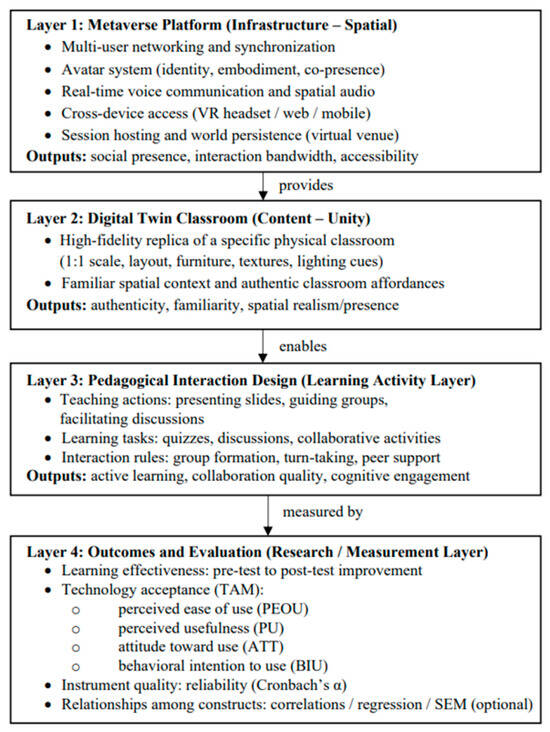
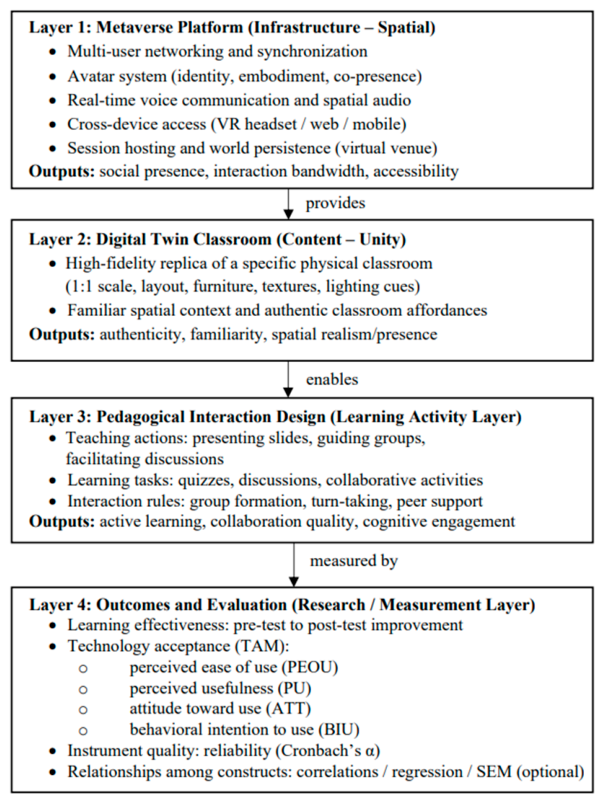
Figure 1 presents the conceptual framework derived from this rationale, organized into four layers. The lowest, the infrastructure layer, provides the essential platform functions: concurrent multi-user access, avatar embodiment, real-time communication, and access from any available device. Above it, the digital twin classroom layer maintains the 1:1 replica of the university room, preserving its layout and teaching affordances. The pedagogical interaction layer above that supplies the teaching moves, the group tasks, and the rules of engagement that pull students into taking part. Crowning the stack is the outcomes-and-evaluation layer, which gathers the pre-test, the post-test, and the validated TAM constructs that gauge short-term learning and acceptance.
Figure 1.
Conceptual framework of the Digital Twin Metaverse Classroom.
From that framework, the study rebuilt an everyday university classroom in virtual form, copying its physical layout and the teaching elements that go with it. The design pulls together three pieces: metaverse infrastructure, a classroom-scale digital twin, and teaching features such as screen sharing and in-class activities. On top of these sits an evaluation layer that tracks short-term learning and acceptance in higher education, and that layer is what lets the study offer early evidence on whether the environment is workable.
To address this gap, the study followed a structured design-and-evaluation procedure when constructing the Digital Twin Metaverse Classroom. The system makes no claim to real-time technical synchronization with the physical room; what it offers is a high-fidelity virtual classroom built to support spatial presence and pedagogical interaction in an immersive higher education setting. Every stage, from 1:1 classroom replication through to metaverse deployment, was tied to an evaluation plan based on pre-test/post-test assessment and TAM constructs. This is what let the study examine quiz performance and student acceptance side by side.
3. Design and Development of Digital Twin Metaverse Classroom
One gap drove the design: too many classroom builds get described but never actually tested. So instead of a generic virtual space, the application copied one real classroom in detail and held onto the teaching functions that count in higher education. The design decisions made for this application are in line with the evaluation framework for the short term, to measure learning as well as acceptance of the application by users.
To realize such an application for a Metaverse Classroom in higher education, an iterative user-centered design approach is developed and tested. It produces an application that corresponds to the experiences of lecturers and students as much as possible. In addition, short-term learning performance and user acceptance of the system can be measured with the help of the evaluation framework. Instructional features were also incorporated, including lecture delivery, slide-based presentation, interactive in-class quizzes, and group discussion, so that the environment could extend the interaction available in conventional video-based online teaching.
Replication began with photographic documentation. High-resolution photographs recorded the room’s dimensions and arrangement, including wall geometry, doors and windows, furniture, and the position of the smartboard. These photographs served as references for 3D models, which were constructed and scaled 1:1 in Autodesk Maya so that proportions and distances corresponded to the original room. A last round of material shaders, surface textures, and lighting finished the look, so the space would read as familiar the instant a student stepped into the metaverse classroom.
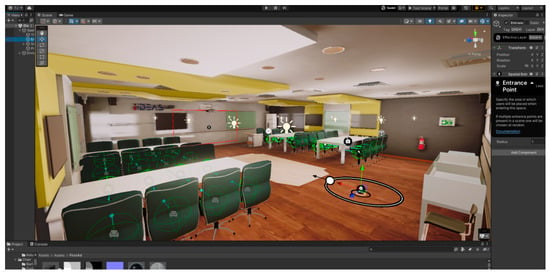
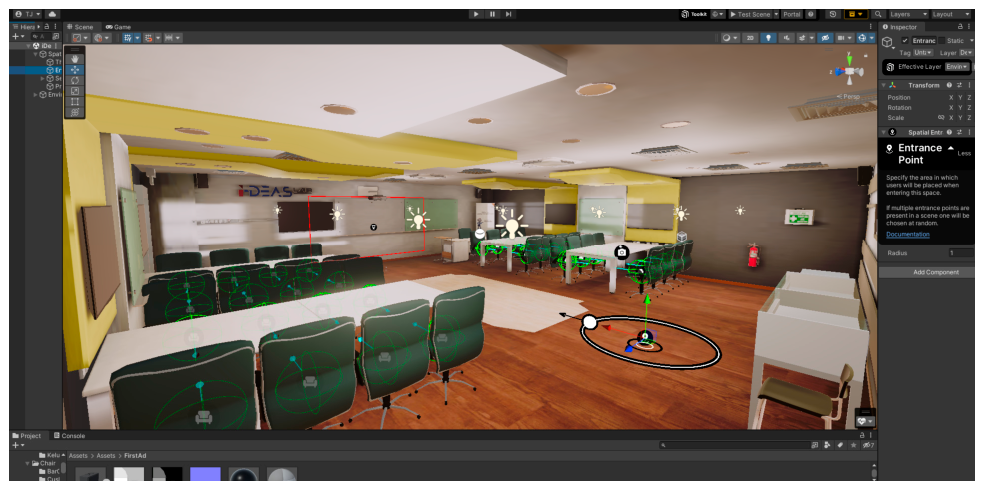
With the environment and its 3D assets finished, everything was brought into the Unity game engine (Figure 2). Lecturers and students showed up as avatars who could roam the room, interact as they drew near one another, and speak in groups over text chat or microphone. Then came the teaching tools. Screen sharing threw slides onto a large digital smartboard, familiar enough from any online class, except that here it sat inside a shared 3D room where the lecturer could just as easily launch a quiz, a short activity, or a discussion. Nearby spaces could be furnished with virtual artifacts and presentation pieces, posters or PDFs, for demonstrations students could examine up close.
Figure 2.
Unity3D (Version: 2021.3.21f1) scene view of the Digital Twin Metaverse Classroom.
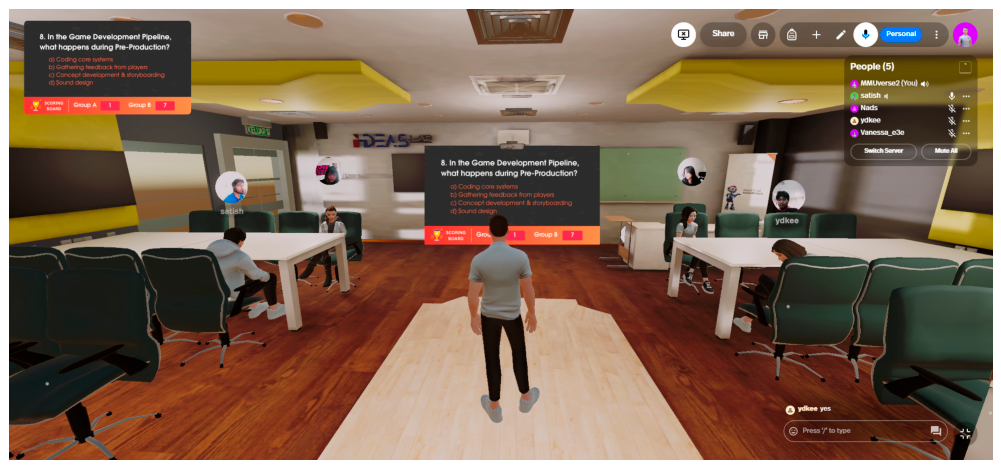
Everything ran on Spatial.io, a ready-made metaverse platform offering multiplayer access, avatar interaction, voice chat, and cross-device support (Li et al. 2024). Leaning on it freed the project to focus on getting the classroom right and shaping how teaching unfolds, rather than constructing a platform from nothing. A VR headset would open the room to fuller immersion, but the evaluation kept deliberately to an ordinary laptop browser, the easier path for the undergraduates taking part. The participants’ consent was obtained before the session began. Figure 3 captures the lecturer presenting while students, as avatars, work in groups, moving, gesturing, and talking over a camera or microphone. The point of these features was to let students feel present, take an active part, and collaborate inside the virtual room.
Figure 3.
Students participating in learning activity.
While the manuscript was being prepared, generative AI tools were used for language editing to refine grammar and wording. Everything of substance, the ideas, the data collection, the analysis and its interpretation, and the conclusions, remain the authors’ own, and they accept full responsibility for what the paper reports.
What follows reports the pilot evaluation, run with undergraduate students. Two instruments did the work: a TAM questionnaire spanning perceived usefulness (PU), perceived ease of use (PEOU), attitude toward use (ATT), and behavioral intention to use (BI) (Davis 1989), and a content knowledge quiz given before and after the session. The aim was to read both how students performed on the quiz in the short term and how they took to the platform as a possible place to learn.
4. Methodology
4.1. Research Design
The design was a single-group pre-test/post-test paired with a cross-sectional technology acceptance survey, and it is reported as a pilot, a feasibility-and-acceptance check rather than a controlled effectiveness trial. Learning was gauged by setting each participant’s quiz score just before a session against their score just after it, both delivered inside the Digital Twin Metaverse Classroom. Acceptance was recorded straight after the session with the Technology Acceptance Model (TAM). With no control or comparison condition in place, the design can speak to within-session change and to student acceptance, but it cannot claim that the immersive environment by itself produced the gains.
4.2. Participants and Recruitment
Thirty-two undergraduates from one higher education institution took part (the site is called “the study institution” here to keep the review double-blind). They were approached one by one around campus and joined voluntarily. Students in the Bachelor of Multimedia (Honors) Virtual Reality program were left out on purpose, since the lesson was an introduction to virtual reality and their prior expertise could have skewed the learning measure. The volunteers formed eight groups of four, which gave eight identical sessions and 32 participants in all. Each gave informed consent before any data were collected. Gender was split evenly (16 men and 16 women), most participants were 18–24 years old (96.9%), and the majority reported only beginner-level prior contact with metaverse environments (see Table 1). Because everyone came from a single institutional setting, the results are best treated as context-specific pilot evidence that may not transfer to learners in other disciplines, institutions, or levels of technological readiness.
Table 1.
Demographic characteristics of participants (N = 32).
4.3. Instructional Procedure
All sessions were conducted on the Spatial.io metaverse platform, accessed through a standard web browser on laptop computers; a virtual reality headset was not required in order to maximize accessibility for participants. The learning content was an introduction to virtual reality (VR). On arrival at the laboratory, each group of four students first signed the consent form, completed a short demographic form, and took the pre-test. A 10 min orientation followed, during which the facilitator introduced the basic controls of the environment, including movement, microphone use, and screen sharing. The instructor then delivered a 20 min lecture introducing VR, after which participants completed the TAM acceptance questionnaire and the post-test. The intended learning objectives were for students to be able to: (1) define VR and identify its four core elements (virtual world, immersion, sensory feedback, and interactivity); (2) differentiate the categories of the reality–virtuality continuum (physical reality, AR, MR, AV, and VR); (3) explain extended reality (XR) as an umbrella term covering AR, MR, and VR; (4) identify common VR and MR devices and real-world VR applications across industries; and (5) outline the stages of the game design and development pipeline. The same instructor and identical learning content were used across all eight sessions to keep delivery consistent.
4.4. Instruments
Two instruments were used: a content knowledge quiz to assess short-term learning, and the TAM questionnaire to assess technology acceptance.
Knowledge quiz. Short-term learning came from a 10-item multiple-choice quiz, marked out of 10 with one point per correct answer. The team wrote the items to map directly onto the stated learning objectives and the lecture, spanning the elements of VR, the reality–virtuality continuum, extended reality, VR devices and applications, and the game development pipeline; this mapping was meant to underpin the quiz’s content validity. The identical items ran at pre-test and post-test, the first before the lecture and the second straight after. Quite a few participants neared full marks at post-test (M = 9.19 out of 10), so a ceiling effect is worth noting, it may have capped how much further gain the instrument could pick up. Appendix A (Table A2 and Part 2) gives the full item-to-objective mapping with each item’s knowledge type (factual, conceptual, or application) and the quiz questions themselves.
Technology acceptance. A 14-item TAM questionnaire captured acceptance, adapted from Davis (1989) and from earlier metaverse and e-learning acceptance work (Al-Adwan et al. 2023; Barz et al. 2024). Its items fell under four constructs, perceived usefulness (PU, 4 items), perceived ease of use (PEOU, 4 items), attitude toward use (ATT, 4 items), and behavioral intention to use (BI, 2 items), each answered on a five-point Likert scale from 1 (strongly disagree) to 5 (strongly agree). Internal consistency ran from acceptable to good across the four (Cronbach’s α = 0.750–0.839; see Table 2), and the full wording sits in Appendix A (Table A1 and Part 1).
Table 2.
Reliability of TAM scales (N = 32).
4.5. Data Analysis
All analyses were performed in IBM SPSS Statistics (Version: 27). Quiz performance was analyzed with a paired-samples t-test comparing pre-test and post-test scores; practical significance was assessed using Cohen’s d, and the instructional gain was summarized with Hake’s normalized gain (g). For the TAM data, internal consistency was examined with Cronbach’s α, construct scores were summarized with means and standard deviations, and associations among constructs were examined with Pearson correlations and their 95% confidence intervals. Consistent with the pilot design, the correlations are interpreted as associations among constructs rather than as evidence of prediction or causal influence.
5. Evaluation Results and Discussion
The system was evaluated with 32 students. The sample had an even gender distribution, with 16 men (50.0%) and 16 women (50.0%). Most participants were aged 18–24 years (n = 31, 96.9%), with one participant aged 25–34 years (3.1%). More than half of the participants were third-year students (53.1%), followed by second-year students (40.6%); one participant was in the first year and one was in the fourth year. At the time of the study, 31 participants (96.9%) were enrolled in a fully on-campus learning mode and one participant (3.1%) was in a hybrid/blended mode. The key demographic characteristics are presented in Table 1.
The sample in Table 1 is a fairly homogeneous one: undergraduates of the usual age who had brushed up against metaverse or virtual world settings only lightly before. Beginner-level metaverse use, a session or two, was the norm (93.8%), so most arrived with little real exposure. About the same proportion (93.8%) had at some point tried non-VR 3D virtual worlds, hinting at a general ease with virtual spaces. Their online learning habits were steadier—75.0% studied online “sometimes,” 21.9% “rarely,” and 3.1% “often.” That profile shapes how to read what follows, since the study is really probing how largely on-campus students who are new to the metaverse respond to the Digital Twin Metaverse Classroom. To begin, each TAM construct, perceived usefulness (PU), perceived ease of use (PEOU), attitude toward use (ATT), and behavioral intention (BI), was tested for internal consistency with Cronbach’s alpha (α), reported in Table 2.
Table 2 shows that all TAM constructs achieved acceptable to good internal consistency. Cronbach’s α ranged from 0.750 for PEOU to 0.839 for ATT. Using the commonly accepted criterion that reliability coefficients of 0.70 or higher indicate acceptable internal consistency and values above 0.80 indicate good reliability (Nunnally and Bernstein 1994), PEOU and BI were acceptable (α = 0.750–0.777), while PU and ATT were good (α = 0.832–0.839). These results indicate that responses to the multiple items within each construct were sufficiently consistent for use in the pilot analysis. After the reliability assessment, short-term learning was examined using the 10-item content knowledge quiz administered before and after the Digital Twin Metaverse Classroom session. Table 3 presents the descriptive statistics for the pre-test and post-test scores.
Table 3.
Descriptive statistics for pre-test and post-test scores (N = 32).
Table 3 shows an increase in quiz performance from pre-test to post-test. The mean pre-test score was 6.41 out of 10 (SD = 1.54), indicating that participants answered approximately 64% of the items correctly before the session. The mean post-test score increased to 9.19 (SD = 0.86), equivalent to approximately 92% correct responses. The minimum score increased from 3 at pre-test to 7 at post-test, and several participants reached the maximum score of 10 at post-test. A paired-samples t-test was used to examine whether the mean difference between pre-test and post-test scores was statistically significant. As shown in Table 4, participants scored an average of 2.78 more correct answers at post-test than at pre-test.
Table 4.
Pre- and post-test comparison with effect size and normalized gain (N = 32).
The paired-samples test in Table 4 comes out significant, t(31) = −8.61, p < 0.001, and the effect is large, Cohen’s d of 1.52, comfortably above the usual 0.80 threshold for a large effect (Cohen 1988). Hake’s normalized gain says much the same in different terms, g = 0.78, which lands in the high band on Hake’s (1998) scale. Read together, they mark a real within-session jump in quiz scores. The usual caution applies. With no control condition, that jump is best taken as something that accompanied the Digital Twin Metaverse Classroom session, not as evidence the immersive environment produced it on its own. Table 5 then reports descriptive statistics for the TAM constructs and Table 6 the Pearson correlations.
Table 5.
Descriptive statistics and reliability for TAM constructs (N = 32).
Table 6.
Pearson correlation matrix for TAM constructs (N = 32).
As Table 5 indicates, all four TAM constructs scored highly on the five-point scale, with means between 4.34 and 4.48. According to Vagias’s (2006) anchors, values above 4.21 may be interpreted as “very high,” indicating positive student perceptions of the Digital Twin Metaverse Classroom. The small standard deviations (SD = 0.42–0.47) further suggest consistency in the responses. Table 6 reports the Pearson correlations among constructs. PU tied closely to ATT (r = 0.84, p < 0.001, 95% CI [0.69, 0.92]) and to BI (r = 0.72, p < 0.001, 95% CI [0.50, 0.85]), and ATT in turn tied to BI (r = 0.68, p < 0.001, 95% CI [0.43, 0.83]). PEOU’s links were looser, with PU (r = 0.48, p < 0.05, 95% CI [0.16, 0.71]), ATT (r = 0.42, p < 0.05, 95% CI [0.08, 0.67]), and BI (r = 0.34, p > 0.05, 95% CI [−0.01, 0.62]); since the PEOU–BI interval crosses zero, that particular association was not significant. Overall, the pattern is consistent with TAM and is strongest among perceived usefulness, attitude, and intention. These are associations, though, not evidence of prediction or causation.
Both halves of the quiz tell one story: scores climbed after the session, and the rise was statistically significant and, in classroom terms, big enough to care about. A Cohen’s d of 1.52 and a normalized gain of 0.78 put real weight behind that short-term improvement. Acceptance leaned the same way, every TAM construct, PU, PEOU, ATT, and BI, averaging high. The shape of it echoes TAM, where perceived usefulness moves together with attitude and intention to use a system (Davis 1989). Kept within a pilot’s limits, then, the undergraduates judged the classroom useful, easy to handle, and worth using again in their studies.
Taken at first glance, the early numbers say the Digital Twin Metaverse Classroom can work in a genuine academic setting. A single session moved scores from pre-test to post-test, and the high TAM averages show students largely found the system useful, easy to use, and fit for learning. That lines up with earlier reports of strong engagement and acceptance in immersive metaverse and VR settings. What this study brings that is its own is the pairing of a direct short-term learning measure with validated TAM constructs inside a classroom-scale digital twin.
Placed against the broader work on videoconferencing and immersive learning, the results back a simple proposition: place-based immersive spaces can work beside synchronous platforms instead of against them. Zoom and Microsoft Teams exist mainly to carry real-time talk. A Digital Twin Metaverse Classroom layers on spatial presence, avatar embodiment, and somewhere to actually work together, which may be part of why engagement and acceptance ran high in the pilot. All the same, this is early days. Calling it better than videoconferencing would take a direct, side-by-side test, and this study ran none.
How far these findings reach depends on how the study was built. With no control or comparison group, there is no way to tell whether the higher quiz scores came from the immersive 3D environment, the lesson content, the instructor’s delivery, seeing the same quiz twice, or some mix of all four. The results should therefore be read with caution, as promising but preliminary evidence of within-session improvement and positive acceptance rather than as conclusive proof that the environment caused the gains.
The absent control group is hardly the only thing worth weighing here. Several other factors could each have pushed the scores up: the novelty of the experience, how motivated the learners were, the instructor’s delivery, any prior familiarity with 3D virtual environments, and the fact that the same quiz content appeared at both pre-test and post-test. The pilot controlled for none of these experimentally, so any one of them may have shaped the observed gains.
Another limitation in this study is the size of the sample. Although 32 undergraduates are adequate for an initial pilot, all came from a single institution, which ties the findings to that context and leaves their applicability to other disciplines, institutions, or levels of technological readiness uncertain. Measurement was also short-term, comprising a pre-test and an immediate post-test, so the study provides no evidence as to whether the learning is retained or yields longer-term benefit.
On balance, the study provides early evidence of two outcomes within a single institution: a short-term improvement in quiz scores and favorable student acceptance. It does not, however, address long-term retention, scalability, or any advantage over videoconferencing or face-to-face teaching.
The appropriate next step is therefore research employing controlled comparisons, larger and more diverse samples, multiple institutions, and longer observation periods. Work of that kind would say much more about whether learning lasts, how acceptance holds up, and how widely Digital Twin Metaverse Classrooms matter for higher education. Even within its narrow pilot scope, though, this study shows the environment to be a workable supplementary place to learn that students responded to well.
One comparison in particular would help: pitting the Digital Twin Metaverse Classroom against face-to-face teaching, videoconferencing, and a standard learning management system, with the content, length, instructor, and assessment held constant. Only then can whatever the immersive setting adds be told apart from the pull of the lesson content itself.
It would also be worth reaching past numbers to qualitative and behavioral evidence, interviews, open-ended responses, watching the class in session, and platform analytics, to see how students actually experience presence, interaction, collaboration, and the snags they hit inside the metaverse classroom.
6. Conclusions
What this study did was design, build, and run a first evaluation of a Digital Twin Metaverse Classroom for higher education. The system rebuilt a real university classroom inside an immersive metaverse, with avatar interaction, spatial audio, virtual presentation tools, and group activities all in place. Across a pilot of 32 undergraduates, one session raised the mean quiz score from 6.41 to 9.19, a statistically significant short-term gain, while TAM scores for perceived usefulness, perceived ease of use, attitude toward use, and behavioral intention all came in high, a sign of solid acceptance. Taken together, the results lend early empirical support to the feasibility and promise of a classroom-scale digital twin, even as the single-group design, the small one-institution sample, the immediate post-test, and the absent comparison group cap how far the conclusions can travel. The most immediate next step is controlled comparison of the environment with face-to-face teaching, videoconferencing, standard learning management systems, and other metaverse-based learning under matched content and assessment. Future analysis of the intervention could include a larger sample, more institutions, a longer time span, and also the use of qualitative or behavioral measures of student engagement in order to test for sustainability of engagement for long-term retention as well as for scalability, long-term adoption and generalization to different fields of study. For the present, the study offers a cautious basis for further investigation of Digital Twin Metaverse Classrooms as supplementary immersive learning environments in post-COVID-19 higher education.
The conclusions presented in this pilot study have several limitations. The single group of participants, a pre-test and post-test design, and the lack of a control group to compare to, only permit registration of changes within a single session and the very positive experiences of students in an immersive environment as presented in this paper. However more work is required to address questions of comparative effectiveness and of long-term learning. This work will be controlled and will be conducted in a number of institutions over a longer period than the pilot.
Author Contributions
Conceptualization, S.-N.C. and C.-O.W.; methodology, S.-J.T.; software, S.-J.T.; validation, S.-J.T., S.-N.C. and C.-O.W.; formal analysis, S.-J.T.; investigation, S.-J.T.; resources, S.-N.C., C.-O.W. and A.H.B.M.; data curation, S.-J.T.; writing—original draft, S.-J.T.; writing—review and editing, S.-N.C. and C.-O.W.; visualization, S.-J.T.; supervision, S.-N.C., C.-O.W. and A.H.B.M.; project administration, S.-N.C.; funding acquisition, A.H.B.M. All authors have read and agreed to the published version of the manuscript.
Funding
This research was funded by Telekom Malaysia Research & Development Sdn. Bhd., grant number RDTC/251158. The APC was funded by Telekom Malaysia Research & Development Sdn. Bhd.
Institutional Review Board Statement
The study was conducted with the approval of the Research Ethics Committee of Multimedia University (protocol code: EA0592026 and approval date: 3 June 2026).
Informed Consent Statement
Informed consent was obtained from all participants prior to data collection in this research.
Data Availability Statement
The survey instrument, orientation protocol, and anonymized analysis materials are available from the main author upon reasonable request. The Digital Twin Metaverse Classroom system assets and Unity/Spatial project files are not publicly available due to institutional/privacy/licensing restrictions.
Acknowledgments
The authors would like to acknowledge the financial support provided by the TM R&D grant, RDTC/251158, which played a vital role in the successful development of the prototype at Multimedia University. Generative AI tools were used to support language editing and clarity during manuscript preparation. The tools assisted only with grammar refinement and stylistic improvements. All ideas, data collection, analysis, interpretation, and conclusions were generated by the authors, who take full responsibility for the content of the manuscript.
Conflicts of Interest
The authors declare no conflicts of interest. The funders played no part in designing the study, in collecting, analyzing, or interpreting the data, in writing the manuscript, or in deciding to publish the results.
Abbreviations
| Abbreviation | Explanation |
| 3D | Three-Dimensional |
| AI | Artificial Intelligence |
| AR | Augmented Reality |
| ATT | Attitude Toward Use |
| AV | Augmented Virtuality |
| BI | Behavioral Intention to Use |
| HMD | Head-Mounted Display |
| IoT | Internet of Things |
| LMS | Learning Management System |
| M | Mean |
| MR | Mixed Reality |
| PEOU | Perceived Ease of Use |
| PU | Perceived Usefulness |
| SD | Standard Deviation |
| TAM | Technology Acceptance Model |
| VR | Virtual Reality |
| XR | Extended Reality |
Appendix A. Questionnaires and Variables
This appendix presents the two instruments used in the study: the Technology Acceptance Model (TAM) acceptance questionnaire and the knowledge quiz. Table A1 summarizes the TAM constructs and their items, Table A2 maps each quiz item to its learning objective and knowledge type, and the full item wording is listed afterwards.
Table A1.
Technology Acceptance Model (TAM) constructs, items, and source.
Table A2.
Knowledge quiz items mapped to learning objectives and knowledge type.
Questionnaire
Part 1. Technology Acceptance Model (TAM) acceptance questionnaire
(rated on a five-point Likert scale: 1 = strongly disagree to 5 = strongly agree).
Demographics
- Age (under 18/18–24/25–34/35–44/45 and above).
- Gender (woman/man/prefer not to say).
- Year of study (first/second/third/fourth year).
- Current learning mode (fully on-campus/fully online/hybrid–blended).
- Prior experience with the metaverse (none/beginner, 1–2 times/some, 3–10 times/frequent, >10 times).
- Frequency of online learning experience (rarely/sometimes/often/very often).
- Prior experience with 3D virtual worlds, non-VR (yes/no).
Perceived Usefulness (PU)
- PU1. Using the Digital Twin Metaverse Classroom improves my performance.
- PU2. Using the Digital Twin Metaverse Classroom in my studies increases my productivity.
- PU3. Using the Digital Twin Metaverse Classroom enhances my effectiveness.
- PU4. I find the Digital Twin Metaverse Classroom useful.
Perceived Ease of Use (PEOU)
- 5.
- PEOU1. My interaction with the Digital Twin Metaverse Classroom is clear and understandable.
- 6.
- PEOU2. Interacting with the Digital Twin Metaverse Classroom does not require a lot of mental effort.
- 7.
- PEOU3. I find the Digital Twin Metaverse Classroom easy to use.
- 8.
- PEOU4. I find it easy to get the Digital Twin Metaverse Classroom to do what I want it to do.
Attitude Toward Use (ATT)
- 9.
- ATT1. I feel that using the Digital Twin Metaverse Classroom is a smart idea.
- 10.
- ATT2. I feel that using the Digital Twin Metaverse Classroom is beneficial.
- 11.
- ATT3. I like using the Digital Twin Metaverse Classroom.
- 12.
- ATT4. I feel that using the Digital Twin Metaverse Classroom is important for me.
Behavioral Intention to Use (BI)
- 13.
- BI1. I intend to use the Digital Twin Metaverse Classroom.
- 14.
- BI2. I predict that I would use the Digital Twin Metaverse Classroom.
Part 2. Knowledge quiz
(10 multiple-choice items; identical items used at pre-test and post-test).
- Which of the following is NOT an element of virtual reality (VR)?
- Virtual world.
- Immersion.
- Sensory feedback.
- Cloud computing.
- What is the main purpose of a “virtual world” in VR?
- To display digital advertisements.
- To create a computer-generated environment that sustains the illusion of presence.
- To simulate physical sensations through haptics.
- To enable real-time data processing.
- Which device is commonly used for mixed reality (MR)?
- Smartphones.
- Meta Quest 2.
- HTC Vive.
- Microsoft HoloLens.
- Pokémon GO is an example of which technology?
- Virtual reality (VR).
- Augmented reality (AR).
- Mixed reality (MR).
- Augmented virtuality (AV).
- In the mixed reality continuum, which option represents the most digital/virtual presence?
- Physical reality.
- Augmented reality (AR).
- Mixed reality (MR).
- Virtual reality (VR).
- Which of the following best describes extended reality (XR)?
- A headset-only version of VR.
- An umbrella term covering AR, MR, and VR.
- A simulation limited to gaming.
- A subset of mixed reality.
- Which element ensures that VR users feel their actions have consequences in the virtual world?
- Immersion.
- Sensory feedback.
- Interactivity.
- Virtual world.
- In the game development pipeline, what happens during pre-production?
- Coding core systems.
- Gathering feedback from players.
- Concept development and storyboarding.
- Sound design.
- Which stage of the game development pipeline focuses on creating 3D models, textures, and animations?
- Level design.
- UI/UX and asset creation.
- Programming and technical implementation.
- Prototyping and marketing.
- What is the main goal of post-production in the game development pipeline?
- Research and storyboarding.
- Build layout for gameplay.
- Gather feedback, refine visuals, and improve user flow.
- Design flowcharts and concept boards.
Correct answers: 1 (d), 2 (b), 3 (d), 4 (b), 5 (d), 6 (b), 7 (c), 8 (c), 9 (b), 10 (c).
References
- Al-Adwan, Ahmad Samed, Na Li, Amer Al-Adwan, Ghazanfar Ali Abbasi, Nour Awni Albelbisi, and Akhmad Habibi. 2023. Extending the Technology Acceptance Model (TAM) to Predict University Students’ Intentions to Use Metaverse-Based Learning Platforms. Education and Information Technologies 28: 15381–413. [Google Scholar] [CrossRef] [Scilit]
- Alhusban, Mohammad Issa, Nael Sarhan, Ibrahim N. Khatatbeh, and Mohannad Obeid Al Shbail. 2024. Exploring how quality dimensions enhance videoconferencing platform benefits from an information systems success perspective. Discover Sustainability 5: 59. [Google Scholar] [CrossRef] [Scilit]
- Barz, Nathalie, Manuela Benick, Laura Dörrenbächer-Ulrich, and Franziska Perels. 2024. Students’ acceptance of e-learning: Extending the technology acceptance model. Discover Education 3: 114. [Google Scholar] [CrossRef] [Scilit]
- Carmi, Golan. 2024. E-Learning using Zoom: A study of students’ attitude and learning effectiveness in higher education. Heliyon 10: E30229. [Google Scholar] [CrossRef] [Scilit] [PubMed]
- Cohen, Jacob. 1988. Statistical Power Analysis for the Behavioral Sciences, 2nd ed. New York: Routledge. [Google Scholar]
- Creswell, John W., and John David Creswell. 2018. Research Design: Qualitative, Quantitative, and Mixed Methods Approaches, 5th ed. Los Angeles: Sage Publications. [Google Scholar]
- Davis, Fred D. 1989. Perceived usefulness, perceived ease of use, and user acceptance of information technology. MIS Quarterly 13: 319–40. [Google Scholar] [CrossRef] [Scilit] [PubMed]
- Fisher, Rosemary, Áron Perényi, and Naomi Birdthistle. 2021. The positive relationship between flipped and blended learning and student engagement, performance and satisfaction. Active Learning in Higher Education 22: 97–113. [Google Scholar]
- Hake, Richard R. 1998. Interactive-engagement versus traditional methods: A six-thousand-student survey of mechanics test data for introductory physics courses. American Journal of Physics 66: 64–74. [Google Scholar]
- Huang, Xi, Hongwei Li, Lirong Huang, and Tao Jiang. 2023. Research on the development and innovation of online education based on digital knowledge sharing community. BMC Psychology 11: 295. [Google Scholar] [CrossRef] [Scilit] [PubMed]
- Hutson, James, Robert Steffes, and Joe Weber. 2023. Virtual learning environments and digital twins: Enhancing accessibility, diversity, and flexibility in training secondary educational administrators. Metaverse 4: 16. [Google Scholar] [CrossRef] [Scilit]
- Kruachottikul, Pravee, Ittipon Yamyuan, Tanakorn Tanmalaporn, Suebphong Noisri, Pruk Sasithong, Panithan Laaiddee, Sorrathan Wongsuwan, Lunchakorn Wuttisittikulki, Kittikul Kovitanggoon, and Gridsada Phanomchoeng. 2025. Immersive learning environment platform: ChulaVerse’s 3D interactive university. Engineering Journal 29: 17–33. [Google Scholar]
- Li, Chen, Yue Jiang, Peter H. F. Ng, Yixin Dai, Francis Cheung, Henry C. B. Chan, and Ping Li. 2024. Collaborative learning in the Edu-Metaverse era: An empirical study on the enabling technologies. IEEE Transactions on Learning Technologies 17: 1107–19. [Google Scholar] [CrossRef] [Scilit]
- Nunnally, Jum C., and Ira H. Bernstein. 1994. Psychometric Theory, 3rd ed. New York: McGraw-Hill. [Google Scholar]
- Pradana, Mahir, and Hanifah Putri Elisa. 2023. Metaverse in education: A systematic literature review. Cogent Social Sciences 9: 2252656. [Google Scholar] [CrossRef] [Scilit]
- Ratan, Rabindra, Qiyang Lin, Chaeyun Lim, Rinseo Park, Alex Lover, Eugy Han, Dayeoun Jang, Alex P. Leith, and Jeremy N. Bailenson. 2025. Time matters in VR: Students benefit from longer VR class duration, but certain outcomes decline after 45 minutes, with large individual variance. Computers & Education 235: 105328. [Google Scholar] [CrossRef] [Scilit]
- Saleh, Abdulrazak, Winchell Alexis Chong Yeng Yong, Mohd Kamal Othman, Mohamad Hardyman Barawi, and Shaziti Aman. 2025. Enhancing student engagement in online learning through a peer-to-peer virtual reality application. International Journal on Studies in Education 7: 585–616. [Google Scholar]
- Vagias, Wade M. 2006. Likert-Type Scale Response Anchors. Clemson: Clemson University. [Google Scholar]
- Xie, Jiayan, Ghayth K. S. Al-Shaibani, Jingli Zhao, and Othman Talib. 2025. The current status and contributing factors of the metaverse adoption in education: A systematic review. Contemporary Educational Technology 17: ep593. [Google Scholar] [CrossRef] [Scilit] [PubMed]
- Yang, Yuhui, Hao Zhang, Jing Yuan, Qingyuan Yang, Yan Jiang, and Lixia Chen. 2025. The construction and application of a metaverse teaching space in the context of online learning. International Journal of Computer Games Technology 2025: 6727895. [Google Scholar] [CrossRef] [Scilit]

Disclaimer/Publisher’s Note: The statements, opinions and data contained in all publications are solely those of the individual author(s) and contributor(s) and not of MDPI and/or the editor(s). MDPI and/or the editor(s) disclaim responsibility for any injury to people or property resulting from any ideas, methods, instructions or products referred to in the content. |
© 2026 by the authors. Licensee MDPI, Basel, Switzerland. This article is an open access article distributed under the terms and conditions of the Creative Commons Attribution (CC BY) license.