


Abstract
Zoomafia is frequently invoked in Italian public, advocacy, and institutional discourse to describe profit-oriented animal-related crime, but the term remains analytically broad and insufficiently connected to criminological theory. This narrative criminological review examines zoomafia as a cautious social-scientific lens for studying organized animal-related crime across heterogeneous illicit markets. Keyword-driven searches in Scopus, Web of Science, PubMed, and targeted criminological, legal, policy, and institutional sources were complemented by citation tracking and qualitative source selection. Peer-reviewed scholarship forms the analytical core, while legal, institutional, and advocacy materials are used selectively and with explicit evidentiary limits. Findings suggest that organized animal-related crime is best understood through market governance, brokerage, legal-illegal interface management, digital mediation, logistics, facilitation, evidentiary visibility, and variable convergence with other illicit economies, rather than through generic offence labels alone. The Italian perspective is analytically useful because companion-animal trafficking, dog fighting and betting circuits, clandestine horse racing, illicit slaughtering, wildlife trafficking, and online-facilitated trade can be compared within a shared frame that also exposes the limits of rhetorical mafia labelling. The article argues that zoomafia should not be treated as a self-proving mafia label, a new legal category, or a synonym for wildlife trafficking, but as a comparative framework for identifying organizational features, enforcement constraints, and evidentiary thresholds. The evidence base remains stronger on strategic recommendations than on robust comparative evaluation of enforcement effectiveness.
1. Introduction
Animal-related crime has become a growing concern in criminology, organized crime studies, green and conservation criminology, legal scholarship, veterinary public health, and enforcement-oriented research. These studies, however, remain only partly integrated. Organized crime scholarship has emphasized governance, brokerage, market control, and criminal embeddedness (Catino 2020; Calderoni et al. 2016), whereas wildlife trafficking research has often focused on conservation harms, trafficking routes, species protection, and enforcement deficits (Wyatt et al. 2020; Wyatt 2022). As a result, animal-related offending is still frequently discussed through parallel vocabularies, especially when analysis moves beyond wildlife trafficking to include companion-animal markets, fighting circuits, clandestine betting, clandestine slaughtering, and other profit-oriented activities involving animals (Moreto and van Uhm 2021; Pires et al. 2016).
The Italian term zoomafia makes this analytical fragmentation particularly visible. In public, advocacy, and institutional discourse, the term has been used to group diverse animal-related illicit activities, including puppy trafficking, clandestine racing and betting circuits, dog fighting, clandestine slaughtering, and wildlife trafficking (Troiano 2019, 2024). This breadth gives the term communicative power, but it also creates analytical risk. Advocacy estimates of annual turnover and market size, including figures for puppy trafficking and clandestine slaughtering, should be interpreted with caution because they aggregate heterogeneous conduct and do not by themselves establish judicially proven proceeds, organized-crime involvement, or mafia-type organization (Troiano 2024). They are nevertheless criminologically relevant when used as contextual indicators of recurrence, market opportunity, and enforcement concern rather than as stand-alone proof.
The scholarly value of zoomafia therefore depends on translating the label into analytical dimensions that can be compared, limited, and tested. Used in this sense, zoomafia does not add a new offence category and should not be treated as a self-proving mafia concept or a synonym for wildlife trafficking. It is more useful as a cautious framework for examining recurrent profit-oriented animal-related markets through market governance, brokerage, facilitation, continuity of exchange, legal-illegal interface management, digital mediation, logistics, evidentiary visibility, and variable convergence with other illicit economies. This distinction can improve prevention and enforcement by helping analysts separate isolated animal-related offences from markets that depend on repeated intermediaries, transport routines, documents, digital traces, payment channels, local protection, or other forms of facilitation.
Against this background, the present article develops a narrative criminological review of zoomafia as organized animal-related crime, with an Italian perspective and with attention to criminalistics and investigative implications. The guiding review question is: how do animal-related illicit markets vary in organizational form, brokerage dependence, market governance, legal-illegal interface management, convergence with other criminal activities, and evidentiary visibility? Its contribution is to reframe zoomafia as a cautious social-scientific and criminological framework capable of comparing heterogeneous offence clusters without assuming mafia-type organization in advance. Italy is used as a critical illustrative context rather than as an exceptional or uniquely representative case because the term originated and circulates strongly in Italian discourse, while the Italian setting allows diverse offence clusters, legal thresholds, public-health concerns, mafia-type risk indicators, and investigative constraints to be examined within a common frame. To clarify the analytical vocabulary used before describing the review approach, the conceptual boundaries are summarized in Figure 1, and the working definitions adopted throughout the review are provided in Box 1.
Figure 1.
Conceptual boundaries between animal-related crime, organized animal-related crime, wildlife trafficking, zoomafia, and mafia-type relevance. Note. The categories are analytical rather than mutually exclusive legal categories. Zoomafia is treated as a cautious comparative lens, while mafia-type relevance requires case-specific empirical and legal demonstration.
Box 1. Working definitions.
| Term | Working Definition |
| Animal-related crime | A broad category including illegal or harmful conduct involving animals, such as cruelty, neglect, illegal killing, trafficking, illicit trade, welfare violations, poaching, unauthorized slaughtering, or unlawful possession. It does not by itself imply market organization or organized-crime involvement. |
| Organized animal-related crime | A narrower analytical domain within animal-related crime in which offending shows recurrence, coordination, role differentiation, facilitation, market continuity, repeated transactions, or stable interfaces with transport, digital, documentary, financial, or local enabling infrastructures. |
| Zoomafia | A cautious criminological lens, derived from Italian public and institutional discourse, for analysing recurrent profit-oriented animal-related illicit markets through organizational form, market governance, brokerage, facilitation, legal-illegal interfaces, convergence, and evidentiary visibility. It is not a new offence category and is not a self-proving mafia label. |
| Functionally organized market | A market configuration capable of sustaining recurrent illicit exchange through repeated roles, brokerage, logistics, digital mediation, documentary practices, payment interfaces, or local facilitators, even where centralized hierarchy or durable organizational closure is not demonstrated. |
| Mafia-type relevance | A case-specific analytical and legal-risk threshold referring to indicators such as intimidation, coercive regulation, territorial mediation, embedded criminal milieus, collusion, protection, or durable integration with mafia-type organizations. It must be demonstrated empirically and cannot be inferred from the word zoomafia alone. |
| Brokerage/facilitation | The connecting functions through which actors link suppliers, breeders, poachers, transporters, document providers, online sellers, buyers, payment channels, commercial fronts, or local venues, thereby transforming fragmented transactions into reproducible exchange. |
| Legal-illegal interface | The operational boundary at which licit infrastructures, documentation, permits, commercial channels, transport systems, online platforms, veterinary procedures, or payment services are used, misused, or manipulated to conceal or normalize illicit animal-related exchange. |
2. Search Strategy and Review Approach
This article was designed as a narrative criminological review aimed at developing an integrated interpretation of zoomafia as organized animal-related crime, with specific attention to the Italian context and, where relevant, to investigative and criminalistics implications. A narrative design was appropriate because the topic spans heterogeneous and only partly connected studies, including organized crime studies, criminology, green and conservation criminology, legal scholarship, policing and criminal justice research, veterinary public health, and work on online markets. These studies differ in aims, methods, evidentiary standards, and vocabularies. The objective was therefore not exhaustive systematic mapping or quantitative synthesis, but a structured critical account of a fragmented field through analytical comparison across overlapping bodies of evidence.
2.1. Data Sources and Search Process
The literature search used major bibliographic databases (Scopus, Web of Science, and PubMed) and targeted searches in additional criminological, legal, criminal justice, veterinary public health, and policy sources where relevant. This database-led strategy was intended to provide a transparent entry point into a dispersed literature, not to imply that indexed sources exhaust the field. Because relevant scholarship also circulates through national debates, specialist outlets, policy materials, institutional reports, and less-visible publication channels, backward and forward citation tracking and supplementary targeted searches were used to reduce avoidable omissions. Searches were iterative, with strings refined after preliminary screening, and were last updated on 1 March 2026. During revision, targeted source checks were also conducted for reviewer-requested factual points concerning Bonelli’s eagle in Sicily, the Bio-Crime model, and international enforcement frameworks; these checks were used for factual verification and did not convert the article into a systematic or scoping review.
2.2. Search Terms
Searches were performed primarily in English, with selected Italian terms included to capture Italian-context contributions. English terms included zoomafia, organized animal-related crime, animal trafficking, wildlife trafficking; pet trade, illegal animal markets, animal cruelty networks, illicit breeding; organized crime, criminal networks, brokerage, facilitators, crime convergence, laundering through licit markets, online animal trade, social-media trade, dark web, investigation, forensic and criminalistics implications, and enforcement and regulatory responses. Italian terms included zoomafia, traffico di cuccioli, traffico di animali, combattimenti tra animali, corse clandestine, macellazione clandestina, traffico di specie protette, bracconaggio, and reati contro gli animali. Database-specific indexing systems were used where available, and terminology was adapted across criminology, law, public health, and animal welfare-oriented studies. Despite this effort, the search may still underrepresent work published outside dominant indexing systems or in languages other than English and Italian (Goyes and South 2017).
2.3. Eligibility Criteria and Source Selection
Sources were selected qualitatively on the basis of thematic relevance to the aims of the review; direct analytical contribution to understanding zoomafia and organized animal-related crime; methodological soundness where empirical evidence was presented; and conceptual usefulness for integrating criminological interpretation with enforcement-relevant and evidentiary implications. Particular attention was given to sources addressing organizational form, brokerage, facilitation, legal-illegal interfaces, market dynamics, digital mediation, crime convergence, investigative visibility, and criminalistics. Consistent with a narrative design, peer-reviewed empirical and conceptual studies formed the analytical core, while legal, regulatory, and policy materials were used where necessary to reconstruct the Italian, European, and international institutional context.
Grey literature, advocacy reports, and institutional reports were included selectively when they provided context or information not reasonably available in peer-reviewed sources, especially in relation to the Italian setting. Their interpretive limits were made explicit. Advocacy or institutional materials were not used as stand-alone proof of organized-crime involvement, mafia-type organization, judicially proven criminal proceeds, or national prevalence. Instead, they were used to identify recurrent offence clusters, policy concerns, monitoring categories, and enforcement issues that were then interpreted in light of peer-reviewed criminological, legal, and criminalistics literature. Source types and evidentiary weighting are summarized in Supplementary Table S2.
2.4. Analytical Synthesis
The selected literature was synthesized thematically through iterative clustering and critical comparison across heterogeneous sources. Synthesis focused on recurrent mechanisms and structures rather than on single-case narratives and was organized around five analytical dimensions: (1) organizational models and division of labor; (2) brokerage, facilitators, and governance of illicit transactions; (3) interfaces between licit and illicit markets, including documentary laundering and regulatory arbitrage; (4) the role of digital environments in enabling trade, recruitment, and concealment; and (5) investigative visibility, detection constraints, and criminalistics implications. Where the evidence base was uneven or context-dependent, this was treated as a substantive finding and returned to in the limitations, discussion, and research gaps.
2.5. Methodological Positioning and Reporting
No meta-analytic procedures were applied, and the manuscript should be read as a narrative Review with explicit search and source-selection procedures rather than as a systematic or scoping review. Accordingly, no PRISMA-style flow diagram, formal screening count, or study-count synthesis is provided. Adding such elements would risk overstating the reproducibility and exhaustiveness of the search design. Reporting was instead guided by narrative-review principles: clarity of aim, transparent description of search and selection, structured presentation of evidence, explicit source weighting, and discussion of interpretive constraints. No new unpublished empirical data are presented in this article; quantitative examples are used only as selective empirical anchors drawn from published or official sources.
3. Framing Zoomafia in Criminology
A criminological framing of zoomafia requires separating rhetorical aggregation from analytical use. Public, media, and policy discourse often place highly heterogeneous conduct under the same label, ranging from cruelty and neglect to trafficking and structured illicit trade. This aggregation has limited explanatory value unless the term is translated into dimensions that can be compared across markets. Used analytically, zoomafia does not add a new offence category; it offers a comparative lens for examining animal-related illicit markets through market governance, organizational form, brokerage, facilitation, legal-illegal interface management, and adaptive responses to control efforts (Catino 2020; Wyatt et al. 2020; Moreto and van Uhm 2021; Roth 2017).
This distinction clarifies that zoomafia is neither a synonym for wildlife trafficking nor a shortcut for proving mafia-type association. Wildlife trafficking remains a major and well-studied component of organized animal-related crime (Reuter and O’Regan 2017; Moreto and van Uhm 2021; Wyatt 2022; Staiano 2020), but the Italian use of zoomafia points to a broader set of animal-related illicit markets that differ in scale, logistics, organization, and relation to legal infrastructures. Some segments display stable facilitation, cross-border brokerage, and financial interfaces (Reuter and O’Regan 2017; Moreto and van Uhm 2021; Lupton 2023; Viollaz et al. 2018), whereas others are better understood as fragmented entrepreneurial chains with weaker coordination and lower institutional penetration (Pires et al. 2016; Costa et al. 2023; Nijman et al. 2022; Lavorgna 2015). The key question is therefore not whether animal-related crime is organized in the abstract, but what form and degree of organization are present in a given market segment.
In this review, zoomafia is treated as a heuristic lens at the intersection of organized crime studies, green and conservation criminology, and illicit market analysis. It draws on scholarship concerning exploitation, opportunity structures, facilitation, regulatory response, logistics, and cross-market interaction (Carpio-Domínguez et al. 2023; McCarthy-Jones 2018; Moreto and van Uhm 2021; Michael 2022; McCarthy-Jones and Turner 2024; Wyatt 2022; Kahler et al. 2019). Its added value lies in directing attention to organization, brokerage, market governance, social embeddedness, and convergence while reserving stronger claims about mafia-type association, criminal governance, or structural integration for case-specific demonstration. In the Italian context, this caution is essential because the mafia label carries both criminological and legal significance, and Italian organized crime scholarship has long emphasized collusion, grey-zone facilitation, and market infiltration as empirically variable rather than automatically inferable features (Sergi 2019; Moro and Catino 2016; Dagnes et al. 2020; Allum et al. 2019).
4. Organizational Structures and Criminal Network Dynamics
Animal-related illicit markets do not operate through a single organizational model. A criminological analysis of zoomafia should therefore focus less on fixed group labels and more on how coordination is achieved across recurrent activities. Organized crime scholarship has shown that criminal enterprises may combine hierarchy, brokerage, specialization, and situational collaboration in variable proportions (Mastrobuoni and Patacchini 2012; McCarthy-Jones et al. 2020; Catino 2014, 2020). This is particularly relevant in animal-related crime, where market operations may be distributed across actors responsible for sourcing, breeding or extraction, aggregation, transport, documentation, brokerage, sale, and payment handling without necessarily being incorporated into a single centralized organization (Costa 2022; Wyatt et al. 2020; Reuter and O’Regan 2017; Moreto and van Uhm 2021).
A network-oriented perspective is especially useful here because it captures operational capacity through relational structure rather than nominal identity. Research on criminal and mafia-like networks shows that brokerage positions, community structure, multiplex ties, and relational density may explain continuity, resilience, and adaptability more effectively than formal hierarchy alone (Calderoni et al. 2017; Calderoni and Piccardi 2014; Calderoni et al. 2026; Malm et al. 2010). In animal-related illicit markets, these asymmetries shape access to routes, clients, logistics, concealment opportunities, and legal interfaces, and therefore influence both market continuity and vulnerability to disruption (Costa 2022; Moreto and van Uhm 2021; Costa et al. 2023; Viollaz et al. 2018). This is evident in markets that depend on repeated handovers, transport routines, intermediaries, and documentary cover, where continuity often depends less on visible leadership than on connecting functions.
The literature on wildlife trafficking and illegal animal trade supports a differentiated view of organization. Rather than assuming that all trafficking is controlled by highly structured transnational groups, several studies distinguish between organized crime in the strict sense and markets that are operationally organized but structurally less consolidated (Wyatt et al. 2020; Moreto and van Uhm 2021; Pires et al. 2016; Costa et al. 2023). In this review, an organized market refers to a configuration marked by relatively stable brokerage, recurring intermediaries, durable facilitative interfaces, and continuity over time. A functionally organized market is one capable of sustaining recurrent illicit exchange without the same degree of centralization, long-term integration, or structural closure. Some configurations display stable brokerage, recurrent intermediaries, and durable cross-border connections (Reuter and O’Regan 2017; Stiles 2022; van Uhm 2019; Alonso and van Uhm 2023), whereas others rely on more opportunistic chains marked by lower centralization, weaker long-term coordination, and greater modularity (Pires et al. 2016; Costa et al. 2023; Nijman et al. 2022; Lavorgna 2015).
Brokerage is one of the most recurrent organizational features across these markets. Criminal network research has shown that brokers may exercise strategic influence without formal leadership because they connect otherwise separate segments of a network and enable continuity of exchange (Calderoni et al. 2017; McCarthy-Jones 2018; Calderoni et al. 2026; Malm et al. 2010). In animal-related crime, brokerage may involve linking breeders or suppliers to transport channels, connecting sellers to digital demand, mediating between illicit actors and legal infrastructures such as shipping or documentation, or facilitating access to commercial cover (Costa 2017, 2022; Reuter and O’Regan 2017; Costa et al. 2023). The broker is often the point at which fragmented transactions become a reproducible market.
Trust and social embeddedness also matter, but they should be understood as organizational resources rather than as alternatives to market logic. Illicit cooperation may be supported by kinship, territorial proximity, repeated interaction, reputational mechanisms, or shared criminal milieus (Calderoni et al. 2026; Malm et al. 2010), yet these forms of embeddedness often coexist with opportunistic exchange and role specialization (Catino 2014; Manzi 2025). In animal-related crime, this coexistence is particularly visible where locally embedded actors interact with mobile intermediaries, digital sellers, or cross-border facilitators (Costa et al. 2023; Nijman et al. 2022; Lavorgna 2015; Xu et al. 2020). This pattern is especially relevant in offence clusters such as dog fighting, clandestine horse racing, or other event-based and betting-related contexts.
Adaptation under enforcement pressure is another central organizational dynamic. Interventions may fragment visible ties without removing the functions that sustain a market, especially when brokerage, demand channels, transport routines, or facilitative interfaces remain available (Calderoni and Piccardi 2014; Calderoni et al. 2026; Sergi and Storti 2020; Manzi 2025). Comparable dynamics are reported in animal-related illicit markets, where arrests or seizures may disrupt specific transactions while leaving networks capable of replacement, rerouting, platform migration, or reorganization (Moreto and van Uhm 2021; Costa et al. 2023; Nijman et al. 2022; Assou et al. 2025). Organizational assessment should therefore not rely only on actor counts or single enforcement outcomes, but also on the persistence of functions that reproduce market activity over time.
5. Markets, Modus Operandi, and Crime Convergence in Animal-Related Crime
A market-oriented perspective is useful because it shifts attention from nominal offence categories to the practical sequences through which animal-related illicit activity is sustained. Across market segments, continuity usually depends on recurring combinations of sourcing or breeding, aggregation, transport, brokerage, sale, and profit extraction, but the organization of these phases varies considerably across commodities, routes, and jurisdictions (Wyatt et al. 2020; Reuter and O’Regan 2017; Moreto and van Uhm 2021; Pires et al. 2016). The same broad market category may therefore include both fragmented entrepreneurial chains and more structured arrangements involving specialized intermediaries, durable facilitation, and repeated access to legal infrastructures (Reuter and O’Regan 2017; Moreto and van Uhm 2021; Stiles 2022; Arivazhagan et al. 2025).
One recurrent pattern is supply chain fragmentation. In many animal-related illicit markets, different actors control different stages of the transaction, with local suppliers or extractors linked to aggregators, transporters, document brokers, and destination sellers through repeated but not always centralized relationships (Costa 2022; Reuter and O’Regan 2017; Stiles 2022; Arivazhagan et al. 2025). Fragmentation may reduce individual exposure and complicate attribution, but it also creates trace-producing points, including handovers, storage phases, transport transitions, payment interfaces, and documentation steps. Crime script approaches are especially useful in this context because they help identify the sequence of actions, decision points, and enabling conditions that make illicit exchange operationally reproducible over time (Skidmore 2021; Viollaz et al. 2018).
A second recurrent feature is the blending of legal and illegal infrastructures. Animal-related illicit markets often rely on ordinary transport systems, commercial channels, and administrative procedures that can be repurposed to conceal illicit flows or normalize suspicious transactions (Reuter and O’Regan 2017; Arivazhagan et al. 2025; Sergi et al. 2021; Alonso and van Uhm 2023). Studies on ports, transport security, and organized crime in logistics environments are therefore relevant even when they are not animal-specific, because they show how licit infrastructures can become facilitative settings for concealment, transit, brokerage, and selective visibility management (Sergi and Storti 2020; Sergi et al. 2021; Antonelli 2021; Antonelli and Vannucci 2025).
Digital mediation has become another central component of modus operandi. Research on online wildlife trade and companion-animal trafficking shows that social media and online marketplaces may be used not only for advertising, but also for signaling availability, screening buyers, expanding audiences, and redistributing risk across multiple channels (Davies et al. 2022b; Lavorgna 2015; Xu et al. 2020; Assou et al. 2025). These studies further indicate that offenders adapt to moderation by shifting platforms, modifying language, using coded listings, or moving transactions into less visible communication spaces (Nijman et al. 2022; Padang et al. 2025; Xu et al. 2020; Assou et al. 2025). For criminological and investigative purposes, the digital layer should therefore be treated as enabling infrastructure linked to offline logistics, payments, and brokerage rather than as a self-contained market.
Concealment strategies frequently depend on the manipulation of provenance, classification, or legality status. In wildlife-related domains, this may include false declarations, misuse of permits, mislabeling, mixing legal and illegal specimens, and documentary laundering designed to create administrative plausibility (Prisner-Levyne 2022; van Uhm 2019; Staiano 2020; Ivory 2017). Comparable dynamics may also arise in companion-animal and mixed animal markets when apparently legitimate channels are used to obscure illicit breeding, transport, or sale (Lavorgna 2015; Xu et al. 2020; Davies et al. 2022a; Assou et al. 2025). These practices show that documentation, classification, and regulatory ambiguity are not merely ancillary aspects of offending but operational tools through which illicit exchange is stabilized and shielded from scrutiny.
Crime convergence is most visible at the level of infrastructure and facilitation. The literature identifies recurring overlaps between animal-related crime and other illicit activities through shared routes, corrupt gatekeepers, document fraud capacities, and laundering mechanisms (Reuter and O’Regan 2017; Moreto and van Uhm 2021; Anagnostou 2021; Lupton 2023). At the same time, convergence is not uniform. In some settings, animal-related crime appears integrated into broader criminal portfolios with access to established logistics, financial channels, or protective resources (Stiles 2022; Alonso and van Uhm 2023; Staiano 2020), whereas in others the overlap is more limited and functional, based on borrowed services or temporary interfaces rather than stable organizational integration (Wyatt et al. 2020; Pires et al. 2016; Costa et al. 2023; Nijman et al. 2022). Treating convergence as a variable improves both market analysis and threat assessment, because it helps distinguish structural interdependence from opportunistic coexistence.
Financial flows are a further operational dimension that remains underexamined in many descriptive accounts. Work on wildlife trafficking and illicit finance emphasizes that market continuity depends not only on commodity movement, but also on payment channels, laundering opportunities, and profit conversion (Lupton 2023; Viollaz et al. 2018; Mniwasa 2022; Terenghi 2022). This aligns with broader organized crime research, which shows that financial interfaces may reveal continuity, facilitation, and diversification more reliably than isolated seizures or arrests (Antinori 2018; Fazekas et al. 2022). In animal-related crime, a financial lens is especially useful where transactions are dispersed, low-visibility, or embedded in apparently ordinary commercial activity, because payment systems may reveal continuity that is not easily visible at the level of single consignments or single actors.
The role of violence also varies across market segments and should not be generalized. Some animal-related illicit markets depend primarily on concealment, brokerage, documentation, and regulatory evasion, whereas others involve explicit coercion, intimidation, or violent enforcement of local control, especially where betting circuits, territorial competition, or reputational power are implicated (Catino 2020; Barnes 2022; Berg and Carranza 2018; Catino and Moro 2018). This variation matters analytically because it affects both classification and investigative expectations: markets organized through intimidation and local mediation do not generate the same trace patterns, witness dynamics, or disruption levers as markets organized through brokerage, transport, and documentary manipulation.
Supplementary Table S1 translates these recurrent market configurations into facilitation mechanisms, trace-producing points, enforcement challenges, priority response levers, and evidentiary corroboration needs. It is not intended as an offence-cluster classification, but as a cross-cutting operational matrix showing how the same analytical lens can be applied beyond the Italian examples.
6. The Italian Perspective: Main Offence Clusters, Mafia-Type Risks, and Enforcement Implications
In Italy, the field commonly described as zoomafia may include, with variable territorial distribution and evidentiary intensity, companion-animal trafficking, illicit breeding and sale circuits, dog fighting, clandestine horse racing and betting, clandestine slaughtering, poaching, and wildlife or exotic-species trafficking (Troiano 2019, 2024). Italy is not used here as an exceptional or uniquely representative model of animal-related crime. Its value is analytical: the term zoomafia originated and circulates strongly in Italian public, advocacy, and institutional discourse, while the Italian context allows multiple offence clusters to be examined within one criminological frame.
This Italian perspective is useful because it makes visible the tension between rhetorical mafia labels and empirically demonstrable mafia-type relevance. Some offence clusters may involve local embeddedness, intimidation, territorial mediation, or repeated facilitation; others are better reconstructed through cross-border transport, online intermediation, document manipulation, commercial cover, payment traces, or specialist identification. The central issue is therefore not whether animal-related crime is mafia-like in the abstract, but under which empirical conditions a given market segment shows indicators of embedded criminal milieus, repeated facilitation, coercive regulation, collusion, or durable integration with broader illicit economies (Wyatt et al. 2020; Pires et al. 2016; Costa et al. 2023; Catino and Moro 2018; Calderoni et al. 2016; Moro and Catino 2016; Allum et al. 2019).
From a legal and institutional perspective, this field is addressed through a combination of animal-protection offences and broader organized-crime and wildlife-trade instruments, including Law 20 July 2004 No. 189, Law 4 November 2010 No. 201, Legislative Decree 6 September 2011 No. 159, Law 6 June 2025 No. 82, Law 7 February 1992 No. 150, and Council Regulation (EC) No. 338/97 (Law 20 July 2004 No. 189 2004; Law 4 November 2010 No. 201 2010; Legislative Decree 6 September 2011 No. 159 2011; Law 6 June 2025 No. 82 2025; Law 7 February 1992 No. 150 1992; Council Regulation (EC) No. 338/97 1996). Law 6 June 2025 No. 82 strengthens the Italian legal framework on offences against animals and reinforces the importance of distinguishing legal thresholds from criminological labels. Law 7 February 1992 No. 150 implements the Convention on International Trade in Endangered Species of Wild Fauna and Flora (CITES) framework domestically, while Council Regulation (EC) No. 338/97 is the core EU instrument regulating trade in wild fauna and flora.
Table 1 summarizes the main offence clusters through which organized animal-related crime may operate in Italy, highlighting market logic, facilitation mechanisms, organizational patterns, possible mafia-type relevance, selected empirical indicators, and investigative implications. Read comparatively, these clusters do not present the same criminological risk profile. Dog fighting, clandestine horse racing and betting circuits, and some clandestine slaughtering contexts are more likely to raise questions of territorial mediation, intimidation, repeated local facilitation, or embedded criminal milieus (Catino and Moro 2018; Calderoni et al. 2016; Moro and Catino 2016; Allum et al. 2019). By contrast, companion-animal trafficking and wildlife or exotic-species trafficking more often make organization visible through brokerage, transport routines, documentary manipulation, online intermediation, and cross-border logistics (Reuter and O’Regan 2017; Arivazhagan et al. 2025; Lavorgna 2015; Xu et al. 2020; Staiano 2020).
Table 1.
Main offence clusters of organized animal-related crime in Italy: market logic, organizational features, empirical indicators, and investigative implications.
The empirical-indicator column should be read as a set of selective anchors rather than a comprehensive measurement of national scale. Some indicators come from peer-reviewed studies or conservation monitoring, while other fields remain dependent on case files, advocacy monitoring, inspection data, or local enforcement information. This unevenness is analytically important: it shows why zoomafia should not be used as a shortcut for claims about scale or mafia-type organization. Table 1 should therefore be read together with Supplementary Table S1: the former summarizes the main Italian offence clusters, whereas the latter reorganizes the same problem through operational configurations, facilitation mechanisms, trace-producing points, enforcement challenges, response levers, and evidentiary priorities. Together, Table 1 and Supplementary Table S1 support the article’s central claim that zoomafia is most useful as an analytical and investigative matrix, not as a generic label.
Three brief Italian examples ground the comparative framework without shifting the article toward a case-study design. They were selected because each illustrates a different mechanism by which animal-related markets become organized or functionally organized: recurrent wildlife extraction, digital market access, and cross-border companion-animal logistics.
First, wildlife trafficking in Sicily illustrates how apparently localized offending may depend on repeated harvesting practices, specialized facilitation, and sustained demand. Di Vittorio et al. (2018) report that an illegal trade ring involving birds of prey was uncovered in Sicily in 2010, that young birds and eggs were taken from nests, that at least nine Bonelli’s eagle breeding sites had been subjected to continuous illegal harvest, and that law-enforcement activity led to the confiscation of raptors, including nine Bonelli’s eagles. The same study notes that the Sicilian population represented nearly 95% of the Italian population and that the species was classified as Critically Endangered in Italy. This example is therefore not presented as proof of a mafia-type market, but as evidence of recurrent extraction, handling, concealment, and onward circulation that generated identifiable conservation and enforcement consequences. The main evidentiary limits are that some enforcement details are derived from unpublished law-enforcement data cited by the study and that the case does not by itself measure the broader national scale of wildlife trafficking.
Second, the online aquarium trade in Italy illustrates how digital infrastructures can expand animal markets without requiring rigid hierarchical organization. Mazza et al. (2015) examined 54 online aquarium shops in Italy and showed that internet-based sales channels can facilitate the circulation of non-native and potentially invasive species, widen market access, and complicate monitoring by dispersing transactions across low-visibility digital environments. This example does not imply that all online aquarium trade is illegal. Its relevance is mechanistic: online availability, delivery arrangements, and weakly visible exchanges may create conditions that support functionally organized market activity when legal, regulatory, or provenance controls are insufficient.
Third, the illegal importation of companion animals into North-Eastern Italy, and the Bio-Crime model developed in response to it, illustrates the cross-border and hybrid nature of some zoomafia-related markets. The Bio-Crime model is an integrated cross-border cooperation framework linking veterinary public health, justice, law enforcement, customs, and international police/customs cooperation structures to address illegal animal trade and related zoonotic risks (Zucca et al. 2020). Cocchi et al. (2021) provide a published empirical anchor: from January 2018 to December 2020, they examined 613 puppies and 62 kittens from 44 requisitions at the north-eastern Italian border, testing confiscated animals for infectious, zoonotic, and welfare-relevant conditions. This example shows that companion-animal trafficking may be organized in functional terms through brokers, transport routines, fraudulent documentation, quarantine procedures, and online/offline coordination, even where classic mafia governance is not demonstrated.
7. Criminalistics and Investigative Implications
From a criminalistics perspective, the key issue is how an organization becomes evidentially visible through recurring transactions, infrastructures, communications, documents, payments, and material traces. In organized animal-related crime, investigative value often lies not in the isolated offence event alone, but in evidentiary sequencing: the progressive integration of digital, logistical, documentary, financial, and biological traces into a coherent pathway capable of supporting attribution, corroboration, and probative assessment (Wyatt et al. 2020; Moreto and van Uhm 2021; Pires et al. 2016; Skidmore 2021; Lupton 2023; Viollaz et al. 2018; Lavorgna 2015; Kanthaswamy 2024). This shifts attention from commodity-centered detection to trace-centered reconstruction and links criminological interpretation to case-building logic.
This distinction matters because similar commodities may appear in very different criminal settings, each requiring different evidentiary priorities and investigative sequencing (Moreto and van Uhm 2021; Pires et al. 2016; Viollaz et al. 2018; Manzi 2025). An isolated trafficking episode, a recurring local betting circuit, and a brokered cross-border market may all involve animals, transport, and exchange, but they do not produce the same pattern of traces, intermediaries, or corroboration needs. Criminalistics adds value precisely by identifying where continuity is most likely to become observable—handover points, repeated intermediaries, communication routines, shipment metadata, payment interfaces, and documentary anomalies—rather than relying exclusively on seizures or single-event detection (Skidmore 2021; Arivazhagan et al. 2025; Lupton 2023; Viollaz et al. 2018).
Network reconstruction is one of the most important implications of this approach. Criminal network analysis does not replace conventional investigation, but it can improve the interpretation of fragmented cases by revealing brokerage roles, bridging nodes, recurrent facilitators, and clusters of cooperation across events that may appear unrelated when handled separately (Ferrara et al. 2015; Calderoni et al. 2017; Calderoni and Piccardi 2014; Calderoni et al. 2026). This is especially relevant in animal-related crime, where many markets depend on repeated low-visibility exchanges rather than spectacular incidents (Costa 2022; Moreto and van Uhm 2021; Costa et al. 2023; Viollaz et al. 2018). In such settings, evidentiary progress often depends on linking partial traces—contacts, messages, consignments, accounts, repeated interactions, and transport interfaces—into a relational structure that supports inferences about continuity, role differentiation, and facilitation (Taha and Yoo 2016; Calderoni et al. 2017; Calderoni et al. 2026; Manzi 2025).
Digital environments have expanded both opportunities and constraints for investigation. Studies on online wildlife and animal trade show that platforms may function not only as advertising spaces but also as brokerage environments, audience-building tools, and coordination interfaces, while offenders adapt through coded language, visual signaling, staged legality, and migration across channels (Davies et al. 2022b; Nijman et al. 2022; Xu et al. 2020; Assou et al. 2025). For investigators, open-source intelligence (OSINT) and social media analysis can be valuable at the intelligence stage, but their evidentiary utility depends on documentation quality, trace preservation, attribution, and admissibility requirements (Lavorgna 2015; Davies et al. 2022a; Williams 2017). Digital traces therefore acquire stronger probative value when integrated with transport, payment, and communication evidence rather than treated as stand-alone proof of organized criminal activity. Automated detection tools may improve screening and triage in high-volume online environments, but they do not replace investigative interpretation, corroboration, or evidentiary reasoning (Kulkarni and Di Minin 2023; Ni et al. 2025; Cardoso et al. 2023; Chakraborty et al. 2025).
Logistics and transport infrastructures remain central evidentiary environments. Organized animal-related crime frequently relies on legal mobility systems—ports, airports, couriers, road transport, warehousing, shipping routines, and customs procedures—which generate traces capable of supporting reconstruction of routes, intermediaries, concealment practices, and recurring facilitators (Reuter and O’Regan 2017; Arivazhagan et al. 2025; Sergi and Storti 2020; Sergi et al. 2021; Antonelli 2021; Antonelli and Vannucci 2025). A logistics-centered approach can integrate seizure data with shipment metadata, booking histories, route anomalies, customs declarations, and repeated consignor–consignee patterns across consignments (Arivazhagan et al. 2025; Sergi et al. 2021; Antonelli 2021; Antonelli and Vannucci 2025). This is also one of the main points at which crime convergence may become operationally visible, through shared routes, infrastructure dependencies, or common facilitators across different illicit markets (Reuter and O’Regan 2017; Moreto and van Uhm 2021; Lupton 2023; Sergi and Storti 2020).
Financial investigation is another strategically important and still comparatively underused dimension. Work on wildlife trafficking and illicit finance shows that market continuity depends not only on commodity movement, but also on payment chains, laundering opportunities, and profit conversion (Lupton 2023; Viollaz et al. 2018; Mniwasa 2022; Terenghi 2022). This aligns with broader organized crime and corruption research, in which financial traces may provide more stable indicators of organizational continuity than isolated arrests or seizures (Terenghi 2022; Antinori 2018; Fazekas et al. 2022). Following financial flows may therefore help distinguish opportunistic transactions from recurring market operations and may reveal brokers, facilitators, or legal-front interfaces that remain less visible in commodity-focused investigations. Material and biological evidence remain relevant, particularly in cases involving species identification, provenance disputes, welfare-related injuries, or chain-of-custody challenges, but their probative value depends on collection quality, preservation, specialist interpretation, and procedural integration within investigative workflows (Zucca et al. 2020; de Vries and Anderson 2022; Kanthaswamy 2024).
Cross-border cooperation further conditions evidentiary effectiveness. Many trafficking chains exploit jurisdictional asymmetries, fragmented enforcement powers, and uneven access to records, making it difficult to connect transport, customs, digital, and financial traces across borders (Prisner-Levyne 2022; Lupton 2023; de Vries and Anderson 2022; Staiano 2020; Ivory 2017). In such contexts, criminalistics is not limited to laboratory or scene-based work but includes the structured assembly of multi-source evidence capable of transforming dispersed intelligence into procedurally usable case construction. The central task is therefore not merely detection, but corroborated reconstruction of continuity, role differentiation, and facilitation across repeated events.
8. Law Enforcement Responses, Prevention Strategies, and Effectiveness
The literature on organized animal-related crime offers a wide range of enforcement and prevention strategies, but comparative evidence on effectiveness remains uneven. Many studies provide legal analysis, operational descriptions, or policy recommendations, whereas fewer assess medium- or long-term outcomes across market segments and jurisdictions (Anagnostou and Doberstein 2026; Rytwinski et al. 2024; Wyatt 2022; Staiano 2020). This matters because plausible intervention logic does not necessarily translate into durable market disruption, especially where markets are adaptive, modular, or able to shift between legal and illegal interfaces.
A recurrent finding is the need for multi-agency coordination. Animal-related crime frequently spans animal welfare enforcement, customs, environmental policing, cyber-investigation, financial monitoring, veterinary or regulatory control, and judicial cooperation; isolated interventions are therefore structurally limited (Zucca et al. 2020; Tajudeen and Oladunjoye 2021; Lupton 2023; de Vries and Anderson 2022). This conclusion is consistent with international wildlife crime frameworks. The ICCWC Wildlife and Forest Crime Analytic Toolkit is designed to support national authorities in analysing legislation, law enforcement, prosecution, judiciary, data, drivers, prevention, and cooperation capacities (ICCWC 2022). UNODC’s World Wildlife Crime Report 2024 further emphasizes that wildlife trafficking persists globally, that seizure data indicate illegal trade across 162 countries and territories affecting around 4000 plant and animal species, and that corruption, money laundering, and illicit financial flows remain central concerns (UNODC 2024).
At the EU level, the revised EU Action Plan against Wildlife Trafficking for 2022–2027 structures action around prevention, strengthening legal and policy frameworks, enforcement, and global partnerships (European Commission 2022). These frameworks are relevant to zoomafia analysis not because they cover all animal-related crime, but because they reinforce the same institutional lesson: effective response requires coordination among law enforcement, customs, prosecution, financial investigation, environmental and wildlife authorities, veterinary/public-health actors, online platforms, and international partners. Italian examples such as companion-animal importation into North-Eastern Italy and the Bio-Crime model show how such coordination can be translated into an animal-related crime setting beyond conventional wildlife trafficking.
Targeted field enforcement remains important, particularly in poaching and extraction-related contexts, but these models should not be generalized across all forms of organized animal-related crime. Approaches developed for protected-area poaching or wildlife extraction may have limited transferability to online-facilitated trade, urban brokerage systems, companion-animal trafficking, or mixed licit-illicit commercial environments (Linkie et al. 2015; Nijman et al. 2022; Lavorgna 2015; Padang et al. 2025; Martin 2010; Xu et al. 2020; Lam et al. 2023; Hadi et al. 2025). Effectiveness is therefore likely to depend less on enforcement intensity alone than on the fit between intervention design and the specific market configuration being targeted.
Digital enforcement has become increasingly central as animal-related trade has moved onto social media and online marketplaces. Research supports the value of online monitoring, platform engagement, and digital intelligence gathering in identifying visible market activity and emerging patterns (Davies et al. 2022b; Nijman et al. 2022; Xu et al. 2020; Assou et al. 2025). Yet evidence on long-term impact remains limited: platform moderation may displace activity to less visible channels, and automated systems face constraints in transferability, false positives, operational robustness, and prosecutorial integration (Kulkarni and Di Minin 2023; Ni et al. 2025; Nijman et al. 2022; Anagnostou and Doberstein 2026; Cardoso et al. 2023; Chakraborty et al. 2025). Digital detection is therefore most credible when linked to broader network, logistics, and financial investigation, and when intelligence outputs can be converted into corroborated evidentiary pathways (Lupton 2023; Viollaz et al. 2018; Lavorgna 2015; Xu et al. 2020).
Cross-border legal and judicial cooperation remains important because animal-related trafficking chains often exploit jurisdictional asymmetries, uneven enforcement capacity, and fragmented legal definitions (Prisner-Levyne 2022; de Vries and Anderson 2022; Staiano 2020; Ivory 2017). Financial countermeasures are equally strategic but still underdeveloped: studies on wildlife trafficking and illicit finance indicate that payment systems, laundering interfaces, and profit conversion are often central to market continuity (Lupton 2023; Viollaz et al. 2018; Mniwasa 2022; Terenghi 2022), and broader organized crime research suggests that financial tracing may reveal organizational continuity more reliably than seizure-based enforcement alone (Terenghi 2022; Antinori 2018; Fazekas et al. 2022).
A further limitation of the current evidence base concerns outcome measurement. Enforcement effectiveness is often inferred from seizures, arrests, or short-term operational outputs, whereas more informative indicators would include network disruption, actor replacement time, route displacement, evidentiary conversion into successful prosecutions, asset-tracing outcomes, and the persistence or reconfiguration of facilitation mechanisms (Moreto and van Uhm 2021; Anagnostou and Doberstein 2026; Rytwinski et al. 2024; Wyatt 2022). A stronger evaluative framework combining criminological and criminalistics indicators would improve comparison across interventions and support more reliable assessment of what works, for which market configurations, and under what institutional conditions.
9. Discussion
This review supports a market- and network-oriented interpretation of zoomafia as a cross-cutting criminological lens rather than a self-explanatory label. Across the literature examined, the most informative patterns concern supply chain fragmentation, brokerage roles, legal-illegal interface management, digital mediation, adaptation under enforcement pressure, and variable convergence with other illicit activities (Reuter and O’Regan 2017; Calderoni et al. 2017; Calderoni et al. 2026; Costa et al. 2023; Lupton 2023; Viollaz et al. 2018; Xu et al. 2020). These patterns clarify how animal-related illicit markets persist, diversify, and reorganize across commodities and settings, and where continuity is most likely to become visible through recurrent intermediaries, transport interfaces, documentary anomalies, communication routines, and payment systems (Calderoni and Piccardi 2014; Skidmore 2021; Lupton 2023; Viollaz et al. 2018; Manzi 2025).
A first implication is that organized animal-related crime should not be approached as a single organizational configuration. Some offence clusters are more readily reconstructed through brokerage, transport, documents, digital intermediation, and payments, whereas others depend more on local embeddedness, repeated face-to-face facilitation, territorial mediation, or coercive control. This distinction affects both classification and disruptability, and it clarifies why convergence with other illicit activities may range from temporary functional overlap to more stable integration within broader criminal portfolios (Reuter and O’Regan 2017; Moreto and van Uhm 2021; Anagnostou 2021; Lupton 2023; Alonso and van Uhm 2023).
A second implication concerns the comparative role of the Italian perspective. Italy is not presented here as a uniquely centralized or exceptional model of animal-related crime. Its value lies in making visible, within a single criminological frame, features that are often studied separately elsewhere: hybrid online-offline markets, decentralized brokerage, kinship- or milieu-based embeddedness, public-health and environmental concerns, and variable mafia-type risk indicators. The comparative value of the Italian case therefore lies less in exceptionalism than in showing how common transnational patterns, including digital mediation, facilitation, and legal-illegal overlap, interact with territorially embedded criminal settings (Lavorgna 2015; Zucca et al. 2020; Moreto and van Uhm 2021).
A third implication concerns the gap between strategic recommendations and evaluative evidence. Multi-agency coordination, digital monitoring, financial investigation, cross-border cooperation, and integrated intelligence are repeatedly presented as necessary components of effective response (Zucca et al. 2020; Lupton 2023; Anagnostou and Doberstein 2026; de Vries and Anderson 2022). However, comparatively few studies assess their medium- or long-term effects on market adaptation, actor replacement, route displacement, evidentiary conversion, or network resilience (Moreto and van Uhm 2021; Rytwinski et al. 2024; Wyatt 2022; Lam et al. 2023). The field therefore still relies more on plausible intervention logics than on robust comparative evidence.
Finally, the review suggests that criminalistics should occupy a more explicit place in the social-scientific study of organized animal-related crime. Much of the literature describes harms, legal frameworks, market patterns, or strategic responses, but gives less attention to how organization becomes evidentially visible through trace integration, sequencing, corroboration, and cross-source reconstruction. This dimension allows network hypotheses, market structure, and organizational inference to be translated into procedurally usable case construction (Skidmore 2021; Lupton 2023; Viollaz et al. 2018; de Vries and Anderson 2022; Kanthaswamy 2024). The connection between criminology and criminalistics is therefore not ancillary; it is one condition for moving from conceptual classification to effective investigation, evidentiary strengthening, and durable disruption.
The review also identifies several priorities for future research. First, the field needs stronger comparative empirical data on organized animal-related markets, including how offence clusters vary by commodity, route, digital/offline interface, and degree of coordination. Second, studies should develop operational indicators of mafia-type relevance that separate intimidation, territorial mediation, collusion, and embedded criminal milieus from more generic market organization. Third, online-offline integration requires closer study because visible digital advertisements, private messaging, delivery arrangements, and payment systems are often parts of the same evidentiary sequence. Fourth, logistics and financial investigation deserve more attention, particularly where transport routines, customs interfaces, legal-market cover, payment traces, or laundering mechanisms reveal continuity that individual seizures cannot show.
Fifth, evaluation research should move beyond counting seizures or arrests toward measuring market adaptation, route displacement, broker replacement, asset recovery, prosecution outcomes, and evidentiary conversion. Finally, interdisciplinary integration remains underdeveloped. Organized animal-related crime sits at the intersection of criminology, criminalistics, veterinary public health, environmental enforcement, customs, cyber-investigation, and legal analysis. Future work would be strongest where these domains are combined in designs capable of testing both market structure and investigative usability.
10. Limitations
The present review has limitations consistent with its narrative design. It offers a structured and critical synthesis rather than an exhaustive systematic mapping, and it draws on studies that differ substantially in methods, evidentiary strength, and geographic scope. The database-led search strategy was intended to provide transparency and analytical structure, but it cannot eliminate the risk of underrepresenting relevant contributions published outside dominant indexing systems, specialist national outlets, or languages other than English and Italian, especially in a field where context-specific knowledge may circulate unevenly across academic, institutional, and advocacy settings (Goyes and South 2017). The evidence base remains uneven across offence clusters: wildlife trafficking, online trade, and some conservation contexts are more extensively studied than locally embedded, betting-related, clandestine slaughtering, or hybrid companion-animal markets. Quantitative indicators included in this review should therefore be read as selective empirical anchors rather than as comprehensive measurements of scale. These limitations reinforce the need for comparative designs, clearer evidentiary thresholds, and more explicit evaluation of enforcement outcomes across offence clusters and market configurations.
11. Conclusions
Zoomafia is most useful not as a self-explanatory label, a new legal category, or a synonym for wildlife trafficking, but as a criminological lens applied to differentiated offence clusters. Across the literature, the most informative dimensions concern market logic, organizational form, brokerage, facilitation, legal-illegal interface management, convergence with other illicit activities, and the conditions under which these elements become investigatively and evidentially visible. From this perspective, the Italian context is valuable because it brings together, within a single analytical frame, companion-animal trafficking, dog fighting and betting circuits, clandestine horse racing, clandestine slaughtering, wildlife and exotic-species trafficking, and online-facilitated trade, thereby making differences in organization, mafia-type relevance, and investigative thresholds more clearly assessable.
At the same time, the reviewed literature remains stronger in identifying plausible intervention logics than in demonstrating comparative effectiveness across market configurations. Future research would benefit from closer integration of criminological and criminalistics perspectives, greater attention to logistics and financial infrastructures, clearer operational indicators of mafia-type relevance, and evaluative frameworks capable of measuring disruption, adaptation, route displacement, asset recovery, and evidentiary conversion across forms of organized animal-related crime. Comparative empirical designs would also help test the applicability of zoomafia across jurisdictions, offence clusters, and variable forms of organizational consolidation.
Supplementary Materials
The following supporting information can be downloaded at: https://www.mdpi.com/article/10.3390/socsci15060387/s1, Table S1: Expanded operational matrix translating recurrent market configurations in organized animal-related crime into facilitation mechanisms, trace-producing points, enforcement challenges, priority response levers, and evidentiary corroboration needs; Table S2: Source types, evidentiary roles, and interpretive limits in the narrative review.
Author Contributions
Conceptualization, P.B. and G.R.; methodology, M.S.P.; validation, M.S.P.; formal analysis, P.B.; investigation, G.R. and E.B.; data curation, E.B. and G.P.; writing-original draft preparation, P.B. and G.P.; writing-review and editing, P.B., M.S.P., E.B., G.P. and G.R.; supervision, P.B. and G.R.; project administration, G.R. All authors have read and agreed to the published version of the manuscript.
Funding
This research received no external funding.
Institutional Review Board Statement
Not applicable. This narrative review did not involve human participants, animal experimentation, or newly collected biological material.
Informed Consent Statement
Not applicable.
Data Availability Statement
No new data were created or analyzed in this study. Data sharing is not applicable to this article.
Acknowledgments
During the preparation of this manuscript, the authors used DeepL 26.5.1 and ChatGPT-5.5 (OpenAI) to support language editing, syntax refinement, and readability. The authors reviewed and edited all outputs and take full responsibility for the content of the manuscript.
Conflicts of Interest
The authors declare no conflicts of interest.
Abbreviations
The following abbreviations are used in this manuscript: CITES, Convention on International Trade in Endangered Species of Wild Fauna and Flora; EC, European Community; EU, European Union; EUR, euro; ICCWC, International Consortium on Combating Wildlife Crime; OSINT, open-source intelligence; UNODC, United Nations Office on Drugs and Crime.
References
- Allum, Felia, Rossella Merlino, and Alessandro Colletti. 2019. Facilitating the Italian Mafia: The Grey Zone of Complicity and Collusion. South European Society and Politics 24: 79–101. [Google Scholar] [CrossRef] [Scilit]
- Alonso, Aitor Ibáñez, and Daan P. van Uhm. 2023. The illegal trade in European eels: Outsourcing, funding, and complex symbiotic-antithetical relationships. Trends in Organized Crime 26: 293–307. [Google Scholar] [CrossRef] [Scilit]
- Anagnostou, Michelle. 2021. Synthesizing knowledge on crime convergence and the illegal wildlife trade. Environmental Challenges 5: 100222. [Google Scholar] [CrossRef] [Scilit]
- Anagnostou, Michelle, and Brent Doberstein. 2026. Countering organised wildlife trafficking: Insights from law enforcement personnel on challenges and opportunities. Trends in Organized Crime, 1–29. [Google Scholar] [CrossRef] [Scilit]
- Antinori, Andrea. 2018. Systemic corruption: Weapons of the twenty-first century, organized crime and the mafia. In Fraud and Corruption: Major Types, Prevention, and Control. Edited by Peter C. Kratcoski and Maximilian Edelbacher. Cham: Springer International Publishing, pp. 263–75. [Google Scholar] [CrossRef] [Scilit]
- Antonelli, Marco. 2021. An exploration of organized crime in Italian ports from an institutional perspective. Presence and activities. Trends in Organized Crime 24: 152–70. [Google Scholar] [CrossRef] [Scilit]
- Antonelli, Marco, and Alberto Vannucci. 2025. Corruption on the waterfront: Polymorphic bribery in the port of Genoa. Territory, Politics, Governance. [Google Scholar] [CrossRef] [Scilit]
- Arivazhagan, R. M., T. Jayakumar, and M. Venkataraman. 2025. Transnational wildlife trafficking via airways: A criminological study of trends, modus operandi, and enforcement challenges at Chennai International Airport. Journal of Transportation Security 18: 31. [Google Scholar] [CrossRef] [Scilit]
- Assou, Delagnon, Angie Elwin, David Megson, Xiaoge Ping, Yan Zeng, Guillaume Koffivi K. Ketoh, Luca Luiselli, Jiang Zhu, Gabriel H. Segniagbeto, and Neil D’Cruze. 2025. Viral threats: The role of TikTok in facilitating trade in CITES-listed species in Lomé, Togo. Nature Conservation 59: 179–206. [Google Scholar] [CrossRef] [Scilit]
- Barnes, Nicholas. 2022. The logic of criminal territorial control: Military intervention in Rio de Janeiro. Comparative Political Studies 55: 789–831. [Google Scholar] [CrossRef] [Scilit]
- Berg, Louis-Alexandre, and Marlon Carranza. 2018. Organized criminal violence and territorial control: Evidence from northern Honduras. Journal of Peace Research 55: 566–81. [Google Scholar] [CrossRef] [Scilit]
- Calderoni, Francesco, and Carlo Piccardi. 2014. Uncovering the structure of criminal organizations by community analysis: The Infinito network. Paper presented at the 2014 Tenth International Conference on Signal-Image Technology and Internet-Based Systems (SITIS 2014), Marrakech, Morocco, November 23–27; Piscataway: IEEE, pp. 301–8. [Google Scholar] [CrossRef] [Scilit]
- Calderoni, Francesco, Domenico Brunetto, and Carlo Piccardi. 2017. Communities in criminal networks: A case study. Social Networks 48: 116–25. [Google Scholar] [CrossRef] [Scilit]
- Calderoni, Francesco, Giulia Berlusconi, Lorella Garofalo, Luca Giommoni, and Federica Sarno. 2016. The Italian mafias in the world: A systematic assessment of the mobility of criminal groups. European Journal of Criminology 13: 413–33. [Google Scholar] [CrossRef] [Scilit]
- Calderoni, Francesco, Jürgen Lerner, and David Bright. 2026. The dynamics of criminal collaboration: Multiplex ties in mafia networks. Criminology 64: 284–312. [Google Scholar] [CrossRef] [Scilit]
- Cardoso, Ana Sofia, Sofiya Bryukhova, Francesco Renna, Luís Reino, Chi Xu, Zixiang Xiao, Ricardo Correia, Enrico Di Minin, Joana Ribeiro, and Ana Sofia Vaz. 2023. Detecting wildlife trafficking in images from online platforms: A test case using deep learning with pangolin images. Biological Conservation 279: 109905. [Google Scholar] [CrossRef] [Scilit]
- Carpio-Domínguez, José Luis, Cynthia Marisol Vargas-Orozco, and Karla Villarreal-Sotelo. 2023. Illegal wildlife trade networks in northeast of México, an analysis from green criminology. Revista Española de Investigación Criminológica 21: e789. [Google Scholar] [CrossRef] [Scilit]
- Catino, Maurizio. 2014. How do mafias organize? Conflict and violence in three mafia organizations. European Journal of Sociology 55: 177–220. [Google Scholar] [CrossRef] [Scilit]
- Catino, Maurizio. 2020. Italian organized crime since 1950. Crime and Justice 49: 69–140. [Google Scholar] [CrossRef] [Scilit]
- Catino, Maurizio, and Francesco N. Moro. 2018. High-profile mafia murders: Understanding targeted assassinations carried out by organised crime in Italy. In Mafia Violence: Political, Symbolic, and Economic Forms of Violence in Camorra Clans. Edited by Monica Massari and Vittorio Martone. London: Routledge. [Google Scholar] [CrossRef] [Scilit]
- Chakraborty, Sunandan, Spencer N. Roberts, Gohar A. Petrossian, Monique Sosnowski, Juliana Freire, and Jennifer Jacquet. 2025. Prevalence of endangered shark trophies in automated detection of the online wildlife trade. Biological Conservation 304: 110992. [Google Scholar] [CrossRef] [Scilit]
- Cocchi, Monia, Patrizia Danesi, Gabrita De Zan, Marta Leati, Laura Gagliazzo, Margherita Ruggeri, Manlio Palei, Alessandro Bremini, Marie-Christin Rossmann, Melanie Lippert-Petscharnig, and et al. 2021. A three-year biocrime sanitary surveillance on illegally imported companion animals. Pathogens 10: 1047. [Google Scholar] [CrossRef] [Scilit]
- Costa, Jacopo. 2017. Networks and illicit associations in corrupt exchanges: Representing a gelatinous system in Italy. Global Crime 18: 353–74. [Google Scholar] [CrossRef] [Scilit]
- Costa, Jacopo. 2022. Structures, functions and flows of IWT: Deconstructing a criminal network between East Africa and Southeast Asia. Crime, Law and Social Change 77: 577–601. [Google Scholar] [CrossRef] [Scilit]
- Costa, Jacopo, Claudia Baez Camargo, Saba Kassa, and Robert Lugolobi. 2023. The role of informal networks in promoting illegal wildlife trade: A qualitative analysis from Uganda. Trends in Organized Crime 26: 397–419. [Google Scholar] [CrossRef] [Scilit]
- Council Regulation (EC) No. 338/97. 1996. Council Regulation (EC) No. 338/97 of 9 December 1996 on the protection of species of wild fauna and flora by regulating trade therein. Official Journal of the European Communities L 61: 1–69. [Google Scholar]
- Dagnes, Joselle, Davide Donatiello, Valentina Moiso, Davide Pellegrino, Rocco Sciarrone, and Luca Storti. 2020. Mafia infiltration, public administration and local institutions: A comparative study in Northern Italy. European Journal of Criminology 17: 540–62. [Google Scholar] [CrossRef] [Scilit]
- Davies, Alisa, Amy Hinsley, Ana Nuno, and Rowan O. Martin. 2022a. Identifying opportunities for expert-mediated triangulation in monitoring wildlife trade on social media. Conservation Biology 36: e13858. [Google Scholar] [CrossRef] [Scilit]
- Davies, Alisa, Neil D’Cruze, Cristiana Senni, and Rowan O. Martin. 2022b. Inferring patterns of wildlife trade through monitoring social media: Shifting dynamics of trade in wild-sourced African Grey parrots following major regulatory changes. Global Ecology and Conservation 33: e01964. [Google Scholar] [CrossRef] [Scilit]
- de Vries, Samantha, and Gail S. Anderson. 2022. Mutual legal assistance in wildlife criminal matters in Eastern Africa. Journal of International Wildlife Law and Policy 25: 135–58. [Google Scholar] [CrossRef] [Scilit]
- Di Vittorio, Massimiliano, Giuseppe Rannisi, Eduardo Di Trapani, Amedeo Falci, Andrea Ciaccio, Marco Rocco, Giovanni Giacalone, Maurizio Zafarana, Salvatore Grenci, Girolamo La Grua, and et al. 2018. Positive demographic effects of nest surveillance campaigns to counter illegal harvest of the Bonelli’s eagle in Sicily (Italy). Animal Conservation 21: 120–26. [Google Scholar] [CrossRef] [Scilit]
- European Commission. 2022. Revision of the EU Action Plan against Wildlife Trafficking. COM(2022) 581 Final. Brussels: European Commission. Available online: https://eur-lex.europa.eu/legal-content/EN/TXT/?uri=celex%3A52022DC0581 (accessed on 1 March 2026).
- Fazekas, Mihály, Salvatore Sberna, and Alberto Vannucci. 2022. The extra-legal governance of corruption: Tracing the organization of corruption in public procurement. Governance 35: 1139–61. [Google Scholar] [CrossRef] [Scilit]
- Ferrara, Emilio, Salvatore Catanese, and Giacomo Fiumara. 2015. Criminal Network Analysis and Mining (CRIMENET 2014): Introduction. In Social Informatics. SocInfo 2014 International Workshops, Barcelona, Spain, November 10. Revised Selected Papers. Edited by Luca Maria Aiello and Daniel McFarland. Lecture Notes in Computer Science; Cham: Springer, vol. 8852, pp. 75–77. [Google Scholar] [CrossRef] [Scilit]
- Goyes, David, and Nigel South. 2017. Green criminology before “green criminology”: Amnesia and absences. Critical Criminology 25: 165–81. [Google Scholar] [CrossRef] [Scilit]
- Hadi, Adhi Nurul, Ulfah Mardhiah, Sasha Sepasthika Suryometaram, Saddam Hussein, Yosia Ginting, Ahtu Trihangga, Rinaldo Rinaldo, Oktafa Rini Puspita, Tarmizi Tarmizi, Edward Efendi Rumapea, and et al. 2025. Evaluating the efficacy of an integrated law enforcement approach to safeguarding Sumatran tigers and their prey. Journal of Environmental Management 378: 124759. [Google Scholar] [CrossRef] [Scilit]
- ICCWC. 2022. Wildlife and Forest Crime Analytic Toolkit, 2nd ed. Vienna: United Nations Office on Drugs and Crime. Available online: https://cites.org/sites/default/files/ICCWC%20Vision/ICCWC/ICCWC%20Wildlife%20and%20Forest%20Crime%20Analytic%20Toolkit%202022.pdf (accessed on 1 March 2026).
- Ivory, Radha. 2017. Corruption gone wild: Transnational criminal law and the international trade in endangered species. AJIL Unbound 111: 413–18. [Google Scholar] [CrossRef] [Scilit]
- Kahler, Jessica S., Rachel Boratto, Liliana Vanegas, M. Wieland, and Meredith L. Gore. 2019. Using conservation criminology to explore the opportunity structures, obstacles, and deterrence of urban bushmeat trafficking in Lékoumou District, Republic of the Congo. In Quantitative Studies in Green and Conservation Criminology: The Measurement of Environmental Harm and Crime. Edited by Michael J. Lynch and Stephen F. Pires. Abingdon: Routledge, pp. 87–110. [Google Scholar] [CrossRef] [Scilit]
- Kanthaswamy, Sree. 2024. Review: Wildlife forensic genetics—Biological evidence, DNA markers, analytical approaches, and challenges. Animal Genetics 55: 177–92. [Google Scholar] [CrossRef] [Scilit]
- Kulkarni, Ritwik, and Enrico Di Minin. 2023. Towards automatic detection of wildlife trade using machine vision models. Biological Conservation 279: 109924. [Google Scholar] [CrossRef] [Scilit]
- Lam, Wai Yee, Chee-Chean Phung, Zainal Abidin Mat, Hamidi Jamaluddin, Charina Pria Sivayogam, Fauzul Azim Zainal Abidin, Azlan Sulaiman, Melynda Ka Yi Cheok, Noor Alif Wira Osama, Salman Sabaan, and et al. 2023. Using a crime prevention framework to evaluate tiger counter-poaching in a Southeast Asian rainforest. Frontiers in Conservation Science 4: 1213552. [Google Scholar] [CrossRef] [Scilit]
- Lavorgna, Anita. 2015. The social organization of pet trafficking in cyberspace. European Journal on Criminal Policy and Research 21: 353–70. [Google Scholar] [CrossRef] [Scilit]
- Law 7 February 1992 No. 150. 1992. Disciplina dei reati relativi all’applicazione in Italia della convenzione sul commercio internazionale delle specie animali e vegetali in via di estinzione, firmata a Washington il 3 marzo 1973, di cui alla legge 19 dicembre 1975, n. 874, e del regolamento (CEE) n. 3626/82, e successive modificazioni, nonche’ norme per la commercializzazione e la detenzione di esemplari vivi di mammiferi e rettili che possono costituire pericolo per la salute e l’incolumita’ pubblica. Gazzetta Ufficiale della Repubblica Italiana, Serie Generale 44, 22 February 1992. Available online: https://www.gazzettaufficiale.it/eli/id/1992/02/22/092G0155/sg (accessed on 3 June 2026).
- Law 20 July 2004 No. 189. 2004. Disposizioni concernenti il divieto di maltrattamento degli animali, nonche’ di impiego degli stessi in combattimenti clandestini o competizioni non autorizzate. Gazzetta Ufficiale della Repubbli-ca Italiana, Serie Generale 178, 31 July 2004. Available online: https://www.gazzettaufficiale.it/eli/id/2004/07/31/004G0217/sg (accessed on 3 June 2026).
- Law 4 November 2010 No. 201. 2010. Ratifica ed esecuzione della Convenzione europea per la protezione degli animali da compagnia, fatta a Strasburgo il 13 novembre 1987, nonche’ norme di adeguamento dell’ordinamento interno. Gazzetta Ufficiale della Repubblica Italiana, Serie Generale 283, 3 December 2010. Available online: https://www.gazzettaufficiale.it/eli/id/2010/12/03/010G0220/sg (accessed on 3 June 2026).
- Law 6 June 2025 No. 82. 2025. Modifiche al codice penale, al codice di procedura penale e altre dis-posizioni per l’integrazione e l’armonizzazione della disciplina in materia di reati contro gli animali. Gazzetta Ufficiale della Repubblica Italiana, Serie Generale 137, 16 June 2025. Available online: https://www.gazzettaufficiale.it/eli/id/2025/06/16/25G00089/sg (accessed on 3 June 2026).
- Legislative Decree 6 September 2011 No. 159. 2011. Codice delle leggi antimafia e delle misure di prevenzione, nonche’ nuove disposizioni in materia di documentazione antimafia, a norma degli articoli 1 e 2 della legge 13 agosto 2010, n. 136. Gazzetta Ufficiale della Repubblica Italiana, Serie Generale 226 (Suppl. Ordinario 214), 28 September 2011. Available online: https://www.gazzettaufficiale.it/eli/id/2011/09/28/011G0201/sg (accessed on 3 June 2026).
- Linkie, Matthew, Deborah J. Martyr, Abishek Harihar, Dian Risdianto, Rudijanta T. Nugraha, Maryati, Nigel Leader-Williams, and Wai-Ming Wong. 2015. Safeguarding Sumatran tigers: Evaluating effectiveness of law enforcement patrols and local informant networks. Journal of Applied Ecology 52: 851–60. [Google Scholar] [CrossRef] [Scilit]
- Lupton, Cayle. 2023. Illegal wildlife trade: The critical role of the banking sector in combating money laundering. Journal of Money Laundering Control 26: 181–96. [Google Scholar] [CrossRef] [Scilit]
- Malm, Aili E., Gisela Bichler, and Stephanie Van De Walle. 2010. Comparing the ties that bind criminal networks: Is blood thicker than water? Security Journal 23: 52–74. [Google Scholar] [CrossRef] [Scilit]
- Manzi, Deborah. 2025. Criminal network resilience: The evolution of a Camorra clan in response to police intervention. Journal of Criminal Justice 98: 102436. [Google Scholar] [CrossRef] [Scilit]
- Martin, Esmond. 2010. Effective law enforcement in Ghana reduces elephant poaching and illegal ivory trade. Pachyderm 48: 24–32. [Google Scholar] [CrossRef] [Scilit]
- Mastrobuoni, Giovanni, and Eleonora Patacchini. 2012. Organized crime networks: An application of network analysis techniques to the American Mafia. Review of Network Economics 11: 1–43. [Google Scholar] [CrossRef] [Scilit]
- Mazza, Giuseppe, Laura Aquiloni, Alberto Francesco Inghilesi, Claudia Giuliani, Lorenzo Lazzaro, Giulio Ferretti, Lorenzo Lastrucci, Bruno Foggi, and Elena Tricarico. 2015. Aliens just a click away: The online aquarium trade in Italy. Management of Biological Invasions 6: 253–61. [Google Scholar] [CrossRef] [Scilit]
- McCarthy-Jones, Anthea. 2018. Brokering transnational networks: Emerging connections between organised crime groups in the Pacific and Indian Oceans. Journal of the Indian Ocean Region 14: 343–53. [Google Scholar] [CrossRef] [Scilit]
- McCarthy-Jones, Anthea, and Mark Turner. 2024. Illicit Business. London: Routledge. [Google Scholar] [CrossRef] [Scilit]
- McCarthy-Jones, Anthea, Caroline Doyle, and Mark Turner. 2020. From hierarchies to networks: The organizational evolution of the international drug trade. International Journal of Law, Crime and Justice 63: 100436. [Google Scholar] [CrossRef] [Scilit]
- Michael, Katina. 2022. Just-in-Time transnational organized crime: Just another adaptive supply chain. Paper presented at the 2022 IEEE International Symposium on Technology and Society (ISTAS): Digital and Societal Transformations, Hong Kong, November 10–12; Edited by T. V. Gopal, Laurie Lau, Lennon Chang and Greg Adamson. Piscataway: IEEE, pp. 1–7. [Google Scholar] [CrossRef] [Scilit]
- Mniwasa, Eugene E. 2022. Institutionalizing the fight against money laundering in Tanzania: The potential, limitations and challenges. Journal of Money Laundering Control 25: 792–832. [Google Scholar] [CrossRef] [Scilit]
- Moreto, William D., and Daan P. van Uhm. 2021. Nested complex crime: Assessing the convergence of wildlife trafficking, organized crime and loose criminal networks. British Journal of Criminology 61: 1334–53. [Google Scholar] [CrossRef] [Scilit]
- Moro, Francesco N., and Maurizio Catino. 2016. Mafia protection in legal markets: An analytical framework and empirical evidence from Lombardy (Italy). Stato e Mercato 3: 311–52. [Google Scholar] [CrossRef] [Scilit]
- Ni, Qingyong, Yu Huang, Lei Xie, Mingwang Zhang, Yongfang Yao, Huailiang Xu, Changjun Zeng, Vincent Nijman, and Meng Xie. 2025. Digital footprints of wildlife crime: Linking public search behavior to illegal trade dynamics for six keystone mammal taxa in China. Biological Conservation 308: 111273. [Google Scholar] [CrossRef] [Scilit]
- Nijman, Vincent, Ahmad Ardiansyah, Abdullah Langgeng, Rifqi Hendrik, Katherine Hedger, Grace Foreman, Thais Q. Morcatty, Penthai Siriwat, S. Bas van Balen, and James A. Eaton. 2022. Illegal Wildlife Trade in Traditional Markets, on Instagram and Facebook: Raptors as a Case Study. Birds 3: 99–116. [Google Scholar] [CrossRef] [Scilit]
- Padang, Krismanko, Nuruliawati, Zahrah Afifah, Muhammad Irfan Andriansyah, Andina Auria Dwi Putri, Nur Hafizoh, Irma Hermawati, Ade Indah Muktamarianti, Syaras Yulianti, Niken Wuri Handayani, and et al. 2025. Online illegal wildlife trade in Indonesia: Strengthening the regulatory framework and law enforcement. Oryx 59: 210–20. [Google Scholar] [CrossRef] [Scilit]
- Pires, Stephen F., Jacqueline L. Schneider, and Mariana Herrera. 2016. Organized crime or crime that is organized? The parrot trade in the neotropics. Trends in Organized Crime 19: 4–20. [Google Scholar] [CrossRef] [Scilit]
- Prisner-Levyne, Yehuda. 2022. Wildlife crime: Story of an international law lacuna. Max Planck Yearbook of United Nations Law Online 25: 498–552. [Google Scholar] [CrossRef] [Scilit]
- Reuter, Peter, and Davin O’Regan. 2017. Smuggling wildlife in the Americas: Scale, methods, and links to other organised crimes. Global Crime 18: 77–99. [Google Scholar] [CrossRef] [Scilit]
- Roth, Mitchel P. 2017. Global Organized Crime: A 21st Century Approach, 2nd ed. New York: Routledge. [Google Scholar] [CrossRef] [Scilit]
- Rytwinski, Trina, Matt J. Muir, Jennifer R. B. Miller, Adrienee Smith, Lisa A. Kelly, Joseph R. Bennett, Siri L. A. Öckerman, Jessica J. Taylor, Andrew M. Lemieux, Rob S. A. Pickles, and et al. 2024. What is the evidence that counter-wildlife crime interventions are effective for conserving African, Asian and Latin American wildlife directly threatened by exploitation? A systematic map. Ecological Solutions and Evidence 5: e12323. [Google Scholar] [CrossRef] [Scilit]
- Sergi, Anna. 2019. Traditional organised crime on the move: Exploring the globalisation of the Calabrian ’ndrangheta. In The Dark Side of Globalisation. Edited by Leila Simona Talani and Roberto Roccu. Cham: Springer International Publishing, pp. 123–45. [Google Scholar] [CrossRef] [Scilit]
- Sergi, Anna, Alex Reid, Luca Storti, and Marleen Easton. 2021. Ports, Crime and Security: Governing and Policing Seaports in a Changing World. Bristol: Policy Press. [Google Scholar] [CrossRef] [Scilit]
- Sergi, Anna, and Luca Storti. 2020. Survive or perish: Organised crime in the port of Montreal and the port of New York/New Jersey. International Journal of Law, Crime and Justice 63: 100424. [Google Scholar] [CrossRef] [Scilit]
- Skidmore, Alex. 2021. Using crime script analysis to elucidate the details of Amur tiger poaching in the Russian Far East. Crime Science 10: 16. [Google Scholar] [CrossRef] [Scilit]
- Staiano, Fulvia. 2020. Wildlife trafficking under the lens of international law: A threat to the peace or a serious transnational crime? Cambridge International Law Journal 9: 137–53. [Google Scholar] [CrossRef] [Scilit]
- Stiles, Daniel. 2022. Ivory trafficking, transnational organized criminal networks in eastern and southern Africa, 2009–2020, and the emerging new threat. Pachyderm 63: 140–52. [Google Scholar] [CrossRef] [Scilit]
- Taha, Kamal, and Paul D. Yoo. 2016. SIIMCO: A forensic investigation tool for identifying the influential members of a criminal organization. IEEE Transactions on Information Forensics and Security 11: 811–22. [Google Scholar] [CrossRef] [Scilit]
- Tajudeen, Yusuf A., and Isaac O. Oladunjoye. 2021. Wildlife trafficking and corruption at the maritime port: A global health threat. International Maritime Health 72: 239–40. [Google Scholar] [CrossRef] [Scilit]
- Terenghi, Francesco. 2022. The financial management of cocaine trafficking in Italy. European Journal of Criminology 19: 1501–20. [Google Scholar] [CrossRef] [Scilit]
- Troiano, Ciro. 2019. Rapporto Zoomafia 2019. Vent’anni di antizoomafia. Rome: LAV. Available online: https://static.lav.it/oldsite/files/LAV_Rapporto%20Zoomafia%202019.pdf (accessed on 1 March 2026).
- Troiano, Ciro. 2024. Rapporto Zoomafia 2024. Venticinque anni di antizoomafia. Rome: LAV. Available online: https://static.lav.it/documents/Zoomafia/RAPPORTO_ZOOMAFIA_2024.pdf (accessed on 1 March 2026).
- UNODC. 2024. World Wildlife Crime Report 2024: Trafficking in Protected Species. Vienna: United Nations Office on Drugs and Crime. Available online: https://www.unodc.org/unodc/en/data-and-analysis/wildlife.html (accessed on 2 June 2026).
- van Uhm, Daan P. 2019. Chinese wildlife trafficking networks along the Silk Road. In Organized Crime and Corruption Across Borders: Exploring the Belt and Road Initiative. Edited by T. Wing Lo, Dina Siegel and Sharon I. Kwok. Abingdon: Routledge, pp. 114–33. [Google Scholar] [CrossRef] [Scilit]
- Viollaz, Jennifer, James Graham, and Lindsey Lantsman. 2018. Using script analysis to understand the financial crimes involved in wildlife trafficking. Crime, Law and Social Change 69: 595–614. [Google Scholar] [CrossRef] [Scilit]
- Williams, Joseph. 2017. Legal and ethical issues surrounding open source research for law enforcement purposes. Paper presented at the 4th European Conference on Social Media (ECSM 2017), Vilnius, Lithuania, July 3–4; Edited by Aelita Skarzauskiene and Nomeda Gudeliene. Reading: Academic Conferences International, pp. 398–406. [Google Scholar]
- Wyatt, Tanya. 2022. The fight against wildlife trafficking. In Wildlife Trafficking: A Deconstruction of the Crime, Victims and Offenders. Cham: Palgrave Macmillan, pp. 159–97. [Google Scholar] [CrossRef] [Scilit]
- Wyatt, Tanya, Daan P. van Uhm, and Angus Nurse. 2020. Differentiating criminal networks in the illegal wildlife trade: Organized, corporate and disorganized crime. Trends in Organized Crime 23: 350–66. [Google Scholar] [CrossRef] [Scilit]
- Xu, Qi, Mingtao Cai, and Tim K. Mackey. 2020. The illegal wildlife digital market: An analysis of Chinese wildlife marketing and sale on Facebook. Environmental Conservation 47: 206–12. [Google Scholar] [CrossRef] [Scilit]
- Zucca, Paolo, Marie-Christin Rossmann, Jorge E. Osorio, Kevin Karem, Paola De Benedictis, Josef Haißl, Paola De Franceschi, Elisa Calligaris, Michaela Kohlweiß, Giulio Meddi, and et al. 2020. The “Bio-Crime Model” of Cross-Border Cooperation Among Veterinary Public Health, Justice, Law Enforcements, and Customs to Tackle the Illegal Animal Trade/Bio-Terrorism and to Prevent the Spread of Zoonotic Diseases Among Human Population. Frontiers in Veterinary Science 7: 593683. [Google Scholar] [CrossRef] [Scilit]
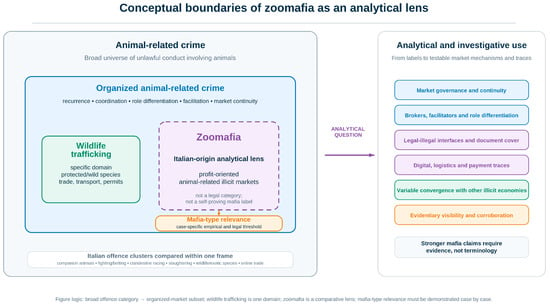
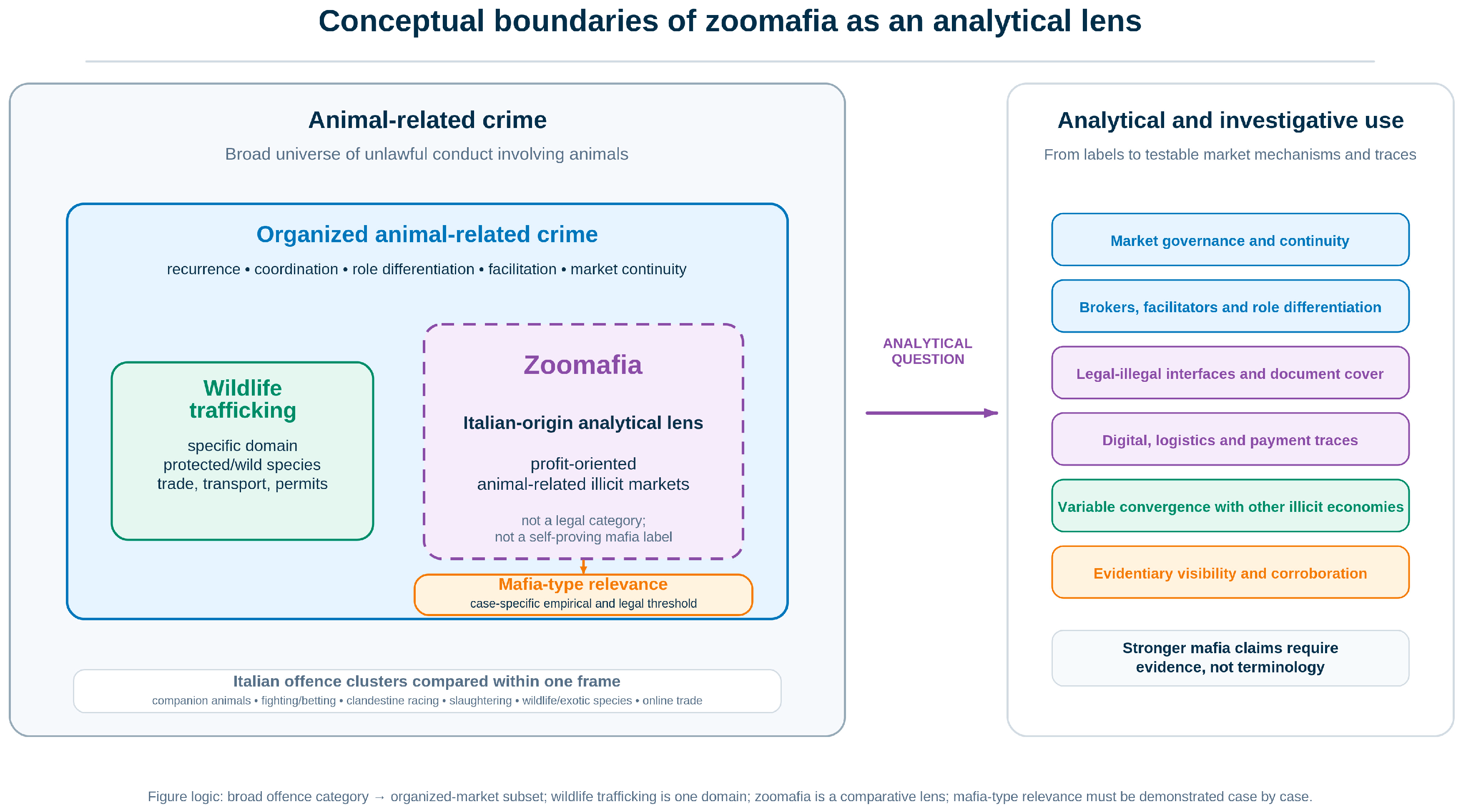

Disclaimer/Publisher’s Note: The statements, opinions and data contained in all publications are solely those of the individual author(s) and contributor(s) and not of MDPI and/or the editor(s). MDPI and/or the editor(s) disclaim responsibility for any injury to people or property resulting from any ideas, methods, instructions or products referred to in the content. |
© 2026 by the authors. Licensee MDPI, Basel, Switzerland. This article is an open access article distributed under the terms and conditions of the Creative Commons Attribution (CC BY) license.