


Abstract
Mental health issues among U.S. college students are reaching critical levels. Sociological theories explain how self and identity processes shape mental health, but few studies assess theoretically grounded interventions designed to improve it. Drawing on the affect control theory of self (ACT-Self), we examine whether students’ sustained investment in a positive, powerful, active identity across an academic term is associated with positive changes in their self-sentiments and mental health. Twenty-nine students invested in such an identity as part of a term-length project in a sociology course. We gathered three waves of survey data to track students’ self-sentiments and mental health immediately before (Wave 1) and after (Wave 2) the project and one month later (Wave 3). Students’ self-sentiments drew significantly closer to their goal at Wave 2 and remained closer at Wave 3. Depression, anxiety, and stress decreased across waves but were not significantly lower than baseline until Wave 3. Thriving and flourishing were significantly higher at Wave 2 but did not significantly differ from baseline at Wave 3. Students with self-sentiments closer to their goal reported lower depression and anxiety at Wave 2 and lower depression at Wave 3. Our findings provide preliminary evidence that identity-based interventions may be associated with improvements in some dimensions of college student mental health, depression in particular.
Keywords:
affect control theory; self; identity; mental health; depression; anxiety; stress; thriving; flourishing; intervention 1. Introduction
Mental health concerns among U.S. undergraduate students have reached alarming levels: depression, anxiety, and suicidal ideation are high, compromising students’ academic and social functioning (e.g., Eisenberg et al. 2009, 2025; Hefner and Eisenberg 2009). In this research, we apply the affect control theory of self (ACT-Self) to the college student mental health crisis, building upon a growing literature that links mental health challenges with negative self and identity sentiments (e.g., Boyle 2017; Boyle and Rogers 2023; Kroska and Harkness 2006). We explore whether self-sentiments and mental health change when college students make a sustained investment in a positive identity of their choosing.
ACT-Self proposes an affect control process in which people selectively enact identities from among those situationally available based on their potential for maintaining or restoring their fundamental self-sentiments—feelings about “myself as I really am” (MacKinnon and Heise 2010). Given its focus on self-actualization through identity enactment, ACT-Self does not currently specify how fundamental self-sentiments might change over time, including in pursuit of a goal to improve one’s mental health. We begin to investigate this in the present research by gathering repeated measures of fundamental self-sentiments during and after a mental health intervention focused on modifying identity enactment.
The main objective of this preliminary research is to examine whether self-sentiments increase and mental health improves when students invest in a positive, powerful, active identity of their choosing over a 10-week academic term. We analyze survey data from 29 students who did so as part of a term-length project in a sociology course. We trace students’ self-sentiments and mental health across three waves of data collection—before the project began (Wave 1), at the end of the project (Wave 2), and one month afterward (Wave 3)—to assess whether any improvements observed are sustained after the end of the project. We also measure students’ continued investment in the identity at Wave 3 to determine whether identity investment persisted beyond the conclusion of the project, when course-related supports for the endeavor were no longer in place.
Before presenting our methods and findings, we provide some background on the college student mental health crisis, introduce ACT-Self, and discuss the relationship of self and identity sentiments to mental health in the prior literature.
2. Literature Review
2.1. The College Student Mental Health Crisis
Depression and anxiety rates among U.S. college students have increased dramatically over the past decade. In national survey data from the 2024–2025 Healthy Minds Study, 37 percent of students surveyed met the screening criteria for moderate or severe depression, and 33 percent met the criteria for moderate or severe anxiety; only 20 percent met the screening criteria for each in 2014–2015 (Eisenberg and Lipson 2015; Eisenberg et al. 2025). In addition, an increasing number of U.S. college students are failing to experience psychological well-being. Only 38 percent of students surveyed in the 2024–2025 Healthy Minds Study displayed evidence of positive mental health (Eisenberg et al. 2025), a stark drop from the 53 percent reported in 2014–2015 (Eisenberg and Lipson 2015).
There are both structural and developmental reasons why U.S. college students experience high rates of mental health challenges. Psychiatric disorders tend to be most prevalent during young adulthood (Kessler et al. 2005), and first onset occurs by the mid-20s for around 75 percent of individuals who will experience a disorder at any point in their lives (Kessler et al. 2007). College students face a confluence of stressors including financial difficulties, academic stress, and lower quality social support that could trigger mental health problems in susceptible individuals (Hefner and Eisenberg 2009; Mowbray et al. 2006). These pressures are often compounded by a lack or limited awareness of mental health resources on college campuses (Mowbray et al. 2006).
Poor mental health has significant academic and social consequences. Students report that psychiatric issues interfere with their academic performance (e.g., lower GPA, more frequent absences, trouble keeping up, dropping out of school), negatively impact their emotional and behavioral skills (e.g., fatigue, paranoia, irritability), and contribute to their social isolation (e.g., difficulty making or keeping friends) (Eisenberg et al. 2009; Haines et al. 1996; Megivern et al. 2003). These patterns highlight both the prevalence of mental health concerns on college campuses and their cascading effects on students’ academic trajectories and social lives.
Despite extensive efforts to address the college student mental health crisis, the problem persists. Many colleges and universities have expanded their therapeutic offerings (e.g., building capacity in counseling centers, offering teletherapy) to address these challenges. However, declines in well-being outpace the growth in mental health service use (Abelson et al. 2022) and high levels of unmet mental health need are found among students of color, first-generation, low-income students, and LGBTQ+ students in particular (Dunbar et al. 2017; Lipson et al. 2018).
Based on a comprehensive review of the literature, Abelson et al. (2022, 2023) advise combining such efforts, which will necessarily reach only a portion of students, with promotive and preventative intervention approaches that address a range of factors impacting student well-being. Among the approaches identified as most promising are those that target the development of positive self-perceptions and supportive interpersonal relationships (e.g., Conley et al. 2013; Conley et al. 2015), which buffer the negative effects of stress on mental health (see also Thoits 2013). Course-based and skill-oriented interventions with a supervised practice—instructor observation of and feedback on developing abilities and habits across multiple sessions—are most effective in improving self-perceptions and mental health (e.g., Conley et al. 2013; Conley et al. 2015). We leveraged these insights to the extent possible in developing the intervention used in this research, which is described in more detail in Section 3.2.
We take a broad perspective on mental health in this research, focusing on emotional and psychological states that can be observed in the general population and examining changes in both psychological distress and psychological well-being—i.e., negative and positive mental health. We measure three distinct types of psychological distress—depression, anxiety, and stress (Lovibond and Lovibond 1995). Depression is associated with self-deprecation, sadness, hopelessness, anhedonia, and disinterest in activities. Anxiety relates to persistent autonomic arousal (e.g., increased heart rate, perspiration), bodily symptoms (e.g., trembling, faintness), and fear or panic. Stress reflects nervousness, irritability, impatience, agitation, and difficulty relaxing. We also measure two psychological well-being constructs—thriving (Su et al. 2014) and flourishing (Diener et al. 2009). Thriving is associated with feelings of belonging, support, accomplishment, optimism, life satisfaction, and personal worth and efficacy. Flourishing reflects meaning and purpose in life, positive relationships, respect, and feelings of goodness and competence.
2.2. The Affect Control Theory of Self
In this study, we apply the affect control theory of self (ACT-Self) to the college student mental health crisis, building on research that connects mental health with identity and self-sentiments (e.g., Boyle 2017; Boyle and Rogers 2023). We briefly introduce ACT-Self, then review literature discussing this link and explain how our work contributes to this literature.
ACT-Self examines how self-sentiments emerge and their consequences for identity enactment (MacKinnon and Heise 2010). The theory posits that individuals develop an aggregate subjective sense of self—a persona—that integrates their biographical experiences, all of the identities they possess, and the cultural meanings of these identities. As the single identity associated with a person’s name or reflexive pronouns, the persona differentiates an individual from others and provides them with a sense of continuity in the self across situations and over time (MacKinnon and Heise 2010, pp. 107–9). The persona evokes global feelings about “myself as I really am” known as fundamental self-sentiments, which are measured on the dimensions of evaluation (good-bad), potency (powerful-powerless), and activity (lively-inactive). These measurement dimensions, collectively known as EPA, are the basis of decades of research in affect control theory (e.g., Heise 1979, 2007; MacKinnon 1994) and are foundational to human interaction and communication (Scholl 2013) in more than 20 cultures (Osgood et al. 1957, 1975).
According to ACT-Self, the actualization of fundamental self-sentiments is the central mechanism underlying identity selection. People are motivated to experience alignment between who they feel they “really are” and how they feel about themselves as a result of recent events. When recent events have largely actualized fundamental self-sentiments, affective alignment is achieved by enacting identities with cultural meanings similar to these sentiments. When these events produce feelings about “myself in this situation” (situational self-sentiments) that diverge from feelings about “myself as I really am,” people experience affective tension known as inauthenticity and seek to enact identities with meanings that offset the discrepancy to cumulatively actualize the self (MacKinnon and Heise 2010, pp. 120–23).
In sum, ACT-Self proposes an affect control process in which people strive to maintain and restore fundamental self-sentiments through their actions and interactions. As a result, the theory predicts that fundamental self-sentiments—positive or negative—will largely be stable over time and actualized through identity enactment.
2.3. Self, Identity, and Mental Health
Fundamental self-sentiments and cultural sentiments for self-relevant identities are importantly related to one another and to mental health among college students and other individuals experiencing mental health challenges. For example, stigmatized cultural meanings for the mental illness identity predict self-sentiments and psychological distress among mentally ill individuals (Kroska and Harkness 2006). College students who identify as victims after experiencing sexual assault report lower self-esteem and more depressive symptoms than those who identify only as survivors—an identity with more positive, powerful, and active meanings (Boyle and Rogers 2020). Students who report that negative identities, traits, and emotions (e.g., loser, unhappy, withdrawn) are more descriptive of them are more likely to report fundamental self-sentiments that are similarly low in evaluation, potency, and activity than those who identify with positive identities, traits, and emotions (e.g., winner, cheerful, sociable) (Boyle 2017). Students with self-sentiments lower in evaluation and activity or closer to cultural meanings for depressed are more likely to report depressive symptoms five months later, controlling for symptoms at baseline (Boyle and Rogers 2023). Emerging adults with self-sentiments lower in evaluation and potency report greater depression, anxiety, and stress; those with self-sentiments lower in activity report greater depression (Rogers et al. 2026).
Despite the clear relationship of self and identity sentiments with mental health in prior work, limited research has explored how interventions on these sentiments might be leveraged to improve mental health. In addition, further investigation is needed into the circumstances under which change in fundamental self-sentiments occurs and how. While ACT-Self scholars acknowledge that self-sentiments change across the life course, no self-change process has yet been theorized. The theory’s model of self-actualization through identity selection implies stability in fundamental self-sentiments over time, which suggests that individuals with negative self-sentiments are at heightened risk of enacting identities that affirm or restore these sentiments and experiencing related mental health challenges (Boyle 2017; Boyle and Rogers 2023; MacKinnon and Heise 2010).
2.4. Intervention on Identity Selection
Our research seeks to disrupt this process by intervening on identity selection. The identity selection process specified in ACT-Self suggests that participants will be motivated to enact identities that actualize current self-sentiments or restore them by offsetting inauthenticity. We seek to introduce competing motivations external to the affect control process that encourage selection and enactment of an identity that is more positive, powerful, and active than fundamental self-sentiments, which is hypothesized to increase rather than maintain or restore fundamental self-sentiments.
In the process of pursuing self-change goals, individuals take part in repeated identity-relevant actions and interactions that increase the salience of positive, powerful, and active self-relevant meanings and have the potential to create positive change in self-sentiments. However, ACT-Self offers an explanation for why self-sentiment change can be difficult—we experience affective tension (inauthenticity) when events challenge our self-sentiments, even when they make us seem more positive, powerful, or active than we believe we are. For example, prior work has shown that people prefer interaction partners who confirm rather than enhance their existing self-sentiments, even when those self-sentiments are negative (Robinson and Smith-Lovin 1992). To work against this problem, it is necessary to develop a repertoire of strategies that support tolerance of inauthenticity and persistence in goal pursuit—i.e., sustained enactment of the positive, powerful, active identities that reflect who we aspire to be. This is the central aim of our intervention.
The intervention we introduce provides scaffolding within which students identify a desired identity change, their motivations for making this change, and personally viable methods of sustaining identity enactment. They receive peer and instructor feedback and support during the initial implementation process, as they put their plan into action and address the challenges that arise. While some of these challenges have to do with the mechanics of identity enactment and motivating continued effort on the intervention, others have to do with addressing thoughts and behaviors that undercut positive self-change. Because the affect control process motivates the restoration of existing self-sentiments, this includes addressing the offsetting identities that might prevent identity investment from being successful or producing the desired self-sentiment change. We view these setbacks as a natural and expected element of the self-change process, and work to equip students with a toolkit for sustaining positive identity enactment in the face of inauthenticity.
2.5. The Current Research
The present research draws on ACT-Self to explore whether students’ investment in a positive identity across a 10-week academic term relates to positive changes in their self-sentiments and mental health that may persist beyond the end of the term. We track changes in students’ self-sentiments, distress, and well-being across three waves of survey data gathered at the beginning, end, and one month after a term-length course project in which they made ongoing efforts to invest in a positive, powerful, active identity of their choosing. We also assess students’ continued investment in the identity after the course project ended to gain insight into the potential for a sustained impact of the intervention on identity enactment when course-related supports for identity investment were no longer in place. Through this research, we begin to address a gap in knowledge within ACT-Self regarding the relationship between identity selection, self-sentiment change, and mental health, and explore the potential of positive identity investment as a pathway for intervention on the college student mental health crisis.
As we do not measure inauthenticity here, we are unable to fully disentangle how event-specific self and identity sentiments might contribute to any changes in fundamental self-sentiments and mental health we observe. However, we seek to understand whether positive changes in self-sentiments and mental health occur across and beyond the intervention period (net of any inauthenticity respondents may have experienced).
3. Methods
3.1. Data
Participants consisted of undergraduate students enrolled in a sociology course during the fall term of 2023 (10 weeks). All members of the course were required to take part in the intervention as part of a class project. However, they were provided with an information sheet at the start of the term and given the option to opt-out of including their data in the study at any point.
Quantitative data were gathered from the same group of participants across three survey waves. Wave 1 took place early in the term, before students began the intervention project (week 2). Wave 2 took place at the end of the term when the formal intervention project was complete (week 10). Wave 3 took place during the interim between terms, one month after the course had ended. Students reviewed a consent form and provided consent before participating in the Wave 3 survey.
Students received course credit for their participation in Waves 1 and 2 and a five-dollar gift card for their participation in Wave 3. Responses were confidential and all identifying information was deleted after data collection was complete. Neither the decision to opt out of the research nor “success” on the project affected students’ performance in the class. Assessments were graded on completion only.
All 29 students enrolled in the course opted to share their intervention data and participated in Waves 1 and 2 of the study; 27 students participated in Wave 3. Sample characteristics are summarized in Table 1.
Table 1.
Sample characteristics.
Survey data were collected online using Qualtrics XM (Qualtrics, LLC, Provo, UT). Each survey wave included quantitative measures of self-sentiments (evaluation, potency, activity), negative mental health (depression, anxiety, stress), and positive mental health (thriving, flourishing). We provide more information about the specific measures included in this research below (Section 3.3).
We chose to incorporate multiple indicators of positive and negative mental health into our research for several reasons. First, these are the key indicators used in previous work to demonstrate mental health issues in the population of interest. Second, prior research has linked different indicators of negative mental health with different dimensions of fundamental self-sentiments in different samples (e.g., Boyle and Rogers 2023; Rogers et al. 2026; MacKinnon 2015). Third, to our knowledge, no prior studies in ACT-Self have examined the relationship between indicators of positive mental health (i.e., psychological well-being) and self-sentiments, despite their importance in the mental health literature. Prior research has found that psychological well-being varies independently from and is not simply the inverse of psychological distress, despite the negative correlations typically found between measures of each (Eklund et al. 2011; Stephens et al. 2023).
3.2. Intervention Project
3.2.1. Design and Procedure
As noted above, students were asked to select a positive, powerful, active identity to invest in as part of a term-length course intervention project. They were encouraged to select an identity that felt both personally relevant and pertinent to their project goals but were given flexibility to approach the project as they wished.
To aid students in identity selection, we provided a menu of intervention options they could choose from that suggested different avenues for action, listed example actions and identities for each option, and linked pertinent campus resources. These options included developing a new skill, volunteering in the local community, acting on a personal goal, cultivating a daily gratitude practice, and investing in existing positive roles.
We developed this list by exploring the identities with positive mean EPA ratings in the most recent available repository of ACT data gathered from college students in the U.S. (Smith-Lovin et al. 2016) and working backward to the action areas that seemed most relevant and accessible to students on our campus. We solicited feedback on the initial list from students in prior sections of the same class, who added the option to invest in existing positive roles to the final list used in this research.
After reviewing the menu of intervention options, students were given a week to brainstorm, and time was set aside for small group discussion of project ideas during class. Students then met individually with the instructor (first author) for 30 min motivational interviews during the second week of the course. Motivational interviewing is an evidence-based, collaborative approach that helps those considering a life change work through ambivalence and concerns, identify their motivations and incentives for goal pursuit, and make an action plan (Miller and Rollnick 2013). Students completed the Wave 1 survey shortly after meeting with the instructor to clarify their project plans and goals, then began work on the project. We provide more details on their selected identities and intervention pathways in Section 3.2.2.
Students were expected to make a concerted effort to take action related to their goal and invest in the identity they selected for intervention each week. They submitted a 500-word diary entry on the intervention project at the end of weeks 3 through 10, responding to a series of writing prompts with a similar structure to motivational interviews. They were asked to describe what took place, where, when, and with whom; why they chose these activities as part of their intervention; their thoughts and feelings about the experience; and what next steps or changes they had planned. Students who did not take action on their intervention in a given week were still required to complete a diary entry, and were asked to identify obstacles to progress and how they could reduce or remove them; supports that would help them get and stay on track; next steps and any groundwork needed to take them; and the motivations for and expected benefits of taking action on their goal. All students completed the Wave 2 survey at the end of week 10, in tandem with the final diary entry.
The intervention project was approached as a design thinking problem (Razzouk and Shute 2012). As our key stakeholders, students in prior sections of the course provided feedback in the prototyping phase and students in this section of the course provided feedback in the evaluation phase. They were invited to critique the intervention design and their approach to the project in diary entries and during class and to collaboratively design solutions to any implementation issues identified at the project or personal level.
Students received encouragement and feedback from the instructor in the form of written comments on their diary entries and occasional check-ins during and outside of class time. Most listed diary entries and/or check-ins with peers during class time among their most important sources of accountability for the project. Most also said that working on this goal as part of a class project helped them prioritize and create space for it that they would not have otherwise.
We collected qualitative data from participants in the form of notes on motivational interviews conducted before survey Wave 1, weekly diary entries tracking intervention progress between Wave 1 and Wave 2, and open-ended responses collected at each survey wave. However, we do not report on our qualitative findings in this paper. The menu of intervention options, motivational interview guide, and diary entry prompts used in our research are available in the online supplement to this article at: https://bit.ly/identityinvestment (accessed on 1 March 2026).
3.2.2. Selected Identities and Intervention Pathways
Students were given both guidance and flexibility in the intervention design process. They were encouraged to tailor the project to their needs and select the single identity that felt most appropriate in achieving their goals—it did not need to come from the list of examples provided in the menu of options. We adopted a broad definition of identity and allowed students to choose role identities (positions within social institutions), social identities (membership in organizations and broad social categories), and person identities (unique traits or characteristics) as options for investment (Burke and Stets 2022). Almost all students (27) selected person identities (e.g., confident, disciplined, optimistic, strong, spontaneous) as the focus of their project, even when roles (e.g., volunteer, leader, musician, student) were implicated in their plans.
Person identities define an individual as unique from others and guide their behavior across situations and settings. For this reason, they may be high-value targets for intervention with the potential to alter orientations to the enactment of multiple role or social identities. While person identities are generally stable, there is significant evidence that they are not fixed. Research in sociology shows that person identities change in response to the social structures in which we are embedded (e.g., interactional, relational, institutional, organizational), role changes and conflicts, and to align our self-perceptions with the views of significant others (e.g., Cast and Welch 2015; Robinson et al. 2020; Stets and Huft 2026). Research in psychology shows that traits can be altered through deliberate effort, behavioral changes, life events, and maturation across the life course (e.g., Damian et al. 2019; Hudson et al. 2019; Roberts et al. 2017). The greatest change tends to occur during early adulthood (Roberts and Mroczek 2008; Roberts et al. 2006), the age group to which our respondents belong.
Fifteen students chose acting on a personal goal as their intervention pathway. These projects were diverse in focus and included goals related to physical health, time management, academics, and mindfulness. Several students in this group took a holistic approach to well-being and engaged in a collection of wellness activities, all of which spoke to their broader goals for identity enactment and self-change. Seven students chose to invest in their existing positive roles, which involved either investing more deeply in an ongoing role or reinvesting in one that had fallen by the wayside. These projects were also diverse in focus, including goals related to physical health, spirituality, volunteerism, music, and dance. Six students chose to pursue gratitude journaling and one chose volunteering in the local community. None chose developing a new skill, although a number of projects in other categories did involve skill-building and/or trying new things.
3.3. Survey Measures
3.3.1. Self-Sentiments
Self-sentiments were collected from all participants in the Wave 1, Wave 2, and Wave 3 surveys. At each wave, we collected participants’ current self-sentiments by asking them to provide ratings of “myself as I really am” on the dimensions of evaluation, potency, and activity. In Wave 1 only, we measured participants’ aspirational self-sentiments by asking them to provide ratings of “myself as I would like to be” on the same dimensions.
Scales ranged from −4 to +4 and were labeled with the anchors standard in ACT research (see Heise 2007). Points along the scale were anchored with the adjectives neutral (0), slightly (−1/+1), quite (−2/+2), extremely (−3/+3), and infinitely (−4/+4). Scale endpoints were anchored with different adjectives for the evaluation (bad/awful vs. good/nice), potency (little/powerless vs. big/powerful), and activity (slow/quiet/inactive vs. fast/noisy/ active) scales. Scale responses were recorded to the tenths place between −4 and +4.
We created a measure of goal EPA distance to assess whether the distance between participants’ current self-sentiments at each wave and the aspirational self-sentiments they identified at the outset decreased across waves. This was done by calculating the Euclidean distance (square root of the summed squared distances on each dimension) between participants’ current self-sentiments at Waves 1, 2, and 3 and their aspirational self-sentiments at Wave 1.
The current mean self-sentiments for the sample at Wave 1 were 2.03 for evaluation, 0.97 for potency, and 1.26 for activity. The mean aspirational self-sentiments were 2.96 for evaluation, 2.56 for potency, and 2.07 for activity. Thus, the sample aspired, on average, to increase their self-sentiments by 0.93 on the evaluation dimension, 1.59 on the potency dimension, and 0.81 on the activity dimension at the start of the intervention. On average, respondents saw themselves as quite good and slightly powerful and active at baseline, but aspired to see themselves as even more good, powerful, and active in the future.
3.3.2. Depression, Anxiety, and Stress
Participants completed the Depression, Anxiety, and Stress Scale Short Form (DASS-21; Lovibond and Lovibond 1995) at all three survey waves. The scale was developed to discriminate between the related negative affective states of depression, anxiety, and stress. Participants were asked to report how much each of 21 statements applied to them in the past week on a scale ranging from 0 (“did not apply to me at all”) to 3 (“applied to me very much or most of the time”).
The depression subscale includes items like “I felt I wasn’t worth much as a person” or “I felt that I had nothing to look forward to.” The anxiety subscale includes items like “I was aware of the action of my heart in the absence of physical exertion (e.g., sense of heart rate increase, heart missing a beat)” and “I felt scared without any good reason.” The stress subscale includes items like “I found it difficult to relax” and “I tended to overreact to situations.”
Responses for each subscale were summed to create separate measures for depression, anxiety, and stress, each of which could range from 0 to 21. Wave 1 depression scores ranged from 0 to 11 with a mean score of 4.21. Wave 1 anxiety scores ranged from 0 to 15 with a mean score of 4.17. Wave 1 stress scores ranged from 0 to 12 with a mean score of 6.90. Participants ranged from normal to high on these measures. Average scores were in the upper end of the normal range for depression and stress and in the lower end of the mild range for anxiety. Depression, anxiety, and stress scores were moderately to highly correlated, with Pearson’s r values ranging between 0.59 and 0.81 across waves, reflecting a common underlying factor of general psychological distress, as found in prior work (e.g., Lee 2019; Zanon et al. 2021).
3.3.3. Thriving and Flourishing
Participants completed the Brief Inventory of Thriving (BIT) at each survey wave (Su et al. 2014). The BIT was designed to measure a broad range of psychological well-being constructs predictive of health outcomes (e.g., life satisfaction, positive relationships, interest in daily activities, meaning and purpose in life, sense of mastery and autonomy, optimism). Participants were asked to indicate their level of agreement or disagreement with each of 10 statements on a scale ranging from 1 (“strongly disagree”) to 5 (“strongly agree”). The scale includes items like “my life is going well,” “I feel a sense of belonging in my community,” and “I am achieving most of my goals.”
Participants also completed the Flourishing Scale (FS) at each survey wave (Diener et al. 2009). The FS measures psychological well-being with a focus on positive relationships, feelings of competence, and meaning and purpose in life. Participants were asked to indicate their level of agreement or disagreement with 8 statements on the same measurement scale used for the BIT. The scale includes items like “My social relationships are supportive and rewarding,” “I am competent and capable in the activities that are important to me,” and “I lead a purposeful and meaningful life.”
Responses for each scale summed separately to create our measures of thriving (which could range from 10 to 50) and flourishing (which could range from 8 to 40). High scores on each measure indicate that respondents view themselves positively in important areas of functioning. Wave 1 thriving scores ranged from 28 to 48; the mean thriving score for the sample was 38.45. Wave 1 flourishing scores ranged from 21 to 39; the mean flourishing score was 31.69. All participants were in the moderate to high range on both measures, and average scores were at the high end of the moderate range in both cases. Scores on the two measures were highly correlated, with Pearson’s r values between 0.87 and 0.88 across waves, reflecting a common underlying factor of general psychological well-being, as found in prior work (Su et al. 2014).
3.3.4. Continued Effort After Conclusion of Formal Intervention
In Wave 3, participants were asked to respond to 6 statements regarding their actions related to the intervention since the end of the term and the conclusion of the intervention project. They were asked to indicate their level of agreement or disagreement with each statement on an ordinal scale ranging from 1 (“strongly disagree”) to 5 (“strongly agree”). Three items assessed whether participants continued to take action on their intervention goals after the term ended. Two items assessed whether they had tried new things to achieve their goals or adjusted their plans or practices to better suit their needs. One item assessed participants’ plans to continue working on their intervention goals in the future.
3.4. Analysis
We use paired t-tests to compare Wave 1 data (baseline) to Wave 2 (end of intervention) and Wave 3 data (one month after intervention end) for goal EPA distance and positive and negative mental health measures. Comparisons of Wave 1 and Wave 2 scores assess whether participants’ current self-sentiments became more aligned with their aspirational self-sentiments and whether their mental health improved during the formal intervention project. Comparisons of Wave 1 and Wave 3 scores assess whether there were still significant improvements in these scores relative to baseline one month after the conclusion of the formal intervention project.
Next, we use ordinary least squares (OLS) regressions to test whether goal EPA distance at Wave 2 predicts scores on each dimension of mental health at Wave 2, controlling for Wave 1 scores on the same mental health dimension. This analysis explores the extent to which alignment of current and aspirational self-sentiments might explain any improvements in mental health at Wave 2 relative to baseline. We repeat this analysis for scores at Wave 3. We also report descriptive statistics on continued effort on intervention goals at Wave 3 to explore whether identity investment persisted beyond the conclusion of the intervention project.
4. Results
4.1. Changes in Self-Sentiments and Mental Health Across Study Waves
4.1.1. Self-Sentiments
As shown in Table 2, goal EPA distance significantly decreased between Wave 1 and Wave 2 (t(28) = −4.10, p < 0.001) and remained significantly lower at Wave 3 compared to baseline (t(26) = −3.66, p < 0.01). This pattern indicates that participants experienced increased alignment between their aspirational and current self-sentiments at the end of the intervention period that was sustained one month after the intervention ended. Mean goal EPA distance decreased between Waves 1 and 2 and was similar at Waves 2 and 3. Declines in mean goal EPA distance reflect increases in current self-sentiments at Wave 2 (ME = 2.38, MP = 1.76, MA = 2.01) and Wave 3 (ME = 2.47, MP = 1.77, MA = 1.87) relative to baseline (ME = 2.03, MP = 0.97, MA = 1.26).
Table 2.
Paired t-tests comparing goal evaluation, potency, and activity (EPA) distance and mental health at Wave 1 versus Wave 2 and Wave 3 *.
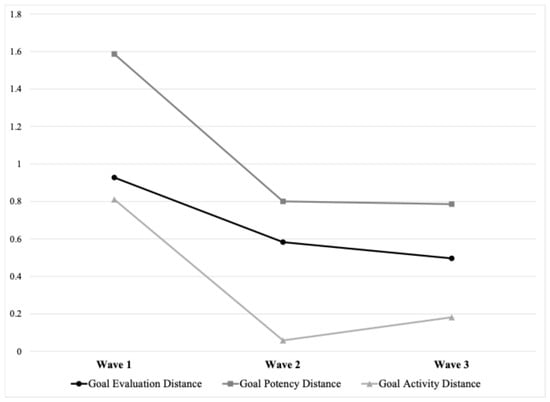
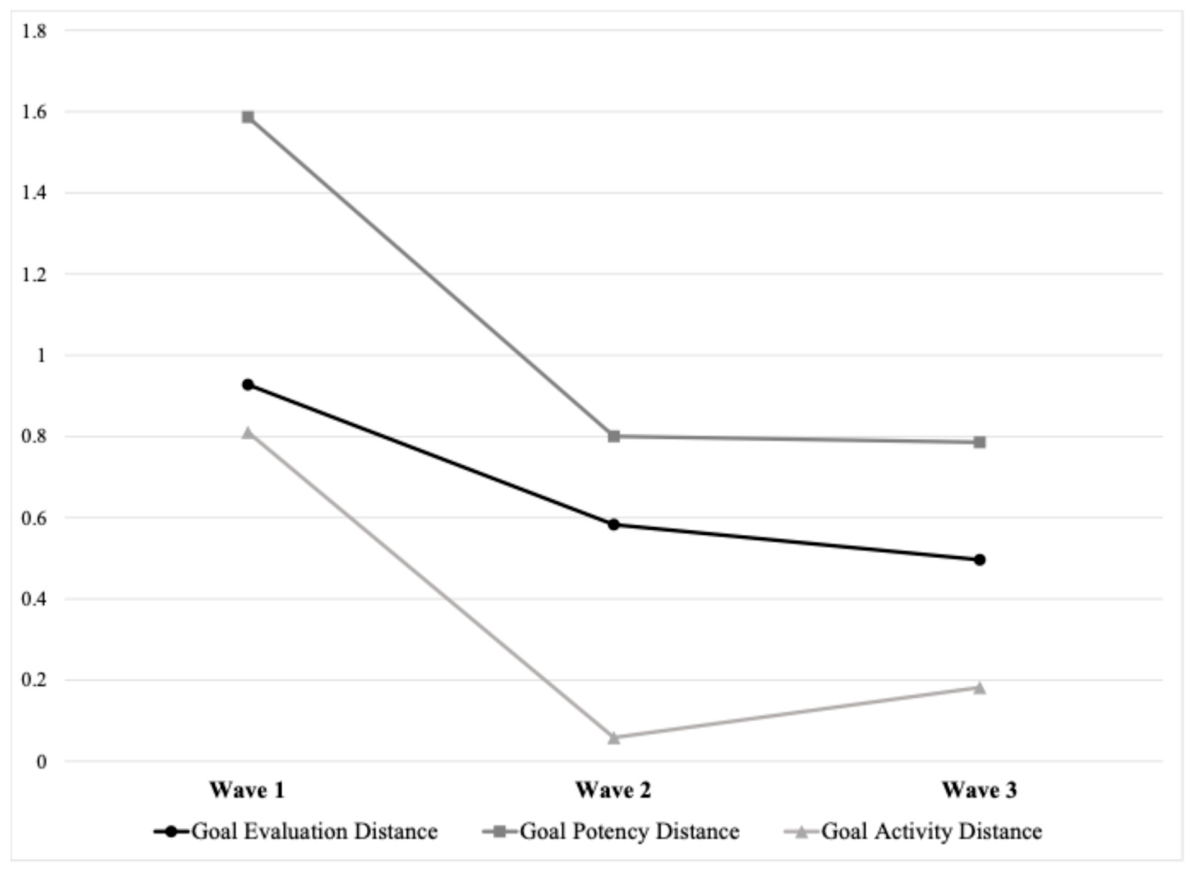
Figure 1 plots change in mean goal distance separately for the dimensions of evaluation, potency, and activity. Goal distance decreased on all three dimensions between Wave 1 and Wave 2 and was lower on all three dimensions at Wave 3 than at baseline. Mean potency distance was similar at Waves 2 and 3, while mean evaluation distance decreased, and mean activity distance increased. These variations across dimensions may be explained by the collection of Wave 3 data during the break between academic terms when activity levels may be lower overall and students may be exposed to fewer factors challenging their self-worth than during the academic term. The busy academic schedule at Wave 2 (e.g., approaching deadlines for final papers and exams) may have had the opposite effect, limiting evaluation gains relative to goals and inflating activity.
Figure 1.
Mean goal EPA distance at each survey wave plotted separately by EPA dimension.
The distance between actual and aspirational self-sentiments was largest at Wave 1 on the potency dimension (1.59), followed by the evaluation (0.93) and activity dimensions (0.81). This pattern persisted across waves. On average, participants aspired to increase their potency most and their activity least at baseline; they had the largest gap to close for the potency dimension and the smallest gap to close for the activity dimension at Waves 2 and 3, after reductions in goal distance. However, participants also made the largest average gains in potency across waves. Between Waves 1 and 2, average goal distance decreased by 0.79 for potency, 0.75 for activity, and 0.34 for evaluation. Between Waves 1 and 3, it decreased by 0.80 for potency, 0.63 for activity, and 0.43 for evaluation. These patterns may suggest that participants’ deliberate efforts to enact positive identities boosted their self-efficacy, which has been conceptually linked with self-potency and, to a lesser extent, self-activity in prior research (MacKinnon 2015).
4.1.2. Mental Health
As shown in Table 2, depression (t(28) = −0.91, p > 0.05), anxiety (t(28) = −0.29, p > 0.05), and stress (t(28) = −1.45, p > 0.05) scores did not differ significantly between Wave 1 and Wave 2, though descriptive trends were in the expected direction. By Wave 3, however, participants reported significantly lower depression (t(26) = −2.27, p < 0.05), anxiety (t(26) = −2.92, p < 0.01), and stress (t(26) = −3.53, p < 0.01) compared to baseline. These patterns may be explained by the timing of our Wave 2 survey in the final week of classes just before the exam period, when academic demands are high (Barker et al. 2018). However, it is difficult to disentangle the effects of the intervention from extraneous factors in this study given our within-subjects design. Mean depression, anxiety, and stress scores descriptively decreased at each wave.
In contrast, thriving (t(28) = 3.21, p < 0.01) and flourishing (t(28) = 3.79, p < 0.001) scores increased significantly between Wave 1 and Wave 2, but did not significantly differ from baseline scores by Wave 3 (thriving: t(26) = 1.99, p < 0.10, flourishing: t(26) = 1.25, p > 0.05). Mean thriving and flourishing scores increased between Wave 1 and Wave 2 but declined between Wave 2 and Wave 3. Wave 3 scores were descriptively but not significantly higher than baseline.
4.2. Predicting Mental Health Variables
As shown in Table 3, Wave 2 goal EPA distance had a significant positive association with Wave 2 depression (B = 1.80, p < 0.05) and anxiety (B = 1.36, p < 0.05), after controlling for depression and anxiety scores at baseline. Participants whose current self-sentiments were closer to their aspirational self-sentiments at Wave 2 reported lower depression and anxiety than those with greater goal distance. No significant relationship was found between Wave 2 goal distance and other mental health variables (stress: B = 0.69, p > 0.05; thriving: B = −0.35, p > 0.05; flourishing: B = −0.60, p > 0.05).
Table 3.
Ordinary least squares (OLS) regressions of mental health on goal EPA distance at Wave 2, controlling for mental health at Wave 1 (N = 29) *.
All Wave 2 mental health variables had significant associations with their parallel scores at Wave 1 (depression: B = 0.54, p < 0.01; anxiety: B = 0.32, p < 0.05; thriving: B = 0.70, p < 0.001; flourishing: B = 0.64, p < 0.001) except for stress (B = 0.29, p < 0.10).
Wave 3 goal EPA distance had a significant positive association with Wave 3 depression (B = 1.24, p < 0.05) after controlling for depression scores at baseline (Table 4). Participants whose current self-sentiments were closer to their aspirational self-sentiments at Wave 3 reported significantly lower depression than those with greater goal distance. No significant relationship was found between Wave 3 goal distance and other mental health variables (anxiety: B = 0.92, p < 0.10; stress: B = 1.11, p > 0.05; thriving: B = −0.35, p > 0.05; flourishing: B = −0.46, p > 0.05).
Table 4.
OLS regressions of mental health on goal EPA distance at Wave 3, controlling for mental health at Wave 1 (N = 27) *.
All Wave 3 mental health variables had significant associations with their parallel scores at Wave 1 (depression: B = 0.31, p < 0.05; anxiety: B = 0.37, p < 0.01; stress: B = 0.37, p < 0.05; thriving: B = 0.42, p < 0.05; flourishing: B = 0.36, p < 0.05).
4.3. Continued Effort After Conclusion of Formal Intervention
Median responses to questions about continued effort on goals after the conclusion of the formal intervention project are summarized in Table 5. More than 80 percent of the sample agreed or strongly agreed that they had kept up with at least some of the practices they found helpful during the project and disagreed or strongly disagreed that they had not kept up with their personal intervention goals. More than 50 percent agreed or strongly agreed that they had taken consistent action each week on their personal intervention goals since the end of the term. More than 75 percent agreed or strongly agreed that they had tried new things to achieve their personal intervention goals and changed their goals or practices to better suit their needs. All but one participant agreed or strongly agreed that they planned to continue working on their personal intervention goals in the future—the other was unsure.
Table 5.
Descriptive statistics on continued effort on intervention goals.
5. Discussion
This study examined whether 29 college students’ investment in a positive, powerful, active identity as part of a term-length course project was associated with increases in their self-sentiments and improvements in their mental health at the end of the project (Wave 2) and one month afterward (Wave 3) relative to baseline (Wave 1). Students completed survey measures of self-sentiments, well-being, and distress at each wave, along with measures assessing students’ continued investment in the identity after the end of the project. While most prior work has focused on the association of negative identities and self-sentiments with emotional and mental health difficulties (e.g., Boyle 2017; Boyle and Rogers 2023), we sought to explore whether positive changes in self-sentiments related to positive identity investment are associated with improvements in mental health.
5.1. Summary of Main Findings
We found that students’ positive identity investment was accompanied by a decrease in the distance between their current self-sentiments (EPA for “myself as I really am”) and their aspirational self-sentiments (EPA for “myself as I would like to be”) between Wave 1 and Wave 2. This progress was sustained at Wave 3, when the formal supports of the intervention project (e.g., weekly diary entries, feedback from instructor and classmates) were no longer in place. Goal EPA distance was significantly lower at Wave 3 than Wave 1 and did not significantly differ from distance at Wave 2. Thus, students’ self-sentiments drew closer to their goal EPA during the intervention project and were similarly close to their goal EPA one month after the project ended.
Depression, anxiety, and stress did not significantly differ between Wave 1 and Wave 2. However, we did observe a downward descriptive trend in these measures across the intervention period. All three measures were significantly lower at Wave 3 than Wave 1. This pattern is likely due to the Wave 3 data being gathered during the break between academic terms while the Wave 2 data was gathered during finals period, when distress is often higher as a result of academic demands not measured in our research (Barker et al. 2018). In contrast, thriving and flourishing scores increased significantly from Wave 1 to Wave 2 but declined from Wave 2 to Wave 3, such that Wave 1 and Wave 3 scores were not significantly different. Thus, increases in psychological well-being across the intervention period were not sustained after the formal supports of the project were no longer in place while declines in psychological distress were, for reasons that may be partially attributable to factors outside of the intervention itself.
Participants with Wave 2 self-sentiments closer to their aspirational self-sentiments reported significantly lower depression and anxiety at Wave 2, controlling for baseline depression and anxiety scores, respectively. This relationship held for depression but not anxiety at Wave 3. We did not find significant associations between goal EPA distance and stress, thriving, or flourishing scores at Wave 2 or 3. In other words, reductions in goal EPA distance were most consistently associated with reductions in depression rather than broad improvements across all dimensions of mental health.
The relationship between fundamental self-sentiments and depression is relatively well-developed in the prior literature, with more limited attention to other mental health outcomes. Prior research has most often linked depression with low self-evaluation and self-activity (e.g., Boyle and Rogers 2023; Rogers et al. 2026), which may be explained by the low self-worth (evaluation) and low energy, interest, and motivation (activity) that characterize depression. Evaluation and activity were the dimensions on which actual and aspirational self-sentiments were most aligned at Waves 2 and 3. This pattern is consistent with the possibility that increased alignment between actual and aspirational self-sentiments, particularly on the dimensions of evaluation and activity, may be more closely related to changes in depression than to other mental health outcomes.
We find some evidence of a relationship between goal EPA distance and anxiety, but this relationship was not sustained after the end of the formal intervention period. One prior study has found a relationship between the evaluation and potency dimensions of fundamental self-sentiments and anxiety (Rogers et al. 2026), which may be explained by the negative affective states (evaluation) and worries about losing control (potency) that characterize anxiety. The potency dimension had the highest desired change at baseline (i.e., largest gap between actual and aspirational self-sentiments) and the highest actual change at Waves 2 and 3 (i.e., largest reduction in goal distance relative to baseline). However, it was also the dimension with the largest remaining goal distance at Waves 2 and 3. This suggests that future research should pay special attention to intervention techniques that might close the potency gap and help sustain reductions in anxiety.
We find little evidence of a relationship between goal EPA distance and stress, thriving, or flourishing in this research, even though stress was lower than baseline and thriving and flourishing were higher than baseline at later waves. While it is possible that our small sample size and design are obscuring a relationship between goal EPA distance and these mental health indicators, it is also possible that aspects of the intervention that did not change self-sentiments nevertheless impacted these dimensions of mental health. For example, many students incorporated mindfulness practices and changes to lifestyle and mindset that prior research suggests can help reduce stress and improve stress tolerance (e.g., Chisea and Serretti 2009; Meyer and Stutts 2024; Welle and Graf 2013). Others adopted gratitude practices and increased their engagement in positive actions and interactions, which promotes psychological well-being (VanderWeele 2020). These practices may relate to improvements in stress and well-being through processes not captured by the changes in self-sentiments we examine here.
At Wave 3, most participants reported keeping up with at least some of the practices they found helpful during the project, trying new things to achieve their intervention goals, changing their goals or practices to better suit their needs, and plans to continue working on these goals in the future. More than half reported consistent effort on their intervention goals each week since the project ended. These patterns suggest the potential of an intervention initiated in a college course to generate some degree of sustained impact on identity-related practices and perceptions alongside changes in self-sentiments and mental health.
While we are unable to assess whether a causal relationship exists between identity investment and changes in self-sentiments and mental health, our findings provide initial evidence that positive changes in self-sentiments can coincide with improvements in mental health, even when self-sentiments were initially positive. We see this as an important direction for future research and broadly encourage further inquiry into the conditions under which self-change may benefit mental health.
5.2. Limitations and Future Research
There are several important limitations of this study that could be addressed in future work. First, our sample was relatively small and homogenous, consisting of students enrolled in a single course at a single institution. While this enabled us to carefully implement and monitor a complex term-length intervention, it necessarily limits the generalizability of our findings. In addition, our observation period was limited. While some improvements at Wave 2 were sustained at Wave 3, others show evidence of attenuation over time or with a change in context. Future studies could recruit participants from multiple courses and/or institutions and incorporate additional waves of data collection or longer follow-up periods to strengthen confidence in the generalizability and durability of the patterns observed.
Second, the prevalence of both mental health problems and protective factors varies by race and ethnicity, family income, gender, and sexuality (Abelson et al. 2022, 2023). We are unable to assess, given our sample size and composition, whether the efficacy of the intervention or best practices for its implementation might differ in important ways across demographic groups. This is an important direction for future research. As our study relied on convenience sampling, the demographic composition of our sample did not match that of the broader U.S. college student population. For example, Asian students were substantially overrepresented relative to their population proportions. Future studies could use quota sampling techniques to improve the representativeness of the sample or explore barriers to and facilitators of successful intervention within specific population groups.
Third, our study design does not allow us to disentangle effects of the intervention from other influences on self-sentiments and well-being, including fluctuations in stressors across the academic year and differential access to identity-related support and resources between the academic term and school breaks. Our reliance on within-person comparisons and lack of a comparison group that did not take part in the intervention limit our ability to check for selection effects and rule out alternative explanations for our findings. Future work could measure relevant stressors and resources and gather comparison data from a parallel course or previous/subsequent cohort not receiving the intervention to better distinguish intervention effects from the effects of exogenous factors.
Relatedly, our study did not include measures of event-specific self and identity sentiments that would have allowed us to assess the contribution of inauthenticity to the changes in mental health observed. As students took action to invest in the identity they selected for intervention, they may have experienced some events that actualized their fundamental self-sentiments and some that did not. Future studies that measure event-specific self and identity sentiments alongside changes in fundamental self-sentiments and mental health would help clarify how inauthenticity impacts efforts to improve mental health through identity investment.
Fourth, because the study relied on self-reported data, issues of measurement validity and reliability cannot be fully ruled out. Future work could improve upon this by triangulating survey responses with additional data sources to check for convergence in assessments across methods. Qualitative analysis of students’ weekly written reflections over the course of the project could provide greater insight into the “how” of identity investment and its relationship to fluctuations in self-sentiments and well-being observed in survey data.
Finally, the intervention itself was embedded within a college course and supported through weekly graded assignments and instructor feedback. While students reported that this structure helped them stay accountable for identity investment, it also limits scalability. Future research could test streamlined or lower-touch versions of the intervention, including formats that operate outside a course context or require fewer structured supports. Developing and evaluating such models would clarify which components are essential for producing change and expand the feasibility of implementing identity-related interventions at scale.
Author Contributions
Conceptualization, K.B.R.; methodology, K.B.R.; data curation, K.B.R. and N.B.; formal analysis, K.B.R.; writing—original draft preparation, K.B.R., N.B., J.C., E.H. and A.K.; writing—review and editing, K.B.R.; visualization, K.B.R.; supervision, K.B.R.; project administration, K.B.R.; funding acquisition, K.B.R. All authors have read and agreed to the published version of the manuscript.
Funding
This research was funded by a Walter and Constance Burke Sustaining Excellence Award through the Office of the Faculty of Arts and Sciences at Dartmouth College.
Institutional Review Board Statement
The study was conducted in accordance with the Declaration of Helsinki and approved by the Committee for the Protection of Human Subjects at Dartmouth College as exempt research under Category 1 (protocol 32777 approved 17 August 2023; modification approved 24 October 2023).
Informed Consent Statement
Participants in Waves 1 and 2 reviewed an information sheet about the study before it began and could opt out of having their data included at any point before, during, or after the study. The requirement for formal consent was waived by the Committee for the Protection of Human Subjects because the Wave 1 and 2 assessments were a graded part of the course, the research was minimal risk, no identifying information was retained, and the option to opt out was provided. Informed consent was obtained from all participants involved in Wave 3.
Data Availability Statement
The data used in this article are not openly available because they are part of ongoing research by the authors. Requests to access the data should be directed to the first author at krogers@dartmouth.edu.
Conflicts of Interest
The authors declare no conflicts of interest. The funders had no role in the design of the study; in the collection, analyses, or interpretation of data; in the writing of the manuscript; or in the decision to publish the results.
Abbreviations
The following abbreviations are used in this manuscript:
| ACT | Affect Control Theory |
| ACT-Self | Affect Control Theory of Self |
| EPA | Evaluation, Potency, and Activity |
| DASS-21 | Depression, Anxiety, and Stress Scale–21 Items |
| BIT | Brief Inventory of Thriving |
| FS | Flourishing Scale |
| OLS | Ordinary Least Squares |
References
- Abelson, Sara, Sarah Ketchen Lipson, and Daniel Eisenberg. 2022. Mental health in college populations: A multidisciplinary review of what works, evidence gaps, and paths forward. In Higher Education: Handbook of Theory and Research. Edited by Laura Perna. Dordrecht: Springer, vol. 37, pp. 133–238. [Google Scholar] [CrossRef] [Scilit]
- Abelson, Sara, Sarah Ketchen Lipson, and Daniel Eisenberg. 2023. What Works for Improving Mental Health in Higher Education? Available online: https://www.acenet.edu/Documents/What-Works-Mental-Health.pdf (accessed on 12 February 2026).
- Barker, Erin T., Andrea L. Howard, Rosanne Villemaire-Krajden, and Nancy L. Galambos. 2018. The rise and fall of depressive symptoms and academic stress in two samples of university students. Journal of Youth and Adolescence 47: 1252–66. [Google Scholar] [CrossRef] [Scilit]
- Boyle, Kaitlin M. 2017. Verification of self using a mathematical theory of identity, feeling, and behavior. Sociological Forum 32: 659–80. [Google Scholar] [CrossRef] [Scilit]
- Boyle, Kaitlin M., and Kimberly B. Rogers. 2020. Beyond the rape “victim”-“survivor” binary: How race, gender, and identity processes interact to shape distress. Sociological Forum 35: 323–45. [Google Scholar] [CrossRef] [Scilit]
- Boyle, Kaitlin M., and Kimberly B. Rogers. 2023. Self-sentiments and depressive symptoms: A longitudinal analysis. American Behavioral Scientist 67: 36–59. [Google Scholar] [CrossRef] [Scilit]
- Burke, Peter J., and Jan E. Stets. 2022. Identity Theory, 2nd ed. New York: Oxford University Press. [Google Scholar] [CrossRef] [Scilit]
- Cast, Alicia D., and Bridget K. Welch. 2015. Emotions and the self: Depression and identity change. The Sociological Quarterly 56: 237–66. [Google Scholar] [CrossRef] [Scilit]
- Chisea, Alberto, and Alessandro Serretti. 2009. Mindfulness-based stress reduction for stress management in healthy people: A review and meta-analysis. Journal of Alternative and Complementary Medicine 15: 593–600. [Google Scholar] [CrossRef] [Scilit]
- Conley, Colleen S., Joseph A. Durlak, and Alexandra C. Kirsch. 2015. A meta-analysis of universal mental health prevention programs for higher education students. Prevention Science 16: 487–507. [Google Scholar] [CrossRef] [Scilit]
- Conley, Colleen S., Joseph A. Durlak, and Daniel A. Dickson. 2013. An evaluative review of outcome research on universal mental health promotion and prevention programs for higher education students. Journal of American College Health 61: 286–301. [Google Scholar] [CrossRef] [Scilit] [PubMed]
- Damian, Rodica Ioana, Marion Spengler, Andreea Sutu, and Brent W. Roberts. 2019. Sixteen going on sixty-six: A longitudinal study of personality stability and change across 50 years. Journal of Personality and Social Psychology 117: 674–95. [Google Scholar] [CrossRef] [Scilit]
- Diener, Ed, Derrick Wirtz, Robert Biswas-Diener, William Tov, Chu Kim-Prieto, Dong-Won Choi, and Shigehiro Oishi. 2009. New measures of well-being: Flourishing and positive and negative feelings. In Assessing Well-Being. Social Indicators Research Series; Edited by Ed Diener. Dordrecht: Springer, vol. 39, pp. 247–66. [Google Scholar] [CrossRef] [Scilit]
- Dunbar, Michael S., Lisa Sontag-Padilla, Rajeev Ramchand, Rachana Seelam, and Bradley D. Stein. 2017. Mental health service utilization among lesbian, gay, bisexual, and questioning or queer college students. Journal of Adolescent Health 61: 294–301. [Google Scholar] [CrossRef] [Scilit]
- Eisenberg, Daniel, and Sarah Ketchen Lipson. 2015. The Healthy Minds Study 2014–2015 Data Report. Available online: https://healthymindsnetwork.org/wp-content/uploads/2019/04/HMS_national_DataReport_15-16.pdf (accessed on 4 December 2025).
- Eisenberg, Daniel, Ezra Golberstein, and Justin B. Hunt. 2009. Mental health and academic success in college. The B.E. Journal of Economic Analysis & Policy 9: 40. [Google Scholar] [CrossRef] [Scilit]
- Eisenberg, Daniel, Sarah Ketchen Lipson, Justin Heinze, and Sasha Zhou. 2025. The Healthy Minds Study 2024–2025 Data Report. Available online: https://healthymindsnetwork.org/wp-content/uploads/2025/09/2024-2025_HMS-National-Data-Report_Student.pdf (accessed on 4 December 2025).
- Eklund, Katie, Erin Dowdy, Camille Jones, and Michael Furlong. 2011. Applicability of the dual-factor model of mental health for college students. Journal of College Student Psychotherapy 25: 79–92. [Google Scholar] [CrossRef] [Scilit]
- Haines, Marc E., Michele P. Norris, and Deborah A. Kashy. 1996. The effects of depressed mood on academic performance in college students. Journal of College Student Development 37: 519–26. [Google Scholar]
- Hefner, Joanna, and Daniel Eisenberg. 2009. Social support and mental health among college students. American Journal of Orthopsychiatry 79: 491–99. [Google Scholar] [CrossRef] [Scilit]
- Heise, David R. 1979. Understanding Events: Affect and the Construction of Social Action. New York: Cambridge University Press. [Google Scholar]
- Heise, David R. 2007. Expressive Order: Confirming Sentiments in Social Actions. New York: Springer. [Google Scholar] [CrossRef] [Scilit]
- Hudson, Nathan W., Daniel A. Briley, William J. Chopik, and Jaime Derringer. 2019. You have to follow through: Attaining behavioral change goals predicts volitional personality change. Journal of Personality and Social Psychology 117: 839–57. [Google Scholar] [CrossRef] [Scilit] [PubMed]
- Kessler, Ronald C., G. Paul Amminger, Sergio Aguilar-Gaxiola, Jordi Alonso, Sing Lee, and T. Bedirhan Ustun. 2007. Age of onset of mental disorders: A review of recent literature. Current Opinion in Psychiatry 20: 359–64. [Google Scholar] [CrossRef] [Scilit] [PubMed]
- Kessler, Ronald C., Per Berglund, Olivia Demler, Roy Jin, Kathleen R. Merikangas, and Ellen E. Walters. 2005. Lifetime prevalence and age-of-onset distributions of DSM-IV disorders in the National Comorbidity Survey Replication. Archives of General Psychiatry 62: 593–602. [Google Scholar] [CrossRef] [Scilit] [PubMed]
- Kroska, Amy, and Sarah K. Harkness. 2006. Stigma sentiments and self-meanings: Exploring the modified labeling theory of mental illness. Social Psychology Quarterly 69: 325–48. [Google Scholar] [CrossRef] [Scilit]
- Lee, Dohyun. 2019. The convergent, discriminant, and nomological validity of the Depression Anxiety Stress Scale-21 (DASS-21). Journal of Affective Disorders 259: 136–42. [Google Scholar] [CrossRef] [Scilit]
- Lipson, Sarah Ketchen, Adam Kern, Daniel Eisenberg, and Alfiee M. Breland-Noble. 2018. Mental health disparities among college students of color. Journal of Adolescent Health 63: 348–56. [Google Scholar] [CrossRef] [Scilit]
- Lovibond, Sydney H., and Peter F. Lovibond. 1995. Manual for the Depression Anxiety & Stress Scales, 2nd ed. Sydney: Psychology Foundation. [Google Scholar]
- MacKinnon, Neil J. 1994. Symbolic Interactionism as Affect Control. Albany: State University of New York Press. [Google Scholar]
- MacKinnon, Neil J. 2015. Self-Esteem and Beyond. New York: Palgrave Macmillan. [Google Scholar] [CrossRef] [Scilit]
- MacKinnon, Neil J., and David R. Heise. 2010. Self, Identity, and Social Institutions. New York: Palgrave Macmillan. [Google Scholar] [CrossRef] [Scilit]
- Megivern, Deborah, Sue Pellerito, and Carol T. Mowbray. 2003. Barriers to higher education for individuals with psychiatric disabilities. Psychiatric Rehabilitation Journal 26: 217–31. [Google Scholar] [CrossRef] [Scilit]
- Meyer, Heidi H., and Lauren A. Stutts. 2024. The effect of mindset interventions on stress and academic motivation in college students. Innovative Higher Education 49: 783–98. [Google Scholar] [CrossRef] [Scilit]
- Miller, William R., and Stephen Rollnick. 2013. Motivational Interviewing: Helping People Change, 3rd ed. New York: Guilford. [Google Scholar]
- Mowbray, Carol T., Deborah Megivern, Jeffrey M. Mandiberg, Steven Strauss, Cynthia H. Stein, Kimberly Collins, Susan Kopels, Cynthia Curlin, and Robin Lett. 2006. Campus mental health services: Recommendations for change. American Journal of Orthopsychiatry 76: 226–37. [Google Scholar] [CrossRef] [Scilit]
- Osgood, Charles E., George J. Suci, and Percy Tannenbaum. 1957. The Measurement of Meaning. Urbana: University of Illinois Press. [Google Scholar]
- Osgood, Charles E., William H. May, and Murray S. Miron. 1975. Cross-Cultural Universals of Affective Meaning. Urbana: University of Illinois Press. [Google Scholar]
- Razzouk, Rim, and Valerie Shute. 2012. What is design thinking and why is it important? Review of Educational Research 82: 330–48. [Google Scholar] [CrossRef] [Scilit]
- Roberts, Brent W., and Daniel Mroczek. 2008. Personality trait change in adulthood. Current Directions in Psychological Science 17: 31–35. [Google Scholar] [CrossRef] [Scilit] [PubMed]
- Roberts, Brent W., Jing Luo, Daniel A. Briley, Philip I. Chow, Rong Su, and Patrick L. Hill. 2017. A systematic review of personality trait change through intervention. Psychological Bulletin 143: 117–41. [Google Scholar] [CrossRef] [Scilit]
- Roberts, Brent W., Kate E. Walton, and Wolfgang Viechtbauer. 2006. Patterns of mean-level change in personality traits across the life course: A meta-analysis of longitudinal studies. Psychological Bulletin 132: 1–25. [Google Scholar] [CrossRef] [Scilit]
- Robinson, Dawn T., and Lynn Smith-Lovin. 1992. Selective interaction as a strategy for identity maintenance: An affect control model. Social Psychology Quarterly 55: 12–28. [Google Scholar] [CrossRef] [Scilit] [PubMed]
- Robinson, Dawn T., Lynn Smith-Lovin, and Jun Zhao. 2020. The role of the other: How interaction partners influence identity maintenance in four cultures. In Identity and Symbolic Interaction. Edited by Richard T. Serpe, Robin Stryker and Brian Powell. New York: Springer Nature, pp. 213–37. [Google Scholar] [CrossRef] [Scilit]
- Rogers, Kimberly B., Kaitlin M. Boyle, and Sophia Shaiman. 2026. Inauthenticity from Transgressive Events: Situational Emotions and Generalized Distress. Social Psychology Quarterly. revised and resubmitted. [Google Scholar]
- Scholl, Wolfgang. 2013. The socio-emotional basis of human interaction and communication: How we construct our social world. Social Science Information 52: 3–33. [Google Scholar] [CrossRef] [Scilit]
- Smith-Lovin, Lynn, Dawn T. Robinson, Bryan C. Cannon, Jesse K. Clark, Robert Freeland, Jonathan H. Morgan, and Kimberly B. Rogers. 2016. Mean Affective Ratings of 929 Identities, 814 Behaviors, and 660 Modifiers by University of Georgia and Duke University Undergraduates in 2012–2014. Available online: https://affectcontroltheory.org (accessed on 12 February 2026).
- Stephens, Jackson Mason, Matthew Iasiello, Kathina Ali, Joep van Ateren, and Daniel B. Fassnacht. 2023. The importance of measuring mental wellbeing in the context of psychological distress: Using a theoretical framework to test the dual-continua model of mental health. Behavioral Sciences 13: 436. [Google Scholar] [CrossRef] [Scilit] [PubMed]
- Stets, Jan E., and Justin Huft. 2026. Identities, meaning, the social structure, and the life course: Developing identity theory in sociology. Theory and Society 55: 8. [Google Scholar] [CrossRef] [Scilit]
- Su, Rong, Louis Tay, and Ed Diener. 2014. The development and validation of the Comprehensive Inventory of Thriving (CIT) and Brief Inventory of Thriving (BIT). Applied Psychology: Health and Well-Being 6: 251–79. [Google Scholar] [CrossRef] [Scilit]
- Thoits, Peggy A. 2013. Self, identity, stress, and mental health. In Handbook of the Sociology of Mental Health, 2nd ed. Edited by Carol S. Aneshensel, Jo C. Phelan and Alex Bierman. New York: Springer, pp. 357–77. [Google Scholar] [CrossRef] [Scilit]
- VanderWeele, Tyler J. 2020. Activities for flourishing: An evidence-based guide. Journal of Positive Psychology & Wellbeing 4: 79–91. [Google Scholar]
- Welle, Paul D., and Helen M. Graf. 2013. Effective lifestyle habits and coping strategies for stress tolerance among college students. American Journal of Health Education 42: 96–105. [Google Scholar] [CrossRef] [Scilit]
- Zanon, Cristian, Rachel E. Brenner, Makilim N. Baptista, David L. Vogel, Mark Rubin, Fatima R. Al-Darmaki, Marta Gonçalves, Patrick J. Heath, Hsin-Ya Liao, Corey S. Mackenzie, and et al. 2021. Examining the dimensionality, reliability, and invariance of the Depression, Anxiety, and Stress Scale-21 (DASS-21) across eight countries. Assessment 28: 1531–44. [Google Scholar] [CrossRef] [Scilit]

Disclaimer/Publisher’s Note: The statements, opinions and data contained in all publications are solely those of the individual author(s) and contributor(s) and not of MDPI and/or the editor(s). MDPI and/or the editor(s) disclaim responsibility for any injury to people or property resulting from any ideas, methods, instructions or products referred to in the content. |
© 2026 by the authors. Licensee MDPI, Basel, Switzerland. This article is an open access article distributed under the terms and conditions of the Creative Commons Attribution (CC BY) license.