


Abstract
This study examined how Twitter/X users engaged in the political discourse on the Sewol ferry accident in South Korea. We used a triangulation method by combining a social networks approach with quantitative content analysis. A comparison of the number of links across politically homogeneous clusters with the number of links across heterogeneous clusters revealed that selective exposure occurred on the Twitter topic network. Findings also showed the greater role of independent journalists armed with social media in disseminating information online. Our content analysis indicated that the tragic accident divided the public into two sides over the issue and that the public sentiment was dependent on the political orientations of the clusters within the network. The implications of these findings were discussed for scholars who aim to address the problems rooted in a polarized society.
1. Introduction
The sinking of the Sewol ferry, or Sewolho, on 16 April 2014 claimed the lives of 304 people, including 250 students who had been on a school trip to Jeju Island (Choi and Kim 2024). Eight years after the Sewol tragedy, the South Korean people felt a sense of déjà vu. On 29 October 2022, a crowd crush that took place in Itaewon, Seoul, during Halloween celebrations killed 159 revelers, most of them young adults (Mackenzie 2023). The Itaewon crush bears a striking resemblance to the Sewolho accident. They were both foreseeable, preventable social disasters, and still demand answers and accountability (S. Y. S. Park 2024). In her reflection on the tenth anniversary of the Sewol ferry disaster, in fact, S. Y. S. Park (2024) noted that this tragedy lives on in South Korea in many ways: for example, the bereaved families and citizens mobilizing and demanding a full explanation of what went wrong; and the Sewol movement showing solidarity with victims of other similar social disasters.
On top of that, the Sewol accident created a political specter that continues to haunt Korean society (Jeon et al. 2022). This accident quickly became a politically charged issue in terms of who was to blame for the tragedy (Koleilat 2014). A religious group called “Guwonpa” and its leader, Yoo Byung-eun, received much media attention because Yoo and his two sons were believed to control the shipping company, The Chonghaejin Marine Co. (Incheon, Republic of Korea), which operated the ferry (Kwon and Park 2014). Members of Guwonpa, which translates to salvation group, protested against the government in what they deemed religious persecution. However, debates over whether the government had more responsibility for the accident than Yoo and his group became prevalent in the public discourse, including the Twittersphere.
Beyond the immediate loss of life, the Sewol disaster functioned as a catalyst for a profound crisis in state legitimacy. The government’s perceived incompetence in rescue operations and subsequent attempts to downplay the tragedy transformed it into a symbol of systemic corruption and state failure, ultimately contributing to the momentum of the candlelight protests that led to the impeachment of President Park Geun-hye (Jeon et al. 2022). Similarly, the 2022 Itaewon crowd crush ignited intense partisan debates regarding police accountability and the Ministry of the Interior and Safety’s role, reinforcing the perception that social disasters in South Korea are inherently political battlegrounds where accountability is contested through ideological lenses (S. Y. S. Park 2024).
Twitter (now X), arguably the most popular microblogging service, provides a social space where people can disseminate news, share opinions, and create large networks in a way that otherwise would not be possible due in large part to its character limit and to the possibility of undirected relationships (Hansen et al. 2010; Kwak et al. 2010). The growing popularity of social media, including Twitter, has provided a major boost to research into social networks, including selective exposure (Himelboim 2014; Himelboim et al. 2013a) and polarization (Bail et al. 2018) in Twitter networks. Few studies, however, have attempted to investigate the role of Twitter in political discussions in a non-Western context (Choi et al. 2014; Hong and Kim 2016). To fill this gap, this study examines the political discourse on a socio-political issue (i.e., the Sewolho accident) and public sentiment toward two major entities involved (i.e., the Korean government and Guwonpa).
Methodologically, this study employs social network analysis, in which social networks are studied by exploring and visualizing patterns found within collections of linked people (Hansen et al. 2010). It also combines content analysis with a social network approach in order to gauge the public sentiment and identify the type and political orientation of Twitter users. Looking at the patterns of Twitter activities by Korean users in relation to political discourse can offer comparable data on selective exposure and polarization for both Western and non-Western scholars. Looking back at the political networks concerning the Selwo ferry accident will broaden our insights into the interplay among social media, networked citizens, and divided communities.
2. Literature Review
As early as 1859, John Stuart Mill espoused the role of cross-cutting exposure in fostering the marketplace of ideas, a concept first developed in his book, On Liberty. The benefits of communication across lines of difference include, among others, “persuasion to a normatively better view, deeper understanding of one’s own views, and the enhanced legitimacy of political decisions” (Mutz and Martin 2001, p. 99). Because of the importance of cross-ideological exposure in democracy (Arendt [1961] 1993; Calhoun 1988; Habermas [1962] 1989), scholars have delved into the impact of media on to what extent and how people expose themselves to attutide-consistent and counter-attitudinal media messages (Chaffee et al. 2001; Garrett 2009; Knobloch-Westerwick and Meng 2009; Messing and Westwood 2012; Mutz and Martin 2001; Stroud 2008).
The proliferation of new communication technologies, including the Internet and social media, has raised a concern that these technologies might hinder cross-cutting exposures rather than facilitating them (Bennett and Iyengar 2008; Stroud 2008; Sunstein 2007). For instance, Sunstein (2007) warns that the availability of a growing number of sources in online spaces may result in a narrowing of the scope of news and views to which individuals choose to self-expose. On the other hand, the potential of the Internet and social media for exposure across lines of political difference has been noted (Gergen 2008; Messing and Westwood 2012).
That is, while Mill’s ([1859] 1999) classic marketplace of ideas suggests that exposure to diverse views fosters democratic health, modern digital environments have significantly complicated this ideal, as social media platforms often function as partisan sorting mechanisms that prioritize group identity over deliberative reasoning (Törnberg 2022). Recent research shows that exposure to cross-cutting political information on social media does not always reduce polarization. Instead, it can trigger motivated reasoning where individuals reinforce their preexisting beliefs when confronted with opposing views (Cinelli et al. 2021; Bail et al. 2018). In the highly polarized Korean context, cross-cutting exposure often functions less as a bridge and more as a trigger for affective polarization, intensifying the us-versus-them divide in digital discourse (Lee et al. 2025; C. S. Park 2024).
Thus, it is a necessary prerequisite for understanding the political discourse in South Korea to review the literature on selective exposure and media, since such a review should proffer a theoretical framework needed to formulate research questions and hypotheses.
2.1. Selective Exposure and Online Media
The selective exposure hypothesis posits that people search for consonant information while avoiding dissonant information on the assumption that rational people should have a general preference for beliefs, values, and attitudes that are logically consistent (D’Alessio and Allen 2007; Frey 1986). A meta-analysis on this subject shows that people routinely expose themselves to messages in accord with their existing attitudes and avoid counter-attitudinal messages (D’Alessio and Allen 2007). The findings of this meta-analysis study are somewhat at odds with the pessimistic conclusion offered by Freedman and Sears (1965), who contend that “there is no evidence for a psychological preference for supportive information” (p. 91).
For example, some scholars provide evidence that online media users do not avoid opinion-challenging information (Barberá 2015; Garrett 2009; Messing and Westwood 2012). After conducting a web-administered behavior-tracking study to investigate the influence of news content on readers’ use of news items, Garrett (2009) concluded that “there is little evidence that they will use the Internet to create echo chambers, devoid of other viewpoints” (p. 279). Under the assumption that social endorsements—social media’s distinctive feature—fundamentally alter the way newsreaders consume online content, Messing and Westwood (2012) found evidence that social cues reduce partisan selective exposure. Barberá (2015) also argues that because social media facilitates the formation of weak ties with politically heterogeneous people, social media exposes individuals to cross-ideological messages, thereby reducing political extremism.
However, research on homophily also supports the selective exposure theory, or vice versa (Hsu and Park 2012; Choi et al. 2014; Himelboim 2014; Himelboim et al. 2013a, 2013b). The notion of homophily holds that individuals’ personal networks are homogeneous with respect to many different characteristics and that association is more likely between similar people than among dissimilar people (McPherson et al. 2001). The idea that birds of a feather flock together is not new in the social network literature. Himelboim and his colleagues repeatedly found evidence that supports the polarization of conservatives and liberals: Key users within a given cluster tend to be associated with politically homogeneous key users (Himelboim 2014); Users can see messages from within their own cluster more easily than from across clusters (Himelboim et al. 2013a); Users’ clusters are characterized by like-minded views and are linked to opinion-reinforcing information sources (Himelboim et al. 2013b).
In fact, the structural and algorithmic affordances of social media platforms like Twitter/X have significantly intensified the formation of what Sunstein (2007) terms information cocoons and echo chambers. The real-time, algorithmic nature of Twitter/X prioritizes high-arousal partisan content, a process that inherently strengthens homophily and promotes partisan sorting (Törnberg 2022). As Sunstein (2007) argues in #Republic, this digital architecture allows users to wall themselves off from dissenting opinions, creating self-reinforcing loops. These dynamics are particularly evident during national crises like the Sewol disaster, where the platform’s mechanisms facilitate the rapid crystallization of polarized clusters as users prioritize information that aligns with their preexisting political orientations (C. S. Park 2024).
In the case of Korean Twitter users, research shows that politicians prefer connecting to fellow politicianswithin the same party on Twitter (Hsu and Park 2012) and that Twitter users are more likely to interact with those with similar political viewpoints (Choi et al. 2014). The studies on selective exposure on Twitter, thus far, provide ample evidence that the homophily phenomenon is common in the Twittersphere. Thus, the following hypotheses are proposed:
H1:
More links will be found across homogeneous clusters than across heterogeneous clusters in terms of political orientation.
2.2. Politics, Media, and Twitter in South Korea
To familiarize the reader with the context of the Korean media landscape and political atmosphere, a brief discussion is necessary concerning politics and mainstream news media in Korea. It is also key to better capturing public opinion on Twitter with respect to the Sewol ferry accident. The Korean government and the National Assembly have been controlled by the conservative party since a more liberal administration was defeated in the 2007 presidential election. It is also reported by Freedom House (2013)—a U.S.-based NGO advocating democracy, political freedom, and human rights—that Korea’s media environment has gone through some setbacks since 2008, even though freedom of the press is guaranteed by the constitution.
The government still exerts great impact on broadcasting because the president plays a significant role in appointing and nominating the chairperson and board members of the two national television networks, the Korean Broadcasting System (KBS) and the Munhwa Broadcasting System (MBC), which account for the lion’s share of broadcasting revenue (Kim and Johnson 2006, 2009; Kwak 2012). The newspaper market has been dominated by three conservative, family-run daily newspapers—Chosun Ilbo, JoonAng Ilbo, and Don-Ah Ilbo—that comprise about 70% of the market share (Kim and Johnson 2006, 2009). Although there are a number of cable channels, local newspapers, as well as a commercial broadcasting system, named Seoul Broadcasting System (SBS), the two national broadcasting networks and the three conservative newspapers have been more influential in shaping public opinion (Kim 2001; Kim and Johnson 2006). In light of this media environment, Kim and Johnson (2006, 2009) indicated that the Internet and online news media are increasingly becoming significant news sources, noting a shift in media credibility from traditional mainstream news sources to Internet sources.
As both a social networking service and an information source, Twitter has gained notability and popularity worldwide among lay people, professionals, and academics alike since its public debut in 2006 (Bruns and Burgess 2012; Kwak et al. 2010; Murthy 2011). Korea is not an exception. Twitter has become a leading social network site in the nation (Choi and Park 2014; Hsu et al. 2013). It was used by 13% of the population as of 2014 and 20% as of 2024, according to DataReportal (2014, 2024).
As for political Twitter use, Bae et al. (2013) found that conservative users form a bigger cluster while liberal users are connected via key users with higher betweenness. Comparing Twitter communities based on individuals’ networking interests, Choi and Park (2014) reported that communities with sociopolitical goals are relatively well connected, relative to communities with either informational motives or interpersonal motives. Jho et al. (2017) also noted that ideological orientations are one of the determining factors in Korean Twitter users’ online behavior.
Given the importance of political interaction in the formation of public opinion, the density of interaction among users in a given political network is “an important indicator for the realization of this democratic potential of Twitter (Himelboim 2014, p. 82). Because there is no definite conclusion regarding whether conservative users tend to form a denser network than liberal users do (Adamic and Glance 2005) or vice versa (Himelboim 2014), the following research question is posed:
RQ1:
Do clusters with opposing political orientations differ in terms of their density value?
In their analysis of Twitter topic networks centered around a politically controversial issue in South Korea, Hsu et al. (2013) found that the 20 key users identified were significantly correlated, suggesting users’ roles as news brokers and/or as commentators. More importantly, they indicated that ordinary users are more likely than media outlets to interact with individual users and thus are more influential in disseminating their messages. After examining a Twitter network of users’ discussions on a former Korean president, Choi et al. (2014) showed that existing influential users (e.g., media outlets and journalists) affect “information flow through their Twitter messages” (p. 596), while emphasizing the predominance of liberal opinion leaders over conservative opinion leaders in the discussion network under study (p. 596). Despite the evidence offered by Kim and Johnson (2006, 2009) that the importance of the Internet and online media as news sources is increasing, the relative roles of mainstream news media and alternative news sources, including everyday users, in Twitter networks on the Sewolho accident have yet to be fully investigated. Thus, the following research question is raised:
RQ2:
What types of key users have more influence in sharing information in terms of their indegree value?
Previous studies on public opinion have attempted to track public sentiment on various issues such as consumer confidence, presidential approval, and elections (O’Connor et al. 2010), political candidates (Tumasjan et al. 2010), and public opinion polling (Kaimakamidis and Pitas 2024). In general, these studies found correlations between public moods on Twitter and polling/election results. For example, after analyzing several surveys on consumer confidence and political opinion, O’Connor et al. (2010) concluded that public sentiment measured from Tweets correlated with survey results, with the associations as high as 80% in some cases. In their analysis of over 100,000 Twitter messages, Tumasjan et al. (2010) noted that the mere number of tweets reflected voter preferences regarding politicians, and even suggested Twitter as a predictor of the election result. Although there are limitations in this line of studies, including the representativeness of the sample, social media political analysis can at least hint at where public sentiment is heading. The present study attempts to examine public sentiment on the two entities involved in the Sewol tragedy by investigating key users’ tone toward them. Thus, the following research questions are posed:
RQ3:
Does the tone of key users toward the government differ by political orientation?
RQ4:
Does the tone of key users toward Guwonpa differ by political orientation?
2.3. Social Networks Approach
Such terms as clusters, density, and indegree are used for the hypotheses and research questions that frequently appear in the social network literature and require elaboration. In fact, the present study employed a social networks approach in order to examine the political discourse and public sentiment surrounding the Sewol sinking. Thus, a brief review is presented of the social network approach in this section. Social networks are structures formed through the relations among individuals and entities and have a long history that predates social media (Hansen et al. 2010). Social network analysis is an attempt to study human relationships and connections with the emphasis on the consequences of distinct patterns of social ties on attitudes, beliefs, and behavior (Hansen et al. 2010; Wasserman 1994). The recent proliferation of social media has made social networks more visible than ever before, and, as a result, an increasing number of studies have applied social network analysis (Hansen et al. 2010; Choi et al. 2014; Terren and Borge 2021).
Twitter users often interact with each other regarding a given topic, which determines the boundaries of their social networks. As such, a topic network can be defined as the connections among a subgroup of users who posted about a specific topic within a specific time period, thereby setting up the contextual boundary of Twitter activity (Himelboim et al. 2013a). When applied to political discourse on a given issue, the social network approach enables researchers to better grasp the dynamics of public opinion on the issue by providing various metrics that describe social networks (Hansen et al. 2010; Choi et al. 2014). Key concepts and network metrics used for this study are discussed in the following subsections.
Clusters or Subgroups
From a network perspective, a cluster refers to a subgroup of interconnected users in a network that reflects more densely connected sets of vertices or edges (Hansen et al. 2010; Himelboim et al. 2013a). Users or nodes in one cluster are more connected to one another than they are to users outside that cluster. In terms of Twitter topic networks, users in a given cluster are more likely to read and respond to content posted by their cluster-mates than to content posted by users outside the cluster. In a sense, clusters can be likened to enclaves (Sunstein 2007) or cyberbalkans (Van Alstyne and Brynjolfsson 1996), in which individuals selectively expose themselves to politically homogeneous others.
To understand the extent to which a group of users is interconnected in a network or in a cluster, density is used in network analysis. Density is a count of the number of a network’s actual relationships divided by the number of its possible relationships, which makes it a quantitative way of capturing important concepts such as cohesion and membership (Hansen et al. 2010). In light of political topic networks, the extent to which users in a given cluster are interconnected indicates how cohesive they are in terms of their existing attitudes and beliefs. Given the significant role of political interaction in facilitating cross-ideological exposure, the density of interconnectedness is a crucial indicator for the realization of the democratic potential of Twitter (Himelboim 2014). Users in a denser cluster are believed to interact more actively with their cluster-mates and to more frequently expose themselves to hubs’ messages in that cluster.
2.4. Hubs or Key Users
Prior research identified the dominance of heavy users, or hubs, in political Twitter use in the sense that these users, as opinion leaders, play a key role in spreading information, setting the agenda or the tone, and thus influencing public opinion (Himelboim 2014; Hsu et al. 2013; Larsson and Moe 2012). Because key users in a given cluster enjoy a higher level of exposure to other users in that cluster, the degree of homogeneity of these hubs can indicate to what extent selective exposure occurs in a given topic network (Himelboim et al. 2013a). For instance, if hub users in one cluster are predominantly liberal while key users in another cluster are primarily conservative, then that would be an indication of homophily.
In this study, hubs were identified on the basis of indegree centrality—the number of connections that point inward at a node or user (Hansen et al. 2010). That is, users with a higher indegree score are relatively more central within their cluster, which suggests their authority, popularity, or power. Studies have used this metric to differentiate hubs from other users when identifying opinion leaders in their social networks (Choi et al. 2014; Himelboim et al. 2013a; Sánchez-Arrieta et al. 2021; Valente 2010).
3. Method
This study utilized a triangulation method to investigate selective exposure in the Twitter community engaging in dialogue about the Sewolho tragedy and to detect public sentiment toward the two relevant entities (i.e., the government and Guwonpa). First, we employed network analysis to identify the main clusters and hubs and to calculate the density and indegree measures. Second, content analysis was used to identify the type and ideology of each hub and to gauge their tone toward the government and Guwonpa. We collected Twitter data using NodeXL, a Microsoft Excel application add-in for social network analysis and visualization. NodeXL also enabled us to calculate the density of clusters and the indegree of all users in the network.
3.1. Data
In order to capture Twitter messages related to the topic under investigation, the following search terms in Korean were used: “Sewolho” AND “Guwonpa.” The Boolean search helped us limit the search results to only those messages containing these two keywords. Relevant tweets written in Korean were collected because the purpose of this study was to track Korean users’ Twitter activities in terms of their political discourse. Hashtags—brief keywords or abbreviations prefixed by #—are often used when generating topic networks on Twitter since they enable users to communicate with “an ad hoc community” formed around the hashtag topics (Bruns and Burgess 2012, p. 804). However, hashtags were not included for data collection purposes because they are not widely utilized in Korea due in large part to their fragmentary and redundant nature (Hsu et al. 2013; Lee et al. 2013).
We collected data twice a week (mostly on Wednesdays and Sundays) from 20 May 2014 to 30 July 2014, except for one week with three data collection times. Data collection started on 20 May when investigators arrived at Geumsuwon, Guwonpa’s 115 acre compound, to search for Yoo Byung-eun, and ended on 30 July, a week after the police had found him dead on 22 July. We collected data three times during the week of 20 July that involved the final moments of Yoo’s death. In total, twenty-two datasets were analyzed for this study. In total, 18,113 users and 22,197 relationships were captured from the 22 datasets after dropping one dataset lacking a hub or a cluster (see Table 1). The final datasets represent the complete universe of tweets containing both Sewolho and Guwonpa collected during the primary data collection period. Our captured networks reflect the totality of public discourse surrounding the Sewol ferry tragedy and the religious sect on the platform at that time.
Table 1.
Twenty-two datasets by clusters, hubs, and political orientation.
In other words, data was collected twice a week to capture both weekday news cycles and weekend discourse peaks while maintaining a longitudinal perspective over the 10-week hunt for Yoo Byung-eun (i.e., the Guwonpa’s leader) period. This frequency allowed us to observe the evolution of the blame-shifting narrative from the government to the religious sect without the data redundancy of daily scraping, a method supported by longitudinal studies of crisis communication on social media (Yu et al. 2025; Zhou et al. 2023).
3.2. Measurements
The Twitter network consists of the datasets that include messages containing the two keywords (i.e., Sewolho AND Guwonpa) and relationships among users who posted the messages. We analyzed this network at both macro and micro levels by using clusters and hubs as units of analysis. The patterns of Twitter users’ activities were then mapped to visualize the occurrence of selective exposure in the network at the end of Section 4.
3.2.1. Identifying Clusters
The vertices, or users, in the topic network were clustered by using the Clauset–Newman–Moore algorithm, which is capable of analyzing large datasets and efficiently finding subgroups (Himelboim et al. 2013a). The clustering algorithm allowed us to identify subgroups of relatively more interconnected users in the network. To detect community structures, we calculated modularity, which measures the quality of the divisions among the clusters (Newman 2006). Modularity values range from zero to one, with higher values indicating more distinct network structures. Newman suggests 0.6 as a cutoff point for detecting meaningfully distinct clusters. Mean modularity was 0.71 (SD = 0.14) at the network level, suggesting that the data contained highly diverse clusters in each network of the datasets.
The Clauset–Newman–Moore algorithm divided the network into several major clusters and lots of small clusters in terms of the number of users contained in each cluster. We identified 63 main clusters from the 22 datasets. These main clusters accounted for the majority of connected users and messages. We also calculated the density of each main cluster to address RQ 1, which compares the levels of interconnectivity of clusters with different political leanings.
3.2.2. Identifying Hubs
As detailed in Section 2, the indegree centrality was used to identify key users in the network. This means that the hubs are those users who are more frequently exposed to other users, thereby making their messages more visible. Hubs were selected from the entire network if they met the threshold (i.e., indegree of 10 or larger). We set this cutoff point, given that the average indegree value of all users in the entire network was 1. This means that hubs were exposed to other users at least ten times more than average users. We utilized this selection method to take into account varying sizes of clusters in the different datasets. This process allowed us to focus more on key users’ influence on the entire network than their influence on individual clusters (Hsu et al. 2013; Choi et al. 2014). We identified 355 hubs from the 22 datasets.
3.3. Content Analysis
We scrutinized key users and their messages to identify their type, political orientation, and tone toward the government and Guwonpa. To do so, we developed a coding scheme based on preliminary analysis of all key users in the first three datasets. Each hub was first classified into one of the seven categories: major newspapers, television networks (KBS, MBC, SBS), online media (online only news sites, portal sites), cable television channels, unaffiliated journalists (independent journalists, commentators, bloggers), political organizations (the government, political parties, or politicians), and general users. Each hub’s political ideology was examined based on its Twitter profiles and messages, and then was coded as conservative, neutral, or liberal. Ideological orientations were determined by analyzing the hubs within each cluster. The criteria included: (1) self-descriptions in user profiles, (2) historical posting patterns regarding the Park Geun-hye administration, and (3) the dominant sentiment of their most-retweeted content during the study period. For instance, clusters led by accounts frequently criticizing government incompetence were labeled liberal, while those focusing on the Guwonpa’s responsibility were labeled conservative (i.e., government-leaning). This approach aligns with recent seed-based classification methods used in social network research to identify community-level polarization (Cinelli et al. 2021).
Finally, we investigated tweets posted by each hub to determine their tone toward the government and Guwonpa. When detecting public sentiment toward issues, persons, or organizations, researchers have used pre-defined dictionaries such as Dictionary of Affect in Language (DAL), systems with embedded dictionaries such as Linguistic Inquiry and Word Count (LIWC), or OpinionFinder (Lee et al. 2013; O’Connor et al. 2010; Tumasjan et al. 2010). However, two coders manually coded the tone of each hub because these opinion mining tools are not able to grasp subtle contextual meanings. Intercoder reliability was assessed using Cohen’s kappa after each coder had analyzed the sample of 43 messages. Overall, values were satisfactorily high (1.00 for type; 0.89 for political orientation; 0.87 for tone toward the government; 1.00 for tone toward Guwonpa).
4. Results
4.1. Selective Exposure at Work
H1 predicted that more links would be found across similar ideology clusters than across dissimilar clusters. To test this hypothesis, cross-ideological datasets were analyzed that included both conservative and liberal clusters. Of the 22 datasets, 10 (43%) were classified as datasets that have 51 major clusters (16 conservative, 34 liberal, and 1 neutral). We performed a regression analysis with a dyad of clusters as the unit of analysis. After excluding one neutral cluster, clusters in each dataset were paired (N = 128). The independent variable was categorical, where two similar clusters were given 0, whereas two dissimilar clusters were given 1. The dependent variable was the number of links between the two clusters. Here, links in both directions were included. A significant regression equation was found (F(1, 126) = 46.26, p < 0.001), with an R2 of 0.27. Thus, this hypothesis was supported (see Table 2). In social science research involving social media interactions (Bail et al. 2018; Boutyline and Willer 2017), an R2 of 0.27 is considered a moderate to substantial effect size. In our case, it explains 27% of the variance in sentiment based on cluster membership. However, we emphasize that these findings represent strong associations between political orientation and discourse patterns, rather than direct causal effects.
Table 2.
Regression Analysis—Hypothesis 1.
RQ1 asked if clusters with different political leanings show different levels of interactions in terms of their density values. A one-way ANOVA was conducted to answer this research question with the density value as the dependent variable and the ideology of clusters as the independent variable (N = 63). The results indicated a significant difference between the three groups (F(2, 60) = 4.10, p < 0.05). We employed Tukey’s HSD to determine the nature of differences between the three groups (i.e., conservative, neutral, and liberal groups). This post hoc analysis revealed that conservative clusters (M = 0.0127, SD = 0.0039) were more densely interconnected than liberal clusters (M = 0.0092, SD = 0.0043). With the aforementioned findings that supported H1, this suggests that Twitter users are more likely to interact with politically like-minded users than with dissenting users, and that conservative users are more densely interconnected than liberal users.
4.2. Dominance of Independent Journalists over Other Media
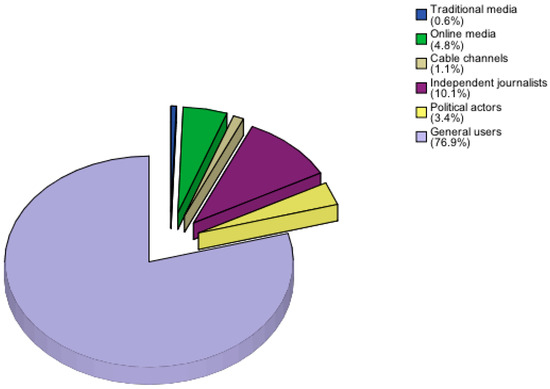
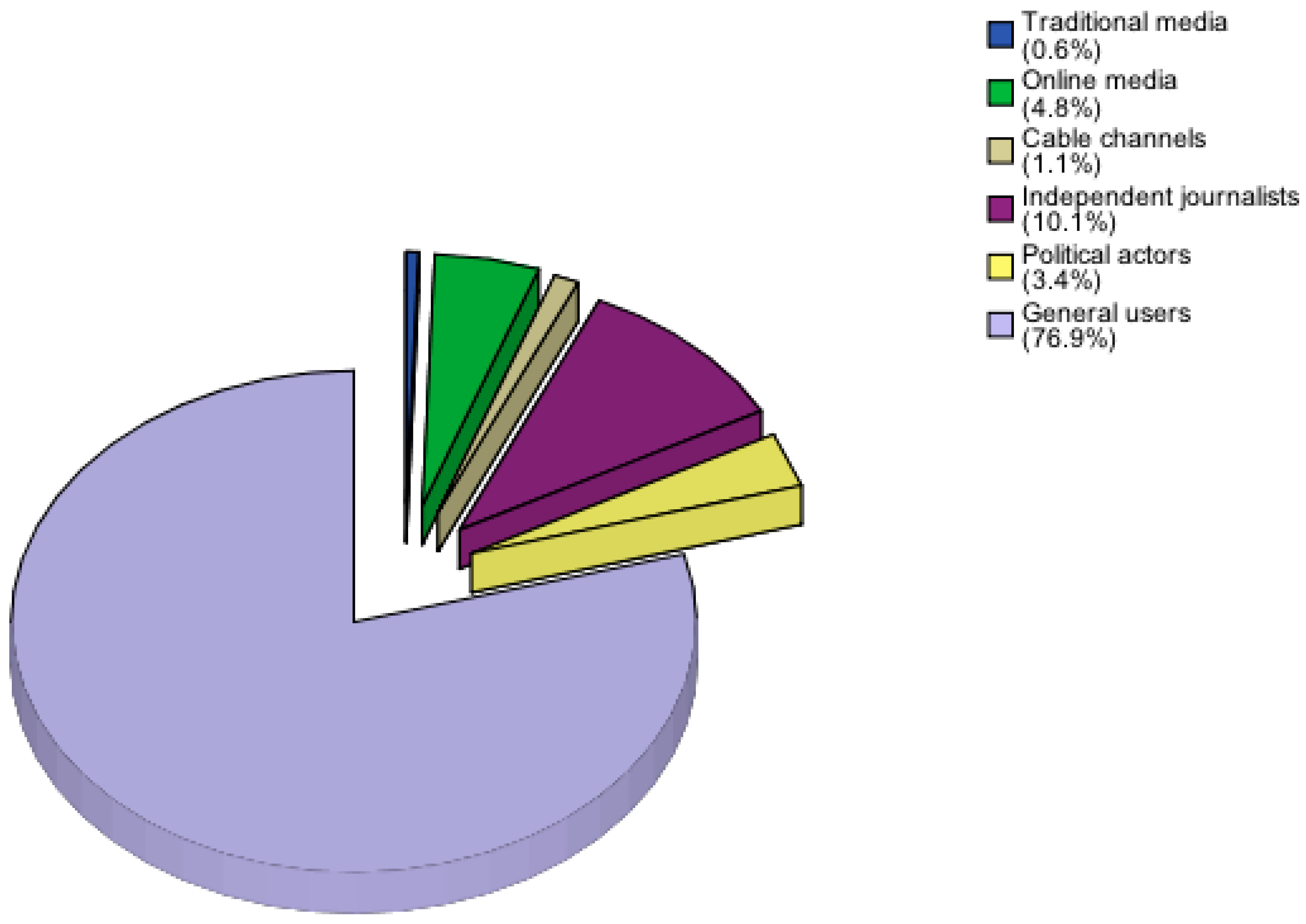
RQ2 was interested in types of hubs that are more influential in disseminating information in the network with respect to their indegree centrality. To address this research question, we evaluated the frequency of each type of user. Because major newspapers and TV networks appeared only once each, these two types were combined as traditional media, and a frequency analysis was run again. Of 355 hubs, 273 (76.9%) were identified as general users while 36 (10.1%) were independent journalists, including commentators and bloggers (see Figure 1). Online media such as digital-only news sites and portal sites were 4.8% of the key users, whereas political actors such as the government and political parties were 3.4%. Other hubs included cable channels (1.1%) and traditional news media (0.6%). The remaining 3.1% consists of uncategorized hubs and is therefore excluded from the chart.
Figure 1.
Twitter hubs by type of user.
In order to see the difference between these types of users, we conducted an ANOVA using the harmonic mean due to unequal sizes of the groups (N = 344). The dependent variable was hubs’ indegree values. The results revealed a significant difference between the types of hubs (F(5, 338) = 3.01, p < 0.05). We then ran a post hoc analysis with Tukey’s HSD to examine where the difference occurred. Independent journalists had the largest indegree values (M = 95.50, SD = 134.52), followed by cable channels (M = 57.75, SD = 31.70) and general users (M = 42.78, SD = 73.94). Traditional media had the smallest mean value (M = 11.00, SD = 1.41), while online media (M = 36.41, SD = 25.84) and political actors (M = 37.83, SD = 20.95) had similar mean values. Post hoc comparison, however, showed that there was a difference only between independent journalists and general users at the 0.05 level. Thus, it seems that unaffiliated journalists, bloggers, and commentators were the most powerful users in the network as regards their ability to share information about the Sewolho accident and Guwonpa.
4.3. Tone Toward the Government and Guwonpa
RQ3 and RQ4 asked whether the tone of hubs toward the government and Guwopa differs based on their political orientation, respectively. To address these research questions, we performed a set of ANCOVA analyses with the recoded hub type variable as a covariate. When it comes to the tone toward the government in the context of the Sewolho tragedy, hubs’ ideology was significantly related to the dependent variable (F(2, 261) = 49.03, p < 0.001). Liberal hubs were more negative (M = 1.26, SD = 0.44) than both conservative (M = 1.83, SD = 0.36) and neutral hubs (M = 1.59, SD = 0.50) in terms of their tone toward the government. Hubs’ type was not significantly related to the tone toward the government (F(1, 261) = 1.61, p = ns).
As for the tone toward Guwonpa, we found an opposite result. Conservative key users were more negative (M = 1.32, SD = 0.47) than both liberal (M = 1.73, SD = 0.48) and neutral users (M = 1.68, SD = 0.48) in their stance toward Guwonpa. Again, the main effect for ideology was significant (F(2, 261) = 17.37, p < 0.001), while the type of hubs was not significantly associated with their tone toward this religious group (F(1, 261) = 1.14, p = ns).
4.4. Visualization of the Homophily
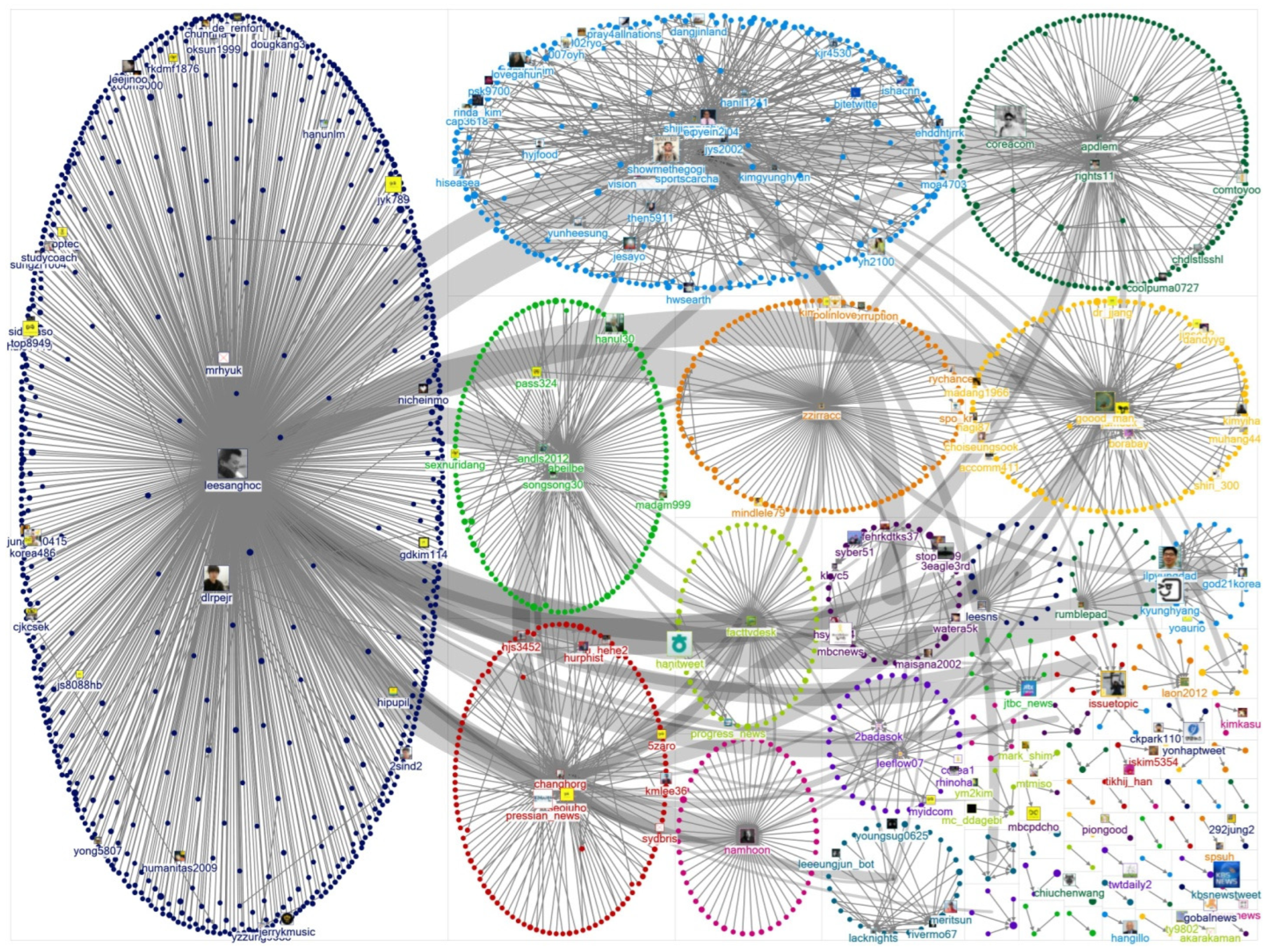
To help the reader see the patterns of selective exposure in the network, a visualization of the network is presented. We combined the 20 May dataset with the 21 May dataset for illustrative purposes. This integrated dataset had 1829 Twitter users that were connected by 2055 unique edges over a four-day period from 18 to 21 May. We studied top hyperlinks to detect the political orientation of the users in the major clusters. The content of tweets was also examined to learn the political orientation of a given hub user, which determines the characteristics of the cluster in which the user belongs. We executed a network visualization by utilizing the Fruchterman–Reingold layout algorithm.
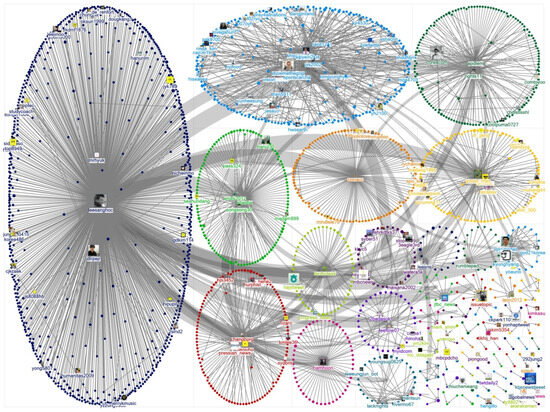
We found the two major clusters in this integrated network: the largest cluster with 693 users linked by 882 connections and the second largest cluster with 245 users linked by 470 connections. These two clusters accounted for about 51% of all connected users and 53% of all relationships in the topic network. The modularity value for this network was relatively high, or 0.68, suggesting that the clusters are fairly distinct. Figure 2 demonstrates all the clusters in this particular network. While Figure 2 reflects the inherent complexity of large-scale social network interactions, our analysis focuses on the primary clusters and structures that define the polarized discourse.
Figure 2.
Network graphs of 1829 Twitter users whose tweets contained the search terms Sewolho AND Guwonpa captured on 20 and 21 May 2014. The largest cluster (Group 1) is shown on the far left, and the second largest cluster (Group 2) on the top center. Intergroup edges were combined for clearer visualization. The vertex size was tied to the number of followers of each user, and the vertex shape was replaced with images for the key users that were selected based on their indegree values.
This network map can be characterized as a “broadcast network structure,” where a few hubs, or key users, are surrounded by spokes of people who repeat their Twitter messages (Smith et al. 2014, p. 42). According to Himelboim et al. (2013b), a relatively small number of users occupy a much larger than average number of relationships, which makes them “the core of the cluster in which they are located” (p. 181). We identified these hub users from the top nine clusters based on their indegree centrality (see Table 3).
Table 3.
Hubs by Cluster in the 20–21 May Network.
In broadcast networks, some central URLs drive the Twitter chatter. In our case, the most frequently mentioned URLs were linked to the GObalnews website for Group 1 (with 290 uses) and to the right-wing portal site, or “Sookut.com” for Group 2 (with 44 uses). The most mentioned users were @leesanghoc (1016), @zzirracc (117), @abeilbe (114), @rights11 (79), @goood_man (79), @apdlem (79), and @showmethegogi (71). The largest cluster in this topic network was associated with the hub, Lee Sangho (or @leesanghoc), who began to operate the GObalnews website after he had been fired from MBC, a major national television network in South Korea. On the other hand, the second largest cluster contained hubs associated with conservative-leaning users such as @showmethegogi and @pyein2. These two groups were interconnected by only 5 edges.
An analysis of the content of tweets in the top nine clusters showed that all the groups but Group 2 can be categorized as liberal in terms of political orientation. For example, @facttvdesk’s tweet was a report critical of the wrong handling of the tragic accident on the part of the government, whereas @goood_man’s message was a bitter diatribe against both the mainstream news media and the government. The content of the hub users in the second cluster, however, was related to criticism of the National Assembly (e.g., @showmethegogi) or of the opposition party (e.g., @inukorean). As evidenced by our content analysis, the Twitter users in this topic network do not appear to repeat the news stories generated by the major news organizations, which dominate the current media landscape.
5. Discussion
The purpose of this study was threefold: to examine the evidence of selective exposure among Korean Twitter users; to identify the most influential key users in the topic network regarding the Sewolho tragedy; and to investigate the difference in the tone toward the government and Guwonpa by users with differing political orientations. The present study supports the findings of previous studies where selective exposure was found among politically active users on Twitter (Ali and Eriyanto 2021; Hsu and Park 2012; Choi et al. 2014; Himelboim 2014; Himelboim et al. 2013a, 2013b). Heavy users in our topic network showed a strong tendency to engage with like-minded others rather than interacting with users with opposing political views. It also appears that conservative users linked to each other in a denser pattern when compared with liberal users (cf. Adamic and Glance 2005; Choi et al. 2014). A divided Twittersphere found in this study clearly reflects the political atmosphere of Korea, where citizens fall along familiar liberal-conservative lines over a range of issues, including the Sewolho disaster (Cheong and Haggard 2023; Choe 2014). The visualization of the combined datasets illustrated that the conflicting groups were hardly connected with each other, an indication of patterns of selective exposure.
The findings of this study also indicate that traditional media outlets did not constitute a substantive part of the social media landscape with regard to the Sewol ferry disaster. Independent journalists, cable channels, and concerned individuals acted as key players when it came to leading the discussion on this tragedy and the religious group involved. These findings may reflect the public’s antipathy toward the major news media, which received somewhat fierce criticism due to their unreliable and biased news coverage of the accident. South Korea’s mainstream news media, in general, and major TV networks in particular, failed to verify the government’s inaccurate and inconsistent announcements, while engaging in ethical breaches such as taking photographs of the victims’ grieving families without their permission (Cho 2014). In fact, the failure of mass media to accurately report on the tragedy resulted in public criticism against them, as represented by a statement issued by a group of mass communication scholars in Korea (Shin 2014).
The minimal impact of traditional legacy media in our findings can be attributed to the unique Korean media landscape, which has seen a decline in trust toward mainstream outlets. In fact, Korea’s traditional media are derisively labeled Giregi (which translates as trash journalist) due to the public’s perception that mainstream news outlets uncritically relay government and corporate press releases, suppress politically inconvenient stories, and prioritize sensationalism over rigorous investigative journalism. (Shin et al. 2021; Lee and Lee 2020). This vacuum has been filled by independent journalists who leverage social media to provide alternative, often highly partisan narratives that bypass traditional gatekeeping. This phenomenon was particularly salient during the Sewol tragedy, where legacy media were criticized for echoing government-controlled misinformation.
In fact, research shows that alternative news channels such as independent web-based newspapers (e.g., Ohmynews and Pressian) were considered as more credible, especially by liberals, relative to traditional news sources (Kim and Johnson 2006, 2009), in South Korea. Hsu et al. (2013) found that media outlets were less influential in circulating their messages on Twitter regarding a politically controversial issue at the time, the Sejong City project. Park and Kaye (2021) also reported that social media news exposure was negatively correlated with traditional news consumption. As such, this study has significant theoretical implications for media credibility research. The media credibility literature has been largely devoted to exploring the role of television, newspapers, or the Internet as a source of authority (Golan 2010; Johnson and Kaye 1998; Kiousis 2001; Metzger et al. 2003). However, studies that examined social media as trusted news sources are on the rise (Cha 2024; Millet et al. 2024). As reflected in our findings, unaffiliated, independent journalists armed with social media can be more authoritative sources than traditional media outlets, not least when traditional news media fail to provide accurate, impartial reporting.
The findings of this study indicate that Korean Twitter users showed different attitudes toward the government and Guwonpa, dependent on their political leanings, as they deliberated on who was to blame for the tragic accident. Liberal users were more critical of the government than their conservative counterparts, whereas conservatives were more negative toward the religious group than liberals. It is hardly surprising that the more liberal people are, the more likely they are to hold negative attitudes toward the conservative government. However, it remains unclear why conservative users tended to cast stones at Yoo Byung-eun and his religious group. To investigate this issue is beyond the scope of this paper and requires qualitative research studies. In any case, this study demonstrated a way of investigating public sentiment toward religious groups using social media data. Although the media and religion scholarships have rapidly grown in the past decades, they have yet to fully encompass the relatively novel area of social network analysis. Networks created by interactions among social media users offer detailed data about social processes that otherwise would not be explored and thus present a new method to explore the intersections of media and religion.
This study has several limitations. First, Twitter/X users in South Korea tend to be younger and more politically active than the general population, which may limit the generalizability of the findings to the entire electorate (Lee 2024). Second, reliance on keyword-based collection may omit nuanced or coded language used in peripheral discourses, a common methodological constraint in social media research that can lead to failure in capturing the full spectrum of public sentiment (Sheehy et al. 2025). Future research should include cross-platform analysis. incorporating platforms such as YouTube—a primary hub for partisan news consumption in Korea—and KakaoTalk—the nation’s ubiquitous messaging service—to provide a more holistic and representative view of the Korean digital public space (Tran et al. 2022).
In addition, due to the nature of the social networks approach, this study is also not able to distinguish motivated exposure and de facto exposure, which is a by-product of individuals’ personal networks or social context. Determinants of selective exposure have not been fully studied in the relevant literature and warrant further research using different methodologies (Iyengar and Hahn 2009).
Finally, to address concerns regarding the potential for circular reasoning in our ideological classifications, we validated the network-inferred clusters through two independent layers of empirical analysis. First, we conducted Latent Dirichlet Allocation (LDA) topic modeling on the content produced by ordinary (non-hub) users within each cluster. This revealed that frequently occurring terms and thematic frames were highly consistent within clusters but diverged significantly between them. These results suggest that shared structural positions correspond to shared discursive frameworks. Second, to move beyond structural inference, we performed a manual content analysis of the profiles and mentions of a random sample of users from the network. This additional analysis confirmed that Group 2 in the integrated network was predominantly composed of users expressing conservative political orientations, whereas other clusters, most notably Group 1, comprised liberal-leaning individuals. By triangulating network topology with both automated text analysis and manual profile verification, we ensure that the observed structural segregation reflects substantive ideological divisions within the Sewol ferry network.
Despite these limitations, the results of this study contribute to a better understanding of Twitter users’ political use of the microblogging service and patterns of public opinion on political issues in terms of networks and clusters. In addition, they illustrate how one tragic accident can divide a society into two ideologically distinct groups, which has a long-lasting, adverse impact on its political stability. In fact, the Sewol ferry disaster has separated Koreans into two camps and resulted in the collapse of the conservative government (Chung et al. 2022; S. Y. S. Park 2024). The Sewol disaster serves as a foundational case for disaster politicization and affective polarization in South Korea, establishing a discursive template that was strikingly visible during the 2022 Itaewon crowd crush. By analyzing this 2014 case, we provide a baseline for understanding how social media-driven echo chambers in non-Western democracies have evolved or persisted over a decade. Our findings offer critical insights for current debates on platform governance and public trust (Choi and Kim 2024; S. Y. S. Park 2024).
It is our hope that the present paper provides insights for scholars and activists who seek to address the recurring problems embedded in their polarized societies, including South Korea. That is because “those who cannot remember the past are condemned to repeat it.” (Santayana 1905, p. 284).
Author Contributions
Conceptualization, T.H. and S.Y.S.; methodology, T.H.; software, T.H.; validation, T.H. and S.Y.S.; formal analysis, T.H.; investigation, T.H.; resources, T.H.; data curation, T.H. and S.Y.S.; writing—original draft preparation, T.H.; writing—review and editing, T.H.; visualization, T.H.; supervision, T.H.; project administration, T.H.; funding acquisition, T.H. All authors have read and agreed to the published version of the manuscript.
Funding
The APC was funded by the Rosenberg Institute for East Asian Studies under the Rosenberg Institute Grants for Suffolk Faculty.
Institutional Review Board Statement
Ethical review and approval were waived for this study under 45 CFR §46.104(d)(4)—Exempt research (Secondary research using identifiable private information is exempt if: “The identifiable private information or identifiable biospecimens are publicly available.”).
Informed Consent Statement
Not applicable.
Data Availability Statement
Data available on request from the authors.
Conflicts of Interest
The authors declare no conflicts of interest.
References
- Adamic, Lada A., and Natalie Glance. 2005. The political blogosphere and the 2004 US election: Divided they blog. In Proceedings of the 3rd International Workshop on Link Discovery. New York: ACM, pp. 36–43. [Google Scholar]
- Ali, Denny Januar, and Eriyanto Eriyanto. 2021. Political polarization and selective exposure of social media users in Indonesia. Jurnal Ilmu Sosial Dan Ilmu Politik 24: 268–83. [Google Scholar]
- Ardent, Hannah. 1993. Between Past and Future: Eight Exercises in Political Thought. London: Penguin. First published 1961. [Google Scholar]
- Bae, Jung-hwan, Ji-eun Son, and Min Song. 2013. Analysis of Twitter for 2012 South Korea presidential election by text mining techniques. Journal of Intelligence and Information Systems 19: 141–56. [Google Scholar] [CrossRef] [Scilit]
- Bail, Christopher A., Lisa P. Argyle, Taylor W. Brown, John P. Bumpus, Haohan Chen, MB Fallin Hunzaker, Jaemin Lee, Marcus Mann, Friedolin Merhout, and Alexander Volfovsky. 2018. Exposure to opposing views on social media can increase political polarization. Proceedings of the National Academy of Sciences USA 115: 9216–21. [Google Scholar] [CrossRef] [Scilit] [PubMed]
- Barberá, Pablo. 2015. How Social Media Reduces Mass Political Polarization: Evidence from Germany, Spain, and the U.S. Available online: http://pablobarbera.com/static/barbera_polarization_APSA.pdf (accessed on 27 March 2025).
- Bennett, W. Lance, and Shanto Iyengar. 2008. A new era of minimal effects? The changing foundations of political communication. Journal of Communication 58: 707–31. [Google Scholar] [CrossRef] [Scilit]
- Boutyline, Andrei, and Robb Willer. 2017. The social structure of political echo chambers: Variation in ideological homophily in online networks. Political Psychology 38: 551–69. [Google Scholar] [CrossRef] [Scilit]
- Bruns, Axel, and Jean Burgess. 2012. Researching news discussion on Twitter: New methodologies. Journalism Studies 13: 801–14. [Google Scholar] [CrossRef] [Scilit]
- Calhoun, Craig. 1988. Populist politics, communications media and large scale societal integration. Sociological Theory 6: 219–41. [Google Scholar] [CrossRef] [Scilit]
- Cha, Jiyoung. 2024. Predictors of the credibility of social media as a news outlet: An examination of the influences of social media contacts, source perceptions, and media use. International Journal on Media Management 26: 68–93. [Google Scholar] [CrossRef] [Scilit]
- Chaffee, Steven H., Melissa Nichols Saphir, Joseph Graf, Christian Sandvig, and Kyu Sup Hahn. 2001. Attention to counter-attitudinal messages in a state election campaign. Political Communication 18: 247–72. [Google Scholar] [CrossRef] [Scilit]
- Cheong, Yeilim, and Stephan Haggard. 2023. Political polarization in Korea. Democratization 30: 1215–39. [Google Scholar] [CrossRef] [Scilit]
- Cho, Chung-un. 2014. Sewol Disaster Reveals Failure of Mass Media as Watchdog. The Korea Herald, May 16. Available online: http://www.koreaherald.com/view.php?ud=20140516001217 (accessed on 27 March 2025).
- Choe, Sang-Hun. 2014. Ferry Disaster That United South Korea Now Polarizes It. The New York Times, October 2. Available online: http://www.nytimes.com/2014/10/03/world/asia/sewol-ferry-disaster-polarizes-south-korea.html (accessed on 27 March 2025).
- Choi, Myunggoon, Yoonmo Sang, and Han Woo Park. 2014. Exploring political discussions by Korean Twitter users. Aslib Journal of Information Management 66: 582–602. [Google Scholar] [CrossRef] [Scilit]
- Choi, Sebin, and Dogyun Kim. 2024. South Koreans Still Seek Answers 10 Years After Sewol Ferry Disaster. Reuters, April 16. Available online: https://www.reuters.com/world/asia-pacific/south-koreans-still-seek-answers-10-years-after-sewol-ferry-disaster-2024-04-16/ (accessed on 27 March 2025).
- Choi, Sujin, and Han Woo Park. 2014. Networking interest and networked structure: A quantitative analysis of Twitter data. Social Science Computer Review 33: 145–62. [Google Scholar] [CrossRef] [Scilit]
- Chung, Ji-Bum, Eugene Choi, Leo Kim, and Byeong Je Kim. 2022. Politicization of a disaster and victim blaming: Analysis of the Sewol ferry case in Korea. International Journal of Disaster Risk Reduction 69: 102742. [Google Scholar] [CrossRef] [Scilit]
- Cinelli, Matteo, Gianmarco De Francisci Morales, Alessandro Galeazzi, Walter Quattrociocchi, and Michele Starnini. 2021. The echo chamber effect on social media. Proceedings of the National Academy of Sciences USA 118: e2023301118. [Google Scholar] [CrossRef] [Scilit]
- D’Alessio, Dave, and Mike Allen. 2007. The selective exposure hypothesis and media choice processes. In Mass Media Effects Research: Advances Through Meta-Analysis. Mahwah: Lawrence Erlbaum Associates Publishers, pp. 103–18. [Google Scholar]
- DataReportal. 2014. Digital 2014: Asia-Pacific Regional Overview. DataReportal. January 16. Available online: https://datareportal.com/reports/digital-2014-apac-regional-overview (accessed on 29 March 2025).
- DataReportal. 2024. Digital 2024: South Korea. DataReportal. February 23. Available online: https://datareportal.com/reports/digital-2024-south-korea (accessed on 29 March 2025).
- Freedman, Jonathan L., and David O. Sears. 1965. Selective exposure. Advances in Experimental Social Psychology 2: 57–97. [Google Scholar]
- Freedom House. 2013. South Korea: Freedom of the Press 2013. Available online: https://freedomhouse.org/sites/default/files/2020-02/FOTP_2013_Booklet_PDF.pdf (accessed on 29 March 2025).
- Frey, Dieter. 1986. Recent research on selective exposure to information. Advances in Experimental Social Psychology 19: 41–80. [Google Scholar]
- Garrett, R. Kelly. 2009. Echo chambers online?: Politically motivated selective exposure among Internet news users1. Journal of Computer-Mediated Communication 14: 265–85. [Google Scholar] [CrossRef] [Scilit]
- Gergen, Kenneth J. 2008. Mobile communication and the transformation of the democratic process. In Handbook of Mobile Communication Studies. Edited by James E. Katz. Cambridge: MIT Press, pp. 297–310. [Google Scholar]
- Golan, Guy J. 2010. New perspectives on media credibility research. American Behavioral Scientist 54: 3–7. [Google Scholar] [CrossRef] [Scilit]
- Habermas, Jurgen. 1989. The Structural Transformation of the Public Sphere. Cambridge: Massachusetts Institute of Technology Press. First published 1962. [Google Scholar]
- Hansen, Derek, Ben Shneiderman, and Marc A. Smith. 2010. Analyzing Social Media Networks with NodeXL: Insights from a Connected World. Burlington: Morgan Kaufmann. [Google Scholar]
- Himelboim, Itai. 2014. Political television hosts on Twitter: Examining patterns of interconnectivity and self-exposure in Twitter political talk networks. Journal of Broadcasting & Electronic Media 58: 76–96. [Google Scholar] [CrossRef] [Scilit]
- Himelboim, Itai, Marc Smith, and Ben Shneiderman. 2013a. Tweeting apart: Applying network analysis to detect selective exposure clusters in Twitter. Communication Methods and Measures 7: 195–223. [Google Scholar] [CrossRef] [Scilit]
- Himelboim, Itai, Stephen McCreery, and Marc Smith. 2013b. Birds of a feather tweet together: Integrating network and content analyses to examine cross-ideology exposure on Twitter. Journal of Computer-Mediated Communication 18: 40–60. [Google Scholar] [CrossRef] [Scilit]
- Hong, Sounman, and Sun Hyoung Kim. 2016. Political polarization on twitter: Implications for the use of social media in digital governments. Government Information Quarterly 33: 777–82. [Google Scholar] [CrossRef] [Scilit]
- Hsu, Chien-Lung, and Han Woo Park. 2012. Mapping online social networks of Korean politicians. Government Information Quarterly 29: 169–81. [Google Scholar] [CrossRef] [Scilit]
- Hsu, Chien-Lung, Sung Jun Park, and Han Woo Park. 2013. Political discourse among key Twitter users: The case of Sejong city in South Korea. Journal of Contemporary Eastern Asia 12: 65–79. [Google Scholar] [CrossRef] [Scilit]
- Iyengar, Shanto, and Kyu S. Hahn. 2009. Red media, blue media: Evidence of ideological selectivity in media use. Journal of Communication 59: 19–39. [Google Scholar] [CrossRef] [Scilit]
- Jeon, Chulwoo, Scott Gabriel Knowles, and Sang-Eun Park. 2022. Disaster (continued): Sewol Ferry investigations, state violence, and political history in South Korea. History and Technology 38: 84–106. [Google Scholar] [CrossRef] [Scilit]
- Jho, Whasun, Jae Min Lee, Mina Song, and Eun Hee Jang Kim. 2017. Ideological Bias and Extremism among Twitter Networks in South Korea. The Taiwanese Political Science Review 21: 235–76. [Google Scholar]
- Johnson, Thomas J., and Barbara K. Kaye. 1998. Cruising is believing?: Comparing Internet and traditional sources on media credibility measures. Journalism & Mass Communication Quarterly 75: 325–40. [Google Scholar] [CrossRef] [Scilit]
- Kaimakamidis, Alexandros, and Ioannis Pitas. 2024. Political tweet sentiment analysis for public opinion polling. Paper presented at the ICASSP 2024—2024 IEEE International Conference on Acoustics, Speech and Signal Processing (ICASSP), Seoul, Republic of Korea, April 14–19; pp. 121–25. [Google Scholar]
- Kim, Daegon, and Thomas J. Johnson. 2006. A victory of the Internet over mass media? Examining the effects of online media on political attitudes in South Korea. Asian Journal of Communication 16: 1–18. [Google Scholar] [CrossRef] [Scilit]
- Kim, Daegon, and Thomas J. Johnson. 2009. A shift in media credibility: Comparing Internet and traditional news sources in South Korea. International Communication Gazette 71: 283–302. [Google Scholar] [CrossRef] [Scilit]
- Kim, Young Hwan. 2001. The broadcasting audience movement in Korea. Media, Culture & Society 23: 91–107. [Google Scholar] [CrossRef] [Scilit]
- Kiousis, Spiro. 2001. Public trust or mistrust? Perceptions of media credibility in the information age. Mass Communication & Society 4: 381–403. [Google Scholar]
- Knobloch-Westerwick, Silvia, and Jingbo Meng. 2009. Looking the other way selective exposure to attitude-consistent and counterattitudinal political information. Communication Research 36: 426–48. [Google Scholar] [CrossRef] [Scilit]
- Koleilat, Lara. 2014. The Sewol Ferry Tragedy and Its Ongoing Impact on South Korea Society. East Asia Forum. September 4. Available online: http://www.eastasiaforum.org/2014/09/04/the-sewol-ferry-tragedy-and-its-ongoing-impact-on-south-korean-society/ (accessed on 25 March 2025).
- Kwak, Haewoon, Changhyun Lee, Hosung Park, and Sue Moon. 2010. What is Twitter, a social network or a news media? In Proceedings of the 19th International Conference on World Wide Web. New York: ACM, pp. 591–600. [Google Scholar]
- Kwak, Kyu Seon. 2012. Media and Democratic Transition in South Korea. Abingdon: Routledge. [Google Scholar]
- Kwon, KJ, and Madison Park. 2014. Where Is South Korea’s Most Wanted Man? CNN, May 28. Available online: http://www.cnn.com/2014/05/28/world/asia/sewol-yoo-manhunt/ (accessed on 25 March 2025).
- Larsson, Anders Olof, and Hallvard Moe. 2012. Studying political microblogging: Twitter users in the 2010 Swedish election campaign. New Media & Society 14: 729–47. [Google Scholar]
- Lee, Jae-Kook. 2024. Semantic networks of election fraud: Comparing the Twitter discourses of the U.S. and Korean presidential elections. Social Sciences 13: 94. [Google Scholar] [CrossRef] [Scilit]
- Lee, Jae-Kook, Hyunjin Ryu, Lois Mon, and Sung Jun Park. 2013. Citizens’ use of Twitter in political information sharing in South Korea. Paper presented at the iConferernce 2013 Proceedings, Fort Worth, TX, USA, February 12–15; pp. 351–65. Available online: https://www.ideals.illinois.edu/items/35607 (accessed on 25 March 2025).
- Lee, Sang-gil, Jiyoung Choi, and Chansoo Ahn. 2025. Hate prompts participation: Examining the dynamic relationship between affective polarization and political participation. New Media & Society 27: 443–61. [Google Scholar]
- Lee, Seungwon, and Jihye Lee. 2020. Ask back on journalist’s dignity: Giregi. Society for Journalism and Communication Studies 24: 124–48. [Google Scholar] [CrossRef] [Scilit]
- Mackenzie, James. 2023. Itaewon Crush: Survivors Are Still Tormented a Year On. BBC News, October 25. Available online: https://www.bbc.com/news/67203564 (accessed on 23 March 2025).
- McPherson, Miller, Lynn Smith-Lovin, and James M. Cook. 2001. Birds of a feather: Homophily in social networks. Annual Review of Sociology 27: 415–44. [Google Scholar] [CrossRef] [Scilit]
- Messing, Solomon, and Sean J. Westwood. 2012. Selective exposure in the age of social media: Endorsements trump partisan source affiliation when selecting news online. Communication Research 41: 1042–63. [Google Scholar] [CrossRef] [Scilit]
- Metzger, Miriam J., Andrew J. Flanagin, Keren Eyal, Daisy R. Lemus, and Robert M. McCann. 2003. Credibility for the 21st century: Integrating perspectives on source, message, and media credibility in the contemporary media environment. Communication Yearbook 27: 293–336. [Google Scholar] [CrossRef] [Scilit]
- Mill, John Stuart. 1999. On Liberty. Peterborough: Broadview Press. First published 1859. [Google Scholar]
- Millet, Benjamin, Jie Tang, Michael Seelig, Jean Petit, and Rui Sun. 2024. In Twitter we trust(ed): How perceptions of Twitter’s helpfulness influence news post credibility perceptions and news engagement. Computers in Human Behavior 155: 108185. [Google Scholar] [CrossRef] [Scilit]
- Murthy, Dhiraj. 2011. Twitter: Microphone for the masses? Media Culture and Society 33: 779. [Google Scholar] [CrossRef] [Scilit]
- Mutz, Diana C., and Paul S. Martin. 2001. Facilitating communication across lines of political difference: The role of mass media. American Political Science Review 95: 97–114. [Google Scholar] [CrossRef] [Scilit]
- Newman, Mark E. 2006. Modularity and community structure in networks. Proceedings of the National Academy of Sciences USA 103: 8577–82. [Google Scholar] [CrossRef] [Scilit]
- O’Connor, Brendan, Ramnath Balasubramanyan, Bryan R. Routledge, and Noah A. Smith. 2010. From tweets to polls: Linking text sentiment to public opinion time series. Proceedings of the International AAAI Conference on Web and Social Media 11: 122–29. [Google Scholar] [CrossRef] [Scilit]
- Park, Chang Sup. 2024. Exposure to cross-cutting information on social media and perceived political polarization. Asian Journal for Public Opinion Research 12: 243–66. [Google Scholar]
- Park, Chang Sup, and Barbara K. Kaye. 2021. What’s this? Incidental exposure to news on social media, news-finds-me perception, news efficacy, and news consumption. In Social Media News and Its Impact. Abingdon: Routledge, pp. 98–121. [Google Scholar]
- Park, Sang Yeon Sylvia. 2024. How the Sewol Sinking Changed South Korea 10 Years on. The Diplomat, April 16. Available online: https://thediplomat.com/2024/04/how-the-sewol-sinking-changed-south-korea/ (accessed on 23 March 2025).
- Santayana, George. 1905. The Life of Reason: The Phases of Human Progress. New York: Scribner, vol. 1. [Google Scholar]
- Sánchez-Arrieta, Natalia, Rafael A. González, Antonio Cañabate, and Francesc Sabate. 2021. Social capital on social networking sites: A social network perspective. Sustainability 13: 5147. [Google Scholar] [CrossRef] [Scilit]
- Sheehy, Benedict, Sujin Choi, Muhammad Iqbal Khan, Bruce Baer Arnold, Yongsuk Sang, and Jin Jae Lee. 2025. Truths and tales: Understanding online fake news networks in South Korea. Journal of Asian and African Studies 60: 2612–39. [Google Scholar] [CrossRef] [Scilit]
- Shin, Jinsuk. 2014. A Statement Issued by 232 Mass Communication Scholars. Kukmin Ilbo, May 25. Available online: http://news.kukinews.com/article/view.asp?page=1&gCode=soc&arcid=0008356446&cp=du (accessed on 23 March 2025).
- Shin, Wonsun, Changhyun Kim, and Jaeyoung Joo. 2021. Hating journalism: Anti-press discourse and negative emotions toward journalism in Korea. Journalism 22: 1239–55. [Google Scholar] [CrossRef] [Scilit]
- Smith, Marc A., Lee Rainie, Itai Himelboim, and Ben Shneiderman. 2014. Mapping Twitter Topic Networks: From Polarized Crowds to Community Clusters. Pew Research Center. February 20. Available online: https://www.pewresearch.org/internet/2014/02/20/mapping-twitter-topic-networks-from-polarized-crowds-to-community-clusters/ (accessed on 23 March 2025).
- Stroud, Natalie Jomini. 2008. Media use and political predispositions: Revisiting the concept of selective exposure. Political Behavior 30: 341–66. [Google Scholar] [CrossRef] [Scilit]
- Sunstein, Cass R. 2007. Republic.com 2.0. Princeton: Princeton University Press. [Google Scholar]
- Terren, Ludovic, and Rosa Borge. 2021. Echo chambers on social media: A systematic review of the literature. Review of Communication Research Journal 9: 100–113. [Google Scholar]
- Törnberg, Anton. 2022. How digital media drive affective polarization through partisan sorting. Proceedings of the National Academy of Sciences USA 119: e2120144119. [Google Scholar] [CrossRef] [Scilit]
- Tran, Gia Toan, Luan Vu Nguyen, Jason J. Jung, and Jungwon Han. 2022. Understanding political polarization based on user activity: A case study in Korean political YouTube channels. Sage Open 12: 21582440221094587. [Google Scholar] [CrossRef] [Scilit]
- Tumasjan, Andranik, Timm O. Sprenger, Philipp G. Sandner, and Isabell M. Welpe. 2010. Predicting elections with Twitter: What 140 characters reveal about political sentiment. Proceedings of the International AAAI Conference on Web and Social Media 10: 178–85. [Google Scholar] [CrossRef] [Scilit]
- Valente, Thomas W. 2010. Social Networks and Health: Models, Methods, and Applications. Oxford: Oxford University Press. [Google Scholar]
- Van Alstyne, Marshall, and Erik Brynjolfsson. 1996. Electronic communities: Global village or cyberbalkans. In Proceedings of the 17th International Conference on Information Systems. New York: Wiley. [Google Scholar]
- Wasserman, Stanley. 1994. Social Network Analysis: Methods and Applications. Cambridge: Cambridge University Press, vol. 8. [Google Scholar]
- Yu, Jia, Emese Domahidi, Birgitta Johansson, and Nikolai Steinmetz. 2025. Multilevel government crisis communication on social media: A comparative and longitudinal approach. International Communication Gazette, 17480485251404809. [Google Scholar] [CrossRef] [Scilit]
- Zhou, Shuang, Xinyu Yang, Ying Wang, Xin Zheng, and Zhan Zhang. 2023. Affective agenda dynamics on social media: Interactions of emotional content posted by the public, government, and media during the COVID-19 pandemic. Humanities and Social Sciences Communications 10: 797. [Google Scholar] [CrossRef] [Scilit]

Disclaimer/Publisher’s Note: The statements, opinions and data contained in all publications are solely those of the individual author(s) and contributor(s) and not of MDPI and/or the editor(s). MDPI and/or the editor(s) disclaim responsibility for any injury to people or property resulting from any ideas, methods, instructions or products referred to in the content. |
© 2026 by the authors. Licensee MDPI, Basel, Switzerland. This article is an open access article distributed under the terms and conditions of the Creative Commons Attribution (CC BY) license.