


Abstract
We document the evolution of minimum salaries in Argentina during electoral cycles. We argue that incumbent politicians tend to significantly increase the growth rates of minimum salaries a few days before primary elections, and they generally keep them high for a long period until general elections conclude. This is due to the fact that minimum wages are known to be best justified by their social contributions rather than their economic effects. Our findings provide evidence of the strategic tools that are used by incumbent politicians to increase their chances of being re-elected. Our results highlight the importance that incumbents and challengers compete on a level playing field during electoral campaigns, and there are mechanisms in place that guarantee that incumbents do not use strategic tools (such as increases in minimum salaries) for their own benefit just before elections.
1. Introduction
This paper contributes to two strands of the literature. First, Lewis-Beck and Stegmaier (2000) suggest that in developing countries and in young democracies in particular, economic variables (such as minimum wages) may not determine political preferences due to, for example, the inability of the state to effectively communicate its actions. On the other hand, Jimenez (2023) has argued that, recently in Peru, a country that has not updated its minimum salary very frequently in the analyzed period, minimum wages have boosted approval of presidential and executive power, warning that “…incumbent politicians have perverse incentives to increase the minimum wage indiscriminately to increase their chances of getting re-elected…”. However, Jimenez (2023) did not document a specific electoral cycle for minimum salaries in countries such as Argentina, where increases in minimum wages occur very often. It is notable that Brummund and Strain (2020) showed that minimum salaries may have different effects depending on the frequency of adjustment.
Second, there is another strand in the literature that documents the strategic use of different specific actions by politicians during the electoral cycle. These actions are reviewed in Table 1. One of the most recent papers documents the use of corruption lawsuits, demonstrating the existence of an electoral cycle in filing new corruption accusations against and by politicians in the periods immediately preceding an election (Feierherd et al. 2024) in Argentina. Feierherd et al. (2024) investigated the differences between primary and general elections in Argentina from July 2013 to December 2021. They found no significant differences in their empirical results and concluded that the incentive to use corruption accusations is similar across primary and general elections. All of the studies in Table 1 show the presence of political business cycles and the opportunistic timing of other political strategies, but none of them have investigated minimum wage policies. One of the main objectives of this paper is to fill this important empirical gap.
Table 1.
Literature review of the use of strategic tools by politicians during political campaigns. Source: Own elaboration.
The main objective of our paper is to unite the two strands of the literature mentioned above and discover whether the use of minimum wages as a political strategy is influenced by the electoral cycle in Argentina. Argentina was selected as a case study because it updates its minimum wages much more often than Peru, and this provides us with a larger sample size with which we can analyze the relationship of changes in minimum wages versus possible electoral cycles. One interesting feature of Argentina that bolsters our case selection rationale is that it features incumbents from different sides of the ideological spectrum (Feierherd et al. 2024). Finding that the business cycle persists despite the ideological orientation of the president signals broader scope conditions and may challenge certain assumptions about who is more likely to engage in this kind of strategy. Finally, it is important to stress that the government sets the minimum wage (i.e., statutory) in every Latin American country. Argentina has a statutory national minimum wage and sets higher floors for some sectors via collective bargaining. However, although social actors do have a voice in countries where the government sets a statutory minimum wage, in practice, this voice is relatively weak except in those cases where there is an institutionalized tripartite consultation body. Both Peru (where Jimenez (2023) documented the perverse use of minimum wages by incumbent politicians) and Argentina are countries where the minimum wage is set unilaterally by the government without any formal consultation with the so-called “social partners” (see column (3) of Table 1 in Gindling and Ronconi (2025)).
We rely heavily on the methodology employed by Feierherd et al. (2024), who provided a dataset documenting election dates in the period of 2013–2021 in Argentina (see Table 2), which is a crucial part of our main argument. Our paper applies this methodology to define electoral cycles and expands on Jimenez’s (2023) contributions on the effects of minimum wage policies on incumbents’ political support, documenting it in the context of Argentina. We argue that, given our knowledge of the existence of political business cycles and other strategically timed political strategies given in Table 1, and their pervasive nature, incumbents will try to manipulate the minimum wage for electoral gain, exactly as they do with other policies. Schemmel and Picot (2025) showed that the best justification for minimum salaries does not lie in their economic effects but in the respect for social contributors that they express. Therefore, minimum wages are also regarded as paying necessary respect to those who fulfill their obligation to social cooperation (see Schemmel and Picot 2025) and who are involved in issues of justice in public discourses (Biermann and Kalfagianni 2020). These studies suggest that incumbent politicians make use of increases in the minimum wage to increase their chances of being re-elected, not only for their economic effects, but also to show their respect for social contributors, which they use in their public discourses. This justifies the increase in minimum wages by incumbents just a few days before primaries, and they expect this to increase their chances of re-election following the increase in minimum salaries, without needing to wait to feel the economic effects.
Table 2.
Election dates in Argentina in the period 2013–2021. Source: Table A9 in Feierherd et al. (2024).
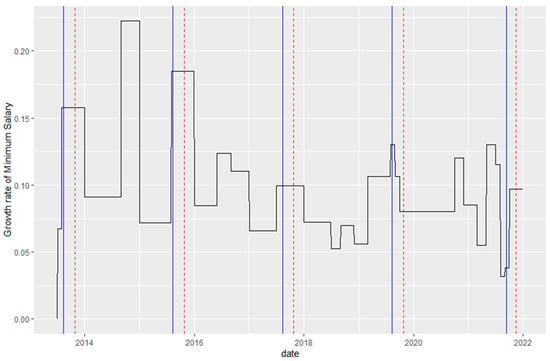
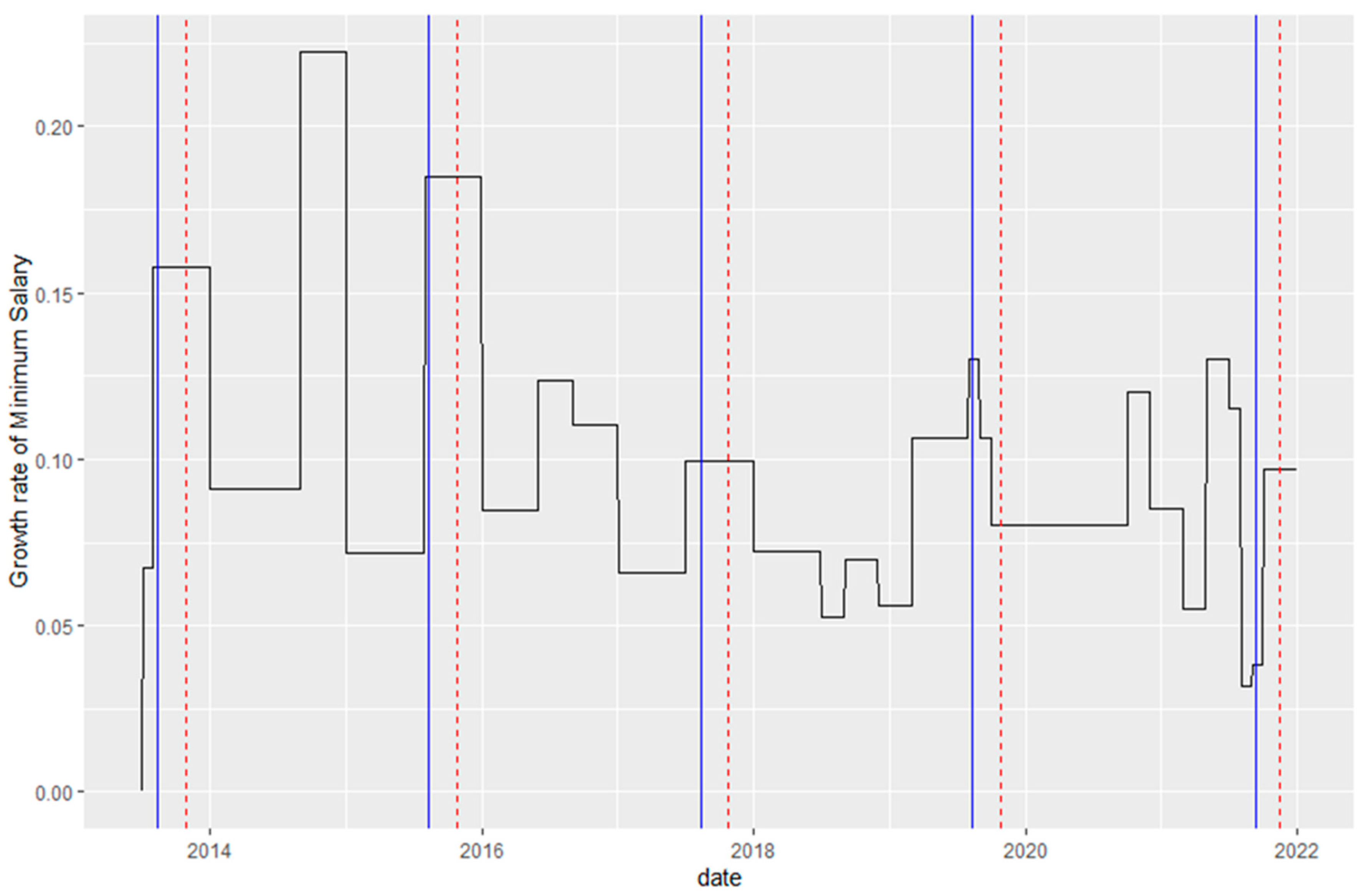
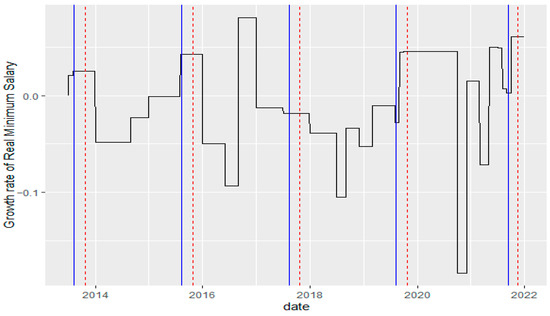
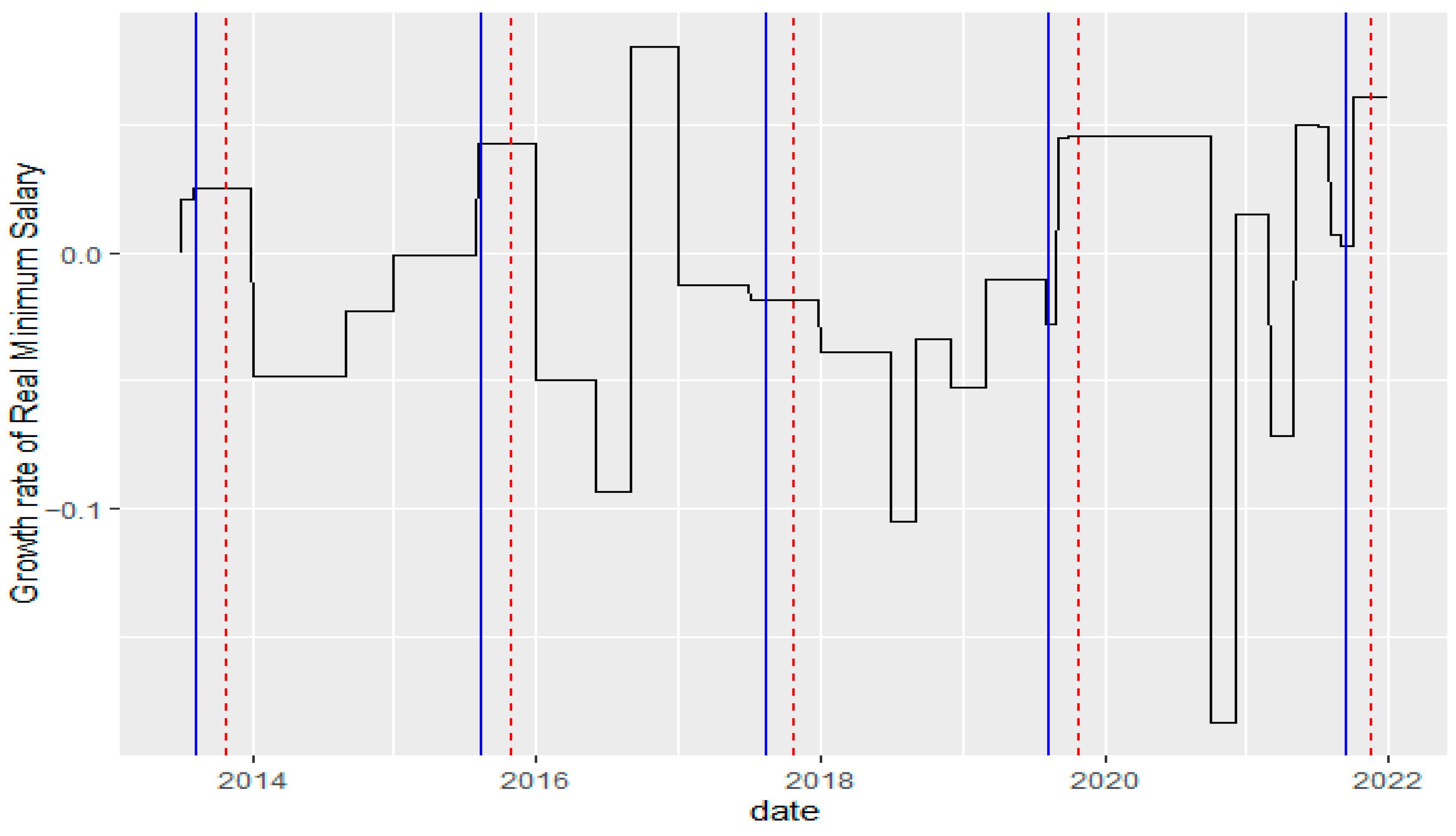
Figure 1 shows the evolution of nominal growth rates of minimum wages in Argentina from July 2013 to December 2021. In the same figure, we also plot solid (dashed) blue (red) vertical lines corresponding to the dates of primary (general) elections in Table 2. We can observe how, in general, exactly a few days before primary elections, there is a very significant increase in the growth rate of minimum wages, creating an asymmetry before and after primary elections. On the other hand, before and after general elections (red lines), we generally observe that the growth rates of minimum wages exhibit symmetric behavior, and there is no incentive to maintain high growth rates for minimum wages. September 2014 is an outlier in terms of minimum salary growth rates; Argentina was experimenting with an annual inflation of 30%, which was unrelated to elections. Figure 2 shows the evolution of real growth rates in minimum wages, and confirms that September 2014 was an outlier due to the high inflation shown in Figure 1. Moreover, the asymmetric behavior of growth rates before and after primary elections and the symmetrical behavior before and after general elections is generally confirmed, as shown in Figure 1 and Figure 2. It is especially interesting to note that in Figure 2, positive growth rates of real minimum salaries are generally obtained when primary elections are approaching. “Although Figure 2 does not show that real growth rates increase a few days before primary elections as clearly as Figure 1, our empirical analysis will confirm the results in the following sections of the paper”. In short, both Figure 1 and Figure 2 indicate the possible existence of an electoral cycle of minimum wages in Argentina (mainly focused on primary elections).
Figure 1.
Solid black line shows the evolution of daily nominal growth rate of minimum salary in Argentina from July 2013 to December 2021 in Argentina. Solid (dashed) blue (red) vertical lines correspond to the dates of primary (general) elections in Table 1. Source: Own elaboration and Ministerio de Capital Humano de Argentina1.
Figure 2.
Solid black line shows the evolution of daily real (adjusted for inflation) growth rate of minimum salary in Argentina from July 2013 to December 2021 in Argentina. Solid (dashed) blue (red) vertical lines correspond to the dates of primary (general) elections in Table 1. Source: Own elaboration, Instituto Nacional de Estadística y Censos (INDEC) de Argentina2 and Ministerio de Capital Humano de Argentina.
The plan of the paper is as follows. We first describe our data and methodology. Later, we show our main results, robustness checks, and finally, our conclusions.
2. Materials and Methods
2.1. Data
We obtained our daily nominal and real data on minimum wages between July 2013 and December 20213 from Ministerio de Capital Humano and Instituto Nacional de Estadística y Censos (INDEC) in Argentina. Following Campos-González and Balcombe (2024), we applied growth rates to the minimum salary (denoted GMinimumSalary) in our sample in order to avoid spurious results due to possible nonstationarities. Figure 1 and Figure 2 show the evolution of nominal and real growth rates, respectively.
2.2. Methods
2.2.1. Baseline Model
Following Feierherd et al. (2024), we start by constructing a simple regression model for varying temporal windows on one-day intervals around elections:
where corresponds to nominal/real growth rates of minimum wages, is a dummy variable that indicates whether growth rates of minimum wages correspond to before or after an election (being 1 before election), and is a disturbance. When focusing on primary elections, according to our Figure 1 and Figure 2, we expect = 0 or < 0 depending on the temporal window on one-day intervals. We argue that growth rates of both nominal and real minimum wages outside electoral windows are lower than during campaign periods, and that there is an initial symmetry since growth rates of minimum wages increase significantly a few days before primary elections, and they remain the same for the same few days after primary elections. However, later we observe an asymmetry since, after those initial days, growth rates are significantly higher after primary elections than before. We used the Argentine electoral law regarding the official start of campaigns to define campaign seasons (Feierherd et al. 2024). We also expected that the effect of primary elections would be different than general elections, since we argue that incumbents increase growth rates as soon as primary elections approach, causing an important asymmetry. We argue that before and after the general election, in a window of approximately half a year, we cannot find important differences in the growth rates due to the expected symmetry. We argue that incumbents who are in power after the general election keep high wage growth rates for a while right after general elections because of the special nature of the minimum salary discussed above (see Schemmel and Picot 2025). Following Feierherd et al. (2024), we estimate Equation (1) using ordinary least squares (OLS) with Huber–White robust standard errors (of the HC2 type).
Therefore, the main hypothesis to be tested from (1) in this paper is the following:
H1:
For primary elections, we expect = 0 if the varying temporal window is for only the first few days that we expect growth rates to increase before primary elections and < 0 when the temporal window is larger. For general elections, we expect = 0.
We set our temporal window on one-day intervals to be 150 days, since we expect the impact of the change in the growth rate before/after the election to be more persistent than the effect analyzed in Feierherd et al. (2024), where a range of thirty-seven was selected when analyzing the file of complaints. The reason, we argue, is that incumbents who lost, or even those who won, keep high wage growth rates for a while right after general elections, as discussed above (see Schemmel and Picot 2025). We also check that our results are robust to analyzing windows of 180 days before and after the election, corresponding to a complete year. Note that this methodology, which allows for varying temporal windows, is especially useful in our case, since we can investigate whether, in primary elections and across separate regressions for varying windows, = 0 for the first days that we expect growth rates to increase before primary elections and < 0 after that.
2.2.2. Robustness Checks: Local-Linear Regression
Following Feierherd et al. (2024), we also estimate a local-linear regression using the number of days away from the nearest election to compute triangular weights. For a given bandwidth, we fitted two separate regressions for the days before and after the nearest election, and estimated the difference between the two intercepts. Bias-corrected confidence intervals and p-values proposed by Calonico et al. (2014) are provided. We use a bandwidth equal to the temporal window used in estimating Equation (1), and therefore a maximum of 150 days is allowed before and after elections. We also check that our results are robust to a bandwidth of 180 days. Note that this methodology allows us only to check that = 0 for general elections, but does not allow us to check if = 0 or < 0 for primary elections, depending on the temporal window.
3. Results
3.1. Baseline Model
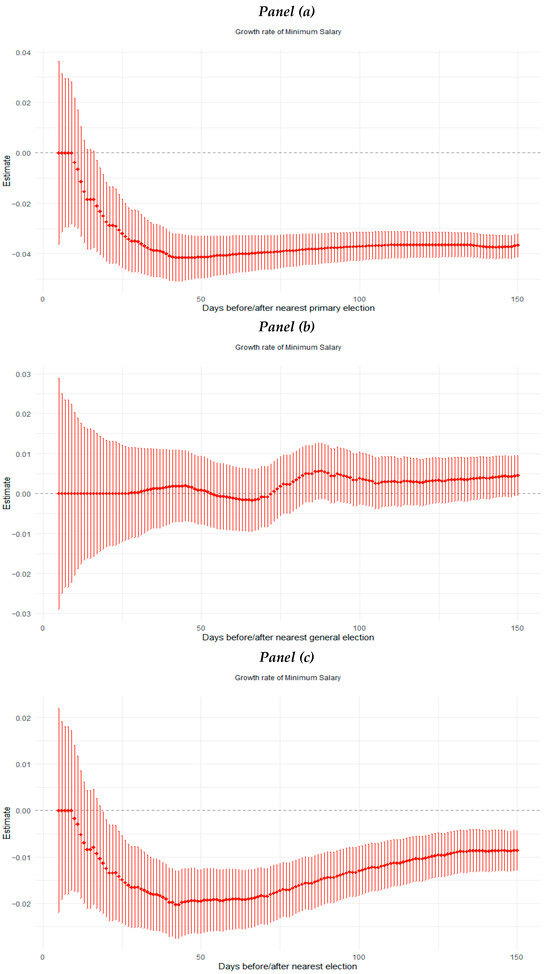
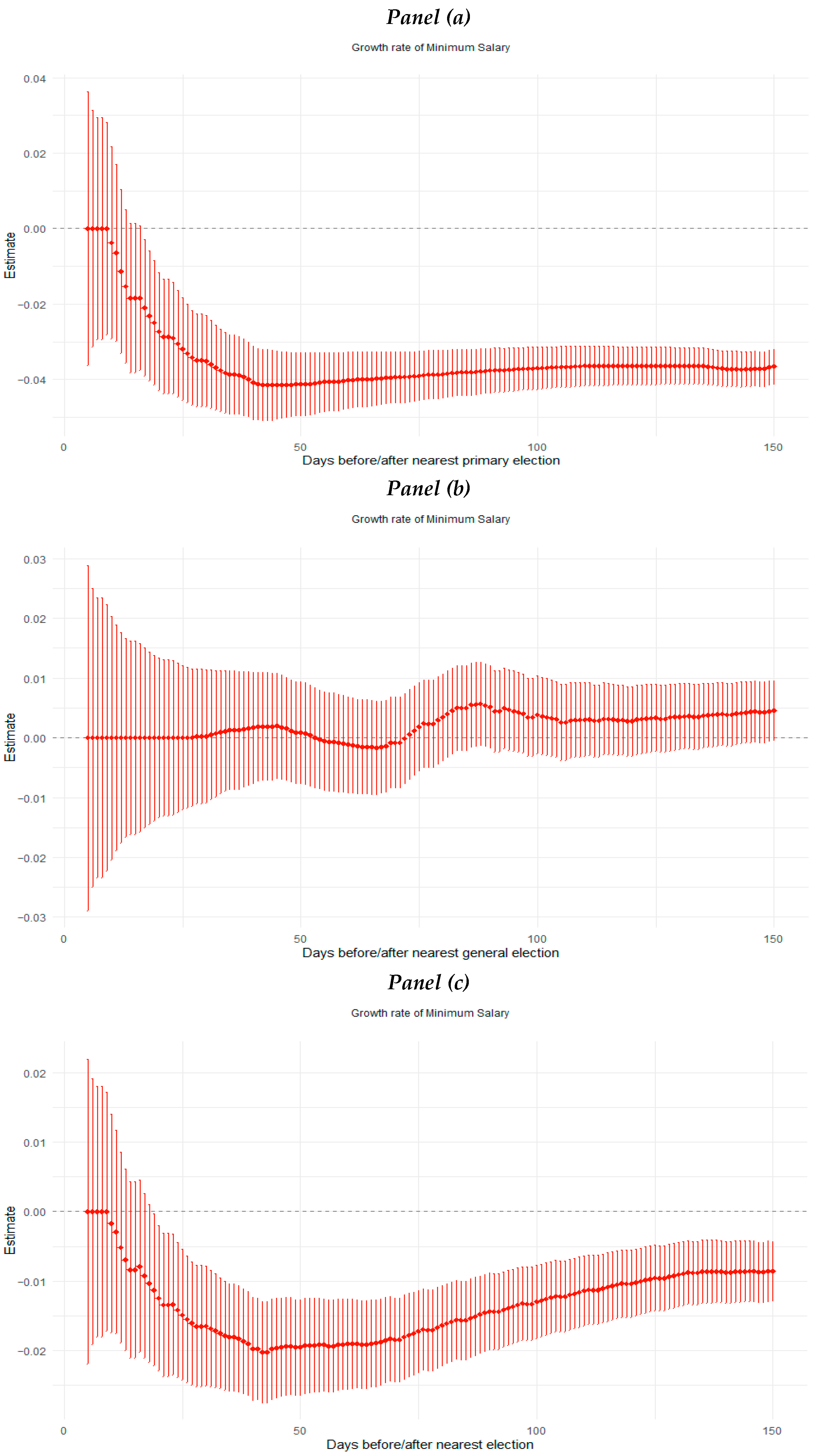
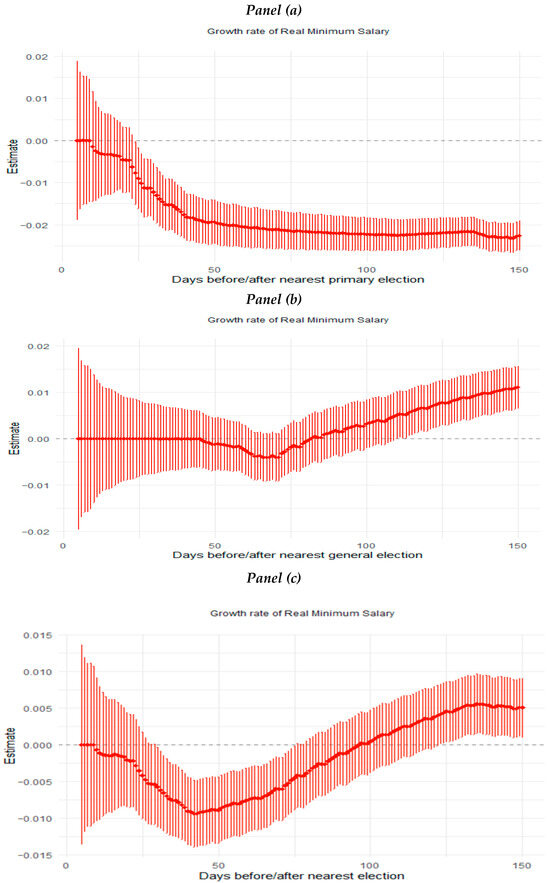
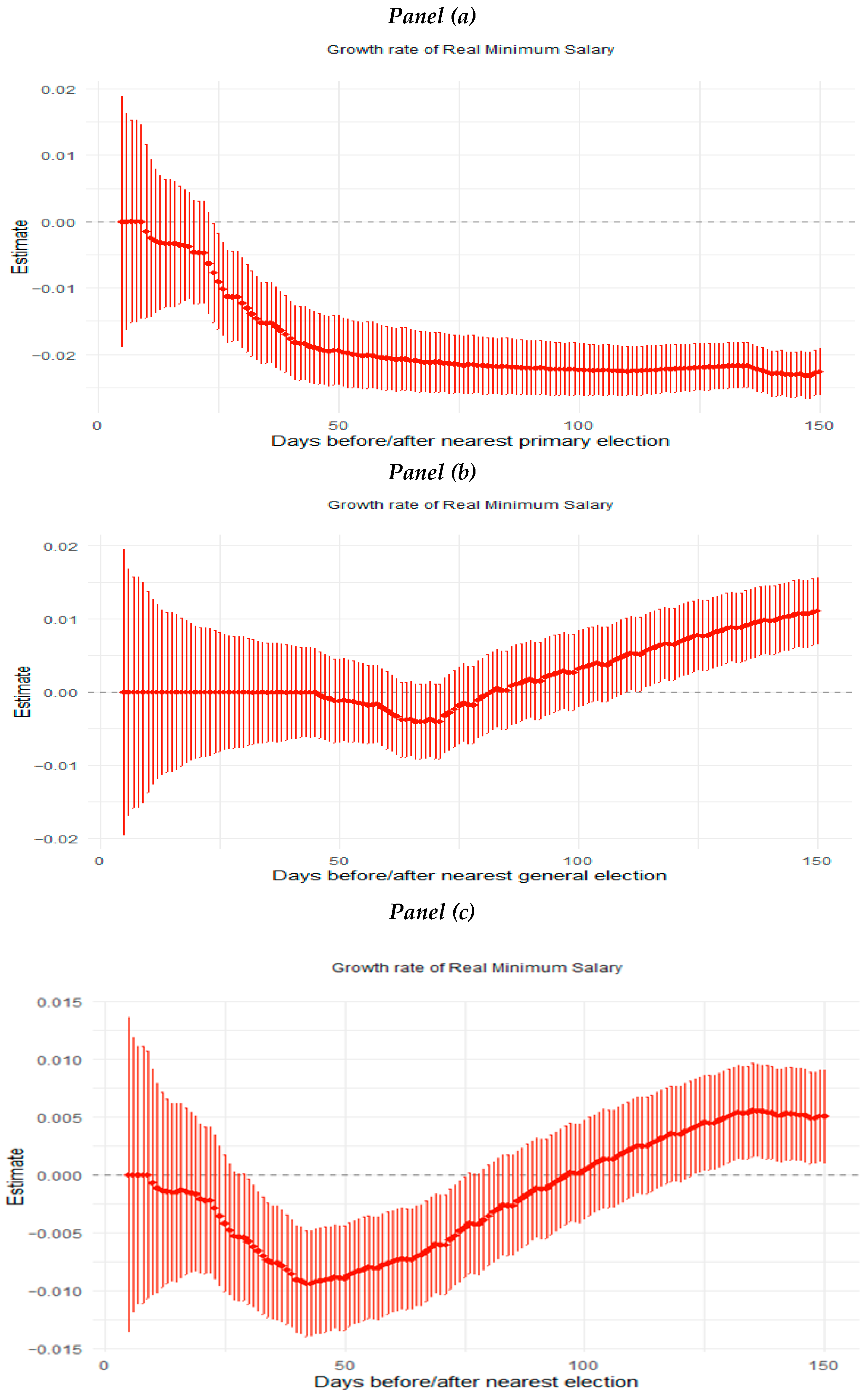
Figure 3 shows the results of estimating Equation (1) with nominal growth rates when focusing on primary (panel (a)), general (panel (b)) or both types of elections (panel (c)). As expected, since we argue that incumbents significantly increase growth rates of minimum wages a few days before primary elections, we find that, at the beginning of the cycle, growth rates of minimum wages are not significantly different before and after primary elections (during the few days of the initial increase before primary elections); however, after those few days have passed, we find that growth rates are statistically significantly higher after primary elections than before (see panel (a)). Panel (b) shows that growth rates before and after general elections are not statistically different. The effect when employing both types of elections in panel (c) covers the two types of effects of panels (a) and (b). Figure 4 shows that the results are robust when using real growth rates.
Figure 3.
Difference in the number of days of nominal growth rates before and after the nearest election. Point estimates come from separate regressions for varying windows as given in (1). Bars represent robust 95 per cent confidence intervals. Panel (a) corresponds to primary elections, while panels (b,c) focus on general and both types of elections. Source: Own elaboration.
Figure 4.
Difference in the number of days of real growth rates before and after the nearest election. Point estimates come from separate regressions for varying windows as given in (1). Bars represent robust 95 per cent confidence intervals. Panel (a) corresponds to primary elections, while panels (b,c) focus on general and both types of elections. Source: Own elaboration.
3.2. Robustness Checks: Local-Linear Regression
Table 3, Table 4, Table 5 and Table 6 show the local-linear regression results. By using nominal and real growth rates, along with robust confidence intervals (RCI) following the procedure of Calonico et al. (2014), Table 3 and Table 5 confirm the expected results of Figure 3 and Figure 4 that = 0 for general elections. For primary elections, Table 3 also shows evidence in favor that < 0, although this methodology does not allow us to find statistically significant evidence that growth rates increased a few days before primary elections. Table 5 shows that = 0 for primary elections, but it cannot verify if < 0 for some particular time varying windows as the baseline model. Table 4 and Table 6 also confirm the results of Table 3 and Table 5 for a bandwidth of 180 days.
Table 3.
Local linear estimates for a bandwidth of 150 days. Nominal growth rates. Source: Own elaboration.
Table 4.
Local linear estimates for a bandwidth of 180 days. Nominal growth rates. Source: Own elaboration.
Table 5.
Local linear estimates for a bandwidth of 150 days. Real growth rates. Source: Own elaboration.
Table 6.
Local linear estimates for a bandwidth of 180 days. Real growth rates. Source: Own elaboration.
4. Discussion
There is an extensive and diverse literature showing the effects of minimum wages on income inequality in Latin America (see, e.g., Maurizio and Vázquez 2016; Feierherd et al. 2023; Francis and Valodia 2021; Anria and Bogliaccini 2022; Cámara et al. 2024). Maurizio and Vázquez (2016) argued that increasing minimum wages decreased income inequality in Argentina, Brazil, and Uruguay, but not in Chile. However, Anria and Bogliaccini (2022) showed that positive results also exist in Chile, while Axelsson and Martins (2024) showed the dangers of the lack of wage indexation in Brazil. More recently, it has been shown that repeated minimum wage increases did not lead to increased unemployment in Argentina (Abbate and Jiménez 2026); however, as minimum wages rise, firms increase investments in tangible assets (da Fonseca et al. 2026). In this paper, we show that minimum wages can also be used by incumbent politicians with perverse incentives (as in Jimenez 2023) by documenting an electoral cycle in the evolution of minimum salaries in Argentina. In more detail, we focus on the potential strategic manipulation of a core economic policy around elections by identifying a political business cycle related to changes in minimum wage policy in Argentina between 2013 and 2021. The findings are interesting, especially because Argentina features incumbents from different sides of the ideological spectrum (Feierherd et al. 2024). Therefore, we find that the business cycle persists despite the ideological orientation of the president, and this signals broader scope conditions.
We argue that incumbent politicians tend to significantly increase growth rates of minimum wages a few days before primary elections, and they tend to keep them high for a period after general elections conclude. We argue that incumbents who lost, or even those who won, keep high wage growth rates for a while right after general elections, because minimum salary is regarded as paying necessary respect to those who fulfill their obligation to social cooperation (see Schemmel and Picot 2025). We show that our analysis is robust to the use of nominal and real minimum wages. However, note that Schemmel and Picot (2025) showed that the best justification of minimum salaries does not lie in their economic effects but in the respect for social contributors that they express. Therefore, we also argue that incumbent politicians benefit from the increase in minimum wages a few days before elections, even without needing to wait to feel the economic effects.
These results are in line with previous studies on populism in Latin America (see, e.g., Posner 2016; Montero 2024), and how increasing the minimum wage can improve citizens’ assessment of governance performance (Jimenez 2023). Our results are also in line with previous literature on the strategic use of different tools used by politicians aiming to be re-elected (Eckstein 2009; Álvarez-Mingote 2019; Barrientos 2023; Feierherd et al. 2024). Our results highlight the importance of incumbents and challengers competing on a level playing field during electoral campaigns (Johnson 2011), and that there are mechanisms in place that guarantee that incumbents do not use strategic tools (such as increases in minimum salaries) for their own benefit just before elections. The following are some examples of specific mechanisms that could be put in place: First, having institutionalized tripartite consultation bodies in order to force consultation with other social actors before changing the minimum wage. Second, installing a caretaker (i.e., a temporary ad hoc) government: an interim, non-partisan, and neutral administration to oversee elections, preventing the use of government resources for campaigns. Third, forcing regulations and legal restrictions to prohibit massive minimum salary increases before an election, and laws that mandate transparency in the actions of incumbents during campaigns and the regulation of state resources. Fourth, making use of autonomous independent electoral management bodies acting as a check on executive power, ensuring unbiased administration of elections, including enforcement of campaign finance laws. Fifth, setting rules requiring public media to provide equitable, balanced coverage to both opposition and incumbent parties, since incumbents often control state media, providing them with disproportionate coverage and the ability to marginalize opposition voices, especially during campaigns.
Our methodology has several important limitations. First, we make use of daily data in order to characterize the election dates (primary and general) in Argentina; however, minimum wages in Argentina are not adjusted daily. They are typically changed through discrete policy decisions. Therefore, using daily growth rates may generate long periods of zero changes punctuated by large jumps, and this may create a data structure poorly suited for OLS regressions. Second, we assume that higher growth rates of minimum salaries around elections are equal to electoral manipulation with perverse incentives, and we recommend electoral fairness mechanisms. However, alternative explanations could include pre-scheduled wage adjustments, bargaining cycles with unions, or institutional wage review calendars. Without controlling for these factors, the results may reflect coincidence rather than strategy. Third, our dataset covers only the period 2013–2021 in order to make use of the primary and general election dates given in Feierherd et al. (2024). However, this includes very few election cycles, and it raises concerns about small sample bias and lack of statistical power. The use of an alternative methodology is left for future research.
Finally, it is important to note that many Latin American countries have a statutory national minimum wage that is set unilaterally by the government (see Table 1 in Gindling and Ronconi (2025)). Additionally, 30 out of 38 OECD countries have a statutory minimum wage in place, and minimum wages also exist in most non-OECD emerging economies (OECD 2025). All of this supports the applicability of our results to other countries.
Author Contributions
Conceptualization, M.A.B.-B. and A.M.L.-L.; methodology, M.A.B.-B. and A.M.L.-L.; software, M.A.B.-B. and A.M.L.-L.; validation, M.A.B.-B. and A.M.L.-L.; formal analysis, M.A.B.-B. and A.M.L.-L.; investigation, M.A.B.-B. and A.M.L.-L.; resources, M.A.B.-B. and A.M.L.-L.; data curation, M.A.B.-B. and A.M.L.-L.; writing—original draft preparation, M.A.B.-B. and A.M.L.-L.; writing—review and editing, M.A.B.-B. and A.M.L.-L.; visualization, M.A.B.-B. and A.M.L.-L.; supervision, M.A.B.-B. and A.M.L.-L.; project administration, M.A.B.-B. and A.M.L.-L. All authors have read and agreed to the published version of the manuscript.
Funding
This research received no external funding.
Institutional Review Board Statement
Not applicable.
Informed Consent Statement
Not applicable.
Data Availability Statement
The data presented in this study are available on request from the corresponding author.
Acknowledgments
We thank the Editor and two reviewers for extremely their helpful comments and suggestions to improve the quality of the paper.
Conflicts of Interest
The authors declare no conflicts of interest.
Notes
| 1 | www.argentina.gob.ar/capital-humano (accessed on 25 March 2026). |
| 2 | www.indec.gob.ar/ (accessed on 25 March 2026). |
| 3 | We focus on the period 2013–2021 in order to refer to the same analyzed period in Feierherd et al. (2024), since we use their R code to implement their methodology. We used R version 4.5.3. |
References
- Abbate, Nicolás, and Bruno Jiménez. 2026. Do minimum wage hikes lead to employment destruction? Evidence from a regression discontinuity design in Argentina. Journal of Development Economics 178: 103558. [Google Scholar] [CrossRef] [Scilit]
- Abofarha, Elsayed A., and Ramez I. Nasreldein. 2022. Explaining presidential instability in Latin America: Evidence from Brazil, Argentina and Ecuador. Review of Economics and Political Science 7: 56–70. [Google Scholar] [CrossRef] [Scilit]
- Ahnen, Ronald. 2017. Leftist Politics and the Limits of Microcredit in Argentina. Journal of Politics in Latin America 9: 41–62. [Google Scholar] [CrossRef] [Scilit]
- Anria, Santiago, and Juan Bogliaccini. 2022. Empowering Inclusion? The Two Sides of Party-Society Linkages in Latin America. Studies in Comparative International Development 57: 410–32. [Google Scholar] [CrossRef] [Scilit] [PubMed]
- Araújo, Victor. 2021. Do anti-poverty policies sway voters? Evidence from a meta-analysis of Conditional Cash Transfers. Research & Politics 8: 1. [Google Scholar] [CrossRef] [Scilit]
- Axelsson, Tobias, and Igor Martins. 2024. Resilience to Shrinking as a Catch-Up Strategy: A Comparison of Brazil and Indonesia, 1964–2019. Studies in Comparative International Development 59: 491–516. [Google Scholar] [CrossRef] [Scilit]
- Álvarez-Mingote, Cristina. 2019. How Do Remittances Shape Electoral Strategies Back Home? Evidence from Mexico’s 2006 Presidential Election. Latin American Politics and Society 61: 55–79. [Google Scholar] [CrossRef] [Scilit]
- Barrientos, Armando. 2023. Social Assistance Expansion and Political Inclusion in Latin America. Journal of Politics in Latin America 15: 25–46. [Google Scholar] [CrossRef] [Scilit]
- Biermann, Frank, and Agni Kalfagianni. 2020. Planetary justice: A research framework. Earth System Governance 6: 100049. [Google Scholar] [CrossRef] [Scilit]
- Brummund, Peter, and Michael R. Strain. 2020. Does employment respond differently to minimum wage increases in the presence of inflation indexing? Journal of Human Resources 55: 999–1024. [Google Scholar] [CrossRef] [Scilit]
- Calonico, Sebastian, Matias D. Cattaneo, and Rocio Titiunik. 2014. Robust nonparametric confidence intervals for regression-discontinuity designs. Econometrica 82: 2295–326. [Google Scholar] [CrossRef] [Scilit]
- Campos-González, Jorge, and Kelvin Balcombe. 2024. The race between education and technology in Chile and its impact on the skill premium. Economic Modelling 131: 106616. [Google Scholar] [CrossRef] [Scilit]
- Cámara, Javier A., Luis Cárdenas, and Adrián Rial. 2024. The effects of the minimum wage on inequality: A literature review. Work, Organisation, Labour & Globalisation 18: 196–218. [Google Scholar] [CrossRef] [Scilit]
- Cooperman, Alicia. 2022. (Un)Natural Disasters: Electoral Cycles in Disaster Relief. Comparative Political Studies 55: 1158–97. [Google Scholar] [CrossRef] [Scilit]
- da Fonseca, Peter V., Michele N. Jucá, and Albert Fishlow. 2026. The Impact of Minimum Wage and Labor-Intensive Businesses on Corporate Investment in Latin America. Latin American Business Review, 1–26. [Google Scholar] [CrossRef] [Scilit]
- Davies, Emmerich. 2025. Absence: Electoral Cycles and Teacher Absenteeism in India. British Journal of Political Science 55: e38. [Google Scholar] [CrossRef] [Scilit]
- Douglas, James W., John Szmer, and Ringa Raudla. 2025. Political tax cycles in the US states: Opportunism versus ideological sincerity in governors’ revenue proposals. Governance 38: e12886. [Google Scholar] [CrossRef] [Scilit]
- Dyke, Andrew. 2007. Electoral cycles in the administration of criminal justice. Public Choice 133: 417–37. [Google Scholar] [CrossRef] [Scilit]
- Eckstein, Susan. 2009. The Personal Is Political: The Cuban Ethnic Electoral Policy Cycle. Latin American Politics and Society 51: 119–48. [Google Scholar] [CrossRef] [Scilit]
- Ellinas, Antonis A., and Iasonas Lamprianou. 2024. Movement versus Party: The Electoral Effects of Anti-Far Right Protests in Greece. American Political Science Review 118: 687–705. [Google Scholar] [CrossRef] [Scilit]
- Englmaier, Florian, and Till Stowasser. 2017. Electoral Cycles in Savings Bank Lending. Journal of the European Economic Association 15: 296–354. [Google Scholar] [CrossRef] [Scilit]
- Feierherd, Germán, Ezequiel Gonzalez-Ocantos, and Guadalupe Tuñón. 2024. Witch Hunts? Electoral Cycles and Corruption Lawsuits in Argentina. British Journal of Political Science 54: 629–48. [Google Scholar] [CrossRef] [Scilit]
- Feierherd, Germán, Patricio Larroulet, Wei Long, and Nora Lustig. 2023. The Pink Tide and Income Inequality in Latin America. Latin American Politics and Society 65: 110–44. [Google Scholar] [CrossRef] [Scilit]
- Figueroa, Valentín. 2016. Electoral Proximity and the Political Involvement of Bureaucrats: A Natural Experiment in Argentina, 1904. Journal of Politics in Latin America 8: 69–94. [Google Scholar] [CrossRef] [Scilit]
- Finnegan, Jared J. 2023. Changing Prices in a Changing Climate: Electoral Competition and Fossil Fuel Taxation. Comparative Political Studies 56: 1257–90. [Google Scholar] [CrossRef] [Scilit]
- Foremny, Dirk, and Nadine Riedel. 2014. Business taxes and the electoral cycle. Journal of Public Economics 115: 48–61. [Google Scholar] [CrossRef] [Scilit]
- Francis, David, and Imraan Valodia. 2021. Inequality in the South African labour market: The political economy of the national minimum wage. Critical Social Policy 41: 385–403. [Google Scholar] [CrossRef] [Scilit]
- Gindling, Tim H., and Lucas Ronconi. 2025. Minimum wage policy and inequality in Latin America and the Caribbean. Oxford Open Economics 4: i400–i415. [Google Scholar] [CrossRef]
- Hamel, Brian T. 2025. Inequality in the Classroom: Electoral Incentives and the Distribution of Local Education Spending. The Journal of Politics 87: 527–43. [Google Scholar] [CrossRef] [Scilit]
- Han, Kangwook. 2022. Political Budgetary Cycles in Autocratic Redistribution. Comparative Political Studies 55: 727–56. [Google Scholar] [CrossRef] [Scilit]
- Jimenez, Bruno. 2023. The Political Economy of the Minimum Wage. Labour Economics 85: 102463. [Google Scholar] [CrossRef] [Scilit]
- Johnson, Joel W. 2011. Incumbents without a Campaign Finance Advantage: Competition and Money in Chile’s Congressional Elections. Journal of Politics in Latin America 3: 3–33. [Google Scholar] [CrossRef] [Scilit]
- Keech, William R., and Kyoungsan Pak. 1989. Electoral Cycles and Budgetary Growth in Veterans’ Benefit Programs. American Journal of Political Science 33: 901–11. [Google Scholar] [CrossRef] [Scilit]
- Klüver, Heike. 2025. Social Influencers and Election Outcomes. Comparative Political Studies 58: 2973–99. [Google Scholar] [CrossRef] [Scilit]
- Landgrave, Michelangelo, Nicholas R. Jenkins, and Aubree J. Hardesty. 2025. Do congressional candidates benefit from rejecting PAC contributions? Evidence from a pre-registered candidate evaluation survey experiment. Research & Politics 12: 3. [Google Scholar] [CrossRef] [Scilit]
- Lewis-Beck, Michael S., and Mary Stegmaier. 2000. Economic determinants of electoral outcomes. Annual Review of Political Science 3: 183–219. [Google Scholar] [CrossRef] [Scilit]
- Maurizio, Roxana, and Gustavo Vázquez. 2016. Distribution effects of the minimum wage in four Latin American countries: Argentina, Brazil, Chile and Uruguay. International Labour Review 155: 97–131. [Google Scholar] [CrossRef] [Scilit]
- Min, Brian, and Miriam Golden. 2014. Electoral cycles in electricity losses in India. Energy Policy 65: 619–25. [Google Scholar] [CrossRef] [Scilit]
- Mintz, Alex. 1988. Electoral Cycles and Defense Spending: A Comparison of Israel and the United States. Comparative Political Studies 21: 368–81. [Google Scholar] [CrossRef] [Scilit]
- Mintz, Alex, and Michael D. Ward. 1989. The Political Economy of Military Spending in Israel. American Political Science Review 83: 521–33. [Google Scholar] [CrossRef] [Scilit]
- Montero, Alfred P. 2024. Polarization and Populism in Latin America. Latin American Politics and Society 66: 179–95. [Google Scholar] [CrossRef] [Scilit]
- Nanes, Matthew J. 2017. Political Violence Cycles: Electoral Incentives and the Provision of Counterterrorism. Comparative Political Studies 50: 171–99. [Google Scholar] [CrossRef] [Scilit]
- OECD. 2025. Inflation and Cost of Living. Available online: https://www.oecd.org/en/topics/inflation-and-cost-of-living.html (accessed on 25 March 2026).
- Parthasarathy, Ramya. 2017. Ethnic Quotas as Term-Limits: Caste and Distributive Politics in South India. Comparative Political Studies 50: 1735–67. [Google Scholar] [CrossRef] [Scilit]
- Posner, Paul W. 2016. Laboring Under Chávez: Populism for the Twenty-first Century. Latin American Politics and Society 58: 26–50. [Google Scholar] [CrossRef] [Scilit]
- Sajuria, Javier, and Sofia Collignon. 2025. Local media, local candidates and preference formation. Political Research Exchange 7: 2461777. [Google Scholar] [CrossRef] [Scilit]
- Sanford, Luke. 2023. Democratization, Elections, and Public Goods: The Evidence from Deforestation. American Journal of Political Science 67: 748–63. [Google Scholar] [CrossRef] [Scilit]
- Schemmel, Christian, and Georg Picot. 2025. Why We Need Minimum Wages: Pay, Recognition, and Economic Citizenship. American Political Science Review 119: 1258–71. [Google Scholar] [CrossRef] [Scilit]
- Slee, Gillian, and Matthew Desmond. 2021. Eviction and Voter Turnout: The Political Consequences of Housing Instability. Politics & Society 51: 3–29. [Google Scholar] [CrossRef] [Scilit]
- Snarski, Yaroslav. 2025. Brilliant tragedy? Electoral effects of environmental protest cycle in autocracy. Democratization 32: 166–87. [Google Scholar] [CrossRef] [Scilit]
- Su, Min, and Christian Buerger. 2025. Playing politics with traffic fines: Sheriff elections and political cycles in traffic fines revenue. American Journal of Political Science 69: 164–75. [Google Scholar] [CrossRef] [Scilit]
- Teele, Dawn L. 2014. Ordinary Democratization: The Electoral Strategy That Won British Women the Vote. Politics & Society 42: 537–61. [Google Scholar] [CrossRef] [Scilit]
- Urvoy, Camille. 2025. Organized Voters: Elections and Public Funding of Nonprofits. American Economic Review 115: 183–219. [Google Scholar] [CrossRef] [Scilit]
- Washida, Hidekuni. 2025. Electoral cycles of protests and statistical manipulation in autocracies: Evidence from the COVID-19 pandemic. Democratization 32: 1160–80. [Google Scholar] [CrossRef] [Scilit]
- Westman, Linda, Janetta McKenzie, and Sarah L. Burch. 2020. Political participation of businesses: A framework to understand contributions of SMEs to urban sustainability politics. Earth System Governance 3: 100044. [Google Scholar] [CrossRef] [Scilit]

Disclaimer/Publisher’s Note: The statements, opinions and data contained in all publications are solely those of the individual author(s) and contributor(s) and not of MDPI and/or the editor(s). MDPI and/or the editor(s) disclaim responsibility for any injury to people or property resulting from any ideas, methods, instructions or products referred to in the content. |
© 2026 by the authors. Licensee MDPI, Basel, Switzerland. This article is an open access article distributed under the terms and conditions of the Creative Commons Attribution (CC BY) license.