


Abstract
This study investigates why U.S. states vary in their spending of federal funds under the Temporary Assistance for Needy Families (TANF) block grant, the primary federal program grant to support low-income families with children. Grounded in fiscal federalism and state welfare politics, the study examines how political and institutional settings shape states’ spending decisions, using panel data from all 50 states from fiscal year 2004 to 2016 and a two-way fixed effects model. The results indicate that policy and political factors significantly impact states’ spending decisions, whereas most socioeconomic indicators do not. In particular, states with a TANF job-search requirement allocate a larger share of TANF funds to child care than those without such requirements. However, this positive effect becomes negative when female legislative representation exceeds a certain threshold. These findings demonstrate that policy design and political representation interact to shape the implementation of federal grants at the state level. The study suggests that state allocation decisions under federal block grants are closely tied to institutional design and political context, with broader implications for welfare governance under federalism.
1. Introduction
The passage of the Personal Responsibility and Work Opportunity Reconciliation Act (PRWORA) was a watershed moment in the history of American welfare policy. The PRWORA of 1996, commonly known as the Welfare Reform Act, replaced the Aid to Families with Dependent Children (AFDC) with the Temporary Assistance for Needy Families (TANF), a federal block grant for low-income families with children. The reform reoriented U.S. welfare policy by emphasizing work and self-sufficiency. It introduced time limits on welfare recipients, established work requirements, and granted state government authority to impose stricter work and work-activity conditions. At the same time, states implemented a range of supportive services aimed at promoting employment, including education programs, job-search assistance, and child care support (Haskins 2016; Martin and Caminada 2011; Moffitt 2003).
By combining work incentives with substantial state discretion over spending priorities, TANF created a policy context in which differences in states’ spending strategies became consequential. However, studies examining cross-state variation in TANF funding allocations remain largely descriptive and limited (Schott et al. 2018; Winburn et al. 2024). Most scholarly interest has focused on total state TANF spending levels (Ewalt and Jennings 2014; Rodgers and Tedin 2006), the stringency of states’ TANF policies for benefits, eligibility, and sanctions (Fellowes and Rowe 2004; Filindra 2013; Maguire-Jack et al. 2021; Ojeda et al. 2019; Soss et al. 2001), and variation in policy outputs such as children coverage or cash generosity (Bentele and Nicoli 2012; Bruch et al. 2018). More recent work addresses the block grant structure of TANF (Fusaro 2021a, 2021b), but their explanatory discussions are limited by short time frames or the omission of key factors influencing state TANF spending decisions.
One important yet relatively understudied aspect of TANF spending decisions involves the allocation of funds for child care support. Understanding TANF spending on child care across states and over time is important for several reasons. Within the broader American child care policy landscape, characterized by a patchwork of multiple federal and state programs, TANF-funded child care occupies a unique position. Together with Child Care Development Fund (CCDF), the largest federal child care subsidy program for low-income families (Pac 2021), TANF functions as an important work-support by helping parents participate in work-related activities while securing child care. However, the two programs serve overlapping but different populations (U.S. ACF 2023). CCDF generally targets wider low-income families, whereas TANF focuses on the poorest families receiving cash assistance or subject to work requirements.
Since the passage of the Welfare Reform Act of 1996, the federal government and the states have greatly emphasized supporting child care with TANF funds (Waldfogel 2001). In fact, child care for low-income families is stated as one of the core welfare reform areas, together with basic assistance for families with children and work-related activities or supports. Because TANF shifted the emphasis from stay-at-home parenting under AFDC to work as a requirement for receiving benefits, the provision of child care has become a critical issue for moving people from cash assistance to work. From the welfare recipients’ point of view, child care is such an important aspect of TANF because welfare recipients, mostly single-mother families, have difficulties seeking employment and securing child care at the same time (Danziger et al. 2013; Heinz 2025). Child care support, therefore, can help recipients transition off welfare and make a living.
The growing share of TANF funds spent on child care over time demonstrates its policy salience for child care. Child care spending in total TANF funds almost doubled from 9.3 percent in fiscal year 1998 to 17 percent in fiscal year 2016 (U.S. Department of Health and Human Services 2019). Despite its expansion, the U.S. government provides relatively little public assistance for child care compared to many industrialized countries in Western Europe (Lokteff and Piercy 2012; Ng 2006; White 2009). Average total public spending on child care and early childhood education across 37 OECD countries is 0.8 percent of GDP, while the U.S. government spends less than 0.5 percent, ranked near the bottom among OECD countries on this measure (OECD 2023). Although nearly three decades have passed since the enactment of PRWORA in 1996, little scholarly attention has been devoted to examining how states spend TANF funds on child care. This gap is notable given that state governments have substantial discretion over the use of TANF block grant funds. This greater flexibility made variation in state spending both possible and likely. For example, Kansas and Idaho spent a similar proportion of TANF funds on child care in fiscal year 2004, at 15.5 percent and 15.4 percent, respectively. Over time, however, their spending trajectories diverged sharply. A decade later, Kansas had reduced child care spending to 4.3 percent, while Idaho was increasing it to 27.1 percent. The stark contrasts underscore the importance of explaining sustained cross-state variation over time in TANF child care spending.
Grounded in the theoretical perspectives of fiscal federalism and state welfare politics, this study examines state TANF spending decisions to better understand the political and policy design environments shaping the allocation of TANF block grant spending on child care. The study addresses three central questions: Does the implementation of a TANF job-search requirement affect the share of TANF funds allocated to child care? Does female legislative representation condition this relationship? And do government ideology and citizen ideology influence these spending patterns? Drawing on fiscal federalism theory, which emphasizes how decentralized governance structures enable state governments to respond strategically to political and fiscal incentives (Nukpezah and Ahmadu 2023; Oates 1999), this study analyzes panel data from all 50 states covering fiscal year 2004 to 2016 employing a two-way fixed effects model. The findings provide empirical evidence of the previously underexplored political and policy drivers of variation in federal block grant spending and contribute to broader debates on welfare governance under federalism. This paper is organized as follows. Section 2 reviews state-level explanations for variation in TANF child care spending, with particular attention to political environments, policy design embedded in TANF rules, and socioeconomic conditions influencing state spending decisions. Section 3 outlines the data sources, variable construction, and analytical approach used to test the proposed relationships, followed by the presentation of results across 50 states. Section 5 then details policy implications, theoretical and practical contributions, study limitations, and directions for future research. Section 6 concludes by linking the findings to broader debates on welfare governance under TANF.
2. State-Level Approaches to TANF Child Care Spending
2.1. State Political Environment of TANF Child Care Spending
Research on state welfare politics has primarily emphasized political and socioeconomic explanations for cross-state variation in welfare policy. Conditions external to state governments’ direct control, including political preferences and socioeconomic environments, can affect states’ decisions regarding TANF child care spending. Political factors, in particular, have played a central role in influencing state welfare policy. A body of scholarship highlights the importance of citizen preferences and broad ideological orientations in driving variation and change in state policy. This political force is widely recognized as a critical determinant of welfare policy and spending levels across states (Erikson et al. 1993; Fellowes and Rowe 2004; Filindra 2013; Ringquist et al. 1997; Soss et al. 2001). In democratic systems, state citizens elect their representatives with the expectation that their governments will respond to citizen preferences when making policy choices (Powell 2004). Accordingly, prior studies have investigated democratic responsiveness by examining the correspondence between state citizen ideology and the ideological leaning of state public policy. More liberal citizen ideology leads to more liberal state policies under certain conditions (Erikson et al. 1993), while more conservative citizens are more likely to oppose an increase in government spending on child care (Henderson et al. 1995). Subsequent studies have also reinforced a consistent positive association between state citizens’ ideology and state welfare policy (Ewalt and Jennings 2014; Fellowes and Rowe 2004; Ringquist et al. 1997; Soss et al. 2001).
State government ideology and partisan control play an important role in shaping state welfare policymaking. Although these concepts can be defined in different ways (Brown 1995; Smith 1997), the underlying pattern is consistent. Although support for using TANF block grant funds to finance child care is often described as bipartisan, more liberal state governments tend to adopt more generous approaches to assisting low-income populations, in part because they reflect the preferences of more liberal electorates (Cohen 2001). Consequently, these governments devote more resources to welfare programs, allocate higher benefit levels, and impose fewer restrictions on benefit eligibility than their more conservative counterparts (Cohen 2001; Fellowes and Rowe 2004; Flavin 2015; Rom 1999; Smith 1997; Soss et al. 2001).
In addition to partisan and ideological dynamics, women’s representation in state legislatures constitutes a distinct political influence on welfare policymaking. Both state-level contexts demonstrate that female legislators are more likely than their male counterparts to prioritize issues affecting women and families and to hold more liberal positions on welfare policy (Barrett 1997; CAWP 2001; Hawkesworth et al. 2001; Poggione 2004; Reingold and Smith 2012; Thomas and Welch 1991; Welch 1985). Evidence from survey data confirms that women legislators are more likely to support more expansive welfare policies (Poggione 2004). Following the welfare reform of 1996, states with a higher level of female legislators were more likely to adopt more progressive welfare arrangements (Payne 2013). Moreover, women legislators’ personal experiences further condition these priorities, as women with children are more likely to introduce legislation addressing children and family well-being (Bryant and Hellwege 2019). Together, women’s legislative representation shapes welfare policy through high policy priorities stemming from experiences and caregiving responsibilities.
2.2. State TANF Policy Intentions Driving TANF Child Care Spending
The devolution of authority under PRWORA reshaped U.S. welfare governance by granting states discretion over the use of TANF block grant funds. This shift created a policy environment in which states can perform as laboratories of democracy (De Jong et al. 2006). It prompts extensive scholarly interest in state welfare policy. Much of the literature particularly focuses on state TANF policies, including eligibility and sanctions, and cash benefit levels. Despite this rich body of work, relatively few studies have examined how states devote TANF funds across specific spending categories, leaving an important gap in our understanding (Ewalt and Jennings 2014; Fusaro 2021a, 2021b; Rodgers and Tedin 2006; Winburn et al. 2024).
Existing studies of TANF spending are limited in several aspects. Some examine cross-state variation at an aggregate level of total TANF expenditures rather than disaggregated spending categories (Ewalt and Jennings 2014; Rodgers and Tedin 2006). Given the considerable discretion states implement in allocating TANF funds across diverse purposes, such aggregation obscures the policy dynamics shaping specific spending categories such as child care. More recent research has examined different categories of the block grant, but this work is often descriptive in nature or limited to relatively short time periods (Fusaro 2021b; Winburn et al. 2024). Furthermore, state TANF policies have been treated exclusively as outcomes rather than as explanatory factors, leaving the effect of state TANF policy design on spending patterns largely unexplored. Treating state TANF policies solely as dependent variables risks providing an incomplete explanation of variation in spending across TANF block grant categories. Research on federal block grants argues that states actively shape the distribution of grants in line with their policy priorities and objectives (Fossett 1987; Jacobsen and McGuire 1996; Morgan and England 1984; Hall-Faul 2025). TANF scholarship similarly demonstrates that state policy designs vary in their generosity to welfare recipients and restrictiveness, reflecting policymakers’ intentions to address growing caseloads (Fellowes and Rowe 2004; Soss et al. 2001).
Given the wide latitude states possess in structuring TANF programs, state TANF policies can be understood as expressions of state policy intentions. As a result, welfare policy may serve as an instrument for shaping behavior, including discouraging welfare dependency (Gans 1995; Handler 1995; Lens 2002; Wolfe 2002). Building on this perspective, this study designates state TANF policy design as an explanatory factor. Focusing on child care is substantively important because it represents one of the largest categories of TANF expenditures nationwide. In fiscal year 2020, child care accounted for 17 percent of total TANF spending, second only to basic assistance at 22 percent (CBPP 2022). Moreover, child care support is central to welfare recipients’ efforts to secure employment, improve family well-being, and attain self-sufficiency (Hahn et al. 2016).
Among the various TANF policy instruments available to states, this study focuses on the presence of a job-search requirement as a key indicator of work-oriented policy intent. Job-search rules reflect a state’s commitment to rapid labor market attachment and, as a result, influence the need for complementary supports such as child care. When employment is prioritized as a condition of eligibility, states may respond by increasing child care spending to support compliance with work requirements and sustained labor market participation.
Finally, this study considers whether the effect of a job-search rule on child care spending is conditioned by women’s representation in state legislatures. Two competing expectations are plausible. On one hand, women legislators may view job-search requirements as increasing the need for child care and therefore advocate for greater child care investment when such rules are in place. Under this scenario, job-search requirements and women’s representation reinforce one another, jointly amplifying child care spending. On the other hand, women legislators may perceive job-search requirements as institutional mechanisms that already generate increased child care demand, thereby reducing the need for additional advocacy. In this case, the presence of a job-search rule would attenuate the effect of women’s representation on child care spending, and vice versa. Examining these competing expectations allows the study to show how policy rules and political representation work together to guide state spending decisions under federal block grants.
2.3. Socioeconomic Contexts of TANF Child Care Spending
Socioeconomic conditions constitute a second major set of factors explaining variation in state welfare policy. A functionalist perspective holds that greater social need is associated with the expansion of welfare programs, as governments respond to increased demand for assistance (Bonoli and Reber 2010; Wilensky 1974). In the context of the American states, however, this relationship is contested. While some argue that higher levels of social needs lead states to implement more generous welfare policy (Fry and Winters 1970), others suggest that rising need may prompt states to tighten eligibility and reduce generosity in an effort to deter welfare dependency (Soss et al. 2001). Empirical findings are mixed, but overall suggest that social needs remain an important influence on state welfare policy. For example, Fellowes and Rowe (2004) show that states facing greater welfare demands tend to provide more generous cash benefits and adopt less restrictive eligibility rules, arguing that policymakers often react compassionately to heightened need.
Rising maternal labor force participation has heightened concern that child care costs pose a barrier to employment, particularly for single mothers and low-skilled workers, prompting greater public investment in child care assistance (Meyers et al. 2002). Within TANF’s welfare-to-work framework, child care spending functions as a key support for recipients who are working or seeking employment. Labor market conditions further shape this relationship: weak labor demand may reduce the need for child care assistance, while tighter labor markets can intensify work requirements and increase demand for supportive services such as child care (Soss et al. 2001). In addition, higher unwed birth rates and poverty levels signal a greater need for child care support, as economically vulnerable households are more likely to seek employment while lacking the resources to cover child care costs.
In addition to overall levels of social need, the racial composition of state populations and welfare caseloads has been identified as a critical determinant of state welfare policy. Since Wright’s (1977) early finding that larger African American populations are associated with lower AFDC benefit levels, studies have examined whether racial backlash effects persist across policy contexts (Avery and Peffley 2005; Bentele and Nicoli 2012; Matsubayashi and Rocha 2012; Reingold and Smith 2012; Soss et al. 2001). Studies conducted both before and after the 1996 welfare reform find that the higher percentage of racial minorities among TANF recipients negatively impacts state welfare policy, leading to less generous welfare provisions (Barrilleaux and Bernick 2003; Brown 1995; Fellowes and Rowe 2004; Matsubayashi and Rocha 2012; Plotnick and Winters 1985; Reingold and Smith 2012; Soss et al. 2001). Given these findings, socioeconomic contexts influence variation in TANF spending priorities.
Because socioeconomic contexts contribute to cross-state variation in TANF child care spending, this study accounts for these influences by including controls for the unemployment rate, unwed birth rate, poverty rate, African-American recipients, and Hispanic recipients in the empirical analysis.
3. Materials and Methods
3.1. Data
Data were drawn from seven nationwide administrative and survey datasets that provide consistent state-level measures relevant to TANF child care spending. The unit of analysis is the U.S. state, and all 50 states were included without geographic restrictions or case-level screening. The analytical sample ranged from fiscal year 2004 to 2016, the period for which complete information is available across all variables listed in Table 1. The empirical analysis relies on publicly available, aggregated secondary data with standardized reporting practices, ensuring comparability across states and over time. Because no identifiable individual information is used, the study does not constitute human subjects research and was conducted in accordance with standard ethical research practices.
Table 1.
Data sources with inclusion and exclusion criteria.
The panel data included five observations with negative values for TANF Child Care Spending for Arizona, Colorado (twice), Georgia, and South Dakota, in four different years between fiscal year 2006 and 2014. To account for potential data entry errors from government administrative staff, two adjustments were examined: (1) the negative values were winsorized, and (2) extreme values of the dependent variable were truncated at the 1st and 99th percentiles to mitigate the influence of outliers. Neither adjustment changed the findings: the results for all the variables remain consistent in terms of their statistical significance and the direction of effect. The results reported in this study, therefore, reflect the original data, leaving the negative values as they are.
3.2. Measurement
3.2.1. Dependent Variable
TANF child care spending is the dependent variable that measures state efforts to support child care spending with TANF and is operationalized as the percentage of total federal and state TANF expenditures used for child care by each state in each fiscal year. The data for this measure are obtained from the Center on Budget and Policy Priorities (CBPP). States can use the TANF funds, which consist of federal and state funds, across 17 categories of allowable activities. A few of the categories are further divided into subcategories, resulting in a total of 22 categories presented in Table 2. To create the dependent variable, this study uses (1) direct child care spending (both assistance and non-assistance) used with federal and state funds, and (2) transferred federal TANF funds to Child Care Development Fund (CCDF). The CCDF is a primary federal fund that provides child care subsidies to low-income working families. State governments are allowed to transfer up to 30 percent of total federal TANF funds to CCDF and another federal fund, the Social Security Block Grant (SSBG) (Schumacher et al. 2001).
Table 2.
Categories of TANF spending.
Theoretically, the value of the TANF child care spending variable ranges from zero to 100, but the analyzed data in this study have negative values. This is because states are allowed to make negative adjustments to previous expenditures (Schott et al. 2015). Negative spending reflects the changes in funding streams, recovered funds from a program, or retrieved funds from the CCDF to TANF (CRS 2025). This study treats these negative values as they are. Meanwhile, the extreme values are winsorized and truncated at 1 and 99 percentiles, respectively, to reduce the effect of possible outliers made by chance. The main findings are robust to these changes to the dependent variable.
3.2.2. Independent Variables
State TANF Policy is the main independent variable of interest, which captures whether a state emphasizes work in its TANF policy design. This study uses a TANF rule indicating whether a job search is required either before or during the application process as a condition for aid in each state as of July of each year. The variable takes on a value of 1 if a state requires a job search, and 0 otherwise. Not only does this measure vary across states, but it also varies over time as states sometimes modify their TANF policies.
This study examines three political variables. Government Ideology indicates the relative liberalism of a state government. For this measure, the study utilizes Berry et al. (2010) NOMINATE measure of state government ideology, which captures the ideological positioning of state legislators and governors along a left-right ideological continuum. The measure ranges from 0 to 100, with larger values indicating a more liberal government ideology. Citizen Ideology measures the relative liberalism of citizens in each state. This measure also ranges from 0 to 100, with larger values representing a more liberal citizen ideology. The data for this variable are drawn from the revised citizen ideology series of Berry et al. (1998). Female Legislators indicates the extent of women’s representation in state legislatures. This variable is measured as the percentage of legislative seats occupied by women.
3.2.3. Controls
To account for socioeconomic and programmatic conditions that may influence state TANF child care spending, this study includes a set of control variables that capture social need, racial composition of TANF caseloads, and programmatic context. Three indicators are used to measure socioeconomic need at the state level. The unemployment rate measures the annual average percentage of people aged 16 and older who are employed in each state. The unwed birth rate is measured by the proportion of all births occurring outside of marriage, indicating potential demand for child care support among single-parent households. The poverty rate measures the percentage of the population living below the federal poverty threshold. The two racial variables are measured by the percentage of African-American and the percentage of Hispanic recipients among total TANF beneficiaries in each state.
In addition, two programmatic variables are included. First, the TANF caseload change is measured as the percentage change in the number of TANF families in each state over time. It captures changes in TANF caseloads across states and over time. Following welfare reform, many states experienced substantial declines in TANF participation, which created fiscal slack and allowed resources previously devoted to cash assistance to be redirected to other purposes, including child care (Pavetti and Schott 2011). Evidence from studies of TANF transfers to the Social Services Block Grant points to a similar pattern: states with larger surpluses resulting from caseload reductions are more likely to reallocate TANF funds to other social service programs (Lambright and Allard 2004). These patterns suggest that declining TANF caseloads can expand states’ capacity to invest in child care. Second, CCDF is measured as states’ financial commitment to child care outside the TANF block grant. Because CCDF is the primary source of child care subsidies for low-income families (Vesely and Anderson 2009), variation in CCDF spending captures underlying differences in states’ child care policy priorities and fiscal capacity that may shape TANF child care spending decisions.
3.3. Analytical Approach
This study employs a multivariate regression with a two-way fixed effects model using panel data from all 50 states for fiscal years 2004–2016 to examine the factors influencing state spending on child care under the TANF block grant. The U.S. federal government’s fiscal year runs from October of the previous year through September of the named year. For example, fiscal year 2004 refers to the period from October 2003 to September 2004. Although TANF financial data is available from the late 1990s, the availability of one control variable—i.e., CCDF Spending—restricts the study’s starting year to 2004. Similarly, data limitations for political variables—i.e., Government Ideology and Citizen Ideology—constrain the end year of the analysis to 2016.
By using fixed effects, the model controls for some time-invariant characteristics within the states that may impact the independent and the dependent variables, and it removes the impact of certain events that influence TANF child care spending across the board in most states. For example, state culture is a time-invariant characteristic of states, with women in some states traditionally being more likely to seek employment than in other states, which likely affects the outcome variable. Also, the inclusion of year fixed effects can control the influence of the American Recovery and Reinvestment Act (ARRA) of 2009. Through ARRA, the federal government provided an additional $5 billion in emergency contingency funds to states in 2009 and 2010, increasing TANF funds available for all states. Therefore, the regression coefficients presented are the estimates that control for both state and year fixed effects. They reflect the degree of influence of each factor on the percentage of state TANF child care spending, controlling for other independent variables, unobserved national time trends, and invariant but unobserved state-specific characteristics within states. Table 3 shows descriptive statistics of the variables estimated in this study.
Table 3.
Descriptive statistics.
Except for the main independent variable, State TANF Policy, all the other independent variables are lagged by one year. Since the dependent variable, TANF Child Care Spending, uses fiscal year data, matching it with lagged independent variables measured in calendar years is reasonable. This approach helps reduce the possibility of reverse causality.
4. Results
4.1. Interaction: State TANF Policy and Female Legislators
Table 4 shows the empirical results from multivariate regression analysis. Estimates from the model support some of the hypotheses posited in this study. Most importantly, they show that State TANF Policy and Female Legislators interact to influence TANF Child Care Spending, and this interaction is statistically significant (p < 0.01). The presence of the job-search rule and the percentage of female legislators each exert a positive, independent effect on TANF child care spending, and as expected, they are also conditioned by each other. However, the negative interaction between the two factors indicates that the effect of each diminishes as the level of the other increases. Note that the coefficient for State TANF Policy only represents the marginal effect of the job-search rule when the percentage of female legislators is held constant at zero. Because Female Legislators ranges approximately from 8 to 42 percent in the study sample, holding this variable at zero does not reflect real world conditions. Therefore, interpretation of the results should consider the moderating effect of Female Legislators on State TANF Policy instead of looking at the main effect of State TANF Policy. Likewise, the coefficient for Female Legislators shows the marginal effect of the percentage of female legislators when states do not have the job-search rule. Therefore, when understanding the marginal effect of Female Legislators on TANF child care spending, the moderating effect of State TANF Policy on Female Legislators must be addressed (Brambor et al. 2006).
Table 4.
Results of State TANF Child Care Spending, fiscal years 2004–2016.
4.2. Marginal Effects
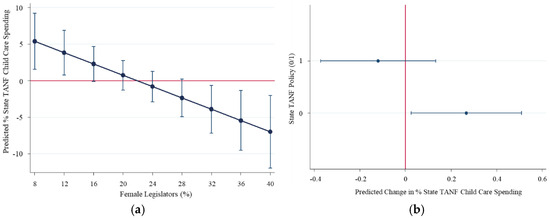
To visualize how the marginal effect of State TANF Policy on the proportion of TANF child care spending changes at varying percentages of female legislators, this study contrasts in Figure 1a the marginal effect of State TANF Policy on the share of TANF child care spending at various percentages of Female Legislators with 95% confidence intervals. The figure presents the average percentage of TANF child care spending if all states had the rule (holding the other variables constant at their means) compared with if no states had the rule, across different levels of female legislative representation. As the percentage of female legislators increases, the marginal effect of State TANF Policy decreases at a rate of 0.38, meaning that 1% increase in the number of female legislators leads to 0.38% decrease in TANF child care spending. However, the marginal effect of State TANF Policy is pronounced in states with either a higher or a lower level of women representation. There is a certain threshold that flips the contrast. When the percentage of female legislators is fewer than 16%, the marginal effect of State TANF Policy is positive and statistically different from zero (p < 0.05); when states have more than 29% of female legislators, the marginal effect is negative and statistically significant (p < 0.05). Having the job-search rule is associated with a 2.5 to 5.4% greater percentage of TANF child care spending when states have a relatively low presence of female legislators, while it leads to a smaller share of TANF child care spending by 2.7 to 7%.
Figure 1.
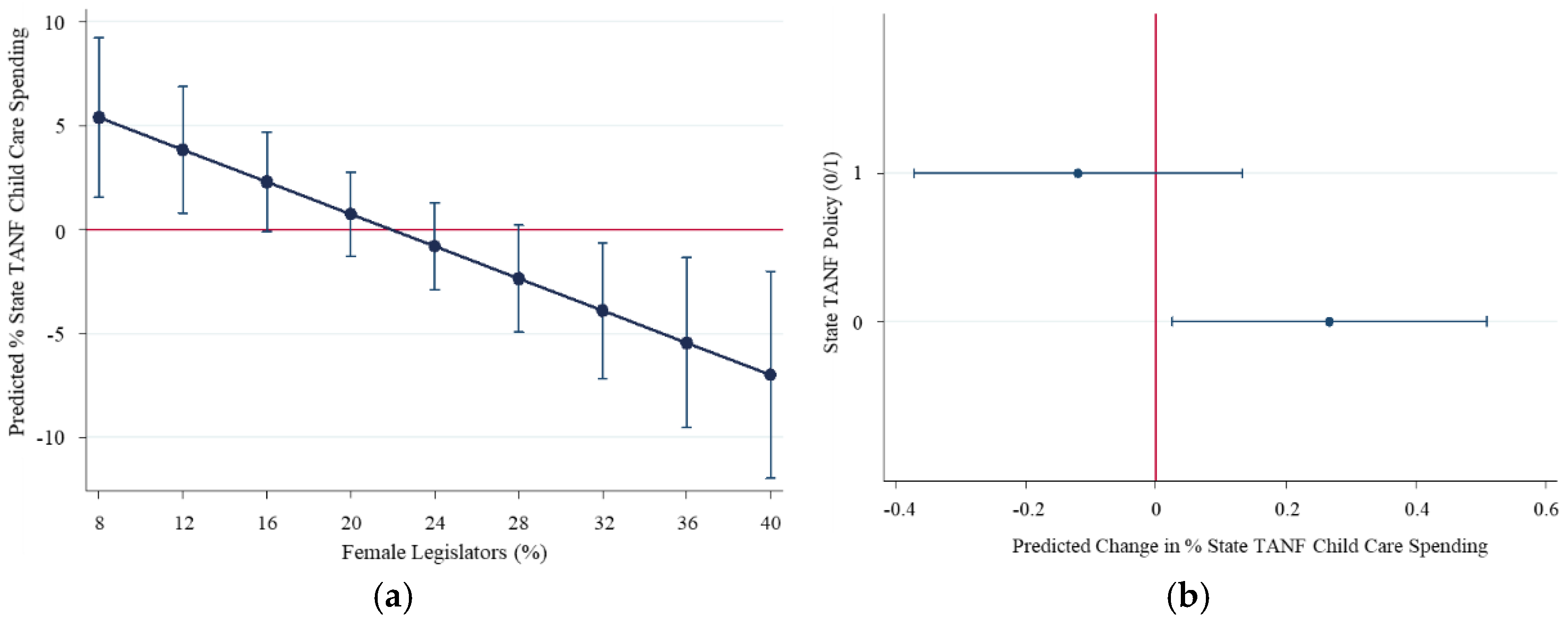
Marginal effects of state TANF policy and female legislative representation on TANF child care spending. (a) The X-axis indicates the percentage of women legislators, and the Y-axis shows the differences in state TANF child care spending with and without a job-search rule (baseline); (b) The X-axis shows the effect of a one-percentage-point increase in female legislators on state TANF child care spending, while the Y-axis indicates the presence of State TANF job-search rule.
These empirical results for Figure 1a suggest two interesting stories as to how State TANF Policy and Female Legislators might interact and explain TANF Child Care Spending. First, the results imply that when states have relatively smaller percentage of female legislators, which is under 16%, the presence of the job-search rule guarantees some level of child care spending under the TANF programs, resulting in a greater percentage of child care spending than when there is no such rule. Second, the analysis reveals a certain threshold that flips the contrast. When a greater percentage of women represents state legislatures, that is approximately 29% and above, the absence of the job-search requirement in TANF programs motivates female legislators to support more child care spending, and it is more than what states would spend when they have the job-search requirement in place. Spending a higher percentage of TANF fund on child care becomes feasible even without the job-search rule because there is a greater percentage of female legislators who presumably vote for more child care spending.
Figure 1b depicts the marginal effect of Female Legislators on TANF child care spending conditional on the presence of State TANF Policy with 95% confidence intervals. It shows that the marginal effect of Female Legislators is positive (β = 0.27) and statistically significant (p < 0.05) when State TANF Policy is zero, while the marginal effect is negative (β = −0.12) but statistically insignificant (p = −0.92) when State TANF Policy is one. These estimation results indicate that, in states without the job search rule, a 1% increase in female legislators is associated with a 0.27 percentage points increase in the share of TANF funds devoted to child care; however, the presence of the job-search rule effectively reduces the impact of a 1 percentage point increase in female legislators on state TANF child care spending close to zero. In other words, the substantive importance of female representation in state legislatures for determining TANF child care spending depends on whether states already have the TANF policy in place that potentially increases child care support.
The findings for Figure 1b can be interpreted in the following two ways. First, the influence of female legislators is more effective when there is no job-search rule, since the absence of the job-search requirement may motivate female legislators to support more child care spending under the TANF programs, as demonstrated by the statistically significant coefficient of Female Legislators (β = 0.27, p < 0.01). Therefore, having a higher percentage of female legislators leads to a higher percentage of spending on TANF child care when there is no job-search rule in place. In a similar vein, female legislators may not make extra efforts to support more child care spending, acknowledging that there is a state TANF policy that is, by design, associated with more state TANF spending on child care. Under the circumstances where the job-search rule is already in place, a state having 1% more female legislators does not make any difference in its TANF child care spending.
To summarize, these findings suggest that State TANF Policy and Female Legislators substitute each other in an interesting way. Having the TANF policy that requires recipients to search for a job leads to a greater spending on TANF child care than in the absence of such policy only when female legislative representation is relatively weak; up to the point where female legislators occupy 16% of state legislative seats, the marginal effect of State TANT Policy is positive and diminishes as the percentage of female legislators increases. However, when female legislators occupy beyond 29% of state legislative seats, the marginal effect of State TANF Policy becomes negative and grows stronger as Female Legislators increase. In other words, the absence of the TANF policy requiring a job search results in a greater percentage of TANF spending on child care when the percentage of female legislators is relatively high. Meanwhile, the positive marginal effect of women’s representation in state legislatures is offset by the presence of the job-search rule.
4.3. Effects of Controls
Other political factors—i.e., Citizen Ideology and Government Ideology—are statistically significant in the expected direction. The regression coefficient of Citizen Ideology is 0.12 (p < 0.05), which means that as state citizens become more liberal by one point, the percentage of TANF child care spending increases by 0.12 percentage points. The regression coefficient of Government Ideology is 0.09; the share of TANF child care expenditure increases by 0.09 percentage points. Meanwhile, among the socioeconomic factors, Hispanic Recipients is statistically significant (p < 0.01) and has a positive effect as hypothesized. States with more Hispanic recipients of TANF by 1% tend to spend 0.35 percentage points more on child care under TANF programs. It is important to note that none of the social need factors—i.e., Unemployment Rate, Unwed Birth Rate, and Poverty Rate—significantly explain variation in state TANF child care spending at the 95% confidence level or higher.
5. Discussion
This study examines how political and institutional factors shape the allocation of TANF funds to child care, using panel data covering all 50 states from fiscal year 2004 to 2016. Extending previous research that has focused primarily on policy strictness, generosity, and sanction following the 1996 welfare reform (Fellowes and Rowe 2004; Matsubayashi and Rocha 2012; Reingold and Smith 2012; Soss et al. 2001), this study shifts attention to spending composition, work-oriented policy design, and legislative representation that interact to influence budgetary priorities.
5.1. Implications and Significance
The findings underscore the importance of TANF’s institutional design as a federal block grant. From the perspective of fiscal federalism, states are granted substantial discretion in program design and resource allocation, allowing state policy makers to respond strategically to local political and fiscal incentives. In this context, policy intention becomes a central determinant of spending priorities. The results indicate that states emphasizing work requirements of TANF recipients, as reflected in the presence of a TANF job-search rule, allocate a greater share of TANF funds to child care. It implies that work-oriented policy design may redirect resources toward services that facilitate employment.
The effect of the job-search rule, however, is not uniform across political contexts. Its impact is conditioned by the proportion of female legislators in a state. While the job-search requirement independently increases the share of TANF child care spending, the marginal effect changes as female legislative representation increases. The positive effect remains until women legislators hold 16 percent of seats, but becomes negative once representation exceeds roughly 29 percent. This implies that policy instruments can produce different outcomes depending on political environments.
More broadly, the results contribute to debates about welfare governance under federalism. Prior research has largely treated state TANF policies as outcomes to be explained. However, this study claims that state policy design itself can shape spending outcomes. The findings offer that allocation decisions under block grant arrangement are closely related to political and representational dynamics. This raises important questions about the implications of decentralizing welfare authority and the role of political practices in shaping welfare priorities.
5.2. Limitations and Future Research Directions
This study has limitations related to data and methodology. First, the analysis draws on data covering the period from fiscal years 2004–2016. The temporal scope is primarily constrained by the availability of two key independent variables, citizen ideology and government ideology, which are currently available only through 2016 and 2017, respectively. These measures are derived from the Fording State Ideology dataset and are among the most widely used and methodologically consistent indicators of state-level political ideology (Kim and Fording 2010; Pickering and Rockey 2013). Although this time frame does not capture more recent policy developments, it corresponds to a relatively stable phase of TANF implementation following the initial turbulence of welfare reform. The core institutional features of TANF, such as state discretion under broader federal guidelines and the centrality of work-oriented policy design, have remained largely unchanged since that period. Thus, the findings in this study are best understood as establishing a historically grounded baseline for how political and policy contexts shape TANF child care spending, against which future changes can be evaluated.
Second, although this study provides a possible explanation for the interaction between state TANF job-search requirements and women’s representation in state legislatures, it does not fully resolve why this interaction produces contrasting effects on TANF child care spending when women constitute a relatively high versus a low share of legislators. Further research is needed to unpack the mechanisms through which political representation and policy design jointly influence spending priorities. In addition, future research could examine how different TANF policy choices impact states’ allocation of the TANF block grant and, in turn, affect the well-being of program recipients.
Third, while the two-way fixed effects approach accounts for unobserved heterogeneity across states and over time, the analysis may not fully reflect dynamic or heterogeneous policy effects. Therefore, future research could employ dynamic panel models or estimators that allow treatment effects to vary across states and over time.
6. Conclusions
TANF has long stood at the center of the United States’ devolved welfare system since the 1996 welfare reform. More than simply a cash assistance program, it represents a policy framework in which federal authority sets broad parameters while states exercise substantial discretion over design and spending. In the context of TANF’s block grant structure, this study demonstrates that state TANF child care spending is shaped less by factors of social need than by political and policy dynamics, which advances understanding of an overlooked dimension of welfare governance. When states are granted broad discretion to allocate federal block grant funds under limited federal guidance, policy design becomes a key determinant of how welfare programs are experienced by recipients (Bruch et al. 2018). The findings suggest that state policies do not prioritize the most vulnerable population, as reflected in the limited role of societal need factors on TANF child care spending. These results underscore the important role of states within the federal system and raise questions about the implications of devolution for providing welfare. A recent study also argued that state administrative discretion can lead fiscal considerations to take precedence over TANF’s core objective of supporting low-income families (Hall-Faul 2025).
Attending to policy intention embedded in specific TANF rules helps understand how states spend the TANF block grants, while also revealing that identical policies can yield divergent outcomes depending on the political and policy environments. TANF represents a distinctive U.S. approach to welfare reform, characterized by extensive decentralization, strict work-based conditionality, and time-limited assistance, positioning it quite differently from most European and advanced Asian welfare systems. In contrast, many of these countries operate nationally standardized social assistance programs with more centralized administration and fewer subnational disparities. They typically do not impose strict lifetime limits and provide support for as long as recipients meet established eligibility criteria. Moreover, social assistance in these systems is embedded within broader social protection regimes rather than relying primarily on short-term, work-conditioned cash assistance. Viewed from a comparative perspective, TANF thus illustrates how institutional design, federalism, and policy priorities shape fundamentally different models of poverty alleviation.
Author Contributions
Conceptualization, H.K.; methodology, H.K.; validation, H.K. and Y.K.; formal analysis, H.K.; writing—original draft preparation, H.K. and Y.K.; writing—review and editing, H.K. and Y.K.; visualization, H.K.; project administration, Y.K. All authors have read and agreed to the published version of the manuscript.
Funding
This research received no external funding.
Institutional Review Board Statement
Not applicable. This study is based on secondary data from publicly available datasets.
Informed Consent Statement
Not applicable. The study used secondary, publicly available data and did not involve identifiable human participants.
Data Availability Statement
The data that support the findings of this study are available from the corresponding author upon reasonable request.
Acknowledgments
During the preparation of this manuscript, the authors used ChatGPT 5.2 for the purposes of improving readability and language refinement.
Conflicts of Interest
The authors declare no conflicts of interest.
References
- Avery, James M., and Mark Peffley. 2005. Voter registration requirements, voter turnout, and welfare eligibility policy: Class bias matters. State Politics & Policy Quarterly 5: 47–67. [Google Scholar] [CrossRef] [Scilit]
- Barrett, Edith J. 1997. Gender and race in the state house: The legislative experience. Social Science Journal 34: 131–44. [Google Scholar] [CrossRef] [Scilit]
- Barrilleaux, Charles, and Ethan Bernick. 2003. Deservingness, discretion, and the state politics of welfare spending, 1990–96. State Politics and Policy Quarterly 3: 1–22. [Google Scholar] [CrossRef] [Scilit]
- Bentele, Keith G., and Lisa T. Nicoli. 2012. Ending access as we know it: State welfare benefit coverage in the TANF era. Social Service Review 86: 223–68. [Google Scholar] [CrossRef] [Scilit]
- Berry, William D., Evan J. Ringquist, Richard C. Fording, and Russell L. Hanson. 1998. Measuring citizen and government ideology in the American states, 1960–93. American Journal of Political Science 42: 327–48. [Google Scholar] [CrossRef] [Scilit]
- Berry, William D., Richard C. Fording, Evan J. Ringquist, Russell L. Hanson, and Carl E. Klarner. 2010. Measuring citizen and government ideology in the American states: A re-appraisal. State Politics and Policy Quarterly 10: 117–35. [Google Scholar] [CrossRef] [Scilit]
- Bonoli, Giuliano, and Frank Reber. 2010. The political economy of childcare in OECD countries: Explaining cross-national variation in spending and coverage rates. European Journal of Political Research 49: 97–118. [Google Scholar] [CrossRef] [Scilit]
- Brambor, Thomas, William. R. Clark, and Matt Golder. 2006. Understanding interaction models: Improving empirical analyses. Political Analysis 14: 63–82. [Google Scholar] [CrossRef] [Scilit]
- Brown, Robert D. 1995. Party cleavages and welfare effort in the American states. American Political Science Review 89: 23–33. [Google Scholar] [CrossRef] [Scilit]
- Bruch, Sarah K., Marcia K. Meyers, and Janet C. Gornick. 2018. The Consequences of decentralization: Inequality in safety net provision in the post–welfare reform era. Social Service Review 92: 3–35. [Google Scholar] [CrossRef] [Scilit]
- Bryant, Lisa A., and Julia M. Hellwege. 2019. Working mothers represent: How children affect the legislative agenda of women in Congress. American Politics Research 47: 447–70. [Google Scholar] [CrossRef] [Scilit]
- Center for American Women and Politics (CAWP). 2001. Women in State Legislatures: Past, Present and Future. Available online: https://cawp.rutgers.edu/sites/default/files/resources/stlegpastpresentfuture.pdf (accessed on 23 February 2023).
- Center on Budget and Policy Priorities (CBPP). 2022. Policy Basics: Temporary Assistance for Needy Families. Available online: https://www.cbpp.org/sites/default/files/atoms/files/7-22-10tanf2.pdf (accessed on 10 April 2022).
- Cohen, Sally S. 2001. Championing Child Care. New York: Columbia University Press. [Google Scholar]
- Congressional Research Service (CRS). 2025. Trends in Child Care Spending from the CCDF and TANF; Washington, DC: Library of Congress. Available online: https://www.congress.gov/crs-product/R44528 (accessed on 20 December 2025).
- Danziger, Sandra K., Elizabeth O. Ananat, and Kimberly G. Browning. 2013. Child-care subsidies and the transition from welfare to work. Family Relations 53: 219–28. [Google Scholar]
- De Jong, Gordon F., Deborah R. Graefe, Shelley K. Irving, and Tanja St Pierre. 2006. Measuring state TANF policy variations and change after reform. Social Science Quarterly 87: 755–81. [Google Scholar] [CrossRef] [Scilit]
- Erikson, Robert S., Gerald C. Wright, and John P. McIver. 1993. Statehouse Democracy: Public Opinion and Policy in the American States. Cambridge: Cambridge University Press. [Google Scholar]
- Ewalt, J. A. G., and Edward T. Jennings, Jr. 2014. The Great Recession and social welfare spending in the American States. International Review of Public Administration 19: 308–23. [Google Scholar] [CrossRef] [Scilit]
- Fellowes, Matthew C., and Gretchen Rowe. 2004. Politics and the new American welfare states. American Journal of Political Science 48: 362–73. [Google Scholar] [CrossRef]
- Filindra, Alexandra. 2013. Immigrant Social Policy in the American States: Race Politics and State TANF and Medicaid Eligibility Rules for Legal Permanent Residents. State Politics & Policy Quarterly 13: 26–48. [Google Scholar] [CrossRef] [Scilit]
- Flavin, Patrick. 2015. Campaign finance laws, policy outcomes, and political equality in the American states. Political Research Quarterly 68: 77–88. [Google Scholar] [CrossRef] [Scilit]
- Fossett, James W. 1987. The consequences of shifting control: Federal and state distribution of small cities CDBG funds in four southern states. Publius: The Journal of Federalism 17: 65–80. [Google Scholar] [CrossRef]
- Fry, Brian R., and Richard F. Winters. 1970. The politics of redistribution. American Political Science Review 64: 508–22. [Google Scholar] [CrossRef] [Scilit]
- Fusaro, Vincent A. 2021a. State politics, race, and “welfare” as a funding stream: Cash assistance spending under Temporary Assistance for Needy Families. Policy Studies Journal 49: 811–34. [Google Scholar] [CrossRef] [Scilit]
- Fusaro, Vincent A. 2021b. State variation in TANF expenditures: Implications for social work and social policy. Social Work 66: 157–66. [Google Scholar] [CrossRef] [Scilit] [PubMed]
- Gans, Herbert J. 1995. The War Against the Poor: The Underclass and Antipoverty Policy. New York: Basic Books. [Google Scholar]
- Hahn, Heather, Gina Adams, Shayen Spaulding, and Caroline Heller. 2016. Supporting the Child Care and Workforce Development Needs of TANF Families. Washington, DC: Urban Institute. [Google Scholar]
- Hall-Faul, Madri. 2025. Serving state budgets instead of families: A case study of temporary assistance for needy families spending and human rights in Connecticut. Families in Society, 1–20. [Google Scholar] [CrossRef] [Scilit]
- Handler, Joel F. 1995. The Poverty of Welfare Reform. New Haven: Yale University Press. [Google Scholar]
- Haskins, Ron. 2016. TANF at age 20: Work still works. Journal of Policy Analysis and Management 35: 224–31. [Google Scholar] [CrossRef] [Scilit]
- Hawkesworth, Mary, Kathleen J. Casey, Krista Jenkins, and Katherine. E. Kleeman. 2001. Legislating by and for Women: A Comparison of the 103rd and 104th Congresses. New Brunswick: Center for American Women and Politics, Rutgers University. [Google Scholar]
- Heinz, Hailey. 2025. Who are childcare subsidies for? Examining subsidy eligibility policy in two southwestern states. Policy Studies Journal, 1–22. [Google Scholar] [CrossRef] [Scilit]
- Henderson, Tammy L., Pamela A. Monroe, James C. Garand, and Diane C. Burts. 1995. Explaining public opinion toward government spending on child care. Family Relations 44: 37–45. [Google Scholar] [CrossRef] [Scilit]
- Jacobsen, Karen, and Thomas G. McGuire. 1996. Federal block grants and state spending: The alcohol, drug abuse, and mental health block grant and state agency behavior. Journal of Health Politics, Policy and Law 21: 751–68. [Google Scholar] [CrossRef] [Scilit]
- Kim, Byungkyu, and Richard C. Fording. 2010. Second-order devolution and the implementation of TANF in the U.S. States. State Politics & Policy Quarterly 10: 341–67. [Google Scholar]
- Lambright, Kristina T., and Scott W. Allard. 2004. Making tradeoffs in federal block grant programs: Understanding the interplay between SSBG and TANF. Publius: The Journal of Federalism 34: 131–54. [Google Scholar] [CrossRef] [Scilit]
- Lens, Vicki. 2002. TANF: What went wrong and what to do next. Social Work 47: 279–90. [Google Scholar] [CrossRef] [Scilit]
- Lokteff, Maegan, and Kathleen W. Piercy. 2012. “Who Cares for the Children?” Lessons from a Global Perspective of Child Care Policy. Journal of Child and Family Studies 21: 120–30. [Google Scholar] [CrossRef] [Scilit]
- Maguire-Jack, Kathryn, Michelle Johnson-Motoyama, and Sarah Parmenter. 2021. A scoping review of economic supports for working parents: The relationship of TANF, child care subsidy, SNAP, and EITC to child maltreatment. Aggression and Violent Behavior 65: 101639. [Google Scholar] [CrossRef] [Scilit]
- Martin, Megan C., and Koen Caminada. 2011. Welfare reform in the US: A policy overview analysis. Poverty & Public Policy 3: 1–38. [Google Scholar] [CrossRef] [Scilit]
- Matsubayashi, Tetsuya, and Rene R. Rocha. 2012. Racial diversity and public policy in the states. Political Research Quarterly 65: 600–14. [Google Scholar] [CrossRef] [Scilit]
- Meyers, Marcia K., Theresa Heintze, and Douglas A. Wolf. 2002. Child care subsidies and the employment of welfare recipients. Demography 39: 165–79. [Google Scholar] [CrossRef] [Scilit]
- Moffitt, Robert A. 2003. The temporary assistance for needy families program. In Means-Tested Transfer Programs in the United States. Edited by R. Moffitt. Chicago: The University of Chicago Press, pp. 291–364. [Google Scholar]
- Morgan, David R., and Robert E. England. 1984. The Small Cities Block Grant Program: An assessment of programmatic change under state control. Public Administration Review 44: 477–82. [Google Scholar] [CrossRef] [Scilit]
- Ng, Guat T. 2006. Child care in the United States: Who shapes state policies for children? Social Work Research 30: 71–81. [Google Scholar] [CrossRef] [Scilit]
- Nukpezah, Julius A., and Aisha S. Ahmadu. 2023. Fiscal Federalism in the USA. In Global Encyclopedia of Public Administration, Public Policy, and Governance. Cham: Springer International Publishing, pp. 4926–34. [Google Scholar]
- Oates, Wallace E. 1999. An essay on fiscal federalism. Journal of Economic Literature 37: 1120–49. [Google Scholar] [CrossRef] [Scilit]
- OECD. 2023. Public Spending on Childcare and Early Education. Available online: https://www.oecd.org/en/data/datasets/oecd-family-database.html (accessed on 2 December 2025).
- Ojeda, Christopher, Anne M. Whitesell, Michael B. Berkman, and Eric Plutzer. 2019. Federalism and the Racialization of Welfare Policy. State Politics & Policy Quarterly 19: 474–501. [Google Scholar] [CrossRef] [Scilit]
- Pac, Jessica. 2021. Early childhood education and care programs in the United States: Does access improve child safety? Social Service Review 95: 66–109. [Google Scholar] [CrossRef] [Scilit]
- Pavetti, Ladonna, and Liz Schott. 2011. TANF’s Inadequate Response to Recession Highlights Weakness of Block-Grant Structure: Proponents Wrong to See It as Model for Medicaid, SNAP, or Other Low-Income Programs. Washington, DC: Center on Budget and Policy Priorities. [Google Scholar]
- Payne, Lee W. 2013. Welfare reform in the states: Does the percentage of female legislators in state legislatures affect welfare reform policies? Journal of Sociology & Social Welfare 40: 53–68. [Google Scholar]
- Pickering, Andrew C., and James Rockey. 2013. Ideology and the size of US state government. Public Choice 156: 443–65. [Google Scholar] [CrossRef] [Scilit]
- Plotnick, Robert D., and Richard F. Winters. 1985. A politico-economic theory of income redistribution. American Political Science Review 79: 458–73. [Google Scholar] [CrossRef] [Scilit]
- Poggione, Sarah. 2004. Exploring gender differences in state legislators’ policy preferences. Political Research Quarterly 57: 305–14. [Google Scholar]
- Powell, G. Bingham, Jr. 2004. The quality of Democracy: The chain of responsiveness. Journal of Democracy 15: 91–105. [Google Scholar] [CrossRef] [Scilit]
- Reingold, Beth, and Adrienne R. Smith. 2012. Welfare policymaking and intersections of race, ethnicity, and gender in US state legislatures. American Journal of Political Science 56: 131–47. [Google Scholar] [CrossRef] [Scilit] [PubMed]
- Ringquist, Evan J., Kim Q. Hill, Jan E. Leighley, and Angela Hinton-Andersson. 1997. Lower-class mobilization and policy linkage in the U.S. states: A correction. American Journal of Political Science 41: 339–44. [Google Scholar] [CrossRef] [Scilit]
- Rodgers, Harrell R., and Kent L. Tedin. 2006. State TANF spending: Predictors of state tax effort to support welfare reform. Review of Policy Research 23: 745–59. [Google Scholar] [CrossRef] [Scilit]
- Rom, Mark C. 1999. Transforming State Health and Welfare Programs. In Politics in the American States. Edited by Virginia Gray and Herbert Jacobs. Washington, DC: CQ Press. [Google Scholar]
- Schott, Liz, Ife Floyd, and Ashley Burnside. 2018. How States Use Funds Under the TANF Block Grant. Washington, DC: Center on Budget and Policy Priorities. [Google Scholar]
- Schott, Liz, Ladonna Pavetti, and Ife Floyd. 2015. How States Use Federal and State Funds Under the TANF Block Grant. Washington, DC: Center on Budget and Policy Priorities. [Google Scholar]
- Schumacher, Rachel, Mark H. Greenberg, and Janellen Duffy. 2001. The Impact of TANF Funding on State Child Care Subsidy Programs. Washington, DC: Center for Law and Social Policy. [Google Scholar]
- Smith, Mark A. 1997. The nature of party governance: Connecting conceptualization and measurement. American Journal of Political Science 41: 1042–56. [Google Scholar] [CrossRef] [Scilit]
- Soss, Joe, Sanford F. Schram, Thomas P. Vartanian, and Erin O’Brien. 2001. Setting the terms of relief: Explaining state policy choices in the devolution revolution. American Journal of Political Science 45: 378–95. [Google Scholar] [CrossRef] [Scilit]
- Thomas, Sue, and Susan Welch. 1991. The Impact of Gender on the Activities and Priorities of State Legislators: Legislative Styles and Policy Priorities. Western Political Quarterly 44: 445–56. [Google Scholar] [CrossRef] [Scilit]
- U.S. Administration for Children and Families (U.S. ACF). 2023. FY 2022 Final Data Table 16—Average Monthly Percent of Families Reporting Income from TANF. Available online: https://acf.gov/occ/data/fy-2022-final-data-table-16 (accessed on 12 February 2023).
- U.S. Department of Health and Human Services (U.S. HHS). 2019. State TANF Spending Data, Various Years. Available online: https://www.acf.hhs.gov/ofa/programs/tanf/data-reports (accessed on 4 February 2019).
- Vesely, Colleen K., and Elaine A. Anderson. 2009. Child care and development fund: A policy analysis. Journal of Sociology & Social Welfare 36: 39–60. [Google Scholar]
- Waldfogel, Jane. 2001. International policies toward parental leave and child care. The Future of Children 11: 99–111. [Google Scholar] [CrossRef] [Scilit]
- Welch, Susan. 1985. Are Women More Liberal than Men in the U.S. Congress? Legislative Studies Quarterly 10: 125–34. [Google Scholar] [CrossRef] [Scilit]
- White, Linda A. 2009. Explaining differences in child care policy development in France and the USA: Norms, frames, programmatic ideas. International Political Science Review 30: 385–405. [Google Scholar] [CrossRef] [Scilit]
- Wilensky, Harold L. 1974. The Welfare State and Equality: Structural and Ideological Roots of Public Expenditures. Berkeley: University of California Press. [Google Scholar]
- Winburn, Jonathan, Robert Brown, and Nichole Gligor. 2024. State Partisan Dominance and the Distribution of TANF Funds, 2000–2018. State and Local Government Review 56: 377–92. [Google Scholar] [CrossRef] [Scilit]
- Wolfe, Barbara L. 2002. Incentives, challenges, and dilemmas of TANF: A case study. Journal of Policy Analysis and Management 21: 577–86. [Google Scholar] [CrossRef] [Scilit]
- Wright, Gerald C. 1977. Racism and welfare policy in America. Social Science Quarterly 57: 718–30. [Google Scholar]

Disclaimer/Publisher’s Note: The statements, opinions and data contained in all publications are solely those of the individual author(s) and contributor(s) and not of MDPI and/or the editor(s). MDPI and/or the editor(s) disclaim responsibility for any injury to people or property resulting from any ideas, methods, instructions or products referred to in the content. |
© 2026 by the authors. Licensee MDPI, Basel, Switzerland. This article is an open access article distributed under the terms and conditions of the Creative Commons Attribution (CC BY) license.