


Abstract
Youth violence occurs within social, economic, institutional, and environmental conditions that may generate recurring survival demands. Yet approaches centered primarily on individual risk, behavior, and decision-making may overlook what young people must expend, sacrifice, or absorb while navigating structurally produced threats. This article introduces Survivornomics™, a theoretical framework for examining the processes and costs of survival within structurally constrained environments. A central theoretical aim of Survivornomics™ is to broaden the meaning of economics beyond monetary exchange by examining the lived expenditure, depletion, sacrifice, and loss of resources that survival may require. Survivornomics™ is organized around three core constructs: Survival Decision-Making, Survival Cost, and Cumulative Survival Burden. The framework proposes that Structural Survival Context shapes the threats individuals encounter and the responses perceived as feasible; survival responses may generate immediate or delayed costs; and those costs may accumulate, persist, interact, or compound across time and circumstances. Five propositions specify downstream, recursive, and, under some conditions, intergenerational relationships within the framework. Applied to youth violence, Survivornomics™ shifts attention beyond visible behavior toward the conditions being navigated, the costs associated with navigating them, and the responsibilities of urban institutions and communities. A Survivornomics™-informed urban response would require institutions to confront conditions in which institutional responses to harm are absent, distrusted, or experienced as harmful while reducing survival demands, expanding viable alternatives, and sharing authority with young people and affected communities in designing solutions. Survivornomics™ ultimately asks not only what young people must survive but what surviving requires of them, what it may cost, and what must change so that survival no longer carries the same price.
1. Introduction
Youth violence remains a consequential and unequally distributed public health problem in the United States. Final U.S. mortality data for 2023 identify homicide as the third leading cause of death among young people ages 10–24; CDC also identifies homicide as the leading cause of death among non-Hispanic Black young people in this age group (Tejada-Vera et al. 2025; Centers for Disease Control and Prevention 2024). These disparities underscore the need to examine not only the occurrence of violence, but also the structural conditions that shape exposure, available responses, and the consequences of navigating violent environments.
Youth violence is frequently examined through individual risk factors, behaviors, exposures, and decision-making. Although these perspectives have contributed substantially to violence-prevention scholarship, they may provide an incomplete account when structural conditions are treated primarily as background influences rather than forces shaping everyday survival. Young people living in structurally disadvantaged urban environments may simultaneously navigate community violence, housing and food insecurity, economic instability, educational inequality, environmental hazards, and harmful or unreliable institutional encounters. These conditions may create recurring and overlapping survival demands.
A central challenge for urban violence prevention is therefore distinguishing between the behavior that becomes visible and the survival conditions within which that behavior occurs. A young person’s response to danger, scarcity, instability, or perceived threat may appear to represent an isolated choice even when structural conditions have constrained the alternatives perceived as feasible. This does not imply that all youth violence constitutes a survival response, nor does structural explanation eliminate individual agency or responsibility. Rather, it raises a different analytic question: What survival demand is being navigated, what alternatives appear viable, and what conditions have shaped the range of available responses?
Survivornomics™ is advanced in this article as a theoretical framework for examining the processes and costs of survival within structurally constrained environments. Survivornomics™ broadens the meaning of economics beyond monetary exchange to encompass the lived allocation, preservation, depletion, sacrifice, and loss of resources required to navigate structurally constrained conditions. The framework focuses particularly on the theoretical space between structural conditions and downstream consequences: how individuals respond to survival demands, what those responses may require, and what may occur when the costs associated with navigating those demands do not remain contained within an individual survival event.
The purpose of this article is to articulate Survivornomics™ as a theoretical framework for examining the processes and costs of survival within structurally constrained environments. The article traces the framework’s development from Perceived Risk Hierarchy Theory™ (PRHT™), defines its core constructs and boundary conditions, advances five theoretical propositions, and applies the framework to youth violence and institutional and community responses in urban environments.
Conceptual Approach
This concept paper develops a theoretical framework rather than reporting new empirical data. It draws on the literature and public-health sources concerning youth violence, structural inequality, environmental health, trauma, policing, and life-course disadvantage, together with prior scholarship on PRHT™ and Survivornomics™. These sources inform the construct definitions, theoretical propositions, comparisons with established frameworks, and applications to urban responses. This article is not a systematic review, and no new participant-level data were collected or analyzed. The use of generative AI is disclosed separately before the references. During manuscript preparation and revision, the author used generative AI to assist with drafting and revising text, organizing sections, clarifying the presentation of concepts, formatting, and preparing and revising the conceptual figure. Survivornomics™ and Perceived Risk Hierarchy Theory™ originated in the author’s prior scholarship.
2. High-Risk Landscapes of Despair
In this article, the term high-risk landscapes of despair describes how intersecting structural conditions can create recurring survival demands; the literature and Baltimore examples below illustrate the conditions informing this conceptual description.
High-risk landscapes of despair are structurally produced environments in which concentrated disadvantage, chronic disinvestment, violence exposure, disproportionate exposure to lead and other environmental hazards, including hazardous waste, educational inequality, institutional neglect, resource scarcity, and constrained opportunity interact to create persistent conditions of threat, instability, and limited access to resources and supports capable of reducing exposure to harm.
The term refers to the conditions surrounding young people, not to the character, capacity, or worth of the young people themselves.
The unequal distribution of firearm violence illustrates how such environments can become part of young people’s everyday context. Approximately one in four adolescents living in large U.S. cities resided within one-half mile of a firearm homicide occurring during the previous year, with substantial racial and ethnic inequities in exposure (Aubel et al. 2023). Historical redlining and related patterns of disinvestment are also associated with contemporary environmental inequities, including lead exposure and air pollution, while Baltimore-specific research has linked neighborhood educational achievement with youth homicide mortality (Bray et al. 2020; Jung et al. 2024; Karp 2023).
Baltimore provides a particularly salient urban context for examining these intersecting conditions. Curtis Bay in South Baltimore has been characterized as an environmental justice community with a longstanding concentration of industrial polluters and compounding socioeconomic, quality-of-life, and health burdens (Aubourg et al. 2023). A 2025 Baltimore preprint modeling emissions from the WIN Waste and Curtis Bay incinerators further estimated that incinerator-attributable health damages were concentrated in West, South, and Southeast Baltimore and disproportionately affected communities with greater socioeconomic vulnerability (Tu et al. 2025). Historically redlined and chronically disinvested neighborhoods in the city have experienced overlapping structural inequities, including concentrated violence exposure, environmental hazards, educational inequality, economic disadvantage, and fraught relationships with institutions expected to prevent or respond to harm. Within Survivornomics™, high-risk landscapes of despair represent a form of Structural Survival Context in which multiple survival demands may become embedded in everyday life rather than occurring as isolated events.
3. From Structural Conditions to the Economics of Survival
Structural disadvantage alone does not fully explain how individuals navigate the conditions it produces. People exposed to similar neighborhood-level threats may perceive different risks, recognize different alternatives, mobilize different resources, and experience different consequences in responding. Survivornomics™ focuses on the theoretical space between structural conditions and downstream outcomes—the space in which survival demands are encountered, responses are enacted, and resources may be drawn upon, altered, or depleted.
The central premise of Survivornomics™ is that survival itself can carry a price.
Within Survivornomics™, economics encompasses how people allocate, preserve, expend, and sometimes sacrifice resources while navigating survival demands under structural constraint. These resources include money, time, health, physical and psychological capacity, relationships, education, social support, and opportunity. A response may preserve one resource while drawing upon another, although not every response involves a trade-off. The economic inquiry therefore concerns what survival requires, which resources remain available afterward, and how expenditures or losses may shape the capacity to navigate subsequent demands. These resources need not be assigned monetary values to examine their expenditure, depletion, or loss.
Resources can be depleted across many dimensions of life, and Survivornomics™ makes those often-hidden expenditures visible.
These processes unfold within a Structural Survival Context: the configuration of social, economic, institutional, environmental, and policy conditions that shapes the survival demands individuals encounter and the resources, supports, opportunities, and viable alternatives available for navigating them. Structural Survival Context functions as an antecedent condition within Survivornomics™ rather than as one of its three core constructs.
Understanding how Survivornomics™ arrived at this formulation requires tracing its development from observations of competing risks toward a broader theory of the lived economics of survival.
4. Intellectual Origins and Evolution of Survivornomics™
Perceived Risk Hierarchy Theory™ (PRHT™) preceded the development of Survivornomics™. PRHT™ addressed how individuals prioritize competing risks within circumstances marked by constrained resources and limited alternatives. Survivornomics™ subsequently extended the inquiry toward what responding to survival demands requires, what those responses may cost, and how those costs may shape subsequent circumstances.
In the SAMHSA-supported Get SMART Project in Baltimore, African American emerging adults aged 18–24 identified community violence, excessive use of force by police, and homelessness or housing instability as more pressing concerns than HIV acquisition or transmission (Edwards et al. 2017). These findings illustrate how immediate threats to safety and housing can take priority over other health risks.
These observations contributed to the development of PRHT™, which sought to explain how individuals prioritize competing risks according to perceived immediacy, severity, urgency, and anticipated consequences. The theory developed through collaborative scholarship and was subsequently articulated in peer-reviewed work examining risk, survival expectations, and emerging adults (Edwards et al. 2017, 2018). PRHT™ helps explain why a risk regarded as serious from a conventional public health perspective may receive lower priority when another threat is perceived as more immediate or consequential.
Yet risk prioritization did not fully explain what was being observed. A second question remained: What happens after a survival priority is established and a person must respond?
Individuals may successfully navigate an immediate threat while expending time, health, relationships, educational opportunity, psychological resources, or other valued resources in the process. The immediate crisis may be managed, yet consequences associated with navigating it may persist. This unanswered question moved the analysis beyond risk prioritization toward the broader economics of survival described above: the resources required, altered, depleted, or sacrificed through repeated navigation of structurally produced survival demands. An early public articulation of Survivornomics™ appeared in 2019 (Edwards 2019).
As Survivornomics™ evolved, its focus also moved beyond resilience or adaptation alone. Resilience may help describe endurance, recovery, or continued functioning, but it does not necessarily reveal what endurance requires or what it costs. Survivornomics™ consequently developed around three distinct constructs—Survival Decision-Making, Survival Cost, and Cumulative Survival Burden—that distinguish the response to a survival demand, the possible price of that response, and the burden that may follow when costs extend across time and circumstances.
The present formulation therefore extends the analysis from which risk receives priority to the broader structural process and consequences of survival. PRHT™ remains a complementary risk-prioritization lens, while Survivornomics™ examines the conditions surrounding survival decisions, the costs that may result, and what may occur when those costs do not remain contained within an individual survival event.
This theoretical evolution produced the three core constructs that form the present architecture of Survivornomics™.
5. The Three Core Constructs of Survivornomics™
Survivornomics™ is organized around three conceptually distinct but interrelated constructs: Survival Decision-Making, Survival Cost, and Cumulative Survival Burden.
5.1. Survival Decision-Making: The Response
Survival Decision-Making is the contextually situated process through which an individual responds to actual, perceived, or anticipated threats in ways aimed at reducing harm or preserving functioning, resources, opportunity, or well-being. Survival Decision-Making may range from deliberative responses to learned, rapid, or routinized responses shaped through repeated navigation of survival demands.
Survival Decision-Making is not synonymous with unconstrained choice or individual preference. In violence-affected environments, for example, a young person may alter routines, avoid particular locations, or respond rapidly to perceived danger in an effort to maintain daily functioning or reduce exposure to harm.
A survival decision does not necessarily involve a Survival Trade-off and does not necessarily produce a Survival Cost.
5.2. Survival Cost: The Price
Survival Cost is an immediate or delayed expenditure, depletion, loss, or adverse consequence incurred through responding to an actual, perceived, or anticipated survival threat. Survival Costs may occur with or without a Survival Trade-off and may arise across economic, physical/health, physiological, psychological, social, behavioral, temporal, educational, and opportunity domains.
A Survival Cost does not necessarily indicate harm, an ineffective response, or a lasting burden. A response may successfully preserve safety or functioning while requiring expenditures of time, effort, money, or other resources. Such expenditures constitute Survival Costs when incurred in navigating a survival threat. Whether they contribute to Cumulative Survival Burden depends on their persistence, accumulation, interaction, or compounding and on the resources and supports available to absorb or mitigate them.
Survival Cost is distinguished from the precipitating adversity itself by its attribution to the process of navigating or responding to the survival demand. Violence exposure, for example, is an adversity; disrupted schooling, altered mobility, lost opportunity, or other consequences incurred while navigating that threat may constitute Survival Costs.
The presence of a Survival Cost does not indicate failure of a survival strategy; it may instead reveal the price of its success.
5.3. Cumulative Survival Burden: The Accumulated Burden
Cumulative Survival Burden is the burden produced when Survival Costs accumulate, persist, interact, or compound across time and circumstances. Cumulative Survival Burden may develop through the accumulation of multiple Survival Costs, the persistence of individual costs, interactions among costs across domains, or the compounding of costs when earlier Survival Costs alter the resources and circumstances available for navigating subsequent survival demands.
Survival Cost and Cumulative Survival Burden are distinguished by their analytical focus. Survival Cost identifies resources expended or consequences incurred in navigating a survival demand. Cumulative Survival Burden identifies the burden that develops when such costs remain active, accumulate, interact, or compound across time and circumstances. A single persistent cost may contribute to this burden; multiple costs do not necessarily produce it if adequate resources, recovery, or support allow them to be absorbed or resolved.
Unlike cumulative adversity, which concerns repeated or sustained exposure to adverse circumstances, Cumulative Survival Burden concerns the burden generated by the costs of navigating those circumstances.
For young people repeatedly navigating violence-related threats, Survival Costs affecting different areas of life may begin to persist or interact, potentially shaping subsequent functioning and future Survival Decision-Making.
The survival event may end, but the cost of surviving it may continue.
5.4. Synthesis of the Core Constructs
The three constructs perform distinct theoretical functions. Survival Decision-Making describes the response. Survival Cost identifies the possible price associated with that response. Cumulative Survival Burden describes the burden that may emerge when Survival Costs accumulate, persist, interact, or compound. The constructs are related but are not inevitable stages of a linear process. An individual may engage in Survival Decision-Making without incurring a measurable Survival Cost, and a Survival Cost may be absorbed, resolved, or mitigated without contributing to Cumulative Survival Burden.
6. Boundary Conditions: Survival Demands and Survival-Related Costs
Within Survivornomics™, a survival demand is an actual, perceived, or anticipated threat that calls for a response to protect safety, basic needs, functioning, or access to essential resources and opportunities. Survival is therefore not restricted to avoiding death; it may also involve maintaining housing, obtaining food, preserving access to education or employment, or navigating threats to physical and psychological well-being. The framework is particularly concerned with circumstances in which structural conditions produce recurring demands while limiting the resources, supports, and viable alternatives available for addressing them. The term survival refers here to the ongoing work of preserving safety, basic needs, functioning, and access to essential resources under threat. Its use does not presume that individuals identify themselves as survivors or that every survival demand involves an immediate threat to life.
Not every difficulty, decision, or expenditure constitutes a survival process. A Survival Cost requires an identifiable connection between a survival demand, the response to that demand, and the expenditure, depletion, loss, or adverse consequence incurred through responding. Spending time or money alone does not establish a Survival Cost. For example, ordinary travel time to school is not sufficient evidence; additional travel time required to avoid a threatening route may constitute a Survival Cost when that response consumes resources or restricts participation.
Structural constraint refers to conditions that limit access to resources, supports, opportunities, or feasible responses. Viable alternatives are responses that are realistically accessible and usable within a person’s circumstances, considering their resources, safety, timing, and anticipated consequences. An option may formally exist without being viable in practice. Applying Survivornomics™ therefore requires examining both the alternatives available and the conditions affecting whether a person can use them.
7. Survival Trade-Off and PRHT™: Explaining Prioritization and Competing Demands
Survivornomics™ distinguishes its three core constructs from concepts that help explain how Survival Decision-Making may unfold. Survival Trade-off describes what may occur when competing needs cannot all be preserved, whereas PRHT™ helps explain how competing risks are prioritized.
7.1. Survival Trade-Off: A Conditional Mechanism
A Survival Trade-off occurs when navigating one survival demand requires sacrificing, delaying, reducing, or placing at risk another valued resource, need, opportunity, or outcome.
Survival Trade-offs may arise when resources, supports, or viable alternatives are insufficient to address competing needs simultaneously. They are not synonymous with Survival Cost. A Survival Trade-off identifies what is sacrificed or placed at risk; Survival Cost identifies the price or expense ultimately incurred in navigating the survival demand.
For example, a young person who perceives traveling to school as an immediate threat may prioritize avoiding that threat even when doing so places school attendance at risk. The competing priorities illustrate a Survival Trade-off; any resulting educational, social, or opportunity losses may constitute Survival Costs.
7.2. PRHT™: The Risk-Prioritization Lens
PRHT™ provides a complementary framework for understanding how individuals prioritize competing risks according to perceived immediacy, severity, urgency, and anticipated consequences. Within Survivornomics™, PRHT™ helps explain which risk receives priority when multiple threats compete for attention, resources, or action.
PRHT™ helps explain which risk becomes prioritized; Survivornomics™ examines the Structural Survival Context surrounding that prioritization, the response that follows, the Survival Costs that may result, and what may occur when those costs accumulate over time.
8. Life-Altering Survival: A Potential Downstream Consequence
Life-Altering Survival refers to the potential long-term alteration of health, functioning, relationships, opportunities, resources, or life trajectory that may emerge when Cumulative Survival Burden contributes to sustained changes in a person’s circumstances.
Life-Altering Survival is not a fourth core construct and is not synonymous with Cumulative Survival Burden. Rather, it describes one possible downstream consequence when the accumulated effects of survival begin to reshape subsequent life circumstances. In violence-affected environments, repeated Survival Costs affecting school participation, employment, mobility, health, relationships, or opportunity may, under some conditions, contribute to changes in a young person’s longer-term life trajectory.
Survivornomics™ recognizes that survival may preserve the present while altering the future.
9. Theoretical Propositions of Survivornomics™
The following propositions specify the principal relationships within Survivornomics™. They are intended as conditional, testable relationships rather than deterministic pathways.
Proposition 1.
Structural Survival Context and Survival Decision-Making
Structural conditions shape Survival Decision-Making by influencing the threats individuals encounter, the resources and supports available to address those threats, and the range of responses perceived as feasible and viable within a given survival context.
Proposition 2.
Survival Decision-Making and Survival Cost
Survival Decision-Making may generate Survival Costs when responding to a survival demand requires the expenditure, depletion, loss, alteration, or sacrifice of resources, opportunities, well-being, or functioning.
Proposition 3.
Survival Cost and Cumulative Survival Burden
Survival Costs may contribute to Cumulative Survival Burden when they accumulate, persist, interact, or compound across time and circumstances.
Proposition 4.
Cumulative Survival Burden and Downstream Consequences
Cumulative Survival Burden may contribute to adverse health, functional, social, economic, educational, and life-course consequences, with the nature and extent of those consequences shaped by available resources, supports, opportunities, and capacities for recovery or mitigation.
Proposition 5.
Recursive and Intergenerational Effects
Cumulative Survival Burden may reshape the Structural Survival Context within which subsequent Survival Decision-Making occurs by altering available resources, supports, opportunities, and capacities. Under some conditions, these altered circumstances may also shape the Structural Survival Context encountered by subsequent generations.
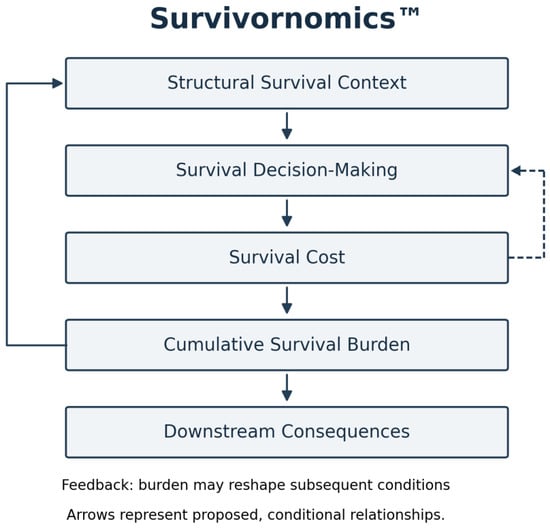
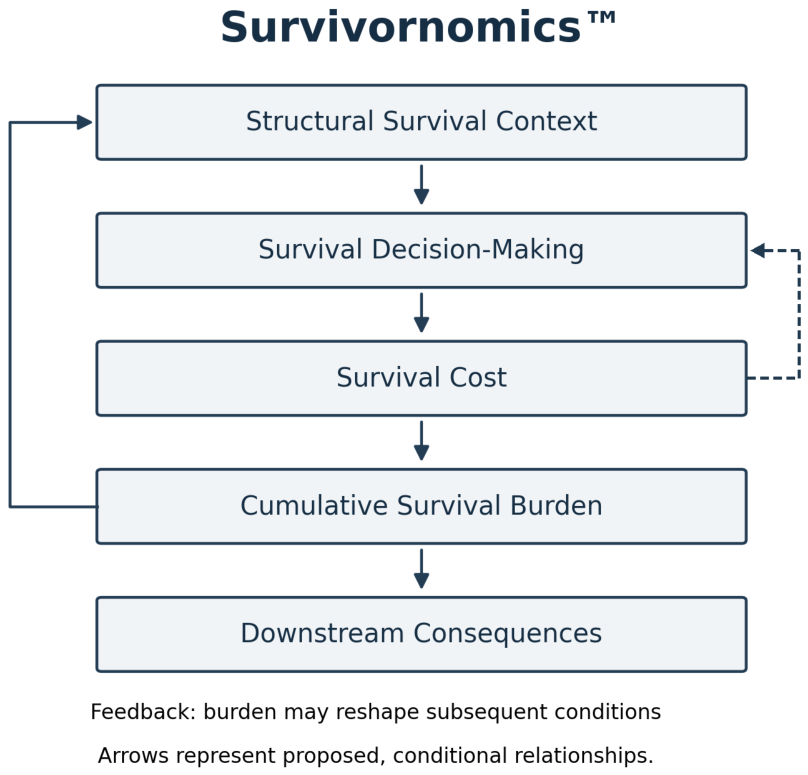
Collectively, these propositions describe Survivornomics™ as a recursive theory of structural survival in which context shapes response, responses may carry costs, costs may accumulate into burden, and burden may influence both downstream outcomes and the circumstances surrounding subsequent survival. Recovery, community assets, institutional intervention, and structural change may interrupt these relationships at multiple points. Figure 1 summarizes the proposed pathway and the feedback relationship through which Cumulative Survival Burden may reshape subsequent Structural Survival Context. Figure 1 also shows a proposed pathway through which unresolved Survival Costs from one response may narrow the options available for subsequent Survival Decision-Making.
Figure 1.
Survivornomics™: A Conceptual Model of Structural Survival, Survival Costs, and Cumulative Survival Burden. Note. Arrows represent proposed, conditional relationships rather than inevitable outcomes. Survival responses do not necessarily generate costs, and costs do not necessarily accumulate into burden. Recovery, community assets, institutional intervention, and structural change may interrupt these relationships at multiple points. Under some conditions, altered resources, supports, and opportunities may also shape the Structural Survival Context encountered by subsequent generations. The dashed arrow indicates that unresolved Survival Costs from an earlier response may constrain subsequent Survival Decision-Making.
Empirical testing of these propositions would require distinguishing exposure to adversity from the responses used to navigate it and the costs associated with those responses. Longitudinal studies could assess survival demands, available alternatives, responses, resource expenditures or losses, and subsequent recovery or persistence of costs. Such designs could examine whether response-related costs help explain later outcomes beyond adversity exposure alone, and whether unresolved costs constrain responses to subsequent demands. Evidence that costs are consistently absorbed or resolved would help identify conditions that interrupt accumulation, while findings that response-related costs offer no additional explanatory value would challenge the framework’s proposed contribution.
10. Illustrative Hypotheses for Future Research
The propositions can guide specific hypotheses once the relevant demands, responses, costs, and outcomes are operationalized. The following examples illustrate tests of the proposed relationships rather than findings established by this article.
First, among young people with comparable baseline resources and violence exposure, greater additional travel time and expense incurred to avoid threatening routes are hypothesized to predict subsequent school absence, after accounting for baseline attendance and ordinary commuting requirements. A precisely estimated absence of this relationship would count against this specified pathway.
Second, unresolved response-related costs are hypothesized to predict fewer viable alternatives when a subsequent survival demand occurs, after accounting for baseline alternatives, resources, and intervening adversity. Findings showing no prospective relationship would challenge the proposed recursive relationship in the circumstances studied.
Third, support that directly absorbs a specified Survival Cost, such as transportation assistance covering additional safety-related travel expenses, is hypothesized to reduce that cost and its associated downstream consequences compared with otherwise similar conditions without that support. If the targeted cost decreases but the predicted downstream consequence does not, the proposed link between that cost and consequence would require revision.
These hypotheses require designs capable of establishing temporal order and addressing alternative explanations. Their contribution should also be evaluated against predictions derived from established frameworks, particularly Conservation of Resources theory.
The intergenerational proposition does not assume that Survival Costs themselves are automatically transmitted. Rather, prior survival processes may alter material resources, health, relationships, opportunities, environments, supports, and institutional conditions that help constitute the Structural Survival Context encountered by subsequent generations. This interpretation is consistent with life-course research demonstrating multiple pathways through which socioeconomic and health disadvantages may be transmitted across generations (Houweling and Grünberger 2024).
11. Applying Survivornomics™ to Youth Violence
Developmental Relevance to Young People
Survivornomics™ is not proposed as a framework exclusive to young people. Its application to adolescence and emerging adulthood directs attention to how developmental timing, dependence on adults and institutions, and differing degrees of autonomy may shape survival processes. Young people’s ability to change schools, secure housing, obtain transportation, or access services may depend on decisions and resources controlled by others. Alternatives that appear available may therefore be difficult to use without caregiver permission, institutional cooperation, or material support.
The timing of Survival Costs may also matter. Missed instruction, interrupted employment, or disrupted relationships during educational and occupational transitions may affect opportunities that are difficult to recover later. The framework consequently proposes examining age, institutional dependence, access to independent resources, and transition points as potential influences on the relationship between survival demands, responses, and costs. These influences should be investigated rather than assumed to operate uniformly across young people.
The theoretical propositions of Survivornomics™ have particular relevance for understanding youth violence in structurally disadvantaged urban environments. Conventional approaches frequently center individual behavior, risk factors, decision-making, or exposure to violence. These perspectives remain important; however, Survivornomics™ asks an additional question: What survival demand is the young person navigating, and how have structural conditions shaped the responses perceived as available, viable, or necessary? This reframing does not excuse harmful behavior or suggest that all violence represents a survival response. Rather, it situates behavior within the social, economic, institutional, and environmental conditions in which decisions are made.
Firearms dominate lethal violence affecting young people: in 2022, 92.2% of homicide deaths among persons aged 10–24 involved a firearm (Garnett and Curtin 2024). Within environments affected by recurrent firearm violence, Survival Decision-Making may involve attempts to reduce immediate harm, maintain social relationships, secure material resources, respond to threats involving family members, or sustain day-to-day functioning. Some responses may carry little or no measurable cost; others may produce educational, psychological, physical, social, temporal, or opportunity-related Survival Costs.
The distinctive contribution of Survivornomics™ is not limited to identifying the adversity confronting young people. It examines the price associated with repeatedly navigating that adversity. A young person may successfully avoid an immediate threat while simultaneously altering mobility, interrupting school or work, withdrawing from activities, or losing access to opportunity. The immediate survival problem may be managed while the consequences associated with navigating it continue.
For some young people, survival demands are not discrete episodes separated by periods of recovery; they may overlap, recur, and arrive before the costs of earlier survival experiences have been resolved. Within Survivornomics™, this creates the possibility that a subsequent survival demand is encountered while prior Survival Costs are still active, thereby reducing available resources for response and increasing the potential for costs to interact or compound into Cumulative Survival Burden. Existing literature links community-violence exposure with post-traumatic stress and other mental-health consequences, while newer work also documents associations with physiological stress regulation (Fowler et al. 2009; Gresham et al. 2025). The Survivornomics™ contribution is to propose that consequences may arise not only from exposure itself but also from the cumulative costs incurred while repeatedly navigating that exposure.
This perspective changes the central question confronting urban violence prevention. Rather than asking exclusively how young people can be encouraged to make different choices, a Survivornomics™-informed response asks whether the conditions surrounding those choices have also changed.
A Survivornomics™ approach to youth violence therefore asks not only why violence occurs, but what young people are attempting to survive, what options they perceive as realistically available, what their responses may cost them, and what urban systems must change so that survival no longer requires the same decisions or carries the same price.
12. Discussion
Survivornomics™ extends youth-violence scholarship by adding an economic and structural lens to the study of how young people navigate violent and resource-constrained environments. Rather than replacing established behavioral, social, or ecological explanations, the framework draws attention to the costs that may arise as young people repeatedly navigate conditions in which threats, resources, institutional responses, and opportunities are unequally distributed.
Conservation of Resources theory provides an important comparison for Survivornomics™. It explains stress through threatened or actual resource loss and recognizes that resources invested in preventing loss may leave individuals vulnerable to further losses (Hobfoll 1989, 2001). Survivornomics™ shares this concern with resource preservation and depletion. Its proposed contribution is to organize the analysis around the relationship between a structurally shaped survival demand, the response used to navigate that demand, and the costs attributable to that response. For example, avoiding a threatening route to school may preserve immediate safety while requiring additional travel time, transportation expenses, or missed instruction. Survivornomics™ distinguishes these response-related costs from the precipitating threat and examines whether they resolve, persist, or constrain subsequent responses. This formulation should be evaluated as a proposed specification of survival processes whose explanatory value must be demonstrated beyond established accounts of resource loss. A standard economic model can also predict that additional travel time or expense may reduce school attendance. Survivornomics™ directs attention to the immediate benefit of avoiding a threat and to the material costs incurred to obtain that benefit. If extra fares recur, they can leave fewer resources for later trips, potentially narrowing safe travel options and disrupting attendance. This pathway may operate alongside the psychological, physiological, and social effects of threat exposure. Examining these pathways together allows researchers to test how much response-related costs contribute to outcomes such as school attendance.
Allostatic load provides another important comparison. McEwen and Stellar (1993) describe the physiological costs of repeated or chronic activation of systems that respond to environmental challenges. Cumulative Survival Burden shares an interest in costs that persist across time, but its proposed scope includes educational, economic, temporal, relational, and opportunity-related costs as well as health-related costs. For example, repeatedly avoiding a threatening route may generate transportation expenses and missed instruction that accumulate even without demonstrated physiological dysregulation. Conversely, evidence of elevated allostatic load alone would not establish which costs arose through particular survival responses. The constructs may intersect, but they should be measured separately rather than treated as interchangeable indicators of accumulated burden.
Cumulative advantage/disadvantage theory examines processes through which inequalities develop across the life course (Dannefer 2003). Survivornomics™ is consistent with this perspective but directs attention to a particular process that may contribute to disadvantage: costs incurred through navigating survival demands. Its proposed contribution concerns the identification of those costs and their relationship to subsequent responses, rather than the observation that disadvantage accumulates. For example, repeated transportation expenses incurred to avoid violence may reduce funds available for other essential needs, while missed instruction may restrict later educational opportunities. These pathways require empirical investigation to determine whether tracing response-related costs improves explanation beyond measures of initial disadvantage, adversity exposure, and resource loss.
Table 1 summarizes these relationships and the proposed contributions requiring empirical evaluation.
Table 1.
Relationship of Survivornomics™ to selected established frameworks.
12.1. Multiple Sources of Threat and Institutional Distrust
Young people living in violence-affected urban environments may encounter threats from multiple sources. These can include interpersonal and firearm violence within communities as well as harmful encounters with institutions formally charged with preventing or responding to harm. A systematic review found that youth exposure to police violence—direct, vicarious, or anticipated—was associated with traumatic stress across nearly all included studies (Oppenheim et al. 2024). Police contact itself is also unequally distributed: in a population-based study of urban adolescents, approximately 19% reported personal police stops and 69% reported vicarious contact; 39% of Black boys reported being stopped compared with 23% of White boys, with Black adolescents experiencing more intrusive contact (Geller 2021).
Baltimore-specific research reinforces the mental-health relevance of these encounters. Among Black young people ages 12–21 in a community-based Baltimore sample, attempts to record police during direct or witnessed stops were associated with elevated police-initiated post-traumatic stress symptoms (Jackson et al. 2025a). Related Baltimore research found that police avoidance was associated with depressive symptoms among Black young people (Jackson et al. 2025b). These findings should be interpreted alongside the broader institutional context: the U.S. Department of Justice documented a pattern or practice within the Baltimore Police Department involving unconstitutional stops, severe racial disparities, and excessive force, conditions that the Department concluded had exacerbated community distrust (U.S. Department of Justice 2016).
A system formally charged with preventing or responding to harm cannot be assumed to reduce risk in the lived experience of every young person.
For some young people, the issue is therefore not merely whether assistance is available, but which sources of assistance are credible, accessible, non-harmful, and perceived as less likely to introduce additional risk. Through a PRHT™ lens, the perceived consequences of seeking formal assistance may compete with the perceived consequences of the immediate interpersonal threat. This complicates any simple assumption that an institutional response automatically reduces risk.
12.2. Implications for Urban Violence Prevention
A Survivornomics™-informed urban response should address more than individual behavior. It should examine whether the surrounding environment reduces recurring threats, expands viable alternatives, and confronts conditions in which institutional responses are absent, distrusted, or experienced as harmful. The goal is not to eliminate individual responsibility, but to enlarge the analysis of responsibility so that structural and institutional conditions are not treated as neutral background.
If urban systems seek to change survival behavior without addressing survival needs, they may attempt to change the response while leaving the conditions that produced the response intact.
12.3. Institutional Accountability and Action
Institutional accountability requires examination of both action and absence. Schools, health systems, housing agencies, transportation systems, public-safety institutions, and other organizations can reduce survival demands by increasing access to resources, opportunity, stability, and credible, non-harmful responses to need and threat. They can also fail to respond adequately or, through particular policies and practices, create additional burdens that young people and communities must navigate.
A Survivornomics™ perspective therefore encourages institutions to evaluate success not simply by whether services were delivered or behavior changed, but by whether the response reduced survival demands, expanded viable alternatives, and avoided creating additional Survival Costs.
Accountability identifies responsibility; action changes conditions.
12.4. Community Knowledge and Shared Authority
Effective urban responses must recognize that those living closest to survival demands possess forms of experiential knowledge that institutions operating at a distance may not have. Young people, families, and community members can identify threats, informal strategies for reducing harm, institutional barriers, and unintended consequences that may remain invisible within conventional program planning. Their role should therefore extend beyond participation or consultation to meaningful involvement in defining problems, establishing priorities, designing responses, and evaluating whether proposed solutions reduce Survival Costs.
Young people should not merely be heard within interventions designed for them; their knowledge should help determine what credible support, meaningful opportunity, and effective response actually look like.
A Survivornomics™-informed urban response is not a single intervention but an evidence-aligned ecology of community and institutional strategies. Such responses may include community collaborative decision-making, mentoring and sustained social support, community-based crisis and violence intervention, accessible mental-health services, educational and economic opportunities, and changes to the physical environment. CDC guidance similarly emphasizes mentoring, apprenticeship and leadership programs, street outreach, community partnerships, supportive school environments, mental-health services, and improvements to vacant lots and neighborhood conditions (Centers for Disease Control and Prevention 2025). Experimental evidence also suggests that remediation of blighted vacant land can reduce violence and improve perceptions of neighborhood safety (Branas et al. 2018).
The ultimate aim of a Survivornomics™-informed urban response is not to help young people become more efficient at enduring harmful conditions. It is to change the conditions that make survival so costly in the first place.
13. Limitations and Future Research
This article presents a theoretical formulation rather than an empirical validation of Survivornomics™. The proposed relationships require investigation, and the three core constructs require operational definitions and measures that establish their distinctiveness. A central methodological challenge is distinguishing consequences of adversity exposure from costs incurred through responding to that adversity, particularly when threats and responses overlap or recur. Researchers should also distinguish perceived alternatives from practically accessible alternatives and examine how accounts of survival demands and costs vary across individuals and settings. Baltimore informs the framework’s development and provides contextual illustrations; its particular neighborhood and institutional conditions are not assumed to be universal. Application elsewhere would require locally grounded identification of survival demands, viable alternatives, responses, resources, and costs. Comparative research should examine whether the proposed relationships hold across geographic and sociopolitical settings and where they require modification. Future research should identify conditions under which survival responses generate costs, those costs persist or resolve, and available supports interrupt their accumulation.
14. Conclusions
Youth violence cannot be fully understood by examining behavior apart from the structural survival conditions in which that behavior occurs. Survivornomics™ offers a framework for examining how young people respond to recurring survival demands, the costs that may accompany those responses, and the burden that may emerge when those costs extend across time and circumstances.
The framework also broadens the meaning of urban response. Effective responses must do more than ask young people to make different choices; they must examine whether the environments surrounding those choices reduce exposure to harm, provide meaningful opportunities and adequate resources, expand viable alternatives, and confront conditions in which institutional responses are absent, distrusted, or experienced as harmful.
Young people and communities closest to survival demands should have meaningful roles in defining problems, identifying priorities, and shaping responses. At the same time, institutions must be accountable for whether their policies, practices, actions, and absences reduce—or reproduce—the burdens young people are required to navigate.
The ultimate contribution of Survivornomics™ is not simply to explain how young people survive structurally difficult environments. It is to illuminate what survival may require, what it may cost, and what systems must change so that young people are no longer required to pay such a high price simply to remain functional and connected to opportunity.
Funding
This research received no external funding.
Institutional Review Board Statement
Not applicable. This concept paper reports no new research involving human participants.
Informed Consent Statement
Not applicable.
Data Availability Statement
No new data were created or analyzed in this study. Data sharing is not applicable to this article.
Acknowledgments
During manuscript preparation and revision, the author used ChatGPT (OpenAI, GPT-5.6 Sol) to assist with text drafting and revision and with preparing and revising the conceptual figure. The author critically reviewed, revised, and independently verified all AI-assisted output and take full responsibility for the manuscript’s content..
Conflicts of Interest
The author declares no conflict of interest.
References
- Aubel, Amanda J., Angela Bruns, Xiaoya Zhang, Shani Buggs, and Nicole Kravitz-Wirtz. 2023. Neighborhood collective efficacy and environmental exposure to firearm homicide among a national sample of adolescents. Injury Epidemiology 10: 24. [Google Scholar] [CrossRef] [Scilit] [PubMed]
- Aubourg, Matthew A., Greg Sawtell, Lauren Deanes, Nicole Fabricant, Meleny Thomas, Kristoffer Spicer, Caila Wagar, Shashawnda Campbell, Abigail Ulman, and Christopher D. Heaney. 2023. Community-driven research and capacity building to address environmental justice concerns with industrial air pollution in Curtis Bay, South Baltimore. Frontiers in Epidemiology 3: 1198321. [Google Scholar] [CrossRef] [Scilit] [PubMed]
- Branas, Charles C., Eugenia South, Michelle C. Kondo, Bernadette C. Hohl, Philippe Bourgois, Douglas J. Wiebe, and John M. MacDonald. 2018. Citywide cluster randomized trial to restore blighted vacant land and its effects on violence, crime, and fear. Proceedings of the National Academy of Sciences 115: 2946–51. [Google Scholar] [CrossRef] [Scilit] [PubMed]
- Bray, Michael J. C., Mary E. Boulos, Galen Shi, Kevin MacKrell, and Paul S. Nestadt. 2020. Educational achievement and youth homicide mortality: A city-wide, neighborhood-based analysis. Injury Epidemiology 7: 20. [Google Scholar] [CrossRef] [Scilit] [PubMed]
- Centers for Disease Control and Prevention. 2024. About Youth Violence. February 15. Available online: https://www.cdc.gov/youth-violence/about/index.html (accessed on 22 November 2026).
- Centers for Disease Control and Prevention. 2025. Preventing Community Violence. July 28. Available online: https://www.cdc.gov/community-violence/prevention/index.html (accessed on 22 November 2026).
- Dannefer, Dale. 2003. Cumulative advantage/disadvantage and the life course: Cross-fertilizing age and social science theory. The Journals of Gerontology: Series B 58: S327–S337. [Google Scholar] [CrossRef] [Scilit] [PubMed]
- Edwards, Lorece V. 2019. Morgan State University professor talks about inner city youth and Survivornomics™. The Baltimore Times, April 5, pp. 12–13.
- Edwards, Lorece V., Ian Lindong, Lawrence T. Brown, Anita S. Hawkins, Sabriya Dennis, Olaoluwa Fajobi, Randolph Rowel, Ronald Braithwaite, and Kim D. Sydnor. 2017. None of us will get out of here alive: The intersection of perceived risk for HIV, risk behaviors and survival expectations among African American emerging adults. Journal of Health Care for the Poor and Underserved 28: 48–68. [Google Scholar] [CrossRef] [Scilit] [PubMed]
- Edwards, Lorece V., Ian Lindong, Lawrence T. Brown, Sabriya Dennis, Alvin Moody, Everse Pullen, and Marcus Henry. 2018. The Perceived Risk Hierarchy Theory™: A new framework for understanding health risk and reality among African American emerging adults. International Journal of Ethnic College Health 4: 30–34. [Google Scholar]
- Fowler, Patrick J., Carolyn J. Tompsett, Jordan M. Braciszewski, Angela J. Jacques-Tiura, and Boris B. Baltes. 2009. Community violence: A meta-analysis on the effect of exposure and mental health outcomes of children and adolescents. Development and Psychopathology 21: 227–59. [Google Scholar] [CrossRef] [Scilit] [PubMed]
- Garnett, Matthew F., and Sally C. Curtin. 2024. QuickStats: Percentage of suicides and homicides involving a firearm among persons aged ≥10 years, by age group—United States, 2022. MMWR Morbidity and Mortality Weekly Report 73: 828. [Google Scholar] [CrossRef] [Scilit] [PubMed]
- Geller, Amanda. 2021. Youth-police contact: Burdens and inequities in an adverse childhood experience, 2014–2017. American Journal of Public Health 111: 1300–8. [Google Scholar] [CrossRef] [Scilit] [PubMed]
- Gresham, Bria, Mirinda M. Morency, Frederique Corcoran, Jacob J. Kunkel, and Amy Riegelman. 2025. Exposure to community violence and biomarkers of allostatic load: A systematic review and meta-analysis. Psychological Bulletin 151: 1040–60. [Google Scholar] [CrossRef] [Scilit] [PubMed]
- Hobfoll, Stevan E. 1989. Conservation of resources: A new attempt at conceptualizing stress. American Psychologist 44: 513–24. [Google Scholar] [CrossRef] [PubMed]
- Hobfoll, Stevan E. 2001. The influence of culture, community, and the nested-self in the stress process: Advancing conservation of resources theory. Applied Psychology 50: 337–421. [Google Scholar] [CrossRef] [Scilit]
- Houweling, Tanja A. J., and Ilona Grünberger. 2024. Intergenerational transmission of health inequalities: Towards a life course approach to socioeconomic inequalities in health—A review. Journal of Epidemiology and Community Health 78: 641–49. [Google Scholar] [CrossRef] [Scilit] [PubMed]
- Jackson, Dylan B., Rebecca L. Fix, Alexander Testa, Lindsey Webb, and Tamar Mendelson. 2025a. When youth record police: Investigating officer intrusion and mental health repercussions among Black youth in Baltimore City, Maryland. Social Science & Medicine 373: 118001. [Google Scholar] [CrossRef] [Scilit] [PubMed]
- Jackson, Dylan B., Rebecca L. Fix, Lindsey Webb, Kristin Mmari, Tamar Mendelson, Alexander Testa, Monique Jindal, Sirry Alang, and Lisa Bowleg. 2025b. Police avoidance and depressive symptoms among Black youth. Academic Pediatrics 25: 103111. [Google Scholar] [CrossRef] [Scilit] [PubMed]
- Jung, Kyung Hwa, Kira L. Argenio, Daniel J. Jackson, Rachel L. Miller, Matthew S. Perzanowski, Andrew G. Rundle, Leonard B. Bacharier, William W. Busse, Robyn T. Cohen, Cynthia M. Visness, and et al. 2024. Home and school pollutant exposure, respiratory outcomes, and influence of historical redlining. Journal of Allergy and Clinical Immunology 154: 1159–68. [Google Scholar] [CrossRef] [Scilit] [PubMed]
- Karp, Robert J. 2023. Redlining and lead poisoning: Causes and consequences. Journal of Health Care for the Poor and Underserved 34: 431–46. [Google Scholar] [CrossRef] [Scilit] [PubMed]
- McEwen, Bruce S., and Eliot Stellar. 1993. Stress and the individual: Mechanisms leading to disease. Archives of Internal Medicine 153: 2093–101. [Google Scholar] [CrossRef] [Scilit]
- Oppenheim, Shoshana, Lindsey Webb, Alexander Testa, Rebecca L. Fix, Laura Clary, Tamar Mendelson, and Dylan B. Jackson. 2024. Police violence exposure and traumatic stress among youth: A systematic review. Trauma, Violence, & Abuse 25: 3662–79. [Google Scholar] [CrossRef] [Scilit] [PubMed]
- Tejada-Vera, Betzaida, Brigham A. Bastian, and Sally C. Curtin. 2025. Deaths: Leading causes for 2023. National Vital Statistics Reports 74: 1–115. Available online: https://www.cdc.gov/nchs/data/nvsr/nvsr74/nvsr74-10.pdf (accessed on 22 November 2026). [CrossRef] [Scilit] [PubMed]
- Tu, Kevin J., Christopher D. Heaney, Greg Sawtell, Carlos Sanchez, Bonita Salmerón, Matthew A. Aubourg, and Shiladitya DasSarma. 2025. Health damages and disparities from municipal and medical waste incineration in Baltimore, USA. medRxiv. [Google Scholar] [CrossRef] [Scilit] [PubMed]
- U.S. Department of Justice, Civil Rights Division. 2016. Investigation of the Baltimore City Police Department; Washington, DC: U.S. Department of Justice. Available online: https://www.justice.gov/crt/case-document/baltimore-police-department-findings-report (accessed on 22 November 2026).

Disclaimer/Publisher’s Note: The statements, opinions and data contained in all publications are solely those of the individual author(s) and contributor(s) and not of MDPI and/or the editor(s). MDPI and/or the editor(s) disclaim responsibility for any injury to people or property resulting from any ideas, methods, instructions or products referred to in the content. |
© 2026 by the author. Licensee MDPI, Basel, Switzerland. This article is an open access article distributed under the terms and conditions of the Creative Commons Attribution (CC BY) license.