


Abstract
Research on African immigrants often aggregates national-origin groups, obscuring differences in language background and employment. Drawing on 2018–2022 IPUMS USA American Community Survey data (n = 17,906), this study examines employment, compared with unemployment or non-participation, among immigrants from Cameroon, the Democratic Republic of Congo, the Republic of Congo, Ghana, and Nigeria. Binary logistic regression and predicted-probability analyses are used to investigate whether English proficiency and country of origin are associated with employment after accounting for education, age, sex, citizenship, marital status, and duration of residence in the United States. Country-of-origin differences were attenuated after adjustment and were not statistically significant in the fully adjusted model. Respondents who spoke only English at home had lower adjusted odds of employment than those who spoke another language at home and reported speaking English very well. The other English-language contrasts were not statistically significant. These findings do not establish a graded proficiency advantage or identify the effects of colonial-linguistic history, discrimination, or institutional recognition. The study demonstrates the importance of disaggregating African immigrant populations while avoiding deterministic interpretations of either colonial language background or culture.
1. Introduction
African immigrants are among the fastest-growing groups in the United States, comprising about 5% of the foreign-born population (Batalova and Zong 2017; Piña et al. 2026). Studies on this immigrant population highlight their high selectivity, particularly in terms of education, skills, and English proficiency, all of which contribute to integration into the American labor market (Adserà and Bhowmick 2022; Chiswick and Miller 2009). Host-country language proficiency is one of the most important predictors of migrant employment, as it facilitates communication, expands access to information networks, and improves the transferability of skills (Dustmann and Van Soest 2002; Dávila and Mora 2004; Kmiotek 2017). However, the relationship between language proficiency and labor market integration is not uniform across migrant groups (Chiswick and Miller 2009; Gazzola et al. 2019; Roth 2019).
Studies in Europe, Canada, and Australia show that language interacts with structural factors such as the recognition of foreign credentials, the racialization of accents, and local demand for skills to produce varying employment outcomes (Colic-Peisker and Tilbury 2007; Hebbani and Colic-Peisker 2012; Udah et al. 2019a). In the U.S., however, African migrants are often treated as a single analytical category, overlooking differences in colonial histories, official languages, and migration trajectories (Hamilton 2014; Chikanda and Morris 2021).
Although research on African migration and integration in the United States is gradually increasing, few studies examine specific African regions, or immigrants from countries where English is not an official language (Ramachandran and Rauh 2023). This gap is particularly relevant to Central African immigrants (Dávila and Doukmak 2022). This study compares immigrants from Cameroon, the Democratic Republic of Congo, and the Republic of Congo with immigrants from Ghana and Nigeria. These countries reflect different but overlapping colonial-linguistic histories. The Democratic Republic of Congo and the Republic of Congo are predominantly Francophone (Dávila and Doukmak 2022; Vigouroux and Mufwene 2009), while Ghana and Nigeria use English as an official language following British colonial rule. Cameroon requires more careful treatment because both French and English are official languages, although their institutional and regional use remains unequal (Echu 2004). The comparison is, therefore, not treated as a simple Francophone and Anglophone binary. Country of origin is used to describe national-origin differences and estimate adjusted employment associations; it does not isolate colonial-linguistic effects.
Using 2018–2022 IPUMS USA American Community Survey (ACS) data for 17,906 immigrants, this article tests whether English-language category and country of origin are associated with employment, and whether country-of-origin differences persist after adjustment for English-language category and sociodemographic characteristics. The analysis measures respondents’ current self-reported English-language category, rather than their proficiency before migration. It, therefore, examines employment associations without attributing them to origin-country language policy.
This study makes three contributions. First, it brings a region-specific focus to Central African migrants, an underrepresented group in U.S. migration research, and shows intra-African variation that is obscured by aggregate “African immigrant” categories. Second, it examines how country-of-origin associations with employment change after adjustment for English-language category and sociodemographic characteristics. This adjustment does not constitute a mediation analysis. Third, it shows that the ACS English-language measure does not account for national-origin differences in employment to the degree that human-capital approaches would predict, which identifies the recognition of migrants’ language skills and qualifications as a question for future research (Schuss 2018). The present analysis does not directly test those mechanisms.
1.1. Background
Language proficiency is among the most studied factors in the integration of migrants into host-country labor markets (Creese and Wiebe 2012). In migration economics, proficiency in the dominant language is treated as a form of human capital that enhances productivity, facilitates credential recognition, and expands access to job-related information (Chiswick 1997; Dustmann and Van Soest 2002).
Host-country language proficiency is a form human capital that facilitates communication, access to job information and skill transferability (Dustmann and Van Soest 2002; Chiswick and Miller 2009). Research across migration destinations such as the US, Europe, Canada, and Australia generally associates proficiency with employment and earnings, although these are distinct outcomes (Bleakley and Chin 2004; Hebbani and Colic-Peisker 2012; Udah et al. 2019a). In English-speaking destinations, English proficiency plays a significant role in promoting immigrants’ integration into the labor force. Studies (Chiswick 1997; Chiswick et al. 2005; Kmiotek 2017; Siegel 2018) have found that host-country language proficiency is essential for immigrants’ economic advancement, as it enhances their human capital by enabling them to build networks that facilitate job opportunities and support successful integration. Proficiency, along with better access to job information, enables them to secure employment and settle (Blau and Mackie 2017). Furthermore, immigrants with advanced English skills tend to have higher earnings compared to their counterparts (Bleakley and Chin 2004; Borjas 2015; Dávila and Mora 2004; Halliday 2003). For instance, Hamilton’s research suggests that Black immigrants from English-speaking countries in Africa and the Caribbean have higher projected earnings than native-born Black Americans, particularly as they reside longer in the United States (Hamilton 2014). Language proficiency thus contributes to human capital, facilitating the transferability of skills between countries, and promoting economic integration in terms of employment and earnings (Dustmann and Van Soest 2002; Schuss 2018). However, language proficiency’s benefits are not universal. The present study tests employment associations rather than earnings or occupational mobility.
Critical migration studies show that linguistic capital is mediated by factors such as accent, racialization, and the status of the migrant’s origin country (Bourdieu 1991; Creese 2010; Udah et al. 2019b). In Canada, for example, Francophone African migrants in predominantly English-speaking provinces often face higher rates of underemployment than Anglophone migrants, even when educational attainment is similar (Houle and Yssaad 2010). In Australia, research documents how African migrants with strong English proficiency still encounter discrimination based on accent or presumed “foreignness” (Hebbani and Colic-Peisker 2012; Udah 2025; Udah et al. 2019b). This suggests that the valuation of language skills is socially constructed, shaped by histories of colonialism and global hierarchies of language prestige (Makoni et al. 2012).
In the African context, colonial histories have left a complex linguistic legacy. Many formerly colonized nations in Africa continue to adhere to the political and social structures implemented by their former colonial powers, including the adoption of official languages (Alcoff 2007; Omoniyi 2010; Ramachandran and Rauh 2023). While most former British colonies, such as Nigeria and Ghana, retain English as the official language, often aligning education systems and bureaucratic structures with British models, Francophone countries in Central Africa, including the Democratic Republic of Congo and the Republic of Congo, maintain French as an official language (Vigouroux and Mufwene 2009). These national contexts do not establish individual language proficiency or migration experiences. National-origin groups may also differ in migration pathways, education, and settlement networks (Pressley 2022). Country comparisons, therefore, cannot isolate language effects from other sources of variation. While colonial language ties often facilitate migration to the former colonial powers (Ramachandran and Rauh 2023), migrants moving to countries with different dominant languages may face steeper integration challenges.
While Chiswick and Miller (2009) suggest that highly skilled immigrants are more likely to be employed in occupations where English communication skills are not crucial, understanding the influence of colonialism and ongoing coloniality on language is also crucial. Language proficiency can directly affect the integration outcomes of African immigrants when they move to the United States (Makoni et al. 2012). U.S.-based studies have largely examined African migrants as a single group (Adserà and Bhowmick 2022; Hamilton 2014), overlooking intra-continental variation in language background and its association with labor market outcomes. Central African migrants may differ from West African migrants not only in language background, but also in migration pathways (e.g., refugee vs. skilled migration), skill transferability, and social networks in the host country (Pressley 2022).
Migrants from the Central African region, particularly those from the Democratic Republic of Congo (DRC) and Cameroon, are increasingly visible within specific U.S. locales. Congolese immigrants represent the largest African immigrant group in Missouri, while Cameroonian populations are concentrated in Texas (Piña et al. 2026; U.S. Census Bureau 2023). Despite these demographic patterns, there remains a significant gap in scholarship concerning their labor market integration. Research on Central African migrants in Europe, Canada, and Australia documents integration challenges during the early stages of resettlement, including limited host-language proficiency, racialized discrimination, and displacement rooted in political instability (Creese 2010; Idemudia and Boehnke 2020; Okeke-Ihejirika et al. 2020).
Central African migrants remain comparatively underrepresented in migration research. They are frequently clustered under broad “African” categories in migration literature. This risks homogenizing their distinct trajectories and obscuring country-specific dynamics. It stands in contrast to more robust and differentiated scholarship on migrants from Nigeria, Ghana, and Ethiopia (U.S. Census Bureau 2023). Moreover, Cameroonian, and Congolese migrants have increasingly settled in parts of Europe, particularly Italy and Spain (Idemudia and Boehnke 2020). Studies in other destinations identify language barriers, racialized discrimination, and displacement as possible influences on employment (Creese 2010; Idemudia and Boehnke 2020; Okeke-Ihejirika et al. 2020). These findings motivate disaggregation but do not establish the mechanisms operating in the present U.S. sample. This highlights the need for comparative, transnational analyses that extend beyond the U.S. context in future studies.
This study addresses this gap by focusing on Central African migrants particularly those from Cameroon, the Democratic Republic of Congo, and the Republic of Congo and comparing them with major West African migrant groups (Nigeria and Ghana). By situating this comparison within the broader literature on language and labor market integration, we examine employment associations across national-origin and English-language categories. The additive models do not test whether language associations differ by country of origin.
1.2. Theoretical Framework
Human capital approaches generally conceptualize host-country language proficiency as an individually possessed skill that improves productivity and facilitates access to employment (Dustmann and Van Soest 2002). Bourdieu’s concept of linguistic capital offers a different but complementary account. From this perspective, the value of language is relational rather than intrinsic. Linguistic competence produces social or economic returns only when particular ways of speaking are recognized as legitimate within a given institutional field (Bourdieu 1991). Consequently, migrants may possess high levels of formal English proficiency without receiving equivalent employment returns if their accents, qualifications, or professional identities are devalued.
Research with African migrants has documented how African-accented English is often devalued relative to North American or British English, and how language, racialization, gender and the non-recognition of overseas qualifications can combine to produce deskilling and “survival employment” despite substantial human capital (Creese 2010; Creese and Wiebe 2012; Hebbani and Colic-Peisker 2012; Kigamwa and Ndemanu 2017). Postcolonial perspectives situate these hierarchies within colonial histories in which English and French were imposed as official languages in Africa (Ashcroft 2017; Makoni et al. 2012). These processes remain possible explanations requiring direct evidence; the present analysis does not test them. While colonial ties often facilitate migration to the former colonial powers, they may not yield the same advantages where another colonial language dominates, as for French-speaking Africans in the United States.
Gendered employment patterns require attention to both cultural and structural conditions. Source-country gender norms, household composition and parenthood may influence immigrant women’s labor-force participation, but these effects change with duration of residence and the institutional context of the receiving country and may intersect with racialization and credential non-recognition (Ala-Mantila and Fleischmann 2018; Blau et al. 2011; Creese and Wiebe 2012). Accordingly, this study does not treat cultural norms and discrimination as mutually exclusive explanations.
These perspectives yield two expectations that the ACS data can test. First, if English proficiency operates primarily as human capital, employment odds should be lower among respondents in less proficient English-language categories. Second, if differences in English proficiency explain national-origin differences, the lower employment odds of migrants from the two Congolese countries relative to Nigeria should be substantially attenuated once English-language category is added to the model. The present analysis does not test mediation, directly measure colonial-linguistic effects, or estimate country-specific language returns. Explanations involving recognition, discrimination, gender norms, and migration pathways remain hypotheses for further research. Differences by sex are examined descriptively through separate regression models.
2. Methods and Process
This study explores the relationship between country of origin and employment outcomes to examine how English-language categories are associated with employment among Central African immigrants in the United States, including migrants from Francophone and bilingual national contexts. The analysis examines whether employment differs across English-language categories when compared to other African migrant groups, particularly those from Nigeria and Ghana. These two West African countries have English as an official language and represent some of the largest African migrant populations in the United States.
Prior research characterizes migrants from these countries as having relatively high levels of educational attainment, which often facilitates their participation in the U.S. labor market (Piña et al. 2026). Their substantial migration flows have been linked to colonial histories and earlier patterns of movement to the Global North dating back to the mid-twentieth century (Alcoff 2007; Pressley 2022). Language proficiency is closely associated with positive selectivity in skills and education, both of which play a pivotal role in shaping employment outcomes (Chiswick et al. 2005). Rather than treating country of origin as a direct measure of colonial-linguistic legacy, this study examines whether variation in English proficiency and employment outcomes across migrants from selected West and Central African countries is consistent with broader expectations derived from postcolonial and linguistic capital perspectives. The central research question guiding this study is: How is English proficiency associated with the employment outcomes of Central and West African immigrants in the United States?
3. Data and Analysis
This study uses individual-level data from the 2018–2022 American Community Survey (ACS) five-year Public Use Microdata Sample (PUMS) obtained through the Integrated Public Use Microdata Series (IPUMS) USA (Ruggles et al. 2025). The ACS five-year sample was selected to ensure adequate representation of relatively small West and Central African migrant populations in the United States, thereby improving the precision and reliability of country-specific estimates and multivariable analyses. The original analytical sample consisted of 26,791 observations. After excluding cases with missing values on variables included in the analyses using listwise deletion, the final analytical sample was reduced to 17,906 foreign-born, working-age respondents (18–64 years) from Cameroon, the Democratic Republic of Congo, the Republic of Congo, Ghana, and Nigeria.
All analyses were conducted using survey-weighted procedures in R version 4.5.1. The survey design incorporated ACS person weights (PERWT) and survey strata to account for the sampling design and produce design-adjusted standard errors. Survey weights were applied throughout both the descriptive and logistic regression analyses to generate population-representative estimates. The ACS five-year sample incorporates survey weights designed to account for differences across survey years, including the period affected by the COVID-19 pandemic (Ruggles et al. 2025).
Nigeria and Ghana are included as analytically meaningful comparators due to their shared colonial legacy of English as an official language, providing a comparison with the distinct linguistic histories of the selected Central African countries without treating national origin as an individual language-background measure. The study uses descriptive analysis to summarize the demographic characteristics of African immigrants. It also uses binary logistic regression to examine the odds of employment with country of origin as the main explanatory variable. Logistic regression is appropriate given the binary nature of the dependent variable (employment status), allowing for the estimation of the odds of employment while controlling for multiple covariates. Finally, to complement the regression findings, predicted probability analyses are presented graphically to illustrate the likelihood of employment by country of origin and English proficiency. As a diagnostic check, an unweighted table of country of birth, English proficiency, and employment status was examined to assess sparse outcome cells and potential separation issues (Appendix C). No country-by-English-proficiency category contained zero employed or zero non-employed observations, indicating no evidence of complete separation, and all models converged normally.
In this study, employment status was coded as employed (1) or unemployed/not in the labor force (0). Unlike analyses that focus exclusively on labor-force participants, this approach captures variation in employment status across the full sample, including individuals who were unemployed and those not participating in the labor force. The main explanatory variables are country of origin and self-reported English proficiency. Specific countries are categorized as follows: Nigeria (reference group), Cameroon, the Democratic Republic of Congo (DRC), Ghana, and the Republic of Congo. Other key variables included in this study are English proficiency, educational attainment, age, citizenship status, marital status, years since migration to the United States, and sex. These covariates account for additional factors associated with employment outcomes.
English proficiency was measured using the IPUMS SPEAKENG variable and categorized into four groups: speaking only English, speaking English very well (reference group), speaking English well, and limited English proficiency (combining respondents who reported not speaking English at all and those who reported speaking English but not well). Respondents who reported speaking only English were classified as “Only English” (code 3). Respondents who reported speaking English very well (code 4) and well (code 5) were retained as separate categories. Respondents who reported not speaking English (code 1) or speaking English but not well (code 6) were combined into a single category labeled “Limited English Proficiency.” Responses coded as N/A, unknown, illegible, or blank were treated as missing and excluded from the analysis.
Consistent with ACS measurement, English proficiency is self-reported, and the “speaks only English” category captures respondents who speak only English at home rather than representing the highest level on a single proficiency scale. Covariates included age, sex, educational attainment, marital status, citizenship status, and duration of residence in the United States. Age is categorized as follows: 18–29 (reference group), 30–49, 50–59, and 60–64. These age brackets are selected to encompass the working-age population, as individuals typically become eligible to work around age 18, and retirement considerations often arise around age 64. Sex is categorized as male and female. Marital status is categorized as married (reference group), never married, and other (widowed, divorced, and separated) which is crucial for understanding gender-specific differences in employment outcomes. Educational attainment was coded into four categories: (1) Bachelor’s degree/higher (reference group), (2) Some college, (3) High school diploma, and (4) Less than high school. The number of years an immigrant has resided in the United States is coded categorically: 0–5 years (reference group), 6–10 years, and 11 years or more. Citizenship status is coded to indicate whether respondents are U.S. citizens or not.
4. Results
Table 1 presents weighted descriptive statistics for African immigrants in the United States. The findings indicate that individuals from the Democratic Republic of Congo (DRC) and the Republic of Congo have slightly lower employment rates (90%) than migrants from Nigeria, Ghana, and Cameroon. Correspondingly, non-employment percentages are higher among migrants from the DRC and the Republic of Congo. English-language composition also differs across groups: African immigrants from Nigeria, Ghana, and Cameroon have higher percentages of English speakers (very well and only English), whereas those from the Republic of Congo and the DRC report the highest proportions reporting speaking English not well or not at all. Migrants from the Republic of Congo have the lowest proportion reporting speaking English very well (33%), followed by migrants from the DRC (36%). The Republic of Congo also has the highest proportion reporting limited English proficiency (29%). These descriptive results show differences in employment and language composition across national-origin groups; they do not establish that language explains employment differences. The sex percentages reported in Table 1 describe the composition of the sample rather than differences in employment rates by sex, with males representing a larger proportion of respondents than females.
Table 1.
Weighted Characteristics of Central and Western African Immigrants, IPUMS-USA, 2018–2022, n = 17,906.
Additionally, immigrants from Nigeria (61%) and Cameroon (52%) exhibit higher levels of education, while those from the DRC (27%) and the Republic of Congo (18%) show lower levels of educational attainment. Prior research has discussed the positive role of higher educational attainment and the associated benefits of human capital in securing employment in the host country (Feliciano 2005), thus making these preliminary results especially relevant. Based on country of origin, immigrants from Ghana and Nigeria also demonstrate higher rates of citizenship compared to those from Central Africa (Cameroon, DRC, and the Republic of Congo).
Obtaining citizenship and residing longer in the host country have both been linked to improved employment outcomes and labor market integration among immigrants (Chiswick and Miller 2009). In this study, immigrants from Ghana (64%) and Nigeria (57%) exhibited the highest proportions of individuals who had resided in the United States for 11 years or more, whereas immigrants from the Republic of Congo exhibited the lowest proportion (32%). These findings highlight demographic differences between migrants from Central and West Africa and provide important context for the employment patterns examined later in the analysis.
Table 2 presents the results of the logistic regression models examining employment among African immigrants in the United States. The baseline model identifies statistically significant contrasts for the two Congolese groups relative to Nigeria. Compared to migrants from Nigeria, migrants from the DRC had 39% lower odds of employment (OR = 0.61), while migrants from the Republic of Congo had 40% lower odds (OR = 0.60). These differences remained statistically significant, and slightly larger, after English proficiency was added in Model 2 (DRC: OR = 0.57; Republic of Congo: OR = 0.56). However, the associations were attenuated with the inclusion of sociodemographic, human capital, and migration-related factors and were no longer statistically significant in the fully adjusted model.
Table 2.
Logistic Regression Analysis Examining odds of Employment by Country of Origin and English Proficiency, n = 17,906.
The inclusion of English proficiency in Model 2 revealed additional variation in employment outcomes. Relative to respondents who reported speaking English very well, those who reported speaking only English exhibited between 23% and 29% lower odds of employment across Models 2 through 4. Additionally, no statistically significant differences were observed between the “well” and combined “limited English” categories relative to the “very well” reference group.
When demographic characteristics were introduced, sex emerged as a significant predictor of employment. Compared with male immigrants, female immigrants had approximately 19% lower odds of employment in both Models 3 and 4 (Model 4: OR = 0.81), after controlling for all other covariates. This finding suggests that female African immigrants face lower odds of employment than their male counterparts, even after accounting for differences in human capital, migration-related characteristics, and other demographic factors. Age also emerged as one of the strongest predictors of employment. Relative to respondents aged 18–29, individuals aged 30–49 had approximately twice the odds of employment (OR = 2.01). Similarly, respondents aged 50–59 had about twice the odds of employment (OR = 2.00), while those aged 60–64 exhibited 77% higher odds of employment (OR = 1.77) in the fully adjusted model. By contrast, neither citizenship status nor marital status was significantly associated with employment in the fully adjusted model.
Educational attainment was consistently associated with employment. Relative to respondents holding a bachelor’s degree or higher, those with some college education had 34% lower odds of employment (OR = 0.66), while respondents with a high school diploma and those with less than a high school education had 26% and 33% lower odds of employment, respectively. These estimates indicate higher adjusted odds of employment among degree holders than among respondents in the other education categories; they do not establish a causal effect of education. Length of residence in the United States was positively associated with employment. Respondents who had lived in the United States for 11 years or more exhibited 31% higher odds of employment than those who had resided in the country for five years or less (OR = 1.31).
Model fit was assessed using AIC values as relative measures of fit across the logistic regression models. AIC values gradually decreased, with the fully adjusted model exhibiting the lowest AIC value, indicating improved relative fit compared with the preceding models.1
Overall, the findings provide limited evidence that country of origin independently predicts employment outcomes among African immigrants. Although migrants from the DRC and the Republic of Congo initially exhibited lower odds of employment, these differences were no longer statistically significant after adjusting for English proficiency, gender, demographic characteristics, educational attainment, and migration-related factors. Instead, sex, age, education, and duration of residence in the United States emerged as the most consistent predictors of employment. Female immigrants had lower odds of employment than male immigrants, whereas older respondents, those with higher levels of educational attainment, and those who had resided in the United States for longer periods generally exhibited greater odds of employment.
Research has consistently shown that the acquisition of human capital, particularly linguistic capital in the form of English proficiency, enhances employment outcomes (Chiswick 1997; Dustmann and Van Soest 2002). Building on this literature, predicted probabilities were estimated to further examine how the likelihood of employment varied across English-proficiency categories and countries of origin among West and Central African migrants.
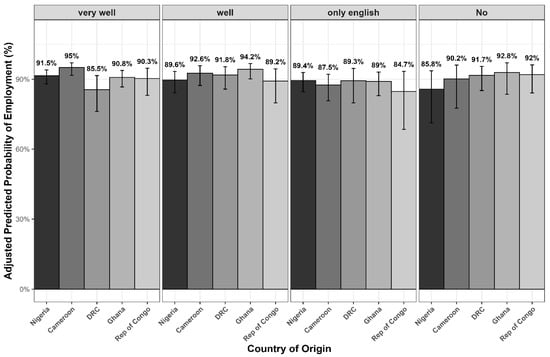
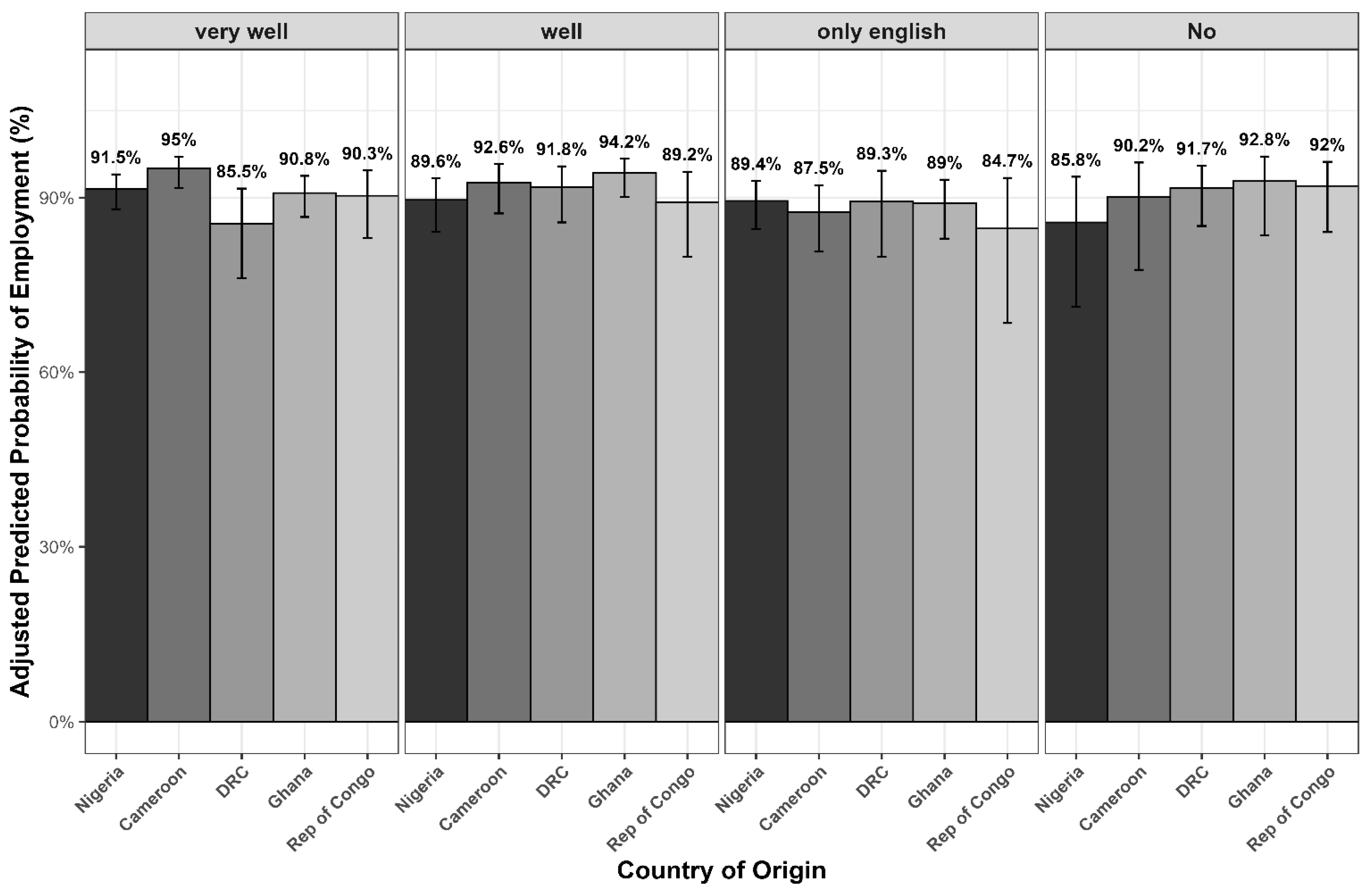
To further explore whether the association between English proficiency and employment varied across countries of origin, predicted probabilities were calculated from the fully adjusted model presented in Table 2 (Model 4).2 The estimates were generated for each country-of-origin and English-proficiency combination while holding all other covariates in the model constant. These predicted probabilities were derived to facilitate interpretation of the relationships shown below.
Figure 1 presents the adjusted predicted probabilities of employment by English proficiency and country of origin. Overall, predicted employment probabilities remained high across all groups, ranging from 84.7% to 95.0%. Within each English-proficiency category, employment probabilities were generally highest among migrants from Cameroon and Ghana and comparatively lower among migrants from the DRC and the Republic of Congo. For example, among respondents reporting that they spoke English very well, predicted probabilities ranged from 85.5% among migrants from the DRC to 95.0% among migrants from Cameroon. Similar patterns were observed across the remaining English-proficiency categories.
Figure 1.
Predicted Probabilities of Employment Across English-Proficiency Categories and Countries of Origin. Notes: Figure 1 presents predicted probabilities of employment derived from the fully adjusted logistic regression model reported in Table 2. Error bars represent 95% confidence intervals. Predicted employment probabilities remain relatively high across all English-proficiency and country-of-origin groups, ranging from 84.7% to 95.0%.
Although some variation in employment probabilities was evident across English-proficiency groups, differences by country of origin appeared less pronounced. Employment probabilities remained relatively high within each English-proficiency category, suggesting that English proficiency alone does not fully account for differences in employment outcomes across national-origin groups. Consequently, the predicted probabilities should be interpreted as evidence of variation in employment likelihood across countries of origin and English-proficiency categories rather than as evidence of large substantive differences between groups.
5. Discussion
Broader studies of African migration to the U.S. frequently fail to account for the differences across African regions in terms of culture, language, and colonial histories. This study fills a gap in the literature by specifically examining migrants from the Central African region and comparing their employment outcomes with those from Nigeria and Ghana. It examines their employment outcomes in relation to English-language proficiency. This focus is especially important, as English proficiency is a critical factor for labor market integration in the United States, where English serves as the dominant language and the primary medium of communication in schools, workplaces, and social settings, as highlighted in previous research (Hamilton 2014; Milligan and Tikly 2016). The study builds on research highlighting African migrants’ selective characteristics, such as high human capital and English proficiency, while situating national and regional diversity within historical debates. It challenges the notion that all African migrants in the United States share the same integration trajectory.
In the American context, for instance, the daily use of English can pose challenges for migrants from non-English-speaking African countries (Huot et al. 2020). Central African migrants, in particular, remain underrepresented in U.S. migration scholarship. This comparison highlights the variability of African education, language, and colonial legacies, as well as their potential relevance to migration and labor market outcomes. Colonial-linguistic histories provide context for this comparison, but the present models cannot identify their contribution to employment differences.
Understanding how the language of an immigrant’s country of origin translates to their employment prospects is important, especially when examining migrants from African countries where English, French, or other languages serve as the official language. Research has shown that proficiency in the host country’s language enhances migrant integration, as it builds social capital, which is essential for securing employment and forming connections (Chiswick and Miller 2009). In the context of the United States labor market, securing employment has been attributed to several factors, with English proficiency standing out as a key indicator of successful integration and upward mobility. Studies have emphasized the importance of linguistic capital in employment attainment within the host country, noting that limited proficiency in the host country’s language can hinder successful integration (Creese 2010; Gazzola et al. 2019; Hebbani and Colic-Peisker 2012). Specifically, the inability to speak English fluently creates significant barriers to engagement and access to opportunities in the host society (Huot et al. 2020; Roth 2019).
While this study aimed to examine the role of English proficiency in the employment outcomes of Central African migrants in the United States, the findings suggest several important patterns. First, the results provide limited evidence that country of origin independently predicts employment among Central African migrants. Although migrants from the DRC and the Republic of Congo initially exhibited lower odds of employment than their counterparts from Nigeria (Table 2, Models 1 and 2), these differences were attenuated after sociodemographic characteristics were included in the models. This attenuation suggests that the observed country differences became less pronounced after demographic and socioeconomic factors were taken into account. However, it does not establish mediation or identify the underlying causes of the initial differences.
Secondly, the pooled models identify an association between home-language category and employment across the five national-origin groups, rather than a consistent gradient in English proficiency. As shown in Models 2–4 (Table 2), employment outcomes varied across English-language categories. Notably, migrants who reported speaking only English had significantly lower odds of employment than those who reported speaking English very well. While both groups represent high levels of English-language ability, this finding highlights variation within English-speaking populations. More specifically, migrants who spoke a language other than English at home but reported speaking English very well exhibited higher odds of employment than those who spoke only English.
Overall, these findings highlight the importance of considering within-group differences when examining labor market outcomes. The variation observed across English-proficiency categories suggests that English proficiency alone does not consistently correspond with employment outcomes. Although some differences were observed across country-of-origin and English-proficiency groups, the present analysis does not establish whether these patterns differ significantly across countries. Furthermore, the attenuation of several country-of-origin estimates after adjustment suggests that demographic and socioeconomic characteristics may account for some of the observed differences. However, these findings do not establish mediation or identify the underlying causes of the observed country differences.
More broadly, these findings shift attention from whether West and Central African migrants possess English proficiency to the conditions under which language skills are recognized and valued within the labor market. Integration cannot be reduced to the acquisition of individual skills alone; it is also shaped by access to opportunities and the extent to which migrants are able to mobilize their linguistic, educational, and professional resources in ways that are recognized within institutional settings. In this study, educational attainment was significantly associated with employment outcomes. Compared with migrants holding a bachelor’s degree or higher, those with some college, a high school diploma, or less than a high school education exhibited lower odds of employment (Table 2, Model 4).
These findings suggest that employment outcomes varied by educational attainment, with the highest odds of employment observed among migrants with higher levels of formal education. This pattern is consistent with prior research indicating that educational credentials are associated with labor market opportunities among immigrant populations, although the value of those credentials may vary across institutional and occupational contexts (Chiswick and Miller 2009; Creese and Wiebe 2012). These results suggest that English proficiency alone may not fully account for variation in employment outcomes among West and Central African migrants. Rather, language proficiency appears alongside other forms of capital, including educational attainment, which are associated with employment outcomes in the United States. This highlights the importance of considering broader processes of socioeconomic and institutional incorporation when examining employment among African migrants in the United States.
The absence of a consistent language proficiency gradient does not by itself demonstrate differential institutional valuation of language. Alongside human-capital approaches (Chiswick and Miller 2009), postcolonial theory offers hypotheses for future investigation, arguing that language ability is often interpreted through racialized perceptions of accent, credibility, and cultural legitimacy, with African varieties of English frequently afforded less value than European or North American varieties (Bourdieu 1991; Creese 2010). In the baseline model, migrants from the DRC exhibited lower odds of employment than migrants from Nigeria the reference group; this contrast does not assess the postcolonial explanation. However, these differences were substantially attenuated after the inclusion of age and other characteristics associated with settlement and human capital accumulation in the United States (Table 2).
Age emerged as one of the strongest predictors of employment, with migrants aged 30–49, 50–59, and 60–64 exhibiting significantly higher odds of employment than those aged 18–29. This pattern may reflect life-course differences in labor market participation, as younger adults are more likely to be pursuing education or transitioning into the workforce, whereas older adults may have accumulated greater work experience and labor market attachment. The association for ages 60–64 also warrants further examination of health, education, and retirement-related selection rather than a causal interpretation of age. Similarly, migrants residing in the United States for 11 years or more also exhibited higher odds of employment than more recent arrivals. These patterns suggest that employment outcomes vary across both age and settlement duration, highlighting the importance of considering life-course and migration-related factors when examining labor market outcomes among Central and West African migrants.
In addition, the gender findings warrant careful consideration. Female migrants exhibited lower odds of employment than their male counterparts, suggesting that employment outcomes varied by gender among West and Central African migrants in the United States. Supplemental analyses stratified by sex (Appendix A and Appendix B) further indicate that country-of-origin differences remained attenuated across both groups, while men who reported speaking only English continued to exhibit lower odds of employment than those who reported speaking English very well. Several factors may be associated with these gender differences, including caregiving responsibilities, household arrangements, educational participation, health conditions, migration experiences, and other constraints that shape labor market participation (Adsera and Chiswick 2006; Azmat and Petrongolo 2014). Prior research similarly finds that source-country gender norms may be associated with immigrant women’s labor force participation, although these relationships often intersect with educational attainment, household composition, parenthood, and receiving-country institutions (Ala-Mantila and Fleischmann 2018; Blau et al. 2011). These explanations remain hypotheses: the present models do not identify the roles of cultural expectations, caregiving, or structural inequalities. Differences in statistical significance between the male and female models do not establish that their coefficients differ; a formal interaction test would be needed.
This study has several limitations. First, the cross-sectional nature of the IPUMS ACS data allows for the identification of associations but does not permit causal conclusions regarding the relationships among English proficiency, colonial history, culture, discrimination, and employment outcomes. Second, country of origin does not isolate colonial-linguistic background from other national-origin characteristics. This limitation is particularly important for Cameroon, where both English and French serve as official languages and linguistic experiences vary substantially across regions and individuals (Echu 2004). Moreover, observed country-level differences may also reflect variation in migration pathways, refugee experiences, socioeconomic backgrounds, and settlement contexts.
These limitations underscore the need for caution when interpreting the findings. The results should not be viewed as direct evidence of discrimination, as the ACS does not capture employer behavior, hiring practices, accent evaluation, credential recognition, or migrants’ experiences of discrimination. Nevertheless, the observed variation in employment outcomes across English-language categories and national-origin groups is consistent with research suggesting that racialized migrants may not receive equivalent labor market returns from similar levels of educational attainment, professional qualifications, and linguistic competence (Creese and Wiebe 2012; Hebbani and Colic-Peisker 2012). Experimental research similarly demonstrates the persistence of racial and ethnic discrimination in hiring processes, although the present analysis cannot determine the extent to which discriminatory practices contributed to the patterns observed in this study (Quillian et al. 2017).
Third, the study is limited by the absence of measures of accent and workplace language use. While the ACS captures self-reported English proficiency, it does not provide information on accent, linguistic presentation, or how language may be perceived by employers and others within institutional settings. Prior research suggests that African immigrants may encounter negative evaluations based on their accents despite high levels of English proficiency and despite originating from countries where English serves as an official language or is widely spoken (Creese 2010). Self-reported English proficiency is also subject to reporting differences, and the home-language distinction should not be interpreted as an ordered proficiency scale. Such research highlights how accents may be associated with perceptions of foreignness, credibility, and belonging, potentially influencing experiences in educational, workplace, and broader social contexts. Moreover, the value assigned to African English varieties may differ from that accorded to European or North American English varieties, making accent an important factor for future research examining language and labor market outcomes among African migrants.
Fourth, while women exhibited lower odds of employment than men, the variables included in this analysis do not establish the mechanisms underlying these differences. Factors such as caregiving responsibilities, household arrangements, educational participation, health conditions, migration experiences, and labor market constraints may all contribute to variation in employment outcomes, but their relative importance cannot be determined from the present models. Combining unemployment and non-participation also prevents this outcome from distinguishing job-search difficulties from decisions or constraints affecting labor-force entry.
Citizenship associations may reflect selection and reverse causality, and the analysis does not account for geographical settlement, local labor-market conditions, occupation, or earnings. Future research should therefore examine labor-force participation, employment, and work intensity as separate but related outcomes while incorporating measures of childcare responsibilities, household composition, migration category, and preferred working hours. Furthermore, the ACS does not directly capture accent discrimination, employer practices, credential recognition, or migrants’ experiences of racialization. Qualitative and mixed-methods approaches would complement the present analysis by providing greater insight into how migrants experience the intersections of language, race, gender, belonging, and institutional recognition and how these processes are associated with labor market outcomes.
The most significant limitation encountered was the restricted number of Central African countries represented in the IPUMS ACS dataset used for the analysis. For instance, the study aimed to focus on immigrants from the Central African Republic, a small, often overlooked country in the central region of Africa that was formerly colonized by France and uses French as its official language. Despite its growing immigrant presence in various counties across the United States (U.S. Census Bureau 2023), data on this population was not available. This made it difficult to include them in the study, even though their inclusion would have been valuable. Similarly, other Central African countries such as Gabon, Chad, and Equatorial Guinea were also excluded for the same reason. Additionally, the study period (2018–2022) encompasses substantial labor market disruptions associated with the COVID-19 pandemic. Thus, the pandemic may have affected employment opportunities differently across national-origin groups in ways that cannot be fully assessed using the available data. Consequently, some of the observed differences in employment outcomes may reflect broader economic and labor market changes that occurred during this period.
Despite these limitations, this research study has broader implications for policy and for research. First, there is a need to challenge the tendency to generalize African immigrants as a homogeneous group and provide targeted English language training. The present analysis does not evaluate the effectiveness of language training. Prior literature also supports attention to the recognition of foreign qualifications, employer bias, and the devaluation of African linguistic capital. Moreover, disaggregating African migrants by region and colonial history should become standard practice in research and policy evaluation to avoid masking significant inequalities. African migrants are often clustered together, despite originating from diverse regions across the continent that bear distinct legacies of colonialism which often shape their cultures, languages, and labor market outcomes. Also, future research should integrate qualitative or mixed methods to capture the African immigrant conditions.
These findings suggest that while country of origin did not independently predict employment outcomes in the fully adjusted models, variation across English-language categories remained evident. The attenuation of country-of-origin effects highlights the role of intersecting factors such as educational attainment, length of residence in the United States, age, and gender, reinforcing the need to examine African immigrant populations through a more nuanced and multidimensional lens rather than as a homogeneous group.
6. Conclusions
This study contributes to migration scholarship by disaggregating employment outcomes among immigrants from Cameroon, the DRC, the Republic of Congo, Ghana, and Nigeria. The lower employment odds observed for the two Congolese groups relative to Nigeria in the initial models were attenuated after adjustment and were not statistically significant in the fully adjusted model. Respondents who spoke only English at home had lower adjusted odds of employment than respondents who spoke another language at home and reported speaking English very well; the other language contrasts were not statistically significant. Because these categories combine home-language practice and self-reported proficiency, the findings do not establish a simple proficiency gradient. Nor do they demonstrate mediation by colonial-linguistic history or identify discrimination and institutional recognition as mechanisms. Bourdieu’s concept of linguistic capital and postcolonial perspectives remain useful for developing questions that require more direct evidence. Future research should distinguish labor-force participation, employment, and job quality, and investigate migration pathways, credential recognition, and workplace language evaluation. The study supports greater attention to differences within African immigrant populations while maintaining a clear distinction between observed associations and their possible explanations.
Author Contributions
Conceptualization, L.M.O. and H.U.; Methodology, L.M.O.; Software, L.M.O.; Validation, L.M.O.; Formal analysis, L.M.O.; Investigation, L.M.O.; Resources, L.M.O. and H.U.; Data curation, L.M.O.; Writing—original draft, L.M.O.; Writing—review and editing, L.M.O. and H.U.; Visualization, L.M.O.; Supervision, L.M.O. and H.U.; Project administration, L.M.O. and H.U. All authors have read and agreed to the published version of the manuscript.
Funding
This research received no external funding.
Institutional Review Board Statement
Not applicable.
Informed Consent Statement
Not applicable.
Data Availability Statement
The data analyzed in this study were obtained from the Integrated Public Use Microdata Series (IPUMS) USA (Extract No. ddi2-575c7fd0-48a0-0139-d2b6-0242ac1d0007-usa_00050.dat-usa.ipums.org), which distributes harmonized microdata from the U.S. Census Bureau’s American Community Survey (ACS). The analysis uses the 2018–2022 ACS five-year Public Use Microdata Sample (PUMS). These data are publicly available and may be accessed through IPUMS USA upon registration.
Conflicts of Interest
The authors declare no conflicts of interest.
Appendix A
Table A1.
Logistic Regression Analysis of Employment Among Male African Immigrants by Country of Origin and English Proficiency (n = 9593).
Appendix B
Table A2.
Logistic Regression Analysis of Employment Among Female African Immigrants by Country of Origin and English Proficiency (n = 8313).
Appendix C
Table A3.
Unweighted Counts of English Proficiency and Employment Status by Country of Birth.
Notes
| 1 | Across the logistic regression models, AIC values were used as relative indicators of model fit and interpreted cautiously because the models were estimated using survey-weighted procedures (svyglm). The fully adjusted model exhibited the lowest AIC value, suggesting the best relative fit among the models examined. |
| 2 | Confidence intervals were derived from the model-based variance estimates associated with the fitted survey-weighted regression model. |
References
- Adsera, Alicia, and Barry R. Chiswick. 2006. Are there gender and country of origin differences in immigrant labor market outcomes across European destinations? Journal of Population Economics 20: 495. [Google Scholar] [CrossRef] [Scilit]
- Adserà, Alicia, and Aditi Bhowmick. 2022. English Proficiency, Gender, and the Occupations of Childhood Immigrants in the US. Journal of Labor Research 43: 321–44. [Google Scholar] [CrossRef] [Scilit]
- Ala-Mantila, Minna, and Fenella Fleischmann. 2018. Gender differences in labour market integration trajectories of recently arrived migrants in the Netherlands. Journal of Ethnic and Migration Studies 44: 1818–40. [Google Scholar] [CrossRef] [Scilit]
- Alcoff, Linda Martín. 2007. Mignolo’s Epistemology of Coloniality. CR: The New Centennial Review 7: 79–101. [Google Scholar] [CrossRef] [Scilit]
- Ashcroft, Bill. 2017. Postcolonial Theory. In The Wiley-Blackwell Encyclopedia of Social Theory. Hoboken: John Wiley & Sons, Ltd., pp. 1–5. [Google Scholar] [CrossRef] [Scilit]
- Azmat, Ghazala, and Barbara Petrongolo. 2014. Gender and the labor market: What have we learned from field and lab experiments? Labour Economics 30: 32–40. [Google Scholar] [CrossRef] [Scilit]
- Batalova, Jeanne, and Jie Zong. 2017. Sub-Saharan African immigrants in the United States. Washington, DC: Migration Policy Institute. Available online: https://www.migrationpolicy.org/article/sub-saharan-african-immigrants-united-states-2015 (accessed on 8 August 2026).
- Blau, Francine D., and Christopher D. Mackie. 2017. The Economic and Fiscal Consequences of Immigration. Washington, DC: National Academies Press. [Google Scholar]
- Blau, Francine D., Lawrence M. Kahn, and Kerry L. Papps. 2011. Gender, Source Country Characteristics, and Labor Market Assimilation among Immigrants. The Review of Economics and Statistics 93: 43–58. [Google Scholar] [CrossRef] [Scilit]
- Bleakley, Hoyt, and Aimee Chin. 2004. Language skills and earnings: Evidence from childhood immigrants*. Review of Economics and Statistics 86: 481–96. [Google Scholar] [CrossRef] [Scilit]
- Borjas, George J. 2015. The slowdown in the economic assimilation of immigrants: Aging and cohort effects revisited again. Journal of Human Capital 9: 483–517. [Google Scholar] [CrossRef] [Scilit]
- Bourdieu, Pierre. 1991. Language and Symbolic Power. Cambridge, MA: Harvard University Press. [Google Scholar]
- Chikanda, Abel, and Julie Susanne Morris. 2021. Assessing the integration outcomes of African immigrants in the United States. African Geographical Review 40: 1–18. [Google Scholar] [CrossRef] [Scilit]
- Chiswick, Barry R. 1997. Special issue: The economics of immigrant skill and adjustment. The Quarterly Review of Economics and Finance 37: 183–88. [Google Scholar] [CrossRef] [Scilit]
- Chiswick, Barry R., and Paul W. Miller. 2009. Earnings and Occupational Attainment among Immigrants. Industrial Relations 48: 454–65. [Google Scholar] [CrossRef] [Scilit]
- Chiswick, Barry R., Yew Liang Lee, and Paul W. Miller. 2005. Parents and Children Talk: English Language Proficiency within Immigrant Families. Review of Economics of the Household 3: 243–68. [Google Scholar] [CrossRef] [Scilit]
- Colic-Peisker, Val, and Farida Tilbury. 2007. Integration into the Australian Labour Market: The Experience of Three “Visibly Different” Groups of Recently Arrived Refugees. International Migration 45: 59–85. [Google Scholar] [CrossRef] [Scilit]
- Creese, Gillian. 2010. Erasing English Language Competency: African Migrants in Vancouver, Canada. Journal of International Migration and Integration/Revue de l’integration et de La Migration Internationale 11: 295–313. [Google Scholar] [CrossRef] [Scilit]
- Creese, Gillian, and Brandy Wiebe. 2012. ‘Survival Employment’: Gender and Deskilling among African Immigrants in Canada. International Migration 50: 56–76. [Google Scholar] [CrossRef] [Scilit]
- Dávila, Alberto, and Marie T. Mora. 2004. English-Language Skills and the Earnings of Self-Employed Immigrants in the United States: A Note. Industrial Relations 43: 386–91. [Google Scholar] [CrossRef] [Scilit]
- Dávila, Liv T., and Noor Doukmak. 2022. Immigration Debated: Central African Immigrant Youth’s Discourses of Fairness and Civic Belonging in the United States. Equity & Excellence in Education 55: 118–32. [Google Scholar] [CrossRef] [Scilit]
- Dustmann, Christian, and Arthur Van Soest. 2002. Language and the Earnings of Immigrants. ILR Review 55: 473–92. [Google Scholar] [CrossRef] [Scilit]
- Echu, George. 2004. The language question in Cameroon. Linguistik Online 18: 19–33. [Google Scholar] [CrossRef] [Scilit]
- Feliciano, Cynthia. 2005. Educational selectivity in U.S. Immigration: How do immigrants compare to those left behind? Demography 42: 131–52. [Google Scholar] [CrossRef] [Scilit]
- Gazzola, Michele, Bengt-Arne Wickström, and Torsten Templin. 2019. Language skills, the labour market, and socioeconomic integration. Empirica 46: 617–23. [Google Scholar] [CrossRef] [Scilit]
- Halliday, Michael A. K. 2003. Written Language, Standard Language, Global Language. World Englishes 22: 405–18. [Google Scholar] [CrossRef] [Scilit]
- Hamilton, Tod G. 2014. Selection, language heritage, and the earnings trajectories of black immigrants in the United States. Demography 51: 975–1002. [Google Scholar] [CrossRef] [Scilit]
- Hebbani, Aparna, and Val Colic-Peisker. 2012. Communicating one’s way to employment: A case study of African settlers in Brisbane, Australia. Journal of Intercultural Studies 33: 529–47. [Google Scholar] [CrossRef] [Scilit]
- Houle, René, and Lahouaria Yssaad. 2010. Recognition of newcomers’ foreign credentials and work experience. Perspectives on Labour and Income 22: 18–33. [Google Scholar]
- Huot, Suzanne, Ana Cao, Jiwon Kim, Milad Shajari, and Tamara Zimonjic. 2020. The power of language: Exploring the relationship between linguistic capital and occupation for immigrants to Canada. Journal of Occupational Science 27: 95–106. [Google Scholar] [CrossRef] [Scilit]
- Idemudia, Erhabor, and Klaus Boehnke. 2020. Patterns and Current Trends in African Migration to Europe. In Psychosocial Experiences of African Migrants in Six European Countries: A Mixed Method Study. Edited by Erhabor Idemudia and Klaus Boehnke. Berlin/Heidelberg: Springer International Publishing, pp. 15–31. [Google Scholar] [CrossRef] [Scilit]
- Kigamwa, James Chamwada, and Michael Takafor Ndemanu. 2017. Translingual practice among African immigrants in the US: Embracing the mosaicness of the English language. Journal of Multilingual and Multicultural Development 38: 468–79. [Google Scholar] [CrossRef] [Scilit]
- Kmiotek, Łukasz. 2017. Language Proficiency and Cultural Identity as Two Facets of the Acculturation Process. Psychology of Language and Communication 21: 192–214. [Google Scholar] [CrossRef] [Scilit]
- Makoni, Sinfree, Busi Makoni, Ashraf Abdelhay, and Pedzisai Mashiri. 2012. Colonial and post-colonial language policies in Africa: Historical and emerging landscapes. In The Cambridge Handbook of Language Policy. Edited by Bernard Spolsky. Cambridge: Cambridge University Press, pp. 523–43. [Google Scholar] [CrossRef] [Scilit]
- Milligan, Lizzi O., and Leon Tikly. 2016. English as a medium of instruction in postcolonial contexts: Moving the debate forward. Comparative Education 52: 277–80. [Google Scholar] [CrossRef] [Scilit]
- Okeke-Ihejirika, Philomina, Sophie Yohani, Bukola Salami, and Natalie Rzeszutek. 2020. Canada’s Sub-Saharan African migrants: A scoping review. International Journal of Intercultural Relations 79: 191–210. [Google Scholar] [CrossRef] [Scilit]
- Omoniyi, Tope. 2010. 21. Language and Postcolonial Identities: An African Perspective. In Language and Identities. Edinburgh: Edinburgh University Press, pp. 237–46. Available online: https://www.degruyterbrill.com/document/doi/10.1515/9780748635788-025/pdf?licenseType=restricted (accessed on 29 May 2025).
- Piña, Gabriel, Alexandra Cahn, and Carol Im. 2026. Key findings about Black immigrants in the US. Pew Research Center, March 20. Available online: https://www.pewresearch.org/short-reads/2026/03/20/key-findings-about-black-immigrants-in-the-us/ (accessed on 3 April 2026).
- Pressley, Jahnea. 2022. Nigerian Emigration to the United States: A Historical Analysis of Post-Colonial Nigeria. MUNDI 2. Available online: https://tuljournals.temple.edu/index.php/mundi/article/view/583 (accessed on 2 April 2026).
- Quillian, Lincoln, Devah Pager, Ole Hexel, and Arnfinn H. Midtbøen. 2017. Meta-analysis of field experiments shows no change in racial discrimination in hiring overtime. Proceedings of the National Academy of Sciences 114: 10870–75. [Google Scholar] [CrossRef] [Scilit]
- Ramachandran, Rajesh, and Christopher Rauh. 2023. The Imperium of the Colonial Tongue? Evidence on Language Policy Preferences in Zambia. Journal of African Economies 32: 52–80. [Google Scholar] [CrossRef] [Scilit]
- Roth, Silke. 2019. Linguistic Capital and Inequality in Aid Relations. Sociological Research Online 24: 38–54. [Google Scholar] [CrossRef] [Scilit]
- Ruggles, Steven, Sarah Flood, Matthew Sobek, Daniel Backman, Grace Cooper, Julia A. Rivera Drew, Stephanie Richards, Renae Rogers, Jonathan Schroeder, and Kari Williams. 2025. IPUMS USA: Version 16.0. Minneapolis: IPUMS. [Google Scholar] [CrossRef]
- Schuss, Eric. 2018. The Impact of Language Skills on Immigrants’ Labor Market Integration: A Brief Revision with a New Approach. The B.E. Journal of Economic Analysis & Policy 18: 20170280. [Google Scholar] [CrossRef] [Scilit]
- Siegel, Jacob S. 2018. Linguistic Proficiency and Acculturation: Role of Family, Neighborhood, and Metropolitan Area. In Demographic and Socioeconomic Basis of Ethnolinguistics. Edited by Jacob S. Siegel. Berlin/Heidelberg: Springer International Publishing, pp. 605–24. [Google Scholar] [CrossRef] [Scilit]
- Udah, Hyacinth. 2025. African Immigrants’ Employment Experiences and Outcomes in Australia: Race, Immigration and Labour Market. Journal of Intercultural Studies 46: 908–27. [Google Scholar] [CrossRef] [Scilit]
- Udah, Hyacinth, Parlo Singh, and Susanna Chamberlain. 2019a. Settlement and employment outcomes of black African immigrants in Southeast Queensland, Australia. Asian and Pacific Migration Journal 28: 53–74. [Google Scholar] [CrossRef] [Scilit]
- Udah, Hyacinth, Parlo Singh, Kiroy Hiruy, and Lillian Mwanri. 2019b. African immigrants to Australia: And challenges to labor market success. Journal of Asian and African Studies 54: 1159–74. [Google Scholar] [CrossRef] [Scilit]
- U.S. Census Bureau. 2023. Over Half of Those Who Reported Their Race as Black or African American Identified as African American, Jamaican, or Haitian; Washington, DC: U.S. Census Bureau. Available online: https://www.census.gov/library/stories/2023/10/2020-census-dhc-a-black-population.html (accessed on 24 September 2026).
- Vigouroux, Cécile B., and Salikoko S. Mufwene. 2009. From Africa to Africa: Globalization, Migration and Language Vitality. In Globalization and Language Vitality. London: Bloomsbury Publishing Plc. [Google Scholar]

Disclaimer/Publisher’s Note: The statements, opinions and data contained in all publications are solely those of the individual author(s) and contributor(s) and not of MDPI and/or the editor(s). MDPI and/or the editor(s) disclaim responsibility for any injury to people or property resulting from any ideas, methods, instructions or products referred to in the content. |
© 2026 by the authors. Licensee MDPI, Basel, Switzerland. This article is an open access article distributed under the terms and conditions of the Creative Commons Attribution (CC BY) license.