


Abstract
LGBTQ+ youth in Eswatini navigate identity and well-being within social environments shaped by cultural expectations, legal restrictions, family relationships, educational institutions, and community attitudes. Although existing scholarship documents stigma and exclusion affecting sexual and gender minorities, less is known about how young people themselves interpret these experiences and how intersecting identities shape both vulnerability and resilience. This study explored the lived experiences of LGBTQ+ youth aged 16–24 years in Eswatini, with particular attention to identity, acceptance and recognition, resilience, and the influence of legal and cultural norms. A qualitative narrative inquiry design was employed with 18 participants recruited purposively through LGBTQ+ community organisations and support networks, followed by snowball recruitment. Twelve participants were recruited through LGBTQ+ organisations and six through participant referrals. The sample comprised seven participants who self-identified as transgender men, six as transgender women, three as lesbian, and two as gay. Data were generated through six individual semi-structured interviews and two focus group discussions involving six participants each. Data were analysed using reflexive thematic analysis informed by narrative inquiry, while intersectionality theory guided interpretation of the interaction between gender identity, sexual orientation, age, family background, socioeconomic position, religion and spirituality, and broader cultural, legal, and institutional contexts. Three interconnected themes were developed: struggles for acceptance and recognition, resilience and personal strength, and the impact of legal and cultural norms. Participants described identity concealment, family and community rejection, school exclusion, and fear associated with legal and institutional environments. At the same time, they described self-acceptance, chosen family, friendship, community connection, education, storytelling, and future aspirations as important resources for navigating adversity. The findings show that LGBTQ+ youth should not be understood only through vulnerability; their accounts also demonstrate agency and adaptive capacity. The study contributes context-specific qualitative evidence from Eswatini and highlights the importance of youth-centred, culturally responsive approaches across schools, counselling services, community organisations, families, and policy environments. The study further demonstrates that support cannot be separated from the structural conditions in which young people live, because family, school, community, and legal contexts may simultaneously constrain identity expression while also providing opportunities for belonging and resilience.
1. Introduction
LGBTQ+ youth continue to experience disparities in social inclusion, mental health, safety, and access to opportunities in contexts where sexual and gender diversity is contested or stigmatised. Recent scholarship emphasises that these experiences are produced not only through interpersonal prejudice but also through institutional practices, heteronormative expectations, legal environments, and unequal access to supportive resources (Chan et al. 2022; Hoy-Ellis 2023; Kaprinis and Charalampakis 2025; Rissanen et al. 2026). For young people, these pressures can be especially consequential because identity development occurs alongside dependence on families, schools, peers, and other institutions that may either affirm or constrain identity expression. In Eswatini, the experiences of LGBTQ+ youth are shaped by a distinctive combination of cultural expectations, religious and social norms, legal restrictions, and institutional practices. Research on Eswatini, Malawi, and Zimbabwe has documented social exclusion associated with sexual orientation, gender identity and expression, and sex characteristics, while also highlighting the importance of family, community, and institutional contexts in shaping everyday experiences (Müller and Judge 2022). The wider literature on LGBTQ+ inclusion similarly shows that heteronormativity can become embedded in ordinary social relationships and expectations, making disclosure and identity expression consequential decisions for young people (Pollitt et al. 2021).
Recent developments in Eswatini have further intensified these challenges. Public statements by the Minister of Education advocating the expulsion of learners involved in same-sex relationships, together with reports of learners being expelled from schools because of their sexual orientation, have heightened concerns regarding the safety, inclusion, and psychological well-being of LGBTQ+ youth (AFP 2026; Dlamini 2026). Such institutional responses extend beyond individual prejudice by legitimising discrimination within educational settings and reinforcing broader societal stigma. These developments illustrate how legal structures, political discourse, cultural beliefs, and institutional practices intersect to shape the everyday realities of LGBTQ+ young people. Despite these structural barriers, LGBTQ+ youth are not merely passive recipients of discrimination. Much of the existing literature documents discrimination, minority stress, social exclusion, or barriers to support, while comparatively less qualitative work in Eswatini centres young people’s own narratives of how these conditions intersect in everyday life. The present study addresses this gap by examining how LGBTQ+ youth aged 16–24 years describe identity development, acceptance and recognition, resilience, and the effects of legal and cultural norms. The study’s contribution lies in bringing together individual stories and shared group experiences while interpreting them through an intersectional framework. Rather than treating LGBTQ+ youth as a homogeneous population, the analysis attends to differences associated with gender identity, sexual orientation, age, family circumstances, educational experiences, social connections, and access to LGBTQ+ organisations and support.
The study therefore asks how LGBTQ+ youth in Eswatini experience and negotiate identity and belonging; how they describe sources of resilience and support; and how cultural, legal, educational, and social environments shape their well-being. By centring participant narratives, the study provides context-specific evidence that can inform school-based practice, counselling and psychosocial support, community-based programming, and future policy discussions without assuming that structural change is immediate or straightforward.
1.1. Literature Review
Research on LGBTQ+ youth consistently demonstrates that stigma and discrimination can influence identity development, social participation, and psychological well-being. Minority stress scholarship conceptualises these effects as arising from persistent social stressors, including stigma, concealment, discrimination, and expectations of rejection (Hoy-Ellis 2023). More recent reviews similarly identify social exclusion as an important pathway through which LGBTQ+ communities may experience adverse psychosocial outcomes (Kaprinis and Charalampakis 2025). These processes are not uniform. They are mediated by social support, community belonging, access to affirming services, and the extent to which young people can construct positive identities within their social environments (Chan et al. 2022). Identity disclosure is particularly complex during youth. Disclosure can provide opportunities for authenticity, support, and connection, but it can also expose young people to rejection, bullying, family conflict, or institutional consequences (Mutekwe and Patsika 2026). A systematic review of LGBTQ+ youth identity disclosure processes emphasises that disclosure is shaped by anticipated reactions, relational contexts, developmental considerations, and perceptions of safety (Mousavi et al. 2025). The present study extends this understanding by examining disclosure and concealment in a setting where cultural expectations and legal restrictions may influence the perceived consequences of being open about identity. Family and peer relationships are especially important because they can either intensify vulnerability or provide protective resources. Supportive relationships may affirm identity and strengthen psychological well-being, whereas rejection can deepen isolation and undermine access to material and emotional resources (Cavarra et al. 2025; Wootton et al. 2025). LGBTQ+ young people may consequently construct forms of chosen family and peer support when biological family relationships are constrained. Such support is not simply an interpersonal resource; it may also provide access to information, community, practical assistance, and spaces in which identity can be expressed with reduced fear (Kitzie et al. 2022). Schools constitute another critical environment. Young people spend substantial periods of their lives in educational institutions, making school climate central to belonging, safety, identity expression, and educational participation. Inclusive school environments can promote fairness, belonging, and positive intergroup relations, whereas exclusionary practices may reproduce stigma and marginalisation (Killen and Rutland 2022; Kokozos and Gonzalez 2024). Research on LGBTQ+ youth also indicates that school experiences are shaped by the interaction of peer relationships, adult responses, institutional policies, and dominant understandings of gender and sexuality (Harris et al. 2025). These findings are particularly relevant to the present study because participants described school experiences alongside family and community expectations rather than as isolated domains.
Legal and policy environments also shape the conditions under which LGBTQ+ people seek recognition and protection. Comparative research demonstrates that the legal environment surrounding LGBTQ+ sexuality has implications for public health, safety, and access to institutional protection (Kavanagh et al. 2025). Ssenyonjo (2023) further documents the human-rights implications associated with criminalisation of consensual same-sex conduct between adults. In settings where legal protection is limited, the perceived risk of institutional exposure can influence whether young people disclose identity, seek help, or report discrimination. The present study is concerned with these lived implications rather than treating legal status as a sufficient explanation of individual experience.
African LGBTQ+ experiences must also be understood within local histories and social meanings rather than through assumptions derived from Western contexts. Research in Southern Africa highlights the role of cultural, religious, family, and community norms in shaping experiences of sexual and gender diversity (Müller and Judge 2022; Michael 2026). At the same time, African LGBTQ+ youth actively negotiate identity, community, and belonging rather than simply receiving externally imposed categories. Russell et al. (2023) argue for expansive understandings of LGBTQ+ identities, while work on heteronormativity demonstrates how expectations about gender and sexuality become embedded in everyday life (Pollitt et al. 2021). The literature also increasingly recognises resilience as a relational and contextual process. LGBTQ+ people may draw on self-acceptance, supportive friendships, community networks, storytelling, education, and future aspirations to navigate adversity (Parmenter et al. 2021; Wootton et al. 2025). Digital storytelling and public narrative can also provide avenues for meaning-making and resistance to stigma (Osoro et al. 2026). These perspectives challenge deficit-based accounts that portray LGBTQ+ youth only as vulnerable. However, resilience should not be interpreted as evidence that structural barriers are harmless. Rather, it can be understood as a response developed within unequal conditions.
Taken together, the literature indicates that identity, well-being, social support, educational participation, and structural context are closely interconnected. Nevertheless, there remains limited qualitative evidence from Eswatini that brings these dimensions together through young people’s own narratives. The present study responds to this gap by examining how multiple systems and identities intersect in participants’ everyday experiences and by identifying both constraining conditions and resources for resilience.
1.2. Theoretical Framework
This study is grounded in intersectionality theory, associated most directly with Crenshaw’s work on the interaction of multiple systems of power and inequality (Crenshaw 1989, 2013). Intersectionality does not treat social identities as independent variables that simply add together. Instead, it draws attention to how identities and structures are mutually constituted within particular social and historical contexts. Collins et al. (2021) similarly conceptualise intersectionality as a critical social theory concerned with interconnected forms of power, knowledge, and social inequality. Intersectionality is appropriate for this study because participants’ experiences could not be adequately understood through sexual orientation or gender identity alone. Age, gender identity, sexual orientation, family background, socioeconomic position, religion and spirituality, access to information, and urban or rural location may shape the resources available to young people and the forms of exclusion they encounter. The study therefore uses intersectionality as an interpretive lens rather than as a checklist of identities. The central analytical question is how these dimensions become consequential in particular contexts.
The framework was applied throughout the analysis. Participant narratives were first preserved as individual accounts so that the temporal and contextual character of each story was not lost. Thematic analysis was then used to identify recurring patterns across accounts, after which the patterns were interpreted in relation to intersecting identities and structures. For example, a participant’s account of concealing identity was not interpreted simply as an individual coping preference; it was examined in relation to family expectations, school experiences, community attitudes, gender norms, and perceptions of legal or institutional risk. In this way, narrative inquiry preserved the story while intersectionality helped explain the social relations and systems through which the story was produced.
2. Methodology
2.1. Research Approach and Design
This study employed a qualitative approach because the research questions concerned meanings, experiences, identity negotiation, and participants’ interpretations of their social worlds. Qualitative research is particularly appropriate where the aim is to understand complex and context-dependent experiences that cannot be adequately represented through numerical measures alone (Lim 2025). Narrative inquiry was selected as the overarching design because participants were invited to describe experiences over time and to explain how they understood identity, belonging, rejection, support, and resilience within their own social contexts.
2.2. Sampling and Participant Characteristics
The study used purposive sampling followed by snowball sampling. Purposive recruitment was appropriate because participation required specific characteristics directly relevant to the research questions. Eligible participants were required to identify as LGBTQ+, be between 16 and 24 years of age, reside in Eswatini, and participate voluntarily. Initial recruitment was conducted through LGBTQ+ community organisations and support groups operating in Eswatini. Twelve of the eighteen participants were recruited through these organisations, while six were recruited through referrals from existing participants (Ting et al. 2025). This recruitment strategy enabled access to young people with direct experience of the study topic while also allowing participants to identify other eligible young people within their social networks. The researchers recognise that recruitment through LGBTQ+ organisations and referrals may have underrepresented young people who were less connected to LGBTQ+ networks or who were more socially isolated.
The final sample comprised eighteen participants aged 16–24 years. Participants self-described their identities using terms that relate to different dimensions of identity: seven identified as transgender men and six as transgender women, which describe gender identity, while three identified as lesbian and two as gay, which describe sexual orientation. These categories are reported exactly as participants described themselves and are not treated as interchangeable constructs. The reporting also avoids assuming that gender identity determines sexual orientation. Participant codes used throughout the findings (P01–P14 for quoted accounts) are neutral identifiers and do not encode gender identity or sexual orientation. The remaining participants are not individually quoted in the findings but contributed to the thematic analysis. Participants also described experiences of educational exclusion and discrimination. This participant profile provides context for interpreting the findings because the narratives were shaped not only by anticipated stigma but also by experiences of institutional exclusion and unequal treatment. The sample size was determined through consideration of information power and the richness and recurrence of the data rather than statistical representativeness. Recruitment and analysis proceeded together, with attention to whether additional interviews or group discussions were producing substantially new dimensions of the phenomenon. The final sample provided sufficient variation in identity and experience to examine shared patterns and differences while retaining the depth required for narrative inquiry.
2.3. Data Collection
Data were collected from 1 June to 13 June 2026. The study generated six individual semi-structured interviews and two focus group discussions involving six participants each, providing data from all 18 participants. Six participants took part in individual interviews, while twelve participated in the two focus groups; participants were allocated to one data-collection format rather than participating in both formats. Individual interviews lasted approximately 45–60 min and focus groups approximately 90 min. The interview guide was developed from the research objectives and literature concerning LGBTQ+ identity, discrimination, resilience, social support, and well-being. It was reviewed for content relevance and pilot-tested with two eligible individuals who were not included in the final sample. Participants could use English or SiSwati. With permission, interviews and focus groups were audio-recorded and transcribed verbatim; SiSwati material was translated into English during transcription, with selected transcripts reviewed by bilingual colleagues against the original audio to support linguistic accuracy.
Because focus groups can create confidentiality limitations that do not arise to the same extent in individual interviews, participants were informed that the researcher could protect the handling of the data but could not absolutely guarantee what another group member might later disclose outside the session. Participants were asked to respect one another’s privacy, avoid repeating personal disclosures, and not identify other participants outside the research setting. The availability of both individual interviews and focus groups enabled the study to capture personal narratives as well as shared reflections on common social experiences. The two forms of data were analysed together while retaining attention to differences between individually narrated and collectively discussed experiences.
Ethical safeguards were particularly important because the study involved potentially identifiable and sensitive information about sexual and gender identities. Ethical clearance was obtained from the University Ethics Committee under protocol code 12338. Participation was voluntary, written informed consent was obtained, and participants were informed of their right to decline questions or withdraw without penalty. For participants below 18 years, parental or legal-guardian consent was obtained. Assent was also obtained from participants below 18 years of age in accordance with the approved ethical procedures. Parents or guardians were assured that participants’ names would not be published and that identifying details would be treated confidentially. This assurance was important because disclosure of a young person’s sexual or gender identity could create social or institutional risks. The manuscript therefore reports participant characteristics only in forms that are relevant to the analysis and avoids publishing names or other direct identifiers. To minimise unintended identity disclosure, the manuscript uses neutral participant codes (P01–P14 for quoted accounts), removes names and direct identifiers, avoids unnecessary combinations of demographic details that could make an individual recognisable, and does not identify participants’ specific schools, communities, or organisations. For focus groups, participants were informed that confidentiality could not be absolutely guaranteed because other group members might disclose information outside the session; they were asked not to repeat personal disclosures or identify other participants. These safeguards were particularly important because disclosure of a young person’s sexual or gender identity could create social or institutional risks.
Researcher Positionality
The researcher approached the study reflexively, recognising that their own social location, professional experiences, assumptions, and relationship to the research context could shape recruitment, interactions with participants, interpretation, and representation of LGBTQ+ experiences. To reduce the risk of imposing predetermined meanings, the researcher maintained a reflexive journal, distinguished participants’ accounts from analytic interpretation, and repeatedly revisited coded material and complete narratives during theme development. The researcher also remained attentive to the power dynamics inherent in interviewing young people about potentially sensitive identities and used neutral participant codes in reporting.
2.4. Data Analysis and Trustworthiness
Data analysis combined Braun et al.’s (2022) reflexive thematic analysis with principles of narrative inquiry. The two approaches served complementary purposes rather than competing methodological functions. Narrative inquiry kept attention on participants’ stories, the meanings they attached to events, and the contextual sequence through which experiences unfolded. Reflexive thematic analysis enabled the researcher to compare accounts and identify patterns that extended across participants. The analysis began with repeated reading of transcripts and listening to selected audio recordings to verify transcription. Initial codes were developed inductively from meaningful segments concerning identity, acceptance, concealment, discrimination, resilience, social support, education, and legal or cultural pressures. Related codes were then grouped into broader patterns and candidate themes. Themes were reviewed against both coded extracts and complete narratives, refined where necessary, and named to capture their central organising concepts.
An example illustrates how the two approaches were combined. A participant’s statement that they hid their identity because of fear was first retained as part of that participant’s story and considered in relation to the surrounding account of family, school, and community relationships. Across the dataset, similar accounts of concealment, rejection, and anticipated judgement were then compared and developed into the broader theme of struggles for acceptance and recognition. The thematic interpretation did not replace the individual story; rather, the story provided the context through which the recurring pattern was understood. Intersectionality was then used to examine how the experience was shaped by overlapping identities and structures rather than by sexuality or gender identity in isolation. Trustworthiness was strengthened through prolonged engagement with the dataset, member checking of selected interview summaries, use of verbatim quotations, maintenance of an audit trail, and reflexive journaling. Dependability was supported by documenting coding and theme-development decisions, while confirmability was addressed through reflexive attention to the researcher’s assumptions and interpretive choices. Rich description of the context, participant characteristics, recruitment pathway, and data-collection procedures was used to support transferability. Throughout the analysis, a distinction was maintained between participants’ direct words, claims drawn from published literature, and the researcher’s interpretation. Participant quotations are presented as empirical evidence from the study, whereas literature is cited separately to contextualise or compare those accounts.
2.5. Findings and Discussion
Participants’ accounts showed that identity and well-being were shaped by interconnected experiences of recognition, exclusion, support, and structural constraint. The three themes developed through the analysis were not treated as isolated categories. Instead, they formed a connected account in which experiences of rejection and exclusion influenced the need for resilience, while supportive relationships and personal aspirations provided resources for navigating legal, cultural, and institutional pressures. Differences between participants were also analytically important. Those with stronger access to LGBTQ+ organisations or supportive peers described resources that were less visible in accounts characterised by family rejection or school exclusion.
2.6. Theme 1: Struggles for Acceptance and Recognition
Participants repeatedly described acceptance as uncertain and conditional. P01 explained, “I often feel invisible, like my existence is not acknowledged by society or even my own family.” The account links identity recognition to both intimate and public relationships. Invisibility here is not simply a feeling of being unnoticed; it describes a social position in which the participant experiences their identity as insufficiently recognised by people and institutions that shape everyday belonging. P02 similarly stated, “Sometimes I hide who I am because I fear rejection and judgement from those around me,” while P03 wished to be “accepted without having to hide myself every day.” Together, these accounts show that concealment was used as a strategy for managing anticipated social consequences.
For some participants, exclusion had an explicitly institutional dimension. These accounts gave concrete meaning to concerns that educational institutions could become sites of exclusion rather than protection. P03 described feeling “invisible” in social settings, while P05 stated, “Acceptance feels like a distant dream in a country where my love is considered a crime.” In addition, participants referred to educational exclusion and discrimination when describing the conditions under which identity expression and belonging were negotiated. These accounts indicate that school experiences formed part of the broader social environment described by participants; however, the qualitative data do not establish the prevalence or extent of school exclusion across LGBTQ+ youth in Eswatini. Rather, they demonstrate how particular participants interpreted educational and institutional environments in relation to identity and belonging. The finding is consistent with literature showing that heteronormativity and institutional practices can shape LGBTQ+ young people’s opportunities for recognition (Pollitt et al. 2021; Harris et al. 2025). Participants’ experiences were not identical. Some had access to supportive friends or LGBTQ+ organisations, whereas others described stronger family or community constraints. This variation matters because it demonstrates that vulnerability cannot be inferred from LGBTQ+ identity alone.
2.7. Theme 2: Resilience and Personal Strength
Alongside accounts of rejection, participants described active strategies for maintaining identity, dignity, and hope. P06 stated, “Despite everything, I have learned to love myself and stay true to who I am.” Their account positions self-acceptance as a form of agency developed in response to social pressures rather than as evidence that those pressures are insignificant. This interpretation is consistent with literature emphasising the role of identity affirmation and social support in LGBTQ+ well-being (Cavarra et al. 2025; Wootton et al. 2025).
Supportive friendships and chosen family were especially important. P07 explained, “My friends are my family—they support me when no one else does.” Their account indicates that support can be reconstructed beyond biological family when conventional family relationships are experienced as unsafe or rejecting. P08 similarly stated, “I find strength in knowing I am not alone, even if society tries to push me away.” These accounts show that resilience was relational as well as individual. Community connection can provide emotional affirmation, practical information, and a sense of belonging that counters social exclusion (Kitzie et al. 2022; Parmenter et al. 2021). Other participants described storytelling, education, and future aspirations as resources for navigating adversity. P09 explained, “Writing and sharing my story helps me process and stay resilient,” while P10 stated, “I focus on my education and dreams, which keep me going.” These accounts demonstrate how meaning-making and future orientation can help participants construct identities that extend beyond experiences of stigma. Research on digital storytelling and public narratives similarly suggests that storytelling can support meaning-making and challenge stigma (Osoro et al. 2026). At the same time, these resources were unevenly available. A young person with supportive friends, organisational connections, or educational opportunities may have more avenues for resilience than someone who is socially isolated or excluded from school. P11 captured the coexistence of adversity and agency by stating, “Every day is a battle, but I am determined to survive and thrive.” The statement should not be read as evidence that resilience removes structural disadvantage. Rather, it demonstrates how participants actively negotiated conditions that remained difficult. Intersectionality helps explain this coexistence: the same social environment that produces exclusion may also contain relationships, aspirations, and community resources that enable young people to resist its effects.
2.8. Theme 3: Impact of Legal and Cultural Norms
Participants understood their experiences within a broader legal and cultural environment. P05 stated, “The law criminalises my love, making me live in constant fear.” P04 similarly explained, “Legislation against us makes it impossible to find protection or justice.” These accounts illustrate how law can have meanings beyond formal legal consequences. Participants perceived legal status as shaping whether they could expect recognition, protection, or fair treatment from institutions. This finding is consistent with scholarship connecting legal environments to the health, safety, and institutional experiences of LGBTQ+ populations (Kavanagh et al. 2025; Ssenyonjo 2023). Cultural narratives were similarly influential. P12 stated, “Cultural traditions tell me I am wrong for who I am, which hurts deeply,” while P13 observed, “Many people think being LGBTQ+ is a Western influence, not part of our culture.” These statements demonstrate that identity is negotiated within competing claims about tradition, authenticity, morality, and belonging. The issue is not simply whether participants accept or reject culture; rather, they must navigate how cultural meanings are mobilised in relation to gender and sexuality. This is consistent with Southern African research showing that cultural and social norms can shape experiences of sexual and gender diversity while leaving room for complex processes of negotiation and identity construction (Müller and Judge 2022).
P14 stated, “The government’s threats and comments create a hostile environment for us.” This account reflects participants’ sensitivity to institutional and public discourse because statements by authorities may influence how safe or legitimate young people perceive themselves to be. The study does not treat participant perceptions as equivalent to an independent assessment of governmental intent. Instead, the finding shows how official discourse was experienced by participants and how that experience contributed to fear and uncertainty. The wider social and institutional environment provides important context for these narratives.
The three themes are therefore mutually reinforcing. Legal and cultural pressures were interpreted as connected to struggles for recognition; experiences of rejection created a need for coping and resilience; and supportive relationships, education, and community connection were described as resources through which participants navigated those pressures. The intersectional framework clarifies why these processes differed between participants. Gender identity, sexual orientation, age, family relationships, socioeconomic circumstances, religious or cultural expectations, school experiences, and access to supportive networks intersected to shape the meaning and consequences of particular events.
2.9. Synthesis of Findings and Conceptual Framework
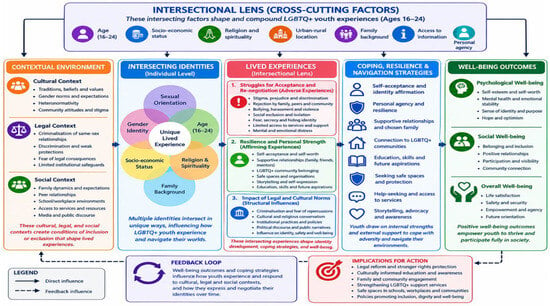
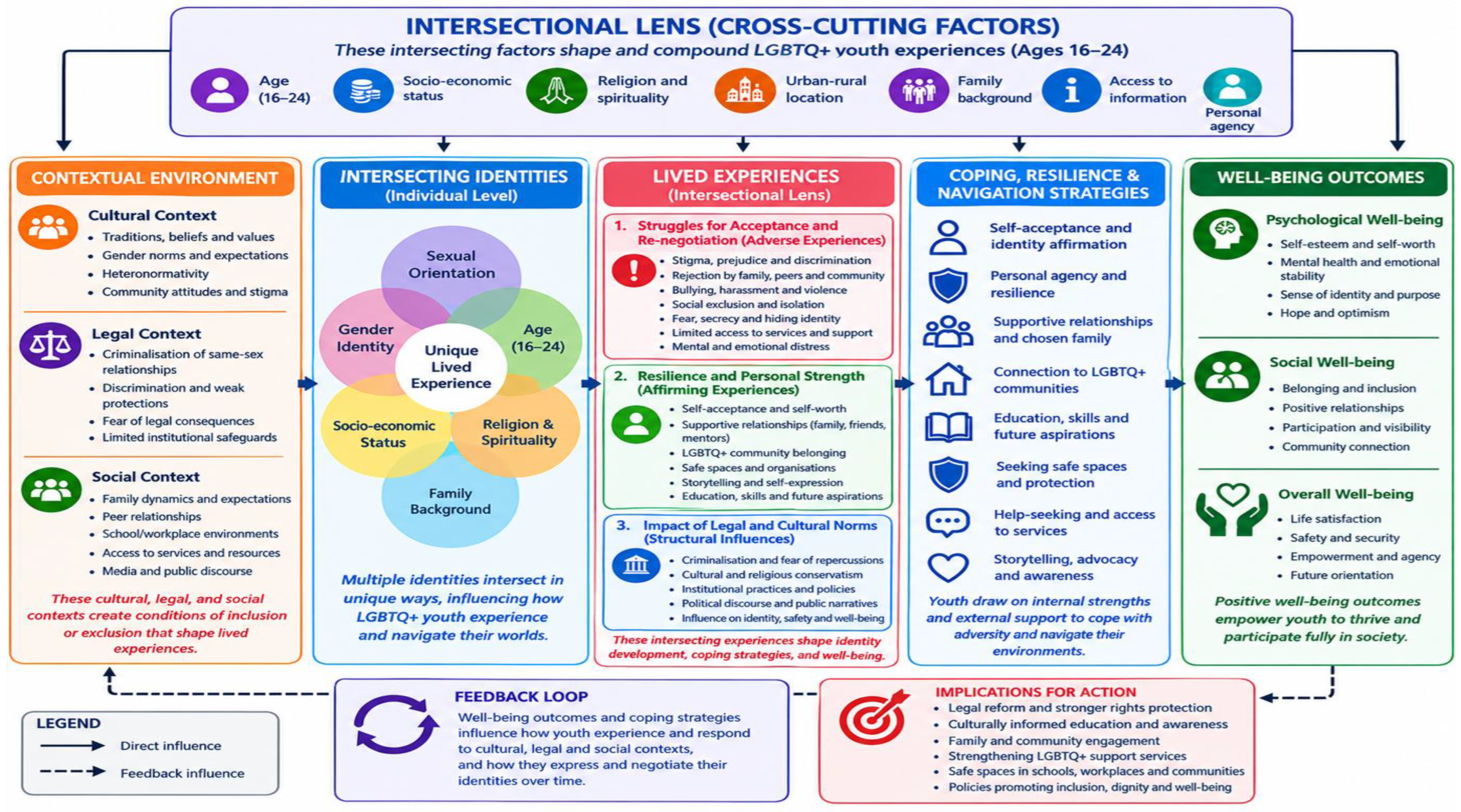
The relationship among the study context, intersecting identities, lived experiences, coping resources, and well-being outcomes is synthesised in Figure 1. The framework brings together the three empirical themes while showing that participants’ experiences unfolded within interconnected cultural, legal, and social conditions. It also illustrates the feedback relationship between well-being, coping, and the contexts in which young people continually negotiate identity and belonging.
Figure 1.
Conceptual framework: Navigating identity and well-being: intersectional experiences of LGBTQ+ youth in Eswatini within cultural, legal, and social contexts (ages 16–24). Note. Developed by the researcher based on the study findings and Intersectionality Theory (Crenshaw 1989, 2013).
2.10. Implications for Practice, Community Engagement, and Policy
The findings have implications for several settings. In schools, the accounts of concealment and exclusion indicate the importance of clear anti-discrimination procedures, confidential support pathways, and staff capacity to respond to LGBTQ+ learners without reproducing stigma. Counsellors and psychosocial practitioners should recognise that distress may be connected to family, school, community, and legal contexts rather than treating it solely as an individual problem. Support should therefore include attention to safety, confidentiality, identity affirmation, and access to trusted networks. Community organisations can build on the protective role that participants attributed to friendships, chosen family, storytelling, and community connection. Such organisations may provide information, peer support, referral pathways, and safe spaces while recognising that young people who are not connected to LGBTQ+ organisations may be especially difficult to reach. Recruitment limitations in the present study reinforce the need for outreach approaches that do not depend entirely on existing community networks.
At family and community level, dialogue involving parents, caregivers, community leaders, religious actors, educators, and youth organisations may create opportunities to address misconceptions and strengthen support. Such engagement should be culturally responsive and should not assume that participants’ identities or experiences are identical. The findings indicate that cultural context is not merely an obstacle; it is a social environment in which meanings of family, responsibility, identity, and belonging are negotiated. At policy level, the findings provide evidence of how legal and institutional environments are experienced by young people. The study does not predict when legal or policy reforms will occur, nor can the qualitative data establish the probability of reform. It does, however, show that any movement toward stronger protection would have to engage with institutional practice, cultural and religious interpretations, public discourse, and the practical capacity of schools and service providers to implement inclusive safeguards. The implementation challenge is therefore not only legislative; it is also organisational, relational, and cultural.
2.11. Limitations
This study has several limitations. First, recruitment through LGBTQ+ organisations and subsequent snowball referrals may have favoured young people who were already connected to supportive networks and may have underrepresented those who were isolated, concealed, or disconnected from community organisations. Second, the sample was small and qualitative, so the findings are not statistically generalisable to all LGBTQ+ youth in Eswatini. The purpose was instead to generate depth and contextual understanding. Third, focus groups can influence what participants are willing to disclose, particularly when topics concern sexual and gender identity. Although confidentiality expectations were explained and participants were asked to respect one another’s privacy, confidentiality cannot be completely controlled once disclosures occur within a group. Fourth, the study relied on self-described identities and experiences, which is appropriate for narrative inquiry but means that findings represent participants’ situated accounts rather than externally verified classifications. Finally, the inclusion of participants aged 16–24 created developmental variation, meaning that younger participants may have experienced family and school dependence differently from older participants. These limitations should be considered when interpreting the findings and designing future research.
3. Conclusions
This study demonstrates that LGBTQ+ youth in Eswatini navigate identity and well-being through interconnected cultural, legal, social, educational, and personal contexts. Participants described struggles for acceptance and recognition, including concealment, family and community rejection, school exclusion, and fear associated with the wider legal environment. At the same time, they described self-acceptance, friendship, chosen family, community connection, storytelling, education, and future aspirations as important resources for resilience. These findings reinforce the value of moving beyond a deficit-based account of LGBTQ+ youth and recognising both structural vulnerability and personal agency. Intersectionality provided a useful framework for explaining why experiences differed across participants and how multiple identities and systems of power became consequential in particular contexts. The study’s contribution is therefore not simply to document stigma, but to show how young people interpret, negotiate, and respond to intersecting conditions of exclusion and support. Future research should extend recruitment beyond established LGBTQ+ networks, examine experiences across different geographic and socioeconomic settings, and further explore how schools, families, community organisations, counsellors, and institutions can create conditions in which young people can participate safely and with dignity.
Funding
This study received no external funding.
Institutional Review Board Statement
The study was conducted in accordance with the Declaration of Helsinki, and approved by the Institutional Ethics Committee of University of South Africa (protocol code: 12338) on 17 February 2026.
Informed Consent Statement
Written informed consent was obtained from participants. For participants below 18 years, parental or legal-guardian consent was obtained, with parents or guardians assured that no participant names or identifying details would be published. Participants were informed of their right to decline questions or withdraw without penalty.
Data Availability Statement
Dataset available on request from the authors.
Acknowledgments
The author acknowledges the young people and community organisations that contributed their time and perspectives to this study. During the preparation of this manuscript, the author used ChatGPT (GPT-6) to refine grammar and English language expression, improve clarity and readability, and assist with the layout and visual presentation of the figure. The author reviewed and edited the outputs and takes full responsibility for the content of this publication.
Conflicts of Interest
The author declares no conflicts of interest.
References
- AFP. 2026. Eswatini Minister Slammed for Reported Threat to Expel LGBTQ Pupils. France 24, February 3. Available online: https://www.france24.com/en/live-news/20260203-eswatini-minister-slammed-for-reported-threat-to-expel-lgbtq-pupils (accessed on 28 July 2026).
- Braun, Virginia, Victoria Clarke, Nikki Hayfield, Louise Davey, and Elizabeth Jenkinson. 2022. Doing reflexive thematic analysis. In Supporting Research in Counselling and Psychotherapy. Edited by Sofie Bager-Charleson and Alistair McBeath. London: Palgrave Macmillan. [Google Scholar] [CrossRef] [Scilit]
- Cavarra, Rebecca, Christopher Pepping, and Joel Anderson. 2025. How social support affirms identity in LGBQ adults: A qualitative exploration. Sexuality Research and Social Policy 22: 1993–2008. [Google Scholar] [CrossRef] [Scilit]
- Chan, Alex Siu Wing, Dan Wu, Iris Po Yee Lo, Jacqueline Mei Chi Ho, and Elsie Yan. 2022. Diversity and inclusion: Impacts on psychological wellbeing among lesbian, gay, bisexual, transgender, and queer communities. Frontiers in Psychology 13: 726343. [Google Scholar] [CrossRef] [Scilit] [PubMed]
- Collins, Patricia Hill, Elaini Cristina Gonzaga da Silva, Emek Ergun, Inger Furseth, Kanisha D. Bond, and Jone Martínez-Palacios. 2021. Intersectionality as critical social theory: Intersectionality as Critical Social Theory, Patricia Hill Collins, Duke University Press, 2019. Contemporary Political Theory 20: 690. [Google Scholar] [CrossRef] [Scilit]
- Crenshaw, Kimberlé Williams. 1989. Demarginalizing the Intersection of Race and Sex: A Black Feminist Critique of Antidiscrimination Doctrine, Feminist Theory and Antiracist Politics. University of Chicago Legal Forum 1989: 139. [Google Scholar]
- Crenshaw, Kimberlé Williams. 2013. Mapping the margins: Intersectionality, identity politics, and violence against women of color. In The Public Nature of Private Violence. London: Routledge, pp. 93–118. [Google Scholar] [CrossRef] [Scilit]
- Dlamini, Bongiwe. 2026. Pupils excluded for same sex. Eswatini Observer, March 30. Available online: https://www.eswatiniobserver.com/pupils-expelled-same-sex-relationships-eswatini/ (accessed on 27 July 2026).
- Harris, Richard, Ann E. Wilson-Daily, Markus Kemmelmeier, and Meggie Copsey-Blake. 2025. “You’re just not real”. LGBTQ+ youth and the struggle for identity in school. Educational Review 77: 1085–104. [Google Scholar] [CrossRef] [Scilit]
- Hoy-Ellis, Charles P. 2023. Minority stress and mental health: A review of the literature. Journal of Homosexuality 70: 806–30. [Google Scholar] [CrossRef] [Scilit] [PubMed]
- Kaprinis, Stergios, and Anastasios Charalampakis. 2025. Social exclusion and psychopathology in LGBTQ+ communities: A neuropsychosocial review. Frontiers in Sociology 10: 1638766. [Google Scholar] [CrossRef] [Scilit] [PubMed]
- Kavanagh, Matthew M., Varsha Srivatsan, Florence Riako Anam, Ludo Bok, Luis Gil Abinader, Agrata Sharma, Catherine Grant, Yu Wei Chen, and Sharonann Lynch. 2025. Global legal environment for LGBTQ+ sexuality and public health. Journal of Law, Medicine & Ethics 53: 115–33. [Google Scholar] [CrossRef] [Scilit] [PubMed]
- Killen, Melanie, and Adam Rutland. 2022. Promoting fair and just school environments: Developing inclusive youth. Policy Insights from the Behavioral and Brain Sciences 9: 81–89. [Google Scholar] [CrossRef] [Scilit] [PubMed]
- Kitzie, Vanessa L., Travis L. Wagner, Valerie Lookingbill, and Nicolas Vera. 2022. Advancing information practices theoretical discourses centered on marginality, community, and embodiment: Learning from the experiences of lesbian, gay, bisexual, transgender, queer, intersex, and asexual (LGBTQIA+) communities. Journal of the Association for Information Science and Technology 73: 494–510. [Google Scholar] [CrossRef] [Scilit]
- Kokozos, Michael, and Maru Gonzalez. 2024. Toward LGBTQ+ belonging: Embodying critically inclusive leadership. The High School Journal 107: 210–28. [Google Scholar] [CrossRef] [Scilit]
- Lim, Weng Marc. 2025. What is qualitative research? An overview and guidelines. Australasian Marketing Journal 33: 199–229. [Google Scholar] [CrossRef] [Scilit]
- Michael, Turnwait Otu. 2026. Navigating diversity: Societal attitudes towards LGBTQ+ individuals in Southern African countries—A systematic review of challenges and implications for policy. In Unveiling Identities: Navigating the Spectrum of LGBTQ+ Experiences in Southern Africa. West Sussex: Emerald Publishing. [Google Scholar] [CrossRef] [Scilit]
- Mousavi, Mohammad, Norman Chong, Valerie A. Earnshaw, and Eric K. Layland. 2025. LGBTQ+ youth identity disclosure processes: A systematic review. Adolescent Research Review 10: 255–84. [Google Scholar] [CrossRef] [Scilit]
- Mutekwe, Paddington, and Tinovimba Patsika. 2026. Unveiling identities: Illuminating LGBTQ+ realities in Southern Africa. In Unveiling Identities: Navigating the Spectrum of LGBTQ+ Experiences in Southern Africa. West Sussex: Emerald Publishing. [Google Scholar] [CrossRef] [Scilit]
- Müller, Alex, and Melanie Judge. 2022. From the Inside out: Social Exclusion Linked to Sexual Orientation, Gender Identity and Expression, and Sex Characteristics in Eswatini, Malawi and Zimbabwe. Research Report. Pretoria: Out & Proud LGBTI Equality and Rights in Southern Africa. [Google Scholar]
- Osoro, Ruth A., Rachel A. Smith, and Glenn Sterner. 2026. Digital storytelling and public stigma: Investigating recovery narratives and intersectionality. Communication Monographs 93: 46–66. [Google Scholar] [CrossRef] [Scilit]
- Parmenter, Joshua G., Renee V. Galliher, Elizabeth Wong, and D. Perez. 2021. An intersectional approach to understanding LGBTQ+ people of color’s access to LGBTQ+ community resilience. Journal of Counseling Psychology 68: 629. [Google Scholar] [CrossRef] [Scilit]
- Pollitt, Amanda M., Sara E. Mernitz, Stephen T. Russell, Melissa A. Curran, and Russell B. Toomey. 2021. Heteronormativity in the lives of lesbian, gay, bisexual, and queer young people. Journal of Homosexuality 68: 522–44. [Google Scholar] [CrossRef] [Scilit] [PubMed]
- Rissanen, Ainara Ossa, Satu Venäläinen, and Päivi Berg. 2026. “You get the feeling that they don’t really get it”: LGBTQ+ young people’s experiences with mental health services. Feminism & Psychology, 1–22. [Google Scholar] [CrossRef] [Scilit]
- Russell, Stephen T., Meg D. Bishop, and Jessica N. Fish. 2023. Expanding notions of LGBTQ+. Annual Review of Sociology 49: 281–96. [Google Scholar] [CrossRef] [Scilit] [PubMed]
- Ssenyonjo, Manisuli. 2023. Sexual orientation and the criminalisation of private consensual sexual acts between adults of the same gender. International Human Rights Law Review 12: 143–212. [Google Scholar] [CrossRef] [Scilit]
- Ting, Hiram, Mumtaz Ali Memon, Ramayah Thurasamy, and Jun-Hwa Cheah. 2025. Snowball sampling: A review and guidelines for survey research. Asian Journal of Business Research 15: 1–15. [Google Scholar] [CrossRef] [Scilit]
- Wootton, Angie R., Paul R. Sterzing, Amy A. Mericle, Laurie A. Drabble, Linda R. Cahoon, and Tonda L. Hughes. 2025. Resilience through social support: An intersectional analysis of sexual minority women’s social resources for wellbeing. Journal of Homosexuality 72: 951–71. [Google Scholar] [CrossRef] [Scilit] [PubMed]
Disclaimer/Publisher’s Note: The statements, opinions and data contained in all publications are solely those of the individual author(s) and contributor(s) and not of MDPI and/or the editor(s). MDPI and/or the editor(s) disclaim responsibility for any injury to people or property resulting from any ideas, methods, instructions or products referred to in the content. |
© 2026 by the author. Licensee MDPI, Basel, Switzerland. This article is an open access article distributed under the terms and conditions of the Creative Commons Attribution (CC BY) license.