


Abstract
Child victimization (CV), and particularly child sexual abuse (CSA), is a highly prevalent and serious problem, the detection and reporting of which remain insufficient in educational settings. In this regard, teacher training has been proposed as a key strategy to improve the identification of and response to these cases. This study aims to synthesize the available empirical evidence on the effectiveness of teacher training programmes in improving the detection and reporting of CSA in school settings. To this end, a systematic review was conducted following the PRISMA 2020 guidelines and was prospectively registered in PROSPERO. The literature search was conducted in the PubMed, APA PsycINFO, Web of Science, and Scopus databases. Ten empirical studies were included, mainly using quasi-experimental designs and randomized controlled trials. Methodological quality was assessed using the Joanna Briggs Institute tools. The results show consistent evidence that teacher training leads to significant improvements in knowledge about CSA, while findings regarding teachers’ attitudes, perceived self-efficacy, and confidence in identifying and reporting potential cases are more variable. However, the evidence indicates that these gains do not always translate into changes in reporting behaviour, suggesting the possible influence of contextual and organizational factors. In conclusion, the available evidence primarily supports the effects of teacher training on CSA on proximal outcomes, although its impact on professional practice is heterogeneous and requires further evidence. Therefore, future research should evaluate long-term effects and consider additional contextual variables.
1. Introduction
CV constitutes a highly prevalent and serious problem on a global scale, with significant implications for public health, social well-being, and the biopsychosocial development of children (Uslu and Zincir 2016). According to the World Health Organization (2026), up to one billion children aged 2–17 years worldwide are estimated to have experienced physical, sexual, or emotional violence or neglect in the preceding year., including physical and emotional abuse, neglect, sexual abuse, emotional abuse, or abandonment. These figures therefore position violence against children as one of the most significant structural challenges in terms of child protection and children’s rights.
Within the framework of CV, understood as the field of study that examines the nature, causes, risk and protective factors, consequences, and institutional and social responses to violence against children (Finkelhor 2008), this phenomenon is conceptualized as complex and multifactorial. In line with Bronfenbrenner’s (1979) ecological model, its manifestation may cut across multiple systems (family, school, and community), thus requiring coordinated and multidisciplinary responses.
Empirical evidence has consistently documented the adverse consequences of these experiences. In the short term, CV has been associated with behavioral and emotional problems, language disorders, academic difficulties, and self-destructive behaviors (Martínez 2019; Mesa-Gresa and Moya-Albiol 2011; Ramírez Caixto and Cedeño Sandoya 2018). In the long term, research has identified an increased risk of anxiety disorders, depression, antisocial behavior, personality disorders, and other forms of psychopathology, as well as risk-taking behaviors and persistent relational difficulties (Amores-Villalba and Mateos 2017; Briere and Scott 2015; Ciscar Cuñat et al. 2021; Deambrosio et al. 2018; Finkelhor 2008; Kisely et al. 2018; Martínez 2019; Mesa-Gresa and Moya-Albiol 2011; Ramírez Caixto and Cedeño Sandoya 2018).
However, despite the magnitude of the problem and the evidence regarding its consequences, CV remains a significantly underdetected and underreported phenomenon. This phenomenon, referred to as the “dark figure” by Finkelhor (2008), reflects the substantial proportion of cases that never come to the attention of protection systems, thereby compromising the possibility of early intervention and damage repair (Finkelhor 2008; World Health Organization 2020). Among the factors explaining this gap are the ambiguity of risk indicators, which complicates identification, the difficulty of distinguishing nonspecific signs, and the institutional and personal barriers experienced by professionals responsible for detection and reporting (Mathews et al. 2009).
In the educational setting, these barriers become particularly relevant. Several studies have identified multiple recurring factors that hinder teachers’ ability to detect and report potential cases of CV, including the lack of specialized training, uncertainty in identifying and interpreting possible indicators of victimization, fear of the legal or relational consequences of reporting, fear of making mistakes, and the absence of clear protocols and organizational support (Kenny and Abreu 2016; Glouchkow et al. 2023). In this regard, the literature indicates that many teachers lack specialized knowledge about CV (Kenny 2004; Goldman 2007) and report low levels of perceived self-efficacy required to activate formal reporting mechanisms when suspecting cases, even when they recognize potential signs of victimization (Alvarez et al. 2004; Márquez-Flores et al. 2016; Walsh et al. 2008; Walsh et al. 2010).
In this context, it is useful to frame these difficulties within the Knowledge, Attitudes, and Practices (KAP) model, which has been widely used in public health. Although this model has traditionally been applied in the health field to analyze and guide behaviors related to disease prevention and control, its structure is equally relevant in the educational context, as it allows for an understanding of the processes underlying teachers’ professional actions. The KAP model proposes that behavior does not depend solely on the availability of information, but rather on the interaction between individuals’ knowledge, their attitudes and beliefs toward a behavior, and their actual practices (World Health Organization 2008). In this sense, knowledge refers to the level of information and understanding about a given phenomenon, attitudes encompass evaluations, beliefs, or perceptions regarding that phenomenon, and practices refer to the behaviors actually carried out in relation to it (World Health Organization 2008; Andrade et al. 2020; Cuartas-Gómez et al. 2019). From this perspective, the lack of specialized training in CV not only limits teachers’ knowledge, but may also influence the development of attitudes of insecurity, fear, or ambivalence toward reporting, which in turn reduces the likelihood of action when facing suspected cases.
Paradoxically, schools constitute one of the most privileged contexts for the early detection of CV. Teachers maintain daily, prolonged, and structured contact with students, facilitating the observation of behavioral, academic, emotional, and physical changes that may act as risk indicators (Walsh et al. 2012). Consequently, teachers play a fundamental role as child protection agents (Brassard and Fiorvanti 2015), since, as Martínez (2019) points out, the family does not always constitute a source of safety for children. Furthermore, from a public health perspective, the school environment is conceptualized as a key secondary prevention setting, aimed at the early identification of existing harm in order to activate protection mechanisms and minimize its consequences (Rose 1992; World Health Organization 2016).
In this context, it is necessary to specifically address one of the most serious and complex forms of CV, child sexual abuse (CSA). This is defined as the involvement of a child in sexual activities that they are unable to fully understand, for which they cannot provide valid consent, and that violate social and legal norms, occurring within the context of a relationship characterized by a position of power on the part of the perpetrator (Mathews and Collin-Vézina 2017; WHO and International Society for Prevention of Child Abuse and Neglect 2006). At the global level, international organizations have highlighted the high prevalence of this form of victimization; in particular, UNICEF (n.d.) estimates that approximately 1 in 5 women and 1 in 7 men have experienced CSA, highlighting the magnitude and persistence of the problem. Although the present review adopts a broad approach to CV, the available evidence on teacher training focuses primarily on CSA. Therefore, this form of victimization plays a particularly prominent role in the synthesis of findings, although this concentration reflects the characteristics of the empirical evidence identified and does not imply conceptually restricting the scope of the review to CSA. Accordingly, the findings should be interpreted taking into account the limited representation of other forms of CV in the included studies.
Beyond its prevalence, CSA presents specific characteristics that increase its severity, such as its often chronic nature, the presence of coercion, manipulation, or abuse of power dynamics, and the high degree of secrecy surrounding it, all of which hinder early detection and contribute to its persistence over time (Finkelhor 2008). In this regard, perpetrators are often individuals close to the child, such as family members, neighbors, or authority figures who exploit relationships of trust, dependency, or power asymmetry (Mathews and Collin-Vézina 2017). CSA may encompass a wide spectrum of behaviors, both involving physical contact and non-contact forms, ranging from exposure to sexually explicit material to abuse involving direct physical contact (Daley and Gutovitz 2026). This heterogeneity, together with the frequent ambiguity of indicators and the possible absence of obvious physical signs, contributes to the particular difficulty of identifying CSA in settings such as schools (Kenny and Abreu 2016; Walsh et al. 2012).
Accordingly, teacher training in the prevention, detection, and reporting of CSA has become a strategic priority for intervention. Available evidence suggests that training programs may improve teachers’ specific knowledge, modify their attitudes toward reporting, increase their confidence and perceived self-efficacy, and thereby strengthen their behavioral willingness to intervene in response to well-founded suspicions (Rheingold et al. 2015). However, the available empirical findings remain fragmented, with substantial variability in methodological designs, training content, and assessed variables, making it difficult to draw integrated conclusions regarding the actual effectiveness of such programs.
Consequently, there is a need for a systematic synthesis of the evidence to determine the extent to which teacher training effectively improves the detection and reporting of CSA in school settings, as well as to identify knowledge gaps and guide future lines of research and the development of evidence-based educational policies.
2. Materials and Methods
2.1. Objectives
The general aim of this study is to analyze the effectiveness of teacher training programmes in improving the detection and reporting of CV in the school context. Although the review was designed from a broad CV perspective, the evidence identified focused predominantly on child sexual abuse (CSA), and therefore the findings should be interpreted taking this distribution of the evidence into account. The study also aims to analyze the impact of these programmes on key variables such as teachers’ knowledge, attitudes, perceived self-efficacy, and professional practice regarding CV.
2.2. Methodology
This systematic review was conducted in accordance with the PRISMA 2020 statement (Preferred Reporting Items for Systematic Reviews and Meta-Analyses; Page et al. 2021). In addition, the review protocol was previously registered in PROSPERO (Booth et al. 2012) (ID: CRD420251024668).
The research question was structured following the PICO model (Population, Intervention, Comparison, Outcomes; Santos et al. 2007). The target population was defined as school teachers; the intervention consisted of teacher training programs aimed at the detection and reporting of CV; the comparison condition included the absence of intervention, usual practice, or pre-post designs; and the outcome variables included acquired knowledge, attitudes toward CV, perceived self-efficacy, and professional practices related to the detection and reporting of CV cases. These criteria guided both the search strategy and the study selection process.
2.2.1. Search Strategy
The literature search was conducted between May and August 2025 across four electronic databases recognized for their scientific rigor and multidisciplinary coverage: PubMed, APA PsycINFO, Web of Science, and Scopus.
A structured search strategy was designed by combining terms related to the professional group and the target behavior under study. The search strings were adapted to the specific syntax of each database (see Table 1).
Table 1.
Search strategy and results by database.
Although terms such as “child maltreatment,” “sexual abuse,” and “neglect” were not explicitly included in all search strategies, broader descriptors such as “child victimization” and “reporting child abuse” were used. Furthermore, an examination of the titles and keywords of the retrieved studies showed that the search had identified literature using specific terminology related to CSA, such as “child sexual abuse,” “child maltreatment,” “child neglect,” and “child sexual abuse prevention.” In addition, manual reference screening enabled the identification of relevant studies not retrieved by the initial search.
2.2.2. Eligibility Criteria
Considering the main objective of this study, the following inclusion criteria were established a priori: (1) original empirical studies; (2) studies with samples composed of in-service teachers from any educational stage; (3) research focused on training programs related to the detection and/or reporting of CV; (4) studies published in English or Spanish; and (5) studies published within the last 15 years.
The selected time frame was established to ensure the inclusion of the most recent and methodologically relevant evidence regarding the phenomenon under study. This criterion responds to the significant evolution experienced by the literature in recent years, both in the development of evidence-based preventive approaches and in the design and evaluation of training programs aimed at educational settings. Furthermore, this temporal delimitation is grounded in the changes that emerged at the beginning of the 21st century in the approach to violence against children, which represented a turning point in its conceptualization and institutional management. In particular, the adoption of the Optional Protocol to the Convention on the Rights of the Child on the sale of children, child prostitution and child pornography by the United Nations (2000), together with the World Report on Violence and Health published by the World Health Organization (2002), consolidated a rights-based and public health approach to the understanding of child violence. Within this framework, there was a progressive expansion of prevention programs, professional training initiatives, and empirical research focused on the detection of and response to situations of victimization, particularly within educational settings.
The following were excluded: (1) systematic or narrative reviews; (2) single-case designs; (3) narrative or theoretical studies; (4) doctoral dissertations or grey literature; (5) books and book chapters; and (6) non-scientific dissemination articles.
2.2.3. Study Selection
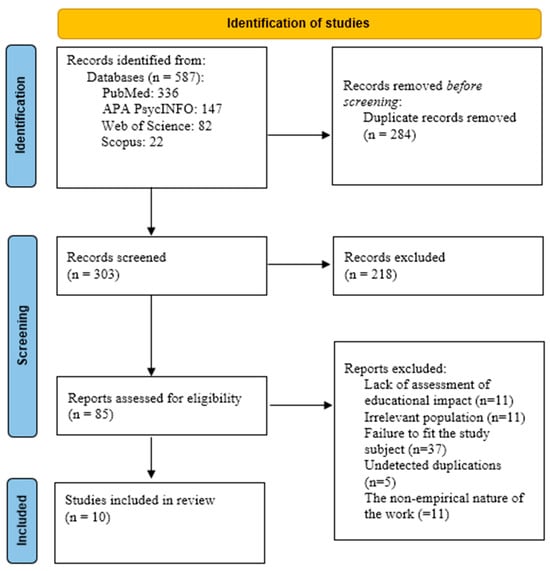
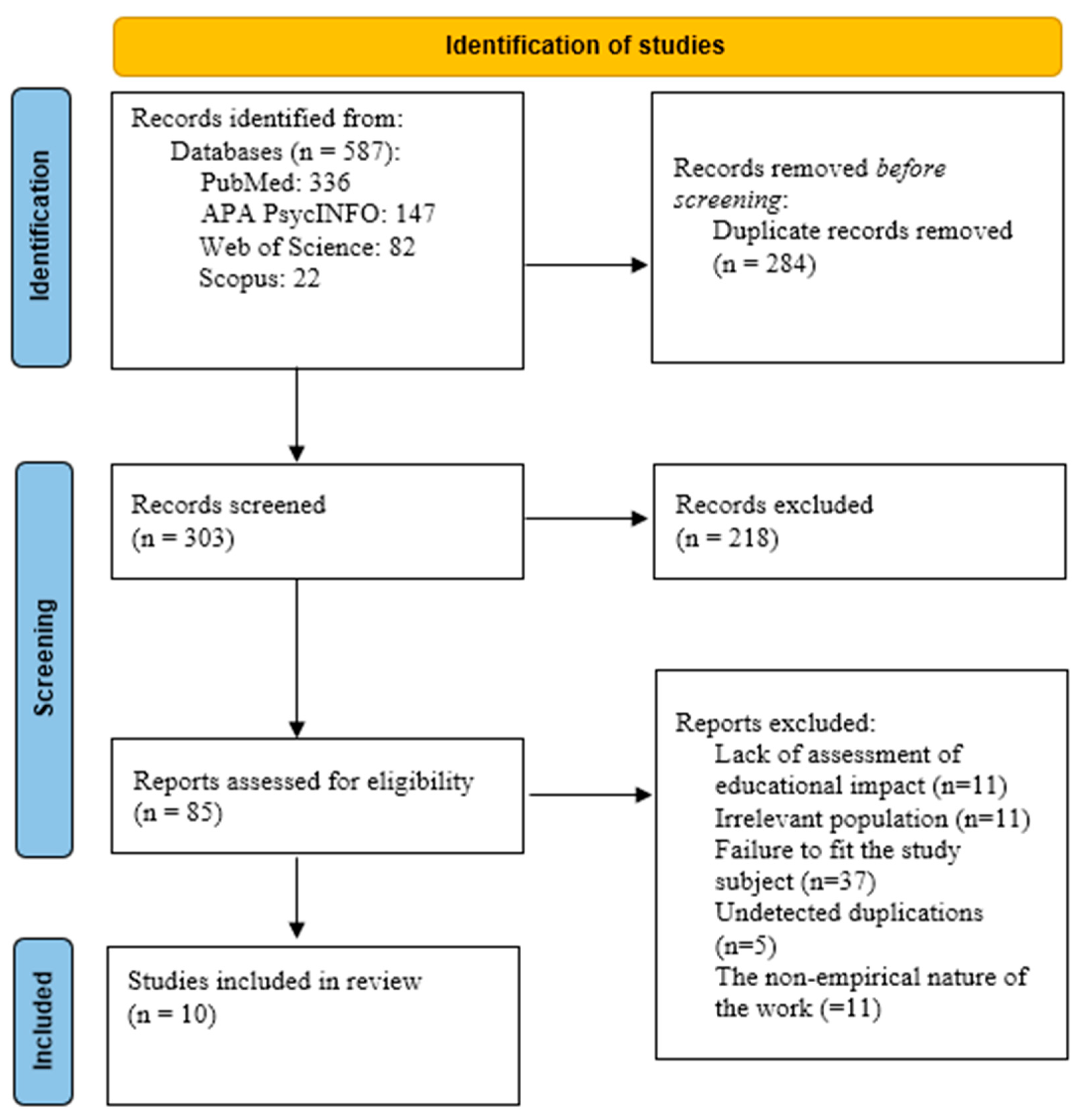
To facilitate the study selection process, the web application Covidence (http://www.covidence.org, accessed on 31 March 2025) was used, a tool designed to support evidence synthesis, data management, and the visualization of the review process status. Of the 587 initial records, 284 duplicates were removed, leaving 303 studies for the screening phase. After reviewing the titles and abstracts, 218 records were excluded because they did not meet the established inclusion criteria. A total of 85 full-text articles were assessed, of which 10 studies met all eligibility criteria and were ultimately included. The main reasons for exclusion at the full-text stage were: absence of an assessment of the training impact, an irrelevant population, lack of alignment with the study objective, duplicates not automatically detected, and the non-empirical nature of the work. The complete process is presented in the PRISMA flow diagram (Figure 1).
Figure 1.
PRISMA diagram for the study selection process.
Throughout the entire process—including identification, selection, and data extraction—two reviewers worked independently and simultaneously. A third reviewer was consulted to resolve any discrepancies when necessary (κ = 0.82, 95% CI [0.76, 0.88] during the title and abstract screening phase, and κ = 0.87, 95% CI [0.79, 0.95] during the full-text review phase).
2.2.4. Quality Assessment
The included studies (n = 10) underwent a quality assessment using the Joanna Briggs Institute Critical Appraisal Checklists (JBI) (Jordan et al. 2019), selecting the appropriate tool according to the methodological design of each study. Specifically, the appraisal checklists for quasi-experimental studies, randomized controlled trials (RCTs), and qualitative research were used, consisting of 9, 13, and 10 items, respectively.
Each criterion was assessed using the categories “Yes,” “No,” “Unclear,” and “Not applicable.” The number of positively rated criteria was counted for descriptive purposes only, to facilitate the presentation of the assessment results. This count was not considered a global quality score and was not used to establish methodological quality categories, as no validated or review-specific cut-off points had been established in advance.
2.2.5. Data Extraction
An ad hoc structured matrix was designed for data extraction. To ensure its adequacy and consistency, the matrix was previously piloted on a subset of the included studies, allowing adjustments to be made to the analytical categories and ensuring clarity in the data collection process.
Two reviewers independently extracted the data, and any discrepancies were resolved, when necessary, by a third evaluator. The extracted variables included: authorship and year of publication, country or geographical context, study objectives, methodological design, characteristics of the training intervention, evaluated variables, main findings related to detection and/or reporting, and follow-up period (when applicable).
2.2.6. Synthesis of Results
Given the heterogeneity of the included studies, a narrative synthesis of the findings was conducted. The studies differed in terms of methodological design, intervention characteristics and content, variables assessed, instruments used, and follow-up periods; therefore, a meta-analysis was not considered appropriate.
To organize the synthesis, the studies were primarily grouped according to the dimensions assessed following the intervention: (1) knowledge about CSA and the ability to identify indicators and response procedures; (2) teachers’ attitudes, confidence, and perceived self-efficacy; (3) detection and reporting of potential cases of CSA; and (4) contextual and personal factors related to the application of the acquired competencies. Findings related to students were presented as secondary and contextual outcomes.
The interpretation of the findings took into account the methodological design and quality of each study. Findings from randomized controlled trials and quasi-experimental studies were considered in light of the characteristics and limitations inherent to each design, while the qualitative study was used primarily to complement and contextualize the quantitative evidence. Likewise, the methodological quality assessed using the Joanna Briggs Institute tools was taken into account in the overall interpretation of the evidence.
Therefore, no meta-analysis was conducted due to the intervention-related and methodological heterogeneity of the studies, particularly with regard to the content, duration, and delivery modality of the interventions, outcome measures, and follow-up periods, as well as the inclusion of a qualitative study and the small number of studies included (n = 10). The narrative synthesis made it possible to identify patterns of findings, convergences and divergences across studies, as well as potential factors related to the transfer of acquired knowledge and skills into professional practice.
3. Results
3.1. General Overview
The studies included in this review were conducted across diverse geographical contexts, with the United States being the most represented country (n = 6), followed by Australia (n = 1), Turkey (n = 1), Cambodia (n = 1), and the Philippines (n = 1). Although the literature search covered studies published within the last 15 years, the selected studies were published between 2018 and 2024, suggesting an upward trend in recent years.
From a methodological perspective, the included studies predominantly used quantitative quasi-experimental designs (e.g., Kantipudi and Chuemchit 2024) and RCTs (e.g., Dudley et al. 2022). In these studies, the experimental and control groups were part of the original research designs and were used to evaluate the effects of interventions aimed at teachers on improving the detection and reporting of suspected cases of CSA. In general, the studies included the administration of pretest measures to establish a baseline, the implementation of training programmes—frequently delivered online—and subsequent evaluation using post-test measures. In addition, one qualitative study based on three structured interviews was included (Epstein and Crisp 2018).
Regarding the samples used, these varied in terms of size and sociodemographic characteristics. The study populations mainly consisted of teachers from different geographical contexts; however, some investigations also included large groups of students as part of the sample (e.g., Madrid et al. 2020; Kim et al. 2023). Except in these latter studies, the remaining investigations included a relatively similar number of participants, ranging from 134 subjects (Gushwa et al. 2019) to a maximum of 245 (Gün et al. 2022), with the exception of the qualitative study, which was based on three structured interviews (Epstein and Crisp 2018).
In most studies, the samples were predominantly composed of women. Regarding participants’ age, marked heterogeneity was observed across studies, with ranges extending from 18 to over 64 years old. Similar variability was found in years of professional experience, which ranged from early-career teachers (approximately one year of experience) to professionals with more than 40 years of teaching experience. A comprehensive overview of the characteristics of the included studies is provided in Appendix A.
3.2. Characteristics of the Intervention Programs
A central aspect of the reviewed studies concerns the nature of the training programs employed. Therefore, the general characteristics of each program are presented below.
3.2.1. Second Step Child Protection Unit
This teacher training program was evaluated in several of the studies included in this review (e.g., Dudley et al. 2022; Kim et al. 2023; Nickerson et al. 2021). Second Step Child Protection Unit (CPU; Committee for Children 2014) is a comprehensive multifaceted program designed for the school setting, as it includes training for teachers and school staff, lessons for students, and family education. The program focuses on the prevention and intervention of CSA, as well as on the multiple factors that may influence it, and addresses four areas related to child protection: (1) school policies and procedures, (2) staff training, (3) student lessons, and (4) family education. Teacher training is divided into four modules corresponding to the four areas addressed by the program. Module 1 helps school staff and teachers review existing protocols and practices within their schools and develop new ones to ensure child protection. Module 2 consists of online training sessions (typically lasting between 75 and 90 min) aimed at educating school staff and teachers on how to recognize signs of CSA and how to report them effectively. Module 3 prepares teachers to deliver CSA prevention lessons to students, while also addressing barriers related to discomfort and promoting family involvement in the program. Teachers are required to deliver six lessons over a period of 8 to 10 weeks, with each session lasting approximately 30 to 45 min. Finally, Module 4 is directed toward families and caregivers. Students receive weekly activities related to the lessons covered in class, encouraging family participation and reinforcing personal safety practices at home.
3.2.2. Enough! Preventing Child Sexual Abuse in My School
Enough! Preventing Child Sexual Abuse in My School is the teacher training program evaluated in the study conducted by Gushwa et al. (2019). Similar to the previous program, it focuses on the specific needs of the school context regarding CSA prevention. Its main objective is to help the different agents involved—teachers, administrative staff, coaches, and support personnel—understand the issue of CSA. In addition, the training includes prevention-oriented content aimed at raising awareness about the obligation to report such cases.
The training consists of an interactive course that can either be delivered in a single one-hour session or divided into several 20-min modules distributed across multiple sessions. The program employs two teacher avatars designed to facilitate participant engagement and content delivery. The course includes two scenes representing common fears associated with reporting detected cases (e.g., fear of retaliation, lack of support, etc.) as well as typical biases that may interfere with the identification of CSA (e.g., the belief that children lie, or that abuse cannot occur in familiar contexts). Overall, the training aims to improve the educational staff’s ability to identify signs and symptoms of CSA, strengthen teachers’ understanding of their reporting responsibilities, and reduce the cognitive and emotional barriers associated with this process.
3.2.3. Program J-Safe
This program is based on the premise that preventive interventions should be adapted to the cultural, social, and religious characteristics of the geographical context in which they are implemented. Accordingly, J-Safe was designed with the aim of raising awareness within the Jewish community regarding the prevention, detection, and reporting of CSA in school settings. It is a pilot child protection program specifically developed for this context, incorporating cultural values, beliefs, and norms characteristic of this community. The J-Safe program is structured into three phases aimed at teachers, students, and other school staff members. However, the present review describes only the teacher training component.
Teacher training consists of two 90-min sessions delivered by instructors from Tzedek, an Australian Jewish community organization. During these sessions, participants receive essential information about CSA, as well as training in skills and strategies for dealing with potential victims. In addition, supporting materials (e.g., presentations) are used, and participants engage in small-group discussions and role-playing activities based on real-life scenarios (Epstein and Crisp 2018).
3.2.4. Other Training Programs with Limited Methodological Description
The remaining studies included in the review provide limited detail regarding the design, content, and implementation of the training interventions, which restricts the possibility of conducting a more comprehensive comparative analysis. In some cases, these interventions are described only in general terms, referring simply to “training sessions” or the implementation of standardized programs without specifying their components, thereby reinforcing this limitation. For this reason, the programs presenting a greater level of development and specificity have been described in more detail.
Nevertheless, the available evidence suggests that these training programs were mainly oriented toward providing teachers with basic knowledge about CSA, as well as improving the identification of risk indicators and general response guidelines for potential cases (e.g., Madrid et al. 2020; Gardner et al. 2020).
3.3. Effects of the Programs
The impact of training interventions may manifest across different dimensions related to teachers’ processes of detecting and reporting CSA. In order to facilitate a clear and structured presentation of the findings, the results are organized according to the main variables in which the most relevant changes were observed. Although these dimensions are analyzed separately, they are not mutually exclusive, as significant relationships exist among them, reflecting the complex nature of the phenomenon under study.
3.3.1. Effects on Knowledge
One of the most prominent and consistent effects identified across the included studies is the increase in teachers’ knowledge regarding CSA, given that most of the analyzed investigations specifically focused on evaluating the impact of training on this issue (e.g., Dudley et al. 2022; Epstein and Crisp 2018; Gardner et al. 2020; Gün et al. 2022; Gushwa et al. 2019; Kantipudi and Chuemchit 2024; Kim et al. 2019; Kim et al. 2023; Madrid et al. 2020; Nickerson et al. 2021). In this regard, although the initial aim was to include different forms of CV, the available scientific evidence is mainly concentrated on CSA.
The findings consistently show that specific training in CSA produces significant improvements in teachers’ knowledge, as evidenced through pretest-post-test comparisons and comparisons between intervention and control groups. In this line, several studies (e.g., Dudley et al. 2022; Gushwa et al. 2019; Kantipudi and Chuemchit 2024; Kim et al. 2019; Nickerson et al. 2021) reported statistically significant increases in teachers’ knowledge scores following the training intervention. However, it should be noted that several studies (Gün et al. 2022; Kantipudi and Chuemchit 2024) identified relatively low baseline levels of knowledge among teachers, which should be considered when interpreting the magnitude of the observed post-intervention effects.
These improvements were observed across different dimensions. On the one hand, an increase was identified in teachers’ ability to recognize signs and indicators of CSA, as evidenced by the results of the CPU program, which demonstrated a significant increase in awareness of CSA signs and symptoms (Dudley et al. 2022). Similarly, other studies highlighted improvements in the recognition of abusive behaviors and in the general understanding of the phenomenon (Gushwa et al. 2019).
On the other hand, training also appears to influence knowledge regarding intervention and reporting procedures. In this sense, Madrid et al. (2020) reported an increase in teachers’ familiarity with reporting protocols (from 45% to 75% following the intervention), while Gün et al. (2022) observed an increase in teachers’ perceived competence to recognize abuse cases (from 40.9% to 82.3%). The latter study also indicated that lack of knowledge constituted one of the main barriers to reporting prior to the intervention.
Nevertheless, some studies introduced relevant nuances concerning the long-term stability of these effects. Gardner et al. (2020) noted that, although knowledge significantly increased following the training, scores tended to decline in subsequent evaluations, suggesting possible difficulties in retaining acquired knowledge and highlighting the need to implement reinforcement strategies. Overall, the findings indicate that training interventions significantly increase teachers’ knowledge about CSA across several key areas, although the maintenance of these gains over time appears to show some variability.
3.3.2. Effects on Detection and Response Skills
After analyzing the impact of training on teachers’ knowledge, it is important to examine the extent to which these changes translate into improvements in detection and response skills regarding potential CSA cases. Although knowledge acquisition constitutes a fundamental requirement, its transfer to professional practice is not automatic; therefore, it is necessary to evaluate its impact on teachers’ ability to identify risk indicators, intervene appropriately, and activate the corresponding reporting protocols.
In this regard, despite all reviewed studies showing an increase in teachers’ levels of knowledge about CSA, the results reveal some heterogeneity in the translation of this knowledge into practice. Some studies, such as Epstein and Crisp (2018), indicated that despite increased knowledge, no increase in case reporting was observed, suggesting limitations in the transfer of learning into professional behavior. However, other studies indicate that training significantly influences key variables. In particular, improvements have been observed in teachers’ attitudes and confidence in dealing with these situations, promoting a greater willingness to detect and report cases (Kantipudi and Chuemchit 2024; Kim et al. 2019). Similarly, Kim et al. (2023) reported that training contributes to strengthening teachers’ confidence and commitment regarding the management of these cases, while Madrid et al. (2020) observed an increase in teachers’ perceived confidence in identifying CSA.
3.3.3. Effects on Professional Practice
Some studies (e.g., Dudley et al. 2022; Kim et al. 2019; Nickerson et al. 2021) have highlighted the possible influence of different factors (e.g., contextual and personal factors) on the process of detecting and reporting CSA cases, which may moderate both knowledge acquisition and its application in professional practice. In this sense, Dudley et al. (2022), following the implementation of the CPU training program, observed that teachers’ knowledge and awareness regarding CSA were partially mediated by their perception of school climate, understood as the quality of relationships among students, teachers, and families. These findings suggest that teachers’ perceptions of their work environment may influence their involvement in learning processes, as well as in the detection and reporting of CSA cases.
Complementarily, other studies indicate that training itself may influence perceptions of school climate. Kim et al. (2019) reported that participation in training programs was associated with improvements in this perception, while Nickerson et al. (2021) observed that the group receiving training demonstrated an increase in perceived school climate quality, in contrast to the control group, whose perception tended to decline over time. Furthermore, teacher acceptability—that is, teachers’ willingness and interest in participating in training programs—has been associated with better outcomes in terms of knowledge, attitudes, and relationships with students (Kim et al. 2019).
Overall, these findings indicate that the detection and reporting of CSA do not depend exclusively on teachers’ level of knowledge, but are also influenced by personal and contextual factors that may facilitate or hinder the application of acquired competencies.
3.3.4. Secondary Outcomes Related to Students and Their Education on CSA
Although the present systematic review focuses on the impact of training interventions targeting teachers in the area of CSA and considers active teachers as the primary population, some of the included studies also assessed outcomes related to students. Therefore, these findings are incorporated as complementary evidence and presented as secondary and contextual outcomes, with the aim of providing a broader view of the potential effects of the interventions in the school context, without considering them as primary outcomes of the review or attributing them directly to the effectiveness of teacher training.
In this regard, the study by Kim et al. (2023) analyzed the indirect impact of teacher training on students by comparing levels of CSA knowledge among students whose teachers had received CPU training (intervention group) and those whose teachers had not received such training (control group). The results showed that students in the intervention group demonstrated a greater ability to recognize, reject, and report situations of CSA compared to the control group. Furthermore, students who already possessed basic prior knowledge about CSA and who also belonged to the intervention group showed increased levels of knowledge and confidence regarding how to act in such situations.
Similarly, Madrid et al. (2020) implemented a structured educational intervention for students composed of eight modules focused on the recognition, documentation, and reporting of CSA cases, while also incorporating content aimed at preventing peer abuse. The results demonstrated significant increases in knowledge regarding CSA, dating violence, and peer-support strategies in situations of risk, as well as improvements in protective behaviors related to these issues. In addition, a significant increase was observed in self-reported experiences related to attempts to engage in unwanted sexual relationships following the intervention.
4. Discussion
The aim of the present systematic review was to analyze the available evidence on the effects of teacher training programs on the detection and reporting of CSA in the school context. Although the review was initially framed within the broader concept of CV, the studies ultimately included focused predominantly on CSA. This finding is particularly relevant, as it highlights both the concentration of research on this specific form of victimization and the relative scarcity of studies addressing other forms of child maltreatment within educational settings.
Overall, the results indicate that CSA-specific teacher training is primarily associated with improvements in proximal outcomes relevant to the educational context. In particular, consistent increases were observed in teachers’ knowledge, as well as improvements in variables such as attitudes, confidence, and willingness to confront and intervene in these situations (e.g., Dudley et al. 2022; Gushwa et al. 2019; Kantipudi and Chuemchit 2024; Kim et al. 2019; Nickerson et al. 2021). However, these results should be distinguished from changes in actual detection and reporting behavior, for which the evidence is more limited and heterogeneous. The findings also indicate that the translation of these improvements into practice does not always occur consistently (Epstein and Crisp 2018), highlighting the complexity inherent in the process of detecting and reporting CSA.
Regarding teachers’ knowledge, the results consistently indicate that training interventions are significantly associated with improvements in understanding the phenomenon, identifying indicators, and knowledge of response procedures. (Dudley et al. 2022; Gushwa et al. 2019; Madrid et al. 2020). Although this finding was expected, the data also reveal the existence of prior training deficiencies in this area, evidenced by the low baseline levels of knowledge identified in several studies (Gün et al. 2022; Kantipudi and Chuemchit 2024). This finding underscores the existence of previous training gaps and reinforces the need to implement specific programs. In this regard, training may constitute a relevant tool for addressing these gaps, rather than a guarantee of changes in professional practice.
However, increased knowledge alone does not necessarily guarantee direct changes in teachers’ professional practice. Some studies reported the absence of a significant increase in case reporting following training (Epstein and Crisp 2018), whereas others identified lack of knowledge as one of the primary reasons for not reporting prior to the intervention (Gün et al. 2022). Taken together, these findings suggest that knowledge, although indispensable, is not sufficient on its own to ensure effective action. This apparent paradox may be interpreted in light of the KAP model (World Health Organization 2008), which proposes that knowledge acquisition constitutes a necessary but insufficient step for behavioral change, as it is mediated by attitudinal and contextual variables. In this regard, in addition to the variables identified in the studies, there are likely to be additional barriers, such as fear of legal consequences, uncertainty in decision-making, or a lack of clarity in institutional protocols, which may limit the application of the knowledge acquired. Therefore, further research is needed to identify and better understand the factors influencing teachers’ implementation of these competencies in practice. Overall, these findings highlight a gap between competency acquisition and its transfer to professional practice.
Among these factors, some are attitudinal, emotional, and contextual in nature and could influence teachers when activating detection and reporting behaviors. The studies analyzed show that training may contribute to improving the willingness to intervene, promoting more proactive attitudes toward the detection and reporting of potential cases of CSA (Kantipudi and Chuemchit 2024; Kim et al. 2019). Likewise, an increase in teachers’ confidence and commitment in managing these cases has been observed (Kim et al. 2023; Madrid et al. 2020). However, these variables primarily reflect greater perceived preparedness or willingness and should not be interpreted as direct evidence of an increase in actual detection or reporting. These variables may act as a bridge between knowledge and action, facilitating the application of the acquired competencies. In line with the KAP model, attitudes and perceived self-efficacy could play a relevant mediating role in the transition from knowledge to behavior, reinforcing the need for training interventions to go beyond the transmission of information and incorporate components aimed at attitudinal change and strengthening teachers’ professional confidence.
Additionally, the results highlight the influence of contextual factors on the detection and reporting process. Variables such as school climate, relationships among the different educational stakeholders, and institutional support could play a relevant role in the application of acquired knowledge (Dudley et al. 2022; Kim et al. 2019; Nickerson et al. 2021). In this regard, teachers do not act in isolation but within an environment that may facilitate or hinder their response to potential cases of CSA. From this perspective, and in line with the KAP model, professional behavior does not depend solely on individual factors but rather on the interaction between knowledge, attitudes, and contextual conditions. Therefore, the effects of training interventions on professional practice could be influenced by the context in which they are implemented, reinforcing the need to adopt a broader approach that takes into account both individual and organizational factors.
Another relevant aspect identified in the present review is the possible decline in the effects of training over time. Some studies have shown a reduction in levels of knowledge and confidence at subsequent assessments (Gardner et al. 2020), suggesting difficulties in retaining acquired knowledge and skills. This finding points to the need to approach CSA training as an ongoing process rather than as a one-time intervention, incorporating reinforcement and refresher strategies to consolidate knowledge and skills over the long term. Likewise, variability in follow-up periods makes it difficult to draw firm conclusions about the stability of these effects over the long term.
On the other hand, the findings related to students help broaden the understanding of the impact of training interventions. In those studies that included this population, these findings are presented as secondary and contextual outcomes, with teacher training not only affecting teachers’ own performance but also potentially being associated with positive effects on students’ knowledge, awareness, and ability to respond to situations involving CSA (Kim et al. 2023; Madrid et al. 2020). These findings should be interpreted with caution and not as evidence equivalent to changes in teachers’ detection or reporting behavior. Furthermore, in the case of interventions directly targeting students, these findings do not allow their effects to be attributed to teacher training. Overall, these findings may contribute to a broader understanding of the potential impact of interventions in the educational context, although specific studies are needed to determine the extent to which these effects are sustained and how they relate to actual behavioral changes.
Study Limitations
The present systematic review has several limitations that should be considered when interpreting the findings. First, the reviewed studies showed a clear predominance of research focused on the prevention of and teacher training in CSA, leaving aside other forms of CV such as physical abuse, emotional abuse, or neglect. This restricts the generalizability of the findings to other forms of victimization; therefore, their applicability to other contexts should be interpreted with caution.
Second, most of the reviewed studies did not systematically consider relevant contextual variables, such as the organizational structure of schools or the institutional support available for the reporting of CSA cases. This limitation may affect the interpretation of the results, given that such factors could significantly influence the processes of CSA detection and reporting.
Third, although the search strategy was designed to be broad, it may not have captured all relevant studies because some specific terms such as “child maltreatment,” “sexual abuse,” or “neglect” were not systematically included, which may have limited the comprehensiveness of the results. Furthermore, the search was restricted to publications in English and Spanish and did not include grey literature, which may have introduced potential language and publication bias by excluding relevant research published in other languages or studies not published in indexed scientific journals. In this regard, the exclusion of works such as doctoral dissertations and other grey literature may have reduced the comprehensiveness of the search and, therefore, the presence of some degree of publication bias cannot be ruled out. Consequently, the results may not fully represent the available evidence on teacher training for the detection and reporting of CV. On the other hand, the heterogeneity among the included interventions should be taken into account. The training programmes differed in terms of their content, duration, delivery modality, and specific objectives, making direct comparisons between studies difficult and limiting the ability to determine which specific characteristics of the interventions may be associated with greater effectiveness. This heterogeneity is further compounded by variability in follow-up periods and the measures used to assess outcomes. While some studies assessed changes immediately after the intervention, others included subsequent assessments, and outcomes were measured using different instruments and variables, including knowledge, attitudes, self-efficacy, and professional practices. This variability limits the possibility of drawing homogeneous conclusions about the magnitude and persistence of the effects of the interventions.
Furthermore, a substantial proportion of the outcomes assessed in the included studies were based on self-reported measures of knowledge, confidence, self-efficacy, or preparedness to act, rather than objective indicators of professional behavior. This characteristic limits the ability to determine the extent to which the observed improvements in these variables translate into actual changes in the detection or reporting of CSA cases. Therefore, the findings should be interpreted with caution, particularly given that greater knowledge or confidence does not necessarily imply an increase in actual reporting behavior. Likewise, the evidence analyzed presents differences in the methodological quality and research designs of the included studies. The presence of studies with different levels of methodological rigor, sample sizes, and assessment procedures may influence the consistency of the findings and should be considered when interpreting the evidence as a whole. Therefore, the findings should be understood in light of the fact that not all studies provide the same level of certainty regarding the effectiveness of the interventions.
Finally, the analyzed evidence presents limited geographical representation, with an absence of studies conducted in European contexts. This lack of cultural and structural diversity reduces the external validity of the findings, as differences in educational systems, legislative frameworks, and institutional resources may significantly influence both the effectiveness of training interventions and the processes of detection and reporting.
Based on the identified limitations, several future research directions are proposed in order to strengthen the available evidence in this field.
First, it is necessary to broaden the focus of study toward other forms of CV beyond sexual abuse, such as physical abuse, emotional abuse, or neglect, in order to obtain a more comprehensive and generalizable understanding of the effectiveness of teacher training in the prevention and detection of CV.
Second, it is recommended that primary studies systematically incorporate relevant contextual variables, such as the organizational structure of schools, school climate, or institutional support. Including these factors would allow for a better understanding of the mechanisms that facilitate or hinder the transfer of knowledge into professional practice.
Furthermore, it is essential to develop research in European contexts, given the absence of evidence from these settings. Differences in educational systems, regulatory frameworks, and institutional resources may significantly influence the effectiveness of interventions; therefore, it is necessary to generate contextualized knowledge that allows training strategies to be adapted to specific realities.
Likewise, future research should aim for greater consistency in the description and evaluation of interventions, including detailed information on their content, duration, delivery modality, and specific components, as well as using comparable outcome measures and establishing follow-up periods that allow not only the immediate effects of training to be assessed but also their maintenance in the medium and long term. The development of more methodologically robust designs and standardized assessment procedures would contribute to improving comparability across studies and determining the effectiveness of these interventions more precisely.
Finally, future research should explore the impact of training interventions on other key agents, such as families and students themselves. This approach would enable the adoption of a more systemic perspective on prevention, broadening the scope of interventions and contributing to the development of safer educational environments.
5. Conclusions
Overall, the findings of the present systematic review indicate that CSA-specific teacher training is primarily associated with improvements in proximal outcomes, particularly knowledge about CSA, as well as favorable outcomes in variables such as attitudes, perceived self-efficacy, and confidence. These findings suggest that training may contribute to strengthening certain teacher competencies related to the identification of potential situations involving CSA. However, these improvements should not be considered equivalent to changes in actual detection or reporting behavior. Indeed, the impact on reporting behavior is more heterogeneous, and increased knowledge does not always translate into increased reporting, suggesting that the transfer of learning into practice is influenced by additional factors.
In this regard, the available evidence indicates that contextual and personal variables, such as school climate, institutional support, or perceived self-efficacy, may play a relevant role in the effective implementation of acquired competencies. Likewise, the limited geographical diversity of the studies and the predominance of research focused on CSA restrict the generalizability of the findings.
Consequently, further research is needed to strengthen the evidence base, expand its applicability to different contexts and types of CV, and further investigate the factors that facilitate the transfer of acquired knowledge and competencies into professional practice. In particular, future research should differentiate between proximal outcomes of interventions and behavioral changes, incorporating measures that allow actual detection and reporting of cases to be assessed, as well as their maintenance in the medium and long term.
From an applied perspective, these findings underscore the importance of designing training programmes that, in addition to providing knowledge, incorporate components aimed at strengthening self-efficacy and addressing contextual barriers present in the educational environment.
Author Contributions
Conceptualization, G.G.P.; methodology, M.V.J. and D.F.P.; validation, M.V.J. and D.F.P.; investigation, M.V.J., G.G.P. and D.F.P.; resources, D.F.P.; data curation, D.F.P.; writing—original draft preparation, G.G.P.; writing—review and editing, G.G.P. and M.V.J.; supervision, D.F.P. All authors have read and agreed to the published version of the manuscript.
Funding
This research received no external funding.
Institutional Review Board Statement
Not applicable.
Informed Consent Statement
Not applicable.
Data Availability Statement
The original contributions presented in this study are included in the article. Further inquiries can be directed to the corresponding author.
Conflicts of Interest
The authors declare no conflict of interest.
Appendix A
Table A1.
Table that summarizes the main features of the studies included in the review.
References
The studies included in this systematic review are presented in Appendix A.
- Alvarez, Krisann M., Maureen C. Kenny, Brad Donohue, and Kimberly M. Carpin. 2004. Why are professionals failing to initiate mandated reports of child maltreatment, and are there any empirically based training programs to assist professionals in the reporting process? Aggression and Violent Behavior 9: 563–78. [Google Scholar] [CrossRef] [Scilit]
- Amores-Villalba, Alejandro, and Rocío Mateos Mateos. 2017. Revisión de la neuropsicología del maltrato infantil: La neurobiología y el perfil neuropsicológico de las víctimas de abuso en la infancia. Psicología educativa 23: 81–88. [Google Scholar] [CrossRef] [Scilit]
- Andrade, Chittaranjan, Vikas Menon, Shahul Ameen, and Samir Kumar Praharaj. 2020. Designing and Conducting Knowledge, Attitude, and Practice Surveys in Psychiatry: Practical Guidance. Indian Journal of Psychological Medicine 42: 478–81. [Google Scholar] [CrossRef] [Scilit] [PubMed]
- Booth, Alison, Mike Clarke, Gordon Dooley, Davina Ghersi, David Moher, Mark Petticrew, and Lesley Stewart. 2012. The nuts and bolts of PROSPERO: An international prospective register of systematic reviews. Systematic Reviews 1: 2. [Google Scholar] [CrossRef] [Scilit] [PubMed]
- Brassard, Marla R., and Christina M. Fiorvanti. 2015. School-based child abuse prevention programs. Psychology in the Schools 52: 40–60. [Google Scholar] [CrossRef] [Scilit]
- Briere, John N., and Catherine Scott. 2015. Principles of Trauma Therapy: A Guide to Symptoms, Evaluation, and Treatment, 2nd ed. Sauzende Oaks: Sage Publications. [Google Scholar]
- Bronfenbrenner, Urie. 1979. The Ecology of Human Development: Experiments by Natura and Design. Cambridge: Havard University Press. [Google Scholar]
- Ciscar Cuñat, Esther, Concepción Martínez Vázquez, and Amparo Pérez Carbonell. 2021. Aproximación al estudio de la negligencia parental y sus efectos en la infancia y adolescencia. Pedagogía Social Revista Interuniversitaria 39: 153–66. [Google Scholar] [CrossRef] [Scilit]
- Committee for Children. 2014. Second Step: Child Protection Unit. Seattle: Committee for Children. [Google Scholar]
- Cuartas-Gómez, Elias, Palacio-Duque Andrea, Leonardo Alberto Ríos-Osorio, Jaiberth Antonio Cardona-Arias, and Walter Alfredo Salas-Zapata. 2019. Conocimientos, actitudes y prácticas (CAP) sobre sostenibilidad en estudiantes de una universidad pública colombiana. Revista U.D.C.A Actualidad & Divulgación Científica 22: 1–10. [Google Scholar] [CrossRef] [Scilit]
- Daley, Sharon F., and Scott Gutovitz. 2026. Child Sexual Abuse. In StatPearls. Treasure Island: StatPearls Publishing. [Google Scholar]
- Deambrosio, Marisa, Marisel Gutiérrez de Vázquez, Vanessa Arán-Filippetti, and Fabián Román. 2018. Efectos del Maltrato en la Neurocognición. Un Estudio en Niños Maltratados Institucionalizados y no Institucionalizados. Revista Latinoamericana de Ciencias Sociales, Niñez y Juventuz 16: 239–53. [Google Scholar] [CrossRef] [Scilit]
- Dudley, Melissa J., Amanda B. Nickerson, Sunha Kim, and Jennifer A. Livingston. 2022. School-based child abuse prevention: The role of school climate in intervention outcomes for teachers. Psychology in the Schools 59: 1158–74. [Google Scholar] [CrossRef] [Scilit]
- Epstein, Sarah B., and Beth R. Crisp. 2018. Educating Australia’s Jewish Communities about Child Sexual Abuse. Journal of Child Sexual Abuse 27: 523–36. [Google Scholar] [CrossRef] [Scilit] [PubMed]
- Finkelhor, David. 2008. Childhood Victimization: Violence, Crime, and Abuse in the Lives of Young People. Oxford: Oxford University Press. [Google Scholar]
- Gardner, Samantha L., Anne Derouin, Ryan Brown, and A. Diann Johnson. 2020. At the Front Lines: Effectively Training Community Stakeholders to Recognize and Report Child Abuse and Neglect. The Journal of School Nursing 36: 181–86. [Google Scholar] [CrossRef] [Scilit] [PubMed]
- Glouchkow, Amanda, Kelly Weegar, and Elisa Romano. 2023. Teachers’ responses to child maltreatment. Journal of Child and Adolescent Trauma 16: 95–108. [Google Scholar] [CrossRef] [Scilit] [PubMed]
- Goldman, Juliette D. G. 2007. Primary school student-teachers’ knowledge and understandings of child sexual abuse and its mandatory reporting. International Journal of Educational Research 46: 368–81. [Google Scholar] [CrossRef] [Scilit]
- Gushwa, Melinda, Jetta Bernier, and David Robinson. 2019. Advancing Child Sexual Abuse Prevention in Schools: An Exploration of the Effectiveness of the Enough! Online Training Program for K-12 Teachers. Journal of Child Sexual Abuse 28: 144–59. [Google Scholar] [CrossRef] [Scilit] [PubMed]
- Gün, İskender, Adeviye Çopur, and Elçin Balcı. 2022. Effect of training about child Neglect and abuse to teachers and its effect to awareness. BMC Public Health 22: 543. [Google Scholar] [CrossRef] [Scilit] [PubMed]
- Jordan, Zoe, Craig Lockwood, Zachary Munn, and Edoardo Aromataris. 2019. The updated Joanna Briggs Institute Model of Evidence-Based Healthcare. Internacional Journal of Evidence-Based Healthcare 17: 58–71. [Google Scholar] [CrossRef] [Scilit] [PubMed]
- Kantipudi, Swarnamala, and Montakarn Chuemchit. 2024. Teach to say “NO”—A mixed methods evaluation of a child sexual abuse prevention training for primary school teachers in Phnom Penh, Cambodia. Child Abuse & Neglect 158: 107097. [Google Scholar] [CrossRef] [Scilit] [PubMed]
- Kenny, Maureen C. 2004. Teacher’s attitudes toward and knowledge of child maltreatment. Child Sexual Abuse & Neglect 28: 1311–19. [Google Scholar] [CrossRef] [Scilit] [PubMed]
- Kenny, Maureen C., and Roberto L. Abreu. 2016. Mandatory Reporting of Child Maltreatment for Counselors: An Innovative Training Program. Journal of Child and Adolescent Counseling 2: 112–24. [Google Scholar] [CrossRef] [Scilit]
- Kim, Sunha, Amanda B. Nickerson, and Tia E. Kim. 2023. The Role of Second Step Child Protection Unit Online Teacher Training in Explaining Teacher and Student Outcomes: Multilevel SEM Analysis. Journal of Child & Adolescent Trauma 16: 183–95. [Google Scholar] [CrossRef] [Scilit] [PubMed]
- Kim, Sunha, Amanda Nickerson, Jennifer A. Livingston, Melissa Dudley, Margaret Manges, Jenine Tulledge, and Kathleen Allen. 2019. Teacher Outcomes form the Second Step Child Protection Unit: Moderating Roles of Prior Preparedness, and Treatment Acceptability. Journal of Child Sexual Abuse 28: 726–44. [Google Scholar] [CrossRef] [Scilit] [PubMed]
- Kisely, Steve, Amanuel Alemu Abajobir, Ryan Mills, Lane Strathearn, Alexandra Clavarino, and Jake Moses Najman. 2018. Chil maltreatment and mental health problems in adulthood: Birth cohort study. The British Journal of Psychiatry 213: 698–703. [Google Scholar] [CrossRef] [Scilit] [PubMed]
- Madrid, Bernadette J., Gilda D. Lopez, Leonila F. Dans, Deborah A. Fry, Francis Grace H. Duka-Pante, and Alberto T. Muyot. 2020. Safe schools for teens: Preventing sexual abuse of urban poor teens, proof-of-concept study—Improving teachers’ and students’ knowledge, skills and attitudes. Heliyon 6: e04080. [Google Scholar] [CrossRef] [Scilit] [PubMed]
- Martínez, Concepción. 2019. El Maltrato Infantil y sus Efectos en el Aula. Una mirada comprensiva desde la Intervención Educativa. Revista Científico Profesional de la Pedagogía y Psicopedagogía 4: 111–20. [Google Scholar]
- Mathews, Ben, and Delphine Collin-Vézina. 2017. Child Sexual Abuse: Toward a Conceptual Model and Definition. Trauma Violence Abuse 20: 131–48. [Google Scholar] [CrossRef] [Scilit] [PubMed]
- Mathews, Ben, Kerryann Walsh, Mehdi Rassafiani, and Des Butler. 2009. Teachers reporting suspected child sexual abuse: Results of a three-state study. University of New South Wales Law Journal 32: 772–813. [Google Scholar]
- Márquez-Flores, Maria Mercedes, Verónica V. Márquez-Hernández, and Genoveva Granados-Gámez. 2016. Teachers’ knowledge and beliefs about child sexual abuse. Journal of Child Sexual Abuse 25: 583–55. [Google Scholar] [CrossRef] [Scilit] [PubMed]
- Mesa-Gresa, Patricia, and Luis Moya-Albiol. 2011. Neurobiología del maltrato infantil: El ‘ciclo de la violencia’. Revista Neurol 52: 489–503. [Google Scholar] [CrossRef] [Scilit]
- Nickerson, Amanda, Sunha Kim, Melissa Dudley, Jennifer A. Livingston, and Margaret Manges. 2021. Longitudinal impact of the Second Step Child Protection Unit on teacher knowledge, attitude, and climate. Children and Youth Services Review 123: 105892. [Google Scholar] [CrossRef] [Scilit]
- Page, Matthew J., Joanne E. McKenzie, Patrick M. Bossuyt, Isabelle Boutron, Tammy C. Hoffmann, Cynthia D. Mulrow, Larissa Shamseer, Jennifer M. Tetzlaff, Elie A. Akl, Sue E. Brennan, and et al. 2021. The PRISMA 2020 statement: An updated guideline for reporting systematic reviews. BMJ 372: n71. [Google Scholar] [CrossRef] [Scilit] [PubMed]
- Ramírez Caixto, Carmita Yisela, and Adrián Cedeño Sandoya. 2018. El maltrato infantil en el entorno familiar y sus implicaciones en el rendimiento académico. Estudio desde Ecuador. Revista Conrado 14: 184–90. [Google Scholar]
- Rheingold, Alyssa A., Kristyn Zajac, Jason E. Chapman, Meghan Patton, Michael de Arellano, Benjamin Saunders, and Dean Kilpatrick. 2015. Child sexual abuse prevention training for childcare professionals: An independent multisite randomized controlled trial of stewards of children. Prevention Science 16: 374–85. [Google Scholar] [CrossRef] [Scilit] [PubMed]
- Rose, Geoffrey. 1992. The Strategy of Preventive Medicine. Oxford: Oxford University Press. [Google Scholar]
- Santos, Cristina Mamédio da Costa, Cibele Andrucioli de Mattos Pimenta, and Moacyr Roberto Cuce Nobre. 2007. The PICO strategy for the research question construction and evidence search. Revista Latino-Americana de Enfermagem 15: 508–11. [Google Scholar] [CrossRef] [Scilit] [PubMed]
- UNICEF. n.d. Sexual Violence. Available online: https://data.unicef.org/topic/child-protection/violence/sexual-violence/ (accessed on 23 June 2026).
- United Nations. 2000. Optional Protocol to the Convention on the Rights of the Child on the Sale of Children, Child Prostitution and Child Pornography. General Assembly Resolution A/RES/54/263, adopted 25 May 2000. New York: United Nations. [Google Scholar]
- Uslu, Nur, and Hakan Zincir. 2016. Opinions and attitudes of occupational groups located in multidisciplinary team related to child abuse and Neglect. Journal of Forensic Medicine 30: 15–28. [Google Scholar] [CrossRef] [Scilit]
- Walsh, Kerryann, Ben Mathews, Mehdi Rassafiani, Ann Farrell, and Des Butler. 2012. Understanding teacher’s reporting of child sexual abuse: Measurement methods matter. Children and Youth Services Review 34: 1937–46. [Google Scholar] [CrossRef] [Scilit]
- Walsh, Kerryann, Mehdi Rassafiani, Ben Mathews, Ann Farrell, and Des Butler. 2010. Teachers’ attitudes toward reporting child sexual abuse: Problems with existing research leading to new scale development. Journal of Child Sexual Abuse 19: 310–36. [Google Scholar] [CrossRef] [Scilit] [PubMed]
- Walsh, Kerryann, Ruth Bridgstock, Ann Farrell, Mehdi Rassafiani, and Robert Schweitzer. 2008. Case, teacher and school characteristics influencing teachers’ detection and reporting of child physical abuse and neglect: Results from an Australian survey. Child Sexual Abuse & Neglect 32: 983–93. [Google Scholar] [CrossRef] [Scilit] [PubMed]
- WHO and International Society for Prevention of Child Abuse and Neglect. 2006. Preventing Child Maltreatment: A Guide to Taking Action and Generating Evidence. Geneva: World Health Organization. [Google Scholar]
- World Health Organization. 2002. World Report on Violence and Health. Geneva: World Health Organization. [Google Scholar]
- World Health Organization. 2008. Advocacy, Communication and Social Mobilization for TB Control: A Guide to Developing Knowledge, Attitude and Practice Surveys. Geneva: World Health Organization. [Google Scholar]
- World Health Organization. 2016. INSPIRE: Seven Strategies for Ending Violence Against Children. Geneva: World Health Organization. [Google Scholar]
- World Health Organization. 2020. Global Status Report on Preventing Violence against Children 2020. Geneva: World Health Organization. [Google Scholar]
- World Health Organization. 2026. Violence Against Children. Available online: https://www.who.int/news-room/fact-sheets/detail/violence-against-children (accessed on 23 June 2026).

Disclaimer/Publisher’s Note: The statements, opinions and data contained in all publications are solely those of the individual author(s) and contributor(s) and not of MDPI and/or the editor(s). MDPI and/or the editor(s) disclaim responsibility for any injury to people or property resulting from any ideas, methods, instructions or products referred to in the content. |
© 2026 by the authors. Licensee MDPI, Basel, Switzerland. This article is an open access article distributed under the terms and conditions of the Creative Commons Attribution (CC BY) license.