


Abstract
This article analyzes the legal frameworks supporting the Korean Wave (Hallyu), a global cultural phenomenon encompassing K-pop, K-dramas, Korean cinema, and related cultural industries. It examines how Korea’s legal infrastructure institutionalizes and coordinates governmental support for the production, distribution, and international expansion of Korean cultural content. Particular attention is given to the Framework Act on Culture, the Culture and Arts Promotion Act, the Framework Act on the Promotion of Cultural Industries, and the recently enacted Framework Act on the Promotion of Hallyu Industry. The latter represents a significant shift from indirect support under general cultural legislation to a dedicated statutory framework addressing overseas expansion, professional training, market information, investment, intellectual property protection, and cooperation among relevant institutions. The analysis finds that the Framework Act on the Promotion of Hallyu Industry adds a Hallyu-specific layer to Korea’s pre-existing cultural and cultural-industry framework, primarily through planning, coordination, and internationalization rather than through the creation of an autonomous rights-based regulatory regime. Important issues concerning copyright remedies, artist contracts, platform responsibility, and cross-border disputes remain governed by other legal regimes.
1. Introduction
The Korean Wave (Hallyu) has expanded internationally since the late 1990s, developing from a primarily regional cultural phenomenon into a form of popular culture with substantial global circulation. The international expansion of Hallyu reflects processes of both localization and globalization, wherein contemporary K-pop and K-dramas have gained substantial international visibility across diverse cultural markets, transcending territorial and cultural boundaries (Kim and Vasileva 2017). In recent years, Korean cultural content has also gained greater visibility in Western media markets. Notably, BTS became the first Korean group to reach the top of the Billboard Hot 100 and Billboard Global 200 charts. BTS also became the first K-pop group to receive a Grammy nomination for their single “Dynamite” in 2021. According to a Harvard Business School case study, the BTS ecosystem alone contributes an estimated $4.9 billion to Korea’s gross domestic product (GDP) (Elberse and Woodham 2020).
In the 1990s and early 2000s, Hallyu was predominantly perceived as a localized phenomenon. It subsequently expanded across multiple cultural sectors and international markets, including music, television, film, fashion, and other areas of popular culture. Notably, “Parasite,” directed by Bong Joon-ho, made history in 2020 by becoming the first non-English language film to win the Academy Award for Best Picture (BBC News 2020). The following year, the Netflix Original Series “Squid Game” became the platform’s most-watched series, topping viewership charts in 94 countries (S.-Y. Yoon 2021).
Existing scholarship has extensively examined Hallyu through the perspectives of globalization and glocalization, cultural hybridity, national identity, soft power, digital media, fandom, and the organization of cultural industries (Shim 2002; Jung 2011; Y. Kim 2013, 2022; Fuhr 2015; Roudometof 2019; Oh and Jang 2022; K. Yoon 2023). More recent scholarship has also examined Hallyu through the lenses of cultural policy and institutionalization, creative labour, copyright, and platformization (Lee 2022; Kim and Lee 2023; Jin et al. 2023; Parc 2024; S. Kim 2025). These studies have contributed substantially to explaining how Korean cultural content is produced, circulated, adapted, and received across different cultural contexts. However, the integrated legal architecture through which these functions are distributed across Korean statutes remains comparatively underexamined, particularly following the enactment of the Framework Act on the Promotion of Hallyu Industry.
More broadly, scholarship on cultural and creative industries has long examined the relationship between cultural policy, industrial policy, and market governance across different national contexts, showing that states adopt different configurations of public support and sectoral intervention (Hesmondhalgh and Pratt 2005; Lee 2020; Tong and Hung 2012). Research on platformization has further emphasized that cultural production and distribution are increasingly shaped by transnational digital infrastructures and private platform governance (Nieborg and Poell 2018). Much of this scholarship, however, has focused on policy rationales, political economy, institutional arrangements, or platform structures, while comparatively less attention has been paid to the doctrinal allocation and coordination of legal functions across overlapping statutory regimes. The Korean case therefore provides a useful setting for examining how a state institutionalizes the international promotion of a cultural industry through a dedicated framework statute while leaving substantive rights, remedies, and regulatory responsibilities to adjacent legal regimes.
Accordingly, this article addresses two principal research questions. First, how are the major Korean statutes supporting culture, cultural industries, and the international expansion of Hallyu functionally related within the existing legal framework? Second, to what extent does the Framework Act on the Promotion of Hallyu Industry create new legal mechanisms, rather than merely consolidating, coordinating, or supplementing functions already provided under existing legislation? To answer these questions, the article examines the respective roles of general cultural legislation, cultural-industry legislation, intellectual-property protection, and the new Hallyu-specific framework.
This article argues that the Framework Act on the Promotion of Hallyu Industry represents an important institutional shift toward a Hallyu-specific statutory framework, but does not establish a wholly autonomous regulatory regime. Its principal legal contribution is coordinative and promotional: it gives statutory form to policy planning, overseas market information, professional training, international promotion, investment, intellectual-property support, and institutional cooperation directed specifically toward the international expansion of Hallyu. At the same time, substantive matters such as copyright rights and remedies, artist contracts and working conditions, platform responsibility, and cross-border private-law disputes remain largely governed by other legal regimes. The significance of the new Act therefore lies primarily in the institutionalization and coordination of Hallyu policy rather than in the creation of extensive new enforceable private rights. By mapping this layered legal structure, this article contributes to broader scholarship on cultural-industry governance by demonstrating how statutory coordination can institutionalize cultural-industry policy without consolidating cultural promotion, rights protection, and market regulation into a single regulatory regime.
This study employs a doctrinal legal research method to examine Korean legislation that directly or indirectly supports the development and international expansion of Hallyu. The analysis covers legislation in force as of 5 August 2026. Any later access dates indicated in the references reflect subsequent bibliographic or source verification during the revision process and do not extend the temporal scope of the analysis. Primary legal materials were identified through official Korean legal databases, including the Korean Law Information Center and the English-language database of the Korea Legislation Research Institute (KLRI), supplemented where relevant by official materials of the Ministry of Culture, Sports and Tourism and peer-reviewed academic literature. Statutes were included if they: (1) established general cultural-policy principles or cultural rights; (2) provided institutional or financial support for cultural and creative industries; (3) regulated sectors relevant to the production or distribution of Hallyu content; (4) protected intellectual property or creators; or (5) expressly supported the overseas expansion of Hallyu or related industries.
The selected statutes are analyzed using a functional analytical framework focusing on their statutory purposes, governmental duties, support mechanisms, institutional arrangements, overseas expansion, intellectual-property protection, enforceability, and relationship with other legislation. Particular attention is given to whether provisions impose identifiable governmental obligations or authorize discretionary support, whether they create enforceable rights or duties, and where their functions overlap with other legal regimes. The analysis distinguishes among the general cultural-policy framework, the cultural-industry promotion framework, and the Hallyu-specific framework. It evaluates the legal structure and normative functions of these statutes rather than attempting to establish a causal relationship between legislation and the commercial or cultural success of Hallyu.
2. Glocalization of the Korean Wave and the Legislative Requirements for Support
2.1. The Korean Cultural Domain
The glocalization of the Korean Wave involves the intersection of local and global processes in the dissemination and reception of Korean popular culture internationally. The widespread popularity of Korean entertainment, including K-pop music, K-dramas, and Korean films, is attributable not solely to globalization but also to the strategic adaptation and localization of these cultural contents across diverse local contexts. Cultural hybridity is pivotal as it exemplifies the blending of global and local elements to create new and distinctive forms of expression.
The glocalization perspective, however, places significant emphasis on local contexts and the active reception and reinterpretation of Korean cultural products by local audiences. The transcultural hybridity of K-pop reflects the interaction of global and national cultural elements (Jung 2011). Hallyu is characterized by the interaction of local, regional, and global cultural influences. This hybridity has been facilitated by developments in information and communication technologies while retaining distinctive Korean cultural elements (Y. Kim 2013, p. 17).
The glocalization of Hallyu highlights the role of local audiences in the reception and adaptation of Korean cultural content and the interaction between global cultural flows and local contexts.
For the purposes of this article, glocalization is not treated as an explanation for the commercial success of Hallyu. Rather, it provides the socio-cultural context in which Korean cultural products circulate across jurisdictions. Such transnational circulation generates legal and institutional demands concerning overseas market access, intellectual-property protection, information on foreign legal systems, international cooperation, and cross-border licensing. The legal analysis below examines how Korean legislation responds to these demands.
2.2. Structural Characteristics of the K-Pop Industry
The K-pop industry is characterized by a highly organized and competitive agency-based production system. Major entertainment companies such as SM Entertainment, JYP Entertainment, YG Entertainment, and HYBE play central roles in discovering, training, managing, and promoting artists, while also participating in the production and international commercialization of K-pop content (Fuhr 2015). The agency system therefore constitutes an important institutional feature of the industry, giving entertainment companies substantial influence over artists’ career development and commercial activities.
Artist training and management are also central to this system. Trainees may undergo several years of preparation in singing, dancing, and performance before debut, and entertainment agencies continue to exercise significant managerial influence after artists enter the market (Lie 2012; Fuhr 2015). This long-term relationship between agencies and performers distinguishes K-pop from more decentralized forms of music production and has implications for contractual relations, revenue distribution, working conditions, and artist protection.
K-pop’s international expansion also depends heavily on transnational fandoms and digital communication. Social-media platforms enable fans to communicate, organize, and circulate K-pop content across national borders, while entertainment companies use digital media, international marketing, world tours, and collaborations with global brands to reach overseas audiences (Fuhr 2015). In this respect, fandom is not merely a form of cultural consumption but also forms part of the wider distribution and promotional structure of the K-pop industry.
The industry is further characterized by diversified revenue streams and increasingly platform-dependent distribution. Revenue is generated through album and digital music sales, streaming, concerts, merchandise, and endorsements, while global platforms such as YouTube, Spotify, and Apple Music facilitate the cross-border circulation of K-pop content. Digital technologies, including new forms of audiovisual and virtual content, have also expanded the ways in which K-pop is produced, distributed, and consumed. These developments have increased the economic importance of digital distribution and cross-border transactions within the industry.
These structural characteristics are legally relevant because the agency-based production system, diversified revenue model, platform-dependent distribution, and transnational circulation of K-pop generate regulatory issues concerning artist contracts and working conditions, copyright and related rights, platform-based remuneration, merchandising, and cross-border licensing. The globalization and digitalization of K-pop therefore raise legal questions that extend beyond general cultural promotion and implicate cultural-industry, intellectual-property, contract, labour, and digital-platform regulation.
2.3. Regulatory Gaps in the Globalization of K-Pop
The international expansion and digitalization of K-pop raise legal issues that extend beyond general cultural-promotion legislation. Although statutes such as the Framework Act on Culture and the Culture and Arts Promotion Act provide a general institutional foundation, specific issues concerning artist protection, intellectual property, digital platforms, and cross-border transactions are governed by multiple legal regimes.
A primary concern is the protection of artists and creative workers. Recent scholarship has highlighted a persistent tension between the industrial promotion of Hallyu and the protection of creative labour, including concerns over precarious and unequal labour practices within Korea’s cultural industries (Kim and Lee 2023). Artist protection is principally governed outside the Framework Act on the Promotion of Hallyu Industry, through sector-specific legislation and private-law arrangements governing contracts and labour relations. The Hallyu Act does not create a general statutory right to remuneration or directly regulate entertainment contracts. Its contribution is therefore indirect, operating primarily through promotional and institutional support rather than through a new artist-protection regime.
Intellectual property protection is equally important. K-pop depends heavily on copyrighted songs, recordings, music videos, choreography, visual concepts, trademarks, and merchandise. Digital piracy and unauthorized distribution raise questions concerning copyright enforcement, remuneration, and cross-border licensing. These issues are primarily governed by copyright law and contractual licensing arrangements rather than by general cultural-promotion legislation. Recent research on the Korean music industry also suggests that the relationship between copyright protection and industrial development is more complex than a simple assumption that stronger copyright necessarily produces better cultural-industry outcomes (Parc 2024).
The digital environment presents additional regulatory challenges. Streaming platforms such as Spotify and YouTube have become major channels for the distribution and consumption of K-pop content, yet the allocation of streaming revenue remains a significant concern. These developments raise legal questions concerning the transparency of streaming remuneration, copyright enforcement, and the allocation of responsibility between platforms, rights holders, and users. Such issues fall across copyright, contract, competition, and digital-platform regulation rather than within a single cultural-industry statute. More broadly, recent scholarship characterizes this transformation as the platformization of the Korean Wave, emphasizing the growing dependence of Korean cultural producers on global digital platforms and the resulting shifts in production and distribution power (Jin et al. 2023).
The global reach of K-pop also creates cross-border legal complexities. International performances, licensing agreements, merchandising, brand endorsements, and digital distribution may involve multiple legal systems. Contract enforcement, taxation, intellectual property registration, and dispute resolution can therefore become difficult for both artists and companies. These cross-border activities may create legal uncertainty concerning applicable law, contractual enforcement, intellectual-property protection, taxation, and dispute resolution. Such matters are generally governed by contract law, intellectual-property law, private international law, and relevant foreign legal regimes rather than by cultural-promotion legislation alone.
Emerging technologies, including artificial intelligence, virtual performers, immersive concerts, and new forms of fan-generated content, may generate additional questions concerning copyright, personality rights, licensing, and compensation. These developments may require coordination between cultural-policy legislation and adjacent legal fields.
Taken together, these issues show that the legal governance of Hallyu extends beyond cultural-promotion legislation. Artist protection, copyright and licensing, digital-platform distribution, and cross-border transactions are governed through multiple legal regimes. The following section therefore examines the extent to which Korea’s cultural-policy and cultural-industry statutes, particularly the Framework Act on the Promotion of Hallyu Industry, address these functions and where significant regulatory matters remain governed by other bodies of law.
3. Korean Legislation Supporting the International Expansion of Hallyu
3.1. Framework Act on the Promotion of Hallyu Industry
The Framework Act on the Promotion of Hallyu Industry, promulgated on 22 October 2024, and effective from 23 April 2025, represents a significant development in Korea’s cultural-policy legislation. Whereas the Framework Act on Culture and the Framework Act on the Promotion of Cultural Industries provide general foundations for cultural rights and cultural-industry development, the new Act establishes a legal framework specifically addressing the sustainable development and international expansion of Hallyu. Its purpose is to promote Hallyu and related industries, strengthen national competitiveness, and contribute to the national economy (Republic of Korea 2024, art. 1).
The Act defines Hallyu as the overseas diffusion of Korean culture that leads to the consumption of Korean cultural products or related goods and services. It distinguishes the “Hallyu industry,” which concerns the production and distribution of cultural products for overseas markets, from “Hallyu-related industries,” which encompass economic activities indirectly connected to Hallyu (Republic of Korea 2024, art. 3). This broad definition extends the scope of Hallyu policy beyond K-pop, television dramas, and films to industries that benefit from the global visibility of Korean culture. The Act therefore provides a statutory basis for coordinating cultural-content policy with wider industrial and export strategies.
The Act also establishes a systematic policy structure. The Minister of Culture, Sports and Tourism is required to formulate a five-year master plan, accompanied by annual implementation plans. The government must conduct regular surveys of Hallyu industries, collect information on overseas markets, and report policy outcomes to the National Assembly (Republic of Korea 2024, arts. 6–9). These provisions create a recurring process of planning, implementation, evaluation, and legislative oversight. The State and local governments are also responsible for securing financial resources and developing policies that reflect both national objectives and regional cultural characteristics.
Substantive support measures include professional training, research, market information, overseas promotion, consulting, commercialization, participation in international events, and cooperation with diplomatic missions and export-support institutions. The Act further authorizes the establishment of an information system containing data on overseas markets, foreign legal systems, technological trends, and policy outcomes (Republic of Korea 2024, arts. 10–13). Such measures may be particularly valuable for small and medium-sized cultural enterprises that lack sufficient resources to independently examine foreign markets and regulations.
Intellectual property protection is another important component. The State and local governments must develop measures to protect Hallyu-related intellectual property rights domestically and internationally. Support may include assistance with overseas registration procedures and the resolution of copyright disputes. Hallyu business entities are simultaneously required to prevent infringement of the rights of others (Republic of Korea 2024, art. 14). Although the Hallyu Act requires governmental measures for the protection of Hallyu-related intellectual property domestically and abroad, substantive copyright rights and remedies remain governed by the Copyright Act. The Hallyu Act therefore supplements rather than replaces the existing intellectual-property regime.
The Act also permits support for start-ups, investment, cooperation between large enterprises and small and medium-sized enterprises, and regional projects using local cultural resources. A specialized agency may be designated to support international exchange and overseas expansion (Republic of Korea 2024, arts. 15–20). Although the Act does not expressly designate KOCCA, its institutional framework may reinforce and systematize functions already performed by organizations supporting Korean cultural content.
From a legal-policy perspective, the Act marks a transition from indirect support under general cultural legislation to a dedicated framework for Hallyu. It integrates cultural dissemination, overseas expansion, intellectual property protection, professional training, investment, and regional development. The Act combines relatively concrete governmental duties, such as planning, surveys, information collection, and reporting, with broader discretionary support measures dependent on administrative discretion and available resources. It does not generally create directly enforceable private rights to particular forms of support; its principal legal innovation therefore lies in the institutionalization and coordination of Hallyu policy rather than in a new rights-based regulatory regime. The Act accordingly supplements rather than replaces existing cultural and copyright legislation.
3.2. Framework Act on Culture and Culture and Arts Promotion Act
The Framework Act on Culture establishes general principles of national cultural policy and sets out the responsibilities of the State and local governments. It addresses cultural rights, non-discrimination, cultural diversity, participation, policy planning, research, human-resource development, and financial support. The Act also requires a five-year fundamental plan and related implementation plans, together with reporting on their implementation to the National Assembly.
The Culture and Arts Promotion Act complements this framework by providing legal and institutional support for cultural and artistic activities. This Act aims to develop national culture through preserving traditional culture and arts and creating new cultural expressions. It provides various policy measures, incentives, and support mechanisms for cultural facilities, industries, and artistic activities. Moreover, the Act promotes collaboration between cultural institutions, encouraging the formation of a “mutual consultation body” where entities like the Arts Council Korea, regional foundations, and regional councils can collaborate.
Taken together, the Framework Act on Culture and the Culture and Arts Promotion Act establish the general legal and institutional foundations for cultural participation, artistic activity, and cultural-policy implementation. Their contribution to the international expansion of Hallyu is therefore indirect and supportive rather than causally determinative. Unlike the Framework Act on the Promotion of Hallyu Industry, these statutes do not specifically organize governmental support around the overseas expansion of Hallyu.
3.3. Framework Act on the Promotion of Cultural Industries and the Other Industrial Laws
The Framework Act on the Promotion of Cultural Industries is the principal general statutory framework for the promotion of cultural industries. The Act defines cultural industries broadly, encompassing music, publishing, animation, digital content, multimedia content, design, and other cultural products and services. Its scope also includes public cultural content managed by museums and other cultural institutions. The Act requires the national and local governments to formulate and implement policies for the development of cultural industries. This includes fostering research and development in cultural technologies, promoting international cooperation to facilitate the exchange of ideas and access to new markets, and establishing long-term policy planning for cultural-industry development. The Act also provides for annual reporting to the National Assembly on cultural-industry policies and trends.
The Act provides various forms of support for cultural-industry businesses and content creators. The Ministry of Culture, Sports and Tourism may provide guidance and support, while investment companies specializing in cultural industries may receive government recognition and assistance, including financial support, business consulting, and risk guarantees. The government may also provide loans, subsidies, and completion guarantees for cultural projects. The Act further addresses distribution by promoting the informatization of distribution processes, including in the digital environment. It also provides measures for intellectual-property protection and the promotion of lawful distribution. In addition, the Act includes provisions concerning fair trade practices within cultural industries. This emphasis on financial support is consistent with Korea’s broader cultural-policy use of state intervention in cultural-industry financing; Lee (2022), for example, characterizes the government’s use of venture capital as a form of state-led regulated financialization.
The Act also provides for infrastructure development, cultural-industry complexes, human-resource development, and support for the commercialization and valuation of cultural products and technologies.
Research and development are prioritized within the Act, with the government providing funding and support for collaborative initiatives and specialized institutions focused on innovation in cultural industries. The Korea Creative Content Agency (KOCCA), established under Article 31 of the Framework Act on the Promotion of Cultural Industries, performs statutory functions including research, surveys, policy planning, the compilation of industry statistics, support for content production and distribution, professional training, and assistance for cultural-industry businesses in their establishment, operation, and overseas expansion (Republic of Korea 2026, art. 31(7)).
The Framework Act on the Promotion of Cultural Industries thus provides a general legal framework for cultural-industry development, including production, distribution, financing, infrastructure, professional training, research, intellectual-property support, and overseas expansion. Several of these functions overlap with those of the Framework Act on the Promotion of Hallyu Industry. The distinction is that the former applies broadly to cultural industries, whereas the latter organizes similar support measures specifically around Hallyu and its international expansion. The Hallyu Act therefore supplements and coordinates, rather than replaces, the pre-existing cultural-industry framework.
3.4. Functional Relationships, Overlaps, and Remaining Regulatory Gaps
The Framework Act on Culture and the Culture and Arts Promotion Act establish the general foundations for cultural development in Korean society. The Framework Act on Culture sets out the fundamental principles of national cultural policy and recognizes the cultural rights of citizens, while the Culture and Arts Promotion Act provides institutional and financial support for artistic activities, cultural facilities, and public participation in culture. In addition, the Framework Act on the Promotion of Cultural Industries and various sector-specific statutes support the production, distribution, commercialization, and international expansion of cultural products. Although most of these statutes were not originally enacted specifically to promote Hallyu, they have provided an important legal and institutional foundation for its development.
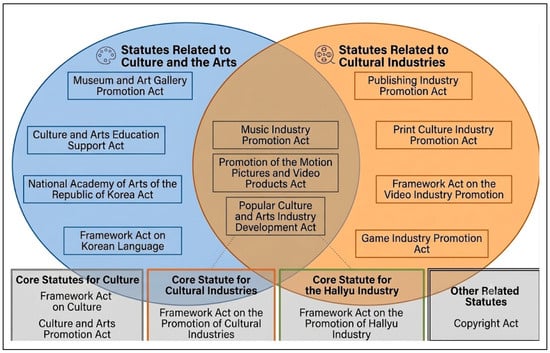
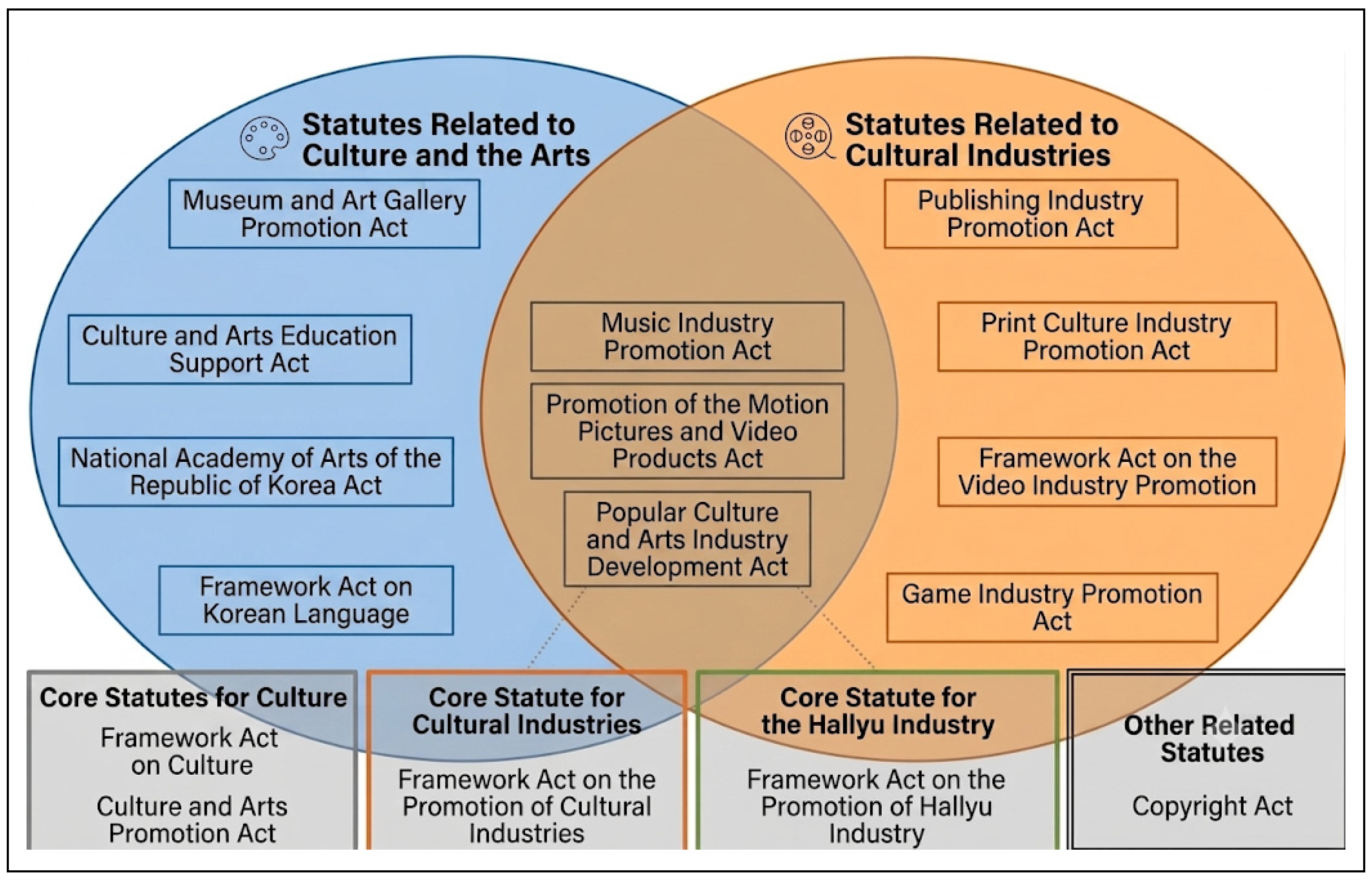
Figure 1 illustrates the layered structure of Korean legislation supporting culture, the arts, and cultural industries. At the general policy level, the Framework Act on Culture establishes the fundamental principles and responsibilities governing national cultural policy. The Culture and Arts Promotion Act complements this framework by supporting artistic creation, cultural participation, cultural facilities, and related institutions. These statutes operate alongside sector-specific legislation, including the Museum and Art Gallery Promotion Act and the Culture and Arts Education Support Act. The Copyright Act provides a separate but closely related legal basis for protecting the intellectual property rights of creators and cultural-content producers.
Figure 1.
Structure of Korean Legislation Supporting the International Expansion of Hallyu. Source: Author’s own work.
The Framework Act on the Promotion of Cultural Industries provides the principal legal foundation for the industrial development of cultural content. It supports content production, distribution, commercialization, technological development, professional training, and overseas expansion. It is complemented by sector-specific legislation governing publishing, music, motion pictures and video products, games, and popular culture and arts. The Framework Act on Korean Language also contributes to the broader cultural-policy environment by promoting the use and development of the Korean language, although it should be understood as an independent statute rather than as part of the Framework Act on the Promotion of Cultural Industries.
More recently, the Framework Act on the Promotion of Hallyu Industry has established a dedicated statutory basis for the sustainable development and international expansion of Hallyu and related industries. Unlike earlier legislation, which supported Hallyu indirectly through general cultural and industrial policies, the new Act specifically addresses overseas promotion, market information, professional training, investment, intellectual property protection, and institutional cooperation. It therefore connects the general principles of cultural policy with the practical requirements associated with the international expansion of Hallyu.
The functional relationships among these statutes are summarized in Table 1. The table distinguishes the general cultural-policy foundation, the broader cultural-industry promotion framework, and the Hallyu-specific framework, while also identifying their principal areas of overlap and regulatory limitation.
Table 1.
Functional Relationships among Major Korean Cultural and Hallyu Legislation. Source: Author’s own work.
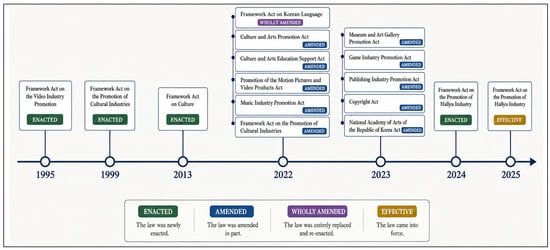
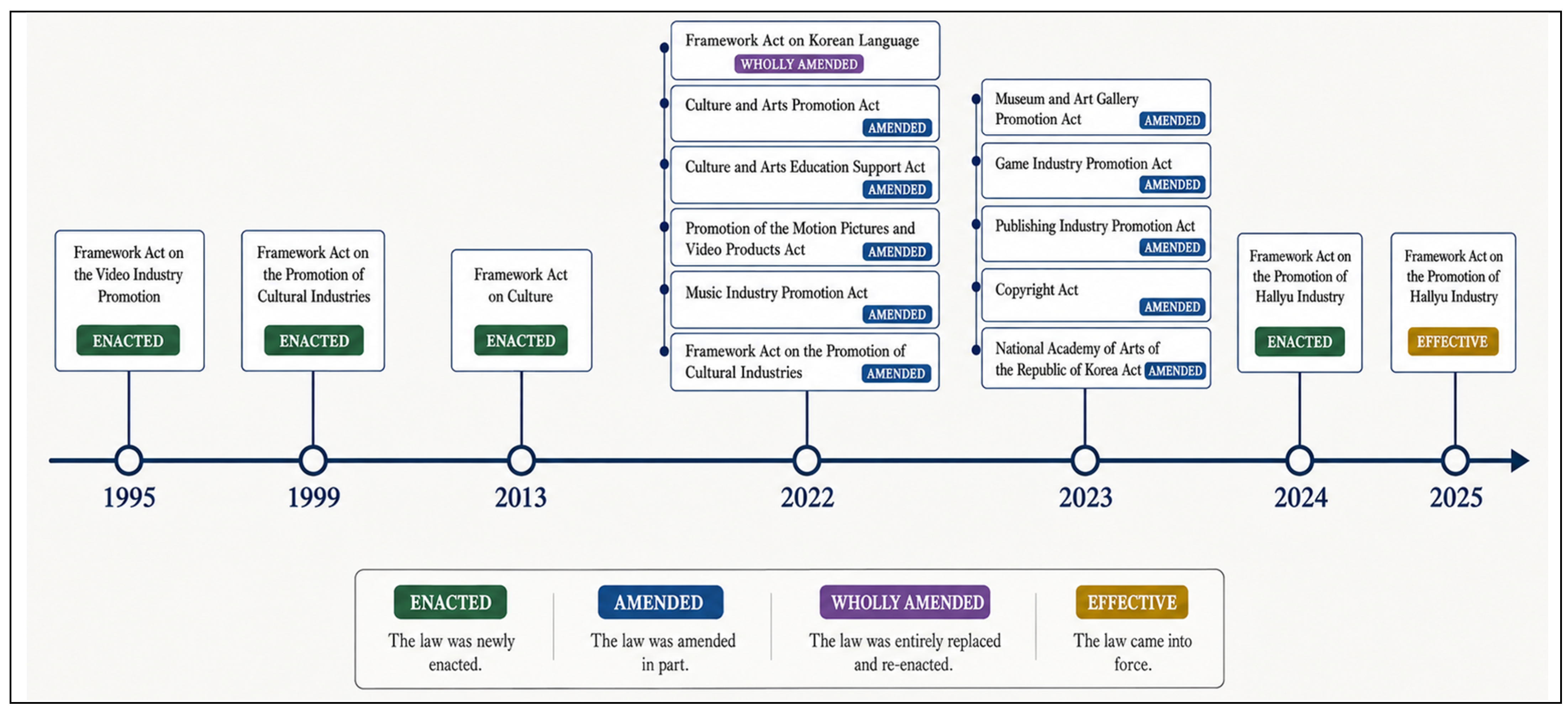
Figure 2 presents the major enactments and amendments that shaped Korea’s legal framework for culture, cultural industries, and Hallyu. Rather than providing an exhaustive legislative history, the figure highlights the principal statutory developments through which cultural policy evolved from the general promotion of culture and the arts to the industrial development and international expansion of Korean cultural content.
Figure 2.
Major Enactments and Amendments of Korean Cultural Legislation. Source: Author’s own work.
Significant regulatory matters remain outside the substantive scope of the Hallyu Act. Copyright ownership and remedies continue to be governed by copyright law; artist contracts and working conditions remain primarily matters of contract, labour, and sector-specific cultural legislation; platform remuneration and platform responsibility depend on copyright, competition, and digital-platform regulation; and international licensing and dispute resolution remain largely governed by private international law and contractual arrangements. The Hallyu Act therefore coordinates governmental promotion of Hallyu but does not constitute a comprehensive regulatory code for the transnational cultural economy.
The layered structure identified here also has relevance beyond the Korean case. Cultural-industry scholarship has emphasized that cultural policy increasingly intersects with industrial policy and market governance rather than operating as a self-contained policy domain (Hesmondhalgh and Pratt 2005; Lee 2020). The Hallyu Act illustrates one legal configuration of this intersection: a dedicated statute coordinates promotion, market information, investment, and internationalization, while copyright, labour, contract, competition, and platform matters remain governed elsewhere. This suggests that the legal institutionalization of cultural internationalization may occur through statutory coordination across legal regimes rather than through the creation of a comprehensive sector-specific code. In this respect, the Korean case provides a doctrinal counterpart to policy-oriented accounts of state involvement in cultural industries.
4. Conclusions
This study has examined the legal structure through which Korean law supports culture, cultural industries, and the international expansion of Hallyu. The analysis shows that the current framework did not emerge as a single Hallyu-specific regulatory system. Rather, it developed cumulatively from general cultural legislation, through cultural-industry promotion legislation and sector-specific regulation, to the more recent Framework Act on the Promotion of Hallyu Industry. The Framework Act on Culture and the Culture and Arts Promotion Act provide general cultural-policy foundations, while the Framework Act on the Promotion of Cultural Industries establishes a broader legal basis for production, distribution, financing, professional training, intellectual-property support, and overseas expansion.
The principal contribution of the Framework Act on the Promotion of Hallyu Industry lies in adding a Hallyu-specific layer to this pre-existing framework. It gives statutory form to policy planning, overseas market information, international promotion, investment, intellectual-property support, and institutional cooperation specifically directed toward Hallyu and related industries. However, the Act primarily operates through governmental planning, coordination, and promotional measures rather than through the creation of extensive directly enforceable private rights. Its legal significance therefore lies more in institutionalization, coordination, and internationalization than in the establishment of an autonomous rights-based regulatory regime.
Important regulatory issues nevertheless remain outside the substantive scope of the Hallyu Act. Copyright rights and remedies continue to depend on copyright law; artist contracts, remuneration, and working conditions remain governed by contract, labour, and sector-specific regulation; and platform responsibility, competition issues, and cross-border private-law disputes are addressed through other legal regimes. The Hallyu Act therefore supplements and coordinates existing cultural and cultural-industry legislation rather than constituting a comprehensive regulatory code for the global cultural economy.
These findings also contribute to wider debates on media and cultural-industry governance. First, they show that the expansion of state support for a globally circulating cultural industry does not necessarily produce a unified regulatory regime; promotion may instead be institutionalized through a framework statute layered over pre-existing rights-based and market-regulatory regimes. Second, the continuing reliance on separate copyright, labour, contract, competition, and platform rules demonstrates the limits of what promotional legislation can accomplish in a transnational and platform-dependent cultural economy. This complements scholarship on the culture–market–state relationship (Hesmondhalgh and Pratt 2005; Lee 2020; Tong and Hung 2012) and on platformization (Nieborg and Poell 2018; Jin et al. 2023) by showing, at the doctrinal level, how these governance functions are legally separated and coordinated. The broader significance of the Korean case therefore lies not in offering a model for direct transplantation, but in illustrating one way in which a state can formalize cultural internationalization while preserving a differentiated regulatory architecture.
The study is limited by its doctrinal focus. It identifies the legal functions, relationships, overlaps, and gaps among relevant statutes, but does not establish that these laws caused the global commercial or cultural success of Hallyu or assess their effectiveness through empirical evidence. Future research could therefore examine how the Hallyu Act is implemented in practice, how administrative discretion is exercised, and whether its institutional mechanisms produce measurable effects for artists, cultural firms, and overseas markets. Comparative research with other jurisdictions pursuing state-supported cultural internationalization could also help clarify the distinctive features and broader significance of the Korean model.
Author Contributions
Conceptualization, B.K., J.L. and H.K.; methodology, B.K., J.L. and H.K.; formal analysis, B.K., J.L. and H.K.; investigation, B.K., J.L. and H.K.; resources, B.K., J.L. and H.K.; writing—original draft preparation, B.K., J.L. and H.K.; writing—review and editing, B.K., J.L. and H.K. All authors have read and agreed to the published version of the manuscript.
Funding
This research was supported by the Keimyung University Research Grant. And there is no specific grant or funding number associated with this support.
Institutional Review Board Statement
Not applicable.
Informed Consent Statement
Not applicable.
Data Availability Statement
No new data were created or analyzed in this study. Data sharing is not applicable to this article.
Conflicts of Interest
The authors declare no conflicts of interest.
Abbreviations
The following abbreviations are used in this manuscript:
| AR | Augmented Reality |
| GDP | Gross Domestic Product |
| IP | Intellectual Property |
| KOCCA | Korea Creative Content Agency |
References
- BBC News. 2020. Oscars 2020: South Korea’s Parasite Makes History by Winning Best Picture. February 10. Available online: https://www.bbc.com/news/entertainment-arts-51440241 (accessed on 15 July 2026).
- Elberse, Anita, and Lizzy Woodham. 2020. Big Hit Entertainment and Blockbuster Band BTS: K-Pop Goes Global. Harvard Business School Case 520-125. Boston: Harvard Business School. Available online: https://store.hbr.org/product/big-hit-entertainment-and-blockbuster-band-bts-k-pop-goes-global/520125 (accessed on 20 July 2026).
- Fuhr, Michael. 2015. Globalization and Popular Music in South Korea: Sounding Out K-Pop. New York: Routledge. [Google Scholar] [CrossRef] [Scilit]
- Hesmondhalgh, David, and Andy C. Pratt. 2005. Cultural Industries and Cultural Policy. International Journal of Cultural Policy 11: 1–13. [Google Scholar] [CrossRef] [Scilit]
- Jin, Dal Yong, Kyong Yoon, and Benjamin Han. 2023. Platformization of the Korean Wave: A critical perspective. Communication Research and Practice 9: 408–27. [Google Scholar] [CrossRef] [Scilit]
- Jung, Sun. 2011. Korean Masculinities and Transcultural Consumption: Yonsama, Rain, Oldboy, K-Pop Idols. Hong Kong: Hong Kong University Press. [Google Scholar] [CrossRef] [Scilit]
- Kim, Bongchul, and Kristina Vasileva. 2017. Popular culture as an important element in creating a national image of Korea. Advanced Science Letters 23: 9866–69. [Google Scholar] [CrossRef] [Scilit]
- Kim, Changwook, and Sangkyu Lee. 2023. Putting creative labour in its place in the shadow of the Korean Wave. International Journal of Cultural Policy 29: 603–17. [Google Scholar] [CrossRef] [Scilit]
- Kim, Sumi. 2025. Conceptualising K-pop as cultural heritage and content: Institutionalisation within South Korea’s cultural policy framework. International Journal of Cultural Policy, 1–17. [Google Scholar] [CrossRef] [Scilit]
- Kim, Youna. 2013. Korean media in a digital cosmopolitan world. In The Korean Wave: Korean Media Go Global. Edited by Youna Kim. London and New York: Routledge, pp. 1–28. [Google Scholar]
- Kim, Youna. 2022. Soft power and cultural nationalism: Globalization of the Korean Wave. In Media in Asia: Global, Digital, Gendered and Mobile. Edited by Youna Kim. London and New York: Routledge, pp. 93–106. [Google Scholar] [CrossRef] [Scilit]
- Lee, Hye-Kyung. 2020. Making Creative Industries Policy in the Real World: Differing Configurations of the Culture-Market-State Nexus in the UK and South Korea. International Journal of Cultural Policy 26: 544–60. [Google Scholar] [CrossRef] [Scilit]
- Lee, Hye-Kyung. 2022. Supporting the cultural industries using venture capital: A policy experiment from South Korea. Cultural Trends 31: 47–67. [Google Scholar] [CrossRef] [Scilit]
- Lie, John. 2012. What is the K in K-pop? South Korean popular music, the culture industry, and national identity. Korea Observer 43: 339–63. [Google Scholar]
- Nieborg, David B., and Thomas Poell. 2018. The Platformization of Cultural Production: Theorizing the Contingent Cultural Commodity. New Media & Society 20: 4275–92. [Google Scholar] [CrossRef] [Scilit]
- Oh, Ingyu, and Wonho Jang. 2022. From globalization to glocalization: Configuring Korean pop culture to meet glocal demands. In Handbook of Culture and Glocalization. Edited by Victor Roudometof and Ugo Dessì. Cheltenham: Edward Elgar Publishing, pp. 256–71. [Google Scholar]
- Parc, Jimmyn. 2024. Between strong and weak copyright: Their impacts on the Korean music industry. International Journal of Cultural Policy 30: 762–73. [Google Scholar] [CrossRef] [Scilit]
- Republic of Korea. 2024. Framework Act on the Promotion of Hallyu Industry, Act No. 20501. Available online: https://elaw.klri.re.kr/eng_service/lawView.do?hseq=70057&lang=ENG (accessed on 18 July 2026).
- Republic of Korea. 2026. Framework Act on the Promotion of Cultural Industries, Act No. 21590. Available online: https://www.law.go.kr/LSW/lsInfoP.do?lsiSeq=285643 (accessed on 12 June 2026).
- Roudometof, Victor. 2019. Cosmopolitanism, glocalization and youth cultures. Youth and Globalization 1: 19–39. [Google Scholar] [CrossRef] [Scilit]
- Shim, Doobo. 2002. South Korean media industry in the 1990s and the economic crisis. Prometheus 20: 337–50. [Google Scholar] [CrossRef] [Scilit]
- Tong, Q. S., and Ruth Y. Y. Hung. 2012. Cultural policy between the state and the market: Regulation, creativity and contradiction. International Journal of Cultural Policy 18: 265–78. [Google Scholar] [CrossRef] [Scilit]
- Yoon, Kyong. 2023. De/Constructing the soft power discourse in Hallyu. Communication Research and Practice 9: 341–57. [Google Scholar] [CrossRef] [Scilit]
- Yoon, So-Yeon. 2021. ‘Squid Game’ is most watched Netflix original series. Korea JoongAng Daily. October 13. Available online: https://koreajoongangdaily.joins.com/2021/10/13/business/tech/Netflix-Squid-Game-success/20211013182953859.html (accessed on 5 August 2026).

Disclaimer/Publisher’s Note: The statements, opinions and data contained in all publications are solely those of the individual author(s) and contributor(s) and not of MDPI and/or the editor(s). MDPI and/or the editor(s) disclaim responsibility for any injury to people or property resulting from any ideas, methods, instructions or products referred to in the content. |
© 2026 by the authors. Licensee MDPI, Basel, Switzerland. This article is an open access article distributed under the terms and conditions of the Creative Commons Attribution (CC BY) license.