


Abstract
Although the central panel of The Garden of Earthly Delights is perceived as a coherent visual whole, it lacks an obvious compositional center and is commonly interpreted as a polycentric image. This study argues that its visual organization is nevertheless governed by a reconstructable functional hierarchy. To investigate this structure, the study develops a functional method based on the analysis of compositional operators and the viewer’s perceptual route. The method is first applied to selected fifteenth-century paintings and then used to examine the central panel of Bosch’s triptych. The analysis demonstrates that Bosch preserves the traditional principle of compositional hierarchy while transforming its spatial organization: instead of unfolding along the vertical axis, the hierarchy is reconfigured through pictorial depth. The study therefore offers a new explanation of the compositional coherence of the central panel. It also extends the concept of visual engineering by treating compositional hierarchy as both a mechanism of visual organization and an independent object of art-historical analysis.
1. Introduction
The central panel of The Garden of Earthly Delights is perceived as a unified pictorial space. Yet the viewer finds neither an obvious compositional dominant nor a single narrative center, nor a sequence of scenes that directly reveals this unity. Instead, the image dissolves into a multitude of autonomous figures, motifs, and localized episodes. Nevertheless, the impression of a unified space persists, even though the principle that produces this spatial coherence is not immediately apparent.
If the image is perceived as a coherent whole, its unity must be sustained by a compositional principle, even if that principle is not explicitly manifest. Accordingly, the aim of the present study is not to explain individual motifs but to reconstruct the mechanism through which a spatially fragmented image is perceived as a compositionally coherent whole. In other words, the article asks how the central panel achieves compositional coherence without relying on either an evident dominant or the reduction of its numerous scenes to a single narrative center.
The investigation of the central panel also leads to a broader methodological conclusion. If compositional coherence is not reducible to the sum of the meanings of individual motifs, analysis must also address the functions that elements perform within the image. These functions can be reconstructed and tested through controlled transformations of the composition. Accordingly, the study addresses not only the specific structure of The Garden of Earthly Delights but also a method for analyzing complex images as functionally organized systems.
2. Current State of Research
The Garden of Earthly Delights has long been one of the most extensively studied works of European art. Research on its central panel, however, has focused primarily on its iconography, symbolic program, spatial organization, and the interpretation of individual motifs. The present study addresses a different aspect of the painting by treating compositional hierarchy as an independent object of analysis. How this organization itself produces the panel’s compositional coherence has rarely been treated as an independent subject of investigation.
This problem has received remarkably little attention in the existing scholarship. Although the spatial organization of the central panel has been described repeatedly, such descriptions have generally served as a point of departure for subsequent iconographic, symbolic, or historical interpretations. The question of how the compositional organization itself produces the panel’s coherence has rarely been treated as an independent subject of investigation. This tendency characterizes both the classic literature on Bosch and more recent scholarship (for a detailed historiographical review, see Pelikhovska 2026).
Margaret Carroll, in Hieronymus Bosch: Time and Transformation in The Garden of Earthly Delights (Carroll 2022), interprets the central panel not as an allegory of a particular condition of humanity but as an image of the world’s continuous transformation through time, relating it to late medieval natural philosophy, the biblical tradition, and the historical context of courtly reception. Within this interpretation, the space of the central panel is understood as a stage in an evolving world. Yet the internal organization of that space is not itself analyzed as the basis from which such an interpretation might be derived.
Hans Belting (Belting 2002) adopts a fundamentally different approach. Rather than beginning with the symbolism of individual motifs, he takes as his point of departure the spatial paradox of the central panel itself. Belting observes that the landscape of the adjacent Paradise continues into the central wing, yet this continuity is incompatible with biblical chronology, since humanity appears only after the expulsion of the first human pair from Eden. From this contradiction, he concludes that Bosch deliberately resists any attempt to situate the central panel “in time and space” within Christian salvation history. Belting characterizes this condition as Uchronia, describing the central scene as a “no-time” beyond history: an imagined Paradise in which historical time, beginning with the Expulsion, has not yet begun. The central wing thus emerges not as a simple stage in a linear narrative but as a distinct imaginary world that demands the active engagement of the viewer’s imagination.
Belting’s argument, however, concerns the historical and semantic status attributed to the represented world rather than the compositional organization of the pictorial field. Even if the central panel is understood, following Belting, as existing outside historical time, it remains pictorially articulated in space, and its spatial organization remains available for compositional analysis. Yet although Belting convincingly reveals the paradoxical character of this space, he does not ask by what compositional means it is maintained as a visually coherent environment.
More broadly, despite the diversity of interpretative models, existing scholarship has tended to consider the central panel primarily within the larger semantic and narrative structure of the triptych. Its spatial organization has generally been examined in relation to principal figural groups, spatial zones, individual motifs, and their interpretative significance. The compositional organization itself has received far less attention as an independent object of analysis. The question of how a spatially fragmented image achieves compositional coherence through the internal organization of its elements has therefore remained largely unaddressed.
Because the question addressed here concerns not the meaning of individual motifs but the organization of the image as a whole, it requires a level of analysis distinct from iconographic interpretation in the strict sense. Methodologically, the present study draws on the traditions of image theory and formal analysis, in which the image is understood not as an aggregate of identifiable elements but as an organized visual system.
Within this methodological tradition, the work of Rudolf Arnheim (Arnheim 1974, 1983), Max Imdahl (Imdahl 1980), Michael Baxandall (Baxandall 1985), and David Summers (Summers 2003) is of particular importance. Arnheim explains composition as the dynamic interaction of visual forces, centers, directions, and fields of tension. Among these approaches, Arnheim’s theory provides the closest methodological point of departure for the present study, since it likewise understands composition as an organized visual system. The present study differs, however, by focusing not on the organization of the visual field as such but on the compositional roles performed by individual elements within it.
Imdahl treats the structure of the image as an autonomous source of meaning that cannot be reduced to iconographic content. Baxandall relates pictorial form to the solution of specific artistic problems, while Summers shows that pictorial space is not merely a matter of geometric extension but also structures perceptual experience and the relationships among the viewer, the image, and place. A closely related approach is developed by Svetlana Alpers (Alpers 1983), who treats the painted image as an autonomous object of analysis rather than as a vehicle for narrative or symbolic meaning. Her joint study with Michael Baxandall (Alpers and Baxandall 1994) on the art of Giambattista Tiepolo further demonstrates the possibility of analyzing the internal logic of pictorial solutions and the ways in which they interact.
In a broader methodological perspective, James Elkins (Elkins 1998) has pointed to the persistent tendency of art-historical scholarship to shift from describing the visual organization of images toward the interpretation of symbols and narrative structures.
Building on this methodological tradition, the present study shifts the focus from describing the overall structure of the image to reconstructing the mechanism through which that structure operates. The object of analysis is not only the spatial relationships among pictorial elements but also the functions they perform within the composition. Some elements introduce the viewer into the image, others establish transitions between its spatial levels, while still others assume the role of the hierarchical dominant. Composition is thus approached as a functional system whose internal relationships can be reconstructed and systematically tested.
This article forms part of the Reading Bosch research project, devoted to reconstructing the internal logic and order of reading The Garden of Earthly Delights. Its scope is deliberately limited to the composition of the central panel and to one self-contained research question: how a spatially fragmented and polycentric image is organized as a functionally coherent whole.
3. Compositional Hierarchy as an Object of Analysis
In the present study, compositional hierarchy is treated not as an interpretative category but as an analytical tool. Its purpose is not to establish the meaning of the image but to reconstruct the structural mechanism through which the image is organized as a coherent whole.
The reconstructed mechanism is not identical with the semantic meaning of the work, nor is it intended to replace semantic interpretation or to reduce the artwork to its compositional structure. It constitutes a distinct analytical level, temporarily isolated in order to establish functional relationships among pictorial elements independently of their presumed semantic attribution. Different interpretations may explain the composition in different ways, yet regardless of their conclusions, the image itself presupposes a particular order of interaction among its elements. It is this order that constitutes the object of the present analysis.
Establishing this compositional structure is therefore understood here as a necessary preliminary condition for the reconstruction of meaning, rather than as its substitute. Composition does not determine meaning by itself; it establishes a system of relations that any subsequent interpretation must take into account. In this sense, compositional analysis provides one of the constraints against which a reconstruction of meaning can be tested.
Describing this mechanism requires the introduction of several analytical concepts.
The first of these concepts is compositional hierarchy. In the present study, this term refers to a system of functional relationships among the elements of an image, in which the function of each element is determined not by its spatial position or iconographic status but by the role it plays in organizing the viewer’s perception.
This concept can be illustrated by a simple example. A tree exists in itself, ornaments exist in themselves, and Christmas exists as a cultural tradition. Yet a Christmas tree does not emerge as the mere sum of these components. It becomes a Christmas tree only when the ornaments are arranged in a particular way. It is this mode of organization—not the properties of the individual ornaments or the symbolism of the holiday—that transforms a collection of separate elements into a coherent image. In the same way, compositional hierarchy is determined not by the set of motifs present in an image but by the functional relationships established among them.
The functions performed by elements within such a system are not identical. Some introduce the viewer into the composition, others establish transitions between its spatial registers, while still others concentrate attention or bring the viewer’s path to its conclusion. Compositional hierarchy therefore describes not the spatial arrangement of objects but the distribution of these functions within the image.
The second essential concept is the hierarchical dominant—the area of the image with respect to which the system of functional relationships among the remaining elements is organized. It does not necessarily coincide with the pictorial dominant. The visually most prominent area of an image may serve primarily to attract attention, while the structural organization of the composition is oriented toward a different region.
Traditional iconographic analysis is concerned primarily with what a particular element depicts and what it signifies. For the analysis of compositional hierarchy, however, this is not sufficient. The same motif may retain its iconographic meaning while performing fundamentally different functions within the organization of the image: directing the viewer’s gaze, holding attention, connecting spatial registers, limiting perspectival recession, or marking the point at which the composition reaches its conclusion. The present study therefore proposes temporarily separating an element’s meaning from its compositional function. The question is not what this element means, but what it does within the composition.
To designate an element from the perspective of the function within the composition, the present study introduces the concept of the compositional operator. The term “compositional operator” is introduced here as a working analytical designation for an element considered from the perspective of the function it performs within the compositional system. A compositional operator is understood not as a motif considered a bearer of meaning, but as an element of the image that performs a specific function within the compositional system—for example, stabilizing, directing, limiting, connecting, concentrating, or otherwise organizing the viewer’s perception. The same motif—a figure, a tree, a column, a patch of color, an architectural opening, or a group of figures—may function as different compositional operators depending on the role it performs within the structure of the whole.
The viewer’s path is understood here as an analytically reconstructed sequence of transitions between compositional operators, through which the compositional logic constructed by the artist can be traced. Accordingly, the analysis is concerned not with the meaning of individual motifs but with the functional relationships established among them: which elements initiate the movement of the gaze, which constrain or redirect it, and which bring the compositional sequence to its conclusion. In other words, the task is not to determine the meaning of a sphere, a tree, or a strawberry as isolated motifs, but to establish their place within the compositional system and thereby identify its hierarchical dominant.
Because a compositional operator is defined by the function it performs rather than by its mere presence in the image, its role must be capable of analytical verification. Such verification is based on controlled transformations of the image. The purpose of these transformations is not to alter the work itself but to reveal the structural relationships that depend upon the element under consideration.
The analysis begins with a functional reformulation of the analytical question. Rather than asking, “What does this motif represent?” or “What does it mean?”, it asks, “What does this element do within the composition?” The answer constitutes a functional hypothesis, which can then be tested by asking two further questions: “What changes in the organization of the image if this element is removed?” and “What changes if the element is altered while the rest of the composition remains unchanged?” These questions correspond to two complementary procedures of controlled transformation: the subtractive test and the modification test.
In the subtractive test, the mental or graphic removal of an element makes it possible to determine which spatial, compositional, or perceptual relationships disappear together with it. The modification test involves changes to the element’s color, tonal value, scale, or spatial status. If such modifications disrupt the direction of the viewer’s gaze, weaken a compositional accent, or alter the organization of the corresponding area of the image, they indicate that the element performs a structurally significant function.
Comparable analytical experiments with the image can be found in the formal tradition—for example, in Wassily Kandinsky’s theoretical investigations of the visual consequences of altering elementary pictorial forms (Kandinsky [1926] 1979). Kandinsky, however, asks a different question: what happens when a form is changed? The present study asks instead how changing a particular element changes the organization of the composition. In other words, it tests a hypothesis about the function that this element performs within the compositional whole.
None of these procedures, taken in isolation, constitutes sufficient evidence. The convergence of several independent tests, however, substantially reduces the likelihood of arbitrary interpretation. If removing an element disrupts a particular compositional sequence, and modifying its visual status weakens the same structural function, then the reconstruction of that function follows from observable changes in the composition itself rather than from an interpretation retrospectively imposed by the researcher.
The existence of a complex compositional organization in the central panel of The Garden of Earthly Delights is not in doubt. On the contrary, the painting displays all the characteristics of an internally organized system: spatial registers, a hierarchy of visual accents, a complex landscape structure, and numerous relationships among its elements. The central question is therefore not whether such an organization exists, but which principle enables this exceptionally dense and diverse pictorial world to maintain its internal coherence. This question cannot be answered by simply describing compositional features. It requires determining the character of the relationships that bind these elements into a unified system.
The proposed analytical framework makes it possible to consider composition not as a collection of individual motifs but as a system of functional relationships among its elements. The reconstruction of compositional hierarchy proceeds through the identification of compositional operators, the reconstruction of the viewer’s path, and the determination of the hierarchical dominant with respect to which the entire system is organized.
Because the operation of this mechanism in the central panel of The Garden of Earthly Delights is substantially complicated by the exceptional density of the image and the absence of an obvious hierarchical dominant, it is first necessary to demonstrate the proposed method using fifteenth-century works in which compositional hierarchy is expressed more clearly. These examples are intended not as a historical survey but as a demonstration of the analytical language that is subsequently applied to Bosch’s central panel.
4. Compositional Hierarchy in Fifteenth-Century Painting
In fifteenth-century sacred painting, compositional hierarchy is subordinated to the semantic organization of the work. Regardless of differences in artistic practice, its fundamental purpose remains the same: to organize the image in such a way that the viewer’s path leads to the semantic dominant. As painting developed during the fifteenth century, artists refined not this underlying principle itself but the means by which it was realized, achieving increasingly precise control over the viewer’s attention.
This assumption is grounded in the nature of artistic training during the Late Middle Ages and the Early Renaissance, when compositional procedures were transmitted within workshops together with professional skills and were not rigidly tied to any particular iconographic program. Consequently, a change of subject did not in itself imply abandoning previously established methods of organizing the image.
The comparative examples that follow are intended not as a survey of fifteenth-century painting but as a practical test of the flexibility of the proposed analytical procedure. A single example would reveal only one particular realization of compositional hierarchy; it would not establish whether the same functions remain identifiable when their pictorial and spatial realization changes. The selected works therefore represent two related but structurally different forms of fifteenth-century pictorial organization: the multipart altarpiece in Northern painting and the monumental wall ensemble in Italian painting. Within each, a relatively transparent and a more complex solution are considered in order to trace how far hierarchical functions may be transformed while remaining structurally recognizable. This comparison is particularly important for the analysis of Bosch’s triptych, whose individual panels are physically autonomous yet participate in a single pictorial-spatial construction.
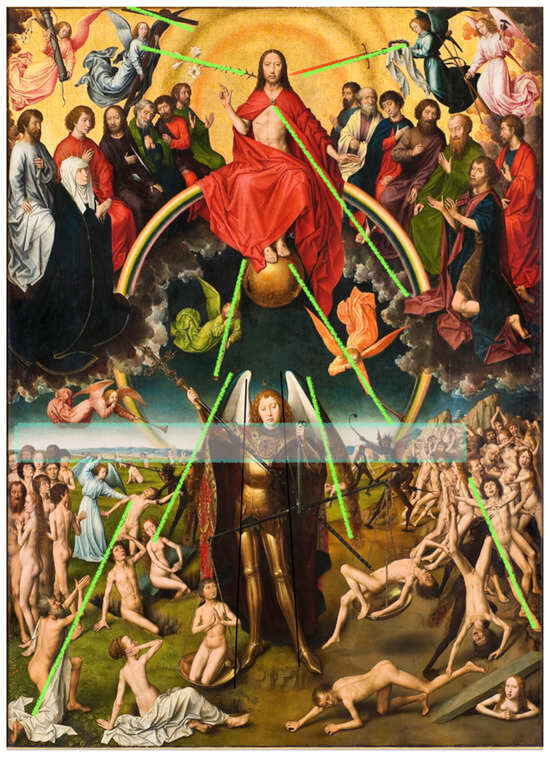
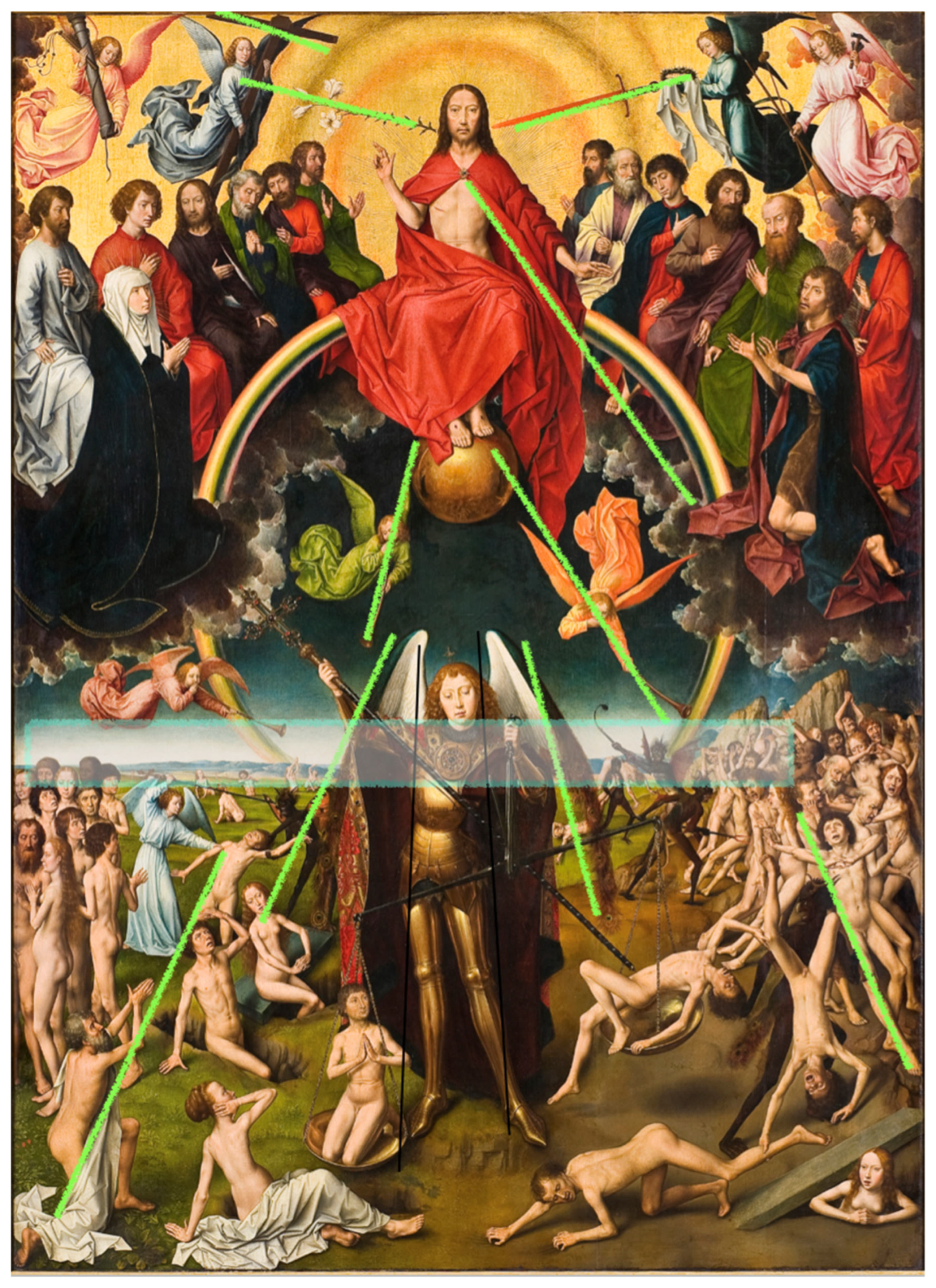
A clear example is provided by Hans Memling’s Last Judgment triptych (Figure 1). Here, the hierarchical dominant does not coincide with the figure that initiates the viewer’s path. Despite occupying the center of the composition and being rendered on a monumental scale, the Archangel Michael is not the final destination of the viewer’s path. Instead, he functions as an entry operator, performing the first phase of the composition’s organization.
Figure 1.
Compositional hierarchy in the central panel of Hans Memling’s Last Judgment triptych. The ascending compositional hierarchy is organized through a system of diagonal compositional vectors that progressively direct the viewer’s gaze toward Christ, the hierarchical dominant of the composition. The cool band along the horizon separates the earthly and celestial registers, preventing their visual fusion, while the figure of the Archangel Michael connects the two registers into a unified compositional system. Without the horizon band, the compositional registers merge; without the figure of Michael, the composition divides into separate upper and lower parts. Public-domain image, Wikimedia Commons, analytical overlay by the author.
It is through Michael’s figure that the viewer enters the hierarchical sequence of the central panel. The vertical axis of his body, his outstretched wings, the raised sword and scales, the figures occupying the intermediate register, and the rainbow together form a unified system of transition that progressively directs attention toward the upper register of the composition.
This function is reinforced by other compositional elements: the cool band along the horizon, the rhythm of green accents in the landscape, the chromatic correspondences between the garments of the saints and the angels, and the red border of Michael’s cloak, linking the lower and upper registers. Yet these relationships alone would establish only continuity of movement. It is Michael’s figure that gives this movement direction and hierarchical order, simultaneously initiating the viewer’s path and linking it to the figure of Christ.
Thus, the central figure of the panel is not the hierarchical dominant but an operator of entry and transition. The viewer’s path begins with Michael but culminates in the figure of Christ, who assumes the role of the hierarchical dominant of the entire composition.
The viewer’s path alone, however, does not explain why a particular area becomes the hierarchical dominant. It merely moves the viewer through the image. The next question, therefore, is by what pictorial means the dominant itself is established. If Memling provides a relatively transparent case in which entry, transition, and culmination remain spatially legible, van der Goes makes it possible to test the same functional distinctions where pictorial concentration and hierarchical culmination no longer coincide.
The distinction between the pictorial dominant and the hierarchical dominant is particularly evident in the central panel of Hugo van der Goes’s Portinari Altarpiece (Figure 2). At the level of pictorial organization, the most highly articulated area is the figure of the Virgin, and above all her face. Van der Goes systematically intensifies this area through several pictorial means: the heavy dark-blue robe creates an absorbing field against which the face acquires exceptional luminous and chromatic definition; the two light-toned figures of angels behind the Virgin abruptly open up the pictorial depth while simultaneously separating her from the surrounding space; and the relief and color of the wall above her form a directing structure that concentrates the gaze on her face and creates a kind of halo.
This pictorial concentration, however, is deliberately prevented from developing into a stable fixation. The flying angel to the left above the Virgin interrupts the stabilization of the gaze on her face, creating a slight compositional tension. As a result, the viewer’s attention shifts downward toward the Christ Child lying before her, who constitutes not the pictorial but the hierarchical culmination of the entire visual trajectory.
Under the original viewing conditions in which the altarpiece was viewed—as the principal altarpiece positioned above the viewer’s eye level—the Christ Child falls within the zone of primary visual contact. The Virgin’s dominance is therefore not final but performs a supporting function within the compositional hierarchy: it holds and organizes the viewer’s attention while directing it toward the Christ Child lying below. In other words, van der Goes separates the most highly articulated pictorial node from the ultimate semantic goal of the composition.
Figure 2.
Compositional hierarchy operators in the Portinari Altarpiece. (1) Supporting tonal masses that stabilize the central compositional structure; (2) operator of vertical spatial opening, establishing the sacred height of the composition; (3) operators of spatial opening, providing air and openness to the foreground; (4) depth operators, compensating for the obscured horizon of the central panel; (5) operators blocking the perspectival recession of the viewer’s gaze; (6) operator redirecting the viewer’s fixation, disrupting stable concentration on the pictorial dominant and transferring attention to the hierarchical center of the composition (combined with the operator of vertical spatial opening). The combined action of these operators organizes a unified spatial field in which the viewer’s gaze arrives at a static compositional nucleus centered on the Christ Child and framed by the figure of the Virgin and the surrounding luminous ground. Public-domain image, Wikimedia Commons, analytical overlay by the author.
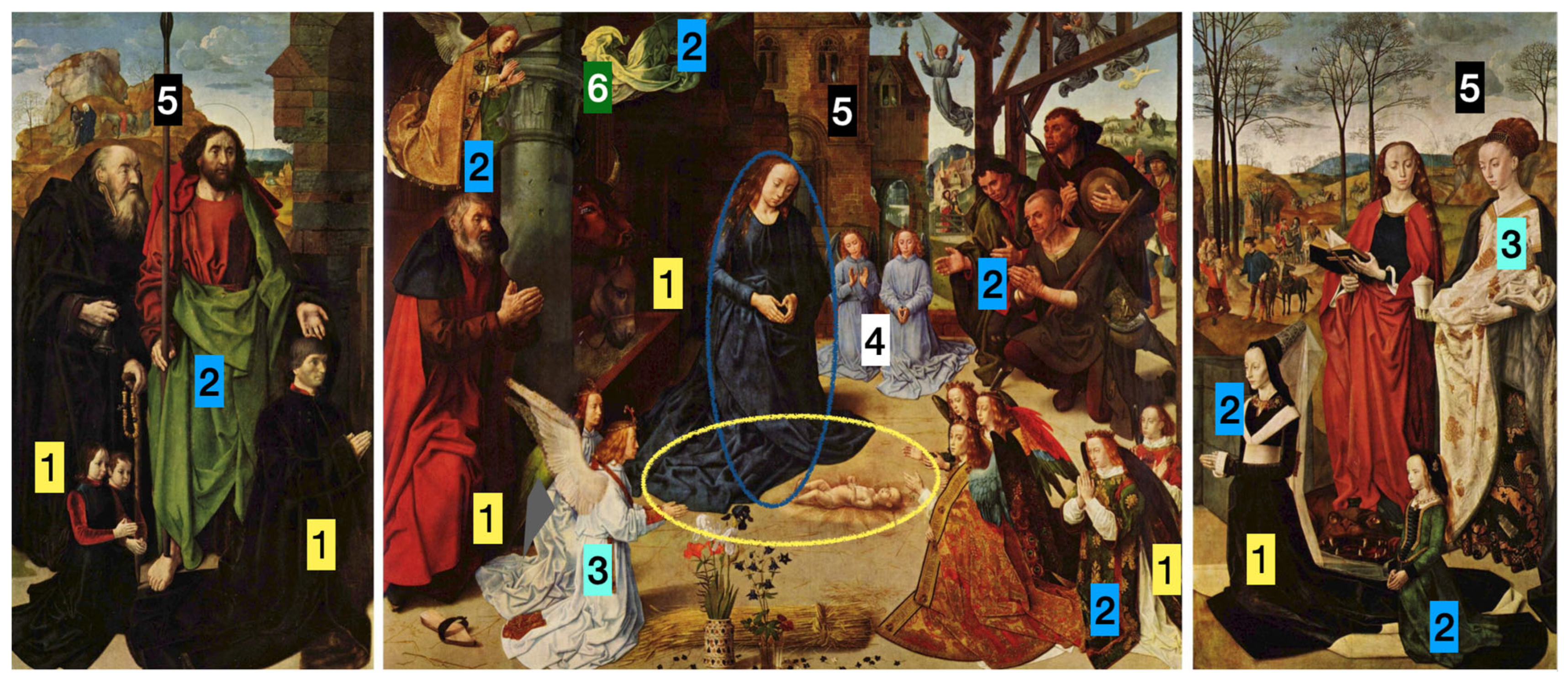
Thus, it is important to distinguish between the pictorial dominant and the hierarchical dominant. The pictorial dominant is determined by the intensity of its own artistic means—color, light, scale, and spatial prominence—whereas the hierarchical dominant is determined by the degree to which the remaining elements of the composition are functionally subordinated to it. The two centers may coincide, but they need not. In the Portinari Altarpiece, the figure of the Virgin constitutes the most intensively organized pictorial area, whereas the Christ Child remains the ultimate hierarchical dominant. In this case, the Christ Child functions simultaneously as the semantic and hierarchical dominant, whereas the Virgin constitutes the pictorial dominant.
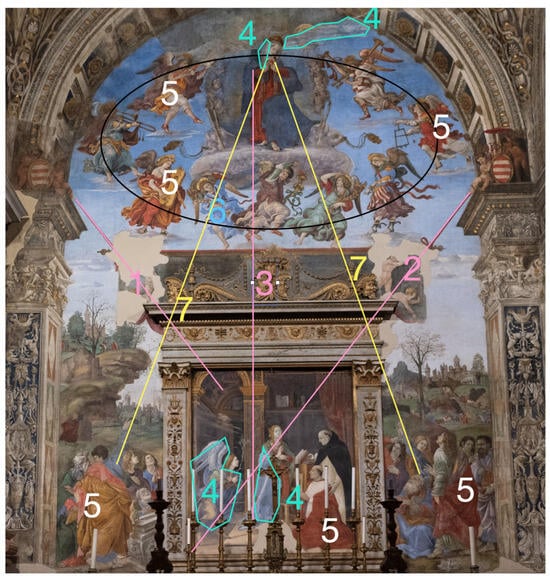
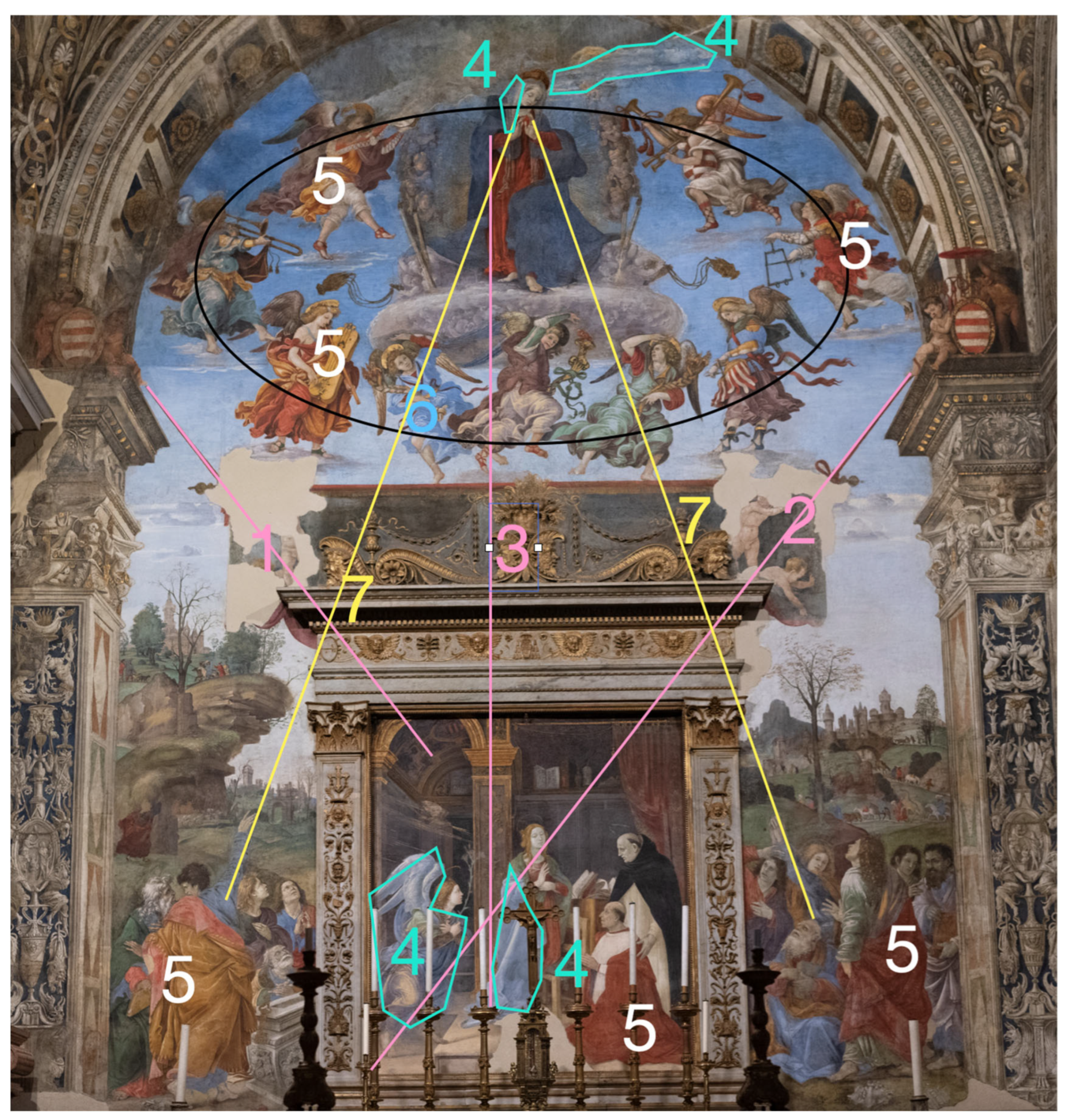
Alongside the Northern tradition, the Italian material allows the same analytical distinctions to be tested under different spatial conditions. Here sacred vertical hierarchy was often constructed not within an altarpiece, but within a large-scale architectural and pictorial ensemble. One of the clearest examples is Filippino Lippi’s Carafa Chapel in Santa Maria sopra Minerva (Figure 3). Here the artist solves an unusual compositional problem: the same figure—the Virgin—is represented in different hierarchical states within a single pictorial field, unbroken by a framing device.
Figure 3.
Functional organization of compositional hierarchy in Filippino Lippi’s Carafa Chapel. (1) Operator of active spatial opening in depth; (2) operator introducing the viewer into the space of the lower scene: the gestures, turns, and poses of the figures are subordinated to its diagonal structure; (3) central vertical axis, deliberately displaced from the geometric center in order to preserve the composition’s dynamism. Rather than directly uniting the two representations of the Virgin, it allows each to retain its autonomy within its own register and prevents competition for hierarchical primacy; (4) identifying chromatic and morphological correspondences linking the Virgin’s two states: the characteristic pale grayish-blue tones and the similar plastic treatment of the drapery folds; (5) chromatic operators that create the unity of the spatial field while simultaneously sustaining its dynamism. Their asymmetrical distribution relative to the central vertical axis generates counter-movement and compositional equilibrium between the upper and lower registers; (6) transition operator, belonging neither to the upper nor to the lower zone and providing the connection between them; (7) system of diagonal connections based on the directions of gestures and the positions of the hands, linking the lower scene with the upper register. The combined action of these operators creates a unified spatial system in which the dynamic circular movement of the upper zone stabilizes the large static chromatic mass of the Virgin as the hierarchical dominant of the composition. Public-domain image, Wikimedia Commons; analytical overlay by the author.
Color therefore performs here not a connective but an identifying function. In the lower part of the fresco, the Virgin and the angel are painted in a pale grayish-blue palette that differs from the more subdued lateral color masses while at the same time corresponding to the blue expanse of the heavenly space in the upper register. As a result, the Virgin in the Annunciation is perceived not simply as a figure within an earthly interior but as one already belonging to the highest sacred register of the composition. Her chromatic organization establishes in advance a visual correspondence with the same figure who, in the upper part of the fresco, appears in a different, glorified state.
In the upper zone, this belonging becomes explicit. The dense blue mass of the sky, the circular movement of the angels, and the directional orientation of the figures concentrate attention on the Virgin as the manifest hierarchical dominant of the entire system. At the same time, the Virgin’s saturated blue robe does not dissolve into the heavenly space but remains pictorially dominant within it, completing the gradual intensification of color that had already begun in the lower scene. Lippi thus demonstrates that compositional hierarchy can be constructed not only through the subordination of elements to a single center but also through the chromatic differentiation of the states of one and the same figure within a unified spatiotemporal field.
At the same time, the compositional hierarchy retains its ascending character: the lower scene serves as the point of entry into the viewer’s path, while the system of verticals, gestures, and chromatic accents directs attention toward the Virgin in the upper register. Thus, even within a monumental fresco cycle, where different states of the same figure coexist within a unified spatiotemporal field, the same principle is preserved: compositional hierarchy organizes an ascending movement from the earthly register to the sacred summit.
By the end of the fifteenth century, the compositional problem had become considerably more complex. It was no longer sufficient for the artist to organize an individual scene; it became necessary to integrate multiple autonomous episodes into a single compositional system. At the same time, the ensemble had to sustain a dual mode of perception. During prolonged viewing, the spectator could follow the individual scenes and their interrelationships sequentially, whereas at a brief glance the entire ensemble had to be perceived as a unified image leading to a single hierarchical culmination.
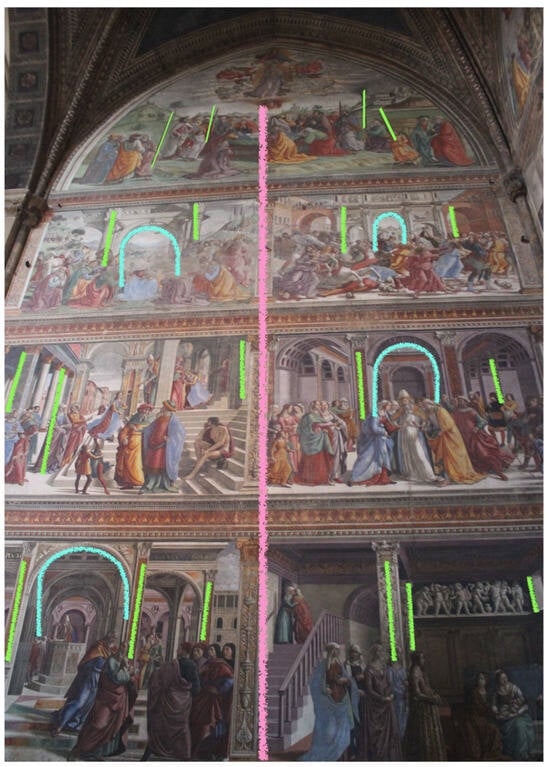
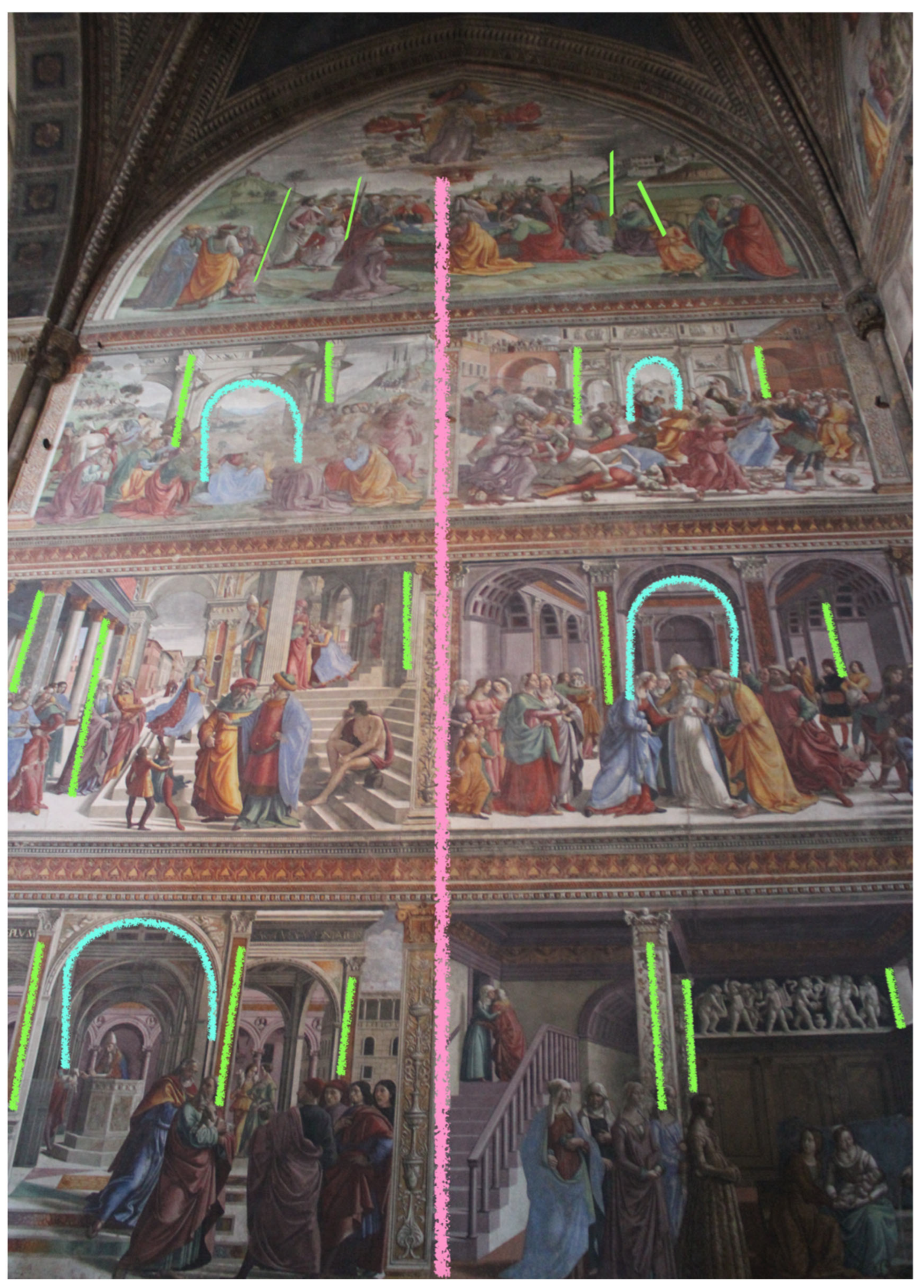
If Lippi demonstrates the redistribution of hierarchical functions within a unified pictorial field, Ghirlandaio extends the same problem to the level of an entire monumental ensemble. One of the most consistent solutions is found in Domenico Ghirlandaio’s cycle of the Stories of the Virgin in the Tornabuoni Chapel (Figure 4). Here, compositional hierarchy is organized no longer within the boundaries of an individual scene but at the level of the entire multi-register ensemble. Each fresco retains its own compositional integrity while simultaneously becoming part of a single ascending path of visual perception.
Figure 4.
Functional organization of the spatial operators of the compositional hierarchy on the north wall of Domenico Ghirlandaio’s Tornabuoni Chapel. (1) Principal compositional vertical, uniting the individual scenes into a single hierarchical system (pink line); (2) system of supporting verticals, reconstructed through architectural elements, figures, and upward-oriented details, ensuring the continuity of the ascending route of visual perception (green lines); (3) arch operators, organizing the spatial structure of the individual scenes and regulating the degree of spatial depth expansion (blue arch). Analytical overlay by the author on a photograph by Miguel Hermoso Cuesta (Wikimedia Commons, CC BY-SA 4.0).
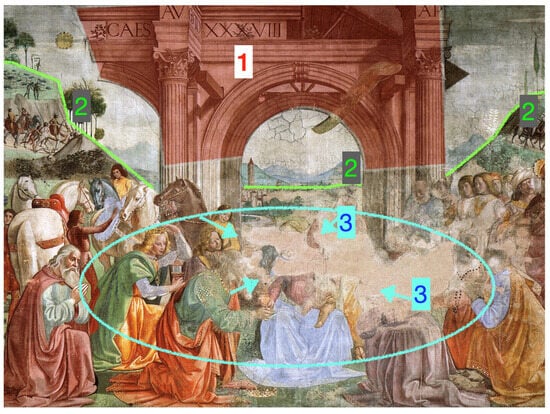
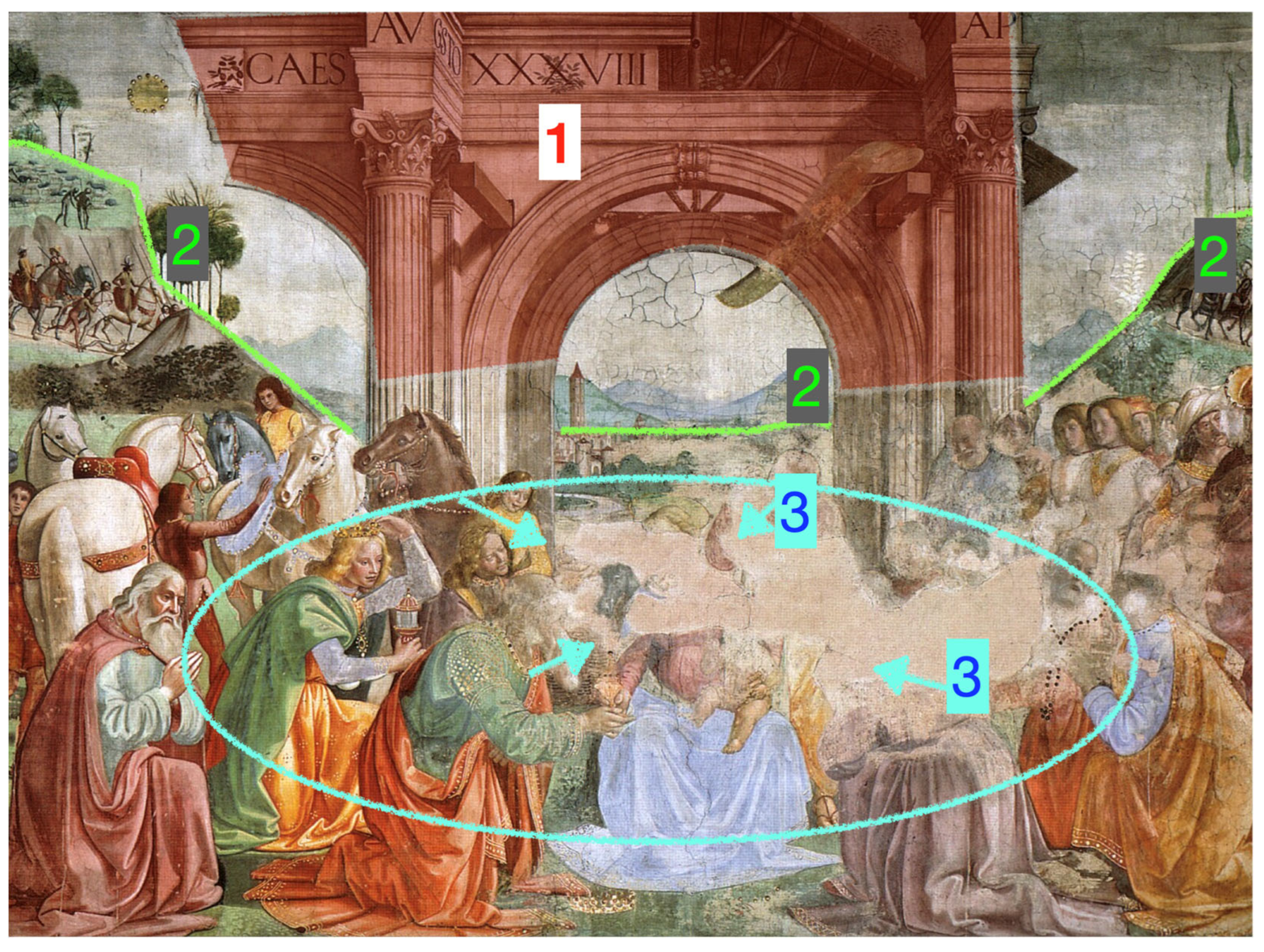
The lower registers retain the viewer within an architecturally organized space. Interiors, colonnades, and arches create spatial depth, yet do not allow the viewer’s gaze to move freely toward the distant horizon. Only in the third register does the space begin to open through the appearance of a distant landscape in the Adoration of the Magi (Figure 5), whereas the adjacent Massacre of the Innocents draws it back into a dense architectural and figural structure. The transition to open space thus occurs gradually, through the alternating expansion and containment of spatial depth.
Figure 5.
Functional organization of the compositional system in the Adoration of the Magi scene from Domenico Ghirlandaio’s Stories of the Virgin cycle in the Tornabuoni Chapel. (1) Upper operator of spatial enclosure, organizing the architectural framework of the scene; (2) operator of spatial depth expansion, providing a controlled extension of the viewer’s gaze toward the distant landscape; (3) lower centripetal group of figures, in which gestures, body orientations, and lines of sight concentrate attention on the central group. The combined action of these operators forms a compositional model whose functional organization is preserved in the concluding composition despite the transformation of its plastic realization. Public-domain image; analytical overlay by the author.
In the final scene, the principle of spatial organization changes fundamentally. The earthly register retains its material density around the Virgin’s sarcophagus, whereas her heavenly figure is not established as a large or particularly intense pictorial mass. Instead, her dominant position is created through the liberation of the surrounding space: architectural forms disappear, giving way to an open landscape and an expansive atmosphere (Figure 6). Whereas in Filippino Lippi the hierarchical dominant is established through the increasing pictorial intensity of the Virgin’s figure, in Ghirlandaio her position is determined primarily by the transformation of the spatial environment in which she exists.
The Adoration of the Magi and the concluding composition share the same functional organization despite differences in their pictorial realization. In both scenes, space is organized through the interaction of three levels: an upper organizing element, an open middle ground, and a lower centripetal group of figures. As the ensemble develops, however, these compositional functions are redistributed among different formal means. In the Adoration of the Magi, the architectural arch encloses the space and structures its depth. In the concluding composition, it is replaced by a living arch formed by Christ and the angels. This arch no longer confines the space but operates within a fully opened aerial environment, framing the heavenly figure of the Virgin and concentrating the viewer’s attention upon her.
Figure 6.
Functional transformation of compositional operators in the concluding scene of Domenico Ghirlandaio’s Stories of the Virgin cycle in the Tornabuoni Chapel. (1) Plastic arch formed by Christ and the angels, creating a compositional frame for the heavenly figure of the Virgin; (2) terminal accent of the principal vertical axis, completing the ascending route of visual perception and concentrating attention on the heavenly figure of the Virgin; (3) operator of spatial depth expansion, establishing a new spatial environment after the disappearance of architectural constraints; (4) lower centripetal group of figures, retaining the viewer’s attention within the earthly compositional center organized around the Virgin’s sarcophagus; (5) ascending guiding elements (staffs and lances), directing visual perception from the earthly register toward the heavenly figure of the Virgin. The combined action of these operators preserves the compositional functions of the Adoration of the Magi scene while simultaneously transforming their plastic realization. Public-domain image; analytical overlay by the author.
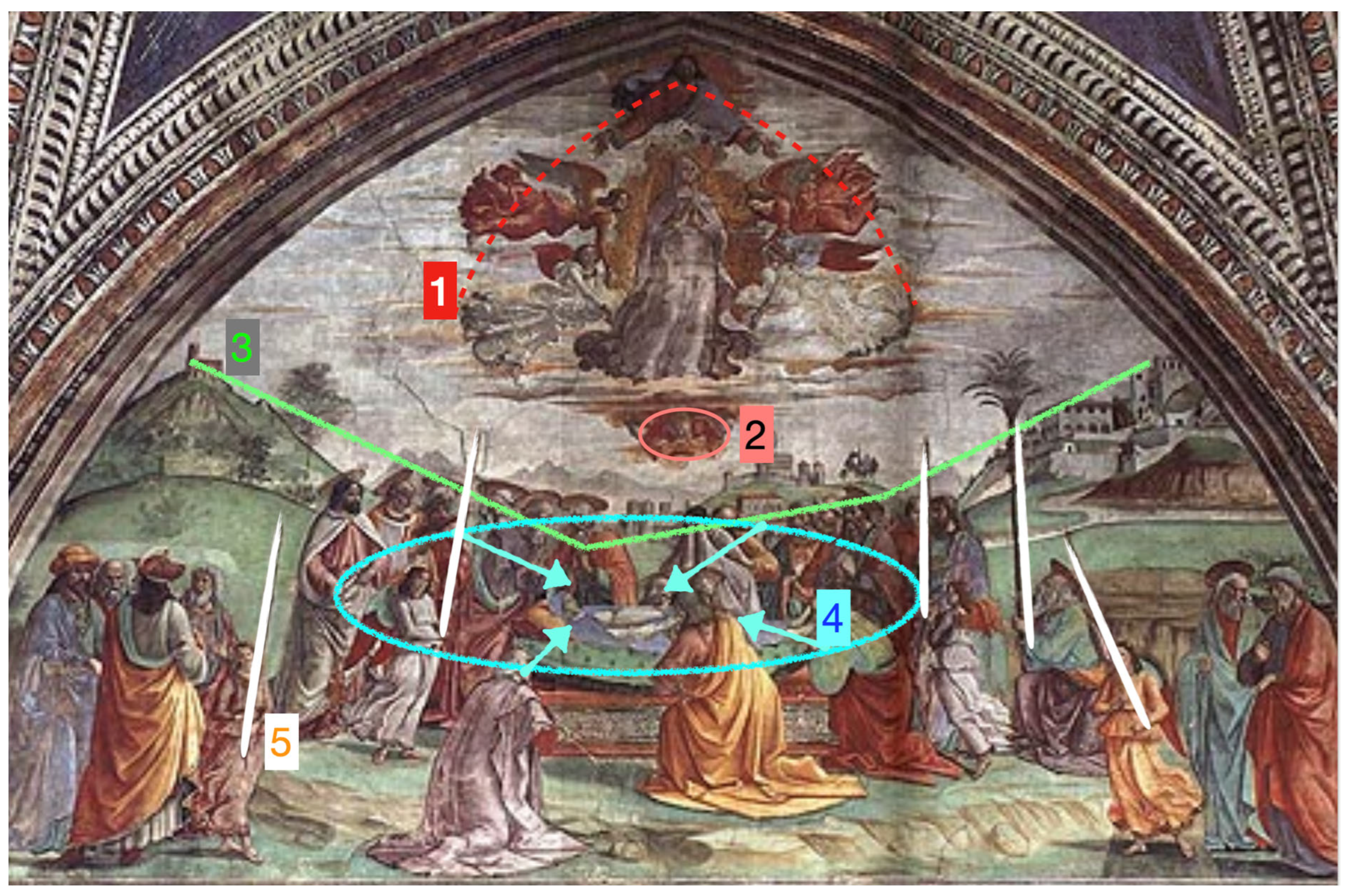
Equally significant is the fact that, in the culminating scene, the Virgin is simultaneously represented in two hierarchical states. The earthly group of figures is organized around the sarcophagus as the culminating element of the architectural structure of the lower register; the gestures, body orientations, and lines of sight of the figures remain enclosed within this composition and do not direct the viewer’s attention toward the heavenly figure. Her hierarchical status is determined not by the internal organization of the upper scene but by the ensemble as a whole. The sequence of architectural verticals established in the lower registers continues into the upper composition and culminates in the figure of the Virgin, while the upward-directed staffs and lances further reinforce this ascending movement. Thus, the hierarchical dominant emerges neither as the most visually intense pictorial mass nor as the immediate target of the surrounding figures’ gazes, but as the culmination of the spatial and compositional route organized by the wall as a whole.
This mode of organization allows monumental painting to develop a complex compositional statement across an entire pictorial cycle without losing its unified hierarchical direction. The triptych presents a comparable compositional problem: while preserving the autonomy of its individual panels, it seeks to unite them into a single compositional world.
Taken together, these examples show that compositional hierarchy is not dependent on a single pictorial formula or spatial arrangement. In Memling’s Last Judgment, hierarchy is constructed as a vertical ascent; in van der Goes, through the separation of the pictorial and hierarchical dominants; in Lippi, within a more complex spatiotemporal field; and in Ghirlandaio, through the sequential unfolding of spatial planes across a monumental ensemble. Across these different configurations, the visual means and spatial organization change, while the underlying hierarchical functions remain recognizable. What is preserved, therefore, is not a fixed vertical scheme but the operation of hierarchical subordination itself—the organization of entry, transition, and culmination within a coherent pictorial system.
Despite the diversity of these solutions, one general principle remains unchanged: composition constitutes a system of relationships in which individual elements do not exist in isolation but acquire their functions through hierarchical subordination. The visual and spatial means may change, while the underlying hierarchical principle persists through different forms of spatial realization.
The number and diversity of the comparative examples are important in this respect. Their subject matter and principal semantic relationships are generally legible and supported by established interpretative traditions. Yet this semantic legibility does not eliminate the compositional question: in each case, a hierarchy of functional relationships can be identified and examined as a distinct analytical problem. The examples therefore make visible a distinction that becomes methodologically crucial in the case of Bosch: understanding what an image represents and reconstructing how its elements are compositionally organized are related, but not identical, analytical tasks.
Since this principle does not correspond either to a fixed iconographic scheme or to an established descriptive category, it must first be demonstrated in more readily identifiable cases. The fifteenth-century works discussed above therefore do not constitute a historical digression; rather, they make it possible to isolate the very operation of compositional hierarchy before examining its most complex and transformed manifestation in the central panel of Hieronymus Bosch’s The Garden of Earthly Delights.
5. Compositional Hierarchy in the Central Panel of The Garden of Earthly Delights
At first sight, the central panel of Bosch’s Garden of Earthly Delights appears to contradict this principle. It displays none of the familiar features of hierarchical organization: its space unfolds horizontally, is densely populated with numerous seemingly equivalent episodes, and offers no obvious compositional culmination. For this reason, scholarship has traditionally focused on questions of symbolism, iconography, narrative structure, or the spatial organization of the panel. Whether the central panel nevertheless preserves compositional hierarchy as an operational principle of its organization has remained largely outside the scope of investigation.
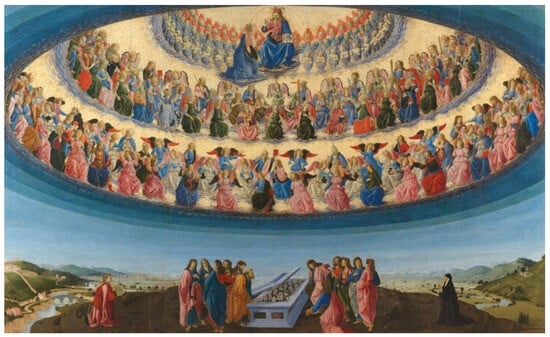
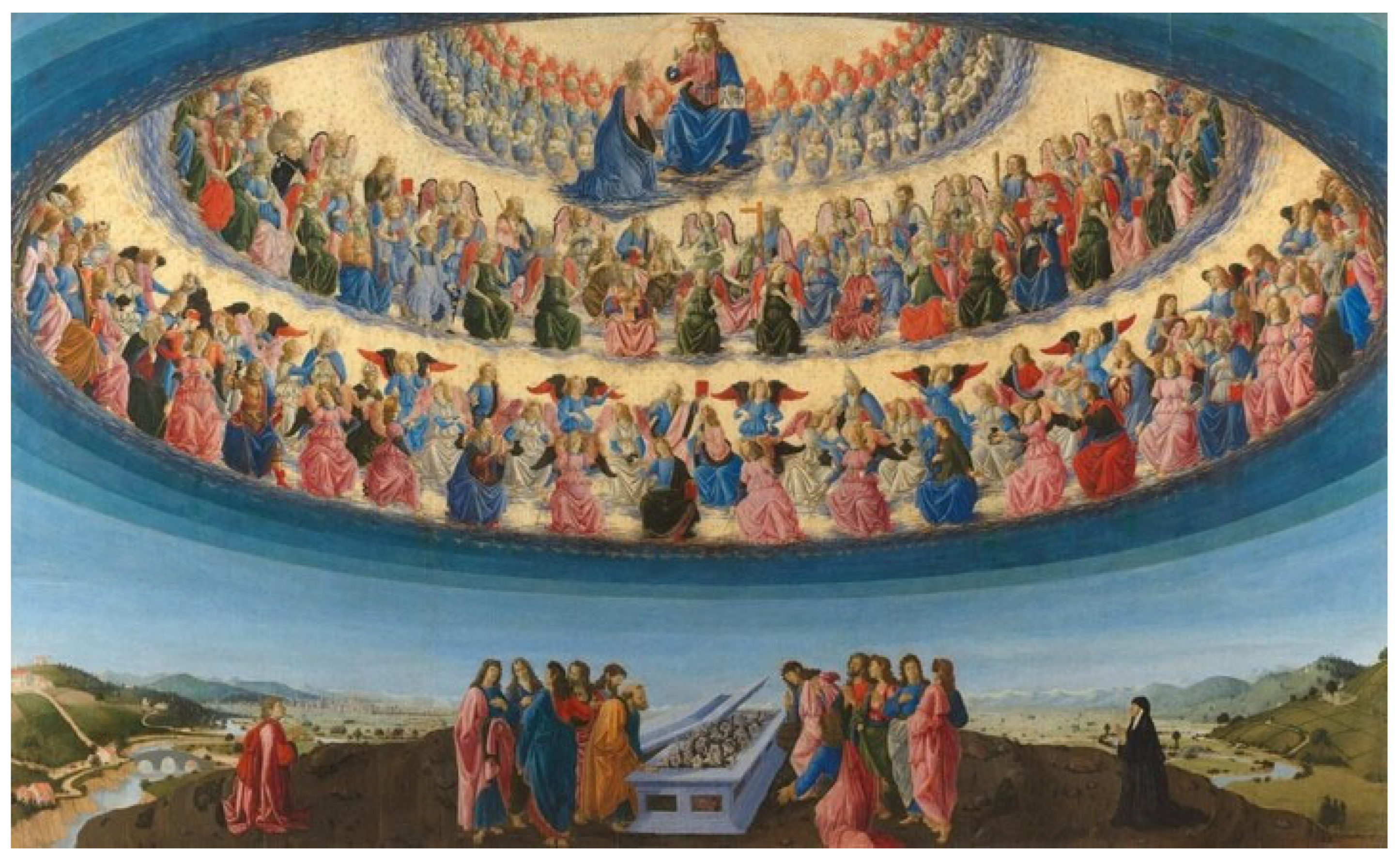
In traditional sacred composition, spatial hierarchy is typically organized along the vertical axis. The lower register is occupied by the earthly group—apostles, donors, or witnesses to the sacred event; above it lies a transitional zone formed by clouds, angelic circles, or orbital movement; finally, the upper register establishes the highest sacred order (Figure 7). These registers differ not only in their spatial position but also in their compositional function. The lower register provides the point of entry into the composition, the transitional zone mediates the movement between the lower and upper registers, and the upper register assumes the role of the hierarchical culmination. It is the distribution of these functions, rather than the vertical orientation itself, that constitutes the enduring organizational principle of fifteenth-century sacred painting.
Figure 7.
Francesco Botticini, The Assumption of the Virgin, 1475–1476. Tempera on panel, 228.6 × 377.2 cm. National Gallery, London. Public domain image via Wikimedia Commons.
The central panel of The Garden of Earthly Delights does not depict a sacred subject in the conventional sense. It contains no manifest figure of Christ, the Virgin, a heavenly throne, or a defining event around which an altarpiece composition would traditionally be organized. Yet the absence of such a subject does not eliminate the compositional problem. On the contrary, Bosch is confronted with the task of organizing an exceptionally complex, densely populated, and polycentric pictorial space into a coherent whole.
For this reason, the central panel draws upon the same operational scheme that had been developed in fifteenth-century sacred triptychs and large multi-figure compositions: the distribution of spatial functions among registers, transitional zones, and dominant nodes. Because the central panel lacks an explicit sacred center, however, this scheme cannot be reproduced directly. Bosch preserves not the iconography of vertical hierarchy but its compositional principle: the pictorial space must still possess a foundation, a transitional zone, and a point of integration.
Naturally, the coherence of the panel is achieved through the combined action of all pictorial means: color, rhythm, scale, spatial depth, the orientation of figures, and other compositional devices. Yet these means do not in themselves explain how the composition is organized. The same pictorial means can perform different functions depending on their relationships with other elements: they can establish a point of entry, mediate a transition, or contribute to a hierarchical culmination. The following analysis therefore seeks not to describe individual compositional devices, but to reconstruct the system of relationships within which they acquire these functions.
To reconstruct this spatial hierarchy, it is first necessary to identify its principal structural functions. The comparative analysis above allows at least three recurrent functions within hierarchical organization to be identified: an element that introduces the viewer into the pictorial system; a mechanism that ensures the sequential transition between its registers; and a culminating node with respect to which the relationships among the remaining elements are organized. These functions may be realized through different pictorial means and embodied in different visual elements; their recurrence in the comparative examples provides the functional framework against which the organization of Bosch’s central panel can be examined.
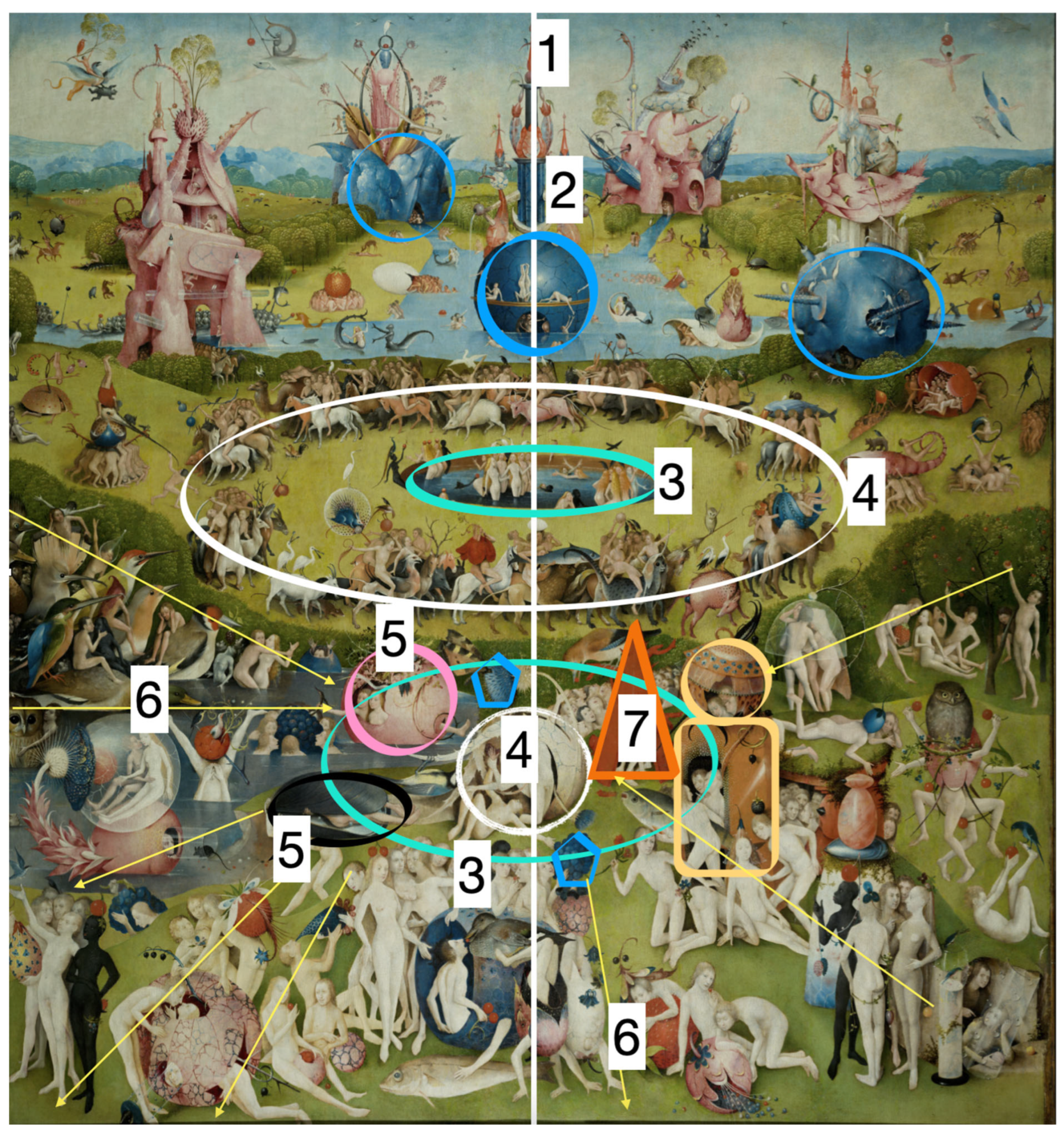
Thus, the organization of the panel (Figure 8) begins at the distant horizon, where the large tower-like forms are situated. Despite their secondary narrative role, they perform the first structural function: they interrupt the horizon line, establish the initial spatial register, and provide the point of entry into the image. Because the horizon constitutes the viewer’s primary frame of spatial orientation, the architectural masses rising above it establish the initial focus from which the composition unfolds downward. From them begins the sequential downward unfolding of the composition. The morphology of the central tower reinforces this movement: its tall spire establishes the direction of the gaze, while the larger spherical mass immediately below becomes its first stable point of fixation. From there, the gaze descends along the structure and, guided by the small blue pool at the center of the circular procession, enters the depth of the image.
This function is determined not only by the position of the towers on the horizon but also by differences in their morphology. While all three structures organize a downward movement of the gaze, the central tower occupies the principal spatial axis of the composition. It therefore concentrates the directional forces of the horizon zone and becomes the natural point of entry into the viewer’s path.
The function of the upper tower-like masses can be clarified by means of a simple heuristic procedure: the mental or visual removal of these elements from the composition. Such removal does not disrupt the image at the level of individual scenes, figures, or chromatic relationships. It immediately, however, disrupts the spatial reading of the panel. The horizon becomes an almost neutral horizontal band, the initial spatial register from which the viewer’s gaze begins disappears, and the circular procession comes to be perceived as the first major organizing element, deprived of the spatial structure that previously guided the viewer toward it.
In other words, removing the tower-like masses demonstrates not their symbolic significance but their structural necessity. They are not the dominant of the panel; rather, they perform an initiating function: they establish the initial point of spatial orientation, interrupt the distant horizon, and prepare the transition to the next level of organization. Without them, the descending sequence—horizon, circular procession, lower radial node—loses its first element and therefore can no longer function as a complete spatial hierarchy.
The direction of the gaze established by the central tower is not confined to the distant register. Continuing the trajectory initiated by its spire, the eye passes successively through a series of major spatial nodes aligned along the principal axis of the composition. Below the central tower lie the small blue pool at the center of the circular procession, the moving white sphere, and the blue basin containing a human figure and a duck. These elements not only occupy comparable axial positions but also form a sequence of stable visual landmarks that sustain the continuous movement of the gaze from the distant horizon toward the foreground. In this way, the local directional structure of the upper register extends into the principal supporting axis of the composition.
It is important to note that, unlike traditional composition, in which the hierarchical sequence unfolds within the picture plane—most often from bottom to top or from left to right—Bosch organizes it along the axis of spatial depth. Visually, this axis is perceived as descending. Structurally, however, its principal nodes are distributed across successive spatial planes rather than arranged one above another. Hierarchy therefore develops not from top to bottom, but from the depth of the image toward the viewer. We shall return to this fundamental distinction below.
Figure 8.
Functional organization of the central panel. The viewer’s perceptual route begins along the principal compositional axis (1), established by the central tower rising from the blue sphere, and develops through a sequence of interconnected compositional operators. The vertical morphology of the tower forms a directional structure (2) that guides the gaze downward toward its contrasting base, after which the movement continues through a system of sequentially connected compositional nodes. Static compositional centers (3) are indicated in blue, and dynamic orbital structures (4) in white; the upper and lower orbits are organized around their respective compositional centers. Colored contours within the lower orbit correspond to the principal compositional operators (5) and follow the geometry of the depicted forms rather than introducing an external analytical scheme. Yellow arrows (6) indicate the radial orientation of the elements relative to the lower compositional center. The orange tree (7) is identified as the principal compositional accent marking the center of the lower radial structure. Public-domain image, Wikimedia Commons; analytical overlay by the author.
Identifying the origin of the spatial hierarchy and reconstructing its principal structural axis do not, by themselves, demonstrate the validity of the proposed model. It remains necessary to determine whether this axis is confirmed by the subsequent organization of the image. If the reconstruction is correct, independent structural evidence should emerge at the presumed endpoint of the axis, confirming the exceptional status of this region within the composition. The next stage of the analysis therefore consists not in identifying the most visually conspicuous object, but in examining the system of compositional accents that develops within the lower register of the panel.
The reconstructed axis requires further verification. If it genuinely organizes the composition, there should be no structural discontinuity between the distant horizon and the lower register, but rather a continuous spatial transition. This function is performed by the circular procession. Rather than constituting an independent hierarchical structure, it transfers the organization of the distant register to the next spatial level.
The movement initiated by the upper architectural masses does not dissipate here but is temporarily transformed into a compact orbital structure. By closing this local movement, Bosch establishes the inner pool as a stable center around which the surrounding figures rotate. The result is the first orbital coupling: a stable center and a moving periphery. The circular procession thus becomes not an independent destination of the visual route but an intermediate node that preserves the continuity of the spatial organization.
Below the circular procession, along the same spatial axis, a second orbital structure emerges. Unlike the procession, it is formed not by the movement of figures but by a system of large static forms arranged around a central area. The black shell, the pink fruit, the orange tree, the brown architectural structure, and two saturated blue accents together form a stable ring-like configuration. The organization of the lower register is governed by this configuration: the positions of the figures, the directions of their movement, and their gestures are oriented radially toward it and away from it.
At the center of this orbital structure lies the region containing the white sphere. It differs fundamentally from the surrounding forms: whereas they remain static, the sphere is perceived as the only moving form within the entire central panel. The lower register thus presents an unusual configuration—a static orbit of large masses surrounding a moving center. This peculiarity does not require immediate symbolic interpretation. For the present analysis, what matters is that this region is where the principal structural axis of the panel, the orbital organization of the lower register, and the radial orientation of the surrounding figures converge. The lower orbital structure therefore becomes the region of hierarchical culmination, with the white sphere at its center—not because its meaning is assumed in advance, but because the entire structure of the image is oriented toward it.
A compositional hierarchy cannot exist as an unfinished sequence. If attention is transferred successively from one register to the next, the system must contain a region in relation to which this movement acquires its meaning and reaches completion. The movement of attention therefore neither breaks off nor dissipates but achieves structural completion.
The validity of the reconstruction can be further tested through the system of local compositional accents. If the identified region indeed constitutes the hierarchical dominant of the panel, the area surrounding it should receive additional compositional emphasis independently of the spatial organization already reconstructed.
The most conspicuous of these accents is the bright orange tree. It is the most saturated chromatic accent not only of the central panel but probably of the triptych as a whole. Its introduction substantially complicates the composition: such an intense chromatic focus requires numerous compensatory accents distributed across the panel. By itself, however, the tree does not possess the characteristics of a compositional dominant. It neither concludes the movement nor organizes the spatial structure.
Its visual prominence is determined not only by its color but also by its silhouette. Among the predominantly rounded forms of the lower register, the tree forms the only large triangular contour, making it the most readily recognizable figure within this region. Visually, the tree resembles a directional arrow. Yet, by itself, it does not point decisively toward any particular element. Its apex reaches into the region of the circular procession without establishing an independent direction of movement. The chromatic intensity of the tree is combined with the extreme simplicity of its geometric silhouette. The coincidence of chromatic and morphological emphasis allows it to be recognized more rapidly than most surrounding forms.
A jay carrying a red berry is perched on one of the branches, leaning over the white sphere. This observation alone does not justify the conclusion that the bird intentionally indicates this element. It does, however, reveal a characteristic feature of the composition: the panel’s strongest local accent is associated precisely with the region previously identified as its hierarchical dominant.
The tree therefore does not assume the function of the compositional dominant but marks the region in which it is located. It enhances the visual salience of the center of the lower orbital structure without replacing the hierarchical dominant itself. A comparable role for a local accent has already been observed in the works discussed above, where compositionally active yet semantically autonomous elements accompanied the region of the hierarchical dominant without coinciding with it.
The reconstructed structure therefore requires not only local description but also comparison with the general principles of compositional hierarchy discussed above. The question is not whether Bosch preserves the traditional vertical scheme in its original form. It is evident that the central panel is not organized as an ascending movement from the lower earthly register toward an upper semantic culmination. The question must instead be reformulated: does the hierarchical operation itself remain intact when the spatial coordinate of its realization changes?
It is precisely here that the principal transformation becomes apparent. In Bosch, hierarchy neither disappears nor is replaced by a simple multiplicity of equivalent episodes. Instead, it is transferred into the depth of the image. What normally functions as the foundation of the composition in a vertical hierarchical scheme is displaced to the distant background: the upper architectural masses no longer conclude the movement but initiate it. The transitional zone likewise changes both its position and its form. Instead of occupying an intermediate vertical register, it takes the form of the circular procession—that is, a ring-shaped movement situated on the middle spatial plane. Finally, the function of hierarchical completion is transferred to the foreground, where the region containing the white sphere becomes the point around which the radial organization of the lower register is structured.
This transformation becomes intelligible when considered from the perspective of the continuity of the compositional tradition. An artist formed within the culture of sacred spatial organization continues to work within its categories even when radically transforming the very mode of representation. This does not imply the mechanical reproduction of a familiar scheme. What is preserved is neither the iconography nor a ready-made compositional formula, but a set of operational principles for organizing space and directing the viewer’s attention. If a fifteenth-century artist radically transforms the subject, the iconography, or the semantic program of a work, this alone does not imply abandoning the fundamental principles of image organization. Bosch therefore preserves not the traditional compositional scheme itself, but the operational logic through which he organizes space and directs the viewer’s attention.
He transforms not the principle of compositional hierarchy itself, but the mode of its spatial operation. Hierarchy no longer unfolds along the vertical axis, yet it preserves the same sequence of functions: entry, transition, and completion. The difference is that these functions are distributed not between the upper and lower parts of the image, but across successive planes of depth. The movement of the gaze therefore acquires a different character: rather than ascending toward a distant culmination, it advances toward the viewer, passing from the far horizon through the middle register to the compositional node in the foreground.
In this sense, depth in the central panel is not a neutral spatial container. It assumes the operational role that the vertical axis may perform in other compositions. Bosch does not merely place multiple episodes within a deep pictorial space; he uses depth as a means of hierarchical subordination. The spatial planes become not only zones of the image, but successive stages of compositional action.
Returning to the example of the Christmas tree introduced at the beginning of the article, in Bosch it no longer stands but lies: its base is on the horizon line, while its top points toward the viewer. Such a mental rotation makes it possible to see the principle according to which the compositional hierarchy of the central panel is organized. What changes is not the principle of organization, but the spatial axis along which it is realized.
It is precisely for this reason that the unusual character of the central panel lies not in the absence of hierarchy, but of in the change its spatial coordinate. In most of the works discussed above, transformations take place within an already established vertical or planar organization: the artist may shift the dominant, separate the pictorial and hierarchical centers, redistribute functions between registers, or complicate the transitions between them. In Bosch, however, the spatial mode of the hierarchical operation itself changes. The vertical sequence of “foundation–transition–dominant” is preserved as a functional model, but is realized along the depth of the image. Consequently, the former ascent is transformed into an approach toward the viewer, and the compositional unity of the panel arises not despite its spatial fragmentation, but because that fragmentation is subordinated to a hierarchy of depth.
6. Conclusions
The analysis presented here demonstrates that the central panel of The Garden of Earthly Delights is not a composition devoid of hierarchy. Its originality lies not in the rejection of compositional organization, but in a radical transformation of the way that organization is constructed.
The fifteenth-century works examined in this study show that artists consistently experimented with different ways of constructing compositional hierarchy. Its spatial organization, the position of the dominant, the relationship between the pictorial and hierarchical dominants, and the means by which the image was unified spatially and temporally all underwent transformation. Only the principle of the functional subordination of compositional elements remained unchanged.
Bosch combines several such transformations simultaneously. While saturating the composition with autonomous figures and local episodes to an unprecedented degree, he preserves its compositional unity by transferring hierarchical organization from the picture plane into spatial depth. Depth thus becomes not only a means of constructing space, but also the principal bearer of compositional hierarchy.
This defines not only the distinctive character of the central panel of The Garden of Earthly Delights, but also its place in the development of compositional thinking at the turn of the fifteenth and sixteenth centuries. The innovative transformation of compositional organization achieved by Bosch created the conditions for the further experiments of the sixteenth century. In particular, the radical separation of the pictorial and hierarchical dominants that characterizes a number of works by Pieter Bruegel the Elder can be understood as a further development of the compositional problem already formulated by Bosch: the preservation of compositional unity under conditions of an extremely complex polycentric image.
The analysis presented here demonstrates that compositional hierarchy can be reconstructed without deriving it from iconographic interpretation. Because it focuses on the functional relationships between compositional elements rather than on their symbolic meaning, the proposed method offers not only an interpretative perspective but also a means of testing compositional hypotheses through controlled transformations of the image. It may therefore be applied beyond Bosch to other pictorial traditions in which visual coherence depends on the interaction of compositional elements. Within this broader perspective, the central panel of The Garden of Earthly Delights emerges not as the culmination of an established compositional lineage, but as the threshold from which the next stage of its development becomes possible.
Funding
This research received no external funding.
Institutional Review Board Statement
Not applicable.
Informed Consent Statement
Not applicable.
Data Availability Statement
No new data were created or analyzed in this study. Data sharing is not applicable to this article.
Conflicts of Interest
The author declares no conflict of interest.
References
- Alpers, Svetlana. 1983. The Art of Describing: Dutch Art in the Seventeenth Century. Chicago: University of Chicago Press. [Google Scholar]
- Alpers, Svetlana, and Michael Baxandall. 1994. Tiepolo and the Pictorial Intelligence. New Haven: Yale University Press. [Google Scholar]
- Arnheim, Rudolf. 1974. Art and Visual Perception: A Psychology of the Creative Eye. Berkeley: University of California Press. [Google Scholar]
- Arnheim, Rudolf. 1983. The Power of the Center: A Study of Composition in the Visual Arts. Berkeley: University of California Press. [Google Scholar]
- Baxandall, Michael. 1985. Patterns of Intention: On the Historical Explanation of Pictures. New Haven: Yale University Press. [Google Scholar]
- Belting, Hans. 2002. Hieronymus Bosch: Garden of Earthly Delights. Munich and New York: Prestel. [Google Scholar]
- Carroll, Margaret. 2022. Hieronymus Bosch: Time and Transformation in The Garden of Earthly Delights. New Haven and London: Yale University Press. [Google Scholar]
- Elkins, James. 1998. On Pictures and the Words That Fail Them. Cambridge: Cambridge University Press. [Google Scholar]
- Imdahl, Max. 1980. Giotto: Arenafresken. Ikonographie, Ikonologie, Ikonik. Munich: Wilhelm Fink. [Google Scholar]
- Kandinsky, Wassily. 1979. Point and Line to Plane. Translated by Hilla Rebay. New York: Dover Publications. First published 1926. [Google Scholar]
- Pelikhovska, Aleksandra. 2026. When a Work of Art Ceases to Be a Question: The History of What Became Self-Evident. Zenodo. Available online: https://zenodo.org/records/21107738 (accessed on 11 September 2026).
- Summers, David. 2003. Real Spaces: World Art History and the Rise of Western Modernism. London and New York: Phaidon. [Google Scholar]
Disclaimer/Publisher’s Note: The statements, opinions and data contained in all publications are solely those of the individual author(s) and contributor(s) and not of MDPI and/or the editor(s). MDPI and/or the editor(s) disclaim responsibility for any injury to people or property resulting from any ideas, methods, instructions or products referred to in the content. |
© 2026 by the author. Licensee MDPI, Basel, Switzerland. This article is an open access article distributed under the terms and conditions of the Creative Commons Attribution (CC BY) license.