


Abstract
The study presents the experiences of emerging artists from the Republic of Moldova in the field of comic strips between 2000 and 2025. Comic strip creation has undergone various periods of development, as well as periods of stagnation. The evolution of current technologies, with their implications for the visual arts, alongside contemporary societal imperatives and challenges, is shaping a new attitude amongst young readers towards documentation, information and knowledge. Drawing on current global trends regarding the relevance of publications with sequential graphic content, the aim of this article is to map the new visual discourses of emerging comic strip creators in the Republic of Moldova, documenting their stylistic and thematic contributions, as well as the role of digital technologies in their creative process. The objectives focus on analysing the artistic development, visual language and messages of key figures such as Octavian Curoșu, Cristina Grati, Alex Buretz, Inna Sacali, Călin Enachi, Valentin Enachi and others. The methodology combines case studies with stylistic and semiotic analysis, examining the structure of the comics, their layout and the relationship between text and image. The results reveal significant diversity. Octavian Curoșu combines the sensitivity of traditional techniques with digital media, addressing historical and socio-cultural themes. The artist Alex Buretz uses caricature and the grotesque as tools for civic activism and social criticism. Comic strip artists Cristiana Grati and Inna Sacali explore the world of family life and human relationships, using an expressive digital style and colour palettes that are either evocative or decorative. Graphic designers Călin and Valentin Enachi bring a youthful and adventurous touch to the narrative images, with experimental and original page layouts. All the artists featured make full use of specialised software (Adobe Photoshop, Clip Studio Paint, Procreate and others) and graphics tablets, modernising the creative process. The use of these tools has enabled the emerging artists to emulate traditional techniques, as well as create complex visual effects, optimising work on layers and facilitating publication on online platforms. Thus, through stylistic diversity and digital adaptation, these artists are strengthening the presence of comic strips within the cultural landscape, confirming a vibrant and modern revival of comic art in the Republic of Moldova.
1. Introduction
The evolution of current technologies affecting the visual sphere, as well as the imperatives and societal challenges of today, are driving a new editorial approach in response to readers’ current preferences regarding research, information and knowledge. Currently, consumers of media and visual content rely on information presented in a concise manner, with content that is to the point, easy to grasp and understand, interactive and emotive. Comic strips are precisely the medium that meets these customer expectations.
Current global trends regarding interest in books indicate a rise in the consumption of publications with graphic content; the current market is estimated at $18.3 billion, with a projected growth of 6.6 per cent by 2035, reaching a value of $34.5 billion (Comic Book Market 2026).
The comic strip is one form of visual-narrative expression in which image, text, sequence and time are organised into a unified artistic system. Frequently found in children’s literature, the comic strip has long been associated with it. Its impact on visual perception at an emotional and interactive level has led to the rapid expansion of the scope of comics into the legitimate realm of aesthetic, historical and cultural research. Their diversity, impact and appeal have demonstrated that comic strips can be analysed not only from the perspective of narrative content but also as complex systems of visual organisation, in which each image acquires meaning through its relationship with the other images, with the page layout and with the verbal elements. Will Eisner established the concept of sequential art, whilst the research of Scott McCloud, Thierry Groensteen, Neil Cohn, Charles Hatfield and other theorists has contributed to the development of a specific terminology and methodology for analysing this medium (Eisner 1990; McCloud 1993; Groensteen et al. 2007).
From this perspective, the comic strip should not be reduced to the multitude of drawings and texts that make it up. Its meaning derives from the sequence and juxtaposition of images, from the spaces between panels, from the relationship between planes, dimensions and perspectives, and from the visual rhythm, as well as from the way in which the reader mentally fills in what is not explicitly depicted. Research into the definition of the comic emphasises precisely the systemic nature of this language, in which the isolated image represents only one component of a broader structure.
From a theoretical perspective, the term comic strip derives lexically from the French bande dessinée, which has been in use in the French language since 1960, characterising this distinct form of visual narrative (Meskin and Cook 2012). In France, the comic strip has acquired the status of the “ninth art” (Perret 2019; Meskin 2007) and has established its substantial role as a “comic or realistic story told through images”, comprising a sequence of images arranged in sequence and accompanied by text (McCloud 2006; McCloud 2019).
The Cambridge Dictionary defines a comic strip as “a short series of humorous drawings with a small amount of text, often published in a newspaper” (Comic Strip 2025). The Encyclopédie de la bande dessinée defines it as “a narrative and visual art form which, through a sequence of drawings generally accompanied by text, recounts an action whose chronological progression is achieved by moving from one image to the next without interrupting the continuity of the story” (Couperie et al. 1974). In French, we find much more concise explanations regarding the definition of the comic strip: “a comic or realistic story told in pictures” or “a horizontal sequence of several images”.
The Explanatory Dictionary of the Romanian Language also includes the neuter noun comics, which comes from English and refers to “stories presented in the form of serialised drawings (published in magazines, booklets, etc.), accompanied by short texts” (Coteanu et al. 1998).
In his work Popular Cultures, the theorist David Rowe describes the comic strip as “the ensemble of forms, meanings and pleasurable practices whose constituents are neither static nor unambiguous, and which cannot be isolated from the social processes and structures into which they are embedded” (Rowe 1995, p. 3; cited in Teampău 2012, p. 145). Within this conceptual and definitional framework, the relevance and functionality of comic strips can be understood more deeply by considering the diversity of the cultural contexts in which they have developed and established themselves.
In the Republic of Moldova, the development of comic strips has followed a different path to that of the major Western schools. The field was, for a long time, subordinate to book design, children’s illustration and periodicals, and its status as an autonomous art form remained insufficiently established (Teampău 2012, p. 272). Previous research carried out by the authors demonstrates the existence of a tradition that can be traced back to the mid-20th century, particularly through the work of graphic artists who published in children’s magazines and satirical publications. Between 1944 and 1991, the comic strip was integrated into the educational, informative and ideological mechanisms of periodicals, whilst after the 1990s and, in particular, after the year 2000, it began to take on more diverse forms of expression.
In this context, the period 2000–2025 represents a distinct phase of revitalisation for comic strips in the Republic of Moldova. The change does not consist solely in an increase in the number of creators or in the use of digital technologies, but in a complex transformation of the status, language and functions of this field. Comic strips are gradually shifting from being a product intended primarily for children to an artistic medium capable of addressing historical, social, political, environmental, family and identity-related themes. The evolution of comic strips in the Republic of Moldova is attributable to several generations of authors. This study aims to highlight the comic strip creation of a generation of emerging artists, including Octavian Curoșu, Alex Buretz, Cristiana Grati, Inna Sacali, Călin Enachi and Valentin Enachi. The main areas of research were: identifying stylistic and compositional changes; analysing the thematic diversity and social functions of comics; assessing the transition from traditional techniques to digital and hybrid processes; and situating comic strip creation from the Republic of Moldova within the context of international comic strip traditions.
2. Materials and Methods
This study is based on comic strips created by emerging artists from the Republic of Moldova: Octavian Curoşu, Alex Biretz, Cristiana Grati, Inna Sacali, Călin and Valentin Enachi. Works and editorial contexts by other creators were also taken into account where they helped to explain the phenomenon.
The methodology applied comprises the following methods: a historical artistic approach to reconstruct the stages of development of the comic strip; case study analysis of creators and representative works; stylistic analysis, to identify the distinctive features of line, form, colour, composition and characterisation; semiotic analysis, to examine the relationship between visual signs and social, cultural or political messages; narratological analysis, to examine the structure of the plot, the sequence of panels, the rhythm and the relationship between text and image; comparative analysis, to situate Moldovan comic art within international comic traditions; and technological analysis, to identify the changes brought about by digitisation in the creative process and the visual outcome.
The analysis aims not only to identify the tools used but also to explore the relationship between tool, artistic technique, visual result, and narrative effect.
3. The Comic Strip—An Autonomous Form of Artistic Expression
In this study, the comic strip is approached as an autonomous form of artistic expression, rather than merely as a technique for illustrating a literary text. This approach is important because one of the traditional limitations in the reception of comics has been their almost exclusive association with children’s literature or popular entertainment. The concept of sequential art, formulated by Eisner (1990) (Comics and Séquentiel Art), draws attention to the way in which successive images construct the narrative. McCloud (1993, Understanding Comics) expands on this perspective by defining comics as a sequence of pictorial and other images intentionally juxtaposed in succession, with the aim of conveying information or producing an aesthetic response. At the same time, Groensteen et al. (2007, The System of Comics) propose understanding the comic as a system in which images are interdependent and the relationships between panels go beyond a simple linear sequence.
In this regard, the artistic value of comics is not determined solely by the individual complexity of an image but by its ability to function within a relational structure. Research into sequentiality emphasises that the individual image “becomes” a narrative through its relationship with the images surrounding it. Consequently, the analysis of Moldovan comics goes beyond a mere description of the subject matter and examines the visual grammar through which it is constructed.
An important aspect is the relationship between comics and other arts. Comics borrow techniques from drawing, painting, printmaking, photography, cinema, editorial design and, in the contemporary era, animation and digital art. This interdisciplinarity does not diminish its autonomy; rather, it constitutes one of its fundamental characteristics, making it even more accessible, visually engaging, effective and sought after by audiences. Consequently, the comic strip can be understood as a syncretic medium in which elements borrowed from other arts are reorganised into its own system of meaning-making.
4. Comic Strips in the Republic of Moldova: Historical and Cultural Aspects
The history of comic strips in the Republic of Moldova is analysed in relation to the history of book illustration, children’s publishing and visual culture in the Soviet and post-Soviet space. From a diachronic perspective, it can be observed that in the early 1950s, the ideological orientation of creative works, including comics, during the period in question was based on the method of socialist realism, which aimed to highlight the close link between art and the masses, and the artistic reflection of objective reality in works of art (Toma 2018; Rocaciuc 2011; Archive of Social and Political Organizations of the Republic of Moldova n.d.a). Thus, sequential art, through newspapers and magazines, which experienced continuous quantitative growth during the period in question, served as a vehicle for promoting these guidelines (Archive of Social and Political Organizations of the Republic of Moldova n.d.a, n.d.b, n.d.c). However, the artistic field—the comic strip—flourished in the 1960s and 1970s, encouraged by the presence of comic strips created by Romanian artists that were published in children’s magazines in the Moldovan SSR1 (Kravcenko 2018) and by the graphic works in satirical and humour magazines from the USSR (Krokodil), East Germany (Eulenspiegel), the Romanian Socialist Republic (Urzica) and elsewhere.
In national art from the 1960s and 1970s, we can observe Western trends specific to newspaper comic strips, which tended to be short and episodic narratives (Manița 2024; Niţă and Ciubotariu 2010). Thus, in the Moldovan SSR, we see the same artistic conventions governing the depiction of characters and the same structural arrangement of panels within the page as those found in several series of children’s comic strips created and published for educational purposes, just as in the Romanian Socialist Republic. It was within this artistic context, in the late 1950s and early 1960s, that the children’s comic strip series entitled Trică and Ciuăică, created by the artist Alexei Grabco, came into being. The characters in the scenes are depicted in various realistic poses, always in the thick of the action, whilst the narrative thread of the story is concise, comprehensive and explicit, ensuring the message is clearly understood. Alongside realistic approaches to image-making, the artist Alexei Grabco makes extensive use of artistic techniques of an associative and symbolic nature. Thus, as in the series of Romanian comic strips, the cultural and educational aim is achieved: to ensure that children’s smiles and laughter express not only their perception of “amusing” humour but also the aesthetic joy of learning—an emotional state that a child experiences through the nature of the image and conveys to the social group to which they belong. In this context, the magazines Pițigoiul, Cravata Roșie, Luminița and Urzica are particularly significant, as their pages featured comic strips such as Miahela and Azorel by Corneliu Barasch (pseudonym Nell Cobar), Titilică, băiat fără frică (Titilică, the Fearless Boy) by Mircea Possa (pseudonym Pos) and others (Epure 2023; Moscu and Oancea 2023).
Among the artists who contributed significantly to the development of comics in the Moldavian Soviet Socialist Republic (Moldavian SSR) between the 1960s and 1990s, the prolific and dynamic work of graphic artist Alexei Grabco occupies a prominent place (e.g., Scânteia Leninistă, No. 2, February 1957; No. 7, July 1957; No. 3, March 1961; Steluța). Other notable contributors include Valeriu Curtu (Alunelul, No. 12, 1990), Margareta Chițcatîi, Iurie Simac (Alunelul, No. 7, 1990), Lică Sainciuc (Alunelul, Nos. 11–12, 1990), Aurel Guțu, Ana Evtușenco, and several others. This stage of development was characterised by the use of traditional graphic techniques, including watercolour, ink, coloured pencils, and graphite, as well as by the regular publication of comics in children’s magazines such as Scânteia Leninistă, Steluța, and Alunelul (Adascalița 2024a). These comics functioned primarily as visual instruments intended to fulfil socio-cultural roles, combining information, education, and entertainment through humour. Humour was skilfully employed as an educational device that shaped children’s perceptions of the surrounding world and encouraged positive attitudes toward work, education, sports, animal care, and mutual assistance.
During the 1970s and 1980s, artistic practice in the Moldavian SSR underwent a gradual transition from the aesthetic principles of Socialist Realism to greater stylistic pluralism. Artistic production increasingly shifted from ideologically engaged art to new aesthetic explorations, allowing artists to experiment with broader forms of visual expression (Bagrin 2021; Nosatîi 2024).
Nevertheless, from the mid-1970s to the late 1980s, comics attracted comparatively less attention from graphic artists. This decline is reflected in the decreasing presence of comics in periodical publications and their more limited use as an artistic solution in illustrated children’s books (Kravcenko 2020).
A renewed interest in comics became evident in the early 1990s. Both artistic production and public interest increased substantially, with comics appearing regularly in magazines such as Alunelul, a-Mic, and Florile Dalbe. The published works included adaptations of children’s stories, educational narratives supporting school subjects such as mathematics and history, and everyday stories featuring children and domestic animals designed primarily for entertainment.
A significant transformation can be observed in the work of artists who emerged after 2000. Their comics increasingly emphasise civic education, the demystification of socio-political and cultural issues, and the communication of personal experiences. Contemporary Moldovan artists employ comics as a visual medium that encourages critical thinking while addressing current topics such as environmental issues, family and social well-being, local and international political developments, and historical memory. Consequently, the comics scene in the Republic of Moldova has experienced a notable revitalisation, reflected in the diversification of themes, functions, and artistic techniques.
5. Paradigm Shifts
The comic strips created by the emerging artists included in the study demonstrate a stylistic diversity ranging from realistic drawing and editorial illustration to caricature, the grotesque, stylisation, graphic expressionism and hybrid digital forms.
5.1. Octavian Curoșu—Between the Tradition of Illustration and the Language of Digital Art
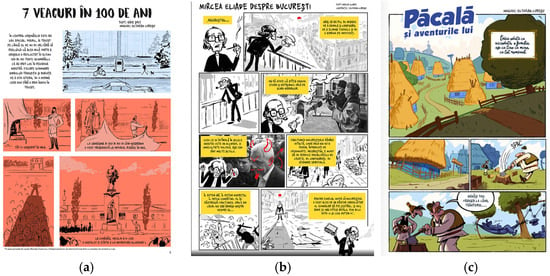
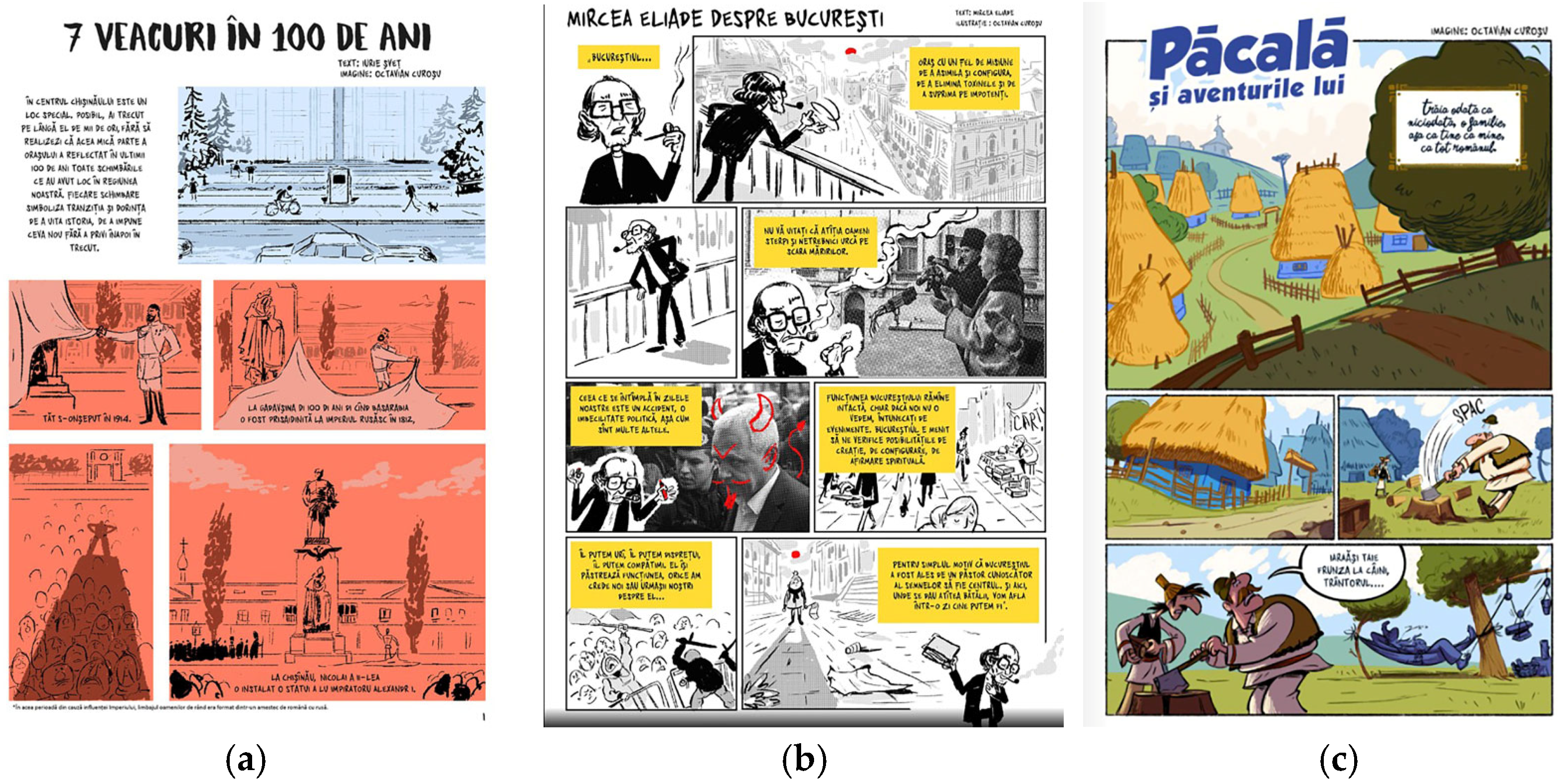
Octavian Curoșu’s work reveals that, stylistically, his comic strips blend the sensibility of book illustrations created using traditional techniques (pencil drawing and watercolour) with the integration of modern graphic elements, demonstrating the ability to express himself artistically in both static and dynamic depictions of everyday life. His works demonstrate a focus on socio-cultural themes, such as cultural heritage, history, civic engagement, interpersonal relationships, environmental protection and intergenerational issues. In these comics, he often adopts the format of long-form stories, designed to span a greater number of pages. All of this is presented in a contemporary artistic style that resonates with the general public. In terms of target audience, his work appeals both to older readers, through the historical themes explored, and to young people and children, through inspirational characters, figures drawn from stories and fairy tales, and exciting plotlines and vibrant colours. Thus, in the comic strips from the series 7 Centuries in 100 Years (Figure 1a), Space Tomatoes, From Underground to the Surface. The Story of a Post-Industrial City, Păcală and His Adventures (Figure 1c) and so on, most of the characters were designed in a simple style by the illustrator to encourage the reader to identify with them. Whereas in the comic strips entitled Mircea Eliade on Bucharest (Figure 1b), Dracula in Comics and others, the artist harmoniously integrates realistically drawn characters, and even photographic sequences, to objectify them and emphasise the “difference” from the reader: fiction versus reality; memory versus the present; the symbolic character from the documentary character; and the graphic convention from the photographic reference. Octavian Curoşu often alternates between simplified characters, easily recognisable to the reader, and realistic depictions. The narrative is structured through panels organised according to the classic Franco-Belgian principle, in rectangular shapes of varying sizes (McCloud 1993, 2019). The images within the panels are outlined in some comics, whilst in other cases, the outline is absent, in keeping with the narrative’s ultimate aim. To capture the dynamism and excitement of a scene, the artist’s preference for using graphic effects such as a few lines around an object or a character (as in the comic strip The Savages in America) and action lines that emphasise movement (as in the comic strips Tortures and 7 Centuries in 100 Years) is particularly noteworthy. An analysis of Octavian Curoșu’s work reveals the deliberate use of speech bubbles, intended to supplement and nuance the verbal meanings of the message conveyed by the visual narratives, highlighting the artist’s direct involvement in shaping the expressiveness of the text–image relationship. It is worth noting that the artist uses colour as a significant visual accent that carries multiple connotations: from the nostalgic and organic refinement of watercolour, intended to lend legitimacy to historical and heritage subjects, to the vitality of vibrant colours, used to attract a young audience and subtly delineate the boundaries between fiction and reality. Regarding his working methods, the artist utilises digital media to create comics whilst also retaining elements of traditional techniques (black-and-white drawing, hatching).
Figure 1.
Comics created by the artist Octavian Curoșu (Curoșu 1992): (a) Comic series “7 Centuries in 100 Years”, 2018; (b) Mircea Eliade about Bucharest, 2020; (c) Păcală and His Adventures 2021.
5.2. Alex Buretz—Caricature, the Grotesque and Social Criticism
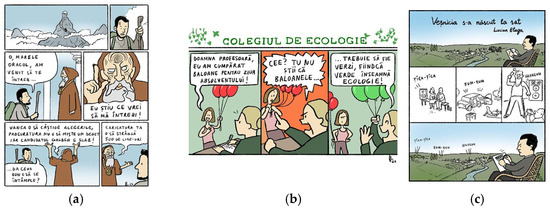
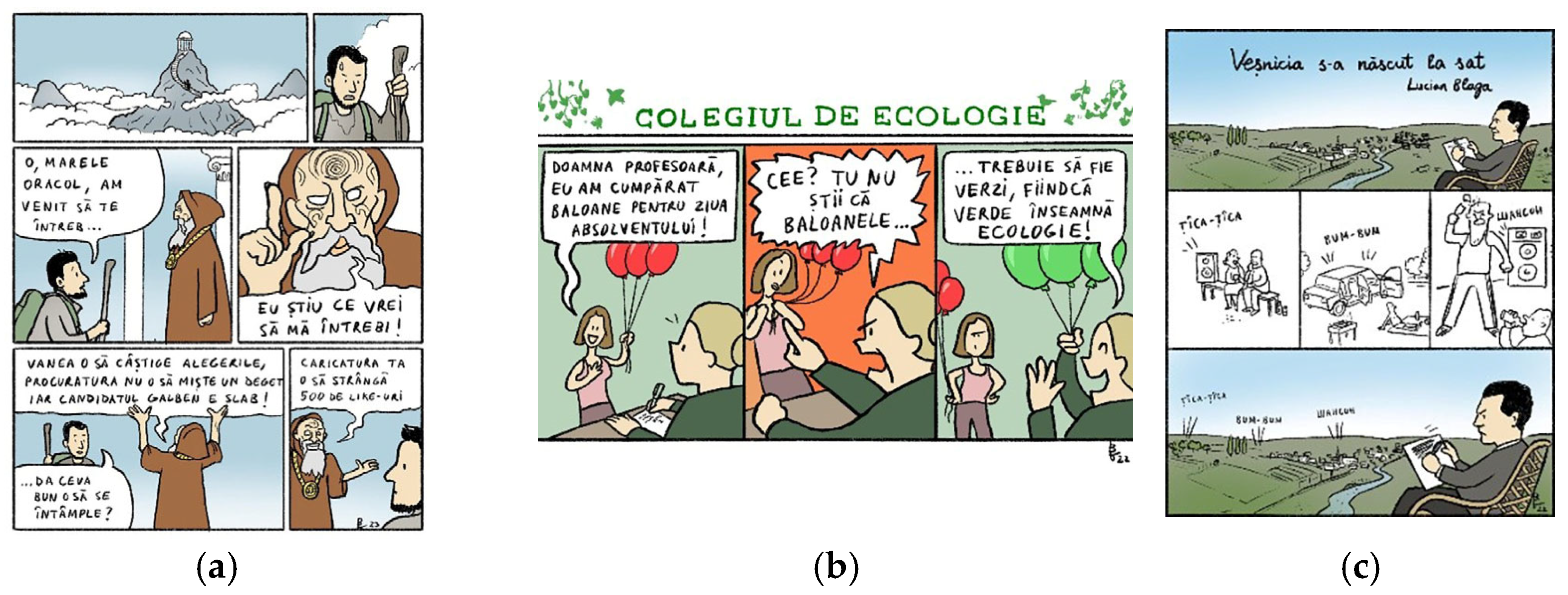
Alex Buretz is an illustrator, graphic designer and caricaturist from the Republic of Moldova, known for the way he combines artistic expression with civic and social activism. The art of graphic artist Alex Buretz is characterised by sarcasm, exaggeration and humour, elements through which he highlights issues such as corruption, social abuses, the absurdities of everyday life, civic education, environmental protection and cultural aspects of society (Figure 2). His vision in the field of comics is based on the belief that storytelling through images, combined with humour, can bring about social change. The cartoonist uses comics as a means of civic education, capable of raising questions and stimulating critical thinking. He often employs characters and situations skilfully drawn from everyday life without resorting to artistic devices of an associative or symbolic nature. The artist Alex Buretz imbues his characters with a sarcastic or ironic air through the characteristics of his line work by incorporating the grotesque and the principle of plastic distortion of form. The caricatured character is reduced to a few dominant features, which allows the reader to quickly identify the archetype being portrayed. This morphological simplification is accompanied by semantic amplification: the more exaggerated the form, the more direct the message becomes. The principle of caricaturing characters is deliberately applied by the artist, with the aim of simplifying the figurative morphology and directing the reader’s attention towards the significant details of the visual message (Adascalița 2024b).
Figure 2.
Comics signed by Alex Buretz (Buretz 1984): (a) The Oracle, 2023; (b) Ecology College, 2022; (c) Eternity Was Born in the Village, 2022.
An analysis of this artist’s work reveals his use of compositions consisting of panels arranged in vertical or horizontal rows, either open or closed, often delineated by outlines. This solution creates a fusion between the verbal and the visual, bringing the message closer to the immediacy of political cartoons. It is evident that, in this regard, the graphic designer experiments with and utilises various types of speech bubbles, adapting them to the action in mass-market comic strips.
A distinctive feature of Alex Buretz’s work is the seamless integration of text directly into the graphic structure, intentionally dispensing with conventional speech bubble outlines. This stylistic choice carries significant analytical weight: it not only softens grotesque visual expressions but also positively influences the reader’s perception of the narrative message. Furthermore, the text is extensively utilised to reinforce the educational, formative, and informative functions rooted in his skilfully rendered images (Figure 2b).
5.3. Cristiana Grati—Family Narratives and Chromatic Expressiveness
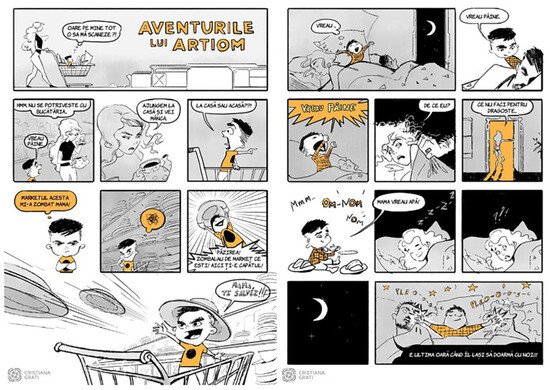
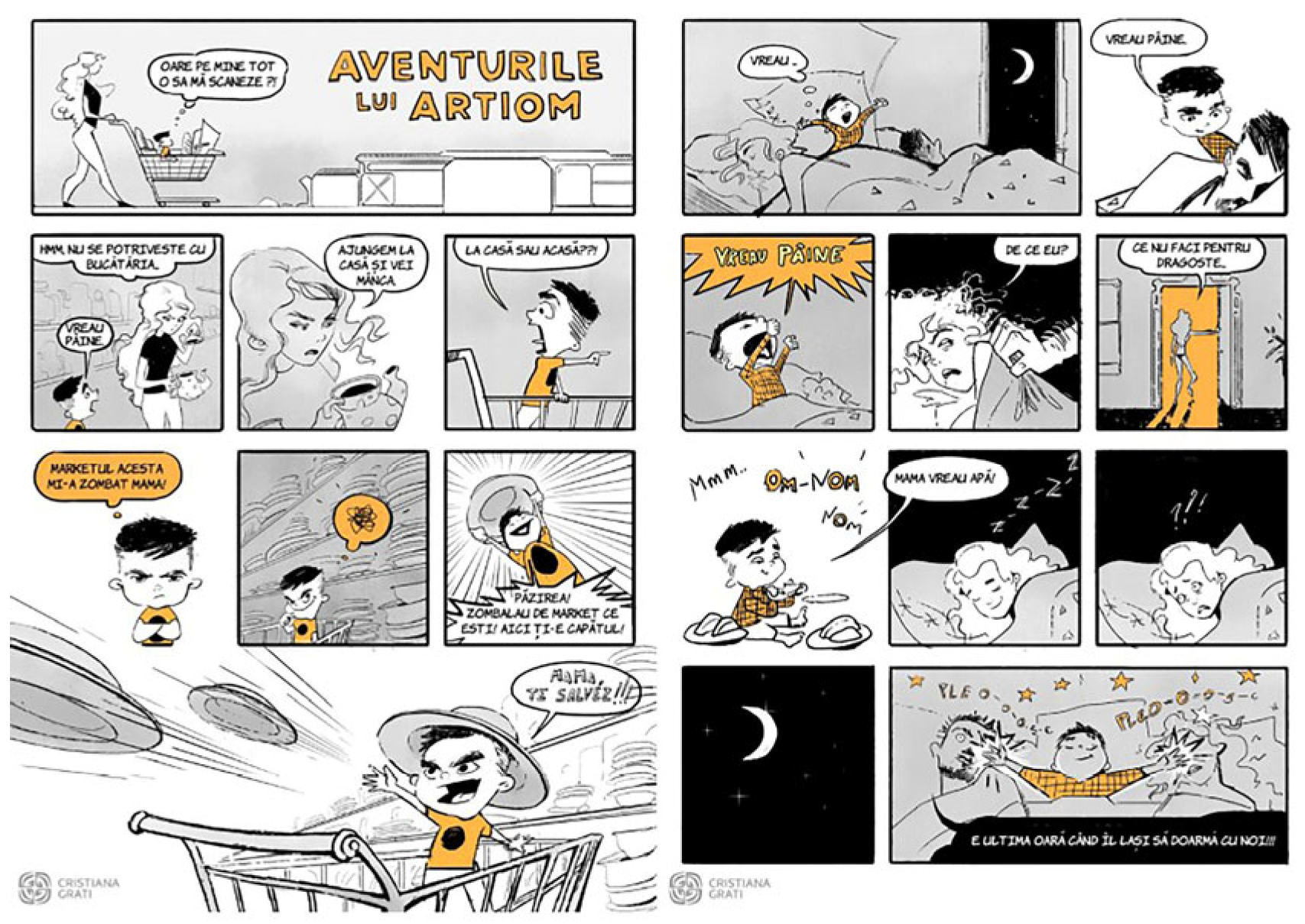
Among the many artists working in the field of comics in the second decade of the 21st century is Cristiana Grati—a concept designer and visual storyteller. Within the context of comic art, Cristiana Grati has created a series of works exploring themes related to family life. Through the use of mixed media—ranging from clear lines and expressive contours to the application of expressive shades of colour—the artist constructs a coherent visual narrative in which graphic effects, sequential structure and the organisation of panels contribute to the articulation of meaning. In the comic strip The Adventures of Artiom (Figure 3), designed to fit within a few pages, a scenario typical of families with young children is presented, intended to stir emotions in the reader. This comic strip is characterised by exaggerated expressions; however, these exaggerations convey the intended message very clearly. The character of the forms and the message of the panels are conveyed through the interplay of light and shadow and chromatic contrasts. The dominant colours—orange and black—are deliberately chosen to suggest the emotional atmosphere, whilst the lines, often dynamic and fluid, amplify the expressiveness of gestures, moods, events and the narrative stakes.
Figure 3.
The Adventures of Artiom by Cristiana Grati (Grati 1992).
At the same time, the four-panel structural approach—featuring multiple large rectangular panels and smaller square ones—helps to distinguish between space and time, offering the reader clues as to the duration of the action. Of particular interest is the artist’s interweaving of the presentation of narrative events throughout the comic strip, using both closed time frames delineated by outlines and open ones, without outline boundaries, at the end of the page, which heightens the sense of endless action in the lingering scenes. Through the sequential structuring of the panels, together with the distribution of perspectives, the white spaces between panels, and the pauses created by the integration of outline-less panels into the page layout, Cristiana Grati facilitates a fluid reading experience, directing the reader’s attention to details significant to the dynamics of family relationships. To convey the dynamism of the movements of the main character, Artiom, and the central objects, the artist draws on the American comic strip model, which involves the use of visible motion lines. In the comic strip The Adventures of Artiom, the rhythm of the sequences, the alternation between close-ups and medium shots, and the way the intensity of the narrative action is managed through the inclusion of written onomatopoeia function as visual devices for highlighting significant emotional moments—such as shopping, sleeping at night, and so on. Taken together, the speech bubbles, action bubbles, paratextual elements and the relationship between text and image fulfil both entertaining and informative emotional functions, reinforcing the complex portrayal of family life within the narrative framework. All these elements confirm that illustrator Cristiana Grati’s portrayal of the family theme is not merely a narrative pretext but a component organically embedded in the protagonist’s everyday life.
5.4. Inna Sacali—The Comic Strip as a Space for Everyday Experience
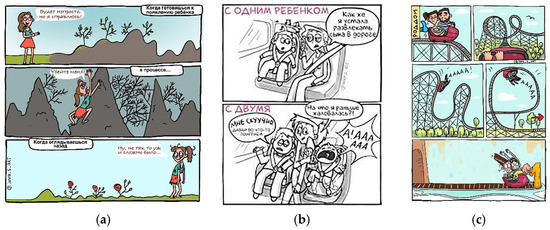
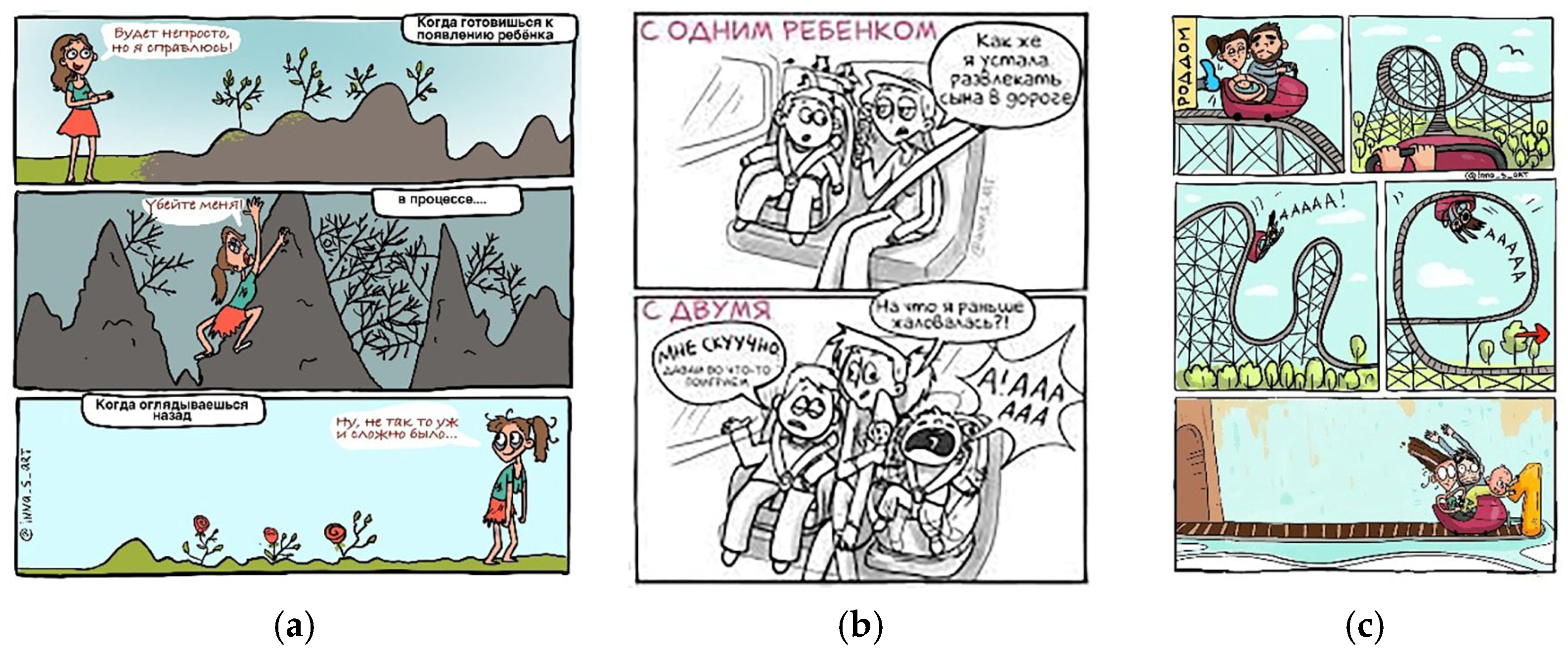
Inna Sacali’s work offers a distinctive perspective on the world of family and interpersonal relationships. Until the early 2020s, when she turned to the art of the comic strip, she worked as an architect and interior designer. Whilst Cristiana Grati’s works display a complex articulation of visual discourse through sequential structures and chromatic and dimensional strategies designed to enhance the emotional dimension, a similar direction—with a pronounced decorative emphasis highlighted by a broad palette of colours and emotions—is evident in the work of Inna Sacali. She constructs her narrative universe not only around family relationships but also around themes concerning interpersonal relationships, the world of mothers and children (Figure 4), the issue of family mental health, intergenerational communication, discrepancies in the interpretation of scientific and technological developments, and other topics.
Figure 4.
Comics by the artist Inna Sacali (Sacali 1990): (a) Preparing for the Birth of the Child; (b) With One Child & With Two Children; (c) Motherhood.
An analysis of Inna Sacali’s work has highlighted the distinctive way in which she employs panoramic, wide-angle or medium-range shots, utilising them both to expand the narrative space and to contextualise the relationships between various characters (husband, wife, children, other people) and the objects surrounding them. She integrates open-frame and closed-frame compositions within a single panel—a technique characteristic of American comics—through which she controls both the focus of the viewer’s gaze and the extent to which the reader can access the depicted space and the depth of the emotions conveyed (Pagani et al. 2023).
The artist often emphasises elements within her visual narrative through the use of close-ups, which lends interactivity and appeal to her work whilst allowing her to alternate between static and dynamic elements within her images. Also noteworthy is the way in which she makes use of a colour palette, often employing multiple expressive colours to create atmospheric variations specific to each scene, emotional contrasts and the unusual situations in which the characters find themselves. Warm colours are used to depict moments of intimacy or intensity, whilst cool or monochrome shades are incorporated into the images to signify conflict, surprise, the dynamism of the sequences, or the simplicity or banality of the situation (Figure 4b).
Inna Sacali uses a variety of speech bubbles, whose shape, size and placement within the often-crowded panel help to amplify the action depicted. Onomatopoeia, organically integrated into the compositions, not only reproduces the sounds associated with everyday situations but also introduces an additional level of visual expressiveness, transforming sound into emotions such as fear, anxiety, agitation, happiness and others. The way in which she orchestrates colour, the structure of the panels and the relationship between verbal and graphic elements bears similarities to the visual-narrative practice of the Romanian artist Xenia Pamfil, particularly in the way she depicts the dynamics of actions within the family environment. In this sense, the work under analysis not only fits within a coherent local aesthetic framework but also asserts its distinct stylistic identity on an international level, contributing to the diversification and enhancement of graphic discourse on the family world through comic strips.
5.5. Călin and Valentin Enachi—Adventure, Play and Compositional Experimentation
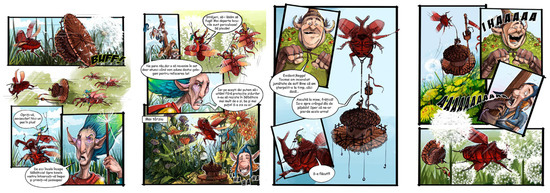
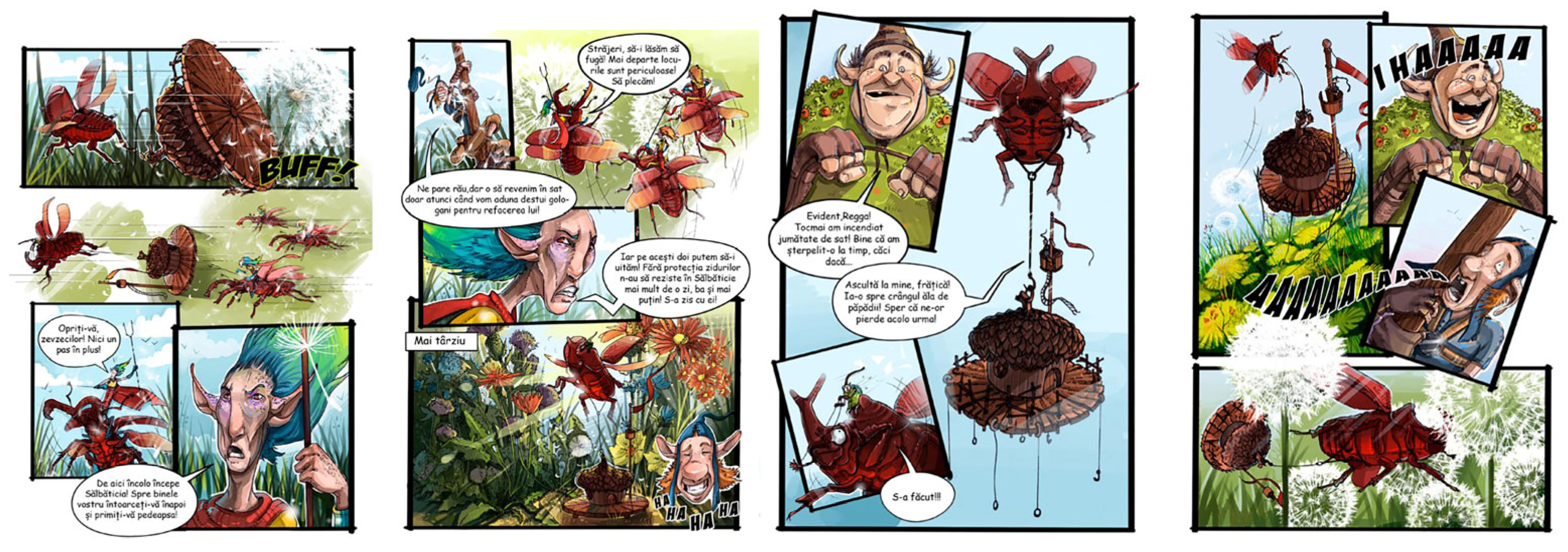
Continuing this analytical approach, it is worth examining the works of artists Călin Enachi and Valentin Enachi who, through projects such as The Little Epic (Figure 5), make distinctive use of the language of comics to construct their visual discourse. Their work is characterised by visual expressions with a youthful flavour, suggesting a reconfiguration of artistic identity. We observe that the main characters in the aforementioned comic strip are accompanied by secondary characters (insects, small animals, monsters) intended to enrich the meaning of the adventures and amplify the artistic expression of the compositions. The secondary characters shape and define the individuality of the central characters whilst also highlighting their mistrust, fear and thirst for adventure.
Figure 5.
The Little Epic by Valentin and Călin Enachi (COMICS Magazine 2021).
From a semantic perspective, this series can be likened to theatrical drama, whilst stylistically, there are parallels with Polish comic strips. The structural analysis has highlighted the fact that the comic strips are organised into non-uniform panels, which alternate in terms of both size and shape. The planimetric approach varies from panoramic, general and wide-angle shots to close-ups and details, which lend dynamism to the comic strip’s narrative discourse. Furthermore, the artists employ an original pagination technique, involving the use of frames that break the rhythm and suggest a sense of volume. The aesthetic dynamism created by these frames accentuates the contrasts between the figurative and emotions/states of mind. Finally, The Little Epic not only follows the recent evolution of comics in the Republic of Moldova but also fits into a contemporary tradition that explores new forms of visual expression, highlighting the authors’ creative potential in exploring youthful and adventurous themes.
The authors experiment with a broad, luminous and expressive colour palette, employing panoramic shots, wide shots, close-ups, long shots and detailed shots. The shots alternate in varying dimensions; in terms of composition, some are static whilst others are dynamic, captured from various angles. Some shots follow one another in sequence, whilst others overlap; nothing is predictable. Elements within the frames extend beyond their boundaries, connecting with elements from other frames, thereby further energising the narrative action. The seemingly ethereal speech bubbles appear between worlds and frames, thus complementing the visual-narrative thread. In the same vein, the characters express a variety of states of great emotional intensity.
6. Contextual Approaches Applied
The thematic metamorphosis of comic strips in the Republic of Moldova cannot be analysed in isolation from the transformations taking place in society. Between 2000 and 2025, there was a shift from predominantly educational and entertainment-based themes to a broader spectrum: social issues; corruption; civic education; the environment; family relationships; motherhood; intergenerational communication; historical memory; identity; cultural heritage; urban transformation; post-industrial society; and political realities.
In Alex Buretz’s work, social criticism is explicit. Caricature functions as a tool for commenting on reality and stimulating reflection. In this sense, the comic strip approaches the role traditionally played by literature and the satirical press: transforming the image into social commentary.
For Octavian Curoșu, history and heritage become visual subjects. In such works, the comic strip can serve as a bridge between history and the contemporary audience.
Cristiana Grati and Inna Sacali shift the focus from major historical themes to micro-histories: family, motherhood, relationships, communication and everyday gestures. This shift is significant because it introduces personal experience into comic strips from the Republic of Moldova as a legitimate source of artistic creation.
Environmental issues feature in the work of artists such as Octavian Curoșu and Alex Buretz. Here, the comic strip serves as a means of visually communicating environmental issues, simplifying the information without reducing it to a didactic message.
7. Comic Strips from the Republic of Moldova in an International Context
To avoid confining the Moldovan phenomenon to a strictly national framework, it is necessary to situate it within the context of main international traditions.
In the American context, comics developed in relation to the press, the publishing industry and popular culture. Their influences are evident in: dynamic lines; the dramatisation of action; close-ups; the extensive use of onomatopoeia; and the dynamic pacing of the narrative.
The European (Franco-Belgian) tradition has helped to consolidate a culture of the graphic novel, graphic storytelling and a distinct visual identity. Its specific characteristics are evident in: the regular layout of the panels; the alternation of frames; the clarity of outlines; the construction of characters; and the relationship between narrative and adventure.
Moldovan creators present a local flavour blended with certain characteristics of the major global schools of comics. They tackle historical subjects, heritage, village life, family, motherhood, post-industrial realities, ecology and civic issues, integrating these into a global visual language whilst relating them to local experiences.
Consequently, contemporary Moldovan comic strips can be characterised by cultural hybridisation. This perspective is in line with recent international research that treats comics as a transnational phenomenon, in which forms, genres and themes circulate between cultures and are reconfigured locally.
8. Discussion
The research findings enable the identification of five major strands of this transformation:
- The emancipation of the comic’s artistic status—The comic strip is gradually moving away from its status as a product exclusively for children and is becoming a form of artistic expression aimed at a more diverse audience. This transformation is also relevant at an international level, where academic research treats comics as a subject of art history, theory and criticism, since comics studies is now an established academic field at the international level.
- Thematic diversification—Contemporary themes are no longer limited to education and entertainment. Social criticism, politics, ecology, memory, family, identity and personal experience are emerging.
- The maturing of visual grammar—The panel becomes a tool for pacing the narrative. Colour becomes a vehicle for meaning. Onomatopoeia becomes an image. The speech bubble becomes a compositional element. White space becomes a narrative tool.
- Technical hybridisation—We are not witnessing a simple replacement of the pencil with the tablet; the process is more complex, moving from traditional to digital to hybrid.
- Internationalisation—The comic strip work of emerging artists from the Republic of Moldova was the subject of a special edition of COMICS Magazine (2021), which is a concrete example of how local creators are connecting with the regional comics scene.
Comic strip creation in the Republic of Moldova since the 2000s has been prolific, especially by artists such as Octavian Curoșu, Alex Buretz, Cristiana Grati, Inna Sacali, Călin Enachi and Valentin Enachi. Both traditional and digital or hybrid technologies have been utilised, making full use of the creative process (Table 1). This technological transformation has made it possible to work at high resolutions and with an unlimited number of layers, enabling the creation of complex visual effects. During the creative process, the artists simulated the effects of using traditional materials—coloured pencils, ink, markers, watercolour or gouache—in a digital format, whilst 3D models facilitated the construction of perspective and backgrounds, helping to add detail to the space.
Table 1.
Analysis of the characteristics of comic strips based on different models.
Digital comic creation streamlines the artistic, technical and editorial stages and brings them together into a single working environment. Thanks to specialised software (Clip Studio Paint version 1.0-3.2, Adobe Illustrator version 2019–2023, Adobe Photoshop 2019–2023, Procreate version 2011 and others) and modern devices, all stages can be carried out either within a single application or using integrated tools. In the initial stages, artists produce a preliminary sketch using one programme, such as Storyboard, Procreate or Clip Studio Paint. Once the sketch has been approved, the inking process begins, carried out using digital brushes that mimic traditional ink or markers.
During the colouring stage, artists can use rich and precise colours, utilising CMYK palettes for print or RGB for digital media. Specialised applications also offer the ability to quickly create speech bubbles, with fonts that can emphasise the emotional tone of the scene. Once all the visual elements have been finalised, the final colour correction is carried out, and the file is exported. Consequently, an analysis of the distinctive features of the works of various artists, their styles, visual strategies, tools and digital techniques used in the creation of comics highlights the complexity of the creative process and the valuable contribution of these artists to the development of the field in the Republic of Moldova during the 21st century, as a continuation of a tradition whose creative roots date back to 1950. The significant changes over the last two and a half decades can be observed across several interdependent levels (Table 2). There has been an emancipation of the target audience and a diversification of comic book genres, marking a shift from linear journalistic illustration to complex formats such as the graphic novel and the digital comic. Visual-narrative syntax is also undergoing change, as classical models—in which text functioned as a caption subordinate to the image—are being replaced by a modern visual grammar characterised by the use of speech bubbles, onomatopoeia and fragmented narrative structures. The transition from exclusively traditional techniques (ink, watercolour) to digital tools and the online environment has fostered the emergence of new mechanisms for collective production and paved the way for international collaborations. Comics from the Republic of Moldova are thus expanding their functional scope, becoming a fertile medium for civic reflection, historical demystification and visual artistic experiences.
Table 2.
Aspects of the evolutionary changes in comic strips created in the Republic of Moldova.
9. Conclusions
An analysis of comic strips created in the Republic of Moldova between 2000 and 2025 reveals a complex transformation that goes beyond mere technical modernisation.
Through diverse stylistic approaches and the integration of digital technologies into the creative process, comic strip creators are helping to broaden the visibility and modernise the specific artistic language of the medium, thereby strengthening the presence of this form of visual expression within the regional and international cultural landscape. Comics should not be perceived merely as humorous or ironic images but as visual media with educational value, capable of contributing to the development of critical thinking (as in the case of artists such as Octavian Curoșu and Alex Buretz), stimulating analytical thinking (as in the case of artists such as Cristiana Grati, Inna Sacali and others) and strengthening the ability to discern information—essential skills in a contemporary society marked by the proliferation of false information. Thus, comics act as a vital link between visual artists, civil society and cultural institutions—such as libraries where workshops and exhibitions dedicated to comics are held (we would like to mention here the active involvement of the artists Alex Buretz and Octavian Curoșu), educational institutions that incorporate this art form into the curriculum of subjects focused on book graphics (such as the Printing Design and Technologies specialism at the Faculty of Design, Technical University of Moldova), national and international publishing houses, and the international community of comic book creators (for example, the edition of ‘Dracula in Comics’, illustrated by Octavian Curoșu—one of the 47 illustrators—which was published by the Brașov County History Museum publishing house), thereby facilitating cultural dialogue and increasing the visibility of art from the Republic of Moldova on the international stage.
The transformations observed in the evolution of comics created by a generation of emerging artists in the Republic of Moldova between 2000 and 2025 are evident in terms of style, theme, narrative, technology and functionality.
In terms of style, contemporary artists are developing individualised visual languages, characterised by a variety of lines, a diverse colour palette, compositional variation and experimentation with page layout. Octavian Curoșu combines traditional illustration techniques with digital possibilities; Alex Buretz uses caricature and the grotesque for social criticism; Cristiana Grati transforms the family world into an emotional narrative; Inna Sacali develops a visual discourse centred on interpersonal relationships and motherhood; and Călin and Valentin Enachi experiment with the page, rhythm and adventurous imagination.
In terms of subject matter, contemporary comics in the Republic of Moldova go beyond their predominantly educational and entertainment-based role and have become a space for the expression of opinions, social criticism, historical reflection, environmental issues, family relationships and personal experiences.
From a narrative perspective, the traditional linear structure is complemented by fragmentary and hybrid constructions. The panels change in size and shape, the space between them becomes active, and the relationship between text and image grows increasingly complex. In this respect, Moldovan comics align with international trends that treat sequentiality, montage, the page and relationships between images as constitutive elements of the medium.
The technological aspect is evidenced by the shift from pencil, ink and watercolour drawings to graphics tablets and specialised applications, which has transformed the production process. However, the research findings do not suggest that traditional techniques have disappeared. On the contrary, they are imitated, reinterpreted and integrated into the digital environment, leading to the emergence of hybrid forms.
In terms of functionality, the comic strip has become a tool for cultural communication, civic education, social reflection and the transmission of memory. It can act as a bridge between the artist and the public, between heritage and the contemporary world, and between individual experience and social issues.
In this context, the work of emerging artists from the Republic of Moldova should not be viewed as a mere peripheral extension of major international traditions. It should be understood as a form of local adaptation and reinterpretation of a global visual language. European (Franco-Belgian), American and other influences are evident, but they are transformed through Moldovan themes, experiences and cultural contexts. Transnational research confirms that the fluidity of forms and themes is one of the key characteristics of contemporary comic culture. Consequently, the 2000–2025 period can be regarded as a phase of revitalisation and artistic maturation for the comic strip in the Republic of Moldova.
Whilst in the previous period comics were often subordinate to illustration, education and entertainment, contemporary work demonstrates a trend towards artistic autonomy, thematic diversification, narrative complexity, technological hybridisation and internationalisation.
From this perspective, the main contribution of the creators analysed lies not only in the production of new works but in redefining the status of comics within the visual culture of the Republic of Moldova.
The contemporary comic strip is becoming a space where tradition and technology, memory and the present, local experience and global visual culture, and image and text come together and give rise to new forms of expression.
Rather than disappearing with digitalisation, traditional drawing is absorbed and reconfigured by it. Rather than remaining confined to childhood, the comic strip is expanding to address the issues of adult society. Rather than being merely a tool for illustration, the image becomes an autonomous vehicle for narrative.
In this sense, the metamorphosis of the comic strip in the Republic of Moldova can be summarised by three fundamental shifts: from illustration to artistic language; from entertainment to discourse; and from traditional technique to hybrid expression.
These developments confirm the need to reconsider the comic strip as an integral part of the cultural heritage and contemporary visual art of the Republic of Moldova.
Author Contributions
Conceptualization, L.A., V.C. and N.V.; methodology, L.A.; software, N.V. and L.A.; validation, L.A., V.C. and N.V.; investigation, L.A., V.C. and N.V.; resources, L.A. and N.V.; data curation, L.A.; writing—original draft preparation, L.A.; writing—review and editing, L.A. and V.C.; visualization, N.V.; supervision, L.A.; project administration, L.A. All authors have read and agreed to the published version of the manuscript.
Funding
This research received no external funding.
Institutional Review Board Statement
Not applicable.
Informed Consent Statement
Informed consent was obtained from all subjects involved in the study, about: personal details of the artists, stages of their artistic development, and images of the artworks.
Data Availability Statement
The original contributions presented in this study are included in the article. Further inquiries can be directed to the corresponding author.
Acknowledgements
This study was conducted within the framework of the research and innovation project 25.80012.0807.53SE—Valorisation and safeguarding of the comics of the Republic of Moldova from 1945 to 2025 as an integral part of the national cultural heritage.
Conflicts of Interest
The authors declare no conflicts of interest.
Note
| 1 | The 1950–August 1991 timeframe represents a period during which the present-day territory of the Republic of Moldova—then the Moldavian Soviet Socialist Republic (Moldavian SSR)—evolved within the setting of a distinct ideological, social, economic and cultural climate. |
References
- Adascalița, Lucia. 2024a. Grafica satirică din Republica Moldova din a doua jumătate a secolului al XX-lea—Începutul secolului al XXI-lea [Satirical Graphics in the Republic of Moldova in the Second Half of the 20th Century—Early 21st Century]. Doctoral thesis, Technical University of Moldova, Chisinau, Moldova. Available online: https://www.anacec.md/files/Adascalita-teza.pdf (accessed on 13 November 2025).
- Adascalița, Lucia. 2024b. Valențe artistice novatoare în grafica satirică din Republica Moldova. Anii 2001–2015 [Innovative artistic approaches in satirical graphics in the Republic of Moldova. 2001–2015]. In Patrimoniul Cultural de Ieri—Implicaţii în Dezvoltarea Societăţii Durabile de Mâine, Iasi, Romania, Chisinau, Moldova, 10th ed. vol. 7, pp. 98–111. [Google Scholar] [CrossRef]
- Archive of Social and Political Organizations of the Republic of Moldova/Arhiva Organizațiilor Social-Politice a Republicii Moldova. n.d.a. Fond P-2906, inv. 1, d. 70, f. 1, 5–6.
- Archive of Social and Political Organizations of the Republic of Moldova/Arhiva Organizațiilor Social-Politice a Republicii Moldova. n.d.b. Fond P-2906, inv. 1, d. 79, f. 56–59.
- Archive of Social and Political Organizations of the Republic of Moldova/Arhiva Organizațiilor Social-Politice a Republicii Moldova. n.d.c. Fond P-2906, inv. 1, d. 105, f. 4.
- Bagrin, Mariana. 2021. Sarcinile Autorităţilor Sovietice în Privinţa Presei Scrise din RSS Moldovenească în Primul Deceniu Postbelic (1944–1953). Available online: https://ibn.idsi.md/sites/default/files/imag_file/366-380.pdf (accessed on 9 December 2025).
- Buretz, Alex. 1984. Portfolio. Available online: https://www.facebook.com/buretzart?locale=ru_RU (accessed on 10 November 2025).
- Comic Book Market. 2026. July. Available online: https://market.us/report/comic-book-market/ (accessed on 21 July 2026).
- COMICS Magazine. 2021. No. 40. Available online: https://issuu.com/smokingcoolcat/docs/revista_comics_nr_40 (accessed on 15 November 2025).
- Comic Strip. 2025. Dictionary. Available online: https://dictionary.cambridge.org/dictionary/english/comic-strip?q=comic+strip (accessed on 21 November 2025).
- Coteanu, Ion, Luiza Seche, and Mircea Seche. 1998. Explanatory Dictionary of the Romanian Language, 2nd ed. Bucharest: Univers Enciclopedic, p. 201. [Google Scholar]
- Couperie, Pierre, Claude Moliterni, and Henri Filippini. 1974. Encyclopédie de la bande dessinée. Tome 1: 147. [Google Scholar] [CrossRef] [Scilit]
- Curoșu, Octavian. 1992. Portfolio. Available online: https://www.behance.net/OctavianCurosu?tracking_source=search_projects|romanian+illustration (accessed on 10 November 2025).
- Eisner, Will. 1990. Comics and Séquentiel Art. New York: Poorhouse Press. ISBN 9780961472818. [Google Scholar]
- Epure, Adrian. 2023. Povestea Mihaelei, prietena fără glas a copiilor…. Adevărul. July 22. Available online: https://adevarul.ro/stil-de-viata/cultura/special-povestea-mihaelei-prietena-fara-glas-a-2285898.html (accessed on 8 August 2025).
- Grati, Cristiana. 1992. Portfolio. Available online: https://www.cristianagrati.com/en/work/revista-comics-nr-40-editie-speciala-republica-moldova (accessed on 15 November 2025).
- Groensteen, Thierry, Bart Beaty, and Nick Nguyer. 2007. The System of Comics. Jackson: University Press of Mississippi. [Google Scholar]
- Kravcenko, Vladimir. 2018. Grafica de carte în Republica Sovietică Socialistă Moldovenească şi Republica Moldova în anii 1988−2000. In Arta. Chisinau: Institute of Cultural Heritage of the Academy of Sciences of Moldova, nr. 1(AV). pp. 104–9. ISSN 2345-1181. [Google Scholar]
- Kravcenko, Vladimir. 2020. Grafica de Carte pentru Copii din Republica Moldova (1945–2010). Ph.D. thesis, Centrul Studiului Artelor al Institutului Patrimoniului Cultura, Chișinău, Moldova; 135p. [Google Scholar]
- Manița, Manuela. 2024. Cum Creezi o Bandă Desenată. Bucharest: Humanitas Junior, pp. 12–13. ISBN 978-973-50-8423-3. [Google Scholar]
- McCloud, Scott. 1993. Understanding Comics: The Invisible Art. New York: HarperCollins. [Google Scholar]
- McCloud, Scott. 2006. Making Comics: Storytelling Secrets of Comics, Manga and Graphic Novels. New York: HarperCollins. New York: William Morrow Paperbacks. ISBN 978-0-06-078094-4. [Google Scholar]
- McCloud, Scott. 2019. Understanding Comics: The Invisible Art. Bucharest: Grafic. ISBN 978-606-710-549-0. [Google Scholar]
- Meskin, Aaron. 2007. Defining Comics? The Journal of Aesthetics and Art Criticism 65: 369. Available online: https://www.academia.edu/2675773/Defining_comics (accessed on 20 November 2025). [CrossRef] [Scilit]
- Meskin, Aaron, and Roy T. Cook. 2012. The Art of Comics: A Philosophical Approach. Oxford: Wiley-Blackwell. Available online: https://books.google.md/books?hl=en&lr=&id=KLzSI5V5-h8C&oi=fnd&pg=PR7&ots=B2dQY9nQfF&sig=54xIBKzBH9TRbLulkFPxaJeg9wQ&redir_esc=y#v=onepage&q&f=false (accessed on 21 November 2025).
- Moscu, Anca, and Lucian Oancea. 2023. Gopo în 100 de Pagini de Bandă Desenată. Bucharest: Grafic. [Google Scholar]
- Niţă, Dodo, and Alexandru Ciubotariu. 2010. Istoria Benzii Desenate Românești 1891–2010. Bucharest: Vellant. ISBN 978-973-1984-64-3. [Google Scholar]
- Nosatîi, Anatolie. 2024. Instituții și procese educațional-culturale în viața cotidiană din RSSM (Anii 1970–1980). In Studia Universitatis Moldaviae. Chisinau: Revista Științifică a Universității de Stat din Moldova, nr. 10(200). ISSN 1811-2668. [Google Scholar]
- Pagani, Balthazar, Otto Gabos, and Marco Maraggi. 2023. How to Draw a Graphic Novel. London: Thames and Hudson. ISBN 9780500660201. [Google Scholar]
- Perret, Aurélie. 2019. Histoire de la Bande Dessinée. Histoire pour Tous, p. 1. Available online: https://www.histoire-pourtous.fr/dossiers/5016-histoire-de-la-bande-dessinee.html (accessed on 20 November 2025).
- Rocaciuc, Victoria. 2011. Artele plastice din Republica Moldova în Contextul Sociocultural al Anilor 1940–2000. Chișinău: Atelier. 275p, ISBN 978-9975-80-458-5. [Google Scholar]
- Rowe, David. 1995. Popular culture [Rock Music, Sport and the Politics of Pleasure. Media Culture & Society series]. London: AGE Publications Ltd. ISBN 978-0803977013. [Google Scholar]
- Sacali, Inna. 1990. Potfolio. Available online: https://www.instagram.com/inna_s_art/ (accessed on 13 November 2025).
- Teampău, Gelu. 2012. Mit și Bandă Desenată [Myth and Comic-Books]. Iași: Institutul European. [Google Scholar]
- Toma, Ludmila. 2018. Procesul artistic în Republica Moldova (1940–2000). Chișinău: Muzeul Național de Artă al Moldovei. 246p, ISBN 978-9975-12-950-3. [Google Scholar]

Disclaimer/Publisher’s Note: The statements, opinions and data contained in all publications are solely those of the individual author(s) and contributor(s) and not of MDPI and/or the editor(s). MDPI and/or the editor(s) disclaim responsibility for any injury to people or property resulting from any ideas, methods, instructions or products referred to in the content. |
© 2026 by the authors. Licensee MDPI, Basel, Switzerland. This article is an open access article distributed under the terms and conditions of the Creative Commons Attribution (CC BY) license.