


Abstract
In the 2020 screen-based performance Extraterritorial صوت, artists Dena Al-Adeeb, Sholeh Asgary, Leyya Mona Tawil, and Daiane Lopes da Silva develop a feminist refugee praxis through video, sound, and choreography to reclaim “post-apocalyptic landscapes … where ghosts reside at the end of the world.” Filmed along the San Francisco Bay shoreline, the work brings bodies, rocky terrain, synthetic material, and the spectral into relation with layered histories of displacement, settler colonialism, and (neo)colonial violence. Through an analysis of choreography, cinematic form, and material interaction, the essay develops “steadfastness” as an analytic for examining how performance cultivates practices of remaining within the ongoing coloniality of the postapocalypse. The analysis proceeds across three interrelated dimensions. First, it examines material persistence through the dancers’ sustained contact with shifting ground and Mylar emergency blankets, foregrounding how histories of extraction, Indigenous dispossession, and humanitarian governance endure through embodied and environmental relations. Second, it examines temporal duration, showing how delay and recurrence interrupt accelerative temporalities and cultivate an unfinished present by rendering slow violence discernible as an ongoing condition. Third, it turns to spectral persistence, where ancestral relations and colonial violence continue to inhabit bodies and landscapes while unsettling dominant regimes of visibility. Working within the incommensurable frictions between Indigenous sovereignty and SWANA (Southwest Asian and North African) displacement, these dimensions establish steadfastness as a choreographic analytic that foregrounds the labor through which livability is sustained within the postapocalypse.
1. Introduction
The 2020 screen-based choreographic work Extraterritorial صوت integrates moving images, original electroacoustic composition, and site-responsive performance filmed along the San Francisco Bay shoreline. As the 22-min work shifts between close-ups and wide-angle views, plots of rocky sand and dirt interweave through the shallow gulfs of water to form zigzag lines across the screen (Figure 1). From a distance, dry brown hills and electrical posts remain visible; at close range, the ground is bare, without visible vegetation. Movement often remains sparse: faint ripples move across the water; two to three female bodies traverse the shoreline at a slow pace, appearing and receding from view; and Mylar emergency blankets wrap around dancers’ bodies or drift across the shoreline’s surface, catching light and swaying in the breeze.1
Figure 1.
Extraterritorial صوت (Al-Adeeb et al. 2020). Wide-angle view of the performers moving along the San Francisco Bay shoreline. Still image captured by author from the online video Source: https://vimeo.com/505468177/98faa95944 (accessed on 27 July 2026).
The landscape upon which these slow movements unfold—the unceded Ohlone lands of the San Francisco Bay—carries layered political and historical strata: the sedimented histories of settler colonialism and Indigenous dispossession, enslaved labor, and more recent forms of displacement, including gentrification and techno-capitalist redevelopment. At the same time, through gesture, tempo, and bearing, the dancers’ bodily archives extend the shoreline beyond its immediate geography, drawing the site into relation with the performers’ ancestral homelands of Iraq, Iran, Syria, Palestine, and Brazil, whose histories have been shaped by overlapping yet distinct formations of (neo)colonialism, migration, and bordering. The shoreline is thus a shifting terrain where multiple histories and geographies gather. My analysis approaches this gathering through transnational feminist, Black feminist, and Indigenous theories of coloniality and survivance that understand colonial violence as an ongoing condition shaping relations among land, histories, bodies, and ancestral presence. The choreography dwells within the tension of these historical and geographical formations, remaining within their instability. Movements advance and retreat without arrival, gestures repeat without resolution, and bodies appear and recede without settling into stable form. In doing so, the work cultivates an unfinished present, where colonial histories remain active through recurrence. The performance thus holds in suspension the binary distinctions between past and present, arrival and departure, home and exile, and citizen and refugee, foregrounding the racialized and colonial logics through which these categories are produced.2
Extraterritorial is a collaborative project created by Iraqi-born artist Dena Al-Adeeb, Iranian-born artist Sholeh Asgary, Syrian–Palestinian–American dance artist Leyya Mona Tawil, and Brazilian-born dance artist Daiane Lopes da Silva. While the work is a collaboration among all four artists, Al-Adeeb and Asgary developed its visual and sonic dimensions, while Tawil and Lopes da Silva created and performed its choreography. Al-Adeeb and Asgary have described their long-standing artistic collaboration as enacting a transnational feminist praxis that centers their refugee experiences. I take this particular framing as my point of departure, reading Extraterritorial within SWANA (Southwest Asian and North African) histories of displacement and migration and placing these histories in dialogue with broader formations of coloniality and dispossession.3 Extraterritorial’s artist statement, written by Al-Adeeb, further situates the project within the compounded conditions of the COVID-19 pandemic and the Northern California wildfire shutdowns in late 2020, describing the work as “a feminist approach towards reclaiming post-apocalyptic landscapes.” She writes: “Through a series of embodied meditations on places where ghosts reside at the end of the world, we pay tribute to our ancestors and gesture towards those who steadfastly endure while carrying us forward … [invoking] movement within and outside borders, bodies, and land” (Al-Adeeb 2020a, 2020b). In this essay, I interpret the “ghosts [who] reside at the end of the world” as ancestral presences who carry histories of displacement across time and through the body. Likewise, I read the “end of the world” as functioning both geographically (as border, shoreline, threshold) and temporally, as a slow apocalypse long lived by colonized and racialized peoples. From this reading, I argue that Extraterritorial enacts choreographies of steadfastness through which practices of remaining take shape materially, temporally, and spectrally amidst ongoing colonial violence. The work’s title, Extraterritorial صوت, further develops this reading through its paired attention to territorial boundaries and resonant transmission: the term “extraterritorial” names a condition in which presence exceeds the jurisdictional boundaries that seek to contain it, while the Arabic word sawt/صوت (voice, sound, tone, noise) invokes resonance and transmission. Taken together, “extraterritorial” and صوت point toward forms of presence and resonance that move across multiple histories and geographies, carrying attachments to land, memory, and relation beyond the territorial frameworks that seek to regulate them.
Reading the artists’ invocation of “those who steadfastly endure,” I understand steadfastness in Extraterritorial as a practice of remaining amid ongoing occupation, dispossession, and displacement. As I argue throughout this essay, this practice constitutes an anti-colonial refusal of corporeal and epistemological erasure, insisting upon forms of presence that exceed both. To situate this understanding within a broader genealogy, I place it in conversation with the Arabic concept of sumud (steadfastness). Within Palestinian political and cultural discourse, sumud refers to practices of anti-colonial remaining and resistance under Israeli occupation and displacement. Across Palestinian scholarship, activism, and everyday life, sumud is understood as a practice grounded in land, embodiment, and sociality, enacted through daily acts of dwelling, waiting, cultivation, and movement, as well as through collective forms of resistance to occupation and displacement (Abu-Lughod and Sa’di 2007; Allen 2008; Hamdonah and Joseph 2024; Hammami 2015; Ophir 2022; Rowe 2016; Taher 2024). While the artists do not explicitly name sumud in their framing of Extraterritorial, their invocation of those who “steadfastly endure” orients my reading. I develop steadfastness in conversation with sumud as a way of situating the analytic I advance here within a broader historical and political genealogy, while remaining accountable to the intellectual, affective, and embodied labor through which sumud has been theorized, lived, and sustained. Accordingly, I do not treat “steadfastness” as a translation or substitution for sumud, since doing so risks obscuring and extracting the concept’s historical and political specificity and the labor through which it has taken shape. Rather, following the traditions of thought and practice associated with sumud, I understand steadfastness in my analysis of the performance as a relational anti-colonial practice enacted through embodied attunement to land, time, and ancestors, rather than through the conventional English meaning of “steadfastness” as an individual disposition or moral virtue. Reading steadfastness alongside sumud situates Extraterritorial within broader SWANA epistemologies and illuminates resonances across related histories of dispossession and anti-colonial struggle, while remaining attentive to the particular contexts within which sumud has been lived and theorized.
Furthermore, I advance steadfastness as the central analytic through which I examine practices of remaining that exceed the conceptual limits of endurance or resilience. Building on Schneider’s (2011) theorization of “remaining,” which understands performance as persisting through residues, repetitions, and reappearances rather than disappearing once it has ended, I use the term not simply to describe what endures after violence but to name an ongoing practice of livability within its irresolution. Within this framework, persistence and duration name interrelated dimensions of steadfastness: persistence refers to continuation across time and material conditions, while duration names the temporal structures through which that persistence is lived amid continued colonial violence.
In Extraterritorial, steadfastness operates through modes of remaining and refusal that take shape materially, temporally, and hauntologically. The sections that follow trace these three interrelated dimensions, examining how steadfastness persists as matter, sustains an unfinished present, and returns as spectral persistence.4 Materially, the choreography enacts steadfastness through the dancers’ sustained negotiations with shifting terrain and synthetic matter, where weight, balance, force, and contact become practices of remaining. Here materiality refers both to matter—the shoreline, water, breeze, Mylar, and the moving body—and to the historical and political conditions sedimented within those encounters. Rather than treating materiality as two separate analytic domains, I approach these material registers as mutually constitutive, such that encounters with bodies, terrain, atmosphere, and synthetic matter are also encounters with histories of colonialism, racialization, dispossession, and migration (Bui and Duong 2026).5 Temporally, steadfastness sustains an unfinished present through which the slow violence of the postapocalypse becomes lived as enduring temporality. In the process, the performance reorients the accelerative temporalities of colonial modernity: the compressed, forward-driven logic of crisis, urgency, and resolution structuring time under global capitalism, militarized regimes, and humanitarian response. Hauntologically, steadfastness emerges as spectral persistence, as bodies appear, fade, and reemerge across the landscape, carrying forward ancestral presence and the unfinished histories of dispossession beyond the limits of stable visibility. Taken together, these dimensions within Extraterritorial establish steadfastness as a critical analytic for tracing practices of remaining within SWANA lifeworlds shaped by ongoing colonial violence.
2. Material Persistence: Terrain, Trace, and Synthetic Matter
The dancers’ movement across the landscape in Extraterritorial orients viewers toward what remains rather than what departs or arrives, toward where land meets water and where borders appear to dissolve even as they persist.6 Across this section, I examine how steadfastness is sustained through the dancers’ negotiations with shifting terrain and synthetic matter, and how those encounters materialize the relations among bodies, landscapes, and histories. Material substances and material conditions are inseparable in Extraterritorial: encounters with bodies, terrain, and synthetic matter are also encounters with the histories they carry. Attending to these material relations, I argue that steadfastness emerges not apart from these histories but in contact with them, taking shape through weight, force, trace, and synthetic matter.
In the first twelve minutes of the video, which consists of a fixed wide-angle shot, the shallow, rippling water of the San Francisco Bay holds as a placid, subtle tide. At the water’s edge, the dancers—small figures on the center horizon—move along the narrow band of exposed terrain. While the gentle tide remains steady, the dancers repeatedly advance and retreat from the horizontal edges of the frame, gathering at the unstable edges where earth recedes into water. Neither fully arriving nor fully departing, the dancers produce a spatial logic in which persistence takes precedence over passage. Each traversal activates the shoreline as a lived threshold of ongoing presence where movement returns to the same terrain, evoking the spatial ambiguity suggested by the work’s title, Extraterritorial: a terrain that is not quite land and not quite water, animated by the dancers’ repeated returns to its shifting edges.
On this unstable ground, the dancers respond to the shifting terrain by oscillating between groundedness and precarity. In one sequence, a dancer plants her front foot firmly on the ground into a deep lunge while her back leg lifts into wavering suspension. The grounded stance of the front leg counterbalances the force of a strong breeze that presses against her body, its instability heightened by the shifting stones beneath her planted foot. Stability here is an ongoing adjustment, her weight continually recalibrated against both shifting terrain and atmospheric force. Balance, in turn, is a practice of continual recalibration. As Silverstein (2024) observes in her study of the Syrian dabke, balance (mizan) within both the dabke and Syria’s precarious sociopolitical conditions is sustained by continual bodily negotiation. Similarly, in Extraterritorial, rootedness and instability, control and collapse, are held together in suspension as the dancers repeatedly adjust their weight and orientation. These weighted gestures amplify the physical stakes of equilibrium, foregrounding the labor of sustaining balance amid instability. The choreography thus stages steadfastness as a practice of remaining in which bodily weight, force, and ground are continually recalibrated across both terrain and the material conditions that shape it.
With each stomp and weighted stance, the dancers bring embodied histories of displacement into contact with the histories of dispossession sedimented in the land. When the video later shifts to a fixed, closer view, one of the dancers repeatedly pivots her boot into the sandy surface, leaving a visible imprint that marks the ground with her trace. Her upper body folds forward over her legs as she slowly encircles her forearms with a Mylar emergency blanket and pivots on one foot in the sand. With each pivot, the pressure of her boot pushes wet sand outward, which in turn gathers along the edges of her sole. After several repetitions, she extends the pivot of her foot into a straight line that travels away from her body. The shallow line pressed into the sand remains a visible trace even after the dancer’s body has shifted elsewhere, her movement leaving a mark on a terrain shaped by Indigenous dispossession, settler colonialisms, and more recent forms of territorial displacement and extraction. In this way, performance, as Schneider (2011) argues, remains in the traces it leaves behind. What remains, however, is more than the trace of movement; the connections among body, terrain, and the histories sedimented within each persist as well. The dancer then slowly lays one of her forearms parallel to the line her boot has drawn in the sand (Figure 2). Significantly, she does not place her arm directly over the line she has created. Instead, her forearm rests alongside it, maintaining a slight distance between body and mark. This parallel alignment establishes an adjacency that holds body, land, history, and the present alongside one another. The dancer’s body in this moment sustains a slight but significant distance between the alignment of her arm and the mark in the sand, resisting identification with or possession of land and history. Steadfastness thus becomes a practice of remaining in uneven adjacency7. The contact between these histories foregrounds their incommensurability (Bui and Duong 2026; Tuck and Yang 2012), while the encounter enacted through the performance holds them in tension within the ongoing settlement of Ohlone land, where Indigenous sovereignty and SWANA displacement continue to exist in tension as overlapping yet irreducible relations to the same land.
Figure 2.
Closer view of a performer placing her forearm alongside a line traced in the sand in Extraterritorial صوت (Al-Adeeb et al. 2020). Still image captured by author from the online video. Source: https://vimeo.com/505468177/98faa95944 (accessed on 27 July 2026).
At several points in the performance, the video shifts into a subtle split frame, allowing two distinct bodily engagements with the same terrain simultaneously. In one sequence, a dancer on the right drives her foot into the terrain with a series of forceful stomps and propels her full weight forward onto her front foot before lifting into a precarious, wavering balance. Each return to the ground intensifies pressure in place, as the choreographic cycle of stomp, suspension, and grounded stance sustains concentrated contact with the terrain rather than advancing across it. Her body trembles as she holds herself in suspension, exerting effort to remain upright while stones and sand shift beneath her standing foot. On the left side of the split screen, the other dancer sustains a deep lunge, her lower body anchored while her upper body undulates and fractures into alternating gestures. Both dancers interrupt their slow, circulating arms with angular stops, while subtle shifts in their bodies give way to sudden releases. These oppositional qualities intentionally distribute force unevenly across the body, and multiple vectors of movement are held within a single stance. Across the split frame, the dancers sustain different bodily articulations of force while responding to the shifting conditions of the shoreline. Their divergent movements reveal steadfastness as a relational practice in which shared material conditions give rise to multiple embodied forms of remaining.
Taken together, these varied bodily engagements with the shoreline invite a broader consideration of the ground itself as a historically constituted surface rather than a neutral backdrop. Across these sequences, the dancers repeatedly return their bodies to the ground, treating the shoreline not as a passive support for movement but as an active participant in the choreography. Their movements disclose the shoreline as a historical and political terrain whose material conditions precede and shape the choreography itself. As Stanger (2021) argues, dance occurs on “violent ground” shaped by dispossession as well as material and historical violence. Extraterritorial situates the dancers’ repeated returns to the shorelines within precisely such a terrain as the choreography sustains contact between the dancers’ displaced bodies and a shoreline marked by Indigenous dispossession. In deep lunges, stomps, pivots, and weighted stances—movements that repeatedly bring the body into contact with the ground—steadfastness materializes through proximity, friction, and shared (yet occupied) terrain.
Beyond establishing the shoreline as a material site of coloniality, the choreography also reveals it as an archive through which histories persist, intersect, and generate friction (Tsing 2005). In Extraterritorial, history is an ongoing material force. Building on Schneider’s (2011) theorization of “remaining,” Rogers (2022) argues, in her analysis of contemporary Cambodian dance shaped by the afterlives of the Khmer Rouge genocide, that performance carries historical violence forward through the performing body. The past thus persists in the materiality of embodied presence, as dancers carry and transmit layered histories through movement. In Extraterritorial, however, these histories reside not only in the body but also in the terrain upon which the dancers move. With their feet anchored into the wet shoreline of the San Francisco Bay, the dancers bear their own layered bodily archives of displacement, and those histories in turn are transmitted and negotiated in pressure, precarious balance, and sustained contact. The shoreline likewise bears transatlantic, imperial, migratory, environmental, and Indigenous histories whose traces remain sedimented in the land. Rather than a stable historical ground, the terrain upon which performance occurs can be understood as composed of multiple “sedimented acts” (Taylor 2022): residual traces, survivals, and ongoing reactivations through which the past continues to inhabit the present. From this perspective, I read the dancers’ bodily contact with the ground in Extraterritorial as participating in the ongoing sedimentation of histories carried by the terrain. The performance activates the shoreline as a transnational node within a colonial cartography, where local histories of displacement encounter imperial geographies carried through moving bodies. Read through SWANA refugee histories, the shoreline becomes a point of encounter where embodied histories of displacement meet the layered histories embedded within Ohlone land. The choreography sustains a relation whose frictions cannot be resolved by shared experiences of displacement alone, thereby foregrounding the tensions that arise when distinct histories of (neo)colonial violence converge within the same landscape.
The dancers’ durational engagement with shifting terrain in Extraterritorial might initially appear to invite an endurance-based reading of bodily persistence. Hentyle Yapp’s critique (Yapp 2014) of endurance provides a useful distinction for my analysis. According to Yapp, dominant scholarly frameworks of endurance in performance tend to overdetermine durational practices as intentional acts of resistance or critique, presuming a stable, conscious, agentic subject while narrowing the interpretive possibilities of non-Western art. Yapp further argues that conventional framings of endurance often situate duration within a linear arc of overcoming suffering, thereby privileging heroic capacity over quieter practices of lingering, hesitation, and remaining-with. While the choreography in Extraterritorial involves durational and iterative engagements with shifting terrain, these gestures operate as distributed practices of remaining, not as demonstrations of singular fortitude, triumph, or recovery. Across the performance, repeated bodily engagements with the shoreline recur through cycles of holding, release, and return: a dancer sustains a grounded stance before loosening into motion; a repeated stomp gives way to wavering suspension; a body exits the frame only to reappear along another edge moments later. These recurring material practices sustain steadfastness as an ongoing mode of remaining rather than a demonstration of endurance. Persistence thus does not appear as the achievement of an agentive subject overcoming adversity, but as a dispersed and relational process sustained through ongoing contact with the shifting material world. In this sense, the choreography locates steadfastness within the recurring labor of remaining and return rather than heroic resolution.
This dispersed and relational persistence takes material form in the Mylar, whose shifting presence materializes through additional forms of steadfastness. Central to the tactile materiality of Extraterritorial, Mylar carries historical and political logics of refugee management and disaster governance: humanitarian camps, emergency aid, and the infrastructures that manage displaced populations through temporary forms of care and containment. Barad (2006) argues that matter and meaning are inseparable; the matter that bodies touch and move with participates in the production of history. In Extraterritorial, Mylar is neither neutral, abstract, ornamental, nor illustrative. Engineered within humanitarian supply chains, it carries histories of displacement as material force, taking shape through contact with the dancers’ bodies and movement across the shoreline. The dancers’ engagement with the emergency blankets binds bodily movement to the material infrastructures of empire, where contact among body, Mylar, wind, and shoreline sustains the material conditions through which histories of displacement and humanitarian governance persist.
The Mylar becomes a shifting surface of contact as the choreography oscillates between coverage and exposure, rendering protection a contingent material relation. Against a strong breeze, the dancers repeatedly wrap and unwrap themselves in the Mylar, at times drawing the material tightly around their bodies and at others releasing it to drift along the shoreline. When one dancer grips the metallic blanket in both hands and extends her arms overhead, the thin reflective surface catches the wind and briefly billows, and she settles into a deep lunge to maintain her balance. Her grip tightens along the edges of the Mylar and then loosens as the material lifts and shifts. Coverage gathers and disperses across her body with each adjustment, as the Mylar alternately wraps and exposes different parts of her form. In another sequence, two dancers are connected by a single strip of Mylar—one walking forward while the other moves backward—each step guided by the shared surface stretched between them. Their movement remains tethered to the material, which simultaneously binds and separates them. Across these repeated negotiations, the Mylar organizes protection as a shifting mode of contact. Coverage is secured, loosened, and carried away by the wind, rendering protection temporary and contingent. What persists, however, are the material traces of empire carried with the Mylar beyond its original contexts of deployment.
Through sustained practices of touch, however, the choreography redistributes the instrumental logics of the emergency blanket, reorienting how the Mylar’s histories of displacement and humanitarian governance are encountered. The dancers draw the Mylar into close contact with their bodies, its surface, sound, and movement producing a lingering, tactile relation. During moments when the material is held close to the skin, the dancers attend carefully to its materiality through folding, gathering, and adjusting. Catching light and producing sound (though inaudible to the video viewer), the Mylar generates a shifting field of sensation that moves with and around the dancers’ bodies. When the Mylar slips, catches, and pulls against the dancers’ skin, movement responds to these shifting points of contact. Without displacing the material histories of the Mylar blanket, Extraterritorial reorients how these histories are encountered, as the Mylar becomes a site where contact is sustained and experienced not through conditions of duress but as sensation, proximity, and attunement. In extending the encounter with the blanket beyond its emergency function, the choreography suspends the imperative of resolution that accompanies humanitarian response. The choreography instead lingers with the blanket beyond the temporal demands of crisis, and humanitarian matter acquires a different rhythm of encounter grounded in attunement and sensation rather than urgency.
The significance of Mylar extends beyond its immediate humanitarian framing; it also marks the ecological afterlife of extraction. Thin, lightweight, and easily carried by wind, the Mylar skims across the shoreline, folding sharply onto itself, snagging on rock, flattening over shallow water, and reopening with each gust. Its surface creases and folds, dulls and tears; yet, designed for temporary use, the material endures as residue and trace. This dynamic is most visible in a scene where a dancer stands in place wearing a Mylar poncho, her body held in profile as she raises her arms horizontally in front of her. Beneath her, a faint inverted reflection appears in the water, slightly out of sync with her movement. The dancer then abruptly disappears from the frame, while the reflection lingers and the Mylar remains behind, no longer worn but drifting along the ground. No longer held in place by the body that it once covered, the material continues its movement across the terrain, folding and shifting with the wind after the body has vanished. The material refuses disappearance, remaining within waste streams as a durable trace of the histories that produced it. In one moment, it shelters; in the next it settles into the terrain as debris, binding humanitarian intervention to the environmental afterlives of empire.8
Designed for temporary deployment in moments of crisis, the blanket persists as a petrochemical material that does not decompose as its synthetic composition outlasts the humanitarian temporality of emergency response. As it circulates across disaster response, refugee management, and broader environmental and political ecosystems, it extends the histories of its manufacture forward into the present. Davis (2022) argues that petrochemical materials collapse what she calls the “deep past” and “deep future” into an ongoing present structured by their persistence. Whereas the dancers enact persistence through shifting arrangements of weight, balance, and contact that sustain an embodied mode of attunement to materiality, Mylar persists as a material residue that exceeds and outlasts these encounters. It bears the environmental and political consequences of its production. Its persistence inheres in the petrochemical material itself, such that the conditions of its manufacture extend beyond any single choreographic encounter. The choreography brings these forms of persistence into relation, revealing how embodied practices of continuance unfold within, and remain entangled with, the enduring material residues of “fossil modernity” (Folkers 2021).
These material entanglements carry particular stakes because the persistence of Mylar is evidence of not only histories of humanitarian governance but also of extraction and environmental degradation. Its presence marks the afterlives of crisis, where care and material excess intertwine. At the same time, the choreography brings the material into sustained engagement with the body and the terrain. In repeated acts of contact—wrapping, gripping, releasing, and adjusting—the dancers rework its function to foreground sensation, friction, and responsiveness. The work holds together Mylar’s implication in imperial and ecological systems and its reworking through the dancers’ sustained, tactile engagement with it. The choreography reorients the Mylar without severing it from the humanitarian and ecological histories embedded within its materiality. As an emergency technology, a tactile surface, and a petrochemical residue, the blanket gathers these histories into a single material encounter that enfolds care, containment, extraction, and environmental persistence as constitutive dimensions of its material life.
These choreographic engagements with materiality discussed in this section show that steadfastness is enacted in the physicality of bodies, the tactile durability of synthetic matter, and the visible traces embedded in the ground upon which they dance. Rather than locating persistence in the body alone, Extraterritorial situates it across terrain, atmosphere, and petrochemical matter, where the shoreline becomes a material point of encounter between Indigenous dispossession and SWANA displacement, foregrounding the frictions and incommensurabilities within distinct historical and geographical formations. Material persistence thus emerges as an ongoing relation enacted through contact, sensation, and the enduring materiality of the shoreline and the Mylar. These material relations give rise to the temporal formations of persistence that I examine in the following section.
3. Against Acceleration: Slow Violence and the Unfinished Present
While the previous section approached steadfastness through material relations of contact, sensation, and persistence, this section traces steadfastness as a temporal condition structured by duration, suspension, and recurrence. Following Sharma (2014), I approach temporality not as a universal condition but as a politically organized field in which time is differentially lived through unequal relations of power. For Nyong’o (2018), performance offers one way of inhabiting these temporal formations through duration, or “a coalescence between the sequential, tensed temporality of the ongoing present … and a tenseless time” (p. 10). Bringing these perspectives into conversation, I argue that steadfastness in Extraterritorial takes shape through temporal practices that sustain an unfinished present, where recurrence continually recalibrates the temporal relations through which history inhabits lived time. Drawing on scholarship that examines the unfinished past and the persistence of colonial histories (Gordon 2008; Schneider 2011; Stoler 2013), I use the term “unfinished present” to describe a temporality through which the postapocalypse persists as an ongoing condition that structures the present (Cornum 2020). In other words, the unfinished present is the temporal form through which the choreography holds acceleration and slow violence together. The choreography inhabits the slow violence of the postapocalypse invoked by the artists while reorganizing the temporal logics of crisis, urgency, and resolution through which global capitalist and militarized regimes structure migration and displacement.
Rather than staging accelerative temporalities and slow violence as binary oppositions, Extraterritorial traces their contingency and dwells within their imbrication. Colonial modernity organizes land and life through accelerated modes of circulation: imperial expansion, technological advancement, extractive economies, and infrastructures that reorganize land for resource accumulation. At the same time, the damage produced by these processes accumulates gradually across land and bodies as slow violence: erosion, contamination, forced migration, and ecological degradation accruing over extended durations. In other words, acceleration generates the very conditions through which slow violence becomes lived and normalized. As Nixon (2013) argues, the violence produced by such systems unfolds slowly and unevenly, accumulating across years or generations—sometimes out of sight—rather than appearing as a singular catastrophic event. Extraterritorial inhabits this temporal entanglement. Against temporal regimes that privilege speed, circulation, and rapid transformation, the dancers’ decelerated pacing, suspended pauses, and repeated reappearances in Extraterritorial interrupt the forward drive of acceleration. Movement dwells rather than advances, and the choreography lingers within the slower accumulation of erosion, dispossession, and environmental degradation that shape the shoreline itself. By lingering with the durational, the suspended, and the unresolved, the choreography folds multiple temporalities into one another, carrying traces of prior actions into contemporaneous ones.
This temporal orientation of Extraterritorial locates the apocalypse within the lived present rather than an impending end of the world. Through the artists’ “feminist approach towards reclaiming post-apocalyptic landscapes,” time is lived within an apocalypse already underway. Their framing resonates with Indigenous epistemologies that understand the apocalypse as a present and ongoing structure of coloniality. Cornum (2020) critiques “Western narratives of apocalypse [that] place the catastrophic earth-ending event in the future,” arguing that this “crisis imaginary” obscures long histories of environmental collapse and systemic violence that Indigenous and colonized peoples have long endured (p. 2). Mameni (2023) also cautions against dominant Anthropocene narratives that erase the racialized experience of threat, noting that, for those living in war zones, violence is neither sudden nor exceptional, but continuous and normalized. Taken together, these interventions provide a framework for understanding how Extraterritorial inhabits the postapocalypse not as speculative futurity but as an ongoing temporal condition. The choreography situates colonial violence, environmental harm, and imperial war within the lived present, where they constitute the unfinished present as an enduring temporal condition.
The postapocalyptic temporality of Extraterritorial brings together competing temporal logics, as repetition, suspension, and recurrence cultivate the unfinished present amid pressures toward speed, rupture, and immediacy. The opening scene establishes this temporal tension: as I discussed in the material analysis of the previous section, the video opens with a fixed wide-angle shot that remains steady for several minutes. Narrow strips of rocky terrain zigzag through ankle-deep water while the dancers appear as distant figures along the center horizon of the frame. In this section’s analysis, however, the significance of this scene lies less in the shifting ground beneath the dancers’ feet than in the temporality it produces, as time and movement are structured by repetition, suspension, and recurrence rather than linear progression. These temporal conditions situate the choreography within the postapocalypse that the artists invoke as an ongoing condition. Time gathers through repetition, suspension, and recurrence, sustaining the unfinished present. Through this temporal orientation, recurrence establishes a different logic of temporal continuity.
Within this unfinished present, recurrence takes choreographic form through the dancers’ repeated entrances, exits, and returns. In one sequence, a dancer traverses the shoreline, pausing, pivoting, and continuing without arrival or departure within the same bounded terrain. She walks slowly off the right edge of the frame, seemingly held back by wind, then reenters from the left moments later to continue along the same trajectory. The movement resumes along an already established trajectory, as if the choreography were returning to a present already in motion. Temporal continuity emerges through these returns, each reshaping the present by reactivating earlier movements. Bodies disappear and reappear through gradual transparency, sudden glitches, and clean fades, while recurring movements refuse clear beginnings or endings. What appears to vanish in one moment reappears in another form: a walk resumes from a different edge of the frame, a gesture reappears slowed by wind, or a figure emerges again within the landscape. This looping choreographic structure interrupts the linear progression of accelerative time by replacing forward movement with continual return. The dancers’ decelerated movements refuse the rapid turnover of space and life under gentrification, militarization, and other regimes that displace bodies, erase histories, and reorganize land for extraction and control.9 The shoreline consequently becomes an indeterminate temporal threshold where recurrence continually recalibrates the unfinished present and suspends the accelerated temporalities through which colonial modernity organizes movement and land.
The video’s cinematic form, developed by Al-Adeeb and Asgary, extends this temporal orientation through the reciprocal interplay with Tawil and Lopes da Silva’s embodied movement. For instance, the stability of the work’s fixed camera interrupts the accelerated temporal logics often associated with many dominant cinematic forms, where movement, editing, and narrative progression propel images forward. Instead, Extraterritorial’s fixed frame cultivates a durational mode of attention that lingers with the shoreline’s subtle transformations, foregrounding waiting, delay, and sustained looking while creating space for other modes of perception (Mulvey 2006; Keeling 2007). The extended duration produced by the fixed frame invites attention to gradual environmental shifts, the dancers’ relation to terrain, and the ongoing spatial and temporal conditions through which bordering is lived. This durational mode of looking echoes what Marks (2000) and Naficy (2001) identify in intercultural and accented cinema as a sustained attentiveness to landscape, duration, and border crossings. In Brannigan’s (2011) theorization of dancefilm, she contends that choreography is produced through the reciprocal relation of both profilmic movement occurring in front of the camera and filmic elements such as camera distance, editing, and framing. Brannigan’s formulation offers a useful framework for understanding the collaborative relation between choreography and video art in Extraterritorial, where choreography emerges through the reciprocal interplay of Tawil and Lopes da Silva’s embodied movement and Al-Adeeb and Asgary’s cinematic framing. This interplay is not simply formal, however. Bayraktar (2016) extends this formal account by locating moving images within the geopolitical conditions of migration, mobility, and bordering. Rather than treating migration as cinematic content, she argues that these conditions are inscribed into cinematic form itself. Following Bayraktar’s understanding of cinematic form as geopolitically constituted, I suggest that Extraterritorial reorganizes the temporal logics through which migration takes shape by cultivating duration, suspension, and recurrence in place of the linear temporalities of transit, crisis, and resolution. The fixed frame thus functions not only as an aesthetic choice but as the formal means through which the work choreographs bordering as an ongoing temporal condition rather than a bounded event.
This temporal reorganization becomes especially apparent through the work’s visual and sonic composition. As in the split-screen sequences I have previously discussed, the video’s image at various moments folds along a subtle digital seam at the center of the frame. The image initially presents as a continuous landscape whose internal divisions gradually emerge through sustained looking, echoing the durational mode of attention that Marks and Naficy identify in intercultural and accented cinema. Only with sustained attention do the dancers’ distinct environmental orientations become apparent. Their hair lifts in opposite directions, while subtle tidal currents move across the frame from opposing sides. Each dancer moves primarily in place, although they shift the directions of their respective orientation throughout this duration, before eventually departing at the sides of the frame from which they entered. Rather than organizing migration as a linear passage across space, the split frame gathers these distinct orientations within a shared temporality. The split frame thus gathers multiple relations to movement, environment, time, and place within the same unfinished present, holding distinct trajectories of displacement together within a shared duration.
The soundscape extends the temporal suspension that is established visually. Asgary’s electro-acoustic composition carries a sustained sonic texture across the work without a clearly demarcated beginning or end. Even as the dancers’ movements and spatial orientations shift, the sound holds the dancers within the same durational atmosphere. In the absence of a clearly articulated rhythmic structure, movement appears without the temporal cues that ordinarily structure anticipation and completion. Sound consequently gathers these shifting relations within the same unfinished present, where change accrues through subtle shifts in texture, intensity, and duration. Visual and sonic form thus become choreographic practices in their own right, extending steadfastness beyond the dancers’ bodies into the temporal organization of the work itself. The choreography consequently distributes steadfastness across bodies, environments, and cinematic form, where shared duration becomes the condition through which displacement is inhabited.
The choreography also extends this temporal organization into its sustained encounters with the Mylar emergency blankets, where touch reorients the temporal logic of humanitarian emergency (Figure 3). As I argued in the materiality section, the choreography reorients the Mylar’s significations through sustained practices of touch that foreground sensation, proximity, and attunement. Here, those same tactile relations reorganize not only the material encounter but time itself, as the temporal logic of emergency unfolds through prolonged contact rather than through the urgency of crisis. The dancers linger with the material, wrapping, folding, and gathering it in slow, iterative gestures that focus attention on the duration of contact. In one sequence, a dancer repeatedly draws the Mylar across her shoulders, encircling her body before pausing with the material gathered around her. She stands in place as the Mylar shifts slightly in the wind, her grip adjusting along its edges before she releases it, allowing the gesture to stretch slowly. Across these repeated acts of wrapping and releasing, the encounter stretches across time, suspended between contact and release. These tactile relations acquire a temporal force that keeps the encounter with the Mylar open, allowing sensation to persist beyond the temporality of crisis. The choreography consequently aligns the temporal unfolding of touch with the material persistence of Mylar, shifting emergency from a bounded event into an enduring condition through which the postapocalypse is lived.
Figure 3.
Performers engaging Mylar emergency blankets along the shoreline in Extraterritorial صوت (Al-Adeeb et al. 2020). Still image captured by author from the online video. Source: https://vimeo.com/505468177/98faa95944 (accessed on 27 July 2026).
As these temporal relations settle within the body, fatigue becomes the choreography’s bodily articulation of the unfinished present. The dancers’ cyclical pacing, suspended pauses, and repeated negotiations with the uneven shoreline gradually render this temporal density embodied. In one sequence, a dancer moves in a pattern of deep lunges and forceful stomps, lifting onto one foot before collapsing that foot into grounded contact. After repeating this cycle of lunges, stomps, and precarious balances, her body shows visible signs of fatigue: her legs draw together and her torso folds forward as her palms press into her thighs for support, preventing her upper body from giving way. She lingers in this posture before gradually dissolving from the screen. Fatigue gives bodily expression to the unfinished present, revealing how bodies absorb the accumulated pressures of accelerated and slow violence alike. As Mengesha and Padmanabhan (2019) argue, racialized fatigue is neither new nor exceptional but an enduring condition of minoritarian life (see also Berlant 2007; Sharma 2014). Read through this framework, the dancers’ exhaustion registers the bodily demands of the unfinished present, where steadfastness takes shape through living with the colonial histories adhering to minoritized bodies.
The bodily demands of the unfinished present ultimately open onto a choreography of livability within the postapocalypse. Extraterritorial locates life under conditions of coloniality within the ordinary temporal labor through which everyday life is sustained, shifting attention from exceptional rupture toward everyday practices of continuance. Hammami (2015) situates the ongoing conditions of colonial violence within the temporal practices through which ordinary life is continually sustained in her analysis of Palestinian narratives about experiences at Israeli military checkpoints. Hammami emphasizes the labor through which Palestinians sustain the ordinary in the present tense—waiting, pacing, pausing, continuing—as part of the ongoing work of livability amid settler colonial violence. Read alongside Hammami, Extraterritorial directs attention to these temporal practices, locating steadfastness within the ordinary labor through which life continues amid the unfinished present. Hammami’s cultivation of livability resonates with Vizenor’s (2008) concept of survivance, an active Indigenous presence that continues through stories and lived practices, renouncing narratives of absence and victimry. Povinelli (2021) cautions against universalizing survivance, locating it within the material sedimentations of settler colonialism and liberal capitalism, where inherited obligations, relations, and forms of persistence remain differentially organized. Persistence thus appears not only as a life-making practice but also as something shaped by the unequal conditions through which lives are governed and sustained. Read through Hammami, Vizenor, and Povinelli, the unfinished present emerges less as a temporal condition than as a choreographic one. The dancers’ repeated shifts in weight, measured pacing, pauses, and continual returns to the shoreline enact the ordinary labor of cultivating livability. The choreography locates steadfastness within these sustained acts of remaining, as the dancers continually recalibrate to unstable ground that holds the irreducible histories of Indigenous dispossession and SWANA displacement in tension. Waiting, moving, pausing, and continuing become the bodily labor through which livability is sustained within the unfinished present of the postapocalypse, where colonial violence and ordinary life remain intertwined.
The contingent temporalities of slow violence, acceleration, and humanitarian emergency ultimately converge within the unfinished present that Extraterritorial cultivates, as the choreography reclaims a world already ended and yet still lived, where livability materializes as ongoing persistence within colonial ruination (Stoler 2013). The already ended world that the performance inhabits is a world nonetheless lived within, one shaped by entangled histories carried in the dancers’ bodies and embedded in the shoreline itself. The temporal orientation of Extraterritorial thus produces a terrain saturated with traces that are material, temporal, and spectral. Past actions persist within subsequent moments as gestures repeat, dissolve, and recur across the shoreline. Even after the dancers fade from view, movement persists within the landscape. In the video’s final sequence, the horizon darkens until the shoreline is barely visible. A faint streak of light slowly travels across the rippling water before dissolving and reappearing elsewhere in the frame. Gradually the light resolves into a figure so transparent that the water behind it remains visible. The figure moves slowly across the darkened landscape, appearing and disappearing throughout the final minutes of the video. Neither fully absent nor fully present, the figure gathers the dispersed traces of earlier movements into a body that remains inseparable from the shoreline. The unfinished present ultimately extends into the spectral, where ancestral relations and unfinished histories redistribute presence across bodies, landscape, and cinematic form, unsettling dominant regimes of visibility and proof.
4. Where Ghosts Remain: Presence, Withdrawal, and Spectral Return
Thus far, this essay has theorized steadfastness in Extraterritorial in relation to material persistence and the unfinished present, showing how traces, duration, and livability sustain colonial histories within the present. This final section turns to the spectral, where ancestral presence, haunting, and return give the unfinished present a spectral mode of persistence. Performance studies has often described haunting in terms of what Roach (1996) calls “surrogation,” a process through which performance attempts to sustain continuity through substitution after loss.10 Within this framework, the dead are continually invoked by embodied substitutions that seek to fill absence, even as those surrogations remain partial and unstable. The ghosts in Extraterritorial, however, are not invoked by substitution or replacement, nor are they representational (Yapp 2024). Rather, spectrality extends the unfinished present by choreographing steadfastness as the continued presence of ancestors and entangled histories that inhabit the present (Chapman 2025). In Extraterritorial, recurring movements of appearance and withdrawal give form to these spectral presences, allowing steadfastness to remain even as visibility itself fluctuates.
Hauntology extends the unfinished present by asking not only how colonial histories persist, but how ancestral presence continue to inhabit the present throughs unfinished histories of violence. For Gordon (2008), haunting marks the ongoing presence of unresolved social violence, making visible what dominant histories have obscured or left unresolved. Saleh-Hanna (2015) grounds this insight more explicitly in the afterlives of enslavement, land theft, and imperial war, foregrounding how these histories persist as ongoing structures that shape the present.11 Building on these accounts, I understand spectrality as a mode through which the unfinished present becomes inhabited by ancestral relations and the ongoingness of empire. Hauntology extends the preceding material and temporal analysis by shifting attention to how presence becomes unstable, distributed, and withdrawn within ongoing colonial conditions. In Extraterritorial, spectral presence takes form through oscillations between appearance and withdrawal, as bodily presence remains partial, shifting, and never fully stabilized. These spectral presences also embody the ancestral relations the artists invoke as figures that carry memory across time. Alvarado (2019) proposes, in her analysis of performance artist Nao Bustamante’s work, that haunting operates as a “sustaining approach to the hostile present,” in which bodies linger across time (p. 246). In Extraterritorial, the ghosts mark ancestral presences that continue to inhabit the present, echoing Alvarado’s understanding of haunting as a sustaining approach to the hostile present. Following these theorists, as well as Extraterritorial’s artists, I read ghosts in this work as spectral forms through which ancestral relations and the “non-closure” of ongoing colonial violence (Coly 2019) persist in the present, a mode of haunting that, as Tuck and Ree (2013) suggest, refuses to stop.
Through recurring cycles of disappearance, doubling, and spectral return, Extraterritorial reconfigures presence by loosening its attachment to stable visibility and the normative terms through which the human is conventionally recognized. Across these cycles, ancestral relations remain active even as bodily presence becomes partial, shifting, and unstable. A scene examined in the materiality section—in which a dancer stands in place wearing a Mylar poncho before abruptly disappearing as the material detaches and drifts across the ground—takes on a different inflection through hauntology. The gestures now stage a space in which bodies remain within the frame of perception even as they pass into partial disappearance. The reflective surface of the Mylar further reconfigures the space, refracting light so that bodies appear doubled or ghosted, leaving faint traces that linger alongside and beneath the dancer’s movement. Visibility itself becomes unstable as bodies fade, vanish, and reappear without fully departing the frame. These layered appearances hold ancestral relations within the site, where they are carried even as they remain partially obscured.
More than a spectral aesthetic, these oscillations between visibility and disappearance expose the uneven terms under which certain lives become perceptible, recognizable, and fully human. As Wynter (2003) argues, the category of the human is structured through the overrepresentation of a Western bourgeois “genre of the human,” Man, which comes to stand in for the human itself, instituting a colonial system of being, power, and knowledge in which the full humanity of those outside its terms is subordinated. Here, racialization names one of the central processes through which the overrepresentation of Man organizes differential recognizability and disposability. Within racialized capitalism and (neo)colonial governance, such designations organize relations of power that differentially value life and death by positioning certain bodies as available for control, extraction, and erasure.12 Following Wynter, I read Extraterritorial as foregrounding how spectral presence emerges within structures that systemically render Black, Indigenous, colonized, and refugee bodies “not quite human” within the racial logics of empire. Spectral presence moves within and against these terms of recognition, reworking the category of the human while remaining within and against dehumanizing regimes. Presence becomes dislocated from visibility, taking shape instead across the dancers’ partial appearances, residues, and reappearances, which reorient the terms by which the human is constituted within colonial ontologies of being.
The video’s final sequence carries the choreography’s reconfiguration of presence beyond Wynter’s account of the Human toward imperial economies of visibility, where spectral presence exceeds the terms through which lives become recognizable. Earlier, I considered the performance’s closing scene as the culmination of the choreography’s unfinished present. Here, the same sequence foregrounds its spectral dimensions by reconfiguring the relation between presence and visibility. After the dancers gradually fade from view, the landscape remains: rippling water, narrow strips of rocky ground, and the distant horizon under a darkening sky. The camera holds the frame as the scene darkens. A faint streak of light moves slowly across the surface of the water before reappearing elsewhere within the frame. Gradually, this light settles into what appears to be an outline of a human figure. The figure remains partially transparent, allowing the movement of the water beneath it to remain visible. It drifts across the landscape for several minutes, shifting in and out of visibility along the darkened shoreline. This sequence draws together earlier choreographic patterns—bodies fading into transparency, gestures interrupted and resumed, figures reentering from the edge of the frame—and gathers them into a single spectral form. Emerging from traces embedded within the terrain, the figure carries forward the choreography’s recurring cycles of appearance and withdrawal. Earlier moments coalesce into a ghostly presence that materializes through the twin pressures of visibility and erasure, presence and partial disappearance. The spectral figure thereby troubles the assumption that presence requires legibility by inhabiting the landscape without securing stable visibility. Transnational feminist scholars Osman and Bajoghli (2024), in their work on Afghan and Iranian feminist uprisings in the twenty-first century, interrogate the uneven distribution of visibility within imperial feminism, showing how certain forms of violence become globally legible while ongoing everyday struggle is ignored or appropriated within dominant geopolitical narratives. Their analysis clarifies how Extraterritorial relocates presence beyond imperial economies of visibility that determine whose lives, deaths, and struggles become recognizable. The ghosts in Extraterritorial embody a form of steadfast life that unsettles those hierarchies through reconfiguring presence beyond stable embodiment and the imperial paradigms that hierarchize visibility.
If hauntology unsettles the colonial terms through which the human and legibility are constituted, it also unsettles the evidentiary logics through which those terms are verified and enforced. Kapadia’s (2019) theorization of ghosting clarifies how these practices reconfigure how presence is seen, sensed, and known within military regimes of surveillance. He describes ghosting as an aesthetic practice that interrupts the evidentiary logics of the United States’ “forever war” and its visual economies of documentation and proof. In Kapadia’s analysis, ghosting operates as an epistemic rupture within the dominant archives of empire and generates what he calls a “demilitarized system of proofing,” where knowledge is produced through affective encounter rather than forensic verification (p. 26). The visual field of Extraterritorial unsettles the demand that presence be secured by visibility, legibility, or proof.
Although the performance is recorded on video, the camera ceases to function as a stabilizing instrument of documentation. Across scenes examined earlier in relation to material persistence and the unfinished present, the choreography reconfigures the politics of visibility, documentation, and recognition through its visual organization. In the scene in which a dancer disappears from the frame while her inverted reflection lingers in the water and the Mylar she once wore continues to drift across the ground, the image separates presence from bodily coherence, redistributing it across reflection, surface, and material. Elsewhere in the performance, the fixed wide frame holds the dancers at a distance as their movements occur across the shoreline. Their bodies are obscured by the glare from the Mylar and absorbed into the shifting tones of water and stones, while their faces remain indistinct throughout the entirety of the video. At other moments, bodies dissolve in digital fades or glitches that interrupt visual continuity. Throughout, the choreography withholds the stable contours through which bodies are typically recognized and verified. These visual strategies stage presence as partial, shifting, and distributed across surfaces, reflections, and temporal delays. Presence therefore exceeds the visual terms through which imperial regimes demand recognition, sustaining a mode of appearing that resists consolidation into a fixed object of knowledge. The choreography thus reorganizes the terms under which presence becomes intelligible, refusing the evidentiary demands that structure surveillance and control. In this sense, Extraterritorial activates ghosting through continual withdrawal from stable visibility, reconfiguring how presence can be sensed, encountered, and known. Steadfastness thus becomes a choreographic practice that cultivates forms of knowing grounded in encounter, where presence gathers through movement and relation without demanding evidentiary certainty.
After the dancers withdraw from view, the camera continues to hold the shoreline, extending the choreography beyond the body’s visible presence into the movement of water, drifting Mylar, shifting light, and terrain. As the choreography repeatedly returns to these images, the shoreline becomes a site of spectral inhabitation, where traces, gestures, and ancestral relations circulate across the performance and continue even as the dancers disappear. When the spectral figure gradually emerges from the darkened horizon in the video’s closing sequence, it takes shape through the terrain and draws together the work’s earlier cycles of appearance, withdrawal, and return. The fixed camera cultivates this transformation by sustaining the landscape within the frame, so that haunting becomes inseparable from place. The shoreline emerges not as a passive or neutral setting but as a violent ground of colonial occupation, where choreography extends presence beyond the body’s visible limits.13 The choreography thus gives form to the artists’ meditation on “places where ghosts reside at the end of the world,” where ancestral presence and the unfinished histories embedded within the shoreline sustain “those who steadfastly endure while carrying us forward” (Al-Adeeb 2020a, 2020b). Haunting thereby becomes not a substitution for the past but a choreographic practice through which ancestral relations continue to inhabit the unfinished present.
5. Conclusions
Steadfastness ultimately names a choreographic mode of inhabiting the unfinished present of the postapocalypse. Extraterritorial develops this mode through material traces, temporal duration, and ancestral presence, choreographing forms of remaining within ongoing colonial violence. In doing so, the performance shifts persistence away from individual endurance and toward distributed forms of remaining. The shoreline operates as a site where layered histories remain active in the unfinished present. Time gathers through duration, delay, and recurrence, drawing past and present into the same plane of experience. The choreography stays with these entangled temporalities, sustaining contact with shifting terrain and synthetic matter as the dancers move across the landscape. Their movements remain attuned to the forces that continue to reconfigure the ground beneath them. Within this terrain, spectral presence appears alongside and within these material and temporal formations, carrying forward ancestors and unfinished histories that continue to animate bodies, land, and modes of perception.
By drawing together SWANA histories and transnational feminist praxis with Indigenous and Black feminist theories of apocalypse and haunting, this essay develops steadfastness as a choreographic analytic for understanding how relations to land, history, and ancestral presence persist in the unfinished present of coloniality. This analysis approaches the San Francisco Bay shoreline upon which the performance takes place not as a neutral backdrop but as a terrain where Indigenous dispossession, SWANA displacement, and other histories of colonial violence continue to shape how bodies move, remain, and encounter one another. Steadfastness does not overcome colonial violence, nor does it reconcile the histories sedimented within the shoreline; it instead remains with the frictions and makes possible forms of adjacency where these forces seek to fragment, displace, and erase. Extraterritorial shows that choreography reorganizes how these conditions are sensed and inhabited, carrying relations to land, ancestors, and history into the unfinished present. The performance thus expands how dance and performance studies might approach embodiment, endurance, and resistance by foregrounding remaining rather than overcoming, relation rather than identification, and persistence rather than resolution. Grounded in the ethical and political commitments of sumud, steadfastness names a relational practice through which the end of the world remains a lived terrain, where livability is continually cultivated amid the incommensurable frictions of coloniality.
Funding
This research received no external funding.
Institutional Review Board Statement
Not applicable.
Informed Consent Statement
Not applicable.
Data Availability Statement
No new data were created in this study. The audiovisual materials analyzed in the article are publicly available and cited in the text and references.
Acknowledgments
I am grateful to María Regina Firmino-Castillo for inviting me to present an early version of this essay as part of her graduate colloquium, “Transversal Re/Configurations: Flesh, Bodies, and Matter in Motion” (Department of Dance, University of California, Riverside) and to my co-panelist Nidia Bautista and discussant Xóchitl C. Chávez for their insightful comments. I also thank the anonymous reviewers for their generous feedback.
Conflicts of Interest
The author declares no conflicts of interest.
Notes
| 1 | While Extraterritorial features two dancers, the work’s video techniques periodically multiply their bodily images, producing a third body within the frame. |
| 2 | I use “empire” throughout the essay to name overlapping formations of power through which colonial and imperial relations persist across land, bodies, borders, and regimes of knowledge. “Colonial” and “coloniality” refer to ongoing structures of dispossession, racialization, settlement, and governance, while “imperial” foregrounds transnational operations of military, geopolitical, and epistemic power. These terms mark related but historically distinct formations. “Empire” attends to their entanglements while preserving the incommensurabilities among histories of settler colonialism, Indigenous dispossession, SWANA displacement, and (neo)colonial violence. |
| 3 | Following recent scholarship, I use SWANA (Southwest Asia and North Africa) rather than Middle East or MENA (Middle East and North Africa) as a critical departure from the Eurocentric, colonial spatial orientation embedded within the term “Middle East” and to align with emerging scholarly and activist frameworks that emphasize anti-colonial, relational, and regionally grounded forms of identification (Maira and Shirazi 2023; Moradian 2023). While Maira and Shirazi explicitly theorize the significance of the shift in terminology, Moradian demonstrates how SWANA functions as a diasporic formation constituted through histories and affects of solidarity that exceed national and ethnic boundaries. |
| 4 | While the soundscape that Asgary produces for and in Extraterritorial operates as a central affective, material, and methodological force that significantly mediates how the work is sensed and inhabited, this essay primarily focuses on the choreographic rather than sonic dimensions of materiality, temporality, and hauntology through which steadfastness is enacted. Sound remains present through the analysis as part of the work’s broader ecology of resonance and relation, particularly when considering صوت in the work’s title, but a sustained examination of its sonic dimensions exceeds the scope of this essay. |
| 5 | This essay is informed by recent work that approaches matter not as a universal substrate but as historically and racially constituted. In their introduction to the Special Issue Racial Matters of Asian/America, Keva X. Bui and Natalia Duong argue for attending to the sociohistorical processes through which race materializes across bodies, environments, infrastructures, and other forms of matter. Their discussion of “racial matters” offers a productive point of departure for my analysis of the shoreline, synthetic materials, and the moving body as mutually constitutive sites of colonialism, dispossession, and racialization. See also: (Chen 2012). |
| 6 | The shoreline also recalls Tiffany Lethabo King’s theorization of the shoal in The Black Shoals: Offshore Formations of Black and Native Studies (King 2019). Literally, a shoal is a shallow underwater formation where land and water meet, creating an unstable zone that interrupts navigation and requires continual adjustment. King draws on the shoal as a conceptual figure developed from Black and Indigenous studies to theorize encounter, interruption, and uneven relation. In doing so, the shoal foregrounds the encounters that emerge between Black and Indigenous formations, attending to the ways slavery, dispossession, sovereignty, and settlement remain entangled (King 2019). |
| 7 | I distinguish the use of “relation” in this essay from formulations of relationality that presume connection, mutuality, and reconciliation as inherently desirable political ideals. My understanding of relation is informed by critiques that caution against collapsing distinct histories and structures of power into generalized frameworks of interconnectedness. Zondi’s (2020) engagement with Afro-pessimist thought questions assumptions that relation and recognition are universally available grounds of political encounter. King’s (2019) theorization of the shoal foregrounds forms of Black and Indigenous encounter shaped by friction, adjacency, and uneven proximity. Tuck and Yang (2012) advance an ethic of incommensurability that preserves distinct political claims of Indigenous sovereignty against their absorption into broader narratives of oppression or social justice. Following these interventions, relation in this essay names the contingent arrangements through which sedimented histories, displaced bodies, and contested lands encounter one another. Rather than reconciliation, relation designates the frictions that emerge when the incommensurable formations of Indigenous dispossession, SWANA displacement, ancestral presence, and ongoing settlement of Indigenous land are brought into adjacency. |
| 8 | Following Black studies and cultural theorists, I use the term “afterlives” to name the ongoing articulation of historical violence in the present rather than a temporal break that situates such violence in the past. Saidiya Hartman’s formulation of the “afterlife of slavery” describes the persistence of racial violence through “skewed life chances, limited access to health and education, premature death, incarceration, and impoverishment,” conditions that structure lived experience in the present (Hartman 2007, p. 6). Therefore, afterlives refer to the material continuation of racialized and colonial violence rather than its remembrance. Sharpe (2016) similarly argues that Black life is lived “in the wake” of slavery, where the wake signifies both the trace left behind and the ongoing force that continues to structure the present. Together these frameworks understand afterlives as enduring modes through which colonial and white supremacist formations remain active across time. |
| 9 | Lepecki (2006) likewise understands stillness as interrupting modernity’s choreography of incessant movement. In Exhausting Dance, he argues that the “still-act” constitutes a political suspension of the modern imperative toward mobility, productivity, and circulation. While my analysis shares his attention to choreography’s interruption of accelerative logics, I am concerned less with stillness than with recurring practices of remaining that sustain livability within the postapocalypse. |
| 10 | Recent performance studies scholarship has approached haunting through Afro-pessimist and adjacent frameworks that emphasize structural nonrelationality and the persistence of subjugation (e.g., Wilderson 2009; Zondi 2020). |
| 11 | Saleh-Hanna identifies hauntology as both the shapeshifting of white supremacy across institutional forms—from the figure of the slaveholder to the figure of the prison guard—and the practices of survivance that are enacted in the face of epistemicide and social death. For Saleh-Hanna, haunting names a decolonial epistemology that recognizes the ongoing presence of those killed, enslaved, and dispossessed, figures that persist into the present and demand accountability. This formulation marks an explicit departure from Jacque Derrida’s theorization of hauntology in Specters of Marx (Derrida 1994), which Saleh-Hanna critiques for abstracting ghosts from the material histories of colonial violence. |
| 12 | On the differential valuation of life and exposure to death under contemporary regimes of power, also see (Mbembe 2003; Butler 2009; Puar 2017; Shakhsari 2020). |
| 13 | My understanding of landscape as haunted by unresolved histories is informed by Morrison’s (1987) formulation of place in Beloved, where places continue to bear the afterlives of slavery long after its formal abolition (p. 43). My argument remains grounded in the choreographic and cinematic organization of Extraterritorial, where haunting emerges through the redistribution of spectral presence across bodies and landscapes. |
References
- Abu-Lughod, Lila, and Ahmad H. Sa’di, eds. 2007. Introduction: The Claim of Memory. In Nakba: Palestine, 1948, and the Claim of Memory. New York: Columbia University Press, pp. 1–24. [Google Scholar]
- Al-Adeeb, Dena. 2020a. Project Page. Available online: https://www.sholehasgary.com/2020/extraterritorialsote (accessed on 1 April 2025).
- Al-Adeeb, Dena. 2020b. Vimeo. Available online: https://vimeo.com/505468177/98faa95944 (accessed on 1 April 2025).
- Al-Adeeb, Dena, Sholeh Asgary, Leyya Mona Tawil, and Daiane Lopes da Silva. 2020. Extraterritorial. Video, 22 min. 11 sec. Available online: https://vimeo.com/505468177/98faa95944?utm_source=chatgpt.com (accessed on 27 July 2026).
- Allen, Lori. 2008. Getting by the Occupation: How Violence Became Normal During the Second Palestinian Intifada. Cultural Anthropology 23: 453–87. [Google Scholar] [CrossRef] [Scilit]
- Alvarado, Leticia. 2019. Ghostly Givings: Nao Bustamante’s Melancholic Conjuring of Brownness. Women & Performance: A Journal of Feminist Theory 29: 243–55. [Google Scholar] [CrossRef] [Scilit]
- Barad, Karen. 2006. Meeting the Universe Halfway: Quantum Physics and the Entanglement of Matter and Meaning. Durham: Duke University Press. [Google Scholar]
- Bayraktar, Nilgün. 2016. Mobility and Migration in Film and Moving Image Art: Cinema Beyond Europe. London: Routledge. [Google Scholar]
- Berlant, Lauren. 2007. Slow Death (Sovereignty, Obesity, Lateral Agency). Critical Inquiry 33: 754–80. [Google Scholar] [CrossRef]
- Brannigan, Erin. 2011. Dancefilm: Choreography and the Moving Image. New York: Oxford University Press. [Google Scholar]
- Bui, Keva X., and Natalia Duong. 2026. Introduction: Racial Matters of Asian/America: Form, Infrastructure, Environment, and Incommensurability. Catalyst: Feminism, Theory, Technoscience 12: 1–26. [Google Scholar]
- Butler, Judith. 2009. Frames of War: When Is Life Grievable? London: Verso. [Google Scholar]
- Chapman, Dasha A. 2025. Folklore’s Ghosts: Haitian Folkloric Dance and the Hauntings of an Entangled History. Dance Chronicle 48: 115–49. [Google Scholar] [CrossRef] [Scilit]
- Chen, Mel Y. 2012. Animacies: Biopolitics, Racial Mattering, and Queer Affect. Durham: Duke University Press. [Google Scholar]
- Coly, Ayo A. 2019. Postcolonial Hauntologies: African Women’s Discourses of the Female Body. Lincoln: University of Nebraska Press. [Google Scholar]
- Cornum, Lou. 2020. Radioactive Intimacies: The Making of Worldwide Wastelands in Marie Clements’s Burning Vision. Critical Ethnic Studies 6: 1–23. [Google Scholar]
- Davis, Heather. 2022. Plastic Matter. Durham: Duke University Press. [Google Scholar]
- Derrida, Jacques. 1994. Specters of Marx: The State of the Debt, the Work of Mourning, and the New International. Translated by Peggy Kamuf. New York: Routledge. [Google Scholar]
- Folkers, Andreas. 2021. Fossil modernity: The materiality of acceleration, slow violence, and ecological futures. Time & Society 30: 223–46. [Google Scholar] [CrossRef] [Scilit]
- Gordon, Avery F. 2008. Ghostly Matters: Haunting and the Sociological Imagination, 2nd ed. Minneapolis: University of Minnesota Press. [Google Scholar]
- Hamdonah, Zeana, and Janelle Joseph. 2024. Indigenous dance, cultural continuity, and resistance: A netnographic analysis of the Palestinian Dabke in the diaspora. Media, Culture & Society 46: 1486–502. [Google Scholar] [CrossRef] [Scilit]
- Hammami, Rema. 2015. On (not) Suffering at the Checkpoint: Palestinian Narrative Strategies of Surviving Israel’s Carceral Geography. Borderlands 14: 1–17. [Google Scholar]
- Hartman, Saidiya. 2007. Lose Your Mother: A Journey Along the Atlantic Slave Route. New York: Farrar, Straus and Giroux. [Google Scholar]
- Kapadia, Ronak K. 2019. Insurgent Aesthetics: Security and the Queer Life of the Forever War. Durham: Duke University Press. [Google Scholar]
- Keeling, Kara. 2007. The Witch’s Flight: The Cinematic, the Black Femme, and the Image of Common Sense. Durham: Duke University Press. [Google Scholar]
- King, Tiffany Lethabo. 2019. The Black Shoals: Offshore Formations of Black and Native Studies. Durham: Duke University Press. [Google Scholar]
- Lepecki, André. 2006. Exhausting Dance: Performance and the Politics of Movement. New York: Routledge. [Google Scholar]
- Maira, Sunaina, and Roozbeh Shirazi. 2023. Introduction: Thinking SWANA in Asian American Studies. Journal of Asian American Studies 26: 123–31. [Google Scholar] [CrossRef] [Scilit]
- Mameni, Salar. 2023. Terracene: A Crude Aesthetics. Durham: Duke University Press. [Google Scholar]
- Marks, Laura U. 2000. The Skin of the Film: Intercultural Cinema, Embodiment, and the Senses. Durham: Duke University Press. [Google Scholar]
- Mbembe, Achille. 2003. Necropolitics. Public Culture 15: 11–40. [Google Scholar] [CrossRef] [Scilit]
- Mengesha, Lilian G., and Lakshmi Padmanabhan. 2019. Introduction to Performing Refusal/Refusing to Perform. Women & Performance: A Journal of Feminist Theory 29: 1–8. [Google Scholar] [CrossRef] [Scilit]
- Moradian, Manijeh. 2023. Affects of Solidarity: Remapping Asian America in Theory and Practice. Journal of Asian American Studies 26: 155–71. [Google Scholar] [CrossRef] [Scilit]
- Morrison, Toni. 1987. Beloved. New York: Alfred A. Knopf. [Google Scholar]
- Mulvey, Laura. 2006. Death 24x a Second: Stillness and the Moving Image. London: Reaktion Books. [Google Scholar]
- Naficy, Hamid. 2001. An Accented Cinema: Exilic and Diasporic Filmmaking. Princeton: Princeton University Press. [Google Scholar]
- Nixon, Rob. 2013. Slow Violence and the Environmentalism of the Poor. Cambridge: Harvard University Press. [Google Scholar]
- Nyong’o, Tavia. 2018. Afro-Fabulations: The Queer Drama of Black Life. New York: NYU Press. [Google Scholar]
- Ophir, Hodel. 2022. Rerooted and Reimagined: Dance, Palestinian Women, and the Reclamation of Urban Spaces. Arts 11: 106. [Google Scholar] [CrossRef] [Scilit]
- Osman, Wazhmah, and Narges Bajoghli. 2024. Decolonizing Transnational Feminism: Lessons from the Afghan and Iranian Feminist Uprisings of the Twenty-First Century. Journal of Middle East Women’s Studies 20: 1–22. [Google Scholar]
- Povinelli, Elizabeth A. 2021. Divergent Survivances. e-Flux Journal 121: 1–8. [Google Scholar]
- Puar, Jasbir. 2017. The Right to Maim: Debility, Capacity, Disability. Durham: Duke University Press. [Google Scholar]
- Roach, Joseph. 1996. Cities of the Dead: Circum-Atlantic Performance. New York: Columbia University Press. [Google Scholar]
- Rogers, Amanda. 2022. Remaining with the Khmer Rouge: Contemporary Cambodian Performances Addressing Genocide in a Post-genocide Era. GeoHumanities 8: 157–76. [Google Scholar] [CrossRef] [Scilit]
- Rowe, Nicholas. 2016. Access Denied and Sumud: Making A Dance of Asymmetric Warfare. In Choreographies of 21st Century Wars. Edited by Gay Morris and Jens Richard Giersdorf. Oxford: Oxford University Press, pp. 25–44. [Google Scholar]
- Saleh-Hanna, Viviane. 2015. Black Feminist Hauntology: Rememory the Ghosts of Abolition? Penal Field 12: 1–33. [Google Scholar]
- Schneider, Rebecca. 2011. Performing Remains: Art and War in Times of Theatrical Reenactment. London: Routledge. [Google Scholar]
- Shakhsari, Sima. 2020. Politics of Rightful Killing: Civil Society, Gender, and Sexuality in Weblogistan. Durham: Duke University Press. [Google Scholar]
- Sharma, Sarah. 2014. In the Meantime: Temporality and Cultural Politics. Durham: Duke University Press. [Google Scholar]
- Sharpe, Christina. 2016. In the Wake: On Blackness and Being. Durham: Duke University Press. [Google Scholar]
- Silverstein, Shayna. 2024. Fraught Balance: The Embodied Politics of Dabke Dance Music in Syria. Middletown: Wesleyan University Press. [Google Scholar]
- Stanger, Arabella. 2021. Dancing on Violent Ground: Utopia as Dispossession in Euro-American Theater Dance. Evanston: Northwestern University Press. [Google Scholar]
- Stoler, Ann Laura, ed. 2013. Imperial Debris: On Ruins and Ruination. Durham: Duke University Press. [Google Scholar]
- Taher, Tamara. 2024. Practicing Wujud: A Constellation of Sumud in the Fragmented Palestinian Present. Middle East Critique 33: 263–81. [Google Scholar] [CrossRef] [Scilit]
- Taylor, Nora A. 2022. Sedimented Acts: Performing History and Historicizing Performance in Vietnam, Myanmar and Singapore. Southeast of Now: Directions in Contemporary and Modern Art in Asia 6: 13–31. [Google Scholar] [CrossRef] [Scilit]
- Tsing, Anna Lowenhaupt. 2005. Friction: An Ethnography of Global Connection. Princeton: Princeton University Press. [Google Scholar]
- Tuck, Eve, and C. Ree. 2013. A Glossary of Haunting. In Handbook of Autoethnography. Edited by Stacy Holman Jones, Tony E. Adams and Carolyn Ellis. Walnut Creek: Left Coast Press, pp. 639–58. [Google Scholar]
- Tuck, Eve, and K. Wayne Yang. 2012. Decolonization is Not a Metaphor. Decolonization: Indigeneity, Education & Society 1: 1–40. [Google Scholar]
- Vizenor, Gerald. 2008. Aesthetics of Survivance: Literary Theory and Practice. In Survivance: Narratives of Native Presence. Edited by Gerald Vizenor. Lincoln: Nebraska University Press, pp. 1–23. [Google Scholar]
- Wilderson, Frank B., III. 2009. Grammar and Ghosts: The Performative Limits of African Freedom. Theatre Survey 50: 119–25. [Google Scholar] [CrossRef] [Scilit]
- Wynter, Sylvia. 2003. Unsettling the Coloniality of Being/Power/Truth/Freedom. CR: The New Centennial Review 3: 257–337. [Google Scholar] [CrossRef] [Scilit]
- Yapp, Hentyle. 2014. Chinese Lingering, Meditation’s Practice: Reframing Endurance Art Beyond Resistance. Women & Performance: A Journal of Feminist Theory 24: 134–52. [Google Scholar] [CrossRef] [Scilit]
- Yapp, Hentyle. 2024. The Ubiquity of Asia: Cai Guo-Qiang’s Fireworks and Spectral Marxism. The South Atlantic Quarterly 123: 129–56. [Google Scholar] [CrossRef] [Scilit]
- Zondi, Mlondolozi. 2020. Haunting Gathering: Black Dance and Afro-Pessimism. ASAP/Journal 5: 256–66. [Google Scholar] [CrossRef] [Scilit]
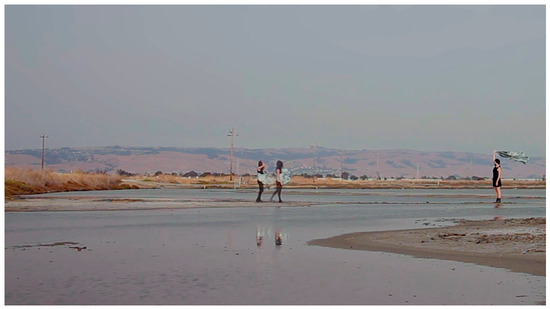
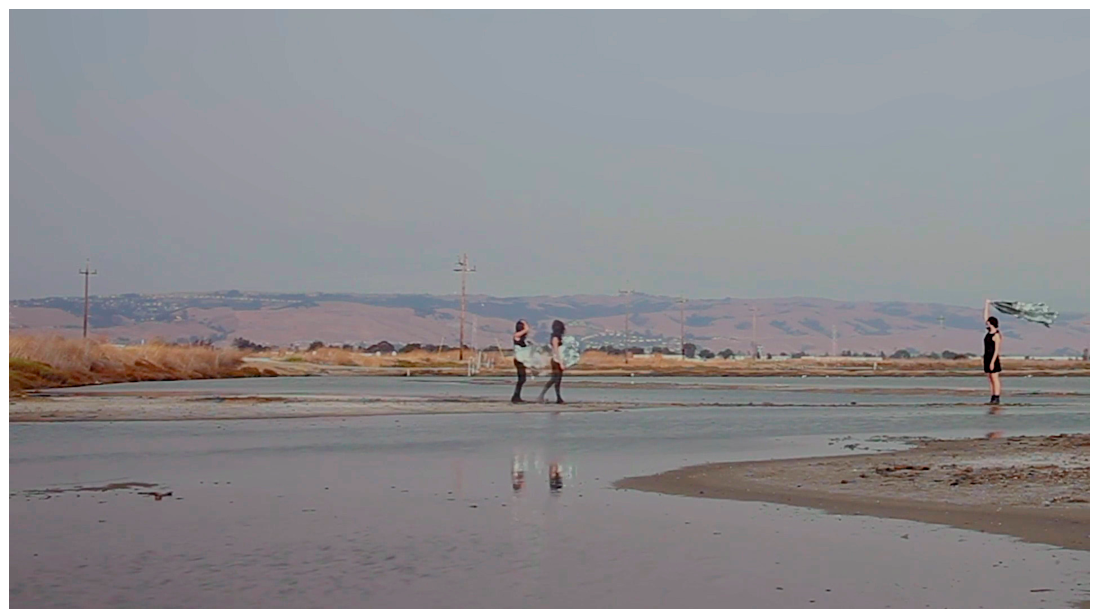
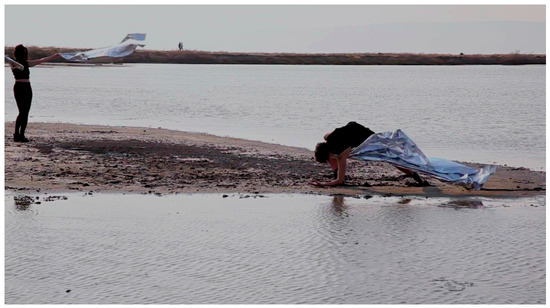
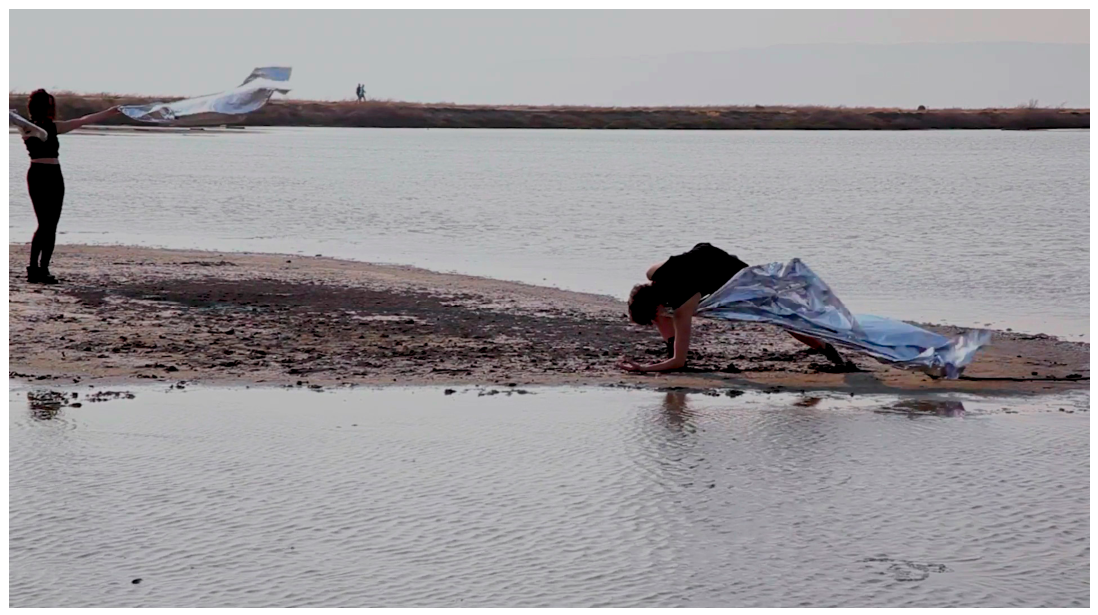
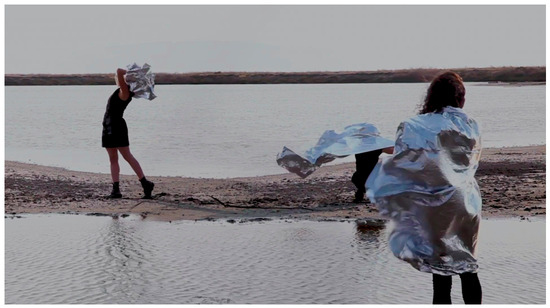
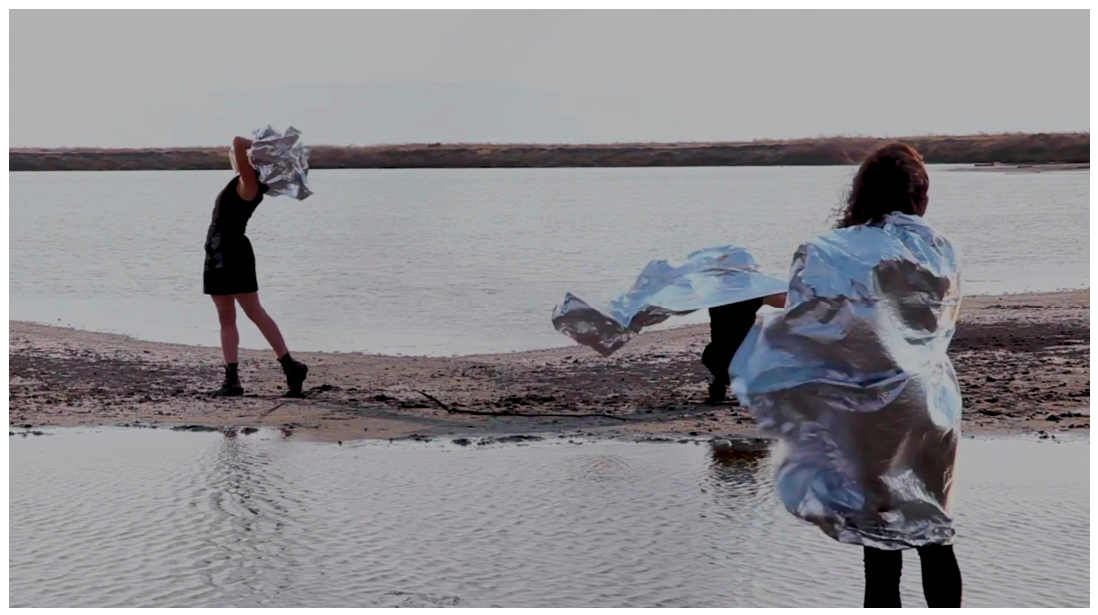
Disclaimer/Publisher’s Note: The statements, opinions and data contained in all publications are solely those of the individual author(s) and contributor(s) and not of MDPI and/or the editor(s). MDPI and/or the editor(s) disclaim responsibility for any injury to people or property resulting from any ideas, methods, instructions or products referred to in the content. |
© 2026 by the author. Licensee MDPI, Basel, Switzerland. This article is an open access article distributed under the terms and conditions of the Creative Commons Attribution (CC BY) license.