


Abstract
The Porous Line is a drawing inquiry that uses materials and processes to engage in a dialogue with a suburban ecosystem. I follow the physicist David Bohm’s proposal to use dialogue as a mode of engagement where habitual modes of thought are suspended, a form of non-judgmental curiosity. I reflect on how immersing a large roll of French imported paper in my everyday environs reveals the porousness between nature and culture. The binary separation of nature and culture has undergone significant criticism as we deal with the climate crisis. As a foundational medium within western art and thought, how can drawing communicate this growing ontological shift? The essay engages in dialogue with Yolngu art from Yirrkala as a guide on what an ecological art practice entails. Their commitment to work with what ‘country’ provides has resulted in innovative and thoughtful new works. In response to propositions seen in Yolngu artworks, this essay engages with place, materiality, and relationality through the process of merging line and ground, the fundamentals of drawing, physically and conceptually. I reflect on the challenges that need to be addressed within western ontologies to develop an ecological approach in drawing.
In thinking around what an ecological approach to drawing would entail I am curious about the basic elements of drawing. What is a line and what is the ground? What happens if we do not separate them? If dualism and human exceptionalism in Western thought is considered an underlying issue in the current ecological crisis, is it possible to reveal the porousness between these supposed binaries? The method of experimentation and reflection that I use to test this proposition involves the use of a nine-metre-long roll of Rives BFK, a medium weight French imported rag paper.
Each day I walk the dog along the shores of Timtumili Minanya, the Derwent River in Nipaluna Hobart, Lutruwita Tasmania1. Throughout the year, I swim out to a rock and depending on the tide, climb on it or dive down to greet the multiple beings assembling at the same time. It is the rock that I initially befriended but gradually I have been introduced to a vast array of beings that ebb and flow with the seasons. One early summer morning I bring a large roll of French imported paper to accompany me in the river.
As I swim out to the rock the paper slowly unravels until it floats along the surface in its entirety. The dappled patterns that form on the paper mirror the dimples in the nearby kelp and the ripples of the sandy surface below. One end of the paper starts to sink so I submerge myself in the water to see if the paper is in any danger of tearing. The paper slowly becomes vertical in the water. It has slightly twisted in response to the current with one end remaining on the surface. Our bodies of matter, the paper and I, float suspended in the watery realm. This unlikely dance makes palpable the reality that we are always surrounded by atmospheric conditions. We are always part of the same milieu and this momentary suspension out of our regular interactions helps to develop a new relationship with the paper, shifting it from a neutral ground to a wondrous complex being of matter.
My research is positioned in the relatively new discourse of Drawing Research (Garner 2008) which loops in and around other critical discourses. For many years, my research has been responding to propositions seen in the work of Australian Aboriginal artists. Steve Garner writes of the tension between drawing as a practice and drawing as an intellectual analysis. One of the reasons for my engagement with Australian Aboriginal and Asian Art practices is the lack of tension between the two positions. The anthropologist (Morphy 1989) writes that ‘when Yolngu talk about painting, they emphasise the role of the mind. Narritjin Maymuru attributed wisdom to the thin brush used in cross-hatching to create bir’yun or ‘brilliance.’ The brush is made of human hair. This is, in turn, linked to the fontanelle, which is seen as a focal point for both spirituality and knowledge. Yolngu paintings are thought as much as they are seen’ (Morphy 2008, p. 110). The interweaving of natural and cultural knowledge that is revealed in Yolngu Art provides an excellent guide as we develop an ecological approach to Art practices and Art History.
The roll of paper, suspended in the water, appears to remember its origins as a plant. It is mirroring the behaviour of the nearby giant kelp. Viewing it underwater, the paper is climbing to the light and putting out a flat expanse to float on the surface to capture the air and energy. In 1865, Charles Darwin linked plant movement to his theory on evolution, claiming that plants were sensitive to the environment. Whilst convalescing from an illness, he began to carefully observe the twisting movement of tendrils and how they grasped on to surfaces they met. Natalie Lawrence remarks that his illness slowed him down enough to observe the plants at their own pace. At that time in Britain, plants were being named and classified into Western systems of taxonomy, but Darwin wanted to find a new way of engaging with plants. Lawrence explains how he ‘placed a plant between a sheet of paper and a glass plate and marked a reference point on the paper, attaching a thin wire to a particular part of the plant, such as a leaf or bud. He made recordings at regular intervals by lining up the end of this filament with the fixed reference point and then marking its position on the glass plate’ (Lawrence 2022). Darwin adapts drawing to map growth and movement on the paper following how a tendril can rise and fall and climb a new support. In my drawing experimentation, the paper released from its horizontal habitat began to follow a similar pattern becoming a freestanding vertical, displaying plant behaviour.
The philosopher Marder (2013) in his examination of Western philosophy concerned with vegetal life provides examples of “information retrieval” by plants by cellular and molecular biologists. He proposes that
‘These examples demonstrate that what Nietzsche chanced upon in his reflection on the mimosa—the sensitive plant par excellence, one that closes its leaves in response to touch or absence of light—is in fact a more general tendency of vegetal beings to store imageless and non-representational material memories in their cells, and so to retain a trace of the remembered thing itself, in place of its idealised projection … Conceived in a non-anthropocentric fashion as a “primal quality,” memory, inherent in plants at the cellular and molecular levels, comes to describe any network of traces, of which consciousness is a highly circumscribed instance. It is the very fact or facticity of impression, of an imprint, or better, an ex-print, that forms the register of what a living being has undergone in its lifetime’.(Marder 2013, p. 127)
In using a roll of European rag paper, I had always thought of it as an extension of me, a white imported intrusion into the landscape. A symbolic acknowledgment of the European drawing tradition that I am steeped in. Paper was in use in China in the second century A.D and gradually developed in Europe around the twelfth century (Rawson 1969, pp. 50–51). Paper mills were initially set up in Italy and many of the processes and sizes of Fine Art papers have remained the same. Paper is made through pulping plant fibres in water. This watery mixture is placed on sieves allowing the fibres to interconnect as they dry. The length and nature of these fibres and the amount of glue added to them constitute the nature and behaviours of the paper. They can be further pressed using hot and cold rollers (Rawson 1969, p. 51), shifting the porousness and response to marks. The roll of Rives BFK that I use is considered medium weight and retains the natural surface formed by the sieve and blankets in which it is dried. This surface is absorbent and sensitive to capturing the traces of graphite or pastel that traditionally goes along its surface.
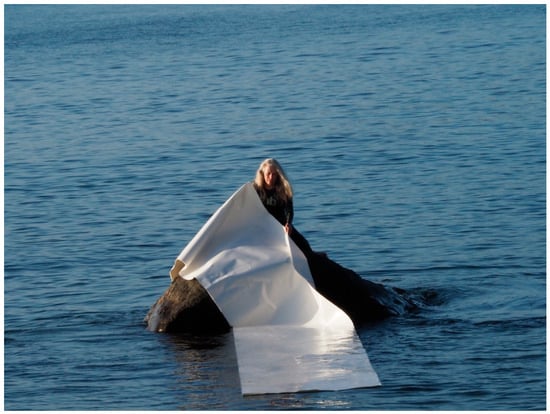
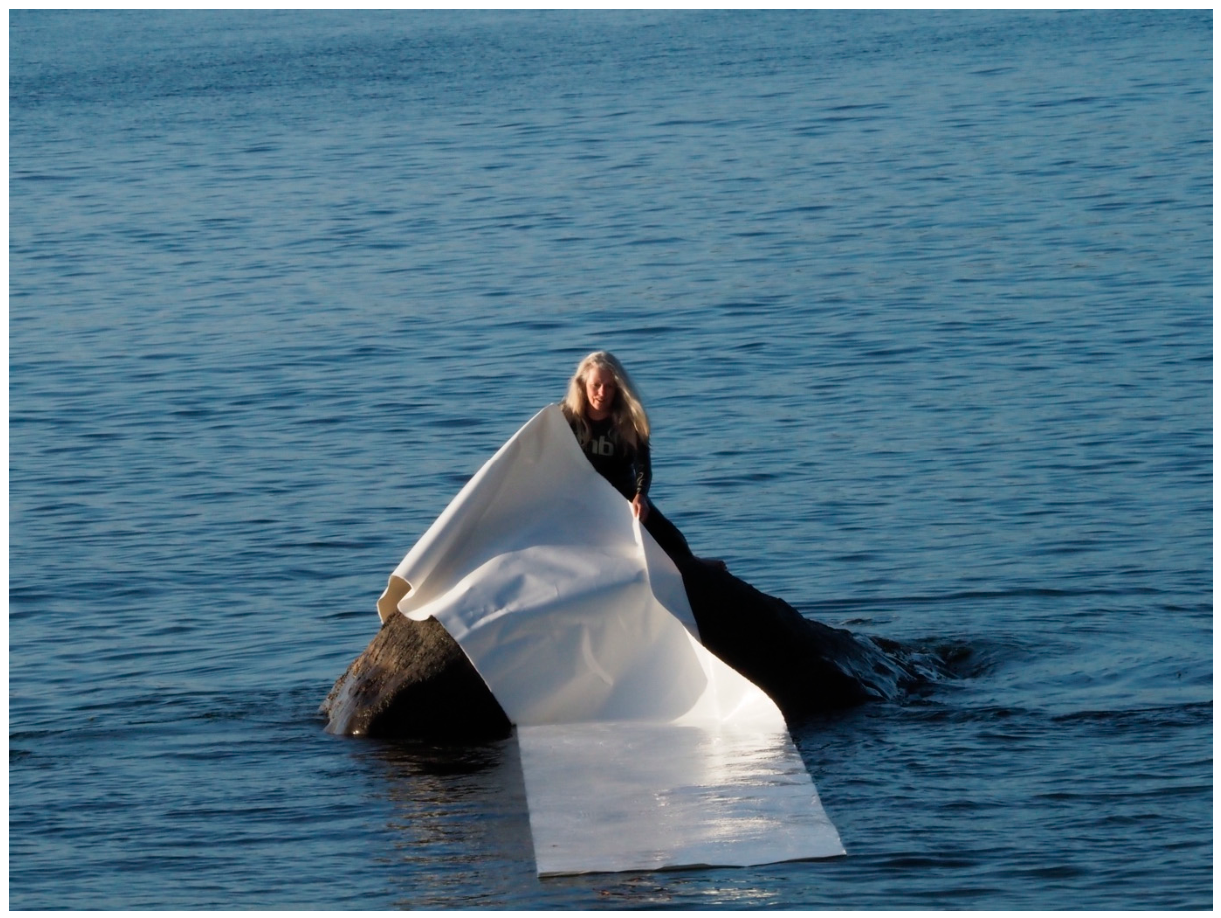
I swim over to a large rock which has a ledge, making it easier to climb on to from the water. The paper drifts my way and I grasp it. Sitting on the rock, I realise I rarely engage with paper in this way, nursing it in my arms (Figure 1). The Western tradition of paper making and its expense to import to Lutruwita Tasmania has maintained my thinking around it as a cultural form and whilst many of these drawings may end up as mulch for the garden, I had never considered it truly as a ‘plant’ form. Here, in the early morning, trying to manoeuvre the paper on to a rock without tearing it, I become more conscious of its materiality. Does it remember in its cells that it was once plant, once cotton in a field, roots in the dirt, twisting in the sunlight transforming ephemeral light into matter and nutrients? As I pull more paper up onto the rock, the other end slides its way back into the water. It is unbelievably acting like the giant kelp nearby, as if reaching out to play. Could the cellular and molecular biological traits of plants become evidenced in the paper? Is this ability to hold memories, of human and nonhuman interactions, part of the story of why humans and paper have coevolved across cultures?
Figure 1.
The artist and paper on a rock, Timtumili Minanya, Derwent River, Photo: Keven Francis.
Trained in both printmaking and drawing I have tested papers in many different conditions. The porosity of paper increases with soaking in water and over the years I have tested the roll of paper in dams, waterholes, and creeks. It is only in recent years that I have engaged with the saltwater estuary of Timtumili Minanya Derwent River. The saltwater changes the paper’s behaviour in quite unexpected ways. During our first immersion several years ago, sections of beautiful crisp marks emerged after Sumi ink was poured directly on the paper whilst it lay on the beach. The black ink seemed to crystallise whilst the more watery realms left exquisite tidal marks behind as the ink dried. Using the carboniferous qualities of sumi ink in the environment reminds me of the Chinese flung ink method, which offers an alternative to the European landscape framing of form as it allows for a decentering of the body through an acceptance of the surrounding conditions in forming the mark.
The sinologist Francois Jullien explains that Ink and Brush painting in China is an acknowledgment of the dialogue between human and landscape and acceptance of the spiritual realm as the animator.
‘The purpose of the landscape ‘according to Shitao,’ is to serve-offer-present something of the “animated spiritual”. The “spirit” so conceived is not an agency but an operation (of inhalation-distillation) by virtue of which any reality is able to exist. And it is by virtue of the spirit that such a reality, in coming about, is itself a source of effect. The spirit is thus at work in any process of actualization, whether of forms or thought’.(Jullien 2009, p. 132)
On this occasion, I am thinking of the paper roll as the flung ‘ink’ in the proposition of merging the line and the ground. The paper is conceived as ink and ground combined and ‘flung’ on to the estuarine ecology of the river. The connections between figure and ground are considered a foundational relationship in teaching and writing about drawing (Elkins 2000), but rarely is the materiality of the paper itself discussed except when the artist’s process is closely connected to the properties of paper. Even then the molecular constituents of the paper are not discussed.
The Land artist Michelle Stuart experimented in using paper as a line, placing the earth of specific sites on to a muslin backed paper. In works such as Turtle Pond, Kingston, NY 1974, the earth/gravel from the site is laboriously worked on to the paper. In this instance, she worked what I would consider ground (dirt) on ground (paper) and made a material line where mark and surface are linked together to form meaning. This is an approach I had been using previously but I had not made the deeper connection of the paper as plant matter.
In On Line (2010), the exhaustive overview of drawing in the twentieth century by Cornelia Butler and Catherine de Zegher, the relationship of line to the surface is mapped from the late nineteenth century to 2010. Across cultures they make connections on the shifting nature of the line in a global context. Whilst they discuss the materials and processes of drawing, there is a consistent appeal to the line breaking away from the constraints of paper into new spatial possibilities. In a section on relations between plane/space/line, de Zegher argues that
‘Rather than the support being the precondition of the drawing, drawing now can be seen as what Alain Badiou calls “a constructive deconstruction,” its marks and lines articulating and indeed constituting the ground itself. As Badiou writes, “In a true drawing, a creative one, the marks, the traces, the lines, are not included or closeted in the background. On the contrary, the marks, the lines—the forms, if you will—create the background as an open space … In the drawing, some marks create an inexistent place. As a result, we have the description without place”’.(de Zegher and Butler 2010, p. 113)
In the context of thinking through an ecological approach to drawing, this dematerialisation of the ground poses a significant challenge. Whilst the line becomes material, the ground inclusive of air, atmosphere or site becomes what Badiou calls an ‘inexistent place’. In a discussion of the work of Dorothea Rockburne, Louise Hopkins, and Lai Chih-Sheng, Maria Kassianidou proposes a dialogical approach to drawing that would stimulate responses to otherness beyond binary structures. She outlines that discussions around drawing continue to privilege the mark whilst the surface becomes an absence (Kassianidou 2020, pp. 346–47). Through her analysis of Dorothea Rockburne, Louise Hopkins, and Lai Chih-Sheng, Kassianidou argues that mark and surface become inextricably linked. And in her conclusion, she asks,
‘Indeed, how might our encounter with a drawing change if the mark is not the sole focus, if the surface—potentially half the material comprising a drawing—is not simply ignored, and if the specific relationship between them becomes another way into the work? Might this enable us to articulate more fully the role surface plays in most drawings? Might it allow us to rethink the roles of the mark and, thus, experience differently the relational character of drawing?’.(Kassianidou 2020, p. 58)
In an ecological approach to drawing, these relationships between things, down to the fundamentals of line and ground, are important elements in the development of meaning. The anthropologist Deborah Bird Rose suggests ‘The new ecology starts with this fundamental assertion: that the unit of survival is not the individual, or the species common but is the organism-and-its-environment in relationship’ (Rose 2004, p. 188). To develop an ecological approach in drawing, is it possible for me to overcome my training as an observer, something outside of the ecology I am drawing and to draw relationally with my fellow beings?
In my daily walks and swims engaging with the weather and conditions of Timtumili Minanya, I manage for short moments to lose a sense of myself as a contained unit and start to engage physically and mentally in what Stacy Alaimo calls trans-corporeality. She writes; ‘The ‘environment,’ as we now apprehend it, runs right through us in endless waves, and if we were to watch ourselves via some ideal microscopic time-lapse video, we would see water, air, food, microbes, toxins entering our bodies as we shed, excrete, and exhale our processes materials back out’ (Alaimo 2010, p. 11). The engagement I have with the roll of paper assists in me visualising these invisible forces. There becomes no front or back to the paper as the surface becomes porous. As our collaboration develops over a year, the paper assists in gathering and absorbing matter that comes our way, revealing the complex relations that gather in this small ecology.
As a guide to developing an ecological approach to drawing, I look towards the artworks of the Yolngu of north-east Arnhem. Whilst the works produced at Buku-Llarngay art centre in Yirrkala would not be classified as drawing in a traditional Art History framework I use a broader definition that encompasses art works where I can see the structural elements of a work. I follow Phillip Rawson’s definition of drawing as being able to read the sequence of layers in a work. In his analysis of drawing, Rawson (1969) looks broadly across the arts into works of other cultures to develop his appreciation of how materials and structures are culturally bound and intrinsic to the meaning of the work. He includes works such as bark painting, pottery, and prints that provide the viewer information about the artist’s decision-making process.
I have selected the art of Yolngu due to their commitment to work from ‘country’. It became ‘a requirement that all elements of the paintings of country made for Buku-Larrngay come from the land … and include identifiable clan based designs for country.’ (Pinchbeck 2025, p. 52). The decision to only use resources from country has led to innovative responses to external global forces whilst maintaining cultural ceremonies, laws and obligations (Morphy 2008). This commitment to country and what it provides has led me to locate my drawing practice within the site I live and work in daily.
Country is an Aboriginal English word that the anthropologist Deborah Bird Rose has defined as a “nourishing terrain”;
People talk about country in the same way that they would talk about a person: they speak to country, sing to country, visit country, worry about country, feel sorry for country, and long for country. People say that country knows, hears, smells, takes notice, takes care, is sorry or happy… country is a living entity with a yesterday, today and tomorrow, with a consciousness, and a will toward life.(Rose 1996, p. 8)
As a settler Australian, I cannot fully grasp this concept as my ontology is completely different. Instead, I use it as a guide to think more carefully and sensitively about the place that I live in. The flow of materials in and out of my home, my travel, my quality of life are all brought into question. The process of drawing in dialogue with a site highlights the multiple beings that have been introduced and jostle for survival in the environment.
The eco-feminist philosopher Val Plumwood points out that a sense of place for one culture can override another’s claim to the same place. It can also provide an uncritical point of departure that does not see the many other places that provide for the sense of belonging or familiarity with a place. Plumwood argues for ‘recognition of the multiple, complex network of places that supports our lives’ (Plumwood 2008, p. 141). She describes ‘dematerialisation’ as ‘the process of becoming more and more out of touch with the material conditions (including ecological conditions) that support or enable our lives’ (italics in original Plumwood 2008, p. 141). The dematerialisation of the ground of drawing in Art History and theory is what I am trying to shift in my own practice.
To understand what I mean by dematerialisation of the ground of drawing in Western ontology, the often-quoted description of the drawing process by the artist and writer John Berger provides an insight;
“I now began to see the white surface of the paper, on which I was going to draw, in a different way. From being a clean flat page it became an empty space. Its whiteness became an area of limitless, opaque light, possible to move through but not to see through. I knew that when I drew a line on it—or through it—I should have to control the line, not like the driver of a car, on one plane: but like a pilot in the air, movement in all three dimensions being possible”.(Berger 2005, p. 5)
This terminology when placed into a settler context becomes palpably inappropriate. If we continue to think of the ground as dematerialised, or neutral, waiting for meaning to come in, do we perpetuate the colonising concept of Terra Nullius?
In my use of the roll of Rives BFK, I aim to grapple with the materials I use physically, financially and conceptually. An acknowledgment of who we are, enmeshed with who we are with, as part of a bio/social ecosystem is an important element to bring drawing into an ecological practice. This engagement with matter also needs to incorporate those materials that pollute, dispossess, and harm. The sites where this occurs are what Val Plumwood terms ‘shadow places’;
“These places remote from self, that we don’t have to know about but whose degradation we as commodity consumers are indirectly responsible for, are the shadow places of the consumer self. The places that take our pollution and dangerous waste, exhaust their fertility or destroy their indigenous or nonhuman populations in producing our food, for example, all these places we must own too”.(Plumwood 2008, p. 147)
Plumwood takes heed of the advice provided by Bill Neidjie, the senior elder of Kakadu, who advised us to take care of ‘this piece of ground he grow you’ (Plumwood 2008, p. 145) and applies it to consumerist societies, reminding us to be inclusive of all the places that sustain us.
In working alongside different cultural ontologies, I engage in a mode of dialogue inspired by the physicist David Bohm which he proposes as a mode of “participatory thought” with the world. Lee Nicol in his foreword to Bohm’s book on dialogue describes it as ‘a mode of thought in which discrete boundaries are sensed as permeable, objects have an underlying relationship with one another, and the movement of the perceptible world is sensed as participating in some vital essence’ (Nichol in Bohm 2003, p. xvi). The aim of the dialogue is to pay attention and to suspend assumptions, even recognising these assumptions and leaving them aside.
It is this approach that I found useful as an artist working side by side with other artists. Watching how marks are applied, in what sequence, and in relationship to other marks, has enormous capacity to communicate differences and similarities in drawing approaches. My dialogue with Yolngu artists started thirty years ago as I worked as a custom printer at Studio One in Canberra. The first artist I worked alongside was Gaymala Yunupingu who was in Canberra for one of her exhibitions. She expressed an interest in working on the large lithographic stones which is my specialty. I showed her my own work which at the time were of Australian animals made with tusche washes, a liquid process where a black greasy medium is suspended in water and as it slowly dries reveals patterns and forms similar to tidal marks. It relies on the lithographic stones ability to assist water’s cohesive forces and to record the outlines of the water’s shapes as applied by the artist. Gaymala indicated she would like to do the same process. Her quick mastery of the medium and perception of the medium’s appropriateness for her subject was my first insight into the knowledge held by her about the nature of how materials and processes reveal meaning. Whilst working on her images Gaymala would tell me the stories of the animals, what seasons they emerged in and the relationships they had with other beings and landforms.
As we worked alongside each other, a dialogue occurred that bypassed linguistic difficulties. Gaymala showed me her country as she laid down each mark, revealing the waterways that the animals lived in and that she was deeply connected to. Her approach to drawing on the stone initially startled me, as she started at one corner and then slowly worked across to a corner diagonally opposite. The completed drawing was successfully framed by the water marks and did not spill off the other side as I half expected. This was an approach I witnessed many times in working with Australian Aboriginal artists. The spatial relations and applications of designs on coordinates often quite different from surfaces they were used to working on such as bodies or barks, were sophisticated and needed no previous mapping out of a design in a manner that I would normally undertake before starting a work.
At the time we worked together, printmaking in Yirrkala was only used by the women of the community. The rules governing the production of artworks differed in this space, ‘allowing for full range of colour choices and encouraging innovation in form and experimentation in the techniques employed’ (Morphy 2008, p. 75). These works by women did not use the sacred designs as the women had not been trained or given permission to use the sacred imagery. Nowadays, there is a purpose-built print space in Yirrkala and it is used by many artists of the community, male and female, elders, youth, and children as a space for learning stories, experimentation, and as financial support for the community.
The anthropologist Howard Morphy provides a brief history on the development of Art in Yirrkala as part of his analysis of how Yolngu negotiated the terms of their engagement with European frameworks (Morphy 2008). He traces the development of Yolngu Art practices in reaction to engagement with the Art market and how this led to an opening up of artistic practices within Yolngu society. One outcome of these engagements is the inclusion of women artists in fields that were initially the province of men.
As Yolngu respond to social changes that have occurred due to European colonisation, there has been a shift in ceremonial practices to be public, allowing women and children greater inclusion. Women artists have transitioned from assisting husbands and fathers to working independently with content that ‘at the time of European colonisation they would not have seen’ (Morphy 2026, p. 12). Cara Pinchbeck quotes the artist Galuma Maymura discussing the role of women in painting, ‘I really want this painting to keep going… I have to teach my kids in case someone might steal the designs (Pinchbeck 2025, p. 51).’ Pinchbeck further outlines the ways in which women have innovated within the printmaking medium and in developing imagery based on the everyday. These innovations in art practice opened up the opportunities in which I came to work with Yolngu artists.
Morphy traces how the Yolngu have used art as a dialogue with visiting Macassan, missionaries, anthropologists, and collectors. He points out these were considered decisions by the Yolngu as they believed in the power of art to demonstrate their knowledge of their land (Morphy 2008).
Yolngu elder Djambawa Mariwili outlines the importance of Art as a cultural, political, economic, and community activity;
‘When we needed strength to fight against political attacks, all we could do was paint those patterns and say, ‘This is our pattern, this is our story, this is our document.’ We never wrote it in a book; we showed it through the patterns and designs. In our paintings, we show that we own these places’.(Pinchbeck 2025, p. 120)
The arts advisor Will Stubbs explains that the ability to sing and paint the stories of sites is an integral part of Yolngu negotiations in land disputes. Access to these stories and designs is guarded and can only be used with approval from appropriate elders. This knowledge is the equivalent to a land title. The law of the land comes from the land and is expressed within the human realm by Yolngu. These designs have power and must be negotiated in their use by artists. Stubbs states that law, as expressed in art, has been used to fight for rights rather than the use of violence (Pinchbeck 2025, p. 36).
In his analysis of drawing across cultures, Phillip Rawson argues that we are not shown a vision of the world in the language of the artist, rather that the art is made in a language that the artist believes to be true to reality. He proposes, ’Drawing conveys a meaning—it can never convey a ‘pure likeness, nor a selection of naturally given, objectively formulated data. It conveys a meaning… by a structure of symbolic elements which are formulated as method’ (Rawson 1969, p. 24). It is only through my cross-cultural dialogues with artists like Gaymala Yunupingu that I became aware that my observational drawings of the world are not a ‘true’ depiction of reality but rather a language from Europe that I have been trained in. It is a common misconception that Western realism provides an image that could be recognised across cultures and animals themselves could be lured into believing it was ‘real’ (Rawson 1969).
Not long after working with Gaymala, I moved to Darwin where the printmaking workshop at the Art School was engaged in projects with Aboriginal artists and communities across the Top End of Australia. In one of the cross-cultural print projects that went over several years, I worked with Djalu Gurruwiwi and Dhopiya Yunupingu from Yirrkala. They visited the workshop several times, engaging in collaborations with other artists as part of the project and developing their own prints. Whilst drawing, both artists would relay to us the significance of what they were performing and the multiple relationships that were being expressed in the work.
Through collaborations over many years, printmakers at the school had developed techniques that aligned with Yolngu practices. For developing a screenprint, Djalu and Dhopiya were provided with separate sheets of acetate. On each sheet of acetate they would paint in the appropriate colour the forms required for the image. These were performed in opaque ochres that corresponded to what they would use in Bark Paintings. The image preparation for the screenprint was performed by adding another layer of acetate for each colour. When placed together, they formed a cohesive image but could be separated to be exposed photographically on a screen for printing each colour separately. This process provided me with some insight into the structure and approach of Yolngu artists.
A deeper understanding of the process as applied to bark paintings is described in more detail by Howard Morphy. Paintings move from a state that is made quite quickly—that Morphy describes as ‘rough, dull and ill defined’ to one of ‘shimmering brilliance’. He notes that this ‘process of painting is seen as adding ancestral power’. Shimmering, according to Morphy, is captured in the Yolngu verb bir’yun, which can be translated into English as ‘to shimmer brightly’ (Morphy 2008, p. 92). This shimmering quality is developed by painting a fine cross-hatching that covers the surface.
The screenprint that Djalu Gurruwiwi and Dhopiya Yunupingu did not aim for this level of brilliance as it was intended as a secular image for cross-cultural dialogue. However, the structure and sequence of marks remain visible, and I can read the layers and the decision-making process. I find that reading a drawing in this way keeps the work active, it reveals the time in which the artist makes the marks layer by layer and brings it back into the time of viewing. Rawson states that in “reality a line once made does not itself change or move. It is fixed as a static mark. But there always lies at the bottom of a drawing an implied pattern of those movements through which it was created” (Rawson 1969, p. 15). His observation that “one has to be continuously aware of the sequences which went into their composition” (Rawson 1969, p. 15) is foundational to my approach to drawing. It is the definition I use to claim a work as a drawing regardless of the medium.
When making art, Djalu and Dhopiya usually sat outside in the garden next to the Print Studio with family, friends, printers, and artists gathered together. Bohm’s theory of dialogue matches the set up quite beautifully in his suggestion that to develop a space for dialogue, groups of no more than twenty should gather in a circle with no fixed agenda (Bohm 2003, p. 15). Although the artists and printers were gathered in the hope of making some prints, whilst the actual drawing was occurring the conversations would drift and change with no obligations to share any particular stories. One day, Djalu was starting on the fine crosshatching over an area where he had painted the broad flat forms of rocks, water lilies, river, and waterhole. He noticed my keen interest in his mark-making and began to explain how the marks corresponded both to the site and to the cultural knowledge of the Yolngu. As his mark-making shifted in direction, he explained that the flow of the water changed at this site and the noise was different. Djalu was a much respected yidaki (didgeridoo) player and to explain the marks, he played the yidaki and pointed to the corresponding space in the painting as the sound from the yidaki. His young son took the prompt and leaped up to dance which Djalu explained was a corresponding manifestation of the site. The music, mark, and dance were all linked to the land, emphasising that it was the land that came first.
Morphy explains how the artworks are intrinsic to the ecology;
‘Yolngu art condenses and expresses extremely complex relationships between things—between social groups, and in the seasonal cycle between fresh water and salt water, fire and water, between life and death, and male and female—and underlying all is the template of the ancestral past. Ancestral design is revealed in action—in the continuing relationships between people, in the fertility of the land, and in the renewing and cleansing power of the wet season’.(Morphy 2008, p. 109)
Having observed this brief lesson, I became more interested in finding an art practice that would listen to the land and reply sensitively. It is an evolving process, especially as I have moved so often in my life across quite different terrains in Australia.
The anthropologist Deborah Bird Rose argues that as ‘doors of connectivity, we settlers would have to acknowledge our connections with indigenous people: the same soil gets into our blood, the same waters quench our thirst, the sweat of us all resides in the ground. We and other living things are co-participants in earthly reciprocities of being, becoming, and dying’ (Rose 2002, p. 322). Rose proposes that engaging in dialogue with our dark histories will allow for a porousness between cultures. ‘Far from being distanced from our histories of violence, dialogical interpenetration means that we are intimately and physically connected. Furthermore, we are intimately connected with the pollution, poisons, and death work of ecological damage’ (Rose 2002, p. 322). She understands that this work is confronting as we grapple with the people and places that we have damaged and continue to exclude. However, it is her message of hope and empowerment that provides a strong foundation to maintain the dialogue that she argues needs to be situated, embodied and ethical.
Her writing seeks to bring the teachings that she has been provided by Aboriginal Elders to the attention of settler communities. She offers the proposition that
… connectivity is potentially empowering. It enables a becoming that calls us to take care of the places and people with whom we are connected. It offers an expanded concept of self, and thus an expanded concept of self-interest. It reconfigures dialogue to include place, and brings us face to face with the real here and now of our lives. A permeable and becoming self is an unfinished project and thus invites considerations of mutual care. An ethic of care could thrust itself into our bodies and minds through awareness of our own unfinished vulnerability. Ecological selves require an ecological dialogue in order to sustain the country in the self and the self in the country.(Rose 2002, p. 322)
An embodied listening alongside artists developing works in printmaking has been a strong guide for my practice. In my drawing process, I am attempting to bring this sensitivity and understanding to the site where I live. The process brings me into close contact with the matter and ecology of my home. Working with the large roll of paper, I aim to make visible the multiple beings that assemble in this time and place. Jane Bennett argues that ‘materiality is a rubric that tends to horizontalise the relations between humans, biota and abiota’ (Bennett 2010, p. 112). Val Plumwood has proposed that ‘Focusing exclusively on the human element as creative, has the effect of disappearing the other, frequently much older and more important, form of agency or creativity, the work of the earth, of the natural world, of nature, in forming the land, also the agency of the earth itself, the biosphere, the other species present in and formative of the land.’ (Plumwood 2006, p. 125). These concepts articulate how I have shifted my concept of ‘dialogue’ from engaging across human cultures to a broader engagement with all the beings that are part of the ecology that I call home. Whilst engaging for many years with the modernist concept of truth to materials and sensitivity to processes, engaging in a situated practice in my local environs, I now try to engage with the assemblage of beings that congregate together.
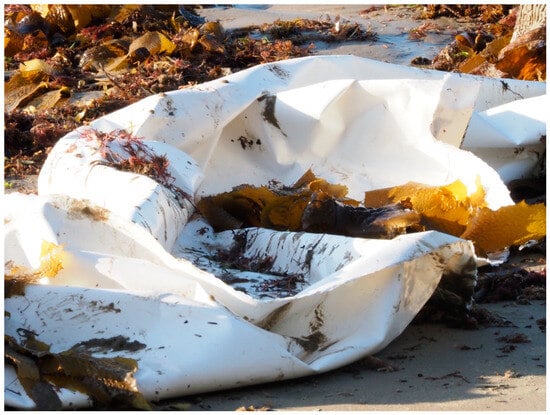
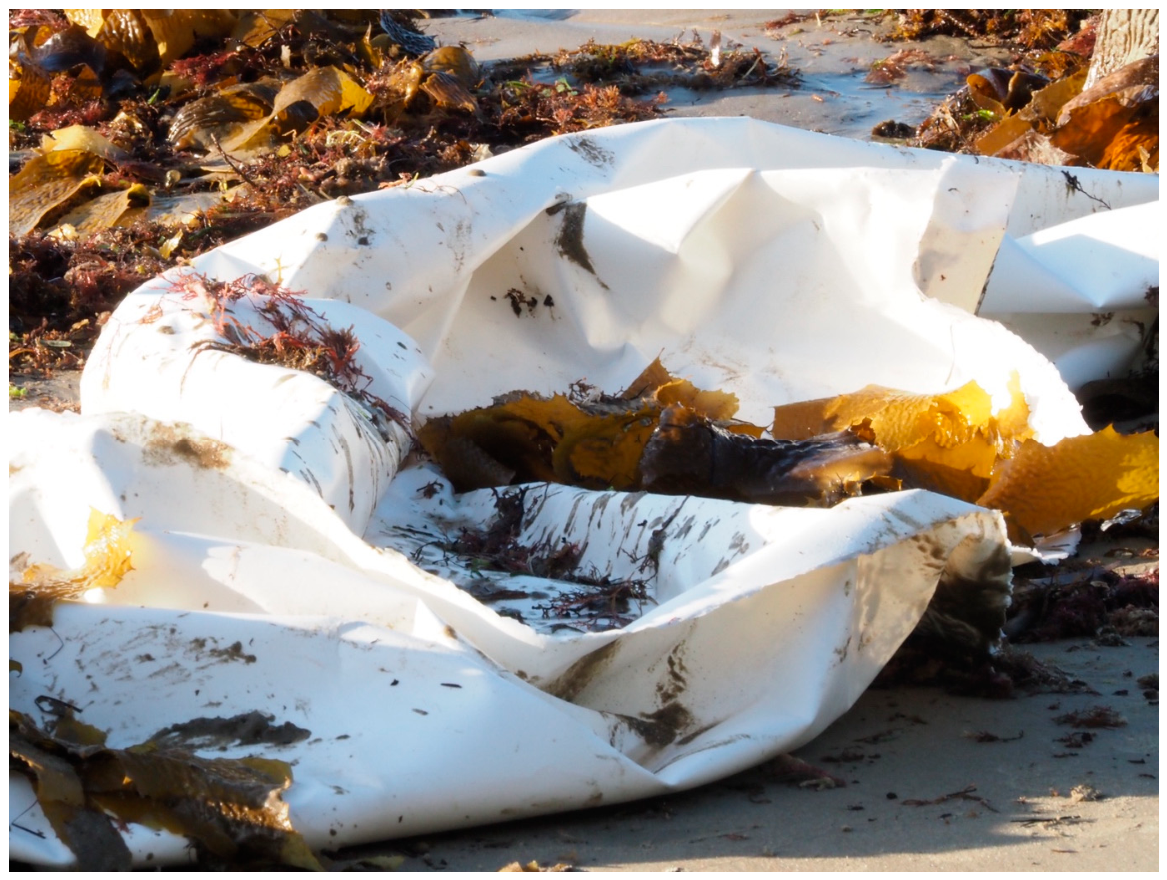
After swimming together in the river, I lay the paper on the beach and put the seaweed that has gathered on the shore on to the surface (Figure 2), roll it up and take it home. In the past the seaweed has melded to the surface of the paper, and I am hopeful that this will happen again. I leave it rolled up in my studio for a couple of weeks until I realise that it smells a bit. I unroll on the front lawn, but I am disappointed that the seaweed just smells but has not attached. There are a few nice stains on both sides of the paper, but nothing substantial. We both sit on the mossy front yard and consider the next steps.
Figure 2.
Paper and seaweed, Taroona Beach, Photo Keven Francis.
Disappointed with the minimal influence of the seaweed I gather the leaf and plant matter that flows through our home and boil them to make ink. I apply the inks at regular intervals alternating on different sides of the paper to allow it to absorb through all fibres of the paper, so that it becomes a physical three-dimensional line and not just a surface that marks are being placed on. Each layer reveals the stains of plant detritus that were available at different seasons throughout the year, although the colours are not as rich as I had hoped. The beautiful red droppings from callistemons only provide a warm tea-like stain. The most prominent stain comes from the seasonal gift of cherries from our neighbours. Any rotten cherries and discarded pips were put in the pot and boiled. These were initially a satisfying purple stain but as I sit here writing, I notice that it has shifted to a mahogany colour and a fluffy green mould has become attached. The paper has invited some unexpected friends that will not be welcome within the cultural structures that I work in. However, it does reveal the truth of what comes into my site and what we live with, internally and externally. How has the cherry industry impacted the land and how will I deal with this accumulation of beings on my paper without causing more harm? Who gets to survive this current assemblage and who makes the decision? Will the mould vacate of its own accord?
I realise my notions of dialogue with a site had not included unwelcome guests. I thought it would all be beautiful washes and attachments of leafy matter. It is a reminder of the world that I do not see or have ignored in my ecology focusing on the beauty of the river and tracks amongst the bush. In reality, the ground that I live amongst consists mainly of clay and building rubble. There has been massive terraforming to build the suburb that I live on and the industrial history has poisoned this land that is acclaimed for its picturesque beauty. There are heavy metals in the Timtumili Minanya Derwent River that make it one of the most polluted in the world and we are now witnessing the death of large ecosystems of giant kelp due to warming waters. The salmon farming industry is polluting and spreading antibiotics and other waste throughout the river system. As I sit with the paper, I search for a way forward. My approach to the project remained contained within my western ontology of a singular artist attempting to solve a problem. How do I acknowledge the relations that impact this small ecosystem within the confines of my knowledge system?
A cross-cultural collaboration between two artists that occurred for many years in Arnhem Land provides an outline of the differences between knowledge systems and how they can meet when engaging in an ecological approach. The artists, Mulkun Wirrpanda and John Wolseley, first met during a cross-cultural print project in Arnhem Land called Djalkiri run by Nomad Art, a gallery that I worked with for a few years. The project commemorated the 150th anniversary of the publication of On the Origin of the Species by Charles Darwin and brought together artists, scientists and printmakers at Yilpara on the shores of Blue Mud Bay (Cameron 2010).
The Yolngu elder Djambawa Marawili hosted and commented on how sharing knowledge and techniques was important. His commentary beautifully evokes how knowledge resides in the land;
‘When those ŋäpaki (foreigner) artists were walking around in that country, they were walking about the land, but the patterns and the designs are beneath, they come from our ancestors. The way we were working together was really important because we were looking from both worlds, the Balanda (white person’s) world, the Balanda way of significance in how to describe and how to paint it and how to make those pictures real, those paintings of country, with substance, with story, with meaning … We were learning together and having a good partnership. Working together to lift the art from the country to make it really strong’.(Cameron 2010, p. 7)
In this statement, Djambawa Marawili articulates that the land is the knowledge holder and there are ways of accessing the patterns of the land within different knowledge systems. Whilst the Yolngu hosted the artists and walked with them, the visitors were accompanied by an ethnobotanist to assist in identifying the plants across cultures, an anthropologist familiar with both art systems, and a printmaker.
After this experience at Blue Mud Bay, John Wolseley sought to continue working alongside Mulkun Wirrpanda. Over many years they worked together in a loosely outlined project that according to Will Stubbs had the running title ‘Two old people looking for food’ (Midawarr 2018, p. 8). Stubbs points out that in Yolngu society to call someone old is a sign of respect. Mulkun Wirrpanda was a senior elder who lived off her ancestral lands. She had a deep knowledge of the plants and their ecosystems. For around five years, she worked with John Wolseley, digging and harvesting plants and making artworks about them. Initially, her artwork remained committed to the plants that she held sacred designs for. Gradually though she began to develop art on a wider range of plants of the region to ensure the knowledge was not lost and would be passed on to future generations. She was aware of the impact of the western fast food that has become a dominant diet amongst Yolngu (Midawarr 2018, p. 7).
The artworks that Mulkun developed around these plants new to her practice presented a difficulty as she did not have the authority to use the sacred designs. She outlines the process;
‘Once I started painting food plants without reference to their sacred identity, I had to find a new way to paint. I could not use the miny’tji (sacred design) or steal the sacred identity of the plants which belonged to clans other than my own. So I had to find a marwat (crosshatched background) which was just wakinŋu (ordinary) but not just infill. So I had to let the plants tell me what their secular identity or character was’.(Midawarr 2018, p. 18)
The Art Historian Henry Skerritt explains the distinction that Mulkun is making is that these are ‘unique geometric designs owned by clans and used in ceremonial context. Painting of the miny’tji is an assertion of one’s knowledge, ownership and identification with particular clan estates’ (Midawarr 2018, p. 19). Compounding the issue is that, according to Yolngu ontology, the sacred design is the ‘true’ identity of all living things that was provided to Yolngu by country. Skerritt argues that Mulkun overcomes this conundrum by using the power of association. There are enough references within the secular design that she paints to connect it within its world of relationships but not enough to be classified as miny’tji’ (Midawarr 2018, p. 19).
In her description of how she arrived at the appropriate designs, she stressed that they were not just a decorative infill. The designs needed to provide marks that made connections to the broader Yolngu cosmology, so Mulkun used observation methods similar to Wolseley’s western approach of scientific classification but still within the realms of her Yolngu ontology. She says that she arrived at these designs by observing ‘the way they grow or the way they look or express themselves. This gave me their rhythm or pattern’ (Midawarr 2018, p. 36). Skerritt argues that these innovations lie within the Yolngu ontology by continuing to rely on the natural world to ‘influence its own representation’ (Midawarr 2018, p. 20). He points out that the miny’tji were ‘Laid down in the land by the ancestral beings, and remain as a discernible presence in the land’ (Midawarr 2018, p. 20). Skerritt reflects that Wolseley and Mulkun’s artistic pursuits were connected not only by their interest in botany as subject matter but as a deeper philosophical inquiry into the ‘nature of being’ (Midawarr 2018, p. 18).
Skerritt outlines the philosophical and ontological differences that underline Wolseley and Mulkun’s approach to art-making. Mulkun uses figures and geometric patterns that remain within the Yolngu cosmology whilst Wolseley uses a range of scientific documentation, encompassing careful observation, scientific notations, and diagrams and colour notes (Midawarr 2018, p. 15). He combines prints, drawings, rubbings, and watercolours in small and large-scale artistic experiments to understand the connections between beings in nature. His practice involves collaborating with the natural world, allowing different systems and notations to come together. In this way, he overcomes the Western view that attempts to present a unified vision as if looking through a window. Both Wolseley and Mulkun have engaged in a lengthy dialogue in an important ecological project to map and maintain the knowledge of edible plants in Arnhem Land, developing new practices from the collaboration.
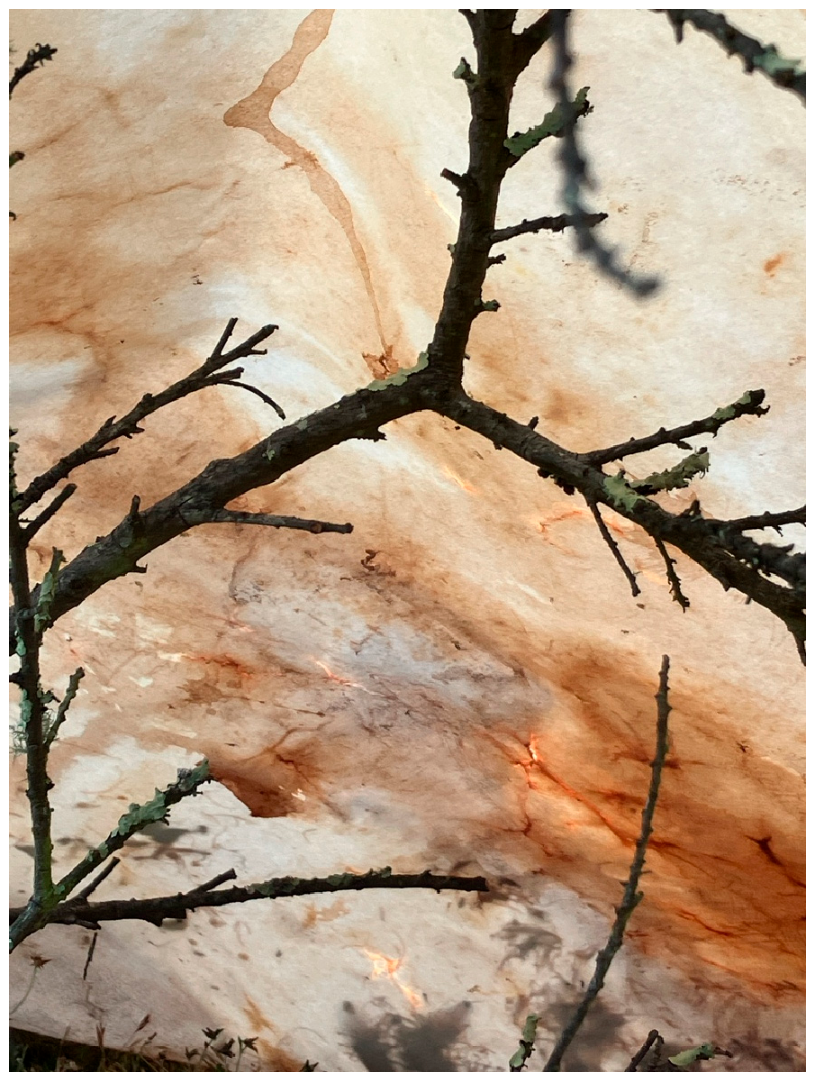
I carry the roll of paper out to the lawn into the warm sunlight. Perhaps the sun may convince the mould to leave? I prop up sections of the paper from underneath with old tree prunings lying on the ground (Figure 3). I am hoping it will allow for greater circulation of air. I look up from underneath and appreciate the warm glow through the paper and the multiple beings gathered there. It is very like swimming underwater in the river. There are muddy aspects, sudden close ups of details, glimpses of something that slips out of comprehension. I am starting to think of the process of drawing in much the same way as I garden, an ongoing work in progress. Perhaps tending and care should become embedded in the language for drawing?
Figure 3.
Sun through paper, Taroona, photo: the artist.
As I continue to work with the roll of paper over the year, its plant-like behaviour becomes increasingly evident. It unfurls and re-curls in response to stimuli, it absorbs and transforms matter. Water travels through, transporting and embedding matter into all the fibres. It is tended to by the environment. It is attentive to the place that feeds it. The stories of the seasons become embedded. It seems to be getting heavier and growing each time I move it. Detritus drops and spreads sand, leaves, and grasses that I cannot even remember putting there. I enjoy its company by my side as I write in the studio. Giovanni Aloi observes that plant life is ‘an ever-evolving constellation of alignments binding our lives to those of other animals, the soil, fungi, bacteria, water, air, and light’ (Aloi 2025, p. 6). My drawing over the past year has made this visible and material.
Allowing the roll of paper to reclaim these memories of its origins as a plant has assisted in shifting my thinking away from the separation of ground and mark. My drawing practice does not follow scientific methods but rather allows for an assemblage of matter and beings. The shadow places of agricultural production in sites that do not have the correct water or soil to support them, the international global trade required to transport art materials are all part of the story. The roll of paper has become quite literally a porous line a type of lineground or groundline where the support and the mark become one and the same.
The anthropologist Anna Tsing in relating the complexities of exchanges that result in the gathering and distribution of matsutake mushrooms provided the term assemblage to comprehend the ecologies occurring in capitalism. She proposes:
‘Patterns of unintentional coordination develop in assemblages. To notice such patterns means watching the interplay of temporal rhythms and scales in the divergent lifeways that gather. Surprisingly, this turns out to be a method that might revitalize political economy as well as environmental studies. Assemblages drag political economy inside them, and not just for humans’.(Tsing 2015, p. 23)
This quote by Tsing brings back to my attention that Yolngu art practices work with the patterns provided by the land. As I keep tending my drawing practice this will be the next step, to recognise the patterns that are emerging from my site. Even with all its damage and history, this small patch has multiple visitors, a vast array of assemblages, and my drawing practice is emerging slowly into an ecological approach. I have been engaging with this process of a porous roll of paper on a site for over fifteen years.
I have moved homes multiple times but now feel attached to this place by the river in Lutruwita Tasmania. Through Bohm’s concept of dialogue, I have suspended habitual modes of thought and been gifted insights by the ecology I am immersed in. Returning to the questions I posed at the beginning ‘What is a line and what is the ground? What happens if we don’t separate them?’, it seems extraordinary to reflect that it is only in developing this project that I have become fully aware of the paper as a plant being and an entity in its own right. In the discipline of Drawing Research, this shifts the dialogue as it requires a relational approach to materials, places, ecologies, and beings that are brought together in the development of a drawing. The porousness of the figure and ground, the mark and the surface have assisted in visualising the trans-corporeality that Alaimo (2010) described so beautifully. It has allowed me to mentally adapt to being part of this porous dialogue and to develop my drawing practice as an integral part of the ecology.
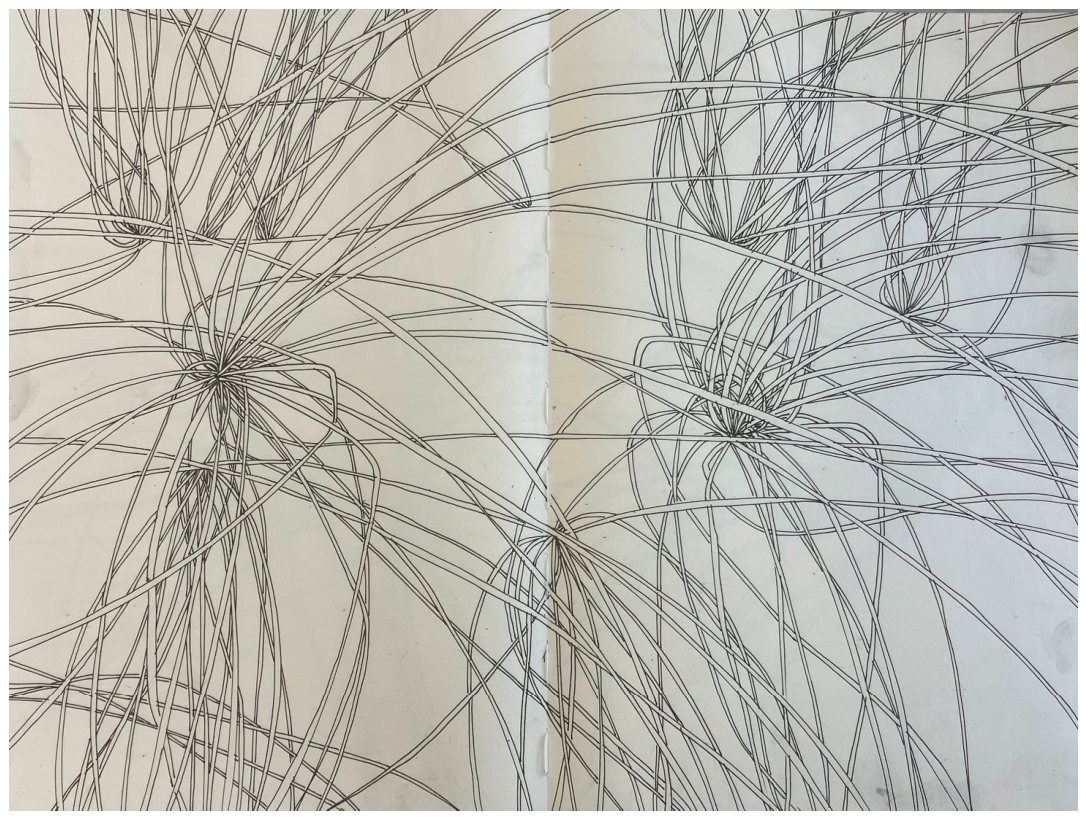
As I work towards resolution for this project, I have chosen to follow the pathway set out by Mulkun Wirrpanda and many of the women I have sat alongside making prints. That is, to embrace the stories in the everyday and to closely observe and draw the plants, to learn from their behaviours and relationships. As an ongoing part of my practice, I draw each day in a sketchbook (Figure 4). Over the length of this project, I have filled several books with drawings of Poa grasses. The patterns that emerge in the process of drawing are revelatory and I have noticed that my relationship with the sketchbook has also changed. It no longer has a front and back, top, or bottom, blank page next to drawn page, rather it is approached from any side in response to my position in dialogue with the grasses. I realise too that in the field of research, this is how I approach the written book. I look around the studio at the multiple texts that are open that I flick through when thoughts and memories arise in response to a drawing that I am doing. In an ecological context, these stories flow in and out of my site of inquiry, deepening my knowledge and adding to the questions that arise in drawing inquiries. The task now begins of how to keep this honesty of response, close observation of plant behaviour with the porous plant that is now paper becoming plant.
Figure 4.
Sketchbook with drawings of Poa grasses by author, photo Jan Hogan.
Funding
This research received no external funding.
Institutional Review Board Statement
Not applicable.
Informed Consent Statement
Not applicable.
Data Availability Statement
No new data were created or analyzed in this study. Data sharing is not applicable to this article.
Conflicts of Interest
The author declares no conflict of interest.
Note
| 1 | The dual naming comes from palawa kani, the language of Tasmanian Aborigines: https://tacinc.com.au/programs/palawa-kani/ (accessed on 15 January 2026). |
References
- Alaimo, Stacy. 2010. Bodily Natures: Science, Environment, and the Material Self. Bloomington: Indiana University Press. [Google Scholar]
- Aloi, Giovanni. 2025. Botanical Revolutions: How Plants Changed the Course of Art. Los Angeles: Getty Publications. [Google Scholar]
- Bennett, Jane. 2010. Vibrant Matter: A Political Ecology of Things. Durham: Duke University Press. [Google Scholar]
- Berger, John. 2005. Berger on Drawing. Aghabullogue: Occasional Press. [Google Scholar]
- Bohm, David. 2003. On Dialogue. London: Routledge, Taylor & Francis e-Library. [Google Scholar]
- Cameron, Angus. 2010. Djalkiri: We Are Standing on Their Names, Blue Mud Bay. Parap: Nomad Art Productions. [Google Scholar]
- de Zegher, Marie Catherine, and Cornelia Helena Butler. 2010. On Line: Drawing Through the Twentieth Century. New York: Museum of Modern Art. [Google Scholar]
- Elkins, James. 2000. Our Beautiful, Dry, and Distant Texts: Art History as Writing. Edited by Paperback. New York: Routledge. [Google Scholar]
- Garner, Steve. 2008. Writing on Drawing: Essays on Drawing Practice and Research. Bristol: Intellect. [Google Scholar]
- Jullien, Francois. 2009. The Great Image Has No Form: Or on the Nonobject through Painting. Translated by Jane Marie Todd. Chicago and London: The University of Chicago Press, p. 125. [Google Scholar]
- Kassianidou, M. 2020. Works on/in/with Paper. In A Companion to Contemporary Drawing. Edited by Kelly Chorpening and Rebecca Fortnum. Newark: John Wiley et Sons Ltd., pp. 239–55. [Google Scholar]
- Lawrence, Natalie. 2022. “Spontaneous Revolutions” Darwin’s Diagrams of Plant Movement. The Public Domain Review, October 26. Available online: https://publicdomainreview.org/essay/darwins-diagrams-of-plant-movement/ (accessed on 26 February 2026).
- Marder, Michael. 2013. What is Plant Thinking? In Klēsis revue philosophique, 25—Philosophies de la Nature. Montpellier: Univ. Paul Valery, pp. 124–43. [Google Scholar]
- Midawarr. 2018. The Art of Mulkun Wirrpanda and John Wolseley; Canberra: National Museum of Australia.
- Morphy, Howard. 1989. From Dull to Brilliant: The Aesthetics of Spiritual Power Among the Yolngu. In Man. New Series; London: Royal Anthropological Institute of Great Britain and Ireland, vol. 24, No. 1, pp. 21–40. [Google Scholar]
- Morphy, Howard. 2008. Becoming Art: Exploring Cross-Cultural Categories. Sydney: University of New South Wales Press. [Google Scholar]
- Morphy, Howard. 2026. Towards an Ecological Synergy between Art History and the Anthropology of Art. Arts 15: 95. [Google Scholar] [CrossRef] [Scilit]
- Pinchbeck, Cara. 2025. Yolngu Power: The Art of Yirrkala. Sydney: Art Gallery of New South Wales. [Google Scholar]
- Plumwood, Val. 2006. The Concept of a Cultural Landscape: Nature, Culture and Agency in the Land. Ethics and the Environment 11: 115–50. [Google Scholar] [CrossRef] [Scilit]
- Plumwood, Val. 2008. Shadow Places and the Politics of Dwelling. Ecological Humanities 44: 139–50. [Google Scholar]
- Rawson, Phillip. 1969. Drawing: The Appreciation of the Arts/3. London: Oxford University Press. [Google Scholar]
- Rose, Deborah Bird. 1996. Nourishing Terrains: Australian Aboriginal Views of Landscape and Wilderness. Canberra: Australian Heritage Commission. [Google Scholar]
- Rose, Deborah Bird. 2002. Dialogue with Place: Toward an Ecological Body. Journal of Narrative Theory 32: 311–25. [Google Scholar] [CrossRef] [Scilit]
- Rose, Deborah Bird. 2004. Reports from a Wild Country: Ethics for Decolonisation. Sydney: UNSW Press. [Google Scholar]
- Tsing, Anna Lowenhaupt. 2015. The Mushroom at the End of the World: On the Possibility of Life in Capitalist Ruins. Princeton: Princeton University Press. [Google Scholar] [CrossRef] [Scilit]
Disclaimer/Publisher’s Note: The statements, opinions and data contained in all publications are solely those of the individual author(s) and contributor(s) and not of MDPI and/or the editor(s). MDPI and/or the editor(s) disclaim responsibility for any injury to people or property resulting from any ideas, methods, instructions or products referred to in the content. |
© 2026 by the author. Licensee MDPI, Basel, Switzerland. This article is an open access article distributed under the terms and conditions of the Creative Commons Attribution (CC BY) license.