1. Introduction
The term
regenerative immediately conjures up a sense of repair and mending; etymologically, ‘the term regenerative stems from the Latin “regenerare,’ meaning to bring forth again or renew.’
1 Thinking from more of a sociological point of view,
Urban Regeneration is often entwined with the politics of gentrification and questions surrounding which social demographic gains from the regeneration of an urban environment
2.
Regenerative practice, however, has been a hot topic in agriculture and food production
3 for many years, but within the field of art and design it is now gaining attention. From a design perspective there are growing numbers of UK higher education courses specialising in regenerative aspects of design
4, and notable research projects and events include the recent ESRC/AHRC funded
Becoming Regenerative5,
The Centre of Design for Regenerative Material Ecologies (DREAM) in Delft
6 and The Jan Van Eyck’s
Re-generate! Symposium in Maastricht.
7From an arts perspective, the recent UP Projects
Bodies of Water Symposium: Regenerative Art Practice, held as part of The Liverpool Biennial 2024
Bedrock, used a beautiful quote from the environmental activist Joanna Macy as an opening calling: ‘The most remarkable feature of this historical moment on earth is not that we are on the way to destroying the world—we’ve actually been on the way for quite a while. It’s that we are beginning to wake up, as from a millennia-long sleep, to a whole new relationship to our world, to ourselves and each other.’ This ‘waking up’ is very much a kind of
regenerare—a renewing of our relationship with the world as Alice Sharp, Artistic Director and founder of the arts and environmental organisation
Invisible Dust, suggested at the
Bodies of Water symposium by re-articulating the terminologies that are used in the field. Sharp suggested we should reject the conservative nature of the term ‘sustainability’ that infers a kind of continuation (just carry on doing the same old), a sentiment also shared by artist David Halley who stated the following in an interview with Barnaby Drabble: ‘I do not use the expression sustainable development anymore, but always refer to ‘capable futures’ as being a specific way of engaging and creating greater capacity to engage with the future that we need to understand. […] So, the idea of ‘capable’’ you could know, maybe, substitute with the word ‘resilient’. In my usage futures are plural because we have to consider multiple, diverse futures. The future is not a predetermined thing, whatever the politicians wish us to believe’ (
Drabble 2019). As Halley signposted a move away from ‘sustainability’ towards ‘capable’ and ‘resilient’, Sharp suggests we should rather focus on the term
regenerative with its emphasis on ‘co-existing and co-evolving’ (
Sharp 2025).
This piece of text aims to walk back and forth between the studio and forest, to get some sense of how this ‘co-existence’ and ‘co-evolving’ is activated in a contemporary context where there is a heightened interest in artwork that
relates to the environmental catastrophe that we are living through. This context is not just resonant to the art world and the cultural sector. It is important, as we make a clear case, for the instrumental role of artistic practice as an essential tool for our ecological and social survival. To support this case I present the voices, tools, processes and materials that surround me as a kind of theatre piece to perform these complexities:
the words of students, specialists in ecology and biological science-related fields, friends, artists and colleagues;
the material techniques in the studio: masking tape, sand paper, paint, pigment, oil and chalk; as well as
the ecological actions of tree planting, meadow restoration and pond scrapes. It is clear that artists can be ‘creative boundary spanners, interacting between scientists, natural resource managers, and inhabitants, bringing creative problem solving approaches to the nexus’ (
Freemantle et al. 2026). But building on this, we can assert the radical
method-making (
McKittrick 2021) that situates and activates itself on the
edges of these ‘fictive distances’ (ibid., p. 36) between us as we assemble our tools to navigate the challenges ahead.
2. Pulse
‘The one thing I’ve learned… never go to a site and plant trees on day one. What we should do is allow the site to give you the knowledge of itself before you go and plant trees […it should be more like] a pulse of change… do an activity, do lots of it, then you walk away and see how that works.’8
‘It’s such a daily routine, in which I don’t necessarily continue the very next day. I try to let the moment, as I have left certain other paintings—continue to affect me for some time, and then there is the time when I look at a work and know how I will continue with it.’9
‘In retrospect I think I got closer to seeing what my work was ‘about’ through the making of it. That feeling of not knowing what I’m doing is natural and expected, I suppose. The reasons and motivations became clearer through reflection—after I did something [in the studio].’10
These are the words from three individuals who work
with and
in the ‘natural’ world
11: a woodlands creation manager for
The Woodlands Trust based in Cumbria, an artist working in Panajachel, Guatemala, and a student at a UK art school. They all express the value of reflective methods working in response to evolving processes where there is a conscious stepping back rather than a desire to control—these voices position themselves
in relation to a set of materials and living organisms that perform in unpredictable ways. Their words float between disciplines and resonate with each other over the shared attention to their work. Vivien Suter is known for making her paintings outside, in the Guatemalan rainforest that inspires and helps construct her work. She allows the surrounding elements and organisms to collaborate and contribute to the works: dog footprints, soil, wind, rain and sun all leave their marks and ‘soak into’ (
Clark 2020) the work. Suter often leaves her work outside overnight for long periods of time (
Suter n.d.) or leaves them buried in the ground to be dug up later. A significant event for her, along the journey of this process in 2005, was when her studio was flooded and she hung the damaged works out to dry and could suddenly see the unpredictable marks, forms and colours that were both evidence of the environmental surge event as well as a tool in constructing the work itself.
Working in response to the fluid and unpredictable nature of our environment has been central to our work at F I E L D W O R K
12, where we have been undertaking actions on an ancient woodland site to try to increase biodiversity and ecological resilience. With the guidance and support of brilliant individuals
13 who have shared their experience and knowledge, we have worked with a kind of
attentive methodology, one where there is no pre-design or ‘plan’ by a single dominant (human) voice—rather, a series of constant, sensitive ‘pulses’ of observation and responses that aim to encourage and support healthy transformation. The term ‘pulse’ as a way to describe an approach to ecological restoration was repeated by a number of specialists who visited and began to make me reflect on the process we have engaged with, loosely articulated in three stages. The first stage is about waiting and observing—a form of careful patience
14 as a case of simply spending time regularly on site whenever possible
15. Secondly, there is the identification and removal of ‘obstacles’—the things that are observed to be inhibiting the process of ecological regeneration such as limiting browsing
16—by placing protective tubes on saplings or removing pollutants, for example. Thirdly, there are the more interventive actions such as tree planting, species-rich meadow restoration, pond construction or woodland creation, for example. This process is then repeated as a continuous cycle of pulses where interventive actions are carefully and attentively observed again and new obstacles are revealed, provoking further potential interventive solutions and in turn provoking living organisms to work in response to these actions—as a kind of ongoing conversation. Or, as American anthropologist Anna Tsing describes it as an ‘unintentional design, that is, the overlapping world-making activities of many agents, human and not human. The design is clear in the landscape’s ecosystem. But none of the agents have planned this effect. Humans join others in making landscapes of unintentional design’ (
Tsing 2015, p. 160).
In the studio, this series of actions resonates with the strategies I witness either while making my own work, following the processes of professional artists, or witnessing the development of the work of students. American Philosopher and Psychologist John Dewey talks about the rhythm of artistic pulses almost 100 years ago: ‘direct experience comes from nature and man interacting with each other. In this interaction, human energy gathers, is released, dammed up, frustrated and victorious. There are rhythmic beats of want and fulfillment, pulses of doing and being withheld from doing’ (
Dewey [1934] 1980, p. 16). This
push and pull—the careful attention, waiting to act, knowing when to (or when not to) pull back and when to make a mark, responding to materials and applying layers—is a kind of
unintentional design between agents (materials, gestures, emotions, ideas, research). Knowing what to do and when to do it, is all very much part of artistic practice. Then there is always the question ‘when to leave it and when is it finished?’ There are, of course, many points of finitude along the way of art making—when it leaves the studio is one moment where the artist ceases ‘control’. But the artwork lives on and in turn continues to function on its own terms, within its own transforming cultural public contexts. It also has a material life that may exceed the artworld itself (I often ask students to imagine what an artwork will look like in 1000 years’ time). The second stage, where obstacles are identified and discussed either as useful restrictions (see
Trier 2003) or inhibitions, is often a central component to productive conversations about the direction of an artist’s work in relation to their specific intentions
17. What is getting in the way of this artwork and how can the artist remove the obstruction?
The only way to see obstructions is to give time looking for them. Back in ‘the field’, it is essential to give oneself the space to really observe and watch, walk away, return and be attentive.
Watching privileges sight, but really, I am talking about a general heightened sensitivity to change that incorporates sound, smell, touch and vision that all contribute to this two-way street—we are part of a multi-sensory exchange. The non-human world is watching us, listening and smelling us, too—a reciprocal awareness of each other.
18 The feeling of a human hand on a cow’s hide is, I’m sure, very normal for those working everyday with their herds but for me, the touch of a red poll’s back is profound and indescribable with words—it’s a feeling that brings me close to my senses and disintegrates the boundaries that separates ‘us’ and ‘them’. As Maria Puig de la Bellacasa states, building on the work of Laura U Marks, Mathew Ratcliffe and Karen Barad, touch can produce deep connections between species: ‘Understanding contact as touch intensifies a sense of the co-transformative, in-the-flesh effects of connections between beings. Significantly, in its quasi-automatic evocation of close relationality, touching is also called upon as the experience par excellence where boundaries between self and other are blurred’. (
Puig de la Bellacasa 2017, p. 96).
The information that emerges through this heightened, multi-sensory awareness is often a surprise or perhaps not what was expected in a particular habitat. And so by looking, feeling, sensing and returning to act in a continuous process of call and response, the benefits are not only evident for the habitat itself but can often mitigate for unwanted losses of time, money and materials wasted on unnecessary infrastructure and labour. So, we could say that slowing down, smelling and stroking could save money.
Back in the studio, it can also often be a struggle to impose the slower, more reflective processes that are so much of what making art is about. Slowing down is just one creative methodology—of course, there are many. Speed of production can often be useful, too. Having spoken with an artist recently, she said that she was consciously creating a bottleneck of deadlines that would create a tension and imposed pressure in the production that she hoped would affect the work beneficially. But there is always the next fair, studio visit, PDF submission, exhibition shipment or Instagram scroll/update that constantly draws attention away from the humble moments of boredom, experimentation and failure that are essential to any healthy practice. Both the sensitive practices of agriculture and art have been pressured within their respective industries
19 that have focused on the market’s demand for their product at all costs—absorbing time and straining the tender, intimate and regenerative relationships that are integral to a healthy, positive practice.
3. Mosaic
The word that I have heard more than any other when having conversations about ecological regeneration is ‘mosaic’. Historically, in the arts, it is known as a pattern or image made by arranging multiple coloured, often ceramic tiles on a surface which can be a floor, wall or ceiling; the first mosaics originated in Mesopotamia in the 3rd millennium BC. Ecologically speaking, the term mosaic is often referred to as a natural landscape that features a diverse, connected pattern of different ecosystems and habitats. An example of this might be grasslands, wetlands, meadows and woodlands, collectively supporting a rich variety of species.
The
mosaic could also be thought of as a way of thinking and working together. Following Physicist Basarab Nicolescu’s outline of disciplinary methodologies, a mosaic of habitats could be seen as a
transdisciplinary set of relationships: ‘
Multidisciplinarity concerns itself with studying a research topic in not just one discipline only, but in several at the same time. […]
Interdisciplinarity has a different goal than multidisciplinarity. It concerns the transfer of methods from one discipline to another. […]
Transdisciplinarity concerns that which is at once between the disciplines, across the different disciplines, and beyond all discipline. Its goal is the understanding of the present world, of which one of the imperatives is the unity of knowledge’ (
Nicolescu 2014, p. 187).
Working with multiple individuals from different ‘specialisms’ on one site has shone a light on voices being guided by their discipline—for example, an ornithologist might see the potential for a pond scrape in a wetland area to benefit bird habitats where an ecologist might see the benefit to leave the same area untouched for the vast rich, unseen microorganisms that lie beneath marshland. A way to navigate through human-defined disciplines like this is to be conscious of the specialist knowledge while at the same time waiting, smelling, touching and watching how the mosaic evolves.
The ‘habitats’ that constitute the
mosaic may be social or cultural as well as ecological, as Bel Jacobs describes in reference to Ackroyd & Harvey’s project
Beuys’ Acorns. Acorns from artist Joseph Beuys’ seminal
7000 Eichen (1982–87) were collected and planted at multiple locations such as museums and public spaces: ‘the hope is that the trees will form part of an exquisite—and genuinely restorative—“mosaic of habitats” which is deeply embedded in the characteristics, the needs and the wildlife of the local community’ (
Jacobs 2021). In this case, the
mosaic extends to human cultural and social interactions that are formed and informed
by and
with the planting of oak trees in response to the original human creative act.
I think of a mosaic as an image often housed in spaces of worship, ritual or prayer; perhaps the mindful process of sitting in front of a thousand fragments and slowly selecting and fitting them together is a kind of prayer or ritual in itself. Standing in front of an intricate, large-scale mosaic
20, the first thing that comes to my mind is who made that and how? It places the process of construction very much in the foreground. The idea of a mosaic of habitats—marsh, scrub, grassland, hedgerow and woodland, for example—working independently, but crucially, in support of each other reminds me of the process of collage. There is a mosaic of fragments that are repositioned to construct new narratives and associations: ‘The collage is a formal device which generates relationships between already socialised images […and] association[s] within a defined place produces a space for dialogue and sharing: images in the company of other images form a
community’ (
Chailou 2012). In the work
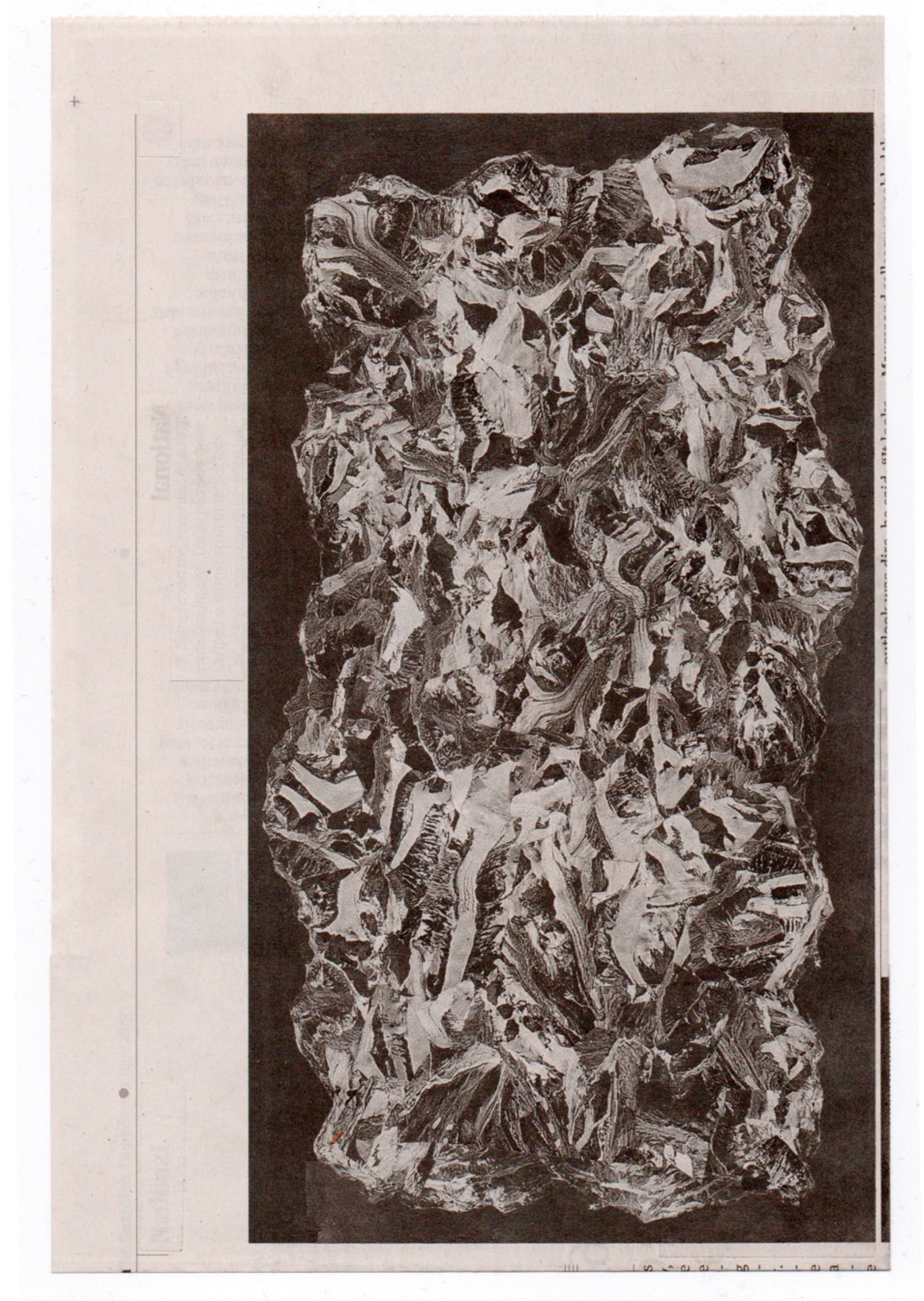
Glacier (
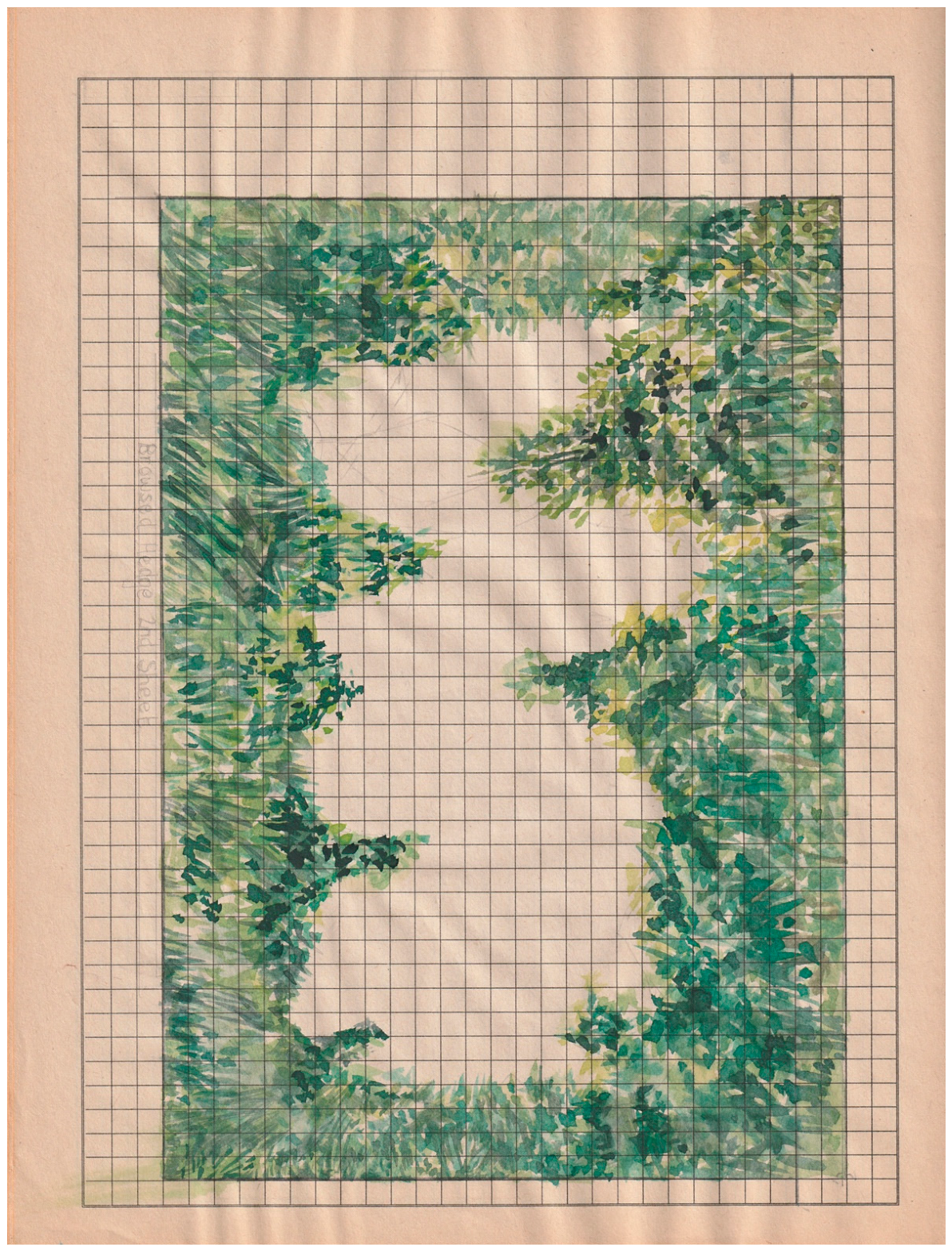
Figure 1) I used multiple copies of the selected newspaper image to enable me to cut fragments of the image and conceal, erase, rearrange, tesselate and recompose the image. In so doing, and after time (and
pulses of action and reflection), the
Glacier resembles a web of roots through a mosaic process of placing fragments together. As curator Timothee Chailou points out, there is something unique to collage, as in most cases it is working with material that already exists: ‘Artists work with what is available to them, with what is on show for all to see, what is already there, already seen, said, produced, socialised—“already out” as Richard Prince puts it.’ (
Chailou 2012, ibid.) The ecological
mosaics of habitats are also often already there, just waiting to be ‘seen’ and allowed to flourish. It is just a question of allowing them to be seen by supplying the right conditions to grow and proliferate. In many ways, this applies to artists (and everyone else for that matter) who inevitably experience mutually dependent periods of dormancy and growth creatively, personally and professionally.
4. Scrape
According to The Royal Society for the Protection of Birds, scrapes are usually dug out with diggers and are often positioned where the land is already susceptible to being waterlogged: ‘scrapes are temporary shallow pools that gradually dry out through the spring and summer to provide valuable feeding habitat for a wide range of birds, but particularly breeding waders such as lapwing and redshank’ (
RSPB 2024). In visiting a recent scrape on a site in the Lake District, multiple pipes ran underground that had been used to drain the land, and the water was both being fed to the scrape by the old drains but also leaking through them. They were like huge, enlarged, hidden underground worms from a sci-fi film. The drains running downhill needed to be filled for the scrape to hold water.
The word scrape sends a slight shudder down my spine—it takes me back to childhood and thin layers of skin on knees or on the palm of hands being ‘scraped’ or ‘grazed’—that stinging hot pain throbbing on the surface of the skin. The noun for ‘graze’ suggests a light removal of skin and the verb ‘to graze’ can be used to describe animals feeding on grass land—a kind of removal of the skin of the landscape.
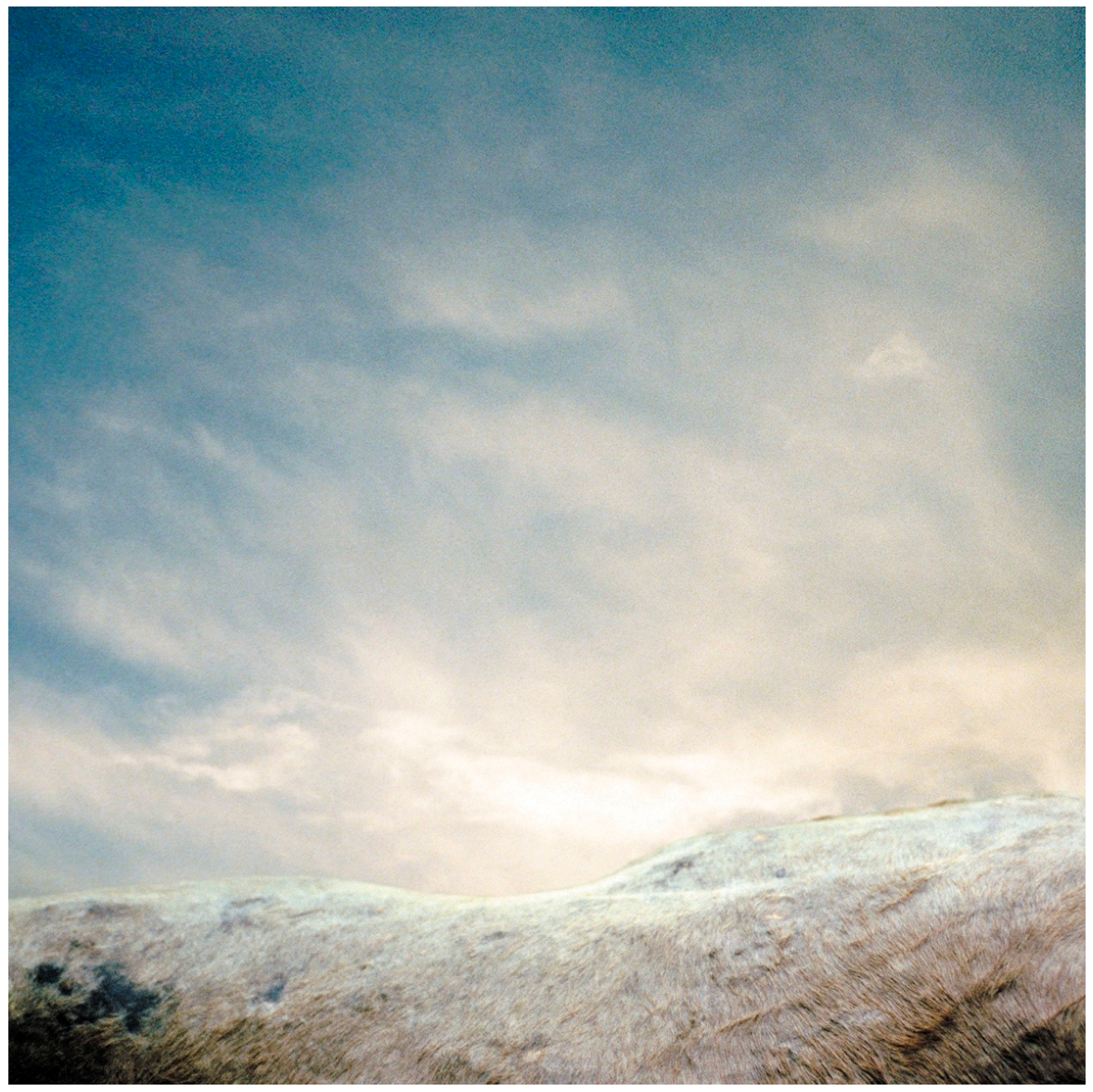
Helen Sear RA’s 2000 series
Grounded (
Figure 2) was made around the same time she was my tutor—perhaps that is why the work stays in my mind. Taxidermy hides photographed in museums are digitally overlaid with sky backgrounds. Skin, ground, grass, hair, soil, flesh, hide and fur merge in a magical landscape vision. You can think about these works in terms of museology, what is ‘natural’
21 or thinking about magic and the imagination, but for me it is what is under the skin that feels resonant. Scraping away at the fell you may find soil, varying amounts of invertebrates, stones, and rocks, or scraping the skin of a mammal (including human skin) there is the flesh and the blood and the cells and the tendons—vessels moving underneath like hidden sci-fi worms—and then there is water
22: under the skin, under the ground, on top of the ground, in flood. The photographic paper itself is a kind of skin. Viewing the C-TYPE print, what is beneath the surface of this image? Somewhere down there past the glossy veneer, scratch or scrape away a bit on the surface and fingernails will encounter compressed photographic paper fibres from trees that once lined the fells being pictured.
5. Inputs
A writer once said to me to ‘read when you are searching for a story and write when you find one’. In a sense, this is simply the process of feeding creativity. Creative input can come in various forms such as an overheard conversation on a bus, an exhibition, a film, or music, to name just a few. But perhaps for some artists there are times when there is too much noise, and practice needs a break from input. The process of making needs to be carried out without distraction where selected references are reduced to an image from a magazine, a colour swatch on the wall, and a choice of music to allow material and bodily impulses to be activated. At times, a restriction of input might help to support intuitive freedom—it is more a case of being aware and attentive to when input is required and when it is not. I hear many voices of students who speak about the distractions of working in shared studio spaces and, at the same time, being critically and intellectually engaged with a cacophony of voices (tutors, peers, cultural ‘input’, etc). Conversations about how to manage this unique (and temporary) intense experience of study at art college often circle around management of ‘what is going in’ to allow space for creativity to come out.
Agricultural
inputs are the external resources used to enhance livestock and crop production—this is generally considered to be fertilisers, pesticides, feed, and the use of machinery, equipment, technology and labour. Generally, regenerative farming aims to reduce these inputs by developing healthy soil through other methods including cover cropping, crop rotation and planned movement of livestock. Following Cumbrian farmer James Rebanks’
23 description of his journey to regenerative farming (
Rebanks 2020) as one where profit margins increase due to reducing inputs, he describes his current ambition to produce all the feed for his livestock on his own farm rather than obtaining external feed, susceptible to global economic shocks, as central to his regenerative goals. Rebanks is consciously managing what goes in, where it is grown, how far it travels and what affect it will have on his farm to make productive, long-term choices that benefit the mutual health of his farm and the ecosystems it is part of.
Back in the studio, it is similarly valuable to have a close eye on the provenance of materials used and how this might affect the work’s success. I discuss with students how the stories of our materials can inform the narratives held in the artwork and how this is passed on to the viewer. You can also think of the management of inputs from a viewer’s perspective—is there too much information here? Not enough? An artwork’s success is often determined by how much information is offered to the viewer and why. A flood of information can benefit a work if that is its intention but can also distract from the core of an artwork if not managed well. Titling for example, offers an additional tool to direct, guide and manage the potential conceptual inputs and narratives associated with a work.
6. Dams
Beavers are a keystone species
24, arranging twigs, branches, leaves and mud to create refuge from land-based predators. Obstacles in rivers guide the
flow of water, positively affecting the shape, depth and flow of water for a multitude of species while contributing to flood mitigation downstream. The evaluation of ‘good flow’ and ‘bad flow’ in terms of flood management and biodiversity could be understood in terms of
variation. Rather than a single straight deep gulley of water flow, multiple curves and depths and waterfalls create meandering
flow which follows the changing contours of the land. Deep in places, shallow in places, with riffles and pools around rocks and waterfalls—diverse ‘complex’ habitats oxygenate the water, creating spawn beds and shelter for fish and in turn attracting birdlife.
These are positive changes caused by obstructions, but if we look through the lens of artmaking, traditionally an obstacle to the
flow of creativity is seen as ‘a writer’s block’, or in terms of painting, the daunting prospect of the blank canvas. When I was a student at The Royal College of Art, London, many years ago, a tutor talked about the difficult pressure of starting work on a blank canvas which many artists, I am sure, can relate to. He said he purposely stored his canvases in places where they were likely to get marked or accidently scratched or
scraped—by the door or in a corridor. The intention was to create something to respond to rather than that open-ended white void. This anecdote is relevant because it is an example of how artistic practice can be provoked by a response to something that already exists rather than a pressured singular autonomous ‘artistic gesture’. So again, this is one action responding to another, creating a response like a beaver acting as a keystone species responding to a river and the trees on the bank. But there is something more significant here in terms of how the act of art making is evidence of how we as humans respond, reflect and have abstract, symbolic thoughts. The recent stencilled outline of a hand found on the Indonesian island of Sulawesi announced in January 2026 was dated to at least 67,800 years ago and represents a moment when humans began to think in imaginative ways that underpin language, religion and science (
BBC 2026). The hands on the cave walls were stencilled and the fingers elongated so they became claws, a reflective process that simultaneously distinguishes our species as unique while at the same time representing how deeply humans see themselves as part of other species. It is staggering to think that the first human self-portrait was a human
as animal and that we have come so far in separating ourselves as a species from other organisms that we share this planet with.
25A dam is considered something which is in the way of a flow, but it is interesting to note how different obstacles might function in specific contexts. ‘Leaky dams’, for example, offer ecological benefits in creating habitats for a range of organisms whereas large-scale reservoir dams are often criticised for their negative environmental impact. If we take the beaver example, we might start to see that there are different kinds of
blockages that might create unexpected, diverse opportunities within a habitat
and an arts practice. As a tutor, I often have conversations about self-imposed restraints or ‘obstructions’
26—when the open-ended nature of art production can sometimes become too much. A rule or a restriction to a certain media, form or mark is sometimes a necessary tool to structure an alternative methodology. There are other methodological ‘restrictions’ that offer potential pathways of expansion. For example, understanding the provenance of your materials in terms of a sustainable, environmentally conscious and health perspective might encourage an artist to reconsider the use of solvents in their practice. What at first might seem like a constraint may offer alternative solutions that extend the conceptual depth through the material consciousness of the work. I have witnessed many examples for both myself and the students I work with where these potential ‘restrictions’ have encouraged a much richer project. So, perhaps there is an interesting ‘leaky’ arts practice where imposed restrictions simultaneously restrain and flow.
7. Clocks
‘The Climate Clock is ticking […and that] time is not ours to command—nature keeps its own time.’ (
Sharp 2025).
A hot day in August. Haytime
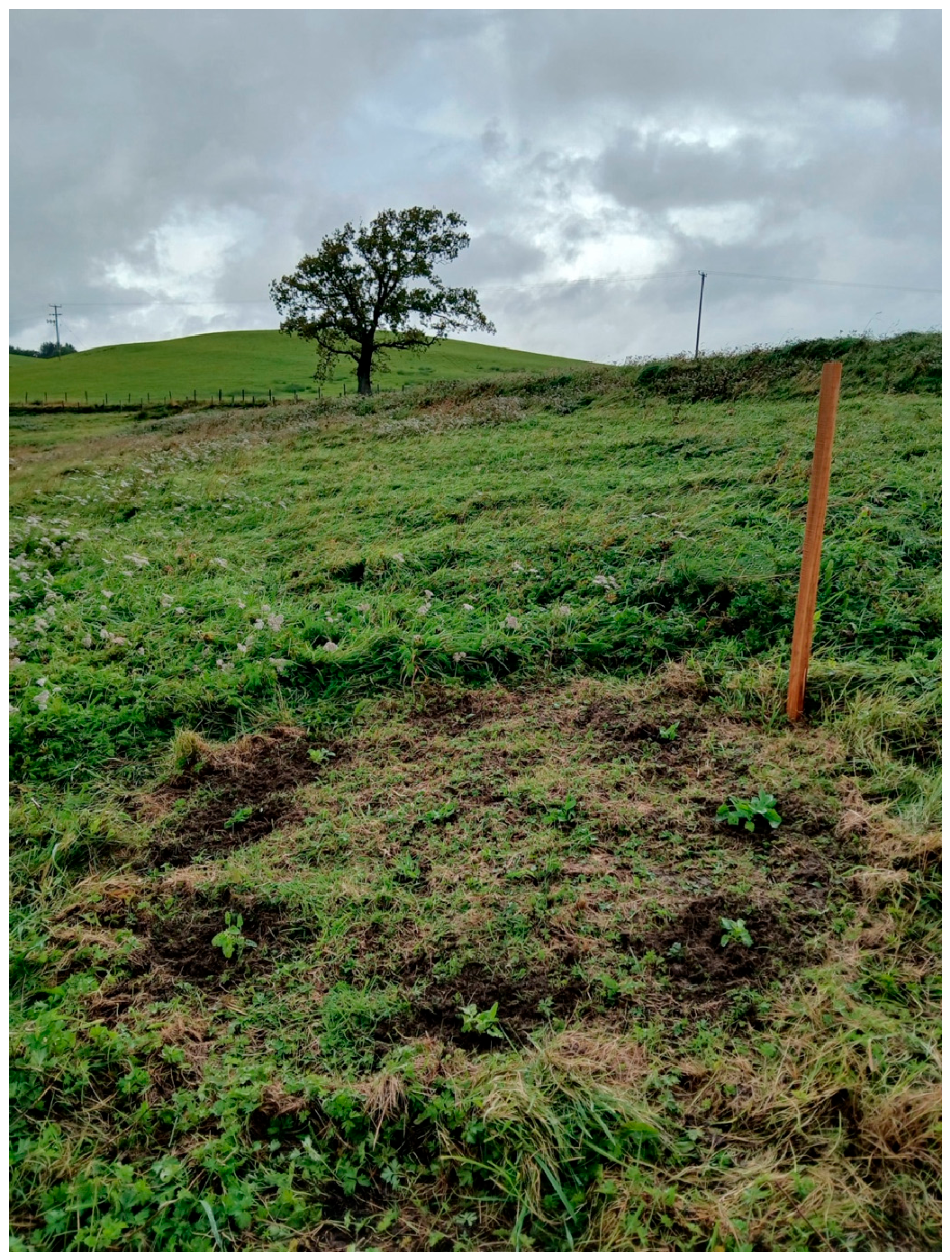
27 is almost done for most but we are out cutting 20 circles in a field to plant into. We are working with Cumbria Wildlife Trust to reinstate a species-rich hay meadow and help create a seedbank of endangered native wildflowers. The plug plants need space and light away from competing grasses—each ‘clock face’ is a circle of cut grass approximately 3 m in diameter (
Figure 3). I start with a bag of tools: mallet, stakes, some rope, a 2 m long scythe, sharpening stone and a rake. The circles need to be on a steady south facing slope in the field, so I start by placing a stake in the centre of an area of high grasses with thick yarrow
28. I make a 1.5 m length of rope and tie it round the stake, giving me an approximate 3 m diameter. I use the scythe to begin to hack away at the long sward. The scythe will take the majority off and then I will use a strimmer. I work my way around the central stake but soon realise that I am focusing too much on measurements and not enough on instinct. I stand in the centre of the circle, and the sweep of the scythe makes a perfect circle as I turn on the balls of my feet. The area is probably a bit more than 3m but that’s fine. These circles are measured by the tool and the arms that make it. As I finish the first circle, I need to choose the placement of the next. Strange crop circle shapes on a yarrow laden field. I stand in the space that will be the centre of a group of wildflowers, each circle a different species—Betony, Melancholy Thistle, Saw-wort— and when I have done that one, I am onto the next. The circles are then raked, and in a few hours the circles are there on the hill facing south, waiting for the plug plants to arrive. I look at them as I feel my back—strained muscles from an unfamiliar repeated physical action. Twenty circles measured out by my body.
I am in a student’s studio discussing if it would be beneficial to change the scale of the work. The work references the landscape as a kind of ‘skin’, and the surface of the forms are translucent like some sort of glass rock limbs. This painting is reminiscent of The Howgill Fells not so far from where I live, which look like heavy sleeping bodies with exposed, naked skins huddled together for warmth. A. W. Wainwright, who wrote the archetypal historical hiking guide of Cumbria, described them as a ‘herd of squatting elephants’ (
Wainwright 1972).
In the studio, we are talking about the brush strokes. What do these gestures and marks invoke for the viewer? They are controlled and careful with delicate sensuality. As we talk, we discuss the frustration of the ecological crisis and other associated social and political issues that seem to press in on us daily. We discuss the pressure and claustrophobia of these times. The student talks about the tension between the softness and the sensuality of care alongside the anger and violence of this feeling of ‘being contained in a glass jar’ and that the work is ‘too still, too accepting’. We talk about how the current scale of the paintings (40 cm × 50 cm) have gestures produced from the elbow—movements of the forearm made sitting down at a table. We talked about Peter Lanyon, Sarah Cunningham and Vivian Suter and how the stretched-out movement of arms at a larger scale can push marks to the edge of the frame.
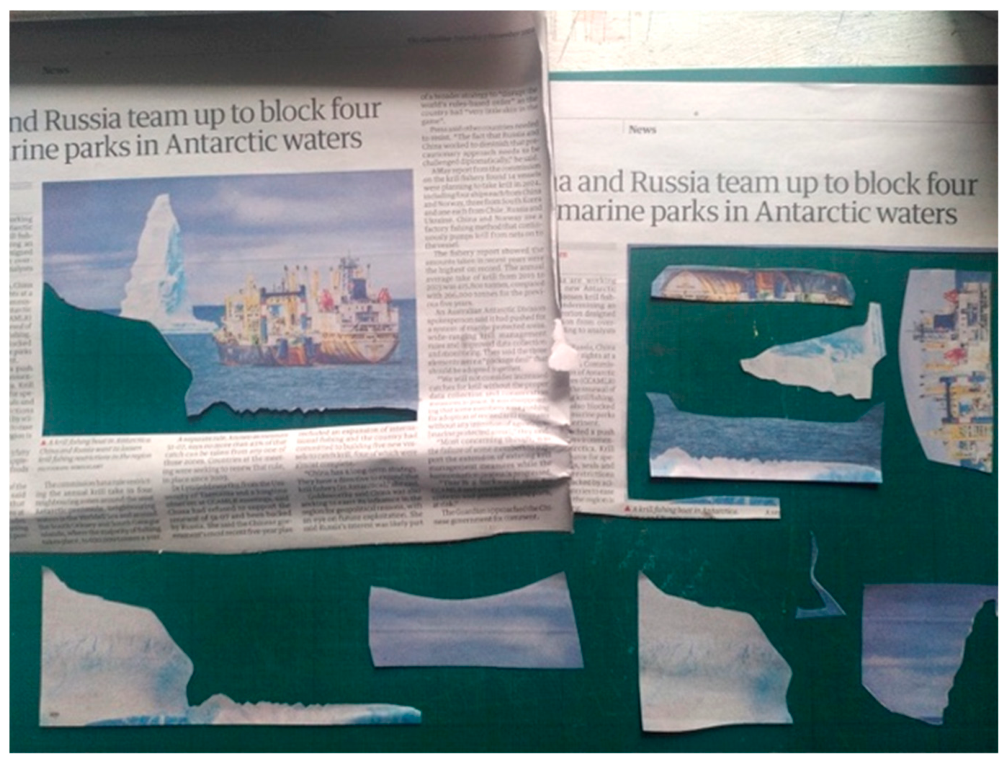
Time is always being played out in the studio in some form, but today, staring at my own paintings hung up and leaned against the wall, it feels like the work is reaching back in time more than usual. There are collages with tiny fragments of newspaper all over the desk (
Figure 4) and small parts of model stages on the floor. There is a large painting on the wall, and it has been there for quite a few months. I started it about 5 years ago. A large oil painting on board based on a small newspaper collage of some curtains and cushions. Now it sits on the wall waiting, and I wait for it. There is something warm and grounded about it as it stands, but at the same time there is more to come, so I wait to respond. Sometimes, waiting is the work.
8. Ground
Officially a
ground for painting is used as a preparatory layer applied to canvas or a wood support structure that acts as a kind of conduit between materials. A ‘grounded’ personality refers to someone who is seen as ‘pretty stable’—someone who may be dependable and not susceptible to unpredictable volatility. The
ground that bears our weight changes depending on where we are, who we are and what we are doing. I grew up in the city, and my ground was the pavement or tarmac. The smell of wet tarmac after the rain in summer comes to mind when I think about my sensual relationship to the ground as I walked to or from school. The ground where I live now is full of stones and rocks and covered in grass. Taking a look a bit deeper underground, we can think of the soil
29 and a perspective largely based on the diversity of microorganisms that are present. Down here, everything is in a constant state of potential.
On grazed fields above the surface, sheep nibble vegetation close to the ground, producing a uniform cut, whereas a cow tears and pulls with its tongue against its lower incisors, creating an uneven varied sward of different heights. Native cows often graze a wide variety of forage, create a variation in sward, and disperse seeds via their defecation. In sensitively managed regenerative organic systems, this grazing encourages the growth of microhabitats where sun can reach the soil in places and seeds are distributed—promoting germination and biodiversity. Like some hidden archaeology constantly suppressed and then suddenly made visible, a secret history of dormant seeds can emerge.
Healthy soil and beneficial grazing inducing germination of a diversity of seeds produces variations of colour. Weather, of course, also affects the hue of the fields, and each year there is a slight difference depending on conditions, creating an unpredictable and rich layering of tones and form revealing a hidden history of species emerging over time. However, if we flew over the countryside like migrating swallows we would see that the true potential of this colour diversity is often never realised. Many plant species are repressed by dominant grasses in high-nutrient, heavily grazed fields. When William Blake idealised England’s ‘green and pleasant lands’
30 in the famous poem ‘And did Those Feet in Ancient Time’ he was calling attention to the preciousness of the English pastoral landscape free from industrial pollution. But in reality, there would have been far greater diversity of colour in our fields in the early 19th century than we have now. Green fields may hold a traditional pastoral idea of beauty but are in essence a monoculture with little complexity: ‘this is why at a glance the countryside still looks green, but from an environmental point of view is becoming increasingly barren. This is a disaster from a genetic point of view’ (
Oliver 2018). According to The Game and Wildlife Conservation Trust’s ‘Sussex Study’, the UK has lost 37% of its invertebrate population since the 1970s.
31 And according to UK government statistics, UK farmland bird populations have declined by 62% since 1970.
32 Lee Schofield suggests in his recent book
Wildfell that this was not the case not so long ago. Referring to the oral histories recorded by Cumbria Wildlife Trust, ‘What comes across more than anything is what a flower dominated world they [rural communities of the past] inhabited. Flowers are mentioned again and again, either as ubiquitous features of the hay meadows or as items for harvesting. One man recalls collecting wood crane’s-bill for his class to study O-levels exams; in another film a woman talks about eating the edible root nodules of pignut, crimson rosehips and nettles to sell. The rich scent of hay and the colours of flowers across the landscape are palpable. That people still alive had once lived in a world so much more vibrant than today moves me; it’s like some glorious treasure that’s just beyond reach’ (
Schofield 2022, p. 111).
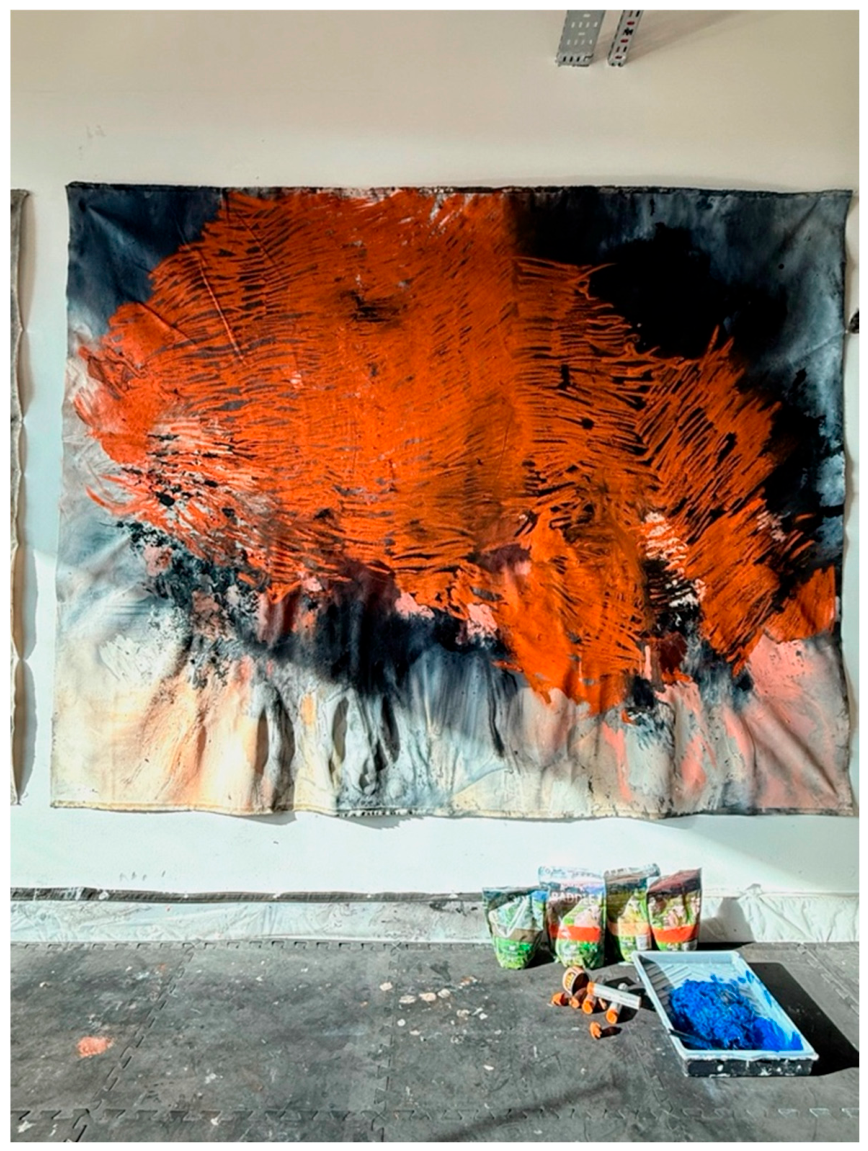
I am in the studio and preparing new surfaces for paintings (
Figure 5). I am using gesso on some boards and leaving them to dry between layers. Next to those, there is a painting on board that I was not pleased with that I used for mixing some filler on when working on a damaged wall. I got the electric sander out and started to get rid of the remaining filler on the surface. As I erased the filler, I worked back into the layers of paint, revealing a painting I had completely forgotten about. Drawn out squares of green and blue and a misty purple background, all scratched and hazy from the rubbing back. A few days before, I had been listening to Maurice Pankhurst—recently retired National Trust’s Ranger for Borrowdale, Cumbria, in the northwest of England—discussing with interviewer and woodland creation manager at The Woodland’s Trust Pete Leeson. Pankhurst proposed the following question: ‘How far do you go back’ (
Pankhurst 2025) in history to understand the ecological journey of a particular habitat in order to guide management and conservation strategies?
33 It is an interesting question in terms of what we want to ‘conserve’—where we want to go back to, when to stop the clock for a constantly evolving environment.
Back with students at college, we discuss the same question with Tate Gallery Conservator Amy Griffin—what state should a painting be returned to when it is deemed in need of restoration? Paint, oil, pigment, chalk and egg naturally change over time, but a team must decide when to act to return it to an agreed state. Back in my studio, the hidden layers in the painting were emerging like something from below the surface, waiting dormant for the right conditions to grow again. An archaeology of sorts—an unexpected assembly of historic traces, marks and colours—there was a sense that the painting’s ‘ground’ was emerging.
In the book
Correspondences, Tim Ingold suggests that rather than an interface of measurable thickness which separates what is on one side from what is on another, ‘ground has no topside or underside. It is the zone of their interpenetration. It is where the earth with its materials and the atmosphere with its weather meet and carry on their eternal conversation’ (
Ingold 2020, p. 90). Ingold describes this as a combination of erosion from above and eruption from below, creating a middle ground of ‘interpenetration’. Returning to the painting surface, it is this in-between space of activity which is not restricted to a reading of a single surface but an area of activity which erupts from below, merging the wooden panel, the board’s fibres and the painting ground with what erodes from above—the pigment, oil and chalk forming an interrelationship that is not separated but constantly in the process of material
interpenetration.
9. End Piece and Edges
Artist Monica Perez’s work (
Figure 6) is titled
COST. 1:40 (Normal Operating Capacity) as a reference to the standard breeding ratio used in lowland sheep farming in England where one ram is expected to serve
34 up to 40 ewes per cycle. The artist employs the same pigments and crayons used during the breeding season to mark which ewes have mated with which ram or tup. Conversations surrounding Perez’s work can follow many pathways, but here as an end note I am interested in how the use of materials from one industry or ‘discipline’ can activate another and how we orientate ourselves around the boundaries of knowledge systems. For Katherine McKittrick, disciplinary separations are inherently problematic as they do not acknowledge the sensitivities of experiential knowledge: ‘Disciplines are coded and presented as disconnected from experiential knowledge; experiential knowledge is an expression of data (The objective census numbers factually show that the poor living here experience…). Disciplines stack and bifurcate seemingly disconnected categories and geographies; disciplines differentiate, split, and create fictive distances between us’ (
McKittrick 2021, p. 36). As we have seen in this text, there are numerous methodological, lived, felt and experienced processes that are shared within the ‘seemingly disconnected categories’ of regenerative ecology and arts studio practice.
Building on Sylvia Winter’s idea of
Groundwork, McKittrick goes on to suggest that the process of nimbly resituating around imposed disciplinary authorities is a kind of
method-making ‘The maneuvering, ideally, dwells on and thinks about the questioning and overturning of normative systems of knowledge, and thus what it means to be human, by situating the process of inquiry as the analytical framework through which to study. Method-making compulsively moves with curiosity (even frustration) rather than applying a set of techniques to an object of study and generating unsurprising findings and outcomes’ (
McKittrick 2021, p. 44). For Mckittrick, this idea of analytical method-making acknowledges that ‘methodology is disobedient’ (ibid.)—that it resists authoritative ideologies and structures in the same way as we have seen regenerative practice encourage complexity and unpredictability rather than orthodoxy. We have seen that the lived, experiential actions and perspectives described in this text do not
obediently perform solely within their own systems of knowledge but, in contrast, are activated across and through these imposed fictional separations. The terms
mosaic, pulse and
ground dance over categories and lead us to the shores of territorial
edges. It might be the collagist in me, or the painter working with frames, portals and masked lines, but I am drawn to the idea of
the edge as a radical and disobedient space when making artwork, when
method-making to navigate disciplinary systems, and when thinking about living ecosystems—where the edge can be a zone activating diverse growth within intersecting boundaries.
The edges between habitats or ‘ecotones’ are often identified as vital for biodiversity: ‘forest rides, woodland edges and open glades form a network of biodiversity corridors that support a variety of species. These transitional zones, where light meets shade and grassland meets woodland, are home to some of our most valuable and at-risk ecosystems—making their conservation and management essential for protecting our natural heritage. These features are also especially important for people’s access to nature’ (
Robinson 2025). We are a world defined by edges—territories, boundaries made with random lines drawn over the ground, sea and the sky—yet it is often where these lines have been drawn that biodiversity has the space to flourish. Demilitarised zones across the world, such as the strip of land that runs between the North and South Korean territories, have seen exponential biodiversity uplift (
Rashid 2025), and hedgerows in the UK are a more local example of this—often harnessing a rich diversity of species and seed banks—yet they exist as structures of separation and enclosure
35. Nicolescu suggests that ‘in fact, there is no transdisciplinarity without disciplinarity’ (
Nicolescu 2014, p. 187), and so perhaps it is more a question of how we orbit and occupy disciplinary boundaries, engaging with the
vacuum between rather than the boundary itself, as Nicolescu continues: ‘I have a different approach to the boundaries between disciplines. For me, they are like the separation between galaxies, solar systems, stars, and planets. It is the movement itself that generates the fluctuation of boundaries. This movement does not mean that a galaxy intersects another galaxy; rather, when we cross the boundaries, we meet the interplanetary and intergalactic vacuum. This vacuum is far from being empty: it is full of invisible substance, energy, information, and space–time. It introduces a clear discontinuity between territories of galaxies, solar systems, stars, and planets. Without the interplanetary and intergalactic vacuum, there is no universe’ (
Nicolescu 2014, p. 189).
This text has endeavoured to highlight a strategy for
navigating our creative and ecological orbits. Following Mckittrick and Nicolescu, perhaps there is a radical ‘method-making’ situated not in the
interface between knowledge systems but in the
vacuum that becomes a conduit or medium through which networks of ongoing communication can occur. To delve a little further into this space, we can look again towards Tim Ingold’s words on
ground where he asserts this line not as an interface between things such as soil and sky but as an active space of evolving interpenetrations: ‘It is where rain meets soil and turns to mud. Where wind meets sand and blows it into dunes, where snow meets ice and coats the surface in a blanket of white. The earth’s eruption thrusts the ground up from below; atmospheric erosion grinds it down from above. The ground surface, however, has depth but no thickness’ (
Ingold 2020, p. 90).
A good place to end in our search to identify the radical potential of regenerative edges might be in a fictional scene, where snow meets ice in a windswept and freezing winter landscape on the Hungarian plain. Here, in an unnamed, desolate bar in a small town, the eruptions and erosions of artistic and scientific knowledge systems are played out through a drunken choreography of orbits. In Bela Tarr’s film
Werckmeister Harmonies (
Tarr 2000), a young newspaper delivery man conducts a performance of drunken patrons. At the end of the night, he calmly and carefully positions each inebriated wobbly man in relation to each other to depict the planetary arrangement of the solar system. Each figure acting a planet—the men move slowly, bumping into each other as the conductor gently sets them spinning on their axis. It is a slow, long black-and-white shot that grounds the human—feet stumbling through the excesses of daily life in correlation with the external universe through a beautiful dance. This fictional bar is our ground, an edge where method-making takes place in all its glorious unknowable potential.