


Abstract
The study reconsiders the architectural production associated with Russian Suprematism (which was speaking of “the supremacy of pure artistic sensation” rather than the veritable figurative depiction of real-life subjects) in the early Soviet period as a coherent and conceptually rigorous mode of speculative world-making rather than as a marginal or unrealized appendix to avant-garde art history and theory. By examining the architectural propositions articulated by Kazimir Malevich and then elaborated by his younger colleagues Lazar Khidekel, Ilya Chashnik, and Nikolai Suetin, the study advances the claim that Russian Suprematist architecture constituted an epistemic experiment aimed at redefining the very ontological premises of architecture. Far from functioning as a mere transposition of abstract pictorial language into three-dimensional form, Suprematist planits, architectons, and aerocentric projects operated as instruments for thinking spatiality beyond terrestrial gravity, anthropocentric utility, and historical typology. Situating these projects within the intellectual horizon of Russian cosmism and early aerospace thought, the article demonstrates how Suprematist architecture intersected with contemporary philosophical, scientific, and technological discourses that envisioned humanity’s active participation in the reorganization of cosmic space. The architectural imagination of Suprematism emerges here as inseparable from broader debates on excitation, non-objectivity, transformation of matter, and the reconfiguration of human corporeality. Through close analysis of formal strategies, pedagogical frameworks, and theoretical writings, the paper reveals the internal plurality of avant-garde Suprematist architectural inquiry, ranging from ecological proto-urbanism and hovering settlements to magnetic and cruciform spatial systems. Ultimately, the paper argues that the historical non-realization of these projects should not be interpreted as a failure but as an intrinsic feature of their speculative methodology. Suprematist architecture is thus redefined as an anticipatory practice whose unresolved propositions continue to resonate with contemporary discussions on space habitation, planetary design, ecological responsibility, and post-human architectural thought, challenging inherited assumptions about the scope and function of architecture as such.
1. Introducing the Subject
The architectural experiments generated within Russian Suprematism during the early 1920s constitute one of the most radical yet still insufficiently theorized attempts to reconceptualize architecture beyond the gravitational, utilitarian, and anthropocentric constraints of terrestrial modernity. Emerging at the intersection of avant-garde aesthetics, speculative philosophy, and nascent scientific imaginaries of space exploration, Suprematist architectural projects were not conceived as merely formal extrapolations of abstract paintings but as ontological propositions aimed at redefining the very conditions of human habitation, perception, and cosmic belonging. This paper situates Suprematist architecture as a speculative epistemic practice that articulated a new model of world construction, in which architectural form functioned simultaneously as philosophical argument, cosmological hypothesis, and ethical projection.
Rather than approaching Suprematist planits and architectons as unrealized utopias or marginal curiosities of the historical avant-garde, the present study argues that they should be understood as integral components of a broader cosmist paradigm, deeply embedded in Russian intellectual traditions ranging from Nikolai Fedorov’s The Philosophy of the Common Task [Φилocoφия oбщeгo дeлa] to early twentieth-century scientific and technological discourses on aeronautics, rocketry, and the conquest of extraterrestrial space. Within this framework, architecture ceases to operate as a discipline bound to the organization of earthly space and instead becomes a mediating structure between humanity and the Universe, oriented toward the transformation of matter, gravity, and corporeality itself.
By tracing the conceptual and formal trajectories linking Kazimir Malevich to his students and collaborators—Lazar Khidekel, Ilya Chashnik, and Nikolai Suetin—my paper reconstructs the emergence of a Suprematist visionary architecture that aspired to transcend the dichotomy between artistic abstraction and technological rationality. It demonstrates how Suprematist architecture functioned as a laboratory for testing new spatial orders predicated on weightlessness, dynamism, and cosmic expansion, while simultaneously anticipating later ecological, cybernetic, and post-human discourses. Ultimately, the paper contends that Suprematist architectural projects should be read not as failures of realization but as anticipatory models whose speculative power continues to resonate within contemporary debates on space habitation, planetary futures, and the limits of human-centered design.
The architectural projects of the Russian Suprematists developed at the very beginning of the 1920s under the aegis of the chief Suprematist, Kazimir Malevich, first at the Vitebsk Art School,1 and then at the Petrograd Museum of Artistic Culture, which subsequently became the Institute of Artistic Culture (INKhUK) and then the State Institute of Artistic Culture (GINKhUK)2. When Kazimir Malevich arrived in Vitebsk, an architecture and graphic design workshop was already in place, directed by El Lissitzky. It was there that, as early as 1919, Lissitzky produced the first painterly works of his Prouns; in the early 1920s, under Malevich’s influence, he proceeded to elaborate a volumetric-spatial Suprematism, advancing toward a new architecture. From the Prouns emerged architectural projects, interior designs, and installation-like environments. By introducing movement, construction, and volume into Suprematism, Lissitzky thereby oriented himself toward other constitutive dimensions of Malevich’s non-objective art: the concrete reorganization of the world and a new, genuinely transformed mode of perceiving reality3.
In the context of Kazimir Malevich’s artistic Suprematism theory, the PROUN (Russian acronym commonly glossed as “Project for the Affirmation of the New”), famously coined by El Lissitzky, names neither a mere stylistic variant nor a detachable “school” label but a programmatic attempt to convert the non-objective pictorial lexicon into an explicitly spatial, quasi-architectural mode of thinking. Museum documentation consistently situates the emergence of Lissitzky’s first PROUNs around 1919–1920, in direct continuity with his desire to integrate painting and architecture and under the immediate impact of Malevich’s Suprematist ideas. The Vitebsk pedagogical milieu is crucial here: at the People’s Art School, Lissitzky led workshops in printing, graphic design, and architecture, while Malevich—already recognized as the founder of Suprematism—functioned as a galvanizing theorist so that questions of form, pedagogy, and the reconstitution of perception were institutionally co-present rather than externally “applied” after the fact. Formally and conceptually, the PROUN reorients Suprematism from the “iconic” absoluteness of the plane toward a constructed field in which the viewer confronts a deliberately unstable, often axonometric space: elements are rendered from divergent viewpoints, the classical hierarchy of horizon and scale is suspended, and gravitational cues are replaced by a calibrated sense of “weightlessness” and asymmetrical equilibrium. Authoritative collection texts describe PROUNs as works that fuse Suprematism’s geometric, largely monochrome vocabulary with devices drawn from architectural representation, thereby producing a dimensional space that hovers between the logically buildable and the perceptually paradoxical—an effect repeatedly framed as utopian in its literal sense of “no-place,” i.e., a space not reducible to existing topography or utilitarian purpose. In this respect, the PROUN can be understood as Lissitzky’s systematic answer to a problem that Malevich posed in broader terms: how non-objective form might operate beyond easel painting as a new regime of spatial cognition and world organization. The relationship is not one of simple derivation: Malevich provides the ontological wager of non-objectivity, while Lissitzky tests its consequences by insisting that pictorial elements behave like components of a constructed environment—capable, at least in principle, of being rotated, inhabited, and reassembled as spatial propositions. This trajectory culminates with particular clarity in the PROUN Room (Prounenraum), executed for the Great Berlin Art Exhibition in 1923, where the PROUN principle is no longer confined to a framed support but becomes an immersive, room-scale composition. The decisive theoretical shift is therefore verifiable across media: from painterly PROUNs (where architectural logics are simulated through projection and relational construction) to exhibition architecture (where those logics are instantiated as a perceptual apparatus). In sum, PROUN practice makes visible—within a historically specific, documentable Vitebsk-to-Berlin arc—the moment when Suprematism’s non-objective grammar is refunctioned as a spatial methodology, positioned between avant-garde theory and the experimental production of new architectural imaginaries.
In the provincial town of Vitebsk (between November 1919 and May 1922), Kazimir Malevich developed further those ideas of radical aesthetic Suprematism that he had presented at the “0.10” exhibition of 1915. On the one hand, he explored the philosophical and theoretical implications of non-objective art and, on the other, how his new artistic style could operate within the new post-revolutionary social milieu. Together with El Lissitzky, Vera Ermolaeva, and Nina Kogan, Malevich developed a new education curriculum4 linked to his conceptual system of innovative artistic forms, as well as a new educational system embodied in the UNOVIS association (Champions of the New Art)5, which enabled students to refine the ideas of their teachers and to manifest independence in the modes of realizing the ideas of Suprematism6. Suprematist art, in Malevich’s view, was to replace all previous artistic forms and to liberate the artist’s consciousness for union with the cosmos as the primordial foundation of all that exists. His Vitebsk treatise God Is Not Cast Down. Art, Church, Factory [Бoг нe cкинyт. Иcкyccтвo, цepкoвь, φaбpикa] (1920) opens with the words: “The basis and reason for what in society we call life, I consider to be a stimulus which reveals itself in all possible forms—pure, unconscious, inexplicable; its existence has never been proved; it is without number, precision, time, space and absolute or relative condition” (Malevich 1968, p. 188); we read further: “Excitation—the cosmic flame—lives as non-objective and only in the skull of thought cools its state into real representations of its immeasurability, and thought, as a known degree of the action of excitation, heated by its flame, moves ever further and further, penetrating into the infinite, creating behind itself the worlds of the Universe. <…> Excitation as cosmic flame oscillates within the human interior without goal, meaning, logic; it is non-objective in action” (Malevich 1995a, p. 238). The dream of flight—present in Kazimir Malevich’s work since Victory over the Sun—is articulated by the artist in his 1918 texts for the newspaper Anarkhiya as a confrontation between the new world and the old: “In the new world, however, the earth is too cramped for us; we fly into space, burrowing new passages in its elastic body <…> we prove, by the flights of wings, that we shall recreate everything—ourselves and the world—and thus, without end, the shells of time will be shattered and new transfigurations will come running forth” (Malevich 1995b, p. 108).
A more profound reflection on cosmic flight—and on immobility as a liberation from all objecthood—is to be found in his philosophical book Suprematism: The World as Non-Objectivity, or Eternal Rest, written in Vitebsk in 1922. There, the artist links flight пpeждe вceгo to thought itself, which “flies, palpates the Universe, penetrating in depth and in breadth, seeking the authentic whole,” and, more concretely, to the seed, which “has no weight, no elements,” in which there are “no overcoming and no resolution,” no improvements—“nothing to cultivate” (Malevich 2000, pp. 71, 140). Malevich discerns the human attempt to free oneself from heaviness in the renunciation of everything objective: the word has passed into zaum, painting into the non-objectivity of Suprematism; they exist “without space and time, beyond any measurements whatsoever” (Ibid, p. 140). In other words, everything bound up with the Universe, with excitation, and with the new art becomes immobile.
In the treatise 1/48: The World as Non-Objectivity (Ideology of Architecture) (1924), Malevich defines the tasks of architectural art as “non-objective” and “non-teleological,” for “for art everything is weightless, everything is motionless”; hence the architect, too, must be “always abstract, not subordinated to a utilitarian design” (Malevich 2003b, pp. 205, 207–8). He devotes a separate text—Architecture as the Degree of the Greatest Liberation of Man from Weight (1924)—to the liberation of architecture from weight. By affirming the emergence of a future architectural art into a mode of being stripped of all objecthood, Malevich, in essence, proclaims art’s entry into “non-objectivity, or zaum, [beyond the relative] sphere of cognition, of the knowledge of aesthetics” (Malevich 2003c, p. 285). Malevich was apparently the first among Russian artists to perceive and to place, at the foundation of Suprematism, the prophetic concept of the path of the real cosmic transfiguration of the world, expounded by the Russian philosopher Nikolai Fedorov. In the book The Philosophy of the Common Task [Φилocoφия oбщeгo дeлa], Fedorov substantiated the inevitability of humanity’s forthcoming entry into outer space and the transformation of the solar system. He proposed abandoning the passive contemplation of the world and proceeding to the elaboration of a plan of humanity’s transformative activity (“the regulation of nature”), to the common task, and to the project of action. Fedorov proceeded from the premise that the unity of science and faith should interpret the place of the human being in nature and his role in the development of the Universe. Addressing this subject in his foundational work The Question of Brotherhood, or Kinship (a memorandum from the unlearned to the learned, spiritual and secular, to believers and unbelievers) [Boпpoc o бpaтcтвe, или poдcтвe… (зaпиcкa oт нeyчeныx к yчeным, дyxoвным и cвeтcким, к вepyющим и нeвepyющим)], he in fact provides both a “natural-scientific” and a “religious-philosophical” definition of the place of the human being in the cosmos and of his task in being and history: the human being, on the one hand, is a creature in whom the cosmic force begins to “become conscious of itself and to feel,” participates in the restoration of “waning worlds by the forces of active reason,” and thereby in the explanation of the formation of world systems; on the other hand, the human being, created in the image and likeness of God, must become His co-creator in the labor of returning the world to the “comeliness of incorruptibility” (i.e., to the state prior to the Fall) by means of self-creation and the creative transformation of the Universe. (Fedorov 1995, pp. 263, 253, 292).
Although the Russian Futurists de facto assumed the role of transformers of the world, nurturing the hope of overcoming the world’s decay through an exit into cosmic space—as had already been declared in Victory over the Sun [Пoбeдa нaд Coлнцeм] (1913)—only Malevich succeeded in elaborating a concept of Suprematist architecture intended for the habitation of the human being who had broken away from terrestrial gravity and all other earthly laws in outer space. In a letter to Mikhail Matiushin on 10 November 1917, Malevich wrote that he had “declared himself chairman of space,” since he “saw himself in space, having hidden himself in colored points and stripes,” among which he fell into an abyss (Vakar and Mikhiienko 2004, p. 107). In 1924, Malevich exhibited his planits (his graphic renditions of Suprematist structures) at the exhibition surveying GINKhUK’s work. Two years later, at the 1926 GINKhUK exhibition, he displayed his architectons (plaster architectural models).
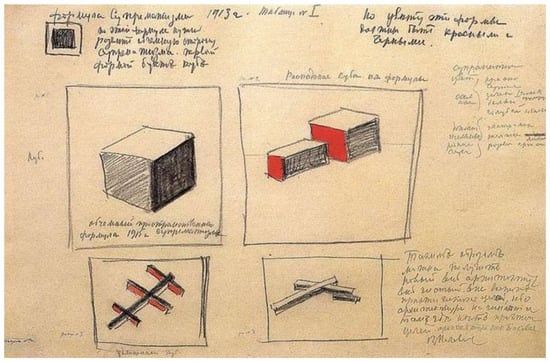
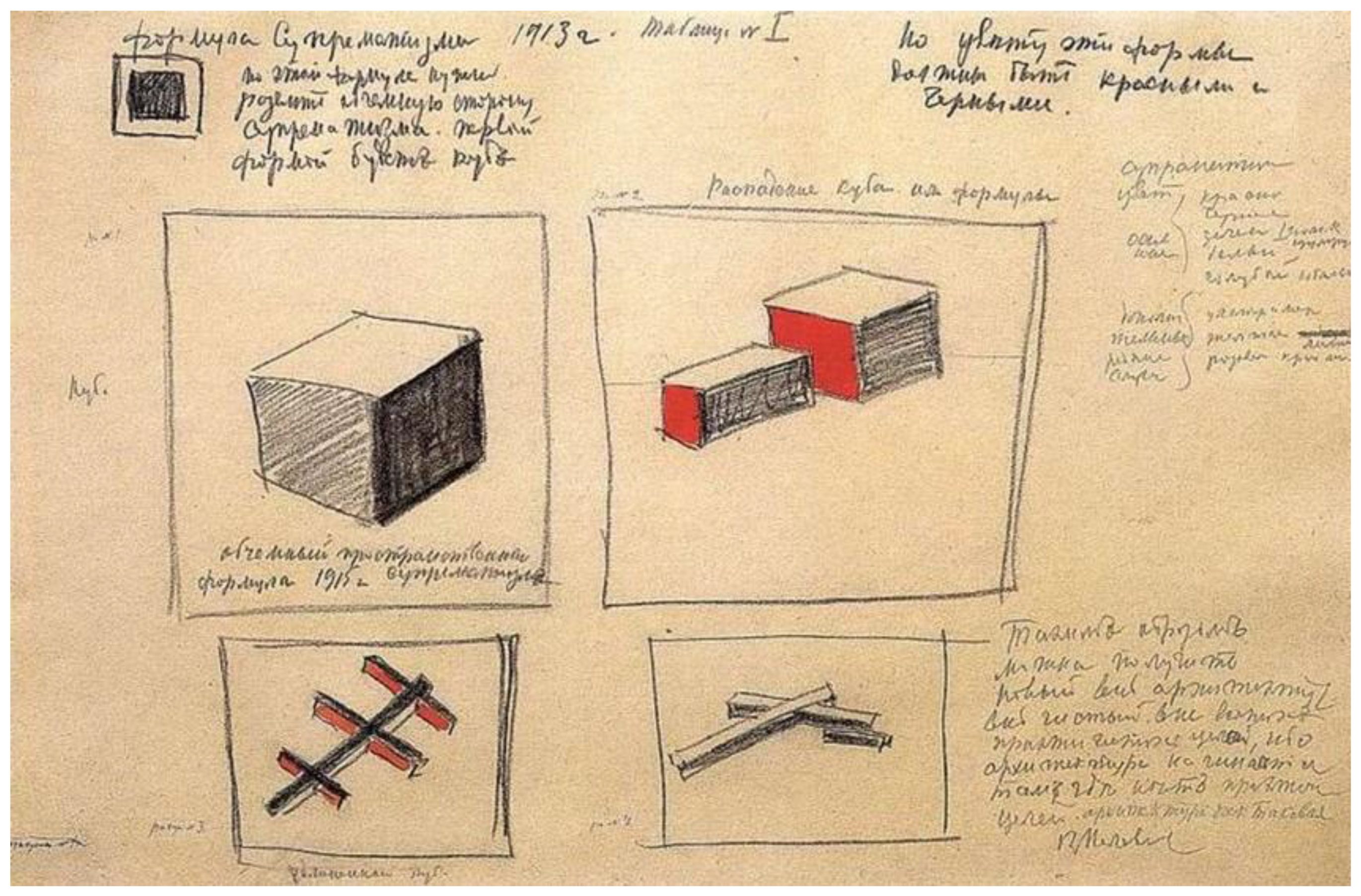
In Table No. 1, Kazimir Malevich depicts the black square as the formula for Suprematism in 1913, on the basis of which it is “necessary to develop the volumetric dimension of Suprematism,” namely, the cube. This “volumetric-spatial formula of Suprematism” of 1915 then decomposes into red and black forms that generate a dynamic cube—and this, precisely, is Suprematist architecture. On the drawing, Malevich writes: “In this way one may obtain a new kind of architecture—a pure kind, beyond any practical aims whatsoever, for architecture begins where there are no simple aims. Architecture as such”; Figure 1.
Figure 1.
Kazimir Malevich, Formula of Suprematism, Table No. 1. 1920s.
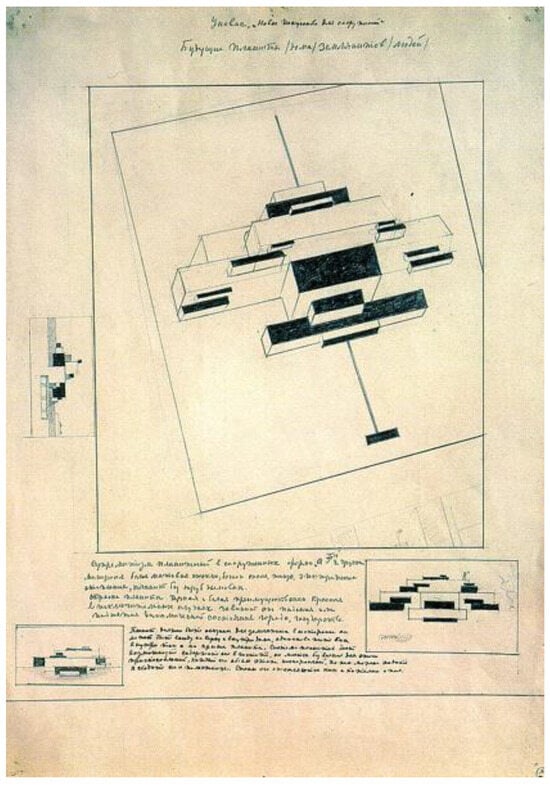
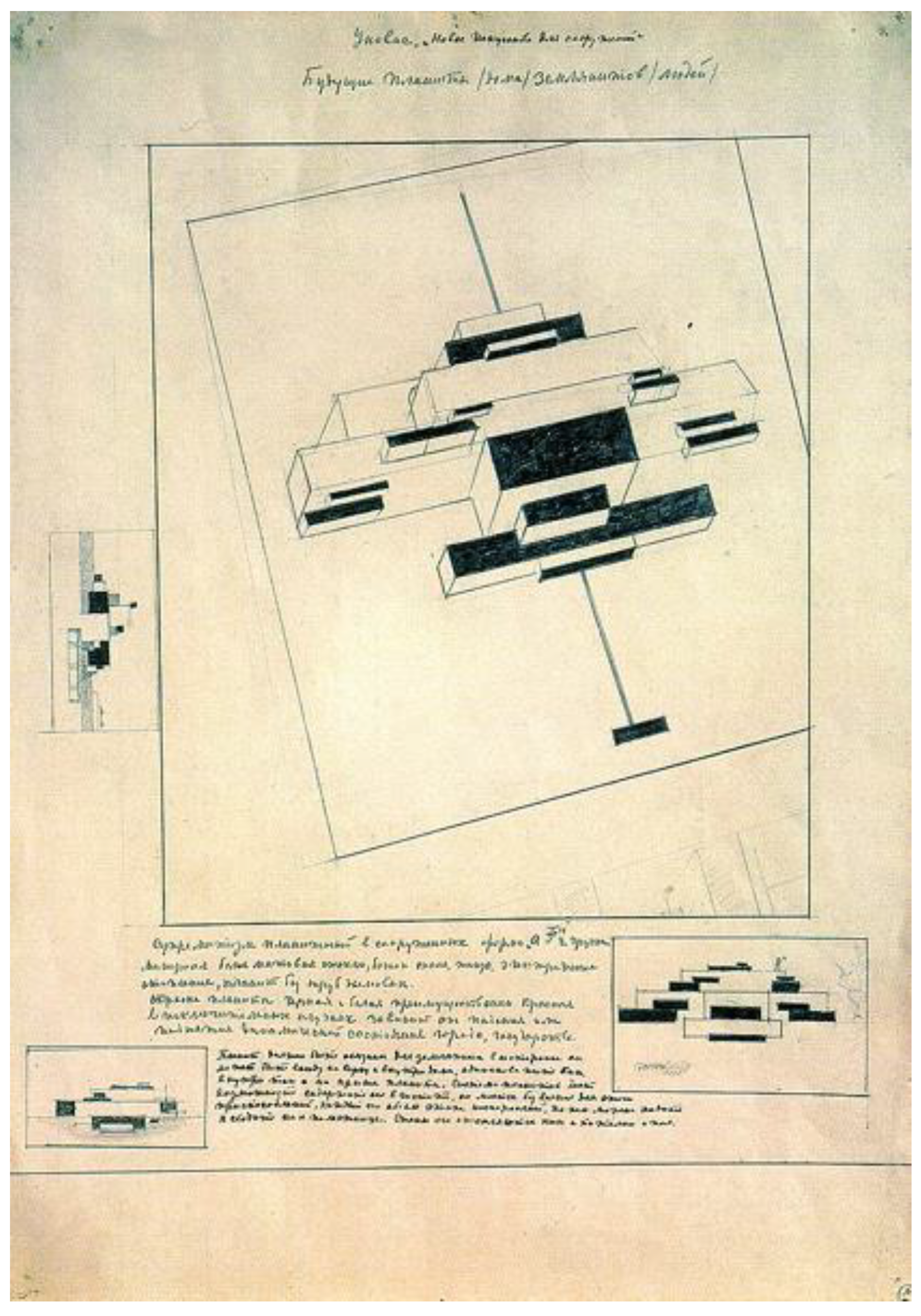
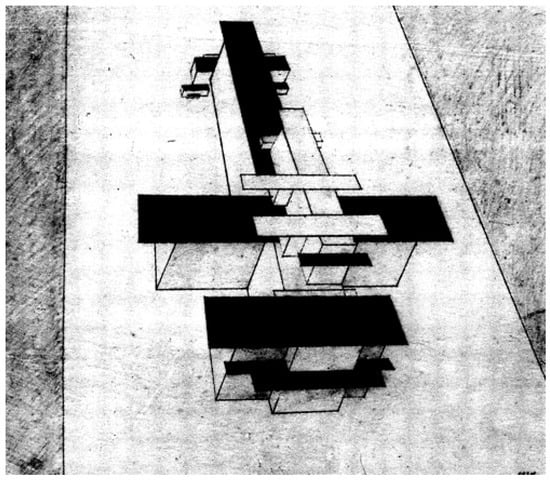
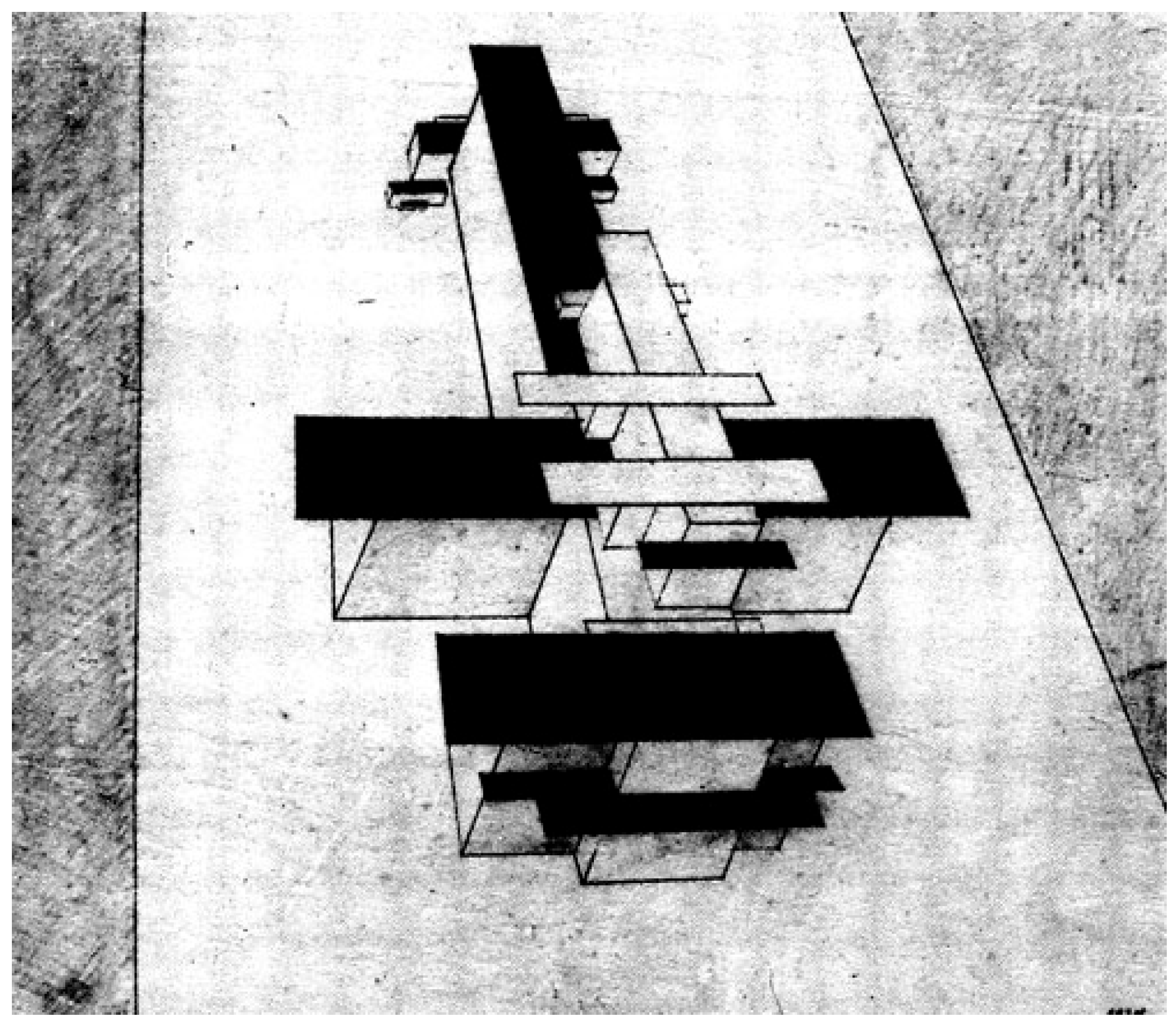
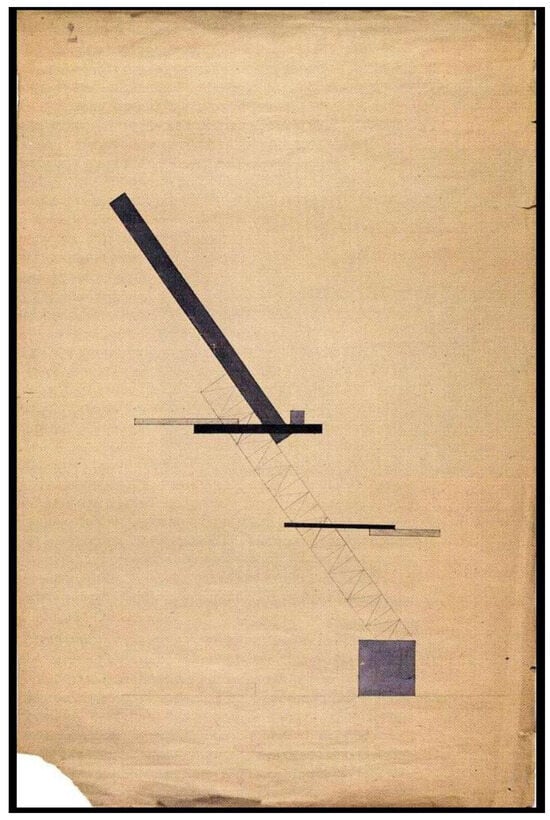
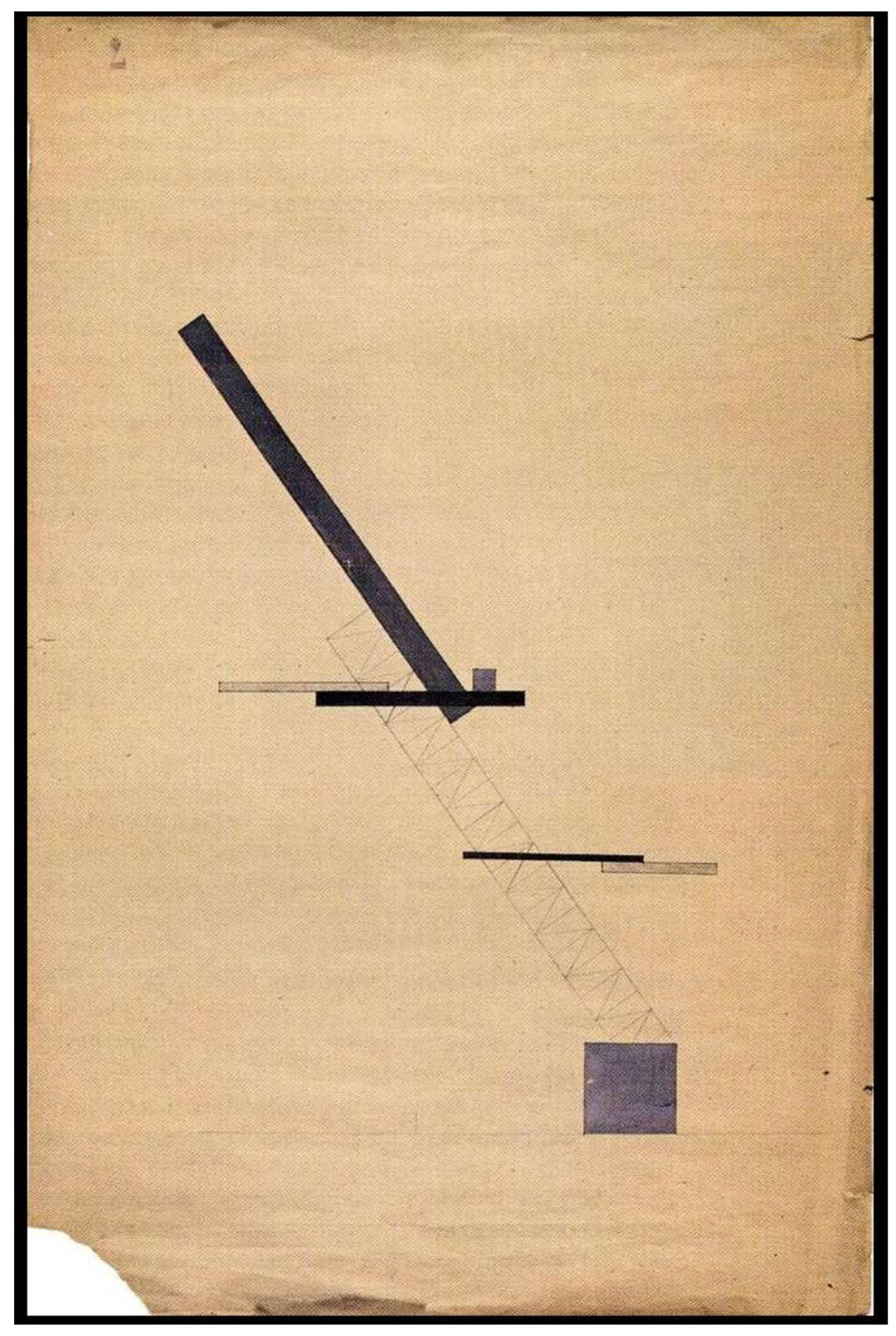
This table serves to elucidate the genesis of the planits and the architectons. In 1924, Malevich produced Suprematist planits—future dwellings for earthlings (humans), including a planit for a pilot. In doing so, he appears to respond to the question, “Is a constructive moment possible within a non-objective Suprematist manifestation?” posed in his book Suprematism: The World as Non-Objectivity, or Eternal Rest of that same year (1924). His contention that construction may not only be practical but also “non-objective, where there is no predetermined goal” and where the artist does not retreat “from pure non-objective constructions” (Malevich 2000, pp. 106, 122), in effect, opened the path toward Suprematist architecture; Figure 2 and Figure 3.
Figure 2.
Kazimir Malevich, Future Planits (Houses) for Earthlings, 1924.
Figure 3.
Kazimir Malevich, Future Planits (Planit for a Pilot), 1924.
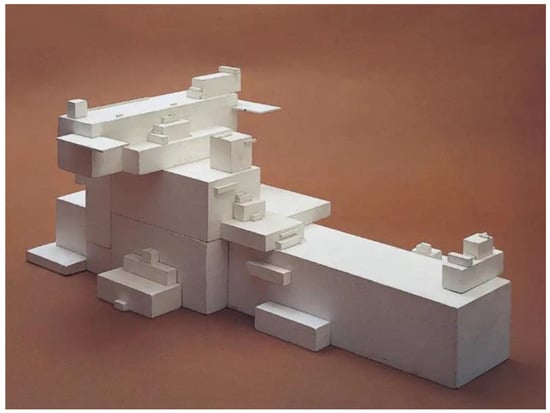
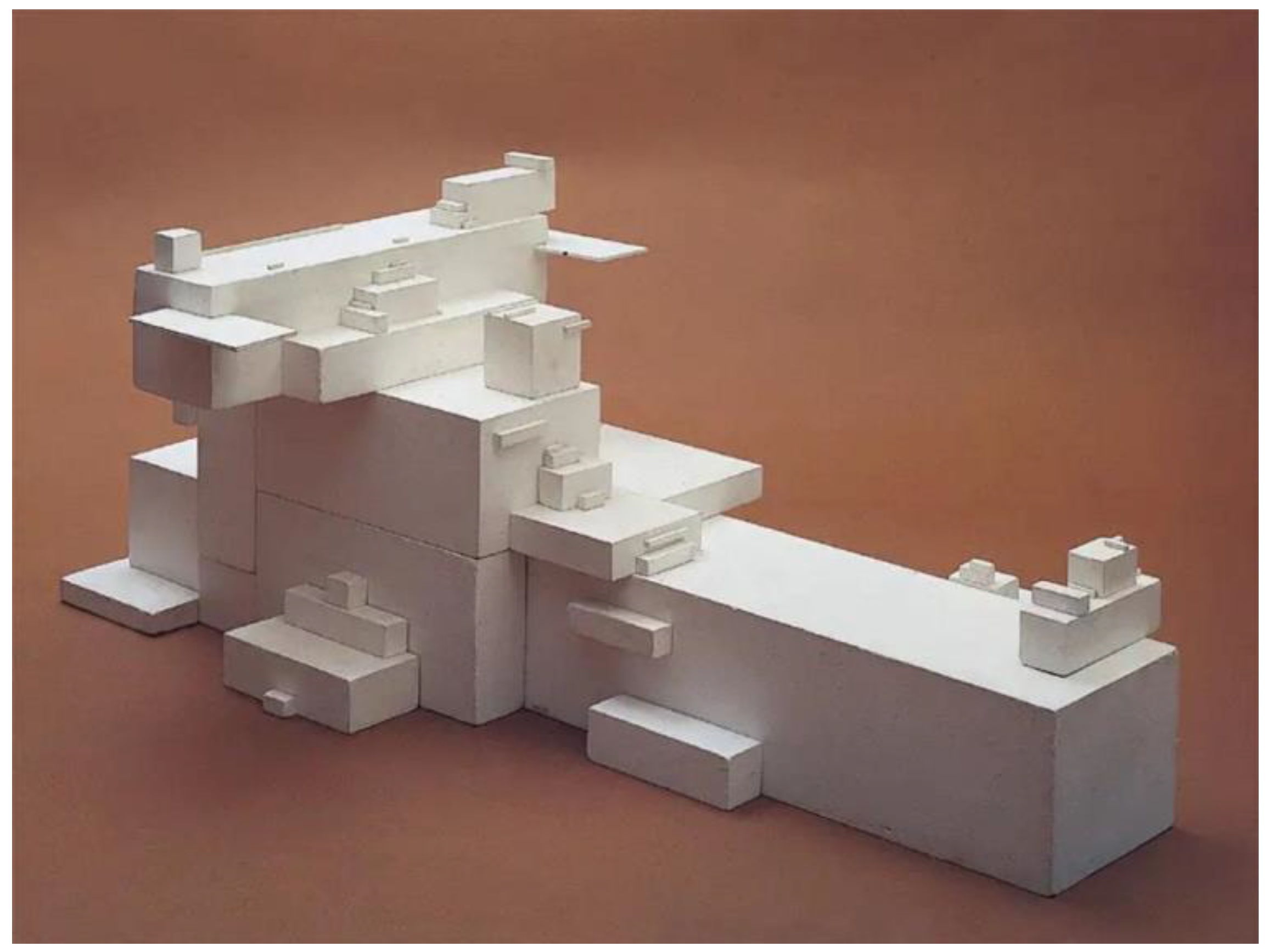
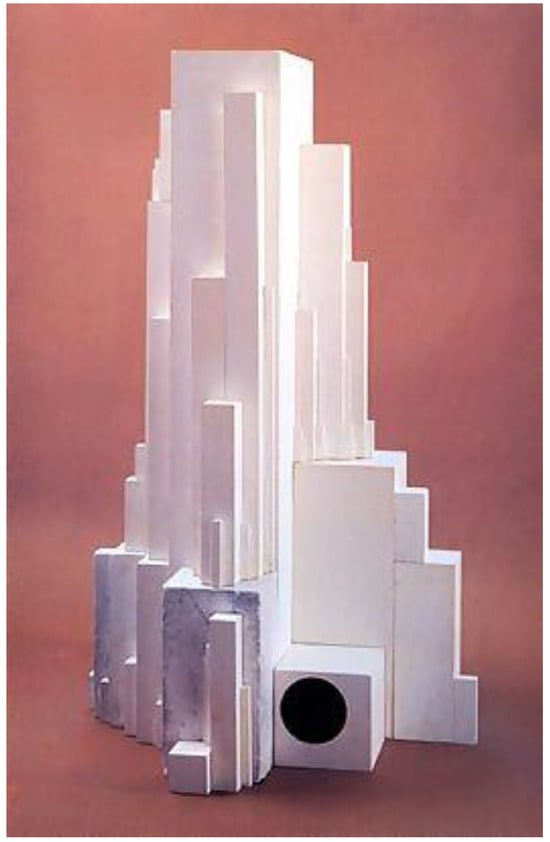
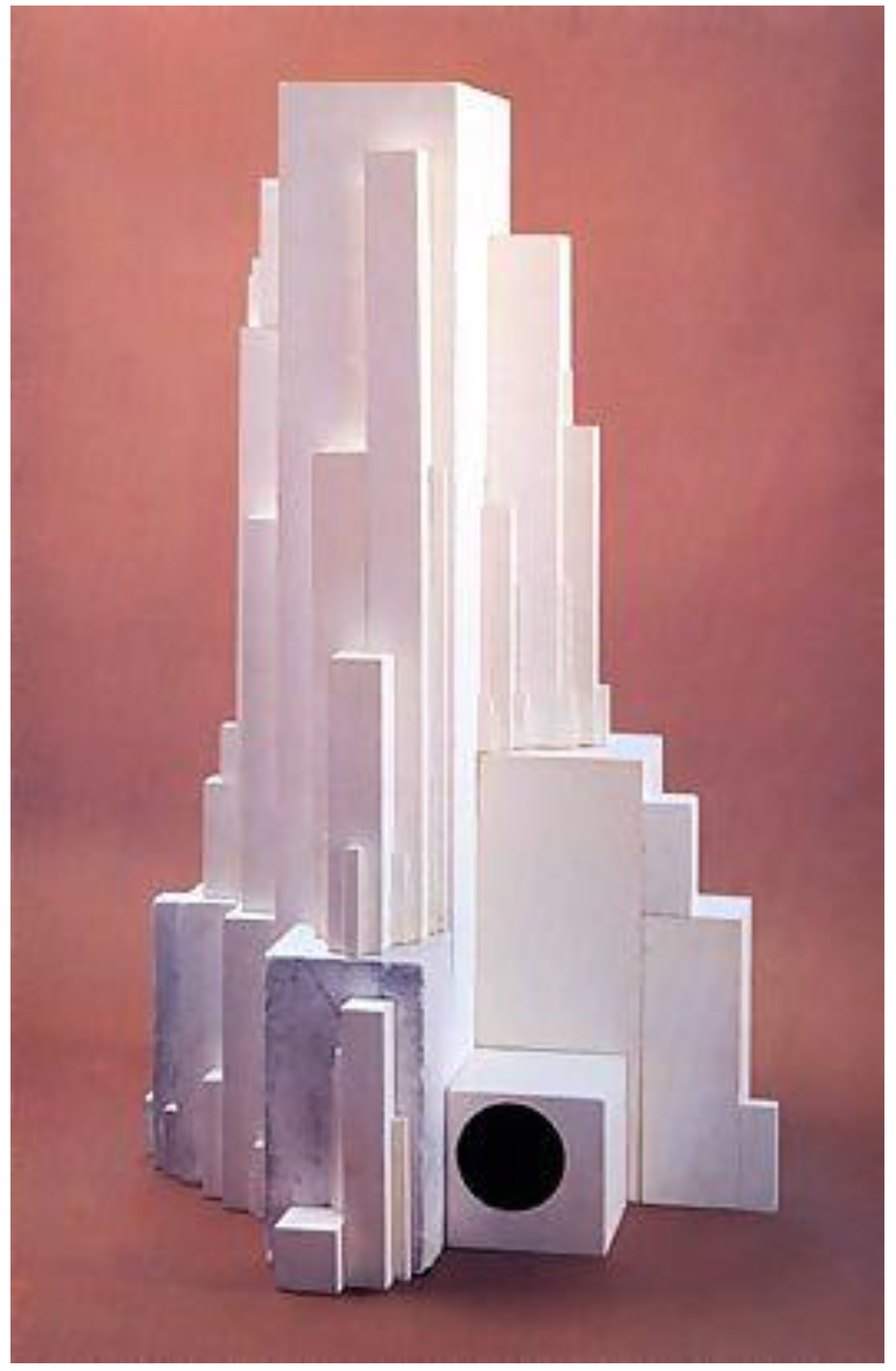
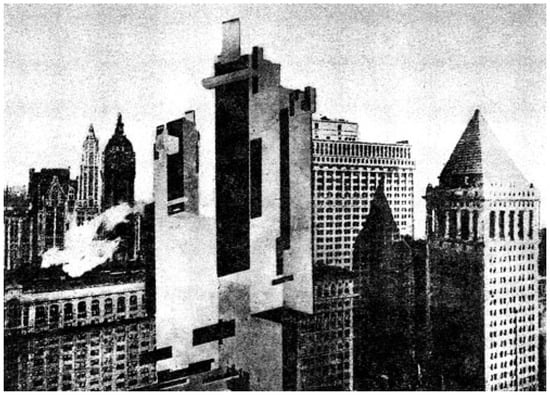
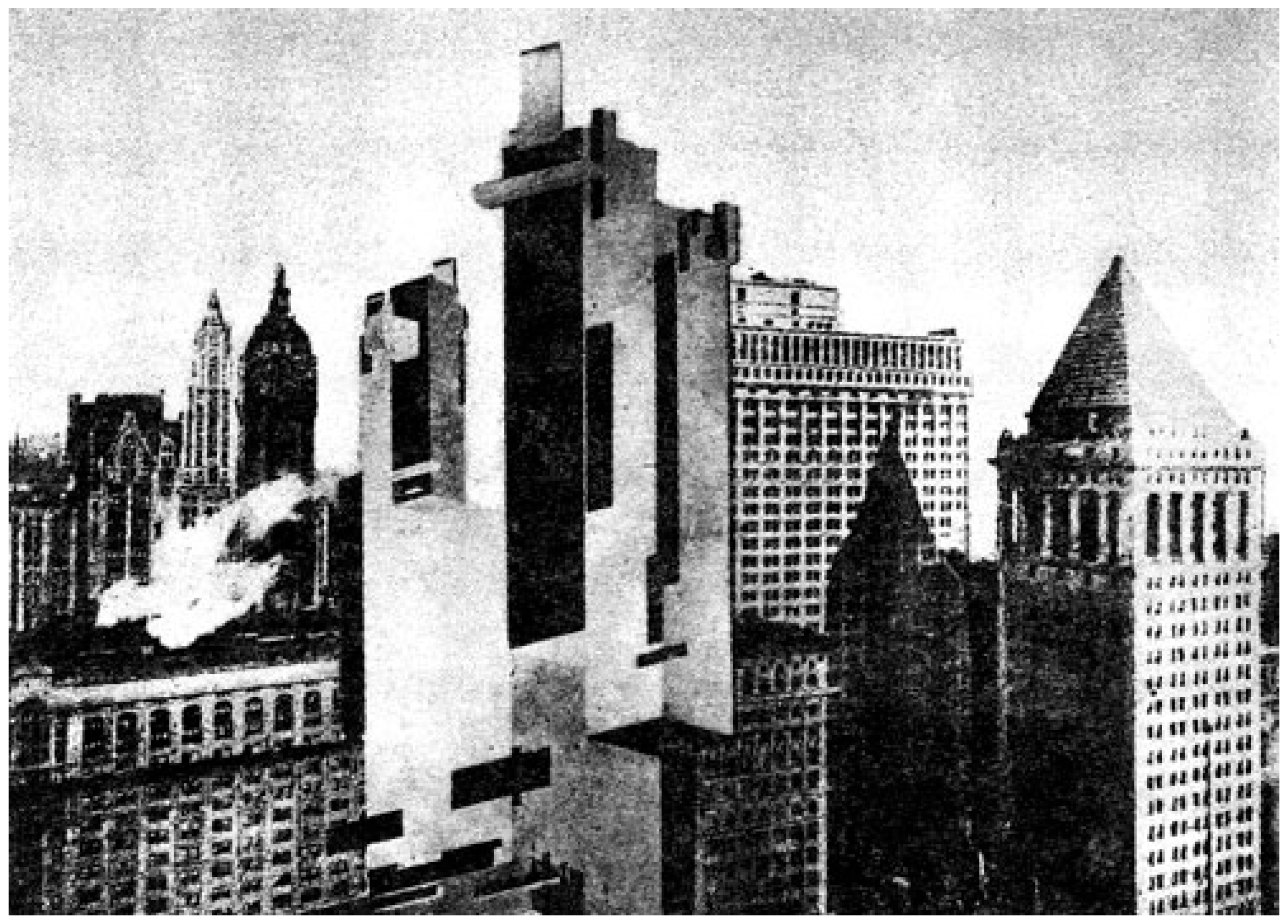
For Malevich, the creation of “abstract, architectural, non-objective relations”—bordering on the nonsensical—constitutes the principal distinction from practical constructiveness. He recognizes that, in the “electro-radio-magnetic epoch,” artistic form has already begun to acquire dynamic prototypes that call for a new form of “pure culture” (Malevich 2003a, pp. 185, 192). For the Suprematist there is no doubt that, in the domain of architecture, a “new great confrontation of art” is taking place, understood as the “stabilization of a dynamic non-objective acceleration” (Ibid., p. 192). He liberates architectural form from weight in order to endow it with an eternal beauty—immutable and abiding in eternal rest—and this is precisely the non-objective abstract: the planit or the architecton. The injunction to architects to remain always abstract is, accordingly, a call to renounce engineering utilitarianism and to turn instead toward ultimate thoughts and toward the nonsensical—that is, to step beyond rational, scientific cognition into weightlessness and suspension within cosmic space; Figure 4, Figure 5 and Figure 6.
Figure 4.
Kazimir Malevich, Architecton Alpha, 1923.
Figure 5.
Kazimir Malevich, Architecton Gota, 1923.
Figure 6.
Kazimir Malevich, Suprematist Skyscraper, 1925, photomontage; illustration in Praesens 1, 1926 (Warsaw).
The turn toward architecture became one of the principal directions of the purposeful development of Malevich’s Suprematism. Yet here, too, following (Lodder 2007, pp. 172–202; Charistou 2004), one discovers the indirect influence of Nikolai Fedorov, who counted on “Copernican architecture” as the most revolutionary aesthetic embodiment of the ideas of cosmism, one that would break with all “Ptolemaic” arts. Fedorov writes that “Copernican architecture” must break with terrestrial urbanism, since it will become a whole series of round dances of resurrected generations: “All these round dances together constitute an already moving temple, the parts of which are indeed ships, ether-vessels, electro-ships, swimmers of the etheric space, freely moving within it, yet without interrupting communication with the center, with the hearth, and all together influencing the central body, regulating it by their course, and with it the course of the entire solar system, the entire chorus, the entire squadron of the universe, the fleet of worlds—stars” (Fedorov 1995, p. 242).
2. Visions of the Alternative Universe
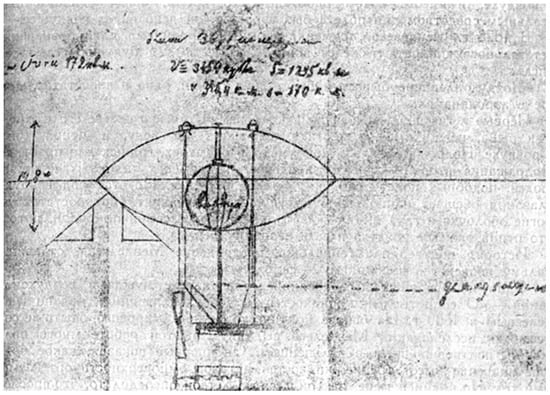
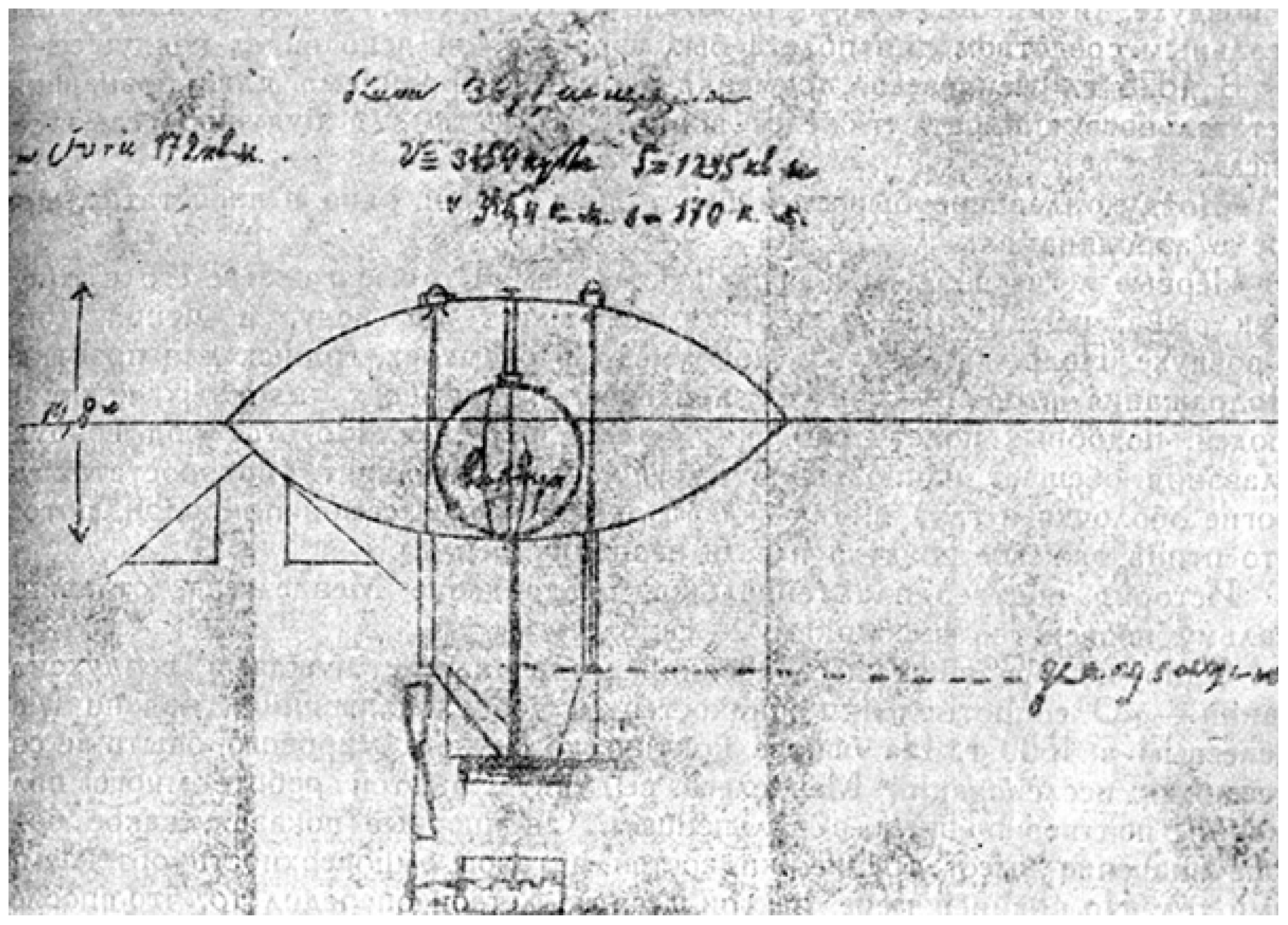
The grandiose visions of Fedorov were transformed into Malevich’s Suprematist cosmism, who, in 1913, already shared with Matiushin his dream of times when “the earth and the moon will serve the human being as energy of motion” and when “on gigantic zeppelins large cities and studios of contemporary artists will be held” (Vakar and Mikhiienko 2004, p. 51). He even voiced the idea of the possibility of interplanetary flights, orbital satellites, and stations intended for the human ocвoeниe of cosmic plaspace7. Undoubtedly, these ideas were inspired by scientific discoveries and technical inventions of the late nineteenth–early twentieth centuries. One of the first in Russia to propose methods for studying the stratosphere was Dmitrii Mendeleev. Speaking at a meeting of the Russian Physical Society at St. Petersburg University in 1875, in his report “On the Temperature of the Upper Layers of the Atmosphere” [“O тeмпepaтype вepxниx cлoeв aтмocфepы”], in researching these problematics, he called for the use of automatic unmanned aerostats and also piloted balloons with a hermetically sealed gondola, which would subsequently acquire the name of stratostats. Mendeleev did not live to see the first flight into the stratosphere in 1924; however, he ascended in a tethered aerostat in Paris in 1878, then undertook a flight in the balloon Russkii in the Moscow region in 1887 to observe the solar corona during a total eclipse, counting on the fact that its study would provide a key to understanding the origin of worlds; Figure 7.
Figure 7.
D. Mendeleev, Project of a Controlled Aerostat, 1875.
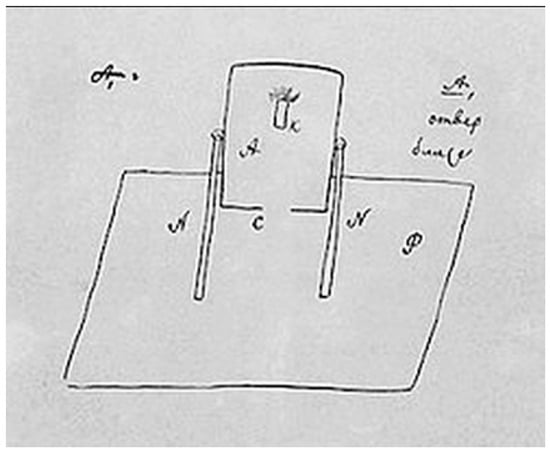
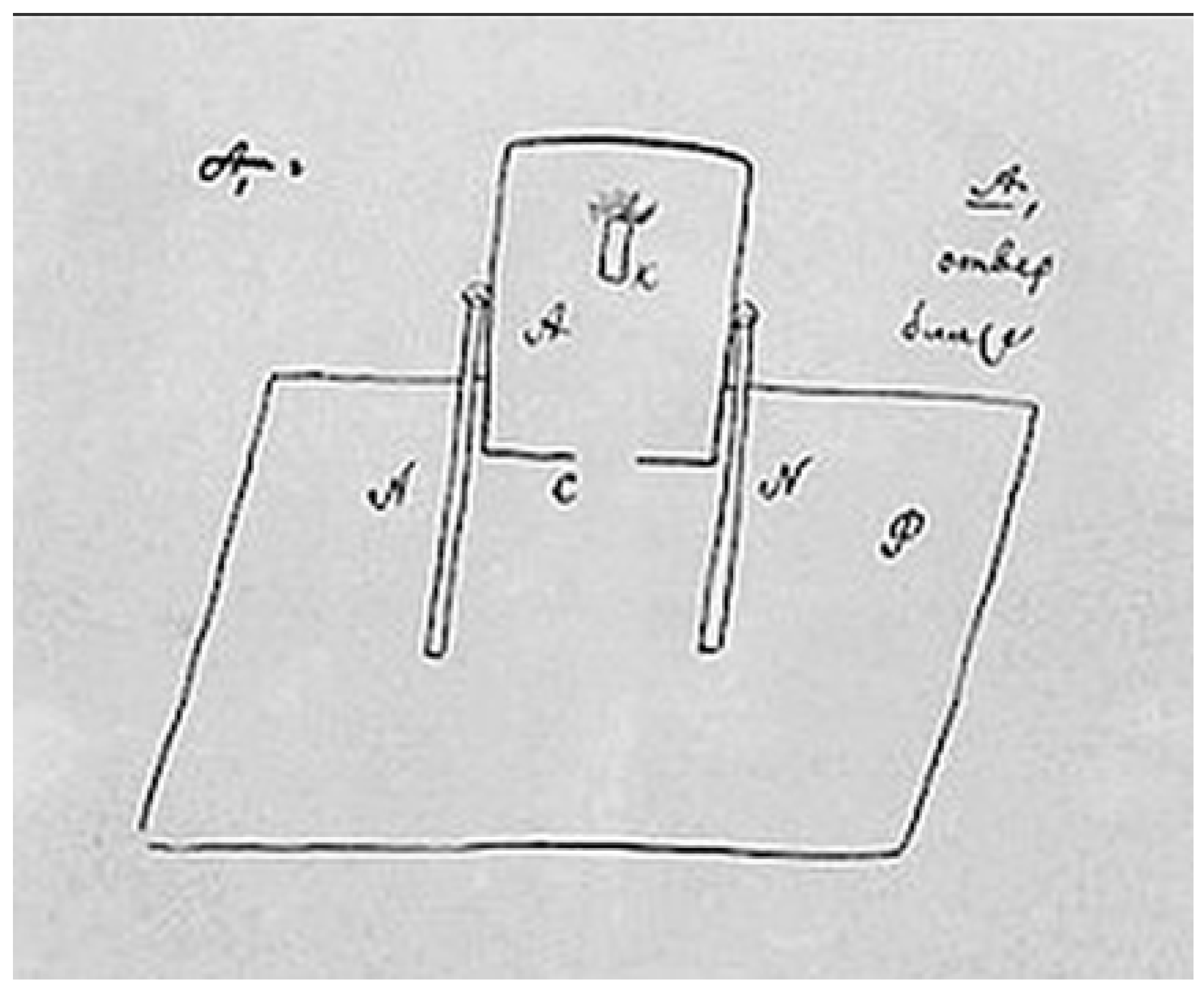
Proceeding from his scientific interests concerning gas, the stratosphere, and aeronautics, Mendeleev, at the beginning of 1877, already unconditionally supported the efforts of the Russian military figure Alexander Mozhaisky, who was among the first to design and build a “full-scale” airplane (i.e., intended for lifting a human being) in 1882. However, one must also not forget the experience of Narodnik Nikolai Kibalchich, who, while in prison in connection with the case of March 1 (the assassination of Emperor Alexander II), a few days before his execution in 1881, developed a project for an aeronautical apparatus capable, as it was believed, of carrying out cosmic flights; Figure 8.
Figure 8.
N. Kibalchich, Drawing with a Rocket Project, 1881.
Kibalchich’s flying machine represented a platform with an opening, above which it was proposed to place an explosive substance so that the machine could start and gain the necessary speed and height. The inventor understood that his idea was only a crude sketch and required technical expertise; nevertheless, he believed in its feasibility, as his deathbed note assured. In 1918, the scholar and popularizer of aviation and cosmonautics Nikolai Rynin published a conclusion on the project of the reactive flying apparatus of N. Kibalchich, in which it was asserted that “priority in the idea of applying reactive engines to aeronautics should be established for N. Kibalchich,” an idea “fundamentally correct and offering remarkable prospects for the future, especially if one dreams of interplanetary travel” (Rynin 1918, p. 123)8. Nikolai Rynin himself created, in Petersburg in 1909, one of the first aerodynamic laboratories in Russia; in 1920, he organized a faculty of air communications; in 1924, he participated in the work of the Moscow “Section of Interplanetary Communications” of Osoaviokhim of the USSR; and in 1928–1932, he published nine issues of Interplanetary Communications [Meжплaнeтныe cooбщeния]—the first encyclopedia on the history and theory of reactive motion and cosmonautics.
A special place in this series was occupied by the contemporary of the Suprematists, the self-taught scholar Konstantin Tsiolkovsky, who developed projects for rocket technology and theoretical questions about cosmonautics. Following Fedorov, in his texts, Tsiolkovsky proposed populating cosmic space through the use of orbital stations, with advanced ideas of a space elevator and of trains on an air cushion. Yet he considered the principal factor in the dispersal of humanity into the cosmos to be the elevation of an intellect deprived of passions, which would make it possible to lead humanity out and to realize a “rational pacified existence.” This served as the main stimulus for the development of the foundations of rocket-space technology. In the article “The Exploration of World Spaces by Reactive Devices” [“Иccлeдoвaниe миpoвыx пpocтpaнcтв peaктивными пpибopaми”] (1903), Tsiolkovsky substantiated the use of rockets for flights into space, which, in the 1920s, led him to the conclusion of the necessity of employing “rocket trains”—prototypes of multistage rockets; simultaneously, he reflected upon the survival of the human being in a state of weightlessness during prolonged space flights. Beginning in 1916, Tsiolkovsky’s ideas were actively promoted by the mathematician Yakov Perelman, who was interested in ideas of conquering cosmic space; in the early 1920s, he was acquainted with the German scholar Hermann Oberth, who, in 1923, published the book The Rocket into Interplanetary Space, with the ideas and works of Tsiolkovsky devoted to human development in outer space.
Undoubtedly, in the 1920s, the influence of Nikolai Fedorov’s doctrine of the common task of populating the Universe, and its elaboration by scholars and technical inventors in projects for constructing apparatuses for movement in space, was great. The avant-garde strove to correspond to this most avant-gardist of ideas, which occupied the minds of all people of the new social and ideological order. Therefore, it is entirely natural that Malevich as well, a pioneer in the artistic mastery of cosmic space, shared his ideas with his students, who subsequently developed them in their own work. Among them were Ilya Chashnik, Nikolai Suetin, and Lazar Khidekel. They created their architectural projects for the future, transformed human being; through them they entered the cosmos, soared above the earth, following the precepts of Malevich formulated in the text “Suprematism. 34 Drawings” [“Cyпpeмaтизм. 34 pиcyнкa”] in 15 December 1920 for the brochure of the same title: “Having established definite plans for the Suprematist system, I place the further development of architectural Suprematism in the hands of young architects, in the broad sense of the word, for in this alone do I see an epoch with a new system of architecture” (Malevich 1968, pp. 127–28; 1995c, p. 189).
Lazar Khidekel accepted the challenge and created, in the opinion of Selim Khan-Magomedov, “the first genuinely architectural composition on the basis of Suprematism”—the Aeroclub (1923), (Khan-Magomedov 2018, p. 7) and, three years later, the first Suprematist architectural project in the history of the avant-garde, the Workers’ Club (1926)9; Figure 9 and Figure 10.
Figure 9.
L. Khidekel, Aeroclub, 1923.
Figure 10.
L. Khidekel, Workers’ Club, 1926.
In 1922, having enrolled in the Petrograd Institute of Civil Engineers, he attracted the attention of Alexander Nikolsky10, who was attempting to introduce new methods of architectural education, which brought him closer to Malevich; on this basis, the meeting of the architects of Nikolsky’s studio and the Suprematists took place, after which followed Malevich’s letter to Nikolsky in 192711. Khidekel was apparently the connecting link, preserving in his architectural sketches—enriched by engineering knowledge of diametric axonometry—the Suprematist principles inherited from Malevich12 and remaining faithful to them throughout his entire creative path. During his work at GINKhUK, he already participated in the creation of architectons, was a bearer of a new method of form generation and of the cosmic principle in architecture. In a description of the activity of the Laboratory of Suprematist Architecture, dated no later than 1 March 1924, Khidekel designated its goal as follows: The conversion of the Suprematist element of the plane into volume; the establishment of a Suprematist dependence of volumetric elements when grouping them into constructions, for the sake of which Suprematist models are cast in real space, and the orthogonal, axonometric, and perspective observations of the constructed elements is determined; the design of a new architectural form with an internal and external elaboration of volumetric constructions, with the calculations of spans of constructions and the determination of material. (L. Khidekel 2000a, p. 210).
Khidekel was the first to use Suprematist volumes to articulate a coherent architectural structure that could actually be built; his spatial constructions (“cosmic settlements,” “tumanoids,” and “aerocities”) existed in the near-earth environment. He finds a common denominator of atmospheric and cosmic space in nebulosity, energy, and movement in order to create a new order between elements and to “launch” their further self-development. It is not accidental that Malevich, before his departure abroad in 1927, entrusted precisely him with making an “architectur<al> plan” in order to show “the entire development of volumetric Supr<ematism> according to sensations of the aero-visible, dynamic, static, Gothic” for a Suprematist film (in a letter to N. Suetin and V. Vorob’ev between 21 and 28 February 1927) (Malevich 2004; Vakar and Mikhiienko 2004, p. 184).
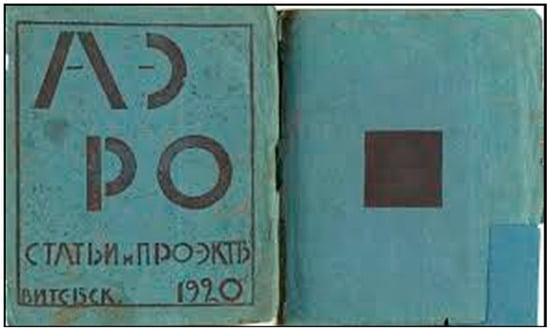
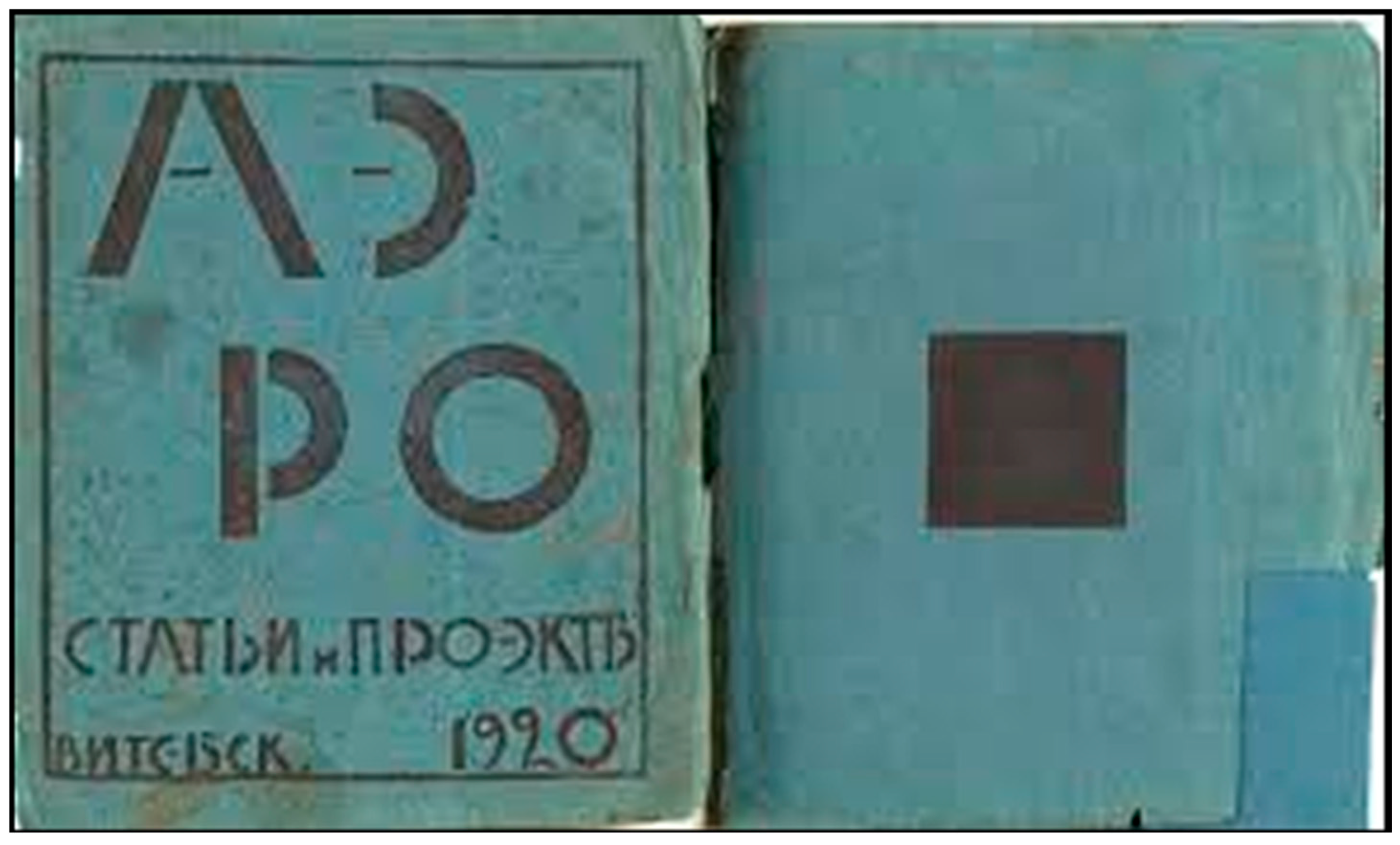
Khidekel realized Suprematist ideas in the projects Aerocity and City over Water, where cruciform shapes, vertical crystals of parallelepipeds, and horizontal stratified structures intersect, creating dwellings of the future hovering above land or water. His philosophy of new cities was connected with ecological ideas of preserving the terrestrial and aquatic surface, of careful treatment of nature, and of ocвoeниe of aerial and cosmic space. In this, he adjoined the ideas of Fedorov. R. Khidekel wrote about Khidekel’s aerocity as a “humane path of development of civilization,” where “care for the individual and for nature are equally important,” and where nature and human culture are governed by the “laws of natural forces” (R. Khidekel 2018, p. 24). It seems more just to compare the relationship between the human being and nature/the aerocity/the architecture of the future with Fedorov’s understanding of the “regulation of nature,” i.e., the introduction of the rational will of the human being into blind nature for the purpose of transforming chaos into cosmos. Let us recall that, already in the declaration for the sole issue of the journal AERO [AЭPO] (1920), the sixteen-year-old Khidekel reflects on real movement into space: the “consciousness of new creativity of world-construction” rejects the aesthetics of ancestors, purifies the “stagnation and chaoticness of the world,” and demands the “conquest of the speed of world space” (L. Khidekel 2000b, p. 210); Figure 11.
Figure 11.
Journal Aero, 1920.
In his manifesto in the journal AERO [AЭPO] he declares that the “construction of the creativity of a new life” is directed toward the “perfection” of world space and the “destruction of the contradictions of civilizations of peoples,” cited after (R. Khidekel 2000, p. 207), and is thereby, in essence, repeating Fedorov’s cherished dream of overcoming the unbrotherly state among people and restoring their kinship in a transfigured form in the Universe13.
In the early works Project of a Cosmic Dwelling (1921), Cosmic Dwelling = Sphere (1922), Tumanoid. Suprematist Structure over Water (1922), and Hovering Suprematist Structure (1923), he develops ideas of weightless, Suprematist space, which are combined with his planning of future habitation in the cosmos; Figure 12, Figure 13 and Figure 14.
Figure 12.
L. Khidekel, Project of a Cosmic Dwelling, 1921.
Figure 13.
L. Khidekel, Cosmic Dwelling. Sphere, 1922.
Figure 14.
L. Khidekel, Tumanoid. Suprematist Structure over Water, 1922.
The further elaboration of architectural-cosmic subject matter led to the appearance of a series of drawings: Project of a Dwelling in Space (1924), Aerocity. Arches over Water (organic form) (mid-1920s), City of the Future (1926), Aerocity (1928), and Flying Planes (1930). Lazar Khidekel proposed aerocities, cities on supports, and flying cities that freely hovered above the earth, creating new urbanistic models of future habitation that took into account concern for human health. It was very important for him that all these “near-Earth” planits and architectons in aerocities should rise above the natural environment and preserve our planet for future generations, while nevertheless allowing the inhabitants of these utopian large-scale constructions to enjoy nature; Figure 15, Figure 16, Figure 17, Figure 18, Figure 19 and Figure 20.
Figure 15.
L. Khidekel, Hovering Suprematist Structure, 1923.
Figure 16.
L. Khidekel, Project of a Dwelling in Space, 1924.
Figure 17.
L. Khidekel, Aerograd. Arches over Water (organic form), mid-1920s.
Figure 18.
L. Khidekel, City of the Future, 1926.
Figure 19.
L. Khidekel, Aerocity, 1928.
Figure 20.
L. Khidekel, Flying Planes, 1930.
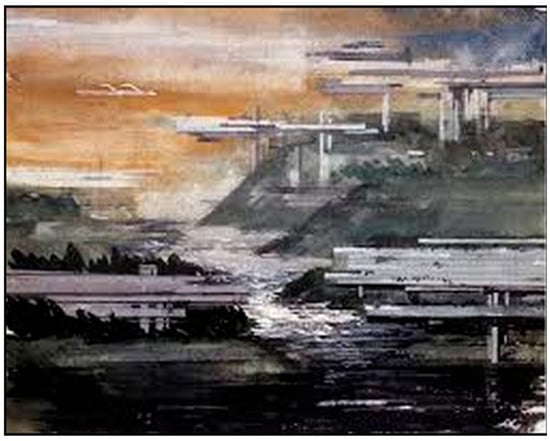
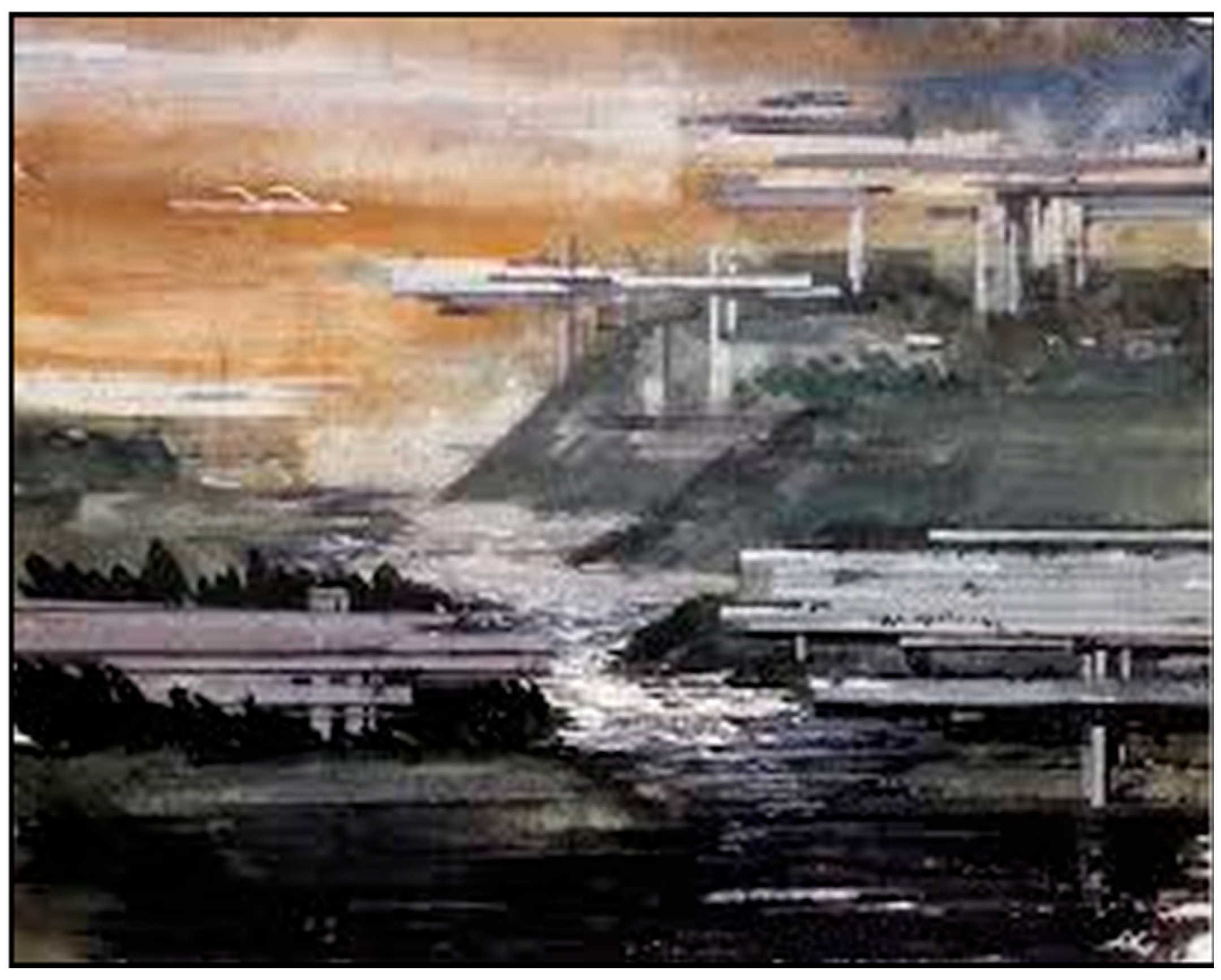
As we see, rising above the level of land or water and leaving them untouched, the proposed Suprematist structures organically develop within the natural landscape as, for example, in the drawings City on Supports (over a river) (1920s) and Aerocity on Supports (1929). With this, Khidekel demonstrated not only an awareness of impending ecological problems in connection with the technological development of civilization—for which he was awarded the title of pioneer of ecological thinking—but also a prophetic understanding of the future of architecture oriented toward cosmic expanses—endless resources for life; Figure 21 and Figure 22.
Figure 21.
L. Khidekel, City on Supports (over a river), 1920s.
Figure 22.
L. Khidekel, Aerocity on Supports, 1929.
And in the early 1930s, the ideas of Suprematism do not leave him; he combines them with the ideas of the garden city and the futuristic city—on supports, over water as, for example, in the Project of a Futuristic City (1928–1932); Figure 23.
Figure 23.
L. Khidekel, Project of a Futuristic City, 1928–1932.
Suprematist constructions continue to be perceived by the artist as a “living self-developing organism” (R. Khidekel 2018, p. 24), manifesting itself especially vividly in the article “Flat Roofs” [“Плocкиe кpыши”]; in this text, the Suprematist plane is considered to be coming alive under the influence of solar rays and fresh air; as a result, it becomes an additional area (for recreational purposes) that justifies itself even economically (L. Khidekel 1928, pp. 3–4)14. Lazar Khidekel projected his Suprematist compositions onto the boundless cosmos, in which geometrized weightless structures akin to cosmic stations of “zemlyanits” were formed before descending downward and turning into above-ground volumes that reveal a cosmic habitat. In this, he likewise echoed his teacher Malevich, who, in the second half of the 1920s, returned to a new figurative painting rethought by Suprematism.
3. The Utopian Projects of Russian Suprematist Architecture
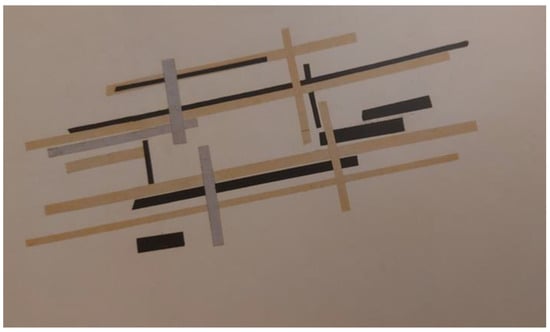
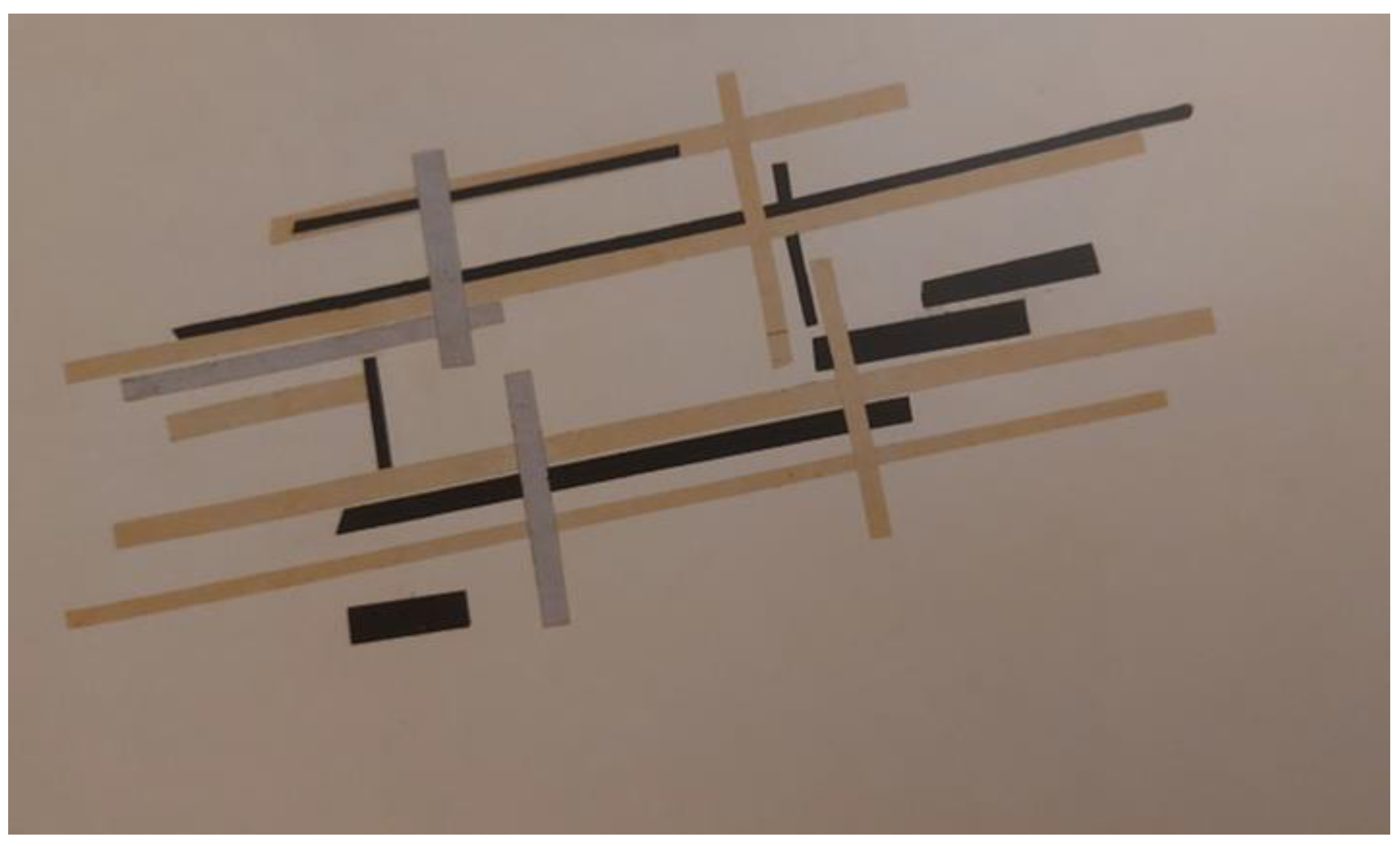
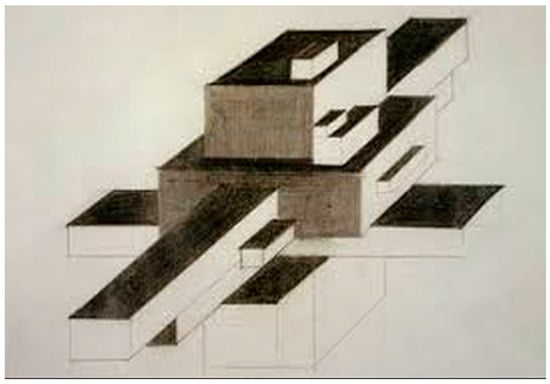
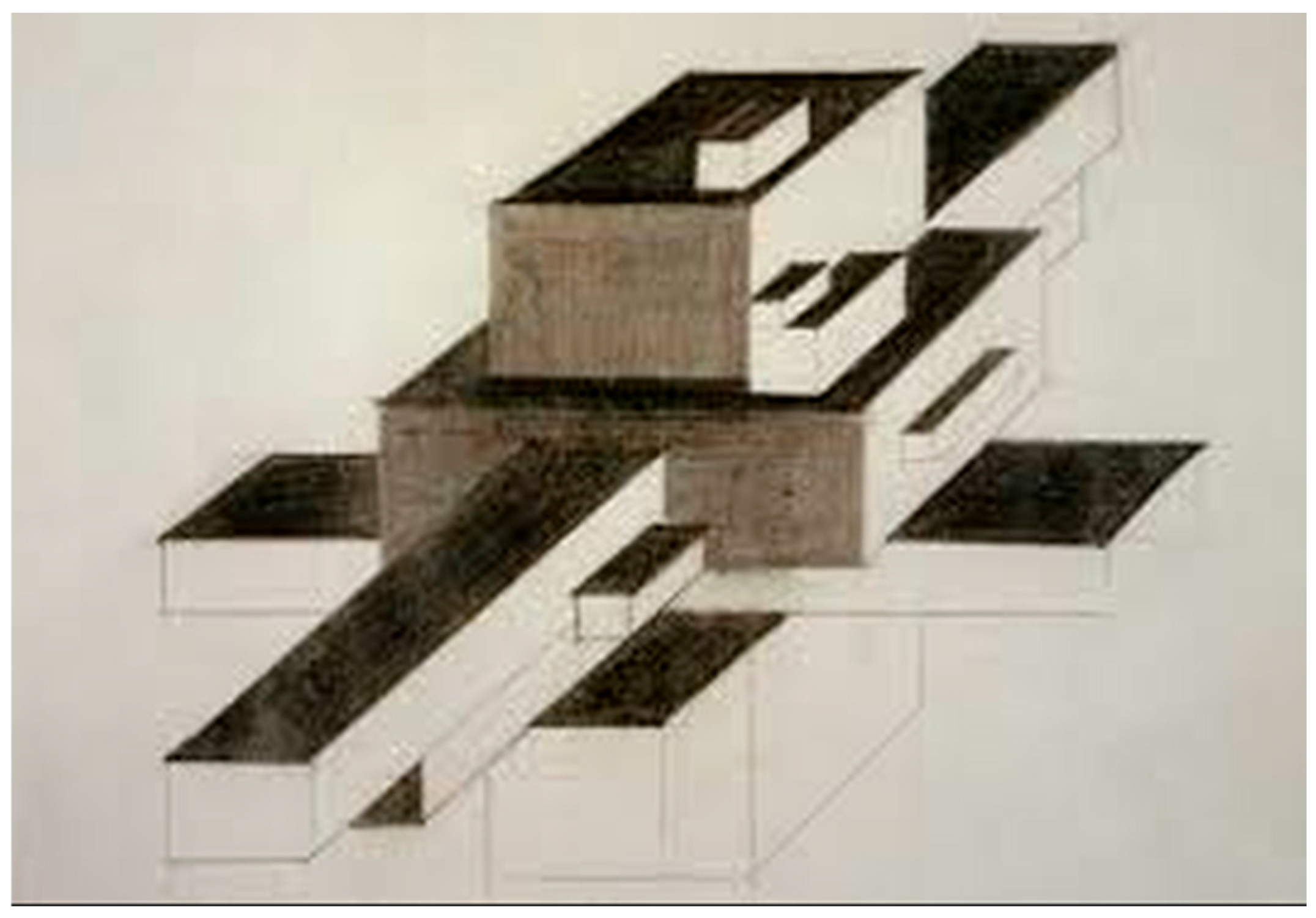
Suprematist tasks of architecture were also formulated by another student of Malevich—Ilya Chashnik. For him the point of departure was the cosmos. In the “UNOVIS questionnaire” [“УHOBИC-aнкeтa”], 15 March 1921, he wrote that he was studying the “latest stages of constructive planar Suprematist positions” with the aim of the “grounding of the world architecture of Suprematism” (Chashnik 2000b, p. 110). The orientation of the UNOVIS workshop was from art to architecture but to the architecture of cosmic, weightless ensembles. In the text “Architectural-Technical Faculty” [“Apxитeктypнo-тexничecкий φaкyльтeт”], Chashnik constructed a logical chain of the acquisition of knowledge from painterly to architectural technical, thanks to which the invention of new constructions becomes possible, leading “Suprematism out of its graphic planar position into the organism of utilitarian forms” and ensuring “its movement in space” (Chashnik 2000a, p. 109). For the young artist there is no doubt that all technical knowledge and equipment (astronomy, mechanics, electrical and casting machines, and magnetic forces) must unite in the task of constructing “organisms of Suprematism as a new economy of the utilitarian system of contemporaneity” (Ibid.). On the basis of Suprematist aesthetics, Chashnik creates one of his first projects, the Orator’s Tribune (1920), hovering in the air and conveying all the dynamic tension of the revolutionary conquest of the Universe15; Figure 24.
Figure 24.
I. Chashnik, Project of a Tribune, 1920.
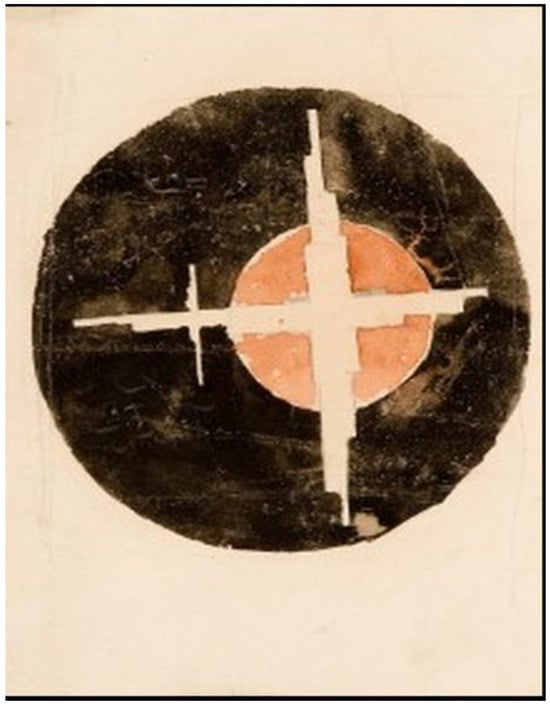
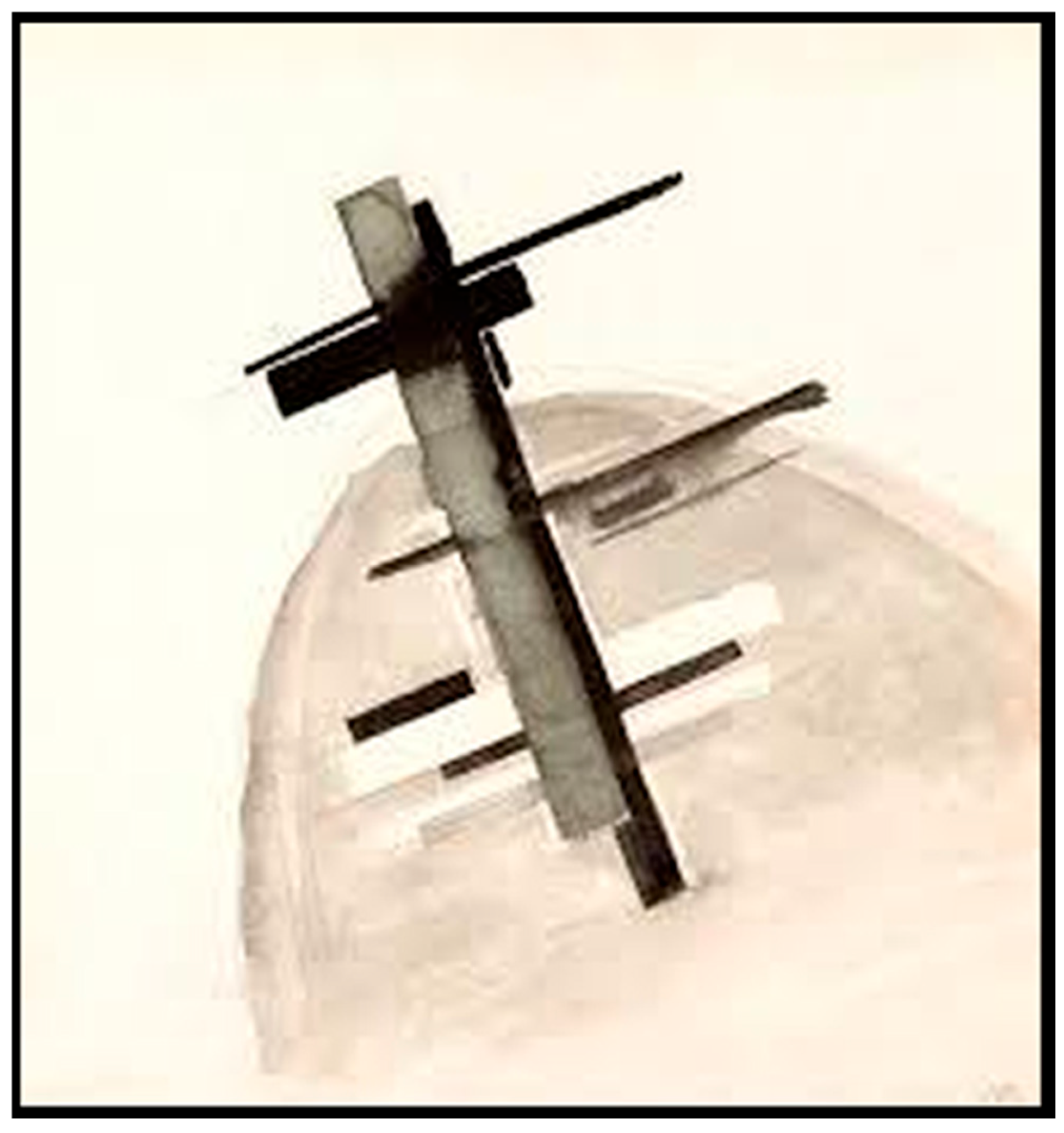
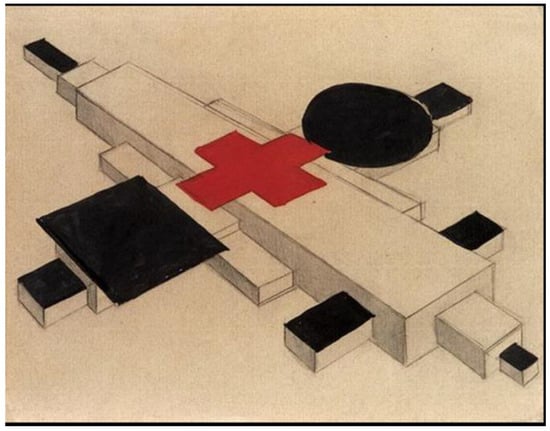
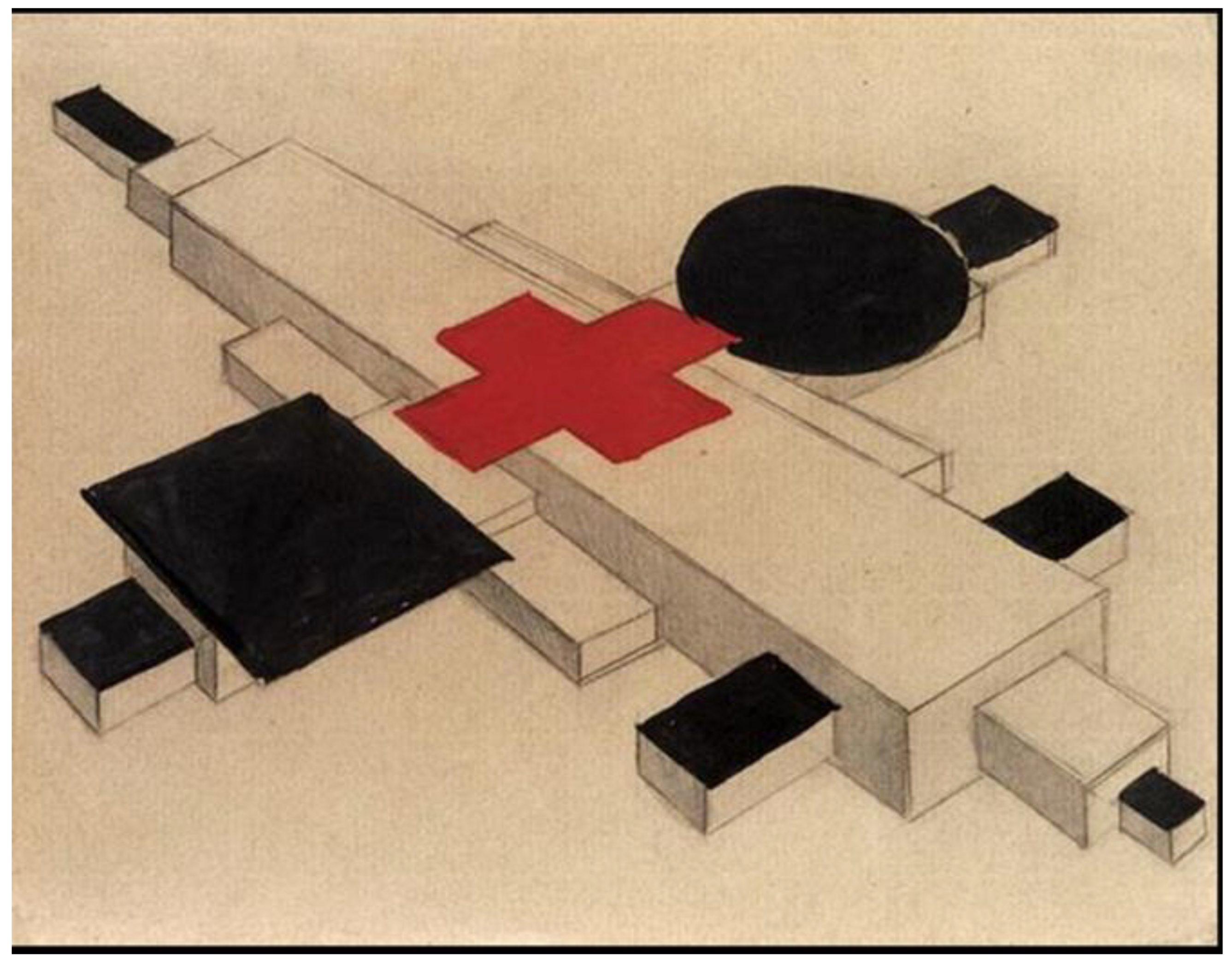
He is especially interested in the cruciform composition invented by Malevich, which later became the point of departure for the artist’s architectural conceptions; as a rule, upon the cruciform construction, Chashnik overlays a black square, a black circle, or else a black cross. Concealed within the cruciform form itself is the entire dynamism, presupposing a breaking away from the earth, an elevation and a hovering above it; simultaneously, it alluded to the religious aspect of overcoming one’s earthly lot (the Ascension of Christ) and, at the same time, to the duty of the resurrection of the fathers for the purposes of populating the outer space of the Universe, about which Nikolai Fedorov usually was speaking in his texts.
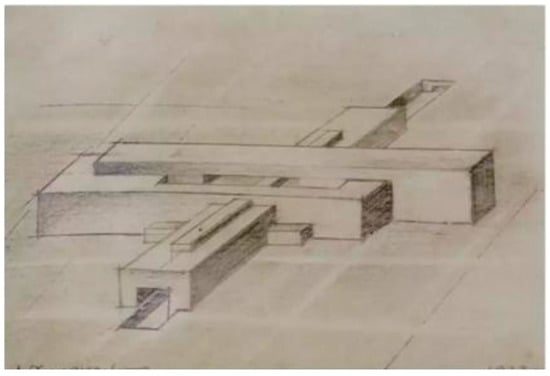
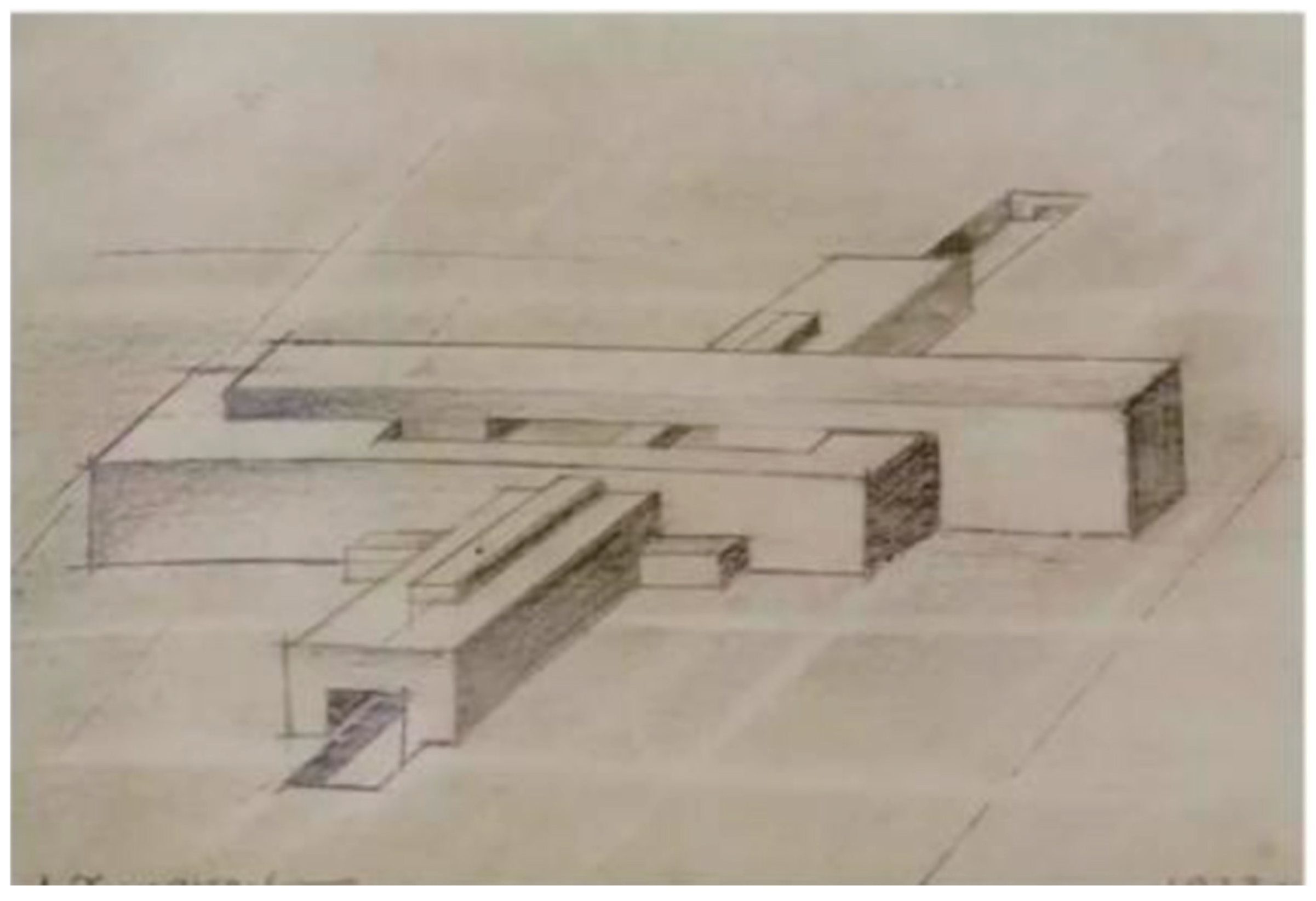
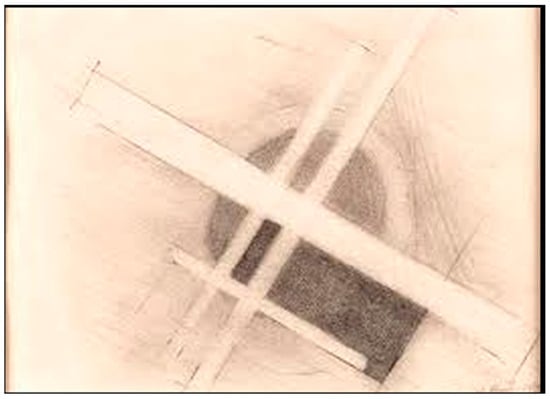
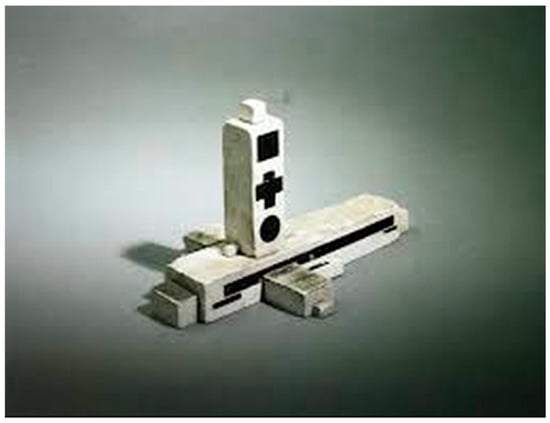
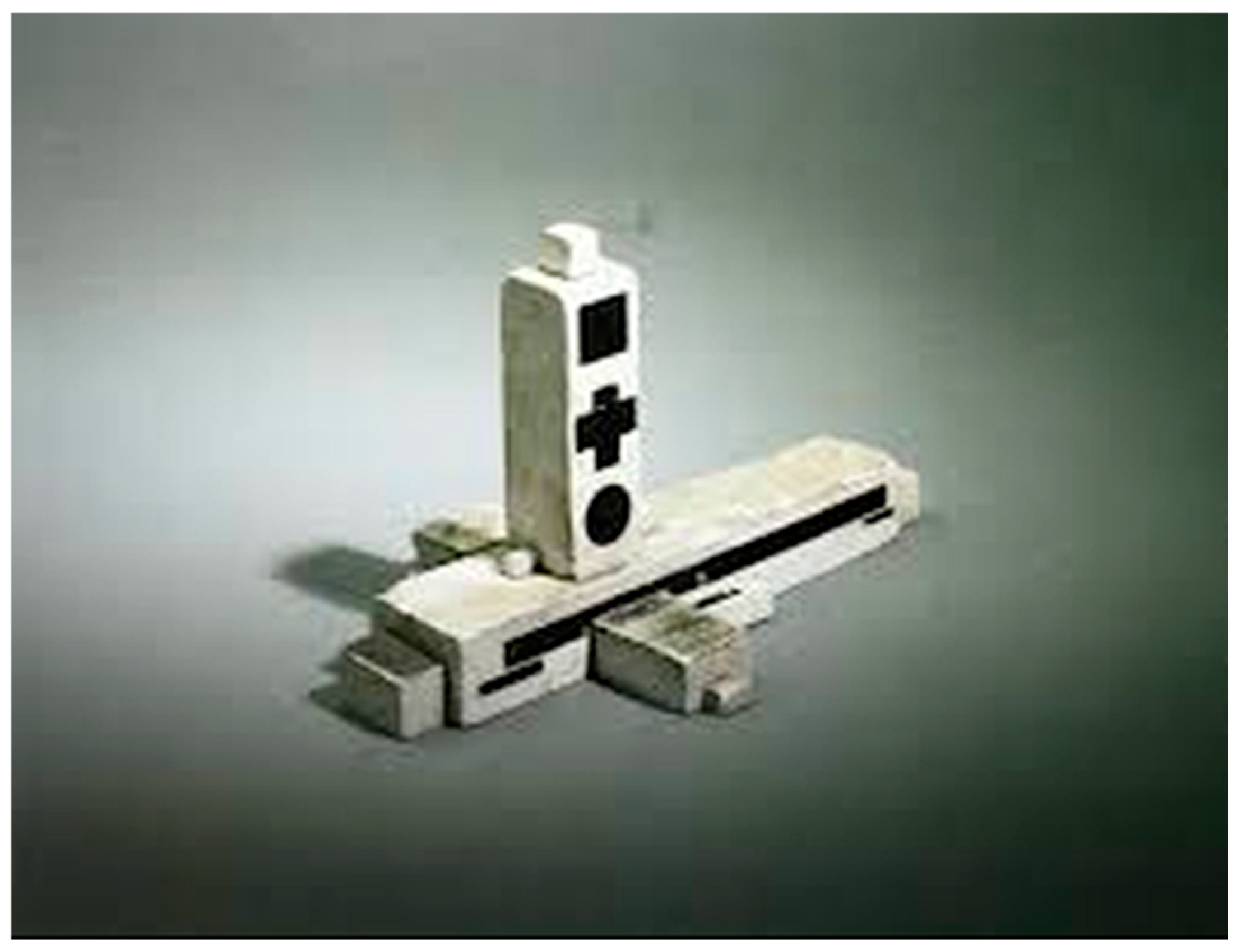
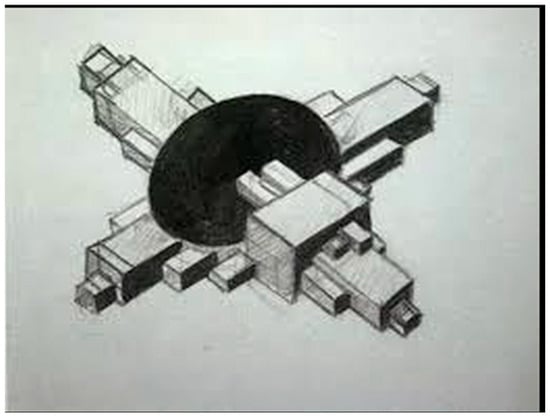
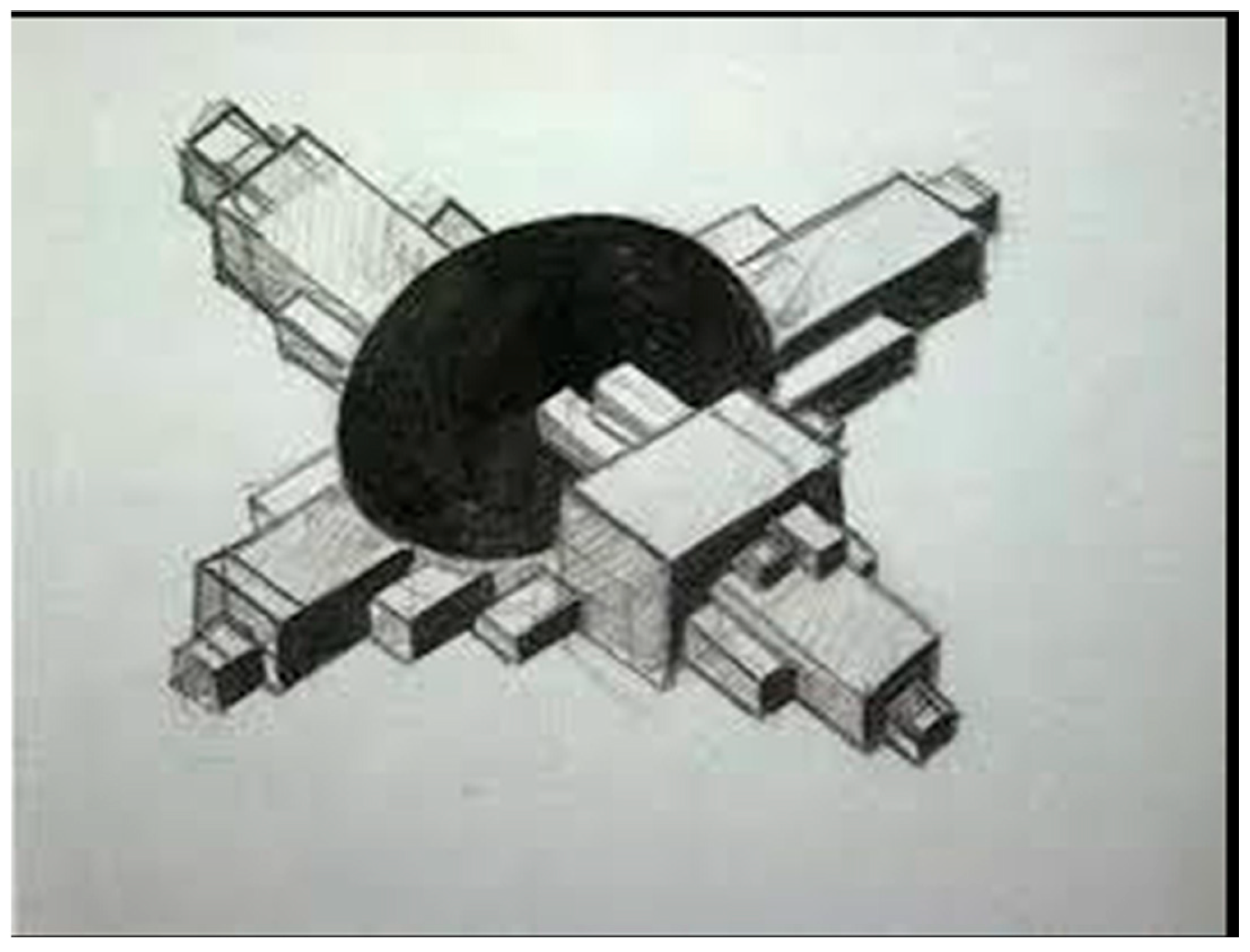
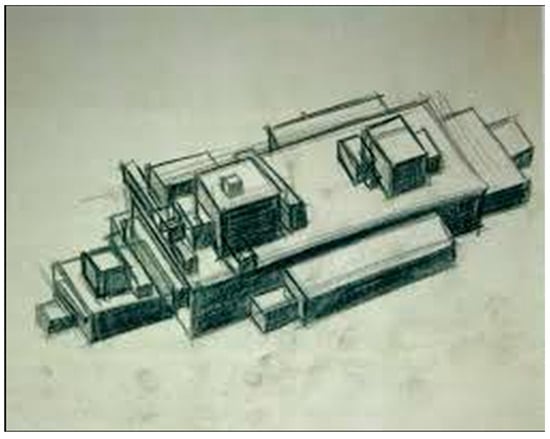
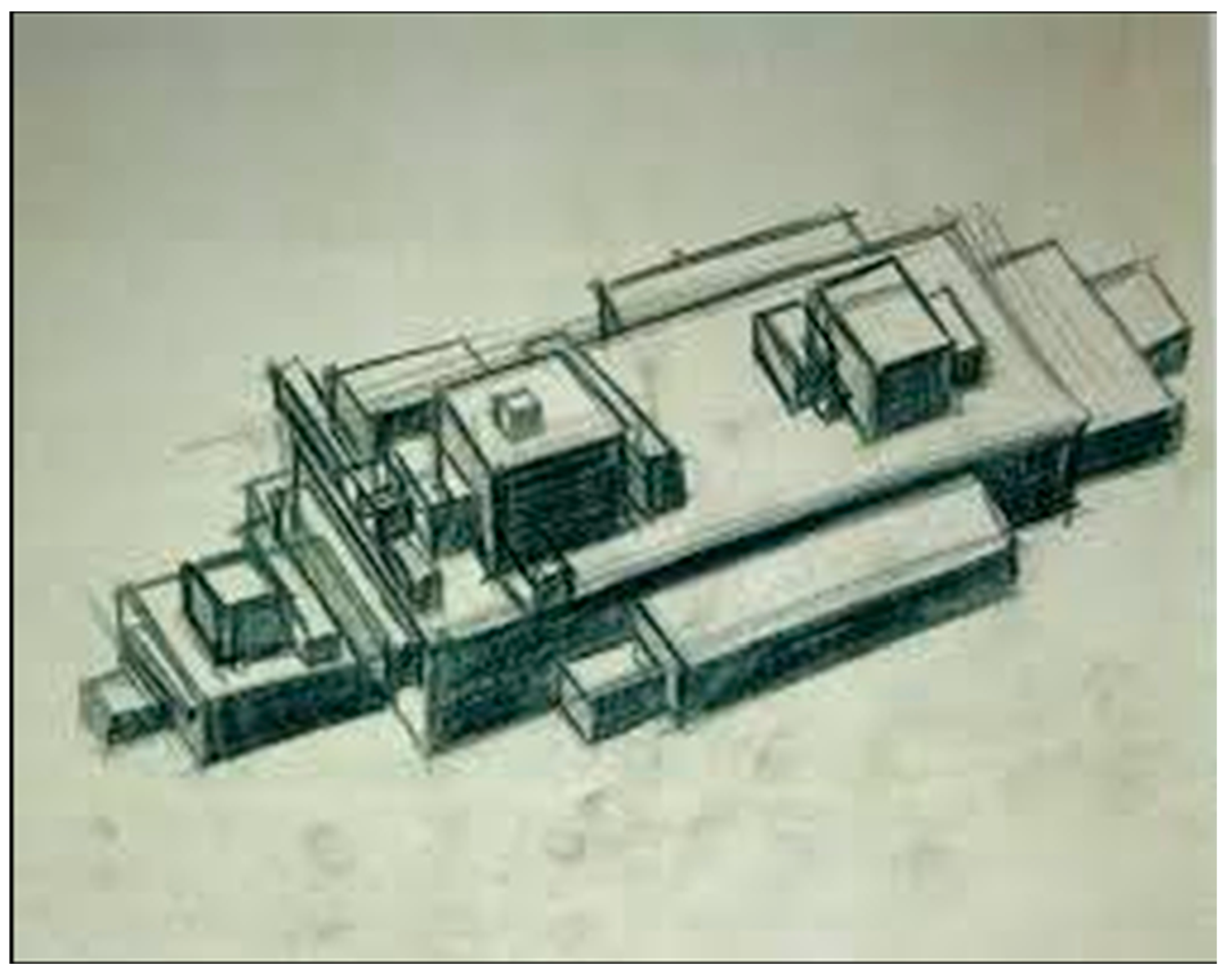
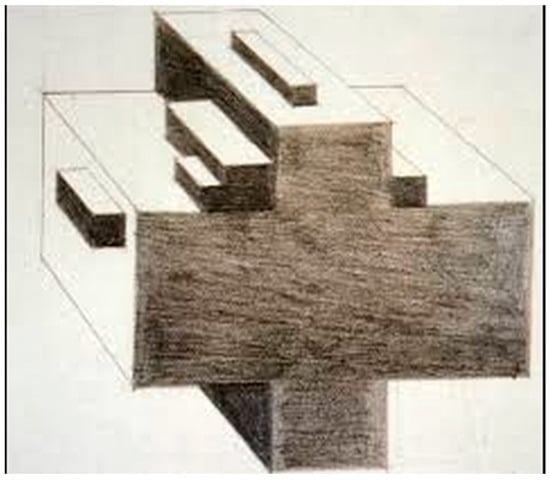
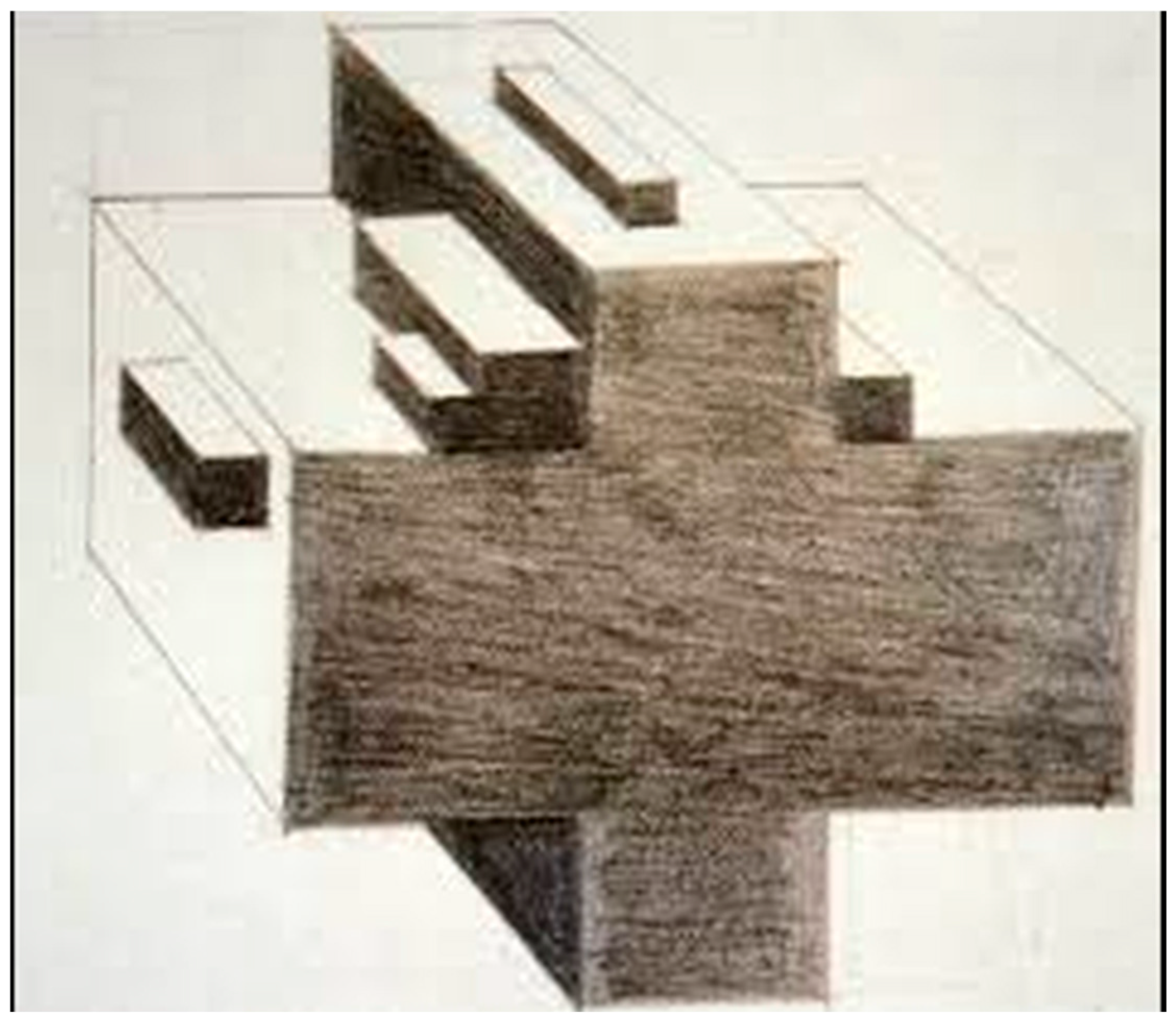
At GINKhUK, the young artist constantly assisted Malevich in the creation of architectons; together with Nikolai Suetin he carried out projects of Suprematist architecture according to Malevich—models, reliefs, and constructions. At the same time, he studied the purity of the artistic form, elaborated the laws of the structure of Suprematist architecture, and investigated its organicity to cosmic space with its dynamic excitation and rhythm. He himself, in 1924–1926, designed his own architectons as an architectural composition of the future, at the basis of which lay the cross; Figure 25, Figure 26, Figure 27 and Figure 28.
Figure 25.
I. Chashnik, Architecton, 1925–1926.
Figure 26.
I. Chashnik, Architectural Project, 1926.
Figure 27.
I. Chashnik, Suprematist Architecture, 1925–1926.
Figure 28.
I. Chashnik, Architectural Project, 1926–1927.
Although various of his architectural sketches have been luckily preserved, it is difficult to understand which of them were brought to the stage of modeling, since the general spirit of Vitebsk UNOVIS still reigned in the studios and the works often remained without signature, thereby recalling the medieval attitude of Masters toward creation16. It is interesting that, in his autobiography, written on 31 March 1927, after the closure of GINKhUK, Chashnik emphasized that “at the present time I am occupied with work on the problems of the forms of contemporary architecture and their internal equipment” (Petrova et al. 2000, p. 185). At the same time, Malevich was writing to A. Nikolsky that “after the destruction of the painterly front of the new art,” its Suprematist representatives, having strengthened the line of “Suprematist architecture,” are ready to unite with a group of engineers in the work of joint “development of the Suprematist architectural front,” to which he prophesied the role of a new classicism: “Thus, we stand on the threshold of a new classicism, and the basic motive for the development of this new classic(al) epoch must be architectonic Suprematism” (Malevich 1927). Suprematism had already been philosophically and theoretically grounded and entered into various kinds of art (painting, sculpture, theatre, ballet, and design); a road was being laid toward architecture (prouns, planits, and architectons).
Chashnik, like his teacher Malevich, manifested an inclination toward philosophical and theoretical reasoning; he linked the essence of human existence with the non-objective principle17, the embodiment of which for him was only Suprematism—“Suprematism, as a world-feeling of non-objective, natural, and cosmic formations.” In connection with this, there developed his consistent interest in astronomical schemes of the sky; he himself proposed his own vision of infinity, based on a magnetic conception of space populated by an innumerable multitude of Suprematist particles (Ibid.) Chashnik’s “magnetic vision” proceeded from the sensation of the continuity of the spatial flow. This spatial flow presented itself to him as “black”—“the greatest state of non-objectivity,” “non-being,” “the beginning of that which gave development to Suprematism”; his white square on a black field embodied the “consciousness of non-being upon the unconsciousness of non-being,” i.e., the human consciousness of its own non-being (white) against the background of non-human non-being (black) (Chashnik 2000d, p. 186)18. For Chashnik, this “white on black” was proof of volume in Suprematist, universal architecture; by means of it, he established the seventh dimension (Ibid.)19. The conclusion drawn by the twenty-year-old artist in the concluding part of his diploma work concerned the greatest utopian dream of realizing the Suprematist conception in the form of spatial constructions, which “will lead to the reorganization of the Earth as a new nature, when humanity, having felt the dynamism of the cosmos, will arrive at the idea of Suprematism as the idea of a new planetary system” (Rakitin 2000, p. 118). The idea of Suprematism for Ilya Chashnik remained dominant, like being and non-being. This he elaborated in horizontal planar planits and volumetric architectons, attempting to understand the nature of the relationships between Suprematist elements, between the rhythm and the dynamics of Suprematist constructions in outer space.
In contrast to Ilya Chashnik and Lazar Khidekel, Nikolai Suetin was not a theoretician of Suprematism. He was a participant in and witness of the formation of the new art in Vitebsk and Petrograd. Malevich’s move from Moscow to Vitebsk and acquaintance with his Suprematist works, which proclaimed the cosmopolitanism of art and the supremacy of spirit, determined his subsequent path. The young artist attempts to penetrate the mystery of Suprematism, to understand the white field that disperses and concentrates energy, and to uncover the magnetic laws of the interaction of forms. He intuits the meaning of the Master’s call to place the Suprematist precept above communism: to devote oneself to the religious spirit of pure action and to enter into the Universe. Therefore, his comrade-in-arms in Suprematism, Ilya Chashnik, in his diary notes written in 1922–1923, wrote, contrary to Malevich’s pedagogical practice of approaching Suprematism through Cézannism and Cubism, that “to the system of Suprematism” one can come without Cubist or Futurist experience, provided that it only be in the person; as an example, he cited himself and Suetin (Chashnik 2000c, p. 131).
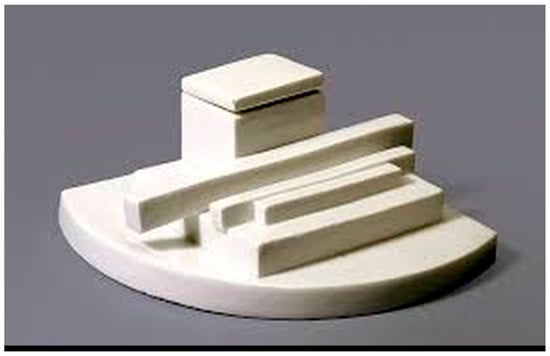
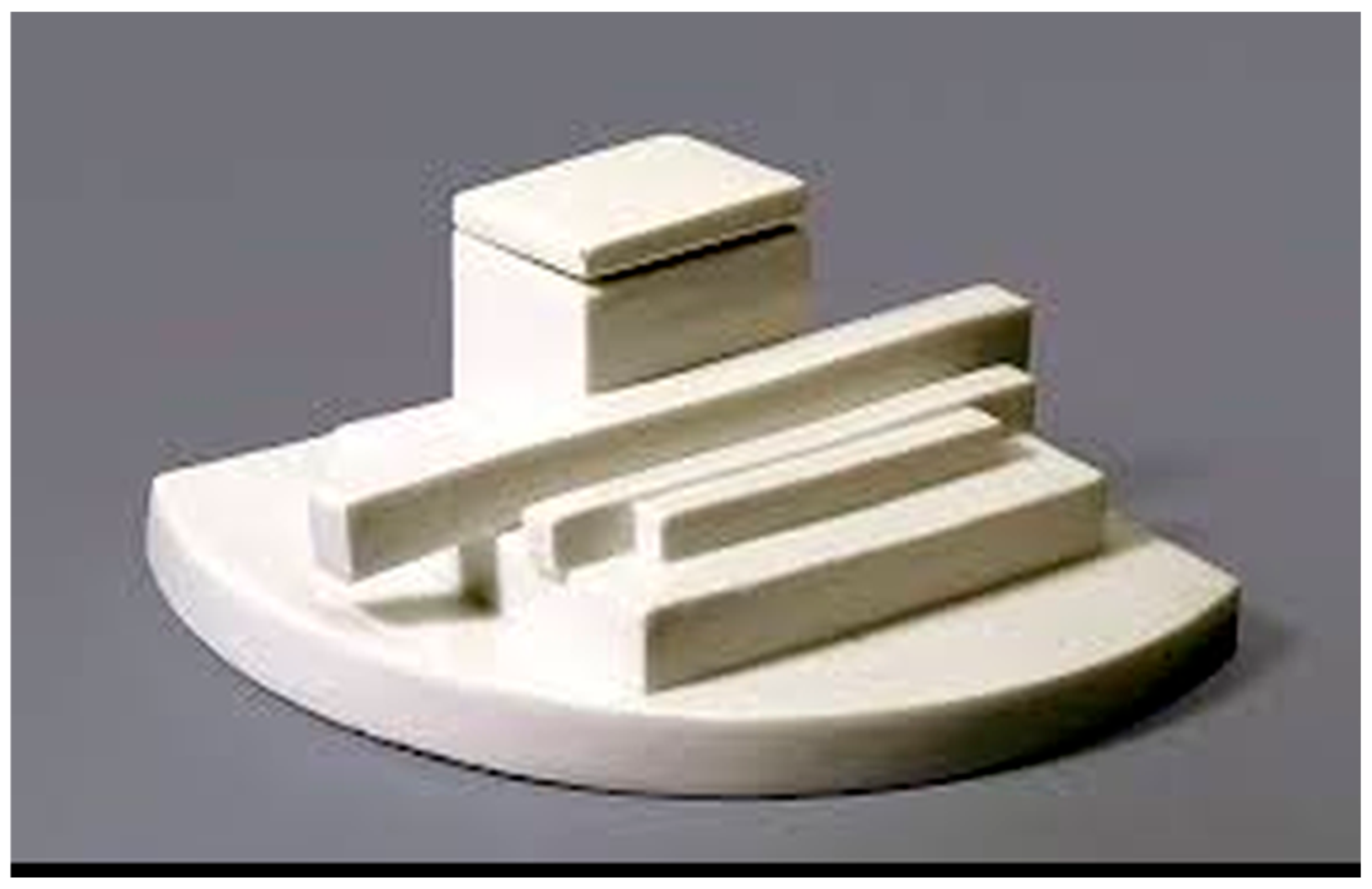
Suetin develops Suprematist ideas: he investigates the theory of the additional element in relation to Suprematism, analyzes Suprematist fields—lightlessness and colorlessness; and elaborates the problems of Suprematism in architecture. Among his first volumetric constructions of Suprematism, the Inkwell (1923) stands out, which is, in fact, a planit that has descended to the earth; Figure 29.
Figure 29.
N. Suetin, Inkwell, 1923.
Vassily Rakitin, in his invaluable volume about Suetin, provides a list of objects of the artist’s architectural fantasies: 1. an electric station; 2. a Suprematist demonstrative theater; 3. an aerodrome; 4. a settlement and a factory center; 5. a city square; 6. a review square; 7. a sea port; 8. a quay for airplanes; 9. a meeting square; and 10. an agricultural region (Rakitin 1998, p. 85).
Suetin agrees with Malevich’s proposed definition of architecture as “pure artistic form” (architectonics), in no way identified with utilitarian materiality, and thereby, with his definition of Suprematist architecture, is the beginning of a “new classical architecture,” an art that always “creates only the ‘beautiful’” and always gives the “‘present’ in any past and future” (Malevich 1998, p. 127). In that same year, 1927, when Malevich’s text on Suprematist architecture appears in the German journal Wasmuths Monatshefte für Baukunst, Suetin creates a series of sketches, mock-ups, and models under the title Architectonics, trying on the new canon of reality; Figure 30 and Figure 31.
Figure 30.
N. Suetin, Architectonics, 1927.
Figure 31.
N. Suetin, Architectonics, 1927.
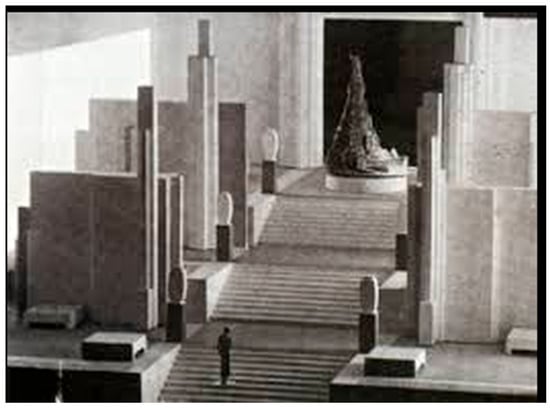
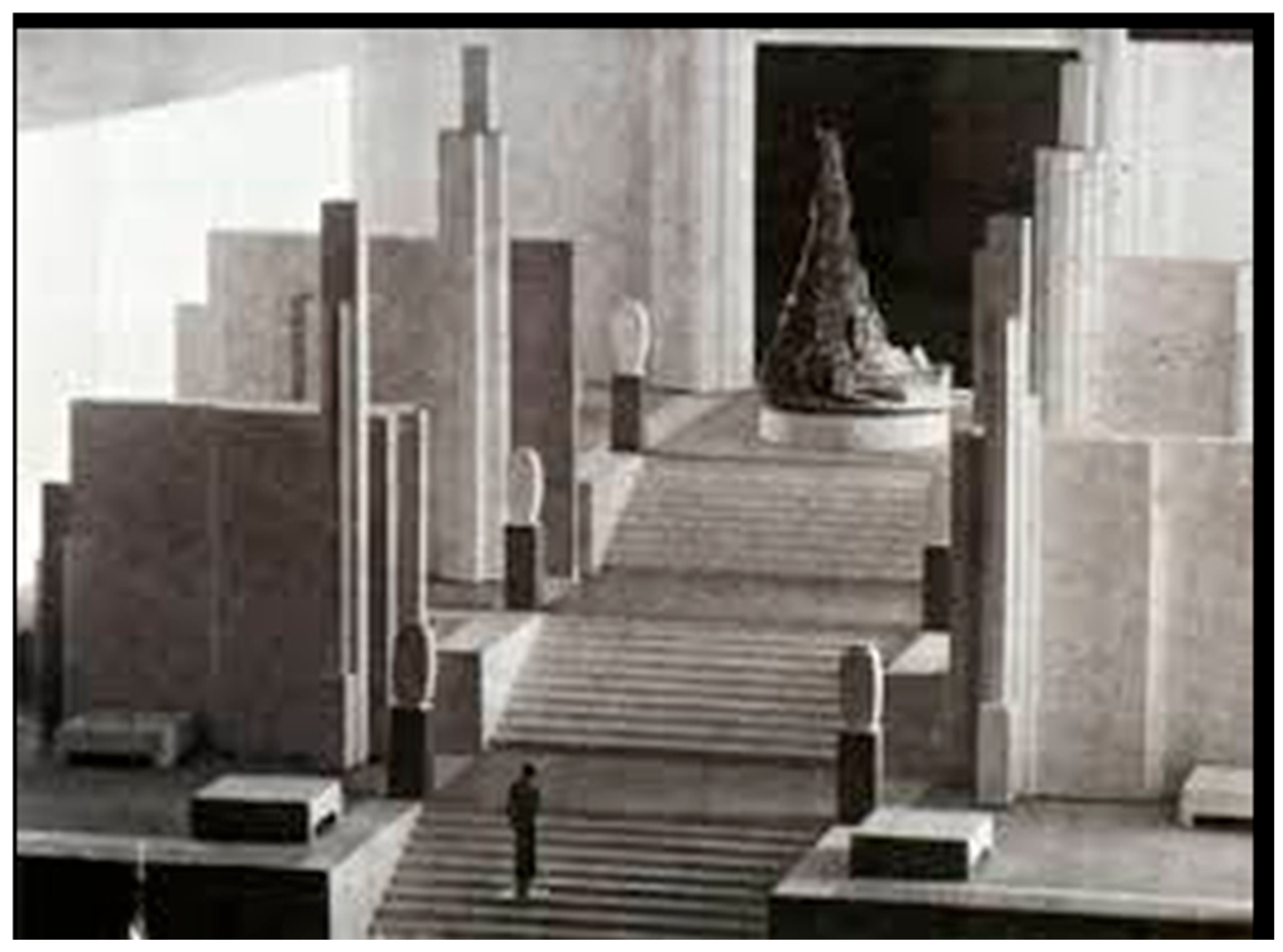
Simultaneously, he helps the Master build vertical models of architectons, makes profilings, and casts volumes. The sketch Suprematist City, 1931, testified that Suetin, alongside work at the porcelain factory, continued to think about the principles of the pure form of Suprematism and was resolving questions raised by Malevich already in Vitebsk and developed by Khidekel and Chashnik. He managed to include architectons in the design of the Soviet pavilion at the World Exhibition in Paris in 1937, as if in memory of Malevich and Chashnik, who had passed away by that time; Figure 32.
Figure 32.
I. Chashnik, model of the ceremonial staircase of the USSR Pavilion for the World Exhibition in Paris, 1936–1937.
One could also remember that it fell to Suetin to bury his friend Chashnik in 1929, placing a ribbon in the coffin with the inscription “To the artist of the new art”; it was he who, in 1935, made the posthumous mask and a cast of Malevich’s hand, constructed—by the Master’s instruction—a coffin architecton in black–white–green tones, installed in Nemchinovka, a monument cube with a black square.
The demise of non-objective art, of Suprematism, which had begun already in Vitebsk, became intertwined with the death of the teacher and friend. The elaborations of architectural projects on the exit of the future human being beyond the bounds of the earth into the Universe, which suffered defeat in the early 1920s, imposed parallels with Fedorov’s project on the resurrection of ancestors and the transfiguration of matter as the common task. Fedorov’s question remained unresolved: How can architecture, uniting within itself all the arts, just as astronomy unites all the sciences, not become world creation just as astronomy became world knowledge? Why is architecture not the application of the knowledge contained in astronomy? For Fedorov, there is no doubt that the application of science will be “the governing of the course not only of the earth but also of the planets,” as well as “the construction of the earth, its transformation into a temple, and of the planets—into new abodes”; true, he realizes that the transition into new abodes depends not only on world order but also on the arrangement of the organisms themselves, and therefore, there arises a new question: why does biology, as the science of the knowledge of life, not find its application “in the re-creation of destroyed bodies” (Fedorov 2000, pp. 5, 6)?
Russian avant-garde artists such as Malevich, Khidekel, Chashnik, and Suetin projected a radical, new Suprematist Universe, planning to (re)create a new world architecture of an alternative type to be able to fit into the cosmic space. In parallel, early Soviet scientists actively worked on the creation of means for movement in space, but only in 1932 would Sergei Korolev succeed in realizing Constantine Tsiolkovsky’s initial conception of constructing a rocket, the launch of which took place in August 1933. Yet in the 1920s, the scientific and technical knowledge of Ilya Chashnik proved insufficient: even if he did turn to astronomical schemes, fitting them to his architectons, this did not yield the desired results all the same. Nevertheless, Suprematist architectural investigations of possible dimensions, of the transformation of the plane into volume, and of overcoming terrestrial gravity anticipated today’s knowledge about space, contemporary 3D projects, and space stations. However, they nevertheless remained and remain insufficient in the task of transfiguring the human substance suitable for dwelling in infinite cosmic space.
4. Concluding Remarks
The foregoing analysis has demonstrated that Suprematist architectural production in the early Soviet period could be understood not as a peripheral or abortive episode within the history of modern architecture but as a rigorously articulated speculative enterprise that redefined—at the level of method, concept, and perceptual regime—the epistemic and ontological scope of architecture itself. By situating the planits, architectons, and visionary projects of Kazimir Malevich, Lazar Khidekel, Ilya Chashnik, and Nikolai Suetin within the broader constellation of Russian cosmism, early aerospace science, and avant-garde pedagogy, this paper has shown that Suprematist architecture functioned as a mode of world thinking rather than as a merely formal or stylistic experiment. Here, architecture emerges as a mediating dispositif between metaphysical aspiration and material projection, between cosmic imagination and the reorganization of terrestrial existence—an epistemic instrument that does not simply represent space but actively produces space as a problem, a hypothesis, and a horizon of collective becoming. One of the principal findings lies in the recognition that Suprematist architecture constituted a deliberate attempt to displace architecture from its traditional anthropocentric and utilitarian frameworks and to re-situate it within a cosmological rather than merely civic contract. In rejecting gravity-bound construction, functional determinism, and inherited typological memory, Suprematist architects proposed a radically alternative conception of spatial order, grounded in notions of excitation, non-objectivity, and cosmic dynamism. Yet the decisive point is not simply that such projects “ignore” practicality; rather, they re-code practicality itself by shifting the criterion of the feasible from immediate technics to long-duration intelligibility—what might be called an architectural protology of the future. Their drawings and models operate as anticipatory structures: not blueprints awaiting execution but epistemic objects whose function is to render thinkable new conditions of habitation, perception, and collective life. In this sense, the frequently invoked label of “utopia” is analytically insufficient: what is at stake is methodological speculation as an internally disciplined procedure—an architecture of the conditions of possibility that treats non-realization as a productive parameter not an accidental deficiency.
Equally significant is the demonstration that Suprematist architectural thought was inseparable from contemporary scientific and philosophical discourses on space, motion, and transformation. The dialog—sometimes explicit, sometimes implicit—between Suprematist form generation and the ideas of Nikolai Fedorov, Konstantin Tsiolkovsky, and the broader culture of early Soviet aerospace imagination reveals a shared conviction that humanity stood on the threshold of a new phase of cosmic participation. Here, architecture is envisioned not merely as shelter or infrastructure but as an active participant in the regulation and reconfiguration of nature, matter, and even human corporeality. Put differently: Suprematist architecture does not simply “dream” of the cosmos; it formulates an ethics and logistics of cosmic agency, aligning itself with a cosmist ambition to transition from passive contemplation of the Universe to its conscious reorganization. This is precisely where the Suprematist wager becomes most acute: architecture is recast as a technics of ontological passage between earth and extraterrestriality, between the biological subject and the post-human condition, and between the given world and a world yet to be composed.
The differentiated avant-garde trajectories of Lazar Khidekel, Ilya Chashnik, and Nikolai Suetin further underscore the internal plurality of Suprematist architectural inquiry. While united by a commitment to non-objective principles, each developed distinct strategies for translating Suprematist logic into spatial constructs: Khidekel’s ecological proto-urbanism and aerocities articulate a strikingly early intuition that the “city of the future” must negotiate the preservation of land and water rather than merely intensify their instrumental exploitation; Chashnik’s magnetic conceptions of space and his cruciform volumetric systems press the Suprematist form toward a quasi-cosmological diagrammatics in which spatial order is less “built” than fielded—distributed across forces, vectors, and scalar discontinuities; Suetin’s applied and model-based explorations, meanwhile, suggest a Suprematist operationality that migrates across media and institutional contexts, preserving the architectonic idea even when the historical field of avant-garde construction narrows. These variations do not indicate doctrinal inconsistency; on the contrary, they attest to the generative openness of Suprematism as a system capable of producing multiple architectural grammars without collapsing into dogma and capable, crucially, of maintaining conceptual identity precisely through formal divergence.
From this perspective, the historical “failure” of Suprematist architecture to achieve material realization appears less as an empirical verdict than as a category mistake. The non-realized planit or architecton is not a deficient building; it is a different ontological type of architectural artifact—one that belongs to the register of research, hypothesis, and world modeling. The Suprematist object is therefore best understood as a laboratory instrument for spatial cognition: it prototypes relations (between volume and void, weight and suspension, and system and growth) and tests how far architectural thought can detach itself from the gravitational metaphors that have long naturalized the human as architecture’s unquestioned measure. In doing so, it not only anticipates contemporary debates in space architecture and extraterrestrial habitation but also resonates with ecological urbanism and post-human design insofar as these fields likewise contest the sovereignty of the human-centered program, the permanence of the ground, and the stability of the terrestrial envelope.
Finally, and perhaps most consequentially, Suprematist architecture obliges us to revise what counts as architectural “agency.” If architecture is typically evaluated through the metrics of construction, occupancy, and serviceable duration, Suprematism invites an alternative criterion: architecture as a speculative force that reorganizes the intelligibility of space—an intervention at the worldview level. In this sense, Suprematist architecture persists not as a closed chapter of avant-garde history but as an unfinished project whose conceptual productivity remains available for reactivation. Its enduring challenge lies precisely in its refusal to let architecture be reduced to either utilitarian instrumentality or aesthetic formalism: it demands that architecture be thought of as cosmological mediation, as ethical project, and as epistemic experiment—a discipline capable of imagining, and thereby partially instituting, forms of life that exceed the present’s technological and anthropological limits.
Funding
This research received no external funding.
Institutional Review Board Statement
Not applicable.
Informed Consent Statement
Not applicable.
Data Availability Statement
No new data were created or analyzed in this study. Data sharing is not applicable to this article.
Conflicts of Interest
The author declares no conflict of interest.
Notes
| 1 | One should keep in mind that the Vitebsk Art School was established on 12 September 1918, when the Collegium for Affairs of the Arts and Artistic Industry of the People’s Commissariat of Enlightenment [Narkompros] of the RSFSR adopted a resolution on the appointment of Marc Chagall to the position of Commissioner for Affairs of Art of Vitebsk Province, after which, in the Petrograd newspaper Art of the Commune [Iskusstvo kommuny], he published an appeal to artists with an invitation to come to Vitebsk for teaching. From May 1919 El Lissitzky worked in Vitebsk, who from the autumn of that same year became the head of the workshop of architecture and graphics, and at whose invitation Kazimir Malevich found himself in Vitebsk in November 1919, which ultimately led to Chagall’s departure from the school and also to his leaving Vitebsk on 5 June 1920. |
| 2 | Created on the initiative of artists with the aim of concentrating on scientific research and the collecting activity of the newest art, the Museum of Artistic Culture (MKhK) existed from 1919 to 1924 (from 1923, it was headed by K. Malevich); in 1924, on its basis, INKhUK arose (from February 1925—GINKhUK), likewise under the leadership of K. Malevich up to its closure in 1926. |
| 3 | Museums in Russia, the Netherlands, and Germany preserve El Lissitzky’s painterly and three-dimensional Prouns from the 1920s. See: (Lissitzky 2013, 2018; Chagall et al. 2018, pp. 86–115). See also: (Margolin 1997, pp. 9–79; Perloff and Reed 2003). |
| 4 | On the pedagogical practice of Kazimir Malevich and his colleagues in Vitebsk, see: (Lisov 2023, pp. 126–40). |
| 5 | Already, in 1920, the First UNOVIS Exhibition took place in Moscow; in June 1920, the members of UNOVIS participated in the First All-Russian Conference of teachers and students of the state free artistic workshops. |
| 6 | Until the end of the academic year 1921/1922, the school changed its name several times; at the end of November 1921, it was deprived of state financing; however, the first graduating class (now already part of the Vitebsk Art-Practical Institute) in May 1922 included, among others, Nikolai Suetin, Ilya Chashnik, and Lazar Khidekel. |
| 7 | Malevich mentions a “Suprematist apparatus” as a unified form composed “of all the elements of natural forces” and bearing within itself “the life of perfections,” such that “each constructed Suprematist body” forms for itself a “new satellite”; for example, between the earth and the Moon a “new satellite, Suprematist, equipped with all elements” may be constructed, which will move along an orbit, “forming its new path” (Malevich 1995c, p. 186). |
| 8 | Nikolai Rynin’s report followed the publication of Nikolai Kibalchich’s “Project of an Aeronautical Device” and the introductory article by Pavel Shchegolev on the fate of the project, which remained unknown for 37 years, being sealed and sewn into the file on March 1, up to 1917. |
| 9 | Workers’ “Club” was published first in Berlin in 1927 in Malevich’s article on Suprematist architecture (L. Khidekel 1927b) and then in the Moscow journal (L. Khidekel 1927a). |
| 10 | This meeting is mentioned by V. Rakitin in his book on the Suprematist Chashnik (Rakitin 2000, p. 89). |
| 11 | After the closure of GINKhUK, Malevich proposes to Nikolsky uniting forces “for the conquest and establishment of new forms.” He proposes that Nikolsky’s group deepen itself in the Suprematist architecton in order to be convinced of its superiority over Western planar architecture “of the supra-visible type” and of the necessity of creating a Suprematist architectural front, grounded in his thought that “life is always poor” and that they, the artists, “going by an abstract path,” always find “the form into which life clothes itself” (Malevich 1927). For Malevich, apparently, the simplicity of Suprematist forms corresponded to the simplicity of naked life, life as such, detached from everything phenomenological—On Suprematist Architecture and A. Nikolsky; see in more detail, Kozlov (2019). |
| 12 | Diametric axonometry is the reduction in dimensions by half along one of the axes; this institute knowledge Khidekel shared at GINKhUK with Malevich, Chashnik, and Suetin, helping them to construct perspective and to execute architectons and planits. |
| 13 | N. Fedorov’s treatise “The Question of Brotherhood, or Kinship, on the Causes of the Unbrotherly, Unkindred, i.e., Unpeaceful, Condition of the World and on the Means for the Restoration of Kinship” is the thinker’s principal work, in which the doctrine of universal brotherhood, the conviction of the final victory over evil and of the universal resurrection of the dead, and the affirmation of all-human kinship and universal brotherhood are set forth. |
| 14 | Let us note that the concepts “additional” (element) and “economy” were especially carefully investigated by Malevich under the influence of Marx’s ideas and apparently migrated to Khidekel. See the economic principle of Malevich’s texts in On New Systems in Art. Statics and Speed. Establishment A (1919), Suprematism. 34 Drawings (1920), “UNOVIS” (1921) (Malevich 1995c); on the “additional element,” see Malevich’s text “Introduction to the Theory of the Additional Element in Painting” (1926) (Russian Literature 1989, 3: 337–81), which entered into his treatise Suprematism. The World as Non-Objectivity or Eternal Rest (Malevich 2000). |
| 15 | The famous sketch by El Lissitzky, Project of a Tribune for the Square, 1924, was, in essence, a reworked conception of Ilya Chashnik for the exhibition of new theatrical technology in Vienna; he called it the “Lenin Tribune” and signed it “Lissitzky’s studio.” |
| 16 | V. Rakitin writes that at the GINKhUK exhibition in 1924, 17 planits were exhibited; at the exhibition in 1926, there were more than 10 models, but it is difficult to determine authorship (Rakitin 2000, p. 65). |
| 17 | Cf., in the notes written in 1927–1928, states: “It is unknown for what, why, and for what purpose the human being lives. This proves the non-objective essence of human being, which, only having been placed in certain conditions of its existence or action, manifests itself in one way or another, and in all the obstacles of the existing world sees meaning and goal. But this is a delusion. No one knows for what and why he lives, who and what obliges him to live, and therefore the meaning and goal of the existence of humanity is the non-objective principle” (Chashnik 2000c, p. 136). This was a peculiar non-objective existentialism with a feeling of “thrownness” into this world and a gloomy sensation of tragicness; moreover, one can even assert that Chashnik, by his thoughts on the purposelessness of existence, anticipated the philosophy of the absurd formulated by Camus in the famous essay “The Myth of Sisyphus”. |
| 18 | Chashnik wrote: “Our earth, which gave birth to the white square as the thought of human non-being, is surrounded by the universal perfection of non-being. This too is white on black. And if we have come to the circle of the earth, then the arc of the Suprematist ring will be white on black” (Ibid.). |
| 19 | One can remark here that Chashnik, in his diploma work “The Method of Suprematism” (1922), substantiates the fourth, fifth, and sixth dimensions: the fourth dimension he connects with the advancement of dispersed elements of construction out of the plane into real space; the fifth dimension is determined by Suprematist materiality without a concrete form and without any surface whatsoever; and the sixth dimension is the organic growth of the volumetric project, which is sensed only as white materiality (Rakitin 2000, pp. 116, 117). |
References
- Chagall, Marc, El Lissitzky, and Kasimir Malévitch. 2018. L’avant-garde russe a Vitebsk, 1918–1922. Paris: Centre Pompidou. [Google Scholar]
- Charistou, Angeliki. 2004. Strands of Cosmic Thinking and Science Fiction and the Art of the Russian Avant-Garde. Master’s thesis, University of St Andrews, St Andrews, UK. [Google Scholar]
- Chashnik, Ilya. 2000a. Architectural-Technical Faculty. In Ilya Chashnik. Artist of a New Time. Edited by Vasilii Rakitin. Moscow: RA. [Google Scholar]
- Chashnik, Ilya. 2000b. Black—The greatest state of non-objectivity. In Malevich’s Circle. Comrades-in-Arms. Students. Followers in Russia of the 1920s–1950s. St. Petersburg: Palace Editions. [Google Scholar]
- Chashnik, Ilya. 2000c. From notes of various years. In Ilya Chashnik. Artist of a New Time. Edited by Vasilii Rakitin. Moscow: RA. [Google Scholar]
- Chashnik, Ilya. 2000d. UNOVIS Questionnaire (15 March 1921). In Ilya Chashnik. Artist of a New Time. Edited by Vasilii Rakitin. Moscow: RA. [Google Scholar]
- Fedorov, Nikolai. 1995. Collected Works. Moscow: Progress, vol. 1. [Google Scholar]
- Fedorov, Nikolai. 2000. Astronomy and Architecture. In Collected Works. Edited by Nikolai Fedorov. Moscow: Traditsia, vol. 4. [Google Scholar]
- Khan-Magomedov, Selim. 2018. The First Suprematist Architect. In Lazar Khidekel. 1904–1986. St. Petersburg: Russian Museum—Palace Editions. [Google Scholar]
- Khidekel, Lazar. 1927a. “Workers’ Club” (photo). Contemporary Architecture [Sovremennaya arkhitektura] 6: 188. [Google Scholar]
- Khidekel, Lazar. 1927b. “Workers’ Club” (photo). Wasmuths Monatshefte fur Baukunst 11: 413. [Google Scholar]
- Khidekel, Lazar. 1928. Flat Roofs. Science and Technology (Nauka i tekhnika) 18: 3–4. [Google Scholar]
- Khidekel, Lazar. 2000a. Journal AERO. Declaration. In Malevich’s Circle. Comrades-in-Arms. Students. Followers in Russia of the 1920s–1950s. St. Petersburg: Palace Editions. [Google Scholar]
- Khidekel, Lazar. 2000b. Suprematist Department. Laboratory of Suprematist Architecture. In Malevich’s Circle. Comrades-in-Arms. Students. Followers in Russia of the 1920s–1950s. St. Petersburg: Palace Editions. [Google Scholar]
- Khidekel, Regina. 2000. Lazar Markovich Khidekel. In Malevich’s Circle. Comrades-in-Arms. Students. Followers in Russia of the 1920s–1950s. St. Petersburg: Palace Editions. [Google Scholar]
- Khidekel, Regina. 2018. Lazar Khidekel—The Trajectory of Suprematism—Between Sky and Earth. In Lazar Khidekel. 1904–1986. St. Petersburg: Russian Museum—Palace Editions. [Google Scholar]
- Kozlov, Dmitrii. 2019. Alexander Nikolsky and Sports Architecture. St. Petersburg: Kolo. [Google Scholar]
- Lisov, Alexander. 2023. Sezanne and Cubism at the Vitebsk State Free Art Studios. Experiment 29: 126–40. [Google Scholar] [CrossRef] [Scilit]
- Lissitzky, El. 2013. Utopia and Reality. Works in Exhibition. Eindhoven: Van Abbemuseum. [Google Scholar]
- Lissitzky, El. 2018. El Lissitzky. Edited by Tatyana Goryacheva. Moscow: The New Tretyakov Gallery and the Jewish Museum and Tolerance Center. [Google Scholar]
- Lodder, Christina. 2007. Living in Space: Kazimir Malevich’s Suprematist Architecture and the Philosophy of Nikolai Fedorov. In Rethinking Malevich. Proceedings of a Conference in Celebration on the 125th Anniversary of Kazimir Malevich’s Birth. Edited by Charlotte Douglas and Christina Lodder. London: The Pindar Press. [Google Scholar]
- Malevich, Kazimir. 1927. Letter of Malevich Kazimir Severinovich to Nikolsky Alexander Sergeevich. In Dating by N. I. Khardzhiev. Fond “Khardzhiev–Chagi Cultural Center.” Storage Unit 861. Amsterdam: Stedelijk Museum. [Google Scholar]
- Malevich, Kazimir. 1968. Essays on Art. Edited by Troels Andersen. Translated by Xenia Glowacki-Prus, and Arnold McMillin. Copenhagen: Borgens Forlag, vol. 1. [Google Scholar]
- Malevich, Kazimir. 1995a. God Is Not Cast Down. Art. Church. Factory. In Collected Works. Articles, Manifestos, Theoretical Writings, and Other Works. 1913–1929. Moscow: Gileia, vol. 1. [Google Scholar]
- Malevich, Kazimir. 1995b. I Have Come. In Collected Works. Articles, Manifestos, Theoretical Writings, and Other Works. 1913–1929. Moscow: Gileia, vol. 1. [Google Scholar]
- Malevich, Kazimir. 1995c. Suprematism. 34 Drawings. In Collected Works. Edited by Kazimir Malevich. Articles, manifestos, theoretical writings, and other works. 1913–1929. Moscow: Gileia, vol. 1. [Google Scholar]
- Malevich, Kazimir. 1998. Suprematist Architecture. In Collected Works. Edited by Kazimir Malevich. Articles and theoretical writings published in Germany, Poland, and Ukraine. Moscow: Gileia, vol. 2. [Google Scholar]
- Malevich, Kazimir. 2000. Suprematism: The World as Non-Objectivity, or Eternal Rest. In Collected Works. Edited by Kazimir Malevich. Suprematism: The World as Non-Objectivity, or Eternal Rest, with an appendix of letters from Kazimir Malevich to M. O. Gershenzon (1918–1924). Moscow: Gileya, vol. 3. [Google Scholar]
- Malevich, Kazimir. 2003a. 1/47: Suprematism: The World as Non-Objectivity. In Collected Works. Edited by Kazimir Malevich. Treatises and Lectures of the First Half of the 1920s, with an appendix of correspondence between Kazimir Malevich and El Lissitzky (1922–1925). Moscow: Gileya, vol. 4. [Google Scholar]
- Malevich, Kazimir. 2003b. 1/48: The World as Non-Objectivity (Ideology of Architecture). In Collected Works. Edited by Kazimir Malevich. Treatises and Lectures of the First Half of the 1920s, with an appendix of correspondence between Kazimir Malevich and El Lissitzky (1922–1925). Moscow: Gileya, vol. 4. [Google Scholar]
- Malevich, Kazimir. 2003c. Architecture as the Degree of Man’s Greatest Liberation from Weight. In Collected Works. Edited by Kazimir Malevich. Treatises and Lectures of the First Half of the 1920s, with an appendix of correspondence between Kazimir Malevich and El Lissitzky (1922–1925). Moscow: Gileya, vol. 4. [Google Scholar]
- Malevich, Kazimir. 2004. Letter of Malevich Kazimir to Suetin Nikolai and Vorob’ev V. (between 21 and 28 February 1927, Moscow). In Malevich About Himself. Contemporaries About Malevich. Letters. Documents. Memoirs. Criticism. Moscow: RA, vol. 1. [Google Scholar]
- Margolin, Victor. 1997. The Struggle for Utopia: Rodchenko, Lissitzky, Moholy-Nagy 1917–1946. Chicago: The University of Chicago Press. [Google Scholar]
- Perloff, Nancy, and Brian Reed. 2003. Situating El Lissitzky. Edited by Nancy Perloff and Brian Reed. Los Angeles: Getty Research Institute. [Google Scholar]
- Petrova, Yevgenia, Irina Karasik, and Elena Basner. 2000. Malevich’s Circle. Comrades-in-Arms. Students. Followers in Russia of the 1920s–1950s. St. Petersburg: Palace Editions. [Google Scholar]
- Rakitin, Vasilii. 1998. Nikolai Mikhailovich Suetin. Moscow: RA. [Google Scholar]
- Rakitin, Vasilii. 2000. Ilya Chashnik. Artist of a New Time. Moscow: RA. [Google Scholar]
- Rynin, Nikolai. 1918. On the Project of an Aeronautical Device of the System of N. Kibalchich. Byloe 4–5: 32–33. [Google Scholar]
- Vakar, Irina, and Tatiana Mikhiienko. 2004. Malevich About Himself. Contemporaries About Malevich. Letters. Documents. Memoirs. Criticism. Moscow: RA, vol. 1. [Google Scholar]
Disclaimer/Publisher’s Note: The statements, opinions and data contained in all publications are solely those of the individual author(s) and contributor(s) and not of MDPI and/or the editor(s). MDPI and/or the editor(s) disclaim responsibility for any injury to people or property resulting from any ideas, methods, instructions or products referred to in the content. |
© 2026 by the author. Licensee MDPI, Basel, Switzerland. This article is an open access article distributed under the terms and conditions of the Creative Commons Attribution (CC BY) license.