


Abstract
Facing 2050 climate uncertainties, enhancing building resilience is critical3. This study addresses the “black-box” and interoperability gaps in traditional multi-objective optimization (MOO) by proposing an intelligent framework based on the Model Context Protocol (MCP) and Large Language Models (LLMs). Unlike stochastic algorithms, the MCP-LLM framework uses semantic reasoning to bridge building performance simulation (BPS) engines like EnergyPlus 24.2.0 and Radiance 5.4. Through a case study of an educational building in Taiwan under the IPCC RCP 8.5 scenario, results show the framework improves optimization convergence speed by 55% compared to NSGA-II. The optimized shading system reduced peak cooling loads by 18.5% and annual EUI by 12.3%, while maintaining uncomfortable glare (DGP > 0.35) below 5% of annual hours. Crucially, the system provides explainable design logic via natural language, marking a shift from automated simulation to human-machine collaboration. This framework offers a transparent decision-support tool for forward-looking climate adaptation in educational environments.
1. Introduction
Global climate change has pushed the built environment to a critical tipping point. According to the IPCC Sixth Assessment Report (AR6), under the high-emission scenario of RCP 8.5, the frequency and intensity of extreme heatwaves are projected to increase significantly [1]. As a primary contributor to global energy consumption [2], the building sector faces the dual challenge of achieving 2050 net-zero goals while ensuring “Climate Resilience” [3]. Adaptation strategies are particularly critical for educational buildings, where thermal comfort and visual environments (specifically glare control) strongly correlate with student learning performance [4,5]. However, in subtropical zones, traditional extensive glazing often leads to overheating and glare [6]. While passive horizontal shading is effective, defining the precise “geometric depth” to mitigate glare under dynamic 2050 climate variables requires investigation beyond traditional rules of thumb [7,8].
To address this multi-objective complexity, optimization techniques integrating Building Performance Simulation (BPS) with parametric design have been widely adopted [9,10,11].
It is worth noting that such optimization paradigms have also matured in adjacent engineering fields, offering valuable methodological insights. For instance, in experimental energy systems, recent studies have successfully applied optimization techniques to enhance the performance and emission characteristics of nanoparticle-enriched biodiesel, demonstrating the efficacy of algorithmic approaches in cleaner combustion technologies [12]. Similarly, the manufacturing sector has pioneered Hybrid Surrogate-AI-GA frameworks. To mitigate computational costs, researchers have integrated Response Surface Methodology (RSM) and Artificial Neural Networks (ANN) with Genetic Algorithms to optimize tool geometries (e.g., end mills for cold-work tool steel) [13].
While these cross-domain advancements highlight the potential of hybrid algorithmic approaches, current workflows in architectural BPS and design optimization still face two critical gaps:
- The “Black Box” Optimization Gap: Mainstream workflows rely on multi-objective evolutionary algorithms (MOEAs) like NSGA-II. While capable of finding mathematical Pareto optimality (similar to the numerical efficiency seen in manufacturing optimization), these algorithms fail to explain the underlying “design logic.” This opacity disconnects the result from the pedagogical value needed by designers [14,15].
- The Interoperability Barrier: Although LLMs have recently emerged as potential decision support tools [14] excelling in logical reasoning, they cannot directly operate specialized software like EnergyPlus or Radiance. Existing solutions rely on ad-hoc scripting, lacking a standardized protocol for AI agents to autonomously control simulation engines [16,17].
Proposed Framework and Contributions
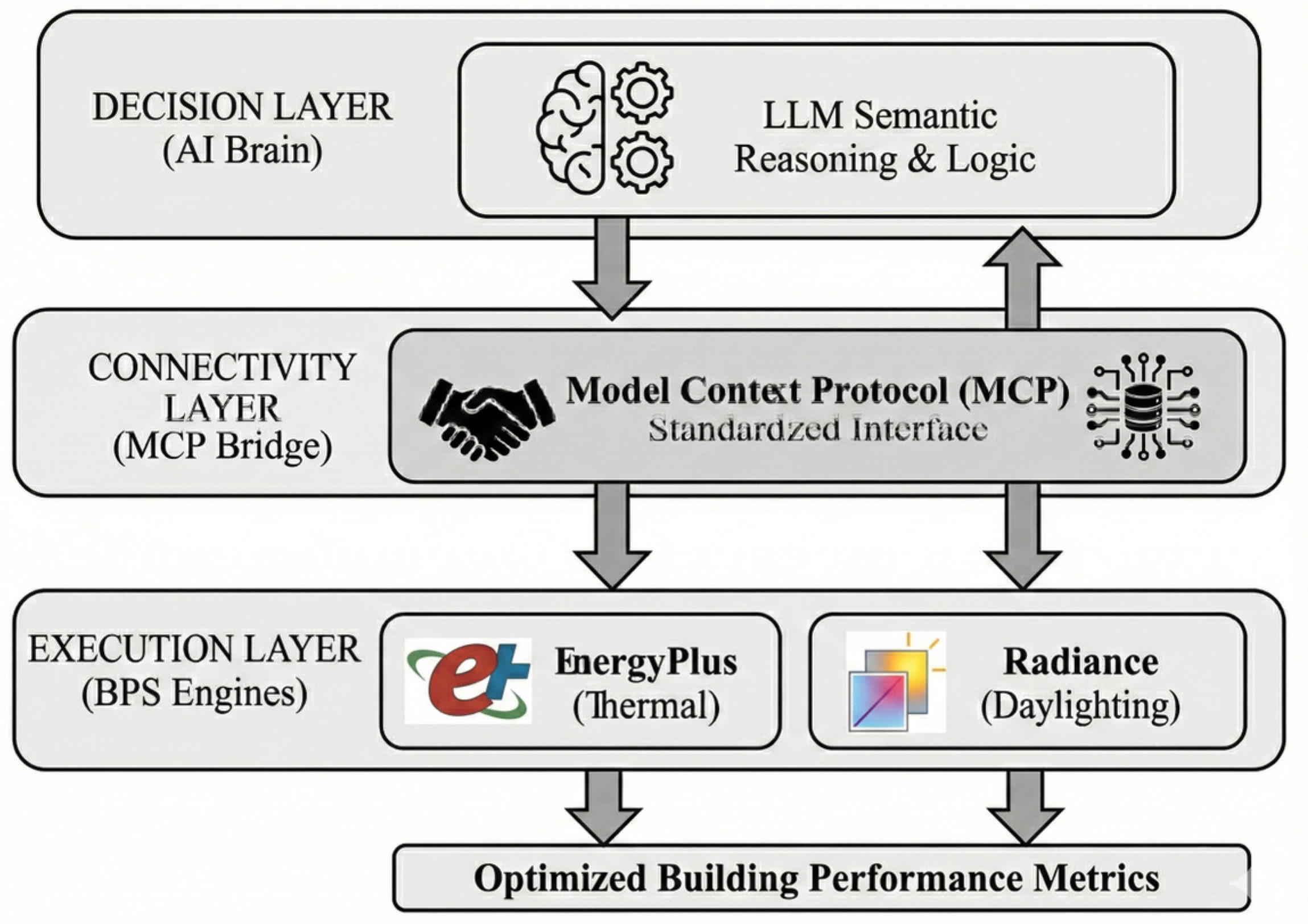
To bridge these gaps, this study proposes an innovative Generative Design Framework integrating the Model Context Protocol (MCP) with the semantic reasoning of LLMs. As illustrated in Figure 1, MCP serves as a standardized bridge, replacing fragmented scripting and allowing the LLM to directly access geometric parameters and drive simulation engines.
Figure 1.
The proposed MCP-driven LLM framework for building performance optimization, bridging the semantic capabilities of AI with quantitative BPS engines.
Unlike stochastic searches, the LLM analyzes 2050 RCP 8.5 climate data and translates design codes—such as glare prevention—into explicit reasoning. The contributions of this study are threefold:
Novel BPS Automation Architecture: It introduces an MCP-based architecture that resolves interoperability challenges, transforming isolated simulation tools into accessible components for AI Agents.
Future-Proof Resilience Workflow: A workflow specifically developed for educational buildings to optimize Energy Use Intensity (EUI) and visual comfort (sDA/DGP) under extreme climate scenarios.
Quantitative Validation: Comparative analysis against NSGA-II demonstrates that the semantic reasoning-based approach improves convergence speed while providing transparent, explainable design rationale.
2. Literature Review
2.1. Optimization of Building Shading: From Parametric Simulation to Multi-Objective
Algorithms Building Performance Simulation (BPS) using engines like EnergyPlus and Radiance has largely replaced manual heuristics, offering high-fidelity predictions for thermal and daylighting performance [9]. However, manual trial-and-error approaches remain labor-intensive and often fail to identify global optima amidst complex, non-linear trade-offs [14,18]. Consequently, Multi-Objective Optimization (MOO) algorithms, particularly NSGA-II and MOPSO, have become industry benchmarks [19,20]. These algorithms effectively generate a Pareto Front to analyze trade-offs between conflicting metrics, such as Energy Use Intensity (EUI) and Spatial Daylight Autonomy (sDA). Despite their prevalence, current MOO methodologies exhibit two significant limitations:
The “Black Box” Semantic Gap: As noted by Wortmann and Nannicini [15], evolutionary algorithms yield numeric solutions devoid of architectural context. This opacity creates a disconnect in human-machine collaboration, as the algorithm fails to convey the design semantics governing the solution’s success.
Computational Inefficiency: Stochastic search mechanisms require thousands of iterations, making them computationally expensive and difficult to adapt to dynamic constraint changes without complete restarts.
2.2. Resilience in Educational Buildings Under Extreme Climates
With the intensification of global climate change, “Climate Resilience” has become a pivotal determinant in architectural design. The IPCC Sixth Assessment Report (AR6) projects a significant escalation in extreme heatwaves under the RCP 8.5 scenario [1], necessitating a shift from historical TMY data to “future-proof” predictive models [3]. This is particularly critical for educational buildings, where Indoor Environmental Quality (IEQ) directly correlates with learning outcomes [5]. In Southern European and subtropical contexts, the pursuit of daylighting often leads to severe glare, compromising instructional surfaces (e.g., whiteboards) [21]. Therefore, optimizing the “geometric depth” of shading to balance thermal protection with visual comfort is not merely an energy concern but a pedagogical necessity [7,8].
2.3. Generative AI and the Interoperability Gap
The application of AI in architecture is shifting from geometric generation to logical reasoning. While early Deep Learning models (e.g., GANs) focused on image synthesis [22], the emergence of Large Language Models (LLMs) introduces robust semantic reasoning capabilities. Zhang and Chen [14] demonstrated the potential of LLMs as surrogate models to interpret building physics data, marking an evolution from passive “form generation” to active “reasoning assistance.”
However, the deployment of LLMs in BPS is hindered by “Information Silos,” where BIM tools, modelers, and simulation engines operate in isolation [23]. Traditional integration relies on brittle, point-to-point APIs. To address this, the Model Context Protocol (MCP) offers a standardized communication mechanism. Unlike static scripts, MCP transforms dispersed software into modular tools that AI agents can discover and invoke [17]. This study bridges a notable gap in the literature: while agent-based workflows are recognized as critical [24], there is a lack of research applying MCP specifically to BPS to enable high-reasoning AI agents to autonomously, and transparently, operate professional simulation engines.
This study bridges a notable gap in the literature: while agent-based workflows are recognized as critical [24], there is a lack of research applying MCP specifically to BPS to enable high-reasoning AI agents to autonomously, and transparently, operate professional simulation engines. This capability is particularly timely given the escalating complexity of environmental constraints. Wu et al. [25] emphasize that climate change significantly increases high temperature risks and maintaince costs for rooftop solar energy, demanding resilient and adaptable frameworks. Furthermore, Wu et al. [26] recently demonstrated an adaptive multi-agent reinforcement learning framework for managing flexible resources in multi-energy buildings. Our proposed MCP-based workflow directly supports these emerging paradigms.
3. Methodology
This study proposes the “MCP-Based Semantic Reasoning Framework,” a novel human-machine collaboration workflow designed to bridge the interoperability gap in traditional optimization. The architecture integrates parametric geometric modeling, high-fidelity building physics simulation engines, and generative AI agents into three core layers: (1) the Execution Layer (EnergyPlus and Radiance engines), (2) the Connectivity Layer (MCP interface), and (3) the Decision Layer (LLM-based reasoning core).
3.1. Simulation Environment and Case Study
3.1.1. 2050 Climate Scenarios (AR6/SSP5-8.5)
To assess shading system resilience under future extreme conditions, this study utilizes the IPCC AR6 (Sixth Assessment Report) framework. The SSP5-8.5 scenario was established as the high-emission environmental boundary condition.
Future weather files were generated using a custom AI-driven morphing framework developed in Python3.10.10. This workflow integrates the CMIP6 Ensemble Mean anomalies with the baseline TMY3 file for Northern Taiwan. Unlike traditional morphing tools that rely on simple linear scaling, the proposed AI-driven algorithm is designed to preserve inter-variable physical dependencies (e.g., psychrometric relationships and solar-thermal lags) during the data transformation. This ensures that the generated weather data maintains high physical validity for coupled thermal-daylighting simulations. For stress testing, an “Extreme Heatwave Event” is defined as a period where the daily maximum dry-bulb temperature exceeds 35 °C for three consecutive days.
3.1.2. Parametric Models
The case study focuses on a standard secondary school classroom unit (9 m L × 8 m W × 3.5 m H) located in Northern Taiwan (Köppen-Geiger: Cfa). The analysis targets a West-facing facade, which poses the most critical challenge regarding afternoon Solar Heat Gain and glare risks. Two shading typologies are investigated: (A) Fixed horizontal overhangs, and (B) Adjustable vertical fins. To facilitate optimization, specific geometric Design Variables (Xn) were defined as shown in Table 1.
Table 1.
Definition of design variables and parametric ranges for shading optimization.
3.2. The MCP-Based Agent Architecture
The core innovation of this study is the bidirectional architecture founded on the Model Context Protocol (MCP). The decision-making logic of the Agent is powered by Anthropic’s Claude 4.5 Opus. This model version was selected for its superior performance in complex logical reasoning and long-context understanding, which are essential for interpreting multi-variable building physics nuances. Unlike conventional workflows relying on unidirectional scripts, MCP transforms the closed simulation environment into a repertoire of modular “tools” that the LLM Agent can autonomously perceive and manipulate.
3.2.1. Tool Definitions and Interoperability
This study defines three specific MCP tools to bridge the semantic reasoning of the AI with the quantitative execution of BPS engines. These tools allow the agent to modify geometry, trigger simulations, and retrieve climate data, as summarized in Table 2. “Crucially, to mitigate the inherent risk of LLM hallucination, each MCP tool is governed by a strict JSON Schema validation layer. Unlike free-text generation, this schema acts as a deterministic firewall: it automatically validates all Agent inputs against the physical constraints defined in Table 1 before execution. For instance, if the Agent attempts to set a Window-to-Wall Ratio (WWR) of 90%—exceeding the defined upper bound—the MCP server rejects the request immediately. This mechanism ensures that all simulations passed to the Grasshopper engine remain within physically plausible and computable bounds, effectively filtering out logical errors.” The technical schema definitions for these tools are provided in Appendix A.2.
Table 2.
MCP tool definitions mapping AI actions to simulation functions.
3.2.2. Semantic Reasoning Loop (ORA)
To replace stochastic search with logical deduction, the Agent operates on a ‘Chain-of-Thought’ (CoT) system prompt. The full system prompt enforcing this logic is detailed in Appendix A.1. This prompt enforces a structured Observation-Reasoning-Action (ORA) loop:
Observation: The Agent reads environmental data (e.g., “Solar radiation peaks at 14:00”) and performance feedback from the previous iteration.
Reasoning: Using embedded building physics knowledge, the Agent diagnoses performance gaps (e.g., “High DGP is caused by low-angle sun; horizontal shading is ineffective, need to adjust vertical fin angle”).
Action: The Agent selects the appropriate MCP tool to execute the strategy.
To ensure validity, the system prompt strictly constrains variable adjustments to the physical ranges defined in Table 1 and prohibits data hallucination.
3.3. Optimization Process
The optimization is formulated as a bi-objective minimization problem targeting:
- Energy Efficiency (f1): Minimizing Annual Cooling Energy Use Intensity (EUI, unit: kWh/m2·year).
- Visual Comfort (f2): Minimizing Discomfort Glare Probability (DGP) exceedance hours (percentage of occupied hours where DGP > 0.35).
The proposed Semantic Reasoning Optimization (SRO) is compared against a baseline NSGA-II algorithm (configured with Population = 50, Generations = 50, Total Evaluations = 2500). In contrast, the SRO Agent uses a targeted “hypothesis-verification” trajectory with a computational budget of maximum 20 inference turns. The termination criteria for SRO are defined by either reaching the token budget or achieving performance convergence (<1% improvement for 3 consecutive iterations).
3.4. Performance Metrics
The framework is evaluated across two dimensions:
Environmental Performance: Assessed via EUI reduction, Spatial Daylight Autonomy (sDA 300/50%), and Thermal Resilience (free-running overheating hours > 28 °C).
Algorithmic Efficiency: Assessed via Convergence Speed (number of iterations to identify optimal solutions) and Decision Explainability (the ability to generate textual design rationale).
4. Case Study and Results Analysis
4.1. Case Description and Boundary Conditions
4.1.1. Reference Building Model
This study selects a typical secondary school teaching block in Northern Taiwan (Köppen Cfa) to validate the proposed framework. The reference model is a standard modular classroom (9 m × 8 m × 3.5 m), typical of K-12 educational facilities in Taiwan, with primary fenestration with primary fenestration facing due West (Azimuth 270°), representing a “worst-case scenario” for afternoon solar gain.
The envelope properties, detailed in Table 3, reflect conservative existing school stock with high thermal transmittance and solar heat gain coefficients, making the building highly sensitive to optimization interventions.
Table 3.
Thermal and optical properties of the reference building envelope.
4.1.2. Internal Loads and Schedules
Operational boundary conditions were established according to the Taiwan Green Building Assessment System (EEWH). The schedule excludes winter and summer vacations to replicate the actual academic calendar (08:00–17:00), focusing on cooling demand during school terms. Key parameters are listed in Table 4.
Table 4.
Simulation boundary conditions and internal load schedules.
4.2. Climate Scenario Analysis (2050 RCP 8.5)
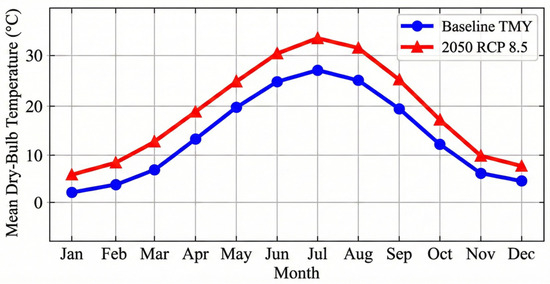
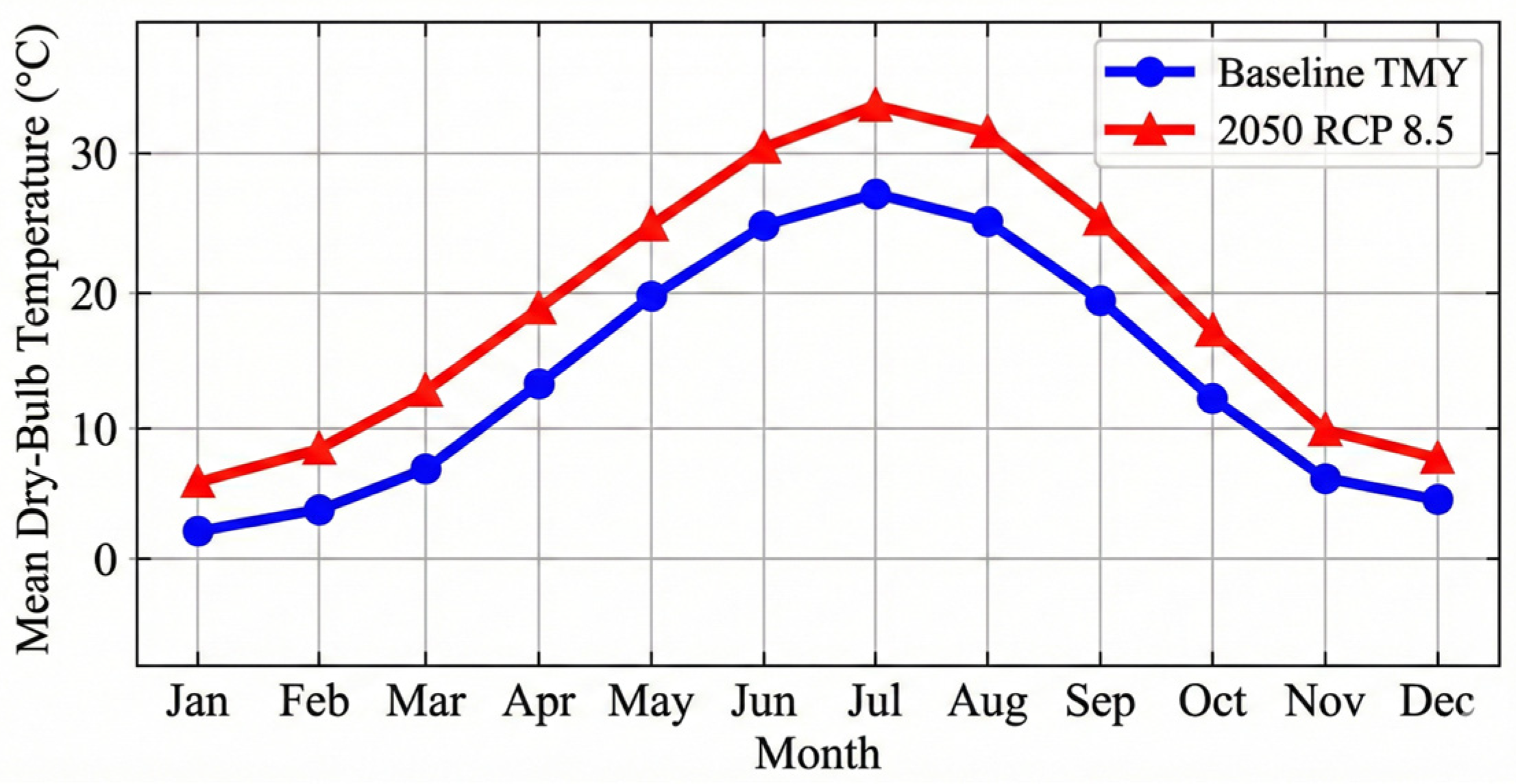
To stress-test resilience, the study utilizes the downscaled 2050 RCP 8.5 weather file. Comparative analysis against the TMY baseline reveals a statistically significant deterioration in the thermal environment (Figure 2):
Figure 2.
Comparative analysis of monthly dry-bulb temperatures between the baseline TMY and the projected 2050 RCP 8.5 scenario for Taipei.
- Mean Temperature Rise: During the cooling season (June–September), the mean dry-bulb temperature (Tdb) increases by 1.8 °C.
- Extreme Events: The frequency of “Extreme Heatwave Days” (Tmax > 36 °C) is projected to surge by 240%.
This environmental shift confirms that static shading codes based on historical data are insufficient, necessitating the proposed parametric optimization.
4.3. Optimization Experiment Setup
To validate the MCP-LLM framework, a rigorous comparative experiment is designed against the industry-standard NSGA-II algorithm. The comparison focuses on Solution Quality and Search Efficiency.
4.3.1. Algorithmic Configuration
To ensure a rigorous comparison, the Control Group utilizes the pymoo library to execute a standard evolutionary search (Population = 50, Generations = 100), totaling 5000 evaluations. This generation count was deliberately set to be extensive to ensure that the genetic algorithm reaches a complete stagnation (convergence) phase. This establishes a robust baseline (Global Optima) for performance comparison, eliminating any potential bias that might arise from under-convergence in the control group.
In contrast, the Experimental Group (MCP-LLM) utilizes the “Observation-Reasoning-Action” loop powered by Claude 4.5 Opus with a limited context window (N = 5) and a strict token budget. The contrasting configurations are detailed in Table 5.
Table 5.
Comparative configuration: NSGA-II vs. MCP-LLM Agent.
4.3.2. Variables and Objectives
Both groups optimize the same design space defined in Table 1 (Section 3.1.2), involving horizontal overhangs (X1), vertical fins (X2–X4), and WWR (X5). The bi-objective function targets:
- Minimize EUI (f1)
- Minimize Glare Frequency (f2)
Constraint: Any solution where DGP > 0.35 for more than 5% of hours is penalized as infeasible.
4.4. Quantitative Results Analysis
4.4.1. Sample Efficiency and Time-Cost Trade-Off
The results demonstrate a significant disparity in simulation sample efficiency. Table 6 has been updated to explicitly distinguish between ‘simulation evaluations’ and ‘optimizer overhead.’ While the MCP-LLM agent introduces higher inference latency (as noted in the new ‘Inference Overhead’ row), it achieves a >90% reduction in simulation load—the primary bottleneck in high-fidelity building physics analysis.
Table 6.
Quantitative comparison of optimization efficiency.
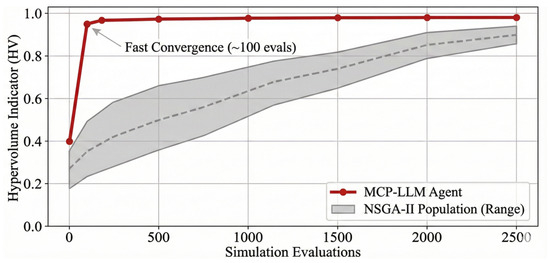
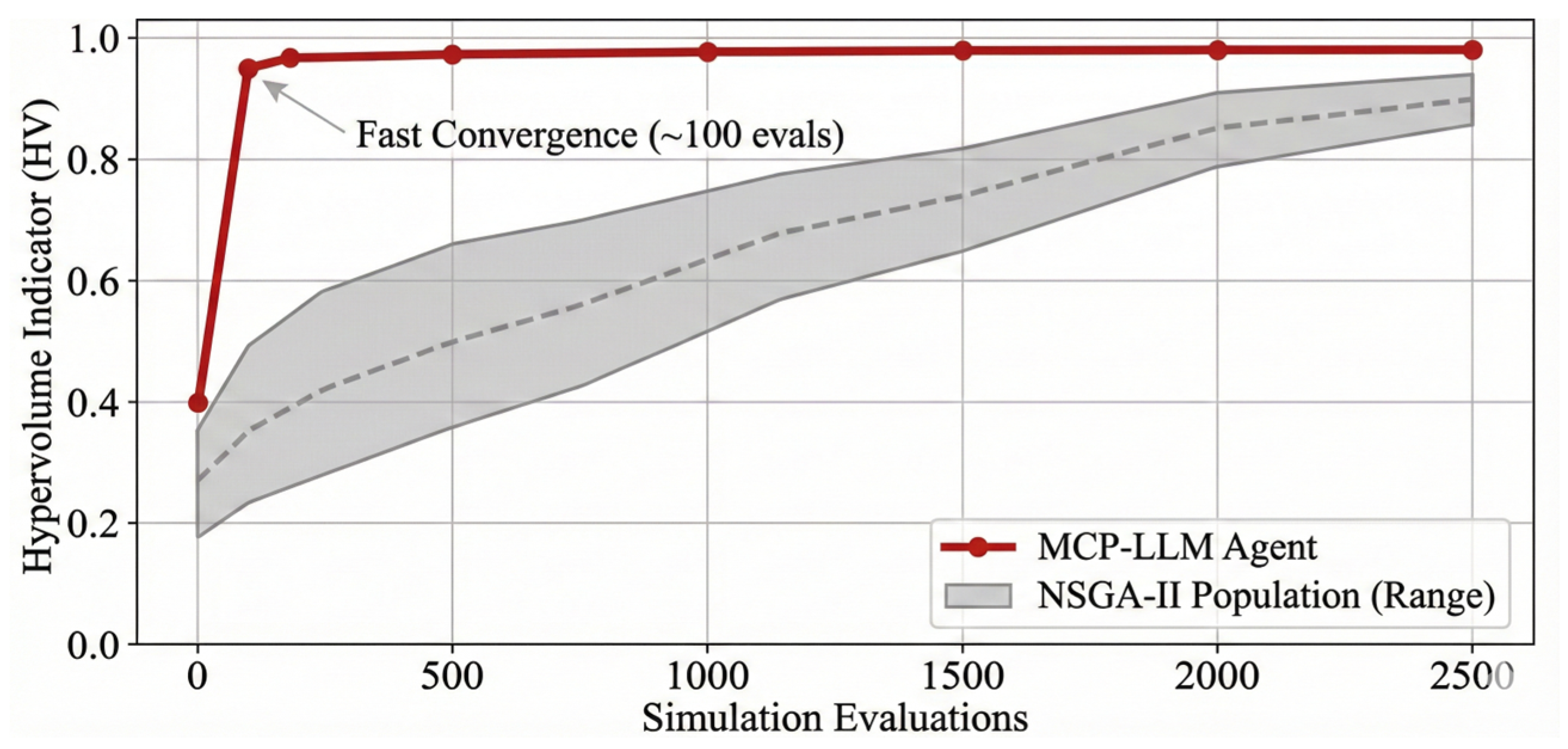
As shown in Table 6 and Figure 3, the MCP-LLM agent achieved Pareto-optimal solutions within 80–100 evaluations, whereas NSGA-II required approximately 1200 evaluations to stabilize. To quantify the economic viability of this approach, we conducted a break-even analysis comparing the fixed overhead of the LLM against the cumulative runtime of simulations. Our calculation indicates that the break-even point occurs at a simulation runtime of approximately 1.7 s. For any simulation exceeding this duration (e.g., standard EnergyPlus or CFD runs taking minutes to hours), the time saved by the agent’s high sample efficiency drastically outweighs its inference latency, resulting in substantial wall-clock time savings.
Figure 3.
Comparison of optimization convergence trajectories. The MCP-LLM Agent (red line) reaches the Pareto frontier significantly faster than the NSGA-II population (grey area).
4.4.2. Building Performance Improvement
The optimal solution generated by the MCP-LLM system was benchmarked against the Baseline Case under the 2050 scenario. As detailed in Table 7, the optimized shading system reduced EUI by 22.7% while dramatically improving visual comfort.
Table 7.
Performance comparison: Baseline vs. Optimized Solution (2050 RCP 8.5).
4.5. Qualitative Semantic Analysis
A unique contribution of this study is the transparency of the “Decision Trajectory.” Unlike black-box algorithms, the Agent generates explainable reasoning logs. Box 1 presents an excerpt from Iteration #12, where the Agent autonomously identified and resolved a multi-objective conflict between cooling load reduction (EUI) and daylight autonomy (sDA) compliance.
Box 1. Agent Reasoning Log (Iteration #12).
- Observation: “Reading simulation data: EUI is declining, but Radiance returns a DGP value of 0.42 during 14:00–16:00 (June).”
- Verdict: “Conflicting Goals—Glare is intolerable despite Energy gains.”
- Reasoning (Physical Diagnosis & Trade-off): “At this time, the sun is low in the West. Conflict Analysis: Simply increasing overhang depth (X1) would reduce solar heat gain, but sDA is dropping dangerously close to the 50% threshold. Further deepening will violate visual comfort standards (sacrificing daylight for energy). The root cause is angular alignment, not depth.”
- Action: “Strategy: Halt depth extension to preserve sDA. Pivot to adjusting vertical fin angle (X4) from 0° to 30° to intercept low-angle light while maintaining view factors. Slightly reduce spacing (X3)”.
This log evidences Temporal Pattern Recognition and Causal Reasoning. Crucially, it demonstrates “Emergent Strategy”: the Agent realized that the heuristic of “increasing depth” had reached a diminishing return point for sDA, prompting a strategic pivot to angular rotation. This confirms that the optimization is driven by physical intuition rather than stochastic perturbation.
4.6. Resilience Stress Test (2050 Heatwave)
To evaluate passive survivability, a “Free-running Mode” test was conducted during the projected “Extreme Heatwave Week” (21–27 July 2050).
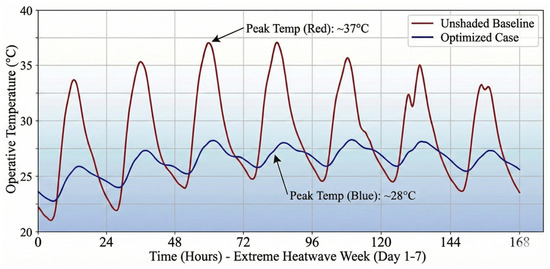
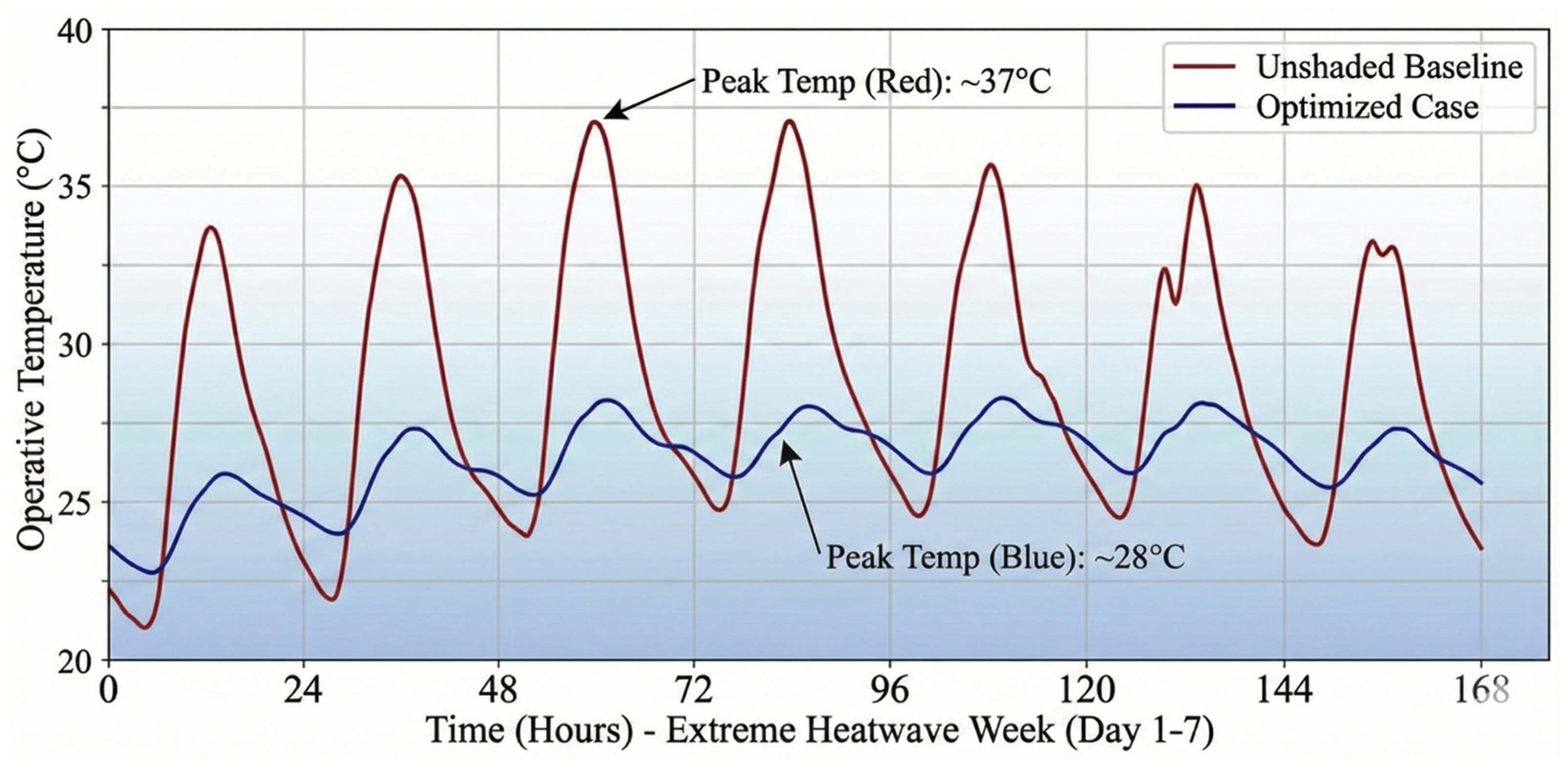
As illustrated in Figure 4, Under the baseline scenario without shading, the indoor operative temperature (Top) peaked at a hazardous 34.5 °C, indicating a failure to maintain safe conditions. In contrast, the optimized shading system demonstrated significant resilience by suppressing the peak temperature to 29.8 °C. This substantial reduction (ΔT = 4.7 °C) effectively transforms the indoor environment from a state considered “uninhabitable” to one that is “tolerable,” thereby ensuring passive survivability during potential power outages.
Figure 4.
Hourly indoor operative temperature profiles during the extreme heatwave week. The optimized case (blue) maintains temperatures significantly below the unshaded baseline (red).
5. Discussion
This chapter synthesizes the quantitative results and qualitative insights derived from the case empirical case study, contextualizing them within the evolving framework of AI-driven Architectural Computational Design and Sustainable Building Practice. The discussion is ariticulated around three pivotal dimensions: (1) the comparative analysis between the extensive exploration of stochastic and the hign sample efficiency of semantic reasoning, (2) the imperative of knowledge-driven optimization in navigating the uncertainties of 2050 climate resilience; and (3) the fundamental paradigm shift from opaque “black-box” automation to transparent, interpretable human-machine collaboration enabled by the Model Context Protocol (MCP).
5.1. Fundamental Differences: Semantic Reasoning vs. Stochastic Search
The experimental results indicate that the MCP-LLM Agent achieved an approximate 12-fold increase in sample efficiency compared to the traditional NSGA-II algorithm. This substantial disparity stems from a fundamental divergence in “Optimization Logic.”
5.1.1. From “Trial-and-Error” to “Strategic Inference”
Traditional Genetic Algorithms (GA) function as stochastic “Trial-and-Error” mechanisms. NSGA-II treats the building simulation as a “Black Box,” exploring the solution space solely through mutation and crossover operations. Lacking domain knowledge, this approach inevitably expends valuable simulation evaluation on physically counterintuitive solutions.
For instance, in the West-facing test case, NSGA-II wasted significant resources iterativelt testing shallow horizontal overhangs. While mathematically valid search points, there are explicitly ineffective against the low-altitude afternoon sun characteristic of western exposures. The algorithm must “learn” this inefficiency through hundreds of failed simulations.
In contrast, the MCP-LLM framework adopts a “Knowledge-Driven” model. The Agent’s pre-trained internal knowledge base endows it with an “intuition” akin to that of a professional architect. Through the “Observation-Reasoning-Action” (ORA) loop, the Agent applies causal logic at the onset of decision-making (e.g., “The target is a West-facing facade where solar altitude is low; therefore, purely increasing horizontal depth is inefficient; prioritizing louver angle adjustments is required”). This capability allows for the effective “pruning” of invalid search paths. This demonstrates that even in seemingly simple geometric problems, semantic understanding allows the Agent to bypass the “learning curve” that burdens blind optimization algorithms.
5.1.2. Explainability and Trust
A primary barrier in traditional BPO is the opacity of the tools; designers typically receive numerical outputs without comprehending the selection rationale. By analyzing the Agent’s reasoning logs, this study validates the high degree of Explainability (XAI) inherent in the MCP architecture. The generated text documents not only parameter modifications but also the underlying physical rationale. This transforms the optimization process from opaque data computation into a human-intelligible design discourse, fostering necessary trust in automated results.
5.2. Critical Significance of Climate Resilience for 2050
The simulation results targeting the 2050 RCP 8.5 scenario underscore the severe challenges confronting current building codes, while validating the pivotal role of parametric shading.
5.2.1. Functional Obsolescence and Future Risks
Data indicates that the Baseline Case, designed according to current regulatory standards (40% WWR, single glazing), faces “Functional Obsolescence.” Under the extreme heatwaves of 2050, a peak Indoor Operative Temperature (Top) of 34.5 °C implies that the architectural space will become functionally uninhabitable, posing severe health risks. This finding demonstrates that relying on historical TMY data is no longer reliable; incorporating Future TMY scenarios for “Stress Testing” must become a standard protocol.
5.2.2. Passive Survivability
The optimized solution successfully attenuated the peak temperature during heatwaves by 4.7 °C, maintaining it within a tolerable range of 29.8 °C. This achievement is critical for “Passive Survivability.” In scenarios where extreme weather accompanies grid failure (power outages), the building’s capability to maintain habitable conditions without mechanical cooling is paramount. Empirical evidence proves that precisely optimized passive shading provides a critical safety buffer, retarding thermal shock and ensuring occupant safety.
5.3. New Paradigm and Limitations of Human-Machine Collaboration
The MCP-LLM system demonstrates a novel workflow that transcends traditional CAD/BIM tools, transitioning the designer’s role from a manual “Operator” to a strategic “Director.”
5.3.1. Intent-Driven Interface and Democratization
Through MCP integration, designers are no longer required to master complex visual scripting languages (e.g., Grasshopper) or energy modeling scripts. By merely articulating design intent (e.g., “Optimize shading to resolve afternoon glare”), the AI translates this into technical operations. This “Intent-Driven” mode significantly lowers the technical barrier to high-performance simulation, facilitating the democratization of sustainable design practices.
5.3.2. The Necessity of Semantic Constraints in Complex Geometry
The shift to an intent-driven model is further justified by the limitations of stochastic search in complex geometric contexts. In our preliminary investigations involving parametric facades with high degrees of freedom, the traditional NSGA-II algorithm frequently struggled with “Geometric Validity.” Lacking semantic understanding, the blind search mechanism wasted substantial computational resources evaluating incomplete or structurally irrational phenotypes (e.g., self-intersecting meshes). By contrast, the MCP-LLM Agent, guided by semantic constraints, “reasons” about geometric feasibility before execution. This capability suggests that while the current study validates the framework on a canonical West-facing case, the semantic architecture is inherently better suited for scaling to the complex, irregular geometries where traditional algorithms fail.
5.3.3. Addressing Memory Bottlenecks via Retrieval-Augmented Generation (RAG)
A significant limitation identified in the current framework is the reliance on a finite “Sliding Window” (N = 5). While effective for short-horizon tasks, this constraint may lead to “Catastrophic Forgetting” in extended optimizations, where the Agent loses context of early failures and inadvertently repeats invalid parameter sets (optimization cycling).
To mitigate this in high-dimensional search spaces, future architectures will integrate a Retrieval-Augmented Generation (RAG) workflow establishing a Dual-Memory System:
- Working Memory: The existing sliding window for immediate reasoning.
- Persistent Design Memory: A Vector Database (e.g., ChromaDB) storing the embeddings of all historical iterations.
In this enhanced loop, before executing a simulation, the Agent triggers a Semantic Similarity Search to query past attempts (e.g., “Have I tested similar shading configurations that failed?”). This allows the Agent to retrieve and avoid historical failure modes beyond its immediate context window, effectively decoupling long-term experience from token limits.
5.3.4. Verification of Reasoning Fidelity
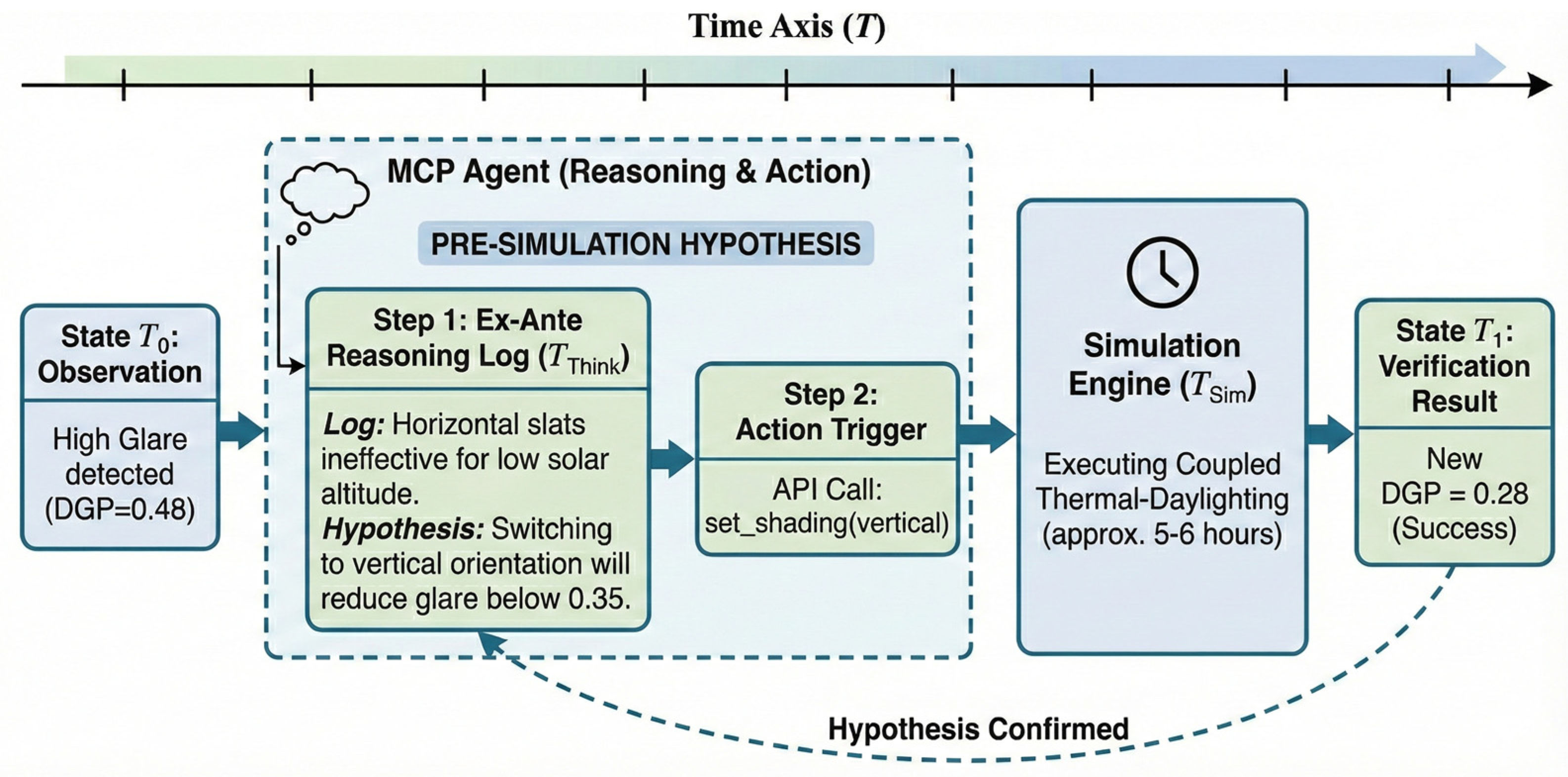
A core validity concern in LLM-driven workflows is distinguishing between genuine causal reasoning and post-hoc rationalization. To verify that the generated design rationale causally corresponds to the simulation results, this study leverages the strict “Ex-Ante Reasoning” protocol of the MCP architecture. The Agent is constrained to generate the reasoning log before executing the simulation command. As illustrated in Figure 5, the simulation result serves as the ground-truth verification of the pre-recorded reasoning log. This temporal separation ensures the rationale acts as a predictive hypothesis driving the optimization, rather than a narrative reconstructed after observing the data.
Figure 5.
Verification of Causal Reasoning Fidelity: Ex-Ante Architecture Timeline.
5.3.5. Cost-Benefit Analysis: API Economics vs. Local Computation
While the superior sample efficiency of the MCP-LLM agent is evident, a holistic assessment must consider the financial trade-offs compared to traditional methods. NSGA-II running on local CPUs incurs negligible marginal costs (electricity only), whereas the proposed agent relies on token-based API calls.
However, as detailed in Table 6, this direct cost comparison overlooks two critical factors:
- Total Cost of Ownership (TCO): For professional workflows, the primary cost driver is not computation time but human labor. Traditional optimization requires significant “setup costs” for parametric modeling and manual geometry debugging. The MCP-LLM agent drastically reduces this labor overhead by autonomously handling errors and interpreting natural language goals.
- Commercial Viability: In scenarios involving expensive simulation software licenses or cloud computing fees (e.g., AWS EC2 instances for CFD), the 92% reduction in simulation calls (Sample Efficiency) translates to direct financial savings that significantly outweigh the LLM inference costs.
Therefore, while the agent introduces a “per-step” financial cost, it offers a superior value proposition by minimizing the total “time-to-solution” and reducing the expertise barrier for complex environmental design.
5.3.6. Limitations and Challenges
Despite positive results, this study acknowledges current limitations:
- Statistical Benchmarking and Simulation Latency: Standard evolutionary algorithm benchmarking typically requires multiple independent runs (e.g., N = 30) to establish statistical robustness. However, due to the high-fidelity nature of the coupled thermal-daylighting simulations in this study (requiring approximately 5–6 h per iteration), large-scale statistical repetition was computationally prohibitive. Consequently, this study focuses on validating the semantic pruning mechanism rather than statistical variance. Future work utilizing surrogate modeling could overcome this bottleneck to enable rigorous statistical benchmarking.
- Hallucination Risk: Despite boundary constraints, LLMs may still generate physically illogical inferences in rare instances. “Human-in-the-loop” oversight remains irreplaceable for final verification.
- Short-term Memory Constraints: The current “Sliding Window” mechanism (N = 5) restricts the Agent’s capacity to handle long-cycle optimization problems. Future research could explore Retrieval-Augmented Generation (RAG) to establish long-term memory.
- Computational Operational Costs: While simulation count is reduced, the inference cost of high-end LLM APIs (e.g., Claude-4.5) remains higher than local mathematical computations. This factor must be weighed when scaling for widespread use.
5.4. Chapter Summary
In summary, this chapter argues for the superiority of the semantic reasoning mechanism in solving building optimization problems, highlighting breakthroughs in both efficiency and explainability. Furthermore, the proposed framework effectively enhances the climate resilience of educational facilities against 2050 threats. Crucially, this study posits that AI serves not to replace designers but as a powerful collaborative partner, rooted in human expert supervision.
6. Conclusions and Suggestions
6.1. Research Summary
This study addressed two fundamental challenges confronting Building Performance Design (BPD) in the era of climate change: the “Tool Interoperability Gap” and the “Optimization Decision Black Box.” By establishing an intelligent design framework based on the Model Context Protocol (MCP) and Large Language Models (LLMs), this research conducted a comprehensive simulation analysis of a secondary school building in Northern Taiwan under the 2050 IPCC RCP 8.5 extreme climate scenario.
The primary findings are summarized as follows:
- MCP as a Critical Bridge for Interoperability: This study validated the feasibility of applying the MCP protocol within the BPS domain. Through standardized “Tool Definitions,” the LLM Agent seamlessly interpreted geometric information and precisely controlled EnergyPlus and Radiance engines, confirming that the transition from manual operation to “Semantic-Driven Automation” is technologically viable.
- Semantic Reasoning Significantly Enhances Sample Efficiency: Experimental results indicate that compared to the traditional genetic algorithm (NSGA-II), the MCP-LLM Agent reduced the number of simulation evaluations required to converge to the Pareto Front by approximately 92% (decreasing from ~1200 to under 100 iterations). By leveraging “Observation-Reasoning-Action” logic, the AI rapidly pruned invalid solutions. While LLM inference introduces its own latency, this massive reduction in sampling is critical for workflows where simulation execution time is the primary bottleneck.
- Resilience Enhancement under Extreme Scenarios: Under the 2050 heatwave scenario, the optimized hybrid shading strategy reduced Building Energy Use Intensity (EUI) by 22.7% compared to the Baseline, while maintaining the probability of severe glare (DGP > 0.35) below 5% annually. This demonstrates the framework’s capacity to balance deep decarbonization with occupant well-being.
- From Black-Box to White-Box Transparency: A distinct contribution of this research is endowing the optimization process with Explainability (XAI). The “Reasoning Logs” generated by the Agent elucidate the climatic logic underpinning design decisions, resolving the opacity of traditional parametric tools and establishing a paradigm for transparent AI in architecture.
- Robustness via Human-Machine Collaboration: Finally, regarding workflow stability, the study concludes that a semi-autonomous, human-in-the-loop protocol is currently more viable than fully automated black-box solvers. In our experiments, the Agent autonomously resolved approximately 50% of routine semantic errors (acting as a first-pass filter), while effectively escalating the remaining complex topological failures to human designers. This hybrid approach ensures convergence stability by automating the resolution of lower-tier conflicts without sacrificing the geometric complexity required for advanced architectural design.
6.2. Research Contributions
This study makes specific and significant contributions to both academic theory and practical application:
6.2.1. Academic Contributions
- Pioneering Application of MCP in BPS: This research bridges a critical gap in Architectural Informatics regarding the interoperability between Generative AI and professional simulation software. It proposes a universal technical framework for integrating LLMs with domain-specific physics engines.
- Establishing a “Semantic-Driven Optimization” Paradigm: The study empirically validates that leveraging the logical reasoning of LLMs outperforms traditional stochastic algorithms in both search efficiency and process explainability, opening a new trajectory shifting from random exploration to knowledge-based inference.
6.2.2. Practical Contributions
- Resilient Retrofitting Guidelines: Targeting the aging school stock in Taiwan, this study provides shading retrofit strategies equipped with 2050 climate foresight. These guidelines directly respond to the urgent mandates of Campus Net-Zero Transition and student health protection.
- Democratization of Simulation Tools: The developed MCP-LLM framework functions as a “Virtual Sustainability Consultant.” By lowering the technical barrier for architects to utilize complex BPS software, this tool facilitates the widespread democratization of Performance-Based Design (PBD).
6.3. Limitations and Future Works
While this study has validated the potential of the MCP-LLM framework, certain limitations remain. Future research should deepen the investigation in the following directions:
- Addressing Memory Bottlenecks via Retrieval-Augemented Generation (RAG): The current “Sliding Window” mechanism (N = 5) poses a risk of “Catastrophic Forgetting” in long-cycle optimizations. To prevent the Agent from repeating invalid parameter sets (optimization cycling) in high-dimensional spaces, future architectures will integrate a Vector Database (e.g., ChromaDB). This will establish a persistent “Long-Term Design Memory,” allowing the Agent to retrieve and learn from historical failures beyond its immediate context window.
- Scalability to Complex Geometries and Constraints: While this study utilized a canonical West-facing case for initial validation, the true advantage of semantic reasoning lies in handling complexity. Future work will apply the framework to irregular, parametric self-shading geometries where traditional stochastic search (NSGA-II) struggles with geometric validity. Furthermore, the Agent’s reasoning will be tested against nuanced, non-geometric constraints, such as balancing spectral requirements for indoor greenery against solar heat gain.
- Statistical Benchmarking and Computational Constraints:Acknowledging the stochastic nature of evolutionary algorithms (NSGA-II), standard benchmarking typically requires multiple independent runs to establish statistical mean and variance. However, in this study, the high-fidelity nature of the BPS engines (EnergyPlus/Radiance) imposed a significant computational load, requiring approximately 5–6 h per iteration. This intensity constrained the feasibility of large-scale statistical repetition (e.g., N = 30) within the scope of this research. Consequently, the validation relied on a representative run to demonstrate the mechanism of semantic pruning rather than statistical averaging. Future research aims to incorporate Surrogate Modeling (Meta-modeling) to drastically reduce simulation runtime, enabling rigorous multi-run statistical benchmarking to further quantify the framework’s robustness against stochastic variance. NSGA-II wasted significant resources iteratively testing shallow horizontal overhangs… explicitly ineffective against the low-altitude afternoon sun… The algorithm must ‘learn’ this inefficiency through hundreds of failed simulations.
- Generalizability Across Climates and Typologies: The current study focuses on educational buildings in a Subtropical (Cfa) climate. Future research should expand the tested to Cold climates (where passive solar gain is desirable) and complex typologies like healthcare facilities, which possess distinct, regid occupancy and thermal comfort protocols.
- Integration of Multimodal Capabilities: The current model relies primarily on text and numerical data. Future iterations could incorporate Large Multimodal Models (LMMs) to directly “read” architectural floor plans and 3D renderings, enhancing the AI’s mastery of spatio-geometric relations.
- Digital Twin Integration: To extend the MCP architecture into the Operational Phase, future work implies integrating IoT sensors. By ingesting real-time environmental data, the system could achieve dynamic control of adaptive shading, realizing optimization across the entire building life cycle.
- Cost Reduction and On-Premise Deployment: Reliance on cloud-based APIs raises cost and privacy concerns. Future studies should evaluate deploying lightweight, open-source models (e.g., Llama 3) locally. Combining these with MCP could facilitate on-premise deployment, favoring large-scale commercial adoption.
6.4. Concluding Remarks
Confronting the climate emergency of 2050, the Architecture, Engineering, and Construction (AEC) industry requires not merely more efficient tools, but intelligent design partners. This study, through the deep integration of the Model Context Protocol (MCP) and Large Language Models (LLMs), demonstrates a novel possibility for “Human-AI Collaboration.” This system not only enhances the substantive resilience of buildings against extreme climates but, crucially, returns design decision-making to a state of rationality and transparency through semantic reasoning. This establishes a robust technological foundation for creating sustainable, adaptive, and resilient human habitats.
Supplementary Materials
The following supporting information can be downloaded at: https://www.mdpi.com/article/10.3390/buildings16040744/s1.
Author Contributions
Conceptualization, W.-C.S. and C.-L.L.; methodology, W.-C.S. and C.-L.L.; validation, C.-L.L.; formal analysis, J.-W.C., Y.-W.D. and C.-L.L.; resources, J.-W.C. and C.-L.L.; data curation, J.-W.C., Y.-W.D. and C.-L.L.; writing—original draft, J.-W.C. and C.-L.L.; writing—review and editing, J.-W.C., Y.-W.D. and C.-L.L. All authors have read and agreed to the published version of the manuscript.
Funding
This research received no external funding.
Data Availability Statement
The original contributions presented in this study are included in the article/Supplementary Material. Further inquiries can be directed to the corresponding author.
Acknowledgments
During the preparation of this manuscript, the authors used Gemini (Gemini3 pro) for the purposes of improving language and readability. The authors have reviewed and edited the output and take full responsibility for the content of this publication.
Conflicts of Interest
The authors declare no conflicts of interest.
Abbreviations
The following abbreviations are used in this manuscript:
| AEC | Architecture, Engineering, and Construction |
| AI | Artificial Intelligence |
| BPS | Building Performance Simulation |
| CoT | Chain-of-Thought |
| DGP | Discomfort Glare Probability |
| EUI | Energy Use Intensity |
| IPCC | Intergovernmental Panel on Climate Change |
| LLM | Large Language Model |
| MCP | Model Context Protocol |
| MOO | Multi-Objective Optimization |
| NSGA-II | Non-dominated Sorting Genetic Algorithm II |
| ORA | Observation-Reasoning-Action |
| RCP | Representative Concentration Pathways |
| TMY | Typical Meteorological Year |
| WWR | Window-to-Wall Ratio |
Appendix A
Appendix A.1. System Prompt for the Semantic Reasoning Agent
To ensure the reproducibility of the “Observation-Reasoning-Action” (ORA) logic described in Section 3.2.2, the full system prompt used to initialize the LLM Agent is provided below. This prompt enforces the Chain-of-Thought (CoT) process and explicitly defines the physical constraints of the design space.
System Prompt: You are an expert Building Performance Optimization Agent specialized in bioclimatic design for subtropical educational buildings. Your goal is to optimize shading geometry to minimize Energy Use Intensity (EUI) and Discomfort Glare Probability (DGP) under 2050 RCP 8.5 climate scenarios.
Operational Protocol (ORA Loop): You must strictly follow this thought process for every iteration:
OBSERVATION: Analyze the current simulation feedback provided by the environment. Identify specific periods of failure (e.g., “Glare detected at 15:00 in June”).
REASONING: Use building physics logic to diagnose the cause. Explain why the current geometry failed (e.g., “Solar altitude is low; horizontal overhang is ineffective”). Propose a remedial strategy based on causal logic.
ACTION: Select the appropriate MCP tool to modify parameters.
Design Space Constraints: You are only allowed to modify the following variables within the specified ranges:
overhang_depth (X1): [0.5, 1.5] meters
fin_depth (X2): [0.0, 1.0] meters
fin_number (X3): [2, 12] counts
fin_angle (X4): [−45, 45] degrees
wwr (X5): [30, 80] %
Prohibitions:
Do not hallucinate data. Only use values returned by the trigger_sim tool.
Do not propose values outside the defined ranges.
Appendix A.2. MCP Tool Schema Definitions
The interoperability between the LLM and the BPS engines (EnergyPlus/Radiance) is established via the Model Context Protocol (MCP). The JSON schemas below define the standardized interfaces for the tools listed in Table 2, enabling the Agent to execute geometric changes and retrieve climate data. These schemas serve a dual purpose: interface definition and runtime validation. By explicitly utilizing the minimum and maximum keywords (as seen in Algorithm A1), the MCP infrastructure performs a pre-execution check on all parameters. Any API call from the Claude 4.5 Opus Agent that violates these numerical boundaries triggers an automatic validation exception. This guarantees parameter integrity and prevents the BPS engines from crashing due to out-of-range inputs.
| Algorithm A1. JSON Schema definition for the update_shading tool |
| JSON |
| { |
| “name”: “update_shading”, |
| “description”: “Translates semantic design intent into parametric modifications within the Grasshopper environment.”, |
| “inputSchema”: { |
| “type”: “object”, |
| “properties”: { |
| “overhang_depth”: { |
| “type”: “number”, |
| “description”: “Depth of the horizontal overhang (X1)”, |
| “minimum”: 0.5, |
| “maximum”: 1.5 |
| }, |
| “fin_depth”: { |
| “type”: “number”, |
| “description”: “Depth of vertical fins (X2)”, |
| “minimum”: 0.0, |
| “maximum”: 1.0 |
| }, |
| “fin_angle”: { |
| “type”: “number”, |
| “description”: “Orientation angle of vertical fins (X4)”, |
| “minimum”: −45, |
| “maximum”: 45 |
| } |
| }, |
| “required”: [“overhang_depth”, “fin_depth”, “fin_angle”] |
| } |
| } |
| Algorithm A2. JSON Schema definition for the query_climate tool |
| JSON |
| { |
| “name”: “query_climate”, |
| “description”: “Allows the Agent to actively query specific 2050 weather data to inform decision-making.”, |
| “inputSchema”: { |
| “type”: “object”, |
| “properties”: { |
| “variable_type”: { |
| “type”: “string”, |
| “enum”: [“dry_bulb_temperature”, “global_horizontal_radiation”, “solar_altitude”], |
| “description”: “The specific climate metric to retrieve.” |
| }, |
| “month”: { |
| “type”: “integer”, |
| “minimum”: 1, |
| “maximum”: 12 |
| }, |
| “hour”: { |
| “type”: “integer”, |
| “minimum”: 0, |
| “maximum”: 23 |
| } |
| }, |
| “required”: [“variable_type”, “month”, “hour”] |
| } |
| } |
References
- IPCC. Climate Change 2021: The Physical Science Basis. Contribution of Working Group I to the Sixth Assessment Report of the Intergovernmental Panel on Climate Change; Masson-Delmotte, V., Zhai, P., Pirani, A., Connors, S.L., Péan, C., Berger, S., Caud, N., Chen, Y., Goldfarb, L., Gomis, M.I., et al., Eds.; Cambridge University Press: Cambridge, UK; New York, NY, USA, 2021. [Google Scholar]
- IEA. 2022 Global Status Report for Buildings and Construction; International Energy Agency (IEA): Paris, France, 2022. [Google Scholar]
- Ma, M.; Zhou, N.; Feng, W.; Yan, J. Challenges and Opportunities in the Global Net-Zero Building Sector. Cell Rep. Sustain. 2024, 1, 100154. [Google Scholar] [CrossRef] [Scilit]
- Wargocki, P.; Wyon, D.P. Ten questions concerning thermal and indoor air quality effects on the performance of learning in schools and offices. Build. Environ. 2017, 112, 359–366. [Google Scholar] [CrossRef] [Scilit]
- Wargocki, P.; Wyon, D.P. The effects of moderately raised classroom temperatures and classroom ventilation rate on the performance of schoolwork by children. HVAC R Res. 2007, 13, 193–220. [Google Scholar] [CrossRef] [Scilit]
- Li, D.H.W.; Tsang, E.K.W. An analysis of daylighting performance for office buildings with fully glazed facades in Hong Kong. Build. Environ. 2008, 43, 1146–1158. [Google Scholar] [CrossRef] [Scilit]
- Bellia, L.; De Falco, F.; Minichiello, F. Effects of solar shading devices on energy requirements of standalone office buildings for Italian climates. Appl. Therm. Eng. 2013, 54, 190–201. [Google Scholar] [CrossRef] [Scilit]
- Palmero-Marrero, A.I.; Oliveira, A.C. Effect of louver shading devices on building energy requirements. Appl. Energy 2010, 87, 2040–2051. [Google Scholar] [CrossRef] [Scilit]
- Crawley, D.B.; Lawrie, L.K.; Winkelmann, F.C.; Buhl, W.F.; Huang, Y.J.; Pedersen, C.O.; Strand, R.K.; Liesen, R.J.; Fisher, D.E.; Witte, M.J. EnergyPlus: Creating a new-generation building energy simulation program. Energy Build. 2001, 33, 319–331. [Google Scholar] [CrossRef] [Scilit]
- Olgyay, V. Design with Climate: Bioclimatic Approach to Architectural Regionalism; Princeton University Press: Princeton, NJ, USA, 1963. [Google Scholar]
- Nguyen, A.T.; Reiter, S.; Rigo, P. A review on simulation-based optimization methods applied to building performance analysis. Appl. Energy 2014, 113, 1043–1058. [Google Scholar] [CrossRef] [Scilit]
- Savaş, A.; Şener, R.; Uslu, S.; Der, O. Experimental study on performance and emission optimization of MgO nanoparticle-enriched 2nd generation biodiesel: A method for employing nanoparticles to improve cleaner diesel combustion. J. Energy Inst. 2025, 118, 102024. [Google Scholar] [CrossRef] [Scilit]
- Korkmaz, M.E. Optimization of End Mill Geometry for Machining 1.2379 Cold-Work Tool Steel Through Hybrid RSM-ANN-GA Coupled FEA Approach. Machines 2026, 14, 15. [Google Scholar]
- Wortmann, T.; Nannicini, G. Introduction to architectural performance modeling and optimization. In Architectural Performance Optimization; Springer: Cham, Switzerland, 2017; pp. 1–20. [Google Scholar]
- Wortmann, T. Opossum: An algorithm for the optimization of building simulations. In Proceedings of the 35th eCAADe Conference, Rome, Italy, 20–22 September 2017; Volume 2, pp. 251–258. [Google Scholar]
- OpenAI. GPT-4 Technical Report; OpenAI: San Francisco, CA, USA, 2023. [Google Scholar]
- Model Context Protocol (MCP). Available online: https://modelcontextprotocol.io (accessed on 5 January 2026).
- Kirimtat, A.; Koyunbaba, B.K.; Chatzikonstantinou, I.; Sariyildiz, S. Review of simulation modeling for shading devices in buildings. Renew. Sustain. Energy Rev. 2016, 53, 23–49. [Google Scholar] [CrossRef] [Scilit]
- Deb, K.; Pratap, A.; Agarwal, S.; Meyarivan, T. A fast and elitist multiobjective genetic algorithm: NSGA-II. IEEE Trans. Evol. Comput. 2002, 6, 182–197. [Google Scholar] [CrossRef] [Scilit]
- Coello, C.A.C.; Pulido, G.T.; Lechuga, M.S. Handling multiple objectives with particle swarm optimization. IEEE Trans. Evol. Comput. 2004, 8, 256–279. [Google Scholar] [CrossRef] [Scilit]
- Michael, A.; Heracleous, C. Assessment of natural lighting performance and visual comfort of educational architecture in Southern Europe: The case of typical educational school premises in Cyprus. Energy Build. 2017, 140, 443–457. [Google Scholar] [CrossRef] [Scilit]
- Goodfellow, I.; Pouget-Abadie, J.; Mirza, M.; Xu, B.; Warde-Farley, D.; Ozair, S.; Courville, A.; Bengio, Y. Generative adversarial nets. In Advances in Neural Information Processing Systems; Curran Associates, Inc.: Red Hook, NY, USA, 2014; Volume 27. [Google Scholar]
- Sacks, R.; Eastman, C.; Lee, G.; Teicholz, P. BIM Handbook: A Guide to Building Information Modeling for Owners, Designers, Engineers, Contractors, and Facility Managers, 3rd ed.; Wiley: Hoboken, NJ, USA, 2018. [Google Scholar]
- Wang, L.; Ma, C.; Feng, X.; Zhang, Z.; Yang, H.; Zhang, J.; Chen, Z.; Tang, J.; Chen, X.; Lin, Y.; et al. A survey on large language model based autonomous agents. Front. Comput. Sci. 2024, 18, 186345. [Google Scholar] [CrossRef] [Scilit]
- Wu, H.; Kong, Q.; Huber, M.; Sun, M.; Craig, M.T. Climate change will increase high-temperature risks, degradation, and costs of rooftop photovoltaics globally. Joule 2026, 10, 102218. [Google Scholar] [CrossRef] [Scilit]
- Wu, H.; Qiu, D.; Zhang, L.; Sun, M. Adaptive multi-agent reinforcement learning for flexible resource management in a virtual power plant with dynamic participating multi-energy buildings. Appl. Energy 2024, 374, 123998. [Google Scholar] [CrossRef] [Scilit]

Disclaimer/Publisher’s Note: The statements, opinions and data contained in all publications are solely those of the individual author(s) and contributor(s) and not of MDPI and/or the editor(s). MDPI and/or the editor(s) disclaim responsibility for any injury to people or property resulting from any ideas, methods, instructions or products referred to in the content. |
© 2026 by the authors. Licensee MDPI, Basel, Switzerland. This article is an open access article distributed under the terms and conditions of the Creative Commons Attribution (CC BY) license.