Systematic Review

Dispute Management in the Digital Era: The Role of Artificial Intelligence and Emerging Technologies

Centre for Smart Modern Construction, Western Sydney University, Kingswood, NSW 2747, Australia
*
Author to whom correspondence should be addressed.
Buildings 2026, 16(4), 706; https://doi.org/10.3390/buildings16040706
Submission received: 20 December 2025 / Revised: 13 January 2026 / Accepted: 6 February 2026 / Published: 9 February 2026

Abstract

Disputes become an accepted reality of construction projects, often resulting in serious consequences, including time and cost overruns, and broader macroeconomic impacts on the national economy. Disputes need to be managed effectively to reduce their negative impacts. Recently, an increasing trend has emerged toward integrating dispute management practices with innovative technologies of the digital era. Therefore, this research aims to investigate the applications of emerging digital technologies and Artificial Intelligence (AI) to manage disputes proactively. This research begins with a scientometric analysis, followed by a systematic review of dispute management using digital technologies with a special focus on AI. Following Preferred Reporting Items for Systematic reviews and Meta-Analyses (PRISMA) guidelines, the systematic review identified 66 previous studies that combine dispute management and digital technologies. The analysis revealed that technologies such as Artificial Intelligence (AI), Building Information Modelling (BIM), blockchain, smart contracts, Document Management System (DMS), big data, cloud computing, and Unmanned Aerial Vehicle (UAV) are utilized, while AI and its technologies significantly contribute to managing disputes. AI technologies, especially natural language processing, show a growing trend in applications for predicting disputes using project documents. In addition, the study develops a conceptual framework to predict disputes using AI technologies. The study identified potential research areas involving the integration of digital technologies for dispute management in the construction industry, offering valuable direction for future research. The research suggests that the use of AI and emerging digital technologies potentially predicts and mitigates disputes, thereby paving the way for proactive dispute management.

1. Introduction

The construction industry holds significant economic importance in every country by making a considerable contribution to its national economy [1]. Australia spends US$162 billion on building and construction work each year, which accounts for around 10% of GDP, making it the fifth-largest sector in the economy [2]. Such a vast and complex industry operating on a huge scale involves multiple stakeholders and significant resources, where disputes become inevitable [3]. A construction dispute is a situation in which two parties typically hold differing opinions regarding a contractual right. When one party rejects the other party’s decision and does not accept it, the disagreement is subsequently formalized into a dispute [4]. Time and cost play a crucial role in determining the success of a construction project. Nevertheless, disputes can interrupt project activities and result in delays and increased expenses [5]. Alrasheed et al. [6] mentioned that disputes in construction projects arise due to failure to address their root causes and lack of procedures for dispute avoidance and mitigation.
Causes of disputes in the construction sector have been widely discussed over the past few decades by several researchers, who have examined the critical factors, classified their causes, and developed causal models. Silva et al. [7] identified several critical factors, including inadequate contractual arrangements, scope changes introduced by the employer, unexpected site conditions, weak understanding and administration of contracts, poor workmanship by contractors, delays in meeting project schedules, late or withheld payments, and generally low design quality. On a different note, Matarneh [8] stated that the main factors leading to disputes in Jordan are incomplete technical drawings and specifications, variations introduced by the owner or consultant (additive or deductive), and errors or omissions in the contract documents. Ahmed and El-adaway [9] indicated that potential risks and uncertainties during the bidding stage were the root causes of many claims, which in turn led to disputes during the project. The authors further developed causal models using network analysis, spectral clustering, and association rule analysis. A recent study classified disputes into 12 categories and argued that payment- and finance-related disputes are particularly critical, as they can trigger severe repercussions ranging from financial hardship for stakeholders down the supply chain to project abandonment and even contractor bankruptcy [4].
Dispute management involves reactive resolution methods and proactive dispute avoidance strategies. Resolving disputes through traditional litigation is increasingly perceived as costly, time-consuming, and detrimental to sound business goals. Such resolutions often lead to uncertain outcomes that are frequently regarded as unsatisfactory. In contrast, Alternative Dispute Resolution (ADR) methods are generally more economical, quicker, and capable of delivering outcomes that are more certain, tailored, and suitable to the specific case [10]. Therefore, industry practitioners have turned to ADR, which encompasses various methods for resolving conflicts. ADR has gained popularity as a non-adversarial approach to managing disputes through techniques such as arbitration, adjudication, mediation, negotiation, conciliation, dispute review boards, and mini-trials [11]. However, ADR methods do not fully satisfy industry needs, which increasingly favor proactive rather than reactive approaches. Although several studies have investigated dispute avoidance strategies, such as addressing the root causes of disputes, adopting fair and balanced contracts, using partnering and alliancing collaborative procurement methods, implementing effective communication systems, and maintaining proper contract administration, the recent literature indicates that disputes remain a persistent threat in the construction industry [12,13]. This gap paves the way for implementing digital technologies to manage disputes in construction projects.
The construction industry is no exception to the pervasive digital revolution. Recognizing the potential of digitalization, the rate of technology adoption in the construction sector is steadily increasing, although it varies across different regions of the world [14]. Perera et al. [15] indicated the prominent drivers of digitalization to be greater level of accuracy and trustworthiness, improve quality and standards in construction, and better communication between stakeholders. Chen et al. [16] found that digital technologies optimize construction functions such as data acquisition, analytics, visualization, communication, and design and construction automation. In particular, data acquisition and visualization are widely regarded as fundamental elements that support and drive towards several innovative applications in the construction industry.
Several researchers have reviewed AI applications in the construction industry [17,18,19,20,21], and a few have reviewed Generative AI applications in the construction industry [22,23], specifically focusing on the opportunities and adaptation challenges. Egwim, Alaka, Demir, Balogun, Olu-Ajayi, Sulaimon, Wusu, Yusuf, and Muideen [20] carried out a comprehensive systematic review of seventy studies examining the application of artificial intelligence across the entire construction value chain. The review revealed that AI technologies are predominantly applied in facility management, highlighting substantial opportunities for the industry to generate value by enabling facility managers to take proactive actions. Yang, Allen, Zhang, and Zhao [21] reviewed frameworks for AI system design across various sectors, as well as the associated government regulations and requirements for achieving trustworthy and responsible AI. In particular, the authors proposed a lifecycle design framework specifically tailored for AI systems deployed in the construction industry. In addition, Baghalzadeh Shishehgarkhaneh et al. [24] conducted a bibliometric and systematic literature review to investigate the application of digital technologies within the construction industry and found that main research themes in the construction industry include Building Information Modeling (BIM), Internet of Things (IoT), Digital Twins, smart contracts, and ontology-based approaches, as well as the integration of virtual reality (VR) and augmented reality (AR) with BIM and DT. Another study reviewed BIM–AI integration and found key research interests include automated design and rule checking, 3D as-built reconstruction, event log mining, building performance analysis, VR, AR, and Digital Twin [25].
While several studies have extensively reviewed the overall applications of the emerging digital technologies in the construction industry, a separate body of research has focused on adopting these technologies in the dispute management domain. In addition, existing studies on AI-enabled online dispute resolution [26] and commercial legal systems [27] remain largely e-commerce and law-focused and are not specific to construction disputes. Over the past decades, researchers have explored the use of digital technologies such as Artificial Intelligence, Blockchain, Building Information Modeling, and other digital technologies to manage disputes. For example, Zhong et al. [28] investigated the application of machine learning to dispute case analysis. Their research compared the performance of various shallow and deep learning models in multilabel text classification, with the goal of automating the analysis of dispute cases and their statutory outcomes. In another study, Wang et al. [29] proposed a conceptual framework explaining the adoption of BIM to facilitate dispute management across the full life cycle of construction projects. Tao, et al. [30] noted that blockchain ensures the authenticity and traceability of project data without the need for an intermediary, thereby reducing the time and cost associated with providing data evidence in dispute resolution.
Although some recent studies have begun to address the involvement of digital technologies in managing disputes, a significant research gap remains. Existing reviews on AI applications in the construction industry are generally not specific to the dispute management domain. There is a lack of a systematic process of identifying and comprehensively investigating the current digital landscape and the potential of advanced technologies which enable proactive dispute management. In addition, a framework for predicting disputes using AI technologies has not yet been developed. To address this gap, the current study adopts a systematic review approach and synthesizes the role of emerging technologies for proactive dispute management, guided by two research questions which cover: (1) landscape of emerging digital technologies for proactive dispute management, (2) AI for proactive dispute management. Accordingly, this research aims to understand the digital landscape of the construction industry and investigate emerging digital technologies that contribute to proactive dispute management, with a special focus on AI technologies.

2. Research Methodology

The literature review method aims to survey previous accomplishments to consolidate knowledge, build upon existing work, summarize findings, prevent redundancy, and identify gaps [31]. Digital technologies have gained considerable interest in the construction industry, with numerous applications highlighting their potential benefits. Consequently, the incorporation of these technologies into proactive dispute management has emerged as a timely development and has attracted increasing scholarly attention over recent decades. This introduces questions such as “What are the emerging digital technologies adopted to proactively manage disputes in the construction industry?”, and “How do emerging digital technologies, particularly AI, contribute to proactive dispute management?”.
This research identifies three major domains to implement the systematic search which include dispute, construction industry, and digital technology. In order to cover dispute-related papers, the word ‘dispute’ is included. Papers that describe dispute avoidance, dispute resolution such as litigation, arbitration, adjudication, and other ADR methods, and dispute mitigation are covered using the keyword ‘dispute’. On the other hand, keywords such as ‘Construction,’ ‘Building,’ ‘Infrastructure,’ ‘Architecture Engineering and Construction,’ and ‘Built Environment’ are included to cover papers within the construction domain. The digital technologies are identified by referring to different research articles that primarily discuss digital technologies, as they emerge rapidly over time.
Chowdhury et al. [32] identified the digital technologies utilized in construction industry, which include 3D Printing; Artificial Neural Network (ANN); Artificial Reality (AR); autonomous vehicle/robotic system; barcode technology; BIM; Case Based Reasoning (CBR); cloud computing; context aware mobile computing; e-commerce technologies, including web-based project management (WBPM); e-Marketplace; e-payment platforms; email; Electronic Data Interchange (EDI); Enterprise Resource Planning (ERP); Extensible Markup Language (XML) technology; Internet of Things (IoT); big data and analytics; game technology; Geographical Information System (GIS); Global Positioning System (GPS); infrared; laser distance and ranging technology (LADAR)/3D Scanner; mobile devices (smartphones, tablet, handheld devices, such as the personal digital assistant, PDA); multimedia technology; photogrammetry (digital cameras); RFID; software applications: 3D, 4D, CAD; ultrasound; virtual prototyping; Virtual Reality (VR); wearable devices; wireless local area network (WLAN); Wireless Sensor Network (WSN) technologies, including Ultra-Wide Band (UWB), bluetooth, ZigBee; and wireless technology. On a different note, Chen, Chang-Richards, Pelosi, Jia, Shen, Siddiqui, and Yang [16] indicated that digital technologies for the construction industry include WLANs, barcoding, MC, eye-tracking, Zigbee, bluetooth, WSNs, IoT, UAVs/drones, UWB, GIS, LiDAR/LADAR, GPS, photogrammetry, sensors, RFID, big data, AI/ML, VP, nD, IM, BIM, web services, AM, Robotics, and DFab. In addition, recent research has identified AI, AR, BIM, big data, blockchain, cloud computing, digital twin, drones, 3D printing, mobile computing, RFID, robotics, sensors, and VR as digital technologies for the construction industry [33]. In addition, several studies have explored the application of digital technologies to address challenges in the construction industry. For example, blockchain has been used to resolve payment issues [34], manage construction certifications [35], manage building services [36], develop a material passport [37], and estimate water usage in constructed facilities [38]. Additionally, AI technologies have been explored, including the use of GeoAI to enhance built environment sustainability [39], deep learning for compliance checking [40], and machine learning for dispute management [41]. Table 1 shows the keywords for digital technologies.
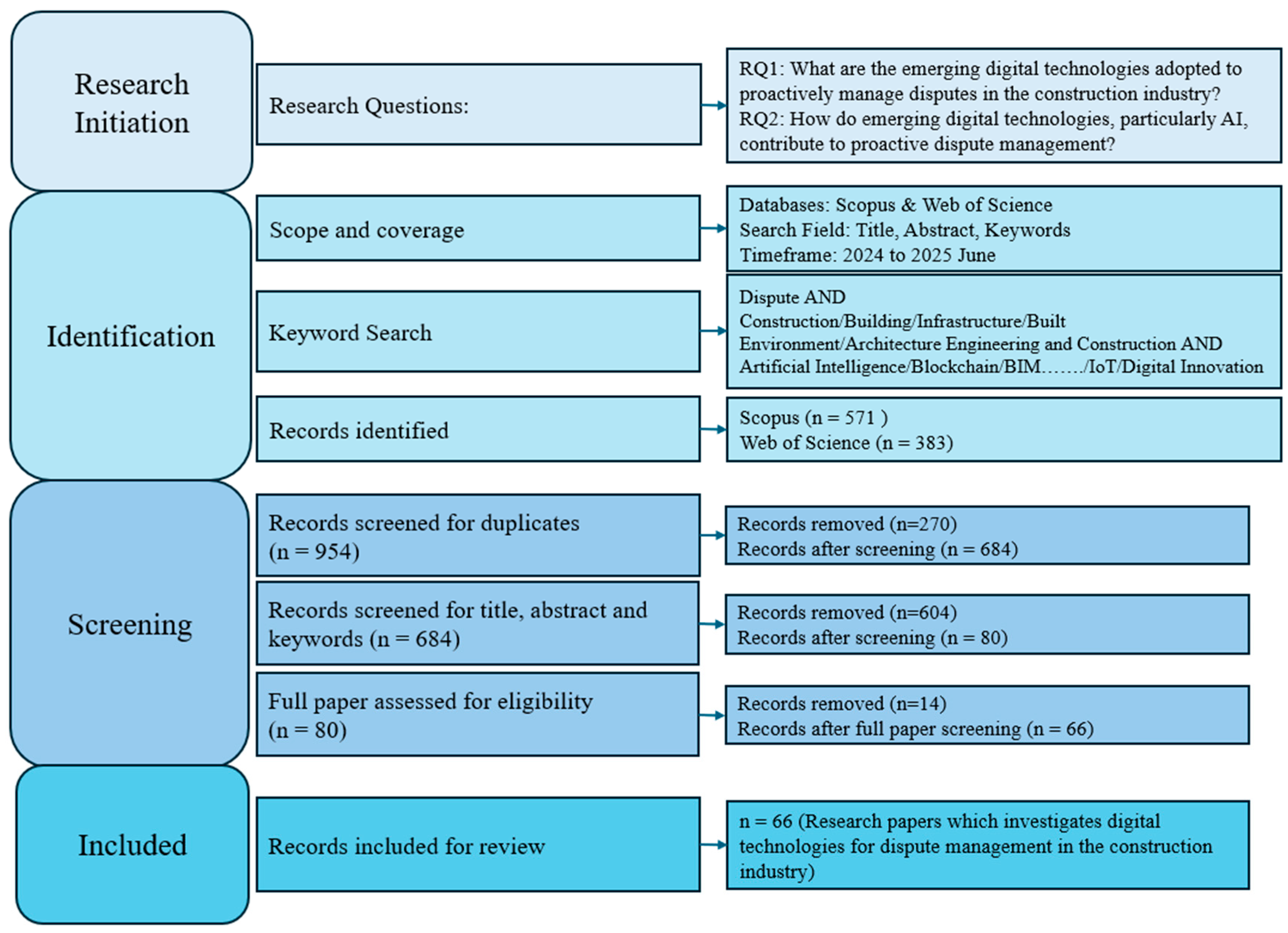
As illustrated in Figure 1, a total of 954 journal articles and conference papers were identified from two major construction management databases: Scopus, which contributed 571 records, and Web of Science, which provided 383 records. These publications were identified using a search string incorporating key terms related to three major areas, such as construction, disputes, and digital technologies. The search was applied to the title, keywords, and abstract, limited to the English language. Specifically, the journal articles and conference papers are included in the systematic search, as the research investigates emerging digital technologies utilized in managing disputes. Journal articles are included due to their high quality, while conference papers are targeted for their up-to-date knowledge. In terms of years, the search includes papers from the last 10 years, covering the period from 2014 to 2025.
Scientometric analysis is described as a quantitative approach to studying scientific development. It serves as a method for assessing research impact and analyzing citation patterns to visualize a specific knowledge domain and identifying emerging trends based on data extracted from academic databases [42]. Accordingly, this study undertakes a systematic review of digital technology applications in construction dispute management using the PRISMA flow diagram. The PRISMA flow diagram illustrates the screening process across the stages of a systematic review. This also provides an indication of the total number of records identified, as well as those included and excluded, along with the reasons for exclusions [43]. The completed PRISMA Checklist is provided as Supplementary Material (see Supplementary Material Table S1). From keyword selection to the screening process, the study was collaboratively undertaken by the research team. The primary researcher conducted the initial screening of titles, abstracts, and keywords. Meanwhile, decisions regarding the eligibility of selected papers were reviewed by all three co-authors. Any uncertainties regarding inclusion were discussed collectively until a consensus was reached. Similarly, coding of the selected studies was carried out by the primary researcher and subsequently refined by the other authors. Figure 1 depicts the steps undertaken in the systematic literature review process.
As depicted in Figure 1, the initial screening process started with the removal of duplicate articles, which led to the elimination of 270 papers, resulting in 684 articles for the next step. The next step involved screening the titles, abstracts, and keywords. Studies that did not investigate dispute management using digital technologies were removed. Specifically, the terms “Construction” and “Building” were widely used in studies not related to the construction industry. This screening process resulted in a total of 80 articles that were taken forward for full-paper screening. The final stage of the systematic review identified 66 studies that specifically examine the application of digital technologies in construction dispute management. The following sections present the scientometric analysis and systematic review of these selected studies.

3. Results and Findings

3.1. Scientometric Analysis

A scientometric technique is utilized in this study to investigate digital technologies’ applications in dispute management in the construction industry, supported by visualization through VOSviewer (version 1.6.20) software.

3.1.1. Keyword Cooccurrence Network

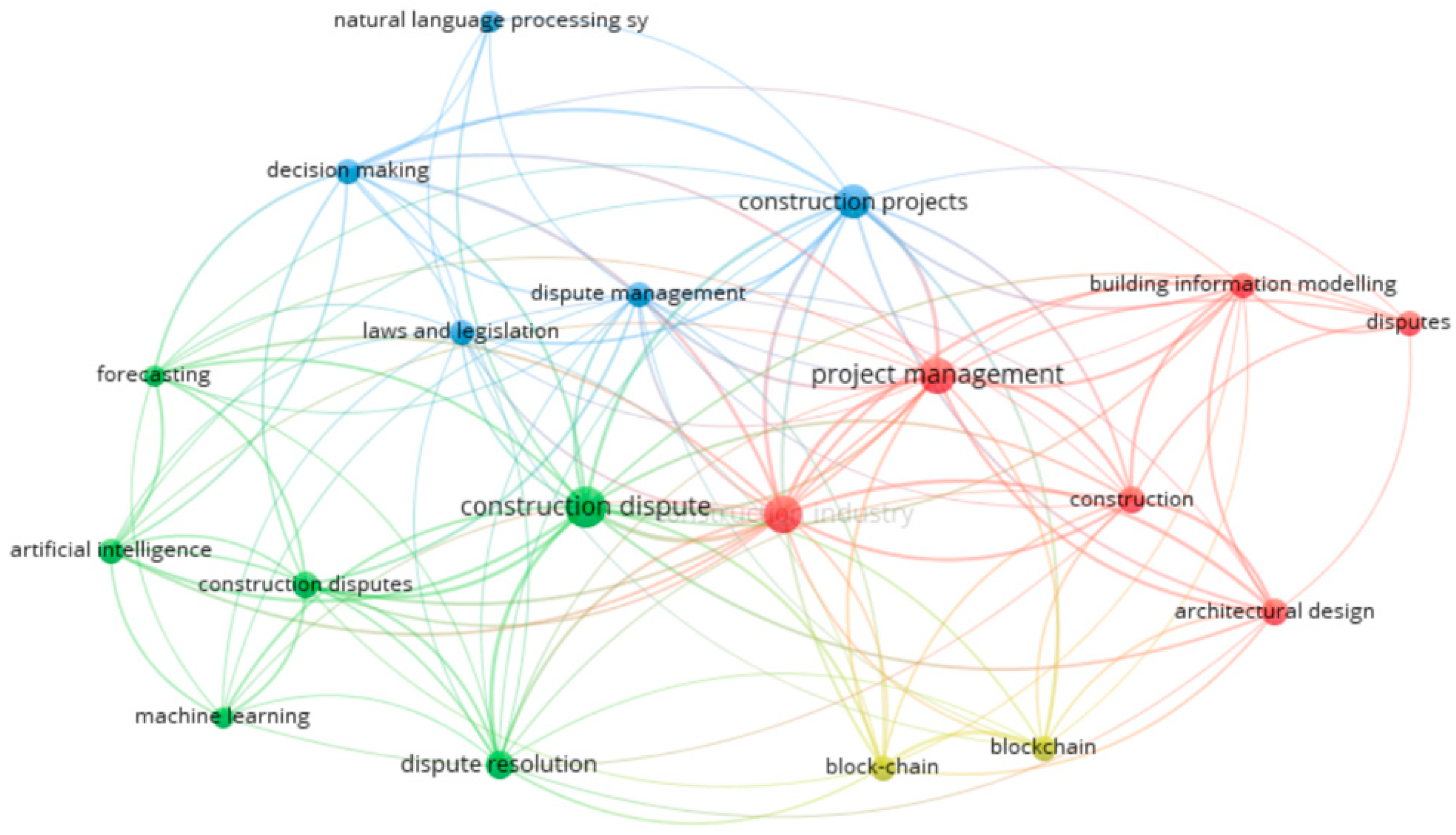
Keywords help summarize, define, and clarify the core aspects of a scientific document within a specific research field. They offer a concise representation of research hotspots, with burst keywords highlighting emerging frontiers and indicating potential future trends [44]. Figure 2 depicts the keywords co-occurrence network.
As shown in Figure 2, the size of the node reflects the frequency of that keyword used in the selected articles for the systematic review process on digital technologies applications for dispute management. The bigger the node, the higher the frequency of keyword usage in the articles. As depicted in Figure 2, different color clusters represent various keywords, including distinct but related research areas. “Construction disputes”, “Construction industry”, “Construction project”, and “Project management” appear as the central positioning, which are core research themes, while the surrounding clusters demonstrate how the field has evolved to incorporate emerging technologies such as BIM, AI, natural language processing, machine learning, and blockchain. In addition, Figure 2 depicts several subthemes of the research area, including laws and legislation, architectural design, and decision-making. The green cluster focuses on relating construction disputes to AI and machine learning; the blue cluster is especially attracted by natural language processing. This shows that among the AI technologies, applications of natural language processing are currently booming. The yellow cluster is centered on blockchain, and the red cluster refers to managing disputes using BIM and architectural design. Thus, this analysis shows the research studies bridge the traditional construction practices with the emerging technologies like AI, BIM, blockchain, and smart contracts. Thus, this scientometric analysis on keyword co-occurrences highlights emerging trends in the existing literature on applications of digital technologies for dispute management in the construction sector.

3.1.2. Citation Country Network

The distribution of research contributions in digital technology applications for construction dispute management varies across countries. The citation country network represents each country and the total strength of its citation links with other countries. The countries with the highest total link strengths are shown in Figure 3.
As depicted in Figure 3, the countries with the highest total link strengths include the United States, Australia, China, India, South Korea, and Turkey. The size of the node represents the citation influence. The larger the node, the higher the number of citations the country has. The United States appears to be the strong node, representing the link between several other countries, such as Australia, Turkey, and China in the red cluster. Moreover, the network extends towards countries such as India and South Korea, represented in the green cluster.

3.1.3. Number of Publications by Year

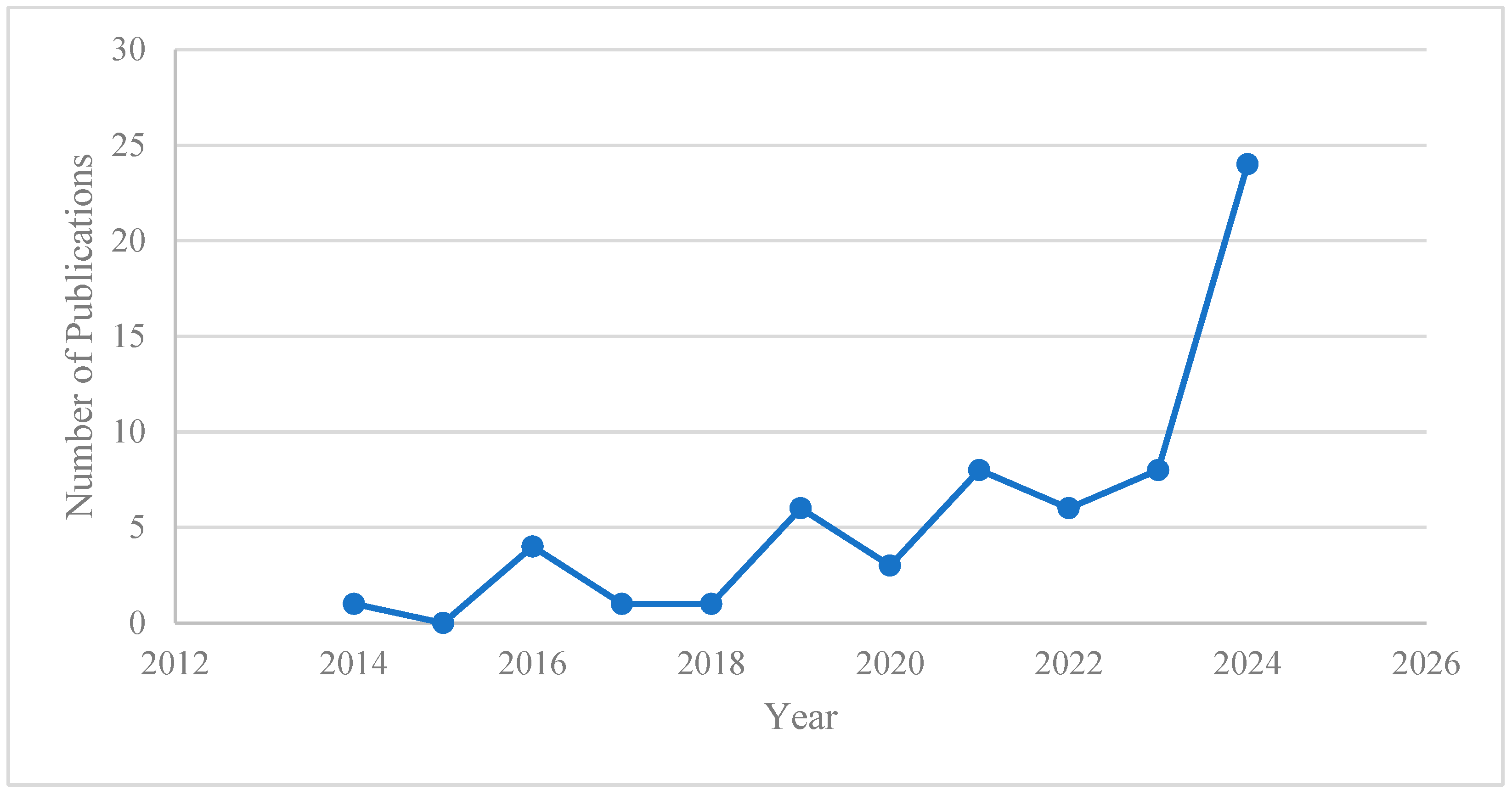
Figure 4 presents the publication trend over time by showing the number of studies published in the field of digital technology applications in construction dispute management.
As depicted in Figure 4, fewer than five publications were identified from 2014 to 2018. From 2019, there appears to be a gradual improvement, along with the emergence of several digital technologies. Consequently, digital technology applications in dispute management have increased involvement in the construction industry. There is a slight dip in 2022; however, it then increases again, indicating a steady rise in publications. Most notably, this momentum peaked at around 24 publications, reflecting a growing interest in digital solutions for construction dispute management. Overall, the analysis of publication trends suggests a rapidly evolving and expanding field of study, particularly in recent years.

3.1.4. Publication Trend in Terms of Various Journals

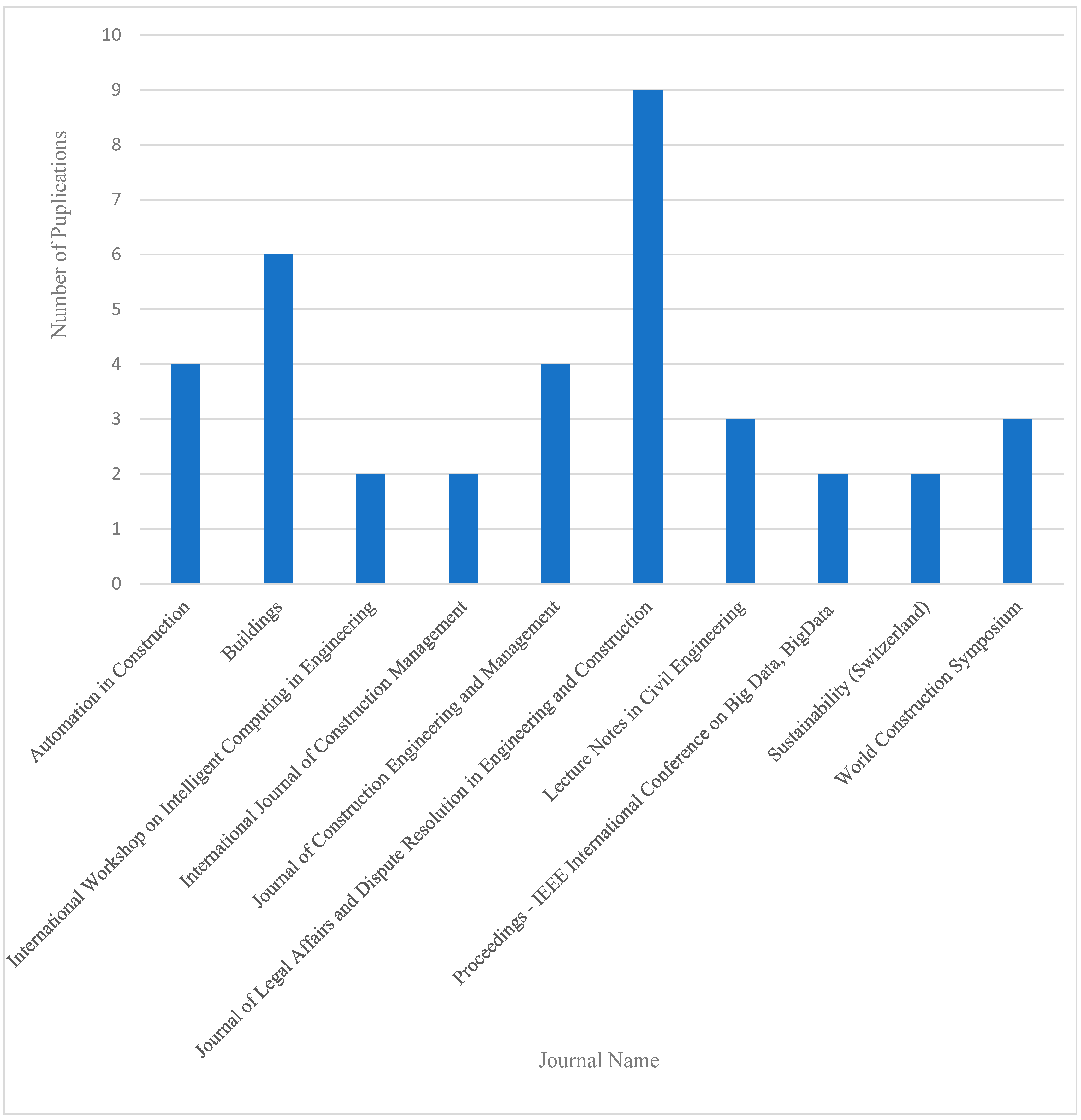
Figure 5 shows the distribution of publications across different journals focusing on digital technology applications in construction dispute management.
The significant number of publications in the Journal of Legal Affairs and Dispute Resolution is far beyond other journals, with approximately nine publications. This indicates that the Journal of Legal Affairs and Dispute Resolution is a primary contributor to this field of research. There are about six articles from Buildings. Automation in Construction and Journal of Construction Engineering and Management have four papers in each. Among the conference papers, the World Construction Symposium has three publications. The graph also exhibits a diverse range of other journals and conferences with fewer publications, suggesting a broad scope of research across different aspects of civil engineering, construction, and related fields.

3.2. Systematic Review on Digital Technologies Applications in Construction Dispute Management

3.2.1. Digital Technologies Applications in Dispute Management

This section of the study compares the digital technologies identified through the systematic literature review with those used in the search, thereby highlighting the research gap. Table 2 presents the keywords that appeared and those that did not, based on a review of the selected publications on digital technology applications in construction dispute management.
As per Table 2, many studies have utilized AI technologies to manage disputes in the construction industry. These AI technologies include Machine Learning, Deep Learning, Artificial Neural Networks, Natural Language Processing, Case-Based Reasoning, Fuzzy Logic, and Game Theory. In addition, technologies like text mining, text classification, explainable machine learning, and expert systems are identified as new, apart from the systematic search string. Applications of Large Language Models and Computer Vision for dispute management could be a potential future research area in the AI era. The systematic search found that document management systems can be used as a tool to manage disputes. The findings show that technologies related to VR and AR, IoT, Communication Technologies, E-commerce Technologies, and Digital Twin are completely untouched areas in terms of application to dispute management. Among these technologies, VR and AR could be used for dispute visualization, while digital twins could enable dynamic comparisons of claims and disputes. For example, developing 3D models and integrating timelines and events, then using a VR headset, can enable stakeholders to better understand claims and disputes. In addition, by connecting BIM with IoT sensors and continuously updating construction progress events and data, stakeholders can more effectively compare claims. Thus, Table 2 depicts that there are several potential research areas combining digital technologies for dispute management in the construction industry.

3.2.2. The Trend of Digital Technologies for Proactive Dispute Management in the Construction Industry

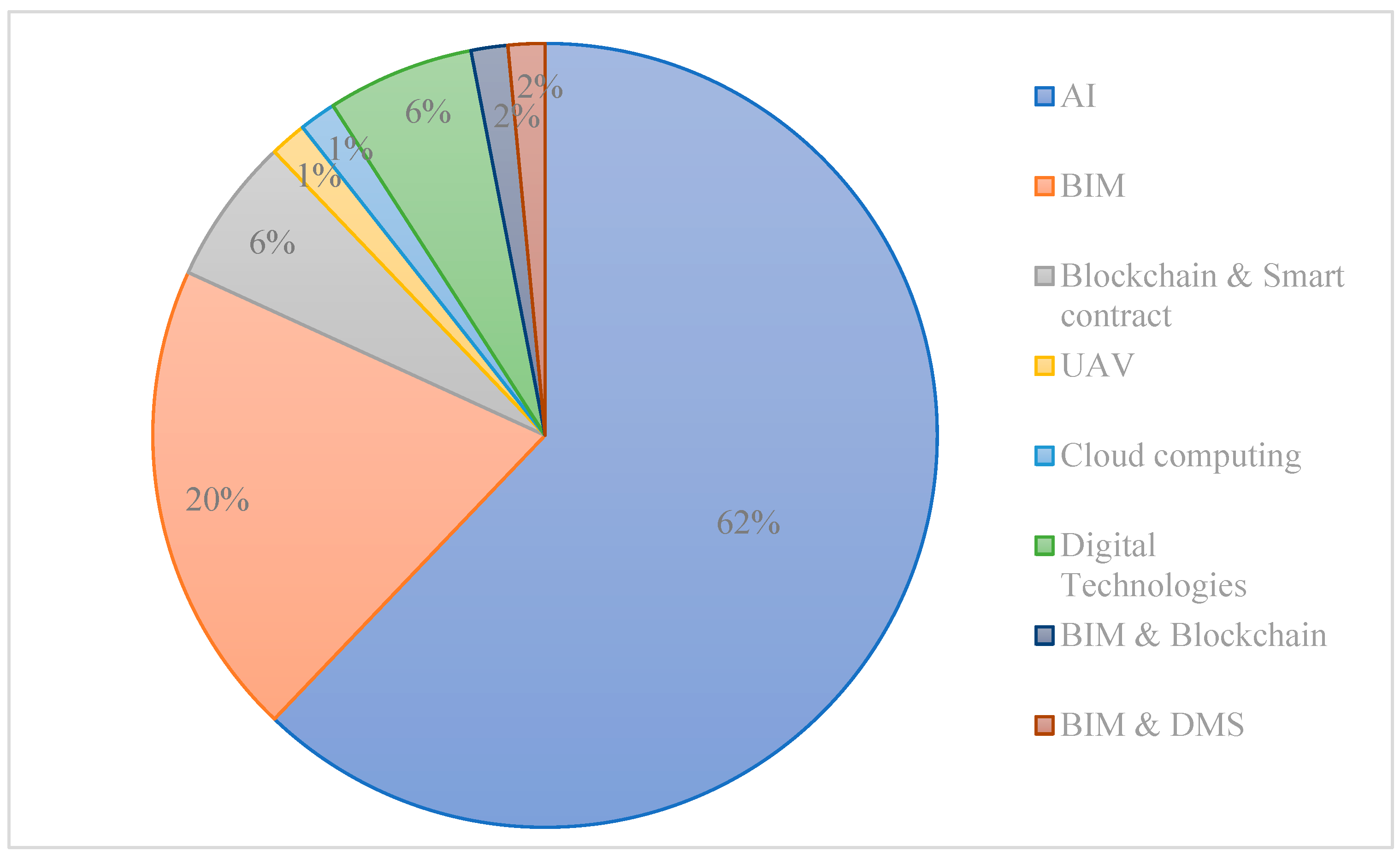
This section of the research analyzes the selected 66 articles in terms of the digital technologies utilized for managing disputes in the construction industry. Figure 6 depicts the trend of digital technologies in construction dispute management.
The pie chart illustrates the distribution of various digital technologies used in construction dispute management. AI is the most dominant technology, accounting for 62% of the studies. AI applications in dispute management encompass many subfields, including ML, DL, NLP, and other AI-related approaches. BIM represents 20%, whereas Blockchain and Smart Contract represents 6%. Digital technologies, as a broader category, account for 6%, while UAVs and cloud computing each account for 1%. As depicted in Figure 6, it is interesting to note that integrating digital technologies such as BIM and Blockchain technologies, and BIM and Document management systems for managing construction disputes, is in practice. This distribution highlights the growing trends in AI, BIM, and Blockchain and smart contract applications for addressing construction disputes. Table 3 presents a summary of the selected studies, highlighting the digital technologies adopted and the corresponding sources.
As depicted in Table 3, AI-based studies employ a range of approaches, including machine learning and deep learning, natural language processing, intelligent support systems, agent-based systems, as well as empirical and review-based studies. Using machine learning, deep learning, and natural language processing techniques, several predictive models have been developed for effective dispute management. AI-related approaches, like intelligent support systems, have been employed in several studies, including those based on game theory [68,71], fussy logic [70,72], rule-based fuzzy genetic algorithm [69], case-based reasoning [73], and expert system [75,76]. Following AI technologies, BIM integration, and blockchain and smart contracts represent key areas that support proactive dispute management. In addition, studies on integrated technologies combine multiple digital technologies to provide enhanced support for dispute management. The following sections describe digital technologies for dispute management across four categories: Artificial Intelligence applications, BIM applications, Blockchain applications, and integrated technologies.
  • Artificial Intelligence Applications in Dispute Management
The application of AI technologies in dispute management is predominantly focused on the development of predictive models, including dispute probability, causes of disputes, dispute outcomes, claim outcomes, dispute resolution methods, and applicable statutes. These studies primarily utilized machine learning models for dispute prediction.
Of those, few studies have predicted the probability of disputes in construction projects. For example, Wang, Huang, Zhu, and Shan [3] addressed construction dispute avoidance by developing paired mechanistic and empirical models to evaluate the feasibility of adopting a mechanistic approach to understanding construction disputes. The study proposed a predictive model that classifies dispute propensity using a dispute index, where values of 0–3 indicate early warning, 4–10 represent warning, and values above 10 signify emergency conditions. Under ideal conditions, the model achieved an accuracy exceeding 95%. In another study, Ayhan, Dikmen, and Birgonul [50] predicted disputes in construction in terms of “Disputed” or “No-disputed” by utilizing machine learning techniques on empirical data using dispute variables.
Alqaisi, Ataei, Seyrfar, and Al Omari [1] developed a model to predict the outcomes of construction change order disputes using historical data from previous cases, which were identified through keyword searches in online databases such as Westlaw and LexisNexis. A reliable prediction model can benefit the construction industry by allowing early identification of potential risks and supporting timely actions to prevent disputes from escalating. In addition, the model can assist parties in reaching settlements before litigation, thereby reducing legal costs and delays. Anysz, Apollo, and Grzyl [49] developed a machine learning model using decision trees and artificial neural networks to predict the result of a dispute. Thus, the model assists in ascertaining the correctness of the decision to choose litigation or not to resolve the dispute between a general contractor and an investor. Thus, the prediction of the probability of dispute occurrences is achieved using binary classification and on different scales with the availability of various algorithms and the quality of digital data.
A growing trend has been identified in the application of NLP models for predicting disputes, driven by the availability of digital construction data and the evolution of AI. For example, Ye, Shan, Gao, Li and Zhang [64] examined the causes of disputes in subcontracting practices by automatically analyzing 3150 publicly available litigation cases in China using text mining and natural language processing techniques. Similarly, Jallan, Brogan, Ashuri, and Clevenger [66] carried out a systematic and automated analysis of construction defect lawsuits available in the public domain, employing advanced NLP and text mining techniques to comprehensively examine legal cases spanning ten years. Latent Dirichlet Allocation (LDA) is used in model development to find the frequencies of keywords in the cases and identify important topics and themes for classifying the case data. Several studies utilized NLP techniques to develop models for retrieving the required data. For example, Elelu, Do, Le, and Piratla [62] developed a well-organized database of utility-related clauses in highway construction projects using unsupervised topic modeling based on LDA models and natural language processing techniques. Few studies have attempted to develop NLP models to predict delay-related disputes [59,60,63]. Thus, ML, DL, and NLP remain crucial for advancing dispute prediction capabilities.
  • BIM Applications in Dispute Management
BIM is a contemporary platform that supports high levels of collaboration, information exchange, and coordination, with applications spanning from project initiation through to completion [105]. Therefore, the authors propose a BIM approach to control dispute causes before the occurrence of disputes. Similarly, Abougamil, Thorpe, and Heravi [85] studied the underlying causes of construction disputes in the Kingdom of Saudi Arabia and highlighted the importance of using BIM applications to reduce claim-related factors in both commercial and residential projects. In another study, Wang, Zhang, Fenn, Luo, Liu, and Zhao [29] developed a conceptual framework that explains how the adoption of BIM supports dispute management across the entire life cycle of construction projects. The framework suggests that many BIM-related benefits can substantially reduce design errors, delays, and change orders. It also highlights improved visual management, enhanced information management, and stronger collaboration as the most commonly applied BIM benefits for addressing the majority of dispute causes. In a similar study, Abougamil, Thorpe, and Heravi [86] investigated claims management procedures under traditional practices and compared them with a proposed BIM-based package as an alternative approach to reducing construction disputes. The findings indicate that the BIM model enhances and streamlines the claims process through automation.
Raza, Farooqui, Saqib, and Ahmed [88] identified a range of opportunities through which BIM can support effective dispute avoidance and resolution in the construction industry. These include documenting existing site conditions, cost estimation through quantity take-offs, phase planning using 4D simulations, site analysis, design authoring and review, drawing production, code compliance checking, site utilization planning, 3D coordination through clash detection, virtual mock-ups for construction system design, as well as field management, progress tracking, and record keeping. On a different note, Muhammad and Nasir [87] proposed a BIM-DRes framework that aligns legal considerations and contractual provisions with the different phases of a construction project, while also identifying the key stakeholders involved in or influenced by these legal aspects. Conversely, Tam, Rahman, and Haron [84] argued that BIM can have a negative impact on projects by leading to poor coordination and creating confusion among stakeholders, which may eventually result in disputes. However, many research studies confirmed that BIM facilitates dispute avoidance in construction projects.
  • Blockchain Applications in Dispute Management
Blockchain is a distributed ledger technology that enables users with internet access to securely transfer items of value, such as currency, data, and survey responses, that empowers anyone with a high level of security and integrity [106]. The construction industry has begun to investigate its potential applications to address long-standing problems around data integrity, transparency, and trust [107]. Accordingly, Tao, Das, Liu, and Cheng [30] mentioned that blockchain guarantees the authenticity and traceability of project data without requiring an intermediary, reducing time and costs in providing data proofs for dispute resolution [30]. On a different note, Torkanfar, et al. [108] proposed blockchain-based dispute management using Hyperledger Fabric to improve the quality and reliability of records and enhance the availability of relevant information for effective claim management. This system could help to address the current challenges in construction and dispute management, such as a lack of trust and collaboration, and the unavailability of reliable information for resolving disputes.
Kim, Park, Kim, and Kim [95] noted that the inherent characteristics of construction projects often lead to challenges in document management, including document loss and tracking difficulties, which may result in claim failure and significant losses. Thus, the authors developed a system that utilizes blockchain technology to generate, transfer, and synchronize blocks based on email communication whenever an event takes place. Additionally, it offers features such as document search, history tracking, automatic retrieval of related documents, and authenticity verification for efficient document management. Recently, Gupta and Jha [94] identified ‘contract-related’ issues as the primary cause of disputes and highlighted a ‘centralized’ hierarchy-based environment as a major challenge to dispute avoidance mechanisms. In response, they proposed an integrated blockchain-based conceptual framework to illustrate a contracting process that is (1) efficient and transparent, (2) digitally integrated, and (3) secure and trustworthy in execution.
Saygili, Mert, and Tokdemir [96] proposed a new construction-specific framework, known as Decentralized Construction Enabling Transparent Resolution (DCENTR), designed to address the unique characteristics of construction projects. The framework demonstrates that reliable execution of contracts and payments can significantly reduce the likelihood of disputes, and that when disputes do arise, they can be resolved with greater transparency and substantial reductions in time, cost, and effort. Goldenfein and Leiter [109] noted that a new area of law is developing around blockchain platforms and automated transactions, and emphasized that understanding the interaction between legal frameworks, enforcement mechanisms, and these technological systems is essential for scaling blockchain applications. Bandara, Abeynayake, Illeperuma, and Eranga [93] mentioned that smart contracts can substantially minimize construction disputes by substituting unclear procedures with well-defined, automated processes. Thus, these studies highlight the potential of blockchain technology, including smart contracts, in managing disputes proactively.
  • Integrated technologies for Dispute Management
After 2020, novel technologies such as AI, BIM, blockchain, and smart contracts have emerged concerning the investigation into construction claim management and dispute resolution [13]. Accordingly, Salem, Elwakil, and Hegab [99] explored the range of innovations in digital documentation, data analytics, virtual collaboration, blockchain transactions, integrated project delivery, and relational contracting frameworks that are transforming dispute resolution practices. Their findings suggest that Fuzzy Logic systems and BIM technologies are highly recommended for effectively managing disputes in construction projects. Gupta and Jha [94] developed Integrated Project Delivery (IPD) practices that emphasize early stakeholder involvement and multiparty contracting, combined with advanced technologies such as blockchain and BIM. Thus, the authors proposed a conceptual framework of decentralized blockchain-integrated system based on building information modeling to steer the digital administration of disputes in the IPD. Similarly, Faraji, Homayoon Arya, Ghasemi, Rashidi, Perera, Tam, and Rahnamayiezekavat [97] developed a conceptual blockchain-based dispute management (BDM) model for ADR in IPD contracts.
Al-Shaibani [110] stated that in the current era of technology and artificial intelligence, remote litigations are equivalent to online dispute resolution (ODR) platforms, which work by digitizing disputes and provide a communication platform for parties of either side to resolve their dispute. Ali, Aibinu, and Paton-Cole [101] proposed a conceptual framework centered on information management and the use of modern technologies, including drones, cameras, radio frequency identification (RFID), BIM, project management software, big data, and machine learning, with the objective of streamlining the disruption claims process and reducing the likelihood of disputes. Recently, Ghosh and Karmakar [98] found that many claim requests are often rejected due to insufficient evidence. In addition to their negative impacts, manual and inefficient approaches to claim document management systems (CDMSs) contribute to cost and time overruns, conflicts, and disputes, making them an inherent challenge in construction projects. To address this, the authors proposed a BIM-based approach to streamline claim document management and enhance dispute resolution effectiveness.

4. Predicting Disputes Using Artificial Intelligence Techniques

Predicting disputes using AI is increasingly popular in the current context. The development of predictive models involves three key elements: Choice of AI technology and concepts, the outcome of the model, and data to develop the model (input features and output features). Among these, accruing data is especially important. Construction projects involve a vast amount of data, including structured, semi-structured, and unstructured data sources. The semi-structured or unstructured data text documents include contracts documents, specifications, change orders, requests for information, schedules, cost estimates, meeting minutes, bill of quantities, and other correspondence; unstructured multimedia data such as 2D or 3D drawings, as well as audio and video files. In contrast, structured data consists of well-organized and processed information that is consistently categorized and readily stored in tabular formats, with rows and columns in databases or spreadsheets [111]. In the context of the construction industry, structured data typically includes the basic project information, which are the project characteristics. Project attributes include complexity of the project, time constraints, procurement method, type of client, size of the project, site factors, type of contract, source of funding, project cost, payment method, project scope, duration of the project, type of project, and project location.
Over the decades, machine learning and deep learning models have been utilized to make predictions using several techniques such as clustering, classification, and regression, primarily with numerical and structured data. For example, Anysz, Apollo, and Grzyl [49] predicted litigation outcomes using variables such as contract value, planned cost, planned profit, financial reserve, contract scope, planned duration, direct cost of additional works, delay in days, additional fixed cost for the contractor, and total fixed cost increase, which is a classification bottom line. Florez-Perez et al. [112] predicted labor productivity of blockwork using regression models such as KNN, DNN, and SVM. Al-Bataineh et al. [113] categorize and understand the risk factors contributing to construction delays using K-means clustering, which is unsupervised learning.
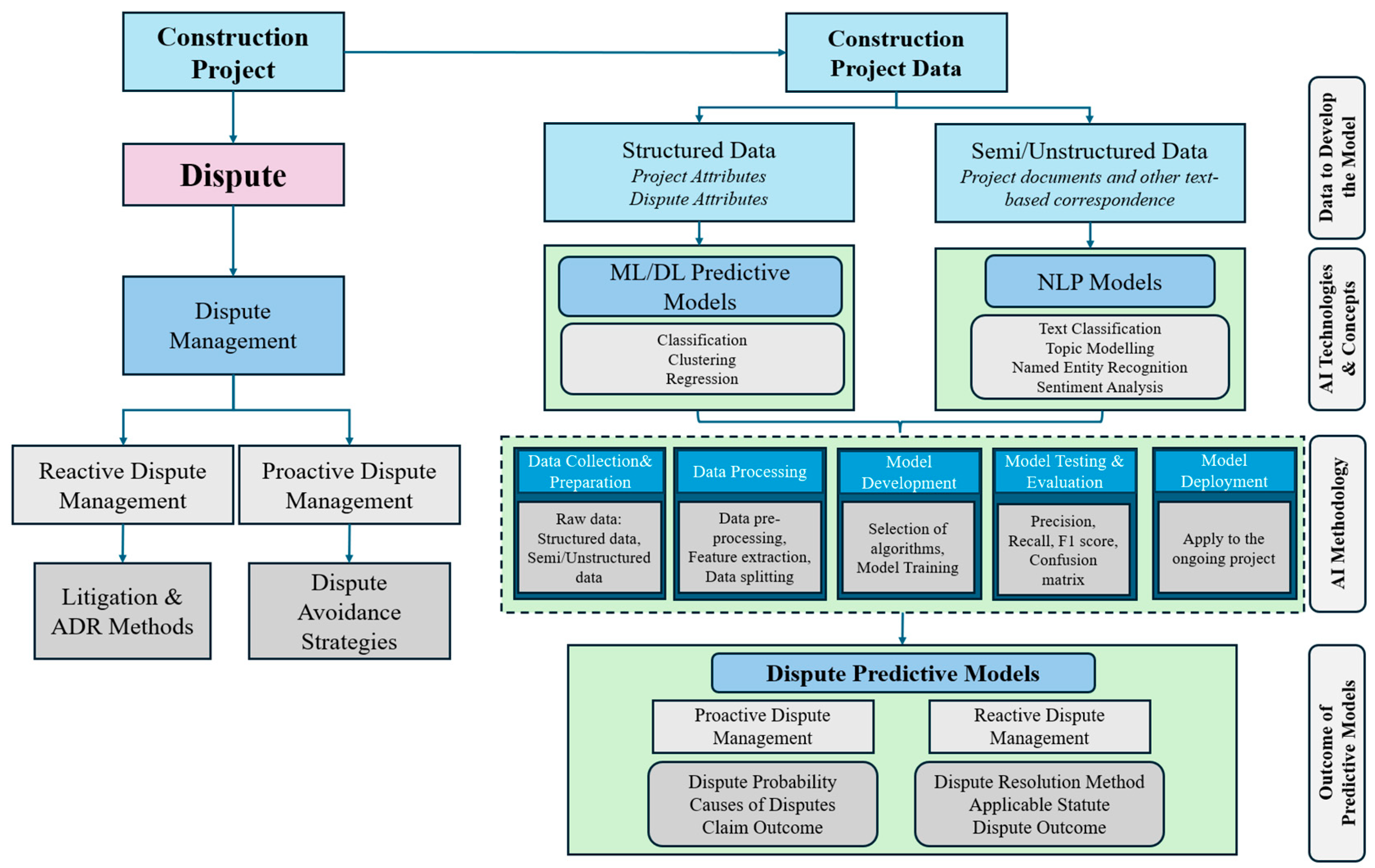
NLP techniques enable machines to understand human language by analyzing text structure and the meaning of words [114]. The availability of digital construction data, especially project documents and correspondence, paves the way for applying NLP concepts to real industry problems. For example, Zheng et al. [115] developed a text classification model to classify each clause in a building code under direct, indirect, method, reference, general, term, and other a well-known pretrained BERT model. Tang et al. [116] utilized sentiment analysis on social media posts and found that weekend and year-end workers’ posts indicated more positivity. Li and Wu [117] integrated the TF–IDF algorithm from text mining with word cloud visualization techniques to support the extraction and interpretation of key accident-related information using named entity recognition. Jallan, Brogan, Ashuri, and Clevenger [66] adopted topic modeling on dispute case documents related to defects and found 14 categories of defects that led to disputes. Figure 7 depicts a conceptual framework to predict disputes using AI technologies in construction projects.
The diagram depicts the conceptual framework that uses machine learning, deep learning, and natural language processing to develop predictive models to manage disputes proactively. The framework, on its left, describes the occurrence of disputes and the required dispute management, which has two approaches: reactive and proactive. “Reactive” indicates litigation and ADR methods, which address the resolution of disputes once they materialize, while the “proactive” approach is a step before disputes materialize and incorporates dispute avoidance strategies. The dispute predictive models primarily serve as a proactive way of addressing disputes beforehand, while also supporting reactive dispute management. On the right, the framework incorporates four major components: the data to develop the model; the AI technologies and concepts, which are the backbone; AI methodology, which indicates the step-by-step process to develop AI models, and the expected outcomes of the predictive models. Machine learning and deep learning dispute predictive models can be developed using project attributes and dispute attributes. NLP models, which specifically use transformer-based models like BERT, adopt topic modeling, text classification, NER, and sentiment analysis in text analysis using text-based project documents.
The predictive model development process involves five major steps: data collection, data processing, model development, model training and evaluation, and model deployment [118]. During the first stage, construction project data will be collected and labeled as per the requirements. In the next phase, the semi/unstructured data will be involved in special data pre-processing steps, which include normalization, tokenization, stop word removal, and stemming. Feature extraction transforms the data into a numerical representation which the machine can understand. Then, the dataset will be split into training and testing sets. Appropriate selection of algorithms for achieving good results is important for model development. The selected models will be then trained using the training data set. The developed models will then be tested using several evaluation metrics such as precision, recall, F1 score, and confusion matrix. The final step is the deployment of models, where the developed model will be applied to an ongoing project scenario in managing disputes. Thus, the conceptual framework integrates digital construction data with AI technologies and concepts to proactively manage disputes in construction projects.

5. Discussion

Disputes are inevitable in the construction industry and often cause serious repercussions for construction projects, leading to unsuccessful outcomes. Construction parties frequently suffer financially due to the presence of disputes. The recent evolution of digital technologies is promising for managing disputes proactively. This research initially conducted a systematic search to identify the digital technologies that have been used to manage disputes in the construction industry. In addition, the study provides insights into potential technologies that could be considered for future research on dispute management.
The review shows a growing interest in AI and its technologies such as Machine Learning, Deep Learning, Artificial Neural Networks, Natural Language Processing, Case-Based Reasoning, Fuzzy Logic, Game Theory, text mining, text classification, explainable machine learning, and expert systems for effectively managing disputes, particularly through the development of predictive models to address dispute-related issues in the construction industry. Perera, Francis, and Nanayakkara [118] also of the opinion that AI plays a vital role in managing disputes. Though no research studies have been identified that combine dispute management with LLMs and Computer Vision, there appears to be significant potential for future research. LLMs could be applied to existing dispute-related data, such as case documents, while Computer Vision could support visual verification of claims and automated identification of quality-related disputes. A recent study investigated the application of Computer Vision and Deep Learning for automated compliance checking [40], which can be further incorporated into dispute management practices. Although there appears to be significant potential for AI applications in dispute management in terms of advanced algorithms, a major challenge lies in acquiring sensitive information for model development, as dispute-related evidence predominantly consists of contractual documents, claim documentation, and other forms of project correspondence. Similarly, Ghimire, Kim, and Acharya [23] claimed that data-intensive models can utilize sensitive project information and personal details lacking proper consent, presenting risks of confidentiality breaches and intellectual property violations.
The current study develops a conceptual framework to predict disputes in the construction industry using AI technologies, which represents a significant contribution to knowledge. The framework incorporates traditional dispute management methods as well as AI-based dispute management approaches. AI-based dispute management incorporates project data used to train AI models, the AI technologies and concepts applicable to managing disputes, the AI methodology, the step-by-step process for developing AI models, and the possible outcomes of the AI models. Thus, the framework provides a landscape of AI technologies for predicting disputes. Future research can adopt this framework as a basis to develop specific models, for example, developing a text classification model to predict the likelihood of disputes using NLP techniques.
In addition to AI technologies, BIM and blockchain have been identified as effective tools for proactively managing disputes. Wang, Zhang, Fenn, Luo, Liu, and Zhao [29] examined whether and how the adoption of BIM can help reduce the persistent problem of disputes in the construction industry. The study found that key BIM benefits, such as improved visual management, enhanced information management, and stronger collaboration, are the most commonly adopted and are effective in addressing the majority of disputes. Kim, Park, Kim, and Kim [95] utilized blockchain technologies to generate, transfer, and synchronize blocks based on project communication whenever an event occurs, thereby creating an audit trail that can be used for dispute management. Thus, the features of BIM and blockchain pave the way for effective dispute management in construction projects.
The study revealed that certain technologies are integrated and applied in dispute management. For example, BIM is integrated with Blockchain and DMS. In addition, several digital technologies, including VR, AR, and Digital Twin remain unexplored in the area of dispute management. This could be due to the document-centric nature of dispute management, and it requires contractual records, claim documents, and formal correspondence among stakeholders. However, VR and AR can be used for dispute visualization, which enables understanding of claim sequence and dispute causality, while digital twins can enable dynamic comparisons of claimed work, and the actual performance at construction project sites. Thus, the study identifies the digital technologies currently used in managing disputes in the construction industry and suggests potential technologies for future research.

6. Conclusions

Disputes frequently occur in the construction industry, where they are not only unavoidable but also recognized as an inherent aspect of the sector. These disputes have led to significant delays and cost overruns, primarily driven by adversarial relationships among stakeholders [99]. Construction practitioners and academic researchers have explored mechanisms to prevent disputes beforehand or resolve them once they arise. Litigation and Alternative Dispute Resolution methods are widely utilized for resolving disputes, while various dispute avoidance strategies are also in practice to mitigate them in advance [119]. In recent years, several initiatives have been undertaken by industry practitioners and researchers to integrate digital technologies with existing dispute management practices for proactive management. Therefore, this research investigates emerging technologies for proactive dispute management. Among these, AI has shown significant and increasing applications in predicting disputes before they occur, thereby enhancing dispute management effectiveness.
A scientometric analysis followed by a systematic review of digital technologies for dispute management was conducted. The findings indicate a fluctuation in publications from 2014 to 2018, then showing a rapid growth, reaching a peak in 2024 with a total of 24 publications. This trend highlights the growing adoption and significance of digital technologies in dispute management. The analysis revealed that emerging technologies such as AI, BIM, and blockchain play a crucial role in dispute management within the construction industry. The technologies such as smart contracts, UAV, document management systems, cloud computing, and big data are stepping into dispute management applications. Among these, AI stands out, particularly with the expanding applications of NLP, driven by the increasing availability of digital data and advancements in AI technologies. AI facilitates dispute prediction, while the integration of BIM and blockchain in construction projects contributes to dispute avoidance. The study further found that integrating various digital technologies enhances proactive dispute management, enabling early identification and mitigation of potential disputes in construction projects. In addition, the study identified that technologies related to VR and AR, IoT, Communication Technologies, and e-Commerce Technologies remain completely unexplored in the context of their application to dispute management, presenting potential areas for future research.
The research contributes to knowledge in four ways. (1) Developing a landscape of digital technologies: the research provides a list of digital technologies and their classifications. (2) Investigating how AI technologies and other emerging digital technologies are adopted for proactive dispute management. (3) Developing a conceptual framework to predict disputes using AI technologies: the framework provides a landscape that gives information on AI technologies and concepts, the type and nature of data, and the expected outcomes of predictive models for proactive dispute management. (4) Identifying future research gaps related to the adoption of emerging digital technologies in dispute management. Based on these contributions, the research recommends that the industry enhance its readiness for adopting emerging digital technologies and that practitioners improve their skills and capabilities to effectively implement these technologies in practice.

Supplementary Materials

The following supporting information can be downloaded at: https://www.mdpi.com/article/10.3390/buildings16040706/s1, Table S1: PRISMA Checklist.

Author Contributions

Conceptualization, M.F., S.P., W.Z. and S.N.; methodology, M.F.; writing—original draft preparation, M.F.; writing—review and editing, S.P., W.Z. and S.N.; supervision, S.P., W.Z. and S.N. All authors have read and agreed to the published version of the manuscript.

Funding

This research received no external funding.

Data Availability Statement

All data generated or analyzed during the study are included in the published paper.

Conflicts of Interest

The authors declare no conflicts of interest.

References

  1. Alqaisi, A.S.; Ataei, H.; Seyrfar, A.; Al Omari, M. Predicting the Outcome of Construction Change Disputes Using Machine-Learning Algorithms. J. Leg. Aff. Disput. Resolut. Eng. Constr. 2024, 16, 04523051. [Google Scholar] [CrossRef]
  2. Administration, I.T. Australia—Building & Construction. Available online: https://www.trade.gov/country-commercial-guides/australia-building-construction (accessed on 20 May 2025).
  3. Wang, P.; Huang, Y.; Zhu, J.; Shan, M. Construction Dispute Potentials: Mechanism versus Empiricism in Artificial Neural Networks. Sustainability 2022, 14, 15239. [Google Scholar] [CrossRef]
  4. Francis, M.; Perera, S.; Zhou, W.; Nanayakkara, S. A Comprehensive Typology of Causes Leading to Disputes in Construction Projects. J. Leg. Aff. Disput. Resolut. Eng. Constr. 2025, 17, 03125006. [Google Scholar] [CrossRef]
  5. Ayhan, M.; Dikmen, I.; Birgonul, M.T. Disputes Using Machine Learning Techniques Classifying Compensations in Construction. J. Eng. Res. 2023, 11, 101–111. [Google Scholar] [CrossRef]
  6. Alrasheed, K.A.; Soliman, E.; AlMesbah, F.E. Dispute Classification in Construction Projects Based on Litigation Cases. J. Leg. Aff. Disput. Resolut. Eng. Constr. 2023, 15, 04523013. [Google Scholar] [CrossRef]
  7. Silva, P.M.; Domingo, N.; Ameer Ali, N.A.N. Causes of disputes in the construction industry–a systematic literature review. J. Financ. Manag. Prop. Constr. 2024, 29, 193–210. [Google Scholar] [CrossRef]
  8. Matarneh, S. Construction disputes causes and resolution methods: A case study from a developing country. J. Constr. Dev. Ctries. 2024, 29, 139–161. [Google Scholar] [CrossRef]
  9. Ahmed, M.O.; El-adaway, I.H. Data-Driven Analysis of Construction Bidding Stage–Related Causes of Disputes. J. Manag. Eng. 2023, 39, 04023026. [Google Scholar] [CrossRef]
  10. Moza, A.; Paul, V.K. Review of the effectiveness of arbitration. J. Leg. Aff. Disput. Resolut. Eng. Constr. 2017, 9, 03716002. [Google Scholar] [CrossRef]
  11. Tang, B.; Li, N. Contractual Governance for Dispute Resolution and Construction Sustainability: Case Studies from China. Sustainability 2022, 14, 7643. [Google Scholar] [CrossRef]
  12. Francis, M.; Perera, S.; Zhou, W.; Nanayakkara, S. Artificial intelligence applications for proactive dispute management in the construction industry: A systematic literature review. J. Inf. Technol. Constr. 2025, 30, 711–730. [Google Scholar] [CrossRef]
  13. Kalogeraki, M.; Antoniou, F. Claim management and dispute resolution in the construction industry: Current research trends using novel technologies. Buildings 2024, 14, 967. [Google Scholar] [CrossRef]
  14. Dauda, J.A.; Chavan, N.N.; Saka, A.B.; Ajayi, S.O.; Oyegoke, A.S. An appraisal of barriers to digitalisation of construction industry in developing countries: Perspective from India. Int. J. Constr. Manag. 2024, 25, 770–782. [Google Scholar] [CrossRef]
  15. Perera, S.; Jin, X.; Samaratunga, M.; Gunasekara, K. Drivers and barriers to digitalisation: A cross-analysis of the views of designers and builders in the construction industry. J. Inf. Technol. Constr. 2023, 28, 87–106. [Google Scholar] [CrossRef]
  16. Chen, X.; Chang-Richards, A.Y.; Pelosi, A.; Jia, Y.; Shen, X.; Siddiqui, M.K.; Yang, N. Implementation of technologies in the construction industry: A systematic review. Eng. Constr. Archit. Manag. 2022, 29, 3181–3209. [Google Scholar] [CrossRef]
  17. Regona, M.; Yigitcanlar, T.; Xia, B.; Li, R.Y.M. Opportunities and adoption challenges of AI in the construction industry: A PRISMA review. J. Open Innov. Technol. Mark. Complex. 2022, 8, 45. [Google Scholar] [CrossRef]
  18. Adeloye, A.O.; Diekola, O.; Delvin, K.; Gbenga, C. Applications of Artificial Intelligence (AI) in the construction industry: A review of Observational Studies. Appl. Sci. Res. Period. 2023, 1, 28–38. [Google Scholar]
  19. Mohapatra, A.; Mohammed, A.R.; Panda, S. Role of artificial intelligence in the construction industry–A systematic review. Int. J. Adv. Res. Comput. Commun. Eng. 2023, 12, 24–29. [Google Scholar] [CrossRef]
  20. Egwim, C.N.; Alaka, H.; Demir, E.; Balogun, H.; Olu-Ajayi, R.; Sulaimon, I.; Wusu, G.; Yusuf, W.; Muideen, A.A. Artificial intelligence in the construction industry: A systematic review of the entire construction value chain lifecycle. Energies 2023, 17, 182. [Google Scholar] [CrossRef]
  21. Yang, L.; Allen, G.; Zhang, Z.; Zhao, Y. Achieving on-site trustworthy AI implementation in the construction industry: A framework across the AI lifecycle. Buildings 2024, 15, 21. [Google Scholar] [CrossRef]
  22. Rane, N. Role of ChatGPT and similar generative artificial intelligence (AI) in construction industry. 2023. Available online: https://ssrn.com/abstract=4598258 (accessed on 26 May 2025).
  23. Ghimire, P.; Kim, K.; Acharya, M. Opportunities and challenges of generative AI in construction industry: Focusing on adoption of text-based models. Buildings 2024, 14, 220. [Google Scholar] [CrossRef]
  24. Baghalzadeh Shishehgarkhaneh, M.; Keivani, A.; Moehler, R.C.; Jelodari, N.; Roshdi Laleh, S. Internet of Things (IoT), Building Information Modeling (BIM), and Digital Twin (DT) in construction industry: A review, bibliometric, and network analysis. Buildings 2022, 12, 1503. [Google Scholar] [CrossRef]
  25. Pan, Y.; Zhang, L. Integrating BIM and AI for smart construction management: Current status and future directions. Arch. Comput. Methods Eng. 2023, 30, 1081–1110. [Google Scholar] [CrossRef]
  26. Alessa, H. The role of Artificial Intelligence in Online Dispute Resolution: A brief and critical overview. Inf. Commun. Technol. Law 2022, 31, 319–342. [Google Scholar] [CrossRef]
  27. Allouzi, A.S.; Karima, K.; AlKhamaiseh, M.A. The role of artificial intelligence and emerging technologies in UAE commercial transactions law (2023). Res. J. Adv. Humanit. 2024, 5, 156–169. [Google Scholar]
  28. Zhong, B.; Shen, L.; Pan, X.; Zhong, X.; He, W. Dispute Classification and Analysis: Deep Learning–Based Text Mining for Construction Contract Management. J. Constr. Eng. Manag. 2024, 150, 04023151. [Google Scholar] [CrossRef]
  29. Wang, J.; Zhang, S.; Fenn, P.; Luo, X.; Liu, Y.; Zhao, L. Adopting BIM to Facilitate Dispute Management in the Construction Industry: A Conceptual Framework Development. J. Constr. Eng. Manag. 2023, 149, 03122010. [Google Scholar] [CrossRef]
  30. Tao, X.; Das, M.; Liu, Y.; Cheng, J.C. Distributed common data environment using blockchain and Interplanetary File System for secure BIM-based collaborative design. Autom. Constr. 2021, 130, 103851. [Google Scholar] [CrossRef]
  31. Grant, M.J.; Booth, A. A typology of reviews: An analysis of 14 review types and associated methodologies. Health Inf. Libr. J. 2009, 26, 91–108. [Google Scholar] [CrossRef]
  32. Chowdhury, T.; Adafin, J.; Wilkinson, S. Review of digital technologies to improve productivity of New Zealand construction industry. 2019. Available online: https://www.researchbank.ac.nz/items/7ee4ef2d-a803-447e-9a42-47ea697cebfe (accessed on 15 May 2025).
  33. Perera, C.S.R.; Francis, V.; Gao, S. Uptake of Industry 4.0 technologies in Australian construction firms. Eng. Constr. Archit. Manag. 2025. [Google Scholar] [CrossRef]
  34. Nanayakkara, S.; Perera, S.; Senaratne, S.; Weerasuriya, G.; Bandara, H. Blockchain and Smart Contracts: A Solution for Payment Issues in Construction Supply Chains. Informatics 2021, 8, 36. [Google Scholar] [CrossRef]
  35. Weerasuriya, G.T.; Perera, S.; Calheiros, R.N. Ensuring trusted and traceabl e construction certifications with blockchain: A conceptual model. In 45th AUBE A Conference; Western Sydney University: Sydney, Australia, 2023. [Google Scholar]
  36. Hewavitharana, S.; Perera, S.; Seneviratne, K.; Bamdad, K. Application of Blockchain in Procurement and Management of Building Services: A Critical and Systematic Review. J. Inf. Technol. Constr. 2024, 29, 635–661. [Google Scholar] [CrossRef]
  37. Kc, A.; Senaratne, S.; Perera, S.; Nanayakkara, S. Review of current digital technologies for material passports to enhance circularity towards net zero. Built Environ. Proj. Asset Manag. 2024, 15, 1055–1072. [Google Scholar] [CrossRef]
  38. Gamage, N.; Ambagala, A.K.K.; Nanayakkara, S.; Perera, S. Towards a framework for implementing blockchain technology in the construction industry of Sri Lanka. Built Environ. Proj. Asset Manag. 2024, 15, 612–628. [Google Scholar] [CrossRef]
  39. Pereraa, P.; Pereraa, S.; Jina, X.; Rashidia, M.; Nanayakkaraa, S.; Yazbekb, G.; Yazbekb, A. The Integration of Geospatial Artificial Intelligence for Enhancing Built Environment Sustainability. In Australasian Universities Building Education Association; Victoria University: Melbourne, Australia, 2024. [Google Scholar]
  40. Perera, P.; Perera, S.; Jin, X.; Rashidi, M.; Nanayakkara, S.; Yazbek, G.; Yazbek, A. Application of Visual Computing and Deep Learning in the Construction Industry. In Australasian Universities Building Education Association; Springer: Singapore, 2023. [Google Scholar]
  41. Francis, M.; Perera, S.; Zhou, W.; Nanayakkara, S. Artificial Intelligence Techniques to Develop a Predictive Model Using Textual Data: A Literature Review. In Book of Abstracts of the 47th Australasian Universities Building Education Association (AUBEA); Victoria University: Melbourne, Australia, 2024. [Google Scholar]
  42. Ghaleb, H.; Alhajlah, H.H.; Bin Abdullah, A.A.; Kassem, M.A.; Al-Sharafi, M.A. A scientometric analysis and systematic literature review for construction project complexity. Buildings 2022, 12, 482. [Google Scholar] [CrossRef]
  43. Page, M.J.; McKenzie, J.E.; Bossuyt, P.M.; Boutron, I.; Hoffmann, T.C.; Mulrow, C.D.; Shamseer, L.; Tetzlaff, J.M.; Moher, D. Updating guidance for reporting systematic reviews: Development of the PRISMA 2020 statement. J. Clin. Epidemiol. 2021, 134, 103–112. [Google Scholar] [CrossRef]
  44. Kastrin, A.; Hristovski, D. Scientometric analysis and knowledge mapping of literature-based discovery (1986–2020). Scientometrics 2021, 126, 1415–1451. [Google Scholar] [CrossRef]
  45. Shojaat, M.; Malekitabar, H.; Haghayegh Isfahani, H. Navigating the Complexity of Dispute Management in Construction: A DEMATEL and Bayesian Network Approach. J. Leg. Aff. Disput. Resolut. Eng. Constr. 2025, 17, 04524029. [Google Scholar] [CrossRef]
  46. Un, B.; Erdis, E.; Aydınlı, S.; Genc, O.; Alboga, O. Forecasting the outcomes of construction contract disputes using machine learning techniques. Eng. Constr. Archit. Manag. 2024, 32, 6421–6444. [Google Scholar] [CrossRef]
  47. Kiridana, Y.; Abeynayake, M.; Eranga, B. AI Models for Predicting Construction Disputes in Sri Lanka. In Proceedings of the 12th World Construction Symposium, Moratuwa, Sri Lanka, 9–10 August 2024; p. 133. [Google Scholar]
  48. Ayhan, M.; Dikmen, I.; Birgonul, M.T. Comparing Performances of Machine Learning Techniques to Forecast Dispute Resolutions. Tek. Dergi 2022, 33, 12577–12600. [Google Scholar] [CrossRef]
  49. Anysz, H.; Apollo, M.; Grzyl, B. Quantitative risk assessment in construction disputes based on machine learning tools. Symmetry 2021, 13, 744. [Google Scholar] [CrossRef]
  50. Ayhan, M.; Dikmen, I.; Birgonul, M.T. Predicting the occurrence of construction disputes using machine learning techniques. J. Constr. Eng. Manag. 2021, 147, 04021022. [Google Scholar] [CrossRef]
  51. Zheng, X.; Liu, Y.; Jiang, J.; Thomas, L.M.; Su, N. Predicting the litigation outcome of PPP project disputes between public authority and private partner using an ensemble model. J. Bus. Econ. Manag. 2021, 22, 320–345. [Google Scholar] [CrossRef]
  52. Mahfouz, T.; Kandil, A. Automated Outcome Prediction Model for Differing Site Conditions Through Support Vector Machines. 2019. Available online: http://www.engineering.nottingham.ac.uk/icccbe/proceedings/pdf/pf145.pdf (accessed on 12 June 2025).
  53. Fatima, A.; Prasad, B.S.K.; Sekhar, T.S. Prediction of construction dispute using artificial neural networks testimonies from Indian construction projects. Int. J. Civ. Eng. Technol 2019, 10, 582–594. [Google Scholar]
  54. Fatima, A.; Prasad, B.; Sekhar, S. A comprehensive study of dispute resolution using artificial neural network in build operate and transfer (bot) project. Int. J. Appl. Eng. Res. 2017, 12, 14984–14988. [Google Scholar] [CrossRef]
  55. Chaphalkar, N.; Iyer, K.; Patil, S.K. Prediction of outcome of construction dispute claims using multilayer perceptron neural network model. Int. J. Proj. Manag. 2015, 33, 1827–1835. [Google Scholar] [CrossRef]
  56. Chou, J.-S.; Cheng, M.-Y.; Wu, Y.-W.; Pham, A.-D. Optimizing parameters of support vector machine using fast messy genetic algorithm for dispute classification. Expert Syst. Appl. 2014, 41, 3955–3964. [Google Scholar] [CrossRef]
  57. Seo, W.; Kang, Y. Auto-summarization of the texts of construction dispute precedents. Adv. Eng. Inform. 2025, 65, 103381. [Google Scholar] [CrossRef]
  58. Seo, W.; Kang, Y. AI model for analyzing construction litigation precedents to support decision-making. Autom. Constr. 2024, 168, 105824. [Google Scholar] [CrossRef]
  59. Huber-Fliflet, N.; Zhang, J.; Gronvall, P.; Wei, F.; Spinelli, P. Experimental Study of In-Context Learning for Text Classification and Its Application to Legal Document Review in Construction Delay Disputes. In Proceedings of the 2024 IEEE International Conference on Big Data (BigData), Washington, DC, USA, 15–18 December 2024; pp. 2119–2125. [Google Scholar]
  60. Wei, F.; Neary, R.; Qin, H.; Mao, Q.; Zhang, J. Empirical Evaluation of Embedding Models in the Context of Text Classification in Document Review in Construction Delay Disputes. In Proceedings of the 2024 IEEE International Conference on Big Data (BigData), Washington, DC, USA, 15–18 December 2024; pp. 4763–4767. [Google Scholar]
  61. Li, J. Causes of Action Identification in Disputes over Construction Project Contracts Using Hierarchical Learning Based on BERT. Appl. Math. Nonlinear Sci. 2024, 9, 1–12. [Google Scholar] [CrossRef]
  62. Elelu, K.; Do, Q.; Le, T.; Piratla, K. Sample of legal provision retrieval using topic clustering to support utility relocation agreement drafting in highway projects. J. Leg. Aff. Disput. Resolut. Eng. Constr. 2024, 16, 04523058. [Google Scholar] [CrossRef]
  63. Huber-Fliflet, N.; Zhang, J.; Gronvall, P.; Wei, F.; Spinelli, P.; Dabrowski, A.; Yang, J. Explainable Text Classification for Legal Document Review in Construction Delay Disputes. In Proceedings of the 2023 IEEE International Conference on Big Data (BigData), Sorrento, Italy, 15–18 December 2023; pp. 1928–1933. [Google Scholar]
  64. Ye, Y.-X.; Shan, M.; Gao, X.; Li, Q.; Zhang, H. Examining causes of disputes in subcontracting litigation cases using text mining and natural language processing techniques. Int. J. Constr. Manag. 2023, 24, 1617–1629. [Google Scholar] [CrossRef]
  65. Lee, J.; Ham, Y.; Yi, J.-S. Construction disputes and associated contractual knowledge discovery using unstructured text-heavy data: Legal cases in the United Kingdom. Sustainability 2021, 13, 9403. [Google Scholar] [CrossRef]
  66. Jallan, Y.; Brogan, E.; Ashuri, B.; Clevenger, C.M. Application of natural language processing and text mining to identify patterns in construction-defect litigation cases. J. Leg. Aff. Disput. Resolut. Eng. Constr. 2019, 11, 04519024. [Google Scholar] [CrossRef]
  67. Mahfouz, T.; Kandil, A.; Davlyatov, S. Identification of latent legal knowledge in differing site condition (DSC) litigations. Autom. Constr. 2018, 94, 104–111. [Google Scholar] [CrossRef]
  68. Jeong, S.-S.; Cha, H.-S.; Yoon, J.-H. An Evolutionary Game Theory-Based Framework for Analyzing Behavioral Strategies in Contractor–Owner Conflicts over Additional Construction Costs. Buildings 2025, 15, 545. [Google Scholar] [CrossRef]
  69. Naji, K.K.; Gunduz, M.; Mansour, M.M. Development of an Integrated Hybrid Risk Assessment System for Construction Disputes during the Preconstruction Phase Using the Delphi Method. J. Constr. Eng. Manag. 2024, 150, 04024068. [Google Scholar] [CrossRef]
  70. Sahu, P.; Bera, D.K.; Parhi, P.K. Analyzing the impact of construction delays on disputes in india: A statistical and machine learning approach. J. Mech. Contin. Math. Sci. 2024, 19, 24–34. [Google Scholar] [CrossRef]
  71. Kandel, M.A.; Eid, M.S.; Elhakeem, A. Game theory approach to decision-making analysis of dispute resolution. J. Leg. Aff. Disput. Resolut. Eng. Constr. 2023, 15, 04523032. [Google Scholar] [CrossRef]
  72. Bagherian-Marandi, N.; Ravanshadnia, M.; Akbarzadeh-T, M.-R. Two-layered fuzzy logic-based model for predicting court decisions in construction contract disputes. Artif. Intell. Law 2021, 29, 453–484. [Google Scholar] [CrossRef]
  73. Liu, J.; Li, H.; Skitmore, M.; Zhang, Y. Experience mining based on case-based reasoning for dispute settlement of international construction projects. Autom. Constr. 2019, 97, 181–191. [Google Scholar] [CrossRef]
  74. Faghih, A.; Akhavian, R. A game-theory approach to construction dispute resolution through mediation. J. Leg. Aff. Disput. Resolut. Eng. Constr. 2019, 11, 05019004. [Google Scholar] [CrossRef]
  75. Elziny, A.; Mohamadien, M.; Ibrahim, H.; Fattah, M.A. An expert system to manage dispute resolutions in construction projects in Egypt. Ain Shams Eng. J. 2016, 7, 57–71. [Google Scholar] [CrossRef]
  76. Chou, J.-S.; Hsu, S.-C.; Lin, C.-W.; Chang, Y.-C. Classifying influential information to discover rule sets for project disputes and possible resolutions. Int. J. Proj. Manag. 2016, 34, 1706–1716. [Google Scholar] [CrossRef]
  77. Barakat, M.; Abdul-Malak, M.-A.U.; Khoury, H. Simulated effectiveness of claims and disputes resolution progression using agent-based modeling. J. Leg. Aff. Disput. Resolut. Eng. Constr. 2024, 16, 04523038. [Google Scholar] [CrossRef]
  78. Raslan, N.D.; Nassar, A.H. An integrated approach to resolving construction disputes: A framework and AI-based solution with a focus on sustainability. In Proceedings of the Conference on Sustainability: Developments and Innovations, Riyadh, Saudi Arabia, 18–22 February 2024; pp. 323–330. [Google Scholar]
  79. Cao, N.; Cheung, S.-O.; Li, K. Perceptive biases in construction mediation: Evidence and application of artificial intelligence. Buildings 2023, 13, 2460. [Google Scholar] [CrossRef]
  80. Naji, K.K.; Mansour, M.M.; Gunduz, M. Methods for modeling and evaluating construction disputes: A critical review. IEEE Access 2020, 8, 45641–45652. [Google Scholar] [CrossRef]
  81. Abougamil, R.A.; Thorpe, D.; Heravi, A. A BIM Package with a NEC4 Contract Option to Mitigate Construction Disputes in the Kingdom of Saudi Arabia. Buildings 2024, 14, 2009. [Google Scholar] [CrossRef]
  82. Giwa, F.; Omotayo, T.; Tzortzopoulos, P.; Malalgoda, C. BIM-enabled claims management concept: Implications for dispute avoidance and management. J. Leg. Aff. Disput. Resolut. Eng. Constr. 2024, 16, 04524009. [Google Scholar] [CrossRef]
  83. Suzeana, A.; Radzi, A.R.; Alias, A.R.; Algahtany, M.; Rahman, R.A. Analyzing Factors Affecting Dispute Negotiation in Construction Subcontracting of BIM-Based Construction Projects. In Proceedings of the International Conference on Structural Engineering and Construction Management, Angamaly, India, 5–7 June 2024; pp. 323–334. [Google Scholar]
  84. Tam, M.C.; Rahman, R.A.; Haron, A.T. Effect of building information modeling on contract disputes: Impact and countermeasures. In Proceedings of the AIP Conference Proceedings, Kuantan, Pahang, Malaysia, 15–16 October 2021. [Google Scholar]
  85. Abougamil, R.A.; Thorpe, D.; Heravi, A. Investigating the Source of Claims with the Importance of BIM Application on Reducing Construction Disputable Claims in KSA. Buildings 2023, 13, 2219. [Google Scholar] [CrossRef]
  86. Abougamil, R.A.; Thorpe, D.; Heravi, A. An Investigation of BIM Advantages in Analysing Claims Procedures Related to the Extension of Time and Money in the KSA Construction Industry. Buildings 2024, 14, 426. [Google Scholar] [CrossRef]
  87. Muhammad, R.; Nasir, A.R. Integrating BIM in construction dispute resolution: Development of a contractual framework. Buildings 2022, 12, 1828. [Google Scholar] [CrossRef]
  88. Raza, W.; Farooqui, R.U.; Saqib, M.; Ahmed, R.R. Identifying Building Information Modeling Potentials for Construction Dispute Avoidance and Resolutions. In Proceedings of the Twelve International Conference on Construction in 21st Century, Amman, Jordan, 16–19 May 2022. [Google Scholar]
  89. Khawaja, E.U.R.; Mustapha, A. Mitigating disputes and managing legal issues in the era of building information modelling. J. Constr. Dev. Ctries. 2021, 26, 111–130. [Google Scholar] [CrossRef]
  90. Abd Jamil, A.H.; Fathi, M.S. Enhancing BIM-based information interoperability: Dispute resolution from legal and contractual perspectives. J. Constr. Eng. Manag. 2020, 146, 05020007. [Google Scholar] [CrossRef]
  91. Sabet, M.; Zekavat, P.; Mostafa, S. BIM attributes for addressing the causes of disputes in construction projects. In Proceedings of the 2018 Joint APNHR and AHRC Conference, Griffith University, Gold Coast, Australia, 6–8 June 2018. [Google Scholar]
  92. Olatunji, O.A. Constructing dispute scenarios in building information modeling. J. Leg. Aff. Disput. Resolut. Eng. Constr. 2016, 8, C4515001. [Google Scholar] [CrossRef]
  93. Bandara, R.; Abeynayake, M.; Illeperuma, I.; Eranga, B. Smart contract applications for mitigating disputes in the construction industry. In Proceedings of the 12th World Construction Symposium, Moratuwa, Sri Lanka, 9–10 August 2024. [Google Scholar]
  94. Gupta, P.; Jha, K.N. Integration of blockchain in contract management for prevention of construction disputes: A systematic literature review and conceptual framework. Int. J. Constr. Manag. 2024, 24, 1054–1065. [Google Scholar] [CrossRef]
  95. Kim, E.W.; Park, M.S.; Kim, K.; Kim, K.J. Blockchain-based automatic tracking and extracting construction document for claim and dispute support. KSCE J. Civ. Eng. 2022, 26, 3707–3724. [Google Scholar] [CrossRef]
  96. Saygili, M.; Mert, I.E.; Tokdemir, O.B. A decentralized structure to reduce and resolve construction disputes in a hybrid blockchain network. Autom. Constr. 2022, 134, 104056. [Google Scholar] [CrossRef]
  97. Faraji, A.; Homayoon Arya, S.; Ghasemi, E.; Rashidi, M.; Perera, S.; Tam, V.; Rahnamayiezekavat, P. A conceptual framework of decentralized blockchain integrated system based on building information modeling to steering digital administration of disputes in the IPD contracts. Constr. Innov. 2024, 24, 384–406. [Google Scholar] [CrossRef]
  98. Ghosh, B.; Karmakar, S. Digitalized Document Management System for Construction Claims and Disputes to Enhance the Smoothness of Advanced Construction Projects Using the Building Information Modeling Integrated Framework. J. Leg. Aff. Disput. Resolut. Eng. Constr. 2025, 17, 04524038. [Google Scholar] [CrossRef]
  99. Salem, E.; Elwakil, E.; Hegab, M. Emerging Trends in Construction Dispute Resolution: Integrating Technology and Collaboration for the Future. In Proceedings of the International Conference on Advanced Technologies for Humanity, Lisbon, Portugal, 6–8 September 2023; pp. 139–150. [Google Scholar]
  100. Abeywickrama, A.; Abeynayake, M.; Eranga, B.; Illeperuma, I. Incorporating digital technologies for alternative dispute resolution in the Sri Lankan construction industry. In Proceedings of the 12th World Construction Symposium, Moratuwa, Sri Lanka, 9–10 August 2024; p. 569. [Google Scholar]
  101. Ali, B.; Aibinu, A.A.; Paton-Cole, V. Improving the process of disruption claims: Identification of the difficulties and expectations. J. Manag. Eng. 2024, 40, 04023058. [Google Scholar] [CrossRef]
  102. Salem, M.; Al-Sabah, R.S.; Elnabwy, M.T.; Elbeltagi, E.; Tantawy, M. Critical success factors for the widespread adoption of virtual alternative dispute resolution (VADR) in the construction industry: A structural equation modeling analysis. Buildings 2024, 14, 3033. [Google Scholar] [CrossRef]
  103. Shirina, N.; Kalachuk, T.; Shin, E.; Parfenyukova, E. Use of UAV to Resolve Construction Disputes. In Proceedings of the International Scientific Conference on Innovations and Technologies in Construction; Springer: Berlin/Heidelberg, Germany, 2021; pp. 241–246. Available online: https://link.springer.com/chapter/10.1007/978-3-030-72910-3_35?utm_source=researchgate.net&utm_medium=article (accessed on 10 June 2025).
  104. Gao, Y.; Sun, X. Construction of ODR platform of engineering construction laws and regulations based on cloud computing technology. In Proceedings of the 2021 2nd International Conference on Big Data & Artificial Intelligence & Software Engineering (ICBASE), Zhuhai, China, 24–26 September 2021; pp. 722–727. [Google Scholar]
  105. Charehzehi, A.; Chai, C.; Md Yusof, A.; Chong, H.-Y.; Loo, S.C. Building information modeling in construction conflict management. Int. J. Eng. Bus. Manag. 2017, 9, 1847979017746257. [Google Scholar] [CrossRef]
  106. Shang, Q.; Price, A. A blockchain-based land titling project in the republic of georgia: Rebuilding public trust and lessons for future pilot projects. Innov. Technol. Gov. Glob. 2019, 12, 72–78. [Google Scholar] [CrossRef]
  107. Nanayakkara, S.; Perera, S.; Bandara, D.; Weerasuriya, G.T.; Ayoub, J. Blockchain technology and its potential for the construction industry. In Proceedings of the 43rd Australasian Universities Building Education Association (AUBEA) Conference: Built to Thrive: Creating Buildings and Cities that Support Individual Well-being and Community Prosperity, Noosa, Australia, 6–8 November 2019; pp. 662–672. [Google Scholar]
  108. Torkanfar, N.; Rezazadeh Azar, E.; McCabe, B. A blockchain-based approach for managing construction claims. In Proceedings of the EC3 Conference 2023, Crete, Greece, 10–12 July 2023. [Google Scholar]
  109. Goldenfein, J.; Leiter, A. Legal engineering on the blockchain:‘Smart contracts’ as legal conduct. Law Crit. 2018, 29, 141–149. [Google Scholar] [CrossRef]
  110. Al-Shaibani, M.N. Remote Litigation in the Kingdom of Saudi Arabia. Int. J. Crim. Justice Sci. 2022, 17, 61–74. [Google Scholar]
  111. Mishra, S.; Misra, A. Structured and unstructured big data analytics. In Proceedings of the 2017 International Conference on Current Trends in Computer, Electrical, Electronics and Communication (CTCEEC), Mysore, India, 8–9 September 2017; pp. 740–746. [Google Scholar]
  112. Florez-Perez, L.; Song, Z.; Cortissoz, J.C. Using machine learning to analyze and predict construction task productivity. Comput. Aided Civ. Infrastruct. Eng. 2022, 37, 1602–1616. [Google Scholar] [CrossRef]
  113. Al-Bataineh, F.; Ali Khatatbeh, A.; Alzubi, Y. Unsupervised machine learning for identifying key risk factors contributing to construction delays. Organ. Technol. Manag. Constr. Int. J. 2024, 16, 170–185. [Google Scholar] [CrossRef]
  114. Wu, C.; Li, X.; Guo, Y.; Wang, J.; Ren, Z.; Wang, M.; Yang, Z. Natural language processing for smart construction: Current status and future directions. Autom. Constr. 2022, 134, 104059. [Google Scholar] [CrossRef]
  115. Zheng, Z.; Zhou, Y.-C.; Chen, K.-Y.; Lu, X.-Z.; She, Z.-T.; Lin, J.-R. A text classification-based approach for evaluating and enhancing the machine interpretability of building codes. Eng. Appl. Artif. Intell. 2024, 127, 107207. [Google Scholar] [CrossRef]
  116. Tang, L.; Zhang, Y.; Dai, F.; Yoon, Y.; Song, Y. Sentiment analysis for the construction industry: A case study of Weibo in China. In Proceedings of the Computing in Civil Engineering 2017, Seattle, WA, USA, 25 June 2017; American Society of Civil Engineers: Reston, VA, USA, 2017; pp. 270–281. Available online: https://ascelibrary.org/doi/10.1061/9780784480823.033 (accessed on 24 May 2025).
  117. Li, J.; Wu, C. Deep learning and text mining: Classifying and extracting key information from construction accident narratives. Appl. Sci. 2023, 13, 10599. [Google Scholar] [CrossRef]
  118. Perera, S.; Francis, M.; Nanayakkara, S. Predicting disputes in the digital age: A machine learning approach to construction projects. Built Environ. Econ. Aust. N. Z 2024, 28–31. Available online: https://search.informit.org/doi/epdf/10.3316/informit.T2024042200011900657026212 (accessed on 13 April 2025).
  119. Illankoon, I.; Tam, V.W.; Le, K.N.; Ranadewa, K. Causes of disputes, factors affecting dispute resolution and effective alternative dispute resolution for Sri Lankan construction industry. Int. J. Constr. Manag. 2022, 22, 218–228. [Google Scholar] [CrossRef]
Figure 1. PRISMA systematic literature review process.
Buildings 16 00706 g001
Figure 2. Keyword co-occurrence network.
Buildings 16 00706 g002
Figure 3. Citation country network.
Buildings 16 00706 g003
Figure 4. Number of Publications by Year.
Buildings 16 00706 g004
Figure 5. Publication Trend in Terms of Various Journals.
Buildings 16 00706 g005
Figure 6. Digital Technologies for Construction Dispute Management.
Buildings 16 00706 g006
Figure 7. A Conceptual Framework to Predicting Disputes Using AI Technologies.
Buildings 16 00706 g007
Table 1. Digital technologies for the construction industry.
Classifications of
Digital Technologies
Search Keywords
AI and its main technologiesArtificial Intelligence, AI, Machine Learning, ML, Deep Learning, DL, Artificial Neural Networks, ANN, Natural Language Processing, NLP, Large Language Model, LLM, Computer Vision, Robotics, Case-Based Reasoning, Fuzzy Logic, Autonomous Vehicle, Robotic System, Game theory
Big Data & Data AnalyticsBig Data, Data Analytics, Data Mining, Data Modeling, Big Data Analytics, Data Warehouse, Data Lake
BlockchainBlockchain, Distributed Ledger Technology, Smart Contracts, Decentralized Ledger
BIMBuilding Information Modeling, BIM, 3D Modeling, Laser Distance and Ranging Technology, LADAR, 3D Scanner, LiDAR, 3D, 4D, nD, CAD, Information Management, IM
Digital TwinDigital Twin, Virtual Twin, Digital Replica, Real-Time Simulation
Virtual Reality, Augmented RealityVirtual Reality, VR, Simulation, Augmented Reality, AR, Mixed Reality, Extended Reality, XR, Virtual Prototyping
IoTInternet of Things, IoT, Sensor Networks, Sensors, Smart Sensors, Wireless Sensor Network (WSN), Radio Frequency Identification, RFID, Context Aware Mobile Computing, Photogrammetry (digital cameras), Wearable Devices, Sensors, Measurement and Control, MC, Eye-tracking
DroneUnmanned Aerial Vehicle, UAV, Drone
Communication technologiesBluetooth, Z Wave, Zigbee, LoRaWAN, LoRa, Smartphones, Tablet, Personal Digital Assistant, PDA, Wireless Local Area Network (WLAN), WSNs, Ultra-Wideband, UWB, Geographic Information System, GIS, Global Positioning System, GPS, Web Services
E-commerce TechnologiesWeb-Based Project Management, WBPM, e-Marketplace, e-Payment Platforms, Email, Electronic Data Interchange, EDI, Enterprise Resource Planning, ERP, Extensible Markup Language, XML
Generic terms for digital technology domineDigital Technology, Innovative technology, Digital Transformation, Smart Technology, Emerging Technology, Industry 4.0, Digital Innovation
Other technologiesCloud computing, Infrared, Ultrasound, Barcoding, DFab. Additive Manufacturing, AM
Table 2. Digital Technologies for Dispute Management: Finding the research gap.
Classifications of
Digital Technologies
Search Keywords
Non-AppearedAppeared in Systematic Search
AI and its main technologiesLarge Language Model, LLM, Computer Vision, Autonomous vehicle, Robotic systemArtificial Intelligence, AI, Machine Learning, ML, Deep Learning, DL, Artificial Neural Networks, ANN, Natural Language Processing, NLP, Case-Based Reasoning, Fuzzy Logic, Game theory
Big Data & Data Analyticsdata modeling, big data analytics, Data warehouse, Data LakeData mining, big data, data analytics
Blockchaindistributed ledger technology, decentralized ledgerBlockchain, smart contracts
BIMLaser distance and ranging technology, LADAR, LiDAR, Information Management, IM, 3D Scanner,Building Information Modeling, BIM, 3D, 4D, 5D, CAD, 3D modeling
Digital TwinDigital Twin, virtual twin, digital replica, real-time simulation
Virtual Reality, Augmented RealityVirtual Reality, VR, simulation, Augmented Reality, AR, mixed reality, Extended reality, XR, Virtual Prototyping
IoTInternet of Things, IoT, sensor networks, sensors, smart sensors, Wireless Sensor Network (WSN), Radio Frequency Identification, RFID, Context aware mobile computing, Photogrammetry (digital cameras), wearable devices, sensors, Measurement and control, MC, Eye-tracking
DroneDroneUnmanned Aerial Vehicle, UAV
Communication technologiesBluetooth, Z Wave, Zigbee, LoRaWAN, LoRa, smartphones, tablet, personal digital assistant, PDA, Wireless local area network (WLAN), WSNs, Ultra-Wideband, UWB, Geographic Information System, GIS, Global Positioning System, GPS, web services
E-commerce Technologiesweb-based project management, WBPM, e-Marketplace, e-payment platforms, email, Electronic Data Interchange, EDI, Enterprise Resource Planning, ERP, Extensible Markup Language, XML
Other technologiesInfrared, Ultrasound, Barcoding, DFab. Additive Manufacturing, AMCloud computing
Table 3. Summary of Selected Studies.
Digital TechnologiesSourcesTotal Number of Studies
AI
Machine Learning/Deep Learning[1,3,5,45,46,47,48,49,50,51,52,53,54,55,56]15
Natural Language Processing[28,57,58,59,60,61,62,63,64,65,66,67]12
Intelligent support systems (fussy logic, game theory, AHP, case-based reasoning, expert system, knowledge-based)[68,69,70,71,72,73,74,75,76]9
Agent-based system[77]1
Empirical studies[78,79]2
Review papers[13,80]2
BIM[29,81,82,83,84,85,86,87,88,89,90,91,92]13
Blockchain and Smart Contract[93,94,95,96]4
Integrated technologies
BIM and Blockchain[97]1
BIM and DMS[98]1
Digital technologies (in general)[99,100,101,102]4
Other Technologies
UAV[103]1
Cloud computing[104]1
Total6666
Disclaimer/Publisher’s Note: The statements, opinions and data contained in all publications are solely those of the individual author(s) and contributor(s) and not of MDPI and/or the editor(s). MDPI and/or the editor(s) disclaim responsibility for any injury to people or property resulting from any ideas, methods, instructions or products referred to in the content.