


Abstract
Digital technologies such as BIM and AI are now part of architectural practice, but their adoption remains inconsistent across project phases and roles. This study develops the Architecture Intelligence Framework (AIF) for governing BIM and AI in architectural workflows and reports a preliminary expert appraisal. A literature review, an IDEF0 model of the architectural service sequence, a workflow comparison, and a SWOT analysis yield twelve System Components in three layers: Workflow, Governance, and Principles. The exploratory appraisal was Delphi-informed and not a full Delphi, with one feedback step and no re-rating. A purposive panel of 15 architecture experts rated each component’s characteristics; five then reviewed the collected results and answered sixteen open questions in writing. Strong support required more than two-thirds agreement and an interquartile range of 1 or less; component-level rules were author-defined. Seven components had strong support, four mixed, and one weak; two of the seven were strong in only four and five of seven phases, and two classes depended on single responses. A coordination role and a governed BIM and AI framework received strong support; a central data platform received the weakest support. Interviews coded by one author were consistent with eight components, expanded three, and differed on phase integration. The AIF is an expert-informed proposal with limited AI-specific evidence; it has not been validated in implementation.
1. Introduction
The COVID-19 pandemic accelerated the digital transformation of architectural practice. Building Information Modeling (BIM), cloud platforms, and related digital tools predated the pandemic. The lockdown, however, fast-tracked remote work, digital coordination, and technology-dependent operations across the architecture, engineering, and construction (AEC) industry. Evidence from construction organizations indicates that the pandemic altered workforce practices and made technology more important for maintaining operations [1]. Implementation demands and regular upgrades then impose repeated adaptation, a continuous updating problem for individuals and firms [2,3].
Digital transformation is therefore better understood as an organizational process than as a technological shift alone [4]. In architectural firms, design routines, workplace learning, and professional culture shape how new systems are absorbed. Firms may adopt new technologies while retaining established practices, so adoption alone does not change practice [5]. BIM has transformed the production, coordination, and exchange of architectural information. It has also introduced new human, infrastructural, and business challenges, and offices often pass through long periods in which BIM and CAD coexist [6]. Designers still combine BIM with conventional 2D and 3D formats, which argues for integrating BIM into existing workflows rather than replacing those formats [7]. BIM implementation depends on the interplay of technology, tasks, actors, and organizational structure [8], and on environment, power dynamics, social structure, and culture [9].
The post-2020 shift toward distributed practice made these conditions more visible. Cloud-BIM combines BIM with cloud computing to support remote processing, storage, software access, and cross-regional collaboration [10]. Shared access, however, does not by itself produce integration. In a longitudinal study of BIM cloud collaboration, project-specific requirements disrupted established firm routines. Siloed locations and varying client requirements also weakened the firm’s capacity to locate and reuse information across its portfolio [11]. In federated BIM collaboration, changes are still tracked at the level of discipline models, so participants often identify modifications by hand [12].
BIM-centered information management raises similar questions. Level of Information (LOI) needs to specify the information required for a defined purpose and recognize that both insufficient and excessive information can harm project outcomes [13]. ISO 19650 assigns the production and management of information to distinct appointing and appointed parties [14]. It also separates information management functions from job titles and from professional design responsibility [15]. Interoperability is broader than file transfer, since it has technical, organizational, semantic, and legal dimensions [16]. Even exchange through Industry Foundation Classes (IFC) can lose parametric information and disconnect elements [17]. Common data environments (CDEs) are meant to provide one structured setting for shared information. In practice, projects often use several tools at once, and the ideal of a single coherent information source is rarely met [18]. Where a CDE works, its main benefit is access to accurate, reliable, and current information [19].
Organizational conditions decide whether these capabilities hold in daily work. BIM requires multidisciplinary teams with new technical and managerial competencies [20]. Training has little lasting effect when staff cannot apply new knowledge soon afterward or when it ignores their actual roles [21]. Under schedule pressure, teams may return to conventional methods when individual capability and team integration are insufficient [22]. Training, cost, uncertain return on investment, skill gaps, and high investment requirements are among the most frequently reported barriers [23,24]. A meta-analysis of 62 studies found organizational culture particularly influential within the organizational dimension of BIM adoption [25]. Coordination depends on communication and clear roles, as well as on shared models [26], and ineffective communication and entrenched silos weaken multi-actor collaboration [27]. The BIM manager has emerged to coordinate multidisciplinary BIM projects. The role works alongside the design manager and project team and does not replace design functions [28].
Artificial intelligence (AI) adds a further layer to this workflow. Generative AI now supports concept images, three-dimensional form generation, floor plans, facades, and structural systems. These applications remain focused on specific design tasks and do not yet cover the architectural workflow as a whole [29]. Acceptance is uneven across phases: in a review of 161 studies, 111 applied generative AI in schematic design, while later phases remained underexplored [30]. Human–AI collaboration in architectural design shows the same concentration [31]. BIM shows the opposite tendency, being used more often for multidisciplinary coordination in later stages than in early design [7]. Among emerging AI and BIM integrations, one proposed intelligent Cloud-BIM environment detects inconsistencies across discipline models and proposes corrections, which are implemented only upon approval [32].
That point of approval matters because much AI automation in AEC does not sufficiently incorporate human knowledge, expertise, and experience. Human-centered AI instead integrates human input into computational processes [33]. Trust in AI depends on explainability, reliability, and robustness, and users need enough knowledge of a system to avoid both low trust and overtrust [34]. Recurring ethical concerns in AEC include conflicts in decision-making, acceptance and trust, and liability [35]. The quality of AI output also depends on data quality, organizational readiness, and governance [36]. Automation shifts tasks from humans to computers, whereas augmentation uses computation to enhance humans’ ability to interpret, compare, identify, or decide. This research adopts an augmentation stance with governed automation. AI may take on defined tasks where its performance is appropriate and verifiable, while architectural judgment remains identifiable where outcomes carry professional consequence.
Existing approaches each govern part of this problem. ISO 19650 is one path through which organizational information needs become project information requirements fulfilled through defined exchange protocols [23]. The standard governs information management between appointing and appointed parties [14,15]. It applies to building assets and projects in general and does not outline the architect’s service phases, the digital tools that support each phase, or the review of AI-generated outputs. Virtual Design and Construction (VDC) links project models with organizations and work processes [37]. BIM and Lean show positive synergies, yet their combination meets barriers of organizational support, coordination, and training [38]. Integrated Project Delivery (IPD) addresses integration at the organizational and contractual levels. In architecture design firms, however, it meets poor communication, distrust, and slow decision-making [39]. These approaches are useful benchmarks, but, to our knowledge, none of the reviewed approaches is structured around the architect’s own service sequence. The framework proposal here is therefore intended to complement ISO 19650, not to replace it.
The central issue is not a lack of guidance, but rather the absence of operational connections between these domains. Information management research has primarily focused on determining what information should be created, which “neglects who is producing and consuming information” [23]. Fit models indicate that Building Information Modeling (BIM) outcomes depend on the alignment among humans, organizations, and technologies [40]. Multilevel models demonstrate that unbalanced adoption across temporary project organizations can obstruct intended integration [41]. A process-oriented perspective on systems integration locates the problem at interfaces, roles, and organizational boundaries [42]. However, none of the reviewed models specifies how architects should produce, review, exchange, or authorize information at each project phase. Similarly, Responsible-AI principles must be translated into specific workflow conditions. Workflows must clarify where review occurs, who is responsible, and the permissible level of automated action. In this context, operational governance refers to the practical structuring of relationships among workflow activities, information requirements, responsible actors, digital systems, decision authority, review, and handoff. The governance that connects each service phase to its associated technologies and delineates the responsibilities for information transfer between phases and parties remains insufficiently explicit.
This research addresses two primary gaps. The first is the criticality–integration gap: while existing reviews document the application of tools by project phase, they do not compare the criticality of technology to each phase with the extent of its integration into phase-specific work. As a result, a project phase may rely on technology that is only weakly integrated. The second gap is empirical, as architectural practitioners provide limited evidence on where such gaps occur. Furthermore, evidence of practitioner support for a phase-based governance framework remains insufficient. Implementation in architectural practice continues to encounter barriers related to policy, technological support, human factors, organizational structure, interoperability, and processes [43]. Digital transformation in design and construction has consequently been characterized as chaotic and ad hoc [44].
A professional service sequence does not represent a linear progression from one isolated task to another. Designers frequently revisit earlier activities as alternatives are tested and refined [45]. With this consideration, the literature review identifies eight requirements for a framework to address these gaps. Digital processes should be aligned with the professional sequence of architectural work (LR1). Information management should be purpose-driven, recipient-specific, and decision-oriented (LR2), while maintaining continuity and traceability across interfaces (LR3). Assign explicit responsibility for information production, exchange management, and acceptance of architectural decisions (LR4). Technology must be aligned with human capabilities and organizational structures (LR5). Relevant expertise should be incorporated early enough to influence decisions (LR6), and digital effort should be proportionate to the significance of the decision it supports (LR7). Computational agency must be bounded, with clearly defined human oversight (LR8).
This study aims to develop the Architecture Intelligence Framework (AIF), a governance framework that connects digital technologies, including BIM and AI, to the phases, functions, and responsibilities inherent in architectural practice. This study presents a preliminary appraisal from an expert panel; it does not validate the framework through a full Delphi study or project implementation. The AIF comprises twelve System Components (SC1–SC12), organized into three layers of four components each. The Workflow layer includes Consistent Lifecycle Workflow (SC1), Digital Technology Integration (SC2), Technology Criticality by Phase (SC3), and Technology Integration by Phase (SC4). The Governance layer covers Architectural and Technical Communication (SC7), Shared Data Ownership and Exchange (SC8), Coordination Function (SC10), and BIM and AI Governance (SC12). The Principles layer consists of Expertise and Training (SC5), Proportionate Adoption Cost (SC6), Continuous Learning and Adaptability (SC9), and Human-Centered AI (SC11). Within this framework, digital tools, including AI, support architectural judgment rather than replace it.
This aim gives rise to five research objectives. The first (RO1) is to define the architectural workflow as a normalized sequence of phases, with functions modeled using the Integration Definition for Function Modeling (IDEF0) method. The AIA B101 serves as the primary reference, with the RIBA Plan of Work 2020 as a supplementary source [46,47]. The second objective (RO2) is to compare the criticality of digital technology with its degree of integration in each phase. The third (RO3) is to identify the responsibilities and governance mechanisms required for digital transformation in architectural firms, articulated as functions rather than job titles [15]. The fourth (RO4) is to determine how expertise, adoption cost, continuous learning, and human oversight of AI influence digital integration. The fifth (RO5) is to propose the AIF and appraise each component using questionnaire and interview data.
The AIF is framed through a socio-technical lens, consistent with the literature review, in which BIM implementation depends on the interdependence of technology, tasks, actors, and organizational structure, all shaped by power dynamics, social structure, and culture [8,9]. The Workflow layer situates technology within the tasks of the service sequence. The Governance layer addresses how information, roles, and rules are managed across disciplinary and organizational boundaries. The Principles layer establishes the human and organizational conditions necessary for sustaining digital practice. In the context of AI, the focus is limited to augmentation through governed automation, as reflected in SC11 and SC12.
This research offers three primary contributions. First, it introduces the AIF as an architecture-centered operational governance framework. Unlike prior information management, integration, and adoption models, the AIF links architectural phase, professional function, information, responsibility, technology, and decision authority within the architect’s service sequence, positioning AI as an aid to architectural judgment under defined human oversight. The individual principles are established; the novelty lies in integrating them into the architect’s workflow, which ISO 19650 organizes by appointment rather than by service phase (Section 4). Second, it illustrates exploratory practitioner-based evidence comparing the criticality and integration of technology across project phases, addressing a gap in prior studies that only describe applications. Third, it ensures traceability of the framework from literature requirements, the IDEF0 phase model, and SWOT factors to the instrument items used to appraise each component.
Section 2 details the derivation of the framework components and the Delphi-informed research design, which integrates a panel of fifteen practitioners, a questionnaire, and structured written interviews with five participants. Section 3 presents the results by framework layer; Section 4 discusses the findings, introduces the refined framework, illustrates its application to a hypothetical project, addresses implications for practice and limitations, and Section 5 provides the conclusion.
2. Materials and Methods
2.1. Study Design
The study has two parts. A theoretical part develops the AIF and its System Components. An empirical part then appraises, with experienced practitioners, the conditions that these components address (Figure 1).
Figure 1.
Research methodology design.
The theoretical part proceeds in four steps. A literature review of architectural practice workflows and digital transformation produces eight literature requirements (LR1–LR8) for the framework. The architectural service sequence is then modeled with the Integration Definition for Function Modeling (IDEF0) method [48]. The AIA B101 agreement is the primary reference for this model, and the RIBA Plan of Work is a supplementary reference for the phases before and after it [46,47]. The model normalizes the services into seven phases: Pre-Design, Schematic Design, Design Development, Construction Documents, Bidding, Construction Administration, and Post-Occupancy (Figure 2). IDEF0 represents each activity as a function with its inputs, controls, outputs, and mechanisms. Software and AI therefore enter the model as mechanisms that support a function, not as functions in their own right. The model links the architectural services together. The output of each phase is the input of the next, so every information transition between phases is a handoff from the previous phase to the next. Controls govern the functions’ performance in each phase; for example, based on B101, owner approval precedes the work of the next phase [46], so each transition is also a decision point at which the output must be accepted before release. Mechanisms include BIM or AI tools and the project team members. The sequence is not strictly linear: the return paths in Figure 2 represent the revisions that must be implemented in earlier phases. AIF builds on this structure. The AIF system components SC1, SC3, and SC4 analyze the project phases; SC8 covers the handoffs; and SC2 and SC11 analyze the differences between mechanisms and functions.
Figure 2.
IDEF0 representation of the architectural service sequence: (a) ICOM notation for one service phase; (b) the seven normalized phases, with AIA B101 as the primary and the RIBA Plan of Work 2020 as the supplementary reference.
Within this functional baseline, document-centered and digitally mediated workflows are compared across eleven analytical dimensions: architecture function, digital intensity, information exchange, iteration, collaboration, professional roles, information structure, project coordination, organizational knowledge, schedule timing, AI and automation. A SWOT analysis then consolidates the review and the modeling into 32 factors: seven strengths, nine weaknesses, seven opportunities, and nine threats. In the final step, each System Component is derived from three sources (Table 1). The first is at least one literature requirement, which states what the framework must achieve. The second is at least one analytical dimension, which locates the concern in the workflow. The third is at least one SWOT factor, which names the capability to use or the risk to manage. The derivation is complete in both directions. Every component rests on all three sources, and every requirement, dimension, and factor informs at least one component. The SWOT analysis is not a separate source of information.
Table 1.
Derivation of the 12 System Components from analytical dimensions, the literature requirements, and SWOT factors, classified in three layers.
The 32 factors were identified in two ways (Appendix D, Table A5). Seventeen are linked to a study in Section 1, Literature Review, that reports the capability or the risk; the other fifteen have no factor-specific source in the reviewed literature and arise from comparing document-centered and digitally modified workflows across the eleven analytical dimensions. Each candidate factor was classified using the definitions below and following the use of SWOT in BIM research [49,50]: strengths and weaknesses as capabilities and constraints within architectural practice and its digitally mediated workflow; opportunities and threats as wider developments and dependencies that may enable or restrict digital integration. Overlapping corners were then merged into a single factor, giving seven strengths, nine weaknesses, seven opportunities, and nine threats. The SWOT is an interpretative synthesis of the review and the modeling: it assigns no weight, and its factors explain why a component is needed rather than confirm it; the components are appraised empirically in the questionnaire and the interview (Section 2.2 and Section 3).
The twelve system components form three layers of four. The Workflow layer (SC1–SC4) covers the sequence of services and the place of technology within it. These are Consistent Lifecycle Workflow (SC1), Digital Technology Integration (SC2), and the criticality (SC3) and integration (SC4) of technology by phase. The Governance layer covers how information, roles, and rules are managed across interfaces. It comprises Architectural and Technical Communication (SC7), Shared Data Ownership and Exchange (SC8), Coordination Function (SC10), and BIM and AI Governance (SC12). The Principles layer sets the conditions under which digital practice can be sustained. It comprises Expertise and Training (SC5), Proportionate Adoption Cost (SC6), Continuous Learning and Adaptability (SC9), and Human-Centered AI (SC11). The layers differ in kind rather than in importance. Component numbers serve as identifiers for traceability across Table 1, the instruments, and the results, and do not indicate rank or order within a layer.
The empirical part follows an explanatory sequential mixed-methods design, in which a quantitative phase is followed by a qualitative phase that helps to interpret it [51]. In Stage 1, an expert panel rated the conditions that each component addresses. In Stage 2, five members of that panel answered structured open questions in writing. This research design is Delphi-informed. It combines an anonymous expert panel, consensus criteria taken from published Delphi practice and applied uniformly to all items, and one controlled-feedback step. In that step, Stage 2 experts received the collected Stage 1 results (Supplementary File S1) together with their own Stage 1 responses before answering. It is not a full Delphi, in which repeated re-rating continues until a predefined consensus level or a stable result is reached [52]. The study had no iterative re-rating and no consensus-based stopping rule. It is therefore a preliminary expert appraisal: one round sufficed because the components were already derived from the literature, and anonymity and controlled feedback were kept because they limit known biases of expert panels [52].
2.2. Data Collection
Stage 1 used non-probability purposive (expert) sampling, selecting participants who can provide information-rich accounts of the conditions under study [53]. Examining these conditions required informed, experience-based judgment from professionals working in architecture firms, not a statistically representative sample. Inclusion criteria were: (1) current or recent activity in the AEC industry in a professional or decision-making role; (2) direct working experience with BIM-based software and architectural workflows after 2020; (3) age 18 or over; and (4) willingness and ability to give informed consent. Professionals without relevant experience of digital or BIM workflows, and anyone unwilling or unable to consent, were excluded. All gave informed consent. Fifteen experts completed the questionnaire. Seven held architect titles, including combined architect and project-manager roles, and eight held management roles in project, program, BIM, or design management. Five reported 10–14 years of experience, six 15–24 years, and four 25 years or more. Three worked in firms of fewer than 100 employees, seven in firms of 100–499, and five in firms of 500 or more. Thirteen described BIM project experience, and eleven described some use of AI in architectural projects, including limited or early stage use; four reported none. The panel’s experience is therefore deeper for BIM than for AI.
This research purposively selected five of the 15 respondents for Stage 2 based on two criteria: technical expertise and organizational level. The group included two architects and three management-level practitioners with 10–24 years of experience. All five used Revit and had BIM project experience, and four had used AI in practice; counts of AI use refer to architectural project work, and the fifth interviewee, who reported no such use, described AI tools for administrative tasks (I3). Stage 2 is treated as a purposive qualitative follow-up, for which small and relatively homogeneous groups are an accepted basis for detailed accounts [53].
This research administered both instruments online through Microsoft Forms, and they shared the same six-part structure (Appendix A and Appendix B). The parts covered current workflow and integration, barriers to adoption, communication and information, service phases, impact and adaptability, and roles, frameworks, and priorities. The questionnaire contained 26 statements rated on a five-point agreement scale, five open questions, and one ranking item. Fourteen statements addressed the seven phases twice: once for how critical technology is to each phase (Q10–Q16) and once for how well it is integrated (Q17–Q23). Q31 asked respondents to rank five factors for a consistent workflow on a 1–4 importance scale (1 = most important and 4 = least important), and respondents could give the same rating to more than one factor; with four values for five factors, ties were unavoidable. These were governance and standards, staff training, a centralized data platform, a dedicated coordination role, and software interoperability. Because 14 of 15 respondents gave the same value to more than one factor, the data are treated as importance ratings, not as complete rankings. The Items were drafted from the twelve system components, and every system component is addressed by at least one rated item and at least one interview question. Items were thus assigned to components by the derivation, not by the response (Section 3; Table A1). Only Q29 and Q30 concern AI governance; both are positively worded and Q30 names BIM and AI together.
The interview guide contained sixteen open questions built on the Stage 1 constructs. Each question corresponds to one or more questionnaire items (Table A1), so each answer could be read against the panel result for the same component. Before answering, each expert received the collected Stage 1 results (Supplementary File S1) and their own Stage 1 responses, and then answered the questions in writing, at their own pace, as a structured written interview. The summary reported only the number of respondents who chose each answer option for every rated statement and for each Q31 factor, with a one-sentence general result for each profile question and each open question; it gave no medians, IQRs, interpretation, support classes, or System Components. Both instruments opened with a consent statement. Participation was voluntary, withdrawal was possible at any time, and responses were reported only in anonymized, aggregated form. The EMU Architecture Department Ethics Committee approved the empirical phase under ETK00-2026-0122, approval letter dated 15 June 2026.
2.3. Analysis
Rated items were reverse-coded so that 5 means strongly agree. This research summarized each item by median, interquartile range (IQR), and percentage agreement, with a 95% Wilson score interval for each agreement proportion [54]. Strong Support was defined as agreement by more than two-thirds of the panel (at least 11 of 15), together with an IQR of 1 or less. These criteria are taken from published Delphi practice and applied uniformly to all items [55,56]. An IQR of 1 or less is the usual consensus indicator for five-point scales [57]. Items meeting both criteria have strong support. As an extension defined by the authors, items are weak when fewer than half agree, or when disagreement is at least equal to agreement, and mixed otherwise. The component rules are also author-defined: a component resting on one item takes that item’s class; a component resting on two items takes their class when they agree and is mixed when they differ; and SC3 and SC4 are strong when at least four of the seven phases are strong. This majority rule weights the phases equally because the instrument gives no basis for phase-weight bias, so a strong SC3 or SC4 is strong in most phases, not every phase. A sensitivity analysis applied stricter phase rules and a 75% agreement threshold (Appendix C, Table A2). The Q31 rating informs the description of SC5, SC8, and SC10 but does not enter their class.
The robustness of every class to individual responses was examined with a leave-one-out check: each respondent was removed in turn (n = 14, strong at 10 or more agreeing), and all item and component classes were recomputed with the same rules. Criticality and integration were compared phase by phase with the Wilcoxon signed-rank test, reported with the normal approximation and the effect size r = z/√N, with the exact p-value obtained by enumerating all sign patterns, and with the number of respondents who rated criticality higher than, equal to, or lower than integration. For Q31, the Friedman test and Kendall’s W were computed on within-respondent ranks of the rating, with tied ratings sharing the average rank and a tie correction applied, for the 14 respondents who rated all five factors. Because the scale forces ties, both are read as descriptive measures of concordance, not as evidence of an order. Analysis was performed in Microsoft Excel. All tests are exploratory and uncorrected for multiple comparisons. With n = 15, the results are exploratory and describe this panel; intervals and effect sizes are reported, and no conclusion rests on statistical significance.
Open answers from both stages were first coded to the System Components and then examined for emergent themes, using a hybrid deductive–inductive content analysis [58]. The two stages were integrated in a joint display, with each component coded as confirmation, expansion, or discordance [51]. A fourth code, silence, was added for components the interviews did not address. Because the experts saw the panel results, their answers may have been anchored toward the panel position [52,59]. Confirmation is therefore read as consistency rather than independent corroboration, and expansion and discordance carry more weight. Because each interviewee also received their own Stage 1 responses, interview answers were additionally compared with the same person’s ratings on eight questionnaire items, or item groups, that correspond to six of the interview questions (40 comparisons). Each comparison was coded as consistent, a difference in degree, an apparent divergence, a clear divergence, not visible in the person’s ratings, or without a matching item. The code definitions and decision rules for both codings are given in Supplementary File S2. The written answers are retained verbatim. Worked coding examples (Appendix C, Table A3) and a negative-case analysis of the answers that depart from each coded theme (Table A4) make the coding traceable. The interviewees received the collected Stage 1 results and their own Stage 1 response (Section 2.2), but the analysis, coding, and interpretations were not returned to them, so member checking of the interpretations was not carried out [60]. The design and analysis limitations are set out in Section 4.2.
3. Results
Across the twelve components, Stage 1 gave seven strong, four mixed, and one weak result (Table 2); these results are exploratory. Figure 3 shows the full response distribution of all 26 rated items, grouped by component. Agreement means Agree or Strongly agree. With n = 15, the 95% intervals are wide: for example, 11 of 15 corresponds to 73% (48–89%) (Table 3). In the leave-one-out check (Table 3, Figure 4), 20 of the 26 items and 10 of the 12 components kept their class, regardless of which respondent was removed. Six items changed class for some removals, either at the agreement thresholds (Q4, Q6, Q16) or under the IQR rule (Q12, Q17, Q25). Two components were therefore fragile: SC2 through Q25 (7 of 15 removals) and SC5 through Q4 (5 of 15). Four strong items (Q1, Q17, Q22, Q25) reached exactly 11 of 15; under a 75% threshold, they would be classed as mixed, and SC1, SC2, and SC4 would move from strong to mixed. SC3 is strong in four of the seven phases and SC4 in five; under a five-phase rule, SC3 would be mixed, and under a six- or seven-phase rule, both would be (Appendix C, Table A2). Questionnaire respondents are cited as R001–R015 and interviewees as I1–I5.
Table 2.
Strength of support for the 12 System Components in Stage 1.
Figure 3.
Stage 1 response distribution for the 26 rated items, grouped by System Component and layer (n = 15), with the full-panel class of each item. Classes follow the rules in Section 2.3; 95% intervals for the agreement proportions are given in Table 3. For SC3 and SC4, the items are the seven service phases. Numbers in the bars are counts of responders; counts of 1 are not labeled.
Table 3.
Item results for the full panel (n = 15) and leave-one-out robustness. Agreeing = Agree or Strongly agree; class S = strong, M = mixed, W = weak. Leave-one-out changes = number of the 15 single-respondent removals (n = 14) that change the item’s class.
Figure 4.
Leave-one-out robustness: the six rated items whose class changes when one respondent is removed (n = 14), with the number of the 15 removals that change the class and the direction of the changes, shaded by the full-panel class. The other 20 items keep their class in all 15 removals (Table 3).
3.1. Workflow Layer (SC1–SC4)
All four Workflow System Components were strong, and SC1, SC3, and SC4 kept their class in the leave-one-out check. SC1 rests on Q1, a consistent workflow from pre-design to post-occupancy. Eleven of 15 respondents agreed (Mdn = 4, IQR = 0.5), the smallest margin the rule allows, and ten of the eleven chose Agree rather than Strongly agree. In the open answers, ten respondents set out the conventional sequence of services, for example “Typical: Concept, SD, DD, CD, CA, Close Out” (R007). None of these descriptions extended beyond construction administration or close-out. The interviews described the same kind of order, “recognizable, but not fully rigid” (I5). Respondents therefore appear to read consistency as a recognizable order of phases, not an identical process on every project.
Q3 was the most robust item of the layer. Fourteen of 15 agreed that digital technology is well integrated into their workflow (Q3; IQR = 1), the highest agreement of any rated item. Eleven agreed that adoption had a positive overall effect (Q25; IQR = 1). Q3 kept its class in every leave-one-out set, whereas Q25 became mixed whenever one of the seven respondents who chose Agree was removed, because the IQR rose to 1.5. SC2 is therefore strong but fragile. The open answers located integration mainly in modeling and documentation. This work runs from schematic design to construction documents. AI appeared in supporting tasks such as administration rather than in production. The interviews named the same center of gravity, describing BIM as “the project’s backbone” (I1).
SC3 covers how critical technology is to each of the seven phases. Four phases met both criteria, the minimum count for a strong component, so SC3 is strong only under the majority rule. Construction Documents drew the most emphatic rating of any phase item: 13 of 15 agreed, 11 of them strongly (Mdn = 5, IQR = 0.5). Schematic Design matched it on agreement (13 of 15), followed by Pre-Design and Construction Administration (12 of 15 each). Design Development reached the agreement count but not the dispersion criterion (IQR = 1.5) and was mixed. Bidding was mixed and Post-Occupancy weak (7 of 15). Neither phase drew any disagreement, because six and eight respondents chose Neutral. This is consistent with limited involvement in these phases, although the questionnaire cannot separate that reading from low criticality. All interviewees placed construction documents among the most critical phases. One wrote that “DD through CA is where coordination issues can turn into real costs” (I4).
SC4 covers how well technology is integrated in the same phases. Five phases were strong, led by Schematic Design and Construction Documents (13 of 15 each). Bidding was mixed (8 of 15), and Post-Occupancy was weak (6 of 15). The comparison with SC3 did not show the expected gap between criticality and integration. Figure 5 compares the two by phase. Medians were identical in six of seven phases. The largest difference was in Construction Documents, where five respondents rated criticality higher, nine rated both equally, and one rated integration higher (normal approximation z = 1.67, p = 0.10, r = 0.43; exact p = 0.19). No phase showed a statistically detectable difference (exact p ≥ 0.19), and effect sizes ranged from r = 0.00 to r = 0.43. Each phase had only five to eight non-zero pairs, so the tests have very little power. The result shows only that this panel did not report a clear gap. The interviews departed from this profile. Four of five interviewees named a gap, and each included an early phase. For schematic design, one wrote that “New tools do not fit” (I2).
Figure 5.
Agreement count, median, IQR, and class of SC3 and SC4 in each of the seven project phases (n = 15), with the number of respondents rating criticality higher than (C > I), equal to (C = I), or lower than (I > C) integration. At the component level, SC3 is strong in four of the seven phases and SC4 in five.
3.2. Governance Layer (SC7, SC8, SC10, SC12)
The Governance layer is divided by item type. The two proposal items were strong and kept their class in every leave-one-out set. The three problem items, which ask whether a barrier is recognized, were mixed or weak. SC7 rests on two items. Ten of 15 agreed that poor communication between architectural and technical staff is a key barrier (Q6; IQR = 1). This is exactly two-thirds and falls one respondent short of strong. Only five reported miscommunication as a recurring problem in their own projects, against eight who disagreed (Q8; IQR = 2), so Q8 is weak and SC7 is mixed. All five who reported recurring miscommunication also saw it as a barrier, but half of those who saw a barrier did not report it as recurring. The panel recognized communication as a general barrier more readily than it reported experiencing it. In the interviews, three named communication as a barrier and two as recurring. For one, it “is why tools die after one project” (I2).
SC8 received the weakest result in the framework. On Q9, which asks whether the lack of a single platform for shared project information harms the workflow, five agreed, five were neutral, and five disagreed (Mdn = 3, IQR = 2). The item fails all three criteria. In Q31, the centralized data platform had the least favorable mean rating of the five factors (M = 2.20, n = 15, where 1 is most important; governance and the coordination role had M = 2.13). Q31 gives a rating, not a ranking (Section 2.2), and concordance in the relative ratings was very low (Friedman χ2(4) = 5.20, p = 0.27; Kendall’s W = 0.09; n = 14). Q9 and Q31 test only the platform premise, and neither asks who owns project information or how it passes between parties. The interviews supplied that missing content. Interviewees located breakdowns at handoffs, between versions, or over file ownership (two) or in communication and human coordination (two): “Everyone has a version, but no one has one clear source of truth” (I4). One interviewee who rated a centralized platform among the most important factors in Q31 placed it last in the interview (I2), which aligns with the weak result.
SC10 proposes a dedicated function to coordinate digital tools and information flow. Thirteen of 15 agreed that such a role would improve their workflow (Q28; Mdn = 4, IQR = 0), and the item kept its class in every leave-one-out set. The endorsement did not depend on a reported problem. Nine of the 13 who supported the role did not report recurring miscommunication. In Q31, however, six respondents rated the role most important and four least important, so its priority divides the panel. All five interviewees supported a coordination role that owns standards and the digital workflow: “that person is the missing piece” (I2).
SC12 proposes a structured, governed framework that combines BIM and AI. Thirteen of 15 respondents agreed that such a framework would improve workflow consistency (Q30; Mdn = 4, IQR = 0), and none disagreed. The two neutral responses were the only ones that did not agree. Because Q30 names BIM and AI together, the endorsement cannot be attributed to AI governance separately. All four respondents who did not agree with Q1 endorsed the framework. For them, governance appears to be a remedy for a consistency they do not yet have. In the open answers, no respondent described what a governance framework should contain. All five interviewees judged such a framework useful. For one, AI tools “also need governance, shared standards, and a coordinator” (I5).
3.3. Principles Layer (SC5, SC6, SC9, SC11)
The Principles layer was the least supported in the questionnaire, with one strong and three mixed components. SC5 rests on Q4, a lack of in-house technical expertise as a key barrier. Ten of 15 agreed (Mdn = 4, IQR = 1), exactly two-thirds, so SC5 is mixed. Removing any one of the five respondents who did not agree would make Q4 strong (10 of 14), so the class is fragile at this boundary (Figure 4). In Q31, staff training had the most favorable mean rating (M = 1.60, where 1 is most important) and was rated most important by ten respondents. Given the very weak concordance, this lead is not statistically established. The open answers placed people at the center, with reluctance among senior staff more often than a lack of technical skill. In the interviews, one wrote that “The people who control the workflow don’t know the new tools and don’t want to learn them” (I2).
SC6 concerns whether the time and cost of adopting new tools are proportionate to the benefit. Eight of 15 agreed that time and cost are a key barrier (Q5), and four disagreed (IQR = 1.5), so SC6 is mixed and kept its class in the leave-one-out check. All eight who agreed also recognized the expertise barrier, so time and cost were never reported as a barrier on their own. All four who disagreed worked in firms of 100 employees or more (two in the 100–499 band and two in the 500 or more band). This pattern aligns with what a firm-size effect would predict, but it rests on four responses and cannot be generalized. The open answers framed cost mainly as time, setup effort, and risk to the schedule rather than purchase price. Interviewees treated time and cost as secondary, “usually part of a bigger problem” (I1).
SC9 addresses the capacity of a practice to keep pace with technological change. Eight of 15 agreed that their team has effective strategies for staying up to date (Q26; IQR = 1), and six were neutral, the largest neutral share outside the phase items. SC9 is mixed and kept its class in the leave-one-out check. Of the 14 who saw technology as well integrated, only eight reported such strategies. The panel was thus more confident about the current state of integration than about how to sustain it. No open answer described how a team monitors, evaluates, or selects new technology. In two interviews, learning was held by individuals. In one team, “the knowledge often stays with those people” (I4).
SC11 holds that AI should support, not supplant, the architect’s professional judgment. Thirteen of 15 agreed (Q29; Mdn = 5, IQR = 1), ten of them strongly, the most emphatic result outside the phase items. Support did not depend on experience with AI: three of the four respondents without such experience strongly agreed. Q29 is a positively worded principle, and with no reverse-keyed item, the questionnaire cannot check how far the wording drew agreement. The item does not locate the boundary between assistance and replacement. The interviewees drew that boundary at accountability: “Those still need someone who will stamp the drawings” (I1).
The evidence on AI is thinner than the evidence on BIM, because the phase and integration items refer to digital technology in general, which the open answers placed mainly in BIM-based modeling and documentation. The AI uses named were supporting tasks, such as administrative work, research, and renderings, reported with caution about the output (Q27). Counterexamples included undisclosed use by project participants (R012) and AI tools that “still feel added-on” (I1), a view shared by four interviewees (Table 4). The questionnaire did not record AI tools, phases of use, or results, so AI-specific evidence rests on Q29, the AI part of Q30, and these open answers.
Table 4.
Joint display of Stage 1 questionnaire and Stage 2 interview results by System Component.
3.4. Triangulation
Table 4 reads each system component against the principal interview themes. Eight components are coded as confirmation, three as expansion, and one as discordance, with none coded as silence. SC1, SC3, SC6, SC7, SC9, SC10, SC11, and SC12 are coded as confirmation. Because the interviewees had seen the panel results, confirmation is read as consistency with Stage 1 rather than independent corroboration. A single author assigned all codes and knew the Stage 1 results. In the negative-case analysis (Table A4), SC3, SC10, and SC12 had no departing answers, so their confirmation carries the least weight, and the SC4 discordance is a majority (four of five), not a unanimous, position.
The three expansions agree with Stage 1 but add a dimension it did not measure. For SC2, the high agreement on integration reflects a BIM production core rather than AI or early design tools. For SC8, the interviews supply ownership (two) or communication and human coordination (two), as well as exchange content that Q9 did not test. They locate failures either at handoffs, between versions, or over ownership rather than in a missing platform. They also reproduce the panel split. Two found scattered information a burden (I3, I4), one located the problem between platforms (I1), and two did not (I2, I5). For SC5, the interviews place people and seniority at the center of the component.
SC4 is the discordance. Stage 1 rated integration strong in the early phases, with Schematic Design at 13 of 15 and Pre-Design at 11 of 15, and found no criticality–integration gap. Yet four of five interviewees named a phase where support lags behind importance, and I1 named none. Each of the four included an early phase that Stage 1 rated strong (I2, I3, I4, I5). I5, however, rated pre-design as well integrated and identified a gap in what tools can capture. The interviews thus place integration gaps in the early phases that the panel rated as well integrated. The interviewees’ own Stage 1 ratings help to explain the departure. As a group, they had rated the early phases lower than the other ten respondents (criticality in Schematic Design 3.4 vs. 4.4; integration in Pre-Design 3.6 vs. 4.2 and in Schematic Design 3.8 vs. 4.3). At the individual level, the gap was visible in the ratings of I4, who rated criticality above integration in all seven phases, and of I3 (Pre-Design, Design Development, and Construction Documents). It was not visible in I2’s ratings, which were equal for Schematic Design, and I5’s gap lay in programming, which no item addressed. The discordance therefore reflects partly the interview group’s composition and partly the instrument’s scope, rather than a contradiction in the full panel. Because the interviewees had seen the panel results, this departure also shows that the design could surface disagreement. It limits, but does not rule out, anchoring in the confirmed components.
A second difference concerns priority factors rather than system components. In Q31, staff training was rated most important by ten of 15. In the interviews, no factor dominated: staff training, governance and standards, and a dedicated coordination role were each named first by two, and software interoperability by one; two interviewees named two factors jointly. This difference reflects the interview group’s composition: staff training was rated most important by two of the five interviewees but by eight of the other ten respondents, and each interviewee named first a factor they had rated most important in Q31. The interviews therefore do not contradict the panel’s ratings.
Because each interviewee received their own Stage 1 responses, the interview answers were also compared with the same person’s ratings on eight corresponding questionnaire items, giving 40 comparisons (Figure 6). Thirty-four were consistent. Two diverged clearly: I2 had rated a centralized data platform among the most important factors in Q31 but placed it last in the interview, and I5 had strongly disagreed that miscommunication recurs in their projects (Q8) but described it as a recurring project problem. I3’s disagreement with Q29 reflected a nuanced position rather than a reversal: AI should not replace a licensed architect’s judgment but should take over repetitive, rules-based, and administrative tasks. One comparison differed only in degree (I1 strongly agreed that time and cost are a key barrier but called them part of a bigger problem), one gap was not visible in the person’s ratings (I2, Schematic Design), one was an apparent divergence (I3 had disagreed with Q29 but held a nuanced position in the interview), and one had no matching item (I5, programming).
Figure 6.
Matched-pair comparison of each interviewee’s Stage 1 answers with their interview stance on eight corresponding questionnaire items (40 comparisons). Rows are the eight items and columns are the five interviewees (I1–I5).
The five interviewees’ mean ratings differed from those of the other ten respondents by less than 0.8 points on 25 of the 26 rated items (Figure 7). The exception was criticality in Schematic Design (3.4 vs. 4.4). The interview group therefore resembles the panel on most items, and its departures concentrate where the two differences in the triangulation arose: the early phases and the priority given to staff training.
Figure 7.
Interviewees (n = 5) compared with the other respondents (n = 10): (a) mean rating per item, with a line joining the two group means; (b) share of each group rating each Q31 factor most important. Several respondents gave the value 1 to more than one Q31 factor, so the shares in (b) sum to more than 100% within a group.
Figure 8 maps each component to its literature requirements, questionnaire items, and the interviewees cited for it.
Figure 8.
Evidence for each System Component: literature requirements, questionnaire items and class, and interview evidence; § marks a component that includes an individual-level divergence.For SC3 and SC4, the number of strong phases out of seven is given beside the class.
4. Discussion
The results are consistent with the framework’s structure, since the refined framework keeps all twelve components in three layers of four (Figure 9), and Table 5 traces each component from derivation to refined wording. This is preliminary support from expert opinion, not validation (Section 4.2).
Figure 9.
The refined AIF: twelve System Components in three layers of four. Classes follow the author-defined rules in Section 2.3. For SC3 and SC4, Strong denotes strong support in four and five of the seven phases, respectively, not in every phase (Table 3). The framework is an expert-informed proposal that has not been validated in implementation.
Table 5.
Traceability of the twelve System Components from derivation to refinement.
The Workflow results begin with a qualified form of consistency. SC1 is strong only at the smallest margin the rule allows (11 of 15). Respondents described a recognizable order of phases rather than an identical process on every project. This matches the treatment of the service sequence as a normalized reference, because design proceeds through iterative refinement [45]. No workflow description extended beyond construction administration or close-out. RIBA notes that the original team may have fulfilled its obligations by the end of Stage 6 unless further services are commissioned [47]. The panel’s descriptions therefore support treating post-occupancy as a lifecycle extension rather than a basic service.
SC2 rests on the most robust item of the layer (Q3), but the open answers located its integration in BIM-based modeling and documentation between schematic design and construction documents. This agrees with the finding that BIM is used more for multidisciplinary coordination in later design stages [7]. It contrasts with the AI literature, where about 69% of generative AI applications concentrate in schematic design [30]. Human–AI collaboration studies report the same concentration, since later-stage outputs must be “reliable, traceable, editable, and compatible with existing professional workflows” [31] (p. 18). In this panel’s practice, the relation was reversed, with AI and early design tools that “still feel added on” (I1). Large architecture firms mainly foster single-loop learning, which changes tool use without changing underlying ways of working [5]. The high rating is thus better read as integration of BIM production than as transformation of the whole workflow.
The central expectation behind SC3 and SC4 was not supported at the panel level. Medians matched in six of seven phases, but with five to eight non-zero pairs per phase, the tests have very little power (exact p ≥ 0.19), so the result is not evidence that criticality and integration are equal. Three explanations are available. First, the phase items had design limits (Section 4.2). Second, four of the five interviewees named a phase where support lags behind importance, and each included an early phase that Stage 1 rated strong; as a group, they had also rated these phases lower than the rest of the panel (Section 3.4). Third, disruption from introducing a tool mid-project was spread across phases. Schedule pressure is known to push teams back toward conventional methods when capability and team integration are insufficient [22]. The gap therefore appears real for individual practitioners but phase-specific, and a mid-project tool change can expose it.
Bidding and Post-Occupancy were the only phases below strong support in both profiles, and no respondent disagreed with either. For Post-Occupancy, this fits the separate appointment that post-occupancy evaluation usually requires [47].
In the Governance layer, the panel endorsed the mechanism of the layer without clearly reporting the problems they address. This may reflect a preventive view of governance or, in part, the positive wording of the proposal items. The questionnaire cannot separate the two. For SC7, the literature treats communication as a persistent condition of BIM-enabled collaboration [26,27]. The interviewees, however, framed friction between architectural and technical staff as a difference in priorities, so SC7 is better defined around adoption and the alignment of priorities.
SC8 received the weakest result in the framework, and a centralized data platform had the least favorable mean rating, by a small margin (Q31). The item measured only the effect of lacking a single platform, so the ownership and exchange content of SC8 was not tested directly. The literature itself separates centralized access from integrated practice. CDE use does not always match the ideal of one coherent source, and projects commonly run several tools at once [18]. Two interviewees located breakdowns at handoffs, versions, or ownership, “between platforms and teams” (I1), and two in communication and human coordination. The weak result therefore does not refute SC8. It supports redefining the component from a central platform to the integrity, ownership, and status of information across handoffs.
SC10 is strong, and the evidence supports defining it as a function rather than a position. ISO 19650-1 warns against confusing information management functions “with job titles or with professional or other designations” [15] (p. 19). The priority of the role divided the panel, since six respondents rated the role most important and four rated it lowest. That split supports defining SC10 by the information it owns and the handoffs it controls. SC12 drew its content from the interviews, in which four interviewees put standards before tools or asked for fewer tools. Neither phase, however, specified where review occurs or who is responsible for it. SC12 is therefore supported as a combined BIM and AI governance mechanism; its AI-specific part, the disclosure, review, and accountability of AI output, was not tested separately.
In the Principles layer, SC11 received the most emphatic support outside the phase section. All five interviewees drew the boundary at professional accountability: “Those still need someone who will stamp the drawings” (I1). This supports augmentation with governed automation and the call to integrate human knowledge into automated processes [33]. The liability concerns reported for AEC [35] already reach practice, since one respondent reported that participants “may use AI without my knowledge” (R012). Even the one panel member who disagreed with Q29 drew the same boundary in the interview while arguing that repetitive, rules-based tasks should be automated (I3). SC11 therefore depends on the governance mechanism of SC12 to become operational.
The class of SC5 is fragile at the two-thirds boundary. Staff training was rated most important by ten of 15 respondents, although this lead is not statistically established (Friedman p = 0.27). Four of the five interviewees treated expertise as the main barrier, understood as a lack of people who can train others and set up tools. This matches the training barriers reviewed in Section 1 [21,23,24]. The interviewed group did not share the panel’s clear priority on training, but this reflects the composition of the group: eight of the ten respondents who were not interviewed rated training most important (Section 3.4).
SC6 and SC9 were mixed and kept their class in the leave-one-out check. Cost was framed mainly as time, setup effort, and schedule risk. Only 8 of 15 agreed that their team has effective strategies for keeping up with technology, against 14 of 15 for current integration. This matches the informal acquisition of digital skills described for large firms [5]. Across the layer, the evidence places people rather than tools at the center, as the cultural conditions of adoption suggest [9,25].
Software interoperability, the one Q31 factor without a component, was rated 1 or 2 by 12 of 14 respondents (M = 1.93, where 1 is most important). Its non-technical dimensions [16] overlap with the exchange content of SC8. The evidence does not justify a thirteenth component, but it supports making exchange explicit within SC8. The joint display coded eight components as confirmation, three as expansion, and one, SC4, as discordance (Table 4). Because interviewees had reviewed the aggregated Stage 1 results, confirmation may partly reflect anchoring [52,59]. The SC4 discordance shows that the design could surface disagreement. Expansion and discordance therefore carry most of the weight in the refinements (Figure 9).
The matched-pair comparison adds an individual-level reading of the same question. Most interviewees restated positions they had already taken in their own Stage 1 ratings, including on Q31, where each named first a factor they had rated most important. This consistency is compatible with anchoring on the panel summary, but it is equally compatible with stable individual views, since the interviewees also saw their own responses. The two clear divergences, both against the interviewee’s own earlier rating, show that the interviews were not a restatement of either the summary or the questionnaire.
Read through the socio-technical perspective [8], the evidence is uneven across its elements. The technical element was the most secure, since Q3 drew the highest agreement of any rated item, but its integration lay in BIM production rather than in the whole workflow. The one technical remedy in the Governance layer, a central platform, received the weakest support, and the interviewees placed breakdowns at handoffs, ownership, and coordination between teams. The Principles results likewise placed people at the center, and SC11 holds only through the governance of SC12. The evidence is thinnest on the structural element. The panel endorsed governance mechanisms more readily than it reported the problems they address, and the questionnaire cannot show whether this reflects a preventive view of governance or item wording.
Table 6 sets the AIF beside ISO 19650 and three other models discussed in Section 1. ISO 19650 is the closest reference point: it specifies information management between appointing and appointed parties in eight activities, from assessment and need to project close-out [61], and separates information management functions from job titles [15]. The AIF adopts that separation in SC10 but differs in scope: it is organized by the architect’s service phases rather than by appointment, treats the fit for technology to each phase as an object of governance (SC3, SC4), and adds conditions for AI use (SC11, SC12), which the 2018 parts do not address. These are differences in scope, not claims of superior performance. The HOT fit model and the model of systemic BIM adoption explain adoption through socio-technical fit and across firm and project levels [40,41], but neither defines phase-specific information responsibilities. Intelligent Cloud-BIM keeps a human approval point for AI-proposed corrections [32]. The AIF differs mainly in scope. It links these concerns to the seven service phases and explicit decision authority, and its support comes from practitioner judgment rather than implementation.
Table 6.
The AIF compared with ISO 19650 and three published frameworks discussed in the literature review.
4.1. Implications for Practice
The results suggest where architects and BIM managers might act first in each phase. They come from one purposive panel, so they indicate priorities rather than prescriptions.
In the Pre-Design and Schematic Design phases, the panel rated technology as both critical and well-integrated. However, four of five interviewees identified integration gaps in the early phases, with one noting that “New tools do not fit”. Consequently, BIM managers should assess the suitability of early phase tools on a project-by-project basis rather than relying solely on firm-wide ratings. This consideration is particularly important when introducing AI or early design tools into an established BIM production environment.
The Design Development and Construction Documents phases are associated with the highest stakes. Eleven of fifteen respondents strongly agreed that technology is critical in the Construction Documents phase, and one interviewee identified significant coordination challenges between Design Development and Construction Administration. A dedicated coordination function, supported by thirteen of fifteen respondents, is particularly valuable in these phases. Architects should establish ownership, status, and handoff procedures for each model prior to the commencement of production, because the platform premise was not supported, and the interviewees placed failures at handoff; implementing a new platform should not be considered the primary solution.
Bidding and Construction Administration phases show divergent results. Construction Administration received strong ratings for both criticality and integration, whereas Bidding was characterized by mixed responses and a high number of neutral answers, consistent with limited involvement. Architects should align digital support for bidding with the specific scope of their appointment.
Post-Occupancy received weak ratings in both profiles, and no respondent described a workflow extending beyond project close-out. Firms providing post-occupancy services should explicitly plan for digital support in these activities.
Two conditions are relevant across all phases. First, although ten respondents identified staff training as the most important factor, open-ended responses and interviews indicated that resistance is often found among senior staff who control the workflow. Therefore, training initiatives should target senior staff as well as junior users. Second, thirteen of fifteen respondents agreed that AI should support, rather than replace, professional judgment. Before incorporating AI-generated output into drawings, firms should clearly designate who is responsible for reviewing and maintaining accountability for such output.
Table 7 applies the framework to a hypothetical project to show how it could operate. The example is illustrative: a constructed scenario that has not been implemented or tested, whose improvements are intended, not observed. A firm designing a mid-rise mixed-use building under an AIA B101-type agreement [46] first assigns the coordination function by standards and handoffs it owns (SC10), sets a rule that AI output entering project information is disclosed, reviewed by a named person, and remains that person’s responsibility (SC11, SC12), and trains its production team and senior staff (SC5). Table 7 then sets out each phase.
Table 7.
Illustrative application of the AIF to a hypothetical building project across the seven service phases; the scenario has not been implemented or tested.
Practice-based studies have structured BIM workflows by design stage, for example, for preliminary design [62] or by aligning BIM with the RIBA Plan of Work [63]. Compared with these and with BIM management in a BIM execution plan, the AIF is intended to name a decision authority in each service phase, define the coordination role by what it owns, bring AI use under the same governance, and set digital effort phase by phase; whether this improves outcomes remains to be tested (Section 5).
4.2. Limitations
Several design limits qualify the results. The panel is small and purposive, so the findings describe this panel and are not generalizable. All panel members worked in architecture firms, so engineers, contractors, and other parties to the workflow were not represented. To protect participant anonymity, we deliberately did not collect country and organization names, reported firm size only in broad bands, and did not report recruitment channels or response dates. The findings therefore reflect an architecture-firm perspective, and their transferability to other regions and to engineering, contracting, and client organizations remains to be tested. All rated items were keyed in one direction, with no reverse-keyed item to check the pattern of agreement. The phase items paired rating questions with an agreement scale. Q24 combined two questions, and Q31 was worded as a ranking but offered four values for five factors, so ties were unavoidable and the data are treated as ratings. The components rules are author-defined, and the classes of SC3 and SC4 depend on them (Table A2). A single author coded all open answers and was not blind to the Stage 1 results. No second coder or member checking of the interpretations was used. The coding author is a project manager with 12 years of professional practice experience, including six years as a BIM manager, and has been a doctoral researcher since 2020. This practitioner perspective supported an informed reading of the answers but could favor interpretations consistent with the framework; it was checked by giving expansion and discordance codes more weight than confirmation and by comparing each interviewee’s answers with their own ratings. Some respondents may share an organization. The evidence on AI is more limited than on BIM: only Q29 and Q30 concern AI governance, and no inventory of AI tools, phase of use, or failures was recorded. The leave-one-out check shows that the classes of SC2 and SC5 depend on single responses. Because the rated items were drafted from the components, agreement indicates endorsement of the conditions the framework addresses, not independent validation of the framework.
The instrument could nonetheless register disagreement: 11 of the 26 items were classed as mixed or weak, the central-platform premise of SC8 was not supported, the interviews coded SC4 as discordant, and software interoperability was examined as a candidate thirteenth component and not adopted. The design had one controlled-feedback step and no re-rating, and the five interviewees had seen the Stage 1 results, so anchoring is possible [52,59], although the summary gave only response counts, without interpretation, which limits this risk. The evidence concerns recognition and endorsement, not the framework’s performance in implemented projects.
5. Conclusions
This study developed the Architecture Intelligence Framework (AIF) and obtained a preliminary, exploratory expert appraisal. The contribution is formative: it structures governance requirements for BIM and AI in architectural practice and offers a method for appraising them. The framework has received preliminary support from expert opinion but has not been empirically validated through practical implementation. The AIF links BIM and AI to the phases, functions, and responsibilities of architectural practice. The evidence is consistent with its twelve System Components in three layers of four, without adding or removing a component. Practitioner evidence strongly endorses seven components: two of them, SC3 and SC4, in four and five of the seven phases, and four with qualification, and it fails to support one premise: the central platform of SC8. The refined framework changes the content of five components: SC2, SC4, SC7, SC8, and SC5. Governance of architectural digitalization may therefore depend less on the technologies a firm adopts than on how it orders, owns, and staffs their use, a proposition to be tested in practice.
The five research objectives were addressed as follows. RO1 was met by the seven-phase IDEF0 model of the architectural service sequence (Section 2.1, Figure 2). For RO2, no phase showed a detectable panel-level difference between critical and integration, although the interviewees placed individual gaps in the early phases (Section 3.1 and Section 3.4). For RO3, the panel strongly supported a dedicated coordination function and a governed BIM and AI framework, but not a central data platform (Section 3.2). For RO4, staff training was most often rated the most important factor, adoption cost and continuous learning drew mixed support, and AI was endorsed as an aid to professional judgment (Section 3.3). RO5 was met by the AIF itself, which kept all twelve components and refined five of them (Section 4, Figure 9).
The main contribution is the framework itself, since ISO 19650, VDC, BIM with Lean, and IPD each govern part of the problem (Section 1). To our knowledge, none of these address phase, function, information, responsibility, technology, or decision authority within the architect’s service sequence. The contribution is this integration, not the individual principles, and in relation to ISO 19650, the AIF is a complementary, practice-level layer (Table 6). Each AIF component is derived from the literature requirements, the IDEF0 phase model and its analytical dimensions, and the SWOT factors. The framework is technology-neutral and defines roles as functions rather than job titles [15].
The study also adds practitioner evidence that qualifies the literature. The often-assumed criticality–integration gap did not appear at the panel level, although with a panel of this size its absence cannot be established. It is better understood as a set of individuals, phase-specific gaps, concentrated in the early phases for those who named one. Practitioners also endorsed governance mechanisms more readily than they reported the problems those mechanisms address. Methodologically, the study offers a transparent Delphi-informed design for a small expert panel. It combines published consensus criteria, one controlled-feedback step, a leave-one-out robustness check, a sensitivity analysis of the component rules, a joint display [51], and a matched-pair comparison of each interviewee’s answers with their own ratings.
The practical implications of these findings are set out phase by phase in Section 4.1.
These conclusions are qualified by the limitations set out in Section 4.2.
Future work should follow from these limitations. First, the AIF should be implemented in firm-level case studies on live projects. Such studies would test whether the components improve information continuity in practice, which the present evidence of recognition and endorsement cannot show. They should compare projects or phases run with and without AIF arrangements on workflow efficiency (for example, rework hours and the time to close requests for information), information exchange (handoffs with a recorded owner and status, version conflicts), and coordination outcomes (issues open at each milestone), and should record the disclosure, review, and errors of AI outputs. They should give specific attention to the timing of tool introduction within a project, the conditions under which architects provide post-occupancy services, and the review and accountability arrangements for AI output. Second, a larger, more international expert panel should test whether the findings hold more broadly. That study should record recruitment channels, response dates, and region in aggregated categories that preserve anonymity, so that firm size, role, and region can be compared. It should use an iterative Delphi with re-rating, a predefined stopping rule, and a stability measure [52,57]. A revised instrument should add items on information ownership and exchange, and dedicated items could test whether software interoperability belongs within SC8 or as a separate component. Live interviews and independent double-coding with an inter-rater check would strengthen the qualitative analysis, as would member checking of the coded interpretations with the interviewees. A revised instrument should also use a true ranking or best–worst format for the priority factors, reverse-keyed items, and separate BIM and AI items.
Supplementary Materials
The following supporting information can be downloaded at: https://www.mdpi.com/article/10.3390/buildings16234784/s1. File S1: Summary of Stage 1 results provided to the interview participants; File S2: Codebook for the qualitative analysis.
Author Contributions
Conceptualization, P.R.E. and O.D.; methodology, P.R.E. and O.D.; formal analysis, P.R.E. and O.D.; investigation, P.R.E.; resources, P.R.E. and O.D.; data curation, P.R.E. and O.D.; writing—original draft preparation, P.R.E.; writing—review and editing, O.D.; visualization, P.R.E.; supervision, O.D.; project administration, P.R.E. and O.D. All authors have read and agreed to the published version of the manuscript.
Funding
This research received no external funding.
Institutional Review Board Statement
The study was conducted in accordance with the Declaration of Helsinki and approved by the EMU Architecture Department Ethics Committee (ETK00-2026-0122), dated 15 June 2026.
Informed Consent Statement
Informed consent was obtained from all subjects involved in the study.
Data Availability Statement
The data presented in this study are available on request from the corresponding author due to participant confidentiality.
Acknowledgments
During the preparation of this manuscript, the authors used Claude (Anthropic (San Francisco, CA , USA); Opus 5.5) for manuscript proofreading, figure revision, and supporting statistical analysis. The authors have reviewed and edited the output and take full responsibility for the content of this publication.
Conflicts of Interest
The authors declare no conflicts of interest.
Abbreviations
The following abbreviations are used in this manuscript:
| AEC | Architecture, engineering, and construction |
| AI | Artificial Intelligence |
| AIF | Architecture Intelligence Framework |
| BIM | Building information modeling |
| CA | Construction administration |
| CI | Confidence interval |
| CD | Construction documents |
| CDE | Common data environment |
| DD | Design development |
| I1–I5 | Interviewees (Stage 2) |
| ICOM | Inputs, controls, outputs, and mechanisms |
| IDEF0 | Integration Definition for Function Modeling |
| IFC | Industry Foundation Classes |
| IPD | Integrated Project Delivery |
| IQR | Interquartile range |
| LR | Literature requirement |
| Mdn | Median |
| PO | Post-occupancy |
| Q | Questionnaire item |
| R001-R015 | Questionnaire respondents (Stage 1) |
| SC | System Component |
| SD | Schematic design |
| SWOT | Strengths, weaknesses, opportunities, and threats |
| VDC | Virtual Design and Construction |
Appendix A. Questionnaire
Questionnaire: Digital Technology and Workflow in Architectural Practice
About this questionnaire:
This questionnaire is part of a doctoral research study examining how professionals in the Architecture, Engineering, and Construction (AEC) industry integrate digital technologies into their project workflows. It explores how technology is used across the phases of an architectural project, the challenges that arise when adopting new tools, and the factors that help teams maintain a consistent, coordinated workflow. Your responses will contribute to a broader understanding of current practice and help inform the development of improved workflow models for the industry. It takes about 15 to 20 min. There are no right or wrong answers; we are interested in your professional experience and honest perspective.
Consent:
Participation is voluntary, and you may withdraw at any time. Responses are confidential and reported only in an anonymized, aggregated form. By proceeding, you confirm you are aged 18 or over and consent to participate.
Rating scale: 1 = Strongly Agree · 2 = Agree · 3 = Neutral · 4 = Disagree · 5 = Strongly Disagree
Respondent Profile
- •
- What is your current role in the AEC industry?
- •
- How many years of experience do you have in your field?
- •
- How many employees does your firm have?
- •
- What primary software does your firm use?
☐ Revit ☐ AutoCAD ☐ SketchUp ☐ Rhino 3D ☐ ArchiCAD ☐ Other:
- •
- Have you worked on BIM-based projects? If so, please explain.
- •
- Have you worked on architecture projects using AI capabilities? If so, please explain.
Section 1: Current Workflow and Integration
1. I follow a clearly defined, consistent workflow across my projects, from pre-design to post-occupancy.
2. Briefly describe the typical workflow you follow for a project, and where technology plays the biggest role.
3. Digital technology (software, BIM, AI) is well integrated into my current workflow.
Section 2: Barriers to Technology Adoption
4. A key barrier to adopting new technology is a lack of in-house technical expertise.
5. A key barrier is the time and cost required to learn and implement new tools.
6. A key barrier is poor communication between architectural staff and technical/software staff.
7. Can you describe a situation where adopting a new technology created a notable challenge?
Section 3: Communication and Information
8. Miscommunication between architectural and technical roles is a recurring problem in my projects.
9. The absence of a single, centralized platform for shared project information negatively affects my workflow.
Section 4: Architectural Services
Based on your experience, rate how critical technology is to the successful completion of each phase:
10. Pre-Design (site analysis, feasibility)
11. Schematic Design (concept, client feedback)
12. Design Development (detailing, engineer coordination)
13. Construction Documents (drawings, specs)
14. Bidding (cost estimation, contractor selection)
15. Construction Administration (on-site, QC)
16. Post-Occupancy (performance, user feedback)
Based on your experience, how well is technology currently integrated into how you carry it out?
17. Pre-Design (site analysis, feasibility)
18. Schematic Design (concept, client feedback)
19. Design Development (detailing, engineer coordination)
20. Construction Documents (drawings, specs)
21. Bidding (cost estimation, contractor selection)
22. Construction Administration (on-site, QC)
23. Post-Occupancy (performance, user feedback)
24. Which phase is least supported by current technology, or most disrupted when new digital tools are introduced, and why?
Section 5: Impact and adaptability
25. Adopting new technologies has had an overall positive impact on my workflow.
26. My team has effective strategies for staying up to date with technological advancements.
27. Give one example of how a specific technology affected your workflow, positively or negatively.
Section 6: Roles, Framework, and Priorities
28. A dedicated role responsible for coordinating digital tools and information flow between architectural and technical teams would improve our workflow.
29. Automation and AI should assist the architect’s work rather than replace professional judgment.
30. A structured, governed framework combining BIM and AI would improve workflow consistency in architectural practice.
31. Rank the following factors from most to least important for maintaining a consistent workflow while adopting new technology. (1 = most important/4 = least important): ___ Clear governance and standards; ___ Staff training; ___ A centralized data platform; ___ A dedicated coordination role; ___ Software interoperability
32. Which software, tools, or methods could most improve architectural workflows, and what best practices would you recommend for integrating them?
Appendix B. Interview Questions
Interview: Digital Technology and Workflow in Architectural Practice
About this Interview:
Thank you for taking part in this study. This Interview is part of doctoral research exploring how professionals across the Architecture, Engineering, and Construction (AEC) industry bring digital technologies into their everyday project workflows. We’re interested in how tools are used at each stage of a project, the challenges of adopting new technology, and what helps teams maintain a consistent, coordinated workflow. Your insights will contribute to a clearer picture of current practice and inform better workflow models for the industry. It should take about 20 to 45 min, and there are no right or wrong answers. We simply want your honest, real-world perspective.
Consent:
Participation is voluntary, and you may withdraw at any time. Responses are confidential and reported only in an anonymized, aggregated form. By proceeding, you confirm you are aged 18 or over and consent to participate.
Respondent Profile
Briefly, can you tell me about your experience in the AEC industry?
- •
- What is your current role in the AEC industry?
- •
- How many years of experience do you have in your field?
- •
- How many employees does your firm have?
- •
- What primary software does your firm use?
☐ Revit ☐ AutoCAD ☐ SketchUp ☐ Rhino 3D ☐ ArchiCAD ☐ Other:
- •
- Have you worked on BIM-based projects? If so, please explain.
- •
- Have you worked on architecture projects using AI capabilities? If so, please explain.
Section 1: Current Workflow and Integration
1. Walk me through the typical workflow you follow on a project, from pre-design to post-occupancy. How consistent is it across projects, and where does technology play the biggest role?
2. Overall, how well integrated is digital technology such as software, BIM, and AI in your current daily workflow? What works smoothly and what still feels bolted on?
Section 2: Barriers to Technology Adoption
3. When your firm adopts a new technology, what gets in the way most: a lack of in-house technical expertise, or the time and cost of learning and implementing it?
4. How much does communication between architectural staff and technical/software staff affect adoption? Is that a barrier for you or your team?
5. Can you describe a situation where adopting a new technology created a notable challenge?
Section 3: Communication and Information
6. How does information flow between the architecture team, engineers, general contractors, and consultants, and where does it break down? Is there a single, centralized source of project information, or several?
Section 4: Architectural Services
7. Across the project phases, pre-design, schematic, design development, construction documents, bidding, construction administration, and post-occupancy, which are most critical to get right with technology, and which matter less?
8. In your actual practice, which of those phases is technology best integrated into, and which is it weakest in?
9. Where do you see the biggest gap between how important technology is to a phase and how well it’s currently supported, and which phase is most disrupted when a new tool is introduced mid-project?
Section 5: Impact and adaptability
10. Overall, has adopting new technology and shared network had a positive impact on your workflow?
11. How does your team stay up to date with new tools and updates, and how well does that approach work?
12. Give me one concrete example of how a specific technology affected your workflow, for better or worse.
Section 6: Roles, Framework, and Priorities
13. Would a dedicated person responsible for coordinating digital tools and information flow between architectural and technical teams help your practice? What should they be responsible for?
14. Should automation and AI assist the architect’s judgment, or replace parts of it? Where do you stand and why?
15. How useful would a structured, governed framework combining BIM and AI be for workflow consistency, and of these factors, which matters most: governance and standards, staff training, a centralized data platform, a dedicated coordination role, or software interoperability?
16. Which software, tools, or methods could most improve architectural workflows, and what best practices would you recommend for integrating them?
Table A1.
Correspondence between the sixteen interview questions and the questionnaire items.
Appendix C. Sensitivity Analysis, Coding Example, and Negative Case
This appendix supports Section 2.3 and Section 3, and 3.4. Table A2 reports the sensitivity of the component classes to the author-defined rules. Table A3 gives worked examples of the qualitative coding, using only quotations that are cited in the article. Table A4 lists, for each component, the interview answers that depart from the principal theme.
Table A2.
Sensitivity of the classes of SC3 and SC4, and the number of components in each class, to the item agreement threshold and the phase rule. The first row gives the rules used in the article.
An item is strong when the agreement threshold is met, and the IQR is 1 or less. Under the 75% threshold, Q1, Q17, Q22, and Q25 (each 11 of 15) become mixed, so SC1 and SC2 also move from strong to mixed. Mixed and weak item classes do not depend on the strong-support threshold. Recomputed from the response counts in Supplementary File S1.
Table A3.
Worked examples of the qualitative coding. All quotations are those cited in the article; codes and rules are defined in Supplementary File S2.
Table A4.
Negative-case analysis: interview answers that depart from, or qualify, the principal theme of each component (compiled from Table 4, Figure 6, and Section 3.4).
Appendix D. SWOT Factors
Appendix D is read with Table A5. Each factor lists the components it informs, and the dimension and requirement columns repeat those of the same components, showing where in the workflow the factor acts and what the framework must achieve in response. Every factor feeds at least one component, and every component rests on at least one literature requirement, one analytical dimension, and one SWOT factor. Several factors cross layers; W9, for example, informs SC1, SC9, and SC12. The SWOT is an interpretive synthesis of the review and the modeling: it assigns no weight, and its factors explain why a component is needed rather than confirm it. The components are tested empirically in the questionnaire and the interview, covered in Section 2.2 and Section 3.
Table A5.
The 32 SWOT factors: origin and effect on the System Components.
References
- Raoufi, M.; Fayek, A.R. New modes of operating for construction organizations during the COVID-19 pandemic: Challenges, actions, and future best practices. J. Manag. Eng. 2022, 38, 04021091. [Google Scholar] [CrossRef] [Scilit]
- Machado, M.; Hardie, M. The architect’s guide to running a digital job. In Architectural Design and Management in the Digital Age: International Perspectives; Giddings, B., Melhado, S., Barrett, J., Eds.; Wiley: Hoboken, NJ, USA, 2024; pp. 139–154. [Google Scholar] [CrossRef] [Scilit]
- Olanipekun, A.O.; Sutrisna, M. Facilitating digital transformation in construction: A systematic review of the current state of the art. Front. Built Environ. 2021, 7, 660758. [Google Scholar] [CrossRef] [Scilit]
- Hanelt, A.; Bohnsack, R.; Marz, D.; Antunes Marante, C. A systematic review of the literature on digital transformation: Insights and implications for strategy and organizational change. J. Manag. Stud. 2021, 58, 1159–1197. [Google Scholar] [CrossRef] [Scilit]
- Gardner, N. Digital transformation and organizational learning: Situated perspectives on becoming digital in architectural design practice. Front. Built Environ. 2022, 8, 905455. [Google Scholar] [CrossRef] [Scilit]
- Jasiński, A. Impact of BIM implementation on architectural practice. Archit. Eng. Des. Manag. 2021, 17, 447–457. [Google Scholar] [CrossRef] [Scilit]
- Xiang, Y.; Mahamadu, A.-M.; Florez-Perez, L. Engineering information format utilisation across building design stages: An exploration of BIM applicability in China. J. Build. Eng. 2024, 95, 110030. [Google Scholar] [CrossRef] [Scilit]
- Mani, S.; Ahmadi Eftekhari, N.; Hosseini, M.R.; Bakhshi, J. Sociotechnical dimensions of BIM-induced changes in stakeholder management of public and private building projects. Constr. Innov. 2024, 24, 425–445. [Google Scholar] [CrossRef] [Scilit]
- Chowdhury, M.; Hosseini, M.R.; Edwards, D.J.; Martek, I.; Shuchi, S. Comprehensive analysis of BIM adoption: From narrow focus to holistic understanding. Autom. Constr. 2024, 160, 105301. [Google Scholar] [CrossRef] [Scilit]
- Zhao, Y.; Taib, N. Cloud-based building information modelling (Cloud-BIM): Systematic literature review and bibliometric-qualitative analysis. Autom. Constr. 2022, 142, 104468. [Google Scholar] [CrossRef] [Scilit]
- Abdirad, H. Managing digital integration routines in engineering firms: Cases of disruptive BIM cloud collaboration protocols. J. Manag. Eng. 2022, 38, 05021012. [Google Scholar] [CrossRef] [Scilit]
- Esser, S.; Vilgertshofer, S.; Borrmann, A. Graph-based version control for asynchronous BIM collaboration. Adv. Eng. Inform. 2022, 53, 101664. [Google Scholar] [CrossRef] [Scilit]
- Zima, K.; Mitera-Kiełbasa, E. Level of information need for BIM models: Australia, New Zealand and ISO 19650. Civ. Environ. Eng. Rep. 2022, 32, 1–3. [Google Scholar] [CrossRef] [Scilit]
- Abanda, F.H.; Balu, B.; Adukpo, S.E.; Akintola, A. Decoding ISO 19650 through process modelling for information management and stakeholder communication in BIM. Buildings 2025, 15, 431. [Google Scholar] [CrossRef] [Scilit]
- ISO 19650-1:2018; Organization and Digitization of Information about Buildings and Civil Engineering Works, Including Building Information Modelling (BIM): Information Management Using Building Information Modelling. Part 1: Concepts and Principles. International Organization for Standardization: Geneva, Switzerland, 2018.
- Shehzad, H.M.F.; Ibrahim, R.B.; Yusof, A.F.; Khaidzir, K.A.M.; Iqbal, M.; Razzaq, S. The role of interoperability dimensions in building information modelling. Comput. Ind. 2021, 129, 103444. [Google Scholar] [CrossRef] [Scilit]
- Gerbino, S.; Cieri, L.; Rainieri, C.; Fabbrocino, G. On BIM interoperability via the IFC standard: An assessment from the structural engineering and design viewpoint. Appl. Sci. 2021, 11, 11430. [Google Scholar] [CrossRef] [Scilit]
- Jaskula, K.; Kifokeris, D.; Papadonikolaki, E.; Rovas, D. Common data environments in construction: State-of-the-art and challenges for practical implementation. Constr. Innov. 2025, 25, 1522–1541. [Google Scholar] [CrossRef] [Scilit]
- Seyis, S.; Ozkan, S. Benefits and challenges of implementing the common data environments in the construction phase of BIM-based projects. J. Constr. Eng. Manag. 2024, 150, 04024091. [Google Scholar] [CrossRef] [Scilit]
- De Souza, M.P.; Fialho, B.C.; Ferreira, R.C.; Fabricio, M.M.; Codinhoto, R. Modelling and coordination of building design: An experience of BIM learning/upskilling. Archit. Eng. Des. Manag. 2023, 19, 74–91. [Google Scholar] [CrossRef] [Scilit]
- Gledson, B.; Zulu, S.L.; Saad, A.M.; Ponton, H. Digital leadership framework to support firm-level digital transformations for Construction 4.0. Constr. Innov. 2024, 24, 341–364. [Google Scholar] [CrossRef] [Scilit]
- Hu, Y.; Dossick, C.S. Decoding the dynamics of BIM use practice in construction projects. Constr. Manag. Econ. 2024, 42, 451–475. [Google Scholar] [CrossRef] [Scilit]
- Celoza, A. Information management for digital asset development and delivery. Autom. Constr. 2024, 165, 105518. [Google Scholar] [CrossRef] [Scilit]
- Wuni, I.Y.; Abankwa, D.A.; Koc, K.; Adukpo, S.E.; Antwi-Afari, M.F. Critical barriers to the adoption of integrated digital delivery in the construction industry. J. Build. Eng. 2024, 83, 108474. [Google Scholar] [CrossRef] [Scilit]
- Wang, W.; Tao, M.; Gong, S.; Mi, L.; Qiao, L.; Zhang, Y.; Zhang, X. Revisiting what factors promote BIM adoption more effectively through the TOE framework: A meta-analysis. Front. Eng. Manag. 2025, 12, 669–688. [Google Scholar] [CrossRef] [Scilit]
- Lee, J.H.; Ostwald, M.J.; Arasteh, S.; Oldfield, P. BIM-enabled design collaboration processes in remote architectural practice and education in Australia. J. Archit. Eng. 2023, 29, 05022012. [Google Scholar] [CrossRef] [Scilit]
- Raja Mohd Noor, R.N.H.; Che Ibrahim, C.K.I.; Belayutham, S. Making sense of multi-actor social collaboration in building information modelling Level 2 projects: A case in Malaysia. Constr. Econ. Build. 2021, 21, 89–114. [Google Scholar] [CrossRef] [Scilit]
- Sampaio, A.Z.; Azevedo, G.; Gomes, A. BIM manager role in the integration and coordination of construction projects. Buildings 2023, 13, 2101. [Google Scholar] [CrossRef] [Scilit]
- Li, C.; Zhang, T.; Du, X.; Zhang, Y.; Xie, H. Generative AI models for different steps in architectural design: A literature review. Front. Archit. Res. 2025, 14, 759–783. [Google Scholar] [CrossRef] [Scilit]
- Jang, S.; Roh, H.; Lee, G. Generative AI in architectural design: Application, data, and evaluation methods. Autom. Constr. 2025, 174, 106174. [Google Scholar] [CrossRef] [Scilit]
- Fattahi Tabasi, S.; Fialho Leandro Alves Teixeira, F.; Luo, D. Human-AI collaboration in architectural design: Interaction, design process and controllability. Autom. Constr. 2026, 191, 107155. [Google Scholar] [CrossRef] [Scilit]
- Sacks, R.; Wang, Z.; Ouyang, B.; Utkucu, D.; Chen, S. Toward artificially intelligent cloud-based building information modelling for collaborative multidisciplinary design. Adv. Eng. Inform. 2022, 53, 101711. [Google Scholar] [CrossRef] [Scilit]
- Nabizadeh Rafsanjani, H.; Nabizadeh, A.H. Towards human-centered artificial intelligence (AI) in architecture, engineering, and construction (AEC) industry. Comput. Hum. Behav. Rep. 2023, 11, 100319. [Google Scholar] [CrossRef] [Scilit]
- Emaminejad, N.; Akhavian, R. Trustworthy AI and robotics: Implications for the AEC industry. Autom. Constr. 2022, 139, 104298. [Google Scholar] [CrossRef] [Scilit]
- Liang, C.-J.; Le, T.-H.; Ham, Y.; Mantha, B.R.K.; Cheng, M.H.; Lin, J.J. Ethics of artificial intelligence and robotics in the architecture, engineering, and construction industry. Autom. Constr. 2024, 162, 105369. [Google Scholar] [CrossRef] [Scilit]
- Wuni, I.Y. Critical success factors for implementing artificial intelligence in construction projects: A systematic review and social network analysis. Eng. Appl. Artif. Intell. 2025, 156, 111192. [Google Scholar] [CrossRef] [Scilit]
- Nabizadeh Rafsanjani, H.; Nabizadeh, A.H. Towards digital architecture, engineering, and construction (AEC) industry through virtual design and construction (VDC) and digital twin. Energy Built Environ. 2023, 4, 169–178. [Google Scholar] [CrossRef] [Scilit]
- Evans, M.; Farrell, P.; Zewein, W.; Mashali, A. Analysis framework for the interactions between building information modelling (BIM) and lean construction on construction mega-projects. J. Eng. Des. Technol. 2021, 19, 1451–1471. [Google Scholar] [CrossRef] [Scilit]
- Othman, A.A.E.; Youssef, L.Y.W. A framework for implementing integrated project delivery in architecture design firms in Egypt. J. Eng. Des. Technol. 2021, 19, 721–757. [Google Scholar] [CrossRef] [Scilit]
- Xu, J.; Lu, W.; Papadonikolaki, E. Human-organization-technology fit model for BIM adoption in construction project organizations: Impact factor analysis using SNA and comparative case study. J. Manag. Eng. 2022, 38, 04022004. [Google Scholar] [CrossRef] [Scilit]
- Murguia, D.; Demian, P.; Soetanto, R. Systemic BIM adoption: A multilevel perspective. J. Constr. Eng. Manag. 2021, 147, 04021014. [Google Scholar] [CrossRef] [Scilit]
- Whyte, J.; Davies, A. Reframing systems integration: A process perspective on projects. Proj. Manag. J. 2021, 52, 237–249. [Google Scholar] [CrossRef] [Scilit]
- Biswas, H.K.; Sim, T.Y.; Lau, S.L. Impact of building information modelling and advanced technologies in the AEC industry: A contemporary review and future directions. J. Build. Eng. 2024, 82, 108165. [Google Scholar] [CrossRef] [Scilit]
- Perera, S.; Jin, X.; Das, P.; Gunasekara, K.; Samaratunga, M. A strategic framework for digital maturity of design and construction through a systematic review and application. J. Ind. Inf. Integr. 2023, 31, 100413. [Google Scholar] [CrossRef] [Scilit]
- Hettithanthri, U.; Hansen, P.; Munasinghe, H. Exploring the architectural design process assisted in conventional design studio: A systematic literature review. Int. J. Technol. Des. Educ. 2023, 33, 1835–1859. [Google Scholar] [CrossRef] [Scilit]
- AIA Document B101-2017; Standard Form of Agreement Between Owner and Architect. American Institute of Architects: Washington, DC, USA, 2017.
- Royal Institute of British Architects. RIBA Plan of Work 2020 Overview; RIBA: London, UK, 2020. [Google Scholar]
- National Institute of Standards and Technology. Integration Definition for Function Modeling (IDEF0); FIPS Publication 183; National Institute of Standards and Technology: Gaithersburg, MD, USA, 1993. [Google Scholar] [CrossRef] [Scilit]
- Rui, S.; Makanae, K.; Fujiu, M.; Morisaki, Y. SWOT-AHP analysis of BIM technology utilization in the Japanese construction industry. Buildings 2024, 14, 3549. [Google Scholar] [CrossRef] [Scilit]
- Shehata, A.O.; Megahed, N.A.; Hassan, A.M.; Shahda, M.M. Holistic SWOT based matrix of BIM adoption in heritage green retrofitting processes. Archit. Eng. Des. Manag. 2024, 20, 694–718. [Google Scholar] [CrossRef] [Scilit]
- Fetters, M.D.; Curry, L.A.; Creswell, J.W. Achieving integration in mixed methods designs: Principles and practices. Health Serv. Res. 2013, 48, 2134–2156. [Google Scholar] [CrossRef] [Scilit]
- Bhandari, S.; Hallowell, M.R. Identifying and controlling biases in expert-opinion research: Guidelines for variations of Delphi, nominal group technique, and focus groups. J. Manag. Eng. 2021, 37, 04021015. [Google Scholar] [CrossRef] [Scilit]
- Palinkas, L.A.; Horwitz, S.M.; Green, C.A.; Wisdom, J.P.; Duan, N.; Hoagwood, K. Purposeful sampling for qualitative data collection and analysis in mixed method implementation research. Adm. Policy Ment. Health Ment. Health Serv. Res. 2015, 42, 533–544. [Google Scholar] [CrossRef] [Scilit]
- Brown, L.D.; Cai, T.T.; DasGupta, A. Interval estimation for a binomial proportion. Stat. Sci. 2001, 16, 101–133. [Google Scholar] [CrossRef] [Scilit]
- Jeon, K.; Lee, G.; Kang, S.; Roh, H.; Jung, J.; Lee, K.; Baldwin, M. A relational framework for smart information delivery manual (IDM) specifications. Adv. Eng. Inform. 2021, 49, 101319. [Google Scholar] [CrossRef] [Scilit]
- Osunsanmi, T.O.; Gillies-Denning, E.; Khaddour, L.A.; Olawumi, T.O.; Moobela, C. Framework for the UK construction industry transition to net zero design: A Delphi techniques and structural equation model approach. Int. J. Constr. Manag. 2025, 25, 495–509. [Google Scholar] [CrossRef] [Scilit]
- von der Gracht, H.A. Consensus measurement in Delphi studies: Review and implications for future quality assurance. Technol. Forecast. Soc. Change 2012, 79, 1525–1536. [Google Scholar] [CrossRef] [Scilit]
- Spearing, L.A.; Bakchan, A.; Hamlet, L.C.; Stephens, K.K.; Kaminsky, J.A.; Faust, K.M. Comparing qualitative analysis techniques for construction engineering and management research: The case of Arctic water infrastructure. J. Constr. Eng. Manag. 2022, 148, 04022058. [Google Scholar] [CrossRef] [Scilit]
- Barrios, M.; Guilera, G.; Nuño, L.; Gómez-Benito, J. Consensus in the Delphi method: What makes a decision change? Technol. Forecast. Soc. Change 2021, 163, 120484. [Google Scholar] [CrossRef] [Scilit]
- Birt, L.; Scott, S.; Cavers, D.; Campbell, C.; Walter, F. Member checking: A tool to enhance trustworthiness or merely a nod to validation? Qual. Health Res. 2016, 26, 1802–1811. [Google Scholar] [CrossRef] [Scilit]
- ISO 19650-2:2018; Organization and Digitization of Information about Buildings and Civil Engineering Works, Including Building Information Modelling (BIM): Information Management Using Building Information Modelling. Part 2: Delivery Phase of the Assets. International Organization for Standardization: Geneva, Switzerland, 2018.
- Wu, K.; Tang, S. BIM-assisted workflow enhancement for architecture preliminary design. Buildings 2022, 12, 601. [Google Scholar] [CrossRef] [Scilit]
- Martin, H.; Watson, C.; Brooks, T. Synergizing BIM and RIBA in architectural practice: Technology workflow efficiencies, challenges, and insights. Archit. Eng. Des. Manag. 2025, 21, 35–59. [Google Scholar] [CrossRef] [Scilit]
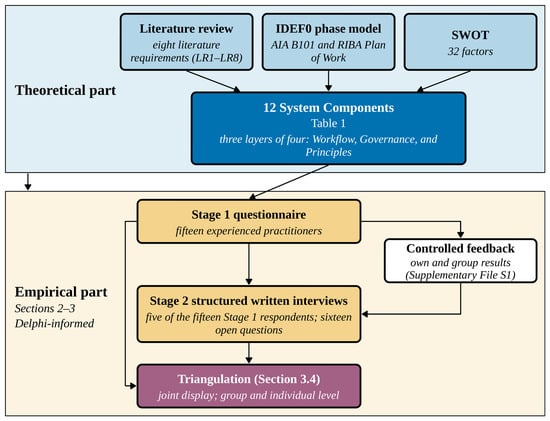
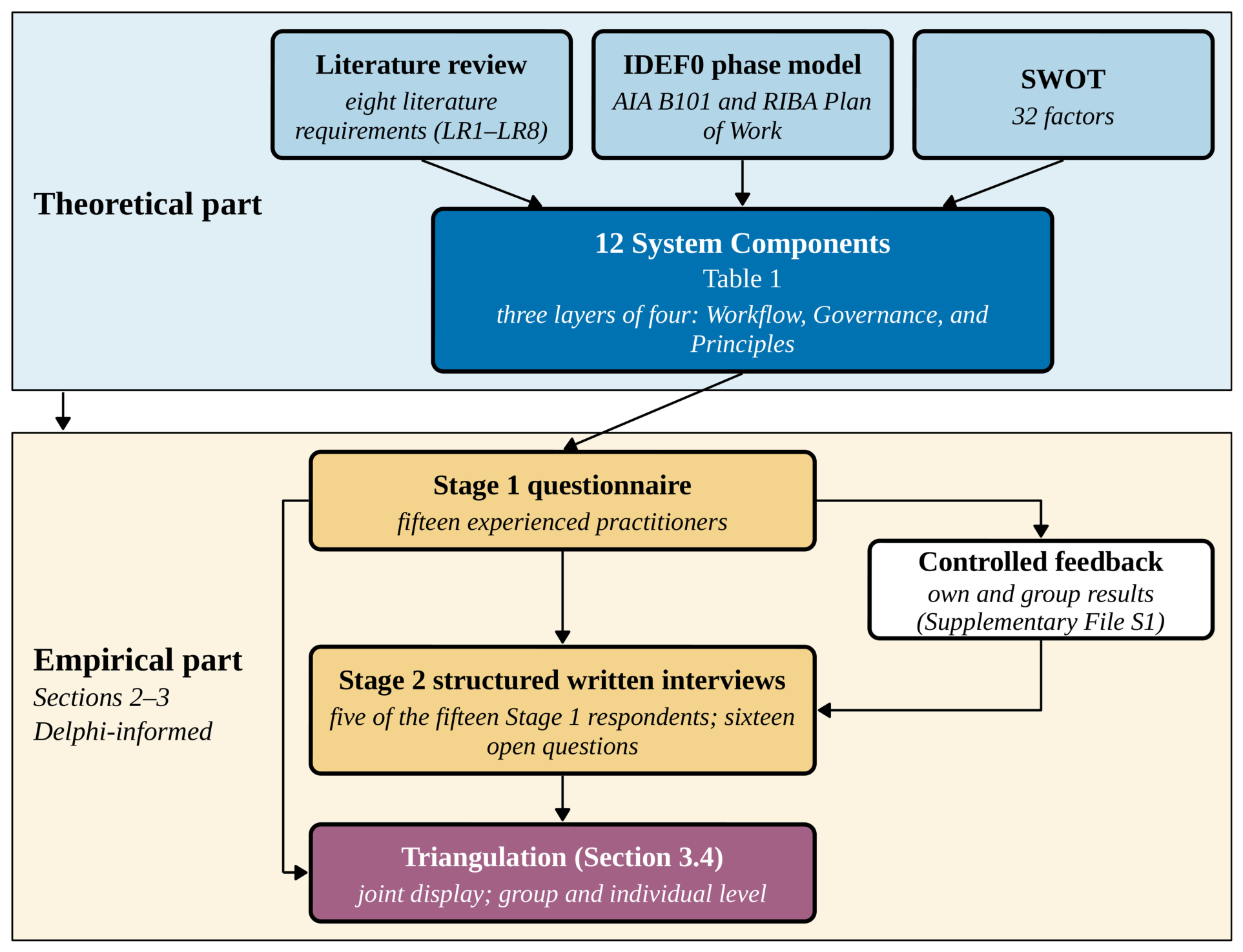
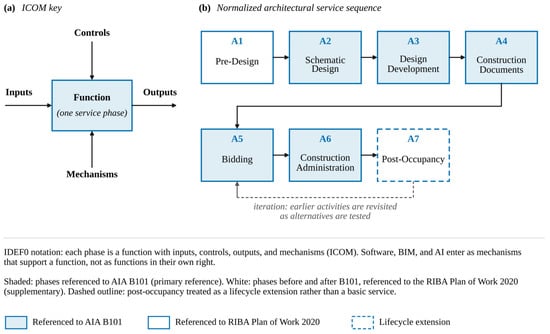
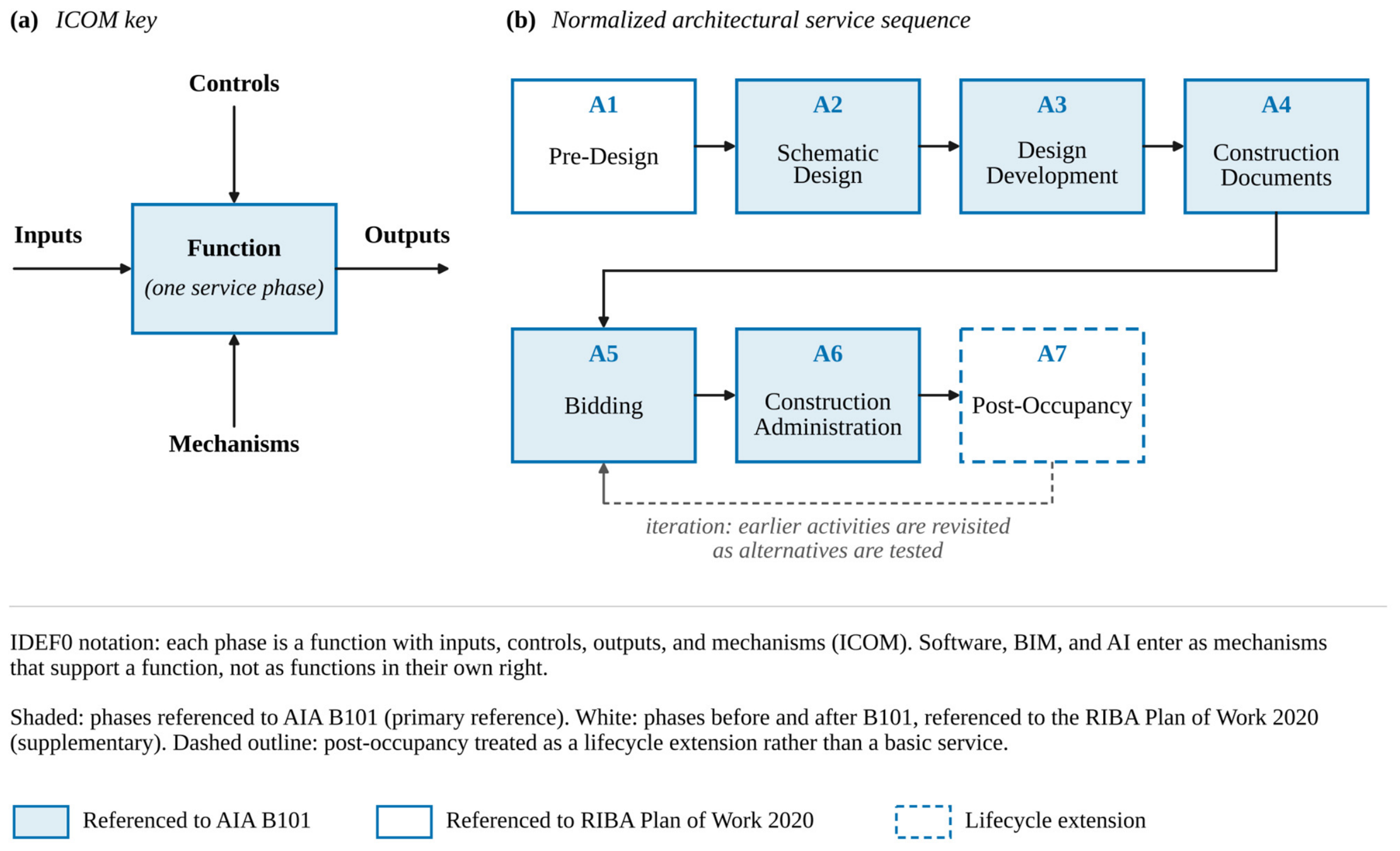
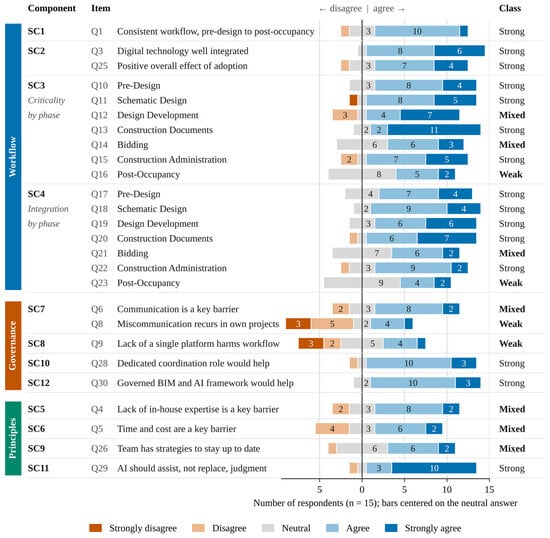
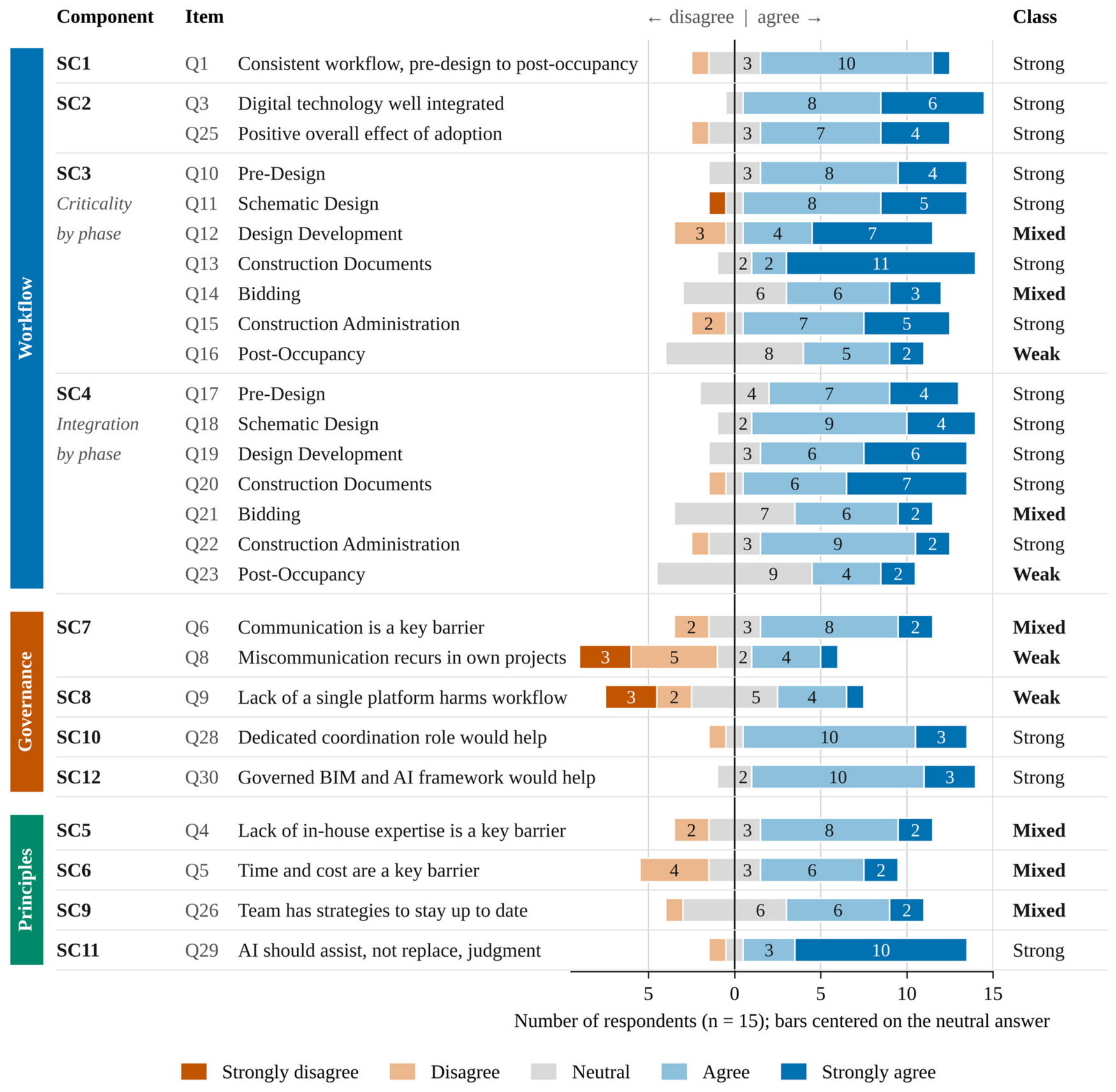
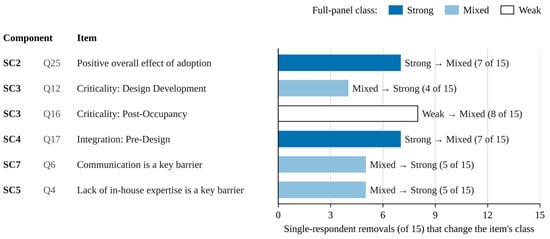
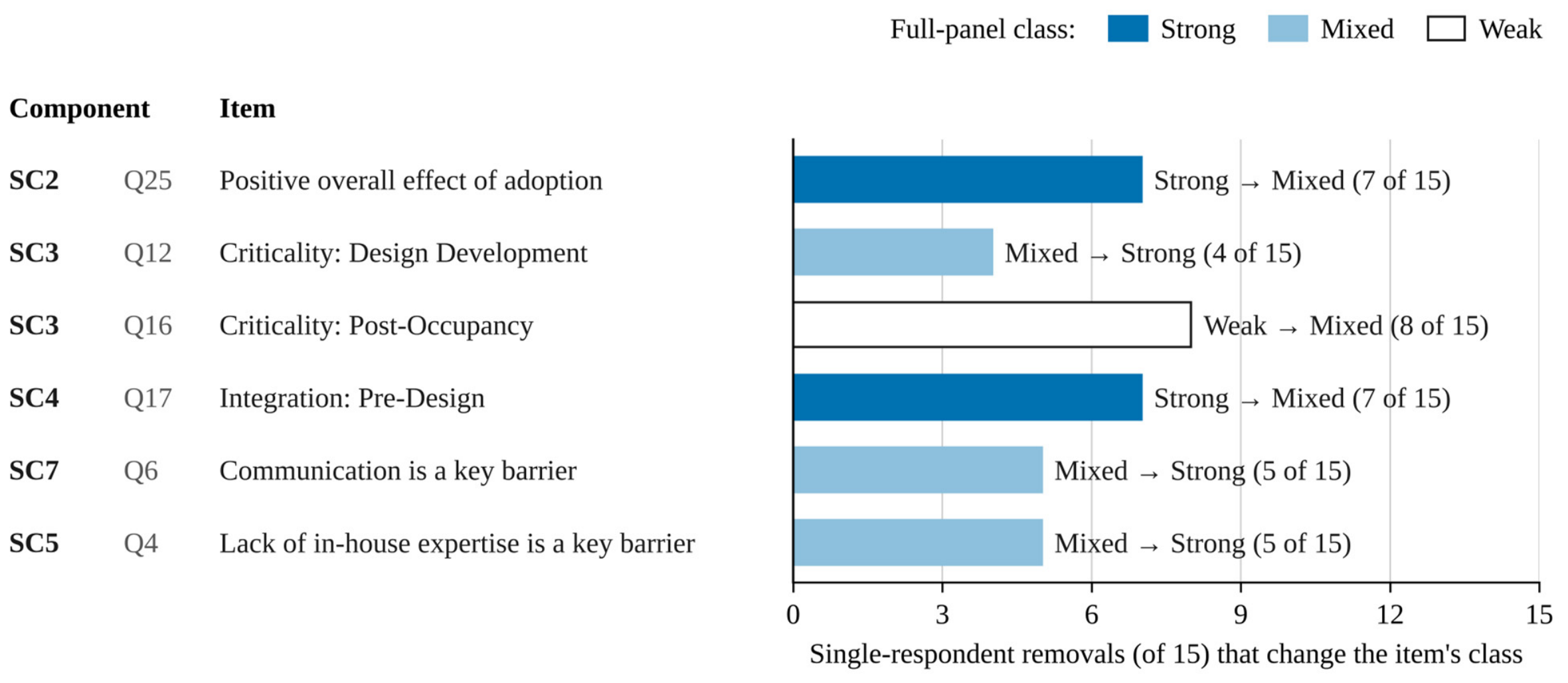
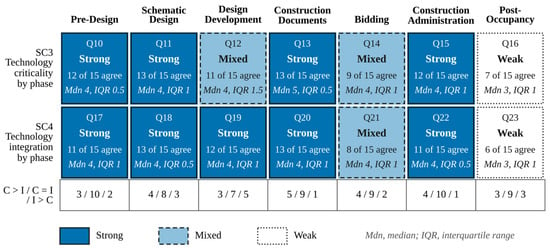
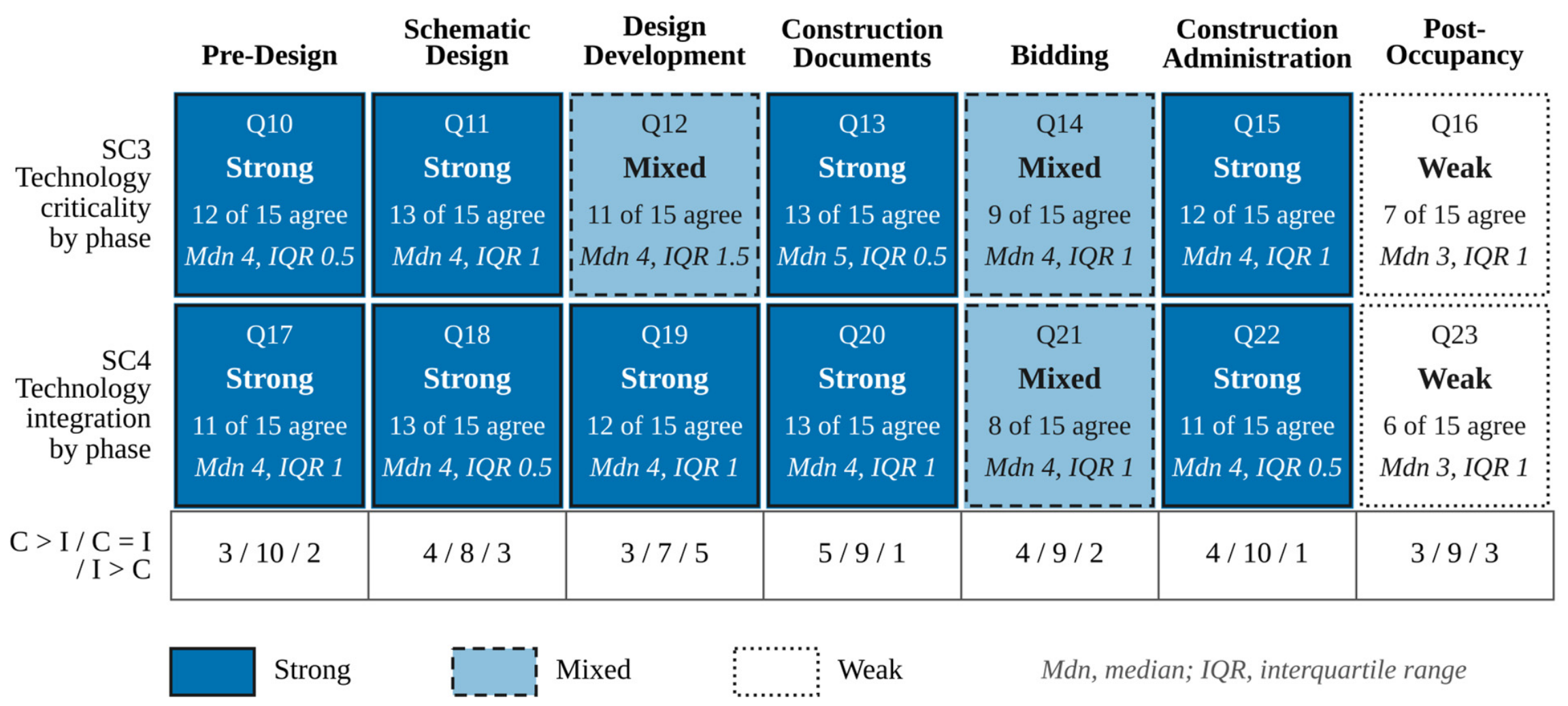
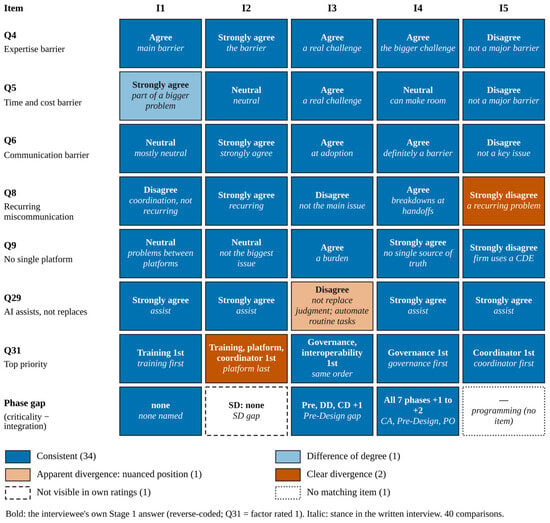
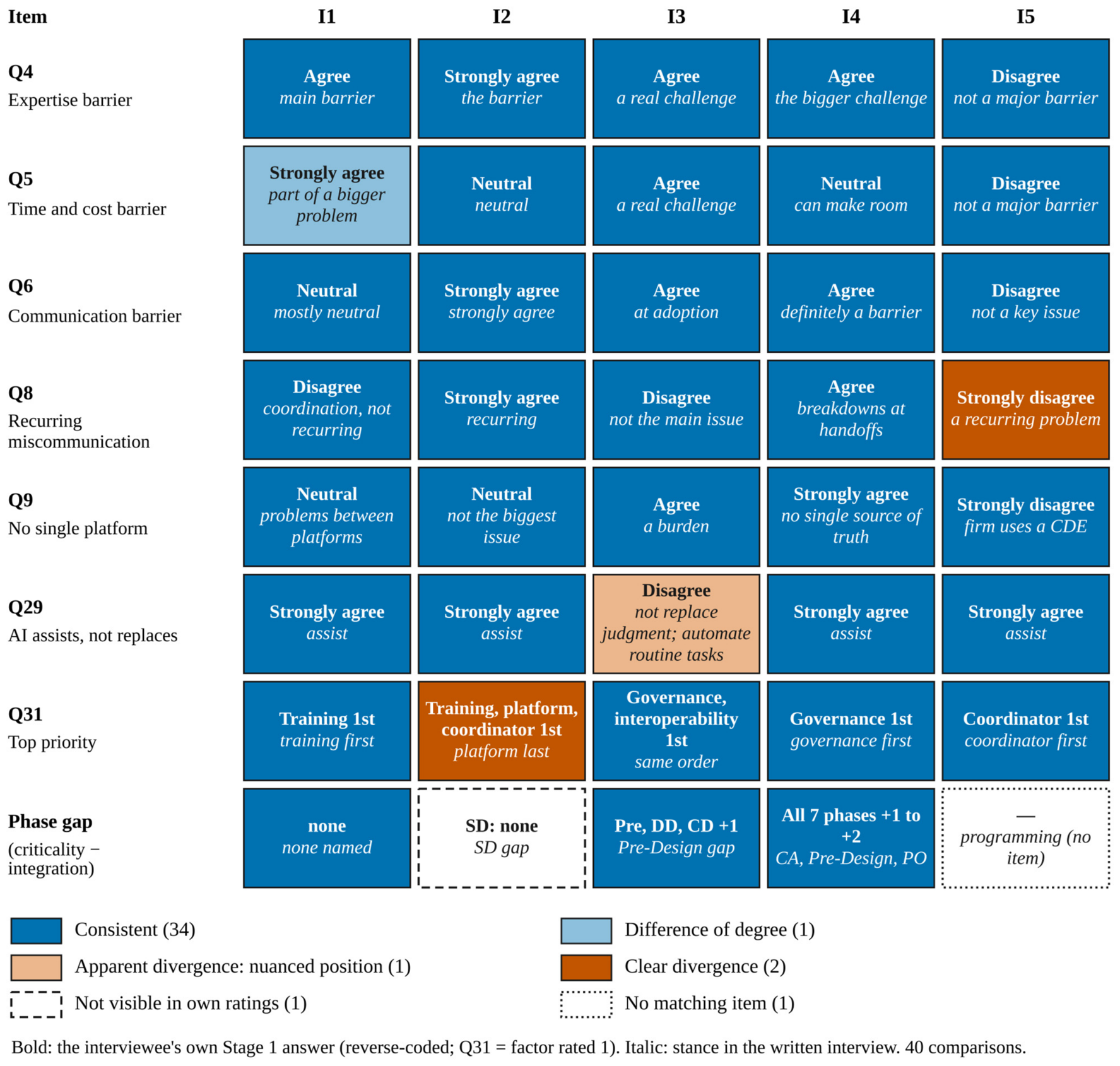
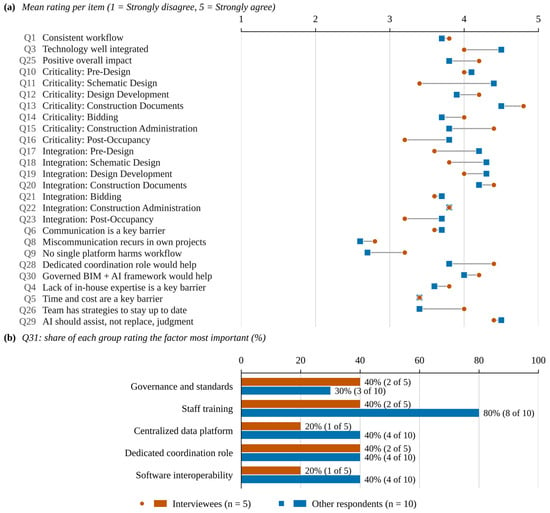
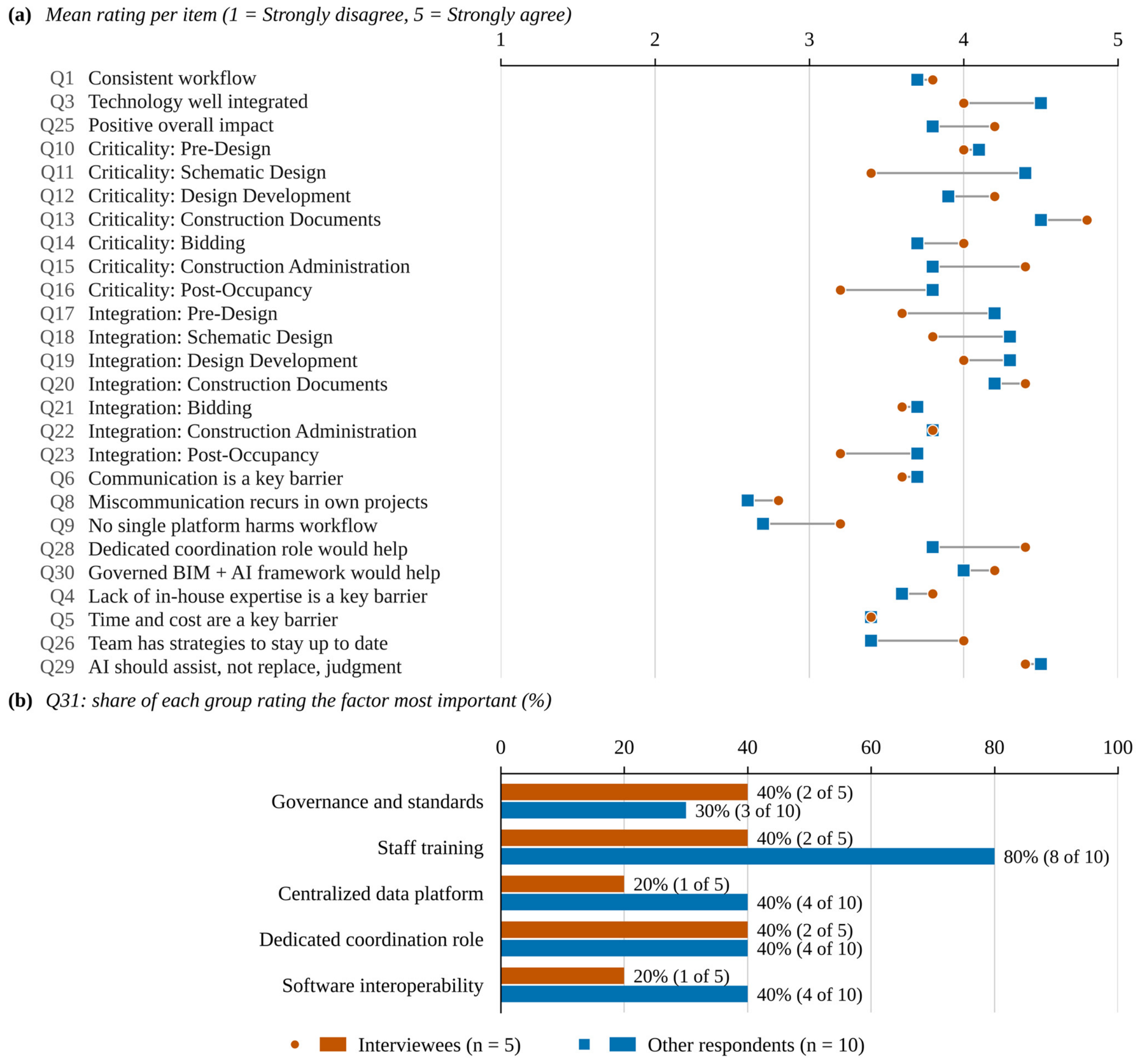
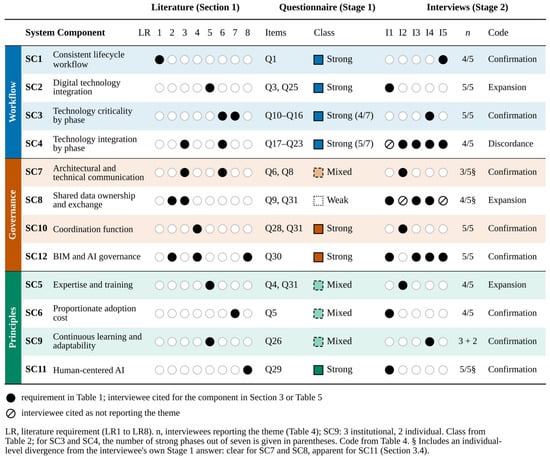
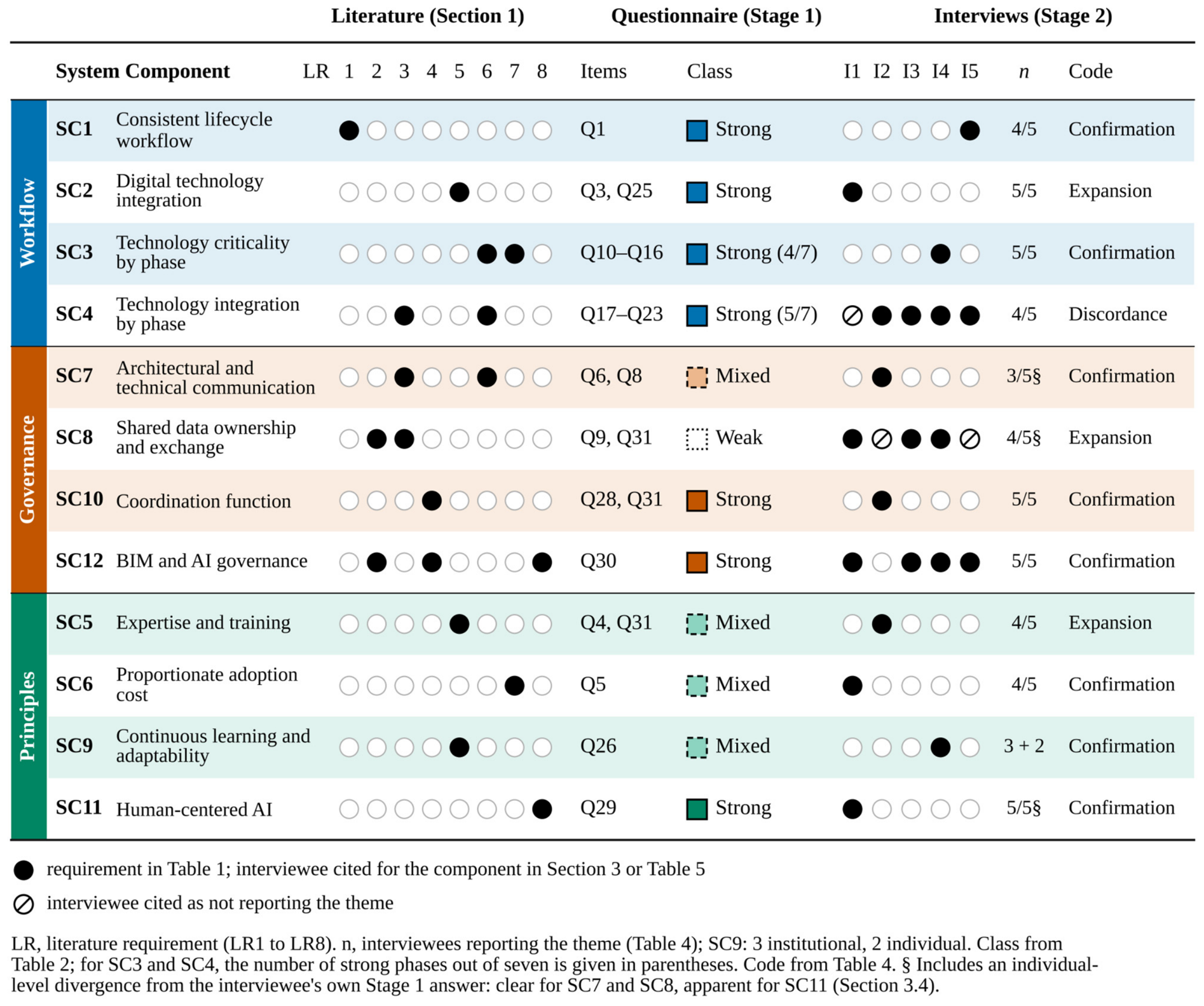
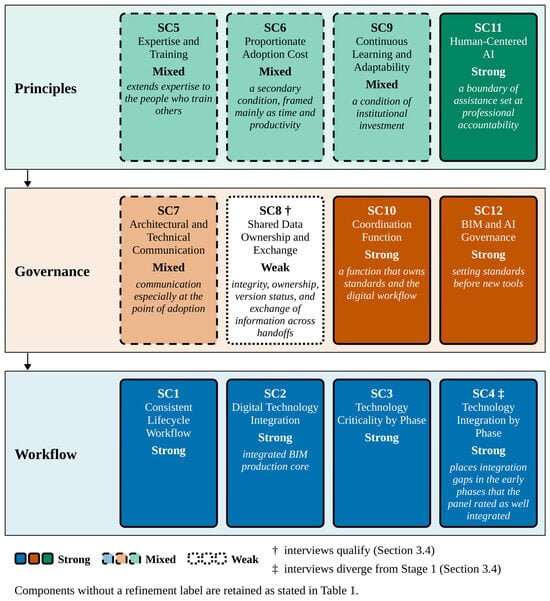
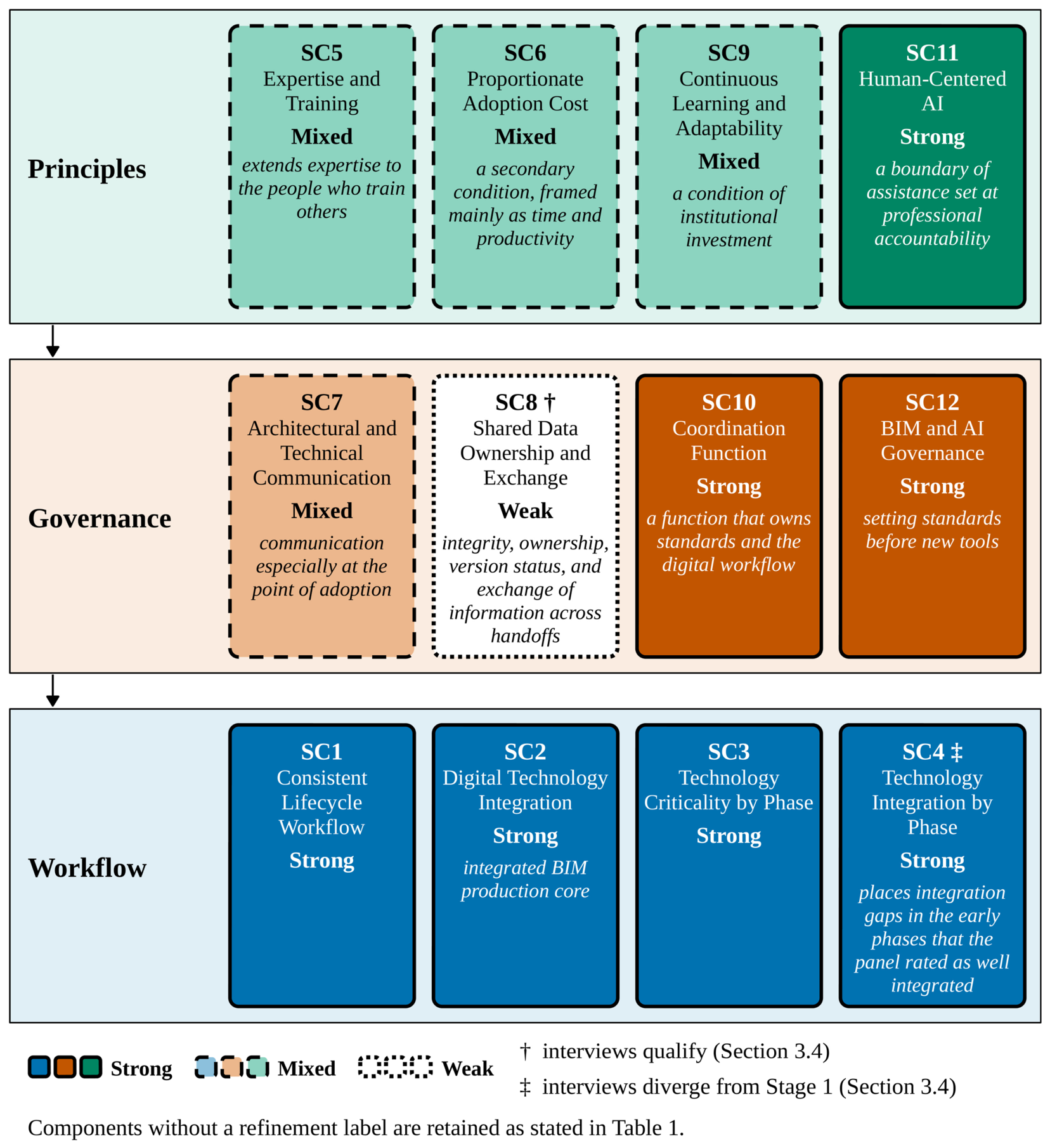

Disclaimer/Publisher’s Note: The statements, opinions and data contained in all publications are solely those of the individual author(s) and contributor(s) and not of MDPI and/or the editor(s). MDPI and/or the editor(s) disclaim responsibility for any injury to people or property resulting from any ideas, methods, instructions or products referred to in the content. |
© 2026 by the authors. Licensee MDPI, Basel, Switzerland. This article is an open access article distributed under the terms and conditions of the Creative Commons Attribution (CC BY) license.