


Abstract
Existing-building structural health monitoring (SHM) research remains fragmented across sensing technologies, data-interpretation methods, and engineering assessment, making it difficult to determine how heterogeneous deterioration evidence should be translated into reliable condition information and maintenance decisions. This review combines a bibliometric analysis of 538 publications from the Web of Science Core Collection with a qualitative synthesis of recent SHM technologies and applications. Building on the classical functional SHM workflow, a complementary monitoring-target dimension is introduced that distinguishes three evidence domains: visible and near-surface deterioration, structural-response and stiffness-related degradation, and global geometric deformation and displacement anomalies. The synthesis shows that these monitoring targets involve fundamentally different technical limitations. Level 1 is primarily constrained by defect observability and quantitative detectability under variable field conditions; Level 2 by the attribution and localization of damage-sensitive response changes under environmental, operational, and measurement variability; and Level 3 by the stability and accuracy of spatial or temporal references used to identify system-scale deformation. Across these levels, heterogeneous data fusion, uncertainty propagation, cross-building generalization, and the translation of monitoring evidence into engineering decisions remain major challenges. The proposed organization therefore extends beyond technology classification by linking deterioration evidence to sensing, interpretation, uncertainty, assessment, and future research needs.
1. Introduction
Global urban development is increasingly shifting from expansion dominated by new construction and large-scale redevelopment toward the management and renewal of existing building stocks. In China, four decades of rapid urbanization have created a vast stock of buildings constructed under different technical standards and service conditions. Many early-built buildings now face material degradation, accumulated structural damage, and increasing exposure to extreme hazards. Recent policies have promoted three complementary mechanisms—housing safety inspection, housing safety management funds, often referred to as housing pension funds, and housing quality and safety insurance—as part of a whole-life-cycle approach to building safety. By 2025, 42 Chinese cities had implemented pilot schemes for whole-life-cycle building safety management, and establishing this system remained part of the national housing and urban–rural development agenda for 2026. However, the safety management of existing buildings still relies heavily on periodic visual inspection, which is subjective, labor-intensive, and limited in its ability to detect hidden or time-dependent deterioration [1]. These limitations create a need for monitoring approaches that can provide continuous and interpretable evidence of structural condition.
Structural Health Monitoring (SHM) provides a systematic basis for acquiring structural information, identifying changes in condition, and supporting engineering decisions. Farrar and Worden (2007) defined SHM as a systematic damage-detection process that integrates several key stages, including operational evaluation, data acquisition, feature extraction and information condensation, as well as statistical modeling for feature discrimination. From an engineering perspective, Brownjohn (2007) further highlighted that the primary objective of SHM is to determine whether a structure can continue to perform its intended functions safely and effectively [2,3]. Together, these perspectives indicate that the understanding of SHM has gradually evolved. It is no longer regarded merely as a series of monitoring procedures, but as an integrated approach that supports structural condition assessment, repair strategies, strengthening measures, and long-term maintenance decisions.
The methodological evolution of SHM has followed a comparable trajectory. In its early development, SHM mainly depended on physics-based models and finite-element model updating techniques. Researchers typically analyzed variations in natural frequencies, mode shapes, and other modal parameters to identify potential damage or stiffness degradation within structures [4]. Their application to operating structures is complicated by temperature, humidity, changing loads, and measurement noise, which may produce response variations comparable to those caused by minor damage. The statistical pattern-recognition paradigm subsequently reformulated SHM as anomaly detection and classification based on damage-sensitive data features [5]. More recently, artificial intelligence and digital twins have extended SHM from current-condition identification toward performance prediction, remaining-service-life assessment, and preventive maintenance [6]. Table 1 summarizes this evolution across three dimensions: essential attributes, methodological paradigms, and functional boundaries.
Table 1.
Academic perspectives and evolution of definitions of SHM.
The development of SHM has also been influenced by changes in infrastructure and building-safety governance. Early guidance mainly standardized structural testing, sensing, and inspection procedures. As building and infrastructure stocks aged, several countries introduced periodic inspection, risk classification, and online monitoring into formal safety-management systems. More recent policies increasingly connect monitoring with asset digitalization, remote inspection, predictive maintenance, and urban resilience. These developments indicate that SHM is moving from project-specific technical deployment toward an institutional component of whole-life-cycle safety management. Representative policies and standards are summarized in Table 2.
Table 2.
Evolution of key global policies and standards for SHM.
Technical capabilities progressed in parallel with these conceptual and institutional changes. From the 1990s to the mid-2000s, SHM relied mainly on local non-destructive testing, including ultrasonic testing and acoustic-emission monitoring, together with physics-based finite-element model updating. These approaches provided localized measurements or model-based evidence of structural condition, but their application to operating structures was affected by environmental and operational variability and remained difficult to extend to continuous and spatially distributed monitoring [4,5,16].
From the mid-2000s to the late 2010s, statistical pattern recognition shifted SHM toward anomaly detection and classification based on damage-sensitive features. MEMS accelerometers and wireless smart-sensor networks reduced cabling and deployment requirements, while distributed optical-fiber sensing and fiber Bragg grating sensors enabled denser measurements of vibration and strain responses. The increasing availability of heterogeneous data also promoted multimodal sensing, in which measurements from different sensors were combined to provide complementary evidence of structural condition [17,18,19].
Since the 2020s, deep-learning models, including convolutional and recurrent neural networks, have improved feature extraction from images, structural-response time series, and point-cloud data. Physics-informed neural networks have further incorporated physical and structural constraints into data-driven interpretation [7,20]. Digital twins and Scan-to-BIM reconstruction have created virtual environments in which monitoring data can be associated with building components and updated representations. Their integration with real-time visualization increasingly supports condition assessment, prognosis, and predictive maintenance [21,22,23]. Figure 1 summarizes this progression from local testing and physics-based diagnosis to distributed and multimodal sensing, data-driven identification, and AI–digital-twin-enabled management.
Figure 1.
Evolution of SHM concepts and technologies for intelligent monitoring of existing buildings [4,5,17,18,19,20,21,22,23,24].
Recent reviews have examined advanced sensing and non-destructive testing, data-driven vibration analysis, AI-assisted damage identification, and digital-twin applications in SHM [6,7,24,25,26]. However, most existing reviews are primarily organized around sensor types, algorithm families, or individual application scenarios. Although these technology-oriented classifications provide valuable summaries of methodological development, they do not fully explain how different forms of deterioration evidence in existing buildings should be associated with appropriate sensing strategies, data-interpretation methods, and subsequent engineering assessment. In addition, sensing technologies, analytical methods, and digital platforms are often discussed separately, making it difficult to trace how heterogeneous monitoring data are progressively transformed into interpretable structural-condition information and maintenance decisions. These limitations are particularly important for existing buildings, where incomplete design information, material heterogeneity, previous repair interventions, occupancy constraints, and changing environmental and operational conditions introduce additional uncertainty into monitoring and damage interpretation.
Accordingly, this review addresses the following overarching research question: How can different forms of deterioration evidence in existing buildings be systematically linked to appropriate sensing technologies, data-interpretation methods, and engineering assessment and decision-support processes?
To address this question, the review builds on the operational-evaluation principle of Farrar and Worden [2], which emphasizes defining monitoring objectives and damage scenarios before data acquisition and feature extraction. Rather than proposing a new damage-severity hierarchy, this study develops a monitoring-target-oriented organizational framework for intelligent SHM of existing buildings. The framework distinguishes three monitoring-target levels according to the dominant form of deterioration evidence: (1) visible and near-surface deterioration, (2) structural-response and stiffness-related degradation, and (3) global geometric deformation and displacement anomalies. These monitoring targets are subsequently examined through four functional SHM stages: operational evaluation, data acquisition, data interpretation, and assessment and decision support. The three monitoring-target levels define what form of structural evidence is being sought, whereas the four functional stages describe how that evidence is acquired, interpreted, and converted into engineering information.
Accordingly, the objectives of this review are:
To characterize the bibliometric development and principal thematic clusters of intelligent SHM research for existing buildings;
To establish a monitoring-target-oriented framework that differentiates the principal forms of deterioration evidence relevant to existing-building assessment;
To critically examine the relationships among dominant physical observables, sensing technologies, data-interpretation methods, and engineering outputs for each monitoring-target level;
To identify the principal sources of uncertainty, implementation limitations, and unresolved technical challenges associated with the different monitoring targets;
To synthesize the pathways from monitoring evidence to digital representation, condition assessment, prognosis, and maintenance decision support, and to identify corresponding future research opportunities.
The remainder of this paper is organized as follows. Section 2 presents the literature-retrieval strategy, descriptive bibliometric profile, keyword co-occurrence analysis, and the monitoring-target-oriented framework. Section 3 reviews intelligent SHM technologies through the functional stages of data acquisition, data interpretation, and assessment and decision support, while relating these technologies to the three monitoring-target levels. Section 4 critically discusses level-specific technical challenges, uncertainty sources, cross-level integration, and future research needs. Section 5 presents the principal conclusions.
2. Review Methodology
2.1. Data Source and Retrieval Strategy
The bibliometric dataset was retrieved from the Web of Science Core Collection on 20 July 2026. Web of Science was selected as the sole database to maintain consistency in bibliographic fields and cited-reference information. A Topic Search was conducted across titles, abstracts, author keywords, and Keywords Plus using the following expression:
TS = ((“structural health monitoring” OR “structural condition monitoring” OR “structural health assessment” OR “structural safety monitoring” OR “building health monitoring”) AND (building OR “building structure” OR “existing structure*” OR “built environment” OR “architectural heritage”) NOT (bridge* OR tunnel* OR pipeline* OR pavement* OR railway* OR “wind turbine*” OR aircraft* OR ship* OR dam*)).
The publication period was restricted to 2011–2026, and only English-language articles and review articles were retained. After applying the above criteria, a total of 538 records were identified and exported with complete records and cited references. This dataset was then used as the fixed source for the descriptive bibliometric analysis and keyword co-occurrence analysis. Additional studies were introduced in Section 3 when necessary to provide further support for specific technical discussions; however, these supplementary references were not included in the bibliometric analysis.
2.2. Publication Profile
The publication profile was established using the “Analyze Results” function in Web of Science. Publication records were categorized by publication year, research area, organization-enhanced affiliation, and source title. The exported data were subsequently reorganized and presented in a consistent format. Since a single publication can be associated with multiple research areas or institutions, these distributions should be interpreted as indicators of disciplinary coverage and institutional involvement rather than independent publication categories.
As shown in Figure 2a, annual publication output remained relatively low before 2018 but experienced a notable increase thereafter, reaching the highest value among complete publication years in 2025. The 2026 value includes only records indexed up to the retrieval date and should therefore not be compared directly with complete publication years. Its lower value relative to 2025 reflects the partial-year coverage rather than a decline in research activity. Engineering was the dominant research area, followed by Construction and Building Technology and then Instruments and Instrumentation (Figure 2b). Tongji University was the most productive institution, while Sensors, Journal of Building Engineering, Buildings, and Structural Control and Health Monitoring were the leading publication sources (Figure 2c,d). These results indicate that intelligent SHM research is primarily engineering-oriented while increasingly integrating building technology, sensing, and data-analysis methods.
Figure 2.
Bibliometric profile of the 538 publications retrieved from the Web of Science Core Collection: (a) annual publication output and exponential trend; (b) normalized distribution of subject-area assignments; (c) leading affiliations; and (d) leading source titles. The 2026 value includes publications indexed up to 20 July 2026.
2.3. Keyword Co-Occurrence Analysis
Author-keyword co-occurrence analysis was conducted in VOSviewer(1.6.20) using the same 538-record dataset. The analysis type was set to “Co-occurrence”, the unit of analysis to “Author keywords”, and the counting method to “Full counting”. The minimum occurrence threshold was set to three, resulting in 97 keywords being retained in the final network. The network contained 315 links with a total link strength of 564. To reduce fragmentation into numerous small groups and obtain an interpretable thematic structure, the clustering resolution was set to 0.25 and the minimum cluster size to three, producing four clusters.
In Figure 3, node size represents the occurrence frequency of a keyword, while the connecting lines indicate co-occurrence relationships and their thickness represents link strength. The distance between two nodes reflects their thematic relatedness, and node color denotes cluster membership. All 97 keywords were retained in the analysis, although only the more prominent labels are displayed to avoid excessive overlap. The thematic cluster annotations and visual-encoding legend were added after exporting the VOSviewer network to improve readability without changing the original node positions, cluster memberships, or network relationships. The legend in Figure 3 summarizes these visual encodings, while the cluster annotations identify the dominant thematic focus of each group.
Figure 3.
Author-keyword co-occurrence network of intelligent SHM research. Node size represents keyword occurrence frequency, link width indicates co-occurrence strength, node distance reflects thematic relatedness, and node color denotes cluster membership.
Based on the dominant keywords and their positions within the network, the four clusters reveal several major research themes in intelligent SHM. Cluster 1, thematically interpreted as core SHM and damage identification, contains the largest number of keywords and primarily focuses on “structural health monitoring”. The associated terms, including “deep learning”, “modal analysis”, “data fusion”, and “crack detection”, highlight the current research emphasis on structural response characterization and intelligent damage identification. Its central position and dense connections with other clusters indicate that response-based monitoring and damage diagnosis continue to form the methodological core around which newer sensing and digital technologies are integrated.
Cluster 2, thematically interpreted as digital technologies and visual inspection, is characterized by keywords such as “building information modeling (BIM)”, “unmanned aerial vehicle”, “augmented reality”, and “digital twin”. Research within this cluster mainly explores the integration of digital technologies and visual inspection methods into existing-building monitoring. Its close proximity to the central SHM cluster suggests that BIM, UAV-based inspection, and digital-twin technologies are increasingly being coupled with physical monitoring and automated damage interpretation rather than developing as isolated digital applications.
Cluster 3, thematically interpreted as heritage monitoring and environmental effects, includes keywords such as “masonry”, “architectural heritage”, “temperature”, “strain”, and “construction monitoring”. These studies primarily address the monitoring and interpretation of existing structures under varying environmental and operational conditions. Notably, the position of “digital twin” near the interface between Clusters 2 and 3 reflects its bridging role between physical monitoring processes and digital representation. The association of temperature with strain and dynamic-characteristic-related terms further indicates that environmental conditions are closely connected with the interpretation of damage-sensitive structural responses, particularly in existing and historic structures.
Cluster 4, thematically interpreted as smart materials and self-sensing, comprises keywords associated with “smart materials”, “piezoresistivity”, and “self-sensing”. Unlike the other clusters, this group represents a more specialized research direction that focuses on integrating sensing functions into construction materials and developing less intrusive monitoring solutions. Its relatively peripheral position suggests that self-sensing materials currently constitute a more specialized technological branch and remain less strongly integrated with the dominant building-SHM, data-interpretation, and digital-management themes.
The spatial relationships among the clusters provide further insight into the structure of the research field. Structural-response monitoring and damage identification occupy the central region of the network, indicating that response-based diagnosis remains a methodological core of SHM research. Digital technologies such as BIM, UAVs, and digital twins are positioned close to this core, reflecting increasing integration between physical monitoring, automated inspection, and digital representation. Environmental and heritage-related terms are more closely associated with temperature, strain, and dynamic characteristics, highlighting the importance of context-dependent interpretation for existing and historic structures. In contrast, self-sensing and smart-material technologies form a relatively peripheral cluster, suggesting that these approaches remain more specialized and less integrated with mainstream building-SHM workflows. Taken together, this network topology indicates that intelligent SHM is evolving from relatively separate sensing, diagnostic, and digital technologies toward more closely connected systems in which physical monitoring, intelligent interpretation, and digital representation increasingly interact.
Overall, the network suggests an ongoing transition from relatively isolated sensing and analytical technologies toward more integrated SHM systems that combine structural monitoring, intelligent interpretation, and digital representation. Nevertheless, the connection between these technical domains and engineering decision support remains comparatively limited. This pattern is important because it indicates that the principal gap is not simply the availability of individual sensing or analytical technologies, but the lack of a systematic pathway linking different forms of monitoring evidence to interpretation and subsequent engineering use. This observation provides bibliometric motivation for the monitoring-target-oriented framework introduced in Section 2.4. Therefore, rather than organizing the following review according to individual technology categories, this study adopts a functional perspective based on the SHM workflow. The subsequent sections are structured around three stages, data acquisition, data interpretation, and assessment and decision support, to discuss how different types of monitoring information contribute to existing-building condition assessment and maintenance decisions.
2.4. Monitoring-Target Framework for Intelligent SHM
To overcome the fragmentation identified in the bibliometric analysis and to establish a clearer link between structural deterioration evidence and SHM technology selection, this review introduces a monitoring-target-oriented framework for existing buildings. Classical SHM frameworks, particularly that of Farrar and Worden, define SHM as a systematic process including operational evaluation, data acquisition, feature extraction and information condensation, and statistical model development for feature discrimination [2]. Among these stages, operational evaluation is fundamental because it defines the relevant damage scenarios, monitoring objectives, target physical observables or response features, environmental and operational conditions, and required assessment outcomes before sensing and analytical methods are selected.
Building on this principle, the proposed framework organizes monitoring targets according to the dominant observable manifestation of structural deterioration. Importantly, the three levels do not represent a damage-severity hierarchy or a sequential progression from minor to severe damage. Instead, they represent different forms of structural evidence that may occur independently or simultaneously within the same building. This distinction enables sensing and interpretation technologies to be organized according to the physical information required for assessment rather than according to sensor category alone.
Level 1: Visible and near-surface deterioration.
This level represents localized deterioration that can be directly observed or inferred from surface-related measurements, including cracks, spalling, delamination, moisture-related anomalies, and other visible or near-surface defects. The dominant physical observables include surface appearance, defect geometry, and temperature-related anomalies. Optical imaging, UAV inspection, and infrared thermography are therefore particularly relevant to this level [7,27]. The reliability of the resulting evidence can be influenced by illumination, viewing geometry, surface properties, environmental conditions, and defect detectability.
Level 2: Structural-response and stiffness-related degradation.
This level describes deterioration that is inferred from changes in structural response rather than from directly visible defects. Relevant physical observables and response features include acceleration, vibration characteristics, strain responses, natural frequencies, mode shapes, damping characteristics, and other damage-sensitive response parameters [2,5]. These measurements can provide indirect evidence of changes in structural stiffness and dynamic properties. However, their interpretation is particularly sensitive to environmental and operational variability, measurement noise, sensor placement, baseline-state uncertainty, and the sensitivity of the selected features to actual structural deterioration.
Level 3: Global geometric deformation and displacement anomalies.
This level concerns system-scale changes expressed through overall structural geometry and long-term or event-induced deformation. The dominant observables include displacement, settlement, inclination, residual drift, and three-dimensional deformation fields. LiDAR/TLS, photogrammetry, GNSS, and related spatial sensing technologies are particularly relevant to obtaining such information [2,6]. The reliability of these measurements depends on factors including occlusion, point-cloud registration accuracy, reference-frame stability, measurement resolution, GNSS multipath effects, and the availability of reliable baseline geometry.
The monitoring-target classification and the SHM workflow therefore represent two complementary dimensions of the proposed framework. The three monitoring-target levels define what form of structural evidence is required for assessment, whereas the four functional stages define how that evidence is transformed into engineering information. Operational evaluation first identifies the relevant monitoring target, representative physical observables or response features, and required assessment outcome. Data acquisition then obtains the measurements required to characterize these target quantities; data interpretation converts the acquired measurements into damage-sensitive features and structural evidence; and assessment and decision support translates the resulting evidence into condition evaluation, digital representation, prognosis, and maintenance actions.
The contribution of this framework is not a new SHM workflow or a damage-severity hierarchy, but a comparative organization of the evidence required for existing-building assessment. By relating the three monitoring-target domains to the functional workflow, the review examines how physical observables, interpretation requirements, and uncertainty sources constrain the use of different monitoring methods. Its analytical value is demonstrated through the distinct limitations identified for each domain: observability and quantitative detectability, damage attribution and localization, and spatial or temporal reference stability.As illustrated in Figure 4, the proposed framework links the three monitoring-target levels to representative physical observables, sensing and measurement methods, data-interpretation procedures, and assessment and decision-support outputs across the four functional SHM stages.
Figure 4.
Monitoring-target-oriented framework for intelligent SHM of existing buildings, linking level-specific deterioration evidence and physical observables to the functional stages of operational evaluation, data acquisition, data interpretation, and assessment and decision support.
3. Intelligent SHM Technologies for Existing Buildings: From Monitoring Targets to Decision Support
Building on the monitoring-target-oriented framework established in Section 2.4, this section reviews intelligent SHM technologies for existing buildings through three functional stages: data acquisition, data interpretation, and assessment and decision support. Section 3.1, Section 3.2 and Section 3.3 examine how monitoring data are acquired, transformed into damage-related information, and subsequently used for digital representation, condition assessment, prognosis, and maintenance support.
3.1. Intelligent Data Acquisition
- (1)
- Vision and Thermal Sensing
Vision-based sensing provides a non-contact approach for acquiring information on visible and near-surface deterioration in existing buildings. UAV-based optical imaging allows façades, roofs, and other difficult-to-access areas to be inspected from multiple viewpoints and can be combined with deep-learning-based crack detection and three-dimensional reconstruction [28,29,30,31]. Its field performance is affected by image resolution, illumination, viewing angle, background complexity, flight conditions, and the limited availability of representative UAV-based building-defect datasets [29,31,32].
Infrared thermography (IRT) complements optical imaging by recording surface-temperature distributions associated with delamination, voids, moisture-related deterioration, and building-envelope anomalies that may not be directly visible in RGB images [33,34,35]. Passive IRT measurements remain sensitive to solar irradiation, ambient temperature, wind, surface properties, defect depth, and the inspection time window [33,35]. AI-assisted thermal-image analysis can support anomaly screening, but the resulting temperature patterns still need to be interpreted in relation to environmental conditions and envelope characteristics [36]. UAV imaging and IRT primarily support Level 1 by acquiring optical images and surface-temperature distributions associated with visible and near-surface deterioration.
- (2)
- Contact and Distributed Sensing
Contact and distributed sensing techniques complement vision-based methods by capturing structural responses that cannot be directly obtained from surface images, including acceleration, vibration, local strain, bond–slip behavior, and distributed crack-induced deformation. Advanced sensor technologies used in non-destructive testing (NDT) and SHM include fiber-optic sensors, MEMS, acoustic emission, ultrasonics, thermography, drones, and other emerging systems, but their applicability depends on the monitoring objective and the type of structural response to be measured [25]. Among these technologies, MEMS accelerometers and fiber-optic sensing are particularly relevant to continuous response monitoring in existing buildings.
Wireless MEMS accelerometers can measure low-amplitude and low-frequency structural vibration while reducing the cabling required for distributed deployment. Their performance nevertheless depends on sensor noise, sampling capability, time synchronization, data transmission, and power supply, particularly when low-level responses of large civil structures are considered [37]. Recent low-noise wireless systems have been used for full-scale dynamic characterization, including a 211 m building [38]. García-Macías et al. installed 12 high-sensitivity uniaxial accelerometers at six elevations of the 41 m Sciri Tower and continuously recorded ambient vibration and temperature during a three-week monitoring campaign, providing a field dataset for the dynamic assessment of an existing historic masonry structure [39]. Accelerometers directly provide acceleration or vibration time histories, from which damage-sensitive dynamic characteristics can be extracted.
Fiber-optic sensing provides local and distributed measurements of strain-related responses. Fiber Bragg grating (FBG) sensors have been embedded in reinforced-concrete specimens to monitor bond–slip behavior at steel–concrete interfaces [19]. Distributed optical-fiber sensing (DOFS) provides continuous strain or temperature profiles along the sensing fiber, offering denser spatial coverage than point-based sensing and reducing the likelihood of missing localized response changes [18,40]. Optical frequency-domain reflectometry (OFDR) enables high-spatial-resolution distributed strain measurement, although its sensing range, installation conditions, and long-term field performance must be considered [18,41]. Zhao et al. estimated crack width from post-cracking strain redistribution and showed that closely spaced cracks may produce overlapping strain peaks, thereby affecting crack identification and quantification [42]. Thus, fiber-optic sensing directly provides local or distributed strain measurements, while crack-related quantities can be inferred from the measured strain response. Accelerometers and distributed strain sensors mainly support Level 2 assessment, while distributed strain measurements may also assist Level 1 crack quantification when strain concentrations are explicitly related to crack development.
- (3)
- Spatial and Geometric Sensing
Spatial and geometric sensing techniques capture deformation that cannot be adequately represented by surface images or isolated point measurements, including global displacement, settlement, inclination, and three-dimensional geometric change. LiDAR and terrestrial laser scanning (TLS) acquire dense point clouds from which structural geometry and deformed shapes can be reconstructed, whereas a Global Navigation Satellite System (GNSS) records continuous displacement histories at selected monitoring locations [43,44,45].
Early TLS-based studies showed that laser scanning can recover complete deformation profiles rather than displacement at a limited number of sensor locations [43]. Dense point clouds have subsequently been combined with registration, feature extraction, and geometric fitting to measure displacement, deformation, and surface irregularities [46,47]. Zhang et al. integrated ground-based real-aperture radar measurements with a LiDAR-derived three-dimensional model to investigate the dynamic deformation of an operational super-high-rise building under wind loading. The combined measurements enabled the displacement response along the building height to be related to its three-dimensional geometry and visualized as an overall deformation state [48]. LiDAR-based sensing nevertheless remains affected by occlusion, redundant objects, surface reflectance, scanner location, environmental conditions, registration errors, and point-cloud noise [44].
A GNSS complements point-cloud sensing by providing displacement time series for long-term and dynamic monitoring. It does not require intervisibility between monitoring stations and has been applied to towers, chimneys, tall buildings, and other large structures [45,49]. Its accuracy is affected by satellite geometry, multipath effects, atmospheric delays, receiver noise, sampling-rate limitations, and surrounding obstructions; multi-constellation positioning, signal denoising, and fusion with accelerometer data are therefore used to improve displacement estimation [45,49,50]. LiDAR/TLS and GNSSs primarily support Level 3 by providing dense three-dimensional geometric measurements and displacement records for the characterization of settlement, inclination, and global structural deformation.
- (4)
- Wireless Sensor Networks and IoT
Wireless sensor networks (WSNs), wireless smart sensor networks (WSSNs), and Internet of Things (IoT) platforms connect distributed sensors with communication gateways, local or edge processors, and remote monitoring platforms. Rather than measuring a specific type of deterioration, they support data transmission, time synchronization, storage, visualization, and remote access. Wireless networks reduce cabling requirements and improve deployment flexibility, although network scalability, sensor placement, bandwidth, power supply, and synchronization remain important constraints in long-term monitoring [17,51,52].
IoT platforms further enable continuous access to vibration, strain, displacement, and environmental data for building condition monitoring. For existing buildings, cloud-connected monitoring records can be used to identify abnormal changes in damage-sensitive parameters and support timely inspection, maintenance, or retrofit decisions, thereby contributing to service-life extension and maintenance-cost control [1]. Data quality remains a practical challenge in long-term monitoring, as sensor failures or transmission losses may introduce distortions into the recorded responses. Therefore, effective fault detection and data recovery strategies are essential to ensure reliable SHM performance [53].
The full-scale field study conducted by Bai et al. further demonstrates the complementary roles of different acquisition technologies. Fixed and mobile cameras, UAVs, wireless accelerometers, and LiDAR were deployed in a six-story reinforced-concrete building during successive structural-component removal tests. The imaging systems documented visible cracking, concrete spalling, and structural movement; the accelerometers recorded dynamic responses; and the pre- and post-test laser scans captured residual geometric deformation. The study also reported practical constraints including dust, occlusion, restricted sightlines, equipment damage, and synchronization requirements, showing that multimodal monitoring in existing buildings depends on both sensor complementarity and field deployment conditions [54].
Table 3 summarizes the data types, principal monitoring targets, and main supported assessment levels associated with the reviewed acquisition technologies.
Table 3.
Key data-acquisition technologies for structural health monitoring of existing buildings.
3.2. Intelligent Data Interpretation
Monitoring data must be converted into damage-related information before they can support building condition assessment. The reviewed methods are organized according to three data formats: optical and thermal images, structural-response signals, and spatial or geometric data.
- (1)
- Image-based Damage Recognition
Optical and thermal image interpretation converts image intensity, spatial patterns, and surface-temperature information into defect-related evidence for the identification, localization, and quantification of surface and near-surface deterioration.
Object-detection models such as YOLO rapidly locate defects using bounding boxes and confidence scores, whereas instance- and semantic-segmentation models delineate damaged regions at the pixel level, allowing crack length, width, and area to be estimated [7,29]. Comparative studies have demonstrated that YOLO-based models generally achieve faster defect localization, whereas Mask R-CNN provides more detailed and consistent segmentation of crack regions [55,56].
Building-scale studies offer more direct evidence regarding the practical applicability of these approaches. Kang et al. trained a CNN to classify five exterior-wall defect categories using images collected from aging buildings and applied the model to four buildings more than 25 years old; overlapping deterioration patterns, such as simultaneous scaling and spalling, remained more difficult to distinguish [22]. Bai et al. applied A-PANet Mask R-CNN to cracks and concrete spalling in a full-scale six-story reinforced-concrete building. The reported recognition accuracy varied substantially between indoor and distant exterior images, demonstrating the effects of camera distance, visibility, and image quality on field performance [54].
Transformer- and foundation-model-based methods further extend image interpretation to multiclass segmentation, tracking, and three-dimensional reconstruction. Azimi and Yang combined the Segment Anything Model, a Detection Transformer, and a refinement module to improve the segmentation and labeling of structural components and damaged regions [57]. For thermal images, reflections, ambient conditions, viewing angle, and surface emissivity may generate temperature patterns unrelated to actual defects [35]. Kurtser et al. developed a label-free color-to-thermal anomaly-detection method for building-envelope inspection, reducing dependence on manually annotated thermal datasets while retaining the need for environmental interpretation [36].
Overall, image-based interpretation primarily supports Level 1 by converting optical and thermal observations into localized defect categories, pixel-level damage regions, and quantitative geometric or thermal indicators.
- (2)
- Signal-Based Damage Analysis
Structural response data acquired by accelerometers, strain sensors, and other contact-sensing systems are converted through feature extraction into damage-sensitive indicators for detecting, locating, and quantifying structural changes. Existing methods include time- and frequency-domain signal processing, such as statistical analysis, Fourier transforms, wavelet transforms, and signal decomposition, while deep-learning models can learn hierarchical features directly from raw or processed response sequences [24,58].
Unlike Level 1 deterioration, which can often be interpreted relatively directly from surface observations, Level 2 deterioration is generally inferred indirectly from changes in structural response. For a linear structural system, the dynamic response is governed by , where M, C, and K denote the mass, damping, and stiffness matrices, respectively. Changes in structural stiffness, connectivity, or boundary conditions can therefore be reflected in natural frequencies, mode shapes, damping characteristics, strain responses, and acceleration responses. These quantities provide damage-sensitive evidence for Level 2 interpretation, while acoustic-emission and ultrasonic or guided-wave signals can provide complementary information on more localized deterioration [25].
However, these response features are not damage-specific because they are also affected by environmental and operational variability (EOV). Temperature, humidity, occupancy, live loads, excitation conditions, and boundary-condition changes may alter modal and strain-related features even when no structural damage is present. For example, long-term monitoring of the healthy Z24 Bridge showed natural-frequency variations of approximately 14–18% attributable to environmental changes [59]. Such variability may mask relatively small damage-induced changes or produce false-positive indications, making environmental correction an important step in Level 2 interpretation.
EOV correction is therefore typically introduced after damage-sensitive feature extraction and before statistical anomaly detection. When influential environmental variables such as temperature are available, regression or surrogate models can be established from healthy-state data to predict the structural response expected under normal environmental conditions; the difference between the measured and predicted responses is then used for subsequent anomaly detection. When the environmental variables cannot be comprehensively measured, PCA can instead be used to characterize the dominant environmental variation contained in healthy-state response features, after which the residual or novelty indicator is evaluated statistically for abnormal structural behavior [59,60].
Figure 5 illustrates this interpretation process and emphasizes that changes in measured structural response should not be directly equated with structural damage. Damage-sensitive modal, strain, wave-related, or time-series features are first extracted from the measured signals, after which environmental and operational effects are normalized before statistical or AI-assisted anomaly detection is performed.
Figure 5.
Interpretation pathway for Level 2 structural-response data, including damage-sensitive feature extraction, environmental and operational variability compensation, and anomaly detection.
García-Macías et al. applied continuous operational modal analysis to the 41 m Sciri Tower, an existing medieval masonry building in Perugia. Resonant frequencies and mode shapes extracted from ambient-vibration measurements were used to update a response-surface surrogate of the finite-element model after temperature-related variations had been removed. Novelty analysis of the corrected parameters enabled the detection, localization, and quantification of simulated earthquake-induced damage, although the damage scenarios were numerically generated rather than observed in the monitored tower [39]. This study provides a representative existing-building example in which modal identification, environmental correction, and subsequent anomaly analysis were integrated within the same interpretation process.
Among controlled building studies, Sajedi and Liang combined cumulative-intensity features, Bayesian optimization, and support-vector machines to identify damage existence, location, and severity in reinforced-concrete frames, achieving an accuracy of 92.48% across four damage classes based on 44 shake-table tests [61]. Ahmadzadeh et al. combined 1D-CNN-based feature extraction with LSTM-based temporal learning and obtained average accuracies above 96.6% for a numerical high-rise frame and 99.6% for an experimental benchmark building [58].
Overall, signal-based interpretation mainly supports Level 2 by converting structural responses into damage-sensitive evidence through feature extraction, environmental normalization, and anomaly detection. The remaining difficulties associated with environmental normalization, baseline definition, sensor placement, feature sensitivity, and generalization to long-term existing-building monitoring are discussed further in Section 4.1.
- (3)
- Spatial and Geometric Analysis
LiDAR/TLS and UAV photogrammetry generate dense three-dimensional point clouds, whereas a GNSS records displacement histories at selected structural locations. Registration, component segmentation, geometric fitting, deformation estimation, and multisensor fusion are then used to convert these spatial measurements into inclination, deflection, settlement, residual-drift, and three-dimensional deformation indicators [43,44,62].
Yu et al. applied point-cloud downsampling, segmentation, clustering, and regression to two real earthquake-damaged multistory buildings: a four-story masonry structure and a three-story reinforced-concrete frame. The method estimated wall and column inclination and full-field residual drift at both system and story levels [62]. Bai et al. aligned LiDAR scans collected before and after structural-component removal in an existing six-story reinforced-concrete building. Coordinate changes between the aligned point clouds were used to quantify residual geometric deformation in affected structural regions [54].
Component-scale studies further show that TLS and geometric fitting can recover complete deformed shapes and quantify deflection or surface irregularities with results close to conventional measurements [43,47,63]. Park et al., for example, obtained a maximum beam-deflection estimate within 1.6% of the corresponding LVDT measurement, although the validation was conducted on a simply supported steel beam rather than an existing building [43].
A GNSS complements point-cloud analysis by providing continuous displacement histories at selected receivers but may require denoising and fusion with higher-frequency acceleration data. Han et al. combined low-frequency GNSS displacement with acceleration-derived dynamic displacement to reconstruct overall structural deformation [64].
Spatial and geometric interpretation mainly supports Level 3 by converting spatial measurements into displacement histories, residual-drift distributions, inclination estimates, and three-dimensional deformation fields. Its reliability is affected by point-cloud quality, registration accuracy, receiver conditions, measurement resolution, and the availability of suitable baseline geometry [44,54]. Table 4 summarizes the data-interpretation methods discussed in this section, the structural features extracted from different input data types, and their corresponding primary assessment levels.
Table 4.
Summary of data-interpretation methods and extracted structural evidence.
3.3. Intelligent Assessment and Decision Support
Damage-related evidence extracted from images, structural-response signals, and spatial measurements must ultimately be translated into engineering information that supports structural evaluation and intervention. Accordingly, intelligent assessment and decision support in existing-building SHM can be organized into three related functions: digital representation, current-state assessment, and prognosis-informed maintenance planning [65].
- (1)
- Digital Representation
Digital representations in SHM range from static BIM models to digital shadows with one-way data updates and digital twins characterized by continuous physical–virtual synchronization [23]. Xu et al. (2023) combined BIM with a real-scene three-dimensional model through component reconstruction, rigid registration, and semantic mapping, integrating sensor locations and monitoring data into a model of the Nanjing Museum Old Hall [66]. Kang et al. (2025) established Scan-to-BIM models for four deteriorated buildings and linked automatically classified façade defects to BIM components through COBie and Dynamo [22].
Hu et al. (2024) integrated wireless IoT sensing, signal processing, structural analysis, and BIM visualization, achieving deformation updates at 5 Hz in a laboratory frame [21]. Luleci et al. (2024) mapped acceleration-derived mode shapes onto a bridge point cloud, providing a spatial representation of structural dynamic behavior [67].
Most reported systems remain digital models or digital shadows rather than fully bidirectional digital twins. The transition from one-way monitoring-data updating to continuous bidirectional synchronization remains constrained by computational, hardware, and data-interoperability requirements. At the computational level, continuous acquisition of heterogeneous monitoring streams, signal processing, model updating, and visualization must be performed with sufficiently low latency to maintain consistency between the physical building and its digital representation [21,23]. At the hardware level, sensor availability, wireless communication reliability, data-transmission latency, and synchronization among distributed sensing devices can interrupt or delay real-time physical-to-digital updating [21,23].
Data standardization presents an additional challenge because BIM and monitoring systems were originally developed to represent different types of information. In particular, conventional IFC-based BIM representations provide limited support for continuously generated sensor and spatiotemporal monitoring data. Wang et al. (2022) integrated IFC with SensorML to extend the representation of sensor metadata and sensing information, illustrating the additional semantic and interoperability mechanisms required to incorporate real-time monitoring streams into BIM-based environments [68].
These implementation constraints are particularly relevant to existing buildings, where sensing systems are often retrofitted onto incomplete or heterogeneous digital records. Consequently, although current platforms increasingly support automated monitoring-data updating and visualization, reliable continuous synchronization and automated digital-to-physical feedback remain substantially less mature. This helps explain why many current SHM implementations still operate more as digital shadows than as fully bidirectional digital twins.
- (2)
- Condition Assessment
Building-condition assessment methods include defect-weighted aggregation, probabilistic inference, neural-network classification, and physics-based model updating [65,69,70].
Faqih and Zayed (2021) combined analytic network process weighting, fuzzy membership functions, and evidential reasoning to aggregate physical and environmental defects into an overall condition result for existing concrete buildings, and implemented the assessment model in BIM [69]. At this stage, interpreted evidence obtained from visual defects, structural-response anomalies, or geometric deformation is converted into component- or building-level condition states. Depending on the assessment objective, this conversion may rely on rule- or weight-based aggregation, probabilistic reasoning, data-driven classification, or physics-based updating. Probabilistic and evidential-reasoning approaches can additionally represent uncertainty in heterogeneous monitoring evidence when estimating component- or building-level condition states [69,70].
Alavi et al. (2022) integrated a Bayesian-network condition-risk model with BIM to represent causal relationships, uncertainty, and the current state of building elements and systems [70]. The framework incorporated inspection information and maintenance records into an integrated risk assessment rather than treating defects as isolated observations. This approach illustrates how multiple observed defect indicators can be combined into an integrated condition result rather than evaluated independently.
Amrouni Hosseini et al. (2024) trained a neural network using 500 wall-defect samples classified from D1 to D5 and visualized the resulting conditions through color-coded BIM in an office-building case study [71]. Bhatta and Dang (2023) [72] combined structural properties and ground-motion characteristics to predict earthquake-induced damage states of reinforced-concrete buildings, using records from the 2015 Nepal earthquake for evaluation [72]. The two studies respectively addressed component-level condition grading and building-level rapid post-earthquake assessment.
These examples show that condition assessment extends beyond damage detection by assigning interpreted evidence to an engineering condition state or risk category. Transferability remains constrained by expert-label uncertainty, threshold selection, class imbalance, regional construction differences, and limited validation across building types and operating conditions [26,69,72]. Results derived from expert-labelled, simulated, or region-specific datasets should not be assumed to generalize directly to ordinary operational buildings.
- (3)
- Prognosis and Maintenance
Structural prognosis uses historical monitoring data, physical models, or hybrid models to estimate future deformation, crack growth, failure risk, and remaining performance [65]. In contrast to current-condition assessment, prognosis estimates how structural responses or deterioration indicators may evolve with time and provides information for subsequent inspection and maintenance planning.
Han et al. used historical deformation sequences to forecast short-term structural displacement. In a shake-table experiment, 153 s of monitoring data was used to predict the subsequent 5 s, with an overall deformation–reconstruction similarity above 95% [64].
Ghaffari et al. generated 7347 loading scenarios through finite-element analysis and trained an RNN–LSTM model to predict the vertical and lateral displacements of a 20-story high-rise building. The reported testing R2 reached 0.9939, but the model was trained and evaluated mainly using simulation-generated responses rather than long-term field data [73].
Cui et al. combined distributed fiber-optic sensing with neural-network regression to monitor, quantify, and predict fatigue-crack propagation in steel specimens. Zhang et al. used embedded PZT aggregates and a damage index to monitor crack growth in a reinforced-concrete beam, predict surface-crack occurrence, and provide early warning of structural failure [74,75]. These studies illustrate two forms of prognosis relevant to SHM: forecasting the future evolution of global structural responses and predicting the progression of localized deterioration.
Predicted deterioration can inform inspection scheduling, maintenance prioritization, repair timing, and cost allocation. Kang et al. linked defect quantities and component importance to BIM-based maintenance-cost estimation [22], while Chen et al. reviewed data-driven monitoring and predictive maintenance with an emphasis on real-world implementation challenges [65].
Maintenance support therefore uses current condition information together with predicted deterioration trends to assist the timing and prioritization of intervention.
Existing studies have demonstrated the feasibility of short-term displacement forecasting, crack-growth prediction, and maintenance prioritization. However, long-term field validation across ordinary existing buildings remains limited, and further evidence is needed before these methods can support routine life-cycle decision-making [26,65]. Table 5 summarizes the main inputs, representative methods, and engineering outputs associated with these assessment and decision-support functions.
Table 5.
Intelligent assessment and decision-support functions in existing-building SHM.
4. Discussion
The reviewed studies demonstrate substantial advances in sensing, data interpretation, and intelligent assessment for existing-building SHM. However, the principal technical limitations cannot be treated as a single set of generic sensing or algorithmic problems. The reliability of monitoring evidence depends strongly on the type of deterioration being observed, because different monitoring targets involve different physical observables, sensing mechanisms, interpretation requirements, and sources of uncertainty. The following discussion therefore examines these differences through the three monitoring-target levels and subsequently considers how heterogeneous evidence can be integrated into system-level assessment, prognosis, and decision support.
4.1. Level-Specific Technical Challenges of the Monitoring-Target Framework
The technical significance of the monitoring-target framework lies not simply in assigning sensing technologies to three categories, but in recognizing that different forms of deterioration evidence require different pathways from physical observation to engineering interpretation. The three levels therefore represent evidence domains rather than damage-severity stages. Level 1 is dominated by directly observable surface and near-surface manifestations; Level 2 relies mainly on indirect changes in structural response; and Level 3 describes system-scale geometric deformation and displacement. Because the physical coupling between deterioration and measured evidence differs among these levels, the dominant sensing requirements, interpretation strategies, and uncertainty mechanisms also differ. This distinction provides the basis for identifying level-specific technical challenges rather than treating intelligent SHM as a homogeneous monitoring problem.
For Level 1, the principal technical challenge arises from the observability of surface and near-surface deterioration under real inspection conditions. Visible cracks, spalling, and other surface defects are represented through optical contrast and defect geometry, whereas subsurface or near-surface anomalies detected by infrared thermography are inferred from surface-temperature differences. The reliability of these observables is therefore strongly conditioned by the sensing environment. Illumination, viewing geometry, camera distance, image resolution, occlusion, and background texture can alter the apparent contrast and geometry of visible defects, while solar irradiation, wind, surface emissivity, viewing conditions, and defect depth can modify thermal signatures [29,33,35,54]. Consequently, uncertainty at Level 1 originates not only from the interpretation algorithm but from whether deterioration produces a sufficiently stable and distinguishable optical or thermal response in the first place.
Recent advances in deep detection, pixel-level segmentation, foundation models, and label-reduced thermal analysis have improved the automation and spatial delineation of Level 1 damage evidence [36,55,56,57]. However, these developments do not remove the physical limitations of the acquired observations. A sophisticated recognition model cannot reliably recover a defect that is poorly visible, weakly contrasted, or thermally indistinguishable from environmental variation. Moreover, the field results of Bai et al. [54] quantify the influence of acquisition conditions. Image-level recognition accuracy reached 99.4% for interior cameras approximately 5–10 m from the damaged components, but was 30.4% for an exterior camera at 45–60 m, a difference of 69.0 percentage points. Distance, visibility, and background distractions varied together, so this contrast cannot be attributed to distance alone. It nevertheless demonstrates that recognition performance must be assessed together with the conditions under which the images are acquired. The unresolved Level 1 challenge is therefore the robust detectability and quantitative characterization of deterioration across heterogeneous field conditions, rather than image-recognition accuracy under controlled or dataset-specific conditions alone.
Level 2 presents a fundamentally different problem from Level 1 because deterioration is inferred indirectly from changes in structural response rather than observed directly from surface manifestations. Its dominant evidence includes modal characteristics, vibration and strain responses, acoustic-emission signatures, and guided-wave features. These observables also differ in spatial sensitivity. Modal parameters provide system-level information on changes in structural dynamics but may offer limited sensitivity to small or spatially localized deterioration, whereas local or distributed strain, acoustic-emission, and guided-wave measurements can provide more spatially concentrated damage-sensitive evidence. This increased local sensitivity, however, is accompanied by stronger dependence on sensor location, sensing coverage, propagation path, and local structural conditions. Sensor placement therefore affects not only the amount of information collected but also whether a particular damage state is observable and localizable from the available response features [76,77]. Guided-wave measurements illustrate a similar trade-off: localized deterioration can modify wave-propagation characteristics, but the resulting damage-sensitive features remain dependent on the sensing configuration and structural medium [78].
The more fundamental uncertainty at Level 2 is one of attribution: a change in structural response does not uniquely indicate structural deterioration. Environmental and operational variability can modify the same modal, vibration, and strain-related features that are used as damage indicators, and in some cases the resulting variations can be comparable with or greater than those produced by relatively minor damage. Although regression-, PCA-, and other normalization-based approaches have substantially improved the separation of environmental trends from damage-sensitive information, their effectiveness remains dependent on the representativeness of the healthy-state baseline and on the stability of the relationship between environmental conditions and structural response. Figueiredo et al. (2011), for example, noted that normalization models may not remain reliable when future observations fall outside the operational and environmental range represented in the training data, or when damage and normal variability produce similar response changes [79]. Consequently, increasing feature sensitivity alone does not necessarily improve diagnosis, because features that respond strongly to damage may also respond strongly to temperature, operational conditions, measurement noise, or sensor configuration. The unresolved Level 2 challenge is therefore the reliable attribution and localization of relatively small damage-induced changes within a continuously varying operational baseline, rather than damage detection under a fixed reference condition alone. Quantitative results also show why aggregate classification accuracy alone is insufficient for evaluating diagnostic reliability. Ahmadzadeh et al. [58] reported only 72% correct classification for the intact-state class in one test fold of their numerical high-rise-frame study, although most damage classes exceeded 94% in that fold. This contrast indicates that high overall performance can coexist with difficulty in recognizing the healthy state. For operational deployment, class-specific recall and false-alarm rates should therefore accompany aggregate accuracy, with validation under environmental and operational conditions representative of the target building.
Level 3 introduces a different form of uncertainty because system-scale deformation is inherently reference-dependent. Displacement, settlement, inclination, residual drift, and three-dimensional deformation fields are meaningful only when changes can be evaluated against a sufficiently stable spatial or temporal reference. Dense LiDAR/TLS measurements substantially increase spatial coverage compared with isolated point measurements, while a GNSS provides continuous displacement histories; however, the resulting geometric evidence remains sensitive to registration accuracy, reference-frame stability, measurement resolution, point-cloud quality, and receiver conditions [44,45,49,54]. In particular, errors in scan alignment or instability in the reference geometry can be transferred directly into the estimated deformation field, making it difficult to distinguish actual structural change from inconsistencies in the measurement reference. Bai et al. [54] estimated a 3D point-position accuracy of 5.3–9.0 mm at their field scanning distances. They reported approximately 50 mm maximum slab displacement, whereas beam deflections below 5 mm could not be reliably resolved. The quoted accuracy was estimated from instrument specifications and scanning distance, rather than representing a validated uncertainty for the complete deformation-measurement process. Consequently, an apparently negligible measured change does not exclude deformation below the measurement capability.
Recent developments in dense point-cloud acquisition and multisensor monitoring have improved the spatial and temporal completeness of Level 3 evidence. Full-field point-cloud analysis can reveal story- and system-level residual deformation that may be missed by sparse measurements, as demonstrated in earthquake-damaged buildings [62], while the combination of spatial models with displacement measurements enables structural movement to be interpreted in relation to overall building geometry [48]. Nevertheless, increasing measurement density does not by itself guarantee reliable long-term comparison. Existing-building monitoring may involve scans or displacement records acquired at different times, from different sensor configurations, or relative to imperfect baseline geometry. The unresolved Level 3 challenge is therefore the maintenance of a stable and sufficiently accurate reference for interpreting system-scale geometric change over time, together with consistent integration of spatial and displacement measurements into engineering-relevant deformation evidence.
Taken together, the three monitoring targets are distinguished not only by the type of deterioration considered, but by where uncertainty enters the pathway from physical condition to engineering evidence. At Level 1, the principal limitation is observability: deterioration must generate a sufficiently stable optical or thermal signature before it can be reliably detected and quantified. At Level 2, the dominant difficulty shifts to attribution and localization because damage-induced response changes must be separated from environmental, operational, and measurement variability while retaining sufficient spatial sensitivity. At Level 3, the key limitation becomes reference stability, since displacement and geometric deformation can only be interpreted reliably relative to an accurate and consistent spatial or temporal baseline. These differences explain why sensing and interpretation strategies cannot be transferred directly among the three levels and why the proposed framework should be understood as more than a descriptive classification. Rather, it provides a level-specific basis for relating physical observables, sensing strategies, interpretation requirements, and uncertainty mechanisms to the technical limitations of existing-building SHM.
4.2. Cross-Level Integration, Uncertainty Propagation, and Decision Support
The level-specific challenges identified above become more complex when evidence from different monitoring targets is combined for system-level assessment. Level 1 images and thermal patterns, Level 2 dynamic and strain-related responses, and Level 3 displacement and geometric measurements differ in spatial resolution, sampling frequency, physical meaning, and uncertainty characteristics. Consequently, multimodal monitoring should not be regarded as the simple aggregation of additional sensors. Fusion may occur at the raw-data, feature, or decision level, but each strategy requires the participating observations to be aligned spatially, temporally, and semantically before complementary information can be interpreted consistently [80]. In existing buildings, this requirement is particularly important because monitoring systems are frequently retrofitted incrementally, and different sensors may correspond to different structural components, acquisition periods, coordinate systems, and baseline conditions. The main cross-level challenge is therefore to determine whether heterogeneous observations provide mutually reinforcing evidence of the same structural condition or merely represent different manifestations of unrelated environmental, operational, or measurement effects.
Uncertainty introduced during monitoring does not remain confined to the measurement stage but can propagate through subsequent stages of data interpretation and engineering assessment. Measurement noise, environmental and operational effects, incomplete sensing coverage, and errors associated with registration or baseline definition can influence the extracted damage-sensitive features and, in turn, affect component- or system-level condition estimates. Additional uncertainty is introduced during prognosis through model assumptions, parameter estimation, limited historical observations, and extrapolation beyond the monitored period. Consequently, uncertainty originating in the acquired measurements may progressively influence feature extraction, condition assessment, prognostic estimates, and ultimately engineering decisions. Probabilistic and evidential-reasoning approaches can represent part of this uncertainty when heterogeneous monitoring evidence is combined [69,70], while physics-based model updating provides a means of reconciling measured responses with an explicit representation of structural behavior. However, model updating is itself sensitive to measurement errors, parameter identifiability, model-form assumptions, and incomplete knowledge of the existing structure, which may result in non-unique or unstable estimates [81]. Therefore, uncertainty in intelligent SHM should not be treated solely as an error associated with the final assessment result, but should be explicitly considered throughout the transformation of monitoring evidence into condition assessment, prognosis, and decision support.
The transition from condition assessment to prognosis and maintenance decision-making introduces a further level of complexity. Condition assessment describes the current structural state, whereas prognosis must estimate how deterioration or structural response may evolve over time and provide information relevant to future intervention. Existing studies have demonstrated the feasibility of displacement forecasting, crack-growth prediction, and maintenance prioritization [26,65,73,74,75]. However, reported predictive performance must be interpreted together with the forecast horizon and validation setting. Han et al. [64] evaluated a 5 s displacement forecast after training on 153 s of monitoring data in a shake-table experiment. Ghaffari et al. [73] reported a testing R2 of 0.9939 for displacement prediction using simulation-generated structural responses. These results support predictive capability within the investigated conditions, but do not establish reliability for long-term deterioration forecasting or maintenance scheduling in operational existing buildings. Such applications require validation over the relevant decision horizon and under changing environmental and operational conditions. Prediction uncertainty may also increase with the forecast horizon, meaning that high accuracy in current-state classification does not necessarily translate into reliable estimates of future structural performance or optimal intervention timing. Engineering decision-making further requires consideration of the unequal consequences of false alarms and missed damage, together with safety requirements, inspection costs, accessibility, and maintenance priorities. Therefore, effective decision support requires not only accurate prediction, but also transparent representation of the confidence, limitations, and engineering significance of the underlying monitoring evidence. Digital representations and continuously updated structural models may provide a common environment for linking monitoring, prognosis, and maintenance planning; however, the predominance of one-way digital shadows rather than fully synchronized digital twins currently limits the realization of such closed-loop decision support.
4.3. Research Gaps and Future Directions
A first priority is to improve the generalizability of intelligent SHM beyond individual datasets and monitored structures. Many data-driven approaches are trained and validated using data from a single structure, controlled experiments, numerical simulations, or relatively limited damage scenarios. This is particularly problematic for existing buildings, where structural systems, materials, deterioration histories, environmental conditions, and previous interventions vary substantially from one building to another. The scarcity and imbalance of labeled damage data further restrict the ability of supervised models to represent the range of conditions encountered in practice [7,20]. Future studies should therefore place greater emphasis on cross-structure validation rather than reporting only within-dataset accuracy. Multi-building and multimodal benchmark datasets, together with consistent evaluation protocols, would make it possible to assess whether a method remains reliable when applied to structures and operating conditions not represented during training. Transfer learning, self- or semi-supervised learning, and simulation-assisted approaches may further reduce dependence on large quantities of labeled damage data, but their effectiveness should ultimately be demonstrated on independent existing-building cases.
A second research direction is to move from accuracy-oriented artificial intelligence toward physically interpretable and uncertainty-aware structural inference. High classification or prediction accuracy alone is insufficient when the resulting output cannot be related to a plausible deterioration mechanism, structural response, or level of confidence. This limitation is particularly important for existing buildings because incomplete documentation, uncertain material properties, and changing environmental and operational conditions make purely data-driven correlations difficult to extrapolate reliably. Physics-informed and hybrid approaches provide a promising means of constraining data-driven models using structural mechanics, governing relationships, or numerical representations, thereby reducing dependence on unconstrained statistical correlations [7,20]. Future SHM models should also report the confidence or uncertainty associated with damage identification, condition assessment, and prognosis rather than providing deterministic labels or predictions alone. Combining explainable AI, physics-based constraints, probabilistic inference, and uncertainty-aware model updating may therefore improve both the interpretability of monitoring results and their credibility for engineering decision-making.
A third priority is long-term validation and integration under the heterogeneous conditions of operational existing buildings. The reviewed field studies demonstrate that intelligent sensing and interpretation can be implemented on individual buildings, but systematic evidence across different structural types, materials, ages, environmental conditions, and occupancy patterns remains limited. Existing applications also suggest that the applicability of intelligent SHM is conditioned by structural and regional context. For example, the Italian Sciri Tower study highlights the importance of environmental normalization for response-based monitoring of historic masonry, whereas the Nanjing Museum Old Hall demonstrates a stronger emphasis on linking monitoring information with BIM-based digital representation in a heritage-building context [39,66]. Earthquake-related assessment using records from the 2015 Nepal earthquake represents another context in which rapid structural-state estimation rather than long-term deterioration tracking becomes the primary objective [72]. These differences suggest that the monitoring targets identified in this review are broadly applicable across structural and regional contexts, whereas specific sensor configurations, baseline models, interpretation algorithms, and decision criteria remain context-dependent. Broader validation is therefore needed to determine whether monitoring strategies developed for a particular building type or regional context can be transferred to different existing-building stocks.
5. Conclusions
This review examined how heterogeneous deterioration evidence in existing buildings can be connected to sensing technologies, data-interpretation methods, and engineering assessment and decision-support processes. The literature analysis shows that recent advances in imaging, structural-response sensing, spatial measurement, artificial intelligence, and digital representation have substantially expanded the technical capabilities of SHM. However, a central limitation lies not simply in the availability of individual sensors or algorithms, but in the reliability with which measured observations can be transformed into defensible structural evidence under realistic operating conditions.
To organize this evidence, the review distinguishes three monitoring targets: visible and near-surface deterioration, structural-response and stiffness-related degradation, and global geometric deformation and displacement anomalies. These levels represent different evidence domains rather than stages of damage severity and complement the classical functional SHM workflow. The comparison demonstrates that their dominant technical limitations are fundamentally different. Level 1 is constrained primarily by the observability and quantitative detectability of optical and thermal deterioration; Level 2 by the attribution and localization of damage-sensitive response changes under environmental, operational, and measurement variability; and Level 3 by the stability and accuracy of the spatial or temporal reference used to identify system-scale deformation. This distinction links monitoring targets to their physical evidence, sensing and interpretation requirements, uncertainty characteristics, and unresolved technical challenges, thereby extending the proposed organization beyond a descriptive classification of monitoring technologies.
Across these levels, further progress requires reliable fusion of heterogeneous monitoring evidence, explicit treatment of uncertainty throughout condition assessment and prognosis, and stronger links between monitoring outputs and engineering decisions. Importantly, research needs to include improved cross-building generalization, more representative benchmark and long-term field datasets, adaptive treatment of environmental and operational variability, physically interpretable and uncertainty-aware artificial intelligence, and robust integration between monitoring systems and continuously updated digital representations. Comparative applications across different structural and regional contexts suggest that the monitoring-target organization has broader applicability, while specific sensing configurations, baseline models, interpretation methods, and decision criteria remain context-dependent. Addressing these issues is essential for intelligent SHM to progress from successful individual demonstrations toward reliable and transferable support for the long-term management of existing buildings.
Author Contributions
Conceptualization, H.X. and S.C.; methodology, H.X., Z.D. and C.Y.; investigation, H.X., Z.D., Y.C., Z.C. and C.Y.; data curation and bibliometric analysis, H.X. and Z.D.; literature analysis, H.X., Y.C., Z.C. and C.Y.; visualization, H.X. and Z.D.; writing—original draft preparation, H.X.; writing—review and editing, H.X., Z.D., Y.C., Z.C., C.Y. and S.C.; supervision, S.C.; project administration and resources, S.C. All authors have read and agreed to the published version of the manuscript.
Funding
The authors gratefully acknowledge the financial support of the Gansu Provincial Construction Science and Technology Research Project “Research on the Development of an Information Platform for Housing Inspection and Safety Monitoring” (NO. JK2026-12); Research on Key Technologies of Thermally Activated Building Systems for Energy Efficiency Retrofit of Existing Buildings (NO. HYB20240127).
Data Availability Statement
No new data were created or analyzed in this study. Data sharing is not applicable to this article.
Conflicts of Interest
Heng Xue, Zhuoyu Deng, and Yugong Chen were employed by Gansu Civil Engineering Research Institute Co., Ltd. The remaining authors, Ziqi Chen, Chen Yang, and Sarula Chen, who are affiliated with the School of Architecture and Spatial Planning, Anhui Jianzhu University, declare that there are no existing conflicts of interest. The remaining authors also declare that the research was conducted in the absence of any commercial or financial relationships that could be construed as a potential conflict of interest.
References
- Mishra, M.; Lourenço, P.B.; Ramana, G.V. Structural health monitoring of civil engineering structures by using the internet of things: A review. J. Build. Eng. 2022, 48, 103954. [Google Scholar] [CrossRef] [Scilit]
- Farrar, C.R.; Worden, K. An introduction to structural health monitoring. Philos. Trans. R. Soc. A Math. Phys. Eng. Sci. 2007, 365, 303–315. [Google Scholar] [CrossRef] [Scilit]
- Brownjohn, J.M.W. Structural health monitoring of civil infrastructure. Philos. Trans. R. Soc. A Math. Phys. Eng. Sci. 2007, 365, 589–622. [Google Scholar] [CrossRef] [Scilit]
- Doebling, S.W.; Farrar, C.R.; Prime, M.B. A summary review of vibration-based damage identification methods. Shock Vib. Dig. 1998, 30, 91–105. [Google Scholar] [CrossRef] [Scilit]
- Sohn, H.; Farrar, C.R.; Hemez, F.M.; Shunk, D.D.; Stinemates, D.W.; Nadler, B.R.; Czarnecki, J.J. A Review of Structural Health Monitoring Literature: 1996–2001; Los Alamos National Laboratory: Los Alamos, NM, USA, 2003; Volume 1, pp. 10–12989. [Google Scholar]
- Gharehbaghi, V.R.; Noroozinejad Farsangi, E.; Noori, M.; Yang, T.Y.; Li, S.; Nguyen, A.; Málaga-Chuquitaype, C.; Gardoni, P.; Mirjalili, S. A critical review on structural health monitoring: Definitions, methods, and perspectives. Arch. Comput. Methods Eng. 2022, 29, 2209–2235. [Google Scholar] [CrossRef] [Scilit]
- Cha, Y.-J.; Ali, R.; Lewis, J.; Büyüköztürk, O. Deep learning-based structural health monitoring. Autom. Constr. 2024, 161, 105328. [Google Scholar] [CrossRef] [Scilit]
- ISIS Canada. Guidelines for Structural Health Monitoring of Intelligent Structures; Intelligent Sensing for Innovative Structures: Winnipeg, MB, Canada, 2001. [Google Scholar]
- Ministry of Land, Infrastructure, Transport and Tourism (MLIT). Act on Promotion of Maintenance of Roads; Ministry of Land, Infrastructure, Transport and Tourism: Tokyo, Japan, 2014.
- Cabinet Office, Government of Japan. Cross-Ministerial Strategic Innovation Promotion Program (SIP): Infrastructure Maintenance; Cabinet Office, Government of Japan: Tokyo, Japan, 2014.
- The Italian Ministry of Infrastructure and Transport (MIT). Guidelines for Risk Classification and Management, Safety Assessment and Monitoring of Existing Bridges; Ministry of Infrastructure and Transport: Rome, Italy, 2020.
- The Building and Construction Authority (BCA). Periodic Structural Inspection (PSI) Requirements; Building and Construction Authority: Singapore, 2020. [Google Scholar]
- Ministry of Land, Infrastructure and Transport (MOLIT). Special Act on the Safety Control and Maintenance of Establishments; Ministry of Land, Infrastructure and Transport: Sejong, Republic of Korea, 2018.
- European Commission. Horizon Europe: The EU Research and Innovation Programme 2021–2027; European Commission: Brussels, Belgium, 2021. [Google Scholar]
- Ministry of Housing and Urban-Rural Development. The 14th Five-Year Plan for the Development of Construction Industry; Ministry of Housing and Urban-Rural Development: Beijing, China, 2022.
- Rehman, S.K.U.; Ibrahim, Z.; Memon, S.A.; Jameel, M. Nondestructive test methods for concrete bridges: A review. Constr. Build. Mater. 2016, 107, 58–86. [Google Scholar] [CrossRef] [Scilit]
- Lynch, J.P. An overview of wireless structural health monitoring for civil structures. Philos. Trans. R. Soc. A Math. Phys. Eng. Sci. 2007, 365, 345–372. [Google Scholar] [CrossRef] [Scilit]
- Barrias, A.; Casas, J.R.; Villalba, S. A review of distributed optical fiber sensors for civil engineering applications. Sensors 2016, 16, 748. [Google Scholar] [CrossRef] [Scilit]
- Mesquita, E.; Pereira, L.; Theodosiou, A.; Alberto, N.; Melo, J.; Marques, C.; Kalli, K.; André, P.; Varum, H.; Antunes, P. Optical sensors for bond-slip characterization and monitoring of RC structures. Sens. Actuators A Phys. 2018, 280, 332–339. [Google Scholar] [CrossRef] [Scilit]
- Jia, J.; Li, Y. Deep learning for structural health monitoring: Data, algorithms, applications, challenges, and trends. Sensors 2023, 23, 8824. [Google Scholar] [CrossRef] [Scilit]
- Hu, X.; Olgun, G.; Assaad, R.H. An intelligent BIM-enabled digital twin framework for real-time structural health monitoring using wireless IoT sensing, digital signal processing, and structural analysis. Expert Syst. Appl. 2024, 252, 124204. [Google Scholar] [CrossRef] [Scilit]
- Kang, S.; Kim, S.; Kim, S. Improvement of the defect inspection process of deteriorated buildings with scan to BIM and image-based automatic defect classification. J. Build. Eng. 2025, 99, 111601. [Google Scholar] [CrossRef] [Scilit]
- Wang, Q.; Huang, B.; Gao, Y.; Jiao, C. Current status and prospects of digital twin approaches in structural health monitoring. Buildings 2025, 15, 1021. [Google Scholar] [CrossRef] [Scilit]
- Eltouny, K.; Gomaa, M.; Liang, X. Unsupervised learning methods for data-driven vibration-based structural health monitoring: A review. Sensors 2023, 23, 3290. [Google Scholar] [CrossRef] [Scilit]
- Hassani, S.; Dackermann, U. A systematic review of advanced sensor technologies for non-destructive testing and structural health monitoring. Sensors 2023, 23, 2204. [Google Scholar] [CrossRef] [Scilit]
- Rosca, C.-M.; Stancu, A.; Popescu, C. A Systematic Review of Sensor–AI Integration in Structural Health Monitoring of Civil Buildings. Buildings 2026, 16, 2299. [Google Scholar] [CrossRef] [Scilit]
- Rossi, M.; Bournas, D. Structural health monitoring and management of cultural heritage structures: A state-of-the-art review. Appl. Sci. 2023, 13, 6450. [Google Scholar] [CrossRef] [Scilit]
- Fayyad, T.M.; Taylor, S.; Feng, K.; Hui, F.K.P. A scientometric analysis of drone-based structural health monitoring and new technologies. Adv. Struct. Eng. 2025, 28, 122–144. [Google Scholar] [CrossRef] [Scilit]
- Lyu, C.; Lin, S.; Lynch, A.; Zou, Y.; Liarokapis, M. UAV-based deep learning applications for automated inspection of civil infrastructure. Autom. Constr. 2025, 177, 106285. [Google Scholar] [CrossRef] [Scilit]
- Wang, J.; Ueda, T.; Wang, P.; Li, Z.; Li, Y. Building damage inspection method using UAV-based data acquisition and deep learning-based crack detection. J. Civ. Struct. Health Monit. 2025, 15, 151–171. [Google Scholar] [CrossRef] [Scilit]
- Jin, T.; Zhang, W.; Chen, C.; Chen, B.; Zhuang, Y.; Zhang, H. Deep-learning- and unmanned aerial vehicle-based structural crack detection in concrete. Buildings 2023, 13, 3114. [Google Scholar] [CrossRef] [Scilit]
- Zhang, W.; Cao, H.; Ji, D.; You, D.; Wu, J.; Zhang, H.; Guo, Y.; Zhang, M.; Wang, Y. Angle Effects in UAV Quantitative Remote Sensing: Research Progress, Challenges and Trends. Drones 2025, 9, 665. [Google Scholar] [CrossRef] [Scilit]
- Tomita, K.; Chew, M.Y.L. A review of infrared thermography for delamination detection on infrastructures and buildings. Sensors 2022, 22, 423. [Google Scholar] [CrossRef] [Scilit]
- Pedram, M.; Taylor, S.; Hamill, G.; Robinson, D.; OBrien, E.; Uddin, N. Experimental evaluation of heat transition mechanism in concrete with subsurface defects using infrared thermography. Constr. Build. Mater. 2022, 360, 129531. [Google Scholar] [CrossRef] [Scilit]
- Pozzer, S.; El Refai, A.; López, F.; Ibarra-Castanedo, C.; Maldague, X. Passive infrared thermography for subsurface delamination detection in concrete infrastructure: Inference on minimum requirements. Comput. Struct. 2024, 305, 107529. [Google Scholar] [CrossRef] [Scilit]
- Kurtser, P.; Feng, K.; Olofsson, T.; De Andres, A. One-class anomaly detection through color-to-thermal AI for building envelope inspection. Energy Build. 2025, 328, 115052. [Google Scholar] [CrossRef] [Scilit]
- Sabato, A.; Niezrecki, C.; Fortino, G. Wireless MEMS-based accelerometer sensor boards for structural vibration monitoring: A review. IEEE Sens. J. 2016, 17, 226–235. [Google Scholar] [CrossRef] [Scilit]
- Gara, F.; Corneli, A.; D’Aparo, R.D.; Spegni, F.; Ranzi, G. Dynamic Characterization of Civil Engineering Structures with Wireless MEMS Accelerometers. Buildings 2025, 15, 3896. [Google Scholar] [CrossRef] [Scilit]
- García-Macías, E.; Venanzi, I.; Ubertini, F. Metamodel-based pattern recognition approach for real-time identification of earthquake-induced damage in historic masonry structures. Autom. Constr. 2020, 120, 103389. [Google Scholar] [CrossRef] [Scilit]
- Bado, M.F.; Casas, J.R. A review of recent distributed optical fiber sensors applications for civil engineering structural health monitoring. Sensors 2021, 21, 1818. [Google Scholar] [CrossRef] [Scilit]
- Ding, Z.; Guo, H.; Liu, K.; Hua, P.; Zhang, T.; Li, S.; Liu, J.; Jiang, J.; Liu, T. Advances in distributed optical fiber sensors based on optical frequency-domain reflectometry: A review. IEEE Sens. J. 2023, 23, 26925–26941. [Google Scholar] [CrossRef] [Scilit]
- Zhao, L.; Tang, F.; Li, G.; Li, H.-N. Crack width measurement with OFDR distributed fiber optic sensors considering strain redistribution after structure cracking. J. Civ. Struct. Health Monit. 2024, 14, 1091–1109. [Google Scholar] [CrossRef] [Scilit]
- Park, H.S.; Lee, H.M.; Adeli, H.; Lee, I. A new approach for health monitoring of structures: Terrestrial laser scanning. Comput.-Aided Civ. Infrastruct. Eng. 2007, 22, 19–30. [Google Scholar] [CrossRef] [Scilit]
- Kaartinen, E.; Dunphy, K.; Sadhu, A. LiDAR-based structural health monitoring: Applications in civil infrastructure systems. Sensors 2022, 22, 4610. [Google Scholar] [CrossRef] [Scilit]
- Shen, N.; Chen, L.; Liu, J.; Wang, L.; Tao, T.; Wu, D.; Chen, R. A review of global navigation satellite system (GNSS)-based dynamic monitoring technologies for structural health monitoring. Remote Sens. 2019, 11, 1001. [Google Scholar] [CrossRef] [Scilit]
- Luo, R.; Zhou, Z.; Chu, X.; Ma, W.; Meng, J. 3D deformation monitoring method for temporary structures based on multi-thread LiDAR point cloud. Measurement 2022, 200, 111545. [Google Scholar] [CrossRef] [Scilit]
- Mohammadi, M.; Rashidi, M.; Azandariani, M.G.; Mousavi, V.; Yu, Y.; Samali, B. Modern damage measurement of structural elements: Experiment, terrestrial laser scanning, and numerical studies. Structures 2023, 58, 105574. [Google Scholar] [CrossRef] [Scilit]
- Zhang, G.; Wang, Z.; Sang, W.; Zhou, B.; Wang, Z.; Yao, G.; Bi, J. Research on dynamic deformation laws of super high-rise buildings and visualization based on GB-RAR and LiDAR technology. Remote Sens. 2023, 15, 3651. [Google Scholar] [CrossRef] [Scilit]
- Yu, J.; Meng, X.; Yan, B.; Xu, B.; Fan, Q.; Xie, Y. Global Navigation Satellite System-based positioning technology for structural health monitoring: A review. Struct. Control Health Monit. 2020, 27, e2467. [Google Scholar] [CrossRef] [Scilit]
- Yang, M.; Wu, J.; Zhang, Q. GNSS and accelerometer data fusion by variational Bayesian adaptive multi-rate Kalman filtering for dynamic displacement estimation of super high-rise buildings. Eng. Struct. 2025, 325, 119396. [Google Scholar] [CrossRef] [Scilit]
- Noel, A.B.; Abdaoui, A.; Elfouly, T.; Ahmed, M.H.; Badawy, A.; Shehata, M.S. Structural health monitoring using wireless sensor networks: A comprehensive survey. IEEE Commun. Surv. Tutor. 2017, 19, 1403–1423. [Google Scholar] [CrossRef] [Scilit]
- Sofi, A.; Regita, J.J.; Rane, B.; Lau, H.H. Structural health monitoring using wireless smart sensor network–An overview. Mech. Syst. Signal Process. 2022, 163, 108113. [Google Scholar] [CrossRef] [Scilit]
- Fu, Y.; Peng, C.; Gomez, F.; Narazaki, Y.; Spencer, B.F., Jr. Sensor fault management techniques for wireless smart sensor networks in structural health monitoring. Struct. Control Health Monit. 2019, 26, e2362. [Google Scholar] [CrossRef] [Scilit]
- Bai, Y.; Sezen, H.; Yilmaz, A.; Qin, R. Field monitoring and assessment of reinforced concrete building collapse using remote sensing and digital twins. J. Civ. Struct. Health Monit. 2026, 16, 21. [Google Scholar] [CrossRef] [Scilit]
- Sohaib, M.; Arif, M.; Kim, J.-M. Evaluating YOLO models for efficient crack detection in concrete structures using transfer learning. Buildings 2024, 14, 3928. [Google Scholar] [CrossRef] [Scilit]
- Choi, Y.; Bae, B.; Han, T.H.; Ahn, J. Application of Mask R-CNN and YOLOv8 algorithms for concrete crack detection. IEEE Access 2024, 12, 165314–165321. [Google Scholar] [CrossRef] [Scilit]
- Azimi, M.; Yang, T. Transformer-based framework for accurate segmentation of high-resolution images in structural health monitoring. Comput.-Aided Civ. Infrastruct. Eng. 2024, 39, 3670–3684. [Google Scholar] [CrossRef] [Scilit]
- Ahmadzadeh, M.; Zahrai, S.M.; Bitaraf, M. An integrated deep neural network model combining 1D CNN and LSTM for structural health monitoring utilizing multisensor time-series data. Struct. Health Monit. 2025, 24, 447–465. [Google Scholar] [CrossRef] [Scilit]
- Roeck, B.; de Roeck, G. One-year monitoring of the Z24-Bridge: Environmental effects versus damage events. Earthq. Eng. Struct. Dyn. 2001, 30, 149–171. [Google Scholar] [CrossRef] [Scilit]
- Yan, A.-M.; Kerschen, G.; De Boe, P.; Golinval, J.-C. Structural damage diagnosis under varying environmental conditions—Part I: A linear analysis. Mech. Syst. Signal Process. 2005, 19, 847–864. [Google Scholar] [CrossRef] [Scilit]
- Sajedi, S.O.; Liang, X. A data-driven framework for near real-time and robust damage diagnosis of building structures. Struct. Control Health Monit. 2020, 27, e2488. [Google Scholar] [CrossRef] [Scilit]
- Yu, R.; Li, P.; Shan, J.; Zhu, H. Structural state estimation of earthquake-damaged building structures by using UAV photogrammetry and point cloud segmentation. Measurement 2022, 202, 111858. [Google Scholar] [CrossRef] [Scilit]
- Maru, M.B.; Lee, D.; Cha, G.; Park, S. Beam deflection monitoring based on a genetic algorithm using lidar data. Sensors 2020, 20, 2144. [Google Scholar] [CrossRef] [Scilit]
- Han, H.; Li, R.; Xu, T.; Du, M.; Ma, W.; Wu, H. A Similarity Clustering Deformation Prediction Model Based on GNSS/Accelerometer Time-Frequency Analysis. Appl. Sci. 2024, 14, 6889. [Google Scholar] [CrossRef] [Scilit]
- Chen, Q.; Cao, J.; Zhu, S. Data-driven monitoring and predictive maintenance for engineering structures: Technologies, implementation challenges, and future directions. IEEE Internet Things J. 2023, 10, 14527–14551. [Google Scholar] [CrossRef] [Scilit]
- Xu, J.; Shu, X.; Qiao, P.; Li, S.; Xu, J. Developing a digital twin model for monitoring building structural health by combining a building information model and a real-scene 3D model. Measurement 2023, 217, 112955. [Google Scholar] [CrossRef] [Scilit]
- Luleci, F.; Chi, J.; Cruz-Neira, C.; Reiners, D.; Catbas, F.N. Fusing infrastructure health monitoring data in point cloud. Autom. Constr. 2024, 165, 105546. [Google Scholar] [CrossRef] [Scilit]
- Wang, T.; Gan, V.J.; Hu, D.; Liu, H. Digital twin-enabled built environment sensing and monitoring through semantic enrichment of BIM with SensorML. Autom. Constr. 2022, 144, 104625. [Google Scholar] [CrossRef] [Scilit]
- Faqih, F.; Zayed, T. Defect-based building condition assessment. Build. Environ. 2021, 191, 107575. [Google Scholar] [CrossRef] [Scilit]
- Alavi, H.; Bortolini, R.; Forcada, N. BIM-based decision support for building condition assessment. Autom. Constr. 2022, 135, 104117. [Google Scholar] [CrossRef] [Scilit]
- Amrouni Hosseini, M.; Ravanshadnia, M.; Rahimzadegan, M.; Ramezani, S. Next-generation building condition assessment: BIM and neural network integration. J. Perform. Constr. Facil. 2024, 38, 04024050. [Google Scholar] [CrossRef] [Scilit]
- Bhatta, S.; Dang, J. Seismic damage prediction of RC buildings using machine learning. Earthq. Eng. Struct. Dyn. 2023, 52, 3504–3527. [Google Scholar] [CrossRef] [Scilit]
- Ghaffari, A.; Shahbazi, Y.; Kashavar, M.M.; Fotouhi, M.; Pedrammehr, S. Advanced predictive structural health monitoring in high-rise buildings using recurrent neural networks. Buildings 2024, 14, 3261. [Google Scholar] [CrossRef] [Scilit]
- Cui, C.; Yuan, X.; Li, Y.; Tang, K.; Zhang, Q. Real-time monitoring and propagation prediction of fatigue cracks in steel structures using distributed fiber-optic sensing technology. J. Build. Eng. 2025, 111, 113304. [Google Scholar] [CrossRef] [Scilit]
- Zhang, H.; Wang, L.; Li, J.; Kang, F. Embedded PZT aggregates for monitoring crack growth and predicting surface crack in reinforced concrete beam. Constr. Build. Mater. 2023, 364, 129979. [Google Scholar] [CrossRef] [Scilit]
- Ostachowicz, W.; Soman, R.; Malinowski, P. Optimization of sensor placement for structural health monitoring: A review. Struct. Health Monit. 2019, 18, 963–988. [Google Scholar] [CrossRef] [Scilit]
- Zacharakis, I.; Giagopoulos, D. Optimal Sensor Placement for Vibration-Based Damage Localization Using the Transmittance Function. Sensors 2024, 24, 1608. [Google Scholar] [CrossRef] [Scilit]
- Wu, F.; Chan, H.-L.; Chang, F.-K. Ultrasonic guided wave active sensing for monitoring of split failures in reinforced concrete. Struct. Health Monit. 2015, 14, 439–448. [Google Scholar] [CrossRef] [Scilit]
- Figueiredo, E.; Park, G.; Farrar, C.R.; Worden, K.; Figueiras, J. Machine learning algorithms for damage detection under operational and environmental variability. Struct. Health Monit. 2010, 10, 559–572. [Google Scholar] [CrossRef] [Scilit]
- Hassani, S.; Dackermann, U.; Mousavi, M.; Li, J. A systematic review of data fusion techniques for optimized structural health monitoring. Inf. Fusion 2024, 103, 102136. [Google Scholar] [CrossRef] [Scilit]
- Simoen, E.; De Roeck, G.; Lombaert, G. Dealing with uncertainty in model updating for damage assessment: A review. Mech. Syst. Signal Process. 2015, 56–57, 123–149. [Google Scholar] [CrossRef] [Scilit]
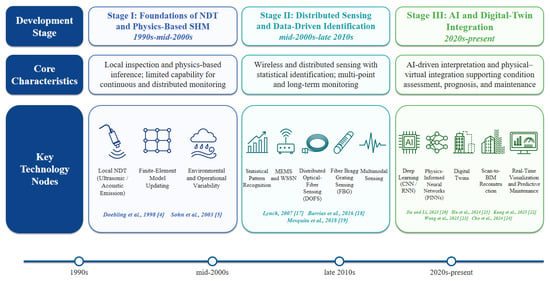
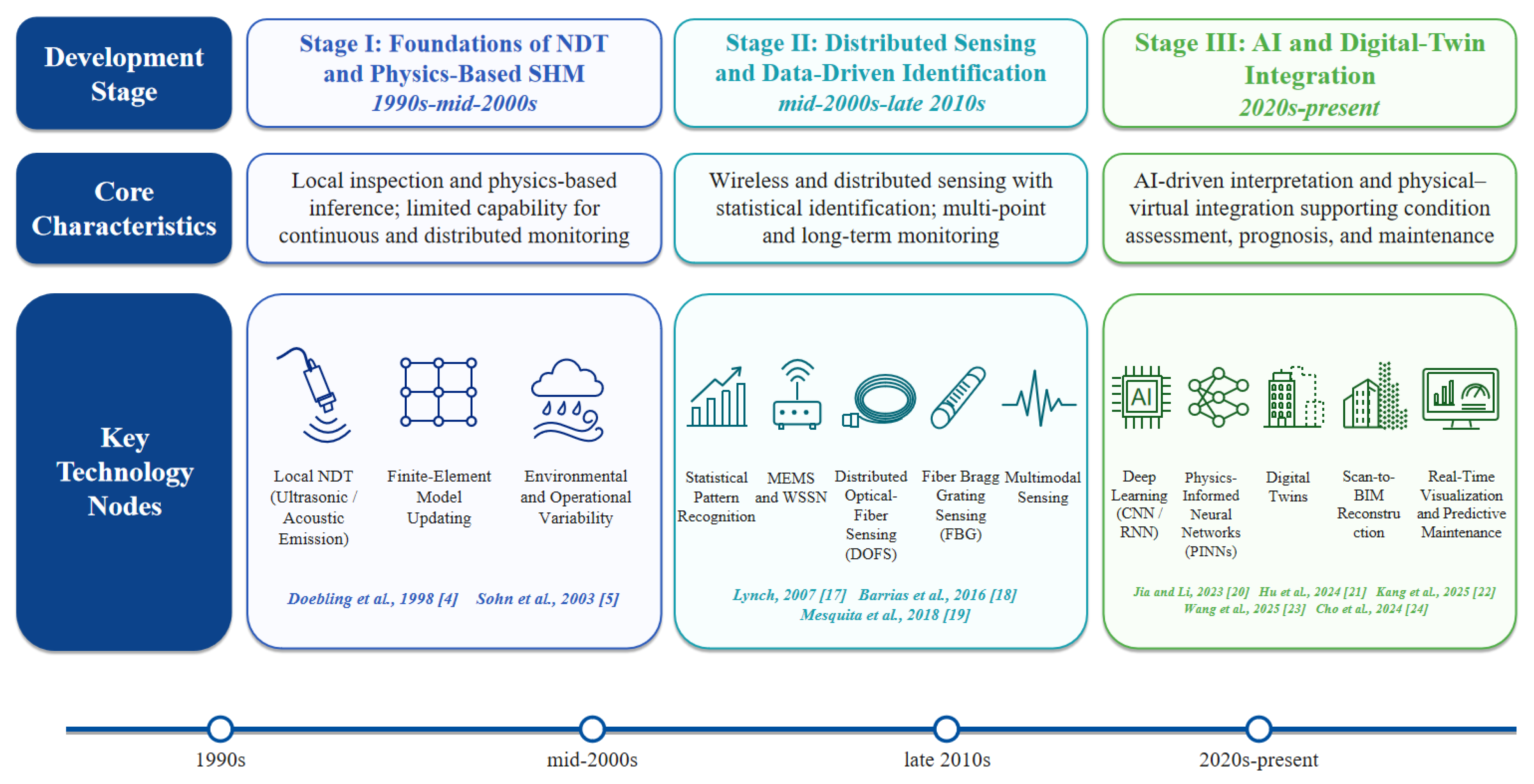
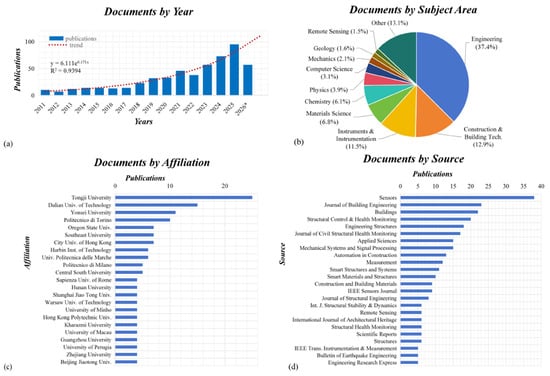
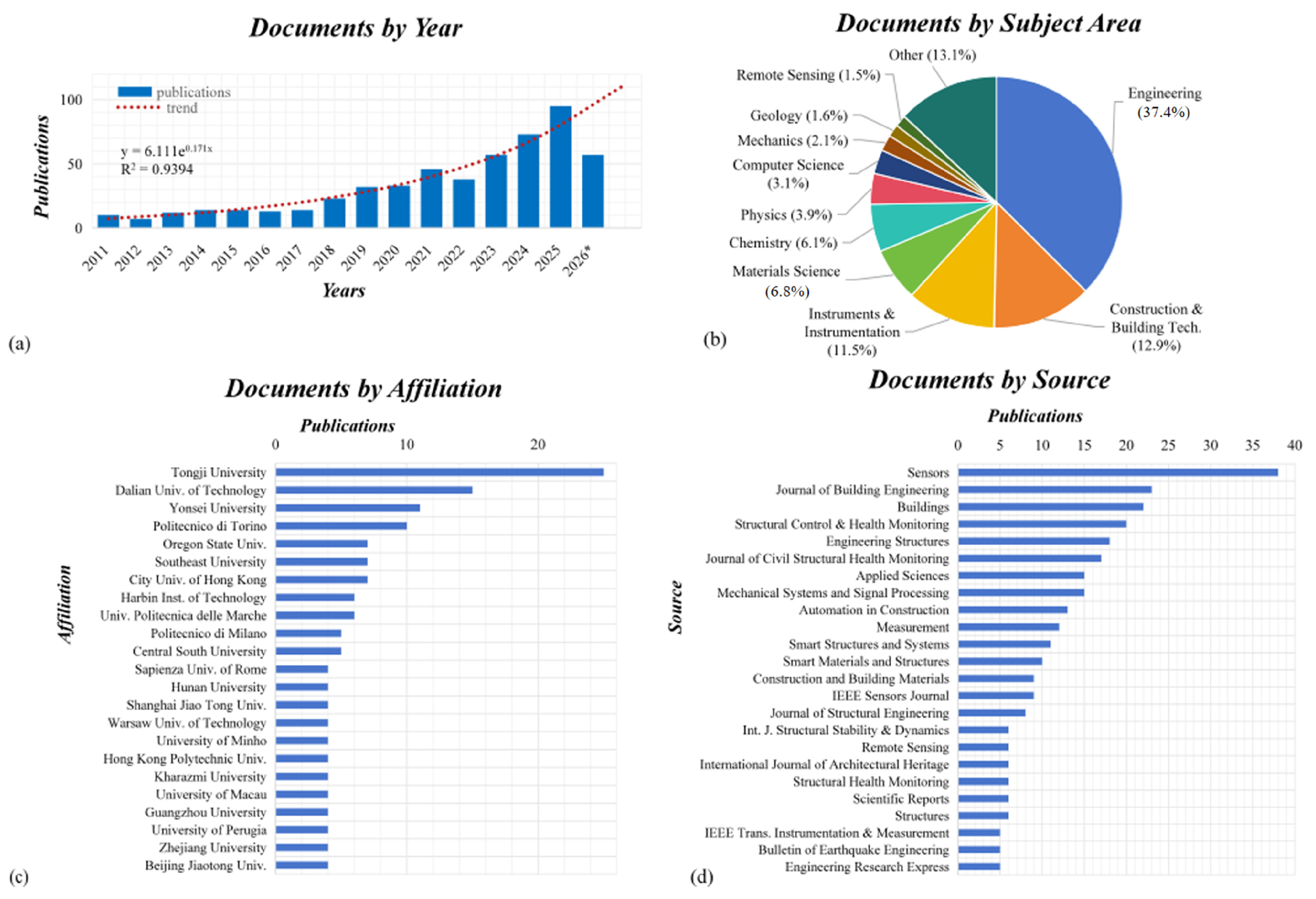
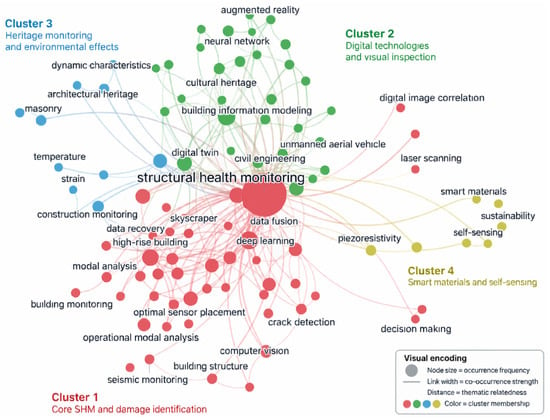
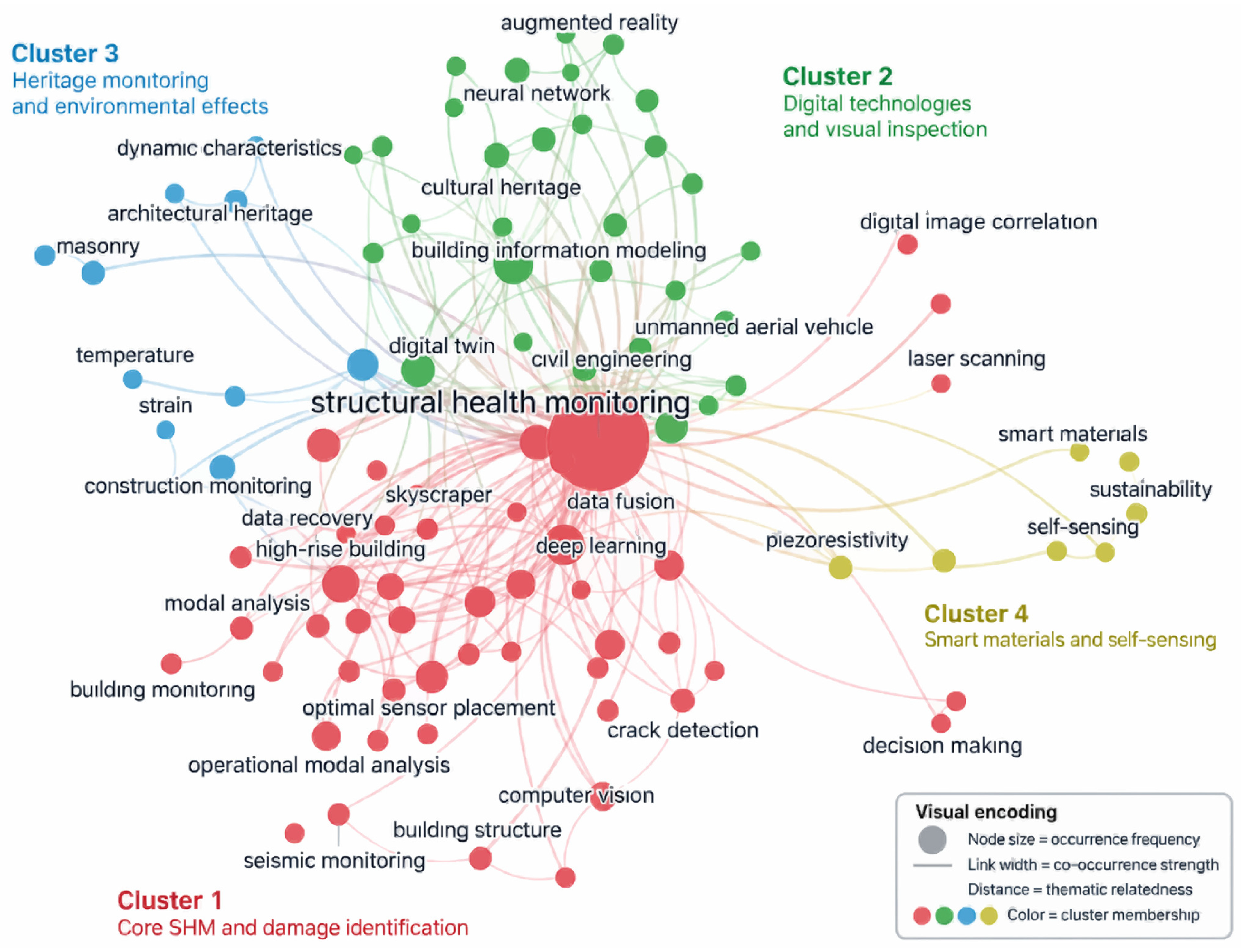
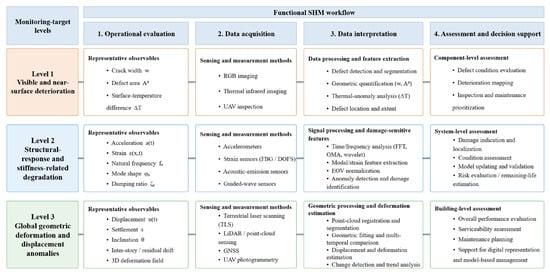
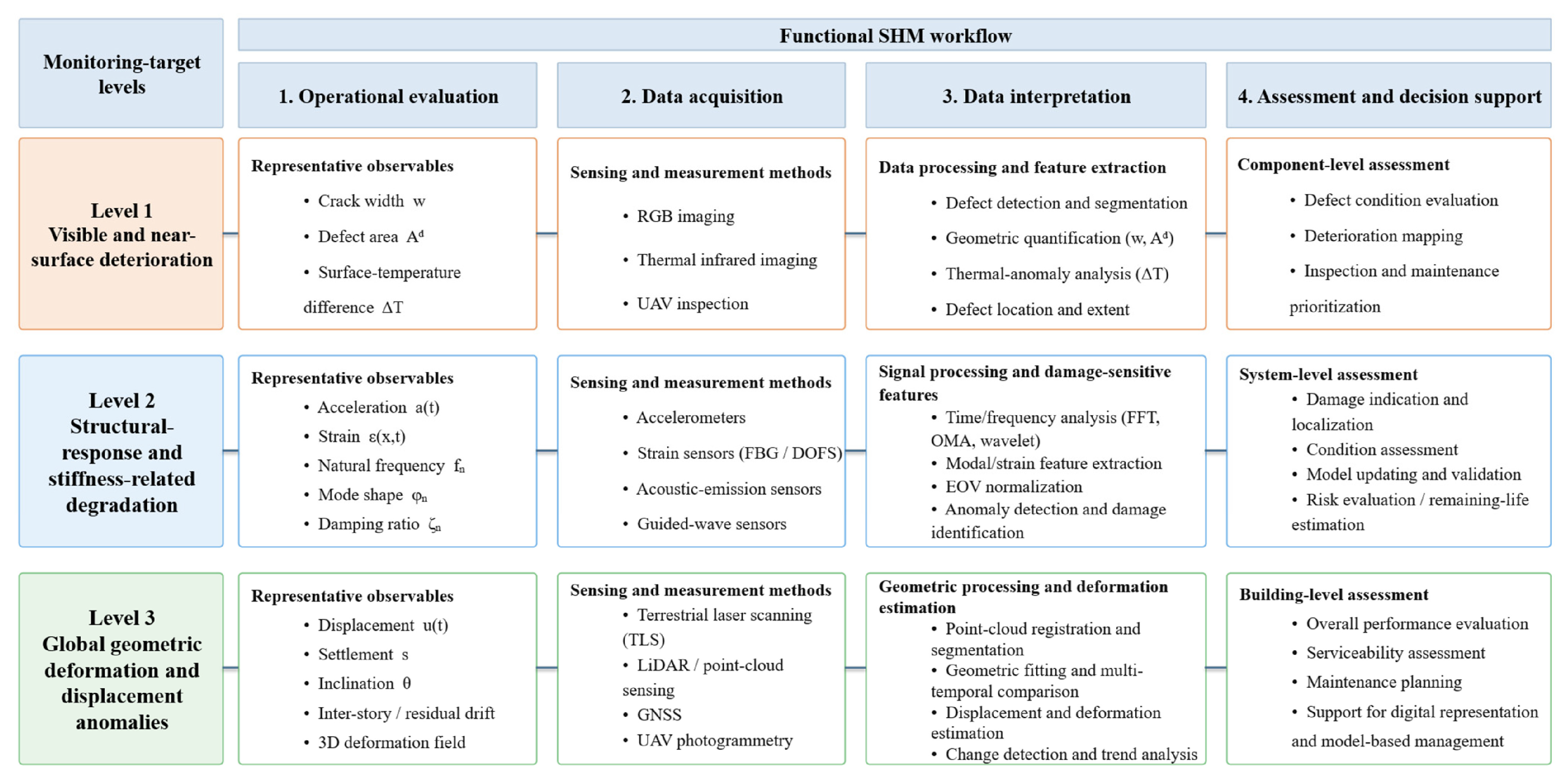
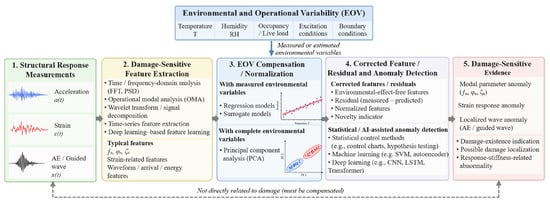
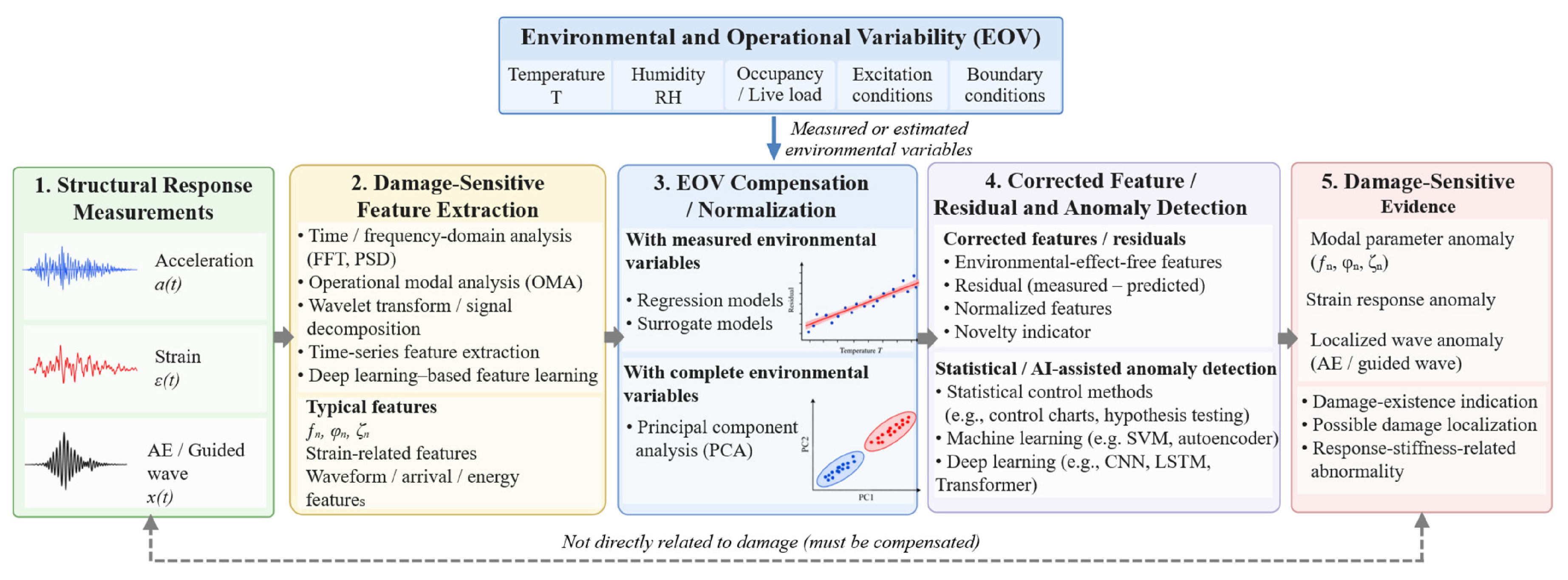

Disclaimer/Publisher’s Note: The statements, opinions and data contained in all publications are solely those of the individual author(s) and contributor(s) and not of MDPI and/or the editor(s). MDPI and/or the editor(s) disclaim responsibility for any injury to people or property resulting from any ideas, methods, instructions or products referred to in the content. |
© 2026 by the authors. Licensee MDPI, Basel, Switzerland. This article is an open access article distributed under the terms and conditions of the Creative Commons Attribution (CC BY) license.