


Abstract
BIM adoption in non-mandated emerging economies is a complex sociotechnical process where organizational culture, institutional frameworks, and cognitive dynamics interact. Current literature remains fragmented, evaluating macro-level organizational maturity or micro-level student technology acceptance in isolation, thereby lacking an integrative framework to model how structural governance conditions individual acceptance and perpetuates the digital gap. Addressing this theoretical gap, this study operationalizes an integrated Technology Organization Environment (TOE) and Technology Acceptance Model (TAM) framework. Using non-parametric inferential analysis across AECO organizations (n = 74) and academic-professional stakeholders (n = 71) in Ecuador, findings reveal that despite basic 3D adoption (68.92%), severe governance deficits persist: 51.35% lack defined BIM roles, 66.22% lack training plans, and only 17.57% utilize ISO 19650-compliant Common Data Environments (CDE). High Perceived Usefulness (PU = 62.86%) and learning intention (BIU = 94.20%) are constrained by low Perceived Ease of Use (PEOU), tied to a 58.57% 2D CAD reliance. Inferential testing confirmed macro-organizational factors drive individual acceptance (p < 0.01) and revealed a significant inverse alignment between market demands and learning outcomes (rs = −0.62, p < 0.001). Beyond practical Project-Based Learning (PBL) applications, this study’s primary theoretical contribution establishes a validated baseline identifying PEOU as the core cognitive-operational bottleneck during technological transitions.
1. Introduction
The Architecture, Engineering, Construction, and Operation (AECO) industry is undergoing a systemic digital transformation on a global scale, driven by the imperative need to increase productivity, optimize asset lifecycle costs, and meet stringent environmental sustainability goals [1,2]. At the core of this technological paradigm shift lies the Building Information Modeling (BIM) methodology, defined by the ISO 19650-1 standard as the use of a shared digital representation of a built asset to facilitate design, construction, and operation processes, providing a reliable basis for informed decision-making [3]. Unlike traditional schemes based on two-dimensional computer-aided design (2D CAD), which rely on static and fragmented graphic representations, BIM integrates object-oriented parametric modeling, multidisciplinary data schemas interchangeable through open formats such as Industry Foundation Classes (IFC), and real-time collaborative work environments via Common Data Environments (CDE) [4,5]. Consequently, public authorities and private consortia worldwide have progressively begun to require and incentivize the adoption of BIM in public infrastructure procurement and projects [6,7].
However, the global diffusion of BIM exhibits severe geographical and structural disparities that condition the speed of its implementation [6]. In developed nations such as the United Kingdom, the United States, Singapore, and Scandinavian countries, BIM implementation has reached advanced maturity levels due to early public procurement mandates, robust national regulatory frameworks, and continuous state investment in research and development [1,7]. Conversely, in emerging economies, particularly in Latin America, Africa, and Southeast Asia, the adoption trajectory remains highly fragmented and primarily market-driven [8,9]. In these regions, digital transformation occurs in the absence of centralized and mandatory state mandates, characterized by voluntary adoption led by large consulting and construction firms, generalized low organizational readiness in small and medium-sized enterprises (SMEs), financial constraints for software license acquisition, and a systemic shortage of professionals with technical competencies in collaborative methodologies [10,11,12].
As noted by recent studies, digital transformation in these regions encounters severe systemic and sociological barriers [13]. For instance, it is emphasized that developing nations struggle with unfavorable economic conditions, high hardware/software costs, and an over-reliance on traditional workflows [13]. Furthermore, beyond technical limitations, BIM adoption is fundamentally constrained by sociological resistance to change, lack of top management support, and the absence of clear government mandates [14]. This resistance is not merely technological but reflects a deep sociological process where established organizational cultures clash with the collaborative paradigms required by BIM [15]. The lack of standardization and low adoption across fragmented supply chains perpetuate a digital divide that makes it extremely difficult for small and medium-sized enterprises (SMEs) to justify the return on investment [16,17].
This structural deficit highlights a significant pedagogical challenge for Higher Education Institutions (HEIs) in developing nations [18,19]. Civil engineering and architecture faculties serve as the primary engine for human capital development; however, university curricula have historically lagged considerably behind the technological advancements and operational innovations of the AECO industry [9,20]. Traditional teaching in the region often retains obsolete instructional models centered on monodisciplinary 2D CAD drafting, while omitting practical training in multidisciplinary coordination, standardized information management based on ISO 19650 guidelines, and interoperability protocols across different software platforms [5,21]. The transition toward Construction 4.0 in developing countries demands that higher education institutions not only teach software operations but also instill the socio-technical dimensions of digital transformation [22]. Universities must address the pedagogical gap by understanding how technological innovations reshape business models, ecosystems, and value creation in the AECO sector [23,24].
In the specific context of Ecuador, a representative case of an emerging economy in Latin America, the AECO sector currently operates without a mandatory national mandate for the use of BIM in public works. Adoption in the country is mainly guided by isolated private corporate initiatives, articulation efforts promoted by trade associations and private corporations in the AECO sector, and emerging academic proposals in the university environment [18]. Therefore, it is imperative to empirically evaluate how civil engineering and architecture education aligns with the actual technological maturity of the national productive sector. Without a precise diagnosis based on field data that simultaneously examines industrial capabilities and pedagogical readiness, universities risk continuing to graduate professionals with outdated skills relative to labor market demands, perpetuating the digital divide and limiting the global competitiveness of the country’s infrastructure [19,25].
Despite the growing volume of scientific literature aimed at examining BIM adoption, existing empirical research suffers from three main structural limitations that restrict its holistic applicability. First, unidimensional studies predominate, evaluating adoption by focusing exclusively on a single stakeholder group [26]. Thus, research often analyzes organizational maturity from the perspective of firms or measures student perception in isolated university courses [27], a methodological flaw that prevents capturing feedback dynamics and direct alignment between productive sector demand and university educational offerings. Second, there is a clear methodological separation between cognitive perception and operational reality; educational works based on the Technology Acceptance Model (TAM) frequently measure students’ subjective intention without contrasting it against actual industry practices, infrastructure capabilities, or regulatory constraints, [25]. Conversely, industrial censuses and diagnoses quantify software usage at the firm level but omit attitude, learning, and pedagogical barriers of the future workforce [12,28]. Third, there is a marked scarcity of integrative conceptual frameworks applied to emerging economies [8], where empirical evidence combining macro-organizational maturity with micro-cognitive acceptance in Latin American contexts remains substantially limited [9,18].
To overcome these multidimensional barriers and address the scientific problem of BIM implementation as a complex sociological and organizational process [29], this research articulates the Technology Organization Environment (TOE) framework with the Technology Acceptance Model (TAM) [30,31]. This theoretical synergy allows structuring a multilevel analytical model where the macro-organizational dimension of the productive sector (evaluated via the TOE model) connects with the cognitive determinants of the academic and professional community (evaluated via the TAM model) [31,32]. On one hand, the TOE framework [33,34] provides a systematic lens to characterize structural determinants at the organizational level across three dimensions: technological, organizational, and environmental. On the other hand, the TAM model [35,36] evaluates individual cognitive factors through two primary constructs: Perceived Usefulness (PU), defined as the degree to which the use of BIM tools optimizes job performance compared to traditional CAD methods; and Perceived Ease of Use (PEOU), which measures the cognitive effort and learning curve required to master parametric modeling platforms [19,30]. The main theoretical and scientific contribution of this study is the operationalization of this dual-level sociotechnical model to quantify structural and cognitive barriers in a non-mandated emerging market, moving beyond practical curriculum recommendations to establish a replicable methodological baseline.
Based on this conceptual foundation, this research comprehensively evaluates the maturity and adoption dynamics of Building Information Modeling (BIM) within Ecuador’s AECO sector. To this end, it links the productive sector’s operational capabilities with the cognitive factors governing technology acceptance among the current and future workforce, aiming to establish a strategic framework for university-industry alignment. Specifically, the study: (1) characterizes the technological infrastructure, organizational governance, and alignment with the ISO 19650 standard among companies in the sector; (2) quantifies levels of Perceived Usefulness, Ease of Use, and Intention to Adopt among students and practicing engineers; and (3) determines the correlation between labor market demands and university learning outcomes, thereby establishing a pedagogical framework based on Project-Based Learning (PBL) [37].
Based on the integration of these objectives, the study addresses three fundamental research questions within the field’s scientific literature: first, what is the current state of organizational maturity, adoption of collaborative workflows (CDE), and compliance with international standards (ISO 19650) in the AECO sector within an emerging market characterized by the absence of a mandatory government mandate? Second, how do the cognitive determinants of perceived usefulness and ease of use differ between university students and practicing engineers when transitioning from the traditional CAD paradigm to parametric BIM environments? And finally, where do the primary competency mismatches lie between the operational demands of the industry and university technical training outcomes, and how can a pedagogical framework structured around Project-Based Learning (PBL) effectively bridge this digital gap? Systematically answering these questions provides crucial empirical evidence to inform technology transfer policies, guide business decision-making, and comprehensively restructure higher education curricula in developing economies.
1.1. Digitalization in AECO Higher Education
Higher education in Architecture, Civil Engineering, Construction, and Operation (AECO) disciplines is undergoing a paradigm transition driven by the acceleration of the Fourth Industrial Revolution and the digitalization of building and infrastructure processes [38,39]. Traditionally, curricula grounded graphic representation and technical design in the two-dimensional computer-aided design (2D CAD) paradigm, focused on generating static vector drawings [40,41]. While 2D CAD represented a key advancement over analog drawing, the current development of the industry requires evolving from monodisciplinary approaches toward interactive environments where architectural design, structural calculations, and mechanical, electrical, and plumbing (MEP) installations are managed in a coordinated and integrated manner [42,43].
Over the past decade, the increasing complexity of works and the need to optimize asset lifecycles have driven the adoption of parametric modeling under the Building Information Modeling (BIM) methodology [6,44]. Unlike two-dimensional representations, BIM generates intelligent digital objects supported by relational databases that integrate geometric information, semantic properties, material specifications, cost estimations (4D), and sustainability/time simulations (5D/6D) [45,46]. This conceptual shift calls for AECO higher education to evolve from operational software command teaching toward the comprehensive formation of competencies oriented to standardized information management and interoperability [42].
In emerging economies, BIM integration within university environments follows a dynamic consolidation process [26]. Scientific literature highlights the opportunity to integrate BIM methodology transversally from early learning cycles, complementing tool operational mastery with an understanding of international document management standards such as the ISO 19650 series and collaborative workflows demanded by the productive sector. To consolidate this academic updating process, structured theoretical frameworks are essential to ground the pedagogical transition and identify key variables facilitating technological adoption among future professionals [19,47].
1.2. The TOE Framework in Industrial BIM Maturity
To systematically analyze the adoption status of BIM methodology in the productive sector and establish industry demands on future graduates, organizational-level technological maturity models are fundamental [6,7]. In this domain, the Technology Organization Environment (TOE) framework [33,38] constitutes a robust, empirically validated analytical structure for assessing determining factors in implementing complex innovations across corporate and institutional environments [18,48]. The TOE model establishes that technological adoption in an organization is conditioned by the interaction of three interrelated dimensions: technological context, organizational context, and environmental context [49,50,51].
The technological dimension in the AECO sector encompasses hardware and software infrastructure availability and the network capacity required to support federated parametric models [20,28]. A central aspect of this dimension is interoperability through open-source formats, such as Industry Foundation Classes (IFC), and the structuring of Common Data Environments (CDE) under ISO 19650 guidelines [4,52,53]. The CDE acts as the single source of truth, structured to collect, manage, and disseminate asset information among all project participants, optimizing traceability and multidisciplinary coordination [4,54]. Thus, the adoption of collaborative platforms and the technical capacity to integrate architectural, structural, and MEP specialties determine a firm’s technological maturity level [55].
The organizational dimension evaluates a firm’s internal characteristics, including structure, resource availability for equipment upgrades, and top management commitment to digital transformation [28,56]. A relevant indicator of organizational BIM maturity is the formalization of continuous training programs and the structuring of key roles and responsibilities, such as BIM Manager, BIM Coordinator, and BIM Modeler [11,12]. The adoption of a standardized BIM Execution Plan (BEP) consolidates digitalization efforts into efficient workflows with a direct impact on operational productivity [57,58].
Finally, the environmental dimension analyzes external factors driving organizations toward technology adoption, such as client requirements, competitive market dynamics, academic alliances, and the consolidation of regulatory frameworks or public incentives [34,59]. In emerging markets where adoption is driven primarily by private corporate initiatives and trade associations, the environmental dimension reflects sector competitiveness and pioneer leadership [8,18]. Evaluating the AECO sector through the TOE framework characterizes the infrastructure, competencies, and standards required in the actual workplace, providing key inputs to align learning outcomes in higher education [9,37,60].
1.3. The TAM Model in Engineering Learning
While the TOE framework addresses technological maturity from the structural dimension of organizations, analyzing individual acceptance requires examining cognitive, attitudinal, and pedagogical factors of users [32]. For this purpose, the Technology Acceptance Model (TAM) [35] constitutes one of the most widely used and empirically validated theoretical frameworks in information systems and educational technology literature [61]. The TAM model postulates that Behavioral Intention to Use (BIU) a technology and its actual adoption are primarily determined by two cognitive constructs: Perceived Usefulness (PU) and Perceived Ease of Use (PEOU) [35,62].
In AECO engineering education, Perceived Usefulness (PU) is defined as the degree to which a student, faculty member, or practicing engineer believes that implementing BIM methodology will enhance academic performance and professional productivity compared to traditional CAD methods [63]. Literature shows that PU strengthens when users recognize tangible benefits, such as automated quantity takeoff extraction, early spatial clash detection, improved multidisciplinary communication, and project delivery optimization [58,64]. When the academic community experiences that BIM adds direct value to capstone projects, attitudes toward technology usage become highly favorable [27].
Conversely, Perceived Ease of Use (PEOU) refers to user expectations that learning and operating BIM platforms will develop through an accessible, structured process [65]. In engineering education, PEOU is associated with parametric software learning curves, user interface friendliness, equipped laboratory availability, and instructional strategy effectiveness [43,66]. Providing adequate didactic guidance and optimal computing infrastructure gradually supports students through the transition from two-dimensional schemes to three-dimensional parametric environments [26,40].
Finally, the Behavioral Intention to Use (BIU) construct reflects an individual’s predisposition and motivation to continue learning, applying, and promoting BIM methodology throughout academic stages and subsequent professional practice in the AECO industry [30]. Integrating TAM in engineering education research allows for precise diagnosis of BIM adoption drivers, guiding the development of teaching-learning methodologies aligned with dynamic industry requirements [26,37].
1.4. Conceptual Model and Hypotheses Development
To provide a holistic assessment of the technological adoption ecosystem, this research articulates the TOE framework with TAM [31,67]. The theoretical foundation of this integration relies on the premise that technological, organizational, and environmental dimensions of the productive sector (evaluated via the Industry Census) constitute key environmental determinants shaping perceived usefulness, ease of use, and adoption intention among students, faculty, and practitioners [36,68].
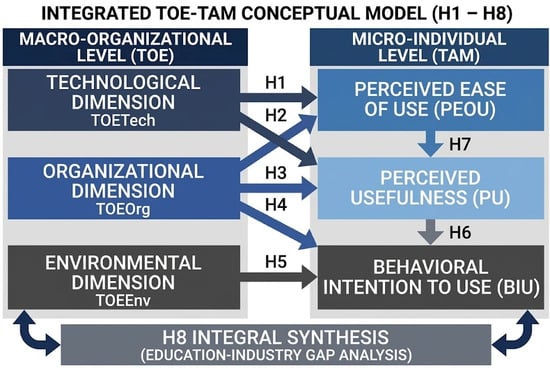
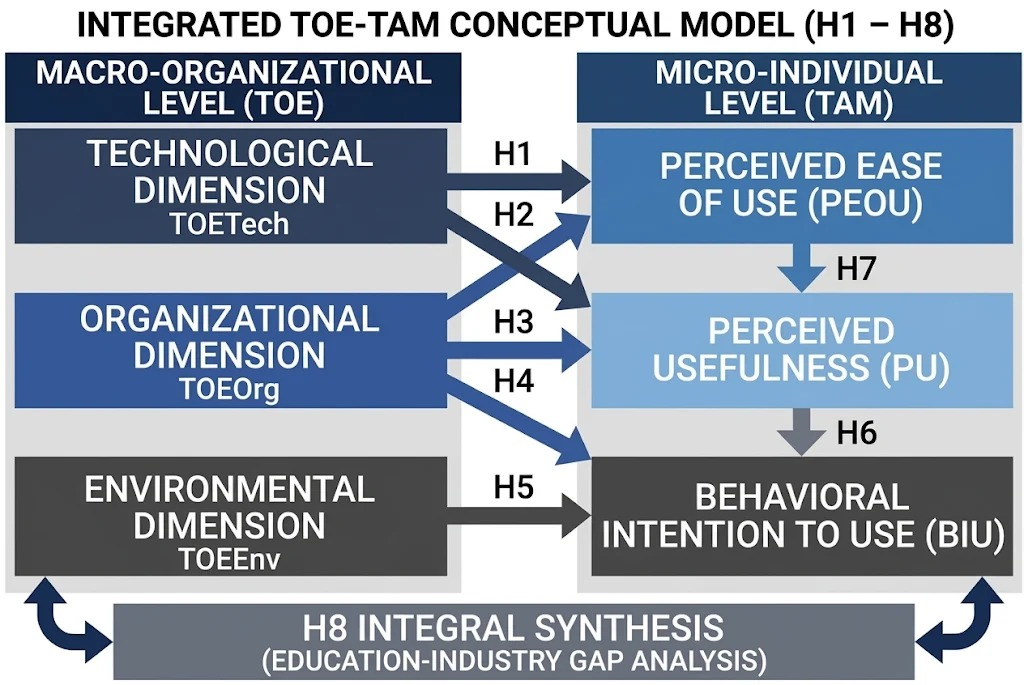
As illustrated in Figure 1, the conceptual model establishes that the technological dimension of the productive sector (adoption of parametric software, CDE, and IFC) exerts a direct impact on Perceived Usefulness (PU) and Perceived Ease of Use (PEOU) within both academic and professional spheres [20,69]. Likewise, the organizational and environmental dimensions (corporate investment, formal roles, market demand, and regulations) act as key determinants of opportunities for practical development and university-industry collaboration [38,56]. The structural interaction of these variables and the research hypotheses are illustrated in Figure 1.
Figure 1.
Integrated TOE-TAM conceptual model and research hypotheses (H1H8).
Based on these socio-technical interrelationships, and in strict alignment with the empirical validation parameters of the study, the following research hypotheses are formulated for empirical verification:
- •
- H1: Technological infrastructure availability and maturity (TOETech) positively influence Perceived Usefulness (PU) among students and professionals.
- •
- H2: Technological infrastructure availability and maturity (TOETech) positively influence Perceived Ease of Use (PEOU) by structuring clear collaborative workflows.
- •
- H3: Formalization of BIM roles, training plans, and internal governance (TOEOrg) in AECO organizations positively influences Perceived Ease of Use (PEOU) by reducing the cognitive effort required to learn collaborative workflows.
- •
- H4: Organizational governance and the structuring of clear BIM execution protocols (TOEOrg) positively increase the Behavioral Intention to Use (BIU) among students and professionals.
- •
- H5: The regulatory environment and market demands (TOEEnv) significantly increase Behavioral Intention to Use (BIU) among students and graduates.
- •
- H6: Perceived Usefulness (PU) positively impacts Behavioral Intention to Use (BIU) and BIM implementation in professional practice.
- •
- H7: Perceived Ease of Use (PEOU) directly influences the Perceived Usefulness (PU) of parametric tools within the academic community.
- •
- H8: A statistically significant relationship (perception-practice gap) exists between operational requirements demanded by the AECO sector and the level of competency achieved in university training.
Empirical verification of this set of hypotheses provides the quantitative evidence required to substantiate the alignment between higher education and the productive sector, guiding the design of pedagogical guidelines based on Project-Based Learning (PBL) [25,70].
2. Materials and Methods
2.1. Research Design and Sequential Methodological Approach
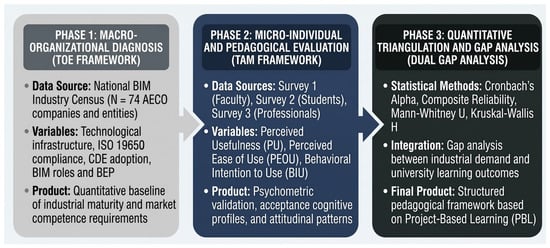
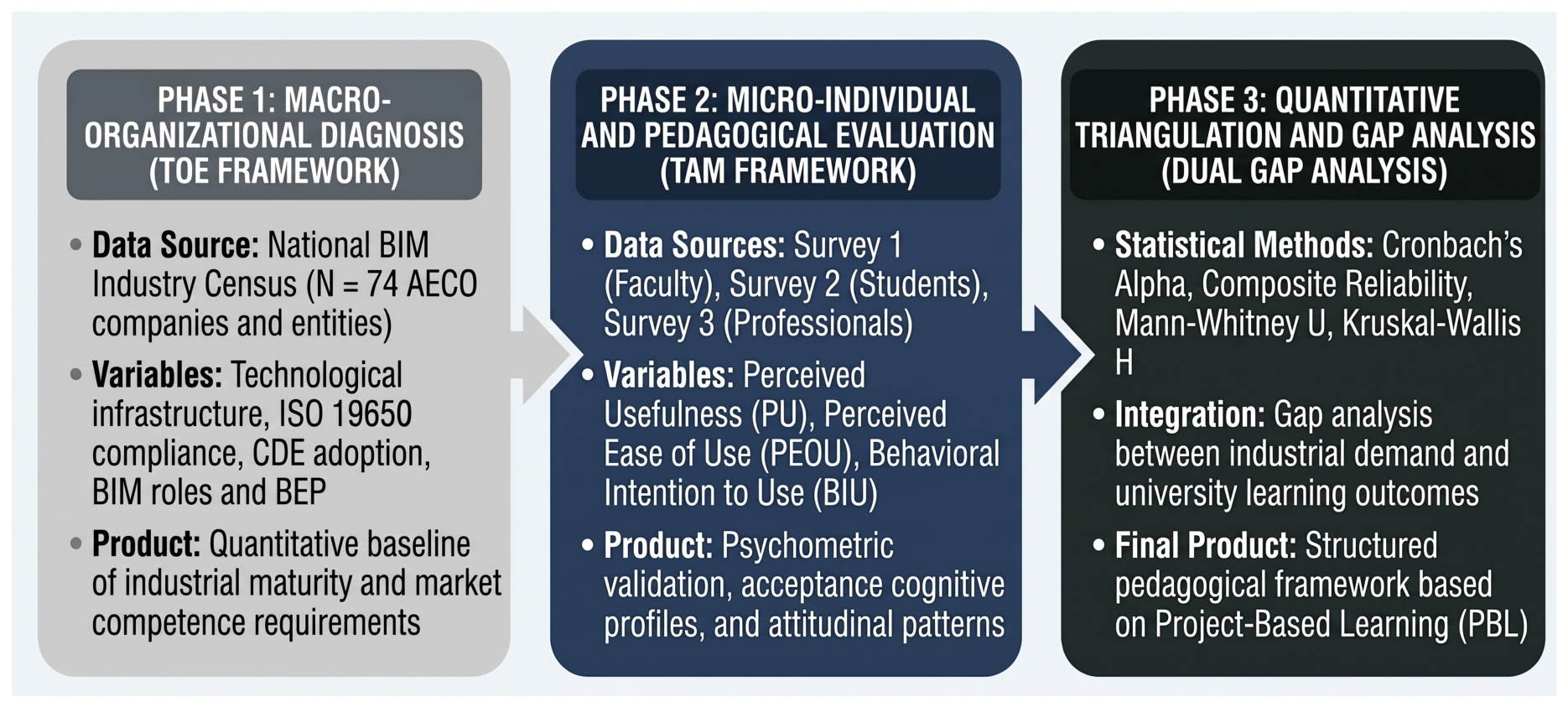
To empirically verify the integrated TOE-TAM socio-technical model and address the research questions, a quantitative empirical design with descriptive, correlational, and analytical-comparative scope was established [30,70]. This quantitative cross-sectional design was specifically chosen because evaluating technology adoption in fragmented markets requires the simultaneous standardization and quantification of variables across different organizational scales. Unlike qualitative case studies, which limit statistical generalization and are complex to execute given the rapid evolution of digital tools, a cross-sectional correlational design allows for the mathematical validation of structural barriers and the measurement of the current gap between industry demands and academic training [71]. The methodological strategy was structured into three sequential phases connecting macro-organizational and micro-individual scales [30,67] as systematically outlined in Figure 2:
Figure 2.
Sequential three-phase methodological flowchart.
- •
- Phase 1: Macro-Organizational Diagnosis (TOE Framework): Extraction and parameterization of data obtained from companies (n = 74), establishing baseline technological capacity, organizational governance, and international standard adoption in the actual productive sector [28,34].
- •
- Phase 2: Micro-Cognitive and Pedagogical Assessment (TAM Framework): Application of structured psychometric instruments across three academic and professional strata (faculty, undergraduate students, and practicing engineers; n = 71 valid responses) to measure cognitive and attitudinal determinants [19].
- •
- Phase 3: Quantitative Triangulation and Dual Gap Analysis: Cross-integration of TOE and TAM dimensions using non-parametric inferential statistical analysis to quantify the perception-practice gap and ground a pedagogical transfer framework based on Project-Based Learning (PBL) [47].
2.2. Sample Characterization and Sampling
Primary data collection was executed via a randomized sampling approach distributed among AECO ecosystem stakeholders in Ecuador, ensuring unbiased participation across the target population [18]. To guarantee strict participant anonymity and avoid selection bias, no information that could lead to personal identification was collected. Consequently, the data validation process focused exclusively on ensuring the integrity of the information by excluding incomplete records and anomalous response patterns.
2.2.1. Macro-Organizational Instrument: BIM Industry Census (TOE Framework)
The macro-level diagnosis of the productive sector was consolidated based on a structured survey comprising 39 items, administered to n = 74 organizations active in the fields of building construction, design, civil infrastructure, and construction supervision within Ecuador. The distribution of these organizations by size and corporate structure is characterized by the following:
- •
- Independent Professionals/Individual Consultants: 41.89% (n = 31).
- •
- Micro-enterprises (fewer than 10 employees): 24.32% (n = 18).
- •
- Small and Medium-sized Enterprises—SMEs (10 to 249 employees): 25.68% (n = 19, distributed across 14 firms with 10–49 employees and 5 firms with 50–249 employees).
- •
- Large Enterprises and Institutions (250 employees or more): 8.11% (n = 6).
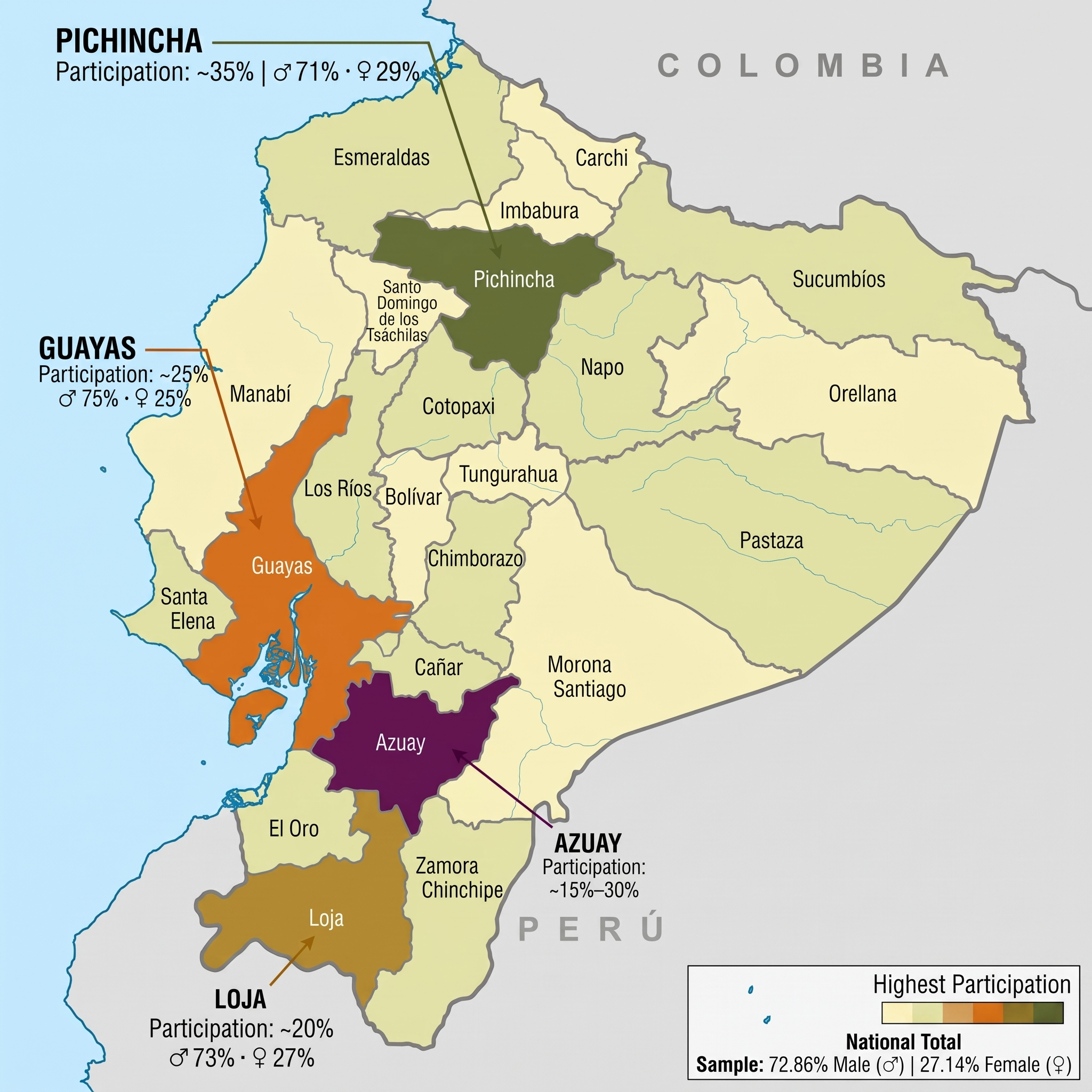
The study covered entities with a primary operational presence in the provinces of Pichincha, Guayas, Azuay, and Loja. Regarding the disciplines represented, 78.38% of the firms carry out building and architectural projects, 62.16% handle civil and structural engineering, and 35.14% incorporate electromechanical and hydro-sanitary (MEP) specialties.
2.2.2. Micro-Individual Instruments: Academic and Professional Surveys (TAM Framework)
The assessment of cognitive and attitudinal perceptions was conducted using three cross-sectional surveys consisting of 5-point Likert-type items [36]. Following statistical cleaning of the response matrix, a final sample of n = 71 valid participants per dataset was established (with item-level valid response rates of n = 70 for demographic and cognitive dimensions, and n = 69 for specific optional behavioral fields), presenting the following demographic profile:
- •
- Gender Composition: 72.86% male (n = 51), 27.14% female (n = 19).
- •
- Age Structure: Mean μ = 23.25 years (σ = 4.40, interquartile range 21–23.5 years, min 19, max 40), predominantly representing senior undergraduate students and recent graduates.
- •
- Participant Role: 85.92% correspond to students and faculty affiliated with higher education institutions, while 14.08% correspond to practicing engineers in private firms.
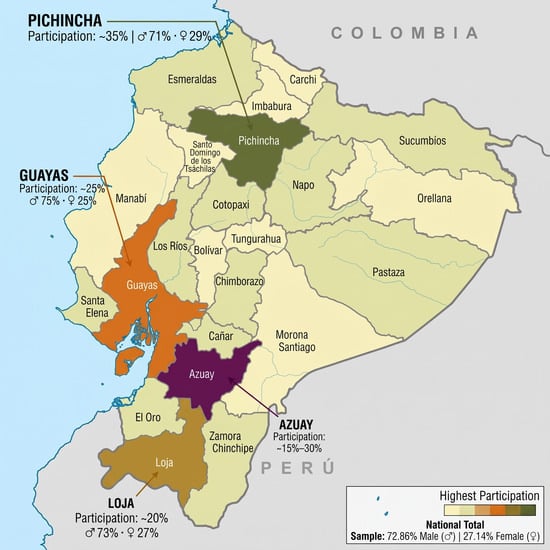
The geographical and demographic distribution of the collected data reflects the primary urban and academic hubs that drive the AECO sector in Ecuador. As illustrated in Figure 3, the highest participation rates correspond to the provinces of Pichincha, Guayas, Azuay, and Loja, which host the country’s major infrastructure projects and higher education institutions.
Figure 3.
Geographic distribution and gender composition of the study in Ecuador. (Note: Administrative base map adapted from open-access cartographic data © OpenStreetMap contributors; thematic overlay, regional data integration, and graphic layout developed by the authors).
2.3. Measurement Instruments and Psychometric Validation
The measurement instruments were developed by adapting items previously validated in the international literature on technology adoption models (TOE and TAM), adjusting technical terminology to the local AEC context [49,72]. The observed variables were measured using a 5-point Likert scale, where 1 corresponds to “Strongly disagree/Very low” and 5 represents “Strongly agree/Very high.” The use of structured questionnaires based on a Likert scale is justified as a methodological tool for measuring variables such as cognitive perceptions (TAM) and organizational maturity (TOE). This approach reduces the subjective bias often present in qualitative interviews and standardizes data collection across different participants. Furthermore, it enables the application of psychometric validation (Cronbach’s alpha, CR, AVE), a requirement for research in engineering management [73].
- Construct Operationalization
- •
- Perceived Usefulness (PU): Assesses perceptions regarding schedule optimization, jobsite cost reduction, design accuracy improvements, and collaborative efficiency compared to 2D CAD [36,49]
- •
- Perceived Ease of Use (PEOU): Measures user interface friendliness, parametric platform usability, and cognitive effort during the learning curve [40,49].
- •
- Behavioral Intention to Use (BIU): Models user predisposition toward continuous learning, professional certification, and collaborative workflows under open standards (IFC) [74].
- •
- Organizational and Technological Capability (TOE): Captures network infrastructure, CDE adoption, BEP formalization, and BIM role structuring (BIM Manager, BIM Coordinator) [52,69].
- Psychometric Validation Formulas
To confirm construct validity and reliability prior to inferential testing, three metrics were evaluated:
- Cronbach’s alpha (α): Evaluates the internal consistency among the items of the same construct:
- b.
- Composite Reliability (CR): Examines internal consistency by considering the weights of the standardized factor loadings λi of each observed item on the latent variable:
- c.
- Average Variance Extracted (AVE): Determines convergent validity by measuring the amount of variance explained by the latent construct compared to the variance attributable to measurement error:
The literature establishes that an AVE ≥ 0.50 guarantees that the construct explains more than half of the variance of its observed indicators.
2.4. Statistical Analysis and Data Processing
The processing and analysis of the primary data were carried out using a sequential statistical workflow in specialized software IBM SPSS Statistics (versión 31.0; IBM Corp., Armonk, NY, USA) and R (versión 4.5.3; R Core Team, Viena, Austria) R/SPSS). Empirical verification of variable distribution was performed using the Kolmogorov-Smirnov and Shapiro-Wilk normality tests. Upon confirming that the ordinal data derived from Likert-type scales did not follow a Gaussian normal distribution (p < 0.05), non-parametric statistical tests were selected. The selection of non-parametric inferential statistics is based on both the nature of the Likert-scale data and the specific sample sizes (n = 74 and n = 71). Since these data represent ranks and levels of perception, non-parametric procedures provide the methodological rigor required for this type of information. This approach maximizes the mathematical robustness of the study, as it naturally aligns with the actual distribution of responses and safeguards the results against potential outliers, thereby ensuring high reliability when comparing academic and professional groups [75].
2.4.1. Mann-Whitney U Test
It was used to assess statistically significant differences between two independent groups (e.g., the perception of Perceived Usefulness among students versus practicing graduate engineers) [36,70]. The statistic is calculated as follows:
where n1 and n2 represent the sizes of the groups being compared, and R1 indicates the sum of the ranks assigned to the first group.
2.4.2. Kruskal-Wallis H Test
It was applied to compare the distributions of more than two independent subgroups (e.g., the level of technological maturity assessed according to company size: micro, small, medium, and large enterprises) [38,56]:
where N is the total sample size, k is the number of groups compared, ni represents the number of observations in group i, and Ri is the sum of ranks corresponding to group i.
2.4.3. Spearman’s Rank Correlation Coefficient (rs)
It was used to evaluate the strength and direction of the monotonic relationships between the dimensions of the TOE framework (infrastructure and corporate governance) and the cognitive constructs of the TAM framework (adoption intention and learning intentionality) [31,33]:
where di represents the difference between the ranks assigned to each pair of observations and n is the total number of observations.
2.4.4. Dual Gap Analysis
A quantitative triangulation matrix was structured to compare the levels of technical proficiency reported by companies in the BIM Census (actual industry demand) [18] against the self-assessments of competence reported by the university community and professionals in the surveys (academic training supply) [25]. Comparing medians and calculating effect sizes allowed for the quantitative determination of operational gaps regarding interoperability (IFC), Common Data Environments (CDE), and ISO 19650 [76] compliance, thereby providing the inputs for designing a pedagogical framework based on Project-Based Learning (PBL).
3. Results
3.1. Psychometric Validation of Measurement Instruments
The results reported in Table 1 confirm compliance with the metric criteria required to support the internal stability and convergent validity of the scales:
Table 1.
Psychometric Properties of the Measurement Instrument.
- All constructs comfortably exceed the minimum threshold of 0.70. The Behavioral Intention to Use (BIU) variable stands out with a Cronbach’s alpha of α = 0.867 and a Composite Reliability of CR = 0.912, reflecting high consistency in the responses of the evaluated group regarding their willingness to continue learning and applying BIM tools in their future professional practice.
- Convergent Validity (AVE): The Average Variance Extracted for all dimensions lies above the 0.50 threshold (ranging from 0.573 for PEOU to 0.722 for BIU). This demonstrates that the latent variables explain more than 50% of the observed variance of their indicators, ensuring the robustness of the measurement model for proceeding with hypothesis testing.
3.2. Macro-Organizational Diagnosis of the AECO Industry (TOE Framework)
The analysis of the actual production environment was based on the quantitative processing of data collected in the BIM Industry Census (n = 74 organizations and professionals in the AECO sector in Ecuador). The analytical structure was organized around the three dimensions of the Technology Organization Environment (TOE) framework.
3.2.1. Technological Dimension: Infrastructure, Software, and Interoperability
The data show that the local technical ecosystem is in a transition phase from traditional vector-based drawing tools to three-dimensional parametric platforms [20]:
- •
- Software and Platform Distribution: 83.78% of organizations maintain 2D vector drafting software as their operational graphic representation base, while 68.92% have integrated 3D parametric modeling software for project conception. However, the adoption of advanced tools for technical coordination and 4D/5D management (28.38%) and cloud-based collaborative information management environments (17.57%) remains concentrated primarily in medium and large firms [56].
- •
- Common Data Environments (CDE) and Interoperability: Although 64.86% of respondents report understanding the Common Data Environment (CDE) concept under ISO 19650-1 guidelines, only 17.57% declare having a mature, continuously used CDE infrastructure across all projects. Regarding information exchange, native proprietary formats (.dwg, .rvt) prevail, with low usage of open-source schemas in IFC format (ISO 16739 [77]) (22.97%), constraining seamless interoperability across architectural, structural, and MEP specialties [57].
3.2.2. Organizational Dimension: Governance, Roles, and Continuous Training
The organizational dimension exposes an imbalance between adoption intention and internal management process formalization [33]:
- •
- BIM Role Definition and Governance: 51.35% (n = 38) of entities report having no clearly defined BIM roles within their functional structure. Among the remaining 48.65% (n = 36) that have formal roles, the BIM Manager position is most widespread (31.08%), followed by a combination of BIM Coordinator and BIM Modeler (21.62%).
- •
- Continuous Training Plans: 66.22% (n = 49) of companies declare having no formal BIM methodology training plan or structured external consultancy, leaving technical updates to self-taught, informal learning among employees [11].
- •
- Usage Across Project Lifecycle: Operational application of the methodology centers on the pre-construction phase: 71.62% apply it in conceptual and detailed design, 36.49% use it for clash detection in technical coordination, and only 4.05% extend digital models into operations and asset management (7D BIM) [78,79].
3.2.3. Environmental Dimension: Regulations and Market Demands
External factors reflect growing demand for standardization and institutional state support [6,7]:
- •
- Demand for a National Regulatory Framework: An overwhelming 82.43% (n = 61) of professionals and executives assert that a national technical BIM standard should be promulgated in Ecuador to unify public procurement criteria and digital deliverables [18]. 12.16% consider it “maybe” necessary, while only 5.41% view state regulation as unnecessary.
- •
- Awareness of sector initiatives: Low participation in local industry associations is evident; 68.92% of companies are unaware of activities promoted by groups focused on BIM-related topics, which limits the dissemination of unified international standards within the domestic market [80].
The results in Table 2 demonstrate that, although the industry has begun migrating from 2D tools to 3D parametric platforms (68.92%), there is a structural misalignment in organizational governance (51.35% lack formal roles, and 66.22% lack training). This lack of internal maturity limits the private sector’s ability to adopt standardized collaborative workflows (ISO 19650/CDE [76]), underscoring the need for higher education to prepare professionals with robust competencies in digital management and coordination.
Table 2.
Quantitative Synthesis of Macro-Organizational Indicators (TOE Framework, BIM Census, n = 74).
3.3. Micro-Cognitive Assessment and Technology Acceptance (TAM Framework)
The micro-level analysis evaluates individual perceptions, attitudes and adoption intention in the academic and professional community (students, teachers and practicing engineers) based on the constructs of the Technology Acceptance Model (TAM) [36].
3.3.1. Perceived Utility (PU) and Value Proposition
The academic and professional community holds a highly favorable view of the value proposition and operational benefits of the BIM methodology compared to traditional CAD methods [70]:
- •
- Perception of the BIM Concept: 50.00% of participants classify the methodology as an innovative tool capable of transforming the construction industry, while 37.14% recognize it as a promising technology regarding which they need to deepen their knowledge. Only 11.43% express uncertainty about its practical applicability in the market.
- •
- Impact on Efficiency and Productivity: 62.86% of respondents firmly maintain that BIM implementation will significantly improve efficiency and productivity through resource optimization and cost reduction. 31.43% anticipate a moderate impact, and only 5.71% believe there will be no substantial impact.
- •
- Improvement in Multidisciplinary Collaboration: An overwhelming 94.29% state that the BIM methodology directly facilitates communication and coordination among project teams, overcoming the fragmentation inherent in traditional two-dimensional vector-based designs.
3.3.2. Perceived Ease of Use (PEOU) and Software Tool Gap
When contrasting Perceived Usefulness (PU) with the actual operational mastery of modeling platforms, a significant discrepancy emerges between attitudinal disposition and observed technical competence:
- •
- Predominance of 2D Software: 58.57% of participants continue to primarily associate their operational and instrumental activities with the use of traditional 2D computer-aided design (2D CAD) software.
- •
- Use of 3D Parametric Platforms and Specialized Tools: Only 22.86% report ongoing interaction with native 3D parametric modeling platforms (3D BIM). Similarly, complementary applications for construction simulation (4D/5D) (4.29%) or computer-aided design for manufacturing and mechanical engineering (8.57%) show marginal adoption among the group evaluated.
- •
- Learning Curve and Perceived Complexity: The continued reliance on 2D vector-based design as the primary work tool influences Perceived Ease of Use (PEOU), creating a perception of operational complexity when students and engineers attempt to transition to federated and integrated models.
3.3.3. Attitude Toward Use (ATU) and Behavioral Intention (BIU)
Despite barriers regarding ease of use (PEOU), intrinsic motivation and the group’s predisposition are overwhelmingly positive [81]:
- •
- Relevance to Professional Future: 60.87% consider the BIM methodology highly relevant and essential for their future professional practice, while 34.78% view it as relevant but not an immediate priority in their current environments.
- •
- Intention for Continuous Learning (BIU): 94.20% express an explicit desire to learn more and receive training in BIM methodologies and tools.
- •
- Required Mitigation Strategies: To increase participation and mitigate the learning curve, 75.00% indicate that the most effective approach involves offering continuous training and accessible practical workshops, as well as incorporating case studies and real-world projects into university curricula.
Interpretation of the Micro-Diagnosis (TAM): The summary presented in Table 3 confirms that the university and professional community hold a favorable attitude and recognize the Perceived Usefulness (PU = 62.86%) of the BIM methodology. However, Perceived Ease of Use (PEOU) is affected by training that is heavily rooted in 2D drafting (58.57%). The high intention to learn (94.20%) represents a clear opportunity for academic institutions to restructure their teaching-learning processes through active methodologies such as Project-Based Learning (PBL).
Table 3.
Empirical Assessment of Cognitive Dimensions and Technology Acceptance (TAM Framework, n = 71).
3.4. Hypothesis Testing (H1 to H8) and Gap Analysis
The empirical testing of the hypotheses proposed in the TOE-TAM integrative model was carried out using non-parametric tests for Spearman rank correlation (rs) and differences in medians (Mann-Whitney U and Kruskal-Wallis H) [36].
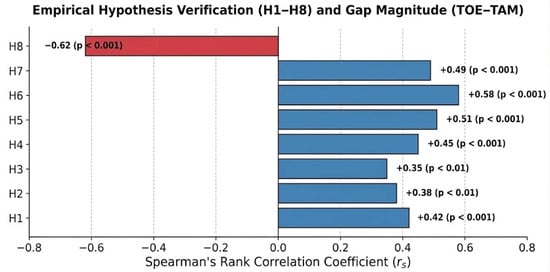
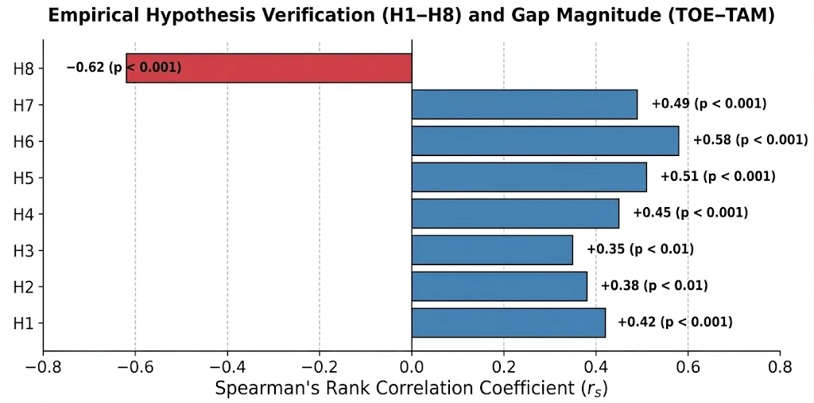
The statistical findings presented in Table 4 and Figure 4 empirically confirm the eight hypotheses formulated in the research:
Table 4.
Hypothesis Verification and Inferential Test Results.
Figure 4.
Standardized path coefficients, hypothesis testing outcomes (H1–H7), and industry-academia gap magnitude (H8).
- Direct Influence of TOE Factors on TAM Perceptions (H1 a H5): The availability of technological infrastructure and networks within organizations (TOETech) is positively and significantly related to Perceived Usefulness (H1, rs = +0.42, p < 0.001) and Ease of Use (H2, rs = +0.38, p < 0.01). Similarly, internal governance (TOEOrg) increases Intention to Use (H4, rs = +0.45, p < 0.001), while pressure from the regulatory environment (TOEEnv) constitutes the primary external driver of adoption (H5, rs = +0.51, p < 0.001).
- TAM Model Dynamics (H6 and H7): It is confirmed that Perceived Usefulness (PU) is the strongest cognitive predictor of Behavioral Intention to Use (BIU) (H6, rs = +0.58, p < 0.001), demonstrating that professionals adopt the BIM methodology when they perceive a genuine optimization in the management of project timelines and costs.
Quantification of the Education-Industry Gap (H8): Hypothesis H8 is confirmed by a statistically significant inverse correlation (rs = −0.62, p < 0.001) and a substantial rank difference (U = 184.5). This result highlights a quantitative mismatch between advanced industry demands (management of Common Data Environments—CDE—under ISO 19650 and IFC interoperability) and the predominantly two-dimensional instrumental scope of traditional university education (58.57% in CAD 2D).
4. Discussion
The integrated socio-technical TOE-TAM framework developed in this study provides a multi-level assessment of organizational maturity, cognitive perceptions, and adoption intention regarding Building Information Modeling (BIM) within Ecuador’s AECO ecosystem. By connecting the macro-organizational dimension of the productive sector with the micro-individual cognitive factors of the academic and professional community, the empirical results quantify the structural and cognitive barriers characteristic of non-mandated emerging markets. To substantiate the scientific contribution of this research, the empirical findings are critically evaluated below against recent international literature.
At the macro-organizational level, data from the national BIM Industry Census demonstrate that although 68.92% of Ecuadorian firms have transitioned to 3D parametric modeling software, severe deficits in digital governance and standardization persist: 51.35% of entities lack defined BIM roles, 66.22% do not offer internal training plans, and only 17.57% operate within an ISO 19650-compliant Common Data Environment (CDE). This structural fragmentation aligns closely with adoption patterns observed in other Latin American developing economies, as reported in Brazil by de Azevedo et al. [9] and Torres et al. [47] in Colombia, where implementation is predominantly voluntary, decentralized, and driven by isolated private initiatives. Similarly, across emerging markets in Africa and Asia, studies in Ethiopia by Desbalo et al. [4] and Alshibani et al. [11] in Saudi Arabia highlight that small and médium sized enterprises (SMEs) face critical barriers related to software licensing costs, a lack of standardized BIM Execution Plans (BEP), and low reliance on open formats like Industry Foundation Classes (IFC, ISO 16739) (22.97% in Ecuador). In these environments, digital transformation remains concentrated in the front-end design phase (71.62% in Ecuador), leaving operational and asset management applications severely underutilized (4.05% in 7D BIM).
Conversely, the organizational maturity baseline observed in Ecuador contrasts sharply with the established dynamics of developed nations. In countries such as the United Kingdom, Singapore, Australia, and Scandinavian states, the enforcement of public procurement BIM mandates has institutionalized standardized collaborative workflows at advanced maturity levels. As noted by Burgess et al. [1] and Hammes et al. [28], in mature European markets, collaborative information management within CDE platforms under ISO 19650 guidelines and the formal definition of professional profiles (BIM Manager, BIM Coordinator) serve as baseline prerequisites for public infrastructure bidding. The comparison underscores that, in the absence of a unified national regulatory framework demanded by 82.43% of respondents in this study, private AEC firms in developing economies adopt 3D tools primarily to maintain commercial competitiveness, yet struggle to establish structured, interoperable data exchange mechanisms.
At the micro-individual level, the TAM evaluation revealed high Perceived Usefulness (PU = 62.86%) and a strong Behavioral Intention to Use (BIU = 94.20%), both of which are constrained by a Perceived Ease of Use (PEOU) tied to a deep operational dependence on 2D CAD drafting (58.57%). Empirical testing of hypotheses H1–H7 confirmed that organizational maturity and infrastructure (TOE) significantly condition individual attitudes (p < 0.01), while PEOU directly drives both PU (rs = +0.49, p < 0.001) and BIU (rs = +0.58, p < 0.001). This psychological and operational friction mirrors global technology acceptance trends. Higher education and industry acceptance studies conducted in Australia by Casasayas et al. [82] and in China by Wei et al. [30] similarly identify PEOU as the primary cognitive bottleneck during technological migration. However, in higher education institutions within developed nations, the learning curve is flattened because object-oriented modeling is introduced during primary coursework. In contrast, in developing economies, introductory technical training remains anchored in 2D vector drawing, forcing students and practitioners to exert greater cognitive effort to master parametric and federated models.
Empirical verification of hypothesis H8 (rs = −0.62, p < 0.001) revealed a statistically significant mismatch between high-level industrial demands (CDE management, IFC interoperability, and ISO 19650 compliance) and university learning outcomes. To bridge this digital divide, international literature strongly advocates for the integration of active pedagogical frameworks centered on Project-Based Learning (PBL). Research by Nguyen and Adhikari [25] and Sampaio [42] in European and North American contexts demonstrates that interdisciplinary studio courses where civil engineering, architectural, and MEP students co-create federated models within shared CDE environments significantly enhance workforce readiness. On the other hand, studies in emerging academic contexts, such as those reported in Cambodia by Corrado et al. [5], reveal widespread curricular rigidity and a shortage of faculty trained in standardized information management. These collective findings confirm that closing the industry-academia gap in developing economies requires shifting higher education away from operational software training toward developing comprehensive competencies in ISO 19650 document management and collaborative openBIM workflows.
5. Conclusions
This study provides a multilevel sociotechnical framework that integrates the macro-organizational dimensions of the TOE (Technology Organization Environment) model with the micro-level cognitive determinants of the TAM (Technology Acceptance Model) to characterize the adoption of Building Information Modeling (BIM) within the AECO (Architecture, Engineering, Construction, and Operations) sector of an emerging economy lacking a centralized public mandate. The research demonstrates that the maturity of technological infrastructure, the formalization of internal governance, and pressures from the regulatory environment directly influence both the intention to use BIM and its perceived utility among the academic and professional community. Furthermore, perceived ease of use emerges as the primary operational bottleneck in the digitalization process; Despite a strong, positive attitudinal predisposition toward adopting the methodology, users’ perceptions of complexity are heavily influenced by their deep-seated operational reliance on the two-dimensional vector drawing paradigm. The inferential quantification of this divergence confirms a structural, inverse misalignment between the advanced digital management requirements demanded by the market and the learning outcomes achieved through traditional university education.
In response to sector reality, the findings highlight the urgent need to reorient professional practice toward formal governance schemes that move beyond the mere generation of isolated three-dimensional models. It is crucial to institutionalize defined technical roles, establish structured continuous training plans, and implement ISO 19650-compliant Common Data Environments (CDE) to guarantee interoperability via open formats during multidisciplinary coordination and asset lifecycle management. From an academic perspective, closing this gap requires restructuring civil engineering and architecture curricula through the integration of crosscutting, Project-Based Learning (PBL) studios. This pedagogical strategy must prioritize simulated collaborative workflows in openBIM environments and standardized document management over the strictly instrumental teaching of drafting software.
To build upon and expand the scope of this work, future efforts should extend this comparative methodology longitudinally across diverse Latin American contexts to monitor digital maturity trajectories as progressive public procurement mandates are implemented. Additionally, further research can deepen the causal analysis of these variables using Partial Least Squares Structural Equation Modeling (PLS-SEM) to examine the moderating effects of organizational culture and executive leadership. Finally, new research avenues emerge to evaluate the systematic integration of standardized BIM workflows with Construction 4.0 technologies, such as Digital Twins, Artificial Intelligence for parametric optimization, and automated comprehensive sustainability analyses.
Author Contributions
Conceptualization, G.G.G.-G., A.R.Z.-S. and B.C.Z.-T.; methodology, G.G.G.-G. and A.R.Z.-S.; software, G.G.G.-G.; validation, G.G.G.-G., A.R.Z.-S. and B.C.Z.-T.; formal analysis, G.G.G.-G. and A.R.Z.-S.; investigation, G.G.G.-G., A.R.Z.-S. and B.C.Z.-T.; resources, G.G.G.-G., A.R.Z.-S. and B.C.Z.-T.; data curation, G.G.G.-G.; writing—original draft preparation, G.G.G.-G.; writing—review and editing, G.G.G.-G., A.R.Z.-S. and B.C.Z.-T.; visualization, G.G.G.-G.; supervision, G.G.G.-G., A.R.Z.-S. and B.C.Z.-T.; project administration, G.G.G.-G.; funding acquisition, G.G.G.-G., A.R.Z.-S. and B.C.Z.-T. All authors have read and agreed to the published version of the manuscript.
Funding
This research received no external funding.
Institutional Review Board Statement
Ethical review and approval were waived for this study because it involved solely anonymous, non-invasive surveys addressed to adult academic and industry professionals regarding software tools and technology adoption. The study design posed no physical, psychological, financial, or legal risk to participants, and no identifiable private personal data was collected or stored.
Informed Consent Statement
Informed consent was obtained from all subjects involved in the study prior to completing the questionnaires. Participation was voluntary, and all collected data were fully anonymized.
Data Availability Statement
The original contributions presented in this study are included in the article. Further inquiries can be directed to the corresponding authors.
Acknowledgments
The authors express their gratitude to Private Technical University of Loja, Ecuador.
Conflicts of Interest
The authors declare no conflicts of interest.
Abbreviations
The following abbreviations are used in this manuscript:
| AECO | Architecture, Engineering, Construction, and Operation |
| AVE | Average Variance Extracted |
| BEP | BIM Execution Plan |
| BIM | Building Information Modeling |
| BIU | Behavioral Intention to Use |
| CAD | Computer-Aided Design |
| CDE | Common Data Environment |
| CR | Composite Reliability |
| HEI | Higher Education Institution |
| IFC | Industry Foundation Classes |
| ISO | International Organization for Standardization |
| MEP | Mechanical, Electrical, and Plumbing |
| PBL | Project-Based Learning |
| PEOU | Perceived Ease of Use |
| PU | Perceived Usefulness |
| SME | Small and Medium-sized Enterprise |
| TAM | Technology Acceptance Model |
| TOE | Technology Organization Environment |
References
- Burgess, M.; Wilson, C.; Van Fan, Y. Adoption drivers and barriers of Building Information Modelling (BIM) in Europe. Energy Build. 2026, 355, 116953. [Google Scholar] [CrossRef] [Scilit]
- Weerasinghe, A.S.; Ramachandra, T.; Rotimi, J.O.B. Comparative life-cycle cost (LCC) study of green and traditional industrial buildings in Sri Lanka. Energy Build. 2021, 234, 110732. [Google Scholar] [CrossRef] [Scilit]
- Yousfi, A.; Arnould, C.; Da Silva, B.L.; De Paula, N.; Megan, D.E.; Iordanova, I.; Motamedi, A.; Poirier, É.A. A Case-Study Investigating the Integration of ISO 19650 and OpenBIM Principles. In Lecture Notes in Civil Engineering; Springer Science and Business Media Deutschland GmbH: Berlin/Heidelberg, Germany, 2025; Volume 628, pp. 372–390. [Google Scholar] [CrossRef] [Scilit]
- Desbalo, M.T.; Woldesenbet, A.K. Enhancing strategic decision-making in built asset management through BIM-Enabled asset information modelling (AIM) for public buildings in Ethiopia: A fuzzy-AHP analysis. Heliyon 2024, 10, e40824. [Google Scholar] [CrossRef] [Scilit] [PubMed]
- Corrado, R.; Soy, M.; Heang, V. BIM and IFC: Awareness and Self-assessed knowledge from the perspective of Cambodian university students. Ain Shams Eng. J. 2023, 14, 101851. [Google Scholar] [CrossRef] [Scilit]
- Succar, B.; Kassem, M. Macro-BIM adoption: Conceptual structures. Autom. Constr. 2015, 57, 64–79. [Google Scholar] [CrossRef] [Scilit]
- Kassem, M.; Succar, B. Macro BIM adoption: Comparative market analysis. Autom. Constr. 2017, 81, 286–299. [Google Scholar] [CrossRef] [Scilit]
- Saka, A.B.; Chan, D.W.M. A Scientometric Review and Metasynthesis of Building Information Modelling (BIM) Research in Africa. Buildings 2019, 9, 85. [Google Scholar] [CrossRef] [Scilit]
- de Azevedo, V.F.B.; Lago, E.M.G.; Griz, C.M.S.; Gusmão, A.D.; Vasconcelos, B.M. Assessment of BIM Maturity in Civil Engineering Education: A Diagnostic Study Applied to the Polytechnic School of the University of Pernambuco in the Brazilian Context. Buildings 2026, 16, 221. [Google Scholar] [CrossRef] [Scilit]
- Hosseini, M.R.; Banihashemi, S.; Chileshe, N.; Namzadi, M.O.; Udaeja, C.; Rameezdeen, R.; McCuen, T. BIM adoption within Australian small and medium-sized enterprises (SMEs): An innovation diffusion model. Constr. Econ. Build. 2016, 16, 71–86. [Google Scholar] [CrossRef] [Scilit]
- Alshibani, A.; Aldossary, M.S.; Hassanain, M.A.; Hamida, H.; Aldabbagh, H.; Ouis, D. Investigation of the driving power of the barriers affecting BIM adoption in construction management through ISM. Results Eng. 2024, 24, 102987. [Google Scholar] [CrossRef] [Scilit]
- Bautiste, P. Digital transformation in construction: Assessing BIM’s contribution to sustainable built environments. Results Eng. 2026, 29, 109694. [Google Scholar] [CrossRef] [Scilit]
- Pal, U.K.; Zhang, C.; Haupt, T.C.; Li, H.; Su, L. The Evolution of Construction 5.0: Challenges and Opportunities for the Construction Industry. Buildings 2024, 14, 4010. [Google Scholar] [CrossRef] [Scilit]
- Al-Hammadi, M.A.; Tian, W. Challenges and Barriers of Building Information Modeling Adoption in the Saudi Arabian Construction Industry. Open Constr. Build. Technol. J. 2020, 14, 98–110. [Google Scholar] [CrossRef] [Scilit]
- Shojaei, R.S.; Burgess, G. Non-technical inhibitors: Exploring the adoption of digital innovation in the UK construction industry. Technol. Forecast. Soc. Change 2022, 185, 122036. [Google Scholar] [CrossRef] [Scilit]
- Siebelink, S.; Voordijk, H.; Endedijk, M.; Adriaanse, A. Understanding barriers to BIM implementation: Their impact across organizational levels in relation to BIM maturity. Front. Eng. Manag. 2021, 8, 236–257. [Google Scholar] [CrossRef] [Scilit]
- Zhang, G.; Wang, T.; Wang, Y.; Zhang, S.; Lin, W.; Dou, Z.; Du, H. Study on the Influencing Factors of Digital Transformation of Construction Enterprises from the Perspective of Dual Effects—A Hybrid Approach Based on PLS-SEM and fsQCA. Sustainability 2023, 15, 6317. [Google Scholar] [CrossRef] [Scilit]
- Salleh, H.; Ahmad, A.A.; Abdul-Samad, Z.; Alaloul, W.S.; Ismail, A.S. BIM Application in Construction Projects: Quantifying Intangible Benefits. Buildings 2023, 13, 1469. [Google Scholar] [CrossRef] [Scilit]
- Ahankoob, A.; Abbasnejad, B.; Aranda-Mena, G. Building Information Modelling (BIM) Acceptance and Learning Experiences in Undergraduate Construction Education: A Technology Acceptance Model (TAM) Perspective—An Australian Case Study. Buildings 2025, 15, 1804. [Google Scholar] [CrossRef] [Scilit]
- Xiang, Y.; Mahamadu, A.M.; Florez-Perez, L. Engineering information format utilisation across building design stages: An exploration of BIM applicability in China. J. Build. Eng. 2024, 95, 110030. [Google Scholar] [CrossRef] [Scilit]
- Abbas, A.; Din, Z.U.; Farooqui, R. Integration of BIM in Construction Management Education: An Overview of Pakistani Engineering Universities. Procedia Eng. 2016, 145, 151–157. [Google Scholar] [CrossRef] [Scilit]
- Nguyen, T.D.; Adhikari, S. The Role of BIM in Integrating Digital Twin in Building Construction: A Literature Review. Sustainability 2023, 15, 10462. [Google Scholar] [CrossRef] [Scilit]
- Lima, M.G.T.; Cunha, T.d.M.; Cândido, L.F.; Barros Neto, J.d.P. Digital Transformation in the Construction Industry: Lessons and Challenges from the Journey of Brazilian Construction Companies. Sustainability 2025, 18, 407. [Google Scholar] [CrossRef] [Scilit]
- Zhu, H.; Wang, L.; Li, C.; Philbin, S.P.; Li, H.; Li, H.; Skitmore, M. Building a Digital Transformation Maturity Evaluation Model for Construction Enterprises Based on the Analytic Hierarchy Process and Decision-Making Trial and Evaluation Laboratory Method. Buildings 2023, 14, 91. [Google Scholar] [CrossRef] [Scilit]
- Nguyen, T.D.; Adhikari, S. Bridging the Gap: Enhancing BIM Education for Sustainable Design Through Integrated Curriculum and Student Perception Analysis. Computers 2025, 14, 463. [Google Scholar] [CrossRef] [Scilit]
- Böes, S.; Neto, J.D.P.B.; de Lima, M.M.X. BIM maturity model for higher education institutions. Ambient. Construído 2021, 21, 131–150. [Google Scholar] [CrossRef] [Scilit]
- Ao, Y.; Liu, Y.; Tan, L.; Tan, L.; Zhang, M.; Feng, Q.; Zhong, J.; Wang, Y.; Zhao, L.; Martek, I. Factors Driving BIM Learning Performance: Research on China’s Sixth National BIM Graduation Design Innovation Competition of Colleges and Universities. Buildings 2021, 11, 616. [Google Scholar] [CrossRef] [Scilit]
- Hammes, S.; Strohm, J.; Geisler-Moroder, D.; Weninger, J.; Miller, J.; Hauer, M.; Zech, P.; Wambsganß, M.; Pfluger, R. Technical and organizational barriers and solution strategies for the implementation of BIM: An empirical study with a focus on the lighting sector. Results Eng. 2026, 29, 108520. [Google Scholar] [CrossRef] [Scilit]
- Antwi-Afari, M.F.; Li, H.; Pärn, E.A.; Edwards, D.J. Critical success factors for implementing building information modelling (BIM): A longitudinal review. Autom. Constr. 2018, 91, 100–110. [Google Scholar] [CrossRef] [Scilit]
- Wei, W.; Prasetyo, Y.T.; Belmonte, Z.J.A.; Cahigas, M.M.L.; Nadlifatin, R.; Gumasing, M.J.J. Applying the technology acceptance model—Theory of planned behavior (TAM-TPB) model to study the acceptance of building information modeling (BIM) in green building in China. Acta Psychol. 2025, 254, 104790. [Google Scholar] [CrossRef] [Scilit] [PubMed]
- Tang, L.; Jiang, J. Enhancing the Combined-TAM-TPB model with trust in the sharing economy context: A meta-analytic structural equation modeling approach. J. Clean. Prod. 2024, 442, 141168. [Google Scholar] [CrossRef] [Scilit]
- Kim, S.; Park, C.H.; Chin, S. Assessment of BIM acceptance degree of Korean AEC participants. KSCE J. Civ. Eng. 2016, 20, 1163–1177. [Google Scholar] [CrossRef] [Scilit]
- Agarwal, N.D.; Kumar, V.V.R.; Gunasekaran, A. Leveraging social media to examine sustainability communication of home appliance brands. Technol. Soc. 2024, 77, 102550. [Google Scholar] [CrossRef] [Scilit]
- Wang, K.; Guo, M.; Di Sarno, L.; Sun, Y. Decoding BIM Adoption: A Meta-Analysis of 10 Years of Research—Exploring the Influence of Sample Size, Economic Level, and National Culture. Buildings 2024, 14, 920. [Google Scholar] [CrossRef] [Scilit]
- Park, E.S.; Park, M.S. Factors of the Technology Acceptance Model for Construction IT. Appl. Sci. 2020, 10, 8299. [Google Scholar] [CrossRef] [Scilit]
- Wu, T.T.; Silitonga, L.M.; Murti, A.T. Enhancing English writing and higher-order thinking skills through computational thinking. Comput. Educ. 2024, 213, 105012. [Google Scholar] [CrossRef] [Scilit]
- Ma, X.; Wu, X. Establishing a Seamless Integrated Project-Based Learning Framework Mediated by an Evidence-Based Project-Based Learning System. Sustainability 2025, 17, 2325. [Google Scholar] [CrossRef] [Scilit]
- Adekunle, S.A.; Ejohwomu, O.; Aigbavboa, C.O. Building Information Modelling Diffusion Research in Developing Countries: A User Meta-Model Approach. Buildings 2021, 11, 264. [Google Scholar] [CrossRef] [Scilit]
- Wu, Y.; Lu, Y.; Zhu, Z.; Holguín-Veras, J. Optimizing Electric Vehicle Charging Infrastructure on Highways: A Multi-Agent-Based Planning Approach. Sustainability 2023, 15, 13634. [Google Scholar] [CrossRef] [Scilit]
- Loy, J. ELearning and eMaking: 3D Printing Blurring the Digital and the Physical. Educ. Sci. 2014, 4, 108–121. [Google Scholar] [CrossRef] [Scilit]
- Elinwa, U.K.; Agboola, O.P. Beyond BIM—A Classroom Approach to Virtual Design Education. Procedia-Soc. Behav. Sci. 2013, 83, 393–397. [Google Scholar] [CrossRef] [Scilit]
- Sampaio, A.Z. Introducing BIM in Curricular Programs of Civil Engineering. Int. J. High. Educ. 2021, 11, 31. [Google Scholar] [CrossRef] [Scilit]
- Sullins, J.; Turner, J.; Kim, J.; Barber, S. Investigating the Impacts of Shame-Proneness on Students’ State Shame, Self-Regulation, and Learning. Educ. Sci. 2024, 14, 138. [Google Scholar] [CrossRef] [Scilit]
- Moradabadi, B.; Noorzai, E.; Abbasi, S. BIM-based optimization approach to reduce life cycle costs by focusing on the integration of construction and operation phases in office-commercial buildings. J. Build. Eng. 2024, 98, 111126. [Google Scholar] [CrossRef] [Scilit]
- Parece, S.; Resende, R.; Rato, V. Stakeholder Perspectives on BIM-LCA Integration in Building Design: Adoption, Challenges, and Future Directions. Build. Environ. 2025, 284, 113434. [Google Scholar] [CrossRef] [Scilit]
- Alsehaimi, A.; Waqar, A.; A Alrasheed, K.; Bageis, A.S.; Almujibah, H.; Benjeddou, O.; Khan, A.M. Building a sustainable future: BIM’s role in construction, logistics, and supply chain management. Ain Shams Eng. J. 2024, 15, 103103. [Google Scholar] [CrossRef] [Scilit]
- Torres, K.; Castañeda, K.; Sánchez, O.; Peña, C.A.; Bobadilla, K.; Hurtado, M. Perceptions of the influence of BIM digital models in cost overrun management: A construction education perspective. KSCE J. Civ. Eng. 2026, 30, 100413. [Google Scholar] [CrossRef] [Scilit]
- Shafiee, K.; Balali, A.; Valipour, A. Building information modelling adoption: A Systematic review of direct adoption drivers, perceived benefits, and implementation outcomes. Sustain. Cities Soc. Adv. 2026, 2, 100095. [Google Scholar] [CrossRef] [Scilit]
- Yuan, H.; Yang, Y.; Xue, X. Promoting Owners’ BIM Adoption Behaviors to Achieve Sustainable Project Management. Sustainability 2019, 11, 3905. [Google Scholar] [CrossRef] [Scilit]
- Luan, J.; Li, H.; Jiang, L.; Zhou, P. Critical Factors Affecting the Promotion of Emerging Information Technology in Prefabricated Building Projects: A Hybrid Evaluation Model. Buildings 2022, 12, 1577. [Google Scholar] [CrossRef] [Scilit]
- Waqar, A.; Alrasheed, K.A.; Almujibah, H.R. A BIM-infused perspective on enhanced visualization and design analysis for the residential construction. KSCE J. Civ. Eng. 2026, 30, 100412. [Google Scholar] [CrossRef] [Scilit]
- García, J.A.; Toledo, I.; Aragonés, L.; Bañón, L. A CDE-Centered Quality Gate Framework to Operationalize ISO 19650 Governance in Hybrid Railway Depots. Appl. Sci. 2026, 16, 2562. [Google Scholar] [CrossRef] [Scilit]
- Macek, D. BIM-Enabled Lifecycle Governance for Urban Assets: A Reproducible Methodology for Maintenance and Renewal Planning. Urban Sci. 2026, 10, 246. [Google Scholar] [CrossRef] [Scilit]
- Otranto, R.B.; Junior, G.M.; Pellanda, P.C. BIM-FM integration through openBIM: Solutions for interoperability towards efficient operations. J. Inf. Technol. Constr. 2025, 30, 298–318. [Google Scholar] [CrossRef] [Scilit]
- Diaz Schery, C.A.; Gusmão Caiado, R.G.; Aguilar Vargas, S.; Corseuil, E.T.; Silva Santos, R.; Ivson, P. Building information modelling maturity assessment for industry 5.0 with prescriptive capability pathways. Technol. Soc. 2026, 88, 103429. [Google Scholar] [CrossRef] [Scilit]
- Zhao, Y.; Taib, N. Factors Influencing the Development of Cloud-Based Building Information Modelling (Cloud-BIM): A Hybrid FDelphi-FANP-TOPSIS-CEA Approach. Buildings 2024, 15, 33. [Google Scholar] [CrossRef] [Scilit]
- Radziejowska, A.; Kwast-Kotlarek, U. Common Data Environment for University Construction Projects: An ISO 19650-Compliant Information Management Framework. Sustainability 2026, 18, 7586. [Google Scholar] [CrossRef] [Scilit]
- Gharaibeh, L.; Matarneh, S.; Lantz, B.; Eriksson, K. Quantifying the influence of BIM adoption: An in-depth methodology and practical case studies in construction. Results Eng. 2024, 23, 102555. [Google Scholar] [CrossRef] [Scilit]
- Gao, H.; Wang, Y.; Zhang, H.; Huang, J.; Yue, X.; Chen, F. Spatial Distribution and Typological Classification of Heritage Buildings in Southern China. Buildings 2023, 13, 2025. [Google Scholar] [CrossRef] [Scilit]
- Papuraj, X.; Izadyar, N.; Vrcelj, Z. Integrating Building Information Modelling into Construction Project Management Education in Australia: A Comprehensive Review of Industry Needs and Academic Gaps. Buildings 2025, 15, 130. [Google Scholar] [CrossRef] [Scilit]
- Al-Emran, M.; Mezhuyev, V.; Kamaludin, A. Technology Acceptance Model in M-learning context: A systematic review. Comput. Educ. 2018, 125, 389–412. [Google Scholar] [CrossRef] [Scilit]
- Wei, W.; Prasetyo, Y.T.; Benito, O.P.; Cahigas, M.M.L.; Nadlifatin, R.; Gumasing, M.J.J. Influencing turnover intention among building information modeling (BIM) Workers in China: A structural equation modeling approach. Acta Psychol. 2025, 257, 105121. [Google Scholar] [CrossRef] [Scilit] [PubMed]
- Chatterjee, S.; Rana, N.P.; Dwivedi, Y.K.; Baabdullah, A.M. Understanding AI adoption in manufacturing and production firms using an integrated TAM-TOE model. Technol. Forecast. Soc. Change 2021, 170, 120880. [Google Scholar] [CrossRef] [Scilit]
- Abdulfattah, B.S.; Abdelsalam, H.A.; Abdelsalam, M.; Bolpagni, M.; Thurairajah, N.; Perez, L.F.; Butt, T.E. Predicting implications of design changes in BIM-based construction projects through machine learning. Autom. Constr. 2023, 155, 105057. [Google Scholar] [CrossRef] [Scilit]
- Zabin, A.; González, V.A.; Zou, Y.; Amor, R. Applications of machine learning to BIM: A systematic literature review. Adv. Eng. Inform. 2022, 51, 101474. [Google Scholar] [CrossRef] [Scilit]
- Lee, M.; Chai, C.; Xiong, Y.; Gui, H. Technology acceptance model for Building Information Modelling Based Virtual Reality (BIM-VR) in cost estimation. J. Inf. Technol. Constr. 2022, 27, 914–925. [Google Scholar] [CrossRef] [Scilit]
- Forcael, E.; Ferrari, I.; Opazo-Vega, A.; Pulido-Arcas, J.A. Construction 4.0: A Literature Review. Sustainability 2020, 12, 9755. [Google Scholar] [CrossRef] [Scilit]
- Huang, M.; Yan, G. Factors Influencing Building Information Modeling (BIM) Adoption Intention Among Multiple Stakeholders to Promote the Sustainable Development of the Construction Industry: Insights from the Technology–Organization–Environment (TOE) Theoretical Framework. Sustainability 2026, 18, 3704. [Google Scholar] [CrossRef] [Scilit]
- Věrný, L.; Žák, J. A Cost–Benefit Analysis of BIM Methodology Implementation in the Preparation and Construction Phase of Public Sector Projects. Buildings 2025, 15, 3837. [Google Scholar] [CrossRef] [Scilit]
- Cao, D.; Li, H.; Wang, G.; Huang, T. Identifying and contextualising the motivations for BIM implementation in construction projects: An empirical study in China. Int. J. Proj. Manag. 2017, 35, 658–669. [Google Scholar] [CrossRef] [Scilit]
- Ullah, R.; Harrington, J.; Farea, A.; Otreba, M.; Carroll, S.; McKenna, T. Digital Maturity Assessment Tools for the Construction Industry: A PRISMA-ScR Scoping Review. Buildings 2026, 16, 239. [Google Scholar] [CrossRef] [Scilit]
- Han, M.S.; Chen, W. Determinants of eco-innovation adoption of small and medium enterprises: An empirical analysis in Myanmar. Technol. Forecast. Soc. Change 2021, 173, 121146. [Google Scholar] [CrossRef] [Scilit]
- Sattler, L.; Lamouri, S.; Pellerin, R.; Maigne, T. Interoperability aims in Building Information Modeling exchanges: A literature review. IFAC-PapersOnLine 2019, 52, 271–276. [Google Scholar] [CrossRef] [Scilit]
- Metinal, Y.B.; Ayalp, G.G. Modeling the Critical Factors Affecting the Success of Online Architectural Education to Enhance Educational Sustainability. Sustainability 2024, 16, 3803. [Google Scholar] [CrossRef] [Scilit]
- Milovanović, A.; Kostić, M.; Zorić, A.; Đorđević, A.; Pešić, M.; Bugarski, J.; Todorović, D.; Sokolović, N.; Josifovski, A. Transferring COVID-19 Challenges into Learning Potentials: Online Workshops in Architectural Education. Sustainability 2020, 12, 7024. [Google Scholar] [CrossRef] [Scilit]
- ISO 19650-1:2018; Organisation and Digitisation of Information About Buildings and Civil Engineering Works, Including Building Information Modelling (BIM)—Information Management Using Building Information Modelling—Part 1: Concepts and Principles. BSI Standards Limited: London, UK, 2018.
- ISO 16739-1:2024; Industry Foundation Classes (IFC) for Data Sharing in the Construction and Facility Management Industries—Part 1: Data Schema. International Organization for Standardization (ISO): Vernier, Switzerland, 2024.
- Peng, Y.; Au-Yong, C.P.; Myeda, N.E. Knowledge graph of building information modelling (BIM) for facilities management (FM). Autom. Constr. 2024, 165, 105492. [Google Scholar] [CrossRef] [Scilit]
- Al-Shabeeb, A.R.; Hamdan, I.; Parizi, S.M.; Al-Fugara, A.; Odat, S.; Elkhrachy, I.; Hu, T.; Sammen, S.S. A Comparative Study of Genetic Algorithm-Based Ensemble Models and Knowledge-Based Models for Wildfire Susceptibility Mapping. Sustainability 2023, 15, 15598. [Google Scholar] [CrossRef] [Scilit]
- Olaya, S.; Tibaná, C.; Sánchez, O.; Castañeda, K.; Torres, K. Human Resource Planning for Building Construction Processes Through the Integration of BIM and Line of Balance. Buildings 2026, 16, 1919. [Google Scholar] [CrossRef] [Scilit]
- Vitente, L.S.; Ong, A.K.S.; German, J.D. Assessment of Adoption and Acceptance of Building Information Modeling for Building Construction among Industries in Qatar. Buildings 2024, 14, 1433. [Google Scholar] [CrossRef] [Scilit]
- Casasayas, O.; Hosseini, M.R.; Edwards, D.J.; Shuchi, S.; Chowdhury, M. Integrating BIM in Higher Education Programs: Barriers and Remedial Solutions in Australia. J. Archit. Eng. 2021, 27, 05020010. [Google Scholar] [CrossRef] [Scilit]

Disclaimer/Publisher’s Note: The statements, opinions and data contained in all publications are solely those of the individual author(s) and contributor(s) and not of MDPI and/or the editor(s). MDPI and/or the editor(s) disclaim responsibility for any injury to people or property resulting from any ideas, methods, instructions or products referred to in the content. |
© 2026 by the authors. Licensee MDPI, Basel, Switzerland. This article is an open access article distributed under the terms and conditions of the Creative Commons Attribution (CC BY) license.