


Abstract
Industrial heritage digitalization increasingly connects documentation, conservation, adaptive reuse, regeneration, and heritage management, yet its interdisciplinary terminology complicates systematic characterization of the field. This study examines the knowledge structure and evolution of industrial heritage digitalization by applying CiteSpace-based and artificial intelligence (AI)-assisted bibliometric analyses to the same literature samples. A total of 431 publications from the China National Knowledge Infrastructure (CNKI; n = 260) and Web of Science Core Collection (WoSCC; n = 171) were analyzed separately. The two approaches examined corresponding dimensions of keyword prominence and relationships, thematic structure, and temporal evolution, with their outputs compared in terms of substantive correspondence rather than numerical equivalence. The findings indicate that industrial heritage digitalization has expanded from documentation and geometric representation toward the wider use of digital information in conservation, adaptive reuse, regeneration, and management. The two approaches showed broad correspondence in keyword prominence, major network nodes, major thematic domains, and overall temporal evolution, whereas specific network relationships, thematic organization, and temporal signals were only partially consistent. Such correspondence indicates convergence across analytical procedures rather than validation against an external ground truth. Differences between the two representations were associated with terminology processing, network construction, clustering, and temporal indicators rather than semantic processing alone. Overall, the findings indicate increasing integration of digital information across heritage functions and spatial scales and emphasize the importance of information continuity across conservation and adaptive-reuse processes. Methodologically, researcher-supervised large language model (LLM)-assisted semantic processing can complement established science-mapping approaches when combined with transparent and reproducible analytical procedures.
1. Introduction
Industrial heritage constitutes a distinctive component of the historic built environment, encompassing industrial buildings, sites, landscapes, infrastructures, and spatial systems shaped by past production and technological development [1,2,3]. Its conservation, management, and adaptive reuse are complicated by the scale and spatial complexity of industrial assets, heterogeneous material conditions, fragmented historical records, and their continuing transformation within contemporary urban environments [1,4,5]. Digital technologies have consequently become increasingly embedded in industrial heritage research and practice, extending from documentation and geometric representation to spatial analysis, information integration, conservation management, interpretation, adaptive reuse, and intelligent applications [4,5,6]. As these applications have expanded across architecture, urban regeneration, geographic information science, digital humanities, and related domains [7,8,9], industrial heritage digitalization has developed into an interdisciplinary field in which related objects, technologies, and research problems are often described through different disciplinary vocabularies [10,11,12,13,14]. The challenge is therefore no longer simply to catalogue individual technologies or application areas, but to clarify how these lines of research are connected within an evolving knowledge structure and how consistently that structure is represented across different analytical procedures.
1.1. Evolution of Digital Applications in Industrial Heritage Conservation and Reuse
Early digital applications in industrial heritage concentrated primarily on documentation and preservation. Photogrammetry, terrestrial laser scanning, point-cloud processing, and three-dimensional modelling became important tools for accurate surveying, digital archiving, and geometric reconstruction of industrial buildings, sites, and associated structures [15,16,17]. These approaches established digital documentation and representation as an important technical basis for subsequent conservation and reuse.
As digital technologies became more closely integrated with heritage practice, their role expanded from representing physical form to organizing and interpreting multiple forms of heritage information. Geographic information systems (GIS), building information modelling (BIM), and historic building information modelling (HBIM) enabled spatial relationships, component attributes, historical records, and management information to be incorporated into structured digital environments [6,18]. In parallel, virtual reality, augmented reality, and mixed reality extended digital applications toward historical reconstruction, cultural interpretation, and immersive heritage experiences [19,20,21,22]. Digital approaches were also increasingly applied beyond individual buildings and structures to heritage inventories, industrial landscapes, spatial analysis, and urban regeneration [5,23,24,25]. These developments broadened both the informational scope and the spatial scale of digital applications in industrial heritage.
More recently, the increasing integration of industrial heritage conservation with adaptive reuse, brownfield regeneration, ecological transformation, and long-term urban management has created greater demand for the continued use of digital information throughout heritage transformation processes [5,26,27]. Digital technologies have accordingly been applied to multi-source data integration, environmental monitoring, regeneration scenario simulation, and decision support [26,28,29,30]. Emerging applications involving digital twins, artificial intelligence, intelligent sensing, and data-driven methods further extend the use of digital information toward dynamic monitoring, updating, and management [28,29,31,32]. These technologies do not replace established concerns with documentation, conservation, reuse, and spatial analysis; rather, they extend the ways in which digital information can support these activities [4,6,7,16,33]. Taken together, these developments have broadened industrial heritage digitalization from the documentation of individual assets toward the continued use of digital information across conservation, interpretation, adaptive reuse, spatial transformation, and management.
1.2. Bibliometric Analysis and Knowledge Representation
Existing reviews and bibliometric studies have examined important aspects of industrial heritage conservation and reuse, landscape protection and renewal, architectural heritage transformation, and related digital applications [34,35,36,37]. However, as digital technologies have assumed a wider range of functions and formerly distinct research concerns have become increasingly connected, understanding the field requires not only the classification of individual technologies or application areas but also examination of the relationships among research topics and how those relationships change over time. Literature reviews provide qualitative means of synthesizing theories, technologies, and research findings, while bibliometric analysis and science mapping provide complementary approaches for examining larger bodies of literature through relationships among publications, keywords, and themes [38,39,40,41,42]. These methods are therefore widely used to characterize research structures, major topics, and temporal change in developing research fields [43,44].
CiteSpace is an established science-mapping tool for examining keyword co-occurrence, thematic clustering, burst terms, and temporal evolution [45,46]. Bibliometric results, however, are partly shaped by analytical choices, because term selection and normalization, network construction, clustering, and thematic interpretation can all influence the resulting maps and classifications [47,48,49,50]. This issue is particularly relevant to industrial heritage digitalization, where related concepts originate in different disciplinary traditions and are often expressed at different levels of specificity. Analyses based on the same body of literature may therefore identify similar major research domains while differing in keyword granularity, network relationships, cluster boundaries, and thematic organization.
Recent advances in artificial intelligence, particularly large language models (LLMs), have expanded the possibilities for semantic processing in literature analysis, including terminology normalization, information extraction, thematic synthesis, and interpretation [51,52,53,54,55]. These capabilities are relevant to industrial heritage digitalization because a central analytical difficulty lies in relating concepts expressed through heterogeneous disciplinary vocabularies rather than simply processing a larger volume of publications. When combined with reproducible computational procedures, LLM-assisted semantic processing can support terminology normalization, thematic labeling, and interpretation of bibliometric outputs. At the same time, semantic consolidation may reduce distinctions among specific heritage objects, geographical contexts, or technical approaches, while AI-assisted outputs remain sensitive to model settings, prompts, and researcher judgment. AI-assisted analysis should therefore not be assumed to provide an inherently more accurate or comprehensive representation of the field.
1.3. Research Gaps and Objectives
Taken together, previous research leaves two closely related questions unresolved. First, although individual technologies and applications in industrial heritage have been extensively examined, the relationships among digital documentation, spatial analysis, conservation, interpretation, adaptive reuse, regeneration, and management have not been sufficiently characterized as an evolving knowledge structure. Second, because these relationships are expressed through different disciplinary vocabularies and are sensitive to analytical choices, it remains uncertain which features of that structure are consistently identified across different bibliometric procedures and which vary with the way the literature is processed and organized.
To address these questions, this study independently applies CiteSpace-based and AI-assisted bibliometric analyses to the same curated literature samples from the China National Knowledge Infrastructure (CNKI) and Web of Science Core Collection (WoSCC), with the two datasets analyzed separately. Both analyses examine corresponding dimensions of the literature, including keyword prominence and relationships, thematic structure, and temporal evolution. Their results are compared in terms of substantive correspondence rather than numerical equivalence or validation of one approach against the other. The comparison is intended to distinguish field-level patterns that are represented relatively consistently across analytical procedures from finer-grained patterns that are more sensitive to terminology processing, network construction, clustering, and temporal indicators.
Accordingly, this study has two objectives: (1) to characterize the knowledge structure, major research themes, and evolutionary patterns of industrial heritage digitalization in the CNKI and WoSCC literature; and (2) to examine which findings are consistently identified across CiteSpace-based and AI-assisted bibliometric analyses and to characterize differences associated with terminology processing, network construction, thematic organization, and temporal analysis. By doing so, the study aims to clarify both the development of industrial heritage digitalization across conservation, adaptive reuse, spatial transformation, and management and the respective contributions and methodological boundaries of established science-mapping and AI-assisted bibliometric approaches.
2. Methods
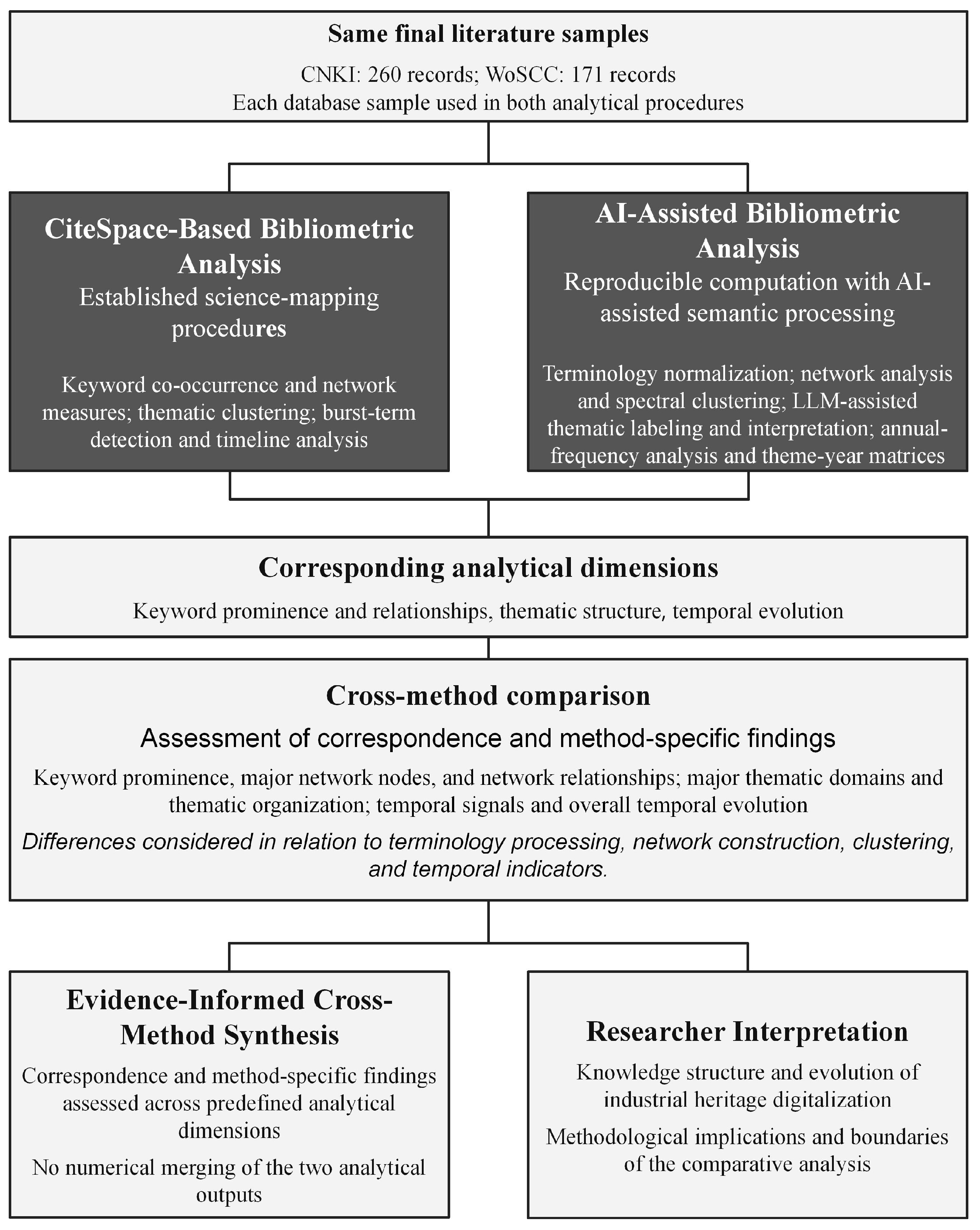
This study adopted a comparative bibliometric design based on two analyses of the same final literature samples: a CiteSpace-based bibliometric analysis and an AI-assisted bibliometric analysis. The CNKI and WoSCC datasets were analyzed separately throughout. Both analyses addressed corresponding dimensions of the literature, including keyword prominence and relationships, thematic structure, and temporal evolution, while differing in how bibliographic information was processed and represented. The overall methodological framework is presented in Figure 1.
2.1. Data Sources and Search Strategy
To identify literature on industrial heritage digitalization, the China National Knowledge Infrastructure (CNKI) and Web of Science Core Collection (WoSCC) were selected as complementary but non-equivalent bibliographic sources. The two databases differ in language coverage, indexing practices, publication types, and disciplinary coverage and therefore capture partly different segments of the literature. Accordingly, they were not treated as a single exhaustive corpus or as direct proxies for “Chinese” and “international” research. Instead, CNKI and WoSCC were treated as separate database-specific corpora throughout retrieval, screening, and analysis. Searches were completed on 5 April 2026 and covered publications from 2008 to that date.
The search strategy was designed to accommodate terminological variation across the interdisciplinary literature. Two conceptual groups were defined: terms referring to industrial heritage and related heritage objects, and terms referring to digitalization and associated digital technologies. Within each group, synonymous expressions, spelling variants, and related terms were combined using the Boolean operator OR; the two groups were then connected using AND to retrieve records addressing both industrial heritage and digitalization. Searches were conducted in the Subject field in CNKI and the Topic field in WoSCC. No restriction on document type was applied at the retrieval stage, and scholarly eligibility was assessed during the screening process described in Section 2.2. The initial searches retrieved 433 records from CNKI and 485 records from WoSCC. The complete search queries and restrictions are reported in Table 1.
Table 1.
Search strategies and initial retrieval results for CNKI and WoSCC.
Figure 1.
Overall framework of the comparative bibliometric analysis.
2.2. Eligibility Criteria and Sample Selection
Following database retrieval, records were screened according to predefined criteria concerning the study object, research content, and publication characteristics. Publications were included when they met all of the following criteria: (1) the study focused on industrial heritage, including industrial buildings, sites, landscapes, infrastructures, or other related heritage assets; (2) digital methods or technologies constituted a substantive component of research on documentation, conservation, management, interpretation, dissemination, regeneration, or adaptive reuse; and (3) the publication was a scholarly work containing sufficient bibliographic information for subsequent analysis.
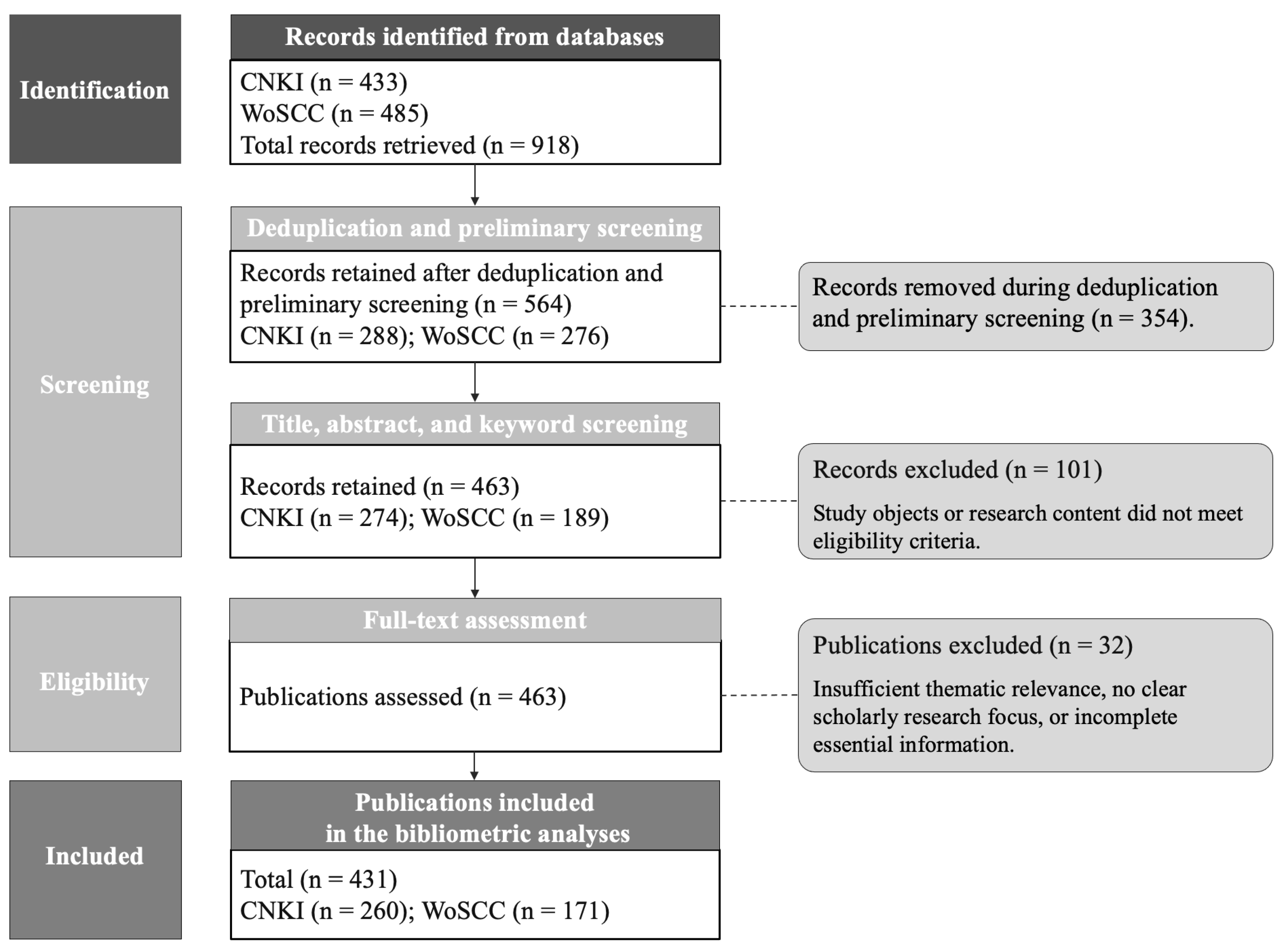
The selection process consisted of three stages and was conducted independently by two reviewers. First, duplicate records, publications clearly outside the research scope, and records that did not meet the basic eligibility requirements were removed during preliminary screening. Of the 918 records initially retrieved, 564 remained for further assessment, including 288 CNKI records and 276 WoSCC records. Second, titles, abstracts, and keywords were screened for thematic relevance. Records whose study objects or research content did not meet the eligibility criteria were excluded, leaving 463 publications (274 CNKI and 189 WoSCC records) for full-text assessment. Third, the bibliographic records and, where available, full texts were reviewed to confirm substantive relevance to industrial heritage digitalization and the availability of information required for bibliometric analysis. When screening decisions differed, the two reviewers re-examined the record against the predefined criteria and resolved the decision through discussion and consensus. Publications with insufficient thematic relevance, no clear scholarly focus, or incomplete essential information were excluded.
A total of 431 publications were ultimately included, comprising 260 CNKI records and 171 WoSCC records (Figure 2). The two datasets were retained and analyzed separately, and each final dataset was used unchanged in both the CiteSpace-based and AI-assisted analyses. For year-based analyses, one CNKI record without a valid publication year was excluded, resulting in 430 records with valid publication years (CNKI, n = 259; WoSCC, n = 171); this record was retained in the bibliographic corpus and AI-assisted cluster-associated-publication counts but excluded from annual node selection, slice-based network construction, and temporal analyses.
Figure 2.
Literature retrieval and selection process. Note. Literature screening was conducted manually according to the predefined eligibility criteria. CNKI and WoSCC records were screened separately.
2.3. Comparative Bibliometric Analysis
2.3.1. CiteSpace-Based Bibliometric Analysis
CiteSpace 6.4.R1 Advanced was used to analyze the CNKI and WoSCC datasets separately. The analysis covered 2008–2026 using one-year time slices. Term sources included titles, abstracts, and author keywords, with Keywords Plus additionally included for the WoSCC dataset. Keywords were selected as the node type to construct co-occurrence networks and examine prominent concepts, structural relationships, and thematic structure within the literature.
Node selection was based on the g-index (k = 25). In the primary CiteSpace analyses, Pathfinder pruning was applied to the CNKI keyword network, whereas the WoSCC network was retained without Pathfinder pruning. These settings were selected separately because the two database-specific networks differed in density and visual complexity. They were not used to support direct comparisons of network density, edge counts, or exact local relationships between the CNKI and WoSCC datasets.
Because Pathfinder pruning can affect network topology and cluster boundaries, a matched sensitivity analysis was conducted for the WoSCC dataset to assess the dependence of the primary findings on this processing choice. The same literature sample, time span, term sources, one-year time slices, and g-index selection rule were retained, while Pathfinder was applied to the merged WoSCC network (Prune merged = true; Prune slices = false; MST = false). The matched analysis examined whether major network and thematic findings remained recognizable under the alternative pruning setting. Detailed settings and results of this sensitivity analysis are reported in Supplementary Materials Section S3.1, Table S2, and Figure S1.
Betweenness centrality was calculated to identify structurally important and bridging keywords. Thematic clustering, burst-term detection, and timeline analysis were also conducted to examine thematic structure and temporal change. The resulting keyword networks, thematic clusters, and temporal outputs were retained for subsequent cross-method comparison.
2.3.2. AI-Assisted Bibliometric Analysis
The AI-assisted bibliometric analysis was also conducted separately for the CNKI and WoSCC datasets. It examined corresponding dimensions of keyword relationships, thematic structure, and temporal evolution but used different procedures for processing and organizing bibliographic information. Quantitative procedures, including node selection, network construction, structural measurement, clustering, and temporal statistics, were implemented using reproducible scripts developed with Codex assistance. Numerical results, network metrics, and computational cluster memberships were generated by executing these scripts rather than directly by the LLM. GPT-5.5, accessed through the Codex and GPT interfaces, supported terminology normalization, candidate thematic labeling, and interpretation of intermediate outputs. The LLM did not determine publication inclusion, network or cluster membership, or final thematic labels, and all model suggestions were reviewed by the researchers before being accepted, revised, or rejected for use in the analysis.
Node selection was based on annual keyword distributions, using an approximate g-index-based rule (×3) as the primary scheme and Top N = 25 as a supplementary reference. Keyword co-occurrence networks were constructed using individual publications as the co-occurrence window, with edge weights representing co-occurrence frequency. The networks were then simplified to retain major associations, after which degree, weighted degree, and betweenness centrality were calculated. Spectral clustering was used to identify thematic groups. Candidate cluster numbers were identified using the eigengap and evaluated using Modularity Q, network-distance-based Silhouette coefficients, cluster size, and thematic interpretability. Smaller clusters with limited keyword and publication support were retained as peripheral thematic clusters and interpreted separately from the major thematic clusters.
Terminology normalization combined rule-based processing with LLM-assisted suggestions for synonyms, abbreviations, capitalization differences, and morphological variants. Candidate cluster labels were generated from cluster keywords, representative nodes, and representative publications and were finalized through researcher review without altering cluster membership. Temporal change was examined using annual keyword-frequency changes and theme–year matrices. Candidate growth terms were defined as keywords showing sustained or marked increases in annual activity and were used as descriptive temporal indicators rather than as equivalents of CiteSpace burst terms. No user-specified LLM sampling parameters were available in the interfaces used; model-access information, prompt templates, researcher-review procedures, and parameter availability are documented in Supplementary Materials Section S4. Detailed computational rules and reproducibility materials are provided in Supplementary Materials Section S3.2 and the accompanying code archive. The principal differences between the CiteSpace-based and AI-assisted procedures are summarized in Table 2.
Table 2.
Analytical dimensions and procedures used in CiteSpace-based and AI-assisted bibliometric analyses.
2.3.3. Cross-Method Comparison of Bibliometric Results
The cross-method comparison was designed to examine the relative stability and method dependence of bibliometric findings obtained from the same literature samples under two different analytical representations. It was not intended to determine which approach was superior or to require numerical equivalence between their outputs. Instead, the comparison examined which findings were represented consistently across the two procedures and which were more sensitive to differences in terminology processing, network construction, clustering, and temporal analysis.
Keyword comparison examined the correspondence of prominent concepts and major network nodes, while network comparison focused on major structural relationships rather than absolute centrality values, edge counts, or network density. Thematic comparison was conducted at two levels. First, major thematic domains were compared on the basis of shared thematic content, representative terms, and representative publications, without requiring equivalent cluster numbers or labels. Second, thematic organization was compared in terms of thematic granularity, cluster boundaries, and the treatment of peripheral thematic clusters. Temporal comparison considered both specific temporal signals and broader evolutionary patterns, with CiteSpace burst terms and AI-assisted candidate growth terms interpreted according to their respective analytical meanings rather than treated as equivalent indicators.
Correspondence was assessed separately for each comparison dimension using the predefined criteria summarized in Table 3. The outputs of the two procedures were not numerically merged or combined into a composite result. Instead, correspondence classifications were based on evidence-informed researcher judgment using the underlying bibliographic and analytical evidence rather than fixed numerical overlap thresholds. Results were classified as broadly consistent when the two analyses identified substantially similar research topics, thematic domains, structural relationships, or evolutionary directions, and as partially consistent when clear substantive overlap was accompanied by differences in granularity, thematic boundaries, network relationships, or temporal characteristics. Findings represented more clearly by only one analysis were classified as method-specific findings when supported by the underlying bibliographic or analytical evidence.
Table 3.
Criteria for cross-method comparison of CiteSpace-based and AI-assisted bibliometric results.
3. Results
3.1. Keyword Prominence and Network Relationships
3.1.1. Principal Keywords and Network Relationships
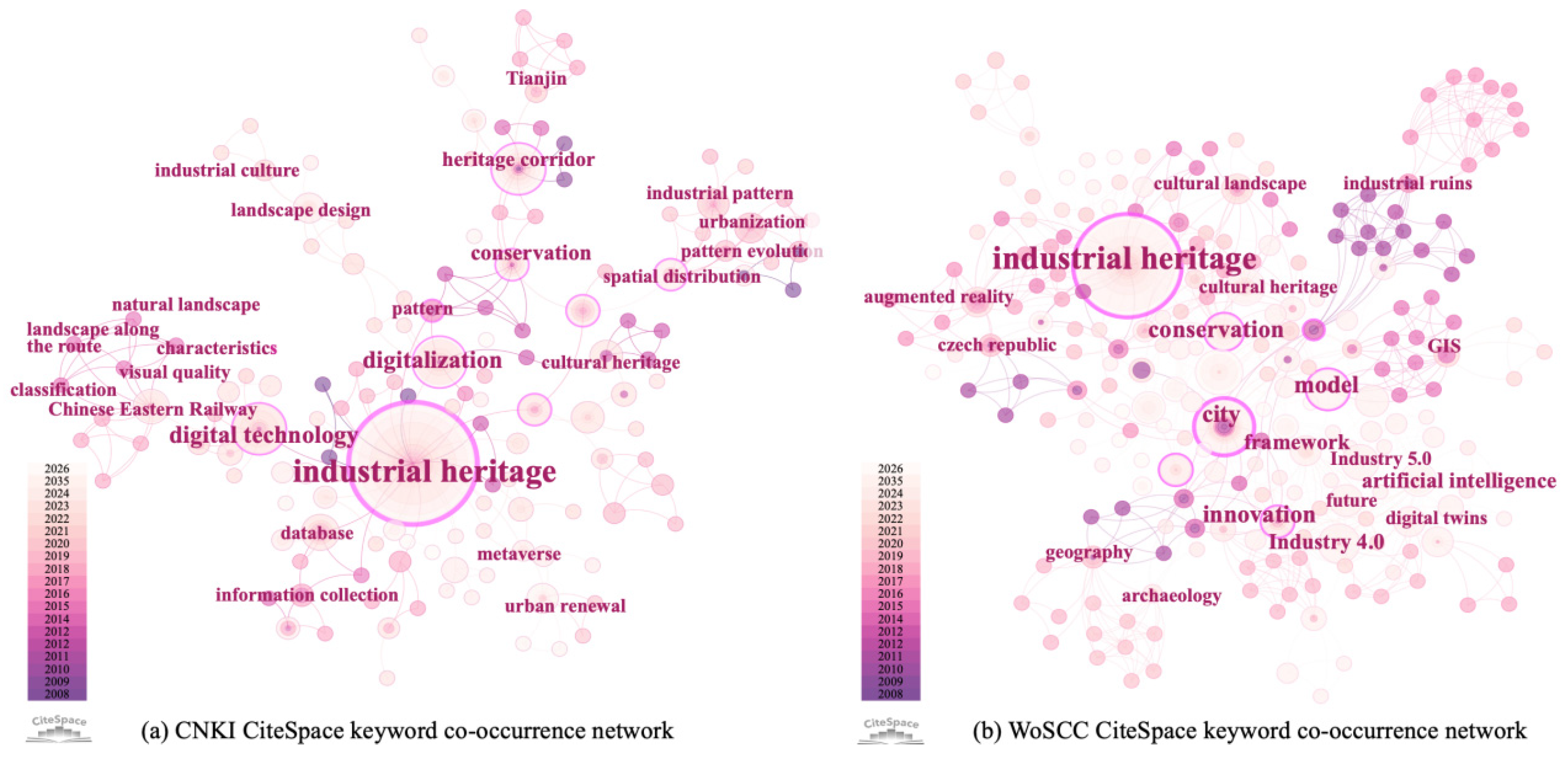
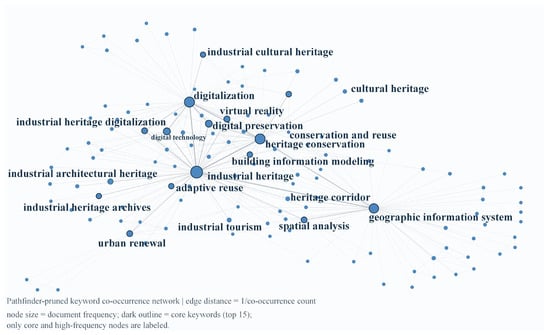
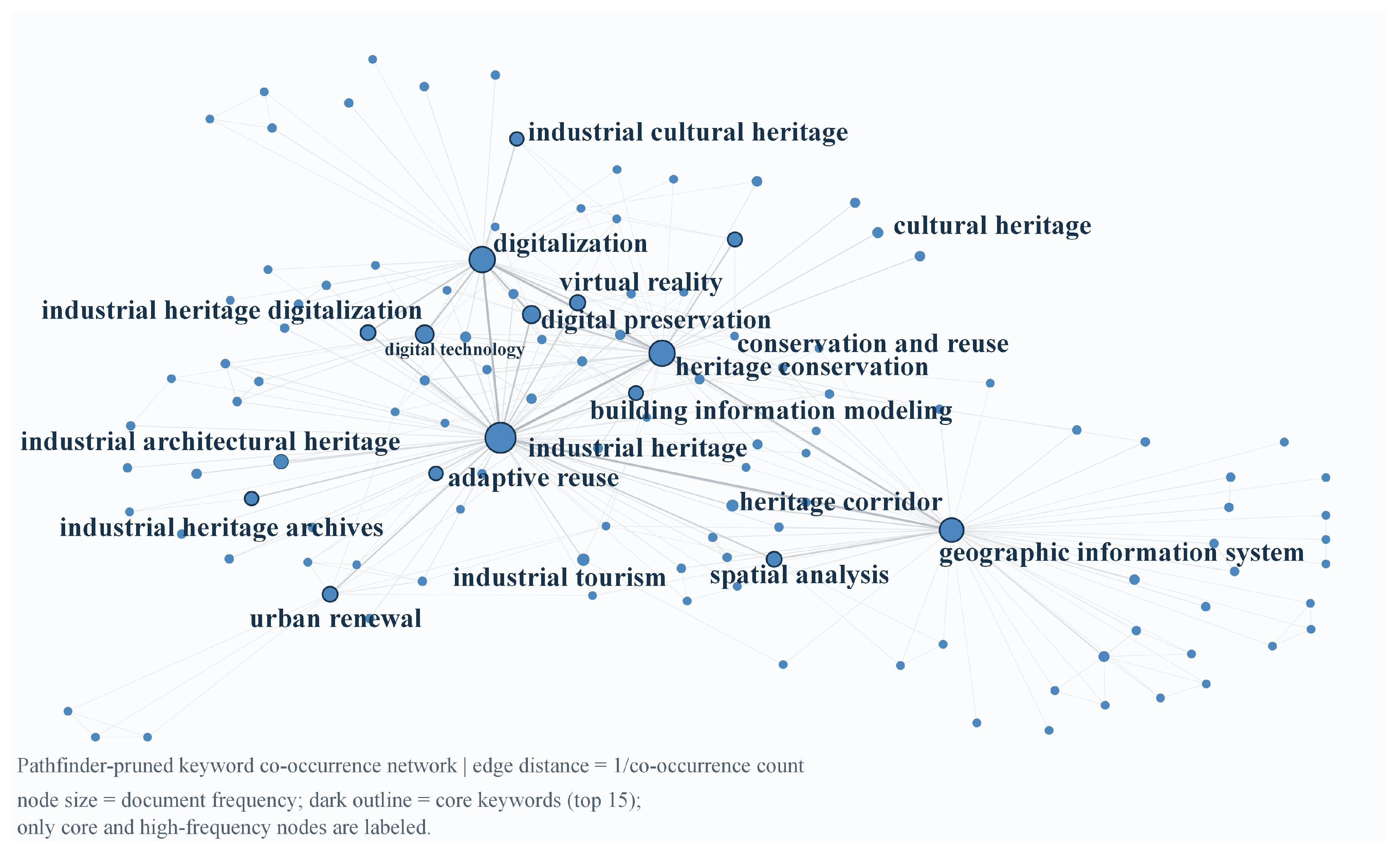
Across both analytical approaches, “industrial heritage” was a prominent keyword in the CNKI and WoSCC literature (Figure 3, Figure 4 and Figure 5). In the CNKI dataset, the CiteSpace-based analysis linked “industrial heritage” with “heritage conservation,” “digitalization,” “digital technology,” “heritage corridor,” “information collection,” “database,” and “urban renewal” (Figure 3a). In the AI-assisted analysis, “industrial heritage” was the most frequent keyword (165 publications), followed by “heritage conservation” and “digitalization” (108 publications each) and “geographic information system” (84 publications). Other prominent terms included “digital technology,” “digital preservation,” “virtual reality,” “spatial analysis,” and “urban renewal” (Figure 4).
Figure 3.
Keyword co-occurrence networks from the CiteSpace-based analysis: (a) CNKI; (b) WoSCC. Note. Network visualizations retain the CiteSpace settings used for each dataset. Pathfinder pruning was applied to the CNKI network only. Node size represents keyword frequency.
Figure 4.
AI-assisted keyword co-occurrence network for the CNKI dataset. Note. The network was constructed from normalized keywords following the node-selection and network-simplification procedures described in Section 2.3.2. Node size represents document frequency, and edges represent keyword co-occurrence relationships.
Figure 5.
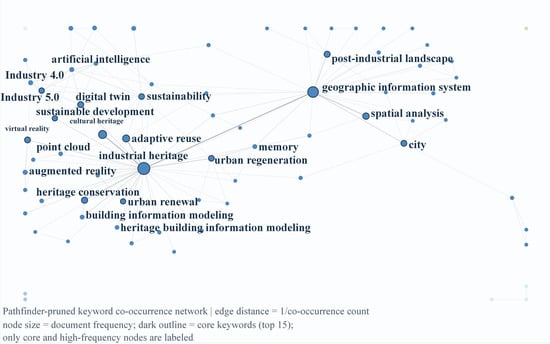
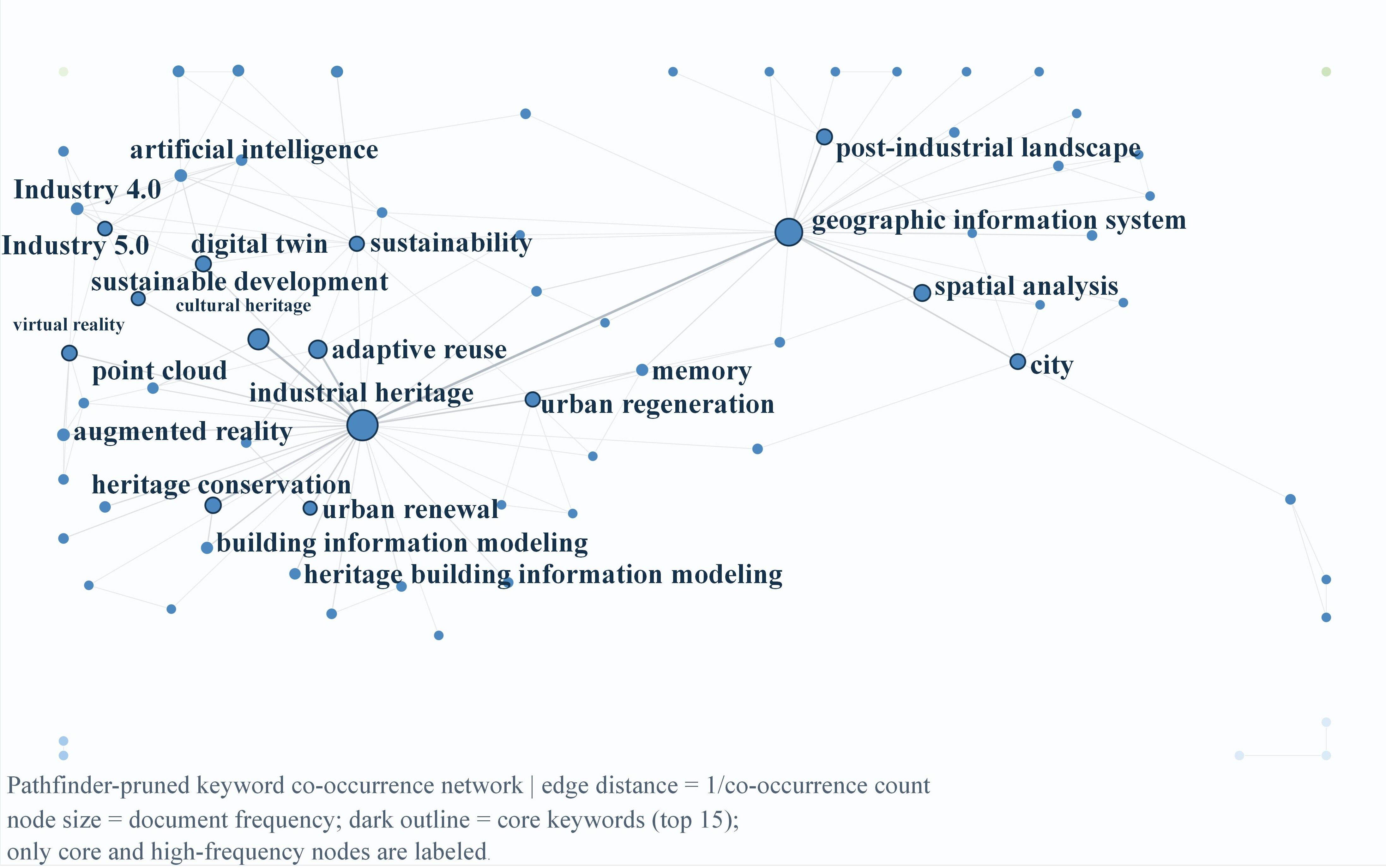
AI-assisted keyword co-occurrence network for the WoSCC dataset. Note. The network was constructed from normalized keywords following the node-selection and network-simplification procedures described in Section 2.3.2. Node size represents document frequency, and edges represent keyword co-occurrence relationships.
Within the AI-assisted CNKI network, “industrial heritage” showed the highest degree (70), weighted degree (439), and betweenness centrality (0.4936). “Geographic information system” (0.4259), “heritage conservation” (0.2096), and “digitalization” (0.1651) also showed relatively high betweenness centrality.
In the WoSCC dataset, the CiteSpace-based analysis linked “industrial heritage” with “cultural heritage,” “conservation,” “adaptive reuse,” “city,” “management,” and “geographic information system.” Technology-related terms, including “digital twin,” “artificial intelligence,” “Industry 4.0,” and “Industry 5.0,” were also present in the network (Figure 3b). In the AI-assisted analysis, “industrial heritage” was the most frequent keyword (87 publications), followed by “geographic information system” (61), “cultural heritage” (27), “spatial analysis” (18), and “adaptive reuse” (16). “Industrial heritage” showed the highest degree (32), weighted degree (138), and betweenness centrality (0.4075), while “geographic information system” had a betweenness centrality of 0.3784. “Sustainability,” “city,” and “framework” also showed relatively high betweenness centrality (Figure 5).
3.1.2. Cross-Method Comparison of Network Representation
The two analyses showed substantial overlap in the prominent keywords identified in both datasets. In the CNKI literature, both included “industrial heritage,” “heritage conservation,” “digitalization,” terms related to spatial analysis, and “urban renewal” among the prominent concepts. In the WoSCC literature, both emphasized “industrial heritage,” “geographic information system,” “cultural heritage,” “spatial analysis,” and “adaptive reuse.”
Differences in network representation were more apparent at finer levels of terminology and association. CiteSpace retained more case-, place-, and object-specific terms; in the CNKI network, for example, “Chinese Eastern Railway” and “heritage corridor” remained distinct nodes. The AI-assisted network more prominently retained broader recurring terms such as “geographic information system,” “digitalization,” and “heritage conservation.” Differences were also observed in specific network relationships and retained nodes.
Absolute node counts, edge counts, network density, and centrality values were not directly compared across methods. According to the criteria defined in Section 2.3.3, keyword prominence and major network nodes were classified as broadly consistent, whereas specific network relationships were classified as partially consistent.
The within-CiteSpace sensitivity analysis showed that applying Pathfinder to the WoSCC network retained the same number of nodes (347) and the same largest connected component (228 nodes; 65%), while reducing the number of edges from 906 to 782 (13.7%). This indicates that pruning altered the retained link structure without changing these broader network characteristics. Accordingly, fine-grained network relationships were treated as sensitive to the pruning procedure rather than as pruning-invariant features. Detailed sensitivity results are provided in Supplementary Materials Section S3.1 and Table S2.
3.2. Thematic Structure
3.2.1. Major Thematic Domains
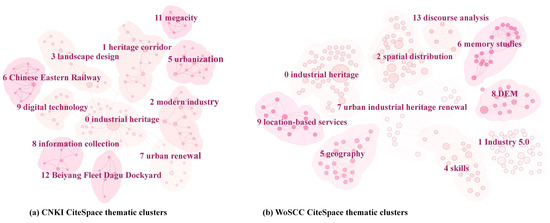
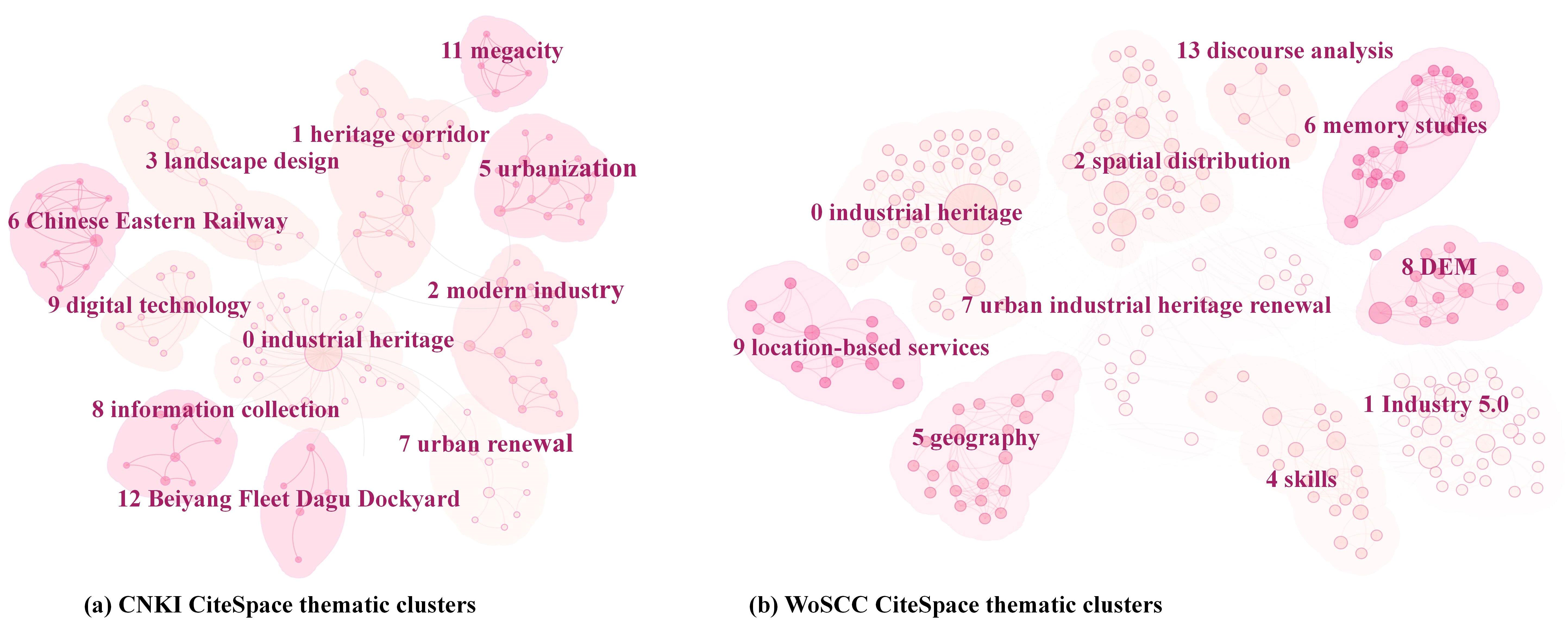
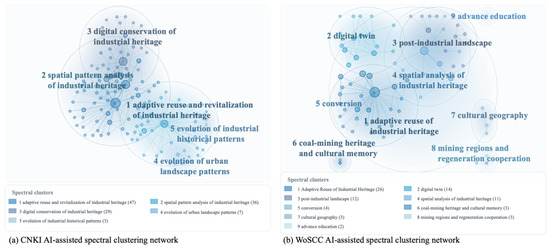
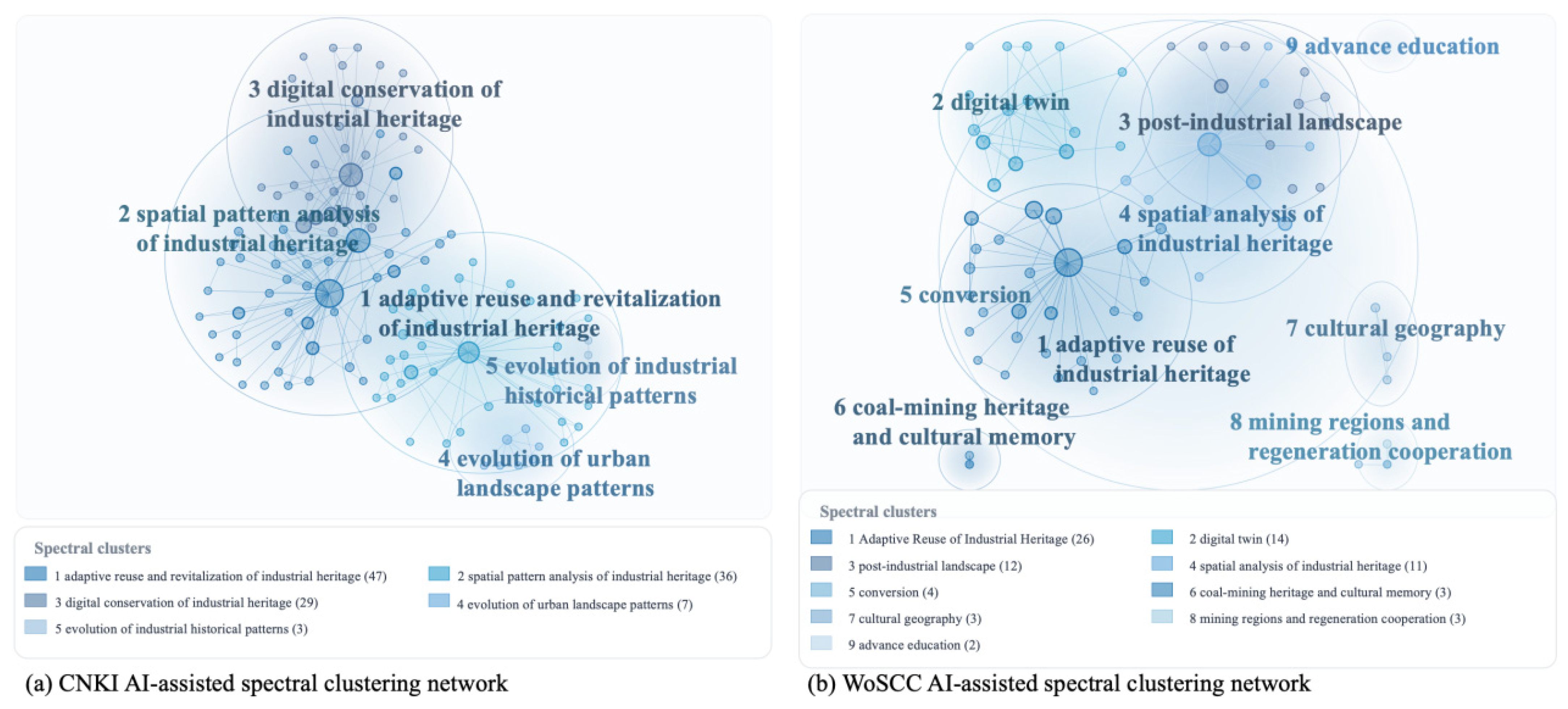
The thematic analyses identified several major themes in both datasets (Figure 6 and Figure 7). In the CNKI dataset, the CiteSpace-based analysis produced clusters related to industrial heritage, urban renewal, heritage corridors, information collection, and digital technology. The AI-assisted analysis identified three major thematic clusters: Adaptive Reuse and Revitalization of Industrial Heritage (47 keyword nodes; 214 associated publications), Spatial Pattern Analysis of Industrial Heritage (36 nodes; 91 publications), and Digital Conservation of Industrial Heritage (29 nodes; 137 publications). Two smaller clusters were retained as peripheral thematic clusters. The selected AI-assisted clustering solution yielded Q = 0.1763 and S = −0.013.
Figure 6.
Thematic clusters from the CiteSpace-based analysis: (a) CNKI; (b) WoSCC. Note. Node size represents keyword frequency, and colors indicate cluster membership.
Figure 7.
Spectral-clustering networks from the AI-assisted analysis: (a) CNKI; (b) WoSCC. Note. AI-assisted thematic clusters were derived using spectral clustering and labeled through LLM-assisted semantic interpretation with researcher review. The two smaller CNKI clusters and WoSCC clusters with fewer than five keyword nodes were treated as peripheral thematic clusters. Associated-publication counts are non-exclusive cluster-linkage counts. Node size represents weighted degree, and shaded regions indicate cluster membership.
In the WoSCC dataset, the primary unpruned CiteSpace analysis produced clusters related to industrial heritage renewal, spatial distribution, digital technologies, post-industrial landscapes, and cultural interpretation. The AI-assisted analysis identified four major thematic clusters: Adaptive Reuse of Industrial Heritage (26 nodes; 102 associated publications), Digital Twin (14 nodes; 39 publications), Post-Industrial Landscape (12 nodes; 21 publications), and Spatial Analysis of Industrial Heritage (11 nodes; 70 publications). Five smaller clusters were retained as peripheral thematic clusters. The selected AI-assisted clustering solution yielded Q = 0.3874 and S = 0.0441.
The matched Pathfinder sensitivity analysis retained the same number of keyword nodes (347) but altered the cluster partition. Major thematic domains remained recognizable under the alternative pruning setting, whereas the boundaries and labels of several smaller clusters changed. This indicates that the broad thematic structure was relatively stable across the two pruning settings, while finer-grained cluster organization was more sensitive to the pruning procedure. Detailed sensitivity results are provided in Supplementary Materials Section S3.1, Table S2, and Figure S1.
Because individual publications could be associated with more than one cluster, the associated-publication counts are non-exclusive and should not be summed across clusters. Detailed results for the peripheral thematic clusters are provided in the Supplementary Analysis Outputs.
3.2.2. Cross-Method Comparison of Thematic Organization
The major thematic domains showed broad correspondence across the two analyses (Table 4). In the CNKI dataset, both analyses identified domains related to adaptive reuse and revitalization, spatial analysis, and digital conservation. In the WoSCC dataset, corresponding domains included adaptive reuse, digital twins and immersive technologies, post-industrial landscapes, and spatial analysis.
Table 4.
Cross-method correspondence of major thematic domains in the CNKI and WoSCC datasets.
Differences occurred mainly in thematic granularity and cluster boundaries. The WoSCC Pathfinder sensitivity analysis retained broad domains related to reuse, spatial and geographic information, digital and immersive technologies, renewal, and heritage interpretation, while reconfiguring several smaller cluster labels and boundaries. This pattern was consistent with broad correspondence at the level of major thematic domains, whereas peripheral clusters and exact CiteSpace labels were more sensitive to the pruning procedure. Correspondence among peripheral thematic clusters was therefore treated cautiously and is reported in the Supplementary Analysis Outputs. According to the criteria defined in Section 2.3.3, the major thematic domains were classified as broadly consistent, whereas thematic organization was classified as partially consistent.
3.3. Temporal Evolution
3.3.1. Temporal Patterns in the CNKI and WoSCC Literature
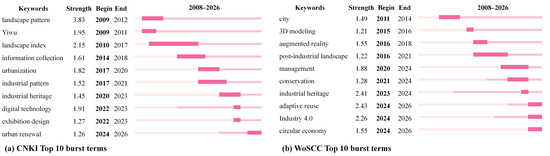
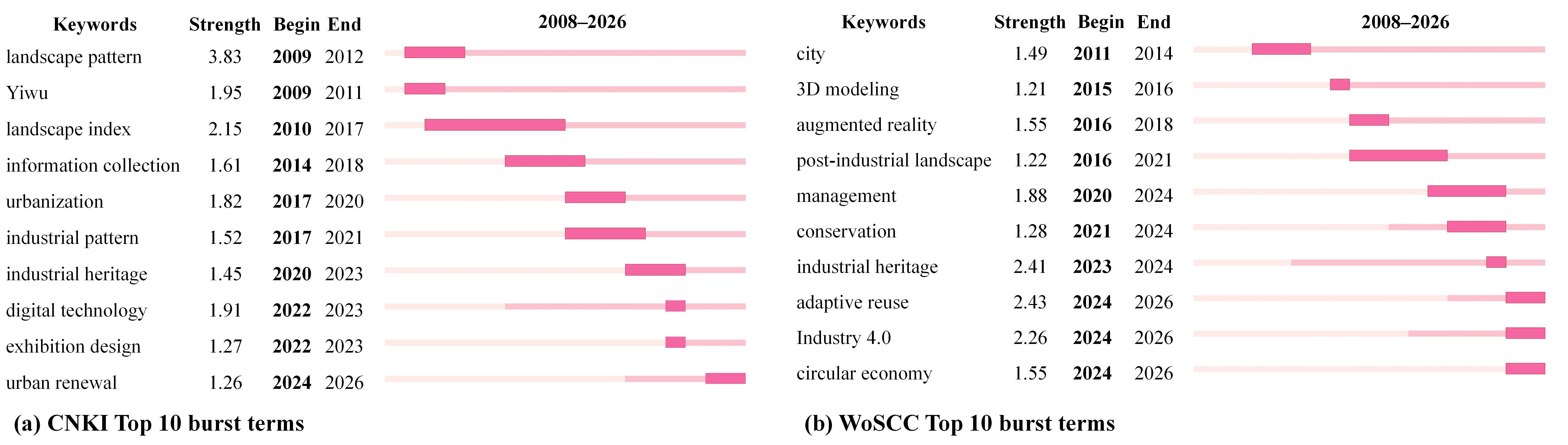
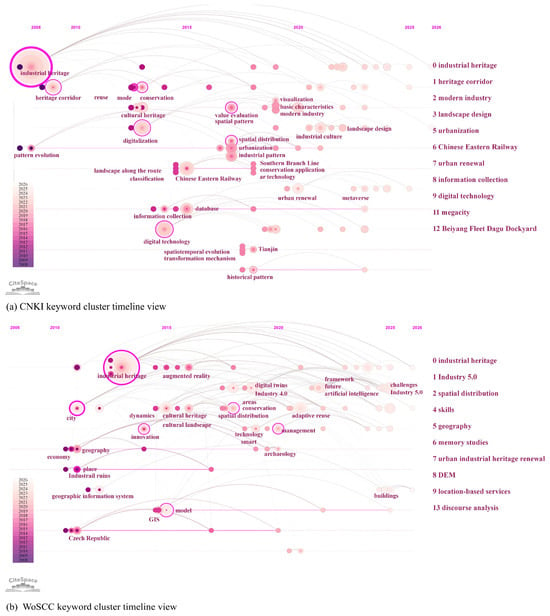
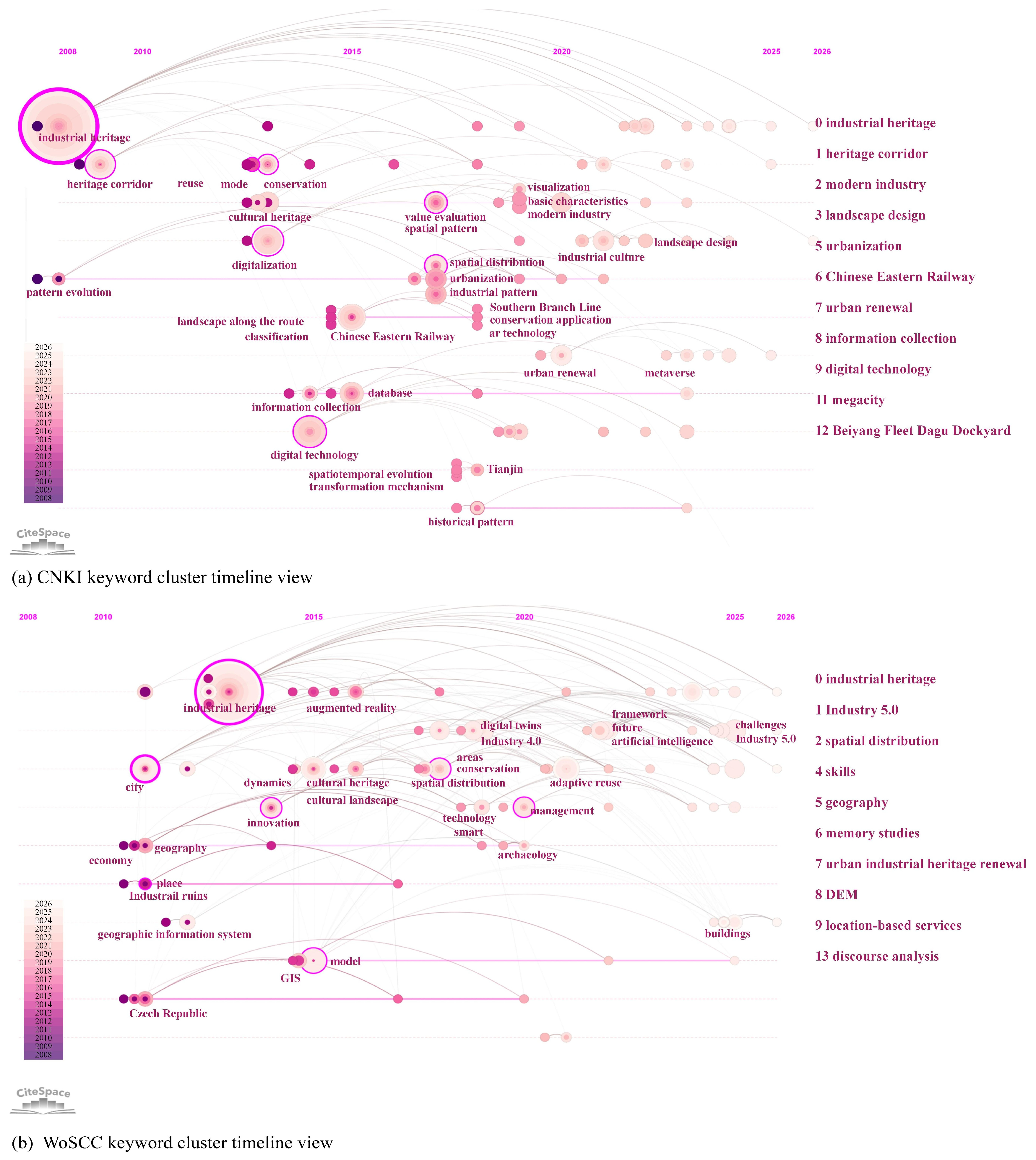
In the CNKI literature, CiteSpace identified earlier burst terms including “landscape pattern” (2009–2012), “landscape index” (2010–2017), and “point cloud” (2012–2020). Later burst terms included “information collection,” “architectural heritage,” “digital technology,” “digitalization,” and “urban renewal,” while the burst periods for “urban renewal,” “sense of place,” and “city image” extended through 2026 (Figure 8a; Table S1). The timeline analysis showed clusters related to industrial heritage, heritage corridors, landscape patterns, information collection, digital technologies, spatial evolution, and urban renewal across different periods (Figure 9a). The AI-assisted analysis indicated sustained annual activity in “industrial heritage,” “heritage conservation,” and “geographic information system,” together with later increases in terms related to digital conservation, digital technologies, and urban renewal.
Figure 8.
Top 10 keyword burst terms identified by CiteSpace: (a) CNKI; (b) WoSCC. Note. Red bars indicate burst periods, and the values indicate burst strength identified by CiteSpace.
Figure 9.
Timeline views of keyword clusters from the CiteSpace-based analysis: (a) CNKI; (b) WoSCC.
In the WoSCC literature, earlier CiteSpace burst terms included “city” (2011–2014), “laser scanning” (2013–2016), “3D modeling” (2015–2016), and “augmented reality” (2016–2018). “Post-industrial landscape” and “cultural landscape” exhibited longer burst periods, while “adaptive reuse,” “Industry 4.0,” “circular economy,” “artificial intelligence,” “digital transformation,” and “digital twins” appeared among the burst terms during 2024–2026 (Figure 8b; Table S1). The timeline analysis showed clusters related to spatial analysis, cultural landscapes, heritage management, and technology-oriented topics across different periods (Figure 9b). The AI-assisted analysis indicated recent increases in terms and themes related to adaptive reuse, digital twins, artificial intelligence, and sustainability.
3.3.2. Cross-Method Comparison of Temporal Signals
The AI-assisted analysis identified 70 candidate growth terms. Of these, 23 corresponded directly with CiteSpace burst terms, seven showed partial correspondence in terminology or active periods, and 40 had no CiteSpace burst counterpart. For example, “geographic information system” showed sustained or repeated increases in annual activity in the AI-assisted analysis but was not identified as a CiteSpace burst term in either dataset.
CiteSpace burst terms and AI-assisted candidate growth terms capture different forms of temporal change and were therefore not compared numerically. According to the criteria defined in Section 2.3.3, temporal signals were classified as partially consistent.
3.4. Overall Cross-Method Comparison
The cross-method comparison showed broad correspondence in keyword prominence, major network nodes, major thematic domains, and overall temporal evolution, whereas specific network relationships, thematic organization, and temporal signals were only partially consistent across the two analyses. Method-specific findings were concentrated mainly in the granularity of retained terms, peripheral thematic clusters, and specific temporal signals (Table 5).
Table 5.
Summary of cross-method correspondence across analytical dimensions.
4. Discussion
4.1. From Digital Documentation to Integrated Heritage Transformation
Industrial heritage digitalization has expanded from documentation and geometric representation toward the wider use of digital information in conservation, adaptive reuse, regeneration, and management. Earlier research emphasized surveying, point-cloud processing, three-dimensional modelling, spatial identification, and digital recording, whereas later studies increasingly connected these approaches with adaptive reuse, urban renewal, and emerging intelligent technologies. This development is better understood as an extension of digital functions rather than a succession in which newer technologies replace earlier ones: documentation and representation remain important foundations but are increasingly incorporated into broader heritage conservation and transformation activities [15,16,17,18,28,29,30,31,32,56].
This expansion is also evident in the changing role and spatial scope of heritage information. GIS, BIM/HBIM, and related approaches connect spatial relationships, building attributes, historical records, and management information within structured digital environments [6,18,56]. Research has also extended beyond individual buildings and sites to heritage corridors, industrial landscapes, spatial distributions, and urban regeneration contexts [23,24,25,26,27]. More recent applications of digital twins, artificial intelligence, and intelligent sensing further support dynamic monitoring, updating, and management [28,29,31,32]. Taken together, these developments indicate an increasingly integrated use of digital information across heritage functions and spatial scales.
4.2. Implications for Industrial Heritage Conservation and Adaptive Reuse
For industrial heritage practice, these developments place greater emphasis on the continuity, interoperability, and usability of digital information. Surveying, point-cloud acquisition, three-dimensional modelling, GIS, and BIM/HBIM can provide detailed records of geometry, condition, spatial relationships, and historical information [6,15,16,17,18,56], but their practical value depends on whether these records remain accessible and usable across conservation assessment, design development, intervention, and subsequent management [28,57,58]. Digital outputs are therefore most useful when information generated at one stage can continue to inform decisions at later stages rather than remaining isolated records or models.
This is particularly important in adaptive reuse and regeneration, where heritage significance must be considered alongside contemporary spatial, functional, technical, and regulatory requirements [5,26,27]. Digital information can support comparisons among existing conditions, heritage values, spatial configurations, environmental characteristics, and proposed interventions [4,26,58]. Because industrial heritage often forms part of wider production landscapes, infrastructure networks, brownfield areas, and urban redevelopment contexts, such information may also need to function across building, site, landscape, and urban scales [5,23,24,59]. Digital twins, artificial intelligence, and intelligent sensing can further support monitoring, maintenance, and phased regeneration, but their contribution depends on clearly defined conservation and reuse tasks rather than technological novelty alone [28,29,31,32,57].
4.3. Methodological Implications of Cross-Method Bibliometric Analysis
The cross-method comparison showed that broader features of the literature were represented more consistently than finer-grained network, thematic, and temporal details. Keyword prominence, major network nodes, major thematic domains, and overall temporal evolution showed broad correspondence, whereas specific network relationships, thematic organization, and temporal signals were more sensitive to differences between the two analytical procedures. This distinction is important because agreement at the level of major research domains does not imply equivalence in how those domains are internally organized or temporally represented. Moreover, because no external ground truth exists for the knowledge structure of industrial heritage digitalization, cross-method correspondence cannot verify that either representation is correct or complete. Rather, it provides evidence of convergence across analytical procedures and indicates that some field-level patterns are represented relatively consistently within the range of procedures examined in this study.
The similarity of the broader conclusions across the two procedures is therefore informative rather than evidence that the comparison is redundant. The purpose of applying two analytical procedures was not to determine which approach was correct or superior, but to distinguish findings that recur across different analytical representations from those that are more dependent on methodological choices. The WoSCC Pathfinder sensitivity analysis illustrates the same distinction within CiteSpace: applying pruning retained the same number of keyword nodes and recognizable major thematic domains while altering local link structure and the labels and boundaries of several smaller clusters. For subsequent bibliometric research, this distinction provides a practical basis for separating field-level patterns that receive convergent support across analytical settings from finer-grained interpretations that should be treated as more method-dependent and exploratory.
These differences cannot be attributed to semantic processing alone. Terminology normalization, node selection, network construction and pruning, clustering, thematic labeling, and temporal indicators can all affect bibliometric representation [11,47,48,49,50]. LLM-assisted semantic processing can help relate terms expressed through heterogeneous disciplinary vocabularies, but semantic consolidation may also reduce distinctions among specific heritage objects, geographical contexts, or technical approaches. Its use is therefore most appropriate as a complement to reproducible bibliometric computation, with semantic decisions made transparent and subject to researcher review.
4.4. Limitations
This study has several limitations. First, the literature corpus was limited to CNKI and WoSCC and therefore does not represent all research on industrial heritage digitalization. Publications indexed in other databases, written in other languages, or reported through professional and practice-oriented outlets may be underrepresented, while evolving interdisciplinary terminology may also have resulted in the omission of relevant studies. Differences in language coverage, indexing practices, publication types, and disciplinary coverage may further affect the terminology, disciplinary emphases, and thematic structures retained in each dataset. Accordingly, observed differences in keyword prominence or thematic structure between the two datasets may partly reflect database coverage and indexing practices rather than substantive differences in the underlying research landscape. The two datasets should therefore be interpreted as defined bibliographic corpora and cross-database contrasts as differences between database-indexed studies rather than complete representations of Chinese or international research.
Second, bibliometric patterns characterize the prominence, relationships, and development of research topics rather than the effectiveness of digital technologies in conservation or adaptive-reuse practice. The practical implications discussed above therefore require further examination through case studies, project evaluations, or longitudinal research [4,7].
Third, the two analytical procedures were compared in terms of substantive correspondence rather than numerical equivalence, and LLM-assisted semantic outputs remain partly dependent on model configuration, prompts, and researcher judgment. The AI-assisted clustering solutions also showed limited separation among some thematic groups, while cross-method thematic mappings involved evidence-informed researcher judgment rather than an external ground truth or numerical overlap threshold. In addition, the original CiteSpace analyses used different pruning settings for the CNKI and WoSCC networks. The matched WoSCC Pathfinder sensitivity analysis retained the same number of keyword nodes and recognizable major thematic domains but altered local link structure and the labels and boundaries of several smaller clusters. Taken together, these limitations primarily affect the strength of inference at finer-grained levels of representation. Consequently, conclusions concerning keyword prominence, major thematic domains, and the broad transition from digital documentation toward conservation, adaptive reuse, regeneration, and management receive convergent support across the analytical procedures examined in this study and do not depend on a single cluster boundary. By contrast, the exact number, labels, and boundaries of individual clusters, particularly peripheral clusters, as well as their cross-method mappings and specific local network or temporal relationships, should be treated as more method-dependent and exploratory.
Finally, because the search was completed on 5 April 2026, results for 2026 represent only a partial publication year.
5. Conclusions
This study indicates that industrial heritage digitalization has expanded beyond documentation and geometric representation toward the wider use of digital information in conservation, adaptive reuse, regeneration, and long-term management. Its significance lies not simply in the adoption of new technologies, but in the capacity to connect heritage records, spatial information, assessment, design, monitoring, and management across different functions and spatial scales. This perspective situates digitalization within the broader conservation and transformation of the historic built environment rather than treating it as a separate technical objective.
For practice, this development places greater emphasis on the continuity, interoperability, and usability of heritage information. Digital records and models are most valuable when they remain usable across successive stages of conservation, adaptive reuse, and management. Methodologically, the comparison showed that broader features of the literature were represented more consistently across the two analytical procedures than finer-grained network, thematic, and temporal details. Using more than one bibliometric procedure can therefore help distinguish field-level patterns that recur across analytical representations from findings that are more dependent on specific methodological choices. Cross-method correspondence provides convergent support for the interpretation of major research domains but does not establish either representation as correct or complete; findings limited to specific local links, peripheral clusters, or temporal signals should therefore be treated as more method-dependent and exploratory unless supported by additional evidence. Researcher-supervised LLM-assisted semantic processing can support terminology normalization and thematic interpretation, but its use should remain transparent and complementary to reproducible bibliometric procedures.
Supplementary Materials
The following supporting information can be downloaded at https://www.mdpi.com/article/10.3390/buildings16204064/s1. Supplementary-Materials.docx contains Section S1: Scope of the supplementary package; Section S2: Analytical sample and temporal-record rule; Section S3: Analytical settings and workflow; Section S4: Transparency information for AI-assisted processing; Section S5: Finalized AI-assisted thematic clusters; Section S6: CiteSpace burst terms and AI-assisted candidate growth terms; Section S7: Data and code availability; Figure S1: WoSCC CiteSpace keyword-cluster map generated with Pathfinder pruning under matched sensitivity-analysis settings; Table S1: Complete CiteSpace keyword burst-term results for the CNKI and WoSCC datasets; Table S2: Matched WoSCC CiteSpace Pathfinder sensitivity comparison; and Table S3: Database-specific literature retrieval and selection process. Additional files are Supplementary-Analysis-Outputs.xlsx (derived analytical outputs), Supplementary-Code.zip (computational code, derived inputs, and verification materials), Figure_S1_WoSCC_Pathfinder_Cluster_Map.png (the full-resolution image for Figure S1), and README-Supplementary-Package.md (file descriptions and instructions for use).
Author Contributions
Conceptualization, F.W. and Y.Y.; methodology, F.W., H.Y. and Y.Y.; software, H.Y. and Z.Z.; validation, H.Y. and Y.Y.; formal analysis, H.Y. and Z.Z.; investigation, H.Y. and Z.Z.; resources, F.W. and Y.Y.; data curation, F.W. and Y.Y.; writing—original draft preparation, F.W., H.Y. and Y.Y.; writing—review and editing, F.W., H.Y. and Y.Y.; visualization, H.Y. and Z.Z.; supervision, F.W. and Y.Y.; project administration, F.W. and Y.Y.; funding acquisition, F.W. and Y.Y. All authors have read and agreed to the published version of the manuscript.
Funding
This research was funded by Fundamental Research Funds for the Central Universities (2026ECNU-GJCBLW002).
Data Availability Statement
The derived analytical data and computational code supporting this study are provided in the Supplementary Materials. The original bibliographic records were obtained from the China National Knowledge Infrastructure (CNKI) and Web of Science Core Collection (WoSCC). The original bibliographic exports are not redistributed with this article; access to the source records is subject to the respective database access and licensing terms.
Conflicts of Interest
The authors declare no conflicts of interest.
References
- TICCIH. The Nizhny Tagil Charter for the Industrial Heritage; The International Committee for the Conservation of the Industrial Heritage: Nizhny Tagil, Russia, 2003. [Google Scholar]
- ICOMOS; TICCIH. Joint ICOMOS–TICCIH Principles for the Conservation of Industrial Heritage Sites, Structures, Areas and Landscapes: The Dublin Principles; ICOMOS: Paris, France, 2011. [Google Scholar]
- Douet, J. (Ed.) Industrial Heritage Re-Tooled: The TICCIH Guide to Industrial Heritage Conservation; Carnegie Publishing Ltd.: Lancaster, UK, 2012; ISBN 978-1-85936-218-1. [Google Scholar]
- Ma, Y.; Roosli, R.; Cao, Z.; Zhang, X.; Gai, Y.; Ma, Z. From Isolation to Integration: A Methodological Review of Adaptive Reuse in Industrial Heritage Buildings. Energy Build. 2025, 348, 116474. [Google Scholar] [CrossRef] [Scilit]
- Ifko, S. Comprehensive Management of Industrial Heritage Sites as A Basis for Sustainable Regeneration. Procedia Eng. 2016, 161, 2040–2045. [Google Scholar] [CrossRef] [Scilit]
- Yang, X.; Grussenmeyer, P.; Koehl, M.; Macher, H.; Murtiyoso, A.; Landes, T. Review of Built Heritage Modelling: Integration of HBIM and Other Information Techniques. J. Cult. Herit. 2020, 46, 350–360. [Google Scholar] [CrossRef] [Scilit]
- Han, S.H.; Zhang, H. Progress and Prospects in Industrial Heritage Reconstruction and Reuse Research during the Past Five Years: Review and Outlook. Land 2022, 11, 2119. [Google Scholar] [CrossRef] [Scilit]
- Bekele, M.K.; Pierdicca, R.; Frontoni, E.; Malinverni, E.S.; Gain, J. A Survey of Augmented, Virtual, and Mixed Reality for Cultural Heritage. J. Comput. Cult. Herit. 2018, 11, 7:1–7:36. [Google Scholar] [CrossRef] [Scilit]
- Trovato, G. Postproduction in the Research on the Urban Cultural Landscape: From the Transfer of Results to the Exchange of Knowledge on Digital Platforms and Social Networks-The TRAHERE Project in Madrid. Land 2023, 12, 31. [Google Scholar] [CrossRef] [Scilit]
- Liu, X.; Xiao, X.; Tian, C.; Li, H.; Zhu, G. Multi-Criteria Decision-Making in the Adaptive Reuse of Historic Buildings: A Bibliometric and Systematic Review of Practices in China. J. Asian Archit. Build. Eng. 2025. [Google Scholar] [CrossRef] [Scilit]
- van Eck, N.J.; Waltman, L.; Noyons, E.C.M.; Buter, R.K. Automatic Term Identification for Bibliometric Mapping. Scientometrics 2010, 82, 581–596. [Google Scholar] [CrossRef] [Scilit] [PubMed]
- Moitinho de Almeida, V.; Wefers, S.; Murphy, O. An Interdisciplinary Discussion of the Terminologies Used in Cultural Heritage Research. In Digital Techniques for Documenting and Preserving Cultural Heritage; Bentkowska-Kafel, A., MacDonald, L., Eds.; Amsterdam University Press: Ashland, OH, USA, 2018; pp. 3–16. [Google Scholar]
- Gleave, K. Disentangling Industrial Archaeology and Industrial Heritage: A Review of Research Methods and Paradigms. Ind. Archaeol. Rev. 2025, 47, 2–14. [Google Scholar] [CrossRef] [Scilit]
- O’Neill, B.; Stapleton, L. Digital Cultural Heritage Standards: From Silo to Semantic Web. AI Soc. 2022, 37, 891–903. [Google Scholar] [CrossRef] [Scilit] [PubMed]
- Wu, T.-C.; Lin, Y.-C.; Hsu, M.-F. A Study of 3D Modeling for Conservation Work of Large-Scale Industrial Heritage Structures: Using the South Chimney of Taiwan Tile Corporation’s Takao Factory as a Case Study. J. Asian Archit. Build. Eng. 2015, 14, 153–158. [Google Scholar] [CrossRef] [Scilit][Green Version]
- Tini, M.A.; Forte, A.; Girelli, V.A.; Lambertini, A.; Roggio, D.S.; Bitelli, G.; Vittuari, L. Scan-to-HBIM-to-VR: An Integrated Approach for the Documentation of an Industrial Archaeology Building. Remote Sens. 2024, 16, 2859. [Google Scholar] [CrossRef] [Scilit]
- Remondino, F. Heritage Recording and 3D Modeling with Photogrammetry and 3D Scanning. Remote Sens. 2011, 3, 1104–1138. [Google Scholar] [CrossRef] [Scilit]
- Limongiello, M.; Musmeci, D.; Radaelli, L.; Chiumiento, A.; di Filippo, A.; Limongiello, I. Parametric GIS and HBIM for Archaeological Site Management and Historic Reconstruction Through 3D Survey Integration. Remote Sens. 2025, 17, 984. [Google Scholar] [CrossRef] [Scilit]
- Vosinakis, S.; Nikolakopoulou, V.; Nikopoulos, G.; Fragkedis, L.; Stavrakis, M.; Politopoulos, N.; Koutsabasis, P. Designing Mixed Reality Experiences That Provide Views to the Past: Reviving the Operation of an Industrial Olive Oil Factory. In Proceedings of the 25th Pan-Hellenic Conference on Informatics with International Participation (PCI2021); Vassilakopoulos, M.G., Karanikolas, N.N., Eds.; Assoc Computing Machinery: Volos, Greece, 2021; pp. 39–44. [Google Scholar]
- Krupa, F.C. InnovART2: A l’ecoute Des Chantiers An Industrial Heritage Sound-and-Augmented-Reality Walking Tour. In Proceedings of the 2023 ACM International Conference on Interactive Media Experiences, IMX 2023, Nantes, France, 12–15 June 2023; pp. 376–378. [Google Scholar] [CrossRef] [Scilit]
- Sylaiou, S.; Dafiotis, P.; Fidas, C.; Vlachou, E.; Nomikou, V. Evaluating the Impact of XR on User Experience in the Tomato Industrial Museum “D. Nomikos.”. Heritage 2024, 7, 1754–1768. [Google Scholar] [CrossRef] [Scilit]
- Zhou, Q.; Wang, S.; Wang, J. Exploring User Experience in Virtual Industrial Heritage Platforms: Impact of Cultural Identity, Functional Clarity, Scene Interactivity, and Narrative Quality. Buildings 2025, 15, 253. [Google Scholar] [CrossRef] [Scilit]
- Tian, Y.; Huang, H. Application of Geographic Information System Technology in Industrial Heritage Management. J. Wuhan Univ. Technol. 2008, 114–117. [Google Scholar]
- Alba Dorado, M.I.; Romero de Oliveira, E. The Industrial Landscape. Approach to the Design of a Methodological Basis for its Study, Enhancement, and Intervention. ACE-Archit. City Environ. 2022, 16, 10501. [Google Scholar] [CrossRef] [Scilit]
- Ma, P.; Li, X.; Lan, D. A Dual Strategy in the Adaptive Reuse of Industrial Heritage Buildings: The Shanghai West Bund Waterfront Refurbishment. Buildings 2023, 13, 1582. [Google Scholar] [CrossRef] [Scilit]
- Hammond, E.B.; Coulon, F.; Hallett, S.H.; Thomas, R.; Dick, A.; Hardy, D.; Dickens, M.; Washbourn, E.; Beriro, D.J. From Data to Decisions: Empowering Brownfield Redevelopment with a Novel Decision Support System. J. Environ. Manag. 2023, 347, 119145. [Google Scholar] [CrossRef] [Scilit] [PubMed]
- Bian, X.; Brown, A.; Marques, B. Balancing Ecological Restoration and Industrial Landscape Heritage Values Through a Digital Narrative Approach: A Case Study of the Dagushan Iron Mine, China. Land 2026, 15, 155. [Google Scholar] [CrossRef] [Scilit]
- Jouan, P.; Hallot, P. Digital Twin: Research Framework to Support Preventive Conservation Policies. ISPRS Int. J. Geo-Inf. 2020, 9, 228. [Google Scholar] [CrossRef] [Scilit]
- Hosamo, H.; Mazzetto, S. Integrating Knowledge Graphs and Digital Twins for Heritage Building Conservation. Buildings 2025, 15, 16. [Google Scholar] [CrossRef] [Scilit]
- Nas, S.M.; Bondrea, M.V.; Radulescu, V.M.; Galgau, R.; Veres, I.S.; Bondrea, R.; Radulescu, A.T. The Use of UAVs for Land Use Planning of Brownfield Regeneration Projects-Case Study: Former Brick Factory, Cluj Napoca, Romania. Land 2023, 12, 315. [Google Scholar] [CrossRef] [Scilit]
- Zhang, H. The AlexNet HSD Model for Industrial Heritage Damage Detection and Adaptive Reuse under Artificial Intelligence. Sci. Rep. 2025, 15, 26289. [Google Scholar] [CrossRef] [Scilit] [PubMed]
- Felicetti, A.; Himmiche, A.; Somenzi, M. Knowledge Graphs and Artificial Intelligence for the Implementation of Cognitive Heritage Digital Twins. Appl. Sci. 2025, 15, 10061. [Google Scholar] [CrossRef] [Scilit]
- Bakon, K.A. Perspective Chapter: From Industry 4.0 to 5.0—Human-Centered Digitalization for Sustainable Heritage Tourism. In Industry 4.0—Transforming the Future Beyond Manufacturing—Volume 2, Human-Centred, Organizational and Societal Transformations; Delgado-Prieto, M., Romeral Martinez, L., Eds.; IntechOpen: London, UK, 2026; ISBN 978-0-85014-729-2. [Google Scholar]
- Hao, J.; Qi, S. Research Progress on the Protection and Reuse of Industrial Heritage in China Based on CiteSpace Analysis. Huazhong Archit. 2025, 43, 1–5. [Google Scholar] [CrossRef]
- Song, J. English Bibliometrics and Knowledge Map Analysis of Industrial Heritage Landscape Protection and Renewal Design Based on CiteSpace. Design 2024, 9, 727–740. [Google Scholar] [CrossRef]
- Liu, Z.; Liang, P. Review of Research on the Transformation and Conservation of Industrial Architectural Heritage. Archit. Des. Manag. 2025, 42, 83–89,96. [Google Scholar]
- You, K.; He, J. Research Review of Industrial Heritage Protection, Utilization, and Reinforcement in China. Build. Constr. 2024, 46, 1216–1222. [Google Scholar]
- Grant, M.J.; Booth, A. A Typology of Reviews: An Analysis of 14 Review Types and Associated Methodologies. Health Inf. Libr. J. 2009, 26, 91–108. [Google Scholar] [CrossRef] [Scilit] [PubMed]
- Snyder, H. Literature Review as a Research Methodology: An Overview and Guidelines. J. Bus. Res. 2019, 104, 333–339. [Google Scholar] [CrossRef] [Scilit]
- Zupic, I.; Čater, T. Bibliometric Methods in Management and Organization. Organ. Res. Methods 2015, 18, 429–472. [Google Scholar] [CrossRef] [Scilit]
- Marzi, G.; Balzano, M.; Caputo, A.; Pellegrini, M.M. Guidelines for Bibliometric-Systematic Literature Reviews: 10 Steps to Combine Analysis, Synthesis and Theory Development. Int. J. Manag. Rev. 2025, 27, 81–103. [Google Scholar] [CrossRef] [Scilit]
- Linnenluecke, M.K.; Marrone, M.; Singh, A.K. Conducting Systematic Literature Reviews and Bibliometric Analyses. Aust. J. Manag. 2020, 45, 175–194. [Google Scholar] [CrossRef] [Scilit]
- Donthu, N.; Kumar, S.; Mukherjee, D.; Pandey, N.; Lim, W.M. How to Conduct a Bibliometric Analysis: An Overview and Guidelines. J. Bus. Res. 2021, 133, 285–296. [Google Scholar] [CrossRef] [Scilit]
- Morris, S.A.; Van der Veer Martens, B. Mapping Research Specialties. Annu. Rev. Inf. Sci. Technol. 2008, 42, 213–295. [Google Scholar] [CrossRef] [Scilit]
- Chen, C. CiteSpace II: Detecting and Visualizing Emerging Trends and Transient Patterns in Scientific Literature. J. Am. Soc. Inf. Sci. Technol. 2006, 57, 359–377. [Google Scholar] [CrossRef] [Scilit]
- Cobo, M.J.; López-Herrera, A.G.; Herrera-Viedma, E.; Herrera, F. Science Mapping Software Tools: Review, Analysis, and Cooperative Study among Tools. J. Am. Soc. Inf. Sci. Technol. 2011, 62, 1382–1402. [Google Scholar] [CrossRef] [Scilit]
- Waltman, L.; van Eck, N.J.; Noyons, E.C.M. A Unified Approach to Mapping and Clustering of Bibliometric Networks. J. Inf. 2010, 4, 629–635. [Google Scholar] [CrossRef] [Scilit]
- Chen, G.; Xiao, L. Selecting Publication Keywords for Domain Analysis in Bibliometrics: A Comparison of Three Methods. J. Inf. 2016, 10, 212–223. [Google Scholar] [CrossRef] [Scilit]
- Borsi, B.; Vida, Z.; Soós, S. Keyword Standardization and Restructuring: The Impact on Analysing Network-Based Science Maps in Innovation Management Research. Scientometrics 2025, 130, 593–617. [Google Scholar] [CrossRef] [Scilit]
- Chen, G.; Hong, S.; Du, C.; Wang, P.; Yang, Z.; Xiao, L. Comparing Semantic Representation Methods for Keyword Analysis in Bibliometric Research. J. Inf. 2024, 18, 101529. [Google Scholar] [CrossRef] [Scilit]
- Bolaños, F.; Salatino, A.; Osborne, F.; Motta, E. Artificial Intelligence for Literature Reviews: Opportunities and Challenges. Artif. Intell. Rev. 2024, 57, 259. [Google Scholar] [CrossRef] [Scilit]
- Scherbakov, D.; Hubig, N.; Jansari, V.; Bakumenko, A.; Lenert, L.A. The Emergence of Large Language Models as Tools in Literature Reviews: A Large Language Model-Assisted Systematic Review. J. Am. Med. Inf. Assoc. 2025, 32, 1071–1086. [Google Scholar] [CrossRef] [Scilit] [PubMed]
- Wagner, G.; Prester, J.; Mousavi, R.; Lukyanenko, R.; Paré, G. Generative Artificial Intelligence for Literature Reviews. J. Inf. Technol. 2026, 41, 148–170. [Google Scholar] [CrossRef] [Scilit]
- Dennstädt, F.; Zink, J.; Putora, P.M.; Hastings, J.; Cihoric, N. Title and Abstract Screening for Literature Reviews Using Large Language Models: An Exploratory Study in the Biomedical Domain. Syst. Rev. 2024, 13, 158. [Google Scholar] [CrossRef] [Scilit] [PubMed]
- Gartlehner, G.; Kahwati, L.; Hilscher, R.; Thomas, I.; Kugley, S.; Crotty, K.; Viswanathan, M.; Nussbaumer-Streit, B.; Booth, G.; Erskine, N.; et al. Data Extraction for Evidence Synthesis Using a Large Language Model: A Proof-of-Concept Study. Res. Synth. Methods 2024, 15, 576–589. [Google Scholar] [CrossRef] [Scilit] [PubMed]
- Du, X. BIM-Based Industrial Architectural Heritage Mapping. Master’s Thesis, Tianjin University, Tianjin, China, 2013. [Google Scholar]
- Hou, H.; Lai, J.H.K.; Wu, H.; Wang, T. Digital Twin Application in Heritage Facilities Management: Systematic Literature Review and Future Development Directions. Eng. Constr. Archit. Manag. 2023, 31, 3193–3221. [Google Scholar] [CrossRef] [Scilit]
- Lasorella, M.; Cantatore, E. CityGML-Based Model for the Recovery and Management of Built Cultural Heritage: A Systematic Review towards Digitalized Processes. City Territ Archit. 2025, 12, 10. [Google Scholar] [CrossRef] [Scilit]
- Li, J.; Pan, J.; Dou, Q.; Fu, F.; Shi, Y. Digital Footprint as a Public Participatory Tool: Identifying and Assessing Industrial Heritage Landscape through User-Generated Content on Social Media. Land 2024, 13, 743. [Google Scholar] [CrossRef] [Scilit]

Disclaimer/Publisher’s Note: The statements, opinions and data contained in all publications are solely those of the individual author(s) and contributor(s) and not of MDPI and/or the editor(s). MDPI and/or the editor(s) disclaim responsibility for any injury to people or property resulting from any ideas, methods, instructions or products referred to in the content. |
© 2026 by the authors. Licensee MDPI, Basel, Switzerland. This article is an open access article distributed under the terms and conditions of the Creative Commons Attribution (CC BY) license.