


Abstract
With the rapid development of AI technologies, digital software, and teaching methods, flipped-learning approaches are becoming increasingly popular for academic education. Next-generation teaching modules will potentially enhance the learning experiences of students. In this study, the impact and enhancement of students’ end-user experience in learning computational fluid dynamics (CFD) fire models have been evaluated based on course evaluation surveys. This paper will explore three key objectives of the proposed flipped-learning approach, including (i) the engagement and enhanced willingness of students’ self-adaptive learning; (ii) the effectiveness of pre-class study and practice towards students’ total understanding of the learning materials; and (iii) the overall quality of the delivery mode towards the learning outcomes. Additionally, the AI-enabled technology to convert legacy teaching materials to online-adaptive tutorials with visual-aided components will be discussed in this paper. Survey responses show generally positive perceptions of the flipped-learning format and AI-supported resources. The students’ feedback on new functions and their effectiveness in software skills acquisition will also be investigated.
1. Introduction
The rapid advancement of digital technologies [1,2], artificial intelligence (AI) [3,4,5], and simulation tools has significantly reshaped engineering education over the past decade [6]. In building fire safety engineering, computational tools such as the Fire Dynamics Simulator (FDS) and its graphical user interface PyroSim have become essential for analysing fire development, smoke movement, heat transfer, and occupant safety performance [7]. Mastery of such computational fluid dynamics (CFD)-based fire models is increasingly required for graduates entering professional practice [8]. However, the technical complexity of these tools, together with steep learning curves in numerical modelling, scripting logic, and result interpretation, poses substantial challenges to conventional teaching approaches.
Traditionally, modelling courses in fire engineering have been delivered through lecture-based instruction supplemented by laboratory demonstrations. In this instructor-centred format, CFD basic theories, including conservation equations [9], turbulence modelling [10], combustion modelling [11], pyrolysis modelling [12], radiation modelling [13] and boundary condition settings [14], are introduced during class time. Meanwhile, students attempt to learn and practice software operation and scenario development independently after class [8,15]. This structure often results in limited hands-on engagement during lessons, insufficient time for troubleshooting modelling errors, and uneven learning outcomes among students with different levels of computational background. As CFD fire modelling requires iterative testing, parameter sensitivity analysis [16,17], and interpretation of visual outputs, passive learning modes may constrain students’ deeper conceptual understanding and practical competence.
Flipped learning has emerged as a pedagogical strategy aimed at addressing these limitations [18,19,20,21,22]. Under the flipped-learning paradigm, foundational knowledge acquisition occurs before class through structured digital materials, including video lectures, interactive tutorials, and guided reading, while classroom time is reallocated to collaborative problem-solving, applied exercises, and instructor-guided discussions [23]. This student-centred approach encourages self-paced learning, promotes active engagement, and allows educators to focus on higher-order cognitive tasks during face-to-face sessions. Active and adaptive learning significantly improve STEM education by enhancing engagement, reducing achievement gaps, and supporting personalised learning. Flipped classrooms combined with adaptive technology show particularly strong effects on problem-solving skills and learning satisfaction among engineering students [23,24]. Nevertheless, its application in highly technical modelling courses, particularly in fire safety engineering, remains relatively underexplored [21,25,26].
Concurrently, AI-enabled technologies provide new opportunities to enhance flipped-learning environments [27,28]. Generative AI tools and adaptive digital platforms can assist in transforming legacy teaching materials. This includes static lecture slides and printed manuals to be converted into interactive online modules with embedded visualisations, automated feedback, and scenario-based simulations [29,30]. CFD modelling typically produces a variety of results ranging from temperature and fire-related parameter data [31], to 2D contour plots showing the cutting-plane results (i.e., temperature, smoke visibility, gas species, etc.) [32], to 3D visualisation of the fire and smoke developments convertible to visual fire developments [33]. AI-assisted features may include automated explanation of error messages, guided parameter selection, visual interpretation of simulation outputs, and step-by-step workflow recommendations. Such enhancements have the potential to reduce cognitive overload, support self-adaptive learning, and improve software skill acquisition.
Recent research has also emphasized that AI-supported analytical frameworks should be accompanied by appropriate validation and interpretability considerations to ensure reliable and transparent use of AI-based methods [34,35]. Despite the growing adoption of AI-assisted educational tools, there is limited empirical evidence evaluating their effectiveness in specialised engineering domains. In particular, few studies have systematically investigated students’ end-user experiences when flipped learning is integrated with AI-enabled support tools in simulation-based fire modelling courses. Understanding learners’ perceptions, engagement levels, and skill development outcomes is essential for assessing whether these innovations meaningfully improve teaching effectiveness.
In this paper, a flipped-learning framework integrated with AI-enabled instructional components was developed and evaluated for a building fire modelling course using FDS and PyroSim. Unlike previous studies that mainly focus on student satisfaction or perception-based evaluations, this work explores the systematic integration of AI-assisted technologies into instructional design to enhance learning material development, pre-class preparation, conceptual understanding, and CFD software skill acquisition. By combining AI-supported content refinement, multimedia learning resources, and structured flipped-learning activities, this study provides a reproducible pedagogical framework for computational engineering education. Through analysis of survey responses and reflective feedback, this research extends existing flipped-learning and AI-assisted education studies by demonstrating a practical implementation pathway for teaching complex simulation-based engineering courses and offering insights for future curriculum innovation. Based on the above research objectives, research hypotheses were formulated to systematically evaluate the effectiveness of the proposed flipped-learning and AI-enabled CFD teaching framework: (1) The flipped-learning approach integrated with AI-enabled learning resources can enhance students’ learning engagement and willingness for self-directed learning compared with conventional lecture-based learning modes; (2) The combination of pre-class learning activities and AI-supported practice can improve students’ understanding of CFD modelling concepts and their ability to apply simulation knowledge in engineering scenarios; (3) The proposed flipped-learning and AI-enabled teaching framework can positively influence students’ perceived learning outcomes, overall satisfaction, and acceptance of the instructional delivery mode. These hypotheses were examined based on students’ questionnaire responses regarding learning effectiveness, motivation, engagement, AI-assisted learning experience, and software skill development.
2. Methodology
This study adopted a structured case-study approach to examine a flipped-learning model integrated with AI-enabled instructional components in a building fire modelling course. The methodology was designed to describe students’ learning engagement, perceived effectiveness of pre-class preparation, perceived usefulness of AI-assisted resources, and perceived support for software learning through quantitative and qualitative end-user feedback. The study was exploratory and evaluative rather than a controlled experimental study; consequently, the survey data were not used to establish causal effects or objective gains in learning performance.
The research framework consisted of three major components: (i) the design and implementation of the flipped-learning structure, (ii) the development and deployment of AI-enabled adaptive learning materials, and (iii) the collection and analysis of student survey data [36]. The study was conducted within an undergraduate/graduate-level computational fire modelling course offered by the Department of Building Environment and Energy Engineering at The Hong Kong Polytechnic University. The course primarily focused on the application of Fire Dynamics Simulator (FDS) and PyroSim for performance-based fire engineering analysis.
To enhance students’ understanding of the modelling theory revolving around the computational fluid dynamics (CFD) approach and large-eddy-simulation (LES) techniques utilised in the FDS framework for fire applications, lecture slides were built based on past lecture and tutorial recordings from the subject “Computational Fire Modelling for Building Designs”. Additional information with regard to governing equations for turbulent reacting flows, pyrolytic solid fire developments and compartment room fire dynamics coupled with underlying theories was included in the pre-class slides. Also, work examples based on previously established studies in compartment room and tunnel fire scenarios [37,38,39,40] were provided as a skill benchmark study for students to validate their model and examine their understanding.
To ensure replicability and transparency, the instructional design, digital materials, survey instruments, and evaluation procedures are described in detail in the following subsections. The flipped-learning intervention was implemented over a full academic semester, allowing sufficient time to observe student adaptation to the revised teaching format. AI-enabled components were embedded into pre-class and post-class learning resources to facilitate guided practice and visual-assisted understanding.
A mixed-method approach was employed for data collection. Quantitative data were obtained through structured five-point Likert-scale survey questions measuring students’ engagement, perceived clarity of instructional materials, perceived effectiveness of AI-assisted tools, and confidence in software operation. Qualitative feedback was collected through open-ended questions to capture students’ reflections on learning experiences, challenges encountered, and suggestions for improvement. The survey was administered at the end of the semester after students had experienced the full teaching cycle. The final pooled dataset contained 26 usable student responses from the two participating course offerings. The analysis was descriptive, focusing on response percentages and mean Likert scores; no inferential significance tests were applied to the pooled survey results because the available data were limited to a small, self-selected end-user sample and were not collected under a controlled experimental design. Future work should use larger samples and pre-specified inferential analyses where the study design permits.
2.1. Flipped-Learning Methods
The flipped-learning implementation in this study is based on the constructivist learning theory and cognitive load theory [41]. Constructivist learning theory holds that knowledge is actively constructed by learners rather than passively accepted, which is consistent with the core requirement of flipped learning that guides students to complete independent learning before class. Cognitive load theory emphasises reducing unnecessary cognitive load in the learning process to improve learning efficiency; therefore, the design of pre-class learning resources (videos, PPT guides) in this study focuses on simplifying complex knowledge and optimising information presentation to help students complete knowledge acquisition efficiently [42]. The research adopts a practical research paradigm, focusing on the operability and effectiveness of flipped-learning resource development, and takes the whole process of pre-class learning resource construction as the key research object.
2.2. Development of Pre-Class Learning Resources
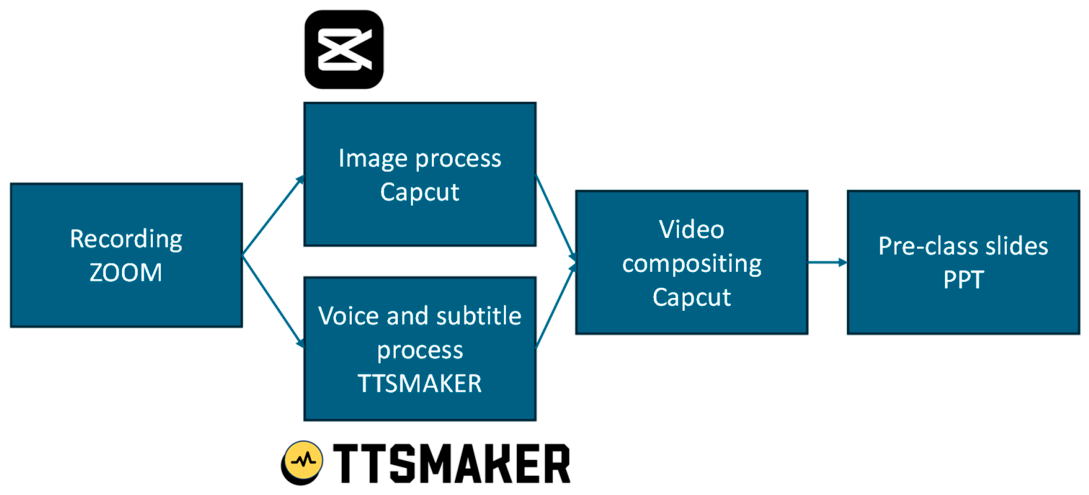
Pre-class learning resources are the foundation of flipped learning implementation, and their quality directly impacts the effect of students’ independent pre-class learning. This study completes the development of pre-class learning resources through four consecutive steps: Zoom cloud video recording, video editing and optimization, PPT integration and AI-assisted logic improvement, as shown in Scheme 1:
Scheme 1.
Development of Pre-Class Learning Resources.
(1) Recording of Complete Video Materials
Before recording, the researcher will sort out the course knowledge system, clarify the key points, difficulties and logical context of each knowledge module, and formulate a detailed video recording plan, including the determination of teaching content and the design of explanation logic. In the recording process, the teaching staff with professional teaching experience were invited to explain the course content, ensuring the accuracy and professionalism of the knowledge.
(2) Video Editing and Learning Module Division
After the completion of the initial video recording, the research team used video editing tools in CapCut (Version 9.3.0) to edit and optimise the video materials, which is an important step to realise the fragmentation and modularisation of learning content. The editing work mainly focuses on three aspects. First, trimming the redundant content in the video, eliminating the irrelevant explanation and pause segments, and ensuring the conciseness and focus of the video. Second, dividing the complete video into different independent learning modules according to the knowledge hierarchy and logical structure of the course; each module corresponds to a specific knowledge point or learning task, and the duration of each module is controlled within a reasonable range to adapt to the characteristics of students’ fragmented learning [43]. Lastly, the automatically generated subtitles from Zoom will be optimised by an AI tool to improve coherence. The optimised subtitles will be transferred to voice via TTSMAKER (https://ttsmaker.com/) and then integrated into the video by CapCut.
In this section, where applicable, authors are required to disclose details of how generative artificial intelligence (GenAI) has been used in this paper (e.g., to generate text, data, or graphics, or to assist in study design, data collection, analysis, or interpretation). The use of GenAI for superficial text editing (e.g., grammar, spelling, punctuation, and formatting) does not need to be declared.
(3) PPT Integration and Text Guidance Configuration
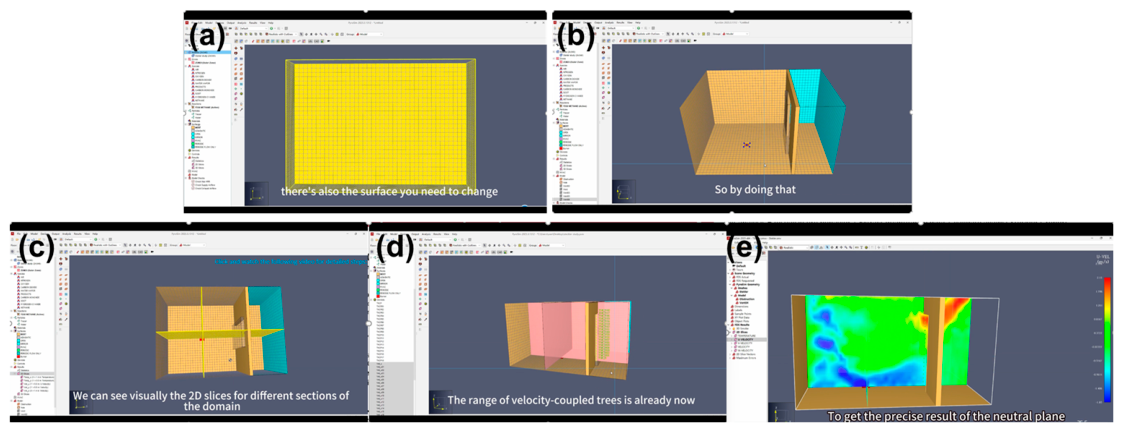
To further improve the effectiveness of students’ pre-class independent learning, the edited video modules were integrated into PPT to form a systematic pre-class learning resource package (Figure 1). One or more slides correspond to a video module, and the video is embedded in the PPT to facilitate students’ watching and learning. At the same time, relevant text guidance is added to each video module in the PPT, including the learning objectives of the module, key and difficult prompts, learning steps and thinking questions. The text guidance is designed to help students clarify the learning focus, guide them to carry out targeted learning, and avoid blind learning in the pre-class stage, thus improving the efficiency of independent learning.
Figure 1.
The simulation process of the tutorial for the Steckler case study: (a) Basic Setup (Reaction, Mesh, Burner); (b) Coordinate Setup (Compartment & Boundaries); (c) 2D Slices (Visualise Temperature & Velocity); (d) Thermocouple & Velocity-Coupled Trees; (e) Result Output & Data Reading.
2.3. AI-Enabled Developed Components
To enhance the effectiveness and accessibility of the flipped-learning CFD fire modelling module, several AI-assisted components were incorporated into the instructional design and content development workflow. Rather than replacing instructor-led teaching, AI tools were employed as supportive technologies to improve learning material preparation, multimedia development, and learning accessibility.
First, ChatGPT (Version 5.6 Luna) was utilised during the instructional design stage to assist with learning-objective generation, refinement of teaching content, and optimisation of explanatory texts. By supporting the restructuring of technical descriptions and improving the clarity of learning materials, ChatGPT helped ensure that complex CFD modelling concepts were presented in a more organised and student-friendly manner. Second, AI-assisted subtitle correction was applied to recorded Zoom lectures to improve the accuracy and readability of video-based learning resources. Since CFD fire modelling involves extensive technical terminology, automated subtitle refinement reduced transcription errors and enhanced students’ comprehension during self-paced learning. Third, TTSMaker was employed to generate AI-based narration for selected learning materials, providing consistent audio explanations and improving the accessibility of instructional videos. The generated narration was integrated with visual teaching content through CapCut, which was used for video editing, multimedia integration, and synchronisation of audio, subtitles, and simulation demonstrations. Finally, AI-assisted workflow optimisation was applied to improve the logical sequence and structure of the learning modules. By reorganising learning activities from fundamental concepts to CFD modelling procedures and practical simulations, the developed framework provided students with a more coherent and progressive learning experience.
Overall, the AI-assisted workflow provided a reproducible approach for preparing interactive CFD fire modelling resources. Its role was primarily to improve the organ-isation, accessibility, narration, subtitle quality, and presentation of learning materials; the substantive instructional content, modelling examples, and classroom activities remained instructor-designed.
2.4. End-User Feedback Survey
A questionnaire will be designed and distributed to students to collect feedback. The present study reports descriptive item-level results rather than a formally validated latent-construct scale. Accordingly, the questionnaire should be regarded as a course-evaluation instrument used to characterize students’ perceptions rather than as a psychometrically validated measurement scale.
3. Results
3.1. Survey Responses
A preliminary analysis was conducted based on pooled student responses (n = 26) collected from courses “Computational Fire Modelling in Building Designs” and “Fire Safety Systems”, both of which adopted the same CFD fire modelling flipped-learning module. The respondent cohort mainly consisted of postgraduate and Year 3 undergraduate students, with most participants reporting mid-to-high academic performance. In addition, the majority of respondents were local Cantonese-speaking students. Importantly, nearly 90% of students reported that this was their first experience with flipped learning, suggesting that the positive responses observed in this study were achieved despite limited prior exposure to this teaching format. The demographic profile of respondents is summarised in Table 1. Overall, students demonstrated strong preferences for visualised and hands-on learning approaches, which aligns well with the pedagogical characteristics of CFD fire modelling courses that heavily rely on simulation visualisation, scenario analysis, and problem-solving activities.
Table 1.
Respondent demographic profile and learning background.
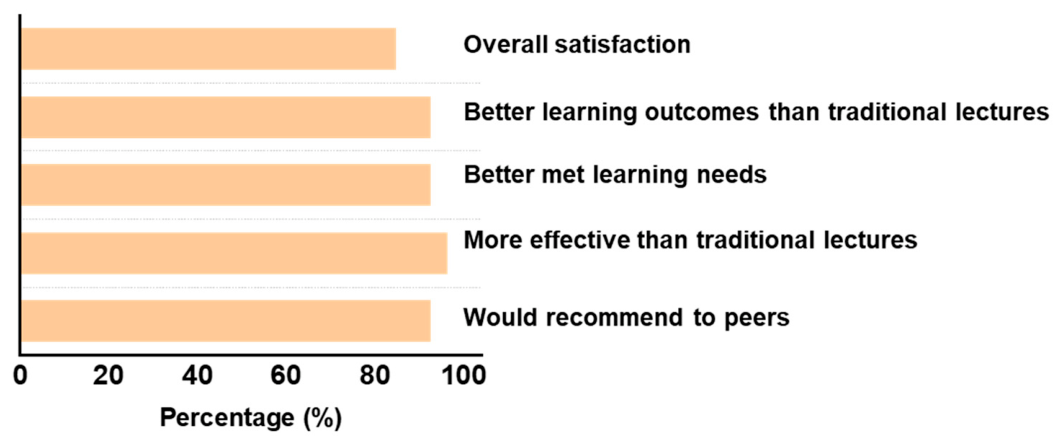
The questionnaire items were evaluated using a five-point Likert scale, where 1 represented “strongly disagree” and 5 represented “strongly agree”. Therefore, mean scores above 4.0 indicate a generally positive perception among students, while values approaching 5 represent strong agreement. This scoring criterion was adopted throughout the analysis to interpret students’ perceived learning experience. The results in Table 2 and Figure 2 provide quantitative evidence supporting the hypotheses. The overall satisfaction score reached 4.46/5, with 92.3% of students selecting “Agree” or “Strongly Agree”. More importantly, the item “Better learning outcomes than traditional lectures” obtained an identical mean score of 4.46, suggesting that students perceived the flipped-learning framework as not only acceptable but also more effective than conventional teaching approaches.
Table 2.
Perceived learning effectiveness of the flipped CFD module.
Figure 2.
Perceived learning effectiveness of the flipped CFD module.
Similarly, the items “Better met learning needs” and “More effective than traditional lectures” obtained mean scores of 4.42 and 4.35, respectively, further demonstrating that students considered flipped learning to be more effective and supportive for their learning needs. Furthermore, 84.6% of students indicated that they would recommend this teaching approach to their peers, reflecting a high level of acceptance and recognition of the flipped-learning model. The results suggest that flipped learning can significantly enhance students’ learning satisfaction and perceived learning effectiveness.
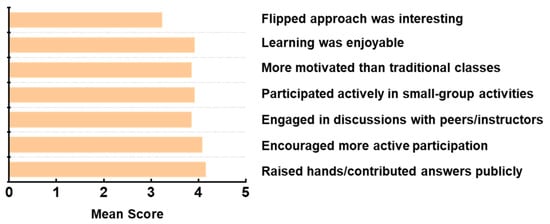
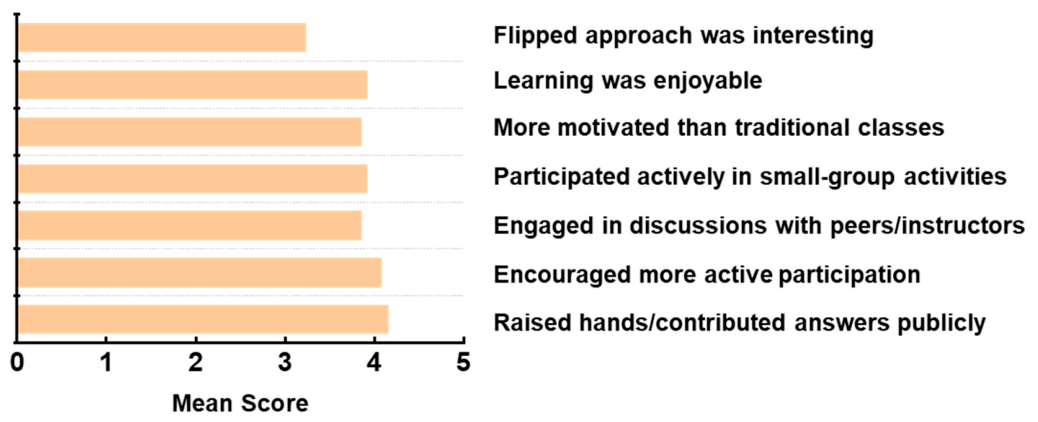
The survey results related to motivation and engagement are presented in Table 3. Overall, students showed positive attitudes toward the flipped-learning approach. The item “Flipped approach was interesting” received the highest mean score (4.15), with 80.8% of students agreeing or strongly agreeing, indicating that the flipped-learning model effectively increased students’ interest in learning. In addition, “Learning was enjoyable” also achieved a relatively high score (4.08), suggesting that students generally had positive learning experiences. Collaborative learning activities showed higher engagement levels. Students reported active participation in small-group activities (mean = 3.92) and discussions with peers/instructors (mean = 3.85), demonstrating that flipped learning promoted interaction and communication in class. Furthermore, 65.4% of students felt more motivated compared with traditional lecture-based classes. However, the item “Raised hands/contributed answers publicly” received the lowest score, indicating that students were less confident in speaking publicly during full-class sessions. Overall, the findings suggest that flipped learning was particularly effective in enhancing engagement within collaborative and discussion-based learning environments.
Table 3.
Student motivation and engagement in flipped-learning activities.
The development of 4C competencies, including communication, collaboration, critical thinking, and creativity, is shown in Figure 3. Among these competencies, the greatest perceived improvements were observed in critical thinking and creativity, followed by collaboration. This pattern is particularly favourable for CFD fire modelling education, where problem-solving, interpretation of simulation results, and engineering judgement are essential learning outcomes.
Figure 3.
Mean score of student motivation and engagement in flipped-learning activities.
Table 4 summarises students’ perceptions of workload and AI-supported learning experiences. The results provide evidence supporting H2. Although some students perceived slightly increased mental effort during the flipped-learning process (38.5%), most students considered the workload comparable with traditional learning approaches. More importantly, AI-assisted learning resources received positive evaluations, with mean scores of 3.96–4.04 for pre-class and in-class learning support. These findings indicate that AI tools did not simply replace conventional instruction but functioned as supplementary learning assistants by improving students’ preparation efficiency, supporting conceptual understanding, and reducing difficulties in mastering CFD modelling procedures.
Table 4.
Perceived workload and AI-supported learning.
3.2. Reflection on Learning Experiences
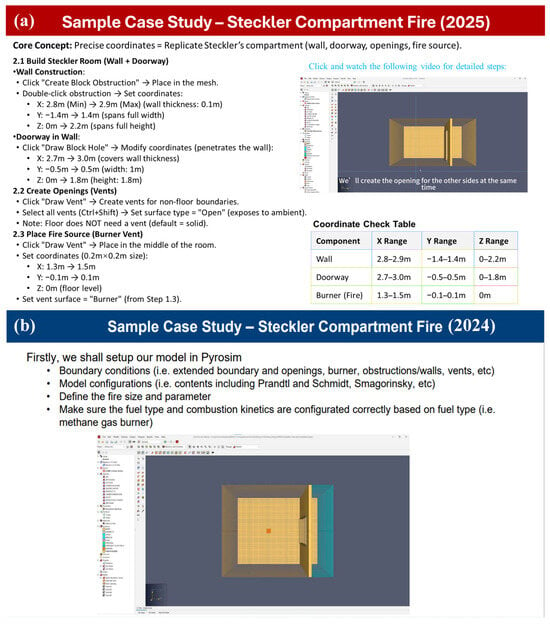
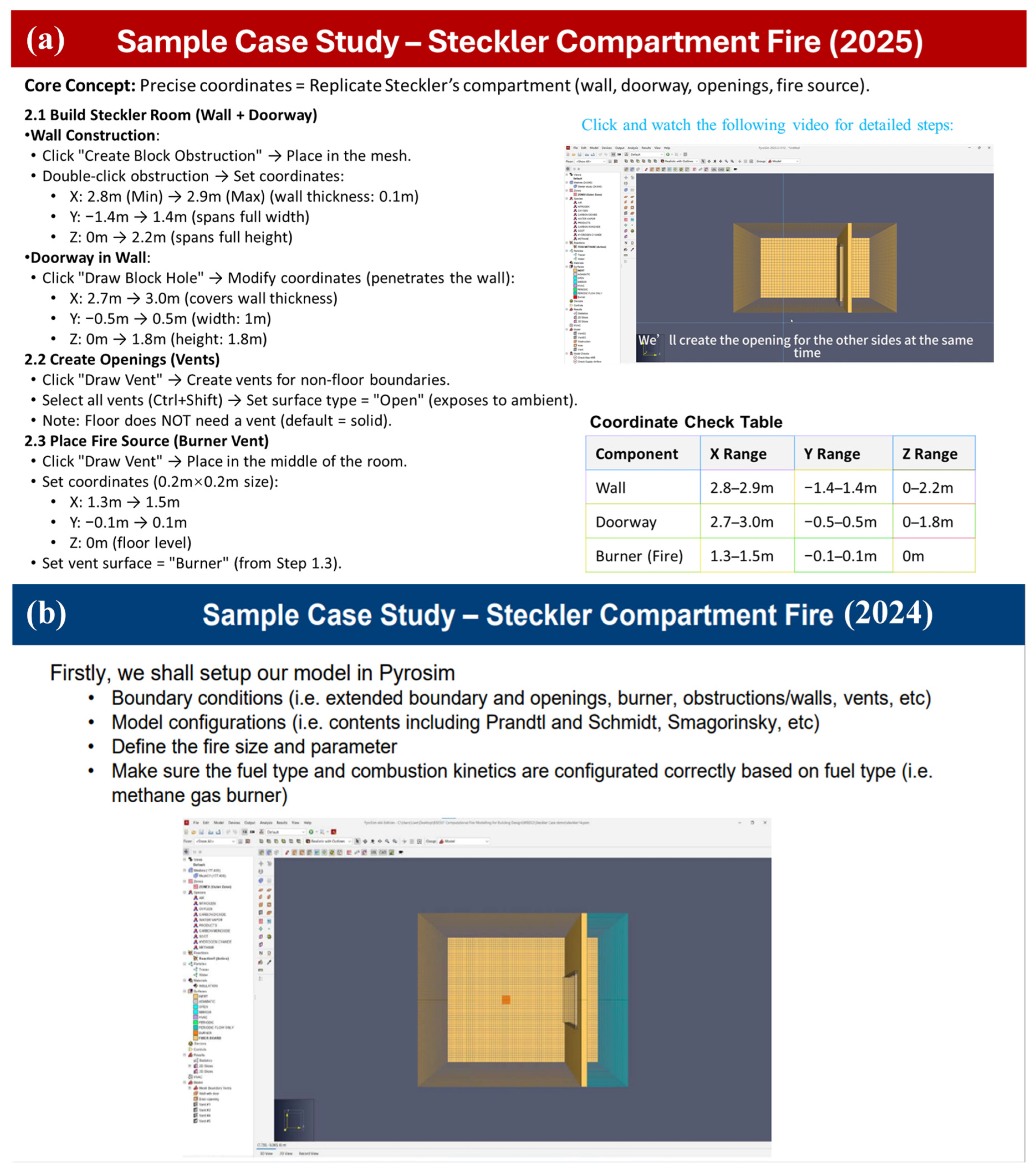
To demonstrate the improvement of the tutorial in 2025, Figure 4 compares the typical modelling procedures of the standard Steckler room fire. As shown in Figure 4a, the guidance introduces the detailed procedures to construct the Steckler room fire model in FDS. For example, it lists the operational steps to build a wall and doorway with precise dimensions. Meanwhile, it allows the student to watch the flipped-learning-enhanced video with clear subtitles and sound, as shown in the Supplementary Material, which will help them to operate and master FDS faster. However, in the tutorial in 2024, there are only general descriptions about the modelling procedure of the Steckler room fire, as presented in Figure 4b. Thus, the flipped-learning-enhanced tutorial will help students to engage in the lecture and spark their interest in fire simulations.
Figure 4.
Typical tutorial slide with (a) and without (b) flipped-learning enhancement.
To elaborate on the effectiveness of the flipped-learning-enhanced tutorial, Table 5 provides a comparison of students’ learning experiences between the 2024 and 2025 semesters and shows a consistent improvement across all four evaluated dimensions. The mean score for students’ understanding of what they were expected to learn increased from 3.8 in 2024 to 4.4 in 2025. Similarly, the perceived contribution of teaching and learning activities to achieving the intended subject learning outcomes increased from 3.9 to 4.4. The largest score in 2025 was observed for the statement that assessments required students to demonstrate their knowledge, skills, and understanding of the subject, which increased from 3.9 to 4.5. Students’ understanding of the criteria according to which they would be graded also increased from 3.9 to 4.4. Thus, the improvement was not limited to a single aspect of the learning experience but was observed consistently in learning expectations, learning activities, assessment alignment, and assessment transparency.
Table 5.
The feedback of learning experience of the subject in different semesters.
These results indicate that the 2025 teaching arrangement was perceived as providing a clearer and more coherent learning structure than the 2024 arrangement. This finding is consistent with the flipped-learning design described in Section 2, where pre-class materials provided explicit learning objectives, key points, learning steps, and guiding questions, while video materials were organised into focused learning modules. This structure may have helped students establish clearer connections between pre-class preparation, classroom activities, and assessment tasks. Meanwhile, reallocating classroom time from basic content delivery to discussion, case analysis, problem-solving, and practical modelling enabled students to apply concepts after pre-class preparation.
The improvement in assessment-related perceptions is also noteworthy. The increase from 3.9 to 4.5 in the alignment between assessment and students’ knowledge and skills, together with the increase from 3.9 to 4.4 in understanding grading criteria, suggests that students perceived stronger alignment and transparency in assessment. This is particularly relevant to CFD fire modelling, where students need to integrate theoretical knowledge, software operation, modelling decisions, and simulation interpretation.
These findings should also be considered alongside the workload perceptions reported in Table 4. Although some students reported increased mental effort and time pressure, most considered the overall workload comparable with traditional learning. This suggests that flipped learning may have redistributed learning effort toward pre-class preparation while allowing classroom time to focus more on application and interaction.
Overall, Table 2, Table 3, Table 4 and Table 5 suggest that students perceived the flipped-learning framework as clearer, more structured, and more application-oriented. However, because Table 5 compares student feedback from different semesters without statistical testing or controls for cohort differences, the findings should be interpreted as evidence of improved student perceptions rather than definitive evidence of a causal effect of the intervention.
3.3. Reflection on Software Skills Acquisition
Beyond the general learning experience, it is important to examine whether the redesigned learning resources were perceived as useful for learning CFD software and understanding modelling procedures. CFD fire modelling requires students to integrate theoretical knowledge with software operations, including model setup, parameter configuration, simulation, and result interpretation. Table 6 therefore focuses on students’ perceptions of online adaptive tutorials, tutorial guides, and interactive learning components. The results show consistently positive evaluations across all three items. Online adaptive tutorials and teaching materials received the highest mean score of 4.3, while both online tutorial guides for software learning and interactive components for understanding received scores of 4.2. The similar scores suggest that students perceived these resources as complementary components of the learning process.
Table 6.
The feedback of reflection on software skills acquisition.
These findings can be further understood in relation to the flipped-learning sequence. Before class, students could use the online tutorials and guided materials to become familiar with software interfaces, modelling procedures, and the CFD simulation workflow. This allowed classroom time to focus more on practical modelling, problem-solving, discussion, and interpretation of simulation results. Thus, the online resources served as a bridge between conceptual learning and practical application, while allowing students to review difficult procedures independently. The positive evaluation of the interactive components also suggests that visual and procedural guidance may be particularly useful for CFD fire modelling. Because CFD modelling involves interdependent operations, such as geometry, mesh, boundary conditions, and reaction settings, structured tutorials may help students follow the modelling workflow more systematically and reduce the difficulty of managing multiple software procedures. This finding is also consistent with students’ positive responses to visualised and hands-on learning activities reported earlier.
The findings from Table 6 complement the AI-supported learning results in Table 4. While Table 4 shows that students generally perceived AI-assisted resources as useful for pre-class and in-class learning, Table 6 provides more specific evidence of the perceived usefulness of the resulting online materials for software learning. These findings suggest that AI primarily played a supportive role by improving the organisation, accessibility, narration, subtitles, and presentation of learning resources, while CFD learning remained centred on instructor-developed content, guided tutorials, practical exercises, and classroom interaction.
Nevertheless, the findings should be interpreted cautiously. Although the mean scores of 4.2–4.3 indicate positive perceptions, they do not directly demonstrate improved software proficiency. Students’ abilities to construct CFD models, identify modelling errors, select parameters, and interpret simulation results were not assessed through standardised practical tests. Therefore, Table 6 provides supportive evidence of the perceived usefulness of the online resources rather than conclusive evidence of improved software competence.
4. Conclusions
This study demonstrated the feasibility of integrating AI-assisted tools into flipped CFD fire modelling education. Students reported generally positive perceptions of the learning experience, engagement, pre-class resources, and AI-supported instructional materials, with AI primarily facilitating the preparation, organisation, narration, subtitle correction, and accessibility of learning resources. However, given the small sample (n = 26), reliance on self-reported data, absence of objective learning assessments, and lack of statistical control for cohort differences, the findings should be interpreted as evidence of perceived usefulness rather than demonstrated learning gains or causal effects. Future research should employ larger samples, validated instruments, objective pre-/post-course assessments, and controlled comparisons of conventional, flipped, and AI-supported flipped instruction. Overall, this study provides a practical foundation for further rigorous evaluation of AI-enhanced flipped learning in CFD fire modelling education.
Supplementary Materials
The following supporting information can be downloaded at: https://www.mdpi.com/article/10.3390/buildings16204049/s1, Video S1: A selected flipped-learning-derived video tutorial for Stekler room fire modelling and simulation in FDS.
Author Contributions
A.C.Y.Y.: Conceptualisation, Data curation, Formal analysis, Investigation, Resources, Project administration, Funding acquisition, Writing—original draft. C.T. and C.M.: Formal analysis, Investigation, Methodology, Software, Validation, Visualisation, Writing—review & editing. All authors have read and agreed to the published version of the manuscript.
Funding
This article is sponsored by the PolyU Seed Fund for Developing Flipped Learning Signature Showcase (Project ID: FLSS2025/BEEE01).
Institutional Review Board Statement
Ethical review and approval were waived for this study due to the survey being conducted anonymously, and participants were informed that the data would be used for research purposes, and the purpose is to improve our flipped-learning framework in the future (terms and statement are clearly provided in the survey). No risk or ethical study is related to this study as it is teaching and education focused (i.e., study of flipped-learning experience on learning how to use a fire modelling tool).
Informed Consent Statement
Informed consent was obtained from all subjects involved in the study.
Data Availability Statement
The data presented in this study are available on request from the corresponding author(s).
Conflicts of Interest
The authors declare no conflicts of interest.
References
- Štemberger, T.; Čotar Konrad, S. Attitudes Towards using Digital Technologies in Education as an Important Factor in Developing Digital Competence: The Case of Slovenian Student Teachers. Int. J. Emerg. Technol. Learn. (iJET) 2021, 16, 83–98. [Google Scholar] [CrossRef] [Scilit]
- Isgren Karlsson, A.; Alatalo, T.; Nyberg, G.; Backman, E. Exploring physical education teachers’ perceptions and attitudes towards digital technology in outdoor education. J. Adventure Educ. Outdoor Learn. 2022, 23, 510–524. [Google Scholar] [CrossRef] [Scilit]
- Zhang, Y.; Geng, P. Artificial intelligence based smoke flow mechanism analysis and prediction patterns of fire for large space building. Alex. Eng. J. 2024, 100, 322–330. [Google Scholar] [CrossRef] [Scilit]
- Zeng, Y.; Zhang, X.; Su, L.-C.; Wu, X.; Xinyan, H. Artificial Intelligence tool for fire safety design (IFETool): Demonstration in large open spaces. Case Stud. Therm. Eng. 2022, 40, 102483. [Google Scholar] [CrossRef] [Scilit]
- López-Villanueva, D.; Santiago, R.; Palau, R. Flipped Learning and Artificial Intelligence. Electronics 2024, 13, 3424. [Google Scholar] [CrossRef] [Scilit]
- Cheng, B.; Zhang, X.; Lu, Z.; Lao, L.; Chen, B.; Xu, N.; Wang, H. Machine-learning-assisted joint optimization of impeller and volute for 6 MF-20 centrifugal fire extinguishers with three-dimension computational fluid dynamics and experiment. Case Stud. Therm. Eng. 2025, 75, 107140. [Google Scholar] [CrossRef] [Scilit]
- Rajendram, A.; Khan, F.; Garaniya, V. Modelling of fire risks in an offshore facility. Fire Saf. J. 2015, 71, 79–85. [Google Scholar] [CrossRef] [Scilit]
- Ma, Q.; Chen, Z.; Chen, J.; Sun, Y.; Chen, N.; Du, M. Assist in real-time risk evaluation induced by electrical cabinet fires in nuclear power plants: A dual AI framework employing BiTCN and TCNN. Reliab. Eng. Syst. Saf. 2025, 260, 111037. [Google Scholar] [CrossRef] [Scilit]
- Mehaddi, R.; Laboureur, P.; Braconnier, A.; Boulet, P.; Haouari-Harrak, S.; Collin, A.; Becker, S.; Morel, J.Y. Experimental Characterization of a Smoke Flow in a Small Length Corridor. Fire Technol. 2020, 56, 883–889. [Google Scholar] [CrossRef] [Scilit]
- Muñoz-Blanc, C. Numerical Simulation of Two-Dimensional Turbulent Dilatable Flows in a Fire. Fire 2023, 6, 413. [Google Scholar] [CrossRef] [Scilit]
- Lin, Y.-X.; Wang, Q.; Li, Q.-X.; Lin, Q.-W.; Man, P.-R.; Zhou, S.-N.; Li, Y.; Deng, J. Multi-stage study of pyrolysis kinetics, combustion characteristics, and fire modeling for selected nature wood species. Fuel 2026, 407, 137296. [Google Scholar] [CrossRef] [Scilit]
- Peng, L.; Huang, X.; Wang, J.; Zhu, H. Influence mechanism of temperature field inside the cable on dynamic process of cable pyrolysis. Fire Saf. J. 2023, 141, 103972. [Google Scholar] [CrossRef] [Scilit]
- Hostikka, S.; Rashidzadeh, S. Thermal radiation—From science to engineering. Fire Saf. J. 2026, 161, 104677. [Google Scholar] [CrossRef] [Scilit]
- Yuen, A.C.Y.; Chen, T.B.Y.; Yeoh, G.H.; Yang, W.; Cheung, S.C.-P.; Cook, M.; Yu, B.; Chan, Q.N.; Yip, H.L. Establishing pyrolysis kinetics for the modelling of the flammability and burning characteristics of solid combustible materials. J. Fire Sci. 2018, 36, 494–517. [Google Scholar] [CrossRef] [Scilit]
- Potluri, R.M.; Gabdullin, M.; Jumasseitova, A.K.; Mukashev, Y.B. Artificial intelligence–enabled teaching: Insights from Kazakhstan higher education students. Soc. Sci. Humanit. Open 2026, 13, 102660. [Google Scholar] [CrossRef] [Scilit]
- Yuen, A.C.Y.; Yeoh, G.H. Numerical simulation of an enclosure fire in a large test hall. Comput. Therm. Sci. 2013, 5, 459–471. [Google Scholar] [CrossRef] [Scilit]
- Bakas, I.; Kontoleon, K.J. Meta-Narrative Review of Artificial Intelligence Applications in Fire Engineering with Special Focus on Heat Transfer through Building Elements. Fire 2023, 6, 261. [Google Scholar] [CrossRef] [Scilit]
- Gong, J.; Cai, S.; Cheng, M. Exploring the Effectiveness of Flipped Classroom on STEM Student Achievement: A Meta-analysis. Technol. Knowl. Learn. 2024, 29, 1129–1150. [Google Scholar] [CrossRef] [Scilit]
- Bode-Staud, R.; Rohwer, L.; Malek, L.; Fricke, A.; Scholl, S. Individualised process simulation examination: A novel online take-home approach within a flipped classroom. Educ. Chem. Eng. 2025, 52, 1–13. [Google Scholar] [CrossRef] [Scilit]
- Chao, W.Y.; Liao, W.C. Long-term effects of flipped learning on nurses’ self-efficacy and satisfaction in pressure injury management: A multi-center quasi-experimental study. Nurse Educ. Pract. 2025, 85, 104368. [Google Scholar] [CrossRef] [Scilit] [PubMed]
- Wittmann, S.; Wulf, T.; Wieser, K. Flipped learning in business and economics higher education: A systematic literature review. Int. J. Manag. Educ. 2026, 24, 101366. [Google Scholar] [CrossRef] [Scilit]
- Etemi, B.P.; Uzunboylu, H.; Latifi, S.; Abdigapbarova, U. The Effect of the Flipped Learning Approach on Engineering Students’ Technology Acceptance and Self-Directed Learning Perception. Sustainability 2024, 16, 774. [Google Scholar] [CrossRef] [Scilit]
- Clark, R.M.; Kaw, A. Adaptive learning in a numerical methods course for engineers: Evaluation in blended and flipped classrooms. Comput. Appl. Eng. Educ. 2020, 28, 62–79. [Google Scholar] [CrossRef] [Scilit]
- Theobald, E.J.; Hill, M.J.; Tran, E.; Agrawal, S.; Arroyo, E.N.; Behling, S.; Chambwe, N.; Cintrón, D.L.; Cooper, J.D.; Dunster, G.; et al. Active learning narrows achievement gaps for underrepresented students in undergraduate science, technology, engineering, and math. Proc. Natl. Acad. Sci. USA 2020, 117, 6476–6483. [Google Scholar] [CrossRef] [Scilit] [PubMed]
- Cladera, M. Does flipped classroom improve students’ evaluations of teaching quality? Int. J. Educ. Res. 2026, 139, 103019. [Google Scholar] [CrossRef] [Scilit]
- Wittmann, S.; Wulf, T.; Müller, F.A. Conventional versus fully online flipped learning environments: A comparison of flexibility, interaction, flow experience, and student learning outcomes. Int. J. Manag. Educ. 2026, 24, 101304. [Google Scholar] [CrossRef] [Scilit]
- Mishra, R.; Singh, R.K. Exploring AI-enabled digital service platform adoption in industrial business-to-business firms through a mixed-method approach. Ind. Mark. Manag. 2026, 135, 279–298. [Google Scholar] [CrossRef] [Scilit]
- Naser, M.Z. Fire resistance evaluation through artificial intelligence—A case for timber structures. Fire Saf. J. 2019, 105, 1–18. [Google Scholar] [CrossRef] [Scilit]
- Chang, W.; Lin, C.C.; Lee, H.C.; Juan, Y.C.; Xu, H.G.; Chen, L.C.; Han, C.Y. Effectiveness of artificial intelligence chatbot-assisted flipped learning on patient handover for nursing students: A mixed-methods study. Nurse Educ. Pract. 2026, 93, 104787. [Google Scholar] [CrossRef] [Scilit] [PubMed]
- Naser, M.Z. Demystifying Ten Big Ideas and Rules Every Fire Scientist & Engineer Should Know About Blackbox, Whitebox and Causal Artificial Intelligence. Fire Technol. 2022, 58, 1075–1085. [Google Scholar] [CrossRef] [Scilit]
- Yuen, A.C.Y.; Yeoh, G.H.; Timchenko, V.; Cheung, S.C.P.; Chan, Q.N.; Chen, T. On the influences of key modelling constants of large eddy simulations for large-scale compartment fires predictions. Int. J. Comput. Fluid Dyn. 2017, 31, 324–337. [Google Scholar] [CrossRef] [Scilit]
- Sherman, W.R.; Craig, A.B.; Baker, M.P.; Bushell, C. Scientific visualization. In Computer Science Handbook, 2nd ed.; 2004; pp. 27-1–27-33. Available online: https://experts.illinois.edu/en/publications/scientific-visualization/ (accessed on 9 October 2026).
- Yuen, A.; Yeoh, G.; Cheung, S.; Chan, Q.; Chen, T.; Yang, W.; Lu, H. Numerical study of the development and angular speed of a small-scale fire whirl. J. Comput. Sci. 2018, 27, 21–34. [Google Scholar] [CrossRef] [Scilit]
- Sarıışık, G.; Özkan, Y.; Göncü, B. A PCA-based composite sustainability measure for maritime logistics: A diagnostic machine learning assessment for Türkiye. Res. Transp. Bus. Manag. 2026, 69, 101825. [Google Scholar] [CrossRef] [Scilit]
- Sarıışık, G.; Göncü, B.; Özkan, Y. An Explainable and Multidimensional Climate Performance Index: Integrating Statistical Validation and Machine Learning-Based Structural Diagnostics. Sustainability 2026, 18, 8336. [Google Scholar] [CrossRef] [Scilit]
- Ardimento, P.; Di Fuccio, R.; Fulantelli, G.; Limone, P.; Pecori, R.; Raviolo, P.; Rondonotti, M.; Schicchi, D.; Taibi, D.; Zaza, G. Higher Education Learning Methodologies and Technologies Online; Springer: Berlin/Heidelberg, Germany, 2025. [Google Scholar]
- Yuen, A.C.Y.; Yeoh, G.H.; Alexander, B.; Cook, M. Fire scene investigation of an arson fire incident using computational fluid dynamics based fire simulation. Build. Simul. 2014, 7, 477–487. [Google Scholar] [CrossRef] [Scilit]
- Yuen, A.C.Y.; Yeoh, G.H.; Alexander, R.; Cook, M. Fire scene reconstruction of a furnished compartment room in a house fire. Case Stud. Fire Saf. 2014, 1, 29–35. [Google Scholar] [CrossRef] [Scilit]
- Yuen, A.C.Y.; Yeoh, G.H.; Yuen, R.K.K.; Chen, T. Numerical Simulation of a Ceiling Jet Fire in a Large Compartment. Procedia Eng. 2013, 52, 3–12. [Google Scholar] [CrossRef] [Scilit]
- Yuen, A.C.Y.; Chen, T.B.Y.; Yang, W.; Wang, C.; Li, A.; Yeoh, G.H.; Chan, Q.N.; Chan, M.C. Natural Ventilated Smoke Control Simulation Case Study Using Different Settings of Smoke Vents and Curtains in a Large Atrium. Fire 2019, 2, 7. [Google Scholar] [CrossRef] [Scilit]
- Kenwright, D.; Dai, W.; Osborne, E.; Gladman, T.; Gallagher, P.; Grainger, R. Just tell me what I need to know to pass the exam!” can active flipped learning overcome passivity. TAPS 2017, 2, 1–6. [Google Scholar] [CrossRef] [Scilit]
- Gao, C.; Wang, S.; Jin, W.; Jiang, J.; Wang, C. Research on the Teaching Practice of Mechanical Courses Based on VR. In Proceedings of the 2026 3rd International Conference on Informatics Education and Computer Technology Applications, Shanghai, China, 16–18 January 2026; pp. 691–696. [Google Scholar]
- Brusilovsky, P.; Vassileva, J. Course sequencing techniques for large-scale web-based education. Int. J. Contin. Eng. Educ. Life Long Learn. 2003, 13, 75–94. [Google Scholar] [CrossRef] [Scilit]

Disclaimer/Publisher’s Note: The statements, opinions and data contained in all publications are solely those of the individual author(s) and contributor(s) and not of MDPI and/or the editor(s). MDPI and/or the editor(s) disclaim responsibility for any injury to people or property resulting from any ideas, methods, instructions or products referred to in the content. |
© 2026 by the authors. Licensee MDPI, Basel, Switzerland. This article is an open access article distributed under the terms and conditions of the Creative Commons Attribution (CC BY) license.