


Abstract
With the trend of city expansion and industrial restructuring, the renewal of industrial heritage has gradually become a key issue for sustainable urban development. However, research on risk management for the industrial heritage renewal project (IHRP) remains scarce. This study focuses on the risk identification and assessment of the IHRP throughout the entire process and from the owner’s perspective. The risks during the entire process of the IHRP are identified and the risk assessment index system is established based on literature analysis, field investigation, semi-structured interviews, and brainstorming-based statistical analysis. A hybrid risk assessment model integrating ANP, CRITIC and Cloud Model is then proposed to simultaneously address inter-dependencies between risk factors, the balance between subjective and data-driven weights and fuzziness and randomness of risk evaluation. The proposed risk assessment method is applied to the Hangzhou Steel IHRP to demonstrate its applicability. This study provides a comprehensive risk assessment method tailored to the IHRP and its risk characteristics. The proposed method can facilitate the planning and implementation of the risk management on the IHRP for the owner and other stakeholders, thus promoting urban renewal development.
1. Introduction
Numerous industrial sites, including factories, buildings, facilities and equipment have been idled or abandoned due to the economic restructuring in the past few decades. Some of them may be identified as industrial heritage sites if they contain historical, social, architectural or scientific values [1]. These identified industrial heritage sites need to be renovated according to new functions and requirements [2,3]. With the transformation of cities through modern city development and urbanization, the renovation or renewal of the industrial heritage requires specialized expertise and is often combined with cultural activities [4]. It concerns the transformation of assets into the heritage based on the principle of sustainable development, cultural prosperity, and artistic creativity [5].
In addition to addressing deterioration and restoring structural stability, industrial heritage renewal aims to retain and reproduce multiple values, such as historical, cultural, technological, architectural, and aesthetic values [3]. Hence, the industrial heritage renewal project concerns issues including safety, cost, quality, functions, and sustainability. It has been emphasized that industrial heritage renewal should not be limited to simple engineering technology transformation, but should focus on value protection-based life-cycle governance [4,6].
On the one hand, the entire process of the IHRP exhibits distinct characteristics from the perspective of the owner due to the need to reduce the sense of dilapidation by preserving core structures and historical traces while integrating modern functions [7]. The preliminary planning and design phase needs to identify and eliminate potential hazards in the existing structures, such as aging underground pipelines. Otherwise, frequent adjustments to subsequent renovation plans and processes may be necessary, thereby increasing renovation costs and causing project delays [8]. Additionally, the impact of policy changes, such as urban planning adjustments or the upgrading of cultural heritage protection standards, should be assessed in advance to evaluate their potential effects on project compliance. In addition to functionality, safety, quality, cost, and duration, the construction process should focus on renovation technology, experience, and implementation with regard to renewal goals based on the original structural performance status and policy conditions [9]. During the operation period, in addition to considering the impacts of the planning and construction processes, the owner should emphasize heritage functional positioning, market demand, maintenance, and operational strategy.
On the other hand, many influencing factors of the IHRP are interrelated and interdependent [3]. First, the deterioration degree of aging structures with their original design lifespan, non-compliant spatial layout, and outdated infrastructure (such as inadequate fire protection and building energy conservation and insulation) will directly increase the difficulty of renovation. If the initial evaluation is insufficient, it is highly likely to result in a situation requiring simultaneous renovation and supplementatary work, resulting in cost increases and schedule delays. Meanwhile, the owner needs to seek a balance between various standards such as planning and cultural preservation, which involves risks arising from conflicting interests. The government planning department may require the IHRP to increase the proportion of public service functions to match the regional development positioning, while the government cultural heritage department emphasizes minimal intervention and limits the scope of renovation of industrial heritage sites. The differences in requirements between the two government departments may lead to repeated modifications of the renewal plan, delaying the progress of pre-approval, design, and construction.
Therefore, the IHRP has unique characteristics and is affected by many interrelated factors, thus leading to uncertainties and risks throughout its entire life cycle. Many studies on the IHRP have been carried out to solve the issues related to technology, functional transformation, cultural preservation, and policy impact; however, few of them have focused on risk management for the IHRP. Risk management plays a key role in reducing losses through risk identification, risk assessment, and the planning and implementing of risk mitigation measures [10,11]. Risk management issues have been extensively explored in the construction industry [12,13,14,15]. However, few studies have focused on risk management, including risk identification and risk assessment, for the IHRP.
Even when borrowing from the broader construction risk literature, none of the existing approaches is directly applicable to IHRPs, due to the projects’ distinctive risk characteristics. First, risk factors in IHRPs exhibit strong bidirectional interdependencies. For instance, decisions on the renewal strategy, such as de-ruination (i.e., a renewal strategy that retains the core structures and historical traces of the industrial heritage while removing the sense of dilapidation and abandonment and integrating new functions) versus demolition, directly shape construction phase risks and operational risks, while feedback from field conditions may in turn force revisions to the strategy. Hierarchical methods such as AHP, which assume independence between criteria, fail to capture such network relationships. Second, the evaluation of IHRP risks must integrate the judgments of experts based on their experience or knowledge when data is limited, with the variability and correlation contained in the evaluation data. Single-paradigm weighting methods, whether judgment-based (AHP, ANP) or data-driven (entropy weight, CRITIC), therefore introduce systematic bias when used alone. Third, expert evaluations of related risks are inherently fuzzy, expressed through qualitative linguistic judgments such as “higher risk”, and also random, owing to variability across experts who often work from limited historical reference cases. Conventional fuzzy comprehensive evaluation handles fuzziness but not randomness, while probabilistic models handle randomness but not fuzziness. These three characteristics, namely interdependence, judgment–data duality, and fuzziness–randomness coexistence, collectively necessitate a hybrid framework that combines ANP to model network dependencies and elicit subjective weights, CRITIC to derive data-driven weights from the variability and inter-factor correlation of expert ratings, and the Cloud Model to jointly quantify fuzziness and randomness. The integration of these three methods, tailored to the IHRP context, constitutes the methodological contribution of this study.
This paper presents a study on risk identification and assessment of the IHRP from the owner’s perspective, covering the entire process from initial planning to operation. Four groups of risks are identified, and a risk assessment index system is established through literature analysis, field investigation, semi-structured interviews, and brainstorming-based statistical analysis. The proposed hybrid ANP-CRITIC-Cloud method is then applied and demonstrated through the IHRP of Hangzhou Steel Heritage Park.
2. Literature Review
2.1. Industrial Heritage Renewal
With the urbanization process and industrial structure upgrading, the scale of modern cities is expanding rapidly, and the industrial structure is gradually shifting from the secondary industry to the tertiary industry [7]. The development logic of modern cities has been shifting from incremental expansion to stock optimization. In this era, industrial heritage sites have become the material carrier of productivity development in specific historical periods, and the process of reusing industrial heritage sites has gradually shown a coordinated trend of protection and renewal [8]. With regard to the issues of safety, cost-effectiveness, value protection and enhancement, environmental protection and coordination, and sustainability in IHRPs, numerous studies have been conducted [4].
The marketing of post-industrial regions has been shown to promote a set of industrial heritage narratives that strengthen a region’s economic position in a neoliberal setting of inter-regional economic competition [16]. Based on case studies in Iran, the influencing factors for achieving adaptive reuse of industrial heritage buildings have been investigated [8]. Mega-events have been found to serve as pivotal moments for re-imagining and re-purposing industrial heritage sites, as illustrated by case studies along the Huangpu River [17]. A satisfaction evaluation model of industrial heritage renewal has been established to judge the adaptability and accuracy of transformation strategies and to put forward improvement suggestions [6]. Through questionnaire surveys in six regions of China, 20 factors affecting the policy risk of IHRPs were identified, and a policy risk assessment model was established [18]. Renewal strategies have also been studied by examining the evolution and current state of industrial heritage sites using various analysis methods [9]. In addition, the sustainable use of industrial heritage sites and the need for modernization and improvement in accordance with their integrity and authenticity during the renovation process have been analyzed [19].
2.2. Risk Identification and Assessment
Risk management is a systematic activity for preventing and controlling potential risks throughout the entire process of a project [20]. Risk management involves four stages, such as risk identification, risk assessment, risk mitigation measure planning, and measure implementation [10]. Many studies have been conducted focusing on risk management regarding various construction aspects, including PPP projects [12,21], landslide disasters [13], and bridge and large-scale projects [14,22].
Risk identification has generally been performed through literature reviews, case or field investigations, semi-structured interviews, and summary analyses in existing studies [11,23]. Weights of the identified risk factors are determined mainly through three types of methods: (1) subjective judgment; (2) data-driven calculation; and (3) combining subjective and data-driven weights [24,25].
The subjective weighting method relies on the experience and professional judgment of experts [14]. The existing subjective weighting methods include the analytic hierarchy process (AHP) [23] and the analytic network process (ANP) [26], etc. AHP assumes that the criteria at the same layer are independent of each other and that the criteria of two nonadjacent layers are unrelated, while ANP does not impose such a strict hierarchical relationship. However, subjective weighting is inevitably affected by experts’ backgrounds, cognitive limitations, and preferences, and thus may not accurately reflect the actual importance of risk factors [24].
Objective weighting methods determine weights from the inherent quantitative relationships among the data of risk factors by means of statistical analysis and mathematical derivation [15]. The weights may significantly reduce the intervention of subjective factors [27]. Commonly used data-driven weighting methods include factor analysis, principal component analysis, the entropy weight method, the standard deviation method, and the CRITIC method [28]. However, such methods may ignore the rich experience and knowledge of the experts [29].
The combination weighting method combines the subjective and data-driven weights based on different preference coefficients. The combination weighting method includes addition or multiplication synthesis normalization, the sum of squared deviations, and objective optimization, etc. Many scholars have determined the weights of risk factors by combining the subjective and data-driven weights [28,29]. For instance, Hou and Wang [30] calculated the weights of risk factors by combining the subjective weights from FAHP and the data-driven weights from CRITIC.
When evaluating the risk factors, experts use uncertain language in their evaluations, resulting in randomness and fuzziness. Li, et al. [31] proposed the Cloud Model to convert the uncertain language used in the evaluation into quantitative data. The Cloud Model is thought to be able to reflect the inherent uncertainty of qualitative concepts to some extent, and reveal the association between the randomness and fuzziness of objective phenomena [31]. It has been applied in risk assessment in various areas of construction [12,24,32,33,34]. For instance, the Cloud Model has been integrated with variable weight theory to perform risk assessment for bridge construction projects [35], and combined with CRITIC to assess the operational safety risk of urban rail transit [27].
In summary, numerous studies have addressed the issues around IHRPs, such as technologies, renewal strategies, policy impact, value protection, environment, and sustainability. However, few studies have focused on the risk management including risk identification and assessment for the IHRP. On the other hand, the combination of ANP and CRITIC is able to balance expert judgment and data-driven information in determining the weights of risk factors that may be correlated, while the Cloud Model can reflect the randomness and fuzziness in evaluating risk factors based on statistics. However, few attempts have been made to combine ANP, CRITIC, and the Cloud Model to achieve risk assessment for the IHRP. Therefore, this study aims to address risk identification and assessment for the IHRP throughout the entire process and the owner’s perspective by combining ANP, CRITIC, and the Cloud Model.
3. Methodology
3.1. Risk Identification and Assessment Index System
An IHRP involves multiple stakeholders, while the owner is the entity that initiates, finances, and holds final decision-making authority over the project throughout its life cycle and is therefore the central entity responsible for integrating and balancing the demands of the other stakeholders during planning, construction, and operation. For this reason, the present study focused on identifying and assessing the risks of the IHRP from the owner’s perspective. Risks throughout the entire process of the IHRP, from initial planning to operation, are closely tied to the implementation pathway and to the inherent attributes of the industrial heritage. Accordingly, this study analyzes potential risks from the following three aspects:
- (1)
- The risks from the renewal strategies. Three core renewal strategies, such as de-ruination, demolition, and adaptive renewal for the IHRP, are used as the basis for analyzing the relevant risks.
- (2)
- The risks inherent in the industrial heritage. The risks relevant to the industrial heritage itself, such as the original design service lifespan, surrounding land environment, geological and geographical environment, age, stability, and degree of deterioration of original structures, are determined.
- (3)
- The risks from the practice and management process. The renewal practice and management of IHRPs involve the owners’ decision-making processes regarding planning and design, the construction process, and the operation period. Therefore, the risks that are closely related to the practice and management process are identified.
Guided by the three aspects of risks, the risk factors of the IHRP are identified through a three-step procedure that combines literature analysis, field investigation and semi-structured interviews, and brainstorming-based screening. The three steps are complementary: the literature provides a broad initial pool of potential risk factors, field evidence refines the pool with practical insights, and brainstorming filters it against a representative project. The three steps are conducted as follows:
- (1)
- Literature analysis of existing studies on IHRPs or relevant aspects
Through a literature review of existing studies on industrial heritage renewal and risk analysis of common construction projects, the potential risk factors of the IHRP are initially identified. The initial list of risks is established with regard to the above three aspects and serves as the basis for the following steps for further identification.
- (2)
- Field investigation and semi-structured interviews of completed IHRPs
Field investigation is conducted on three typical IHRPs that are renewed from original steel plants and have similar backgrounds or histories, namely, Beijing Shougang Park, Shanghai Yangpu Riverside, and Chengdu Dongjiao Memory. A list of risk factors is obtained through the field investigation based on the initial list of risks from the literature review. From the three IHRPs, one owner representative, one designer, one construction contractor, and one operation manager, i.e., 4 participants from each project and a total of 12 participants who are engineers or higher-level professionals and have at least 5 years of work experience in IHRPs, are then invited to participate in semi-structured interviews to further identify the risks highlighted in practice.
Through the field investigation and semi-structured interviews, the risk factors that were not addressed in the literature are supplemented. Finally, a list of 28 potential risk factors of the IHRP is established, as shown in Table 1. Meanwhile, the risk factors are categorized into four groups, including industrial heritage objective risk, owner decision-making risk, construction process risk, and operation period risk.
Table 1.
Initially identified risk factors for the IHRP.
- (3)
- Brainstorming-based statistical analysis based on the Hangzhou Steel IHRP
Based on the list of risk factors shown in Table 1, brainstorming is conducted to determine the final risk factors with reference to the ongoing Hangzhou Steel IHRP, which involves the renovation of the original Hangzhou steel plant and consists of two phases, the first of which has been completed and has begun its early operation. A panel of 15 experts was invited to participate in the brainstorming to obtain the frequencies of the 28 risk factors. The experts were selected according to the following criteria: experience or knowledge in construction, architecture, construction management, and industrial heritage renovation and operation from industry (engineer level or above and at least 5 years of work experience) and academic institutions (associate professor level or above). The 15 experts were grouped into 5 categories, including owner representatives, designers, construction contractors, operation managers, and academic experts, with 3 persons in each category. It should be noted that the 15 panel experts are different from the 12 participants who participated in the semi-structured interview.
After an open discussion in which different opinions were allowed to be retained, the 15 experts anonymously indicated the risk factors that should be emphasized. The identification frequency for each factor is calculated by dividing the number of experts who selected it by 15, and the resulting value is transformed to a scale ranging from 0 to 5. The risk factors with frequencies greater than 2 (a 5-point threshold unanimously agreed upon by the 15 experts) are screened (see Table S1 in the Supplementary Material), thus identifying the final 13 risk factors. It should be noted that a frequency above 2 actually means that the corresponding risk factor is selected by at least 7 of the 15 experts. To perform risk assessment, the final screened risk factors are used to construct the risk assessment index system for the IHRP, as shown in Table 2. The 13 risk factors are defined as the second-level indices, the four groups are defined as the first-level indices, and the final risk level of the IHRP is the target-level index.
Table 2.
Risk assessment index system for the IHRP.
3.2. Hybrid Risk Assessment Method
After constructing the risk assessment index system, the weights of the factors are determined by combining the ANP (analytic network process) and CRITIC methods. Then, the Cloud Model is used to perform risk assessment.
3.2.1. Determining Subjective Weights Through ANP
The analytic network process (ANP), proposed by Saaty [36] as an extension of the analytic hierarchy process (AHP), is adopted in this study to determine the subjective weights of the risk factors. Unlike AHP, which requires criteria to be hierarchically organized and mutually independent, ANP represents a decision problem as a directed network in which nodes denote elements (criteria and sub-criteria) and edges denote dependencies among them. This structure allows ANP to handle the feedback and bidirectional influences that characterize the risk factors of an IHRP, where, for example, decisions on the renewal strategy directly shape construction-phase risks, while feedback from the field may force revisions of the strategy. ANP is therefore well suited to risk assessment problems in which the assumption of factor independence does not hold.
The procedure for computing the subjective weights through ANP consists of five main steps:
- (1)
- The network structure is constructed for the risk assessment index system, in which the interactions between factors at the same level and across levels are identified through a two-dimensional expert questionnaire.
- (2)
- The pairwise comparison matrices are formulated for each pair of correlated factors, and a consistency check is performed by calculating the consistency ratio (CR); a matrix is accepted only when CR < 0.1.
- (3)
- Determine the unweighted supermatrix based on pairwise comparison matrices and using the eigenvector method to obtain normalized eigenvector values filled as column vectors of the supermatrix.
- (4)
- Determine the weights of each element group in the unweighted supermatrix by ensuring normalization of each column to obtain the weighted supermatrix W.
- (5)
- The limit supermatrix W∞ is computed using the power method, which involves raising the supermatrix W to the n-th power until the column vectors of the matrix remain unchanged.
The columns of the limit supermatrix W∞ converge to a stable vector, the entries of which give the global subjective weights of the risk factors with all network dependencies taken into account.
The above ANP procedure for computing the subjective weights of the risk factors is implemented in Super Decisions software.
3.2.2. Determining Data-Driven Weights Through CRITIC
The CRITIC method (Criteria Importance Through Intercriteria Correlation) was proposed by DIAKOULAKI, et al. [37]. It is commonly classified as an “objective” weighting method [37,38], because the weights are calculated from the data themselves without direct preference judgments. In this study, however, the input data for CRITIC are the ratings provided by the expert panel. The weights derived by CRITIC are therefore referred to as data-driven weights based on expert-generated data (hereafter “data-driven weights”), rather than objective weights in a strict sense. The weight calculation in CRITIC is derived from two data features: (1) the greater the data fluctuation, the richer the information carried by the indicator and the higher its weight; (2) the lower the correlation with other indicators, the lower the degree of information repetition, the greater the independent contribution, and the higher the weight. Compared with other weighting methods such as the entropy weight method or the standard deviation method, which rely solely on the dispersion of each factor considered in isolation, CRITIC additionally accounts for the correlations between factors. Hence, the CRITIC method is adopted in this study to derive the data-driven weights of the risk factors. The property of the CRITIC method is particularly relevant to the present study because the risk factors of an IHRP are typically interdependent, and a weighting method that ignores inter-factor correlation would systematically overstate the importance of redundant factors.
CRITIC determines the weight of each factor from two information sources. The first is the contrast intensity of the factor, which is measured by its standard deviation across the sample of expert ratings: a larger standard deviation indicates that the factor discriminates more strongly among assessment cases and therefore carries more information. The second is the conflict between the factor and the others, which is measured by 1 minus the correlation coefficient: when two factors are highly correlated, they convey overlapping information; hence, the conflict of either factor is reduced, and their weights are naturally lower. The total information carried by a factor is then defined as the product of its contrast intensity and its conflict; using the product rather than the sum ensures that a factor with a high standard deviation but high redundancy with other factors does not dominate the weighting.
Let K denote the number of experts participating in the evaluation, and let n denote the number of risk factors at a given level. The expert ratings form an original data matrix X:
where xki is the rating of factor i evaluated by expert k. The procedure for computing the data-driven weights of the risk factors contains the following steps:
- (1)
- The data matrix X is standardized to the interval [0, 1], with the positive and reverse factors handled differently:
- (2)
- The contrast intensity of factor i is quantified in terms of the sample standard deviation:
- (3)
- The conflict of factor j relative to all other factors is calculated from the Pearson correlation coefficients:
- (4)
- Combining contrast intensity and conflict, the information content of factor j is determined:
Cj = Sj × Rj
The larger the value of Cj, the greater the amount of information covered by factor j; hence, a larger weight should be assigned to factor j.
- (5)
- The data-driven weight of factor j is obtained by normalizing the information content across all n factors:
3.2.3. Combining Weights from ANP and CRITIC
The subjective weight derived by ANP captures expert experience and the network dependencies among risk factors, whereas the data-driven weight derived by CRITIC reflects the variability and inter-factor correlation embedded in the expert rating data. The two are complementary: subjective weights alone may be biased by expert preferences, while data-driven weights alone may overlook expert insight on heritage-specific risks for which historical data are sparse.
The combined ANP and CRITIC method allows judgment-based and data-driven weights to complement each other. It integrates the two sets of weights through linear weighting, so as not only to reflect expert experience and knowledge in judging fuzzy risks but also to reduce subjective arbitrariness in weight allocation. The combined ANP and CRITIC method is suitable for multi-attribute decision-making scenarios where weights are difficult to quantify and data is incomplete, such as engineering risk, health management, and other fields.
The comprehensive weight is determined as follows:
where is the subjective weight determined by the ANP method, is the data-driven weight determined by the CRITIC method, and α is the weight coefficient. Following the convention detailed in recent hybrid weighting studies [29,30], α is set to 0.5 in this study so that the subjective and data-driven weights are treated equally. This setting can be justified by minimizing the sum of squared deviations between the comprehensive weight and the two component weights, that is, , whose first-order condition yields α = 0.5. The comprehensive weights obtained from Equation (8) serve as the input to the Cloud Model in the next section.
3.2.4. Risk Assessment Through Cloud Model
The Cloud Model, proposed by Li [39], provides a structured framework for handling uncertainty by mapping qualitative linguistic concepts onto quantitative values while simultaneously capturing both fuzziness and randomness [29]. For a qualitative concept T defined on a universe of discourse, each quantitative realization x together with its membership degree μ(x) ∈ [0, 1] forms a “cloud droplet”; the distribution of these droplets is the “cloud” representing the concept. The Cloud Model consists of cloud droplets and is characterized by three numerical features: expected value Ex, entropy En, and hyper-entropy He. Ex represents the quantitative value of the qualitative concept and locates the center of the cloud. En measures the fuzziness of the qualitative concept and the dispersion of cloud droplets along the x-axis, with a larger En producing a wider cloud. He measures the thickness of the cloud droplet distribution in the cloud diagram with x as the horizontal axis and μ(x) as the vertical axis.
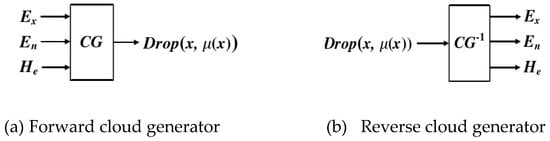
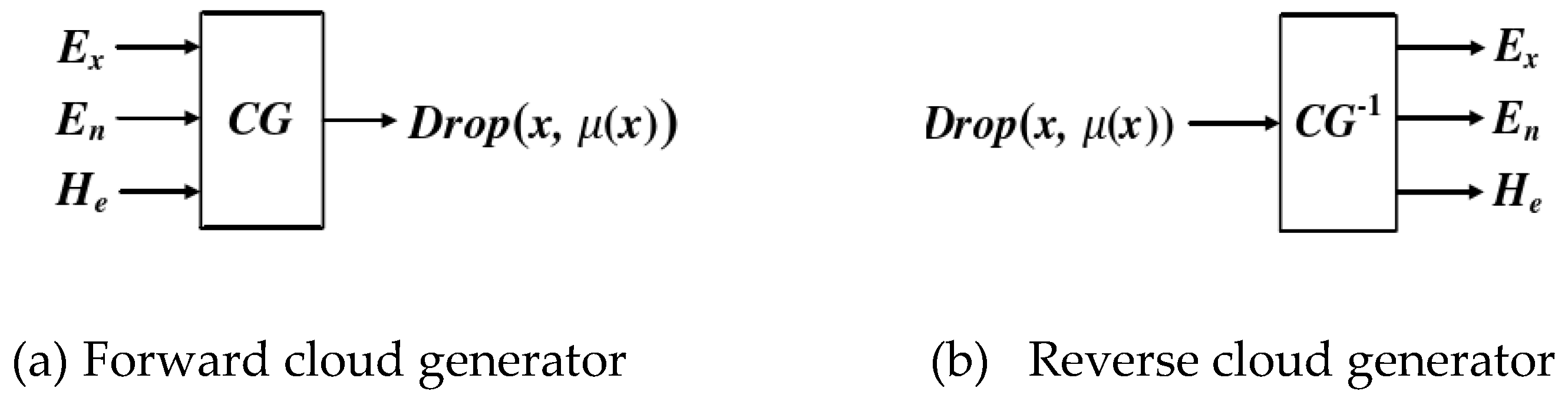
Compared with conventional fuzzy comprehensive evaluation, which represents fuzziness alone through fixed membership functions, the Cloud Model expresses fuzziness and randomness jointly through En and He, which makes it well suited to expert-based risk evaluation of an IHRP, where both linguistic ambiguity and inter-expert variability are pronounced. Two complementary cloud generators are used in the Cloud Model, as illustrated in Figure 1. The forward cloud generator (CG, Figure 1a) takes the three numerical features as input and produces a population of cloud droplets for visualization. The reverse cloud generator (CG−1, Figure 1b) performs the inverse operation, extracting the three numerical features from a sample of expert ratings.
Figure 1.
Forward and reverse cloud generators.
The risk assessment in this study is carried out at three hierarchical levels: standard clouds for the predefined risk levels, assessment clouds for the individual risk factors and the higher levels of factors, and a comprehensive cloud at the target-level index. The risk assessment criteria are first discretized into five linguistic levels, namely V = [low, lower, medium, higher, high], each associated with a numerical interval. For each interval [xmin, xmax], the corresponding standard cloud is constructed as:
where δ is a constant that reflects the evaluation fuzzy threshold, which is set to 0.1 in this study following Yao, Wang, Gao, and Ren [35]; a smaller δ corresponds to sharper level boundaries and can be adjusted in practice.
The assessment clouds for the second-level risk factors are then computed by the reverse cloud generator from expert ratings. Let xkij denote the rating given by expert k (k = 1, …, K) for factor j in the second-level index under the i-th first-level index. The numerical features of the second-level assessment cloud are calculated as:
where is the sample variance of the expert ratings.
The numerical features at the first-level index and target-level index are then aggregated from the second-level features. For the i-th index in the first-level index, the aggregated features are:
where mi is the number of the second-level factors under the i-th index in the first-level index, and wij is the weight of factor j in the second-level index under the i-th index in the first level index, which are derived from Equation (8). The features of the comprehensive (target-level index) cloud are obtained, following the entropy-weighted aggregation form adopted by Wu, Zhen and Zhang [27] and Yao, Wang, Gao and Ren [35].
For the comprehensive (Com.) cloud or target-level assessment cloud, the numerical features are calculated as:
where wi is the weight for factor i in the first-level index, and n is the number of factors in the first-level index.
The entropy weighting in Ex and He gives more influence to the index whose evaluations carry greater uncertainty, which is consistent with the Cloud Model’s treatment of fuzziness as an integral part of the assessment.
Once the numerical features have been obtained, the forward cloud generator produces a population of cloud droplets for visualization. A normal random number En′ is first sampled with mean En and standard deviation He. A cloud droplet x is then sampled from a normal distribution with mean Ex and standard deviation En′. Its certainty degree is computed as
The pair (x, μ(x)) is plotted as one cloud droplet, and the procedure is repeated N times (typically N = 2000) to generate the full cloud. The five standard clouds and each assessment cloud (for the first-level index or the comprehensive level) are then plotted in the same coordinate system. The risk level corresponding to each assessment cloud is determined by the standard cloud closest to it, where closeness is measured by the distance between the expected value Ex of the assessment cloud and that of each standard cloud. Because the standard clouds are centered on the midpoints of equal-width intervals, this rule is equivalent to locating Ex within the corresponding risk-level intervals. The cloud diagrams are used to visualize this comparison, while En and He are used to interpret the dispersion and consistency of the evaluations rather than to determine the level. When Ex lies very close to a level boundary, the result is reported as bordering the adjacent level. In addition, the numerical features themselves carry interpretive information: a higher Ex indicates a higher risk level, a smaller En indicates a more concentrated assessment, and a smaller He indicates greater consistency among experts.
4. Case Study
The proposed hybrid risk assessment method is implemented using Super Decisions and MATLAB R2024a. The Hangzhou Steel industrial heritage renewal project (IHRP), also known as the Hangzhou Steel Heritage Park, is used to apply and demonstrate the proposed method.
4.1. Project Background and Input Data
The Hangzhou Steel IHRP is located on the former site of the Hangzhou Steel Plant. It covers a construction area of 540,000 square meters with a total investment of approximately 9.8 billion RMB and was delivered in two phases. The first phase had been completed and had entered early operation at the time of this study. The project received the Excellence Award of the WLA World Landscape Architecture Award in 2024, and its lead architect was awarded the 54th Pritzker Architecture Prize in 2025.
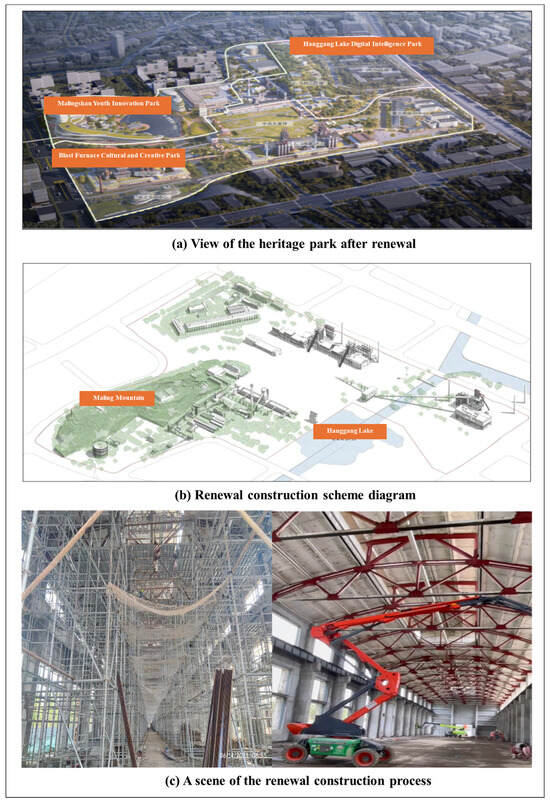
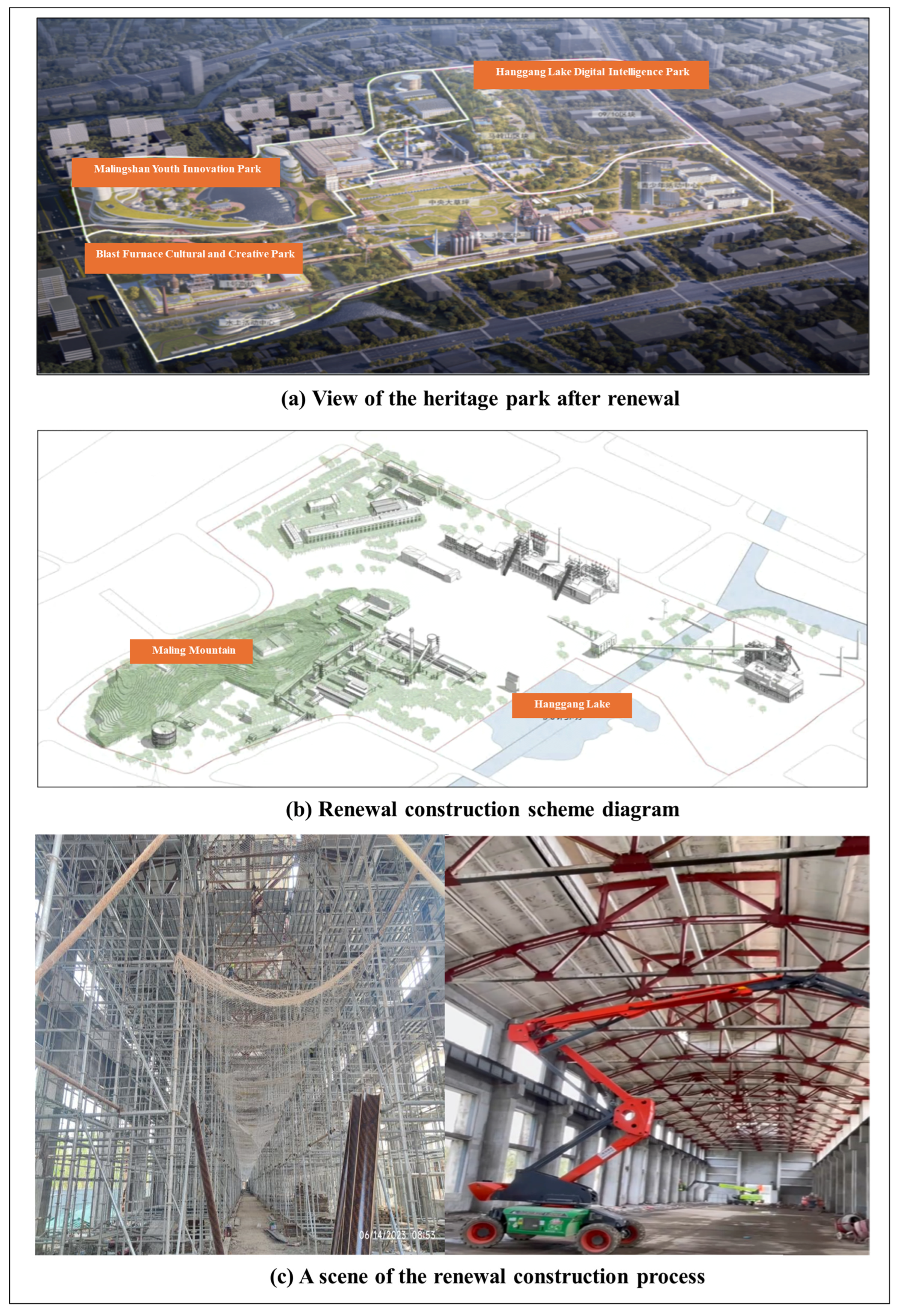
The Hangzhou Steel Plant ceased production in 2015, and its industrial assets, including blast furnaces, coke ovens, silos, and steam locomotives, together with statues and memorial monuments, have been preserved as carriers of urban industrial memory. Through renovation, the site is being transformed from an industrial rust belt into a cultural showcase. Figure 2 shows the view of the heritage park after renewal, the renewal construction scheme diagram, and a scene of the renewal construction process.
Figure 2.
Hangzhou Steel IHRP.
The panel of 15 experts who were invited to perform the brainstorming to identify the final risk factors were also invited to complete a two-dimensional questionnaire on the correlations between risk factors and give ratings for the second-level risk factors. The data collected from the 15 experts serve as the input to the hybrid risk assessment method integrating ANP, CRITIC, and the Cloud Model by implementing the equations described in Section 3.2.1 and Section 3.2.2, and Section 3.2.4 through Super Decisions and MATLAB. Note that the number of experts, i.e., 15, was determined based on previous studies that suggested using 10–15 experts to rate risks when using Cloud Model-based methods [40,41].
4.2. Determining Combined Weights
Based on the established risk assessment index system shown in Table 2, the subjective weights of the factors can be determined through the ANP method implemented in Super Decisions. A network structure is built based on the assessment index system established in Section 3.1, and the correlations, such as feedback or interdependence between risk factors at the same level and across levels, are identified. The 15 experts who were invited to perform brainstorming to screen the risk factors from the initially selected factors were also invited to identify the correlations between risk factors for the IHRP and assign scores of the second-level risk factors. The 15 experts were requested to hold a brainstorming discussion on the correlations between risk factors until they reached a unified opinion. The two-dimensional questionnaire on the correlations between risk factors based on brainstorming is shown in Table 3.
Table 3.
Correlations between factors of the same level or different levels.
A tick indicates that the factor in the row influences the factor in the column. Note that some of the influences between factors for the IHRP are bidirectional, while others are unidirectional. For example, the implementation risk of de-ruination (U11) and the environmental remediation investment risk (U13), which are factors in the same set, U1, mutually influence each other. The implementation risk of de-ruination (U11) affects the operational constraint risk of retained structures (U41), but U41 cannot alter the inherent nature of U11. Regarding the renewal and utilization of the coke oven art center in the Hangzhou Steel IHRP, although the internal space of the furnace has been excavated and environmentally treated, it is objectively impossible to completely remove the residual coal ash in the dense column space of the basement, which makes it difficult to operate and utilize.
Based on the correlations identified in Table 3, the remaining steps of the ANP procedure are carried out as follows: (1) the network structure is constructed according to the two-dimensional expert questionnaire (Figure S1); (2) pairwise comparison matrices are formulated, using Saaty’s 1–9 scale, for the factors that influence a common factor, and the consistency of each matrix is checked by calculating the consistency ratio (CR); (3) the normalized eigenvectors of the comparison matrices are filled in as the column vectors of the unweighted supermatrix; (4) equal weights are assigned to the clusters connected to each element to obtain the weighted supermatrix; and (5) the limit supermatrix is computed using Equation (1). For each comparison, the judgement was determined by consensus among the 15 experts through group discussion, so individual judgements were not aggregated numerically. In total, 16 pairwise comparison matrices were constructed (11 involving two elements and five involving three elements). The network structure, the available pairwise comparison judgements and consistency ratios (Table S3), and the unweighted, weighted, and limit supermatrices (Tables S4–S6) are provided in the Supplementary Material; the subjective weights can be reproduced from the weighted supermatrix. The resulting subjective weights of the risk factors at the two levels are shown in Table 4.
Table 4.
Subjective, data-driven, and comprehensive weights.
The 15 experts who screened the risk factors and identified the risk correlations were also invited to anonymously rate the scores of the second-level risk factors for the IHRP (see Table S2 in the Supplementary Material). The data-driven weights are then determined by the CRITIC method using Equations (2)–(7) based on the ratings of the second-level risk factors.
4.3. Cloud Model-Based Risk Assessment Results
The risk assessment criteria for the IHRP are classified into five linguistic levels, namely, V = [low, lower, medium, higher, high]. The numerical features of the corresponding standard clouds, computed from Equation (9), are reported in Table 5.
Table 5.
Risk assessment levels and numerical features for standard clouds.
Based on the ratings of the 13 second-level factors from the 15 experts, the numerical features of the second-level assessment clouds are computed from Equation (10), as reported in Table 6. Using the comprehensive weights in Table 4 and the second-level features in Table 6, the numerical features of the four first-level assessment clouds and the comprehensive cloud are obtained from Equations (11) and (12), as reported in Table 7.
Table 6.
Numerical features of assessment clouds for the second-level index.
Table 7.
Numerical features for first level assessment and comprehensive clouds.
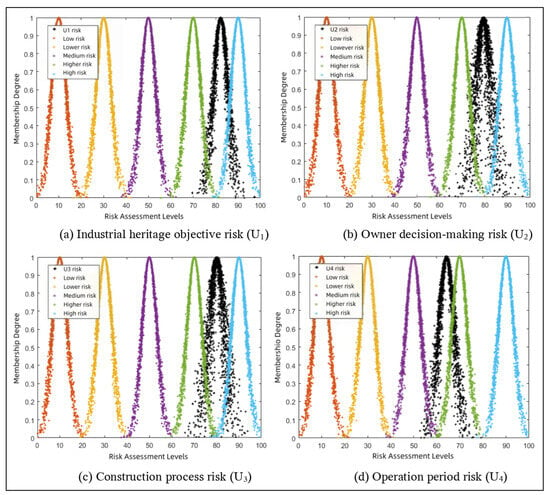
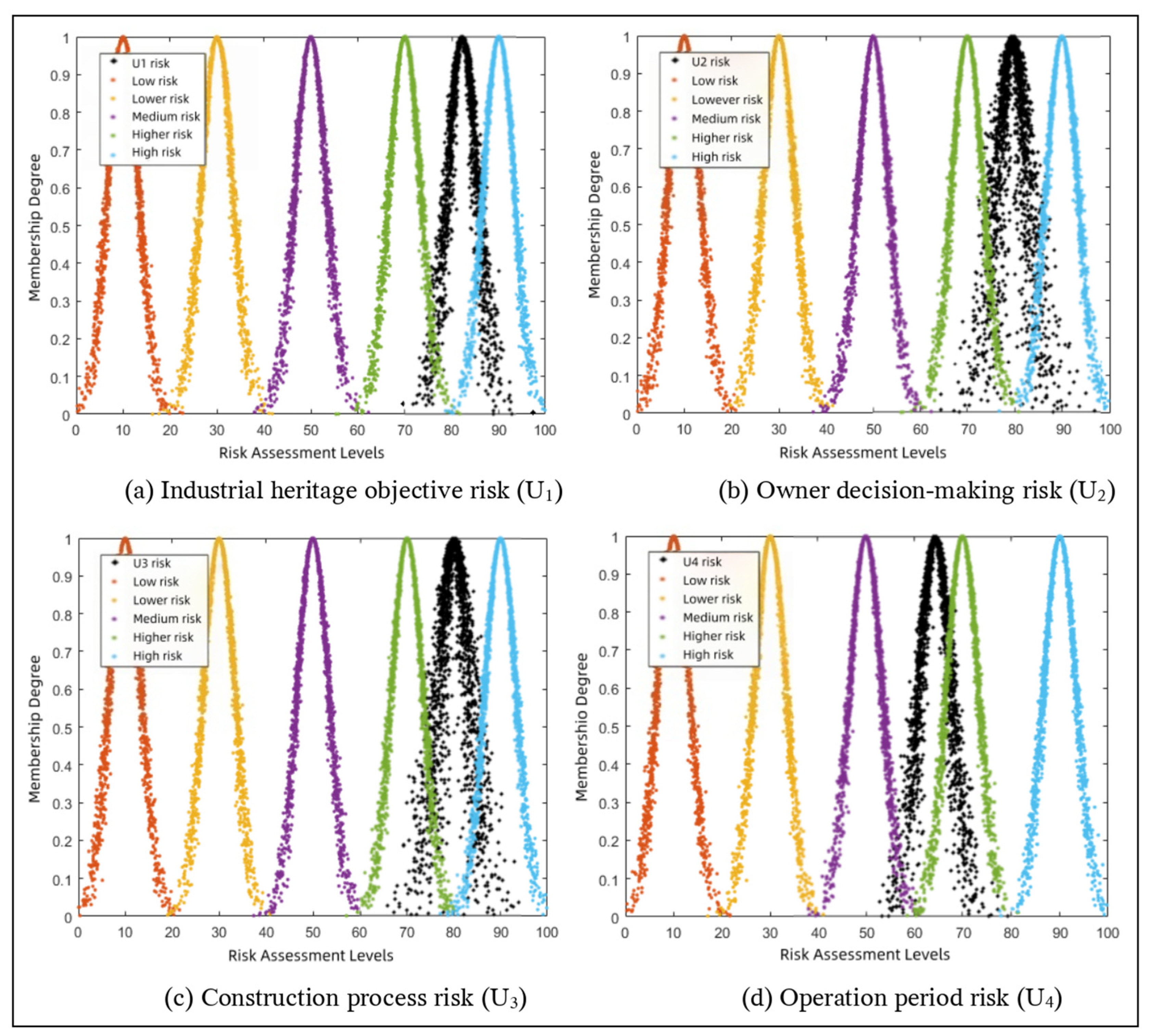
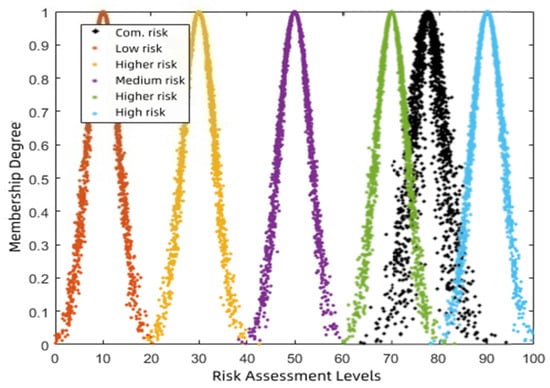
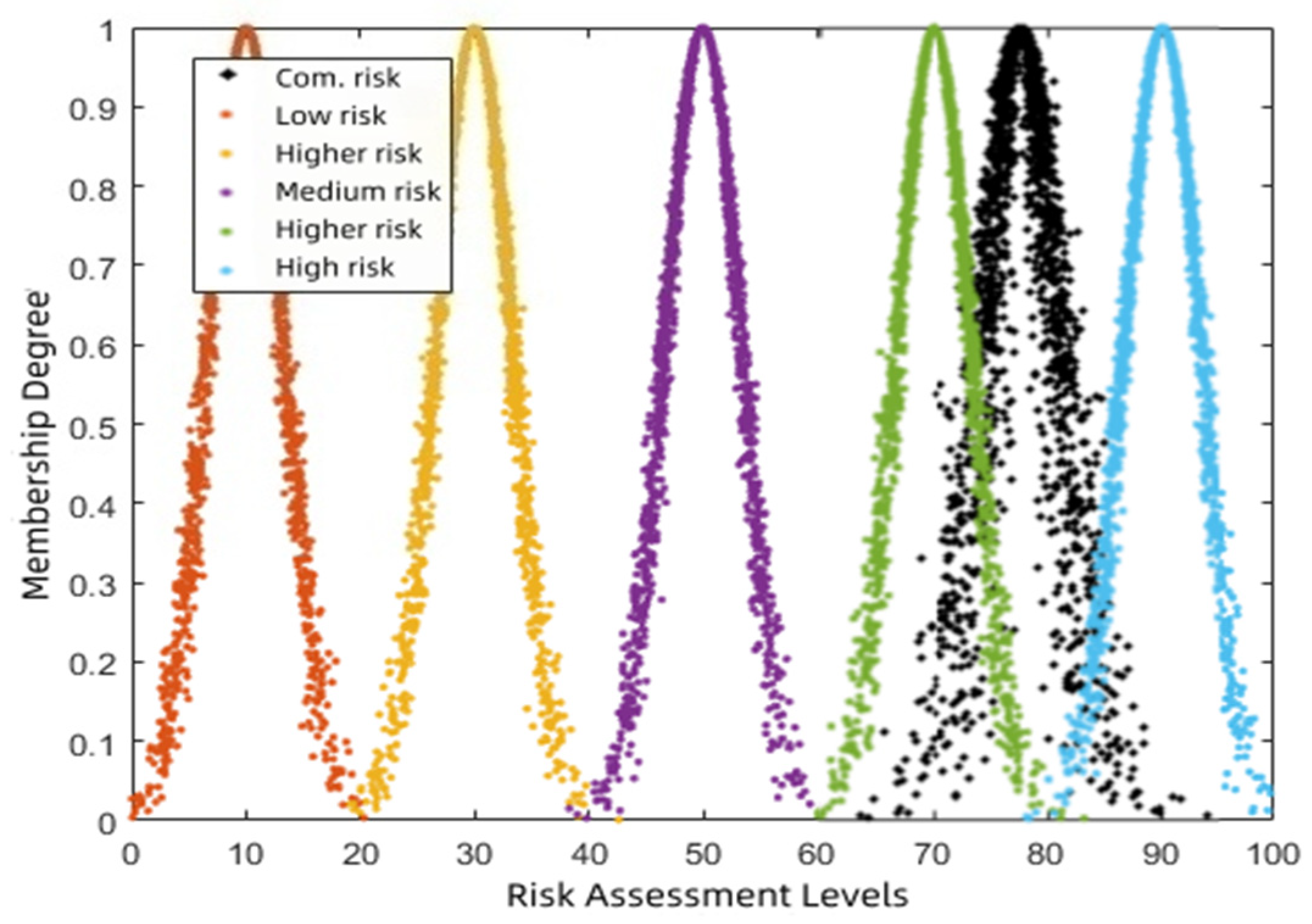
Using the forward cloud generator described in Section 3.2.4, the cloud diagrams of the four first-level risk groups were produced and superimposed on the standard clouds, as shown in Figure 3. The corresponding diagram for the comprehensive cloud is shown in Figure 4.
Figure 3.
First-level assessment clouds against the standard clouds: (a) industrial heritage objective risk (U1), (b) owner decision-making risk (U2), (c) construction process risk (U3), and (d) operation period risk (U4).
Figure 4.
Comprehensive assessment cloud and the standard clouds.
The risk level of each group is determined by the standard cloud closest to its assessment cloud, i.e., by the interval in Table 5 in which its Ex falls. As shown in Figure 3 and Table 7, the assessment cloud of U1 (Ex = 82.213) lies between the higher-risk and high-risk standard clouds and is clearly closer to the high-risk cloud, indicating that the industrial heritage objective risk is at the high-risk level. The assessment clouds of U3 (Ex = 80.099) and U2 (Ex = 79.587) are both located at the boundary between the higher-risk and high-risk levels: U3 is marginally above the boundary and is classified as high risk, whereas U2 is marginally below it and is classified as higher risk, bordering on high risk. The assessment cloud of U4 (Ex = 64.372) lies between the medium-risk and higher-risk standard clouds and is closer to the higher-risk cloud, indicating that the operation period risk is at the higher-risk level.
Figure 4 shows that the comprehensive assessment cloud of the Hangzhou Steel IHRP also lies between the higher-risk and high-risk standard clouds, closer to the higher-risk cloud. The overall risk level of the project is therefore at the higher-risk level. Combined with the first-level results in Figure 3, this finding indicates that the industrial heritage objective risk (U1), the construction process risk (U3), and the owner decision-making risk (U2), in descending order of Ex, are the major contributors to the overall risk and should be prioritized in risk management.
The numerical features in Table 7 further illustrate and explain the results of the assessment. The values of En and He for the four first-level clouds and the comprehensive cloud are relatively small, suggesting that the cloud droplets are relatively concentrated and that the expert evaluations show an acceptable degree of consistency.
To examine whether the assessment results are consistent with field conditions, the project records of the first phase of the Hangzhou Steel IHRP provided by the owner were reviewed. Inadequate investment in environmental protection (U13) and planning and design problems (U23) led to damage to an original environmental control area during construction. As a result, a new site had to be found for short-haul earthwork, backfilling, and re-sealing, which increased the price of the relevant contract by approximately 20% and delayed the critical path of the project by 129 days. In addition, hollowing in the cement mortar on the exterior of some relics was found during construction because no infrared scanning had been conducted (U32). This required supplementary testing and identification, hollowing treatment, and roof panel replacement, resulting in additional delay and cost. By contrast, only a minor waterlogging event (U43) has been recorded during the operation period so far. These observations correspond to the assessment results: the factors involved in the major events belong to U1, U3, and U2, which are assessed at or near the high-risk level, whereas U4 is assessed at a lower level. It should be noted that this is a qualitative comparison based on the first phase of a single project in its early operation stage, rather than a formal statistical validation. The operation period risk, in particular, needs to be further verified with longer-term operation data and the completion of the second phase.
4.4. Comparison and Discussion
To evaluate the impact of the weight coefficient α on the risk assessment results of the IHRP, a sensitivity analysis of different values of the coefficient α for subjective weights, i.e., 1 − α for data-driven weights, as shown in Equation (8), is conducted. The sensitivity analysis results, including numerical features for the first-level and the target-level risks, are shown in Table 8. The results show that the Ex values of the first-level and target-level clouds change only slightly with α. The overall risk level remains at the higher-risk level, and U1 and U4 remain at the high-risk and higher-risk levels, respectively, for all values of α. The only changes in classification occur for U2 and U3, whose Ex values lie close to the boundary of 80: U3 falls marginally below 80 when α = 0.25, and U2 rises marginally above 80 when α = 0.75. This confirms that U2 and U3 are located at the boundary between the higher-risk and high-risk levels, and that the main conclusions are robust to the choice of α. It also suggests that the relative emphasis on expert judgement and rating data can be adjusted through α according to the needs of decision-makers.
Table 8.
Sensitivity analysis for different values of the coefficient α in balancing subjective and data-driven weights.
To position the proposed approach within the broader risk assessment literature, three types of alternative methods are considered for comparison, namely, AHP combined with the Cloud Model, the fuzzy comprehensive evaluation method, and CRITIC combined with TOPSIS. These methods represent the most common pathways for project risk assessment under uncertainty and have been applied in PPP infrastructure [42], bridge engineering [14,35], urban rail transit [27], and prefabricated construction [15].
The first comparison concerns the treatment of dependencies among risk factors. AHP combined with the Cloud Model derives subjective weights under the assumption of mutual independence among criteria. This assumption is reasonable in projects where risks are organized hierarchically, but it does not hold for an IHRP in which decisions on the renewal strategy and the inherent attributes of the heritage produce bidirectional influences on subsequent construction and operation risks. The proposed approach replaces AHP with ANP, which models such bidirectional influences explicitly through the limit supermatrix and is therefore better suited to representing the interdependent structure of IHRP risks identified in this study.
The second comparison concerns the balance between expert judgment and data variability. The fuzzy comprehensive evaluation method relies entirely on subjective ratings to derive both weights and assessments, which captures expert experience but may amplify individual preferences when the expert panel is heterogeneous, as in the case of an IHRP whose expert panel involves owner representatives, designers, construction contractors, operation managers, and academic researchers. CRITIC combined with TOPSIS, on the other hand, derives weights solely from data variability and inter-factor correlation, which reduces subjective bias but may underweight experts’ intangible experience or knowledge when historical data are limited. The proposed approach combines ANP and CRITIC at α = 0.5, which preserves expert insight on heritage-specific risks while restraining subjective arbitrariness through data-driven correction.
The third comparison concerns the representation of uncertainty in expert evaluation. The fuzzy comprehensive evaluation method represents fuzziness through fixed membership functions but does not quantify randomness, while CRITIC combined with TOPSIS produces a single distance-based score that obscures both fuzziness and randomness. The Cloud Model expresses fuzziness and randomness jointly through the entropy and hyper-entropy parameters, which match the dual sources of uncertainty in expert evaluation of an IHRP, namely, linguistic ambiguity and inter-expert variability.
The comparisons above suggest that the proposed integration of ANP, CRITIC, and the Cloud Model is not intended to replace the alternative methods in general, but to provide a tailored option for projects, such as the IHRP, in which interdependence among factors, the duality of judgment-based and data-driven information, and the coexistence of fuzziness and randomness arise simultaneously. For projects where one or two of these characteristics are absent, simpler combinations remain appropriate.
5. Conclusions
This study focuses on the risk identification and assessment of industrial heritage renewal projects (IHRPs). Although industrial heritage renewal has become increasingly important for sustainable urban development, risk management for IHRPs has received limited attention in the existing literature. From the owner’s perspective and across the entire project life cycle, this study identifies thirteen risk factors organized into four groups, namely, industrial heritage objective risk, owner decision-making risk, construction process risk, and operation period risk, through literature analysis, field investigation, semi-structured interviews, and brainstorming. A hybrid risk assessment method integrating ANP, CRITIC, and the Cloud Model is proposed to capture the bidirectional dependencies among risk factors, balance expert judgment-based weights with data-driven weights derived from expert ratings, and quantify the fuzziness and randomness inherent in expert evaluations. The proposed method is applied to assess the risks in the Hangzhou Steel IHRP to demonstrate its applicability.
The case study shows that the overall risk level of the Hangzhou Steel IHRP is assessed as higher risk, indicating that systematic risk control measures are required throughout the project. Among the four risk groups, the industrial heritage objective risk (U1) is at the high-risk level, while the construction process risk (U3) and the owner decision-making risk (U2) lie at the boundary between the higher-risk and high-risk levels. These three groups should therefore be prioritized in risk management, whereas the operation period risk (U4) is at a relatively lower level. The relatively small values of entropy and hyper-entropy suggest that the expert evaluations are reasonably concentrated and consistent.
This study provides an investigation and identification of the risks in IHRPs, as well as an assessment index system from the owner’s perspective and across the entire process. In addition, this study contributes to a hybrid risk assessment framework for the IHRPs to address interdependence among risk factors, the duality of judgment-based and data-driven information, and the coexistence of fuzziness and randomness. Moreover, the proposed method enables the owner and other stakeholders to quantify and prioritize the risks across the entire process of an IHRP, supporting the safe and sustainable renewal of industrial heritage sites.
Several limitations of this study suggest directions for future research. First, this study integrates three well-developed methods to address the problems associated with assessing risks in IHRPs but does not innovate on these methods themselves. Hence, future studies will address theoretical advancements in the existing methods. Second, this study focuses on risk assessment rather than risk mitigation for IHRPs. Future work may integrate risk assessment with dynamic risk-monitoring and response planning during IHRP implementation. Third, the CRITIC weights in this study are derived from the ratings of the same expert panel, and are therefore data-driven weights based on expert-generated data rather than objective weights in a strict sense. Future studies may use measured project data, such as cost, schedule, and structural inspection records, as the input of CRITIC where such data are available. Fourth, the screening of risk factors for IHRPs relies solely on the frequency of experts’ selections and a threshold decided by the experts, but this approach may ignore risks with a low likelihood of occurrence but potentially serious or irreversible consequences. In addition, the identified risk factors are scored by the same panel of experts, which may introduce potential bias. Hence, further studies will explore how to identify and quantitatively evaluate risk factors by addressing these issues in assessing the risks of IHRPs.
Supplementary Materials
The following supporting information can be downloaded at https://www.mdpi.com/article/10.3390/buildings16204028/s1. Table S1: Initially identified risk factors of the IHRP for further selecting; Table S2: Scoring table for risk assessment factors of the IHRP; Table S3: Pairwise comparison judgements and consistency ratios; Table S4: Calculation results of unweighted supermatrix; Table S5: Calculation results of weighted supermatrix; Table S6: Limiting priorities (identical columns of the limit supermatrix); Figure S1: Risk indicator network structure relationship diagram; Figure S2: Example of pairwise comparisons among the elements of cluster U1 with respect to U22; Figure S3: Priority vector and consistency ratio (CR = 0.018) of the comparisons in Figure S2.
Author Contributions
Conceptualization, W.Z., X.L., H.M. and H.Z.; methodology, W.Z., X.L., H.M. and H.Z.; software, W.Z., X.L., H.M. and H.Z.; validation, W.Z., X.L., H.M. and H.Z.; formal analysis, W.Z., X.L., H.M. and H.Z.; investigation, W.Z., X.L., H.M. and H.Z.; resources, W.Z., X.L., H.M. and H.Z.; data curation, W.Z., X.L., H.M. and H.Z.; writing—original draft, W.Z., X.L., H.M. and H.Z.; writing—review and editing, W.Z., X.L., H.M. and H.Z.; visualization, W.Z., X.L., H.M. and H.Z.; supervision, X.L., H.M. and H.Z.; project administration, X.L., H.M. and H.Z.; funding acquisition, H.Z. All authors have read and agreed to the published version of the manuscript.
Funding
This research received no external funding.
Institutional Review Board Statement
Ethical approval was not required because this study involved interviews, group discussions (brainstorming sessions), and questionnaires with architecture/design/heritage-management professionals to elicit their professional judgment on project risks. No personal, health, or otherwise sensitive information was collected; all responses were anonymous, participation was voluntary, and all participants gave verbal informed consent prior to participation. In accordance with the research organization, this type of professional-opinion survey did not require formal ethics committee approval.
Informed Consent Statement
Verbal informed consent was obtained from the participants. Verbal consent was obtained rather than written because this study involved interviews, group discussions (brainstorming sessions), and questionnaires with architecture/design/heritage-management professionals to elicit their professional judgment on project risks. No personal, health, or otherwise sensitive information was collected.
Data Availability Statement
The data presented in this study are openly available in [Zenodo] [https://zenodo.org/records/22986214] (accessed on 9 October 2026).
Conflicts of Interest
Author Hang Mei was employed by the company Industrial Site Comprehensive Protection and Development Co., Ltd. The remaining authors declare that the research was conducted in the absence of any commercial or financial relationships that could be construed as a potential conflict of interest.
References
- Ticcih, P. The Nizhny Tagil Charter for the industrial heritage. In Proceedings of the TICCIH XII International Congress, Moscow, Russia, 10–17 July 2003; pp. 169–175. [Google Scholar]
- Liu, F.; Zhao, Q.; Yang, Y. An approach to assess the value of industrial heritage based on Dempster-Shafer theory. J. Cult. Herit. 2018, 32, 210–220. [Google Scholar] [CrossRef] [Scilit]
- Plevoets, B.; Sowinska-Heim, J. Community initiatives as a catalyst for regeneration of heritage sites: Vernacular transformation and its influence on the formal adaptive reuse practice. Cities 2018, 78, 128–139. [Google Scholar] [CrossRef] [Scilit]
- Porkar, M.J.; Khakzand, M.; Mardanlou, N. Achievement to adaptive reuse strategies of industrial heritage: Learning from Iranian cases. Int. J. Build. Pathol. Adapt. 2025, 43, 463–481. [Google Scholar] [CrossRef] [Scilit]
- Cercleux, A.-L.; Merciu, F.-C.; Merciu, G.-L. Models of Technical and Industrial Heritage Re-Use in Romania. Procedia Environ. Sci. 2012, 14, 216–225. [Google Scholar] [CrossRef] [Scilit]
- Huang, W.; Xiong, G.; Zhong, L.; Li, K.; Li, H.; Skitmore, M.; Talebian, N. Research into Satisfaction with Industrial Heritage Renewal Based on the SEM-IPA Model: A Case Study of the Dongguan Jianyuzhou Park. Land 2022, 11, 403. [Google Scholar] [CrossRef] [Scilit]
- Petković-Grozdanovića, N.; Stoiljković, B.; Keković, A.; Murgul, V. The Possibilities for Conversion and Adaptive Reuse of Industrial Facilities into Residential Dwellings. Procedia Eng. 2016, 165, 1836–1844. [Google Scholar] [CrossRef] [Scilit]
- Arbab, P.; Alborzi, G. Toward developing a sustainable regeneration framework for urban industrial heritage. J. Cult. Herit. Manag. Sustain. Dev. 2022, 12, 263–274. [Google Scholar] [CrossRef] [Scilit]
- Han, R.; Yang, S. A Study on Industrial Heritage Renewal Strategy Based on Hybrid Bayesian Network. Sustainability 2023, 15, 10707. [Google Scholar] [CrossRef] [Scilit]
- Klein, J.H.; Cork, R.B. An approach to technical risk assessment11British Crown Copyright 1998/DERA. Published with the permission of the Controller of Her Britannic Majesty’s Stationery Office. Int. J. Proj. Manag. 1998, 16, 345–351. [Google Scholar] [CrossRef] [Scilit]
- Chapman, R.J. The role of system dynamics in understanding the impact of changes to key project personnel on design production within construction projects. Int. J. Proj. Manag. 1998, 16, 235–247. [Google Scholar] [CrossRef] [Scilit]
- Xu, Y.; Yeung, J.F.Y.; Chan, A.P.C.; Chan, D.W.M.; Wang, S.Q.; Ke, Y. Developing a risk assessment model for PPP projects in China—A fuzzy synthetic evaluation approach. Autom. Constr. 2010, 19, 929–943. [Google Scholar] [CrossRef] [Scilit]
- Chen, W.; Pourghasemi, H.R.; Kornejady, A.; Zhang, N. Landslide spatial modeling: Introducing new ensembles of ANN, MaxEnt, and SVM machine learning techniques. Geoderma 2017, 305, 314–327. [Google Scholar] [CrossRef] [Scilit]
- Lu, Z.; Wei, C.; Liu, M.; Deng, X. Risk Assessment Method for Cable System Construction of Long-Span Suspension Bridge Based on Cloud Model. Adv. Civ. Eng. 2019, 2019, 5720637. [Google Scholar] [CrossRef] [Scilit]
- Zhang, Z.; Duan, L.; Du, X. Risk Assessment of Prefabricated Building Projects Based on the G1-CRITIC Method and Cloud Model: A Case Study from China. Buildings 2025, 15, 2787. [Google Scholar] [CrossRef] [Scilit]
- Berkenbosch, K.; Groote, P.; Stoffelen, A. Industrial heritage in tourism marketing: Legitimizing post-industrial development strategies of the Ruhr Region, Germany. J. Herit. Tour. 2022, 17, 327–341. [Google Scholar] [CrossRef] [Scilit]
- Wang, K. Temporal insights into mega-events and waterfront industrial heritage transformation: A case study of Shanghai’s Huangpu River industrial zone. Built Herit. 2024, 8, 48. [Google Scholar] [CrossRef] [Scilit]
- Guo, P.; Li, H.; Zhang, G.; Zhang, Y. Exploring Critical Variables That Affect the Policy Risk Level of Industrial Heritage Projects in China. Sustainability 2019, 11, 6848. [Google Scholar] [CrossRef] [Scilit]
- Blagojevic, M.R.; Tufegdzic, A. The new technology era requirements and sustainable approach to industrial heritage renewal. Energy Build. 2016, 115, 148–153. [Google Scholar] [CrossRef] [Scilit]
- Tah, J.; Carr, V.; Howes, R. Information modelling for case-based construction planning of highway bridge projects. Adv. Eng. Softw. 1999, 30, 495–509. [Google Scholar] [CrossRef] [Scilit]
- Jin, X.-H. Neurofuzzy Decision Support System for Efficient Risk Allocation in Public-Private Partnership Infrastructure Projects. J. Comput. Civ. Eng. 2010, 24, 525–538. [Google Scholar] [CrossRef] [Scilit]
- Kim, B.-C. Multi-factor dependence modelling with specified marginals and structured association in large-scale project risk assessment. Eur. J. Oper. Res. 2022, 296, 679–695. [Google Scholar] [CrossRef] [Scilit]
- Yucelgazi, F.; Yitmen, I. An ANP model for risk response assessment in large scale bridge projects. Civ. Eng. Environ. Syst. 2020, 37, 1–27. [Google Scholar] [CrossRef] [Scilit]
- Gao, H.; Zhang, X.; Liu, Y.; Li, D. Cloud Model Approach for Lateral Control of Intelligent Vehicle Systems. Sci. Program. 2016, 2016, 6842891. [Google Scholar] [CrossRef] [Scilit]
- Kim, B.; Kim, J.; Kim, J. Evaluation Model for Investment in Solar Photovoltaic Power Generation Using Fuzzy Analytic Hierarchy Process. Sustainability 2019, 11, 2905. [Google Scholar] [CrossRef] [Scilit]
- Zangenehmadar, Z.; Moselhi, O. Prioritizing deterioration factors of water pipelines using Delphi method. Measurement 2016, 90, 491–499. [Google Scholar] [CrossRef] [Scilit]
- Wu, H.-W.; Zhen, J.; Zhang, J. Urban rail transit operation safety evaluation based on an improved CRITIC method and cloud model. J. Rail Transp. Plan. Manag. 2020, 16, 100206. [Google Scholar] [CrossRef] [Scilit]
- Yuan, J.; Li, X.; Xu, C.; Zhao, C.; Liu, Y. Investment risk assessment of coal-fired power plants in countries along the Belt and Road initiative based on ANP-Entropy-TODIM method. Energy 2019, 176, 623–640. [Google Scholar] [CrossRef] [Scilit]
- Liu, X.; Yang, W.; Zhang, X. Rockburst prediction of multi-dimensional cloud model based on improved hierarchical analytic method and critic method. J. Hunan Univ. 2021, 48, 118–124. [Google Scholar]
- Hou, K.; Wang, L. Risk assessment model for open pit mine slope based on improved FAHP-CRITIC method and cloud theory. Chin. J. Saf. Environ. 2021, 21, 2443–2451. [Google Scholar]
- Li, D.; Liu, C.; Gan, W. A New Cognitive Model: Cloud Model. Int. J. Intell. Syst. 2009, 24, 357–375. [Google Scholar] [CrossRef] [Scilit]
- Deng, W.; Wang, G.; Zhang, X. A novel hybrid water quality time series prediction method based on cloud model and fuzzy forecasting. Chemom. Intell. Lab. Syst. 2015, 149, 39–49. [Google Scholar] [CrossRef] [Scilit]
- Qin, G.; Zhang, M.; Yan, Q.; Xu, C.; Kammen, D.M. Comprehensive evaluation of regional energy internet using a fuzzy analytic hierarchy process based on cloud model: A case in China. Energy 2021, 228, 120569. [Google Scholar] [CrossRef] [Scilit]
- Hou, X.; Lv, T.; Xu, J.; Deng, X.; Liu, F.; Pi, D. Energy sustainability evaluation of 30 provinces in China using the improved entropy weight-cloud model. Ecol. Indic. 2021, 126, 107657. [Google Scholar] [CrossRef] [Scilit]
- Yao, B.; Wang, L.; Gao, H.; Ren, L. Bridge Construction Risk Assessment Based on Variable Weight Theory and Cloud Model. Buildings 2024, 14, 576. [Google Scholar] [CrossRef] [Scilit]
- Saaty, T.L. Decision Making with Dependence and Feedback: The Analytic Network Process; RWS Publications: Pittsburgh, PA, USA, 1996; Volume 4922. [Google Scholar]
- Diakoulaki, D.; Mavrotas, G.; Papayannakis, L. Determining Objective Weights in Multiple Criteria Problems—The Critic Method. Comput. Oper. Res. 1995, 22, 763–770. [Google Scholar] [CrossRef] [Scilit]
- Žižović, M.; Miljković, B.; Marinković, D. Objective methods for determining criteria weight coefficients: A modification of the CRITIC method. Decis. Mak. Appl. Manag. Eng. 2020, 3, 149–161. [Google Scholar] [CrossRef] [Scilit]
- Li, D. Membership clouds and membership cloud generators. Comput. Res. Dev. 1995, 32, 15–20. [Google Scholar]
- Yin, Y.; Liu, J. Risk assessment of photovoltaic-Energy storage utilization project based on improved Cloud-TODIM in China. Energy 2022, 253, 124177. [Google Scholar] [CrossRef] [Scilit]
- Wang, H.; Guo, L.; Chen, T.; Li, Y.; Zhou, G. Quantification and evaluation for resilience of railway transportation system based on the cloud model. Smart Resilient Transp. 2026, 8, 57–78. [Google Scholar] [CrossRef] [Scilit]
- Xu, T.; Song, Z.; Guo, D.; Song, Y. A Cloud Model-Based Risk Assessment Methodology for Tunneling-Induced Damage to Existing Tunnel. Adv. Civ. Eng. 2020, 2020, 8898362. [Google Scholar] [CrossRef] [Scilit]

Disclaimer/Publisher’s Note: The statements, opinions and data contained in all publications are solely those of the individual author(s) and contributor(s) and not of MDPI and/or the editor(s). MDPI and/or the editor(s) disclaim responsibility for any injury to people or property resulting from any ideas, methods, instructions or products referred to in the content. |
© 2026 by the authors. Licensee MDPI, Basel, Switzerland. This article is an open access article distributed under the terms and conditions of the Creative Commons Attribution (CC BY) license.