


Abstract
Sustainability-oriented housing policies rely on financial incentives, green mortgage products, and energy-efficiency programs to achieve environmental and long-term social objectives. However, their effectiveness remains limited at the household level, raising questions about why these instruments underperform despite growing policy attention and institutional support. While previous research has examined household responses to sustainable housing measures and behavioral influences on housing decisions, less attention has been paid to how behavioral mechanisms interact with mortgage finance in shaping the effectiveness of sustainability-oriented housing policies. This paper addresses this gap by integrating behavioral economics, housing finance and sustainable housing research within a unified perspective. It focuses on the mismatch between policy assumptions and behavioral processes underlying housing and mortgage decisions. Using insights from behavioral housing finance, it develops a conceptual framework that explains how households evaluate and respond to sustainability-related housing interventions. The literature review integrates evidence on behavioral mechanisms and financial constraints and examines their role in housing-related financial decisions and policy responses. The analysis shows that household decisions are driven by short-term affordability concerns, decision heuristics, and subjective perceptions of financial risk. As a result, behavioral mechanisms such as present bias, mental accounting, and framing effects reduce the importance of long-term financial stability and environmental benefits in housing choices. The findings suggest that policy uptake alone is a weak indicator of success, as participation in sustainability-oriented programs does not necessarily translate into lasting behavioral or environmental change. This highlights the importance of aligning housing policy design with household decision-making processes and behavioral realities.
1. Introduction
Sustainable housing policies are widely promoted as instruments for achieving environmental and financial resilience [1]. Yet many of these interventions produce weaker household-level outcomes than expected [2,3]. This paper argues that the explanation lies not only in institutional or financial design, but in the behavioral logic through which households interpret housing-related incentives.
Sustainable housing is a multidimensional concept that includes environmental, economic, social and cultural dimensions [4,5]. Beyond energy performance, it also involves factors, such as affordability, accessibility, location and household well-being [4]. In this study, however, the primary focus is on the environmental and energy-efficiency dimensions of sustainability, reflecting the specific objective of examining household responses to sustainability-oriented housing and mortgage policies. Accordingly, household preferences are understood within this broader context, even though the analysis focuses specifically on behavioral responses to environmental and energy-efficiency-oriented housing policies.
Housing plays a central role in modern societies, extending far beyond its economic function. Housing decisions shape social stability, household wellbeing, and long-term development outcomes [6]. In recent years, housing policy has increasingly adopted sustainability goals, reflected in energy-efficiency programs, green housing incentives, and the growing use of green mortgage products [7,8]. These policies aim not only to reduce environmental impacts but also to support long-term financial stability and social cohesion. Despite strong policy ambition, their effectiveness at the household level often remains limited [9].
Housing choices are closely tied to household finances. Mortgage conditions, interest-rate volatility, borrowing constraints, and access to public subsidies strongly influence housing affordability and long-term financial planning [10]. In many transition economies, housing constitutes the primary form of household wealth, making housing policy a central driver of financial security and asset accumulation [11,12]. Under these conditions, housing policy directly affects not only where households live, but also how much risk they take on and how resilient they are to future economic shocks [10].
Building on this growing body of literature, this paper argues that housing decisions cannot be fully explained by standard economic models based on rational choice. Behavioral economics highlights that decisions are shaped by cognitive biases, heuristics, and framing effects rather than purely by optimization [13,14]. Housing decisions are especially subject to such influences, as they involve long-term commitments, emotional attachment, and perceptions of security [15,16]. Behavioral mechanisms such as mental accounting, loss aversion, and present bias play an important role in how households perceive affordability, risk, and future benefits linked to housing and mortgage choices [3,17,18].
From a behavioral housing finance perspective, state-supported housing programs further amplify these behavioral dynamics. Subsidized loans, homeownership incentives, and energy-efficiency programs act not only as financial instruments but also as social and normative signals. They may shape expectations about family formation, financial safety, or continued state support, influencing borrowing decisions and risk tolerance [19,20]. As a result, households often focus on short-term affordability and eligibility criteria, while long-term financial sustainability and environmental benefits receive less attention [3,21].
Recent sustainability-oriented housing research increasingly acknowledges the importance of these behavioral factors. Studies show that the adoption of energy-efficient housing and green technologies depends on information framing, labelling, social norms, and perceived costs rather than on environmental preferences alone [21,22]. While some households are willing to pay a premium for sustainable or energy-efficient homes, their choices remain strongly influenced by short-term budget constraints and information asymmetries [18,23]. Across the literature, these studies suggest that short-term financial considerations often dominate decisions involving long-term sustainability benefits.
Despite these advances, we identify several important gaps in the existing literature. Much of the existing empirical evidence focuses on short-term outcomes, such as policy uptake, stated preferences, or adoption of green housing options. Long-term financial sustainability, mortgage repayment behavior, and household vulnerability remain underexplored, especially in transition economies characterized by institutional uncertainty and subsidy-driven housing policies [2,24]. Although housing institutions and structural frameworks have been widely analyzed in these contexts [11], the behavioral mechanisms shaping household-level financial decisions receive far less attention.
This paper addresses this gap by examining sustainable housing policy through a behavioral housing finance perspective. The aim of this study is to examine the interaction between behavioral mechanisms and financial constraints in shaping household responses to sustainability-oriented housing policies. This perspective allows us to examine why policy incentives may generate participation without necessarily producing lasting changes in household decision-making.
Accordingly, the study is guided by the following research question:
- RQ (Research Question): How do behavioral mechanisms in household housing and mortgage decision-making influence the effectiveness of sustainability-oriented housing policies?
To address this research question, the study reviews and integrates evidence from behavioral economics, housing finance and sustainable housing research. It focuses on how behavioral mechanisms and financial constraints interact in household housing decisions. Based on this review, the study develops a conceptual framework to explain how these mechanisms jointly shape household responsiveness to sustainability-oriented housing policies.
The contribution of this study does not lie in identifying new behavioral biases, but in integrating established behavioral mechanisms into a housing-finance-based explanation of sustainability policy effectiveness. Specifically, we conceptualize mortgage finance as a transmission channel through which policy incentives, financial constraints and behavioral mechanisms jointly shape household housing decisions. This perspective shifts attention from whether households participate in sustainability-oriented programs to how financing conditions and behavioral responses determine whether such participation translates into durable changes in housing choices. In this way, the study connects behavioral housing finance with sustainable housing policy and emphasizes that policy uptake and longer-term behavioral effectiveness represent different dimensions of policy success.
Building on a review of international research, it identifies the key behavioral mechanisms that shape housing and mortgage decisions, particularly in response to state-sponsored housing programs. By linking behavioral insights to household-level financial outcomes, the analysis contributes to a better understanding of why sustainability-oriented housing policies often fail to deliver durable results. The findings underline the importance of behaviorally informed housing finance instruments that better align policy goals with how households actually perceive affordability, risk, and long-term commitments.
2. Conceptual Background
2.1. Housing Decisions as Behavioral and Financial Choices
Housing decisions occupy a unique position among household economic choices because they combine long-term financial commitments with strong social, psychological, and environmental meanings. Purchasing a home typically represents the largest investment households make during their lifetime, often financed through long-term mortgage debt while facing considerable uncertainty regarding future income, interest rates, housing prices, and policy conditions [6,10]. As a result, housing choices shape not only residential conditions but also long-term financial security, exposure to risk, and wealth accumulation.
From a financial perspective, housing decisions are closely linked to credit access, borrowing constraints, and mortgage market conditions. Empirical evidence shows that mortgage supply, interest rate dynamics, and lending standards strongly influence household behavior, sometimes encouraging excessive borrowing or discouraging refinancing even when it would be financially beneficial [25]. Instead of evaluating housing decisions based on lifetime costs or long-term affordability, households often rely on simplified indicators such as monthly payments, down payment requirements, or eligibility thresholds for subsidies. Behavioral finance research suggests that such a focus on short-term affordability reflects cognitive shortcuts rather than fully rational evaluation [14,17,23].
Building on this literature, we view housing decisions as outcomes shaped by both economic and behavioral mechanisms. When facing complex, high-stakes decisions under uncertainty, households rely on heuristics, reference points, and social cues [13,15]. Housing markets are particularly affected by these effects due to information asymmetries, search costs, and the emotional attachment associated with homeownership [16]. Evidence from real estate valuation and transaction behavior shows that individuals are influenced by price anchors, peer behavior, and market narratives, which shape expectations independently of fundamental value [26,27,28].
Housing decisions are also highly shaped by social and cultural contexts. Homeownership is widely perceived as a symbol of stability, success, and adulthood, which can create social pressure to buy property even when financial fundamentals are weak [16,29]. Such social norms can reinforce herd behavior and amplify housing cycles, as households imitate the choices of peers or family members in response to policy windows or market signals [7,30]. These dynamics suggest that housing choices increasingly reflect identity signaling and social expectations, rather than purely economic optimization.
From a sustainability perspective, the behavioral and financial nature of housing decisions is particularly important. Many sustainable housing options (such as energy efficient buildings, retrofits, or low carbon housing solutions) involve higher upfront costs, while their economic and environmental advantages typically emerge over the longer term. However, empirical studies show that households often undervalue these delayed gains when making housing decisions. Instead, short-term budget constraints, perceived affordability, and immediate financial incentives dominate choice [3,23]. As a result, households may lock themselves into housing arrangements that generate long-term energy vulnerability or higher emissions, even when more sustainable alternatives exist [24,31].
Recent research on sustainable housing adoption confirms that financial considerations alone do not explain household behavior. Studies on energy-efficient housing and retrofitting highlight the importance of behavioral responses to information, labeling, and perceived effort [21,32,33]. While some households are willing to pay a green premium for sustainable dwellings, these decisions depend heavily on how costs and benefits are framed and whether information is perceived as credible and salient [22,34]. This indicates that sustainability outcomes in housing markets depend not only on technological options or financial incentives, but also on how households process and interpret them.
Based on the reviewed evidence, we conceptualize housing decisions as behavioral and financial choices shaped by cognitive biases, social norms, and institutional settings. Rather than reflecting fully informed optimization, these decisions emerge from simplified decision rules applied to complex financial and sustainability tradeoffs. Recognizing this dual nature of housing choices is essential for understanding why sustainability-oriented housing policies may struggle to influence household behavior and why financial instruments alone are often insufficient to align individual decisions with long-term sustainability objectives.
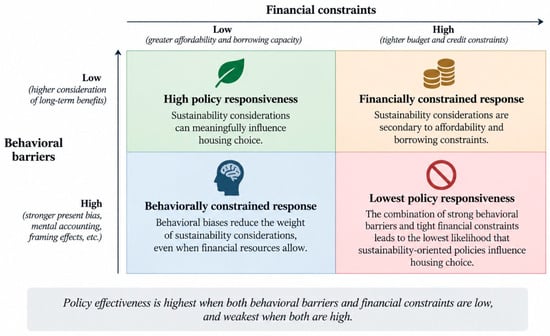
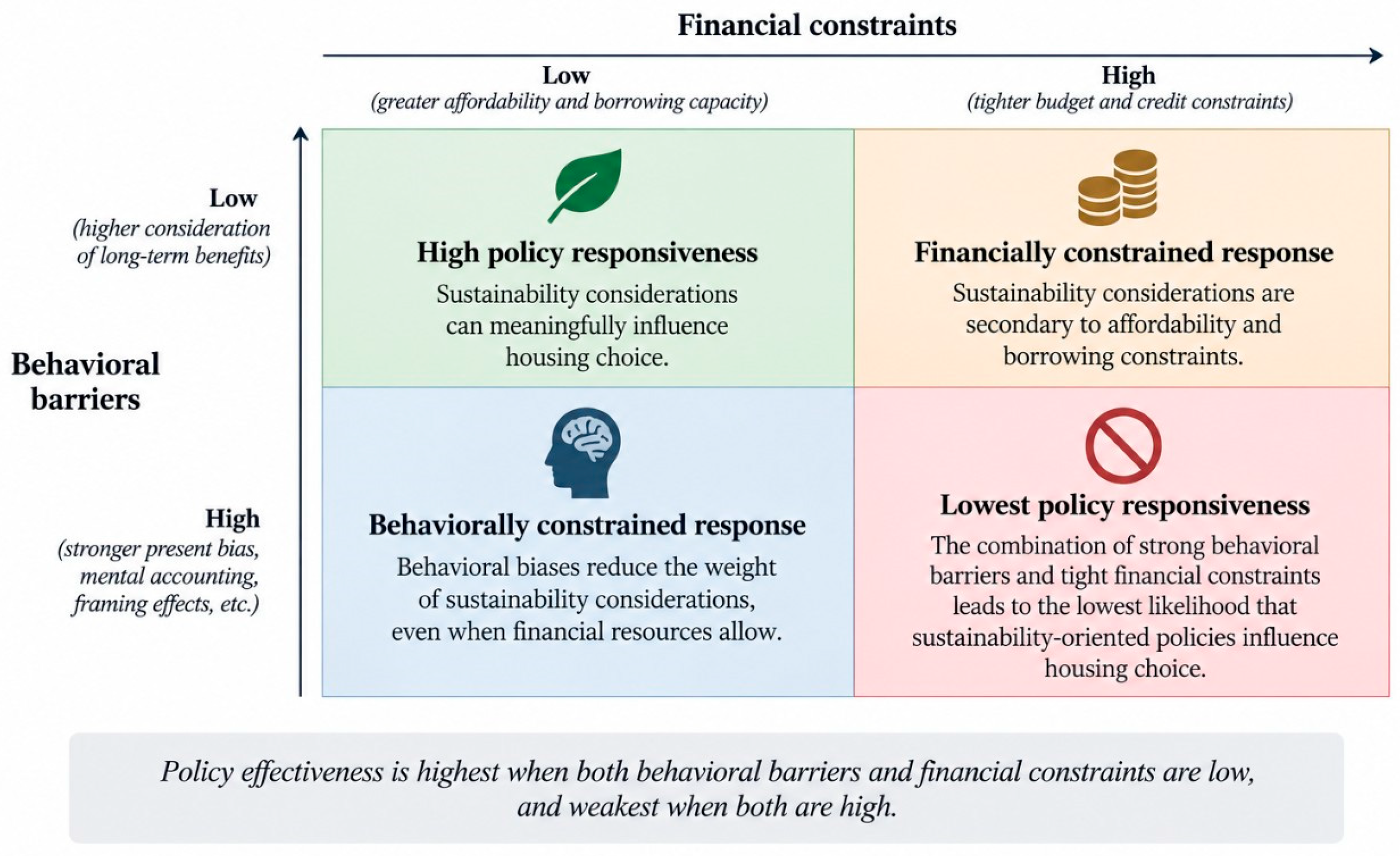
Based on the recurring patterns identified in the reviewed literature, we distinguish between two dimensions that shape household responsiveness to sustainability-oriented housing policies: behavioral barriers and financial constraints. Previous research shows that both behavioral factors and access to financial resources can influence household energy-efficiency and retrofit decisions [9,35]. These dimensions are analytically distinct but may operate simultaneously. Their interaction provides the basis for the conceptual framework presented in Figure 1. Behavioral and financial constraints may limit household responses through different channels. Behavioral barriers can reduce households’ willingness to undertake long-term sustainability investments, while financial constraints can restrict the set of feasible housing and investment choices [9]. Evidence from European homeowners also indicates that these dimensions can interact: debt aversion can reduce retrofit adoption, particularly when households face limited access to capital [9].
Figure 1.
Household responsiveness to sustainability-oriented housing policies under different behavioral and financial constraint settings.
Information processing adds a further behavioral dimension to this relationship. Carroll et al. [22] show that the framing of energy-efficiency information can influence actual housing decisions, indicating that financial feasibility alone does not determine household responses. Building on this evidence, Figure 1 integrates behavioral and financial constraints into a four-part conceptual typology.
The four configurations illustrate how the relative strength of behavioral and financial constraints may shape household responsiveness. When both are relatively low, sustainability considerations have greater scope to influence housing choices. When one dimension is strong, household responses may be limited primarily by either behavioral or financial barriers. When both are strong, the constraints may reinforce each other, resulting in the most limited responsiveness to sustainability-oriented housing policies. The matrix should be interpreted as a conceptual typology derived from the reviewed literature rather than as an empirically estimated classification of households. By combining the two dimensions, it provides a structured representation of how different behavioral-financial configurations may produce different levels of household responsiveness.
Based on this conceptual distinction, we formulate the following proposition:
Proposition 1.
Household responsiveness to sustainability-oriented housing policies depends on the joint influence of behavioral barriers and financial constraints. Policy responsiveness is expected to become more limited when either constraint is strong and to be lowest when both constraints operate simultaneously.
This proposition is not empirically tested in the present study but specifies a theoretically derived relationship that can be examined in future empirical research.
2.2. Behavioral Mechanisms Shaping Housing Policy Responses
Housing policies are often designed under the assumption that households will respond predictably to financial incentives, subsidies, and regulatory signals. Building on behavioral research, we argue that household responses are strongly shaped by how policy instruments are perceived, framed, and cognitively processed, rather than by their objective financial value alone [2,22]. As housing policies increasingly aim to promote sustainability through subsidies, energy efficiency programs, and green mortgage instruments, understanding these behavioral mechanisms becomes essential [2,18].
One of the most influential behavioral mechanisms in housing policy is mental accounting. Households tend to categorize financial resources into separate mental accounts instead of treating income and costs as fully interchangeable [14]. From a housing policy perspective, subsidies, grants, or preferential loans are often perceived as “extra” or “windfall” resources rather than as part of a long-term financial commitment [14]. Empirical evidence suggests that such mental separation can increase borrowing willingness and reduce sensitivity to long-term costs, particularly when subsidies are tied to property purchases or renovations [18,36]. From a sustainability perspective, this may lead households to focus on immediate eligibility or upfront support while underestimating future repayment obligations or operating costs.
Framing effects further influence how households interpret housing policy instruments. The way a subsidy, loan, or energy efficiency program is presented can significantly alter household responses, even when the underlying financial conditions remain unchanged. Research shows that individuals react differently to policies framed as gains rather than as reduced losses or obligations [37]. In housing markets, framing a policy as “support” or “assistance” may encourage uptake, while emphasizing long-term commitments or conditionality may discourage participation. Studies on housing transactions indicate that framing and presentation can shape perceived affordability, risk tolerance, and investment timing [34,38].
We identify present-biased decision-making as another key mechanism influencing housing policy responses. Because households frequently focus on short-term financial considerations, they may undervalue benefits that emerge only over an extended period. Consequently, sustainability-oriented housing measures, including energy-efficient construction and retrofit investments, often face adoption barriers despite their long-run financial and environmental advantages [39]. Evidence suggests that households often prioritize short-term affordability over future energy savings, even when long-term benefits are substantial [3,21]. As a result, sustainability incentives may fail to change behavior if their benefits are perceived as distant or uncertain.
Behavioral responses to housing policies are also shaped by information salience and complexity. Housing-related decisions involve complex information on prices, energy performance, financing conditions, and regulatory requirements. When information is difficult to process or poorly communicated, households rely more heavily on heuristics and simplified decision rules [22,33]. Studies on energy labeling and performance information show that clear, salient, and credible information can significantly influence housing choices, while complex or unclear policy designs reduce effectiveness [40,41].
Social norms and peer effects further condition policy responses. Housing decisions are socially visible and often influenced by the observed behavior of others. Research on housing markets shows that households tend to follow dominant norms regarding homeownership, renovation, and investment timing, sometimes independently of financial fundamentals [7,30]. In the context of sustainability, social signaling can either reinforce or undermine policy goals. When sustainable housing choices become socially desirable or associated with higher status, uptake is more likely [42]. On the other hand, perceptions of high cost or limited relevance to a narrow group of households may cause resistance to sustainable housing options [42].
These behavioral mechanisms suggest that housing policy responses cannot be understood through financial incentives alone. Mental accounting, framing effects, present bias, information salience, and social norms shape how households interpret and react to policy instruments [18,21,22]. For sustainability-oriented housing policies, failure to account for these behavioral dynamics may lead to low uptake, unplanned borrowing incentives, or long-term financial vulnerability [2,3]. Integrating behavioral insights into housing policy design therefore represents a critical step toward aligning household decisions with sustainability objectives.
2.3. Behavioral Biases in Mortgage Decisions
Mortgage decisions represent one of the most important financial choices households face [43]. These decisions involve long-term debt commitments, exposure to interest rate risk, and uncertainty about future income and housing prices. Standard economic models typically assume that households select mortgage products by optimizing interest costs and risk exposure [43]. Building on this growing body of empirical evidence, we propose that mortgage behavior frequently deviates from fully rational decision-making, which reflects a range of behavioral biases and heuristics [17,25].
One of the most persistent behavioral biases in mortgage decisions is mental accounting. Instead of evaluating mortgage costs over the full life of the loan, households often focus on specific components such as initial monthly payments, introductory interest rates, or subsidy eligibility [44]. Mental accounting can lead households to evaluate financial resources according to how they are categorized rather than treating all resources as fully identical [14]. In housing-related decisions, this mechanism may influence how households evaluate financial support and different components of housing costs.
Framing effects further shape mortgage product choice. The way mortgage terms are communicated (such as emphasizing affordability, support, or opportunity) can significantly affect borrower behavior. Empirical studies indicate that households overweight short-term features such as reduced monthly payments or temporary interest incentives, while underweighting long-term financial risks [25,38]. As a result, borrowers may choose mortgage products that appear attractive in the short run but increase vulnerability to future shocks, including interest rate changes or income uncertainty [25,43].
Another important behavioral mechanism is present bias, which leads households to prioritize immediate affordability over long-term financial outcomes. Present-biased borrowers place greater weight on current housing access and consumption benefits than on future repayment obligations. This tendency helps explain why households often delay refinancing, fail to adjust mortgage structures when conditions change, or select loan products with higher long-term costs [15,17]. From a sustainability perspective, present bias can discourage the adoption of mortgage products linked to energy efficiency or green housing, where benefits emerge gradually over time [8,39].
Mortgage decisions are also influenced by information asymmetries and complexity. Mortgage contracts involve detailed financial terms that are difficult for many households to fully evaluate. When faced with complex information, borrowers often rely on heuristics, advice from financial advisers, or observed market behavior. Studies show that information frictions, search costs, and intermediary effects can systematically shape borrower choices, leading to suboptimal mortgage selection and delayed decision-making [45].
Social influences further reinforce behavioral biases in mortgage markets. Homeownership and borrowing decisions often serve as social signals, shaped by peer behavior, family expectations, and prevailing housing narratives. Social influences may further reinforce behavioral patterns in housing and real estate markets. Evidence suggests that herding and imitation can influence market participants’ decisions and contribute to broader real estate market dynamics [7,30]. Such dynamics can amplify credit cycles and increase overall financial risk, particularly when policy incentives or favorable market conditions encourage rapid borrowing.
These behavioral biases have important implications for sustainability-oriented housing finance. Mortgage markets are a key channel through which housing policies influence household behavior, yet cognitive biases can limit the effectiveness of incentives aimed at promoting long-term energy efficiency and financial stability [9]. When mortgage decisions are driven by short-term affordability, framing, and social signals, households may underinvest in sustainable housing options or assume levels of debt that undermine long-term resilience.
Overall, mortgage decisions cannot be understood solely through rational-choice frameworks. Mental accounting, framing effects, present bias and information frictions can influence how borrowers evaluate mortgage options, costs and long-term financial consequences. Recognizing these behavioral mechanisms is essential for designing mortgage-based housing policies that support sustainability objectives without increasing long-term financial vulnerability. Our review also highlights that, while research on sustainable housing is expanding, the integration of behavioral insights into mortgage finance remains limited, highlighting an important area for further policy-relevant analysis.
3. Evidence and Research Focus
Understanding the household-level effectiveness of sustainability-oriented housing policies requires consideration of evidence across behavioral economics, housing finance and sustainable housing research. This study therefore uses a literature review to examine how behavioral and financial mechanisms influence household responses to these policies. The review integrates findings from these research fields by focusing on recurring behavioral mechanisms, financial constraints and their relationship with household responses to sustainability-oriented housing policies.
The review draws on academic literature identified through Web of Science, Scopus and Google Scholar. Studies were considered relevant when they provided evidence on behavioral or financial factors influencing household housing, mortgage or sustainability-related decisions. Additional targeted searches were conducted when further evidence was needed for specific mechanisms or relationships discussed in the analysis.
As a literature review, the study does not use a primary empirical dataset. The reviewed academic literature provides the evidence base for the analysis. The analysis followed a staged literature-synthesis process designed to identify recurring mechanisms and relationships across the reviewed studies. First, the selected studies were examined to identify behavioral and financial factors repeatedly associated with household housing and mortgage decisions. Second, the review considered how recurring mechanisms identified across these research streams influence the evaluation of affordability, risk, borrowing, future benefits and sustainability-related attributes. Third, these patterns were considered in relation to sustainability-oriented housing policies to assess how behavioral mechanisms and financial constraints may shape household-level policy responses. This process identified recurring mechanisms including present bias, mental accounting, framing effects, risk perception and social influences.
Based on these recurring patterns, the evidence was organized around two central dimensions: behavioral barriers and financial constraints. These dimensions provide the analytical basis for the conceptual framework developed in this study. The framework brings together the relationships identified in the reviewed literature and illustrates how different combinations of behavioral and financial constraints may shape household responsiveness to sustainability-oriented housing policies.
4. Household-Level Barriers to Sustainable Housing Policies
Across the literature, sustainability considerations rarely operate as primary drivers of housing or borrowing decisions. Instead, households tend to evaluate housing policies through immediate financial concerns, such as affordability, access conditions, and perceived risk [9]. Empirical studies consistently show that price, location, and short-term budget constraints dominate decision-making, even when sustainable options offer long-term benefits [21,23]. This suggests that sustainability-oriented measures are filtered through simplified household decision processes.
Mortgage finance further reinforces these constraints. Because sustainable housing policies are frequently implemented through mortgage instruments or long-term loans, policy outcomes become closely tied to how households perceive debt, uncertainty, and financial exposure [18]. Research on mortgage behavior highlights that concerns about repayment capacity, interest rate risk, and affordability often outweigh environmental considerations when households choose between housing options [10,25]. The behavioral mechanisms underlying these patterns are examined in greater detail in the following section.
We argue that this pattern cannot be fully explained by policy support alone, but rather reflects how households evaluate costs and risks. It points to a systematic misalignment between policy design and the behavioral realities of household decision-making. Based on this synthesis, we propose that housing policies should better align sustainability objectives with how households actually evaluate costs, risks, and long-term outcomes [2,46].
4.1. Behavioral Mechanisms in Sustainable Housing and Mortgage Decisions
Research on housing and mortgages consistently shows that household decisions rarely reflect comprehensive evaluations of long-term financial and environmental outcomes. Instead, housing-related choices are typically shaped by simplified decision processes that prioritize immediate affordability and short-term feasibility. These behavioral mechanisms play a central role in explaining why sustainability-oriented housing policies often struggle to influence household behavior in lasting ways [3,6].
Rather than operating independently, the behavioral mechanisms discussed in Section 2.2 interact in housing and mortgage decisions by reinforcing households’ focus on immediate financial feasibility. Mental accounting can increase the perceived attractiveness of subsidies or preferential financing, while present bias shifts attention toward current affordability and away from delayed financial and environmental benefits [14,39]. Framing further influences how these options are evaluated by emphasizing support, opportunity or short-term savings [22]. In combination, these mechanisms help explain why participation in sustainability-oriented housing programs may increase without fundamentally changing the decision logic underlying household housing and borrowing choices.
Simplified risk perception represents another important feature of household housing and mortgage decisions. Households often evaluate risk through current affordability rather than future uncertainty. As a result, mortgage conditions frequently receive greater attention than longer-term considerations related to housing performance or sustainability outcomes [43]. This tendency is particularly relevant in environments characterized by economic uncertainty or volatile financing conditions. Under such circumstances, sustainability features may receive limited attention if they are perceived as adding complexity or financial uncertainty to the decision process [3].
Taken together, these patterns suggest that the main barrier to sustainability-oriented housing decisions is not any single behavioral mechanism, but their interaction with immediate financial constraints. Across different housing markets and policy instruments, this interaction repeatedly shifts attention toward short-term feasibility and away from longer-term sustainability outcomes [2,6].
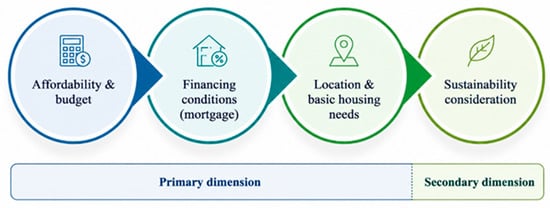
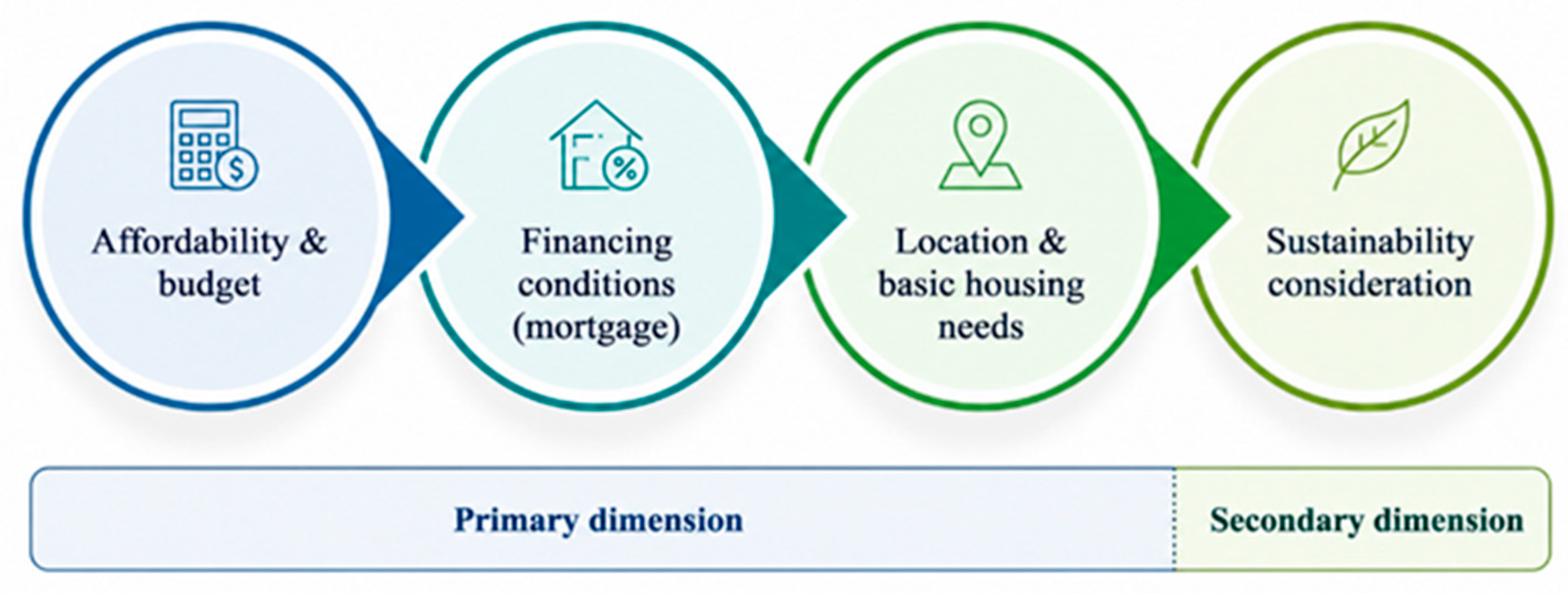
Policy support alone does not explain the limited impact of sustainable housing policies at the household level. Instead, policy outcomes are filtered through behavioral mechanisms that shape how households evaluate affordability, risk, and financing decisions. Table 1 summarizes these recurring mechanisms and their implications for sustainability-oriented housing policies. As illustrated in Figure 2, these decision processes influence the position of sustainability within household decision-making, often placing environmental considerations behind more immediate financial and practical concerns.
Table 1.
Behavioral mechanisms shaping household level barriers in sustainable housing decisions.
Figure 2.
Position of sustainability in housing decisions.
Figure 2 provides a conceptual representation of the relative position of sustainability considerations within household housing decisions based on the patterns identified in the reviewed literature. It should not be interpreted as a fixed or empirically estimated sequence of decision stages.
4.2. Sustainability as a Secondary Decision Dimension
A recurring insight across housing and real estate research is that sustainability considerations rarely function as primary decision criteria for households. Even though energy efficiency and environmental performance are more visible in housing policies, households tend to consider them only after dealing with immediate concerns such as affordability. As a result, sustainability often operates as a secondary or supporting dimension rather than a decisive driver of housing and mortgage choices [29].
Across different institutional and market contexts, studies consistently show that households prioritize attributes such as price, location, size, and monthly affordability over sustainability-related features. Even when households express positive attitudes toward energy efficiency or environmental performance, these preferences tend to be overridden by short-term financial constraints at the point of decision [21,29]. This gap between stated preferences and revealed behavior highlights the limited weight sustainability carries relative to core housing attributes.
Building on the reviewed evidence, we observe that sustainability is frequently framed as an additional benefit rather than as an essential component of housing quality. Energy-efficient features and long-term energy savings can create value for households, but their influence on actual decisions may remain constrained by competing financial considerations [34,47]. When financial trade-offs arise, sustainability features are among the first to be discounted or postponed.
This secondary role of sustainability is particularly evident in mortgage-related decisions. Because housing purchases are typically financed through long-term debt, households tend to focus on eligibility criteria, interest rates, and monthly repayments when selecting housing options. Sustainability attributes that do not immediately affect these parameters struggle to compete with features that directly influence borrowing capacity and short-term affordability [10,25]. As a result, even housing options with superior lifetime performance may be rejected if their benefits are not immediately reflected in mortgage conditions.
Research on energy retrofits and green housing adoption reinforces this pattern. Households are more likely to invest in energy efficient measures when these interventions lower upfront costs or are clearly linked to direct financial support. By contrast, measures that deliver benefits gradually through lower operating expenses are far less attractive at the point of decision [3,32]. This suggests that sustainability considerations gain traction primarily when they align closely with short-term financial logic.
While environmental performance and energy efficiency have become more visible in housing markets, empirical evidence indicated that sustainability features may receive lower priority than more immediate housing attributes, particularly price and affordability [48]. To summarize these relationships, Figure 2 illustrates how affordability and financing conditions form the primary layers of household decision-making, followed by location and basic housing quality. Sustainability considerations typically enter the decision process only at later stages, once these core constraints have been satisfied.
Importantly, the secondary position of sustainability does not imply a lack of concern about environmental issues. Rather, it reflects how households manage complex decisions under financial and informational constraints [29]. Sustainability has to compete with other considerations in household decisions, and it is often pushed into the background by concerns that feel more immediate or certain. Without explicit integration into affordability structures or mortgage evaluation criteria, sustainability remains secondary to household decision-making.
Taken together, our literature review indicates that sustainability-oriented housing policies operate in a decision environment where environmental considerations are systematically outweighed by short-term financial concerns. This helps explain why many sustainable housing initiatives have limited uptake despite favorable attitudes toward sustainability. For policies to influence household behavior more effectively, sustainability must be positioned not as an additional feature, but as a dimension that directly interacts with affordability and financing decisions.
4.3. Mortgage Finance as a Transmission Channel
Mortgage finance plays a central role in shaping how households respond to sustainability-oriented housing policies. Because most housing decisions are mediated through long-term borrowing, mortgage conditions act as a transmission channel through which behavioral biases and policy design interact [18]. As a result, sustainability objectives are often filtered not only through household preferences, but also through the structure and perceived constraints of housing finance.
Housing purchases typically involve complex mortgage contracts that require households to commit to long-term debt under uncertainty. In this context, borrowing capacity, interest rates, down-payment requirements, and monthly repayments become dominant reference points in decision-making [10,25]. Even when sustainability features promise long-term savings or lower operating costs, these benefits tend to be overshadowed by concerns related to immediate affordability and perceived financial risk. We argue that mortgage finance therefore amplifies the short-term focus already identified in household housing decisions.
The decision flow illustrated in Figure 2 helps clarify this mechanism. Financing conditions appear at the earliest stages of household decision-making, effectively functioning as binding constraints. If a housing option fails to meet mortgage eligibility criteria or increases perceived repayment risk, it is eliminated from consideration before sustainability attributes become relevant. In this way, mortgage finance limits the decision space within which sustainability can operate, regardless of policy intent.
Behavioral mechanisms further reinforce this dynamic. Present bias leads households to prioritize near-term affordability over future benefits, while mental accounting encourages borrowers to separate mortgage repayments from expected energy savings. Even when sustainability investments improve lifetime housing costs, households may discount these gains if they are not directly reflected in mortgage terms [3,14,17,18]. As a result, green or energy-efficient housing options remain disadvantaged unless financing structures explicitly account for their long-term performance.
The reviewed evidence indicates that financial conditions play an important role in household responses to sustainability-oriented housing options. Energy-efficiency mortgages can improve the accessibility and affordability of energy-efficient housing, while cost-related factors and financial incentives significantly influence household acceptance of sustainable housing options [18,21]. Taken together, these findings suggest that sustainability-related benefits are more likely to influence housing decisions when they are reflected in immediate financial conditions.
Mortgage finance also shapes risk perception. Long-term debt increases households’ sensitivity to uncertainty, particularly in environments characterized by volatile interest rates or changing policy frameworks [43]. In such settings, borrowers may avoid options perceived as financially complex or unfamiliar, even if these options are environmentally superior. This may help explain why sustainability-oriented housing policies usually lead to small adjustments rather than widespread changes in housing behavior [3].
Overall, mortgage finance influences whether housing policies actually affect household decisions. By prioritizing short-term affordability and risk reduction, mortgage structures reinforce behavioral biases that constrain sustainability uptake. If sustainability is not reflected in financing criteria, housing policies are unlikely to play a meaningful role in household decisions, no matter how ambitious their environmental goals are. This interaction between mortgage finance and household behavior represents a key mechanism that may limit the household-level effectiveness of sustainable housing policies.
5. Discussion
The reviewed evidence suggests that the household-level effectiveness of sustainable housing policies can be constrained by factors that go beyond policy ambition or technical design. Across the reviewed literature, we identify a recurring pattern in which policy objectives do not align well with how households actually make housing and financial decisions. Household choices are shaped by short-term affordability, perceived risk, and financing constraints, which often dominate longer-term environmental and financial considerations. As a result, the behavioral effects of sustainability-oriented policies may be weakened when they interact with real-world household financial constraints and decision processes.
We interpret this gap as arising because households usually rely on short-term considerations when making housing and mortgage decisions. Housing and mortgage choices are shaped primarily by immediate affordability, perceived eligibility, and short-term financial feasibility. Behavioral mechanisms such as present bias, mental accounting and framing effects can direct household attention toward upfront costs and monthly payments, while long-term financial and environmental benefits receive less weight [14,22,39]. These mechanisms do not represent anomalies or irrational behavior, but rather predictable responses to complex, high-stakes decisions under uncertainty.
Our synthesis further indicates that sustainability typically enters the decision process only after core financial and practical constraints have been addressed. The reviewed evidence suggests that affordability, financing and location-related considerations often receive greater weight than sustainability attributes in household housing decisions. Sustainability may therefore operate as a secondary consideration when these more immediate constraints are present. This positioning makes sustainability a conditional and frequently secondary dimension of decision-making, even among households that express positive attitudes toward environmental goals.
Mortgage finance plays a crucial role in reinforcing this hierarchy. Because most housing decisions involve long-term debt, financing conditions largely determine which options households realistically consider. Mortgage eligibility criteria, repayment risks, and borrowing limits often eliminate housing options from consideration before sustainability features become relevant [43]. In this way, mortgage finance does not simply accompany housing decisions; it actively shapes which sustainability attributes can influence household choices.
Concrete empirical evidence from eight European countries illustrates how behavioral and financial mechanisms can jointly affect sustainable housing decisions. Schleich et al. [39] found that time preferences, risk aversion, loss aversion and present bias were associated with the adoption of energy-efficient technologies, including retrofit measures. Building on this evidence, Schleich et al. [9] showed that debt aversion also reduced homeowners’ likelihood of undertaking energy-efficiency retrofits. It further limited the effectiveness of low-interest loan programs among households with restricted access to capital [9]. Together, these findings show that favorable financing alone may not be sufficient to encourage sustainable investment. Household responses also depend on how individuals perceive debt, risk, immediate cost and future benefits.
A second case from the Irish housing market illustrates the importance of framing. Carroll et al. [22] conducted a nationwide controlled field experiment using property advertisements. They presented energy efficiency in terms of property-specific energy costs rather than only energy units. This framing increased the energy-efficiency premium and shortened the time needed to sell more energy-efficient properties [22]. The findings show that the way sustainability-related information is presented can influence actual housing decisions.
Taken together, we propose that these mechanisms explain why sustainability-oriented housing policies often generate only limited rather than broad behavioral change. Policies that rely on subsidies, labelling, or informational interventions assume that households will integrate long-term benefits once incentives are offered. However, when sustainability is not directly reflected in affordability structures or mortgage conditions, it remains peripheral to the decision calculations of most households.
In response to the research question, the reviewed evidence indicates that behavioral mechanisms influence the effectiveness of sustainability-oriented housing policies. They shape how households evaluate affordability, risk, borrowing and long-term benefits. These mechanisms are closely intertwined with financial constraints. This finding is consistent with Proposition 1, which links household responsiveness to the joint influence of behavioral and financial constraints.
The reviewed evidence suggests that these mechanisms can operate simultaneously and reinforce each other. We therefore propose that sustainability-oriented housing policies should explicitly integrate behavioral mechanisms with housing finance considerations. Addressing both dimensions may support more durable changes in housing choices, borrowing behavior, and long-term financial resilience.
6. Conclusions
This paper examined why sustainability-oriented housing policies often fail to produce lasting effects at the household level. The analysis suggests that their limited impact is closely linked to how households approach housing and financial decisions in practice. When choosing homes and mortgage products, households tend to focus on short-term affordability and perceived financial risk, which often outweigh longer-term environmental and financial considerations.
By synthesizing insights from behavioral economics, housing finance, and sustainability research, we show how mental accounting, present bias, framing effects, and simplified risk assessment shape household responses to housing policies. Sustainability considerations typically enter decision-making only at later stages and often remain secondary once core constraints related to affordability and financing have been addressed. As a result, sustainability-oriented incentives rarely alter underlying decision logic, even when participation rates appear high.
The analysis also emphasized the central role of mortgage finance. Because housing decisions are largely channeled through long-term borrowing, mortgage conditions determine which options households realistically consider. Financing structures therefore act as a key channel through which behavioral biases are reinforced, limiting the effectiveness of sustainability-oriented housing policies. When sustainability attributes are not reflected in financing conditions, they tend to remain peripheral to household choices.
Based on these findings, we argue that improving the effectiveness of sustainable housing policies requires more than expanding subsidies or refining technical standards. Policies must account for how households actually evaluate affordability, risk, and long-term commitments within a mortgage-driven decision environment. Without integrating behavioral insights into housing finance and policy design, sustainability objectives are unlikely to translate into durable changes in household behavior.
This paper contributes to the literature by integrating behavioral mechanisms and financial constraints into a common framework for understanding household responses to sustainability-oriented housing policies. The study highlights how the interaction of behavioral and financial factors shapes household responsiveness to policy interventions. It further highlights the role of mortgage finance as a transmission channel through which financial constraints and behavioral mechanisms influence housing decisions. These insights provide a basis for subsequent empirical investigation and contribute to ongoing debates on the design of sustainable housing policies. These conclusions should be interpreted within the study’s primary focus on the environmental and energy-efficiency dimensions of sustainable housing.
7. Further Research Directions
This paper adopts a conceptual perspective to explain why sustainability-oriented housing policies often underperform at the household level. The preceding analysis identifies three main gaps in the existing literature. First, evidence on longer-term household outcomes remains limited, as existing studies tend to focus on policy uptake, housing choice, or stated preferences rather than subsequent financial and behavioral outcomes. This partly reflects the limited availability of longitudinal household and mortgage data. Second, behavioral mechanisms and mortgage characteristics are often examined separately, leaving their interaction insufficiently understood. Third, evidence remains fragmented across different housing-market and institutional contexts, limiting the generalizability of existing findings.
Future research should therefore examine how behavioral mechanisms interact with specific financing conditions and whether these interactions influence the longer-term effectiveness of sustainability-oriented housing policies. In particular, research could investigate whether mortgage characteristics strengthen or reduce the effects of present bias, mental accounting, and simplified risk perception, and whether policy participation produces lasting changes beyond initial uptake. Longitudinal household and mortgage data could provide evidence on repayment behavior, financial vulnerability, and the persistence of sustainability-related choices, while comparative and mixed-method studies could clarify how these relationships vary across different housing-market and policy contexts.
Author Contributions
Conceptualization, V.G., E.P.-M. and B.E.B.; methodology, V.G., E.P.-M. and B.E.B.; validation, E.P.-M. and B.E.B.; formal analysis, V.G.; investigation, V.G., E.P.-M. and B.E.B.; resources, V.G.; data curation, V.G.; writing—original draft preparation, V.G.; writing—review and editing, V.G., E.P.-M. and B.E.B.; visualization, V.G.; supervision, E.P.-M. and B.E.B.; project administration, V.G. All authors have read and agreed to the published version of the manuscript.
Funding
This research received no external funding.
Institutional Review Board Statement
Not applicable.
Informed Consent Statement
Not applicable.
Data Availability Statement
The original contributions presented in this study are included in the article. Further inquiries can be directed to the corresponding author.
Acknowledgments
During the preparation of this study, the authors used DeepL Translator for translation purposes (https://www.deepl.com). The authors have reviewed and edited the output and take full responsibility for the content of this publication.
Conflicts of Interest
The authors declare no conflicts of interest.
References
- Choguill, C.L. The search for policies to support sustainable housing. Habitat Int. 2007, 31, 143–149. [Google Scholar] [CrossRef] [Scilit]
- Penasco, C. From policy to practice: The role of national policy instruments and social barriers in UK energy efficiency adoption in households. Energy Policy 2024, 194, 114308. [Google Scholar] [CrossRef] [Scilit]
- Belaïd, F. Decarbonizing the residential sector: How prominent is household energy-saving behavior in decision making? Energy J. 2024, 45, 125–148. [Google Scholar] [CrossRef] [Scilit]
- Adamec, J.; Janoušková, S.; Hák, T. How to measure sustainable housing: A proposal for an indicator-based assessment tool. Sustainability 2021, 13, 1152. [Google Scholar] [CrossRef] [Scilit]
- Piparsania, K.; Kalita, P.C. Development of DASH: Design assessment framework for sustainable housing. Sustainability 2022, 14, 15990. [Google Scholar] [CrossRef] [Scilit]
- Glaeser, E.; Gyourko, J. The economic implications of housing supply. J. Econ. Perspect. 2018, 32, 3–30. [Google Scholar] [CrossRef] [Scilit]
- Cho, S.W.; Jung, J.Y. Behavioral Finance Insights into Land Management: Decision Aggregation and Real Estate Market Dynamics in China. Land 2024, 13, 1478. [Google Scholar] [CrossRef] [Scilit]
- Li, Q.; Qian, T.; Long, R.; Sun, C. How Symbiosis Influences the Connected Response of Group Purchasing Behavior in Green Housing? J. Clean. Prod. 2025, 511, 145608. [Google Scholar] [CrossRef] [Scilit]
- Schleich, J.; Faure, C.; Meissner, T. Adoption of retrofit measures among homeowners in EU countries: The effects of access to capital and debt aversion. Energy Policy 2021, 149, 112025. [Google Scholar] [CrossRef] [Scilit]
- Lu, W.; Zhu, K. Housing Market and Household Consumption in Urban China: A Debt Perspective. Land 2024, 13, 521. [Google Scholar] [CrossRef] [Scilit]
- Hegedüs, J.; Lux, M.; Teller, N. (Eds.) Social Housing in Transition Countries; Routledge: Abingdon, UK, 2013; Volume 10. [Google Scholar]
- Kemeny, J. Comparative housing and welfare: Theorising the relationship. J. Hous. Built Environ. 2001, 16, 53–70. [Google Scholar] [CrossRef] [Scilit]
- Kahneman, D.; Tversky, A. Prospect theory: An analysis of decision under risk. Econometrica 1979, 47, 263–291. [Google Scholar] [CrossRef] [Scilit]
- Thaler, R.H. Mental accounting matters. J. Behav. Decis. Mak. 1999, 12, 183–206. [Google Scholar]
- Thaler, R.H. Misbehaving: The Making of Behavioral Economics; WW Norton & Company: New York, NY, USA, 2015. [Google Scholar]
- Seiler, M.J. Behavioral real estate. In Private Real Estate Markets and Investments; Oxford University Press: Oxford, UK, 2014; p. 49. [Google Scholar] [CrossRef] [Scilit]
- Benartzi, S.; Thaler, R.H. Myopic loss aversion and the equity premium puzzle. Q. J. Econ. 1995, 110, 73–92. [Google Scholar] [CrossRef] [Scilit]
- Dell’Anna, F.; Marmolejo-Duarte, C.; Bravi, M.; Bottero, M. A choice experiment for testing the energy-efficiency mortgage as a tool for promoting sustainable finance. Energy Effic. 2022, 15, 27. [Google Scholar] [CrossRef] [Scilit]
- Hilber, C.A.; Turner, T.M. The mortgage interest deduction and its impact on homeownership decisions. Rev. Econ. Stat. 2014, 96, 618–637. [Google Scholar] [CrossRef] [Scilit]
- Andrews, D.; Sánchez, A.C.; Johansson, Å. Housing Markets and Structural Policies in OECD Countries; OECD Publishing: Paris, France, 2011. [Google Scholar] [CrossRef]
- Choi, J.; Kee, D.; Lee, J.; Kim, J.J. Understanding heterogeneous consumer preferences for residential zero-energy buildings (ZEBs) in South Korea: A latent class approach. Sustain. Cities Soc. 2023, 97, 104747. [Google Scholar] [CrossRef] [Scilit]
- Carroll, J.; Denny, E.; Lyons, R.C.; Petrov, I. Better energy cost information changes household property investment decisions: Evidence from a nationwide experiment. Energy Econ. 2024, 139, 107909. [Google Scholar] [CrossRef] [Scilit]
- Canepa, A.; Chersoni, G.; Fontana, M. The role of environmental and financial motivations in the adoption of energy-saving technologies: Evidence from European Union data. Q. Rev. Econ. Financ. 2023, 91, 1–14. [Google Scholar] [CrossRef] [Scilit]
- Desvallées, L.; Haine, J. Double energy vulnerabilities in France: When residential choices lock households into patterns of energy dependence. Energy Res. Soc. Sci. 2025, 123, 104037. [Google Scholar] [CrossRef] [Scilit]
- Ambrose, B.W.; Conklin, J.; Yoshida, J. Credit rationing, income exaggeration, and adverse selection in the mortgage market. J. Financ. 2016, 71, 2637–2686. [Google Scholar] [CrossRef] [Scilit]
- Shiller, R.J. Understanding Recent Trends in House Prices and Home Ownership; National Bureau of Economic Research: Cambridge, MA, USA, 2007. [Google Scholar] [CrossRef] [Scilit]
- Genesove, D.; Mayer, C. Loss aversion and seller behavior: Evidence from the housing market. Q. J. Econ. 2001, 116, 1233–1260. [Google Scholar] [CrossRef] [Scilit]
- Case, K.E.; Shiller, R.J. Is there a bubble in the housing market? Brook. Pap. Econ. Act. 2003, 2003, 299–362. [Google Scholar] [CrossRef] [Scilit]
- Santos, E.; Tavares, F. The profile of Portuguese people when choosing an apartment. Real Estate Manag. Valuat. 2021, 29, 38–51. [Google Scholar] [CrossRef] [Scilit]
- Zhou, J.; Anderson, R.I. An empirical investigation of herding behavior in the US REIT market. J. Real Estate Financ. Econ. 2013, 47, 83–108. [Google Scholar] [CrossRef] [Scilit]
- Gillingham, K.; Palmer, K. Bridging the energy efficiency gap: Policy insights from economic theory and empirical evidence. Rev. Environ. Econ. Policy 2014, 8, 18–38. [Google Scholar] [CrossRef] [Scilit]
- Akhatova, A.; Derkenbaeva, E.; van Leeuwen, E.; Kranzl, L.; Vega, S.H.; Hofstede, G.J. Who invests in energy retrofits? Mining Dutch homeowners’ data. Energy Policy 2024, 189, 114132. [Google Scholar] [CrossRef] [Scilit]
- He, C.; Liu, X.; Bi, J.; Wang, X.; Li, J. The influence of information on residents’ green housing purchasing behavior: Different information contents and providers. J. Civ. Eng. Manag. 2023, 29, 530–541. [Google Scholar] [CrossRef] [Scilit]
- Dell’Anna, F.; Bottero, M. Green premium in buildings: Evidence from the real estate market of Singapore. J. Clean. Prod. 2021, 286, 125327. [Google Scholar] [CrossRef] [Scilit]
- McGinley, O.; Moran, P.; Haines, V.; Goggins, J. Householders’ energy efficiency retrofit decisions—A review of the evidence. J. Build. Eng. 2025, 114, 113838. [Google Scholar] [CrossRef] [Scilit]
- Seiler, M.J.; Seiler, V.L.; Lane, M.A. Mental accounting and false reference points in real estate investment decision making. J. Behav. Financ. 2012, 13, 17–26. [Google Scholar] [CrossRef] [Scilit]
- Chetty, R.; Looney, A.; Kroft, K. Salience and taxation: Theory and evidence. Am. Econ. Rev. 2009, 99, 1145–1177. [Google Scholar] [CrossRef] [Scilit]
- Hayunga, D.K. Sales concessions in the US housing market. J. Real Estate Financ. Econ. 2018, 56, 33–75. [Google Scholar] [CrossRef] [Scilit]
- Schleich, J.; Gassmann, X.; Meissner, T.; Faure, C. A large-scale test of the effects of time discounting, risk aversion, loss aversion, and present bias on household adoption of energy-efficient technologies. Energy Econ. 2019, 80, 377–393. [Google Scholar] [CrossRef] [Scilit]
- Newell, R.G.; Siikamäki, J. Nudging energy efficiency behavior: The role of information labels. J. Assoc. Environ. Resour. Econ. 2014, 1, 555–598. [Google Scholar] [CrossRef] [Scilit]
- Brounen, D.; Kok, N. On the economics of energy labels in the housing market. J. Environ. Econ. Manag. 2011, 62, 166–179. [Google Scholar] [CrossRef] [Scilit]
- Griskevicius, V.; Tybur, J.M.; Van den Bergh, B. Going green to be seen: Status, reputation, and conspicuous conservation. J. Personal. Soc. Psychol. 2010, 98, 392. [Google Scholar] [CrossRef] [Scilit]
- Campbell, J.Y.; Cocco, J.F. Household risk management and optimal mortgage choice. Q. J. Econ. 2003, 118, 1449–1494. [Google Scholar] [CrossRef] [Scilit]
- Perry, V.G.; Lee, J.D. Shopping for a home vs. a loan: The role of cognitive resource depletion. Int. J. Consum. Stud. 2012, 36, 580–587. [Google Scholar] [CrossRef] [Scilit]
- Woodward, S.E.; Hall, R.E. Diagnosing consumer confusion and sub-optimal shopping effort: Theory and mortgage-market evidence. Am. Econ. Rev. 2012, 102, 3249–3276. [Google Scholar] [CrossRef] [Scilit]
- Sunstein, C.R. Nudging: A very short guide. J. Consum. Policy 2014, 37, 583–588. [Google Scholar] [CrossRef] [Scilit]
- Frederiks, E.R.; Stenner, K.; Hobman, E.V. Household energy use: Applying behavioural economics to understand consumer decision-making and behaviour. Renew. Sustain. Energy Rev. 2015, 41, 1385–1394. [Google Scholar] [CrossRef] [Scilit]
- Evangelou, M.; Katafygiotou, M. Sustainability of the housing market: Post-COVID-19 effects on housing preferences in Cyprus. Sustainability 2024, 16, 5597. [Google Scholar] [CrossRef] [Scilit]

Disclaimer/Publisher’s Note: The statements, opinions and data contained in all publications are solely those of the individual author(s) and contributor(s) and not of MDPI and/or the editor(s). MDPI and/or the editor(s) disclaim responsibility for any injury to people or property resulting from any ideas, methods, instructions or products referred to in the content. |
© 2026 by the authors. Licensee MDPI, Basel, Switzerland. This article is an open access article distributed under the terms and conditions of the Creative Commons Attribution (CC BY) license.