


Abstract
With the advancement of healthy city development and community renewal practices, the influence of perceived community environmental quality on residents’ psychological well-being has attracted increasing attention. Previous research has shown that the built environment is closely related to residents’ well-being; however, most studies have focused on objective spatial elements or facility provision and have paid insufficient attention to the mechanisms through which subjective environmental perceptions operate in the process by which the environment affects psychological well-being. From the perspective of Homo Urbanicus theory, this study takes 36 communities in Yangpu District, Shanghai, as cases and uses data from 882 valid questionnaires. Structural equation modeling is employed to examine the relationships among perceived community environmental quality, perceived environmental restorativeness, and residents’ psychological well-being, and to further explore age-related patterns among young-old, middle-old, and oldest-old groups. The results show that perceived community environmental quality has a significant positive effect on residents’ psychological well-being and produces a significant indirect effect through perceived environmental restorativeness. Exploratory age-stratified analyses further suggested different pathway patterns among the young-old, middle-old, and oldest-old groups. On this basis, the study further proposes a four-quadrant model of spatial contact opportunities and a five-category accessibility classification and accordingly develops community environment optimization strategies for older adults of different ages. The findings provide a theoretical basis and practical reference for healthy-community development and age-friendly community renewal.
1. Introduction
With rapid urbanization, the community has become the most stable and immediate spatial field for residents’ daily lives, and the influence of perceived community environmental quality on residents’ psychological well-being has thus attracted growing attention from urban studies, public health, and environmental psychology. Existing research has demonstrated that, after controlling for individual socioeconomic attributes, neighborhood or community environment remains relatively consistently associated with residents’ psychological well-being. This association involves not only the physical spatial characteristics of the community but also the social interaction atmosphere and residents’ subjective cognition of the environment [1,2]. Against the backdrop of high-density urbanization in China, the functions of housing, socializing, leisure, and emotional regulation carried by community environments have become more prominent, making it a crucial issue in healthy city and community governance research to understand residents’ psychological well-being at the community scale [3].
Early research primarily focused on housing conditions, neighborhood disorder, sense of safety, and social deprivation, whereas recent studies have gradually expanded to include more comprehensive environmental dimensions such as community green space, blue space, street view greenness, park accessibility, land-use mix, street connectivity, and social cohesion [1,4]. Relevant reviews generally agree that community environments can influence well-being outcomes through pathways such as reducing harmful exposures, promoting psychological restoration, and enhancing social and behavioral resources [4,5]. Chinese urban studies have also provided substantial empirical evidence—for instance, studies in Guangzhou [6,7], Shenzhen [8], Beijing [3], and Hong Kong [9] indicate that community greening, streetscape environments, perceived built environment, sense of community belonging, and social cohesion are closely related to residents’ psychological well-being. This suggests that the psychological well-being effects of community environments depend not only on objective spatial conditions but also on how the environment enters residents’ daily perceptions and lived experiences.
In recent years, sustainable-city theories have increasingly emphasized residents’ everyday needs and the human scale. Among them, the “10-Minute City,” as a specific form of the “X-minute city” concept, advocates compact layouts, mixed functions, and the appropriate allocation of public services so that residents can reach basic public services, green spaces, leisure spaces, and exercise facilities within a short walking or cycling time [10,11]. The “Walkable City,” meanwhile, emphasizes the continuity, safety, comfort, and environmental attractiveness of pedestrian networks [12,13]. By shortening everyday travel distances, promoting physical activity, reducing automobile dependence and associated environmental exposures, and increasing opportunities for residents to encounter green spaces and restorative spaces, these concepts can improve physical and mental health, life satisfaction, and overall well-being. Community environmental quality is therefore reflected not only in the quantity of spaces and facilities, but also in whether residents can reach, use, and experience them safely, conveniently, and comfortably.
Building on the above concepts of sustainable and healthy cities, restorative mechanisms are increasingly becoming an important perspective for explaining how perceived community environmental quality affects psychological well-being. Attention Restoration Theory (ART) posits that environments with characteristics of being away, fascination, coherence, and compatibility help restore cognitive resources [14,15]; Stress Restoration Theory (SRT) suggests that low-threat and attractive environments can evoke positive emotions and alleviate stress [16]. Building on this, research has gradually shifted from objective natural exposure to subjective restorative experiences, emphasizing residents’ perceptions and evaluations of the environment’s restorative potential [17,18,19]. In recent years, high-density Asian urban communities—characterized by dense population, compact space, mixed functions, and strong daily environmental exposure—have become representative settings for examining the relationship between perceived community environments and psychological well-being. Shanghai, as a typical high-density Asian city, has central urban communities that are particularly prominent in terms of population density, spatial complexity, vitality, and renewal needs, thus providing reliable empirical support for this case study. Existing studies have shown that factors such as neighborhood green space quality, small open spaces, residential green areas, and urban soundscapes can influence psychological well-being through pathways of perceived environmental restorativeness, tranquility, social cohesion, and physical activity; importantly, environmental quality and subjective perception often explain differences in residents’ psychological well-being better than mere distance or quantity indicators [20,21,22,23,24,25]. Therefore, this study takes perceived environmental restorativeness as the key mediating mechanism linking perceived community environmental quality and psychological well-being, explaining how community spatial conditions translate into psychological well-being gains through residents’ daily perceptions and restorative experiences.
It is worth noting that existing discussions of restorativeness focus largely on natural environments, yet community life does not occur only in natural spaces such as parks and green spaces. Everyday streets, open spaces, and built environments with local significance may likewise produce restorative effects through a sense of safety, aesthetic experience, place attachment, and social interaction [26]. This understanding means that the effect of perceived community environmental quality on residents’ psychological well-being should not be narrowly interpreted as an effect of green space exposure, but should be examined within the more complete context of community life. In Chinese urban communities in particular, natural and built environments are usually interwoven and jointly shape residents’ environmental experiences and psychological states [27]. Therefore, examining the mediating role of perceived environmental restorativeness from the perspective of perceived community environmental quality can more effectively reveal the specific process through which the physical community environment affects residents’ psychological well-being.
Although relevant research has made considerable progress, further development is still needed. First, existing studies have often focused on single environmental elements, while integrated examinations of natural and built environments at the community scale remain insufficient [28]. Different physical environmental elements are interrelated and jointly influence residents’ judgments of overall community environmental quality. Second, although research on restorativeness has grown rapidly, studies that test restorative perception as a core mediating variable at the community scale remain insufficient, and the strength and boundary conditions of its effects require further discussion in specific contexts [29]. Third, most existing studies draw on Western environmental psychology theories to explain environment-health relationships, while theoretical accounts of lived experience and subjectivity in Chinese urban communities remain limited. It is therefore necessary to introduce a theoretical perspective with greater local explanatory power and to reintegrate the mechanisms through which perceived community environmental quality affects psychological well-being.
Homo Urbanicus theory proposed by Hok-lin Leung offers important insights for addressing this research gap. The theory emphasizes that urban space is not an abstract physical container detached from people, but a lived world closely connected to human needs, perceptions, value judgments, and everyday practices [30]. It takes people’s actual needs and subjective experiences as its starting point, regards people and the human settlement as an interacting whole, and argues that the value of the urban environment depends not only on objective spatial conditions but also on whether the spatial contact opportunities provided by the environment are well matched to residents’ needs, thereby improving residents’ settlement experience and life satisfaction. In this sense, perceived environmental restorativeness is an important mediating link between perceived community environmental quality and subjective psychological well-being outcomes, reflecting the process through which the perceived community environment is transformed from external spatial attributes into internal psychological well-being.
On this basis, the study adopts Homo Urbanicus theory as its overarching theoretical framework and integrates research on restorative mechanisms from Attention Restoration Theory to construct an analytical framework linking perceived community environmental quality, perceived environmental restorativeness, and residents’ psychological well-being. Unlike previous studies that focused mainly on objective built-environment characteristics, this study begins with residents’ perceptions of the quality of the community’s physical environment and selects four frequently encountered environmental elements—green landscapes, environmental sanitation, walking paths, and physical exercise facilities—to examine their relationships with perceived environmental restorativeness and psychological well-being. It also focuses on the role of perceived environmental restorativeness in the process by which community environments affect psychological well-being and, in light of the subjective perceptual characteristics emphasized by Homo Urbanicus theory, analyzes differences in these relationships among older adults at different ages.
To achieve these objectives, structural equation modeling is used to empirically analyze the relationships among perceived community environmental quality, perceived environmental restorativeness, and residents’ psychological well-being, to test the mediating role of perceived environmental restorativeness, and to further explore age-related patterns in these relationships among older adults. The study aims to deepen understanding of the process through which urban community environments in China affect residents’ psychological well-being and to provide empirical references for health-oriented optimization of community environments and age-friendly community renewal.
2. Model Hypotheses
2.1. Model Construction Under Homo Urbanicus Theory
As an emerging metatheory in urban and rural planning, Homo Urbanicus theory aims to describe, explain, and evaluate urban phenomena [31]. It incorporates the holistic and systemic perspective of the science of human settlements for understanding human habitation systems and draws on principled descriptions of basic human attributes and spatial-choice behavior [32]. In recent years, Homo Urbanicus theory has generated a relatively systematic body of research in fields including community life-circle planning, the allocation of basic public-service facilities, and territorial spatial planning, and has gained broad academic recognition.
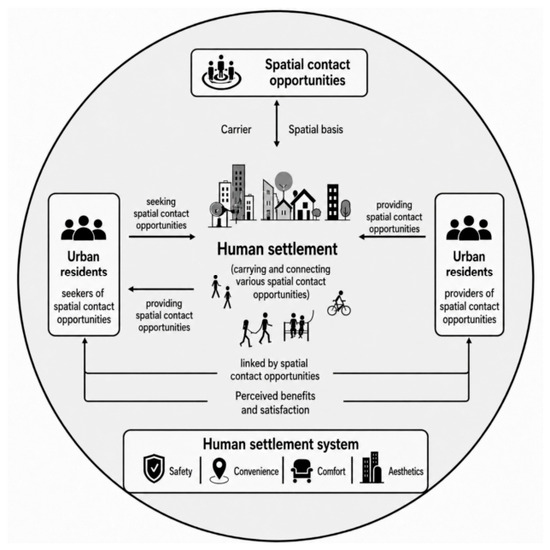
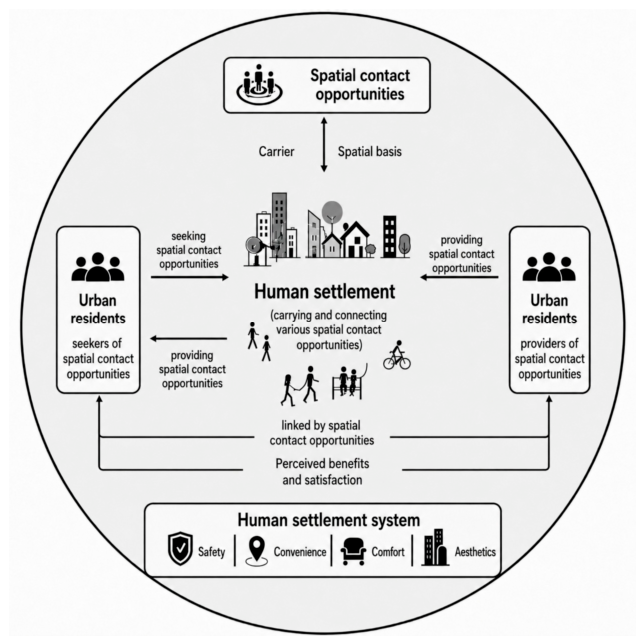
According to Figure 1, the various elements of the human settlement system can be grouped into three interrelated components: Homo Urbanicus, spatial contact opportunities, and the human settlement. The human settlement serves as the carrier system for spatial contact opportunities, providing residents with roads, greenery, public-service facilities, open spaces, and other forms of spatial contact opportunities. Homo Urbanicus, meanwhile, is both a seeker and a provider of spatial contact opportunities and selects and creates them based on physical ability, psychological needs, value judgments, and everyday experience. Homo Urbanicus has basic attributes such as gender, age, and life stage, among which age is an important dimension differentiating spatial needs. Different age groups vary in physical functioning, mobility, cognitive capacity, and lifestyle-related needs, and therefore also differ in the spatial contact opportunities they can obtain, use, and create. Together, “Homo Urbanicus-spatial contact opportunities-human settlement” constitute a complete human settlement system. The core goal of planning is therefore to respond to the differentiated needs of different age groups, enhance residents’ sense of acquisition and satisfaction with spatial contact opportunities, and create a safe, convenient, comfortable, aesthetically pleasing, and supply-demand-coordinated human settlement environment.
Figure 1.
Model construction under Homo Urbanicus theory.
2.2. Research Framework
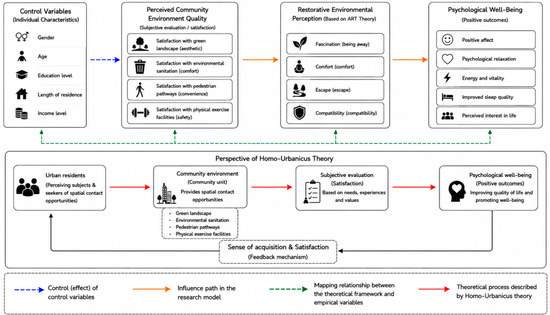
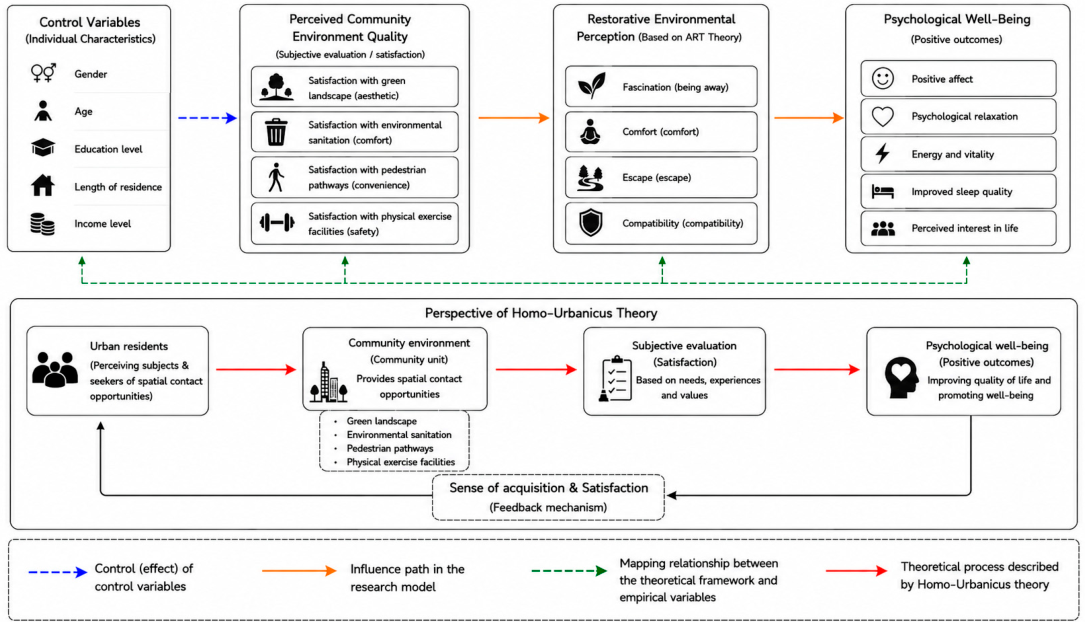
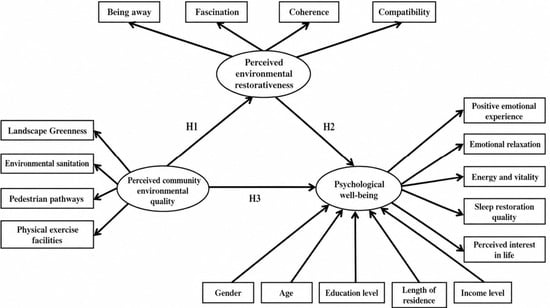
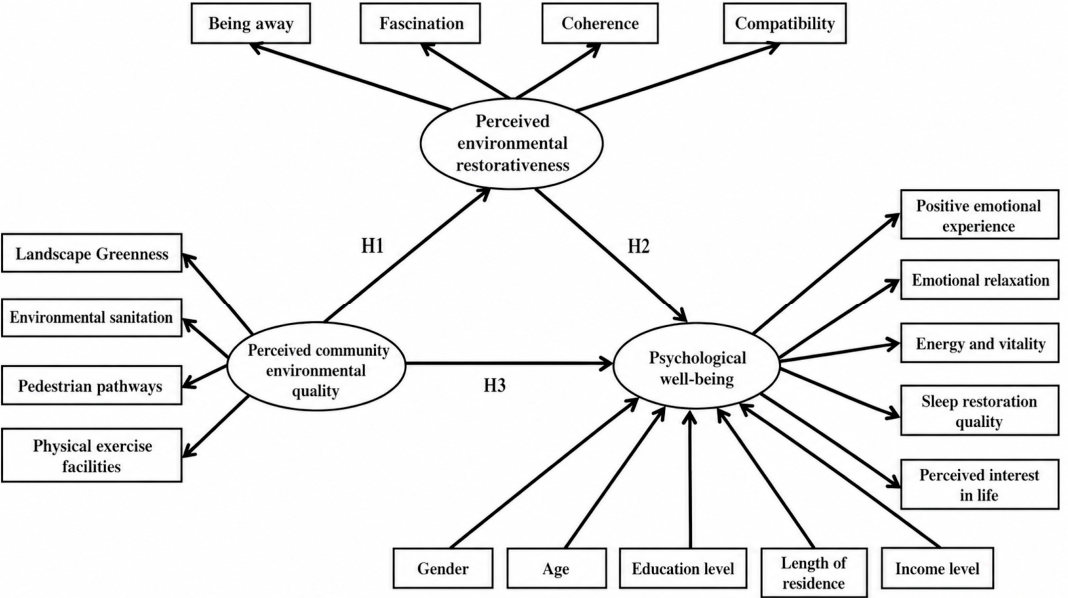
This study adopts an “environment—perceived restorativeness—psychological well-being” framework as the overall theoretical framework for explaining how perceived community environmental quality affects residents’ psychological well-being, and incorporates the four ART dimensions of being away, fascination, coherence, and compatibility to construct a relational model among perceived community environmental quality, perceived environmental restorativeness, and residents’ psychological well-being (Figure 2). From the perspective of Homo Urbanicus theory, community residents are both perceiving subjects of the community environment and recipients of spatial contact opportunities. Individual characteristics such as age, gender, education level, length of residence, and income level affect mobility, environmental sensitivity, and spatial judgment and further influence residents’ cognition and evaluation of the community environment. Therefore, these demographic characteristics are included in the analytical model as control variables.
Figure 2.
Schematic research framework for the effects of perceived community environment on residents’ mental health.
Community units are important carrier systems for residents’ everyday life and spatial activities, providing spatial contact opportunities such as green landscapes, environmental sanitation, walking paths, and physical exercise facilities. As residents encounter and experience the community environment, they form comprehensive evaluations of it in terms of aesthetics, comfort, convenience, and safety based on their own needs, life experiences, and value judgments. This study measures perceived community environmental quality using residents’ satisfaction with green landscapes, environmental sanitation, walking paths, and physical exercise facilities, focusing on how this subjective environmental evaluation further affects perceived environmental restorativeness and psychological well-being. It should be noted that spatial contact opportunities are used in this study primarily as an explanatory concept within Homo Urbanicus theory to describe the process through which community environmental resources enter residents’ everyday perceptions and psychological experiences; they are not directly measured or tested as an independent variable.
2.3. Research Hypotheses
Based on the above theories, the study proposes five research hypotheses concerning the relationships among perceived community environmental quality, perceived environmental restorativeness, and residents’ psychological well-being, and constructs a mechanism model of residents’ psychological well-being using the community as the unit of analysis.
H1.
Perceived community environmental quality positively affects residents’ perceived environmental restorativeness.
The community is the basic human-settlement unit in which residents conduct everyday life. Good greenery, roads, sanitation, and public facilities can provide residents with comfortable, convenient, and attractive spatial contact opportunities, making it easier for them to relax physically and mentally and temporarily escape everyday stress. Therefore, the higher the perceived community environmental quality, the stronger residents’ perceived environmental restorativeness.
H2.
Perceived environmental restorativeness positively affects residents’ psychological well-being.
Perceived environmental restorativeness reflects residents’ subjective evaluation of the community environment’s ability to relieve stress, restore attention, and regulate emotions. Stronger perceived environmental restorativeness can promote positive emotions, alleviate tension, restore energy, improve sleep quality, and enhance interest in life, thereby raising residents’ psychological well-being.
H3.
Perceived community environmental quality positively affects residents’ psychological well-being.
A good community environment can support residents’ everyday leisure, exercise, and social interaction and enhance their sense of safety, comfort, and environmental satisfaction. These positive experiences help relieve psychological stress; therefore, the higher the perceived community environmental quality, the higher residents’ psychological well-being.
H4.
Perceived environmental restorativeness mediates the relationship between perceived community environmental quality and residents’ psychological well-being.
Stronger perceived environmental restorativeness can further transform the spatial contact opportunities provided by the community environment into psychological benefits such as improved emotions, stress relief, energy restoration, better sleep, and greater interest in life, thereby enhancing residents’ psychological well-being. Perceived environmental restorativeness is therefore an important psychological mechanism linking perceived community environmental quality to residents’ psychological well-being and plays a mediating role between them.
H5.
The relationships among perceived community environmental quality, perceived environmental restorativeness, and psychological well-being are expected to exhibit different patterns across older age groups.
Residents at different stages of old age differ in physical functioning, cognitive capacity, psychological needs, social roles, mobility, and patterns of everyday activity. Consequently, the spatial contact opportunities they can obtain, use, and experience may also vary with age. At the same time, residents at different stages of old age may have different priorities regarding environmental safety, convenience, attractiveness, and restorative experience. Therefore, the relationships among perceived community environmental quality, perceived environmental restorativeness, and psychological well-being may exhibit different patterns across the young-old, middle-old, and oldest-old groups.
3. Materials and Methods
3.1. Data and Sample
To test the relationships among perceived community environmental quality, perceived environmental restorativeness, and residents’ psychological well-being, and to explore potential age-related patterns in these relationships, the study adopts a research design combining a questionnaire survey with structural equation modeling. The questionnaire survey is suitable for obtaining residents’ subjective evaluations of the community environment, environmental restorative potential, and psychological well-being. Homo Urbanicus theory provides an interpretive framework for understanding residents’ subjective perceptions and experiences of the community environment. Building on this framework, the present study adopts a quantitative approach to operationalize these concepts and examine their relationships systematically. Structural equation modeling can further estimate the strength and mediating mechanisms of these relationships while accounting for measurement error, making it appropriate for testing the proposed direct effects, mediating effects, and between-age-group differences. Accordingly, the University of Shanghai for Science and Technology conducted a questionnaire survey on community residents’ health and environment in Yangpu District, Shanghai, in November 2025. The questionnaire consisted of four parts: first, respondents’ personal information; second, community residents’ subjective perceptions of the community environment; third, an assessment of residents’ perceived environmental restorativeness; and fourth, a measure of community residents’ psychological well-being.
The study used a multistage sampling method. Based on spatial location and community type, 36 communities in 12 subdistricts of Yangpu District, Shanghai, were selected. Each subdistrict included three community types—low-, medium-, and high-end—and geographic location, unit sale price, transport convenience, and year of completion were used as sampling criteria to improve sample representativeness and heterogeneity. A total of 1154 questionnaires were collected; after 272 incomplete or invalid responses were removed, 882 valid samples remained, yielding a valid response rate of 76.43%. The sample size met the requirements for structural equation modeling. The final sample covered residents of different ages and sociodemographic backgrounds, reflecting differences across life stages in spatial contact opportunities, perceptions of the community environment, and psychological well-being, and providing an adequate basis for structural equation modeling and age group comparisons.
3.2. Variables and Measurements
3.2.1. Dependent Variable
The dependent variable is the psychological well-being of community residents. To accurately assess this state, the study uses a self-rated positive mental-health scale adapted with reference to the WHO-5 Well-Being Index. The scale was developed by the Danish scholar P. Bech in 1998 and revised by the World Health Organization Collaborating Centre for Mental Health Research [33,34]; it has demonstrated good measurement stability and applicability in the Chinese context [35]. The scale contains five items: (1) I feel cheerful and in good spirits; (2) I feel calm and relaxed; (3) I feel active and vigorous; (4) I wake up feeling fresh and rested; and (5) my daily life is filled with things that interest me. Scores range from 1 to 6, corresponding to “at no time,” “some of the time,” “less than half of the time,” “more than half of the time,” “most of the time,” and “all of the time.” Higher scores indicate higher levels of residents’ psychological well-being.
3.2.2. Independent Variable
Perceived community environmental quality is used as the independent variable. It mainly reflects residents’ subjective evaluation of the overall living environment in their community and is an important external contextual factor affecting residents’ well-being and quality of life. Existing studies show that residents’ subjective perceptions of the residential environment not only effectively complement objective built-environment indicators but are also closely related to health behaviors, quality of life, and subjective well-being [36]. Research on perceived residential environmental quality further indicates that subjective environmental evaluation has good reliability and applicability in Chinese cities and can effectively reflect residents’ overall judgments of community environmental quality [37]. Accordingly, the perceived community environmental quality variable in the University of Shanghai for Science and Technology’s “Community Residents’ Health and Environment Questionnaire Survey” was obtained through subjective evaluation. In this study, perceived community environmental quality focuses mainly on the community’s physical spatial environment and is measured across four dimensions: green landscapes, environmental sanitation, walking paths, and physical exercise facilities. Together, these dimensions provide a relatively comprehensive reflection of the community’s ecological aesthetics, cleanliness and order, mobility convenience, and health support. Scores range from 1 to 5, corresponding to “very dissatisfied,” “dissatisfied,” “neutral,” “satisfied,” and “very satisfied,” and represent respondents’ degree of approval of different aspects of the community environment.
3.2.3. Mediating Variable
Perceived environmental restorativeness is used as the mediating variable. The study takes Kaplan’s Attention Restoration Theory (ART) [38] as its theoretical basis. ART emphasizes that an environment’s restorative potential depends not only on its physical attributes, but also on how individuals perceive and experience those environmental characteristics, which is consistent with this study’s focus on residents’ subjective evaluations of physical community environment elements. The community is a living space that residents encounter frequently and in which they spend considerable time. Green landscapes, environmental sanitation, walking paths, and physical exercise facilities not only form the physical basis of residents’ everyday activities, but are also associated with environmental attractiveness, a sense of order, comprehensibility, and fit with activities, thereby providing a relatively clear explanatory pathway for the association between perceived community environmental quality and psychological well-being.
Accordingly, based on ART, the study uses a revised Perceived Restorativeness Scale (PRS) to measure residents’ perceptions of the restorative qualities of the community environment across four dimensions: being away, fascination, compatibility, and coherence. The scale contains four items, scored from 1 to 5 as “strongly disagree,” “disagree,” “neutral,” “agree,” and “strongly agree.” The scores represent the degree of perceived environmental restorativeness, with higher scores indicating that residents perceive the community environment as more restorative.
3.2.4. Control Variables
When examining the relationships among perceived community environmental quality, perceived environmental restorativeness, and community residents’ psychological well-being, model paths are often affected by socioeconomic status, length of community residence, and other factors. Therefore, this paper incorporates gender, age, education level, length of community residence, and income level as control variables in the conceptual model. Gender is a two-level item coded as “1 = male, 2 = female.” Education level is a six-level item coded as “1 = below primary school, 2 = primary school, 3 = junior high school, 4 = senior high school/secondary vocational school, 5 = undergraduate/junior college, 6 = postgraduate and above.” Length of community residence is a three-level item coded as “1 = 0–5 years, 2 = 5–10 years, 3 = more than 10 years.” Income level is a five-level item coded as “1 = below 2200 yuan, 2 = 2200–5000 yuan, 3 = 5000–10,000 yuan, 4 = 10,000–30,000 yuan, 5 = above 30,000 yuan.”
3.3. Model Construction
Structural equation modeling has clear advantages in handling group comparisons and relationships among multiple variables. It not only allows variables to contain measurement errors, but also enables factor analysis and path analysis to be conducted simultaneously within a single model, thereby providing a more comprehensive and clearer explanation of relationships among variables.
Based on the research hypotheses and variable measurement design proposed above, this study constructed a structural equation model with community environment as the independent variable, perceived environmental restorativeness as the mediating variable, and psychological well-being as the dependent variable (Figure 3). The model includes three latent variables and 13 observed variables. Perceived community environmental quality, as the core independent variable, is measured by four indicators: greenery and landscape, environmental sanitation, pedestrian walkways, and physical exercise facilities. Perceived environmental restorativeness, as the mediating variable, covers four dimensions: being away, fascination, coherence, and compatibility. Psychological well-being, as the dependent variable, is reflected by five items: positive emotional experience, emotional relaxation, energy and vitality, sleep restoration quality, and perceived interest in life. Meanwhile, the model includes five demographic characteristics—gender, age, education level, length of residence, and income level—as control variables to reduce interference from confounding factors.
Figure 3.
Hypothesized Theoretical Model of the Mechanism Through Which Perceived Community Environmental Quality Influences Community Residents’ Psychological Well-Being.
4. Results
4.1. Descriptive Statistics of Variables
SPSS 29.0 was used to conduct statistical analysis of the demographic characteristics of the surveyed community residents in order to understand the basic sample profile and determine whether it met the research requirements. The demographic characteristics of the surveyed residents were described in terms of gender, age, education, length of residence, monthly income, and self-rated health status. The results are shown in Table 1. The sample of community residents in this survey exhibited an aging trend: residents aged 60 and above accounted for 52.7% of the sample (21.0% aged 60–69, 20.0% aged 70–79, and 11.7% aged 80 and above), and 56.6% had lived in the community for more than 10 years, highlighting community stability. In terms of gender structure, males accounted for 48.3% and females for 51.7%, indicating a relatively balanced gender ratio. Overall, community residents had a medium or above level of education. Income levels were mainly concentrated in the middle-income range, while the proportion of high-income groups was relatively low; the overall economic level was relatively stable, though a certain proportion of middle- and low-income residents remained. Residents’ overall self-rated health was relatively good, with 57.8% rating their health as good. The sample demonstrates good representativeness of community residents in terms of demographic structure.
Table 1.
Demographic Characteristics of Surveyed Community Residents (n = 882).
The descriptive statistics of the research variables in Table 2 show that perceived community environmental quality was generally at a moderately high level. Among its dimensions, greenery and landscape and pedestrian walkways had relatively high scores, both at 3.72, indicating that residents evaluated community landscape quality and walking conditions positively. Environmental sanitation had the lowest score, suggesting that there is still room for further improvement in the maintenance of perceived community environmental quality. The overall level of perceived environmental restorativeness was relatively high; compatibility had the highest score, indicating that residents generally believed the perceived community environment could satisfy their activity needs and support relaxation experiences. Psychological well-being also scored relatively high overall. Among its dimensions, energy and vitality had the highest score, while perceived interest in life was relatively lower, though still at a high level overall. In general, the sample residents showed good psychological well-being, and both perceived community environmental quality and perceived environmental restorativeness received relatively positive evaluations.
Table 2.
Descriptive Statistical Results of Research Variables.
4.2. Measurement Validation and Analysis
This study used structural equation modeling (SEM) to analyze the complex relationships among community environment, perceived environmental restorativeness, and psychological well-being. Anderson and Gerbing proposed the well-known two-step approach, which first validates the measurement model through confirmatory factor analysis (CFA) and then tests the structural model (SEM) [39]. In the first step, the measurement models for the three latent variables—community environment, perceived environmental restorativeness, and psychological well-being—were tested by examining factor loadings, composite reliability, and average variance extracted. As shown in Table 3, the results all met the standards for reliability and convergent validity. The composite reliability coefficients of the three measurement models all exceeded the acceptable threshold of 0.7; the average variance extracted (AVE) values all met the criterion of being greater than 0.5; and the standardized factor loadings and reliability coefficients of the observed variables exceeded the established standards of 0.6 and 0.36, respectively [40]. In the second step, the fit indices of the final model were examined. The model fit results (Table 4) showed that CFI > 0.90, GFI > 0.90, AGFI > 0.90, IFI > 0.90, RMSEA < 0.08, and χ2/df < 5, meeting the fit-index criteria proposed by Hu and Bentler (1999) [41], which indicates that the model had good fit. Given the large sample size, maximum likelihood estimation was considered relatively robust; however, skewness and kurtosis statistics were still examined. Overall, the measurement model demonstrated reliable validity and reliability, laying a methodological foundation for the subsequent empirical testing of relationships among latent variables in the structural model.
Table 3.
Reliability and Validity Test of the Measurement Model.
Table 4.
Model Fit Test.
In addition, because all data in this study came from the same self-reported questionnaire, Harman’s single-factor test was used. The results showed that the first factor explained 49.2% of the variance, below the critical threshold of 50% [42]. Further confirmatory factor analysis also indicated that there was no serious common method bias. To test the discriminant validity among the main latent variables, this study compared the square root of AVE with the correlations among latent variables according to the Fornell–Larcker criterion [43]. The results showed that the square root of AVE for each latent variable was greater than its correlations with other latent variables, indicating that the model had good discriminant validity. Given that the 882 respondents came from 36 communities, there might be intra-community correlations. After adjusting for age, gender, educational level, economic status, and length of residence, and using community-clustered robust standard errors, the standard errors for CE to PR and PR to MH were 0.040 and 0.053, both p < 0.001, indicating statistical significance.
4.3. Analysis of Fitting Results of Full-Sample Models
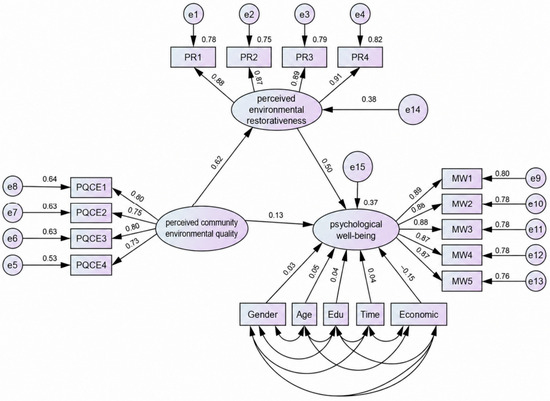
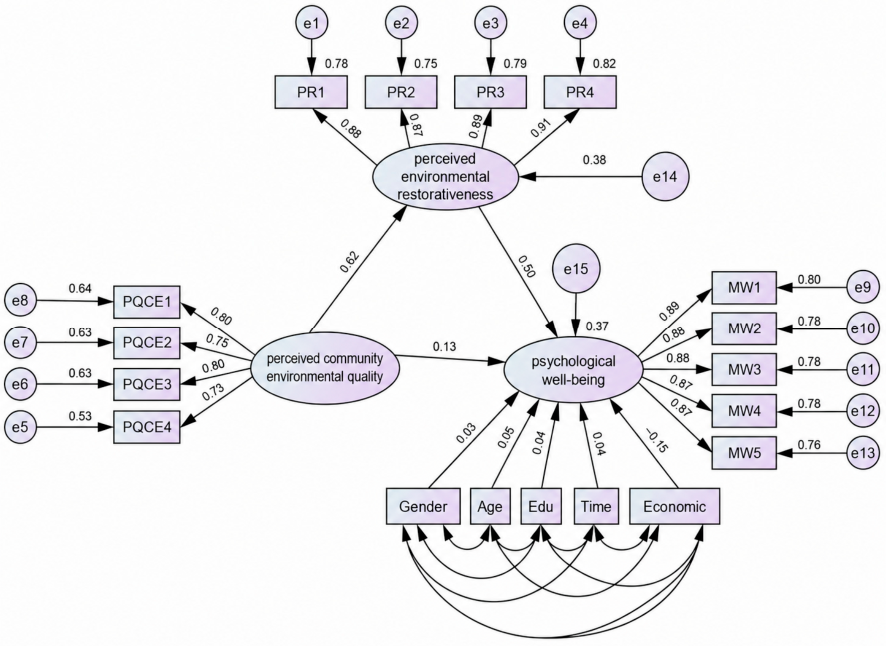
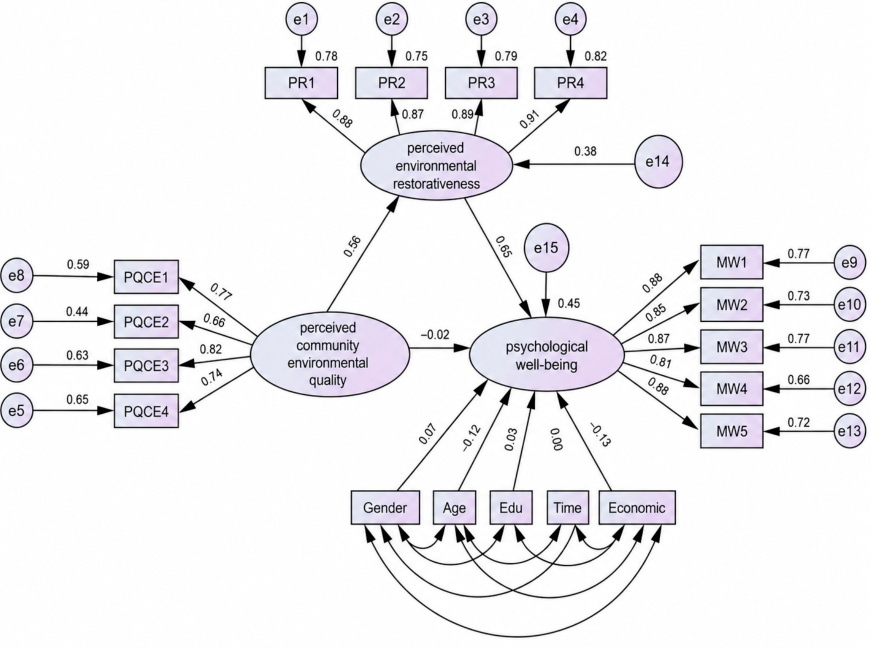
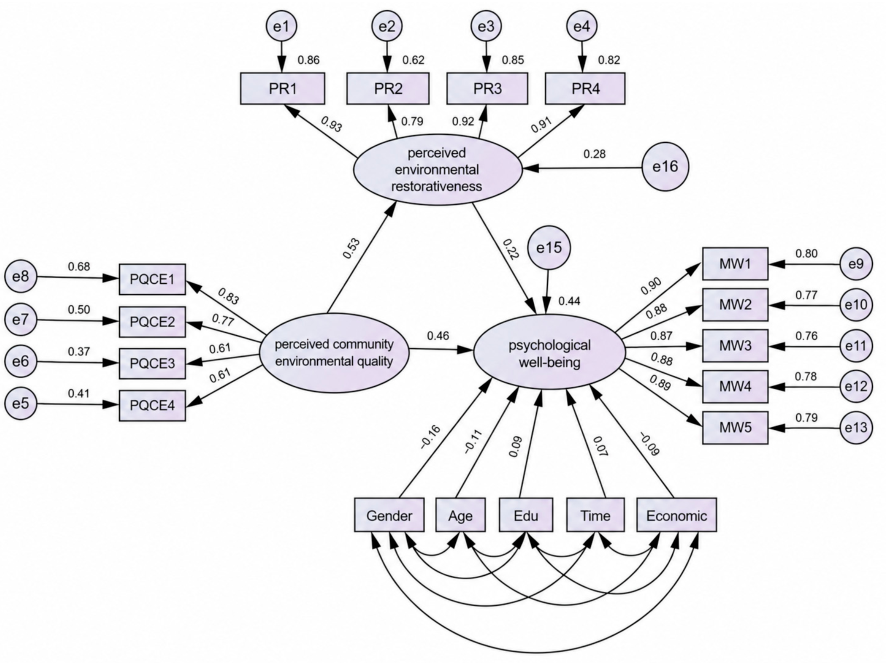
According to the full-sample path-analysis results shown in Table 5 and Table 6, the total effect of perceived community environmental quality on community residents’ psychological well-being was 0.441. Perceived community environmental quality had a significant positive effect on perceived environmental restorativeness, with a standardized path coefficient of 0.617; perceived environmental restorativeness had a significant positive effect on psychological well-being, with a standardized path coefficient of 0.499; and the direct effect of perceived community environmental quality on psychological well-being was 0.133. These results indicate that perceived community environmental quality can both directly and positively affect residents’ psychological well-being and generate an additional indirect effect through perceived environmental restorativeness.
Table 5.
Total, Direct, and Indirect Effects of the Full-Sample Model.
Table 6.
Test of the Mediating Effect of Perceived Environmental Restorativeness in the Effect of Perceived Community Environmental Quality on Psychological Well-Being.
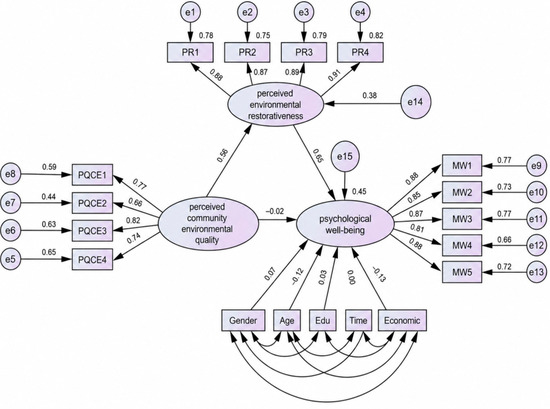
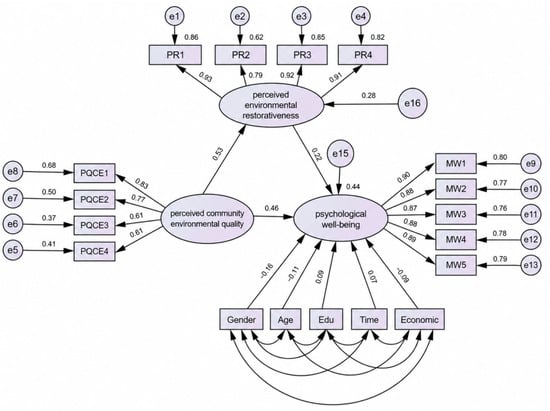
With regard to the mediating effect, the indirect effect of perceived community environmental quality on psychological well-being through perceived environmental restorativeness was 0.308, which was greater than the direct effect of 0.133. The Bootstrap test further showed that, within the 95% confidence interval, the lower and upper limits of both the total effect and the indirect effect did not include 0. This indicates that perceived environmental restorativeness plays a partial mediating role in the effect of perceived community environmental quality on psychological well-being (Figure 4).
Figure 4.
AMOS-Based Standardized Results for the Mechanism Through Which Perceived Community Environmental Quality Influences Community Residents’ Psychological Well-Being.
4.4. Path Differences in Group Models
Considering the relatively high proportion of older adults in the sample and the possibility of more detailed age differences within old age, this study further extracted the older adult sample separately. Following Ma Shuyuan [44] and Zhou Gang [45], who classify older adults by chronological age, the older adult sample was divided into the young-old group (60–69 years), middle-old group (70–79 years), and old-old group (80 years and above). This was done to further test the model’s applicability and differences within the older adult population. The final sample included 185 young-old adults, 176 middle-old adults, and 103 old-old adults.
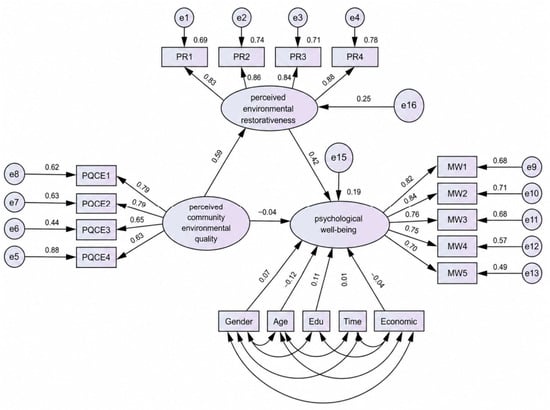
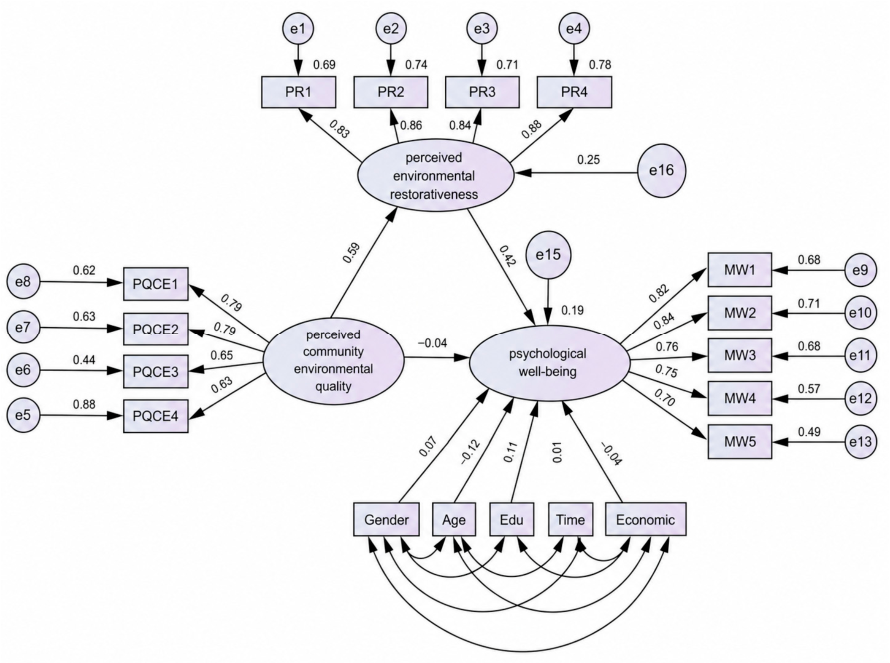
As shown in Table 7, different descriptive pathway patterns were observed across the three older age groups. In the young-old group (Figure 5), the direct effect of perceived community environmental quality on psychological well-being was −0.022, while the indirect effect was 0.365, indicating that perceived community environmental quality mainly affected psychological well-being through perceived environmental restorativeness. The middle-old group showed the same pattern of weaker direct effects and more prominent indirect effects, with an indirect effect of 0.211 (Figure 6). The old-old group differed: its direct effect of perceived community environmental quality on psychological well-being reached 0.464, clearly higher than the indirect effect of 0.117 (Figure 7).
Table 7.
Comparison of Model Paths among Older Adult Groups by Age
Figure 5.
Standardized Coefficients of the Young-Old Adult Sample Model.
Figure 6.
Standardized Coefficients of the Middle-Old Adult Sample Model.
Figure 7.
Standardized Coefficients of the Old-Old Adult Sample Model.
These results reveal different descriptive pathway patterns across the three older age groups, which are consistent with the pattern proposed in H5. In the young-old and middle-old groups, perceived environmental restorativeness appeared to play a relatively more prominent role in the relationship between perceived community environmental quality and psychological well-being. By contrast, in the oldest-old group, the direct association between perceived community environmental quality and psychological well-being was relatively more pronounced. Young-old and middle-old adults still have relatively strong community mobility and needs for spatial experience, and their psychological well-being benefits arise more from the relaxation, attraction, and activity fit generated by the environment. In contrast, because old-old adults experience declining physical functioning, smaller activity radii, and greater dependence on safe and convenient conditions, physical attributes of the community environment—such as road evenness, facility accessibility, sanitation maintenance, lighting, and resting conditions—are more closely associated with their psychological security and living comfort. Age-friendly community development should therefore avoid a one-size-fits-all strategy and instead optimize environments in differentiated ways according to age-related patterns of environmental dependence.
5. Discussion
5.1. The Restorative Pathway from Community Environmental Quality to Psychological Well-Being
Homo Urbanicus theory holds that residents’ satisfaction and sense of well-being in the human settlement are jointly influenced by multidimensional spatial perceptions of safety, convenience, comfort, and aesthetics, and that once lower-level environmental needs are met, higher-level environmental perceptions can further develop [46]. The results of this study are consistent with this view. The effects of physical community environment elements—including green landscapes, environmental sanitation, walking paths, and physical exercise facilities—on residents’ psychological well-being are not generated entirely through direct pathways, but are shaped to some extent by residents’ subjective perceptions, everyday use, and restorative experiences. Only when the community environment helps residents temporarily escape everyday stress, attracts involuntary attention, creates a coherent and orderly spatial experience, and fits their activity needs can physical environmental resources be further transformed into psychological benefits such as improved mood, restored energy, better sleep, and greater interest in life.
From the perspective of Homo Urbanicus theory, the community environment is the carrier system of spatial contact opportunities, while residents are seekers, users, and evaluators of those opportunities. The influence of community environmental quality on psychological well-being is a process in which external human settlement conditions become integrated into residents’ everyday lives by providing spatial contact and activity opportunities, and are then transformed into psychological well-being through residents’ perceptions and experiences. This study therefore further demonstrates that healthy-community development should focus not only on the quantity and spatial configuration of environmental elements, but also on whether residents can form positive, comfortable, and restorative environmental experiences in actual use.
Furthermore, the restorativeness discussed in this study is not confined to parks or large green spaces, but arises from the comprehensive community environment that residents encounter frequently. Clean and orderly sanitation, continuous and comfortable walking paths, easy-to-use exercise facilities, and attractive green landscapes can all produce restorative effects by reducing everyday stress and supporting leisure activities. This helps expand restorative-environment research from single types of space to everyday community settings in which natural and built environments are interwoven.
5.2. Age-Related Patterns in Spatial Contact Opportunities and Accessibility
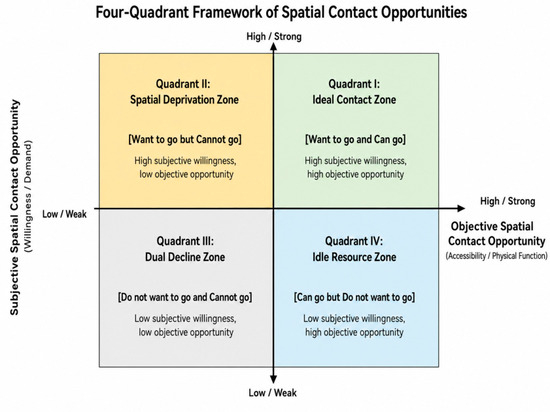
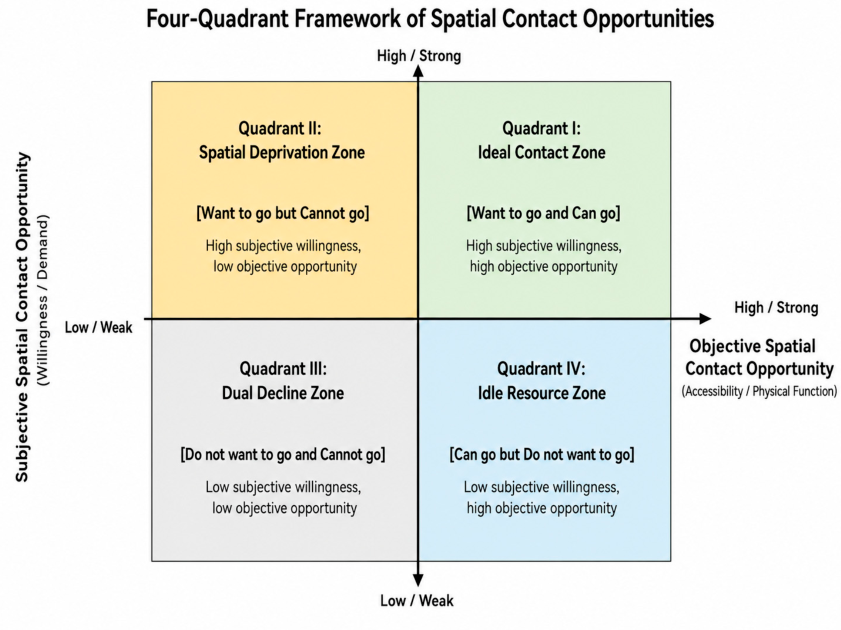
Different older age groups follow different pathways in the transformation of community environmental quality into psychological well-being. These differences are related not only to physical functioning and activity range, but also to willingness to use space, environmental needs, and actual conditions of contact. From the perspective of Homo Urbanicus theory, spatial contact opportunities depend both on whether residents have the ability to enter and use a space and on whether they are willing to use it. The former is influenced by physical condition, spatial barriers, safety conditions, and ease of use, while the latter is related to spatial attractiveness, comfort, restorativeness, and suitability for activities. Based on these two dimensions, older adults’ states of spatial contact can be summarized as four conditions—ideal contact, spatial deprivation, idle resources, and dual decline (Figure 8)—which are used to explain the possible spatial-use states and transitions experienced by different age groups.
Figure 8.
Four-Quadrant Analysis of Spatial Contact Opportunities.
In the young-old group, the direct effect of perceived community environmental quality on psychological well-being was weak, whereas the mediating effect of perceived environmental restorativeness was more prominent. Young-old adults generally have stronger mobility and richer needs for spatial experience, so environmental comfort, aesthetics, attractiveness, and compatibility are more closely associated with their psychological well-being. Their spatial state is therefore usually closer to the ideal-contact zone, although they may enter the idle resource zone when the environment lacks attractiveness and restorativeness. In the middle-old group, perceived community environmental quality also affected psychological well-being mainly through perceived environmental restorativeness, but the mediating effect was weaker. As physical ability declines and the cost of using space increases, environmental attractiveness remains important, but conditions such as convenient passage, safety guarantees, and spatial legibility begin to impose more obvious constraints. When residents remain willing to use a space but cannot do so smoothly because walking paths are discontinuous, resting facilities are insufficient, wayfinding is unclear, or safety concerns persist, they are more likely to shift from ideal contact to spatial deprivation. In the oldest-old group, the direct effect of perceived community environmental quality on psychological well-being was greater than the indirect effect. For oldest-old adults with declining mobility and reduced activity radii, basic conditions such as road access, environmental sanitation, facility convenience, and safety guarantees more directly affect psychological security, living comfort, and psychological well-being. When mobility limitations, environmental barriers, and reduced willingness to be active occur simultaneously, spatial contact opportunities decline further and may even enter a state of dual decline. These differences show that spatial contact opportunities are not determined by facility quantity or physical distance alone. A nearby facility does not necessarily mean that older adults can reach it successfully, and the objective existence of a space does not mean that residents are willing or able to use it or obtain positive experiences from it. Homo Urbanicus theory emphasizes obtaining better spatial contact opportunities with less effort [47,48]. For older adults, this “effort” includes not only the physical energy required for movement, but also the cognitive and psychological costs associated with route recognition, risk management, and environmental adaptation.
Spatial contact opportunities therefore need to be understood in conjunction with physical, visual, sensory, cognitive, and safety accessibility (Table 8). Physical accessibility concerns whether residents can move through, enter, and remain in a space smoothly. Visual accessibility concerns whether they can conveniently see greenery, water bodies, and public-activity scenes; previous research has confirmed that visual exposure may be an important pathway through which blue space affects mental health [49]. Sensory accessibility involves the comfort of sound, smell, lighting, temperature, and wind conditions [50]. Cognitive accessibility reflects whether routes, signs, and spatial order are clear. Safety accessibility concerns lighting, visual permeability, and risk control. Together, these five forms of accessibility affect the possibility that residents can obtain and experience spatial contact opportunities and help explain why facilities that are nearby or numerous do not necessarily generate more positive restorative experiences or psychological well-being.
Table 8.
Accessibility Classification.
The observed age-related patterns suggest that older age groups may differ in their sensitivity to these accessibility conditions. Once basic passage and safety are ensured, young-old adults place greater emphasis on landscape attraction, sensory comfort, and restorative experience. Middle-old adults become increasingly dependent on physical, safety, and cognitive accessibility, while still needing blue–green landscapes and activity scenes to maintain spatial attractiveness. Oldest-old adults place greater emphasis on the safety and convenience of building entrances, paths between residential buildings, nearby resting points, and everyday facilities. For oldest-old adults with limited activity ranges, views from residential windows, building entrances and exits, and greenery, water features, and neighborhood activities in nearby spaces can also provide low-cost opportunities for contact with nature and psychological restoration.
Overall, the exploratory findings suggest that the relationships among community environmental quality, restorative experience, and psychological well-being are vary across older age groups by influencing physical ability, activity range, environmental needs, and the cost of using space. Safety and convenience are the foundation for older adults to obtain spatial contact opportunities, particularly for the oldest-old, while comfort, aesthetics, and restorativeness help strengthen willingness to use space and enhance psychological benefits. As age increases, the emphasis of the community environment may gradually shift from attraction and restoration toward accessibility, usability, and safety. These environmental needs do not replace one another, however; rather, they assume different levels of importance at different ages.
5.3. Planning Implications for Age-Friendly Community Renewal
The above analysis offers implications for the development of “X-minute cities” and community life circles in Shanghai and other high-density Asian cities. Current life-circle planning emphasizes walkable coverage of eldercare, leisure, fitness, greenery, and public-service facilities. For older adults, however, a facility located within walking distance does not necessarily mean that a spatial contact opportunity has truly been created. In older communities in particular, narrow spaces, aging facilities, discontinuous walking environments, parking encroachment, fragmented greenery, and inadequate age-friendly design may simultaneously reduce usability, comfort, and attractiveness. Community life-circle development can therefore move beyond facility service radii and quantity allocation to pay greater attention to the conditions under which residents actually encounter and experience community spaces, incorporating physical, visual, sensory, cognitive, and safety accessibility into community environment assessment systems. Evaluation should not stop at asking whether facilities exist or are nearby, but should also consider whether spaces are easy to enter, suitable for staying, clear and legible, safe and comfortable, and continuously attractive. Accordingly, age-friendly community strategies should address not only infrastructure provision and physical environmental quality, but also older adults’ perceptual experiences and cognitive responses to the environment, as these subjective dimensions shape how spatial conditions are translated into psychological well-being. Sustainable community planning for older adults should likewise shift from a uniform time standard toward adaptive proximity planning that takes age differences, mobility, and environmental experience into account.
In practice, health-oriented community renewal should move from the simple addition of physical facilities toward comprehensive micro-renewal focused on psychological well-being. For young-old adults, priority can be given to enhancing the attractiveness, diversity of activities, and neighborhood-interaction functions of community spaces—for example, by improving blue–green spaces, green landscapes, fitness facilities, walking loops, and social nodes to create community settings that support both activity and restoration. For middle-old adults, continuous walking paths, resting points, wayfinding systems, and environmental comfort can be coordinated to reduce physical exertion and cognitive burden while maintaining environmental attractiveness and support for activities. For oldest-old adults, priority should be given to improving building entrances, paths between residential buildings, corner spaces, and nearby resting facilities, with emphasis on addressing basic deficiencies in road evenness, anti-slip treatment, nighttime lighting, seating, and sanitation maintenance. “Spatial acupuncture” micro-renewal—such as pocket green spaces, micro-spaces in front of buildings, shaded seating, quiet resting points, and neighborhood interaction nodes—can transform scattered, marginal, and inefficient spaces into everyday-life settings that are easy to enter, stay in, socialize in, and recover in, thereby creating synergy among community environment improvement, support for everyday activity, and enhanced psychological well-being. Greater attention should also be paid to nearby visual contact. By improving views from residential windows, sightlines at building entrances, greenery between buildings, and the layout of small water features, residents can see greenery, water bodies, and neighborhood activities without needing to travel long distances. Visual accessibility can thus serve not only spatial recognition but also as an important theoretical pathway linking blue–green environments to restorative experience.
6. Conclusions
6.1. Main Findings and Implications
This study demonstrates that the effect of perceived community environmental quality on residents’ psychological well-being is transformed into positive psychological benefits through residents’ subjective perceptions and evaluations. The results support H1–H4, while the exploratory age-stratified analysis revealed descriptive pathway patterns consistent with H5. Perceived community environmental quality positively affects both perceived environmental restorativeness and psychological well-being, while perceived environmental restorativeness also positively affects psychological well-being. Perceived community environmental quality further affects residents’ psychological well-being indirectly through perceived environmental restorativeness, and the indirect effect is greater than the direct effect, indicating that perceived environmental restorativeness is an important psychological mechanism through which community environmental resources are transformed into psychological well-being benefits. The exploratory age-stratified analyses further suggested different pathway patterns among the young-old, middle-old, and oldest-old groups. Psychological well-being among young-old adults depends more strongly than among middle-old adults on perceived environmental restorativeness, whereas the psychological well-being of oldest-old adults depends more directly on the basic conditions of the community environment. This indicates that, because residents of different ages differ in basic attributes such as physical ability, cognitive capacity, psychological needs, social roles, and patterns of everyday activity, the spatial contact opportunities they can obtain and use also differ. The findings further show that whether community environmental resources can be transformed into psychological well-being depends not only on the quantity of spatial facilities and physical distance, but also on whether residents can conveniently obtain, use, and experience these spaces. Community life-circle planning and healthy community development for older adults should therefore move from uniform facility coverage standards toward adaptive planning that accounts for age differences, mobility, and environmental experience. On the basis of ensuring physical and safety accessibility, planning should enhance visual, sensory, and cognitive accessibility and implement differentiated, tiered renewal for the needs of young-old, middle-old, and oldest-old adults.
From the perspective of Homo Urbanicus theory, the value of the urban environment depends not only on physical spatial conditions but also on how spatial contact opportunities correspond to residents’ needs, perceptions, and everyday experiences. Building on this perspective, this study incorporates perceived environmental restorativeness and age differences into the analysis of the relationship between community environmental quality and psychological well-being, thereby providing empirical support for a more integrated understanding of the individual–environment relationship. The proposed four-quadrant model of spatial contact opportunities and five-category accessibility classification further provide a conceptual basis for understanding how community environmental resources may be translated into psychological well-being through residents’ access, perceptions, and experiences, while also offering practical references for healthy-community development, community life-circle optimization, and age-friendly community renewal.
6.2. Limitations and Future Research
This study has several limitations. First, it uses cross-sectional data, making it difficult to strictly identify causal relationships among variables. Future research could use longitudinal tracking or quasi-experimental designs for verification. Second, both the community environment and mental health are based on residents’ subjective reports. Subsequent studies could incorporate street-view recognition, walking trajectories, facility accessibility, environmental exposure, and physiological and psychological indicators to improve the robustness of mechanism explanations. Finally, this study focuses mainly on exploratory age-related differences; future research could formally examine the potential moderating roles of age and other Homo Urbanicus attributes, such as gender, income, length of residence, and life stage. In addition, the study did not directly measure residents’ willingness to use specific spaces, physical mobility, actual frequency of use, duration of activities, or their actual acquisition of spatial contact opportunities. The four-quadrant model, the five-category accessibility classification, and the explanations of spatial use among older age groups are therefore conceptual analyses and theoretical inferences proposed on the basis of Homo Urbanicus theory. Future research can incorporate these variables into the measurement system to further test how spatial contact opportunities affect perceived environmental restorativeness and psychological well-being.
Author Contributions
Conceptualization, C.G. and J.F.; methodology, C.G. and J.F.; validation, C.G. and J.F.; formal analysis, C.G. and J.F.; investigation, J.F., L.L. and L.C.; data curation, J.F.; writing—original draft preparation, J.F.; writing—review and editing, C.G. and W.L.; visualization, C.G. and J.F.; funding acquisition, C.G. and W.L. All authors have read and agreed to the published version of the manuscript.
Funding
Shanghai Municipal Government Decision-Making Consultation Research Base Key Special Project “Research on Strategies to Enhance Shanghai’s Urban Identity (2025-JD-43)”.
Institutional Review Board Statement
Ethical review and approval were waived for this study due to the non-interventional and minimal-risk nature of the anonymous questionnaire-based survey, which involved no medical interventions, experimental manipulation, collection of identifiable personal information, or ethically sensitive procedures. All participants’ data were fully anonymized prior to statistical analysis.
Informed Consent Statement
Not applicable.
Data Availability Statement
The original contributions presented in the study are included in the article, further inquiries can be directed to the corresponding author.
Acknowledgments
The authors acknowledge the respondents and community staff who supported the questionnaire survey.
Conflicts of Interest
The authors declare no conflicts of interest.
References
- Truong, K.D.; Ma, S. A systematic review of relations between neighborhoods and mental health. J. Ment. Health Policy Econ. 2006, 9, 137–154. [Google Scholar]
- O’Campo, P.; Salmon, C.; Burke, J. Neighbourhoods and mental well-being: What are the pathways? Health Place 2009, 15, 56–68. [Google Scholar] [CrossRef] [Scilit]
- Tao, Y.; Yang, J.; Chai, Y. The anatomy of health-supportive neighborhoods: A multilevel analysis of built environment, perceived disorder, social interaction and mental health in Beijing. Int. J. Environ. Res. Public Health 2020, 17, 13. [Google Scholar] [CrossRef] [Scilit]
- Markevych, I.; Schoierer, J.; Hartig, T.; Chudnovsky, A.; Hystad, P.; Dzhambov, A.M.; de Vries, S.; Triguero-Mas, M.; Brauer, M.; Nieuwenhuijsen, M.J.; et al. Exploring pathways linking greenspace to health: Theoretical and methodological guidance. Environ. Res. 2017, 158, 301–317. [Google Scholar] [CrossRef] [Scilit]
- Hartig, T.; Mitchell, R.; De Vries, S.; Frumkin, H. Nature and health. Annu. Rev. Public Health 2014, 35, 207–228. [Google Scholar] [CrossRef] [Scilit]
- Liu, Y.; Wang, R.; Grekousis, G.; Liu, Y.; Yuan, Y.; Li, Z. Neighbourhood greenness and mental wellbeing in Guangzhou, China: What are the pathways? Landsc. Urban Plan. 2019, 190, 103602. [Google Scholar] [CrossRef] [Scilit]
- Liu, Y.; Wang, R.; Lu, Y.; Li, Z.; Chen, H.; Cao, M.; Zhang, Y.; Song, Y. Natural outdoor environment, neighbourhood social cohesion and mental health: Using multilevel structural equation modelling, streetscape and remote-sensing metrics. Urban For. Urban Green. 2020, 48, 126576. [Google Scholar] [CrossRef] [Scilit]
- Yang, M.; Dijst, M.; Faber, J.; Helbich, M. Using structural equation modeling to examine pathways between perceived residential green space and mental health among internal migrants in China. Environ. Res. 2020, 183, 109121. [Google Scholar] [CrossRef] [Scilit]
- Guo, Y.; Liu, Y.; Lu, S.; Chan, O.F.; Chui, C.H.K.; Lum, T.Y.S. Objective and perceived built environment, sense of community, and mental wellbeing in older adults in Hong Kong: A multilevel structural equation study. Landsc. Urban Plan. 2021, 209, 104058. [Google Scholar] [CrossRef] [Scilit]
- Kesarovski, T.; Hernández-Palacio, F. Time, the other dimension of urban form: Measuring the relationship between urban density and accessibility to grocery shops in the 10-minute city. Environ. Plan. B Urban Anal. City Sci. 2023, 50, 44–59. [Google Scholar] [CrossRef] [Scilit]
- Logan, T.M.; Hobbs, M.H.; Conrow, L.C.; Reid, N.L.; Young, R.A.; Anderson, M.J. The x-minute city: Measuring the 10, 15, 20-minute city and an evaluation of its use for sustainable urban design. Cities 2022, 131, 103924. [Google Scholar] [CrossRef] [Scilit]
- Baobeid, A.; Koç, M.; Al-Ghamdi, S.G. Walkability and its relationships with health, sustainability, and livability: Elements of physical environment and evaluation frameworks. Front. Built Environ. 2021, 7, 721218. [Google Scholar] [CrossRef] [Scilit]
- World Health Organization Regional Office for Europe. Promoting Mental Health Through Cycling and Walking: A Win-Win Approach for Health and Sustainability; WHO/EURO:2026-12905-52679-81719; WHO Regional Office for Europe: Copenhagen, Denmark, 2026. [Google Scholar]
- Kaplan, S. The restorative benefits of nature: Toward an integrative framework. J. Environ. Psychol. 1995, 15, 169–182. [Google Scholar] [CrossRef] [Scilit]
- Hartig, T.; Korpela, K.; Evans, G.W.; Gärling, T. A measure of restorative quality in environments. Scand. Hous. Plan. Res. 1997, 14, 175–194. [Google Scholar] [CrossRef] [Scilit]
- Ulrich, R.S.; Simons, R.F.; Losito, B.D.; Fiorito, E.; Miles, M.A.; Zelson, M. Stress recovery during exposure to natural and urban environments. J. Environ. Psychol. 1991, 11, 201–230. [Google Scholar] [CrossRef] [Scilit]
- Berto, R. The role of nature in coping with psycho-physiological stress: A literature review on restorativeness. Behav. Sci. 2014, 4, 394–409. [Google Scholar] [CrossRef] [Scilit]
- Dzhambov, A.M.; Markevych, I.; Hartig, T.; Tilov, B.; Arabadzhiev, Z.; Stoyanov, D.; Gatseva, P.; Dimitrova, D.D. Multiple pathways link urban green-and bluespace to mental health in young adults. Environ. Res. 2018, 166, 223–233. [Google Scholar] [CrossRef] [Scilit]
- Wang, R.; Helbich, M.; Yao, Y.; Zhang, J.; Liu, P.; Yuan, Y.; Liu, Y. Urban greenery and mental wellbeing in adults: Cross-sectional mediation analyses on multiple pathways across different greenery measures. Environ. Res. 2019, 176, 108535. [Google Scholar] [CrossRef] [Scilit]
- Xian, Z.; Nakaya, T.; Liu, K.; Zhao, B.; Zhang, J.; Zhang, J.; Lin, Y.; Zhang, J. The effects of neighbourhood green spaces on mental health of disadvantaged groups: A systematic review. Humanit. Soc. Sci. Commun. 2024, 11, 488. [Google Scholar] [CrossRef] [Scilit]
- Grave, A.J.J.; Neven, L.; Mohammadi, M. The design of neighbourhood open spaces to improve mental health: A critical review of restorative spatial characteristics and their applicability in design practice. Cities Health 2024, 8, 784–799. [Google Scholar] [CrossRef] [Scilit]
- Lu, S.; Oh, W.; Ooka, R.; Wang, L. Effects of environmental features in small public urban green spaces on older adults’ mental restoration: Evidence from Tokyo. Int. J. Environ. Res. Public Health 2022, 19, 5477. [Google Scholar] [CrossRef] [Scilit]
- Zhang, J.; Tan, Z.; Bu, F. Impact of urban green spaces on mental restoration in older adults: A perspective based on subjective perception. Front. Public Health 2025, 13, 1687874. [Google Scholar] [CrossRef] [Scilit]
- Chen, L.; Ma, Y. Perceived restorativeness of urban green spaces in southern China during summer. Sci. Rep. 2025, 15, 38580. [Google Scholar] [CrossRef] [Scilit] [PubMed]
- Zhao, W.; Wang, J.; Zhu, X.; Liu, F.; Wang, W. Restorativeness and pleasantness shape tranquility in high-density urban residential soundscapes. Sci. Rep. 2025, 15, 42472. [Google Scholar] [CrossRef] [Scilit]
- Bornioli, A.; Subiza-Pérez, M. Restorative urban environments for healthy cities: A theoretical model for the study of restorative experiences in urban built settings. Landsc. Res. 2023, 48, 152–163. [Google Scholar] [CrossRef] [Scilit]
- He, N.; Xu, L.; Li, N. Community environmental healing benefits: A systematic review comparing intervening variables, environments, and outcomes. J. Community Psychol. 2024, 52, 799–816. [Google Scholar] [CrossRef] [Scilit]
- Zhang, R.; Zhang, C.Q.; Rhodes, R.E. The pathways linking objectively-measured greenspace exposure and mental health: A systematic review of observational studies. Environ. Res. 2021, 198, 111233. [Google Scholar] [CrossRef] [Scilit]
- Xiaohui, Y. Theoretical Discussion on the Interaction between Homo Urbanicus and Urban Planners: Its Role in Chinese Planning Theory. J. City Plan. Rev. 2014, 2, 85–90. [Google Scholar]
- Wei, W.; Xie, B. Values of Western planners in the context of cultural genes: Also on Homo Urbanicus theory. Planners 2014, 30, 21–25. (In Chinese) [Google Scholar]
- Leung, H.-L. Homo Urbanicus. City Plan. Rev. 2012, 36, 87–96. (In Chinese) [Google Scholar]
- Wu, L. Introduction to Sciences of Human Settlements; China Architecture & Building Press: Beijing, China, 2001; p. 138. (In Chinese) [Google Scholar]
- Bech, P.; Gudex, C.; Staehr Johansen, K. The WHO (Ten) well-being index: Validation in diabetes. Psychother. Psychosom. 1996, 65, 183–190. [Google Scholar] [CrossRef] [Scilit]
- Becha, P.; Pichot, P. Rating scales for psychopathology, health status and quality of life. Compendium on documentation in accordance with the DSM-mr and WHO systems. Nord. J. Psychiatry 1994, 48, 300–301. [Google Scholar] [CrossRef] [Scilit]
- Fung, S.F.; Kong, C.Y.W.; Liu, Y.M.; Huang, Q.; Xiong, Z.; Jiang, Z.; Zhu, F.; Chen, Z.; Sun, K.; Zhao, H.; et al. Validity and psychometric evaluation of the Chinese version of the 5-item WHO well-being index. Front. Public Health 2022, 10, 872436. [Google Scholar] [CrossRef] [Scilit]
- Zhang, Z.; Zhang, J. Perceived residential environment of neighborhood and subjective well-being among the elderly in China: A mediating role of sense of community. J. Environ. Psychol. 2017, 51, 82–94. [Google Scholar] [CrossRef] [Scilit]
- Mao, Y.; Luo, X.; Guo, S.; Xie, M.; Zhou, J.; Huang, R.; Zhang, Z. Validation of the abbreviated indicators of perceived residential environment quality and neighborhood attachment in China. Front. Public Health 2022, 10, 925651. [Google Scholar] [CrossRef] [Scilit]
- Kaplan, R.; Kaplan, S. The Experience of Nature:A Psychological Perspective; Cambridge University Press: Cambridge, UK, 1989; p. 142. [Google Scholar]
- Anderson, J.C.; Gerbing, D.W. Structural equation modeling in practice: A review and recommended two-step approach. Psychol. Bull. 1988, 103, 411. [Google Scholar] [CrossRef] [Scilit]
- Raykov, T.; Shrout, P.E. Reliability of Scales with General Structure: Point and Interval Estimation Using a Structural Equation Modeling Approach. Struct. Equ. Model. 2002, 9, 195–212. [Google Scholar] [CrossRef] [Scilit]
- Hu, L.T.; Bentler, P.M. Cutoff criteria for fit indexes in covariance structure analysis: Conventional criteria versus new alternatives. Struct. Equ. Model. Multidiscip. J. 1999, 6, 1–55. [Google Scholar] [CrossRef] [Scilit]
- Eichhorn, B.R. Common Method Variance Techniques. In MWSUG 2014 Conference Proceedings; Paper AA11-2014; Cleveland State University: Cleveland, OH, USA, 2014. [Google Scholar]
- Fornell, C.; Larcker, D.F. Evaluating structural equation models with unobservable variables and measurement error. J. Mark. Res. 1981, 18, 39–50. [Google Scholar] [CrossRef] [Scilit]
- Ma, S.; Wang, X. Classification of age stages in older adults and key points of nursing. J. Pract. Med. Tech. 2008, 30, 4311–4312. (In Chinese) [Google Scholar]
- Zhou, G.; Cao, W.; Deng, X. Differences between subjective age and chronological age among older tourists and their relationship with tourism motivation. J. Chongqing Norm. Univ. (Nat. Sci. Ed.) 2016, 33, 180–186. (In Chinese) [Google Scholar]
- Hong, M.; Wei, W.; Yin, L.; Xia, J. Mechanism of basic public service facilities affecting residents’ satisfaction: From the perspective of Homo Urbanicus theory. Hum. Geogr. 2023, 38, 107–117. (In Chinese) [Google Scholar] [CrossRef]
- Leung, H.-L. Re-discussing Homo Urbanicus: People-oriented urbanization. City Plan. Rev. 2014, 38, 64–75. (In Chinese) [Google Scholar]
- Leung, H.-L. The basic logic and operational procedure of Homo Urbanicus theory. City Plan. Rev. 2020, 44, 68–76. (In Chinese) [Google Scholar]
- White, M.; Smith, A.; Humphryes, K.; Pahl, S.; Snelling, D.; Depledge, M. Blue space: The importance of water for preference, affect, and restorativeness ratings of natural and built scenes. J. Environ. Psychol. 2010, 30, 482–493. [Google Scholar] [CrossRef] [Scilit]
- Ubillus, J.D.; Medrano-Sanchez, E.J. Sensory Architecture in Relation to Quality of Life in Older Adults: An Evidence-Based Design Approach. Buildings 2026, 16, 1498. [Google Scholar] [CrossRef] [Scilit]

Disclaimer/Publisher’s Note: The statements, opinions and data contained in all publications are solely those of the individual author(s) and contributor(s) and not of MDPI and/or the editor(s). MDPI and/or the editor(s) disclaim responsibility for any injury to people or property resulting from any ideas, methods, instructions or products referred to in the content. |
© 2026 by the authors. Licensee MDPI, Basel, Switzerland. This article is an open access article distributed under the terms and conditions of the Creative Commons Attribution (CC BY) license.