


Abstract
The construction industry remains among the most dangerous occupations in the world and safety management in this industry remains hierarchical in nature, being designed by engineers, regulatory agencies, and site managers and not by those who actually face the highest risk of danger. This paper argues that this asymmetry in who gets to design safety is systemic, arising from the intersection of organisational hierarchy, national power distance, and multi-tier subcontracting, all of which erode both accountability and worker voice. Drawing on a theoretical framework that integrates the safety-voice, power-distance, and systems-theoretic accident model and processes (STAMP) literatures with a structural analysis of Istanbul’s construction sector, the paper shows how legal, contractual, and cultural mechanisms suppress the feedback processes that resilience-oriented safety management depends on. Drawing on Turkish labour-law thresholds for union recognition, subcontracting data, and a case of worker protest during the construction of one of Istanbul’s largest infrastructure projects, the paper identifies three mechanisms of exclusion: statutory representation thresholds that structurally exclude construction workers, subcontracting chains that diffuse responsibility for safety outcomes away from the workers who bear the risk, and organisational hierarchies that discourage safety voice long before it reaches any formal channel. The paper concludes with a set of design principles for reintegrating worker feedback into safety control structures, offered as a contribution to resilience engineering practice.
1. Introduction
Construction sites are typically designed to be safe by people who never set foot on a scaffold. Regulators set standards, engineers specify control measures, and site managers issue instructions; in most formal safety frameworks, the worker’s role is simply to comply. This division of labour goes largely unquestioned, yet it sits awkwardly alongside a growing recognition among construction-safety and resilience-engineering researchers that the people working closest to a hazard are also best placed to detect it at an early stage. The main question this paper asks is simple to state but hard to answer: who actually designs safety on a construction site, and what happens to safety outcomes when that design authority sits far from the point of risk? The paper does not address construction safety governance in general; its scope is deliberately narrower, and is defined here at the outset. The framework and analysis that follow apply specifically to construction settings characterised by the joint presence of two structural conditions: extensive multi-tier subcontracting and high national or organisational power distance. The above conditions define the limits of the argument, not just its context, since, as stated in Section 2, it is the two together that lead to suppression of upward safety feedback. The cases where only one of the two conditions hold true are used purely for comparison (see Section 4.1), but are not seen as an object of the framework itself.
The dangers discussed are very concrete in nature. Despite even good regulatory oversight, construction workers are at significantly increased risk of injuries due to subcontracting process since the most dangerous jobs can be shifted to subcontractors who have less visibility and resources to spend on safety measures [1]. In case this situation overlaps with poor labour representation, this gradient of risks is made even worse by the lack of feedback mechanism that normally helps detect the hazards arising from such work environment.
This compounding effect is clearly visible through the case of Turkey. With regard to large-scale projects, it has now become common practice to distribute every stage of the construction process between different subcontractors, who in turn provide their own OHS services according to legislation that allows such an approach. Such division is associated with high rates of injuries at work, unemployment, and poorly developed inspection and control framework [2]. The problem goes beyond merely an interesting empirical observation: as of January 2022, there were more than 1.4 million construction employees in Turkey, and the country has been demonstrating very high death rates on the job compared to other countries with similar economic conditions. According to national analysis of the Turkish accident statistics, there was a significant increase between 2013 and 2020, despite increasing awareness about the role of informal employment in underreporting [2,3]. That this record has persisted through decades of regulatory reform suggests that the problem is not primarily a shortage of rules, but a shortage of channels through which the people exposed to risk can shape how that risk is managed.
Recent research has begun to reframe construction safety through the lens of systems thinking, arguing that the transition from a purely technology-driven paradigm toward one that is human-centred and resilience-oriented is already underway conceptually, even if empirical grounding remains limited [4]. That literature operates primarily at the level of paradigm description: it documents that a shift from Industry-4.0-style technological optimisation toward Industry-5.0-style human-centred, resilience-oriented safety management is occurring across the field, without specifying the causal mechanism by which any particular site or sector fails to make that transition. This paper’s contribution is at a different level of analysis: rather than describing the paradigm shift itself, it identifies a specific, testable mechanism, structurally suppressed upward feedback, that explains why the transition remains incomplete in a particular class of high-subcontracting, high power-distance contexts, and grounds that mechanism in a documented case rather than in paradigm-level description alone. This paper contributes to that reframing, but from a different angle than most of the literature associated with it. Rather than treating “human-centredness” primarily as a matter of ergonomic design or technology adoption, it treats it as a question of power: who holds the authority to define what counts as an acceptable risk, who is consulted before that definition is fixed, and what structural features of the industry make consultation more or less likely. It does so by combining three bodies of theory that, to the author’s knowledge, have not previously been integrated in a single explanatory framework in the construction safety literature: safety voice, power distance, and the systems-theoretic accident model and processes (STAMP). This claim is necessarily a claim about absence, and is offered with the appropriate caution: it is based on a targeted search of Safety Science, Reliability Engineering and System Safety, and Buildings between 2018 and 2026 for terms combining “STAMP” or “systems-theoretic accident model” with either “power distance” or “safety voice”, which returned no paper combining all three; the closest related work, discussed immediately below, addresses at most one of these three constructs directly. This search was not a formal systematic review and should not be read as one; it is reported here only to substantiate the originality claim rather than to assert it without basis. The paper applies that combined lens to a structural analysis of the Istanbul construction sector, illustrated by a documented case of collective worker action at a major national infrastructure project.
2. Theoretical Framework
2.1. Safety Voice as a Structural, Not Only Individual, Phenomenon
Safety voice, defined as the act of speaking up about hazards in order to prevent harm, has become an established construct in occupational safety research. A systematic review integrating 48 studies found that safety voice occurs across contexts ranging from healthcare to aviation to construction, and synthesised 256 distinct antecedents of the behaviour into an ecological framework spanning individual, group, organisational, and hazard-specific levels of analysis [5]. Much of this literature, however, is disproportionately weighted toward the individual and dyadic levels of that framework, predicting whether a given worker speaks up as a function of psychological safety, leadership style, or personality, with organisational and institutional context entering mainly as background. This is valuable but incomplete: it explains why a given worker on a given day might or might not speak up, without explaining why an entire sector might be structurally organised so that speaking up rarely happens at all, regardless of individual disposition.
This paper treats safety voice instead as an emergent property of a control structure, following the logic developed in Section 2.3. Before making that connection explicit, it is necessary to establish why voice is unevenly distributed across hierarchical positions in the first place, which is where power distance becomes relevant.
This structural reading of voice has an established parallel outside safety science, in the industrial-relations concept of the “representation gap”: the proportion of a workforce that would want formal representation, whether through a union or another channel, but is structurally excluded from it, a concept developed to explain declining union coverage in Britain and the United States and later extended to explain gaps in workplace voice more broadly [6]. The concept originates in the liberal-market, common-law industrial-relations systems of Britain and the United States, quite different institutionally from Turkey’s more state-corporatist labour relations tradition; it is invoked here for its structural logic, that representation gaps are properties of institutional design rather than of individual worker preference, not for the specific British/American policy diagnosis that accompanied its original formulation. That literature’s central insight maps directly onto this paper’s claim that safety voice is a structural rather than individual phenomenon; Section 4.2 returns to this concept directly when analysing Turkish labour law’s representation thresholds.
2.2. Power Distance and the Legitimacy of Speaking Up
Power distance, understood as the degree to which a culture accepts and expects unequal distribution of power, was originally formulated by Hofstede as one of four dimensions distinguishing national cultures [7]. The construct has since been developed independently in at least two further research traditions that converge on the same core claim while using different measurement instruments: the Global Leadership and Organizational Behavior Effectiveness (GLOBE) project’s cross-cultural leadership study, which surveyed over 17,000 managers across 62 societies and treats power distance as one of nine cultural dimensions shaping what followers expect of leaders [8]; and Schwartz’s theory of cultural values, which identifies a conceptually related hierarchy-versus-egalitarianism dimension describing how societies resolve the problem of managing interdependence between unequal members [9]. That three independently developed cross-cultural frameworks converge on a similar dimension is itself evidence that the construct captures something more than an artefact of Hofstede’s original 1980 sample. More directly relevant to this paper’s argument, a three-decade meta-analysis synthesising 598 studies and over 200,000 individuals found that power distance carries one of the more consistent negative relationships in the entire cultural-values literature with feedback-seeking behaviour specifically, alongside positive relationships with preference for directive leadership [10]. This meta-analytic finding is the most direct empirical support available for this paper’s central claim that power distance suppresses upward feedback, and it does not depend on any single study or a single formulation of the construct. Power distance shapes more than how safety culture is experienced, a construct descending from the safety climate literature’s original concern with workers’ shared perceptions of how much their organisation genuinely prioritises safety [11]; it also shapes whether raising a concern is considered a legitimate act in the first place. A large comparative study across 21 national air traffic providers, covering over 13,500 staff, found that workers in countries with established values for hierarchy and power reported safety culture as less positive than those from countries with low power distance, and that the gap between how positively managers and frontline staff perceived safety culture widened specifically in high power-distance national contexts [12]. This is a structural finding, not merely a psychological one: it shows that behaviours driven by power dynamics, such as raising a concern, challenging unacceptable conduct, or asking for safety improvements, are jointly determined by a person’s position in the hierarchy and by the surrounding society’s tolerance for unequal power [12]. In the construction industry, the above relationship works in combination with leadership style. In an empirical paper using survey data conducted in 2025 that investigates the effects of paternalistic leadership on 263 construction site foremen and workers in China, it was discovered that power distance moderates the effect of paternalistic leadership on both team safety climate and psychological safety, and its effect was found to be greater for those workers who have high power distance themselves [13].
Thus, power does not just become a control variable in safety culture studies; it becomes an agent through which safety culture is formed. This is particularly relevant for Turkey, whose construction industry is highly hierarchical and paternalistic in nature, where the foreman–worker and contractor–subcontractor dynamics together create an extremely hierarchical organisation. If power distance widens the gap between how managers and frontline workers perceive safety, and reduces workers’ willingness to challenge decisions made above them, then any safety system that depends on workers reporting what they observe cannot be expected to detect risk reliably.
2.3. Re-Reading STAMP as a Map of Blocked Feedback
The STAMP (systems-theoretic accident model and processes) approach was first proposed as an alternative to accident models that focus on failure in individual system components. Safety in this framework is presented as a control problem, not a question of the reliability of components: an accident happens when the hierarchical control structure does not provide necessary safety constraints to keep the system within safe bounds because of either ineffective top-down control actions or inadequate bottom-up feedback. A 2022 review of STAMP’s history and applications found that, although the approach has been used across various fields (transportation, food safety, hazardous industries), its key contribution is to connect the different causes of an accident and reveal the relationships among interrelated components within a system, rather than treating component failures in isolation [14]. A systematic review of STAMP’s practical applications in the built environment specifically found that, despite this theoretical richness, industry engagement was largely absent from most published studies [15].
To be precise about where the gap in the literature actually lies: feedback is not a neglected component of STAMP itself. Leveson’s original formulation treats feedback channels as structurally as necessary to a control loop as the control actions they inform, and reviews of the model’s applications confirm that feedback is routinely modelled [14,16]. What is comparatively underdeveloped, and what the STAMP literature reviewed above does not address, is the question of who is structurally permitted to generate feedback in the first place, as opposed to the question of whether a feedback channel exists on the control-structure diagram. A STAMP diagram can show a complete, well-specified feedback arrow between a worker level and a supervisory level while remaining silent on whether workers at that level face social or institutional costs for using it; that is the gap this paper addresses, not an omission of feedback from STAMP as such. In the conventional STAMP control structure, commands go from high-level organisations to low-level ones; for safety, though, the feedback from the lower levels is necessary to know whether the safe state was achieved through these control actions. This paper’s central theoretical move is to read this feedback channel not merely as an information-engineering problem but as a political one: the same hierarchical control structure that transmits instructions downward is also, in principle, the channel through which worker observations should travel upward, and it is precisely this channel that power distance, subcontracting fragmentation, and weak labour representation combine to narrow or sever.
This narrowing can take two analytically distinct forms, and the theoretical framework developed here treats them as separate failure modes rather than conflating them. The first is feedback that is never generated: a worker observes a hazard but does not report it, because the social or institutional cost of speaking up, predicted by the power-distance literature reviewed above, exceeds the perceived benefit. The second is feedback that is generated but disregarded: a hazard is reported, or a formal channel is used, but the information does not produce a corresponding control action, because the entity receiving it lacks the authority, the incentive, or the coordination capacity to act on it. STAMP’s control-loop logic predicts different failure signatures for each: the first produces an empty or thin feedback channel with no corresponding record; the second produces a feedback channel that generates records, complaints, or reports, which then fail to translate into revised control actions. Section 4.4 shows evidence consistent with both dynamics operating at different points in the same case, and Table 1 distinguishes them explicitly rather than treating “narrowed feedback” as a single undifferentiated mechanism. A STAMP-informed safety system that ignores who is structurally permitted to generate feedback, and who is structurally prevented from doing so, will misdiagnose why its control loops fail.
2.4. Resilience Engineering and the Cost of Centralised Control
This reframing connects naturally to the distinction between Safety-I and Safety-II articulated in the resilience engineering literature, a field established as a distinct paradigm in the mid-2000s [17]. Safety-I treats safety as the absence of unwanted outcomes and pursues it by identifying failure modes in advance and constraining behaviour to prevent them; Safety-II instead treats safety as the ability to succeed under varying conditions, achieved through the everyday adaptive performance of the people actually doing the work [18]. This distinction has direct implications for how authority should be distributed, beyond its philosophical interest. An analysis of the safety professional’s role under this paradigm distinguishes two modes of safety management: centralised control, which aims to align an organisation and its people through decisions made at the centre, and guided adaptability, which aims to enable the organisation and its people to adapt safely to conditions that were never fully specified in advance [19]. That analysis found that safety professionals and their organisations remain overwhelmingly focused on the centralised-control mode, and that this focus can itself be detrimental to safety, since it under-uses the distributed judgement of the workforce as a safety resource rather than treating it as a compliance risk to be managed away [19]. Resilience engineering more broadly asks what technologies, cognitive systems, and organisational practices support a system’s ability to adjust its functioning before, during, or after changes and disturbances, so that it can sustain required operations even after a major mishap or in the continuous presence of stress [20].
Before stating the combined hypothesis, it is worth making explicit how the four bodies of theory reviewed in this section relate to one another, since they are not simply juxtaposed but each supply a distinct, necessary piece of the causal chain. Safety voice (Section 2.1) establishes that whether a worker speaks up is not solely an individual disposition but can be an emergent property of context; power distance (Section 2.2) supplies the specific structural mechanism that determines how that context suppresses voice, namely the social cost of challenging a hierarchical superior; STAMP (Section 2.3) supplies the systems-level vocabulary for locating where in an organisational control structure that suppression has its effect, by identifying the feedback channel as the site where power distance’s behavioural prediction becomes an organisational-safety failure mode; and the Safety-I/Safety-II distinction (Section 2.4) supplies the normative stakes, showing why a control structure that cannot receive upward feedback loses exactly the adaptive capacity that resilience engineering identifies as necessary for safety in complex systems. Each of the four theories considered on its own provides an explanation for one part of the overall puzzle: safety voice provides an explanation for individual difference; power distance shows how such differences are distributed non-randomly; STAMP provides the organisational position in the hierarchy where the resulting knowledge gap is situated; and Safety-I/Safety-II shows why this gap is relevant to safety and does not constitute merely a managerial failure. For that reason, the combination of these theories is not cumulative, but rather sequential, in which each theory answers the question posed by the previous one.
Combined, these four theoretical threads form a coherent hypothesis: safety performance suffers in organisations where there are hierarchical organisational structures, widespread use of subcontracting, and power distance not because of insufficient regulation, but because the structural prerequisites for upward feedback, on which the control loop and adaptive ability in STAMP and Safety-II depend, are not satisfied. In Figure 1, the author attempts to represent this reasoning in the form of an integrative theoretical model constructed specifically for this paper, which is not based on any previously published framework combining these four theoretical streams in this way. In the figure below, one can see the flow of events from the three structural conditions mentioned in Section 2.1 and Section 2.2 to the process of blocked feedback described in Section 2.3 and Section 2.4 to the two different outcome pathways analysed in Section 4.
Figure 1.
The theoretical framework that is integrated is one which connects the structural factors to lack of safety voice, STAMP feedback blockage, and conflicting results of Safety-I and Safety-II. The red solid line is the outcome trajectory that has been identified empirically in Section 4; the green dotted line is the alternative outcome trajectory designed in Section 5. Source: Synthesis by author.
3. Methods
This study combines theoretical synthesis with a structural case analysis, rather than choosing between a purely conceptual approach and a single-incident case study. This mixed design follows directly from the research question, which asks why worker voice is structurally suppressed within a particular sector, a question that requires both a theoretical account of the suppressing mechanism and empirical evidence that the mechanism is actually observable.
The theoretical framework in Section 2 was constructed through a targeted synthesis of three literatures identified as jointly relevant to the research question: safety voice, power distance in safety culture, and STAMP-based systems safety, read alongside the resilience engineering distinction between Safety-I and Safety-II. Sources were included in this synthesis if they met three explicit criteria: (a) the source directly theorised or empirically tested a mechanism connecting hierarchical position, cultural or organisational power distance, or systems-level control structure to information flow or reporting behaviour; (b) for empirical sources, the study was published in a peer-reviewed venue and reported a quantifiable relationship (an effect size, a significant test statistic, or a comparable finding) rather than a purely descriptive account; and (c) for theoretical or foundational sources, the work was either the originating statement of a construct used elsewhere in the paper (e.g., Hofstede’s original power-distance formulation) or a peer-reviewed synthesis of that construct’s subsequent development (e.g., meta-analytic or systematic-review sources). Sources meeting these criteria were located through targeted searches of Scopus and Google Scholar using combinations of the core constructs (safety voice, power distance, STAMP, resilience engineering, Safety-II) with construction-specific and general organisational-safety terms, supplemented by backward citation searching from the most relevant sources located. This targeted approach, rather than an exhaustive systematic review protocol, is consistent with the paper’s aim of building an integrative theoretical bridge across four literatures rather than mapping the full breadth of any one of them; Section 6 returns to this as a limitation of the theoretical synthesis.
The structural case analysis in Section 4 draws on three categories of secondary evidence. First, sector-level statistics on occupational accidents, subcontracting prevalence, and informal employment in the Turkish construction sector, drawn from peer-reviewed occupational health literature and official social security data as reported in that literature. Second, the legal and regulatory architecture governing union recognition and collective bargaining in Turkey, drawn from labour law sources and comparative Organisation for Economic Co-operation and Development (OECD) data on union density. Third, a documented case of collective worker action, the September 2018 protests by construction workers at Istanbul’s new airport project, reconstructed from contemporaneous reporting by international human rights organisations and labour bodies.
These three categories are not treated as independent or parallel sources of support, but as operating at different levels of a single nested analytical design with using Bibliometrix (Biblioshiny) and SciMAT (GPLv3) softwares. The sector-level statistics and legal-architecture evidence (the first and second categories, corresponding to Section 4.1, Section 4.2 and Section 4.3) establish that the structural preconditions this paper’s framework identifies as necessary for feedback suppression, namely subcontracting depth, informality, and representation thresholds, are present across the Turkish construction sector as a whole. The Istanbul Airport case (the third category, Section 4.4) is nested within that sector-level picture: it does not independently establish that these structural preconditions exist, since that work is already done by the first two categories, but instead shows what those preconditions look like in operation at a single, well-documented site, and specifically whether the STAMP-predicted feedback failure (Section 2.3) is observable in a concrete instance. The case’s evidentiary function is therefore illustrative and mechanism-tracing rather than confirmatory: it cannot by itself establish that the mechanism operates sector-wide, but it can show that the mechanism is empirically observable at all, which the sector-level statistics alone cannot do, since aggregate figures on subcontracting depth or union density cannot directly show a feedback channel failing in real time.
In the typology of information-oriented case selection developed in the case-study methodology literature, this case functions as what has been termed a critical case: a case chosen not for its representativeness, but because if the theorised mechanism, structurally suppressed feedback, is not observable there, given how extensively documented the site is, it is unlikely to be observable with comparable clarity anywhere else in the sector; conversely, its presence there is a necessary but not sufficient condition for the framework’s broader plausibility [21]. This is the case’s explicit methodological role in the design: a plausibility probe for the mechanism identified in Section 2, not a representative sample from which prevalence claims about the sector could be drawn. The case was not chosen because it represents every construction site in Istanbul, but because of the sheer volume of evidence available about it through independent monitors, which provides verified information, on matters such as inspection frequency, the underreporting of deaths, and the treatment of workers’ representatives, that is otherwise difficult to observe. It is treated in this paper as an illustrative instance of structural dynamics that the sector-level data suggest are widespread, not as a statistically representative sample; this scope limitation is revisited in Section 6.
The analytical procedure used to interpret and combine these three categories of evidence in Section 4 followed the same logic in reverse: each documentary source (a report, a statistical release, a legal text) was read to extract two kinds of information relevant to the STAMP framework developed in Section 2, namely (i) which control level in the site’s or sector’s hierarchy the source’s content pertained to, and (ii) whether the source described a control action (downward) or a feedback channel (upward), and if the latter, whether that channel appeared functioning, thin, or absent based on the frequency, outcome, or documented use of that channel as reported in the source. These extracted classifications were then mapped onto the control-level structure shown in Table 1 and Figure 2; Section 4.4 describes this mapping process for the Istanbul case specifically. The above process is interpretative as opposed to a formal coding system complete with inter-coder reliability scores, an issue that will be mentioned again in Section 6. However, its use is explicit, in the sense that each code in Table 1 has been attributed to a certain citation and can be easily crosschecked.
Figure 2.
STAMP control structure for the Istanbul Airport case, showing downward control actions on the left-hand side and the current status of upward feedback channels on the right-hand side, from the state level down to the individual worker. Compare Table 1 for the corresponding source citations. Source: Synthesis by author.
This selection strategy carries a specific trade-off that should be stated rather than left implicit. The Istanbul Airport project’s scale and political prominence are precisely what generated the independent documentation this paper relies on, but that same prominence may make the suppression mechanism observed there unusually visible rather than unusually severe. A smaller, less politically salient site might exhibit the same underlying dynamic, power distance and subcontracting fragmentation narrowing the channel for upward feedback, through quieter mechanisms with no documentary trace at all: for example, the simple non-renewal of a complaining worker’s short-term subcontract, rather than the mass detention documented in Section 4.4. If anything, this suggests the mechanism identified here is a conservative, lower-bound illustration of a dynamic that may be harder to detect, not necessarily milder, at less visible sites. This paper does not have evidence to confirm this directly, and it is flagged here as an open question rather than a claim, but it is the correct way to read the relationship between this case’s visibility and its generalisability. No primary data collection (interviews, surveys, or site access) was undertaken for this study; all evidence is drawn from published, citable secondary sources.
4. Structural Analysis of Istanbul’s Construction Sector
This section presents the three categories of evidence described in Section 3 in sequence, sector-level statistics (Section 4.1), legal architecture (Section 4.2 and Section 4.3), and the single case (Section 4.4), but their analytical integration should be read cumulatively rather than as three independent demonstrations. Section 4.1 and Section 4.2 establish, using sector-wide data, that two of this paper’s three mechanisms of exclusion, subcontracting-driven diffusion of responsibility and statutory representation thresholds, are structurally present across the Turkish construction sector as a whole, independently of any single site. The third mechanism, organisational hierarchy discouraging voice before it reaches a formal channel, is comparatively harder to observe at sector scale, since it operates informally and leaves little documentary trace outside a well-monitored site; this paper’s evidence for that third mechanism accordingly draws more heavily on the single Istanbul Airport case (Section 4.4) than the other two mechanisms do, a point already noted in principle by the general power-distance literature reviewed in Section 2.2, which shows the mechanism operating in other hierarchical, high-power-distance settings, but which this paper cannot independently confirm operates identically inside Turkish construction sites beyond the one case examined in depth. This asymmetry in evidentiary weight across the three mechanisms is stated here explicitly rather than left for the reader to infer, and is revisited at the point in Section 4.4 where the case-specific evidence for hierarchy-driven voice suppression is presented.
4.1. A Sector Organised Around Fragmentation
The Turkish construction sector expanded rapidly in the post-2000 period, at its peak contributing close to a tenth of GDP and around seven percent of national employment, with over 1.4 million registered construction workers recorded as of January 2022. Within this expansion, subcontracting became the dominant organising principle of employment: in large-scale building projects it is now standard practice for almost every component of the construction product to be divided into pieces and outsourced to separate subcontractors, each operating under its own arrangements for supervision and, critically, for OHS. Turkish OHS legislation compounds this fragmentation by granting subcontractor firms the freedom to arrange their own OHS services independently of the main contractor, which means that a single site can host multiple, uncoordinated OHS regimes operating side by side [2].
This is not a uniquely Turkish phenomenon: multi-tiered subcontracting, the subletting of work tasks that creates a hierarchy or pyramid of contractual relationships, has grown substantially since the mid-1970s across many high-hazard industries, and a growing international research base has linked it to higher injury rates, disease exposure, and mental health problems in sectors including construction, mining, and trucking [22]. What distinguishes the Turkish case is the scale at which this dynamic combines with informality: estimates place unregistered and purely informal work at around 35 to 40 percent of the sector, alongside widespread unpaid family labour and contract manufacturing arrangements that further obscure who is actually responsible for a given worker’s safety on a given day [23]. National trend analysis of Turkish occupational accident data covering 2013 to 2020 found a statistically significant positive trend over that period, even as awareness of undercounting linked to informal employment grew [3], and sector-specific analysis of Turkish shipyards, a trade that shares construction’s reliance on subcontracting and its physical hazard profile, found that having workers from multiple different subcontracting firms present on the same site simultaneously worsened work schedules, organisational integration, and coordination in ways that negatively affected safety [24]. Further analysis of occupational health ethics in Turkey has revealed that the informal and subcontracted labour market is large and deeply embedded within society and can be directly related to cases of serious occupational illness or even death [25].
The claim that fragmentation of this kind is a driver of poor safety outcomes needs a comparative check, since subcontracting is not unique to Turkey and other countries with extensive subcontracting in construction do not show comparably poor fatality records; this comparison helps rule out the possibility that subcontracting depth alone, independent of the power-distance and representation mechanisms this paper foregrounds, is sufficient to explain the Turkish case. The Netherlands offers a useful comparator: its construction sector relies substantially on flexible and subcontracted labour, with construction accounting for a meaningful share of the country’s overall temporary-staffing hours, yet the Netherlands recorded one of the lowest standardised fatal-accident incidence rates in the European Union in 2023, below one fatality per 100,000 employed people across all sectors [26]. Hofstede’s power-distance index for the Netherlands is 38, roughly half of Turkey’s score of 66 on the same scale [7]. Spain provides a second, more direct comparator: a construction sector that has itself struggled with subcontracting-related risk led the Spanish legislature to enact Law 32/2006, which specifically limits the permissible length of subcontracting chains on construction sites and imposes coordinated safety-management requirements across contractor tiers, a regulatory response explicitly motivated by evidence that deepening subcontracting chains were generating new occupational risks [27]. That a legislature identified subcontracting depth as a risk factor worth directly constraining, rather than leaving to market or contractual arrangement, does not show that fragmentation is harmless; it shows that fragmentation’s effects on safety outcomes are moderated by the surrounding legal and representational architecture, which is this paper’s central claim, rather than being a fixed, unmediated consequence of fragmentation alone. Turkey’s combination of comparable or lesser subcontracting depth with substantially higher power distance and a weaker, more fragmented representation architecture (Section 4.2 and Section 4.3) is, on this comparative evidence, the more plausible candidate explanation for its outcomes than subcontracting considered in isolation, though a formal multi-country statistical test of this interaction, beyond the scope of the illustrative comparison offered here, would be needed to establish it conclusively.
One dimension of this workforce that the framework developed in Section 2 does not, on its own, capture is demographic composition, and specifically the prevalence of internal, rural-to-urban migrant labour. Large Turkish construction projects have historically drawn heavily on internal migrant workers moving from rural provinces to major urban and infrastructure projects, a pattern widely noted in accounts of the sector, though sector-wide, project-level data on the specific demographic composition of any single site’s workforce, including the Istanbul Airport project discussed in Section 4.4, is not systematically published and cannot be independently verified from the sources this paper relies on. This matters because migrant status, whether internal or international, is documented elsewhere in the global construction-labour literature as a mechanism of voice suppression in its own right, operating through channels, unfamiliarity with local grievance procedures, employer-controlled housing and transport, and a more acute fear of job loss given fewer local alternatives, that are analytically distinct from the power-distance and subcontracting mechanisms this paper foregrounds. Comparable qualitative research across Italy, Spain, and the UK has independently identified several of these same channels, including diluted safety standards moving down the subcontracting chain and language and cultural barriers to raising concerns, as recurring, cross-nationally consistent challenges facing migrant construction workers specifically [28]. The paper’s framework should therefore be read as identifying mechanisms that plausibly operate in addition to, and interact with, workforce composition effects that a dedicated study with direct site-level demographic data would be needed to disentangle.
4.2. A Legal Architecture That Structurally Excludes Construction’s Workforce from Representation
If subcontracting fragments responsibility for safety, Turkish labour law compounds the effect by making collective representation exceptionally difficult for a workforce organised this way to achieve. Under the Trade Unions and Collective Bargaining Agreements Law (Law No. 6356), a union seeking authorisation to bargain collectively must simultaneously clear two thresholds: it must represent at least one percent of the total registered workforce in the relevant industry nationwide, and it must also represent either a majority of employees at a specific workplace or at least 40 percent of employees across an enterprise’s multiple workplaces [29]. With regards to a sector that is known for its subcontracting practices and has sites scattered around as well as an informal employment component that, by definition, falls out of the “registered” worker sector against which these thresholds are calculated, such a double standard serves more as a structural barrier than a practical one. Individuals who change subcontracting companies every few months and work in sites that have closed down in the same project cycle are exactly the individuals who will not be able to meet the conditions of continuous membership that these thresholds demand. This is reflected in statistics in general. Trade union density in Turkey stands at six percent, according to the OECD comparative data set, making it one of the lowest in OECD countries [30].
Detailed national analysis found that the gap between formal union membership and workers actually able to exercise the right to collective bargaining widened from 1.6 percentage points in 2012 to 3.7 points in 2020, meaning that a growing share of workers who do hold union membership are nonetheless unable to bargain collectively because of the authorisation mechanism itself [31]. Even where unions have made membership gains, as in the case of public-sector subcontracted workers who accounted for a large share of union growth in the past decade, the underlying employment relationship, subcontracted, insecure, and dependent on repeated re-authorisation, limits how durable that representation can be [31]. International labour bodies monitoring the sector have documented outsourcing as a direct threat to union density and collective bargaining, describing management tactics in some firms that include dismissing key union organisers, alongside broader patterns of low unionisation and low bargaining power tied to Turkey’s high rates of subcontracting and unregistered work [2,32]. This matters for safety outcomes specifically, beyond its relevance to labour relations more broadly: comparative research on worker representation in health and safety has found that the presence and strength of trade union backing is one of the most consistent predictors of whether formal safety representation structures actually function as intended, rather than existing only on paper [33].
4.3. The Limited Authority of the Safety Specialist Inside This Structure
A further mechanism narrows the feedback channel even where formal OHS structures exist on paper. Turkish OHS legislation requires the assignment of OHS professionals, but because subcontractors are legally permitted to arrange their OHS services independently of the principal contractor, on-site specialists and inspectors operate within a structure that is difficult to coordinate across a multi-employer site, limiting their practical authority to compel action once a hazard is identified [2]. This produces a paradox: even where an OHS professional correctly identifies a hazard, responsibility for remediation may lie with an entirely different subcontracting firm that has no stake in the matter, leaving the worker with no clear route to the party who could actually act.
4.4. Illustrative Case: Worker Protest at Istanbul’s New Airport Construction Site
The Istanbul Airport construction project is one of the largest construction projects in Turkey in the period considered, showing the practical application of the features discussed earlier. Carried out under the BOT model by an international consortium, known as the Istanbul Grand Airport (IGA) consortium, the project involved about 35,000–40,000 workers at its construction height [34]. According to on-the-record testimony gathered by Human Rights Watch, the head of the site’s construction workers’ union, Dev Yapı-İş, reported at least 38 work-related deaths as of September 2018, alongside numerous injuries, which he described as preventable [35]. The reported death toll varied considerably depending on which body was reporting and when: the labour ministry’s initial figure was 27, whereas a written response to a parliamentary question from the Istanbul Provincial Social Security Directorate put the number of fatal work-related accidents registered on the site between 2013 and 2018 at 52 [34,36]. The interpretation offered here, that this discrepancy reflects fragmented reporting rather than a definitional or temporal difference between the two counts, rests on the following basis: both figures come from different arms of the same state apparatus (the labour ministry and the Istanbul Provincial Social Security Directorate) reporting on the same site over an overlapping period, rather than from different countries, different accident definitions, or different reporting years, which would be the more obvious alternative explanations for a discrepancy of this size. In the absence of any published reconciliation between the two counts, whether by explaining the difference through differing reporting scope (for example, whether the higher count includes deaths the lower one excludes) or by correcting one figure in favour of the other, the most parsimonious reading of two official counts that differ by nearly a factor of two for the same site over the same period is that the tracking and reporting system does not aggregate information reliably across its own component parts, which is precisely what Section 4.1’s account of subcontractor-level OHS fragmentation would predict. This is offered as the most defensible reading available from published sources, not as a claim that every alternative explanation has been formally ruled out. The discrepancy between official estimates from different organs of the same state apparatus is, in itself, telling: it signals a fatality-tracking and reporting system that is deeply fragmented.
Following the analytical procedure described in Section 3, the five control levels shown in Table 1 (state, principal contractor, subcontractor firms, site union, individual worker) were identified directly from the organisational hierarchy described across the cited sources themselves, rather than imposed on the case from the STAMP literature in advance; each row’s “nominal downward control action” and “nominal upward feedback channel” cells describe formal powers and channels that the cited legal and institutional sources (Section 4.1, Section 4.2 and Section 4.3) attribute to that level, while each row’s “observed status” cell is drawn from the specific factual claims in the case sources discussed below (inspection counts, the fatality figures, and the strike and detention reporting). Where a source did not report on a given cell (for example, none of the cited sources describe a formal downward control action available to the site union), that cell is marked accordingly rather than left to inference. The control structure described above is depicted schematically in Table 1 using the terminology of STAMP. In this context, the case becomes not just a catalogue of complaints but a control structure in which almost all upward channels are either missing or weak or, in the case of the one actually used, actively blocked. This structure is depicted graphically in Figure 2 below. In the terms distinguished in Section 2.3, the subcontractor firms and principal contractor rows illustrate feedback that is thin or largely not generated, since the case sources report no scheduled mechanism independent of complaints; the site union row illustrates the second failure mode, feedback that was generated, through the September 2018 strike, but was met with detention rather than a corresponding control action, which Section 4.4 discusses further below. Table 1 and Figure 2 are drawn from this single case and illustrate both failure modes as they appeared there; they are not, on their own, evidence that both modes are equally prevalent sector-wide, a point Section 4.1’s sector-level fragmentation evidence bears on independently of the case, though the site-level union-representation mechanism specifically is not directly attested outside this case beyond the general power-distance literature reviewed in Section 2.2, which predicts but does not, in this paper, independently confirm the same dynamic elsewhere in the sector.
Table 1.
Schematic STAMP control structure for the Istanbul Airport case.
Independent audit activity at the site was correspondingly thin. According to social security officials’ own account, the site had been inspected 22 times between 2013 and 2018, but only two of those inspections were scheduled in advance; the remainder were triggered by complaints, meaning that in the absence of a worker or bystander raising a concern, the site’s safety performance was essentially unaudited for most of a five-year construction period [30]. This falls well short of the international benchmark set by the International Labour Organization’s (ILO) Labour Inspection Convention, which Turkey has ratified and which requires workplaces to be inspected “as often and as thoroughly as is necessary” to secure effective enforcement, a standard understood to require a substantial proactive, scheduled component rather than reliance on complaints alone [38]. This is consistent with, though on its own does not conclusively prove, the theoretical claim advanced in Section 2.3: in a system where the great majority of external safety checks are complaint-triggered rather than scheduled, the entire audit function is downstream of worker willingness to raise a formal complaint, which is exactly the channel that Section 2.2’s power-distance literature predicts will be least used in a high power-distance, hierarchical setting (Figure 3).
Figure 3.
(A) Composition of the 22 inspections recorded at the Istanbul Airport site, 2013–2018, by type [30]. (B) Trade union density in Turkey compared with the OECD average, 2023/24 [30,39]. The two panels jointly illustrate the audit and representation gaps documented in Section 4.2 and Section 4.4.
When workers did attempt to use that channel collectively, in a strike and protest action on 14 September 2018 triggered by unsafe transport, unpaid wages, and unsanitary living conditions, the response documented by independent monitors was not investigation of the underlying hazards but suppression of the workers who raised them: several hundred workers were detained overnight, and Amnesty International reported that 31 workers and trade unionists, including representatives of the site union İnşaat-İş and the head of Dev Yapı-İş, were held in pretrial detention for approximately two months on charges related to obstructing work and resisting security forces during the protest [37]. However, according to a further international trade union evaluation of the project in question, “Turkey is a party to all core ILO Conventions on freedom of association and the right to organize and collective bargaining” [34]. Regardless of this specific case, there have been instances where the ILO supervisory bodies have raised concern regarding the implementation of these core conventions in Turkey, including problems associated with the representation of trade unions for certain groups of workers [40], indicating that this tension may reflect a persistent issue in general. The case is consistent with, and illustrates with unusual documentary clarity, the mechanism this paper’s framework predicts: when the routine channels for feedback are structurally too narrow to carry information about a genuinely dangerous system, as evidenced by the near-total reliance on complaint-triggered inspection, and workers escalate to the one channel still available to them, collective action, the response can be to close that channel too, rather than to treat the escalation itself as safety-relevant feedback about a system operating outside its safe boundaries.
This is not the only plausible explanation for the case’s fatality record, and it is worth stating the strongest alternative explicitly rather than leaving it unaddressed. The project was built under extreme schedule compression, publicly celebrated at its opening as having been completed in 42 months against a comparable European airport project the same source described as taking considerably longer, and involved close to 40,000 workers on a single site at peak construction [34]. Extreme schedule compression and unprecedented single-site scale are independently plausible drivers of elevated fatality rates in construction, essentially irrespective of any power-distance or voice-suppression mechanism: classic sociological accounts of accidents in complex, tightly coupled systems suggest that scale and time pressure of this kind elevate risk largely on their own, through unpredictable interactions among components that no single actor fully oversees [41]. A project moving this fast with this many workers concentrated on one site would likely show both elevated risk and inspection capacity that could not keep pace with the site’s growth, even under stronger labour representation. This paper’s framework and a speed-and-scale explanation are not mutually exclusive, and the evidence presented here cannot cleanly separate their relative contributions; a single documentary case study is not the right instrument for that decomposition, and disentangling them is precisely the kind of question the multi-site quantitative research proposed in Section 6 would need to address. What speed and scale alone do not explain, however, is why the specific response to workers’ collective raising of concerns was detention rather than, for example, schedule adjustment or a safety stand-down; that response is better explained by the power-distance and representation-suppression mechanisms this paper foregrounds than by construction pace on its own, which is the narrower but more defensible claim this case actually supports.
This narrative draws entirely on third-party human rights and labour-body documentation (Human Rights Watch, Amnesty International, the ITUC, and Turkish state social security data as reported by independent media); it has not been independently re-verified by the author beyond cross-checking consistency across these sources, and should be read with that provenance in mind.
A further factor worth naming explicitly is the broader political climate surrounding the September 2018 protest. Turkey’s extended state of emergency, declared after the July 2016 coup attempt, had only been lifted some two months earlier, and the period was widely characterised by heightened state responses to public assembly and labour organising well beyond the construction sector specifically. The detention response documented above should therefore be read against this general political backdrop and not solely as a construction-sector-specific instance of power-distance-driven feedback suppression. This qualifies, in particular, Principle 4 in Section 5, which draws more heavily on this single episode than the paper’s other three principles do on their respective evidence bases (Section 4.1, Section 4.2 and Section 4.3); the routine, non-episodic evidence for suppressed feedback, the inspection ratio, the fragmented OHS authority, and the representation thresholds does not depend on this specific protest and is not affected by this qualification.
5. Discussion: Design Principles for Redistributing Power in Safety Control Structures
Before presenting these principles, it is necessary to distinguish clearly what in this section is a conclusion drawn from the analysis in Section 4 and what is a normative proposal that goes beyond it. Three claims are supported directly by the analysis: that subcontracting-driven fragmentation of OHS authority is present sector-wide (Section 4.1), that Turkish labour law’s representation thresholds structurally disadvantage a mobile, project-based workforce (Section 4.2), and that, in the single documented case examined, the scheduled-inspection function had effectively collapsed and a collective attempt to escalate concerns was met with suppression rather than investigation (Section 4.4). The four design principles below are not further analytical conclusions of the same kind; they are the author’s proposals for how a control structure could be redesigned in light of those findings, informed by the STAMP and resilience-engineering theory reviewed in Section 2, but not themselves derived by the same evidentiary process that produced the findings in Section 4. Where a principle extends beyond what the Istanbul case alone could support, generalising from one site’s evidence to a proposed feature of safety control structures generally, this is flagged individually below rather than left implicit, consistent with this paper’s single-case design (Section 3) and its stated limitations (Section 6).
The Istanbul case and the sector-level statistics that contextualise it point toward a common conclusion: the technical vocabulary of safety management, hazard identification, control measures, audit cycles, is fully present in the Turkish construction sector’s formal regulatory architecture, yet the structural preconditions for that vocabulary to function are largely absent for the workforce it is meant to protect. This section draws out what a STAMP- and resilience-engineering-informed response to that gap would look like, framed as design principles rather than policy recommendations in the narrow sense, since the intent is to identify what any safety control structure operating under similar conditions of subcontracting fragmentation and high power distance would need to incorporate.
As positioned against the two most closely related prior contributions cited in this paper, the present analysis differs in the following specific ways. Yıldırım and Gültekin’s institutional-system proposal for the Turkish construction sector [2] identifies the same fragmentation of OHS authority documented in Section 4.1, but proposes institutional consolidation (a unified licensing and inspection body) without theorising why fragmented authority persists despite decades of awareness of the problem; this paper’s contribution is precisely that explanatory layer, using power distance and STAMP’s feedback logic to explain why fragmentation is stable rather than only describing that it exists. Zou et al.’s systematic review of the Industry-4.0-to-5.0 transition in construction safety management [4] documents a field-wide shift toward human-centred, resilience-oriented framing at the level of the literature as a whole, but, being a review of that literature rather than a study of a specific mechanism, does not identify why any particular site or sector fails to complete that transition; this paper supplies a testable, structural answer to that question (suppressed upward feedback) and grounds it in a documented case, which a literature-level review by design cannot do. The four principles below build on, rather than restate, both of these contributions.
These principles concern the worker–management control relationship specifically, and are deliberately narrower than a complete systems-thinking account of the site would require. A fuller account would also model subcontracting firms’ own position in the control structure, squeezed between principal-contractor pricing and their own safety obligations in ways that plausibly drive some of the corner-cutting this paper attributes to voice suppression, and the state labour inspectorate’s own resourcing constraints, which may limit scheduled-inspection capacity for reasons unrelated to construction-sector power dynamics specifically. Both are treated here as boundary conditions on the four principles below rather than as targets for redesign in their own right, since the available evidence does not extend to their internal constraints.
- Principle 1: Treat complaint-triggered inspection as a diagnostic failure, not a baseline. The finding that only two of 22 inspections at the airport site over five years were scheduled rather than complaint-driven should not be read as evidence that the complaint mechanism was working; it should be read as evidence that the scheduled-inspection function had effectively collapsed, leaving the entire external audit burden on a channel that the power-distance literature predicts will be underused precisely where it is most needed [12,13]. A resilience-oriented system would treat a low ratio of scheduled to complaint-triggered inspections as an early-warning indicator in its own right, analogous to a leading rather than lagging safety metric, and would investigate why the scheduled function is not generating findings independently of whether complaints arrive. The following is offered explicitly as a hypothesis for future testing, generated by this paper’s framework rather than established by this paper’s single-case design (Section 3), and is not itself a finding this study’s methods were designed to test: sites where there is a single, overarching authority responsible for OHS for the entire site (Principle 2), will have a greater number of inspections on a schedule basis as opposed to inspections that arise out of complaints and a lesser average delay from the time when the hazard first occurs to when the first recorded inspection takes place compared to other sites, where each subcontractor manages their OHS service requirements separately.
- Principle 2: Decouple OHS authority from subcontractor employment relationships. Under current Turkish legislation, each subcontractor is free to arrange its own OHS services, which means the person who detects a hazard and the body with authority to address it can belong to entirely separate organisational hierarchies; the principal contractor on site has no direct obligation to coordinate between them [2]. The proposed control model would vest the responsibility for safety in one unified entity within the site that would have the power to deal with every threat of danger reported by any of the employees of the organisation regardless of the subcontractor under whose employment they work. This goal can be accomplished in two ways that involve different levels of institutional change. The first method consists of changing the Turkish legislation on OHS by substituting the existing rule of independent arrangement of OHS services by each subcontractor with the necessity to have one OHS coordinator appointed by and responsible to the principal contractor or consortium who would be able to give orders to all subcontractors working at the site. Such an approach would be similar to the coordination obligation of the principal contractor that is stipulated by Spanish Law 32/2006 [27], mentioned above. The second, requiring no legislative change, is a contractual mechanism: principal contractors could be required, as a condition of the head contract itself (for example, by the client commissioning a Build–Operate–Transfer project of the kind described in Section 4.4), to designate a single site-wide safety authority and to make each subcontract conditional on that authority’s powers, which would achieve the same coordination within the existing legal framework but would depend on the principal contractor’s or client’s willingness to impose it. This paper does not take a position on which of these two routes is preferable; that is a policy question outside its scope, and the principle is stated at the level of the coordination function required, which either route could deliver.
- Principle 3: Build representation thresholds around how construction workers actually work, not how factory workers do. The dual membership thresholds set out in Law No. 6356 were not designed with a mobile, temporary workforce in mind. Whatever the intent behind them, their effect is to make union representation difficult to achieve, particularly in a sector where subcontracting already forecloses informal complaint mechanisms [29,31]. In the terms introduced in Section 2.1, this is a textbook representation gap [6]: a workforce that plausibly wants representation but is structurally prevented from sustaining it by thresholds designed around a different, more stable pattern of employment. A concrete version of this proposal, again offered as a proposal rather than as a claim already validated for the Turkish case, would replace or supplement the current dual national-and-workplace membership threshold with a sectoral bargaining structure of the kind already used in other project-based, high-turnover industries: for example, the construction-specific sectoral bargaining councils found in several European Union member states, where representation and bargaining rights attach to a worker’s registration in the construction trade or sector as a whole rather than to continuous employment with a single employer, and are typically administered jointly by sectoral employer associations and trade unions rather than by a single-workplace works council. Applied to the Turkish case, this would mean that a worker’s accumulated time in the sector, tracked for example through the same social security (SGK) registration system already used to record individual employment spells across successive subcontractors, would count toward representation eligibility, rather than resetting with each change of subcontracting employer. This paper does not specify the exact numerical threshold such a system should use, since that is a matter for domestic labour-law design and social partner negotiation that this paper’s evidence base does not extend to; the claim advanced here is limited to the structural principle that eligibility should track the worker’s sector tenure rather than a single employer’s workforce. Sectoral or project-based representation mechanisms, of the kind that already exist in some other high-subcontracting industries, would allow representation to track the worker rather than the employer of the month, without requiring wholesale reform of the general labour relations framework.
- Principle 4: Recognise collective action as safety feedback, not merely a labour dispute. The response to the September 2018 protest, treating the escalation itself as the problem to be contained rather than as information about the underlying hazard profile of the site, is the clearest illustration in this case of what STAMP would characterise as feedback suppression at the highest level of the control structure [14,37]. This is also an instance of what the just-culture literature identifies as a more general organisational reflex: responding to a safety-relevant disclosure with blame or punishment rather than investigation, which reliably teaches a workforce to stop disclosing rather than to stop taking risks [42]. As noted in Section 4.4, this specific episode should be read alongside Turkey’s broader political climate at the time, and this principle accordingly rests more heavily on a single-case episode than Principles 1–3 do on their sector-wide evidence base. A genuinely resilience-oriented approach, consistent with the Safety-II literature’s emphasis on treating adaptive worker behaviour as a resource rather than a threat to be managed [18,19], would treat large-scale, coordinated worker concern as a signal warranting the same investigatory seriousness as a near-miss report, rather than as a matter to be resolved through detention of the workers who raised it.
None of these four principles demands any novel technologies, regulations, or theory; what it demands is to redesign the roles of those who should produce, transmit and use relevant information in a particular hierarchical system of control. Ultimately, this represents the key thesis of the present paper: the lack of safety on building sites in the environment with high subcontracting and high power distance cannot be attributed to the lack of rules, but to the lack of feedback in those rules.
6. Limitations and Future Research
This study has several limitations that bear on how its conclusions should be read. The first concerns its reliance on a single, if unusually well-documented, illustrative case: although the aggregate statistics in Section 4.1 and Section 4.2 suggest that the underlying structural dynamics are widespread, the specific pattern of events at the Istanbul Airport site cannot be generalised mechanically to every project in the sector, particularly since smaller, less publicised projects may exhibit different dynamics, not necessarily milder ones. The second limitation is the absence of primary data: no direct interviews were conducted with construction workers, subcontractor managers, OHS specialists, or labour inspectors, which means the mechanisms proposed here have not been tested against firsthand accounts. Third, while the theoretical framework draws on established literature, this paper does not itself test any hypothesis; the framework proposed in Section 2 offers an account that is consistent with the available evidence for why hazard information is suppressed in construction, but a quantitative test of the relationship between power distance, subcontracting depth, and concrete safety outcomes would require a dedicated study, ideally using site-level data on inspection rates, subcontracting depth, and worker hazard reporting. Such a study would be a natural next step building on the present one.
7. Conclusions
Construction safety systems tend to be designed from the perspective of those who are insulated from the risks involved. This paper has argued that, at least within the high-subcontracting, high-power-distance settings its scope was defined around in Section 1, and for which its evidence base is limited to Turkey, this is not simply a matter of professional habit but a structural property generated by the interaction of organisational hierarchy, national power-distance culture, and subcontracting fragmentation. Whether the same account extends to construction safety systems more generally, including low-power-distance or low-subcontracting contexts where these mechanisms would not be expected to operate in the same way, is outside what this paper’s single-country evidence base can establish, and the claims above should be read as bounded accordingly. At the same time, this combination of mechanisms can be analysed through the feedback-loop structure of the systems-theoretic accident model, and doing so is consistent with certain features of the Istanbul construction industry that aggregate regulatory statistics do not, on their own, make visible. This paper has not directly compared its case-based approach against a regulatory-statistics-only analysis of the same sector, and the following is offered as an interpretive observation rather than a demonstrated methodological finding: a sector that operates within the law, that has its own OHS specialists and inspection procedures, and that still records a high number of fatalities; an inspection process that is almost entirely complaint-driven; and an instance in which collectively raising a safety concern led to arrest rather than investigation.
Returning to the Industry 4.0/5.0 framing introduced in Section 1, this paper’s central claim is that the transition from technology-driven to human-centred, resilience-oriented safety management, which the wider literature describes as incomplete across the field as a whole [4], remains incomplete in settings like Turkish construction specifically because of the mechanism this paper identifies: structurally suppressed upward feedback is precisely the barrier an Industry-5.0-style transition would need to overcome, and has not yet overcome. A human-centred safety paradigm cannot be achieved simply by adding sensors, digital twins, or other Industry-5.0-associated technologies to a control structure whose upward channels remain narrowed by power distance, fragmented subcontracting, and restrictive representation thresholds; on this paper’s framework, such technologies would merely generate more downward-flowing data without addressing why the corresponding upward channel is thin or blocked. This is the specific sense in which this paper’s argument completes, rather than merely gestures at, the Industry 4.0-to-5.0 framing with which it opened. A human-centred redesign of construction safety systems, in the spirit already called for in the construction-safety literature, cannot rely solely on digital technologies and ergonomic improvements layered onto an unchanged authority structure; it also requires asking, from a system-design standpoint, whose voice is heard, whose voice is acted upon, and what structural, legal, contractual, and organisational changes would be needed to bring the voice of the worker on the scaffold into that conversation.
Funding
This research received no external funding. The funders had no role in the design of the study; in the collection, analyses, or interpretation of data; in the writing of the manuscript; or in the decision to publish the results.
Data Availability Statement
This study did not generate new primary data. All data analysed are drawn from previously published, publicly available sources cited in the reference list.
Acknowledgments
During the preparation of this manuscript, the author used ChatGpt 5.6 only for the figures design. The author has reviewed and edited the output and takes full responsibility for the contents of this publication.
Conflicts of Interest
The author declares no conflicts of interest.
Abbreviations
The following abbreviations are used in this manuscript:
| OHS | Occupational Health and Safety |
| STAMP | Systems-Theoretic Accident Model and Processes |
| ILO | International Labour Organization |
| ITUC | International Trade Union Confederation |
| OECD | Organisation for Economic Co-operation and Development |
| BOT | Build–Operate–Transfer |
| GDP | Gross Domestic Product |
| IGA | Istanbul Grand Airport (the operating consortium) |
| CPWR | Center for Construction Research and Training |
| GLOBE | Global Leadership and Organizational Behavior Effectiveness |
| SGK | Sosyal Güvenlik Kurumu (Turkish Social Security Institution) |
References
- CPWR—The Center for Construction Research and Training. Measuring Injuries Along the Subcontracting Chain in the U.S. Construction Industry; CPWR: Silver Spring, MD, USA, 2024. [Google Scholar]
- Yıldırım, N.; Gültekin, D. An Institutional System Proposal for Advanced Occupational Safety and Labor Standards in the Turkish Construction Industry. Int. J. Environ. Res. Public Health 2022, 19, 15113. [Google Scholar] [CrossRef] [Scilit]
- Isik, V.; Yilmaz Isikhan, S. Trend analysis of occupational accidents during 2013–2020 based on various characteristics in Turkey. Work 2025, 81, 2086–2096. [Google Scholar] [CrossRef] [Scilit] [PubMed]
- Zou, J.; Mohandes, S.R.; Cheung, C.; Rahbarimanesh, A.; Majumdar, A.; Arashpour, M. From industry 4.0 to industry 5.0 in construction safety management: A comparative systematic review. Saf. Sci. 2026, 203, 107304. [Google Scholar] [CrossRef] [Scilit]
- Noort, M.C.; Reader, T.W.; Gillespie, A. Speaking up to prevent harm: A systematic review of the safety voice literature. Saf. Sci. 2019, 117, 375–387. [Google Scholar] [CrossRef] [Scilit]
- Heery, E. The representation gap and the future of worker representation. Ind. Relat. J. 2009, 40, 324–336. [Google Scholar] [CrossRef] [Scilit]
- Hofstede, G. Culture’s Consequences: International Differences in Work-Related Values; Sage: Beverly Hills, CA, USA, 1980. [Google Scholar]
- House, R.J.; Hanges, P.J.; Javidan, M.; Dorfman, P.W.; Gupta, V. (Eds.) Culture, Leadership, and Organizations: The GLOBE Study of 62 Societies; Sage: Thousand Oaks, CA, USA, 2004. [Google Scholar]
- Schwartz, S.H. A theory of cultural values and some implications for work. Appl. Psychol. 1999, 48, 23–47. [Google Scholar] [CrossRef]
- Taras, V.; Kirkman, B.L.; Steel, P. Examining the impact of Culture’s Consequences: A three-decade, multilevel, meta-analytic review of Hofstede’s cultural value dimensions. J. Appl. Psychol. 2010, 95, 405–439. [Google Scholar] [CrossRef] [Scilit] [PubMed]
- Zohar, D. Safety climate in industrial organizations: Theoretical and applied implications. J. Appl. Psychol. 1980, 65, 96–102. [Google Scholar] [CrossRef]
- Tear, M.J.; Reader, T.W.; Shorrock, S.; Kirwan, B. Safety culture and power: Interactions between perceptions of safety culture, organisational hierarchy, and national culture. Saf. Sci. 2020, 121, 550–561. [Google Scholar] [CrossRef] [Scilit]
- Wang, L.; Luo, X.; Li, H.; Chen, H. The impact of foremen’s paternalistic leadership on construction workers’ safety behaviors: Considering the effects of team safety climate, workers’ psychological safety and power distance. Front. Public Health 2025, 13, 1633467. [Google Scholar] [CrossRef] [Scilit] [PubMed]
- Zhang, Y.; Dong, C.; Guo, W.; Dai, J.; Zhao, Z. Systems theoretic accident model and process (STAMP): A literature review. Saf. Sci. 2022, 152, 105596. [Google Scholar] [CrossRef] [Scilit]
- Ortega, N.; Sutrisna, M.; Paes, D.; Feng, Z.; Wing Yiu, K.T. A Systematic Literature Review of the Previous Applications to the Systems Theoretic Accident Model and Process (STAMP). In Creating Capacity and Capability: Embracing Advanced Technologies and Innovations for Sustainable Future in Building Education and Practice; Jelodar, M.B., Lovreglio, R., Feng, Z., Paes, D., Kumar, V., Siriwardana, C., Eds.; Springer: Cham, Switzerland, 2025. [Google Scholar]
- Leveson, N. A new accident model for engineering safer systems. Saf. Sci. 2004, 42, 237–270. [Google Scholar] [CrossRef] [Scilit]
- Hollnagel, E.; Woods, D.D.; Leveson, N. (Eds.) Resilience Engineering: Concepts and Precepts; Ashgate: Aldershot, UK, 2006. [Google Scholar]
- Hollnagel, E. Safety-I and Safety-II, the past and future of safety management. Cogn. Tech. Work 2015, 17, 461–464. [Google Scholar] [CrossRef] [Scilit]
- Provan, D.J.; Woods, D.D.; Dekker, S.W.A.; Rae, A.J. Safety II professionals: How resilience engineering can transform safety practice. Reliab. Eng. Syst. Saf. 2020, 195, 106740. [Google Scholar] [CrossRef] [Scilit]
- Hollnagel, E. What Is Resilience Engineering? Resilience Engineering Association. 2019. Available online: https://www.resilience-engineering-association.org/blog/2019/11/09/what-is-resilience-engineering/ (accessed on 11 July 2026).
- Flyvbjerg, B. Five misunderstandings about case-study research. Qual. Inq. 2006, 12, 219–245. [Google Scholar] [CrossRef] [Scilit]
- Quinlan, M. Subcontracting, Repeat Latent Failures and Workplace Disasters. In Safe Performance in a World of Global Networks: Case Studies, Collaborative Practices and Governance Principles; Le Coze, J.C., Journé, B., Eds.; SpringerBriefs in Applied Sciences and Technology; Springer: Cham, Switzerland, 2024; pp. 27–36. [Google Scholar]
- Hazards Magazine. #IWMD19 Special Report: Making Work-Related Murders Visible in Turkey. 2019. Available online: https://hazards.org/workingworld/turkeyreport.htm (accessed on 11 July 2026).
- Barlas, B.; Izci, F.B. Individual and workplace factors related to fatal occupational accidents among shipyard workers in Turkey. Saf. Sci. 2018, 101, 173–179. [Google Scholar] [CrossRef] [Scilit]
- Artvinli, F. The ethics of occupational health and safety in Turkey: Responsibility and consent to risk. Acta Bioethica 2016, 22, 111–118. [Google Scholar] [CrossRef] [Scilit]
- Eurostat. Accidents at Work Statistics; Statistics Explained, Publications Office of the European Union: Luxembourg, 2025; Available online: https://ec.europa.eu/eurostat/statistics-explained/index.php?title=Accidents_at_work_statistics (accessed on 11 July 2026).
- European Labour Authority (ELA). Regulating Subcontracting in the Construction Sector (Law 32/2006), Spain; ELA: Bratislava, Slovakia, 2019; Available online: https://www.ela.europa.eu/sites/default/files/2021-09/ES-LawSubcontractingChains.pdf (accessed on 11 July 2026).
- Shepherd, R.; Lorente, L.; Vignoli, M.; Nielsen, K.; Peiró, J.M. Challenges influencing the safety of migrant workers in the construction industry: A qualitative study in Italy, Spain, and the UK. Saf. Sci. 2021, 142, 105388. [Google Scholar] [CrossRef] [Scilit]
- International Comparative Legal Guides (ICLG). Employment & Labour Laws and Regulations Report 2026: Turkey. 2026. Available online: https://iclg.com/practice-areas/employment-and-labour-laws-and-regulations/turkey/ (accessed on 11 July 2026).
- Centre for Economic Policy Research (CEPR). The State of Trade Unions, Employer Organisations, and Collective Bargaining in OECD Countries. VoxEU. 2018. Available online: https://cepr.org/voxeu/columns/state-trade-unions-employer-organisations-and-collective-bargaining-oecd-countries (accessed on 11 July 2026).
- Birelma, A. Trade Unions in Turkey 2022; Friedrich-Ebert-Stiftung: Berlin, Germany, 2022. [Google Scholar]
- IndustriALL Global Union. PROFILE: Unions in Turkey: Holding the Line for Workers. 2016. Available online: https://www.industriall-union.org/profile-unions-in-turkey-holding-the-line-for-workers (accessed on 11 July 2026).
- Walters, D.; Nichols, T. Worker Representation and Workplace Health and Safety; Palgrave Macmillan: London, UK, 2007. [Google Scholar]
- International Trade Union Confederation (ITUC). Turkey’s Istanbul New Airport: Occupational Safety and Health Violations and the High Cost to Workers’ Lives; ITUC: Brussels, Belgium, 2018. [Google Scholar]
- Human Rights Watch. Construction Workers at Turkey’s New Airport Jailed for Protesting Work Conditions. 2018. Available online: https://www.hrw.org/news/2018/09/21/construction-workers-turkeys-new-airport-jailed-protesting-work-conditions (accessed on 11 July 2026).
- Turkish Minute. Official Statement Claims 52 Workers Died During Construction of İstanbul’s New Airport. 2018. Available online: https://www.turkishminute.com/2018/12/03/official-statement-claims-52-workers-died-during-construction-of-istanbuls-new-airport/ (accessed on 11 July 2026).
- Amnesty International. Workers Arrested in Turkey for Protesting Conditions at Airport Construction Site Must Be Released. 2018. Available online: https://www.amnesty.org/en/latest/press-release/2018/12/workers-arrested-in-turkey-for-protesting-conditions-at-airport-construction-site-must-be-released/ (accessed on 11 July 2026).
- International Labour Organization (ILO). Labour Inspection Convention, 1947 (No. 81); ILO: Geneva, Switzerland, 1947.
- OECD. Membership of Unions and Employers’ Organisations, and Bargaining Coverage; OECD Publishing: Paris, France, 2025. Available online: https://www.oecd.org/en/publications/membership-of-unions-and-employers-organisations-and-bargaining-coverage_fe47107c-en.html (accessed on 11 July 2026).
- International Labour Organization (ILO). Summary of Observations on Ratified Conventions Related to Turkey; ILO: Geneva, Switzerland, 2024. Available online: https://www.ilo.org/resource/news/summary-observations-ratified-conventions-related-turkey (accessed on 11 July 2026).
- Perrow, C. Normal Accidents: Living with High-Risk Technologies; Basic Books: New York, NY, USA, 1984. [Google Scholar]
- Dekker, S. Just Culture: Balancing Safety and Accountability, 1st ed.; Ashgate: Aldershot, UK, 2007. [Google Scholar]
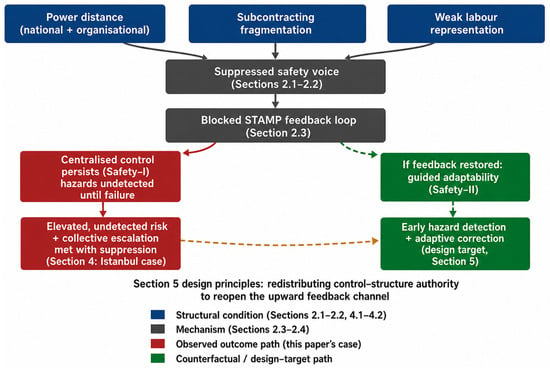
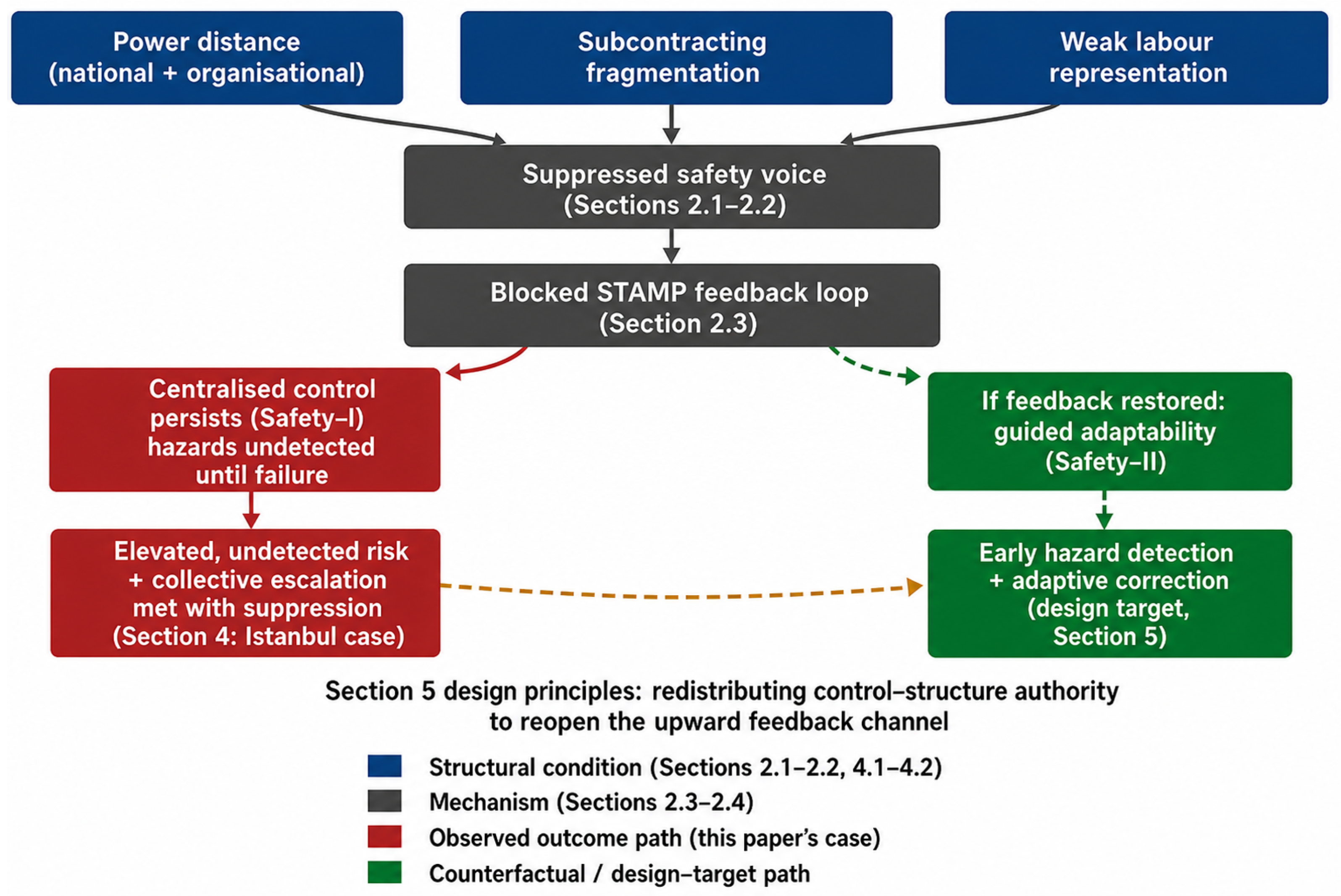
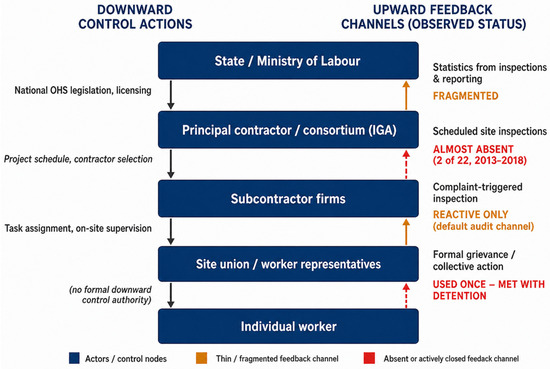
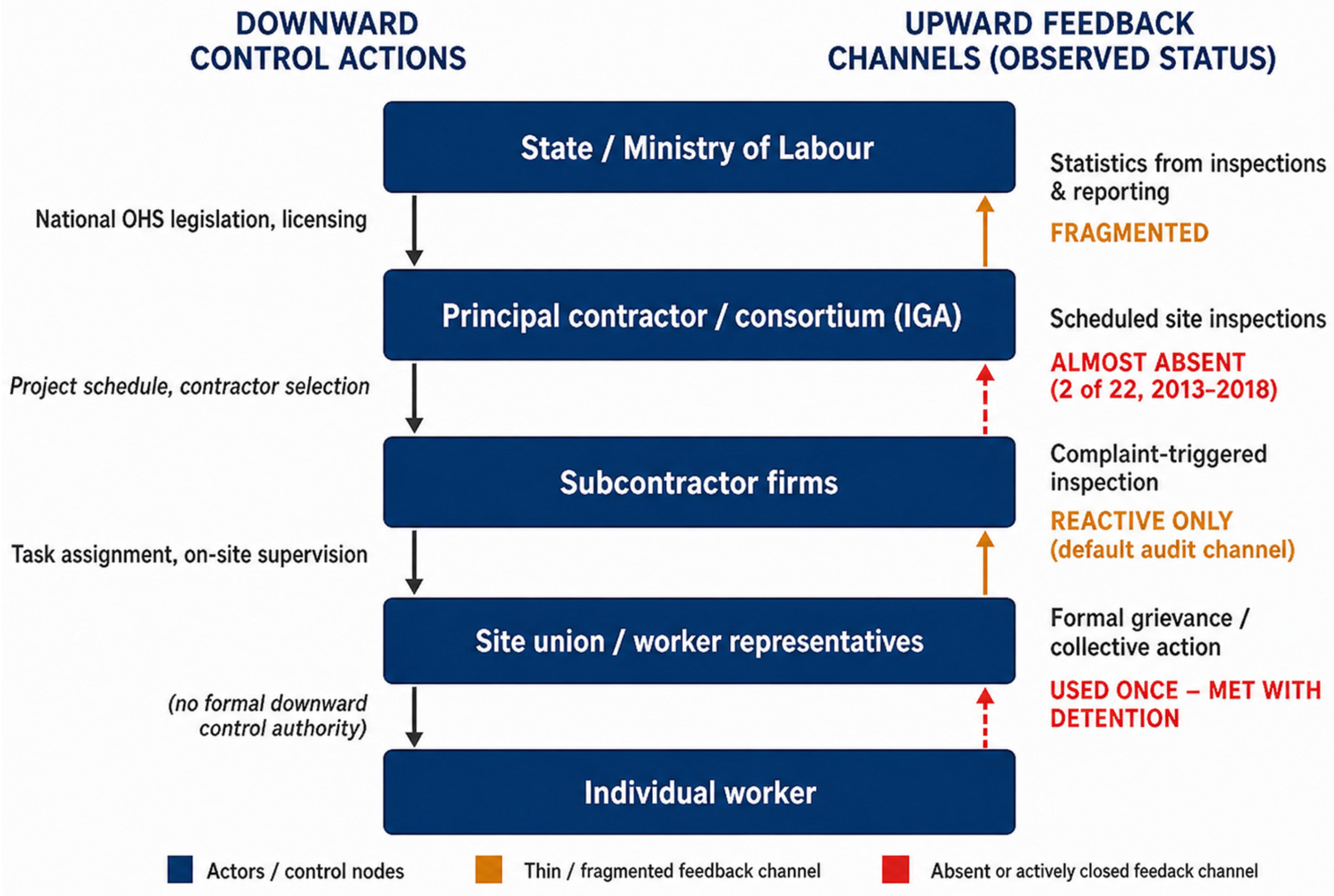
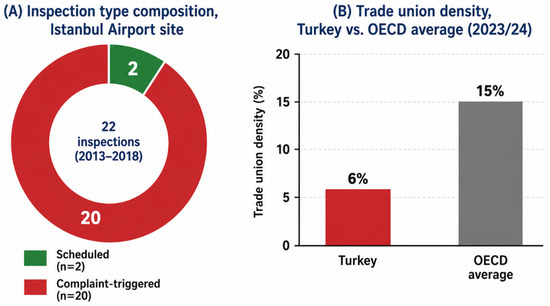
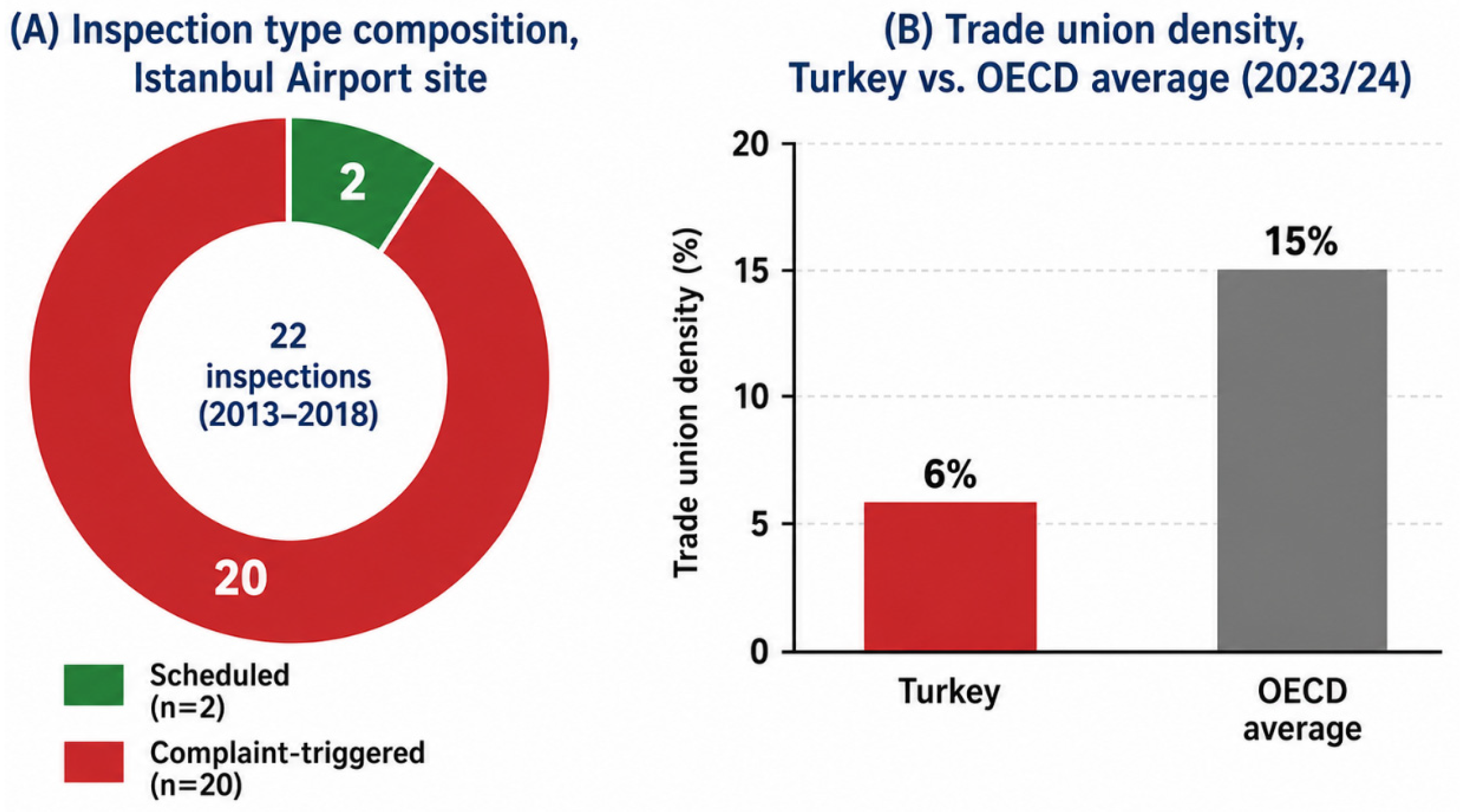
Disclaimer/Publisher’s Note: The statements, opinions and data contained in all publications are solely those of the individual author(s) and contributor(s) and not of MDPI and/or the editor(s). MDPI and/or the editor(s) disclaim responsibility for any injury to people or property resulting from any ideas, methods, instructions or products referred to in the content. |
© 2026 by the author. Licensee MDPI, Basel, Switzerland. This article is an open access article distributed under the terms and conditions of the Creative Commons Attribution (CC BY) license.