


Abstract
The convergence of Artificial Intelligence (AI) and Building Information Modeling (BIM) is reshaping how the Architecture, Engineering, and Construction (AEC) sector manages projects across their lifecycle, yet the systemic uptake of this convergence remains poorly understood in developing-economy contexts such as Morocco. This study examines the state, opportunities, and barriers of BIM–AI integration in Morocco’s AEC sector through a PRISMA-guided scoping review combined with a bibliometric analysis. An initial global search of Scopus and Web of Science identified 1842 records; after successive screening for relevance to BIM–AI integration and to the Moroccan context, six core studies were retained for detailed synthesis. The bibliometric analysis, covering the broader filtered corpus, shows a publication trend with three distinct growth phases between 2015 and 2025 and reveals that Moroccan research output on digital construction is disproportionately concentrated on energy-efficiency applications rather than construction management or structural engineering. The synthesis of the six core studies further indicates that BIM–AI integration in Morocco remains at an early, largely 3D-focused stage, with significant conceptual and empirical gaps. Building on these findings, this study proposes a three-tiered strategic roadmap, targeting policy, industry, and academia, to accelerate digital transformation and innovation in Morocco’s construction sector.
1. Introduction
The Architecture, Engineering, and Construction (AEC) sector has long been associated with organizational silos, modest productivity gains, and a slower pace of digital uptake relative to manufacturing or aerospace industries [1]. Over the past ten years, the emergence of “Construction 4.0” an extension of the “Industry 4.0” framework applied to physical infrastructure has triggered a significant shift [2]. Central to this evolution is Building Information Modeling (BIM).
Initially conceived as a tool for three-dimensional modeling and geometric clash detection, BIM evolved into a comprehensive process for data management covering the entire lifecycle of construction projects [3]. Although BIM constitutes a digital structured container for numerical data, it is increasingly recognized that this technology alone cannot address the complex and dynamic challenges of the modern AEC sector, whether in risk management, automated verification, regulatory compliance, or predictive maintenance [4].
Beyond geometric modeling, BIM’s growing capacity to capture project attributes and process data in a structured, queryable format has created new opportunities for organizational learning. When systematically recorded, this data can support the extraction of lessons learned across projects, reducing reliance on individual experience and supporting more consistent knowledge sharing within organizations. This capacity, however, remains largely untapped unless it is coupled with analytical tools capable of interpreting the resulting volumes of data, which is precisely the role that AI is increasingly called upon to play.
These limitations have motivated the emergence of AI-driven BIM in civil engineering. AI, encompassing subfields such as Machine Learning (ML) and Deep Learning (DL), can act as a cognitive layer capable of interpreting BIM models and their associated data at a scale and speed beyond manual human analysis. The integration of BIM and AI is therefore increasingly regarded as a natural extension of the digital construction paradigm, shifting BIM from a passive data repository toward an active decision-support system. Understanding this shift in a developing-economy context such as Morocco’s is significant because it fills a specific evidentiary gap: this study is, to our knowledge, the first PRISMA-ScR-compliant Table S1 [5], bibliometrically grounded synthesis to situate Morocco within the global BIM–AI literature and translate the resulting evidence into a strategic roadmap for policy, industry, and academia.
The Morocco construction sector is a key contributor to the economy as well as a major provider of jobs. In addition, there are several infrastructure projects being run on a continental scale which are relying on accurate measurements as better-quality guarantees than normal cannot safely ensure [6]. Notwithstanding, the use of BIM appears to be highly focused and limited to the 3D conception phase while the 4D, 5D and 6D/7D dimensions remain in the backdrop and there is no human integration of AI in the local professional discourse [7,8]. Studies in this area either deal with the issues of AI or BIM or, at most, focus on AI plus BIM, without systematically mapping the volume, focus, or practical implications of this intersection specifically for Morocco. There is a huge scarcity of literature that investigates challenges and constraints in AI–BIM integration. To address this literature gap and achieve a more contextualized synthesis, this article proposes a scoping review, coupled with bibliometric analysis following the PRISMA guidelines of a selection of academic works between 2015 and projected to 2025 to identify and map the existing corpus of knowledge and relevant applications for Morocco. This work is structured around four research questions (RQs).
RQ1.
What is the current state of BIM and AI adoption in Morocco’s AEC sector?
RQ2.
Which areas of the construction sector in Morocco are most suitable for BIM–AI applications?
RQ3.
What are the main technical, organizational, and regulatory barriers to integration?
RQ4.
What strategic directions could best accelerate the transition toward AI-driven BIM adoption in the country?
The article is structured as follows. Section 2 presents the theoretical background. Section 3 details the materials and methods, including the search strategy, eligibility criteria, and characteristics of the papers selected for analysis. Section 4 presents the bibliometric and qualitative results. Section 5 offers a critical discussion of those findings in light of each research question. Section 6 provides strategic recommendations, and Section 7 concludes the article.
2. Theoretical Background
2.1. BIM from 3D Modeling to Lifecycle Data Ecosystem
The introduction of Building Information Modelling (BIM) began to take shape in the late 1970s when CAD technologies were launched [3]. BIM’s definition evolved with building SMART’s release of the IFC standard in the 1990s and began to be applied in earnest in the AEC sector [3]. In fact, BIM refers more to the process than the software, which in fact involves the geometric, spatial, and sematic information over the whole life of a construction project [9]. This refers to 3D for early design, 4D for scheduling, 5D for cost estimating, and so on [9,10]. More recently, BIM has been understood as an information management framework, mainly with the publication of the ISO 19650 series [11]. Moreover, at least three countries with considerable influence on the Moroccan case have national BIM mandates: the United Kingdom, Singapore, and some Nordic countries [11]. The ministry responsible for the housing section, including urban planning and the national territory, shows some BIM awareness in official framework documents but no national binding BIM mandate (as of 2025) [6].
Most often, projects drive BIM adoption. In other words, this practice is usually limited to bigger companies, especially ones where the contracts are international, as foreign clients require BIM as part of the contract [7].
2.2. Artificial Intelligence in the AEC Sector
Over the last 10 years, AI has found its way into an increasing number of AEC programs. Random Forest, Support Vector Machines, and Gradient Boosting algorithms are currently being used to provide cost estimates as well as schedule risk prediction and site safety monitoring [4,12]. Deep learning has similarly had a powerful impact. Specifically, Convolutional Neural Networks (CNNs) have been very effective at defect detection in images, progress tracking in drone footage, and even code compliance checking [13]. At the same time Natural Language Processing (NLP) is being applied to extract requirements from specification documents and to assist in contract disputes analyses [14]. Introducing AI becomes particularly valuable when applied to the rich structured data found in BIM models. According to Pan and Zhang [4], five areas in which applying AI to BIM can produce substantial benefits are design optimization, construction planning and scheduling, safety and risk management, structural health monitoring, and energy performance simulation. All five are highly relevant to Morocco; however, research in these fields at the local level remains nascent [7].
2.3. Digital Transformation in Developing Economies
The challenges of BIM adoption in developing countries vary significantly from those in developed nations. According to Osei-Kyei and Chan [15], they are often systemic rather than technical. Regulatory uncertainty, informal procurement processes, limited funding for new technologies, and a skills gap that goes beyond a mere lack of training. This is corroborated by a region-specific survey of BIM adoption barriers across the Middle East and North Africa [16], which identifies a comparable set of sociotechnical constraints rather than a single dominant technical obstacle.
The construction industry in Morocco with SMEs representing more than 95% of the registered firms is particularly at-risk [6,17]. On the flip side, the absence of deeply embedded “legacy systems” can be advantageous too. In other words, that means there is an opportunity for leapfrogging. According to some researchers, the same may be true for BIM adoption in Africa too [18]. The idea is well-known from the mobile telecom industry [19].
The real question is whether Morocco can put the right enabling conditions in place on the regulatory, educational, and financial fronts to turn leapfrogging from a nice idea into a concrete reality [20].
3. Materials and Methods
This research adopted a two-phase design combining a quantitative bibliometric analysis with a scoping literature review. The scoping review followed the methodological framework of Arksey and O’Malley [21] and was reported in accordance with the PRISMA extension for Scoping Reviews (PRISMA-ScR) [22]. The aim is to explore recent literature at both national and international scales, identifying the convergence between Building Information Modelling (BIM) and Artificial Intelligence (AI) in the AEC sector. The study examined a range of performance indicators from a bibliometric perspective. These included published documents per year, types of documents and country of origin of contribution, highlighting the distinctions between a developed country context and Moroccan realities. Subsequently, keyword co-occurrences were reviewed, and after that, co-authorship clusters were studied to uncover trends and sub-trends on “BIM–AI”. Ultimately, the qualitative aspect assessed the influential journals and citation indicators which lead to the recognition of seminal works currently guiding digital transformation in civil engineering.
3.1. Data Sources and Research Strategy
The references identified were covered by extracting the data from two main databases which were Scopus and Web of Science (WoS). It can be argued that two already broad interdisciplinary databases will yield probably more relevant results such as coverage in civil engineering, computer science, construction management. It additionally guarantees the availability of reviewed works only. Each cluster contained a set of search terms. Boolean operators (AND, OR) were used to delimitate and specify search parameters. To introduce a more precise perimeter while still responding to the specificities of the challenges, we also added a geographical filter concerning Morocco and North Africa. As shown in Table 1.
Table 1.
Search query strings and keyword clusters.
3.2. Eligibility Criteria and Screening
Following the initial data collection, a screening process was applied to guarantee the relevance and quality of selected works. Inclusion and exclusion criteria were defined in advance to minimize selection bias. Only peer-reviewed articles published between 2015 and 2025 were included, in order to capture the most recent advances in Construction 4.0, as shown in Table 2.
Table 2.
Eligibility criteria for study inclusion and exclusion.
3.3. Study Selection Process
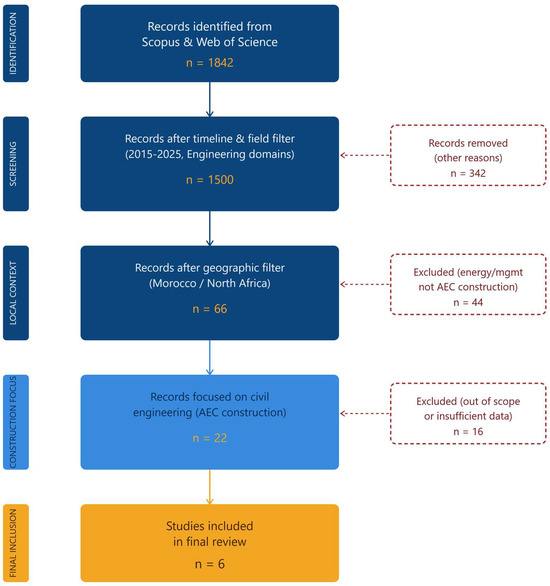
Following the PRISMA-ScR guidelines [22], the initial broad search across Scopus and WoS yielded 1842 records, a figure that testifies to the global interest in digital technologies within the built environment. Duplicate records across the two database exports were identified and removed using Zotero’s (version 6.0.36) reference-management software prior to screening. A primary filter applying the 2015–2025 timeline and engineering field restrictions reduced the corpus to 1500 documents. This 1500-document corpus is used exclusively for the bibliometric landscape analysis presented in Section 4 (publication trends, keyword co-occurrence, co-authorship geography); it is not used as direct evidence for claims about Morocco specifically. A secondary geographical filter (Morocco, North Africa, MENA, and developing economies, as specified in Table 1) further reduced the corpus to 66 documents.
Detailed analysis of these 66 documents revealed that the majority addressed energy efficiency or construction management rather than BIM–AI integration. After excluding out-of-scope documents, 22 remained focused on civil engineering. A final full-text eligibility review focused exclusively on BIM and AI reduced the dataset to three documents specifically addressing the Moroccan or African AEC context (Tajmout et al. [7]; Bouhmoud et al. [23]; Saka & Chan [18]), underscoring the scarcity of research on BIM–AI integration in Morocco’s AEC sector. Given this scarcity, three additional globally influential theoretical papers (Succar & Kassem [24]; Pan & Zhang [4]; Sacks et al. [2]) were incorporated as interpretive framing references; these three papers are reported in Table 3 (Section 4.4). Title, abstract, and full-text screening at every stage were conducted by a single reviewer (the corresponding author); this is noted as a limitation in Section 5, together with a recommendation for dual independent screening in future replications. The full search strings applied at each stage are reported in Table 1. In terms of characteristics, the three search-derived studies span two study types (an exploratory survey and two literature/scientometric reviews) and two geographic scopes (Morocco-specific and Pan-African), none reporting AI-technique use alongside BIM; full study-level characteristics are reported in Table 3.
Table 3.
Synthesis of core studies: Search-derived Morocco/Africa-specific studies and global theoretical framing references.
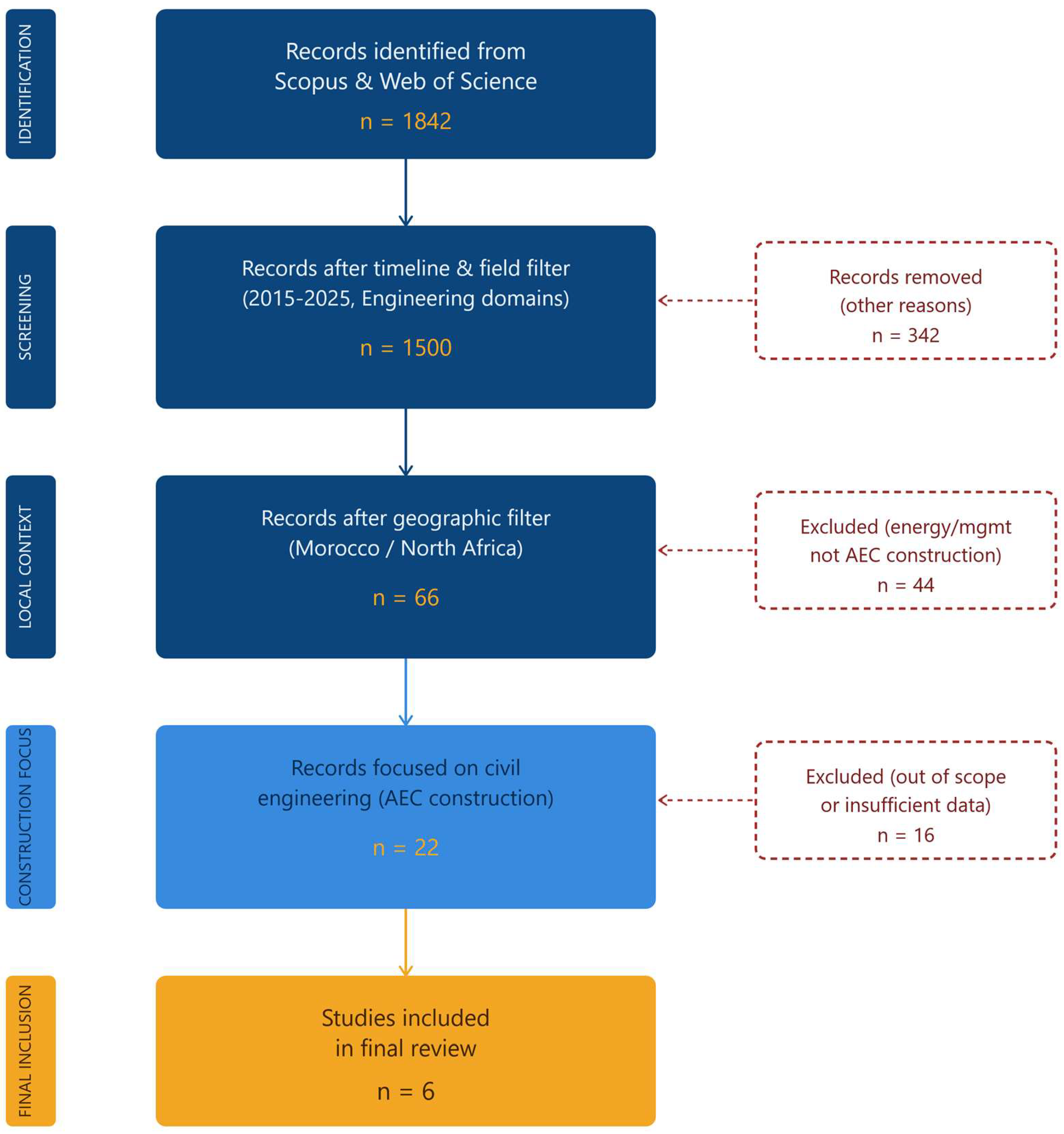
Figure 1 presents the PRISMA flow diagram illustrating the selection funnel: Identification (n = 1842) → Screening (n = 1500) → Local Context (n = 66) → Construction Focus (n = 22) → Final Inclusion (n = 6). Note that the numbers in the PRISMA diagram reflect the total records removed at each stage, including duplicates and records that did not meet field or geographic criteria.
Figure 1.
PRISMA flow diagram illustrating the selection funnel: Identification (n = 1842) → Screening (n = 1500) → Local Context (n = 66) → Construction Focus (n = 22) → Final Inclusion (n = 6).
3.4. Bibliometric Analysis Tools
For the bibliometric mapping, we used VOSviewer (version 1.6.20, from Leiden University in Leiden, the Netherlands). The first step was to carry out a co-occurrence analysis on author keywords. We made the minimum number of occurrences of a keyword three. This gave us a network of 89 keywords from the entire set of 1500 documents. We performed another co-authorship analysis, but this time we took a country-based approach. We screened countries based on the fact that an association must have contributed to at least five document outputs. For the sake of transparency and reproducibility, all other network settings (resolution, minimum cluster size, minimum number of documents per author, etc.) were left at their default VOSviewer settings. Two datasets were used, namely CSV exports from Scopus and plain-text exports from Web of Science. Any visualization from either data source was generated after removing duplicates. We validated DOIs against Scopus for elimination of duplicates.
3.5. Publication Trends (2015–2025)
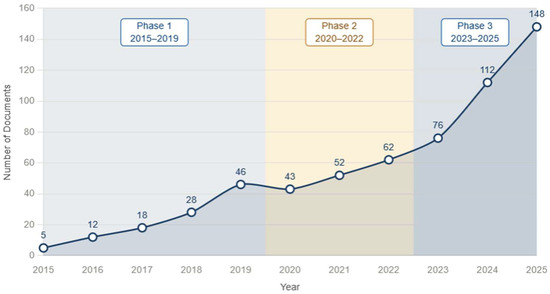
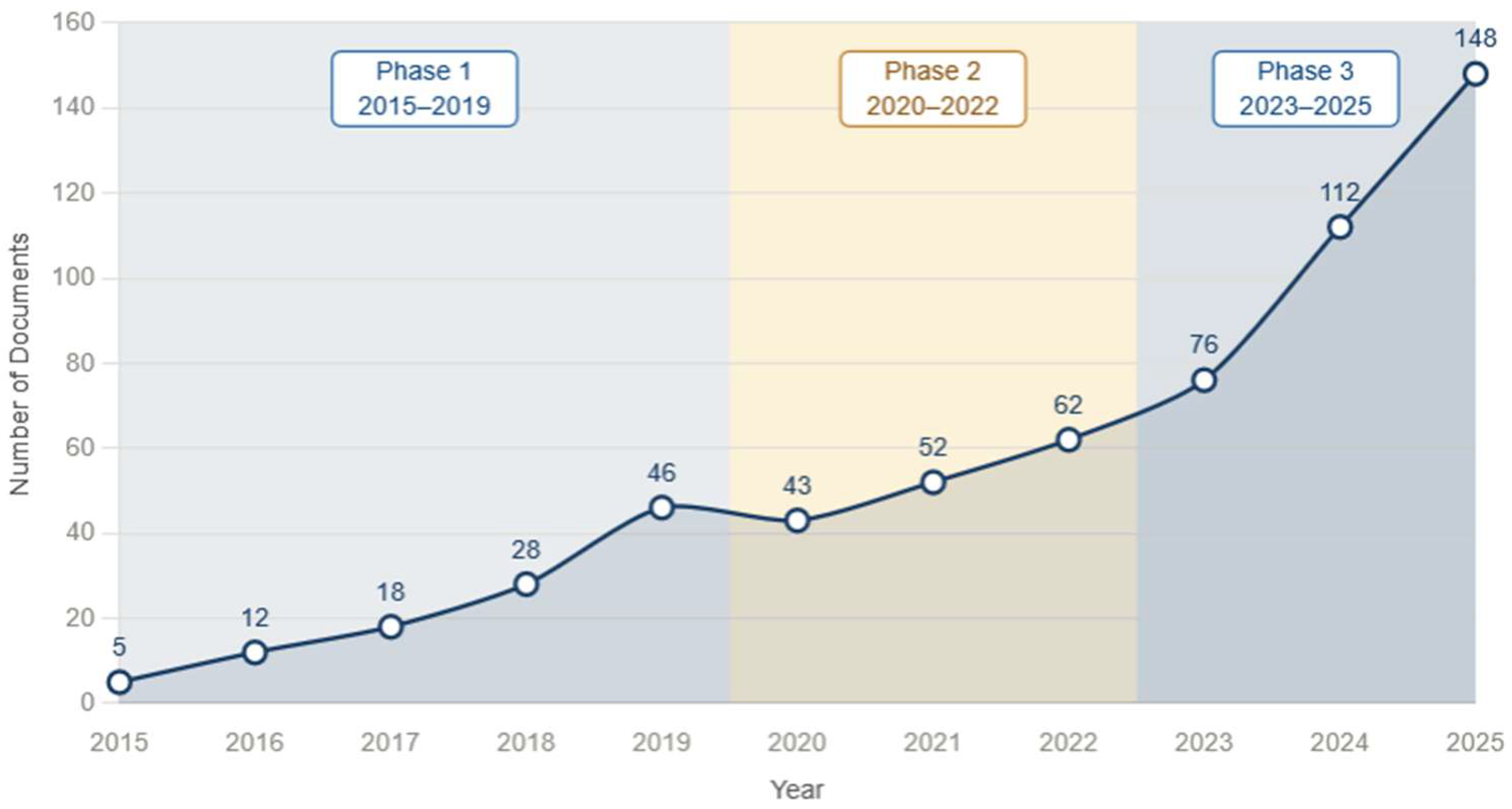
Figure 2 illustrates publication trends from 2015 to 2025, revealing growth across three distinct phases. The first phase (2015–2019) saw publications grow from 5 documents in 2015 to 46 in 2019. The second phase (2020–2022) showed sustained growth, exceeding 50 publications per year. The third phase, beginning in 2023, exhibited exponential growth, surpassing 100 documents per year and reaching approximately 150 publications by 2025.
Figure 2.
Per year publications on BIM–AI integration in AEC (2015–2025).
This three-stage pattern reflects a broader AI research trend. The initial phase corresponds to the period just after the UK BIM Level 2 mandate came into play and IFC adoption saw a growth in followers. The second phase coincides with the emergence of more user-friendly deep learning tools such as TensorFlow and PyTorch. The third step shows the recent coming of large language models and generative AI that has started to find applications in the design and construction workflow [4,25].
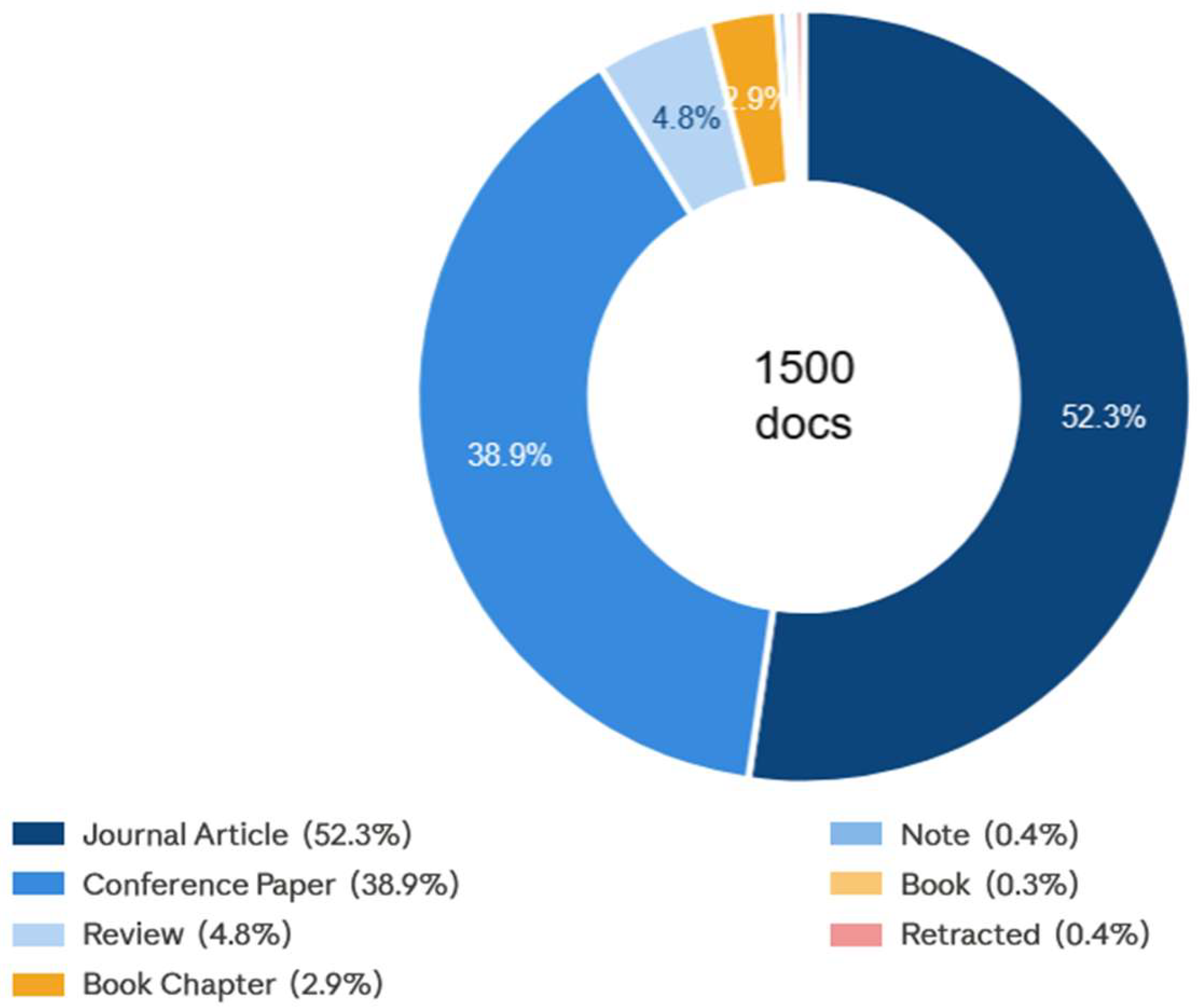
3.6. Document Typology
According to the document typology in Figure 3, the most dominant document type is journal articles (52.2%). Within the corpus, almost forty percent of conference papers (38.9%), while the balance is made up of reviews, book chapters, etc. Nearly 39% of the corpus are made of conference papers, which is interesting. No doubt, this is not surprising at all, as it is in line with the newness of the discipline, which is changing fast and is technology oriented. It probably has to do with the fact that scholars prefer to showcase new findings at conferences and in journals later.
Figure 3.
Typology of publications in the BIM–AI AEC corpus.
However, this also means that a substantial share of the existing BIM–AI literature has not yet undergone the more rigorous peer review associated with journal publication, which introduces a potential quality bias into the corpus analyzed in this review.
3.7. Geographical Distribution
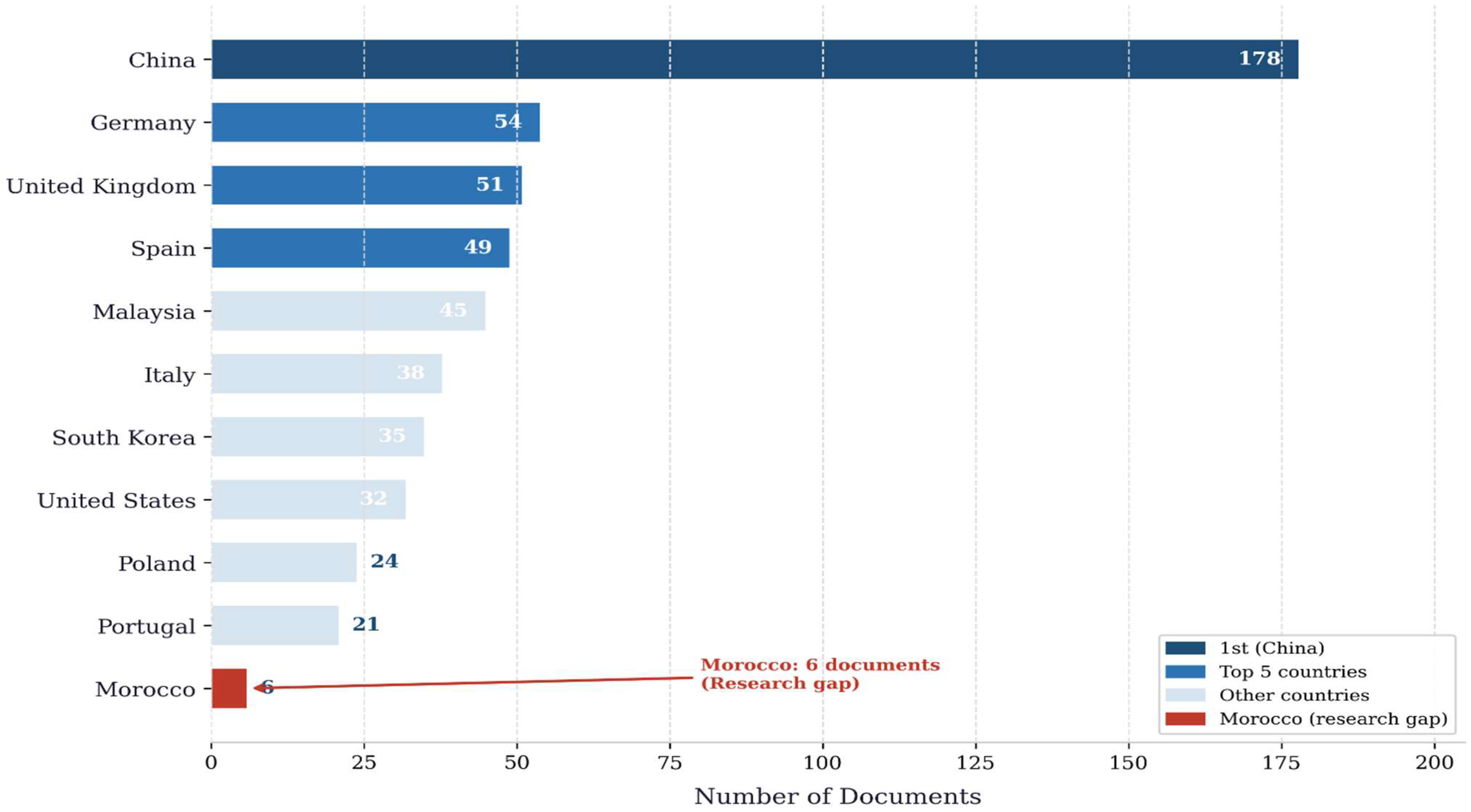
Figure 4 shows the number of publications by country or territory. This is filtered to include only countries with more than 20 publications plus Morocco. China has 178 documents, while Germany, the UK, and Spain have just under 50 documents each, roughly one-third of China’s total. Morocco, by comparison, has only 6 documents. This reflects a substantial disparity between research activity in East Asia and Western Europe, which lead BIM–AI studies, and North Africa.
Figure 4.
Publications by country or territory (countries with >20 documents, plus Morocco).
Two factors appear to explain this pattern: first, countries such as the UK, Singapore, and South Korea have formal BIM mandates driven by regulatory policy; second, the major construction technology firms and leading research universities are concentrated in these same countries. Malaysia is a particularly instructive case, having entered the group of high-output countries despite comparable developing-economy constraints to Morocco’s. Since initiating a coordinated national BIM policy in 2014, Malaysia has achieved a level of BIM maturity and research output that offers a potentially transferable model for Morocco [26,27].
4. Results and Analysis
In this section, findings from the bibliometric and qualitative analyses are presented offering a structured synthesis of the findings emerging from the reviewed studies, moving from a global overview of the BIM–AI literature to Morocco-specific findings and their comparison against this global picture.
4.1. Keyword Co-Occurrence Analysis
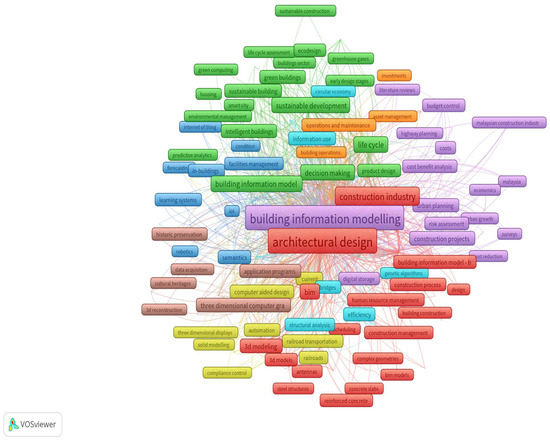
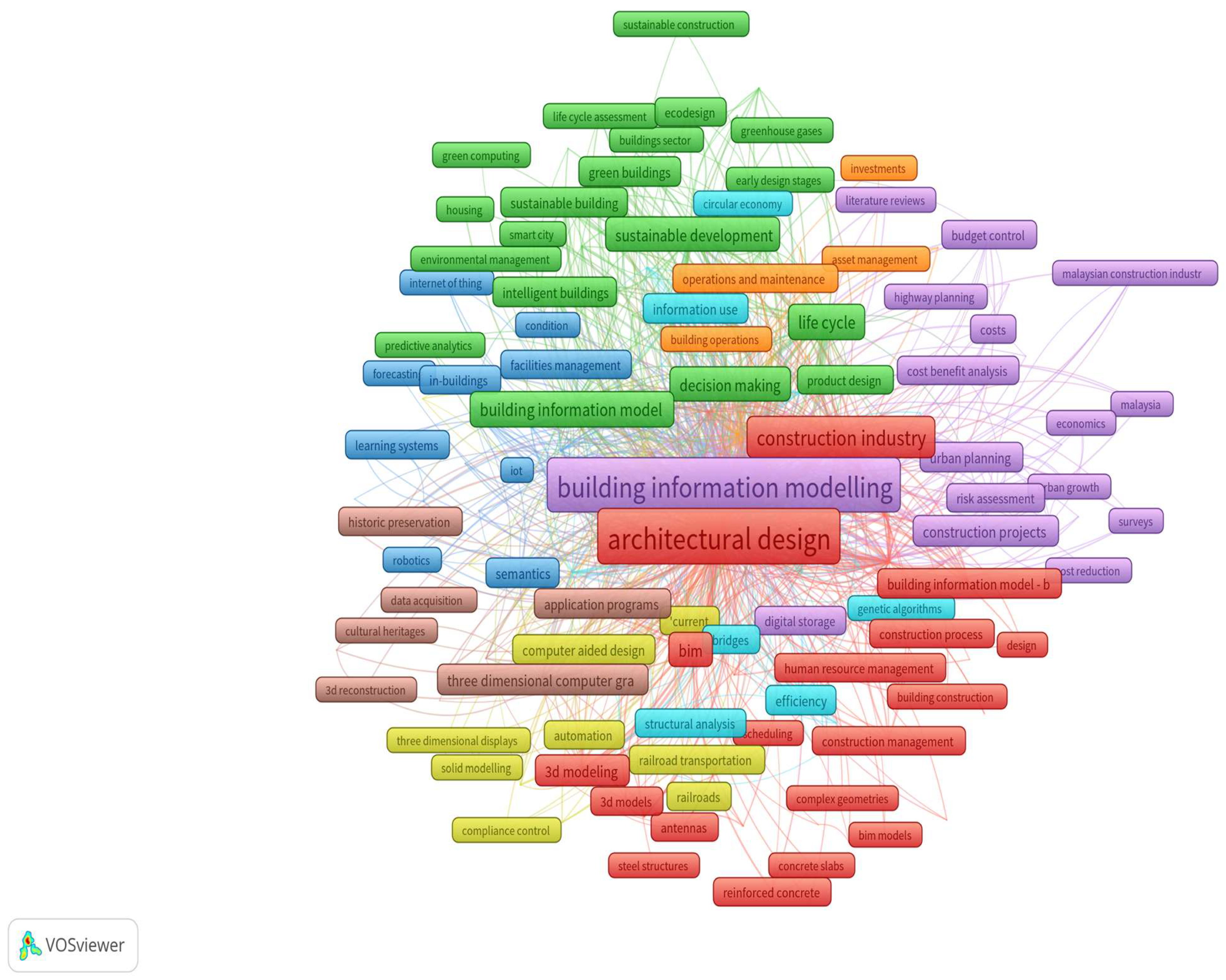
The keyword co-occurrence network generated by VOSviewer, as presented in Figure 5, shows that the articles can be grouped into 7 clusters or themes, namely BIM, design, 3D modeling, sustainable development, historic preservation, construction, management, and digital technologies. Also, that network possesses a total of 7721 links with a strength of 19,510.
Figure 5.
Keyword co-occurrence network (VOSviewer, 7 clusters, 7721 links, 19,510 total link strength).
The keyword network shows that “Building Information Modelling” and “architectural design” occupy central positions, indicating that the global literature remains predominantly focused on project design applications. Notably, AI-related terms such as machine learning, deep learning, and neural networks appear in smaller, distinct clusters that are nonetheless growing rapidly, suggesting a gradual shift in the global literature from BIM alone toward AI-augmented BIM.
Morocco-specific keywords are virtually absent from this network, consistent with the small number of Moroccan records retained through the PRISMA funnel. While Morocco’s engagement with this global research conversation is growing, it remains limited in volume and only weakly connected to the broader thematic clusters observed elsewhere.
4.2. Co-Authorship Analysis
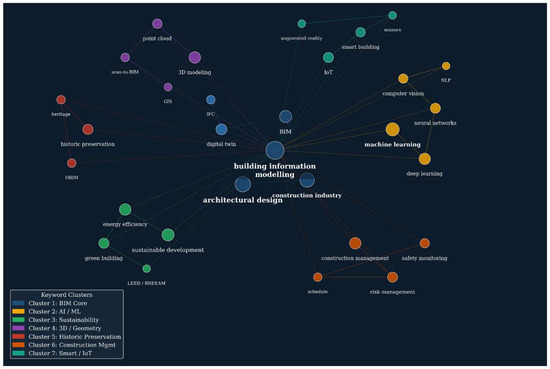
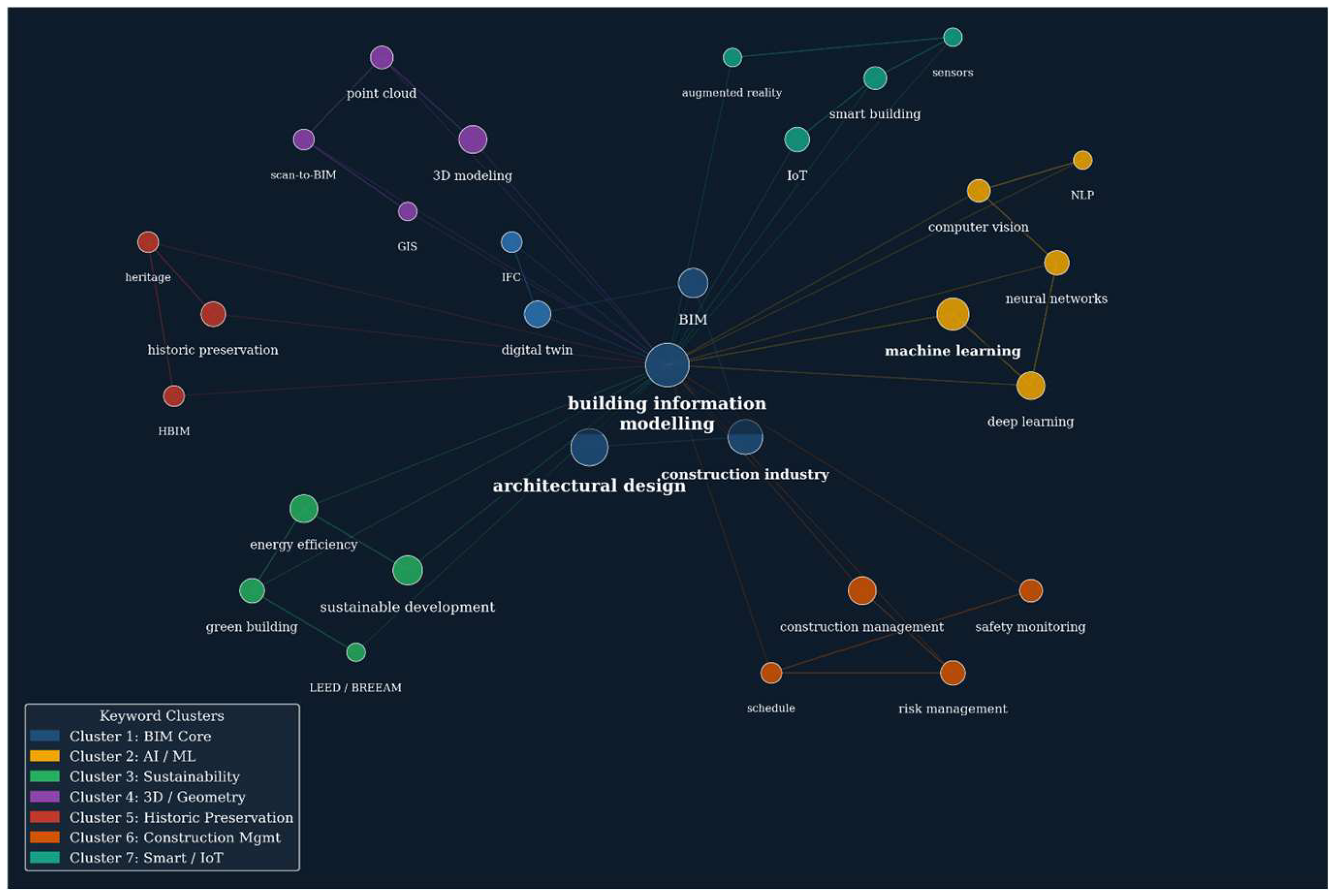
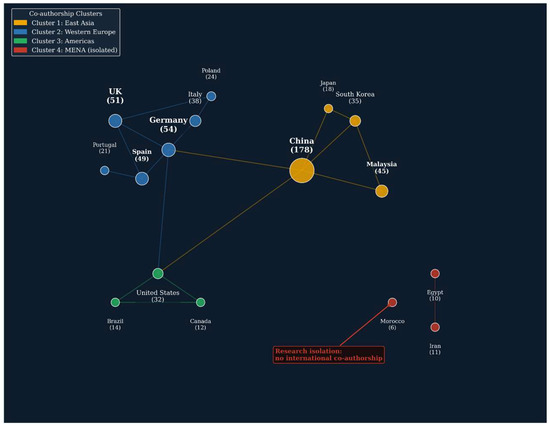
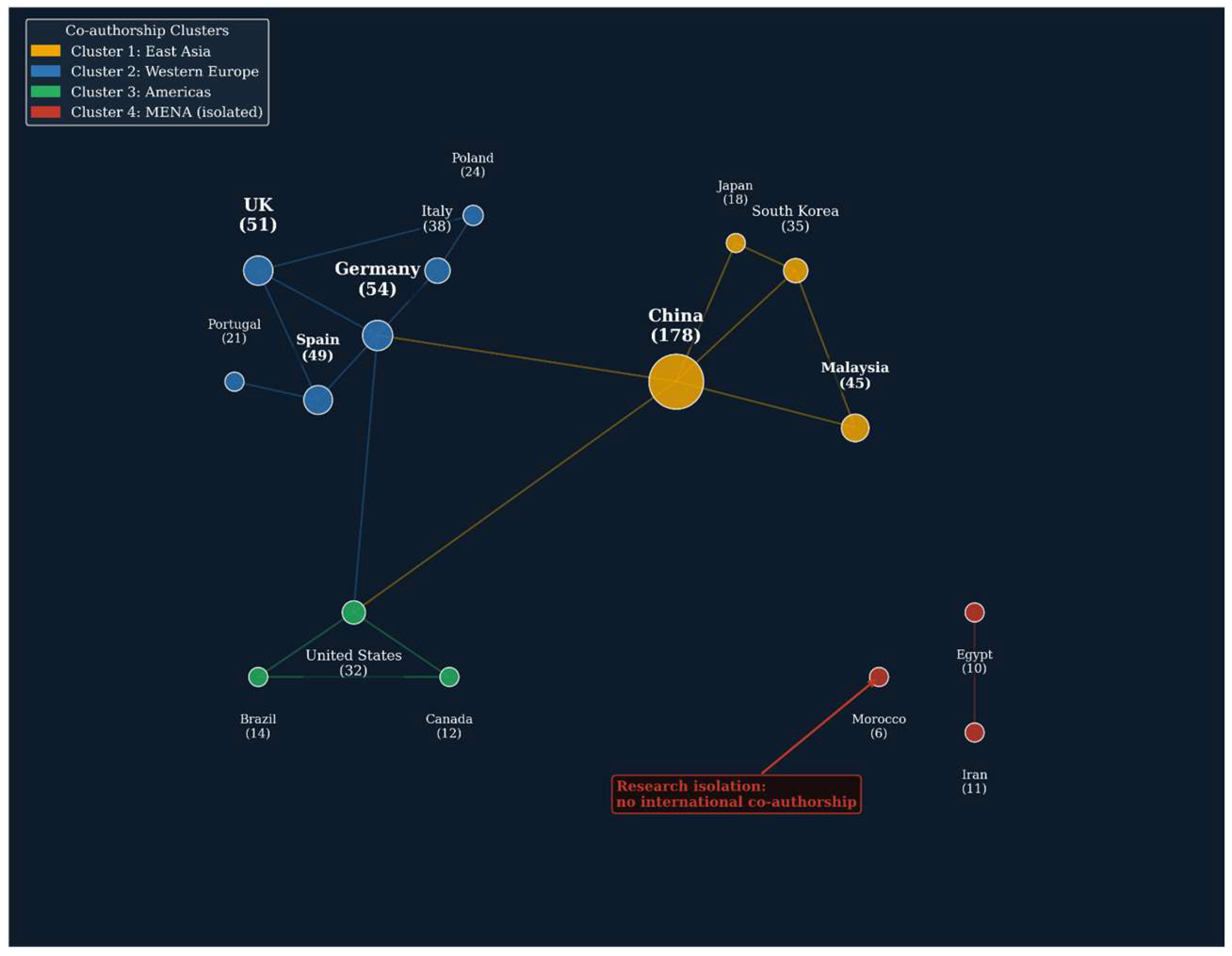
Figure 6 shows a co-authorship network comprising four major clusters with 22 links and a total link strength of 26, reinforcing the geographic concentration of research activity in Asia already observed in the publication counts (Figure 4). Notably, the co-authorship network’s total link strength of 26 is markedly lower than the keyword co-occurrence network’s total link strength of 19,510. This substantial gap suggests that BIM–AI research communities remain relatively isolated from one another across countries, even where thematic overlap exists.
Figure 6.
Focused keyword co-occurrence network.
There is also limited evidence that North African institutions participate in international co-authorship networks, indicating that Moroccan research in this space remains largely isolated and disconnected from global flows of knowledge. This has direct implications for the strategic recommendations proposed in Section 6.
4.3. Synthesis of Core Studies
As detailed in Table 3, the six studies that met full eligibility criteria were retained for the final corpus. For all the studies we collected, we recorded the country of origin, study type, BIM dimensions, AI techniques used, key finding, and identified research gaps. This synthesis directly answers RQ1 and RQ2 and provides the empirical foundation for the discussion in Section 5.
When you look across the six summarized studies in Table 3, three patterns clearly emerge. First, timing. Every single one of these studies was published after 2017, and four of them came out after 2020. That tells us this research area BIM–AI integration in Morocco and Africa is still very new.
Second, data. The articles make use of other papers but does not rely on the papers based on empirical data from the Moroccan construction sector. To date, the Morocco-only papers by Tajmout et al. [7] and Bouhmoud et al. [23] either use the literature or rely on exploratory surveys; valuable but insufficient to provide useful hard performance metrics to guide decision making.
Thirdly, the Scope researchers worldwide showcase successful AI–BIM integration from 4D to 7D, as reflected in the two global framing references that address AI–BIM convergence directly [2,4]. By contrast, all three search-derived studies on Morocco and Africa report on BIM use confined to 3D. This lines up with what we see in practice in the construction industry; we refer to this pattern as a “3D ceiling,” defined and evidenced in Section 4.4 below.
4.4. The 3D Ceiling: Definition and Evidence
We define the “3D ceiling” as a pattern in which BIM implementation remains confined to three-dimensional geometric and visual modeling, without progressing to time-based scheduling (4D), cost integration (5D), sustainability and energy-performance analysis (6D), or facility management and operations (7D). Concretely: 3D refers to the geometric/visual modeling of building components; 4D adds construction sequencing and scheduling data; 5D integrates cost estimation and quantity take-off; 6D incorporates sustainability and energy-performance simulation; and 7D extends the model into the operations and facility-management phase of the building lifecycle.
Operationalized against Table 3, this pattern is evident in all three search-derived, Morocco/Africa-specific studies: Tajmout et al. [7], Bouhmoud et al. [23], and Saka & Chan [18] each report BIM use confined to 3D, with no discussion of 4D–7D applications. By contrast, the two global framing references that directly address AI–BIM convergence, Pan & Zhang [4] and Sacks et al. [2], both describe 4D–7D applications as already established internationally. This 3-of−3 pattern, while based on a small sample, is consistent with informal industry observation and motivates the strategic roadmap proposed in Section 6.
Concretely, the technologies that distinguish the global framing references from the search-derived studies include sensor-fed machine learning models for structural health monitoring and predictive maintenance [4], computer vision applied to site imagery for safety and accident prevention [13], rule-based or NLP-powered automated regulatory compliance checking [4,13], and AI-enhanced 6D BIM for energy performance simulation; none of these AI–BIM applications are yet reported in the search-derived Morocco/Africa studies, which instead rely on statistical survey analysis [23], scientometric/bibliometric methods [18,28], and text-mining/NLP applied to the heritage-documentation literature [7], none involving AI applied to BIM models directly.
4.5. Structured Evidence Matrix of Search-Derived Studies
Table 4 presents a structured evidence matrix for the three search-derived Morocco/Africa-specific studies, reporting the research setting, methodology and sample, BIM dimension and AI application, and reporting barriers/key findings for each. This matrix allows readers to directly verify that the claims made in Section 5 are traceable to specific studies, rather than to the undifferentiated evidence base as a whole.
Table 4.
Structured evidence matrix of search-derived studies.
5. Discussion
Each research question below is addressed by first stating the finding as it emerges from the search-derived studies (Table 3) or the structured evidence matrix (Table 4), then interpreting it against the global framing references and broader bibliometric corpus, with claims extrapolated from the international literature or professional experience labeled accordingly.
5.1. RQ1: State of BIM and AI Adoption in Morocco
The quantitative analysis of the research corpus highlights a pronounced energy-efficiency bias within Moroccan academic output: of the 66 documents identified in the geographic filter, 67% (44 out of 66) addressed BIM or digital tools in the context of energy performance rather than construction management or structural engineering. While this is consistent with Morocco’s national energy strategy and renewable energy targets, it suggests that research attention is directed away from the operational construction challenges faced by contractors, project managers, and site engineers.
The analysis of the 6 final core studies confirms that BIM–AI integration in Morocco is in its infancy. In the last three years (2022–2025), six publications were produced, which demonstrates that this is a very recent phenomenon in North African countries. Most of the papers are either a theoretical framework or a pilot experiment with hardly any longitudinal data based on experiments on an actual site. In addition, no articles address the interoperability issue, resulting in the fragmented supply chain in the Moroccan context.
Malaysia offers an instructive comparison: despite being a developing economy, it reached an advanced level of BIM maturity through a coordinated national program, whereas Morocco’s trajectory more closely resembles a “passive adoption” state rather than an actively accelerating one [26]. Malaysia’s approach was anchored in a formal BIM roadmap launched by CIDB in 2014.
Since 2016, Malaysia has required BIM for public projects above a defined budget threshold. This single policy achieved two effects simultaneously: a regulatory push driving industry-wide BIM adoption, and a corresponding demand-pull effect on academic research in the field [26].
Morocco currently has no equivalent policy in place, and this review suggests that this absence is directly reflected in the scarcity of empirical research on the topic originating from the country.
5.2. RQ2: High-Potential BIM–AI Synergy Domains for Morocco
Four areas for investment in BIM–AI were drawn from the global and national literature as well as the realities of the Moroccan construction market. These are areas that promise the best near-term return on investment.
5.2.1. Structural Health Monitoring and Predictive Maintenance
Morocco has two things working against its building stock: age and seismic risk, especially in the northern regions like the Rif Mountains and the Al Hoceima fault zone. That makes AI-driven structural health monitoring an urgent need, particularly when integrated with BIM facility management data [4]. Sensor-fed machine learning models that can catch early signs of structural problems are a high-impact, technology-ready solution.
5.2.2. Construction Site Safety and Accident Prevention
Construction site safety is widely regarded as a critical concern across the MENA region, and Morocco’s construction sector is no exception. Computer vision applied to site imagery and linked to BIM work-zone data has been shown in international studies to significantly reduce near-miss incidents [13]. Notably, this application requires only modest BIM maturity (3D plus 4D), placing it within reach of Morocco’s current technical capabilities.
5.2.3. Automated Regulatory Compliance Checking
Building permit approval in Morocco currently takes approximately 83 days on average, a significant bottleneck for urban development [6]. Rule-based or ML-powered code compliance tools capable of automatically checking BIM models against regulatory requirements could substantially reduce this timeline. Applying NLP to the Moroccan Construction Code (RTBA) could form the basis of a national automated compliance-checking engine.
5.2.4. Energy Performance Simulation and Optimization
Energy efficiency is already a strong theme in Moroccan research. AI-enhanced BIM energy models (6D BIM) could build right on that strength. Think of it as a bridge technology that leverages existing local expertise while extending it toward full lifecycle BIM–AI integration.
5.3. RQ3: Barriers to BIM–AI Integration in Morocco
Looking across the core studies and the wider literature, the barriers to BIM–AI integration in Morocco fall into three main buckets: technical, organizational, and regulatory/educational.
5.3.1. Technical Barriers
In public procurement, there is no standard requirement for IFC-compliant BIM deliverables in Moroccan tenders, and no Common Data Environment (CDE) framework is in place. Locally, most firms rely on CAD software that is not well suited to open BIM workflows, such as AutoCAD DWG and SketchUp. These proprietary formats create data silos that AI processing pipelines cannot easily interoperate with [23].
5.3.2. Organizational Barriers
The construction supply chain is fragmented. Architects, structural engineers, MEP engineers, and contractors rarely work together in a shared digital space. Procurement tends to be informal, which discourages upfront investment in digital tools when the return on investment is long-term. And senior decision-makers are often not fully aware of what BIM–AI integration could do for their operations [6,23].
5.3.3. Regulatory and Educational Barriers
There is no national BIM mandate or standard. Most Moroccan engineering schools do not include BIM in their curricula, and Moroccan researchers publish very little in international BIM–AI journals. This last point creates a reinforcing feedback loop: the absence of local evidence makes policy action harder to justify, while the absence of policy action limits the generation of new local evidence [6].
5.4. RQ4: Strategic Directions for Accelerating Adoption
These findings indicate that Morocco requires a coordinated approach to BIM–AI adoption that brings multiple stakeholders together; isolated efforts from industry or academia alone are unlikely to be sufficient.
The strategic directions proposed in Section 6 are grounded in two elements: first, the specific barriers identified in response to RQ3; and second, the success factors observed in countries such as Malaysia, South Korea, and Poland, which achieved significant BIM maturity growth within roughly a decade [11,26]. These cases are presented as illustrative precedents rather than directly transferable models, given differences in institutional environments, procurement systems, and governance capacity relative to Morocco.
5.5. Limitations of This Review
This review is subject to several limitations that should be considered when interpreting its findings.
First, the search was restricted to Scopus and Web of Science. As a result, grey literature, government statistics, and Arabic-language studies on Morocco not indexed in these two databases were excluded. Relatedly, title/abstract and full-text screening at every stage were conducted by a single reviewer rather than independently by two or more reviewers, and the exact date(s) on which each search was run were not prospectively logged; both are disclosed here as limitations, and we recommend that future replications of this review incorporate dual independent screening and prospectively log search dates.
Second, the geographical filter combined Morocco, North Africa, the MENA region, and developing economies more broadly.
While this broader lens was appropriate for a scoping review of an emerging topic, it may blur some conceptual distinctions between contexts. Future systematic reviews, particularly on the MENA region specifically, may benefit from a more narrowly tailored regional search strategy.
Third, and most importantly, only three studies met the full eligibility criteria for direct evidence about Morocco/Africa (supplemented by three additional global theoretical framing references, as detailed in Section 4.4). This is a small sample, and Table 3 should therefore be read as an illustrative mapping of the emerging research landscape rather than as a statistically representative meta-analysis.
Finally, Figure 5 and Figure 7 present bibliometric visualizations of the broader filtered corpus of 1500 documents, rather than the six core studies alone.
Figure 7.
Co-authorship network by country (VOSviewer, 4 clusters, 22 links).
6. Strategic Recommendations
Drawing on the findings of this review and on the trajectories of countries that have successfully navigated similar transitions, this section proposes a three-tiered strategic roadmap to accelerate BIM–AI adoption in Morocco’s AEC sector.
Table 5 makes this derivation explicit by linking, for each major recommendation, the identified barrier, the supporting evidence (search-derived study, international literature, or the authors’ professional experience—labeled accordingly), the corresponding intervention, and the international precedent, where applicable, so that no recommendation is presented without a traceable evidentiary basis.
Table 5.
Evidence-to-recommendation linkage framework.
The roadmap is built around three dimensions, policy, industry, and academia, with corresponding actions outlined across three time horizons (see Table 6 for the full breakdown).
Table 6.
Three-tiered strategic roadmap for BIM–AI adoption in Morocco.
The following subsections detail the roadmap at each level.
At the policy level, the most urgent short-term action is to formally establish BIM as a procurement requirement for large public infrastructure projects. Such a measure would send a clear signal to the market, incentivizing private firms to invest in BIM capacity while generating the real-world data needed to build an evidence base for future policy. Morocco does not need to start from scratch: the ISO 19650 framework offers a technology-neutral standard for managing information that can be adapted to the country’s legal and contractual context.
Firms’ priority should be given to SMEs as they represent the Moroccan construction market by 75% but generally do not have enough capital to invest in new technology. Programs to develop BIM capacity could be subsidized and run through a professional body like “l’Ordre des Architectes”, or l’Ordre des Ingénieurs, and co-financed by OFPPT (Office de la Formation Professionnelle et de la Promotion du Travail) so that the industry gets covered and not any one firm excessively burdened.
When it comes to academics, the gap with the most impact is the absence of empirical BIM–AI studies on real Moroccan construction sites. Researchers need to pay more attention to longitudinal case studies that monitor BIM–AI use on real-world infrastructure projects in Morocco. Such studies can generate the baseline data that policymakers and practitioners urgently need. The Moroccan institutions should make a strong case for setting up collaborative research programs with international partners, for example, Malaysia, Poland and Spain, that have successfully scaled BIM from similar zero baselines.
7. Conclusions
This scoping literature review has produced a systematic mapping of a severely underdeveloped research field: the development of Building Information Modeling (BIM) and Artificial Intelligence (AI) in the Architecture, Engineering and Construction (AEC) sector within the Moroccan context. To answer our four research questions, we used a two-stage approach combining bibliometric analysis with a scoping review. We started with 1842 records from Scopus and Web of Science, and after filtering, identified only three search-derived studies that directly examine BIM–AI integration in Morocco or Africa, supplemented by three global theoretical papers used for interpretive framing. Given this limited evidence base, the findings below are best read as a field-mapping exercise and a research agenda for future empirical work, rather than as a comprehensive account of BIM–AI implementation across the Moroccan construction sector.
The analysis reveals that progress toward Construction 4.0 requires an unambiguous commitment from multiple actors. Actual BIM adoption is typically limited to 3D modeling due to strategic shortcomings that fail to support the economic and operational dimensions of the construction sector. This study emphasizes that overcoming this digital divide requires shifting the perception of BIM from a mere geometric design tool to a dynamic data ecosystem that AI can leverage to optimize decision-making, anticipate risks, and automate processes throughout the lifecycle of civil engineering projects.
This study offers three key contributions. First, to the best of our knowledge, it provides the first PRISMA-ScR-compliant, bibliometrically grounded synthesis of BIM–AI research in Morocco’s AEC sector. Second, it identifies and characterizes the three existing search-derived studies in this space, revealing that all of them are limited to theoretical or pilot-scale work confined to a “3D ceiling” (Section 4.4). Third, it proposes a structured three-tiered strategic roadmap spanning policy, industry, and academia, explicitly linked to the identified barriers and evidence (Table 5), to help accelerate BIM–AI adoption in Morocco.
Future studies should focus on testing empirically. Consequently, for the theory to confront the reality of the sector, appropriate field surveys, questionnaires (to target), interviews (to structure), and experts (to certify) are used. We will thus be able to assess concretely the technological maturity of the enterprises and to make BIM–AI a concrete reality that will be able to improve the performance of civil engineering and construction in Morocco.
In greater detail, future research needs to do three things. To gain insight into the use of BIM and AI tools, first, structured surveys on Moroccan AEC firms categorized by firm size and project type will be performed. Then, a BIM maturity assessment framework will need to be deployed, regardless of the Moroccan situation with respect to rules and contracts. Ultimately, several AI–BIM pilot projects should be launched and assessed in collaboration with the Moroccan public infrastructure agencies in order to acquire the kind of substantive longitudinal empirical material that is currently missing.
Supplementary Materials
The following supporting information can be downloaded at: https://www.mdpi.com/article/10.3390/buildings16163287/s1, reference [5].
Author Contributions
Conceptualization, Y.T.; methodology, Y.T.; software, Y.T.; validation, Y.T. and A.M.; formal analysis, Y.T.; investigation, Y.T.; resources, Y.T.; data curation, Y.T.; writing—original draft preparation, Y.T.; writing—review and editing, Y.T. and A.M.; visualization, Y.T.; supervision, A.M.; project administration, A.M. All authors have read and agreed to the published version of the manuscript.
Funding
This research received no external funding.
Data Availability Statement
No new data were created or analyzed in this study. Data sharing is not applicable to this article.
Acknowledgments
The authors have reviewed and edited the output and take full responsibility for the content of this publication.
Conflicts of Interest
The authors declare no conflicts of interest.
Abbreviations
The following abbreviations are used in this manuscript:
| BIM | Building Information Modeling |
| AI | Artificial Intelligence |
| AEC | Architecture, Engineering, Construction |
| PRISMA | Preferred Reporting Items for Systematic Reviews and Meta-Analyses |
| ML | Machine Learning |
| DL | Deep Learning |
| SMEs | Small, Medium Enterprises |
| CAD | Computer Assisted Design |
| CNNs | Convolutional Neural Networks |
| WoS | Web Of Science |
| NLPs | Natural Language Processing |
References
- Sawhney, A.; Riley, M.; Irizarry, J. Construction 4.0: An Innovation Platform for the Built Environment; Routledge: London, UK, 2020. [Google Scholar] [CrossRef] [Scilit]
- Sacks, R.; Girolami, M.; Brilakis, I. Building information modelling, artificial intelligence and construction tech. Dev. Built Environ. 2020, 4, 100011. [Google Scholar] [CrossRef] [Scilit]
- Sacks, R.; Eastman, C.; Lee, G.; Teicholz, P. BIM Handbook: A Guide to Building Information Modeling for Owners, Designers, Engineers, Contractors, and Facility Managers, 3rd ed.; Wiley: Hoboken, NJ, USA, 2018. [Google Scholar] [CrossRef] [Scilit]
- Pan, Y.; Zhang, L. Roles of artificial intelligence in construction engineering and management: A critical review and future trends. Autom. Constr. 2021, 122, 103517. [Google Scholar] [CrossRef] [Scilit]
- Page, M.J.; McKenzie, J.E.; Bossuyt, P.M.; Boutron, I.; Hoffmann, T.C.; Mulrow, C.D.; Shamseer, L.; Tetzlaff, J.M.; Akl, E.A.; Brennan, S.E.; et al. The PRISMA 2020 statement: An updated guideline for reporting systematic reviews. bmj 2021, 372, n71. [Google Scholar] [CrossRef] [Scilit] [PubMed]
- High Commission for Planning (HCP). Moroccan Construction Sector Report: Annual Statistics; HCP: Rabat, Morocco, 2023. [Google Scholar]
- Tajmout, Y.; Merzouk, S.; Moumen, A. The Integration of Building Information Modeling with Traditional Construction Materials in the Preservation of Historical Buildings: A Literature Review. E3S Web Conf. 2025, 675, 02008. [Google Scholar] [CrossRef] [Scilit]
- Li, J.; Hou, L.; Wang, X.; Wang, J.; Guo, J.; Zhang, S.; Jiao, Y. A project-based quantification of BIM benefits. Int. J. Adv. Robot. Syst. 2014, 11, 123. [Google Scholar] [CrossRef] [Scilit] [PubMed]
- Tajmout, Y.; Merzouk, S.; Elbhiri, B.; Moumen, A. Construction Materials Durability: A Review. In Civil Engineering, Material and Smart Buildings; Springer: Berlin/Heidelberg, Germany, 2024. [Google Scholar] [CrossRef] [Scilit]
- Xu, G.; Li, M.; Chen, C.-H.; Wei, Y. Cloud asset-enabled integrated IoT platform for lean prefabricated construction. Autom. Constr. 2018, 93, 123–134. [Google Scholar] [CrossRef] [Scilit]
- BS EN ISO 19650-1:2018; Organization and Digitization of Information about Buildings and Civil Engineering Works, Including Building Information Modelling (BIM). BSI: London, UK, 2018.
- Alizadehsalehi, S.; Hadavi, A.; Huang, J.C. From BIM to extended reality in AEC industry. Autom. Constr. 2020, 116, 103254. [Google Scholar] [CrossRef] [Scilit]
- Fang, Q.; Li, H.; Luo, X.; Ding, L.; Luo, H.; Rose, T.M.; An, W. Detecting non-hardhat-use by a deep learning method from far-field surveillance videos. Autom. Constr. 2018, 85, 1–9. [Google Scholar] [CrossRef] [Scilit]
- Zhong, B.; Pan, X.; Love, P.E.D.; Ding, L.; Fang, W. Deep learning and network analysis: Classifying and visualizing accident narratives in construction. Autom. Constr. 2020, 113, 103089. [Google Scholar] [CrossRef] [Scilit]
- Osei-Kyei, R.; Chan, A.P.C. Review of studies on the critical success factors for public–private partnership (PPP) projects from 1990 to 2013. Int. J. Proj. Manag. 2015, 33, 1335–1346. [Google Scholar] [CrossRef] [Scilit]
- Tajmout, Y.; Moumen, A. Digital Transformation and Structural Challenges in the Moroccan Construction Sector: A Qualitative Study of Construction Professionals’ Perspectives on Building Information Modeling and Artificial Intelligence Adoption. Buildings 2026, 16, 2890. [Google Scholar] [CrossRef] [Scilit]
- Kopsida, M.; Brilakis, I. Real-time volume-to-reality comparison for mixed reality BIM visualization. J. Constr. Eng. Manag. 2020, 146, 04020038. [Google Scholar] [CrossRef] [Scilit]
- Saka, A.B.; Chan, D.W.M. A scientometric review and metasynthesis of building information modelling (BIM) research in Africa. Buildings 2019, 9, 85. [Google Scholar] [CrossRef] [Scilit]
- Asongu, S.A.; Nwachukwu, J.C. Mobile phone penetration, mobile banking and inclusive development in Africa. Afr. Financ. J. 2016, 20, 34–52. [Google Scholar]
- Dallasega, P.; Rauch, E.; Linder, C. Industry 4.0 as an enabler of proximity for construction supply chains: A systematic literature review. Comput. Ind. 2018, 99, 205–225. [Google Scholar] [CrossRef] [Scilit]
- Arksey, H.; O’Malley, L. Scoping studies: Towards a methodological framework. Int. J. Soc. Res. Methodol. 2005, 8, 19–32. [Google Scholar] [CrossRef] [Scilit]
- Peters, M.D.J.; Godfrey, C.M.; Khalil, H.; McInerney, P.; Parker, D.; Soares, C.B. Guidance for conducting systematic scoping reviews. Int. J. Evid.-Based Healthc. 2015, 13, 141–146. [Google Scholar] [CrossRef] [Scilit] [PubMed]
- Bouhmoud, H.; Loudyi, D.; Giordano, A.; Farah, M. Post-COVID-19 BIM adoption, challenges and perspectives among AEC firms in Africa: Case of Morocco. In Proceedings of the 13th International Conference on Construction in the 21st Century (CITC-13), Arnhem, The Netherlands, 8–11 May 2023. [Google Scholar]
- Succar, B.; Kassem, M. Macro-BIM adoption: Conceptual structures. Autom. Constr. 2015, 57, 64–79. [Google Scholar] [CrossRef] [Scilit]
- Tang, S.; Shelden, D.R.; Eastman, C.M.; Pishdad-Bozorgi, P.; Gao, X. A review of building information modeling (BIM) and the internet of things (IoT) devices integration: Present status and future trends. Autom. Constr. 2019, 101, 127–139. [Google Scholar] [CrossRef] [Scilit]
- Construction Industry Development Board (CIDB) Malaysia. BIM Roadmap for Malaysia’s Construction Industry; CIDB: Kuala Lumpur, Malaysia, 2014. [Google Scholar]
- World Bank. Morocco Economic Monitor: Navigating Uncertainty; World Bank: Washington, DC, USA, 2024. [Google Scholar]
- El Hajj, C.; Martínez Montes, G.; Jawad, D. An overview of BIM adoption barriers in the Middle East and North Africa developing countries. Eng. Constr. Archit. Manag. 2023, 30, 889–913. [Google Scholar] [CrossRef] [Scilit]

Disclaimer/Publisher’s Note: The statements, opinions and data contained in all publications are solely those of the individual author(s) and contributor(s) and not of MDPI and/or the editor(s). MDPI and/or the editor(s) disclaim responsibility for any injury to people or property resulting from any ideas, methods, instructions or products referred to in the content. |
© 2026 by the authors. Licensee MDPI, Basel, Switzerland. This article is an open access article distributed under the terms and conditions of the Creative Commons Attribution (CC BY) license.