


Abstract
To improve the energy absorption capacity of star-shaped honeycomb (SSH), this paper proposes a novel star-shaped negative Poisson’s ratio (NPR) structure with a second-order fractal substructure based on the principles of self-similarity and iterative generation in fractal theory. Subsequently, a fractal star-shaped honeycomb (FSSH) is developed through a biaxially symmetric design. Finite element analyses were performed, and the deformation modes, NPR effect, and energy absorption capacity of the proposed FSSH under low-velocity (5 m/s), medium-velocity (30 m/s), and high-velocity (100 m/s) dynamic compression were systematically investigated and compared with those of the SSH. Furthermore, the effect of cell wall thickness on the dynamic compressive performance of the FSSH was thoroughly analyzed. The results indicate that, at the same relative density, the FSSH exhibited greater energy absorption capacity than the SSH, although this enhancement was achieved at the expense of a reduced NPR effect. As cell wall thickness increased, the deformation mode of the FSSH became more uniform under low- and medium-velocity dynamic compression. Under medium- and high-velocity dynamic compression, the NPR effect became more pronounced at relatively low axial strains. Moreover, the energy absorption capacity was significantly improved under low-, medium-, and high-velocity dynamic compression. This study provides a novel design strategy and theoretical guidance for the development of advanced energy-absorbing metamaterials.
1. Introduction
The negative Poisson’s ratio (NPR) effect refers to the phenomenon where a material contracts laterally when subjected to axial compression. NPR structures have attracted considerable research attention due to their excellent fracture resistance [1], outstanding indentation resistance [2], strong impact resistance [3], high shear modulus [4], and excellent energy absorption capability [5]. Consequently, they have been widely applied in fields such as aerospace [6,7], automotive engineering [8,9], and medical applications [10]. NPR structures have also found various applications in the field of civil engineering. For example, Zhang et al. [11] applied NPR structures to steel buckling-restrained braces by designing and fabricating a porous NPR buckling-restrained brace (NP-BRB). This NP-BRB exhibited stable hysteretic behavior and a relatively low compressive strength adjustment factor. Rosewitz et al. [12] developed a composite structure with excellent flexural and compressive strengths by casting cement mortar filled with NPR polymers. Ren et al. [13] designed and manufactured an NPR nail, which was easier to drive in and more difficult to pull out than conventional nails, and showed superior mechanical properties.
The structural configuration of NPR structures is critical for generating the NPR effect. In previous studies, several representative NPR configurations have been developed, including the re-entrant hexagonal structures [14,15], star-shaped structures [16], and double arrowhead structures [17,18]. In recent studies, researchers have developed a variety of novel NPR structures by modifying these representative forms. Xu et al. [19] proposed a multi-arc re-entrant NPR structure by replacing the straight outer walls of the re-entrant hexagon with multiple arc segments, and its mechanical properties were significantly improved. Qi et al. [20] proposed a novel re-entrant circular NPR honeycomb by replacing the inclined walls of the traditional re-entrant hexagon with double-arc walls. This configuration can form more plastic hinges during compression, thereby dissipating additional energy. Liu et al. [21] proposed a diabolo-shaped NPR structure based on the morphology of diabolo and the re-entrant hexagonal structure, demonstrating a marked improvement in energy absorption. Chen et al. [22] made the outer walls of the traditional star-shaped structure into asymmetric forms and arranged them in various configurations and proposed six types of star-shaped NPR honeycombs with asymmetric cells. The energy absorption capacity and deformation modes under different impact velocities were investigated. Wang et al. [23] developed a petal-shaped NPR structure to address stress concentration at the tips of star-shaped NPR structures and their fabrication difficulty, and shape optimization was performed. Zhang et al. [24] introduced a circular-arc segment into a star-shaped structure and designed a novel star-shaped NPR structure with an adjustable Poisson’s ratio. Zhang et al. [25] added two inclined rods to the double-arrowhead structure, forming an improved configuration with a two-step deformation mode and enhanced energy absorption capacity. Guo et al. [26] proposed a two-dimensional double U-shaped NPR structure composed of cell walls curved at both ends, based on the traditional double-arrowhead configuration. The analysis indicated that the equivalent Poisson’s ratio and equivalent stiffness of this structure are adjustable, and that its smooth geometric configuration can reduce stress concentration. Li et al. [27] proposed a novel double-arrowhead NPR structure by adding vertical rods to a double-headed NPR structure. The equivalent elastic modulus and yield strength of this structure were increased, while its NPR was not weakened. Such design methods tune mechanical performance by modifying local geometric features, such as replacing straight walls with curved walls, rounding sharp corners, introducing local members, or altering unit-cell asymmetry. However, these methods also have limitations. Their structural responses usually remain governed by the dominant deformation mode of the original unit cell, and their optimization effects are mainly reflected in the alleviation of local stress concentration or the adjustment of local bending stiffness, making it difficult to establish an effective multiscale cooperative deformation mechanism.
Currently, scholars have developed composite NPR structures by combining various forms of existing NPR structures and systematically investigated their mechanical properties. This approach provides a novel perspective for the design and research of NPR structures. For example, Hai et al. [28] modified the re-entrant positions of a conventional re-entrant hexagonal NPR structure and combined it with a star-shaped NPR structure to develop a windmill-shaped NPR structure, achieving a significant improvement in energy absorption capacity. Wei et al. [29] integrated a triangular topology with a star-shaped NPR structure to propose a star-triangle NPR structure, and investigated its mechanical properties under different loading directions. Furthermore, Wang et al. [30] embedded a double arrowhead NPR structure into a star-shaped NPR structure to create a star-arrow NPR structure, exploring its in-plane dynamic compression behavior and energy absorption capacity. The aforementioned hybrid design strategies mostly involve the integration of different NPR structures at the same length scale. The above combined design methods mostly involve same-scale combinations of different NPR structures. Although they introduce multiple deformation mechanisms, these mechanisms are not necessarily coordinated. Different unit cells may differ in deformation mode, stiffness level, and densification sequence, which can lead to issues during compression, such as premature deformation in local regions or dominance of the global response by a particular configuration.
In addition to these hybrid and combined configurations, hierarchical design concepts have also been introduced into the design of NPR structures to improve their mechanical performance. For example, Jin et al. [31] proposed a novel hybrid NPR structure by nesting a star-shaped NPR structure into a re-entrant hexagonal NPR structure, which enhanced the elastic modulus while retaining the NPR effect. Ma et al. [32] incorporated square unit cells into re-entrant honeycombs to improve plateau stress, Specific energy absorption (SEA), and low-frequency vibration insulation. Lian et al. [33] embedded augmented double-arrowhead substructures into re-entrant cell walls, leading to a two-plateau crushing response and enhanced energy absorption. Lian et al. [34] replaced re-entrant cell walls with hexagonal and triangular substructures, showing that the substructure type and geometric parameters strongly affect the crushing response. Such design methods achieve hierarchical design primarily by nesting different types of NPR structures. While they can introduce secondary deformation mechanisms, the base structure and the secondary substructure differ in deformation mechanisms, which may induce cross-scale deformation competition and make it difficult to ensure the continuous transmission of NPR mechanisms across multiple scales.
To address the limited attention paid in existing studies to self-similar hierarchical design, particularly for star-shaped NPR structures, this study, inspired by fractal theory, conducts structural design and investigates the corresponding mechanical performance. Fractal theory, as a mathematical tool for describing geometric morphology, is characterized by self-similarity and iterative generation, which are highly compatible with the multiscale design requirements of NPR structures. Therefore, based on the principles of self-similarity and iterative generation in fractal theory, a fractal star-shaped NPR structure is proposed in this study. Its core characteristics lie in its different scales and self-similarity. On this basis, a biaxially symmetric fractal star-shaped honeycomb (FSSH) is further developed. Subsequently, finite element analyses are conducted to investigate the deformation modes, NPR effect, and energy absorption capacity of the FSSH and star-shaped honeycomb (SSH) under different impact velocities, and their energy absorption capacities are compared at the same relative density. In addition, a series of analyses are conducted on the FSSH with different cell wall thicknesses, and the effects of cell wall thickness on its deformation mode, nominal stress–strain response, NPR effect, and energy absorption capacity are obtained.
2. Structural Design and Mechanical Performance Evaluation Indexes
2.1. Structural Design
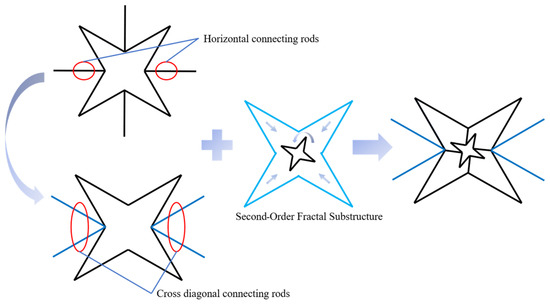
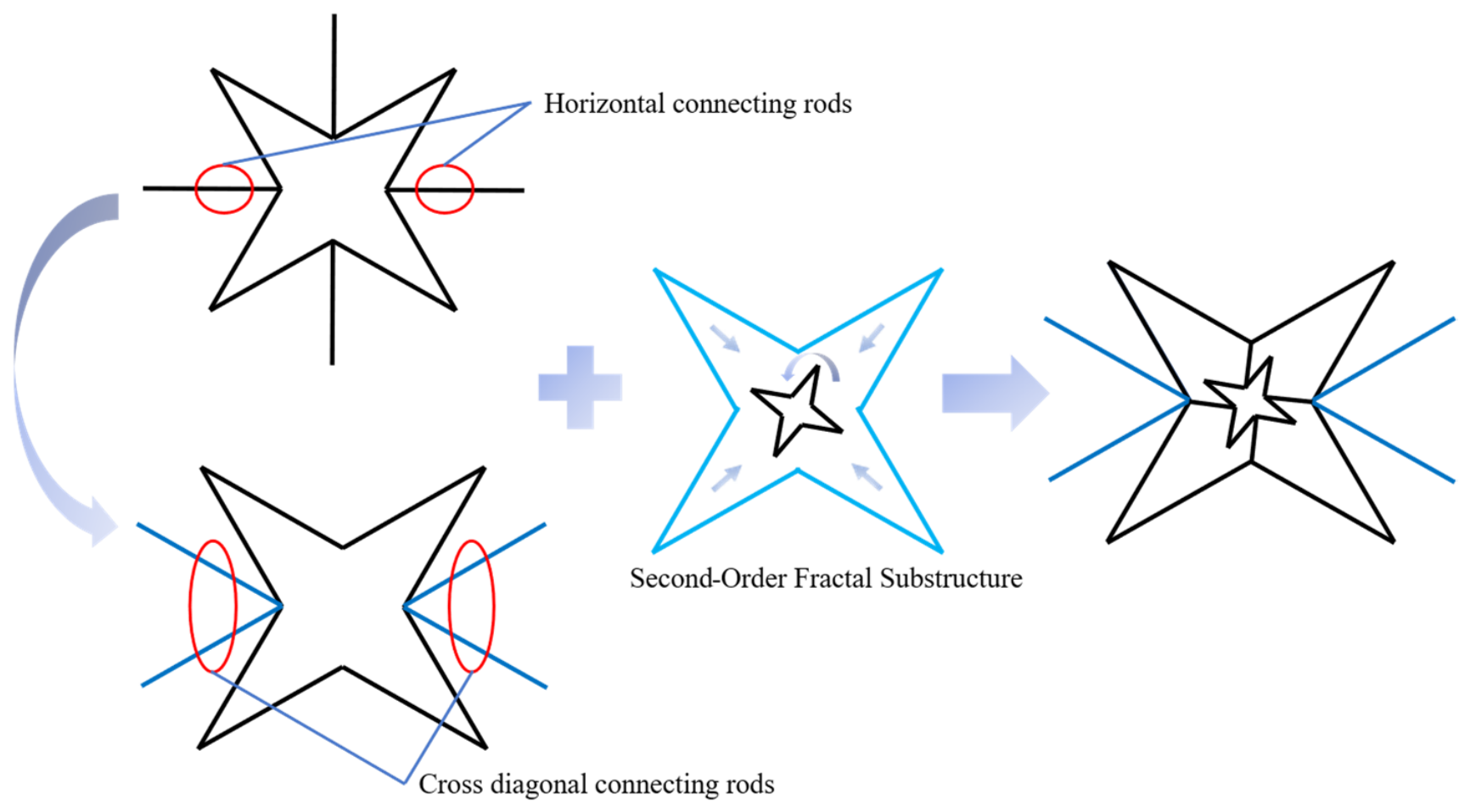
Based on the principles of self-similarity and iterative generation in fractal theory, the cell of the traditional SSH is scaled and rotated to form a second-order fractal substructure, which is then embedded into the original cell. By connecting the four re-entrant points of the original structure and the second-order fractal substructure and replacing the horizontal rods with two crossed diagonal rods, a novel fractal NPR structure is obtained. The design concept is illustrated in Figure 1. Furthermore, an FSSH can be proposed based on a biaxially symmetric design.
Figure 1.
Design concept of the fractal star-shaped negative Poisson’s ratio (NPR) cell.
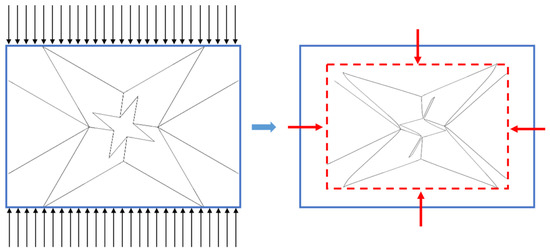
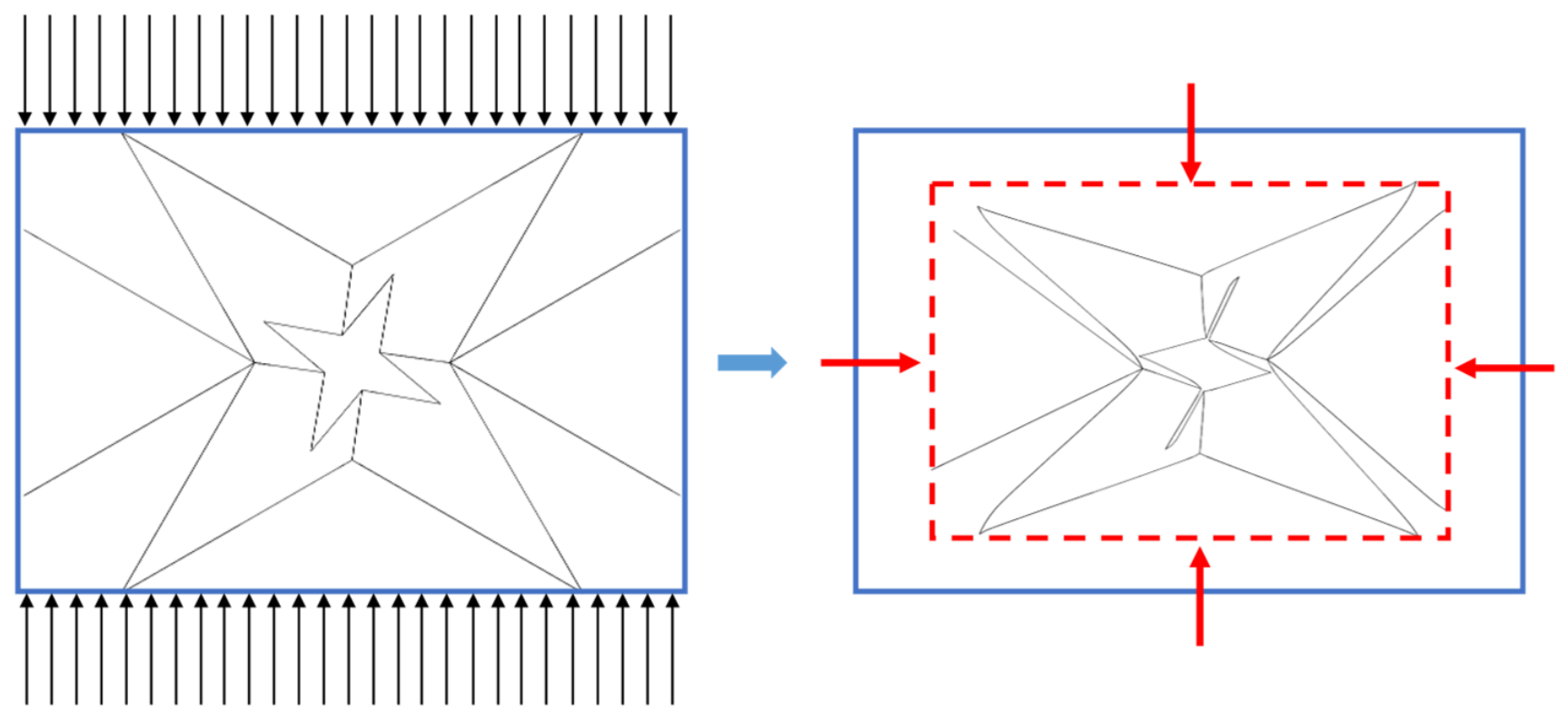
To provide a clear illustration of the deformation characteristics of the star-shaped NPR structure, Figure 2 presents a typical deformation schematic under in-plane compression. The blue outline represents the initial outer envelope of the structure, the red dashed outline represents the deformed outer envelope after compression, the black arrows indicate the direction of the compressive load, and the red arrows indicate the deformation direction. Under vertical compression, the inclined cell walls inside the star-shaped unit cell undergo rotation and bending, thereby driving the lateral boundaries of the structure to contract toward the center. This deformation mode differs from the transverse expansion behavior of conventional positive Poisson’s ratio materials under uniaxial compression, demonstrating a typical NPR effect.
Figure 2.
Schematic illustration of Poisson’s ratio effect of the fractal star-shaped NPR cell.
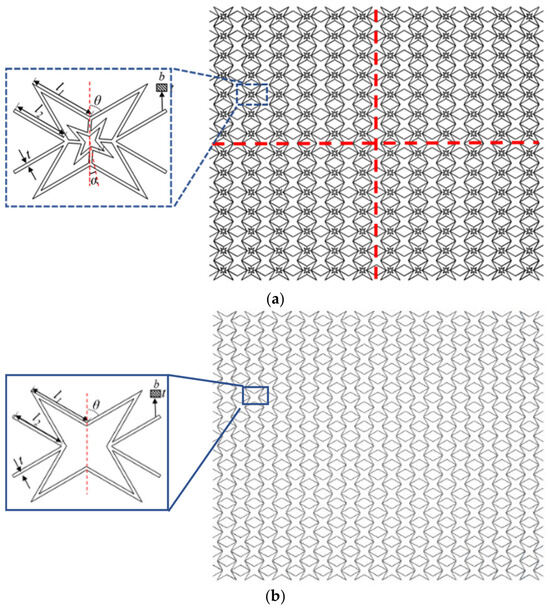
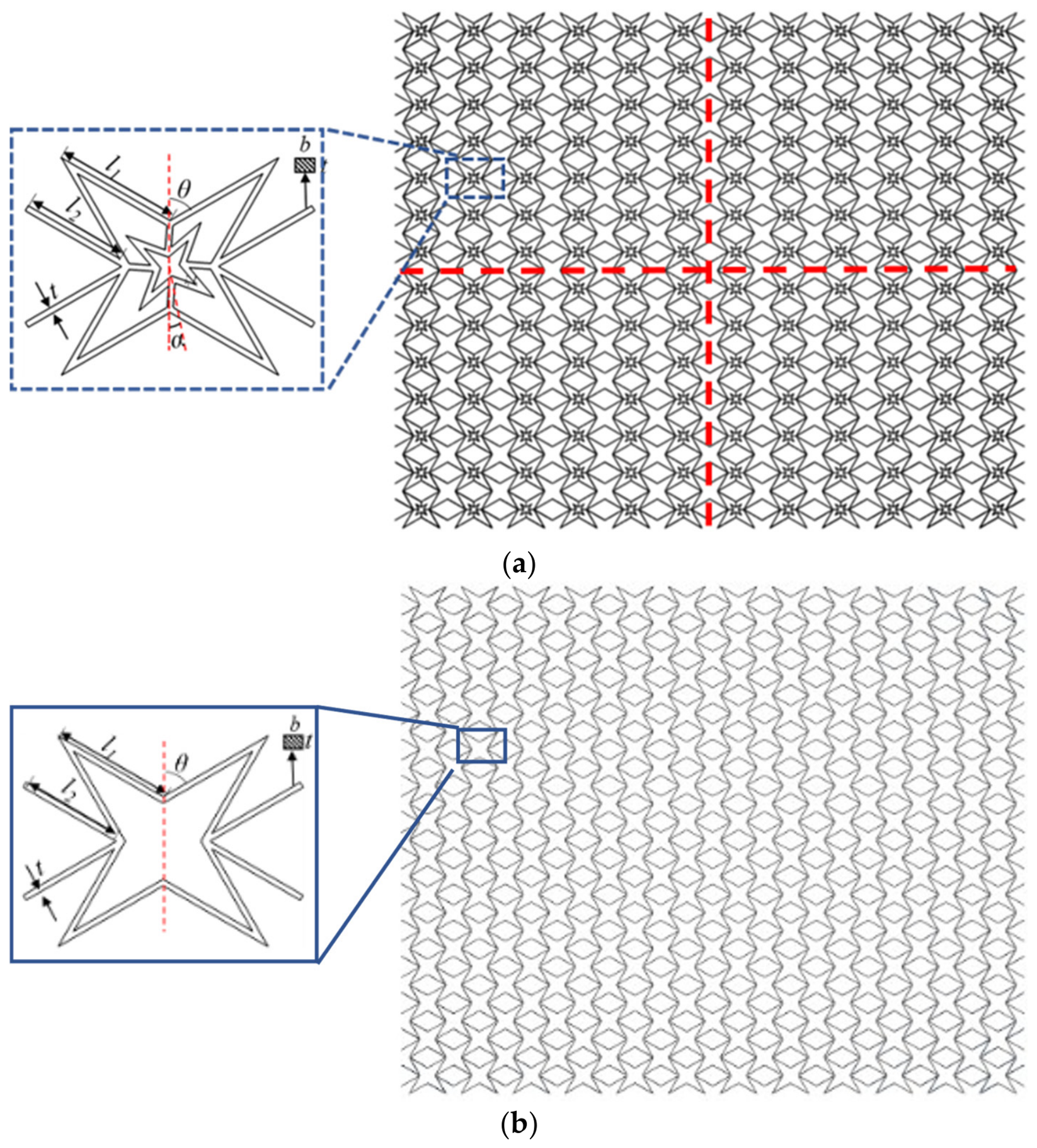
The structural configuration and cell geometric parameters of the FSSH are shown in Figure 3a. The re-entrant angle of the cell is 60°, the cell wall length is 10 mm, the connecting rod length is 10 mm, the cell wall thickness is 0.5 mm, and the out-of-plane thickness is 1 mm. The scaling coefficient of the second-order fractal structure is 0.3, and the rotation angle of the second-order fractal structure is 20°. To examine the second-order fractal structure, the SSH was configured without a second-order fractal substructure. Its structural configuration and cell geometric parameters are shown in Figure 3b.
Figure 3.
Structural configuration and cell geometric parameters of NPR honeycombs. (a) Fractal star-shaped honeycomb (FSSH); (b) Star-shaped honeycomb (SSH).
Based on these geometric parameters, the theoretical formulas for calculating the relative densities of the FSSH and SSH are derived as follows [35]:
where and denote the relative densities of the FSSH and SSH, respectively. and represent the effective densities of the FSSH and SSH, respectively; and is the density of the base material.
2.2. Mechanical Performance Evaluation Indexes
2.2.1. Nominal Stress Strain
Nominal stress and nominal strain are key parameters for evaluating the mechanical performance of structures. Their calculation formulas are as follows [36]:
where is the total reaction force of the structure; is the initial cross-sectional area; is the initial width; is the out-of-plane thickness; ΔH is the compression displacement and H is the initial height.
2.2.2. Plateau Stress and Specific Energy Absorption
Plateau stress is a crucial index for evaluating energy absorption performance. A higher plateau stress indicates better energy absorption performance. It is calculated as follows [37]:
where is the nominal strain corresponding to the initial peak nominal stress, which is generally small. denotes the densification strain, which is commonly determined using the energy efficiency method and calculated as follows [38]:
where is the energy absorption efficiency which is calculated as follows [38]:
SEA represents the energy absorbed per unit mass and serves as an important metric for evaluating the energy absorption capacity of honeycomb structures. It is calculated as follows [39]:
where is the total absorbed energy; is the absorbed energy per unit volume, which corresponds to the area under the nominal stress–strain curve. is the total mass of the structure. and are the relative density of the honeycomb structure and the density of the base material, respectively.
2.2.3. Dynamic Poisson’s Ratio
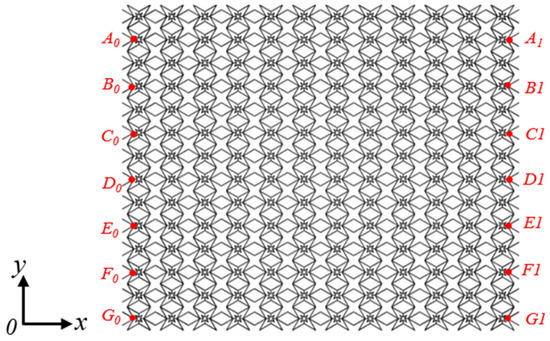
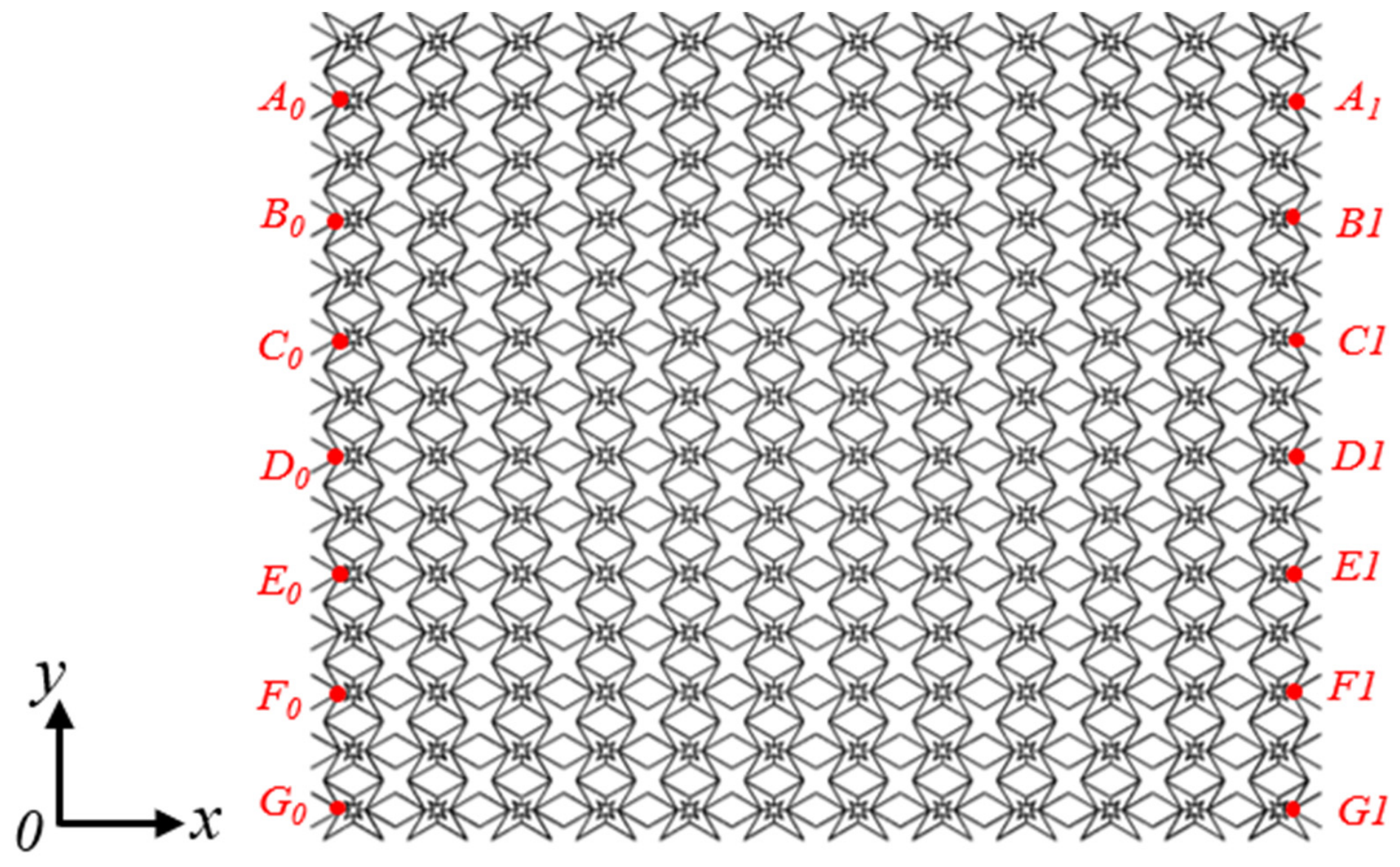
Dynamic Poisson’s ratio is an important index for characterizing the NPR effect of the structure, and the lateral contraction displacement is a key parameter in calculating the dynamic Poisson’s ratio. As shown in Figure 4, a total of 14 feature points from 7 layers are selected to calculate the X-directional contraction displacement of the honeycomb structure. The formula for calculating the X-directional contraction displacement of Layer A is given as follows [35]:
where and represent the X-direction displacements of points and , respectively. These displacements are defined as positive along the positive X-axis and negative along the negative X-axis. The displacements for the other layers are calculated using the same method as that for Layer A.
Figure 4.
Schematic of feature point selection for transverse contraction displacement calculation.
The formula for calculating the average contraction displacement in the X-direction is given as follows [35]:
As the FSSH is subjected to global compression along the Y-direction, the top surface undergoes a uniform displacement in this direction. Therefore, in this study, the Y-direction displacement at the geometric center of the top surface was taken as the y-direction displacement of the FSSH, denoted as .
Accordingly, the formula for Poisson’s ratio is given as follows [32]:
where and are the strains of the honeycomb structure in the X- and Y-directions, respectively. and denote the initial height in the X-direction and Y-direction, respectively.
2.2.4. Dynamic Compression Velocity
Compression velocity is a key parameter governing the deformation characteristics of honeycomb structures. The critical velocity at which the deformation mode of such structures changes from global compressive deformation to localized plastic crushing is defined as the first critical velocity and is calculated as follows [40]:
where denotes the elastic modulus of the NPR structure within the elastic regime.
With increasing compression velocity, localized deformation in honeycomb structures becomes increasingly pronounced. The critical velocity at which the crushing mode of such structures changes from a mixed crushing mode to an inertia-dominated crushing mode is defined as the second critical velocity and is calculated as follows [40]:
where denotes the static yield stress of the NPR structure.
According to Equations (1) and (2), the first critical compression velocities of the SSH and FSSH were calculated as 5.81 m/s and 9.9 m/s, respectively, while the corresponding second critical velocities were 62.6 and 89.8 m/s. Based on these results, 5 m/s, 30 m/s, and 100 m/s were selected as representative velocities for the low-, medium-, and high-speed compression loading cases, respectively. Specifically, 5 m/s corresponds to the region of < , 30 m/s corresponds to the region of < < , and 100 m/s corresponds to the region of > [41].
3. Finite Element Model Validation
3.1. Finite Element Model
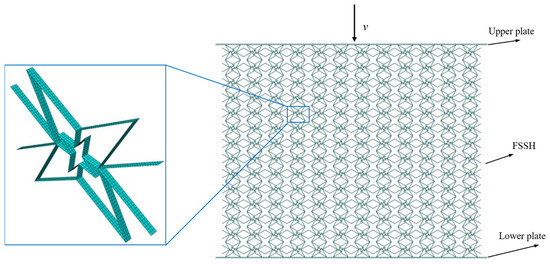
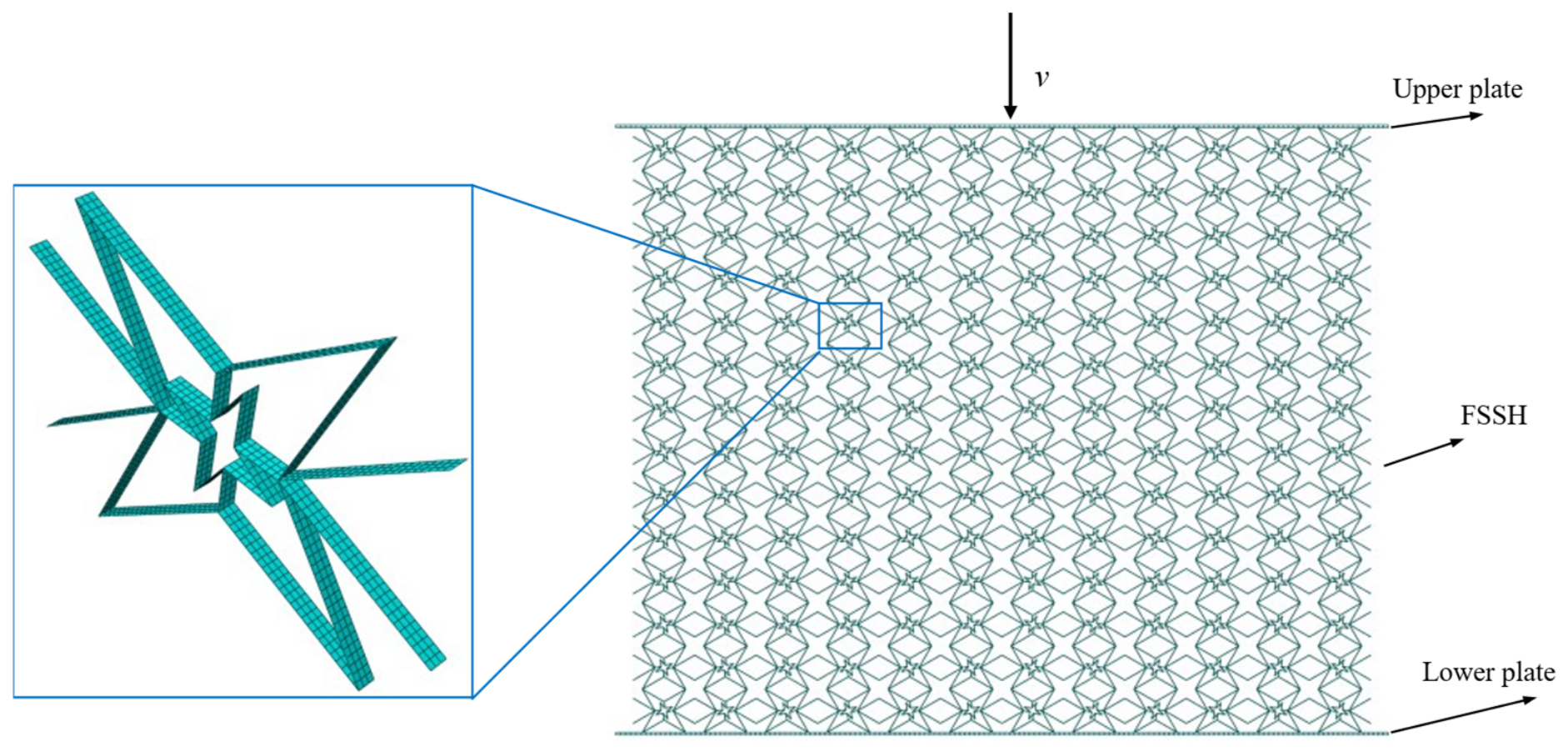
In this study, Abaqus 2024/Explicit was used to perform finite element simulations of the SSH and FSSH. As illustrated in Figure 5, the finite element model of the FSSH consisted of an upper plate, a lower plate, and the FSSH specimen. Rigid-body constraints were applied to the upper and lower plates. The upper plate served as the loading end during dynamic compression and was subjected to a constant downward velocity v, whereas the lower plate served as the fixed boundary, with all degrees of freedom constrained. Additionally, the out-of-plane translational degree of freedom of all nodes in the FSSH was constrained to ensure that only in-plane deformation occurred.
Figure 5.
Finite element model of the FSSH.
The FSSH was modeled using an aluminum alloy, and the material was defined using an ideal elastoplastic model. The material properties are listed in Table 1. The finite element model was discretized with S4R reduced-integration shell elements. The S4R element is a four-node shell element with finite membrane strains, reduced integration, and hourglass control, where the hourglass control parameters were kept at their default settings. The stable time increment was automatically determined by Abaqus/Explicit. The loading duration was defined based on the prescribed compression displacement and loading velocity, and no mass scaling was applied during the simulations. General contact was used to model the contact interactions during compression; hard contact was specified in the normal direction, while a penalty friction model was used in the tangential direction with a friction coefficient of 0.2. All settings for the finite element model of the SSH were identical to those of the FSSH.
Table 1.
The properties of the base material.
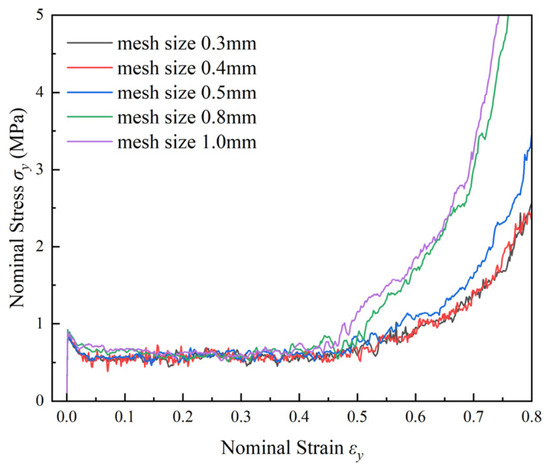
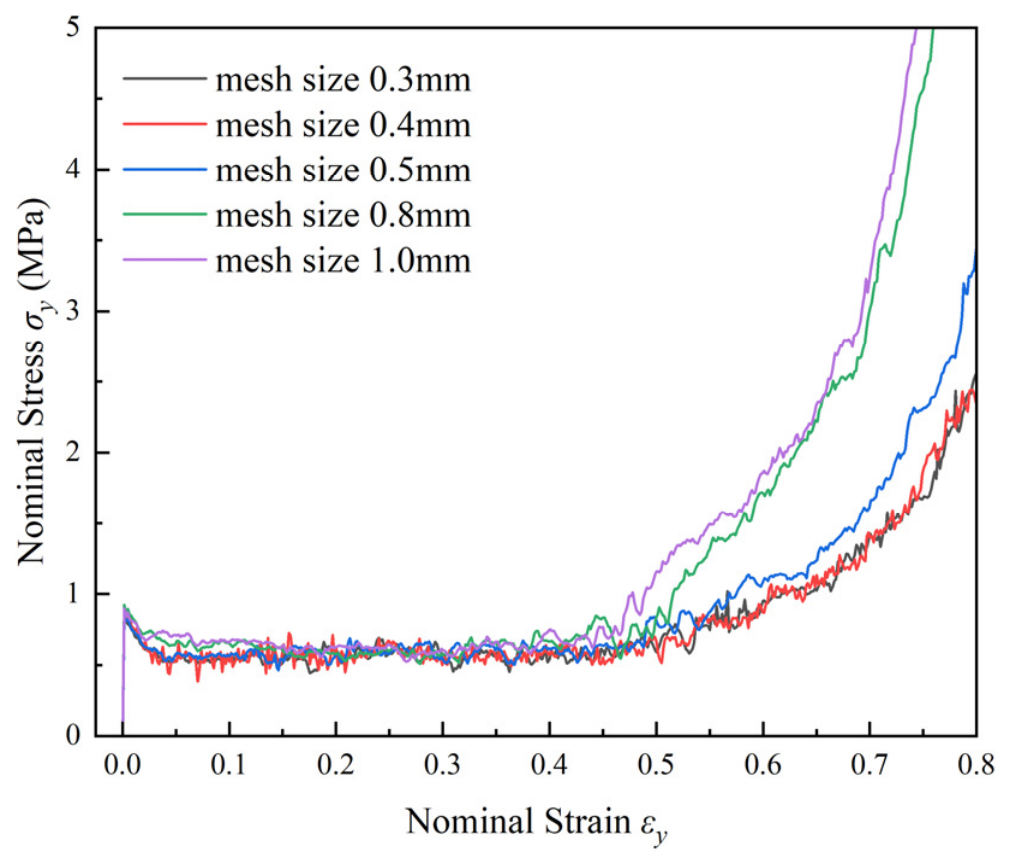
To ensure the accuracy of the finite element results, a mesh sensitivity analysis is performed. Based on the shortest cell wall in the second-order fractal substructures of the FSSH, mesh sizes of 0.3 mm, 0.4 mm, 0.5 mm, 0.8 mm, and 1.0 mm are selected to discretize the finite element model. The nominal stress–strain curves under dynamic compression are presented in Figure 6. In the early and intermediate stages of compression, the nominal stress–strain curves for different mesh sizes are closely aligned. In the later stages of compression, the nominal stress at the same nominal strain decreases as the mesh size decreases. For mesh sizes of 0.3 mm and 0.4 mm, the nominal stress–strain curves show substantial overlap, indicating that the simulation results tend to converge.
Figure 6.
Nominal stress–strain curves of the FSSH with different mesh sizes.
To perform a more rigorous mesh convergence analysis, the results obtained with the finest mesh size of 0.3 mm were used as the reference, and the relative deviations of the key mechanical metrics obtained with the other mesh sizes were calculated. As shown in Table 2, relative to the 0.3 mm mesh, the 0.4 mm mesh produced relative deviations of 3.49%, 2.76%, 0.00%, and 5.88% in plateau stress, SEA, densification strain, and initial peak stress, respectively, indicating that the overall deviations remained limited. In contrast, the meshes of 0.8 mm and 1.0 mm exhibited larger deviations in plateau stress or densification strain. Therefore, considering both numerical accuracy and computational efficiency, a mesh size of 0.4 mm was adopted in the following studies.
Table 2.
Quantitative mesh convergence analysis of the FSSH model.
3.2. Validation of the Finite Element Model
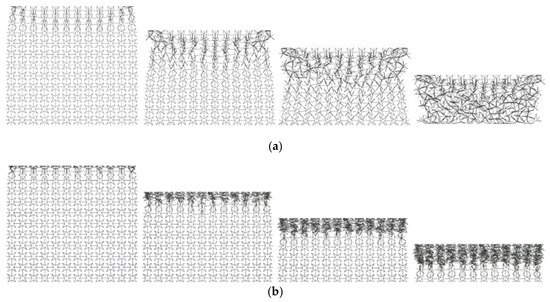
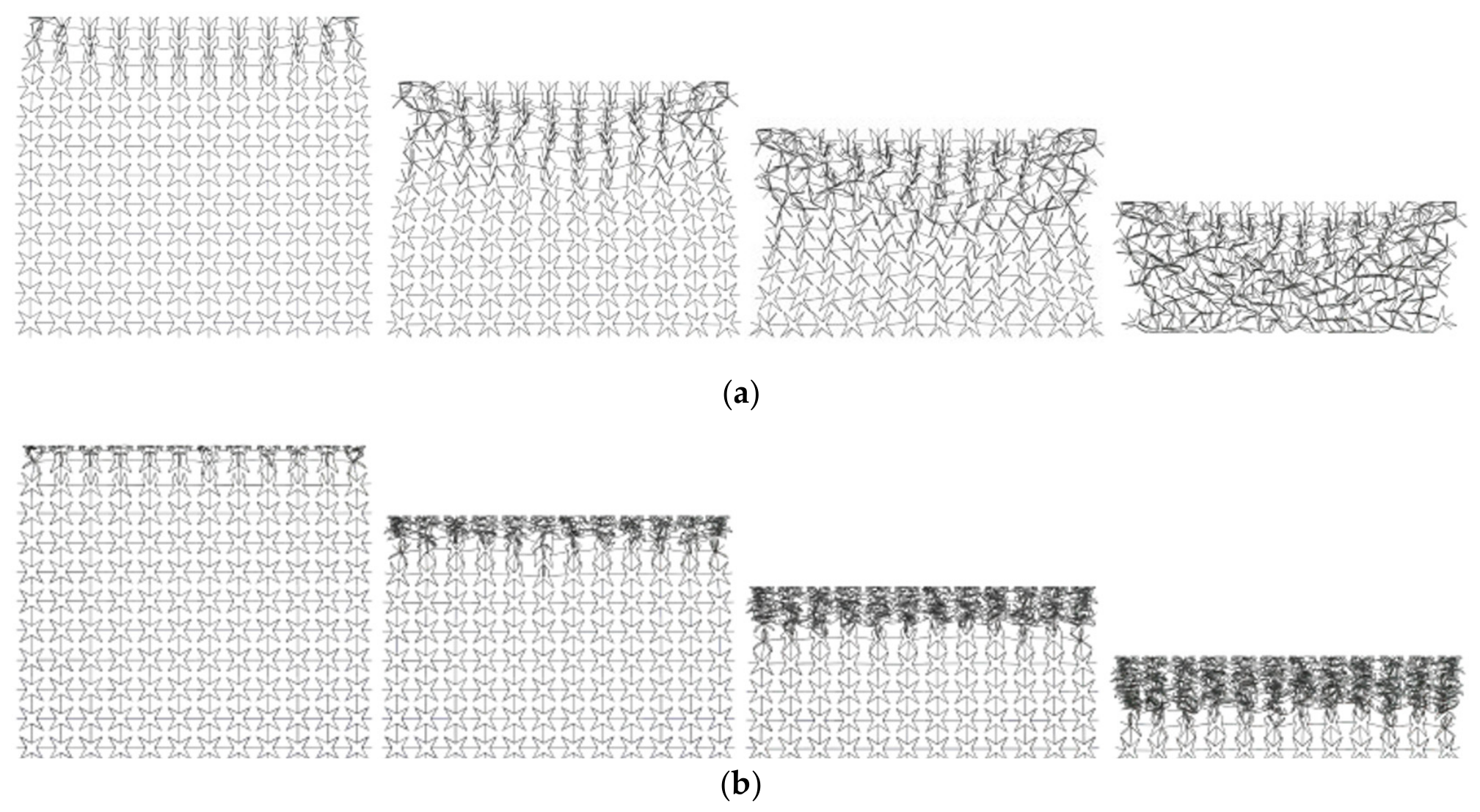
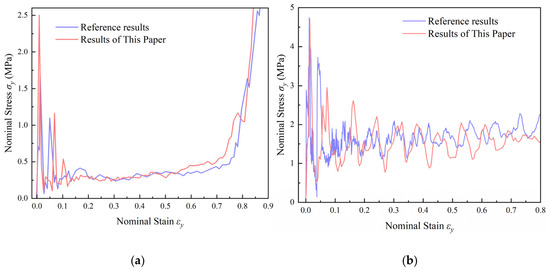
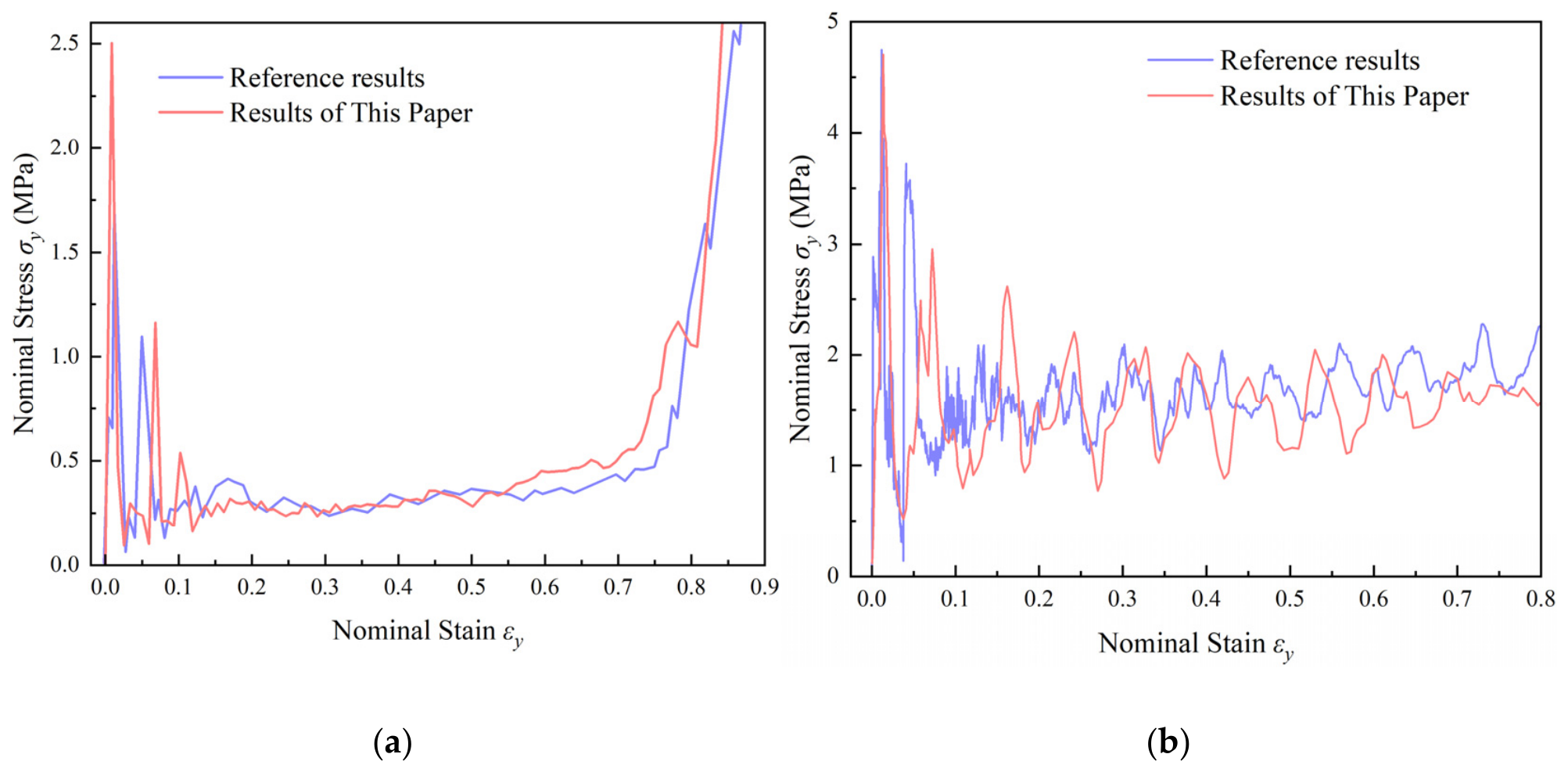
To ensure that the finite element model established in this study can accurately simulate the dynamic crushing behavior of the FSSH, the modeling method described above is employed to establish the finite element model of the star-shaped NPR honeycomb proposed in Ref. [30]. Dynamic compression simulations were conducted at compression velocities of 25 and 70 m/s, and the results were benchmarked against the numerical data reported in Ref. [30]. Figure 7 presents the deformation modes obtained by the finite element model using the present modeling procedure. The comparison indicates that the simulated deformation patterns at both velocities are highly consistent with the reference results. To further assess the accuracy of the proposed finite element model, the nominal stress–strain curves obtained at 25 and 70 m/s were compared with the corresponding curves from the same study. As shown in Figure 8, the present results agree well with the reported data at 25 m/s, whereas minor deviations are observed at 70 m/s. These discrepancies are mainly attributed to the absence of explicit information on mesh size and contact parameters in the reference model.
Figure 7.
Deformation modes of the finite element model constructed in this study at different compression velocities: (a) v = 25 m/s. (b) v = 70 m/s.
Figure 8.
Comparison of nominal stress–strain curves between the results of this work and the reference results [30] under different compression velocities: (a) v = 25 m/s. (b) v = 70 m/s.
4. Deformation Analysis of FSSH and SSH
In this study, the deformation behavior of the SSH and FSSH under dynamic compression at different velocities is analyzed. To maintain the same relative density for the SSH and FSSH, the cell wall thickness t of the SSH is adjusted to 0.64 mm in this section, whereas the cell wall thickness of the FSSH is kept unchanged. Consequently, = = 0.181. Under the condition of identical relative density, the deformation modes, NPR effects, and energy absorption performance of the SSH and FSSH are analyzed and compared under dynamic compression at three different velocities (5 m/s, 30 m/s, and 100 m/s), to investigate the effect of the second-order fractal substructures on the SSH.
4.1. Low-Velocity Dynamic Compression
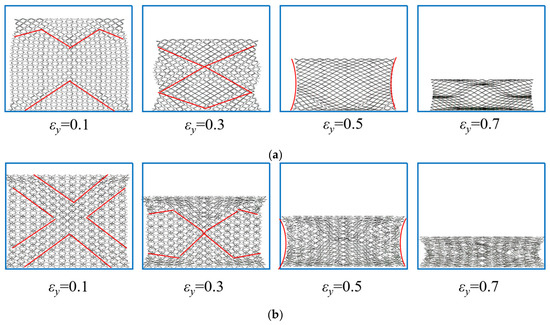
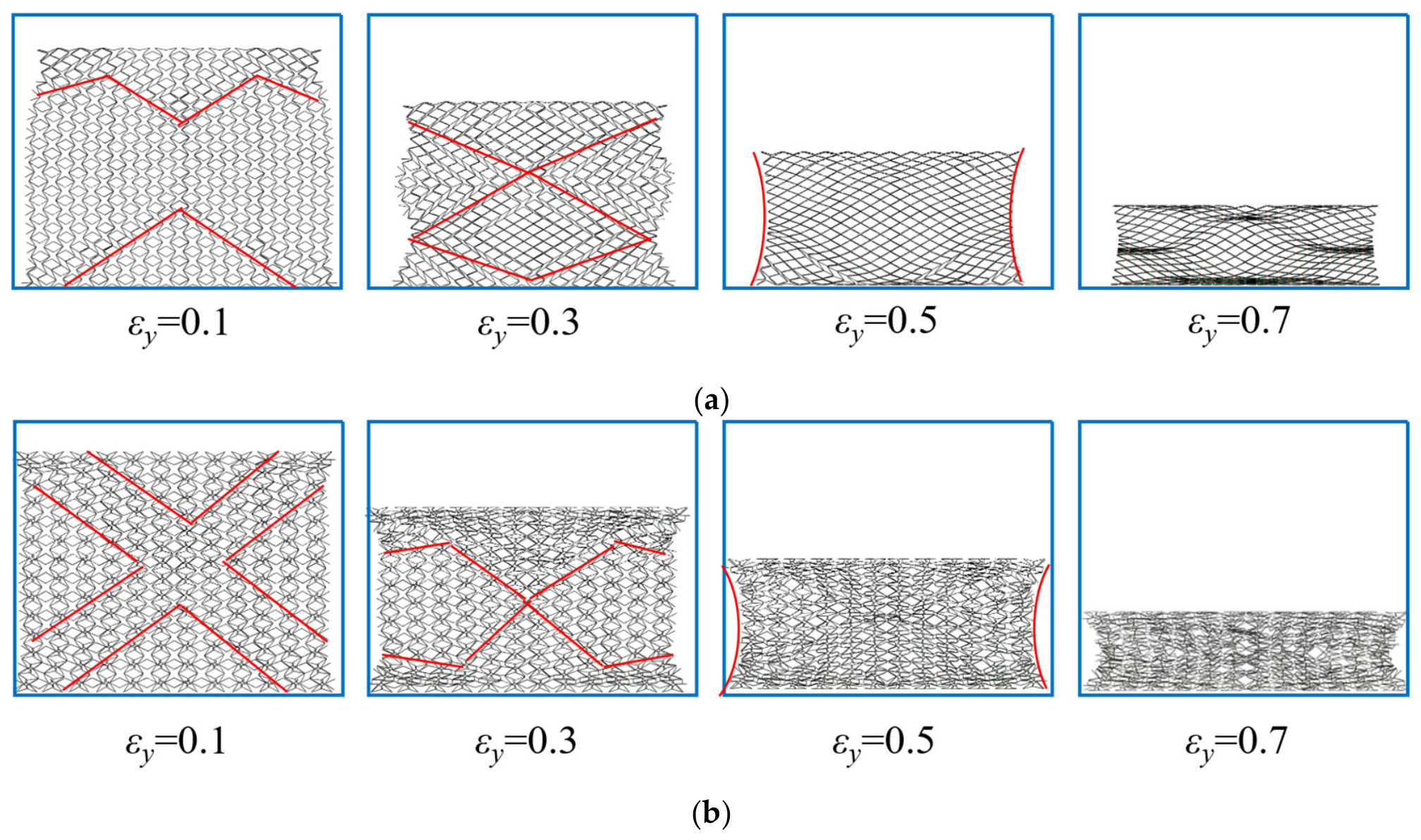
Figure 9 shows the deformation modes of the SSH and FSSH at different strain levels under dynamic compression at a velocity of 5 m/s, where the blue dashed boxes represent the initial dimensions of the honeycomb structures. At the initial stage of compression, when = 0.1, the SSH exhibits a W-shaped deformation at the dynamic-compression end and a V-shaped deformation at the fixed end due to inertial effects. For the FSSH, because its fractal substructure is rotated by a certain angle and its configuration is biaxially symmetric, the cells tended to rotate toward the center during compression, leading to a relatively uniform overall X-shaped deformation. As compression progressed, when = 0.3, the SSH exhibited an X-shaped deformation at the top and a V-shaped deformation at the bottom, driven by cell stacking and inward contraction. Due to the further rotation and contraction of the second-order fractal substructures, the FSSH exhibits a vertically symmetric W-shaped deformation, with densification progressing from the upper and lower ends toward the middle. When = 0.5, nearly all cell walls of both the SSH and FSSH begin to contact each other, and an arc-shaped inward concavity appears on both lateral sides of the structures. Finally, when = 0.7, all cells of the SSH and FSSH are gradually compacted, and the overall structures progressively densify. Overall, under low-velocity dynamic compression, both structures mainly undergo global deformation, and the deformation of the FSSH is more uniform than that of the SSH, indicating that the introduction of the second-order fractal substructures can effectively improve the deformation uniformity.
Figure 9.
Deformation modes of NPR honeycombs under dynamic compression at a velocity of 5 m/s: (a) SSH. (b) FSSH. The red lines mark the regions of significant local deformation and deformation modes.
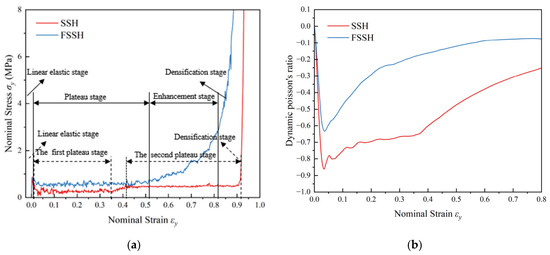
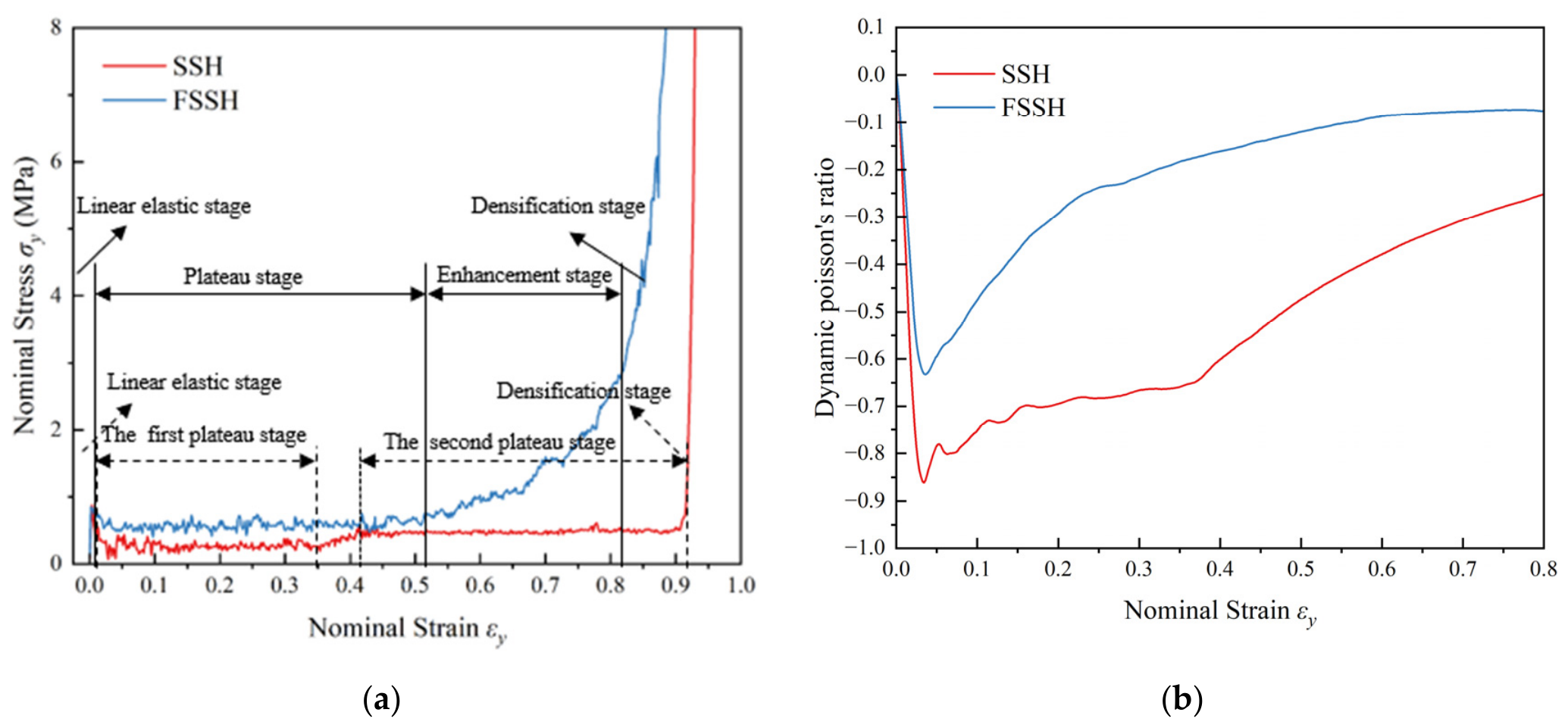
Figure 10a presents the nominal stress–strain curves of the SSH and FSSH. The nominal stress–strain curve of the SSH can be divided into four stages. In the first stage, the stress increases linearly until it reaches a peak point, indicating the linear elastic stage. In the second stage, after reaching the peak point, the stress decreases and then fluctuates within a narrow range around a certain stress level, indicating the first plateau stage. In the third stage, after increasing for a period, the stress enters another stable stage, defined as the second plateau stage. The second plateau stage of the SSH is mainly attributed to the progressive contact of cell walls and the associated enhancement of structural constraints. The first plateau stage corresponds to the gradual contact of the internal cell walls within each unit cell during progressive buckling and inward rotation. Once the intra-cell contact is largely established, local support constraints are formed, which suppress further instability of the cell walls and improve the load-bearing capacity of the unit cells. Consequently, the stress response enters the second plateau stage. Finally, in the fourth stage, the stress increases sharply over a relatively small strain range, corresponding to the densification stage. The nominal stress–strain curve of the FSSH also has four stages. However, in the third stage, the stress of the FSSH no longer remains stable but increases gradually with increasing strain. This stage is defined as the strain-hardening stage.
Figure 10.
Mechanical responses of SSH and FSSH under dynamic compression at 5 m/s: (a) Nominal stress–strain curves. (b) Dynamic Poisson’s ratio.
Figure 10b shows the dynamic Poisson’s ratios of the SSH and FSSH during dynamic compression at a velocity of 5 m/s. When < 0.035, the Poisson’s ratios of both structures gradually decrease, indicating an increasing NPR effect. When = 0.035, their Poisson’s ratios reach the minimum values of the entire compression process, −0.86 for the SSH and −0.63 for the FSSH. When 0.035 < < 0.37, the Poisson’s ratio of the SSH gradually increases and converges to −0.7. For the FSSH, when 0.035 < < 0.23, the Poisson’s ratio increases rapidly, indicating a rapid weakening of the NPR effect. When > 0.37, the Poisson’s ratio of the SSH increases rapidly, indicating that its NPR effect decreases rapidly. For the FSSH, when > 0.23, its Poisson’s ratio gradually increases and converges to −0.08, indicating that its NPR effect progressively weakens and tends to stabilize. Overall, under low-velocity dynamic compression, both the SSH and FSSH exhibit pronounced NPR effects. However, the NPR effect of the FSSH is weaker than that of the SSH throughout the compression process, indicating that the introduction of second-order fractal substructures reduces the NPR effect.
For the SSH, the first and second plateau stages serve as the primary energy absorption phases, whereas for the FSSH, the plateau and strengthening stages serve as the main stages of energy absorption. The plateau stress and SEA are considered to evaluate the energy absorption performance of both honeycomb structures. As shown in Table 3, the plateau stress of the FSSH is 128% higher than that of the SSH, and the SEA is 104% higher than that of the SSH. The densification strain of the FSSH is 11% lower than that of the SSH. These results indicate that the introduction of second-order fractal substructures significantly improves the energy absorption capacity.
Table 3.
Densification strain, plateau stress, and SEA of the SSH and FSSH with identical relative density under dynamic compression at a velocity of 5 m/s.
These results reveal a trade-off between the enhanced energy absorption capacity and the weakened NPR effect of the FSSH. In the conventional SSH, the NPR effect is mainly generated by the inward rotation and bending of the cell walls, leading to lateral contraction during axial compression. In contrast, the introduced fractal substructures increase the internal constraints within the unit cells and restrict the free rotation of the cell walls, thereby weakening the lateral contraction and reducing the NPR effect. However, these substructures also involve more cell walls in deformation and contact processes, expand the plastic energy-dissipation regions, and enhance the energy absorption capacity of the FSSH. By quantifying the NPR effect using the limiting Poisson’s ratio, the NPR intensity of the FSSH is found to be 26.7% lower than that of the SSH under low-velocity dynamic compression, while its SEA increases by 104%.
4.2. Medium-Velocity Dynamic Compression
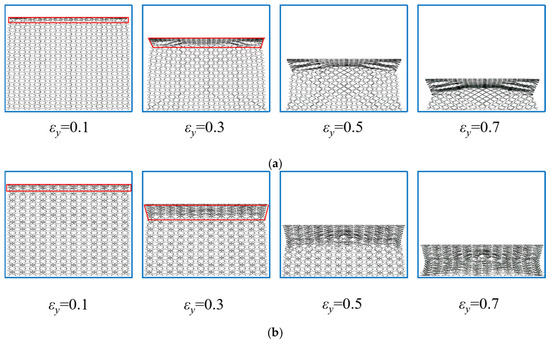
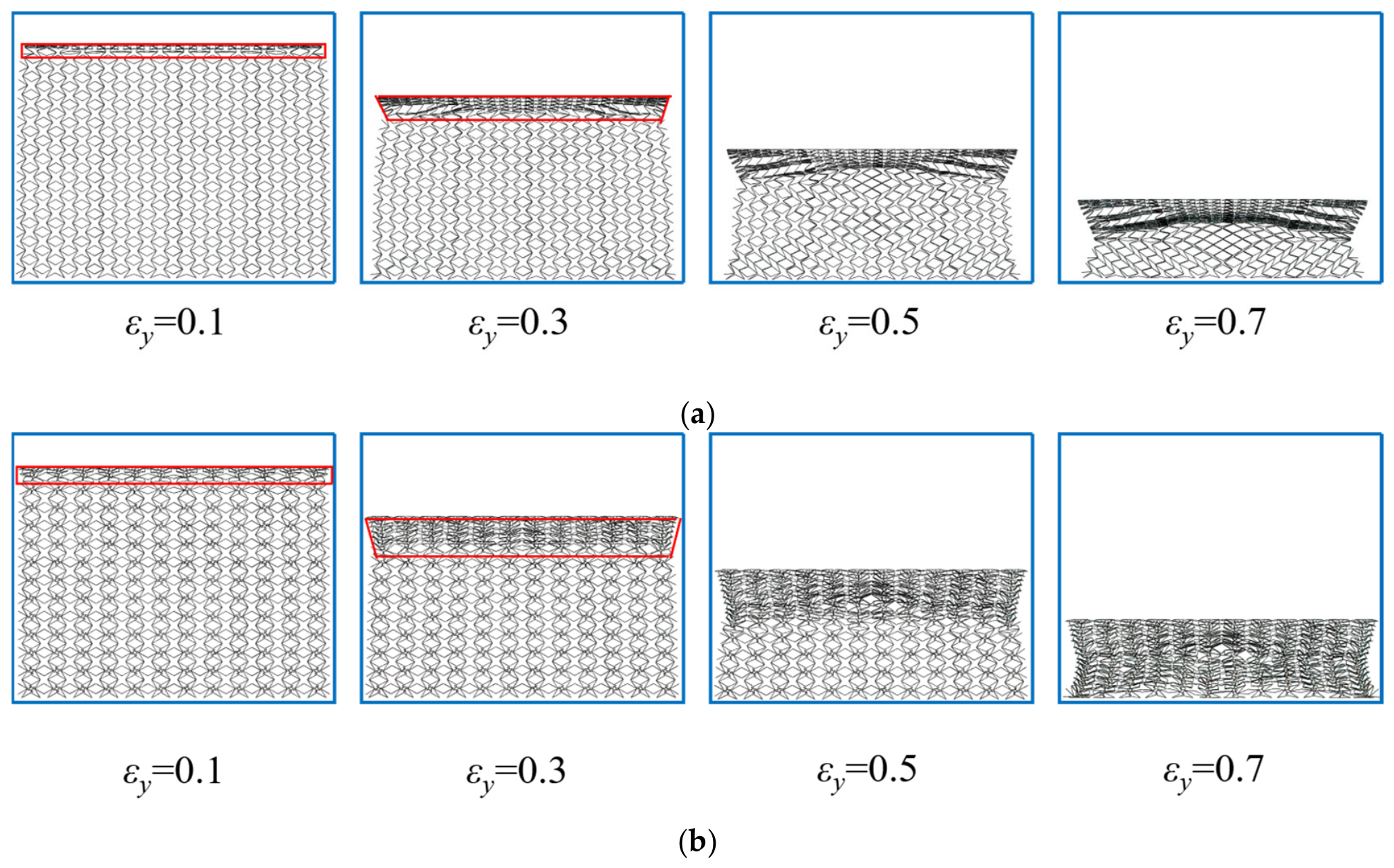
Figure 11 illustrates the deformation modes of the SSH and FSSH at various strain levels under dynamic compression at a velocity of 30 m/s, where the blue dashed boxes denote the initial dimensions. At the initial compression stage, when = 0.1, the SSH exhibits localized deformation at the dynamic-compression end and global deformation at the fixed end, while the deformation of the FSSH is concentrated near the dynamic-compression end. As compression proceeds when = 0.3 and 0.5, both the SSH and FSSH develop trapezoidal deformation regions at the dynamic-compression end due to the layer-by-layer densification and lateral contraction of the cells. The difference is that the number of densified layers in the FSSH is greater than that in the SSH. With further compression, when = 0.7, almost all cell walls within the FSSH contact each other, whereas some cell walls in the SSH remain not fully in contact. These results indicate that under medium-velocity dynamic compression, the second-order fractal substructures led to a more localized deformation mode in the FSSH.
Figure 11.
Deformation modes of NPR honeycombs under dynamic compression at a velocity of 30 m/s: (a) SSH. (b) FSSH. The red boxes denote regions of significant local deformation.
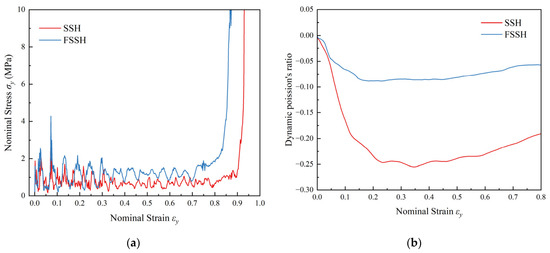
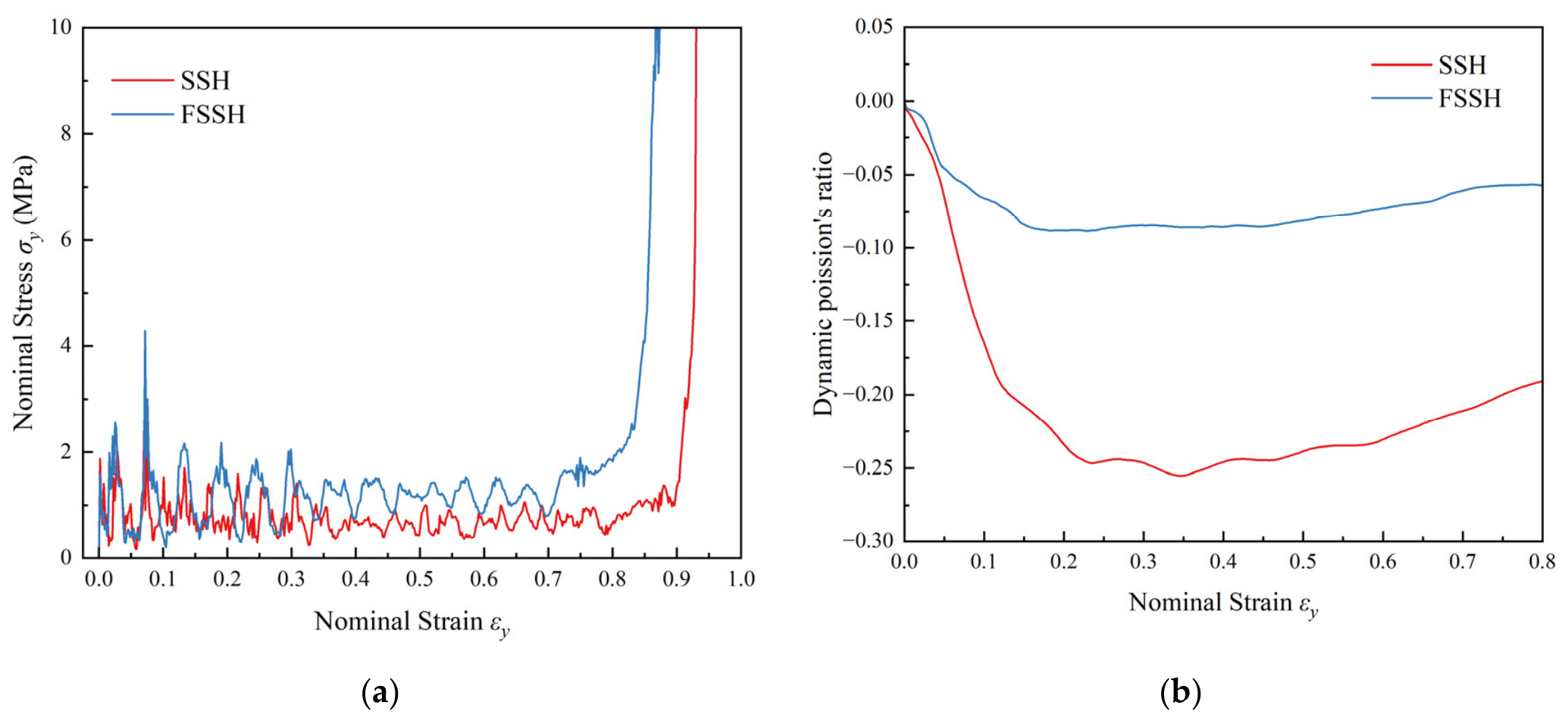
Figure 12a presents the nominal stress–strain curves of the SSH and FSSH during compression. The nominal stress–strain curve of the SSH has three distinct stages: a linear elastic stage, a plateau stage characterized by stress fluctuations around a certain stress level, and a densification stage. The second plateau stage is no longer observed at this velocity. In contrast, the nominal stress–strain curve of the FSSH exhibits the same four stages observed at 5 m/s: the linear elastic, plateau, strengthening and densification stages. However, at this higher velocity of 30 m/s, the plateau stage exhibits large-amplitude fluctuations. In addition, the plateau stage serves as the primary energy absorption stage for the SSH, whereas the plateau and strengthening stages are regarded as the main energy absorption stages of the FSSH. To evaluate the energy absorption performance, the plateau stresses and SEAs are summarized in Table 4. It can be seen that plateau stress of the FSSH is 63.2% higher than that of the SSH, and its SEA is 51.4% higher than that of the SSH. The densification strain of the FSSH is 6.8% lower than that of the SSH. These results indicate that, under medium-velocity dynamic compression, the second-order fractal substructures significantly improve the energy absorption capacity.
Figure 12.
Mechanical responses of SSH and FSSH under dynamic compression at a velocity of 30 m/s: (a) Nominal stress–strain curves. (b) Dynamic Poisson’s ratio.
Table 4.
Densification strain, plateau stress, and SEA of the SSH and FSSH under dynamic compression at a velocity of 30 m/s.
Furthermore, it is observed that throughout the entire compression process, the lateral contraction of the SSH at a given nominal strain is consistently greater than that of the FSSH, consistent with the conclusions from their dynamic Poisson’s ratios. As shown in Figure 12b, under medium-velocity dynamic compression, the NPR effect of the FSSH remains weaker than that of the SSH throughout the compression process. This demonstrates that the introduction of second-order fractal substructures weakens the NPR effect of the original SSH structure.
These results indicate that, under medium-velocity dynamic compression, the FSSH still exhibits a trade-off between the enhanced energy absorption capacity and the weakened NPR effect. By quantifying the NPR effect using the limiting Poisson’s ratio, the NPR intensity of the FSSH is found to be 65.1% lower than that of the SSH under medium-velocity dynamic compression, while its SEA increases by 51.4%.
4.3. High-Velocity Dynamic Compression
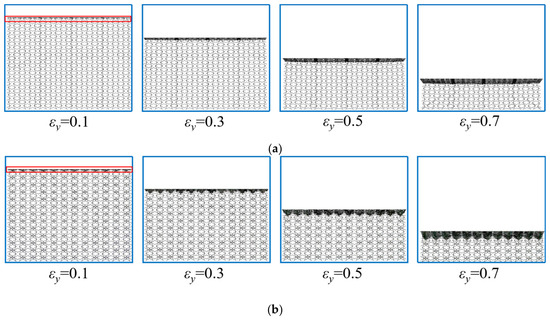
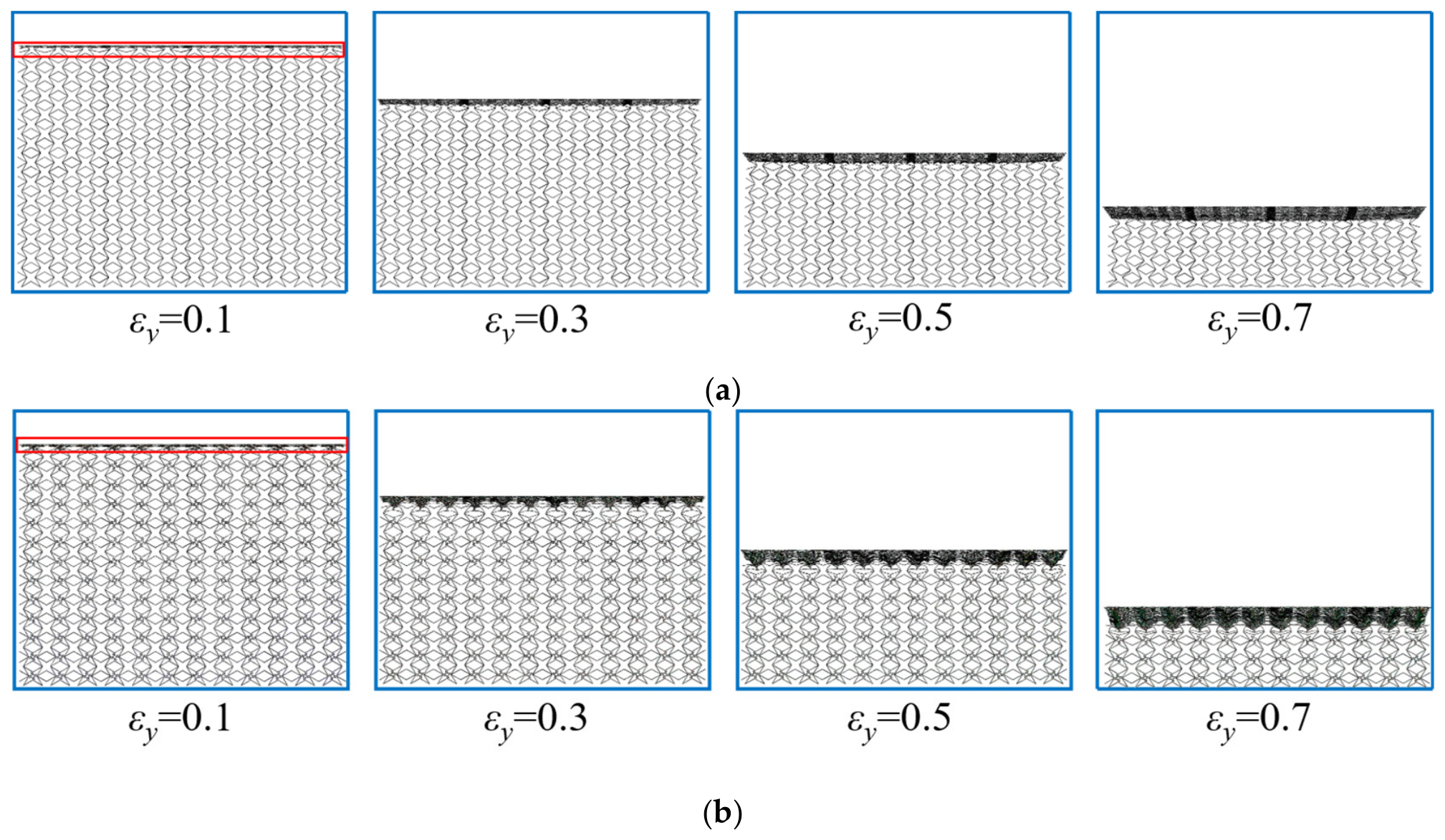
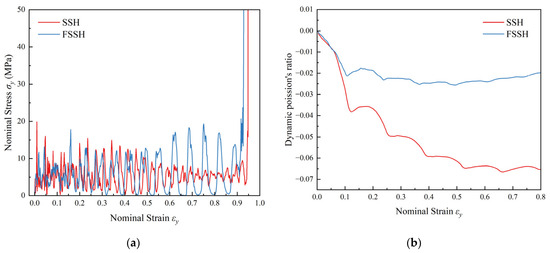
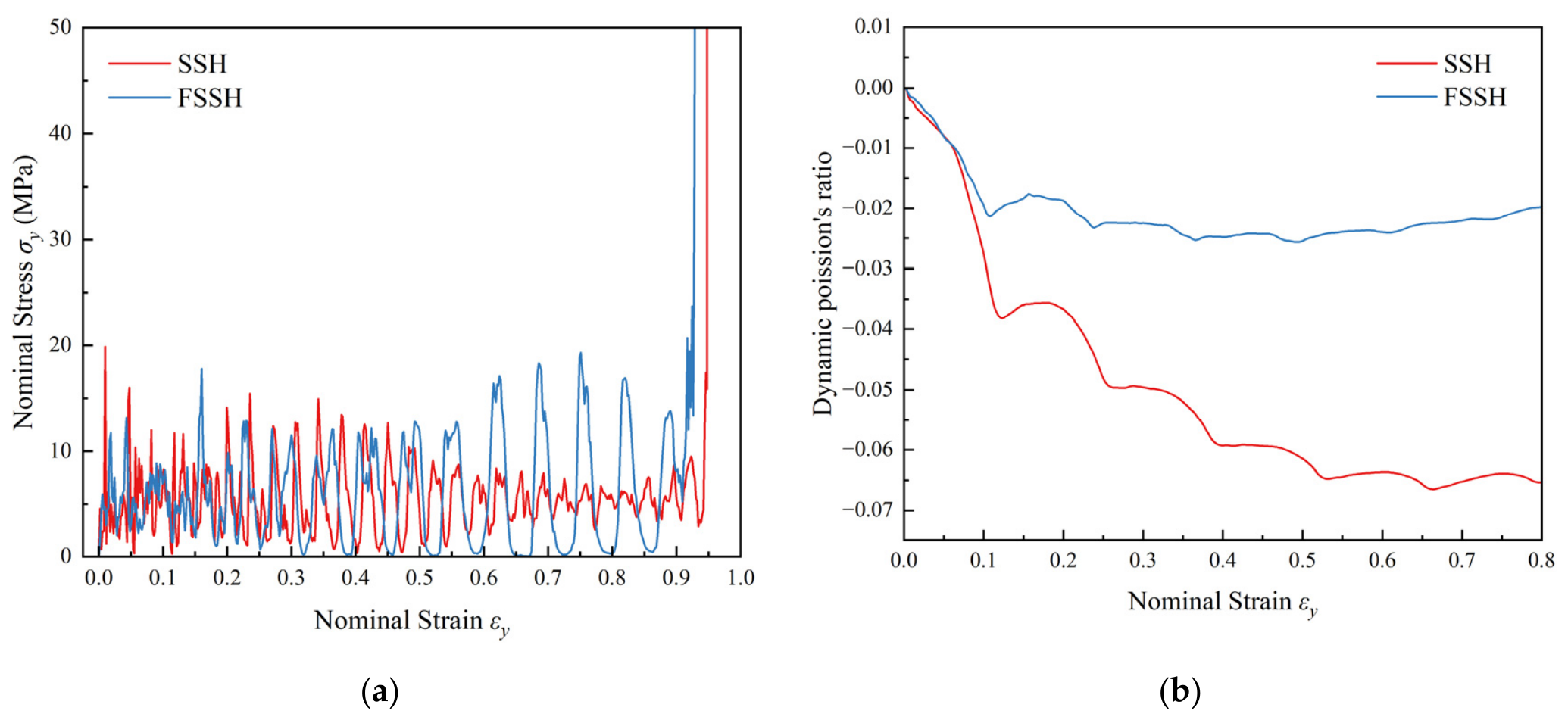
Figure 13 shows the deformation modes of the SSH and FSSH at various strain levels under dynamic compression at a velocity of 100 m/s, where the blue dashed boxes denote the initial dimensions. Throughout the compression process, inertial effects play a dominant role, causing both the SSH and FSSH to exhibit localized deformation. Deformation is first initiated locally at the dynamic-compression end, and as compression proceeds, the cells densify layer by layer toward the fixed end. This indicates that, at high-velocity dynamic compression, the second-order fractal substructures have no significant effect on the overall deformation mode. The corresponding dynamic Poisson’s ratios are shown in Figure 14b. At this velocity, the NPR effects for the SSH and FSSH are no longer pronounced, although a certain degree of NPR effect remains. Throughout the compression process, the Poisson’s ratio of the FSSH remains higher than that of the SSH, indicating the NPR effect of the FSSH is weaker than that of the SSH. This indicates that, under high-velocity dynamic compression, the second-order fractal substructures can decrease the NPR effect.
Figure 13.
Deformation modes of NPR honeycombs under dynamic compression at a velocity of 100 m/s: (a) SSH. (b) FSSH. The red boxes denote regions of significant local deformation.
Figure 14.
Mechanical responses of SSH and FSSH under dynamic compression at a velocity of 100 m/s: (a) Nominal stress–strain curves. (b) Dynamic Poisson’s ratio.
Figure 14a presents the nominal stress–strain curves of the SSH and FSSH during compression. The nominal stress–strain curves of both the SSH and FSSH exhibit three stages: the linear elastic stage, the plateau stage, and the strengthening stage. The difference is that, due to the second-order fractal substructures, more frequent contact occurs among the cell walls, resulting in larger stress fluctuations during the plateau stage. The plateau stage serves as the primary energy absorption phase for both the SSH and FSSH. The plateau stress and SEA are investigated to evaluate the energy absorption capacity of the two structures. As shown in Table 5, the plateau stress and SEA of the FSSH are 9% and 5.6% higher than those of the SSH, respectively, and the energy absorption capacity of the FSSH is slightly higher than that of the SSH. The densification strain of the FSSH is 2.2% lower than that of the SSH. These results indicate that, under high-velocity dynamic compression, the second-order fractal substructures provide only a slight improvement in energy absorption capacity.
Table 5.
Densification strain, plateau stress, and SEA of the SSH and FSSH under dynamic compression at a velocity of 100 m/s.
These results indicate that the NPR effect and energy absorption capacity under high-velocity dynamic compression differ significantly from those under low-velocity dynamic compression. By quantifying the NPR effect using the limiting Poisson’s ratio, the NPR intensity of the FSSH is found to be 61.7% lower than that of the SSH under high-velocity dynamic compression, whereas its SEA increases by only 5.6%.
4.4. Overall Comparison Under Dynamic Compression at Different Velocities
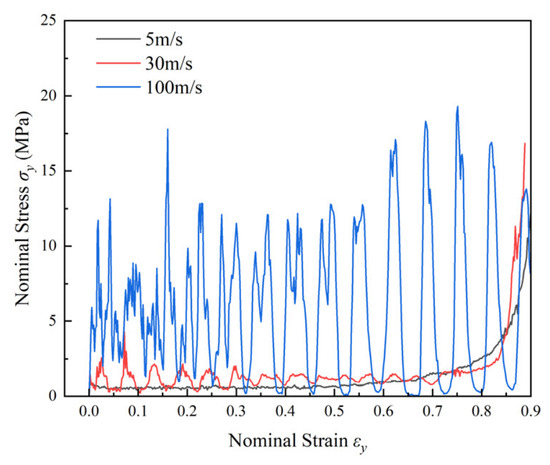
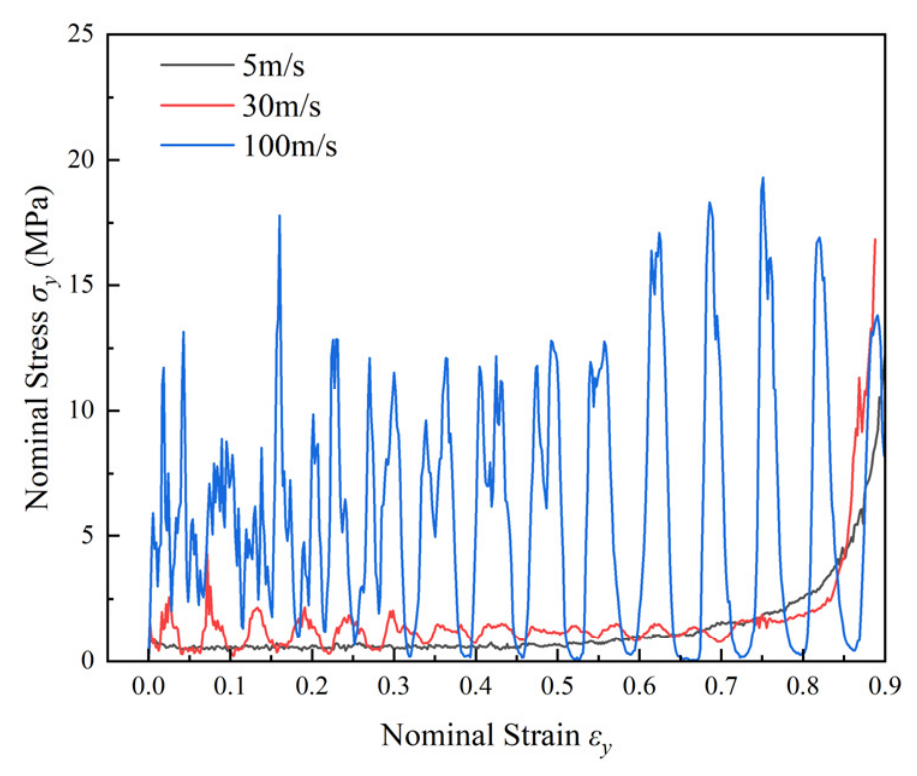
Figure 15 compares the nominal stress–strain responses of the FSSH under dynamic compression at velocities of 5, 30, and 100 m/s. Overall, the initial peak stress, nominal stress level, and stress fluctuation amplitude increase markedly with increasing loading velocity, indicating a pronounced velocity sensitivity of the dynamic compressive response of the FSSH. At 5 m/s, the curve remains relatively smooth, suggesting that the deformation is mainly governed by stable progressive buckling and cell-wall bending. As the loading velocity increases to 30 m/s, the plateau stress increases and local stress fluctuations become more evident, reflecting more active cell-wall contact and localized collapse. At 100 m/s, dense serrated peaks with large amplitudes are observed, and the stress level is significantly higher than those observed at 5 and 30 m/s, indicating stronger effects of inertia, stress-wave propagation, and local contact during dynamic compression. These results demonstrate that increasing the loading velocity not only enhances the initial load-bearing capacity of the FSSH but also changes the crushing process from relatively stable progressive deformation at low velocity to more localized dynamic crushing at high velocity.
Figure 15.
Nominal stress–strain responses of the FSSH at different compression velocities.
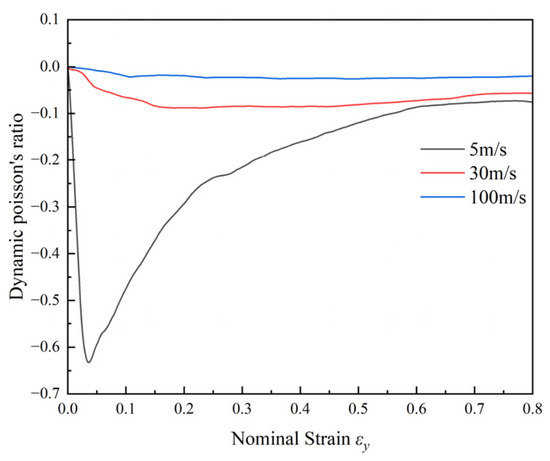
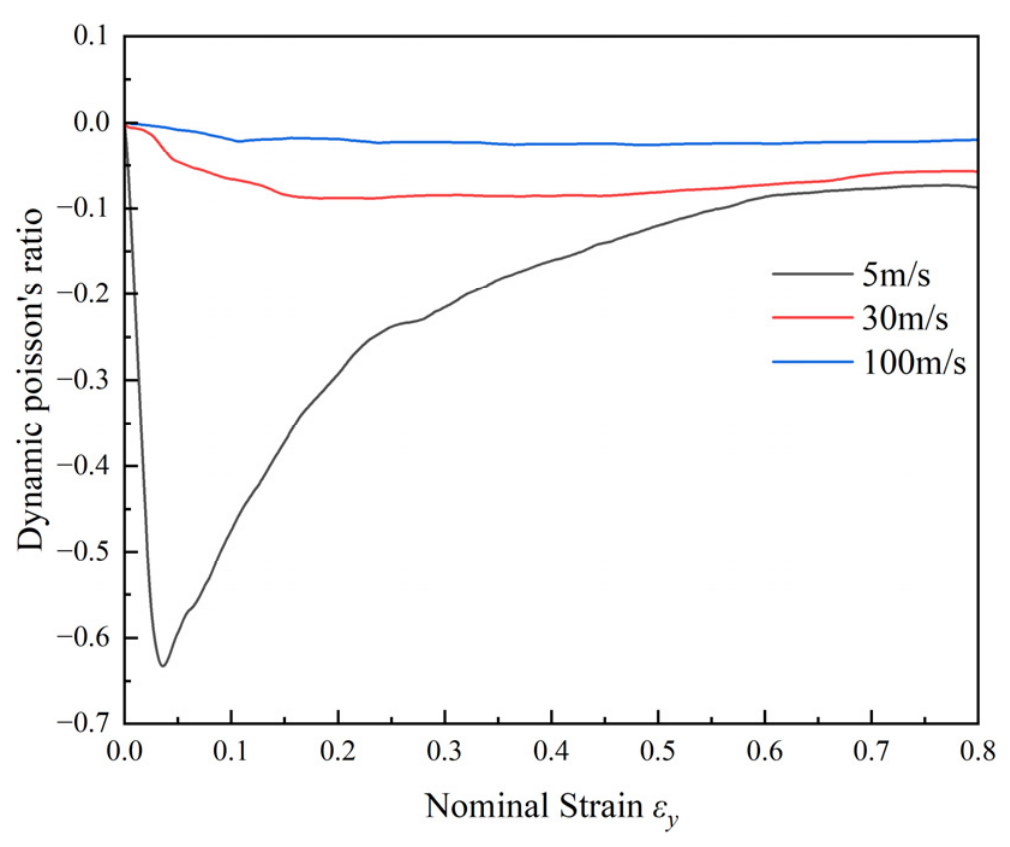
Figure 16 shows the dynamic Poisson’s ratio of the FSSH at three compression velocities. Under the low-speed condition, the extreme value of the limiting Poisson’s ratio is approximately −0.63, indicating that the cell walls of the FSSH have sufficient time to undergo coordinated rotation and inward bending during low-speed compression; consequently, pronounced transverse contraction is observed. Under the medium-speed condition, the extreme Poisson’s ratio of the FSSH is approximately −0.09, and the overall NPR effect is markedly weaker than that under the low-speed condition. This indicates that inertial effects begin to interfere with the coordinated deformation of the unit cells during medium-speed compression, thereby suppressing the ability for transverse contraction. Under the high-speed condition, the Poisson’s ratio of the FSSH remains close to 0, and only a weak NPR effect is retained, suggesting that inertial effects become more pronounced during high-speed compression and that the unit cells cannot fully develop global inward deformation. These results indicate that increasing the compression velocity weakens the NPR effect of the FSSH.
Figure 16.
Dynamic Poisson’s ratio of the FSSH under dynamic compression at different velocities.
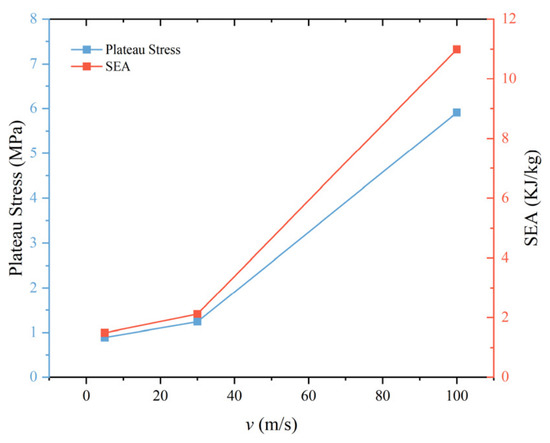
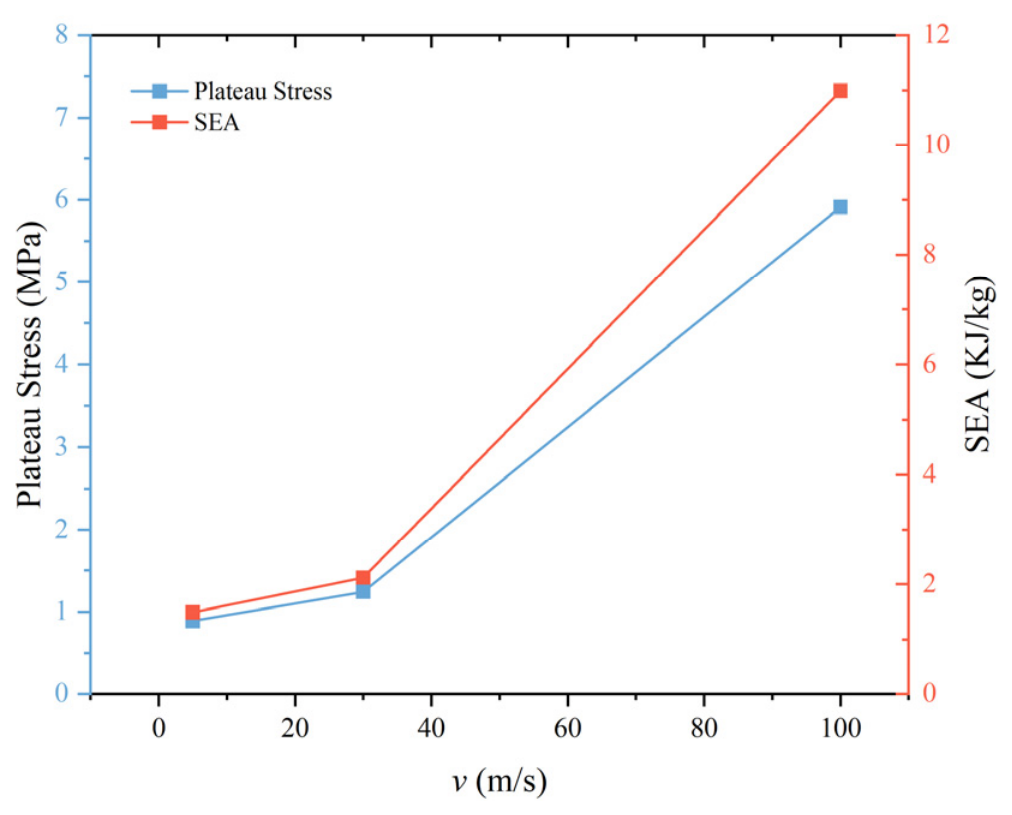
Figure 17 compares the plateau stress and SEA of the FSSH under dynamic compression at different velocities. As the loading velocity increases from 5 m/s to 100 m/s under dynamic compression, both the plateau stress and SEA increase continuously, indicating that the energy absorption capacity of the FSSH exhibits a pronounced dependence on the loading velocity. Between 5 m/s and 30 m/s, both quantities increase only slightly, suggesting that under low- to medium-velocity dynamic compression, the FSSH is still governed primarily by progressive crushing and cell-wall bending, with inertial effects exerting a limited influence on the overall energy absorption capacity. When the loading velocity further increases to 100 m/s, both the plateau stress and SEA increase markedly, indicating that local cell-wall contact and inertial effects are enhanced under high-velocity dynamic compression, thereby enabling more cell walls to engage in load-bearing, contact interaction, and plastic energy dissipation. Therefore, compared with the low- and medium-velocity conditions, the FSSH exhibits higher load-bearing capacity and energy absorption capacity at 100 m/s.
Figure 17.
Plateau stress and SEA of the FSSH under dynamic compression at different velocities.
5. Effect of Cell Wall Thickness on the Dynamic Compressive Mechanical Properties of the FSSH
To investigate the effect of the cell wall thickness on the FSSH, this study comparatively investigates the deformation modes, NPR effects, and energy absorption capacity of FSSHs with cell wall thicknesses of = 0.1 mm, 0.3 mm, 0.5 mm, 0.7 mm, and 0.9 mm under low-velocity, medium-velocity, and high-velocity dynamic compression conditions. The remaining geometric parameters of the FSSHs are consistent with those described in Section 2.1. The relative densities of FSSHs corresponding to different cell wall thicknesses are = 0.0362, = 0.109, = 0.181, = 0.254, = 0.3258, respectively.
5.1. Low-Velocity Dynamic Compression
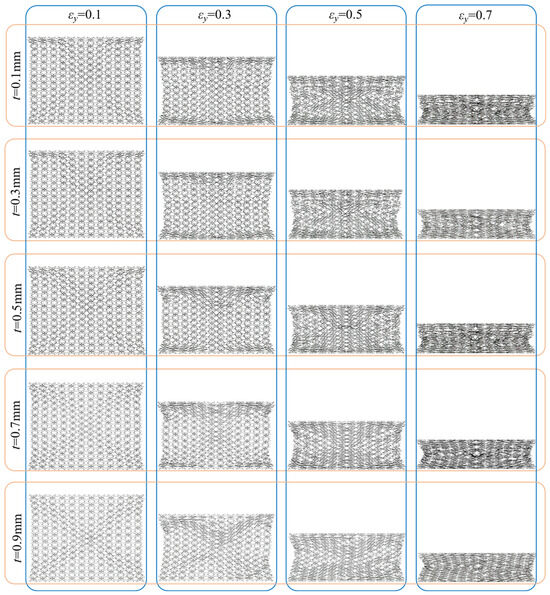
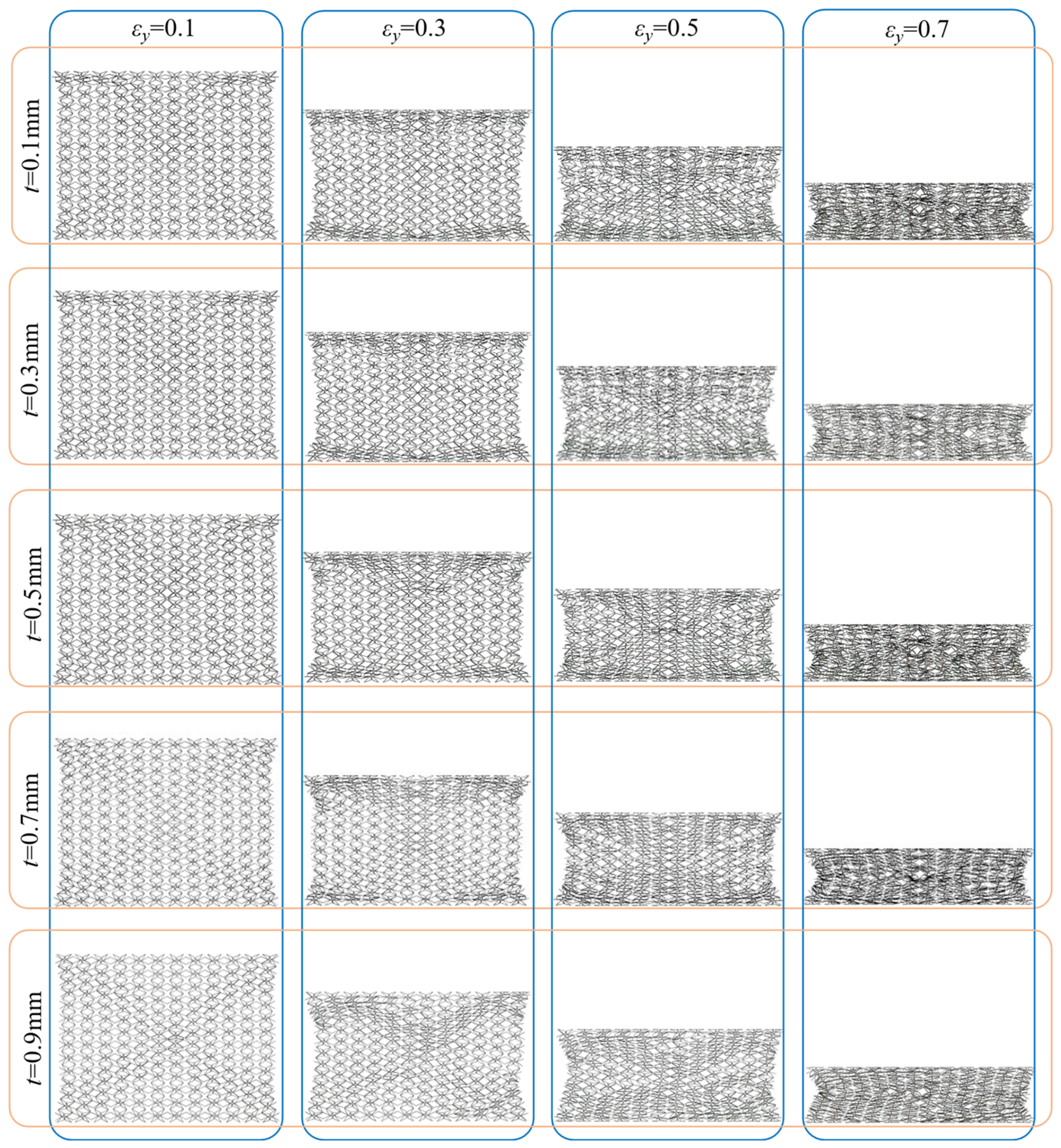
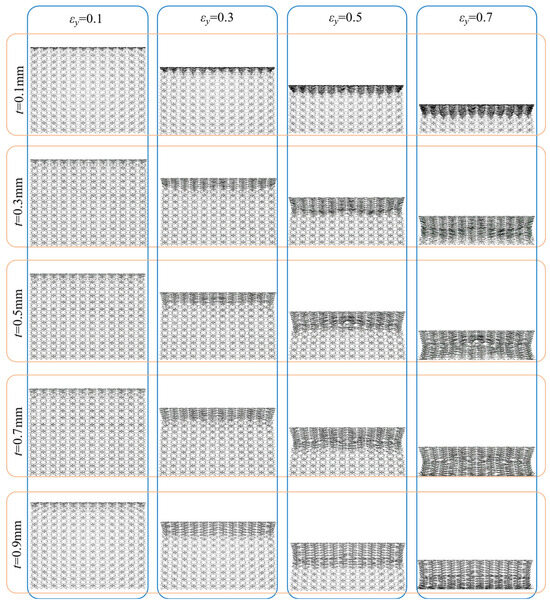
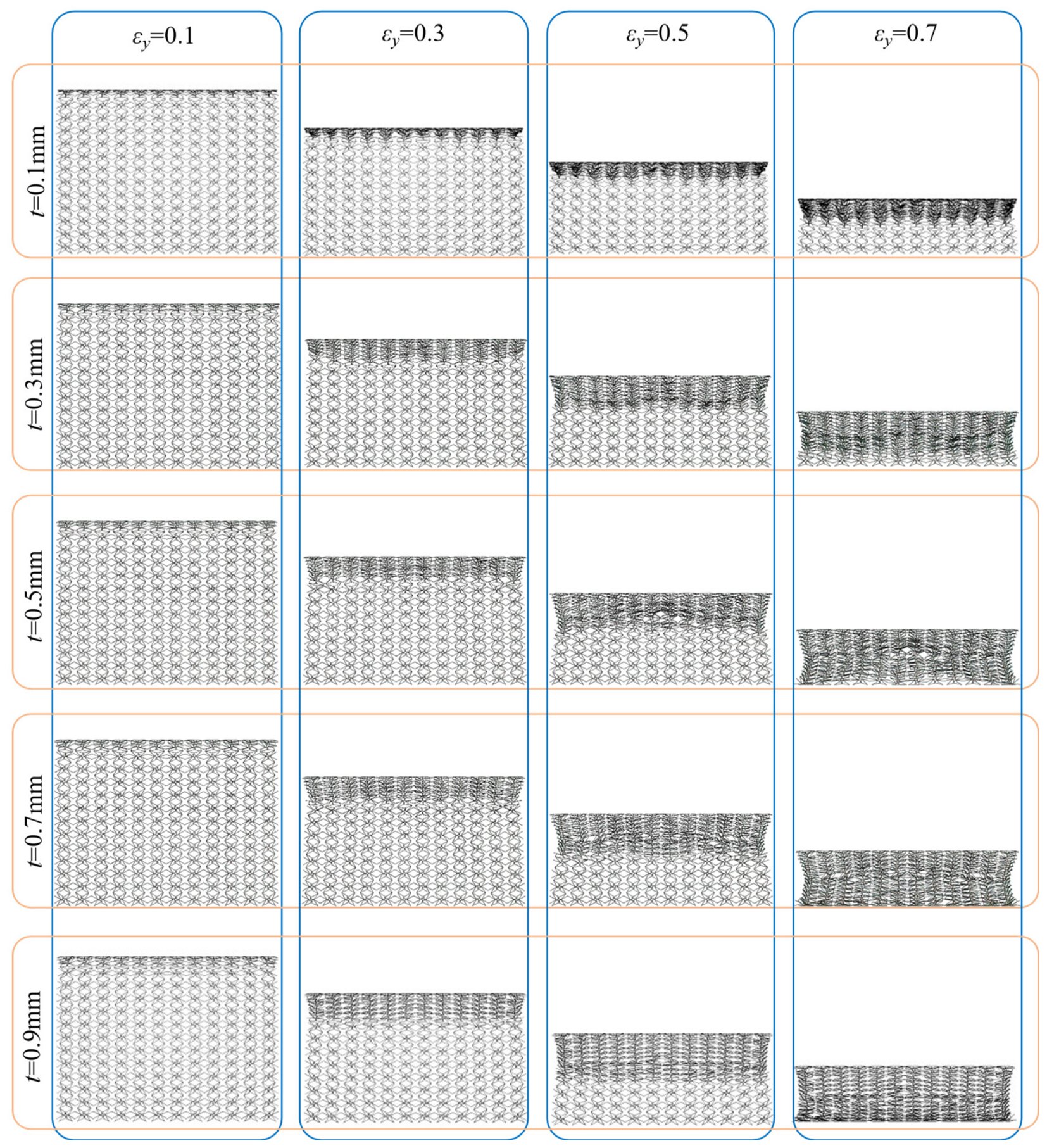
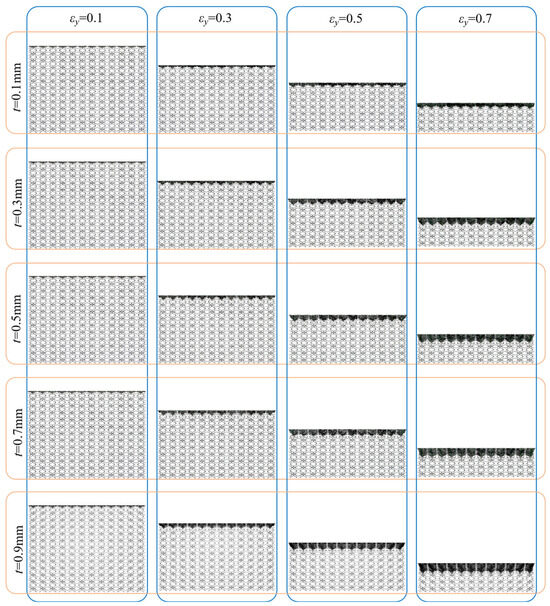
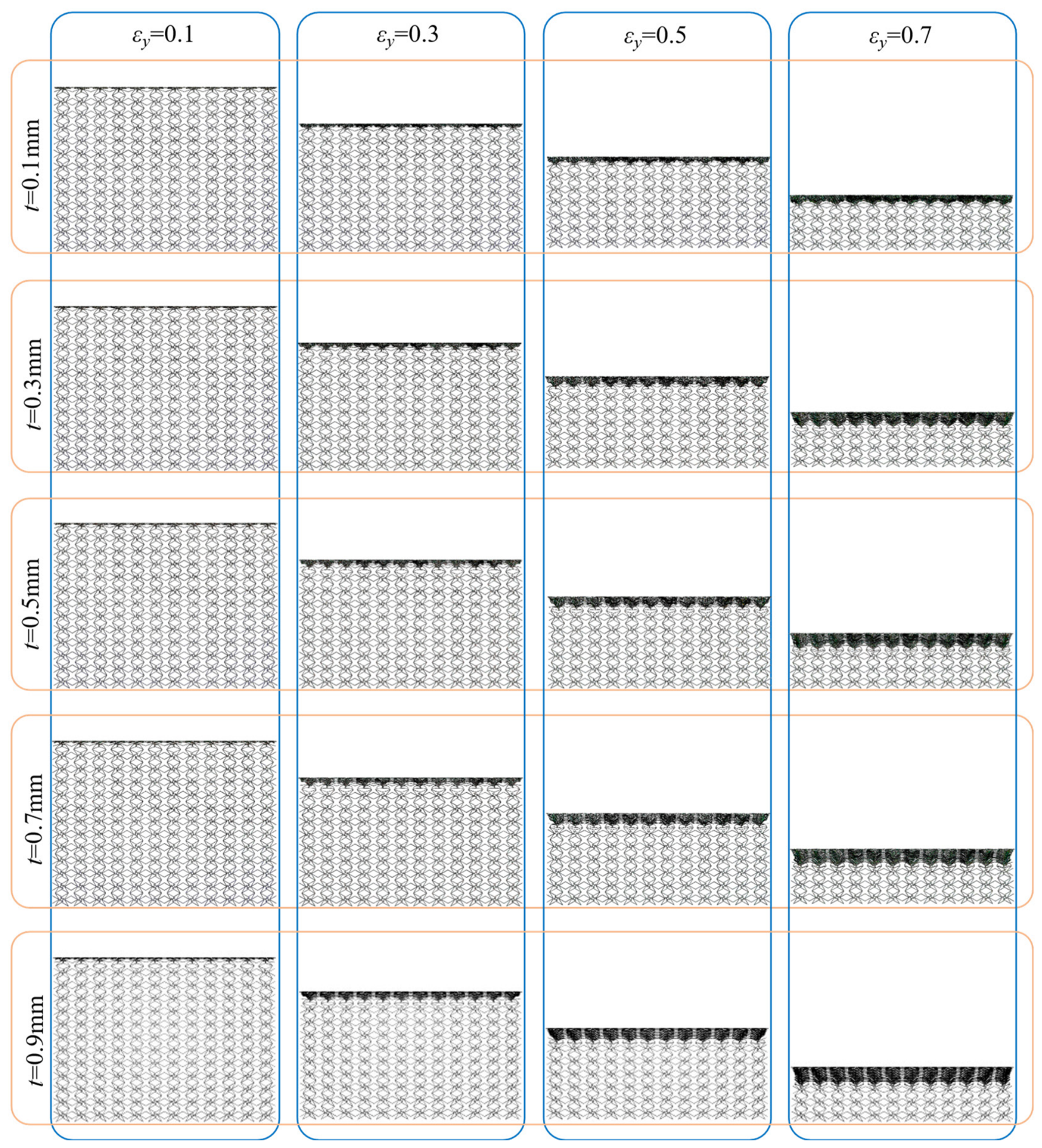
Figure 18 shows the deformation modes of FSSHs with different cell wall thicknesses under dynamic compression at a velocity of 5 m/s. It can be observed that, at the early compression stage, with increasing cell wall thickness, the preferentially densified cells are no longer concentrated at the dynamic-compression end and the fixed end, and the number of densified cells in the central region gradually increases. This indicates that increasing the cell wall thickness can improve the cooperative interaction among the cells, leading to a more uniform deformation mode.
Figure 18.
Deformation modes of FSSH with different thicknesses under dynamic compression at a velocity of 5 m/s.
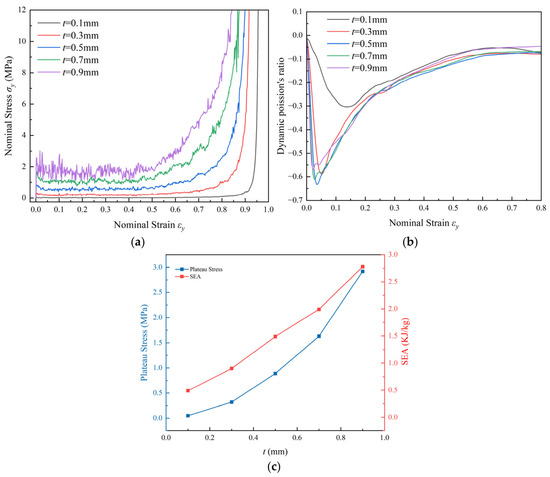
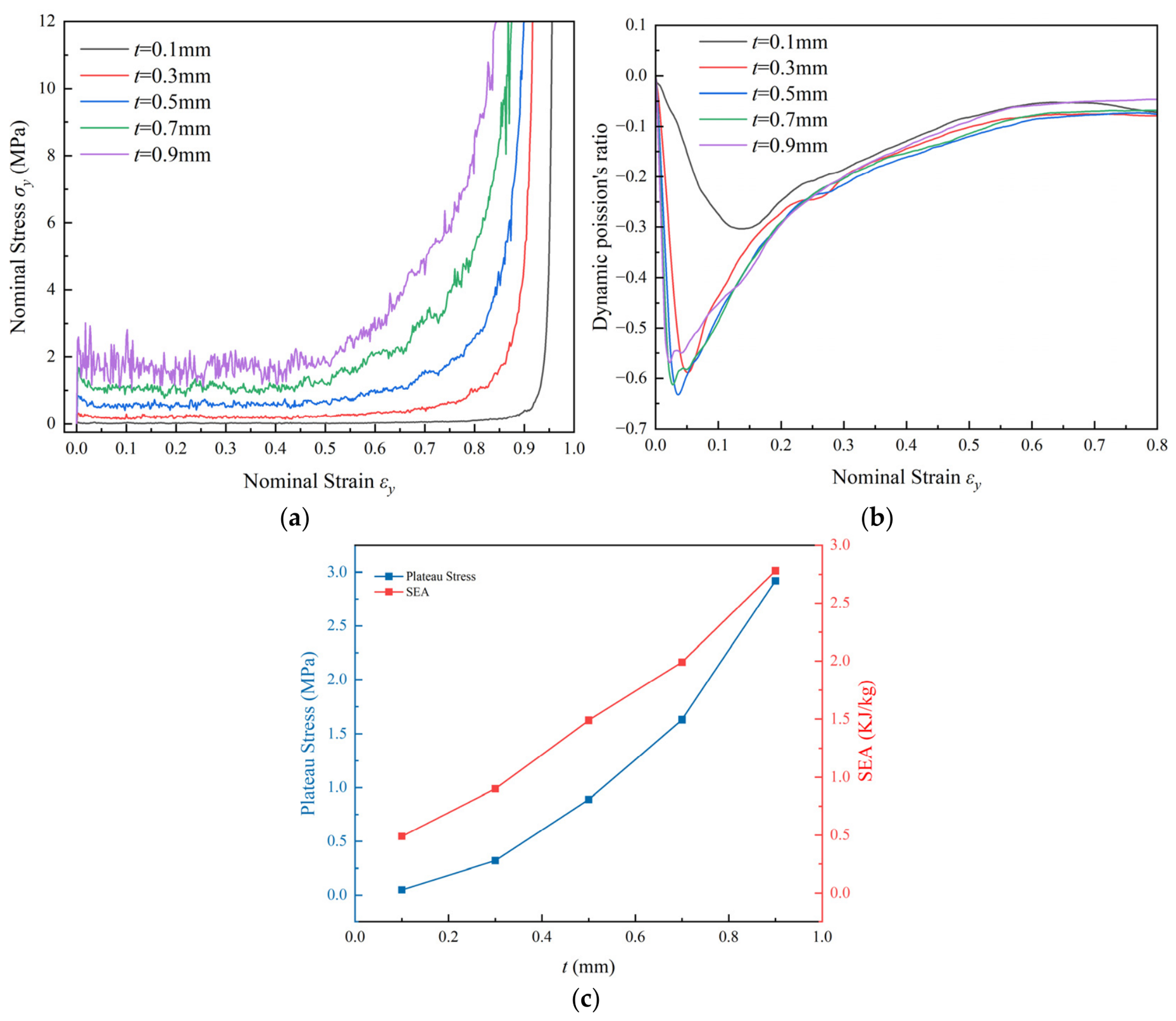
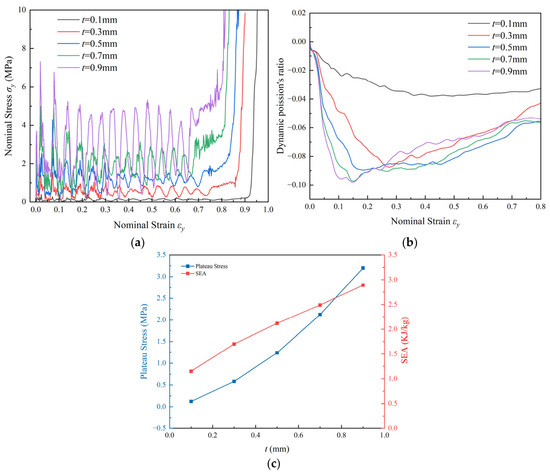
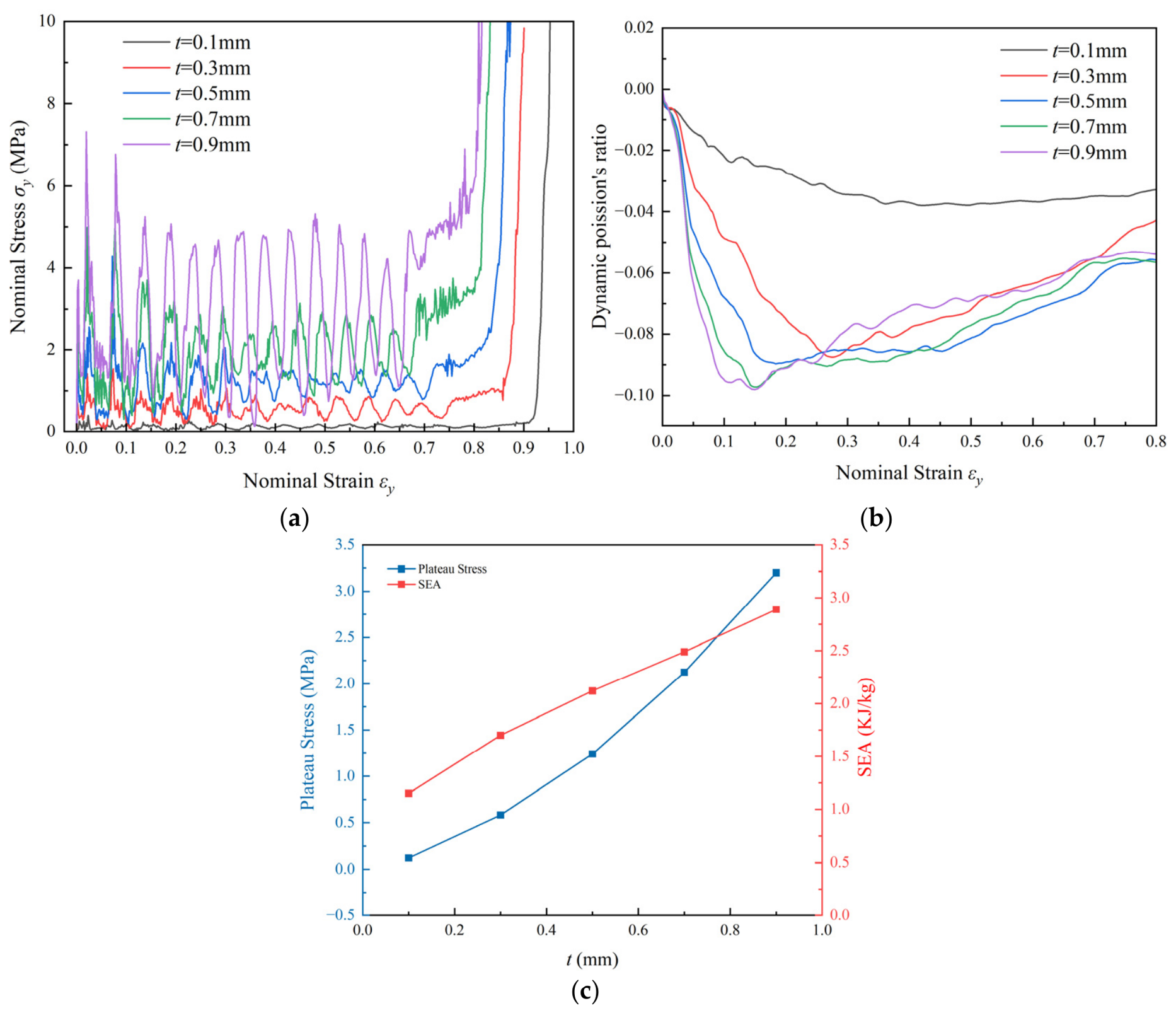
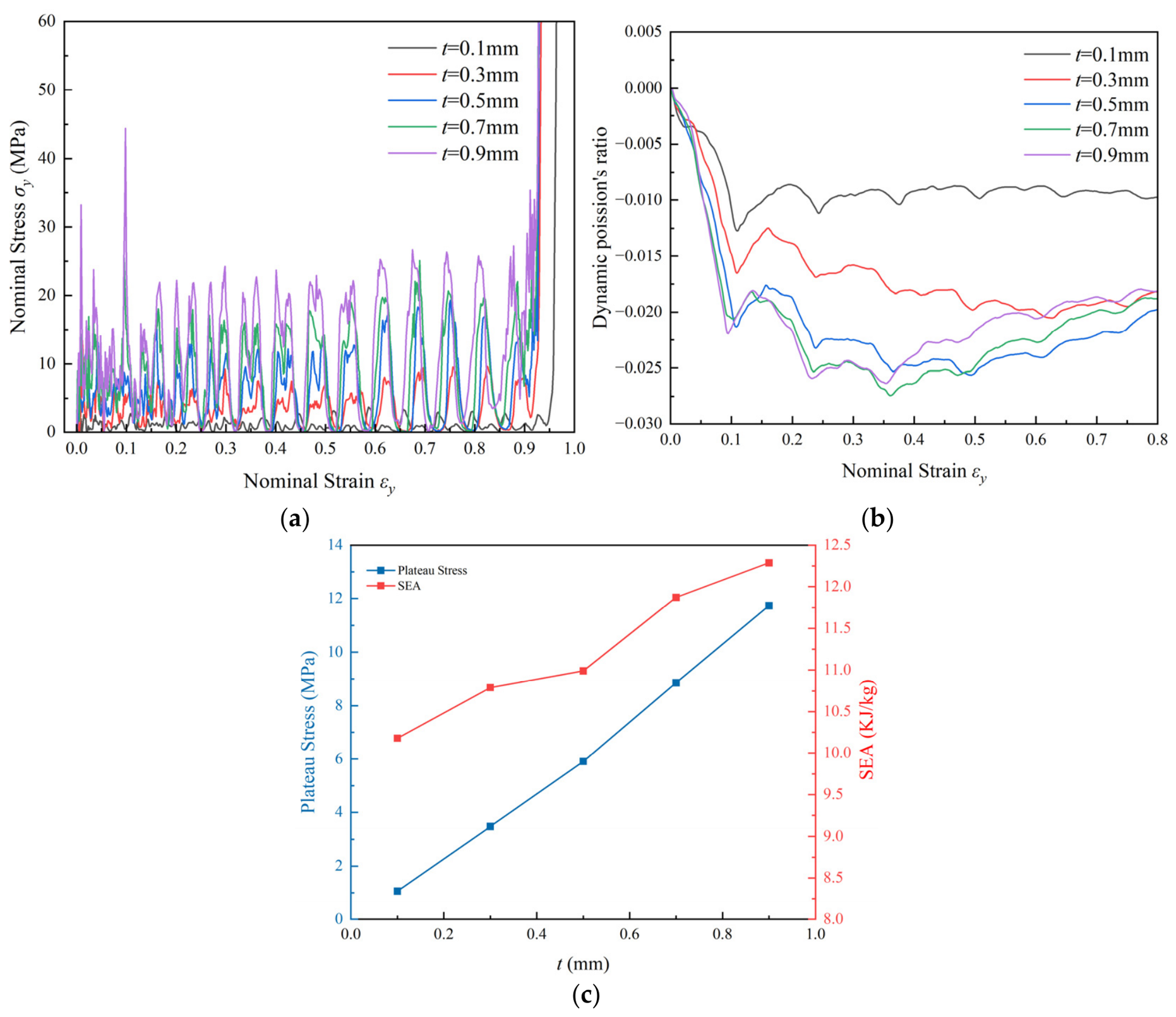
Figure 19a presents the nominal stress–strain curves of FSSHs with varying cell wall thicknesses. It can be observed that as the cell wall thickness increases, the initial peak stress gradually increases. Furthermore, the nominal stress at the same nominal strain also increases, the fluctuation amplitude of the nominal stress in the plateau stage becomes larger, and the densification stage occurs earlier.
Figure 19.
Mechanical properties of FSSH with different cell wall thicknesses under dynamic compression at a velocity of 5 m/s: (a) Nominal stress–strain curves. (b) Dynamic Poisson’s ratios. (c) Plateau stresses and SEA.
The dynamic Poisson’s ratios during compression are presented in Figure 19b. Initially, as the cell wall thickness increases, the ultimate Poisson’s ratio of the FSSH gradually decreases. However, when the thickness exceeds 0.5 mm, the ultimate Poisson’s ratio begins to increase. This demonstrates that the NPR effect first strengthens and then weakens with increasing cell wall thickness, suggesting that a moderate cell wall thickness leads to a more pronounced NPR effect.
The plateau stresses and SEA of FSSHs with varying cell wall thicknesses are shown in Figure 19c. Taking the FSSH with a wall thickness of 0.1 mm as the reference, the plateau stresses of the FSSHs with wall thicknesses of 0.3, 0.5, 0.7, and 0.9 mm are 6.4, 17.8, 32.6, and 58.4 times the corresponding reference value, respectively, and the SEA values are 1.83, 3.04, 4.06, and 5.67 times the corresponding reference value, respectively. The results indicate that, under dynamic compression at a velocity of 5 m/s, increasing the cell wall thickness can effectively improve the energy absorption capacity of the FSSH.
5.2. Medium-Velocity Dynamic Compression
Figure 20 illustrates the deformation modes of FSSHs with varying cell wall thicknesses under dynamic compression at a velocity of 30 m/s. It can be observed that, throughout the compression process, as the cell wall thickness increases, the number of densified cells near the dynamic-compression end gradually increases, and the influence of inertial effects on the deformation response gradually weakens.
Figure 20.
Deformation modes of FSSH with different thicknesses under dynamic compression at a velocity of 30 m/s.
Figure 21a presents the nominal stress–strain curves of FSSHs with varying cell wall thicknesses under dynamic compression at a velocity of 30 m/s. It is observed that as the cell wall thickness increases, the initial peak stress of the FSSHs gradually increases. Furthermore, the nominal stress at the same nominal strain increases, the fluctuation amplitude of the nominal stress in the plateau stage becomes larger, and the densification stage occurs earlier.
Figure 21.
Mechanical properties of FSSH with different cell wall thicknesses under dynamic compression at a velocity of 30 m/s: (a) Nominal stress–strain curves. (b) Dynamic Poisson’s ratios. (c) Plateau stresses and SEA.
The dynamic Poisson’s ratios during the compression process are presented in Figure 21b. In the early stage of compression, the Poisson’s ratio of the FSSHs gradually decreases as the cell wall thickness increases. As compression proceeds, except for the FSSH with a cell wall thickness of 0.1 mm, the Poisson’s ratios of the FSSH configurations with the other cell wall thicknesses tend to converge. This indicates that under dynamic compression at a velocity of 30 m/s, increasing the cell wall thickness within a certain range can improve the NPR effect of the FSSH.
The plateau stresses and SEA of FSSHs with varying cell wall thicknesses are shown in Figure 21c. Taking the FSSH with a wall thickness of 0.1 mm as the reference, the plateau stresses of the FSSHs with wall thicknesses of 0.3, 0.5, 0.7, and 0.9 mm are 4.8, 10.2, 17.6, and 26.4 times the corresponding reference value, respectively, and the SEA values are 1.48, 1.84, 2.17, and 2.51 times the corresponding reference value, respectively. The results indicate that, under dynamic compression at a velocity of 30 m/s, increasing the cell wall thickness can improve the energy absorption capacity of the FSSH.
5.3. High-Velocity Dynamic Compression
Figure 22 illustrates the deformation modes of FSSHs with varying cell wall thicknesses under dynamic compression at a velocity of 100 m/s. It is observed that for each FSSH, densification is initiated in the cells near the dynamic-compression end and then progresses layer by layer toward the fixed end.
Figure 22.
Deformation modes of FSSH with different thicknesses under dynamic compression at a velocity of 100 m/s.
Figure 23a presents the nominal stress–strain curves of FSSHs with varying cell wall thicknesses under dynamic compression at a velocity of 100 m/s. It is observed that as the cell wall thickness increases, the initial peak stress of the FSSHs gradually increases. Furthermore, the nominal stress at the same nominal strain increases, the fluctuation amplitude of the nominal stress in the plateau stage becomes larger, and the densification stage occurs earlier.
Figure 23.
Mechanical properties of FSSH with different cell wall thicknesses under dynamic compression at a velocity of 100 m/s: (a) Nominal stress–strain curves. (b) Dynamic Poisson’s ratios. (c) Plateau stresses and SEA.
The dynamic Poisson’s ratios during the compression process are presented in Figure 23b. In the early stage of compression, as the cell wall thickness increases, the Poisson’s ratios of the FSSH configurations at the same nominal strain generally decrease, and the variation trends for thicknesses of 0.7 mm and 0.9 mm are highly similar. From the middle stage of compression, except for the FSSH with a cell wall thickness of 0.1 mm, the Poisson’s ratios of the FSSH configurations with the other cell wall thicknesses tended to converge. This indicates that under dynamic compression at a velocity of 100 m/s, increasing the cell wall thickness at low strain levels makes the NPR effect of the FSSH more pronounced.
The plateau stress and SEA of FSSHs with varying cell wall thicknesses are shown in Figure 23c. Taking the FSSH with a wall thickness of 0.1 mm as the reference, the plateau stresses of the FSSHs with wall thicknesses of 0.3, 0.5, 0.7, and 0.9 mm are 3.3, 5.6, 8.4, and 11.1 times the corresponding reference value, respectively, and the SEA values are 1.06, 1.08, 1.17, and 1.21 times the corresponding reference value, respectively. The results indicate that, under dynamic compression at a velocity of 100 m/s, increasing the cell wall thickness can slightly improve the energy absorption capacity of the FSSH.
6. Conclusions
Based on the principles of self-similarity and iterative generation of fractal theory, a fractal star-shaped NPR structure with a second-order fractal substructure is proposed in this study. A biaxially symmetric FSSH is further developed. A finite element model was established for the proposed FSSH. The deformation modes, NPR effects, and energy absorption capacity of the FSSH and SSH under low-, medium-, and high-velocity conditions were investigated to examine the effect of the second-order fractal substructures. Subsequently, the effects of different cell wall thicknesses on the deformation mode, NPR effect, and energy absorption capacity of the FSSH were systematically investigated. The main conclusions are summarized as follows:
- (1)
- Under low-velocity dynamic compression, the FSSH exhibits a more uniform deformation mode and is less affected by inertial effects. Under medium-velocity dynamic compression, the SSH exhibits both global and localized deformation, whereas the FSSH is dominated by localized deformation. Under high-velocity dynamic compression, both the SSH and FSSH are dominated by localized deformation, and only minor differences can be observed between their deformation modes. In addition, under dynamic compression at different velocities, the NPR effects of the FSSH are weaker than those of the SSH.
- (2)
- Under dynamic compression at the three investigated velocities, the plateau stress and SEA of the FSSH are higher than those of the SSH. Under low-velocity dynamic compression, the plateau stress and SEA of the FSSH are 128% and 104% higher than those of the SSH, respectively. As the loading velocity increases under dynamic compression, the improvement in the plateau stress and SEA of the FSSH compared with SSH gradually decreases. Under medium-velocity dynamic compression, the plateau stress and SEA of the FSSH are 63.2% and 51.4% higher than those of the SSH, respectively. Under high-velocity dynamic compression, they are 9% and 5.6% higher, respectively.
- (3)
- As the wall thickness increases, the initial peak stress, plateau stress, and SEA of the FSSH increase gradually. Meanwhile, the stress fluctuations become more pronounced, and densification occurs earlier. Under low-velocity dynamic compression, increasing the wall thickness improves the cooperative deformation of the cells, resulting in a more uniform deformation, while the NPR effect first increases and then decreases. Under medium- and high-velocity dynamic compression, larger wall thicknesses mainly improve the NPR effect in the early stage of compression. Under high-velocity dynamic compression, the effect of wall thickness weakens, and SEA increases only slightly.
Although systematic finite element analysis has been performed in this study, several limitations remain. In future work, FSSH specimens will be fabricated through additive manufacturing or precision machining, and experimental tests will be conducted to validate the deformation modes, NPR effect, plateau stress, and SEA predicted by the simulations. The experimental program will also account for manufacturability, minimum feature size, possible fabrication defects, and the sensitivity of the NPR and SEA responses to geometric deviations. In addition to experimental investigations, a systematic parametric study will be conducted on the scaling coefficient and rotation angle , which define the second-order fractal substructure, to further evaluate their influence on the NPR effect, plateau stress, SEA, and deformation modes, thereby providing a basis for the geometric design of the FSSH.
Author Contributions
Conceptualization, T.C. and H.W.; methodology, T.C.; software, T.C.; validation, T.C., Y.S. and P.L.; formal analysis, T.C.; investigation, Y.S.; resources, P.L.; data curation, T.C. and Y.S.; writing—original draft preparation, T.C.; writing—review and editing, H.W. and P.L.; visualization, T.C.; supervision, H.W. and P.L.; project administration, P.L.; funding acquisition, H.W. All authors have read and agreed to the published version of the manuscript.
Funding
This research was funded by the National Natural Science Foundation of China, grant number 5240083601, and the Innovation Capability Enhancement Project of Small and Medium-sized Sci-tech Enterprises of Shandong Province, grant number 2024TSGC0595.
Data Availability Statement
The data presented in this study are available on request from the corresponding author. The data are not publicly available due to privacy.
Conflicts of Interest
The authors declare no conflicts of interest.
Abbreviations
The following abbreviations are used in this manuscript:
| SSH | Star-shaped honeycomb |
| NPR | Negative Poisson’s ratio |
| FSSH | Fractal star-shaped honeycomb |
| SEA | Specific energy absorption |
References
- Mousanezhad, D.; Haghpanah, B.; Ghosh, R.; Hamouda, A.M.; Nayeb-Hashemi, H.; Vaziri, A. Elastic properties of chiral, anti-chiral, and hierarchical honeycombs: A simple energy-based approach. Theor. Appl. Mech. Lett. 2016, 6, 81–96. [Google Scholar] [CrossRef] [Scilit]
- Hu, L.L.; Zhou, M.Z.; Deng, H. Dynamic indentation of auxetic and non-auxetic honeycombs under large deformation. Compos. Struct. 2019, 207, 323–330. [Google Scholar] [CrossRef] [Scilit]
- Prawoto, Y. Seeing auxetic materials from the mechanics point of view: A structural review on the negative Poisson’s ratio. Comput. Mater. Sci. 2012, 58, 140–153. [Google Scholar] [CrossRef] [Scilit]
- Jin, S.; Korkolis, Y.P.; Li, Y. Shear resistance of an auxetic chiral mechanical metamaterial. Int. J. Solids Struct. 2019, 174–175, 28–37. [Google Scholar] [CrossRef] [Scilit]
- Sanami, M.; Ravirala, N.; Alderson, K.; Alderson, A. Auxetic materials for sports applications. Procedia Eng. 2014, 72, 453–458. [Google Scholar] [CrossRef] [Scilit]
- Spadoni, A.; Ruzzene, M. Numerical and experimental analysis of the static compliance of chiral truss-core airfoils. J. Mech. Mater. Struct. 2007, 2, 965–981. [Google Scholar] [CrossRef] [Scilit]
- Alomarah, A.; Masood, S.H.; Ruan, D. Out-of-plane and in-plane compression of additively manufactured auxetic structures. Aerosp. Sci. Technol. 2020, 106, 106107. [Google Scholar] [CrossRef] [Scilit]
- Wang, C.; Li, Y.; Zhao, W.; Zou, S.; Zhou, G.; Wang, Y. Structure design and multi-objective optimization of a novel crash box based on biomimetic structure. Int. J. Mech. Sci. 2018, 138–139, 489–501. [Google Scholar] [CrossRef] [Scilit]
- Qu, Y.; Wang, D. Analyses on the roller structure of equivalent honeycombs for forest harvester under impact loading. Compos. Struct. 2021, 262, 113355. [Google Scholar] [CrossRef] [Scilit]
- Ali, M.N.; Busfield, J.J.C.; Rehman, I.U. Auxetic oesophageal stents: Structure and mechanical properties. J. Mater. Sci. Mater. Med. 2014, 25, 527–553. [Google Scholar] [CrossRef] [Scilit] [PubMed]
- Zhang, Y.; Ren, X.; Zhang, X.Y.; Huang, T.T.; Sun, L.; Xie, Y.M. A novel buckling-restrained brace with auxetic perforated core: Experimental and numerical studies. Eng. Struct. 2021, 249, 113223. [Google Scholar] [CrossRef] [Scilit]
- Rosewitz, J.A.; Choshali, H.A.; Rahbar, N. Bioinspired design of architected cement-polymer composites. Cem. Concr. Compos. 2019, 96, 252–265. [Google Scholar] [CrossRef] [Scilit]
- Ren, X.; Shen, J.; Tran, P.; Ngo, T.D.; Xie, Y.M. Auxetic nail: Design and experimental study. Compos. Struct. 2018, 184, 288–298. [Google Scholar] [CrossRef] [Scilit]
- Xiao, D.; Kang, X.; Li, Y.; Wu, W.; Lu, J.; Zhao, G.; Fang, D. Insight into the negative Poisson’s ratio effect of metallic auxetic reentrant honeycomb under dynamic compression. Mater. Sci. Eng. A 2019, 763, 138151. [Google Scholar] [CrossRef] [Scilit]
- Wang, T.; Wang, L.; Ma, Z.-D.; Hulbert, G.M. Elastic analysis of auxetic cellular structure consisting of re-entrant hexagonal cells using a strain-based expansion homogenization method. Mater. Des. 2018, 160, 284–293. [Google Scholar] [CrossRef] [Scilit]
- Wei, L.; Zhao, X.; Yu, Q.; Zhang, W.; Zhu, G. In-plane compression behaviors of the auxetic star honeycomb: Experimental and numerical simulation. Aerosp. Sci. Technol. 2021, 115, 106797. [Google Scholar] [CrossRef] [Scilit]
- Gao, Q.; Liao, W.-H.; Wang, L. On the low-velocity impact responses of auxetic double arrowed honeycomb. Aerosp. Sci. Technol. 2020, 98, 105698. [Google Scholar] [CrossRef] [Scilit]
- Zhao, X.; Gao, Q.; Wang, L.; Yu, Q.; Ma, Z. Dynamic crushing of double-arrowed auxetic structure under impact loading. Mater. Des. 2018, 160, 527–537. [Google Scholar] [CrossRef] [Scilit]
- Xu, H.; Liu, H.-T.; Li, G.-F. In-plane characteristics of a multi-arc re-entrant auxetic honeycomb with enhanced negative Poisson’s ratio effect and energy absorption. Eur. J. Mech. A Solids 2025, 109, 105473. [Google Scholar] [CrossRef] [Scilit]
- Qi, C.; Jiang, F.; Remennikov, A.M.; Pei, L.-Z.; Liu, J.; Wang, J.-S.; Liao, X.-W.; Yang, S. Quasi-static crushing behavior of novel re-entrant circular auxetic honeycombs. Compos. Part B Eng. 2020, 197, 108117. [Google Scholar] [CrossRef] [Scilit]
- Liu, J.-Y.; Liu, H.-T.; An, M.-R. Crushing behaviors of novel Diabolo shaped honeycombs with enhanced energy absorption performance. Int. J. Mech. Sci. 2022, 229, 107492. [Google Scholar] [CrossRef] [Scilit]
- Chen, Y.; Huang, H.; Deng, X. In-plane compression characteristics of star-shaped honeycomb with asymmetric cells. Eur. J. Mech. A Solids 2024, 105, 105224. [Google Scholar] [CrossRef] [Scilit]
- Wang, Z.-P.; Poh, L.H.; Dirrenberger, J.; Zhu, Y.; Forest, S. Isogeometric shape optimization of smoothed petal auxetic structures via computational periodic homogenization. Comput. Methods Appl. Mech. Eng. 2017, 323, 250–271. [Google Scholar] [CrossRef] [Scilit]
- Zhang, Z.-Y.; Li, J.; Liu, H.-T.; Wang, Y.-B. Novel 2D arc-star-shaped structure with tunable Poisson’s ratio and its 3D configurations. Mater. Today Commun. 2022, 30, 103016. [Google Scholar] [CrossRef] [Scilit]
- Zhang, W.; Yan, Z.; Zhang, J.; Wang, H.; Han, F.; Jiang, P.; Wu, T.; Qin, Q. On in-plane crushing behavior of an improved double-arrow auxetic metamaterial with two-step deformation mode. Eng. Struct. 2024, 303, 117482. [Google Scholar] [CrossRef] [Scilit]
- Guo, M.-F.; Yang, H.; Ma, L. Design and analysis of 2D double-U auxetic honeycombs. Thin-Walled Struct. 2020, 155, 106915. [Google Scholar] [CrossRef] [Scilit]
- Li, X.; Wang, Q.; Yang, Z.; Lu, Z. Novel auxetic structures with enhanced mechanical properties. Extrem. Mech. Lett. 2019, 27, 59–65. [Google Scholar] [CrossRef] [Scilit]
- Hai, H.; Wang, B.; Sun, H.; Wang, W.; Cheng, S.; Zhao, Z.; Xu, W. Design and energy absorption study of an asymmetric windmill-style negative Poisson’s ratio honeycomb structures. Phys. Status Solidi B 2025, 262, 2400470. [Google Scholar] [CrossRef] [Scilit]
- Wei, L.; Zhao, X.; Yu, Q.; Zhu, G. Quasi-static axial compressive properties and energy absorption of star-triangular auxetic honeycomb. Compos. Struct. 2021, 267, 113850. [Google Scholar] [CrossRef] [Scilit]
- Wang, H.; Lu, Z.; Yang, Z.; Li, X. In-plane dynamic crushing behaviors of a novel auxetic honeycomb with two plateau stress regions. Int. J. Mech. Sci. 2019, 151, 746–759. [Google Scholar] [CrossRef] [Scilit]
- Jin, Y.-T.; Qie, Y.-H.; Li, N.-N.; Li, N.-W. Study on elastic mechanical properties of novel 2D negative Poisson’s ratio structure: Re-entrant hexagon nested with star-shaped structure. Compos. Struct. 2022, 301, 116065. [Google Scholar] [CrossRef] [Scilit]
- Ma, N.; Han, Q.; Han, S.; Li, C. Hierarchical re-entrant honeycomb metamaterial for energy absorption and vibration insulation. Int. J. Mech. Sci. 2023, 250, 108307. [Google Scholar] [CrossRef] [Scilit]
- Lian, J.; Xu, L.; Wu, D.; Wang, Z. Study on re-entrant hierarchical honeycombs in-plane impact. Sci. Rep. 2023, 13, 21423. [Google Scholar] [CrossRef] [Scilit] [PubMed]
- Lian, J.; Wang, Z. Impact response of re-entrant hierarchical honeycomb. Materials 2023, 16, 7121. [Google Scholar] [CrossRef] [Scilit] [PubMed]
- Lu, H.; Wang, X.; Chen, T. In-plane dynamics crushing of a combined auxetic honeycomb with negative Poisson’s ratio and enhanced energy absorption. Thin-Walled Struct. 2021, 160, 107366. [Google Scholar] [CrossRef] [Scilit]
- Li, N.; Liu, S.-Z.; Wu, X.-N.; Wang, J.-Y.; Han, Y.-S.; Zhang, X.-C. Mechanical characteristics of a novel rotating star-rhombic auxetic structure with multi-plateau stages. Thin-Walled Struct. 2023, 191, 111081. [Google Scholar] [CrossRef] [Scilit]
- Zhang, X.; Hao, H.; Tian, R.; Xue, Q.; Guan, H.; Yang, X. Quasi-static compression and dynamic crushing behaviors of novel hybrid re-entrant auxetic metamaterials with enhanced energy-absorption. Compos. Struct. 2022, 288, 115399. [Google Scholar] [CrossRef] [Scilit]
- Xu, Z.H.; Cui, Y.J.; Wang, K.F.; Wang, B.L.; Wang, B. Quasi-static compression and impact resistances of novel re-entrant chiral hybrid honeycomb structures. Compos. Struct. 2025, 366, 119206. [Google Scholar] [CrossRef] [Scilit]
- Li, X.; Li, Z.; Guo, Z.; Mo, Z.; Li, J. A novel star-shaped honeycomb with enhanced energy absorption. Compos. Struct. 2023, 309, 116716. [Google Scholar] [CrossRef] [Scilit]
- Liu, J.-Y.; Liu, H.-T. Energy absorption characteristics and stability of novel bionic negative Poisson’s ratio honeycomb under oblique compression. Eng. Struct. 2022, 267, 114682. [Google Scholar] [CrossRef] [Scilit]
- Wei, L.; Zhao, X.; Yu, Q.; Zhu, G. A novel star auxetic honeycomb with enhanced in-plane crushing strength. Thin-Walled Struct. 2020, 149, 106623. [Google Scholar] [CrossRef] [Scilit]

Disclaimer/Publisher’s Note: The statements, opinions and data contained in all publications are solely those of the individual author(s) and contributor(s) and not of MDPI and/or the editor(s). MDPI and/or the editor(s) disclaim responsibility for any injury to people or property resulting from any ideas, methods, instructions or products referred to in the content. |
© 2026 by the authors. Licensee MDPI, Basel, Switzerland. This article is an open access article distributed under the terms and conditions of the Creative Commons Attribution (CC BY) license.