


Abstract
While construction and demolition waste (CDW) remains one of the largest waste streams and a major source of environmental impacts worldwide, strategies based on circular economy principles, selective deconstruction, and pre-demolition audits (PDAs) have been increasingly promoted to mitigate these impacts. This study presents a comparative life cycle assessment (LCA) of high material recovery deconstruction and conventional demolition of an administrative building in Czechia. Two end-of-life (EoL) scenarios were evaluated: a Circular scenario derived from detailed PDA data and real material flows, and a Business-as-usual (BAU) demolition scenario representing conventional demolition practice. The system boundary included EoL stage (modules C2–C4) and module D in accordance with EN 15804+A2. Environmental modelling was conducted in SimaPro software V.9.2. using the ecoinvent 3.7 database and covered nine environmental impact categories. Results show that circular deconstruction consistently yielded higher environmental benefits, with improvements ranging from 1% to almost 15% across the assessed categories. Recycling of aluminium, steel, and glass contributed most significantly to avoided impacts, while concrete recycling provided benefits mainly under high-quality recovery pathways. The study demonstrates the value of PDA as an effective decision-support tool to improve material recovery and support more sustainable CDW management.
1. Introduction
Construction and demolition activities are among the largest contributors to global waste generation, accounting for approximately 30% of total waste generated in the European Union (EU) [1]. Consequently, effective construction and demolition waste (CDW) management has become essential for achieving circular economy and climate-neutrality objectives within the built environment.
To address these challenges, the EU has introduced several legislative and policy instruments, including the revised Waste Framework Directive (2018/851/EU) [2] and the Circular Economy Action Plan [3]. Among the proposed strategies and tools, increasing attention has been directed towards circular economy principles, selective deconstruction practices, and the concept of buildings as a material bank (BAMB) for future material recovery and resource efficiency [4]. Within this framework, pre-demolition audits (PDAs) have emerged as a critical tool enabling systematic identification and quantification of materials prior to demolition [5,6,7]. PDAs support informed decision-making regarding material separation, reuse, recycling, and waste treatment pathways. Their importance has been further reinforced by the updated EU Construction and Demolition Waste Management Protocol [6], which formalises guidance and requirements for pre-demolition and pre-renovation audits.
Selective deconstruction, defined as the systematic dismantling of buildings to recover reusable and recyclable materials, is increasingly recognised as a key strategy for improving CDW management performance. Compared with conventional demolition, selective approaches can substantially increase material recovery rates and improve the quality of recovered secondary materials [8,9]. However, higher recovery rates alone do not necessarily guarantee lower environmental impacts. The overall environmental performance of demolition strategies depends on multiple factors, including transportation distances, treatment technologies, recycling quality, and the substitution potential of recovered materials relative to primary resource production [9,10].
Life Cycle Assessment (LCA) is widely recognised as one of the most robust methodologies for evaluating the environmental impacts of buildings across their life cycle stages, including end-of-life (EoL) [11,12,13]. In the context of CDW management, LCA enables a systematic comparison of alternative demolition and waste treatment scenarios, including assessments of climate change impacts, resource use, and emissions associated with transport, processing, disposal, and recycling activities [13,14]. Several studies have demonstrated that improved CDW management can significantly reduce environmental burdens, particularly global warming potential (GWP) [14,15,16,17]. Nevertheless, much of the existing literature relies on generic inventory assumptions, theoretical recovery rates, or regional-average datasets rather than on real, project-specific data [18]. Furthermore, studies integrating a completed PDA with an LCA of the actual deconstruction outcome remain scarce in peer-reviewed research.
Therefore, this study addresses this research gap by combining a completed pre-demolition audit, project-specific material flow data, and a comparative life cycle assessment of alternative end-of-life management scenarios for a real demolition project in Prague, Czechia. Unlike previous studies based predominantly on generic inventories or assumed recovery rates, the present work evaluates the environmental implications of actual demolition data and demonstrates how PDA-derived information can support end-of-life decision-making. The study therefore contributes both methodologically, by demonstrating the integration of PDA data into building LCA, and practically, by providing decision support for selecting end-of-life material management strategies.
2. Materials and Methods
2.1. Case Study
As a case study, a freestanding nine-storey administrative building in Prague, Czechia, built in 1971, was selected. Architecturally, the building exemplifies Brutalism. The structure is based on a prefabricated reinforced concrete skeleton, with a central core and four corner towers of different heights intersecting it. The building also has a curtain-wall façades with incorporated external sun-shading elements. The open-plan interiors, typical of office architecture of that period, were complemented by gypsum plasterboard partitions. The floors are primarily carpeted or covered with linoleum, and the ceilings are mineral.
2.2. Pre-Demolition Audit Data
A PDA was conducted in accordance with the EU Construction and Demolition Waste Management Protocol [6], since national guidance is still under development. The documentation included an inventory of the main material by material type, conditions, and product flows generated during deconstruction, including their quantities, transport distances to treatment facilities, and the actual waste management and recovery pathways applied. The primary data source for the assessment was the bill of quantities (BoQ) provided in spreadsheet format.
The deconstruction process was divided into three main phases: (i) P1: removal of interior components, including partitions, ceiling systems, floor coverings, and windows; (ii) P2: removal of structural components, primarily the load-bearing structural frame; and (iii) P3: removal of exterior building elements, including soil, retaining walls, and asphalt surfaces.
2.3. Scenario Definition
Based on the provided documents, two EoL scenarios were modelled: (i) a Circular scenario based on an actual case study, featuring selective deconstruction practices and high material recovery flows informed by a PDA, and (ii) a conventional business-as-usual (BAU) scenario representing typical demolition and waste management practices in Czechia. The second scenario reflects conventional inventory-based approach using typical demolition and waste management assumptions for Czechia. Nevertheless, the BAU scenario was derived from expert judgement, common industry practice, and typical lower-value treatment routes such as backfilling, landfilling, and limited recycling. The BAU scenario was not intended to represent a statistically verified national average.
The scenarios differ primarily in the degree of material separation and the associated waste treatment pathways. The circular deconstruction scenario assumes higher-quality recycling, whereas the BAU scenario reflects lower sorting efficiency and more common downcycling practices. Overall, the Circular scenario achieved a substantially higher material recovery rate, with 95.7% of total material flows directed to recycling, new product manufacturing, or reuse, compared with only 60.0% in the BAU scenario. In contrast, the BAU scenario relied predominantly on landfilling and backfilling (nearly 40.0% in total), whereas the Circular scenario reduced this share to only 4.3%. A detailed overview of the modelled EoL treatment pathway scenarios, including material quantities, transport distances, and demolition phases, is provided in Table 1.
Table 1.
Overview of CDW management pathways in the modelled EoL scenarios. Note: The symbol (•) indicates that the same scenario as in the Circular scenario was applied.
The division into phases P1, P2, and P3 is based on the commonly used Level(s) classification system, which distinguishes between Core (P1), Shell (P2), and External Works (P3) [19]. The only exception is the inclusion of internal walls, partitions, and doors within the P1 category, although these elements are classified as Shell in the Level(s) framework. This reclassification was introduced for practical reasons, as it better reflects standard deconstruction practices. In buildings for which no BIM model is available, it is generally not possible to reliably verify the material composition of elements concealed within partition walls. Consequently, the proposed P1–P3 phase structure more closely aligns with the actual reporting and management of material flows on construction sites, as well as with the practices commonly employed by construction and demolition contractors. Both scenarios follow the same demolition sequence; therefore, differences in the results arise exclusively from the assumed waste management and recovery pathways rather than from the order of demolition operations.
As the study considers only the EoL stage (Modules C2–C4) and Module D in accordance with EN 15804+A2 [20], the results are not biased by differences in the service lives of individual building components prescribed by the Level(s) framework, which are accounted for in the excluded Module B.
2.4. Environmental Assessment and System Boundary
The primary objective of this study was to provide decision support for selecting end-of-life material management strategies by comparing the overall environmental performance of alternative demolition scenarios. Therefore, the assessment was designed to capture both the environmental burdens associated with waste management and the potential benefits of material recovery and substitution in accordance with EN 15804+A2 [20].
The life cycle assessment (LCA) was conducted based on the project documentation provided, in accordance with ISO 14040 [21] and ISO 14044 [22], EN 15978 [23], the standard for assessment of environmental performance of buildings, as well as EN 15804+A2 [20], the harmonised standard for environmental product declarations (EPDs) of construction products and building materials.
The functional unit is the complete end-of-life management of the investigated building. The life cycle inventory was based on the total quantity of construction and demolition waste generated during demolition, and all results are reported for the entire building. The system boundary encompasses the building’s EoL stage (modules C2–C4) and Benefits and Loads Beyond the System Boundary (module D), as defined in EN 15804+A2 [20]:
- Module C2 (Transport to waste processing): transport of demolition materials from the building site to processing, treatment, or disposal facilities, modelled using scenario-specific transport distances and vehicle load assumptions;
- Module C3 (Waste processing): sorting, treatment, and recycling operations applied to individual material streams;
- Module C4 (Disposal): final disposal routes, including landfilling and energy recovery where applicable;
- Module D (Net Benefits and Loads Beyond the System Boundary): potential environmental credits arising from secondary material substitution of primary resources, modelled using the substitution approach.
However, Module C1 (On-site demolition activities), which includes mechanical demolition, selective dismantling, and on-site sorting, was excluded from the system boundary. The analysed building was intentionally demolished using a selective deconstruction approach from the outset; therefore, the demolition activities were identical in both scenarios and were not a differentiating factor in the comparison. The BAU scenario in this study does not assume demolition without sorting (“all materials in one stream”) but rather reflects conventional demolition practice with more limited recovery pathways. Consequently, the scenarios diverge only starting from module C2, where differences in transport, waste treatment, recycling rates, and substitution benefits were modelled.
2.5. Life Cycle Inventory
The life cycle inventory (LCI) was compiled from two primary sources: (1) project-specific material quantity data derived from the PDA documentation, provided by the responsible contact person for the case study demolition project; and (2) environmental datasets from the ecoinvent database version 3.7 [24], which represented the current background database available at the time the assessment was carried out, accessed via SimaPro software V.9.2.
Dataset selection followed a defined hierarchy: geographically specific (Czechia or Central Europe) datasets were preferred; when unavailable, European-average datasets from the ecoinvent database were used. Selected datasets are listed in Supplementary Table S1.
As detailed information on the transport fleet was not available, a generic European freight transport dataset representing unspecified EURO 6 lorries was applied consistently to all material flows. Actual transport distances were derived from the PDA documentation, while vehicle characteristics were assumed to be identical across both scenarios.
2.6. Life Cycle Impact Assessment
Nine impact category indicators were selected to capture the most relevant environmental impacts associated with demolition and CDW management, including climate and atmospheric impacts, ecosystem-related degradation, resource depletion and efficiency (Table 2). Impact assessment was performed in accordance with EN 15804+A2 [20] as well.
Table 2.
Selected impact category indicators and their unit of measurement.
2.7. Modelling of Recycling and Substitution (Module D)
In module D, environmental benefits from material recovery were modelled using an avoided burden approach, so-called End-Of-Life approach or 0:100. Under this method, the assessed building bears the full environmental burden of producing and using its materials, while credits are assigned at the end of life for materials recovered through recycling or reuse [11]. These credits reflect the avoided impacts of producing equivalent materials from virgin resources in subsequent product systems.
The total extent of substitution benefits varied according to the material type and the quality of the recycling process. For example, materials with high recycling efficiency and strong market demand, such as steel, aluminium, and glass, were assumed to replace primary materials with comparable technical performance, resulting in significant environmental credits. Environmental benefits were calculated assuming full substitution of the corresponding primary material by the recovered secondary material, as represented by the selected ecoinvent datasets. The substitution processes therefore represent the potential environmental credits associated with material recovery rather than the actual downstream utilisation of the recovered materials. For mineral waste streams, the substitution potential was more limited and depended on the final recovery pathway. In this study, lower-quality recycling (downcycling) refers to recovery routes in which recycled materials are used in lower-value applications, such as backfilling or road base layers, with limited substitution of primary materials. Accordingly, in the conventional BAU scenario, recycled concrete was mainly modelled as aggregate used for backfilling, representing a typical downcycling route with relatively low environmental benefits. In contrast, higher-quality recycling refers to recovery pathways in which recycled concrete substitutes primary aggregates in the production of new construction materials. Therefore, the Circular scenario included higher-quality recovery pathways for selected concrete fractions, allowing partial replacement of primary construction materials and improved environmental performance.
3. Results
The analysed case study is mainly composed of mineral materials, particularly concrete-based materials, which accounted for nearly 11,000 t of the total mass. Metal fractions, particularly reinforcement steel (803 t in total) and aluminium (210 t), represented a considerably smaller share by mass. Nevertheless, these materials were among the most important contributors to the overall environmental benefits due to their high recycling potential, as discussed in the following sections.
3.1. Comparative Environmental Performance of the Two Scenarios
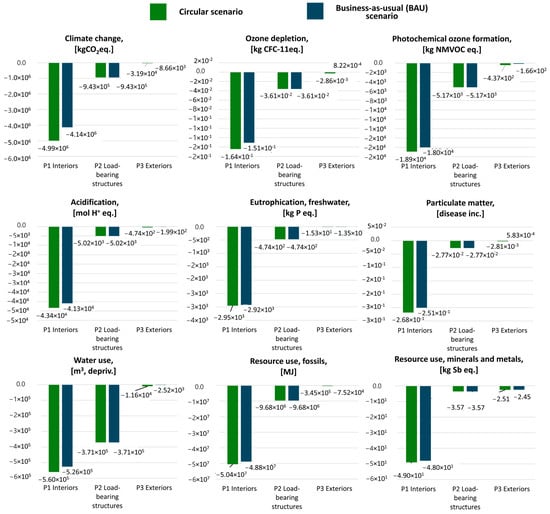
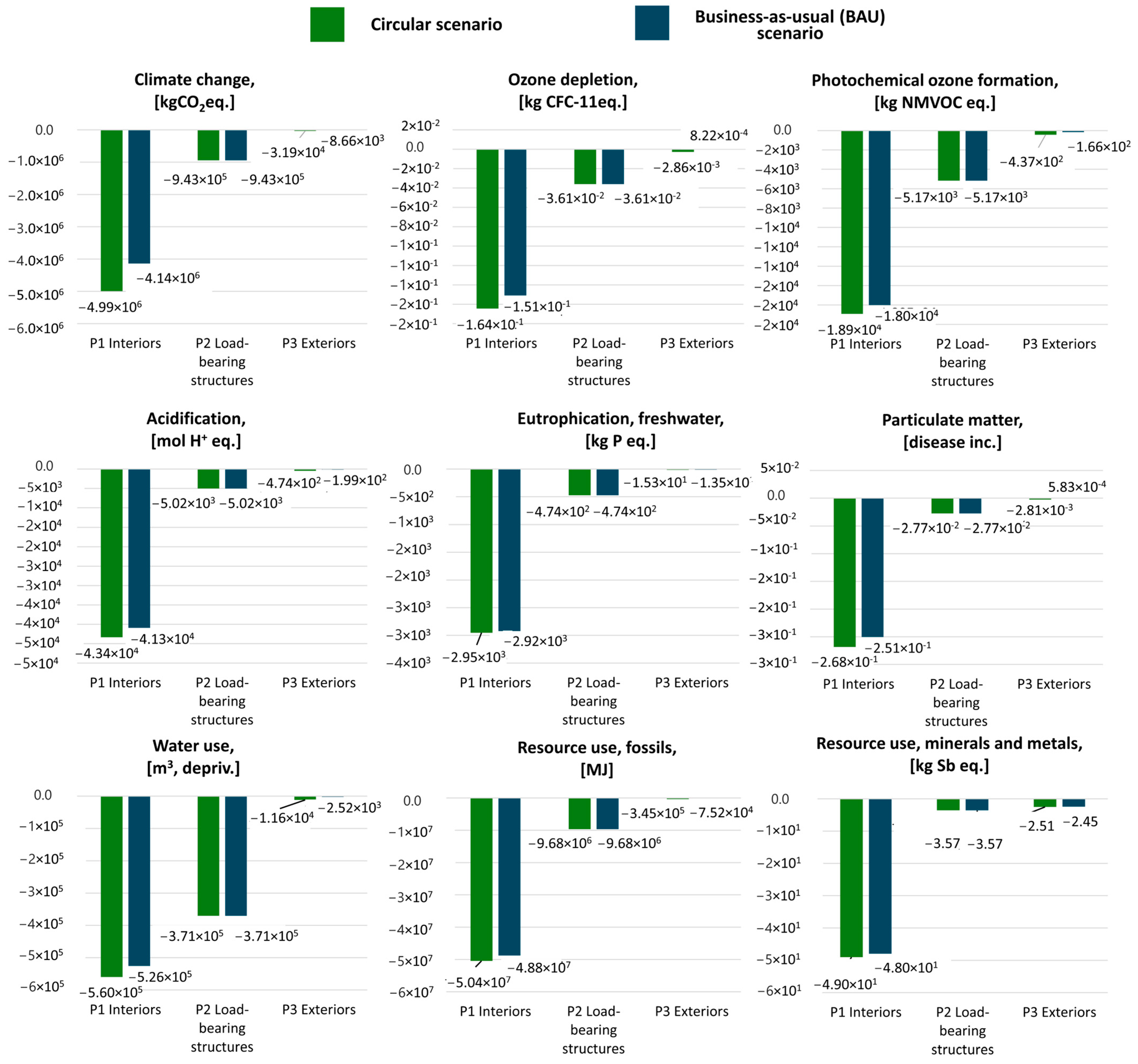
In this study, the environmental impacts for the nine selected impact categories across the three demolition phases for both analysed scenarios: Circular and conventional Business-as-usual (BAU) demolition, were calculated. Negative values in Figure 1 indicate net environmental benefits resulting from the combined assessment of modules C2–C4 and module D. These benefits are primarily associated with material recovery, recycling, and the substitution of primary materials through avoided production processes accounted for in module D.
Figure 1.
Comparison of the total impacts (modules C2–C4 and D) between Circular and BAU scenarios across nine environmental impact categories during the demolition phases of the project.
The interior demolition phase (P1) generated the largest environmental benefits in both scenarios. This phase included waste processing, transportation, and recovery of materials with high recycling potential and substitution value, particularly steel, aluminium, and glazing. In the climate change category, the selective scenario achieved approximately −4.99 × 10⁶ kg CO2 eq., compared with −4.14 × 10⁶ kg CO2 eq. in the BAU scenario, representing the largest contribution to the overall difference between the scenarios. Similar trends were observed for almost all categories.
The demolition of load-bearing structures (P2) also contributed significantly to avoided impacts through recycling of reinforced concrete and structural steel. However, the differences between scenarios were minimal compared to P1 because the selected scenarios were the same—recycling for concrete and recycling for new steel production for reinforcing steel.
The exterior demolition phase (P3) showed comparatively minor contributions to the total environmental profile. In several impact categories, only minor differences were observed between scenarios. Furthermore, for some categories, particularly ozone depletion and particulate matter formation, the results showed net positive values, indicating environmental burdens rather than benefits. This was mainly associated with the selected concrete backfilling processes and the relatively environmental significance of exterior materials such as asphalt and soil in these impact categories.
3.2. Environmental Impacts Across the Life Cycle Stages
Table 3 presents the contribution of individual EoL modules (C2–C4) and the environmental benefits beyond the system boundary (module D) for the Circular scenario across the nine assessed impact categories. In the table, results for module D are presented separately because they represent potential benefits or burdens that are not associated with the life cycle of a building but only indicate potential impacts of future management. This method of interpretation allows comparisons to be made with other up-to-date literature on building LCA, and it follows the recommendations according to EN 15978 [23].
Table 3.
Environmental impacts of End-of-Life (EoL) modules (C2–C4) and environmental benefits in module D for the Circular scenario. Percentages for C2–C4 are expressed relative to total module C (100%); module D values represent benefits relative to module C.
Among the assessed EoL stages, waste processing (module C3) was the dominant contributor to environmental burdens in most impact categories. The transportation (module C2) and its associated environmental impacts are not as significant as the potential environmental benefits of material recovery, contributing between approximately 2% and 27%, depending on the impact category. The highest transport-related contributions were primarily associated with the largest material streams in P2, particularly concrete from load-bearing structures and the long-distance transport of selected materials, such as glass, which was transported over 260 km, compared with an average transport distance of approximately 40 km.
The largest relative benefits were observed for resource use, minerals and metals (more than 680 times greater than module C), freshwater eutrophication (more than 300 times greater), water use (approximately 72 times greater), and climate change (approximately 36 times greater). These results highlight the dominant influence of material recovery and substitution effects on the overall environmental performance of the analysed scenarios.
An exception was observed in the resource use, minerals and metals category, where module C3 showed a negative contribution. This result indicates that material recovery during waste processing generated environmental credits that partially avoid resource consumption associated with transport and final treatment. These credits are associated with the avoidance of other material flows resulting from the sorting process, while the avoided burden of recovered aluminium is separately expressed in module D.
3.3. Environmental Benefits (Module D) of Material Streams
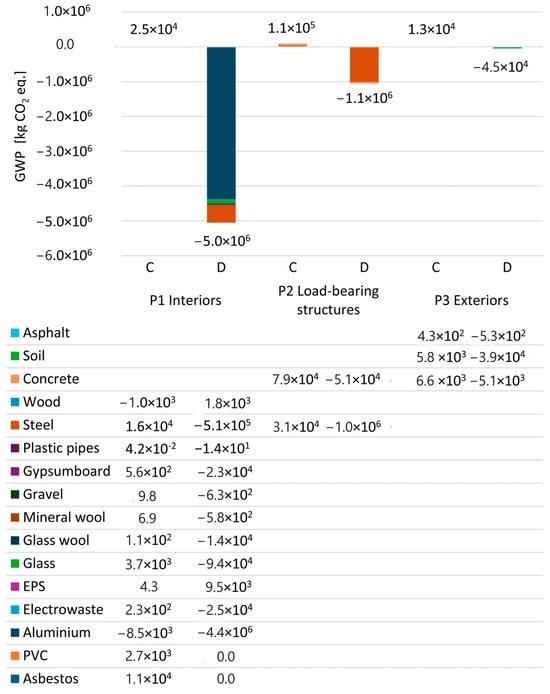
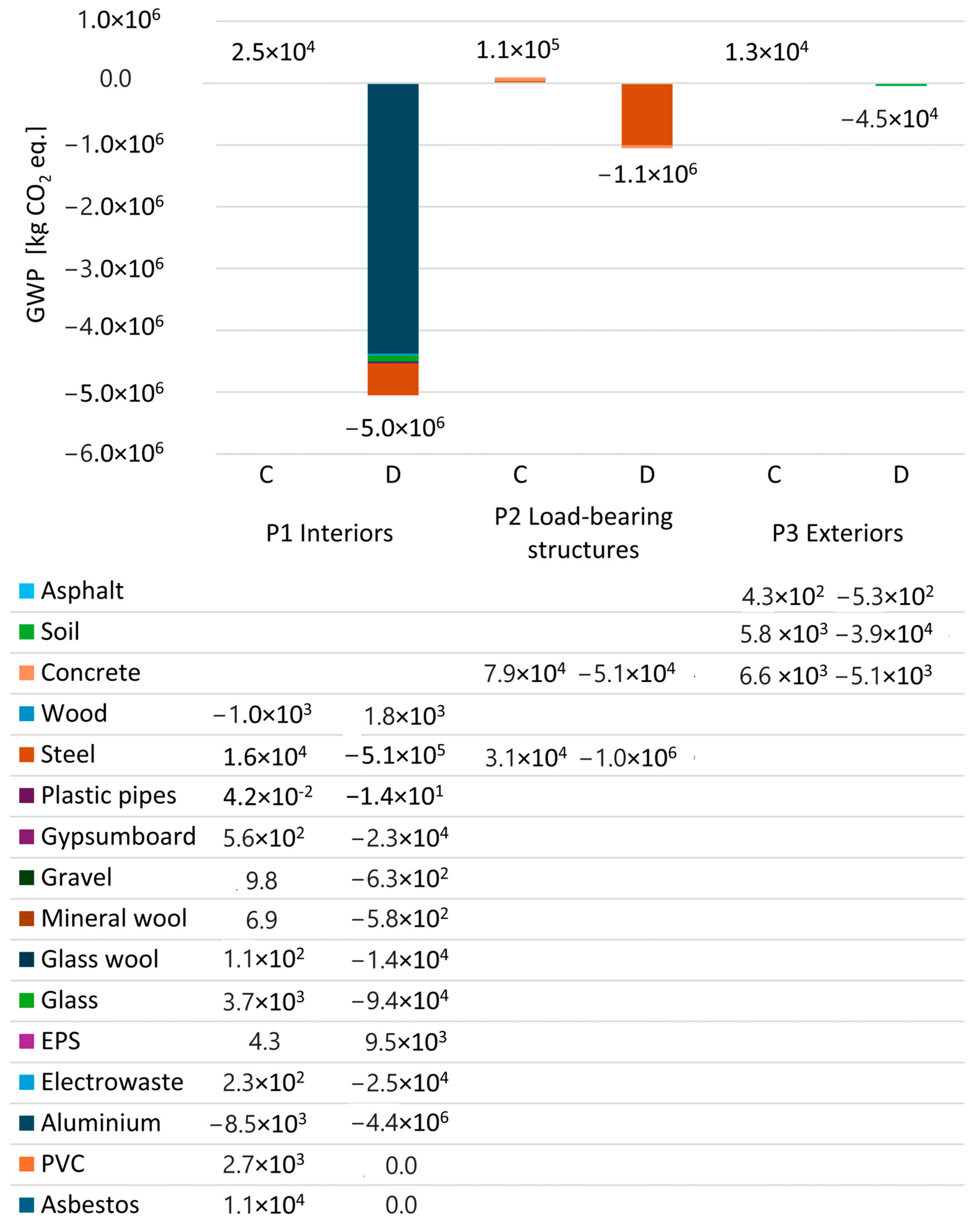
To illustrate and compare the contribution of each material type to the results of modules C and D, a graph of the climate change indicator (GWP, kg CO2 eq.) is shown in Figure 2.
Figure 2.
Environmental impacts of individual material flows in modules C and D for the climate change impact category (GWP, kg CO2 eq.).
Across all demolition phases, metals, particularly aluminium and structural steel, were identified as the dominant contributors to environmental credits due to the high avoided burdens associated with primary metal production. This is mainly related to the highly energy- and emission-intensive production of primary aluminium and steel, resulting in substantial benefits when secondary materials replace virgin resources [16]. Therefore, even small amounts of recovered aluminium result in significant avoided impacts.
A further notable group is glass-based materials (glass wool, flat glass) and gypsum-based products (e.g., plasterboard). Although their individual contributions are lower than those of metals, their cumulative effect was considerable. These findings are consistent with other studies, which identified material recovery, particularly of metals and glass, as a key driver of environmental benefits [14,25,26,27].
In addition, electrical and electronic waste (WEEE), despite representing relatively small material quantities, showed favourable environmental performance, underlining the importance of proper collection and recycling of these waste streams [28].
The environmental performance of concrete recycling depended strongly on the assumed recycling quality and the final application–backfilling or recycling for aggregate production and it is affected by specific conditions of the case. In this study, generic datasets for recycling were considered, taking into account the origin of concrete in the building structure (see Supplementary Table S1). In addition to this, module D was modelled as avoided burden using the same generic process described as “Gravel, crushed {BR}|gravel production, crushed|Cut-off, S”. Previous studies have similarly demonstrated that the environmental impacts of recycled concrete are highly sensitive to the recycling process, transportation distances, and the intended end-use of the recycled material. The quality of recycled aggregates and their environmental profile are influenced by the recycling technology employed, including crushing procedures, separation techniques, and aggregate beneficiation processes aimed at removing adhered mortar [29,30,31]. Furthermore, transportation has consistently been identified as one of the major contributors to the life-cycle impacts of recycled aggregate concrete, often second only to cement production, making the environmental performance strongly dependent on local supply chains and transport scenarios [32,33].
The environmental performance of concrete recycling also depends on the physical properties of the demolished concrete, including its strength, age, and composition, which influence the energy demand for crushing and material separation. As project-specific information on these parameters and on the recycling technologies used by downstream contractors was not available, generic datasets were applied. Consequently, the reported results should be interpreted as scenario-based estimates rather than exact representations of the actual recycling processes.
Finally, the environmental benefits achieved through concrete recycling vary according to the final utilisation pathway. While some studies reported only limited reductions in environmental impacts when recycled fines were used as a substitute for natural sand, others demonstrated significant benefits when recycled aggregates effectively replaced virgin aggregate production, thereby reducing the consumption of primary resources and the need for landfill disposal [34,35,36,37]. Therefore, it should be noted that the benefits reported in Module D represent a potential environmental credit rather than a guaranteed outcome. The modelling approach adopted in this study is based on the waste management plan and assumes that recycled concrete is recovered and used as a substitute for primary aggregates in subsequent applications. However, after the waste materials were transferred to recycling contractors, the actual treatment routes of individual concrete waste streams, including the recycling processes applied, transportation distances, and final utilisation pathways, were not tracked and are therefore beyond the scope of this study. Consequently, the results presented for Module D should be interpreted as a scenario-based estimate of the potential benefits associated with concrete recycling rather than as a representation of the actual end-of-life management of the investigated building.
Similarly, as discussed in the previous chapter, not all materials resulted in environmental benefits within module D. For expanded polystyrene (EPS), the benefits were modelled considering an energy recovery scenario. Although energy recovery provides environmental credits through the substitution of conventional energy production, EPS consists almost entirely of fossil-based polymers. Consequently, its combustion generates significant fossil CO2 emissions, which outweigh the substitution benefits in the climate change impact category. As a result, the overall contribution of EPS to GWP remains negative.
3.4. Overall Environmental Benefits
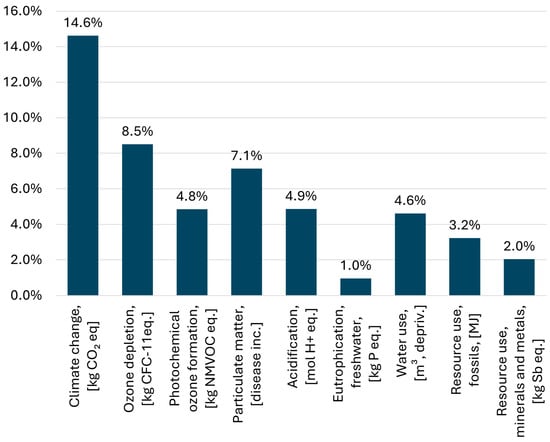
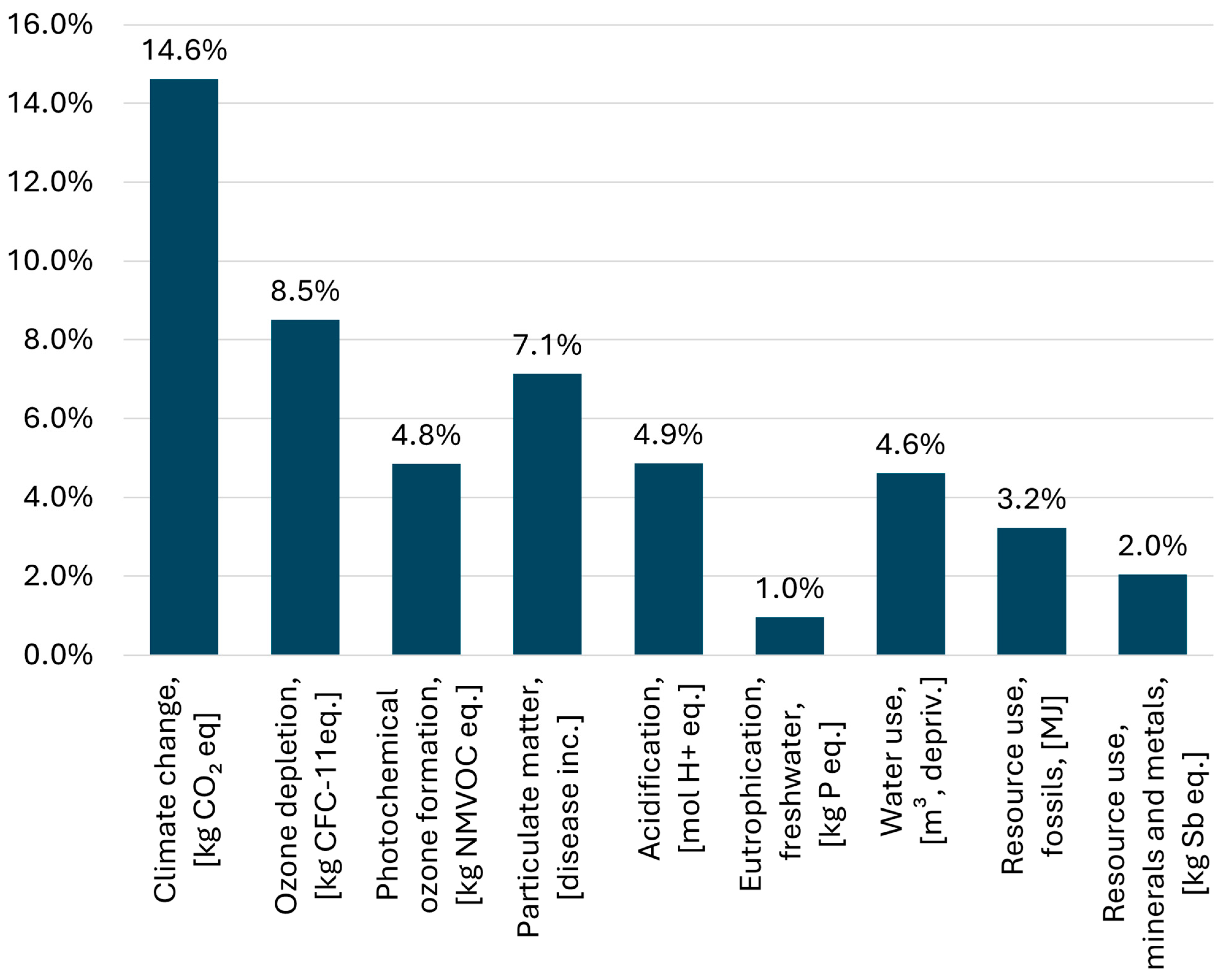
Overall, the circular scenario achieved consistently greater environmental benefits than the BAU scenario across all impact categories. Figure 3 presents a comparative analysis of the two analysed scenarios. The most substantial differences were observed for climate change (accounting for 14.6%), corresponding to a net saving of approximately 872 t CO2 eq., as well as for ozone depletion (8.5%), and particulate matter formation (7.1%). These results confirm that the environmental impact of CDW management largely depends on the efficiency of recycling processes, the ability of materials to replace others, the quality of material separation, and the availability of high-value recycling pathways, all of which improve the environmental performance of CDW management.
Figure 3.
Relative comparison of overall environmental results between the circular and BAU scenarios, expressed as percentages, with the circular scenario set at 100%.
4. Discussion
4.1. Comparison of the Environmental Impacts of the Scenarios with Previous Studies
The results of this study demonstrate that the circular approach, combined with selective deconstruction and improved CDW management, can reduce the environmental impact of building EoL by 1–15% across assessed impact categories compared to conventional demolition. While this range is more conservative than some published data, it reflects realistic conditions based on actual project data rather than theoretical scenarios.
For example, Bayram et al. reported that GWP results are approximately twice as low for highly selective options compared to partially selective approaches when avoided impacts are considered [17]. Quéheille et al. similarly found that deconstruction reduces most environmental impacts by approximately 25% for GWP [14]; however, their analysis also identified that for 4 of 16 impact categories, conventional demolition exhibited a smaller impact than deconstruction, underlining that selective approaches do not universally outperform conventional ones across all indicators. Comparable findings were reported by Pantini et al., who observed that selective deconstruction performed better than conventional demolition in selected impact categories: for climate change (48%), energy use (64%), and resource depletion indicators, mainly due to enhanced recovery of glass, metals, and other CDW [25]. These findings are consistent with the present study, which identified material recovery, particularly of metals and glass, as a key driver of environmental benefits. In turn, Di Maria et al. showed impact reductions of 36% for recycling and 59% for selective demolition scenarios, compared with landfilling [16]. However, direct comparison with the present study is limited, as the BAU scenario also included recycling of major material streams, particularly concrete and metals.
4.2. The Limited Role of Transport
Although transportation is often cited as a factor influencing the environmental performance of CDW management [26,38,39,40], its contribution was relatively limited in this case study, ranging from only a few percent to approximately one-third of total EoL impacts, depending on the impact category. This finding is broadly consistent with those of Atta et al. who reported that CDW recycling remained environmentally advantageous when transport distances were below approximately 70 km [26]. In contrast, Antunes et al. conducted a sensitivity analysis and concluded that when the distance to a treatment facility exceeds approximately 140 km, the environmental feasibility of recycling rather than landfilling should be carefully evaluated [40].
In the present study, most material flows were transported within an average distance of 40 km. Exceptions included WEEE, gypsum board, and glass, which required longer hauls to specialised facilities; however, these streams represent a small fraction of the total waste mass, and their transport contribution did not materially alter the overall environmental profile. Even assuming a hypothetical doubling of transport distances occurs, transportation impacts (module C2) would increase proportionally; the overall results would remain dominated by the environmental benefits generated in module D. The results are presented in Table 4.
Table 4.
Sensitivity analysis of transport distances. Module D environmental benefits are expressed relative to the impacts of modules C2–C4 (module C = 100%). The modified scenario assumes a double increase in transport distances for all material flows.
The largest relative reduction was observed for resource use, minerals and metals (65%), followed by ozone depletion (25%), resource use, fossils (22%), freshwater eutrophication (21%), and climate change (20%). Water use showed a slight reduction (13%), whereas acidification (3%), photochemical ozone formation (2%), and particulate matter formation (4%) showed only minor changes. Therefore, unlike studies that identify transport distance as a limiting factor for recycling feasibility, the present case suggests that selective deconstruction and a high material recovery approach would remain environmentally preferable even under substantially longer transport distances.
4.3. Exclusion of On-Site Demolition Activities and Scope Limitations
On-site demolition activities (module C1) were excluded from the system boundary based on two assumptions. First, from a comparative perspective, demolition processes are expected to be largely similar across scenarios. Material on-site separation is required by current legislation and common demolition practice; therefore, the main differences between the scenarios arise primarily from the subsequent waste management routes and recovery pathways beyond the demolition site rather than from the demolition activities themselves. Second, previous studies have shown that the environmental impacts associated with on-site demolition operations are generally minor compared with those related to material processing, transportation, and end-of-life treatment [41,42]. This assumption is supported by Quéheille et al., who found that demolition and deconstruction activities were among the smallest contributors among EoL modules in most analysed case studies [14]. The study of Zakerhosseini et al. shows similar results [27].
Moreover, circular economy and circular design principles may reduce module C1’s future impacts. Strategies such as Design for Disassembly (DfD), modular construction, and the implementation of reversible connections can facilitate selective dismantling, reduce demolition effort, and improve material recovery [43,44]. While C1 generally contributes less than downstream recovery processes, integrating circular design may then further improve environmental performance at the building EoL stage.
The relatively high contribution of Module D observed in this study should be interpreted with respect to the system boundaries [45]. Although the potential benefits associated with material recovery are substantial, they represent benefits beyond the system boundary and should not be directly compared with the impacts occurring during the production and use stages of the building. Previous life cycle assessment studies have consistently shown that embodied impacts associated with material production (A1–A3) are among the dominant contributors to the overall environmental performance of buildings [46]. Furthermore, depending on the building typology, service life, operational energy demand, and assessment scope, the impacts associated with modules A–C may exceed the potential benefits reported in Module D by an order of magnitude [47]. Therefore, the results do not suggest that end-of-life processes are more important than the production and use stages. Rather, they highlight the significant potential of circular economy strategies to reduce life-cycle impacts.
Although mineral materials constitute the majority of the building mass, the overall environmental performance was largely influenced by the recovery of relatively small quantities of aluminium, steel, and glass. This reflects the high environmental burdens associated with the production of these materials and the substantial credits obtained through their substitution in Module D. The analysed case study represents a typical reinforced concrete office building with a curtain-wall façade constructed in the 1970s, which is a common building typology in Czechia and Central Europe. Therefore, while the quantitative contribution of individual material streams may vary for buildings with different structural systems or material compositions, the methodological conclusions and the identified benefits of integrating PDA data into LCA are considered representative for this type of building.
4.4. Scenario Assumptions and Remaining Improvement Potential
The BAU scenario was defined based on expert assumptions and common industry practice, so results could vary based on the different pathways or interpretations. Different assumptions regarding material separation efficiency or waste treatment routes could shift the calculated performance gap.
The circular scenario is one of the most successful examples of managing a building at the end of its life cycle in the Czech context; nevertheless, certain improvement opportunities were identified during the project.
Gypsum board recovery could be increased by addressing legislative barriers. In the analysed case, recycling became feasible only after the manufacturer obtained authorisation to process construction waste directly, enabling a closed-loop recovery pathway.
Further improvements remain possible for mineral waste streams through optimisation of recycling pathways. In the analysed case, different concrete and masonry fractions were intentionally separated and managed through distinct treatment routes. Construction debris consisting primarily of interior masonry materials and part of the basement concrete was transported separately and predominantly used in lower-value applications such as backfilling. In contrast, the largest material stream—load-bearing reinforced concrete from the structural frame—was directed to a concrete plant and recycled into new concrete products, resulting in higher substitution benefits. Although interior masonry fractions are not explicitly distinguished in the final disposal inventory, they were managed separately in practice due to the phased demolition process, with interior stripping and structural demolition taking place several months apart.
Also, steel elements, when in good structural condition, offer a direct reuse opportunity that has not been fully utilised due to operational wear and tear. Carpet and soft floor finishes, if cut to standard dimensions prior to removal, could be recycled.
These observations illustrate the gap between technically achievable and currently implemented practice, underlining the potential of PDAs to facilitate more effective and sustainable EoL management. Although the quantities of materials delivered to recycling and recovery operators were established in the project documentation, the subsequent treatment of these materials could not be verified. Information on actual recycling efficiencies, market substitution rates, and the final applications of secondary materials was not available. Consequently, the benefits reported in Module D should be interpreted as scenario-based estimates of the potential environmental benefits associated with material recovery rather than the actual environmental performance achieved after the materials left the demolition site.
It should also be noted that the choice of environmental datasets can significantly influence LCA results. In this study, datasets were selected to maximise geographical representativeness for Central European conditions and to ensure comparability between recovered secondary materials and the primary materials they substitute. Nevertheless, alternative datasets or assumptions regarding substituted products may lead to different absolute values of environmental impacts and credits, particularly in Module D. The results should therefore be interpreted in the context of the selected modelling approach and database assumptions.
4.5. Policy Context and Implications for National Practice
The findings of this study have direct relevance for policy development on CDW management at the Czech national level: PDAs and selective deconstruction are not yet current established practices. There is currently no binding national standard (ČSN) in Czechia that directly prescribes the format and conduct of a PDA. Its implementation is currently governed by the EU Protocol on the Management of Construction and Demolition Waste and complies with the requirements of the Waste Act.
The results of this study provide empirical evidence supporting the wider adoption of PDAs and selective deconstruction practices as effective tools for increasing material recovery and reducing the environmental impacts of buildings’ EoL management.
The wider implementation of pre-demolition audits in Czech practice will require not only legislative support but also practical implementation tools. These include standardized audit templates, consistent reporting requirements for demolition contractors, improved traceability of recovered material flows, and stronger integration of PDA findings into demolition planning and permitting processes. Such measures would improve the reliability of material inventories and facilitate higher-quality material recovery, thereby increasing the environmental benefits identified in this study.
5. Conclusions
This study presented a comparative LCA of two EoL management scenarios for the administrative building in Prague, Czechia, based on a detailed pre-demolition audit. The circular scenario achieved approximately 15% greater climate benefits than conventional demolition approaches, corresponding to a net saving of approximately 872 t CO2 eq, with consistent environmental improvements across all assessed impact categories, ranging from 1% to 8.5%. The largest environmental credits originated from the recovery and recycling of high-value materials, particularly aluminium, steel, and glass-based materials. Although concrete represented the largest material flow by mass and remained a significant contributor to total impacts, its environmental performance depended strongly on the quality of recycling pathways and the final application of recycled material.
The results further demonstrated that transportation had a relatively minor influence on the overall environmental profile compared with the impacts and benefits associated with material recovery and substitution processes, even if doubled. Nevertheless, optimisation of transport logistics may provide additional environmental improvements. Future studies may also consider including demolition activities (module C1) to provide a more comprehensive assessment of EoL environmental impacts.
The study also highlights the importance of accurate material inventorying, reliable environmental datasets, and project-specific modelling assumptions. The results demonstrate that project-specific data obtained through a pre-demolition audit provide a valuable basis for scenario-based life cycle assessment and support decision-making regarding end-of-life material management.
Overall, the findings demonstrate that integrating project-specific PDA data into LCA enables a more robust comparison of alternative end-of-life management scenarios and provides decision support for selecting material recovery strategies within a circular economy framework.
Supplementary Materials
The following supporting information can be downloaded at: https://www.mdpi.com/article/10.3390/buildings16142717/s1, Table S1: Environmental Datasets Used for Scenario Modelling.
Author Contributions
Conceptualization, J.P., B.V., N.T. and T.P.; methodology, J.P. and B.V.; software, J.P. and B.V.; validation, J.P. and B.V.; formal analysis, J.P. and B.V.; investigation, J.P. and B.V.; resources, J.P. and B.V.; data curation, J.P. and B.V.; writing—original draft preparation, N.T., J.P. and A.M.Č.; writing—review and editing, N.T., J.P., T.P. and A.M.Č.; visualization, J.P. and N.T.; supervision, J.P. and T.P. All authors have read and agreed to the published version of the manuscript.
Funding
This research was funded by Ministry of Education, Youth and Sports of the Czech Republic, as part of the project ‘Sustainable and Safe Use of Secondary Materials as a Key to Circular Built Environment’, grant number LUC23046.
Data Availability Statement
Further not presented researcher data are subject of 3rd-party restrictions and can be obtained from the authors with the permission of the third party.
Acknowledgments
This research was conducted as part of the project ‘Sustainable and Safe Use of Secondary Materials as a Key to Circular Built Environment’ (LUC23046) supported by the Ministry of Education, Youth and Sports of the Czech Republic. During the preparation of this manuscript/study, the authors used Grammarly and ChatGPT v.5.5. check the spelling and grammar and improve the language. The authors have reviewed and edited the output and take full responsibility for the content of this publication.
Conflicts of Interest
The authors declare no conflicts of interest. The funders had no role in the design of the study; in the collection, analyses, or interpretation of data; in the writing of the manuscript; or in the decision to publish the results.
Abbreviations
The following abbreviations are used in this manuscript:
| BAU | Business-as-usual |
| BoQ | Bill of quantities |
| CDW | Construction and demolition waste |
| EoL | End-of-life |
| EPD | Environmental Product Declaration |
| EU | European Union |
| GWP | Global warming potential |
| LCA | Life cycle assessment |
| PDA | Pre-demolition audit |
| WEEE | Waste from Electrical and Electronic Equipment |
References
- European Commission. Construction and Demolition Waste (CDW). Available online: https://environment.ec.europa.eu/topics/waste-and-recycling/construction-and-demolition-waste_en (accessed on 21 May 2026).
- European Union. Directive (EU) 2018/851 of the European Parliament and of the Council of 30 May 2018 Amending Directive 2008/98/EC on Waste. Off. J. Eur. Union 2018, 150, 109–140. [Google Scholar]
- European Commission. A New Circular Economy Action Plan for a Cleaner and More Competitive Europe. Brussels, 2020, COM(2020) 98 Final. Available online: https://eur-lex.europa.eu/resource.html?uri=cellar%3A9903b325-6388-11ea-b735-01aa75ed71a1.0017.02/DOC_1&format=PDF (accessed on 22 April 2026).
- Buildings as Material Banks (BAMB2020). Available online: https://www.bamb2020.eu/ (accessed on 6 November 2023).
- Wahlström, M.; Castell-Rüdenhausen, M.; Hradil, P.; Hauge-Smith, K.; Oberender, A.; Ahlm, M.; Götbring, J.; Hansen, J. Improving Quality of Construction & Demolition Waste—Requirements for Pre-Demolition Audit; Nordic Council of Ministers: Copenhagen, Denmark, 2019; ISBN 9789289360142. [Google Scholar]
- Directorate-General for Internal Market, Industry, Entrepreneurship and SMEs (European Commission); Oberender, A.; Fruergaard Astrup, T.; Frydkjær Witte, S.; Camboni, M.; Chiabrando, F.; Hayleck, M.; Akelytė, R. EU Construction & Demolition Waste Management Protocol Including Guidelines for Pre-Demolition and Pre-Renovation Audits of Construction Works—Updated Edition 2024; Publications Office of the European Union: Luxembourg, 2024. [Google Scholar]
- Ehlert, C.; Lacroix, C.; Biwer, A.; Dubois, G. It’s All about Planning—Pre-Demolition Audits to Inform Public Calls for Tender for Enhanced Resource Management of Building Materials from Deconstruction. IOP Conf. Ser. Earth Environ. Sci. 2019, 225, 012003. [Google Scholar] [CrossRef] [Scilit]
- Antunes, A.; Martins, R.; Silvestre, J.D.; do Carmo, R.; Costa, H.; Júlio, E.; Pedroso, P. Environmental Impacts and Benefits of the End-of-Life of Building Materials: Database to Support Decision Making and Contribute to Circularity. Sustainability 2021, 13, 12659. [Google Scholar] [CrossRef] [Scilit]
- Zhu, S.; Feng, H. Evaluating the Embodied Carbon Emission of Building Wood Waste: A Case Study of Deconstruction vs. Demolition in Canada. IOP Conf. Ser. Earth Environ. Sci. 2025, 1554, 012002. [Google Scholar] [CrossRef] [Scilit]
- Aidonis, D. Multiobjective Mathematical Programming Model for the Optimization of End-of-Life Buildings’ Deconstruction and Demolition Processes. Sustainability 2019, 11, 1426. [Google Scholar] [CrossRef] [Scilit]
- Obrecht, T.P.; Jordan, S.; Legat, A.; Ruschi Mendes Saade, M.; Passer, A. An LCA Methodolody for Assessing the Environmental Impacts of Building Components before and after Refurbishment. J. Clean. Prod. 2021, 327, 129527. [Google Scholar] [CrossRef] [Scilit]
- Van Gulck, L.; Steeman, M. Life Cycle Assessment of Demountable Building Elements: Influential Design and Use Parameters. Build. Environ. 2023, 245, 110876. [Google Scholar] [CrossRef] [Scilit]
- Mesa, J.A.; Fúquene-Retamoso, C.; Maury-Ramírez, A. Life Cycle Assessment on Construction and Demolition Waste: A Systematic Literature Review. Sustainability 2021, 13, 7676. [Google Scholar] [CrossRef] [Scilit]
- Quéheille, E.; Ventura, A.; Saiyouri, N.; Taillandier, F. A Life Cycle Assessment Model of End-of-Life Scenarios for Building Deconstruction and Waste Management. J. Clean. Prod. 2022, 339, 130694. [Google Scholar] [CrossRef] [Scilit]
- Chen, Y.; Ou, Y.; Mohamed, M.S.; Bao, Z. Life Cycle Assessment of Construction and Demolition Waste Upcycling: A Critical Review of Studies from 2010 to 2025. Dev. Built Environ. 2025, 22, 100685. [Google Scholar] [CrossRef] [Scilit]
- Di Maria, A.; Eyckmans, J.; Van Acker, K. Downcycling versus Recycling of Construction and Demolition Waste: Combining LCA and LCC to Support Sustainable Policy Making. Waste Manag. 2018, 75, 3–21. [Google Scholar] [CrossRef] [Scilit] [PubMed]
- Bayram, B.; Greiff, K.; Gerlich, L.; Luthin, A.; Hildebrand, L.; Traverso, M. Environmental and Economic Implications of Selective Demolition and Advanced Recycling of Construction Waste. Sustain. Prod. Consum. 2025, 57, 61–79. [Google Scholar] [CrossRef] [Scilit]
- Abd Rashid, A.; Idris, J.; Yusoff, S. Environmental Impact Analysis on Residential Building in Malaysia Using Life Cycle Assessment. Sustainability 2017, 9, 329. [Google Scholar] [CrossRef] [Scilit]
- European Commission Level(s)—European Framework for Sustainable Buildings. Available online: https://environment.ec.europa.eu/topics/circular-economy/levels_en (accessed on 1 December 2023).
- EN 15804:2012+A2:2019; Sustainability of Construction Works—Environmental Product Declarations—Core Rules for the Product Category of Construction Products. European Committee for Standardization (CEN): Brussels, Belgium, 2019.
- ISO 14040:2006; Environmental Management—Life Cycle Assessment—Principles and Framework. International Organization for Standardization (ISO): Geneva, Switzerland, 2006.
- ISO 14044:2006; Environmental Management—Life Cycle Assessment—Requirements and Guidelines. International Organization for Standardization (ISO): Geneva, Switzerland, 2006.
- EN 15978:2011; Sustainability of Construction Works—Assessment of Environmental Performance of Buildings—Calculation Method. CEN: Brussels, Belgium, 2011.
- Ecoinvent Database v3.7. Available online: https://ecoinvent.org/ (accessed on 17 December 2024).
- Pantini, S.; Rigamonti, L. Is Selective Demolition Always a Sustainable Choice? Waste Manag. 2020, 103, 169–176. [Google Scholar] [CrossRef] [Scilit] [PubMed]
- Atta, I.; Bakhoum, E.S. Environmental Feasibility of Recycling Construction and Demolition Waste. Int. J. Environ. Sci. Technol. 2024, 21, 2675–2694. [Google Scholar] [CrossRef] [Scilit]
- Zakerhosseini, A.; Abdoli, M.A.; Molayzahedi, S.M.; Salmi, F.K. Life Cycle Assessment of Construction and Demolition Waste Management: A Case Study of Mashhad, Iran. Environ. Dev. Sustain. 2023, 26, 25717–25743. [Google Scholar] [CrossRef] [Scilit]
- Ghisellini, P.; Passaro, R.; Ulgiati, S. Environmental and Social Life Cycle Assessment of Waste Electrical and Electronic Equipment Management in Italy According to EU Directives. Environments 2023, 10, 106. [Google Scholar] [CrossRef] [Scilit]
- Tam, V.W.Y.; Soomro, M.; Evangelista, A.C.J. Quality Improvement of Recycled Concrete Aggregate by Removal of Residual Mortar: A Comprehensive Review of Approaches Adopted. Constr. Build. Mater. 2021, 288, 123066. [Google Scholar] [CrossRef] [Scilit]
- Akbarnezhad, A.; Ong, K.C.G. Separation Processes to Improve the Quality of Recycled Concrete Aggregates (RCA). In Handbook of Recycled Concrete and Demolition Waste; Woodhead Publishing: Sawston, UK, 2013. [Google Scholar]
- Florea, M.V.A.; Brouwers, H.J.H. Properties of Various Size Fractions of Crushed Concrete Related to Process Conditions and Re-Use. Cem. Concr. Res. 2013, 52, 11–21. [Google Scholar] [CrossRef] [Scilit]
- Tošić, N.; Marinković, S.; Dašić, T.; Stanić, M. Multicriteria Optimization of Natural and Recycled Aggregate Concrete for Structural Use. J. Clean. Prod. 2015, 87, 766–776. [Google Scholar] [CrossRef] [Scilit]
- Marinković, S.; Carević, V.; Dragaš, J. The Role of Service Life in Life Cycle Assessment of Concrete Structures. J. Clean. Prod. 2021, 290, 125610. [Google Scholar] [CrossRef] [Scilit]
- Kurda, R.; Silvestre, J.D.; de Brito, J. Life Cycle Assessment of Concrete Made with High Volume of Recycled Concrete Aggregates and Fly Ash. Resour. Conserv. Recycl. 2018, 139, 407–417. [Google Scholar] [CrossRef] [Scilit]
- Roh, S.; Kim, R.; Park, W.-J.; Ban, H. Environmental Evaluation of Concrete Containing Recycled and By-Product Aggregates Based on Life Cycle Assessment. Appl. Sci. 2020, 10, 7503. [Google Scholar] [CrossRef] [Scilit]
- Hossain, M.U.; Poon, C.S.; Lo, I.M.C.; Cheng, J.C.P. Comparative Environmental Evaluation of Aggregate Production from Recycled Waste Materials and Virgin Sources by LCA. Resour. Conserv. Recycl. 2016, 109, 67–77. [Google Scholar] [CrossRef] [Scilit]
- Pešta, J.; Pavlů, T.; Fořtová, K.; Kočí, V. Sustainable Masonry Made from Recycled Aggregates: LCA Case Study. Sustainability 2020, 12, 1581. [Google Scholar] [CrossRef] [Scilit]
- Soust-Verdaguer, B.; Hoxha, E.; Llatas, C.; Passer, A. How Transport Modelling Affects the Building Life Cycle Assessment (LCA) Results: A Case Study Analysis. IOP Conf. Ser. Earth Environ. Sci. 2022, 1078, 012096. [Google Scholar] [CrossRef] [Scilit]
- Gerald, L.; Carlos, B.-V.; Marta, G.-G.; Jan, P.; Nika, T. A Decision-Support Tool for Analysing Transport Impacts in Building Life Cycle Assessment. IOP Conf. Ser. Earth Environ. Sci. 2025, 1546, 012067. [Google Scholar] [CrossRef] [Scilit]
- Antunes, A.; Silvestre, J.; Costa, H.; do Carmo, R.; Júlio, E. Reducing the Environmental Impact of the End-of-Life of Buildings Depending on Interrelated Demolition Strategies, Transport Distances and Disposal Scenarios. J. Build. Eng. 2024, 82, 108197. [Google Scholar] [CrossRef] [Scilit]
- Hasselsteen, L.; Stapel, E.B.; Birgisdóttir, H.; Sørensen, C.G.; Kanafani, K. Evaluating the Environmental Impact of Construction Waste: A Comprehensive Analysis of End-of-Life Scenarios in Environmental Product Declarations. Build. Environ. 2025, 280, 113159. [Google Scholar] [CrossRef] [Scilit]
- Hu, M.; Świerzawski, J. Assessing the Environmental Benefits of Adaptive Reuse in Historical Buildings. A Case Study of a Life Cycle Assessment Approach. Sustain. Environ. 2024, 10, 2375439. [Google Scholar] [CrossRef] [Scilit]
- Attia, S.; Al-Obaidy, M.; Mori, M.; Campain, C.; Giannasi, E.; van Vliet, M.; Gasparri, E. Disassembly Calculation Criteria and Methods for Circular Construction. Autom. Constr. 2024, 165, 105521. [Google Scholar] [CrossRef] [Scilit]
- Trubina, N.; Lupíšek, A. Discussion on Challenges and Opportunities for Demountable Building Structures in Czechia’s Transition to a Circular Economy. IOP Conf. Ser. Earth Environ. Sci. 2025, 1546, 012028. [Google Scholar] [CrossRef] [Scilit]
- Frischknecht, R.; Balouktsi, M.; Lützkendorf, T.; Aumann, A.; Birgisdottir, H.; Ruse, E.G.; Hollberg, A.; Kuittinen, M.; Lavagna, M.; Lupišek, A.; et al. Environmental Benchmarks for Buildings: Needs, Challenges and Solutions—71st LCA Forum, Swiss Federal Institute of Technology, Zürich, 18 June 2019. Int. J. Life Cycle Assess. 2019, 24, 2272–2280. [Google Scholar] [CrossRef] [Scilit]
- Röck, M.; Saade, M.R.M.; Balouktsi, M.; Rasmussen, F.N.; Birgisdottir, H.; Frischknecht, R.; Habert, G.; Lützkendorf, T.; Passer, A. Embodied GHG Emissions of Buildings—The Hidden Challenge for Effective Climate Change Mitigation. Appl. Energy 2020, 258, 114107. [Google Scholar] [CrossRef] [Scilit]
- Železná, J.; Felicioni, L.; Růžička, J.; Diviš, J.; Fořtová, K.; Nehasilová, M.; Trubina, N.; Vlasatá, B.; Veselka, J. Whole Life Carbon Assessment of Czech Building Typologies: Analysis of 170 Representative Case Studies towards the Definition of National Benchmarks. Build. Environ. 2026, 297, 114556. [Google Scholar] [CrossRef] [Scilit]

Disclaimer/Publisher’s Note: The statements, opinions and data contained in all publications are solely those of the individual author(s) and contributor(s) and not of MDPI and/or the editor(s). MDPI and/or the editor(s) disclaim responsibility for any injury to people or property resulting from any ideas, methods, instructions or products referred to in the content. |
© 2026 by the authors. Licensee MDPI, Basel, Switzerland. This article is an open access article distributed under the terms and conditions of the Creative Commons Attribution (CC BY) license.