


Abstract
Construction site fires caused by spatiotemporal overlaps between hot work (ignition sources) and combustible substances remain a critical concern. The traditional method identifies fire hazards based on the intersections among hot works and other works with combustible substances. However, the intersections between hot work and built elements containing combustible materials are ignored, which can also lead to fire accidents. In addition, the detection of such intersections relies on the computationally intensive proximity search from the ignition source to the potential combustible substances, resulting in a long-time calculation in large construction projects with the dynamic construction process. To address this limitation, this study proposes a voxel-based fire hazard identification method applicable to large 4D-BIM models, fast and accurately. By discretizing BIM into reusable LEGO voxels, both the construction activities and the building components can be mapped to the voxels, enabling a simultaneous intersection identification between ignition sources and both activities and BIM elements. In addition, voxel-based proximity searching is efficient, enabling a fast and accurate fire hazard identification. Validation tests demonstrate high accuracy with calculatable spatial error (maximum 0.57 m for 200 mm voxels) and superior efficiency (126–1368% faster than mesh-based methods). By reusing the voxelized BIM data, the speed can be enhanced by between 400% and 1975%. This method offers an efficient and reliable digital solution for proactive construction fire safety management in 4D-contexts.
1. Introduction
1.1. Background
Fire stands as one of the most severe and persistent hazards on construction sites, characterized by its sudden onset, rapid spread, and devastating potential to cause catastrophic loss of life and property. The dynamic and cluttered nature of construction environments, filled with temporary structures, abundant combustible materials, and various hot works, conceals huge fire hazards. In the US, the structure fire accidents began to rise again in recent years, causing the majority of fire-related fatalities and financial damage [1]. The analysis of combustible materials and fire risk factors according to the construction process is a key area for improving site safety [2]. However, given that the potential overlap between hot works and combustible materials occurs frequently and unpredictably as various activities involving hot work or combustible substances take place in shifting locations, traditional paper-based safety planning and periodic inspections are labor-intensive and error-prone. Consequently, identifying and managing these hazardous intersections remains a significant challenge.
Building Information Modeling (BIM) technology plays a significant role in the proactive identification of fire risks on construction sites. As a cutting-edge information technology, BIM integrates diverse building-related data, including geometry, materials, and structural information, thereby providing robust technical support throughout all stages of construction. Specifically, the digital environment provided by BIM serves as the foundation for fire risk assessment, fire dynamics simulation, and fire evacuation decision support. This study leverages the application logic of BIM in fire safety management and risk assessment, with a particular focus on developing a targeted proactive identification mechanism for construction site fire hazards, emphasizing the detection of spatiotemporal overlaps between hot work activities and combustible materials. In this context, BIM—and particularly 4D-BIM—offers a powerful digital platform that integrates a detailed three-dimensional geometric model with rich semantic data on building components, materials, and construction schedules (activities). Consequently, 4D-BIM holds the potential to support the effective identification of potential fire hazards.
1.2. Literature Review
1.2.1. BIM-Based Fire Hazard Identification
The geometric and semantic information in BIM can support fire hazard identification. There are three categories of BIM-assisted fire hazard identification: simulation-based strategy, rule-based strategy, and sensor-based strategy.
Simulation-based strategy combines BIM and various simulation techniques to evaluate the effect of fire accidents. By establishing a proper data exchange mechanism, fire dynamics simulation (FDS), which is a common method in simulating the spreading of fires, can either be embedded in the BIM context [3] or interact with BIM bidirectionally [4]. When FDS is applied, the comparison between required safe egress time (RSET) and available safe egress time (ASET) is a common and clear method for identifying fire hazards: If the latter is shorter than the former, which means that people cannot evacuate within a safe time, it indicates a severe fire hazard. This approach is applied by many [4,5,6,7]. The information required for calculating ASET is provided by BIM data, including geometry (layout, obstacles), material properties, and occupant characteristics profiles [5], and can be further accompanied by other data, such as luggage in metro stations [8]. The RSET is obtained by evaluation simulation, such as occupant behavior simulation [5], social force model [9], agent-based modeling [10], or machine learning [8]. The fire hazards can also be identified by other means. For example, Terzi, et al. [11] propose an evaluation model integrating BIM, the Entropy Weight Method, and Technique for Order Preference by Similarity to Ideal Solution (TOPSIS) to evaluate and visualize fire hazards; Zhong, et al. [12] simulate fire in a double-roofed ancient Buddhist building using BIM and Computational Fluid Dynamics (CFD) to optimize water mist fire protection.
Rule-based method translates fire safety regulations (e.g., OSHA, UK Building Regulations) into machine-readable rules. By comparing these rules with BIM or blueprint geometry, the non-compliant areas or equipment are automatically identified. The regulations can be either coded as program or natural-language-processing (NLP)-generated logical expressions [13,14,15]. Data from the BIM model, including the building element [14], evaluation distance [16], site layout [17], and firefighting equipment [18,19], are extracted to run the compliance check. With the advances in artificial intelligence and Large Language Models, some studies have attempted to apply Large Language Models (LLMs) to BIM compliance checks [20].
Sensor-based strategies leverage sensors (temperature, smoke, Carbon Oxide), cameras, and real-time positioning technologies to dynamically monitor both the internal and external environments of buildings. When integrated with BIM spatial models, these strategies realize real-time risk warning and visualization. The real-time data can be collected by both the temperature sensors and visual devices [21,22]. Such data is then used to instantly adjust ASET and RSET [23], compared with pre-defined safety thresholds [24], or matches the knowledge base [25] to dynamically know the situation of the fire zone, enabling an adaptive evacuation route planning [26]. These techniques are often integrated into fire alarm or management platforms to better support fire controllers [27,28].
1.2.2. Spatial–Temporal Intersection Analysis in 4D-BIM Context
Since the spatial–temporal intersections of hot work and uncontrolled ignition sources are major causes of fire accidents in construction sites, the research on spatial–temporal intersection analysis in 4D-BIM is also reviewed. The temporal intersection of two activities is easy to identify because only their start and finish times need to be compared; the identification of their spatial intersection, however, varies from one research to another. Currently, the spatial identification is determined by three strategies: (1) A workspace-based method that generates geometric shapes resembling workspaces, and clash detection among the workspaces is implemented to find the potential intersections [29,30,31]. (2) A work-region-based method that divides the construction site into several regions, and the activities within the regions are considered spatially intersected. The potential safety hazard in a work region can be quantified by assigning risk scores [32] or, specified to fire-hazard, by calculating the possibility and severity of fire accidents [9]. The limitations of the aforementioned research are that the work regions are divided manually, and the risk spread across the work region is ignored. To address this limitation, Nasab et al. [33] model risk spread via a pre-defined matrix where specific hazard attributes from a source zone can affect activities in adjacent or distant target zones. (3) A distance-based method that directly calculates the distances among elements under construction. For example, Kim et al. [34] calculate the horizontal and vertical distances of two elements involving hot works and combustible materials; if the distances are less than the given fire separation range, a fire hazard is identified.
1.3. Summary and Arrangement of This Research
Although the existing literature and commercial BIM programs have made significant contributions to fire safety, some critical challenges persist: (1) Overlooking of the pre-ignition protection: A predominant portion of BIM-based research focuses on assessing hazards in post-ignition scenarios, often overlooking the crucial aspect of proactive fire prevention. (2) Incomplete hazard Identification Scope: Although spatial–temporal intersection analysis holds considerable promise for precautionary measures, this analysis primarily evaluates intersections among activities, thereby neglecting potential hazards arising from hot work near built components with combustible materials (e.g., welding adjacent to installed EPS insulation boards). (3) Speed–Accuracy Dilemma: Work-region-based approaches frequently rely on manual delineation to correctly reveal the work space occupation, which is time-consuming and laborious in 3D or 4D context; however, the fast and automatically generated workspace geometric representations, such as Axis-Aligned Bounding Boxes (AABB), are inaccurate and unreliable due to their oversimplification nature. (4) Practical issue: distance-based methods face practical constraints when location-related metadata is missing. For instance, certain elements, like stairs in Revit, lack inherent location point properties. (5) Lack of validations on large-scale BIM scenarios: Beyond methodological flaws, there is a distinct lack of large-scale validation. With the exception of Hosseini and Maghrebi [9], who validated their approach on a 55,000-square-meter project, no other studies have applied these methods to large-scale 4D-BIM scenarios. Moreover, the computational efficiency—specifically the elapsed time required for hazard identification—remains largely unreported in the current literature.
To address these specific limitations, this study proposes a voxel-based approach in the 4D-BIM context. Unlike existing methods that may focus on either activity–activity conflicts or post-ignition simulations, the proposed method is specifically designed for proactive and comprehensive hazard identification. It requires no pre-defined workspaces or regions; instead, it automatically discretizes the BIM space into voxels to facilitate an efficient and automatic proximity search around the ignition sources. This allows for the simultaneous identification of both Ignition–Activity spatial–temporal intersections (IASIs) and the often-overlooked Ignition–Element spatial–temporal intersections (IESIs).
This paper is arranged as follows: Section 2 illustrates the rationale and detailed process of the method, clarifying the selection basis and operational rigor of the approach in line with the research purpose and field norms. Section 3 designs and conducts experiments on the proposed method in accordance with the principles of control, randomization, and repeatability, ensuring the reliability of the experimental design. The result of the test is discussed in Section 4, and the conclusion and targeted recommendation for further research are made in Section 5.
This study contributes to the body of knowledge by introducing a hybrid framework integrating 4D-BIM and LEGO voxelization for automated construction fire hazard identification in large buildings. It requires no pre-defined work regions, thereby enhancing the precision of risk detection across dynamic construction spaces. By combining a refined element-phase-dividing strategy, both Ignition–Activity spatial–temporal intersections (IASIs) and Ignition–Element spatial–temporal intersections (IESIs) can be identified with assessable spatial errors (maximum 0.57 m for 200 mm voxels) and high performances (126–1368% faster than mesh-based methods), and information-rich results can be output thereafter. In summary, this study proposed a fast, easy-to-use fire hazard identification method that bridges academic innovation and practical engineering, establishing a scalable digital template for proactive fire safety management in the construction stages.
2. Methodology
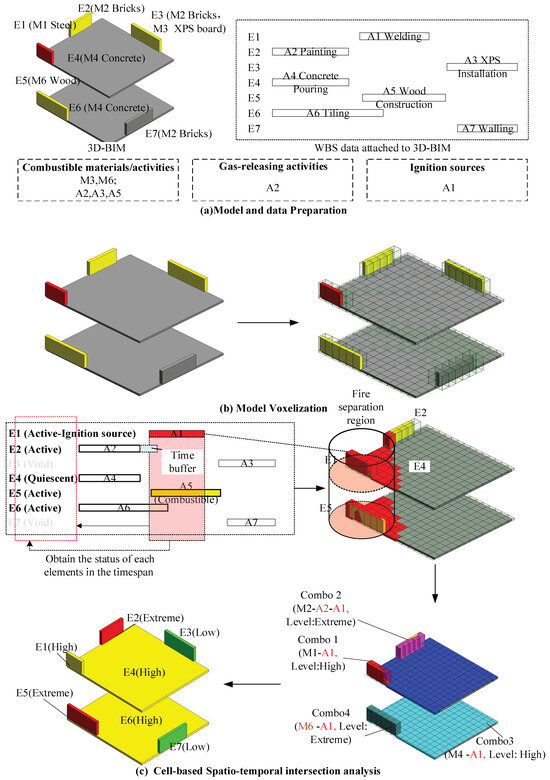
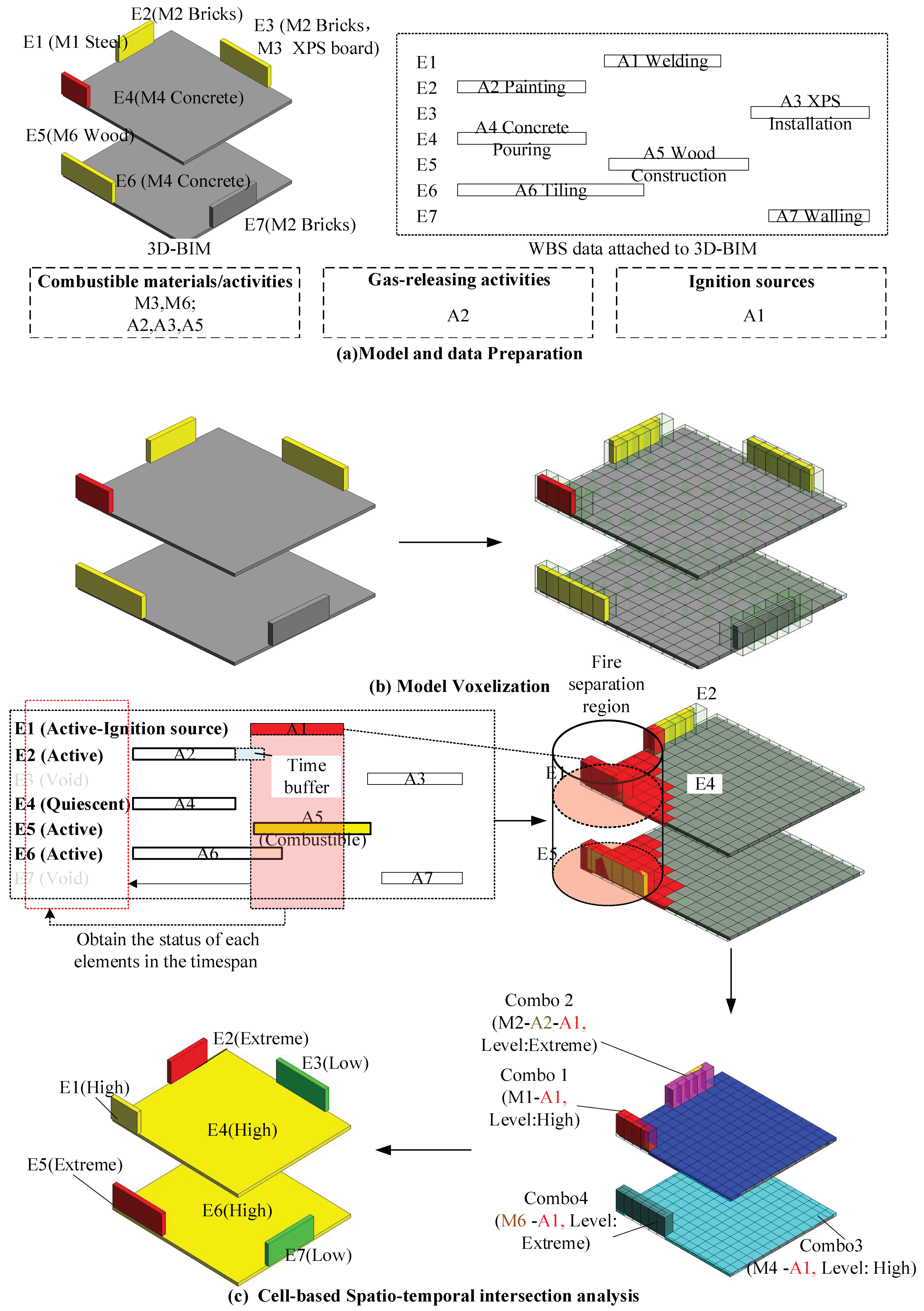
Figure 1 illustrates the procedures of the method: (1) model and data preparation, which assigns the necessary fire-hazard data to the material and construction activities to find the hot works (ignition sources), combustible activities and combustible building materials (Figure 1a); (2) model voxelization, which voxelizes the BIM elements into numerous LEGO voxels (Figure 1b); and (3) cell-based spatio-temporal intersection analysis, which obtains the voxels of each elements with hot works and spread the hot works horizontally and vertically to other elements whose voxels lies within a pre-defined fire separation range, based on which the hazard combinations are generated considering the intersections of the ignition sources and the combustible materials and activities (Figure 1c). The informative hazard identification result of each element in the BIM is output when the above processes finish.
Figure 1.
Main procedures of the proposed method.
2.1. Model and Data Preparation
To implement the fire hazard identification, the following input should be prepared:
2.1.1. 4D-BIM Model with Fire-Related Data
4D BIM refers to a BIM model that incorporates the time dimension [35]. 4D-BIM contains information about both element components and construction activities. To facilitate fire hazard identification, the following information from the 4D models is required: (1) BIM elements with material information: The element is used to determine the location of the construction activities, and their material information is used for identifying the potential combustible substances. (2) Work-Breakdown Structure (WBS) activities with time and resource information: Their names and resources are used to detect potential sparks, combustible substances, and the potential for combustible gas release. (3) Activity types: This determines how an activity impacts the corresponding building elements. In this research, three activity types are defined as follows: (a) Construction, whose linking elements only exist after the completion of the activity. For example, the concrete pouring is a construction activity for a floor slab. (b) Demolition, whose linking elements only exist before the start of the activity. For example, the excavation is a demolition activity for a foundation pit. (c) Temporary, which has no effect on the existence of the linking elements; for example, the concrete curing is a temporary work on a floor slab. (4) Material combustibility, which is a user-defined data for each material in the BIM model. There have been some regulations to clarify the combustibility of materials, for example, the Classifications for Burning Behavior of Building Materials and Products (GB8624-2025) [36]. (5) Activity fire-hazard data, including (a) the involvement of combustible material, indicating the fire hazards caused by the nearby ignition activities when the activity is undergoing; (b) the possibility of releasing combustible gases, vapors or liquids, indicating the lasting fire hazard caused by the nearby ignition activities when the activity is done; and (c) the capacity to generate fires, sparks or high temperature, which indicates if the activity can be an ignition source, as shown in Table 1.
Table 1.
Material and WBS table structures.
2.1.2. Fire Separation Distance
Fire separation distance is used to define the fire safety boundary around an ignition source (for example, a welding site). Both horizontal and vertical distances are considered in this research: the horizontal distance refers to the minimum safety horizontal distance between an ignition source and a combustible substance. This distance can be found in the fire safety regulations. For example, the Technical standard for fire safety of construction site (GB 50720-2011) states that: “The distance between combustible material stockyards, their processing sites, or designated hot work areas and the under-construction project shall not be less than 10 m. Construction in progress shall not be less than 10 m.” [37]. Therefore, the distance can be set as 10 m. The vertical distance is the minimum vertical safety clearance between the ignition source and the combustible substance. Unlike the horizontal one, for this distance, although states in the codes correlative to building components (For example, the Illinois Building Code 2021 stated that opening protectives having a fire protection rating of not less than 3/4 h shall be provided in every opening that is less than 15 feet (4572 mm) vertically above the roof of an adjacent building or structure based on assuming an imaginary line between them [38]), no such regulations are directly applicable to the construction scenario. The research on the exact vertical fire separation distance is out of the scope of the research. In this research, the vertical distances are defined by the users. In practice, it can be determined empirically or by consulting the construction administrative department. Due to the influence of gravity on spark propagation, the vertical fire separation distance is differentiated into two components: the fire upper separation distance and the fire lower separation distance. Typically, the magnitude of the former is smaller than that of the latter. In this study, the fire lower separation distance is defined as a negative value to represent the offset in the −z direction.
2.1.3. Time Buffer
A time buffer is used to consider the residual of the combustible gases, vapors, or liquids after a certain activity, for example, painting, is done. Most of the research ignores such a situation, resulting in overlooking the potential fire hazard. For example, if a painting is done on 30 April, a nearby welding activity is planned to start on 2 May. Apparently, these 2 activities have no temporal overlaps; thus, based on the current method, no fire hazard exists. However, the combustible organic solvent can exist for a period of time and can be ignited by the welding activities. By setting a time buffer, for example, 7 days, to the painting activities, it will remain active before 7 May, posing a temporal overlap with the welding activity to expose the fire hazard.
2.2. Model Voxelization
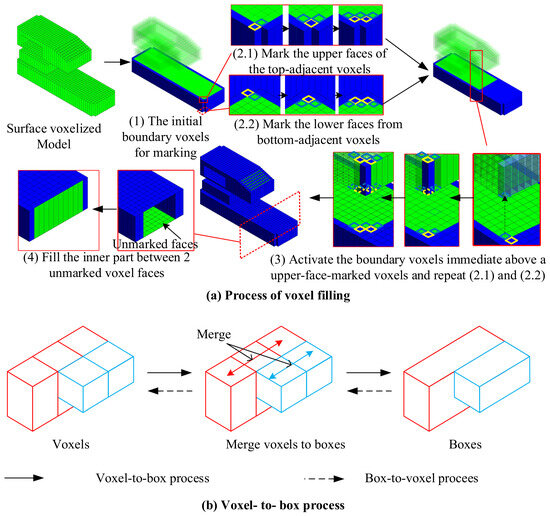
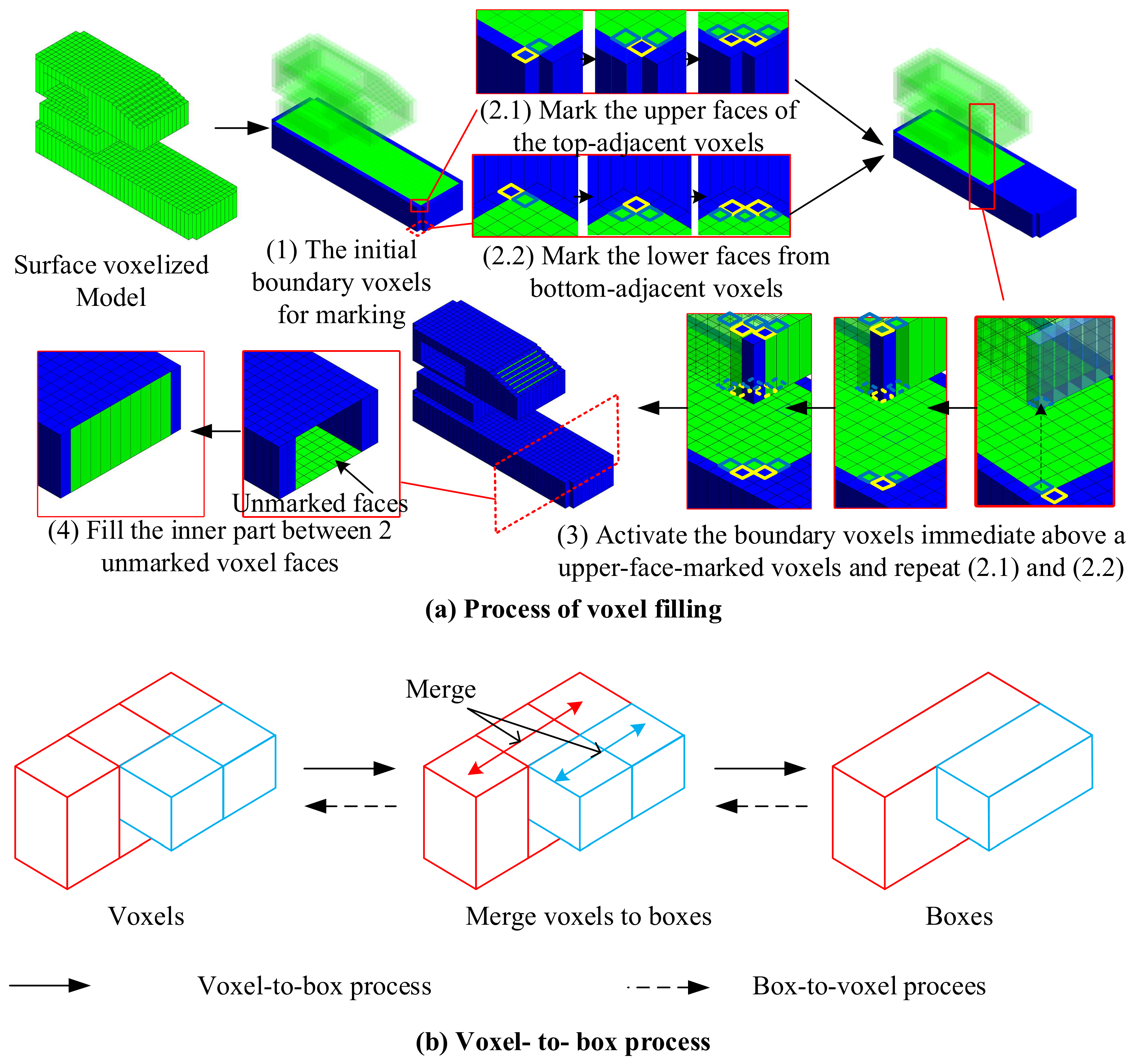
Since fire accidents occur when ignition sources and combustible materials are in close proximity, searching each ignition source for nearby potential combustible materials is the key to identifying fire hazards. Considering that there may be numerous ignition sources and combustible materials on the construction site, direct proximity searches are time-consuming because it involves pairwise distance calculation between all the ignition sources and combustible materials. Voxelization, which is a method for approximating 3D objects with cubes (voxels), can facilitate the nearby spatial search easily and effectively. The method proposed in [39] is adopted because it can voxelize arbitrary 3D models. The general steps of this method are shown in Figure 2a.
Figure 2.
Model voxelization and voxel-to-box process.
Once the models are voxelized, the ignition sources and the combustion materials are represented by voxels. In practice, it is rare that the precise ignition source location is marked separately; instead, hot works are attached to one or more BIM elements. So, in this research, the voxels of the hot-working elements are chosen as the ignition source. Fire hazards are identified based on whether those voxels can ignite other voxels within the fire separation range.
To accommodate for the large BIM model for a reasonable voxelization time and voxel file sizes, the DotRecast, which is a C# port of an industry-standard navigation mesh toolset for Microsoft.NET platform, Unity3D, games, and servers, is integrated in this research to voxelize the surface of the model by its voxelization method before filling the inside following [40]; then, the voxels with the same bottom and top elevations are clustered into rectangular boxes (Figure 2b). By doing so, the voxelization is fast and the voxelized model file is small.
2.3. Cell-Based Spatio-Temporal Intersection Analysis
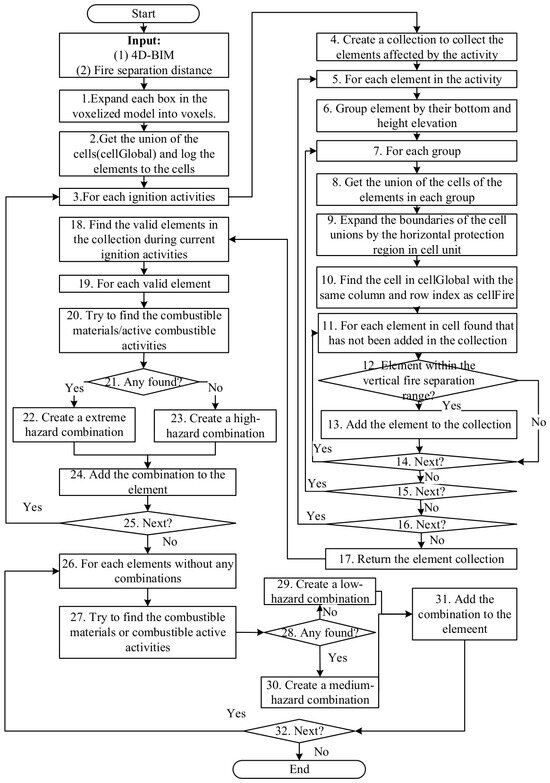
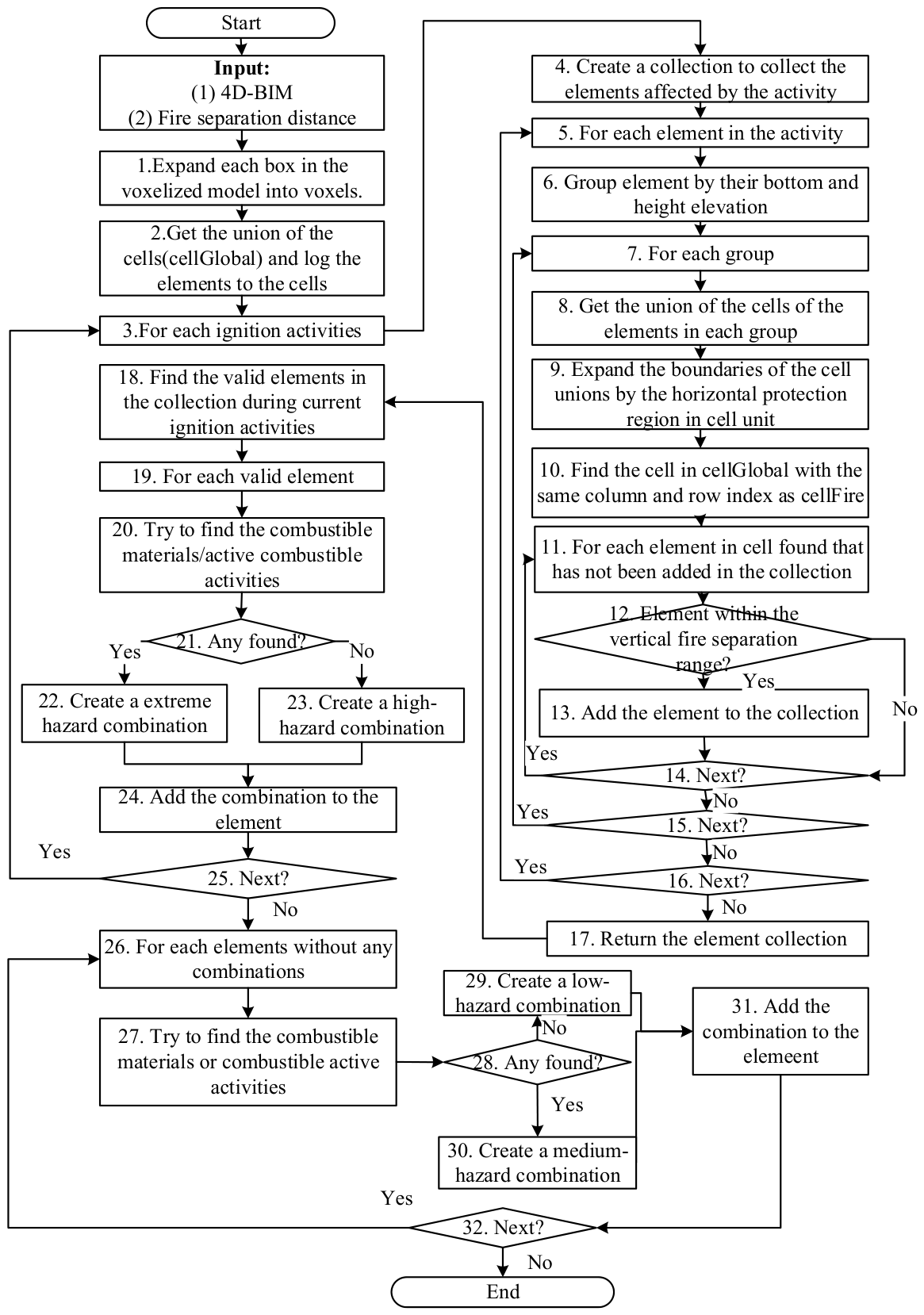
This step tries to find all Ignition–Activity spatial–temporal intersections (IASI)s and Ignition–Element spatial–temporal intersections (IESIs). Because the combination of ignition sources and combustible materials can cause fire accidents, the activity with flames, sparks, or high temperatures is considered an ignition source. Iterating those activities can identify all the severe fire hazards. The process is shown in Figure 3 with some explanations:
Figure 3.
Spatial–temporal Ignition Analysis.
- (1)
- In steps 1 and 2, the 2D-cell regions covered by the voxel boxes of each element are determined, and the references (a reference can be interpreted as the location of an element in the memory) of the corresponding elements are logged to the cells. As stated earlier, the fire separation regions are formed by cells. If an ignition source affects a cell, the elements within that cell can be instantly obtained to determine the possibility of ignition and subsequent fire accidents.
- (2)
- In step 6, to consider the vertical fire separation distance, the bottom and top elevations of each element are approximated as the z ranges of their AABBs with a vertical offset. For instance, if an ignition element has a bottom and top elevation of zmin and zmax, respectively, and the given fire vertical lower and upper separation distance is btmOff and topOff, any element, whose bottom and top elevations are z′min and z′max, respectively, is considered to have the vertically ignitable potential if Equation (1) is met. The ignition source elements are grouped by the bottom and top elevations for batch processing.
- (3)
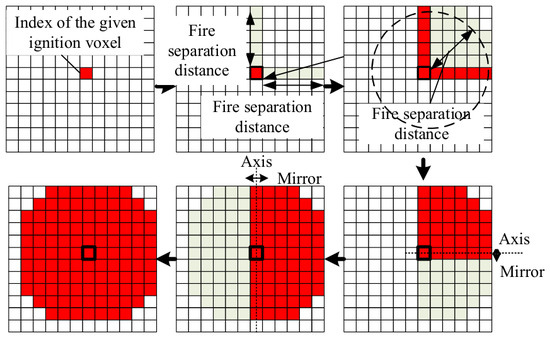
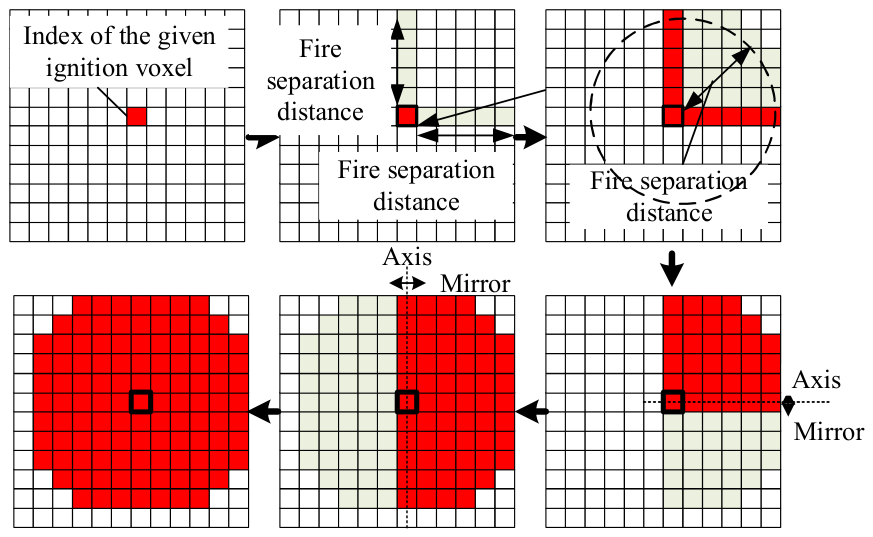
- From Step 7 to 16, the fire separation ranges of a group of ignition elements are determined in terms of 2D cells as follows: given an ignition voxel indexed as (col0, row0), another voxel indexed as (col, row) falls within the distance only if Equation (2) is met.
Figure 4.
Process of obtaining the fire hazardous range.
The process above is done in Step 9. The cell-based fire spreading range is bigger than the actual fire separation range, indicating that the element a little farther than the fire separation distance can still be detected. It can be proved that the upper limit of the error is , where d is the given fire separation distance, and vs is the cell size (The proof process is shown in the Supplementary Materials). When the fire separation range is 10 m, the actual fire hazard distance can reach at most 10.57 m; that is, the elements whose nearest direction to an ignition source is less than 10.57 m may be regarded as affected by the ignition source.
- (4)
- From steps 11 and 14, the elements logged to the cells covered by the fire hazardous ranges are iterated: If the element has not been iterated before, then check if its bottom and top elevation meet Equation (1). If so, the element is both horizontally and vertically within the fire hazardous range; therefore, add them to an element collection. After all the groups are processed, the element collections collect all the elements affected by the ignition activity.
- (5)
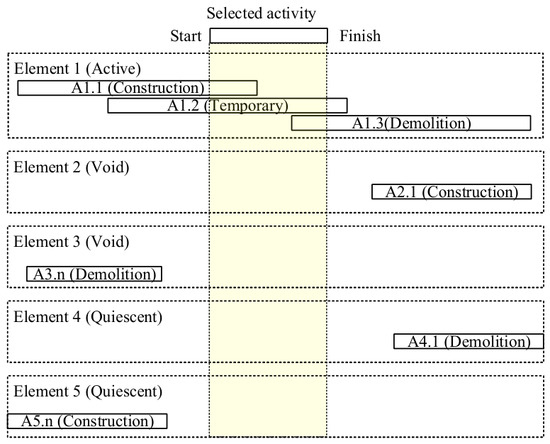
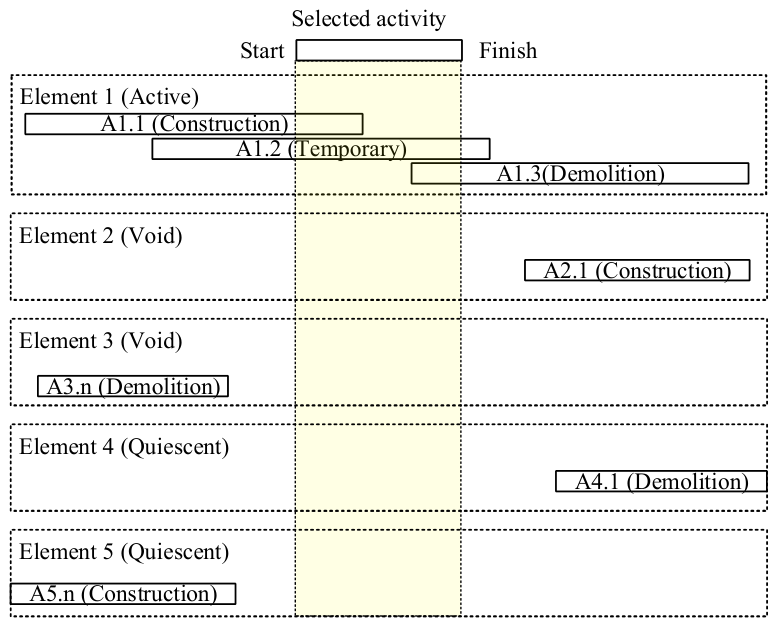
- Step 18 is used to find the valid element from the element collections within the time span of the ignition activity. In this research, the status of elements during a given time span is categorized into three types: quiescent, active, and void. Quiescent elements refer to elements that exist and exhibit no ongoing activity during a time span [41,42]; active elements are those with ongoing activities during the time span; and void elements refer to those that do not exist during the time span. The valid elements are the quiescent or active ones because IESIs only exist in these elements. The method to determine the element status is: if one of its linking activities has time overlap with the time span of a selected activity, the element is active (Element 1 of Figure 5); else, find the finished non-temporary activity immediate before the start of the time span. If this activity is a construction one, then the element is quiescent (Element 5 of Figure 5); otherwise, it is void (Element 3 of Figure 5). If no such activity is found, which means that the element has not started constructing or demolishing, then obtain the non-temporary activity immediately after the time span. If this activity is a construct one, then the element is void (Element 2 of Figure 5); otherwise, it is quiescent (Element 4 of Figure 5). It is noteworthy that, if activities can release combustible gases or vapors after their finish, their finish time should be extended. A user-defined time buffer is added to them.Figure 5. Element status.
- (6)
- The IASIs and IESIs are identified from steps 19 to 32 in terms of combinations. There are 4 levels of combinations, including extreme, high, medium, and low, and extreme and high correspond to IASIs and IESIs. An extreme combination contains both combustible materials/activities and an ignition source; high means that there is an ignition source, but neither combustible material nor activities, which is a combination that contains only ignition sources. The classification high, which is identified in steps 22 and 23, can highlight the need for a strictly monitored exclusion zone, preventing the unauthorized entry of combustible materials into the active hot-work area. Likewise, in steps 29 and 30, the remaining 2 hazard levels are assigned to combinations without ignition sources: medium combination contains no ignition source, but the building materials or activities within are combustible. This classification identifies “vulnerable zones” that require strict protection against external fire sources (e.g., stray sparks or unauthorized smoking), even if no hot work is currently scheduled nearby, while the low combination includes neither ignition source nor combustible materials or activities.
2.4. Result Output
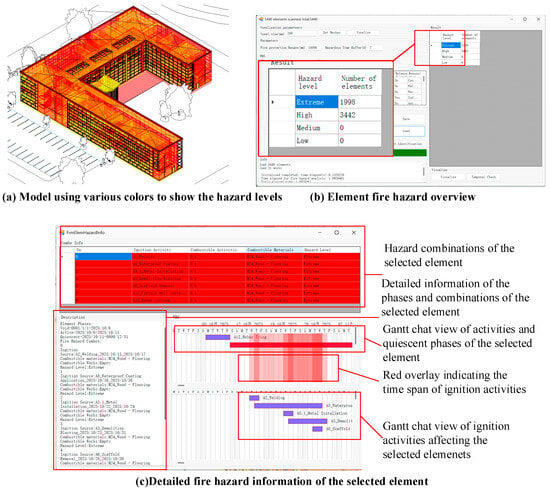
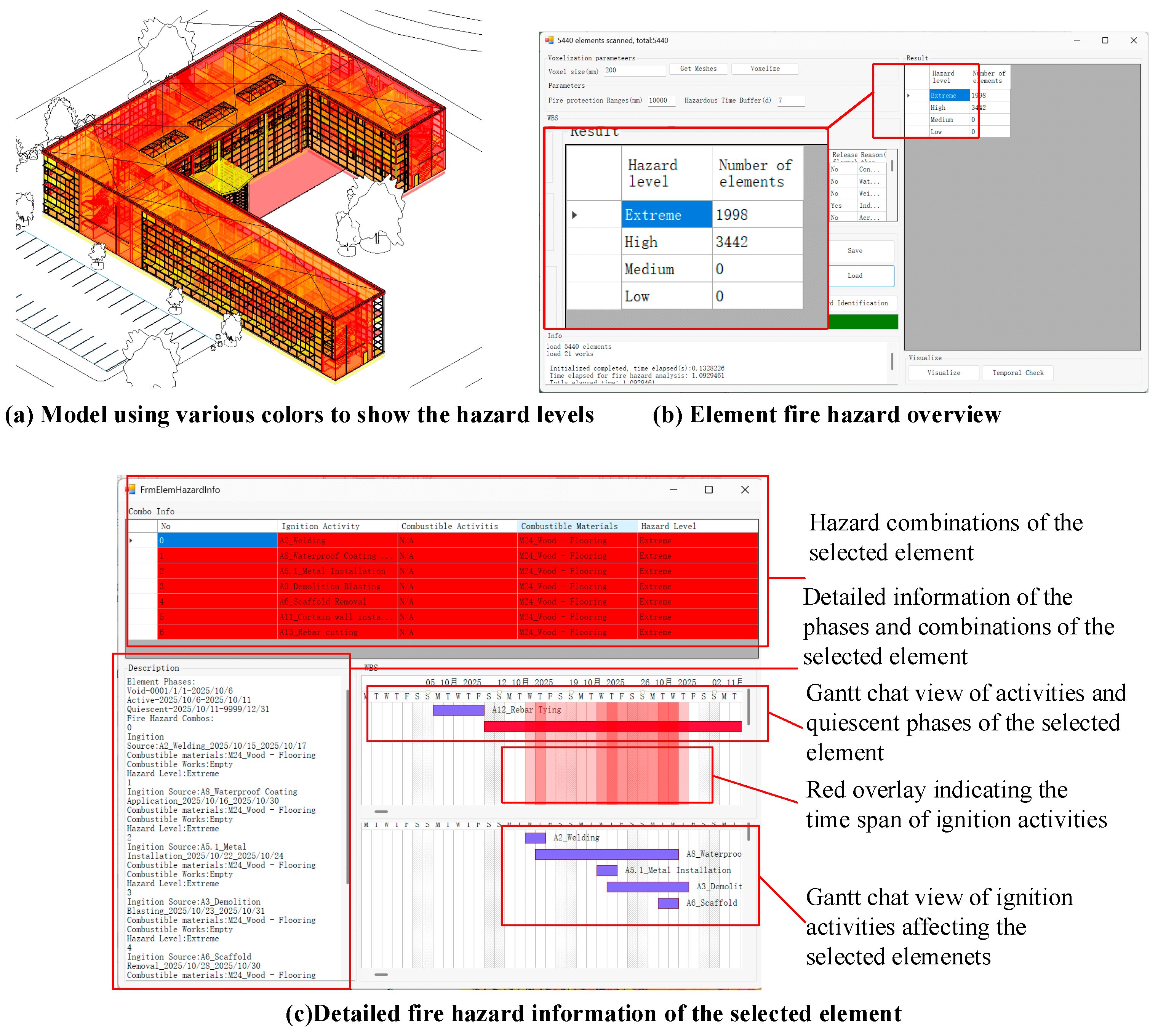
After the aforementioned steps, the combinations are obtained and assigned to the model elements. The hazard level of an element equals the highest hazard level of its combinations. The hazard identification result is visualized by 3 measures: (1) Colors: Extreme-hazardous elements are red; high-hazardous elements are yellow; medium-hazardous elements are blue; and low-hazardous elements are green. (2) Element fire hazard overview: Showing the number of elements from various fire hazards. (3) Detailed fire hazard information of a selected element: By selecting an element, its detailed fire hazard information will appear, including: (a) hazard combinations; (b) detailed information of the phases and combinations; (c) Gantt chart view of activities and quiescent phases and red overlay indicating the time span of ignition activities, if any; and (d) Gantt chart view of ignition activities affecting the elements, as shown in Figure 6.
Figure 6.
Fire-hazard identification result output.
3. Validation Test
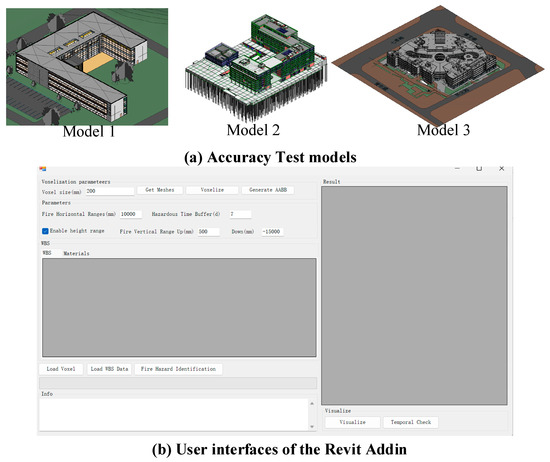
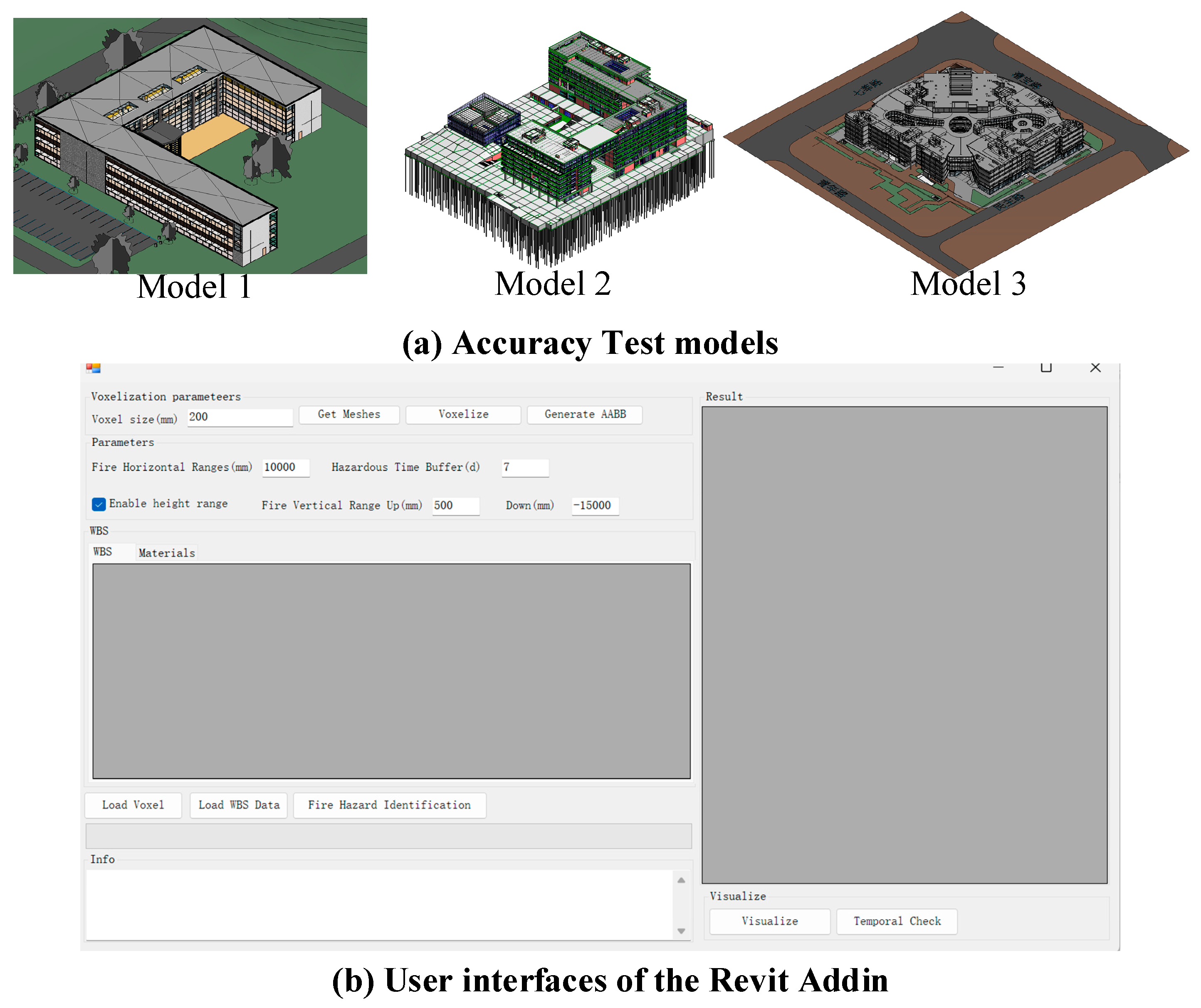
This section evaluates the performance of the proposed method through two sets of tests: accuracy and speed. The accuracy test comprises two sub-tests: (1) temporal accuracy test, which assesses the accuracy of the temporal information derived from the method, and (2) spatial accuracy test, which evaluates the accuracy of the voxel-based horizontal spatial distance for fire separation analysis. The speed test gauges the computational time of the proposed method when applied to a real-world project. Three test models are selected: Model 1 is the sample project of Autodesk Revit-Technical school (left of Figure 7a), which is a 3-story teaching building with a total building area of 5018 m2. Model 2 is a laboratory project in Sanya city, Hainan province, which consists of two 8-story laboratories, one 3-story conference center and a one-level basement, covering a total building area of 67,462.19 m2 (middle of Figure 7a). Model 3 is a shopping center with 5 floors and 3-level basements, covering a total building area of 237,600 m2 (right of Figure 7a). By excluding elements irrelevant to the actual building (for example, elevations, annotations, dimensions, and cameras), Model 1, Model 2, and Model 3 contain 5440, 62,461, and 41,800 valid elements, respectively, representing small-scale, standard-scale, and large-scale BIM model sizes; 21 activities with known fire-related information (Table 2) are randomly attached to the elements. It is worth noting that Model 2, which is smaller than Model 3 in building area, exhibits a higher element count, primarily due to its fine-grained modeling approach in the interior decoration phase. Specifically, it includes double-layered slab constructions (structural base and decorative finishes), structurally subdivided slabs based on beam intersections, and individually modeled floor tiles.
Figure 7.
Test models and UI of tools.
Table 2.
Activities of the validation test.
In the speed test, the activities in Table 2 are randomly attached to those elements. Meanwhile, a tool is developed as a Revit Addin by C# language with the interfaces (UI) in Figure 7b. During the test, the basic horizontal fire separation distance and vertical upper and lower separation distances are set to 10 m, 0.5 m, and 15 m, respectively, and the time offset is set to 7 d. All tests were conducted on a laptop with a Central Processing Unit (CPU) of i7-12700H (2.7 GHz) and 32 GB Random Access Memory (RAM). The Revit version for the tests in this research is Revit 2018. Other versions of the tools competitive to Revit 2024 and 2026 are also available at the links in the Data Availability Statement section.
3.1. Accuracy Test
3.1.1. Temporal Accuracy Test
The temporal accuracy test includes the status and hazardous combination within each element.
The accuracy of an element status is checked by analyzing the time overlap between the attached activities and the timespan of the status. The status of an element is correct only if the following conditions are all met: (a) The time overlaps only exist between the attached activities and the active status. (b) The quiescent status should start with the finish of a construction work or end with a demolition work; that is, a quiescent status stays in between a construction work (or 1 January 0000 if the first non-temporary work is not a construction one) and a demolition work (or 31 December 9999 if the last non-temporary work is not a demolition work). (c) The void status should either start with the completion of a demolition work, or end with the commencement of a construction work; that is, a void status only exists between a demolition work (or 1 January 0000 if the first non-temporary work is not a demolition one) and a construction work (or 31 December 9999 if the last non-temporary work is not a construction work).
The accuracy of the hazard combination is checked as follows: for each element, get its hazard combinations. A combination is correct only if: (a) combination levels meet Figure 3; (b) the combustible activities and materials, if any, are from the element; and (c) none of the ignition and combustible activities (if any) are totally during any void phases of the element.
3.1.2. Spatial Accuracy Test
This test assesses if the elements within the fire separation ranges of the ignition elements are accurately identified. That is, for each element with high or extreme hazardous combinations, its distance to at least one ignition element is less than the fire separation distance, which is 10 m in this test. To accurately calculate distances among triangle meshes, another mesh-based approach for fire hazard identification is developed: For each ignition activity, first gather its linking elements as the ignition elements, and collect the valid elements during the time span of the activity; then, for each valid element, if the distance between any triangle of the valid element and a triangle of the ignition element is less than 10 m, the element has either a high or extreme hazard combination, depending on whether its associated active activities or materials are combustible. The fire hazard combinations of this method are the ground truth. Accuracies are measured by the discrepancies between the ground truth and the combinations of the proposed voxel-based method: The combinations that only exist in the ground truth indicate some fire hazards failed to be identified by the proposed method (false negative errors, FN); the combinations that only exist in the proposed method indicate some non-fire hazards are regarded as fire hazards (false positive errors, FP). Based on the discussion of the errors of the proposed method, only false positive errors may occur. To validate the error limit of times of the voxel size, which is 0.566 m, another round of mesh-based method with the fire separation distance of 10.566 m, which is called the expanded ground truth, is done, and the new false positive errors (FP-expand) are calculated. The spatial accuracy passes only if neither FN nor FP-expand exists.
Because there are numerous triangles in the 2 models (1,404,471 of model 120,027,484 of model 2, and 9,410,469 of model 3), the pairwise calculation of triangle distances is impossible to get the result within a reasonable time, so the triangles of the ignition elements are arranged in a STRTree (Sort-Tile-Recursive tree) data structure [43]. Some packages have embedded this method. In this research, the NetTopologySuite is used for STRTree-based distance calculation.
In addition, since some research in Section 1.2 uses AABB to detect spatial intersection [31], the AABB intersection between the ignition sources and the combustible activity/elements is also done, and the output is compared with the proposed method. In this situation, each element is represented by its AABBs, and the spatial intersections between the ignition sources and the combustible elements/activities are detected by their AABB intersections. Theoretically, the AABB simplification can generate more FP errors than the proposed method because AABBs often occupy more spaces than the actual BIM components. The superiority of the proposed method is proved only when the total FP errors are less than those of the AABB ones.
3.2. Speed Test
This test contains 2 sub-tests. Sub-test 1 compares the proposed method to the mesh-based method in the accuracy test to check if the proposed method is faster. Because the first running of the proposed method requires a model-voxelization process to generate a voxelized model, and this model can be reused for the later running, the time elapsed for fire hazard identification with and without the voxelization process is all recorded. Sub-test 2 focuses on analyzing the factors influencing the elapsed time. Since the voxel size, the fire separation distances, the time buffers, and the number of activities can affect the elapsed time, tests are run by changing those variables and measuring the elapsed time. The voxel sizes vary from 100 mm to 500 mm with an interval of 100 mm; the fire horizontal separation distance varies from 10 m to 30 m with an interval of 5 m; the fire vertical upper and lower separation distances vary from 0.5 m and 15 m to 4.5 m and 45 m, respectively, with intervals of 1 m and 10 m respectively; the time buffer varies from 7 d to 35 d with an interval of 7 d; and the activities in Table 2 are duplicated from 1 time (21 activities) to 40 times (840 activities) with an interval of 10 times, and in each duplication, the elements are randomly assigned to the activities. Because the voxelized method only generates once and is reused throughout the construction process, sub-test 2 runs on existing voxelized models: the elapsed time of this sub-test does not include the voxelization time.
4. Result, Discussion, and Application
4.1. Accuracy Test Result
4.1.1. Temporal Accuracy
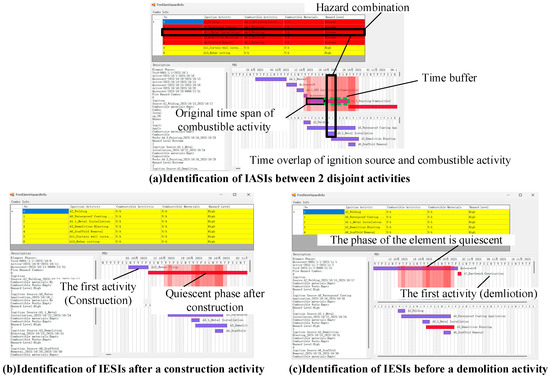
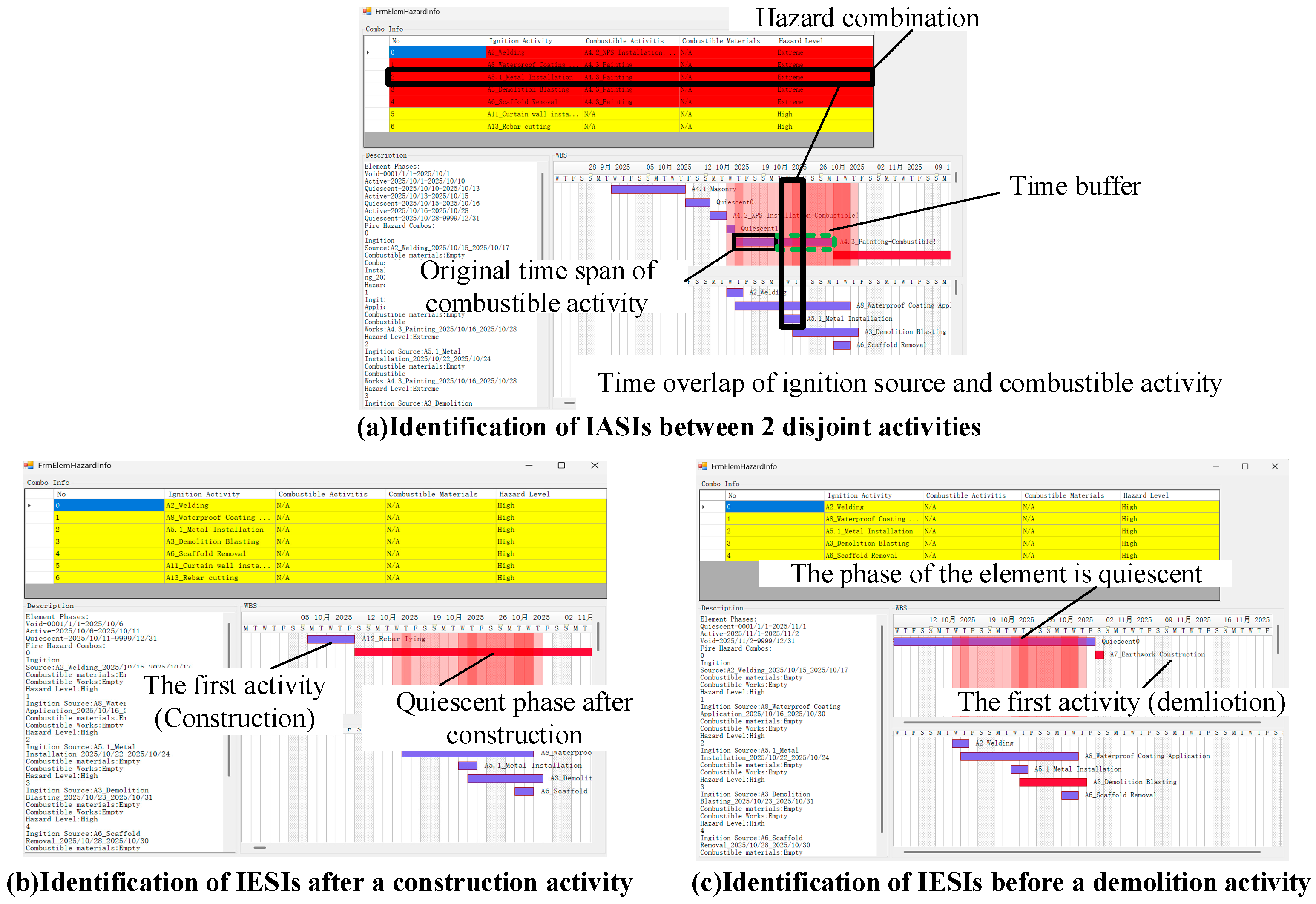
The result of the temporal accuracy test exhibits no inaccuracies, meaning that the proposed method correctly generates all the element phases and hazard combinations. Three noteworthy examples are shown in Figure 8:
Figure 8.
Example of the test result.
- (1)
- In Figure 8a, by using a time buffer, a gas-releasing activity (painting), which has no time intersection based on its original time span, intersects with an ignition source (Metal installation), generating a hazard combination.
- (2)
- In Figure 8b, the first activity is a construction one; after its completion, the element becomes quiescent. Since there are no combustible materials in the element, all the hazard combinations are high.
- (3)
- In Figure 8c, the first activity is a demotion one, the phase before the activity is quiescent, and the phase becomes void after the activity (so no bar appears behind the activity). Likewise, since there are no combustible materials in the element, all the hazard combinations are high.
4.1.2. Spatial Accuracy
The result of the spatial accuracy is shown in Table 3. From the table, the FN errors of the three models are 0, indicating that the proposed method can identify all the hazards within the fire separation distances of the ignition elements. Although FP errors are non-zero at the initial fire separation distance, these errors decrease to zero when the distance is expanded to the upper error bound. This result proves that the proposed method is reliable for identifying high/extreme fire hazards accurately. Although the outcome is conservative, the maximum error is less than 1 m when the voxel size is 200 mm, which is safe and acceptable during the construction stage.
Table 3.
Spatial accuracy result.
Table 4 presents a comparative analysis of the proposed method against the AABB method. The proposed approach yields a total of 92 false positives (FPs), whereas the AABB method results in 1249, demonstrating that the proposed method generates fewer false-positive errors. Notably, in Model 3, the AABB method produces 1228 FP errors—13 times more than the proposed method. This discrepancy is primarily attributed to the fact that many elements in Model 3 are not aligned with the x, y, and z axes. Conversely, in Model 1, the AABB method outperforms the proposed method. This is because the majority of components are parallel to the axes; therefore, the AABB approximation of the elements incurs fewer errors. To further verify this, Model 1 was rotated by 45 degrees around the z-axis, and the tools were run again. In this case, the number of FPs for the proposed method is 5, whereas that for the AABB method is 22. These results indicate that the spatial accuracy of the AABB method is affected by model orientation, while the proposed method is more robust to changes in orientation.
Table 4.
Comparison between the proposed method and AABBs.
4.2. Speed Test Result
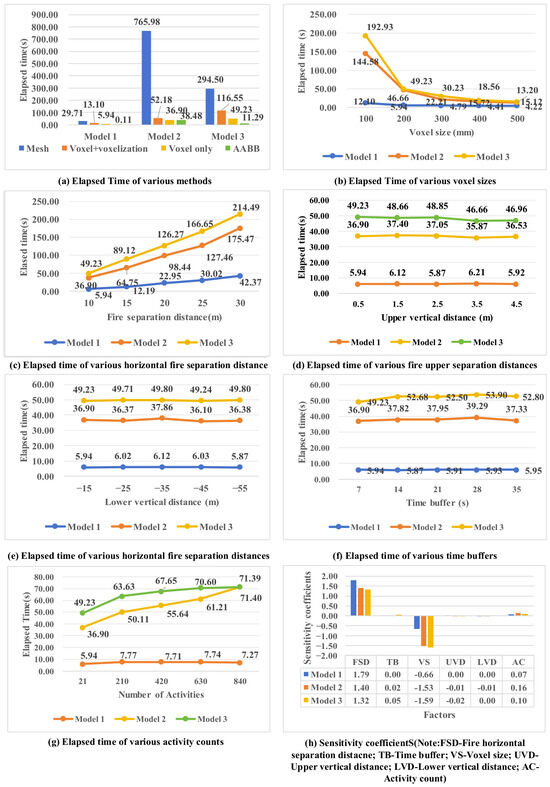
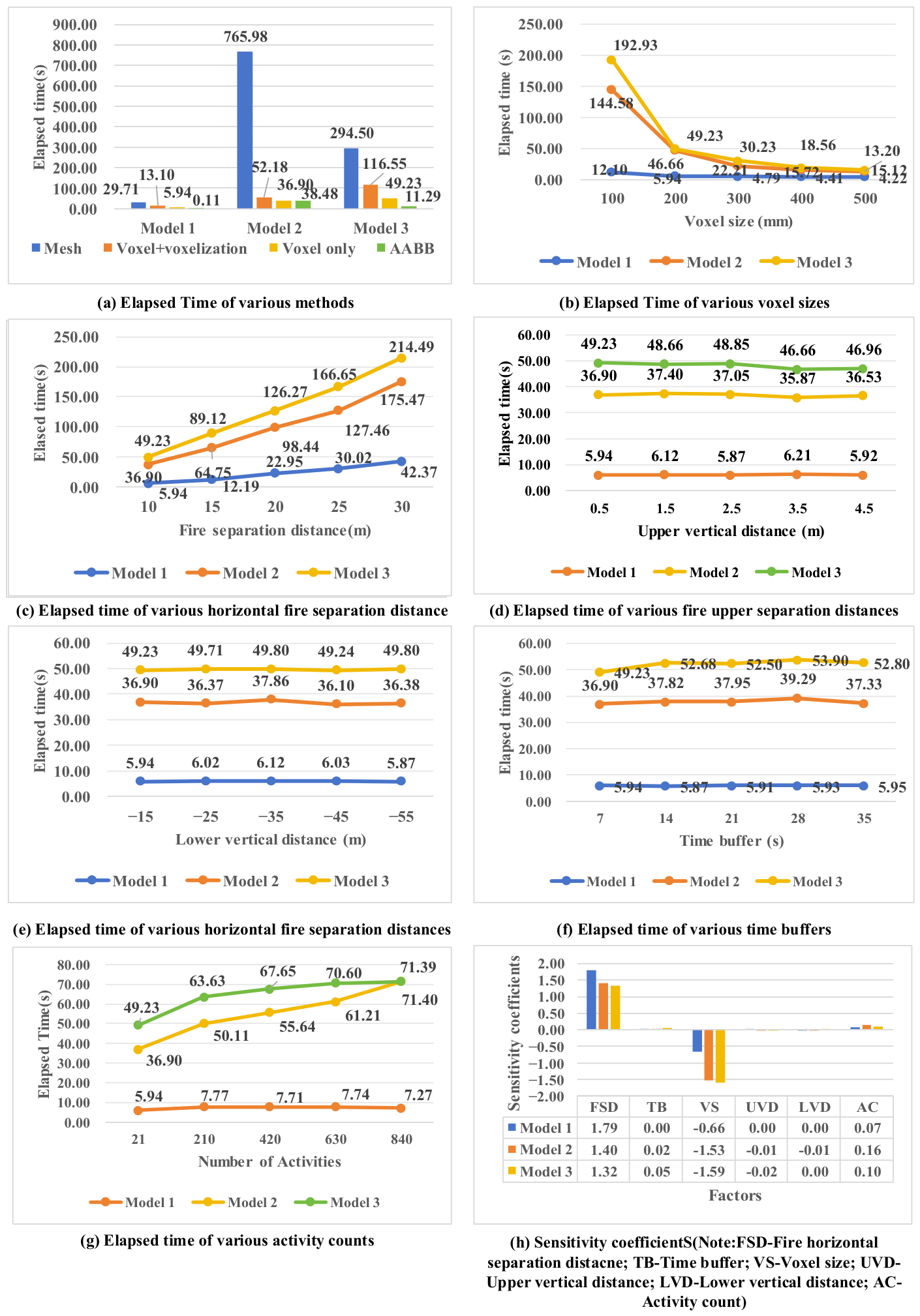
Figure 9 shows the elapsed time of the proposed method under varying fire separation horizontal and vertical distances, time buffers, and voxel sizes. As illustrated in Figure 9a. Some interesting results can be seen from that figure:
Figure 9.
Speed test result.
- (1)
- The proposed method vs. the mesh-based method
Despite the overhead of model voxelization, the proposed method achieves a shorter elapsed time than the mesh-based method. For example, in Model 1, the elapsed time of the proposed method is 13.10 s, compared to 29.71 s for the mesh-based method, indicating that the proposed method is 126% faster. In Model 2, the elapsed times of the proposed and mesh-based methods are 52.18 s and 765.98 s, respectively, representing a speedup of 1368%. In Model 3, the elapsed times are 116.55 s and 294.5 s, respectively, meaning that the proposed method is 152% faster than the mesh-based counterpart. If the voxelized model is stored and directly reused for fire hazard identification, the elapsed time can be further reduced to 5.94 s (Model 1), 36.9 s (Model 2), and 49.23 s (Model 3), corresponding to speed increases of 400%, 1975%, and 498%, respectively. These results demonstrate that the proposed method yields substantial time savings in fire hazard identification. The primary reason is that mesh-based methods involve numerous floating-point calculations to determine the exact distance between BIM elements. In contrast, the proposed method avoids such computationally intensive operations. For instance, when calculating distances between a set of ignition sources and potential combustible elements, the mesh-based approach must compute the distance between every triangle of each source and every triangle of each target. This process is time-consuming, even when acceleration strategies like STRTree are applied. Conversely, the proposed method expands voxels at the boundary of ignition sources using a pre-calculated cell range. Consequently, affected surrounding elements can be identified solely through cell index and elevation comparisons, significantly improving efficiency. This result also supports that the voxel-based method is an efficient approach for near-proximity search, as illustrated in [40,44].
- (2)
- The proposed method vs. the AABB method
Although the less-accurate AABB method is faster than the proposed method in Models 1 and 3, it is slower in Model 2. A possible explanation is that Model 2 contains a large number of elements; the pairwise comparisons between the AABBs of ignition sources and combustible activities/materials become time-consuming. In summary, the proposed method strikes a favorable balance between accuracy and speed.
- (3)
- Fire-related data affecting the performance of the proposed method
From Figure 9b,c,g, the elapsed time increases with the horizontal fire separation distance and the number of activities, but decreases with the voxel size. The reason is that a bigger fire separation distance includes more cells to be scanned around the ignition elements, and a larger activity count requires more rounds of spatial–temporal intersection analysis due to the increase of the ignition activities, resulting in longer elapsed time; likewise, a smaller voxel size increases the voxel density, which can also increase the cells to be scanned near each ignition element. However, the elapsed time seems insensitive to the time buffer and vertical fire separation ranges. One possible explanation is that in this test, the activities are very close to each other. The expansion of the time buffer can activate very few new gas-releasing activities, resulting in little impact on the elapsed time, and compared with increasing the horizontal separation range, increasing the vertical separation range can incur very few additional elements to be processed, which also poses little impact on the total elapsed time.
To analyze the sensitivity of the elapsed time to changes in voxel sizes, fire separation horizontal and vertical distances, time buffers, and activity count, a series of one-factor sensitivity analyses is done. The sensitivity coefficients are calculated based on double-log linear regression mode [45]: To calculate the sensitivity coefficient (elasticity) between the indicator Y and factor X, apply the equation ln(Y) = β0 + β1ln(X). The estimated slope coefficient β1 directly represents the elasticity. Mathematically, it signifies that a 1% change in the independent variable X results in a β1% change in the dependent variable Y. In this research, β0 and β1 are calculated by the “LINST” function in Microsoft Excel based on the data in Figure 9b–g. The calculated β1s, which are the sensitivity coefficients, are shown in Figure 9h. This figure shows that the computational time of the proposed method exhibits significant sensitivity to the fire horizontal separation distance and voxel size, moderate sensitivity to the activity count, and negligible sensitivity to the time buffer and fire vertical separation distances, which echoes the discussion in the previous paragraph.
4.3. Application in a Real Case
This section selects two real cases to apply the proposed method to identify fire hazards caused by IASI and IESI, respectively.
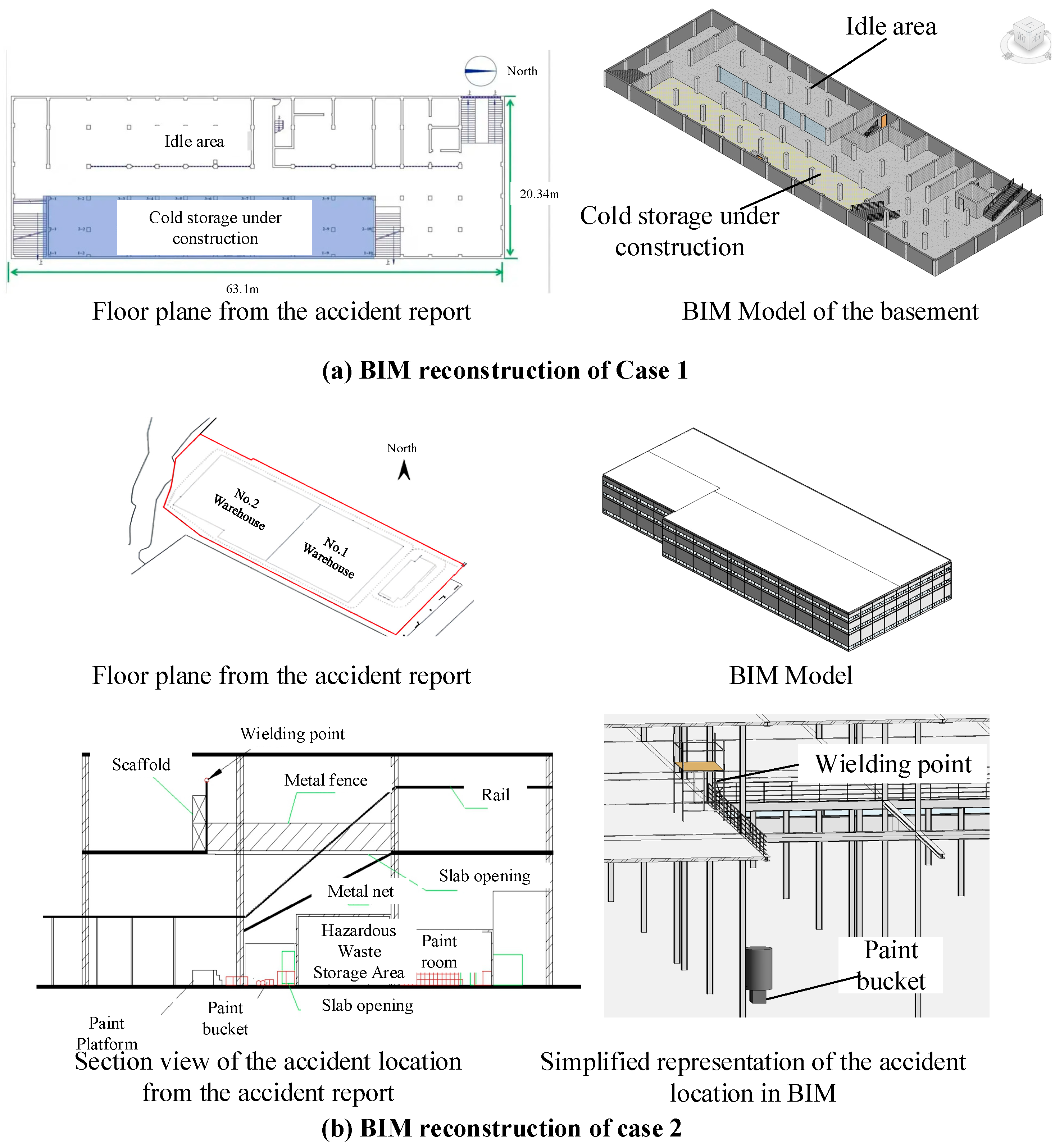
Case 1 is a fatal fire that occurred in the basement of a commercial building at Jiale Garden Community, Xinyu City, Jiangxi Province. The accident was directly caused by static electricity igniting flammable gases released during polyurethane foam application while illegally constructing a cold storage facility. Due to inadequate fire compartmentation and blocked escape routes, toxic smoke rapidly spread to the upper floors. This tragedy resulted in 39 deaths, nine injuries, and direct economic losses exceeding 43 million RMB [46].
Case 2 is a fatal fire accident at a factory of Zhejiang Weijiali Industry & Trade Co., Ltd. in Wuyi County, Zhejiang Province. The blaze was caused by illegal welding operations on the second floor, where hot slag fell and ignited improperly stored paint on the first floor. The fire spread rapidly through the building’s vertical spaces, claiming 11 fatalities and a direct economic loss of 28.065 million RMB [47].
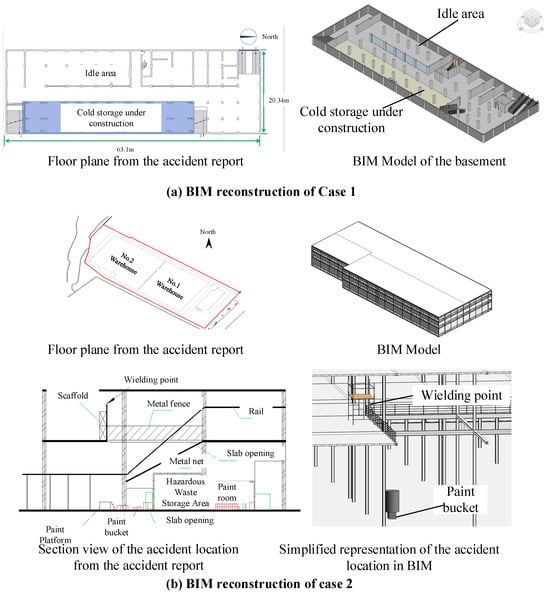
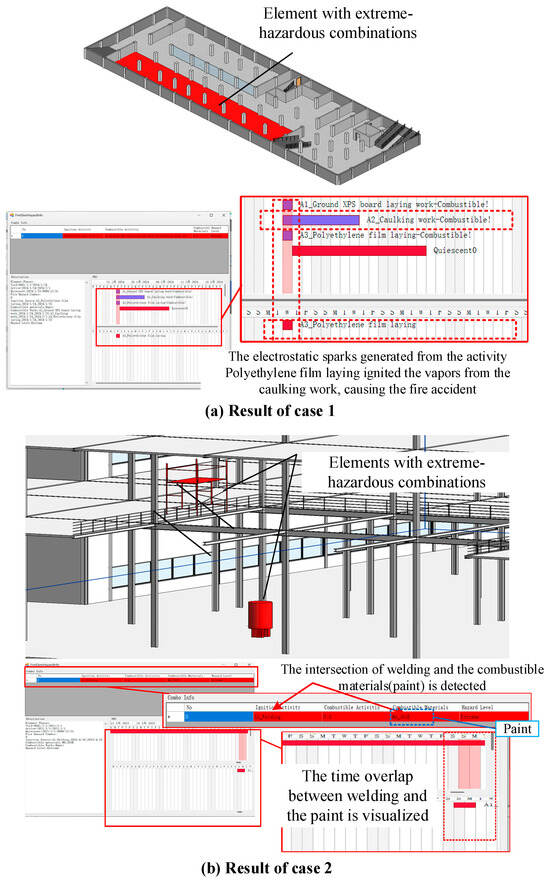
Based on the accident reports of both cases, the accident scenarios were reconstructed, as illustrated in Figure 10. Meanwhile, the activities associated with these accidents are detailed in Table 5 and Table 6. In Case 1, the fire was triggered by the intersection of two activities: polyethylene film laying and caulking work, representing a typical IASI. Conversely, the fire in Case 2 resulted from welding and paint storage, which constitutes an IESI. To facilitate this analysis, a dummy activity—a completed construction task—was assigned to the paint bucket. This was necessary because the proposed tool ignores BIM objects without any activities. By assigning an early-finished dummy activity, the paint bucket enters a quiescent phase before the onset of welding, thereby allowing its spatial intersection with the welding activity (if any) to be accurately identified.
Figure 10.
BIM reconstruction of cases 1 and 2.
Table 5.
WBS of activities of case 1.
Table 6.
WBS of activities of case 2.
Application of the proposed tool to both cases confirmed its ability to identify the root causes. As shown in Figure 11a, the intersection between polyethylene film laying and caulking in Case 1 was successfully detected. Likewise, Figure 11b highlights the successful identification of the intersection between welding and paint in Case 2. Collectively, these findings underscore the significant practical value of the proposed method. It is noteworthy that the result of case 2 also marks the scaffold red; the reason is that the family of the scaffold contains a default but combustible material, “plywood”, generating an extremely hazardous combination of its linking ignition activity (welding) and the material.
Figure 11.
Result of the real cases.
5. Conclusions
This study proposes a voxelization-based method for fire hazard identification in the 4D-BIM context. The advantages of this method are as follows:
- (1)
- Comprehensive Hazard Identification: Unlike methods that primarily focus on conflicts between construction activities, the proposed approach identifies hazards from both Ignition–Activity (IASI) and Ignition–Element (IESI) intersections. This ensures that risks arising from hot work near existing combustible building components are not overlooked, a common gap in current proactive safety planning tools.
- (2)
- Proactive and Automated: This method is designed for proactive fire prevention and requires no pre-defined work regions. It automates the hazard identification process by leveraging voxelization, reducing the labor and potential for human error associated with manual workspace delineation.
- (3)
- Superior Computational Efficiency: By converting complex geometric proximity searches into efficient cell-based index lookups, the proposed method is significantly faster than traditional mesh-based approaches. Validation tests show it is 126–1368% faster, making it highly suitable for frequent safety checks in large-scale, dynamic construction projects where computational speed is critical.
However, the proposed method has several limitations: (1) The speed test results indicate that the combination of a larger fire separation distance, more activities, and a smaller voxel size leads to increased computation time; further research is needed to accelerate the method. (2) The ignition source and the combustible activities and materials are labeled manually in this research; therefore, it can be laborious when there are a large amount of materials and activities. The LLM-assisted automatic generation of fire-related data requires further research. (3) The method does not account for the fire resistance of building components, resulting in conservative outcomes. Further research will take them into consideration to make the method more accurate. (4) The comparison in this study is primarily conducted against the AABB method and a mesh-based ground truth. While this validates the effectiveness and efficiency of the proposed approach, a more comprehensive comparison with other state-of-the-art methods (e.g., Oriented boundary box (OBB)-based or advanced workspace-based methods) would further strengthen the evaluation. This will be a key focus of future research.
Supplementary Materials
The source code, the proof of the voxel error, and instructions for the developed tool are available at: https://github.com/ZengGuoWHUT/SiteHazardIdentifier_0423.git (accessed on 23 April 2026).
Author Contributions
Conceptualization, Z.G. and Q.L.; methodology, Q.L.; software, Z.G.; validation, Z.G. and Q.L.; formal analysis, Z.G.; investigation, Z.G.; resources, Z.G. and Q.L.; data curation, Z.G. and Q.L.; writing—original draft preparation, Q.L.; writing—review and editing, Z.G.; visualization, Z.G.; supervision, Q.L.; project administration, Q.L.; funding acquisition, Q.L. All authors have read and agreed to the published version of the manuscript.
Funding
This research was funded by the Humanities and Social Science Foundation of the Ministry of Education of China for Young Scholars (Grant NO. 24YJC630110), the Project of Sanya Yazhou Bay Science and Technology City (Grant No: SKJC-2022-PTDX-021), and the National Key Research and Development Program of China (2021YFC3100800).
Data Availability Statement
The source code, the proof of the voxel error, and instructions for the developed tool are available at: https://github.com/ZengGuoWHUT/SiteHazardIdentifier-2.0.git (accessed on 23 April 2026) (https://github.com/ZengGuoWHUT/SiteHazardIdentifier_0423.git (accessed on 23 April 2026)).
Acknowledgments
The authors would like to extend their sincere gratitude to the editors and 3 anonymous reviewers for their valuable time, insightful comments, and constructive suggestions, which have significantly improved the quality of this manuscript. During the preparation of this manuscript/study, the authors used Deepseek Reasoner-V3.2 to assist in polishing the English writing only. The authors have reviewed and edited the output and take full responsibility for the content of this publication.
Conflicts of Interest
The authors declare no conflicts of interest.
Abbreviations
The following abbreviations are used in this manuscript:
| BIM | Building Information Modeling |
| FDS | Fire Dynamics Simulation |
| ASET | Available Safe Egress Time |
| RSET | Required Safe Egress Time |
| TOPSIS | Technique For Order Preference By Similarity To Ideal Solution |
| CFD | Computational Fluid Dynamics |
| LLM | Large Language Models |
| IASI | Ignition–Activity Spatio-Temporal Intersections |
| IESI | Ignition–Element Spatio-Temporal Intersections |
| AABB | Axis-Aligned Bounding Box |
| STRTree | Sort-Tile-Recursive Tree |
| OBB | Oriented Boundary Box |
References
- NFSA. Fires and Numbers—NFSA Investigates Structure Fire Trends in the U.S. Available online: https://nfsa.org/2024/04/30/structure-fire-trends-in-the-us/ (accessed on 18 January 2026).
- Liu, K.X.; González, V.A.; Lee, G.; Kinateder, M. A scoping review of fire safety on building construction sites: Current measures, practices and future research directions. Eng. Constr. Archit. Manag. 2025, 33, 5210–5243. [Google Scholar] [CrossRef] [Scilit]
- Shi, J.Y.; Dao, J.C.; Jiang, L.; Pan, Z.Y. Research on IFC- and FDS-Based Information Sharing for Building Fire Safety Analysis. Adv. Civ. Eng. 2019, 2019, 3604369. [Google Scholar] [CrossRef] [Scilit]
- Siddiqui, A.A.; Ewer, J.A.; Lawrence, P.J.; Galea, E.R.; Frost, I.R. Building Information Modelling for performance-based Fire Safety Engineering analysis—A strategy for data sharing. J. Build. Eng. 2021, 42, 102794. [Google Scholar] [CrossRef] [Scilit]
- Abadi, S.T.S.; Tokmehdash, N.M.; Hosny, A.; Nik-Bakht, M. BIM-Based Co-Simulation of Fire and Occupants’ Behavior for Safe Construction Rehabilitation Planning. Fire 2021, 4, 67. [Google Scholar] [CrossRef] [Scilit]
- Malagnino, A.; Corallo, A.; Lazoi, M.; Zavarise, G. The Digital Transformation in Fire Safety Engineering over the Past Decade Through Building Information Modelling: A Review. Fire Technol. 2022, 58, 3317–3351. [Google Scholar] [CrossRef] [Scilit]
- Xu, H.; Wei, Y.X.; Tan, Y.T.; Zhou, Q.L. A BIM-FDS Based Evacuation Assessment of Complex Rail Transit Stations under Post-Earthquake Fires for Sustainable Buildings. Buildings 2024, 14, 429. [Google Scholar] [CrossRef] [Scilit]
- Feng, Z.; Hou, H.; Chen, H.; Liu, Y. Fire simulation and evacuation optimization for metro stations with interpretability: A hybrid BIM, fire dynamics simulator and multiobjectives optimization algorithm approach. J. Build. Eng. 2026, 117, 114798. [Google Scholar] [CrossRef] [Scilit]
- Hosseini, O.; Maghrebi, M. Risk of fire emergency evacuation in complex construction sites: Integration of 4D-BIM, social force modeling, and fire quantitative risk assessment. Adv. Eng. Inform. 2021, 50, 101378. [Google Scholar] [CrossRef] [Scilit]
- Dang, P.; Zhu, J.; Li, W.L.; Xie, Y.K.; Zhang, H. Large-language-model-driven agents for fire evacuation simulation in a cellular automata environment. Saf. Sci. 2025, 191, 106935. [Google Scholar] [CrossRef] [Scilit]
- Terzi, A.F.; Aksu, K.; Koçyigit, A.; Demirel, H. A BIM-Based Multi-Criteria Spatial Framework for Assessing Fire Risks in Indoor Environments. Fire 2025, 8, 361. [Google Scholar] [CrossRef] [Scilit]
- Zhong, C.; Li, T.; Liu, H.; Zhang, L.; Wen, X.Y. Fire Reconstruction and Flame Retardant with Water Mist for Double-Roofed Ancient Buddhist Buildings. Buildings 2025, 15, 1109. [Google Scholar] [CrossRef] [Scilit]
- Khan, N.; Lee, D.; Baek, C.; Park, C.S. Converging Technologies for Safety Planning and Inspection Information System of Portable Firefighting Equipment. IEEE Access 2020, 8, 211173–211188. [Google Scholar] [CrossRef] [Scilit]
- Wang, Y.K.; Liu, Y.; Cai, H.Z.; Wang, J.; Zhou, X.P. An Automated Fire Code Compliance Checking Jointly Using Building Information Models and Natural Language Processing. Fire 2023, 6, 358. [Google Scholar] [CrossRef] [Scilit]
- Ismail, A.S.; Ali, K.N.; Iahad, N.A.; Kassem, M.A.; Al-Ashwal, N.T. BIM-Based Automated Code Compliance Checking System in Malaysian Fire Safety Regulations: A User-Friendly Approach. Buildings 2023, 13, 1404. [Google Scholar] [CrossRef] [Scilit]
- Chen, D.Y.; Chen, L.; Zhang, Y.; Lin, S.; Ye, M.; Solvsten, S. Automated fire risk assessment and mitigation in building blueprints using computer vision and deep generative models. Adv. Eng. Inform. 2024, 62, 102614. [Google Scholar] [CrossRef] [Scilit]
- Yang, Y.P.; Sun, Y.; Chen, M.S.; Zhou, Y.K.; Wang, R.; Liu, Z.X. Platform Development of BIM-Based Fire Safety Management System Considering the Construction Site. Buildings 2022, 12, 1268. [Google Scholar] [CrossRef] [Scilit]
- Khan, N.; Ali, A.K.; Tran, S.V.T.; Lee, D.; Park, C. Visual Language-Aided Construction Fire Safety Planning Approach in Building Information Modeling. Appl. Sci. 2020, 10, 1704. [Google Scholar] [CrossRef] [Scilit]
- Schönfelder, P.; Aziz, A.; Bosché, F.; König, M. Enriching BIM models with fire safety equipment using keypoint-based symbol detection in escape plans. Autom. Constr. 2024, 162, 105382. [Google Scholar] [CrossRef] [Scilit]
- Wang, T.; Du, P.; Dang, P.; Liu, T.; Li, P. A real-time mapping method for knowledge graph-driven large language models: A focus on indoor fire evacuations. Int. J. Digit. Earth 2025, 18, 2468407. [Google Scholar] [CrossRef] [Scilit]
- Zhang, T.H.; Wang, Z.L.; Zeng, Y.F.; Wu, X.Q.; Huang, X.Y.; Xiao, F. Building Artificial-Intelligence Digital Fire (AID-Fire) system: A real-scale demonstration. J. Build. Eng. 2022, 62, 105363. [Google Scholar] [CrossRef] [Scilit]
- Ding, Y.F.; Zhang, Y.X.; Huang, X.Y. Intelligent emergency digital twin system for monitoring building fire evacuation. J. Build. Eng. 2023, 77, 107416. [Google Scholar] [CrossRef] [Scilit]
- Kim, Y.J.; Kim, H.; Ha, B.; Kim, W.T. Advanced fire emergency management based on potential fire risk assessment with informative digital twins. Autom. Constr. 2024, 167, 105722. [Google Scholar] [CrossRef] [Scilit]
- Cheng, M.Y.; Chiu, K.C.; Hsieh, Y.M.; Yang, I.T.; Chou, J.S.; Wu, Y.W. BIM integrated smart monitoring technique for building fire prevention and disaster relief. Autom. Constr. 2017, 84, 14–30. [Google Scholar] [CrossRef] [Scilit]
- Kong, L.L.; Yang, Q.L.; Zhou, Q.Z.; Xing, J.C.; Sun, X.B.; Zou, R.W. Embedding knowledge into BIM: A case study of extending BIM with firefighting plans. J. Build. Eng. 2022, 49, 103999. [Google Scholar] [CrossRef] [Scilit]
- Abdullahi, U.I.; Zhang, W.; Cao, Y.D.; Irankunda, G. Integrating IoT Technology for Fire Risk Monitoring and Assessment in Residential Building Design. Buildings 2025, 15, 1346. [Google Scholar] [CrossRef] [Scilit]
- Zhou, X.P.; Li, H.R.; Wang, J.; Zhao, J.C.; Xie, Q.S.; Li, L.; Liu, J.Y.; Yu, J. CloudFAS: Cloud-based building fire alarm system using Building Information Modelling. J. Build. Eng. 2022, 53, 104571. [Google Scholar] [CrossRef] [Scilit]
- Kim, D.; Cha, H.S.; Jiang, S.H. The Prediction of Fire Disaster Using BIM-Based Visualization for Expediting the Management Process. Sustainability 2023, 15, 3719. [Google Scholar] [CrossRef] [Scilit]
- Chavada, R.; Dawood, N.; Kassem, M. Construction workspace management: The development and application of a novel nD planning approach and tool. J. Inf. Technol. Constr. 2012, 17, 213. [Google Scholar]
- Kassem, M.; Dawood, N.; Chavada, R. Construction workspace management within an Industry Foundation Class-Compliant 4D tool. Autom. Constr. 2015, 52, 42–58. [Google Scholar] [CrossRef] [Scilit]
- Tran, S.V.T.; Khan, N.; Lee, D.; Park, C. A Hazard Identification Approach of Integrating 4D BIM and Accident Case Analysis of Spatial-Temporal Exposure. Sustainability 2021, 13, 2211. [Google Scholar] [CrossRef] [Scilit]
- Choe, S.; Leite, F. Construction safety planning: Site-specific temporal and spatial information integration. Autom. Constr. 2017, 84, 335–344. [Google Scholar] [CrossRef] [Scilit]
- Nasab, A.R.; Malekitabar, H.; Elzarka, H.; Tak, A.N.; Ghorab, K. Managing Safety Risks from Overlapping Construction Activities: A BIM Approach. Buildings 2023, 13, 2647. [Google Scholar] [CrossRef] [Scilit]
- Kim, D.; Yoo, T.; Tran, S.V.T.; Lee, D.; Park, C.; Lee, D. Automated Safety Risk Assessment Framework by Integrating Safety Regulation and 4D BIM-Based Rule Modeling. Buildings 2024, 14, 2529. [Google Scholar] [CrossRef] [Scilit]
- Awe, M.; Malhi, A.; Budka, M.; Mavengere, N.; Dave, B. Towards 4D BIM: A Systematic Literature Review on Challenges, Strategies and Tools in Leveraging AI with BIM. Buildings 2025, 15, 1072. [Google Scholar] [CrossRef] [Scilit]
- GB 8624-2025; Classification for Burning Behavior of Building Materials and Products. State Administration for Market Regulation: Beijing, China; Standardization Administration of the People’s Republic of China: Beijing, China, 2025.
- GB/T 50720-2011; Technical Standard for Fire Safety of Construction Site. Ministry of Housing and Urban-Rural Development of the People’s Republic of China: Beijing, China, 2025.
- International Building Code. 705.8.6 Vertical Exposure. Available online: https://up.codes/s/vertical-exposure (accessed on 6 May 2026).
- Zuo, W.W.; Li, Q.Y.; Wang, Q.K.; Qiao, S.; Mei, T.T.; Guo, Z. LEGO Voxelization Method for Arbitrary Building Information Models to Support Path Planning. J. Constr. Eng. Manag. 2026, 152, 04025239. [Google Scholar] [CrossRef] [Scilit]
- Wang, Q.K.; Zuo, W.W.; Guo, Z.; Li, Q.Y.; Mei, T.T.; Qiao, S. BIM Voxelization Method Supporting Cell-Based Creation of a Path-Planning Environment. J. Constr. Eng. Manag. 2020, 146, 04020080. [Google Scholar] [CrossRef] [Scilit]
- Su, X.; Cai, H.B. Life Cycle Approach to Construction Workspace Modeling and Planning. J. Constr. Eng. Manag. 2014, 140, 04014019. [Google Scholar] [CrossRef] [Scilit]
- Wang, Q.K.; Guo, Z.; Mintah, K.; Li, Q.Y.; Mei, T.T.; Li, P. Cell-Based Transport Path Obstruction Detection Approach for 4D BIM Construction Planning. J. Constr. Eng. Manag. 2019, 145, 04018141. [Google Scholar] [CrossRef] [Scilit]
- Leutenegger, S.T.; Lopez, M.A.; Edgington, J. STR: A simple and efficient algorithm for R-tree packing. In Proceedings of the 13th International Conference on Data Engineering, Birmingham, UK, 7–11 April 1997; IEEE: New York, NY, USA, 1997. [Google Scholar]
- Golpour, A.; Sheikhkhoshkar, M.; Khanzadi, M.; Rahbar, M.; Banihashemi, S. 4D BIM-Based Enriched Voxel Map for UAV Path Planning in Dynamic Construction Environments. Systems 2025, 13, 917. [Google Scholar] [CrossRef] [Scilit]
- Lee, M.J. Finding correct elasticities in log-linear and exponential models allowing heteroskedasticity. Stud. Nonlinear Dyn. Econom. 2021, 25, 81–91. [Google Scholar] [CrossRef] [Scilit]
- Ministry of Emergency Management of the People’s Republic of China. Investigation Report on the “January 24” Specially Serious Fire Accident at the Street-Facing Shops of Jiale Garden Community, Xinyu City, Jiangxi Province. Available online: http://www.mem.gov.cn/gk/zfxxgkpt/fdzdgknr/202409/t20240921_501979.shtml (accessed on 5 June 2026).
- The Zhejiang Provincial Department of Emergency Management. Investigation Report on the “April 17” Serious Fire Accident at Zhejiang Weijiali Industry and Trade Co., Ltd. in Wuyi, Zhejiang Province. Available online: https://yjt.zj.gov.cn/art/2023/7/28/art_1228978417_59132005.html (accessed on 4 June 2026).

Disclaimer/Publisher’s Note: The statements, opinions and data contained in all publications are solely those of the individual author(s) and contributor(s) and not of MDPI and/or the editor(s). MDPI and/or the editor(s) disclaim responsibility for any injury to people or property resulting from any ideas, methods, instructions or products referred to in the content. |
© 2026 by the authors. Licensee MDPI, Basel, Switzerland. This article is an open access article distributed under the terms and conditions of the Creative Commons Attribution (CC BY) license.