


Abstract
This article examines in detail Advisory Opinion No. 32, issued by the International Court of Justice (ICJ) in July 2025. The analysis examines how the decision of the International Court of Justice establishes the principle of intergenerational equity as an interpretative criterion for climate obligations, consolidating specific duties of prevention, due diligence, cooperation, mitigation, and adaptation to the consequences of climate change that directly affect present and future generations. This Opinion also designates the 1.5 °C threshold as a central legal benchmark for assessing States’ due diligence in climate mitigation and adaptation and extends state obligations to the regulation of private actors, characterizing climate protection as an erga omnes duty based on human rights and customary international law. Through a doctrinal and institutional legal method, supported by systematic documentary analysis of treaties, case law and soft-law instruments, this study situates the ICJ’s reasoning within the broader evolution of intergenerational equity and explores its implications for state responsibility and climate litigation. It also analyzes the potential of the Advisory Opinion to foster new institutional mechanisms, such as ombudsmen, fiduciary management mechanisms, and intergenerational impact assessments, to represent future generations in climate governance. The main conclusion is that the Advisory Opinion inaugurates a new stage in global climate governance, in which intergenerational equity ceases to be a purely aspirational vision and instead operates as a binding interpretative standard guiding the interpretation and review of existing climate obligations, rather than serving as an autonomous source of new duties. However, its transformative effect will depend primarily on the political will and institutional capacity of states to implement effective mechanisms.
1. Introduction
As it weakens ecosystems, economies, and livelihoods across generations, climate change has become one of the greatest empirical threats in human history (Banu and Fazal 2025). Global governance has struggled to provide an enforceable legal framework that can address the cumulative and transboundary nature of climate harm, in defiance of decades of international negotiations (Latif and Khan 2025). Before 2025, the international systems mostly depended on voluntary commitments made under the Paris Agreement and the United Nations Framework Convention on Climate Change (UNFCCC), both of which placed higher priority on consensus than accountability (Leal-Arcas 2025). In this sense, States acknowledged ethical obligations to future generations, but these commitments remained aspirational rather than legally binding, creating a persistent normative gap. This landscape was drastically altered by the ICJ 23 July 2025, Advisory Opinion, which affirmed that human rights principles and customary international law, in addition to treaty law, are the sources of climate obligations (Brunnée 2025). Consequently, the Court made it clear that states have obligations under the law to prevent major transboundary environmental harm, to regulate public and private activities with due diligence, and to collaborate internationally to safeguard the climate system. Importantly, the ICJ treated the 1.5 °C threshold as a legal benchmark rather than merely a political goal, reinforcing States’ due diligence obligations to curb global warming and protect vulnerable populations (Cheong 2025). From an intergenerational equity sense, the authors regard this move as revolutionary because it translates long-standing ethical duties toward future generations into concrete, justiciable standards for present state conduct, thereby turning intergenerational equity into a practical legal standard of modern international environmental law (Brunnée 2025; Cheong 2025; Foster 2025).
This article’s main goal is to analyze how the ICJ’s 2025 Advisory Opinion turns the idea of intergenerational equity, which was preciously regarded as a moral and philosophical requirement, into a practical legal standard of modern international environmental law. It examines the Court’s justification for acknowledging intergenerational justice as a legally binding interpretative principle, its practical ramifications for state accountability, and its potential to realign climate governance with the preservation of current and future generations. The principal premise is that the Opinion transforms intergenerational equity from an ethical ideal into a legally relevant interpretative principle, giving it a justiciable role in the evaluation of climate action and inaction.
2. Methods
This work employs a doctrinal and institutional legal methodology, complemented by systematic documentary analysis of treaties, case law and relevant UN documents. First, the legal analysis systematically interprets key international jurisprudence and essential legal instruments, focusing on the development and application of intergenerational equity standards in environmental and climate law, taking as its main reference Advisory Opinion No. 32 (2025) of the International Court of Justice (ICJ). In addition to this Opinion, the analysis closely relates to the United Nations Framework Convention on Climate Change (UNFCCC), the Kyoto Protocol, and the Paris Agreement, as well as relevant indicative law instruments and General Comments that have articulated intergenerational equity and climate-related human rights obligations, in particular General Comment No. 36 of the Human Rights Committee on the right to life, and General Comment No. 26 of the Committee on the Rights of the Child on the rights of the child and the environment, with special attention to climate change, and General Comment No. 24 of the Committee on Economic, Social and Cultural Rights on the obligations of States in the context of business activities.
Second, the comparative method is used to contrast the ICJ’s reasoning with that of other international and regional bodies that have addressed climate and intergenerational issues. In particular, the article draws on: (i) the International Tribunal for the Law of the Sea (ITLOS), especially its 2024 Advisory Opinion on Climate Change and International Law, in which the Tribunal characterizes the protection of the marine environment and the prevention of ocean warming and acidification as erga omnes obligations and refines due diligence standards in light of scientific evidence; and (ii) the Inter-American Court of Human Rights (IACHR), with emphasis on Advisory Opinion OC-23/17 and subsequent contentious cases such as Lhaka Honhat v. Argentina and Advisory Opinion AO-32/25 (Environment and Climate Change), which explicitly addresses environmental protection, extraterritorial obligations, and the intergenerational dimensions of climate harm. To situate the ICJ’s contribution within a broader judicial trend, the analysis also considers selected national and regional decisions that have become canonical in climate litigation and intergenerational reasoning, including Neubauer et al. v. Germany (Federal Constitutional Court of Germany, 2021) and Future Generations v. Ministry of the Environment (Supreme Court of Justice. Republic of Colombia, 2018), both explicitly based on duties to future generations and the notion of a finite carbon budget. These decisions were selected according to three criteria: (a) they offer detailed and reasoned interpretations of States’ climate obligations, rather than mere political declarations; (b) they explicitly address the temporal dimension of environmental harm, intergenerational equity, and/or the rights of future generations; and (c) are already becoming established in the literature and practice as key references in contemporary climate litigation and in debates on the justiciability of obligations to future generations, making them particularly suitable benchmarks for comparing and contextualizing the ICJ’s approach. Finally, a documentary analysis is conducted to extract and synthesize key concepts, findings, and legal frameworks from the full text of the ICJ Advisory Opinion, relevant jurisprudence from the Inter-American Court of Human Rights and the Inter-American Court of Human Rights, selected national judgments, and relevant resolutions and reports from UN bodies and treaty bodies. This analysis aims to reconstruct the emerging normative architecture of intergenerational equity in international climate law and to identify convergences, gaps, and points of tension in how different jurisdictions conceptualize and enforce duties toward future generations. In this sense, documentary analysis is not used as an autonomous method, but as a technique for identifying, systematizing and interpreting the legal materials on which the doctrinal and comparative analyses are built
3. Theoretical Framework
3.1. Foundations of Intergenerational Equity (Weiss, Rawls, Caney)
The concept of intergenerational equity is fundamentally based on the theoretical work of Edith Brown Weiss, John Rawls, and Simon Caney and constitutes the ethical and philosophical foundation for the legal recognition of States’ obligations toward future generations in international environmental law, this section outlines how the principle of intergenerational equity evolved from moral reasoning to a normative framework explicitly integrated by the International Court of Justice in its 2025 Advisory Opinion on Climate Obligations. Grounded in the theories of Weiss, Rawls, and Caney, and enriched by Global South, Indigenous, and postcolonial perspectives, it emerges as a central interpretative standard linking ethics, historical justice, and sustainability in international climate law (Vinogradov and Wouters 2020; Weiss 2019; Gupta and Arts 2018; Iorns Magallanes 2018; Rodríguez-Garavito 2025; Acosta 2013). In this context, Edith Brown Weiss established the foundational framework for intergenerational equity in international law, arguing that each generation holds the Earth in trust for future generations. She proposed three core duties: the conservation of options, ensuring ecological and cultural diversity; the conservation of quality, maintaining the planet’s environmental integrity; and the conservation of access, guaranteeing equitable use of resources across time. Weiss’s trust-based model frames the relationship between generations as one of stewardship rather than ownership, imposing both moral and legal duties on States to manage global commons sustainably (Díaz-Cruces et al. 2024a). This conceptualization deeply influenced international instruments, from the 1987 Brundtland Report to the preambles of the UNFCCC and the Paris Agreement, where the link between sustainability and intergenerational fairness was formally recognized (Brown Weiss 1984; United Nations 1987). John Rawls, in A Theory of Justice (1971), addressed intergenerational fairness through his just savings principle, affirming that each generation bears the responsibility to save enough resources and institutional stability to allow future generations to enjoy equally just societies (Rawls 2005). Rawls’s vision overcomes the reciprocity dilemma by embedding the duty to save within the notion of fairness itself. In the climate context, this principle translates into maintaining the environmental capital necessary for sustaining freedom, well-being, and justice across generations (Rawls 2005). Also, Simon Caney advanced intergenerational justice into the realm of enforceable human rights. Framing environmental protection as a moral and legal duty owed to future persons, he argues that the right to a stable climate constitutes a universal human entitlement. Caney’s theory aligns environmental obligations with distributive justice, emphasizing that those with the greatest historical and material capacity have proportional duties to mitigate and adapt to climate change (Climate Ethics Gardiner 2010). This viewpoint resonates with the ICJ’s linkage between intergenerational equity and common but differentiated responsibilities in its 2025 decision, where the Court recognized that developed States must lead in fulfilling mitigation and cooperation duties.
At the same time, this canonical triad reflects a predominantly Western liberal tradition and does not exhaust the range of normative perspectives that have shaped contemporary understandings of intergenerational justice. Scholars such as César Rodríguez-Garavito, Radha D’Souza and Joyeeta Gupta have emphasized that much of the thinking on climate and intergenerational justice in the Global South has been articulated through ecological constitutions, Indigenous peoples’ struggles and post-colonial approaches that link climate, development and structural inequality (Rodríguez-Garavito 2025; D’Souza 2018; Gupta and Arts 2018). In Latin America, for example, Alberto Acosta and the literature on buen vivir (sumak kawsay) have argued that nature and territories are not mere resources, but communities of life that present generations receive in custody from their ancestors and are obligated to transmit in conditions of integrity to future generations, thereby introducing a form of “ancestral trusteeship” that exceeds classical liberal frameworks (Acosta 2013).
Likewise, authors such as Catherine J. Iorns Magallanes and Rauna Kuokkanen have shown how numerous Indigenous cosmologies conceive land, water and ecosystems as relational and sacred entities, in relation to which communities assume intergenerational duties of care and reciprocity rather than simple property rights, articulating an ethic of responsibility towards both ancestors and the unborn (Iorns Magallanes 2018; Kuokkanen 2025). In an African key, recent contributions collected in the Handbook of Intergenerational Justice highlight how notions such as ecological ubuntu and certain customary traditions on communal lands formulate obligations towards future generations that are expressed through community practices of sharing, conservation and limiting the use of scarce resources (Iorns Magallanes 2018; Kuokkanen 2025; Tremmel 2006). From a post-colonial perspective, Joyeeta Gupta and co-authors have argued that any theory of intergenerational justice that ignores the history of colonization, dispossession and ecological debt risks naturalizing an unjust distribution of burdens and benefits, displacing onto societies in the Global South the costs of a transition that was driven by Northern development patterns (Gupta and Arts 2018; Gupta 2010). In the same vein, Maxine Burkett and Cymie Payne have developed the idea of “climate reparations” and historical responsibility, underscoring that obligations towards future generations in vulnerable contexts cannot be separated from claims for past and present harm, nor from the need to transform the economic and legal structures that produce climate vulnerability (Burkett 2009; Payne 2017). These strands of thought intersect with, but also place pressure on, the theories of Weiss, Rawls and Caney, through questioning the purported neutrality of aggregate metrics of welfare or risk and insisting that the distribution of intergenerational burdens must take into account who has historically controlled decisions on emissions, who has benefited from the accumulated fossil infrastructure, and who now faces existential risks arising from climate breakdown.
In this sense, these strands of thought provide the conceptual background against which the ICJ’s 2025 Advisory Opinion No. 32 on climate obligations gives intergenerational equity a distinctly juridical profile. While the Court does not explicitly engage with the works of Weiss, Rawls, Caney or Global South and Indigenous scholars, its reasoning weaves together key elements of each, that is to say, it adopts a trust-like understanding of State obligations, requiring States to exercise stringent due diligence in preserving the climate system and critical ecosystems for the benefit of present and future generations, echoing Weiss’s notion of the Earth held in fiduciary custody. It simultaneously reflects a Rawlsian “just savings” logic by treating the 1.5 °C threshold and the remaining carbon budget as constraints that must be respected to safeguard the basic conditions for just societies over time, thereby embedding the duty to save environmental capital within the idea of fairness between generations. At the same time, the Court’s linkage between intergenerational equity, human rights and common but differentiated responsibilities mirrors Caney’s rights-based and distributive approach, insisting that those with greater historical responsibility and capacity must assume correspondingly heavier mitigation and cooperation burdens. Crucially, the Opinion also resonates with Global South, Indigenous and post-colonial doctrines by acknowledging historical responsibility, differentiated capabilities and the right to sustainable development, thus implicitly recognizing that duties towards future generations cannot be detached from colonial legacies, ecological debt, claims to climate reparations and the need for just transitions in fossil-fuel-dependent societies. In this way, the ICJ transforms a diverse and often contested body of philosophical and critical thought into a unifying interpretive principle of international climate law, using intergenerational equity both to structure the content of States’ obligations and to frame the fair distribution of climate-related burdens across time, space and social groups. In this context, these theoretical contributions laid the intellectual groundwork for the ICJ’s 2025 Advisory Opinion, defining it as a manifestation of equity in the general sense (paras. 152–57), the Court positioned intergenerational equity as a cross-cutting criterion guiding the interpretation of all international climate obligations. It thereby established a legal bridge between ethics and enforceability, crystallizing a normative duty of care owed not only to present populations but to the continuity of human and ecological communities into the future. At the same time, the Court stops short of recognizing intergenerational equity as an autonomous source of obligations, confining it to the role of an interpretative principle. This cautious move is central to understanding both the normative potential and the structural limits of the Advisory Opinion for intergenerational equity.
3.2. Integration of the Principle into International Environmental Law
The incorporation of the principle of intergenerational equity into international environmental law is grounded in a progressive normative framework that links the early environmental declarations with the contemporary structure of climate governance. This process reflects a clear evolution; what initially emerged as an ethical aspiration has evolved into a consolidated legal standard, enshrined in key multilateral instruments and acknowledged across various levels of governance.
In this field, the Stockholm Declaration (1972) was the first international instrument to formally recognize humanity’s duty to protect and improve the environment “for present and future generations”. Specifically, Principle 1 of the Declaration introduced the notion of intergenerational responsibility, framing environmental protection as both a human right and an obligation toward those yet to be born. Although its language was largely aspirational and lacked legally binding mechanisms, it laid the moral and philosophical foundations for the subsequent developments of environmental law by consolidating the idea of environmental stewardship as an ecological trust whose benefits and duties extend across generations (United Nations 1972).
Likewise, the Brundtland Report (Our Common Future 1987) marked a turning point in the evolution of thinking on sustainable development. The document defined this concept as a model progress capable of meeting the needs of the present without jeopardizing the ability of dimensions to meet their own. Through explicitly linking the social, economic, and ecological dimensions within an intergenerational perspective, the Brundtland Commission shifted the focus of policy debates from predominantly anthropocentric objectives to an approach grounded in responsibility, conservation, and equity. This conceptual shift decisively integrated the notion of intergenerational justice into the core of the international law global treaty framework, thereby shaping the normative basis for the emergence of new legal mandates (United Nations 1987).
Also, the Rio Declaration (1992) further crystallized intergenerational fairness as a global policy standard, stating that development must “equitably meet developmental and environmental needs of present and future generations” (United Nations 1992a). This set the tone for all subsequent negotiations and conventions, giving intergenerational equity a doctrinal consistency and serving as a bridge between aspirational principles and legal codification (United Nations 1992a).
Hence, the principle was subsequently given formal legal expression in the United Nations Framework Convention on Climate Change (UNFCCC 1992). In particular, article 3(1) provides that the Parties “should protect the climate system for the benefit of present and future generations of humankind, on the basis of equity and in accordance with their common but differentiated responsibilities and respective capabilities.” (United Nations 1992b). Through this provision, the UNFCCC became the first treaty to enshrine intergenerational equity as a core legal obligation, linking climate protection to the demands of both temporal (between generations) and distributive (between states) justice. Within this framework, the principle of common but differentiated responsibilities (CBDR) connects justice for future generations with fairness among present populations, thereby institutionalizing accountability and equity as foundational pillars of climate governance (United Nations 1992b).
On the one hand, the Paris Agreement (2015) brought the most explicit and sophisticated articulation of intergenerational equity in international law. Its preamble references the importance of “intergenerational equity” and situates it alongside climate justice, human rights, and the right to health. It sets stricter operational targets, such as limiting temperature rises to 1.5 °C, to safeguard the interests and well-being of both present and future people. The Paris Agreement also codifies procedures like the periodic “global stocktake,” an accountability mechanism to ensure that State action remains consistent with long-term protection of planetary systems for future generations (United Nations 2015).
The progressive codification of intergenerational equity within international environmental law reflects a profound shift from ethics to enforceable rights and obligations. Rooted in the foundational declarations of Stockholm and solidified through the Brundtland Report, Rio Declaration, UNFCCC, and the Paris Agreement, the principle now stands as a central norm in treaties and national constitutions worldwide. Thus, it compels states to balance short-term interests with long-term responsibilities, ensuring that environmental stewardship is recognized as both a collective trust and a binding duty to safeguard planetary health for future generations, see Table 1.
Table 1.
Integration of intergenerational equity in international environmental law.
This international evolution is echoed and reinforced at the regional and national level. Constitutions from Germany to Brazil and Kenya enshrine provisions tying environmental rights to obligations for future generations. For example, Article 225 of the Brazilian Constitution asserts the collective duty “to defend and preserve, the environment, for present and future generations”. Also, courts in Colombia, Germany, India, Nepal, Kenya, and South Africa have repeatedly drawn on the intergenerational principle to justify ambitious climate protection and environmental restoration, equating ecological degradation with the violation of rights held in trust for the future (May and Daly 2015).
4. Legal Characterization by the ICJ (2025)
4.1. Nature and Legal Status of the ICJ Advisory Opinion
Advisory Opinions of the International Court of Justice occupy a specific place in the architecture of international law. Unlike judgments in contentious cases between States, they are not legally binding, as they are issued at the request of authorized United Nations organs or specialized agencies seeking clarification on points of law rather than the settlement of a dispute. Nevertheless, Advisory Opinions possess considerable authority and persuasive force, both because they emanate from the principal judicial organ of the UN and because they synthesize existing treaty law, customary international law, and general principles within a coherent interpretative framework (Lanzoni 2022).
From a procedural standpoint, an Advisory Opinion is delivered after the requesting organ submits a legal question, the Court determines its jurisdiction and the propriety of giving a reply, and written and oral proceedings are conducted in which States and international organizations may present observations. The resulting Opinion does not create direct erga partes obligations in the way a judgment does, but it guides the subsequent practice of States, international bodies, and courts, often contributing to the clarification and progressive development of international law (Acquaviva 2024). In this context, the 2025 Advisory Opinion on climate obligations should be interpreted within the broader framework of the politics of judicial restraint that characterizes the ICJ’s advisory function, this means that, the Court reaffirms and systematizes existing obligations of prevention, due diligence, and cooperation, but it does not establish new compliance mechanisms or supranational sanctions, nor does it radically depart from the prevailing treaty and customary framework (Aust 2010). This institutional and procedural context is crucial for understanding the analysis developed in the present study, as well as the potential and limits of the Opinion’s contribution to intergenerational equity in climate law.
4.2. Recognition of Binding Obligations of Prevention, Cooperation, and Due Diligence
The 2025 Advisory Opinion of the International Court of Justice (ICJ) provides a rigorous and unprecedented legal recognition of States’ binding obligations in the field of climate change, explicitly integrating prevention, cooperation, and due diligence as pillars of international climate law. In this regard, it is important to highlight that climate change treaties, including the UNFCCC (Naciones Unidas 1992), the Kyoto Protocol (United Nations 1997), and the Paris Agreement (United Nations 2015), impose obligations on States to adopt substantive and procedural measures aimed at mitigating greenhouse gas emissions and adapting to climate impacts. Thus, Annex I Parties to the UNFCCC, which mainly include developed countries and economies in transition, assume reinforced duties of leadership in reducing emissions and strengthening carbon sinks, reflecting their greater historical responsibility and capacity compared to non-Annex I Parties (Naciones Unidas 1992). All Parties are required to cooperate in good faith to achieve the objectives of the treaty; Annex I Parties must demonstrate proactive leadership by limiting their anthropogenic emissions and strengthening carbon sinks and reservoirs in accordance with their special obligations (Naciones Unidas 1992). In this context, the Paris Agreement further requires Parties to act with due diligence according to their common but differentiated responsibilities and respective capabilities, demanding the preparation, implementation, and periodic review of nationally determined contributions capable of meeting the 1.5 °C warming limit (United Nations 2015).
However, beyond conventional law, the Court confirms that customary international law also establishes additional obligations; this means that States must act with due diligence to prevent significant harm to the climate system and other parts of the environment, adopting all available measures to ensure that activities under their jurisdiction do not cause such harm. Sustained cooperation and the principle of prevention are enshrined as legal duties, not mere aspirations, requiring continuous and meaningful coordination among States. Furthermore, the Opinion establishes that these obligations extend to the regulation of private actors under a state’s jurisdiction, requiring the adoption of legislative and regulatory measures to control emissions from both public and private sources, in accordance with due diligence standards (Inter-American Court of Human Rights (IACHR) 2025).
In this respect, the Advisory Opinion consolidates pre-existing obligations and underscores their universal and erga omnes character; however, the Court does not establish new compliance mechanisms or supranational sanctions, which is consistent with the non-binding and consultative nature of the Opinion and with the ICJ’s traditional policy of judicial restraint in this procedural context. Instead, it continues to rely on political will, the adaptability of domestic legal systems, and the growing pressure exerted by international civil society. In the absence of a centralized enforcement authority, the “binding” quality of these obligations does not automatically translate into effective compliance, so that, where political will is weak or national courts are unwilling or unable to give effect to the Opinion, a structural enforcement gap opens between the language of hard law and a reality of markedly soft implementation. In this context, the Opinion operates primarily as a normative and interpretative benchmark within a decentralized system of State responsibility, empowering other States, international bodies, and civil society actors (Inter-American Court of Human Rights (IACHR) 2025). This enduring tension between formal legal obligation and limited enforcement capacity is intrinsic to contemporary international climate law and exposes the recurrent gap between hard-law climate commitments and their soft-law implementation in practice, thereby underlining the need for complementary mechanisms, ranging from climate litigation and human rights bodies to fiduciary institutions and intergenerational impact assessments, to narrow the distance between law on the books and law in action. In this context, the extension of responsibility to private actors represents a significant development, but its concrete effectiveness will depend heavily on domestic regulation, judicial independence and multilateral cooperation, areas in which regional disparities are pronounced. Finally, the Opinion’s clarity in elevating the 1.5 °C threshold to a legally binding benchmark transforms climate policy from a largely aspirational agenda into a normative requirement, while simultaneously highlighting the persistent disjuncture between the emerging legal consensus and actual emissions trajectories, and pointing to the need for intensified oversight, enhanced resource transfers and systematic support for vulnerable States, together with the continuous refinement of legal doctrines to accommodate the cumulative, global and long-term nature of climate-related harm (Lawrence and Reder 2025).
4.3. Establishment of Intergenerational Equity as an Interpretative Principle
In its 2025 Advisory Opinion, the ICJ characterizes intergenerational equity as a manifestation of equity in the general sense, rather than as an autonomous, self-standing source of primary obligations. In doctrinal terms, the principle acquires legal significance as a cross-cutting interpretative criterion that guides the reading of existing treaty and customary rules on prevention, due diligence and cooperation, in particular under the UNFCCC, the Paris Agreement and general international law on transboundary environmental harm. As the Court itself makes clear, intergenerational equity operates as a normative lens through which human rights, common but differentiated responsibilities and historical responsibility are integrated and coordinated, rather than as an independent foundation for new categories of climate duties. This interpretative status has concrete implications for climate litigation, since domestic and international courts are called upon to use intergenerational equity to construe and apply pre-existing climate and human rights obligations more strictly, not to create ex nihilo obligations that lack a basis in treaty or customary law. In this sense, the Advisory Opinion consolidates intergenerational equity as a juridically relevant, but essentially hermeneutic, standard that structures the evaluation of State climate action and inaction across time.
The Advisory Opinion marks a key advance in the legal treatment of intergenerational equity and future generations’ rights in climate governance (Bookman and Wewerinke-Singh 2025). The Court identifies as binding obligations not only the adoption of measures for mitigation and adaptation in accordance with treaty frameworks such as the UNFCCC and Paris Agreement but also imposes special leadership and emissions-reduction responsibilities upon the Annex I parties to the UNFCCC (developed countries and economies in transition) (Naciones Unidas 1992; United Nations 2015). Through these provisions, the ICJ establishes that States are required to engage in substantive emissions reductions, proactively enhance carbon sinks, and regularly update nationally determined contributions to meet the 1.5 °C objective, all within a framework of good faith cooperation and due diligence. A critical reading underlines that these duties, previously treated as principles or indicative law, could now constitute enforceable obligations, which explicitly extend to the regulatory sphere with respect to private actors and require States to adopt legal, administrative and technical measures to prevent significant damage to the climate system (Foster 2025). The ICJ’s reasoning recognizes the cumulative nature of climate harm and the challenge of attribution but affirms scientifically based methods to determine State contributions and liability. The Opinion does not distinguish in the remedies available to ‘specially affected’ or ‘particularly vulnerable’ States, confirming that all are entitled to restitution, cessation, and guarantees of non-repetition (Petersen 2025), this means that, in recognizing the cumulative nature of climate harm and the difficulties of individualizing causation, the Court does not abandon the framework of international responsibility but instead endorses the use of scientific methods (including emissions inventories, carbon budgets and risk-attribution models) to determine each State’s specific contribution to climate change and, consequently, its legal responsibility. Moreover, the Advisory Opinion does not design a differentiated remedial regime for States. Rather, it reiterates that any injured State may claim the ordinary remedies under the law of international responsibility, with vulnerability operating as a relevant factor in calibrating the content and intensity of those measures, but not as a ground for limiting the type of remedy available. In addition, these mitigation duties are not only aimed at protecting present populations, but also at safeguarding the interests and rights of future generations, thereby giving concrete content to intergenerational equity as an interpretative principle.”
4.4. Identification of Specific Duties Towards Future Generations: Mitigation, Adaptation, and Regulation of Private Actors
This Advisory Opinion substantially advances the understanding of how international law defines and enforces duties owed by States to future generations in the context of climate change. Indeed, the IACHR identifies three specific areas of responsibility, mitigation, adaptation, and the regulation of private actors, each forming a key pillar in the architecture of intergenerational protection (Inter-American Court of Human Rights (IACHR) 2025).
In matters of mitigation, as previously explained, the ICJ concludes that States are under an obligation to adopt and implement effective measures to reduce greenhouse gas emissions, consistent with the objectives of the UNFCCC, the Kyoto Protocol, and the Paris Agreement. These measures must be substantive and continuous, reflecting a state’s duty of good faith and due diligence (Rajamani 2020). Regarding adaptation, the Court articulates a dual dimension of responsibility, internal and international. Domestically, States must adopt legislative, policy, and infrastructural measures to safeguard populations and ecosystems from climate-related harm. Internationally, adaptation requires sustained cooperation through financial and technological transfers, particularly to vulnerable and developing States (Garschagen and Doshi 2022). This duty is rooted in the equitable sharing of burdens and benefits across generations, combining distributive justice with intergenerational solidarity. The Court emphasizes that adaptation is not an optional complement to mitigation but a parallel legal obligation that reflects the evolving nature of environmental risk and resilience (Garschagen and Doshi 2022; Alhoussari 2025). In this sense, adaptation is framed not merely as short-term risk management, but as part of States’ responsibility towards future generations, linking resilience-building directly to intergenerational equity.
The most significant innovation of the Advisory Opinion lies in its recognition of States’ duties regarding the regulation of private actors. The ICJ declares that States bear responsibility for ensuring that private entities, particularly those engaged in extractive or industrial activities, do not cause significant harm to the climate system. Failure to exercise regulatory due diligence (Cheong 2025; Inter-American Court of Human Rights (IACHR) 2025), for example, by not limiting emissions from corporations, neglecting to control fossil fuel licensing, or maintaining harmful subsidies, may render a State internationally responsible for omissions within its jurisdiction. Crucially, this clarification of State obligations vis à vis corporate actors does not dissolve the State-centered structure of international responsibility but rather reframes it as a duty to configure and enforce an internal regulatory framework capable of governing private conduct in line with climate-protection standards. Importantly, the Court differentiates between direct emissions and the State’s broader systemic failures in oversight, thereby extending accountability from state organs to the private sector when harm results from regulatory negligence. In this way, States are required to configure and enforce an internal regulatory framework capable of governing private conduct in line with climate-protection standards. From an intergenerational perspective, this extension of due diligence obligations to private actors is crucial, as it seeks to prevent long-term climate harms that will disproportionately affect future generations.
In doctrinal terms, it is important to clarify that the Advisory Opinion does not establish a regime of direct international responsibility for companies, but rather interprets existing obligations of prevention and due diligence as a duty to regulate and supervise private conduct. Therefore, the bridge between a state-centric international legal order and the role of private actors is built through positive obligations imposed on states; that is, it is the state that incurs international responsibility, either through its own acts or omissions or by failing to adopt adequate legislative, administrative, and supervisory measures to control emissions and relevant climate-related activities undertaken by companies under its jurisdiction (Foster 2025). Corporate responsibility, on the other hand, remains primarily a matter for national and regional legal systems, which may rely on the ICJ’s reasoning as a normative benchmark when defining duties of care, disclosure requirements, and remedies in climate-related disputes (Ganguly et al. 2018; Díaz-Cruces et al. 2024b).
Indeed, the Opinion’s focus on state regulation of private actors underscores a growing convergence between public authority and corporate environmental responsibility. However, translating these obligations into enforceable mechanisms poses structural challenges. In principle, the Opinion states that violations constitute internationally wrongful acts and then refrains from detailing punitive or remedial avenues beyond the general framework of state responsibility. This underscores a broad paradox: though the Court provides normative clarity and moral legitimacy for the protection of future generations, the fulfillment of these duties will depend largely on national implementation, political will, and the consistent invocation of intergenerational justice in both national and international decision-making (Inter-American Court of Human Rights (IACHR) 2025). In this vein, the Advisory Opinion does not revolutionize issues of international responsibility but rather recalibrates the content of States’ positive obligations toward private actors, using the duties of prevention, regulation, and supervision as the main vectors through which climate norms permeate corporate governance and market practices. In this way, the Opinion consolidates an indirect but robust pathway through which international climate obligations shape the conduct of private actors, by deepening States’ regulatory duties instead of displacing the traditional architecture of state responsibility.
4.5. Introduction of the 1.5 °C Threshold as a Legal, Not Merely Political, Criterion
The introduction of the 1.5 °C threshold as a legal, not merely political, criterion represents a historic shift in international environmental law. Before this decision, the 1.5 °C limit established under the Paris Agreement had a primarily advisory nature: it was a political target derived from scientific consensus, without direct legal consequences for noncompliance (Mayer 2024). However, the recent Advisory Opinion of the International Court of Justice (ICJ) elevates the 1.5 °C threshold from a predominantly political benchmark to a fundamental legal parameter for assessing States’ due diligence and the adequacy of their mitigation pathways, thereby reinforcing its normative weight within the United Nations system. At the same time, the 1.5 °C limit remains a collective objective of the Paris Agreement, so that, for any individual State, the Opinion implies a duty to adopt nationally determined contributions that represent its fair and proportionate share of the global mitigation effort, rather than a strict obligation to guarantee the achievement of 1.5 °C on its own (Mayer 2024). This threshold ceases to be a mere political recommendation and is established as an international legal standard that can guide the assessment of whether States have exercised due diligence in contributing to the collective 1.5 °C objective, particularly when they maintain policies or trajectories that are clearly incompatible with that pathway (Rajamani 2024). Consequently, inaction or persistence in high-emission activities, such as fossil-fuel subsidies, oil exploration licenses, or lack of emission regulation, may constitute an internationally wrongful act (European Union 2023).
In this sense, the transformation of the 1.5 °C threshold into a fundamental legal parameterintroduces an unprecedented principle of accountability (Mayer 2017). According to the ICJ, failure to comply with mitigation and adaptation obligations gives rise to international responsibility, which entails the duty to cease the wrongful act, provide guarantees of non-repetition, and fully repair the harm caused, including through financial compensation or environmental restoration (Rajamani and Werksman 2018). Thus, policies and trajectories clearly incompatible with the 1.5 °C pathway can be framed as a breach of States’ enhanced due diligence obligations, rather than as a merely political shortcoming, especially when they disregard the cumulative nature of climate harm and its intergenerational impacts. Nonetheless, attributing individual responsibility and accountability for a collectively defined temperature goal remains conceptually and evidentially complex, and will likely be tested and refined through future climate litigation and judicial practice.
In other hand, this new framework has profound implications. The Court emphasized that climate obligations are of an erga omnes nature, meaning they apply to all States and protect a global common good, the climate (Cima 2022). Any State affected by the damage resulting from another’s noncompliance may invoke international responsibility and seek reparation. Furthermore, by linking the 1.5 °C limit with human rights, such as the rights to life, health, and a clean and sustainable environment, the ICJ elevates climate protection to the rank of a fundamental legal duty for the preservation of humanity and future generations (Atapattu 2018; Díaz-Cruces et al. 2024a; Díaz-Cruces and Méndez Rocasolano 2025).
From a critical perspective, although this development strengthens global climate justice, it also presents substantial challenges. The practical application of the 1.5 °C threshold as a legal criterion faces both technical and political obstacles, as attributing climate-related harm to a specific State requires complex scientific evidence, and the absence of an international enforcement mechanism limits the immediate effectiveness of the judgment. Nevertheless, its symbolic and normative impact is significant, meaning that national and regional courts may rely on this Opinion as persuasive authority and an interpretative reference point when assessing the consistency of governmental and corporate conduct with climate objectives, within the limits of their respective constitutional and procedural frameworks, thereby potentially reinforcing the global climate litigation movement. Consequently, the introduction of the 1.5 °C threshold as a legal limit constitutes a modern reinterpretation of international responsibility, merging environmental law, human rights law, and climate science. This implies that, by enshrining this threshold as a potential legal obligation, the ICJ transforms scientific knowledge into a legal parameter and governmental inaction into a juridical fault, thus marking the beginning of a new era in global climate governance, in which justice and intergenerational equity acquire a solid legal foundation in response to the contemporary climate emergency. Finally, this renewed legal framework invites reflection on its transformative potential at the national level, particularly in jurisdictions whose judiciaries are already active in climate matters. In the European and Spanish contexts, where climate litigation doctrine has already produced significant precedents, such as KlimaSeniorinnen v. Switzerland (Díaz-Cruces and Méndez Rocasolano 2025), the ICJ’s Advisory Opinion provides a supranational standard capable of catalyzing more ambitious judicial decisions. Thus, national courts will not only interpret domestic obligations in light of climate treaties but will also incorporate the 1.5 °C threshold and the erga omnes norms as criteria for reviewing compliance with international agreements, thereby strengthening the accountability of public authorities and private actors in response to the demands of intergenerational justice.
5. Discussion
The ICJ’s 2025 Advisory Opinion strengthened the status of the ethical principle of intergenerational equity as a legal principle, integrating moral responsibility towards future generations into the binding interpretative obligations of States. The innovation of this Opinion lies in its explicit reference to the obligation to protect the climate system ‘for present and future generations’, thereby consolidating the ethical duty of care as a legally relevant interpretative standard anchored in existing treaty and customary obligations, rather than introducing an entirely new, self-standing duty. This measure links environmental ethics with law by positioning the 1.5 °C threshold not only as a scientific objective, but also as a moral and legal standard (Cointe and Guillemot 2023). From a governance perspective, the ICJ’s reasoning requires the recalibration of national climate policies and Nationally Determined Contributions (NDCs). In this sense, the Court stated that States must act with due diligence to adopt measures “capable of achieving the objective of limiting global warming to 1.5 °C”. This reasoning reinforces the argumentative basis for treating the Paris Agreement as a framework with increasingly justiciable elements, in which a persistent lack of ambition or implementation may be framed as a breach of States’ enhanced due diligence obligations under international law, even though the Agreement formally retains its cooperative architecture (De Vilchez and Savaresi 2023). In this context, enhanced due diligence means not only setting reduction targets, but also demonstrating their scientific adequacy with respect to the 1.5 °C limit. Politically, this redefines national responsibility, as States must integrate climate obligations into constitutions, laws, and judicial oversight. At this point, it is worth mentioning that the ICJ’s stance on State responsibility and intergenerational protection is comparable to recent judicial trends, such as the International Tribunal for the Law of the Sea (ITLOS), which, in its 2024 Advisory Opinion, recognized marine environmental protection as an erga omnes obligation, requiring States to address ocean warming and acidification (Taghizadeh and Asgarian 2025). Similarly, the Inter-American Court of Human Rights (IACHR) in Advisory Opinion OC-23/17 established environmental protection as a precondition for the enjoyment of human rights and affirmed States’ extraterritorial obligations regarding transboundary harm (Inter-American Court of Human Rights (IACHR) 2017). What distinguishes the ICJ Opinion is the systemic integration of these approaches into a unified legal framework that explicitly obligates States to achieve temperature goals. In this way, it consolidates an emerging jurisprudence of planetary responsibility among judicial bodies (Bodansky 2016).
At the same time, several commentators have argued that the ICJ could have gone significantly further in operationalizing intergenerational equity. While the Court acknowledges duties toward future generations and uses IGE to support a more demanding standard of due diligence, it refrains from recognizing intergenerational equity as an autonomous source of obligations and does not articulate specific, generation-sensitive benchmarks for the allocation of mitigation efforts, the management of the remaining carbon budget or the design of procedural rights for future generations (Lawrence 2024; Bookman and Wewerinke-Singh 2025; Foster 2025). As a result, the Opinion consolidates IGE as a powerful interpretative lens, but stops short of turning it into a fully fledged constitutional principle of the climate regime.
Contempting its normative force, the Opinion faces significant challenges regarding legitimacy, effectiveness, and representation. Then, doubts about its legitimacy stem from its advisory nature, since, although not formally binding, it wields persuasive political weight that can be diminished in the absence of explicit enforcement mechanisms. Therefore, its effectiveness depends largely on the political will of States to internalize the logic of the decision into their domestic legal frameworks and on the existence of coordinated multilateral monitoring (Radavoi and Rayman-Bacchus 2021). In this context, when these enabling conditions are not met, the Opinion risks operating in practice as a sophisticated form of soft law, despite its hard law vocabulary; that is, States may recognize the legal standard and yet maintain emissions trajectories and policy choices incompatible with the 1.5 °C threshold and the protection of future generations. At the same time, the representation of these generations remains conceptually and institutionally fragile, in that, although the Opinion invokes their rights, there is no direct procedural mechanism for their participation or defense in international forums (Croke 2023). However, it is precisely this disconnect between formally binding norms and precarious implementation that suggests the Opinion’s most profound impact will not come from centralized sanctions, but rather from its reception by constitutional courts, human rights bodies, and climate litigants, who are capable of translating its standards into concrete duties of justification and oversight at the domestic and regional levels. This relative silence on concrete mechanisms of representation confirms that, despite its strong language on duties to ‘present and future generations’, the Opinion leaves much of the hard work of designing intergenerational institutions and standards to States, regional courts and domestic actors.
For all the above reasons, the central issue is no longer merely to identify the content of States’ obligations towards future generations, but to design governance architectures capable of embedding those obligations in a stable manner within legislative, administrative and judicial procedures. The following analysis sets out how the fiduciary logic sketched by the ICJ can be translated into new institutions and instruments, from ombudspersons for future generations to climate trusteeship regimes and intergenerational impact tests, aimed at aligning present-day decision-making with the 1.5 °C threshold and with the duties of prevention, cooperation and reparation (see Figure 1).
Figure 1.
Conceptual framework for institutionalizing intergenerational equity after the ICJ’s 2025 Advisory Opinion, showing how ombudspersons for future generations, climate trusteeships for critical ecosystems and the carbon budget, and intergenerational impact tests embed the 1.5 °C benchmark and duties of prevention, cooperation and reparation into climate governance.
Figure 1 reflects the legal hierarchy underpinning the proposed institutional architecture. Essentially, the roots of the tree are formed by general principles and sources of international law (intergenerational equity, human rights, due diligence, prevention, ethics, science, and collective responsibility), from which more specific treaty and jurisprudential standards are derived. The trunk represents binding international instruments and judicial pronouncements, with the 2025 ICJ Advisory Opinion, the 2024 ITLOS Opinion, and the 1.5 °C target under the Paris Agreement taking precedence over indicative law guidelines and constituting the main normative framework informing States’ obligations. Conversely, the “branches” (the ombudsmen, the climate trusts for critical ecosystems and the carbon budget, the intergenerational impact tests and the climate litigation) are institutional and procedural mechanisms developed at the national and regional levels to give effect to those higher-order norms and, therefore, operate within and are limited by the hierarchy of sources represented in the figure.
5.1. Designing Institutions for Intergenerational Climate Protection
The ICJ’s 2025 Advisory Opinion not only elevates intergenerational equity to a binding interpretative standard; it also implicitly calls for institutional innovations capable of representing and safeguarding the interests of those who cannot yet participate in political decision-making (Foster 2024). Besides characterizing climate protection as a matter of erga omnes concern and by defining States as duty-bearers vis à vis future generations, this Opinion provides a normative basis for re-imagining sovereignty as trusteeship over the climate commons, rather than unfettered control over territorial emissions (Bosselmann 2020).
From this perspective, the Advisory Opinion can be read as a constitutional moment for global climate governance, in which traditional state-centric structures are challenged by the need to articulate concrete mechanisms of representation for future persons. Intergenerational equity ceases to function as a merely rhetorical appeal and becomes a criterion against which institutional design, decision-making procedures and accountability mechanisms must be evaluated (Beckman and Uggla 2016). This shift invites States and international organizations to develop new institutional figures, such as ombudspersons for future generations, climate trusteeships, or intergenerational councils, explicitly mandated to ensure that the 1.5 °C threshold, due diligence and cooperation duties are interpreted and applied in light of the rights and interests of coming generations (Byskov and Hyams 2022).
In practical terms, the Opinion supports at least three lines of institutional innovation. First, it legitimizes the creation of independent guardians or ombudspersons empowered to monitor the compatibility of national climate policies with intergenerational duties and to intervene in litigation and legislative processes on behalf of future generations (Byskov and Hyams 2022). Secondly, it provides a doctrinal foundation for trusteeship-based arrangements in which specific bodies, at national, regional or global level, manage remaining carbon budgets and key ecosystems under fiduciary duties of loyalty, prudence and transparency towards future beneficiaries (Brown 1998). Thirdly, it justifies the incorporation of ex ante intergenerational impact assessments into climate-relevant decision-making, transforming intergenerational equity into a procedural requirement that constrains policy choices rather than a purely ex post argument before courts (Brown 1998).
Consequently, these innovations do not imply creating a parallel constitutional order, but rather reconfiguring existing democratic and administrative structures so that they internalize the temporal extension of climate obligations. Parliaments, executive branches and courts retain their essential functions, but their decisions become subject to additional scrutiny based on the fiduciary logic articulated by the ICJ; this means that present generations exercise public power in trust for those who will bear the most serious consequences of climate inaction.
5.2. Ombudspersons and Guardians for Future Generations
Existing experiences with ombudspersons for future generations at the national and regional level demonstrate that independent institutions can effectively act as guardians of long-term interests in legislative, administrative and judicial processes (Ambrusné 2010). Bodies such as the former Hungarian Parliamentary Commissioner for Future Generations, the Commissioner for Future Generations in Wales, or advisory councils on sustainable development in several European countries illustrate that it is possible to institutionalize a permanent voice for those who are structurally under-represented in electoral cycles, including young people and persons not yet born (Ambrusné 2010; Stokes and Smyth 2024). These mechanisms typically combine advisory, monitoring and advocacy functions, and they have already intervened in areas such as environmental legislation, long-term infrastructure planning and climate policy (Rose 2024).
In light of the ICJ’s reasoning, such bodies could be endowed with explicit mandates to monitor the consistency of Nationally Determined Contributions (NDCs) and domestic climate strategies with the 1.5 °C limit, to issue opinions on climate-relevant legislation, and to intervene in climate litigation as representatives of future generations (Gonzalez-Ricoy and Rey 2019). The Advisory Opinion’s affirmation of intergenerational equity as a binding interpretative principle, together with its characterization of climate protection as an erga omnes obligation, provides the normative justification for granting these institutions a stronger role than that of mere consultative bodies. Rather than acting only ex post, after policies have been adopted, ombudspersons for future generations can be integrated into the policy cycle from the outset, screening proposed measures for compatibility with long-term climate obligations and equity considerations (Petz 2024). In this sense, a minimum mandate derived from the Advisory Opinion would include three core components. First, the power to review climate policies, energy plans and public budgets for compatibility with intergenerational equity, non-regression and the duty of due diligence articulated by the Court (Pedersen and Sulyok 2024). This review function could be linked to formal requirements that governments justify, in transparent and publicly accessible terms, how their decisions align with the 1.5 °C pathway and how they distribute climate-related burdens and benefits across generations. Secondly, standing to bring or support legal actions where inadequate mitigation or adaptation measures risk breaching erga omnes climate obligations, whether through constitutional complaints, administrative challenges or interventions as amicus curiae in strategic climate cases (Cheong 2025). This litigation capacity would transform ombudspersons into key actors in enforcing the ICJ’s standards at the domestic level, enabling them to trigger judicial review when political processes fail to internalize intergenerational duties (Cheong 2025). Thirdly, the authority to participate in public consultations, parliamentary hearings and global stocktake processes under the Paris Agreement, to ensure that youth and future generations’ perspectives are systematically integrated into climate governance. In this order, the creation of ombudspersons and climate trusteeships does not displace the authority of domestic courts or political branches but rather introduces an additional layer of scrutiny that must operate within existing constitutional and jurisdictional boundaries. In cases of tension between urgent energy or development needs of present generations and the protection of future generations’ interests, it is ultimately for courts and constitutional review bodies to balance competing claims and to delimit the respective mandates of these institutions, ensuring that fiduciary duties towards the future are enforced without emptying democratic decision-making of substance. The Advisory Opinion does not pre-define these jurisdictional boundaries, but it offers a set of guiding criteria, intergenerational equity, due diligence, the 1.5 °C threshold and erga omnes obligations, that domestic and regional courts can use when reviewing conflicts of competence or assessing whether trusteeship-based mechanisms and ombudspersons have remained within their legally defined mandates.
At the international level, such participation could take the form of formal observer status in relevant UNFCCC bodies, regular reporting on intergenerational impacts, and the submission of shadow reports assessing States’ compliance with their fiduciary responsibilities towards future generations (Thew et al. 2021). At the domestic level, it would involve structured dialogue with youth organizations, indigenous communities and other stakeholders who experience climate risks asymmetrically over time (Ursin et al. 2021). All of the above indicates that structuring ombudspersons and guardians in this way helps to translate the ICJ’s abstract principles into concrete procedural guarantees. On the one hand, these institutions act as “custodians of the long term,” ensuring that the temporal dimension of climate obligations is not eclipsed by short-term political incentives. On the other hand, they provide a focal point for mobilizing and articulating claims of intergenerational justice at both the domestic and international levels, thereby reinforcing the transformative potential of the Advisory Opinion. But precisely because these institutional innovations promise to recalibrate the temporal horizon of climate decision-making, their interaction with the material constraints and distributive conflicts that structure the decarbonization process must be taken seriously, particularly in relation to how remaining carbon budgets are governed.
In developing countries, this institutional design must also be reconciled with the right to development and with urgent needs related to energy access, poverty reduction and economic diversification. Ombudspersons and trusteeship bodies should therefore not operate as simple veto players against carbon-intensive projects, but as institutions that require governments to justify how proposed measures will simultaneously advance decarbonization, protect vulnerable communities and expand opportunities for present generations, in line with the principle of common but differentiated responsibilities and respective capabilities. In practical terms, this means that, when reviewing energy and infrastructure policies, these bodies would be mandated to assess whether alternative, lower-carbon pathways have been seriously considered, whether international support (finance, technology and capacity-building) has been adequately sought and mobilized, and whether the distribution of climate-related burdens and benefits respects both intergenerational equity and the right to sustainable development of populations in the Global South (Foster 2024).
Accordingly, the practical implementation of climate trusteeships in relation to carbon budgets cannot be separated from the asymmetries that characterize the global political economy of fossil fuels. Many states in the Global South, such as Nigeria, Angola, Gabon, and Venezuela, remain structurally dependent on hydrocarbon extraction and export revenues, or lack the fiscal and technological capacity necessary to rapidly reorient their development trajectories toward low-carbon models. In these contexts, a rigid fiduciary allocation of the remaining carbon space risks being perceived as an external constraint on sovereignty or as a new layer of conditionality, especially if it is articulated through financial and market instruments that reproduce previous patterns of economic subordination (Karanfil and Omgba 2023). To avoid this outcome, any climate trusteeship design must be explicitly grounded in the principles of common but differentiated responsibilities and respective capabilities, as well as the right to sustainable development. This ensures that the fiduciary management of the carbon budget is conceived not only as a mechanism for intergenerational protection but also as a tool for correcting historical inequalities in access to energy and development opportunities (McKinnon 2015). Also, a trusteeship model that ignores these conditions could, in practice, reproduce the very inequities it seeks to address by limiting the carbon-intensive options of fossil-dependent economies without providing commensurate support for a just transition, the diversification of production structures, and the protection of workers and affected communities, as highlighted in the literature on distributive justice of the global emissions budget and on just transition. In contrast, the planetary trust perspective developed by Edith Brown Weiss (Brown 1998) provides a normative basis for conceiving of states as obligated stewards not only to future generations, but also to present populations in vulnerable situations (Weiss 2021). This requires accompanying any restriction of carbon space with resource transfers, strengthened access to climate finance, and technology transfer that make a decarbonization pathway compatible with the 1.5 °C threshold materially possible without sacrificing the right to development of countries in the Global South.
5.3. Climate Trusteeships and Planetary Trust Mechanisms
The Opinion emphasizes the principles of common concern, prevention, and cooperation, in line with the proposal formulated by Edith Brown Weiss (Brown Weiss 1984) and further developed in debates on the planetary commons, which conceives environmental protection as a planetary trust whereby present generations act as fiduciary custodians of the Earth and its life-support systems for the benefit of future generations (Weiss 2024). This perspective transforms the traditional notion of sovereignty, moving away from absolute control over natural resources and emissions and directing it toward legally defined duties of care, preservation, and equitable use (Rockström et al. 2024). On this basis, the ICJ’s 2025 decision can be understood as the normative foundation of climate trusteeships, conceived as institutional structures designed to manage climate-related critical assets under enforceable fiduciary obligations toward the future. Implementing this idea in practice would entail the creation of climate trusteeships at the national, regional, and global levels, responsible for administering carbon budgets and critical ecosystems under duties of loyalty, prudence, and transparency (Wood 2009). These institutions would take on key functions; allocating the remaining carbon space in accordance with the 1.5 °C limit, supervising the phased elimination of fossil fuels, coordinating the restoration of degraded ecosystems under judicially reviewable standards based on intergenerational equity and due diligence, monitoring compliance with mitigation and adaptation pathways, requiring progress reports from States and private actors, applying corrective measures in case of unjustified deviations, and managing financial and technological mechanisms aimed at vulnerable countries and communities (Majumdar 2019). Through requiring States to justify deviations from scientifically grounded decarbonization pathways and to disclose the intergenerational impacts of their decisions, climate trusteeships operationalize the Court’s call for equitable burden-sharing across time and space, prioritizing long-term planetary stability over short-term political or economic gains and providing a benchmark for judicial review of climate policies (Sarra 2020). Ultimately, this fiduciary architecture transforms intergenerational equity from a moral aspiration into a concrete legal technique of environmental governance, translating the ICJ’s abstract principles into institutional mechanisms capable of constraining both public authority and corporate power in the name of future generations. Similarly, the effectiveness and legitimacy of such an architecture cannot be assessed solely based on its time orientation or its ability to protect future interests, but must also be measured based on its capacity to address the deep distributive asymmetries that structure the global decarbonization process and the governance of the remaining carbon space. For this reason, any fiduciary architecture for managing carbon budgets must incorporate strong safeguards for distributive justice at both the interstate and intrastate levels. This entails, at a minimum, guaranteeing meaningful participation of Global South actors in the design and governance of trusteeship bodies, calibrating carbon-budget allocations considering historical responsibility and development needs, and coupling stricter oversight of emissions with predictable flows of finance, technology transfer and capacity-building aimed at supporting just transitions in fossil-fuel-dependent economies. In this way, climate trusteeships can function not as technocratic instruments of constraint, but as vehicles for operationalizing the Court’s vision of equitable burden-sharing over time and across regions.
A climate trusteeship in Spain could be structured as a fiduciary institution that manages, on behalf of the political community and future generations, the Spanish share of the global carbon budget and certain key resources (soil, water, sinks), aligning all public action with the 1.5 °C threshold. At the domestic level, this arrangement could be given legal force through a reform of Law 7/2021 on climate change and energy transition, which already sets climate neutrality by 2050 and alignment with the Paris Agreement, explicitly recognizing Spain as a fiduciary of its proportional share of the global carbon budget and requiring all plans and sectoral policies to respect a national emissions cap compatible with 1.5 °C (Mora Ruiz 2023). On this basis, an independent climate authority or fund, endowed with its own legal personality, would operate as a “fiduciary custodian” of the carbon budget and the main national sinks, with a mandate to oversee the consistency of the NDCs, the National Integrated Energy and Climate Plan (NECP) and spatial-planning instruments with the 1.5 °C pathway, to issue binding or quasi-binding opinions on legislation and projects with major climate impacts, and to manage revenues from economic instruments (carbon markets, green taxes) in a fund aimed at mitigation, adaptation and ecological restoration, guided by intra- and intergenerational equity criteria (Padilla 2002). This internal trusteeship should also extend to decisions on land use and spatial planning, identifying “critical fiduciary assets” (forests, wetlands, peatlands, agricultural areas with high carbon value) whose degradation would only be legally admissible under strict criteria of necessity, proportionality and ex ante compensation within the same carbon budget, thus preventing net losses of sinks (Enguer 2024).
At the regional and international levels, the fiduciary logic of the climate trusteeship would be transposed to transboundary resources whose degradation generates systemic climate impacts and therefore directly triggers erga omnes obligations of States to protect the climate and environmental global commons (Havukainen et al. 2022). Thus, large, shared river basins, forests that function as global sinks, or marine areas of particular ecological importance could be managed through river-basin organizations, forest-cooperation mechanisms or marine regimes conceived as climate and ecological fiduciaries, with reinforced duties to conserve sink functions, maintain ecological flows and avoid changes in land use or seabed use that are incompatible with climate stabilization (Brown Weiss 1984). This fiduciary reinterpretation is connected to the doctrine of the planetary trust developed by Edith Brown Weiss, which conceives humanity as the trustee of the planet’s natural and cultural resources for the benefit of present and future generations, allowing abstract notions such as the “common concern of humankind” and erga omnes obligations to be transformed into concrete stewardship duties over carbon budgets and key ecosystems, both at the state level and in the governance of global commons (Havukainen et al. 2022).
Although the present article focuses primarily on the legal architecture of climate trusteeships, any workable model for fiduciary management of the carbon budget necessarily raises questions of financing and economic costs. In practice, trusteeship bodies could be funded through a combination of domestic budgetary allocations, earmarked revenues from carbon pricing or fossil-fuel subsidy reform, and dedicated windows within existing international climate finance mechanisms, such as the Green Climate Fund or the Loss and Damage Fund. The operational costs of administering the carbon budget, including monitoring, verification, data management and participatory procedures, should be understood as part of States’ due diligence obligations and thus integrated into climate-related spending rather than treated as discretionary expenditures. For developing countries, in particular, the ICJ’s emphasis on common but differentiated responsibilities and capabilities implies that the additional costs of establishing and running climate trusteeships ought to be supported by predictable flows of international finance, technology transfer and capacity-building, so that fiduciary governance of the carbon budget does not come at the expense of the right to sustainable development.
5.4. Intergenerational Impact Tests in Climate Policymaking
A further step towards implementation is the incorporation of an “intergenerational impact test” into domestic climate legislation and policy-making cycles (Steinkamp 2023). Building on current debates on intergenerational fairness in European climate policy, such a test would require governments to systematically assess how proposed laws, energy plans or infrastructure investments affect the rights and opportunities of younger and future generations under the 1.5 °C constraint (Steinkamp 2023). Rather than treating intergenerational equity as a purely ethical consideration, the test would operate as a formal requirement attached to key decision-making procedures, compelling public authorities to disclose the long-term climate implications of their choices and to justify any trade-offs made between short-term interests and long-term planetary stability (Steinkamp 2023).
The parameters of this test can be directly linked to the Advisory Opinion. First, measures would need to demonstrate compatibility with the remaining global carbon budget associated with the 1.5 °C limit, including an explanation of how national trajectories contribute to closing, rather than widening, the global ambition gap. Secondly, the test would examine whether proposed policies create or reinforce long-term fossil fuel lock-in through new extraction projects, infrastructure or subsidies that extend the life of high-emission assets beyond what is consistent with the Court’s understanding of due diligence and prevention (Minnerop 2024). Thirdly, it would require an assessment of how climate-related risks and adaptation burdens are distributed across generations, paying particular attention to children, youth and communities that are already disproportionately exposed to climate impacts and socio-economic vulnerabilities (Minnerop 2024).
Embedding this assessment into budgetary and regulatory procedures would turn intergenerational equity into an ex-ante constraint on public decision-making rather than a purely ex post litigation argument, thus aligning domestic governance with the preventive and cooperative duties articulated by the Court (Kaplow et al. 2010). Concretely, an intergenerational impact test could be integrated into regulatory impact assessments, climate budget tagging and long-term strategic planning, with results made publicly available and subject to parliamentary and judicial scrutiny. In this way, the Advisory Opinion’s abstract standards, 1.5 °C as a legal benchmark, erga omnes obligations, and the duty to protect future generations, are translated into a routine administrative practice that requires governments to “show their work” whenever they adopt measures with significant climate relevance (Kaplow et al. 2010).
5.5. Intergenerational Equity in Climate Litigation After AO-32/25
The ICJ’s 2025 Advisory Opinion is likely to reshape the landscape of climate litigation by transforming intergenerational equity into a justiciable standard for assessing both the adequacy of States’ mitigation and adaptation efforts and the legality of high-emission projects. By affirming that States have binding obligations to limit warming to 1.5 °C, to prevent foreseeable climate harm and to protect present and future generations as beneficiaries of erga omnes climate obligations, the Court provides domestic and regional tribunals with a dense normative framework that can be invoked to review the consistency of public policies with long-term climate duties (UNFCCC 2025). This development converges with recent case law, such as KlimaSeniorinnen v. Switzerland and the Inter-American Court’s AO-32/25, where courts explicitly acknowledge that insufficient climate action can constitute a violation of human rights and raise questions of intergenerational burden-sharing (UNFCCC 2025).
In practical terms, intergenerational equity after AO-32/25 can structure climate litigation along three main axes. First, as a substantive benchmark, claimants can argue that nationally determined contributions, sectoral plans or project approvals are incompatible with the 1.5 °C pathway and thus fail to satisfy the State’s duty of due diligence towards future generations (Bookman and Wewerinke-Singh 2025). Here, courts may use carbon budgets, emission-reduction trajectories and scientific scenarios to determine whether governmental measures amount to the “highest possible ambition” required to prevent disproportionate burdens from being shifted onto younger and future cohorts. Secondly, as a procedural standard, intergenerational equity can underpin demands for enhanced participation of youth and affected communities, access to climate-related information, and the obligation to provide reasoned justifications when authorities choose policies that increase risks for future generations, echoing the Inter-American Court’s emphasis on collective and youth-led actions in AO-32/25 (Inter-American Court of Human Rights (IACHR) 2025). Thirdly, as a remedial guide, courts can tailor orders that go beyond declaratory judgments, imposing time-bound obligations to revise NDCs, adopt more stringent mitigation measures or strengthen adaptation and loss-and-damage responses in ways that correct intergenerational imbalances (Gupta and Arts 2018).
Moreover, the interaction between the ICJ’s Opinion and other advisory and contentious decisions creates an emerging jurisprudence of planetary responsibility, which domestic courts can draw upon to justify more assertive scrutiny of governmental inaction. The combined effect of AO-32/25, the ICJ’s Opinion and regional decisions such as KlimaSeniorinnen is to normalize the idea that present generations cannot democratically “vote away” the basic conditions of habitability for those yet to come (Case of Verein Klimaseniorinnen Schweiz and Others v. Switzerland 2024). In this context, intergenerational equity becomes a bridge between international obligations and constitutional or human rights guarantees, allowing judges to reinterpret existing provisions on life, health, environment and equality in light of the 1.5 °C benchmark and the shared but differentiated responsibilities identified by international courts. As a result, climate litigation after AO-32/25 is poised to move from simply seeking recognition of climate harms to actively enforcing a forward-looking duty of care owed by States and, indirectly, near private actors, to a transgenerational community of rights-holders (UNFCCC 2025). The following table outlines landmark climate litigation cases that have shaped the understanding and application of intergenerational equity in environmental and climate law. These decisions, spanning diverse jurisdictions, illustrate how courts worldwide have progressively recognized the rights and responsibilities of present generations toward those yet to come, reinforcing the legal foundations for climate justice and sustainable governance, see Table 2.
Table 2.
Landmark climate litigation cases illustrating the evolution of intergenerational equity in environmental and climate law.
The table shows how a series of judicial decisions, in different legal systems, have gradually consolidated intergenerational equity as a central axis of climate litigation and of the interpretation of fundamental rights. Through these cases, standing is broadened (children, young people, older persons, future generations) and doctrines such as the public trust, human rights and the attribution of rights to nature are used to translate the abstract duty to protect future generations into concrete obligations of mitigation and adaptation. In doing so, they provide a jurisprudential background that complements the ICJ’s Advisory Opinion, showing how national, regional and international courts are already incorporating the logic of burden-sharing between generations into the assessment of climate policies.
6. Conclusions
In conclusion, it is important to highlight that the ICJ’s 2025 Advisory Opinion represents a significant step in the gradual legalization of intergenerational equity in international climate law, but not a radical break from the existing legal framework. Through the analysis presented in this study, it was confirmed that its foundation rests on conventional law, the principles of customary international law, and human rights jurisprudence. The ICJ consolidates intergenerational equity as a guiding principle for interpreting climate-related obligations and clarifies that States have duties of prevention, due diligence, cooperation, and protection not only toward present populations but also toward future generations. However, these duties do not rise to the level of a comprehensive constitutional charter for the climate regime; intergenerational equity retains its character as a principle for interpreting conventional and customary norms, without constituting an autonomous basis of responsibility. In this context, the Opinion strengthens and systematizes standards that were already emerging in instruments such as the UNFCCC and the Paris Agreement, as well as in decisions of the Inter-American Court of Human Rights and national courts, without creating new implementation mechanisms, its main contribution lies in articulating a comprehensive framework of mitigation, adaptation and regulatory obligations for private actors, and recognizing the 1.5 °C threshold as a legally relevant benchmark for interpreting existing commitments, while acknowledging the persistent gap between these standards and current emissions trajectories. In this sense, the principle of intergenerational equity is confirmed as a legal standard that could assess the suitability of state conduct, but its practical impact will continue to depend on the will and capacity of the courts, as well as national and regional legislatures and administrations, to incorporate this framework into their own legal systems.
In this order, the Advisory Opinion leaves several structural tensions identified in this study unresolved. First, the absence of a central authority enforcement and the continued reliance on political will and national courts mean that the binding language of climate obligations may still result in uneven and often insufficient implementation, especially in contexts marked by profound socioeconomic inequality and dependence on fossil fuels. Second, recognizing obligations to future generations does not automatically grant them effective representation in decision-making processes. Therefore, discussions on ombudsmen, climate trusts, and intergenerational impact assessments remain crucial for operationalizing the Court’s reasoning.
Finally, given these limitations, the Opinion can be understood as a normative and interpretative milestone, rather than the culmination of a “planetary trust” regime. However, it is necessary to recognize that it provides states, courts, and other actors with a coherent legal vocabulary to reassess climate policies and justify more ambitious mitigation and adaptation measures. The full realization of these measures, however, will depend on the progressive integration of intergenerational considerations into legislative procedures, budget planning, administrative practice, and climate litigation, as well as on the capacity of the international community to adapt the emerging legal consensus to the financial, technological, and institutional reforms necessary for a just and effective transition.
Author Contributions
Conceptualization, E.D.-C.; methodology E.D.-C. and S.B.; validation, E.D.-C. and S.B.; formal analysis, E.D.-C. and C.Z.-L.; investigation, E.D.-C.; resources, E.D.-C., S.B. and C.Z.-L.; data curation, C.Z.-L.; writing—original draft preparation, E.D.-C.; writing—review and editing, E.D.-C., S.B. and C.Z.-L.; visualization, E.D.-C.; supervision, E.D.-C.; project administration, E.D.-C. All authors have read and agreed to the published version of the manuscript.
Funding
This research received no external funding.
Institutional Review Board Statement
Not applicable.
Informed Consent Statement
Not applicable.
Data Availability Statement
The original contributions presented in this study are included in the article. Further inquiries can be directed to the corresponding author.
Conflicts of Interest
The authors declare no conflicts of interest.
Correction Statement
This article has been republished with a minor correction to the Data Availability Statement. This change does not affect the scientific content of the article.
Abbreviations
The following abbreviations are used in this manuscript:
| AO | Advisory Opinion |
| ICJ | Court of Justice |
| IACHR | Inter-American Court of Human Rights |
| ITLOS | International Tribunal for the Law of the Sea |
| NDCs | Nationally Determined Contributions |
| NECP | National Integrated Energy and Climate Plan |
| UN | United Nations |
| UNFCCC | United Nations Framework Convention on Climate Change |
References
- Acosta, Alberto. 2013. Good Living: Sumak Kawsay, a Possibility to Imagine Other Worlds. In Icaria Antrazyt: Análisis Contemporáneo 387, 1st ed. Barcelona: Icaria Editorial. [Google Scholar]
- Acquaviva, Guido. 2024. ICJ Advisory Opinions: The Binding Nature of the Content of Pronouncements under Article 65 of the ICJ Statute. SSRN Electronic Journal advance online publication. [CrossRef] [Scilit]
- Alhoussari, Houda. 2025. Between Urgency and Exception: Rethinking Legal Responses to the Ecological Crisis. Laws 14: 26. [Google Scholar] [CrossRef] [Scilit]
- Ambrusné, Éva Tóth. 2010. The Parliamentary Commissioner for Future Generations of Hungary and His Impact. Intergenerational Justice Review 10: 18–24. [Google Scholar] [CrossRef]
- Atapattu, Sumudu. 2018. The Right to a Healthy Environment and Climate Change: Mismatch or Harmony? In The Human Right to a Healthy Environment, 1st ed. Edited by John H. Knox and Ramin Pejan. Cambridge, UK: Cambridge University Press. [Google Scholar] [CrossRef] [Scilit]
- Aust, Anthony. 2010. Advisory Opinions. Journal of International Dispute Settlement 1: 123–51. [Google Scholar] [CrossRef] [Scilit]
- Banu, Nasrin, and Shahab Fazal. 2025. Climate Change, Livelihood Crisis and Resilience: An Introduction. In Livelihoods and Well-Being in the Era of Climate Change. Edited by Nasrin Banu and Shahab Fazal. Cham: Springer Nature. [Google Scholar] [CrossRef] [Scilit]
- Beckman, Ludvig, and Fredrik Uggla. 2016. An Ombudsman for Future Generations. In Institutions For Future Generations. Edited by Iñigo González-Ricoy and Axel Gosseries. Oxford: Oxford University Press. [Google Scholar] [CrossRef] [Scilit]
- Bodansky, Daniel. 2016. The Paris Climate Change Agreement: A New Hope? American Journal of International Law 110: 288–319. [Google Scholar] [CrossRef] [Scilit]
- Bookman, Sam, and Margaretha Wewerinke-Singh. 2025. Intergenerational Equity. In The Cambridge Handbook on Climate Litigation, 1st ed. Edited by Margaretha Wewerinke-Singh and Sarah Mead. Cambridge, UK: Cambridge University Press. [Google Scholar] [CrossRef] [Scilit]
- Bosselmann, Klaus. 2020. Environmental Trusteeship and State Sovereignty: Can They Be Reconciled? Transnational Legal Theory 11: 47–61. [Google Scholar] [CrossRef] [Scilit]
- Brown, Peter G. 1998. Toward an Economics of Stewardship: The Case of Climate. Ecological Economics 26: 11–21. [Google Scholar] [CrossRef] [Scilit]
- Brown Weiss, Edith. 1984. The Planetary Trust: Conservation and Intergenerational Equity. Ecology Law Quarterly 11: 495–581. [Google Scholar]
- Brunnée, Jutta. 2025. The Advisory Opinion on Obligations of States in Respect of Climate Change: Harm Prevention under Customary International Law. Völkerrechtsblog advance online publication. [CrossRef]
- Burkett, Maxine. 2009. Climate Reparations. Melbourne Journal of International Law 10: 509–42. Available online: https://ssrn.com/abstract=1539726 (accessed on 1 February 2026).
- Byskov, Morten Fibieger, and Keith Hyams. 2022. Who Should Represent Future Generations in Climate Planning? Ethics & International Affairs 36: 199–214. [Google Scholar] [CrossRef] [Scilit]
- Case of Verein Klimaseniorinnen Schweiz and Others v. Switzerland, No. 53600/20 (European Court of Human Rights 9 de Abril de 2024). 2024. Available online: https://hudoc.echr.coe.int/eng/#{%22itemid%22:[%22001-233206%22]} (accessed on 10 September 2025).
- Cheong, Ben Chester. 2025. The ICJ’s 2025 Climate Change Advisory Opinion: Critical Implications for UK Environmental and Planning Law. Journal of Planning and Environment Law, 1623–41. [Google Scholar] [CrossRef] [Scilit]
- Cima, Elena. 2022. The Right to a Healthy Environment: Reconceptualizing Human Rights in the Face of Climate Change. Review of European, Comparative & International Environmental Law 31: 38–49. [Google Scholar] [CrossRef] [Scilit]
- Cointe, Béatrice, and Hélène Guillemot. 2023. A History of the 1.5 °C Target. WIREs Climate Change 14: e824. [Google Scholar] [CrossRef] [Scilit]
- Croke, Rhian. 2023. Giving Future Generations Human Rights: Linehan, J. and Lawrence, P. (Eds.) (2021). Giving Future Generations a Voice: Normative Frameworks, Institutions and Practice. 232 Pp., £85.00 (Hard Cover) ISBN: 978-1-83910-824-2. Human Rights Education Review 6: 120–22. [Google Scholar] [CrossRef] [Scilit]
- De Vilchez, Pau, and Annalisa Savaresi. 2023. The Right to a Healthy Environment and Climate Litigation: A Game Changer? Yearbook of International Environmental Law 32: 3–19. [Google Scholar] [CrossRef] [Scilit]
- Díaz-Cruces, Eliana, and María Méndez Rocasolano. 2025. The right to a stable climate: Analysis of the Klimaseniorinnen ruling and proposals to strengthen Spain’s Law 7/2021. Actualidad Jurídica Ambiental 13: 1–32. [Google Scholar] [CrossRef] [Scilit]
- Díaz-Cruces, Eliana, María Méndez Rocasolano, and Camilo Zamora-Ledezma. 2024a. Human Rights at the Climate Crossroads: Analysis of the Interconnection between Human Rights, Right to Climate, and Intensification of Extreme Climate Events. Laws 13: 63. [Google Scholar] [CrossRef] [Scilit]
- Díaz-Cruces, Eliana, María Méndez Rocasolano, and Pablo Javier Miró Colmenárez. 2024b. CorporateSustainability: A Strategic Pillar for Sustainable Development and Business Competitiveness. European Public & Social Innovation Review 10: 1–18. [Google Scholar] [CrossRef] [Scilit]
- D’Souza, Radha. 2018. What’s Wrong with Rights? Social Movements, Law and Liberal Imaginations. London: Pluto Press. [Google Scholar]
- Enguer, Joan. 2024. Party Preferences for Climate Policy and the Renewable Energy Transition in Spain’s Multilevel Democracy. Npj Climate Action 3: 93. [Google Scholar] [CrossRef] [Scilit]
- European Union. 2023. The Normative Status of Climate Change Obligations Under International Law. Brussels: European Union. Available online: https://www.europarl.europa.eu/RegData/etudes/STUD/2023/749395/IPOL_STU(2023)749395_EN.pdf (accessed on 12 September 2025).
- Foster, Caroline E. 2024. Due Regard for Future Generations? The No Harm Rule and Sovereignty in the Advisory Opinions on Climate Change. Transnational Environmental Law 13: 588–609. [Google Scholar] [CrossRef] [Scilit]
- Foster, Caroline E. 2025. The 2025 International Court of Justice Advisory Opinion on Obligations of States in Respect of Climate Change. International and Comparative Law Quarterly 74: 775–809. [Google Scholar] [CrossRef] [Scilit]
- Ganguly, Geetanjali, Joana Setzer, and Veerle Heyvaert. 2018. If at First You Don’t Succeed: Suing Corporations for Climate Change. Oxford Journal of Legal Studies 38: 841–68. [Google Scholar] [CrossRef] [Scilit]
- Gardiner, Stephen, ed. 2010. Climate Ethics: Essential Readings. Oxford: Oxford University Press. [Google Scholar]
- Garschagen, Matthias, and Deepal Doshi. 2022. Does Funds-Based Adaptation Finance Reach the Most Vulnerable Countries? Global Environmental Change 73: 102450. [Google Scholar] [CrossRef] [Scilit]
- Gonzalez-Ricoy, Inigo, and Felipe Rey. 2019. Enfranchising the Future: Climate Justice and the Representation of Future Generations. WIREs Climate Change 10: e598. [Google Scholar] [CrossRef] [Scilit]
- Gupta, Joyeeta. 2010. A History of International Climate Change Policy. WIREs Climate Change 1: 636–53. [Google Scholar] [CrossRef] [Scilit]
- Gupta, Joyeeta, and Karin Arts. 2018. Achieving the 1.5 °C Objective: Just Implementation through a Right to (Sustainable) Development Approach. International Environmental Agreements: Politics, Law and Economics 18: 11–28. [Google Scholar] [CrossRef] [Scilit]
- Havukainen, Minna, Mirja Mikkilä, and Helena Kahiluoto. 2022. Global Climate as a Commons—Decision Making on Climate Change in Least Developed Countries. Environmental Science & Policy 136: 761–71. [Google Scholar] [CrossRef] [Scilit]
- Inter-American Court of Human Rights (IACHR). 2017. Advisory Opinion OC-23/17. At the Request of Colombia. Environment and Human Rights. San José: Inter-American Court of Human Rights. [Google Scholar]
- Inter-American Court of Human Rights (IACHR). 2025. ADVISORY OPINION AO-32/25. Available online: https://admin.climatecasechart.com/wp-content/uploads/non-us-case-documents/2025/20250703_18528_decision-1.pdf (accessed on 14 September 2025).
- Iorns Magallanes, Catherine J. 2018. Improving the Global Environmental Rule of Law by Upholding Indigenous Rights: Examples from Aotearoa New Zealand. Global Journal of Comparative Law 7: 61–90. [Google Scholar] [CrossRef] [Scilit]
- Kaplow, Louis, Elisabeth Moyer, and David A. Weisbach. 2010. The Social Evaluation of Intergenerational Policies and Its Application to Integrated Assessment Models of Climate Change. The B.E. Journal of Economic Analysis & Policy 10: 1–34. [Google Scholar] [CrossRef] [Scilit]
- Karanfil, Fatih, and Luc Désiré Omgba. 2023. The Energy Transition and Export Diversification in Oil-Dependent Countries: The Role of Structural Factors. Ecological Economics 204: 107681. [Google Scholar] [CrossRef] [Scilit]
- Kuokkanen, Rauna. 2025. It’s about All Relations: Indigenous Feminist Theory of Relational Freedom. Review of International Studies 26: 1–20. [Google Scholar] [CrossRef] [Scilit]
- Lanzoni, Niccolò. 2022. The Authority of icj Advisory Opinions as Precedents: The Mauritius/Maldives Case. The Italian Review of International and Comparative Law 2: 296–322. [Google Scholar] [CrossRef] [Scilit]
- Latif, Sakina, and Abdul Basit Khan. 2025. Focus on the Responsibility of States under International Law for Environmental Damages that Cross Borders. Review of Education, Administration & Law 8: 207–18. [Google Scholar] [CrossRef] [Scilit]
- Lawrence, Peter. 2024. The International Court of Justice Advisory Opinion on Climate Change and Future Generations. Chinese Journal of Environmental Law 8: 284–300. [Google Scholar] [CrossRef] [Scilit]
- Lawrence, Peter, and Michael Reder. 2025. Representing Future Generations: Climate Change and the Global Legal Order, 1st ed. Cambridge, UK: Cambridge University Press. [Google Scholar] [CrossRef] [Scilit]
- Leal-Arcas, Rafael. 2025. Effectiveness of the UN Framework Convention on Climate Change and the Paris Agreement. Connecticut Journal of International Law 41: 1–42. [Google Scholar] [CrossRef] [Scilit]
- Majumdar, Arjya B. 2019. The Fiduciary Responsibility of Directors to Preserve Intergenerational Equity. Journal of Business Ethics 159: 149–60. [Google Scholar] [CrossRef] [Scilit]
- May, James R., and Erin Daly. 2015. Global Environmental Constitutionalism. Cambridge, UK: Cambridge University Press. [Google Scholar]
- Mayer, Benoit. 2017. Climate Change Reparations and the Law and Practice of State Responsibility. Asian Journal of International Law 7: 185–216. [Google Scholar] [CrossRef] [Scilit]
- Mayer, Benoit. 2024. The ‘Highest Possible Ambition’ on Climate Change Mitigation as a Legal Standard. International and Comparative Law Quarterly 73: 285–317. [Google Scholar] [CrossRef] [Scilit]
- McKinnon, Catriona. 2015. Climate Justice in a Carbon Budget. Climatic Change 133: 375–84. [Google Scholar] [CrossRef] [Scilit]
- Minnerop, Petra. 2024. Intergenerational Preparedness: Climate Change, Community Interest Obligations and the Environmental Rule of Law. Global Policy 15: 20–41. [Google Scholar] [CrossRef] [Scilit]
- Mora Ruiz, Manuela. 2023. Climate Change, Energy Transition and Territorial Decentralisation in Spain. Revista d’Estudis Autonòmics i Federals. Journal of Self-Government 37: 127–55. [Google Scholar] [CrossRef]
- Naciones Unidas. 1992. Convention on Climate Change (UNFCCC). Available online: https://unfccc.int/resource/docs/convkp/convsp.pdf (accessed on 10 July 2025).
- Padilla, Emilio. 2002. Intergenerational Equity and Sustainability. Ecological Economics 41: 69–83. [Google Scholar] [CrossRef] [Scilit]
- Payne, Cymie. 2017. Developments in the Law of Environmental Reparations: A Case Study of the UN Compensation Commission. Oxford: Oxford University Press. Available online: https://ssrn.com/abstract=3312931 (accessed on 10 July 2025).
- Pedersen, Ole W., and Katalin Sulyok. 2024. Future Generations Litigation and Transformative Changes in Environmental Governance. Transnational Environmental Law 13: 464–74. [Google Scholar] [CrossRef] [Scilit]
- Petersen, Niels. 2025. Equality, Climate Change and Future Generations. European Journal of International Law 36: 727–46. [Google Scholar] [CrossRef] [Scilit]
- Petz, Daniel. 2024. Exploring Intergenerational Climate Resilience: A Basic Needs-Based Conception. Ethics, Policy & Environment 27: 299–315. [Google Scholar] [CrossRef] [Scilit]
- Radavoi, Ciprian N., and Lez Rayman-Bacchus. 2021. The Need for Durable Institutions for Future Generations: Mobilising the Citizenry. Futures 132: 102820. [Google Scholar] [CrossRef] [Scilit]
- Rajamani, Lavanya. 2020. Due Diligence in International Climate Change Law. In Due Diligence in the International Legal Order, 1st ed. Edited by Heike Krieger, Anne Peters and Leonhard Kreuzer. Oxford: Oxford University Press. [Google Scholar] [CrossRef] [Scilit]
- Rajamani, Lavanya. 2024. Interpreting the Paris Agreement in Its Normative Environment. Current Legal Problems 77: 167–200. [Google Scholar] [CrossRef] [Scilit]
- Rajamani, Lavanya, and Jacob Werksman. 2018. The Legal Character and Operational Relevance of the Paris Agreement’s Temperature Goal. Philosophical Transactions of the Royal Society A: Mathematical, Physical and Engineering Sciences 376: 20160458. [Google Scholar] [CrossRef] [Scilit]
- Rawls, John. 2005. A Theory of Justice: Original Edition. Cambridge, MA: Harvard University Press. [Google Scholar] [CrossRef] [Scilit]
- Rockström, Johan, Louis Kotzé, Svetlana Milutinović, Frank Biermann, Victor Brovkin, Jonathan Donges, Jonas Ebbesson, Duncan French, Joyeeta Gupta, Rakhyun Kim, and et al. 2024. The Planetary Commons: A New Paradigm for Safeguarding Earth-Regulating Systems in the Anthropocene. Proceedings of the National Academy of Sciences of the United States of America 121: e2301531121. [Google Scholar] [CrossRef] [Scilit]
- Rodríguez-Garavito, César. 2025. Climate Change on Trial: Mobilizing Human Rights Litigation to Accelerate Climate Action, 1st ed. Cambridge, UK: Cambridge University Press. [Google Scholar] [CrossRef] [Scilit]
- Rose, Michael. 2024. Can We Represent Future Generations in Myopic Democracies?—Analyzing the Design, Feasibility and Viability of Institutional Guardians of Future Generations. Policy Studies 26: 1–21. [Google Scholar] [CrossRef] [Scilit]
- Sarra, Janis. 2020. Fiduciaries’ Obligations and Climate Governance. In From Ideas to Action, 1st ed. Edited by de Janis Sarra. Oxford: Oxford University Press. [Google Scholar] [CrossRef] [Scilit]
- Steinkamp, Till. 2023. Intergenerational Justice as a Lever to Impact Climate Policies: Lessons from the Complainants’ Perspective on Germany’s 2021 Climate Constitutional Ruling. European Journal of Risk Regulation 14: 731–46. [Google Scholar] [CrossRef] [Scilit]
- Stokes, Elen, and Caer Smyth. 2024. Hope-Bearing Legislation? The Well-Being of Future Generations (Wales) Act 2015. Transnational Environmental Law 13: 569–87. [Google Scholar] [CrossRef] [Scilit]
- Taghizadeh, Zakieh, and Hoda Asgarian. 2025. From Global Commons to Global Accountability: The Erga Omnes Obligation to Safeguard Marine Biological Diversity as Common Heritage of Humankind. Journal of International Wildlife Law & Policy 28: 193–220. [Google Scholar] [CrossRef] [Scilit]
- Thew, Harriet, Lucie Middlemiss, and Jouni Paavola. 2021. Does Youth Participation Increase the Democratic Legitimacy of UNFCCC-Orchestrated Global Climate Change Governance? Environmental Politics 30: 873–94. [Google Scholar] [CrossRef] [Scilit]
- Tremmel, Jörg, ed. 2006. Handbook of Intergenerational Justice. Elgar Original Reference. Cheltenham: Edward Elgar. [Google Scholar]
- UNFCCC. 2025. KCI/2025/12/7 Climate Policy Impact Assessment: Centring Intergenerational Equity, Gender, Youth, Local Communities and Indigenous Peoples. Available online: https://unfccc.int/sites/default/files/resource/04c-%20Draft%20policy%20brief%20impacts%20on%20gender%20local%20communities%20and%20Indigenous%20Peoples.pdf (accessed on 10 August 2025).
- United Nations. 1972. Declaration of the United Nations Conference on the Human Environment. Available online: https://www.un.org/es/conferences/environment/stockholm1972 (accessed on 15 August 2025).
- United Nations. 1987. Report of the World Commission on Environment and Development Our Common Future. Available online: https://www.brundtland.co.za/wp-content/uploads/2022/08/Brundtland-Report-1987-Our-Common-Future.pdf (accessed on 5 July 2025).
- United Nations. 1992a. Rio Declaration on Environment and Development. Available online: https://www.un.org/spanish/esa/sustdev/agenda21/riodeclaration.htm (accessed on 4 August 2025).
- United Nations. 1992b. United Nations Framework Convention on Climate Change. Available online: https://unfccc.int/files/essential_background/background_publications_htmlpdf/application/pdf/conveng.pdf (accessed on 7 September 2025).
- United Nations. 1997. The Kyoto Protocol. Available online: https://unfccc.int/sites/default/files/resource/docs/spanish/cop3/kpspan.pdf (accessed on 15 September 2025).
- United Nations. 2015. Paris Agreement. Available online: https://unfccc.int/sites/default/files/english_paris_agreement.pdf (accessed on 10 August 2025).
- Ursin, Marit, Linn C. Lorgen, Isaac Arturo Ortega Alvarado, Ani-Lea Smalsundmo, Runar Chang Nordgård, Mari Roald Bern, and Kjersti Bjørnevik. 2021. Promoting Intergenerational Justice Through Participatory Practices: Climate Workshops as an Arena for Young People’s Political Participation. Frontiers in Psychology 12: 727227. [Google Scholar] [CrossRef] [Scilit] [PubMed]
- Vinogradov, Sergei, and Patricia Wouters. 2020. Adaptation Regulatory Regimes to Address Climate Change Challenges in Transboundary Water Basins: Can Multilateral Regionalism Help? Review of European, Comparative & International Environmental Law 29: 406–16. [Google Scholar] [CrossRef] [Scilit]
- Weiss, Edith Brown. 2019. Intergenerational Equity in a Kaleidoscopic World. Environmental Policy and Law 49: 3–11. [Google Scholar] [CrossRef] [Scilit]
- Weiss, Edith Brown. 2021. The Future of the Planetary Trust in a Kaleidoscopic World. Environmental Policy and Law 50: 449–56. [Google Scholar] [CrossRef] [Scilit]
- Weiss, Edith Brown. 2024. Marshalling the Planetary Trust. Environmental Policy and Law 54: 67–78. [Google Scholar] [CrossRef] [Scilit]
- Wood, Mary C. 2009. Advancing the Sovereign Trust of Government to Safeguard the Environment for Present and Future Generations (Part II): Instilling a Fiduciary Obligation in Governance. Environmental Law 39: 91. [Google Scholar] [CrossRef] [Scilit]
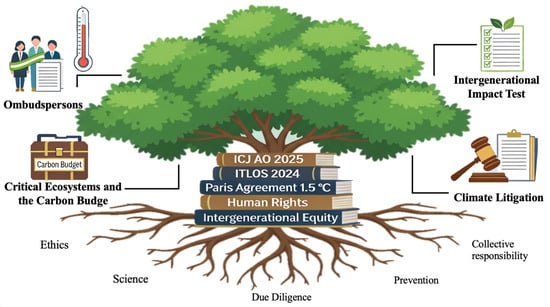
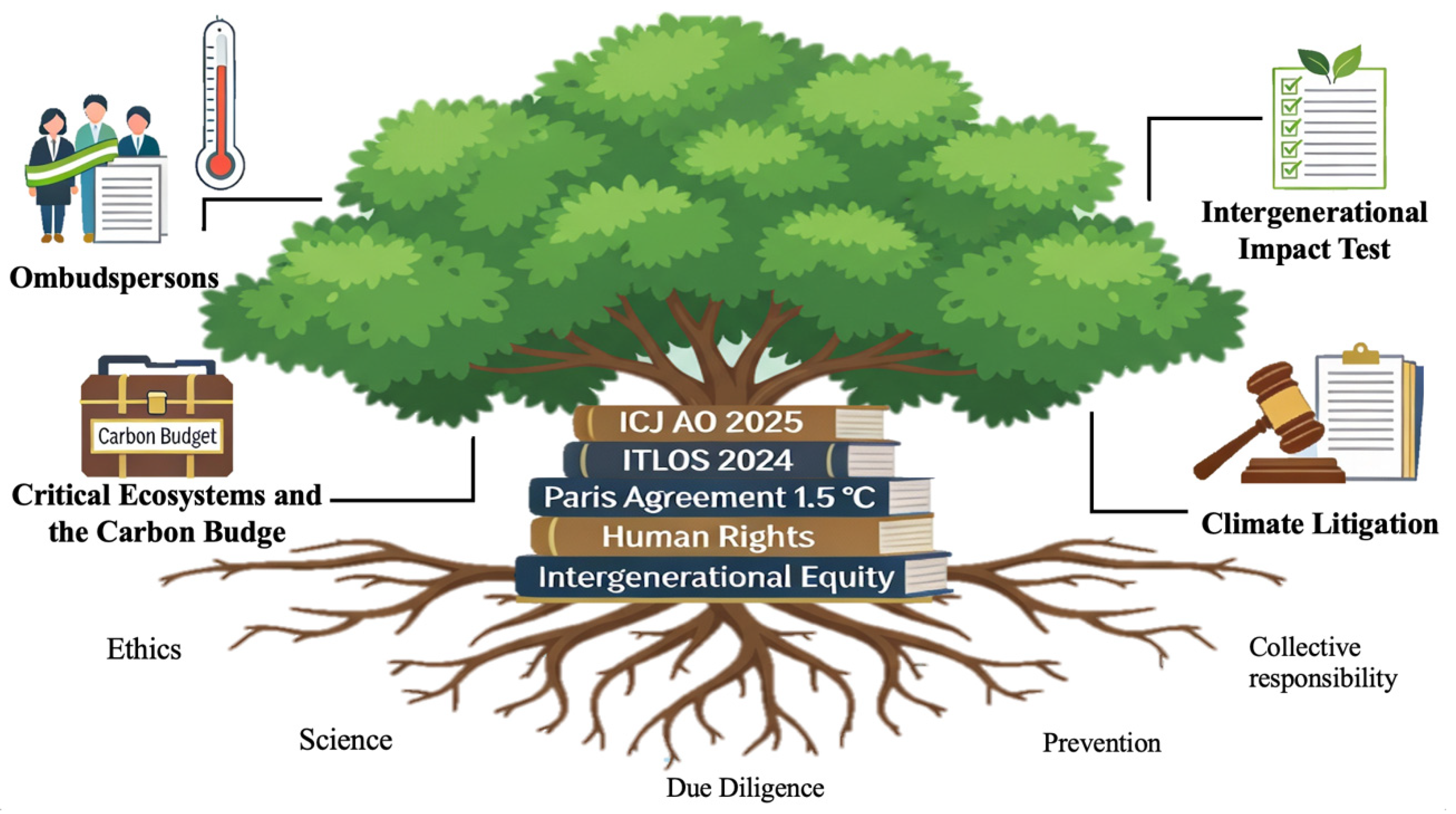

Disclaimer/Publisher’s Note: The statements, opinions and data contained in all publications are solely those of the individual author(s) and contributor(s) and not of MDPI and/or the editor(s). MDPI and/or the editor(s) disclaim responsibility for any injury to people or property resulting from any ideas, methods, instructions or products referred to in the content. |
© 2026 by the authors. Licensee MDPI, Basel, Switzerland. This article is an open access article distributed under the terms and conditions of the Creative Commons Attribution (CC BY) license.