


Abstract
The structure, mechanical and electrical properties of Zr-based melt-spun Zr–(Al)–Ni–Cr–Ag alloys were investigated as a function of elemental composition. X-ray diffraction reveals the structural evolution from fully amorphous to nanocrystalline states, with the latter containing Zr2Ni “big-cube” (space group Fd3̄m, cF96), fcc-Zr2Ni, and β-Zr phases depending on the alloying ratio: Cr-rich compositions (≥15 at.%) stabilize β-Zr within the amorphous matrix, whereas Ag-enriched alloys promote “big-cube” phase formation. Ag atoms can replace both Zr and Ni sites in the “big-cube” lattice, yielding a (Zr,Ag)2(Ni,Ag) solid solution and highlighting its role as a structural bridge between the amorphous and crystalline states. Nanoindentation measurements show that hardness increases from 6.5 GPa in fully amorphous ribbons to 10.12 GPa in three-phase nanocrystalline composites, with an H/E ratio of ~0.08 indicating predominantly covalent bonding, and the fracture strength of the amorphous alloys is ~2 GPa, exceeding literature values for related Zr-based systems. Electrical resistivity measurements over the 4–298 K range show that most alloys deviate from Matthiessen’s rule, exhibiting a negative temperature coefficient of resistivity consistent with the Mooij correlation; the presence of the icosahedrally ordered “big-cube” phase further increases resistivity relative to fully amorphous alloys.
1. Introduction
Zirconium-based alloys with transition metals have a wide range of applications, from nuclear fuel cladding (Zr(Nb) with Zr content ≥ 98 at. %) to surgical implants (Zr–Cu–Co), structural materials for the chemical industry (high-temperature corrosion-resistant Zr–Cr–Al coatings [1]), and materials used in sporting goods [2]. Scientific interest in zirconium alloys has grown significantly after the discovery of a large, supercooled liquid region (SLR) in Zr–Al–(Ni, Cu) systems [3,4] and the production of bulk amorphous alloys within broad compositional ranges in Zr–Al–Ni-based metallic systems [5,6,7].
Although the fundamental characteristics of Zr-based amorphous alloys were discovered several decades ago, research activity in this area has remained high in recent years [8,9,10,11,12,13,14]. In particular, modern studies are focused on enhancing the mechanical properties and corrosion resistance of these alloys through the formation of amorphous–nanocrystalline composites and alloying with additional elements [10,11,12,13]. In multicomponent metallic systems, for instance, improved strength has been achieved by forming icosahedral phases and β- or ω-Zr phases within an amorphous matrix [15,16].
Of particular interest are the so-called “big-cube” phases—crystalline formations with a Ti2Ni-type structure (space group Fd3̄m, cF96). Traditionally, they are viewed as common products of partial crystallization in Zr-based amorphous alloys. Recently, however, interest in these phases has grown significantly due to the discovery of “ZIP-phases” (zigzag intermetallic compounds). These A3CB2 ternary compounds exhibit dual atomic ordering and exist in two structural variants: cubic (with the same Fd3̄m symmetry as “big-cube” phases) and hexagonal. This discovery has brought renewed attention to classical Ti2Ni-type phases, highlighting their potential for investigating the interplay between local atomic structure, electronic properties, and the formation of nanocomposite or even two-dimensional derivative structures [17].
It is worth noting that despite numerous publications, there is still no unambiguous understanding of phase formation processes and their impact on the physical and mechanical properties of these systems depending on the specific chemical composition and ratio of additional elements. On the other hand, the development of biocompatible materials for long-term implant applications remains one of the most important engineering tasks [14]. Therefore, the present study aims to investigate Zr–Ni–Al alloys featuring a composition close to a deep eutectic and a wide SLR [4] by adding Cr and Ag, which can improve mechanical properties and corrosion resistance, as well as contribute to the biocompatibility of the alloys. Additionally, the introduction of Ag may promote the nucleation of crystallization centers and improve the stability of the resulting composites [18,19].
2. Materials and Methods
The initial alloys were obtained by melting ingots of elementary metals with purity greater than 99.9 mass % using a high-frequency induction furnace (Vienna University of Technology, Wien, Austria) under a purified argon atmosphere. To achieve better homogeneity, the initial alloys were re-melted five times. Ribbons approximately 5 mm wide and about 0.03 mm thick were produced using the melt-spinning technique at a cooling rate of about 106 K/s. The circumferential speed was 18 m/s (and 25 m/s in one case), with the distance between the nozzle with the melt and the wheel surface being 0.7 mm.
The structure of the as-quenched ribbon specimens was examined by X-ray diffraction (XRD), using Cu-Kα radiation, in step-scan mode with a step width of 0.011°. The crystallite sizes were evaluated from the XRD using FullProf.2k software (Website: https://www.ill.eu/sites/fullprof/, Access date: 15 June 2026) Prior to nanoindentation and microscopy tests, the samples were polished with a diamond paste to a mirror-like appearance using down to 1 μm diamond particles.
The mechanical properties (hardness and reduced elastic modulus) of the ribbon and sheet samples were evaluated by nanoindentation at room temperature in the load control mode. Hardness was measured as a function of depth by nanoindentation using a CSIRO UMIS nanoindenter with a Berkovich tip (Christian Doppler Laboratory “Surface Engineering of high-performance Components”, Wien, Austria). Twenty-five indentations (5 × 5 array with 50 μm spacing between indents) up to a fixed maximum depth of 2 μm were made on each specimen.
The temperature-dependent electrical resistivity of the alloys was studied using a four-point probe technique and employing a Lakeshore 370 a.c. resistance bridge Vienna University of Technology, Wien, Austria) in the range from room temperature down to 4 K. Electrical contacts to the melt-spun ribbon pieces (~1 cm in length) were made using gold wires attached with conductive silver paste. The temperature coefficient of resistivity (TCR) α was evaluated from the temperature dependence using a standard linear approximation:
where ρ0 is the residual resistivity at 0 K.
ρ = ρ0 [1 + α (T − T0)]
3. Results and Discussion
In the ternary Zr–Ni–Al system, a significant number of intermetallic compounds can form, including both binary (Zr2Ni, ZrNi, Zr7Ni10, Zr3Al, Zr2Al, Zr3Al2, Zr4Al3, etc.) and ternary phases (ZrAlNi2, Zr6Al2Ni, etc.) [20,21,22]. These crystalline phases exhibit notably negative enthalpies of formation, which promote their stability and formation [23,24]. However, the intense competition among a large number of energetically close phases complicates the process of equilibrium crystallization and leads to suppression of crystal growth during rapid cooling. This phenomenon contributes to the increased tendency of such multicomponent alloys to amorphization, forming a metastable glassy structure instead of equilibrium crystalline phases [25,26]. Alloying the base Zr–Ni–Al system with chromium and silver significantly influences the structural formation processes during quenching from the liquid state.
This study investigates phase formation in rapidly quenched quinary Zr–Al–Ni–Cr–Ag alloys, as well as quaternary Zr–Ni–Cr–Ag alloys, using XRD. The compositions of the alloys were chosen to be in regions near the most well-known SLR, aiming to obtain glassy or amorphous structures with nanostructured α-/β-/ω-Zr or quasicrystalline phases.
3.1. XRD Analysis of the Rapidly Quenched Alloys
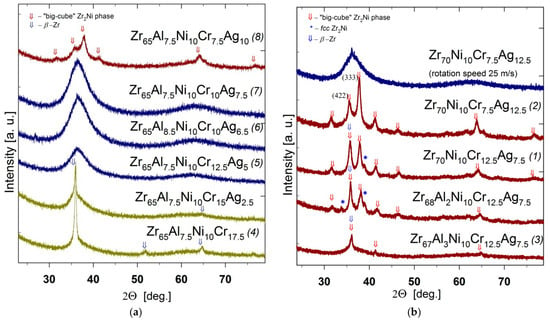
XRD patterns of alloys containing 7.5–8.5 at. % of Al (Figure 1a) show that Cr-rich compositions (Zr65Al7.5Ni10Cr17.5 and Zr65Al7.5Ni10Cr15Ag2.5) consist of two structural components: β-Zr (bcc) and an amorphous phase. A Cr content decrease accompanied by an increase in Ag content leads first to the formation of a fully amorphous structure and subsequently to the appearance of nanocrystalline Zr2Ni embedded in an amorphous matrix.
Figure 1.
XRD patterns of the melt-spun Zr-based alloys using circumferential rotation speed 18 m/s: (a) with 65 at. % of Zr, and (b) with 67-70 at. % of Zr (the Zr70Ni10Cr7.5Ag12.5 alloy obtained also at a rotation speed of 25 m/s).
The observed Zr2Ni phase is metastable and corresponds to the so-called “big-cube” fcc Ti2Ni-type structure reported in the literature [27]. This phase has been previously identified as a crystallization product in the binary Zr–Ni system [27] and has also been observed in multicomponent (Co, Ni, Cu, Al)–(Zr, Ti) alloys, where it forms within an amorphous matrix, with its formation promoted by oxygen contamination [28]. Furthermore, a curious cyclic transformation of the Zr2Ni phase was observed during high-energy mechanical grinding. Initially, the alloy contained tetragonal Zr2Ni, which transformed as follows: tetragonal Zr2Ni → fcc Zr2Ni → “big-cube” Zr2Ni → amorphous → “big-cube” Zr2Ni → fcc Zr2Ni with increasing grinding duration [29].
In alloys with a lower Al content or in Al-free compositions, the big-cube phase in the amorphous matrix is usually found as the main one. Only for the Zr67Al3Ni10Cr12.5Ag7.5 alloy does the β-Zr phase in the amorphous matrix predominate. Another feature of these alloys is the presence of the Zr2Ni (fcc) phase in the Zr68Al2Ni10Cr12.5Ag7.5 and Zr70Ni10Cr12.5Ag7.5 alloys (Figure 1b). Increasing the circumferential wheel speed to 25 m/s results in the formation of a fully amorphous structure in the Zr70Ni10Cr7.5Ag12.5 alloy, while rapid quenching at 18 m/s results in a nanocrystalline structure. This observation indicates that increased compositional complexity and Al addition enhance the glass-forming ability even at relatively low spinning rates compared to those typically used for similar systems (35–50 m/s) [16,18,19]. A noticeable broadening of the amorphous halo with increasing wheel speed was observed even within this range [30].
It should be notedthat a slight decrease in the Al content (in Zr67Al3Ni10Cr12.5Ag7.5 and Zr68Al2Ni10Cr12.5Ag7.5 alloys) leads to the β-Zr content decreasing while the “big-cube” phase content increases.
Analysis of XRD reference patterns for Ti2Ni-type structures shows that the (333) reflection (often indexed as (511)) exhibits significantly higher intensity than other diffraction peaks. Therefore, the unusually high intensity of the (422) reflection (at ~35.5° 2Θ) observed in the Zr68Al2Ni10Cr12.5Ag7.5 and Zr70Ni10Cr12.5Ag7.5 alloys can be attributed to the superposition of reflections from the Zr2Ni (“big-cube”) and β-Zr (bcc) phases.
The obtained results evidence that not only a reduction in the Al content in the alloys, but also the replacement of chromium with silver, promotes the formation of the Zr2Ni (“big-cube”) phase. To understand why this occurs, the system of known binary phases of the A2B type and ternary phases of the A3CB2 type with the Ti2Ni structural type was analyzed. They are collected in Table 1. Since some of the determining factors in the formation of a particular structure are the ratios of atomic sizes, the structure of the outer electron shells, and electronegativity, these parameters were compared for different phases.
Table 1.
Characteristics of binary (A2B) and ternary (A3CB2) phases with a Ti2Ni-type cubic lattice.
The atomic radius ratio rA/rB for all binary phases ranges from 1.16 to 1.33. Smaller atoms of the same group generally have higher electronegativity and, in most cases presented here, possess two electrons in their outer shells. In the Ti2Ni lattice, Ni atoms occupy equivalent positions, while Ti atoms occupy two inequivalent positions, with a ratio of 3:1 between the two types [31]. This explains the stoichiometry of ternary A3CB2 Ti2Ni-type phases, where the third element occupies positions of the less numerous type. One can see (Table 1) that elements substituting Ti are also smaller and more electronegative. In ternary phases, atomic size differences are less pronounced than in binary phases, as smaller atoms occupying Ti sites allow larger atoms to occupy Ni sites.
Based on these considerations, the possible substitution of Cr and Ag atoms in the Zr2Ni “big-cube” lattice was analyzed. Cr atoms are similar in size to Ni (130 pm vs. 124 pm) but have lower electronegativity, making substitution for Ni unlikely.
Substitution of Zr by Cr is also improbable due to the significant size mismatch (Cr 130 pm vs. Zr 160 pm). Consequently, Cr presence favors the formation of only an additional β-Zr (bcc) phase, as Cr is a stabilizer for β-Zr.
Ag atoms are larger than Ni (144 pm vs. 124 pm) but have similar electronegativity. Moreover, substituting Zr atoms with Ag, similar to ternary phases, can compensate for lattice distortion caused by Ni substitution. The sum of atomic radii Zr + Ni (284 pm) is close to 2×Ag (288 pm), suggesting that Ag can occupy both Zr and Ni sites, forming a solid solution of the type (Zr,Ag)2(Ni,Ag). This specific Ag addition effectively increases the “Ni content” in the lattice, reducing the Zr/Ni ratio and favoring the formation of the (Zr,Ag)2(Ni,Ag) (“big-cube”) phase during crystallization.
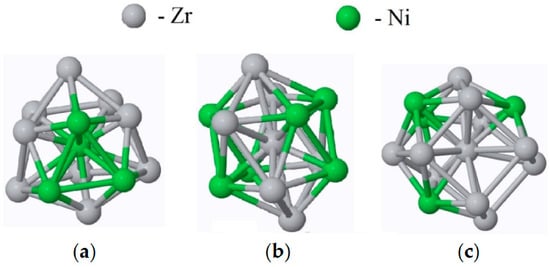
Detailed structural analysis reveals a hierarchical arrangement of atomic clusters within the Zr2Ni (“big-cube”) lattice. Three distinct types of clusters can be identified (32e Ni, 16c Zr, and 48f Zr), differing in both the central atom and coordination geometry (Figure 2).
Figure 2.
The structure of atomic clusters in the Zr2Ni (“big-cube”) phase: (a) Ni centered distorted icosahedron, (b) Zr centered distorted icodahedron, (c) Zr centered fourteen-vertex polyhedron.
The first type of cluster is centered by Ni atoms and forms a distorted icosahedron (Figure 2a). The icosahedral coordination, characterized by twelve nearest neighbors, is an energetically favorable configuration for dense packing of atoms with varying atomic radii [32,33]. The other two types of clusters are centered by Zr atoms. One of them also has the geometry of a distorted icosahedron (Figure 2b), while the second forms a fourteen-vertex polyhedron with a more complex coordination environment topology (Figure 2c).
The substitution of Ni atoms with Ag is expected to induce strong local lattice distortions, resulting in compressive stresses. Conversely, replacing the Zr atoms with Ag ones at the centers of both clusters leads to tensile stresses. The results presented in Table 1 suggest that Ag atoms can probably substitute for Zr atoms at the 16c sites (cluster shown in Figure 2b). This conclusion is supported by the existence of the Mg3AlPt2 phase, where atomic radii closely match those of Zr and Ag. Thus, it can be inferred that Ag atoms can occupy both Ni (32e) and Zr sites (16c). In this process, Ag-Ag atomic pairs must form to minimize the lattice distortion energy. Based on this, one can estimate the limiting Ag content in the “big-cube” phase by assuming that Ag atoms fully occupy all 16c Zr positions. In this case, half of the 32e Ni positions would be occupied by Ag, resulting in a phase stoichiometry of Zr3Ag2Ni.
The metastable Zr2Ni (“big-cube”) phase exhibits structural features reminiscent of icosahedral quasicrystals. Its diffraction pattern shows characteristic peak arrangements similar to quasicrystalline structures. In particular, the interplanar spacing ratio for the most intense reflections (d422/d511 ≈ 1.06) closely matches the analogous ratio for icosahedral quasicrystals (d(18,29)/d(20,32) ≈ 1.05) [34]. This correspondence indicates a deep relationship between the local atomic ordering in Zr2Ni (“big-cube”) and the principles of quasicrystal organization, despite the fundamental differences in long-range periodicity.
The presence of icosahedral structural units in the Zr2Ni (“big-cube”) phase is of particular interest in the context of amorphous state theory. It is known that the formation of atomic clusters with icosahedral symmetry is a characteristic feature of amorphous metallic alloys [32,33,35]. Icosahedral local ordering provides high packing density and energy stabilization of the disordered structure, thus preventing crystallization. Therefore, the presence of icosahedral clusters in the metastable Zr2Ni (“big-cube”) crystal phase can be seen as a structural “bridge” between the amorphous, quasicrystalline, and crystalline states.
3.2. Mechanical Properties from Nanoindentation Measurement
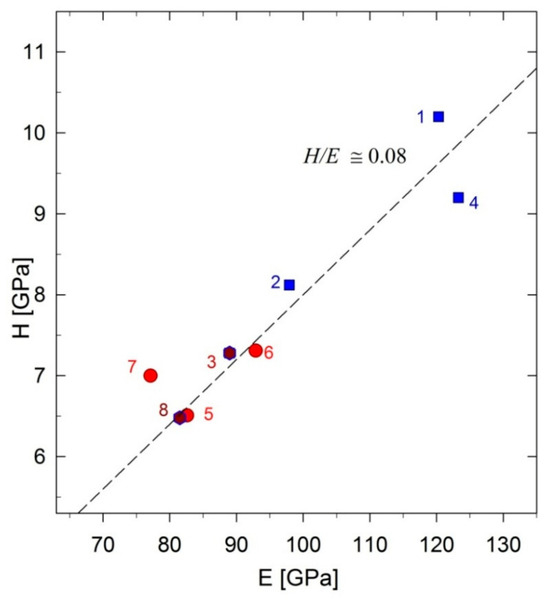
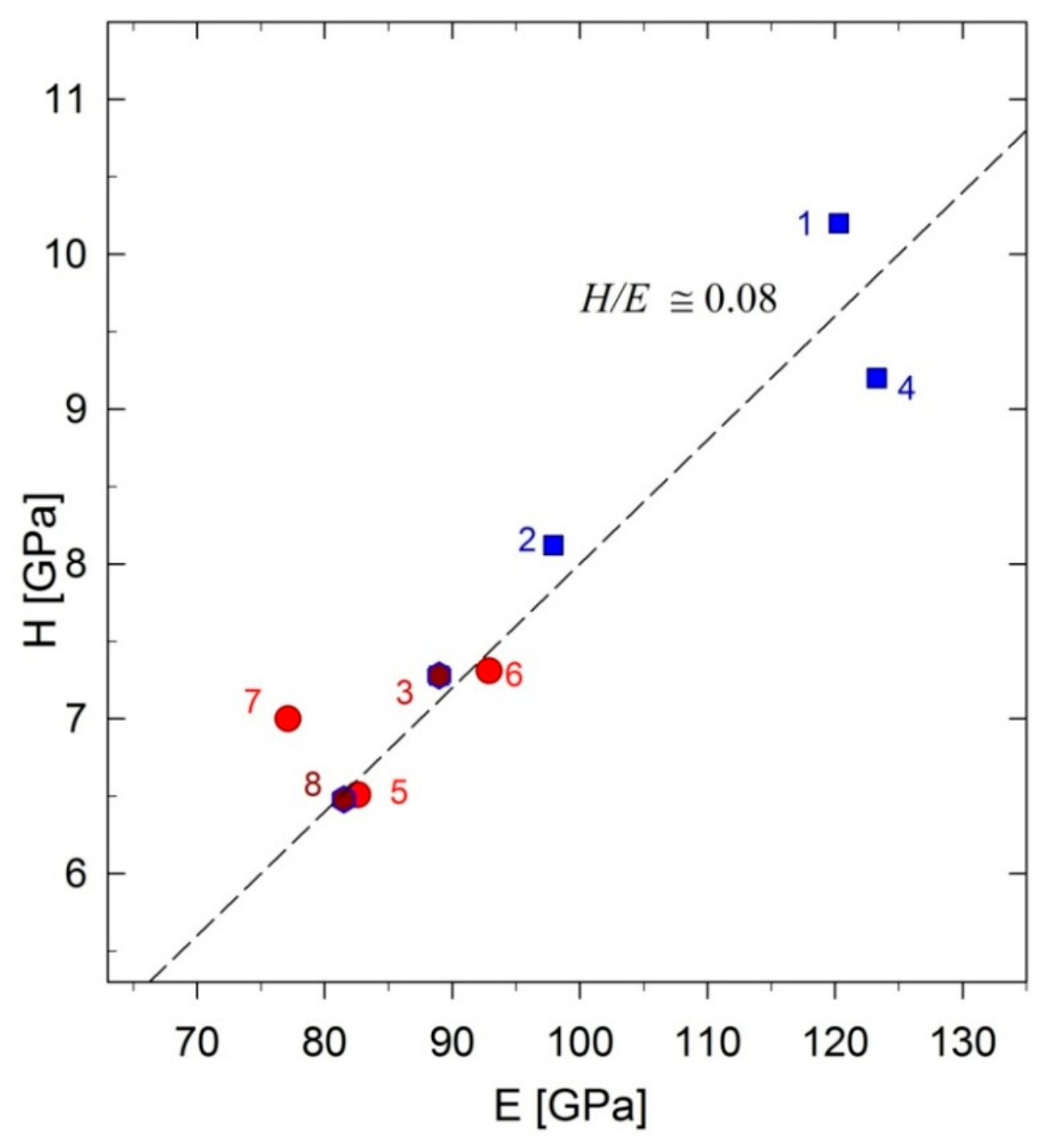
Amorphous alloys exhibit high bending plasticity: the ribbons can be bent up to 180° without fracture and return to their original shape. Alloys containing additionally crystallized phases show reduced plasticity. Young’s modulus and hardness values were extracted from nanoindentation load–depth curves following Oliver and Pharr [36], assuming a Poisson’s ratio of 0.37. Single-phase amorphous alloys exhibit the lowest hardness values (Table 2). Alloys containing a higher fraction of nanocrystalline phases, as identified by XRD analysis, demonstrate the highest hardness (up to 10.2 GPa for the Zr70Ni10Cr12.5Ag7.5 alloy, which contains both Zr2Ni “big-cube” and fcc phases). This trend is consistent with previous literature data [37], which reported an increase in the mechanical properties, particularly hardness and Young’s modulus, after partial crystallization of the alloys.
Table 2.
Mechanical properties and phase content of the rapidly solidified ribbons (H—hardness, Y—Young’s modulus, A—amorphous phase).
The obtained Young’s modulus values are close to those reported for bulk Zr-based alloys (103–117 GPa) [37]. The experimental data points (Figure 3) follow the characteristic H/E ≈ 0.08 trend, indicating a high elastic strain limit. The H/E ratio can be related to the type of atomic bonding. The values were close to 1:10, indicating predominantly covalent bonding. For comparison, metallic alloys with an fcc lattice typically show an H/E ratio of ~1:500 [38]. The values are in good agreement with the results of structural studies. The Zr2Ni “big-cube” and amorphous phases, built from similar clusters in which atoms are bonded by covalent bonds, are the main components in the alloy composition. The lowest ratio value (0.0731) is observed in the alloy with the composition Zr65Al7.5Ni10Cr17.5, where the contribution of metallic-type bonding is the most pronounced (due to the high β-Zr content) compared to the others.
Figure 3.
Correlation between nanoindentation hardness (H) and Young’s modulus (E) for Zr-based melt-spun alloys. Experimental data points are color- and shape-coded by structural state: crystalline alloys—blue squares, fully amorphous—red circles, partially crystalline—cherry hexagons.
To estimate the fracture strength σf, the empirical equation H ≈ 3σf [39] was applied. The evaluated σf for amorphous alloys was approximately 2 GPa, which is markedly higher than previously reported values for amorphous and partially crystallized alloys of other Zr-based multicomponent systems. For example, the fracture strength of the Zr–Al–Ni–Ag [15] and Zr–Al–Ni–Cu–Ag [16] alloys doesnot exceed 1.5 GPa.
This improvement in the mechanical properties may be attributed to the Cr presence instead of Cu, which is usually used in Zr-based amorphous alloys. On the other side, a further increase in hardness was attributed to the Zr2Ni (“big-cube”) phase. Being nanocrystalline and having a complex lattice, this phase can effectively hinder dislocation motion during plastic deformation, thereby enhancing the overall mechanical performance of the alloys.
3.3. Low-Temperature Electrical Resistivity Investigation
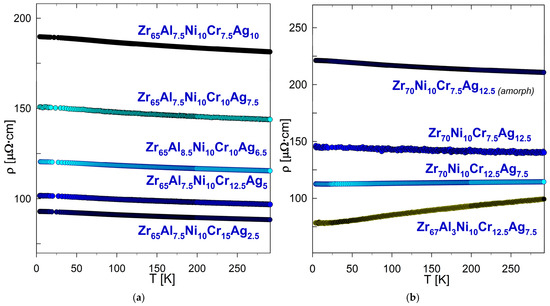
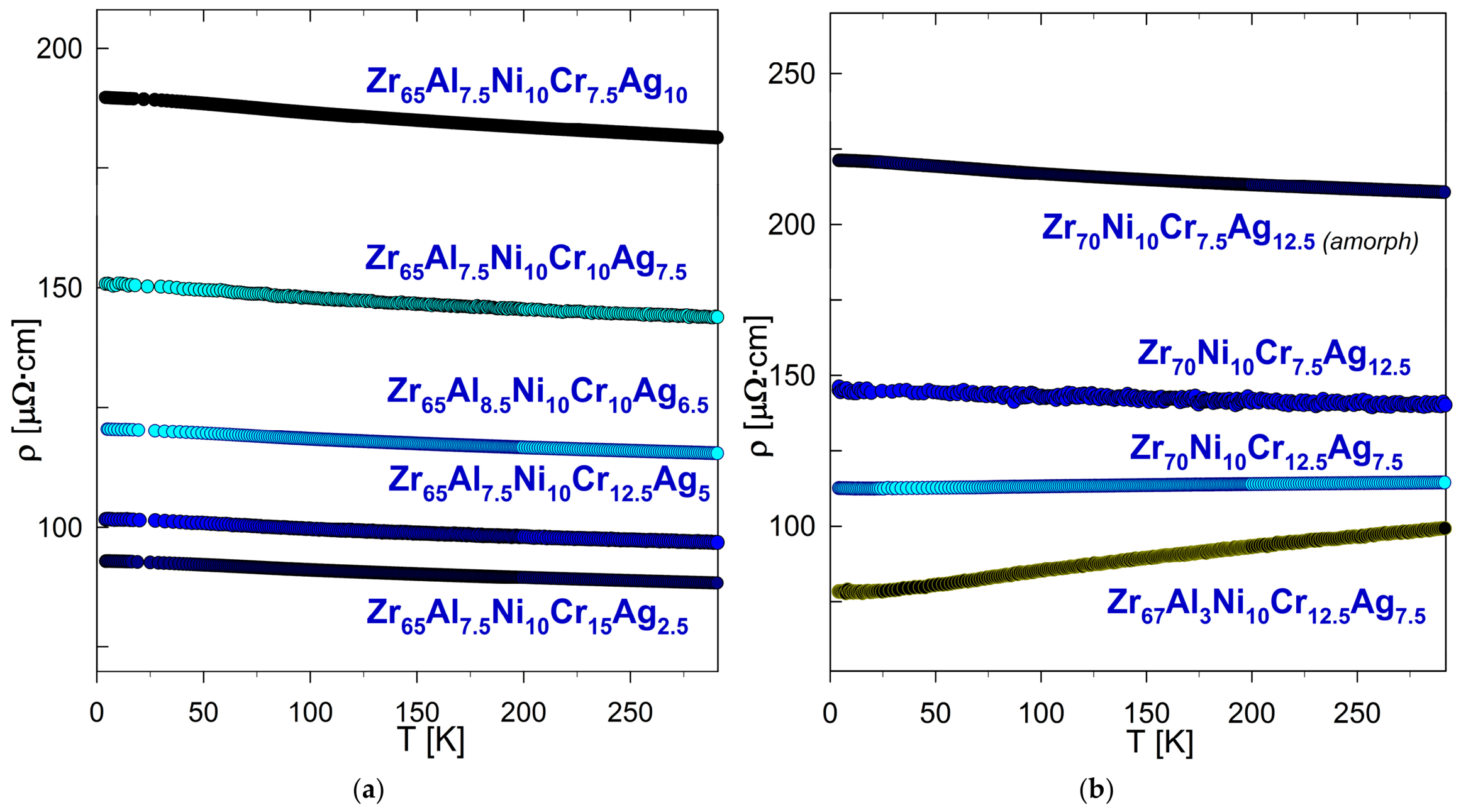
The study of the electrical resistivity temperature dependence in the melt-spun alloys provides valuable insights into structural changes that are often difficult to study by other methods. Low-temperature electrical resistivity measurements provide specific information on the structure of the rapidly quenched ribbons, while higher-temperature measurements reflect the occurrence of relaxation processes. Therefore, the electrical resistivity of the Zr–Al–Ni–Cr–Ag and Zr–Ni–Cr–Ag alloy systems was investigated in the temperature range 4–298 K (Figure 4). It was observed that increasing the temperature leads to a slight decrease in the electrical resistivity for most of the alloys. Furthermore, all alloys except Zr67Al3Ni10Cr12.5Ag7.5 do not follow Matthiessen’s rule:
where ρh(T) is the phonon contribution.
ρ(T) = ρ0 + ρh(T),
Figure 4.
Temperature dependences of the electrical resistivity of the melt-spun Zr-based Zr-(Al)-Ni-Cr-Ag alloys with 65 at. % Zr (a) and 67-70 at. % of Zr (b).
The negative TCR observed in amorphous alloys results from the complex interplay between structural disorder, the electronic structure, and the electron scattering mechanisms, which differ significantly from those in crystalline metals [40,41].
It is worth noting that the obtained resistivity valuesare close to the values for Zr-based alloys. For example, the resistivity of binary amorphous Zr70Ni30 alloy is 180 μΩ·cm at room temperature [42]. The residual resistivity values, obtained from linear approximation, range from 92.80 μΩ·cm for Zr65Al7.5Ni10Cr15Ag2.5 to 220.80 μΩ·cm for the Zr70Ni10Cr7.5Ag12.5 alloy, with a maximum change of 20 μΩ·cm as the temperature increases to room temperature. The highest TCR is observed for the Zr70Ni10Cr7.5Ag12.5 alloy, which has a value of −3.699(2) × 10−4 1/K. In contrast, Zr70Ni10Cr12.5Ag7.5 shows a slight positive TCR of 0.7632(7) × 10−4 1/K, in contrast to the negative values for the other alloys.
Analysis of the curves shown in Figure 4 reveals that, in some cases, the electrical resistivity of ribbons containing the Zr2Ni “big-cube” phase exceeded the resistivity of fully amorphous ribbons. This phenomenon can be attributed to the atomic clusters present in the Zr2Ni “big-cube” phase, which is known to resemble the structures found in icosahedral quasicrystals. It is well-established that the resistivity of metallic alloys with identical chemical compositions in a quasicrystalline state is much higher than that in an amorphous state [43]. However, since the “big-cube” phase has a periodic crystal structure, rather than a quasicrystalline one—yet shares a similar local atomic arrangement with the amorphous matrix—the temperature-dependent behavior of electrical resistivity shows negligible differences between the fully amorphous alloys and amorphous-crystalline composites.
Notably, a correlation between the absolute resistivity values and the TCR can be observed: as the resistivity increases, the slope of the resistivity vs. temperature curve decreases. In the limiting case, for the alloy with the lowest resistivity value (Zr67Al3Ni10Cr12.5Ag7.5), the TCR becomes positive, which is characteristic of crystalline metallic alloys. The structural analysis reveals a clear size gradation: crystallite sizes in the range of 115–130 nm (alloys No.1–2) retain an amorphous-like structural contribution, whereas the coarse grains of the Zr67Al3Ni10Cr12.5Ag7.5 (No.3) alloy (around 200 nm) drive the distinct metallic behavior, directly affecting the anomalous trend of the temperature coefficient of electrical resistivity. These experimental results align well with the Mooij correlation [43], which predicts the temperature dependence of resistivity on the absolute resistivity basis.
4. Conclusions
1. Based on X-ray diffraction analysis, a dependence of the formation of different structural states (amorphous; nanocrystalline with the Zr2Ni “big-cube” phase; or with β -Zr) in the melt-spun Zr–Al–Ni–Cr–Ag and Zr–Ni–Cr–Ag alloys on the elemental composition ratio was established. Cr-rich alloys (≥15 at. %) contain two phases: β-Zr and an amorphous matrix. A decrease in Cr content accompanied by an increase in Ag content leads first to the formation of a fully amorphous structure and subsequently to the precipitation of a nanocrystalline metastable Zr2Ni “big-cube” phase within the amorphous matrix. A reduction in Al content or its absence promotes the formation of the “big-cube” phase in the amorphous matrix. In alloys with a low Al content, the coexistence of “big-cube” Zr2Ni, fcc Zr2Ni, and β-Zr phases within an amorphous matrix was observed.
2. The specific role of Ag in the formation of the “big-cube” phase of Zr2Ni is that Ag atoms can probably replace Zr and Ni atoms, leading to the formation of a solid solution of (Zr,Ag)2(Ni,Ag). Phenomenologically, this can be explained by the fact that the sum of the atomic radii of Zr and Ni (284 pm) is close to the sum of the radii of two Ag atoms (288 pm), which minimizes the distortion of the crystal lattice and effectively increases the “effective” nickel content in the alloy, thereby promoting the formation of the (Zr,Ag)2(Ni,Ag) phase.
3. The presence of icosahedral structural units in the crystalline Zr2Ni “big-cube” phase is of fundamental importance for understanding its metastability and formation mechanisms. Since icosahedral local ordering is a characteristic feature of amorphous metallic alloys and provides high packing density and energetic stabilization of a disordered structure, the existence of such clusters in the metastable crystalline Zr2Ni “big-cube” phase serves as a structural “bridge” between amorphous, quasicrystalline, and crystalline states, thereby explaining the facilitation of transitions between these states at different processing conditions.
4. It was established that the mechanical properties of the alloys are determined by their structural state: amorphous alloys are characterized by the lowest hardness (6.5–7.0 GPa) and high plasticity, while the presence of the nanocrystalline Zr2Ni “big-cube” with fcc Zr2Ni phases increases the hardness up to 10.2 GPa. The ratio H/E ≈ 0.08 (about 1:10) indicates a predominantly covalent nature of interatomic bonds in the alloys, in contrast to metallic fcc alloys (~1:500). The fracture strength (2.0 GPa) exceeds the known literature values for other Zr-containing amorphous systems.
5. Investigation of the electrical resistivity temperature dependence of the Zr–Al–Ni–Cr–Ag and Zr–Ni–Cr–Ag Zr-based alloys in the range of 4–298 K allowed us to establish that most alloys (except Zr67Al3Ni10Cr12.5Ag7.5) do not follow Matthiessen’s rule, demonstrating a negative temperature coefficient of resistivity (TCR). A clear Mooij correlation was established: as the absolute value of electrical resistivity increases, the TCR systematically decreases, even undergoing a sign change. The presence of the nanocrystalline Zr2Ni “big-cube” phase, containing icosahedral atomic clusters, increases the electrical resistivity of the alloys compared to their fully amorphous counterparts, despite its structural affinity with icosahedral quasicrystals.
Author Contributions
Conceptualization, O.S. (Olena Shved), V.G., H.R. and S.M.; Methodology, I.S., P.D. and H.R.; Software, H.R. and A.P.; Validation, V.G., O.S. (Oleksandr Smolyakov) and S.M.; Formal analysis, O.S. (Olena Shved), O.S. (Oleksandr Smolyakov) and P.D.; Investigation, O.S. (Olena Shved), V.G., O.S. (Oleksandr Smolyakov) and P.D.; Resources, O.S. (Olena Shved), H.R. and A.P.; Data curation, O.S. (Olena Shved); Writing—original draft, O.S. (Olena Shved) and V.G.; Writing—review and editing, V.G., O.S. (Oleksandr Smolyakov), I.S., H.R., A.P. and S.M.; Visualization, O.S. (Olena Shved) and O.S. (Oleksandr Smolyakov); Supervision, A.P. and S.M.; Project administration, O.S. (Olena Shved); Funding acquisition, O.S. (Olena Shved) and A.P. All authors have read and agreed to the published version of the manuscript.
Funding
The authors acknowledge the financial support provided by the CEEPUS Freemover 2024 program and the Ernst Mach grant—Ukraine (OeAD, Austria) 2023–2024 awarded to Olena Shved for supporting the research and experimental activities presented in this work. The financial support by the Austrian Federal Ministry of Economy, Energy and Tourism, the National Foundation for Research, Technology and Development and the Christian Doppler Research Association is gratefully acknowledged (Christian Doppler Laboratory “Surface Engineering of high-performance Components”). We also thank Plansee SE, Plansee Composite Materials GmbH, and Oerlikon Balzers, Oerlikon Surface Solutions AG for financial support.
Data Availability Statement
The original contributions presented in this study are included in the article. Further inquiries can be directed to the corresponding author.
Conflicts of Interest
The authors declare that this study received funding from Plansee SE, Plansee Composite Materials GmbH, and Oerlikon Balzers, Oerlikon Surface Solutions AG. The funder was not involved in the study design, collection, analysis, interpretation of data, the writing of this article or the decision to submit it for publication.
Abbreviations
The following abbreviations are used in this manuscript:
| SLR | supercooled liquid region |
| XRD | X-ray diffraction |
| bcc | body-centered cubic structure |
| fcc | face-centered cubic structure |
| TCR | temperature coefficient of resistivity |
References
- Ma, H.B.; Yan, J.; Zhao, Y.H.; Liu, T.; Ren, Q.S.; Liao, Y.H.; Zuo, J.D.; Liu, G.; Yao, M.Y. Oxidation behavior of Cr-coated zirconium alloy cladding in high-temperature steam above 1200 °C. npj Mater. Degrad. 2021, 5, 7. [Google Scholar] [CrossRef] [Scilit]
- Zhang, N.; Xia, C.; Qin, J.; Li, Q.; Zhang, X.; Liu, R. Research progress of novel zirconium alloys with high strength and toughness. J. Met. Mater. Miner. 2022, 32, 23–36. [Google Scholar] [CrossRef] [Scilit]
- Inoue, A.; Zhang, T.; Masumoto, T. Zr–Al–Ni Amorphous Alloys with High Glass Transition Temperature and Significant Supercooled Liquid Region. Mater. Trans. JIM 1990, 31, 177–183. [Google Scholar] [CrossRef] [Scilit]
- Zhang, T.; Inoue, A.; Masumoto, T. Amorphous Zr–Al–TM (TM=Co, Ni, Cu) Alloys with Significant Supercooled Liquid Region of Over 100 K. Mater. Trans. JIM 1991, 32, 1005–1010. [Google Scholar] [CrossRef] [Scilit]
- Inoue, A. Stabilization of metallic supercooled liquid and bulk amorphous alloys. Acta Mater. 2000, 48, 279–306. [Google Scholar] [CrossRef] [Scilit]
- Chen, W.; Wang, Y.; Qiang, J.; Dong, C. Bulk metallic glasses in the Zr-Al-Ni-Cu system. Acta Mater. 2003, 51, 1899–1907. [Google Scholar] [CrossRef] [Scilit]
- Inoue, A.; Zhang, T. Fabrication of bulk glassy Zr55Al10Ni5Cu30 alloy of 30 mm in diameter by a suction casting method. Mater. Trans. JIM 1996, 37, 185–187. [Google Scholar] [CrossRef] [Scilit]
- Dong, Q.; Tan, J. Advances in Zr-based alloys. Crystals 2024, 14, 351. [Google Scholar] [CrossRef] [Scilit]
- Alla, S.S.; Eskandari, M.; Jha, S.; Pei, Z.; Vincent, S.; Ryu, W.H.; Park, E.S.; Mukherjee, S. Effect of Ag and Ti Addition on the Deformation and Tribological Behavior of Zr-Co-Al Bulk Metallic Glass. Metals 2025, 15, 213. [Google Scholar] [CrossRef] [Scilit]
- Wang, H.; Liu, T.; Wu, Y.; Guo, C. Evolution of Microstructure and Mechanical Properties of Novel Al-Mg-Mn-Ag-Cr-Zr Alloy. Coatings 2024, 14, 134. [Google Scholar] [CrossRef] [Scilit]
- An, Q.; Li, R.; Hu, Y.; Luo, Y.; Cai, A.; Li, Y.; Mao, H.; Li, S. Non-Isothermal Crystallization Behavior of a Zr-Based Amorphous Alloy Composite Prepared by Selective Laser Melting. Materials 2025, 18, 1631. [Google Scholar] [CrossRef] [Scilit] [PubMed]
- Yuan, L.; Ouyang, D.; Zhang, P.; Pan, J.; Zhang, C.; Ding, H.; Liu, L. Enhancement of mechanical properties in 3D-printed Zr-based bulk metallic glass composites via multiscale heterogeneous structures. Mater. Res. Lett. 2026, 14, 176–185. [Google Scholar] [CrossRef] [Scilit]
- Li, B.; Yakubov, V.; Nomoto, K.; Ringer, S.P.; Gludovatz, B.; Li, X.; Kruzic, J.J. Superior mechanical properties of a Zr-based bulk metallic glass via laser powder bed fusion process control. Acta Mater. 2024, 266, 1196. [Google Scholar] [CrossRef] [Scilit]
- Sourani, F.; Ramasamy, P.; Singh, D.; Yüce, E.; Zhang, Z.; Park, H.J.; Hong, S.H.; Kim, K.B.; Sarac, B.; Eckert, J. Tailoring Zr-based bulk metallic glasses with noble metals: Toward next-generation biocompatible implants. J. Mater. Res. Technol. 2025, 39, 7985–7998. [Google Scholar] [CrossRef] [Scilit]
- Liu, C.; Inoue, A.; Kong, F.L.; Zhu, S.L.; Shalaan, E.; Al-Ghmadi, A.; Greer, A.L. Zr-rich Zr-Al-Ni-Ag metallic glass composites with high strength and plastic strain. J. Alloys Compd. 2022, 918, 165683. [Google Scholar] [CrossRef] [Scilit]
- Liu, C.; Inoue, A.; Kong, F.L.; Zhu, S.L.; Shalaan, E.; Al-Ghmadi, A.; Greer, A.L. Plastic Zr-Al-Ni-Cu-Ag bulk glassy alloys containing quasicrystalline or β-Zr plus ω-Zr phases. Acta Mater. 2022, 229, 117812. [Google Scholar] [CrossRef] [Scilit]
- Tunes, M.A.; Drewry, S.M.; Schmidt, F.; Valdez, J.A.; Schneider, M.M.; Kohnert, C.A.; Saleh, T.A.; Fensin, S.; Maloy, S.A.; Schön, C.G.; et al. A New Family of Ternary Intermetallic Compounds with Dualistic Atomic Ordering—The ZIP Phases (Adv. Mater. 8/2026). Adv. Mater. 2026, 38, e72148. [Google Scholar] [CrossRef] [Scilit]
- Li, M.M.; Inoue, A.; Han, Y.; Kong, F.L.; Zhu, S.L.; Shalaan, E.; Al-Marzouki, F. Influence of Ag replacement on supercooled liquid region and icosahedral phase precipitation of Zr65Al7.5Ni10Cu17.5−xAgx (x = 0–17.5 at%) glassy alloys. J. Alloys Compd. 2017, 735, 1712–1721. [Google Scholar] [CrossRef] [Scilit]
- Saida, J.; Li, C.; Matsushita, M.; Inoue, A. Investigation of the stability of glassy state in the Zr- and Hf-based glassy alloys correlated with their transformation behavior. J. Mater. Res. 2001, 16, 3389–3401. [Google Scholar] [CrossRef] [Scilit]
- Fan, L.; He, J.Q.; Liu, H.S.; Peng, H.L.; Jin, Z.P. Measurement of phase equilibria in Zr-Ni-Sc ternary system. Calphad 2019, 65, 25–33. [Google Scholar] [CrossRef] [Scilit]
- Chen, Q.; Huang, L.H.; Liu, H.S.; Zheng, F.; Jin, Z.P. Isothermal Sections of Al-Ni-Zr Ternary System at 850 and 1050 °C. J. Phase Equilibria Diffus. 2013, 34, 390–402. [Google Scholar] [CrossRef] [Scilit]
- Peruzzi, A. Reinvestigation of the Zr-rich end of the Zr-Al equilibrium phase diagram. J. Nucl. Mater. 1992, 186, 89–99. [Google Scholar] [CrossRef] [Scilit]
- Maciąg, T. Enthalpy of formation of intermetallic phases from Al–Zr system determined by calorimetric solution method. J. Therm. Anal. Calorim. 2018, 134, 423–431. [Google Scholar] [CrossRef] [Scilit]
- Ghosh, G.; Asta, M. First-principles calculation of structural energetics of Al–TM (TM = Ti, Zr, Hf) intermetallics. Acta Mater. 2005, 53, 3225–3252. [Google Scholar] [CrossRef] [Scilit]
- Hu, Y.-C.; Tanaka, H. Physical origin of glass formation from multicomponent systems. Sci. Adv. 2020, 6, eabd2928. [Google Scholar] [CrossRef] [Scilit] [PubMed]
- Na, J.H.; Demetriou, M.D.; Floyd, M.; Hoff, A.; Garrett, G.R.; Johnson, W.L. Compositional landscape for glass formation in metal alloys. Proc. Natl. Acad. Sci. USA 2014, 111, 9031–9036. [Google Scholar] [CrossRef] [Scilit] [PubMed]
- Baricco, M.; Spriano, S.; Chang, I.; Petrzhik, M.I.; Battezzati, L. “Big cube” phase formation in Zr-based metallic glasses. Mater. Sci. Eng. A 2001, 304–306, 305–310. [Google Scholar] [CrossRef] [Scilit]
- Altounian, Z.; Batalla, E.; Strom-Olsen, J.O.; Walter, J.L. The influence of oxygen and other impurities on the crystallization of NiZr2 and related metallic glasses. J. Appl. Phys. 1987, 61, 149–155. [Google Scholar] [CrossRef] [Scilit]
- El-Eskandarany, M.S.; Inoue, A. Mechanically induced cyclic metastable phase transformations of Zr2Ni alloys. Phys. Rev. B 2007, 75, 224109. [Google Scholar] [CrossRef] [Scilit]
- Singh, D.; Mandal, R.K.; Tiwari, R.S.; Srivastava, O.N. Mechanical Behavior of Zr-Based Metallic Glasses and Their Nanocomposites. In Metallic Glasses—Formation and Properties; InTech: London, UK, 2016. [Google Scholar] [CrossRef] [Scilit] [PubMed]
- Mueller, M.H.; Knott, H.W. The crystal structures of Ti2Cu, Ti2Ni, Ti4Ni2O, and Ti4Cu2O. In Transactions of the Metallurgical Society of Aime; AIME: San Ramon, CA, USA, 1963; Volume 227, pp. 674–678. [Google Scholar]
- Cahn, J.W.; Shechtman, D.; Gratias, D. Indexing of icosahedral quasiperiodic crystals. J. Mater. Res. 1986, 1, 13–26. [Google Scholar] [CrossRef] [Scilit]
- Sheng, H.W.; Luo, W.K.; Alamgir, F.M.; Bai, J.M.; Ma, E. Atomic packing and short-to-medium-range order in metallic glasses. Nature 2006, 439, 419–425. [Google Scholar] [CrossRef] [Scilit] [PubMed]
- Miracle, D.B.; Greer, A.L.; Kelton, K.F. Icosahedral and dense random cluster packing in metallic glass structures. J. Non-Cryst. Solids 2008, 354, 4049–4055. [Google Scholar] [CrossRef] [Scilit]
- Cheng, Y.Q.; Ma, E. Atomic-level structure and structure–property relationship in metallic glasses. Prog. Mater. Sci. 2011, 56, 379–473. [Google Scholar] [CrossRef] [Scilit]
- Fischer-Cripps, A.C. Critical review of analysis and interpretation of nanoindentation test data. Surf. Coat. Technol. 2006, 200, 4153–4165. [Google Scholar] [CrossRef] [Scilit]
- Wang, J.G.; Choi, B.W.; Nieh, T.G.; Liu, C.T. Crystallization and nanoindentation behavior of a bulk Zr–Al–Ti–Cu–Ni amorphous alloy. J. Mater. Res. 2000, 15, 798–807. [Google Scholar] [CrossRef] [Scilit]
- Gilman, J.J. The Science of Hardness Testing and its Research Application; Westbrook, J.H., Hans, C., Eds.; American Society for Metals: Metals Park, OH, USA, 1973. [Google Scholar]
- Davis, L.A. Mechanical Behavior of Rapidly Solidified Materials; The Metallurgical Society: Pittsburgh, PA, USA, 1986. [Google Scholar]
- Gu, J.C.; Han, X.T.; Chen, Q. Correlation between electrical resistivity and the structural evolution of Zr-based bulk amorphous alloys. Mater. Sci. Forum 2016, 849, 85–90. [Google Scholar] [CrossRef] [Scilit]
- Tenhover, M.; Johnson, W.L. Superconductivity and the electronic structure of Zr-and Hf-based metallic glasses. Phys. Rev. B 1983, 27, 1610. Available online: https://journals.aps.org/prb/pdf/10.1103/PhysRevB.27.1610 (accessed on 1 June 2026). [CrossRef] [Scilit]
- Liu, B.; Liu, C.; Jiang, X.; Zhu, Z.; You, L.; Ye, F. Changes of electrical resistivity during glass-to-quasicrystalline transformation in different metallic glasses. Vacuum 2022, 200, 110994. [Google Scholar] [CrossRef] [Scilit]
- Mooij, J.H. Electrical conduction in concentrated disordered transition metal alloys. Phys. Status Solidi (A) 1973, 17, 521–530. [Google Scholar] [CrossRef] [Scilit]

Disclaimer/Publisher’s Note: The statements, opinions and data contained in all publications are solely those of the individual author(s) and contributor(s) and not of MDPI and/or the editor(s). MDPI and/or the editor(s) disclaim responsibility for any injury to people or property resulting from any ideas, methods, instructions or products referred to in the content. |
© 2026 by the authors. Licensee MDPI, Basel, Switzerland. This article is an open access article distributed under the terms and conditions of the Creative Commons Attribution (CC BY) license.