


Abstract
The role of the Zn/Mg ratio in regulating microstructure, precipitation evolution and coarsening resistance in Al–Zn–Mg-based alloys was investigated by microhardness testing, scanning electron microscopy (SEM), and transmission electron microscopy (TEM) during isothermal aging at 150 °C. Three alloy compositions were designed with Zn/Mg ratios of 1.6, 2.4, and 3.9, whereas the combined Zn and Mg level was fixed at 6.0 wt%. All alloys exhibited a typical age-hardening response, whereas the maximum peak hardness was obtained at an intermediate Zn/Mg level rather than at the two extremes. The optimal composition (Zn/Mg = 2.4) reached 137 HV, which is attributable to the formation of the finest precipitates (~3 nm) and the highest number density. Moreover, this alloy exhibited the smallest hardness loss (ΔH = 19 HV) after prolonged aging (192 h). TEM analysis indicated that this alloy exhibited the lowest coarsening rate constant, Kr = 0.43 at 192 h. Furthermore, the variation in Zn/Mg ratio affected grain boundary precipitation, leading to a minimized PFZ width at Zn/Mg = 2.4 while maintaining a similar discontinuous distribution of grain boundary precipitates among the alloys. Overall, tailoring the Zn/Mg balance offers an effective strategy to achieve refined precipitates, improved coarsening resistance, and enhanced mechanical performance with superior thermal stability.
1. Introduction
Al–Zn–Mg alloys have been extensively applied in aerospace, transportation, and deep-sea energy exploration fields owing to their outstanding balance of high specific strength and excellent formability [1,2,3]. The outstanding mechanical properties of these alloys are primarily attributed to precipitation strengthening, which is strongly governed by precipitate morphology, size, and stability and is highly sensitive to alloy composition as well as the corresponding aging response [4,5]. Among the various alloying elements, Zn and Mg serve as the principal strengthening elements, and their total concentration (Zn + Mg) in combination with the relative Zn/Mg proportion are recognized as two critical compositional parameters that determine the precipitation characteristics, mechanical performance, and thermal stability of this alloy system [6,7]. Generally, increasing the total Zn + Mg content can effectively enhance alloy strength by promoting the generation of a greater amount of strengthening precipitates. Nevertheless, excessive additions of solute elements may result in adverse effects on other critical properties, such as ductility and corrosion resistance [8]. For alloys containing the same Zn + Mg concentration, variations in the Zn/Mg proportion become an important parameter for tailoring the precipitation process. Previous studies have shown that variations in the Zn/Mg proportion can noticeably affect precipitate characteristics, including phase type, size, density, and distribution, consequently altering the properties of Al–Zn–Mg-based alloys [9,10,11]. However, most previous investigations concerning Zn/Mg proportion have primarily focused on room-temperature properties, such as tensile strength, corrosion resistance, and recrystallization behavior [12,13]. In contrast, the influence of Zn/Mg proportion on the long-term stability of strengthening precipitates during elevated-temperature exposure remains insufficiently understood. This issue is particularly important for Al–Zn–Mg alloys used in aerospace and transportation applications, where structural components may experience prolonged thermal exposure during service. Under elevated-temperature conditions, precipitate coarsening is one of the major factors responsible for the degradation of precipitation strengthening, resulting in a gradual decrease in hardness and mechanical performance. Therefore, improving the resistance of strengthening precipitates to coarsening is essential for developing Al–Zn–Mg alloys with enhanced thermal stability. Previous studies have indicated that Zn/Mg proportion plays an important role in determining the thermal stability of Al–Zn–Mg-based alloys. Zou et al. [14] reported that Al–Zn–Mg–Cu alloys with Zn/Mg proportions (wt%) of 1.5–2.1 exhibited superior thermal stability compared with alloys containing higher Zn/Mg proportions ranging from 2.8 to 10. These findings indicate that optimizing the Zn/Mg proportion may provide an effective strategy for improving resistance to precipitate coarsening. However, most existing studies concerning the influence of the Zn/Mg proportion on precipitate evolution and coarsening behavior have mainly focused on Cu-containing 7xxx systems [15,16,17]. Recent studies on 7xxx-series aluminum alloys have demonstrated that microalloying provides an effective approach for tailoring microstructural features and improving mechanical performance. Pozdniakov et al. and co-workers reported that minor additions of rare-earth elements and transition elements, such as Y, Pr, and Zr, can modify solidification behavior, promote grain refinement, and enhance the mechanical properties and processing capability of Al–Zn–Mg–Cu alloys [18,19,20,21]. Among these microalloying elements, Zr is widely used in Al alloys due to its ability to form fine Al3Zr dispersoids, which contribute to grain refinement and microstructural modification. The refined microstructure induced by Zr addition is beneficial for improving strength and ductility, making Zr-containing Al–Zn–Mg alloys attractive for advanced structural applications. Although microalloying strategies have been widely applied to optimize the microstructure and properties of 7xxx-series aluminum alloys, the presence of Cu introduces additional complexity into precipitation evolution. The addition of Cu can inhibit precipitate coarsening at elevated temperatures, thereby improving the high-temperature stability of the alloy [22,23,24,25]. Thus, the influence of the Zn/Mg proportion may be masked in Cu-containing alloys, making it necessary to investigate the effect of the Zn/Mg proportion in Cu-free Al–Zn–Mg-Zr alloys.
In this study, a series of Al–Zn–Mg-Zr alloys was developed by maintaining the Zn + Mg concentration at 6.0 wt% while varying the Zn/Mg proportion among 1.6, 2.4, and 3.9. The effects of Zn/Mg proportion on the as-cast and homogenized microstructures, precipitation evolution, coarsening kinetics, and thermal stability of Al–Zn–Mg-Zr alloys were systematically investigated using scanning electron microscopy (SEM), Vickers hardness measurements, transmission electron microscopy (TEM), and Ostwald ripening analysis. This work elucidates the role of Zn/Mg proportion in regulating microstructural evolution and thermal stability of Al–Zn–Mg alloys, providing new insights into the compositional design of high-performance aluminum alloys with enhanced thermal stability.
2. Materials and Methods
The measured chemical compositions of the Al–Zn–Mg alloys with various Zn/Mg proportions are listed in Table 1. To investigate the intrinsic effect of Zn/Mg ratio on precipitation evolution, a low-alloyed Al–Zn–Mg–Zr system was designed by maintaining the total Zn + Mg content at approximately 6.0 wt% while varying the Zn/Mg ratio. Trace Zr was introduced because it is commonly used in Al–Zn–Mg alloys to improve recrystallization resistance and microstructural stability during thermomechanical processing.
Table 1.
The compositions of Al–Zn–Mg alloys (wt%).
The alloy ingots were fabricated from high-purity Al (99%), Zn (99%), Mg (99%), and an Al–4 wt% Zr master alloy, which were melted at 800 °C in a crucible furnace. The cast ingots were homogenized through a two-stage process at 350 °C for 10 h and 475 °C for 12 h, respectively. Subsequently, the homogenized ingots were hot rolled at 450 °C with a total thickness reduction of 88%, yielding sheets with a final thickness of 3–4 mm. The rolled sheets were solution-treated at 470 °C for 2 h, water-quenched, and artificially aged at 150 °C for different aging periods. The Vickers hardness was measured using an HXD-1000TM/LCD hardness tester (Shanghai Optical Instrument No.1 Factory, Shanghai, China) with a load of 100 gf and a dwell time of 15 s, and the average values were obtained from multiple measurements. The electrical conductivity of the aged samples was measured using a SIGMATEST 2.069 conductivity meter (Foerster, Reutlingen, Baden-Württemberg, Germany). The microstructural features of the aged alloys were characterized using a JEOL-2100F transmission electron microscope (TEM) (Japan Electron Optics Laboratory, Akishima, Tokyo, Japan) operated at 200 kV. TEM specimens were prepared by twin-jet electropolishing under a constant voltage condition, using an electrolyte consisting of 20% HNO3 (70 wt%) and 80% CH3OH. The electropolishing temperature was maintained between −25 and −35 °C, with an applied voltage of 20–30 V and a current of 80–100 mA.
3. Results and Discussion
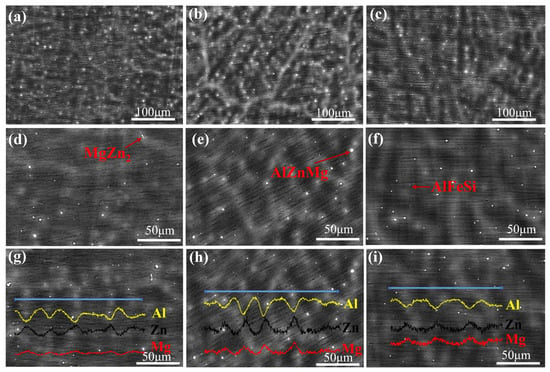
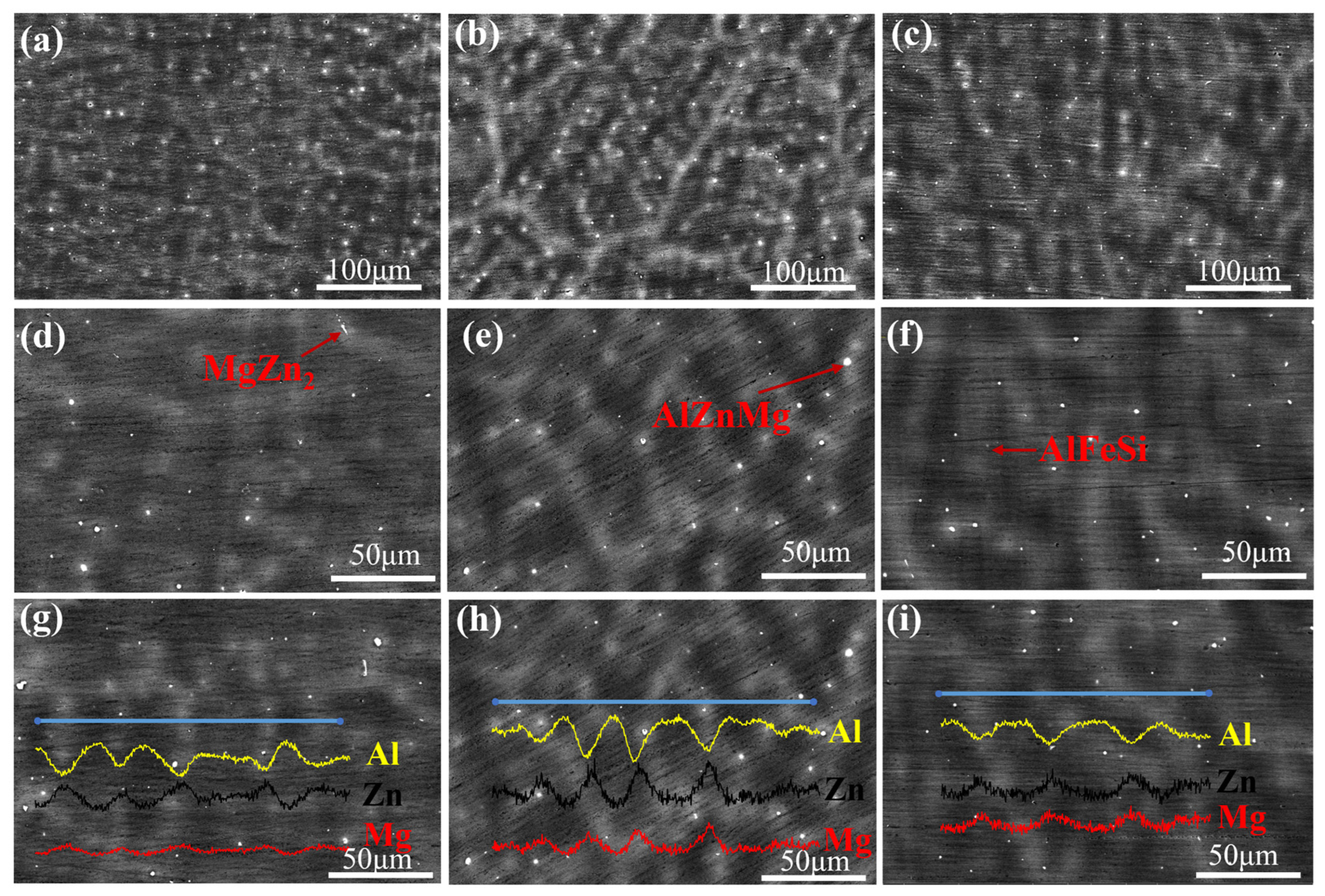
The alloy system examined here exhibits a relatively low alloying degree, containing Zn and Mg as the major solute elements and only Zr as a microalloying addition, while intentionally excluding other conventional alloying elements such as Cu, Cr, and Mn. Therefore, only a small amount of residual primary phases remained in the as-cast microstructure, accounting for approximately 0.05% in volume fraction, as shown in Figure 1a–c. The primary phases in the as-cast alloys mainly consisted of the T phase (Al2Mg3Zn), η phase (MgZn2), and Fe- and Si-containing impurity phases. Besides the presence of coarse blocky primary phases, significant elemental segregation was also detected. EDS line-scan results from Figure 1d–f indicate that the segregation was mainly associated with the enrichment of Zn and Mg elements.
Figure 1.
(a–f) SEM images of the as-cast microstructures, (g–i) corresponding EDS line-scan profiles, the blue line represents the EDS line-scan path, (a,d,g) A1 alloy, (b,e,h) A2 alloy, (c,f,i) A3 alloy.
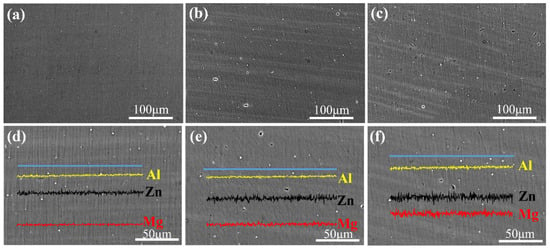
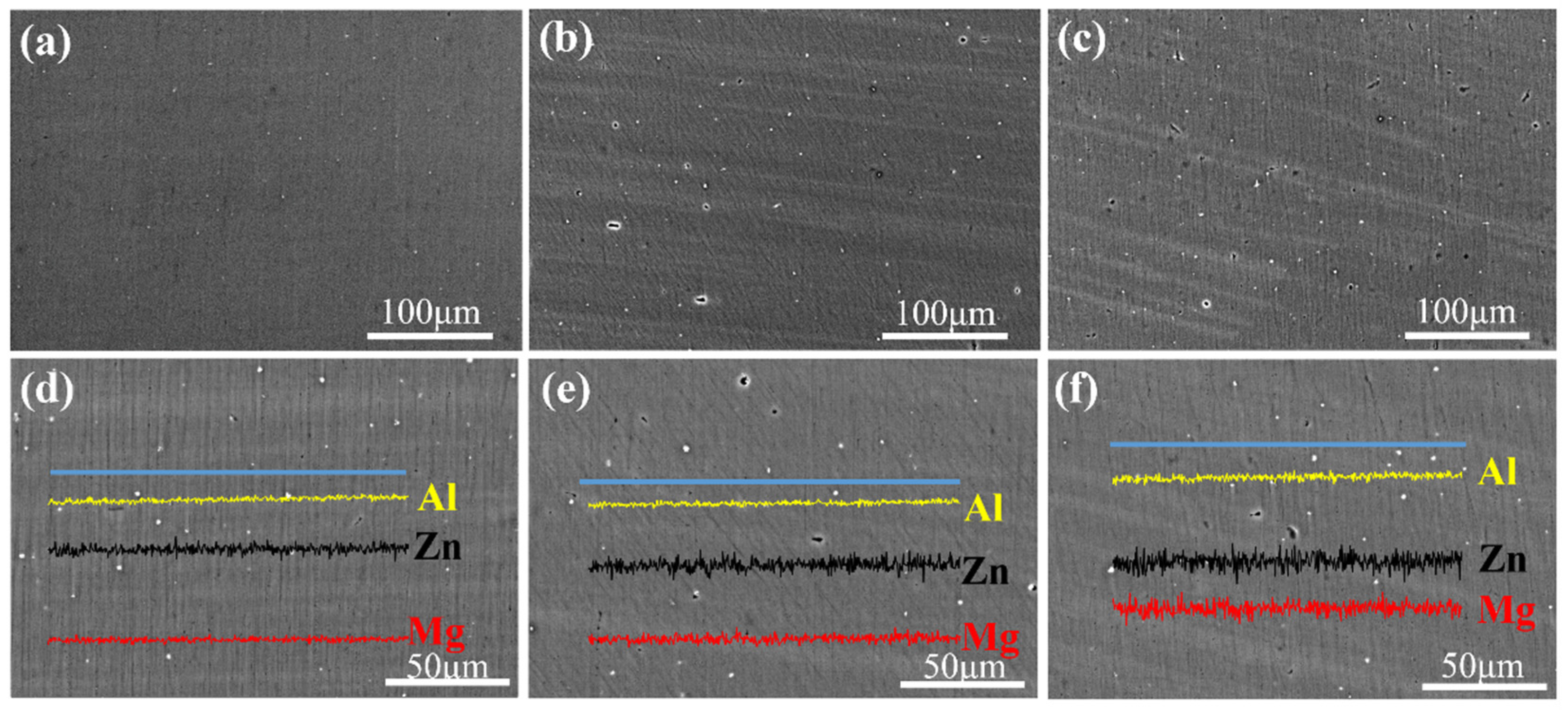
Following the two-stage homogenization treatment, the resulting microstructures were examined by SEM, as illustrated in Figure 2a–c. Notably, the primary phases in the as-cast microstructure were almost completely dissolved, with only a small number of fine blocky phases remaining. The residual particles were identified as Fe- and Si-rich phases. After homogenization, the coarse primary phases were substantially dissolved, and the elemental segregation of Zn and Mg was effectively reduced, as indicated by the line-scan results in Figure 2d–f.
Figure 2.
(a–c) SEM images of microstructure of homogenized alloys, (d–f) corresponding EDS line scanning analysis of homogenized alloys, the blue line represents the EDS line-scan path, (a,d) A1 alloy, (b,e) A2 alloy, (c,f) A3 alloy.
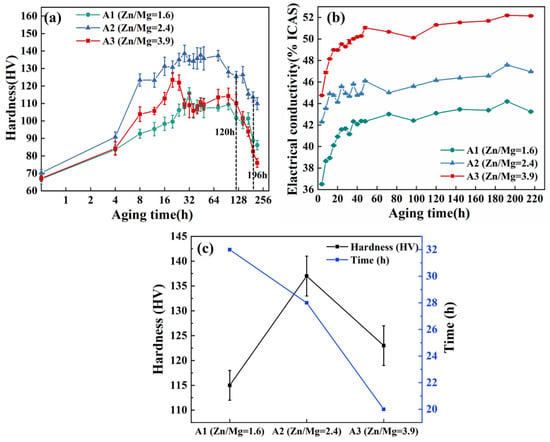
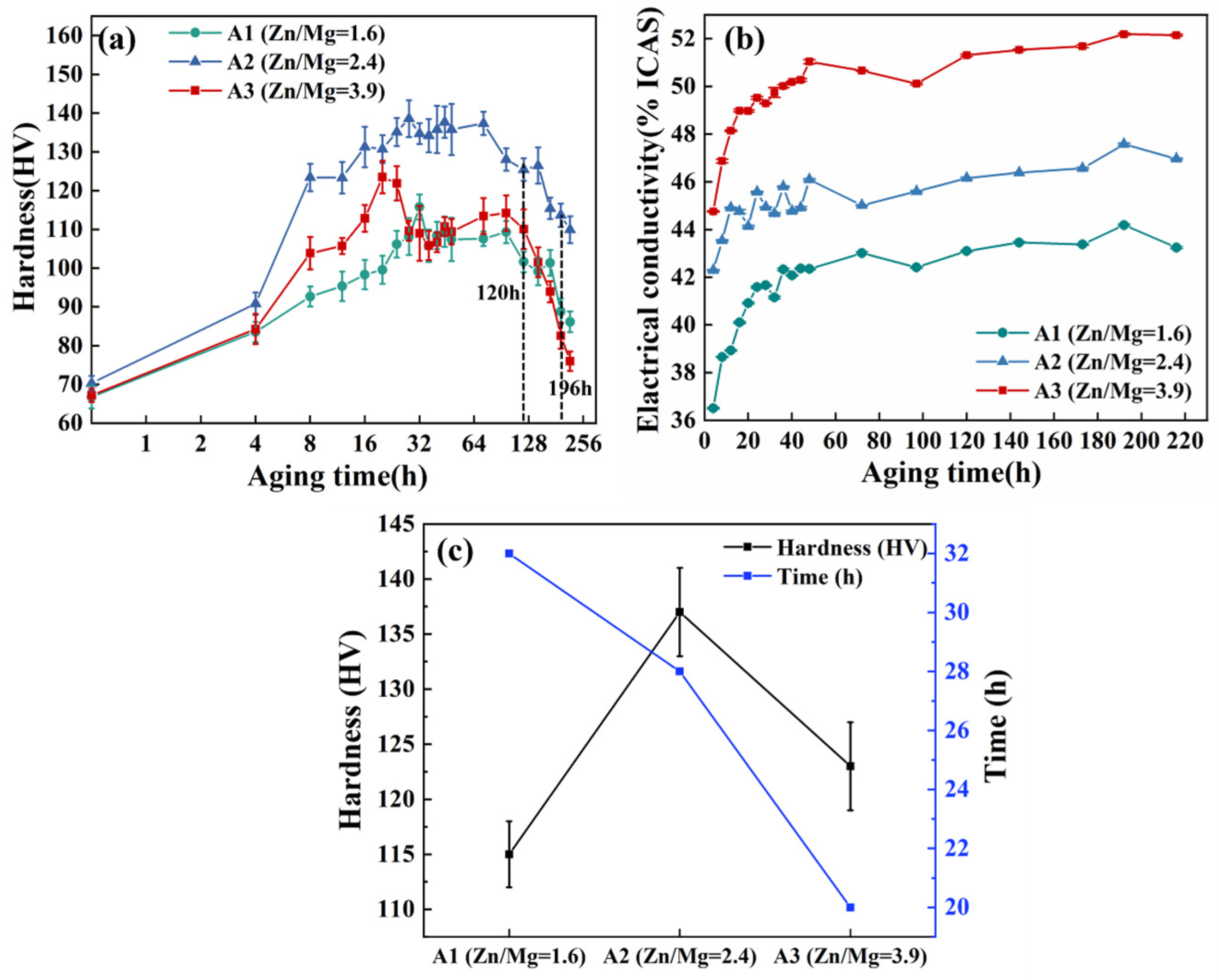
The hardness response of Al–Zn–Mg alloys with varying Zn/Mg proportions ranging from 1.6 to 3.9 during isothermal aging at 150 °C is illustrated in Figure 3a,c. It is evident that the three alloys under investigation followed a similar precipitation-hardening trajectory, characterized by an initial hardness enhancement during the early aging period, subsequently reaching the peak hardness within 20–32 h and then experiencing a gradual decline owing to over-aging. The aging response around the peak-aging region was evaluated at 4 h intervals, and the peak-aging time was identified as the aging duration corresponding to the maximum measured hardness. With a gradual increase in the Zn/Mg proportion, the peak hardness exhibited a non-linear variation, initially showing an enhancement followed by a subsequent decline. The highest hardness at 137 ± 4 HV was obtained for the alloy with an intermediate Zn/Mg proportion of 2.4, whereas the alloys at the lower and higher proportions (1.6 and 3.9) exhibited reduced hardness values of 115 ± 3 HV and 123 ± 4 HV, respectively. Meanwhile, the corresponding peak-aging time was progressively shortened from 32 h to 20 h with increasing Zn/Mg ratio, indicating an accelerated aging response under a higher Zn/Mg condition. Previous studies [26,27] have demonstrated that raising the Zn/Mg proportion promotes a shift in the dominant precipitate from the T′ precipitate to the η′ precipitate. Since η′ precipitates possess faster precipitation kinetics, alloys with greater Zn/Mg proportions exhibit a more rapid aging response [27,28]. This precipitation evolution is therefore considered to be responsible for the shortened peak-aging duration observed with increasing Zn/Mg ratio.
Figure 3.
(a) Age-hardening evolution of three alloys with varying Zn/Mg ratios at 150 °C, (b) electrical conductivity curves, (c) peak hardness value and time to reach peak aging.
Upon extending the aging duration to 100 h, a continuous hardness decline was observed in all alloys, suggesting the occurrence of an over-aging process. At the extended aging time of 192 h, the hardness values decreased to 89 ± 3 HV, 116 ± 3 HV, and 85 ± 3 HV in the investigated alloys containing progressively greater Zn/Mg proportions, respectively. After prolonged aging, the composition with an intermediate Zn/Mg proportion (2.4) exhibited the best hardness retention, whereas the sample containing a lower Zn/Mg proportion (1.6) showed slightly improved hardness compared with its Zn/Mg = 3.9 counterpart. Interestingly, the hardness evolution of the two alloys displayed a crossover behavior during aging. The Zn/Mg = 3.9 alloy dominated the early-stage strengthening, but its hardness declined more rapidly at longer aging times, allowing the Zn/Mg = 1.6 alloy to surpass it after 144 h. This result suggests that although the higher Zn/Mg alloy exhibits a faster aging response and improved short-term hardness retention, the Zn/Mg = 1.6 alloy demonstrates more favorable long-term thermal stability and stronger resistance to precipitate coarsening during prolonged aging exposure.
Figure 3b shows the changes in electrical conductivity in the three alloys with aging time. The electrical conductivity of all alloys exhibited an upward trend with prolonged aging and reached a relatively stable value after 120 h. The evolution of hardness and electrical conductivity during aging depends strongly on the formation and evolution of nanoscale precipitates. After aging treatment, a higher degree of precipitation of supersaturated solute atoms from the Al matrix leads to a higher precipitate density at the peak-aged state, thereby leading to enhanced hardness and electrical conductivity. At the same aging stage, the alloys with higher Zn/Mg ratios exhibited enhanced electrical conductivity. This behavior can be mainly attributed to the stronger effect of Mg atoms on reducing the electrical conductivity of the Al matrix compared with Zn atoms. According to the data reported by Ref. [29], the dissolution of 1 wt% Mg and Zn atoms in the Al matrix decreases electrical conductivity by 11.10% IACS and 2.26% IACS, respectively. When the concentrations of these alloying elements exceed their solid solubility limits, the additional dissolution of 1 wt% Mg and Zn further reduces electrical conductivity by 5.03% IACS and 0.57% IACS, respectively. Therefore, increasing the Zn/Mg proportion decreases the overall Mg content, leading to a lower concentration of Mg atoms retained in solid solution and consequently improving electrical conductivity under identical aging conditions.
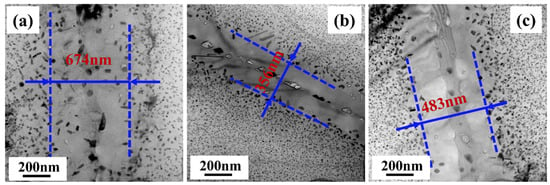
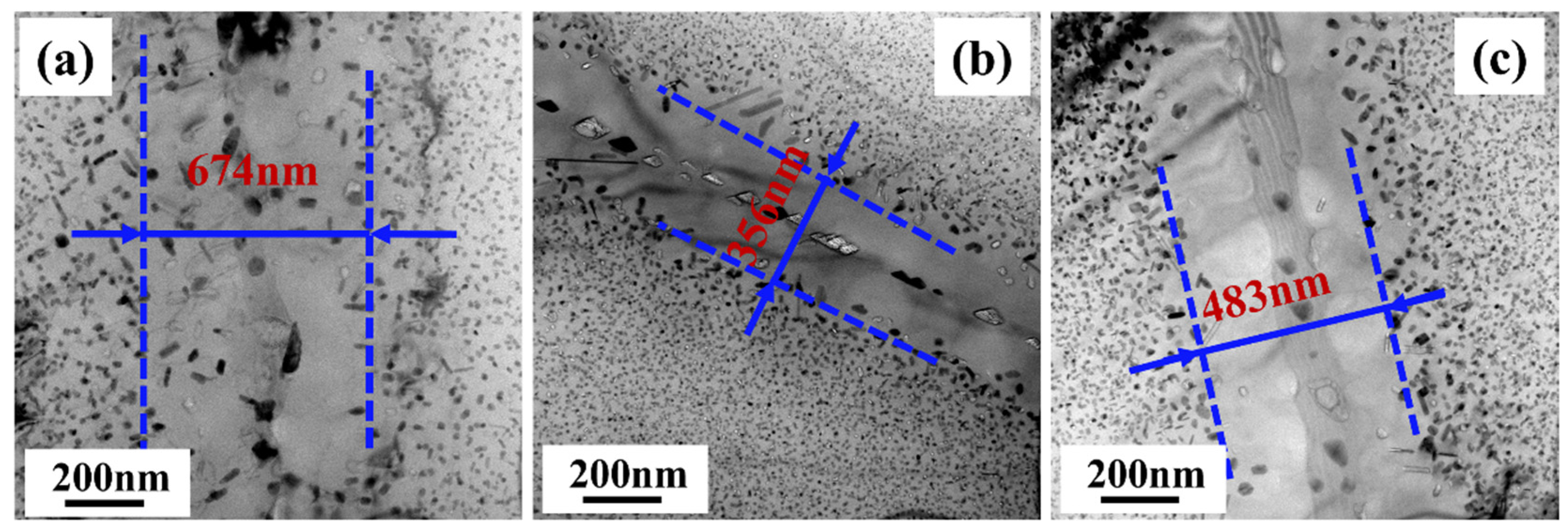
Figure 4 provides the TEM characterization of grain boundary precipitates (GBPs) and precipitate-free zones (PFZ) in the peak-aged specimens at 150 °C. The PFZ width showed a non-monotonic dependence on the Zn/Mg proportion, initially decreasing and subsequently increasing as the proportion increased. Among the investigated compositions, the sample with Zn/Mg = 1.6 displayed the widest PFZ (~634 nm), followed by the Zn/Mg = 3.9 alloy (~438 nm), whereas the minimum PFZ width (~341 nm) was measured for the Zn/Mg = 2.4 alloy. Moreover, no obvious differences were presented in the GBPs among the three alloys, all of which exhibited an intermittent distribution along the grain boundaries.
Figure 4.
GBPs and PFZ in the peak-aged alloys at 150 °C, (a) A1 alloy, (b) A2 alloy, (c) A3 alloy.
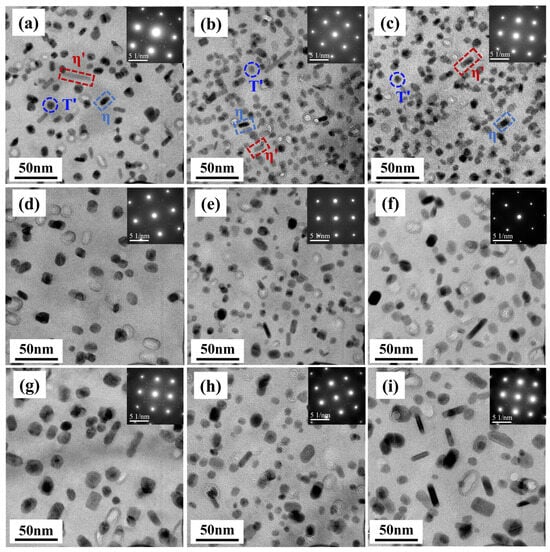
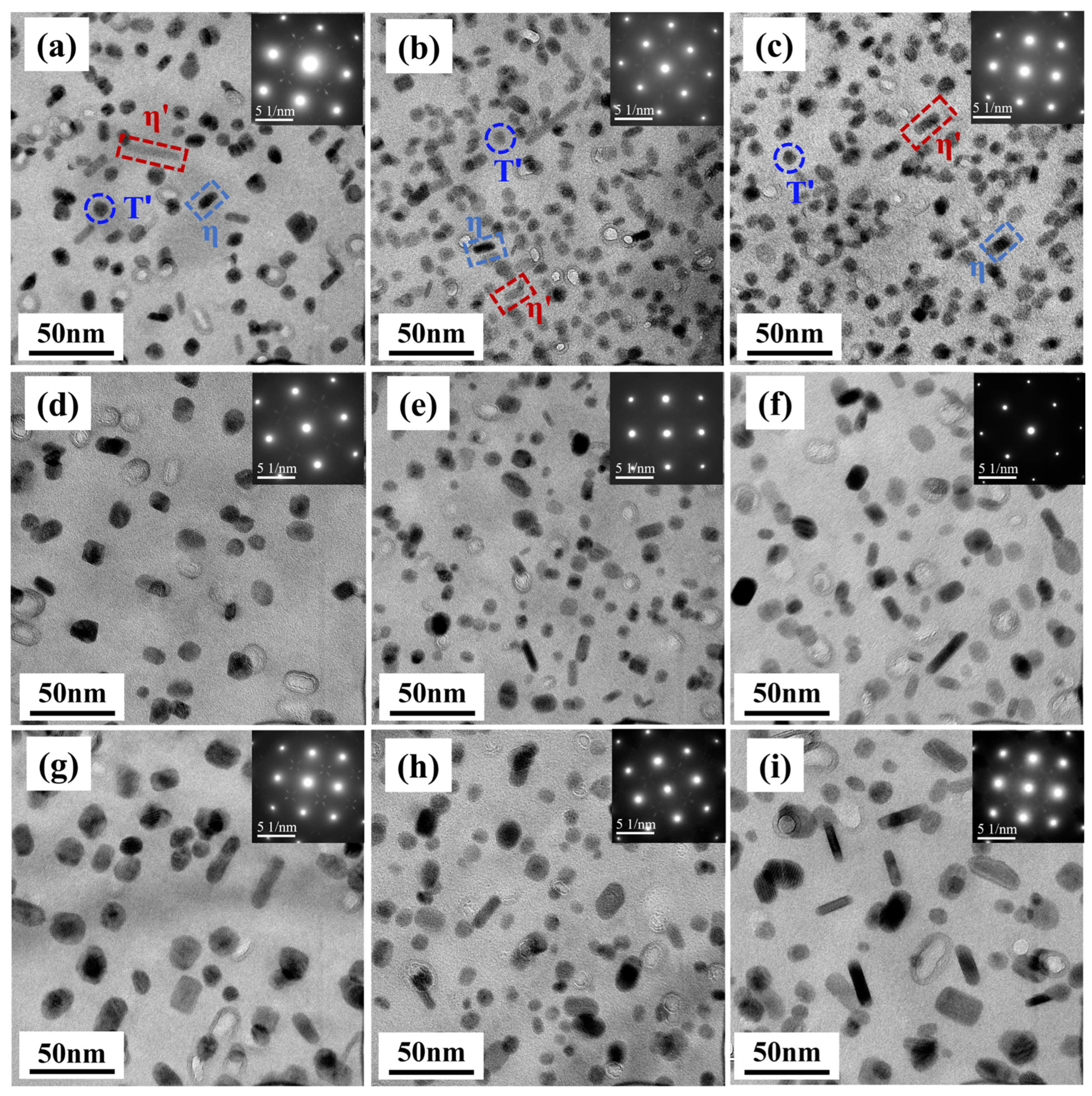
Figure 5 presents bright-field TEM images and the corresponding selected-area electron diffraction (SAED) patterns of the alloys aged at peak aging, 120 h, and 192 h. Three types of precipitates were identified in all alloys, namely the spherical T′ phase, plate-like η′ phase, and rod-like η phase. At peak aging, the three alloys exhibited a homogeneous distribution of nanoscale precipitates with a high population density. The minimum precipitate size was achieved at a Zn/Mg proportion of 2.4 (r ~3 nm), significantly smaller than those observed in the other two alloys (~5 nm and ~4 nm, respectively).
Figure 5.
TEM images of precipitates in the alloys: (a–c) peak-aged, (d–f) 150 °C/120 h, (g–i) 150 °C/192 h, (a,d,g) A1 alloy, (b,e,h) A2 alloy, (c,f,i) A3 alloy.
Meanwhile, the higher number density of precipitates further contributes to the enhanced peak hardness. With prolonged aging at 150 °C, the investigated alloys underwent evident precipitate coarsening accompanied by a reduction in precipitate number density. After aging for 120 h, the precipitates remained relatively fine in the alloy with Zn/Mg = 2.4, whereas more pronounced coarsening was already evident in the other two alloys. As illustrated in Figure 5g–i, this difference became more significant after 192 h of aging. Quantitative results showed that the equivalent precipitate radius increased to approximately 8 nm, 5 nm, and 8 nm for the three alloys after 192 h aging, respectively. The precipitate coarsening was accompanied by a decrease in hardness of 26 HV, 19 HV, and 38 HV, respectively. Notably, the alloy with Zn/Mg = 2.4 retained the smallest precipitate size after long-term aging, demonstrating the strongest resistance to precipitate coarsening. Consequently, this alloy exhibited the highest hardness retention during overaging at 150 °C, indicating superior microstructural and mechanical stability. These observations suggest that an appropriate Zn/Mg ratio effectively suppresses precipitate coarsening and delays overaging degradation, thereby improving the thermal stability of 7xxx alloys.
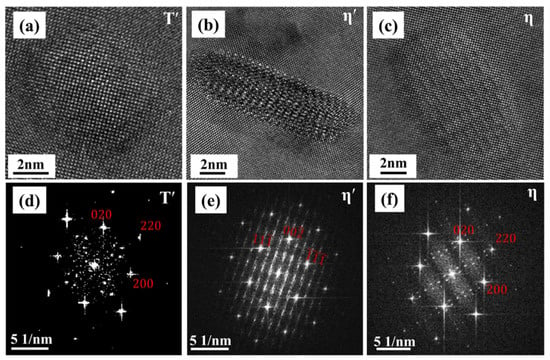
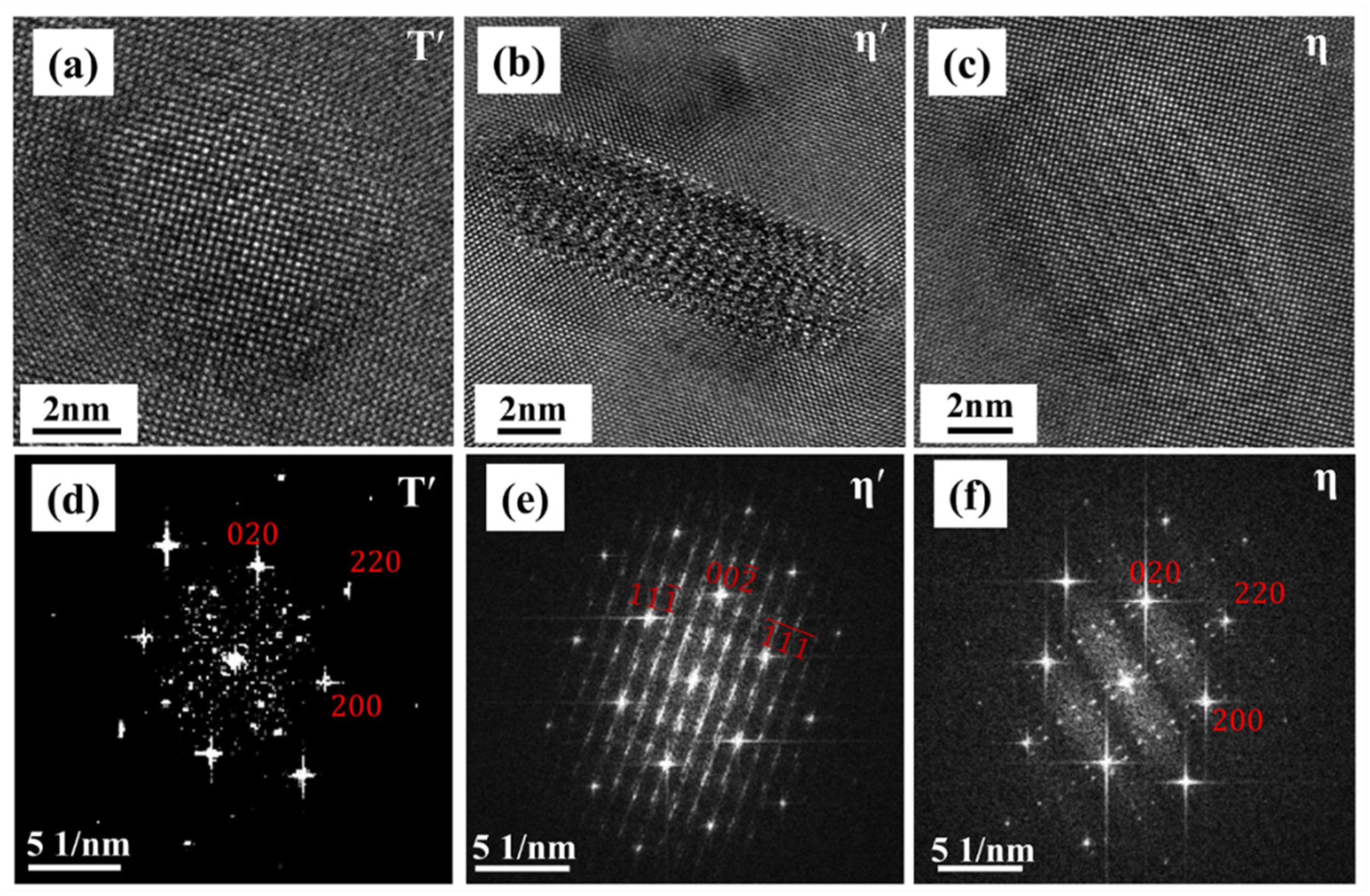
Figure 6 presents representative high-resolution transmission electron microscopy (HRTEM) images together with the corresponding fast Fourier transform (FFT) patterns of the T′, η′ and η precipitates in the investigated alloys. The diffraction features extracted from the FFT patterns show good agreement with the previously reported crystallographic structures and characteristic diffraction information of these precipitates [30,31,32], thereby providing further confirmation for the existence of spherical T′ precipitates, plate-like η′ precipitates and rod-like η precipitates within the alloy matrix. The identification of these precipitate phases based on the HRTEM observations and FFT analysis is in accordance with the SAED results presented in Figure 5, further verifying the reliability of the phase characterization results.
Figure 6.
HRTEM images of the T′, η′ and η phases and their corresponding FFT patterns, (a,d) T′, (b,e) η′, (c,f) η.
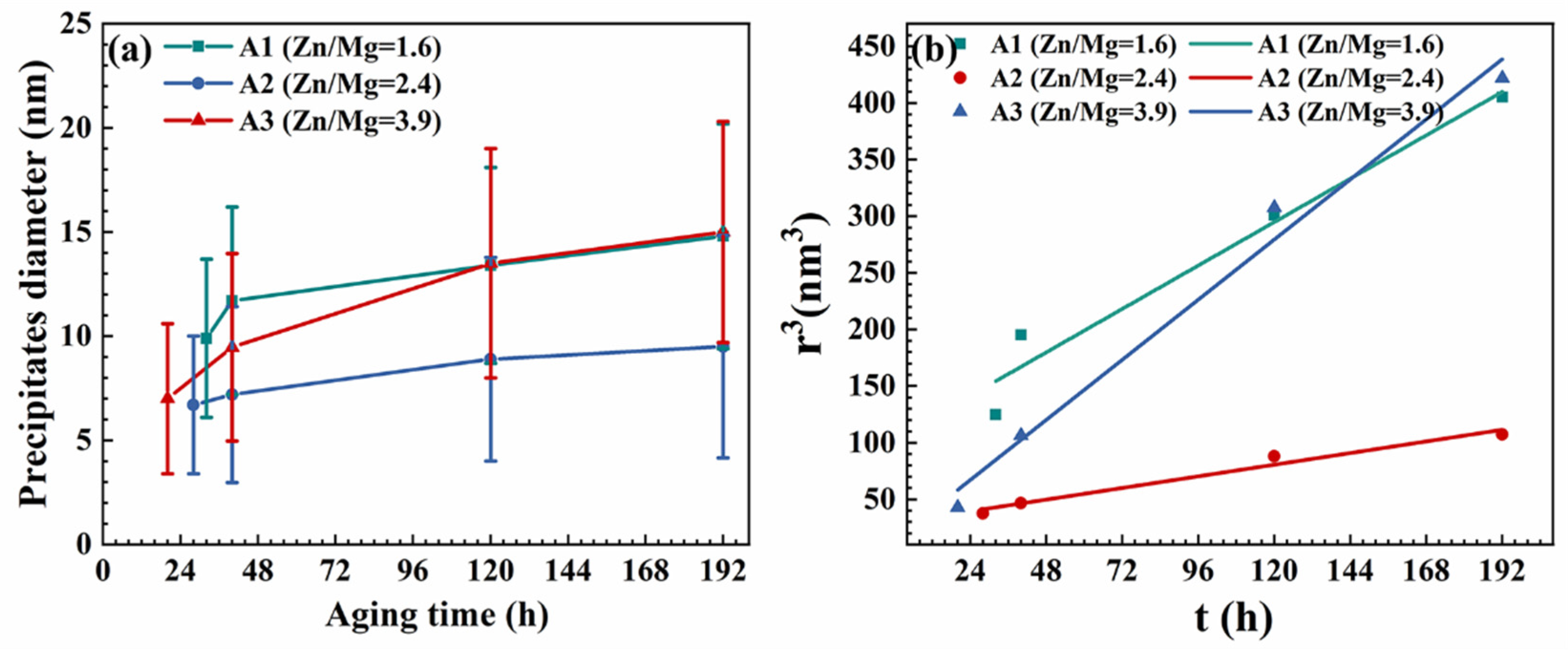
The equivalent diameters of precipitates at different aging times were statistically analyzed, as shown in Figure 7a. The average equivalent radius of the precipitates was determined based on TEM observations. Considering the irregular morphology of precipitates [9], the equivalent radius () of disk- and rod-shaped precipitates (r) was calculated according to Equation (1).
A gradual increase in equivalent diameter was observed for all alloys with increasing aging time, indicating the occurrence of precipitate coarsening during prolonged exposure at 150 °C. Notably, the alloy with Zn/Mg = 2.4 exhibited the slowest precipitate growth and retained the finest precipitate size after long-term aging, whereas more pronounced coarsening occurred in the alloys with lower and higher Zn/Mg levels. This difference can be related to the distinct precipitation characteristics induced by the variation in Zn/Mg proportion. Previous investigations revealed that peak-aged 7xxx alloys containing varying Zn/Mg proportions exhibited distinct fractions of T′ and η′ precipitates. Specifically, the T′ precipitate fractions were approximately 75%, 60%, and 39% at Zn/Mg values of 1.6, 2.4, and 3.9, respectively, whereas the corresponding η′ precipitate fractions increased to 25%, 40%, and 61% (volume fraction) [26]. The T′ precipitates generally exhibit superior stability against thermal exposure and stronger resistance to coarsening than η′ precipitates, whereas the latter provide more effective precipitation strengthening [14,27,33]. Therefore, the different proportions of T′ and η′ phases lead to a trade-off between initial strengthening capability and long-term precipitate stability. For the Zn/Mg = 2.4 alloy, the relatively balanced distribution of T′ and η′ phases enables a synergistic combination of strengthening capability and coarsening resistance. The sufficient fraction of η′ precipitates contributes to high peak hardness, while the retained T′ precipitates suppress precipitate growth during prolonged aging. In contrast, although the Zn/Mg = 1.6 alloy contains the highest fraction of thermally stable T′ precipitates, its lower η′ fraction results in insufficient precipitation strengthening at the peak-aged condition, leading to lower initial hardness relative to the investigated alloy with a Zn/Mg = 3.9. However, the Zn/Mg = 1.6 alloy retained more stable T′ precipitates, resulting in slower precipitate coarsening during prolonged aging. Consequently, its hardness exceeded that of the Zn/Mg = 3.9 alloy after aging beyond 144 h. Meanwhile, the high η′ fraction in the Zn/Mg = 3.9 alloy provides enhanced early-stage strengthening but accelerates precipitate coarsening during extended aging, resulting in inferior long-term hardness retention. To further quantify the coarsening behavior, the precipitate growth kinetics were analyzed using the classical Ostwald ripening model [34,35,36], in which the precipitate radius (r) is related to aging time (t) according to Equation (2). Although precipitate volume fraction is also an important factor affecting precipitation strengthening and microstructural evolution, the present analysis mainly focuses on precipitate size evolution to evaluate the coarsening resistance of alloys with different Zn/Mg proportions.
where r0 represents the mean radius of precipitates at the initial time t0, and Kᵣ denotes the coarsening rate constant [37]. The relationship between r3 and t for the investigated alloys is shown in Figure 7b. As described by Equation (1), the slope of the fitted linear relationship corresponds to the coarsening rate constant. The calculated slopes are 1.59, 0.43, and 2.24, respectively, among the alloys containing different Zn/Mg proportions (1.6, 2.4, and 3.9). The alloy with Zn/Mg = 2.4 exhibits the lowest coarsening rate, indicating significantly improved resistance to precipitate coarsening during prolonged aging. This suppressed coarsening behavior is consistent with the balanced T′/η′ precipitation characteristics and the finer precipitate size observed in Figure 5, thereby contributing to the superior hardness retention of this alloy during over-aging at 150 °C.
Figure 7.
(a) Variation of the precipitate diameter with time; (b) relationship between r3 and time.
4. Conclusions
Maintaining the Zn + Mg concentration at approximately 6.0 wt%, the role of varying Zn/Mg proportions in controlling precipitate evolution and coarsening stability of Al–Zn–Mg alloys aged at 150 °C was systematically investigated. As the Zn/Mg proportion increased from 1.6 to 3.9, the hardness response exhibited a non-linear variation, initially showing an enhancement followed by a subsequent decline. The highest hardness of 137 ± 4 HV was obtained for the alloy with a Zn/Mg ratio of 2.4, whereas lower values of 115 ± 3 HV and 123 ± 4 HV were recorded for the alloys with Zn/Mg ratios of 1.6 and 3.9, respectively. Meanwhile, the duration required to achieve the peak-aged condition was progressively reduced from 32 h to 20 h with increasing Zn/Mg ratio. Three types of precipitates with distinct morphologies were identified in all investigated alloys, including spherical T′, plate-like η′, and elongated rod-like η precipitates. At peak aging, the alloy with Zn/Mg = 2.4 exhibited the finest precipitates (r ~3 nm) and the highest number density. After an extended aging duration of 192 h, hardness reductions of 26 HV, 19 HV, and 38 HV were obtained for the alloys containing different Zn/Mg proportions (1.6, 2.4, and 3.9, respectively), accompanied by precipitate radii of approximately 8 nm, 5 nm, and 8 nm. Based on the Ostwald ripening relationship (r3 ∝ t), the calculated coarsening rate constants were 1.59, 0.43, and 2.24 for the three investigated alloys, indicating that the Zn/Mg = 2.4 alloy possesses the lowest coarsening rate. Furthermore, the variation in Zn/Mg ratio affected grain boundary precipitation, leading to a minimized PFZ width at Zn/Mg = 2.4 while maintaining a similar discontinuous distribution of grain boundary precipitates among the alloys. Therefore, when the overall Zn + Mg content remains unchanged, the alloy designed with a Zn/Mg ratio of 2.4 provides the most balanced precipitation characteristics, resulting in the highest peak hardness and the best resistance to precipitate coarsening during long-term aging.
Author Contributions
Conceptualization, X. Z., X.W., P.Z., X.X., Z.Z., G.Z., S.A., G.S., K.G., W.W., S.W., H.H., L.R. and Z.N.; methodology, X. Z., X.W., P.Z., X.X.; software, X. Z., Z.Z., G.Z., S.A. and G.S.; validation, X.Z., G.Z., S.A., G.S., K.G., W.W. and S.W.; formal analysis, X. Z., X.W., G.S., G.Z., S.A., H.H., L.R. and Z.N.; investigation, X. Z., X.W., P.Z., X.X., Z.Z., G.Z., S.A., G.S., K.G., W.W., S.W., H.H., L.R. and Z.N.; resources, X.W. and Z.N.; data curation, X. Z., X.W. and Z.N.; writing—original draft preparation, X.Z.; writing—review and editing, X. Z., X.W. and Z.N.; visualization, X.Z.; supervision, X.W., P.Z., X.X., Z.Z., G.Z., S.A., G.S., K.G., W.W., S.W., H.H., L.R. and Z.N.; project administration, X.W., X.X., G.Z., S.A., G.S., K.G., W.W., S.W., H.H., L.R. and Z.N.; funding acquisition, X.W., P.Z., X.X., G.Z., S.A., G.S., K.G., W.W., S.W., H.H., L.R. and Z.N. All authors have read and agreed to the published version of the manuscript.
Funding
This work was supported by the Advanced Materials-National Science and Technology Major Project (2025ZD0611400).
Data Availability Statement
The data presented in this study are available on request from the corresponding author due to privacy.
Conflicts of Interest
Authors Peihao Zhao, Zhi Zheng were employed by the company Chinalco Materials Application Research Institute. Authors Gaoteng Zhang, Shanglong Ao and Guishan Shi were employed by the company Southwest Aluminium (Group). The remaining authors declare that the research was conducted in the absence of any commercial or fi-nancial relationships that could be construed as a potential conflict of interest.
References
- Starke, E.A.; Staley, J.T. Application of modern aluminum alloys to aircraft. Prog. Aerosp. Sci. 1996, 32, 131–172. [Google Scholar] [CrossRef] [Scilit]
- Heinz, A.; Haszler, A.; Keidel, C.; Moldenhauer, S.; Benedictus, R.; Miller, W.S. Recent development in aluminium alloys for aerospace applications. Mater. Sci. Eng. A 2000, 280, 102–107. [Google Scholar] [CrossRef] [Scilit]
- Dai, P.; Luo, X.; Yang, Y.; Kou, Z.; Huang, B.; Wang, C.; Zang, J.; Ru, J. Nano-scale precipitate evolution and mechanical properties of 7085 aluminum alloy during thermal exposure. Mater. Sci. Eng. A 2018, 729, 411–422. [Google Scholar] [CrossRef] [Scilit]
- Lee, S.H.; Jung, J.G.; Baik, S.I.; Seidman, D.N.; Kim, M.S.; Lee, Y.K.; Euh, K. Precipitation strengthening in naturally aged Al-Zn-Mg-Cu alloy. Mater. Sci. Eng. A 2021, 803, 140719. [Google Scholar] [CrossRef] [Scilit]
- Jiang, L.; Wang, C.; Fu, H.; Shen, J.; Zhang, Z.; Xie, J. Discovery of aluminum alloys with ultra-strength and high-toughness via a property-oriented design strategy. J. Mater. Sci. Technol. 2022, 98, 33–43. [Google Scholar] [CrossRef] [Scilit]
- Wang, J.; Dong, Q.; Wang, R.; Liu, Q.; Feng, Z.; Wu, Z.; Nagaumi, H. Influence of Zn/Mg ratio on mechanical strength and corrosion resistance of Al-Zn-Mg alloys. J. Alloys Compd. 2025, 1016, 178953. [Google Scholar] [CrossRef] [Scilit]
- Chiu, Y.N.; Yen, S.Y.; Lin, W.T.; Yu, C.Y.; Lin, S.K. Computational Design of Thermally Stable Nanoprecipitates in Al-Zn-Mg Alloys: Insights From High-Throughput DFT and Machine Learning. Small 2026, 22, e11883. [Google Scholar] [CrossRef] [Scilit] [PubMed]
- Jiang, H.; Xing, H.; Xu, Z.; Yang, B.; Liang, E.; Zhang, J.; Sun, B. Effect of Zn content and Sc, Zr addition on microstructure and mechanical properties of Al-Zn-Mg-Cu alloys. J. Alloys Compd. 2023, 947, 169246. [Google Scholar] [CrossRef] [Scilit]
- Zou, Y.; Wu, X.; Tang, S.; Zhu, Q.; Song, H.; Guo, M.; Cao, L. Investigation on microstructure and mechanical properties of Al-Zn-Mg-Cu alloys with various Zn/Mg ratios. J. Mater. Sci. Technol. 2021, 85, 106–117. [Google Scholar] [CrossRef] [Scilit]
- Yin, H.; Wen, K.; Li, Z.; Li, X.; Li, Y.; Yan, L.; Yan, H.; Yu, M.; Zhang, Y.; Xiong, B. Effect of Zn/Mg ratio on the microstructure and mechanical properties of as-cast Al-Zn-Mg-Cu alloys and the phase transformation during homogenization. J. Mater. Res. Technol. 2023, 26, 3646–3660. [Google Scholar] [CrossRef] [Scilit]
- Thronsen, E.; Shah, S.; Hatzoglou, C.; Marioara, C.D.; Wenner, S.; Andersen, S.J.; Holmedal, B.; Holmestad, R. The evolution of precipitates in an Al-Zn-Mg alloy. J. Mater. Res. Technol. 2023, 23, 5666–5680. [Google Scholar] [CrossRef] [Scilit]
- Jiang, K.; Lan, Y.; Pan, Q.; Deng, Y. Effect of the Zn/Mg Ratio on Microstructures, Mechanical Properties and Corrosion Performances of Al-Zn-Mg Alloys. Materials 2020, 13, 3299. [Google Scholar] [CrossRef] [Scilit] [PubMed]
- Li, C.; Xu, X.; Chen, H.; Tabie, V.; Peng, C.T. Effect of Zn/Mg Ratio on Microstructure and Properties of Cold Extruded Al-xZn-2.4Mg-0.84Cu-0.2Zr-0.25Ti Aluminum Alloy. J. Mater. Eng. Perform. 2020, 19, 5787–5795. [Google Scholar] [CrossRef] [Scilit]
- Zou, Y.; Cao, L.; Wu, X.; Mou, C.; Tang, S. Revealing the coarsening behavior of precipitates and its effect on the thermal stability in Tʹ and ηʹ dual-phase strengthened Al-Zn-Mg-Cu alloys. J. Mater. Sci. Technol. 2025, 220, 54–66. [Google Scholar] [CrossRef] [Scilit]
- Yin, H.; Wen, K.; Li, Z.; Li, X.; Li, Y.; Yan, L.; Yan, H.; Yu, M.; Zhang, Y.; Xiong, B. Investigation on precipitate behavior and mechanical properties of Al-Zn-Mg-Cu alloys with various Zn/Mg ratios. J. Mater. Res. Technol. 2024, 33, 5769–5783. [Google Scholar] [CrossRef] [Scilit]
- Li, Y.; Wang, Y.; Lu, B.; Yu, W.; Wang, H.; Xu, G.; Wang, Z. Effect of Cu content and Zn/Mg ratio on microstructure and mechanical properties of Al-Zn-Mg-Cu alloys. J. Mater. Res. Technol. 2022, 19, 3451–3460. [Google Scholar] [CrossRef] [Scilit]
- Hong, L.; Wu, X.; Xiong, X.; Gao, K.; Wen, S.; Wei, W.; Rong, L.; Huang, H.; Nagaumi, H.; Nie, Z. Study of thermal stability of Al-Zn-Mg-Cu-Er-Zr alloy used for oil drilling by tensile tests and TEM. Mater. Charact. 2025, 229, 115466. [Google Scholar] [CrossRef] [Scilit]
- Glavatskikh, M.; Konovalova, S.; Chubov, D.; Khomutov, M.; Barkov, R.; Pozdniakov, A. Novel cast heat resistant crossover Al-Zn-Mg-Cu-Y-Zr-Cr alloy with improved corrosion and wear behavior, and low thermal expansion. J. Alloys Compd. 2025, 1033, 181286. [Google Scholar] [CrossRef] [Scilit]
- Mahmoud, M.; Mosleh, A.; Salem, S.; Sadek, W.; Yakovtseva, O.; Khalifa, W.; Pozdniakov, A.; Ataya, S.; Latief, F. Influence of Praseodymium Additions and Multiple Step T6 on Microstructure, and Mechanical Properties of 7075 Al-Zn-Mg-Cu Alloy. Int. J. Met. 2026, 20, 2391–2414. [Google Scholar] [CrossRef] [Scilit]
- Mahmoud, M.; Mosleh, A.; Salem, S.; Yakovtseva, O.; Khalifa, W.; Pozdniakov, A.; Afifi, M. Solidification Modification and Microstructural Evolution of Al–Zn–Mg–Cu Alloy with Praseodymium Additions. Metallogr. Microstruct. Anal. 2026, 15, 209–227. [Google Scholar] [CrossRef] [Scilit]
- Glavatskikh, M.; Barkov, R.; Khomutov, M.; Yakovtseva, O.; Pozdniakov, A. Precipitation, Deformation, and Superplastic Behavior of Novel Crossov er Al-Zn-Mg-Cu-Y(Er)-Zr-Cr-Ti-Fe-Si Alloys. JMMP J. Manuf. Mater. Proc. 2025, 9, 403. [Google Scholar] [CrossRef] [Scilit]
- Hu, L. Effect of Cu Content on Microstructure and Property of Al-Zn-Mg-Cu-Ag Alloy. Ph.D. Thesis, Chongqing University, Chongqing, China, 2021. [Google Scholar]
- Zhao, X.; Song, S.; Luo, C.; Hu, K.; Liu, S.; Zhang, S.; Wang, K. Microstructural evolution and mechanical properties of Al-Zn-Mg-Cu-Zr alloys with varying Zn and Cu contents under multi-stage solution-hot rolling-T6 aging. J. Alloys Compd. 2026, 1055, 186396. [Google Scholar] [CrossRef] [Scilit]
- Shu, W.X.; Hou, L.G.; Zhang, C.; Zhang, F.; Liu, J.C.; Liu, J.T.; Zhuang, L.Z.; Zhang, J.S. Tailored Mg and Cu contents affecting the microstructures and mechanical properties of high-strength Al-Zn-Mg-Cu alloys. Mater. Sci. Eng. A 2016, 657, 269–283. [Google Scholar] [CrossRef] [Scilit]
- Zhu, Q.; Wu, X.; Cao, L.; Zou, Y.; Song, H.; Liu, Y.; Song, K.; Couper, M.J. Precipitation evolution of Al-Zn-Mg-Cu-(Ag) alloys with a low Zn/Mg ratio. J. Mater. Sci. Technol. 2024, 195, 177–196. [Google Scholar] [CrossRef] [Scilit]
- Zhang, X.; Wu, X.; Zhao, P.; Xiong, X.; Zheng, Z.; He, F.; Rong, Z.; Wang, J.; Zhou, H.; Wang, S.; et al. Quantitative analyses of Zn/Mg ratios on T’ and η’ precipitation strengthening and corrosion resistance in low alloyed Al-Zn-Mg-Zr alloys using atom probe tomography. Mater. Charact. 2026, 237, 116486. [Google Scholar] [CrossRef] [Scilit]
- Zou, Y.; Wu, X.D.; Tang, S.B.; Zhao, K.; Cao, L.F. Tailoring phase fractions of T’ and η’ phases in dual-phase strengthened Al-Zn-Mg-Cu alloy via ageing treatment. Trans. Nonferrous Met. Soc. China 2022, 32, 3182–3196. [Google Scholar] [CrossRef] [Scilit]
- Huang, Z.W.; Loretto, M.H.; White, J. Influence of lithium additions on precipitation and age hardening of 7075 alloy. Mater. Sci. Tech. 1993, 9, 967–980. [Google Scholar] [CrossRef]
- Mamala, A.; Sciężor, W. Evaluation of the Effect of Selected Alloying Elements on the Mechanic al and Electrical Aluminium Properties. Arch. Metall. Mater. 2014, 59, 413–417. [Google Scholar] [CrossRef] [Scilit]
- Sha, G.; Cerezo, A. Characterization of precipitates in an aged 7xxx series Al alloy. Surf. Interface Anal. 2004, 36, 564–568. [Google Scholar] [CrossRef] [Scilit]
- Dumont, M.; Lefebvre, W.; Doisneau-Cottignies, B.; Deschamps, A. Characterisation of the composition and volume fraction of η′ and η precipitates in an Al-Zn-Mg alloy by a combination of atom probe, small-angle X-ray scattering and transmission electron microscopy. Acta Mater. 2005, 53, 2881–2892. [Google Scholar] [CrossRef] [Scilit]
- Bergman, G.; Waugh, J.L.T.; Pauling, L. The crystal structure of the metallic phase Mg32(Al, Zn)49. Acta Cryst. 1957, 10, 254–259. [Google Scholar] [CrossRef] [Scilit]
- Kelly, P.M. The effect of particle shape on dispersion hardening. Scr. Mater. 1972, 6, 647–656. [Google Scholar] [CrossRef] [Scilit]
- Voorhees, P.W. The theory of Ostwald ripening. J. Stat. Phys. 1985, 38, 231–252. [Google Scholar] [CrossRef] [Scilit]
- Hou, X.; Wen, S.; Li, J.; Ma, J.; Huo, S.; Hu, J.; Liang, S.; Qi, P.; Wei, W.; Wu, X. Synergistic inhibition of phase transition and precipitates coarsening for high-temperature strength and stability of Al-Cu-(Zr) alloys via Sn and Mn microalloying. Mater. Sci. Eng. A 2026, 950, 149501. [Google Scholar] [CrossRef] [Scilit]
- Alexandrov, D.V. Kinetics of particle coarsening with allowance for Ostwald ripening and coagulation. J. Phys. Condens. Matter 2016, 28, 035102. [Google Scholar] [CrossRef] [Scilit] [PubMed]
- Tang, J.; Liu, M.; Bo, G.; Jiang, F.; Luo, C.; Teng, J.; Fu, D.; Zhang, H. Unraveling precipitation evolution and strengthening function of the Al-Zn-Mg-Cu alloys with various Zn contents: Multiple experiments and integrated internal-state-variable modeling. J. Mater. Sci. Technol. 2022, 116, 130–150. [Google Scholar] [CrossRef] [Scilit]

Disclaimer/Publisher’s Note: The statements, opinions and data contained in all publications are solely those of the individual author(s) and contributor(s) and not of MDPI and/or the editor(s). MDPI and/or the editor(s) disclaim responsibility for any injury to people or property resulting from any ideas, methods, instructions or products referred to in the content. |
© 2026 by the authors. Licensee MDPI, Basel, Switzerland. This article is an open access article distributed under the terms and conditions of the Creative Commons Attribution (CC BY) license.