


Abstract
A rare-earth (RE)-segregation-assisted route combining mechanical alloying and hot extrusion was used to produce a WE43 alloy with an in situ network-like bimodal structure. Mechanical alloying fragmented and partially dissolved RE-containing phases produced a supersaturated Mg-RE solid solution, and dispersed oxygen-bearing surface films. During the pre-sintering stage before hot extrusion, defect-rich prior powder-particle boundaries (PPBs) acted as preferential sinks for RE solutes, establishing RE-enriched regions before extrusion, while some oxygen-bearing species remained near PPBs and grain boundaries. During subsequent hot extrusion, RE solute drag and pinning by RE-containing precipitates and retained oxides restricted grain-boundary migration near PPBs, whereas rotation-assisted grain coalescence and growth occurred within particle interiors. In the 350—extruded alloy, the relatively coarse and fine grains averaged 299 and 144 nm and occupied 71 and 29 vol.%, while the precipitates averaged 97.1 and 9.2 nm. The 400—extruded alloy achieved a yield strength of 396 MPa, an ultimate tensile strength of 432 MPa, and an elongation of 7.9%. For the 350—extruded alloy, Orowan-type, solid-solution, grain-boundary, and dislocation strengthening contributed approximately 118.5, 116.8, 84, and 67 MPa, respectively, leaving an unresolved residual difference of 63.7 MPa. Coupled RE redistribution and oxide dispersion therefore provide a route to a favorable strength–ductility balance in powder-metallurgy Mg alloys.
1. Introduction
Magnesium alloys, as the lightest commercially viable metallic structural materials, hold exceptional promise for aerospace, transportation, and electronic communication systems due to their outstanding specific strength, superior damping capacity, and high thermal conductivity [1,2,3]. Their low density also makes them attractive for high-volume automotive applications requiring vehicle mass reduction [4]. However, their widespread deployment in critical load-bearing components is fundamentally constrained by intrinsically low absolute strength and limited room-temperature ductility [5,6]. To address these limitations, rare-earth (RE)-containing Mg alloys, such as the WE series, have been strategically engineered [7]. The addition of RE elements such as Gd and Y significantly enhances mechanical performance through synergistic mechanisms, including solid-solution strengthening, grain refinement, and the formation of thermally stable nanoscale precipitates (e.g., β′ and β phases). RE additions can also weaken the conventional extrusion texture and thereby improve the tensile ductility of Mg alloys [8]. This establishes Mg-RE alloys as leading candidates for next-generation high-performance lightweight applications, particularly in demanding aerospace environments where properties like specific strength and heat resistance are paramount.
Achieving an optimal strength–ductility synergy in Mg alloys remains a persistent challenge [9,10]. Heterostructure design, particularly the creation of bimodal grain structures that integrate fine and coarse grain domains, has emerged as a powerful paradigm to overcome this trade-off by concurrently activating Hall–Petch strengthening and hetero-deformation-induced (HDI) strengthening [11,12]. Conventional thermomechanical processing, such as rolling and extrusion [13,14], can fabricate such bimodal structures through dynamic recrystallization (DRX), leading to excellent combinations of strength and plasticity. However, this approach typically achieves fine grain sizes only at the sub-micron level. Powder metallurgy (P/M), including mechanical alloying (MA), is an effective alternative process for preparing nanocrystalline materials [15]. Rapid powder-consolidation routes have also been shown to retain fine grains while controlling precipitation in Mg alloys [16]. Yet, in the context of fabricating bimodal materials via P/M, common strategies involve the deliberate addition of coarse-grained phases [17,18]. Previous powder-metallurgy studies further demonstrate that surface oxides and interparticle bonding strongly influence the microstructure and mechanical response of consolidated Mg materials [19]. This approach faces several critical limitations: (1) weak interfacial bonding between the fine-grained matrix and the introduced coarse-grained phases, often exacerbated by continuous oxide networks along particle boundaries; (2) process complexity and difficulty in achieving a controlled, optimal spatial distribution of coarse grains and fine grains.
To overcome these limitations, the tendency of RE elements to redistribute toward prior powder-particle boundaries (PPBs) during thermally assisted consolidation [20,21,22] is employed as a microstructural regulation strategy for constructing an in situ network-like bimodal structure in WE43 magnesium alloy. Here, “network-like” refers to the overall network formed by fine-grained regions distributed along the PPBs and surrounding the relatively coarse-grained particle interiors, although the network is locally discontinuous at the microscopic scale, whereas “bimodal” denotes the coexistence of these relatively fine and relatively coarse grain populations that may partially overlap. Meanwhile, the possible contribution of oxygen-bearing surface films on the machined chips must also be considered. Mechanical alloying can disrupt such surface films and redistribute the resulting oxide fragments throughout the powder, thereby reducing the formation of continuous brittle oxide networks at the PPBs. Nevertheless, a fraction of oxygen-rich/oxide constituents may remain locally near PPBs and grain boundaries after consolidation. Therefore, the retention of fine-grained regions along the PPBs is not attributed to RE segregation alone. Instead, during pre-sintering, defect-rich PPBs act as preferential diffusion paths and sinks for RE solutes, while locally retained oxide particles provide additional obstacles to grain-boundary migration through particle pinning. The combined effects of pre-sintering-induced RE segregation, heterogeneous precipitation, oxide redistribution, and spatially heterogeneous grain-boundary migration during subsequent hot extrusion facilitate the formation of the network-like bimodal structure. Accordingly, this strategy offers potential for developing lightweight, high-strength magnesium alloys for automotive structural applications requiring a favorable strength–ductility balance.
2. Experimental Procedures
2.1. Materials and Processes
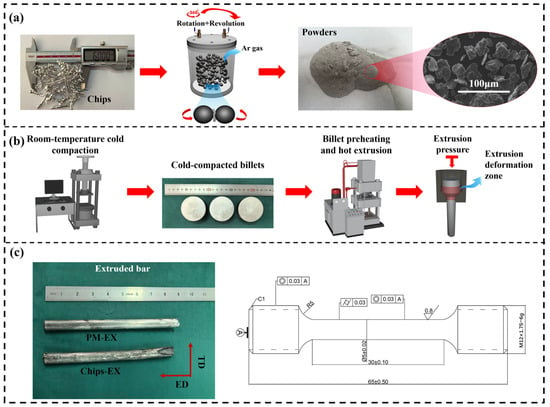
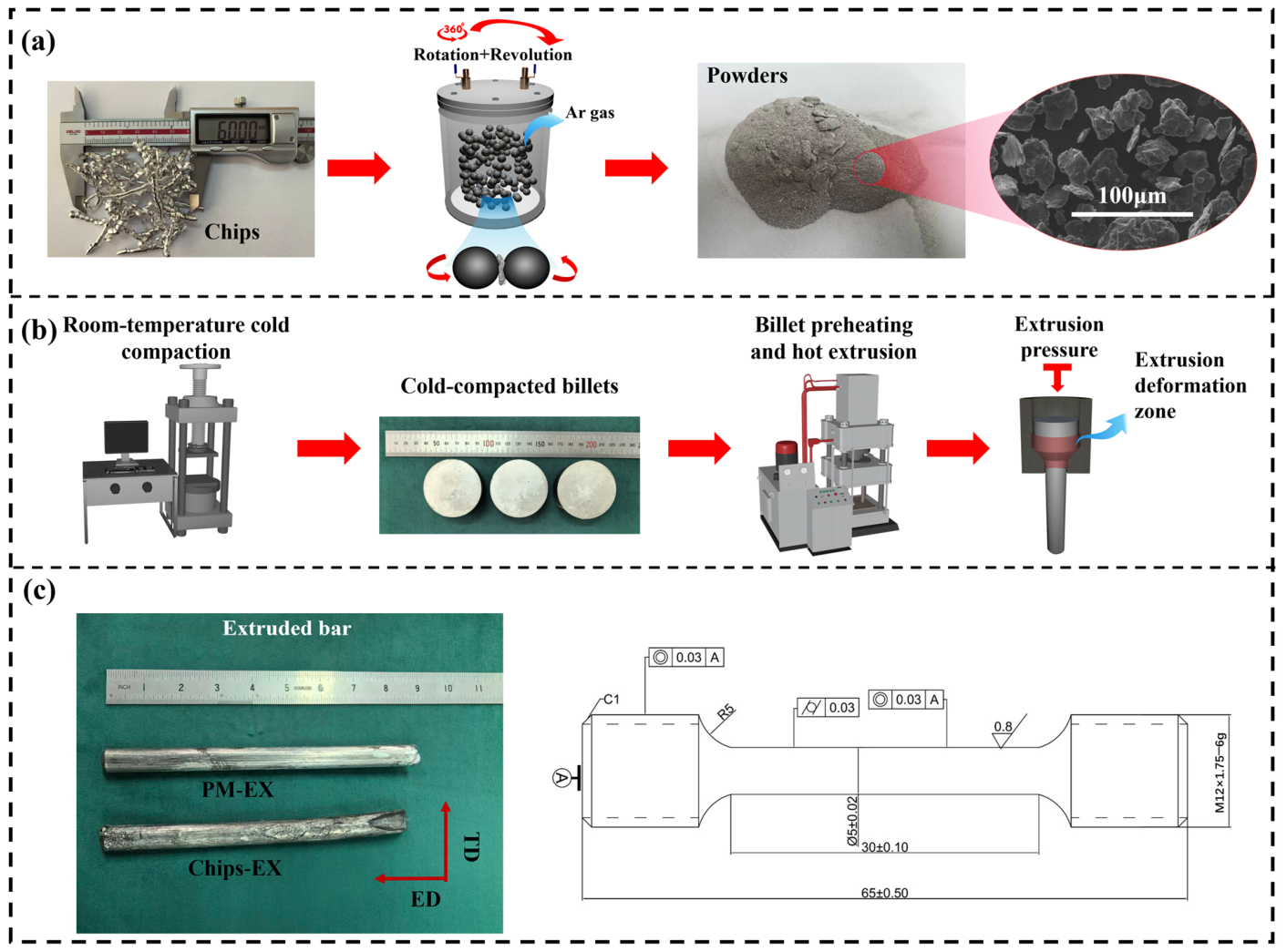
In this study, machining chips of a commercial WE43 magnesium alloy were employed. The chemical composition of the chips was measured as (in wt.%): Nd 2.03, Y 3.84, Gd 1.01, and Zr 0.69. The appearance and representative dimensions of the as-machined chips are shown in Figure 1a.
Figure 1.
Schematic of the material preparation and specimen extraction procedures: (a) appearance and representative dimensions of the as-machined chips, mechanical-alloying setup, and morphology of the mechanically alloyed powder; (b) room-temperature cold compaction, cold-compacted billets, pre-sintering, and hot extrusion; and (c) appearance of the extruded bars, definitions of the extrusion direction (ED) and transverse direction (TD), and geometry of the tensile specimen. PM-EX denotes the alloy fabricated from mechanically alloyed powder followed by hot extrusion, whereas Chips-EX denotes the control alloy directly extruded from as-machined chips without mechanical alloying.
The machined WE43 chips were subjected to MA using a planetary ball mill (QM-3SP4, Changsha Mickey, Changsha, China). The MA process was carried out in a stainless-steel vial with stainless-steel balls under an argon atmosphere, using a ball-to-powder weight ratio of 25:1, a rotational speed of 300 rpm, processing durations of 5 h and 12 h, and an alternating rotation mode consisting of 30 min clockwise rotation and 30 min counterclockwise rotation with a 10-min interval between direction changes. The as-milled powder was cold-compacted into cylindrical billets (50 mm in diameter and 30 mm in length) using a universal testing machine (YAW-3000B, Jinan Shijin Group Co., Ltd., Jinan, China) under a pressure of 1300 MPa. The compaction was performed at a loading rate of 2 kN/s with a dwell time of 3 min. Subsequently, hot extrusion was conducted on a four-column hydraulic press (YT32-200, Tianjin Tianduan Press Co., Ltd., Tianjin, China) equipped with a die preheated to 300 °C and having an orifice diameter of 16 mm. Before extrusion, the 50-mm-diameter compacted billets were held for 1 h at 300, 325, 350, or 400 °C. This pre-extrusion thermal holding step is hereafter referred to as the pre-sintering stage. The corresponding extrusion ratio was 9.8:1. The detailed process flowchart is illustrated in Figure 1a,b.
For clarity, the as-received WE43 alloy is denoted as AR-WE43. The alloys fabricated from powder mechanically alloyed for 12 h and subsequently extruded at 300, 325, 350, and 400 °C are denoted as PM-EX300, PM-EX325, PM-EX350, and PM-EX400, respectively. The control alloy directly extruded from as-machined chips at 400 °C without mechanical alloying is denoted as Chips-EX400.
2.2. Microstructural Characterization
Microstructural characterization was carried out using SEM-EDS (Thermo Scientific Apreo 2C, Thermo Fisher Scientific, Waltham, MA, USA), TEM (Thermo Fisher Talos F200X, Thermo Fisher Scientific, Waltham, MA, USA), and XRD (Rigaku D/max-rb, 10° min−1, Rigaku Corporation, Tokyo, Japan). Samples were wire-cut, ground, polished, and cleaned to Φ10 mm × 10 mm.
EBSD was performed on the longitudinal section using a field-emission SEM (Thermo Fisher Scientific, Waltham, MA, USA) equipped with an EDAX Velocity Super EBSD detector (EDAX Inc., Mahwah, NJ, USA). The EBSD maps were acquired with a step size of 40 nm and a resolution of 400 × 400 pixels. The samples were mechanically polished and ion-polished before analysis. Grain boundaries with misorientations of >15° and 2–15° were defined as high-angle and low-angle boundaries, respectively. EBSD data were analyzed using EDAX OIM Analysis, and KAM maps were calculated by the first nearest-neighbor method, excluding misorientations > 5°.
2.3. Mechanical Property Evaluation
Room-temperature uniaxial tensile and compressive tests were conducted on an Instron 5569 universal testing machine (Instron, Norwood, MA, USA) at a strain rate of 0.001 s−1. The elongation to failure was determined based on extensometer (Instron, Norwood, MA, USA) measurements. The dimensions of the tensile specimen are shown in Figure 1c. For each processing condition, at least three independent specimens were tested.
3. Results and Discussion
3.1. Morphological and Microstructural Evolution of Powders During Mechanical Alloying
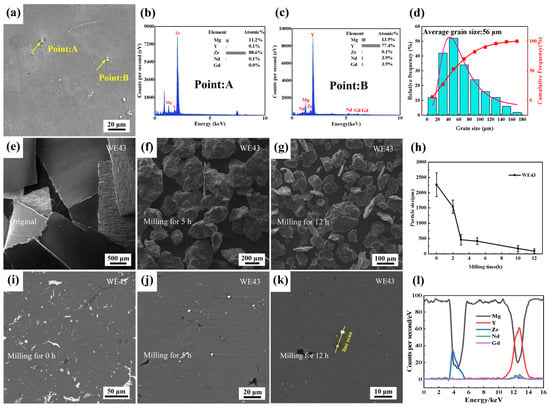
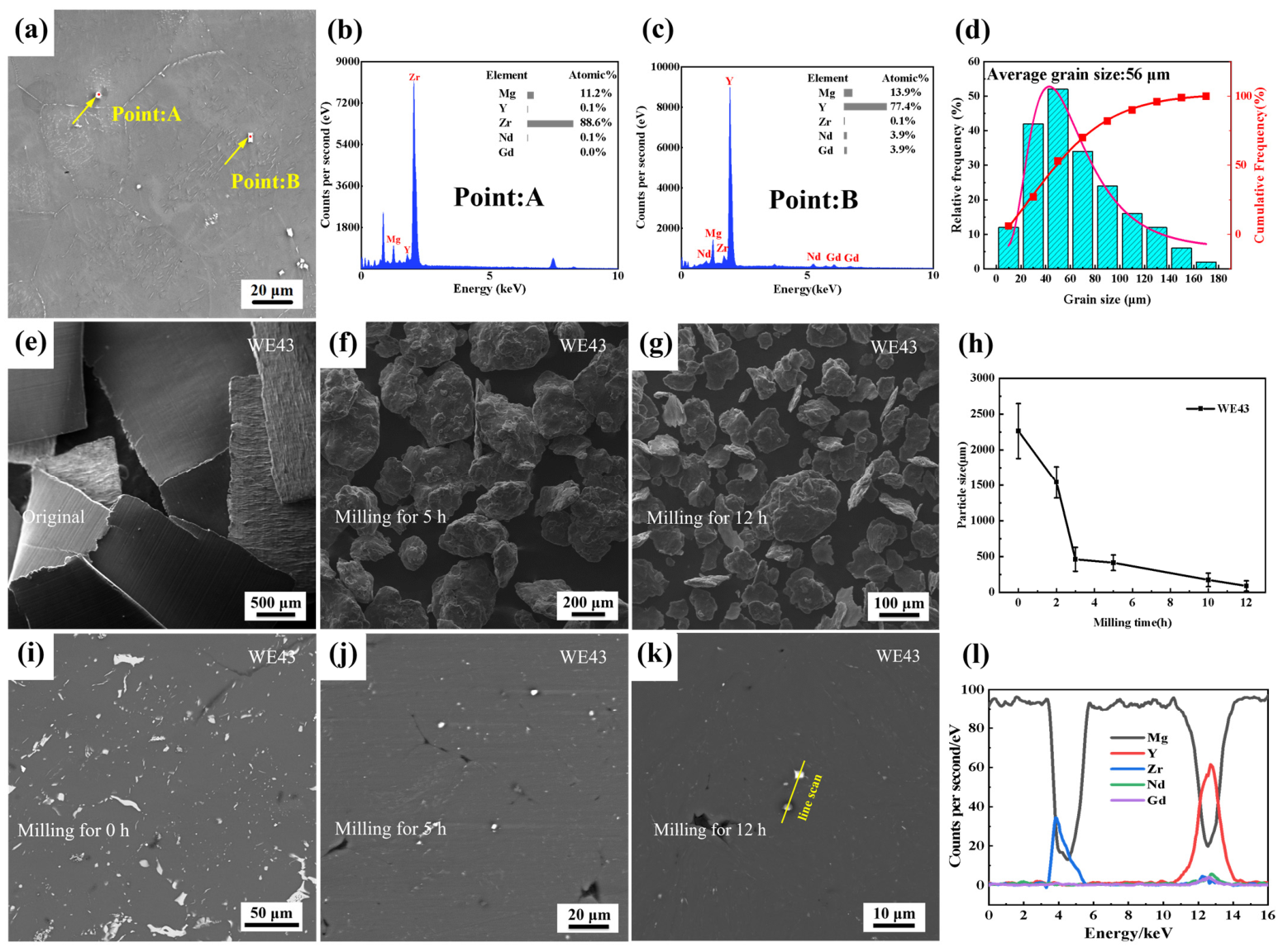
The initial microstructure of the as-received WE43 alloy is shown in Figure 2a, consisting of spherical Zr-rich particles, blocky Y-rich phases, and strip-like Nd-rich phases [23], with an average grain size of 56 µm (Figure 2d). The evolution of powder morphology with MA duration is presented in Figure 2e–g. The particle size was progressively refined from an initial average of 2260 µm to approximately 50 µm, accompanied by a morphological change to a flaky shape. Figure 2i–k display the morphology of cold-compacted WE43 powder compacts prepared from powders subjected to different MA durations. These images indicate that the secondary phases within the Mg matrix underwent continuous fragmentation during MA. Their morphology evolved sequentially from coarse particulate and elongated strips to finer particles, with a concomitant reduction in both size and volume fraction. During MA, the powder particles undergo severe plastic deformation, causing dislocations to accumulate and initially organize into dislocation cells. These cells subsequently transform into low-angle grain boundaries and, finally, into high-angle grain boundaries, resulting in significant refinement of the Mg matrix grains. This non-equilibrium processing state, characterized by the generation of high defect densities (dislocations, subgrain boundaries, and grain boundaries), provides accelerated diffusion pathways for solute elements. Under the combined action of severe plastic deformation and mechanical forcing, the decomposition of intermetallic phases and the dissolution of solute atoms are promoted. This facilitates the supersaturated solid solution of RE elements (Nd, Y, Gd) into the Mg matrix. As shown in Figure 2k,l, after 12 h of MA, the refractory Zr-rich and Y-rich phases, which are difficult to dissolve under these conditions [24], persist but in a significantly refined state. In contrast, the Nd-rich phase is nearly completely dissolved.
Figure 2.
Microstructural and compositional characterization of the initial material, mechanically alloyed powders, and cold-compacted billets: (a) SEM-BSE micrograph of the as-received WE43 alloy showing the locations selected for EDS analysis; (b,c) EDS spectra acquired from Points A and B marked in (a), respectively; (d) grain-size distribution of the as-received alloy (cyan bars), together with the corresponding fitted distribution (magenta curve) and cumulative frequency (red curve); (e–g) representative SEM micrographs showing the evolution of chip/powder morphology after 0, 5, and 12 h of mechanical alloying, respectively; (h) evolution of the average particle size as a function of mechanical-alloying time; (i–k) representative SEM-BSE micrographs of the cold-compacted billets prepared from materials mechanically alloyed for 0, 5, and 12 h, respectively; and (l) EDS line-scan profile acquired along the line marked in (k).
3.2. Microstructural Characteristics and Formation Mechanism of Extruded Alloys
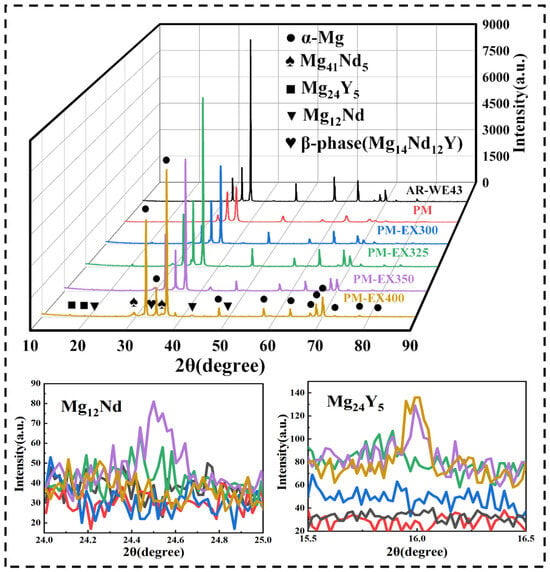
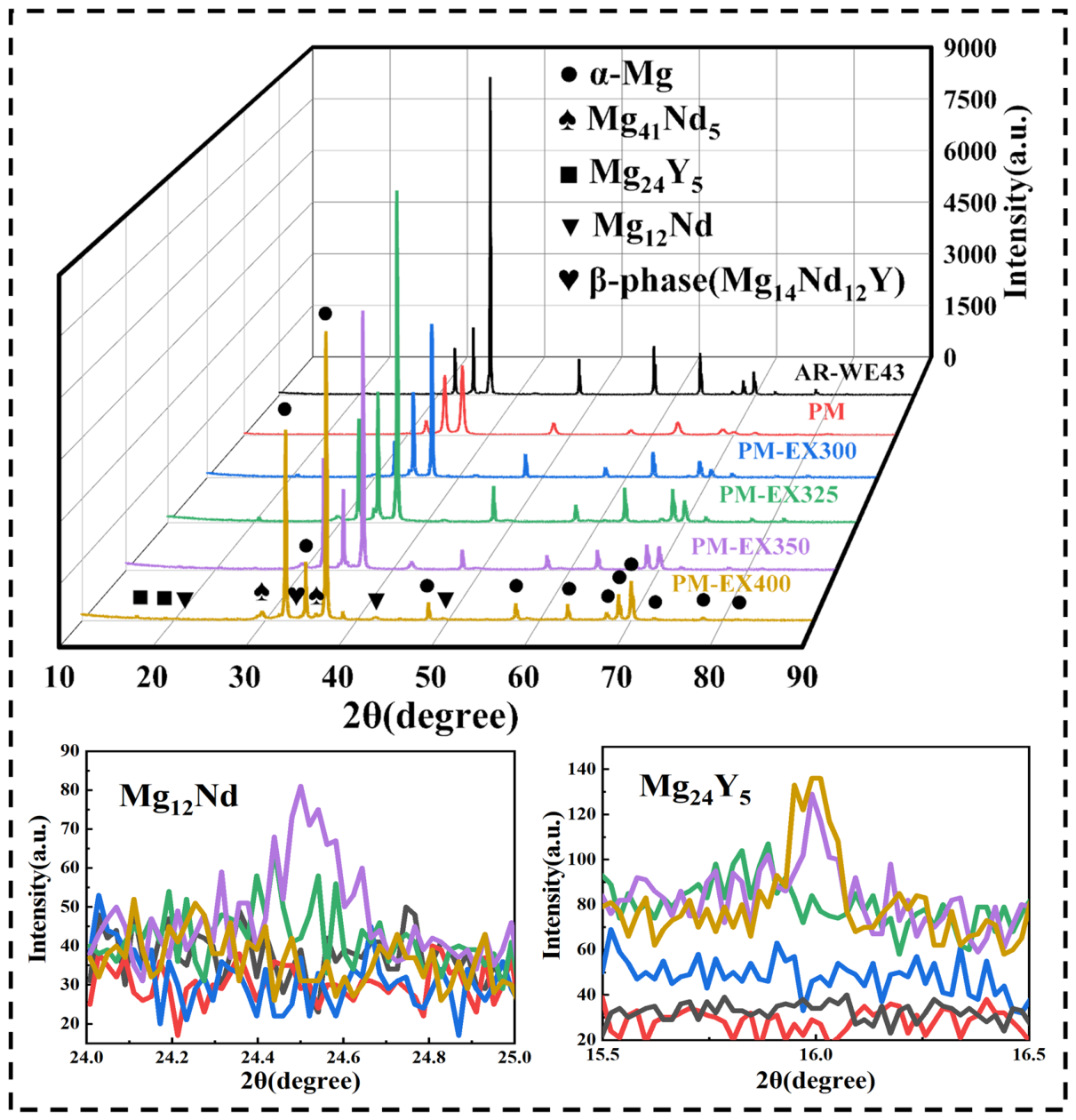
Figure 3 presents the X-ray diffraction (XRD) patterns of the as-received WE43 alloy, the MA powder, and the alloys extruded at different temperatures. With increasing MA duration, the accumulation of dislocations leads to grain refinement and increased microstrain, thereby reducing the diffraction intensity and broadening the full width at half maximum (FWHM) of the α-Mg peaks. The pattern of the as-received alloy shows distinct peaks corresponding to α-Mg and the β-Mg24Y5 phase. After MA, the diffraction peaks of the secondary phases become indistinguishable, while the α-Mg peaks shift toward lower diffraction angles. These changes are consistent with the dissolution of RE elements into the Mg matrix, accompanied by lattice distortion and the formation of a supersaturated Mg-RE solid solution [25,26].
Figure 3.
XRD patterns of the WE43 magnesium alloy in the as-received, mechanically alloyed, and extruded states. The insets show enlarged low-intensity regions near the reference diffraction positions of Mg12Nd and Mg24Y5. PM denotes the mechanically alloyed powder before extrusion.
Following extrusion, weak local intensity variations are observed near the reference diffraction positions of Mg12Nd, Mg24Y5, the β phase (Mg14Nd12Y), and Mg41Nd5. However, the signal-to-background ratios of these features are relatively low, particularly in the enlarged regions associated with Mg12Nd and Mg24Y5. Therefore, a contribution from background noise cannot be excluded, and these features are regarded only as tentative indications of RE-containing precipitation rather than conclusive evidence for phase identification. Thermomechanical processing is expected to promote the precipitation of RE elements from the supersaturated solid solution, while differences in the extent of precipitation can produce variations in the residual solid-solute content and the corresponding shifts in the α-Mg diffraction peaks [27]. The feature near the reference diffraction position of Mg24Y5 appears to become progressively more pronounced with increasing extrusion temperature, whereas the feature near the Mg12Nd reference position is most visible in the alloy extruded at 350 °C. Nevertheless, these apparent trends should be interpreted cautiously because of the low intensities of the corresponding signals. The phase assignments were further verified by the subsequent HRTEM, FFT, and EDS analyses.
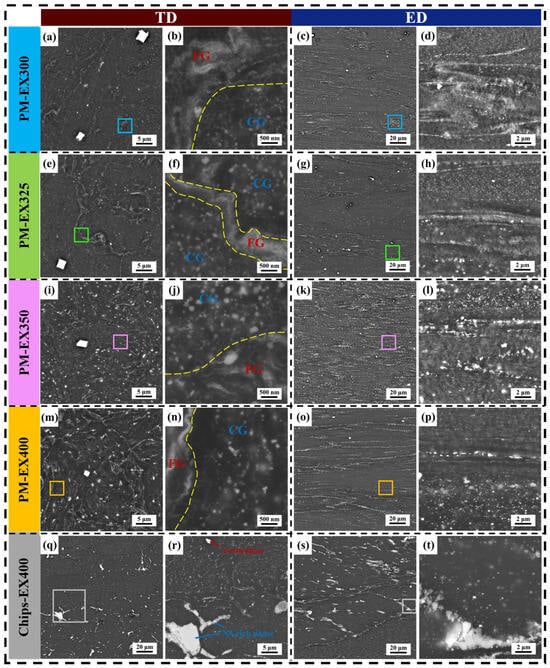
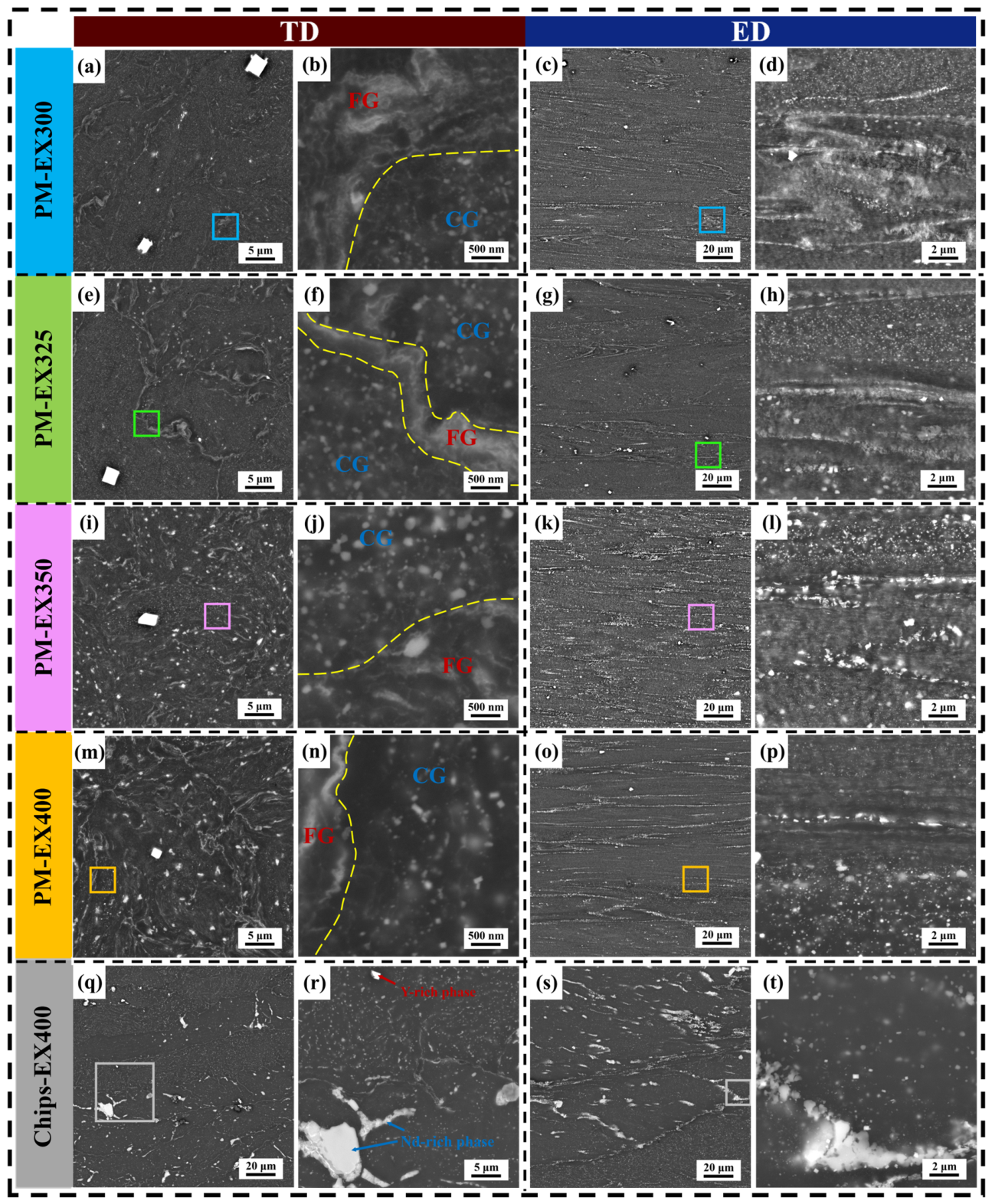
Figure 4 presents backscattered electron (BSE) micrographs of the WE43 magnesium alloys extruded at different temperatures. A comparison of the microstructures along the TD at various extrusion temperatures clearly reveals that the population of fine nanoscale precipitates is highest in the sample extruded at 300 °C (Figure 4a). As the extrusion temperature increases, the density of these nanoscale precipitates decreases, whereas their size increases markedly (Figure 4m), indicating the precipitation of RE-containing phases at all extrusion temperatures. At lower extrusion temperatures, the diffusion rate of RE elements is relatively low. The high-density defects introduced during both MA [28] and the extrusion process [29] provide abundant nucleation sites, promoting the formation of nanoscale RE precipitates. With increasing extrusion temperature, the accelerated diffusion of RE atoms leads to pronounced precipitate coarsening. Furthermore, locally magnified images (Figure 4b) reveal a heterostructure consisting of fine-grained (FG) regions and coarse-grained (CG) regions. The nanoscale precipitates are more distinct within the CG regions, whereas in the FG regions, precipitates are predominantly distributed in a near-continuous manner along the grain boundaries. Owing to the limited resolution of SEM, a detailed characterization of these features will be provided subsequently via TEM.
Figure 4.
SEM images of the WE43 magnesium alloys along the transverse direction (TD) and extrusion direction (ED): (a–d) PM-EX300, (e–h) PM-EX325, (i–l) PM-EX350, (m–p) PM-EX400, and (q–t) Chips-EX400. The yellow dashed lines indicate the boundaries between the fine-grained (FG) and coarse-grained (CG) regions.
In Figure 4b, a network structure delineated by band-shaped precipitates is observed. The grains at the network nodes remain relatively fine, with significant second-phase enrichment at their boundaries. As the extrusion temperature increases, this network-like distribution becomes more spatially developed and uniform, evolving from a localized to a more widespread morphology (Figure 4n). Along the ED, the band-shaped precipitates undergo a distinct evolution: with increasing extrusion temperature, they transition from a divergent, river-like distribution (Figure 4d) to a more consolidated arrangement (Figure 4h), and finally transform into discrete granular precipitates (Figure 4p). These networks closely follow the PPBs, supporting preferential, rather than exclusive, RE enrichment at the inherited particle boundaries, consistent with previous reports [30]. The redistribution of RE solutes is inferred to occur primarily during the pre-sintering stage before hot extrusion, resulting in RE-enriched PPB regions prior to extrusion. The supersaturated Mg-RE solid solution and high density of defects introduced by mechanical alloying provide the solute source and short-circuit diffusion paths during this stage. Meanwhile, the relatively high defect density and interfacial energy of the PPBs make these inherited interfaces energetically favorable sinks for RE solutes.
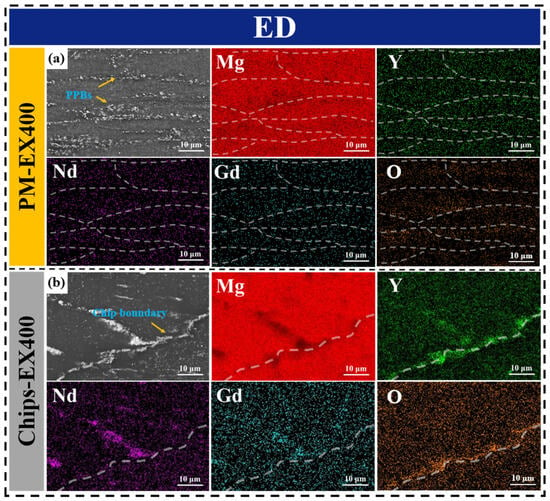
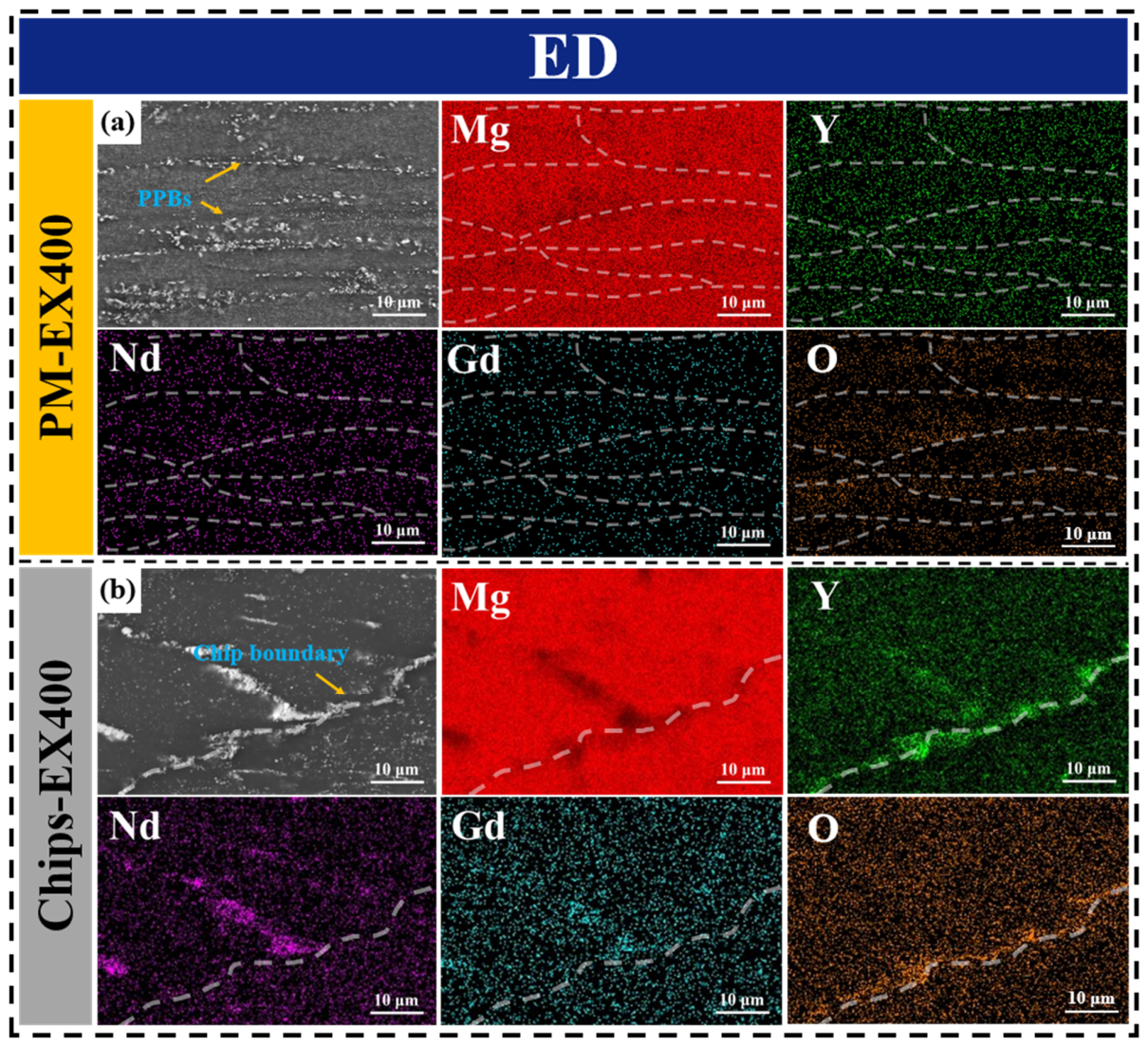
Figure 5 presents the microstructure and corresponding EDS analysis along the ED for the WE43 alloys extruded at 400 °C, comparing materials fabricated from MA powder and directly from as-machined chips. A pronounced network structure consisting of uniformly dispersed RE-rich particles is observed along the original PPBs in the alloy fabricated from MA powder (Figure 5a). In contrast, the directly extruded chips contain relatively large RE-rich phases comparable in size to those in the initial material, together with a substantially lower population of nanoscale particles (Figure 5b).
Figure 5.
SEM images and corresponding EDS mapping results of WE43 alloys extruded at 400 °C along the ED: (a) alloy fabricated from MA powder; (b) alloy directly extruded from as-machined chips. The gray dashed lines indicate the prior powder-particle boundaries (PPBs) in PM-EX400 and the chip boundary in Chips-EX400. The red, green, purple, cyan, and orange maps correspond to Mg, Y, Nd, Gd, and O, respectively.
The O map of the directly extruded chips shows pronounced oxygen enrichment along the inherited chip boundaries, supporting the presence of oxygen-bearing surface layers before consolidation. After MA, the O signal becomes substantially more dispersed, although localized enrichment remains at some PPBs. This result suggests that MA disrupts and redistributes the original surface oxide films rather than completely eliminating them [31]. Because EDS mapping alone cannot determine the chemical state of oxygen, the phase constitution of the oxygen-bearing constituents is evaluated subsequently using HRTEM and FFT analyses.
The RE maps show a partially similar PPB-associated distribution. In addition to the high defect density and interfacial energy of the PPBs, locally retained oxygen-rich species may provide an additional interfacial contribution to RE accumulation. Previous studies of Mg-Y-Nd powder consolidation have reported pronounced Y and Nd redistribution toward powder-particle boundaries, accompanied by destabilization and fragmentation of surface oxide shells [32]. Although the partial spatial correspondence suggests that locally retained oxygen-rich species may promote RE accumulation at the PPBs, the present EDS data alone do not establish a direct causal relationship between oxygen enrichment and RE segregation. Therefore, oxygen-rich/oxide species are regarded as a possible contributing factor, rather than the sole cause, of RE localization at the PPBs during the pre-sintering stage before hot extrusion.
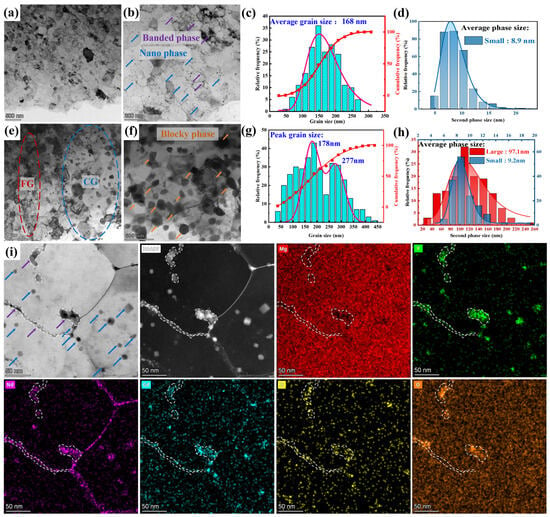
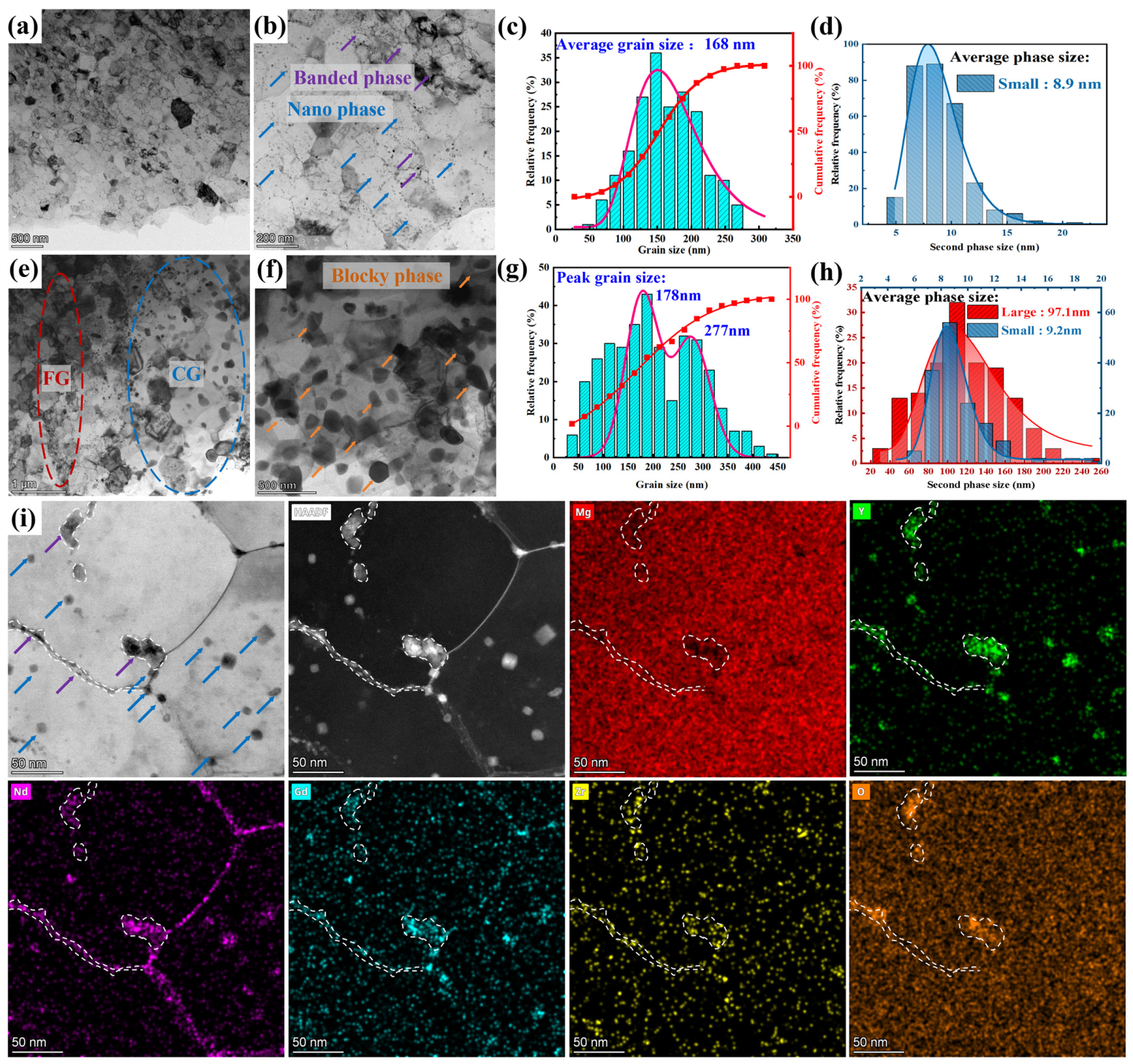
To clarify the influence of extrusion temperature on precipitation behavior, TEM was conducted on samples extruded at 300 °C and 350 °C, where a wider variety of precipitate phases could be distinguished. Figure 6 presents the TEM microstructures of the samples extruded at 300 and 350 °C, allowing the effect of extrusion temperature on the grain structure and precipitation behavior to be compared. Two distinct precipitate populations are observed: a high density of nanoscale precipitates within the grain interiors, indicated by the blue arrows in Figure 6b, and band-shaped precipitates preferentially distributed along grain boundaries, marked by the purple arrows in Figure 6b. The latter corresponds well to the banded contrast observed in the SEM image in Figure 4b. Quantitative analysis reveals that the average grain size is 168 nm (Figure 6c). The nanoscale precipitates have an average diameter of 8.9 nm and are mainly distributed within the grain interiors (Figure 6d).
Figure 6.
TEM micrographs of WE43 magnesium alloy extruded at (a,b) 300 °C and (e,f) 350 °C; (c,g) corresponding grain-size distributions, where the magenta curves represent the peak fits and the red curves represent the cumulative frequencies; (d,h) precipitate-size distributions, where the corresponding solid curves represent the peak fits; (i) high-magnification TEM image of nanoscale precipitates and associated EDS elemental maps from the sample extruded at 350 °C. The white dashed contours in (i) mark the locations of the band-like precipitates.
The corresponding O map exhibits partial spatial correspondence with the band-like RE-rich regions and some grain-boundary regions. Combined with the more dispersed O distribution observed after MA in Figure 5, this result suggests that the oxygen-bearing surface layers on the original chips were disrupted and redistributed during MA, although a fraction of the O signal remained locally associated with interfacial regions after hot extrusion. Nevertheless, EDS mapping provides only elemental-distribution information and cannot determine the chemical state of oxygen or distinguish intrinsic oxygen-containing phases from oxygen introduced by surface oxidation or specimen preparation. Therefore, the O map is not regarded as direct evidence for the presence of specific oxide phases, and the observed spatial correspondence alone does not establish a causal relationship between oxygen and RE segregation. Further HRTEM and FFT analyses are presented in the following section to clarify the phase constitution and interfacial characteristics of the oxygen-containing constituents.
For the sample extruded at 350 °C, a distinct bimodal grain structure is observed, with peak grain sizes of 178 nm and 277 nm (Figure 6g). Band-like precipitates remain present in the FG region, whereas relatively coarse nanoscale precipitates are clearly observed in the CG region, in contrast to the 300—extruded sample (Figure 6e). The precipitates also exhibit a bimodal size distribution, with average sizes of 9.2 nm and 97.1 nm (Figure 6h). Selected-area EDS analysis of the 350—extruded alloy shows RE enrichment in the band-like phases and in the nanoscale spherical/blocky precipitates (Figure 6i). Pronounced Nd- and Gd-rich segregation is also detected along the grain boundaries. These observations suggest that the RE segregation established during pre-sintering was retained at grain-boundary regions and subsequently contributed to precipitation during hot extrusion.
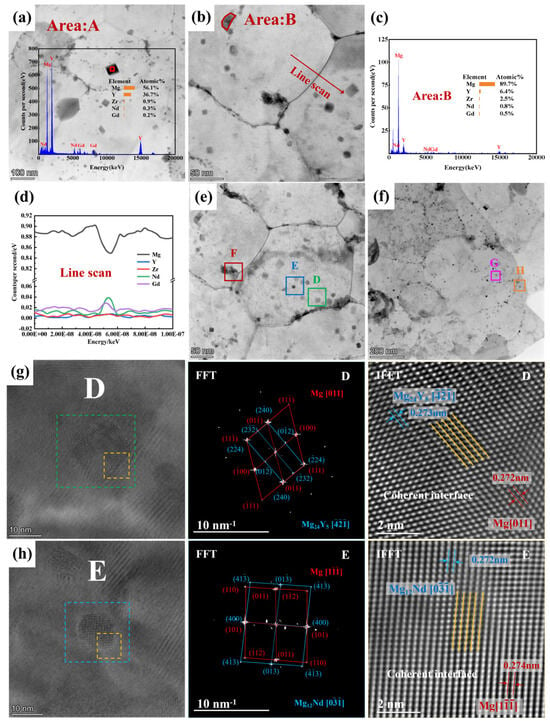
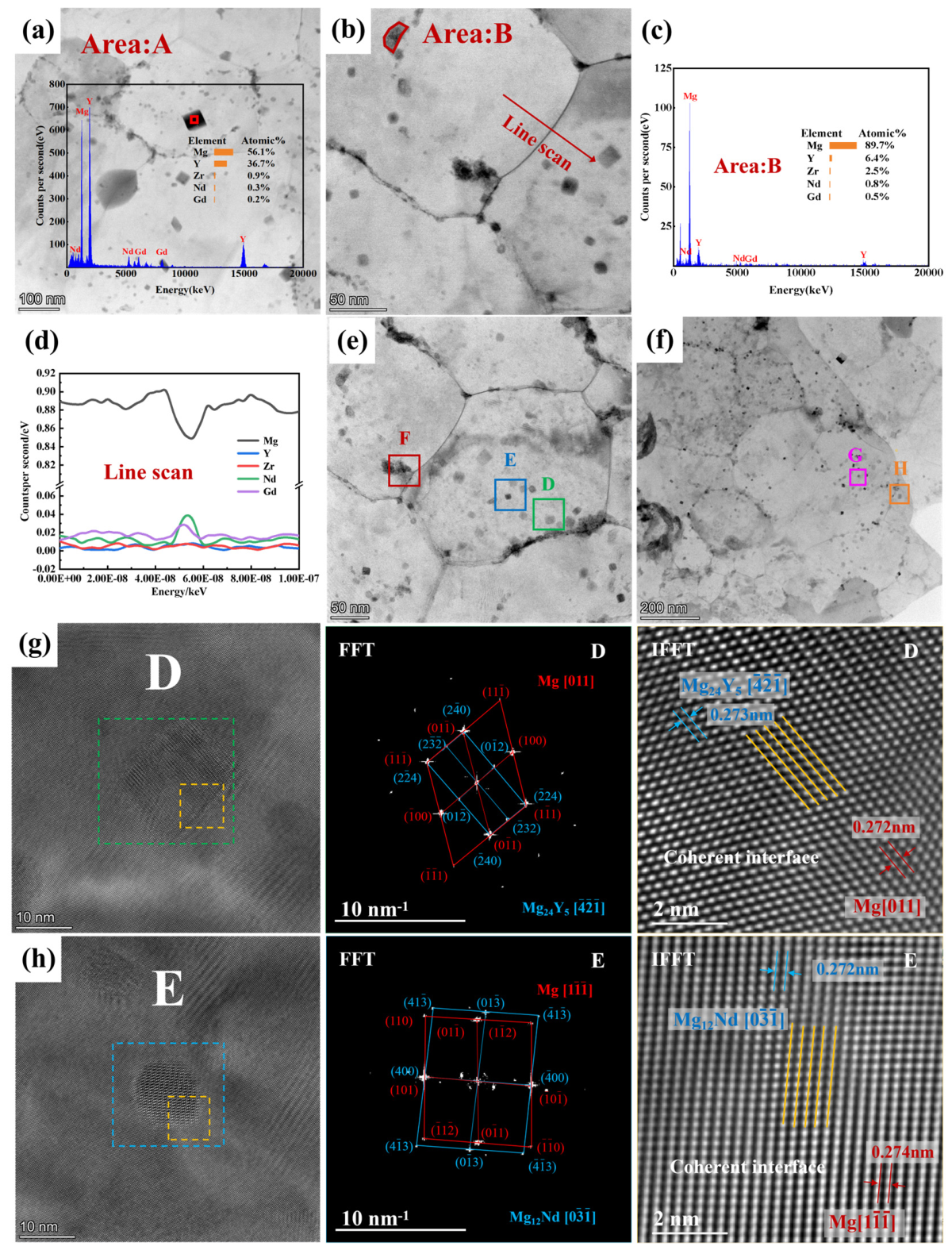
EDS and HRTEM analyses were performed to further characterize the nanoscale phases, solute-enriched regions, and oxide particles in the alloy extruded at 350 °C. The fine blocky particles in region A are primarily enriched in Y (Figure 7a), whereas the line-scan analysis across region B reveals local enrichment of Y, Nd, Gd, and Zr near the interfacial region (Figure 7b–d). In addition, RE elements remain in solid solution within the grain interiors.
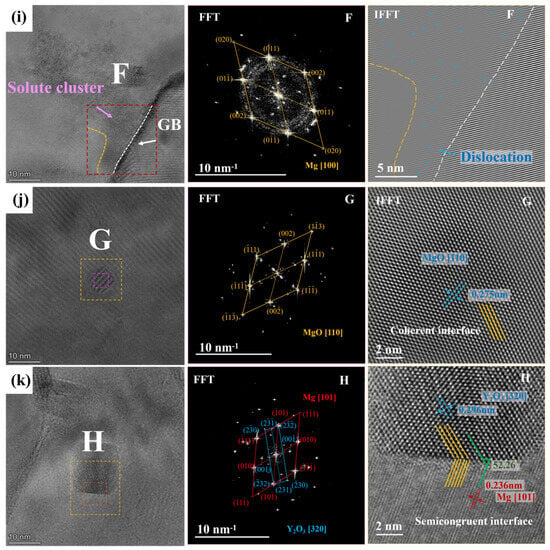
Figure 7.
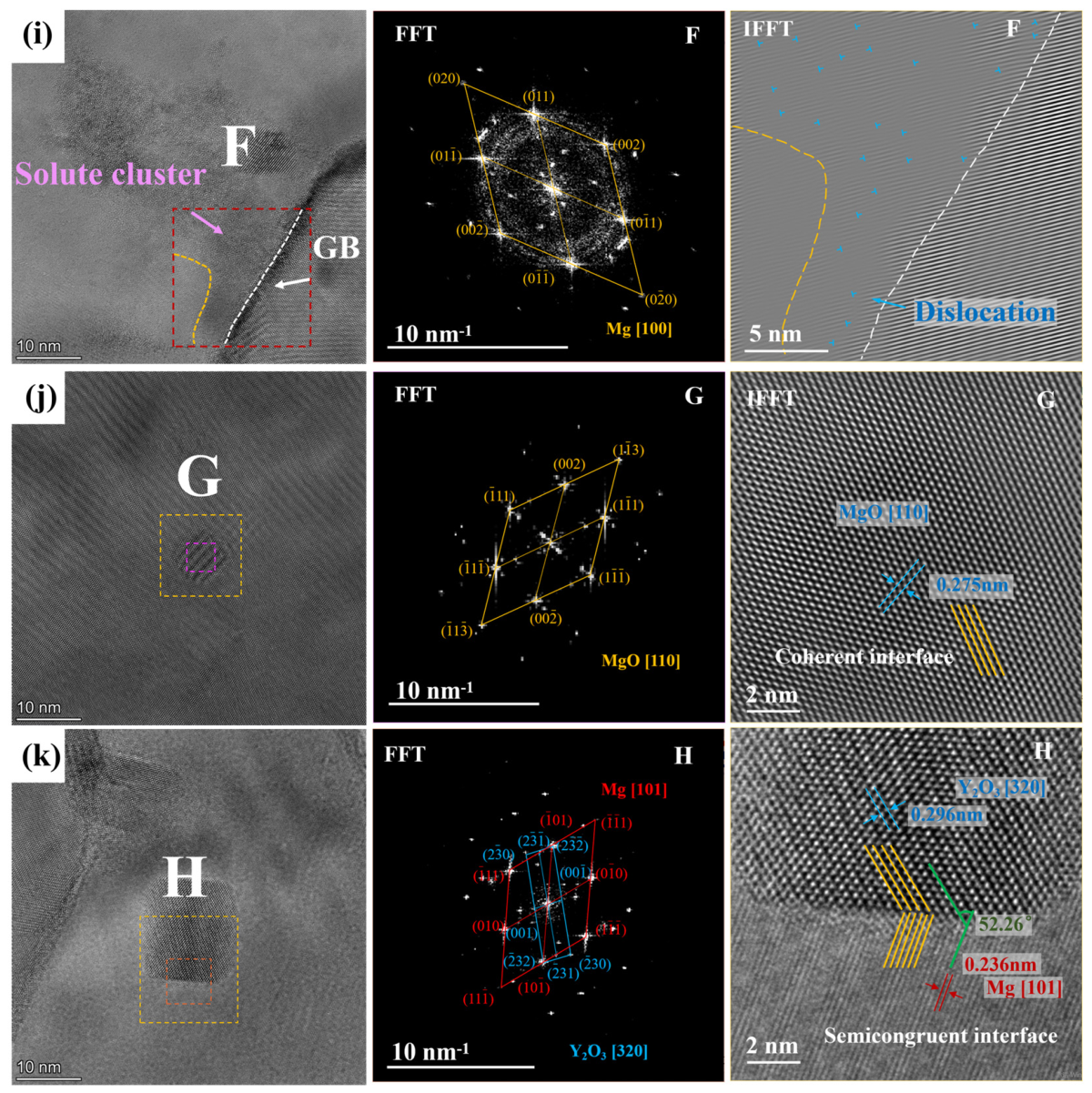
TEM, HRTEM, FFT/IFFT, and EDS characterization of RE-containing phases, solute clusters, and oxide particles in the WE43 magnesium alloy extruded at 350 °C: (a) TEM image and point EDS analysis of region A; (b) TEM image showing region B and the EDS line-scan path; (c) EDS spectrum acquired from region B; (d) corresponding EDS line-scan profiles; (e) TEM image showing regions D–F; (f) TEM image showing regions G and H; (g,h) HRTEM images, FFT patterns, and IFFT-filtered images of the Mg24Y5 and Mg12Nd particles at regions D and E, respectively; (i) HRTEM, FFT, and IFFT analysis of the RE-rich solute cluster at region F; (j) HRTEM, FFT, and IFFT analysis of the coherent intragranular MgO nanoparticle at region G; (k) HRTEM, FFT, and IFFT analysis of the semi-coherent Y2O3 particle at region H. The colored boxes indicate the regions selected for the corresponding diffraction analyses, while the yellow dashed boxes mark the areas selected for FFT or IFFT analysis, as applicable. The yellow parallel lines in the IFFT images of regions D, E, G, and H highlight the lattice planes at the corresponding interfaces.
Based on the HRTEM images and corresponding FFT/IFFT analyses, the nanoscale particles in regions D and E are identified as Mg24Y5 and Mg12Nd, respectively (Figure 7g,h). Both particles maintain coherent interfaces with the α-Mg matrix. Figure 7i presents the RE-rich region at F. The corresponding FFT pattern contains only diffraction spots associated with the α-Mg matrix, while the IFFT-filtered image shows continuous matrix lattice planes across the enriched region. Therefore, this region is considered to consist of coherent RE solute-atom clusters containing Y, Nd, and Gd [33]. Local elastic lattice distortion and a high density of dislocations are observed around this cluster.
The approximately spherical nanoparticle at region G is identified as MgO based on its FFT pattern (Figure 7j). It is located within a grain interior and exhibits a coherent interface with the α-Mg matrix. This intragranular coherent MgO particle provides direct microstructural evidence consistent with the fragmentation of the original surface oxide films during MA and the subsequent dispersion of oxide fragments into the particle interiors. A separate particle at region H is identified as Y2O3 and forms a locally semi-coherent interface with the Mg matrix (Figure 7k). The coexistence of MgO and Y2O3 confirms that at least part of the O signal detected in Figure 5 and Figure 6 corresponds to crystalline oxide particles.
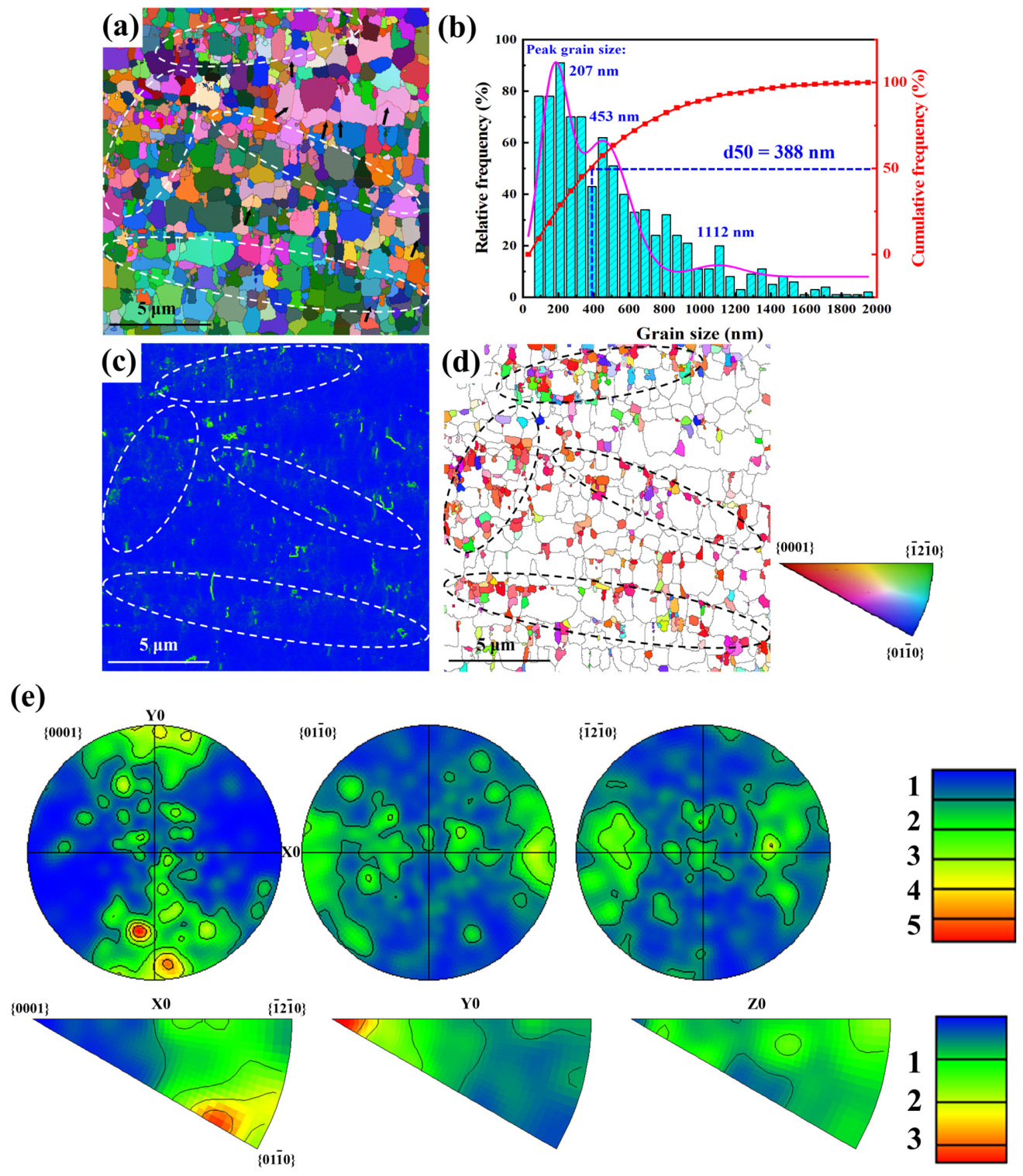
To further examine the grain-structural heterogeneity revealed by SEM and TEM, EBSD characterization was performed on the alloy extruded at 400 °C along the ED. As shown in Figure 8a, fine grains are distributed in an overall network-like configuration, whereas relatively coarse grains are located mainly within the interiors of the original powder particles. More specifically, the apparently overall network-like configuration is locally interrupted because plastic deformation and fragmentation of the PPBs during hot extrusion, together with newly formed interfaces surrounding the coarsened grains, separate the fine-grained regions into discontinuous segments. This spatial distribution corresponds well to the PPB-related network observed in Figure 5, indicating that the network morphology is associated with both RE-rich phases and a spatially heterogeneous grain-size distribution. Notably, red subgrain boundaries are retained within some relatively coarse grains, as indicated by the black arrows in Figure 8a. These internal low-angle boundaries are consistent with incomplete lattice rotation and boundary elimination during the coalescence of adjacent refined grains, providing microstructural evidence supporting rotation-assisted grain coalescence during subsequent grain growth.
Figure 8.
EBSD characterization of PM-EX400 on the longitudinal ED–TD section. The IPF colors are referenced to the extrusion direction (ED; X0 in the EBSD data coordinates): (a) IPF-X0 map showing the grain morphology and crystallographic orientation, with high-angle grain boundaries (HAGBs, >15°) and low-angle grain boundaries (LAGBs, 2–15°) shown as black and red lines, respectively; (b) grain-size distribution calculated using the equivalent-circle diameter, where the cyan bars represent the grain-size frequency distribution, the magenta curve represents the peak fit, and the red curve represents the cumulative frequency; (c) KAM map showing the local misorientation distribution; (d) IPF-X0 map displaying only grains with equivalent-circle diameters of d ≤ 388 nm, overlaid with the complete HAGB/LAGB network to reveal the spatial distribution of the relatively fine grains; and (e) pole figures and inverse pole figures obtained from the mapped area. The dashed ellipses in (a,c,d) outline the corresponding fine-grained regions, and the black arrows in (a) indicate representative LAGBs shown in red.
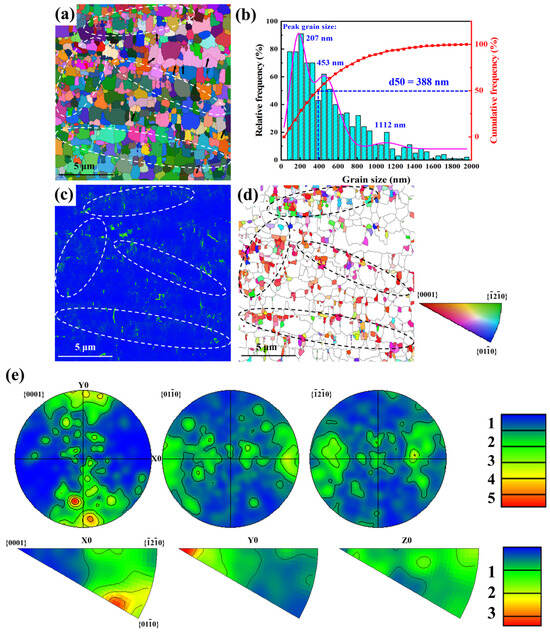
The grain-size distribution in Figure 8b is dominated by an ultrafine-grained population with a peak grain size of approximately 207 nm. Additional fitted components centered at approximately 453 and 1112 nm correspond to progressively coarsened grains, while the median grain size, d50, is approximately 388 nm and the largest grains approach 1900 nm. Thus, the grain-size distribution is broad and partially overlapping rather than consisting of two completely separated populations. Figure 8d displays only the fine grains in IPF colors, while the complete grain-boundary map is retained as an overlay. The colored fine grains are distributed along the PPB-associated regions and surround the uncolored, relatively coarse-grained particle interiors, thereby revealing an overall network-like configuration despite local discontinuities at the microscopic scale.
The powder had already developed a nanocrystalline or near-nanocrystalline matrix during MA [34]. During subsequent hot extrusion, grain-boundary migration and grain growth proceeded heterogeneously. Grain-boundary migration was restricted in the RE-enriched PPB regions by RE solute drag and particle pinning from RE-containing precipitates and locally retained oxide particles, whereas relatively rapid grain coalescence and growth occurred within the powder-particle interiors.
The KAM map in Figure 8c is predominantly characterized by low local misorientation, as indicated by the extensive blue regions. Nevertheless, localized misorientation gradients are observed along some PPB-associated interfaces between the fine- and relatively coarse-grained regions. These localized features are consistent with lattice curvature and local strain incompatibility near the heterogeneous interfaces. The spatial variation in precipitate size between the relatively fine- and coarse-grained regions may further enhance local deformation incompatibility and thereby contribute to back-stress strengthening [35]. However, KAM does not directly measure back stress or independently quantify an HDI strengthening contribution. Considering the relatively modest grain-size contrast, the contribution of the heterogeneous grain structure is therefore regarded as a possible secondary contribution to local strain accommodation rather than the dominant strengthening mechanism.
The overall pole figures and inverse pole figures in Figure 8e exhibit maximum texture intensities of approximately 5 and 3 multiples of a random distribution, respectively, indicating a measurable but relatively dispersed crystallographic orientation preference. Previous studies have shown that RE additions can weaken the conventional basal texture and restrict grain growth during annealing of Mg alloys [36]. However, neither the IPF maps nor the crystallographic-orientation analysis reveal a clear and systematic orientation contrast between the fine-grained network and the relatively coarse-grained particle interiors. Accordingly, a separate texture-mediated strengthening contribution associated with an inter-regional orientation contrast was not included in the present analysis.
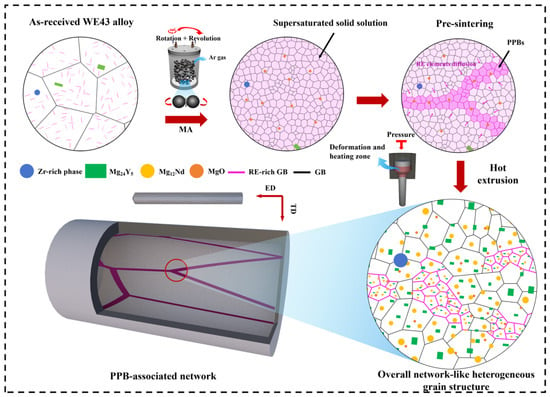
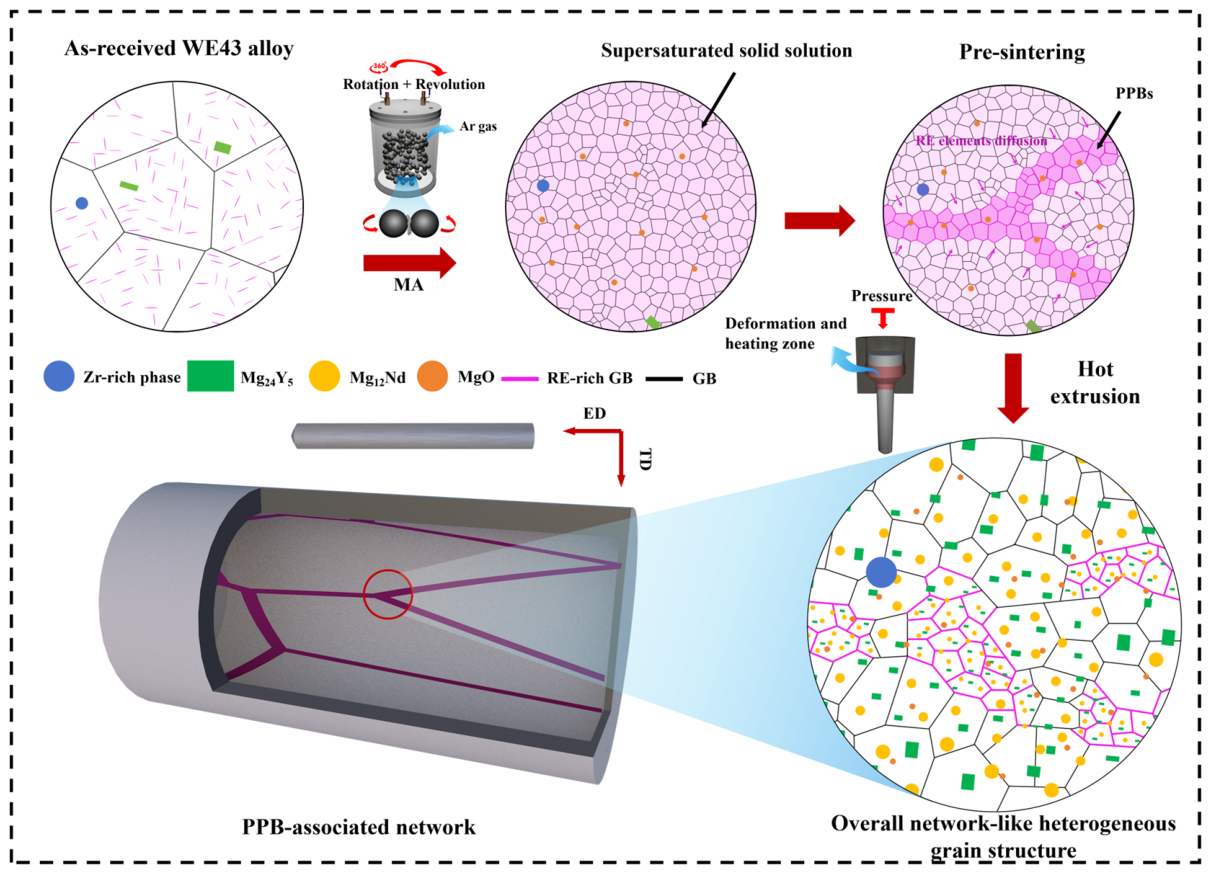
Based on the SEM, TEM/HRTEM, EDS, and EBSD observations, the formation of the network-like heterogeneous grain structure is associated with oxide redistribution during mechanical alloying, RE redistribution and local retention of oxygen-bearing species during the pre-sintering stage, and spatially heterogeneous grain-growth behavior during subsequent hot extrusion and cooling, as schematically illustrated in Figure 9. During MA, the original RE-containing phases are fragmented and partially dissolved into the α-Mg matrix, producing a supersaturated Mg-RE solid solution with a high density of defects. Meanwhile, the oxygen-bearing surface films on the machined chips are disrupted and redistributed throughout the powder. The intragranular coherent MgO nanoparticle identified in Figure 7j provides evidence consistent with the effective dispersion of the fragmented oxide films, whereas the O maps in Figure 5 and Figure 6 show that a smaller fraction of oxygen-rich species remains associated with PPBs and grain-boundary regions.
Figure 9.
Schematic illustration of microstructural evolution during mechanical alloying, pre-sintering, hot extrusion, and subsequent cooling, showing RE redistribution during pre-sintering, partial oxide dispersion and local retention, and spatially heterogeneous grain-growth behavior.
Because the MA powder already possesses a nanocrystalline matrix, the subsequent microstructural evolution during hot extrusion is governed primarily by grain-boundary migration, grain coalescence, and grain growth. During pre-sintering, the inherited PPBs provide high-defect-density and high-interfacial-energy regions and consequently act as rapid diffusion paths and preferential sinks for RE solutes. RE segregation is inferred to occur primarily during the pre-sintering stage before hot extrusion, whereas precipitation and further microstructural evolution proceed during subsequent hot extrusion and cooling. The oxygen-rich remnants at the PPBs may provide an additional interfacial contribution to RE accumulation during pre-sintering. This interpretation is consistent with the reported redistribution of Y and Nd toward powder-particle boundaries and the concurrent destabilization of surface oxide shells during Mg-RE powder consolidation [32]. Nevertheless, the present spatial correlation does not establish a direct causal relationship between oxygen enrichment and RE segregation.
The retention of the fine-grained PPB regions is therefore not attributed solely to RE segregation. During subsequent hot extrusion, the pre-established RE-rich PPB regions supply solutes to adjacent grain boundaries, where RE solutes reduce grain-boundary mobility through solute drag, while RE-containing precipitates and locally retained oxide particles impede boundary migration through particle pinning. These combined effects suppress grain-boundary migration and grain coalescence in the PPB regions, thereby retaining the network-like distribution of ultrafine-grained regions along the PPBs. In contrast, the interiors of the original powder particles contain fewer interfacial solutes and pinning obstacles, permitting relatively rapid grain coalescence, boundary migration, and grain growth. The dispersed intragranular MgO nanoparticles further demonstrate that the surface oxides do not remain as continuous brittle PPB films and may additionally impede dislocation motion.
Consequently, the coupled effects of interfacial defect accumulation, pre-sintering-induced RE segregation, subsequent precipitation, oxide dispersion, locally retained oxygen-rich species, and spatially heterogeneous grain-boundary migration generate the final heterogeneity in grain size, particle size, and elemental distribution.
3.3. Mechanical Properties and Fracture Behavior
The compressive and tensile engineering stress–strain curves of the alloys extruded at different temperatures are presented in Figure 10a,c. Increasing the extrusion temperature from 300 °C to 400 °C reduces the compressive yield strength (CYS) from 558 MPa to 464 MPa and the ultimate compressive strength (UCS) from 568 MPa to 486 MPa. The 300—extruded sample shows the highest strength but insufficient ductility, which prevents stable plastic deformation during tensile testing and promotes premature fracture. As a result, the corresponding tensile data are considered unreliable. Such premature failure is frequently observed in high-strength magnesium alloys [37]. With increasing extrusion temperature from 325 °C to 400 °C, the tensile yield strength (YS) decreases from 486 to 396 MPa, and the ultimate tensile strength (UTS) decreases from 502 to 432 MPa, while the elongation to failure (EL) increases markedly from 1.1% to 7.9%.
Discontinuous yielding, characterized by an abrupt stress drop after initial yielding, can be associated with the ultrafine/nanocrystalline bimodal structure of the present alloy. When the grain size is refined to the ultrafine or even nanocrystalline scale, conventional dislocation slip is no longer the only operative deformation mechanism; grain-boundary sliding (GBS) and grain rotation may also participate in plastic deformation [38,39,40]. In this alloy, RE solute segregation at grain boundaries, together with dispersed nanoscale precipitates such as the β′ phase, can exert strong grain-boundary pinning through Zener pinning and solute drag [41]. Meanwhile, the high grain-boundary density in the ultrafine-grained regions further promotes grain-boundary-mediated deformation during plastic flow [38,39,40]. Once the applied stress reaches the critical level required to overcome this pinning effect, pinned grain boundaries may be rapidly activated, leading to abrupt grain-boundary sliding/rotation and producing the macroscopic stress drop associated with discontinuous yielding [39,40,42].
To ensure a meaningful comparison, the literature comparison was limited to bulk WE43 magnesium alloys [43,44,45,46,47,48,49,50,51,52,53,54,55,56,57,58,59,60] and other RE-containing magnesium alloys [61,62,63,64,65,66,67,68,69,70,71,72,73] without post-aging treatment (Figure 10e,f). Compared with these alloys, the present bulk alloy maintains good ductility while retaining a comparable strength level, indicating a favorable strength–ductility balance.
Figure 10.
Mechanical properties of WE43 magnesium alloy: (a,b) compressive stress–strain curves and CYS, UCS; (c,d) tensile stress–strain curves and YS, UTS, and elongation to failure (δ). The blue lines in (b,d) represent the corresponding compressive strain to failure and tensile elongation to failure, respectively; (e) comparison of tensile yield strength and elongation with literature-reported values for WE43 processed via alternative routes: CR (cold rolling); MR (warm rolling); HR (hot rolling); LPBF (laser powder bed fusion); LPBF-AT (LPBF as-fabricated followed by post-processing); AFSD (additive friction stir deposition); RS (rapid solidification); DBHR (bidirectional hot rolling); ECAP (equal-channel angular pressing); AR (as-rolled); MDF (multidirectional forging); MDC (metal disintegrating cutting); CMT (cold metal transfer); SCC (semi-solid casting); ABE (alternating bending deformation); MAD (mechanical alloying followed by diffusion bonding) Adapted from Refs. [43,44,45,46,47,48,49,50,51,52,53,54,55,56,57,58,59,60]; (f) comparative tensile YS of WE43 versus other commercial RE-containing Mg alloys (e.g., Mg-Gd, Mg-Y) Adapted from Refs. [61,62,63,64,65,66,67,68,69,70,71,72,73].
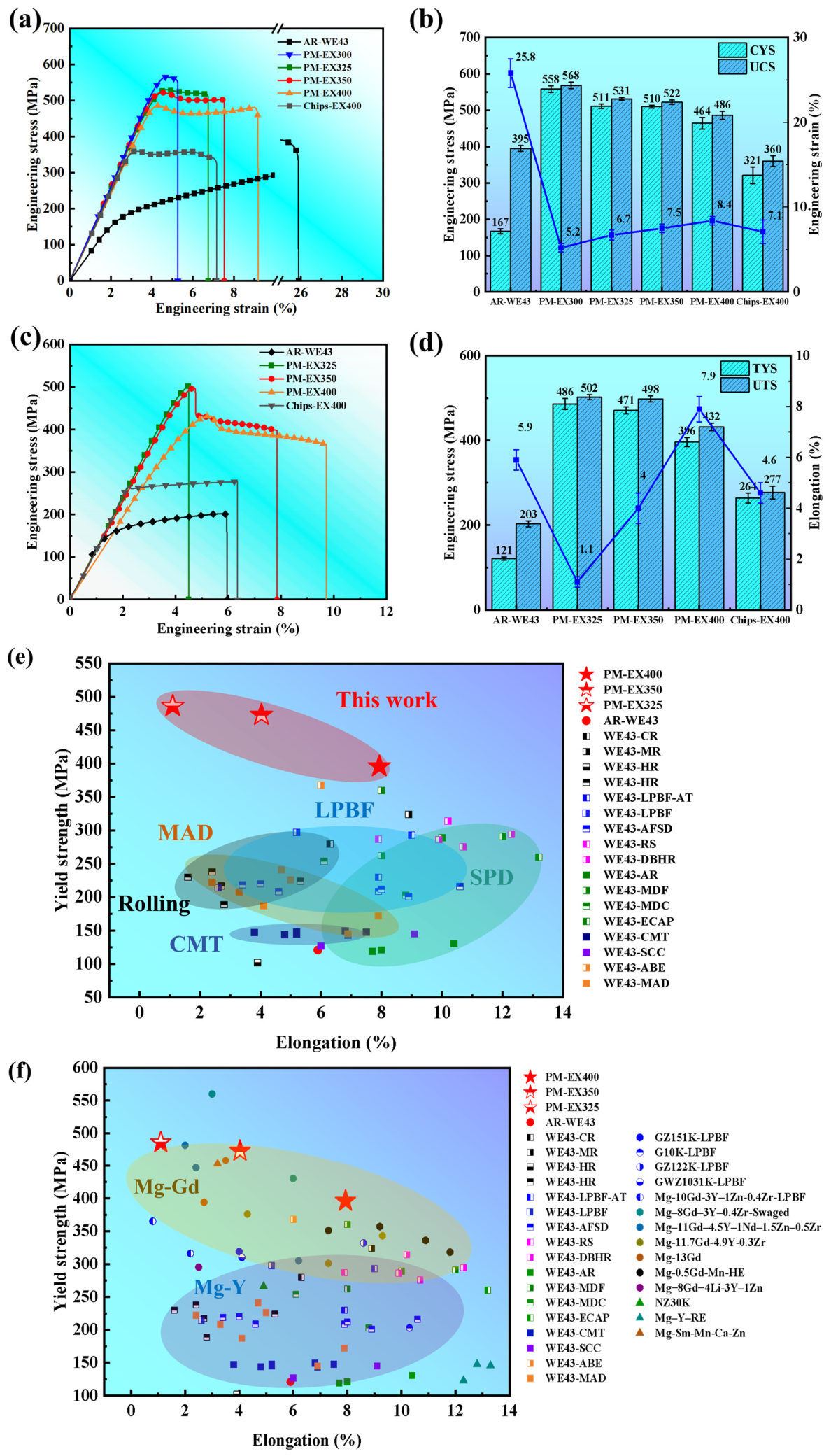
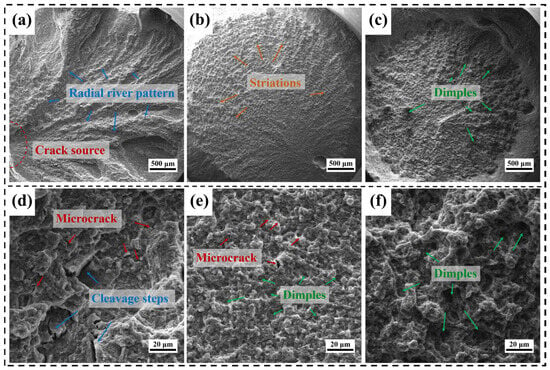
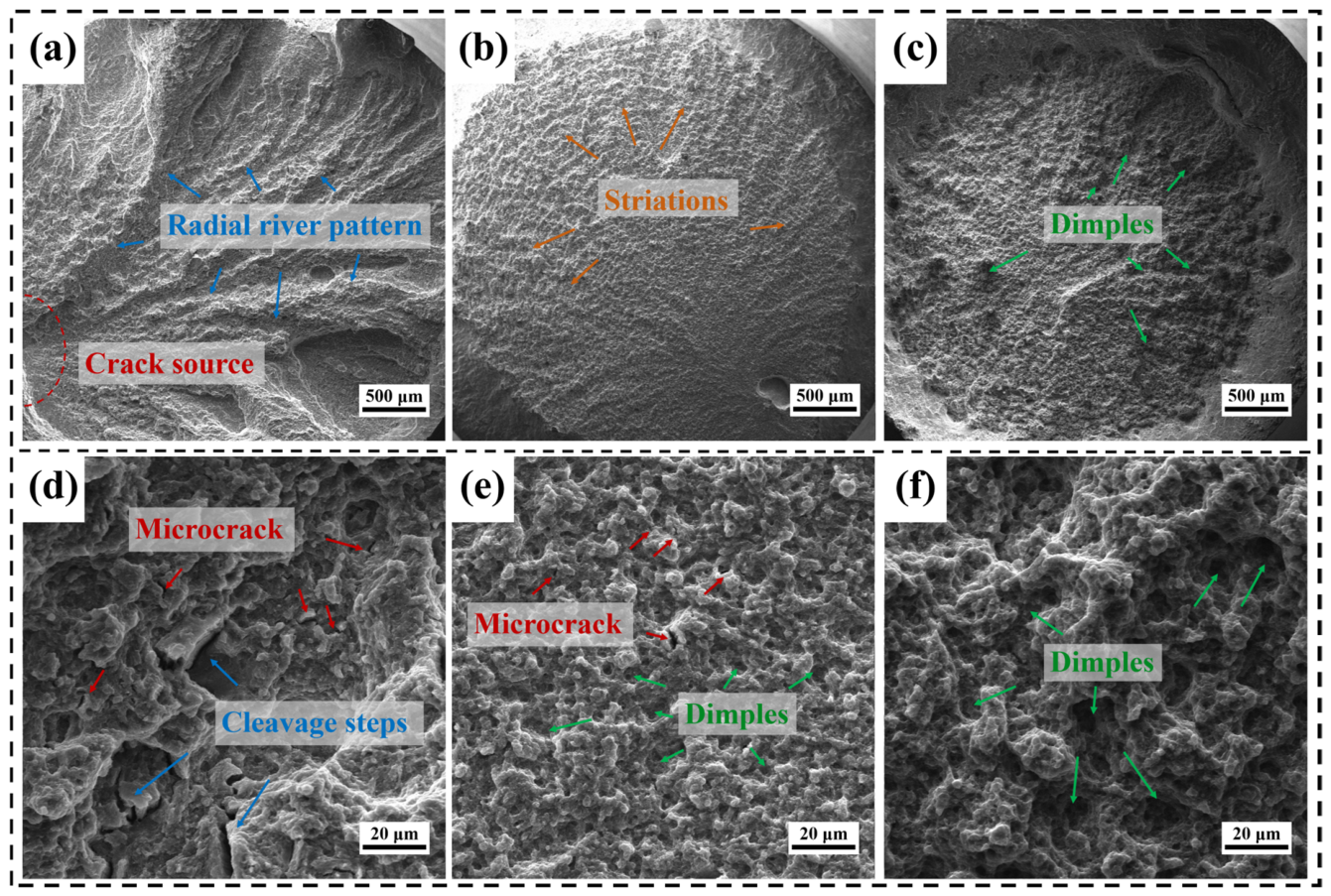
Figure 11 presents SEM images of the tensile fracture surfaces for alloys extruded at different temperatures. The fracture surface of the alloy extruded at 325 °C exhibits pronounced radial river patterns emanating from a crack-source region (Figure 11a). At higher magnification (Figure 11d), numerous microcracks and cleavage steps are observed, indicative of a predominantly brittle fracture mode. The alloy extruded at 350 °C shows a relatively flat and uniform fracture surface (Figure 11b). Higher-magnification images (Figure 11e) reveal a population of fine dimples, with substantially fewer microcracks than those observed in the 325—extruded alloy, suggesting a transition toward ductile fracture. In contrast, the fracture surface of the alloy extruded at 400 °C is characterized by numerous deep dimples (Figure 11f), a morphology typical of substantial plastic deformation and indicative of a ductile fracture mechanism.
Figure 11.
Representative SEM fractographs of (a,d) PM-EX325, (b,e) PM-EX350, and (c,f) PM-EX400 tensile specimens: (a–c) low-magnification views showing the overall fracture-surface morphologies; and (d–f) corresponding high-magnification views showing cleavage steps, microcracks, and dimples.
The transition from cleavage-dominated fracture to dimple-dominated fracture with increasing extrusion temperature indicates improved plastic-strain accommodation prior to failure. This improvement is primarily associated with grain coarsening at elevated extrusion temperatures, which reduces the grain-boundary density and facilitates dislocation-mediated plastic deformation. The more spatially developed network-like heterogeneous structure may also contribute to local strain redistribution. However, the present post-mortem fractographic observations do not directly identify crack-initiation sites or independently determine the effects of RE-enriched PPB regions and nanoscale precipitates on crack initiation and propagation. Further local or in situ characterization is therefore required to clarify their specific roles in the fracture process.
3.4. Mechanisms Underlying Strength–Ductility Synergy
To quantitatively evaluate the origin of the yield strength, the calculated yield strength was expressed as the sum of the explicitly modeled contributions from intrinsic lattice resistance, grain boundaries, solid-solution atoms, precipitates, and dislocations:
where is the measured yield strength, denotes the intrinsic matrix strength of pure Mg, and , , , , represent the strengthening contributions from grain boundaries, solid solution, precipitates and the dislocations respectively. Here, denotes the difference between the measured yield strength and the sum of the explicitly modeled contributions and is not assigned a priori to a single strengthening mechanism. This equation provides the general framework for the following quantitative analysis, in which the individual strengthening terms are evaluated separately.
The 350—extruded WE43 alloy was selected for quantitative analysis because it exhibits a good combination of high strength and measurable ductility. In addition, its bimodal grain structure and precipitate distribution can be clearly resolved, making it suitable for evaluating the individual strengthening contributions.
The grain-boundary strengthening contribution, , was estimated using the Hall–Petch relationship [27]:
The Hall–Petch coefficient for Mg polycrystals was taken as = 40.7 MPa⋅µm1/2 [27], where is the grain size. The strengthening contributions from the CG and FG regions were calculated separately and then averaged using the rule of mixtures [74]:
In the bimodal grain size distribution histogram, the trough value between the two peaks serves as an objective criterion to distinguish fine-grain and coarse-grain regions [75]. For the alloy extruded at 350 °C, the CG region accounts for 71 vol.% with an average grain size of 299 nm, whereas the FG region accounts for 29 vol.% with an average grain size of 144 nm. Therefore, the grain refinement strengthening contribution () is approximately 84 MPa.
For solid-solution strengthening, the yield strength increment () can be quantitatively estimated using the following empirical relation [76]:
here, denotes the dimensionless atomic fraction of solute element in the Mg-rich matrix, and is the empirical concentration exponent, taken as 2/3 for the present calculation. The strengthening coefficients were taken as 1168 MPa for Gd and 1249 MPa for Y [77]. Because Ref. [77] does not provide a corresponding coefficient for Nd, the coefficient for Nd was approximated using the value reported for Y; this assumption is included in the uncertainty of the model. The EDS-derived concentrations of 1.56 at.% Gd, 0.28 at.% Y, and 1.18 at.% Nd were converted to atomic fractions of 0.0156, 0.0028, and 0.0118, respectively, before substitution into Equation (4). The resulting solid-solution strengthening contribution is approximately 116.8 MPa.
Precipitation strengthening is generally one of the dominant strengthening mechanisms in RE-containing Mg alloys [78,79,80,81]. In the present alloy, nanoscale precipitates were observed within the grain interiors. Although some fine coherent precipitates may be shearable, the Orowan bypassing model was adopted as a first-order approximation because these precipitates are densely distributed and can act as strong obstacles to dislocation motion [47,82]:
where is the shear modulus (~17 GPa for magnesium) [83], and is the magnitude of the Burgers vector (0.321 nm for magnesium). Here, denotes the average particle diameter, and denotes the average planar interparticle spacing. Based on TEM statistics, the small precipitates in the 350—extruded alloy have = 9.2 nm and = 13.62 nm, corresponding to = 138.1 MPa. The large precipitates were simplified as isolated obstacles, with = 97.1 nm and = 108.4 nm, giving = 32.8 MPa.
For the 350—extruded alloy, TEM statistics indicate that large-sized precipitates are preferentially formed within grains larger than approximately 344 nm, whereas grains smaller than this threshold mainly contain small nanoscale precipitates. Therefore, the area fractions of grains larger and smaller than 344 nm were used as first-order estimates of the spatial fractions of the large- and small-sized precipitate populations, giving 18.6% and 81.4%, respectively. Their Orowan strengthening contributions were therefore weighted by volume fraction using the modified model proposed by Lyu et al. [84]:
here represents the strengthening contribution from precipitates; = 1, 2 denotes the two precipitate populations with different sizes; is the volume fraction of the -th precipitate population; = is the total volume fraction of precipitates; is the shear modulus of the matrix; is the Burgers vector; is Poisson’s ratio; is the average inter-precipitate spacing on the slip plane; is the effective size of the -th precipitate population on the slip plane; and is the dislocation core cut-off radius, which is usually taken as = . Therefore, the precipitation strengthening contribution () is approximately 118.5 MPa.
Coherent RE solute clusters distributed in the matrix can act as effective barriers to dislocation motion without causing severe interfacial stress concentration, thereby providing additional strengthening [85]. These clusters may also promote more uniform local deformation and suppress plastic instability, contributing to the strength–ductility synergy [86]. However, these effects are considered secondary and were not included in the quantitative precipitation-strengthening calculation.
The dislocation strengthening contribution was calculated using the Taylor relationship [74]:
where is the average dislocation density estimated from XRD peak broadening. For the alloy extruded at 350 °C, the dislocation density was calculated from XRD peak broadening using the UDEDM-modified Williamson-Hall method [87]. The dislocation density used in the strengthening calculation is 5.61 × 10¹⁴ m−2. is a constant with a value of approximately 0.2. is the Taylor factor, which is taken as 2.6 in the present simplified approach [88]. The calculated contribution from dislocation strengthening () is 67 MPa.
Based on the above calculations, the contributions from grain-boundary, solid-solution, precipitation, and dislocation strengthening are approximately 84, 116.8, 118.5, and 67 MPa, respectively. Together with the intrinsic lattice resistance of pure Mg = 21 MPa, the explicitly modeled terms give a calculated yield strength of approximately 407.3 MPa.
For the alloy extruded at 350 °C, the experimentally measured yield strength is approximately 471.0 MPa, giving = 63.7 MPa. This residual may contain uncertainties associated with the simplified strengthening models and unresolved contributions from heterogeneous interfaces, solute clusters, oxide nanoparticles, local crystallographic texture, and possible strain-gradient effects.
4. Conclusions
A WE43 magnesium alloy with an in situ network-like bimodal structure was fabricated through mechanical alloying and hot extrusion. The main conclusions are as follows:
- Mechanical alloying fragmented and partially dissolved the original RE-containing phases and introduced a high density of defects, producing a nanocrystalline Mg-RE supersaturated solid solution. It also disrupted the surface oxide films and dispersed the oxide fragments, as supported by the intragranular coherent MgO nanoparticles, although a small fraction of oxygen-rich constituents remained locally at PPBs and grain boundaries.
- During the pre-sintering stage before hot extrusion, RE solutes redistributed preferentially toward the defect-rich PPBs, while a fraction of oxygen-bearing species was locally retained at PPBs and grain boundaries; local oxygen enrichment is proposed only as a possible contributing factor to RE segregation. During subsequent hot extrusion and cooling, the pre-established RE-rich PPB regions supplied solutes to adjacent grain boundaries, where solute drag, together with particle pinning by RE-containing precipitates and retained oxides, suppressed grain-boundary migration and retained the network-like distribution of fine-grained regions along the PPBs. In contrast, relatively rapid grain coalescence and growth occurred within the particle interiors, producing coupled heterogeneity in grain size, particle size, and elemental distribution.
- The extruded alloy exhibited a favorable strength–ductility balance. The 400—extruded alloy achieved a yield strength of 396 MPa, an ultimate tensile strength of 432 MPa, and an elongation to failure of 7.9%. The increase in ductility with extrusion temperature is primarily associated with grain growth and enhanced dislocation-mediated plasticity, while the network-like heterogeneous structure may additionally contribute to local strain accommodation.
- Quantitative strengthening analysis of the alloy extruded at 350 °C showed that precipitation, solid-solution, grain-boundary, and dislocation strengthening contributed approximately 118.5, 116.8, 84, and 67 MPa, respectively. Together with an intrinsic lattice resistance of 21 MPa, these explicitly modeled terms gave a calculated yield strength of approximately 407.3 MPa, compared with the experimentally measured value of approximately 471.0 MPa. The remaining difference of 63.7 MPa was treated as an unresolved residual.
Author Contributions
Conceptualization, Q.S., P.Z. and Y.Y.; methodology, H.Y., J.Z., K.C., D.Z., X.F. and Y.Y.; validation, H.Y., Q.S., P.Z. and K.C.; formal analysis, H.Y., J.J. and D.Z.; investigation, G.C. and M.C.; resources, J.Z.; data curation, G.C.; writing—original draft preparation, G.C.; writing—review and editing, G.C., M.C., H.Y., J.Z., J.J., Q.S., P.Z., J.D., K.C., D.Z., X.F. and Y.Y.; visualization, M.C. and J.D.; supervision, J.Z., P.Z., X.F. and Y.Y.; funding acquisition, J.Z., J.J. and J.D. All authors have read and agreed to the published version of the manuscript.
Funding
This work was supported by the Shandong Provincial Natural Science Foundation (Grant No. ZR2024ME049), the Shandong Province Key Research and Development Plan (Grant Nos. 2025CXGC010309 and 2024CXPT053), the Shandong Laboratory of Aluminum Advanced Manufacturing in Binzhou Open Project (Grant No. SLAAMBOP2025ZD01), the Major innovation project for integrating science, education & industry of Qilu University of Technology (Shandong Academy of Sciences) (Grant Nos. 2025ZDZX09 and 2024GH06), the National Natural Science Foundation of China (Grant No. 52402123).
Data Availability Statement
The original contributions presented in this study are included in the article. Further inquiries can be directed to the corresponding authors.
Acknowledgments
The authors gratefully acknowledge the financial support provided by the Collaborative Innovation Center for Green Low-Carbon Materials of the Yellow River Basin for Ecological Conservation and High-Quality Development.
Conflicts of Interest
Author Junpeng Duan was employed by the company Weihai Wanfeng Magnesium Industry Science and Technology Development Co., Ltd. The remaining authors declare that the research was conducted in the absence of any commercial or financial relationships that could be construed as a potential conflict of interest.
References
- Xu, T.; Yang, Y.; Peng, X.; Song, J.; Pan, F. Overview of advancement and development trend on magnesium alloy. J. Magnes. Alloys 2019, 7, 536–544. [Google Scholar] [CrossRef] [Scilit]
- Bai, J.; Yang, Y.; Wen, C.; Chen, J.; Zhou, G.; Jiang, B.; Peng, X.; Pan, F. Applications of magnesium alloys for aerospace: A review. J. Magnes. Alloys 2023, 11, 3609–3619. [Google Scholar] [CrossRef] [Scilit]
- Mordike, B.L.; Ebert, T. Magnesium: Properties—Applications—Potential. Mater. Sci. Eng. A 2001, 302, 37–45. [Google Scholar] [CrossRef] [Scilit]
- Joost, W.J.; Krajewski, P.E. Towards magnesium alloys for high-volume automotive applications. Scr. Mater. 2017, 128, 107–112. [Google Scholar] [CrossRef] [Scilit]
- Ruano, O.A.; Álvarez-Leal, M.; Orozco-Caballero, A.; Carreño, F. Superplasticity of a friction stir processed overaged WE54 magnesium alloy. J. Magnes. Alloys 2022, 10, 3156–3166. [Google Scholar] [CrossRef] [Scilit]
- Xiang, C.; Xu, Y.; Yang, Y.; Ding, H.; Wang, Z. Plastic deformation mechanisms and constitutive modeling of WE43 magnesium alloy at various strain rates and temperatures. J. Mater. Res. Technol. 2024, 29, 4110–4128. [Google Scholar] [CrossRef] [Scilit]
- Wang, L.; Zhan, S.; Ruan, Y.; Miao, T.; Hu, L. Influence of grain size on twinning behavior of WE43 magnesium alloy during room-temperature compression deformation. J. Rare Earths 2024, 42, 2285–2292. [Google Scholar] [CrossRef] [Scilit]
- Stanford, N.; Barnett, M.R. The origin of “rare earth” texture development in extruded Mg-based alloys and its effect on tensile ductility. Mater. Sci. Eng. A 2008, 496, 399–408. [Google Scholar] [CrossRef] [Scilit]
- Liu, W.; Liu, W.; Song, Z.; Zhang, Y.; Shuai, C.; Xie, T.; Hou, H.; Zhao, Y. Excellent strength-ductility balance of fully recrystallized fine-grained Mg-Y-Zn-Ni extrusion alloy with 14H-LPSO lamellas. Mater. Res. Lett. 2025, 13, 465–474. [Google Scholar] [CrossRef] [Scilit]
- Chen, X.; Zhang, J.; Wang, M.; Wang, W.; Zhao, D.; Huang, H.; Zhao, Q.; Xu, X.; Zhang, H.; Huang, G. Research progress of heterogeneous structure magnesium alloys: A review. J. Magnes. Alloys 2024, 12, 2147–2181. [Google Scholar] [CrossRef] [Scilit]
- Zhang, Y.; Rong, W.; Wu, Y.; Peng, L. Achieving ultra-high strength in Mg–Gd–Ag–Zr wrought alloy via bimodal-grained structure and enhanced precipitation. J. Mater. Sci. Technol. 2020, 54, 160–170. [Google Scholar] [CrossRef] [Scilit]
- Zhang, H.; Wang, H.; Wang, J.; Rong, J.; Zha, M.; Wang, C.; Ma, P.; Jiang, Q. The synergy effect of fine and coarse grains on enhanced ductility of bimodal-structured Mg alloys. J. Alloys Compd. 2019, 780, 312–317. [Google Scholar] [CrossRef] [Scilit]
- Zha, M.; Ma, X.; Jia, H.-L.; Hua, Z.-M.; Fan, Z.-X.; Yang, Z.-Z.; Gao, Y.-P.; Wang, H.-Y. Dynamic precipitation and deformation behaviors of a bimodal-grained WE43 alloy with enhanced mechanical properties. Int. J. Plast. 2023, 167, 103682. [Google Scholar] [CrossRef] [Scilit]
- Xu, C.; Nakata, T.; Qiao, X.G.; Jiang, H.S.; Sun, W.T.; Chi, Y.C.; Zheng, M.Y.; Kamado, S. Effect of extrusion parameters on microstructure and mechanical properties of Mg-7.5Gd-2.5Y-3.5Zn-0.9Ca-0.4Zr (wt%) alloy. Mater. Sci. Eng. A 2017, 685, 159–167. [Google Scholar] [CrossRef] [Scilit]
- Ren, J.-Y.; Ji, G.-C.; Guo, H.-R.; Zhou, Y.-M.; Tan, X.; Zheng, W.-F.; Xing, Q.; Zhang, J.-Y.; Sun, J.-R.; Yang, H.-Y.; et al. Nano-Enhanced Phase Reinforced Magnesium Matrix Composites: A Review of the Matrix, Reinforcement, Interface Design, Properties and Potential Applications. Materials 2024, 17, 2454. [Google Scholar] [CrossRef] [Scilit] [PubMed]
- Mondet, M.; Barraud, E.; Lemonnier, S.; Guyon, J.; Allain, N.; Grosdidier, T. Microstructure and mechanical properties of AZ91 magnesium alloy developed by Spark Plasma Sintering. Acta Mater. 2016, 119, 55–67. [Google Scholar] [CrossRef] [Scilit]
- Zemková, M.; Minárik, P.; Knapek, M.; Šašek, S.; Dittrich, J.; Král, R. Microstructure and Mechanical Strength of Attritor-Milled and Spark Plasma Sintered Mg-4Y-3Nd Alloy. Crystals 2020, 10, 574. [Google Scholar] [CrossRef] [Scilit]
- Zhang, X.; Qian, M.; Li, A.; Jia, Z.; Zhang, X.; Hu, X.; Geng, L. Synergistic strength–ductility enhancement in aluminum matrix composites via dual-heterostructure and martensitic phase transformation. J. Mater. Sci. Technol. 2026, 271, 1–13. [Google Scholar] [CrossRef] [Scilit]
- Březina, M.; Minda, J.; Doležal, P.; Krystýnová, M.; Fintová, S.; Zapletal, J.; Wasserbauer, J.; Ptáček, P. Characterization of Powder Metallurgy Processed Pure Magnesium Materials for Biomedical Applications. Metals 2017, 7, 461. [Google Scholar] [CrossRef] [Scilit]
- Soderlind, J.; Cihova, M.; Schäublin, R.; Risbud, S.; Löffler, J.F. Towards refining microstructures of biodegradable magnesium alloy WE43 by spark plasma sintering. Acta Biomater. 2019, 98, 67–80. [Google Scholar] [CrossRef] [Scilit] [PubMed]
- Dvorsky, D.; Kubasek, J.; Jablonska, E.; Kaufmanova, J.; Vojtech, D. Mechanical, corrosion and biological properties of advanced biodegradable Mg–MgF2 and WE43-MgF2 composite materials prepared by spark plasma sintering. J. Alloys Compd. 2020, 825, 154016. [Google Scholar] [CrossRef] [Scilit]
- Minárik, P.; Zemková, M.; Lukáč, F.; Bohlen, J.; Knapek, M.; Král, R. Microstructure of the novel biomedical Mg–4Y–3Nd alloy prepared by spark plasma sintering. J. Alloys Compd. 2020, 819, 153008. [Google Scholar] [CrossRef] [Scilit]
- Zhu, Y.M.; Liu, H.; Xu, Z.; Wang, Y.; Nie, J.F. Linear-chain configuration of precipitates in Mg–Nd alloys. Acta Mater. 2015, 83, 239–247. [Google Scholar] [CrossRef] [Scilit]
- Zhang, J.; Han, S.; Sun, Y.; Chen, X.; Chen, P.; Li, Z.; Huang, G.; Pan, F. Enhanced strength of WE43 magnesium-rare earth alloy via combining extrusion and aging. Mater. Sci. Eng. A 2023, 880, 145329. [Google Scholar] [CrossRef] [Scilit]
- Peng, Q.; Meng, J.; Li, Y.; Huang, Y.; Hort, N. Effect of yttrium addition on lattice parameter, Young’s modulus and vacancy of magnesium. Mater. Sci. Eng. A 2011, 528, 2106–2109. [Google Scholar] [CrossRef] [Scilit]
- Ding, H.; Shi, X.; Wang, Y.; Cheng, G.; Kamado, S. Texture weakening and ductility variation of Mg–2Zn alloy with CA or RE addition. Mater. Sci. Eng. A 2015, 645, 196–204. [Google Scholar] [CrossRef] [Scilit]
- Sun, W.; Wu, B.; Fu, H.; Yang, X.-S.; Qiao, X.; Zheng, M.; He, Y.; Lu, J.; Shi, S.-Q. Combining gradient structure and supersaturated solid solution to achieve superior mechanical properties in WE43 magnesium alloy. J. Mater. Sci. Technol. 2022, 99, 223–238. [Google Scholar] [CrossRef] [Scilit]
- Chen, J.; Cai, Z.; Bao, W.; Gao, T.; Xie, G. Outstanding strength-ductility balance in a Ti–N alloy by tuning ball milling time. J. Mater. Res. Technol. 2023, 27, 5128–5139. [Google Scholar] [CrossRef] [Scilit]
- Chen, G.; Song, J.; Yang, H.; Fan, J.; Liu, Y.; Xu, J.; Ouyang, S.; Hu, H.; Chen, X.; Pan, F. The microstructures and mechanical properties of low-cost Ti particles reinforced AZ81 composites. J. Mater. Res. Technol. 2024, 29, 3494–3507. [Google Scholar] [CrossRef] [Scilit]
- Dvorský, D.; Kubásek, J.; Vojtěch, D.; Čavojský, M. Advanced Mechanical and Corrosion Properties of WE43 Alloy Prepared by Powder Metallurgy. Acta Phys. Pol. A 2018, 134, 748–752. [Google Scholar] [CrossRef] [Scilit]
- Minárik, P.; Zemková, M.; Knapek, M.; Šašek, S.; Dittrich, J.; Lukáč, F.; Kozlík, J.; Král, R. Effect of Short Attritor-Milling of Magnesium Alloy Powder Prior to Spark Plasma Sintering. Materials 2020, 13, 3973. [Google Scholar] [CrossRef] [Scilit] [PubMed]
- Minárik, P.; Zemková, M.; Veselý, J.; Lukáč, F.; Bohlen, J.; Knapek, M.; Král, R. Synergic effect of high temperature and high pressure on consolidation of Mg-4Y-3Nd powder by spark plasma sintering. Mater. Lett. 2021, 292, 129647. [Google Scholar] [CrossRef] [Scilit]
- Mei, X.M.; Mei, Q.S.; Li, J.Y.; Li, C.L.; Wan, L.; Chen, F.; Chen, Z.H.; Xu, T.; Wang, Y.C.; Tan, Y.Y. Solid-state alloying of Al-Mg alloys by accumulative roll-bonding: Microstructure and properties. J. Mater. Sci. Technol. 2022, 125, 238–251. [Google Scholar] [CrossRef] [Scilit]
- Moldovan, D.; Wolf, D.; Phillpot, S.R.; Haslam, A.J. Role of grain rotation during grain growth in a columnar microstructure by mesoscale simulation. Acta Mater. 2002, 50, 3397–3414. [Google Scholar] [CrossRef] [Scilit]
- Vogt, R.; Zhang, Z.; Huskins, E.; Ahn, B.; Nutt, S.; Ramesh, K.T.; Lavernia, E.J.; Schoenung, J.M. High strain rate deformation and resultant damage mechanisms in ultrafine-grained aluminum matrix composites. Mater. Sci. Eng. A 2010, 527, 5990–5996. [Google Scholar] [CrossRef] [Scilit]
- Hantzsche, K.; Bohlen, J.; Wendt, J.; Kainer, K.U.; Yi, S.B.; Letzig, D. Effect of rare earth additions on microstructure and texture development of magnesium alloy sheets. Scr. Mater. 2010, 63, 725–730. [Google Scholar] [CrossRef] [Scilit]
- Zengin, H.; Ari, S.; Turan, M.E.; Hassel, A.W. Evolution of Microstructure, Mechanical Properties, and Corrosion Resistance of Mg–2.2Gd–2.2Zn–0.2Ca (wt%) Alloy by Extrusion at Various Temperatures. Materials 2023, 16, 3075. [Google Scholar] [CrossRef] [Scilit] [PubMed]
- Koike, J.; Ohyama, R.; Kobayashi, T.; Suzuki, M.; Maruyama, K. Grain-Boundary Sliding in AZ31 Magnesium Alloys at Room Temperature to 523 K. Mater. Trans. 2003, 44, 445–451. [Google Scholar] [CrossRef] [Scilit]
- Edalati, K.; Masuda, T.; Arita, M.; Furui, M.; Sauvage, X.; Horita, Z.; Valiev, R.Z. Room-Temperature Superplasticity in an Ultrafine-Grained Magnesium Alloy. Sci. Rep. 2017, 7, 2662. [Google Scholar] [CrossRef] [Scilit] [PubMed]
- Zheng, R.; Bhattacharjee, T.; Gao, S.; Gong, W.; Shibata, A.; Sasaki, T.; Hono, K.; Tsuji, N. Change of Deformation Mechanisms Leading to High Strength and Large Ductility in Mg-Zn-Zr-Ca Alloy with Fully Recrystallized Ultrafine Grained Microstructures. Sci. Rep. 2019, 9, 11702. [Google Scholar] [CrossRef] [Scilit] [PubMed]
- Chi, Y.Q.; Zhou, X.H.; Xu, C.; Sun, D.; Qiao, X.G.; Brokmeier, H.G.; Zheng, M.Y. The origin of discontinuous yielding in Mg alloys under slip-dominated condition studied by in-situ synchrotron diffraction and elastic-viscoplastic self-consistent modeling. Mater. Sci. Eng. A 2019, 754, 562–568. [Google Scholar] [CrossRef] [Scilit]
- Drozdenko, D.; Fekete, K.; Dobroň, P.; Knapek, M.; Máthis, K.; Minárik, P.; Yamasaki, M.; Kawamura, Y. The yield point phenomenon in ultrafine-grained dilute Mg-Zn-Y alloys. Mater. Lett. 2023, 330, 133315. [Google Scholar] [CrossRef] [Scilit]
- Zhou, L.; Huang, T.; Ren, G.; Wang, Z.; Wang, F.; Wei, Z.; Mao, P.; Liu, Z. Microstructural, Mechanical, and Damping Properties of WE43 Alloy. JOM 2025, 77, 3723–3735. [Google Scholar] [CrossRef] [Scilit]
- Li, Q.; Yan, H.; Liu, H.; Chen, R. Dynamic recrystallization mechanism and near-isotropic mechanical properties of WE43 magnesium alloy sheets rolled at different temperatures. Mater. Charact. 2022, 193, 112259. [Google Scholar] [CrossRef] [Scilit]
- Yang, J.; Zhai, Y.; Kang, T.; Fu, M.; Wang, S.; Liu, X.; Zhou, S.; Xie, W.; Wang, W.; Liu, X. Evolution of the microstructure and mechanical properties of WE43 magnesium alloy during multipass hot rolling. Int. J. Miner. Metall. Mater. 2025, 32, 1681–1692. [Google Scholar] [CrossRef] [Scilit]
- Deng, B.; Dai, Y.; Lin, J.; Zhang, D. Effect of Rolling Treatment on Microstructure, Mechanical Properties, and Corrosion Properties of WE43 Alloy. Materials 2022, 15, 3985. [Google Scholar] [CrossRef] [Scilit] [PubMed]
- Chen, W.; Yin, B.; Li, K.; Liao, R.; Li, B.; Huang, H.; Wu, Y.; Wen, P.; Jiang, B.; Pan, F. Superstrengthening effect of beyond-solid-solution laser powder bed fused WE43 magnesium alloy triggered by direct aging treatment. Addit. Manuf. 2024, 89, 104287. [Google Scholar] [CrossRef] [Scilit]
- Hyer, H.; Zhou, L.; Benson, G.; McWilliams, B.; Cho, K.; Sohn, Y. Additive manufacturing of dense WE43 Mg alloy by laser powder bed fusion. Addit. Manuf. 2020, 33, 101123. [Google Scholar] [CrossRef] [Scilit]
- Jin, Z.; Mao, P.; Lu, P.; Wei, Z.; Zhou, L.; Wang, Z.; Wang, F.; Liu, Z. High strain rate deformation mechanism of extruded WE43 magnesium alloy at room temperature and 400 °C. J. Alloys Compd. 2025, 1030, 180692. [Google Scholar] [CrossRef] [Scilit]
- Chen, F.; Cai, X.; Dong, B.; Lin, S. Effect of process modes on microstructure and mechanical properties of CMT wire arc additive manufactured WE43 magnesium alloy. J. Mater. Res. Technol. 2023, 27, 2089–2101. [Google Scholar] [CrossRef] [Scilit]
- Kang, Y.H.; Huang, Z.H.; Wang, S.C.; Yan, H.; Chen, R.S.; Huang, J.C. Effect of pre-deformation on microstructure and mechanical properties of WE43 magnesium alloy II: Aging at 250 and 300 °C. J. Magnes. Alloys 2020, 8, 103–110. [Google Scholar] [CrossRef] [Scilit]
- Chai, F.; Feng, J.; Han, X.; Ma, Z.; Hu, X.; Hua, L. Uncovering the influence of deformation amount on microstructure evolution and mechanical behavior of the multi-DoF formed WE43 magnesium alloy. J. Mater. Res. Technol. 2024, 33, 7029–7039. [Google Scholar] [CrossRef] [Scilit]
- Jiang, H.S.; Zheng, M.Y.; Qiao, X.G.; Wu, K.; Peng, Q.Y.; Yang, S.H.; Yuan, Y.H.; Luo, J.H. Microstructure and mechanical properties of WE43 magnesium alloy fabricated by direct-chill casting. Mater. Sci. Eng. A 2017, 684, 158–164. [Google Scholar] [CrossRef] [Scilit]
- Bian, J.; Yu, B.; Hao, J.; Zhu, H.; Wu, H.; Chen, B.; Li, W.; Li, Y.; Zheng, L.; Li, R. Improvement of microstructure, mechanical properties, and corrosion resistance of WE43 alloy by squeeze casting. China Foundry 2022, 19, 419–426. [Google Scholar] [CrossRef] [Scilit]
- Asqardoust, S.; Zarei Hanzaki, A.; Abedi, H.R.; Krajnak, T.; Minárik, P. Enhancing the strength and ductility in accumulative back extruded WE43 magnesium alloy through achieving bimodal grain size distribution and texture weakening. Mater. Sci. Eng. A 2017, 698, 218–229. [Google Scholar] [CrossRef] [Scilit]
- Sun, M.; Pei, L.; Shi, D.; Yang, D.; Li, D. A systematic study on hot-rolled high-strength WE43 Mg-RE alloy: Formability, microstructures, mechanical properties, and strengthening mechanism. J. Mater. Res. Technol. 2025, 38, 6096–6111. [Google Scholar] [CrossRef] [Scilit]
- Dong, X.; Zhou, M.; Han, Y.; Zhu, Y.; He, D.; Geng, Y.; Lei, Z.; Chen, G.; Wu, R.; Shi, Q. Additive friction stir deposition of WE43: The influence of rotation speed on microstructure, mechanical and corrosion properties. J. Mater. Res. Technol. 2025, 36, 1585–1596. [Google Scholar] [CrossRef] [Scilit]
- Sun, L.; Liu, C.; Zhang, R.; Wang, Y.; Zhang, M.; Liu, X.; Zhong, L. Strength-ductility synergistic heterogeneous lamella-structured Mg alloy prepared by hot rolling combined with diffusion bonding. J. Alloys Compd. 2025, 1036, 181715. [Google Scholar] [CrossRef] [Scilit]
- Ji, C.; Li, K.; Zhu, L.; Yin, B.; Murr, L.E.; Wen, S.; Song, B.; Wen, P.; Jiang, B.; Pan, F. Achieving outstanding room and elevated temperature strength of additively manufactured WE43 alloy via synergistic effects of nano-spaced stacking faults and precipitates. J. Alloys Compd. 2025, 1022, 179880. [Google Scholar] [CrossRef] [Scilit]
- Bär, F.; Berger, L.; Jauer, L.; Kurtuldu, G.; Schäublin, R.; Schleifenbaum, J.H.; Löffler, J.F. Laser additive manufacturing of biodegradable magnesium alloy WE43: A detailed microstructure analysis. Acta Biomater. 2019, 98, 36–49. [Google Scholar] [CrossRef] [Scilit] [PubMed]
- Dong, B.; Chai, J.; Wu, G.; Zhang, H.; Zhang, Z.; Yu, J.; Xue, Y.; Meng, M. Dynamic recrystallization behavior and strengthening mechanism of Mg–Gd–Y–Zn–Zr alloy during isothermal MDF process. J. Mater. Res. Technol. 2022, 21, 1419–1433. [Google Scholar] [CrossRef] [Scilit]
- Martynenko, N.; Lukyanova, E.; Anisimova, N.; Kiselevskiy, M.; Serebryany, V.; Yurchenko, N.; Raab, G.; Birbilis, N.; Salishchev, G.; Dobatkin, S.; et al. Improving the property profile of a bioresorbable Mg-Y-Nd-Zr alloy by deformation treatments. Materialia 2020, 13, 100841. [Google Scholar] [CrossRef] [Scilit]
- Luo, K.; Zhang, L.; Wu, G.; Liu, W.; Ding, W. Effect of Y and Gd content on the microstructure and mechanical properties of Mg–Y–RE alloys. J. Magnes. Alloys 2019, 7, 345–354. [Google Scholar] [CrossRef] [Scilit]
- Deng, Q.; Chen, F.; Wang, L.; Liu, Z.; Wu, Q.; Chang, Z.; Wu, Y.; Yan, W.; Peng, L.; Ding, W. Exceptional strength paired with increased cold cracking susceptibility in laser powder bed fusion of a Mg-RE alloy. J. Mater. Sci. Technol. 2025, 213, 300–314. [Google Scholar] [CrossRef] [Scilit]
- Deng, Q.; Zhang, Y.; Liu, Z.; Chang, Z.; Su, N.; Wu, Y.; Hao, L.; Peng, L.; Ding, W. Laser powder bed fusion of an age-hardenable Mg-10Gd-0.2Zr alloy with excellent strength-ductility synergy. J. Alloys Compd. 2022, 910, 164863. [Google Scholar] [CrossRef] [Scilit]
- Xu, W.; Fu, P.; Wang, N.; Yang, L.; Peng, L.; Chen, J.; Ding, W. Effects of processing parameters on fabrication defects, microstructure and mechanical properties of additive manufactured Mg–Nd–Zn–Zr alloy by selective laser melting process. J. Magnes. Alloys 2024, 12, 2249–2266. [Google Scholar] [CrossRef] [Scilit]
- Yu, Z.; Xu, X.; Mansoor, A.; Du, B.; Shi, K.; Liu, K.; Li, S.; Du, W. Precipitate characteristics and their effects on the mechanical properties of as-extruded Mg-Gd-Li-Y-Zn alloy. J. Mater. Sci. Technol. 2021, 88, 21–35. [Google Scholar] [CrossRef] [Scilit]
- Peng, P.; She, J.; Yang, Q.; Long, S.; Tang, A.; Zhang, J.; Dai, Q.; Pan, F. Bimodal grained Mg–0.5Gd–xMn alloys with high strength and low-cost fabricated by low-temperature extrusion. J. Alloys Compd. 2023, 935, 168008. [Google Scholar] [CrossRef] [Scilit]
- Yu, Z.; Xu, C.; Meng, J.; Kamado, S. Microstructure evolution and mechanical properties of a high strength Mg-11.7Gd-4.9Y-0.3Zr (wt%) alloy prepared by pre-deformation annealing, hot extrusion and ageing. Mater. Sci. Eng. A 2017, 703, 348–358. [Google Scholar] [CrossRef] [Scilit]
- Wan, Y.; Tang, B.; Gao, Y.; Tang, L.; Sha, G.; Zhang, B.; Liang, N.; Liu, C.; Jiang, S.; Chen, Z.; et al. Bulk nanocrystalline high-strength magnesium alloys prepared via rotary swaging. Acta Mater. 2020, 200, 274–286. [Google Scholar] [CrossRef] [Scilit]
- Yu, Z.; Huang, Y.; Qiu, X.; Wang, G.; Meng, F.; Hort, N.; Meng, J. Fabrication of a high strength Mg–11Gd–4.5Y–1Nd–1.5Zn–0.5Zr (wt%) alloy by thermomechanical treatments. Mater. Sci. Eng. A 2015, 622, 121–130. [Google Scholar] [CrossRef] [Scilit]
- Zhang, Z.; Zhang, J.; Xie, J.; Liu, S.; He, Y.; Guan, K.; Wu, R. Developing a low-alloyed fine-grained Mg alloy with high strength-ductility based on dislocation evolution and grain boundary segregation. Scr. Mater. 2022, 209, 114414. [Google Scholar] [CrossRef] [Scilit]
- Zhang, D.; Pan, H.; Pan, Z.; Zeng, Z.; Xie, D.; Tang, W.; Xie, H.; Li, R.; Qin, G. Unexpectedly high precipitation hardening induced by supersaturated solute and strong texture in a Mg-13Gd binary alloy after forging. Mater. Sci. Eng. A 2023, 872, 144984. [Google Scholar] [CrossRef] [Scilit]
- Huang, Y.; Sun, J.; Qi, F.; Wang, J.; Xu, Y.; Yu, J.; Guo, Y.; Wu, G.; Liu, W. Achieving strength-ductility synergy in Mg-Li alloy via heterogeneous structure and shearable precipitates. Acta Mater. 2026, 305, 121830. [Google Scholar] [CrossRef] [Scilit]
- Renaud, A.; Tie, B.; Mouronval, A.-S.; Schmitt, J.-H. Multi-parameter optimization of attenuation data for characterizing grain size distributions and application to bimodal microstructures. Ultrasonics 2021, 115, 106425. [Google Scholar] [CrossRef] [Scilit] [PubMed]
- Gypen, L.A.; Deruyttere, A. Multi-component solid solution hardening. J. Mater. Sci. 1977, 12, 1028–1033. [Google Scholar] [CrossRef] [Scilit]
- Gao, L.; Chen, R.S.; Han, E.H. Effects of rare-earth elements Gd and Y on the solid solution strengthening of Mg alloys. J. Alloys Compd. 2009, 481, 379–384. [Google Scholar] [CrossRef] [Scilit]
- Xiang, C.; Gupta, N.; Coelho, P.; Cho, K. Effect of microstructure on tensile and compressive behavior of WE43 alloy in as cast and heat treated conditions. Mater. Sci. Eng. A 2018, 710, 74–85. [Google Scholar] [CrossRef] [Scilit]
- Mengucci, P.; Barucca, G.; Riontino, G.; Lussana, D.; Massazza, M.; Ferragut, R.; Aly, E.H. Structure evolution of a WE43 Mg alloy submitted to different thermal treatments. Mater. Sci. Eng. A 2008, 479, 37–44. [Google Scholar] [CrossRef] [Scilit]
- Jahedi, M.; McWilliams, B.A.; Knezevic, M. Deformation and fracture mechanisms in WE43 magnesium-rare earth alloy fabricated by direct-chill casting and rolling. Mater. Sci. Eng. A 2018, 726, 194–207. [Google Scholar] [CrossRef] [Scilit]
- Hidalgo-Manrique, P.; Robson, J.D.; Pérez-Prado, M.T. Precipitation strengthening and reversed yield stress asymmetry in Mg alloys containing rare-earth elements: A quantitative study. Acta Mater. 2017, 124, 456–467. [Google Scholar] [CrossRef] [Scilit]
- Zhang, Z.; Chen, D.L. Consideration of Orowan strengthening effect in particulate-reinforced metal matrix nanocomposites: A model for predicting their yield strength. Scr. Mater. 2006, 54, 1321–1326. [Google Scholar] [CrossRef] [Scilit]
- Chang, Y.; Kochmann, D.M. A variational constitutive model for slip-twinning interactions in hcp metals: Application to single- and polycrystalline magnesium. Int. J. Plast. 2015, 73, 39–61. [Google Scholar] [CrossRef] [Scilit]
- Lyu, Y.; Jones, I.P.; Chiu, Y.-L. Precipitation strengthening in Mg-Sn alloys with multiple precipitate types. Philos. Mag. 2022, 102, 1580–1601. [Google Scholar] [CrossRef] [Scilit]
- Li, M.-X.; Jiao, Y.-B.; Zhu, Y.-L.; Hu, Z.-T.; Wang, J.; Li, Y.-J.; Hua, Z.-M.; Chen, P.; Wang, H.-Y. Solute cluster-mediated natural age hardening in a dilute Mg-Zn-Ca alloy. Scr. Mater. 2026, 273, 117109. [Google Scholar] [CrossRef] [Scilit]
- Gao, Z.; Jiang, S.; Wan, Y.; Gao, Y.; Chen, Z.; Liu, C. Transformation mechanism of yielding behavior in the aged Mg-Gd-Y-Nd-Zr alloy during room temperature tensile deformation. Scr. Mater. 2026, 270, 116944. [Google Scholar] [CrossRef] [Scilit]
- Wang, C.; Zhang, J.-K.; Nie, K.; Xu, C.; Deng, K. The work hardening and softening behavior of spherical Tip/Mg-5Zn-0.3Ca composite. J. Magnes. Alloys 2025, 13, 2752–2768. [Google Scholar] [CrossRef] [Scilit]
- Starink, M.J.; Cheng, X.; Yang, S. Hardening of pure metals by high-pressure torsion: A physically based model employing volume-averaged defect evolutions. Acta Mater. 2013, 61, 183–192. [Google Scholar] [CrossRef] [Scilit]
Disclaimer/Publisher’s Note: The statements, opinions and data contained in all publications are solely those of the individual author(s) and contributor(s) and not of MDPI and/or the editor(s). MDPI and/or the editor(s) disclaim responsibility for any injury to people or property resulting from any ideas, methods, instructions or products referred to in the content. |
© 2026 by the authors. Licensee MDPI, Basel, Switzerland. This article is an open access article distributed under the terms and conditions of the Creative Commons Attribution (CC BY) license.