


Abstract
The precise control of non-metallic inclusions is crucial for high-end GCr15 bearing steel. This study investigates cerium (Ce)-induced inclusion modification mechanisms. Smelting experiments with 0 to 0.017 wt% Ce additions, high-temperature in situ observations, thermodynamics, and first-principles calculations were used to evaluate inclusion evolution and aggregation behaviors. Without Ce, coarse Al2O3 and MnS phases dominate. As Ce increases to 0.017 wt%, inclusions evolve sequentially into CeAlO3, Ce2O3, and ultimately, finely dispersed Ce2O2S and CeS. Thermodynamics indicate CeAlO3 nucleates preferentially, acting as heterogeneous nucleation sites for MnS. In situ observations and interparticle force calculations reveal an aggregation tendency order of Al2O3 > CeAlO3 > Ce2O3 > Ce2O2S. Furthermore, first-principles simulations confirm that Ce2O2S possesses the lowest formation energy and optimal stability, wherein Ce effectively modifies coarse inclusions into fine, well-dispersed spherical particles. Coupled with its intrinsic deoxidizing and desulfurizing effects, Ce addition synergistically modifies coarse inclusions into fine, well-dispersed spherical particles. These findings elucidate the rare-earth modification micro-mechanisms, providing a theoretical foundation for manufacturing high-quality bearing steel.
1. Introduction
Bearings, as core foundational components in the equipment manufacturing industry [1], are widely applied in critical sectors such as aerospace, transportation, and nuclear energy [2]. GCr15 bearing steel, a representative high-carbon chromium bearing steel, has become the dominant material for manufacturing key components like bearing rings and rollers due to its outstanding fatigue resistance [3], wear resistance, excellent ductility, and adaptability to machining processes [4]. Consequently, it is extensively utilized in various high-end equipment [5]. However, coarse, sharp-edged, or densely clustered inclusions readily act as stress concentration sites. During service, these inclusions can initiate and propagate cracks, significantly reducing the fatigue life and structural stability of the bearing steel [6,7]. Through high-cycle fatigue testing of GCr15 steel, Wang et al. [8] discovered that as the ultimate tensile strength (UTS) of the material increases, the proportion of fatigue failures caused by Al2O3 inclusions gradually rises, while the proportion of surface failures decreases. As a result, the fatigue strength initially increases but subsequently declines. Therefore, the precise control of inclusions is a key technology for enhancing the quality of GCr15 bearing steel and meeting the stringent requirements of special bearings [9,10].
Currently, the control of inclusions in bearing steel primarily relies on two technical approaches: metallurgical refining and elemental modification [11,12]. While metallurgical refining can remove specific inclusions, it carries risks such as the subsequent entrapment of coarse inclusions and nozzle clogging. Constrained by economic feasibility and process stability, this approach struggles to fundamentally optimize inclusion morphology and distribution. Tian et al. [13] analyzed the functional failures of submerged entry nozzles (SENs) during the continuous casting of GCr15 bearing steel. Their study revealed that nozzle clogging primarily results from internal wall blockages caused by the low cleanliness of the molten steel. Enhancing refining effectiveness, improving molten steel sealing, and implementing protective shrouding are essential to mitigate nozzle clogging. Recently, the dynamic evolution and distribution of non-metallic inclusions during various steel casting processes have been extensively investigated in up-to-date studies, including stainless steel investment castings [14], high-titanium steel cast slabs [15], and massive steel castings [16]. Regarding elemental modification, rare-earth (RE) elements have emerged as a research focus for inclusion control due to their strong affinity for oxygen and sulfur, along with their unique physicochemical properties [17,18]. Previous studies indicate that RE elements can enhance steel properties by altering inclusion types, refining inclusion sizes, and optimizing inclusion morphologies [19,20]. Wang et al. [21] simulated the evolution of inclusions at different time points in RE-treated bearing steel after undergoing secondary oxidation at 1873 K. The study revealed that adding Ce alloys formed Ce-enriched zones in the molten steel, where inclusions were extensively generated and subsequently disappeared. Their compositional evolution followed the pathway: Al2O3 → Ce2O2S + CeS → Ce2O2S. Addressing the issue of irregular inclusions inducing cracks, Li et al. [22] designed H13 steel with varying RE content gradients. Their research indicates that REs not only modify irregular Al2O3 into ellipsoidal Ce2O3, CeAlO3, and Ce2O2S inclusions but also act as nucleation sites to promote MC-type carbide precipitation, thereby refining Mo- and V-rich composite carbides distributed along grain boundaries. However, existing research on the systematic impact of the single RE element Ce on inclusion evolution in GCr15 steel remains insufficient. First, the quantitative influence of Ce content gradients on inclusion types, sizes, and morphologies remains unclear. Second, the formation mechanisms and thermodynamic bases of fine RE inclusions lack in-depth analysis. Third, research on the aggregation capabilities and regulation mechanisms of different inclusion types following RE modification, particularly the fundamental reasons for aggregation behavior at the microstructural level, remains exploratory [23].
The dynamic evolution of inclusions at high temperatures is crucial for understanding their nucleation, growth, and aggregation mechanisms. However, traditional characterization methods struggle to intuitively capture this real-time process, failing to accurately reflect the dynamic behavior of inclusions in molten steel. This limitation hinders the in-depth elucidation of inclusion modification mechanisms [24,25]. Confocal laser scanning microscopy (CSLM), as a core technology for high-temperature in situ observations, enables the real-time recording of inclusion evolution under conditions approximating actual smelting temperatures [26]. It provides a direct and effective research tool for revealing inclusion aggregation characteristics and nucleation patterns [27]. Therefore, employing this technique for high-temperature in situ observations of inclusions in GCr15 bearing steel represents a necessary approach to address the limitations of traditional characterization methods and precisely analyze inclusion evolution mechanisms.
The positive influence of rare earth (RE) elements on the modification of non-metallic inclusions and the fundamental thermodynamic mechanisms have been extensively investigated and established in previous excellent studies [28,29]. However, most of the existing research primarily focuses on classical macroscopic thermodynamics and static, room-temperature characterizations. The dynamic evolution behavior of inclusions at high temperatures and the fundamental mechanisms at the atomic and electronic levels remain insufficiently explored. Therefore, building upon these foundational works, this study investigates the effects of the single RE element Ce on inclusion types, morphologies, and aggregation behaviors in GCr15 bearing steel through a cross-scale approach. Employing a combined methodology of smelting experiments, high-temperature in situ observations, thermodynamic calculations, and density functional theory (DFT) simulations, this research dynamically monitors the inclusion evolution and quantitatively investigates the formation energies and lattice mismatch at the atomic scale. Ultimately, this work elucidates the nucleation, growth, and aggregation mechanisms of Ce-modified inclusions, aiming to provide deep theoretical insights and guidance for the precise control of inclusions and the quality enhancement of GCr15 bearing steel.
2. Materials and Methods
Using commercially pure iron, high-purity carbon powder with a carbon content exceeding 95 wt%, micro-carbon ferrochromium, and a Ce-Fe alloy with a purity of 42.00 wt% as raw materials (all provided by HBIS Group, Shijiazhuang, China), GCr15 bearing steel with varying Ce contents was smelted in a 50 kg vacuum induction furnace (P10-PE-001, HBIS Materials Technology Research Institute, Shijiazhuang, China). The smelting procedures and addition sequences were strictly controlled. Initially, the commercially pure iron was heated to a fully molten state in the crucible. Subsequently, the high-purity carbon powder and micro-carbon ferrochromium were sequentially introduced into the melt for fundamental alloying. Once the molten steel was thoroughly homogenized and the temperature stabilized at 1600 °C, the designated amount of the Ce-Fe alloy was added. Following the RE addition, the melt was held at 1600 °C for 10 min to ensure the uniform distribution of Ce and to facilitate the floatation of coarse primary inclusions prior to casting into an ingot mold. The chemical compositions of the resulting GCr15 bearing steel ingots with different Ce contents are detailed in Table 1 where T.O denotes the Total Oxygen content. The chemical composition of the samples was determined using multiple analytical techniques. Specifically, the rare earth Ce content was measured by Inductively Coupled Plasma Mass Spectrometry (ICP-MS, iCAP RQ, Thermo Fisher, Waltham, MA, USA). The oxygen and nitrogen contents were analyzed using an Oxygen/Nitrogen/Hydrogen analyzer (EMGA-830, HORIBA, Kyoto, Japan), while carbon and sulfur contents were determined via a Carbon/Sulfur analyzer (EMIA-920V2, HORIBA, Kyoto, Japan). Other conventional elements were analyzed using an Optical Emission Spectrometer (OES, ARL-8860, Thermo Fisher, Waltham, MA, USA).
Table 1.
Primary Chemical Composition of Samples (wt%).
It is worth noting that the progressive decreases in T.O. and Sulfur (S) across the samples are not independent fluctuations, but are inherently coupled with the Ce addition. As a strong deoxidizer and desulfurizer, Ce reacts with dissolved O and S to form RE-inclusions, a portion of which float and separate during the holding period, lowering the final T.O. and S contents. Additionally, the minor variations in C, Cr, and Mn among the samples are well within the standard required range for GCr15 steel; these slight differences are thermodynamically negligible with respect to the fundamental evolution mechanism of the inclusions.
To reveal the evolution of inclusions in the Ce-free and Ce-containing steels, the inclusion characteristics were analyzed using a Quanta-250 scanning electron microscope (SEM) manufactured by FEI in Hillsboro, OR, USA. This instrument was equipped with an XFlash 5030 energy dispersive spectrometer (EDS) supplied by Bruker in Berlin, Germany. The size distribution and number density of the nonmetallic inclusions were statistically evaluated by employing the INCA Steel automated nonmetallic inclusion detection system (EVO 18, Zeiss, Oberkochen, Germany). To ensure statistical reliability, three independent sample microsections were prepared and examined for each chemical composition variant. For each sample, an area of 25 mm2 (5 mm × 5 mm) was scanned, providing a robust statistical basis for the evolution trends. Moreover, error bars representing the standard deviations have been incorporated into the relevant quantitative charts to ensure statistical reliability.
Following the inclusion analysis, the aggregation behavior of inclusions at elevated temperatures was observed utilizing a VL2000DX CSLM system (Lasertec, Yokohama, Japan). Cylindrical specimens measuring 7 mm in diameter and 2 mm in thickness were prepared for these high-temperature observations. The specimens were placed into high-purity alumina crucibles and positioned within the heating furnace of the CSLM. Heating was conducted according to a predetermined thermal profile, with high-purity argon introduced into the furnace at a constant flow rate of 200 mL/min to serve as a protective atmosphere and prevent specimen oxidation at elevated temperatures.
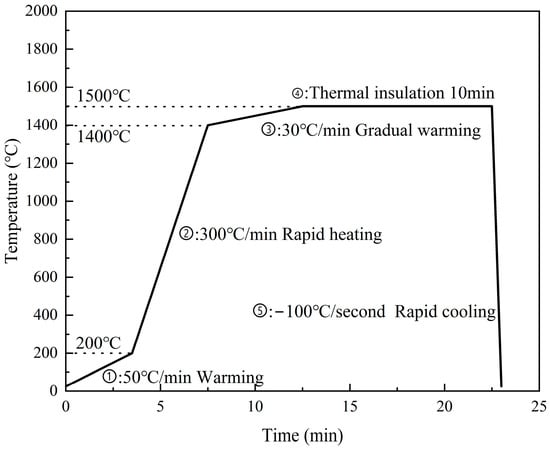
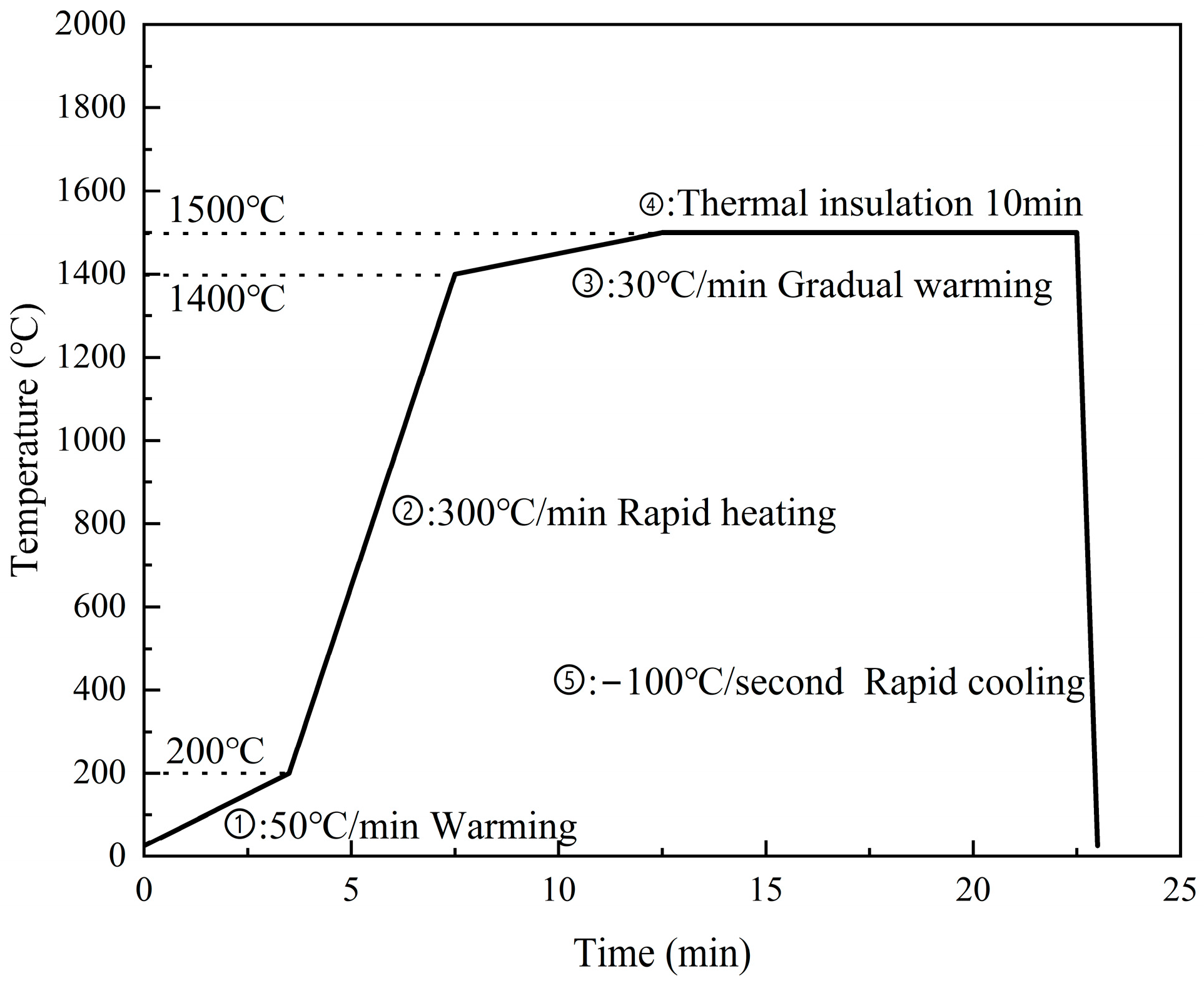
Real-time in situ images were captured using a laser source with an exposure time of 1/30 and a video recording frame rate of 15 frames per second. The temperature control process, illustrated in Figure 1, was managed by an automated program controller. During the initial heating phase, the specimen was heated from room temperature to 200 °C at a rate of 50 °C/min, followed by rapid heating to 1400 °C at 300 °C/min. Subsequently, the heating continued at 30 °C/min until reaching 1500 °C, where the specimen was held for 10 min.
Figure 1.
High-temperature confocal in situ observation of inclusion aggregation behavior: temperature control protocol flowchart.
Image and video captures were primarily focused on the 1500 °C holding period and the subsequent cooling stage. The rationale for capturing images at 1500 °C was to intuitively observe the situ morphologies, distribution characteristics, stable states, and dynamic migration and aggregation capabilities of various RE inclusions within the fully molten steel matrix. Furthermore, continuous image capturing during the cooling process was essential to dynamically monitor the liquid-solid phase transformation. This procedure allowed for the real-time tracking of the heterogeneous nucleation capabilities of primary austenite on the surfaces of RE inclusions, as well as the dynamic spatial confinement effect exerted by the advancing solidification front on the primary carbides. Finally, the specimen was rapidly cooled to room temperature using helium gas at a cooling rate of 100 °C/s.
3. Results and Discussion
3.1. Effect of Rare Earth Element Ce on Inclusions in GCr15 Bearing Steel
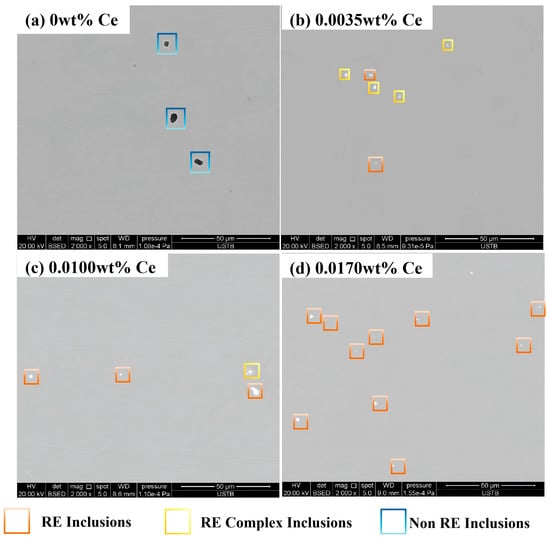
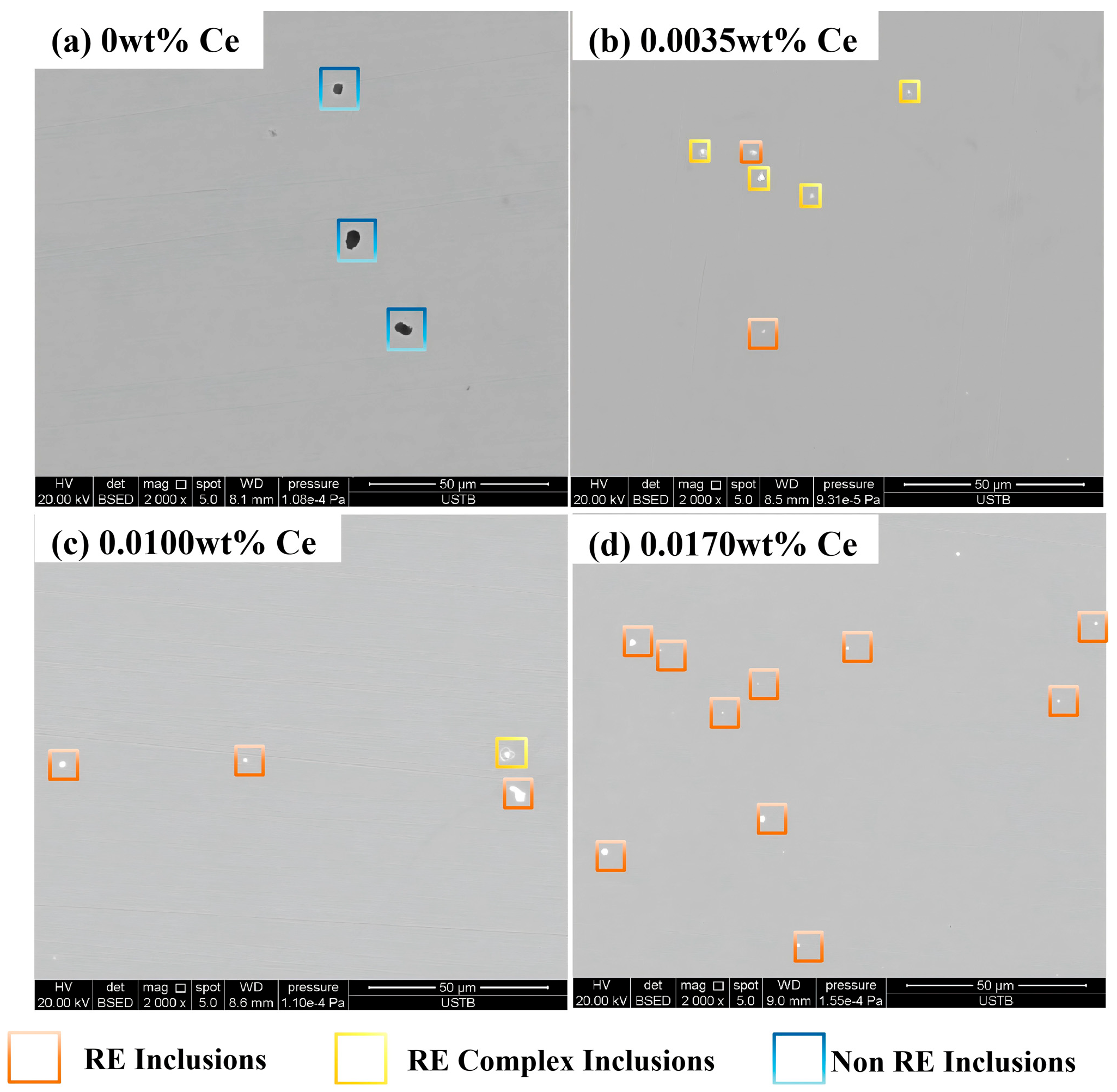
Figure 2 illustrates the distribution of inclusions within the steel matrix before and after varying Ce additions. In the Ce-free steel, the inclusions are predominantly coarse, with some exhibiting irregular morphologies and sharp angularities, which are highly detrimental to the mechanical properties of the material. As the Ce content in the steel was increased to a range of 0.0035 wt% to 0.0100 wt%, the average inclusion size decreased whereas their number density increased significantly, accompanied by a notable rise in RE complex inclusions. However, upon further increasing the Ce content to 0.0170 wt%, fine and dispersed RE inclusions became uniformly distributed throughout the steel matrix, and the complex inclusions completely disappeared.
Figure 2.
Distribution of inclusions in GCr15 bearing steel before and after rare earth element Ce addition.
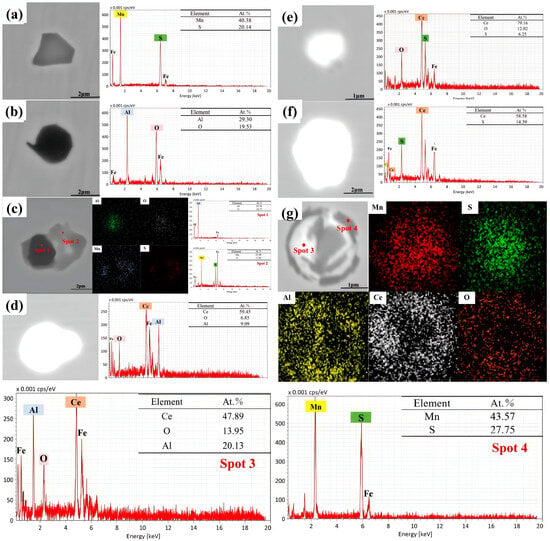
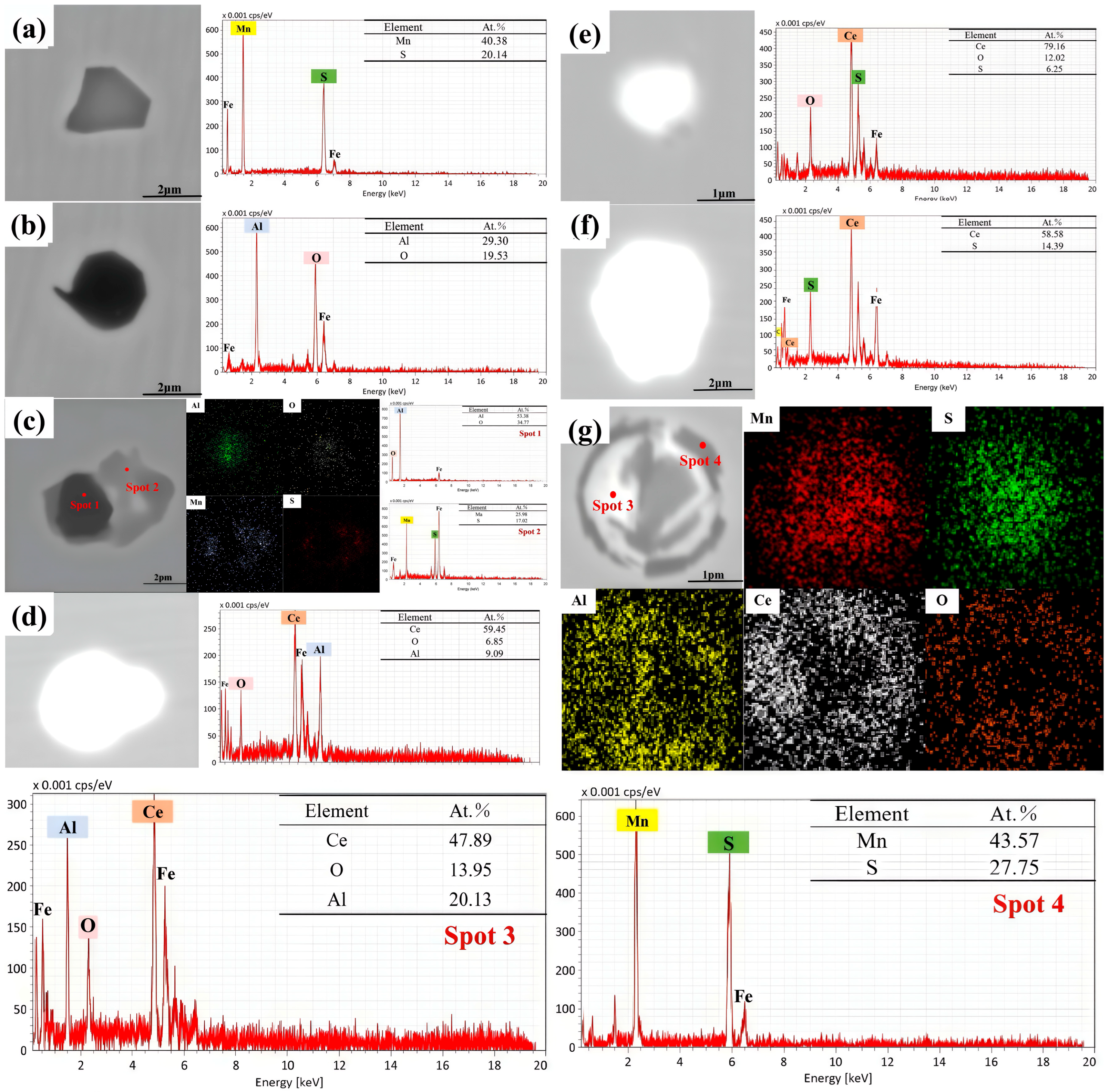
Figure 3 illustrates the morphology and elemental distribution of inclusions within the steel matrix before and after Ce modification. In the absence of trace Ce additions, sulfur-containing inclusions primarily manifested as independent MnS particles and complex Al2O3-MnS inclusions. These inclusions exhibited spherical morphologies with relatively coarse dimensions, occasionally exceeding 5 μm in diameter. Following the introduction of Ce within a concentration range of 0.0035 to 0.0100 wt%, the predominant inclusion type transitioned to complex CeAlO3-MnS. As the Ce content was further increased to 0.0170 wt%, the dominant inclusion types transformed into finer Ce2O2S and coarser CeS particles. These observations indicate that the CeAlO3 inclusions formed in the bearing steel subsequent to Ce treatment successfully fulfill the objective of modifying the MnS inclusions.
Figure 3.
Morphology and Elemental Characterization of Inclusions in GCr15 Bearing Steel. (a) MnS inclusion; (b) Al2O3 inclusion; (c) elemental mapping of an Al2O3-MnS composite inclusion, with corresponding EDS analysis for Spot 1 (Al2O3) and Spot 2 (MnS); (d) CeAlO3 inclusion; (e) Ce2O2S inclusion; (f) CeS inclusion; (g) elemental mapping of a CeAlO3-MnS composite inclusion, with corresponding EDS spectra for Spot 3 (CeAlO3) and Spot 4 (MnS) shown below.
As illustrated in the preceding figure, the addition of Ce to the steel facilitates the spheroidization of individual RE inclusions, a reduction in their average size, and an increase in their number density across the field of view. Furthermore, CeAlO3 serves as the heterogeneous nucleation center for MnS, thereby promoting the morphological spheroidization of the MnS inclusions.
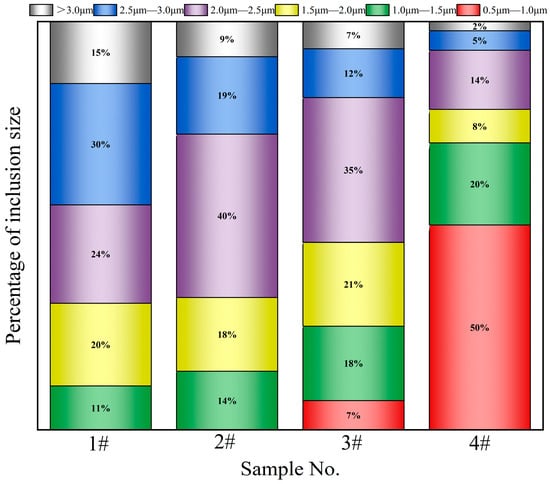
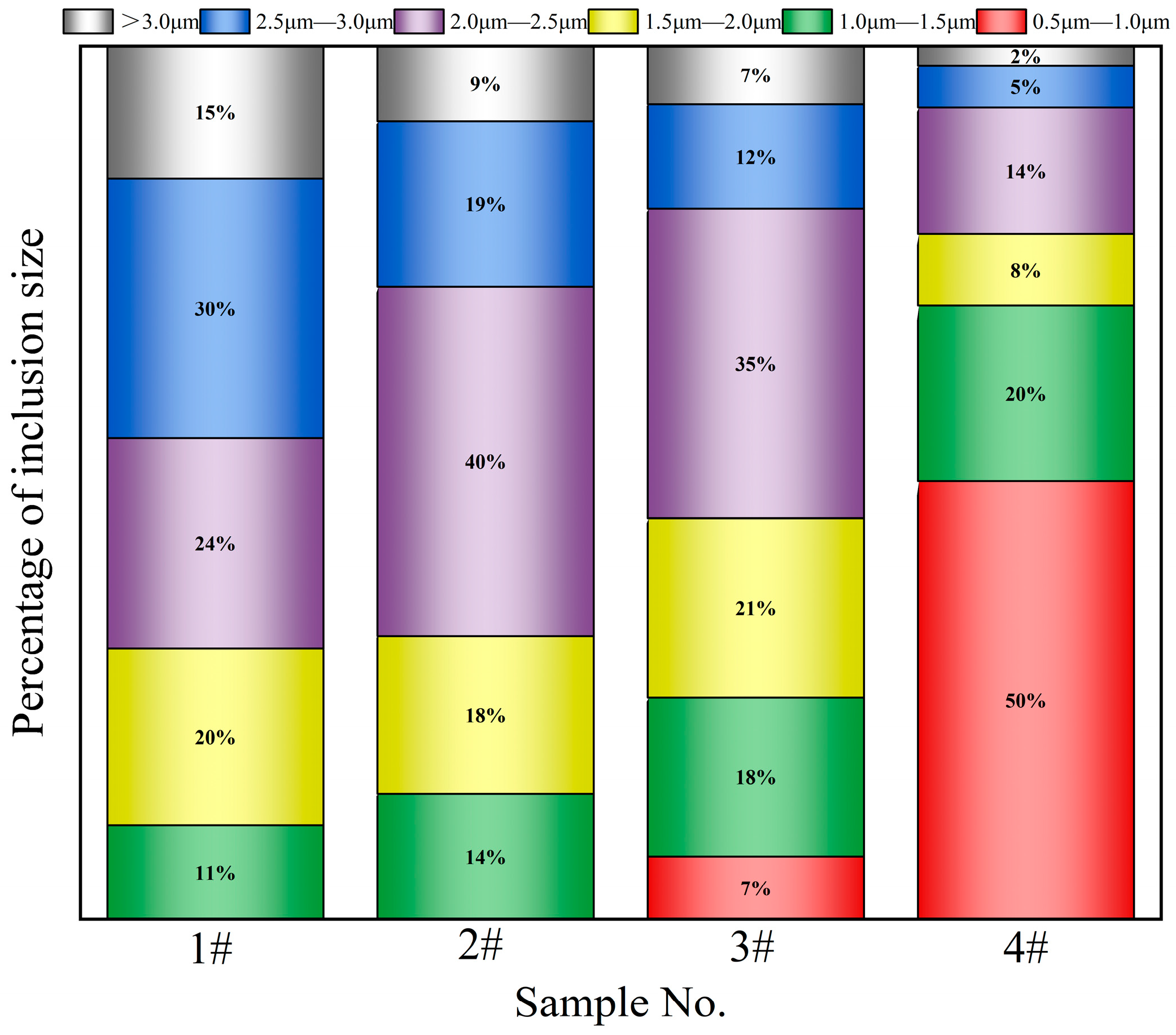
Figure 4 illustrates the statistical distribution of inclusion sizes across the evaluated specimens. In the Ce-free control specimen, the distribution was heavily skewed toward coarse particles, with inclusions larger than 2.0 μm constituting 69% of the total population, including 15% that exceeded 3.0 μm in diameter. Following the introduction of 0.0035 wt% Ce, a noticeable size refinement trend emerged. The proportion of ultra-large inclusions exceeding 3.0 μm decreased to 9%, while particles within the 2.0 to 2.5 μm range became the most frequent, accounting for 40%. Upon increasing the Ce content to 0.0100 wt%, finer inclusions began to manifest significantly. Particles within the 0.5 to 1.0 μm regime appeared and constituted 7% of the total, while the overall fraction of inclusions larger than 2.0 μm further declined to 54%. Finally, in the specimen alloyed with 0.0170 wt% Ce, a dramatic size refinement was achieved. The proportion of fine inclusions within the 0.5 to 1.0 μm regime surged to 50%, and those exceeding 3.0 μm were nearly eliminated, diminishing to merely 2%. These statistical trends confirm that progressive Ce additions promote the miniaturization of inclusions, converting coarse particles into finely dispersed ones.
Figure 4.
Inclusion Size Distribution in Steel under Different Rare Earth Content. (1#–4# represent samples with 0, 0.0035, 0.0100, and 0.0170 wt% Ce addition, respectively).
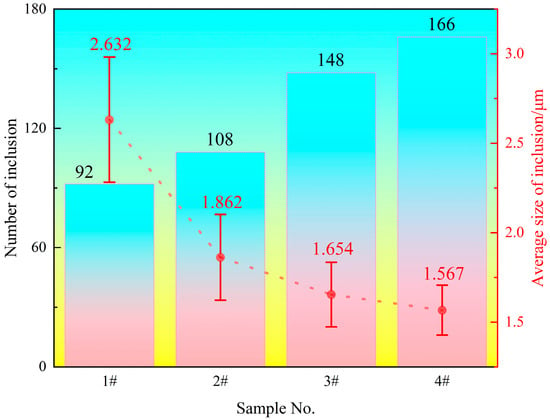
Figure 5 illustrates the evolution of the average inclusion size and number density in response to varying Ce additions. In the Ce-free control specimen, the inclusion density stood at 92/mm2 with a relatively coarse average size of 2.632 ± 0.35 μm. Following the introduction of 0.0035 wt% Ce, the number density increased to 108/mm2, while the average size was notably refined to 1.862 ± 0.24 μm. As the Ce content was further elevated to 0.0100 wt%, the inclusion density continued to rise, reaching 148/mm2, coupled with a subsequent reduction in average size to 1.654 ± 0.18 μm. Ultimately, in the specimen alloyed with 0.0170 wt% Ce, the precipitation of finely dispersed Ce2O2S inclusions culminated in the highest number density of 166/mm2 and the smallest average size of 1.567 ± 0.14 μm among all evaluated conditions. Statistical analysis confirms that the progressive addition of Ce significantly refines the inclusion size and increases their number density.
Figure 5.
Statistical diagram showing the proportion of classical inclusion count and average size before and after adding rare earth element Ce to GCr15 bearing steel. (1#–4# represent samples with 0, 0.0035, 0.0100, and 0.0170 wt% Ce addition, respectively).
These quantitative trends, corroborated by automated inclusion analysis, demonstrate that RE Ce modifications effectively refine coarse inclusions within the steel. Furthermore, a progressive increase in the Ce content directly promotes the extensive proliferation of fine-scale inclusions within the steel matrix.
3.2. Thermodynamic Analysis of the Effect of Rare Earth Element Ce on Inclusions in GCr15 Bearing Steel
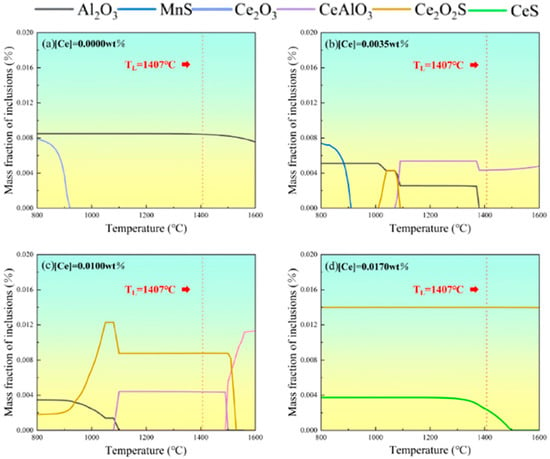
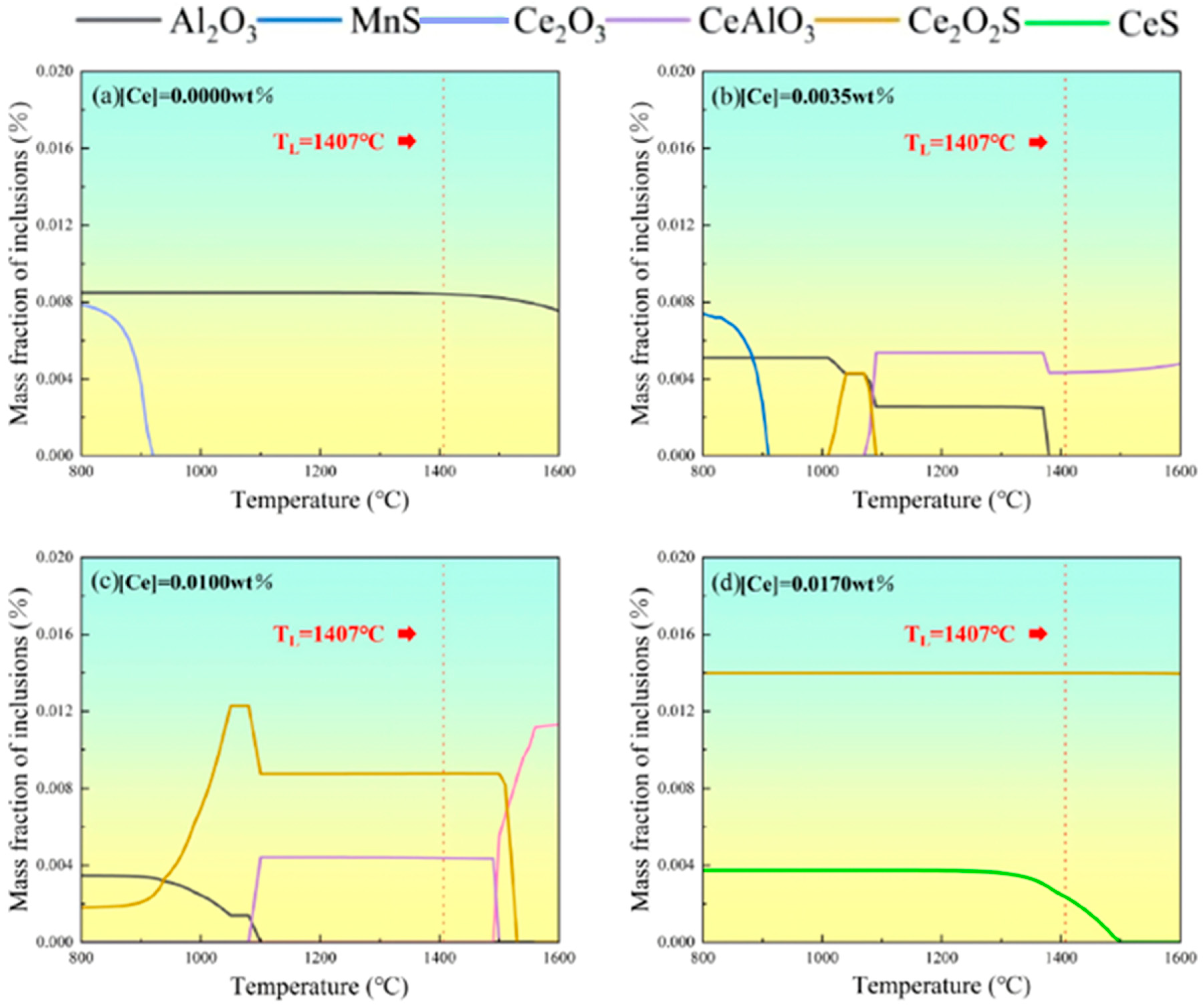
Based on the primary chemical compositions of various known samples, the FactSage 8.2 software (Thermfact/CRCT, Montreal, QC, Canada; GTT-Technologies, Aachen, Germany) equilibrium module was employed to calculate the precipitation types of inclusions in each sample. This was achieved using the FSteel, FactPS, FToxid databases (provided within the FactSage 8.2 software package), alongside a custom-built rare earth database. The results are presented in Figure 6.
Figure 6.
Precipitation behavior of classic inclusions in GCr15 bearing steel before and after rare earth element Ce addition Solid lines in different colors represent the calculated mass fractions of the corresponding inclusion phases (black for Al2O3; blue for MnS; pale blue for Ce2O3; purple for CeAlO3; yellow for Ce2O2S; green for CeS) as a function of temperature.
Prior to the introduction of the rare earth element Ce, the endogenous inclusions within the steel primarily comprised Al2O3 and MnS. Thermodynamic simulations indicate that Al2O3 precipitated at 1600 °C, with its mass fraction increasing continuously during cooling until reaching a stable plateau of 0.0085 wt% at 1200 °C. Conversely, MnS precipitation initiated at a lower temperature of 910 °C, and its mass fraction rose progressively as the temperature decreased, ultimately culminating at 0.0078 wt% at 800 °C.
Upon increasing the Ce content, the predominant RE inclusions precipitating at 1600 °C underwent a distinct transformation sequence from CeAlO3 to Ce2O3, and ultimately to Ce2O2S. Consequently, the overall diversity of inclusion types diminished, while their respective mass fractions converged to stable thermodynamic equilibriums. The maximum mass fractions of the intermediate CeAlO3 and Ce2O3 phases exhibited a steady decline correlating with higher Ce additions. Specifically, at a Ce concentration of 0.0170 wt%, the inclusion system stabilized to exclusively comprise Ce2O2S and CeS, marked by the complete exhaustion of CeAlO3 and Ce2O3. In the specimen alloyed with 0.0170 wt% Ce, the mass fraction of Ce2O2S remained constant at 0.0139 wt% throughout the cooling regime from 1600 °C down to 800 °C. Concurrently, CeS precipitation initiated at 1490 °C, reaching a steady mass fraction of 0.0038 wt% at 1180 °C. These thermodynamic evolutions demonstrate that an optimal elevation in Ce content effectively reduces the total dissolved oxygen and sulfur levels within the melt. This deoxidation and desulfurization simplifies the inclusion constituents, thereby achieving a pronounced purification effect on the molten steel.
The Equilib module of FactSage 8.2 was employed to identify the comprehensive inclusion constituents before and after the RE treatment, confirming the presence of Al2O3, MnS, CeAlO3, Ce2O3, Ce2O2S, and CeS. To systematically elucidate the modification mechanism of Ce on the primary MnS and Al2O3 inclusions, further theoretical calculations and analyses regarding the precipitation behavior of these typical inclusions were conducted based on fundamental thermodynamic principles. The relevant standard Gibbs free energies of formation for these inclusions in the liquid steel are detailed in Table 2.
Table 2.
Standard Gibbs Free Energy of Formation for Representative Substances in Steel Before and After Rare Earth Treatment.
Under conditions of constant temperature and pressure, the spontaneity of a chemical reaction is predicated on a negative Gibbs free energy change [30]. The Gibbs free energy of formation for each inclusion species is determined through the reaction isotherm equation as presented in Equation (1).
ΔG = ΔGθ + RTlnJ
In the equation, ΔG and ΔGθ denote the Gibbs free energy of formation for inclusions and the standard Gibbs free energy of formation for inclusions, respectively, both in units of J·mol−1; R is the gas constant, with a value of 8.314, in units of J·mol−1·K−1; and J is the activity entropy. Taking a 1% mass fraction solution as the standard state, the activities and activity coefficients of each element in the molten steel are given by the following Equations (2) to (3).
where denotes the Henry’s activity coefficient for component i; represents the interaction coefficient between element j and i; [%i] and [%j] denote the mass percentages of elements i and j in the molten steel; signifies the activity of component i. Excluding second-order interaction coefficients, the interaction coefficients of relevant elements in molten steel are presented in Table 3 below:
Table 3.
Activity Interaction Coefficients of Constituents in Molten Steel [31].
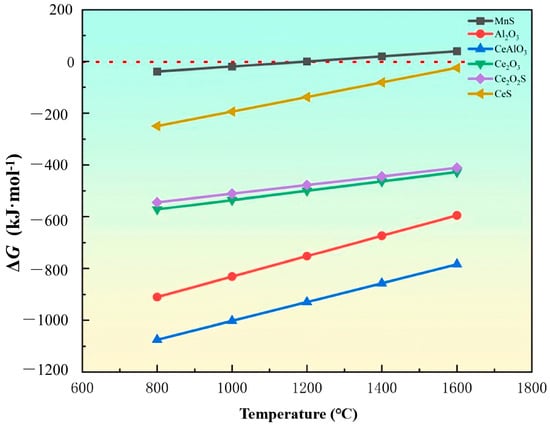
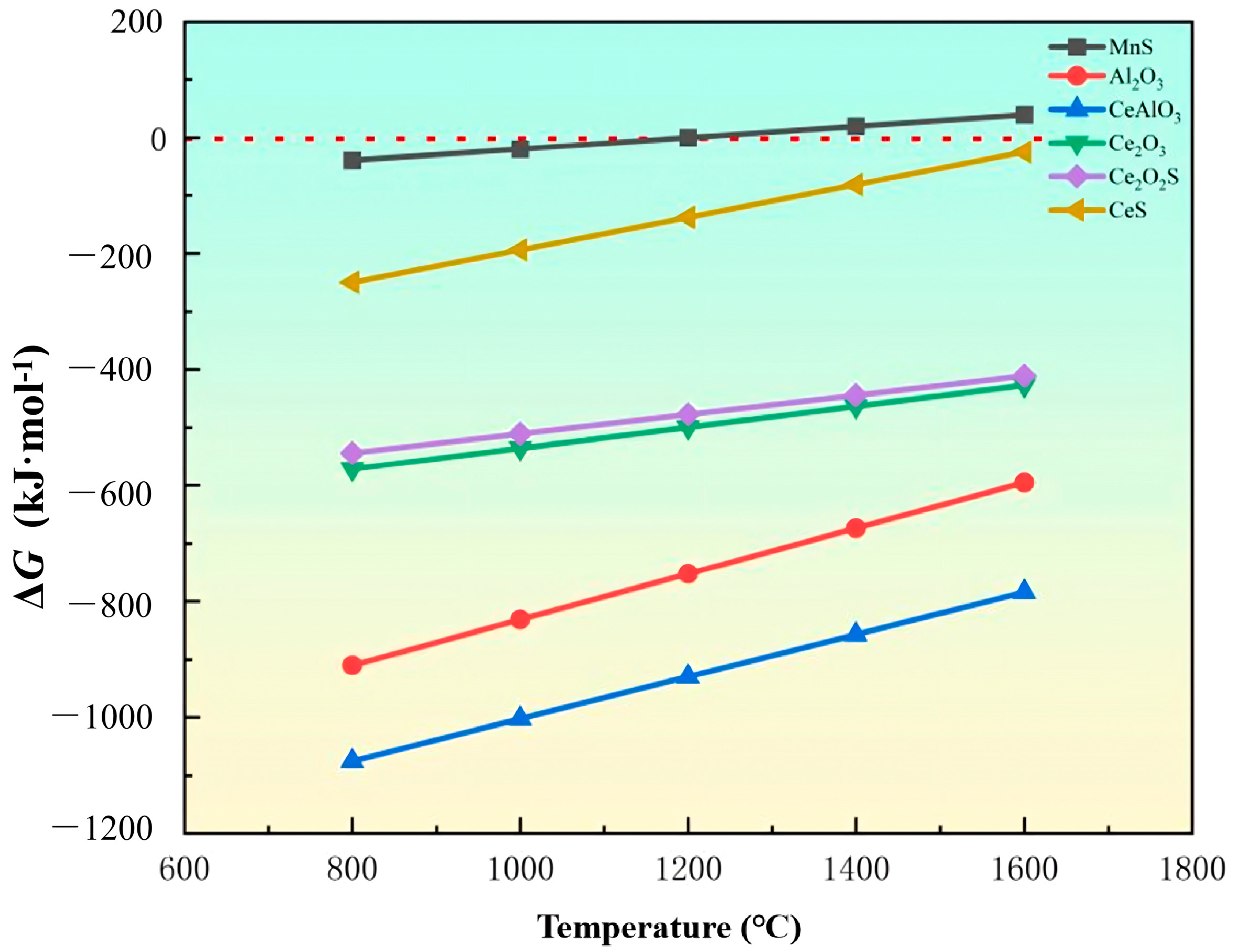
The Gibbs free energy of inclusion formation in steel at temperatures ranging from 800 °C to 1600 °C was calculated, with the results shown in Figure 7.
Figure 7.
Gibbs free energy variation of different inclusions in GCr15 bearing steel at temperatures ranging from 800 °C to 1600 °C.
Within the investigated temperature regime, the standard Gibbs free energies of formation for both Al2O3 and CeAlO3 are considerably more negative than that of MnS, corresponding to significantly elevated precipitation temperatures. Thermodynamically, this dictates that prior to the Ce modification, the pre-precipitated Al2O3 acts as a heterogeneous nucleation core for subsequent MnS precipitation. Conversely, following the Ce treatment, the thermodynamically favored CeAlO3 precipitates preferentially within the melt, thereby superseding Al2O3 as the primary heterogeneous nucleation site for MnS.
Furthermore, regarding the deep compositional evolution of inclusions, namely Al2O3 → Ce2O2S + CeS → Ce2O2S, the rare earth Ce acts as a strong deoxidizer and desulfurizer. Due to its higher thermodynamic affinity for oxygen and sulfur than Al, Ce reduces the original Al2O3 inclusions. Consequently, the Al element from the decomposed Al2O3 is released and dissolves back into the liquid steel matrix as soluble Al. The primary replacement reaction for the formation of Ce2O2S can be described by the following thermodynamic equation: 2Al2O3 + 6[Ce] + 3[S] = 3Ce2O2S + 4[Al].
Through this reduction and element exchange process, the sharp and hard Al2O3 inclusions are effectively modified into globular Ce-containing inclusions, while maintaining the conservation of elements within the steel matrix.
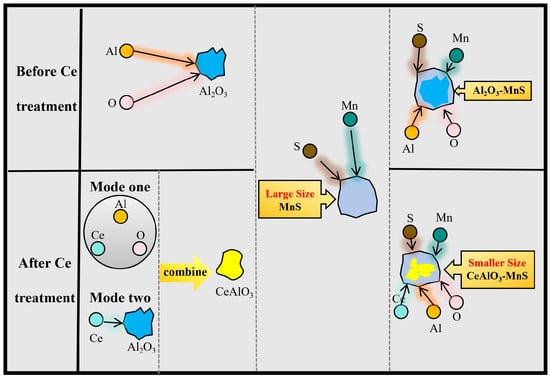
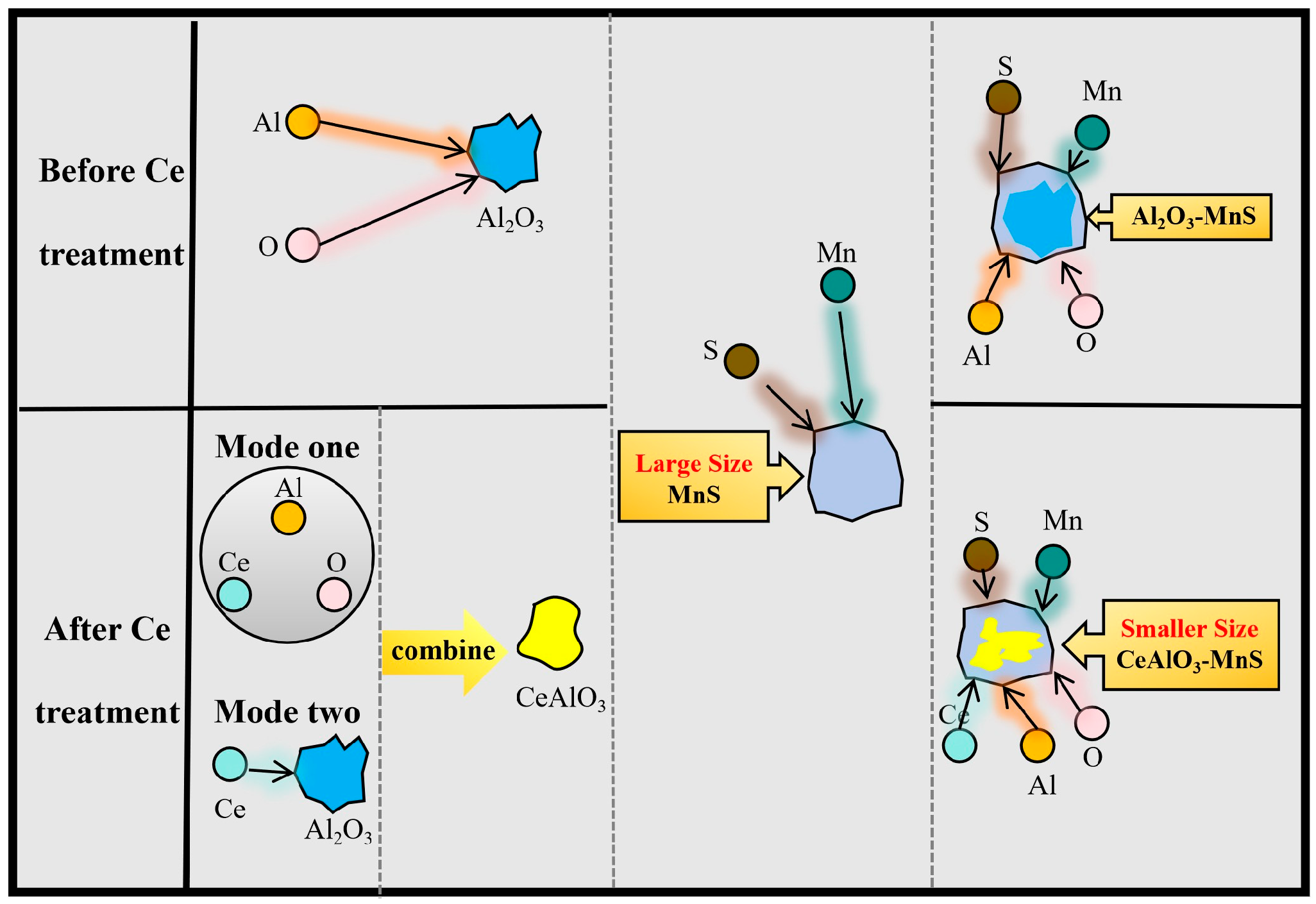
Figure 8 delineates the evolutionary modification mechanisms of the MnS-type inclusions before and after the Ce addition, as elucidated by the thermodynamic analyses. Prior to the rare earth treatment, the Al2O3 phase precipitating during the initial cooling stage serves as a nucleation substrate for MnS, yielding Al2O3-MnS composite inclusions. Subsequent to the rare earth treatment, the modification of MnS-type inclusions by CeAlO3 proceeds via two distinct mechanistic pathways. The first pathway entails an in situ transformation, wherein CeAlO3 substitutes the original Al2O3 core within the pre-existing Al2O3-MnS composite architecture. The second pathway involves the preferential precipitation of CeAlO3 at earlier cooling stages, which subsequently acts as a heterogeneous nucleation core for MnS. This synergistic sequence effectively promotes the formation of CeAlO3-MnS composite inclusions and facilitates the morphological spheroidization of the inclusion phases.
Figure 8.
Schematic diagram illustrating the mechanism of MnS inclusion modification in GCr15 bearing steel following rare earth element Ce addition.
3.3. Aggregation Analysis of Inclusions in GCr15 Bearing Steel Before and After Rare Earth Ce Treatment
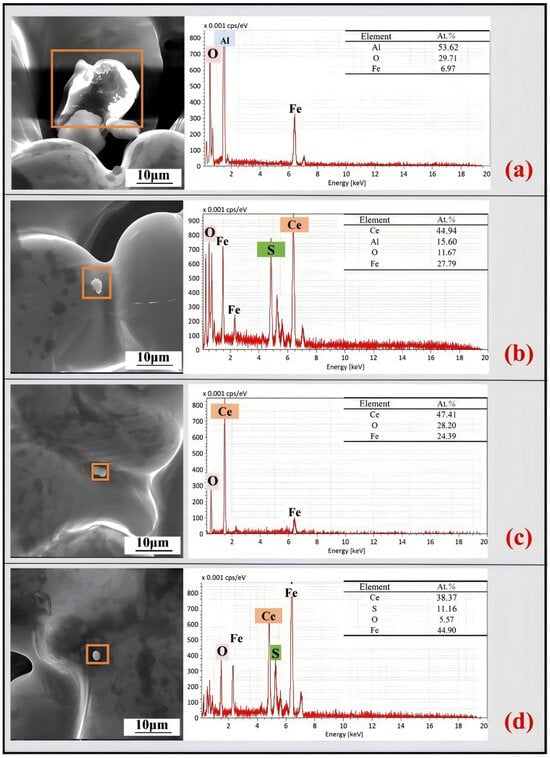
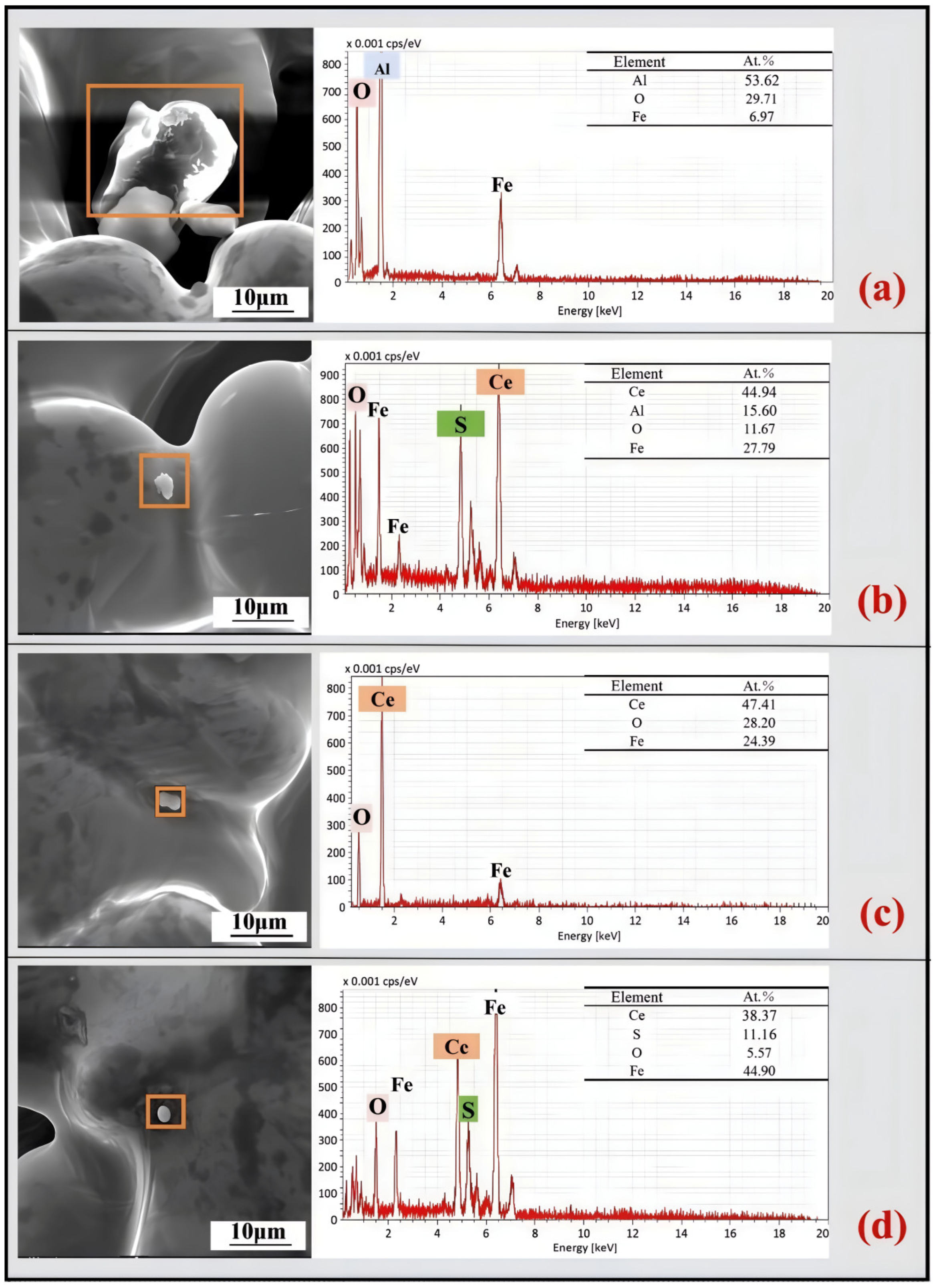
During the high-temperature experiments, four groups of steel samples were subjected to rapid cooling to preserve the high-temperature morphology of the inclusions. Subsequently, the morphology and composition of the primary inclusions in each sample were characterized using SEM-EDS. The results are shown in Figure 9.
Figure 9.
Inclusion particle morphology and composition in GCr15 bearing steel after rapid cooling from high temperature ((a): Al2O3 (b): CeAlO3 (c): Ce2O3 (d): Ce2O2S).
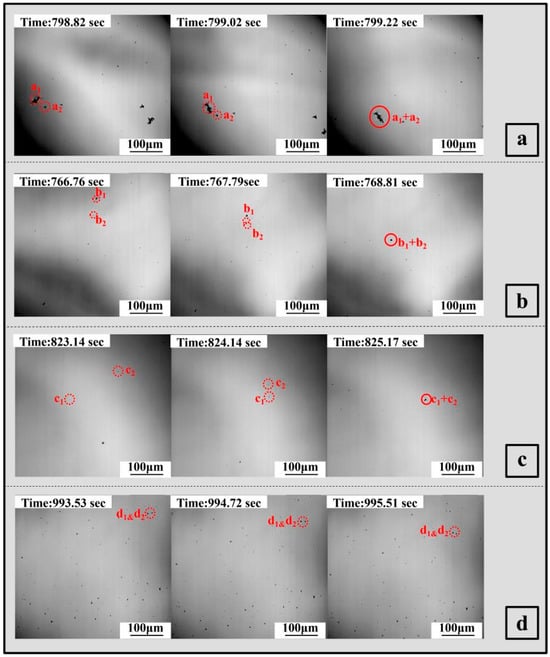
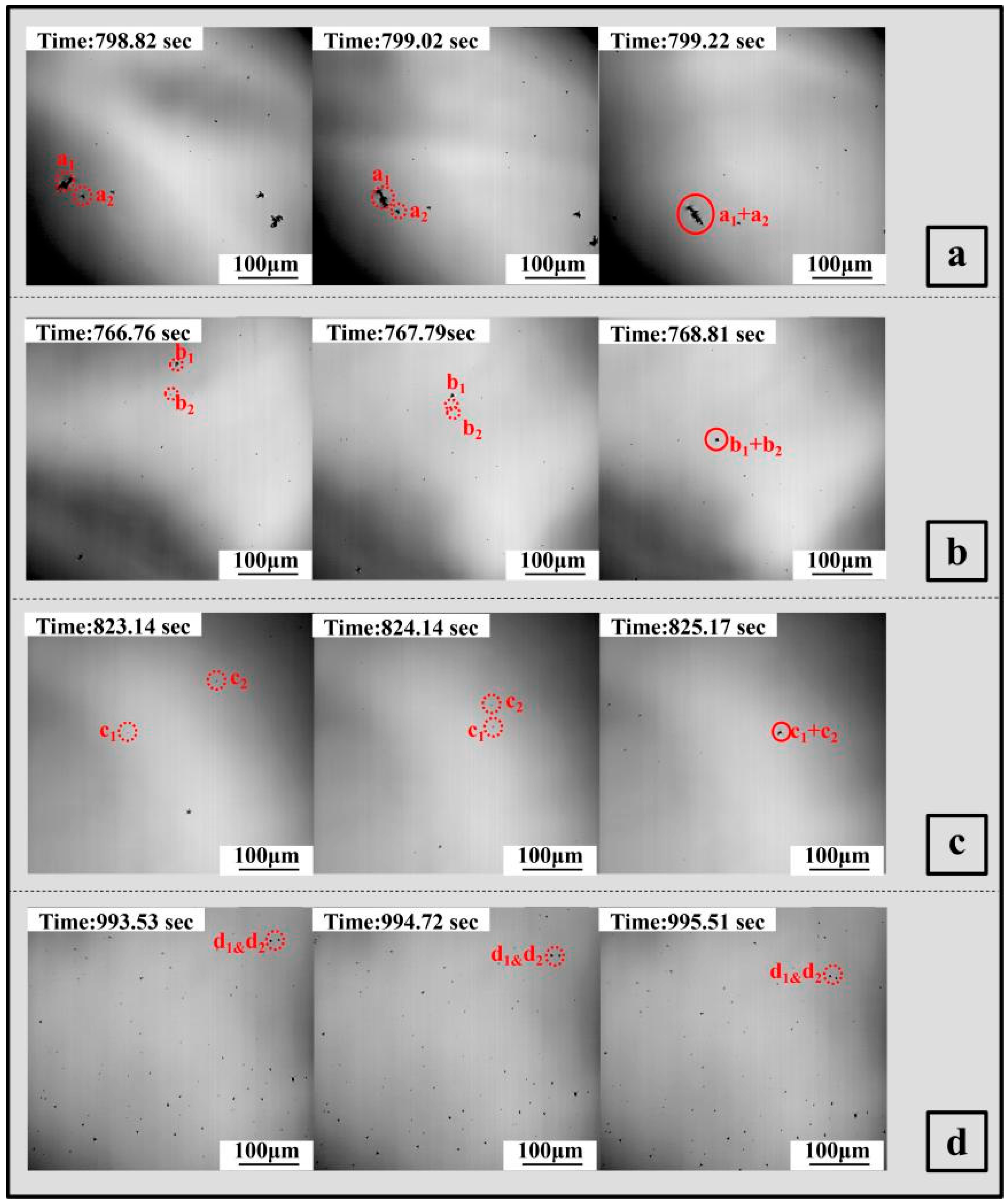
The increase in the rare earth content at 1500 °C dictates a distinct evolutionary sequence for the monophasic inclusions in the steel: Al2O3 → CeAlO3 → Ce2O3 → Ce2O2S. Concomitantly, the inclusion dimensions progressively diminish, accompanied by a systematic morphological transition toward complete spheroidization. The agglomeration dynamics of the various inclusions were dynamically monitored via the in situ experiments, and the corresponding results are presented in Figure 10.
Figure 10.
Aggregation behavior of inclusion particles at 1500 °C (a): Al2O3 (b): CeAlO3 (c): Ce2O3 (d): Ce2O2S). In the subfigures, the red labels (e.g., a1, a2, b1, b2, c1, c2, d1, d2) denote the individual inclusion particles being tracked over time. The plus sign (e.g., a1 + a2, b1 + b2, c1 + c2) indicates the complete aggregation of the respective particles, whereas the ampersand (d1 & d2) denotes that the particles remain separate and do not aggregate.
Figure 10a illustrates the agglomeration behavior of Al2O3 inclusions in the Ce-free Sample 1. These inclusions exhibit substantial dimensions and a pronounced agglomeration tendency, resulting in a heterogeneous distribution of varying-sized particles throughout the liquid steel. Figure 10b presents the dynamics of CeAlO3 inclusions in Sample 2, treated with 0.0035 wt% Ce, where the population of large-sized inclusions is markedly diminished. Figure 10c delineates the agglomeration of Ce2O3 inclusions in Sample 3 following a 0.0100 wt% Ce addition, demonstrating a further reduction in inclusion density. Figure 10d highlights the Ce2O2S inclusions in Sample 4, containing 0.0170 wt% Ce. Although their agglomeration propensity is relatively attenuated, these inclusions remain predominantly fine and are uniformly dispersed across the melt surface.
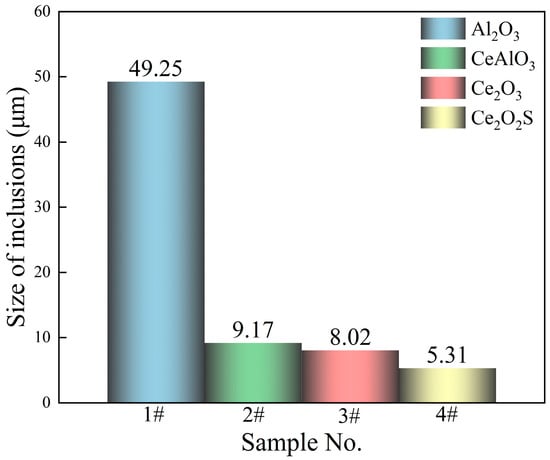
To further provide a statistical analysis of the increase in particle size and verify the representativeness of the in situ observations, the sizes of the aggregated inclusions after the high-temperature experiments were systematically measured across the samples. As illustrated in Figure 11, the statistical results are highly consistent with the in situ phenomena. Driven by the strong agglomeration tendency, the size of Al2O3 aggregates in the Ce-free steel (Sample 1#) increased dramatically to 49.25 μm. In stark contrast, the average size of Ce2O2S in the 0.0170 wt % Ce-treated steel (Sample 4#) remained extremely fine at 5.31 μm. This quantitative analysis confirms that the restricted agglomeration behavior observed in Figure 10 represents the macroscopic statistical state of the entire sample.
Figure 11.
Statistical average sizes of aggregated inclusions after high-temperature experiments for different samples. (1#–4# represent samples with 0, 0.0035, 0.0100, and 0.0170 wt% Ce addition, respectively).
While the macroscopic migration velocity of inclusions dictates their probability of mutual approach and collision within the molten steel, the actual occurrence of collision-induced agglomeration and growth at ultra-short distances is fundamentally governed by interparticle attractive forces. To quantify this dynamic, fifteen consecutive high-temperature confocal images for each inclusion type were analyzed using Image-Pro Plus 6.0 software to elucidate the correlation between interparticle attraction and separation distance. The applied calculation frameworks are detailed in Figure 12 and Equations (4) to (9).
Figure 12.
Schematic diagram of the calculation method for interparticle attraction between inclusions (The calculation formulas are based on Ref. [32]).
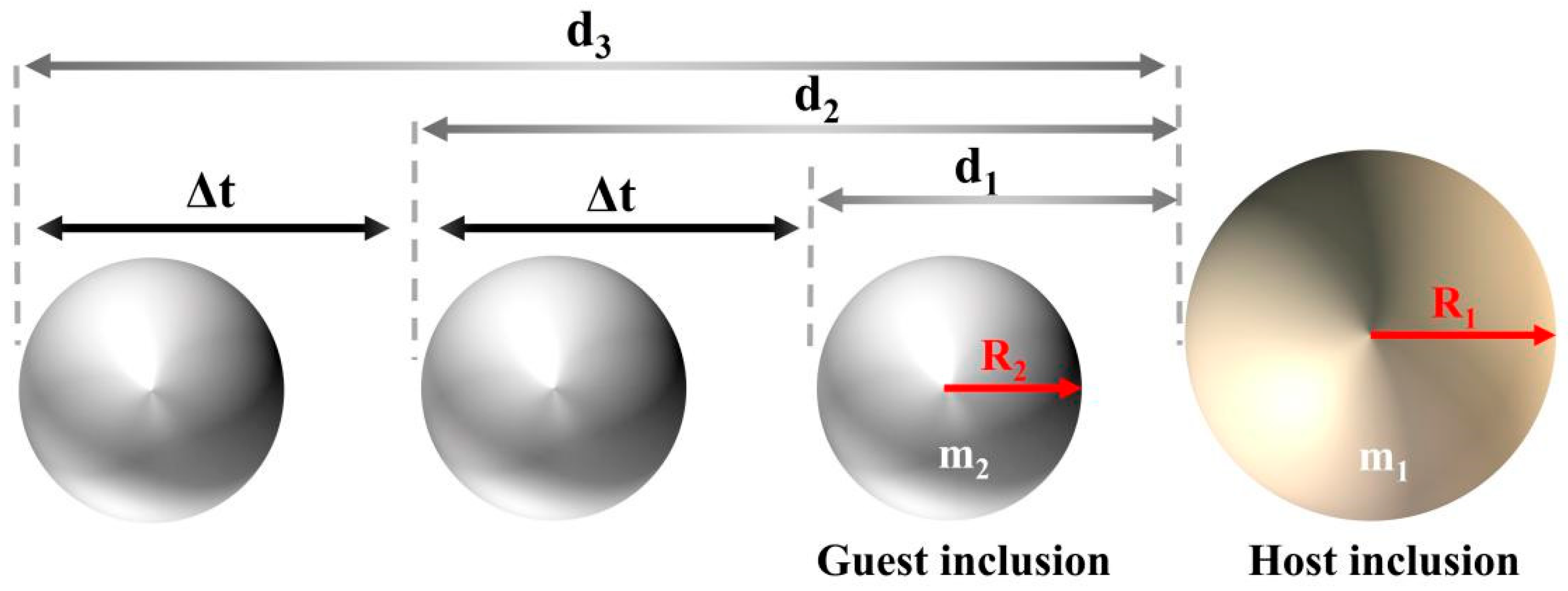
In these expressions, Δti denotes the time interval between consecutive measurements; di and di+1 represent the interparticle distances at successive time points; ai signifies the acceleration; Ak and Ri correspond to the equivalent area and radius of the particle, respectively; ρi and mi are the density and mass of the inclusion; and FA,i alongside define the interparticle attractive forces. To accurately quantify these variables, the in situ observation videos were decomposed into frame-by-frame image sequences. The Image-Pro Plus 6.0 software was subsequently utilized to measure the physical dimensions and track the trajectories of the targeted inclusions. Specifically, the equivalent area was directly extracted from the two-dimensional projection contour pixels of the inclusion and calibrated against the spatial scale. The equivalent radius was then derived via the area-equivalent circle formulation. Regarding the kinematic parameters, the continuous variations in interparticle distance were systematically tracked. By coupling these displacement data with the precise time intervals dictated by the video frame rate, the relative velocities were calculated, and the accelerations were subsequently derived via a kinematic finite-difference approach. Furthermore, the specific inclusion density values applied in these calculations are detailed in Table 4.
Table 4.
Density of inclusions in specimens observed in situ.
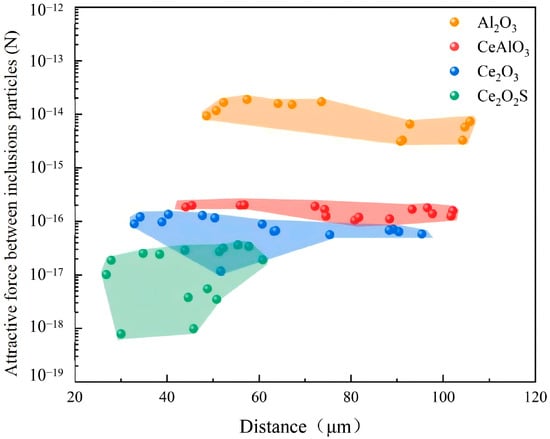
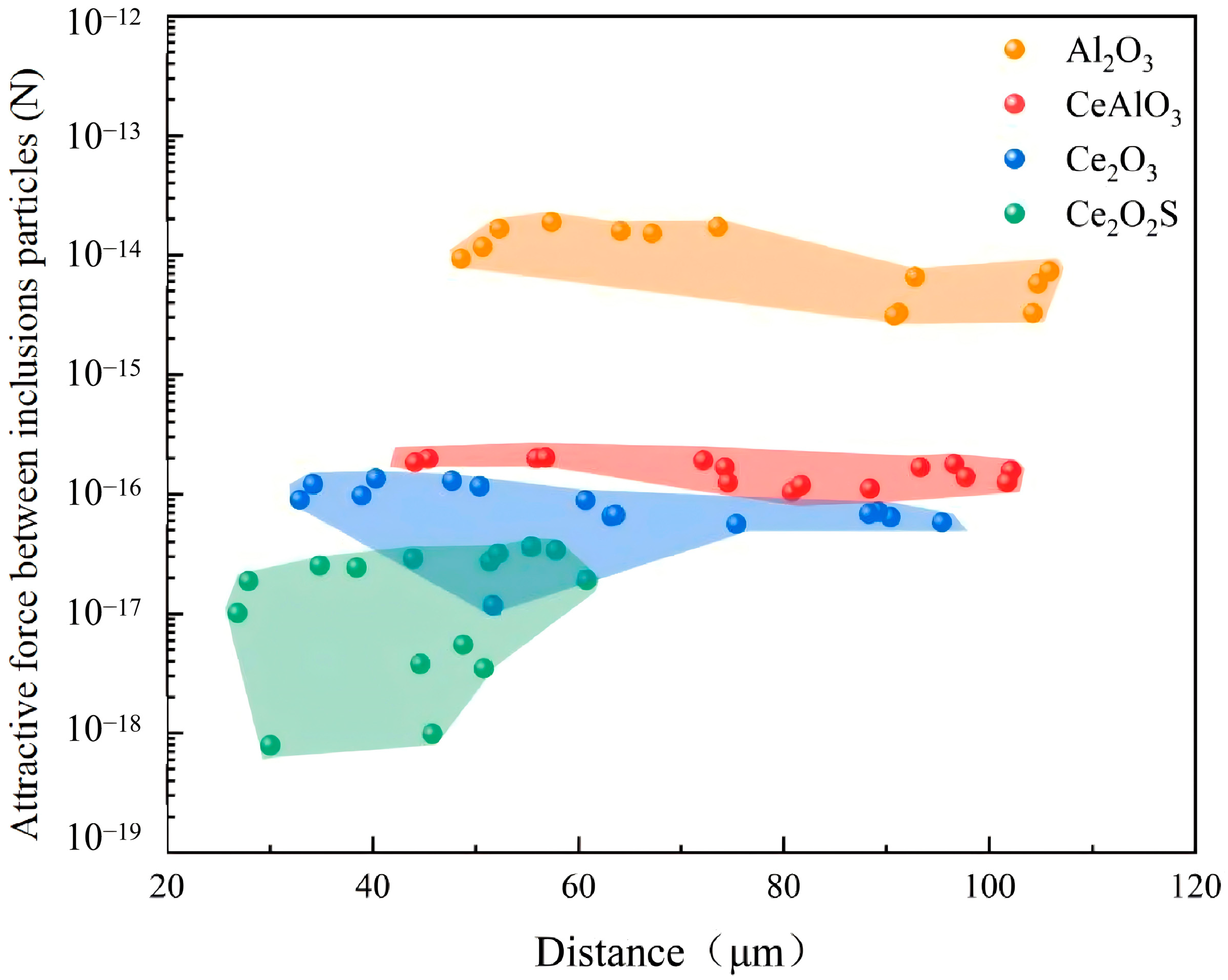
An analysis of the relationship between the distance and attractive force between different inclusion particles yielded the results shown in Figure 13.
Figure 13.
Schematic diagram illustrating the relationship between attractive forces between impurity particles and distance.
Generally, the attractive forces between particles amplify progressively as the interparticle spacing diminishes. Notably, Al2O3 particles exhibit the most pronounced agglomeration propensity, characterized by a maximum effective interaction distance of 136.4 μm and an attractive force ranging from 9.32 × 10⁻¹⁵ N to 1.26 × 10⁻¹⁴ N. For CeAlO3 particles, the maximum interaction distance is reduced to 102.1 μm, with attractive forces spanning from 1.04 × 10⁻¹⁶ N to 2.02 × 10⁻¹⁶ N. These values denote an agglomeration capacity and interaction range comparable to those of Ce2O3 particles, yet significantly attenuated compared to the unmodified Al2O3. Furthermore, the maximum interaction distance for Ce2O2S inclusions is restricted to merely 60.8 μm, corresponding to an attractive force range of 7.89 × 10⁻¹⁹ N to 3.63 × 10⁻¹⁷ N. This represents the weakest interparticle attraction among all evaluated rare-earth-modified inclusions. Consequently, this study posits that the attenuated agglomeration propensity following rare-earth treatment serves as a primary fundamental mechanism driving the refinement of inclusion dimensions. The relative hierarchy of agglomeration strength is established in the sequence of Al2O3 > CeAlO3 > Ce2O3 > Ce2O2S, underscoring Ce2O2S as possessing the weakest tendency for particle coalescence.
Although CSLM observations are conducted at the surface of the melt within a crucible, where fluid convection conditions differ from the bulk steel, the intrinsic agglomeration tendency of inclusions is fundamentally governed by their interfacial energy with the molten steel. Therefore, the distinct behaviors observed via CSLM—the strong agglomeration of original Al2O3 versus the dispersed nature of Ce-modified inclusions—can reliably and qualitatively represent their relative interaction characteristics in the bulk liquid steel.
Formation energy is primarily utilized to assess the thermodynamic stability and the intrinsic driving force for the precipitation of compounds [33]. A highly negative formation energy signifies a pronounced thermodynamic tendency for an inclusion to precipitate from its constituent elements, directly correlating with enhanced structural stability and diminished matrix solubility. Such elevated stability dictates robust interatomic bonding within the inclusion lattice, which severely impedes subsequent dissolution and atomic migration. Consequently, this kinetic hindrance effectively suppresses diffusion-controlled Ostwald ripening, fortifies the resistance against particle coarsening and agglomeration, and ultimately preserves a fine, homogeneously dispersed inclusion profile within the matrix. Therefore, by calculating and analyzing the formation energies across various inclusion unit cells, their stable configurations within the steel can be predicted, thereby elucidating their fundamental impact on macroscopic material properties. The mathematical formulation governing this formation energy is delineated in Equation (10):
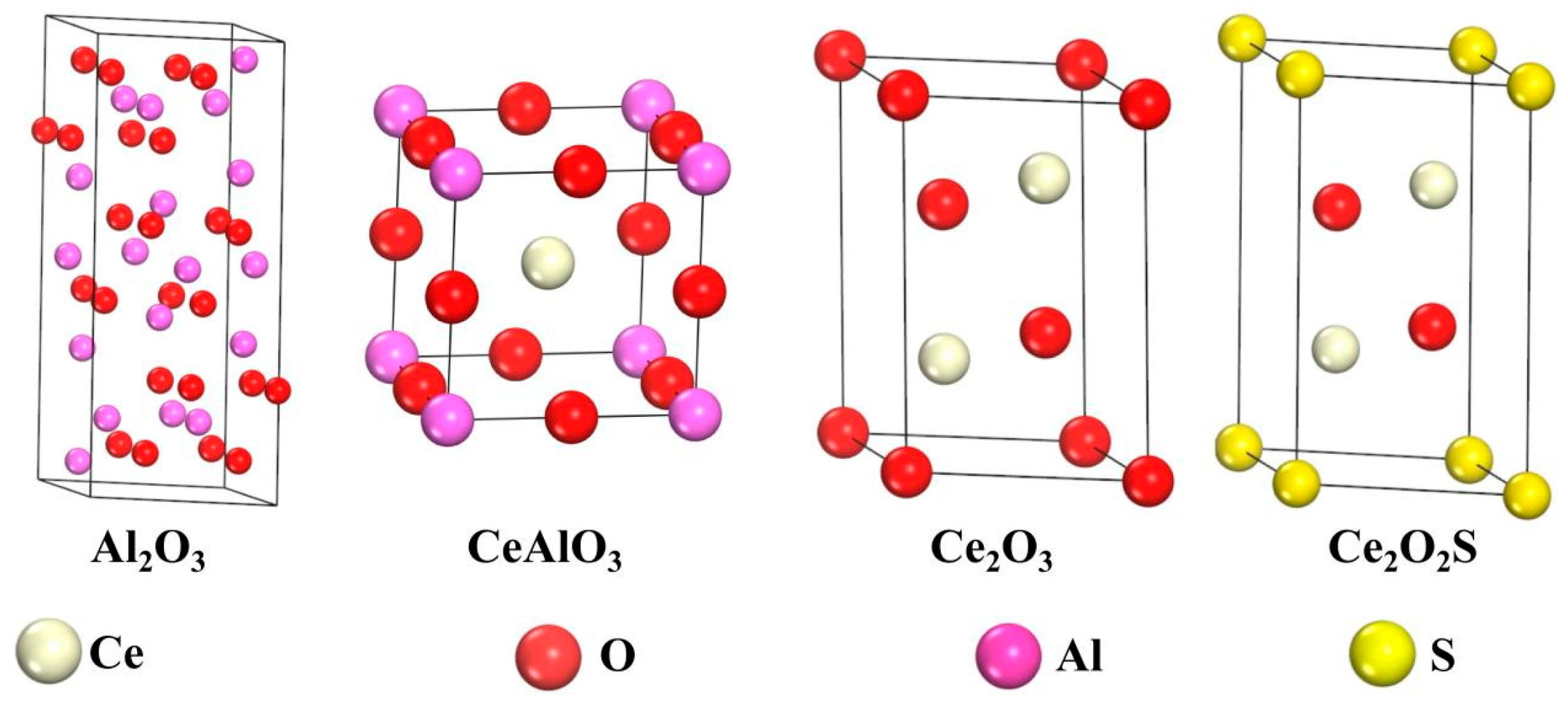
where ΔH denotes the formation energy, n represents the number of atoms, Etotal is the total energy of the unit cell, and Ebulk is the total energy of the atoms in the elemental crystal. To determine the formation energies of each unit cell during high-temperature in situ observation, modeling was performed on each unit cell. The results are shown in Figure 14.
Figure 14.
Crystal structure of various inclusion particles under high-temperature in situ observation.
First-principles geometric relaxations and total energy computations for the single-atom reference models were executed utilizing the CASTEP module integrated within the Materials Studio software (Version 2023, Dassault Systèmes BIOVIA, San Diego, CA, USA).
The exchange-correlation interactions were described by the generalized gradient approximation with the Perdew–Burke–Ernzerhof functional. A plane-wave basis set was applied with a kinetic energy cutoff strictly constrained at 600 eV. During the relaxation process, the unit cell volume and shape were kept fixed while the internal atomic coordinates were fully relaxed, which conceptually aligns with an ISIF setting of 2. The Brillouin zone integration was performed using a Monkhorst–Pack grid with a uniform k-point spacing of 0.2 Å−1. Furthermore, stringent convergence thresholds were enforced: the self-consistent electronic energy tolerance was established at 1.0 × 10⁻⁵ eV/atom, and the maximum Hellmann–Feynman force criterion was set to 0.02 eV/Å. The final calculated energies derived from these configurations are delineated in Table 5.
Table 5.
Formation energy of various inclusions under high-temperature in situ observation.
As elucidated in the tabulated data, the calculated formation energies of the respective inclusions exhibit the following descending hierarchy: Al2O3 > CeAlO3 > Ce2O3 > Ce2O2S. Following rare-earth modification, the formation energies of the resultant inclusions become substantially more negative compared to the unmodified Al2O3. This energetic shift significantly diminishes their thermodynamic driving force to agglomerate into macroscopic clusters. Ce2O2S shows the most negative formation energy among the evaluated inclusions, indicating comparatively high thermodynamic stability and a lower tendency toward coarsening. This optimized dispersion promotes a higher heterogeneous nucleation rate during solidification, concurrently contributing to the overall microstructural refinement and deep purification of the molten steel.
Fundamentally, the universally negative formation energies across all assessed inclusions dictate their robust thermodynamic stability within the melt environment. This inherent structural integrity fulfills the primary prerequisite for these precipitated particles to function as highly potent heterogeneous nucleation substrates. To quantify the crystallographic compatibility between these inclusion templates and the nucleating solid metal, the Bramfitt two-dimensional lattice mismatch theory is systematically employed. The mathematical expression governing this interfacial atomic disregistry is detailed in Equation (11).
where is the lattice disregistry; and are the low-index plane of the substrate and nucleated solid, respectively; [uvw]s and [uvw]n are the low-index direction in (hkl)s and (hkl)n, respectively; and are the interatomic spacing along [uvw]s and [uvw]n, respectively; and θ is the angle between [uvw]s and [uvw]n.
Drawing upon established crystallographic databases, the intrinsic lattice structures and corresponding close-packed planes for the analyzed inclusions were systematically identified. Specifically, the fundamental close-packed facets for Al2O3, Ce2O2S, Ce2O3, and CeAlO3 are the (0001) [34], (0001) [35], (0001) [36], and (110) [37] planes, respectively. For the austenitic matrix, designated as γ-Fe, the (110), (100), and (111) facets were selected as the representative low-index crystallographic planes. The two-dimensional planar disregistry values between these low-index austenite planes and the aforementioned close-packed inclusion facets were calculated, with the comprehensive results delineated in Table 6.
Table 6.
Mismatch Degree Between Different Types of Inclusions and Austenite.
The optimal crystallographic orientation relationships, which yield the minimal interfacial disregistry against the γ-Fe matrix, are universally established on the austenite (111) plane. These preferred epitaxial interfaces manifest as (0001) Al2O3//(111) γ-Fe, (110) CeAlO3//(111) γ-Fe, (0001) Ce2O3//(111) γ-Fe, and (0001) Ce2O2S//(111) γ-Fe. Under these optimized matching conditions, the minimum two-dimensional planar disregistries for Al2O3, CeAlO3, Ce2O3, and Ce2O2S relative to γ-Fe are quantitatively determined to be 14.67%, 7.80%, 7.50%, and 3.27%, respectively. Notably, Ce2O2S exhibits a minimal disregistry magnitude, establishing its capability to serve as a highly potent heterogeneous nucleation core during solidification.
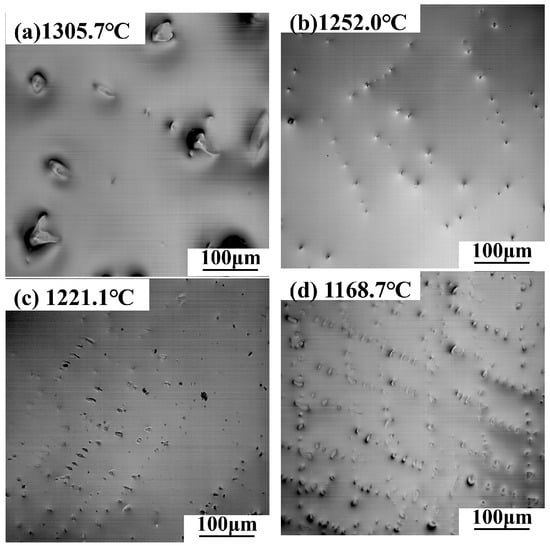
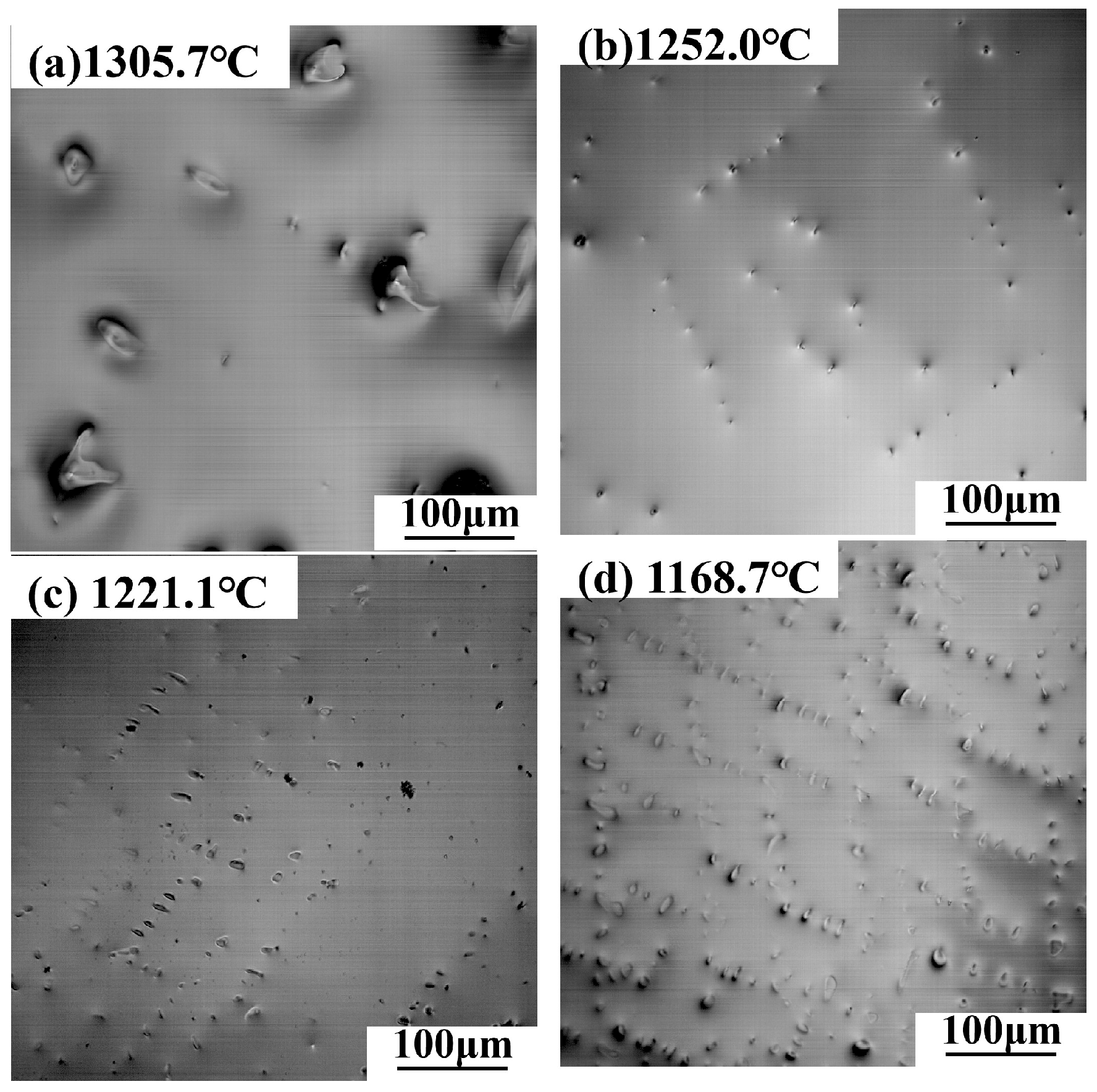
Misfit calculations of the steel samples demonstrate that Ce2O2S can effectively serve as a nucleation core for γ-Fe during solidification, thereby promoting γ-Fe nucleation. This section analyzes the number of nucleation sites per unit field of view observed in situ during high-temperature solidification for various inclusions. The statistical results are detailed in Figure 15.
Figure 15.
In situ observation of nucleation site numbers for different inclusions: (a) sample 1# at 1305.7 °C; (b) sample 2# at 1252.0 °C; (c) sample 3# at 1221.1 °C; (d) sample 4# at 1168.7 °C.
Under identical field-of-view conditions, the nucleation site densities on the surfaces of different inclusion specimens exhibit significant variations, which are highly consistent with the calculated lattice mismatch values. For Al2O3 inclusions without rare earth modification, the field of view displays a severely limited number of nucleation sites distributed in an isolated and sparse manner. This suggests that the relatively high lattice mismatch may increase nucleation resistance and reduce their effectiveness as heterogeneous nucleation cores. In contrast, CeAlO3 and Ce2O3 inclusions show a markedly increased number of uniformly distributed nucleation sites, confirming their moderate lattice mismatch and superior capacity to promote nucleation. Furthermore, Ce2O2S inclusions demonstrate exceptionally dense clusters of microscopic nucleation sites, exhibiting a nucleation density that far surpasses those of the other three inclusion types.
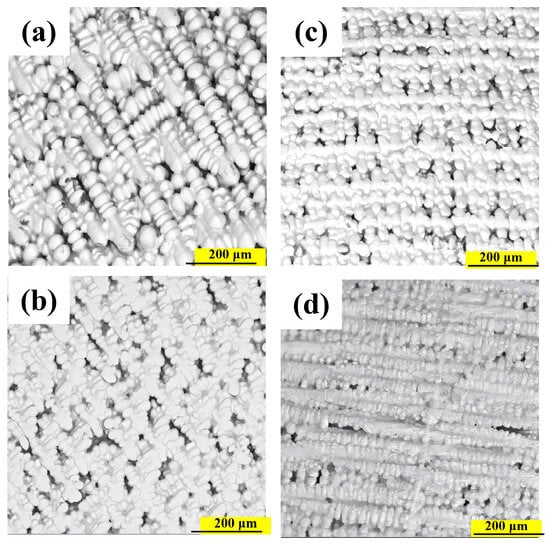
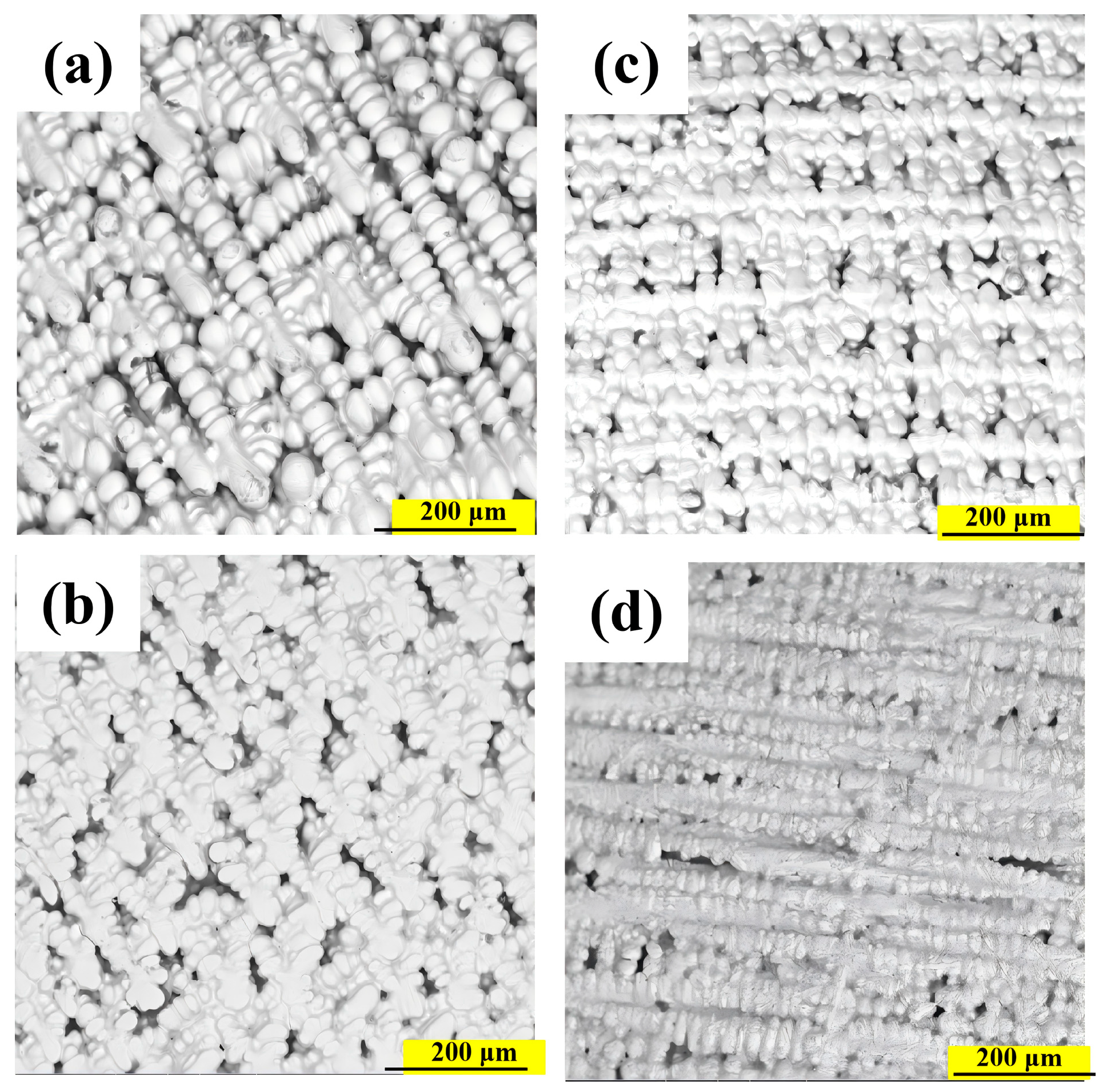
To further verify the macroscopic effect of these preferable nucleation sites on the final solidified structure, the grain microstructures (primary dendrite morphologies) of the steel ingots after crystallization were characterized, as shown in Figure 16. In the Ce-free base steel (Figure 16a), the primary dendrite arms are coarse and loosely arranged. However, with the progressive addition of Ce, the primary dendrites are continuously refined. In Sample 4# with 0.017 wt% Ce (Figure 16d), the microstructure transforms into a highly dense and fine dendrite array. This significant microstructural refinement after crystallization directly validates the in situ observations, comprehensively proving that the finely dispersed Ce2O2S inclusions act as effective heterogeneous nucleation cores during the solidification process.
Figure 16.
Primary dendrite morphologies of the steel ingots at the 1/2 radius position after crystallization: (a) 1# (0 wt% Ce); (b) 2# (0.0035 wt% Ce); (c) 3# (0.010 wt% Ce); (d) 4# (0.017 wt% Ce).
4. Conclusions
This study systematically investigated the effects of varying Ce content on the type, size, morphology, aggregation tendency, and modification mechanisms of inclusions in GCr15 bearing steel. Employing a comprehensive methodology including smelting experiments, high-temperature in situ observations, thermodynamic evaluations, and first-principles calculations, the mechanisms underlying Ce modification were elucidated. The primary findings are summarized as follows:
- (1)
- Without Ce addition, the primary inclusions in GCr15 bearing steel predominantly consisted of irregular and coarse Al2O3, MnS, and Al2O3-MnS composite phases. As the Ce content increased, the inclusion types underwent a sequential transition from CeAlO3 to Ce2O3, and ultimately to Ce2O2S and CeS. All rare-earth-modified inclusions exhibited morphological spheroidization and significant size reduction. At 0.017 wt% Ce, uniformly dispersed, fine-scale Ce2O2S and CeS inclusions were formed throughout the steel matrix.
- (2)
- Prior to Ce treatment, the average inclusion size was 2.63 ± 0.35 μm, with a substantial proportion of Al2O3 inclusions exceeding 2.0 μm. Following the progressive addition of Ce, the average inclusion size systematically decreased. At a Ce concentration of 0.0170 wt %, the average inclusion size reached a minimum of 1.57 ± 0.14 μm, while the number density achieved a maximum of 166/mm2, demonstrating a statistically microstructural refinement effect.
- (3)
- Thermodynamic calculations revealed that the Gibbs free energy of formation for CeAlO3 is significantly lower than that of MnS, corresponding to a higher precipitation temperature. Consequently, following Ce treatment, CeAlO3 precipitates preferentially from the melt and acts as an effective heterogeneous nucleation core for MnS. This mechanism promotes the formation of small, spherical CeAlO3-MnS composite inclusions, thereby effectively suppressing the precipitation of coarse isolated MnS particles and simplifying the inclusion constituents.
- (4)
- High-temperature in situ observations and interparticle attractive force calculations demonstrated significant differences in the agglomeration capabilities of various inclusions, with the attraction strength decreasing in the order of Al2O3, CeAlO3, Ce2O3, and Ce2O2S. Unmodified Al2O3 readily formed large clusters, whereas Ce2O2S exhibited the weakest interparticle attraction. First-principles calculations further corroborated that Ce2O2S shows the most negative formation energy among the evaluated inclusions, indicating comparatively high thermodynamic stability and a lower tendency toward coarsening, thus remaining stably dispersed within the matrix.
- (5)
- Two-dimensional lattice mismatch calculations indicated that Ce2O2S possesses an extremely low disregistry of merely 3.27% with primary austenite, establishing it as a highly potent nucleation core. In situ observational statistics confirmed that the copious precipitation of finely dispersed Ce2O2S provides dense, uniformly distributed nucleation sites. This significantly reduces nucleation resistance, enhances the nucleation rate of the primary phase, and ultimately refines the solidification microstructure of the steel.
Author Contributions
Conceptualization, H.C., L.L. and J.P.; methodology, H.C. and J.P.; software, H.C. and J.L.; validation, H.C., J.P., Y.X., J.L. and F.H.; formal analysis, H.C., J.L. and Y.X.; investigation, H.C., F.H. and Y.X.; resources, L.L. and Y.X.; data curation, H.C. and F.H.; writing—original draft preparation, H.C.; writing—review and editing, H.C., L.L., J.P., Y.X., J.L. and F.H.; visualization, H.C. and F.H.; supervision, L.L., J.P. and J.L.; project administration, L.L.; funding acquisition, L.L. All authors have read and agreed to the published version of the manuscript.
Funding
This research was funded by the Open Project of State Key Laboratory of Advanced Metallurgy, grant number 41625031.
Data Availability Statement
The original contributions presented in this study are included in the article. Further inquiries can be directed to the corresponding author.
Conflicts of Interest
Author Yingtie Xu was employed by the company Baoshan Iron & Steel Co., Ltd. The remaining authors declare that the research was conducted in the absence of any commercial or financial relationships that could be construed as a potential conflict of interest.
References
- Zaretsky, E.V. Rolling bearing steels–a technical and historical perspective. Mater. Sci. Technol. 2012, 28, 58–69. [Google Scholar]
- Tsubota, K.; Sato, T.; Kato, Y.; Hiraoka, K.; Hayashi, R. Bearing Steels: Into the 21st Century; ASTM International: Conshohocken, PA, USA, 1998; pp. 202–215. [Google Scholar]
- Zhang, F.; Yang, Z. Development of and perspective on high-performance nanostructured bainitic bearing steel. Engineering 2019, 5, 319–328. [Google Scholar] [CrossRef] [Scilit]
- Lu, B.; Wei, W.; Mao, H.; Lu, X. Effect of cold ring rolling on the wear resistance of GCr15 bearing steel after quenching and tempering. Metals 2019, 9, 647. [Google Scholar] [CrossRef] [Scilit]
- Li, K.; Chen, T.; Li, S.Y.; Wang, X.T.; Liu, T. The impact on the residual stress distribution in continuous hard turning GCr15. Mater. Sci. Forum 2014, 800–801, 596–600. [Google Scholar] [CrossRef] [Scilit]
- Hashimoto, K.; Fujimatsu, T.; Tsunekage, N.; Hiraoka, K.; Kida, K.; Santos, E.C. Effect of inclusion/matrix interface cavities on internal-fracture-type rolling contact fatigue life. Mater. Des. 2011, 32, 4980–4985. [Google Scholar] [CrossRef] [Scilit]
- Cong, T.; Wang, J.; He, J.; Liu, Y.; Chen, Y.; Liu, F.; Li, L. Microstructure evolution and fatigue crack initiation life prediction of actual failed bearings under GRCF conditions. Eng. Fail. Anal. 2025, 169, 109148. [Google Scholar]
- Wang, P.; Zhang, P.; Wang, B.; Zhu, Y.; Xu, Z.; Zhang, Z. Fatigue cracking criterion of high-strength steels induced by inclusions under high-cycle fatigue. J. Mater. Sci. Technol. 2023, 154, 114–128. [Google Scholar]
- Zou, Y.; Huang, A.; Fu, L.; Gu, H. Effect of lightweight refractories on the cleanness of bearing steels. Ceram. Int. 2018, 44, 12965–12972. [Google Scholar] [CrossRef] [Scilit]
- Zhang, G.; Cheng, G.; Zhang, T.; Miao, H.; Zhang, X. Evolution of oxide inclusions and cleanliness control in Al-killed GCr15SiMn bearing steel during secondary refining process. Ironmak. Steelmak. 2024, 51, 152–162. [Google Scholar]
- Clemons, K.; Lorraine, C.; Salgado, G.; Taylor, A.; Ogren, J.; Umin, P.; Es-Said, O. Effects of heat treatments on steels for bearing applications. J. Mater. Eng. Perform. 2007, 16, 592–596. [Google Scholar] [CrossRef] [Scilit]
- Hua, L.; Du, Y.; Qian, D.; Sun, M.; Wang, F. Influence of prior cold rolling on bainite transformation of high carbon bearing steel. Metall. Mater. Trans. A 2025, 56, 640–654. [Google Scholar] [CrossRef] [Scilit]
- Tian, C.; Zhang, S.; Liu, X.; Gao, S.; Xie, X.; Zhu, X.; Mu, W.; Yuan, Y.; Wang, Q. Functional failure behavior of submerged entry nozzle during the continuous casting process of the bearing steel GCr15. Steel Res. Int. 2024, 95, 2400145. [Google Scholar] [CrossRef] [Scilit]
- Liu, Y.; Fan, Q.; Liu, Y.; Ning, Y.; Zhang, J.; Yu, H.; Zhu, Z.; Gao, H.; Wang, J. Microstructural analysis of non-metallic inclusions in atmosphere melted and poured stainless steel investment castings. Int. J. Met. 2025, 19, 2443–2457. [Google Scholar] [CrossRef] [Scilit]
- Zhang, M.; Li, X.; Guo, Z.; Sun, Y. Research on the size and distribution of TiN inclusions in high-titanium steel cast slabs. Materials 2025, 18, 3527. [Google Scholar] [CrossRef] [Scilit]
- Goikhenberg, Y.N.; Kulakov, B.A.; Polukhin, D.S. Non-metallic inclusions in micropores of massive steel castings. Izv. Ferr. Metall. 2025, 68, 274–279. [Google Scholar]
- Wang, H.; Zhang, Z.; Wang, P.; Tang, H.; Zhang, J. Improving the as-cast structure and semi-macro segregation in bearing steel through cerium inclusions. J. Mater. Res. Technol. 2025, 39, 7575–7587. [Google Scholar] [CrossRef] [Scilit]
- Wu, H.J.; Xiao, T.; Xu, Y.; Liu, X.-J.; Liu, W.; Li, X.; Li, J. Effect of rare earth cerium on inclusions and contact fatigue properties in high-carbon chromium bearing steel. Metall. Mater. Trans. B 2026, 57, 65–74. [Google Scholar] [CrossRef] [Scilit]
- Wang, W.; Xia, W.; Zhou, Y.; Deng, A.; Bao, G.; Liao, Z.; Wang, H. The modification of aluminum oxide inclusions in bearing steel under different cleanliness conditions by rare earth elements. Metals 2024, 14, 861. [Google Scholar] [CrossRef] [Scilit]
- Yang, C.; Liu, P.; Luan, Y.; Li, D.; Li, Y. Study on transverse-longitudinal fatigue properties and their effective-inclusion-size mechanism of hot rolled bearing steel with rare earth addition. Int. J. Fatigue 2019, 128, 105193. [Google Scholar] [CrossRef] [Scilit]
- Wang, W.; Xia, W.; Zhou, Y.; Deng, A.; Bao, G.; Liao, Z.; Wang, H. Time-dependent study of inclusions in bearing steel subjected to rare earth treatment with secondary oxidation. Crystals 2024, 14, 697. [Google Scholar] [CrossRef] [Scilit]
- Wang, Y.; Liu, C. Agglomeration characteristics of various oxide inclusions in molten steel containing rare earth element under different deoxidation conditions. ISIJ Int. 2021, 61, 1396–1403. [Google Scholar] [CrossRef] [Scilit]
- Yin, Y.; Wang, Y.; Liu, C.; Jiang, M. Effect of interfacial properties on the agglomeration characteristics of inclusions in high-manganese and high-aluminum steels. Steel Res. Int. 2025, 97, 316–329. [Google Scholar]
- Zang, X.; Liu, C.; Wang, Y.; Liang, Z. Effect of interface property on the agglomeration characteristic of inclusions in high Al steel with different Al contents. Steel Res. Int. 2024, 95, 2400248. [Google Scholar] [CrossRef] [Scilit]
- Kawanishi, S.; Tsukahara, Y.; Terashima, S.; Nakao, H.; Sukenaga, S.; Shibata, H. In-situ observation of inclusion formation behaviors during solidification process using model alloy. ISIJ Int. 2025, 65, 1153–1161. [Google Scholar] [CrossRef] [Scilit]
- Ren, Y.; Zhang, L. In-situ observation of nonmetallic inclusions in steel using confocal scanning laser microscopy: A review. Int. J. Miner. Metall. Mater. 2025, 32, 975–991. [Google Scholar]
- Teh, Y.S.; Rangaiah, G.P. A study of equation-solving and Gibbs free energy minimization methods for phase equilibrium calculations. Chem. Eng. Res. Des. 2002, 80, 745–759. [Google Scholar] [CrossRef] [Scilit]
- Yang, C.; Luan, Y.; Li, D.; Li, Y. Effects of rare earth elements on inclusions and impact toughness of high-carbon chromium bearing steel. J. Mater. Sci. Technol. 2019, 35, 1298–1308. [Google Scholar] [CrossRef] [Scilit]
- Wu, X.; Dong, B.; Wang, Z.; Tian, Q.; Fu, J. Modification Effect and Mechanism of La-Ce on Inclusions in GCr15 Bearing Steel. Spec. Steel 2024, 45, 36–42. [Google Scholar]
- Iwai, Y.; Seki, R.; Tanaka, Y. Correlation of phase equilibria by new activity coefficient model. Fluid Phase Equilib. 2019, 488, 62–71. [Google Scholar]
- Chen, L.Q. Chemical potential and Gibbs free energy. MRS Bull. 2019, 44, 520–523. [Google Scholar] [CrossRef] [Scilit]
- Wu, M.; Cheng, L.; Ren, Y.; Zhang, L.-F. Influence of surface tension on collision of inclusions on surface of molten steel. J. Iron Steel Res. Int. 2025, 32, 3838–3846. [Google Scholar] [CrossRef] [Scilit]
- Wang, Y.; Liu, X.; Yang, Q.; Liu, Y.; Li, Z.; Guo, B.; Mao, H.; Misra, R.D.K.; Xu, H. First principles calculation of interfacial stability, energy, and elemental diffusional stability of Fe (111)/Al2O3 (0001) interface. AIP Adv. 2019, 9, 125313. [Google Scholar] [CrossRef] [Scilit]
- Lv, W.; Yan, L.; Pang, X.; Yang, H.; Qiao, L.; Su, Y.; Gao, K. Study of the stability of α-Fe/MnS interfaces from first principles and experiment. Appl. Surf. Sci. 2020, 501, 144017. [Google Scholar]
- He, F.; Peng, J.; Zhang, F.; Wang, Y.-B.; Chang, H.-T. Experimental and first-principles calculation of TiN growth mechanism on CeAlO3 surface in steel. J. Iron Steel Res. Int. 2024, 31, 452–463. [Google Scholar]
- Yu, J.; Lin, X.; Wang, J.; Chen, J.; Huang, W. First-principles study of the relaxation and energy of bcc-Fe, fcc-Fe and AISI-304 stainless steel surfaces. Appl. Surf. Sci. 2009, 255, 9032–9039. [Google Scholar] [CrossRef] [Scilit]
- Liu, J.; Li, G.; Shi, C.; Tang, Z.; Jia, L.; Zhao, Y.; Wang, S.; He, X. Effect of Ce-Y composite addition on the inclusion evolution in T91 heat-resistant steel. Materials 2025, 18, 1459. [Google Scholar] [CrossRef] [Scilit]

Disclaimer/Publisher’s Note: The statements, opinions and data contained in all publications are solely those of the individual author(s) and contributor(s) and not of MDPI and/or the editor(s). MDPI and/or the editor(s) disclaim responsibility for any injury to people or property resulting from any ideas, methods, instructions or products referred to in the content. |
© 2026 by the authors. Licensee MDPI, Basel, Switzerland. This article is an open access article distributed under the terms and conditions of the Creative Commons Attribution (CC BY) license.