


Abstract
This review provides a comprehensive overview of high-wear-resistant metal–ceramic surface engineering technologies based on Directed Energy Deposition (DED) for high-temperature industrial applications. In high-temperature processes such as continuous hot-dip coating, critical components (e.g., rollers and sleeves) are exposed to severe wear and chemical reactions, leading to rapid degradation and frequent replacement, which results in significant economic losses. This review focuses on the fundamental characteristics of DED processes and their advantages over conventional surface modification techniques such as HVOF, PVD/CVD, and arc-based methods. Particular attention is given to the process–structure–property relationships governing coating performance, including coating thickness, bonding characteristics, and high-temperature stability. Representative material systems, particularly WC-based metal–ceramic composites (e.g., Co–WC), are systematically discussed in terms of their wear resistance and applicability under severe operating conditions. Quantitative tribological performance metrics, including wear rate and friction coefficient, are also reviewed to provide a more rigorous understanding of coating performance. The analysis highlights that DED offers unique advantages in achieving thick coatings with strong metallurgical bonding and high applicability to repair and remanufacturing of large-scale components. In addition, recent advances in DED technologies, such as closed-loop control, self-regulating effects, and data-driven process optimization, are examined to highlight emerging trends in the field. The review also identifies current technical limitations and outlines future research directions, emphasizing the need for improved process control, defect mitigation, and integration of advanced monitoring techniques.
1. Introduction
Wear problems in rotating components operating under high-temperature and high-load environments represent a critical technical challenge commonly encountered across various industries, including steel manufacturing, heavy industry, energy, and aerospace sectors. In particular, in high-temperature industrial processes such as continuous hot-dip coating operations, rotating components such as rollers, bushings, and sleeves are continuously exposed to friction, high-temperature oxidation, and chemical reactions with molten metals. These conditions lead to severe surface wear and premature component failure. Such wear damage not only shortens component lifetime but also results in frequent equipment shutdowns and reduced productivity, ultimately causing significant economic losses [1,2,3]. Such challenges are particularly pronounced in continuous hot-dip coating processes, where rotating components are directly exposed to molten metal environments, leading to accelerated degradation and complex failure mechanisms.
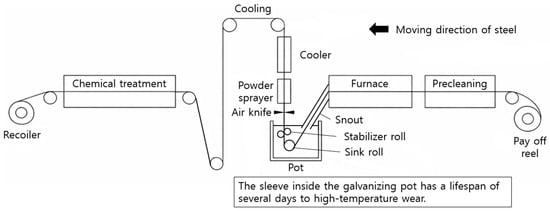
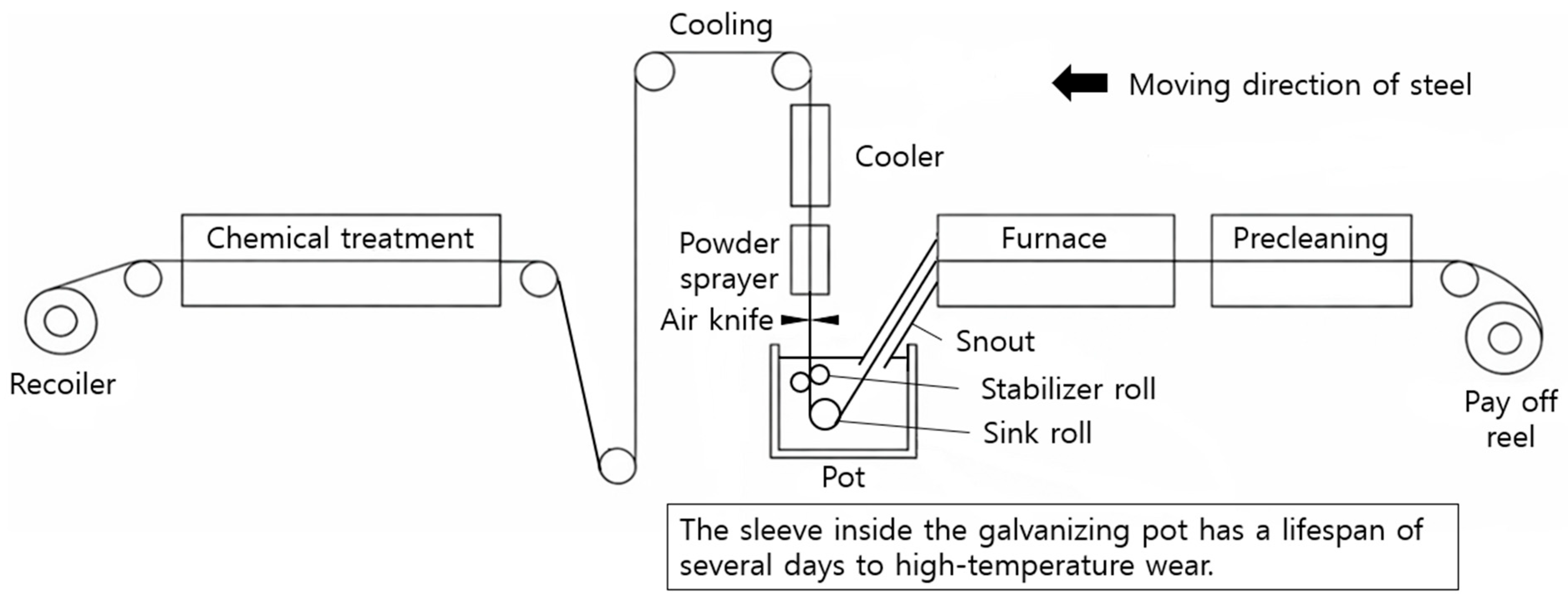
A representative example is the pot roller and stabilizer roll used in continuous molten aluminum coating processes, as shown in Figure 1, which operate under high-temperature conditions exceeding approximately 660 °C. When molten aluminum penetrates through defects in the surface coating layer, dissolution and chemical reactions can occur at the coating–substrate interface. This phenomenon has been reported to induce interfacial delamination, crack formation, and localized damage [2]. Figure 2 shows typical damage patterns observed on the surface of a stabilizer roll used in an actual continuous hot-dip coating process. For this reason, the typical service life of sink rollers and related components is reported to be approximately one week, indicating that ensuring adequate surface durability under high-temperature friction environments remains an unresolved challenge [3]. Figure 1 and Figure 2 illustrate a typical hot-dip aluminum coating process, in which steel rollers are continuously exposed to molten aluminum at elevated temperatures (~660 °C). It should be emphasized that the examples shown in Figure 1 and Figure 2 are intended to represent a typical high-temperature wear environment encountered in various industrial applications, rather than a case-specific problem.
Figure 1.
Steel Galvanizing Process.
Figure 2.
Schematic illustration of surface damage and the underlying mechanism of an operating roll in a molten metal bath. Adapted from Ref. [2]. Step 1: Molten Zn or Al penetrates into the coating through micro-channels and interconnected porosity. Step 2: The infiltrated molten metal accumulates at the coating–substrate interface and induces local substrate dissolution, forming a liquefied region. Step 3: Under external mechanical loading, such as frictional force during roll–strip interaction, crack initiation occurs, leading to coating spallation.
Although the steel manufacturing equipment described above has been used as an example, similar wear problems are commonly observed in industrial rotating components that are continuously exposed to high-temperature, high-load, oxidation, and friction environments. Under such conditions, surface engineering technologies have played a crucial role in extending hardware lifetime and improving operational efficiency of industrial equipment [4,5]. In the early stages, components were manufactured entirely from bulk wear-resistant alloys to achieve high wear resistance. However, this approach significantly increases material costs as well as manufacturing expenses. In contrast, surface treatment–based approaches enable localized reinforcement only in regions where wear is concentrated, thereby reducing material consumption and allowing repeated repair and reuse. In fact, it has been reported that re-depositing wear-resistant coatings on worn roll components can significantly reduce maintenance costs and material waste compared with replacing components with new ones [5].
Various surface treatment technologies have been applied in industrial environments to mitigate wear. High-velocity oxy-fuel (HVOF) coating has been widely utilized because it can form coatings with high hardness and strong adhesion using metal–ceramic (cermet) powders such as WC–Co systems [4,6]. However, due to inherent process characteristics, the HVOF process may involve issues such as porosity, surface roughness, and coating thickness uniformity. Moreover, it has been reported that the process has structural limitations in performing precise repair of locally worn regions or components with complex geometries [6,7].
Physical and chemical vapor deposition (PVD/CVD) processes are thin-film coating technologies capable of providing excellent surface quality and precise thickness control, and they are widely used in cutting tools and mold applications [8]. However, PVD/CVD coatings, which are typically formed with thicknesses of only a few micrometers or less, may exhibit limitations in load-bearing capacity and long-term durability under high-temperature and high-load wear environments. In addition, due to the line-of-sight deposition characteristics, achieving uniform coating on large or complex industrial components remains challenging [9]. For these reasons, alternative technologies capable of simultaneously providing thicker coating layers and strong interfacial bonding are required to ensure wear resistance in high-temperature industrial facilities and large rotating components.
As an alternative to overcome the limitations of conventional surface treatment technologies, laser-based surface modification technologies—particularly Directed Energy Deposition (DED), one of the laser additive manufacturing processes—have recently gained significant attention as advanced wear-resistant surface engineering techniques [10,11]. The DED process locally melts and deposits metal powder or wire using a high-power laser, enabling the formation of strong metallurgical bonding with the substrate while maintaining a relatively small heat-affected zone. Furthermore, the process allows direct coating and repair on existing component surfaces and can be applied to large or complex industrial parts, providing significant advantages from the perspective of field repair and refurbishment (FRR) [10].
In particular, metal–ceramic composite coatings provide superior hardness and wear resistance compared with single-metal coatings through the combination of a ductile metallic matrix and hard ceramic reinforcement phases. WC-based metal–ceramic composites (such as Co–WC, WC–Co, and WC–Ni) exhibit stable wear resistance even at elevated temperatures, and numerous studies have reported that when applied through the DED process, both thick coating layers and strong interfacial bonding can be achieved simultaneously [11,12,13]. In addition, it has been confirmed that microstructure and mechanical properties are highly sensitive to process parameters such as laser power, scanning speed, and powder feed rate, and that wear resistance and hardness can be effectively tailored through precise control of heat input [14].
Recently, this research trend has evolved beyond simple experimental exploration of process conditions toward data-driven analysis of the relationships among process parameters, microstructure, and performance. In particular, efforts are being made to extend these approaches to machine learning (ML/AI)-based process control and digital twin manufacturing systems [12]. Therefore, this review paper systematically summarizes the limitations of existing wear-resistant surface treatment technologies and comprehensively examines recent research trends and future development directions of DED-based metal–ceramic surface engineering, focusing on process characteristics, microstructure–property relationships, and industrial application cases.
2. Trends in Conventional Wear-Resistant Surface Treatment Technologies
Various surface treatment technologies have been developed and applied to address wear problems in industrial rotating components operating under high-temperature and high-load environments. Compared with manufacturing entire components from bulk wear-resistant alloys, these technologies play an important industrial role by reducing material costs and enabling the reuse of existing components. In this section, representative wear-resistant surface treatment technologies that have been widely utilized are categorized according to their processing principles and application characteristics, and their advantages and limitations are discussed. However, these conventional surface treatment technologies inherently involve trade-offs. For instance, HVOF processes can produce relatively dense coatings but rely primarily on mechanical bonding; PVD/CVD techniques provide excellent surface quality but are limited to micrometer-scale thicknesses; and arc-based coatings allow for thick layer deposition but suffer from excessive heat input and dilution.
2.1. High-Velocity Oxy-Fuel (HVOF) Technology
The high-velocity oxy-fuel (HVOF) process is a representative thermal spray technique in which metal or metal–ceramic powders are accelerated and sprayed at high velocity using a supersonic flame generated by the combustion of fuel and oxygen. The particles impact and adhere to the substrate surface, forming a dense coating layer [13,14,15]. The HVOF process can achieve high bonding strength and excellent coating density due to relatively low powder oxidation and high particle impact energy. As a result, it is considered one of the most widely commercialized processes among wear-resistant surface treatment technologies.
In particular, cermet powders such as WC–Co and WC–CoCr provide both high hardness and excellent wear resistance, and have therefore been widely applied to various industrial wear components, including engine parts, valve trains, and roll hardware [4,8,16,17]. These HVOF coatings exhibit excellent performance under adhesive and abrasive wear conditions and have demonstrated a high level of technological maturity in industrial applications.
However, due to inherent process characteristics, the HVOF process has difficulty completely eliminating a certain level of porosity, and limitations remain in controlling surface roughness and coating thickness uniformity [18]. Furthermore, since the bonding between the coating and the substrate primarily relies on mechanical interlocking, interfacial degradation and delamination have been reported during long-term operation in high-temperature environments [8,17]. In addition, precise repair of locally damaged regions or repeated re-deposition is difficult, and achieving uniform coatings on large components with complex geometries remains challenging.
2.2. Physical and Chemical Vapor Deposition (PVD/CVD)
Physical vapor deposition (PVD) and chemical vapor deposition (CVD) processes can produce high-hardness thin-film coatings such as TiN, CrN, and TiAlN. Owing to their excellent surface quality and precise thickness control, these technologies have been widely used in the cutting tool and mold industries [19,20]. In particular, gas-phase deposition processes have been reported to be effective in improving tool life, reducing friction, and enhancing surface durability.
However, PVD/CVD coatings are typically formed with thicknesses of only a few micrometers or less. As a result, under high-temperature and high-load wear conditions, the load-bearing capacity of the coating layer itself becomes limited, which may lead to insufficient long-term durability [8]. In such thin coatings, load transfer depends heavily on the substrate, and under elevated temperature conditions, thermal stability and wear behavior at the coating–substrate interface can become problematic.
In addition, the PVD process exhibits line-of-sight deposition characteristics, meaning that the movement of deposited particles follows a straight trajectory. This makes it difficult to form coatings with uniform thickness on large or complex industrial components. Such geometric shadowing effects can lead to coating thickness non-uniformity and localized performance degradation, posing limitations for applications in high-temperature industrial equipment or rotating components that require thick coatings over large areas [21]. Therefore, while PVD/CVD technologies are well suited for high-precision and low-load applications, they are considered to have structural limitations in enhancing the wear resistance of large rotating components operating under high-temperature and high-load conditions.
2.3. Arc-Based and Welding-Type Surface Treatment
Welding-based surface treatment technologies, such as plasma transferred arc welding (PTAW or PTA-P), have been widely used in wear-resistant reinforcement and repair/regeneration of large components because they enable the formation of relatively thick overlay layers and provide high deposition efficiency (material utilization) [22].
However, welding-based processes generally involve high heat input, which may lead to issues such as expansion of the heat-affected zone (HAZ), increased dilution with the substrate, and accumulation of residual stresses. These factors may increase the risk of defects such as cracking depending on the process and material combinations [22]. Furthermore, in metal–matrix composite (MMC) hardfacing systems using ceramic-reinforced powders (e.g., WC), ceramic particles may experience thermal degradation, decomposition, or partial dissolution and re-precipitation within the molten pool. Such particle degradation and dilution behavior can alter the microstructure and negatively affect the wear resistance and long-term reliability of the coating layer [23].
For these reasons, welding-based surface treatment technologies have advantages in forming thick layers and achieving metallurgical bonding. However, limitations remain in terms of precise control, localized and repeated repair of damaged regions, and ensuring uniform quality for complex geometries or large components operating under high-temperature and high-load environments. Consequently, as an alternative that can simultaneously satisfy requirements such as thick deposition layers, strong interfacial bonding, local repair capability, and applicability to complex geometries, laser-based additive manufacturing processes—particularly Directed Energy Deposition (DED)—have recently attracted attention as advanced wear-resistant surface treatment technologies [24]. The comparison of wear-resistant surface treatment technologies is summarized in Table 1. It should be noted that certain characteristics summarized in Table 1 may vary depending on process parameters and material systems. In particular, cracking susceptibility in arc-based processes such as PTAW is strongly influenced by alloy composition, preheating conditions, and interpass temperature, and does not necessarily represent an inherent limitation of the process.
Table 1.
Comparison of wear-resistant surface treatment technologies.
3. DED (Directed Energy Deposition)-Based Surface Treatment Technology
Directed Energy Deposition (DED) is an additive manufacturing process that locally melts and deposits materials in the form of metal powder or wire using a high-power laser or electron beam as a heat source. In this context, laser cladding can be considered a representative subset of Directed Energy Deposition (DED). However, the two are not strictly interchangeable, as they differ in process configuration, energy density regime, and typical application scale. Laser cladding is typically employed for surface coating and repair applications, whereas DED encompasses a broader range of additive manufacturing processes, including both laser- and arc-based material deposition systems. Conventional surface treatment technologies exhibit inherent trade-offs: HVOF provides relatively dense coatings but relies on mechanical bonding; PVD/CVD offers excellent surface quality but is limited to micrometer-scale thickness; arc-based coatings enable thick layers but suffer from excessive heat input and dilution. These limitations highlight the need for advanced surface engineering technologies, such as Directed Energy Deposition (DED). This technology has been reported to be particularly effective for surface engineering as well as component repair and restoration applications [24,28]. Although the dimensional accuracy of DED may be relatively lower than that of powder bed fusion (PBF) processes, it offers significant advantages in terms of remanufacturing and field applications because material can be directly deposited onto existing components and the process is less constrained by build chamber size limitations [24,26]. In particular, DED is highly suitable for repairing large-scale industrial components because it enables direct material deposition onto existing parts without size constraints imposed by build chambers, while providing strong metallurgical bonding and localized repair capability.
3.1. Principle and Characteristics of the DED Process
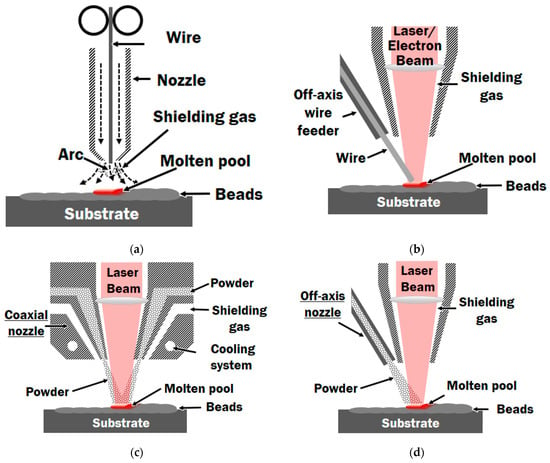
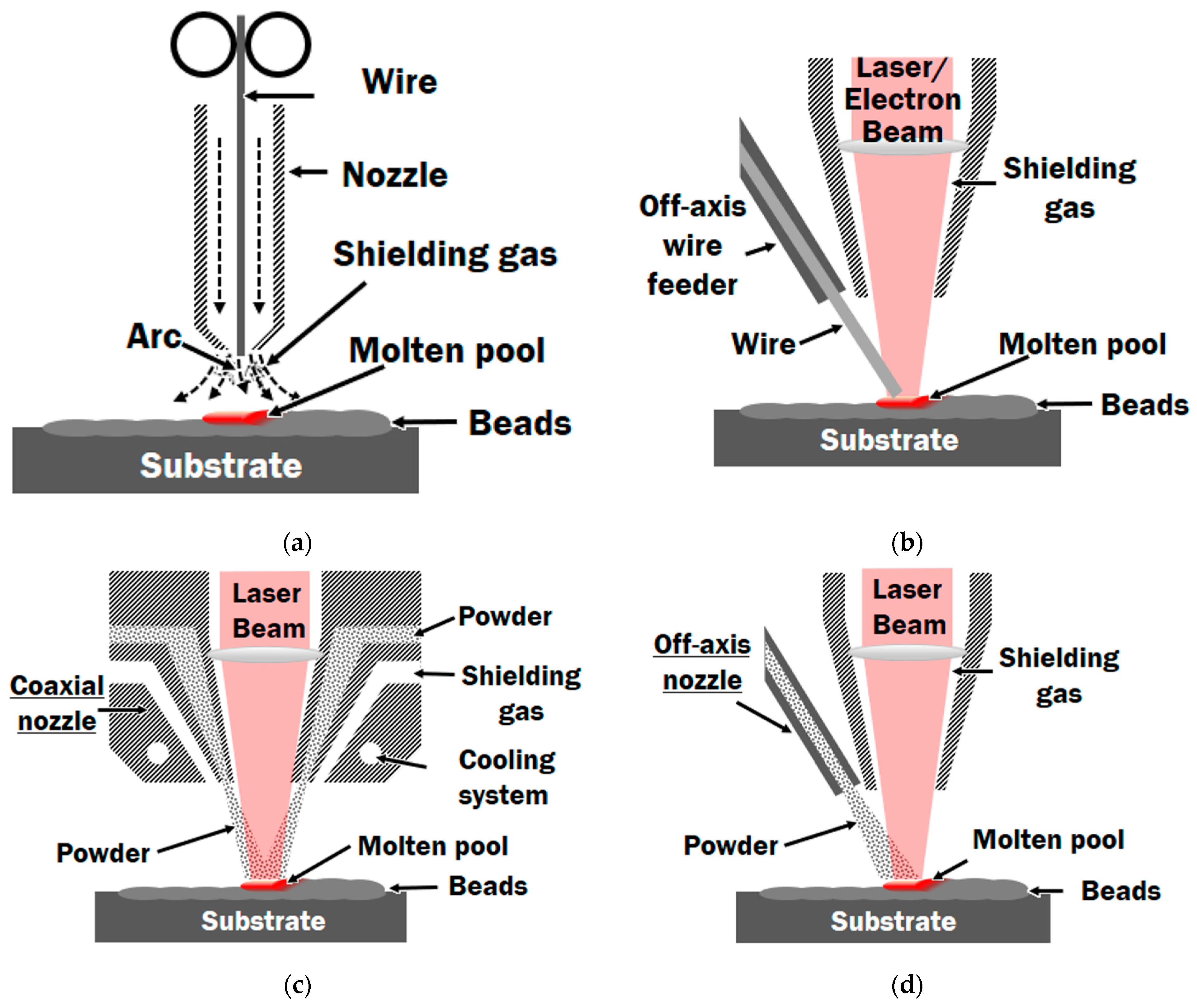
In the DED process, the cladding material supplied simultaneously with laser irradiation forms a molten pool on the substrate surface. This molten pool then undergoes rapid solidification, resulting in the formation of a dense cladding layer. Depending on the process configuration, DED systems can be categorized into powder-feeding systems (coaxial or off-axis powder feeding), pre-placed powder systems, and wire-fed DED systems. Among these, the coaxial powder feeding method is currently the most widely used in both industrial and research environments due to its superior process controllability and suitability for automated operation [24,29,30]. Figure 3 illustrates representative DED methods, including the wire-fed and powder-fed deposition approaches [24]. DED processes can be further classified according to the type of heat source, including laser-based DED and arc-based DED. In particular, the configuration shown in Figure 3a corresponds to an arc-based DED process, commonly referred to as Wire Arc Additive Manufacturing (WAAM), whereas the other configurations represent laser-based deposition systems.
Figure 3.
Representative DED processes categorized by feeding method and heat source, including arc-based (wire-fed, WAAM-type) and laser-based deposition systems. Reprinted from Ref. [24]. (a) Coaxial wire feeding with arc heat source; (b) Off-axial wire feeding with laser heat source; (c) Coaxial powder feeding with laser heat source; (d) Off-axis powder feeding with laser heat source.
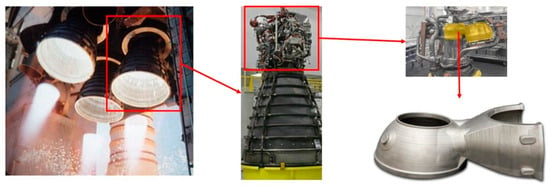
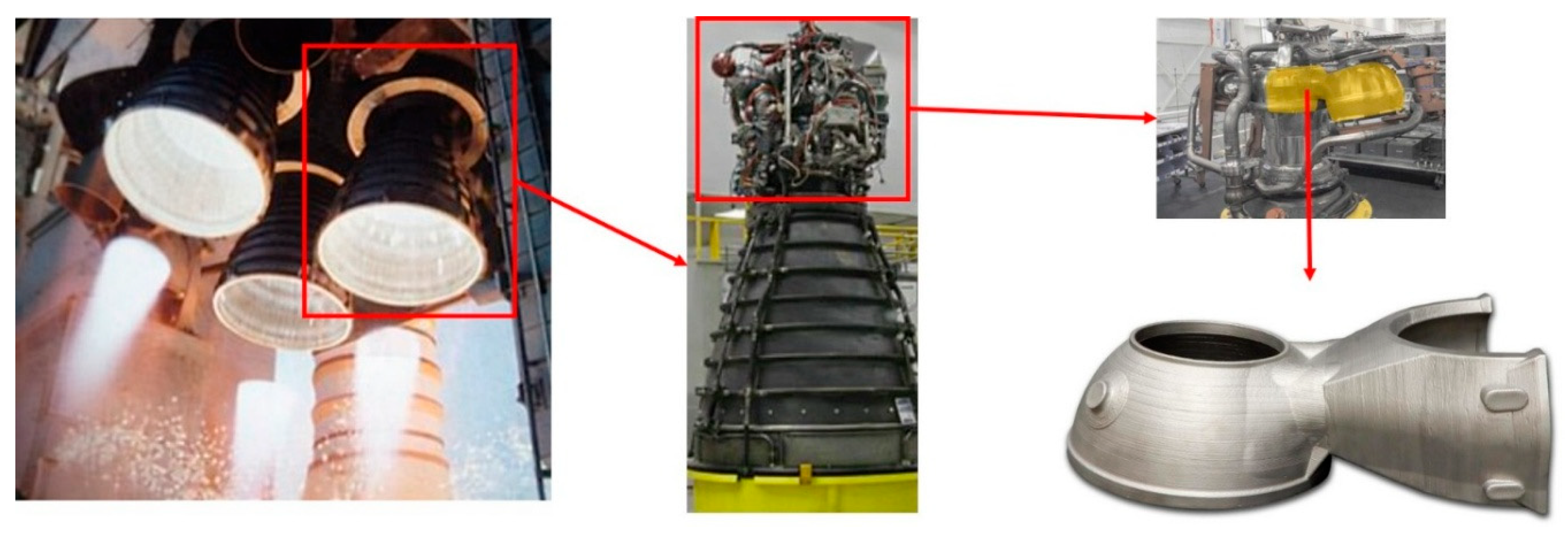
One of the key advantages of DED is its ability to achieve strong metallurgical bonding with the substrate while minimizing the dilution rate and heat-affected zone (HAZ) through high energy density and localized heat source control [10,31]. These characteristics are particularly beneficial for improving the surface durability of industrial rotating components and aerospace structures that operate repeatedly under high-temperature and high-load conditions. Furthermore, when the DED process is applied to the manufacturing of rocket engine components—such as the RS-25 engine powerhead shown in Figure 4—it has been reported that the production time can be significantly reduced compared with conventional manufacturing methods. This comparison is summarized in Table 2, based on a technical seminar report [32], and should be interpreted as indicative rather than a strict quantitative benchmark.
Figure 4.
Example of RS-25 rocket powerhead component fabrication using Directed Energy Deposition (DED), demonstrating significantly reduced production time compared with conventional manufacturing methods. Image courtesy of NASA (public domain). Adapted from Ref. [32].
Table 2.
Qualitative comparison of manufacturing lead time for rocket engine components (adapted from a technical seminar report. Adapted from Ref. [32]).
3.2. Technical Advantages of DED from a Surface Engineering Perspective
Conventional surface modification technologies such as high-velocity oxy-fuel (HVOF) spraying, physical/chemical vapor deposition (PVD/CVD), and arc-based welding coatings (e.g., PTAW, GMAW overlay) have been widely applied for wear-resistant surface treatments. Although these processes offer advantages such as relatively low heat input or high coating quality, they still exhibit certain limitations in terms of coating thickness, bonding strength with the substrate, and applicability to localized repair.
For example, HVOF and other thermal spray processes can form high-hardness coatings with relatively low heat input; however, the bonding between the coating layer and the substrate primarily relies on mechanical interlocking. As a result, the relatively weak interfacial bonding strength with the substrate can lead to reduced fatigue life of the coated component [33]. PVD and CVD are primarily designed for the fabrication of high-quality thin films with precise control at the micro- and nanoscale, making them well-suited for semiconductor applications. However, their inherent limitations in deposition rate, thermal budget, and material selectivity restrict their applicability in large-scale or thick coating applications [34]. Furthermore, arc-based welding cladding processes can produce thick coating layers, but the high heat input may result in a large heat-affected zone (HAZ) and increased dilution with the substrate, which can degrade the performance of the coating layer [25].
In comparison, the DED process, as described earlier, utilizes a high-energy-density laser heat source to locally melt metal powder or wire supplied onto the substrate surface, forming a dense cladding layer through rapid solidification. During this process, metallurgical bonding is formed between the coating layer and the substrate, and the dilution rate can be precisely controlled, enabling effective design of the coating composition and microstructure [35]. In particular, the DED process can produce thick cladding layers exceeding several millimeters and allows selective deposition only in regions where damage is concentrated. Therefore, it has been evaluated as a highly suitable technology for localized repair and remanufacturing of high-value components [27,36].
The rapid solidification conditions formed during the DED process promote the development of a fine-grained microstructure, which generally exhibits superior mechanical properties compared with conventional cast microstructures [37]. In addition, the high cooling rate facilitates uniform dispersion of ceramic reinforcement phases and the formation of fine carbides, thereby enhancing the hardness and wear resistance of the coating layer [11]. For example, metal–ceramic composite claddings consisting of Ni-based or Co-based alloy matrices reinforced with ceramic particles such as WC, TiC, and TiB2 have been reported to exhibit excellent performance under abrasive and adhesive wear conditions [13,38].
In addition to conventional ceramic reinforcements, recent studies have demonstrated that the incorporation of rare-earth elements (REEs), particularly CeO2, plays a critical role in tailoring the microstructure and mechanical properties of WC-based composite coatings [39]. Specifically, the addition of CeO2 exhibits a non-monotonic effect on hardness, where an optimal concentration (typically around 4 wt.%) results in peak hardness values (up to ~91.4 HRC), while excessive addition leads to particle agglomeration and deterioration in wear resistance due to microstructural inhomogeneity. Furthermore, grain refinement mechanisms associated with REE and carbide additions have been explained by the Zener pinning effect. Dispersed second-phase particles such as TiC or CeO2 effectively inhibit grain boundary migration, leading to significant refinement of WC grains, with reported reductions in average grain size from approximately 3.8 μm to 1.2 μm. These findings highlight that precise compositional control of REEs is essential for optimizing the process–microstructure–property relationship in DED-based composite coatings.
In particular, WC-based metal–ceramic composite coatings exhibit excellent performance in high-temperature wear environments due to their high hardness, high melting point, and superior thermal stability. Such coatings have been widely investigated as protective surface coatings for components such as rollers in the steel industry, valve seats, pump impellers, and aerospace turbine parts [11,12]. In these composite cladding structures, the ductile metallic matrix absorbs impact loads while the ceramic reinforcement phases provide wear resistance, enabling stable surface performance even under high-temperature and high-load conditions. In particular, Co–WC metal–ceramic composite coatings offer distinct advantages in high-temperature and high-load environments due to their synergistic microstructure. The WC particles act as primary load-bearing phases with extremely high hardness, providing excellent resistance to abrasive and adhesive wear, while the Co-based matrix enhances fracture toughness and accommodates thermal and mechanical stresses. In addition, the high thermal stability of both WC and Co phases enables the coating to retain its mechanical integrity and wear resistance even at elevated temperatures. This combination of high hardness, load-bearing capability, and toughness makes Co–WC composite coatings especially suitable for severe service conditions involving high contact stress and thermal exposure.
To provide a more quantitative assessment, the tribological performance of WC-reinforced composite coatings has been widely evaluated using standardized test configurations such as pin-on-disk and ball-on-disk methods. Reported specific wear rates are typically on the order of 10−7–10−5 mm3/N·m, while friction coefficients generally range from approximately 0.4 to 0.7 depending on material composition and processing conditions. For example, nanocomposite coatings have demonstrated wear rates as low as 1.88 × 10⁻⁷ mm3/N·m under pin-on-disk testing conditions, along with significantly reduced friction coefficients [40,41,42].
However, controlling the thermal stability of WC particles during the DED process remains a critical challenge. To mitigate WC decomposition, several process design strategies have been proposed in recent studies. In particular, the use of a laser-leading configuration, in which the laser beam is directed ahead of the powder or wire feed, has been reported to significantly reduce the thermal exposure of WC particles compared with conventional rod-leading configurations [43]. This approach enables more stable incorporation of ceramic particles into the molten pool while minimizing decomposition and dissolution. In addition, the introduction of a Ni-based alloy interlayer between the substrate and the coating has been identified as an effective method for suppressing Fe diffusion from the substrate into the coating layer [43]. This interlayer acts as a diffusion barrier, thereby preserving the integrity of the WC phase and maintaining the hardness and wear resistance of the Co–WC composite coating. These strategies highlight the importance of process configuration and material design in improving the microstructural stability of DED-fabricated metal–ceramic composites.
Moreover, the DED process offers a high degree of process design flexibility because key features such as coating thickness, dilution rate, reinforcement phase distribution, and interfacial microstructure can be precisely controlled through process parameters including laser power, scanning speed, and powder feed rate. Process parameters such as laser power, scanning speed, and powder feed rate govern melt pool size, cooling rate, and dilution behavior, which in turn control microstructural features such as grain size, phase distribution, and reinforcement particle dispersion, ultimately determining hardness and wear resistance of the coating layer. These characteristics provide significantly greater process design flexibility compared with conventional surface treatment technologies. When combined with data-driven process optimization and artificial intelligence-based manufacturing technologies in the future, DED is expected to further expand its potential as a high-performance surface engineering technology.
3.3. Process Control, Automation, and Scalability
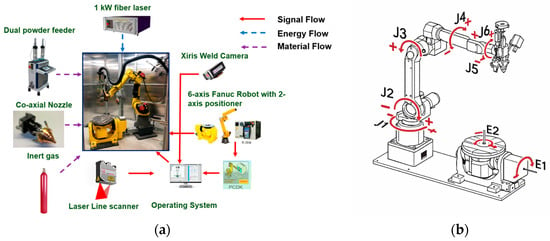
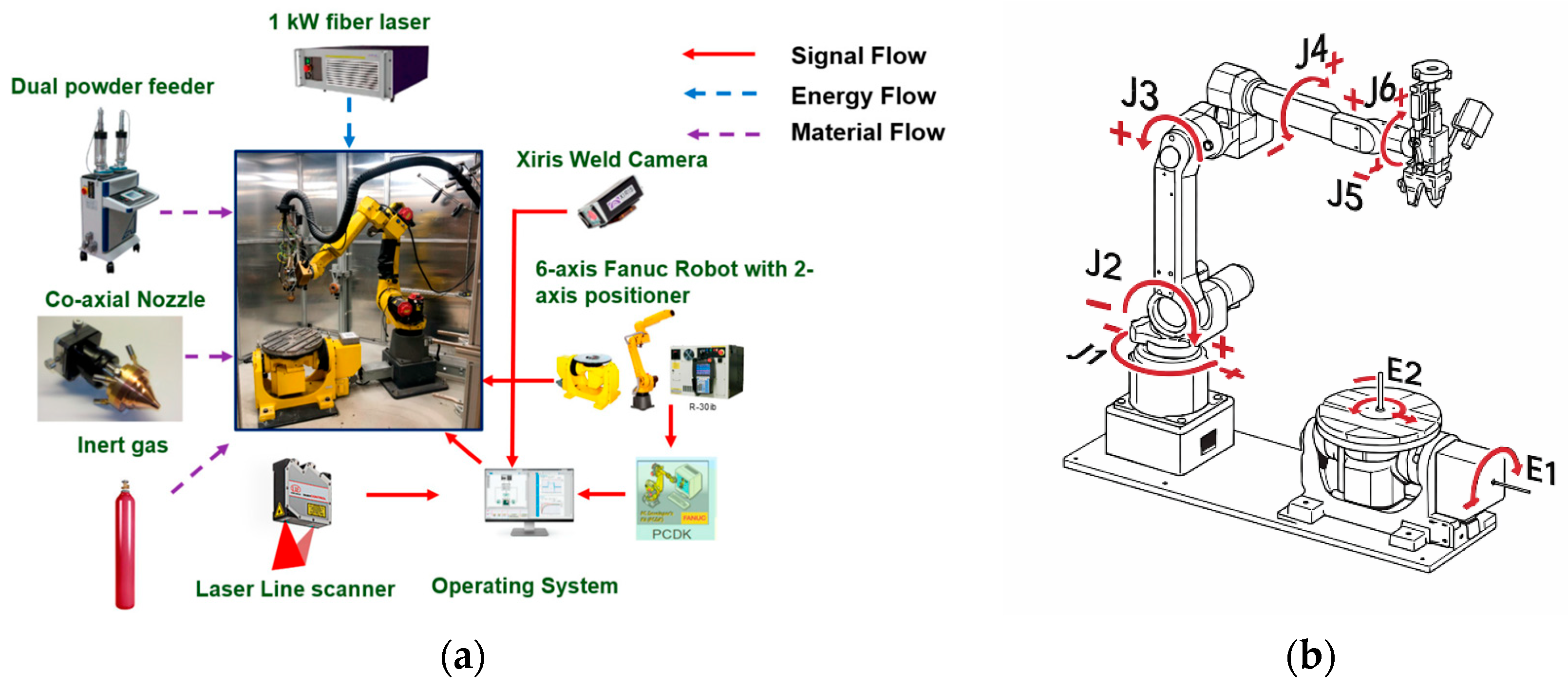
The DED process can be readily integrated with multi-axis robotic systems and CNC platforms, enabling uniform surface treatment even on complex curved components. Figure 5 illustrates an example of a DED system configuration including a general-purpose six-axis industrial robot and a positioner system for such applications [35].
Figure 5.
DED system configuration and rotational axes of the robot–positioner system: (a) An example of DED system configuration. Reprinted from Ref. [35]; (b) Rotational axes of the 6-axis robot with a 2-axis positioner.
Recently, significant research efforts have been directed toward closed-loop control technologies that monitor melt pool temperature, geometry, and powder flow behavior in real time during the deposition process and adjust process parameters accordingly [44,45].
In addition to externally controlled process stabilization, DED-LP processes inherently exhibit a self-regulating effect (SRE), which plays a critical role in maintaining deposition stability. This effect arises from the dynamic interaction between melt pool geometry and powder capture efficiency. Specifically, variations in the standoff distance and melt pool size lead to corresponding changes in the amount of powder captured in the melt pool, thereby enabling autonomous adjustment of the deposited layer height. As a result, this intrinsic feedback mechanism stabilizes the layer height during deposition and significantly improves surface uniformity. Recent studies have reported that the self-regulating effect can reduce surface flatness variation by up to approximately 55%, demonstrating its effectiveness in enhancing process stability and coating quality [46].
Digital twin (DT)-based modeling approaches have also been actively investigated to improve the predictive capability of DED processes. In particular, a multiscale DT framework integrating global and local models has been recognized as an effective strategy for capturing the complex thermo-physical phenomena involved in laser-based deposition processes [47].
In this framework, the global model simulates the thermal history of the entire component, providing context awareness of heat accumulation and process evolution during deposition. In contrast, the local model employs high-resolution discretization to capture melt pool behavior, including laser–powder interactions and rapid solidification phenomena. The coupling of these models enables the transfer of boundary conditions and process context from the global scale to the local scale, which is essential for accurately predicting multi-layer deposition behavior. Such a multiscale global–local modeling approach has been demonstrated to achieve reliable prediction accuracy, with clad geometry errors typically below 10% [47].
In addition, data-driven process optimization approaches that integrate process simulations, real-time sensor data, and machine learning techniques are increasingly being investigated. These approaches demonstrate the potential for the development of intelligent surface engineering technologies based on artificial intelligence in the future [48,49].
In particular, data-driven and artificial intelligence approaches enable the analysis of complex nonlinear relationships among process parameters, thermal behavior, and microstructural evolution, allowing accurate prediction of defect formation such as porosity and cracking, as well as optimization of process conditions for improved coating quality.
In recent studies, specific machine learning architectures have been increasingly adopted to improve prediction accuracy in DED processes. For example, hybrid particle swarm optimization–artificial neural network (PSO–ANN) models have demonstrated superior performance in predicting clad characteristics, including clad height and powder catchment efficiency, compared with conventional empirical approaches [50].
Furthermore, advanced deep learning frameworks based on Bayesian long short-term memory (LSTM) networks have been applied to predictive thermal modeling. These approaches enable accurate temperature field prediction while simultaneously providing uncertainty quantification, which is critical for robust process optimization and real-time control in DED systems [51].
Such approaches are expected to play an important role in systematically controlling common challenges in composite cladding processes, such as reinforcement particle decomposition, porosity formation, and residual stress development.
3.4. Industrial Applicability of DED for Wear-Resistant Surface Engineering
DED-based surface treatment technologies have recently attracted considerable attention across various industries as effective approaches for extending component lifetime and enabling remanufacturing of parts exposed to severe wear and high-temperature environments. In particular, in the steel industry, components such as rollers, shafts, and valve parts used in continuous casting and coating processes are subjected to high-temperature oxidation and severe wear conditions, leading to a continuously increasing demand for high-performance surface engineering technologies. In response to these industrial needs, the DED process has been evaluated as a promising technology because it can form thick functional surface layers with relatively low dilution and strong metallurgical bonding compared with conventional thermal spray and welding cladding techniques. In practice, DED-based surface treatment technologies are increasingly being applied not only to rollers, shafts, and valve components in the steel industry but also to high-temperature rotating components, turbine parts, and propulsion system structures in aerospace and defense sectors [27,31,52].
In aerospace repair applications, advanced sensing technologies are increasingly integrated with DED systems to enable automated and high-precision restoration of damaged components. In particular, 3D laser triangulation sensors have been employed for point-to-point surface registration, allowing accurate reconstruction of worn or damaged geometries prior to deposition. This approach enables precise material deposition tailored to the original component geometry, and has been successfully applied to the repair of gas turbine blade tips. As a result, such sensor-integrated DED systems significantly reduce manual intervention, tooling requirements, and overall repair costs while improving dimensional accuracy and repeatability [53].
Extreme High-Speed Laser Cladding (EHLA) has emerged as an advanced variant of laser-based deposition technologies, offering significantly enhanced productivity and material efficiency. EHLA can achieve cladding speeds exceeding 300 m/min and surface coverage rates of up to approximately 2.0 m2/h. Furthermore, due to its high powder capture efficiency, EHLA can reduce feedstock material consumption by up to 90% compared with conventional thermal spraying processes [54]. Compared with conventional laser cladding processes, EHLA significantly reduces heat input and dilution, thereby enabling the formation of thinner coatings with improved metallurgical quality. These characteristics make EHLA particularly attractive for large-area coating applications requiring both high throughput and cost efficiency. In addition to these technical advantages, EHLA is increasingly recognized as a critical environmentally sustainable alternative to conventional coating processes. In particular, the use of hexavalent chromium (Cr(VI)) in conventional electroplating has been severely restricted under international environmental regulations due to its high toxicity and carcinogenic nature. In this context, EHLA provides a viable solution by eliminating the need for Cr(VI)-based processes while simultaneously improving material utilization efficiency and reducing waste generation [54].
Despite these advantages, high-speed laser cladding processes, including EHLA, may still be susceptible to crack formation due to steep thermal gradients and residual stress development, particularly when applied to high-strength steel substrates. To address this issue, substrate preheating has been widely adopted as an effective strategy to reduce thermal gradients and associated thermal stresses. For instance, preheating the substrate to approximately 250 °C has been shown to effectively mitigate solidification cracking in carburized steel [55].
Among various approaches for wear-resistant surface engineering, metal–ceramic composite coatings have been widely investigated as an effective strategy. In particular, WC-reinforced Ni- or Co-based alloy claddings have attracted significant attention as material systems capable of simultaneously providing excellent wear resistance and high-temperature stability. WC particles act as ceramic reinforcement phases with extremely high hardness, providing excellent resistance against abrasive and adhesive wear. Meanwhile, the Ni- or Co-based metallic matrix exhibits high toughness and thermal stability, effectively mitigating impact loads and thermal stresses. Such metal–ceramic composite structures can maintain stable surface performance over extended service periods even under high-temperature oxidation and high-load wear conditions, making them promising candidates for next-generation wear-resistant surface engineering solutions.
The performance of Co–WC metal–ceramic composite coatings produced through the DED process strongly depends on their microstructural characteristics. In particular, microstructural parameters such as WC particle size, volume fraction, spatial distribution, and interparticle spacing directly influence the hardness, wear resistance, and crack resistance of the coating layer. These microstructural characteristics are significantly affected by various process parameters, including laser power, scanning speed, powder feed rate, and preheating conditions. In particular, the size, distribution, and volume fraction of WC particles play a critical role in determining mechanical properties such as hardness, toughness, and crack resistance, which in turn directly influence the wear performance of DED coatings. If process conditions are not properly controlled, defects such as partial melting or decomposition of WC particles, porosity formation, and crack initiation may occur. Therefore, systematically clarifying the correlation between processing conditions and microstructural evolution is considered a key research task for improving the performance of wear-resistant DED coatings.
Recently, data-driven research aimed at quantitatively analyzing the relationships among processing parameters, microstructure, and material properties has been actively pursued. Increasingly, studies are utilizing optical and electron microscopy images to automatically analyze the size, volume fraction, and distribution characteristics of WC particles and to correlate these microstructural features with mechanical properties. Such approaches enable process optimization based on objective indicators rather than relying solely on empirical parameter selection. In particular, when artificial intelligence and machine learning techniques are employed, the complex nonlinear relationships among processing conditions, microstructure, and wear properties can be effectively modeled. This makes it possible to optimize process parameters and predict the likelihood of defect formation during the deposition process [56].
In addition to conventional homogeneous coating strategies, advanced material design concepts such as functionally graded materials (FGMs) have been increasingly investigated to further enhance performance in extreme environments. This approach is particularly relevant for high-temperature aerospace components, where simultaneous optimization of surface and bulk properties is required. For instance, Al-based functionally graded super-intermetallic compounds have been developed for turbine blade applications, in which compositional gradients are introduced to achieve both high-temperature oxidation resistance at the surface and sufficient fracture toughness in the interior. By tailoring the spatial distribution of intermetallic phases, these materials effectively mitigate the intrinsic brittleness of intermetallic compounds while maintaining excellent thermal stability. Such gradient-based material design strategies provide important insights into next-generation surface engineering technologies. In particular, the DED process offers a unique capability to locally control composition, heat input, and microstructure during deposition, making it a promising platform for realizing FGM-like architectures in coating and repair applications. Therefore, integrating FGM concepts with DED-based surface engineering is expected to further expand the design flexibility and performance of advanced coatings [57].
In addition to these material design perspectives, recent studies indicate that Directed Energy Deposition (DED) offers a unique capability for the seamless transition between dissimilar materials, enabling the fabrication of functionally graded structures with continuously varying compositions. In particular, DED has been successfully applied to the deposition of austenitic–ferritic graded structures for nuclear and high-temperature piping applications, where gradual compositional transitions effectively reduce thermal mismatch and interfacial stress concentrations. Such capabilities demonstrate that DED is not only a suitable platform for implementing FGM concepts but also represents a major emerging trend in advanced manufacturing [58].
Overall, DED-based surface engineering technology is emerging as a key manufacturing approach capable of overcoming the limitations of conventional surface treatment processes while enabling the formation of metal–ceramic composite surfaces optimized for high-wear and high-temperature environments. Furthermore, when combined with process simulations, real-time sensor-based monitoring systems, and machine learning–driven data analysis technologies, DED has the potential to enable automated process design and quality control. This integration is expected to facilitate the development of intelligent surface engineering technologies based on digital twin manufacturing in the future.
4. Discussion on Technical Limitations
Despite the significant advantages of Directed Energy Deposition (DED) for wear-resistant surface engineering, several technical limitations remain that must be addressed before widespread industrial implementation can be fully realized. Major technical challenges in DED-based surface engineering include residual stress accumulation due to rapid thermal cycles, as well as defect formation such as porosity, cracking, and incomplete fusion, which can significantly affect the structural integrity and performance of the coating layer.
Compared with conventional surface treatment technologies, these limitations should be interpreted in a relative context. For instance, thermal spray processes such as HVOF can produce dense coatings but are typically limited by mechanical bonding and difficulties in achieving thick coatings, while PVD/CVD processes offer excellent surface quality but are generally restricted to micrometer-scale thicknesses. In contrast, although DED may involve challenges such as residual stress and defect formation, it provides unique advantages in terms of metallurgical bonding and the ability to form thick coatings.
One of the primary challenges is the complexity of process parameter optimization. The quality and performance of DED coatings are strongly influenced by multiple interacting parameters such as laser power, scanning speed, powder feed rate, and substrate temperature. Improper combinations of these parameters may lead to defects, including porosity, cracking, incomplete fusion, and excessive dilution. In particular, in metal–ceramic composite claddings reinforced with WC particles, the high thermal energy input can induce partial melting, dissolution, or decomposition of ceramic particles, which may degrade the mechanical properties and wear resistance of the coating layer. While process parameter sensitivity is a key challenge in DED, it also offers a higher degree of process flexibility compared to conventional coating techniques, where process conditions are often more constrained and less adaptable to complex geometries. Another important limitation is the difficulty in achieving uniform microstructural control across large deposition areas. During the DED process, variations in heat accumulation and thermal gradients can result in heterogeneous microstructures, leading to spatial variations in hardness, residual stress distribution, and wear resistance. These issues become more pronounced when depositing thick coatings or processing large industrial components. In contrast, thin-film processes such as PVD/CVD typically achieve highly uniform microstructures, but their applicability is limited to thin coatings and relatively simple geometries, making them less suitable for large-scale or repair-oriented applications.
Residual stress formation and distortion also remain critical concerns in DED-based surface treatment processes. Rapid heating and cooling during laser deposition can generate significant thermal stresses within the coating layer and the substrate. These stresses may lead to crack initiation, delamination, or distortion of the component, particularly when thick multilayer deposits are produced. In addition, process monitoring and quality assurance remain challenging in industrial environments. Although recent advances in sensor-based monitoring and closed-loop control have improved process stability, real-time detection and prediction of defects during deposition are still under active investigation.
From an industrial perspective, economic factors and process scalability must also be considered. Compared with conventional coating technologies, DED systems require relatively high initial equipment investment and sophisticated process control systems. Therefore, further improvements in process reliability, automation, and cost efficiency are necessary to enhance the industrial competitiveness of DED-based surface engineering technologies. Nevertheless, in applications requiring thick coatings, strong metallurgical bonding, and localized repair capability, DED can offer superior long-term value despite its higher initial cost compared to conventional coating technologies. Addressing these technical limitations through integrated approaches combining process modeling, advanced sensing technologies, and data-driven optimization will be essential for realizing the full potential of DED in high-wear industrial applications.
5. Conclusions and Future Research Directions
This review summarized recent research trends in wear-resistant surface engineering technologies for industrial components operating under high-temperature and high-load conditions, with particular emphasis on metal–ceramic composite cladding using the laser-based Directed Energy Deposition (DED) process.
Compared with conventional surface treatment technologies such as HVOF thermal spraying, PVD/CVD, and arc-based welding overlays, the DED process offers several unique advantages, including strong metallurgical bonding, low dilution, and the ability to form thick functional coatings exceeding several millimeters or more through multi-layer deposition. These characteristics make DED particularly suitable for the repair, refurbishment, and surface reinforcement of large industrial components.
Metal–ceramic composite coatings reinforced with WC particles have demonstrated excellent wear resistance and thermal stability, making them promising candidates for high-temperature applications in industries such as steel manufacturing, aerospace, and energy systems. In particular, the combination of a tough metallic matrix and hard ceramic reinforcement phases enables improved resistance to abrasive and adhesive wear under severe operating conditions.
Future research should focus on several key directions to further enhance the performance and industrial applicability of DED-based surface engineering technologies. First, systematic investigation of the relationships among processing parameters, microstructure evolution, and wear properties is necessary to establish reliable process–structure–property correlations. Second, advanced monitoring and control strategies, including real-time sensing and closed-loop process control, should be further developed to improve process stability and coating quality. Third, the integration of machine learning and data-driven approaches offers significant potential for optimizing process parameters and predicting defect formation.
Ultimately, the integration of DED processes with digital twin technologies, intelligent manufacturing systems, and advanced materials design strategies is expected to significantly expand the role of DED in next-generation wear-resistant surface engineering applications.
Author Contributions
Conceptualization, W.-I.C.; methodology, W.-I.C.; formal analysis, C.P.; data curation, C.P.; writing—original draft preparation, W.-I.C.; writing—review and editing, W.-I.C.; C.P.; supervision, W.-I.C.; funding acquisition, W.-I.C. All authors have read and agreed to the published version of the manuscript.
Funding
This paper was supported by the Sunchon National University Glocal University Project Fund in 2025 (grant number: 2025-0059).
Data Availability Statement
The original contributions presented in this study are included in the article. Further inquiries can be directed to the corresponding author.
Conflicts of Interest
The authors declare no conflicts of interest.
References
- Liu, X. Life Improvement of Pot Hardware in Continuous Hot Dipping Processes Final Report; No. DOE/EE/14042-1; West Virginia University Research Corp, on behalf of West Virginia University: Morgantown, WV, USA, 2006. [Google Scholar]
- Kim, W.; Byon, E.; Koo, B.H. Damage cause analysis of coating failure of pot roll for hot-dip aluminizing. Eng. Fail. Anal. 2023, 154, 107692. [Google Scholar] [CrossRef] [Scilit]
- Zhang, G.; Li, D.; Zhang, N.; Zhang, N.; Duan, S. Thermal-sprayed coatings on bushing and sleeve-pipe surfaces in continuous galvanizing sinking roller production line applications. Coatings 2017, 7, 113. [Google Scholar] [CrossRef] [Scilit]
- Singh, S.; Berndt, C.C.; Singh Raman, R.K.; Singh, H.; Ang, A.S. Applications and developments of thermal spray coatings for the iron and steel industry. Materials 2023, 16, 516. [Google Scholar] [CrossRef] [Scilit] [PubMed]
- Wang, Y.; Feng, C.; Lin, T.; Zhu, R.; Zhang, J.; Yang, H.; Wei, G. A Review of Wear-Resistant Coatings for Steel Substrates: Applications and Challenges. Metals 2025, 15, 1231. [Google Scholar] [CrossRef] [Scilit]
- Mariani, F.E.; Figueiredo, G.V.; de Los Rios, G.A.B.; Casteletti, L.C.; Coelho, R.T. Hardness and wear characteristics of laser-clad WC–17Co coatings on AISI H13 and AISI 4140 steel. Iran. J. Mater. Sci. Eng. 2023, 20, 1–15. [Google Scholar] [CrossRef]
- Fauchais, P.; Heberlein, J.V.R.; Boulos, M. Thermal Spray Fundamentals; Springer: New York, NY, USA, 2014. [Google Scholar]
- Holmberg, K.; Matthews, A. Coatings Tribology: Properties, Mechanisms, Techniques and Applications in Surface Engineering; Elsevier: Amsterdam, The Netherlands, 2009. [Google Scholar]
- Han, X.; Zhang, Q.; He, G. Deposition patterns and mechanisms of PVD plasma erosion-resistant coatings based on boundary constraint conditions. Chin. J. Aeronaut. 2025, 38, 103604. [Google Scholar] [CrossRef] [Scilit]
- Toyserkani, E.; Khajepour, A.; Corbin, S. Laser Cladding; CRC Press: Boca Raton, FL, USA, 2004. [Google Scholar]
- Sun, S.; Wang, J.; Xu, J.; Cheng, X.; Jing, C.; Chen, Z.; Ru, H.; Liu, Y.; Jiao, J. Preparing WC–Ni coatings with laser cladding technology: A review. Mater. Today Commun. 2023, 37, 106939. [Google Scholar] [CrossRef] [Scilit]
- Zhu, L.; Xue, P.; Lan, Q.; Meng, G.; Ren, Y.; Yang, Z.; Xu, P.; Liu, Z. Recent research and development status of laser cladding: A review. Opt. Laser Technol. 2021, 138, 106915. [Google Scholar] [CrossRef] [Scilit]
- Kim, K.-W.; Kale, A.B.; Cho, Y.-H.; Park, S.-H.; Lee, K.-A. Microstructural and wear properties of WC–12Co cemented carbide fabricated by direct energy deposition. Wear 2023, 518–519, 204653. [Google Scholar] [CrossRef] [Scilit]
- Li, W.; Yang, H.; Liu, Y.; Li, F.; Yi, J.; Eckert, J. Effect of laser power on microstructure and properties of WC–12Co composite coatings deposited by laser-based directed energy deposition. Materials 2024, 17, 4215. [Google Scholar] [CrossRef] [Scilit] [PubMed]
- Davis, J.R. Handbook of Thermal Spray Technology; ASM International: Materials Park, OH, USA, 2004. [Google Scholar]
- Ramirez, E.R.; Silvello, A.; Diaz, E.T.; Tornese, F.; Gnoni, M.G.; Cano, I.G. A comparison of cold spray, atmospheric plasma spray and high velocity oxy fuel processes for WC-Co coatings deposition through LCA and LCCA. Heliyon 2024, 10, e38961. [Google Scholar] [CrossRef] [Scilit]
- Owoseni, T.A.; Gupta, M.; Joshi, S.V.; Ingmar, M.; Varis, T. Wear and corrosion of HVAF and HVOF-sprayed WC-CoCr coatings on aluminum alloy. J. Therm. Spray Technol. 2025, 34, 970–991. [Google Scholar] [CrossRef] [Scilit]
- Rajendran, P.R.; Duraisamy, T.; Chidambaram Seshadri, R.; Mohankumar, A.; Ranganathan, S.; Balachandran, G.; Renjith, L. Optimisation of HVOF spray process parameters to achieve minimum porosity and maximum hardness in WC-10Ni-5Cr coatings. Coatings 2022, 12, 339. [Google Scholar] [CrossRef] [Scilit]
- Bobzin, K. High-performance coatings for cutting tools. CIRP J. Manuf. Sci. Technol. 2017, 18, 1–9. [Google Scholar] [CrossRef] [Scilit]
- Podgornik, B.; Hogmark, S.; Sandberg, O. Proper coating selection for improved galling performance of forming tool steel. Wear 2006, 261, 15–21. [Google Scholar] [CrossRef] [Scilit]
- Panjan, P.; Drnovšek, A.; Mahne, N.; Čekada, M.; Panjan, M. Surface topography of PVD hard coatings. Coatings 2021, 11, 1387. [Google Scholar] [CrossRef] [Scilit]
- Passos, T.A.; Costa, H.; Luz, F.K.C.; Pintaude, G. The effect of the dilution level on microstructure and wear resistance of Fe-Cr-CV hardfacing coatings deposited by PTA-P. Coatings 2022, 12, 1835. [Google Scholar] [CrossRef] [Scilit]
- Zhang, C.; Zhang, L.; Wang, Y.; Li, S.; Li, J.; Xie, Z. Microstructural evolution and dissolution mechanisms of hard WC particles reinforced nickel based composite coatings fabricated by plasma transferred arc welding. J. Alloys Compd. 2025, 1019, 179293. [Google Scholar] [CrossRef] [Scilit]
- Ahn, D.G. Directed energy deposition (DED) process: State of the art. Int. J. Precis. Eng. Manuf.-Green Technol. 2021, 8, 703–742. [Google Scholar] [CrossRef] [Scilit]
- Furquim Junior, A.; Lima, C.R.C.; Cunha, A.B.; Delfino, F.H.S.; Varasquim, F.M.F.D.A.; da Cruz Junior, E.J.; Santos, G.A.D. Effect of Welding Heat Input on Corrosion Behavior of Duplex Stainless Steel Welding Overlay on Carbon Steel. Metals 2026, 16, 207. [Google Scholar] [CrossRef] [Scilit]
- DebRoy, T.; Wei, H.L.; Zuback, J.S.; Mukherjee, T.; Elmer, J.W.; Milewski, J.O.; Beese, A.M.; Wilson-Heid, A.; De, A.; Zhang, W. Additive manufacturing of metallic components—Process, structure and properties. Prog. Mater. Sci. 2018, 92, 112–224. [Google Scholar] [CrossRef] [Scilit]
- Piscopo, G.; Iuliano, L. Current research and industrial application of laser powder directed energy deposition. Int. J. Adv. Manuf. Technol. 2022, 119, 6893–6917. [Google Scholar] [CrossRef] [Scilit]
- Singh, A.; Kapil, S.; Das, M. A comprehensive review of the methods and mechanisms for powder feedstock handling in directed energy deposition. Addit. Manuf. 2020, 35, 101388. [Google Scholar] [CrossRef] [Scilit]
- Kumar, S.P.; Elangovan, S.; Mohanraj, R.; Srihari, B. Critical review of off-axial nozzle and coaxial nozzle for powder metal deposition. Mater. Today Proc. 2021, 46, 8066–8079. [Google Scholar] [CrossRef] [Scilit]
- Özel, T.; Shokri, H.; Loizeau, R. A Review on Wire-Fed Directed Energy Deposition Based Metal Additive Manufacturing. JMMP 2023, 7, 45. [Google Scholar] [CrossRef] [Scilit]
- Saboori, A.; Aversa, A.; Marchese, G.; Biamino, S.; Lombardi, M.; Fino, P. Application of Directed Energy Deposition-Based Additive Manufacturing in Repair. Appl. Sci. 2019, 9, 3316. [Google Scholar] [CrossRef] [Scilit]
- Gradl, P.R. Principles of directed energy deposition for aerospace applications. In Seminar for WM Keck Center for 3D Innovation; NASA Technical Reports Server: Hampton, VA, USA, 2022. [Google Scholar]
- Ham, G.S.; Kreethi, R.; Kim, H.J.; Yoon, S.H.; Lee, K.A. Effects of different HVOF thermal sprayed cermet coatings on tensile and fatigue properties of AISI 1045 steel. J. Mater. Res. Technol. 2021, 15, 6647–6658. [Google Scholar] [CrossRef] [Scilit]
- Kintek Solution Ltd. What Limitations Does CVD Have in Coating Large Surfaces? Available online: https://kintekfurnace.com/faqs/what-limitations-does-cvd-have-in-coating-large-surfaces (accessed on 29 March 2026).
- Arackal Narayanan, J.; Kaji, F.; Zimny, M.; Toyserkani, E. Laser directed energy deposition-based additive manufacturing of Fe20Cr5.5AlY from single tracks to bulk structures: Statistical analysis, process optimization, and characterization. Machines 2023, 11, 58. [Google Scholar] [CrossRef] [Scilit]
- Tuominen, J.; Kaubisch, M.; Thieme, S.; Näkki, J.; Nowotny, S.; Vuoristo, P. Laser strip cladding for large area metal deposition. Addit. Manuf. 2019, 27, 208–216. [Google Scholar] [CrossRef] [Scilit]
- Gu, D. Laser Additive Manufacturing of High-Performance Materials; Springer: Berlin, Germany, 2015; pp. 125–168. [Google Scholar]
- Liu, H.; Yu, Y.; Wang, X.; Gao, H.; Zhao, J.; Wang, H. Microstructure and properties of CoCrNi/nano-TiC/micro-TiB2 composite coatings prepared via laser cladding. Materials 2023, 16, 7016. [Google Scholar] [CrossRef] [Scilit]
- Tong, W.; Xu, Q.; Liu, Y.; Qi, Z.A.; Wang, J.; Liu, J. The effect of CeO2 content on the microstructure and properties of TiC/WC/Co composite cladding layers. Coatings 2025, 15, 530. [Google Scholar] [CrossRef] [Scilit]
- Ahmed, R.; Ali, O.; Berndt, C.C.; Fardan, A. Sliding wear of conventional and suspension sprayed nanocomposite WC-Co coatings: An invited review. J. Therm. Spray Technol. 2021, 30, 800–861. [Google Scholar] [CrossRef] [Scilit]
- Mohamed, A.; Farghali, A.A.; Khalil, A.M.; Abdel-Wahab, M.S.; Tawfik, W.Z.; Saeed, A.A.; Diab, M.R.; Murasawa, K.; Naragino, H.; Yoshitake, T.; et al. Sustainable thick nanodiamond composite coatings on hard metal: Effects of varied discharge energies on tribological performance and corrosion resistance. Surf. Coat. Technol. 2025, 498, 131844. [Google Scholar] [CrossRef] [Scilit]
- Zhao, X.; Zhao, X.; Xu, Y.; Shi, Y. Friction Performance Analysis of WC-Reinforced IN718 Composite Material Based on SLM Process. Metals 2024, 14, 1361. [Google Scholar] [CrossRef] [Scilit]
- Marumoto, K.; Abe, T.; Nagamori, K.; Ichikawa, H.; Nishiyama, A.; Yamamoto, M. Effect of the hot-wire laser irradiation method and a Ni-based alloy middle layer on mechanical properties and microstructure in additive manufacturing of WC–Co cemented carbide. Int. J. Refract. Met. Hard Mater. 2025, 136, 107624. [Google Scholar] [CrossRef] [Scilit]
- Smoqi, Z.; Bevans, B.D.; Gaikwad, A.; Craig, J.; Abul-Haj, A.; Roeder, B.; Macy, B.; Shield, J.E.; Rao, P. Closed-loop control of meltpool temperature in directed energy deposition. Mater. Des. 2022, 215, 110508. [Google Scholar] [CrossRef] [Scilit]
- Gibson, B.T.; Bandari, Y.K.; Richardson, B.S.; Henry, W.C.; Vetland, E.J.; Sundermann, T.W.; Love, L.J. Melt pool size control through multiple closed-loop modalities in laser-wire directed energy deposition of Ti-6Al-4V. Addit. Manuf. 2020, 32, 100993. [Google Scholar] [CrossRef] [Scilit]
- Burl, A.; Hussein, Z.; Adapa, V.S.K.; Foley, M.; Handel, N.V.; McCoy, M.; Saleeby, K. On the role of interface strategy in multi-scale hybrid additive manufacturing. npj Adv. Manuf. 2025, 2, 38. [Google Scholar] [CrossRef] [Scilit] [PubMed]
- Hartmann, S.; Murua, O.; Arrizubieta, J.I.; Lamikiz, A.; Mayr, P. Digital Twin of the laser-DED process based on a multiscale approach. Simul. Model. Pract. Theory 2024, 132, 102881. [Google Scholar] [CrossRef] [Scilit]
- Gaikwad, A.; Yavari, R.; Montazeri, M.; Cole, K.; Bian, L.; Rao, P. Toward the digital twin of additive manufacturing: Integrating thermal simulations, sensing, and analytics to detect process faults. Iise Trans. 2020, 52, 1204–1217. [Google Scholar] [CrossRef] [Scilit]
- Ramma, R.; Moreira, C.; Chiumenti, M.; Caicedo, M.A.; Das, R.; Ji, Z.; Molotnikov, A. Machine Learning-enhanced optimization of Laser-based Direct Energy Deposition Additive Manufacturing Technology. Res. Sq. 2026. [Google Scholar] [CrossRef]
- Pant, P.; Chatterjee, D. Prediction of clad characteristics using ANN and combined PSO-ANN algorithms in laser metal deposition process. Surf. Interfaces 2020, 21, 100699. [Google Scholar] [CrossRef] [Scilit]
- Karkaria, V.; Goeckner, A.; Zha, R.; Chen, J.; Zhang, J.; Zhu, Q.; Chen, W. Towards a digital twin framework in additive manufacturing: Machine learning and bayesian optimization for time series process optimization. J. Manuf. Syst. 2024, 75, 322–332. [Google Scholar] [CrossRef] [Scilit]
- Chen, C.; Zhang, M.; Liu, H.; Yang, Q. Gas Turbine Blade Failures Repaired Using Laser Metal Additive Remanufacturing. Materials 2025, 18, 5590. [Google Scholar] [CrossRef] [Scilit] [PubMed]
- Winkler, M. Automated Repair of Gas Turbine Blades Using DED-Arc. In Proceedings of the IIW Assembly, Genoa, Italy, 22–27 June 2025. [Google Scholar]
- Hornet Laser Cladding. Extreme High-Speed Laser Cladding (EHLA). Available online: https://www.hornetlasercladding.com/extreme-high-speed-laser-cladding-ehla/ (accessed on 29 March 2026).
- Shamsujjoha, J.; Ruano, S.G.; Siegfried, J.; Baker, B.; Thurston, M.; Walluk, M.; Jonnalagadda, A. Crack mitigation and wear performance of high-strength steel coatings deposited by high-speed laser cladding. Surf. Coat. Technol. 2025, 513, 132467. [Google Scholar] [CrossRef] [Scilit]
- Meng, L.; McWilliams, B.; Jarosinski, W.; Park, H.Y.; Jung, Y.G.; Lee, J.; Zhang, J. Machine Learning in Additive Manufacturing: A Review. JOM 2020, 72, 2363–2377. [Google Scholar] [CrossRef] [Scilit]
- Jeong, W.; Yang, J.; Choi, J.P.; Hwang, J.Y.; Kim, Y.W.; Park, S.J.; Aranas, C., Jr. Al-based functionally graded super-intermetallic compounds for the turbine blade of a high-performance jet engine. Adv. Compos. Hybrid Mater. 2025, 8, 420. [Google Scholar] [CrossRef] [Scilit] [PubMed]
- Hajra, R.N.; Kim, J.H. Research trends in the directed energy deposition method of heterogeneous materials. J. Weld. Join. 2024, 42, 88–98. [Google Scholar] [CrossRef] [Scilit]

Disclaimer/Publisher’s Note: The statements, opinions and data contained in all publications are solely those of the individual author(s) and contributor(s) and not of MDPI and/or the editor(s). MDPI and/or the editor(s) disclaim responsibility for any injury to people or property resulting from any ideas, methods, instructions or products referred to in the content. |
© 2026 by the authors. Licensee MDPI, Basel, Switzerland. This article is an open access article distributed under the terms and conditions of the Creative Commons Attribution (CC BY) license.