


Abstract
The advancement of green and low-carbon transition in the steel industry has increased the demand for high-quality direct reduced iron (DRI) as a premium feedstock for electric arc furnace steelmaking. This imposes stricter quality requirements for fired pellets utilized in gas-based shaft furnace processes. To address the poor low-temperature reduction degradation (LTD) of fired pellets produced from a single high-grade magnetite concentrate during gas-based direct reduction. This study investigates the effects of blending hematite concentrates into a magnetite concentrate base (with additions of 0, 20 wt.%, 30 wt.%, and 40 wt.%) on the characteristics of the mixed concentrates, green ball properties, firing performance, and the metallurgical performance of the resulting fired pellets under conditions simulating an HYL shaft furnace. The results indicate that the incorporation of hematite concentrate optimizes the overall particle size distribution and green ball properties. As the hematite proportion increases, the optimal preheating temperature for green balls rises, while the required roasting temperature decreases. The most significant reduction in roasting temperature, from 1225 °C to 1175 °C, is achieved with a 20 wt.% hematite addition. Regarding metallurgical properties, the addition of hematite has a minor effect on the reducibility index (RI) but substantially improves the reduction swelling index (RSI). A notable decrease in the RSI is observed at addition levels of 30% and above. Critically, the LTD is significantly enhanced. The optimal improvement is attained with a 20 wt.% hematite blend, resulting in a- LTD+6.3 mm fraction of 97.48 wt.%, a- LTD−3.2 mm fraction of only 2.18 wt.%, and a whole pellet ratio of 88.01% after reduction. Considering the comprehensive performance, a blend of hematite concentrate between 20 wt.% and 30 wt.% yields fired pellets with superior characteristics, meeting the production requirements for gas-based shaft furnace direct reduction processes. This study provides an effective technological pathway for producing high-performance DRI-grade pellets from high-grade magnetite concentrates, contributing to the green and low-carbon transformation of the iron and steel industry.
1. Introduction
In the context of global efforts to address climate change, the iron and steel industry, as a key sector in energy consumption and carbon emissions, is accelerating its transition toward green and low-carbon development [1]. According to statistics, carbon emissions from the steel industry account for approximately 7–9% of total global anthropogenic emissions [2]. The majority of these emissions come from traditional processes, particularly the blast furnace–basic oxygen furnace (BF-BOF) long process [3]. In this context, gas-based direct reduction processes, represented by the direct reduced iron–electric arc furnace (DRI-EAF) short process, have emerged as one of the important technological pathways for the low-carbon transition of steel production [4]. This is due to their lower carbon emission intensity and flexible energy structure.
Gas-based shaft furnace direct reduction processes, such as the HYL and MIDREX methods, impose stringent quality requirements on the burden materials [5,6]. As the primary feedstock for gas-based shaft furnaces, the metallurgical performance of fired pellets directly determines DRI quality, production efficiency, and operational stability. Key evaluation indices include the reducibility index (RI), reduction swelling index (RSI), and low-temperature reduction degradation (LTD) [7].
High-grade magnetite concentrates are widely recognized as premium raw materials for fired pellet production due to their high theoretical iron grade and significant exothermic oxidation characteristics [8]. During the grate-kiln roasting process, the oxidation of magnetite (Fe3O4) to hematite (Fe2O3) releases heat that reduces energy consumption, contributing to energy-efficient production [9,10].
However, fired pellets produced from a single magnetite concentrate often exhibit poor LTD during gas-based reduction. This issue primarily stems from structural defects within the pellets that arise during the oxidation stage (Fe3O4 → Fe2O3) of the magnetite pellet consolidation process [11]. The lattice distortion and internal stress generated during the reduction process lead to the propagation of microcracks within the pellets, ultimately resulting in disintegration under mechanical action.
Considerable research has been conducted domestically and internationally to address the poor metallurgical properties of magnetite concentrate fired pellets. In their study on Western Australian ultrafine magnetite concentrate, Zhu et al. demonstrated that blending 20% Brazilian hematite concentrate reduced the optimal roasting temperature from 1300 °C to 1280 °C and increased the compressive strength of fired pellets to over 2630 N (per pellet)−1 (N·p−1), and microstructural analysis revealed well-developed Fe2O3 grains with enhanced inter-grain connectivity [12]. Industrial trials conducted by Yuan et al. demonstrated that blending 25% GF88 hematite concentrate not only reduced bentonite consumption and improved fired pellet strength but also enhanced metallurgical performance and reduced fuel consumption in blast furnace ironmaking [13]. Song et al. systematically investigated the effects of substituting Chinese magnetite concentrate with Brazilian hematite concentrate on fired pellet performance, finding that 20–30% substitution improves green ball drop number and thermal stability and enhances the RI and RDI of fired pellets, enabling the metallurgical properties to meet blast furnace requirements, although a slightly adverse effect on the RSI was observed [14]. Furthermore, research on preparing shaft furnace pellets with high proportions of hematite–limonite blends has confirmed that optimized ore blending is an effective measure for improving LTD [15].
Existing studies have primarily focused on the balling performance of mixed concentrates and the optimization of firing regimes. However, systematic research on the effect of hematite ratio on the metallurgical properties of magnetite concentrate pellets under the conditions of gas-based shaft furnace direct reduction remains relatively limited. The HYL process, as a typical gas-based shaft furnace technology, involves reducing atmospheres (H2/CO ratio), temperature regimes, and pressure conditions that significantly influence the metallurgical performance of fired pellets. Conducting systematic research under simulated HYL process conditions holds important engineering guidance value [16].
Based on the above background, this study uses high-grade magnetite concentrate as the base material, with the addition of 0 wt.%, 20 wt.%, 30 wt.%, and 40 wt.% hematite concentrate. The chemical composition, physical properties, and particle size distribution characteristics of the two types of iron concentrates were systematically investigated. The balling performance and firing characteristics of green balls under different blends were evaluated. Furthermore, the RI, RSI, and LTD of the fired pellets were examined under conditions simulating a HYL-based gas direct reduction shaft furnace. By analyzing the influence of hematite proportion on the firing regime and metallurgical properties, the suitable blend range for gas-based shaft furnace production was determined. This study aims to provide technical support for the preparation of high-performance fired pellets for direct reduction using high-grade magnetite concentrate, thereby contributing to the green and low-carbon transformation of the steel industry.
2. Materials and Methods
2.1. Raw Material Properties
Two types of iron ore concentrates were used in this study, namely, a magnetite concentrate (MC) and a hematite concentrate (HC). As shown in Table 1, the (MC) has a high total iron grade of 70.16 wt.% and an FeO content of 30.28 wt.%. The total content of gangue components (CaO, MgO, Al2O3, and SiO2) is low, at only 2.60 wt.%. The contents of the harmful elements P and S are also low, and the loss on ignition is −2.53 wt.%. The HC has an iron grade of 66.29 wt.% and a low FeO content of 0.68 wt.%. The total gangue content is relatively higher at 3.43 wt.%, with SiO2 being the major component at 2.76 wt.%. The contents of harmful elements are low, and the loss on ignition is 0.95 wt.%.
Table 1.
Chemical compositions of iron ore concentrates/wt.%.
The particle size distribution and physical properties of the iron ore concentrates are presented in Table 2 and Table 3. Both types of iron concentrates have extremely fine particle sizes. For MC, the content of particles below 0.075 mm is 94.78 wt.%, and that below 0.038 mm is 60.71 wt.%. For HC, the content below 0.075 mm reaches 99.18 wt.%, while the fraction below 0.038 mm is 73.84 wt.%. The specific surface areas (SSA) of both concentrates are relatively low, with values of 1099 cm2·g−1 for MC and 1269 cm2·g−1 for HC. The static ballability index of MC is 0.68, indicating good balling performance. In contrast, HC exhibits a much lower static ballability index of only 0.14, suggesting poor balling performance.
Table 2.
Iron ore concentrate particle size compositions and specific surface areas/wt.%.
Table 3.
Physical properties of iron ore concentrates.
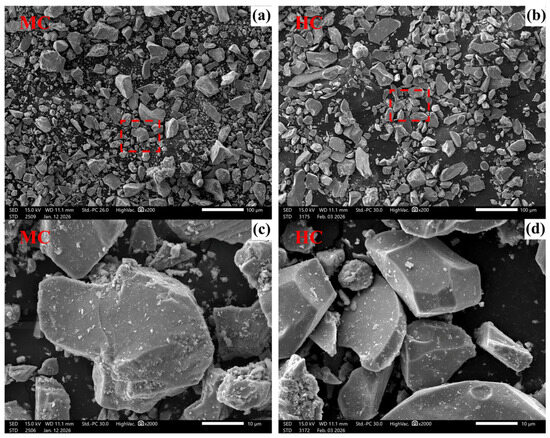
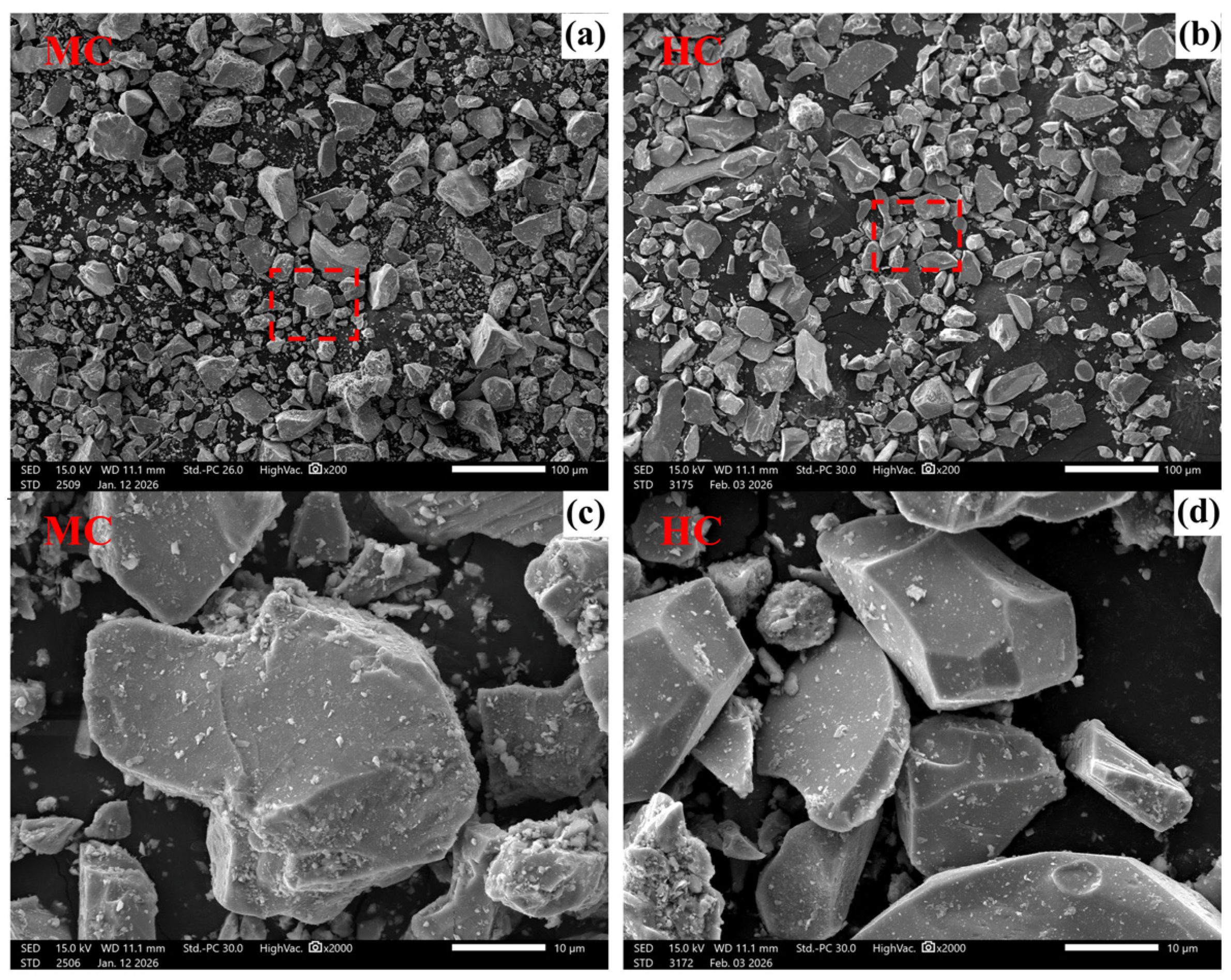
The micromorphology of the two iron ore concentrates is shown in Figure 1. Figure 1a,c present the micromorphology of the MC mineral particles. The MC particles exhibit varied shapes and sizes, with numerous angular edges and a large number of fine particles adhered to their surfaces. Figure 1b,d display the micromorphology of the HC mineral particles. The HC particles are mostly plate-like with an elliptical shape, featuring smooth surfaces and few adhered fine particles. Due to the rough and angular surfaces with abundant adhered fine particles, the MC particles possess high surface activity, resulting in a higher max molecular moisture of 3.98%. In contrast, the smooth surfaces of the HC particles contribute to a lower max molecular moisture of 1.71%. Additionally, the HC particles have a smaller average particle size and a higher max capillary moisture of 14.05%.
Figure 1.
Secondary electron images (SEMs) of iron ore concentrates ((a,b)—200×, (c,d)—2000×).
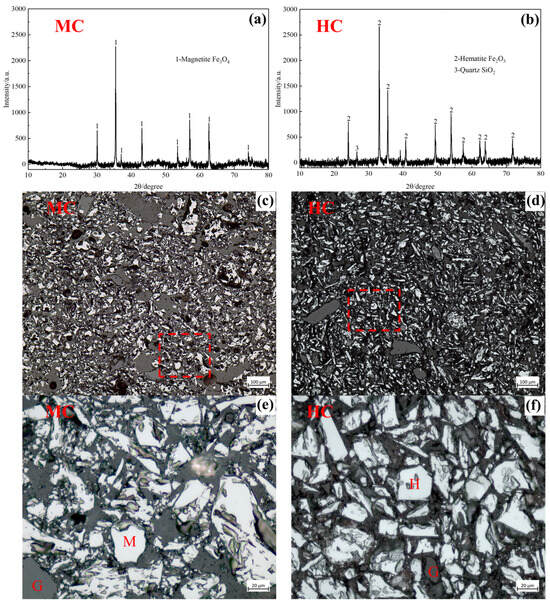
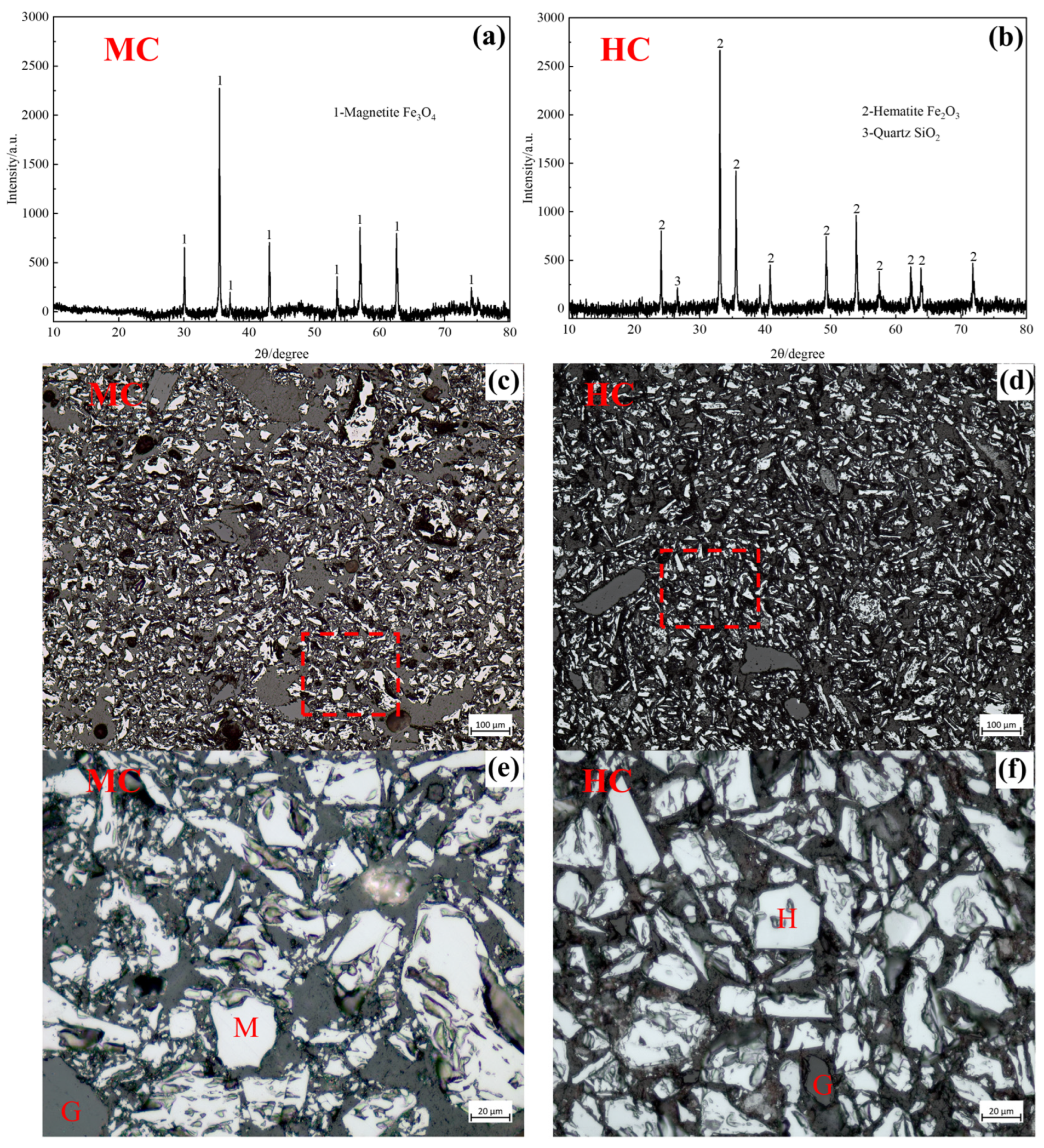
The mineralogical analysis results of the two iron ore concentrates are presented in Figure 2. As shown in Figure 2a, magnetite is the dominant mineral phase in MC, with a small amount of gangue impurities also observed, as evidenced by the optical microscopy images in Figure 2c,e. In the case of HC, hematite constitutes the primary mineral phase (Figure 2b). In addition to the hematite phase, a minor presence of gangue minerals can be identified from the optical microscopy images in Figure 2d,f.
Figure 2.
XRD pattern and optical micrographs of iron ore concentrates ((a,b)—XRD, (c,d)—100× optical micrographs, (e,f)—500× optical micrographs, M—magnetite, G—gangue, H—hematite).
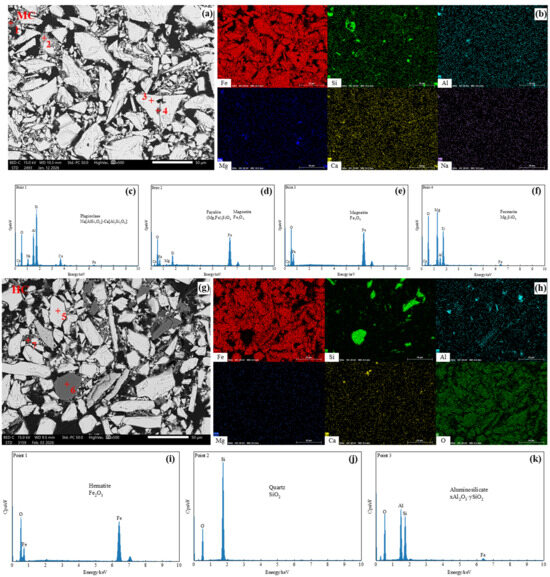
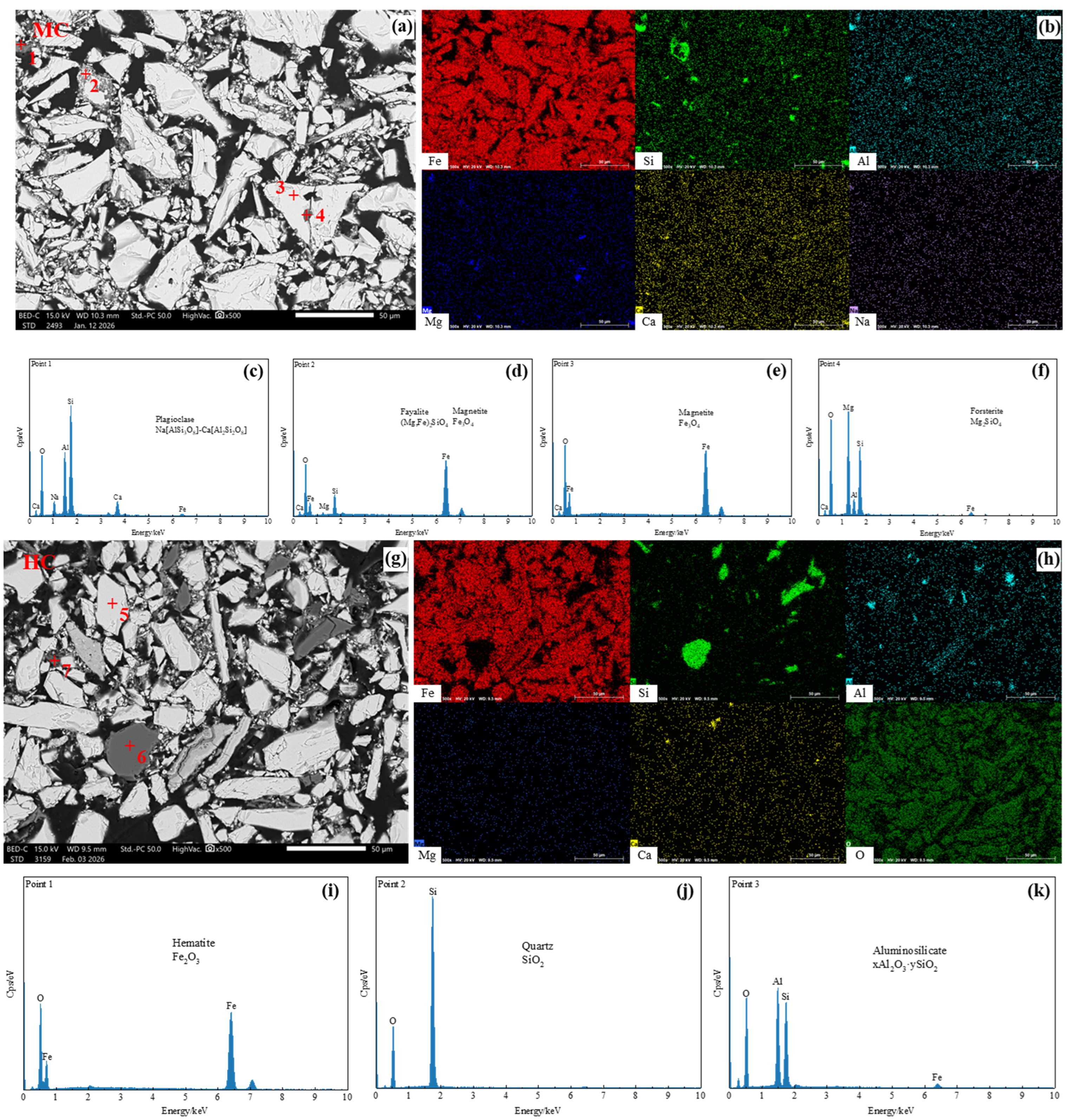
Based on the phase analysis results, further investigation was carried out using scanning electron microscopy and energy-dispersive spectroscopy, with the results presented in Figure 3. The primary mineral in MC is magnetite. The gangue minerals mainly consist of Fe, Si, Mg, and Al, corresponding to the phases marked as points 1, 2, and 4 in Figure 3, which are identified as plagioclase (point 1) and olivine (fayalite at point 2 and forsterite at point 4). For HC, the dominant mineral is hematite. The gangue minerals are primarily composed of Si and Al, corresponding to points 6 and 7 in Figure 3, which are identified as quartz and an aluminosilicate mineral, respectively.
Figure 3.
SEM-EDS analysis of main phases of iron ore concentrates ((a,g)—backscattered electron images (BSE), (b,h)—energy-dispersive spectroscopy (EDS) surface, (c–f,i–k)—EDS point scan).
2.2. Methods
2.2.1. Experimental Procedure
According to Table 4, the two types of iron ore concentrates were mixed at a specified ratio, and the moisture content of the mixture was adjusted to 8.0 wt.%. Due to the low SSA of the two concentrates, the mixture was subjected to a high-pressure grinding roller (QTGM-300-I, Xingyu, Changsha, China) pretreatment to increase the SSA to 1500–1800 cm2/g, thereby meeting the requirement for balling feed. For each of the four blend ratios, 1.2 wt.% bentonite was added. The mixture was mixed using the cone stacking method, sieved through a 1 mm screen, and then balled. Green balls were prepared using a disk pelletizer (QTYZQ-1000*200-II, Xingyu, Changsha, China), and atomized water was added during the process to achieve a moisture content of 9.0 wt.% in the green balls. Green balls with a particle size of 10–16 mm were produced, and their properties (drop strength, compressive strength and thermal shock temperature) were subsequently evaluated [17].
Table 4.
Blend compositions for balling/wt.%.
Green balls were dried in a forced air-drying oven at 105 °C. The dried balls were then fired in a horizontal dual-temperature zone tube furnace (GSL-1400X-II, Kejing, Hefei, China). The cold compressive strength (CCS) of both preheated and fired pellets was measured using a compression testing machine (microcomputer-controlled electronic universal testing machine, WDW-10E, Shidaixinguang, Jinan, China) to optimize the firing conditions [18]. Based on the optimized firing parameters, fired pellets were prepared in batches.
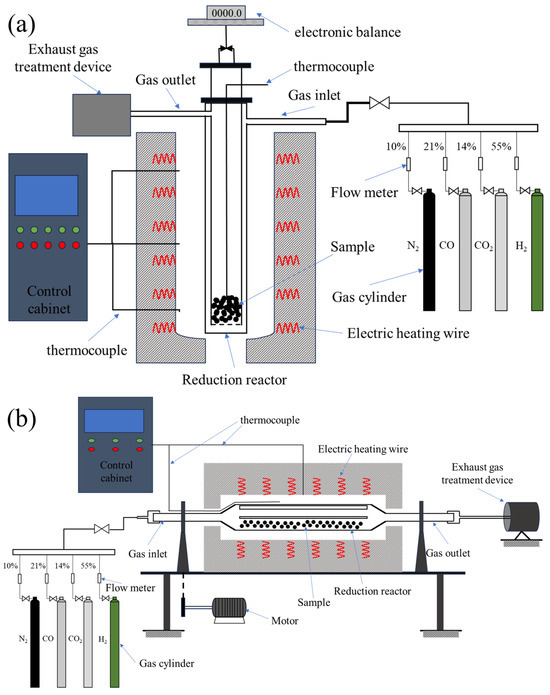
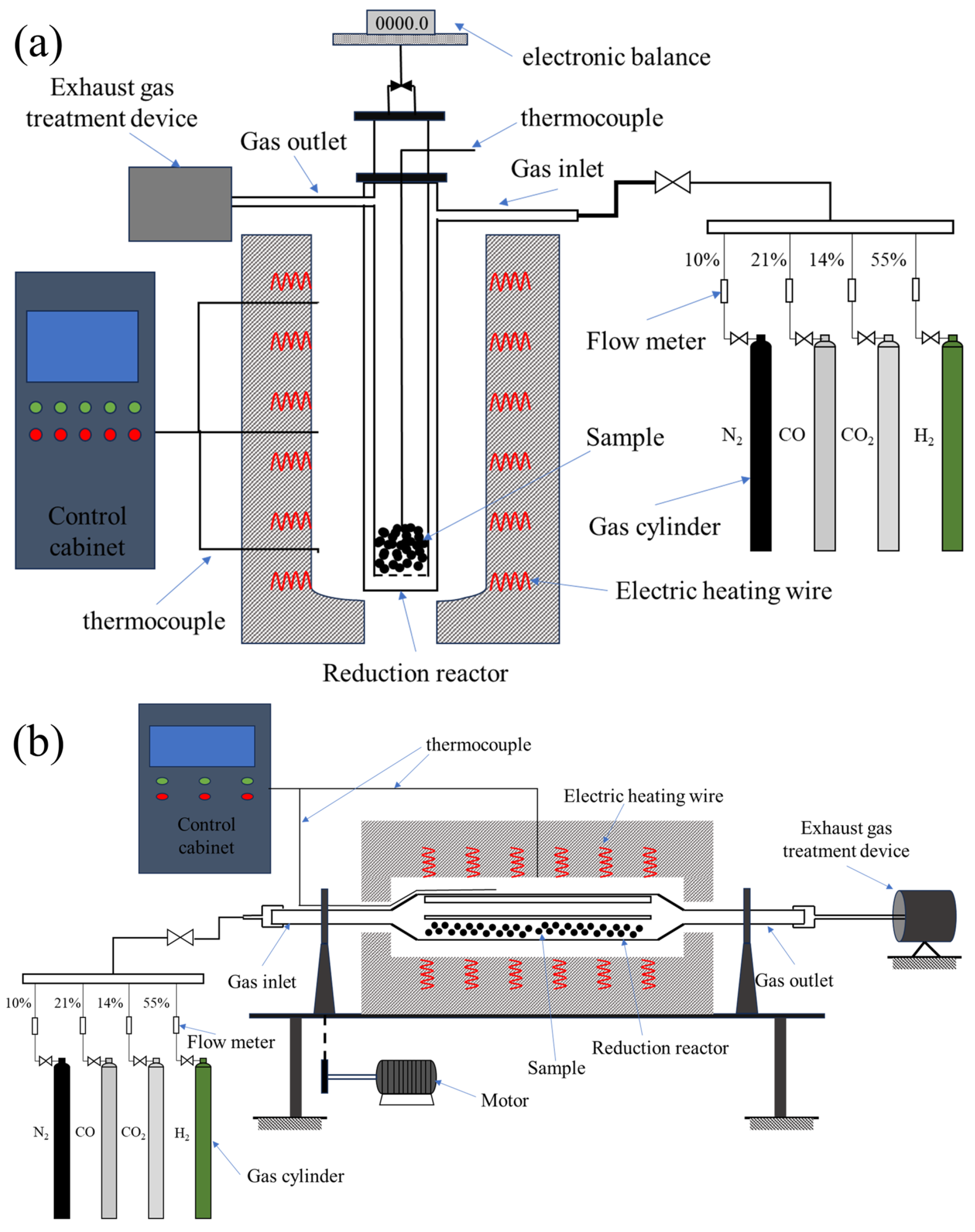
Using four types of fired pellets with different composition ratios as raw materials, their metallurgical properties, including the RI, RSI, and LTD, were evaluated in a gas-based direct reduction furnace simulating the HYL process and a rotary tube. The experimental setup is shown in Figure 4. Additionally, the CCS of the reduced pellets was measured.
Figure 4.
Schematic diagram of HYL gas-based direct reduction metallurgical performance testing device ((a)—RI and RSI, (b)—LTD).
The detection apparatus for RI and RSI is shown in Figure 4a. The sample mass is 500 g, the gas flow rate is 55 L/min, and the reduction temperatures are 800 °C and 950 °C. After placing the sample into the reduction reactor, the temperature is raised to 800 °C or 950 °C under a N2 atmosphere. Reducing gas is then introduced, and the mass loss during the reaction is recorded. The reaction is terminated when the reduction degree reaches 95%, followed by cooling to ambient temperature under a N2 atmosphere.
The LTD detection device is shown in Figure 4b. The sample mass is 1000 g, the gas flow rate is 20 L/min, and the reduction temperature is 500 °C. After placing the sample into the rotary tube, the temperature is raised to 500 °C under a N2 atmosphere, followed by the introduction of reducing gas. During the reduction process, the rotation speed of the rotary tube is set to 18 r/min, and the reaction time is 2 h. After reduction, the system is cooled to ambient temperature under a N2 atmosphere.
The calculation formulas for RI, RSI, and LTD are shown in Equations (1)–(6), respectively.
where R is percentage of reduction, and t is reduction time.
where V is volume of the sample after reduction, and V0 is volume of the sample before reduction.
where m0 is the mass, in grams, total mass after reduction. m1 is the mass, in grams, of fraction retained on the 6.3 mm sieve. m2 is the mass, in grams, of fraction passed through the 3.2 mm sieve. UP is unbroken pellet. n0 is number of initial pellets, and n1 is number of final unbroken pellets.
2.2.2. Characterization of Physicochemical Properties
The chemical composition of the iron concentrate was determined using X-ray fluorescence spectrometry (XRF, S8 Tiger, Bruker, Karlsruhe, Germany). The ferrous iron content was measured by the potassium dichromate titration method [19]. The physical property tests for the two types of iron ore concentrates include: LOI [20]; particle size by wet sieving [21]; SSA [22]; maximum molecular moisture, maximum capillary moisture [23]; bulk density and true density [24]. Phase analysis was conducted using X-ray diffraction (XRD, Smartlab Se, Rigaku, Tokyo, Japan) and optical microscopy (Axioscope 7, Carl Zeiss, Oberkochen, Germany). The microstructure and elemental distribution were examined by scanning electron microscopy (SEM, JSM-IT710HR/LV, JEOL, Tokyo, Japan) coupled with energy-dispersive spectroscopy (EDS, XFlash Detector7|60, Bruker, Germany).
3. Results and Discussion
3.1. Balling Behavior
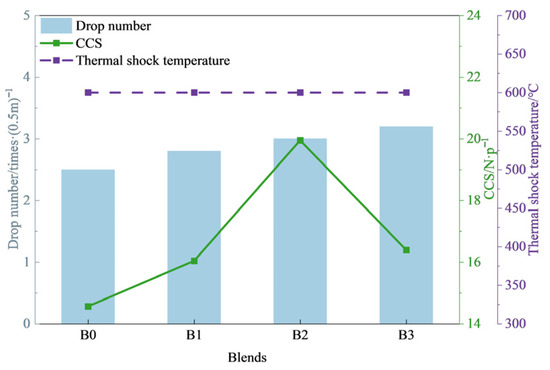
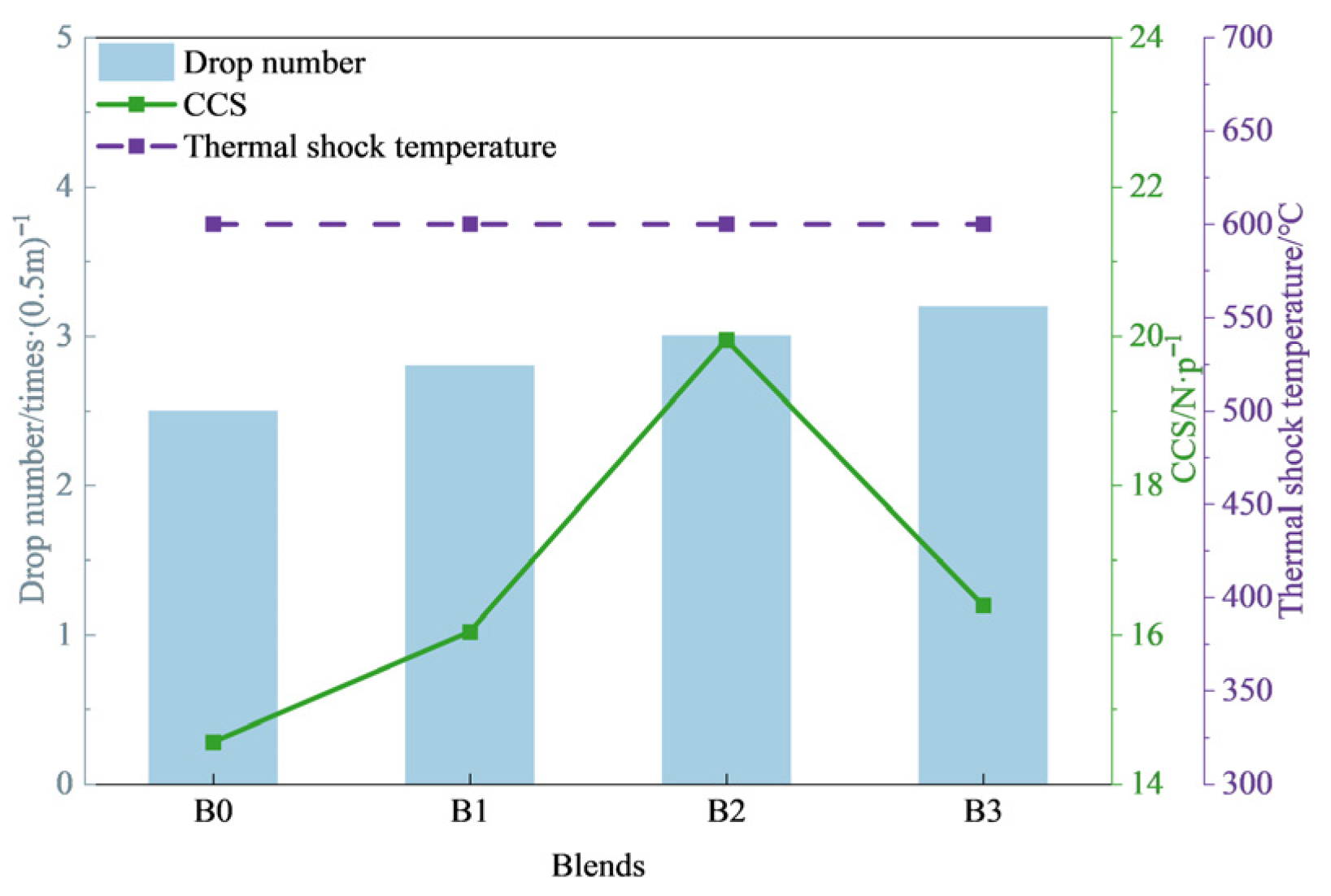
Green balls were prepared from four blends of iron concentrate mixtures, each blended with 1.2 wt.% bentonite, under the conditions of a balling time of 12 min and a moisture content of 9.0 wt.%. The measured properties of the green balls are presented in Figure 5. As the proportion of HC in the iron concentrate mixture increased, the drop strength of the green balls showed an increasing trend, rising from 2.5 times·(0.5 m)−1 for B0 to 3.2 times·(0.5 m)−1 for B3, although the extent of increase was relatively small. The CCS of the green balls first increased and then decreased, from 14.56 N·(per ball)−1 (N·p−1) for B0 to 19.95 N·p−1 for B2, followed by a decrease to 16.39 N·p−1. The thermal shock temperature of the green balls remained essentially unchanged, at 600 °C and above.
Figure 5.
The properties of green balls with different blends (“drop number/times·(0.5 m)−1” = the drop strength of the green balls, which is measured using the number of times they fall from 0.5 m until they crack or rupture. “CCS/N·p−1” = the compressive strength of each green ball).
Compared with MC, HC exhibits a finer particle size, and after mixing, the particle size distribution of the mineral grains becomes more reasonable. A reasonable particle size distribution facilitates the achievement of optimal packing (a particle size distribution that minimizes the porosity within a given volume) among the particles within the green ball, thereby enhancing the mechanical interlocking forces between the mineral particles. However, the mineral particles of HC have smooth surfaces and adhere to fewer fine particles. As the proportion of HC increases, the intermolecular forces between particles weaken, leading to a decrease in the strength of the green ball.
3.2. Firing Performance
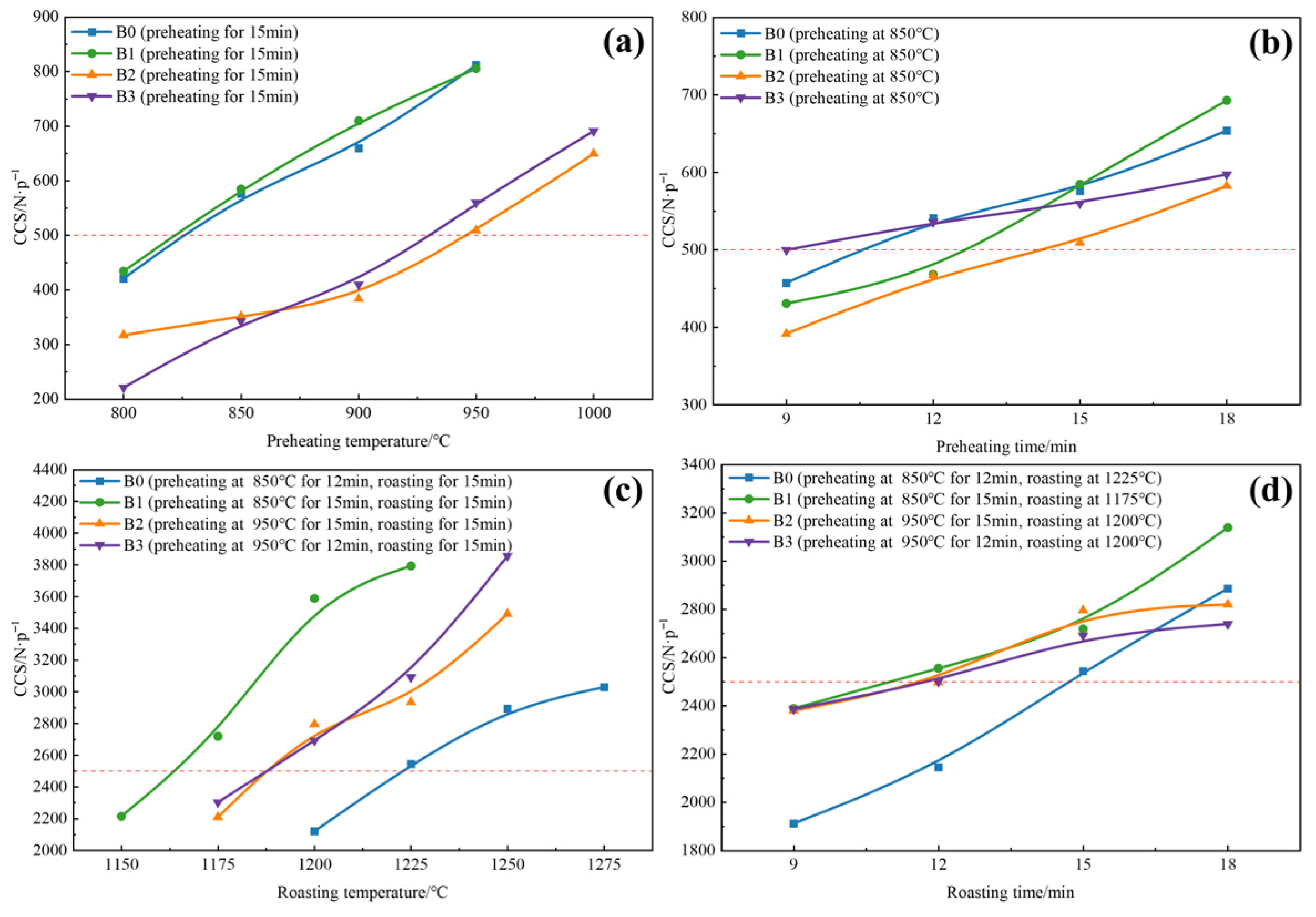
After complete drying, the qualified green balls of the four blends were subjected to firing characteristic tests. The grate-kiln process was simulated to investigate the effects of preheating temperature, preheating time, roasting temperature, and roasting time on the CCS of the pellets. In the actual production of the grate-kiln process, the preheated pellets are generally required to have a CCS of at least 500 N·p−1 before entering the rotary kiln, ensuring process stability during roasting. For the gas-based shaft furnace, the raw material—fired pellets—is typically required to have a CCS of 2500 N·p−1 to maintain good mechanical performance under reducing atmospheres. Therefore, 500 N·p−1 was adopted as the reference strength for the preheating stage, and 2500 N·p−1 as the target strength for the roasting stage. The test results are shown in Figure 6.
Figure 6.
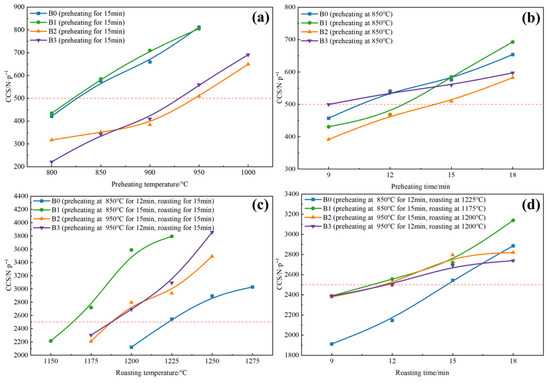
The firing performance of balls with different blends ((a)—preheating temperature, (b)—preheating time, (c)—roasting temperature, (d)—roasting time).
As shown in Figure 6a, the effect of preheating temperature on the CCS of preheated pellets was investigated by fixing the preheating time for 15 min. With the increase in preheating temperature, the CCS of all four blends of preheated pellets exhibited an upward trend. The iron-bearing material in each of the four balls was mainly magnetite concentrate. During the preheating process, the primary reaction occurring was the oxidation of magnetite to hematite. Initial crystal bridges formed between the newly generated hematite particles, connecting them and thereby imparting a certain strength to the preheated pellets. As the preheating temperature increased, the formation of fresh hematite was promoted, leading to further growth and development of the crystal bridges, which enhanced the strength of the preheated pellets.
Under the same conditions, the preheated pellet strength of B1 was similar to that of B0, while B2 and B3 exhibited lower strength than B0. As the proportion of HC increased, the formation of new hematite crystallites decreased under the same conditions, leading to fewer initial hematite bridges between mineral particles and consequently a reduction in preheated pellet strength. The suitable preheating temperature for B1 and B0 was 850 °C, whereas for B2 and B3, it was 950 °C. With an increasing proportion of HC in the iron ore concentrate blend, the suitable preheating temperature increased. When the HC addition ratio was 20 wt.%, no significant effect on the preheating temperature during the firing process was observed.
As illustrated in Figure 6b, the effect of preheating time on the CCS of preheated pellets was investigated under appropriate preheating temperature conditions. The CCS of the preheated pellets showed an increasing trend with extended preheating time. However, as the proportion of HC increased, the rate of increase in the CCS with prolonged preheating time diminished. The optimal preheating times for B0, B1, B2, and B3 were determined to be 12 min, 15 min, 15 min, and 12 min, respectively. Based on the suitable preheating times for B0 and B1, a higher HC ratio requires more energy to achieve the same preheated pellet strength.
As illustrated in Figure 6c, the effect of roasting temperature on the CCS of fired pellets was investigated under an appropriate preheating regime with a fixed roasting time of 15 min. The CCS of the fired pellets increased significantly with rising roasting temperature. The reactions occurring during the roasting process mainly involve high-temperature solid-state diffusion and recrystallization of hematite, which further enhances the connectivity of grain bridges. An increase in roasting temperature promotes the diffusion and migration ability of hematite, strengthens the recrystallization process, and reinforces grain bridge bonding.
Under the same conditions, the CCS of pellets containing HC (B1, B2, B3) was higher than that of pellets without HC (B0). Among these, the B1 fired pellets exhibited the highest CCS. During the oxidation process of the pure magnetite pellets (B0), magnetite concentrate was first oxidized to hematite, and the newly formed hematite recrystallized to enhance pellet consolidation. When an appropriate amount of HC was added, hematite particles acted as stable crystal nuclei. The newly formed hematite crystallites, derived from magnetite oxidation, migrated toward the surface of larger hematite grains, facilitating orderly grain growth [25]. However, with a further increase in the HC addition ratio, the formation of new hematite crystallites decreased, leading to a reduction in initial crystal bridges and weaker connections between particles. The suitable roasting temperatures for B0, B1, B2, and B3 were 1225 °C, 1175 °C, 1200 °C, and 1200 °C, respectively. The addition of an appropriate amount of HC effectively reduced the required roasting temperature for magnetite concentrate pellets.
As shown in Figure 6d, the effect of roasting time on the CCS of fired pellets was investigated under the optimal roasting temperature. With the extension of roasting time, the CCS of the fired pellets exhibited an increasing trend. The suitable roasting times for samples B0, B1, B2, and B3 were determined to be 15 min, 12 min, 15 min, and 15 min, respectively.
3.3. Metallurgical Performance
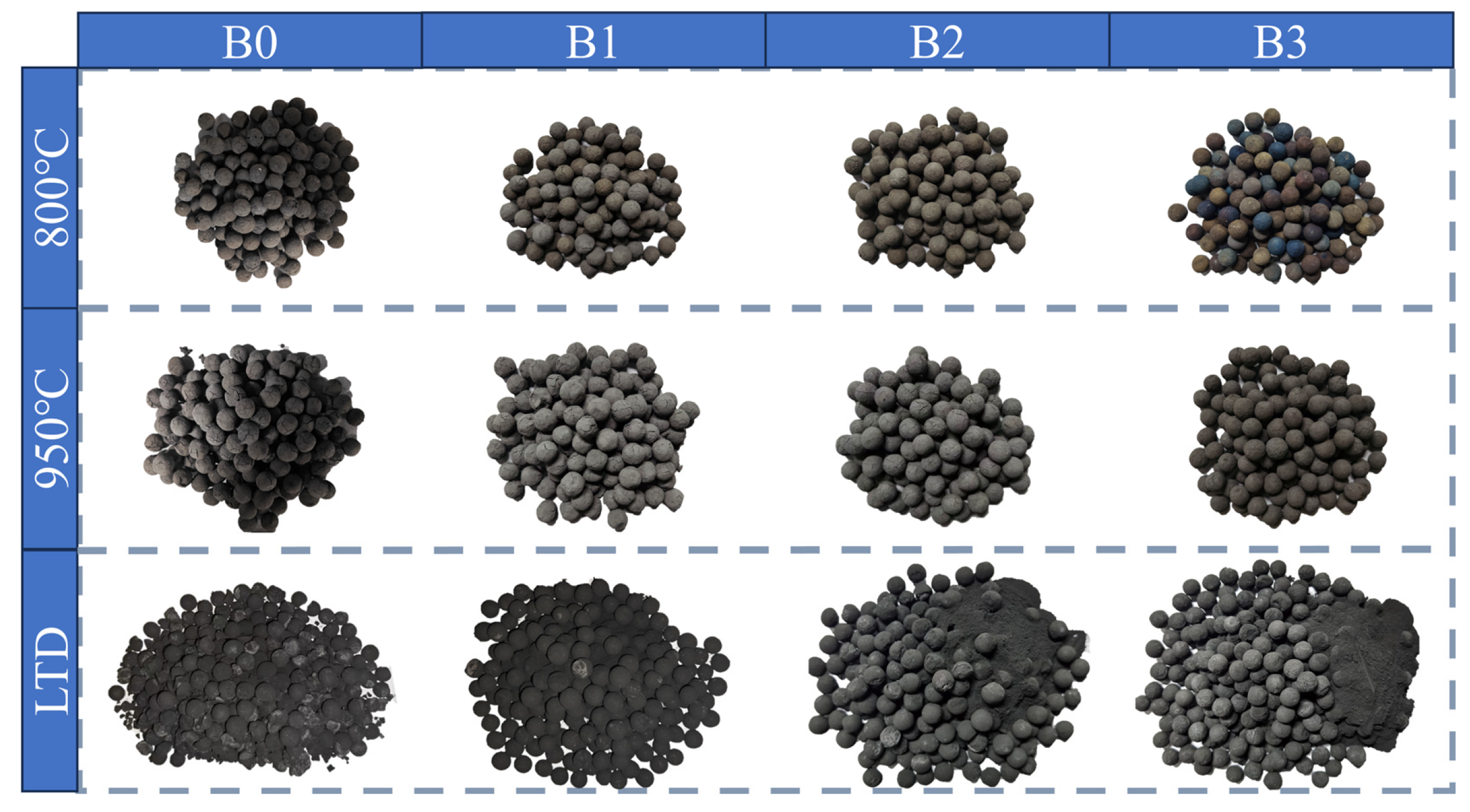
Under appropriate preheating and roasting conditions, four blends of fired pellets with different compositions were prepared in batches, all exhibiting the CCS of 2600 N·p−1. Using these fired pellets as raw materials, the gaseous direct reduction metallurgical performance was evaluated by simulating the HYL process. The test results are shown in Figure 7 and Figure 8, while the macromorphology of the pellets after reduction is presented in Figure 9.
Figure 7.
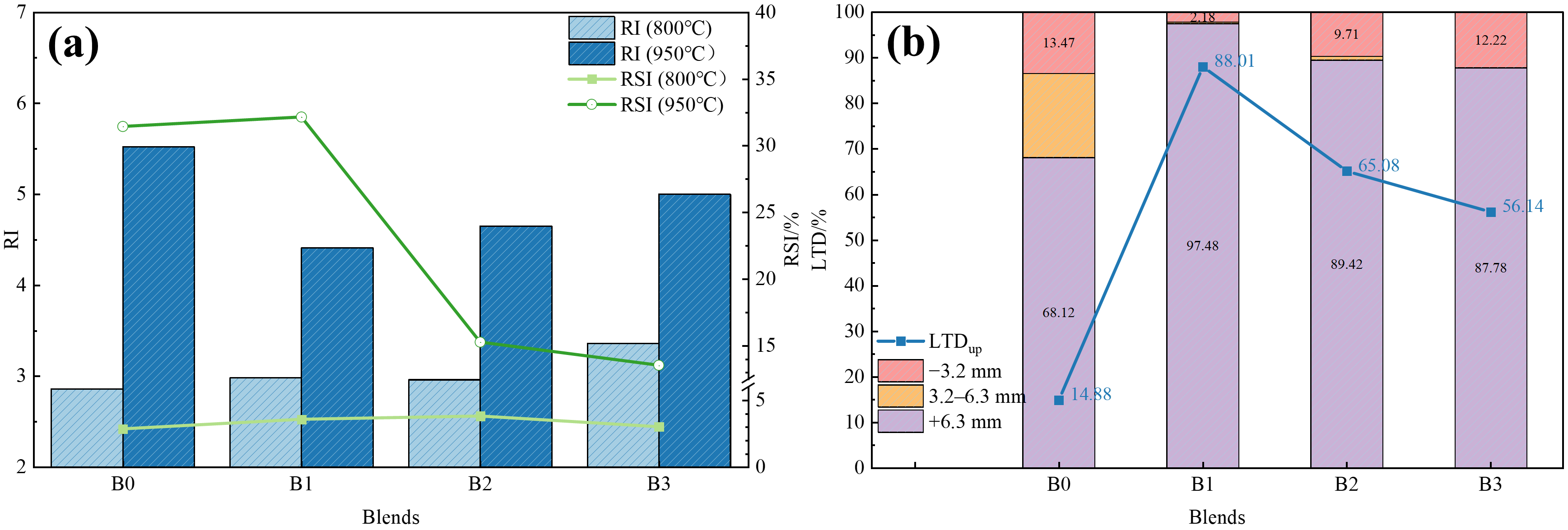
The metallurgical performance of fired pellets with different blends ((a)—RI and RSI (b)—LTD).
Figure 8.
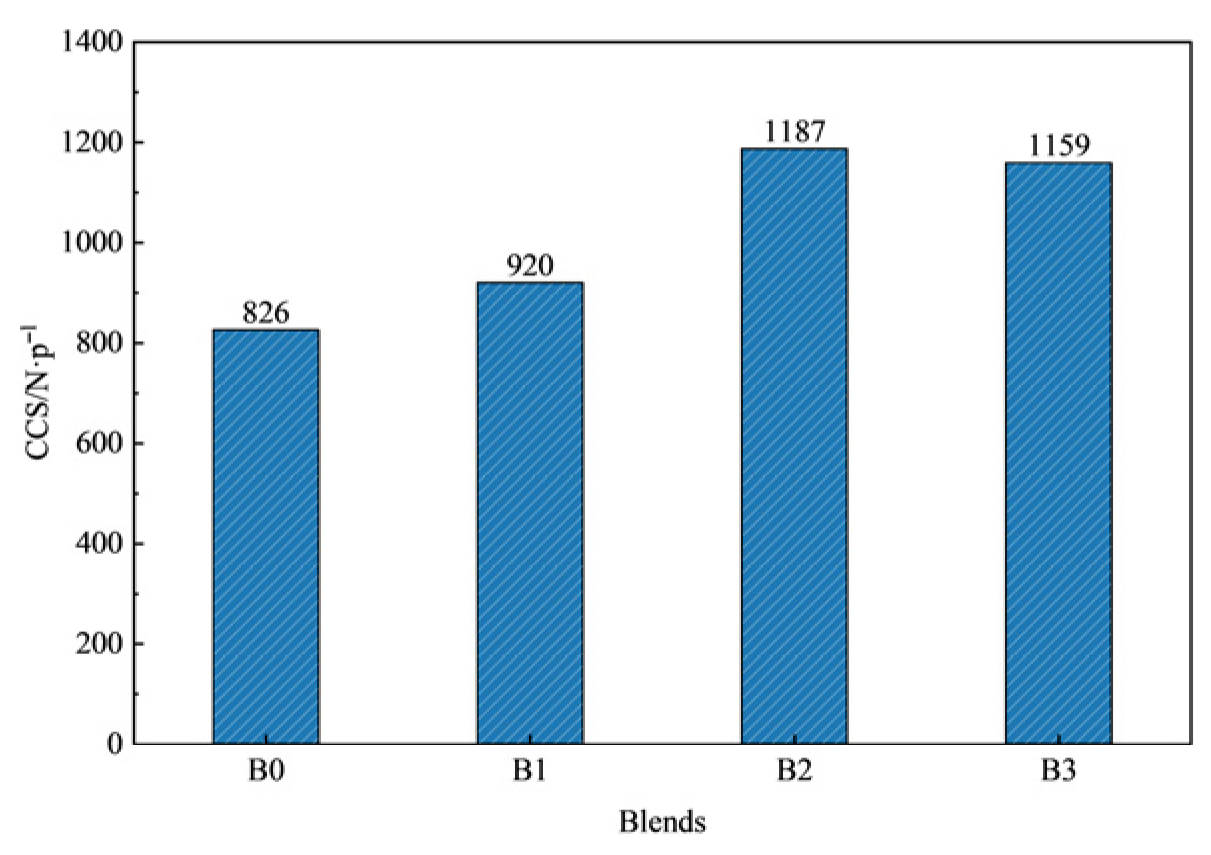
The cold compressive strength of pellets reduced at 800 °C.
Figure 9.
Macroscopic appearance of samples after testing the metallurgical performance of fired pellets with different blends.
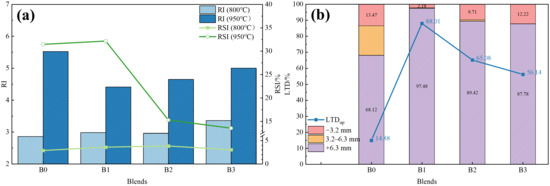
As shown in Figure 7a, the RI and RSI of fired pellets with different compositions exhibited minimal variation when measured at 800 °C. The RI remained approximately 3, while the RSI was around 3%. Under the reduction condition at 950 °C, B0 exhibited a relatively high RI of 5.52, whereas B1 showed the lowest value at 4.41. The RSI of B0 and B1 were relatively high, reaching 31.43% and 32.14%, respectively. In contrast, B2 and B3 demonstrated notably lower RSI of 15.27% and 13.53%. When the HC addition ratio was 30 wt.% and 40 wt.%, the RSI of the fired pellets decreased significantly at 950 °C.
Figure 7b illustrates the LTD of fired pellets with four different blends. In practical production, the LTD must satisfy the criteria of LTD+6.3 mm > 80%, LTD−3.2 mm < 10%, and LTDup > 60%. The LTD was significantly improved after the addition of HC. For B0, the content of LTD+6.3 mm was 68.18 wt.%, LTD−3.2 mm was 13.47 wt.%, and the whole pellet ratio was only 14.88%, which could not meet the requirements for practical production. The optimal LTD was achieved with the addition of 20 wt.% HC. For B1, the LTD+6.3 mm content reached 97.48 wt.%, LTD−3.2 mm was 2.18 wt.%, and the whole pellet ratio was as high as 88.01%. In comparison, B2 and B3 exhibited relatively poorer reduction disintegration performance. For B2, the LTD+6.3 mm content was 89.42 wt.%, LTD−3.2 mm was 9.71 wt.%, and the whole pellet ratio was 65.08%, meeting the production requirements. For B3, the LTD−3.2 mm content was 12.22 wt.%, indicating a relatively high amount of fines, which did not satisfy the production requirements.
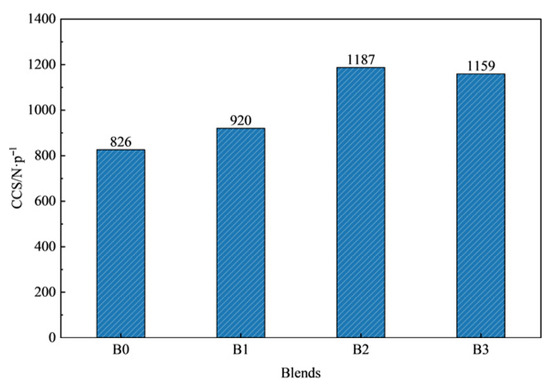
The CCS of the pellets obtained by direct reduction at 800 °C was measured, and the results are shown in Figure 8. The CCS of the direct reduced pellets under all four blends exceeded 800 N·p−1. Among them, B0 exhibited the lowest value at 826 N·p−1, while B2 showed the highest at 1187 N·p−1.
4. Conclusions
- (1)
- MC is a magnetite concentrate with a high iron grade of 70.16 wt.% and a FeO content of 30.48 wt.%. The main gangue minerals in MC are plagioclase and olivine. HC is a hematite concentrate with an iron grade of 66.29 wt.% and an FeO content of 0.68 wt.%. The primary gangue minerals in HC are quartz and aluminosilicate minerals.
- (2)
- For magnetite concentrate pellets, the addition of an appropriate amount of hematite concentrate leads to a decrease in the CCS of preheated pellets and an increase in the suitable preheating temperature. When the addition ratio is 20 wt.%, the optimal preheating temperature shows little change. However, as the ratio increases to 30–40 wt.%, the required preheating temperature rises by 100 °C. In contrast, the CCS of fired pellets improves, and the appropriate firing temperature decreases. The most significant reduction in firing temperature occurs at an addition ratio of 20 wt.%, where it drops from 1225 °C to 1175 °C.
- (3)
- After the addition of hematite concentrate, the RI of the fired pellets showed only a slight change. When the addition ratio was in the range of 30–40 wt.%, the RSI decreased significantly at 950 °C, from 31.43% to 15.27%. The LTD was also markedly improved. At an addition ratio of 20 wt.%, the LTD+6.3 mm value reached 97.48 wt.%, while the LTD−3.2 mm value was only 2.18 wt.%, and the whole pellet ratio was as high as 88.01%.
- (4)
- The addition of 20–30 wt.% hematite concentrate to high-grade magnetite concentrate pellets can significantly improve their firing and metallurgical properties, thereby meeting production requirements.
Author Contributions
Methodology, M.G. and D.Z.; Data curation, X.X.; Writing—original draft, M.G.; Writing—review and editing, X.X. and D.Z.; Investigation, D.Z., L.L., H.J., R.L., Y.W. and Z.W.; Project administration, D.Z., L.L., H.J., R.L., Y.W. and Z.W. All authors have read and agreed to the published version of the manuscript.
Funding
The research is funded by China’s key R&D program project China–Serbia “Belt and Road” joint laboratory construction and joint research project for green steel manufacturing (NO·2024YFE0215000), and Key Technology Development and Application for Improving the Total Ball Ratio of Hydrogen Metallurgy DRI in HBIS Group’s “Ranking and Leading” project (HG2024145).
Data Availability Statement
The original contributions presented in the study are included in the article. Further inquiries can be directed to the corresponding author.
Conflicts of Interest
Authors Minglei Gao, Lanjie Li, Heng Ji and Renguo Li were employed by the company Hebei HBIS Materials Technology Research Institute Co., Ltd. Author Yaobin Wang was employed by the company HBIS Group Co., Ltd. Author Zhonghua Wang was employed by the company Hebei Zhangxuan Gaoke Technology Co., Ltd. The authors declare that this study received funding from Hebei HBIS Materials Technology Research Institute Co., Ltd., HBIS Group Co., Ltd., Hebei Zhangxuan Gaoke Technology Co., Ltd. The funding sponsors had the following involvement with the study: methodology, writing—original draft, investigation, and project administration. The remaining authors declare no conflicts of interest.
References
- Pang, Z.; Bu, J.; Yuan, Y.; Zheng, J.; Xue, Q.; Wang, J.; Guo, H.; Zuo, H. The Low-Carbon Production of Iron and Steel Industry Transition Process in China. Steel Res. Int. 2024, 95, 202300500. [Google Scholar] [CrossRef] [Scilit]
- Koohestani, H.; Majidi, M. A review on green steel; introduction, benefits and challenges of the steelmaking industry. Ironmak. Steelmak. 2025. Online First. [Google Scholar]
- Hou, T.; Yuan, Y.; Na, H. A Comprehensive Systematic Review of CO2 Reduction Technologies in China’s Iron and Steel Industry: Advancing Towards Carbon Neutrality. Energies 2024, 17, 5975. [Google Scholar] [CrossRef] [Scilit]
- Zhang, S.; Yi, B.; Guo, F.; Zhu, P. Exploring selected pathways to low and zero CO2 emissions in China’s iron and steel industry and their impacts on resources and energy. J. Clean. Prod. 2022, 340, 130813. [Google Scholar] [CrossRef] [Scilit]
- Ni, B.; Lin, X.; Shangguan, F.; Li, X.; Zhou, J.; Li, T.; Jin, J. Analysis on technology readiness level of hydrogen metallurgy process. China Metall. 2024, 34, 91. [Google Scholar]
- Li, N.; Qie, Y.; Zhang, S.; Wang, X.; Wang, X.; Li, X. Development status and prospects of direct reduction technology of gas-based shaft furnace. Iron Mak. 2024, 43, 1–8. [Google Scholar]
- Zhang, F.; Cao, C.; Xu, H. Current Status and Prospects of Gas-Based Shaft Furnace Direct Reduction Technology. Iron Steel 2014, 49, 1–10. [Google Scholar]
- Huang, Z.; Zhang, Y.; Zhu, S.; Zhuang, J.; Luo, X. Study on mainly made from hematite based oxidized pellets with addition of some magnetite. Iron Steel 2004, 39, 9–13. [Google Scholar]
- Yang, X. Mechanism of Roasting and Agglomeration on the Pellets Produced by Blended Iron Ore Fines of Hematite and Magnetite. J. Iron Steel Res. Int. 2010, 22, 6–8. [Google Scholar]
- Fu, J.; Li, Y.; Jiang, C.; Wang, L. Oxidation Kinetics of Magnetite Concentrate Pellets. J. Cent. South Univ. 2004, 35, 950–954. [Google Scholar]
- Fu, S. Causes of Weakening in the Structure of Oxidized Magnetite Pellets and Measures to Eliminate It. Sinter. Pelletizing 1980, 06, 18–26. [Google Scholar]
- Zhu, D.; Hu, X.; Pan, J.; Yang, C.; Xu, M.; Wang, Z. Optimization of Ore Blending to Enhance the Roasting of Ultra-Fine West Australian Magnetite Concentrate Pellets. Chin. J. Eng. 2017, 39, 683–692. [Google Scholar]
- Yuan, Z.; Tian, G.; Pan, J.; Zhu, D.; Jiang, L.; Guo, Z. Test of characteristics of GF88 refined powder and its industrial application. Chin. Metall. 2021, 31, 12–18. [Google Scholar]
- Song, Q.; Xue, X.; Zhu, D. An Investigation into the Pelletizing Performance of Blends Comprising Brazilian Hematite and Chinese Magnetite Concentrates. Metals 2024, 14, 1398. [Google Scholar] [CrossRef] [Scilit]
- Yi, L.; Huang, W.; Pan, J.; Yang, C.; Zhao, L.; Li, M.; Wu, Y.; Xie, S. Preparation characteristics and metallurgical properties of pellets in hydrogen-based shaft furnace with high-proportion hematite-limonite. Sinter. Pelletizing 2026, 51, 131–142. [Google Scholar]
- Ji, Y.; Chi, Z.; Yuan, S.; Chen, Y.; Li, Y.; Jiang, T.; Liu, X.; Zhang, W. Development and Application of Hydrogen-Based Direct Reduction Iron Process. Processes 2024, 12, 1829. [Google Scholar] [CrossRef] [Scilit]
- YB/T 4848-2020; Method for Physical Test of Sinter Balls. Ministry of Industry and Information Technology of China: Beijing, China, 2020.
- ISO 4700: 2015; Iron Ore Pellets for BLAST Furnace and Direct Reduction Feedstocks—Determination of the Crushing Strength. International Organization for Standardization: Geneva, Switzerland, 2015.
- GB/T 6730.8-2016; Iron Ores—Determination of Iron (II) Content-Potassium Dichromate Titrimetric Method. China National Standardization Administration: Beijing, China, 2016.
- ISO/TR 18230: 2015; Iron Ores—Determination of Loss on Ignition—Non-Oxidised Ores. International Organization for Standardization: Geneva, Switzerland, 2015.
- GB/T 10322.7-2016; Iron Ores and Direct Reduced Iron—Determination of Size Distribution by Sieving. China National Standardization Administration: Beijing, China, 2016.
- GB/T 10322.9-2023; Iron Ores—Determination of Specific Surface Area—Test Method Using Air-Permeability Apparatus (Blaine). China National Standardization Administration: Beijing, China, 2023.
- GB/T 42523-2023; Iron Ore Fines—Determination of Moisture Capacity. China National Standardization Administration: Beijing, China, 2023.
- GB/T 24586-2009; Iron Ores—Determination of Apparent Density, True Density and Porosity. China National Standardization Administration: Beijing, China, 2009.
- Yang, X. Fundamental and Applied Studies on Preparing Oxidized Pellets Form Mixed Iron Ore Concentrates. Ph.D. Thesis, Central South University, Changsha, China, 2011. [Google Scholar]

Disclaimer/Publisher’s Note: The statements, opinions and data contained in all publications are solely those of the individual author(s) and contributor(s) and not of MDPI and/or the editor(s). MDPI and/or the editor(s) disclaim responsibility for any injury to people or property resulting from any ideas, methods, instructions or products referred to in the content. |
© 2026 by the authors. Licensee MDPI, Basel, Switzerland. This article is an open access article distributed under the terms and conditions of the Creative Commons Attribution (CC BY) license.