


Abstract
A high level of Fe impurity restricts the sustainable recycling and wide application of recycled aluminum alloys. Optimizing the phase selection to favor less harmful Fe-containing intermetallics is a critical strategy to develop high-performance alloys with high Fe-level contamination. To reveal the intrinsic mechanism of Fe-containing intermetallic transformation in Al-Si-Fe alloys, the thermodynamic stability, thermal properties, elastic properties, and electronic structure evolution of θ-Al13Fe4, α-Al7.1Fe2Si, β-Al9Fe2Si2, and δ-Al3FeSi2 phases were systematically investigated by first-principles calculations. The calculated formation energy and binding energy of θ-Al13Fe4, α-Al7.1Fe2Si, β-Al9Fe2Si2 and δ-Al3FeSi2 are −0.28 eV/atom, −0.41 eV/atom, −0.57 eV/atom, −1.92 eV/atom and −4.95 eV/atom, −5.14 eV/atom, −5.35 eV/atom and −6.7 eV/atom, respectively. These results revealed that the thermodynamic stability shows an increasing tendency in the sequence of θ-Al13Fe4, α-Al7.1Fe2Si, β-Al9Fe2Si2 and δ-Al3FeSi2. The calculated Gibbs free energy, enthalpy, entropy, heat capacity, thermal expansion-temperature, and bulk modulus results demonstrated the increased stability in the sequence of θ-Al13Fe4, α-Al7.1Fe2Si, β-Al9Fe2Si2 and δ-Al3FeSi2 phases. These calculated thermal properties validated the phase transformation behaviors. Finally, the enhanced stability and increased modulus values of the δ-Al3FeSi2 phase is attributed to the stronger Si-Fe covalent chemical bonding caused by electron transfer. These findings provide new insight for designing recycled aluminum alloys by optimizing Fe-IMC phase selection and transformation pathways.
1. Introduction
The recycling of aluminum scraps demonstrates lower energy costs and greenhouse gas emissions, and thus it has been more attractive in industry and academic practice [1]. Although currently the majority of aluminum scraps are recycled, most of them are downcycled or diluted with primary aluminum due to the excessive level of impurities such as Fe [2,3,4]. According to the binary Al-Fe and ternary Al-Fe-Si phase diagrams, Fe elements show very low solubility in aluminum [5,6]; an excessive level of Fe impurity in aluminum easily forms different kinds of coarse and brittle Fe-containing intermetallics (e.g., the plate-like β-AlFeSi phase), which significantly deteriorates the ductility, fatigue and corrosion resistance properties of the alloys [1,7]. For example, β-AlFeSi and α-AlFeSi phases usually appear in Al-Si alloys, Al7Cu2Fe phases are easily developed in Al-Cu-Fe alloys, and AlFeNi phases emerge in Al-Ni-Fe alloys or other alloys [4,7,8]. It is reported that the deterioration effect of these Fe-containing intermetallics on the mechanical properties of Al alloys usually depends on their final morphology. The long needle-like or plate-like Fe-containing intermetallics in as-cast alloys are more harmful to the mechanical properties than those with compacted morphologies (such as polyhedral, star-like and blocky morphologies). Although some plate-like Fe-containing intermetallics can be refined via heat treatment, micro-alloying, or severe plastic deformation, this refinement is very limited and cannot completely remove the deterioration of mechanical properties.
The Fe-containing intermetallics with different crystal structures and compositions show different thermophysical and mechanical properties, which show the influences on the thermophysical and mechanical properties of Al-Si alloys [9,10]. This finding provides new insight into controlling the detrimental effect of the Fe-containing intermetallics in aluminum by phase selection during the solidification process. Que et al. reported that plate-like θ-Al13Fe4 formed initially and transformed into an intermediate α-Al7.1Fe2Si (hexagonal) phase. Subsequently, the intermediate α-Al7.1Fe2Si phase transformed into the β-Al9Fe2Si2 phase (monoclinic). The transformed β-Al9Fe2Si2 phase finally transformed into δ-Al4FeSi2 (Some papers are labeled as δ-Al3FeSi2) after the heat treatment (530 °C for 30 min) [11]. Wang et al. reported that the π-AlSiMgFe phase can be transformed into the β-AlFeSi phase by the trace addition of TiB2 in the high-pressure die casting AlSi10Mg alloy, thus leading to a significant improvement in ductility [12]. Que et al. reported that primary θ-Al13Fe4 can be transformed into the α-Al15(Fe,Mn)3Si2 phase via a peritectic reaction in Al-5Mg-2Si-0.6Mn-1.3Fe alloy; the transformation process is significantly affected by heterogeneous nucleation [13]. Que et al. also reported the phase selection among θ-Al13Fe4, Al6(Fe,Mn), and α-Al15(Fe,Mn)3Si2 in an Al-5Mg-2Si-0.6Mn-1.3Fe alloy. The results showed that θ-Al13Fe4 and Al6(Fe,Mn) solidify as non-equilibrium primary phases and subsequently transform to the α-Al15(Fe,Mn)3Si2 phase. The phase transformation process was also confirmed by thermodynamic stability by first-principles modeling [14]. Fang et al. systematically investigated the stabilization effects of Si on Al-rich Fe-IMCs and reported that Si moderately stabilizes the cubic α-FeAl phase (ΔESi2 = −0.054 eV/Fe) but strongly stabilizes the hexagonal α′-FeAl phase (ΔESi2 = −0.181 eV/Fe); the stability evolution of the ternary Fe-IMCs in Si-rich alloys becomes τ4-(Al,Si)5Fe > β-Al4.5SiFe > α′-(Al,Si)4.174Fe [15]. Moreover, Fang et al. investigated the stability, chemical composition, structural and electronic properties of the τ4-(Al1-xSix)5Fe phase; the results showed that the τ4-Al3Si2Fe superstructure is stabilized at low temperature, whereas the configurational entropy allows a wide range of Si contents at casting temperatures, and that the cell volume decreases linearly with increasing Si content [16]. These studies enrich the understanding of the phase selection and formation of Fe-IMCs in recycled Al-Si alloys.
The phase formation and transition competition of Fe-containing intermetallics are heavily determined by their thermodynamic stability and related thermophysical properties, which are derived from their crystal structures and chemical bonding [15,16,17,18,19]. First-principles calculations based on density functional theory (DFT) are an effective way to explore these factors in Fe-containing intermetallics. L. Amirkhanyan et al. reported the heat capacity and thermal expansion coefficient of the δ-Al3FeSi2 phase via DFT calculations; the calculated heat capacity values are well validated by DSC test results [10]. Dinsdale et al. reported the thermodynamic stability and structure of Al13Fe4 and α-AlFeMnSi by first-principles calculations. The results showed that Fe and Mn mixing on the crystallographic sites results in a negative mixing enthalpy and the thermal stability of α-Al(FeMn)Si phase improved [9]. These calculation results in previous studies also showed that the improved thermodynamic stability of Fe-containing intermetallics is essentially attributed to the strengthened chemical bonds [20,21,22].
Up to now, the phase transformation of Fe-containing intermetallics in aluminum has been widely reported from the perspective of crystal structure and interface relationship characterization. However, the underlying mechanism of the phase transformation from θ-Al13Fe4 to α-Al7.1Fe2Si, β-Al9Fe2Si2 and δ-Al3FeSi2 phases in the solidification process of Al-Si-Fe alloy (in the temperature range of 300~700 °C) is not completely clear. The underlying relationship between stability, Gibbs free energy, enthalpy, entropy, heat capacity, thermal expansion and the transformation pathway of this phase deserves further investigation. In this paper, the phase transformation pathways, thermodynamic stability, elastic properties and thermophysical properties evolution of θ-Al13Fe4, α-Al7.1Fe2Si, β-Al9Fe2Si2 and δ-Al3FeSi2 phases are investigated by first-principles calculations. The temperature-dependent heat capacity, thermal expansion coefficient and mechanical properties are studied to provide support for thermodynamic modeling and the application of high-Fe-level Al-Si alloys. This study aims to uncover the thermodynamic mechanisms driving the phase transformations in Fe-containing phases, thereby providing theoretical guidance for optimizing the phase selection and transformation pathways of Fe-containing phases in recycled aluminum alloys.
2. Experimental Methods and Calculation Details
2.1. Experimental Methods
The experimental alloy (mass percentage, unless otherwise specified; the following are all mass fractions) was prepared from industrial pure aluminum (≥99.95 wt.%), commercial Al-20Si and Al-20Fe master alloys. The pure aluminum, Al-20Si and Al-20Fe alloy ingots were heated to 750 °C in an electric resistance furnace (JZ-200, Longxinyuan Electromechanical Technology Co., Ltd., Shaanxi, China). After the alloy was completely melted, high-purity argon was introduced for refining, and then the alloy melt was poured into a water-cooled copper mold at 700 °C. The chemical composition of the experimental alloy was measured using a direct-reading spectrometer (Spectrometer LAB, LACM12, SPECTRO, Berlin, Germany). Measurements were taken at three points on the sample, and the average value was recorded. The measured compositions of the alloy are Si 1.02 wt.%, Fe 1.19 wt.%, and the balance is Al.
The solidification sequences of the precipitates in the Al-1Si-1Fe alloy were calculated by JMatPro software (V7.0) with the phase and properties model and the aluminum database. The melting temperature and precipitation temperature of the Fe-containing intermetallics were measured by a differential scanning calorimeter DSC (NETZSCH DSC204, NETZSCH, Bavaria, Germany) with a heating/cooling rate of 5 °C/min under a flowing high-purity argon protective atmosphere.
2.2. Calculation Methods and Details
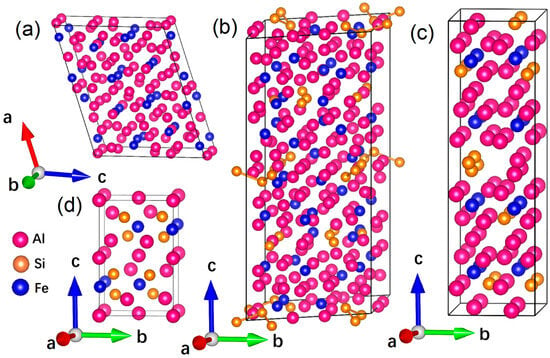
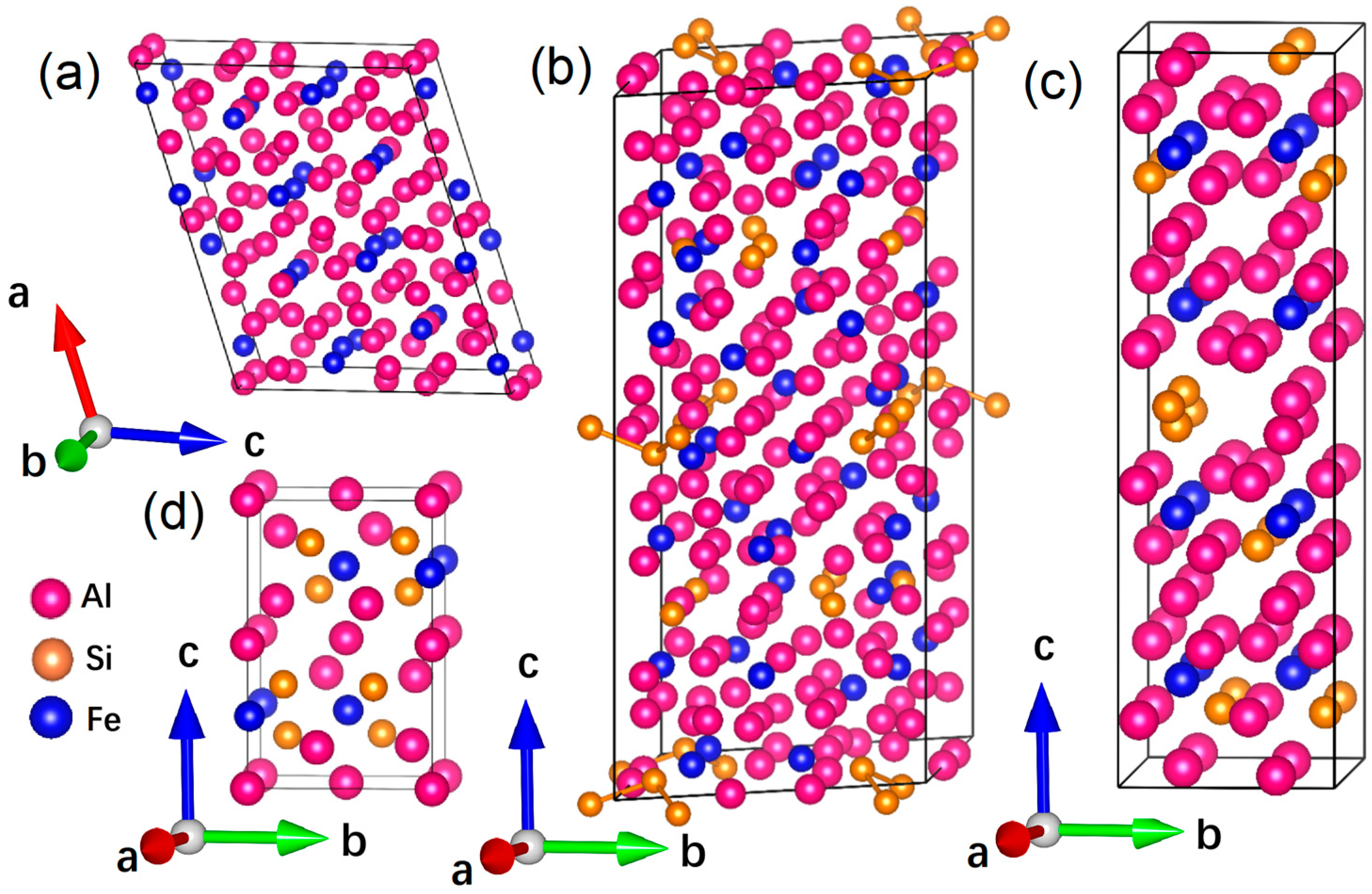
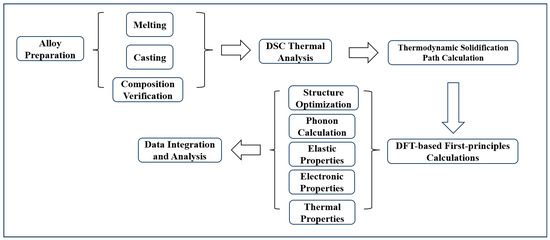
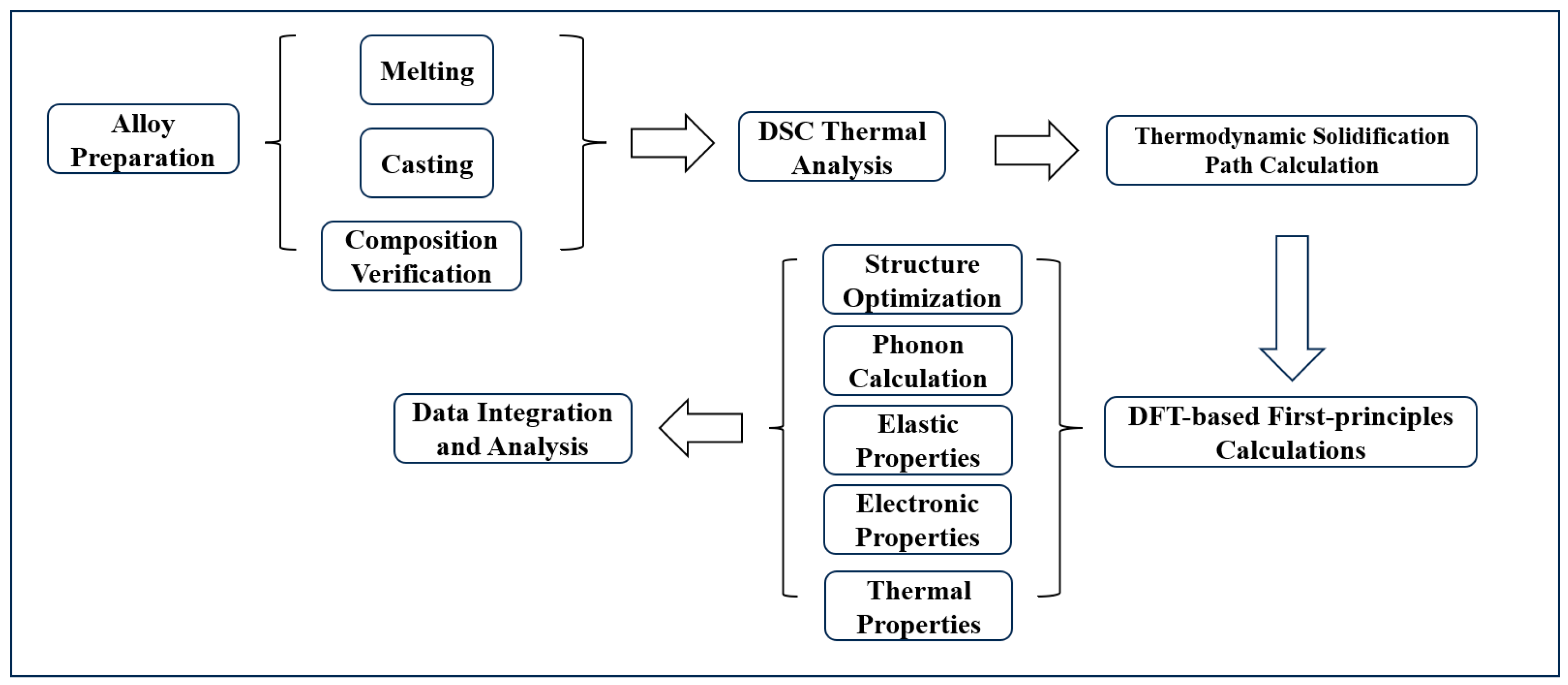
The first-principles calculation based on density functional theory (DFT) was used to study the thermodynamic stability, elastic properties, thermophysical properties and electronic structures of Fe-containing intermetallics in this paper. The binding energy, formation enthalpy, phonon spectrum, temperature-dependent thermodynamics, elastic properties, elastic three-dimensional anisotropy and electronic structure of θ-Al13Fe4, α-Al7.1Fe2Si, β-Al9Fe2Si2 and δ-Al3FeSi2 were calculated. The detailed crystal structure parameters and crystal models of θ-Al13Fe4, α-Al7.1Fe2Si, β-Al9Fe2Si2 and δ-Al3FeSi2 are shown in Table 1 and Figure 1. The experimental flowchart of this paper is shown in Figure 2.
Table 1.
The lattice parameters of θ-Al13Fe4, α-Al7.1Fe2Si, β-Al9Fe2Si2 and δ-Al3FeSi2 phases before and after crystal structure optimization in this paper.
Figure 1.
Crystal structure models of (a) θ-Al13Fe4, (b) α-Al7.1Fe2Si, (c) β-Al9Fe2Si2 and (d) δ-Al3FeSi2 phases.
Figure 2.
The experimental flowchart of this paper.
2.2.1. Calculation Details
The DFT calculations were performed using the CASTEP module [10] in the Materials Studio software package (V.80). The exchange-correlation functional was treated with the Perdew–Burke–Ernzerhof (PBE) functional [9] under the generalized gradient approximation (GGA). The projector augmented wave (PAW) potentials [17,18] were selected to describe the interactions between ionic cores and valence electrons, with a plane-wave basis set defined by a kinetic energy cutoff of 500 eV (determined through convergence tests). The 3s23p1, 3s23p2 and 3d64s2 were treated as valence electron configurations for Al, Si and Fe atoms, respectively. During structural optimization, the Monkhorst-Pack k-point mesh was employed for Brillouin zone sampling are as following: θ-Al13Fe4 (monoclinic): k-point mesh of 5 × 5 × 3 achieves convergence (<1 meV/atom); α-Al7.1Fe2Si (hexagonal): k-point mesh of 6 × 6 × 3 achieves convergence (<1 meV/atom); β-Al9Fe2Si2 (orthorhombic): k-point mesh of 4 × 5 × 3 achieves convergence (<1 meV/atom); δ-Al3FeSi2 (tetragonal): k-point mesh of 6 × 6 × 4 achieves convergence (<1 meV/atom). Electronic self-consistency was achieved when the total energy change fell below 10−5 eV, while geometric convergence was considered attained if the maximum atomic force was less than 0.02 eV·Å−1. The lattice parameters before and after optimization are listed in Table 2. The phonon spectrum and phonon density of states were calculated with the finite displacement method; this method involves constructing a supercell, moving the atoms, and calculating the forces on all the atoms in the cell. A force constant matrix was constructed based on these forces, and the cutoff radius of the finite displacement method is 5.0 Å. All DFT calculations were performed for seven volumes around the 0 K equilibrium volume of all structures to promote the quasi-harmonic approximation (QHA) method [20]. The elastic moduli were calculated and visualized using the Elastic Constants Analysis module in Materials Studio [19] with force constants derived via the finite displacement method in CASTEP combined with the phonopy code [21]. The elastic moduli of the Fe-containing intermetallics were determined using the Voigt–Reuss–Hill (VRH) averaging scheme.
Table 2.
The calculated Cp values on a per-mole-of-atoms, ΘD and Cel/Ctotal.
2.2.2. Calculation Methods
To account for the finite-temperature properties of these Fe-containing intermetallics, the quasi-harmonic Debye model [20] was applied in this paper; the vibrational heat capacity can be obtained by
where CV,vib is the vibrational heat capacity, n is the number of atoms per formula unit, Θ is the Debye temperature, and k is the Boltzmann constant. The thermal electronic contribution to the heat capacity can be calculated by:
where Eel (V, T) is the thermal electron energy, which can be calculated by
where f is the Fermi function, n(ε,V) is the electronic density of states, and ε is the one-electron band energy. The isobaric heat capacity (Cp) at constant volume can be calculated by:
where β(T) and V are the volumetric thermal expansion coefficients (TECs) and equilibrium volume. The β(T) is obtained according to the equilibrium volume by employing the EOS method, as described in the following equation [20]:
The elastic constant matrix was determined according to the generalized Hooke’s law by deforming the unit cell and using the stress–strain relationship [20,21,22]. Then, the elastic moduli (bulk modulus B and shear modulus G) could be obtained by combining Cij with the Voigt and Reuss models. The equations are as follows:
where is the corresponding elastic compliance constants and . The bulk modulus and shear modulus derived from the Voigt model, as well as and obtained via the Reuss model. Due to discrepancies between the two models, the final values of B and G were determined as their arithmetic averages [21,22]:
Then, Young’s modulus (E) and Poisson’s ratio () were obtained from the following equations:
Finally, the micro-hardness (H) could also be obtained from the Young’s modulus (E) and Poisson’s ratio ():
3. Results and Discussion
3.1. Crystal Structure and Phase Transformation of Fe-Containing Intermetallics
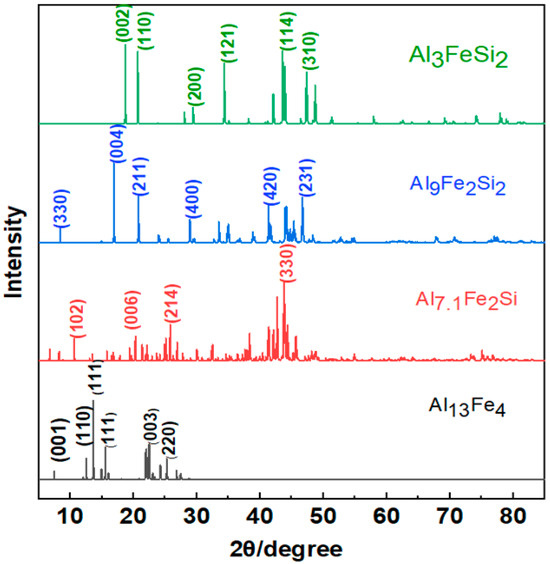
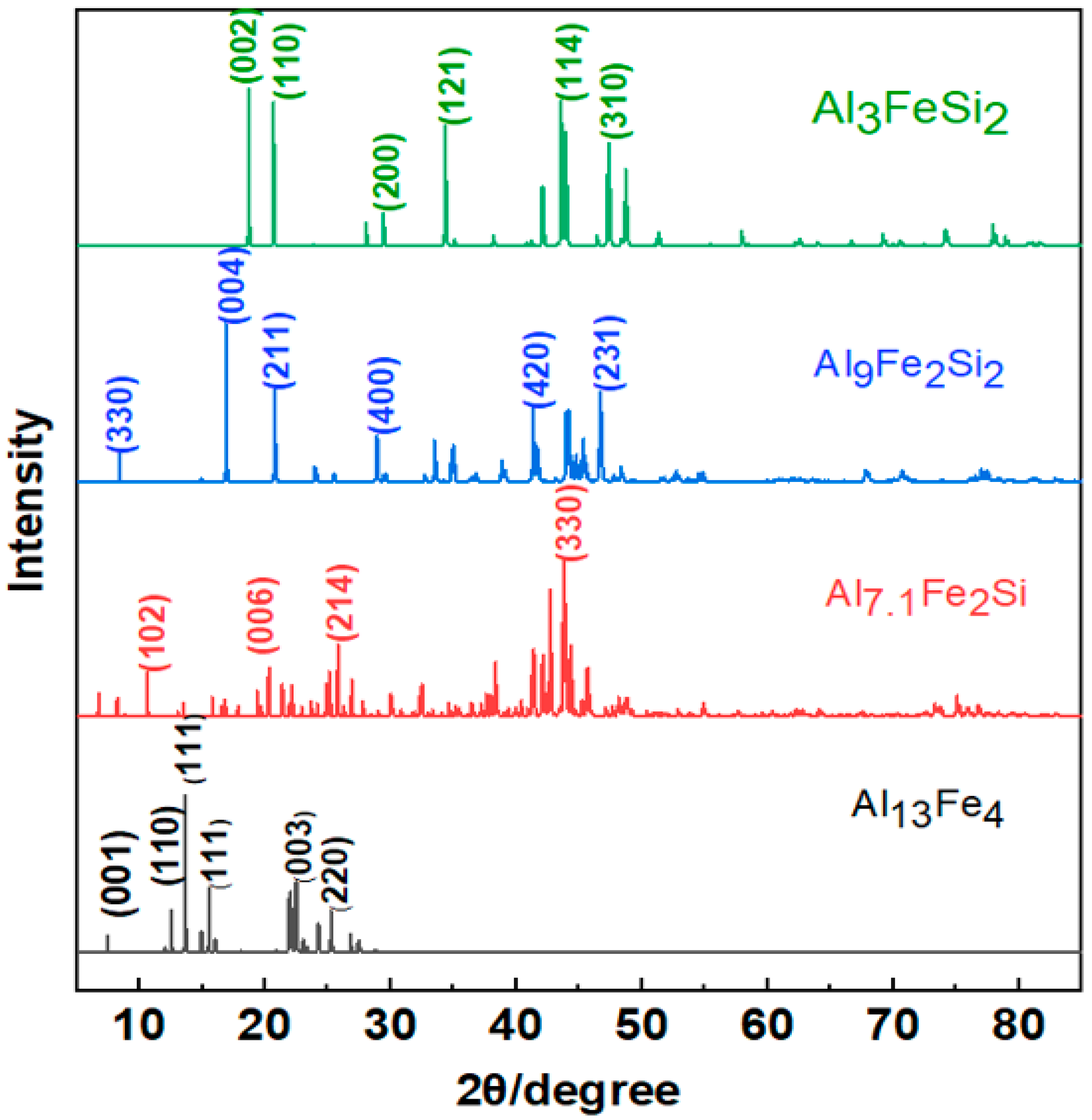
To further understand the crystal structure of Fe-containing intermetallics in this study, the theoretical XRD patterns of the θ-Al13Fe4, α-Al7.1Fe2Si, β-Al9Fe2Si2 and δ-Al3FeSi2 phases are calculated using the parameters of a Cu-Kα source and illustrated in Figure 3. The peak intensity of crystallographic planes reflects the atomic packing density. For example, the (11-1) plane of the Al13Fe4 phase warrants special consideration during modification treatments of Fe-containing intermetallics owing to its interfacial adsorption behavior. The dense diffraction peaks of the Al7.1FeSi phase indicate its highly complex crystal structure. As shown in Figure 3 and Table 1, the Al13Fe4 phase shows a monoclinic crystal structure (C12/m1(12), No. 12), with a lattice parameter of a = 15.492 Å, b = 8.078 Å, and c = 12.47 Å, α = γ = 90° and β = 107.7° [11,23]. The δ-Al3FeSi2 phase has a tetragonal structure, with a space group of P4/mmm (No. 123) and lattice parameters of a = b = 6.07 Å, c = 9.48 Å, α = β = γ = 90° [11]. The δ phase in this study (designated as δ-Al3FeSi2) corresponds to the terminal phase reported by Que et al. [9] as δ-Al4FeSi2. The slight difference in stoichiometry (Al3FeSi2 vs. Al4FeSi2) reflects minor compositional variations associated with different structural refinements and synthesis conditions. Both designations refer to the same tetragonal crystal structure with space group P4/mmm (No. 123), as confirmed by our structural models and XRD patterns. The β-Al9Fe2Si2 phase has an orthorhombic structure, with a space group of Pna21 (No. 33) and the lattice parameters of a = 12.34Å, b = 12.18 Å, c = 20.96 Å, and α = β = γ = 90° [11]. The α-Al7.1Fe2Si phase belongs to the hexagonal system, with a space group of P63/mmc, α = β = 90° and γ = 120°. Their unit-cell lengths are shown in Table 1. Due to factors such as impurity elements, crystal growth rate (smelting process), and solid-solubility fluctuations, there will be certain slight differences in the actual unit-cell parameters.
Figure 3.
The theoretical X-ray diffraction (XRD) patterns of θ-Al13Fe4, α-Al7.1Fe2Si, β-Al9Fe2Si2 and δ-Al3FeSi2 phases, obtained using Cu-Kα radiation, exhibit distinct superlattice lines.
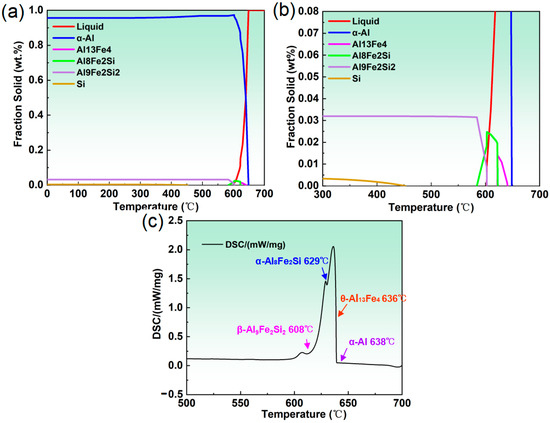
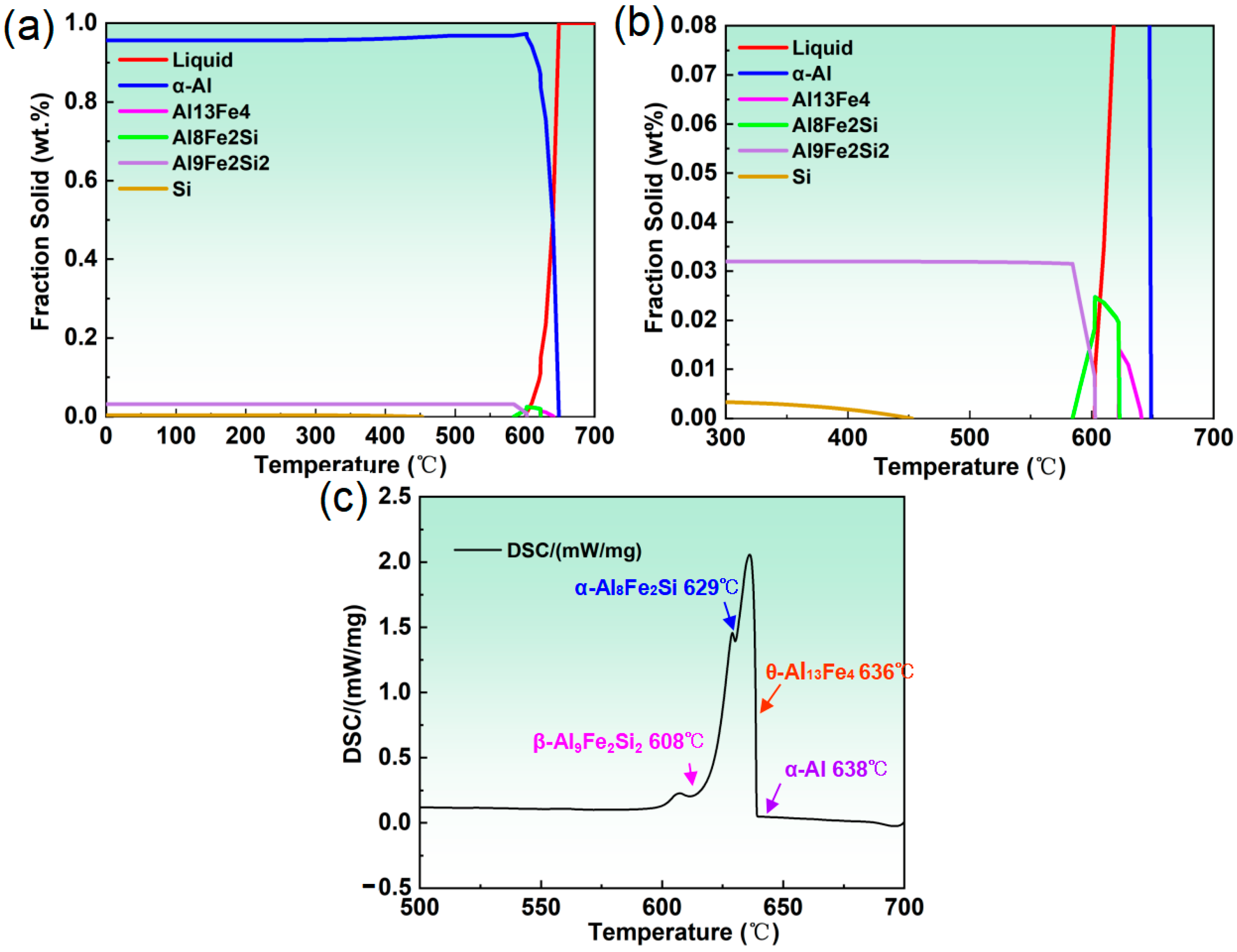
To investigate the phase transformation of Fe-containing intermetallics during the alloy solidification process, the solidification path of the Al-1Si-1Fe alloy is calculated and shown in Figure 4a,b. As shown in Figure 4a,b, the α-Al, θ-Al13Fe4, α-Al7.1Fe2Si, β-Al9Fe2Si2, and a few eutectic Si phases precipitate successively during the solidification process. According to the calculation, the α-Al precipitates at 641 °C first, and then the θ-Al13Fe4 phase forms at 640 °C. With the temperature decreasing from approximately 640 °C to 602 °C, the amount of θ-Al13Fe4 phase increased first, and then decreased, accompanied by the formation of the α-Al7.1Fe2Si phase.
Figure 4.
(a) Solidification path diagram of Al-1Si-1Fe alloy; (b) the enlarged view of (a); (c) cooling DSC curve of Al-1Si-1Fe alloy.
The α-Al7.1Fe2Si phase formed at 622 °C, then it transformed to β-Al9Fe2Si2 at 602 °C. With the drop in temperature, the amount of β-Al9Fe2Si2 phase increased first, and then remained at a stable level during the solidification process of the alloy.
To further determine the formation sequence of Fe-containing intermetallics in Al-1Si-1Fe alloy, the cooling DSC curves of the experimental alloy are measured and shown in Figure 4c. As shown in Figure 4c, the formation temperature of α-Al is ascertained as 638 °C, which is in good agreement with the calculation result in Figure 4a,b. With the drop in temperature, the α-Al7.1Fe2Si phase and β-Al9Fe2Si precipitates at 629.0 °C and 608 °C; these results verify the phase transformation of Fe-containing intermetallics in the Al-1Si-1Fe alloy. The thermodynamic calculation predicts θ-Al13Fe4 formation at approximately 640 °C. However, no distinct exothermic peak corresponding to θ-Al13Fe4 is observed in the DSC cooling curve (Figure 4c). This absence can be attributed to the relatively small volume fraction of θ-Al13Fe4 phase, producing a weak thermal signal that is difficult to detect by DSC; (2) the transformation temperature of θ-Al13Fe4 (640 °C) is very close to the α-Al solidification temperature (638 °C), and the two thermal events may overlap, with the strong α-Al exotherm masking the weak θ signal; and (3) the DSC cooling rate of 5 °C/min may shift the precipitation temperature of θ-Al13Fe4 sufficiently to overlap with the α-Al peak. As a result, the θ-Al13Fe4 phase formation is not resolved as a distinct peak but is implied by the subsequent transformation to α-Al7.1Fe2Si and β-Al9Fe2Si2, which are clearly observed at 629 °C and 608 °C. In previous studies, the formation of θ-Al13Fe4 and its phase transformation to α-Al7.1Fe2Si (hexagonal) via a quasi-peritectic reaction, the subsequent phase transformation of α-Al7.1Fe2Si into β-Al9Fe2Si2 (monoclinic), as well as the β-Al5FeSi phase transformation into δ-Al3FeSi2 (tetragonal) via heat treatment have been confirmed in the Al-20Si-0.7Si alloy [11].
3.2. Stability Evolution of Fe-Containing Intermetallics
The phase transformation of Fe-containing intermetallics is closely related to their thermodynamic stability. To further investigate the thermodynamic stability evolution of Fe-containing intermetallics in this paper, first-principles calculations were carried out to calculate the binding energy (Eb) and formation energy (Ef) of the θ-Al13Fe4 (Al78Fe24), α-Al7.1Fe2Si (Al168Fe46Si24), β-Al9Fe2Si2(Al72Fe16Si16) and δ-Al3FeSi2 phases (Al12Fe4Si8). The Ef and Eb are defined as the following expressions:
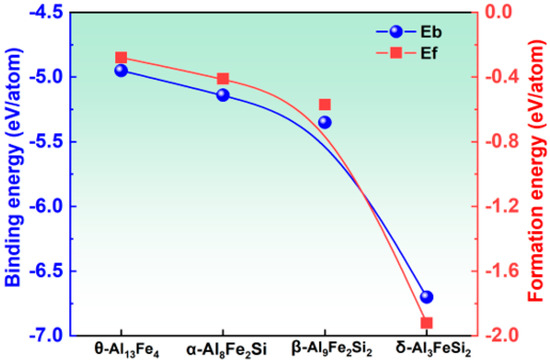
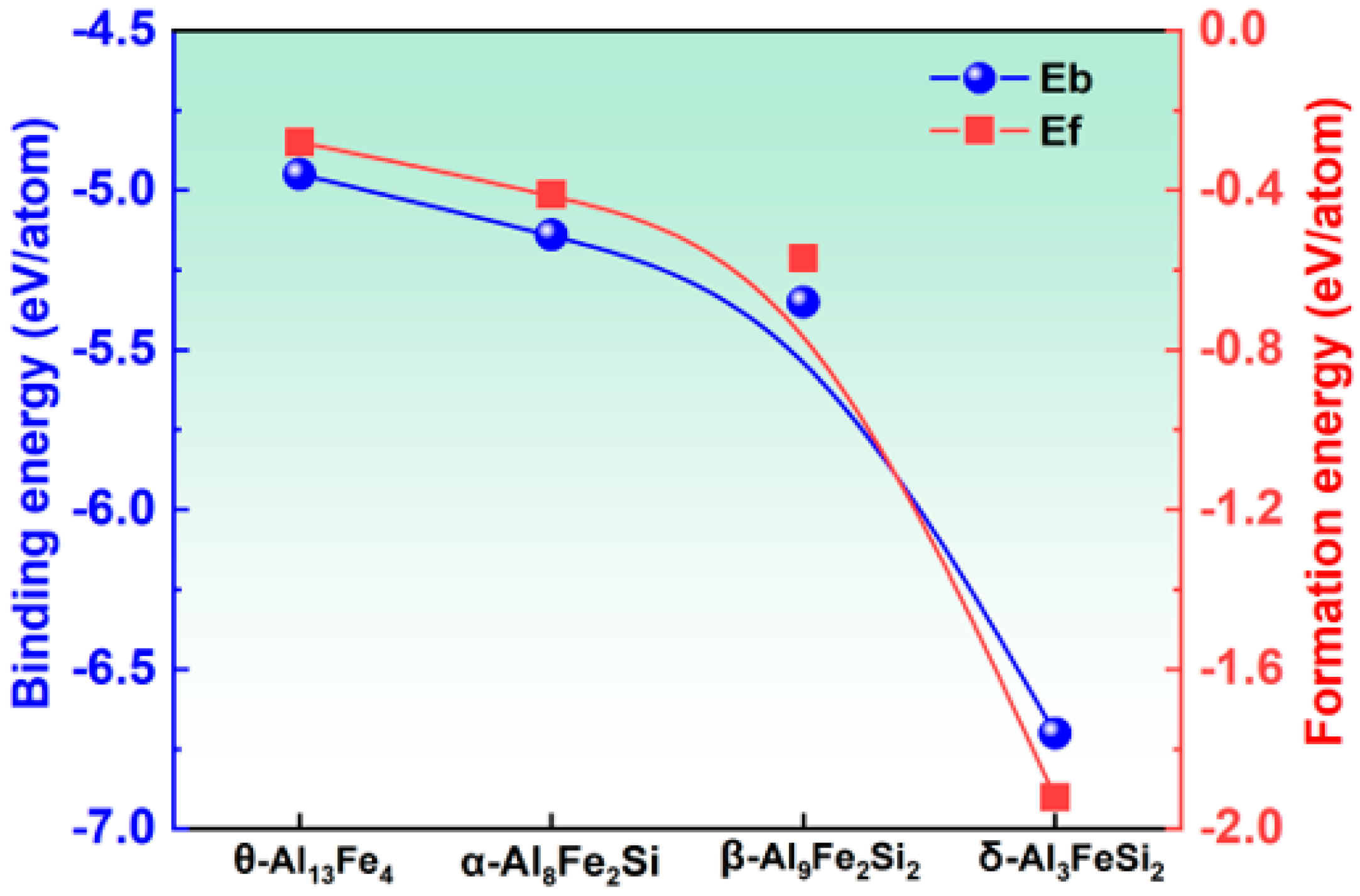
Here, Etot is the total energy of the Fe-containing intermetallic crystal; N is the total number of atoms in the unit crystal cell. , and are the energies of bulk Al, Fe, and Si, respectively. , and are the energies of isolated Al, Fe, and Si atoms, respectively. , and are the numbers of Al, Fe, and Si atoms in the unit cell [24,25]. A negative formation energy indicates better thermodynamic stability of Fe-containing intermetallics. A more negative formation energy and binding energy indicate greater thermodynamic stability of the Fe-containing intermetallics. The calculated formation energy and binding energy of these Fe-containing IMCs are shown in Figure 5. The Binding energy values of θ-Al13Fe4, α-Al7.1Fe2Si, β-Al9Fe2Si2 and δ-Al3FeSi2 phases are −4.95 eV/atom, −5.14 eV/atom, −5.35 eV/atom and −6.7 eV/atom, respectively. The formation energy values of θ-Al13Fe4, α-Al7.1Fe2Si, β-Al9Fe2Si2 and δ-Al3FeSi2 phases are −0.28 eV/atom, −0.41 eV/atom, −0.57 eV/atom and −1.92 eV/atom, respectively, indicating that they are thermodynamically stable. Accordingly, the thermodynamic stability of these Fe-containing IMCs increases in the order: δ-Al3FeSi2 > β-Al9Fe2Si2 > α-Al7.1Fe2Si > θ-Al13Fe4. Among them, the δ-Al3FeSi2 phase shows the lowest binding energy and formation enthalpy, making it the most thermodynamically stable phase. These results are the exact explanation of the phase transformation from the θ-Al13Fe4 phase to the δ-Al3FeSi2 phase from the perspective of thermodynamic stability.
Figure 5.
The calculated formation energy Ef (eV/atom) and binding energy of θ-Al13Fe4, α-Al7.1Fe2Si, β-Al9Fe2Si2 and δ-Al3FeSi2 phases at 0 K.
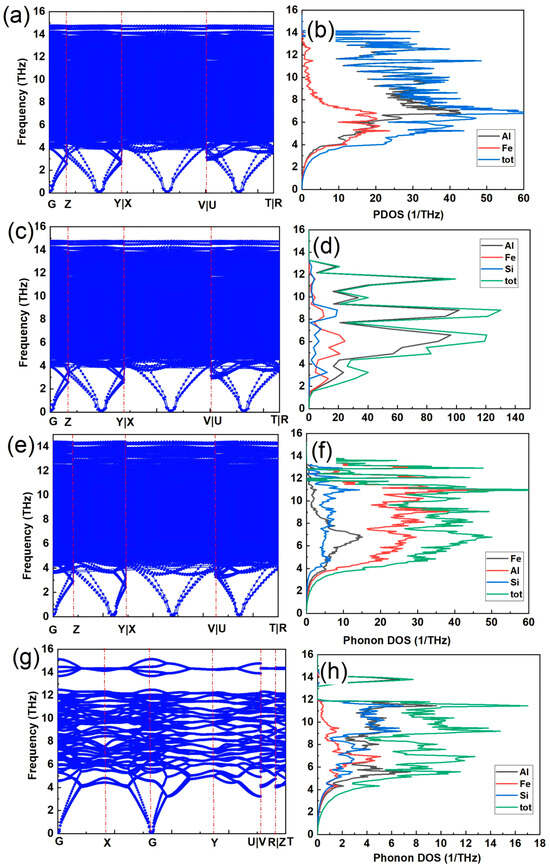
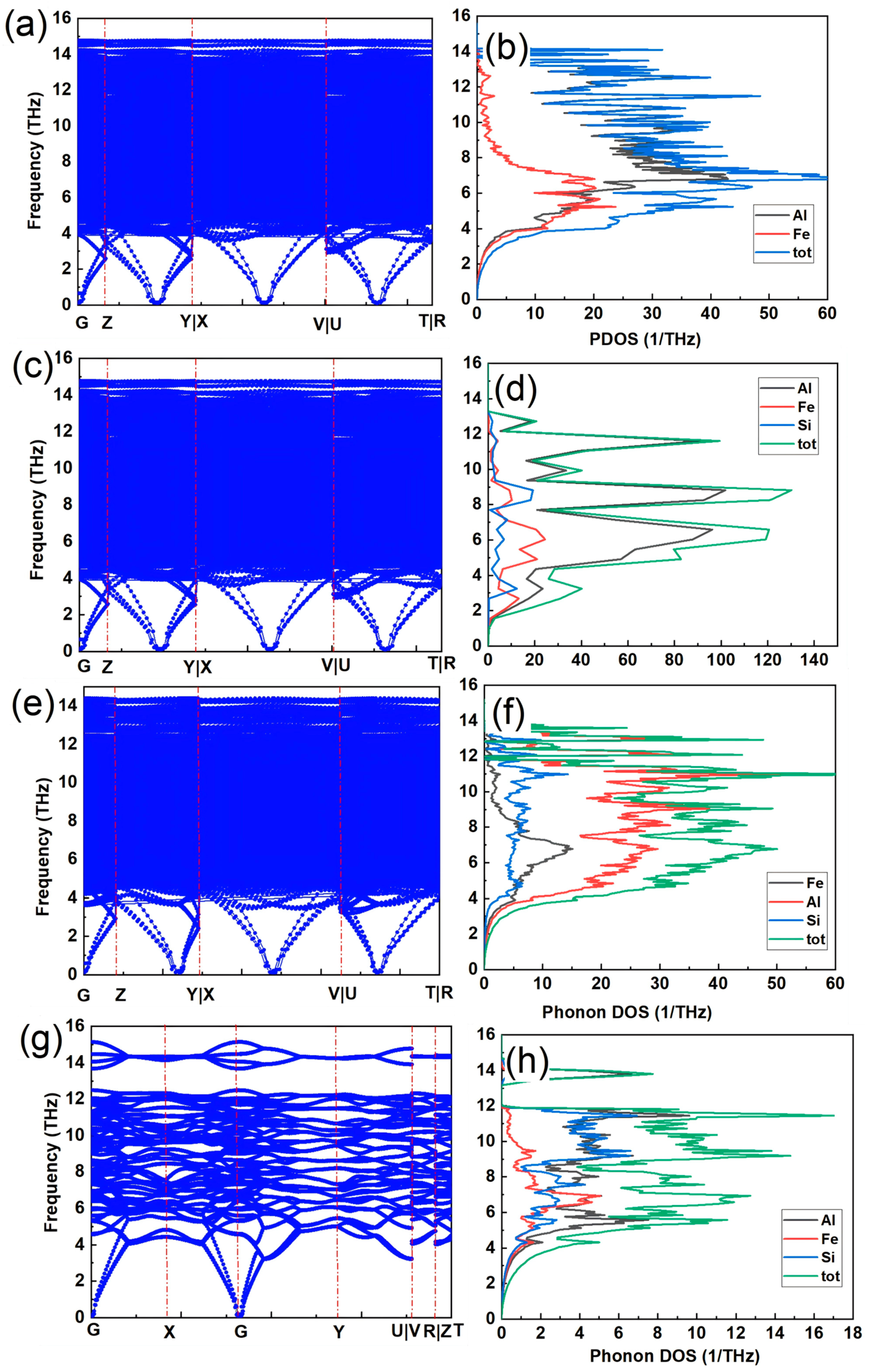
Moreover, the dynamic stability of these Fe-containing intermetallics can be determined by the phonon spectrum. If there are no imaginary frequencies at any high-symmetry point, the structure is dynamically stable. The phonon dispersion curves and projected phonon densities of states (PHDOS) of the θ-Al13Fe4, α-Al7.1Fe2Si, β-Al9Fe2Si2 and δ-Al3FeSi2 phases are calculated and depicted in Figure 6. The absence of soft modes at any high-symmetry dispersion is indicated by phonon calculations, which serve as a requirement for crystal stability along high-symmetry directions in the Brillouin zone. There is no imaginary frequency (frequency ≤ 0THz) in the phonon dispersion curve, indicating that all the investigated Fe-containing intermetallics are dynamically stable.
Figure 6.
The calculated phonon dispersion curves and projected phonon densities of states (PHDOS) of (a,b) θ-Al13Fe4; (c,d) α-Al7.1Fe2Si; (e,f) β-Al9Fe2Si2; and (g,h) δ-Al3FeSi2 phases.
3.3. Thermophysical Properties Evolution of Fe-Containing Intermetallics
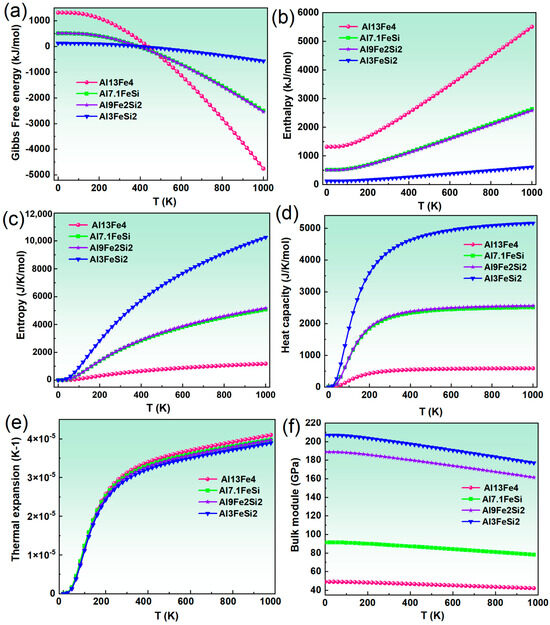
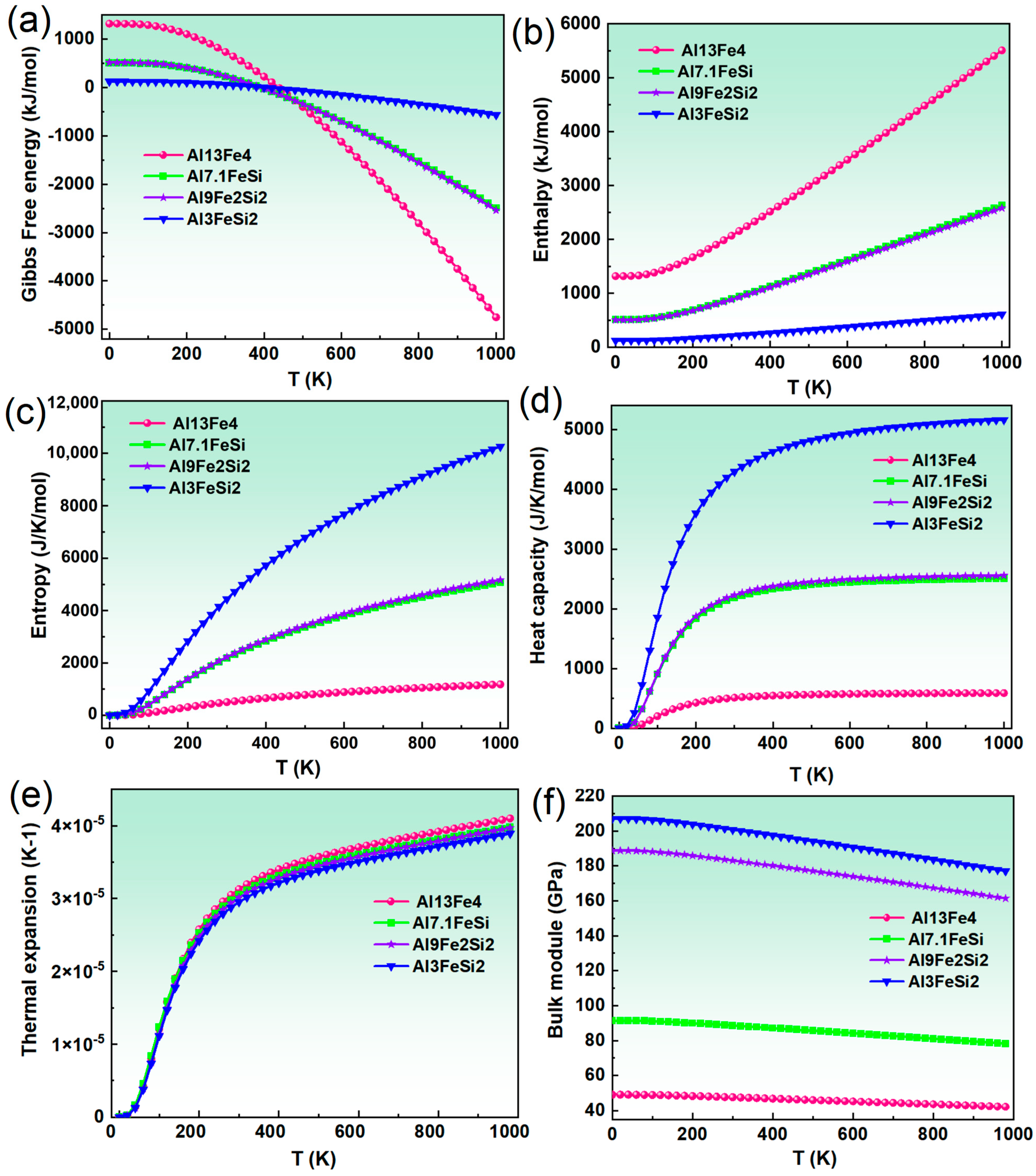
The phase transformation of Fe-containing intermetallics is closely related to their thermal properties. Then, the Gibbs free energy, enthalpy, entropy, heat capacity, thermal expansion and bulk modulus of the θ-Al13Fe4, α-Al7.1Fe2Si, β-Al9Fe2Si2 and δ-Al3FeSi2 phases are calculated by First-principles calculations and shown in Figure 7. Figure 7a illustrates the temperature-dependent Gibbs Free energy of θ-Al13Fe4, α-Al7.1Fe2Si, β-Al9Fe2Si2 and δ-Al3FeSi2 phases. The most stable phase is θ-Al13Fe4 at temperatures from 480 K to 1000 K due to the lower Gibbs free energy, while α-Al7.1Fe2Si becomes more stable than other phases at temperatures from 380 K to 480 K. When the temperature is reduced to360 K, the δ-Al3FeSi2 phase becomes the most stable phase. So θ-Al13Fe4 appears as the precursor for the formation of α-Al7.1Fe2Si and β-Al9Fe2Si2 phases, which have been observed in thermodynamic calculation results. To further understand the relative stability and transformation routes of these Fe-containing intermetallics, their formation enthalpy evolution with temperature is calculated and shown in Figure 6b. As the temperature increases, their relative formation enthalpy increases. The δ-Al3FeSi2 phase shows the minimum formation enthalpy value, indicating the most stable phase among the δ-Al3FeSi2 phases. From Figure 7c, all the entropies of these Fe-containing intermetallics show the same increasing trend with the increment of temperature. The δ-Al3FeSi2 phase shows the largest entropy, and θ-Al13Fe4 has the lowest entropy among all these phases. Figure 7d displays the temperature-dependent isobaric heat capacity (Cp) of θ-Al13Fe4, α-Al7.1Fe2Si, β-Al9Fe2Si2 and δ-Al3FeSi2 phases. Below 300 K, the Cp value of these phases increases rapidly with temperature but stabilizes beyond 300 K, which is consistent with the Debye theory [26]. The calculated Cp values of θ-Al13Fe4, α-Al7.1Fe2Si, β-Al9Fe2Si2 and Al3FeSi2 phase are approximately 511 J/mol·K, 2181 J/mol·K, 2229 J/mol·K and 4290 J/mol·K at room temperature, respectively. This indicates that the phase transformation improves the Cp value. The isobaric heat capacity can be made up of contributions from lattice vibrations, thermal electrons and thermal expansion. The thermal electronic contribution is determined by the electronic density of states near the Fermi energy. Figure 7e illustrates the thermal expansion coefficient (TEC). Below 300 K, TEC rises sharply but slows at higher temperatures. At room temperature, the TEC value of these Fe-containing intermetallics decreases in the following sequence: δ-Al3FeSi2 > α-Al7.1Fe2Si > β-Al9Fe2Si2 > θ-Al13Fe4. The TEC value increases linearly, which is caused by the intensive phonon excitations and the enhancement of the anharmonic effect. Moreover, the calculated temperature-dependent bulk modulus of the θ-Al13Fe4, α-Al7.1Fe2Si, β-Al9Fe2Si2 and δ-Al3FeSi2 phases are depicted at different temperatures in Figure 6f. The results indicate that the Bulk modulus value increases in the sequence of δ-Al3FeSi2 > α-Al7.1Fe2Si > β-Al9Fe2Si2 > θ-Al13Fe4 in each set of data at the same temperature. The results indicate that the phase transformation can improve the bulk modulus and elastic heat-resistant properties. The chemical bond strength is an important factor in the thermal and mechanical properties of multicomponent intermetallics, such as mechanical modulus and thermal expansion coefficient [26]. It should be noted that the present calculations are based on the quasi-harmonic approximation (QHA), which accounts for the lattice vibrational contribution and its volume dependence, and the thermal electronic contribution has also been included via the electronic density of states. However, explicit anharmonic terms and electron–phonon coupling are not fully captured in this framework. Therefore, the relative stability trends obtained here should be regarded as more reliable in the low-to-intermediate temperature range.
Figure 7.
Thermal properties of θ-Al13Fe4, α-Al7.1Fe2Si, β-Al9Fe2Si2 and δ-Al3FeSi2 phases: (a) free energy–temperature; (b) enthalpy–temperature; (c) entropy–temperature; (d) heat capacity–temperature; (e) thermal expansion–temperature and (f) bulk modulus–temperature (estimated uncertainties in formation energies: ±0.02–0.05 eV/atom; in bulk modulus: ±2–3 GPa; in Cp: ±2–3% of the value; in TEC: ±3–5%).
3.4. Elastic Properties and Anisotropy
The elastic properties of Fe-containing intermetallics are closely related to their chemical bonding characters and stability. Then, the elastic constants of θ-Al13Fe4, α-Al7.1Fe2Si, β-Al9Fe2Si2 and δ-Al3FeSi2 phases are calculated and listed in Table 3. According to Born-Huang’s lattice dynamical theory, the mechanical stability criteria can be expressed as in Table 3 [20]. Data from Ref. [20]:
Table 3.
The mechanical stability criteria of the θ-Al13Fe4, α-Al7.1Fe2Si, β-Al9Fe2Si2 and Al3Fe2Si2 phases.
As shown in Table 3, the calculated elastic constants of these Fe-containing IMCs satisfy the above criteria, which indicates mechanical stability [20,21]. Typically, the elastic constants of C11, C22, and C33 reflect resistance to uniaxial compression of the crystal, while C44, C55, and C66 indicate its resistance to shear deformation [20,21]. Clearly, all four Fe-containing intermetallics exhibit stronger resistance to uniaxial compression than to shear deformation, which can be intuitively observed through the C11, C22, C33, C44, C55, and C66 values in Table 4.
Table 4.
Calculated elastic constants (in GPa) of θ-Al13Fe4, α-Al7.1Fe2Si, β-Al9Fe2Si2 and Al3Fe2Si2 phases.
Mechanical modulus can reflect the atomic bonding strength in crystals. Generally, the larger the mechanical modulus value, the stronger the bonding strength [20,21,22]. Then, the bulk modulus (B), shear modulus (G) and Young’s modulus (E) were derived using the Voigt and Reuss approximations based on the elastic constants results. Then, the Young’s modulus (E), B/G ratio, Poisson’s ratio (ν), and micro-hardness (H) of the θ-Al13Fe4, α-Al7.1Fe2Si, β-Al9Fe2Si2 and δ-Al3FeSi2 phases are calculated and shown in Table 5. From the calculated mechanical properties in Table 5, the Young’s modulus values of the θ-Al13Fe4, α-Al7.1Fe2Si, β-Al9Fe2Si2 and δ-Al3FeSi2 phases are 131.0 GPa, 180.3 GPa, 183.5 GPa and 221.6 GPa, respectively; the increasing tendency of Young’s modulus indicates the highest chemical bonding strength and stability of the δ-Al3FeSi2 phase. The variation tendency is the same for the shear and bulk modulus of the θ-Al13Fe4, α-Al7.1Fe2Si, β-Al9Fe2Si2 and δ-Al3FeSi2 phases.
Table 5.
The bulk modulus (B), shear modulus (G), Young’s modulus (E), Poisson’s ratio (v), Hardness (Hv), B/G and AUvalue of the θ-Al13Fe4, α-Al7.1Fe2Si, β-Al9Fe2Si2 and δ-Al3FeSi2 phases.
The critical values of the Pugh ratio B/G (1.75), Poisson’s ratio (0.26) and Cauchy pressure (C12-C44) have been used extensively as indicators for the ductility of crystals [22]. The larger the Poisson’s ratio (σ), the softer the material [26]. Cauchy pressure (C12-C44) is also an important criterion for the ductile-brittle properties of materials. C12 is smaller than C44 for brittle materials. While for the ductile materials, the contrary is the case. As shown in Table 4 and Table 5, for the θ-Al13Fe4 phase, ν = 0.29 and B/G = 2.08, along with C12 > C44, indicate ductile behavior. The plasticity of θ-Al13Fe4 allows stress redistribution during loading, potentially enhancing crack resistance and fatigue performance. In contrast, δ-Al3FeSi2 exhibits complete brittleness, and brittle materials typically have higher hardness [22]. α-Al7.1Fe2Si and β-Al9Fe2Si2 phases show mixed behavior: while ν and B/G suggest brittleness, the Cauchy pressure implies limited ductility. In the present work, we use the B/G and Poisson’s ratio values as relative indicators of ductility–brittle tendency rather than as absolute classifications. The systematic comparison among the four phases is more significant than the exact classification of any single phase.
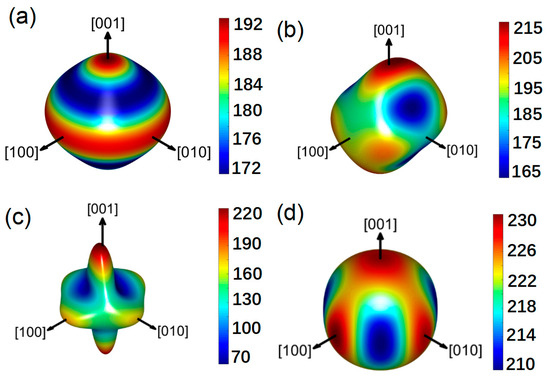
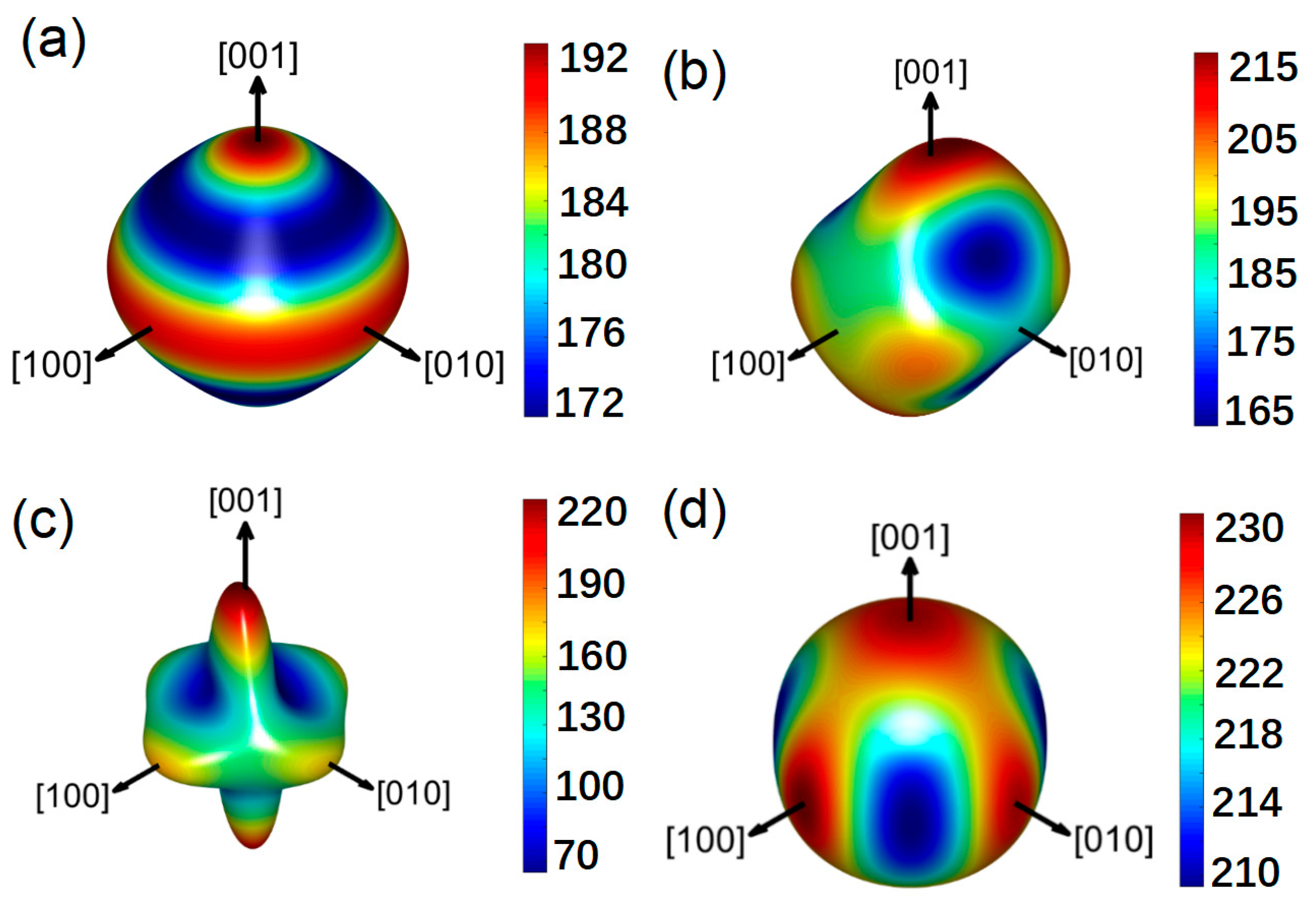
Elastic anisotropy of Fe-containing intermetallics influences crack formation and is of great significance to the application of aluminum alloys. Then, the 3D surface contours of Young’s modulus for the θ-Al13Fe4, α-Al7.1Fe2Si, β-Al9Fe2Si2 and δ-Al3FeSi2 phases are illustrated in Figure 8. For isotropic materials, the Young’s modulus sphere is an ideal sphere. This indicates that the θ-Al13Fe4, α-Al7.1Fe2Si and δ-Al3FeSi2 phases show a weak anisotropic character in Young’s modulus, while β-Al9Fe2Si2 exhibits significant anisotropy, with E reaching 220 GPa in the [001] direction—three times higher than that in the [101] direction—indicating a highly non-spherical contour. Then, it can be concluded that every effort should be made to obtain the θ-Al13Fe4 or α-Al7.1Fe2Si phase, while the formation of the β-Al9Fe2Si2 phase should be avoided during the processing of the alloy. The strong elastic anisotropy of β-Al9Fe2Si2, as evidenced by its high Universal Elastic Anisotropy Index (Table 5, AU = 0.86) and the significant Voigt–Reuss spread in its shear modulus, suggests that this phase is more susceptible to stress concentration and crack formation during mechanical loading compared to the more isotropic phases (θ, α, and δ). This finding, in conjunction with the reported brittleness of β-Al9Fe2Si2 in the literature, suggests that minimizing the formation of β-Al9Fe2Si2 during solidification and subsequent processing could be beneficial for improving the mechanical properties of recycled Al-Si-Fe alloys.
Figure 8.
Young’s modulus 3D surface of (a) θ-Al13Fe4, (b) α-Al7.1Fe2Si, (c) β-Al9Fe2Si2 and (d) δ-Al3FeSi2 phases.
3.5. Electronic Structure
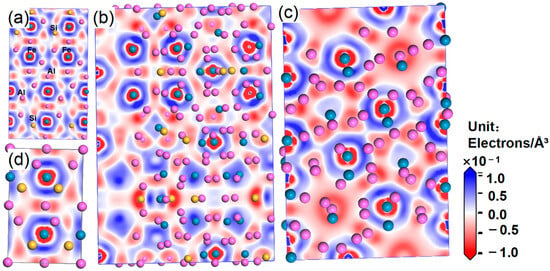
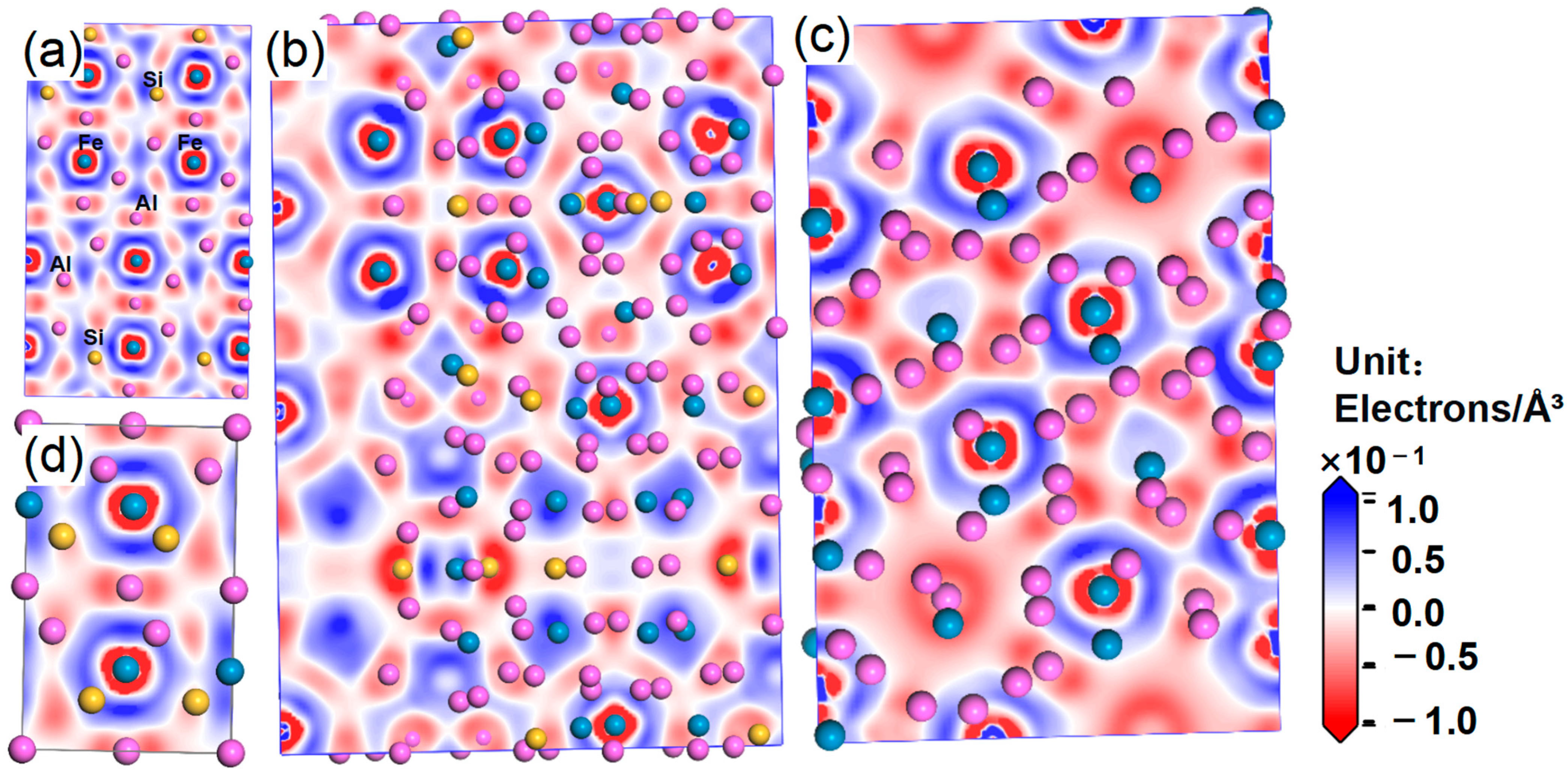
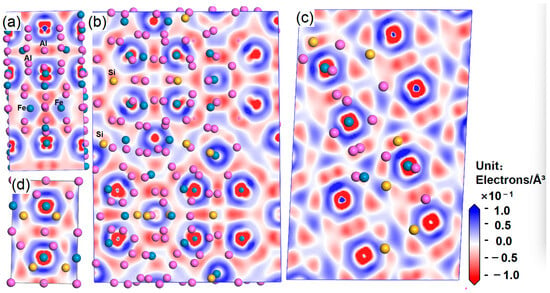
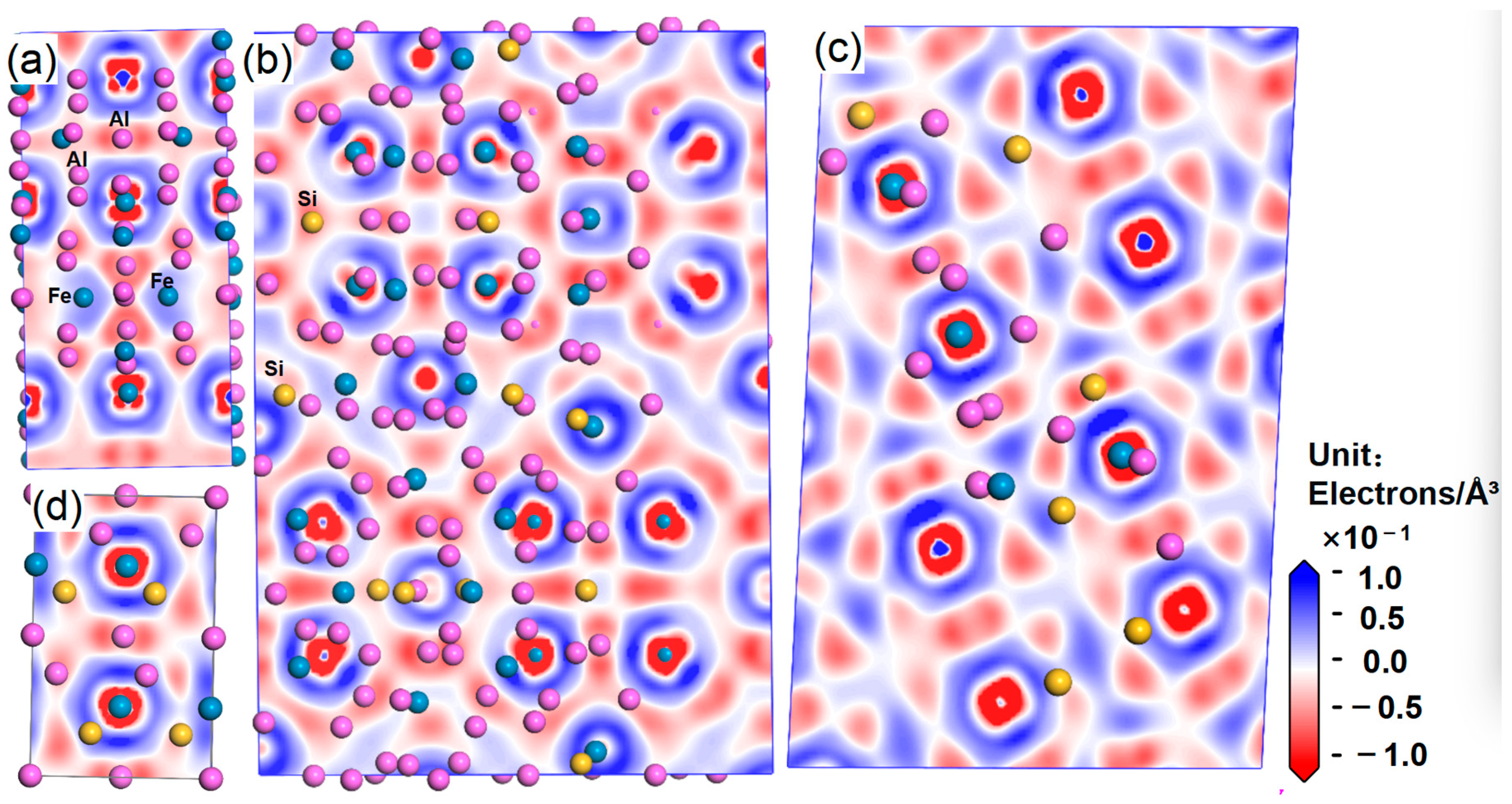
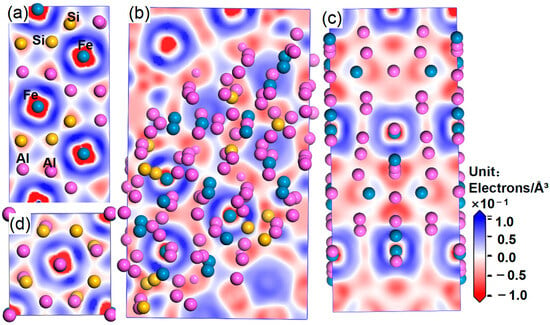
As widely discussed in previous work, the stability and Young’s modulus of crystals are heavily determined by the chemical bonding strength [26]. For a deeper understanding of the stability and mechanical evolution of the θ-Al13Fe4, α-Al7.1Fe2Si, β-Al9Fe2Si2 and δ-Al3FeSi2 phases, the electron density difference distribution contours on the (010), (100) and (001) planes are shown in Figure 9, Figure 10 and Figure 11.
Figure 9.
Electron density difference distribution on the (010) plane of the (a) θ-Al13Fe4, (b) α-Al7.1Fe2Si, (c) β-Al9Fe2Si2 and (d) δ-Al3FeSi2 phases.
Figure 10.
Electron density difference distribution on the (100) plane of the (a) θ-Al13Fe4, (b) α-Al7.1Fe2Si, (c) β-Al9Fe2Si2 and (d) δ-Al3FeSi2 phases.
Figure 11.
Electron density difference distribution on the (001) plane of the (a) θ-Al13Fe4, (b) α-Al7.1Fe2Si, (c) β-Al9Fe2Si2 and (d) δ-Al3FeSi2 phases.
Red regions denote charge accumulation (covalent bonding or electron sharing), while blue regions indicate charge consumption (electron transfer). Generally, strong electron localization typically corresponds to stronger chemical bonds. For the θ-Al13Fe4 phase (Figure 9a), it can be clearly seen that electrons mainly accumulate uniformly around Fe atoms. A smaller degree of delocalization leads to a greater degree of uneven electron distribution, indicating that the chemical bonds of Al-Fe in the θ-Al13Fe4 phase are stronger than those of Al-Al. For the α-Al7.1Fe2Si and β-Al9Fe2Si2 phases (Figure 9b,c), electron accumulation occurs not only around Fe atoms but is also distributed directionally between Al-Si, Al-Fe and Si-Fe atoms, indicating covalent interactions of Si-Fe bonds. The electron accumulation degree in the Al-Fe direction in α-Al7.1Fe2Si and β-Al9Fe2Si2 is relatively high, indicating that the interaction between Al and Fe atoms is greater than that between Si and Fe atoms. These results showed that Al-Fe chemical bonds are stronger than those of Al-Si, Al-Fe and Si-Fe bonds in the α-Al7.1Fe2Si and β-Al9Fe2Si2 phases. For the δ-Al3FeSi2 phase, the covalent interactions between Si and Fe atoms are obvious due to the significant electron distribution between Si and Fe atoms, indicating stronger Si-Fe chemical bonds.
Stronger chemical bonds usually mean higher stability, which determines the thermodynamic and thermophysical properties of Fe-containing intermetallics.
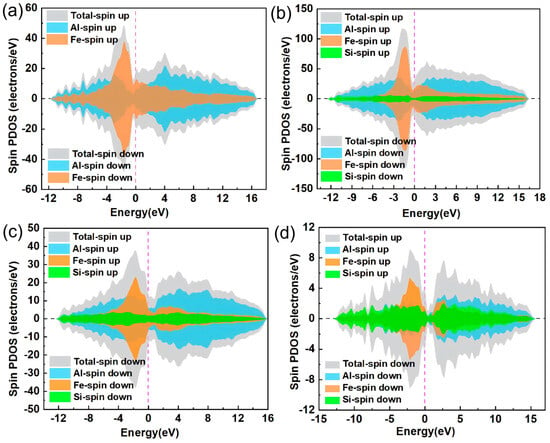
To further investigate the electronic structures and chemical bonding characters of Fe-containing intermetallics in this study, the total density of states (TDOS) and partial density of states (PDOS) of the θ-Al13Fe4, α-Al7.1Fe2Si, β-Al9Fe2Si2 and δ-Al3FeSi2 phases were calculated and presented in Figure 12. It can be observed that the θ-Al13Fe4, α-Al7.1Fe2Si, β-Al9Fe2Si2 and δ-Al3FeSi2 phases exhibit non-zero TDOS at the Fermi level, indicating metallic behavior and good electrical conductivity. A higher density of states (DOS) at the Fermi level implies more available electronic states near this energy level, which is beneficial for enhancing the electronic system’s capacity for heat absorption and increasing electronic heat capacity. Previous studies suggest that a lower DOS at the Fermi level corresponds to a more stable structure. The spin-up TDOS values at the Fermi level for the θ-Al13Fe4, α-Al7.1Fe2Si, β-Al9Fe2Si2 and δ-Al3FeSi2 phases are 18.56, 32.75, 13.42, and 3.78, respectively, which aligns with the formation energy and binding energy calculation results in Figure 5. In the energy range of −4 to 4 eV, the partial density of states (PDOS) of Al and Fe atoms overlap in the θ-Al13Fe4, α-Al7.1Fe2Si and β-Al9Fe2Si2 phases, representing the hybridization of the Al-3p and Fe-3d states to form Al-Fe chemical bonding in the −4 eV to 4 eV energy range.
Figure 12.
Spin-polarized total density of states (TDOS) and partial density of states (PDOS) of (a) θ-Al13Fe4, (b) α-Al7.1Fe2Si, (c) β-Al9Fe2Si2 and (d) δ-Al3FeSi2. Dashed lines represent the Fermi level.
For the δ-Al3FeSi2 phase (Figure 12d), the Fe bands overlap with Al bands to some degree in the −5 eV to 0 eV energy range, and overlap with Si bands in the −5 eV to 0 eV and 0 eV to 5 eV energy ranges, representing the hybridization of Al and Fe, and Si and Fe to form stronger Al-Fe and Si-Fe chemical bonding in the above energy range. Moreover, there is no evidence of Al-Si and Si-Fe chemical bonds in the α-Al7.1Fe2Si and β-Al9Fe2Si2 phases (Figure 12b,c). Thus, it can be concluded that the stronger Si-Fe covalent chemical bonds give the δ-Al3FeSi2 phase higher stability and mechanical performance than those of the α-Al7.1Fe2Si and β-Al9Fe2Si2 phases, thereby explaining the superior thermal stability and thermophysical properties of the δ-Al3FeSi2 phase.
To further reveal the chemical bonds characteristic of the θ-Al13Fe4, α-Al7.1Fe2Si, β-Al9Fe2Si2 and δ-Al3FeSi2 phases, the average bond populations and bond lengths of these phases are calculated and presented in Table 6. Generally, stronger covalent interactions are indicated by larger average bond populations and shorter bond lengths. In the Al13Fe4 phase, the bond population of Al-Fe bonds is significantly higher than those of Al-Al and Fe-Fe bonds, demonstrating stronger Al-Fe chemical bonds than Al-Al and Fe-Fe bonds. This result is consistent with the spin-polarized total density of states and charge density difference in Figure 9a and Figure 12a. As shown in Table 6, for the β-Al9Fe2Si2 and α-Al7.1Fe2Si phases, the Al-Fe bonds exhibit higher strength due to the higher bond population value and shorter bond length, while for the δ-Al3FeSi2 phase, the Si-Fe bonds are the strongest chemical bonds, resulting in a higher modulus and stability of the δ-Al3FeSi2 phase. Moreover, the Al-Fe bonds and Si-Fe bonds in the β-Al9Fe2Si2 and α-Al7.1Fe2Si phases are obviously weaker than those in the δ-Al3FeSi2 phase, indicating a lower modulus value and stability. The above analysis of the chemical bonding characteristics is consistent with the charge density and dynamic analyses. While Mulliken analysis provides a qualitative indication of bonding trends, its quantitative values are basis-set dependent and should be interpreted with caution, particularly for plane-wave DFT calculations requiring projection onto localized orbitals.
Table 6.
The calculated average bond populations and bond lengths of the θ-Al13Fe4, α-Al7.1Fe2Si, β-Al9Fe2Si2 and δ-Al3FeSi2 phases.
4. Conclusions
To reveal the underlying phase transformation mechanism of Fe-containing intermetallics in Al-Si-Fe alloy, the thermodynamic stability, thermal properties, elastic properties and electronic structures of the θ-Al13Fe4, α-Al7.1Fe2Si, β-Al9Fe2Si2 and δ-Al3FeSi2 phases are systematically investigated by first-principles calculations and the quasi-harmonic approximation (QHA). The main conclusions are as follows:
- (1)
- The phase transformations from the θ-Al13Fe4 to α-Al7.1Fe2Si, β-Al9Fe2Si2 and δ-Al3FeSi2 phases are supported by both the DSC measurements and the JMatPro thermodynamic calculations, which provide an independent check on the finite-temperature stability trends
- (2)
- The calculation results of thermodynamic stability and thermal properties of θ-Al13Fe4, α-Al7.1Fe2Si, β-Al9Fe2Si2 and δ-Al3FeSi2 phases validated the phase transformation behavior. The higher thermodynamic stability favors the phase transition to proceed.
- (3)
- The stability and thermal properties evolution of Fe-containing intermetallics can be explained by the electronic structure and chemical bond characters. The δ-Al3FeSi2 phase shows the highest thermodynamic stability and largest elastic modulus, which can be attributed to the strong Si-Fe covalent bonds.
Author Contributions
Conceptualization, X.Z., D.W., H.N., R.W., M.Z. and Y.G.; methodology, X.Z., D.W. and H.N.; software, X.Z., M.Z., L.Z. and Y.G.; validation, X.Z., L.Z. and Y.G.; investigation, H.N., R.W. and M.Z.; resources, Z.Y., R.W., M.Z., L.Z. and Y.G.; data curation, X.Z., Z.Y., L.Z. and Y.G.; writing—original draft, X.Z.; writing—review and editing, X.Z.; visualization, D.W., H.N. and R.W.; supervision, D.W. and H.N.; project administration, D.W. and H.N.; funding acquisition, H.N. All authors have read and agreed to the published version of the manuscript.
Funding
This project was supported by project ZR2025LGY012, supported by the Shandong Provincial Natural Science Foundation.
Data Availability Statement
The original contributions presented in this study are included in the article. Further inquiries can be directed to the corresponding authors.
Conflicts of Interest
Ying Gao was employed by the Binzhou Institute of Technology. The remaining authors declare that the research was conducted in the absence of any commercial or financial relationships that could be construed as a potential conflict of interest.
Abbreviations
The following abbreviations are used in this manuscript:
| IMC | Intermetallics |
| DSC | Differential Scanning Calorimetry |
| DFT | Density Functional Theory |
| PBE | Perdew–Burke–Ernzerhof |
| GGA | Generalized Gradient Approximation |
| PAW | Projector Augmented Wave |
| QHA | Quasi-Harmonic Approximation |
| VRH | Voigt-Reuss-Hill |
| TECs | Thermal Expansion Coefficients |
| XRD | X-ray Diffraction |
| PHDOS | Projected Phonon Densities of States |
| TDOS | Total Density of States |
| PDOS | Partial Density of States |
| DOS | Density of States |
References
- Zhao, Y.; He, W.; Song, D.; Shen, F.; Li, X.; Sun, Z.; Wang, Y.; Liu, S.; Du, Y.; Fernández, R. Effect of ultrasonic melt processing and Al-Ti-B on the microstructural refinement of recycled Al alloys. Ultrason. Sonochem. 2022, 89, 106139. [Google Scholar] [CrossRef] [Scilit] [PubMed]
- Raabe, D.; Ponge, D.; Uggowitzer, P.J.; Roscher, M.; Paolantonio, M.; Liu, C.; Antrekowitsch, H.; Kozeschnik, E.; Seidmann, D.; Gault, B.; et al. Making sustainable aluminum by recycling scrap: The science of “dirty” alloys. Prog. Mater. Sci. 2022, 128, 100947. [Google Scholar] [CrossRef] [Scilit]
- Gaustad, G.; Olivetti, E.; Kirchain, R. Improving aluminum recycling: A survey of sorting and impurity removal technologies. Resour. Conserv. Recycl. 2012, 58, 79–87. [Google Scholar] [CrossRef] [Scilit]
- Vicent Fanconi, M.M.; Gil Fernández-Marcote, I.; Ruiz-Bustinza, Í. The challenge of impurities (Fe, Si) to recycling in the rolled aluminum industry in the coming years in relation to their influence on ultimate tensile strength. Metals 2023, 13, 2014. [Google Scholar] [CrossRef] [Scilit]
- Han, K.; Ohnuma, I.; Kainuma, R. Experimental determination of phase equilibria of Al-rich portion in the Al–Fe binary system. J. Alloys Compd. 2016, 668, 97–106. [Google Scholar] [CrossRef] [Scilit]
- Du, Y.; Schuster, J.C.; Liu, Z.K.; Hu, R.; Nash, P.; Sun, W.; Zhang, W.; Wang, J.; Zhang, L.; Tang, C.; et al. A thermodynamic description of the Al–Fe–Si system over the whole composition and temperature ranges via a hybrid approach of CALPHAD and key experiments. Intermetallics 2008, 16, 554–570. [Google Scholar] [CrossRef] [Scilit]
- Song, D.; Zhao, Y.; Jia, Y.; Huang, G.; Zhang, Z.; Zhou, N.; Li, X.; Zheng, K.; Fu, Y.; Zhang, W. Effect of B addition on the formation of Fe-rich phases in Al-Si-Fe alloys. J. Alloys Compd. 2023, 930, 167426. [Google Scholar] [CrossRef] [Scilit]
- Zhao, Y.; Song, D.; Wang, H.; Chen, L.; Sun, Z.; Zhai, T.; Fu, Y.; Wang, Y.; Liu, S.; Du, Y.; et al. Revealing the nucleation and growth mechanisms of Fe-rich phases in Al–Cu–Fe (-Si) alloys under the influence of Al–Ti–B. Intermetallics 2022, 146, 107584. [Google Scholar] [CrossRef] [Scilit]
- Dinsdale, A.; Fang, C.; Que, Z.; Fan, Z. Understanding the Thermodynamics and Crystal Structure of Complex Fe Containing Intermetallic Phases Formed on Solidification of Aluminium Alloys: Dinsdale, Fang, Que, and Fan. JOM 2019, 71, 1731–1736. [Google Scholar]
- Amirkhanyan, L.; Weissbach, T.; Gruber, T.; Zienert, T.; Fabrichnaya, O.; Kortus, J. Thermodynamic investigation of the τ4-Al–Fe–Si intermetallic ternary phase: A density-functional theory study. J. Alloys Compd. 2014, 598, 137–141. [Google Scholar] [CrossRef] [Scilit]
- Que, Z.; Mendis, C.L. Formation of θ-Al13Fe4 and the multi-step phase transformations to α-Al8Fe2Si, β-Al5FeSi and δ-Al4FeSi2 in Al–20Si-0.7 Fe alloy. Intermetallics 2020, 127, 106960. [Google Scholar] [CrossRef] [Scilit]
- Wang, X.; Zhao, K.; Li, Y.; Liu, X.; Wang, H.; Li, X.; Zhang, T.; Fu, Y.; Chen, Z.; Kang, H.; et al. Improving the ductility of a high-Fe die-casting aluminum alloy via TiB2-induced formation of metastable Fe-rich intermetallics. Mater. Sci. Eng. A 2025, 942, 148727. [Google Scholar] [CrossRef] [Scilit]
- Que, Z.; Mendis, C.L. Heterogeneous nucleation and phase transformation of Fe-rich intermetallic compounds in Al–Mg–Si alloys. J. Alloys Compd. 2020, 836, 155515. [Google Scholar] [CrossRef] [Scilit]
- Que, Z.; Fang, C.; Fan, Z. Nucleation competition and phase transformation mechanisms in recycled aluminium alloys: Insights into θ-Al13Fe4, Al6(Fe, Mn) and α-Al15(Fe, Mn)3Si2. J. Alloys Compd. 2025, 1032, 181130. [Google Scholar] [CrossRef] [Scilit]
- Fang, C.; Que, Z.; Fan, Z. First-Principles Study on Silicon Stabilization of the Cubic α-and Hexagonal α’-FeAl Phases. Metals 2026, 16, 832. [Google Scholar] [CrossRef] [Scilit]
- Fang, C.M.; Que, Z.P.; Fan, Z. Stability, chemical composition, and structural and electronic properties of the intermetallic compound τ4-(Al1-xSix)5Fe. J. Alloys Compd. 2025, 3027, 182295. [Google Scholar]
- Zienert, T.; Amirkhanyan, L.; Seidel, J.; Wirnata, R.; Weissbach, T.; Gruber, T.; Fabrichnaya, O.; Kortus, J. Heat capacity of η-AlFe (Fe2Al5). Intermetallics 2016, 77, 14–22. [Google Scholar] [CrossRef] [Scilit]
- Zienert, T.; Leineweber, A.; Fabrichnaya, O. Heat capacity of Fe-Al intermetallics: B2-FeAl, FeAl2, Fe2Al5 and Fe4Al13. J. Alloys Compd. 2017, 725, 848–859. [Google Scholar] [CrossRef] [Scilit]
- Sun, Y.; Huang, X.; Liu, C.; Zhou, M.; Zhang, X. Impurity iron separation from molten secondary aluminum by pulsed electric current. J. Alloys Compd. 2023, 934, 167903. [Google Scholar] [CrossRef] [Scilit]
- Zhang, X.; Wang, D.; Zhou, Y.; Chong, X.; Li, X.; Zhang, H.; Nagaumi, H. Exploring crystal structures, stability and mechanical properties of Fe, Mn-containing intermetallics in Al-Si Alloy by experiments and first-principles calculations. J. Alloys Compd. 2021, 876, 160022. [Google Scholar] [CrossRef] [Scilit]
- Zhang, X.; Wang, D.; Nagaumi, H.; Zhou, Y.; Yu, W.; Chong, X.; Zhang, H. Morphology, thermal stability, electronic structure and mechanical properties of α-AlFeMnSi phases with varying Mn/Fe atomic ratios: Experimental studies and DFT calculations. J. Alloys Compd. 2022, 901, 163523. [Google Scholar] [CrossRef] [Scilit]
- Zhang, X.; Wang, D.; Nagaumi, H.; Wang, R.; Wu, Z.; Zhang, M.; Gao, D.; Chen, H.; Wang, P.; Zhou, P.; et al. Accelerating the design of highly separable Fe-containing intermetallics in Al–Si alloys via DFT calculations and experimental validation. Mater. Genome Eng. Adv. 2025, 3, e70008. [Google Scholar] [CrossRef] [Scilit]
- Takata, N.; Minamihama, K.; Miyawaki, T.; Cheng, Y.; Xu, Y.; Wang, W.; Kim, D.; Suzuki, A.; Kobashi, M.; Kato, M. Design of high-performance sustainable aluminum alloy series for laser additive manufacturing. Nat. Commun. 2025, 16, 11105. [Google Scholar] [CrossRef] [Scilit] [PubMed]
- Wang, G.; Jiang, Y.; Li, Z.; Chong, X.; Feng, J. Balance between strength and ductility of dilute Fe2B by high-throughput first-principles calculations. Ceram. Int. 2021, 47, 4758–4768. [Google Scholar] [CrossRef] [Scilit]
- Chong, X.; Jiang, Y.; Zhou, R.; Feng, J. Elastic properties and electronic structures of CrxBy as superhard compounds. J. Alloys Compd. 2014, 610, 684–694. [Google Scholar] [CrossRef] [Scilit]
- Zhou, Y.; Gan, M.; Yu, W.; Chong, X.; Feng, J. First-principles study of thermophysical properties of polymorphous YTaO4 ceramics. J. Am. Ceram. Soc. 2021, 104, 6467–6480. [Google Scholar] [CrossRef] [Scilit]

Disclaimer/Publisher’s Note: The statements, opinions and data contained in all publications are solely those of the individual author(s) and contributor(s) and not of MDPI and/or the editor(s). MDPI and/or the editor(s) disclaim responsibility for any injury to people or property resulting from any ideas, methods, instructions or products referred to in the content. |
© 2026 by the authors. Licensee MDPI, Basel, Switzerland. This article is an open access article distributed under the terms and conditions of the Creative Commons Attribution (CC BY) license.