


Abstract
Nitric–sulfuric acid leaching of substandard molybdenite concentrate from the Aktogay deposit (Kazakhstan) transfers only part of the molybdenum into solution: under the baseline process conditions, approximately 30% of the sulfide is oxidized, while roughly 70% of the molybdenum remains in the leach cake as unoxidized molybdenite. Molybdenum is thus distributed between two technologically dissimilar streams—the solution and the solid cake—and complete recovery requires processing of both. In the present work, both branches are combined into a single integrated scheme applied to a common feedstock. In the first (sorption) branch, molybdenum is concentrated from the solution. Among four anionites tested (Purolite A-100, Amberlite IRA-95, AV-17-8, and Lewatit M-800), Amberlite IRA-95 exhibited the best performance (sorption 84.21%, desorption with ammonia solution 82.15%, and selectivity coefficients Mo/Cu = 304.7 and Mo/Fe = 192.2). To remove iron, copper, and silicon impurities prior to concentration, a two-stage scheme is proposed incorporating preliminary impurity sorption on KU2-8 cationite (separation coefficients Mo/Cu = 5.7, Mo/Fe = 3.58, Mo/SiO2 = 2.17). In the second (roasting) branch, the cake is processed: the cake, granulated with molasses, is subjected to oxidative roasting at 600 °C for 150 min under an oxygen flow (2 dm3/min) until complete desulfurization is achieved, after which the calcine is leached with ammonia. Both streams converge into a single product: the ammoniacal desorbate from the sorption branch and the alkaline solution from the calcine are acidified with nitric acid to pH 2–3, ammonium paramolybdate is precipitated by evaporation, and the precipitate is calcined to molybdenum trioxide. The resulting MoO3, according to XRD data, is represented predominantly by orthorhombic α-MoO3 (molybdite). Overall, the proposed two-branch scheme closes the molybdenum material balance for the substandard concentrate from both sides and outlines a technically straightforward pathway for bringing stockpiled technogenic raw material into processing.
1. Introduction
Molybdenum ranks among the strategically important refractory metals, with demand consistently sustained by the metallurgical industry’s requirements for high-strength, corrosion- and heat-resistant alloys, as well as by the rapidly expanding use of molybdenum-bearing functional materials in catalysis and renewable-energy technologies [1]. In particular, molybdenum is a key alloying addition in wear-resistant high-chromium cast irons (e.g., grade G-X300CrMo27-1), used for manufacturing comminution equipment in mining and ore-processing operations [2,3]. According to estimates by the U.S. Geological Survey, world molybdenum mine production in 2025 amounted to approximately 260 thousand tonnes (essentially unchanged from the previous year), while estimated global reserves rose to around 17 million tonnes; five countries—China, Chile, the United States, Peru, and Mexico (in descending order of output)—together account for approximately 90% of global production [4]. The stability of the market is further corroborated by data from the International Molybdenum Association (IMOA), which reports that total metal consumption, including recycled scrap, has remained at a record-high level of roughly 400 thousand tonnes in recent years [5].
For Kazakhstan, the task of increasing molybdenum recovery is of particular relevance: the country is a notable regional producer—KAZ Minerals, for instance, produced approximately 4.5 thousand tonnes of molybdenum in concentrate at the Aktogay and Bozshakol deposits in 2025 [6], with its mineral resource base composed predominantly of copper-porphyry deposits of the Balkhash ore belt (Aktogay, Bozshakol), where molybdenum is recovered as a by-product. Molybdenum belongs to the group of scarce elements (crustal abundance ~1.2 ppm) and does not occur in native form; its principal ore mineral is the sulfide molybdenite (MoS2), which is genetically associated with copper, tungsten, and rhenium in copper-porphyry deposits [7]. As high-grade ores are progressively depleted, low-grade and technogenic (secondary) raw materials are being increasingly drawn into processing, from which molybdenum is irretrievably lost during subsequent stages; this has given rise to a well-established trend in domestic metallurgy toward the integrated processing of complex raw materials for the supplementary recovery of strategic elements [8,9].
Industrially, molybdenum is extracted via two fundamentally different routes: pyrometallurgical and hydrometallurgical [10]. The key limitation of the conventional roasting flowsheet, as applied to substandard raw materials, lies not only in its high energy consumption and gaseous emissions but also in its lack of selectivity: during high-temperature roasting and subsequent leaching of the calcine, the bulk of the impurities is transferred into solution together with molybdenum, while part of the valuable components (rhenium, in particular) is irretrievably lost with off-gases and slags [11,12,13]. For feedstocks with an initially low molybdenum content, such losses are economically critical, which is precisely what drives the shift toward hydrometallurgical flowsheets capable of achieving selective processing at moderate temperatures.
Hydrometallurgical technologies are regarded as a more environmentally sound and energy-efficient alternative: they proceed at comparatively low temperatures, are accompanied by lower emissions, and are better suited to processing compositionally complex raw materials, with the possibility of closed-loop reagent circulation [13]. Among these, leaching in nitric and nitric–sulfuric acid media is attractive owing to the thermodynamic favorability of the oxidative decomposition of MoS2; nitric acid acts simultaneously as an acid and an oxidant, while sulfuric acid stabilizes the resulting ionic species through the formation of molybdenyl sulfate complexes [14,15]. It is precisely this nitric–sulfuric acid flowsheet with oxygen sparging that has been developed by the authors for substandard Aktogay concentrate [16]. A notable feature of the process, however, is the incomplete oxidation of the sulfide: in the baseline variant, only about 30% of the molybdenum is transferred into solution, whereas approximately 70% remains in the leach residue as unoxidized molybdenite. Molybdenum is thus distributed between two technologically dissimilar streams—a relatively dilute, multicomponent solution and a sulfide-enriched solid residue—and a high overall recovery cannot be achieved without processing both of them.
For the supplementary recovery of molybdenum from complex hydrometallurgical solutions, liquid–liquid extraction with high-molecular-weight tertiary amines (Alamine 336, N235) or organophosphorus acids (D2EHPA, TBP, PC88A) has traditionally been employed [11]. This extraction approach was previously implemented by the authors for the recovery of related refractory metals, in particular niobium, from complex fluoride and sulfate solutions [17,18]. In aggressive, high-ionic-strength sulfate matrices, however, the organic phase is prone to coagulation, the formation of stable emulsions, and a toxic “third phase”; the process is further complicated by the co-extraction of iron and copper, while the use of flammable diluents poses environmental risks. In this respect, ion-exchange sorption on polymeric resins offers a safer, more selective, and technologically more flexible alternative [19,20]. The effectiveness of sorption-based concentration in the processing of technogenic raw materials and metallurgical process waste has likewise been confirmed, in particular, in the recovery of niobium from titanium–magnesium production waste [21]. Here, the roles of cationites and anionites are fundamentally distinct: cationites (strongly acidic sulfonic cation exchangers of the KU-2 or Amberlite IR-120 type) are employed predominantly not for concentrating molybdenum, but for purifying solutions of cationic impurities, leaving the anionic and neutral forms of molybdenum in the eluate [22,23]; direct concentration of Mo(VI) from sulfate media, by contrast, is most effectively achieved on anionites [24,25,26]. In strongly acidic sulfate solutions, an excess of background sulfate ions shifts the equilibrium toward stable anionic molybdenyl sulfate complexes, which are readily retained by macroporous weakly basic anionites; a further advantage of the latter is their mild regeneration with aqueous ammonia solutions, which directly yields a concentrated ammonium molybdate solution—a convenient precursor for the precipitation of a marketable product [27].
Oxidative roasting followed by ammoniacal leaching remains the benchmark flowsheet for converting molybdenite concentrates into technical-grade MoO3 [28]; its known modifications—roasting with lime or limestone, roasting with magnesium oxide to fix sulfur, microwave-assisted roasting, and volatilization roasting—are aimed at reducing emissions and improving the leachability of the calcine. When applied to the residual leach cake from a preceding hydrometallurgical stage, however—a material already partially oxidized and depleted in iron, copper, and silica—this treatment remains poorly studied, even though it is precisely this route that enables the supplementary recovery of the bulk of the molybdenum not transferred into solution.
The present study combines both approaches into a single integrated technological scheme applied to a common feedstock—the nitric–sulfuric acid leach solution obtained from substandard Aktogay concentrate and the leach cake generated in the same leaching step. The sorption branch concentrates molybdenum from the solution (following preliminary impurity removal on KU2-8 cationite), while the roasting branch recovers molybdenum from the cake; both streams converge at a common ammonium paramolybdate precipitation stage, followed by calcination to MoO3. The aim of the work is to establish the operating conditions for both branches, to characterize the final product, and to close the molybdenum material balance for the substandard concentrate from both sides, thereby outlining a complete, closed processing scheme.
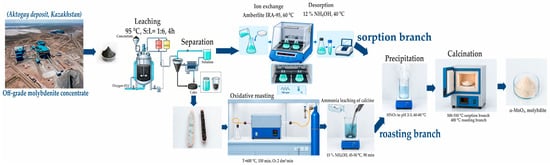
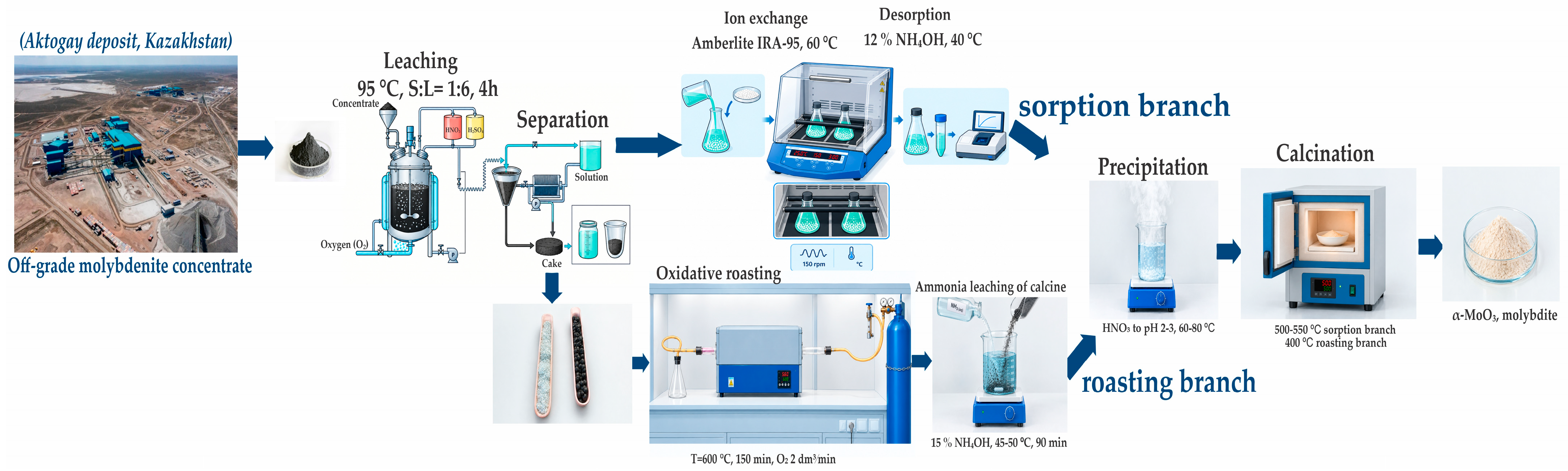
The overall flowsheet of the proposed process is shown in Figure 1. Both products of the nitric–sulfuric acid leaching of the concentrate—the pregnant solution and the solid cake—are processed in parallel, and their molybdenum-bearing streams are combined at a common precipitation and calcination stage.
Figure 1.
Two-branch recovery of molybdenum from off-grade concentrate to α-MoO3.
2. Materials and Methods
2.1. Materials
The objects of the study were the products of nitric–sulfuric acid leaching of substandard molybdenite concentrate supplied by the Aktogay Mining and Processing Plant (AyagozRegion, Kazakhstan): the process solution for sorption processing, and the solid residue (cake)—for the roasting route. The chemical composition of the initial concentrate and of the cake was determined by X-ray fluorescence spectrometry (XRF) and is presented in the tables in Section 3, whereas the composition of the process solutions was determined by ICP-AES. Composition of the process solution, g/dm3: 1.71 Mo, 1.16 Cu, 1.85 Fe, 0.145 SiO2 (in individual batches, the molybdenum content varied within the range of ~1.7–5.6 g/dm3); composition of the cake used for the roasting route, wt.%: 33.1 Mo, 15.3 S, 0.95 Fe, 1.3 Cu, 2.2 Si, 0.47 Al.
The molybdenum-bearing solutions for the sorption experiments were obtained by leaching the off-grade concentrate under different conditions, selected according to the objective of each experimental series. For the isotherm experiments, the concentrate was leached with a 50 g/dm3 HNO3 solution (95 °C, S:L = 1:6, 300 rpm, 4 h, oxygen sparging 0.7–1 dm3/min), which yielded a higher molybdenum content in solution suitable for subsequent dilution; the molybdenum recovery into solution was 45.2%. For the other series, leaching with 200 g/dm3 H2SO4 under otherwise similar conditions was used. The varying initial molybdenum concentrations reflect the influence of the leaching conditions and the natural variability of the technogenic feedstock.
Nitric acid (HNO3, 65%, Sigma-Aldrich, St. Louis, MO, USA) and sulfuric acid (H2SO4, 98%, Merck, Darmstadt, Germany) were used as leaching reagents in the preparation of the initial solution; high-purity oxygen (99.9%, Linde Gas, Almaty, Kazakhstan) was employed to intensify oxidation. Desorption of molybdenum from the anionite was carried out using a 12 wt.% aqueous ammonium hydroxide solution (NH4OH; analytical grade, LLP “Laborpharma” Almaty, Kazakhstan); the choice of the ammoniacal eluent was dictated by its dual function: NH4OH not only displaces molybdate ions from the active sites of the resin but also simultaneously forms ammonium molybdate (NH4)2MoO4 in the eluate—a direct precursor for the subsequent precipitation of the marketable product. Desorption of impurities from the cationite was performed with a hydrochloric acid solution (HCl; analytical grade, Almaty, Kazakhstan) at a concentration of 100–200 g/dm3. Technical-grade molasses was used as a binder for cake granulation; roasting off-gases were scrubbed with a sodium hydroxide NaOH solution (≥98%, analytical grade, LLP “Laborpharma” Almaty, Kazakhstan) at a concentration of 100 g/dm3. All solutions were prepared using distilled water. Ion-exchange sorption was studied using the commercial resins Purolite A-100 (King of Prussia, PA, USA), Amberlite IRA-95 (Wilmington, DE, USA), AV-17-8 (Kemerovo, Russia; manufactured in accordance with GOST 20301–74), and Lewatit MonoPlus M-800 (Cologne, Germany) (anionites), as well as KU2-8 (a strongly acidic sulfonic cationite) [29,30,31]. Prior to each series of experiments, the resins were conditioned according to a standard procedure: washing with distilled water, treatment with 4% NaOH, washing to neutral pH, conversion to the working form with 5% H2SO4, and a final wash.
The static sorption experiments were carried out by contacting 100 mL of the process solution with 4 mL of the anion exchanger for 4 h at room temperature (screening of the four resins, Table 1). The effects of temperature (20–80 °C) and solution pH (0.5–5) on molybdenum sorption onto Amberlite IRA-95 were studied separately, with a contact time of 30 min at 60 °C in the pH-effect experiments. Molybdenum was subsequently desorbed from the loaded resin with the 12 wt.% NH4OH solution at 40 °C. Preliminary purification of the solution from iron, copper, and silicon was performed on the KU2-8 cationite (contact time 120 min; resin volumes of 6–36 mL). The concentrations of molybdenum and accompanying elements in the initial and treated solutions are reported in the corresponding tables.
Table 1.
Static-mode sorption of molybdenum from molybdenite concentrate leach solutions onto anionites.
2.2. Equipment and Analytical Methods
Batch (static) sorption and desorption experiments were carried out on a KS 3000 i control orbital shaker (IKA-Werke, Staufen, Germany) at a rotation speed of 200 rpm; temperature control during the desorption experiments was maintained by a LOIP LT-100 liquid circulating thermostat (St. Petersburg, Russia). Stirring during the precipitation operations was performed using ES VELP (Usmate Velate, Italy) and IKA RW16 basic (Staufen, Germany) overhead stirrers. pH values were monitored with an HI 2213-02 laboratory pH/ORP meter (Shelton, CT, USA) featuring three-point calibration and automatic temperature compensation. Weighed portions of resin, reagents, and precipitates were measured using a Shimadzu analytical balance (Shimadzu Corporation, Kyoto, Japan). Sample drying was carried out in an SNOL drying oven (Utena, Lithuania), and calcination was performed in an SNOL 7.2/1300 muffle furnace (Almaty, Kazakhstan). Mechanical activation of the concentrate was performed using an IV-1 grinder (Tehnolit, Almaty, Kazakhstan) at 300 rpm for 2 h. Oxidative roasting of the cake was conducted in a tube furnace (alundum boat within a quartz tube) with technical-grade oxygen supplied at a flow rate of 2 dm3/min.
The concentrations of molybdenum and associated elements in the solutions at all process stages were determined by inductively coupled plasma atomic emission spectrometry (ICP-AES) using an Optima 8300 DV spectrometer (PerkinElmer Inc., Shelton, CT, USA) and, where necessary, by atomic absorption spectrometry using an AA-7000 spectrometer (Shimadzu, Kyoto, Japan). For ICP-AES analysis, the initial solutions were diluted 1000-fold and the post-sorption solutions 100-fold with deionized water prior to measurement. Calibration was performed using a certified multi-element standard solution (TruQ Standard Mix Solution B, 100 μg/mL, PerkinElmer; matrix 5% HNO3/1% HF) containing molybdenum among other elements, over a three-point calibration range of 1, 2, and 5 mg/dm3. All key sorption experiments were carried out in triplicate; reported values are means of three replicates, and the error bars in Figure 2 and Figure 3 represent the standard deviations. The elemental composition of the solid samples was determined by X-ray fluorescence spectrometry using a PANalytical wavelength-dispersive spectrometer (Axios 1 kW/Venus 200; PANalytical, Almelo, The Netherlands), with data processing performed using the SuperQ5 (Omnian 37) software package (Omnian 37). The phase composition of the final product was established by X-ray diffraction (XRD) analysis using a D8 Advance diffractometer (Bruker, Ettlingen, Germany) with Cu-Kα radiation, with phase identification performed against the PDF-2 database (ICDD, Swarthmore, PA, USA).
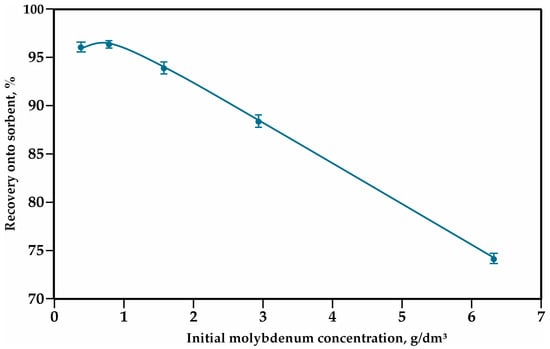
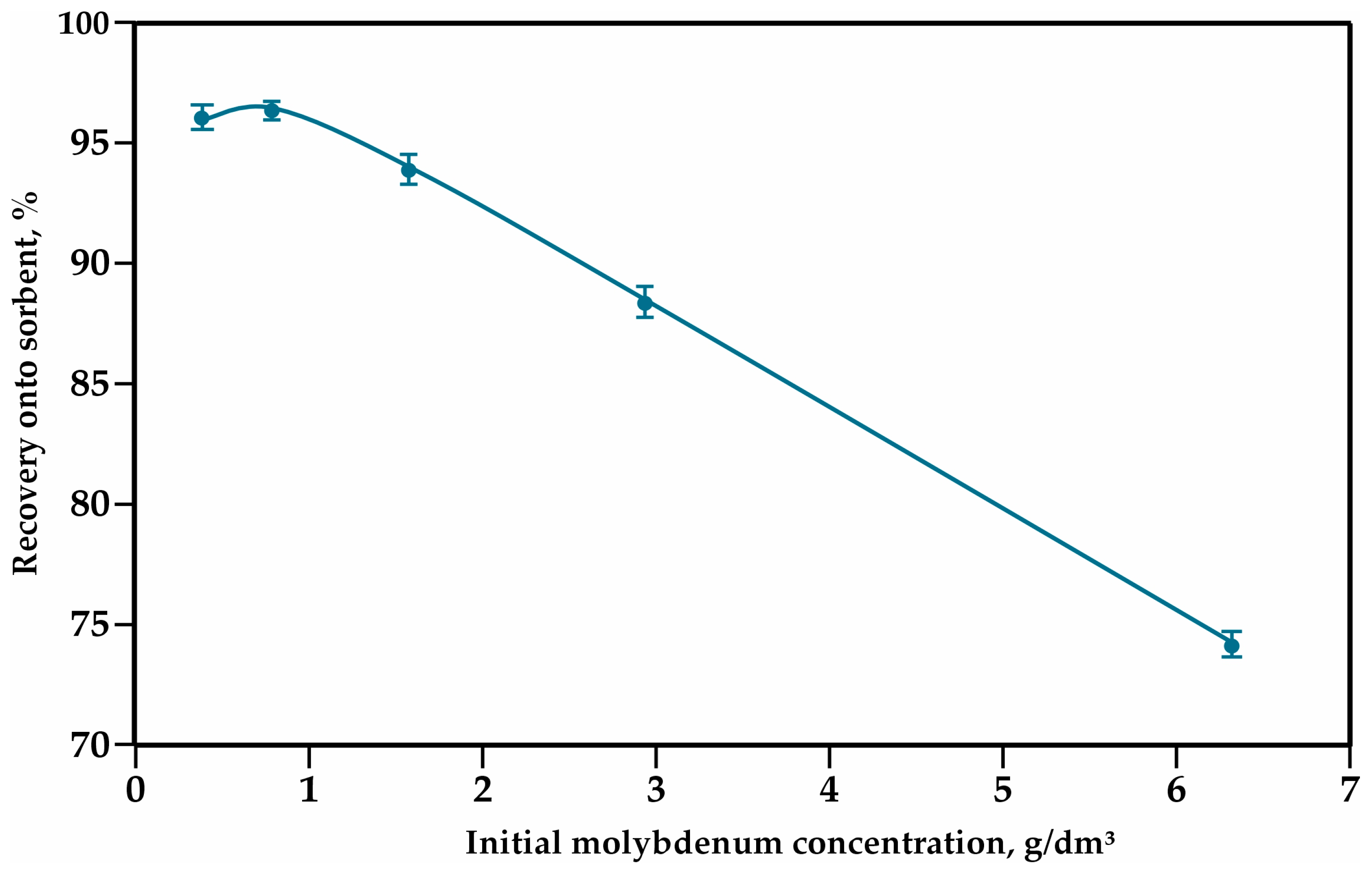
Figure 2.
Sorption isotherm of molybdenum on Amberlite IRA-95 anionite.
Figure 3.
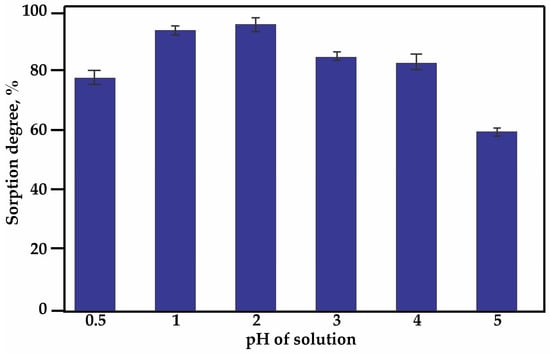
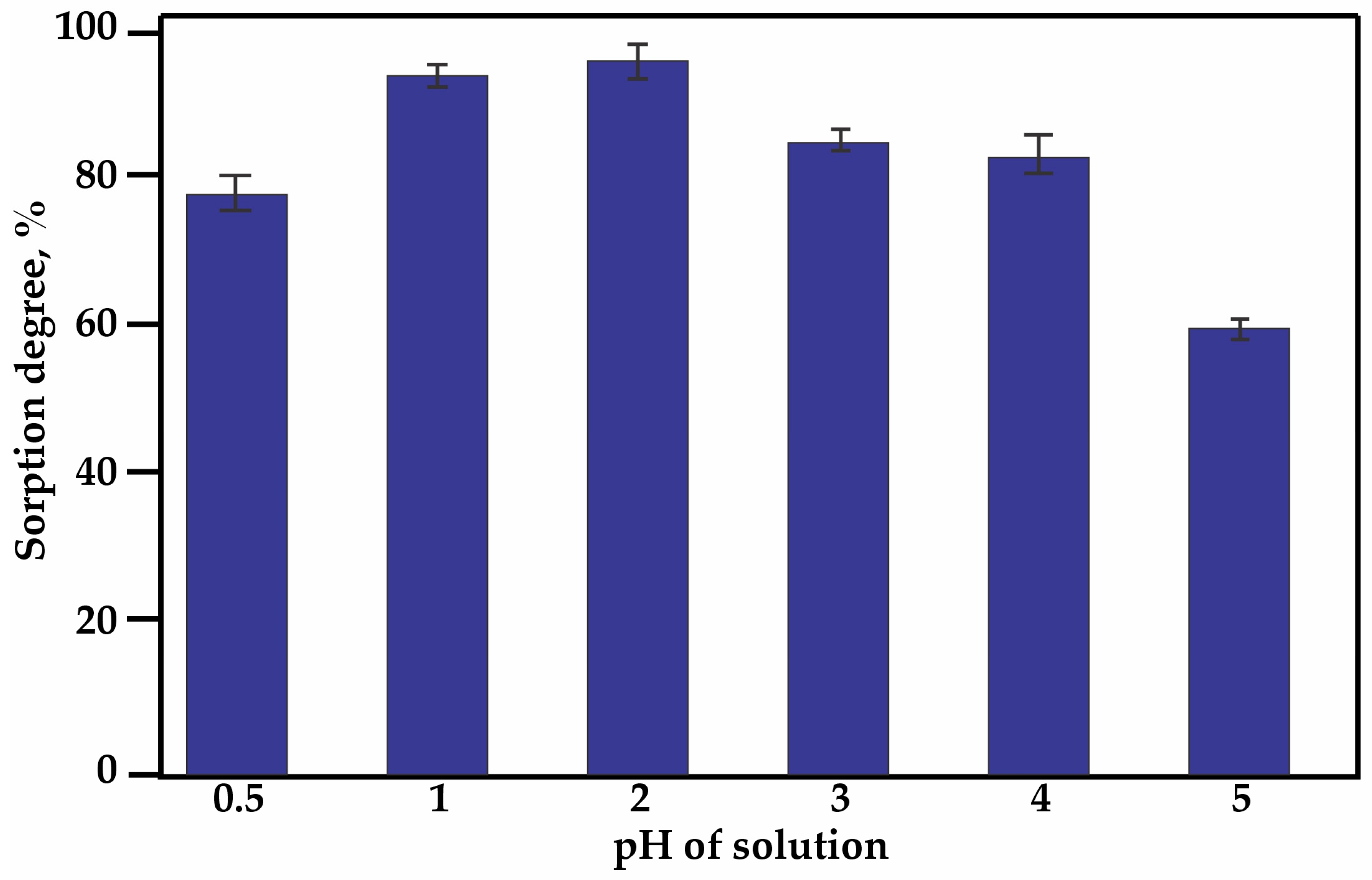
Dependence of molybdenum recovery on Amberlite IRA-95 on solution pH (60 °C, 30 min).
3. Results and Discussion
3.1. Sorption Concentration of Molybdenum from Solution
3.1.1. Screening of Anion Resins
The results of molybdenum sorption from the process solution onto four anionites are presented in Table 1. The highest molybdenum recovery into the sorbent was achieved with Amberlite IRA-95—84.21%, with Purolite A-100 ranking second in efficiency (74.85%); the anionites AV-17-8 and Lewatit M-800 gave markedly lower values (35.09% and 54.39%, respectively). Subsequent desorption with a 12% NH4OH solution confirmed the superiority of Amberlite IRA-95: recovery into the desorbate amounted to 82.15%, compared with 74.69% for Purolite A-100, 37.33% for AV-17-8, and 36.99% for Lewatit M-800. Based on the combined sorption and desorption performance, Amberlite IRA-95 was selected for further investigation. An important practical advantage of the proposed sorption scheme is that desorption and resin regeneration are combined in a single step: elution with a 12% NH4OH solution simultaneously strips molybdenum and restores the working form of the anion exchanger, so that no separate regeneration reagent is required. The mild desorption conditions (40 °C) minimize thermal stress on the polymer, whereas sorption at 60 °C approaches the upper thermal limit of the resin matrix and may be reduced to 55 °C to extend its service life. According to the manufacturer’s data, anion exchangers of the Amberlite IRA-95 type withstand on the order of 150–300 sorption–regeneration cycles.
Summary sorption performance data for Amberlite IRA-95 across all solution components are presented in Table 2. At a molybdenum recovery of 84.21%, the sorption of associated metals remains low (Cu 1.72%, Fe 2.7%), corresponding to selectivity coefficients of Mo/Cu = 304.73 and Mo/Fe = 192.19—these high values confirm the excellent selectivity of the anionite toward molybdenum relative to the base metals.
Table 2.
Summary of sorption performance on Amberlite IRA-95.
3.1.2. Sorption Isotherm
The sorption results obtained at various initial molybdenum concentrations are presented in Table 3 and Figure 2. As the initial molybdenum concentration increases from 0.368 to 6.324 g/dm3, the static exchange capacity of the anionite increases correspondingly by more than a factor of 13, indicating the high sorption capacity of Amberlite IRA-95 in concentrated solutions. At the same time, the recovery degree at the high concentration (6.324 g/dm3) decreases to 74.49%, which is attributable to the progressive saturation of the sorbent’s active sites. The shape of the isotherm closely resembles the classical Langmuir isotherm, approaching saturation at high equilibrium metal concentrations.
Table 3.
Sorption of molybdenum on Amberlite IRA-95 from solutions of varying concentration.
3.1.3. Effect of Temperature and pH
The effect of temperature on the sorption of molybdenum and associated components is presented in Table 4. As temperature increases, molybdenum sorption proceeds satisfactorily, with the best performance achieved at 60 and 80 °C; at 60 °C, the exchange capacity for molybdenum reached ~223 mg/g at a recovery of 91.78%. At the same time, the recovery of associated metals (iron, copper) remains low across the entire temperature range investigated, confirming the selectivity of the anionite toward molybdenum even at elevated temperatures. Molybdenum recovery increased steadily with temperature, from 88.2% at 20 °C to 91.8% at 60 °C, remaining essentially constant at 80 °C (91.5%).
Table 4.
Effect of temperature on the recovery of molybdenum and associated components from the process solution on Amberlite IRA-95 anionite.
The dependence of molybdenum recovery on solution pH at 60 °C with a contact time of 30 min is shown in Figure 3. Maximum recovery (96%) is achieved at pH 2, at which optimal protonation of the sorbent matrix occurs together with a high capacity for polyanions, with the formation of paramolybdate species Mo7O246− and HMo7O245−. In the pH range of 3–4, polymerization decreases with a shift toward smaller polymeric forms, while at pH 5 deprotonation of the weakly basic amino groups of the resin begins, accompanied by the formation of monomeric MoO42− anions [32,33]. At pH 0.5, cationic and neutral forms of molybdenum (MoO22+ and MoO2SO4) predominate in solution, which likewise reduces sorption [34]. In the pH-effect experiments, the pH of the initial nitric–sulfuric leach solution (initial pH < 1) was adjusted to the target values (0.5–5) by the addition of ammonia solution (NH4OH), with the pH monitored using a pH meter.
The contact time of 30 min and the temperature of 60 °C used in the pH-effect experiments were selected on the basis of preliminary experiments: under these conditions, molybdenum sorption reached a high, essentially equilibrium level (80–90%), so that 30 min can be regarded as sufficient to approach sorption equilibrium. The elevated temperature (60 °C) markedly enhanced the sorption of molybdenum onto the resin.
3.1.4. Preliminary Purification on KU2-8 Cationite and the Two-Stage Scheme
Since process solutions contain impurities of iron, silicon, and copper, which are also partially sorbed on the anionite, their preliminary sorption on KU2-8 cationite was investigated prior to molybdenum concentration. The separation coefficient values (Table 5)—Mo/Cu = 5.7, Mo/Fe = 3.58, Mo/SiO2 = 2.17 (all D > 1)—confirm that the cationite selectively retains the base metals relative to molybdenum: in acidic and weakly acidic media, molybdenum is present predominantly as anionic isopolymolybdates or neutral molecules and is therefore poorly retained by the cationite, whereas copper and iron are sorbed via a cation-exchange mechanism. Copper is removed most effectively, and iron satisfactorily, while purification from silicon is comparatively weaker.
Table 5.
Selectivity of KU2-8 cationite (distribution and separation coefficients).
Effect of contact time and resin volume. In the first series of experiments, the sorption of impurities on KU2-8 was studied by varying the resin volume (6, 12, 14, and 18 mL) and the contact time (60 and 120 min), followed by desorption of the sorbed impurities with a hydrochloric acid solution; the results are presented in Table 6. Impurity recovery onto the cationite increases consistently with both increasing contact time and increasing resin volume: at 6 mL of KU2-8, extending the sorption time from 60 to 120 min raises silicon recovery from 17.4% to 34.8%, while at the maximum resin volume (18 mL, 120 min) the most complete purification is achieved—68.8% for iron and 72.6% for copper. Notably, the sorbed impurities are effectively stripped from the cationite upon regeneration: the degree of their transfer into the desorbate (hydrochloric acid solution) reaches 70–82% for all three components, confirming the reversibility of sorption and the feasibility of repeated resin use. Copper is removed most completely under all conditions, and iron satisfactorily, while purification from silicon remains comparatively less pronounced.
Table 6.
Sorption and desorption of iron, copper, and silicon from the process solution on KU2-8 cationite at varying resin volumes (sorption time 60–120 min; desorption with HCl solution).
Co-presence of molybdenum. In a second series of experiments, molybdenum (5.3 g/dm3) was introduced into the solution together with the impurities in order to evaluate its behavior on the cationite within a genuine multicomponent system, at two resin volumes, 30 and 36 mL (Table 7). Under both conditions, molybdenum is sorbed on KU2-8 only to a minor extent (20.1% at 30 mL and 8.7% at 36 mL), whereas copper and iron are removed considerably more completely (copper 45.7–47.5%, iron 35.3–37.1%). Notably, upon regeneration of the cationite, only a small fraction of molybdenum (about 20%) is transferred into the desorbate; that is, molybdenum remains predominantly in the purified solution and is not lost during the pre-purification stage—whereas the impurities are stripped from the sorbent to a considerably greater extent (iron up to 62%). This confirms the initial hypothesis: the cationite predominantly binds the cationic forms of the impurity metals, leaving the anionic forms of molybdenum in solution, thereby providing selective pre-purification without appreciable loss of the target metal.
Table 7.
Sorption and desorption of molybdenum, iron, copper, and silicon from the process solution on KU2-8 cationite at varying resin volumes (sorption time 120 min; desorption with HCl solution).
On this basis, a two-stage sorption scheme is proposed: the solution is first passed through KU2-8 cationite to remove part of the impurities, and then through Amberlite IRA-95 anionite to concentrate molybdenum. The stage-by-stage concentration profile and the overall recoveries are presented in Table 8. The overall molybdenum recovery achieved by the two-stage scheme was 86.44%, with the solution being progressively purified of iron, copper, and silicon at each successive stage.
Table 8.
Two-stage scheme KU2-8 → Amberlite IRA-95: concentration profile and overall recovery (initial solution volume 800 mL).
The overall balance of the sorption branch with respect to molybdenum (sorption × desorption) amounts to 84.21% × 82.15% = 69.18% of the molybdenum contained in the initial solution.
3.2. Roasting Branch: Supplementary Recovery of Molybdenum from the Cake
3.2.1. Effect of Roasting Temperature on Desulfurization and Calcine Composition
The results obtained under four roasting regimes are presented in Table 9. At 450 °C, the cake retained 1.9% S after 150 min, while at 500 °C, over the shorter duration of 60 min, only 13.3% of the initial sulfur was removed, confirming the combined influence of temperature and duration on the degree of MoS2 oxidation:
Table 9.
Effect of roasting temperature and duration on calcine yield and composition (50 g cake samples, O2 flow rate 2 dm3/min).
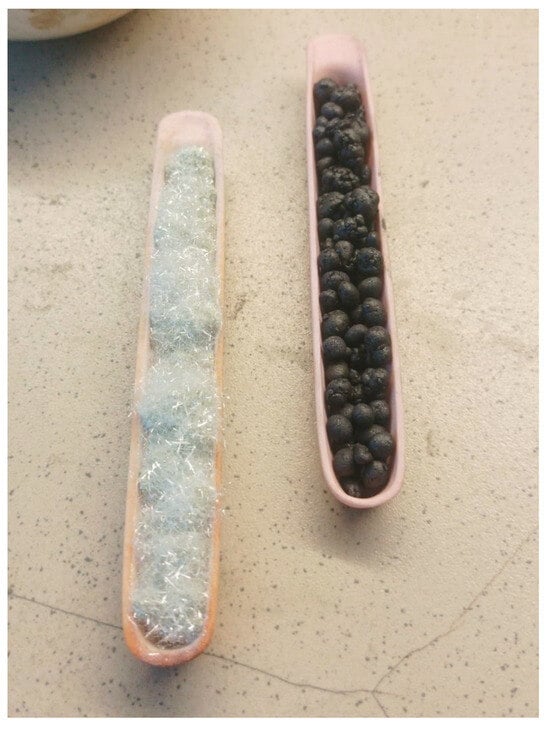
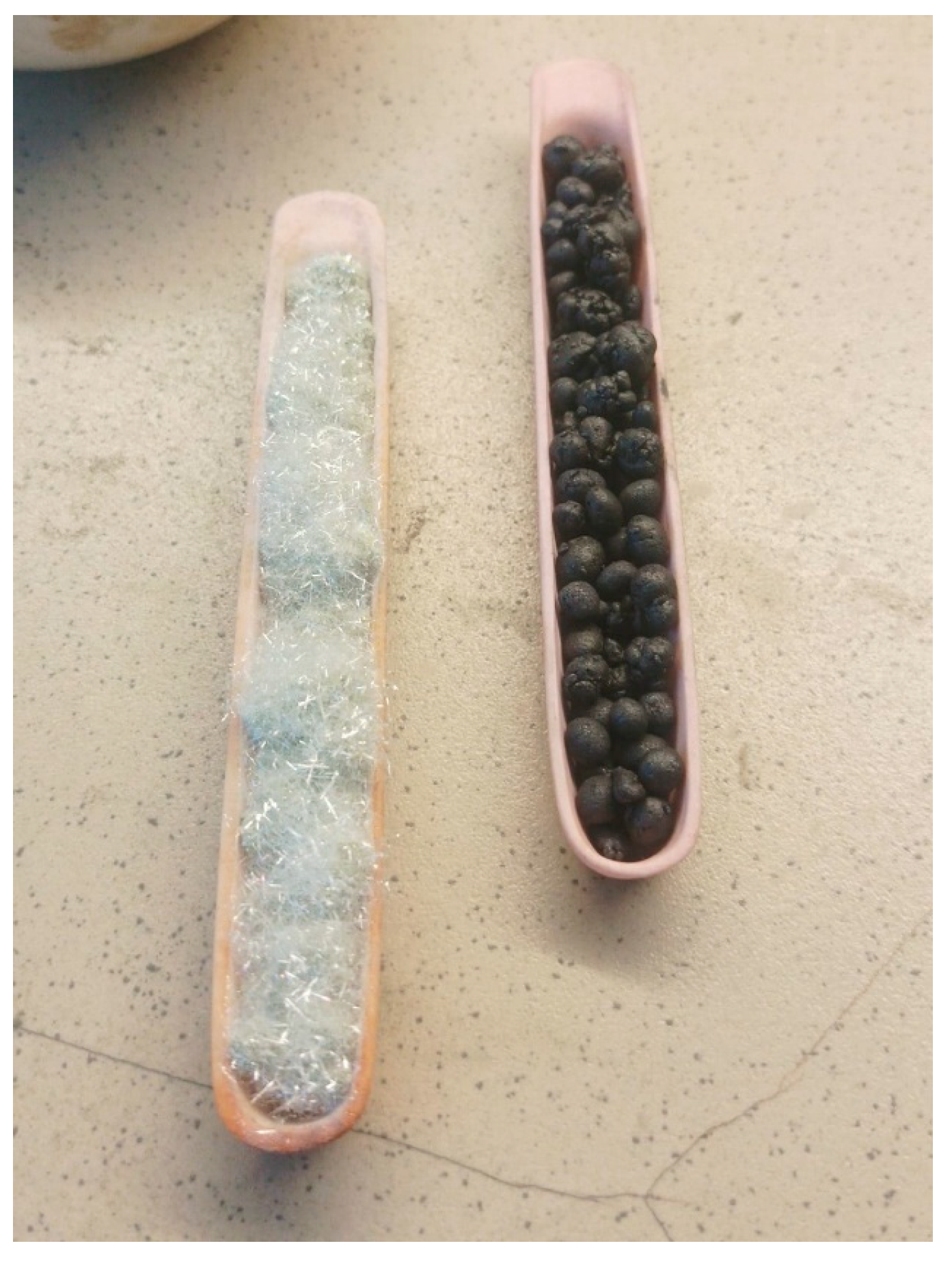
Raising the temperature to 550 °C reduced the residual sulfur content to 0.58%, while at 600 °C/150 min sulfur fell below the detection limit, indicating essentially complete conversion of molybdenite to the trioxide. This trend is consistent with the well-documented reluctance of MoS2 to oxidize fully below ~550–600 °C, as reported for low-grade concentrates [3], although the exact threshold is sensitive to particle size, pellet porosity, and gas flow rate. The calcine yield decreased monotonically with increasing temperature (86.6% → 80.0% over the 450–600 °C range), which is attributable to the increasing volatility of MoO3 at elevated temperatures (Figure 4)—a well-known complication in molybdenite roasting that, in certain process variants, is deliberately exploited for product purification via volatilization [6], but which here represents a mechanical loss. A regime of 600 °C/150 min was adopted as the working condition—the only one of the tested conditions providing complete desulfurization of the cake, which is important for the subsequent stage, since residual sulfide or sulfate carries over into the ammoniacal solution and complicates purification of the molybdate solution.
Figure 4.
Cake pellets with molasses binder prior to roasting (right) and needle-like sublimate in the boat (left), consistent with partial vapor-phase transport of MoO3 at elevated roasting temperatures.
3.2.2. Ammoniacal Leaching of the Calcine
Leaching of the calcine (600 °C) with a 15% NH4OH solution proceeds via the dissolution of the trioxide [35]:
From 22.9 g of calcine, after washing with water and ammoniacal leaching, 8.5 g of solid residue and 150 mL of filtrate remained, indicating that a substantial fraction of the calcine mass was transferred into solution. The elemental composition of the cake before and after roasting, determined by XRF, is presented in Table 10. Roasting increased the molybdenum content from 33.1 to 39.4 wt.% while reducing sulfur from 15.3 wt.% to below the detection limit, confirming deep desulfurization. The relatively low recovery at this stage (39.5%) indicates that a substantial part of the molybdenum remained in the leach residue, pointing to incomplete leaching and scope for further optimization.
Table 10.
Chemical composition of the material at the stages of the roasting branch (XRF, wt.%).
3.3. Common Stage: Precipitation of Ammonium Paramolybdate and Calcination to MoO3
The ammoniacal desorbate from the sorption branch (molybdenum present as (NH4)2MoO4) and the ammoniacal-alkaline solution from calcine leaching converge at a common precipitation stage. The solution was acidified with nitric acid to pH 2.0–3.0 at 60–80 °C, which induced polymerization of the molybdate ions and precipitation of ammonium paramolybdate:
The solution was evaporated (during which the excess ammonia is naturally removed and crystallization of APM is completed), and the crystals were filtered off on a vacuum filter, washed with ice-cold distilled water, dried to (NH4)6Mo7O24·4H2O, and calcined to molybdenum trioxide via the thermal decomposition reaction:
For the sorption branch, 4.0 g of technical-grade MoO3 was obtained from 800 mL of desorbate (2.676 g Mo). It was noted that the calcination temperature for this stream should be maintained within the range of 500–550 °C: at temperatures below 450 °C, undecomposed ammonium paramolybdate phases remain in the powder, lowering the proportion of the principal MoO3 substance below 94%. (For the paramolybdate of the roasting branch, crystallized by evaporation, a calcination temperature of 400 °C proved sufficient—the possible difference in the required temperature may reflect a finer-crystalline or more uniformly hydrated precipitate; this is a plausible but unproven explanation, confirmation of which would require a comparative thermogravimetric analysis.)
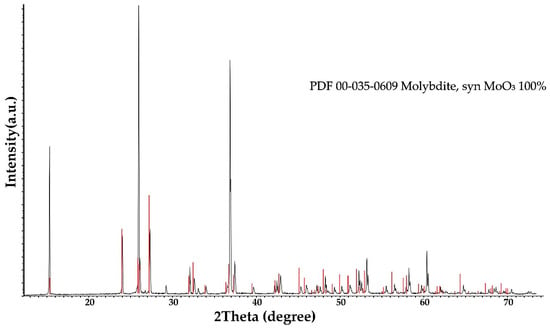
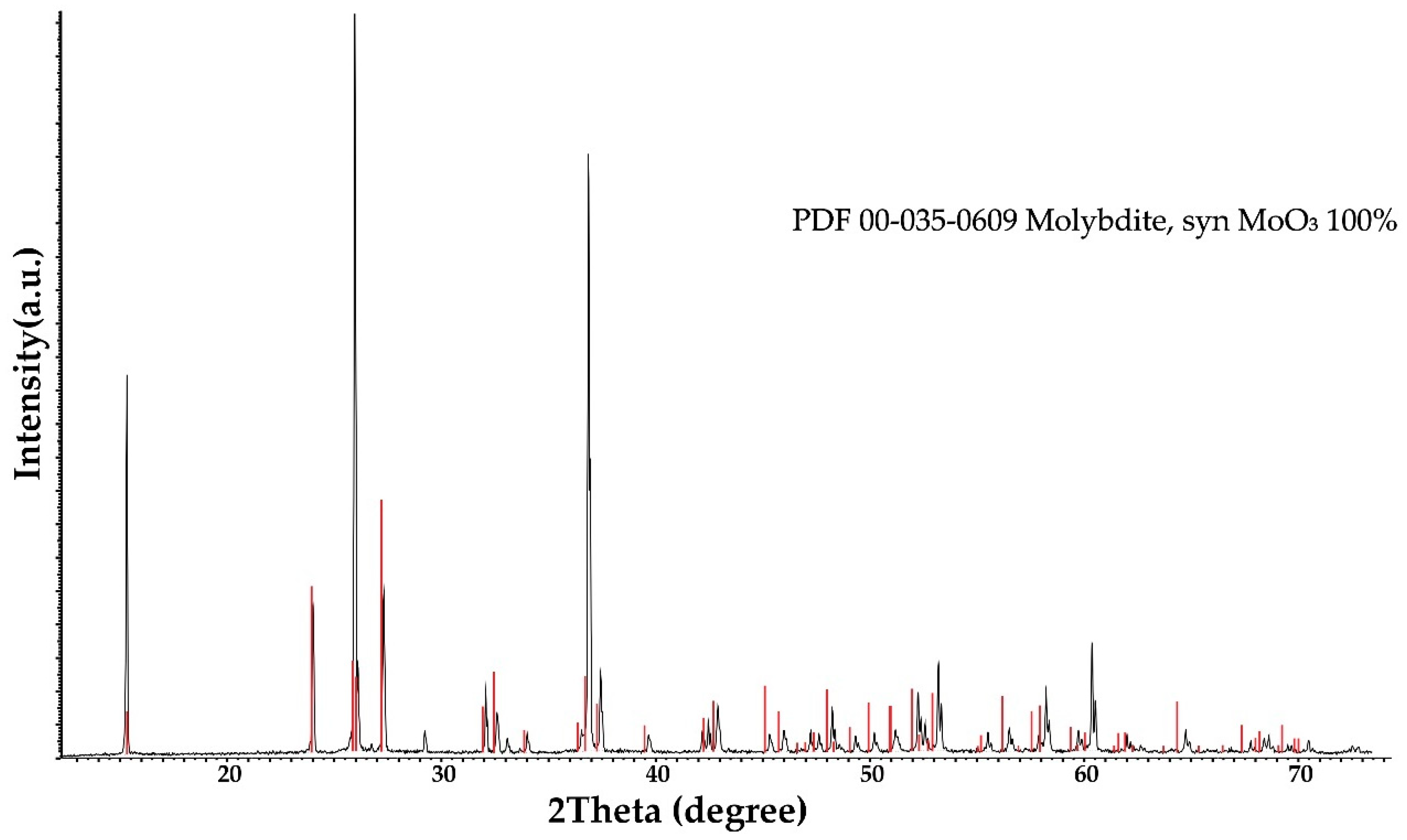
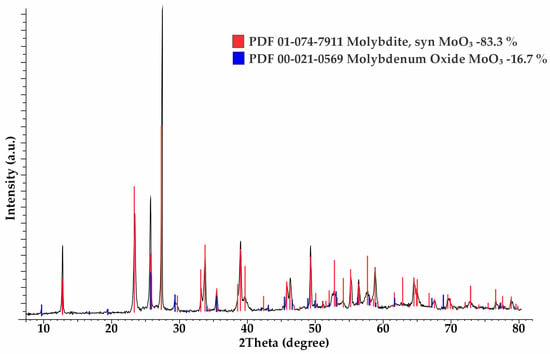
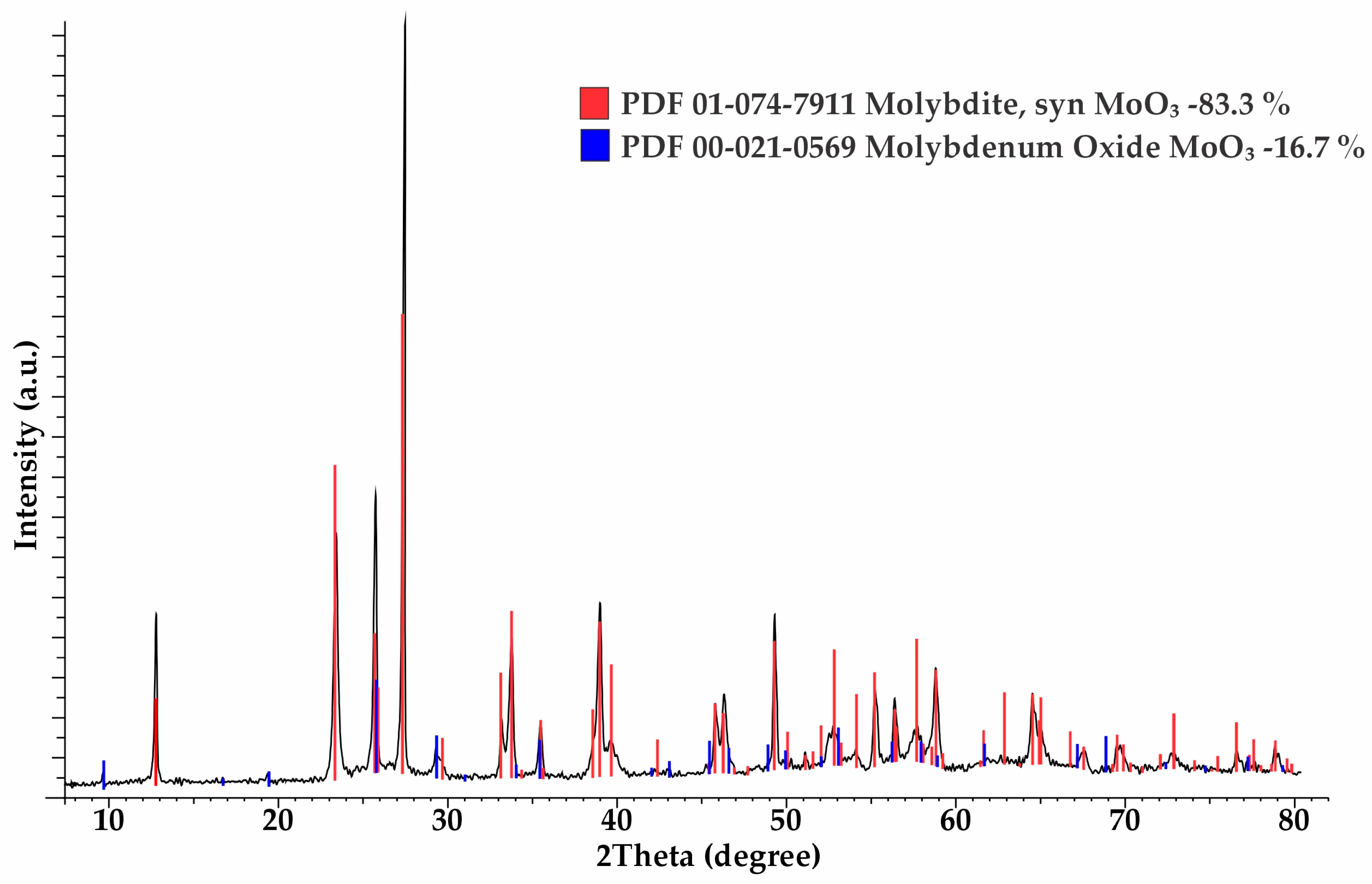
According to XRD data, the product consists predominantly of molybdite (synthetic α-MoO3): for the oxide from the sorption branch, the reference card (Figure 5), PDF 00-035-0609 (molybdite, syn MoO3) matches the entire diffraction profile essentially, while for the oxide from the roasting branch (Figure 6), PDF 01-074-7911 accounts for 83.3% of the fitted profile, with the remainder assigned to a second, closely related MoO3 reference card. In both cases, the product corresponds to a single oxide phase—orthorhombic α-MoO3.
Figure 5.
X-ray diffraction pattern of molybdenum trioxide obtained via the sorption branch.
Figure 6.
X-ray diffraction pattern of molybdenum trioxide obtained via the roasting branch.
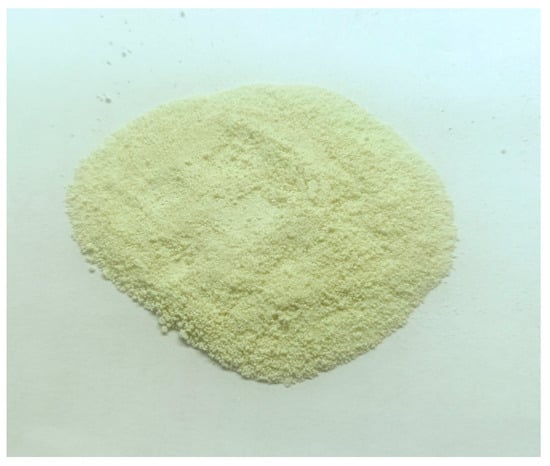
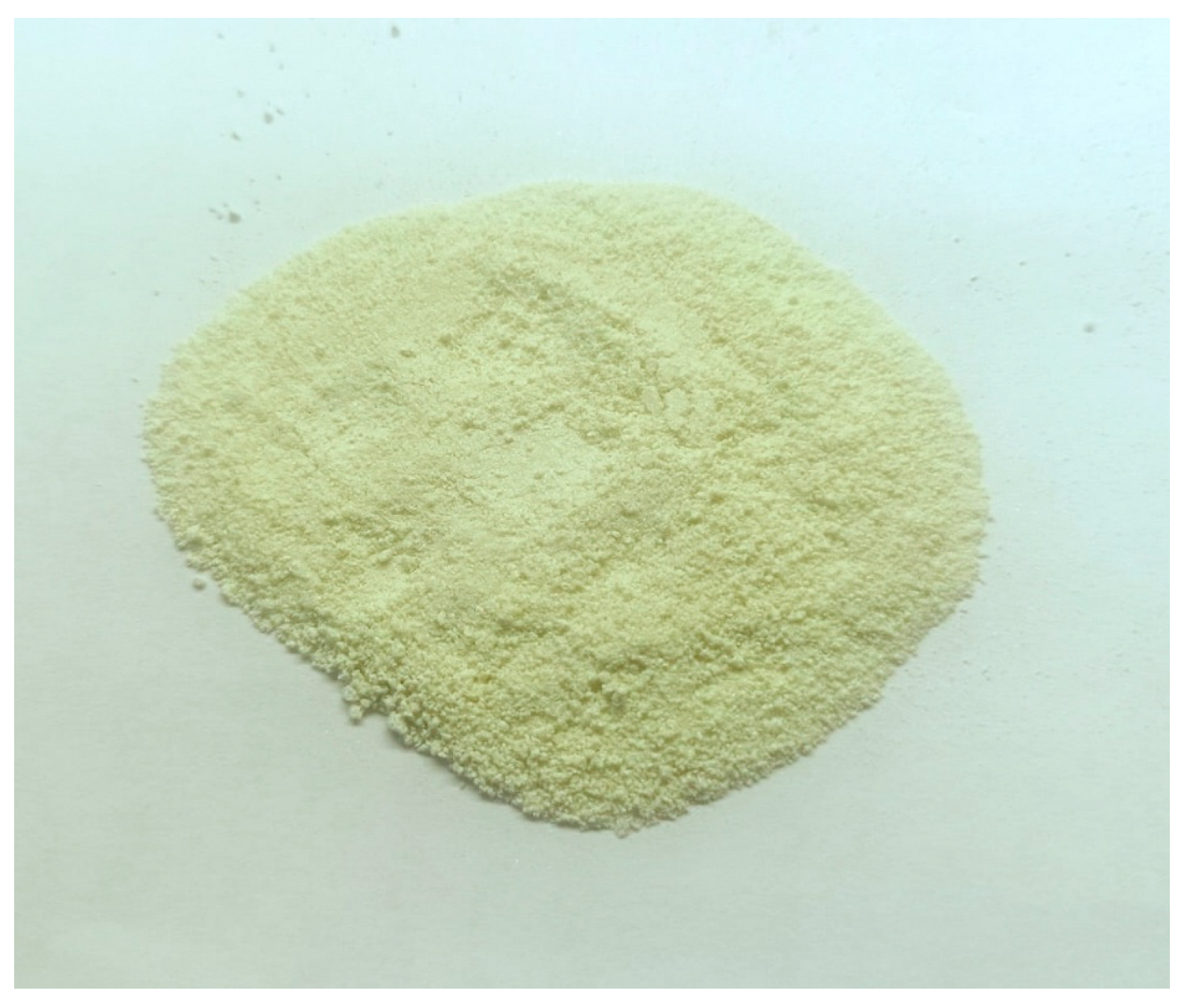
The impurity content of the final product, determined by XRF, was low: Fe 0.05, Cu 0.05, and Si 0.04 wt.%. Together with the phase composition (predominantly α-MoO3) and the principal-substance content exceeding 94%, this confirms that a technical-grade molybdenum trioxide was obtained (Figure 7).
Figure 7.
Photograph of the molybdenum trioxide obtained (technical-grade product of the sorption branch).
Thus, both branches, originating from a single nitric–sulfuric acid leach solution of substandard Aktogay concentrate, converge into a unified technological scheme for producing molybdenum trioxide. The sorption branch recovers the molybdenum that has been transferred into solution (overall balance, sorption × desorption = 69.18%, while under the two-stage scheme with preliminary purification on KU2-8, the overall molybdenum recovery into the anionite reaches 86.44%), while the roasting branch achieves supplementary recovery of the molybdenum remaining in the cake (~70% under the baseline leaching conditions), with complete desulfurization at 600 °C. The two molybdenum-bearing streams are combined at a common APM precipitation and calcination stage, yielding a single product—technical-grade MoO3, represented by orthorhombic α-MoO3 (molybdite). Together, these two branches close the molybdenum material balance for the substandard concentrate from both sides—the solution side and the solid-residue side.
The developed method can be compared with previously reported molybdenum recovery routes. The conventional oxidative roasting–ammonia leaching route requires conditioned molybdenite concentrates (55–60% Mo) and additional precipitation of heavy-metal impurities as sulfides [35,36,37]. The two-stage roasting route with a CaO additive fixes sulfur as gypsum but generates large amounts of impurity-contaminated calcium sulfate requiring further purification and is likewise limited to conditioned concentrates [11,38]. The closest prototype—two-stage nitric-acid leaching of conditioned molybdenite—attains only about 80% molybdenum recovery owing to passivation of the particle surfaces by a molybdenum-oxide or molybdic-acid film and incomplete oxidation of molybdenite, and involves high nitric-acid consumption with NOx evolution [39,40]. In contrast, the method proposed in the present work is designed specifically for off-grade concentrates [7], recovers molybdenum simultaneously from both the leach solution and the solid cake, and yields a technical-grade MoO3 product through a simplified flowsheet.
Beyond the technical comparison, the practical feasibility of the proposed scheme for larger-scale application deserves consideration. Its economic rationale rests on the value contrast between the feedstock and the product: the off-grade concentrate is currently stockpiled or sold at a discount, whereas technical-grade molybdenum trioxide is a marketable commodity (on the order of 20–30 USD/kg Mo) [5]. The main contributions to processing cost are reagent consumption and the thermal energy of the roasting and calcination stages; in this respect, applying roasting only to the residual cake rather than to the entire concentrate reduces both the treated mass and the energy demand, while ammonia elution regenerates the sorbent in a single step. A rigorous techno-economic and life-cycle assessment, including the handling of gaseous emissions at scale, is beyond the scope of the present laboratory study and represents a necessary direction for future work.
The behavior of the process on a larger scale will also depend on the presence of competing ions in real process solutions. In the present work, the leach liquor already contained iron, copper, and silicon, and the high selectivity of the Amberlite IRA-95 anion exchanger toward molybdenum relative to these species (selectivity coefficients Mo/Cu ≈ 305 and Mo/Fe ≈ 192) indicates that the sorption step is robust against the most common accompanying cations. Nevertheless, industrial molybdenite concentrates and their leach solutions may additionally contain rhenium, tungsten, and phosphate species, which are known to compete with molybdenum for anion-exchange sites and can be co-sorbed [26,27]; their influence on sorption capacity and product purity should therefore be evaluated when the scheme is applied to specific feedstocks. Assessment of the process under continuous (column) operation and in the presence of such competing ions represents an important direction for scaling up the developed scheme.
4. Conclusions
An integrated scheme was proposed and experimentally verified for recovering molybdenum from an off-grade molybdenite concentrate of the Aktogay deposit, taking the metal from both products of nitric–sulfuric acid leaching—the pregnant solution and the solid cake. Of the four anion exchangers compared in the sorption branch, the macroporous weak-base resin Amberlite IRA-95 was the most effective, sorbing 84.2% of the molybdenum and releasing 82.2% of it on ammonia desorption, while taking up little copper or iron (selectivity Mo/Cu ≈ 305, Mo/Fe ≈ 192). Conditioning the feed solution beforehand on the KU2-8 cationite removed part of the iron, copper and silicon and brought the overall molybdenum recovery into the anionite to 86.4% in the two-stage scheme; the recovery rose with temperature, from 88.2% at 20 °C to 91.8% at 60 °C.
In the roasting branch, oxidative roasting of the cake at 600 °C for 150 min under an oxygen flow gave complete desulfurization and raised the molybdenum content of the solid from 33.1 to 41.3 wt.%; ammonia leaching of the calcine with 15% NH4OH then took molybdenum into solution at 25.74 g/dm3, or 39.5% at this stage, with part of the metal still retained in the leach tails. The two streams meet at a common precipitation of ammonium paramolybdate and its calcination to molybdenum trioxide; with calcination held at 500–550 °C, the product was technical-grade MoO3 with a principal-substance content above 94% and low residual iron, copper and silicon, identified by X-ray diffraction as single-phase orthorhombic α-MoO3 (molybdite). By drawing molybdenum from the solution and the cake at the same time, the scheme closes the material balance of the off-grade concentrate from both the solution and the solid-residue side. Developing this dual-stream approach toward continuous, larger-scale operation offers a realistic route to bringing such technogenic resources into fuller industrial use.
Author Contributions
Conceptualization, B.K. and A.U.; methodology, A.U. and N.L.; software, A.M.; validation, N.L., K.K., N.S. and A.Y.; formal analysis, A.M. and N.L.; investigation, A.M., N.S. and K.K.; resources, B.K. and A.U.; data curation, N.S. and K.K.; writing—original draft preparation, A.M.; writing—review and editing, A.U., N.L. and A.Y.; visualization, A.M. and A.Y.; supervision, B.K. and A.U.; project administration, A.U.; funding acquisition, B.K.; technical assistance, A.Y., K.K. and N.S. All authors have read and agreed to the published version of the manuscript.
Funding
This research is funded by the Science Committee of the Ministry of Science and Higher Education of the Republic of Kazakhstan, program-targeted funding BR24992757.
Data Availability Statement
The original contributions presented in this study are included in the article. Further inquiries can be directed to the corresponding author.
Conflicts of Interest
The authors declare no conflicts of interest.
References
- Lide, D.R. (Ed.) CRC Handbook of Chemistry and Physics, 104th ed.; CRC Press: Boca Raton, FL, USA, 2023. [Google Scholar]
- Panichkin, A.; Wieleba, W.; Kenzhegulov, A.; Uskenbayeva, A.; Mamaeva, A.; Imbarova, A.; Kasenova, B. Effect of thermal treatment of chromium iron melts on the structure and properties of castings. Mater. Res. Express 2023, 10, 086502. [Google Scholar] [CrossRef] [Scilit]
- Panichkin, A.; Kenzhegulov, A.; Mamaeva, A.; Uskenbayeva, A.; Kshibekova, B.; Imbarova, A.; Alibekov, Z. Effect of carbon and cooling rate on the structure of hypereutectic high-chromium cast iron in the cast state and after heat treatment. J. Compos. Sci. 2023, 7, 483. [Google Scholar] [CrossRef] [Scilit]
- U.S. Geological Survey. Mineral Commodity Summaries 2026—Molybdenum; USGS: Reston, VA, USA, 2026. Available online: https://pubs.usgs.gov/periodicals/mcs2026/mcs2026-molybdenum.pdf (accessed on 28 August 2026).
- International Molybdenum Association (IMOA). IMOA Annual Review and Market Statistics, 2024–2025; IMOA: London, UK, 2025; Available online: https://www.imoa.info (accessed on 28 August 2026).
- KAZ Minerals. Q4 and FY 2025 Production and Sales Report (Molybdenum in Concentrate); KAZ Minerals: London, UK, 2026; Available online: https://www.kazminerals.com (accessed on 28 August 2026).
- Liu, B.; Zhang, B.; Han, G.; Wang, M.; Huang, Y.; Su, S.; Xue, Y.; Wang, Y. Clean separation and purification for strategic metals of molybdenum and rhenium from minerals and waste alloy scraps—A review. Resour. Conserv. Recycl. 2022, 183, 106232. [Google Scholar] [CrossRef] [Scilit]
- Ultarakova, A. Investigations of waste sludge of titanium production and its leaching by nitric acid. In Proceedings of the 19th International Multidisciplinary Scientific GeoConference SGEM 2019, Albena, Bulgaria, 30 June–6 July 2019; STEF92 Technology: Sofia, Bulgaria, 2019; pp. 861–868. [Google Scholar]
- Zhang, Y.; Wang, H. Pyrometallurgical extraction of molybdenum from molybdenite: A review. Metall. Mater. Trans. B 2021, 52, 789–805. [Google Scholar]
- Lin, X.; Jiao, F.; Wei, Q.; Wu, Y. Application and depression mechanism of sodium humate on flotation separation of molybdenite and pyrite. Sep. Sci. Technol. 2024, 59, 449–463. [Google Scholar] [CrossRef] [Scilit]
- Chen, Z.; Jiang, Z.; Hu, Q.; Li, J.; Zhao, Z.; Chen, A.; Liu, X.; Chen, X.; He, L.; Sun, F. A novel molybdenum extraction process from molybdenite via magnesia roasting for sulfur fixation. Miner. Eng. 2025, 232, 109566. [Google Scholar] [CrossRef] [Scilit]
- Chepushtanova, T.; Yulussov, S.; Baigenzhenov, O.; Khabiev, A.; Rysbekov, K.; Nosbi, N.; Barmenshinova, M.; Yusof, N.N.; Merkibaev, Y.; Hosseini-Bandegharaei, A. An innovative method for complex processing of black shale ores. Chem. Methodol. 2025, 10, 75–111. [Google Scholar]
- Lasheen, T.A.; El-Ahmady, M.E.; Hassib, H.B.; Helal, A.S. Molybdenum metallurgy review: Hydrometallurgical routes to recovery of molybdenum from ores and mineral raw materials. Miner. Process. Extr. Metall. Rev. 2015, 36, 145–173. [Google Scholar] [CrossRef] [Scilit]
- Zhang, J.; Guo, Y.; Lu, W.; Song, B.; Xu, M.; Guo, H. Method for Reducing and Removing Metal Impurities from Ammonium Molybdate Solution by Using Ion Exchange Resin. CN Patent 102730758A, 27 November 2013. [Google Scholar]
- Shalchian, H.; Ferella, F.; Birloaga, I.; De Michelis, I.; Vegliò, F. Recovery of molybdenum from leach solution using polyelectrolyte extraction. Hydrometallurgy 2019, 190, 105167. [Google Scholar] [CrossRef] [Scilit]
- Kenzhaliyev, B.; Ultarakova, A.; Lokhova, N.; Mukangaliyeva, A.; Kassymzhanov, K. Optimized hydrometallurgical extraction of molybdenum via mechanoactivation and nitric–sulfuric leaching. Processes 2025, 13, 1486. [Google Scholar] [CrossRef] [Scilit]
- Yessengaziyev, A.; Mukangaliyeva, A.; Toishybek, A.; Karshyga, Z.; Abdyldayev, N.; Yersaiynova, A.; Bakhytuly, N. Studies of the crucial role of extractant selection for niobium extraction from sulfuryl fluoride solution and optimization of extraction conditions. Acta Metall. Slovaca 2024, 30, 120–126. [Google Scholar] [CrossRef] [Scilit]
- Yessengaziyev, A.M.; Toishybek, A.M.; Mukangaliyeva, A.O.; Abdyldayev, N.N.; Yersaiynova, A.A. Study of the leaching process for dust-chamber sublimates followed by the extraction of niobium and zirconium into solution. Kompleks. Ispolz. Miner. Syra 2024, 331, 117–126. [Google Scholar] [CrossRef] [Scilit]
- Ogata, F.; Kurazaki, M.; Nagai, N.; Uematsu, Y.; Toda, M.; Otani, M.; Saenjum, C.; Tanei, S.; Kawasaki, N. Recovery of molybdenum using adsorption/desorption by nickel–aluminum or nickel–aluminum–zirconium complex hydroxides from aqueous media. RSC Adv. 2025, 15, 24475–24482. [Google Scholar] [CrossRef] [Scilit] [PubMed]
- Fu, Y.; Xiao, Q.; Gao, Y.; Ning, P.; Xu, H.; Zhang, Y. Direct extraction of Mo(VI) from acidic leach solution of molybdenite ore by ion exchange resin: Batch and column adsorption studies. Trans. Nonferrous Met. Soc. China 2018, 28, 1660–1669. [Google Scholar] [CrossRef] [Scilit]
- Ultarakova, A.; Lokhova, N.; Karshyga, Z.; Toishybek, A.; Yessengaziyev, A.; Kassymzhanov, K.; Mukangaliyeva, A. Recovery of niobium pentoxide and ammonium sulfate from titanium–magnesium production waste. J. Ecol. Eng. 2023, 24, 227–235. [Google Scholar] [CrossRef] [Scilit] [PubMed]
- Behmadi, R.; Mirzaei, M.; Afshar, R.; Najafi, H. Influence of chalcopyrite removal and mechanical exfoliation on the performance of molybdenite catalysts supported on activated bauxite for alcohol synthesis by the Fischer–Tropsch process. Fuel 2023, 357, 129772. [Google Scholar] [CrossRef] [Scilit]
- Wang, M.; Yang, X.; Wen, J.; Li, W.; Yang, H.; Liu, W. Selective anion exchange adsorption of molybdenum(VI) at low concen trations from an acid leached vanadium shale solution containing aluminium and phosphorus. Hydrometallurgy 2024, 229, 106366. [Google Scholar] [CrossRef] [Scilit]
- Ultarakova, A.; Karshyga, Z.; Lokhova, N.; Yessengaziyev, A.; Kassymzhanov, K.; Mukangaliyeva, A. Studies of niobium sorption from chloride solutions with the use of anion-exchange resins. Processes 2023, 11, 1288. [Google Scholar] [CrossRef] [Scilit]
- Rasulova, S.; Guro, V.; Safarov, E.; Adinaev, X. Metals recovery from molybdenite concentrate by electrooxidation and leaching. IOP Conf. Ser. Mater. Sci. Eng. 2020, 848, 012076. [Google Scholar] [CrossRef] [Scilit]
- Kirillov, E.; Bochkareva, Z.; Semenishchev, V.; Kirillov, S.; Bunkov, G.; Rychkov, V. Anion Exchange Recovery of Rhenium from Industrial Liquors Followed by Direct Synthesis of a Rhenium Halide Salt. Hydrometallurgy 2024, 230, 106387. [Google Scholar] [CrossRef] [Scilit]
- Ismailova, A.; Rashit, D.; Kossova, T.; Tileuberdi, Y. Selective Removal of Mo and W from Acidic Leachates Using Thiourea Modified Macroporous Anion Exchanger. Molecules 2025, 30, 3803. [Google Scholar] [CrossRef] [Scilit] [PubMed]
- Youssef, W.M.; Masoud, A.M.; Elmaadawy, M.M.; Khawassek, Y.M. Uranium (VI) sorption from aqueous solution using com mercial anion exchange resins; kinetics, isotherm, and thermodynamic investigations. J. Radioanal. Nucl. Chem. 2024, 333, 1975–1989. [Google Scholar] [CrossRef] [Scilit]
- LANXESS. Product Information Lewatit® MonoPlus M 800 OH (Edition: 19 May 2025). 2025. Available online: https://www.atswatertechnology.com/wp-content/uploads/2025/07/Lewatit-MonoPlus-M-800-OH_Datasheet.pdf (accessed on 4 March 2026).
- Purolite. Purolite™ Resins Product Guide (Version 60, as of 13 October 2025). 2025. Available online: https://www.purolite.com/dam/jcr:bb4577ce-96f9-4756-a629-bc7013331367/ECL-033_Product-Summary-Guide_v60_10-13-25.pdf (accessed on 4 March 2026).
- DuPont. DuPont™ AmberLite™ IRA96 Ion Exchange Resin (Product Data Sheet). Available online: https://www.dupont.com/content/dam/water/amer/us/en/water/public/documents/en/IER-AmberLite-IRA96-PDS-45-D01250-en.pdf (accessed on 4 March 2026).
- Bekbutaeva, N.N.; Sharipov, K.T.; Lukomskaya, G.A.; Bekbutaev, A.N.; Tashaliev, F.U.; Saparov, A.R. Recovery of molybdenum from sulfuric acid mother liquors after rhenium sorption. Univers. Tech. Sci. 2021, 12. Available online: https://7universum.com/ru/tech/archive/item/12816 (accessed on 28 August 2026). (In Russian)
- Blokhin, A.A.; Amosov, A.A.; Murashkin, Y.V. Assessment of the feasibility of sorptive recovery of rhenium from the scrubbing sulfuric acid of wet gas-cleaning systems in copper–nickel production. Tsvetnye Met. 2006, 8, 94–98. (In Russian) [Google Scholar]
- Shodiev, A.N.; Khamidov, S.B.; Turobov, S.N. Study of sorption technology for the recovery of molybdenum and rhenium from waste. Univers. Tech. Sci. 2020, 11. (In Russian) [Google Scholar]
- Zelikman, A.N. Metallurgy of Refractory Rare Metals; Metallurgiya: Moscow, Russia, 1980; 326p. (In Russian) [Google Scholar]
- Zhou, Q.-S.; Yun, W.-T.; Xi, J.-T.; Li, X.-B.; Qi, T.-G.; Liu, G.-H.; Peng, Z.-H. Molybdenite–limestone oxidizing roasting followed by calcine leaching with ammonium carbonate solution. Trans. Nonferrous Met. Soc. China 2017, 27, 1618–1626. [Google Scholar] [CrossRef] [Scilit]
- Shariat, M.H.; Setoodeh, N.; Atash Dehghan, R. Optimizing conditions for hydrometallurgical production of purified molybdenum trioxide from roasted molybdenite of Sarcheshmeh. Miner. Eng. 2001, 14, 815–820. [Google Scholar] [CrossRef] [Scilit]
- Sun, H.; Li, G.; Wang, J.; Bu, Q.; Luo, J.; Rao, M.; Peng, Z.; Jiang, T. Short-flow preparation of pure MoO3 from CaCO3-added molybdenite concentrate pellet by sublimation with flue gas recirculation. J. Clean. Prod. 2021, 284, 124747. [Google Scholar] [CrossRef] [Scilit]
- Khoshnevisan, A.; Yoozbashizadeh, H.; Mozammel, M.; Sadrnezhaad, S.K. Kinetics of pressure oxidative leaching of molybdenite concentrate by nitric acid. Hydrometallurgy 2012, 111–112, 52–57. [Google Scholar] [CrossRef] [Scilit]
- Shalchian, H.; Ghorbanpour, P.; Nateq, B.; Passadoro, M.; Romano, P.; Vegliò, F.; Ippolito, N.M. Nitric acid purification of molybdenite concentrate: Copper-iron removal and development of a comprehensive dissolution kinetics model. Minerals 2025, 15, 982. [Google Scholar] [CrossRef] [Scilit]

Disclaimer/Publisher’s Note: The statements, opinions and data contained in all publications are solely those of the individual author(s) and contributor(s) and not of MDPI and/or the editor(s). MDPI and/or the editor(s) disclaim responsibility for any injury to people or property resulting from any ideas, methods, instructions or products referred to in the content. |
© 2026 by the authors. Licensee MDPI, Basel, Switzerland. This article is an open access article distributed under the terms and conditions of the Creative Commons Attribution (CC BY) license.