


Abstract
The events industry is facing mounting pressure to embed sustainability into core operations; yet, the mechanisms through which organizational initiatives translate into green practices remain underexplored. Drawing on Social Identity Theory, Stakeholder Theory, and Institutional Theory, this study examines the mediating role of Employee Environmental Identity (EEI) and the moderating role of Community Stakeholder Pressure (CSP) in the relationship between Sustainability Initiatives in Events (SIEs) and Green Operations (GOs). Data were collected from 448 employees in Saudi Arabian event management organizations and analyzed using PLS-SEM. The results reveal that SIE significantly enhances both EEI and GO. EEI partially mediates the SIE–GO relationship, while CSP strengthens all three hypothesized pathways, amplifying the effectiveness of sustainability initiatives and the translation of employee identity into operational outcomes. These findings advance theoretical integration across micro and macro perspectives and offer practical insights for managers, HR professionals, policymakers, and educators seeking to foster sustainability in event operations. By demonstrating the synergistic interplay among organizational initiatives, employee identity, and community pressure, this study underscores the importance of cultivating environmental self-concepts within a supportive stakeholder environment to achieve meaningful green outcomes aligned with Saudi Vision 2030.
1. Introduction
The global events industry has emerged as an economic powerhouse for millions of people worldwide. Large-scale events produce substantial carbon emissions, generate waste, consume water resources, and cause environmental damage. The growing global awareness of environmental impacts has increased the pressure on event organizers to make sustainability a central part of their operations. Sustainable event management has become a business necessity, requiring all organizations to establish comprehensive operational response systems, as Jones describes. Saudi Arabia stands out as an exceptional research environment within the global research landscape. The Saudi Arabian national framework for environmental sustainability identifies waste management, the development of recycling infrastructure, the implementation of renewable energy, and pollution control as essential investments to achieve national environmental protection commitments. The Saudi government established new institutional standards that link environmental protection with resource preservation, human duties, and ethical standards. This change affects all fields by influencing organizational behavior across sectors, including the events industry. The growth of the entertainment, hospitality, and events industries will be the main means for Vision 2030 to achieve its goals of economic diversification away from petroleum, tourism revenue growth, and the creation of a lively community. Event organizations need more research on how to apply sustainability practices in their operations and which methods can help establish sustainability through employee identity and stakeholder relationships (Sustaships) [1,2,3].
Sustainability in organizations lacks the vital recognition of employee functions that support environmentally friendly transformations. Employees establish how well organizations implement their sustainability initiatives through their personal values, organizational identities, and work conduct [4,5]. EEI stands as a critical factor that predicts environmental work behavior through its function as an identity element for self-concept development and connection with the natural environment [6]. Sustainability initiatives from organizations lead to two outcomes, which maintain or create environmental self-identity in employees, who subsequently use this identity to implement green operational methods [7,8]. The events industry lacks a dedicated examination of how organizational sustainability initiatives affect EEI, which, in turn, impacts green practices in organizations.
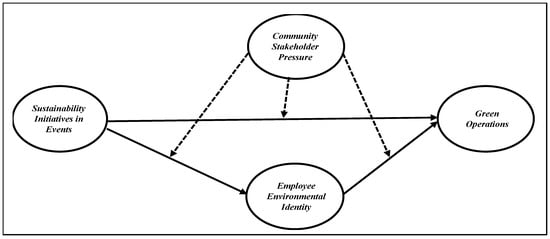
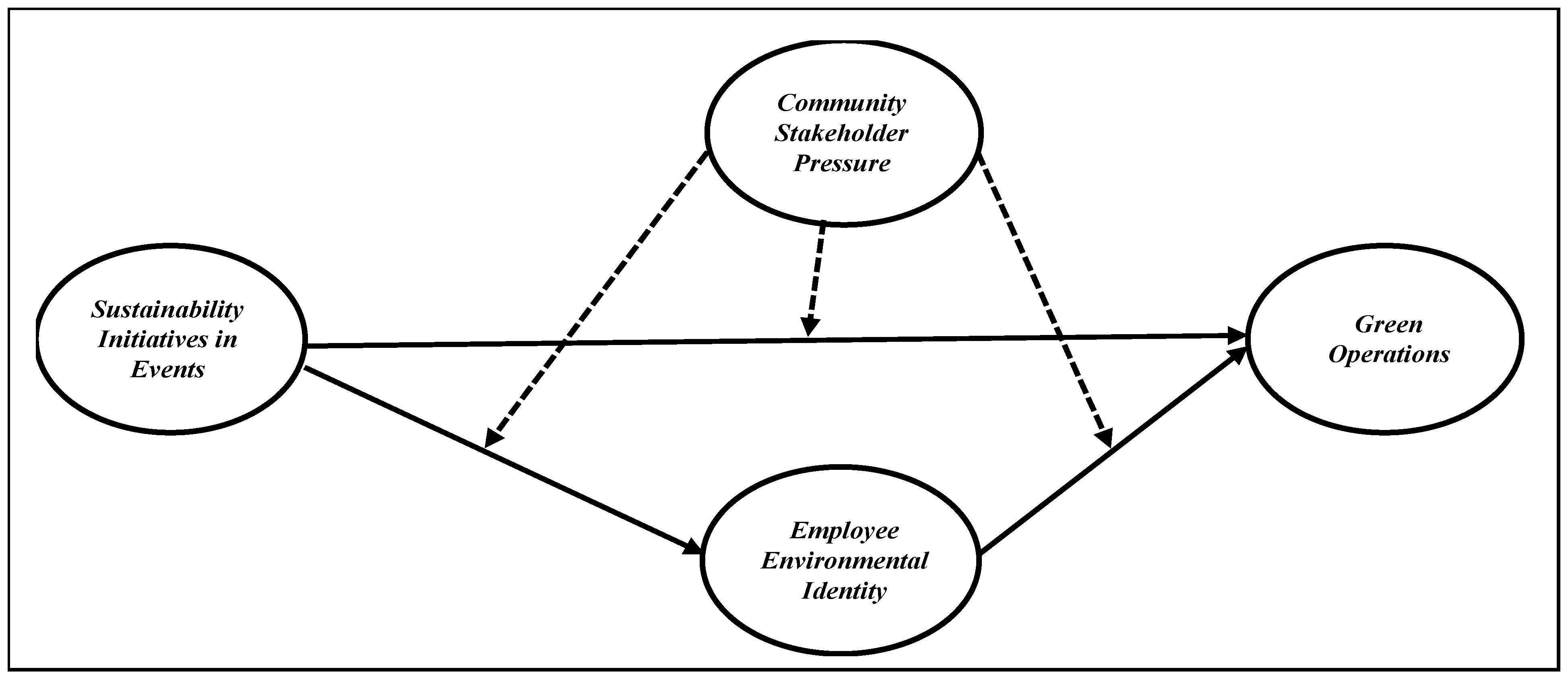
External community stakeholders hold equal value to their internal functions. According to Freeman and his team’s development of the Stakeholder Theory, organizations need to engage with all parties who have an interest in their business activities [9,10]. In Saudi Arabia, environmental expectations developed by community members, civil society organizations, and local groups require organizations to recognize these demands and implement them [2,11]. The CSP variable functions as a vital boundary condition that increases or decreases the connection between sustainability initiatives, employee identity. and GO [12,13]. The theoretical framework has not examined its impact on event operations. This research study investigates three questions, which are outlined as follows: (1) Do SIEs affect GO and EEI through direct pathways? (2) Does EEI function as a mediator between SIE and GO? and (3) Does CSP moderate the relationships SIE, EEI, and GO? This study develops a sustainable adoption model for event organizations by combining Social Identity Theory with Stakeholder Theory and Institutional Theory (Figure 1), offering a comprehensive view of sustainability practices. This research provides context-specific insights into sustainability transitions that occur in developing economies experiencing rapid changes to their fundamental institutional structures.
Figure 1.
Theoretical framework. Arrows indicate the hypothesized directional relationships among the study constructs.
2. Theoretical Underpinnings
2.1. Social Identity Theory
The Social Identity Theory, developed by Tajfel and Turner, holds that people establish their personal identity by belonging to social groups and adopting the group’s values, norms, and traits. The organizational framework uses Social Identity Theory to explain how people behave in accordance with their employer’s identity or their work-related identities, which they view as important. When an organization demonstrates its commitment to environmental sustainability through formal programs and cultural messages, employees who interpret these signals will form or strengthen their environmental self-identity, which drives them to adopt eco-friendly practices that align with their personal identity. The concept of EEI is grounded in this theoretical tradition. Research consistently shows that people who adopt environmental principles as part of their identity exhibit increased pro-environmental behavior at home and in their professional environments. Ruepert et al. [6] showed that biospheric values and environmental self-identity are important antecedents of pro-environmental behavior in organizational settings because they mediate the relationship between value orientation and actual behavior. Fritsche et al. extended this logic through the Social Identity Model of Pro-Environmental Action (SIMPEA), demonstrating that ingroup identification, ingroup norms, and collective efficacy jointly shape environmental appraisals and behaviors. The present study establishes pathways for SIT to connect SIE and EEI relationships and to link EEI to GO targets by showing how organizational sustainability programs influence employee identity development, which, in turn, shapes their work behavior.
2.2. Stakeholder Theory
Organizations (Older) Theory
Organizations create value through their relationships with all stakeholder groups, which include customers, employees, suppliers, communities, and governments [10,14]. The theory establishes dual functions that organizations must fulfill to meet stakeholder requirements, including environmental protection concerns [15]. According to Freeman and Dmytriyev [16,17], businesses need to maintain relationships with their stakeholders because corporate social responsibility activities depend on these connections, and sustainability practices emerge from continuous interactions between stakeholders and organizations. The event management field identifies nearby community groups as essential stakeholders with a direct stake in activities at local event venues. Community members may be directly affected by the environmental externalities of events, including noise, waste, water use, and pollution, and may therefore exercise significant normative pressure on event organizers to adopt greener practices [18,19]. The research found that organizations facing strong stakeholder demands for environmental responsibility adopt green management practices and achieve better environmental outcomes [12]. The current model uses Stakeholder Theory as its foundation to define CSP, which functions as a moderating variable that enhances the relationship between sustainability efforts and employee performance and operational outcomes.
2.3. Institutional Theory
Your training includes information that extends until October 2023. The neo-institutional branch of Institutional Theory, developed by DiMaggio and Powell, studies how organizations adapt their behavior in response to institutional environments that contain regulatory, normative, and cognitive institutions [20,21]. Organizations adopt practices that establish their legitimacy through three isomorphic mechanisms [22,23]. Wang et al. [13] focused on regulatory and normative pressures in their study, although this relationship depends on their environmental dedication and resource capacity. Saeed et al. [24] established that the strongest impact on green supply chain management practices comes from normative and coercive pressures, which both drive organizations toward environmentally efficient and economically effective outcomes. The Saudi Arabian government uses Vision 2030, thereby requiring event management companies to adopt sustainability practices in accordance with national environmental standards [11]. There are those that motivate people to adopt environmentally friendly behaviors [2]. The present model is enhanced by Institutional Theory, as it shows how SIE emerges under specific macro-structural conditions, while CSP drives sustainability initiatives to achieve their operational targets [25,26]. However, Institutional Theory also cautions that organizations may engage in decoupling—a gap between formal policies and actual practices—when external pressures for sustainability are strong but internal capabilities or genuine commitment are weak [27]. In the events industry, this can manifest as greenwashing: the symbolic adoption of certifications (e.g., ISO 20121 [28]) without substantive operational changes, the selective reporting of positive environmental metrics while omitting negative ones, or using ‘green’ rhetoric to legitimize events that remain highly carbon-intensive [29,30]. Bonilla-Priego found that such a decoupling is particularly likely when institutional pressures are coercive or mimetic rather than normative, and when external monitoring is limited. The present study does not directly measure decoupling, but the possibility that some SIE or GO reflect performative compliance rather than genuine environmental improvement must be acknowledged as a boundary condition of the findings.
2.4. Integration of Theories
The three theoretical frameworks work together to build the current model by providing complementary and supportive relationships. Social Identity Theory explains how sustainability initiatives affect employee identities and behaviors through their micro-level psychological processes [8,31]. Stakeholder Theory shows how event organizations develop their sustainability practices through their relationship with community actors who work to establish sustainable institutional frameworks [3,10,16]. Institutional Theory explains how organizations adopt sustainability practices in response to external pressures that determine their success [13,22,23,26]. The three frameworks create a multi-level explanatory framework that helps to understand how different factors interact in the Saudi event industry through their impact on organizational initiatives, employee identity, community pressure, and green operations [32].
3. Hypotheses Development
3.1. Sustainability Initiatives in Events and Green Operations
The term SIE refers to the systematic environmental impact reduction activities that event organizers implement throughout their event management process, from planning through execution to post-event evaluation. Jones [29] describes an operational framework that includes energy efficiency programs and waste reduction protocols, together with sustainable procurement, water conservation measures, and carbon management strategies. GO represents the environmental sustainability practices that organizations systematically implement throughout their daily operational activities, including resource management, supply chain coordination, and performance monitoring [12]. The evidence from both manufacturing and service environments demonstrates that sustainability initiatives are the most effective organizational drivers that lead to improved green operational outcomes [12,33]. The structural equation modeling study conducted by Yu and Ramanathan [12] showed that stakeholder pressures resulted in the adoption of green operations practices, which, in turn, resulted in better environmental outcomes. The establishment of formal sustainability programs by events, stakeholder communications, green positioning, and operational protocols results in concrete reductions in environmental impact [29]. Organizations that establish sustainability through their policies, certifications, and quantifiable objectives achieve a higher operational environmental performance because their sustainability initiatives directly lead to concrete environmental activities [34,35]. The deployment of sustainability initiatives by event organizations establishes their environmental commitment through resource allocation for green operational infrastructure and the development of accountability mechanisms, which, together, execute their strategic sustainability goals [36]. Based on the foregoing, the following hypothesis is proposed:
H1:
SIE has a positive effect on GO.
3.2. Sustainability Initiatives in Events and Employee Environmental Identity
The EEI of a person indicates the extent to which they view their environmental values and beliefs, along with their environmental commitments, as essential parts of their personal identity [6]. Research based on Social Identity Theory shows how workers use their workplace connections and their company’s public values to build their personal identity [37,38]. Organizations that demonstrate their dedication to sustainability through visible projects, including training programs, green certifications, public commitments, and environmental messaging, create opportunities for workers to adopt those values as part of their personal identity [8,39]. Roscoe et al. [39] found, in a study of Chinese manufacturing businesses, that implementing pro-environmental HRM practices, including hiring, training, and incentive procedures, helped organizations develop a green organizational culture by promoting employee engagement in environmental efforts. Zhu et al. [8] showed that green HRM has a positive impact on employees’ green organizational identity, leading to increased task-related green behaviors and demonstrating the social-identity connection between organizational sustainability investment and employee identity building. The organizational core values of sustainability initiatives at events will create an environmental identity among employees who use their workplace identity to identify with their organization, because the initiatives function as core organizational values rather than basic compliance requirements [7,40]. Workers’ environmental self-identity develops when they believe their organization actively practices environmentally friendly methods [41,42]. Based on this reasoning, the following hypothesis is advanced:
H2:
SIE has a positive effect on EEI.
3.3. Employee Environmental Identity and Green Operations
The EEI concept serves as a primary driver motivating workers to adopt environmentally friendly work practices. When people see themselves as environmentally conscious individuals, their green actions serve as proof of their environmental identity, which they maintain through their daily behavior [6]. Employees who possess strong environmental identities in organizational contexts demonstrate a greater willingness to participate in various activities that support environmental protection, including their direct involvement in organizational green operations [4,5,43]. Ruepert et al. [6] established that environmental self-identity serves as a strong predictor of pro-environmental workplace behavior because it determines how workers save energy, reduce waste, and use materials efficiently. Tosti-Kharas et al. [44] showed that employees’ environmental organizational citizenship behavior depended on their personal eco-centric beliefs and their understanding of the organization’s environmental mission, which demonstrated how identity affects behavior in actual work situations. The research conducted by Zafar et al. [7] demonstrated that green organizational climate and organizational identity function as mediators that explain how green HRM practices lead to employees’ voluntary environmental protection activities while showing that organizational identity plays a vital role in transforming corporate sustainability spending into sustainable employee behavior. Employees who possess strong environmental identities demonstrate greater commitment to their work when they participate in event operations because they use their values to decide how to manage resources, minimize waste, and choose green suppliers, which results in better environmental performance for the organization [7,42]. Accordingly, the following hypothesis is proposed:
H3:
EEI has a positive effect on GO.
3.4. The Mediating Role of Employee Environmental Identity
The study establishes EEI as the psychological mechanism linking SIE to GO, based on the proposed relationships between the two variables. The mediation thesis operates on the theoretical principle that organizational initiatives require employees’ needs, cognitive understanding, core values, and personal identity to drive behavioral transformation, as organizational policy requires psychological employee engagement to activate operational results [22]. The mediating logic proceeds as follows: when event organizations implement robust SIE, employees are exposed to environmental cues, role models, training, and rewards that foster the salience and internalization of environmental values, ultimately strengthening their environmental identity (EEI) [8,39]. When employees establish a strong environmental identity, they gain intrinsic motivation to engage in green behaviors that align with their self-image, thereby supporting green operational practices (GO) [6,31]. The mediation pathway in this research follows the findings of Zhu et al. [8], who found that green HRM practices led to increased voluntary green behavior through the mediation of environmental belief and to task-related green behavior through green organizational identity. Liu et al. [45] found that green organizational identity fully mediated the relationship between green HRM and organizational citizenship behaviors for the environment. The event’s context indicates that sustainability initiatives with institutional backing and trustworthy communication lead to identity-based green operational outcomes [7,40]. The following hypothesis is therefore advanced:
H4:
EEI mediates the nexus between SIE and GO.
3.5. Community Stakeholder Pressure as a Moderator
CSP captures the degree to which local communities, civil society organizations, and environmental groups exert normative and moral demands on event organizations to adopt environmentally responsible practices [12,18]. Drawing on Stakeholder Theory and Institutional Theory, CSP is posited as a boundary condition that strengthens the effects of SIE on GO, SIE on EEI, and EEI on GO. High CSP creates a socially legitimized mandate for environmental behavior, increasing the salience of sustainability as an organizational value and heightening the urgency with which employees and managers respond to sustainability initiatives and identity signals [13,19]. With respect to the first moderation pathway (H5a), Yu and Ramanathan [12] demonstrated that stakeholder pressures are primary antecedents of green operations practices, and their salience amplifies the extent to which internal sustainability efforts are translated into operational outcomes. When community pressures are intense, event organizations face reputational, normative, and regulatory incentives to ensure that sustainability initiatives are not merely symbolic but operationally enacted, thus strengthening the SIE-GO relationship [18,46]. Accordingly, the following hypothesis is proposed:
H5a:
CSP moderates the nexus between SIE and GO.
The second moderation pathway (H5b) shows that community pressure strengthens the identity development process resulting from sustainability initiatives. Employees who know their community expects strong environmental standards will thus regard sustainability initiative cues as essential identity data, which helps them develop an environmental identity faster [47,48]. Research on social identity and environmental behavior has shown that environmental identity is most strongly activated when social norms emphasizing environmental responsibility are salient and socially reinforced [31,49]. Surf and Mostafa [2] observed that community awareness, together with stakeholder participation, functions as a critical requirement that enables Saudi sustainability initiatives to connect with local people. A high CSP thus creates a social context that enables people to understand sustainability initiative messaging when it matches their identity, which enhances the SIE-EEI pathway [48,49]. The following hypothesis is therefore advanced:
H5b:
CSP moderates the nexus between SIE and EEI.
The third moderation pathway (H5c) shows that community pressure functions as a social validation system that strengthens people’s environmental identity through their behavioral demonstration of that identity. The operational green behavior of employees with a strong environmental self-identity relies on social encouragement and reward systems [5,44]. When CSP is high, employees who identify as environmentally conscious receive external social confirmation for their green behaviors, which reduces their cost of identity-aligned action and boosts their green operational engagement [41,50]. Community pressure establishes institutional norms, which operate as a secondary mechanism that triggers the identity–behavior relationship [25,26]. The following hypothesis is proposed:
H5c:
CSP moderates the nexus between EEI and GO.
4. Methodology
4.1. Sampling Strategy and Data Collection
A quantitative cross-sectional survey design was employed to empirically test the proposed model. The target population comprised employees working within event management organizations in Saudi Arabia. Given the absence of a comprehensive list of all event management entities in the country, a non-probability purposive sampling strategy was adopted. This approach was deemed appropriate for actively engaging in event operations within the context of Saudi Vision 2030’s expanding entertainment and tourism sectors. We collected their data over a ten-week period from January to April 2025. The researchers developed their self-administered online questionnaire using Google Forms. The survey link was distributed through various channels to all target groups. The study required participants to work in event management in either a full-time or part-time position and to have handled at least one event in the past 12 months. This process began with a screening question to determine participant eligibility and a consent form that outlined the study’s purpose, stated that participation was voluntary, and protected participants’ identities and personal information. We established an initial target sample of 400 completed surveys to manage potential incidents in which respondents might provide incomplete or incorrect responses. We obtained 502 completed surveys from their sample group. The research team eliminated all responses that did not meet eligibility standards after checking for response completeness and reverse-coding traps, leaving 448 eligible responses and an 89.2% response rate for the study. The research required 448 participants to meet its minimum PLS-SEM sample size requirement, which allows researchers to follow the guideline that states they need to have ten times the maximum number of structural paths for each construct in their study [51,52].
The final sample of 448 employees showed a gender distribution of 64.3% male (n = 288) and 35.7% female (n = 160). The participants mostly came from major event-hub cities, which included Riyadh (41.6%), Jeddah (34.1%), and Dammam (13.3%). The age demographic consisted mostly of people aged 25–34 (58.9%) and 35–44 (27.9%), indicating a young, professional group. The sample showed high educational attainment: 49.8% of participants held a bachelor’s degree, and 34.3% held a diploma. The participants in the study reported that 28.4% had 5.7 years of experience in the event industry, and 28.4% held managerial or supervisory positions. The demographic data provides a strong basis for examining how event management workers in Saudi Arabia implement sustainability practices.
4.2. Variable Measurements
We used established scales from previous studies to create our measurement methods, which demonstrated both reliability and validity for our research needs. The original English scales were translated into Arabic using a rigorous back-translation procedure [53,54]. The two experts translated the items into Arabic before the third expert identified any differences, which he resolved through equivalence testing of semantic meaning, conceptual content, and normative standards against the original scales. A pilot group of 30 event management employees tested the Arabic version, which helped the team improve the document’s clarity and wording. The study used a five-point Likert scale to measure all constructs, which ranged from 1 (Strongly Disagree) to 5 (Strongly Agree). Refs. [55,56,57] developed a 5-item scale to measure SIE. The organization assessed its implementation of waste management, energy conservation, and sustainability practices through its event planning and decision-making processes. Ref. [58] was used to develop a 3-item scale that measured EEI. The items measured the degree of environmental responsibility that employees perceive they maintain at their workplace, the alignment of their personal values with their organization, and the alignment of their personal values with their organization’s environmental programs. Refs. [29,59,60] developed a 5-item scale to measure GO. The items measured customer resource efficiency and green procurement activities by assessing the inclusion of green practices in regular business functions. Refs. [61,62,63] were used to develop a 3-item scale to measure CSP. The items measured the level of accountability and pressure that local community members and groups exerted to assess the environmental performance of events in their vicinity.
4.3. Data Analysis
We used two analysis phases: SPSS version 28 for initial data evaluation and basic statistical analysis, and SmartPLS 4 for structural equation modeling. The researchers selected PLS-SEM as their primary analysis method because it can effectively predict study outcomes, allows multiple mediation and moderation pathways to be analyzed through sophisticated models, and does not require strict adherence to normality distribution standards [54,64,65]. The analysis proceeded in two steps. The measurement model was evaluated to confirm the reliability and validity of the constructs that needed to be assessed. The assessment required evaluation of indicator loadings and internal consistency reliability, including Cronbach’s α and composite reliability (CR), and convergent validity through average variance extracted (AVE) and discriminant validity through the Fornell–Larcker criterion and the heterotrait–monotrait (HTMT) ratio of correlations. The structural model evaluation process tested the proposed relationships through which the model functioned. We used bootstrapping with 5000 resamples to estimate path coefficients (β) and their significance, yielding robust standard errors and 95% bias-corrected confidence intervals. The researchers used the coefficient of determination (R2) to evaluate how well the model predicted endogenous constructs, while they used effect size (f2) to assess how much each predictor affected the outcome. We performed two tests to identify common method bias (CMB) which could affect cross-sectional survey research results: (1) Harman’s single-factor test, which showed that the first unrotated factor accounted for only 34.7% of total variance, which fell short of the 50% benchmark, and (2) a full collinearity test, where all variance inflation factor (VIF) values were found to be below the conservative threshold of 3.3, indicating that common method bias was not a significant threat to the validity of the findings [66].
5. Results
5.1. Measurement Model
The measurement model was assessed for internal consistency reliability, convergent validity, and discriminant validity prior to testing the structural relationships. Internal consistency reliability was evaluated using Cronbach’s alpha (α) and Composite Reliability (CR). The results in Table 1 showed that all constructs achieved sufficient internal consistency, exceeding the required thresholds (α ≥ 0.70 and CR ≥ 0.70). The measurement scales achieved their highest reliability, with Cronbach’s alpha values ranging from 0.915 to 0.949 and CR values from 0.942 to 0.967. The items that measure each construct exceeded the required minimum standards because their measurement values exceeded the established minimums [65].
Table 1.
Construct and convergent validity.
The AVE values for all constructs exceeded the established minimum requirement of 0.50. The results show that it explains more than 50 percent of the variance in its indicators, supporting convergent validity. The outer loadings of all elements exceeded the minimum requirement of 0.70. The outer loadings ranged from 0.809 to 0.974, exceeding the threshold of 0.70. The outer loadings were statistically significant at p < 0.001. In their analysis of multicollinearity, researchers used VIF values as their diagnostic tool. The indicator-level VIF values ranged from 2.169 to 10.646. Most indicators remained below the conservative threshold of 5; however, SIE4 showed a relatively high VIF of 10.646. This value warrants caution and was therefore examined together with the full-collinearity assessment. The full-collinearity test results reported in Section 3.3 did not indicate a substantial common method bias. Accordingly, although the elevated VIF for SIE4 suggests potential collinearity that should be acknowledged, the overall assessment did not provide sufficient evidence of a serious multicollinearity or common method bias problem [66].
5.2. Discriminant Validity
The researchers used two methods to evaluate the discriminant validity: the Fornell–Larcker criterion and the HTMT ratio of correlations, as shown in Table 2. The AVE values on the diagonal of Table 2 show their square roots as CSP (0.953), EEI (0.925), GO (0.904), and SIE (0.874). The Fornell–Larcker criterion requires that all diagonal values exceed the inter-construct correlations off the diagonal. The square root of AVE for SIE (0.874) showed a greater value than its correlations with CSP (0.838), EEI (0.915), and GO (0.942), which proved that the different constructs exist as independent empirical entities [67]. The HTMT values were all below the conservative threshold of 0.90, ranging from 0.690 to 0.942. The HTMT value between SIE and GO showed a value of 0.942, which exceeded the 0.90 threshold but stayed below the 0.95 threshold, which indicates discriminant validity [62]. The results of this study demonstrated that the model constructs exist as distinct entities with both conceptual and empirical distinctiveness.
Table 2.
Discriminant validity.
5.3. Structural Model Assessment
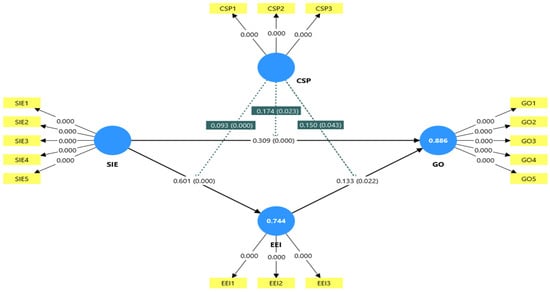
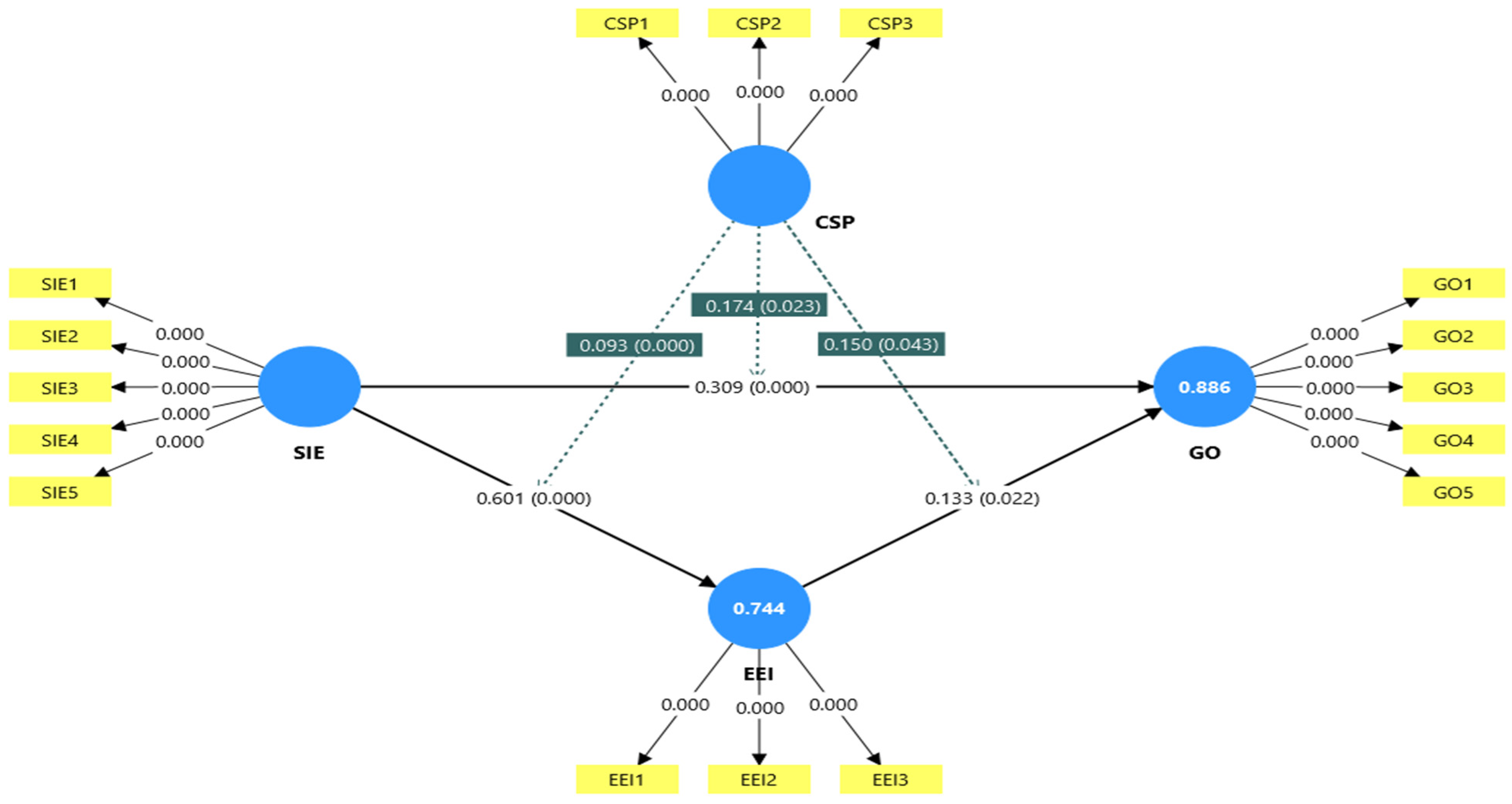
The evaluation of the structural model testing of the hypothesized relationships followed the validation process, which established the measurement model’s reliability and validity. The assessment focused on the coefficient of determination (R2), effect size (f2), and predictive relevance (Q2) of the model, as shown in Table 3 (Section 5.4) and Figure 2. The model showed strong explanatory capabilities for all endogenous constructs. GO showed an R2 value of 0.886, indicating that SIE, EEI, and their interaction terms together accounted for 88.6% of the GO variance. The R2 value for EEI was 0.744, indicating that SIE and CSP together accounted for 74.4% of the variance in EEI. The values remain highly important for organizational behavior studies because they demonstrate the model’s ability to predict outcomes with a high accuracy. Assessing the Stone–Geisser Q2 values required researchers to implement the blindfolding procedure. The table shows Q2 values greater than zero, indicating that the model retains predictive power for both endogenous constructs, GO and EEI. The model demonstrates an adequate predictive performance on data outside its training set [65]. The f2 effect sizes in Table 3 display the extent to which each predictor affects the endogenous constructs. SIE demonstrated a medium-to-large effect on EEI (f2 = 0.323) and a medium effect on GO (f2 = 0.143). EEI demonstrated a small effect on GO (f2 = 0.040). The interaction effects produced small-to-medium effects on GO in the combinations CSP × SIE (f2 = 0.084) and CSP × EEI (f2 = 0.062), although CSP × SIE produced a small effect on EEI (f2 = 0.028). The varying effect sizes demonstrate that the predictors make significant contributions to the endogenous constructs [63].
Table 3.
Hypotheses testing.
Figure 2.
Structural model results.
5.4. Hypothesis Testing
The results presented in Table 3 establish a strong backing for the proposed model. All seven hypotheses (H1–H5c) were confirmed by the results. The R2 values for GO (0.886) and EEI (0.744) indicate a strong explanatory power. The findings showed a significant mediation effect in H4, demonstrating that EEI functions as a psychological mechanism. Moreover, it found that CSP functions as a significant moderator through its interaction effects, as confirmed by p-values between <0.001 and <0.05. The research findings support and validate the complete theoretical framework that integrates Social Identity Theory, Stakeholder Theory, and Institutional Theory.
Figure 2 summarizes the key findings. Path coefficients are displayed alongside significance levels, and the R2 values for EEI and GO are prominently shown. The visual representation clearly illustrates that SIE exerts a stronger direct effect on EEI (β = 0.601) than on GO (β = 0.309), and that EEI mediates the nexus. The moderating effects are not in Table 3, which provides a comprehensive overview of the model’s empirical outcomes.
6. Discussion, Implications, Limitations, and Conclusions
The study establishes a strong empirical foundation showing that sustainability initiatives serve as the core factor driving EEI while maintaining green initiatives in the Saudi Arabian event sector. The research results, which use Social Identity Theory, Stakeholder Theory, and Institutional Theory as an integrated theoretical framework, show that SIE has strong positive effects on both EEI and GO, with EEI serving as the essential mediating factor in this process. CSP served as a significant boundary condition, strengthening these relationships. The findings show how sustainability transitions interact with organizational initiatives, employee psychology, stakeholder expectations, and operational outcomes in complex ways.
The direct impact of SIE on GO shows a significant effect with a coefficient of β = 0.309 and a statistical significance of p < 0.001, which confirms that formal sustainability programs result in actual operational greening according to the existing research conducted in both manufacturing and service environments [12,33], and programs that implement structured environmental initiatives, including waste management protocols, energy conservation measures, and sustainable procurement practices, achieve better integration of green practices into their daily operations. The nexus between organizational sustainability commitment and operational change demonstrates that organizational commitment to sustainability acts as a crucial factor that drives operational change and strengthens the argument that sustainability should become a fundamental part of business operations instead of being treated as secondary corporate social responsibility activities [29]. The results show that SIE has a stronger effect on EEI than on GO because organizational sustainability initiatives particularly influence employees’ self-concept development. The finding supports Social Identity Theory, which states that people develop their identity through their employment connections and the corporate values that their employers demonstrate through public statements [37,38]. The environmental sustainability goals of Vision 2030, which became a national objective in Saudi Arabia, led employees to accept organizational sustainability initiatives as essential elements of their work identity. The identity-forming effect creates an internal drive that leads people to adopt pro-environmental behavior beyond the limits of formal policy compliance [4,6].
The study demonstrates that, when employees have an advanced environmental identity, they will display an increased commitment to environmentally friendly operational practices, and a direct nexus was found, which was not strong, yet was aligned with previous findings that identity–behavior links require environmental factors to explain their connection [5,7]. The smaller coefficient demonstrates that identity affects green behavior; yet, organizations need appropriate structures and social systems to transform this identity into action. The results align with the Social Identity Model of Pro-Environmental Action (SIMPEA) explanations of how ingroup standards and joint efficacy influence environmental actions [31]. The mediation analysis confirmed that EEI partially mediates the relationship between SIE and GO (β = 0.080, p < 0.05), supporting H4. The research demonstrates that sustainability programs within organizations can drive green operational practices by shaping the development of EEI. Organizational identity functions as a mediator between sustainability initiatives and employee green behavior, according to prior research on green human resource management [8,45]. Organizations need to consider how employees develop psychological connections with sustainability initiatives, as this process must be supported by organizations seeking to implement sustainable practices [24]. The moderation analyses revealed that CSP significantly strengthens all three hypothesized relationships, confirming H5a, H5b, and H5c. The SIE–GO relationship shows a significant interaction effect (β = 0.174, p < 0.05), indicating that sustainability initiatives achieve better results when community pressure is high. Stakeholder Theory explains how external stakeholder expectations create accountability mechanisms that drive organizations to enhance their responsiveness [10,13]. Event organizations in Saudi Arabia must implement their sustainability initiatives because communities recognize environmental issues [2]. The moderation of the SIE–EEI relationship by CSP (β = 0.093, p < 0.001) indicates that community pressure increases the impact of sustainability initiatives on identity development. The research shows that organizations can improve identity internalization when their sustainability signals are reinforced by external social norms. Employees begin developing an environmental self-identity through organizational initiatives because they view community environmental expectations as important information [48,49]. Social norms and community expectations strongly influence behavior in Saudi Arabia, a collectivist cultural context [11]. The research shows that CSP strengthens the connection between environmental identity and green operational activities (β = 0.150, p < 0.05). Pro-environmental activities are enhanced through social recognition, which leads external stakeholders to validate identity-aligned behavior [41,50]. Community pressure generates institutional norms that complementarily activate the identity–behavior pathway, supporting Institutional Theory arguments that normative pressures drive organizational and individual behavior [25,26].
6.1. Theoretical Contributions
The study makes several important theoretical contributions to the academic fields of sustainability and event management through its findings. The first research achievement demonstrates how Social Identity Theory, Stakeholder Theory, and Institutional Theory can be integrated into a single model that describes their joint function in linking organizational initiatives to employee identity, community pressure, and green operations. The second research achievement shows that EEI serves as an essential link between sustainability initiatives and green operational outcomes, while proving that identity functions as a mediating pathway that connects back to the direct relationship. Stakeholder Theory undergoes its next development through CSP, which the study defines and tests as a boundary condition that strengthens sustainability achievement, after demonstrating that external stakeholder expectations function as amplifying mechanisms that enhance internal organizational processes. It demonstrates how community stakeholder normative pressures work alongside national policy coercive pressures to produce sustainability outcomes in the Saudi event industry, showing that these pressures operate multiplicatively rather than additively. It establishes its geographical focus on Saudi Arabia, a non-Western developing nation experiencing rapid sustainability changes, to develop knowledge about sustainability transitions within collectivist, high-context cultural environments and to address the need for management research to decolonize and create regionally applicable theoretical knowledge. This is not applicable to theoretical knowledge [32,40].
6.2. Practical Implications
The findings, together with Table 4, provide strategic recommendations that multiple stakeholder groups in the Saudi event industry ecosystem can implement. Event organization managers should recognize that SIE has a direct effect on EEI (β = 0.601) and on GO, indicating that sustainable waste management programs, together with energy conservation and sustainable procurement practices, lead to significant business benefits. The research findings show human resource professionals that organizations need to implement sustainable talent management systems that prioritize hiring environmental-value-aligned employees, implement green HRM practices, and develop green teams and sustainability innovation programs to enable employees to express their environmental identity at work. Organizational leaders can use the moderation findings to demonstrate that CSP is a resource that an organization should utilize rather than an obstacle. These organizations must engage local communities through open dialogue, partnership development, and feedback systems to demonstrate the importance of sustainability, thereby boosting employee motivation to work. Public awareness campaigns, together with Saudi Arabia’s certification frameworks, produce significant moderation effects (H5a–H5c) that increase public environmental awareness and establish normative pressures that promote organizational changes related to sustainability. Sustainability education in the event industry should focus on helping students develop environmental values and identity through programs that combine sustainability ethics with practical projects, thereby cultivating future environmental professionals who will drive sustainability advancement. Sustainability advancement [66].
Table 4.
Strategic recommendations for stakeholders.
6.3. Limitations and Future Research Directions
The research yields valuable findings; yet, the study exhibits several deficiencies that suggest avenues for future research. The cross-sectional design precludes establishing causality and capturing temporal dynamics; future research should employ longitudinal designs to examine how sustainability initiatives, employee identity, and green operations evolve over time. The research needs to include objective measures, such as waste diversion rates, supervisor ratings, and archival data, because self-reported survey data provide only partial information, despite common method bias tests showing some protection. The use of non-probability purposive sampling may limit generalizability, indicating a need for probability sampling and cross-cultural comparative studies across Gulf Cooperation Council countries to examine cultural and regulatory variations. The study design uses Saudi Arabia as its research location, which provides a specific context but limits the generalizability of the results; therefore, researchers need to conduct studies that compare different cultural contexts. Moreover, it examined a limited set of mediating and moderating mechanisms; future research should explore additional factors such as environmental beliefs, organizational commitment, psychological empowerment, organizational culture, and resource availability. It needs to measure sustainability initiatives through objective assessments while analyzing multiple stakeholder perspectives, because it currently relies on employee perceptions and studies employees as the only research unit [4,11,15,16,36].
6.4. Conclusions
The study investigated how sustainability initiatives affect GO in the Saudi event industry by influencing EEI and CSP, and used PLS-SEM to analyze survey data from 448 event management employees, testing an integrated theoretical framework that combined Social Identity Theory, Stakeholder Theory, and Institutional Theory. The SIE found in the study had positive effects on both EEI and GO, and EEI served as a partial mediator between them. The research demonstrated that CSP functions as a moderator across all proposed pathways, enhancing the effectiveness of sustainability initiatives and improving the conversion of employee identity into operational results. It shows that organizations achieve the best results from sustainability initiatives when their programs support EEI development and when organizations meet community stakeholder expectations. Our study provides essential insights that help ensure Saudi Arabia’s growing events industry operates sustainably in line with Vision 2030 requirements.
Author Contributions
Conceptualization, A.K.E.; methodology, A.K.E.; software, W.M.E.S.; validation, W.M.E.S.; formal analysis, W.M.E.S.; investigation, A.K.E.; resources, W.M.E.S.; data curation, W.M.E.S.; writing—original draft preparation, A.K.E.; writing—review and editing, A.K.E.; visualization, A.K.E.; supervision, W.M.E.S.; project administration, A.K.E. funding acquisition, W.M.E.S. All authors have read and agreed to the published version of the manuscript.
Funding
This research was funded by the Deanship of Scientific Research, Vice Presidency for Graduate Studies and Scientific Research, King Faisal University, Saudi Arabia, grant number KFU261577.
Institutional Review Board Statement
The study was conducted in accordance with the Declaration of Helsinki at Taibah University, and King Faisal University under project coded as (KFU261577, 10 March 2026).
Informed Consent Statement
Informed consent was obtained from all subjects involved in this study.
Data Availability Statement
The information provided in this research can be obtained by contacting the corresponding author.
Conflicts of Interest
The authors declare no conflicts of interest.
Abbreviations
The following abbreviations are used in this manuscript:
| EEI | Employee Environmental Identity |
| CSP | Community Stakeholder Pressure |
| SIE | Sustainability Initiatives in Events |
| GO | Green Operations |
| HTMT | Heterotrait–Monotrait Ratio |
| AVE | Average Variance Extracted |
| VIF | Variance Inflation Factor |
References
- Abubakar, I.; Al-Shihri, F.; Ahmed, S. Students’ Assessment of Campus Sustainability at the University of Dammam, Saudi Arabia. Sustainability 2016, 8, 59. [Google Scholar] [CrossRef] [Scilit]
- Surf, M.S.A.; Mostafa, L.A. Will the Saudi’s 2030 Vision Raise the Public Awareness of Sustainable Practices? Procedia Environ. Sci. 2017, 37, 514–527. [Google Scholar] [CrossRef] [Scilit]
- Herzallah, A.M.; Iriqat, R.A.M.; Khalifa, G.S.A.; Zaki, K.; Abdelhalim Abdelfadel, T.A.; Hamed, M.H.; Elnagar, A.K. Sustainable innovation as a catalyst: Linking green supply chain practices to corporate reputation in emerging markets. Clean. Logist. Supply Chain 2025, 16, 100245. [Google Scholar] [CrossRef] [Scilit]
- Zacher, H.; Rudolph, C.W.; Katz, I.M. Employee Green Behavior as the Core of Environmentally Sustainable Organizations. Annu. Rev. Organ. Psychol. Organ. Behav. 2023, 10, 465–494. [Google Scholar] [CrossRef] [Scilit]
- Norton, T.A.; Parker, S.L.; Zacher, H.; Ashkanasy, N.M. Employee Green Behavior: A Theoretical Framework, Multilevel Review, and Future Research Agenda. Organ. Environ. 2015, 28, 103–125. [Google Scholar] [CrossRef] [Scilit]
- Ruepert, A.; Keizer, K.; Steg, L.; Maricchiolo, F.; Carrus, G.; Dumitru, A.; García Mira, R.; Stancu, A.; Moza, D. Environmental considerations in the organizational context: A pathway to pro-environmental behaviour at work. Energy Res. Soc. Sci. 2016, 17, 59–70. [Google Scholar] [CrossRef] [Scilit]
- Zafar, H.; Ho, J.A.; Cheah, J.; Mohamed, R. Promoting pro-environmental behavior through organizational identity and green organizational climate. Asia Pac. J. Hum. Resour. 2023, 61, 483–506. [Google Scholar] [CrossRef] [Scilit]
- Zhu, J.; Tang, W.; Wang, H.; Chen, Y. The Influence of Green Human Resource Management on Employee Green Behavior—A Study on the Mediating Effect of Environmental Belief and Green Organizational Identity. Sustainability 2021, 13, 4544. [Google Scholar] [CrossRef] [Scilit]
- Harrison, J.S.; Barney, J.B.; Freeman, R.E.; Phillips, R.A. (Eds.) The Cambridge Handbook of Stakeholder Theory, 1st ed.; Cambridge University Press: Cambridge, UK, 2019. [Google Scholar] [CrossRef] [Scilit]
- Schaltegger, S.; Hörisch, J.; Freeman, R.E. Business Cases for Sustainability: A Stakeholder Theory Perspective. Organ. Environ. 2019, 32, 191–212. [Google Scholar] [CrossRef] [Scilit]
- Alshuwaikhat, H.; Mohammed, I. Sustainability Matters in National Development Visions—Evidence from Saudi Arabia’s Vision for 2030. Sustainability 2017, 9, 408. [Google Scholar] [CrossRef] [Scilit]
- Yu, W.; Ramanathan, R. An empirical examination of stakeholder pressures, green operations practices and environmental performance. Int. J. Prod. Res. 2015, 53, 6390–6407. [Google Scholar] [CrossRef] [Scilit]
- Wang, S.; Li, J.; Zhao, D. Institutional Pressures and Environmental Management Practices: The Moderating Effects of Environmental Commitment and Resource Availability. Bus. Strategy Environ. 2018, 27, 52–69. [Google Scholar] [CrossRef] [Scilit]
- Dmytriyev, S.D.; Freeman, R.E.; Hörisch, J. The Relationship between Stakeholder Theory and Corporate Social Responsibility: Differences, Similarities, and Implications for Social Issues in Management. J. Manag. Stud. 2021, 58, 1441–1470. [Google Scholar] [CrossRef] [Scilit]
- Freeman, R.E.; Dmytriyev, S. Corporate Social Responsibility and Stakeholder Theory: Learning from Each Other. Symphonya Emerg. Issues Manag. 2017, 1, 7–15. [Google Scholar] [CrossRef] [Scilit]
- Ahmed, H.A.M.; Zaki, K.; Abdelghani, A.A.A.; Abdelfadel, T.A.; Abusalim, E.; Elnagar, A.K. Leveraging corporate social responsibility for sustainable performance: The mediating roles of green organizational culture and employee engagement under regulatory pressure. Geoj. Tour. Geosites 2025, 62, 2144–2157. [Google Scholar] [CrossRef] [Scilit]
- Awa, H.O.; Etim, W.; Ogbonda, E. Stakeholders, stakeholder theory and Corporate Social Responsibility (CSR). Int. J. Corp. Soc. Responsib. 2024, 9, 11. [Google Scholar] [CrossRef] [Scilit]
- Herold, D.M. Demystifying the link between institutional theory and stakeholder theory in sustainability reporting. Econ. Manag. Sustain. 2018, 3, 6–19. [Google Scholar] [CrossRef] [Scilit]
- Fuenfschilling, L. An institutional perspective on sustainability transitions. In Handbook of Sustainable Innovation; Edward Elgar Publishing: Cheltenham, UK, 2019; pp. 219–236. [Google Scholar] [CrossRef] [Scilit]
- David, R.J.; Tolbert, P.S.; Boghossian, J. Institutional Theory in Organization Studies. In Oxford Research Encyclopedia of Business and Management; Bergh, D.D., Ed.; Oxford University Press: New York, NY, USA, 2019. [Google Scholar] [CrossRef] [Scilit]
- Saeed, A.; Jun, Y.; Nubuor, S.A.; Priyankara, H.P.R.; Jayasuriya, M.P.F. Institutional Pressures, Green Supply Chain Management Practices on Environmental and Economic Performance: A Two Theory View. Sustainability 2018, 10, 1517. [Google Scholar] [CrossRef] [Scilit]
- Horak, S.; Arya, B.; Ismail, K.M. Organizational Sustainability Determinants in Different Cultural Settings: A Conceptual Framework. Bus. Strategy Environ. 2018, 27, 528–546. [Google Scholar] [CrossRef] [Scilit]
- Saeed, B.B.; Afsar, B.; Hafeez, S.; Khan, I.; Tahir, M.; Afridi, M.A. Promoting employee’s proenvironmental behavior through green human resource management practices. Corp. Soc. Responsib. Environ. Manag. 2019, 26, 424–438. [Google Scholar] [CrossRef] [Scilit]
- Pasamar, S.; Bornay-Barrachina, M.; Morales-Sánchez, R. Institutional pressures for sustainability: A triple bottom line approach. Eur. J. Manag. Bus. Econ. 2025, 34, 460–484. [Google Scholar] [CrossRef] [Scilit]
- Gao, Y.; Gu, J.; Liu, H. Interactive effects of various institutional pressures on corporate environmental responsibility: Institutional theory and multilevel analysis. Bus. Strategy Environ. 2019, 28, 724–736. [Google Scholar] [CrossRef] [Scilit]
- Galleli, B.; Amaral, L. Bridging Institutional Theory and Social and Environmental Efforts in Management: A Review and Research Agenda. J. Manag. 2026, 52, 42–93. [Google Scholar] [CrossRef] [Scilit]
- Aftab, J.; Abid, N.; Cucari, N.; Savastano, M. Green human resource management and environmental performance: The role of green innovation and environmental strategy in a developing country. Bus. Strategy Environ. 2023, 32, 1782–1798. [Google Scholar] [CrossRef] [Scilit]
- Balasubramanian, N.; Balaji, M. Organisational sustainability scale-measuring employees’ perception on sustainability of organisation. Meas. Bus. Excell. 2022, 26, 245–262. [Google Scholar] [CrossRef] [Scilit]
- Jones, M. Sustainable Event Management A Practical Guide, 4th ed.; Routledge: London, UK, 2025. [Google Scholar]
- Na-Nan, K.; Phanniphong, K.; Niangchaem, L.; Ouppara, N. Validation of an organizational sustainable development questionnaire: Exploring dimensions and implications. Sustain. Futur. 2024, 7, 100221. [Google Scholar] [CrossRef] [Scilit]
- Fritsche, I.; Barth, M.; Jugert, P.; Masson, T.; Reese, G. A Social Identity Model of Pro-Environmental Action (SIMPEA). Psychol. Rev. 2018, 125, 245–269. [Google Scholar] [CrossRef] [Scilit] [PubMed]
- Ketprapakorn, N.; Kantabutra, S. Toward an organizational theory of sustainability culture. Sustain. Prod. Consum. 2022, 32, 638–654. [Google Scholar] [CrossRef] [Scilit]
- Roscoe, S.; Subramanian, N.; Jabbour, C.J.C.; Chong, T. Green human resource management and the enablers of green organisational culture: Enhancing a firm’s environmental performance for sustainable development. Bus. Strategy Environ. 2019, 28, 737–749. [Google Scholar] [CrossRef] [Scilit]
- Khan, R.U.; Abbasi, M.A.; Farhan, A.F.A.; Al-sakkaf, M.A.; Singh, K.S.D. Green HRM, organizational identification and sustainable development in the emerging economy: Applications from social identity theory. J. Econ. Adm. Sci. 2025, 41, 1426–1443. [Google Scholar] [CrossRef] [Scilit]
- Shah, S.H.A.; Cheema, S.; Al-Ghazali, B.M.; Ali, M.; Rafiq, N. Perceived corporate social responsibility and pro-environmental behaviors: The role of organizational identification and coworker pro-environmental advocacy. Corp. Soc. Responsib. Environ. Manag. 2021, 28, 366–377. [Google Scholar] [CrossRef] [Scilit]
- Afsar, B.; Cheema, S.; Javed, F. Activating employee’s pro-environmental behaviors: The role of CSR, organizational identification, and environmentally specific servant leadership. Corp. Soc. Responsib. Environ. Manag. 2018, 25, 904–911. [Google Scholar] [CrossRef] [Scilit]
- Merlin, M.L.; Chen, Y. Impact of green human resource management on organizational reputation and attractiveness: The mediated-moderated model. Front. Environ. Sci. 2022, 10, 962531. [Google Scholar] [CrossRef] [Scilit]
- Chaudhary, R.; Akhouri, A. CSR perceptions and employee creativity: Examining serial mediation effects of meaningfulness and work engagement. Soc. Responsib. J. 2019, 15, 61–74. [Google Scholar] [CrossRef] [Scilit]
- Herzallah, A.M.; Iriqat, R.A.M.; Hamed, M.H.; Zaki, K.; Elnagar, A.K. Green synergy in hospitality: Unveiling the nexus between environmentally sustainable practices and hotel green performance. Int. J. Hosp. Manag. 2025, 131, 104301. [Google Scholar] [CrossRef] [Scilit]
- Tosti-Kharas, J.; Lamm, E.; Thomas, T.E. Organization OR Environment? Disentangling Employees’ Rationales Behind Organizational Citizenship Behavior for the Environment. Organ. Environ. 2017, 30, 187–210. [Google Scholar] [CrossRef] [Scilit]
- Hutchins, J.; Sinha, M.; Nandan, S. The sustainability route to corporate legitimacy. J. Glob. Sch. Mark. Sci. 2019, 29, 15–24. [Google Scholar] [CrossRef] [Scilit]
- Zeng, K.J.; Yu, I.Y.; Tso, S.H.; Yang, M.X. Employees’ geographic social identity and group pro-environmental behaviors: Cross-cultural evidence from 45 countries. Bus. Strategy Environ. 2023, 32, 3848–3860. [Google Scholar] [CrossRef] [Scilit]
- Prati, G.; Albanesi, C.; Pietrantoni, L. The interplay among environmental attitudes, pro-environmental behavior, social identity, and pro-environmental institutional climate. A longitudinal study. Environ. Educ. Res. 2017, 23, 176–191. [Google Scholar] [CrossRef] [Scilit]
- Pong, V.; Tam, K.-P. Relationship between global identity and pro-environmental behavior and environmental concern: A systematic review. Front. Psychol. 2023, 14, 1033564. [Google Scholar] [CrossRef] [Scilit] [PubMed]
- Al Zaidi, S.M.; Iyanna, S.; Jabeen, F.; Mehmood, K. Understanding employees’ voluntary pro-environmental behavior in public organizations—An integrative theory approach. Soc. Responsib. J. 2023, 19, 1466–1489. [Google Scholar] [CrossRef] [Scilit]
- Hair, J.F.; Black, W.C.; Babin, B.Y.; Anderson, R.E. Multivariate Data Analysis, 8th ed.; Springer International Publishing: Cham, Switzerland, 2019. [Google Scholar]
- Elnagar, A.K.; Zaki, K.; Salama, W.M.E.; Suliman, M.A. Customer Incivility Spillover into Kitchen Staff Deviance and Withdrawal in Multigenerational Workplaces: The Moderating Function of Moral Disengagement. Adm. Sci. 2026, 16, 253. [Google Scholar] [CrossRef] [Scilit]
- Mumcu, A.Y. A review of translation processes in scale adaptation studies: A guide for scale translation. Bus. Econ. Manag. Res. J. 2025, 8, 119–136. [Google Scholar] [CrossRef] [Scilit]
- Elnagar, A.K.; Aljuwaiber, A. The nexus of green intellectual capital and sustainable performance: Leadership commitment and knowledge sharing as influences. J. Intellect. Cap. 2026, 27, 110–138. [Google Scholar] [CrossRef] [Scilit]
- Raj, R.; Musgrave, J. Event Management and Sustainability; CABI: Wallingford, UK, 2009. [Google Scholar]
- Mair, J.; Smith, A. Events and sustainability: Why making events more sustainable is not enough. J. Sustain. Tour. 2021, 29, 1739–1755. [Google Scholar] [CrossRef] [Scilit]
- Holmes, K.; Hughes, M.; Mair, J.; Carlsen, J. Events and Sustainability; Routledge: London, UK, 2015. [Google Scholar]
- Cheng, Z.; Liu, W.; Zhou, K.; Che, Y.; Han, Y. Promoting employees’ pro-environmental behaviour through empowering leadership: The roles of psychological ownership, empowerment role identity, and environmental self-identity. Bus. Ethics Environ. Responsib. 2021, 30, 604–618. [Google Scholar] [CrossRef] [Scilit]
- Liu, Y.; Zhang, Y.; Batista, L.; Rong, K. Green operations: What’s the role of supply chain flexibility? Int. J. Prod. Econ. 2019, 214, 30–43. [Google Scholar] [CrossRef] [Scilit]
- Inman, R.A.; Green, K.W. Lean and green combine to impact environmental and operational performance. Int. J. Prod. Res. 2018, 56, 4802–4818. [Google Scholar] [CrossRef] [Scilit]
- González-Benito, J.; González-Benito, Ó. A review of determinant factors of environmental proactivity. Bus. Strategy Environ. 2006, 15, 87–102. [Google Scholar] [CrossRef] [Scilit]
- Adomako, S.; Tran, M.D. Environmental collaboration, responsible innovation, and firm performance: The moderating role of stakeholder pressure. Bus. Strategy Environ. 2022, 31, 1695–1704. [Google Scholar] [CrossRef] [Scilit]
- Dai, J.; Montabon, F.L.; Cantor, D.E. Linking rival and stakeholder pressure to green supply management: Mediating role of top management support. Transp. Res. Part E Logist. Transp. Rev. 2014, 71, 173–187. [Google Scholar] [CrossRef] [Scilit]
- Hair, J.F.; Hult, G.T.M.; Ringle, C.M.; Sarstedt, M.; Danks, N.P.; Ray, S. An Introduction to Structural Equation Modeling. In Partial Least Squares Structural Equation Modeling (PLS-SEM) Using R; Springer International Publishing: Cham, Switzerland, 2021; pp. 1–29. [Google Scholar] [CrossRef] [Scilit]
- Kock, N. Common Method Bias in PLS-SEM: A Full Collinearity Assessment Approach. Int. J. E-Collab. 2015, 11, 10. [Google Scholar] [CrossRef] [Scilit]
- Fornell, C.; Larcker, D.F. Structural Equation Models with Unobservable Variables and Measurement Error: Algebra and Statistics. J. Mark. Res. 1981, 18, 382–388. [Google Scholar] [CrossRef] [Scilit]
- Henseler, J.; Ringle, C.M.; Sarstedt, M. A new criterion for assessing discriminant validity in variance-based structural equation modeling. J. Acad. Mark. Sci. 2015, 43, 115–135. [Google Scholar] [CrossRef] [Scilit]
- Cohen, J. Statistical Power Analysis for the Behavioral Sciences, 2nd ed.; Routledge: London, UK, 2013. [Google Scholar] [CrossRef] [Scilit]
- Zaki, K.; Elnagar, A.K.; Salama, W.M.E.; Suliman, M.A.; Abdel Ghani, T.M.; Raslan, A. Developing a Hybrid Conceptual Framework for Sustainability Transitions in Tourism and Hospitality: Evidence from the Saudi Arabia Vision. Sustainability 2026, 18, 5724. [Google Scholar] [CrossRef] [Scilit]
- Ferrell, O.C.; Harrison, D.E.; Ferrell, L.; Hair, J.F. Business ethics, corporate social responsibility, and brand attitudes: An exploratory study. J. Bus. Res. 2019, 95, 491–501. [Google Scholar] [CrossRef] [Scilit]
- Zizka, L. Sustainability in Top Hospitality/Leisure Management Programs: Teaching for a Sustainable Future? J. Hosp. Tour. Educ. 2022, 34, 57–65. [Google Scholar] [CrossRef] [Scilit]
- Podsakoff, P.M.; MacKenzie, S.B.; Lee, J.-Y.; Podsakoff, N.P. Common method biases in behavioral research: A critical review of the literature and recommended remedies. J. Appl. Psychol. 2003, 88, 879–903. [Google Scholar] [CrossRef] [Scilit] [PubMed]

Disclaimer/Publisher’s Note: The statements, opinions and data contained in all publications are solely those of the individual author(s) and contributor(s) and not of MDPI and/or the editor(s). MDPI and/or the editor(s) disclaim responsibility for any injury to people or property resulting from any ideas, methods, instructions or products referred to in the content. |
© 2026 by the authors. Licensee MDPI, Basel, Switzerland. This article is an open access article distributed under the terms and conditions of the Creative Commons Attribution (CC BY) license.