


Abstract
This study examined how living costs, employment, and smoking are associated with subjective economic status and quality of life among middle-aged Koreans aged 45 to 57, the cohort that will constitute the older population of the coming decades. Drawing on social determinants of health theory, the study specified expenditure on food, vehicles, and housing as curvilinear rather than monotonic correlates of the two outcomes. Data were drawn from the 2022 wave of the Korean Longitudinal Study of Older Adults’ Employment (n = 4392), and quadratic multiple regression models were estimated for each outcome. Food cost and vehicle cost displayed inverted U-shaped associations with subjective economic status, and vehicle cost displayed the same pattern with quality of life, whereas housing cost was negatively and linearly associated with subjective economic status. Employment was positively associated with subjective economic status but negatively associated with quality of life, and smoking was negatively associated with both outcomes. Subjective economic status was, in turn, positively associated with quality of life. These results indicate that the level at which expenditure occurs, rather than expenditure as such, is relevant to how middle-aged Koreans evaluate their economic circumstances and their lives, and they carry implications for welfare policy addressed to the pre-old cohort.
1. Introduction
South Korea is undergoing one of the fastest demographic transitions among OECD countries. The share of the population aged 65 and over reached 19.2% in 2024 and is projected to rise to 40.1% by 2050 [1]. This projection is, in an important sense, a statement about the cohort that is currently middle-aged: the individuals who will constitute the older population of 2050 are those now in their forties and fifties. Research on super-aging has emphasized its societal costs, including reduced productivity, rising healthcare expenditure, and labor shortages [2,3]. From a life-course perspective, however, the conditions that shape later-life outcomes—health-related behaviors, financial preparedness, leisure repertoires, and social networks—are largely established during middle age rather than after the age of 65 [4,5]. Policy responses initiated only once individuals have entered old age are therefore reactive, whereas middle age remains the period in which preparation for aging can still be meaningfully influenced [4,5]. Documenting the characteristics of the middle-aged population now approaching old age thus provides the foundational evidence required for effective policy design. Accordingly, the present study focuses on South Korea’s middle-aged cohort. This population is examined not as a proxy for current older adults, but as the pre-old cohort whose present circumstances will shape the coming super-aged society. Consistent with this framing, the findings are interpreted with reference to middle-aged individuals approaching later life and are not generalized to the current older population. This study adopts quality of life as one of its two focal outcomes because it is widely regarded as a representative subjective indicator of an individual’s life circumstances [6,7,8]. It further adopts subjective economic status, on the premise that financial resources are fundamental to daily life in a market economy and that individuals’ appraisals of their own economic position carry consequences that objective income alone does not capture [9,10]. Prior research has also established that subjective economic status is closely associated with quality of life [11,12].
The theoretical foundation of this work is social determinants of health theory, which holds that social, economic, and environmental conditions account for a substantial share of the variation in individual well-being [13,14]. Consistent with this view, previous studies have linked daily life to expenditure on food [15,16], mobility [17,18], and housing [19,20], each of which bears on physical and mental condition. Scholars have further argued that keeping expenditure at a moderate level is essential for sustaining daily life [13,21], implying that utility diminishes when spending is either excessive or insufficient. This premise points to a nonlinear, inverted U-shaped relationship rather than a monotonic one. The present study therefore applies quadratic regression analysis, differentiating the estimated functions with respect to expenditure in order to obtain the turning points at which the direction of the association changes. The study additionally examines employment. Labor serves an economically instrumental function, yet it also requires the expenditure of time and energy in exchange for financial resources [22,23,24,25], so that its consequences for well-being may run in opposing directions. Smoking is considered as well, since it imposes both a direct financial burden—through tobacco purchases and health-related spending—and an elevated risk of adverse health outcomes [26,27].
In sum, the primary objective of this study is to assess the explanatory power of social determinants of health theory for subjective economic status and quality of life among South Korea’s middle-aged population. Specifically, it examines how food, vehicle, and housing costs, employment, and smoking are associated with the two outcomes, and how subjective economic status relates to quality of life. The contribution of the study is threefold. First, it applies social determinants of health theory to a Korean pre-old cohort and specifies the expenditure–outcome relationship as curvilinear rather than linear, thereby locating the expenditure levels at which the direction of the association reverses. Second, it clarifies the dual position of employment in this age group, which is linked to economic appraisal and to life evaluation in opposite directions. Third, it documents the correlates of smoking in a domain—perceived economic standing—that has received less attention than its health consequences. The findings are intended to inform policy and practice addressed to the transition into a super-aged society, grounded in evidence on the generation that will experience it.
2. Literature Review and Development of the Research Hypotheses
2.1. Quality of Life
Quality of life refers to an individual’s subjective evaluation of their life circumstances and overall satisfaction [6,8]. The construct has been employed as a dependent variable across a wide range of populations and settings. Yonata et al. [7] used it to characterize patients undergoing hemodialysis; Alfaro-Navarro et al. [28] examined its determinants among urban residents; and Ma and Ma [29] analyzed it across Chinese cities. Quality of life has also been examined extensively in the context of aging. Burks et al. [30] reviewed the literature on quality of life among older adults with dementia, Fulmer et al. [31] proposed directions for improving quality of life among older Americans, and Aljahdali et al. [32] investigated its determinants in a nationally representative sample of older adults. Taken together, this body of work establishes quality of life as a well-validated outcome for research on aging populations as well as in other domains.
2.2. Subjective Economic Status
Subjective economic status refers to an individual’s perceived level of financial well-being. Individuals who are not economically comfortable face substantial constraints in daily life because their consumption choices are limited [9,10], which underscores the role of perceived financial security in overall quality of life. A growing number of studies have accordingly employed subjective economic status as a key variable. Zhao et al. [33] demonstrated its value as an alternative to objective indicators of socioeconomic position. Kim et al. [11] employed the construct in a study of older Chinese immigrants, and Tavakoly Sany et al. [34] applied it to university students. Ilmakunnas et al. [35] approached the same underlying issue from the opposite direction, taking perceived economic hardship as the focal variable. Collectively, these studies indicate the growing analytical interest in how individuals evaluate their own economic circumstances.
2.3. Hypotheses Development
Expenditure on food plays a crucial role in enabling individuals to lead a healthy life [15,16]. Adequate spending on food supports physical well-being through balanced nutrition and thereby sustains an active daily routine [36,37]. Access to transportation, in turn, enables the consumption of a broad range of goods and services, including leisure and tourism [17,18], and relaxes the spatial and temporal constraints that individuals face [17,38,39]. Residential space serves as the site of rest and recovery and therefore bears directly on well-being [40,41]; securing adequate and appropriately located housing has consistently been identified as a fundamental determinant of quality of life [19,20]. Individual life circumstances are thus likely to be associated with expenditure in each of these three domains.
The literature also emphasizes, however, that the level of spending is what matters [13,21]. Social determinants of health theory holds that an individual’s life is shaped by conditions such as housing and the surrounding environment [13,14], and it implies that both insufficient and excessive expenditure on necessities may be associated with less favorable well-being [14,42,43]. Insufficient spending on housing, in particular, is likely to entail residence in unsafe neighborhoods, in deteriorated dwellings, or in areas with poor access to essential services and infrastructure [44,45,46], whereas expenditure beyond a certain level absorbs resources that could otherwise be allocated to other domains of life. On this reasoning, expenditure on food, transportation, and housing is expected to relate to subjective economic status and quality of life in an inverted U-shape rather than in a monotonic manner. The following hypotheses are therefore proposed:
H1a.
Food cost has an inverted U-shaped association with subjective economic status.
H1b.
Food cost has an inverted U-shaped association with quality of life.
H2a.
Vehicle cost has an inverted U-shaped association with subjective economic status.
H2b.
Vehicle cost has an inverted U-shaped association with quality of life.
H3a.
Housing cost has an inverted U-shaped association with subjective economic status.
H3b.
Housing cost has an inverted U-shaped association with quality of life.
The second domain of interest is employment. Employment provides monetary compensation and thereby enables individuals to acquire economic goods and services [23,25]. Prior research suggests that improvement in one’s economic condition through labor can serve as a key source of motivation [23,47]. Employment is nevertheless likely to entail psychological and physical burdens, particularly when it involves the involuntary allocation of time and energy [22,24]. Several studies have documented that work can be experienced as a form of distress and that involuntary employment is negatively associated with overall well-being and quality of life [24,48]. Employment may therefore relate positively to how individuals appraise their economic position while relating negatively to their broader evaluation of life. Accordingly, the following hypotheses are proposed:
H4a.
Employment is positively associated with subjective economic status.
H4b.
Employment is positively associated with quality of life.
Scholars have consistently linked smoking to poorer health and diminished well-being [49,50]. Lima et al. [27], comparing smokers and non-smokers in a Brazilian population, reported that smoking was associated with lower health-related quality of life. Purchasing tobacco also constitutes a recurring financial burden that may adversely affect economic circumstances [51,52], and Siahpush et al. [26] documented an association between smoking and financial stress using secondary data. In light of this literature, the following hypotheses are proposed:
H5a.
Smoking is negatively associated with subjective economic status.
H5b.
Smoking is negatively associated with quality of life.
Finally, individuals who perceive themselves as economically comfortable are able to consume more freely, and this perceived latitude may relate positively to how they evaluate life as a whole [9,12]. Kim et al. [11] reported that subjective economic status was positively associated with quality of life among older Chinese immigrants. Nutakor et al. [53] found that individuals who appraise their economic and social position favorably report higher quality of life, and Rajabi-Gilan et al. [54] observed the same pattern among working women in Iran. The final hypothesis is therefore proposed as follows:
H6.
Subjective economic status is positively associated with quality of life.
3. Method
3.1. Research Model
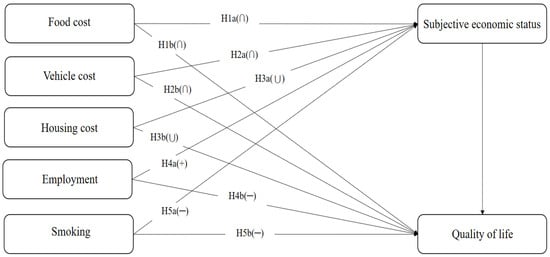
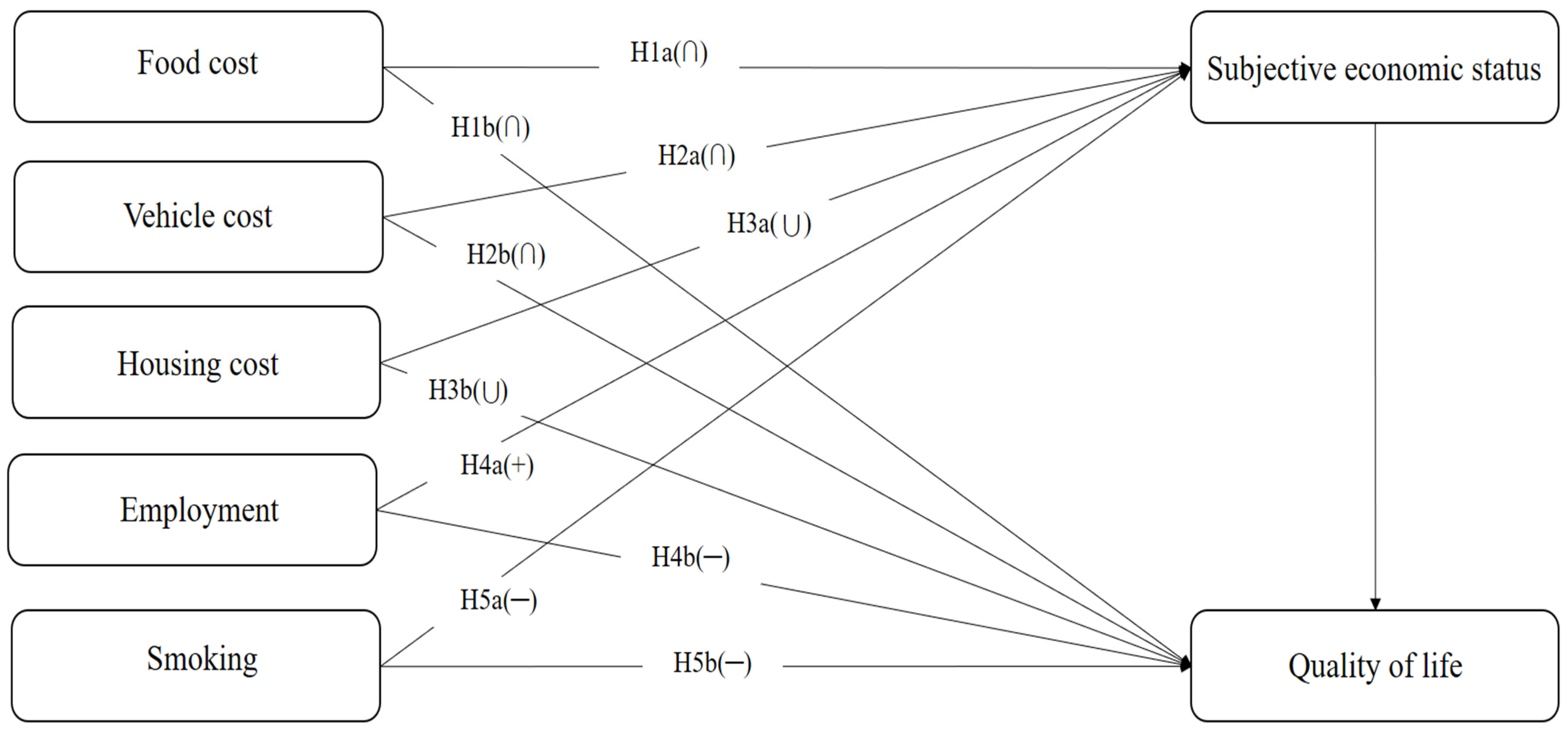
Figure 1 presents the research model. Subjective economic status is modeled as a function of food cost, vehicle cost, housing cost, employment, and smoking. Quality of life is modeled as a function of the same five variables together with subjective economic status. Food, vehicle, and housing costs are specified as curvilinear correlates of both outcomes. Employment is expected to relate positively to subjective economic status and negatively to quality of life, and smoking is expected to relate negatively to both. Subjective economic status is expected to relate positively to quality of life.
Figure 1.
Research model.
3.2. Measurement Description
Table 1 describes the variables. Quality of life (QOL) and subjective economic status (SES) were each measured on a 0–100 scale (0 = very poor, 100 = very good). Food cost (FCO), vehicle cost (VCO), and housing cost (HCO) were measured as monthly expenditures in Korean won (KRW). Employment (EMP) and smoking (SMO) were measured as binary variables (0 = no, 1 = yes). Age (AGE), sex (SEX), and household assets (HAS) were included as control variables. All monetary values are expressed in units of 10,000 KRW, which corresponds to approximately USD 7.1 at the exchange rate of KRW 1418 per USD as of August 2026.
Table 1.
Illustration of variables.
3.3. Data Collection and Analysis
This study used data from the Korean Longitudinal Study of Older Adults’ Employment (KLoEE), administered by the Korea Employment Information Service. The survey was designed to provide comprehensive data supporting the formulation and evaluation of employment policy for middle-aged individuals, specifically those born between 1964 and 1976. Although data collection commenced in 2021, the 2022 wave was the most recent and methodologically robust release available at the time of analysis and covered a broader set of variables; the 2021 wave contained a substantial number of missing values and was therefore unsuitable for the present analysis. The study consequently used the 2022 cross-sectional dataset, comprising 4392 observations.
The analysis proceeded in three stages. Descriptive statistics—means, standard deviations, minima, and maxima—were first computed to summarize the distribution of each variable. A correlation matrix was then constructed to assess the bivariate associations among the variables. Finally, the hypotheses were tested using multiple regression models estimated by ordinary least squares, with statistical significance evaluated at the 95% confidence level. Two models were estimated: Model 1 specified subjective economic status as the dependent variable, and Model 2 specified quality of life as the dependent variable, with subjective economic status entered as an additional regressor. Squared terms for food, vehicle, and housing costs were included in both models so that curvilinear associations could be examined, following the methodological guidance of Gujarati and Porter [55] and Wooldridge [56]. Age, sex, and household assets were included as control variables in both models. Turning points for the quadratic terms were derived analytically by taking the first derivative of the estimated equations with respect to the expenditure variable and setting it equal to zero.
4. Empirical Results
Table 2 summarizes the descriptive statistics. The mean scores for quality of life and subjective economic status were 64.00 and 58.88, respectively. Mean monthly expenditures were 66.27 for food, 25.84 for vehicles, and 24.34 for housing, in units of 10,000 KRW. The mean values of employment and smoking were 0.96 and 0.17, indicating that the great majority of respondents were employed and that roughly one in six was a smoker. Respondents averaged 51.18 years of age, 47% were male, and mean household assets were 42,386.05 in units of 10,000 KRW.
Table 2.
Results of descriptive statistics (n = 4392).
Table 3 reports the correlation matrix. Quality of life was positively correlated with subjective economic status, food cost, vehicle cost, housing cost, and household assets, and negatively correlated with smoking, age, and sex. Subjective economic status showed a similar pattern, correlating positively with the three expenditure variables, employment, and household assets, and negatively with smoking, age, and sex. The magnitudes of the correlations among the independent variables were modest, which suggests that multicollinearity was unlikely to distort the regression estimates.
Table 3.
Results of the correlation matrix.
Table 4 reports the regression results. Both models were statistically significant (Model 1: F = 68.93, p < 0.05, R2 = 0.1476; Model 2: F = 439.61, p < 0.05, R2 = 0.5464). In Model 1, in which subjective economic status was the dependent variable, food cost carried a positive linear coefficient and a negative squared coefficient, both significant, indicating an inverted U-shaped association. Vehicle cost followed the same pattern. Housing cost, by contrast, was negatively and linearly associated with subjective economic status, while its squared term was not significant, so the curvilinear specification was not supported in this case. Employment was positively associated with subjective economic status, and smoking was negatively associated with it. Among the control variables, household assets were positively associated with subjective economic status.
Table 4.
Results of hypothesis testing using multiple regression model.
In Model 2, in which quality of life was the dependent variable, vehicle cost carried a positive linear coefficient and a negative squared coefficient, both significant, again indicating an inverted U-shaped association. Neither food cost nor housing cost was significant in either its linear or its quadratic form. Employment and smoking were both negatively associated with quality of life, whereas subjective economic status was positively and substantially associated with it. Sex and household assets were also significant among the controls.
Turning points obtained by differentiating the estimated functions were located at 161.84 for food cost and 81.84 for vehicle cost in the subjective economic status model, and at 88.93 for vehicle cost in the quality-of-life model, all in units of 10,000 KRW. Below these levels, additional expenditure was associated with higher scores on the respective outcome; above them, the direction of the association reversed.
Taken together, H1a, H2a, H2b, H4a, H4b, H5a, H5b, and H6 were supported, whereas H1b, H3a, and H3b were not supported. The results therefore indicate that the curvilinear specification holds for food cost with respect to perceived economic standing and for vehicle cost with respect to both outcomes, but not for housing cost, and that employment, smoking, and perceived economic standing are associated with the two outcomes in the directions anticipated.
5. Discussion
This study examined how food expenditure, vehicle-related costs, housing expenses, employment, and smoking are associated with the subjective economic status and quality of life of middle-aged Koreans. Food expenditure exhibited an inverted U-shaped association with perceived economic standing: subjective economic status rose with food spending up to a turning point of 161.84 (10,000 KRW) and declined thereafter. The same pattern held for vehicle expenditure with respect to both outcomes, with turning points at 81.84 for subjective economic status and 88.93 for quality of life. These results are consistent with the argument that both insufficient and excessive expenditure correspond to less favorable evaluations, and that a moderate level of spending corresponds to the most favorable ones [13,21]. Food expenditure was not significantly associated with quality of life in either its linear or its quadratic form, which suggests that food spending is registered primarily in how individuals appraise their financial position rather than in their broader evaluation of life. Housing costs followed a different pattern. The quadratic term was not significant for either outcome, and the linear term was negatively associated with subjective economic status. Higher monthly housing expenditure therefore corresponded to a less favorable appraisal of one’s economic position, which is consistent with the housing cost burden literature [19,41]: for middle-aged households, housing outlays function largely as a fixed and non-discretionary obligation, so that a larger housing bill is experienced as pressure on the household budget rather than as an indicator of residential quality. The absence of a significant association with quality of life suggests that this pressure is registered in the financial domain specifically rather than diffusing into life evaluation as a whole.
Employment was positively associated with perceived economic standing but negatively associated with quality of life. This divergence suggests that, while participation in the labor market underwrites financial security, the experience of work itself co-occurs with psychological or physical burdens in this age group, in line with the literature on involuntary and burdensome employment [22,24,48]. Smoking was negatively associated with both outcomes, which may reflect the direct financial cost of tobacco consumption as well as the indirect costs associated with deteriorating health [26,51,52]. Finally, subjective economic status was positively associated with quality of life and was by a considerable margin the strongest correlate in Model 2, underscoring the centrality of perceived financial standing to life evaluation among middle-aged Koreans.
Considered against prior work, this study makes four observations. First, drawing on social determinants of health theory [13,14], it shows that expenditure on food and transportation is meaningfully associated with the life circumstances of middle-aged Koreans, and that these associations are curvilinear rather than monotonic. Second, the findings are consistent with prior arguments that labor participation improves economic conditions while simultaneously imposing a burden on the individual [22,24,25]. Third, the negative association between smoking and both perceived economic standing and quality of life corresponds with previous research on the financial dimension of smoking [51,52]. Fourth, the positive association between subjective economic status and quality of life lends support to studies identifying perceived economic condition as a correlate of a better life [11,53].
6. Conclusions
6.1. Theoretical and Policy Implications
This research offers several theoretical contributions. First, it identifies nonlinear associations between food and vehicle expenditure and individuals’ appraisals of their economic status and quality of life, contributing a more nuanced account of how levels of consumption relate to well-being among the pre-old cohort than a linear specification allows. It thereby demonstrates the explanatory reach of social determinants of health theory in a Korean middle-aged context. Second, it documents the divergent position of employment, which is linked to economic appraisal and to life evaluation in opposite directions, and thus complicates accounts that treat continued labor force participation as uniformly beneficial. Third, it shows that smoking is negatively associated with perceived economic standing as well as with quality of life, extending attention beyond the health consequences that dominate the existing literature.
The study also suggests several policy implications, which are offered tentatively given the correlational and cross-sectional nature of the analysis. Because food and vehicle costs were associated with the outcomes through significant quadratic terms, these implications concern the level at which expenditure occurs rather than the direction in which it should move; the turning points reported in Table 4 indicate the expenditure levels at which the direction of the association changes, and the present analysis does not establish that raising or lowering spending would alter either outcome. With respect to food, nutritional assistance measures such as food voucher programs may merit consideration as one means of supporting households whose grocery spending falls well below the observed turning point, although no such program was evaluated here. With respect to transportation, vehicle cost was the only expenditure category associated with both outcomes in the expected curvilinear form, so measures that reduce the cost of mobility—public transit subsidies among them—may be worth examining, together with attention to the accessibility and comfort of transport options for this age group. With respect to housing, the negative linear association with perceived economic standing is consistent with housing outlays operating as a budget constraint, which suggests that affordability-oriented measures rather than upgrading-oriented measures are the more appropriate object of policy attention; the mechanism behind this pattern, however, cannot be identified from the present data.
In the area of employment, respondents who were working reported higher subjective economic status but lower quality of life. This tension between the economic function of work and its non-economic costs suggests that the design of employment opportunities—compensation considered alongside physical and time demands—deserves attention in policy for this age group, although job characteristics were not measured in this study. Finally, smoking was negatively associated with both outcomes, so cessation support such as subsidized access to cessation services may merit attention. The present data cannot establish whether smoking precedes these outcomes or whether cessation would change them, and health outcomes were not examined directly.
6.2. Limitations and Suggestions for Future Research
Several limitations should be acknowledged. First, the study relied on archival survey data, and future research might combine this design with other modes of data collection, including observation and experiment. Second, the analysis was confined to middle-aged Koreans; because economic and social conditions vary across countries, future work might examine samples drawn from other geographic settings. Third, the factors that may be associated with the quality of life and subjective economic status of middle-aged adults extend well beyond the variables employed here, and future research would benefit from a broader and more diverse set of predictors. Fourth, and most importantly, the cross-sectional design cannot resolve the direction of the observed associations. Future research should therefore address the possibility of reverse causality—examining, for example, whether higher housing expenditure arises precisely because individuals hold a more favorable appraisal of their economic situation—and should consider longitudinal or quasi-experimental designs through which the direction of these associations can be clarified.
Author Contributions
Original draft, H.Y.; Review and editing, J.M.; writing. All authors have read and agreed to the published version of the manuscript.
Funding
This research received no external funding.
Institutional Review Board Statement
Not applicable. According to the exemption standard of Kangwon National University, ethical review and approval requirements for this study were waived due to the fact that this research used archival data.
Informed Consent Statement
Not applicable.
Data Availability Statement
The data used in this study are derived from the Korean Longitudinal Study of Older Adults’ Employment (KLOEE), a publicly available dataset. The original data presented in the study are openly available in https://survey.keis.or.kr/kloee/kloee010.jsp (accessed on 6 July 2026).
Conflicts of Interest
The authors declare no conflicts of interest.
References
- Statistics Korea. 2024 Statistics on the Aged; Statistics Korea: Daejeon, Republic of Korea, 2024. Available online: https://kostat.go.kr/board.es?mid=a20111030000&bid=11759&act=view&list_no=433631 (accessed on 24 January 2026).
- Waitzkin, H.; Britt, T.; Williams, C. Narratives of aging and social problems in medical encounters with older persons. J. Health Soc. Behav. 1994, 35, 322–348. [Google Scholar] [CrossRef] [Scilit]
- Gore, M.S. Studying problems of aging. Sociol. Bull. 1997, 46, 41–51. [Google Scholar] [CrossRef] [Scilit]
- Infurna, F.J.; Gerstorf, D.; Lachman, M.E. Midlife in the 2020s: Opportunities and challenges. Am. Psychol. 2020, 75, 470–485. [Google Scholar] [CrossRef] [Scilit] [PubMed]
- Sahraoui, M.; Borrell, A.; Laurent, M.; Hagège, M. Normative representations of aging in French public communication: A discourse analysis across levels of public action. J. Gerontol. B Psychol. Sci. Soc. Sci. 2026, 81, gbag069. [Google Scholar] [CrossRef] [Scilit] [PubMed]
- Costa, D.S.; Mercieca-Bebber, R.; Rutherford, C.; Tait, M.A.; King, M.T. How is quality of life defined and assessed in published research? Qual. Life Res. 2021, 30, 2109–2121. [Google Scholar] [CrossRef] [Scilit] [PubMed]
- Yonata, A.; Islamy, N.; Taruna, A.; Pura, L. Factors affecting quality of life in hemodialysis patients. Int. J. Gen. Med. 2022, 15, 7173–7181. [Google Scholar] [CrossRef] [Scilit] [PubMed]
- Buchcik, J.; Kovach, V.; Adedeji, A. Mental health outcomes and quality of life of Ukrainian refugees in Germany. Health Qual. Life Outcomes 2023, 21, 23. [Google Scholar] [CrossRef] [Scilit] [PubMed]
- Hsu, H.C. Trajectory of life satisfaction and its relationship with subjective economic status and successful aging. Soc. Indic. Res. 2010, 99, 455–468. [Google Scholar] [CrossRef] [Scilit]
- Wang, C.; Shen, J. How subjective economic status matters: The reference-group effect on migrants’ settlement intention in urban China. Asian Popul. Stud. 2023, 19, 105–123. [Google Scholar] [CrossRef] [Scilit]
- Kim, B.J.; Chen, L.; Xu, L.; Lee, Y. Self-rated health and subjective economic status in life satisfaction among older Chinese immigrants: A cross-sectional study. Healthcare 2021, 9, 342. [Google Scholar] [CrossRef] [Scilit] [PubMed]
- Du, H.; Huang, Y.; Ma, L.; Chen, X.; Chi, P.; King, R.B. Subjective economic inequality is associated with lower well-being through more upward comparison and lower trust. Appl. Psychol. Health Well-Being 2024, 16, 25–41. [Google Scholar] [CrossRef] [Scilit] [PubMed]
- Flaskerud, J.H.; DeLilly, C.R. Social determinants of health status. Issues Ment. Health Nurs. 2012, 33, 494–497. [Google Scholar] [CrossRef] [Scilit] [PubMed]
- Hahn, R.A. What is a social determinant of health? Back to basics. J. Public Health Res. 2021, 10, 2324. [Google Scholar] [CrossRef] [Scilit] [PubMed]
- Lee, J.H.; Ralston, R.A.; Truby, H. Influence of food cost on diet quality and risk factors for chronic disease: A systematic review. Nutr. Diet. 2011, 68, 248–261. [Google Scholar] [CrossRef] [Scilit]
- Glushakova, O.V.; Fadeikina, N.V. Food consumption as an indicator of the quality of life of the population in regions. Foods Raw Mater. 2016, 4, 171–180. [Google Scholar] [CrossRef] [Scilit]
- Hybel, J.; Mulalic, I. Transportation and quality of life: Evidence from Denmark. Transp. Res. A Policy Pract. 2022, 157, 107–125. [Google Scholar]
- Iamtrakul, P.; Chayphong, S.; Kantavat, P.; Hayashi, Y.; Kijsirikul, B.; Iwahori, Y. Exploring the spatial effects of built environment on quality of life related transportation by integrating GIS and deep learning approaches. Sustainability 2023, 15, 2785. [Google Scholar] [CrossRef] [Scilit]
- Shamsuddin, S.; Campbell, C. Housing cost burden, material hardship, and well-being. Hous. Policy Debate 2022, 32, 413–432. [Google Scholar] [CrossRef] [Scilit]
- Karimimansoob, V.; Mahdaviparsa, A.; Sadigh Sarabi, M.; Safaei-Mehr, M. Application of BIM in energy conservation in low-cost housing: A case study of the Dallas Independent School Residential District, Texas. Eur. Online J. Nat. Soc. Sci. 2024, 13, 188. [Google Scholar]
- Watt, R.G. Emerging theories into the social determinants of health: Implications for oral health promotion. Community Dent. Oral Epidemiol. 2002, 30, 241–247. [Google Scholar] [CrossRef] [Scilit] [PubMed]
- Kauhanen, M.; Nätti, J. Involuntary temporary and part-time work, job quality and well-being at work. Soc. Indic. Res. 2015, 120, 783–799. [Google Scholar] [CrossRef] [Scilit]
- Díaz, J.J.; Sánchez, A.; Diez-Canseco, F.; Miranda, J.J.; Popkin, B.M. Employment and wage effects of sugar-sweetened beverage taxes and front-of-package warning label regulations on the food and beverage industry: Evidence from Peru. Food Policy 2023, 115, 102412. [Google Scholar] [CrossRef] [Scilit]
- Yang, S.; Chen, L.; Bi, X. Overtime work, job autonomy, and employees’ subjective well-being: Evidence from China. Front. Public Health 2023, 11, 1077177. [Google Scholar] [CrossRef] [Scilit] [PubMed]
- Dupéré, V.; Beauregard, N.; Pelletier-Dumas, M.; Racine, É.; Tardif-Grenier, K. Employment wages and diseases of despair in early adulthood: Links through subjective socioeconomic status and cumulative stressor exposure. SSM Ment. Health 2024, 5, 100324. [Google Scholar] [CrossRef] [Scilit]
- Siahpush, M.; Borland, R.; Scollo, M. Smoking and financial stress. Tob. Control 2003, 12, 60–66. [Google Scholar] [CrossRef] [Scilit] [PubMed]
- Lima, M.G.; Borim, F.S.A.; de Azevedo Barros, M.B. Smoking and health-related quality of life (SF-36): A population-based study in Campinas, SP, Brazil. Health 2014, 6, 1539–1548. [Google Scholar]
- Alfaro-Navarro, J.L.; Lopez-Ruiz, V.R.; Huete-Alcocer, N.; Nevado-Peña, D. Quality of life in the urban context, within the paradigm of digital human capital. Cities 2024, 153, 105284. [Google Scholar] [CrossRef] [Scilit]
- Ma, D.; Ma, Y. The impact of the digital economy on quality of life: Empirical evidence from 220 cities in China. Digit. Policy Regul. Gov. 2025, 27, 404–421. [Google Scholar] [CrossRef] [Scilit]
- Burks, H.B.; des Bordes, J.K.; Chadha, R.; Holmes, H.M.; Rianon, N.J. Quality of life assessment in older adults with dementia: A systematic review. Dement. Geriatr. Cogn. Disord. 2021, 50, 103–110. [Google Scholar] [CrossRef] [Scilit] [PubMed]
- Fulmer, T.; Reuben, D.B.; Auerbach, J.; Fick, D.M.; Galambos, C.; Johnson, K.S. Actualizing better health and health care for older adults. Health Aff. 2021, 40, 219–225. [Google Scholar] [CrossRef] [Scilit] [PubMed]
- Aljahdali, A.A.; Na, M.; Leung, C.W. Food insecurity and health-related quality of life among a nationally representative sample of older adults: Cross-sectional analysis. BMC Geriatr. 2024, 24, 126. [Google Scholar] [CrossRef] [Scilit] [PubMed]
- Zhao, M.; Huang, C.C.; Mendoza, M.; Tovar, X.; Lecca, L.; Murray, M. Subjective socioeconomic status: An alternative to objective socioeconomic status. BMC Med. Res. Methodol. 2023, 23, 73. [Google Scholar] [CrossRef] [Scilit] [PubMed]
- Tavakoly Sany, S.B.; Aman, N.; Jangi, F.; Lael-Monfared, E.; Tehrani, H.; Jafari, A. Quality of life and life satisfaction among university students: Exploring subjective norms, general health, optimism, and attitude as potential mediators. J. Am. Coll. Health 2023, 71, 1045–1052. [Google Scholar] [CrossRef] [Scilit] [PubMed]
- Ilmakunnas, I.; Uotinen, J.; Vaalavuo, M. Association between age and subjective economic hardship across the income distribution in Europe. Soc. Indic. Res. 2024, 173, 523–542. [Google Scholar] [CrossRef] [Scilit]
- Darmon, N.; Drewnowski, A. Contribution of food prices and diet cost to socioeconomic disparities in diet quality and health: A systematic review and analysis. Nutr. Rev. 2015, 73, 643–660. [Google Scholar] [CrossRef] [Scilit] [PubMed]
- Birhanu, M.Y.; Osei-Amponsah, R.; Yeboah Obese, F.; Dessie, T. Smallholder poultry production in the context of increasing global food prices: Roles in poverty reduction and food security. Anim. Front. 2023, 13, 17–25. [Google Scholar] [CrossRef] [Scilit] [PubMed]
- Steg, L.; Gifford, R. Sustainable transportation and quality of life. J. Transp. Geogr. 2005, 13, 59–69. [Google Scholar] [CrossRef] [Scilit]
- Sun, H.; Jing, P.; Liu, Y.; Wang, D.; Wang, B.; Xu, M. The causal effect of private transport on life satisfaction among older adults and the mediation effect of social participation in China. Cities 2024, 148, 104865. [Google Scholar] [CrossRef] [Scilit]
- Streimikiene, D. Quality of life and housing. Int. J. Inf. Educ. Technol. 2015, 5, 140. [Google Scholar] [CrossRef] [Scilit]
- Acolin, A.; Reina, V. Housing cost burden and life satisfaction. J. Hous. Built Environ. 2022, 37, 1789–1815. [Google Scholar] [CrossRef] [Scilit] [PubMed]
- Jayasinghe, S. Social determinants of health inequalities: Towards a theoretical perspective using systems science. Int. J. Equity Health 2015, 14, 71. [Google Scholar] [CrossRef] [Scilit] [PubMed]
- Kerschbaumer, L.; Crossett, L.; Holaus, M.; Costa, U. COVID-19 and health inequalities: The impact of social determinants of health on individuals affected by poverty. Health Policy Technol. 2024, 13, 100803. [Google Scholar] [CrossRef] [Scilit]
- Luukinen, H.; Koski, K.; Kivelä, S.L.; Laippala, P. Social status, life changes, housing conditions, health, functional abilities and life-style as risk factors for recurrent falls among the home-dwelling elderly. Public Health 1996, 110, 115–118. [Google Scholar] [CrossRef] [Scilit] [PubMed]
- Forrest, R.; Wu, Y. People like us? Social status, social inequality and perceptions of public rental housing. J. Soc. Policy 2014, 43, 135–151. [Google Scholar] [CrossRef] [Scilit][Green Version]
- Jansen-van Vuuren, J.; Rijal, H.; Bobbette, N.; Lysaght, R.; Krupa, T.; Aguilar, D. Exploring the connection between social housing and employment: A scoping review. Int. J. Environ. Res. Public Health 2024, 21, 1217. [Google Scholar] [CrossRef] [Scilit] [PubMed]
- Lavetti, K. Compensating wage differentials in labor markets: Empirical challenges and applications. J. Econ. Perspect. 2023, 37, 189–212. [Google Scholar] [CrossRef] [Scilit]
- Albæk, K.; Andrade, S.B. Involuntary temporary work and mental health medications: A longitudinal study in Denmark. PLoS Glob. Public Health 2023, 3, e0002634. [Google Scholar] [CrossRef] [Scilit] [PubMed]
- Arruda, C.V.; Guilardi, I.J.; Pavan, L.M.C.; Greggianin, B.F. Oral health-related quality of life and periodontal status according to smoking status. Int. J. Dent. Hyg. 2024, 22, 368–375. [Google Scholar] [CrossRef] [Scilit] [PubMed]
- Halms, T.; Strasser, M.; Hasan, A.; Ruether, T.; Trepel, M.; Raab, S.; Gertzen, M. Smoking and quality of life in lung cancer patients: A systematic review. BMJ Support. Palliat. Care 2024, 13, e686–e694. [Google Scholar] [CrossRef] [Scilit] [PubMed]
- Madani, N.A.; Carpenter, D.O. Patterns of emergency room visits for respiratory diseases in New York state in relation to air pollution, poverty and smoking. Int. J. Environ. Res. Public Health 2023, 20, 3267. [Google Scholar] [CrossRef] [Scilit] [PubMed]
- Shi, X.; Yuan, W.; Cao, Q.; Cui, W. Education plays a crucial role in the pathway from poverty to smoking: A Mendelian randomization study. Addiction 2023, 118, 128–139. [Google Scholar] [CrossRef] [Scilit] [PubMed]
- Nutakor, J.A.; Zhou, L.; Larnyo, E.; Addai-Danso, S.; Tripura, D. Socioeconomic status and quality of life: An assessment of the mediating effect of social capital. Healthcare 2023, 11, 749. [Google Scholar] [CrossRef] [Scilit] [PubMed]
- Rajabi-Gilan, N.; Zardoshtian, S.; Sarabi, N.; Khezeli, M. The effect of work-family conflict, subjective socio-economic status, and physical activity on the perceived quality of life of working women in Iran: The mediating role of quality of work life. BMC Womens Health 2025, 25, 45. [Google Scholar] [CrossRef] [Scilit] [PubMed]
- Gujarati, D.; Porter, D. Basic Econometrics; McGraw-Hill: New York, NY, USA, 2009. [Google Scholar]
- Wooldridge, J. Introductory Econometrics: A Modern Approach; South-Western College Publishing: Cincinnati, OH, USA, 2009. [Google Scholar]

Disclaimer/Publisher’s Note: The statements, opinions and data contained in all publications are solely those of the individual author(s) and contributor(s) and not of MDPI and/or the editor(s). MDPI and/or the editor(s) disclaim responsibility for any injury to people or property resulting from any ideas, methods, instructions or products referred to in the content. |
© 2026 by the authors. Licensee MDPI, Basel, Switzerland. This article is an open access article distributed under the terms and conditions of the Creative Commons Attribution (CC BY) license.