


Abstract
This study examines how the ideal woman is discursively constructed and negotiated in contemporary Vietnamese online media amid globalisation and rapid social transformation. Using framing analysis, it examines recurring metaphors, catchphrases, depictions, exemplars, slogans and visual representations across a corpus of Vietnamese online texts concerning accomplished women, femininity, marriage and identity. The findings delineate three competing interpretive frames: (1) modernized traditional femininity, which reinterprets Confucian gender ideals through contemporary narratives of female empowerment; (2) relational negotiation, which situates women’s achievements by their impacts on heterosexual relations, emotional balance, and familial responsibilities; and (3) critical challenges to gender inequality, which questions restrictive gender norms, idealized femininity, and unequal relational expectations. Collectively, these frames demonstrate that contemporary media frequently portray women’s empowerment alongside persistent expectations of caregiving, emotional labor, and relational responsibilities. Building on these findings, functional persistence and relational negotiation are proposed as complementary analytical concepts for explaining how contemporary empowerment narratives accommodate and transform, rather than simply displace, traditional gender norms. The study contributes to sociological scholarship on gender discourse, media framing, and globalisation by demonstrating how competing representations of the ideal woman collectively shape a hybrid configuration of femininities in contemporary Vietnam.
1. Introduction
Over the past decades, globalisation, technological transformation, and gender-equality reforms have significantly expanded women’s opportunities in education, employment, and public life. Women’s educational attainment has increased substantially worldwide, with young women now participating in tertiary education at higher rates than men in many countries and gaining unprecedented access to elite universities [1,2]. These developments have contributed to the growing visibility of women in professional, political, and academic leadership, while women now constitute nearly half of the paid workforce in many societies [3,4,5]. However, despite these advances, women’s achievements continue to be evaluated through enduring cultural expectations surrounding femininity, intimate relationships, caregiving, and family responsibility. Instead of displacing traditional gender norms, the growing visibility of successful women has generated new tensions over how women’s success should be interpreted and socially negotiated. This tension is particularly evident in contemporary media discourse, where women’s success is simultaneously celebrated, questioned, and redefined through competing narratives of empowerment, relational responsibility, and gender equality.
Media discourse plays a central role in constructing and disseminating gender norms by shaping public understandings of appropriate identities, behaviours, and social expectations [6,7]. Rather than merely reflecting social reality, media actively participates in defining what constitutes an “ideal” woman through recurring representations of femininity, success, family life, and interpersonal relationships [8,9]. Through repeated narratives, media contributes to the formation and normalization of gendered expectations, influencing how women evaluate themselves and how they are evaluated by others [6,10]. As such, media functions not only as a channel of communication but also as a discursive institution through which cultural values are reproduced, negotiated, and occasionally contested [11]. This process is particularly significant in societies experiencing rapid social transformation, where global narratives of empowerment increasingly intersect with enduring cultural traditions.
Existing scholarship has extensively documented both the expansion of women’s educational and professional opportunities and the continuing influence of traditional gender norms. However, these two strands of research have largely developed in parallel. Comparatively less attention has been paid to how contemporary media discourse reconciles women’s empowerment with enduring expectations surrounding femininity, caregiving, and family responsibility. Likewise, although media studies have examined representations of women across different contexts, relatively few studies have explored how competing understandings of femininity are simultaneously negotiated within online media discourse under conditions of globalisation and rapid social transformation [8,12]. This limitation is particularly relevant in Vietnam, where global empowerment narratives increasingly intersect with Confucian cultural traditions and socialist gender ideals.
To address these gaps, this research examines the discourse on the ideal woman in Vietnamese media discourse using framing analysis. Instead of treating women’s empowerment and traditional femininity as opposing forces, the study investigates how these competing gender logics are simultaneously constructed and negotiated through media discourse. The analysis identifies three competing interpretive frames that collectively reveal how contemporary media reconstructs, negotiates, and challenges normative expectations of womanhood. Building upon these empirical findings, the study proposes the analytical concepts of relational negotiation and functional persistence to explain how traditional gender norms are discursively reinterpreted rather than simply maintained or replaced under conditions of globalisation.
Vietnam serves as an apt case study for investigating how gender norms are reconfigured under conditions of rapid socio-economic transformation and globalisation. The normative image of Vietnamese women has transformed over time. During the premodern period, Confucian principles prioritized the tứ đức—công, dung, ngôn, hạnh—as the ethical basis of femininity, assessing women’s worth through domestic competence, good speech, beauty, and moral conduct. Domestic labor, including serving spouses and caring for children and the elderly, rendered women largely dependent on men and reinforced gendered divisions of labour [13].
Throughout the wars of the 20th century, the roles of women significantly expanded. They were recruited not only as caregivers but also as laborers, warriors, and activists, epitomizing the archetype of the “heroic mother” and “revolutionary woman” who contributed to national liberation. This era signified a transition from exclusively domestic goals to collective and political engagement.
In modern Vietnam, globalisation and modernity have significantly altered expectations. Although Vietnam has achieved considerable progress in women’s education and labour force participation, gender equality continues to coexist with enduring expectations surrounding family responsibility and caregiving [14]. Women are increasingly celebrated for their independence, education, and professional achievements, yet longstanding cultural traditions of familial harmony and sacrifice continue to exert influence [15]. Gender inequality and gender-based violence continue to endure in various facets of social life [15]. The dichotomy of policy success and persistent inequality emphasises the necessity of understanding how the ideal woman is portrayed in public discourse and its effects on gender equality in Vietnam.
Examining contemporary Vietnamese online media discourse, this study aims to identify the dominant interpretive frames through which normative femininity is represented. A framing analysis of 469 online media texts (news articles and opinion pieces) retrieved through systematic Google searches from major Vietnamese news websites and magazines was conducted to identify the predominant themes concerning the normative image of women in current Vietnamese society. By examining how present-day Vietnamese online media constructs competing representations of ideal womanhood, the article contributes to sociological scholarship on gender discourse, media framing, and globalisation. More specifically, the study demonstrates how competing representations of femininity collectively construct a hybrid gender discourse that simultaneously reinterprets, negotiates, and contests traditional gender norms in contemporary Vietnam.
This article is organised as follows. Following the introduction, Section 2 reviews the theoretical background, and Section 3 outlines the research methodology. Section 4 presents the empirical findings. Section 5 interprets these findings through the concepts of functional persistence and relational negotiation while examining how globalisation, Confucian values, and different media discourses shape the modern construction of femininity in Vietnam. Section 6 concludes the paper.
2. Theoretical Background
To examine how the discourse on the ideal woman is constructed and negotiated in Vietnamese online media, this article draws upon three complementary theoretical approaches. First, theories of gender norms and femininity explain how women’s identities and social roles are socially constructed. Second, theories of globalisation and modernity emphasise a framework for understanding how transnational cultural flows reshape local gender norms. Third, framing theory offers an analytical approach to examining how media organise and communicate these competing meanings. Together, these perspectives provide an integrated theoretical foundation for analysing the negotiation of femininity in contemporary Vietnamese media.
2.1. Gender Norms and Femininity
The present study adopts the premise that femininity is socially constructed rather than biologically determined. This idea was initially expressed by Simone de Beauvoir in 1949 in her famous words, “One is not born, but becomes a woman.” [16]. This foundational insight was subsequently elaborated by West and Zimmerman (1987), who argued that femininity is an ‘accomplishment’ created and sustained through behaviour, language, and social customs [17]. According to Judith Butler (1990), gender performativity highlights femininity as a repetitive performance that produces the illusion of naturalness [18]. Scholars such as Goffman (1974) and Chodorow (1978) further exemplified how femininity is reinforced through media, familial structures, and daily social interactions [19,20]. Recent scholarship in gender studies increasingly conceptualizes femininity as a socially constructed and context-dependent phenomenon shaped by cultural, religious, and institutional norms [21]. This perspective provides the theoretical basis for examining how femininity is discursively negotiated within the contemporary Vietnamese media landscape. Through processes of socialisation, these norms become institutionalized and reproduced across everyday practices and social institutions [22,23].
Femininity is embedded within the broader system of gender roles, which are the societal constructions of the expected standards and behavior of individuals based on their assigned gender [24,25,26]. They represent femininity and masculinity and shape social identity. Even if women have more access to education and work, gender role norms continue to influence expectations of caring, emotional responsibility, and interpersonal behavior [27,28]. Traditional ideas of gender roles delineate the instrumental functions of males and the expressive functions of women [29]. They also differentiate between sex and gender, illustrating that women’s conventional roles in family and society are socially constructed [30]. Recent findings indicate that gender roles are universal yet contextually variable [31]. Digital media simultaneously empowers and perpetuates conventional female roles [32,33], as traditional gender roles evolve, reflecting the dynamic interaction between tradition and modernity, cultural identity, and global influence [34].
By situating femininity within the framework of gender roles, the analysis underscores how individual performances of identity are tied to larger social structures. Consequently, femininity is understood not as a fixed attribute but as a negotiated social position embedded within broader systems of gender expectations. This perspective provides the conceptual foundation for analysing how contemporary Vietnamese media redefine the ideal woman while simultaneously reproducing enduring normative expectations.
2.2. Modernity and Changing Gender Norms
In this research, modernity is understood not as a specific historical period but as an ongoing process of social, cultural, and institutional transformation associated with globalisation. Rather than engaging in debates over the historical origins of modernity or its relationship with postmodernity, the present study focuses on how modernity reshapes and reinterprets traditional gender norms in contemporary media discourse.
Femininity and gender norms are socially produced and hence change with globalisation-influenced social and cultural contexts. In this way, modernity has brought new cultural dynamics, economic frameworks, and global narratives that contest and transform conventional gender norms.
Berman (1982) and Giddens (1990) interpreted modernity as a synthesis of the deconstruction and rebuilding of tradition [35,36]. Accordingly, the present study understands modernity as a process of reinterpretation rather than replacement, whereby traditional gender norms are selectively adapted to new social and cultural conditions. Global interconnectedness and reflexivity drive alterations in social life. These perspectives highlight how global cultural flows and economic transformations disrupt and redefine gender roles and femininity, formerly established in local traditions. Bhabha (1994) proposed the word hybridity, arguing that modernity in postcolonial non-Western nations is inherently composite [37]. Recent works indicate that modernity manifests in various hybrid forms globally [38,39]. The modernization in Asia, particularly in China, is a confluence of Confucian heritage, state policy, and globalisation [40,41,42]. Connell and Pearse’s (2015) global view on gender, coupled with Moghadam’s (2005) analysis of transnational feminist networks, underscores that modernity theory posits globalisation as both an economic and cultural phenomenon, engendering new tensions and opportunities regarding gender norms [31,43]. Although some scholars argue that modernity cannot be separated from coloniality and its enduring power relations [44,45], this research adopts a sociological perspective that examines modernity primarily as a process of social and cultural transformation associated with globalisation and changing gender norms.
The transformation of gender norms in Vietnam should be understood within the country’s distinctive socio-cultural context. Rather than replacing traditional values, modernization has interacted with enduring Confucian ethics and socialist gender ideology to produce hybrid gender expectations [46]. Although women’s educational attainment, labour force participation, and public visibility have expanded substantially, Confucian ideals concerning family responsibility, moral conduct, and relational harmony continue to shape expectations of femininity in contemporary Vietnam [47]. Similarly, Hoang (2020) argues that Vietnam’s socialist gender regime promotes women’s public participation while simultaneously reaffirming women’s responsibilities within the family [14]. At the level of media discourse, Ha (2011) further demonstrates that Vietnamese media actively reproduce this dual ideology by celebrating women’s achievements alongside expectations of caregiving, morality, and family responsibility [48]. Collectively, these studies suggest that gender equality in Vietnam has largely been articulated through the reinterpretation, rather than the abandonment, of traditional gender ideals. This hybrid configuration provides the immediate socio-cultural context within which contemporary media negotiate competing expectations surrounding women’s success and femininity.
2.3. Framing Theory and Media Discourse
Having established how femininity is socially constructed and transformed under conditions of globalisation, the next step is to examine how these competing meanings are organized and communicated through media discourse. Goffman (1976) introduced the concept of “frames” as a technique to organize and understand information [49]. Entman (1993) articulately defined framing as the process of selecting and emphasizing specific aspects of reality to foster a particular viewpoint [50]. While Entman’s (1993) definition remains the conceptual foundation of framing analysis, subsequent scholarship has further developed framing as a dynamic process through which media construct, organize, and communicate social meanings [50,51,52,53].
Framing has been utilized to examine the media’s impact on social discourse as well as on politics and foreign policy [54,55]. According to a recent bibliometric analysis of framing research (Song, 2024), studies published between 2014 and 2023 increasingly focused on political communication, science communication, and social media as important contexts for constructing and disseminating narratives concerning gender, globalisation, and identity [56]. Framing mechanisms influence public views and cultural norms in various contexts, as demonstrated by Rooke’s (2021) examination of framing in alternative media coverage of the COVID-19 epidemic and Lundahl’s (2020) investigation of social media addiction [57,58]. In the present study, framing is employed as an analytical tool rather than as the primary theoretical framework. Although framing analysis identifies recurrent interpretive patterns within media texts, these patterns collectively constitute the broader discourse through which meanings about gender are produced and circulated.
Individual frames are understood as interpretive structures that collectively contribute to the construction of broader discourse. Here, discourse refers to a socially shared system of meanings through which particular understandings of women, femininity, and gender relations are produced, circulated, and normalized within media texts. Accordingly, recurrent interpretive patterns in media texts are examined to show how they collectively construct dominant ideals of femininity in contemporary Vietnam.
Taken together, these theoretical perspectives provide an integrated framework for examining how present-day Vietnamese online media construct the discourse of the ideal woman. Gender theory explains the normative foundations of femininity; theories of modernity account for the transformation and hybridization of these norms under globalisation; and framing analysis identifies the interpretive patterns through which these competing meanings are organized in media texts. By combining these perspectives, the study explains not only how media represent women’s success but also how traditional gender norms are simultaneously reproduced, negotiated, and reconfigured within contemporary Vietnamese society.
Previous studies have applied framing analysis to examine media representations of women, gender stereotypes, and gender equality across different cultural contexts. Other studies have investigated gender norms under globalisation or changing femininities. However, relatively few studies have integrated gender norms, theories of modernity, and framing analysis to examine how Vietnamese online media discourse simultaneously negotiates women’s empowerment and traditional femininity.
Against this background, examining how contemporary online media negotiate these overlapping normative expectations provides an important opportunity to understand the evolving discourse on the ideal woman in Vietnam.
3. Research Methodology
A qualitative content analysis approach was employed to examine online sources concerning normative constructions of ideal womanhood in contemporary media. Google was selected as the primary search engine because it is the most widely used online search platform in Vietnam and indexes a broad range of publicly accessible online sources, including newspapers, governmental websites, NGOs, business websites, blogs, forums, and academic publications [59,60]. This diversity enabled the collection of diverse public texts concerning representations of the ideal Vietnamese woman. Searches were conducted between 1 May and 31 July 2025 using Google’s default search environment. No anonymization procedures (e.g., incognito mode, VPN, or multiple IP addresses) were intentionally employed. The same search terms and procedures were consistently applied throughout the data collection period to maximize procedural consistency. The three-month period refers to the data collection window rather than the publication period of the retrieved texts.
To obtain a manageable and reasonably replicable corpus, only the first ten pages of Google search results were screened. These pages contain the most visible and publicly accessible results and therefore most closely reflect the information typically encountered by ordinary users. The study aimed to analyze publicly prominent representations rather than exhaustively archive all available webpages.
A document was included in the corpus if it appeared in search results for relevant keywords, was publicly available on the internet, and its content genuinely discussed the image/standards/qualities/roles of Vietnamese women, rather than merely mentioning them briefly. Duplicate or inaccessible URLs, as well as those containing only advertisements or irrelevant results and those that only mentioned the keyword but did not discuss the image of women, were removed.
Grounded in the historical ideals of công, dung, ngôn, and hạnh, the data collection explored how current representations of women reflect continuity and transformation in societal expectations. The search strategy followed a theory-informed deductive approach. Accordingly, the study adopted a directed qualitative content analysis (deductive coding), in which the Four Virtues served as the initial analytical categories, while the specific themes and interpretive meanings within each category were allowed to emerge inductively from the data [61]. The objective was not to identify all possible representations of women but to investigate how one of Vietnam’s most enduring normative frameworks of femininity—the Four Virtues—is reinterpreted in contemporary media discourse under conditions of globalisation and social change.
The initial search keywords were derived from the culturally established concept of the Four Virtues (công, dung, ngôn, hạnh), which has historically defined the normative ideal of Vietnamese womanhood. Based on preliminary search results, these keywords were iteratively refined into more specific contemporary expressions, such as “successful woman”, “the role of modern women”, “the beauty of modern women”, and “morality of modern women”. This deductive search strategy ensured conceptual continuity between the historical framework and its contemporary reinterpretations.
These search queries yielded 488 results. Subsequent to the elimination of 6 documents with broken links and 12 with irrelevant content, the sample comprised 469 items (Table 1).
Table 1.
Types of sources.
Based on the current literature regarding the four virtues of Vietnamese women, the author developed a coding scheme consisting of four predefined issue categories: competence, good communication, beauty, and moral conduct. During the coding process, pertinent sub-categories were recognised and integrated into the theme categories. Because the corpus consists of heterogeneous online texts, the author selected Gamson & Modigliani’s framing devices as a flexible and well-established analytical framework capable of identifying interpretive patterns across multiple genres of public communication [54]. The items in the article were classified into pertinent categories. The researcher documented the presence of an item inside a category only once, irrespective of its frequency in the articles; the coding process is presented in Figure 1. Throughout the coding process, analytical memos were maintained to document coding decisions, emerging interpretations, and theoretical reflections, thereby enhancing transparency and analytical consistency. Although coding was conducted by a single researcher, consistency was maintained through iterative coding, analytical memoing [62], and the systematic application of a predefined coding framework. Following coding, a content analysis was performed to identify the underlying frames. The initial percentages of the codes within each category were analyzed to identify the dominant codes. The examination of the prevailing codes within each category enables the discernment of the main themes of the text, which combined constituted the shared frame for each category. Frame construction was an interpretive rather than purely frequency-based process. Codes that repeatedly co-occurred and shared similar interpretive logic were grouped into broader themes, from which the three overarching frames were developed. Thus, frequencies informed—but did not determine—the final frame structure.
Figure 1.
Analytical procedure for developing interpretive frames.
Although the corpus included diverse source types (e.g., newspapers, governmental websites, business websites, and NGOs), all texts were analyzed using the same coding framework because the unit of analysis was the framing of normative femininity, rather than linguistic or stylistic differences between genres.
4. Framing the Ideal Woman in Contemporary Vietnamese Online Media
The analysis identified three competing interpretive frames through which Vietnamese media discourse negotiate dominant ideals of womanhood. Rather than representing isolated perspectives, these frames reveal different ways of negotiating femininity under conditions of social change. Frame 1 (Modernized Traditional Femininity) represents the dominant discourse; Frame 2 (Relational Negotiation) partially reinforces while extending this dominant logic; and Frame 3 (Critical Challenge to Gender Inequality) functions as a counter-discourse that questions the assumptions underlying the first two frames. This sequence reflects the analytical progression from dominant discourse to negotiated discourse and finally to counter-discourse, illustrating how normative expectations are simultaneously reproduced, adapted, and contested. For ease of presentation, these three interpretive frames are hereafter referred to as the Modernized Frame, the Relational Frame, and the Critical Frame.
4.1. Modernized Traditional Femininity: Reinterpreting the Four Virtues in Contemporary Vietnam
This Modernized Frame accounted for 52.1% of the corpus, making it the dominant interpretive frame. It was most frequently found in texts published by government agencies, non-governmental organisations, the Vietnam Women’s Union, mainstream newspapers and journals, corporate websites, media outlets (VOV), research publications, and dissertations, particularly around International Women’s Day (March 8) and Vietnamese Women’s Day (October 20). The discourse was articulated by a wide range of actors, including government officials, academics, journalists, business leaders, celebrities, and ordinary citizens, indicating that this framing circulated across multiple social domains rather than being confined to a single institutional voice.
The catchphrases “Công ngôn dung hạnh thời hiện đại” (The virtues of competence, beauty, communication, and conduct in the modern era) [63], “Công-Dung-Ngôn-Hạnh” của phụ nữ thời 4.0” (competence, beauty, communication, and moral conduct of women in the 4.0 era) [64] and “Tứ đức thời hiện đại” (four virtues in modern times) [65] summed up the frame. Exemplars of the ideal woman included female National Assembly members, female CEOs of enterprises [66,67], high-ranking members of the Communist Party of Vietnam, generals [68,69], professors and researchers [70,71,72], and leaders of mass organisations such as the Union of Women, Red Cross Association [73,74]. Only 25 of 244 texts referred to female workers, craftswomen or farmers, despite these groups representing a substantial proportion of Vietnam’s workforce. The coexistence of these catchphrases and exemplars illustrates how media discourse negotiates hybrid modernity, blending continuity with transformation in the construction of women’s identities.
Alongside celebrating women’s success in career and social life, more than half of the texts simultaneously highlighted women’s indispensable domestic roles. Dominant metaphors portrayed women as “women are the fire of family happiness” [74,75] and suggested that while men build houses, women build homes [76]. More than 80% of the texts further advised women to balance career success with family responsibilities, portraying the ideal wife as emotionally supportive, loyal, and responsible for maintaining family harmony.
Three other virtues were established concerning women’s emerging social responsibilities. Beauty was associated with professional competence by highlighting intrinsic qualities, health, and skill [77]. Contemporary beauty was increasingly associated with cosmetics, physical fitness, and spa therapies, whilst traditional beauty was esteemed for its capacity to harmonize modern and national aesthetics [78]. Narratives of empowered, educated women advancing their own development, with beauty metaphorically depicted as the ‘cultivation’ of both appearance and inner character, predominated this frame. Rather than replacing traditional beauty ideals, the discourse expanded them to incorporate education, health, and self-development, thereby redefining beauty as both external appearance and internal cultivation.
As women increasingly work outside the home, this frame emphasised communication in both family and public contexts. Women were depicted as confident, open, positive, and enthusiastic, with education and talent conveying civilized and sophisticated behavior [74,77]. While 18.7% of articles stressed traditional traits such as kindness and patience, nearly half highlighted modern styles of openness, intelligence, and confidence. Communication was therefore constructed less as obedience than as a form of relational competence that enables women to navigate both family and professional settings [64].
Moral conduct was framed as encompassing both traditional virtues—kindness, honesty, sincerity, generosity, and respect for elders—and more resilient qualities such as courage, perseverance, and decisiveness under pressure. The exemplary woman in Vietnam is characterized as knowledgeable, ethical, healthy, and accountable to herself, her family, society, and the nation, as articulated in some provincial periodicals representing provincial governments and the organisation of the Vietnam Fatherland Front Committee of Hanoi [79,80]. Closely tied to domestic roles, women were expected to care for children, respect and support husbands, and contribute to family and society, with devotion (tận tuỵ) and sacrifice often highlighted [81,82,83]. Although only 3% of sources explicitly mentioned ‘sacrifice,’ nearly 30% emphasised “đảm đang”, denoting women’s ability to balance household duties with professional work.
Taken together, these findings suggest that the Modernized Traditional Femininity frame does not reject the traditional Four Virtues but selectively reinterprets them to accommodate women’s expanding participation in education, employment, and public life. Rather than replacing traditional femininity, the discourse redefines its meanings so that women’s empowerment becomes legitimate only when it remains compatible with enduring expectations of caregiving, relational harmony, and moral responsibility. This selective representation narrows the public imagination of women’s success by privileging elite professional achievement while rendering the everyday economic contributions of working-class women largely invisible despite their substantial contribution to Vietnam’s economy. Women’s success is therefore recognised primarily through socially prestigious forms of achievement while remaining closely connected to expectations of caregiving, relational harmony, and moral responsibility.
Rather than positioning empowerment and longstanding Confucian femininity as mutually exclusive, this frame discursively reconciles them. Female achievement becomes legitimate insofar as it remains compatible with enduring expectations of compassion, humility, caregiving, and family commitment. Consequently, traditional femininity is not displaced but reconfigured through the reinterpretation of the Four Virtues, allowing multiple forms of femininity to coexist within contemporary Vietnamese media discourse.
This frame represents one form of hybrid femininity, in which traditional moral expectations are retained but selectively redefined to accommodate women’s expanding public participation.
4.2. Relational Negotiation Frame: Negotiating Women’s Happiness Through Relational Dependence
The Relational Negotiation frame accounted for 15.6% of the corpus, making it the second dominant interpretive frame. Whereas the Modernized Traditional Femininity frame legitimizes women’s public participation through reinterpreted traditional virtues, the Relational Negotiation frame shifts attention from women’s achievements themselves to the relational conditions under which those achievements become socially acceptable [84,85].
In total, 80.8% of the materials under this frame depicted women as emotional supporters, positioned subordinate to men. Through metaphors of life as external battles and spatial hierarchy, women were portrayed as kind, tender, and sensitive companions who provide comfort after men’s struggles [86]. Catchphrases such as “A wife is her husband’s companion” [67] directly affirmed women’s roles and reinforced social norms by repeating a simple, easily internalized definition. The metaphor ‘Behind every successful man is a woman who understands and sacrifices’ [87], utilized ‘behind-the-scenes’ imagery to convey a relationship of support and sacrifice, thereby generating symbolic depth, eliciting emotions, and validating dependence through visual language. Rather than depicting women as independent actors, these metaphors consistently positioned them as relational enablers whose value derived from supporting male achievement.
A total of 28.8% of the sources in this frame showed that women’s achievements and happiness were negotiated through male-centered expectations rather than individual autonomy. Catchphrases simplify the definition of women’s roles, whereas metaphors and evaluative slogans naturalize relational dependence. The characteristics attributed to the ideal woman were articulated as: “No matter how capable and successful a woman is, if she possesses these four traits, men will look down on her.” [88]. Even female beauty was framed through male evaluation. The catchphrase “How beautiful are women in the eyes of men?” [89] revealed a gendered hierarchy in which women appear as objects of assessment rather than independent subjects. Men were described as seeking social validation, while women’s fulfillment was framed as deriving from men’s appreciation [84]. Women’s success, therefore, remained contingent upon male recognition rather than women’s own self-definition.
This frame frequently portrayed successful women as a relational threat whose achievements were associated with family disruption, marital instability, and male insecurity [83]. Catchphrases like “Successful women make men feel insecure” [90], “Should you marry a successful woman?” [91], “The gaps surrounding strong, successful women” [92], “An intelligent man would never marry a successful woman” [93] and “Five reasons why men often avoid successful women” [94] portray successful women as discontented or unattractive, cautioning them about potential challenges in marriage.
In total, 27.4% of the sources analyzed the perceived ‘tragedy’ of successful women [92,95], highlighting obstacles such as difficulties in romantic relationships, concerns around childlessness, and marital dissolution. Certain sources regarded female achievement as an impediment to personal pleasure, urging women to embody gentleness and refinement while empathizing with men’s demands and accepting them as they are. A representative example is provided in the following excerpt:
A successful wife, one who earns a good living, needs to know how to behave so that her husband doesn’t feel inferior and can maintain family happiness. Because what men always need is to be appreciated by their wives. Don’t turn your husband into a fool when the woman always appears intelligent and sharp. Even if a man doesn’t do well or makes mistakes, encourage him instead of criticizing or judging him.[96]
The frame particularly claimed unhappy families resulted from accomplished women being excessively engrossed in their careers, hence ignoring their obligations to their spouses and offspring [97]. Women should therefore prioritize familial and spousal support. The frame also emphasised the career obstacles faced by female leaders, illustrating the notion of success as a sacrifice for women [98], and inquired about the type of support women require from their partners for their jobs [99].
Beyond regulating intimate relationships, some texts extended women’s relational responsibilities to the moral well-being of society as a whole: women not only as relational supporters of men but also as moral guardians of society. Warnings such as the morality of some Vietnamese women showing signs of deviation, with moral values eroding, causing public concern and negatively impacting social development. This highlights the urgent need to build a new morality and character for Vietnamese women. Statements such as “men build the world while women build people” [95] construct a gender complementarity ideology in which men occupy the public sphere while women are assigned responsibility for moral and familial development.
Based on the recurring patterns identified across the corpus, the second frame is conceptualized as Relational Negotiation. In this study, relational negotiation refers to the discursive process through which women’s growing autonomy is rendered socially acceptable by reconciling it with enduring expectations of caregiving, family harmony, emotional support, and relational responsibility. Rather than replacing traditional femininity, empowerment is negotiated within existing relational norms.
Consequently, professional achievement remains relationally conditioned rather than individually defined, positioning women’s value within emotional support, caregiving, and moral responsibility rather than autonomous accomplishment. Successful women were seen as “masculinizing” [84], showing gender role disruption. The emphasis here is that the frame not only said women supported men but also justified the difference in roles through the ideal of complementarity. These narratives collectively reinforce a gender order in which women’s happiness continues to be evaluated through relational dependence rather than independent achievement.
Taken together, these narratives redefine women’s empowerment as relational rather than individual. Professional achievement becomes legitimate only when it reinforces male confidence, family harmony, and heterosexual complementarity. Women’s happiness is therefore evaluated through relational dependence rather than autonomous accomplishment. These sources collectively construct a narrative in which women’s professional achievements are interpreted through their implications for heterosexual relationships. Other dimensions of intersectionality, including disability, ethnicity, sexuality, or age, did not emerge as meaningful themes within the analyzed corpus.
Unlike the Modernized Traditional Femininity frame, which expands traditional femininity to accommodate women’s public participation, the Relational Negotiation frame relocates analytical attention to the relational conditions that determine whether women’s achievements are socially legitimate. The central logic of this frame is that women’s success acquires legitimacy only through men’s recognition, emotional comfort, and relationship stability. By casting women as the emotional anchor of family life and the backdrop to male success, the discourse recentres women within domestic and relational roles despite their expanding participation in public life. This discourse was especially visible in texts published by the Vietnam Women’s Union and mainstream online newspapers around International Women’s Day (8 March) and Vietnamese Women’s Day (20 October), where celebrations of women’s achievements were consistently accompanied by reaffirmations of family responsibility and traditional gender expectations.
This frame therefore represents a second form of hybrid femininity, in which women’s empowerment is acknowledged but remains discursively conditional upon relational obligations and traditional gender complementarity.
4.3. Critical Challenge to Gender Inequality: Every Woman Should Be Her Own Most Beautiful Self
Unlike the preceding two frames, the Critical Challenge frame directly contests the legitimacy of traditional expectations surrounding marriage, caregiving, self-sacrifice, and ideal femininity. Rather than renegotiating these norms, it relocates the authority to define happiness, success, and femininity from society to women themselves.
Accounting for approximately one-third of the corpus, the Critical Challenge frame was primarily articulated through opinion articles published in mainstream online newspapers, personal blogs, and independent websites. The opinion articles included texts written by journalists, invited contributors, columnists, and readers contributing personal viewpoints through newspaper opinion sections. Unlike institutional media, these platforms primarily reflected individual interpretations rather than official or organizational positions.
Like the first two frames, the third also highlighted women’s evolving social roles as they joined the workforce and participated in social activities. Whereas the previous frames emphasised women’s roles as spouses and mothers and advocated for a happy work–family balance, 66.7% of the information in the third frame underlined the multiple pressures faced by contemporary Vietnamese women. Metaphors such as “difficult and misguided goals” [100] and “the dual burden” [101] were highlighted.
This frame explicitly denounced the notion that women should serve as both workplace warriors and proficient homemakers, all while adhering to societal expectations of beauty, behavior, and fashion [102]. Rather than celebrating women’s multiple roles, this frame portrayed them as a traditional trap that disproportionately burdened women with unpaid domestic labour [103]. Time constraints also reduced women’s income and limited their access to steady employment and continuous skill development compared to men, consequently reducing their economic prospects and influence within the household [101]. The frame thus prompted the inquiry of whether males can share domestic responsibilities with females, thereby facilitating women’s increased engagement in paid labor akin to that of men [97].
Diverging from the first frame, the challenge frame asserted that marriage is not the sole premise for women’s happiness and success. Marriage was therefore repositioned as one possible life choice rather than the defining criterion of female happiness. Only 11% of the content addressed notions of being a good mother or wife, while 61.5% emphasised the idea of being a good citizen. Ideal contemporary women were depicted as either enjoying fulfilling marriages or remaining single [104], with the notion that “marriage is not the entirety of life” [105]. Women were shown as self-assured, dynamic, graceful, skilled, and successful individuals [106]. The catchphrase “self-love” was frequently invoked, contrasting sharply with the term “devotion”/”thorough” in the two earlier frames, as it emphasised individuality independent of men. Women were cautioned:
Do not rely on others under any circumstances. You are the protagonist in your existence. Your destiny should not be contingent upon his actions, regardless of his kindness towards you. Should he depart one day, you must persist in enacting the drama of your life. Your deficiency lies solely in the ornate, exaggerated character; what you possess abundantly is the adulation emanating from your innermost self.[105]
Independence from male approval was portrayed as enabling women to develop confidence, challenge restrictive gender norms, and define themselves as autonomous individuals [106]. This point is illustrated in the following statement:
Women don’t need to wait until International Women’s Day to be loved. They deserve it every day…[107]
Beyond advocating autonomy, the frame also challenged perfectionism by portraying the pursuit of flawless femininity as a source of anxiety, exhaustion, and structural inequality [108]. The work–life balance trap negatively reinforces gender inequality by impacting women’s well-being through increased stress and time limits [88,102], while also intensifying their frustration [99].
Instead, contemporary narratives on the ideal woman highlight respect for individual diversity, asserting that feminine traits should not be treated as fixed standards [105,106,107,108,109]. More than half of its sources insisted that every woman should be unique. Depictions such as single, unique, one-of-a-kind, and financially independent were overwhelming [110]. As the excerpt illustrates, “The woman should break free from stereotypes, including the stereotype of “a successful woman” [96].
Common catchphrases included “unique personality”, “be yourself”, “live for herself” [111]; “your individuality”, “true to our personalities”, “confidently showcase your individuality”, “live the way you choose” [107]; and “to be the happiest”, “the proudest version of yourselves” [112]. Collectively, these catchphrases foreground individuality, authenticity, and self-expression, reflecting a discursive shift toward women’s right to define happiness and success on their own terms rather than through relational dependence. As one source emphasised, “We don’t have much time in our lives, so choose the way you feel most comfortable” [111], further reinforcing the idea that women’s fulfillment derives from self-determined choices rather than external validation.
Counter-discourses surrounding women’s beauty similarly rejected fixed aesthetic standards, which was illustrated in the following statements: “Every woman is the most beautiful version of herself” [108] and “A woman may not be very beautiful, but she must have its own unique characteristics” [105].
This change underscored the cultivation of a distinct mentality to foster a woman’s unique style, enabling her to radiate with confidence in her individuality rather than pursuing conventional aesthetic norms. The anti-stereotype was concomitant with anti-perfectionism. Instead of pursuing perfection or self-sacrifice [100], women were encouraged to embrace self-love [102], accept their own value, and resist the need for external validation [113]. Self-love is not selfishness, but rather the foundation upon which women spread love and live a meaningful life [102,107]. Success is redefined as the pursuit of goals that align with one’s own aspirations, regardless of scale, and valued through personal effort rather than extraordinary outcomes [114]. Happiness is no longer framed as a singular ideal confined to domestic harmony or professional achievement, but as a multifaceted experience derived from personal choices [100,114].
Taken together, this frame redefines women’s success as an expression of personal autonomy rather than relational obligation. Marriage, motherhood, beauty, and professional achievement are no longer presented as universal standards but as individual choices shaped by women’s own aspirations and life circumstances. Self-love, authenticity, and diversity become central principles through which women define happiness on their own terms.
More broadly, the frame signals a discursive shift away from defining women’s success through family harmony toward recognizing self-mastery, personal fulfillment, and individual agency. Success becomes grounded in women’s own aspirations rather than external expectations, directly challenging traditional gender norms.
The frame indicated a societal shift away from associating women’s happiness and success with family harmony defined by a satisfied spouse and contented children to a focus on social responsibility, signaling the rise in alternative gender norms. This redefinition of success—rooted in self-mastery and the pursuit of happiness according to individual standards—directly contests traditional expectations and validates women’s entitlement to define both achievement and identity independently of societal or relational limitations. Passion and personal fulfillment are highlighted as essential components of beauty and success, with happiness understood as living authentically, enjoying life, and making choices that reflect individual desires.
Unlike the first two frames, which reinterpret or negotiate traditional gender norms, the Critical Challenge frame openly contests their underlying assumptions. Rather than positioning women primarily as wives, mothers, or emotional supporters, it recognises them as autonomous individuals whose social value derives from their own choices rather than from relational responsibilities. Consequently, this counter-discourse constitutes the most explicit challenge to conventional gender norms identified across the corpus.
The comparison of the key features among the three frames is presented in Table 2.
Table 2.
The key features of the three frames.
5. Negotiating Female Ideals in Contemporary Vietnamese Society
The analysis identifies three competing interpretive frames through which Vietnamese media discourse constructs the ideal woman. Instead of representing mutually exclusive narratives, these frames collectively constitute a hybrid discursive formation in which women’s empowerment is simultaneously expanded, negotiated, and constrained. Together, these findings suggest that contemporary Vietnamese media increasingly accommodate women’s empowerment without fully relinquishing traditional expectations of caregiving and relational responsibility.
The results indicate that the Modernized Frame publicly recognises women’s expanding participation in education, employment, leadership, and public life while simultaneously continuing to associate female success with caregiving, family harmony, and moral responsibility. These findings correspond to the predominance of the Modernized Frame identified in the analyzed corpus. Rather than abandoning traditional femininity, this frame symbolically accommodates women’s public achievements within enduring expectations of relational responsibility.
The Modernized Frame operates through a subtle logic that reconciles women’s public achievements with traditional expectations of care and sacrifice. It legitimizes women’s dual burden not through explicit restrictions but by presenting caregiving as cultural authenticity and moral responsibility. In doing so, gender inequality is reproduced not through exclusion but through the normalization of complementary gender roles and symbolic recognition of women’s achievements. This pattern closely resembles what previous scholarship describes as soft patriarchy. Building on this insight, this article conceptualizes this adaptive continuity as functional persistence, whereby traditional gender norms retain legitimacy by adapting their discursive form while preserving their underlying normative logic in contemporary societies under globalisation [115].
Within the Relational Frame, women’s achievements are legitimized only when they reinforce family harmony, emotional caregiving, and relational responsibility. Women’s empowerment therefore remains conditional rather than autonomous. By framing female success and autonomy as potential threats to men’s security and intimate relationships, the discourse reasserts patriarchal norms by positioning men as the central beneficiaries of women’s emotional labor. Unlike the Modernized Frame, which recognises women’s public achievements while preserving traditional femininity, the Relational Frame places less emphasis on achievement itself than on the relational conditions under which such achievement becomes socially acceptable. This frame thus redefines the legitimacy of women’s success through relationships. Women’s empowerment is recognised but interpreted not as individual autonomy but as relational responsibility, where emotional support, caregiving, and the maintenance of marital stability remain central expectations.
Building on these findings, the concept of relational negotiation captures the discursive process through which women’s growing autonomy is continuously reconciled with traditional expectations of gender complementarity. The discourse conditions the legitimacy of female achievement on its ability to preserve men’s confidence, heterosexual relationships, and family cohesion. Empowerment is symbolically accommodated without fundamentally challenging the relational foundations of traditional gender norms. Consequently, women’s independence is acknowledged yet remains discursively embedded within emotional labor and relational obligations rather than being recognised as fully autonomous.
Taken together, the Modernized Frame and the Relational Frame reveal two complementary mechanisms through which traditional gender norms adapt to contemporary expectations of women’s empowerment. The Modernized Frame symbolically reconciles professional achievement with traditional femininity, whereas the Relational Frame redefines the legitimacy of women’s success through emotional labor, family harmony, and relational responsibility. The two frames should not be understood as contradictory discourses. Instead, they demonstrate how women’s empowerment is incorporated into existing gender norms through processes of adaptation and reinterpretation. More broadly, the analysis moves beyond identifying competing frames of the ideal woman by demonstrating how these frames collectively function as discursive mechanisms through which traditional gender norms are maintained, reconfigured, and contested in Vietnamese media discourse.
These findings also contribute to broader debates on globalisation and gender change. The coexistence of the two dominant frames indicates that gender norms evolve through continuous cultural adaptation rather than a linear transition from tradition to modernity [115]. In the Vietnamese context, empowerment discourses expand women’s educational and professional opportunities while simultaneously preserving expectations surrounding caregiving, family harmony, and emotional responsibility. Consistent with previous scholarship [33,116,117], empowerment therefore becomes incorporated into existing gender arrangements while leaving their underlying structure largely intact [118,119,120]. The present study extends this literature by showing how such adaptive processes operate through distinct interpretive frames in the contemporary Vietnamese media landscape.
The Critical Frame demonstrates that the persistence of traditional gender norms is neither complete nor uncontested. Instead, contemporary Vietnamese media represent a discursive arena in which traditional, negotiated, and counter-hegemonic understandings of femininity simultaneously compete for cultural legitimacy. Like the first two frames, the Critical Frame reflects changing gender norms, albeit through a different discursive logic. Its central contribution lies in shifting the focus from adapting traditional gender expectations to emphasizing individual self-determination. In doing so, it redefines women’s success in terms of autonomy, self-definition, and individual choice while simultaneously exposing traditional gender expectations as mechanisms of inequality. In doing so, the Critical Frame moves beyond adaptation by directly contesting the cultural legitimacy of conventional gender expectations and opening discursive space for alternative understandings of femininity.
This counter-hegemonic discourse reflects the growing circulation of global gender-equality discourses that emphasise individual autonomy, self-definition, diversity, and women’s rights. Within a society historically shaped by Confucian gender ethics and a socialist gender regime, the emergence of this frame suggests that global gender discourses are no longer external influences but have become part of domestic media discourse. These global narratives do not replace traditional gender ideals; instead, they coexist with them while exerting discursive pressure on the dominant interpretive frames. Its emergence may help explain why the two dominant frames increasingly incorporate the language of women’s empowerment while simultaneously preserving traditional relational expectations. Despite its relatively limited proportion within the corpus, the Critical Frame carries broader theoretical significance. These findings suggest that global gender-equality discourses emphasizing autonomy, self-definition, and individual rights have become part of contemporary Vietnamese media discourse. The Modernized and Relational Frames increasingly incorporate the language of women’s empowerment yet reinterpret it in ways that remain compatible with enduring expectations of family responsibility and relational harmony. This interaction among frames illustrates that gender norms are negotiated not only between tradition and modernity but also through ongoing competition among alternative interpretive frameworks.
The distribution of the three frames across the analyzed corpus provides further insight into the competing representations of women’s roles in the contemporary Vietnamese media landscape. The proportions of the Modernized Frame (52%), the Relational Frame (16%), and the Critical Frame (29%) in the corpus predominantly portray a hybrid model in which women are encouraged to be independent while continuing to fulfill family and relational responsibilities.
These findings are consistent with Hoang’s (2020) observation that gender equality in Vietnam has been articulated through a hybrid model in which women’s professional success remains closely intertwined with traditional domestic responsibilities [14]. Extending this insight, the analysis demonstrates how this hybrid gender model is discursively constructed and negotiated through three competing interpretive frames in the Vietnamese digital media sphere.
The coexistence of the three frames suggests that contemporary Vietnamese society is in a transitional phase and not moving linearly from tradition to modernity. Instead, empowerment discourses coexist with enduring cultural expectations, creating an ongoing process of negotiation over the meaning of women’s success. More broadly, identifying the three interpretive frames demonstrates how they collectively function as discursive mechanisms through which traditional gender norms are maintained, reconfigured, and challenged in Vietnam’s digital media environment (Figure 2). Taken together, these findings highlight that women’s empowerment is not simply accepted or rejected but continuously negotiated through competing interpretive frames.
Figure 2.
The Three-Frame Model of Hybrid Gender Discourse in Contemporary Vietnam.
Globalization appears to reconfigure traditional gender norms into more adaptive and symbolically egalitarian forms without fundamentally displacing them, as modernization theory often assumes [121], particularly in contexts shaped by Confucian values, where women are urged to embody autonomy while fulfilling relational obligations. This creates a constant negotiation between personal aspirations and cultural expectations. These findings further support the concept of functional persistence by showing that traditional gender norms endure through discursive adaptation rather than direct continuity. Women’s educational and professional achievements are increasingly celebrated, yet caregiving, sacrifice, and family harmony remain central evaluative standards. This recurring pattern illustrates continuity beneath changing symbolic representations.
The Vietnamese case illustrates that the persistence of traditional gender norms cannot be understood solely through Confucian legacies or globalisation alone. Rather, contemporary media discourse reflects the interaction between socialist gender ideology, Confucian cultural values, and the growing circulation of global gender-equality discourses. Consequently, traditional ideals are not abandoned but selectively reinterpreted through contemporary narratives of women’s empowerment.
The evidence further indicates that women’s empowerment is negotiated differently across media contexts. Institutional media continue to privilege relational and family-centered understandings of empowerment, whereas more individualized online media provide greater space for counter-hegemonic interpretations centered on autonomy and self-definition. Rather than representing a linear transition from tradition to modernity, these competing discourses coexist and continuously renegotiate the meaning of legitimate femininity (see Figure 2 and Table 2).
Taken together, these findings position Vietnamese media discourse not simply as sites that reflect gender norms but as active arenas in which the meaning of legitimate femininity is continuously produced and contested.
6. Conclusions
The analysis demonstrates that contemporary Vietnamese online media construct competing ideals of womanhood through three competing interpretive frames, revealing a hybrid configuration of femininities instead of reproducing a single dominant ideal. Although these frames differ in their understandings of women’s empowerment, they collectively illustrate that femininity is continually negotiated through the interaction between globalisation, Confucian gender norms, and contemporary media discourse. Taken together, these three interpretive frames constitute a hybrid configuration of femininities in which traditional, negotiated, and critical understandings of the ideal woman coexist within the same media landscape.
Beyond identifying three interpretive frames, the evidence explains how contemporary media reproduce, negotiate, and contest gender norms through competing discursive mechanisms. The concepts of functional persistence and relational negotiation explain how traditional gender expectations are strategically reconfigured within contemporary empowerment narratives rather than simply preserved or rejected. Furthermore, the findings further show that this variation, both across interpretive frames and media producers, highlights the institutional diversity of gender discourse in Vietnam.
This suggests that globalisation and tradition are best understood as mutually constitutive discursive resources through which women’s empowerment is simultaneously promoted, negotiated, and constrained.
The findings suggest that promoting gender equality requires more than increasing women’s public participation. Media organisations should diversify representations of women’s success beyond caregiving and family-centered ideals, while educational institutions can strengthen critical media literacy to help audiences recognise subtle forms of gender inequality. Policymakers should complement symbolic empowerment with structural reforms that redistribute care responsibilities and promote substantive gender equality. Understanding this dynamic is vital for designing strategies that move beyond individual adaptation towards structural transformation. These results underscore the need for critical counter-frames that challenge stereotypes, expose the mechanisms of traditional gender norms, and situate empowerment within collective and systemic agendas. By reframing happiness as self-realization and equality as a cultural as well as structural demand, such counter-frames can destabilize the subtle persistence of old gender norms and open pathways for transformative change across societies.
Ultimately, the ideal woman emerging from Vietnamese media discourse is best understood as a negotiated cultural construct through which gender norms are simultaneously maintained, reconfigured, and challenged. This dynamic provides a new perspective for understanding how gender orders persist under conditions of globalization and rapid social change.
Limitations and Future Research
Several limitations should be acknowledged when interpreting these findings. First, although the corpus comprised 469 online texts from diverse sources, it does not capture the full range of media discourse in Vietnam. Consequently, the identified frames should be understood as discursive patterns within the sampled texts rather than public or media portrayals.
Second, the coding process was conducted by a single researcher. This approach provided conceptual coherence in code, theme, and frame development, but also allowed interpretive subjectivity. To increase openness, the analysis included systematic coding, memoing, and specified coding criteria.
Third, because Google’s default search environment was used, algorithmic personalization may have affected search results. Therefore, although the same search strategy was applied, Google search results may not be reproducible. Furthermore, Google constantly modifies its search algorithms and ranking methods, so identical searches at different times may get different results.
Finally, the corpus included online publications, government websites, organisational websites, blogs, and personal opinions. To guarantee analytical consistency, all texts were evaluated using a common coding framework and framing devices; however, communicative aims, institutional contexts, and discursive producers may have affected frame expression and distribution.
Funding
This research received no external funding.
Institutional Review Board Statement
Not applicable.
Informed Consent Statement
Not applicable.
Data Availability Statement
The raw data supporting the conclusions of this article will be made available by the author upon reasonable request.
Conflicts of Interest
The author declares no conflicts of interest.
References
- UNESCO. Status and Trends of Women in Science: New Insights and Sectoral Perspectives 2025; UNESCO: Paris, France, 2025. [Google Scholar] [CrossRef]
- Gromkowska-Melosik, A. Femininity, Schooling and Social Expectations; Adam Mickiewicz University Press: Poznań, Poland, 2015. [Google Scholar]
- Gann, E.L.; Steil, J.M. Women in Leadership: Barriers and Opportunities; Routledge: New York, NY, USA, 2005. [Google Scholar]
- CWDI. Women Leading Fortune Global 500 Companies: Key Findings Report; Global Summit of Women: Istanbul, Türkiye, 2025; Available online: https://globewomen.org/globalsummit/wp-content/uploads/2025/07/2025-CWDI-Report-Global-Fortune-500-Companies-Key-Findings.pdf (accessed on 7 June 2026).
- Townsend, J. Women in Politics and Business: Global Perspectives; Palgrave Macmillan: London, UK, 2012. [Google Scholar]
- Liu, J.; Siegel, L.; Gibson, L.A.; Kim, Y.; Binns, S.; Emery, S.; Hornik, R.C. Toward an aggregate, implicit, and dynamic model of norm formation: Capturing large-scale media representations of dynamic descriptive norms through automated and crowdsourced content analysis. J. Commun. 2019, 69, 563–588. [Google Scholar] [CrossRef] [Scilit] [PubMed]
- Fadilah, R.; Zefrina, M.; Salma, U.; Ridho, K. Analisis efek media massa terhadap perubahan perilaku dan struktur nilai kultural di masyarakat. J.-KIs J. Komun. Islam 2025, 6, 41–54. [Google Scholar] [CrossRef] [Scilit]
- Raupach, T. Zwischen Sein und Sollen: Moderne Massenmedien als Agenturen Sozialer Ordnung; Schüren: Cambridge, UK, 2010. [Google Scholar] [CrossRef] [PubMed]
- Van Raemdonck, N. What Others Afford: Sociotechnical Shaping of Normative Processes on Social Media Platforms. Doctoral Dissertation, Vrije Universiteit Brussel, Ixelles, Belgium, Hasselt University, Hasselt, Belgium, 2025. [Google Scholar]
- Siegel, J.A.; Elbe, C.I.; Calogero, R.M. “It’s an ongoing process”: A qualitative analysis of men’s feminist identity growth. Psychol. Men Masculinities 2022, 23, 321. [Google Scholar] [CrossRef] [Scilit]
- Shakalov, I. Adaptive Situations in the Media Discourse of Youth Policy. Philol. Hum. 2024, 2, 152–169. [Google Scholar] [CrossRef] [Scilit]
- Jinia, N.J.; Asaduzzaman, M. Gender Inequality and Sustainable Development. In Reduced Inequalities; Springer International Publishing: Cham, Switzerland, 2021; pp. 279–289. [Google Scholar]
- Vo, D.V. Four important characteristics of women in Confucianism and its contribution to the implementation of gender equality in Vietnam. Conatus-J. Philos. 2024, 9, 283–302. [Google Scholar] [CrossRef] [Scilit]
- Hoang, L.A. The Vietnam Women’s Union and the Contradictions of a Socialist Gender Regime. Asian Stud. Rev. 2020, 44, 297–314. [Google Scholar] [CrossRef] [Scilit]
- Hien, V.T.; Tuan, N.M. Gender equality: Policy and the problems raised in Vietnam today. Glob. Acad. J. Humanit. Soc. Sci. 2022, 4, 157–161. [Google Scholar] [CrossRef] [Scilit]
- Beauvoir, S.D. The Second Sex; Gallimard: Paris, France, 1949. [Google Scholar]
- West, C.; Zimmerman, D.H. Doing gender. Gend. Soc. 1987, 1, 125–151. [Google Scholar] [CrossRef] [Scilit]
- Butler, J. Gender Trouble: Feminism and the Subversion of Identity; Routledge: Oxfordshire, UK, 1990. [Google Scholar]
- Goffman, E. Frame Analysis: An Essay on the Organization of Experience; Harvard University Press: Cambridge, MA, USA, 1974. [Google Scholar]
- Chodorow, N. The Reproduction of Mothering: Psychoanalysis and the Sociology of Gender; University of California Press: Oakland, CA, USA, 1978. [Google Scholar]
- Konstantinovskaia, N. The Language of Feminine Beauty in Russian and Japanese Societies; Springer: Berlin/Heidelberg, Germany, 2020. [Google Scholar]
- Fang, Z. Research on the femininity under social gaze. Commun. Humanit. Res. 2024, 47, 46–49. [Google Scholar] [CrossRef] [Scilit]
- Lind, A.; Gaytán, M.S. Femininities and masculinities. In The Blackwell Encyclopedia of Sociology; Wiley-Blackwell: Hoboken, NJ, USA, 2025; pp. 1–4. [Google Scholar] [CrossRef] [Scilit]
- Eagly, A.H. Sex Differences in Social Behavior: A Social-Role Interpretation; Erlbaum: Mahwah, NJ, USA, 1987. [Google Scholar]
- Hyde, J.S.; Else-Quest, N.M. Gender roles and gender differences. In Encyclopedia of Behavioral Medicine; Zimbardo, P.G., Ed.; Springer: Cham, Switzerland, 2013; pp. 821–823. [Google Scholar]
- Unger, R.K.; Crawford, M. Women and Gender: A Feminist Psychology; McGraw-Hill: Columbus, OH, USA, 1992. [Google Scholar]
- Kamyab, F.; Hoseinzadeh, A. The psychological impact of social expectations on women’s personal choices. Psychol. J. 2023, 4, 169–176. [Google Scholar] [CrossRef] [Scilit]
- Karupiah, P. The social construction of femininity: Identity, power, and resistance. In The Palgrave Handbook of Global Social Problems; Springer Nature Switzerland: Cham, Switzerland, 2025; pp. 1–12. [Google Scholar]
- Parsons, T.; Bales, R.F. Family, Socialization and Interaction Process; Free Press: Glencoe, IL, USA, 1955. [Google Scholar]
- Oakley, A. Sex, Gender and Society; Temple Smith: London, UK, 1972. [Google Scholar]
- Connell, R.W.; Pearse, R. Gender in World Perspective, 3rd ed.; Polity Press: Cambridge, UK, 2015. [Google Scholar]
- Gill, R. Gender and the Media: Feminist Perspectives in the Digital Age; Polity Press: Cambridge, UK, 2022. [Google Scholar]
- Banet-Weiser, S. Empowered: Popular Feminism and Popular Misogyny; Duke University Press: Durham, NC, USA, 2023. [Google Scholar]
- Lapanaphan, T.; Chinakkarapong, S. Gender roles and cultural expectations in contemporary Thai society. J. Soc. Sci. 2020, 48, 123–138. [Google Scholar]
- Berman, M. All That Is Solid Melts Into Air: The Experience of Modernity; Simon & Schuster: New York, NY, USA, 1982. [Google Scholar]
- Giddens, A. The Consequences of Modernity; Stanford University Press: Redwood City, CA, USA, 1990. [Google Scholar]
- Bhabha, H.K. The Location of Culture; Routledge: Oxfordshire, UK, 1994. [Google Scholar]
- Gaonkar, D.P. (Ed.) Alternative Modernities; Duke University Press: Durham, NC, USA, 2001. [Google Scholar]
- Eisenstadt, S.N. Multiple modernities. Daedalus 2000, 129, 1–29. [Google Scholar]
- Chang, H.-J. Bad Samaritans: The Myth of Free Trade and the Secret History of Capitalism; Bloomsbury Press: London, UK, 2007. [Google Scholar]
- Ong, A. Neoliberalism As Exception: Mutations in Citizenship and Sovereignty; Duke University Press: Durham, NC, USA, 2006. [Google Scholar]
- Rofel, L. Desiring China: Experiments in Neoliberalism, Sexuality, and Public Culture; Duke University Press: Durham, NC, USA, 2007. [Google Scholar]
- Moghadam, V.M. Globalizing Women: Transnational Feminist Networks; Johns Hopkins University Press: Baltimore, MD, USA, 2005. [Google Scholar]
- Quijano, A. Coloniality of power, Eurocentrism, and Latin America. Nepantla Views South 2000, 1, 533–580. [Google Scholar]
- Walsh, C.E. Shifting the geopolitics of critical knowledge: Decolonial thought and cultural studies “others” in the Andes. Cult. Stud. 2007, 21, 224–239. [Google Scholar] [CrossRef] [Scilit]
- Grosse, I. Gender values in Vietnam—Between confucianism, communism, and modernization. Asian J. Peacebuilding 2015, 3, 253–272. [Google Scholar] [CrossRef] [Scilit]
- Nizhnikov, S.A.; Pham, T.B. Gender issues in Confucian ethics in contemporary Vietnam. Rudn. J. Sociol. 2023, 23, 100–111. [Google Scholar] [CrossRef] [Scilit]
- Ha, N.T.T. Gender ideologies in the Vietnamese printed media. In Living with Patriarchy: Discursive Constructions of Gendered Subjects Across Cultures; Majstorović, D., Lassen, I., Eds.; John Benjamins: Amsterdam, The Netherlands, 2011; pp. 195–216. [Google Scholar]
- Goffman, E. Gender Advertisements; Harvard University Press: Cambridge, MA, USA, 1976. [Google Scholar]
- Entman, R.M. Framing: Toward clarification of a fractured paradigm. J. Commun. 1993, 43, 51–58. [Google Scholar] [CrossRef] [Scilit]
- Scheufele, D.A. Framing as a theory of media effects. J. Commun. 1999, 49, 103–122. [Google Scholar] [CrossRef]
- Druckman, J.N. On the limits of framing effects: Who can frame? J. Politics 2001, 63, 1041–1066. [Google Scholar] [CrossRef] [Scilit]
- Reese, S.D. The framing project: A bridging model for media research revisited. J. Commun. 2007, 57, 148–154. [Google Scholar] [CrossRef] [Scilit]
- Gamson, W.A.; Modigliani, A. Media discourse and public opinion on nuclear power: A constructionist approach. Am. J. Sociol. 1989, 95, 1–37. [Google Scholar] [CrossRef] [Scilit] [PubMed]
- Entman, R.M. Projections of Power: Framing News, Public Opinion, and U.S. Foreign Policy; University of Chicago Press: Chicago, IL, USA, 2003. [Google Scholar]
- Song, Q. Framing in media and communication studies: A bibliometric analysis. Insight—News Media 2024, 7, 45–62. [Google Scholar] [CrossRef] [Scilit]
- Rooke, M. Alternative media framing of COVID-19 risks. Curr. Sociol. 2021, 69, 529–547. [Google Scholar] [CrossRef] [Scilit]
- Lundahl, O. Media framing of social media addiction in the UK and the US. Int. J. Consum. Stud. 2020, 44, 552–560. [Google Scholar] [CrossRef] [Scilit]
- Similarweb. Top Search Engines Websites Ranking in Vietnam. 2026. Available online: https://www.similarweb.com/top-websites/vietnam/computers-electronics-and-technology/search-engines/ (accessed on 5 July 2025).
- Google. Year in Search 2025–Vietnam. 2025. Available online: https://trends.withgoogle.com/year-in-search/2025/vn/ (accessed on 5 July 2025).
- Hsieh, H.F.; Shannon, S.E. Three approaches to qualitative content analysis. Qual. Health Res. 2005, 15, 1277–1288. [Google Scholar] [CrossRef] [Scilit] [PubMed]
- Chametzky, B. Writing memos: A vital classic grounded theory task. Eur. J. Soc. Secur. 2023, 3, 39–43. [Google Scholar] [CrossRef] [Scilit]
- Ho, L. Nhung duc tinh va pham chat tot dep của nguoi phu nu van luon đuoc đe cao va coi trong [The Good Qualities and Virtues of Women Are Always Appreciated and Respected]. Available online: https://hcmcpv.org.vn/tin-tuc/nhung-duc-tinh va-pham-chat-tot-dep-cua-nguoi-phu-nu-van-luon-duoc-de-cao-va-coi-trong-1491875150 (accessed on 4 March 2025).
- Minh, N.T.Q. “Cong-Dung-Ngon-Hanh” cua phu nu thoi 4.0 [“Competence, Beauty, Communication, and Good Moral Conduct” of Women in the 4.0 Era]. Available online: https://khoahocphothong.vn/cong-dung-ngon-hanh-cua-phu-nu-thoi-4-0-252939.html (accessed on 4 October 2025).
- Minh, T. Phat huy tu duc cua phu nu ngay nay [Promoting the Virtues of Women Today]. Available online: https://giaoducthoidai.vn/phat-huy-tu-duc-cua-phu-nu-ngay-nay-post657634.html (accessed on 5 February 2025).
- TTXVN. Viet Nam: Nguoi “giu lua,” “kien tao” trong xa hoi hien dai [Vietnam: The “Keepers of the Flame,” the “Builders” in Modern Society]. Available online: https://baocaovien.vn/tin-tuc/phu-nu-viet-nam-nguoi-giu-lua-kien-tao-trong-xa-hoi-hien-dai/154292.html (accessed on 20 October 2025).
- Vietnambiz. Goc nhin ve vai tro cua phu nu trong xa hoi hien dai [A Perspective on the Role of Women in Modern Society]. Available online: https://vietnambiz.vn/goc-nhin-ve-vai-tro-cua-phu-nu-trong-xa-hoi-hien-dai-202322816467592.htm (accessed on 4 March 2025).
- Hanh, T.N. Đong gop cua phu nu Viet Nam qua gan 40 nam tien hanh cong cuoc doi moi [The Contributions of Vietnamese Women Over Nearly 40 Years of Implementing the Reform Process]. Available online: https://tapchicongsan.org.vn/web/guest/chinh-tri-xay-dung-dang/-/2018/996002/dong-gop-cua-phu-nu-viet-nam-qua-gan-40-nam-tien-hanh-cong-cuoc-doi-moi.aspx (accessed on 12 April 2026).
- Duyen, V. Vai tro va su menh cua phu nu Viet Nam trong ky nguyen moi [The Role and Mission of Vietnamese Women in the New Era]. Available online: https://www.bienphong.com.vn/vai-tro-va-su-menh-cua-phu-nu-viet-nam-trong-ky-nguyen-moi-post487428.html (accessed on 8 March 2026).
- Duyen, M.; TTXVN. Phu nu Viet Nam đong gop quan trong vao xay dung va phat trien đat nuoc. Available online: https://nvsk.vnanet.vn/phu-nu-viet-nam-dong-gop-quan-trong-vao-xay-dung-va-phat-trien-dat-nuoc-1-126393.vna (accessed on 19 October 2025).
- Le, N. Phu nu 4.0 qua goc nhin cua “phai dep” [Nha UEF [Women in the 4.0 Era: A Perspective from the ‘Fair Sex’ at UEF]. Available online: https://www.uef.edu.vn/tin-tuc-su-kien/phu-nu-4-0-qua-goc-nhin-cua-phai-dep-nha-uef-22457 (accessed on 19 October 2025).
- An, T.D.H. Vi the va vai tro cua phu nu Viet Nam trong su nghiep xay dung va phat trien dat nuoc [The Position and Role of Vietnamese Women in the Cause of National Construction and Development]. Available online: https://hcma3.hcma.vn/Pages/chi-tiet-tin.aspx?ItemID=40102 (accessed on 20 November 2025).
- Thai, D.; Sam, H. Vai tro nguoi phu nu trong xa hoi hien dai [The Role of Women in Modern Society]. Available online: https://sonlatv.vn/vai-tro-nguoi-phu-nu-trong-xa-hoi-hien-dai-23951.html (accessed on 19 October 2025).
- Khanh, M.; Khanh, H. Ve dep cua Phu nu trong the gioi hien dai [The Beauty of Women in the Modern World]. Available online: https://vtv.vn/doi-song/ve-dep-cua-phu-nu-trong-the-gioi-hien-dai-20241020104759743.htm (accessed on 19 October 2025).
- Huong, K. Cong dung ngon hanh la gi? ‘Tu duc’ cua phu nu xua va nay co gi khac biet? [What Are the Virtues of Diligence, Grace, Speech, and Conduct? How Do the “Four Virtues” of Women in the Past and Present Differ?]. Available online: https://voh.com.vn/song-dep/cong-dung-ngon-hanh-la-gi-436076.html (accessed on 12 June 2026).
- Quyết, N.T. Khang dinh vai tro, vi the cua phu nu trong xay dung, phat trien Thu do [Affirming the Role and Position of Women in Building and Developing the Capital City]. Available online: https://www.tapchicongsan.org.vn/web/guest/chinh-tri-xay-dung-dang/-/2018/863602/khang-dinh-vai-tro%2C-vi-the-cua-phu-nu-trong-xay-dung%2C-phat-trien-thu-do.aspx (accessed on 12 June 2026).
- Mai Han Group. Tieu chuan ve dep cua phu nu hien dai nam 2023, ban da biet chua? [Do You Know the Beauty Standards for Modern Women in 2023?]. Available online: https://thanhnien.vn/tieu-chuan-ve-dep-cua-phu-nu-hien-dai-nam-2023-ban-da-biet-chua-185230721172408989.htm (accessed on 28 May 2025).
- Chi, H. Su thay doi quan niem ve cai dep cua nguoi phu nu Viet [The Changing Perception of Beauty Among Vietnamese Women]. Available online: https://songtre.com.vn/su-thay-doi-quan-niem-ve-cai-dep-cua-nguoi-phu-nu-viet-p28904.html (accessed on 19 October 2025).
- Ngoc, L. Net dep cua phu nu hien dai [The Beauty of Modern Women]. Available online: https://baovinhlong.com.vn/xa-hoi/hon-nhan-gia-dinh/202203/net-dep-cua-phu-nu-hien-dai-3106420/ (accessed on 12 June 2026).
- Linh, T. Xay dung nguoi phu nu Viet Nam thoi dai moi: Goi mo nhieu giai phap [Building the Modern Vietnamese Woman: Suggesting Many Solutions]. Available online: https://vietnamnet.vn/xay-dung-nguoi-phu-nu-viet-nam-thoi-dai-moi-2085760.html (accessed on 19 October 2025).
- Lieu, N.Q.T. Phat huy pham chat “cong, dung, ngon, hanh” cua nguoi phu nu trong giai doan hien nay [Promoting the Virtues of “Diligence, Grace, Eloquence, and Conduct” of Women in the Present Era]. Available online: https://baophutho.vn/phat-huy-pham-chat-cong-dung-ngon-hanh-cua-nguoi-phu-nu-trong-giai-doan-hien-nay-138785.htm (accessed on 19 October 2025).
- Thi, L. Ve chuan muc nguoi phu nu Viet Nam thoi hien dai [Regarding the Standards of Vietnamese Women in Modern Times]. Available online: https://lyluanchinhtrivatruyenthong.vn/ve-chuan-muc-nguoi-phu-nu-viet-nam-thoi-hien-dai-p24519.html (accessed on 25 May 2025).
- Anh, N. Phu nu hien dai hay luon no luc trang bi tri thuc cho minh [Modern Women Should Always Strive to Equip Themselves with Knowledge]. Available online: https://ttdn.vn/hoi-nhap-va-phat-trien/van-hoa-xa-hoi/phu-nu-hien-dai-hay-luon-no-luc-trang-bi-tri-thuc-cho-minh-68366 (accessed on 28 May 2025).
- Cau, N. Nu doanh nhan thanh dat: Giau tien hiem con [Successful Businesswoman: Rich but Childless]. Available online: https://nld.com.vn/tinh-yeu-hon-nhan/nu-doanh-nhan-thanh-dat-giau-tien-hiem-con-92798.htm (accessed on 19 October 2025).
- Huy, L. Neu mot ngay vang bong phu nu, am ap co con? [If One Day Women Were Absent, Would the Warmth Still Remain?]. Available online: https://tuoitre.vn/neu-mot-ngay-vang-bong-phu-nu-am-ap-co-con-20250304150813667.htm (accessed on 15 February 2026).
- Thanh, A. 4 duc tinh cua phu nu luon khien nguoi ta danh gia cao [4 Qualities of Women That Are Always Highly Appreciated]. Available online: https://kenh14.vn/4-duc-tinh-cua-phu-nu-luon-khien-nguoi-ta-danh-gia-cao-20220927093952348.chn (accessed on 30 October 2025).
- Huong, N. Nguoi phu nu hien dai giup chong thanh cong [Modern Women: Supporting Their Husband’s Success]. Available online: https://vhds.baothanhhoa.vn/nguoi-phu-nu-hien-dai-giup-chong-thanh-cong-32630.htm (accessed on 10 February 2026).
- Anh, N. Phu nu gioi giang thanh cong may nhung co 4 tinh nay se khien dan ong “coi thuong” [No Matter How Capable and Successful a Woman Is, if She Possesses These Four Traits, Men Will “Look Down” on Her]. Available online: https://cafef.vn/phu-nu-gioi-giang-thanh-cong-may-nhung-co-4-tinh-nay-se-khien-dan-ong-coi-thuong-188230826073843962.chn (accessed on 19 October 2025).
- Chau, M. Phu nu dep the nao trong mat cac ‘nam nhan’? [How Beautiful Are Women in the Eyes of Men?]. Available online: https://baophapluat.vn/phu-nu-dep-the-nao-trong-mat-cac-nam-nhan-post468719.html (accessed on 10 February 2026).
- GiadinhNet. Kieu dan ong ma nhieu phu nu thanh dat lua chon de lay, trai nguoc voi nhung gi moi nguoi nghi [The Type of Man Many Successful Women Choose to Marry Is the Opposite of What People Think]. Available online: https://giadinh.suckhoedoisong.vn/kieu-dan-ong-ma-nhieu-phu-nu-thanh-dat-lua-chon-de-lay-trai-nguoc-voi-nhung-gi-moi-nguoi-nghi-172220723170051518.htm (accessed on 1 August 2025).
- Anh. Co nen cuoi nguoi phu nu thanh dat? [Should You Marry a Successful Woman?]. Available online: https://vnexpress.net/co-nen-cuoi-nguoi-phu-nu-thanh-dat-3153580.html (accessed on 10 February 2026).
- Tam, T. Nhung khoang trong quanh nguoi phu nu nghi luc, thanh dat [The Gaps Surrounding the Image of a Strong, Successful Woman]. Available online: https://phunuvietnam.vn/nhung-khoang-trong-quanh-nguoi-phu-nu-nghi-luc-thanh-dat-20241105162500863.htm (accessed on 10 August 2025).
- Ha, N. Nhung chuyen kho ngo ve phu nu thanh dat [Unexpected Stories About Successful Women]. Available online: https://congluan.vn/nhung-chuyen-kho-ngo-ve-phu-nu-thanh-dat-10008163.html (accessed on 1 August 2025).
- Hoa, T.T. 5 ly do khien dan ong hay ne phu nu thanh dat [5 Reasons Why Men Tend to Avoid Successful Women]. Available online: https://www.phunuonline.com.vn/5-ly-do-khien-dan-ong-hay-ne-phu-nu-thanh-dat-a1478624.html (accessed on 1 August 2025).
- Pirago. Bi kich cua phu nu thanh dat [The Tragedy of Successful Women]. 21 November 2021. Available online: https://blog.pirago.vn/bi-kich-cua-phu-nu-hien-dai/ (accessed on 1 August 2025).
- Huong, D. Phu nu thanh dat trong mat ai? [In Whose Eyes Are Women Considered Successful?]. Available online: https://baophapluat.vn/phu-nu-thanh-dat-trong-mat-ai-post320579.html (accessed on 21 September 2025).
- Nghi, T. Phu nu thanh cong, bao gio hanh phuc? [When Do Successful Women Find Happiness?]. Available online: https://tuoitre.vn/phu-nu-thanh-cong-bao-gio-hanh-phuc-20210709235325401.htm (accessed on 10 July 2025).
- Phu, V. Nhung rao can su nghiep cua nha lanh dao nu [Career Barriers for Female Leaders]. Available online: https://vietnamnet.vn/nhung-rao-can-su-nghiep-cua-nha-lanh-dao-nu-2183826.html (accessed on 10 July 2025).
- Linh, N. De thanh cong, phu nu can ban doi ung ho su nghiep nhu the nao? Available online: https://getflycrm.com/nguoi-phu-nu-can-ban-doi-ung-ho-su-nghiep-nhu-nao/ (accessed on 21 September 2025).
- Duong, M. Nhung nguoi phu nu hanh phuc va thanh cong nhat quan diem khac biet ra sao ve cuoc song? [How Do the Happiest and Most Successful Women Differ in Their Perspectives on Life?]. Available online: https://cafebiz.vn/nhung-nguoi-phu-nu-hanh-phuc-va-thanh-cong-nhat-quan-diem-khac-biet-ra-sao-ve-cuoc-song-20211019002840428.chn (accessed on 21 September 2025).
- Quynh, T. Dieu gi co loi cho ca 2 gioi [What Benefits Both Genders?]. Available online: https://tiasang.com.vn/dieu-gi-co-loi-cho-ca-hai-gioi-4970728.html (accessed on 1 August 2025).
- Thinh, T. Khi chat: Ve dep va suc manh rieng cua nguoi phu nu [Charisma: The Unique Beauty and Strength of a Woman]. Available online: https://dantri.com.vn/doi-song/khi-chat-ve-dep-va-suc-manh-rieng-cua-nguoi-phu-nu-20250304105219344.htm (accessed on 15 June 2025).
- Hong, K.T. TS Khuat Thu Hong: “Sau khi nghe ve tam tong, tu duc, toi buon lang di…” [Dr. Khuất Thu Hồng: “After Hearing About the Three Obediences and Four Virtues, I was Silently Saddened…”]. Available online: https://viettimes.vn/ts-khuat-thu-hong-sau-khi-nghe-ve-tam-tong-tu-duc-toi-buon-lang-di-post139476.html (accessed on 15 June 2025).
- Ngoc, M. 5 dac diem cua nguoi phu nu thanh dat va cuoc song hanh phuc [5 Characteristics of Successful Women and Happy Lives]. Available online: https://phunutoday.vn/5-dac-diem-cua-nguoi-phu-nu-thanh-dat-va-cuoc-song-hanh-phuc-d222237.html (accessed on 15 June 2025).
- Lien, P. 9 dieu nen co o mot phu nu hien dai thong minh [What a Smart, Modern Woman Should Possess]. Available online: https://thaihabooks.com/blogs/cam-hung/9-dieu-nen-co-o-mot-phu-nu-hien-dai-thong-minh (accessed on 3 June 2025).
- Vu, A. Phu nu hien dai–vuot qua dinh kien gioi de khang dinh vi the chinh minh [Modern Women—Overcoming Gender Stereotypes to Assert Their Own Position]. Available online: https://tamlynhc.vn/phu-nu-hien-dai-vuot-qua-dinh-kien-gioi-de-khang-dinh-vi-the-chinh-minh-1951.html (accessed on 26 July 2025).
- Miên, M. Phu nu hien dai: Doc lap tai chinh, yeu thuong va dau tu cho ban than [Modern Women: Financial Independence, Self-Love, and Personal Investment]. Available online: https://tuoitre.vn/phu-nu-hien-dai-doc-lap-tai-chinh-yeu-thuong-va-dau-tu-cho-ban-than-20250303191014279.htm (accessed on 10 February 2026).
- Thanh, P. Moi nguoi phu nu la mot ban the dep nhat cua rieng minh [Every Woman Is Her Own Most Beautiful Self]. Available online: https://tuoitrethudo.vn/moi-nguoi-phu-nu-la-mot-ban-the-dep-nhat-cua-rieng-minh-218967.html (accessed on 8 June 2025).
- Talentbold. Cach can bang cuoc song cua nguoi phu nu thanh dat [How Successful Women Balance Their Lives]. Available online: https://talentbold.com/cach-can-bang-cuoc-song-cua-nguoi-phu-nu-thanh-dat-718-ns (accessed on 10 February 2026).
- Ha, T. Phu nu cang song cang co gia tri thuong so huu 5 dieu nay trong cot cach, nho vay moi day khi chat hon nguoi [Women Who Grow More Valuable over Time Often Possess These 5 Traits, Which Make Them Truly Charismatic]. Available online: https://soha.vn/phu-nu-cang-song-cang-co-gia-tri-thuong-so-huu-5-dieu-nay-trong-cot-cach-nho-vay-moi-day-khi-chat-hon-nguoi-198240415101046887.htm (accessed on 10 February 2026).
- Vietnam, Y. Xem ngay 10 dau hieu ban co phai hinh mau nguoi phu nu hien dai khong [10 Signs You Might Be the Model of a Modern Woman]. Available online: https://yuanta.com.vn/tin-tuc/xem-ngay-10-dau-hieu-ban-co-phai-hinh-mau-nguoi-phu-nu-hien-dai-khong (accessed on 21 September 2025).
- Lam, T. Phu nu muon xinh dep thi to son, muon hanh phuc phai yeu lay minh [Women Who Want to Be Beautiful Wear Lipstick; Women Who Want to Be Happy Must Love Themselves]. Available online: https://laodong.vn/gia-dinh-hon-nhan/phu-nu-muon-xinh-dep-thi-to-son-muon-hanh-phuc-phai-yeu-lay-minh-1497914.ldo (accessed on 15 February 2026).
- Le, A. Hanh phuc cua nguoi phu nu hien dai [The Happiness of a Modern Woman]. Available online: https://www.qdnd.vn/van-hoa/doi-song/hanh-phuc-cua-nguoi-phu-nu-hien-dai-818763 (accessed on 28 May 2025).
- Anh, N.T.P. Phu nu thanh cong-Cau chuyen thien chuc va doat lay vuong mien [Successful Women-Stories of Mission and Claiming the Crown]. Available online: https://timviec365.vn/blog/phu-nu-thanh-cong-cau-chuyen-thien-chuc-va-doat-lay-vuong-mien-new13908.html (accessed on 12 January 2026).
- Berry, J.W. Immigration, acculturation, and adaptation. Appl. Psychol. 1997, 46, 5–68. [Google Scholar] [CrossRef] [Scilit]
- Gill, R. Postfeminist media culture: Elements of a sensibility. Eur. J. Cult. Stud. 2007, 10, 147–166. [Google Scholar] [CrossRef] [Scilit]
- McRobbie, A. The Aftermath of Feminism: Gender, Culture and Social Change; Sage: London, UK, 2009. [Google Scholar]
- Lwamba, E.; Shisler, S.; Ridlehoover, W.; Kupfer, M.; Tshabalala, N.; Nduku, P.; Langer, L.; Grant, S.; Sonnenfeld, A.; Anda, D.; et al. Strengthening women’s empowerment and gender equality in fragile contexts. Campbell Syst. Rev. 2022, 18, e1231. [Google Scholar] [CrossRef] [Scilit]
- UN Women. Addressing Social Norms in the Pursuit of Gender Equality and Women’s Empowerment; ALiGN: New York, NY, USA, 2025. [Google Scholar]
- Inglehart, R.; Norris, P. Rising Tide: Gender Equality and Cultural Change Around the World; Cambridge University Press: Cambridge, UK, 2003. [Google Scholar]
- Sam, D.L.; Berry, J.W. Acculturation: When individuals and groups of different cultural backgrounds meet. Perspect. Psychol. Sci. 2010, 5, 472–481. [Google Scholar] [CrossRef] [Scilit] [PubMed]
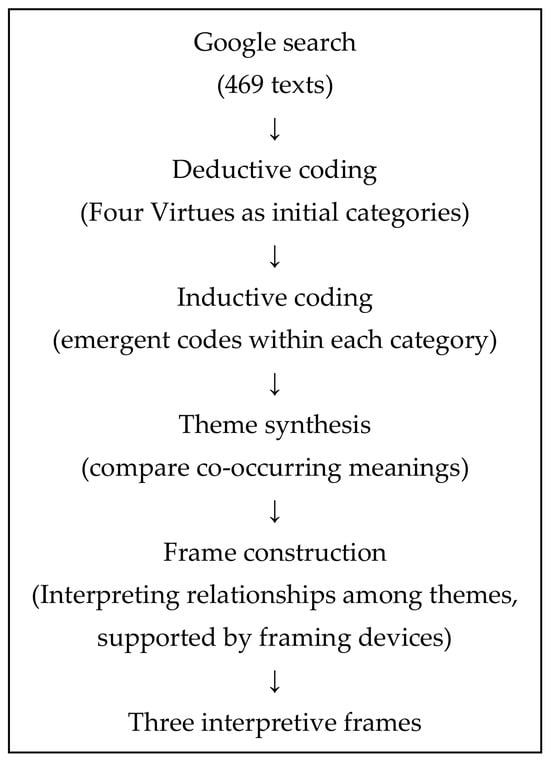
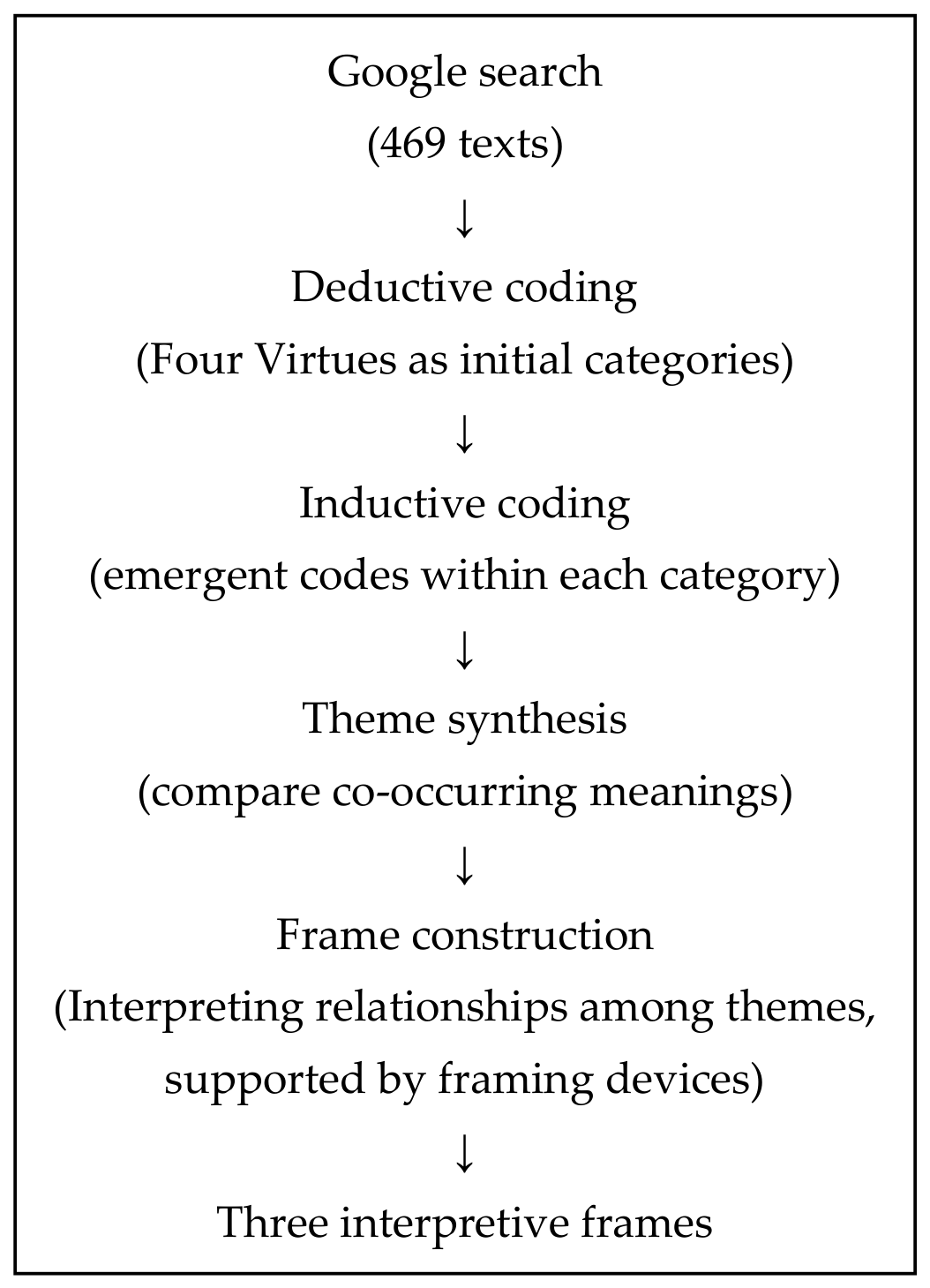
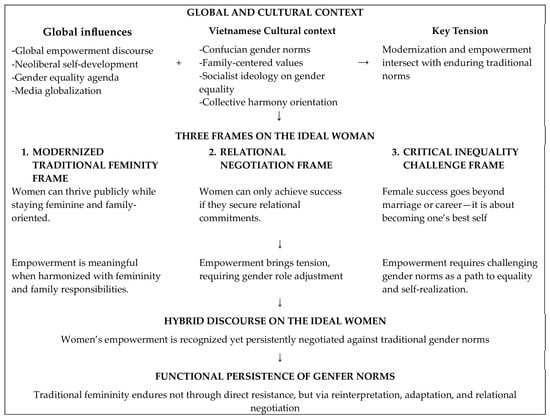
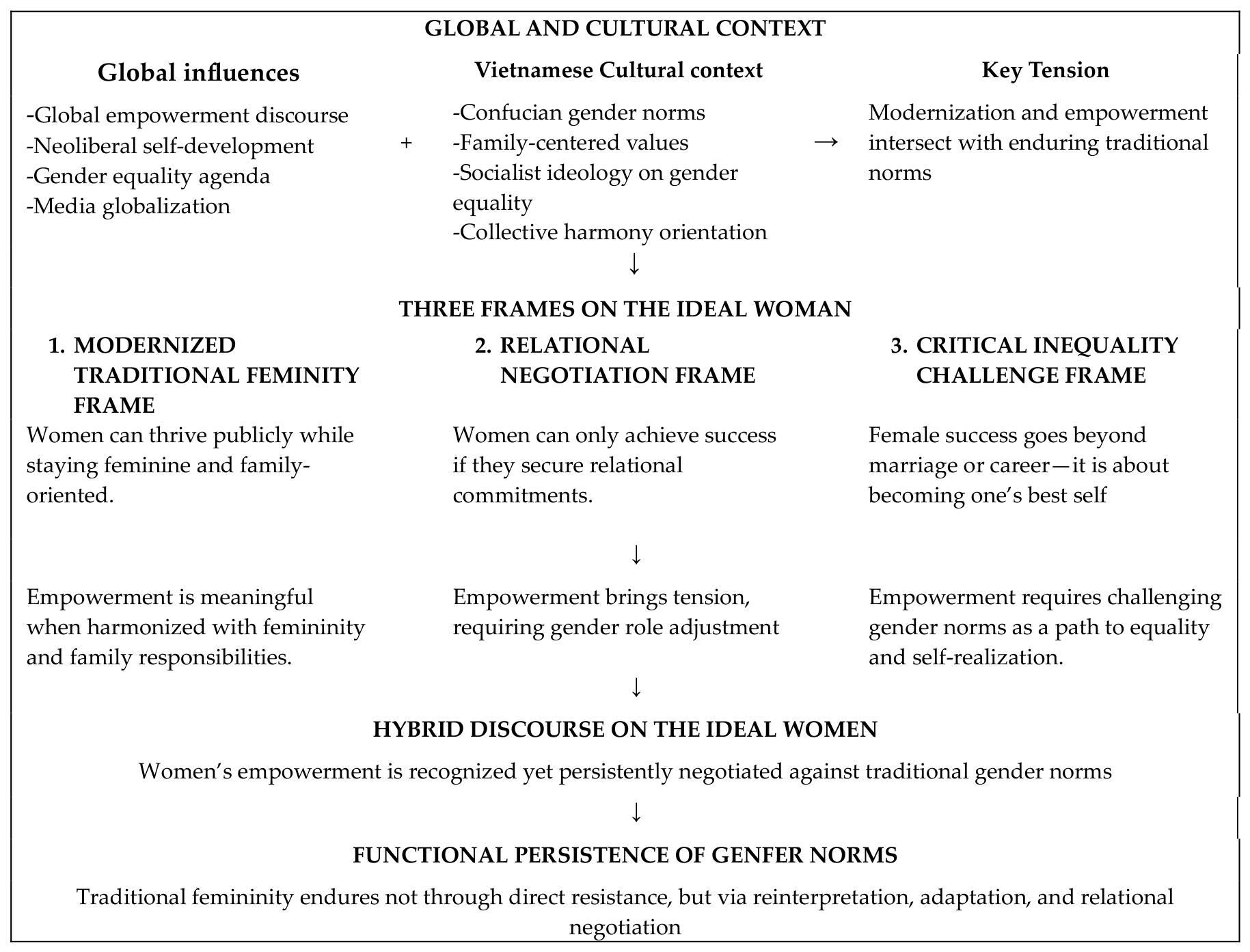

Disclaimer/Publisher’s Note: The statements, opinions and data contained in all publications are solely those of the individual author(s) and contributor(s) and not of MDPI and/or the editor(s). MDPI and/or the editor(s) disclaim responsibility for any injury to people or property resulting from any ideas, methods, instructions or products referred to in the content. |
© 2026 by the author. Licensee MDPI, Basel, Switzerland. This article is an open access article distributed under the terms and conditions of the Creative Commons Attribution (CC BY) license.