


Abstract
Global restoration frameworks, such as the Bonn Challenge and Forest Landscape Restoration, have endorsed multistakeholder engagement in agroforestry as key to reversing land degradation at scale. This paper follows shifts in how stakeholders have been organised, coordinated and steered since 2010 when Rwanda’s National Forestry Policy came into force, a year ahead of Rwanda’s pledge to the Bonn Challenge. The specific focus is on Bugesera District, representing a national policy shift from focusing on restoration in highland areas only. Bugesera is a lowland area facing complex socio-ecological and livelihood challenges including high rates of deforestation, recurrent drought and rapid population fluctuations. This paper analyses these changes by investigating which stakeholders were involved, how they were engaged (modes of participation) and why they participated (drivers of participation). Conceptually, this follows stakeholder mapping, Reed’s theory of participation and multi-level governance theory. Through thematic analysis, we triangulated data from 15 policy-related documents with semi-structured interviews with representatives from 24 organisations. Our findings show that both before and after 2010, stakeholder engagement has remained top-down. However, since 2010 this has been qualified by an asymmetrical form of collaboration that increasingly takes the form of top-down deliberation. Changes were observed in participation patterns, engagement approaches, and governance arrangements, driven by contextual conditions, power relations, process design, and spatial–temporal dynamics. Within a centrally coordinated government system, shaped by the post-genocide political context and culturally embedded structures such as Umuganda and Ubudehe, multistakeholder restoration initiatives have largely remained state-led, with structured approaches to coordination and implementation that have varied in the extent of local stakeholder engagement. Trust emerged as an important factor influencing stakeholder interactions. Despite more diverse and expanded institutional arrangements over time, variations in levels of participation and influence among stakeholders persist, with differences in how engagement and decision-making power are distributed. We conclude that effective stakeholder engagement is contingent on existing governance structures, the political will to engage with a diversity of actors at different levels, contextual conditions including spatial-temporal dynamics, and opportunities provided by global and regional restoration frameworks.
1. Introduction
Agroecology has emerged as a contested yet promising approach to addressing land degradation, which continues to affect nearly 3.2 billion people worldwide [1]. Within this framework, agroforestry stands out as an integrative land-use strategy that combines trees with crops and livestock production to generate ecological and socio-economic benefits [2,3,4]. These benefits include enhanced climate resilience, soil fertility, erosion control, and the provision of forest products [5,6,7,8]. Empirical evidence suggests that agroforestry can make a significant contribution to restoring degraded lands and improving ecosystem services [5,6]. However, its effectiveness is not uniform and largely depends on ecological conditions and social and institutional contexts [9]. For example, smallholder farmers, while among the most severely affected by degradation, also serve as crucial agents of change. Successful implementation requires the engagement of multiple stakeholders and the integration of social and economic dimensions of land use. Indeed, studies have shown that projects involving a broad range of stakeholders tend to achieve better outcomes [10].
Nevertheless, involving diverse actors in land restoration initiatives presents governance challenges. How should these stakeholders be organised, coordinated, and steered? The objective of this paper is to examine how multi-stakeholder participation contributes to addressing land degradation through agroforestry. The study draws on a case from Rwanda, a signatory to the Bonn Challenge, which continues to face significant degradation issues amid ongoing governance constraints [11,12]. This research contributes to the growing body of literature on how multiple stakeholders are engaged and governed in landscape restoration initiatives involving agroforestry.
The case study is drawn from Bugesera District in southeastern Rwanda, which has become a focal point for restoration efforts due to its high rates of deforestation, poor soils, and recurrent droughts [11]. In 2011, Rwanda committed to restoring two million hectares of degraded landscapes by 2030 under the Bonn Challenge [13] This ambitious target has mobilised a broad range of stakeholders, including government agencies, civil society organisations, and smallholder farmers. However, most restoration interventions have historically concentrated on highland areas, prioritising soil erosion over other drivers of degradation. In contrast, lowland semi-arid areas such as Bugesera have only recently received attention, despite their complex socio-ecological dynamics and diverse livelihood systems.
Specifically, this paper examines the evolution of stakeholder roles and interactions in Bugesera over two land restoration periods: 1995–2009 and 2010–2019. Conceptually, the analysis combines stakeholder mapping, Reed’s theory of participation, and multi-level governance theory to investigate three key questions: (1) Who were the actors involved; (2) how were they engaged (modes of participation)? and (3) why did they participate or not (drivers of participation)? Reed conceptualises participation as a dynamic and iterative process that extends beyond a single event, emphasising the importance of context, power dynamics, and process design [9]. Multilevel governance theory is useful for analysing the distribution of authority and decision-making across scales and sectors [14,15]. It is an approach that is relevant for studying participation in agroforestry where initiatives span local, district, provincial and national levels, and involve multiple actors with overlapping mandates and benefits. Our findings show how shifts from top-down one-way communication from the central government to top-down deliberation in a devolving governance system in Bugesera’s restoration initiatives went along with changes in stakeholder roles during restoration. We contribute to the growing literature on collaborative land restoration, sustainable governance, and agroforestry systems in arid and semi-arid regions.
The remainder of this paper is organised as follows. Section 2 continues with a background overview of land degradation and restoration in Rwanda. This is further specified in Section 3, with the case of Bugesera District. In Section 3, we also explain why 2010 was our anchor year and detail the methods for data collection and analysis. The results in Section 4 identify the actors involved according to their comparative power and interest, modes and drivers of participation. We discuss these further in Section 5, including the role of state dominance, global restoration frameworks and inclusiveness. The conclusion is drawn in Section 6 and includes three key contributions of the paper to the literature.
2. Contextual Background
2.1. Land Degradation in Rwanda
Land degradation in Rwanda is mainly caused by “non-sustainable agriculture, overgrazing by livestock, overexploitation of forests and woodlands, urbanisation and resettlement and other natural causes” [16]. Unsustainable agriculture is practised through continuous cultivation without fallow periods, increasing reliance on nutrient-reducing fertilisers, and inappropriate cultivation techniques on steep slopes and swamps [17,18,19]. Vegetation loss and soil erosion often result from grazing in valleys and steep terrains [20,21]. Forest resources are mainly threatened by increasing energy demand for household cooking, heating and home construction materials [16,22,23]. Against these developments is the legacy of environmental deterioration caused by deliberate forest fires during the 1990–1994 civil war and the 1994 Genocide against the Tutsi [24]. Large numbers of internally displaced people resorted to cutting down forests to survive, including by building camps and cooking with firewood. The Gishwati rainforest, for example, was reduced from 28,000 ha in 1990 to just 2.5% of its size by the year 2000 [24,25]. These human-driven causes are further aggravated by natural events like frequent droughts and flash floods [26,27].
2.2. Landscape Restoration in Rwanda Through Multistakeholder Participation
Rwanda was the first African country to join the Bonn Challenge, pledging to restore 2 million hectares of deforested and degraded land by 2030. This pledge spread restoration efforts “border to border” beyond the previous focus on highland areas only. It was also closely followed by the ambitious regional challenge, African Forest Landscape Restoration Initiative (AFR100), pioneered by Rwanda in 2015 to scale the Bonn Challenge across the continent. The aim of Forest Landscape Restoration (FLR) is to reinstate social and ecological aspects of forests [28,29,30,31]. Rwanda adopted agroforestry as one of its main restoration approaches under AFR100 and the Bonn Challenge [32]. By combining forestry (trees and shrubs) with agriculture (crop and livestock farming), agroforestry addresses socio-ecological challenges by improving climate resilience, soil richness, erosion control, and forest products [5,6,7,8]. It is also a pragmatic approach for balancing Rwanda’s high pollution density and livelihood needs with environmental sustainability.
Studies show that Rwanda’s success with agroforestry is mixed. On the one hand, there are reports about the improvements to ecosystem benefits [5,33] through better sustainable land management and nature-based solutions to land degradation [6,34]. However, understanding socio-economic and ecological benefits is challenging because restoration outcomes are generally difficult to evaluate and attribute [20,35]. Restoration efforts in Rwanda are constrained by limited extension services, low technical expertise, low literacy, poor market access, and inadequate availability of seedlings [7,36,37]. Efforts to combat these include capacity building, participatory planning, equitable resource allocation, and multi-stakeholder coordination [37]. For example, participatory planning is included in policy development in Gishwati forest and Nyabarongo wetland, but addressing disproportionate power asymmetries remains slow [38,39].
3. Materials and Methods
3.1. Study Area
Bugesera is one of the semi-arid districts of the eastern province of Rwanda, bordering Burundi to the south. It has an acreage of about 1333.9 km2 covered by both savannah flora and multiple degraded wetlands, including Lakes Rweru and Cyohoha [40]. It experiences low and erratic rainfall, high temperatures and frequent drought. Due to rapid population growth, expansion of agriculture into marginal lands, deforestation and overgrazing, it faces soil erosion, loss of soil fertility, wetland degradation, biodiversity loss and deforestation [11].
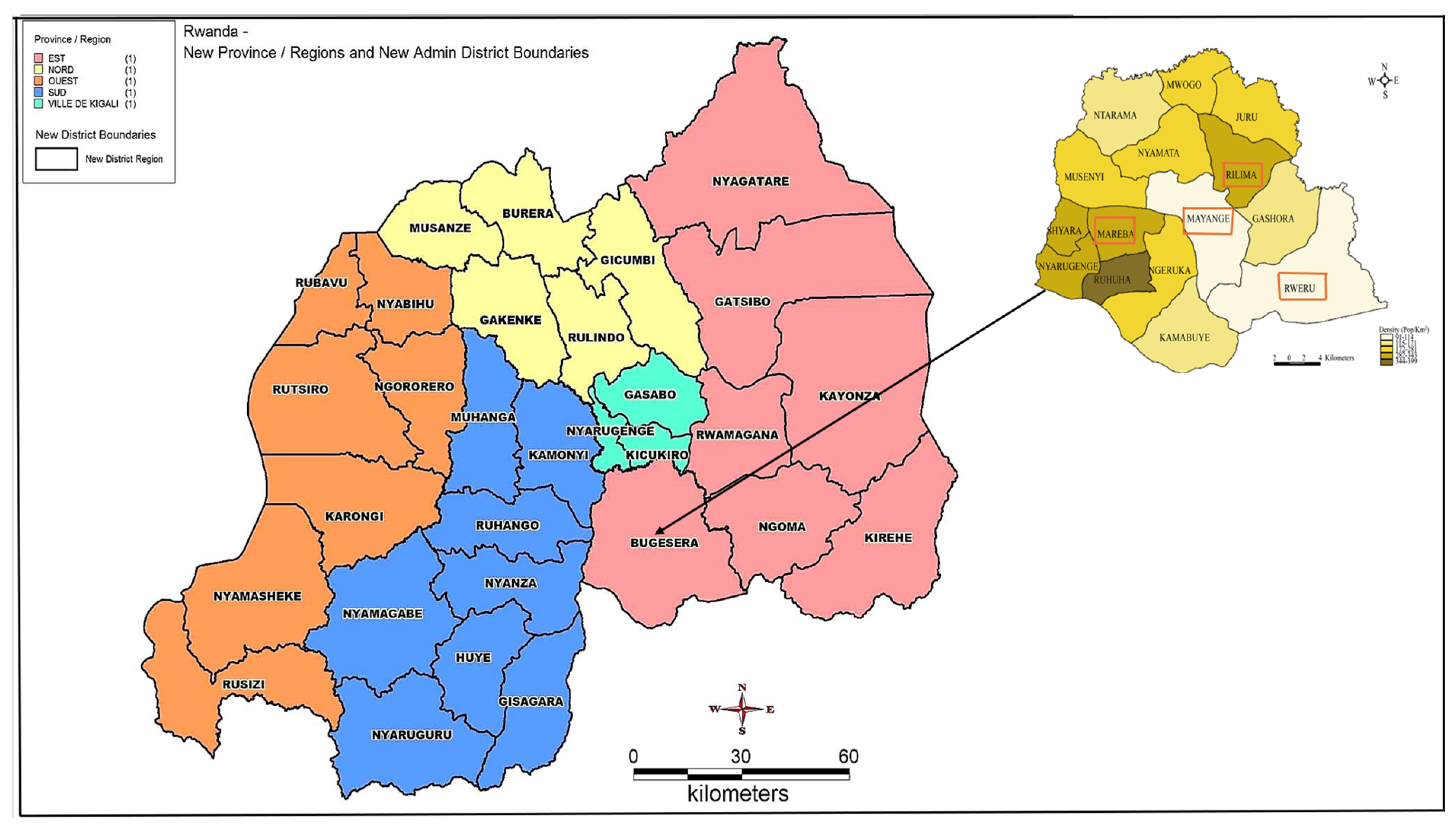
Historically, restoration efforts in Rwanda were focused on highland areas, ignoring lowland areas. The focus was on addressing soil erosion on highlands, rather than the complex socio-ecological dynamics and diverse livelihood systems typical of lowland places like Bugesera. Within Bugesera, this study selected four sectors that together represent these complex and diverse dynamics: Rilima (rural town), Rweru (aquatic ecosystem), Mareba (village), and Mayange (rural village) (see Figure 1). In Rwanda, a sector (umurenge in Kinyarwanda) is a third-level administrative subdivision in a devolving governance system.
Figure 1.
Areas of study, Mareba, Mayange, Rilima, and Rweru in Bugesera District (adapted from Rwanda’s Administrative Map in Wikimedia Commons and the ESMI Update for Bugesera District, 2023) [12,41].
Since the Rwandese government committed to the Bonn Challenge, aiming to restore two million hectares by 2030 [13], several environmental interventions were initiated in Bugesera. These include soil and water conservation measures and reforestation programmes. Bugesera thus poses as an interesting study area due to the combination of high vulnerability, visible degradation, human pressure and ongoing interventions, alongside emerging availability of data from government and other sources.
3.2. Data Collection and Analysis
We used exploratory qualitative case study methods for data collection and analysis. This approach was in line with the nascent state of our research in Bugesera, where limited similar studies have been conducted (for example, Nzeyimana et al., 2025) [42]. We were also interested in an in-depth, context-specific study that would inform future scholarship.
The study focused on two distinct periods: 1995–2009 characterised by ad hoc and fragmented efforts, and 2010–2019 marked by formal, government-coordinated interventions aligned with national and global restoration targets. Intensive preparation for signing the 2011 Bonn Challenge pledge was carried out in 2010, including through strong participation at the 2010 Bonn Climate Change Conference ahead of COP 16. In 2010, there was also a shift towards better execution of the new National Forestry Policy that integrated agroforestry with landscape restoration, facilitating greater institutional alignment and policy coherence. This shift enabled restoration efforts to become more closely aligned with global restoration initiatives, clarified the roles and obligations of restoration actors, and strengthened state-led coordination. Thus, we consider 2010 as an analytical threshold because it reflects a critical shift in Rwanda’s restoration governance, rather than the inception of restoration activities, which date as far back as the late 1970s.
Data was collected from semi-structured interviews with representatives of twenty-four (24) organisations. They were selected using purposive and snowball sampling strategies [43], drawing on the prior experience and networks of the first author, who has years of work and study experience in agroforestry in Rwanda. The list was further developed to include stakeholders identified through the document analysis. Stakeholders included state ministries and agencies, district-level stakeholders, NGOs and faith-based institutions, academic and research organisations, foreign development partners, and farmer cooperatives (Table 1), ensuring representation of stakeholders from national, district, and local levels. In the interview guide, we operationalised Reed’s theory of participation by covering stakeholder roles, modes of involvement, institutional partnerships, and barriers to engagement.
Table 1.
List of stakeholders who participated in interviews between 25 June and 19 August 2020.
All interviews took place between 25 June and 19 August 2020 amid COVID-19-related travel restrictions. They were therefore all conducted through online communication platforms (Skype, WhatsApp, and Zoom). A research assistant was physically present on the ground to support scheduling, participant coordination, and the interview process. Interviews lasted between forty-five (45) and ninety (90) minutes. We observed research ethics like informed consent, confidentiality, anonymity, beneficence, and withdrawal rights [44].
Findings from the interviews were triangulated with the systematic review of fifteen (15) documents, comprising donor reports, national policy frameworks, local action plans, project evaluations, and NGO briefs (Table 2). These documents were purposively selected based on their relevance to restoration governance and their alignment with the study’s analytical periods. All reviewed documents were produced after 2010, reflecting the period of policy-driven interventions following national reforms and the Bonn Challenge. Relevant documentary evidence for the pre-2010 period was not available, and this phase was therefore solely examined through interview data.
Table 2.
List of documents reviewed.
Documents were collected from the online databases and websites of key organisations, including ICRAF, FAO, PROFOR, CIFOR, WRI, and IUCN, using Google and Google Scholar. They were identified through targeted and systematic searches of organisational databases and relevant references. The literature search used combined keywords across themes of governance and policy (e.g., Rwanda AND “forest governance,” “forest landscape restoration policy framework,” “multi-level governance forest restoration”), agroforestry and land use systems (e.g., Rwanda AND “agroforestry systems,” “trees on farms agroforestry,” “sustainable land management agroforestry”), restoration frameworks and initiatives (e.g., Rwanda AND “forest landscape restoration FLR,” “Bonn Challenge restoration governance,” “landscape restoration Africa”), tools and methods (e.g., Rwanda AND “decision support tools forest landscape restoration,” “restoration opportunities assessment methodology ROAM,” “forest restoration progress tracking”), stakeholder engagement (e.g., Rwanda AND “community participation forest restoration,” “private sector involvement restoration,” “multistakeholder engagement agroforestry restoration”), and funding (e.g., Rwanda AND “forest landscape restoration investment,” “restoration finance private sector FLR”).
All titles, abstracts, and executive summaries were then screened for relevance to the study. Based on the inclusion/exclusion criteria, documents had to be produced by institutions involved in restoration initiatives in Rwanda, fall within the defined time frame, and be available in English or French. Document sampling followed established document analysis approaches [45] and was conducted alongside semi-structured interviews to enable triangulation through systematic cross-checking of documentary and interview data. In total, 44 documents were identified and screened, resulting in a final sample of 15 documents, including reports, occasional papers, and working papers (Table 2).
3.3. Data Analysis
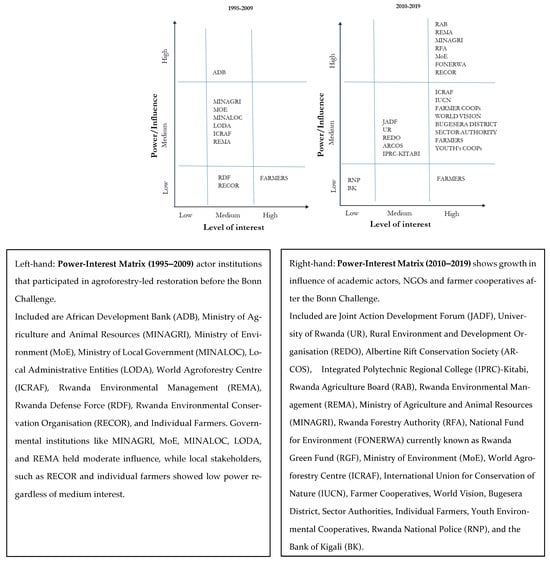
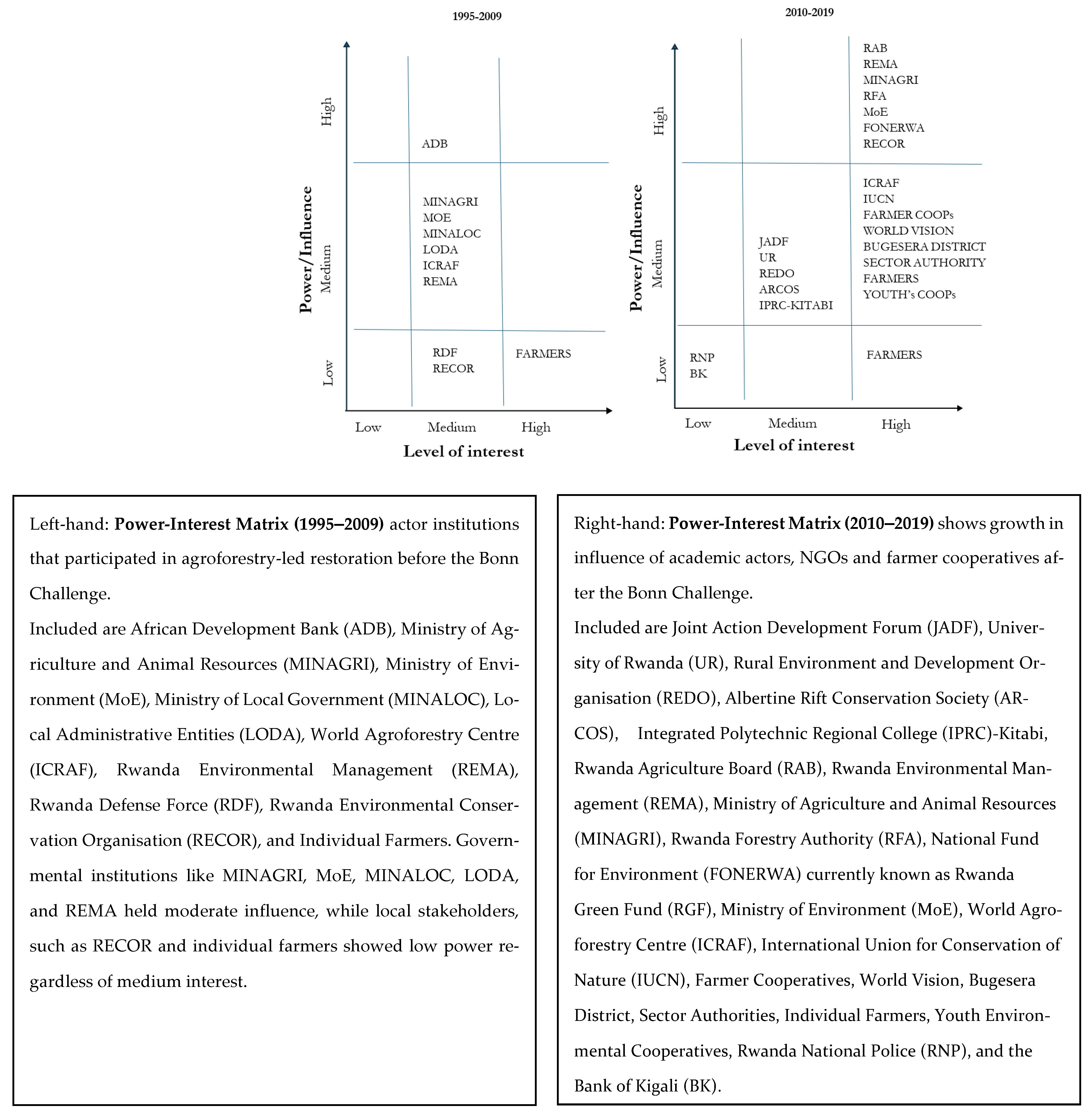
We analysed our data in two steps. First, through stakeholder mapping, we plotted each stakeholder on a Power–Interest Matrix, according to their influence in decision-making and their interest in restoration [46,47]. For comparison, there was a matrix for each of the two analytical periods (1995–2009 and 2010–2019) (see Figure 2). Actors were assigned to quadrants based on triangulated evidence from the interview data and reviewed documents, focusing on indicators such as decision-making authority, control over resources, level of participation, and expressed commitment to restoration activities. These indicators informed the classification of actors into low, medium, and high categories of power and interest.
Figure 2.
Comparative Stakeholder Mapping along Power–Interest matrix (1995–2009 vs. 2010–2019).
Second, interview transcriptions and the selected documents were analysed through thematic analysis. We followed Braun and Clarke’s six-stage process of familiarisation, coding, theme development, review, definition, and reporting [48]. Familiarisation took place during the selection process when documents were skimmed for relevance. Codes were assigned to relevant text segments, guided by three anchor codes (actor identification, actor roles, and influencing factors). Examples of codes included “active involvement”, “passive involvement”, “top-down consultation”, “bottom-up co-production”, “lead-government”, and “conflicts of interests”. Codes were iteratively reviewed and refined through an analytical back-checking process to ensure accuracy and consistency. This involved continuous comparison of coded segments with the original interview transcripts and documents. Similar codes were then merged and organised into clusters based on frequency, relationships, and underlying concepts, resulting in 45 final codes grouped into 13 themes. These themes were further grouped into three core analytical themes: actor participation in restoration, modes of participation, and drivers of participation. This iterative coding and validation process ensured that themes were grounded in the data and provided a transparent basis for linking empirical evidence to analytical claims.
4. Results
4.1. Actors Participated in Restoration
We found both continuities and distinctions in stakeholder engagement in Bugesera by comparing the two periods: 1995–2009 and 2010–2019 (see Figure 2). The former period was characterised by ad hoc and fragmented stakeholder participation shaped by ad hoc community mobilisation by the state. While state dominance remained largely intact, participation in the latter period was more distinctly formalised, institutionalised and broadened to include multi-stakeholder participation. This followed national restoration policy changes established in 2010.
4.1.1. 1995–2009: Ad Hoc and Fragmented Participation
Between 1995 and 2009, restoration efforts in Bugesera District were shaped by fragmented institutional arrangements and a predominantly top-down approach. Government bodies such as the Ministry of Agriculture and Animal Resources (MINAGRI) and the Ministry of Environment (MoE) implemented restoration activities with limited ongoing coordination between agencies or with local stakeholders. Responsibilities were delegated to district and sector-level officials, yet the mandates they received often exceeded their operational capacity. These dynamics are reflected in the National Forestry Policy (2004) and the Organic Law on Environment (2005).
Faith-based organisations, including local churches, contributed mainly through environmental awareness initiatives, while international NGOs such as World Vision supported labour-intensive restoration through food-for-work programmes. However, these contributions were sporadic and insufficiently aligned with a broader policy framework. Community participation was rudimentary and primarily restricted to unskilled tasks such as digging planting holes or planting seedlings. Although organised women’s groups existed within local socio-economic structures, they were largely excluded from planning processes, an issue also highlighted in the Rwanda Environmental Management Authority (REMA)’s assessment of community forestry initiatives.
The Power–Interest actor mapping positioned most stakeholders at low to medium power and fluctuating interest. Government institutions retained formal authority but lacked deep, sustained engagement, while informal cooperatives and farmers showed high interest yet possessed limited influence (Figure 2).
4.1.2. 2010–2019: Institutionalised and Inclusive Participation
The post-2010 period marked a shift towards more institutionalised and broader stakeholder participation. Rwanda’s Bonn Challenge Pledge (2011) and national commitments under the Green Growth and Climate Resilience Strategy catalysed the establishment of multi-stakeholder governance through Local Environment Committees, Cross-Sectoral Taskforces (CSTF), and Joint Action Development Forums (JADF). National bodies such as the Rwanda Forestry Authority (RFA), REMA, and MINAGRI partnered with civil society organisations and technical partners in restoration planning. NGOs including the Rural Environment and Development Organisation (REDO), the Albertine Rift Conservation Society (ARCOS), and the Rwanda Environment Conservation Organisation (RECOR) emerged as key intermediaries, implementing donor-funded initiatives through localised and participatory methods. REDO reports highlight their engagement with cooperatives in capacity-building activities. Academic institutions—most notably Kitabi College and the University of Rwanda—provided training in agroforestry practices and soil health, thereby creating a scientific feedback loop into policy processes and environmental monitoring. Local cooperatives such as Kopakuma and Agaciro assumed more formalised roles in nursery supervision and management, influencing tree-species selection and contributing to monitoring and evaluation activities. This evolution is reflected in the 2010–2019 Power–Interest map (Figure 2), where a broader range of stakeholders—including farmer groups—showed a shift into positions of high interest and increasing power. Comparing pre- and post-2010 in Figure 2 also reveals the dropping out of actors with a medium level of interest but varied power and influence: MINALOC-Ministry of Local Government, LODA-Local Administrative Entities Development Agency, ADB-African Development Bank and RDF-Rwanda Defence Force. Many new actors, mostly of medium to high interest, joined after 2010. Meanwhile, the influence and power of individual farmers did not increase, but their level of interest remained high.
4.2. Modes of Participation
There was little documentation of actors’ participation in restoration initiatives during the ad hoc organised 1995–2010 period. According to an interviewee from the Ministry of Environment, this period was marked by drought in Bugesera leading to outward migration of a large population of the people. The government reacted “by planting trees, rehabilitating state forests and introducing and scaling up agroforestry with different practices such as agricultural ones. We financed different restoration initiatives…” (Interviewee from MoE). However, these efforts were one-directional with no genuine consultation. According to a review done by REMA, these early reforestation initiatives ignored input from local institutions and farmers for restoration planning.
Post-2010, there was a marked shift from one-directional communication to participatory processes (see Table 3). This was facilitated by mechanisms such as seasonal review forums, Cross-Sectoral Taskforce (CSTF), and participatory monitoring and evaluation. User groups at the district level encouraged community response and involvement in planning meetings. REDO reports detail feedback meetings between farmer cooperatives and the NGOs that supported them to continuously improve restoration efforts and address disappointments related to tree survival. For example, ARCOS mentioned that they used a community-based approach in which they provided training through cooperatives and placed local leadership that included both men and women (Interview with ARCOs country programme coordinator). Nevertheless, this form of co-production remained top-down as illustrated by this farmer:
Table 3.
Evolution of Stakeholder participation in Bugesera 1995–2009 compared to 2010–2019.
“Mainly, we wait for what comes from above, we only sign the performance agreement, and we do not say any influential words. We wait for what these actors say and then implement them, however. Most of the time we exceed the performance agreed upon in the performance contract (for instance, sometimes we find that our farmers need orange tree seedlings even though we do not have them in the agreement, we have to meet the needs of our farmers).”(Farmer and secretary at KOPAKUMA cooperative)
The top-down deliberation mode was not limited to communication with farmers, but also with NGOs and donors. The government determined the type, scope and extent of NGO/donor engagement:
“When these stakeholders come to us and show us that they have a project, they have to hear from us regarding where the gaps are and where we want the effort to be allocated, but we also try to look at their objectives, but they have to conform with our performance contract as well…Necessarily is that for any initiative to take place, it should first consult the Ministry of Environment as we are in charge of overseeing anything regarding the environment.”(Head of the District’s Agricultural and Natural Resources Management unit and a member of the JADF-Joint Action Development Forum). [underlined for emphasis]
The governance of restoration broadened to include more actors besides the national government after 2010. Notably, more international players were involved (e.g., IUCN, ICRAF and World Vision), and they held the same power/influence and interest as organised farmer groups. This could be explained by the privileged position of state-aligned farmer groups in Rwanda [Huggins, 2017] [49]. There was also increased collaboration with local NGOs and academic institutions. However, the government remained the most dominant stakeholder and controlled the extent of the collaborations, confining donors and international NGOs to facilitation roles, especially in the support and alignment of monitoring and evaluation.
4.3. Drivers of Participation
Stakeholder involvement differed markedly between pre- and post-2010 (Table 4). Stakeholder participation in the former period was driven mainly by historical and cultural structures of communal work and top-down government mobilisation under ad hoc governance arrangements. The main drivers of participation post-2010 were policy and governmental commitments to international agendas, increased donor participation, and access to an expanded range of resources and power.
Table 4.
Drivers of participation in pre- and post-2010.
Overall, these drivers indicate that stakeholder participation does not result from a single motivated actor, but from the interaction of community power dynamics, resource allocation, institutional designs, and cultural patterns. Forced cultural practices, unequal resource allocation, and spatial inequalities weaken trust and collaboration.
5. Discussion
In recent decades, global restoration frameworks such as Forest Landscape Restoration (FLR) and the Bonn Challenge have endorsed agroforestry as a central strategy for reversing land degradation at scale. However, the success of these initiatives is strongly dependent on effective stakeholder engagement. Evidence shows that benefits from multistakeholder participation in agroforestry largely depend on social and institutional contexts [9]. In Rwanda, a new Forestry Policy was established in 2010 to integrate agroforestry with landscape restoration, with the triple aim of tackling land degradation, reducing poverty and improving livelihoods. By combining stakeholder mapping, Reed’s theory of participation, and multi-level governance theory, this paper found that effective stakeholder engagement is contingent on existing governance structures, the political will to engage with a diversity of actors at different levels, and opportunities provided by global and regional restoration frameworks.
We found that the state has dominated multistakeholder engagement in restoration governance in Bugesera. This dominance is rooted in Rwanda’s post-genocide political environment in which institutional legitimacy is key to stable and strong leadership. Government ministries have increasingly played a decisive role in setting up restoration priorities, executing environmental regulations, and directing donor participation. Pre-2010, the main government ministries that were involved were the Ministry of Agriculture and Animal Resources (MINAGRI) and the Ministry of Environment (MoE). However, their actions were ad hoc and uncoordinated, with medium-level interest and power. Institutionalisation and stronger governmental alignment took place after 2010, as coordination between these ministries improved through joint committees, taskforces and fora. But the high power and influence of government extended to dominate interactions at all levels, from local communities to international actors. Non-state actors were invited to dialogue only within the constraints set by the government. With local communities, this was largely facilitated by the communal culture of work known as Umuganda and Ubudehe. State-led mobilisation, involuntary labour and threats of sanctions have left little room for willing participation. The government also determined the extent of engagement with donors and international NGOs, being decisive on the goals, type and scope of initiatives. Remarkably, our findings also point to the forming of a “missing middle”, as stakeholders with medium-level influence and interest (such as MINALOC-Ministry of local government and LODA-Local Administrative Entities) dropped out of the governance arrangements. State control has also been found in other settings where strong centralised authority with long reach is instrumental for initiating and scaling restoration efforts [50,51].
Global restoration frameworks, alongside strong political will, were catalytic in facilitating multistakeholder engagement. Governments declared the ambition of restoring 150 million hectares of degraded and deforested land by 2020 and 350 million hectares by 2030, taking responsibility to lead restoration programmes worldwide [31,52]. This ambition was further supported by other global and regional goals such as AFR100, UNCCD and CBD and facilitated the integration of diverse objectives within the restoration agenda. Notably, the Rwandese government showed regional leadership being the first African country to join the Bonn challenge and the African leadership committing to the continent-wide AFR100. This attracted an increased number of international organisations post-2010 as their level of interest increased from medium to high, albeit with their power remaining medium.
However, the expansion of participating platforms and actors does not necessarily guarantee inclusiveness. In Bugesera, marginalised groups including women, youth and remote villages remained underrepresented in processes of decision-making, capacity-building and resource distribution. New initiatives were layered onto existing structures, inheriting their limitations for engagement. For example, we found that new restoration interventions were embedded in existing agricultural extension services that continue to ignore remote communities. Decision-making was limited to well-trained and well-positioned actors, ignoring agrarian cooperatives and women. Other scholars have also found limited forms of stakeholder engagement for marginalised groups, who continue to be minimally involved, or involved in tokenistic ways [53,54,55]. Multi-stakeholder engagement does not necessarily change current power arrangements but diversifies stakeholder roles while largely maintaining current governance structures [56,57].
Among the factors that influenced effective stakeholder engagement, trust was key. In Bugesera, historical grievances and persistent power imbalances fostered mistrust among stakeholders, particularly through restricted consultation processes and coercive implementation strategies. Strengthening trust after 2010 continued to be undermined by uneven, misaligned, and delayed distribution of resources, the failure to make timely payments and tensions between local and “expert” knowledge. Social control was maintained through the persistent system of coercive state-led collective labour, embedded in community policing through the localised ten-cell system. Studies have shown that trust-based participatory methods like dispute resolution and incorporating local expertise are a pre-requisite to attaining restoration outcomes [9,58,59]. The Bugesera case shows that building trust can be a difficult, long-term process with cumulative gains or setbacks that should be carefully managed. Long-term restoration impacts demand not only robust government organisation, but also trust-centred, adaptive, and broad governance [50,53,60,61].
The progression of stakeholder engagement in restoration reflects a broader global trajectory: a shift from top-down one-way communication prior to the launch of the Bonn Challenge to multistakeholder and top-down deliberation in its aftermath. This transition has been facilitated by the interplay of international frameworks, local cultural practices, and institutionalised participatory systems. Persistent and emerging barriers, power imbalances, marginalisation, donor dependency, and spatial inequalities continue to constrain effective stakeholder engagement. The case of Bugesera in Rwanda exemplifies these dynamics, reflecting patterns observed more broadly across similar contexts. Ensuring equitable and meaningful participation will require not only the expansion of engagement platforms, but also a reconfiguration of power relations and the strengthening of more sustainable, inclusive institutions across scales [31,62,63].
6. Conclusions and Policy Implications
This paper has assessed the growing landscape of multistakeholder engagement in agroforestry-based restoration in Rwanda, using Bugesera District as a case study. Grounded in the theory of participation [9], stakeholder mapping, and multi-level governance theory, the analysis followed how actor roles and agency changed from top-down one-way communication in the pre-2010 era to top-down deliberation post-2010, after Rwanda committed to global restoration objectives under the Bonn Challenge. Our findings indicate that multistakeholder participation for landscape restoration is dependent on the type of government and culture of participation in place. With a hierarchical, centrally coordinated government, a post-genocide political climate and culturally defined structures of Umuganda and Ubudehe, multistakeholder restoration initiatives in Rwanda remained state-driven, bureaucratic, and limited towards local stakeholder engagement. Even after more expansive and diverse institutional changes, successive frameworks, such as the Cross-Sectoral Taskforces, Joint Action Development Forum, and ROAM, equitable power sharing and meaningful local inclusion remained constrained in Bugesera.
These findings contribute to the literature on agroforestry and Forest Landscape Restoration (FLR) in three key ways. First, they demonstrate how multistakeholder engagement evolves within a state-dominated governance structure, highlighting the persistence of government gatekeeping even under participatory frameworks. Second, they advance understanding of engagement as a negotiated and dynamic process, shaped by both global policy drivers and local historical legacies, particularly in post-conflict environments. Third, they emphasise the central role of trust as a non-linear and long-term condition for meaningful collaboration, reinforcing the need to move beyond formal participation toward more equitable and adaptive governance arrangements. Together, these insights provide a nuanced perspective on the opportunities and limitations of multistakeholder engagement in agroforestry restoration.
Therefore, the main take-home message is that expanding participatory platforms alone is insufficient to achieve inclusive agroforestry-based restoration. Although institutionalisation enabled broader engagement, it did not resolve underlying power imbalances that constrained local agencies. Effective restoration therefore requires deliberate mechanisms that relate participation to shared decision-making, accountability, and locally grounded priorities, rather than procedural inclusion alone. The Bugesera case study highlights that restoring degraded landscapes must involve restoring inclusive and adaptive governance spaces, where actors across scales greatly matter in shaping restoration futures. Future research could strengthen this understanding by providing more empirical evidence demonstrating how effective stakeholder engagement contributes to improved restoration outcomes.
Author Contributions
Conceptualization, V.N.; Methodology, V.N.; software, V.N.; validation, V.N.; formal analysis, V.N.; investigation, V.N. and N.A.-v.Z.; resources, V.N.; data curation, V.N.; writing—original draft preparation, V.N.; writing—review and editing V.N. and N.A.-v.Z.; visualization, V.N.; project administration, V.N. All authors have read and agreed to the published version of the manuscript.
Funding
This research received no external funding.
Institutional Review Board Statement
The study was conducted in accordance with the Declaration of Helsinki, and ethical review and approval were waived in accordance with the Netherlands Code of Conduct for Research Integrity, 2018 and the the Integrity Code of Wageningen University & Research, 2014.
Informed Consent Statement
Informed consent was obtained from all subjects involved in the study.
Data Availability Statement
The original contributions presented in this study are included in the article. Further inquiries can be directed to the corresponding author.
Conflicts of Interest
The authors declare no conflicts of interest.
Abbreviations
The following abbreviations are used in the manuscript:
| AFR100 | African Forest Landscape Restoration Initiative |
| ADB | African Development Bank |
| CBD | Convention on Biological Diversity |
| MINAGRI | Ministry of Agriculture and Animal Resources |
| MoE | Ministry of Environment |
| MINALOC | Ministry of Local Government |
| LODA | Local Administrative Entities |
| ICRAF | World Agroforestry Centre |
| REMA | Rwanda Environmental Management Authority |
| RDF | Rwanda Defence Force |
| RECOR | Rwanda Environmental Conservation Organisation |
| NGO | Non-governmental Organisation |
| JADF | Joint Action Development Forum |
| UR | University of Rwanda |
| REDO | Rural Environment and Development Organisation |
| ARCOS | Albertine Rift Conservation Society |
| IPRC | Integrated Polytechnic Regional College |
| RAB | Rwanda Agriculture Board |
| RFA | Rwanda Forestry Authority |
| FONERWA | National Fund for Environment |
| RGF | Rwanda Green Fund |
| IUCN | International Union for Conservation of Nature |
| RNP | Rwanda National Police |
| BK | Bank of Kigali |
| UNCCD | United Nations Convention to Combat Desertification |
References
- United Nations Convention to Combat Desertification (UNCCD). Global Land Outlook, 2nd ed.; UNCCD: Bonn, Germany, 2022; Available online: https://www.unccd.int/resources/global-land-outlook/glo2 (accessed on 15 May 2026).
- Intergovernmental Panel on Climate Change (IPCC). Climate Change and Land: An IPCC Special Report on Climate Change, Desertification, Land Degradation, Sustainable Land Management, Food Security, and Greenhouse Gas Fluxes in Terrestrial Ecosystems; IPCC: Geneva, Switzerland, 2019; Available online: https://www.ipcc.ch/srccl/ (accessed on 15 May 2026).
- Intergovernmental Panel on Climate Change (IPCC). Climate Change 2022: Mitigation of Climate Change. Contribution of Working Group III to the Sixth Assessment Report of the Intergovernmental Panel on Climate Change; Cambridge University Press: Cambridge, UK, 2022; Available online: https://www.ipcc.ch/report/ar6/wg3/ (accessed on 17 May 2026).
- Intergovernmental Panel on Climate Change (IPCC). Climate Change 2022: Impacts, Adaptation and Vulnerability. Contribution of Working Group II to the Sixth Assessment Report of the Intergovernmental Panel on Climate Change; Cambridge University Press: Cambridge, UK, 2022; Available online: https://www.ipcc.ch/report/ar6/wg2/ (accessed on 17 May 2026).
- Garrity, D.P.; Akinnifesi, F.K.; Ajayi, O.C.; Weldesemayat, S.G.; Mowo, J.G.; Kalinganire, A.; Larwanou, M.; Bayala, J. Evergreen Agriculture: A robust approach to sustainable food security in Africa. Food Secur. 2010, 2, 197–214. [Google Scholar] [CrossRef] [Scilit]
- Jose, S. Agroforestry for ecosystem services and environmental benefits: An overview. Agrofor. Syst. 2009, 76, 1–10. [Google Scholar] [CrossRef] [Scilit]
- Kiyani, P.; Andoh, J.; Lee, Y.; Lee, D.K. Benefits and challenges of agroforestry adoption: A case of Musebeya sector, Nyamagabe District in southern province of Rwanda. For. Sci. Technol. 2017, 13, 174–180. [Google Scholar] [CrossRef] [Scilit]
- Stainback, G.A.; Masozera, M.; Mukuralinda, A.; Dwivedi, P. Smallholder Agroforestry in Rwanda: A SWOT-AHP Analysis. Small-Scale For. 2012, 11, 285–300. [Google Scholar] [CrossRef] [Scilit]
- Reed, M.S.; Vella, S.; Challies, E.; De Vente, J.; Frewer, L.; Hohenwallner-Ries, D.; Huber, T.; Neumann, R.K.; Oughton, E.A.; Sidoli Del Ceno, J.; et al. A theory of participation: What makes stakeholders and public engagement in environmental management work? Restor. Ecol. 2018, 26, S7–S17. [Google Scholar] [CrossRef] [Scilit]
- Evans, K.A.; Guariguata, M.R. Success from the Ground Up: Participatory Monitoring and Forest Restoration; Center for International Forestry Research (CIFOR): Bogor, Indonesia, 2016; Paper No. 159. [Google Scholar] [CrossRef] [Scilit]
- Dusengimana, J.B.; Kamuhanda, J.K.; Nsabimana, B. The impacts of land use change on ecosystem services in Rwanda: A case of Bugesera District. Int. J. Sci. Res. Manag. 2025, 13, 2329–2338. [Google Scholar] [CrossRef] [Scilit]
- Bugesera District (Government of Rwanda). Environmental and Social Management Plan (ESMP) Update in Bugesera Districts 2023. Bugesera District. 2023. Available online: https://www.bugesera.gov.rw/fileadmin/user_upload/bugesera/Inyandiko/Inyandiko/ESMP_Update_in_Bugesera_Districts_2023.pdf (accessed on 17 May 2026).
- Dave, R.; Saint-Laurent, C.; Murray, L.; Antunes Daldegan, G.; Brouwer, R.; de Mattos Scaramuzza, C.A.; Raes, L.; Simonit, S.; Catapan, M.; García Contreras, G.; et al. Second Bonn Challenge Progress Report: Application of the Barometer in 2018; IUCN: Gland, Switzerland, 2019. [Google Scholar] [CrossRef] [Scilit]
- Bache, I.; Flinders, M. Multi-Level Governance and the Study of the British State. Public Policy Adm. 2004, 19, 31–51. [Google Scholar] [CrossRef] [Scilit]
- Lockwood, M.; Davidson, J.; Curtis, A.; Stratford, E.; Griffith, R. Multi-level Environmental Governance: Lessons from Australian natural resource management. Aust. Geogr. 2009, 40, 169–186. [Google Scholar] [CrossRef] [Scilit]
- Bizimana, I. Final Country Report of the LDN Target Setting Programme in Rwanda. Report of the LDN National Working Group dated September 2018; Ministry of Lands and Forestry: Kigali, Rwanda, 2018. Available online: https://www.unccd.int/sites/default/files/ldn_targets/2019-01/Rwanda%20LDN%20TSP%20Country%20Report.pdf (accessed on 23 April 2026).
- Byiringiro, F.; Reardon, T. Farm productivity in Rwanda: Effects of farm size, erosion, and soil conservation investments. Agric. Econ. 1996, 15, 127–136. [Google Scholar] [CrossRef] [Scilit]
- Drechsel, P.; Gyiele, L.; Kunze, D.; Cofie, O. Population density, soil nutrient depletion, and economic growth in sub-Saharan Africa. Ecol. Econ. 2001, 38, 251–258. [Google Scholar] [CrossRef] [Scilit]
- Nabahungu, N.L.; Visser, S.M. Farmers’ knowledge and perception of agricultural wetland management in Rwanda. Land Degrad. Dev. 2013, 24, 363–374. [Google Scholar] [CrossRef] [Scilit]
- Clay, D.; Reardon, T.; Kangasniemi, J. Sustainable Intensification in the Highland Tropics: Rwandan Farmers’ Investments in Land Conservation and Soil Fertility. Econ. Dev. Cult. Change 1998, 46, 351–377. [Google Scholar] [CrossRef] [Scilit]
- Nahayo, A.; Pan, G.; Joseph, S. Factors influencing the adoption of soil conservation techniques in Northern Rwanda. J. Plant Nutr. Soil Sci. 2016, 179, 367–375. [Google Scholar] [CrossRef] [Scilit]
- Ndayambaje, J.D.; Mohren, G.M.J. Fuelwood demand and supply in Rwanda and the role of agroforestry. Agrofor. Syst. 2011, 83, 303–320. [Google Scholar] [CrossRef] [Scilit]
- Safari, B. A review of energy in Rwanda. Renew. Sustain. Energy Rev. 2010, 14, 524–529. [Google Scholar] [CrossRef] [Scilit]
- Kanyamibwa, S. Impact of war on conservation: Rwandan environment and wildlife in agony. Biodivers. Conserv. 1998, 7, 1399–1406. [Google Scholar] [CrossRef] [Scilit]
- Arakwiye, B.; Rogan, J.; Eastman, J.R. Thirty years of forest-cover change in Western Rwanda during periods of wars and environmental policy shifts. Reg. Environ. Change 2021, 21, 27. [Google Scholar] [CrossRef] [Scilit]
- Kuria, A.W.; Barrios, E.; Pagella, T.; Muthuri, C.W.; Mukuralinda, A.; Sinclair, F.L. Farmers’ knowledge of soil quality indicators along a land degradation gradient in Rwanda. Geoderma Reg. 2019, 16, e00199. [Google Scholar] [CrossRef] [Scilit]
- Westoff, C.F. The Recent Fertility Transition in Rwanda. Popul. Dev. Rev. 2013, 38, 169–178. [Google Scholar] [CrossRef] [Scilit]
- Mansourian, S. Overview of Forest Restoration Strategies and Terms. In Forest Restoration in Landscapes; Springer: Berlin/Heidelberg, Germany, 2005; pp. 8–13. [Google Scholar] [CrossRef] [Scilit] [PubMed]
- Spathelf, P.; Stanturf, J.; Kleine, M.; Jandl, R.; Chiatante, D.; Bolte, A. Adaptive measures: Integrating adaptive forest management and forest landscape restoration. Ann. For. Sci. 2018, 75, 55. [Google Scholar] [CrossRef] [Scilit]
- Stanturf, J.A.; Palik, B.J.; Williams, M.I.; Dumroese, R.K.; Madsen, P. Forest Restoration Paradigms. J. Sustain. For. 2014, 33, S161–S194. [Google Scholar] [CrossRef] [Scilit]
- Stanturf, J.A.; Kleine, M.; Mansourian, S.; Parrotta, J.; Madsen, P.; Kant, P.; Burns, J.; Bolte, A. Implementing Forest landscape restoration under the Bonn Challenge: A systematic approach. Ann. For. Sci. 2019, 76, 50. [Google Scholar] [CrossRef] [Scilit]
- International Union for Conservation of Nature (IUCN). A Guide to the Restoration Opportunities Assessment Methodology (ROAM): Assessing Forest Landscape Restoration Opportunities at the National or Sub-National Level; Working Paper (Road Test Edition); International Union for Conservation of Nature and World Resources Institute: Gland, Switzerland, 2014; Available online: https://portals.iucn.org/library/sites/library/files/documents/2014-030.pdf (accessed on 3 June 2026).
- Food and Agriculture Organisation of the United Nations (FAO). Advancing Agroforestry on the Policy Agenda: A Guide for Decisionmakers (Agroforestry Working Paper No. 1); FAO: Rome, Italy, 2013; p. 1. Available online: http://www.fao.org/3/i3182e/i3182e.pdf (accessed on 8 June 2026).
- Montagnini, F. (Ed.) Environmental Services of Agroforestry Systems; Food Products Press: Binghamton, NY, USA, 2005. [Google Scholar]
- Bidogeza, J.C.; Berentsen, P.B.; de Graaff, J.; Oude Lansink, A. Potential impact of alternative agricultural technologies to ensure food security and raise income of farm households in Rwanda. In Forum for Development Studies; Routledge: London, UK, 2015; Volume 42, pp. 133–157. [Google Scholar]
- Michael, V.; Andrew, S. How do the risk preferences of smallholder farmers affect the attractiveness of restoration activities? Evidence from forest and agricultural land in Rwanda. J. Dev. Agric. Econ. 2016, 8, 200–214. [Google Scholar] [CrossRef] [Scilit]
- Buckingham, K.; Arakwiye, B.; Ray, S.; Maneerattana, O.; Anderson, W. Cultivating networks and mapping social landscapes: How to understand restoration governance in Rwanda. Land Use Policy 2021, 104, 104546. [Google Scholar] [CrossRef] [Scilit]
- Clay, N. Fixing the ecosystem: Conservation, crisis and capital in Rwanda’s Gishwati Forest. Environ. Plan. E Nat. Space 2019, 2, 23–46. [Google Scholar] [CrossRef] [Scilit] [PubMed]
- Nsengimana, V.; Weihler, S.; Kaplin, B.A. Perceptions of Local People on the Use of Nyabarongo River Wetland and Its Conservation in Rwanda. Soc. Nat. Resour. 2017, 30, 3–15. [Google Scholar] [CrossRef] [Scilit]
- Japan International Cooperation Agency (JICA). Study on Sustainable Rural and Agricultural Development in Bugesera District, Eastern Province, Republic of Rwanda: Final Report; JICA: Tokyo, Japan, 2009. Available online: https://openjicareport.jica.go.jp/pdf/11919727_01.pdf (accessed on 8 August 2020).
- Wikimedia Commons Contributors. Rwanda’s Districts—Media Search Results. Wikimedia Commons. n.d. Available online: https://commons.wikimedia.org/w/index.php?search=rwanda%27s+districts&title=Special%3AMediaSearch&type=image (accessed on 5 June 2026).
- Nzeyimana, L.; Danielsson, Å.; Brodén-Gyberg, V.; Andersson, L. Constructing Ubudehe? Farmers’ perceptions of drought impacts and resilience capacities in Bugesera, Rwanda. Int. J. Clim. Change Strateg. Manag. 2025, 17, 91–110. [Google Scholar]
- Palinkas, L.A.; Horwitz, S.M.; Green, C.A.; Wisdom, J.P.; Duan, N.; Hoagwood, K. Purposeful Sampling for Qualitative Data Collection and Analysis in Mixed Method Implementation Research. Adm. Policy Ment. Health Ment. Health Serv. Res. 2015, 42, 533–544. [Google Scholar] [CrossRef] [Scilit] [PubMed]
- Chen, C.; Schweiker, M.; Day, J.K. Ethics and Privacy. In Exploring Occupant Behavior in Buildings; Wagner, A., O’Brien, W., Dong, B., Eds.; Springer International Publishing: Cham, Switzerland, 2018; pp. 287–306. [Google Scholar] [CrossRef] [Scilit] [PubMed]
- Bowen, G.A. Document Analysis as a Qualitative Research Method. Qual. Res. J. 2009, 9, 27–40. [Google Scholar] [CrossRef] [Scilit]
- Bryson, J.M. What to do when Stakeholders matter: Stakeholder Identification and Analysis Techniques. Public Manag. Rev. 2004, 6, 21–53. [Google Scholar] [CrossRef] [Scilit]
- Reed, M.S.; Graves, A.; Dandy, N.; Posthumus, H.; Hubacek, K.; Morris, J.; Prell, C.; Quinn, C.H.; Stringer, L.C. Who’s in and why? A typology of stakeholder analysis methods for natural resource management. J. Environ. Manag. 2009, 90, 1933–1949. [Google Scholar] [CrossRef] [Scilit] [PubMed]
- Braun, V.; Clarke, V. Using thematic analysis in psychology. Qual. Res. Psychol. 2006, 3, 77–101. [Google Scholar] [CrossRef] [Scilit]
- Huggins, C. Agricultural Reform in Rwanda: Authoritarianism, Markets and Zones of Governance; Bloomsbury Publishing: London, UK, 2017. [Google Scholar]
- Mansourian, S. Governance and forest landscape restoration: A framework to support decision-making. J. Nat. Conserv. 2017, 37, 21–30. [Google Scholar] [CrossRef] [Scilit]
- Reinecke, S.; Blum, M. Discourses across Scales on Forest Landscape Restoration. Sustainability 2018, 10, 613. [Google Scholar] [CrossRef] [Scilit]
- McLain, R.; Lawry, S.; Guariguata, M.R.; Reed, J. Toward a tenure-responsive approach to forest landscape restoration: A proposed tenure diagnostic for assessing restoration opportunities. Land Use Policy 2021, 104, 103748. [Google Scholar] [CrossRef] [Scilit]
- Reed, M.S. Stakeholder participation in environmental management: A literature review. Biol. Conserv. 2008, 141, 2417–2431. [Google Scholar] [CrossRef] [Scilit]
- Petts, J. Public engagement to build trust: False hopes? J. Risk Res. 2008, 11, 821–835. [Google Scholar] [CrossRef] [Scilit]
- Van Oosten, C. Restoring Landscapes—Governing Place: A Learning Approach to Forest Landscape Restoration. J. Sustain. For. 2013, 32, 659–676. [Google Scholar] [CrossRef] [Scilit]
- Chazdon, R.L.; Guariguata, M.R. Decision Support Tools for Forest Landscape Restoration: Current Status and Future Outlook; Center for International Forestry Research (CIFOR): Bogor, Indonesia, 2018. [Google Scholar] [CrossRef] [Scilit]
- Sterling, E.J.; Betley, E.; Sigouin, A.; Gomez, A.; Toomey, A.; Cullman, G.; Malone, C.; Pekor, A.; Arengo, F.; Blair, M.; et al. Assessing the evidence for stakeholder engagement in biodiversity conservation. Biol. Conserv. 2017, 209, 159–171. [Google Scholar] [CrossRef] [Scilit]
- Stringer, L.C.; Reed, M.S. Land degradation assessment in Southern Africa: Integrating local and scientific knowledge bases. Land Degrad. Dev. 2007, 18, 99–116. [Google Scholar] [CrossRef] [Scilit]
- Sayer, J.; Sunderland, T.; Ghazoul, J.; Pfund, J.-L.; Sheil, D.; Meijaard, E.; Venter, M.; Boedhihartono, A.K.; Day, M.; Garcia, C.; et al. Ten principles for a landscape approach to reconciling agriculture, conservation, and other competing land uses. Proc. Natl. Acad. Sci. USA 2013, 110, 8349–8356. [Google Scholar] [CrossRef] [Scilit] [PubMed]
- Chaffin, B.C.; Gosnell, H.; Cosens, B.A. A decade of adaptive governance scholarship: Synthesis and future directions. Ecol. Soc. 2014, 19, 56. [Google Scholar] [CrossRef] [Scilit]
- Folke, C.; Hahn, T.; Olsson, P.; Norberg, J. Adaptive governance of social-ecological systems. Annu. Rev. Environ. Resour. 2005, 30, 441–473. [Google Scholar] [CrossRef] [Scilit]
- Chazdon, R.L.; Lindenmayer, D.; Guariguata, M.R.; Crouzeilles, R.; Rey Benayas, J.M.; Lazos Chavero, E. Fostering natural forest regeneration on former agricultural land through economic and policy interventions. Environ. Res. Lett. 2020, 15, 043002. [Google Scholar] [CrossRef] [Scilit]
- Hobbs, R.J. Setting Effective and Realistic Restoration Goals: Key Directions for Research. Restor. Ecol. 2007, 15, 354–357. [Google Scholar] [CrossRef] [Scilit]

Disclaimer/Publisher’s Note: The statements, opinions and data contained in all publications are solely those of the individual author(s) and contributor(s) and not of MDPI and/or the editor(s). MDPI and/or the editor(s) disclaim responsibility for any injury to people or property resulting from any ideas, methods, instructions or products referred to in the content. |
© 2026 by the authors. Licensee MDPI, Basel, Switzerland. This article is an open access article distributed under the terms and conditions of the Creative Commons Attribution (CC BY) license.