


Abstract
The COVID-19 pandemic led to the adoption of information and communication technology (ICT) in lobola (bride price) negotiations in South Africa, raising concerns about the practice’s cultural authenticity amid the significant digitalisation of intangible cultural heritage. Through a case study of negotiations between families from KwaZulu-Natal and the Eastern Cape, this paper examines how ICT, particularly videoconferencing tools, affected the processes and dynamics of lobola negotiations during the pandemic within what we conceptualise as the “virtual kraal peripheral”, a term combining two spaces: a digital space and ngasebuhlanti (next to a traditional physical kraal in Xhosa culture), based on the Third Space Theory. Using purposive and snowball sampling, semi-structured interviews were conducted with 14 participants: family members directly involved in remote negotiations, the couple, traditional court headmen and women, and a Chief. The findings suggest that, for some families, ICT can coexist with culture, enabling cultural hybridity while respecting traditional values, although some ancestral rituals cannot be performed online and may be postponed to a later stage. The virtual kraal peripheral was seen as a supplement to tradition, supporting cultural adaptation rather than a replacement. It can reduce travel costs, connect diaspora families, and provide an alternative during future pandemics.
1. Introduction
Paying lobola, commonly referred to as bridewealth or bride price, is tied to African identity and widely practised across many Southern African communities [1]. This payment is known as lobola in Zulu (South Africa), roora in Shona (Zimbabwe), bohali in Sesotho (Lesotho), and magadi in Setswana (Botswana). Lobola negotiation is the most significant aspect of this custom, serving as the initial step in the marriage process, where designated representatives of the groom’s family, usually experienced senior male family members, known as abakhongi, travel to the bride’s homestead to discuss the bride price [1,2]. Lobola negotiations are formal procedures, but they are also a learning experience, especially for men. During this process, abakhongi follow established communication, protocol (including greetings and seating arrangements), and rituals that connect the ancestors of both families. Some families, especially those that adhere to ancestral rituals, burn incense (impepho) before the groom’s emissaries leave to inform the groom’s ancestors of their departure and its purpose [3]. Cattle or money intended for ilobolo are similarly presented to the ancestors by both the groom’s and bride’s families. Meanwhile, many African churches accept ilobolo, so some Christian families incorporate it into marriage practices while excluding ancestral veneration because it conflicts with Christian doctrine [4]. However, others call for the practice to be abolished or reformed because its commercialisation and high bride prices have been associated with gender-based violence and cohabitation, as couples may delay or forgo formal marriage because they cannot afford the required payments [5,6]. Nevertheless, the practices of lobola negotiations guide the interactions and teach younger family men about the customs, as they observe and gradually learn through conversations, practical experiences, and values passed on by word of mouth. This intergenerational sharing of intangible cultural heritage (ICH) helps them understand their cultural identity, responsibility, and sense of belonging [7], as they may be required to emulate these lived experiences in the future.
Lobola negotiations, therefore, support intergenerational knowledge sharing of ICH (also known as living heritage). They create environments that promote intergenerational learning through informal mentorship and learning spaces centred on Ubuntu, where social relations, solidarity, interconnectedness, moral values, cultural events, dance, music, and language are transmitted within cultural settings and through social interactions [7]. Cultural learning happens naturally, enabling each generation to adapt and strengthen its heritage. This interactive process is essential for continuity and preservation of the ICH, thereby recognising the intrinsic value of cultural diversity and inclusion. Thus, safeguarding ICH, as recommended by the United Nations Educational, Scientific and Cultural Organisation (UNESCO), goes beyond documentation, archiving, and sharing of heritage through inventories. It entails active safeguarding and promotion of living heritage, because culture is not static but subjective and constantly evolving [8,9]. Digitisation risks fixing culture in time, whereas effective safeguarding requires preserving the meaning, because that is where the cultural value of the heritage lies [8]. As a result, many countries have implemented laws and policies to safeguard ICH, despite ongoing internal and external threats, which include limited funds and resources, rapid urbanisation, migration, sociocultural shifts, technology invasion, environmental hazards and climate change, youth disinterest, and the ageing, memory loss and death of custodians, among others [10,11].
The outbreak of COVID-19 in 2020 posed a new threat and accelerated the global adoption and use of information and communication technology (ICT) in ICH. As people adjusted to the new normal, there was an unprecedented uptake of video conferencing tools such as Zoom, Microsoft Teams, and Google Meet [12]. These ICT tools facilitated hybrid or remote work across sectors such as business, education, health, and religious activities, both during and after the pandemic. In South Africa, this shift extended to lobola negotiations. Due to uncertainty about how long the pandemic would last [13], two families in KwaZulu-Natal and Eastern Cape met on Zoom for lobola negotiations and shared images on social media [14]. As the groom explained:
“Normally for lobola negotiations, my family representatives and I would travel from KwaZulu-Natal, Vryheid, all the way to where my fiancée stays in the Eastern Cape, iDutywa. But now with the pandemic at hand, and my parents being in their old age, we resorted to Zoom.”
Similar cases followed, including reported Zoom lobola negotiations involving the former Miss South Africa and her fiancé in 2021 [15]. While ICT enabled lobola negotiations to continue when physical gatherings were not feasible, it also raised concerns about cultural authenticity, with critics arguing that remote negotiations deprive families of the opportunity to bond and that much of the novelty of the day is lost [16]. Despite the widespread use of ICT for ICH during the pandemic, scholarly research on lobola negotiations specifically has not examined how ICT use, video conferencing tools in particular, affected the processes and dynamics of lobola negotiations themselves. In other words, the study asks: how did ICT use shape the way lobola negotiations were conducted? Therefore, this paper addresses this gap in the literature, drawing on the Third Space Theory, and introduces the concept of the ‘virtual kraal peripheral’, a term that brings together two ideas: a digital space and ngasebuhlanti (next to a traditional physical kraal, which is the gathering place for lobola negotiations in Xhosa culture). Specifically, the focus was on how ICT affected culture, a “unique way of life” of the Zulu and Xhosa people, expressed through behavioural patterns that distinguish them from others, such as greeting habits, clothing, social norms and taboos, cuisine, songs and dances, traditional roles, religion, beliefs, and rites of passage like coming-of-age ceremonies, marriage and death [17]. Understanding this is important for how such cultural practices may adapt in contemporary African societies, future similar pandemics, and for diaspora families who may use ICT to reduce the logistics costs of in-person negotiations even after the pandemic and its restrictions are lifted. Therefore, this paper focuses on the process and cultural dynamics of remote lobola negotiations, rather than on the determinants of ICT adoption.
2. Literature Review and Theoretical Background
2.1. Digitalisation of ICH
Digitalisation of ICH increased significantly during the COVID-19 pandemic. According to the 2020 UNESCO survey, among the five domains of ICH—(1) oral traditions and expressions; (2) performing arts; (3) social practices, rituals and festive events; (4) knowledge and practices concerning nature and the universe; and (5) traditional craftsmanship—the social practices, rituals, and festive events domain was the most affected, cited by 64 per cent of respondents, as many in-person gatherings were cancelled or postponed due to social distancing measures [18]. These event cancellations were an immediate, visible impact of the pandemic [18], which resulted in online workshops, livestreaming, and social media sharing that altered how cultural practices were conducted. For example, in Australia, Zoom enabled remote weaving and storytelling, resulting in the “Ngarrindjeri e-learning weaving instructional video” for future learners [19]. Funeral and wedding [14,15] services globally moved towards smaller, livestreamed proceedings on platforms such as Zoom, Facebook Live, and YouTube Live due to their wider reach [14,15,20]. This offered accessibility and a sense of closure for family and diasporic relatives [21]. A couple in Kenya, for example, held their wedding at the Presbyterian Church of East Africa (PCEA) with nine guests seated three metres apart, all wearing masks, and livestreamed for other loved ones at a cost of 80,000 Kenyan shillings ($800) [22]. Marriage-related customs in South Africa experienced similar shifts, with some families conducting lobola negotiations remotely via Zoom [14,15]. ICT enabled traditions to continue when physical gatherings were not feasible. This produced cultural hybridisation, which involves blending traditional practices with modern innovations [23]. This digital shift led to the digitalisation of lobola negotiations, defined as the integration of digital technologies into social, economic, and cultural systems, resulting in changes in how those systems operate and in new ways of doing things [24,25,26]. At the same time, it showed ICH resilience as lobola negotiations were re-enacted online.
2.2. Third Space Theory and Cultural Hybridity
The more important question is not why families adopted ICT, but what happened to lobola negotiations once they did, a question that the Third Space Theory can address. Rooted in postcolonial theory, the third space is conceptualised as a “contradictory and ambivalent space of enunciation” [27]), where individuals appropriate, reorganise, and transform conflicting sociocultural forces to construct hybrid identities [28]. The concept challenges the idea of pure, distinct cultures by showing how cultures are fluid, dynamic, and interconnected [29]. This emphasises that culture is not static or fixed but rather a constantly evolving mix of influences, practices, and identities [29,30]. It creates spaces where cultural meanings and practices are preserved but interact, blend, and evolve, shaping both original cultures and new cultural forms [30]. Kipng’etich [30] argues that technology and globalisation produce hybrid identities that combine inherited culture with new influences, shaped by migration, history, and socio-economic factors, resulting in cultural changes that go beyond traditional borders.
In this study, the third space refers to the digital space created when lobola negotiations move onto ICT platforms. We refer to “ngasebuhlanti” as the “virtual kraal peripheral,” a third space where two systems meet and overlap, resulting in a hybrid form of cultural practice rather than a simple replacement of tradition by technology. It places the hybrid space beside the physical kraal, where women and younger men are usually absent, and examines three questions: which aspects of in-person negotiation are carried over into the digital space and what is left out; who gains or loses a voice there; and who is excluded by skills or beliefs. Thus, we use hybridity in the sense that its value lies in showing how fixed cultural boundaries are and in helping explain the existing third-space dynamics, using “cultural hybridity” to explain the outcome of combining traditional lobola practices with Zoom. As defined by Hijam [29] (p. 53), cultural hybridity is the formation of a new culture through the intermingling of two different cultures, thereby creating something that is neither entirely traditional nor completely modern. This process may preserve certain core purposes of lobola negotiation while reshaping others. It enables customary practices to be re-enacted and practised in digital spaces rather than being lost, portraying technology as a supplement to tradition that supports cultural adaptation [23,31]. This supports Akinwale’s [32] view that Africans need to align their indigenous knowledge with modern realities and overcome challenges that arise when the invasion of technology is perceived as taking over or replacing traditional practices [33]. Technology integration has helped communities preserve and, in some cases, sustain indigenous knowledge and living heritage [34].
Kipng’etich [30] extends this concept to globalised, digitally connected societies across the United States, United Kingdom, Japan, Brazil, and Africa, showing that technology and globalisation produce hybrid identities that combine inherited culture with new influences, shaped by migration, history, and socio-economic factors, leading to cultural changes that transcend traditional borders. Embracing hybridity allows individuals and communities to celebrate diversity and promote inclusivity, challenging dominant discourses that favour certain cultural norms over others and strengthening social cohesion and global citizenship rooted in shared humanity and respect for diversity [30]. However, it also raises questions about power, privilege, and cultural appropriation, especially in contexts of inequality and colonial legacies, where dominant cultures may exploit marginalised ones, leading to the erasure of indigenous knowledge, practices, and identities [27]. Therefore, it is important to critically analyse cultural hybridity and promote ethical practices that protect the rights, dignity, and agency of all cultural groups involved in cultural exchange. In this context, however, hybridity arises from a shared external constraint, the pandemic, which affected both negotiating families equally, rather than from one culture imposing itself on another. Cultural hybridity helps us understand how lobola negotiations changed as this traditional practice was integrated with modern digital tools during the COVID-19 pandemic.
3. Methods
A qualitative case study design was used to investigate a real-world event involving the use of ICT in lobola negotiations. The case concerns a remote lobola negotiation held on Zoom in 2020 between two families from KwaZulu-Natal and the Eastern Cape, along with the views of traditional court members on virtual negotiations. Other virtual negotiations held after the one in question were not part of the study. Participants were selected through purposive and snowball sampling and were divided into two groups. Purposive sampling targeted the first group (n = 5), those directly involved in Zoom negotiations: the groom, the bride, and three family members from the bride’s side. Unfortunately, family members (abakhongi) from the groom’s side who joined via Zoom for lobola discussions have since passed away. So, the groom’s delegation is not represented, a study limitation. Participation was voluntary, and only three family members from the bride’s side agreed to take part. The second group (n = 9) consisted of eight traditional court headmen and women (izinduna) and a chief (iNkosi) with 5–15 years of experience. None of them had taken part in a virtual negotiation, as shown in Table 1. They were included as custodians of the practice to show how they viewed virtual negotiations rather than as participants in the event. They were recruited through snowball sampling via professional associations because the Department of Cooperative Governance and Traditional Affairs did not have an up-to-date, publicly available official database of their names and contact details. This information may not be shared under the South African Protection of Personal Information Act (POPIA).
Table 1.
Profiles of participants.
Written informed consent was obtained from all participants. Participants were informed of the study purpose, confidentiality procedures, and their right to withdraw. In addition, participants were asked during the interviews not to disclose their names or the traditional court they serve under, and identifiable information was recorded only on the information sheet and consent form. Data were collected through face-to-face and virtual interviews on Microsoft Teams, using semi-structured research instruments. Interviews were conducted between August and September 2024, about four years after the negotiation took place in August 2020. Each interview lasted approximately 30 to 45 minutes and was audio-recorded with participants’ consent. The five participants directly involved in the negotiation were recalling an event that had taken place four years earlier, so some details may have faded, whereas iNkosi and izinduna shared their opinions on virtual negotiation. Data collection was monitored to determine when saturation was reached among traditional court members. No new codes emerged after the sixth interview; subsequent interviews only confirmed the codes already developed, indicating data saturation. The study cannot claim saturation for the first group, which was small because few people took part in the event. Therefore, sample adequacy was assessed using information power [35] because the sample size was narrow and case-specific, comprising participants with direct experience of the negotiation who could provide detailed accounts of the event. The final sample size was 14 participants; we do not claim that it represents all traditional leaders or all families in either province.
The interview recordings mixed isiXhosa, isiZulu, and English, and the TurboScribe Artificial Intelligence (AI) tool (TurboScribe, Bellevue, WA, USA, https://turboscribe.ai/, 24 February 2025) translated them into English. The audio files and transcripts themselves contain no direct identifiers (names, specific roles, contact info) or indirect identifiers (unique phrases, highly specific location details). It should be noted that, although images of virtual lobola negotiations by both families are available on public social media such as X (formerly Twitter) and reported in the news media. In this study, in order to minimise this risk of cross-referencing, contextual details surrounding specific media events were omitted from quoted excerpts and participant quotes were presented without identifying participants’ attributions. The translations were treated as drafts and checked in three ways. Firstly, with the consent of older family members, a younger family member, who was also a participant, reviewed the translated transcript against the original recording as part of member checking and responded in writing via email, providing the correct translations of some Xhosa words. This was further discussed via a recorded follow-up meeting on Microsoft Teams. Secondly, the first author, who is a native Zulu speaker, checked the translations against the original isiZulu recordings. Izinduna were contacted to confirm their responses verbally via a recorded Microsoft Teams call. Thirdly, the Ulwazi Programme resource [36] was also consulted to check the meanings of certain traditional terms such as imvulamlomo [a payment given to the family to start talking] to ensure the translations were accurate. Back-translation was not performed.
The first author coded all transcripts; a single coder was used, and the co-author reviewed the themes. Codes were developed inductively, and conventional content analysis was then conducted in Atlas.ti (v2025). This type of analysis involves reading through the data to find codes, categories, patterns, and themes as they emerge [37]. The analysis involved familiarisation with the transcripts, open coding of meaningful segments, grouping of related codes into categories, and developing overall themes. For example, the codes “younger members setting up the meeting” and “troubleshooting connectivity” were grouped into the category “technology facilitation,” which then contributed to the theme “Intergenerational Knowledge Transfer.” Third Space Theory was then applied during interpretation. Categories were considered through three questions: what carried over into the digital space and what was left out; who gained or lost a voice; and who was excluded because of their skills or beliefs. These questions shaped the identified themes: intergenerational knowledge transfer, social limitations, community engagement, gender dynamics, economic costs, time efficiency, digital divide, emotional pressure, ritual incompleteness, and cultural hybridity.
4. Findings
This section presents the demographic characteristics, ICT awareness and use, and the effects of ICT adoption on lobola negotiations.
4.1. Profiles of Participants
The demographic data covered key factors such as age, gender, marital status, household headship, education level, and involvement in lobola negotiations. These factors are significant because individual differences such as age, education, income, cultural background, technology self-efficacy, and life stage influence decisions to adopt new technology [38] (p. 2). As shown in Table 1, the participants’ age ranged from 30 to 75 years, with 5 females (36%) and 9 males (64%). Most of the participants were married (10), 3 had never married, and 1 was a widow. Eleven (11) participants identified as household heads (7 male and 4 female) hold decision-making authority and influence within family and community structures. Education levels also varied widely, from no formal education to postgraduate degrees, indicating that lobola negotiations remain a significant practice among individuals with diverse educational backgrounds. Men reported higher participation levels, ranging from 1 to 16 negotiations, whereas 3 women reported no participation at all, and 2 participated only indirectly. This reflects the gender roles embedded in this cultural practice, in which men are more directly involved, and women’s participation is limited or indirect [38,39,40]. Participants involved in over ten negotiations were seen as custodians of the practice.
4.2. ICT Awareness and Use
As shown in Table 1, participants reported varying levels of ICT awareness and use across generations due to the digital divide. When asked to identify platforms they were familiar with, the youth (aged 26–35) and a few adults (aged 36–55) identified Zoom, Microsoft Teams, Skype, WhatsApp Video Call, Google Meet, and FaceTime as their familiar ICT tools. As the pandemic forced daily interactions to move online, people had to adapt to new communication methods, such as shared meeting links [41]. This online coordination emerged as a new practice across social, professional, and religious domains. As a result, many young participants were already familiar with how video conferencing tools operate. For instance, the bride explained:
Bride: “…because the country was on lockdown, at work, we worked remotely using Teams, and we held virtual services and meetings at church using Zoom, so I was more familiar and more confident with those. I joked about it and said I would use Zoom.”
As a result, prior experience with video conferencing tools and the incorporation of technology into specific parts of lobola negotiations led to greater openness and acceptance of hybrid lobola negotiations.
Family member_3 noted: “We have been using technology for other things that are linked to lobola negotiations, like the bride price being transferred via EFT. So, if we can also meet virtually, why not?”
Whereas older participants (60 years and above) were more familiar with WhatsApp and reported basic and intermediate ICT skills, those who owned feature phones reported having basic or no ICT skills. In turn, most participants without exposure to such ICT tools expressed clear resistance and favoured the traditional in-person approach.
Induna_7: “Personally, it is not something I agree with. I still prefer in-person.”
These findings support Lee and Coughlin [38] perspective that prior technology experience influences effort expectancy when adopting new tools. Past ICT exposure shaped willingness to use Zoom, particularly among younger participants, whereas resistance among others stemmed from traditional principles, regardless of their technical skills. Therefore, both prior technology exposure and cultural norms independently influenced ICT adoption and use.
4.3. Processes and Dynamics of Lobola Negotiations
This section examines how ICT affected lobola negotiations. Participants reported significant differences in planning and preparation, communication, and the execution of virtual negotiations compared to traditional face-to-face negotiations. These differences had implications on who attends, economic costs and culture.
4.3.1. Intergenerational Knowledge Transfer
Usually, the elders of the family coordinate communication, but with video conferencing, younger family members were in charge of technology, while the elders remained in control of the negotiations. The younger generation’s involvement in setting up devices, managing meeting links, troubleshooting connectivity issues, and navigating the platform made them essential facilitators and led to intergenerational knowledge transfer.
Bride: “My younger brother was there writing down what was discussed. It was also an opportunity for him to be there, as young men are usually not part of such engagements. He ended up joking about it, calling me “ubuso bentombi” [a process in which the bride-to-be reveals her face to the negotiators], and this taught him something about lobola, and in future, if he will be part of onozakuzaku [a Xhosa name for abakhongi]”.
Recording lobola discussions was considered beneficial for accurately documenting the agreements between the two families and for educating younger family members about this cultural practice. Participants said that digital records cannot fully replace in-person rituals and should be supplemented with elders’ guidance to incorporate omitted cultural elements.
iNkosi: “It can be useful to document what is discussed, as there is usually someone who records what both families have agreed upon. That person must ensure the information is accurate, that nothing important is left out, and that nothing is misrepresented, as it could lead to future misunderstandings. Additionally, such recordings can serve as a learning opportunity for younger family members, teaching them how to conduct themselves during these types of discussions.”
Groom: “Although we recorded the talks, it takes away the other traditional rituals that are normally done in-person. So, the recording will have to be shared with lessons from an elder to cover what was omitted.”
Privacy concerns also had to be addressed, especially regarding sensitive information such as the bride price, as its unauthorised release could harm the individuals involved and violate cultural protocols. As iNkosi explained:
iNkosi: “The concern lies in the potential leakage of discussions, particularly if the lobola amount becomes publicly known online. Although, abakhongi may sometimes share the agreed bride price with family members, we generally call these discussions ‘isifuba’ [secret].”
Therefore, digitalisation can support cultural hybridity, continuity, education and preservation; it must be approached with caution to ensure that private information is protected and cultural values are upheld. This is particularly significant for intergenerational knowledge transfer.
4.3.2. Social Limitations and Community Engagement
Virtual negotiations changed the lobola ceremony from a public, community-visible event into a private, invitation-only process. As noted by Induna_6 and Family member_3:
Induna_6: “Lobola negotiations held via ICT become a family thing; neighbours won’t know.”
Family member_3: “Remember, we are Africans with large families and cultural traditions. In person, anyone in the family who wants to attend can, so many people come. Normally, when there’s lobola, the entire village knows, gathers, and celebrates, even the uninvited, due to signs like smoke or the smell of cooking meat. This collective celebration was absent, which is socially significant as villagers are used to participating in such events.
Induna_8 had a different perspective from Induna_6, stating that, traditionally, lobola negotiations are a family matter and that the community and extended family are involved only when a bride is preparing for the wedding. This is not what we see happening today.
Induna_8: “It doesn’t involve the community. Community and family are more involved during ‘umcimelo’ [ a ceremony conducted by the bride-to-be before the wedding, to get gifts from the community and extended family members].”
Therefore, some participants appreciated this privacy, feeling that ICT offered a more controlled environment. As family members noted,
Family member_2: “We ensured that only key individuals from both sides of the family who should be there when a daughter is asked for her hand in marriage were present, as per cultural norms.”
In addition, virtual proceedings were criticised for hindering the informal social bonding that often takes place during face-to-face negotiations. Lobola negotiations are structured and formal, governed by strict protocols, yet they also build human connection and family ties through humour, storytelling, and shared meals; this novelty of the day is lost in virtual settings [16]. As noted by iNkosi,
iNkosi: “The absence of physical presence during such negotiations can lead to a loss of nuanced communication and missed opportunities to build meaningful relationships (ubukhozi).”
Therefore, ICT was both enabling and limiting. It allowed the negotiations to continue in a more controlled and private space, which some participants appreciated. However, it also removed informal social bonding and community witnessing, which give in-person negotiations importance and communal significance. The absence of what Family member_3 called a community celebration stands for the public’s endorsement of a new family union. The shared meeting link, therefore, served as a gatekeeping mechanism.
4.3.3. Economic Costs, Time Efficiency and Digital Divide
Planning and preparing for face-to-face lobola negotiations involve coordinating travel and hospitality arrangements for the negotiators. This time, family preparations were mainly around ensuring digital connectivity. All participants reported that virtual lobola negotiations reduced the financial costs of long-distance travel, accommodation, and catering. Family member_3 gave an illustration of what the journey would typically cost, not as a figure from actual spending:
Family member_3: “If the groom’s family had to travel from Vryheid to the Eastern Cape, it would have required at least four to five full tanks of petrol or diesel, depending on the car. At current prices, that’s over R5000 ($294.53), plus meals along the way. In addition, they might have to spend two nights in accommodation because negotiations can take a whole day. On the bride’s side, normally, you’d have to prepare food, maybe slaughter a sheep, buy groceries, and feed not only the groom’s family but also the hosts and the broader community. With virtual negotiations, none of that was necessary. The financial savings were significant for both families.”
Similar views were shared by iNkosi:
iNkosi: “At home, we report ‘emsamo’ [an ancestral shrine] what will take place, and a sheep is often slaughtered to prepare food for the groom’s family. With virtual negotiations, the sheep can be spared and reserved for the day of an in-person meeting after COVID-19, thereby reducing immediate expenses.”
In addition to perceived financial savings, participants also reported that ICT saved time. Lobola negotiations can take a whole day, but the online platform made the process far more efficient.
Groom: “Things went well on Zoom; physically, it can drag on for as long as it can, but remotely, it is fast and not time-consuming.”
However, the perceived financial savings should be weighed against the costs of devices and data required to connect, which may pose a barrier for less economically privileged families. The remote negotiations were conducted by families who had the devices, data, and younger relatives needed to set them up, so people without these may have different outcomes. The shift to digital platforms might also widen the global digital divide [18]. This issue is even more pronounced in African communities, particularly in rural areas [18,42]. Family member_3 shared how Zoom was introduced to parents and elders, including a demonstration of how it works, to bridge the digital divide and help them feel comfortable with virtual negotiations.
Family member_3: “I realised there was a chance we could explore doing this virtually. Firstly, I needed to talk to my mother, then ask her to talk with the family elders to see if they would be open to this idea. As someone who appreciates culture, how people live, and how things are evolving, I found her response intriguing: if it is possible for people to connect, then we should give it a try. I also reassured her that onozakuzaku will be able to see each other, which made her quite pleased and the rest of the elders since they were following the news and very much aware of the COVID-related issues.”
4.3.4. Emotional Pressure
Participants also reflected on the emotional stress related to face-to-face lobola negotiations, pointing out that lobola can affect both physical and mental health. Stress, anxiety, and pressure levels regarding family expectations and cultural obligations were minimal online:
Groom: “These implications go beyond financial means; the process can also affect one’s health, both physically and mentally. So, going through all that stress can take a toll on you as a person.”
The reduced emotional pressure in the virtual format is one of the less documented but important advantages. Lobola negotiations are key social events in which negotiators must maintain dignity, follow cultural protocols, and negotiate effectively, even in difficult situations. For instance, as a sign of respect and to facilitate more productive discussions, negotiators may talk privately outside during in-person lobola negotiations, and in a virtual environment, they can mute to confer privately. These trade-offs show that virtual negotiations are compatible. Yet, the physical presence of negotiators, shared travel experiences and hospitality, and the embodied reading of social cues create psychological meanings that the virtual format cannot recreate.
4.3.5. Gender Dynamics
The inclusion of mothers from both families in the virtual proceedings reveals an unexpected gender dynamic, potentially marking a significant change in this traditionally male-dominated practice. Usually, women influence lobola decisions indirectly through male relatives [39,43]. Kobo [43] attributes the traditional exclusion of women from the physical kraal to patriarchal traditions embedded in Xhosa culture, while Diala [39] argues that this exclusion limits women’s social and legal agency within customary law. According to participants:
Family member_3: “Lobola negotiations are conducted only by men. The groom’s representatives arrive and sit ngasebuhlanti. Women, especially married women, are not allowed in that space. In some families, married women cannot even go near ancestral graves, as a sign of respect.”
Family member_1: “In a case where the father of the bride has passed away, a male relative, either the bride’s elder or younger brother, an uncle, or a sibling of the father, represents the family during lobola negotiations. They consult with the mother of the bride-to-be to establish her preferences, including the number of cows, whether lobola should be paid in money or livestock, and additional requests. This process ensures that the mother’s wishes are respected and prevents disagreements among family members delegated to represent the bride’s side.”
However, Zoom made women’s participation more visible in the process. As family members emphasised this gender shift:
Family member_3: “But with virtual negotiations, both the mother of the bride and groom were part of the discussions, something that would not have been allowed during in-person lobola negotiations. For me, that was a positive development. These are conversations about their own children, whom they carried for nine months. Letting mothers witness, even if only by listening, is progress. We asked for permission to mute when the delegation needed clarity from her. For traditionalists, though, this might be seen as disrespectful or a break from customs. But for more flexible families, it can be a sign of transformation, showing that culture can adapt.”
Family member_2: “Technology gave me the allowance to be part of the negotiations. Also, my husband’s family (elders) are very respectful; they allowed me to represent my late husband during the negotiations, which were held inside the house. I still indirectly participated. After the negotiations were complete, I also got a chance to meet Umkhozi Wami [my daughter’s mother-in-law], as she was also part of the individuals who represented the groom.”
Removing the physical kraal restrictions created an opportunity for women visibility without directly challenging formal authority or restructuring the formal roles of negotiators. As Family member_3 noted, this can be seen as a sign of transformation for families, even though traditionalists may view it as a departure from custom.
4.3.6. Cultural Authenticity and Ritual Incompleteness
Cultural practice is defined as shared perceptions of how individuals regularly behave in relation to a particular tradition, ritual, or ceremony [44]. Traditionalists raised concerns about cultural authenticity [16], as some rituals cannot be performed online. Participants explained:
Induna_1: “There is a difference; certain cultural rituals can’t be performed online, but the discussions remain the same as when we talk and meet in-person.”
iNkosi: “According to Zulu tradition, some customs traditionally performed by the groom’s family, such as ‘ukukhuleka [when the delegation arrives at the bride’s homestead, they shout outload reciting izithakazelo (clan praise names of the bride to be) and state that bazocela isihlobo esihle (ask for a hand in marriage)],’ ‘vula masango [a cash payment required before the delegation can enter the gate and shown where to sit],’ ‘imvulamlomo [a payment given to the family to start talking] and ‘ukwehla emthini [a traditional figurative expression where the groom’s family make a payment to coax the bride’s father or senior male figures to join the negotiation]’, cannot be done virtually.”
Induna_2: “When there are people coming to ask for my daughter’s hand in marriage, I must burn incense and report to the ancestors, but now I will report that those people are on the phone? When they come to our household, it must be clear that those people came for what from the gate.”
This concern is not unique to lobola negotiations. Similar anxieties have been recorded among indigenous knowledge-holders elsewhere. During COVID-19, a Ngarrindjeri elder, despite using Zoom to share weaving knowledge and storytelling, remained concerned that internet use might replace traditional storytelling methods, potentially causing younger generations to lose their indigenous land and cultural connection [19]. This shows that adopting ICT for continuity reasons does not automatically alleviate deep-seated worries about authenticity. Many traditionalists believe that lobola negotiations involve sacred rituals in which ancestors must be acknowledged and informed. Hence, postponement was their preferred option.
Induna_5: “Umshado awuhlehli [a wedding cannot be postponed], but lobola negotiations can be postponed, ensuring that the proper rituals and ancestral acknowledgements are fully observed”.
Similarly, iNkosi further explained:
iNkosi: “The wedding date is considered irreversible. Once both families agree on a date, it must proceed as planned, as it is believed that even the ancestors are aware of the arrangements. Any changes might upset the ancestors, potentially resulting in negative consequences for the living.”
Conversely, those who did not adhere to ancestral worship had a different perspective.
Bride: “At home, we are Christians, so ICT did not conflict with our faith; we are part of the church setup that had already started going this route. If it works for the church, why not?”
Family member_3: “The core of the process remained the same: two families met, discussions were held, and an agreement was reached. The only thing that could not be done at the time was a celebration.”
4.3.7. Cultural Hybridity
Several participants described a hybrid approach in which virtual negotiations can coexist with traditional practices. Induna_8 suggested a sequential approach:
Induna_8: “Even though it does not fully align with tradition, people can still conduct it virtually, and families can meet later to finalise what was not covered. This way, it can still be a success.”
This approach allows communities to mix two systems while still preserving their core cultural values. This helps them maintain their uniqueness while also interacting with the dominant culture [29]. This is evident in the context of colonisation in Africa, where most colonised African countries incorporated external cultural elements into their own. For example, Christianity has been blended with indigenous belief systems, resulting in practices that combine Christian doctrine with traditional African spirituality, ancestor veneration, and local rituals. This synthesis of religious traditions has led to hybrid practices, new religious movements, or adaptations within existing faiths. Family member_3 further applied this line of reasoning to families in the diaspora and those living far apart, noting that international travel for negotiations could be prohibitively expensive, especially since lobola negotiations may need more than one sitting, depending on the circumstances.
Family member_3: “Overall, I think I would recommend conducting lobola negotiations virtually, especially for geographically distant and diaspora families. Imagine a delegation from the UK or Ghana travelling to South Africa solely for lobola negotiations. Sometimes, these negotiations can take more than one sitting. The cost of that! Let the technology work for us.”
Others felt it was acceptable during crises, such as potential future pandemics.
Groom: “In the future, even if there’s another pandemic, when my son or daughter is getting married, I would agree to use ICT if needed. I’ve used it before, and it worked well. If the situation allows, why not?”
This agrees with the perspective that indigenous communities can increase flexibility, preserve their culture by combining traditional knowledge with digital technologies [32,45], and address challenges that may arise when ICT is perceived as threatening to replace traditional practices [33]. Thus, a hybrid approach to lobola negotiations can be a practical solution that matches Family member_3’s view that ICT should “work for us” rather than replace tradition.
In summary, to avoid an overly harmonised view of hybridity, we deliberately sought out data segments that challenged emerging themes. As some of izinduna, such as Induna_3, completely rejected virtual negotiations:
Induna_3: “I feel that using ICT in this context reduces the value of our culture”
Induna_7: “It doesn’t align with the culture; the customs require the physical presence of both families.”
In addition to traditionalists who viewed ICT use as a temporary solution due to the pandemic, we saw these perspectives as signs of limitations for hybridity. Therefore, virtual negotiations worked well for those willing to delay ancestral rituals to a later stage, suggesting that both religious and ancestral beliefs and previous ICT experience shaped acceptance of virtual lobola negotiations.
5. Discussion
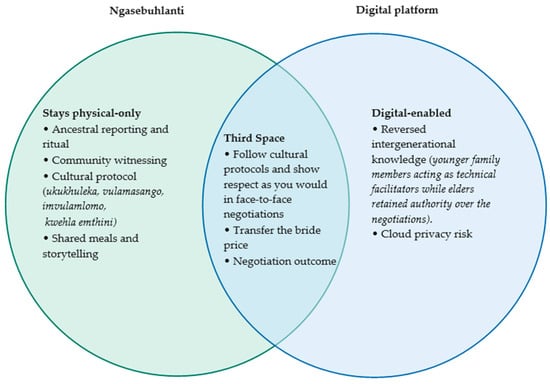
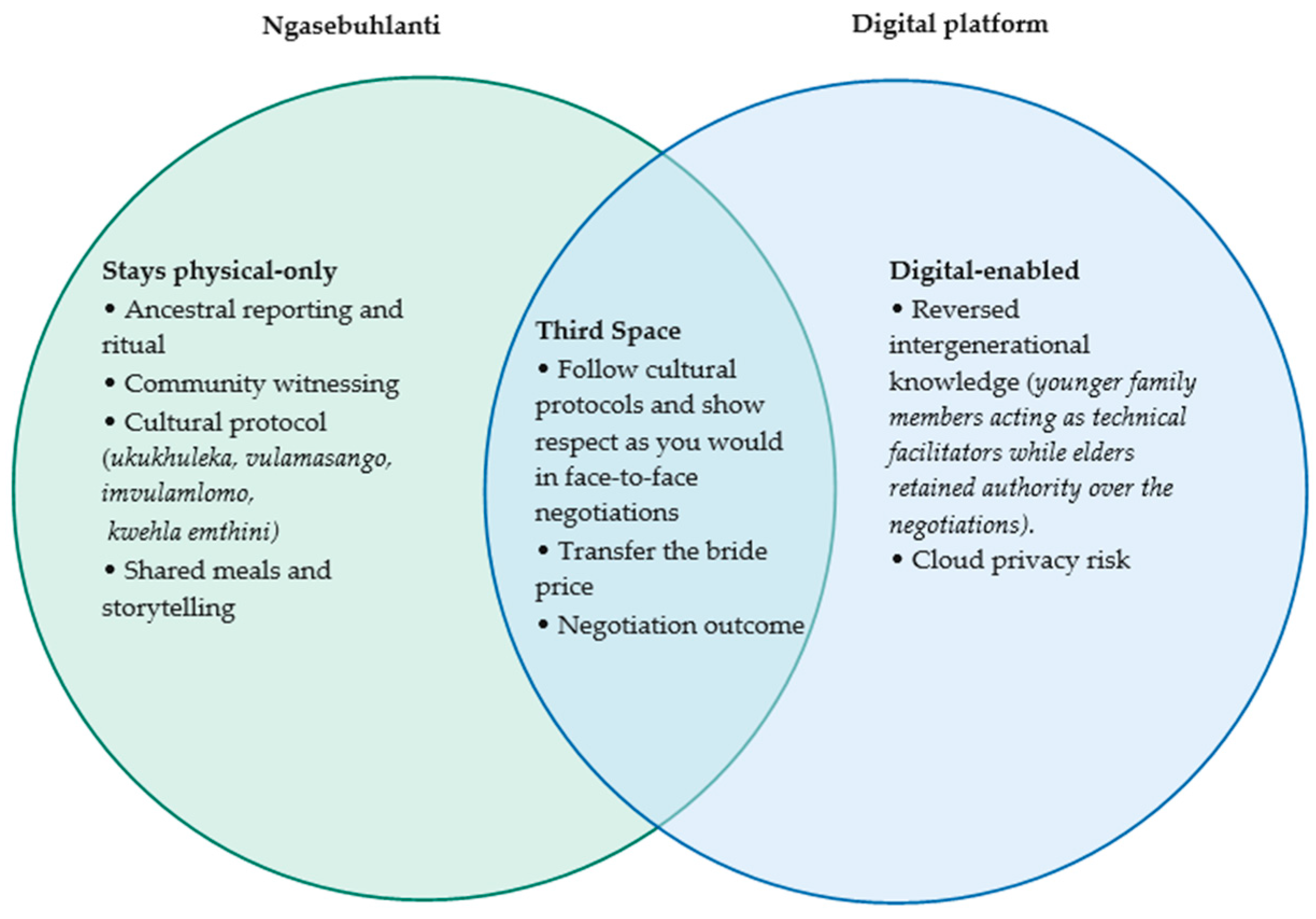
The pandemic accelerated ICT adoption and a cultural shift into the digital space. However, this change was met with both support and criticism. Based on the two types of negotiations, a comparative analysis shows that virtual lobola negotiations do not simply replicate in-person proceedings. Instead, they foster cultural hybridisation, which involves blending traditional practices with modern innovations [23]. This creates a ‘third space,’ illustrated by the concept of the ‘virtual kraal peripheral’, as shown in Figure 1.
Figure 1.
The third space between ngasebuhlanti and the digital platform.
This co-existence reflects a hybrid space where tradition and ICT mix, preserving the essence of lobola as the two families gather to discuss bridewealth and reach an agreement. Although this method may omit some ancestral protocols and embodied practices, the fundamental purpose of the negotiation remains unchanged for participants who accepted it. During remote lobola negotiations, younger family members served as technical facilitators, participating directly in the process rather than simply observing. This served as an intersection where ICT supported senior family custodians in fulfilling their roles and promoted cultural apprenticeship among young family members in the digital age. Although the invasion of technology has been recognised as a significant factor in the loss of folklore and reduced opportunities for intergenerational knowledge sharing, leading to the gradual loss or distortion of traditional knowledge because of changing lifestyles, modern technology, and Western influences [10]. In addition, since these digital platforms are owned by international companies and can record and store meetings in the cloud for later access, there are concerns about privacy and security, as lobola negotiations frequently touch on sensitive financial and personal family matters [46].
Participants described economic and emotional advantages of using ICT. The reductions in travel, accommodation, and catering costs, along with time savings and reduced emotional pressure, show the perceived benefits of ICT adoption. The reductions in travel, accommodation, and catering costs, the time savings and the reduced emotional pressure that participants described reflect their perceptions. However, these perceived gains must be carefully balanced against concerns about the digital divide, especially in rural areas where access to internet infrastructure, affordability, and digital literacy remain inconsistent. Despite widespread technology adoption, rural communities in South Africa still face limited internet access and low digital skills, further exacerbated by socioeconomic inequalities [47]. Similarly, Naidoo [48] argues that digital inequality is not just about access to technology; it also encompasses gaps in knowledge and skills, driven by demographics, socioeconomic status, and prior experience with technology, which play a major role in the choice to adopt new technology. The digital divide, therefore, threatens the participation of key senior members whose presence and authority are needed in these negotiations. Kanimozhi and Selvarani [49] also highlight that technology adoption across different cultural settings will happen only if the perceived benefits outweigh the costs. When access to devices, software, and the internet is limited by financial constraints, many communities facing poverty are less likely to adopt and use ICT [50]. Although the virtual kraal peripheral may offer real benefits for families separated by geographic location, it may also worsen inequality. The pandemic restrictions were only temporary, but being separated by distance is not. So, for families living in the diaspora, the costs of in-person lobola negotiations could remain long after the pandemic and its restrictions are lifted. This might ease the financial pressure on young couples, which often leads to more informal unions and cohabitation [51]. In addition, as suggested by participants the use of virtual lobola negotiations may offer an alternative option for similar future pandemics and transnational families and families in diaspora by reducing the costs associated with cross-border travelling, as they sometimes rely on ICT and digital communication to maintain cultural and family ties across countries [30,52]. However, this possibility requires further investigation, as families in diaspora were not included in this study.
Perspectives varied regarding social engagement and cultural authenticity. With COVID-19 reducing the number of people attending social gatherings, the virtual kraal peripheral allowed negotiations to take place in a private, controlled environment, which some found appealing, but it limited informal social interaction and the celebration of a new family bond. Some even criticised it for hindering the intimate social interaction between families that often takes place during face-to-face negotiations, which is consistent with [16]. Although lobola negotiations are highly structured and formal, governed by strict rules, they also build human connection through laughter, storytelling, and shared meals, which strengthen family ties. Because ancestral rituals cannot be performed online, those who held that ancestors must be informed in person saw the virtual negotiations as incomplete and lacked ancestral presence, making postponement the preferred choice. Conversely, those who were less involved with ancestral worship were more concerned with the core purpose of lobola, which is two families reaching an agreement regarding the future of their children. This illustrates that culture is not static but subjective and constantly evolving [8]. Lobola negotiations are a good example as they vary from family to family, across different regions, religions, and generations. This demonstrates that the same cultural event can be interpreted differently depending on individual beliefs. As a result, virtual formats do not uniformly or automatically threaten cultural authenticity. Their impact depends on a family’s cultural and religious beliefs of the family.
Lastly, family members described the virtual kraal peripheral as changing gender dynamics by allowing women to be part of the discussions about their children firsthand, a very special experience for them. These findings aligned with Sennott et al. [53] observation that women in rural South Africa often strike a balance between the benefits and challenges by adapting practices to contemporary realities while still upholding cultural traditions. However, whether digitalisation can bring social reform and greater gender equality in lobola negotiations or if it will simply recreate old inequalities in a new medium, remains an important question for future research. In addition, legal uncertainties surrounding the validity of virtual lobola negotiations and whether they meet the requirements of South African customary law, such as Section 3(1)(b) of the Recognition of Customary Marriages Act (RCMA) 120 of 1998, which states that a customary marriage must be negotiated and celebrated according to customary law, complicate this further [54,55]. In N.V.M v D.S.R (2025), for instance, the court examined conflicting arguments about what constitutes a valid legal marriage. The defendant contended that strict adherence to custom, such as the bride’s welcoming ceremony and full lobola payment, was mandatory. The court clarified that full lobola payment is not a strictly required element of a legal marriage. It also drew on Mbungela v Mkabi (2020) and Tsambo v Sengadi (2020), noting that certain customs, such as the handover of the bride, can be waived or modified by mutual consent [56,57]. This waiver logic raises a question for virtual negotiations: if physical elements of the ceremony can be waived by mutual consent, it remains unclear whether a fully online negotiation would be considered an “incomplete” negotiation under s3(1)(b), or whether the same mutual consent waiver reasoning would protect it? This is a gap in South African law that needs to be addressed and could therefore help legal experts, policymakers, and communities in future. Finally, because these digital platforms are owned by international companies and can record and store proceedings in the cloud, privacy and data security concerns were raised, particularly since lobola discussions often involve sensitive financial and family matters [46]. This issue reflects Bawack et al.’s [58] view on tensions and opportunities at the intersection of Indigenous knowledge and digital technologies, emphasising the need for culturally sensitive, inclusive, and ethical approaches. Thus, ensuring that control over sensitive cultural and financial information remains with the negotiating families and clan structures, rather than with external cloud providers, will be very important. Indigenous data governance frameworks make the same point, asking that communities retain authority over data about their own practice [59].
Therefore, remote lobola negotiations should not be seen as a replacement for physical ones, but as a supplement. By supplement we mean that the digital meeting adds to the in-person form, for example when it is followed by an in-person stage for the omitted rituals. The virtual kraal peripheral is a supplement only, where participants described a later in-person stage so that the proper rituals and ancestral acknowledgements are fully observed. We also note that when cost or distance drives the choice, it could serve as a replacement for the in-person discussions, although this study does not examine whether this occurs; this is a question for future research. In addition, ICT facilitated cultural hybridity, enabling lobola negotiations to continue during the hard lockdown in a digital space. A parallel is drawn between integrating indigenous knowledge systems (IKS) with modern science, which shows hybridisation in African communities. Ubisi et al. [60] show that rural smallholder farmers in Mpumalanga did not abandon their indigenous climate indicators when modern meteorological science was introduced; instead, they integrated both, maintaining their local knowledge while selectively adopting scientific tools to improve their adaptability. The same idea applies to the use of ICT in lobola negotiations. These negotiations can be authentic when participants show the same respect and follow the same cultural protocols as in face-to-face negotiations. A hybrid approach, starting virtually and concluding in person with outstanding rituals and a community celebration, emerged as the most favoured option among participants open to adopting ICT. This approach acknowledges that living heritage can sustain its meaning across both physical and digital space.
6. Conclusions
ICT adoption showed the resilience of living heritage. It allowed lobola negotiations to continue during the lockdown. Findings indicated that maintaining respect, protocol, and relational intent in these virtual negotiations did not compromise their core purpose. However, those who held that ancestors must be informed in person saw the virtual format as incomplete and preferred postponement; thus, we cannot say that core values were left intact for everyone. Hence, some traditionalists viewed the use of ICT as a temporary solution. Others saw it as a form of cultural hybridity that, in their view, could reduce the financial costs of the practice, assist families in diaspora, and be useful in future pandemics. Since the study focused on a single case study from a specific event, future research can
- Focus on diaspora communities in South Africa and other countries to see how the virtual kraal peripheral works across different countries and time zones;
- Look into the gender aspects of the virtual kraal peripheral to find out if the increased visibility of women can lead to changes in their formal authority or social role in such marriage-related processes;
- Conduct research that specifically focuses on the validity and recognition of marriages that have been negotiated entirely through video conferencing tools.
Author Contributions
Conceptualization, Q.P.D.; methodology, Q.P.D.; validation, Q.P.D., E.F. and M.S.; data curation, Q.P.D.; writing—original draft preparation, Q.P.D.;writing—review and editing, E.F.; supervision, Q.P.D. All authors have read and agreed to the published version of the manuscript.
Funding
This research received no external funding.
Institutional Review Board Statement
The Ethics Review Committee of the Department of Knowledge and Information Stewardship (DKIS), on behalf of the Humanities Faculty of the University of Cape Town, granted ethics clearance (protocol code DKIS20231208, approved 21 May 2024). The information sheet and consent form, and research instruments submitted to the committee were written in English; and during fieldwork, it was discovered that participants preferred to engage in their mother tongue, a vernacular language, so they were allowed to proceed in that manner. Consequently, the interview recordings mixed isiZulu, isiXhosa and English. TurboScribe transcribed and translated anonymised recordings into English using the first author’s paid account. According to the provider, uploaded files are encrypted during transfer and, while stored, are accessible only to the account holder, are processed on systems owned or controlled by the provider rather than third-party transcription services, and are not used to train its AI models. The transcripts were downloaded and saved, along with the original recordings, on the HSRC secure infrastructure accessible via a password-protected work laptop. These translations were treated as drafts and checked in the three ways described in the Section 3 above. Once the data has been curated and shared in the university’s repository, all audio files and transcripts will be deleted from the account.
Informed Consent Statement
Informed consent was obtained from all subjects involved in the study.
Data Availability Statement
The original contributions presented in this study are included in the article. Further inquiries can be directed to the corresponding author.
Acknowledgments
I am sincerely grateful to the Human Sciences Research Council for funding my studies. The findings reflect the views of the authors, not those of the organisation. I thank the Hlongwane, Tshezi, and Dlamini families, as well as the Traditional Court members, for their participation. Special thanks to Thandolwethu ka Mafu for encouraging family members to participate in the study and for verifying the accuracy of isiXhosa names after TurboScribe AI translated the recordings into English. It is worth noting that the first author shares a similar last name with the Dlamini family; this is purely coincidental, and the first author is not a relative of any family involved in this case study. This is to acknowledge that nothing influenced the interpretation of the data.
Conflicts of Interest
The authors declare no conflicts of interest.
Abbreviations
The following abbreviations are used in this manuscript:
| COVID-19 | Coronavirus |
| EFT | Electronic Fund Transfer |
| ICH | Intangible Cultural Heritage |
| ICT | Information and Communication Technology |
References
- Heeren, G.A.; Jemmott, J.B.; Tyler, J.C.; Tshabe, S.; Ngwane, Z. Cattle for Wives and Extramarital Trysts for Husbands? Lobola, Men, and HIV/STD Risk Behavior in Southern Africa. J. Hum. Behav. Soc. Environ. 2011, 21, 73–81. [Google Scholar] [CrossRef] [Scilit] [PubMed]
- Posel, D.; Rudwick, S. Marriage and Bridewealth (Ilobolo) in Contemporary Zulu Society. African Studies Review 2014, 57, 51–72. [Google Scholar] [CrossRef] [Scilit]
- Sibisi, S. The Juristic Nature of Ilobolo Agreements in Modern South Africa. Obiter 2021, 42, 57–69. [Google Scholar] [CrossRef] [Scilit]
- Shumba, S.; Landman, C. Towards the Inculturation of Marriage Rituals in the National Baptist Convention of Zimbabwe. HTS Theol. Stud. 2019, 75, 15. [Google Scholar] [CrossRef] [Scilit]
- Ngema, N. The Enforcement of the Payment of Lobolo and Its Impact on Children’s Rights in South Africa. Potchefstroom Electron. Law J. 2013, 16, 404–425. [Google Scholar] [CrossRef] [Scilit]
- Montle, M.E. Conceptualising Lobola as a Perpetuator of Gender-Based Violence in South Africa through Intsika. E-Bangi J. Soc. Sci. Humanit. 2020, 17, 160–168. [Google Scholar]
- Gwerevende, S.; Mthombeni, Z.M. Safeguarding Intangible Cultural Heritage: Exploring the Synergies in the Transmission of Indigenous Languages, Dance and Music Practices in Southern Africa. Int. J. Herit. Stud. 2023, 29, 398–412. [Google Scholar] [CrossRef] [Scilit]
- Bialostocka, O. Inhabiting a Language: Linguistic Interactions as a Living Repository for Intangible Cultural Heritage. Int. J. Intang. Herit. 2017, 12, 18–27. [Google Scholar]
- Tri, N.M. Culture as a Dynamic Product of Socially and Historically Situated Discourse Communities: A Review of Literature. Minist. Sci. Technol. Vietnam 2024, 66, 121–128. [Google Scholar] [CrossRef] [Scilit]
- Malapane, O.L.; Chanza, N.; Musakwa, W. Transmission of Indigenous Knowledge Systems under Changing Landscapes within the Vhavenda Community, South Africa. Environ. Sci. Policy 2024, 161, 103861. [Google Scholar] [CrossRef] [Scilit]
- Zabulis, X.; Partarakis, N.; Zidianakis, E.; Kaplanidi, D. A Critical Review of the Function of Intangible Cultural Heritage as a Driver for Social Resilience and Cohesion. Encyclopedia 2025, 5, 189. [Google Scholar] [CrossRef] [Scilit]
- Karl, K.A.; Peluchette, J.V.; Aghakhani, N. Virtual Work Meetings During the COVID-19 Pandemic: The Good, Bad, and Ugly. Small Group Res. 2022, 53, 343–365. [Google Scholar] [CrossRef] [Scilit] [PubMed]
- Han, P.K.J.; Scharnetzki, E.; Scherer, A.M.; Thorpe, A.; Lary, C.; Waterston, L.B.; Fagerlin, A.; Dieckmann, N.F. Communicating Scientific Uncertainty about the COVID-19 Pandemic: Online Experimental Study of an Uncertainty-Normalizing Strategy. J. Med. Internet Res. 2021, 23, e27832. [Google Scholar] [CrossRef] [Scilit] [PubMed]
- Dayimani, M. Family Holds Lobola Negotiations Via Zoom as Happy Couple Adjust to New COVID-19 Normal. News24 2020. Available online: https://www.news24.com/family-holds-lobola-negotiations-via-zoom-as-happy-couple-adjust-to-new-covid-19-normal-20200812 (accessed on 12 February 2026).
- Morkel, G. Liesl Laurie and Musa Mthombeni’s Families Hold Virtual Lobola Negotiations. News24 2021. Available online: https://www.news24.com/life/arts-and-entertainment/celebrities/liesl-laurie-and-musa-mthombenis-families-hold-virtual-lobola-negotiations-next-will-be-the-white-wedding-20210719-2 (accessed on 12 February 2026).
- Moziak Virtual Lobola Negotiations the Way Forward or a Convenient Solution for Now? Moziak 2020. Available online: https://moziak.africa/virtual-lobola-negotiations-the-way-forward-or-a-convenient-solution-for-now/ (accessed on 5 May 2026).
- Idang, G.E. AFRICAN CULTURE AND VALUES. Phronimon 2015, 16, 97–111. [Google Scholar] [CrossRef] [Scilit] [PubMed]
- UNESCO. Living Heritage in the Face of COVID-19; UNESCO: Paris, France, 2021. [Google Scholar]
- Haines, J.; Du, J.T.; Trevorrow, A.E. Cultural Use of ICT4D to Promote Indigenous Knowledge Continuity of Ngarrindjeri Stories and Communal Practices. J. Assoc. Inf. Sci. Technol. 2023, 74, 1449–1462. [Google Scholar] [CrossRef] [Scilit]
- MacNeil, A.; Findlay, B.; Bimman, R.; Hocking, T.; Barclay, T.; Ho, J. Exploring the Use of Virtual Funerals during the COVID-19 Pandemic: A Scoping Review. Omega 2023, 88, 425–448. [Google Scholar] [CrossRef] [Scilit] [PubMed]
- Maviza, G.; Thebe, P. Virtual Eulogies, Rituals, and Burials: Experiences of and Adaptations to Death and Mourning During the COVID-19 Pandemic among Transnational Families. Illn. Crisis Loss 2025, 33, 322–341. [Google Scholar] [CrossRef] [Scilit]
- Wasike, A. Kenya: Pandemic Forces Wedding Ceremonies Go Online. Anatolia Agency 2020. Available online: https://www.aa.com.tr/en/africa/kenya-pandemic-forces-wedding-ceremonies-go-online/1821696 (accessed on 12 May 2026).
- Alsaleh, A. The Impact of Technological Advancement on Culture and Society. Sci. Rep. 2024, 14, 32140. [Google Scholar] [CrossRef] [Scilit] [PubMed]
- Brunetti, F.; Matt, D.T.; Bonfanti, A.; De Longhi, A.; Pedrini, G.; Orzes, G. Digital Transformation Challenges: Strategies Emerging from a Multi-Stakeholder Approach. TQM J. 2020, 32, 697–724. [Google Scholar] [CrossRef] [Scilit]
- Ghimire, P. DIGITALIZATION OF INDIGENOUS KNOWLEDGE IN NEPAL—REVIEW ARTICLE. Acta Inform. Malays. 2021, 5, 42–47. [Google Scholar] [CrossRef] [Scilit]
- Parviainen, P.; Tihinen, M.; Kääriäinen, J.; Teppola, S. Tackling the Digitalization Challenge: How to Benefit from Digitalization in Practice. Int. J. Inf. Syst. Proj. Manag. 2017, 5, 63–77. [Google Scholar] [CrossRef] [Scilit]
- Bhabha, H.K. The Location of Culture; Routledge: Abingdon, England, 1994. [Google Scholar]
- Jung, J.K.; Jang, B.G.; Sung, Y.K.; Kwon, J. Interconnected Third Spaces: Collective Inquiry into Spaces That Honour the Hybrid Identities of Immigrant Children and Youth. Multicult. Educ. Rev. 2026, 18, 271–289. [Google Scholar] [CrossRef] [Scilit]
- Hijam, G.P. CULTURAL HYBRIDITY. In Cultural Landscapes of the Diaspora: Identity, Integration and Influence; National Press Associates: New Delhi, India, 2024; pp. 52–56. [Google Scholar]
- Kipng’etich, L. Cultural Hybridity and Identity Formation in Globalized Societies. Int. J. Humanit. Soc. Sci. 2024, 2, 14–25. [Google Scholar] [CrossRef] [Scilit]
- Tuncer, F.F. Discussing Globalization and Cultural Hybridization. Univers. J. Hist. Cult. 2023, 5, 85–103. [Google Scholar] [CrossRef] [Scilit]
- Akinwale, A.A. Digitisation of Indigenous Knowledge for Natural Resources Management in Africa. Africana 2012, 6, 1–32. [Google Scholar]
- Ramatlhakwana, D. Challenges to Digitizing the African Heritage: Some Reflections. ESARBICA J. J. East. South. Afr. Reg. Branch Int. Counc. Arch. 2009, 28, 195–205. [Google Scholar] [CrossRef] [Scilit]
- Kandpal, M.S.; Chauhan, R.; Kandari, R.; Purohit, M.; Bhardwaj, N. Cultural Hybridity in the Age of Digital Globalization. Multidiscip. Sci. Work. Manag. J. 2026, 36, 2016–2038. [Google Scholar]
- Malterud, K.; Siersma, V.D.; Guassora, A.D. Sample Size in Qualitative Interview Studies: Guided by Information Power. Qual. Health Res. 2016, 26, 1753–1760. [Google Scholar] [CrossRef] [Scilit] [PubMed]
- Ulwazi Programme Stages in a Zulu Wedding: Lobola. Available online: https://www.ulwaziprogramme.org/stages-in-a-zulu-wedding-lobola/ (accessed on 15 September 2026).
- Hsieh, H.F.; Shannon, S.E. Three Approaches to Qualitative Content Analysis. Qual. Health Res. 2005, 15, 1277–1288. [Google Scholar] [CrossRef] [Scilit] [PubMed]
- Lee, C.; Coughlin, J.F. PERSPECTIVE: Older Adults’ Adoption of Technology: An Integrated Approach to Identifying Determinants and Barriers. J. Prod. Innov. Manag. 2015, 32, 747–759. [Google Scholar] [CrossRef] [Scilit]
- Diala, J.C. “Talk to My Father”: Re-Thinking Social Exclusion and Access to Justice in the Context of Bridewealth Negotiation. Law Democr. Dev. 2021, 25, 20–46. [Google Scholar] [CrossRef] [Scilit]
- Rudwick, S.; Posel, D. Zulu Bridewealth (Ilobolo) and Womanhood in South Africa. Soc. Dyn. 2015, 41, 289–306. [Google Scholar] [CrossRef] [Scilit]
- Zubek, J.; Nagórska, E.; Komorowska-Mach, J.; Skowrońska, K.; Zieliński, K.; Raczaszek-Leonardi, J. Dynamics of Remote Communication: Movement Coordination in Video-Mediated and Face-to-Face Conversations. Entropy 2022, 24, 559. [Google Scholar] [CrossRef] [Scilit] [PubMed]
- Choudrie, J.; Pheeraphuttranghkoon, S.; Davari, S. The Digital Divide and Older Adult Population Adoption, Use and Diffusion of Mobile Phones: A Quantitative Study. Inf. Syst. Front. 2020, 22, 673–695. [Google Scholar] [CrossRef] [Scilit]
- Kobo, F. Umfazi Akangeni Ebuhlanti Emzini … A Womanist Dialogue with Black Theology of Liberation in the 21st Century. HTS Teol. Stud./Theol. Stud. 2016, 72, 6. [Google Scholar] [CrossRef] [Scilit]
- Frese, M. Cultural Practices, Norms, and Values. J. Cross. Cult. Psychol. 2015, 46, 1327–1330. [Google Scholar] [CrossRef] [Scilit]
- Khan, M.; Gope, L. Aligning Indigenous Knowledge with Digital Technology for Achieving Sustainable Development Goals. Int. J. Multidiscip. Res. 2025, 7, 1–11. [Google Scholar] [CrossRef]
- Kagan, D.; Alpert, F.; Fire, M. Zooming Into Video Conferencing Privacy. IEEE Trans. Comput. Soc. Syst. 2023, 11, 933–944. [Google Scholar] [CrossRef] [Scilit]
- Mwansa, G.; Ngandu, M.R.; Mkwambi, Z. Bridging the Digital Divide: Exploring the Challenges and Solutions for Digital Exclusion in Rural South Africa. Discov. Glob. Soc. 2025, 3, 54. [Google Scholar] [CrossRef] [Scilit]
- Naidoo, A. South African Schools: A Landscape of Digital Disparities in an Era of Ubiquitous Technology. Educ. Chall. 2025, 30, 2. [Google Scholar] [CrossRef] [Scilit]
- Kanimozhi, S.; Selvarani, A. APPLICATION OF THE DECOMPOSED THEORY OF PLANNED BEHAVIOUR IN TECHNOLOGY ADOPTION: A REVIEW. Int. J. Res. Anal. Rev. 2019, 6, 735–739. [Google Scholar]
- Baraka, K. Digital Divide and Social Inequality. Int. J. Humanit. Soc. Sci. 2024, 3, 30–45. [Google Scholar] [CrossRef] [Scilit]
- Madondo, E.; Dhobha, H. Exploring the Impact and Significance of the Lobola Tradition in African Societies. Afr. J. Relig. Philos. Cult. 2025, 6, 201–216. [Google Scholar] [CrossRef] [Scilit]
- Altunay, E.; Özdemir, N.; Omran, L.; Neunen, O.; Karpava, S.; Albert, I.; Telegdi-Csetri, Á.; Ringblom, N. Connecting Across Borders: A Systematic Review of How Information and Communication Technologies Influence Emotional, Social, and Cultural Dynamics in Transnational Families. J. Fam. Theory Rev. 2026, 1–22. [Google Scholar] [CrossRef] [Scilit]
- Sennott, C.; Madhavan, S.; Nam, Y. Modernizing Marriage: Balancing the Benefits and Liabilities of Bridewealth in Rural South Africa. Qual. Sociol. 2020, 44, 55. [Google Scholar] [CrossRef] [Scilit] [PubMed]
- Government Gazette. Recognition of Customary Marriages Act 120 of 1998; Parliament: Cape Town, South Africa, 1988; pp. 1–14.
- Sauls, N.R.; Phaladi, H. REVISITING THE ESSENTIALIA FOR CONCLUDING A VALID CUSTOMARY MARRIAGE IN SOUTH AFRICA: THE CASE OF B.C.G V S.J.M [2024] ZAFSHC 92. J. Jurid. Sci. 2025, 50, 139–153. [Google Scholar] [CrossRef] [Scilit]
- Ditsela, M.; Diala, A.; Ozoemena, R. African Feminism and the Recognition of Cohabitation Under Customary Law. Afr. Dev. 2024, 49, 71–96. [Google Scholar] [CrossRef] [Scilit]
- Radebe, K.M. Tsambo v Sengadi (244/19) [2020] ZASCA 46 (30 April 2020); Sengadi v Tsambo; In Re: Tsambo (40344/2018) [2018] ZAGPJHC 666; [2019] 1 All SA 569 (GJ) (8 November 2018). Jure Law J. 2022, 55, 77–86. [Google Scholar]
- Bawack, R.; Roderick, S.; Badhrus, A.; Dennehy, D.; Corbett, J. Indigenous Knowledge and Information Technology for Sustainable Development. Inf. Technol. Dev. 2025, 31, 233–250. [Google Scholar] [CrossRef] [Scilit]
- Carroll, S.R.; Garba, I.; Figueroa-Rodríguez, O.L.; Holbrook, J.; Lovett, R.; Materechera, S.; Parsons, M.; Raseroka, K.; Rodriguez-Lonebear, D.; Rowe, R.; et al. The CARE Principles for Indigenous Data Governance. Data Sci. J. 2020, 19, 43. [Google Scholar] [CrossRef] [Scilit]
- Ubisi, N.R.; Kolanisi, U.; Jiri, O. Comparative Review of Indigenous Knowledge Systems and Modern Climate Science. Ubuntu J. Confl. Social. Transform. 2019, 8, 53–73. [Google Scholar] [CrossRef] [Scilit]

Disclaimer/Publisher’s Note: The statements, opinions and data contained in all publications are solely those of the individual author(s) and contributor(s) and not of MDPI and/or the editor(s). MDPI and/or the editor(s) disclaim responsibility for any injury to people or property resulting from any ideas, methods, instructions or products referred to in the content. |
© 2026 by the authors. Licensee MDPI, Basel, Switzerland. This article is an open access article distributed under the terms and conditions of the Creative Commons Attribution (CC BY) license.