


Abstract
This study develops a framework for translating online review signals into possible management responses at the Genoese Castle and Beach in Akçakoca, Türkiye. Of the 948 Google Maps evaluations screened, 297 reviews were retained. Across 295 reviews, 977 code assignments were made using 32 subcodes grouped into six themes. Twenty-eight subcodes informed eight attributes for importance–performance analysis (IPA). A rank-based model explained 33.0% of the variation in ranked star ratings. Natural scenery and recreation had high relative importance and performance. Beach and sea conditions, Heritage experience, and Price and value had high relative importance and low performance, although Price and value retained its quadrant in only 59.2% of bootstrap resamples. The coded signals distinguished four possible response routes: preservation and strengthening, direct operational improvement, information and expectation management, and coordination and visitor management. These appeared in 236, 134, 121, and 34 reviews, respectively. Attributes in the same IPA region can call for different instruments. Responsibility and feasibility require separate validation.
1. Introduction
Online reviews can reveal what visitors value and which conditions disrupt their experience [1,2,3]. For a heritage attraction that also functions as a beach and public space, an issue identified in reviews may concern conservation, facilities, natural conditions, visitor behavior, or several of these at once. Turning the reviews into a management agenda therefore requires more than counting complaints or ranking attributes. Research on online review management in hospitality describes monitoring and responding to reviews, review analytics, organizational integration, and acting on the information obtained [4,5]. Yet much of this literature concerns services largely controlled by one firm. Tourist attractions may combine protected resources, public space, municipal services, commercial provision, natural conditions, and visitor behavior, so both control and responsibility are fragmented.
Importance–performance analysis (IPA) places attributes in relation to their performance and derived importance [6,7,8]. This is useful for deciding where to look, but it leaves the response unspecified. Management uses of attraction reviews [9] and diagnoses combining ratings with textual sentiment [10] provide relevant precedents. The question addressed here is what can be done after a priority has been identified: which underlying signal could inform which type of response, and who would need to assess it?
IPA, however, answers a priority question more readily than a response question. A high-importance/low-performance attribute may concern litter, a rocky seabed, limited surviving heritage fabric, pricing, or crowding. These signals can occupy the same priority region while requiring different instruments: operational repair, conservation, safety information, expectation management, or coordination. Treating them as equivalent performance deficits can therefore produce misleading recommendations.
A composite attraction is used here for a site whose visit combines resource types that are ordinarily managed separately, so that one visit spans several managerial domains. A single review may praise scenery, criticize facilities, warn about waves, and still recommend the visit. Frequency, predictive importance, and the feasibility of changing a condition consequently require separate consideration. The study uses IPA as a brief prioritization step and places the main analytical emphasis on a second, code-level assessment of response options. The same attribute may contain a valued resource to preserve and a condition that calls for operational improvement, information, or coordination. The proposed routes consider the nature and alterability of a signal, an appropriate instrument, and the likely structure of responsibility. Outcome codes remain contextual and monitoring indicators rather than response categories.
The case is the Genoese Castle and Beach in Akçakoca, northwestern Türkiye, where heritage remains, beach use, natural scenery, recreation, municipal services, commercial provision, and visitor behavior are experienced as one visit. This configuration makes the site useful for examining how an aggregate priority position can coexist with different signal-level response requirements.
Sustainable tourism governance depends on institutional arrangements and relationships among stakeholders [11,12]. In a composite attraction, a visitor may report several issues in the same review even when different actors are responsible for examining them. Three questions guide this study: (1) Which resources, problems, and outcomes recur in the reviews? (2) Which attributes warrant attention according to review-based IPA? (3) What managerial responses can the underlying coded signals inform? Section 4.1 and Section 4.2 address the first question, Section 4.3 the second, and Section 4.4 the third.
2. Theoretical Background
2.1. Attraction Experience and Online Review Signals
Leiper’s [13] tourist attraction system distinguishes the tourist, the natural, cultural, or human-made nucleus that attracts attention, and markers that provide information about that nucleus. Post-visit online reviews can function as digital markers, but they are not complete reproductions of experience. Reviewers select the resources, incidents, emotions, and judgments they considered salient, satisfactory, problematic, or worth communicating [14]. Review codes should therefore be interpreted as visitor-visible signals rather than an objective inventory of the site.
Attraction experience emerges from the interaction of core resources with cleanliness, maintenance, access, safety, interpretation, service, price, and crowding [15]. A composite attraction may be positively evaluated for natural scenery and recreation while being criticized for heritage visibility, facilities, fees, or sea conditions. Multiple coding preserves these distinct evaluations within a review, while co-occurrence analysis describes which resources, deficiencies and outcomes appear together. Empirical attraction research supports this contextual approach. Salient dimensions vary across attraction types [16], while museum reviews connect cultural content with service, information and physical conditions [17,18]. These studies provide directly relevant precedents for retaining attribute-level meaning within an account of the overall visit.
The term signal is used to avoid treating an individual review as a direct representation of objective site conditions. A signal is an expression of a resource, problem, constraint, or outcome that attracted a reviewer’s attention and forms an interpretable pattern in the corpus. Its meaning may vary with season, weather, crowding, prior expectations, or the condition of a service on a particular day. Diagnostic interpretation must therefore consider textual context, recurrence, and co-occurrence, while recognizing that online narratives do not substitute for physical inspection, operational records, or managerial knowledge.
Composite attractions make this distinction especially visible. The attractiveness of a natural nucleus, the meaning of cultural heritage, recreational opportunities, and service infrastructure may be produced or protected by different actors, although the visitor evaluates them as one trip. Managerial analysis must preserve this experiential integration while separating the alterability of each component and the response instrument to which it may be connected. The analysis therefore emphasizes resource-use condition-outcome relationships rather than treating positive and negative sentiment as the principal explanatory structure.
2.2. From Online Review Management to Managerial Actionability
Online review management is more than responding publicly to complaints. Reviews become organizational inputs when they are monitored, interpreted, circulated, and connected to action [4,5]. At the attraction and destination level, user-generated content can support visitor, resource, product, site, and crisis management, but problem identification alone does not specify the appropriate response [9]. Managerial actionability is defined here as the extent to which a review-derived signal can be connected, through explicit diagnostic reasoning, to a plausible and actor-relevant response route. It is an analytical property preceding implementation. Analytical actionability is therefore distinct from organizational feasibility, which depends on authority, budget, regulation, technical capacity, and inter-organizational agreement [19].
We propose four response routes to distinguish what a manager can examine in response to a review signal [15,19]. Preservation and strengthening focuses on valued resources and conditions. Direct operational improvement addresses deficiencies that can be changed. Information and expectation management addresses conditions that call for explanation or guidance. Coordination and visitor management addresses conduct, capacity, or responsibilities shared across actors. These routes organize the review signals at this site for local assessment. Instruments such as restrictions or pricing changes can be considered within a route.
Research on organizational learning and tourism knowledge management distinguishes access to external information from its assimilation and use [20,21,22]. Review signals can inform the choice of a response, while authority and feasibility depend on the local institutional context [11,19].
Review frequency and predictive importance provide different kinds of evidence from an on-site assessment of a safety, conservation, or accessibility concern. Managers can use such an assessment to examine the seriousness of a reported issue.
Satisfaction, disappointment, and recommendation are outcome indicators. Their co-occurrence with resource or problem codes provides context for interpreting the reviews and can guide later monitoring. The co-occurrence itself does not establish a causal relationship.
2.3. Cultural Heritage Values and Destination-Level Response
Heritage interpretation concerns how visitors encounter the meanings of a place. Moscardo [23] connects interpretation with mindful engagement, visitor experience and the conservation of built heritage. This provides a conceptual basis for treating information and narration as management instruments. It does not imply that interpretation replaces conservation or that every disappointing encounter with a monument results from inadequate interpretation. At a site with limited surviving fabric, a visitor may be responding to the physical remains, prior expectations, available information, or a combination of these conditions. Research in Lisbon and Porto examines built heritage preservation alongside cultural legacy and urban revitalization [24].
Nowacki’s [25] systematic review situates interpretation within visitor management, sustainable development planning and community involvement. It also identifies risks associated with excluding residents from interpretive design or presenting unbalanced accounts of heritage. Interpretation can therefore connect surviving material with wider cultural meanings, but the choice of stories and perspectives requires evidence and dialogue. For a fortification within a beach destination, this suggests considering how local accounts of heritage relate to the information visitors receive before and during their visit. The review data analysed here cannot establish which accounts residents would choose or whether current interpretation represents them adequately.
Interpretive practice also need not depend on substantial physical additions. In protected natural areas, Moscardo and Hughes [26] examine activities that encourage visitors to attend to existing features while requiring little additional infrastructure. Their setting differs from a medieval fortification, so the findings do not establish the effectiveness of an intervention in Akçakoca. They nevertheless provide a relevant design question: can existing features support a more meaningful encounter without expanding the physical footprint? At the case site, a short account of the surviving walls and their historical setting would be a candidate for testing, not a demonstrated solution to dissatisfaction.
These distinctions connect heritage management to regenerative tourism without equating the two. Bellato et al. [27] place tourism within interdependent social–ecological systems and emphasise the capacity of places and communities, rather than a universal list of repairs. Applied to this study, that perspective asks whose priorities guide the response and how a proposed action relates to the wider place. Preserving a valued resource or addressing a complaint is not, on its own, evidence of regeneration. The review-derived framework can provide issues for deliberation, but cannot establish community benefit, ecological improvement or a regenerative outcome.
2.4. Review-Based Importance–Performance Analysis as a Prioritization Tool
Importance–performance analysis (IPA) interprets attributes jointly by importance and perceived performance [6]. Review-based applications derive these dimensions from user-generated content [7,8]. Here, coded review signals supply eight attribute scores, and a variance-decomposition allocation of model R2 estimates their relative importance. IPA serves to select issues for further diagnosis; the subsequent response assessment works with the underlying codes rather than quadrant labels. Performance is the balance of favorable and critical coded signals within an attribute. Because the reviews contain no direct ratings of attribute importance, importance is derived from each attribute’s association with the overall star rating. It is a relative, model-dependent measure; frequency alone does not establish predictive importance [7,8]. Attributes with restricted score variation have less scope to account for differences in ratings.
For correlated attribute scores, the Lindeman–Merenda–Gold (LMG) decomposition averages each predictor’s incremental contribution to explained variance across possible orderings, corresponding to a Shapley-value allocation [28]. The main analysis uses rank-transformed variables because star ratings are ordinal. An unranked specification is examined as a sensitivity check. An IPA position can indicate where diagnosis should begin, but the choice of instrument depends on the specific review signal. Serious safety, conservation, or accessibility concerns may also require examination independently of model rank. The proposed severity check is a matter for subsequent managerial assessment and is not validated in this study.
3. Methodology
3.1. Study Setting
Akçakoca is a coastal district on the western Black Sea whose tourism supply includes beaches, natural areas, civil and religious architecture, local products, and the Genoese Castle [29]. Stakeholder research identifies the castle and the sea among the district’s principal tourism assets [30]. The castle lies approximately 2.5 km west of the town center on a cliff between two bays. Its location allows visitors to combine heritage viewing with swimming, scenery, picnicking, and relaxation [31,32]. The structure’s initial construction date remains uncertain. Official accounts connect its use with Genoese activity in the region [31]. Architectural research suggests possible construction and repairs during the Komnenian period [33]. Akçakoca Fortress is a component of the Genoese Maritime Network entry on Türkiye’s United Nations Educational, Scientific and Cultural Organization (UNESCO) World Heritage Tentative List [34].
Beyond its physical remains, the castle carries cultural significance for the district. It appears in provincial tourism representations as a defining image of Akçakoca and anchors the town’s association with Genoese Black Sea trade, so how it is interpreted contributes to how the destination as a whole is recognised [29,30]. The surviving fabric is nonetheless limited relative to that symbolic role, which makes the relationship between cultural meaning and physical evidence a managerial question rather than only an archaeological one.
The visit can encompass the castle, the adjacent beach and the picnic and recreation area [32]. Managing those experiences can involve heritage protection, visitor services, commercial provision and bathing safety. These activities may call for different management instruments and actors. A district-wide study identified facilities, cleanliness, accessibility and information about natural and historic resources as visitor concerns [35]. These findings provide local context for examining similar signals in the present reviews.
3.2. Research Design, Data Collection, and Screening
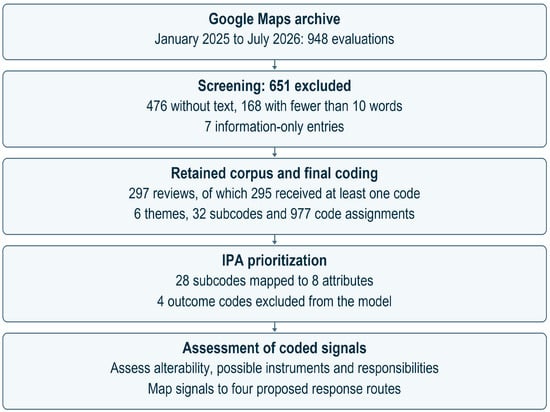
The study used an exploratory qualitative single-case design. Google Maps (web version; Google LLC, Mountain View, CA, USA) displayed 4081 evaluations for the Genoese Castle and Beach and an overall rating of 4.1 on 19 July 2026. The screening window was the period covered by the available archive. Using one Google Maps listing kept the site reference and rating scale consistent. Of the 948 evaluations posted between January 2025 and July 2026 that were screened, 476 had no review text, 168 contained fewer than ten words, and seven provided information without describing a visitor experience or making an evaluative judgment. The ten-word threshold was used to retain enough text for contextual coding. The 297 eligible reviews averaged 3.91 stars. The star ratings of the 948 Google Maps evaluations were compared between the retained and excluded groups to assess how screening affected the sample.
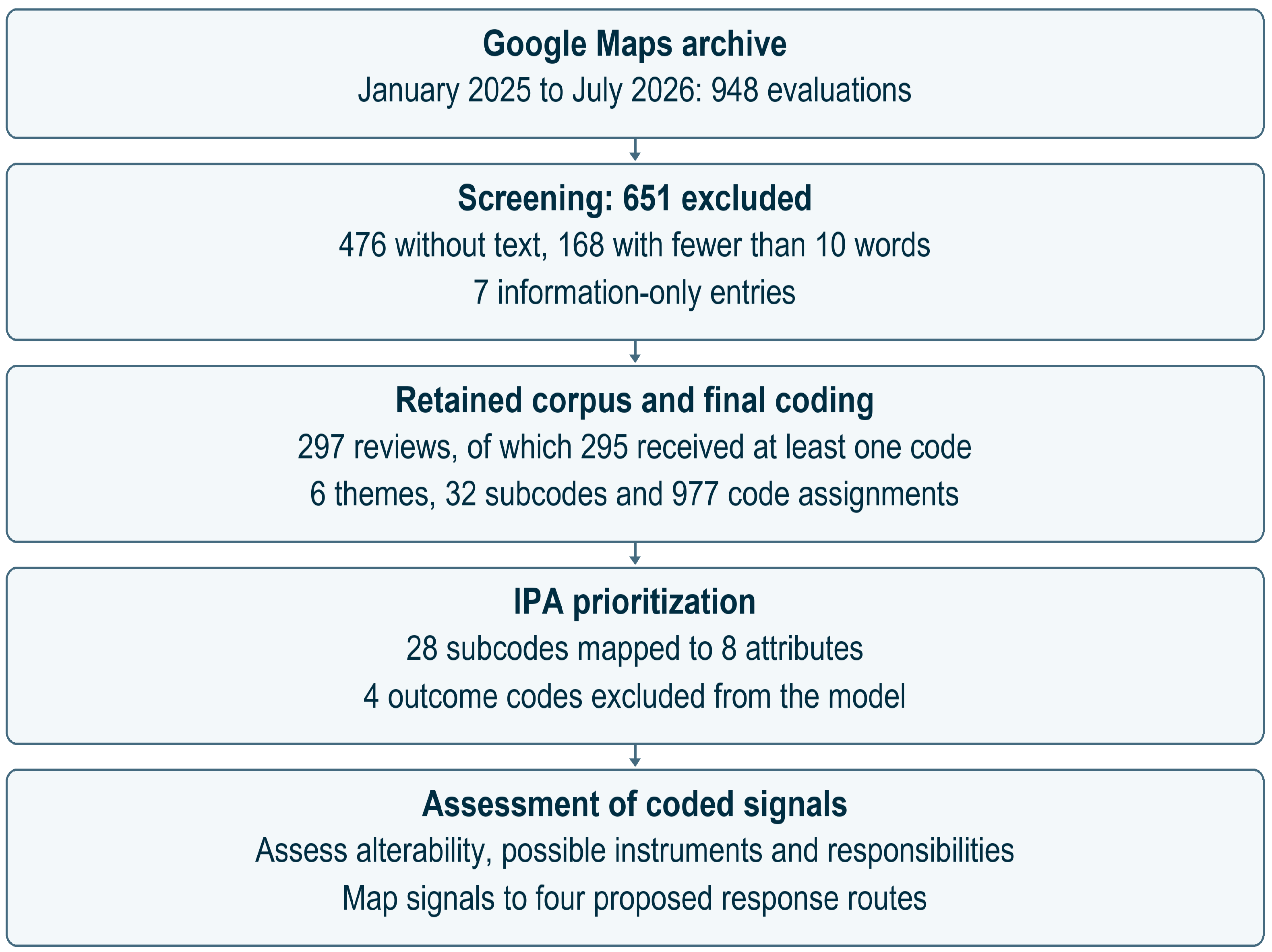
Usernames and profile information were not recorded; reviews were labeled Y1–Y297. Only errors involving Turkish characters, obvious spelling, word separation, the Turkish de/da construction, and punctuation were corrected without changing meaning. All but three reviews were originally in Turkish. The three non-Turkish reviews were examined using the Turkish translations displayed by Google Maps. Turkish text remained the analytic source; English theme labels and quotations were produced only after coding and were checked against the original coded segments. Figure 1 summarizes the process.
Figure 1.
Data screening, coding, review-based importance–performance analysis (IPA), and managerial actionability process.
3.3. First-Level Coding and Co-Occurrence Analysis
Reviews were the units of analysis, and meaningful expressions within them were the units of coding. Python scripts flagged candidate words and phrases, and the first author read and coded the retained reviews in context. The codebook defined resource, use-condition, experience, and recommendation signals and their inclusion and exclusion criteria. A review could receive several codes. The second coder independently coded a random subsample of 60 reviews. Cohen’s κ was 0.764 before reconciliation. Coding disagreements were reviewed in a reconciliation round to establish the final coding matrix. Two reviews met none of the subcode criteria and were retained in the analytical dataset without codes.
Code frequency counts distinct reviews containing a code. A review containing several codes from one theme was counted once at the theme level. Co-occurrence means that two codes appeared in the same review. All 32 codes were cross-tabulated with the four outcome codes: Satisfaction, Disappointment, Recommends, and Does not recommend.
3.4. Attribute Scoring and Importance Estimation for Review-Based Importance–Performance Analysis
For IPA, the 28 non-outcome subcodes were aggregated into eight non-overlapping management attributes: Natural scenery and recreation; Beach and sea conditions; Heritage experience; Cleanliness and maintenance; Services and facilities; Access and parking; Price and value; and Visitor management. Satisfaction, Disappointment, Recommends, and Does not recommend remained outcome codes and were excluded from IPA predictors. The complete code-to-attribute mapping is provided in Table S1 of the Supplementary Materials.
For review i and attribute j, a signed attribute score was calculated as s = (P − N)/(P + N), where P and N are the numbers of favorable and critical subcodes from that attribute assigned to the review. Scores therefore range from −1 to +1. An unmentioned attribute was scored 0 for the importance model; both retained uncoded reviews consequently had zero scores for all eight predictors. Attribute performance was the conditional mean of s among reviews mentioning the attribute, rescaled to 0–100 as (mean(s) + 1)/2 × 100; 50 represents an equal balance of favorable and critical signals. This review-derived valence index is not an objective measure of site quality. Natural scenery and recreation contains only favorable subcodes, whereas Visitor management contains only critical ones. Their performance values of 100 and 0 are fixed by codebook composition rather than indicating uncertainty-free performance.
Importance was derived by regressing overall 1–5 star ratings on the eight attribute scores and allocating explained variance using LMG/Shapley R2 [28]. The main model rank-transformed ratings and scores because the rating is ordinal (R2 = 0.330); an unranked model served as a sensitivity check (R2 = 0.343). The equal-share importance reference is 12.5% across eight attributes, and the performance midpoint is 50. Excluding the two uncoded reviews yielded a ranked R2 of 0.332 without changing quadrant assignments. A 1000-resample bootstrap assessed interval estimates and the proportion of resamples retaining each quadrant. We descriptively flag positions below 60% stability as borderline; this is not a formal IPA significance test.
We assessed dependence on the rank transformation and the zero score for unmentioned attributes using three alternative specifications on the final coding matrix: unranked star ratings and signed attribute scores, rank-transformed scores after substituting the mean among mentioning reviews for each unmentioned attribute, and rank-transformed binary mention indicators. We inspected predictor correlations and variance inflation factors (VIFs) for the main ranked model. Internal prediction was checked with 20 repeats of five-fold cross-validation. In each split, ranks were derived from the training observations and applied to the held-out reviews; LMG shares were recalculated in the training partitions to describe rank stability. These partitions overlap and do not provide independent confidence intervals (Tables S5 and S6).
3.5. Second-Level Actionability Mapping
After the attribute-level IPA, each subcode was assessed for its direction, subject, alterability, likely response instrument, and responsibility structure. The primary route for favorable resources and services was Preserve and strengthen; for operational deficiencies, Direct operational improvement; for natural or heritage conditions of low alterability, Information and expectation management; and for behavior, capacity, or distributed responsibility, Coordination and visitor management. The purpose of this second step was to specify what an actor might examine in practice, rather than to equate a quadrant with an intervention. Outcome codes were retained for monitoring.Route frequencies count distinct reviews with at least one code assigned to that route. A review can contribute to more than one route. Review evidence can inform the choice of instrument. Authority, costs, conservation requirements, and likely uptake require institutional assessment.
Frequencies, co-occurrences, IPA estimates, and bootstrap checks were calculated in Python 3.12 (Python Software Foundation, Wilmington, DE, USA) and cross-checked in Microsoft Excel (Microsoft 365; Microsoft Corporation, Redmond, WA, USA). ChatGPT and Codex (OpenAI, San Francisco, CA, USA; web versions accessed between July and November 2026) assisted with Python scripting, candidate code checks, and review-workbook preparation. The authors made the coding decisions and checked the numerical results.
4. Results
4.1. Overall Review Structure and Recurring Signals
Of the 297 retained reviews, 161 (54.2%) contained both favorable and critical codes, 81 (27.3%) only favorable codes, and 53 (17.8%) only critical codes. Two reviews (0.7%) were uncoded and had zero scores on the eight IPA predictors. The retained reviews had lower ratings than the 651 excluded evaluations (mean 3.91 versus 4.44 stars). The share of five-star ratings was 46.1% among retained reviews and 68.7% among excluded evaluations. The full distribution is shown in Supplementary Table S4.
Table 1 presents the principal signals within the six themes. Nature and Beach appeared in 228 reviews (76.77%). Natural environment was recorded in 149 reviews, while explicit beach appreciation appeared in 41. The critical signals in this theme included rocky surfaces (n = 38), sea safety (n = 37), and seaweed or pests (n = 28). Services, Access and Price appeared in 155 reviews (52.19%): adequate services and facilities were recorded in 81, inadequate facilities in 37, price-value concerns in 32, and difficult access or parking in 28. Table 1 groups codes by descriptive theme. For the IPA, Vandalism contributes to Visitor management because the signal concerns visitor conduct. The Recommendation theme consists of outcome codes and is excluded from the IPA predictors.
Table 1.
Theme-level review signals.
Within Cleanliness and Maintenance, pollution (n = 52) and poor maintenance (n = 26) were more frequent than clean and well-maintained conditions (n = 15). In Castle and Heritage, limited remains (n = 43) exceeded historic atmosphere (n = 15) and the need for restoration (n = 8). Visitor Experience included satisfaction (n = 42) and picnicking or relaxation (n = 36), alongside disappointment (n = 21) and short visits (n = 18). Of the 59 reviews containing an explicit recommendation code, 41 recommended the site and 18 did not. These theme counts refer to coded signals rather than mutually exclusive groups of visitors. A review could contain favorable and critical assessments of different aspects of the same visit, so a positive attraction signal should be considered together with the conditions that shape its use.
4.2. Outcome-Linked Co-Occurrence Patterns
Natural environment co-occurred with Satisfaction in 27 reviews and Recommends in 30; adequate services and facilities co-occurred with these outcomes in 15 and 19 reviews, respectively. Pollution co-occurred with Disappointment in ten reviews, Price-value concern in six, and Poor maintenance and Inadequate services or facilities in five each. These pairings show which experiences were reported together within reviews; they do not establish that a coded condition caused an outcome. Limited remains co-occurred with Short visit in seven reviews, Disappointment in five, and Does not recommend in seven. It also co-occurred with Recommends in seven. Counts below ten reviews are illustrative and should be read alongside the surrounding account. Supplementary Table S2 reports outcome-linked counts. Table S7 reports the full code-by-code matrix.
4.3. Review-Based Importance–Performance Analysis Results
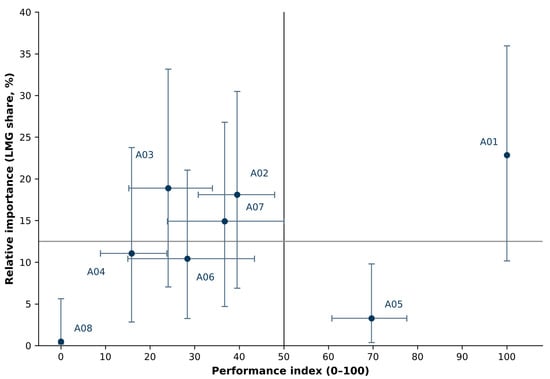
Natural scenery and recreation was the only attribute above both IPA reference lines (importance 22.85%; performance 100.00). Beach and sea conditions (18.08%; 39.51), Heritage experience (18.89%; 24.05), and Price and value (14.92%; 36.73) occupied the high-importance/low-performance region. These positions identify matters for closer examination; they do not determine which response is appropriate. Cleanliness and maintenance had low performance (15.88) and an importance share below the 12.5% equal-share reference (11.07%). Pollution and maintenance can still merit operational attention. Services and facilities combined relatively high performance with lower derived importance (69.64; 3.27%). Access and parking and Visitor management fell below both lines. Bootstrap quadrant stability was 78.0% for Beach and sea conditions, 82.0% for Heritage experience, 60.7% for Cleanliness and maintenance, and 59.2% for Price and value. The last two estimates are particularly sensitive to the importance boundary.
The service result illustrates a limitation of interpreting a quadrant as a management instruction. Services and facilities appeared in 112 reviews: 75 favorable, 31 critical, and six balanced signed scores. Its bivariate rank correlation with star ratings was 0.128, but its LMG share conditional on the other seven attributes was 3.27%. The rank correlation between Services and facilities and Natural scenery and recreation was 0.111. This weak association and the VIF of 1.076 give little reason to attribute the low share to collinearity with scenery. The small relative share cannot establish that an individual service complaint is minor. The rank-based model explained 33.01% of variation in ranked star ratings (R2 = 0.3301). Excluding the two retained uncoded reviews gave R2 = 0.3322 without changing any IPA quadrant. Table 2 and Figure 2 report the final positions and bootstrap intervals; the code-level response analysis that follows determines how those positions should be examined.
Table 2.
Review-based importance–performance analysis results.
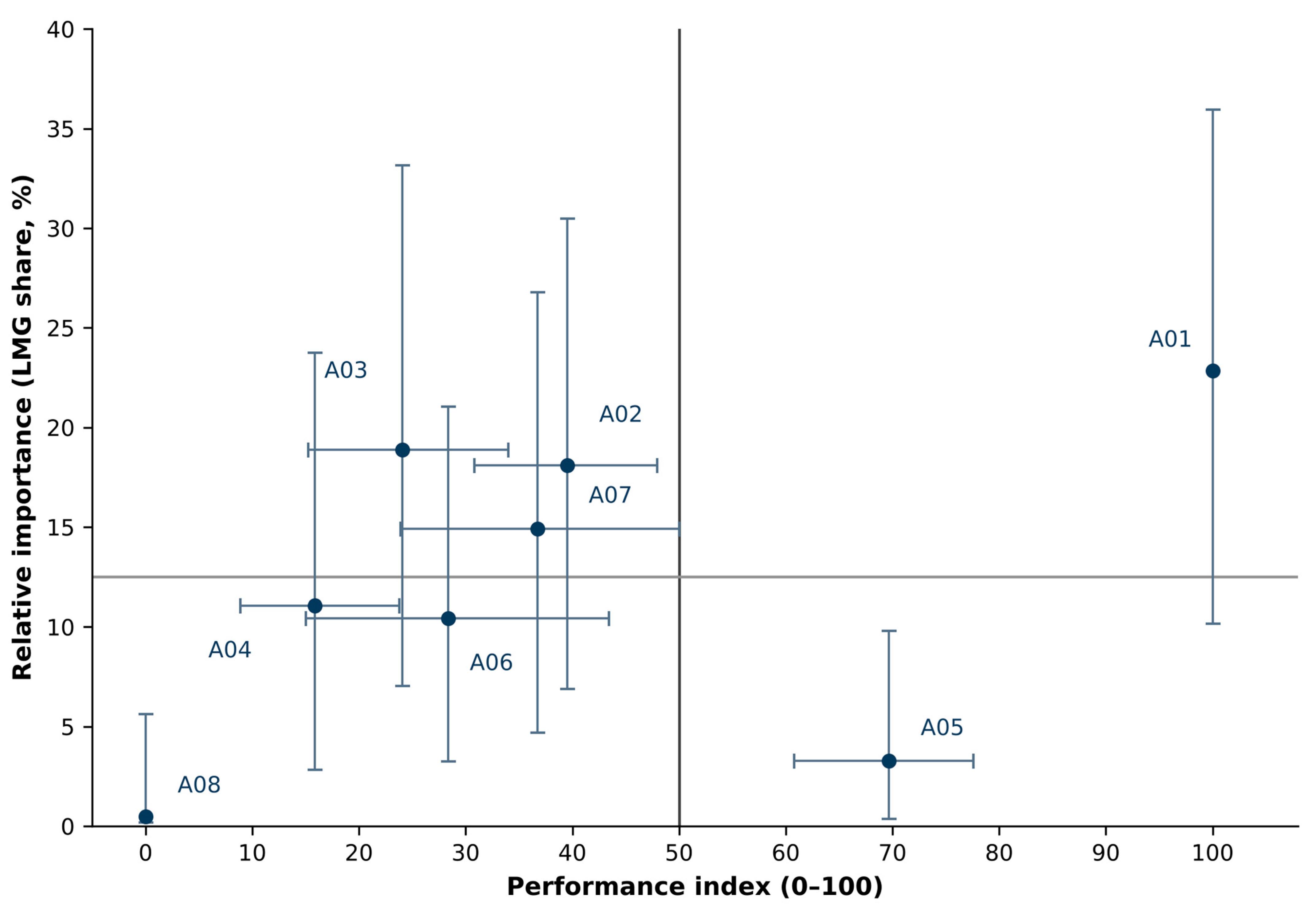
Figure 2.
Review-based importance–performance analysis matrix. Note: Attribute codes A01–A08 are defined in Table 2. Horizontal bars show bootstrap 95% confidence intervals for performance; vertical bars show bootstrap 95% confidence intervals for derived importance. Quadrant membership is interpreted from point estimates together with bootstrap stability; intervals crossing a threshold indicate boundary cases. Attributes composed exclusively of favorable or critical subcodes have zero-width performance intervals.
Predictor collinearity was low (VIF 1.025–1.113). Across 20 repeats of five-fold internal cross-validation, mean held-out R2 was 0.284 and the average rank correlation between full-sample and training-partition LMG shares was 0.907. These overlapping partitions do not provide independent confidence intervals; the full checks are in Tables S5 and S6. Sensitivity to scoring matters near an importance threshold. Without rank transformation, Cleanliness and maintenance had an LMG share of 13.07%, compared with 11.07% in the ranked model, crossing the 12.5% reference. Mean substitution for unmentioned attributes yielded R2 = 0.259 and mention-only scoring yielded R2 = 0.203. Mean substitution made the two single-valence attributes constant. In the mention-only model, Natural scenery and recreation remained first (45.25%) and Visitor management remained last (0.40%). These specifications represent different assumptions; none identifies a uniquely correct priority order (Table S5).
4.4. Managerial Actionability Pathways
Preserve and strengthen occurred in 236 reviews (79.5%). This route includes valued natural scenery, beach experiences, tranquility, recreational use, historic atmosphere, cleanliness, and adequate services. Its diagnostic question is which existing qualities should remain visible and usable as visitor pressure or site conditions change. Identifying a valued feature does not itself establish a conservation measure or an actor responsible for it. For example, Y23 described the view as “wonderful.” The positive scenery signal gives managers a reason to examine how access to the view could be maintained as use changes.
Direct operational improvement occurred in 134 reviews (45.1%). Pollution, poor maintenance, inadequate facilities, difficult access or parking, price-value concerns, and restoration needs all call for further examination, but they are not one type of repair. Cleaning and facilities may involve service planning; price-value complaints may call for transparency about charges and provision; restoration requires heritage assessment. The route identifies matters that can potentially be changed, subject to authority, costs, and conservation constraints. Review Y89 reported, “It is very dirty everywhere. There is no cleaning.” This signal can guide an inspection of litter and cleaning provision without establishing who is responsible.
Information and expectation management occurred in 121 reviews (40.7%). Rocky surfaces, seaweed or pests, sea-safety concerns, limited beach capacity, limited heritage remains, and short visits raise different information needs: current-condition and safety guidance, suitability advice, or historical interpretation. Informing visitors cannot make unsafe conditions safe or replace conservation work. It is a candidate response where an underlying condition cannot readily be changed or where expectations and available information may shape the experience. Y113 reported that “there are a lot of rocks in the water.” Information about the seabed could help visitors decide whether the site suits their needs. Separately, Y87 described nearly injuring themselves on a slippery surface. That report warrants checking the site condition regardless of the aggregate IPA rank. The example illustrates a possible safety review, with no validated severity cutoff.
Coordination and visitor management occurred in 34 reviews (11.4%), including vandalism, crowding, and disturbing behavior. These signals may require more than one organization or the cooperation of visitors; the reviews cannot allocate legal responsibility. A low importance share does not settle how much attention a signal deserves. Visitor management holds the smallest share of the eight attributes (0.49%), and vandalism, recorded in 15 reviews, sits inside it. Damage to a protected structure is a conservation matter whose consequences the star rating does not register. This is the kind of signal the proposed severity check would raise. The four routes are not mutually exclusive. Outcome indicators appeared in 104 reviews (35.0%) and serve to contextualize and later monitor experiences, not as an additional intervention route. Table 3 lists each route, its underlying codes, and a possible use. Y192 noted that it was “crowded at the weekend” despite giving a five-star rating. A manager could use this signal to investigate peak demand with operators and relevant public bodies. The review alone does not establish whether capacity measures are needed.
Table 3.
Managerial response pathways and outcome indicators.
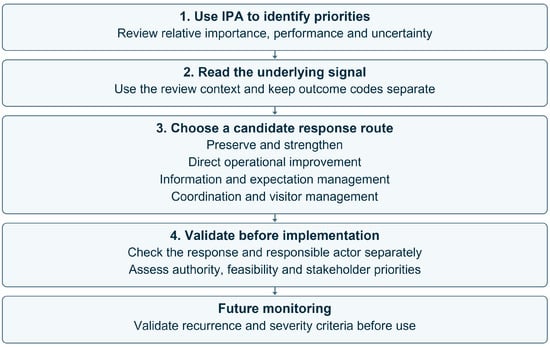
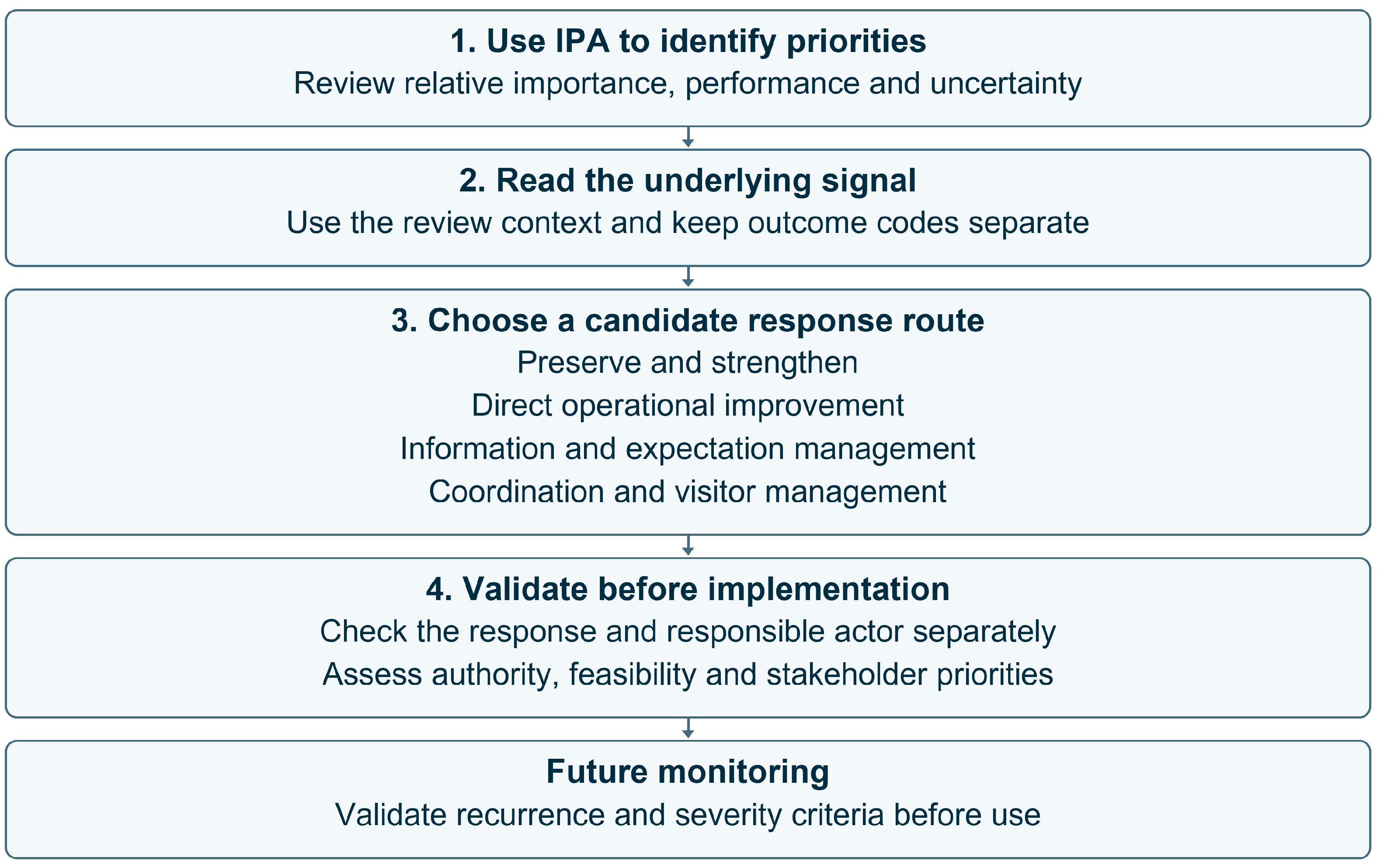
The distinction between priority and response is clearest within one attribute. Beach and sea conditions combines appreciation that may be worth preserving with rocky-surface and sea-safety concerns that call for suitability or safety information. An IPA quadrant groups these signals for attention; the coded account shows why they cannot all receive the same instruction. Figure 3 presents this pre-decision sequence, which still requires verification with the actors concerned.
Figure 3.
From IPA priority to managerial actionability: a pre-decision diagnostic framework. Note: IPA quadrants indicate relative priority rather than automatic intervention. Outcome codes are retained for monitoring and are not a step in this sequence.
5. Discussion
The main contribution lies in returning from an aggregate priority to the specific review signals that could inform a management decision. IPA supplies a point of entry; the response routes distinguish what might be preserved, improved, explained, or coordinated. This extends the attraction-management uses discussed by Chemin et al. [9] and the rating–sentiment diagnosis of Liu and Liu [10] without claiming that any proposed response has been implemented or tested.
The three attributes in the high-importance/low-performance region show why this step is needed. Beach and sea conditions includes safety and rocky-surface concerns for which current-condition guidance may be relevant. Heritage experience raises separate questions about surviving material, conservation, and interpretation. Price and value may require a review of charges, provision, and transparency. Cleanliness and maintenance is below the equal-share importance reference despite poor performance; its signals can still warrant operational assessment. Response design therefore follows the nature of the code, not the IPA label.
Even within Beach and sea conditions, explicit appreciation can coexist with concerns about waves, rocks, or seaweed. The aggregate score cannot show that every component performs poorly or should be altered. Examining individual comments distinguishes a potentially changeable condition from one that calls for a warning, suitability information, or closer inspection. The same principle applies outside the high-priority quadrant. A safety, conservation, or accessibility issue should not be dismissed solely because it explains little variation in star ratings. The proposed severity check gives decision makers a question to examine; this study does not establish a threshold or show that the check has been implemented.
The case also extends online-review management beyond hospitality services controlled by one firm. Heritage conservation, municipal services, beach operation, commercial provision, natural conditions, and visitor conduct are evaluated together but governed through different actors. In such settings, responsibility structure is part of the diagnostic problem, and review-derived recommendations should not be directed automatically to a single site manager [15,19]. Altanlar and Akıncı Kesim [35] identified litter and inadequate beach toilets, changing cabins, and showers as concerns in a district-wide survey. Pollution and inadequate services or facilities also appear in the present review corpus. The overlap concerns the kinds of problems reported. The sites, respondent groups, and measurements differ, so the two studies cannot establish a trend.
At the destination level, route assignments suggest possible addressees rather than a verified allocation of statutory responsibilities. Conservation professionals, municipal service providers, commercial operators and beach-management actors may need to examine different signals. Formal authority, operating arrangements and available resources must be established before assigning an intervention. This is consistent with the contextual approach to heritage destination governance [19] and the emphasis on institutions and policy trade-offs in sustainable tourism governance [11].
Visitor reviews provide one channel of feedback, but reviewer residence and stakeholder status were not established. The corpus therefore cannot be treated as a measure of host-community participation. A participatory application would bring review-derived signals into discussions with residents, local enterprises and relevant public bodies, allowing them to question the interpretation of a problem and the proposed response. Who participates, whose account is excluded and how conflicting priorities are resolved would need to be documented.
The heritage signals also require a distinction between conservation and interpretation. A comment about limited remains or a short visit can raise a question about expectations and available information but cannot by itself identify the cause of dissatisfaction, nor does it rule out a conservation need. The framework suggests assessing these possibilities separately. The interpretive capacity argument developed in Section 2.3 is consequently a proposition for intervention design and testing, not a finding that narration would resolve a low heritage-performance score.
The predominance of mixed reviews reinforces this argument. Visitors can value the attraction nucleus while criticizing the conditions through which it is experienced. This is consistent with aspect-level evidence that positive and negative evaluations can coexist within one tourism narrative [36]. Whole-review polarity or aggregate star ratings alone can therefore obscure both assets to preserve and specific conditions requiring intervention. Leiper’s [13] distinction between the attraction nucleus and its markers provides a basis for this proposition. Where alteration of the underlying resource is inappropriate or infeasible, information about that resource may offer a different response instrument. Whether interpretation improves understanding or visitor experience in this case remains to be tested; it should not be inferred from the IPA position alone.
The framework remains a diagnostic interface preceding organizational learning. External knowledge produces value only when organizations recognize, assimilate, and apply it [20,22]. The study does not show that managers used the reviews or that the proposed routes improve subsequent evaluations. It structures review-derived evidence so that those questions can be tested in a later organizational and longitudinal stage.
For subsequent implementation, the 2030 Agenda offers specific policy connections [37]. Heritage protection relates to Target 11.4; inclusive access to public space to Target 11.7; and the design of tourism monitoring tools to Target 12.b. These connections indicate questions for an implementation plan, not Sustainable Development Goal (SDG) achievements measured in this study. Review monitoring would need to be combined with appropriate information on conservation, accessibility and relevant social and environmental outcomes. In particular, the coded-valence index and the IPA scores are not official SDG indicators.
The attribute rankings reflect the reviews collected for Akçakoca and the selection biases associated with platform data [38]. Applying the framework elsewhere requires local evidence and consultation. It is especially useful when a single IPA attribute contains signals that call for different responses and the underlying reviews are available for examination.
6. Conclusions and Practical Implications
The study combines relative IPA priorities with a signal-level classification of possible management responses. At this site, Beach and sea conditions, Heritage experience, and Price and value were above the importance reference and below the performance midpoint, with Price and value near the importance boundary. The coded signals distinguish responses involving preservation, operational improvement, information, and coordination.
Pollution and maintenance may call for operational investigation; comments on limited remains require separate consideration of conservation and interpretation; sea conditions raise questions about safety and suitability information. Vandalism and crowding may require coordination, while valued natural and recreational features raise preservation needs. These are proposed directions for assessment with relevant actors.
For culturally significant sites, interpretive capacity is one candidate for that examination. Site information, narration and expectation setting may help visitors understand limited surviving fabric, while conservation needs require their own assessment. Any investment should be developed with heritage professionals and local stakeholders and evaluated against an explicit objective, such as understanding the site’s significance. Improved experience or wider destination benefits cannot be assumed in advance.
Limitations and Future Research
The analysis covers a single attraction and one platform, with reviews posted from January 2025 to July 2026. The data came from visitors who chose to post on Google Maps, so the findings cannot be generalized to all visitors. Visitor characteristics and visit dates could not be verified consistently. Posting dates could not reliably distinguish summer beach visits from off-season heritage visits. The ten-word threshold may have excluded short but informative reviews. Photographs, management responses, and other platforms were outside the scope of the analysis. The agreement statistics describe the independently coded subsample.
The rating comparison also shows that screening changed the composition of the analytical corpus: 651 of 948 evaluations (68.7%) were excluded, and these evaluations had a higher average star rating. Code frequencies and IPA estimates therefore describe the retained reviews, not all 948 archived evaluations or the 4081 ratings displayed on the platform. The comparison does not identify which exclusion reason produced the difference or how excluded entries would have been coded.
Model rankings also depend on the scoring rule: Cleanliness and maintenance moved across the importance reference when ranks were removed. Mean substitution and mention-only scoring describe different hypothetical treatments of unmentioned attributes. Cross-validation was internal and relied on overlapping training partitions, so the checks do not establish how the model would behave for another site or after a management intervention. A review’s overall impression may influence both its star rating and which specific experiences the visitor chooses to describe. This shared source can introduce halo effects. The sensitivity checks cannot separate those effects from attribute-level associations. The approach of Bi et al. [7] derives topics and sentiment from text and estimates importance with an ensemble neural network. Its attributes and rankings could differ from those produced by the present coded LMG model. We did not apply that model to the Akçakoca corpus.
A future monitoring design could examine recurrence across comparable periods and review serious safety, conservation or accessibility signals independently of IPA rank. This study did not validate thresholds for either decision. Future validation should separate the appropriateness of a response route from the assignment of its institutional addressee. Structured workshops with residents, operators and conservation and service authorities could examine both judgements and record disagreements. Replication should construct local attributes rather than import the present rankings. Where interventions are documented, seasonally comparable observations and suitable comparison sites could support longitudinal evaluation; no such intervention evaluation was undertaken here.
Supplementary Materials
The following supporting information can be downloaded at: https://www.mdpi.com/article/10.3390/soc16110406/s1, Table S1: Code-to-attribute mapping and second-level response-route assignment; Table S2: Code-level frequencies and co-occurrences with outcome codes; Table S3: Review-based importance–performance analysis: computation and bootstrap results; Table S4: Star ratings by screening status; Table S5: Alternative specifications on final codes; Table S6: Final-coding model diagnostics and internal checks; Table S7: Complete review-level co-occurrence matrix. The de-identified binary coding matrix is provided in a separate worksheet.
Author Contributions
Conceptualization, A.K. and M.C.K.; methodology, M.C.K.; software, M.C.K.; validation, A.K. and M.C.K.; formal analysis, M.C.K.; investigation, M.C.K.; resources, A.K. and M.C.K.; data curation, M.C.K.; writing—original draft preparation, M.C.K.; writing—review and editing, A.K. and M.C.K.; visualization, M.C.K.; supervision, A.K.; project administration, M.C.K. All authors have read and agreed to the published version of the manuscript.
Funding
This research received no external funding.
Institutional Review Board Statement
Not applicable.
Informed Consent Statement
Not applicable.
Data Availability Statement
The de-identified derived coding matrix, the attribute-level computations and the analysis documentation that support the reported frequencies, co-occurrences and IPA results are provided as Supplementary Materials and are additionally available from the corresponding author on reasonable request. The raw review texts are not redistributed because they reproduce third-party platform content; they remain publicly accessible at their original source.
Acknowledgments
ChatGPT and Codex (OpenAI, San Francisco, CA, USA; web versions accessed between July and November 2026) assisted with Python scripting, candidate code checks, and review-workbook preparation. ChatGPT (OpenAI) and Claude (Anthropic, San Francisco, CA, USA; web version accessed between July and November 2026) assisted with translation and language and structural editing. The authors reviewed the outputs and take responsibility for the published work.
Conflicts of Interest
The authors declare no conflicts of interest.
Abbreviations
The following abbreviations are used in this manuscript:
| IPA | Importance–Performance Analysis |
| LMG | Lindeman–Merenda–Gold decomposition of explained variance |
| UNESCO | United Nations Educational, Scientific and Cultural Organization |
References
- Hlee, S.; Lee, H.; Koo, C. Hospitality and tourism online review research: A systematic analysis and heuristic-systematic model. Sustainability 2018, 10, 1141. [Google Scholar] [CrossRef] [Scilit]
- Litvin, S.W.; Goldsmith, R.E.; Pan, B. Electronic word-of-mouth in hospitality and tourism management. Tour. Manag. 2008, 29, 458–468. [Google Scholar] [CrossRef] [Scilit]
- Zheng, X.; Huang, J.; Wu, J.; Sun, S.; Wang, S. Emerging trends in online reviews research in hospitality and tourism: A scientometric update (2000–2020). Tour. Manag. Perspect. 2023, 47, 101105. [Google Scholar] [CrossRef] [Scilit]
- Nguyen, K.A.; Coudounaris, D.N. The mechanism of online review management: A qualitative study. Tour. Manag. Perspect. 2015, 16, 163–175. [Google Scholar] [CrossRef] [Scilit]
- Niu, R.H.; Fan, Y. An exploratory study of online review management in hospitality services. J. Serv. Theory Pract. 2018, 28, 79–98. [Google Scholar] [CrossRef] [Scilit]
- Martilla, J.A.; James, J.C. Importance-performance analysis. J. Mark. 1977, 41, 77–79. [Google Scholar] [CrossRef] [Scilit]
- Bi, J.-W.; Liu, Y.; Fan, Z.-P.; Zhang, J. Wisdom of crowds: Conducting importance-performance analysis (IPA) through online reviews. Tour. Manag. 2019, 70, 460–478. [Google Scholar] [CrossRef] [Scilit]
- Lu, L.; Xu, P.; Wang, Y.-Y.; Wang, Y. Measuring service quality with text analytics: Considering both importance and performance of consumer opinions on social and non-social online platforms. J. Bus. Res. 2023, 169, 114298. [Google Scholar] [CrossRef] [Scilit]
- Chemin, M.; Pereira da Silva, C.; Vincent de Paul Vikou, S. User-generated content (UGC) in tourist attractions and destinations: Systematic literature review and perspectives for management. PASOS Rev. Tur. Patrim. Cult. 2025, 23, 539–562. [Google Scholar] [CrossRef] [Scilit]
- Liu, F.; Liu, J. What do online reviews reveal about tourist experience? A diagnostic framework for sustainable destination management in a large provincial tourism system in China. Sustainability 2026, 18, 3543. [Google Scholar] [CrossRef] [Scilit]
- Bramwell, B.; Lane, B. Critical research on the governance of tourism and sustainability. J. Sustain. Tour. 2011, 19, 411–421. [Google Scholar] [CrossRef] [Scilit]
- Blanco-Gregory, R.; Sánchez-Oro Sánchez, M.; Calleja-Aldana, M. The UNESCO environmental corridor of Extremadura: Tourism and governance as tools for social sustainability. Societies 2025, 15, 152. [Google Scholar] [CrossRef] [Scilit]
- Leiper, N. Tourist attraction systems. Ann. Tour. Res. 1990, 17, 367–384. [Google Scholar] [CrossRef] [Scilit]
- Marine-Roig, E. Content analysis of online travel reviews. In Handbook of e-Tourism; Xiang, Z., Fuchs, M., Gretzel, U., Höpken, W., Eds.; Springer: Cham, Switzerland, 2022; pp. 557–582. [Google Scholar] [CrossRef] [Scilit]
- Leask, A.; Urquhart, E.; Garrod, B.; Fyall, A. Advances in visitor attraction research: A critical and thematic review. Tour. Manag. 2026, 115, 105400. [Google Scholar] [CrossRef] [Scilit]
- Taecharungroj, V.; Mathayomchan, B. Analysing TripAdvisor reviews of tourist attractions in Phuket, Thailand. Tour. Manag. 2019, 75, 550–568. [Google Scholar] [CrossRef] [Scilit]
- Riva, P.; Agostino, D. Latent dimensions of museum experience: Assessing cross-cultural perspectives of visitors from TripAdvisor reviews. Mus. Manag. Curatorship 2022, 37, 616–640. [Google Scholar] [CrossRef] [Scilit]
- Su, Y.; Teng, W. Contemplating museums’ service failure: Extracting the service quality dimensions of museums from negative online reviews. Tour. Manag. 2018, 69, 214–222. [Google Scholar] [CrossRef] [Scilit]
- Mandić, A.; Kennell, J. Smart governance for heritage tourism destinations: Contextual factors and destination management organization perspectives. Tour. Manag. Perspect. 2021, 39, 100862. [Google Scholar] [CrossRef] [Scilit]
- Zahra, S.A.; George, G. Absorptive capacity: A review, reconceptualization, and extension. Acad. Manag. Rev. 2002, 27, 185–203. [Google Scholar] [CrossRef] [Scilit] [PubMed]
- Centobelli, P.; Ndou, V. Managing customer knowledge through the use of big data analytics in tourism research. Curr. Issues Tour. 2019, 22, 1862–1882. [Google Scholar] [CrossRef] [Scilit]
- Abdollahi, A.; Ghaderi, Z.; Béal, L.; Cooper, C. The intersection between knowledge management and organizational learning in tourism and hospitality: A bibliometric analysis. J. Hosp. Tour. Manag. 2023, 55, 11–28. [Google Scholar] [CrossRef] [Scilit]
- Moscardo, G. Mindful visitors: Heritage and tourism. Ann. Tour. Res. 1996, 23, 376–397. [Google Scholar] [CrossRef] [Scilit]
- Rodrigues, R.; Caldeira Heitor, J.; Pimentel, H.; Lopes, T. Relationship between preservation of built cultural heritage and economic development in Lisbon and Porto: Cultural legacy and urban revitalization as serial mediation mechanisms. Societies 2025, 15, 124. [Google Scholar] [CrossRef] [Scilit]
- Nowacki, M. Heritage interpretation and sustainable development: A systematic literature review. Sustainability 2021, 13, 4383. [Google Scholar] [CrossRef] [Scilit]
- Moscardo, G.; Hughes, K. Rethinking interpretation to support sustainable tourist experiences in protected natural areas. J. Interpret. Res. 2023, 28, 76–94. [Google Scholar] [CrossRef] [Scilit]
- Bellato, L.; Frantzeskaki, N.; Nygaard, C.A. Regenerative tourism: A conceptual framework leveraging theory and practice. Tour. Geogr. 2023, 25, 1026–1046. [Google Scholar] [CrossRef] [Scilit]
- Grömping, U. Relative importance for linear regression in R: The package relaimpo. J. Stat. Softw. 2006, 17, 1–27. [Google Scholar] [CrossRef] [Scilit]
- Düzce İl Kültür ve Turizm Müdürlüğü. Akçakoca. Available online: https://duzce.ktb.gov.tr/TR-211375/akcakoca.html (accessed on 5 November 2026).
- Mesci, Z.; Bakır, E.B. Destinasyon markalaşmasına yönelik paydaş analizi: Akçakoca örneği. Balıkesir Üniv. Sos. Bilim. Enst. Derg. 2020, 23, 1323–1341. [Google Scholar] [CrossRef] [Scilit]
- Düzce İl Kültür ve Turizm Müdürlüğü. Ceneviz Kalesi [Genoese Castle]. Available online: https://duzce.ktb.gov.tr/TR-236535/ceneviz-kalesi.html (accessed on 18 August 2026).
- T.C. Kültür ve Turizm Bakanlığı. Ceneviz Kalesi-Düzce [Genoese Castle-Düzce]. Kültür Portalı. Available online: https://www.kulturportali.gov.tr/turkiye/duzce/gezilecekyer/akcakoca-ceneviz-kalesi (accessed on 18 August 2026).
- Verim, E. Düzce’den iki Orta Çağ kalesi: Akçakoca (Dia) ve Beyköy (Embolos) kaleleri. Sanat Tar. Yıllığı 2025, 34, 431–455. [Google Scholar] [CrossRef] [Scilit]
- UNESCO World Heritage Centre. The Genoese Maritime Network: Trading Posts and Fortifications from the Mediterranean to the Black Sea. Available online: https://whc.unesco.org/en/tentativelists/7030/ (accessed on 5 November 2026).
- Altanlar, A.; Akıncı Kesim, G. Sürdürülebilir turizm planlaması için yöre halkı ve yerli turistlerin davranış ve beklentilerini anlamaya yönelik bir araştırma; Akçakoca örneği. Ank. Üniv. Çevrebilim. Derg. 2011, 3, 1–20. [Google Scholar] [CrossRef] [Scilit]
- Yang, T.; Hsu, C.H.C. Calculating tourist sentiment ambivalence through aspect-level sentiment analysis: Infusing tourism domain knowledge into a pre-trained language model. Tour. Manag. 2026, 113, 105294. [Google Scholar] [CrossRef] [Scilit]
- United Nations. Transforming Our World: The 2030 Agenda for Sustainable Development, 2015. Available online: https://sdgs.un.org/2030agenda (accessed on 2 November 2026).
- Zheng, Y.; Zhang, Y.; Mou, N.; Makkonen, T.; Li, M.; Liu, Y. Selection biases in crowdsourced big data applied to tourism research: An interpretive framework. Tour. Manag. 2024, 102, 104874. [Google Scholar] [CrossRef] [Scilit]

Disclaimer/Publisher’s Note: The statements, opinions and data contained in all publications are solely those of the individual author(s) and contributor(s) and not of MDPI and/or the editor(s). MDPI and/or the editor(s) disclaim responsibility for any injury to people or property resulting from any ideas, methods, instructions or products referred to in the content. |
© 2026 by the authors. Licensee MDPI, Basel, Switzerland. This article is an open access article distributed under the terms and conditions of the Creative Commons Attribution (CC BY) license.