


Abstract
Growing environmental awareness has encouraged brands to adopt greener practices, yet their success depends on how consumers respond. While previous research has largely focused on green purchase intention and loyalty, less attention has been given to green brand evangelism and the role of green trust in developing such behavior. This study examines the relationships between green perceived value (GPV), green brand positioning (GBP), and green brand image (GBI) and green brand evangelism (GBE), with green trust (GT) as a mediator. Drawing on the Stimulus–Organism–Response framework, the study explains how green branding factors shape consumer responses. Data were collected through a cross-sectional survey, yielding 400 valid responses and analysed using Partial Least Squares Structural Equation Modelling (PLS-SEM) in SmartPLS 4. Bootstrapping was used to assess direct and indirect relationships. The findings show that GPV, GBP and GBI are significantly related to both GT and GBE. GT also has a significant positive relationship with GBE and significantly mediates all three relationships, with GBP showing the strongest indirect relationship. The findings highlight the importance of credible green positioning, meaningful environmental value and a consistent green image in building trust and encouraging consumer support.
1. Introduction
In an era marked by escalating environmental challenges, sustainable consumption has become a global priority. In India alone, plastic waste generation reached 4.14 million tonnes in 2022–2023 [1], intensifying pressure on businesses to adopt environmentally responsible practices. Within this context, green brand evangelism (GBE) has emerged as a powerful driver of sustainable market transformation. Unlike traditional brand loyalty, GBE reflects consumers’ voluntary and passionate advocacy, wherein individuals actively recommend, defend, and promote environmentally responsible brands without any external incentives [2]. The relevance of GBE is especially pronounced in India’s fast-growing FMCG market, was projected to reach USD 220 billion by 2025 [3]. While study indicates that most of the Indian consumers are willing to pay premium for green products [4], their willingness does not reflect whether they voluntarily recommend green brands to others. The rapid growth of digital platforms has amplified the influence of such advocacy, particularly among younger consumers [5], but the translation of positive attitudes into active evangelistic behavior remains limited. This gap is largely attributed to greenwashing skepticism and trust deficits, which undermine consumers’ confidence in brands’ environmental claims. Consequently, understanding the mechanisms that convert green perceptions into genuine advocacy has become both theoretically and managerially critical. Prior literature suggests that green brand image (GBI) plays central role in shaping green trust (GT) which subsequently encourage advocacy behaviors such as positive word-of-mouth, brand defense and repeated recommendations [6]. Moreover, Green Perceived Value (GPV) and Green brand positioning (GBP) have been largely associated with higher green trust [7,8]. Based on the Stimulus–Organism–Response (S–O–R) theory, this study explains how external green brand cues (GPV, GBP and GBI) act as stimuli that shape consumers’ internal psychological states (GT), which in turn drive behavioral responses in the form of green brand evangelism (GBE). The S–O–R framework thus provides a robust theoretical lens to understand how environmental branding efforts translate into trust-based advocacy behaviors. Empirical evidence confirms a positive GBI–GT relationship [7], with GT further mediating the transition toward evangelistic outcomes, although the strength of this mediation varies across contexts [5,9].
Despite growing scholarly attention, significant research gaps remain. Existing studies are heavily concentrated in Indonesia and Southeast Asia, often focusing on single brands or limited urban samples (e.g., refs. [5,10]). Comparatively little empirical work has examined Indian consumers, who operate within a highly price-sensitive, culturally diverse, and greenwashing-aware market environment [11]. Moreover, much of the prior research emphasizes purchase intention or loyalty, rather than capturing the deeper, behavioral construct of green brand evangelism. Methodologically, cross-sectional designs and limited contextual validation further constrain the generalizability of existing findings [12]. Addressing these gaps, this study empirically investigates the GBI–GT–GBE relationship within the Indian market context using SmartPLS-SEM and data collected from over 400 consumers. By doing so, the study extends green branding literature into an under-researched emerging market and provides nuanced insights into the conditional role of green trust in fostering evangelistic behavior. The study findings contribute to theory by refining the understanding of trust-based advocacy in green marketing and offer practical implications for brands seeking to combat skepticism and cultivate authentic consumer-driven sustainability narratives [5,7].
2. Theoretical Framework
The Stimulus–Organism–Response (S–O–R) theory introduced by Mehrabian and Russell [13] and later used by Jacoby [14] in studies on consumer behaviour, illustrates that how stimuli effect behavioural response by way of individual organismic internal processes. The external stimuli are not directly translated into behavioural responses but, rather, the organismic psychological evaluative processes are utilised by the individual to interpret external stimuli and generate behavioural responses. S–O–R’s importance also applies in the cases of green and sustainable consumption, where consumers tend to consult brand-related environmental information to verify sustainability claims. This framework has been exemplified in recent research contexts of sustainable consumption. Hossain et al. [15] studied the effect of marketing stimuli on purchase intention through the mediating effect of internal consumer assessments and Rouf et al. [16] focused on consumer motivations and consumer attitudes mediating endorsement stimuli to sustainable consumption intentions. Likewise, Babu [17] shows the effectiveness of cognitive and emotional processing in establishing consumer trust and advertising attitude. These studies illustrate that S–O–R provides a theoretical explanation of the psychological processes connecting external stimuli with behavioural responses, rather than simply classifying variables into three categories.
Based on this theoretical framework, the current study operationalizes GPV, GBP and GBI as the stimuli, which are different types of brand-related environmental information. Green Trust (GT) is the organism in the framework, mediating consumers’ internal assessment on the believability and authenticity of a green brand’s environmental attributes and commitment to the environment. Green Brand Evangelism (GBE) is the response, reflected by consumers’ active endorsement, recommendation and promotion of green brands. As such, green trust functions as the core psychological process bridging the brand-related environmental information stimuli and the advocacy behavior outcome. Specific hypotheses development of the relationships among these constructs will be introduced subsequently.
3. Literature Review & Hypothetical Development
3.1. Green Brand Evangelism (GBE)
When consumers passionately promote brands committed to environmental practices due to their genuine sustainability focus [18], green brand evangelism goes beyond mere purchasing to enthusiastic recommendations driven by deep emotional bonds and active advocacy including positive word-of-mouth, peer endorsements, and even opposition to rival brands [2,19]. Brands become powerful vehicles for self-expression, reflecting consumers’ identities and desired green lifestyles [20], as these individuals willingly transform into unpaid ambassadors who share personal sustainability stories and persuade others to champion the same eco-friendly options [12]. In this dynamic, green perceived value, green brand positioning, and green brand image emerge as essential drivers that first cultivate green trust, ultimately powering brand evangelism as the key outcome converting satisfied green consumers into fervent advocates who boost brand reach through authentic endorsements and clear competitive advantages [6]. Far exceeding basic loyalty, brand evangelism embodies intense passion that insulates consumers from alternatives, making it the ideal dependent variable to capture ultimate green brand triumph in sustainability-driven markets.
3.2. Green Perceived Value (GPV)
Green perceived value (GPV) is defined as consumers’ comprehensive evaluation of the benefits and sacrifices related to the environmental attributes of a product shaped by their sustainability concerns, environmental desires, and expectations [21,22]. This construct captures the consumer’s assessment of how well a product satisfies their green needs, balancing perceived environmental benefits against the costs or trade-offs involved [23]. The importance of green perceived value is underscored by its ability to differentiate products in competitive markets and enhance consumer purchase intentions especially as consumers become more environmentally conscious [24,25].
Previous studies in general marketing have examined the role of perceived value and consumer trust in shaping consumer relationships and behavioural outcomes [26,27,28]. Although these studies provide a broader understanding of the importance of value and trust in consumer decision making, their findings are drawn from general marketing settings. In the green marketing context, green perceived value may also contribute to the development of green trust, which refers to consumers’ willingness to rely on a product or brand based on their confidence in its environmental performance and credibility [7]. When consumers perceive greater value in eco-friendly products, they may develop stronger confidence in the environmental claims made by brands and their commitment to sustainability [24]. Furthermore, consumers who perceive high value in eco-friendly brands may be more willing to support and advocate for them through positive word-of-mouth, recommendations and oppositional referrals towards competing brands [29]. Based on these arguments, we propose:
H1.
Green perceived value is positively, significanty and directly related to Green Brand Evangelism.
H2.
Green perceived value is significantly related to Green Trust.
3.3. Green Brand Positioning (GBP)
Green brand positioning (GBP) represents a strategic effort by companies to differentiate their products in consumers’ minds through environmentally friendly attributes, encompassing both functional benefits (such as ecological performance and features) and emotional benefits (such as alignment with sustainability values and consumer well-being) [30,31]. This positioning creates a distinct competitive advantage by associating the brand with superior environmental quality and credibility fostering positive consumer perceptions that extend beyond mere functionality to evoke trust and loyalty [8]. In the green marketing context, effective GBP signals a genuine commitment to sustainability which reduces perceived risks associated with environmental claims and enhances consumers’ confidence in the brand’s ecological promises [32].
Previous studies suggest that brand-related perceptions, such as brand experience and brand image, play an important role in developing consumer trust and loyalty [33,34]. In green marketing, green brand positioning has been associated with favourable consumer attitudes and purchase intentions by communicating the distinctive value of environmentally responsible brands [35,36]. Although these studies provide insights into the importance of brand positioning and consumer trust, the relationship between green brand positioning and green trust requires further investigation. A well-defined green brand position may help consumers recognise a brand’s environmental commitment and distinguish it from competing alternatives. Such perceptions may strengthen consumers’ confidence in the brand’s environmental claims and contribute to the development of green trust.
Green brand positioning establishes a distinctive environmental identity that differentiates products from competitors encouraging strong consumer advocacy known as green brand evangelism. When companies successfully position their brands as authentic green leaders through functional (ecological performance) and emotional (sustainability alignment) benefits, consumers develop heightened brand preference and actively promote these brands to others [30,31]. This positive relationship occurs because effective GBP creates perceptions of superiority and trustworthiness motivating consumers to evangelize green brands as embodiments of their environmental values [8,32]. Hence, we propose:
H3.
Green brand positioning is positively, significantly and directly related to Green Brand Evangelism.
H4.
Green brand positioning is significantly related to Green Trust.
3.4. Green Brand Image (GBI)
Green brand image (GBI) reflects consumers’ overall perceptions of a brand’s environmental commitment, authenticity and sustainability orientation, creating associations that distinguish it from competing brands [7]. Previous research has highlighted the role of corporate image in shaping consumer trust in traditional and online banking contexts [37,38]. Although these studies are not specific to green brands, they provide a broader understanding of how favourable brand perceptions can contribute to trust. In the green marketing context, a positive green brand image may strengthen consumers’ confidence in a brand’s environmental claims and perceived commitment to sustainability. When consumers associate a brand with genuine environmental responsibility, they may be more willing to rely on its environmental promises, thereby developing green trust.
Beyond trust, GBI directly cultivates brand evangelism, where consumers actively advocate for and promote green brands that resonate with their self-identity and values [39]. When GBI embodies superior environmental quality and symbolic meaning, it motivates enthusiastic word-of-mouth and loyalty beyond typical purchase intent [40]. Hence, we propose:
H5.
Green brand image is positively, significanty and directly related to Green Brand Evangelism.
H6.
Green brand image is significantly related to Green Trust.
3.5. Green Trust (GT) as Mediator
Previous studies have highlighted the role of consumer trust and emotional connections in shaping brand related behaviors. Research on green consumer behavior has linked perceptions of environmental sustainability with consumer loyalty and explored the relationship between green consumption and brand love [29,41]. In the broader branding context, brand trust has also been associated with brand evangelism, suggesting that consumers who trust a brand may be more willing to advocate for it and recommend it to others [42,43]. These findings provide a theoretical basis for examining the role of green trust in green brand evangelism. When consumers have confidence in a brand’s environmental commitments and claims, they may be more willing to support the brand through positive recommendations and advocacy. Hence, we propose:
H7.
Green Trust is positively related to Green Brand Evangelism.
When consumers perceive high value in eco-friendly brands i.e., green perceived value, it builds confidence in the brand’s environmental authenticity creating green trust. This green trust then transforms passive buyers into active evangelists who enthusiastically recommend the brand and oppose competitors. Prior studies confirm green trust fully mediates green perceived value ‘s effect on repurchase intention [44,45,46] and extending this pathway green trust channels GPV into evangelism behaviors like positive WOM and brand defense [2,29]. Hence, we propose:
H8.
Green Trust mediates the relationship between Green Perceived Value and Green Brand Evangelism.
Strategic green positioning signals environmental leadership fostering consumer confidence and trust in the brand’s sustainability claims [7]. This elevated green trust serves as the critical mechanism that converts positioned green brands into evangelized ones, motivating consumers to actively promote and defend them against rivals [47,48]. Hence, we propose:
H9.
Green Trust mediates the relationship between Green Brand Positioning and Green Brand Evangelism.
A strong green brand image creates lasting impressions of environmental credibility, building deep consumer trust [49]. This green trust then drives evangelism as trusted consumers become passionate advocates who share positive experiences and reject alternatives, amplifying brand reach through authentic endorsements [5,6]. Hence, we proposed;
H10.
Green Trust mediates the relationship between Green Brand Image and Green Brand Evangelism.
4. Research Methodology
The study employs SmartPLS 4 to examine the mediating role of green trust and the interrelationships among key green branding factors’ relationship with green brand evangelism. PLS-SEM is mainly suitable for this research due to the complexity of the proposed model and its focus on predictive relationships. Its flexibility enables a rigorous evaluation of measurement reliability and validity while effectively capturing latent green marketing constructs, thereby strengthening theory development in the context of consumer behavior and green marketing.
4.1. Research Procedure
Data for the study were collected through a mixed-mode survey approach. Offline responses were obtained from consumers visiting supermarkets and retail outlets offering green products across India, while online data were gathered via emails and social media platforms such as Facebook, LinkedIn, and WhatsApp. Of the approximately 720 questionnaires distributed, 439 responses were received. After careful data screening using Microsoft Excel and IBM SPSS Statistics 26 to remove incomplete and inconsistent responses, a final sample of 400 valid questionnaires was retained for analysis. Thus, 39 responses were excluded during the data screening process. The questionnaire focused on respondents’ general perceptions of green brands rather than on any specific brand. Respondents were asked to evaluate green branding practices based on their general experiences and understanding of green brands. Their responses were used to assess green perceived value, green brand positioning, green brand image, green trust and green brand evangelism. As the study did not focus on a single brand, the findings reflect respondents’ overall perceptions of green brands rather than their evaluations of an individual brand.
Several procedural measures were adopted to minimize the potential risk of common method bias. Respondents were assured of the confidentiality of their responses and unnecessary personal identification information was avoided. The questionnaire statements were kept clear and simple, leading questions were avoided and a consistent response format was maintained throughout the questionnaire. These measures were intended to reduce the possibility of response bias. The cleaned dataset was then analyzed using SmartPLS 4 to estimate the measurement and structural models. Measurement reliability and validity were assessed by examining Cronbach’s alpha and composite reliability values both of which exceeded the recommended threshold of 0.70, consistent with the guidelines suggested by Hulland [50] as well as Nunnally and Bernstein [51]. Convergent validity was established as the Average Variance Extracted (AVE) values for all constructs were above 0.50, in accordance with the criteria proposed by Hair et al. [52]. Discriminant validity was further established using the Heterotrait–Monotrait (HTMT) ratio, with all values remaining below the conservative threshold of 0.85, as suggested by Henseler et al. [53].
4.2. Measurement Scales
The measurement scales employed in this research were adapted and refined based on established instruments from previous research. The green perceived value scale was sourced from Dorsamy and Govender [54], while green brand positioning was drawn from Chen et al. [55]. The green brand image scale followed the framework of Huang et al. [56]. Green trust was adopted from Chen [7]. Green Brand evangelism was measured using three items adapted from previous studies. The first two items were adopted from Guiao and Lacap [57] and measured positive brand referrals. The third item was adopted from the oppositional referral dimension reported by Khandai et al. [58]. All constructs were assessed using a 5-point Likert scale ranging from (1) strongly disagree to (5) strongly agree.
4.3. Study Sample and Data Analysis Method
This study followed a cross-sectional design and collected primary data through an online questionnaire created using Google Forms. Offline data were also collected from consumers visiting supermarkets and retail outlets selling green products across India. Online responses were obtained through email and social media platforms, including Facebook, LinkedIn, and WhatsApp. A convenience sampling approach was adopted to reach respondents efficiently. Data were gathered over a five-month period, from September 2025 to January 2026. Of the 439 responses received, 400 were considered usable after careful screening for incomplete or inconsistent entries. The final dataset was then analyzed using PLS-SEM to examine the hypothesized relationships among the study variables.
5. Results
5.1. Study Sample
Table 1 presents the descriptive statistics of the research sample, including gender, age, education level, and income. Based on the data from the final sample of 400 respondents, the demographic characteristics of the participants are as follows. The demographic profile of the respondents indicates a fairly balanced gender distribution, with females 53% slightly outnumbering males 47%. In terms of age, the majority of participants fell within the 30–40 years category 33.5%, followed closely by those aged 20–30 years 31.5%, suggesting that the sample largely represents young and middle-aged consumers. Regarding educational attainment, most respondents held an undergraduate degree 35.5% or a postgraduate qualification 31%, reflecting a relatively well-educated sample. In terms of monthly income, nearly half of the respondents 45.5% reported earning less than 20,000, while 29.5% fell within the 20,000–30,000 INR range, and 25% earned above 30,000 INR. Overall, the sample captures a diverse yet education-oriented consumer group suitable for examining green brand perceptions and evangelistic behavior.
Table 1.
Demographic characteristics of the study sample.
5.2. Measurement Model
The study assessed the reliability and consistency of the constructs using key statistical indicators, including Cronbach’s alpha, composite reliability, multicollinearity (outer VIF) and Average Variance Extracted (AVE). As shown in Table 2, all constructs demonstrated satisfactory internal consistency, with Cronbach’s alpha values ranging from 0.739 to 0.876, exceeding the suggested threshold of 0.70. Collinearity at the indicator level was measured using Variance Inflation Factor (VIF) values. The results indicate that all outer VIF values ranged from 1.058 to 2.865, which are well below the conservative threshold of 3.3 [59] and the commonly accepted limit of 5.0 [60]. These findings suggest that there are no multicollinearity concerns among the measurement items. Therefore, the indicators demonstrate adequate independence and do not bias the estimation of the measurement model. Similarly, composite reliability values (ρc) ranged between 0.842 and 0.914, confirming strong internal consistency [50,51,61]. Furthermore, convergent validity was established as the Average Variance Extracted (AVE) values extended between 0.581 and 0.728, all surpassing the 0.5 benchmark [52], thereby establishing the convergent validity of the measurement scales. Although GBP1 reported a relatively low loading (0.501), it was retained because the overall construct demonstrated acceptable reliability (CR = 0.842) and convergent validity (AVE = 0.581), both exceeding recommended thresholds. Moreover, the item holds theoretical relevance to the conceptual domain of green brand positioning. Therefore, considering both statistical adequacy and content validity, GBP1 was retained for subsequent structural analysis. Therefore, the measurement model shows satisfactory reliability and convergent validity, backing up its suitability for subsequent structural model analysis.
Table 2.
An assessment of the measurement model.
Table 3 shows the results of the Heterotrait-Monotrait (HTMT) analysis, confirming that discriminant validity was established as all inter-construct correlations were below the recommended threshold of 0.85 suggested by Henseler et al. [53]. Although some relationships were moderately strong (e.g., between green trust and green brand evangelism), the values remained within acceptable limits, indicating that the constructs are related yet conceptually distinct, and supporting the progression to the subsequent structural model analysis. Thus, adequate discriminant validity is established.
Table 3.
Heterotrait-Monotrait Ratio (HTMT) Discriminant Validity Test.
5.3. Structural Model Evaluation
The coefficient of determination (R2) values further indicated the explanatory power of the model. As shown in Table 4, the R2 value for green brand evangelism (GBE) is 0.498 (adjusted R2 = 0.493), indicating that nearly 49.8% of its variance is explained by green perceived value, green brand positioning, green brand image and green trust. This reflects moderate explanatory power. For green trust (GT), the R2 value is 0.209 (adjusted R2 = 0.203), suggesting that 20.9% of its variance is explained by its predictors, indicating a modest level of predictive capability and predictive accuracy in the structural model.
Table 4.
R-squared and R-squared adjusted.
The data presented in Table 5 and Figure 1 provide detailed insights into the structural relationships between various predictors and green brand evangelism (GBE), as tested through PLS-SEM. The results presented in the table and the figure show the model estimation results, using the bootstrap method with 5,000 subsamples and a 95% confidence level. The structural model results indicate that all proposed hypotheses (H1–H10) are supported, demonstrating that most independent variables included in the model have meaningful relationships with either green trust (GT) or green brand evangelism (GBE).
Table 5.
Direct Effects and Hypothesis Testing.
Regarding direct effects on green trust, green brand positioning emerged as the strongest predictor (β = 0.336, p < 0.001), followed by green perceived value (β = 0.133, p = 0.001) and green brand image (β = 0.119, p = 0.013). This ordering suggests that consumers form trust in green brands primarily when those brands communicate clear and credible environmental positioning, while value perceptions and brand image reinforce trust formation to a somewhat lesser degree. All three confidence intervals exclude zero, confirming the robustness of these direct paths.
For direct effects on green brand evangelism, green brand image was the strongest direct predictor (β = 0.247, p < 0.001), followed by green brand positioning (β = 0.185, p < 0.001) and green perceived value (β = 0.095, p = 0.007). This indicates that a favorable environmental brand image most directly motivates consumers to recommend, defend, and actively promote the brand, while positioning and value perceptions also contribute positively, though with smaller direct magnitudes.
The most striking finding is that green trust is the strongest overall predictor of green brand evangelism (β = 0.445, p < 0.001), with a t-value of 11.268 and a confidence interval well above zero. This confirms that trust is the central psychological mechanism through which green marketing efforts translate into evangelistic consumer behavior. Consumers who trust a green brand are substantially more likely to engage in advocacy behaviors such as recommending the brand to others, defending it against criticism, and actively promoting it within their social networks.
The mediation analysis further reinforces this mechanism. All three indirect paths through green trust were statistically significant, as indicated by bias-corrected confidence intervals that exclude zero. Green brand positioning exhibited the strongest indirect effect on GBE through GT (β = 0.150, CI [0.113, 0.188]), followed by green perceived value (β = 0.059, CI [0.028, 0.092]) and green brand image (β = 0.053, CI [0.013, 0.090]). Notably, although green brand image had the strongest direct effect on GBE, green brand positioning had the strongest indirect effect through trust. This pattern suggests that positioning operates primarily by building trust, which then drives evangelism, whereas brand image exerts a more direct influence on advocacy behavior alongside its trust-mediated pathway.
Taken together, these results support the theoretical argument that green marketing factors do not influence brand evangelism in isolation; rather, they operate substantially through green trust. The findings establish green trust as a pivotal mediator in the green marketing–evangelism relationship, with green brand positioning playing a particularly important role in building that trust. The model therefore offers both theoretical and practical insights: brands seeking to cultivate consumer evangelism should prioritize trust-building through credible environmental positioning, while also leveraging brand image to directly encourage advocacy behavior.
Figure 1.
Hypothetical model result.
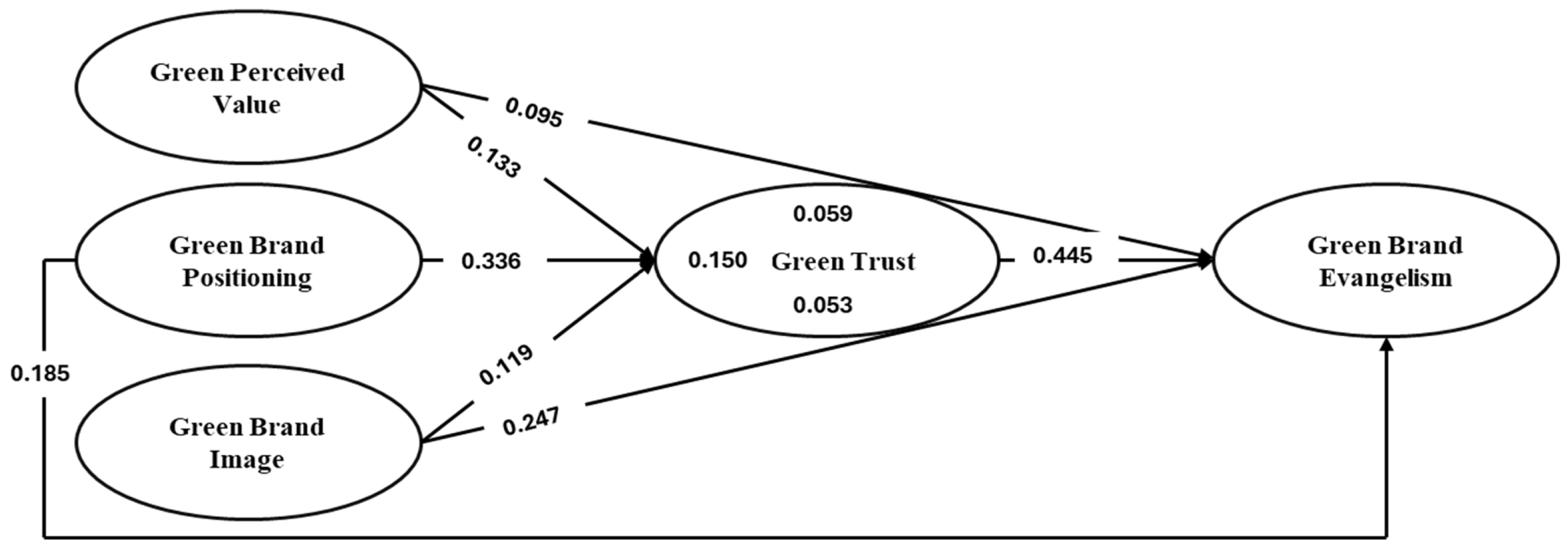
The results of Table 6 show that green trust mediates the relationships between green perceived value, green brand positioning, green brand image and green brand evangelism. All three indirect effects are positive, and their 90% bias-corrected confidence intervals do not include zero.
Table 6.
Specific Indirect Effects.
The calculated total effects showed in Table 7 indicate that green brand positioning has the strongest overall relationship with green brand evangelism, followed by green brand image and green perceived value.
Table 7.
Calculated Total Effects (Optional).
The effect-size showing in Table 8 indicates green trust has a medium effect on green brand evangelism (f2 = 0.313). The remaining relationships demonstrate small or negligible effects.
Table 8.
Effect Size (f2).
5.4. Multigroup Analysis (MGA)
A multi-group analysis was conducted to observe whether the structural relationships differ between male and female respondents. The PLS-MGA results, as shown in Table 9, indicate that none of the path differences between the two groups are statistically significant, as all p-values exceed the recommended threshold of 0.05. Specifically, the differences for the relationships GBI → GBE (Δβ = 0.054, p = 0.263), GBI → GT (Δβ = −0.001, p = 0.509), GBP → GBE (Δβ = 0.073, p = 0.170), GBP → GT (Δβ = −0.010, p = 0.542), GPV → GBE (Δβ = −0.157, p = 0.979), GPV → GT (Δβ = 0.050, p = 0.282), and GT → GBE (Δβ = 0.094, p = 0.114) were found to be insignificant. These findings suggest that gender does not significantly moderate the relationships among green perceived value, green brand positioning, green brand image, green trust, and green brand evangelism. Therefore, the structural relationships proposed in the model are consistent across male and female consumers.
Table 9.
PLS-MGA and Parametric Test Results.
6. Discussion
In this study, green perceived value (GPV), green brand positioning (GBP) and green brand image (GBI) were found to have a significant relationship with green brand evangelism (GBE) with green trust (GT) acting as a mediating variable. The findings confirm that consumers’ evaluations of environmental value, brand positioning, and brand image translate into advocacy behavior primarily through the development of trust in a brand’s environmental claims and practices.
GT plays a critical role in converting consumers’ confidence in a brand’s environmental performance into advocacy behaviors for instance positive word-of-mouth and brand recommendations [2,42]. The findings of this study show that GT has the strongest direct association with GBE (β = 0.445), highlighting its important contribution to explaining green brand evangelism. However, trust alone may not fully explain consumers’ advocacy behaviour, as their perceptions of environmental value, brand positioning and brand image may also shape their willingness to support and recommend green brands. This indicates that trust must be reinforced by tangible environmental value and credible brand actions to stimulate stronger advocacy. Accordingly, marketers should strengthen GT through transparent and authentic sustainability practices to effectively convert consumer confidence into green brand advocacy.
The results further reveal that GPV has a significant and positive impact on both GBE and GT, through GT. These findings support prior research demonstrating that consumers who perceive strong environmental benefits relative to costs are more likely to trust a brand’s sustainability claims [45,62,63]. GPV not only directly encourages advocacy behaviors such as recommendations and preference over competing brands but also indirectly fosters evangelism by first building GT. This extends the findings of Rahmani and Pradana [5], who observed that consumers become evangelists when green value is perceived as authentic and meaningful. The results highlight GT as a crucial psychological bridge through which perceived environmental value is transformed into active brand advocacy [21]. This underscores the importance of delivering tangible green value such as superior eco-performance, emotional satisfaction and social recognition rather than relying on symbolic environmental claims alone.
GBP was found to significantly influence GBE through GT, indicating that clear and credible environmental positioning strengthens consumer trust and advocacy intentions. Prior studies support this relationship, showing that strong green positioning enhances GT by signaling authenticity and reliability [7,64]. Empirical evidence also suggests that effective green positioning promotes advocacy-oriented behaviors, including commitment and brand defense [5,65]. The present findings reinforce the view that strategic green positioning must be supported by consistent environmental actions to build trust and encourage evangelistic behavior.
GBI also emerged as a significant predictor of GT and GBE, confirming its role in shaping pro-environmental consumer responses. Consistent with Chen [7], a favorable GBI enhances trust by signaling a brand’s competence, credibility, and sincerity in environmental responsibility. Prior studies have shown that while GBI is positively associated with trust-driven behavioral intentions, GPV may have a stronger impact due to its functional and tangible benefits [21,66,67]. Extending this stream of research, the present study demonstrates that GBI contributes to GBE through GT. This aligns with Panda et al. [6] as well as Rahmani and Pradana [3], who found that a strong green image encourages consumers to actively recommend and defend green brands. The findings emphasize that projecting a green image alone is insufficient; firms must reinforce image perceptions with authentic sustainability practices, such as ethical sourcing, transparent recycling initiatives, and honest environmental communication, to cultivate lasting trust and advocacy. Overall, the study highlights that GPV, GBP, and GBI function synergistically in shaping GBE through the mediating role of GT. Authenticity, transparency, and consistent environmental performance emerge as critical drivers in transforming consumer perceptions into voluntary green brand evangelism, enabling firms to cultivate loyal brand advocates in competitive green markets.
7. Theoretical and Practical Implications
This study makes numerous important theoretical contributions to the green marketing and sustainable branding literature by addressing a key gap in existing research. The study extends prior work that has largely focused on green purchase intention or loyalty by examining green brand evangelism (GBE) as a high-involvement behavioral outcome. By doing so, it advances understanding of how consumers move beyond favorable attitudes toward active advocacy in green consumption contexts. Based on the Stimulus–Organism–Response (S–O–R) framework, the study theoretically positions green perceived value (GPV), green brand positioning (GBP), and green brand image (GBI) as environmental stimuli that can shape green trust (GT) as an internal psychological state, which subsequently drives evangelistic behavior. This integrated model contributes to theory by clarifying green trust’s mediating role in translating cognitive brand perceptions into advocacy behaviors, an area that has received limited empirical attention. Furthermore, the study enriches green branding literature by jointly examining value-based, strategic, and image-based antecedents of GBE within a single framework, offering a more holistic explanation of green consumer advocacy. By empirically validating these relationships in an emerging market context, the research enhances the generalizability of green marketing theories and provides a refined conceptual foundation for future studies exploring trust-based green behavioral outcomes.
The findings of this study offer a number of valuable insights for marketers, brand managers, sustainability practitioners, and policymakers involved in green branding and sustainable consumption. This study indicates that organizations should focus on delivering tangible environmental benefits, such as superior eco-performance, health advantages, and long-term cost savings, rather than relying on symbolic green claims. Enhancing GPV helps consumers recognize real value, which strengthens trust and encourages advocacy. This paper suggests that firms must clearly and consistently communicate their environmental commitments. Positioning strategies should be supported by verifiable actions, certifications, and transparent messaging to differentiate green brands in competitive markets. Strong and credible positioning helps reduce consumer skepticism and builds confidence in environmental claims. This study highlights the importance of maintaining a consistent and authentic green identity across all consumer touchpoints. Firms should invest in ethical sourcing, sustainable packaging, and responsible communication to reinforce a trustworthy green image. Most importantly, the mediating role of green trust (GT) shows that trust is the key mechanism that transforms positive green perceptions into green brand evangelism (GBE). By strengthening GT through transparency and authenticity, firms can cultivate voluntary brand advocates who can promote green brands through positive word-of-mouth, recommendations and social influence.
8. Conclusions
The purpose of this study was to examine how green perceived value (GPV), green brand positioning (GBP), and green brand image (GBI) are related to green brand evangelism (GBE), with green trust (GT) as a mediating variable. The findings reveal that all three antecedents have a significant and positive impact on GBE, through GT. The results confirm that when consumers perceive strong environmental value, credible positioning, and a trustworthy green image, they develop higher trust, which in turn motivates advocacy behaviors such as positive word-of-mouth and brand recommendation. The study highlights that green trust plays a crucial mediating role, converting consumers’ environmental perceptions into active evangelistic behavior. These outcomes contribute to a deeper understanding of how sustainable branding strategies translate into consumer-driven promotion. For future research, scholars may explore this model across different industries or cultural contexts, incorporate moderating variables such as price sensitivity or green skepticism, or adopt longitudinal designs to capture changes in green advocacy behaviors over time.
9. Limitations and Future Research Directions
Despite providing valuable insights, this study has certain limitations that should be acknowledged. First, the research is based on cross-sectional data, which limits the ability to capture changes in consumers’ green perceptions, trust and evangelistic behavior over time. As consumer awareness of sustainability and greenwashing continues to evolve, longitudinal studies could offer deeper insights into how green trust and green brand evangelism develop in the long run. Second, the study relies on self-reported responses, which may be subject to social desirability bias, particularly in the context of environmentally responsible behavior. Future studies may incorporate behavioral data or experimental designs to strengthen validity. Third, the research focuses on selected green branding variables like GPV, GBP, GBI, GT, and GBE, while other relevant factors such as green skepticism, perceived greenwashing, price sensitivity, and cultural values were not examined. Including these variables would provide a more comprehensive understanding of green consumer behavior. Additionally, the study adopts a generalized brand perspective rather than examining specific brands or industries, which may limit contextual depth. Future research may apply the model to specific sectors or conduct comparative studies across industries or countries. These directions offer promising avenues to extend the present findings and enhance the validity of green branding literature.
Author Contributions
Conceptualization, I.S.; methodology, A.E, T.K.; data curation, A.E.; writing—original draft preparation, I.S. and A.S.A.; formal analysis, I.S; writing—review and editing, A.M.H., A.E.E.S.; supervision, A.S.A. All authors have read and agreed to the published version of the manuscript.
Funding
This work was supported by the Deanship of Scientific Research, Vice Presidency for Graduate Studies and Scientific Research, King Faisal University, Saudi Arabia [Funding No. KFU 266572].
Institutional Review Board Statement
Data were kept anonymous and personal information was not asked from participants, so this study did not require ethical approval by Institutional Ethics Committee of Aligarh Muslim University.
Informed Consent Statement
Informed consent was obtained from all subjects involved in the study.
Data Availability Statement
The data will be made available on reasonable request from the corresponding author.
Conflicts of Interest
The authors declare no conflicts of interest.
Abbreviations
The following abbreviations are used in this manuscript:
| GBE | Green Brand Evangelism |
| GBI | Green Brand Image |
| GBP | Green Brand Positioning |
| GPV | Green Perceived Value |
| GT | Green Trust |
| Construct | Source |
| GREEN PERCEIVED VALUE GPV1: Green products give me more benefits than other products. GPV2: Green products have more environmental concern than non-green products. GPV3: Green products are healthy | Dorsamy and Govender [54] |
| GREEN BRAND POSITIONING GBP1: Quality is important when I buy green products. GBP2: Price is important when I buy green products. GBP3: I know about the brand through advertising. GBP4: Green products suit my personal needs. | Chen et al. [55] |
| GREEN BRAND IMAGE GBI1: Green Brand is considered the best benchmark for environmental commitments. GBI2: Green Brand is very professional in building reputation for environmental protection GBI3: Green Brand products have a positive Brand Image in the eyes of consumers. GBI4: Green Brand is trusted in sustainable environmental development | Huang et al. [56] |
| GREEN TRUST GT1. I trust the green products I use to be genuinely environmentally friendly. GT2. I believe that green products generally keep their environmental promises. GT3. I feel that the environmental claims made by green products are reliable. GT4. I consider green products to be honest about their environmental performance. GT5. Compared to regular products, I have more trust in green products and their environmental impact. | Chen [7] |
| GREEN BRAND EVANGELISM GBE1. I will spread positive word-of-mouth about the brand of the green products. GBE2. I will recommend brands of green products over non-green brands to my friends. GBE3. I’d probably convey a negative word of mouth about other brands | Guiao and Lacap [57]; Khandai et al. [58] |
References
- Press Information Bureau (PIB). Parliament Question: Plastic Waste Management; Ministry of Environment, Forest and Climate Change: New Delhi, India; Government of India: New Delhi, India, 2024. Available online: https://www.pib.gov.in/PressReleasePage.aspx?PRID=2083801 (accessed on 2 September 2026).
- Becerra, E.P.; Badrinarayanan, V. The influence of brand trust and brand identification on brand evangelism. J. Prod. Brand Manag. 2013, 22, 371–383. [Google Scholar] [CrossRef] [Scilit]
- Fast-Moving Consumer Goods (FMCG) October 2021. Available online: https://www.readkong.com/page/fast-moving-consumer-goods-fmcg-october-2021-for-7901819 (accessed on 2 September 2026).
- Statista. Consumer Readiness to Pay for Sustainable Products by Age in India. Available online: https://www.statista.com/statistics/1320631/india-consumer-readiness-to-pay-for-sustainable-products-by-age/ (accessed on 2 September 2026).
- Rahmani, M.A.; Pradana, M.; Widodo, A. Building green brand advocacy: Examining the effect of green brand image and green perceived value on green brand evangelism through green trust mediation. J. Manag. Account. Gen. Financ. Int. Econ. Issues 2025, 4, 682–697. [Google Scholar] [CrossRef] [Scilit]
- Panda, T.K.; Kumar, A.; Jakhar, S.; Luthra, S.; Garza-Reyes, J.A.; Kazancoglu, I.; Nayak, S.S. Social and environmental sustainability model on consumers’ altruism, green purchase intention, green brand loyalty and evangelism. J. Clean. Prod. 2020, 243, 118575. [Google Scholar] [CrossRef] [Scilit]
- Chen, Y.S. The drivers of green brand equity: Green brand image, green satisfaction, and green trust. J. Bus. Ethics 2010, 93, 307–319. [Google Scholar] [CrossRef] [Scilit]
- Keller, K.L.; Parameswaran, M.; Jacob, I. Strategic Brand Management: Building, Measuring, and Managing Brand Equity; Pearson Education India: Noida, India, 2011. [Google Scholar]
- Hidayat, A.M. Pengaruh green brand image, green trust dan green satisfaction terhadap loyalitas konsumen (Studi kasus pada konsumen Stuja Coffee Jakarta). J. Ilm. Mhs. FEB 2021, 9, 2. Available online: https://jimfeb.ub.ac.id/index.php/jimfeb/article/view/7323/ (accessed on 29 September 2026).
- Winangun, M.S.; Nurcaya, N. Peran green trust memediasi pengaruh green brand image terhadap green brand equity produk Bali Ratih. E-J. Manaj. 2020, 9, 1879–1898. [Google Scholar] [CrossRef] [Scilit]
- de Freitas Netto, S.V.; Sobral, M.F.F.; Ribeiro, A.R.B.; Soares, G.R.D.L. Concepts and forms of greenwashing: A systematic review. Environ. Sci. Eur. 2020, 32, 19. [Google Scholar] [CrossRef] [Scilit]
- Doss, S.K. “Spreading the good word”: Toward an understanding of brand evangelism. In The Sustainable Global Marketplace; Dato-on, M., Ed.; Developments in Marketing Science: Proceedings of the Academy of Marketing Science; Springer: Cham, Switzerland, 2015; p. 444. [Google Scholar] [CrossRef] [Scilit]
- Mehrabian, A.; Russell, J.A. The basic emotional impact of environments. Percept. Mot. Ski. 1974, 38, 283–301. [Google Scholar] [CrossRef] [Scilit]
- Jacoby, J. Stimulus-organism-response reconsidered: An evolutionary step in modeling (consumer) behavior. J. Consum. Psychol. 2002, 12, 51–57. [Google Scholar] [CrossRef] [Scilit]
- Hossain, M.S.; Islam, T.; Babu, M.A.; Moon, M.; Mim, M.; Alam, M.T.U.; Bhattacharjee, A.; Sultana, M.S.; Akter, M.M. The influence of celebrity credibility, attractiveness, and social media influence on trustworthiness, perceived quality, and purchase intention for natural beauty care products. Clean. Responsible Consum. 2025, 17, 100277. [Google Scholar] [CrossRef] [Scilit]
- Rouf, M.A.; Babu, M.A.; Islam, M.R.; Uddin, M.J. Influence leads intention: How micro-celebrity endorsements and care motivations drive sustainable consumption. Clean. Responsible Consum. 2026, 21, 100394. [Google Scholar] [CrossRef] [Scilit]
- Babu, M.A. Engaging the Human Mind: The Effects of Anthropomorphism on Engagement, Trust, and Ad Attitude in Fashion Brands. Sage Open 2026, 16(4). [Google Scholar] [CrossRef] [Scilit]
- Asan, S.; Gabriel, D.S.; Purba, J.T.; Berlianto, M.P. The drivers of green brand evangelism: The mediation role of green brand experience. Rev. Gest. Soc. Ambient. 2024, 18, e06217. [Google Scholar] [CrossRef] [Scilit]
- Matzler, K.; Pichler, E.A.; Hemetsberger, A. Who is spreading the word? The influence of extraversion and openness on consumer passion and evangelism. In Proceedings of the American Marketing Association’s Winter Educators’ Conference, San Diego, CA, USA, 16–19 February 2007. [Google Scholar] [CrossRef] [Scilit]
- Cătălin, M.C.; Andreea, P. Brands as a means of consumer self-expression and desired personal lifestyle. Procedia Soc. Behav. Sci. 2014, 109, 103–107. [Google Scholar] [CrossRef] [Scilit]
- Chen, Y.-S.; Chang, C.-H. Enhance green purchase intentions: The roles of green perceived value, green perceived risk, and green trust. Manag. Decis. 2012, 50, 502–520. [Google Scholar] [CrossRef] [Scilit]
- Juliana, J.; Djakasaputra, A.; Pramono, R. Green perceived risk, green viral communication, green perceived value against green purchase intention through green satisfaction. J. Ind. Eng. Manag. Res. 2020, 1, 124–139. Available online: https://jiemar.org/index.php/jiemar/article/view/46 (accessed on 29 September 2026).
- Putra, I.K.M.; Wirga, I.W.; Sanjaya, I.B.; Pasek, I.K.; Sukarta, I.W. Does green perceived value impact the green repurchase intention? Int. J. Bus. Econ. Manag. 2022, 5, 176–180. [Google Scholar] [CrossRef] [Scilit]
- Kim, C.; Zhao, W.; Yang, K.H. An empirical study on the integrated framework of e-CRM in online shopping: Evaluating the relationships among perceived value, satisfaction, and trust based on customers’ perspectives. J. Electron. Commer. Organ. 2008, 6, 1–19. [Google Scholar] [CrossRef] [Scilit]
- Steenkamp, J.B.E.M.; Geyskens, I. How country characteristics affect the perceived value of web sites. J. Mark. 2006, 70, 136–150. [Google Scholar] [CrossRef] [Scilit]
- Sweeney, J.C.; Soutar, G.N.; Johnson, L.W. The role of perceived risk in the quality-value relationship: A study in a retail environment. J. Retail. 1999, 75, 77–105. [Google Scholar] [CrossRef] [Scilit]
- Eid, R. Determinants of e-commerce customer satisfaction, trust, and loyalty in Saudi Arabia. J. Electron. Commer. Res. 2011, 12, 78–93. [Google Scholar]
- Sirdeshmukh, D.; Singh, J.; Sabol, B. Consumer trust, value, and loyalty in relational exchanges. J. Mark. 2002, 66, 15–37. [Google Scholar] [CrossRef] [Scilit]
- Jargalmaa, B.; Ariunkhishig, S.; You, S.-Y. The effect of consumer perception of environmental sustainability on consumer loyalty for a cosmetic brand. J. Korea Acad.-Ind. Coop. Soc. 2021, 22, 820–832. [Google Scholar] [CrossRef] [Scilit]
- Hartmann, P.; Apaolaza Ibañez, V.; Forcada Sainz, F.J. Green branding effects on attitude: Functional versus emotional positioning strategies. Mark. Intell. Plan. 2005, 23, 9–29. [Google Scholar] [CrossRef] [Scilit]
- Situmorang, T.P.; Indriani, F.; Simatupang, R.A.; Soesanto, H. Brand positioning and repurchase intention: The effect of attitude toward green brand. J. Asian Financ. Econ. Bus. 2021, 8, 491–499. [Google Scholar] [CrossRef]
- Anwar, S. Pengaruh green brand positioning terhadap brand attitude secara fungsional dan emosional. J. Ilm. Humanika 2019, 2, 65–80. [Google Scholar]
- Wardani, I.; Rahardjo, S.T. Analisis pengaruh green brand positioning, attitude, knowledge dan perceived value terhadap green product purchase intention pada produk Unilever Indonesia. SEIKO J. Manag. Bus. 2022, 5, 618–628. [Google Scholar]
- Marliawati, A.; Cahyaningdyah, D. Impacts of the brand experience and brand image on brand loyalty: Mediating role of brand trust. Manag. Anal. J. 2020, 9, 140–151. [Google Scholar] [CrossRef] [Scilit]
- Chuah, S.H.-W.; El-Manstry, D.; Tseng, M.-L.; Ramayah, T. Sustaining customer engagement behavior through corporate social responsibility: The roles of environmental concern and green trust. J. Clean. Prod. 2020, 262, 121348. [Google Scholar] [CrossRef] [Scilit]
- Pebrianti, W.; Aulia, M. The effect of green brand knowledge and green brand positioning on purchase intention mediated by attitude towards green brand: Study on stainless steel straw products by zero waste. J. Din. Manaj. 2021, 12, 201–214. [Google Scholar] [CrossRef] [Scilit]
- Flavian, C.; Guinaliu, M.; Torres, E. The influence of corporate image on consumer trust: A comparative analysis in traditional versus internet banking. Internet Res. 2005, 15, 447–470. [Google Scholar] [CrossRef] [Scilit]
- Mukherjee, A.; Nath, P. A model of trust in online relationship banking. Int. J. Bank. Mark. 2003, 21, 5–15. [Google Scholar] [CrossRef] [Scilit]
- Tan, T.M.; Liew, T.W.; William, L.S.; Michelle, O.B.; Tan, S.M. Consumer-based brand equity in the service shop. Int. J. Mark. Stud. 2012, 4, 75–86. [Google Scholar] [CrossRef] [Scilit]
- Anselmsson, J.; Vestman Bondesson, N.; Johansson, U. Brand image and customers’ willingness to pay a price premium for food brands. J. Prod. Brand Manag. 2014, 23, 90–102. [Google Scholar] [CrossRef] [Scilit]
- Hamouda, M.; Aissaoui, A. Rooting for the green: Consumers and brand love. J. Bus. Strategy 2024, 45, 275–281. [Google Scholar] [CrossRef] [Scilit]
- Rehman, H.; Khan, Q.; Ahmed, M. Brand commitment, image, identification and trust on brand evangelism. Hum. Nat. J. Soc. Sci. 2022, 3, 491–505. [Google Scholar] [CrossRef] [Scilit]
- Shaari, H.; Ahmad, I.S. The effect of brand trust and brand community commitment on online brand evangelism behaviour. Malays. Manag. J. 2016, 20, 77–86. [Google Scholar] [CrossRef] [Scilit]
- Muflih, M.; Iswanto, B.; Purbayati, R. Green loyalty of Islamic banking customers: Combined effect of green practices, green trust, green perceived value, and green satisfaction. Int. J. Ethics Syst. 2024, 40, 477–494. [Google Scholar] [CrossRef] [Scilit]
- Aditi, B.; Nani; Juliana; Surya, E.D.; Manullang, S.O. Green trust mediates the effect of green perceived value and green perceived risk against green repurchase intention. Int. J. Adv. Sci. Technol. 2020, 29, 354–365. Available online: https://www.researchgate.net/publication/342706242_Green_Trust_Mediates_The_Effect_Of_Green_Perceived_Value_And_Green_Perceived_Risk_Against_Green_Repurchase_Intention.
- Lam, A.Y.C.; Lau, M.M.; Cheung, R. Modelling the relationship among green perceived value, green trust, satisfaction, and repurchase intention of green products. Contemp. Manag. Res. 2016, 12, 47–60. [Google Scholar] [CrossRef] [Scilit]
- Yoon, K. The era of SNS, what makes the brand evangelist? The effect of authenticity types and message sources on the level of participation in the SIPS model. Korean J. Advert. 2017, 28, 73–92. [Google Scholar] [CrossRef] [Scilit]
- Xu, Y.; Du, J.; Shahzad, F.; Li, X. Untying the influence of green brand authenticity on electronic word-of-mouth intention: A moderation-mediation model. Front. Psychol. 2021, 12, 724452. [Google Scholar] [CrossRef] [Scilit]
- Dewi, S.A.; Rastini, N.M. Peran green trust memediasi green perceived value dan green perceived risk terhadap green repurchase intention. E-J. Manaj. Unud 2016, 5, 8046–8078. Available online: https://scholar.google.com/citations?view_op=view_citation&hl=en&user=h_zre-8AAAAJ&cstart=20&pagesize=80&sortby=pubdate&citation_for_view=h_zre-8AAAAJ:UebtZRa9Y70C.
- Hulland, J. Use of partial least squares (PLS) in strategic management research: A review of four recent studies. Strateg. Manag. J. 1999, 20, 195–204. [Google Scholar] [CrossRef]
- Nunnally, J.; Bernstein, I. Psychometric Theory, 3rd ed.; McGraw-Hill: New York, NY, USA, 1994. [Google Scholar]
- Hair, J.F., Jr.; Hult, G.T.M.; Ringle, C.M.; Sarstedt, M. A Primer on Partial Least Squares Structural Equation Modeling (PLS-SEM); Sage Publications: Thousand Oaks, CA, USA, 2014. [Google Scholar]
- Henseler, J.; Ringle, C.M.; Sarstedt, M. A new criterion for assessing discriminant validity in variance-based structural equation modelling. J. Acad. Mark. Sci. 2015, 43, 115–135. [Google Scholar] [CrossRef] [Scilit]
- Dorsamy, B.; Govender, J.P. Consumer purchase intention and purchase behaviour for green fast moving consumer goods. Expert J. Mark. 2023, 11, 45–58. [Google Scholar] [CrossRef] [Scilit]
- Chen, Y.-S.; Chang, T.-W.; Li, H.-X.; Chen, Y.-R. The influence of green brand affect on green purchase intentions: The mediation effects of green brand associations and green brand attitude. Int. J. Environ. Res. Public Health 2020, 17, 4089. [Google Scholar] [CrossRef] [Scilit]
- Huang, Y.; Yang, M.; Wang, Y. Effects of green brand on green purchase intention. Mark. Intell. Plan. 2014, 32, 250–268. [Google Scholar] [CrossRef] [Scilit]
- Guiao, B.G.M.; Lacap, J.P.G. Effects of environmental sustainability awareness and altruism on green purchase intention and brand evangelism. Asian J. Bus. Res. 2022, 12, 43–62. [Google Scholar] [CrossRef] [Scilit]
- Khandai, S.; Kataria, S.; Kohli, H.S.; Yadav, R.; Mathew, J. Green choices and brand happiness: A recipe for brand evangelism. Sustain. Dev. 2025, 33, 2486–2501. [Google Scholar] [CrossRef] [Scilit]
- Kock, N. Common method bias in PLS-SEM: A full collinearity assessment approach. Int. J. E-Collab. 2015, 11, 1–10. [Google Scholar] [CrossRef] [Scilit]
- Hair, J.F.; Hult, G.T.M.; Ringle, C.M.; Sarstedt, M. A Primer on Partial Least Squares Structural Equation Modeling (PLS-SEM), 2nd ed.; Sage: Thousand Oaks, CA, USA, 2017. [Google Scholar]
- Hair, J.F.; Risher, J.J.; Sarstedt, M.; Ringle, C.M. When to use and how to report the results of PLS-SEM. Eur. Bus. Rev. 2019, 31, 2–24. [Google Scholar] [CrossRef] [Scilit]
- Keni, K.; Asali, A.; Teoh, A.P.; Muthuveloo, R. Factors influencing green purchase intention. In Proceedings of the 2nd Tarumanagara International Conference on the Applications of Social Sciences and Humanities, Jakarta, Indonesia, 3–4 August 2020; pp. 1015–1022. [Google Scholar] [CrossRef] [Scilit]
- Wahyumar, H.; Manggabarani, A.S.; Universitas, D. Pengaruh analisis green purchase intention dengan green trust sebagai variabel intervening pada green product perawatan tubuh. J. Sos. Dan Sains 2023, 3, 315–325. [Google Scholar] [CrossRef] [Scilit]
- Wang, Y.M.; Zaman, H.M.F.; Alvi, A.K. Linkage of green brand positioning and green customer value with green purchase intention: The mediating and moderating role of attitude toward green brand and green trust. SAGE Open 2022, 12, 21582440221102441. [Google Scholar] [CrossRef] [Scilit]
- Damanik, W.; Batu, K.L. Analysis of the influence of green brand positioning and green brand knowledge on brand evangelism. J. Sains Pemasar. Indones. 2024, 23, 204–213. [Google Scholar] [CrossRef] [Scilit]
- Lisaningrum, D.; Sabihaini, S.; Ghofar, A. Konsekuensi green trust terhadap green perceived value, green perceived risk dan green repurchase intention. J. Sains Pemasar. Indones. 2020, 19, 62–74. [Google Scholar] [CrossRef] [Scilit]
- Rakhmawati, D.; Puspaningrum, A.; Hadiwidjojo, D. Hubungan green perceived value, green brand image, dan green trust terhadap green purchase intention. IQTISHODUNA 2019, 1, 1–16. [Google Scholar] [CrossRef] [Scilit]

Disclaimer/Publisher’s Note: The statements, opinions and data contained in all publications are solely those of the individual author(s) and contributor(s) and not of MDPI and/or the editor(s). MDPI and/or the editor(s) disclaim responsibility for any injury to people or property resulting from any ideas, methods, instructions or products referred to in the content. |
© 2026 by the authors. Licensee MDPI, Basel, Switzerland. This article is an open access article distributed under the terms and conditions of the Creative Commons Attribution (CC BY) license.