


Abstract
Focusing on the portability revolution, this theoretical paper explores how smart devices and their associated visual and algorithm-driven social networks have become highly impactful socialisation agencies, especially for youth. Integrating secondary data with various mass communication theories, the study introduces an original set of conditional propositions to interpret the contemporary digital environment. The framework suggests that social networks’ influence expands as the educational efficacy of traditional socialisation agencies decline, and that they tend to develop a more global social knowledge but do not equally promote pluralism. As heirs to the visual culture inaugurated by television, these platforms exert pervasive structural pressures that risk constraining critical thinking and in-depth analysis under specific exposure conditions, despite their inherent democratic potential. Rather than asserting deterministic outcomes, the model specifies generative mechanisms and moderating factors, showing how platforms may saturate social knowledge with slogan-like, rapid, and uncritical information, regardless of the specific content being addressed; consequently, even the ethical dimension risks becoming increasingly tied to the trends they establish. Ultimately, the study presents the “follower” construct as a Weberian ideal-type and heuristic limit-case: a modern iteration of the mass-man, a tool to map potential risks of simplified, emotional, and polarizing mainstream communication.
1. Introduction: Topic, Aim and Research Question
The present paper presents theoretical interpretative hypotheses aimed at fostering knowledge and understanding of the cultural processes and dynamics that characterize the contemporary social reality, which is increasingly digital and immaterial. It is a conceptual theory-building study drawing on observation, secondary data, and a comprehensive literature review that mostly aims to rediscover, reuse, and reframe key concepts and theories developed during the last century, when television dominated and mass communication studies flourished, while acknowledging and discussing the most recent studies.
The study specifically tackles the topic of socialisation from a proper sociological perspective, which identifies the concept as the internalization of norms, i.e., the behaviours, beliefs, ideas and cultural values, that make individuals adapt to and integrate into the social community and world they have to live in. Given that, within the broader personal experience of socialisation, the new generation of visual and algorithm-driven social networks1 are rapidly gaining the status of socialisation agencies that constantly confront traditional ones, the study has the general aim of identifying how the fundamental process of socialisation is changing within the new digital environment. The interpretative hypotheses presented and discussed throughout this research were merged into a descriptive model of the contemporary socialisation process. Termed “digital socialisation”, this model is designed to address the topic of how people learn, understand, internalize and reproduce social norms through standardized, highly visual digital formats.
Other scholars have already used the term “digital socialisation” in prominent empirical and review papers, albeit with slightly different meanings, depending on different disciplinary frameworks and perspectives. These intersect with the sociological domain, yet do not examine it in a thorough manner. Previous studies have primarily focused on the perception of risks and opportunities related to the use of digital media [1] or on online interactions [2] rather than on the complex process of norm internalization that occurs through the use of new and social media.
Hence, the majority of recent research tackling the topic of socialisation presents mostly a psychological focus on the individual; though this represents a necessary starting point for any analytical generalization, novel theories or models about how new processes impact cultures and societies as systems remain lacking. Socialisation is mostly understood in terms of relational competence, which is only one dimension of a more complex learning process aimed at the subject’s understanding of and adaptation to the social world. How individuals acquire the knowledge used to navigate society and what kind of knowledge emerging media forms tend to generate or promote remain a matter of collective interest and have not been sufficiently addressed or investigated.
This study as a whole draws on the theoretical assumptions that media condition the culture of a given society and that the cultural dimension is central to societal development. Since individual agency is likewise recognized as central within sociological discourse and its timeless actor–structure dialectic, it is essential to examine precisely the systemic limits within which participatory action—including individual learning and knowledge construction—operates today. While taking individual agency as a given, the primary aim of this work is therefore to explore how forms of participation are conditioned by the contemporary digital individual–structure dialectic. Thus, the proposed model operates as a critical heuristic to analyse structural constraints alongside—and not in denial of—individual agency and social contexts. Consequently, conceptualizing the “follower” as the ideal-typical possibility of individuals who end up merely following rather than questioning ideas, opinions, tastes, behaviours and attitudes is not meant to negate individual agency or active appropriation; rather, it delineates the material, structural, and architectural boundaries that condition usage, thereby constraining, and at times putting at risk, critical thought, authentic relationality, and that very agency.
From the advent of the World Wide Web to the new media system we are confronted with today, it appears that the boundaries among cultures and societies are progressively being eroded: new media are moulding, indeed, globally shared attitudes, behaviours, and an increasingly global collective imaginary—albeit with very different consequences according to different contexts—as well as a global economy. Given these premises, the research presents some deductive reasoning aimed at answering the main research question: whether and why socialisation through social media implies a more global, yet less pluralistic, social knowledge2. The study hence collects secondary data and theoretical arguments on how these networks and forms of media condition our informal learning processes and cognition, both in terms of how we process information and what we ultimately believe, while they regulate public opinion, and eventually introduces the theoretical ideal-type of the “follower”, which is conceptualized as a possible outcome and social product of increasingly digital socialisation processes.
It is worth noting at the outset that secondary data are used strictly as a descriptive baseline to frame usage trends, while the social-psychological literature provides the theoretical context for potential psychosocial outcomes. Furthermore, the aforementioned ideal-type of the follower is not intended as a generalized description of contemporary identities. Rather, it represents a plausible contemporary tendency, substantiated by the analysis presented throughout this paper. Nevertheless, as this remains a theoretical hypothesis itself, it warrants further empirical investigation. While prior conceptualizations by the Author introduced the initial ideal-type of the follower from a descriptive perspective, the present manuscript extends this scholarship in three fundamental ways: (i) it formulates an integrated, multi-level theoretical model of digital socialisation linking micro, meso, and macro dynamics; (ii) it specifies four conditional, testable theoretical propositions (P1–P4), complete with generative mechanisms, moderators, and falsification criteria; and (iii) it grounds these theoretical arguments in updated secondary empirical data from Eurobarometer and Pew Research Center surveys.
2. Methodological Approach: Propositions, Materials and Theoretical Framework
As already stated, the research presented is a conceptual deductive theory-building study. Its primary objective is to address the research question by proposing explanatory propositions and constructing a consistent descriptive theoretical model of contemporary socialisation, derived both from argumentative reasoning and a critical discussion of counterarguments found in the literature.
2.1. Theoretical Propositions
The central arguments of this paper are formulated as theoretically specified, conditional propositions (P1–P4) rather than empirical hypotheses. Designed to provide a testable framework for future research, each proposition delineates the specific analytical level, exposure factor, theoretical outcome, underlying generative mechanism, key moderators, and explicit falsification criteria, alongside observable implications for future research3.
- •
- Proposition 1, P1 (meso—institutional level)
- -
- Exposure: daily use and increasing pervasiveness of visual, algorithm-driven social media architectures.
- -
- Outcome: diminishing educational efficacy and institutional legitimacy of traditional socialisation agencies (e.g., family, formal education).
- -
- Generative mechanism: round-the-clock availability alongside short, slogan-like content and algorithmic curation provides users with instant gratification and establishes uncritical knowledge construction pathways that compete with, and often undermine, the deliberative pace of traditional agencies.
- -
- Key moderators: this structural shift primarily relates to high-density digital environments and increasing smartphone access among youth.
- -
- Reverse causality note: while platform reliance accelerates institutional erosion, the initial retreat or perceived inefficiency of traditional agencies simultaneously drives youth toward digital platforms, creating a reciprocal feedback loop.
- -
- Falsification criterion: P1 would be falsified if high daily social media exposure were empirically shown to systematically reinforce or leave unaffected youth adherence to and trust in traditional educational institutions.
- -
- Observable implications: variations in institutional trust and educational adherence relative to daily platform use and exposure metrics.
- •
- Proposition 2, P2 (micro—cognitive level)
- -
- Exposure: continuous engagement with social media platforms as powerful socialisation agencies optimized for rapid scroll-through, visual primacy, and immediate gratification.
- -
- Outcome: promoting the reproduction and diffusion of a “fast uncritical social knowledge”, leading to a downward levelling of analytical depth.
- -
- Generative mechanism: structures privileging speed over depth and emotion over analytical thinking encourage low-effort cognitive processing, reducing reflective engagement with complex social issues and outsourcing analytical synthesis to platform curation.
- -
- Key moderators: this effect is clearly moderated by the users’ active engagement with other socialisation agencies, including legacy media and news coverage, prior critical media literacy, and measurable educational attainment.
- -
- Falsification criterion: P2 would be falsified if intensive long-term use of visual/algorithmic feeds were found to improve or maintain dispositional capacity for complex textual analysis and critical evaluation.
- -
- Observable implications: decreased engagement with long-form textual argumentation, decreased attention-span and increased reliance on digital content.
- •
- Proposition 3, P3 (micro—relational level)
- -
- Exposure: high engagement with performative, low-effort, image-based, and slogan-like content.
- -
- Outcome: may predict a decreased dispositional empathy, heightened communicative self-referentiality, and a structural impoverishment of interpersonal relationships.
- -
- Generative mechanism: algorithmic feedback mechanisms (primarily likes) as well as image and selfie-based content privilege performative identity staging, while information overload reduces deep emotional resonance and reflective engagement with others.
- -
- Analytical separation: empathy (emotional resonance), self-referentiality (ego-centric performance), and relational quality (depth of offline ties) are treated as distinct variables linked within this single generative pathway.
- -
- Key moderators: presence of face-to-face peer networks and situated offline communicative practices.
- -
- Falsification criterion: P3 would be falsified if high-frequency visual social media usage were demonstrated to increase dispositional empathy scores and deepen interpersonal conversational patience offline.
- -
- Observable implications: lower dispositional empathy scores and increased communicative self-referentiality among high-frequency users of visual/algorithmic platforms.
- •
- Proposition 4, P4 (macro—societal level)
- -
- Exposure: the aggregation of uncritical reproduction of social knowledge (P2) and micro-relational self-referential habits (P3) within increasingly digital algorithmic environments (P1).
- -
- Outcome: erosion of deliberative pluralism and exposure diversity through the establishment of a dominant stream.
- -
- Generative mechanism: as individual users continuously consume, like and reproduce fast, uncritical content, algorithmic aggregation converts these micro-level cognitive practices into a macro-level, standardized, highly reactive “dominant stream”, while micro-level relational practices miseducate users and undermine genuine dialogue. Rather than eliminating divergent perspectives, digital environments tend to erode the communicative disposition required to engage with opposing viewpoints.
- -
- Key moderators: platform design (slow/collaborative vs. fast/algorithmic) and public sphere regulations.
- -
- Falsification criterion: P4 would be falsified if algorithmic content aggregation across major platforms systematically enhanced exposure diversity and strengthened public willingness to engage in structured deliberative dialogue across ideological divides.
- -
- Observable implications: increased prevalence of low-effort, reactive, and slogan-based communicative exchanges; decline in structured, deliberative dialogue and reflective engagement within broader public discourse; and corresponding decrease in the usage and social centrality of legacy media.
2.2. Literature Selection
While socialisation is considered a foundational concept in sociology, it remains insufficiently investigated within contemporary digital research. Among the scientific studies published over the past two decades following the widespread adoption of smartphones, relatively few sociological inquiries have addressed socialisation as a structured learning process driven by platform agencies rather than merely a relational dynamic. Specifically, there is a distinct gap in understanding social media platforms as proper digital agencies of socialisation and formal transmitters and enforcers of norms comparable to families, educational institutions, peer groups, or traditional mass media. This literature gap underscores the compelling need to thoroughly articulate and examine the theoretical propositions outlined above.
Conceptualising digital media as a socialisation agent does not contradict the mediatization paradigm; rather, it represents its logical sociological extension. As the framework of deep mediatization developed by Couldry and Hepphighlights, digital media are not merely external tools or environmental background factors shaping traditional socialisation. By providing the very infrastructure, symbolic codes, and relational architectures through which social life is enacted, digital environments acquire an agentive capacity. They operate as a pervasive, cross-cutting socialisation agent that continually overlaps with, re-mediates, and at times disrupts established institutional actors such as the family and the school.
Given the conceptual nature of this study, rather than a systematic review protocol, a critical narrative review approach was adopted to examine the role of visual social media as novel agencies of socialisation. Studies were selected through a targeted, conceptual sampling strategy aimed at identifying the core theoretical frameworks and empirical evidence addressing the new mechanisms of socialisation involving knowledge construction and norm internalization.
To ensure a robust and interdisciplinary foundation, the selection of sources was guided by the following parameters:
- •
- Search strategy and databases: the relevant literature was retrieved through structured searches across major academic databases (Scopus, Web of Science, Google Scholar) conducted between September 2024 and June 2026.
- •
- Representative search strings: combinations of key concepts across media studies, relational sociology, and social psychology were employed using Boolean operators: (“digital socialisation” OR “socialisation agency” OR “norm internalization”) AND (“visual social media” OR “algorithm-driven platforms” OR “TikTok” OR “Instagram”) AND (“youth” OR “cognition” OR “empathy” OR “pluralism”).
- •
- Time frame and language criteria: priority was given to empirical and platform-specific research in the form of the peer-reviewed literature in English and Italian, published between 2010 and 2026, to capture the architectural evolution of modern mobile and algorithmic platforms.
- •
- Citation-chaining procedures: forward and backward citation-chaining was systematically applied to foundational theoretical texts to trace the conceptual lineage of media effects into contemporary digital environments.
- •
- Screening logic and inclusion criteria: sources were selected based on their explicit theoretical or empirical contribution to understanding norm internalization, social knowledge construction, and individual agency. Studies purely focused on commercial marketing, technical platform architectures, or e-learning tools were excluded.
- •
- Corpus size and composition: a total retained corpus of approximately 110 sources was assembled, eventually comprising foundational media theory (~25%), contemporary empirical studies on youth, social media platforms, and well-being (~50%), and sociodemographic report datasets (~25%).
- •
- Method for identifying contrary evidence: search protocols explicitly incorporated terms such as “networked activism”, “online agency”, “participatory culture”, and “digital support groups” to ensure the deliberate inclusion of counter-evidence highlighting user agency and positive digital practices.
2.3. Theoretical Framework
As indicated in the description of the corpus composition, while the main focus remains on the contemporary literature, foundational sociological and communication theories have been integrated as necessary analytical benchmarks, constituting the study’s overall theoretical framework.
Theories from the first mass communication era—from Technological Determinism [3,4,5] to Cultivation theory [6,7], and from Lippmann’s Public Opinion theory [8] to the Agenda-Setting [9] and Spiral of Silence [10] models—proved to be useful explanatory tools for understanding contemporary socialisation processes, understood as “social knowledge construction” through digital media. The overarching conceptual repertoire derived from these sources supported the development of the proposed model, alongside relevant secondary data from psycho-social research by Turkle [11,12] and Twenge [13]. These constitute the theoretical framework within which the present research is situated and from which it develops.
Additionally, select neuroscientific perspectives [14,15,16] are referenced not as empirical proof of structural neurological changes but as broader interdisciplinary frameworks to contextualize potential behavioural and attentional shifts. Technological determinism [3,4,5] was precisely meant to show how the balance between the senses and the balance between perception and rationality both change according to the dominant medium used by the members of social community. The aforementioned selected evidence from neuroscience tends to confirm this long-debated sociological assumption, claiming that the brain is characterized by a plasticity that allows it to constantly reorganize and re-learn how to work [16]: ultimately, the brain seems to get used to the routines we propose to it and to be able to reconfigure itself on the basis of neuronal activities.
Nevertheless, to avoid any deterministic misunderstanding, thereby acknowledging the aforementioned centrality of individual agency, it must be emphasized at the outset that digital environments are not monochromatic spaces of passive consumption, nor does this framework overlook users’ active engagement. Sociological research extensively demonstrates that individuals actively appropriate digital media, leveraging online networks for mutual support [17,18,19,20], identity experimentation—as Turkle herself argued in 1995 [21], alongside boyd [19] and Buckingham [22]—and collaborative learning [23,24], as will be discussed later. However, acknowledging user agency does not negate the structural asymmetries embedded in platform architectures, formats, and use. The theoretical framework proposed here adopts a critical, dialectical lens: rather than endorsing a technological-pessimistic stance, it specifically isolates the format-related, algorithmic, and normative constraints that may condition contemporary and future agency and socialisation dynamics.
The dynamics theorized to shape the process of digital socialisation—which this paper aims to illustrate—require further empirical investigation to fully map how digital media interact with other social institutions or agencies across diverse organizational contexts (such as democracies versus authoritarian regimes or open societies versus closed societies). Understanding the specific conditions under which social media and related socialisation dynamics become actually dominant remains a task for future research; however, this study provides the necessary theoretical foundation for further development. While an exploratory empirical study has been initiated as part of this theoretical research, it is currently in its embryonic stage. Consequently, it does not contribute to the empirical evidence of this paper, which relies on the secondary analysis of representative survey data from the Pew Research Center and the Eurobarometer Survey, integrated with empirical evidence from the peer-reviewed sociological and psychosocial literature discussed below.
Having established both the empirical limitations and the theoretical framework and having formulated the core hypotheses, the remainder of this paper is structured topically to fully develop and discuss the proposed model. Rather than separating the conceptual exposition from its subsequent discussion, the manuscript adopts an integrated thematic approach. The two following sections are organized around specific key themes, directly embedding the critical discussion and potential counterarguments within the relevant conceptual domains.
3. Understanding Social Media as a Powerful Socialisation Agency
In this section, social media platforms are individuated as socialisation agencies, through a reasoning meant to argue about (i) what socialisation is, through a comparison with the concept of education and introducing the concept of person as formulated within Italian relational sociology patterns and (ii) why social media frameworks are so powerful as socialisation agencies.
In particular, as previously outlined, visual and algorithmic-driven social media are considered. Among them, Instagram, Tik Tok, and YouTube are the most used by North American [25,26,27,28] and European audiences [29].
3.1. Education and Social and Individual Knowledge
As a starting point, it is crucial to clearly define the notions that underpin the reasoning. Research on socialisation processes cannot disregard the key concepts of education and knowledge, nor can it assume their interpretation and meaning to be univocal. Rather, it is essential to stipulate the specific meaning of the terms that structure this argument.
For the purposes of this study, education is conceptualized as the construction of individual knowledge mediated by social knowledge (the array of social norms and institutions structuring culture). However, education is not merely a process; it is also an action in its own right. In fact, as an individual process, education equates to the subject’s learning, which occurs through their direct or indirect, formal or informal exposure to the actions of another actor—it is concretized through instruction, which we significantly term instru-action.
Indeed, the learning process never occurs entirely or exclusively within the individual; rather, it always unfolds in relation to external stimuli and guiding actions. Even when the element of individual action appears to be absent or lacking, the process always relates to that semiotic heritage—that shared and internalized symbolic-normative horizon (comprising, primarily, language, cultural norms, and values), which coincides with social knowledge.
Knowledge itself is, of course, a complex philosophical concept that engages with ontology, thought and language [30,31], and the relationship among the three universes of real things, ideas, and words. Without delving into an exhaustive philosophical discussion of the concept and into the long history of the theory of knowledge, we assume the empiricist perspective introduced by John Locke [31], according to which meaning is a mental state of the subject, and things only possess a nominal essence, as reality, in its true essence, lies beyond human reach, whereas ideas are culturally developed. Nonetheless, they do not perfectly coincide across different subjects’ interpretations: only names grant them a socially recognizable substance.
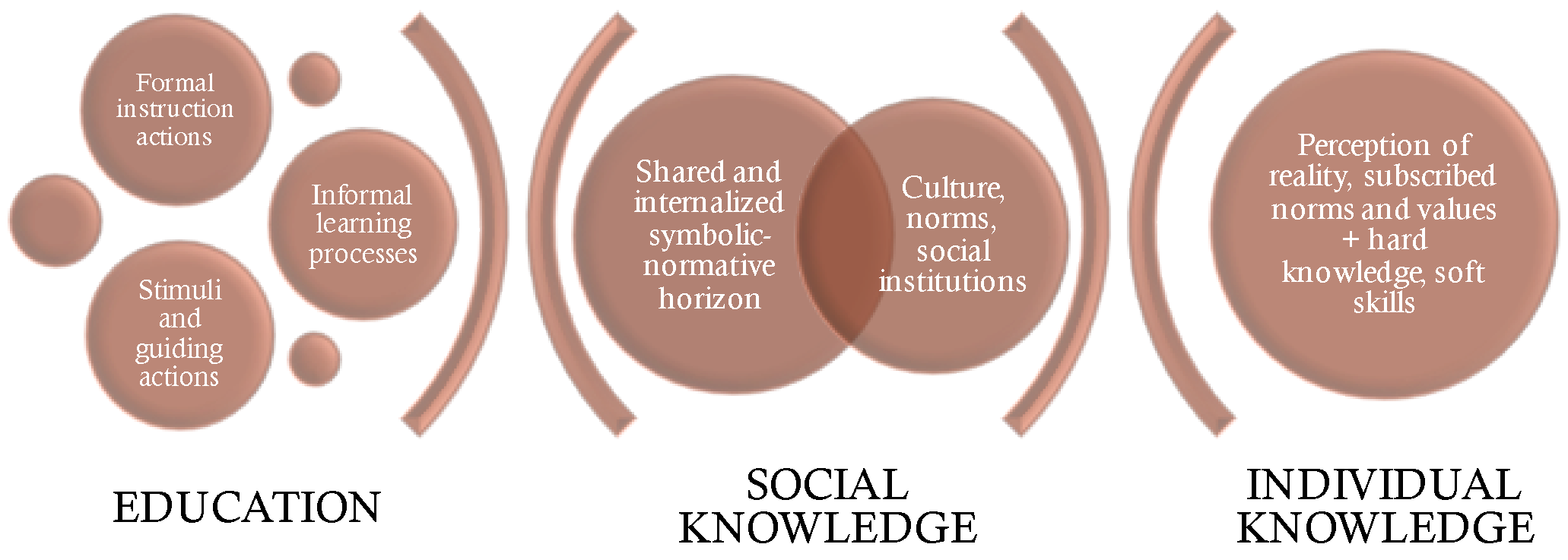
Hence, within each subject, knowledge consists of both personal perceptions of reality and social constructions or conventions previously established by others in order to convey and represent reality itself. Individual knowledge is the result of both formal educational practices and informal learning processes, with social knowledge serving as a structural precondition for both (Figure 1).
Figure 1.
The educational process. This figure illustrates education as a combination of formal actions and informal learning, which serve as inputs. Social knowledge acts as the mediator, and individual knowledge constitutes the outcome.
3.2. Socialisation and the Person: The Relational Sociology Framework
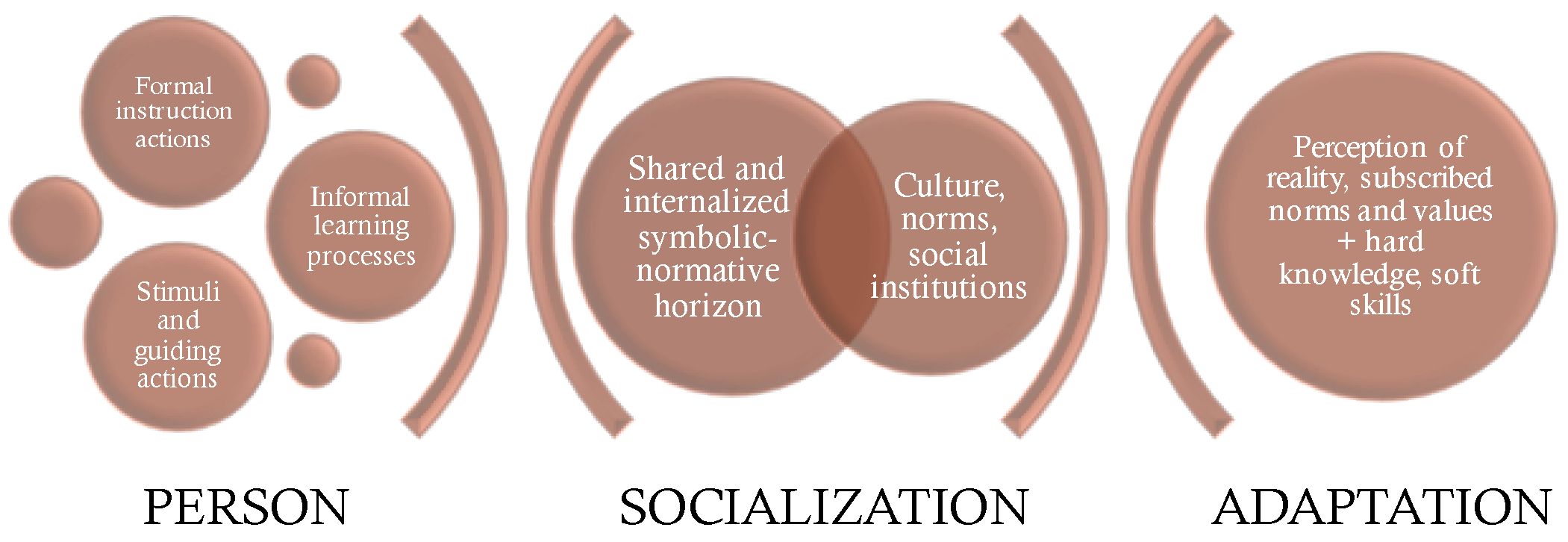
Individual knowledge may be broadly conceptualized as the personal cognitive and cultural repertoire acquired from a heritage of norms and social institutions, which is transmitted via socializing agencies. The pivotal process of socialisation fundamentally aligns with the educational process. Yet, instead of focusing on its learning outcomes in terms of knowledge, skills and competences, though mediated by culture, it centres on the subjects’ adaptation to the social environment they have to live in, i.e., on that educational outcome that can be precisely assessed as the internalization of certain cultural norms and values, stemming from the progressive integration of social factors into the individual’s personality, which ultimately drives either conformity, rejection or innovation of those very social elements (Figure 2).
Figure 2.
The socialisation process. The educational process is examined from a more sociological perspective, wherein the individual is viewed as the subject interacting with formal and informal educational stimuli provided by various agencies; socialisation acts as the subsequent internalisation of social knowledge, and personal adaptation to culture and society constitutes the expected outcome.
However, personality itself cannot be assessed independently of the social environments within which it develops. The concept of personality that socialisation brings into play also needs to be understood as being both genetically and socially determined. Vincenzo Cesareo, the eminent sociologist associated with the Italian school of “Sociology of the Person” and a key proponent of so-called “relational sociology”, significantly developed the concept of the person as comprising four essential elements: uniqueness, relationality, historicity, and concreteness [32,33].
The person is unique, unmistakable, and original, while the individual is plural, replaceable, and general, defining the person solely through their membership to a species (mankind). Indeed, a person’s uniqueness is established by the historical and cultural differences that distinguish them from their peers and from the abstract concept of the individual. In other words, the person exists as a function of their relationality (relational), shaped by equally unique and unmistakable bonds. The person is historical, because their relational and creative experience unfold over time, and (past) time shapes their present consciousness, agency, vision, and future projection. By virtue of all these conditions, the person is concrete. In his own words, “Relationality projects the uniqueness of the person onto the spatial plane and represents the continuity between the social (external) and personal (internal) dimensions. Relationality is constitutive of the person; it refers to their peculiar communicative and dialogic dimension. That is to say, there is no self-sufficient ‘I’ to which relations are extrinsically added; rather, relationality inherently belongs to the person, being natively connate to them” [33].
This passage clearly highlights the status of socialisation as a fundamental process for the development of personality. Indeed, socialisation involves all the relationships that lead individuals to adopt certain values, to imitate certain behaviours, and to internalize certain cultural and social norms, thereby turning the individual into something more specific and more concrete, which is precisely what constitutes a person. Socialisation agencies structure the abovementioned relationships, making them possible and conditioning their evolution in relation to the conventional values they refer to. This is true for agencies such as the family, the school, and peer groups, as much as it is for traditional mass media, new media, and social networks today.
3.3. The Social Power of New Media
New media, by definition, comprise a diverse group of mass media that use the internet as their primary conduit. Among these, the “newest” and most widely used by younger audiences—who rely on them for all purposes, from entertainment to information—are social networks and apps, whose new generation is mostly visual and algorithm-driven. In addition, television and the press maintain websites and profiles on social networks to engage with their audiences. Collectively, these platforms are identified as social media.
The five Big Tech giants that own these media were founded with vastly different objectives, and their profiles continue to diverge in many respects. Nevertheless, they have increasingly converged through their shared role in managing content. They are not merely corporations that produce and distribute technological products; rather, they function as cultural industries [34] that shape the collective imaginary in many different ways.
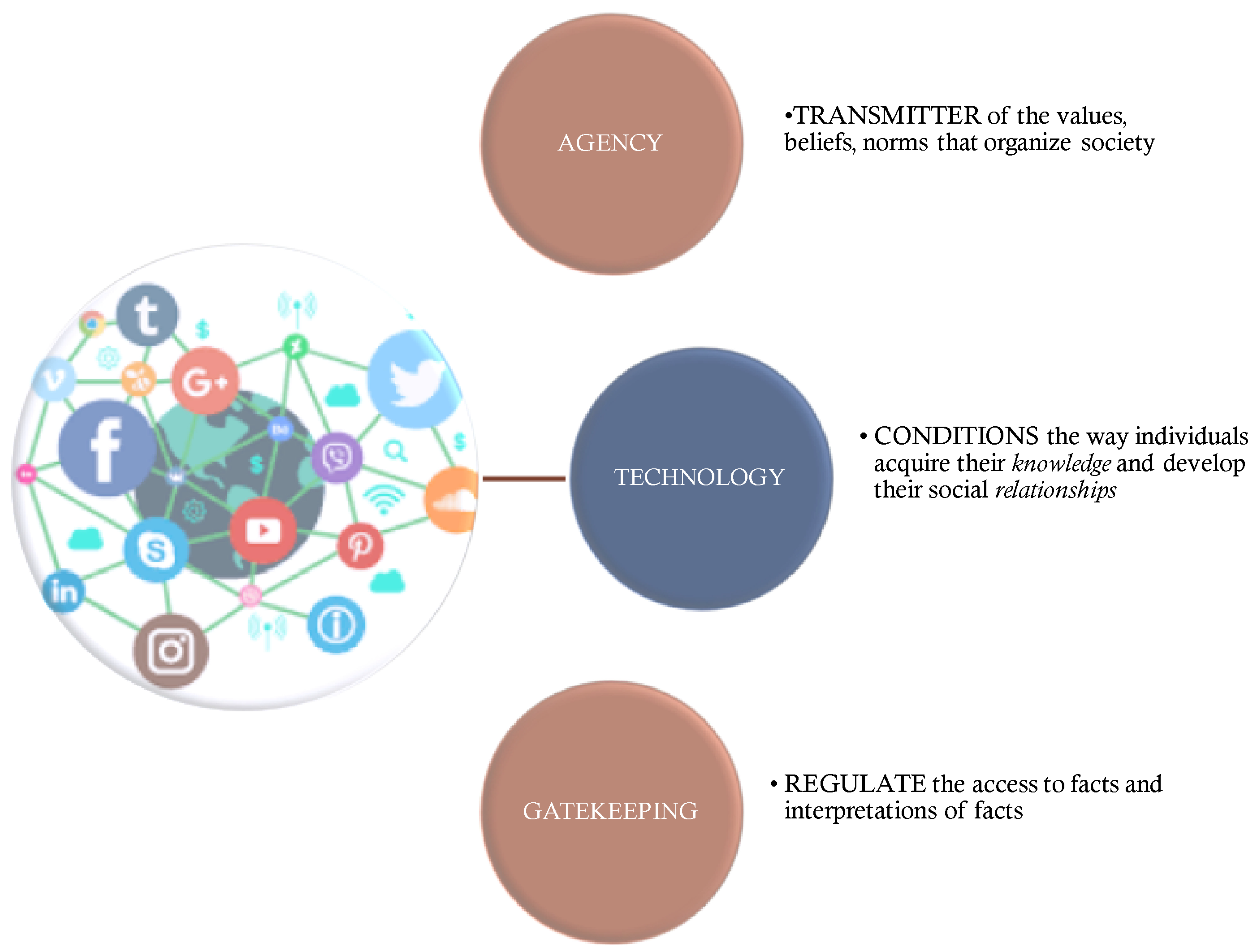
As evidenced above and as Figure 3 shows, the media act as agencies of socialisation, i.e., as transmitters of values, beliefs, and norms that organize society and its associated institutions (cultural role). Sociological theorists have argued that media can either reinforce [35,36] or change and innovate [17,18,37] the dominant models within a society. This outcome largely depends on the specific medium, as some are materially and constitutionally better suited to reproducing established knowledge, while others have proven to capable of giving voice to subcultural expressions.
Indeed, the media function as specific technologies: their material and communicative affordances shape not only how individuals acquire and construct their individual knowledge, but also how they develop and maintain their social relationships.
Last, but not least, the media constitute a system [35,36,38], in the proper sociological sense: an organized set of social institutions distinct from the surrounding environment and aimed at fulfilling specific collective needs and functions (social role). The specific aim of the media system is ensuring access to facts that would otherwise remain unknown to the majority of the members within a given community or society [8]. However, providing this access—which is the essence of gatekeeping—is not a neutral task. Media content creators decide which content people engage with, and their perspective inevitably influences the audience’s views, preferences, tastes, habits and customs: in short, the media system is responsible for shaping so-called public opinion.
Figure 3.
The power of media. The three fundamental dimensions of social media power as agencies—agency, technology, and gatekeeping—with the latter understood as the regulation of access to facts and information (public affairs).
According to Walter Lippmann’s insightful and far-sighted analysis of the concept, an opinion is said to be public first and foremost when it concerns public affairs and, secondly, when it is widely disseminated. In this regard, mass media ranging from the press in the British and North American contexts—the latter discussed by Lippmann—to electronic and broadcast media (from cinema to radio and television) across the globe (primarily in Western countries) function precisely as disseminators of facts and their interpretations.
Since reality in one’s mind is nothing more than a representation of actual events, a concept Lippmann famously defines as a “pseudo-environment” [8], individuals who lack direct access to facts, relying instead on mediated information, are not actually interacting with reality but only with a representation of it constructed by social leaders. In Lippmann’s analysis, these leaders are primarily identified as journalists and other actors with direct access to the political environment. Through their agency, the general public gain access to facts that would otherwise remain invisible and to interpretations that would otherwise be inaccessible. Yet, this dynamic prompts the main research question: in our hyper-mediated social environment, are we actually interacting with a more pluralistic social knowledge through new media? Or are social media just producing a more global dissemination of a specific body of social knowledge?
The (partial and never definitive) answer emerges from a series of arguments. The first is that the attributes listed above (agency, technology and system) represent distinct forms of power inherent to communication media. Since knowledge and culture are understood as a continuous social construction, like any other social reality [39,40], and as the result of both cultural supply and demand, then cultural-media products possess the power to influence those preferences, tastes, habits, customs and eventually the identities of the audiences, too (or they would not be transmitters of role models), just as audiences can, in turn, influence media products. User agency and all the legacy from the limited effects theories [37,41,42] is undeniable. Users do have the possibility and the power to choose what to see, what to understand about the content they are confronted with, what to remember, what to value.
But—and here comes the second argument—which power is stronger than the other? How much power do new media have in determining social knowledge and culture? In driving, at least, the audience’s informal education itself towards a less critical attitude? Are they the kind of structures in which individuals can find themselves trapped? This is a question of individual creative agency confronting the coercive power of social structures—a classic binary opposition in sociology, a discipline that can itself be understood as a dialectic between the two visions of individualism and collectivism. Consequently, a straightforward answer remains elusive. Furthermore, this should not be regarded as a definitive answer, as it is subject to constant shift due to historical contingencies and depends on the specific medium under consideration. Thus, we argue that new and social media may wield a greater influence than earlier media forms.
To understand why, we must examine the concept of social power, a multifaceted notion that addresses the fundamental question of “who has power in society?” (third argument). Social power entails a greater availability of resources for those in positions of social leadership—be they individuals, groups, elites [43]4, or institutions. These resources may include right, force, wealth, authority, authoritativeness and, indeed, access. Media—and professionals operating in the media—possess greater power than ordinary users, because, at the very least, they control the resource of access. Consequently, even though they align with audience tastes and profiles to optimize the communication of their broadcast content, this reasoning ultimately suggests a certain structural dominance over the audience. As previously outlined, this study’s primary theoretical assumption is that while user agency is undeniable, it is essential to examine how the contemporary digital individual–structure dialectic shapes participatory dynamics. As much as people’s personal opinions arise from the individual’s interaction with the social environment—giving rise to the so-called pseudo-environment—the media themselves produce a distinct pseudo-environment. In a highly media-saturated social reality, this constructed environment is precisely what individuals are most likely to rely on when developing their own opinions, attitudes, and values: social media are social leaders to us.
It could be argued that social media actually turned the top-down leadership model into a bottom-up dynamic, drawing on the aforementioned legacy of the limited effects paradigm, whose premises postulate the autonomy and the agency of users, finding its contemporary equivalent in Henry Jenkins’ concepts of convergence culture and collective intelligence [18]. However, while collective intelligence represents a robust, deliberate form of bottom-up knowledge production and is believed to be able to foster social innovation, the architectural design of contemporary platforms prioritizes a different kind of engagement. Platform affordances encourage speed over depth. Consequently, while collective intelligence persists within specialized niches, the broader, shared digital space is increasingly shaped by the frictionless circulation of ‘short-form’ content, with all the implications discussed in the subsequent section. In this framework, convergence culture does not necessarily lead to a democratization of knowledge; rather, it provides the behavioural raw material (such as “fast likes”) that algorithms process to perpetuate a dominant, superficially appreciated stream of information.
Other counter-arguments are found in Castells [44], who has illustrated how contemporary digital networks enable users to bypass traditional gatekeepers, generating horizontal counter-power and grassroots mobilization driven by shared emotional states. This perspective aligns with a non-coercive view of media effects, emphasizing that audiences do possess the capacity to construct alternative spaces of resistance. Nevertheless, as Couldry and Hepp [45] argue through the concept of deep mediatization, the contemporary social world is structurally dependent on digital infrastructures. In this light, user agency does not exist in a vacuum; rather, it is exercised within corporate architectures. As Gillespie [46] points out, platform governance and algorithmic curation act as the invisible “custodians” of public discourse, systematically rewarding speed, simplicity, and engagement. Indeed, the typical format of social media actually acts as the invisible custodian of public discourse, at times unveiling what official narratives omit, but generally flattening the discourse to the most superficial patterns, which are easily consumed. Consequently, while networks of outrage and hope demonstrate that users can collectively subvert dominant narratives, the overarching infrastructure tends to absorb these decentralized efforts.
The theoretical hypotheses presented here suggest that social knowledge is increasingly constructed through social media and that socialisation itself predominantly occurs by the means of social networks. If these networks rely on formats and platform designs [47] that tend to discourage critical, in-depth analysis of content, then younger generations are less likely to learn how to exert their diagnostic, critical, oppositional power. This is ultimately why, given both the potential and actual time spent online, new media can be seen as exceptionally pervasive agencies that function as highly powerful social leaders for individuals.
Following the revolution triggered by the advent of the internet, that of portability marked a major watershed. Regarding the crucial element of media exposure [6,7], social media are potentially available 24 hours a day on smart mobile devices, with an average active use time of 5 to 6 hours a day. In fact, according to data from the Gallup Familial and Adolescent Health Survey, U.S. adolescents spend an average of 4.8 hours per day on social media platforms, with usage increasing to 5.8 hours daily among the oldest teenagers (aged 17) [48]. Concurrently present on the same screen, private communications (instant messaging, telephone calls, e-mails), social networks, e-commerce apps, television, radio and the digital press collectively construct an environment that has integrated into daily routines more deeply than any prior medium—each of which was previously isolated on its own dedicated device.
As Figure 4 illustrates, this distinctly digital socialisation may condition other socialisation agencies by constructing the reality in which they operate—thereby acting as all-encompassing and influencing, to a far greater extent than any previous medium. When confronted with an environment dominated by image-based, short, and over-stimulating content, traditional socialisation agencies may become less effective, as they rely on conversation, reading, and longer attention spans. Echoing McLuhan’s argument that schools act as intellectual penitentiaries, traditional socialisation agencies risk losing their appeal, leaving them unable to counter or even balance the potentially negative effects of social media on social knowledge construction.
Figure 4.
New media pervasive pseudo-environment. Serving as a heuristic visual framework rather than a deterministic causal model, this diagram illustrates how digital media are likely to construct an infrastructural environment that overlaps with and conditions other socialisation agencies.
3.4. New Media Pervasiveness and the User-Generated-Content Era
As a result, new media are profoundly transforming traditional socialisation processes, becoming among the most important and impactful agencies and rendering the entire process increasingly digitally mediated, especially for the youngest audience.
Capable of reaching an audience wider than that of any previous medium, and being globally spread—albeit with significant issues related to the digital divide—with no or few boundaries and limitations, the internet and the new generation of communication and information platforms are potentially the unprecedented disseminators of both facts and their interpretations. Not only are they rapid channels able to connect opposite sides of the world, and to make what happens on the one side of the globe known to the other, but their intrinsic, technological and material properties also imply greater user exposure to them. Last but not least, what will be probably remembered as the defining legacy of social networks—the ultimate consequence of the portability revolution—is of having ushered in the era of the user-generated content.
The element of pervasiveness, thus, precisely refers to these three elements: (i) widespread diffusion of new media; (ii) their being portable and potentially constantly available; and (iii) most of all, their being actively usable.
Now, the active role of users as generators of content may well support agency theory conclusions. As previously discussed, it is undeniable that users can produce forms of social innovation through social media, as evidenced by activism, Wikipedia, open-source communities, and mutual-aid groups [18,20,24,44]. However, the material characteristics of the medium imply certain constraints: platforms still act as drivers, while users remain users.
Furthermore, other critical elements need to be incorporated to this argumentation. When cinema, radio and television entered the public sphere as mass communication tools, we all entered an age of globally shared images and imaginaries, i.e., culture became increasingly visual [49,50,51]. Traditional learning processes based on oral communication, reading and understanding skills had to confront the multidimensionality of reality reproduced by the multimedia experience. Given that new media are an evolution of electronic media, the character of being multimedia, i.e., a composite language made of both audio and visual content, images and writing, where the visual element is predominant, is in their DNA; intertextuality is the other, newer, characterizing trait, referring to the already mentioned fact that these forms of media are all present at the same time on the same material support, thus conditioning the ways they are used, experienced, enjoyed.
Ultimately, the interplay between visual dominance, intertextuality, round-the-clock availability, and the active role of users as content producers has fostered the establishment of the aforementioned image-based narrative communication model, characterized by the shortest forms of verbal communication, which social networks borrowed in particular from the world of television advertising: social networks actually took this logic to the extreme, with a slogan-like communication applied to all types of content, not only to emotional narratives but also to referential ones, i.e., those concerning public affairs and political and ethical issues involving critical debates. This is actually the very reason why some talk about the “emotional audience” [52,53].
The possibility of an authoritative, critical and argumentative dimension is reduced, delegated to personal and autonomous in-depth analysis initiatives promoted elsewhere—hopefully by other agencies of socialisation—while images penetrate the mind with their suggestive power.
Consider the argument that the family and modern educational institutions are failing to function effectively or are falling short of their educational roles. The intersection of these shortcomings with the pervasive nature of new media allows the latter to serve as a substitute for traditional socializing agencies rather than merely supplementing them. It is not a surprise that adolescents from cultures where the power of family is stronger experience a less influential digital socialisation [54]5, even though a single study makes just a case and not a law. However, it establishes, at least, a proposition to be tested and thus reinforces the one here proposed as P1, according to which the pervasiveness of social media is inversely correlated with the educational effectiveness of traditional socialisation agencies.
4. A More Global but Less Pluralistic Social Knowledge Through Digital Socialisation
Having established the foundational premises—namely the recognition of social media as a particularly powerful and pervasive agency of socialisation—this section aims to thoroughly discuss the central propositions P2 and P3 presented in the second paragraph by presenting supporting empirical secondary data and theories, while simultaneously addressing and debating potential counterarguments. The ultimate objective, as previously stated, is to understand whether and how social media may be producing a form of social knowledge that is indeed more global, yet less pluralistic, thus establishing final theoretical proposition P4.
As a matter of fact, personal opinions are more likely to be similar when they refer to the same sources rather than being developed through diverse direct personal experience. Of course, a broad and vast experience of public affairs is at least unlikely to be thoroughly direct in a complex society, which needs to be led by representative institutions; thus, a mediated access to facts is generally better than no access at all. The representation of the diversity of personal experiences and views is precisely what information and communication media systems are called to realize, through guaranteeing pluralism [55].
Nevertheless, although decades of legislation in representative democracies have intended to make this guarantee effective, and despite the evidence that the internet and new media seem to have implied, the passage from a one-to-many mass communication model to a many-to-many model, the theoretical hypothesis here advanced is that the so-called digital socialisation dynamics seem to be, precisely and paradoxically, an obstacle to pluralism, for they are producing less critical humans. Let us consider why and how.
4.1. Fast Uncritical Knowledge and Values Turning into Trends
In line with preceding media forms, the cultural role of new media as transmitters of norms, values, and beliefs comprises three sub-functions, conceptualized as the “Three I model” [56]: (i) the dissemination of information, positioning media as key information providers; (ii) the shaping of the imaginary through visual narratives; and (iii) the facilitation of innovation by crowdsourcing social needs and new product ideas. These sub-functions are not mutually exclusive but are in constant overlap; thus, the imaginary is also constructed through information—itself deeply visual—and innovation is driven by both. Although this innovation potential is undeniable, and many educational opportunities could arise from the judicious use of the internet and social media [57], their everyday use does not seem to involve the enhancement of social knowledge.
In fact, the information and imaginary that people receive from social media are fundamentally fast: short forms of content articulation like the mostly visual posts, including multimedia reels, evidence how the production of knowledge is fast; consuming practices such as scrolling down very diverse newsfeeds, likes, and reposts, are fast, too, and ultimately superficial, to the extent of becoming automatisms. It is the individuals’ way of responding to the so-called “abundance catastrophe” [58], assessable as an information overload [59] that makes them progressively more indifferent and less empathic; they cannot bear it and cannot clearly distinguish reality from fiction, actual information from disinformation and misinformation. Social networks can be metaphorically defined as the “fast-foods of knowledge”. In this framework, the continuous interaction between individual actors and platform affordances gives rise to distinct digital practices (such as continuous presence, algorithmic scrolling, or selective exposure). Crucially, the effects of these practices do not remain isolated within online spaces; rather, they dynamically spill over into and rearticulate social interactions across offline domains, including family relations, peer networks, and the public sphere.
Even though educational attainment has increased substantially in many national contexts over the decades, social knowledge no longer depends solely on schools, universities, families, social groups or subcultures; rather, it relies primarily on global mass media. Smart devices and apps have simplified our lives and, among other daily activities, have facilitated precisely how we stay informed about what happens around us: individuals increasingly consume the news via social media platforms, and, in particular, the vast majority of digital natives report social media platforms as their main source for news consumption, as shown by the Pew Research Center [25,26,27,28] and Eurobarometer [29] surveys. Therefore, not only do these datasets reveal a high degree of exposure to social media (Table 1), as previously noted, but they also demonstrate that visual feeds, such as Instagram or YouTube, are the preferred medium (Table 2), used for both self-entertainment and news consumption (Table 3, Table 4 and Table 5).
Table 1.
The frequency of news consumption on social media among U.S. adults from 2020 to 2025. Data represent the percentage of respondents within each yearly survey who reported obtaining news with varying frequencies.
Table 2.
The frequency of social media platform use among U.S. teens aged 13–17, revealing high daily exposure to visual feeds (YouTube, TikTok, Instagram). While Table 2 illustrates overall platform exposure, this pervasive usage directly conditions how young users access public affairs content; as further detailed in Table 3 and Table 4, social media have indeed become a primary pathway for news consumption among youth. Data represent the percentage of respondents reporting daily engagement formats. Total daily usage is summarized in bold in the NET Daily column.
Table 3.
Percentage of U.S. adults who often or sometimes obtain news from select platforms, disaggregated by age group. Consistent with the aforementioned suggestion, younger users (age 18–29) rely on new media for news consumption substantially more than older users.
Table 4.
Trends among European Youth (EU citizens, 16 to 30 years old). The data highlight a consistent trend where social media platforms are preferred over television and online news platforms for news consumption.
Table 5.
Visual formats and algorithm-driven platforms show the highest information usage rates compared to most traditional ones.
The data presented in Table 1, Table 2, Table 3, Table 4 and Table 5 are compiled from public datasets published by the aforementioned Pew Research Center [26,27,28] and Eurobarometer [29]. Figures represent weighted percentage estimates derived from nationally representative survey samples of U.S. adults, U.S. teens (aged 13–17), and EU youth (aged 16–30). Percentages across rows or platform categories do not necessarily sum to 100% due to multiple-choice response formats. Full sampling details, field dates, exact question wordings, and weighting procedures are specified in the primary source reports cited in the References.
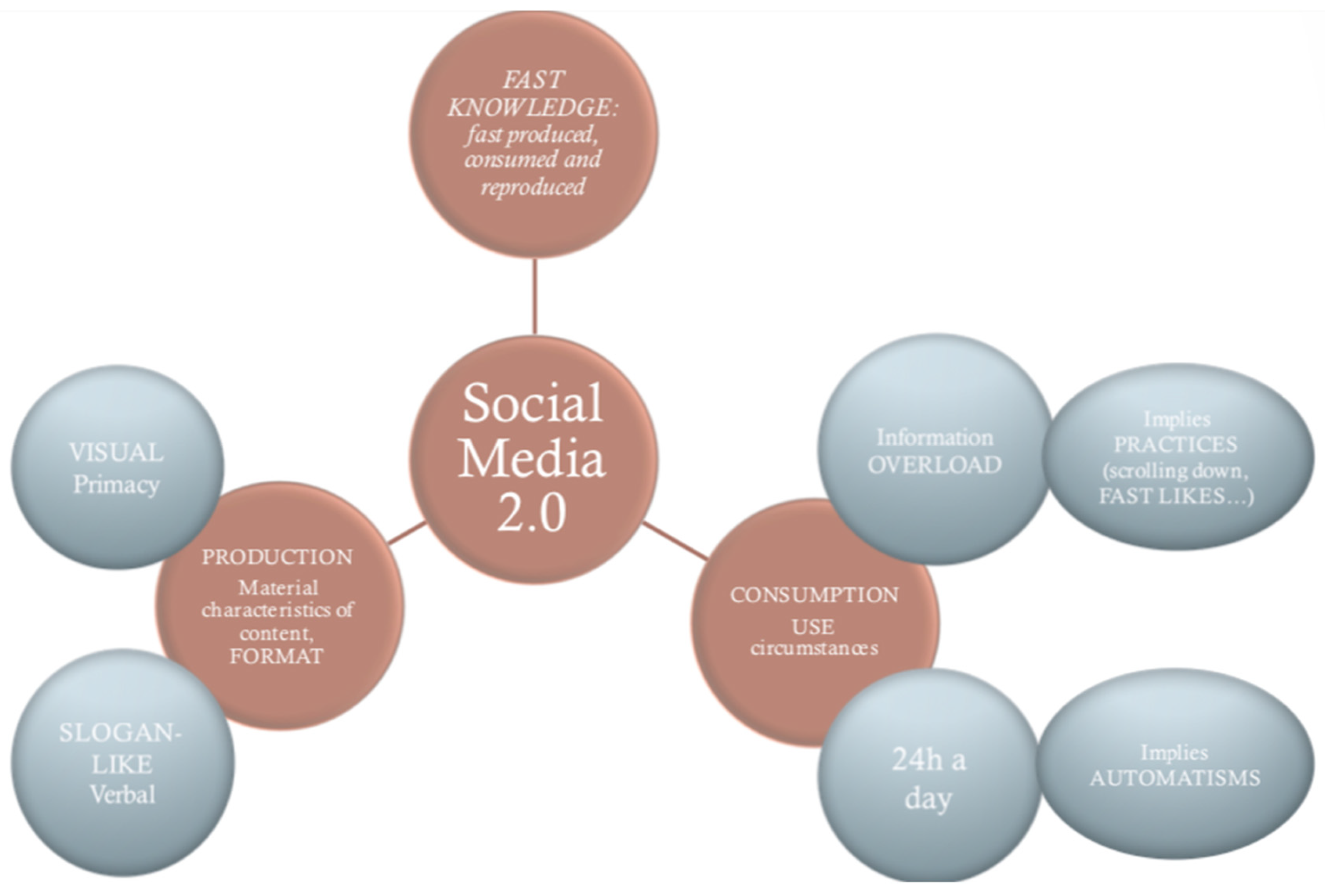
The aspect of news consumption, as revealed by the data, is particularly relevant, as it suggests that by relying on these rapid, visually driven formats for more complex and articulated content—such as public affairs issues—individuals are delegating the capacity for synthesis to the platforms, a faculty that should instead emerge from a more critical and deeper engagement with the information. Consequently, analytical processes seem to have been outsourced to technology, increasingly capable of replicating processes once executed through complex, rational thought. Ultimately, delegating human functions to devices does not merely impoverish daily life, it can structurally condition our logic and reason [14]. With the advent social media 2.0—i.e., the highly visual generation of social networks such as Instagram, TikTok, and YouTube—social knowledge production and consumption became increasingly fast, as Figure 5 shows.
Saturated with image-based, slogan-like and uncritical social knowledge, social media represent the primary pathway through which not only behaviours and attitudes, but also ideas and values, spread as trends. To examine this mechanism in greater depth, it is evident that social media serve as powerful transmitters of trends, given the great audiences they are able to reach. If this process affects not only the aesthetic dimension, but also encompasses the ethic dimension, then cultural change becomes increasingly subject to the trend-shifting group dynamics described by Georg Simmel as early as 1910 [60], rather than drawing on individual critical thinking.
Simmel argued that trends develop because of two natural human tendencies: imitation and differentiation. Lower groups or social circles imitate the behaviours and attitudes of the nearest higher circles in order to differentiate themselves from those perceived as “lesser”. Equally, people now imitate more appealing or better presented ways of thinking as necessarily more correct, smarter, or ultimately more progressive, in order to achieve differentiation from those perceived as “lesser groups”, but without critically evaluating the actual sources, opposing viewpoints, or arguments in favour and against. This risk should be understood as both a socialisation and educational matter as much as a cultural and structural one. Indeed, it spreads as a common practice, becoming increasingly unquestionable, since people tend to take for granted the social practices and environment they happen to live in [39], the social world into which they are “thrown” [59]. As the generation that witnessed the transition from analogue to digital communication, we bear a particular responsibility to question these practices and to foster critical digital education among the digital natives.
Figure 5.
Fast knowledge. This analytical map illustrates the theoretical feedback loop between platform affordances (visual primacy, slogan-like formats) and user practices (automatic scrolling, low-effort engagement), outlining structural conditions for uncritical knowledge reproduction rather than verified empirical causality. Even complex content is constrained by a visual format where textual and discursive elements are reduced to slogan-like snippets. This very content is consumed by users who are constantly overloaded with information and whose consumption practices tend to become automatic and uncritical.
Now, if the reproduction of knowledge through new media tends to be uncritical, it matters little how many voices can find space on these platforms thanks to the user-generated content: the result remains a multitude (of followers) replicating the voice of very few (influencers).
4.2. The Like Ethic and a New Definition of Mainstream: The Some-to-So-Many Reformulation
The basic prodromal form of imitation is appreciation, which is the main practice, or ethic, on social networks. The “like ethic” eventually determines trends itself: it involves the subject’s appreciation of something on the basis of that short, image-based, pervasive communication; the subjects’ fast likes perpetuate the construction of the fast uncritical knowledge described above, as they drive the algorithm to suggest similar superficial content. Although tailored to every single user, the algorithm tends to prioritize highly engaging, interactive media over authoritative content.
Within this framework, “mainstream” can no longer be easily addressed as “the most traditional stream” but rather as “the dominant stream”—the one that collects the most trending, influential and appealing topics on social media. This stream eventually emerges from fast superficial communication, influencers’ content, followers’ fast likes, and the workings of algorithms and AI, representing the contemporary version of the mechanisms of accumulation and consonance that Elisabeth Noelle Neumann accounted for in her research on the Spiral of Silence [10]. The interaction between superficial human agency (represented by followers’ “fast likes”) and non-human agency (algorithmic curation) generates a new configuration of consonance. Consequently, those who fail to conform to short-form formats or trending topics are relegated to the margins of visibility, echoing the dynamics described in classical theory. On the contrary, the most trending topics, views, behaviours, attitudes, and values on social media—i.e., the mainstream—are likely to become the main outputs on the web through search engines, as well as prominent sources for AI training and elaboration. Consequently, they may ultimately influence the legacy media agenda or gain legitimacy from it.
At this juncture, several potential counterarguments must be addressed. A prominent strand of contemporary media literature implicitly suggests that a unified mainstream no longer exists, given that users are presented with highly personalized feeds that potentially confine them within so-called echo chambers. Sunstein argued that internet users actively select content and profiles that align with their pre-existing beliefs, thereby driving group polarization and radicalization—a process he attributed fundamentally to deliberate human agency [61,62]. Eli Pariser’s filter bubble thesis updated this perspective by shifting the focus toward algorithmic agency, illustrating how automated curation constructs individualized informational enclaves [63].
Crucially, this study contends that it is precisely this algorithmic agency that sustains the existence of a dominant stream. Because algorithms systematically prioritize and amplify highly engaging and visible content, algorithmic selection occurs prior to human choice. Logically, this conceptualization helps address the controversy between Sunstein and Garrett [64]; while the latter empirically demonstrated that echo chambers are not hermetically sealed enclaves—as users do not systematically avoid alternative viewpoints—the algorithmic primacy over visibility explains how a pervasive, dominant stream persists.
Importantly, while human agency within social media spaces can successfully dilute or challenge this dominance through active engagement—albeit with the counter-effect of polarization that worried Sunstein—the underlying mainstream flow remains highly concentrated and standardized across the broader web ecosystem, from search engines to generative AI environments, where algorithmic filtering precedes any user intervention. Therefore, the feed personalization within filter bubbles does not preclude the existence of a mainstream: if mainstream content is “fragmented” and channelled into millions of personalized bubbles—depending on the subject, more or less superficial choices and their subsequent algorithmic processing—it loses its original function of universal information, yet it retains its role as the dominant stream of information.
As the final result of these complex dynamics, the communication model, which was believed to be many-to-many, appears instead to be closer to a “some-to-so-many” pattern, where the most polarized voices are broadcast to a mass of uncritical reproducers, namely the followers.
This evidence is further reflected by the macro-social reality that new media infrastructure is concentrated in fewer private hands, those of the aforementioned five Big-Tech corporations within digital capitalism [65]. Although this aspect will be further outlined and discussed in the conclusions, it is worth pointing out immediately that the definition of “follower” is not intended as a judgment toward any ideology or position. Rather, it serves as an analytical tool to examine how social knowledge develops and spreads in the digital environment. In this framework, followers are characterized as uncritical, because posts—their main source of information—rely on a self-contained, image-based, inherently slogan-like format, which is inadequate for the information needs of a complex society. By relying solely upon them, the risk of impoverishing critical thinking increases, unless other socialisation agencies actively intervene.
4.3. Impoverished Relationships
Not only is critical thinking at risk but interpersonal relationships are as well: digital socialisation entails more than merely confronting a world of (predominantly visual) content—trending behaviours, attitudes, uses, customs, and values. Indeed, the innovative power of new media has introduced the “sharing function”—the act of sharing emotions and thoughts—thereby establishing a new way of experiencing social relationships and engaging with the other. As previously noted, this represents the most thoroughly investigated dimension of socialisation, particularly within psycho-social research, which has generated useful empirical conclusions to support this theoretical model building, such as those from Turkle [11,12] and Twenge [13].
Notably, the qualitative empirical insights introduced by Sherry Turkle find notable parallels in the macro-psychosocial research of Jean Twenge. Analysing extensive longitudinal datasets, Twenge demonstrates that the saturation of the smartphone market around 2011–2012 coincided with a marked decline in youth face-to-face interactions. These trends suggest that digital engagement may displace real-world relationality, thereby depriving individuals of the interpersonal “training ground” essential for empathy. Her findings highlight strong, albeit not definitive, statistical correlations between screen time, perceived loneliness, and anxiety.
While these empirical frameworks offer compelling accounts of digital displacement, the contemporary literature [66] emphasizes that such correlational findings must be interpreted with nuance—highlighting that technology’s psychosocial impact depends heavily on context, distinguishing between active and passive use, platform dynamics, and individual vulnerabilities. This suggests that digital communication can indeed supplement rather than outright replace offline relationships. Indeed, the central theoretical hypothesis advanced here is that the broader personal experience of socialisation—specifically the perceived absence or diminished efficacy of traditional socialisation agencies, including legacy media—drives the shift toward standardized, highly visual digital formats. In such cases, digital socialisation takes over, potentially eroding the cognitive and emotional patience required to negotiate offline relationships, which inherently remain slow, non-algorithmic, and devoid of instant gratification.
Screen time increasingly competes with face-to-face interaction: the influence exerted by new media is, first and foremost, a matter of time and priorities. As a consequence of high levels of screen exposure, individualism may grow, consistently with what Cesareo argued in his studies about narcissism. Conversely, introspection may diminish: indeed, the fast content overload, or “abundance catastrophe” [58], tends to anesthetize both critical and self-reflection.
Significantly, not only do social relations become increasingly mediated by social networks, but dynamics that shape digital interaction also permeate the realm of unmediated reality. This spillover begins with self-perception itself, which appears increasingly data-driven: in this light, the “quantitative self” emerges as an ideal-type developed to describe contemporary identities [67], like the “follower”.
Above all, confronting through a screen-mediated interaction serves as a defence mechanism that tends to absolve the subject of responsibility. This dimension of avoided responsibility [11] is believed to shape a general attitude toward the other, at times legitimizing an openly aggressive posture that polarizes social conflicts [68]. This dynamic fosters not only the phenomena of cyber bullying and hate speech (which are admittedly driven by a plurality of factors, among which this psychological shielding must be accounted for), but also the radicalization and polarization of public debate and the public sphere. Indeed, moral freedom and a sense of responsibility towards the other diminish; furthermore, the aforementioned information overload has the extra consequence of confining individuals increasingly within their echo chambers [62,63], thereby fuelling a vicious circle that drives further radicalization and polarization. Within this framework, the relationship between public figures and audiences, as well as between adversarial audiences themselves, is increasingly characterized by informal, aggressive and violent communicative practices.
The immediacy that characterizes content management ultimately seems to shape the managing of interpersonal relationships as well, thereby undermining both empathy towards the other and a critical disposition toward digital content. In Turkle’s perspective, the way social media steer social relationality also conditions people’s inner desires, which boil down to establishing mere connections rather than fostering genuine relationships, intimacy, authentic conversation [12], and meaningful engagement. As noted, this shift also impairs individuals’ capacity to reflect upon the self and upon their authentic personal and social needs, eventually reducing introspection. Paradoxically, the more inter-connected we become, the less empathy we develop.
While consumers themselves often perceive social networks and applications merely as pastimes or diversions, these media ultimately serve to fill an unfulfilled need for companionship and connection—a need that remains paradoxically unmet precisely due to the ubiquity of these platforms. Significantly, Lovink [47] argues that social media platform design is intrinsically structured to foster a nihilistic attitude and a form of structural boredom among users, which might (hopefully) eventually guide them elsewhere. Unable to bear the information overload, the subject nevertheless squanders time on endless scrolling, failing to invest sufficient effort into distinguishing fact from fiction, or verified from unverified sources, in order to build proper, meaningful, and durable knowledge. Instead, individuals risk becoming progressively less willing to process and deepen their understanding of content implications and the complexity of human experience, ultimately rendering them more indifferent and less empathetic.
5. Conclusions
The primary contribution of this study is the articulation of a theoretically motivated model, a set of conditional propositions, and a structured agenda for future empirical inquiry.
5.1. The Ideal-Type of the Follower
The so-called ideal-type of the “follower” [50] formulated herein is not intended as a deterministic empirical generalization of contemporary youth; rather, it serves as a critical heuristic benchmark to identify the potential risk factors associated with fast, algorithmically curated digital socialisation. It appears as a possible outcome emerging under the specific conditional dynamics and processes described above.
Long before the advent of digital media, Ortega and Gasset theorized the concept of “mass-man” [69]; similarly, “massification” theorists and scholars of the Frankfurt School developed the idea of an atomized subject within mass society [34]. While these serve as historical antecedents, the follower is not intended as a deterministic, inevitable consequence of contemporary communication and socialisation but rather as an extreme analytical limit-case.
To the extent that the socialisation of this subject is heavily mediated by digital platforms, its hypothetical ethics, cultural traits, and eventual educational needs are synthesised in Figure 6.
Figure 6.
The ideal-type of the follower. The pre-conditions of the potential rise of followers are identified in the widespread diffusion of digital media, alongside systemic inefficiencies within traditional agencies such as family. Based on these premises, interest and time may be diverted to the online dimension; the substantial impact of information overload can foster the uncritical reproduction of social knowledge, while individualism and narcissism may emerge as the outcome of relational impoverishment. This heuristic scheme synthesizes the boundary conditions and theoretical dimensions of the “follower” construct. The figure maps potential risk factors and analytical limit-cases of digital socialisation, strictly distinguished from active, strategic, or participatory forms of digital engagement.
In line with Weberian methodology, as an ideal-type, the “follower” does not aim to comprehensively describe individuals in contemporary society, nor does it presume to offer a value judgment or an absolute generalization. Instead, it serves as a purely heuristic baseline—a potential analytical framework indicating a risk factor related to the core theoretical hypothesis of the widespread diffusion of a fast, less critical—and less pluralistic—social knowledge.
The outlined scenario suggests potential underlying factors that may contribute to the previously described impoverishment of relationships and the gradual transformation of the human element. This shift is theorized to coincide with three key phenomena, identified by Vincenzo Cesareo as highly characteristic of contemporary narcissistic identities [70]: desensitization toward the concept of moral freedom, a disinterest in existential questions, and a conceptualization of social action as the mere projection of positive self-images rather than a meaningful connection to the (significant) other. Consequently, we witness the rise of individualism, “presentism”, and a form of substitutive interaction delegated to social media. Absorbed in their own self-contemplation, followers live in an immediate present, lacking both historical memory and future orientation; within this framework, social media emerge as the most pervasive and contemporary tools for feeling connected to the world.
Therefore, the ideal-type of the “follower” directly contrasts with Cesareo’s conceptualization of the “person” [33]. While relational sociology anchors the subject in the four core dimensions of uniqueness, relationality, historicity, and concreteness, the “follower” reverses this logic. Uniqueness gives way to standardized fungibility, genuine relationality is replaced by algorithmically mediated connectivity, historicity shrinks into the immediate present of the feed, and concrete lived experience is displaced by digital dematerialization.
Given the proposed research question of whether digital and social media are introducing new forms of social knowledge, more global but less pluralistic, the theoretical model and hypotheses developed suggest that, while new-media positive innovative power mostly concerns technological tools that can serve social innovation (activism, sharing economy and knowledge, open-source communities, mutual-aid groups), these media risk overwhelming individuals and their critical power, thereby exposing them to the coercion of dominant trends—whose nature is at least half algorithmic—in both aesthetic and ethical dimensions of social life. This might be worrying, for it suggests that the processes through which especially the youngest acquire their social knowledge and develop their opinions, personality and relational abilities, are device-driven more than human-driven.
5.2. Limitations and Further Developments
Despite its being a theoretical model, the follower is argued to capture some key characteristics of contemporary identities, as constantly confronted with a world of visual stimuli. Furthermore, it acknowledges the growing tendency to perform and stage one’s life—a reality with which individuals frequently struggle—and to comment on public affairs without sufficient knowledge. Future qualitative empirical research is intended to precisely investigate these two dimensions.
As previously stated, the outlined ideal-type is itself a theoretical proposition and hypothesis: as such, it requires further and deeper empirical investigation to test its explanatory potential across diverse cultural and social contexts. Specifically, we need to understand under which specific organizational and cultural conditions the outlined traits—the acritical reproduction of social knowledge, individualism, presentism and narcissism—are most likely to arise. Organizational conditions encompass the efficiency and inefficiency of the traditional socialisation agencies mentioned above; this includes examining institutions such as the family and the school, which are themselves increasingly entangled in digital socialisation. Such empirical inquiry is necessary to gather evidence of both the actual dominance of digital media over other socialisation agencies—characterized by user attention and time being diverted from physical to virtual spaces—and the heightened coercive power exerted by mainstream social media platforms. In operational terms, the observable implications listed alongside the statement of theoretical propositions could serve as topics and variables to be tested in future empirical research, including variations in trust towards traditional socialisation institutions; engagement with long-form textual argumentation and structured, deliberative dialogue; and dispositional empathy scores among high-frequency users of visual/algorithmic platforms.
Moreover, the structural reasons why digital media are dominant or, instead, other agencies are more effective in counter balancing the potential negative effects of a deeply digital socialisation, and how, are to be investigated: this calls for empirically—particularly qualitatively—testing this framework within the liberal democracies where it was conceived, while also extending the analysis to different political contexts, including authoritarian regimes. The adaptability of these propositions to non-Western or lower-density digital settings constitutes a crucial direction for future empirical research as well.
The concept of the digital divide [71] itself should be reassessed not only in relation to the mere availability of digital media but rather in relation to the availability and effective action of other agencies of socialisation to counter-balance the negative effects of a mostly digital education and socialisation, i.e., fast reading, “scrolling down”, decreased attention span, the absence of in-depth analysis, the lack of curiosity and self-questioning, less empathy and more narcissism, rising individualism and indifference, increased risks of violence and misperception of reality. Reassessing the concept of the digital divide within this perspective constitutes another objective of future research.
Ultimately, policy-oriented research is needed to determine how public efforts can best support traditional socialisation agencies in achieving this desirable counterbalancing effect, thereby making the call for a critical digital education both concrete and actionable. While a detailed policy analysis lies beyond the scope of this study, the proposed framework strongly resonates with major international initiatives, such as the EU Digital Education Action Plan 2021–2027 [72] and the UNESCO Media and Information Literacy framework [73].
In this light, fostering critical digital citizenship represents a major challenge and a fundamental prerequisite for safeguarding the relational dimension of individuals in the digital age.
Funding
This research received no external funding.
Institutional Review Board Statement
Not applicable.
Informed Consent Statement
Not applicable.
Data Availability Statement
No new data were created or analyzed in this study. Data sharing is not applicable to this article.
Acknowledgments
The author would like to thank the anonymous reviewers for their valuable comments and constructive suggestions that helped improve the quality of this manuscript.
Conflicts of Interest
The author declares no conflicts of interest.
Notes
| 1 | To ensure conceptual clarity from the very outset, this study clarifies the intended meaning of each specific term related to the digital and social realm, as these terms are employed throughout the text with distinct analytical functions:
|
| 2 | To analytically disambiguate these terms, the following should be noted:
|
| 3 | In terms of scope and boundaries, the theoretical framework and propositions (P1–P4) developed herein specifically apply to high-density digital environments among youth within Western contexts (primarily the EU and US). As discussed in Section 5.2, evaluating the adaptability of these propositions to non-Western or lower-density digital settings constitutes a crucial direction for future empirical research. |
| 4 | Used in a broader sense, the word elite is synonymous with “high position” and is attributed to all those social groups who have more, achieve more, count more, can do more…have more power, not only by right but just in fact—that is to say, more force, more authority\authoritativeness, more wealth, deservedly or undeservedly—from lobbies to economic conglomerates to the media system. |
| 5 | Of course, family counter-influence may be repressive or, rather, constructive; here we are advocating for the second type to be promoted at the social level. |
References
- Smith, J.; Hewitt, B.; Skrbiš, Z. Digital socialisation: Young people’s changing value orientations towards internet use between adolescence and early adulthood. Inf. Commun. Soc. 2015, 18, 1022–1038. [Google Scholar] [CrossRef] [Scilit]
- Stornaiuolo, A. Contexts of Digital Socialization: Studying Adolescents’ Interactions on Social Network Sites. Commentary on Zizek. Hum. Dev. 2017, 60, 233–238. [Google Scholar] [CrossRef] [Scilit]
- McLuhan, H.M. Understanding Media; Routledge and Kegan Paul: London, UK, 1964. [Google Scholar]
- McLuhan, H.M.; Fiore, Q. Il Medium È Il Massaggio (The Medium Is the Massage); Corraini Edizioni: Mantova, Italy, 1967. [Google Scholar]
- Innis, H. Empire and Communication; Meltemi: Milano, Italy, 1951. [Google Scholar]
- Gerbner, G.; Gross, L.P.; Morgan, M.; Signorelli, N. Living with television: The dynamics of the Cultivation Process. In Perspectives on Media Effects; Bryant, J., Zillman, D., Eds.; Erlbaum: Hillsdale, NJ, USA, 1986. [Google Scholar]
- Gerbner, G. Cultivation analysis: An overview. Mass Commun. Soc. 1998, 1, 175–212. [Google Scholar]
- Lippmann, W. Public Opinion; Donzelli: Roma, Italy, 1922. [Google Scholar]
- McCombs, M.E.; Shaw, D.L. The Agenda Setting function of Mass Media. Public Opin. Q. 1972, 36, 176–187. [Google Scholar] [CrossRef] [Scilit]
- Noelle-Neumann, E. La Spirale Del Silenzio. Per Una Teoria Dell’opinione Pubblica; Meltemi: Roma, Italy, 1973. [Google Scholar]
- Turkle, S. Insieme Ma Soli (Alone Together: Why We Expect More Than Technology and Less from Each Other); Codice Edizioni: Torino, Italy, 2012. [Google Scholar]
- Turkle, S. Reclaiming Conversation: The Power of Talk in a Digital Age; Penguin Press: New York, NY, USA, 2015. [Google Scholar]
- Twenge, J.M. IGen: Why Today’s Super-Connected Kids Are Growing up Less Rebellious, More Tolerant, Less Happy—And Completely Unprepared for Adulthood—And What That Means for the Rest of Us; Atria Books: New York, NY, USA, 2017. [Google Scholar]
- Merzenich, M. Soft-Wired: How the New Science of Brain Plasticity Can Change Your Life; Parnassus Publishing: New York, NY, USA, 2013. [Google Scholar]
- Spitzer, M. Demenza Digitale. Come La Nuova Tecnologia Ci Rende Stupidi; Corbaccio: Milano, Italy, 2013. [Google Scholar]
- Spitzer, M. Solitudine Digitale; Corbaccio: Milano, Italy, 2016. [Google Scholar]
- Castells, M. The Internet Galaxy; Oxford University Press: Oxford, UK, 2001. [Google Scholar]
- Jenkins, H. Convergence Culture: Where Old and New Media Collide; New York University Press: New York, NY, USA, 2006. [Google Scholar]
- Boyd, D. It’s Complicated: The Social Lives of Networked Teens; Yale University Press: New Haven, CT, USA, 2014. [Google Scholar]
- Baym, N.K. Personal Connections in a Digital Age, 2nd ed.; Polity Press: Cambridge, UK, 2015. [Google Scholar]
- Turkle, S. Life on the Screen: Identity in the Age of the Internet; Simon & Schuster: New York, NY, USA, 1995. [Google Scholar]
- Buckingham, D. (Ed.) Youth, Identity, and Digital Media; The MIT Press: Cambridge, MA, USA, 2008. [Google Scholar]
- Ito, M.; Arum, R.; Conley, D.; Gutiérrez, K.; Kirshner, B.; Livingstone, S.; Michalchik, V.; Penuel, W.R.; Peppler, K.; Pinkard, S.; et al. The Connected Learning Research Network: Reflections on a Decade of Research; Digital Media and Learning Research Hub: Irvine, CA, USA, 2019. [Google Scholar]
- Livingstone, S. Audiences in an age of datafication: Critical questions for media research. Telev. New Media 2019, 20, 170–183. [Google Scholar] [CrossRef] [Scilit]
- Pew Research Center. Social Media and News Fact Sheet; Pew Research Center: Washington, DC, USA, 2024. [Google Scholar]
- Pew Research Center. Teens, Social Media and Technology Report; Pew Research Center: Washington, DC, USA, 2024. [Google Scholar]
- Pew Research Center. Soc. Media News Fact. Sheet; Pew Research Center: Washington, DC, USA, 2025. [Google Scholar]
- Pew Research Center. Young Adults Future News; Pew Research Center: Washington, DC, USA, 2025. [Google Scholar]
- EuroBarometer. EP Youth Survey 2024; European Parliament: Brussels, Belgium, 2025. [Google Scholar]
- Whorf, B.L. Linguaggio, Pensiero e Realtà; Boringhieri: Torino, Italy, 1977. [Google Scholar]
- Locke, J. Saggio Sull’intelligenza Umana (Essay on Human Understanding); Editori Laterza: Roma, Italy; Bari, Italy, 1690. [Google Scholar]
- Cesareo, V.; Vaccarini, I. La Libertà Responsabile. Soggettività e Mutamento Sociale; Vita e Pensiero: Milano, Italy, 2006. [Google Scholar]
- Cesareo, V. (Ed.) Dizionario Di Sociologia per La Persona; FrancoAngeli: Milan, Italy, 2013. [Google Scholar]
- Horkheimer, M.; Adorno, T.W. Dialettica Dell’Illuminismo; Einaudi: Torino, Italy, 1944. [Google Scholar]
- Merton, R.K. Teoria e Struttura Sociale. Vol. III. Sociologia Della Conoscenza; Il Mulino: Bologna, Italy, 1949. [Google Scholar]
- Merton, R.K. The Matthew Effect in Science. Science 1968, 159, 56–63. [Google Scholar] [CrossRef] [Scilit]
- Hall, S. Encoding and Decoding in the Television Discourse; Centre for Contemporary Cultural Studies: Birmingham, UK, 1973. [Google Scholar]
- Luhmann, N. Theory of Society; Stanford University Press: Stanford, CA, USA, 1997; Volume 2. [Google Scholar]
- Berger, P.L.; Luckmann, T. La Realtà Come Costruzione Sociale; Il Mulino: Bologna, Italy, 1966. [Google Scholar]
- Sideri, D. Meaning as a Social Artifact: A Conceptual Review Paper. Sociologia 2018, 52, 142–147. [Google Scholar]
- Lazarsfeld, P.F.; Berelson, B.; Gaudet, H. The People’s Choice: How the Voter Makes up His Mind in a Presidential Campaign, 3rd ed.; Columbia University Press: New York, NY, USA, 1968. [Google Scholar]
- Katz, E. The two-step flow of communication: An up-to-date report on an hypothesis. Public Opin. Q. 1957, 21, 61–78. [Google Scholar] [CrossRef] [Scilit] [PubMed]
- Mills, C.W. L’élite Del Potere; Feltrinelli: Milano, Italy, 1986. [Google Scholar]
- Castells, M. Networks of Outrage and Hope: Social Movements in the Internet Age; Polity Press: Cambridge, UK, 2012. [Google Scholar]
- Couldry, N.; Hepp, A. The Mediated Construction of Reality; Polity Press: Cambridge, UK, 2016. [Google Scholar]
- Gillespie, T. Custodians of the Internet: Platforms, Content Moderation, and the Hidden Decisions That Shape Social Media; Yale University Press: New Haven, CT, USA, 2018. [Google Scholar]
- Lovink, G. Sad By Design: On Platform Nihilism; Pluto Press: London, UK, 2019. [Google Scholar]
- Gallup. Gallup Advisory: Adolescent Mental Health and Social Media Use. In Gallup Familial and Adolescent Health Survey; Gallup, Inc.: Washington, DC, USA, 2023. [Google Scholar]
- Sartori, G. Homo Videns Televisione e Post-Pensiero; Laterza: Roma, Italy; Bari, Italy, 1997. [Google Scholar]
- Codeluppi, V. L’era Dello Schermo. Convivere Con L’invadenza Mediatica; FrancoAngeli: Milano, Italy, 2013. [Google Scholar]
- Codeluppi, V. Mondo Digitale; Editori Laterza: Roma, Italy; Bari, Italy, 2022. [Google Scholar]
- Higgins, M. Media and Their Publics; Open University Press: Maidenhead, UK, 2008. [Google Scholar]
- De Blasio, E.; Selva, D. Emotions in the Public Sphere: Networked Solidarity, Technology and Social Ties. In Emotions and Loneliness in a Networked Society; Fox, B., Ed.; Palgrave Macmillan: London, UK, 2019. [Google Scholar]
- Emad, F.S. Adolescent Socialization in the Digital Age: The Role of Internet Usage and Social Networks. In Recent Research Advances in Arts and Social Studies; Garcìa Chiang, A., Ed.; BP International: London, UK, 2024; Volume 8. [Google Scholar]
- Sideri, D. Della Relatività e Del Pluralismo Dei Valori Saggio Di Teoria Sociale Intorno All’arbitrarietà Del Linguaggio e Dei Concetti; Aracne Editrice: Roma, Italy, 2020. [Google Scholar]
- Sideri, D. La Società Dei Follower; Morlacchi Editore University Press: Perugia, Italy, 2023. [Google Scholar]
- Livingstone, S. Ragazzi Online. Crescere Con Internet Nella Società Digitale; Vita & Pensiero: Milano, Italy, 2010. [Google Scholar]
- Keen, A. Dilettanti.com. Come La Rivoluzione Del Web 2.0 Sta Uccidendo La Nostra Cultura e Distruggendo La Nostra Economia; De Agostini: Milano, Italy, 2009. [Google Scholar]
- Plummer, K. Il Primo Libro Di Sociologia (Sociology); Giulio Einaudi Editore: Torino, Italy, 2023. [Google Scholar]
- Simmel, G. La Moda (Fashion); Arnoldo Mondadori Editore: Milano, Italy, 1910. [Google Scholar]
- Sunstein, C.R. Republic.com; Princeton University Press: Princeton, NJ, USA, 2001. [Google Scholar]
- Sunstein, C.R. #Republic: Divided Democracy in the Age of Social Media; Princeton University Press: Princeton, NJ, USA, 2017. [Google Scholar]
- Pariser, E. The Filter Bubble: What the Internet Is Hiding from You; Penguin Press: New York, NY, USA, 2011. [Google Scholar]
- Garrett, R.K. Echo chambers online? Politically motivated selective exposure among Internet news users. J. Comput.-Mediat. Commun. 2009, 14, 265–285. [Google Scholar] [CrossRef] [Scilit]
- Srnicek, N. Capitalismo Digitale; Luiss University Press: Roma, Italy, 2017. [Google Scholar]
- Orben, A.; Przybylski, A.K. The association between adolescent well-being and digital technology use. Nat. Hum. Behav. 2019, 3, 173–182. [Google Scholar] [CrossRef] [Scilit] [PubMed]
- Lupton, D. The Quantified Self. A Sociology of Self-Tracking; Polity: Cambridge, UK, 2016. [Google Scholar]
- De Blasio, E.; Sorice, M. Il disordine informativo e l’odio in rete. Democr. A Rischio. H.-Ermes J. Commun. 2023, 23, 217–244. [Google Scholar]
- Ortega y Gasset, J. La Ribellione Delle Masse; Il Mulino: Bologna, Italy, 1929. [Google Scholar]
- Cesareo, V.; Vaccarini, I. L’era Del Narcisismo; Franco Angeli: Milano, Italy, 2012. [Google Scholar]
- Van Dijk, J. The Digital Divide; Polity Press: Cambridge, UK, 2019. [Google Scholar]
- European Commission. Digital Education Action Plan 2021–2027: Resetting Education and Training for the Digital Age; (COM(2020) 624 final); Publications Office of the European Union: Luxembourg, 2020. [Google Scholar]
- UNESCO. Media and Information Literate Citizens: Think Critically, Click Wisely! (Media and Information Literacy Curriculum for Educators and Learners), 2nd ed.; UNESCO Publishing: Paris, France, 2021. [Google Scholar]
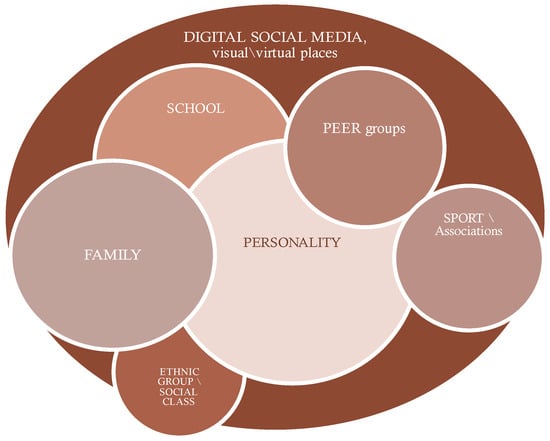
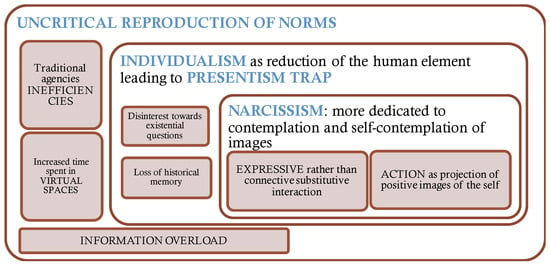
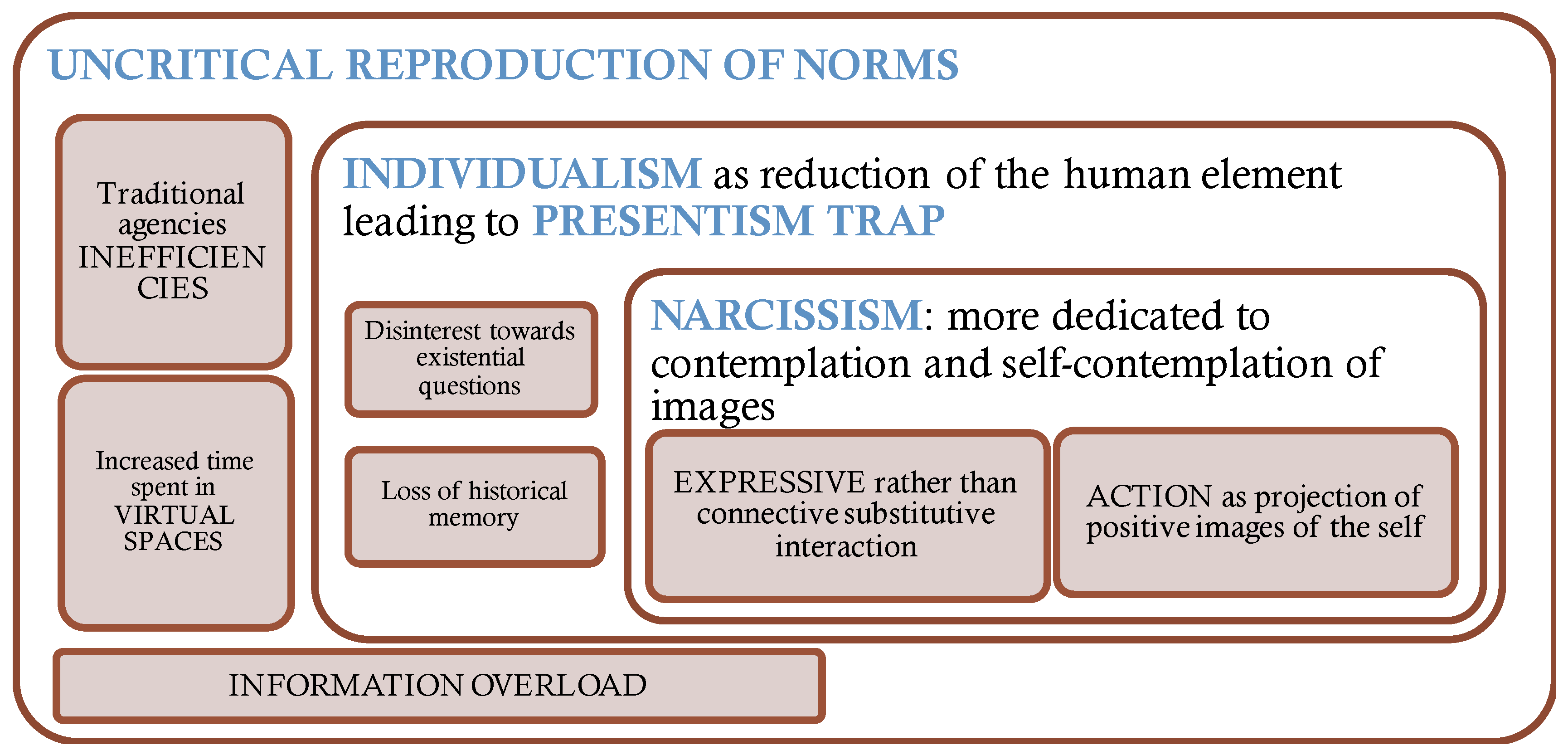

Disclaimer/Publisher’s Note: The statements, opinions and data contained in all publications are solely those of the individual author(s) and contributor(s) and not of MDPI and/or the editor(s). MDPI and/or the editor(s) disclaim responsibility for any injury to people or property resulting from any ideas, methods, instructions or products referred to in the content. |
© 2026 by the author. Licensee MDPI, Basel, Switzerland. This article is an open access article distributed under the terms and conditions of the Creative Commons Attribution (CC BY) license.