


Abstract
Artificial intelligence (AI) is becoming part of everyday work. Workers use it to prepare documents and evaluate information, while some may encounter it through systems that assign or assess their work. Research has examined productivity, organizational adoption, collaboration, and algorithmic management. These studies offer important evidence but tell us less about how workers experience AI as part of their daily work. In this conceptual paper, I apply occupational science to AI-mediated work. I argue that patterned and situated AI-related activity can be examined as occupation: it takes shape within workplace routines, can carry meaning for workers, and can affect their opportunities to participate. Drawing on occupational science and selected AI-at-work scholarship, I propose an analytic map with seven elements: human–AI actions, work integration, interpretive work, responsibility work, relational work, identity work, and boundary work. I consider how workplace conditions shape these elements and their consequences for workers. This perspective connects questions about AI at work with workers’ experience of what they do and what their contribution means.
1. Introduction: Why AI Use Needs an Occupational Science Lens
Artificial intelligence (AI) is increasingly embedded in contemporary work. Recent scholarship has examined AI at work through lenses such as productivity, automation, organizational performance, decision-making, governance, and psychosocial risk. For example, Brynjolfsson et al. [1] found that access to a generative AI conversational assistant increased customer support workers’ productivity on average, while also producing uneven effects across workers. Other scholars have argued that generative AI represents a qualitative shift from earlier predictive AI because of its broad applicability, conversational interface, and capacity to support creativity, learning, and innovation [2]. At the same time, AI-enabled work environments raise concerns about algorithmic control, surveillance, work intensification, reduced autonomy, job insecurity, technostress, and burnout [3,4].
Much of the AI-at-work literature is organized around questions of adoption, efficiency, productivity, and organizational performance. Aldossary et al. [5], for example, examined AI adoption in relation to perceived benefits, organizational agility, management commitment, and organizational performance. This work is valuable because it helps explain how organizations integrate AI and how AI-related perceptions may affect organizational outcomes. Adoption and performance frameworks can leave a more basic occupational science question underexamined: What do workers repeatedly do with or in response to AI, and what does that activity come to mean in their working lives?
AI use at work involves ongoing worker judgment. Workers decide when to consult AI, what information to provide, whether its responses are useful, and how much checking it requires. They may also have to disclose AI assistance or reject a recommendation. Repeated decisions of this kind can affect how workers understand their own competence and responsibility. A worker may welcome help with drafting yet worry that its use will raise expectations about how quickly the next report must be finished. Another may have little choice about an automated system that monitors performance. In either case, repeated encounters with AI can change how workers understand their competence and contribution.
Occupational science offers a useful but underrepresented lens for examining these developments. Occupational science is concerned with humans as occupational beings and with the ways people organize, experience, and give meaning to what they do in everyday contexts [6,7]. Occupation encompasses more than discrete task performance or paid employment. It is situated in culture, organized over time, and embedded in social life [8,9]. Scholarship also positions technology as a fundamental feature of occupation and human experience [10]. AI use can therefore be examined as part of how workers carry out their jobs, respond to expectations, communicate with others, and understand their own participation. From this perspective, AI forms a part of the activity through which work is carried out and experienced. Workers may use or respond to AI while completing tasks, navigating expectations, or communicating with others. These interactions can also affect how workers understand their own competence and contribution.
This argument parallels activity-centered ergonomics and work psychology. Béguin and Rabardel [11] distinguish an artifact from an instrument: people turn an artifact into an instrument by appropriating it within their activity. In doing so, they also change how they act and understand the work. People and technologies therefore develop in relation to one another. Several related concepts help explain parts of AI-mediated work. Job crafting describes how workers alter the tasks and relationships that make up their jobs [12]. Identity work addresses how people construct and maintain a sense of who they are at work [13]. Invisible work draws attention to labor that is necessary but goes unrecognized, such as checking and repairing an AI-generated output [14]. These concepts remain useful here. An occupational science perspective examines how such actions become part of a worker’s recurring way of doing a job, what that way of working means to the worker, and whether workplace conditions allow meaningful participation. It also connects a worker’s actions with the demands and opportunities that surround them. The seven elements below organize those questions, but are not intended to represent new ways of conceptualizing kinds of work.
Occupational science follows what people do over time and what that doing comes to mean within their lives and relationships. Occupational science scholarship on work is especially relevant to this argument because it has consistently challenged narrow understandings of work as merely paid employment or economic productivity. Harvey-Krefting [15] traced the historical centrality of work in occupational therapy and showed that work has been understood not only as employment but also as a therapeutic and meaning-laden form of occupation. Spencer et al. [16] found that people value work for immediate reasons including income, enjoyment, and recognition. Over time, work can also shape identity and foster a sense of contributing to something beyond oneself. More recent occupational science scholarship has continued to critique narrow and individualized understandings of work, emphasizing that work is shaped by sociopolitical conditions, occupational possibilities, structural expectations, and unequal access to meaningful participation [17]. Yekta’s study of immigrant platform workers, for example, examines occupational justice within platform-mediated work and shows that occupational science has already begun to address sociotechnical labor [18]. The present paper considers a broader range of AI-mediated work practices and proposes questions that can be examined across settings. I draw on these accounts of work because they connect workers’ everyday activity to their sense of contribution and to the conditions under which they can participate.
Understanding AI-mediated work as occupation also foregrounds identity, belonging, agency, and justice. Meaningful work can provide social recognition and a sense of contribution. Its absence or disruption can therefore affect well-being and self-understanding [19,20]. Occupational justice scholarship adds that opportunities for meaningful participation are shaped by social structures, institutional policies, power, and access to resources [21]. These concerns are directly relevant to AI-mediated work. AI may reduce administrative burden or make communication more accessible for some workers. However, workers who lack access, training, institutional permission, or tools responsive to their language and disability-related needs may be excluded from these benefits.
In this conceptual paper, I argue that recurring AI-related activity at work can be examined as occupation, including choosing to consult an AI tool as well as responding to or working around systems imposed by an organization. By AI-mediated work as occupation, I mean recurring, socially situated human–AI activity through which workers carry out and experience their work and to which they attach meaning. Meaning refers here to what an activity signifies to a worker; it does not imply that the activity is welcome or beneficial. This activity may involve interpreting AI–generated material, negotiating trust and responsibility, managing disclosure, and participating in workplace relationships. Workers may choose these ways of working or have them imposed and may experience them as helpful, harmful, or morally contested. This framing makes it possible to consider how AI use affects workers’ routines, identities, relationships, participation, and agency.
The purpose of this paper is to develop an occupational science perspective on AI-mediated work. I pursue three aims. First, I critique adoption and performance-oriented accounts of AI in work environments, arguing that these approaches insufficiently address the everyday ways workers incorporate or respond to AI. Second, I draw on occupational science to examine how repeated AI-related activity becomes part of workers’ routines and affects what they believe they contribute. Third, I propose key analytic dimensions for future research and workplace practice, with particular attention to occupational justice and the unequal conditions under which workers encounter AI.
Conceptual Approach and Scope
I use a theory-adaptation approach to apply occupational science concepts to AI-mediated work [22]. I selected literature purposively rather than through a systematic review. My knowledge of occupational science guided the selection of foundational and contemporary sources, supplemented by targeted searches for recent AI-at-work research. I included sources based on their conceptual relevance and their ability to clarify points of convergence or tension between the literatures.
I do not offer a comprehensive review of AI-at-work scholarship or theories of work. Instead, I bring selected areas of scholarship into conversation to clarify the potential contribution of occupational science. The analytic elements below provide a structure for inquiry and possible research questions; they are neither predictive nor empirically validated.
2. AI-Mediated Work: Dominant Perspectives and Their Limits
A central challenge in developing an occupational science perspective on AI-mediated work is that occupation carries different meanings across disciplines. In occupational health, organizational studies, and everyday language, it commonly refers to paid employment or a job category. Occupational science uses the term more broadly to describe situated forms of doing through which people organize daily life, participate in society, and develop identities [7,8]. I use both meanings deliberately. The discussion focuses on paid work and on recurring, socially situated human–AI activity through which workers carry out and experience their work and attach meaning. Meaning does not imply that workers value or welcome the activity. AI-related work may carry a sense of competence or possibility, but it may also signify pressure, loss of control, or a change in what the worker believes they contribute.
AI-at-work scholarship offers several important but sometimes competing accounts of the AI-mediated work experience. Adoption and organizational performance research generally treats AI as a resource whose benefits depend on how successfully it is incorporated into organizational processes. Aldossary et al. [5], for example, proposed that perceptions of AI’s usefulness help translate AI-related resources into organizational agility and performance. This perspective shows that organizational value is not produced by access to technology alone. Yet organizational performance is still its principal outcome, leaving less room to examine how workers live, interpret, and negotiate AI use in the flow of daily work.
Productivity research provides stronger evidence of task-level effects, although the findings are neither universal nor evenly distributed. Brynjolfsson et al. [1] found that an AI assistant increased customer-support productivity on average, with the greatest gains among less experienced workers. In an experimental study of professional writing tasks, Noy and Zhang [23] similarly found that generative AI reduced completion time and improved rated quality. These studies support claims that AI can improve some forms of performance, but they also show why average gains are an incomplete account. Effects vary by worker and task, and improved speed may alter expectations about pace, learning, and acceptable output. Measures of productivity do not by themselves reveal whether workers experience these changes as enabling, deskilling, reassuring, or disruptive.
A related tension concerns whether AI augments human work or gradually displaces parts of it. Raisch and Krakowski [24] argue that automation and augmentation are interdependent rather than opposing outcomes: systems intended to support workers may also shift expertise and decision authority away from them. Krakowski [2] presents generative AI as a broadly applicable cognitive artifact that may support exploration and learning. Wang et al. [25], however, found that the complexity of human–AI collaboration can create learning anxiety and weaken work engagement, although AI self-efficacy may buffer this effect. Zulu et al. [26] add another relevant perspective: digital creative professionals continued to value human judgment even as generative AI unsettled their understanding of competence and future roles. Together, these studies suggest that collaboration with AI is not a stable arrangement. Workers must continually determine what the system contributes, what workers must still know or decide, and what its use means for their professional standing.
The language of adoption and collaboration also fits poorly when workers encounter AI through systems they did not choose. Research on algorithmic management shows how digital systems direct, evaluate, and discipline workers [3]. Parent-Rocheleau and Parker [27] further explain that algorithmic management changes job design by redistributing decisions about work pace, scheduling, performance, and discretion. Here, AI may form part of the environment through which work is assigned and judged. Research on algorithmic management has brought power and worker resistance into the discussion. Occupational science can extend this work by examining how imposed systems enter daily routines and affect relationships, competence, and understandings of valued work. These questions are not limited to explicitly digital occupations. Workers may use generative AI to draft a report, translate a message, or prepare instructional material. They may also be subject to automated scheduling, routing, risk scores, or performance evaluation. Workers encounter AI differently across sectors. Occupational science can be used to examine how they incorporate or respond to it in everyday work and how those experiences affect their responsibilities.
When an employer requires an automated system, the system may be part of the worker’s environment rather than a tool the worker has chosen to use. Occupation lies in the worker’s activity under those conditions. A delivery worker, for example, receives a route and judges whether it fits what they know about local safety. If they depart from it, they may have to explain that decision or accept a lower score. In this situation, the map gives less emphasis to directing the system and more to interpretation, responsibility, and the worker’s ability to challenge a demand. Whether a worker can act on those judgments depends on the consequences of refusal or deviation.
Taken together, the literature does not support a simple contrast between beneficial and harmful AI in the work world. The same technology may operate as a resource and a means of control, improve performance while creating new demands, or extend agency while redistributing authority. Occupational science allows these tensions to be examined through workers’ lived experiences. Changes in routine, contextual judgment, and workplace relationships can affect meaning, identity, participation, and justice. This shift in emphasis provides the basis for examining AI-mediated work as occupation in the next section.
3. AI-Mediated Work as Occupation
Occupational science provides a conceptual foundation for this analysis because it distinguishes occupation from an isolated task or action. Occupations take form through engagement over time and in relation to particular roles, expectations, and contexts. Yerxa [7] described occupational science as the study of humans as occupational beings, emphasizing that occupation must be understood in relation to development, agency, culture, and time. From this perspective, prompting, checking, and responding to AI warrant attention when workers incorporate these actions into their routines and attach meaning to them within their lived work experiences.
Although developed for occupational therapy practice, the Occupational Therapy Practice Framework (4th ed.; OTPF-4) offers a useful distinction between activities considered in the abstract and occupations situated within a person’s life [28]. Prompting an AI system or revising its output may be described as an activity. An occupational science analysis helps us ask what happens when such activity becomes a regular part of a worker’s role. It considers how the worker exercises judgment and whether the activity changes their relationships or opportunities to participate. Context influences how workers incorporate and experience AI. Accordingly, I use AI-mediated work as occupation to refer to recurring, socially situated human–AI activity through which workers carry out and experience their work and to which they attach meaning. This definition draws on foundational occupational science accounts of occupation [7,8,9] and on Smith’s positioning of technology as embedded within occupation rather than external to it [10].
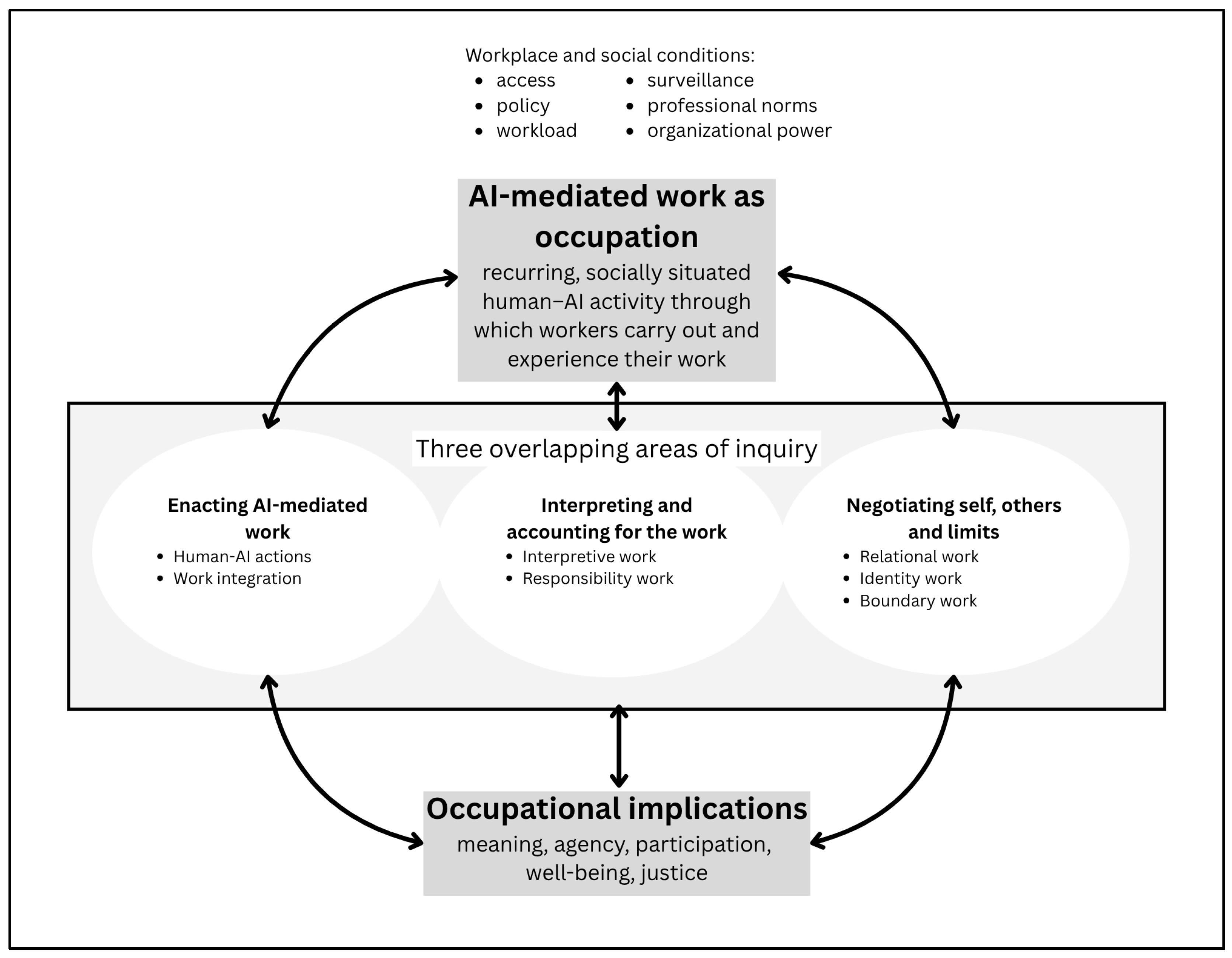
Not every brief encounter with AI is relevant to this analysis. A single automated suggestion may be a discrete event. The focus is on AI–related habits and routines that influence how workers understand their responsibilities, relationships, or contributions. Describing AI use in the workplace as occupation is not a moral endorsement. Such involvement may be useful or harmful, chosen or imposed, and sanctioned or hidden. Figure 1 presents the seven elements as three related areas of inquiry: enactment, interpretation and accountability, and negotiation of relationships, identity, and boundaries. The areas overlap and are shaped by workplace and social conditions. Table 1 provides a guiding question for each element.
Figure 1.
An analytic map of AI-mediated work informed by occupational science constructs. The seven analytic elements are grouped into three overlapping areas of inquiry and situated within the workplace and social conditions that shape AI use. The arrows represent reciprocal relationships rather than a causal sequence.
Table 1.
Analytic elements of AI-mediated work as occupation.
Human–AI actions are observable moments through which a worker engages with AI. A worker might ask a model to produce a first draft, compare its response with source information, revise its language, or reject its recommendation. Each action involves choices about timing, effort, and reliance. An isolated action reveals little about the worker’s broader experience. Analysis should therefore consider how AI-related actions fit into the worker’s routines and what meaning the worker attaches to them.
Work integration concerns how these actions settle into the flow of the workday. Some AI uses are highly visible, such as generating a report or image. Other uses become part of the background when workers routinely use AI to summarize messages, sort information, or route tasks. These ordinary and repeated changes may be more consequential than occasional high-profile uses because they gradually alter the pace, sequence, and expectations of work.
Interpretive work involves deciding whether AI-generated material fits the purpose and context of the work and can be trusted. This judgment is especially consequential when communication, care, education, or safety are involved. Zulu et al. [26], for example, found that digital creative professionals continued to regard human judgment as essential even as generative AI changed their routines and understanding of competence. Workers use their knowledge of the situation to decide what, if anything, to do with the output.
Responsibility work arises when AI-assisted output can affect another person or carry professional consequences. Workers may be held responsible for material they did not fully create and for recommendations whose internal logic they cannot fully inspect [3,26]. They must determine what requires verification, what should be disclosed, and when an output must be corrected or rejected. Organizational policy may clarify this responsibility or leave it ambiguous. Questions of responsibility include who has authority to act and who bears the consequences when something goes wrong.
Relational work concerns how AI use affects communication, trust, and expectations among people. AI-assisted communication may improve access or help a worker express an idea more clearly or efficiently. It may also make communication feel formulaic, obscure who exercised judgment, or create uncertainty about authenticity [2,3]. Colleagues may regard the same AI use as resourceful, lazy, deceptive, or innovative, while organizations may increasingly come to expect it. Maintaining trust may therefore require workers to negotiate emerging norms around acceptable AI-mediated work. Relational work is used here as a descriptive label for the effort involved in maintaining relationships and trust, but is not presented as a new theory.
Identity work concerns what workers believe they contribute when AI performs part of a task previously associated with human expertise. Some workers may experience AI as support that expands confidence or participation. Others may worry that their knowledge is being devalued or that opportunities to develop expertise are disappearing [25,26]. When organizations assign more tasks to AI systems, workers may question whether their expertise is still recognized. They may also wonder whether the changing role still reflects the kind of worker or professional they understand themselves to be.
Boundary work describes how workers negotiate the limits of acceptable AI use, including what may be delegated to AI and what requires human judgment. This use of the term draws on Gieryn’s account of boundary work and its later application to occupations and organizations [29,30]. A worker may accept AI for brainstorming while rejecting it for final writing or use it for administrative tasks but not for replacing professional judgment. These boundaries are not solely personal. They are shaped by workplace policy, professional standards, legal obligations, and expectations that may be unclear or internally inconsistent.
Workers may engage in boundary work when AI assistance supports their participation but conflicts with workplace policy. For example, a neurodivergent employee may use AI to reorganize dense written instructions into a sequence that is easier to follow, even though the employer prohibits unapproved tools. The employee must weigh the value of that support against privacy rules and the possibility that disclosure will be interpreted as a lack of competence. Over time, the employee may come to rely on this approach as part of their usual way of working, although questions about privacy, permission, and disclosure are unresolved.
The seven elements overlap rather than unfold as stages. Consider a multilingual community liaison who uses generative AI to draft messages for families in several languages. They use AI to generate a message and then revise it before sending. Repeating this process across outreach tasks makes it part of the regular workflow. The liaison must assess tone, accuracy, and cultural meaning and is ultimately responsible for what is sent. A translation that sounds polite in one language may seem overly direct or impersonal in another, with consequences for trust. Although the worker may find AI useful, repeated reliance on it may leave them wondering whether the organization still values their linguistic expertise. Choices about when to disclose AI assistance or rely on a human translator involve boundary work. Access to approved tools, organizational policy, and time for verification shape how the liaison carries out this work. What starts as a faster way to draft a message can become part of how the liaison works with families and answers for the quality of that communication. Differences in workers’ ability to choose, adapt, or refuse AI use bring questions of occupational justice into view.
4. Occupational Justice and the Unequal Conditions of AI-Mediated Work
Workplace and social conditions influence who can participate in AI-mediated work and on what terms. Occupational justice concerns people’s opportunities to engage in meaningful occupation and participate in decisions affecting their lives [21,31]. In AI-mediated workplaces, workers vary considerably in how much influence they have over whether and how these technologies are used.
Occupational injustice can take several forms. Occupational deprivation occurs when people are excluded from needed or meaningful occupations. Occupational marginalization arises when they have little choice or influence over how participation occurs. Occupational alienation describes activity experienced as empty, estranging, or disconnected from a sense of purpose. Occupational imbalance develops when the demands of one area of occupation crowd out other necessary parts of life [28,31,32,33,34,35]. Occupational apartheid refers to the systematic distribution of occupational restrictions across social groups [36]. Workers’ experiences of restriction must therefore be considered in relation to the institutional arrangements that help produce them.
AI-mediated work can reflect each of these patterns. A contract worker who is denied access to tools available to salaried colleagues may be excluded from tasks that increasingly assume AI support. A worker required to follow an automated schedule or performance score may retain little influence over the organization of the work. When AI displaces the judgment a worker considers central to their role, the work may feel less meaningful. If time saved through AI leads only to higher output expectations, work may increasingly displace reflection, recovery, or life outside employment. Workers’ experiences depend in part on how organizations introduce and govern AI.
Patterns of AI-mediated work must therefore be interpreted in context. Workers may use AI willingly, reluctantly, or secretly; others may comply because they have no realistic alternative. Table 2 summarizes five workplace conditions that can expand or restrict workers’ occupational possibilities.
Table 2.
Unequal conditions shaping AI-mediated work.
AI use and nonuse are shaped by workplace conditions. A delivery worker may depart from an automated route because local knowledge indicates a safety problem. The route system is a condition of the job; assessing the route and deciding whether a deviation is possible are parts of the worker’s ongoing activity. Another worker may follow an unsuitable route because deviations lower a performance score. Labels such as “enthusiastic” or “resistant” obscure the constrained choices in both cases. The relevant questions concern what options were genuinely available and what consequences followed from each choice.
Yekta’s research with immigrant platform workers offers an empirical point of comparison: platform rules and demands shape everyday doing, while workers also negotiate client relationships and their place within the work [18]. While the delivery-worker example above is illustrative, these findings show why researchers need to examine workers’ activity together with the conditions under which it occurs.
Workers face a different constraint when disclosure expectations are unclear. An organization may demand faster output while offering no clear guidance about acceptable AI assistance. A worker who quietly uses AI may be able to meet increasing productivity pressures, while also assuming risks related to privacy, accuracy, and trust. Employers can reduce this uncertainty by aligning workload expectations with approved uses, explaining when disclosure is required, and providing a nonpunitive route for raising concerns. Without those supports, organizations may benefit from AI-assisted productivity while leaving individual workers to manage the uncertainty and accept the consequences.
Workers experience the benefits of access differently. In a survey by Whistler et al. [37], blind and low-vision workers reported using AI image descriptions at work more often than sighted workers. For a worker who cannot otherwise access visual information in a document or interface, a description may make it possible to complete the task without waiting for someone else to explain it. One respondent described image descriptions as helpful to their workflow but said workplace restrictions on uploading information prevented them from using the tool for some tasks. Access to a tool therefore does not by itself ensure that a worker can use it within the rules governing their job. Workers and employers must also address what information can be shared and what accessible alternatives are available.
From an occupational justice perspective, researchers and workplace leaders should examine workers’ room to act and their influence over decisions about AI. When that influence is limited, workers may receive little recognition for the judgment and additional labor their work requires. Complex AI-related work and intensified expectations can also contribute to anxiety and burnout [4,25]. Identity disruption may follow when expertise central to a worker’s roles is devalued [26]. Workplaces can support more meaningful and dignified participation by enabling and empowering workers to raise concerns, influence how systems are used, and use viable alternatives when AI use is unsuitable. Section 5 develops these implications for research, workplace practice, and policy.
5. Implications for Research and Workplace Practice
Researchers and workplace leaders can use the analytic map to connect what workers do with AI to how those activities fit within their work and affect their participation. The map organizes inquiry rather than predicting outcomes, so I frame the research agenda as guiding questions rather than propositions.
5.1. Questions and Research Directions
How do workers incorporate AI into everyday work over time? Researchers could follow a particular use of AI, such as using it to prepare client communications, from initial experimentation through regular use, modification, or abandonment. Following workers over time could reveal how they develop verification habits, decide what to disclose, and respond when a system does not fit the task. Such research could also uncover unreported use, refusal, and informal adaptation that organizational measures of AI adoption may often miss.
How does AI-mediated work redistribute judgment, responsibility, and recognition? Research can trace decisions and consequences across the work process. If an AI-generated draft contains an error, for example, who is expected to identify it, who has authority to correct it, and who is held responsible? A related question concerns whether organizations acknowledge the additional work of checking and repairing AI output. Comparisons among workers with different levels of authority or employment security could show whether AI supports expertise, transfers it elsewhere, or makes some contributions harder to recognize.
Under what conditions does AI expand or restrict occupational possibilities? Studies could compare the use of similar technologies in workplaces that differ in worker autonomy, accessibility, organizational support, and exposure to monitoring. The same system may support participation where workers have time to evaluate its output and meaningful authority to reject it, yet create additional burdens where use is compulsory or difficult to question. Research should also examine how these conditions change as organizational expectations and workers’ routines develop over time.
These questions require evidence that captures both context and change. Workplace observation can reveal discrepancies between formal policy and the work people actually perform. Researchers could use interviews or diaries to uncover checking, workarounds, and disclosure decisions that workers may not report through formal organizational channels. Participatory research can also involve workers in determining which changes matter and how their consequences should be interpreted. Studies should include work in which people encounter AI through scheduling, routing, scoring, or surveillance, as well as work in which they choose to use generative AI.
5.2. Applications in Workplaces and Policy
Organizations can use the analytic map before introducing an AI system and throughout its use. Before implementation, workers and organizational leaders could examine how one actual workflow would change. The discussion should identify where human judgment is essential and who would be responsible for AI-assisted output. It should also address effects on workplace relationships and what workers would need to use the system safely or to decline its use. Participation in this review should extend beyond managers and enthusiastic early adopters to workers who are most likely to encounter barriers.
Pilot evaluations should account for the total work involved in producing an outcome. A drafting system, for example, may shorten initial production while adding time to verify facts or revise language that could damage trust. Evaluating the full process can show where time is actually saved and where new work has now appeared. Organizations can then adjust workload expectations, training, and workflow design to reflect what workers actually do.
Policies should give workers realistic guidance about approved uses, disclosure, and responsibility. Workers also need a safe way to report problems or challenge an AI-supported decision. When a system is inaccessible, unreliable, or inappropriate for a particular situation, workers should have access to a viable alternative. These provisions are especially important when AI affects scheduling, performance evaluation, access to work, or other conditions that workers cannot easily avoid.
Occupational scientists and occupational therapy practitioners can contribute expertise in observing work as it is actually performed and identifying changes in routines, environments, and participation. During an implementation review, for example, they might observe where workers interrupt a task to verify an output, seek assistance, or protect a relationship with a client or colleague. They can use those observations to revise workflow, training, or policy in ways that performance data alone may not suggest.
Policymakers and professional bodies can apply similar questions when developing procurement requirements, labor guidance, or professional standards. Provisions for worker input, accessible alternatives, and review of decisions based on automated scoring or scheduling would help protect participation and agency. Such protections become particularly important when workers have little choice about whether they interact with the system.
5.3. Scope and Limitations
The analytic map is a conceptual resource rather than an empirically validated or predictive framework. Its seven elements overlap, and they may not capture every aspect of AI-mediated work. The constructed examples illustrate possible applications but do not establish how frequently particular experiences occur or whether AI causes them. I selected literature purposively to bring relevant bodies of scholarship into conversation. The review was not systematic and may therefore have omitted other important work.
Activity-centered ergonomics and work psychology offer related accounts of how technologies are incorporated into human activity. Occupational science extends these accounts by helping us ask what technology-mediated activity means within workers’ everyday lives. We can also then ask who has the opportunity to do this work on acceptable terms and who bears its added demands. The present focus on paid work also represents only one part of the broader domain of occupation. Empirical research in different labor systems and cultural settings will be needed to determine where the analytic elements are useful, where they require refinement, and what the map may have overlooked.
6. Conclusions
AI is changing work through the ordinary decisions workers make about its use. Workers must decide whether an output can be trusted, how much correction it requires, and whether AI even belongs in a particular task. They may also have to explain or defend its use. When these decisions recur, they can alter routines, responsibilities, relationships, and workers’ understanding of what they contribute.
I have used AI-mediated work as occupation to refer to recurring, socially situated human–AI activity through which workers carry out and experience their work and to which they attach meaning. Researchers can use the analytic map to examine how workers’ actions relate to their interpretations, relationships, and surrounding conditions. The consequences cannot be assumed in advance. Workers may gain opportunities in one workplace and face restrictions in another because they differ in access, authority, and freedom to refuse.
An occupational science analysis begins with workers’ lived experience and connects technology use with meaning, identity, participation, and justice. These connections matter because an organization may benefit from AI while workers absorb additional verification tasks, lose discretion, or receive less recognition for their expertise. By studying the recurring and often unnoticed ways workers encounter AI, scholars and workplace leaders can better evaluate whether technological change supports workers’ agency, recognizes their contributions, and allows them to participate in meaningful ways.
Funding
This research received no external funding.
Institutional Review Board Statement
Not applicable.
Informed Consent Statement
Not applicable.
Data Availability Statement
No new data were created or analyzed in this study. Data sharing is not applicable to this article.
Acknowledgments
During preparation of this manuscript, the author used generative AI to support organization and language refinement, but all ideas are their own. This process required the same boundary and responsibility judgments discussed in the article, including decisions about when AI assistance was appropriate and what required independent review. The author reviewed and edited all AI-assisted text and takes full responsibility for the manuscript’s content.
Conflicts of Interest
The author declares no conflicts of interest.
References
- Brynjolfsson, E.; Li, D.; Raymond, L. Generative AI at work. Q. J. Econ. 2025, 140, 889–942. [Google Scholar] [CrossRef] [Scilit]
- Krakowski, S. Human-AI agency in the age of generative AI. Inf. Organ. 2025, 35, 100560. [Google Scholar] [CrossRef] [Scilit]
- Kellogg, K.C.; Valentine, M.A.; Christin, A. Algorithms at work: The new contested terrain of control. Acad. Manag. Ann. 2020, 14, 366–410. [Google Scholar] [CrossRef] [Scilit]
- Rabasa-Martín, Ó.; Martínez-Jarreta, B. Impact of artificial intelligence and work digitalization on mental health and occupational well-being: A scoping review. Front. Public Health 2026, 14, 1857108. [Google Scholar] [CrossRef] [Scilit]
- Aldossary, M.A.; Ayad, T.H.; Moustafa, M.A. Artificial intelligence adoption and organizational performance: The role of organizational agility and management commitment in AI-enabled work environments. Societies 2026, 16, 138. [Google Scholar] [CrossRef] [Scilit]
- Clark, F.; Parham, D.; Carlson, M.E.; Frank, G.; Jackson, J.; Pierce, D.; Wolfe, R.J.; Zemke, R. Occupational science: Academic innovation in the service of occupational therapy’s future. Am. J. Occup. Ther. 1991, 45, 300–310. [Google Scholar] [CrossRef] [Scilit]
- Yerxa, E.J. Occupational science: A renaissance of service to humankind through knowledge. Occup. Ther. Int. 2000, 7, 87–98. [Google Scholar] [CrossRef] [Scilit]
- Christiansen, C.H.; Townsend, E.A. An introduction to occupation. In Introduction to Occupation: The Art and Science of Living, 2nd ed.; Christiansen, C.H., Townsens, E.A., Eds.; Pearson: Upper Saddle River, NJ, USA, 2010; pp. 1–34. [Google Scholar]
- Pierce, D.E. Occupational science: A powerful disciplinary knowledge base for occupational therapy. In Occupational Science for Occupational Therapy; Pierce, D.E., Ed.; SLACK Incorporated: Thorofare, NJ, USA, 2014; pp. 1–10. [Google Scholar]
- Smith, R.O. Technology and occupation: Past, present, and the next 100 years of theory and practice. Am. J. Occup. Ther. 2017, 71, 7106150010. [Google Scholar] [CrossRef] [Scilit]
- Béguin, P.; Rabardel, P. Designing for instrument-mediated activity. Scand. J. Inf. Syst. 2000, 12, 173–190. [Google Scholar]
- Wrzesniewski, A.; Dutton, J.E. Crafting a job: Revisioning employees as active crafters of their work. Acad. Manag. Rev. 2001, 26, 179–201. [Google Scholar] [CrossRef] [Scilit]
- Sveningsson, S.; Alvesson, M. Managing managerial identities: Organizational fragmentation, discourse and identity struggle. Hum. Relat. 2003, 56, 1163–1193. [Google Scholar] [CrossRef] [Scilit]
- Star, S.L.; Strauss, A. Layers of silence, arenas of voice: The ecology of visible and invisible work. Comput. Support. Coop. Work 1999, 8, 9–30. [Google Scholar] [CrossRef] [Scilit]
- Harvey-Krefting, L. The concept of work in occupational therapy: A historical review. Am. J. Occup. Ther. 1985, 39, 301–307. [Google Scholar] [CrossRef] [Scilit]
- Spencer, J.; Daybell, P.J.; Eschenfelder, V.; Khalaf, R.; Pike, J.M.; Woods-Petitti, M. Contrasting perspectives on work: An exploratory qualitative study based on the concept of adaptation. Am. J. Occup. Ther. 1998, 52, 474–485. [Google Scholar] [CrossRef] [Scilit]
- Asaba, E.; Aldrich, R.M.; Gabrielsson, H.; Ekstam, L.; Farias, L. Challenging conceptualisations of work: Revisiting contemporary experiences of return to work and unemployment. J. Occup. Sci. 2021, 28, 81–94. [Google Scholar] [CrossRef] [Scilit]
- Yekta, A.R. Occupational justice in sociotechnical contexts: Exploring immigrant platform workers’ experiences of doing, being, becoming, and belonging. J. Occup. Sci. 2026, 33, 624–643. [Google Scholar] [CrossRef] [Scilit]
- Blank, A.A.; Harries, P.; Reynolds, F. “Without occupation you don’t exist”: Occupational engagement and mental illness. J. Occup. Sci. 2015, 22, 197–209. [Google Scholar] [CrossRef] [Scilit]
- Lintner, C.; Elsen, S. Getting out of the seclusion trap? Work as meaningful occupation for the subjective well-being of asylum seekers in South Tyrol, Italy. J. Occup. Sci. 2018, 25, 76–86. [Google Scholar] [CrossRef] [Scilit]
- Hocking, C. Occupational justice as social justice: The moral claim for inclusion. J. Occup. Sci. 2017, 24, 29–42. [Google Scholar] [CrossRef] [Scilit]
- Jaakkola, E. Designing conceptual articles: Four approaches. AMS Rev. 2020, 10, 18–26. [Google Scholar] [CrossRef] [Scilit]
- Noy, S.; Zhang, W. Experimental evidence on the productivity effects of generative artificial intelligence. Science 2023, 381, 187–192. [Google Scholar] [CrossRef] [Scilit]
- Raisch, S.; Krakowski, S. Artificial intelligence and management: The automation–augmentation paradox. Acad. Manag. Rev. 2021, 46, 192–210. [Google Scholar] [CrossRef] [Scilit]
- Wang, B.; Liu, S.; Luo, C. How does human-AI collaboration task complexity affect employee work engagement? The roles of humble leadership and AI self-efficacy. Front. Psychol. 2026, 17, 1767967. [Google Scholar] [CrossRef] [Scilit]
- Zulu, N.C.; Åkesson, M.; Thomsen, M. What does generative AI mean for my professional competence? Insights into the perspectives of digital creative professionals. Interact. Comput. 2026, iwaf056. [Google Scholar] [CrossRef]
- Parent-Rocheleau, X.; Parker, S.K. Algorithms as work designers: How algorithmic management influences the design of jobs. Hum. Resour. Manag. Rev. 2022, 32, 100838. [Google Scholar] [CrossRef] [Scilit]
- American Occupational Therapy Association. Occupational therapy practice framework: Domain and process (4th ed.). Am. J. Occup. Ther. 2020, 74, 7412410010. [Google Scholar] [CrossRef] [Scilit]
- Gieryn, T.F. Boundary-work and the demarcation of science from non-science: Strains and interests in professional ideologies of scientists. Am. Sociol. Rev. 1983, 48, 781–795. [Google Scholar] [CrossRef] [Scilit]
- Langley, A.; Lindberg, K.; Mørk, B.E.; Nicolini, D.; Raviola, E.; Walter, L. Boundary work among groups, occupations, and organizations: From cartography to process. Acad. Manag. Ann. 2019, 13, 704–736. [Google Scholar] [CrossRef] [Scilit]
- Townsend, E.; Wilcock, A.A. Occupational justice and client-centred practice: A dialogue in progress. Can. J. Occup. Ther. 2004, 71, 75–87. [Google Scholar] [CrossRef] [Scilit]
- Wilcock, A.A.; Townsend, E.A. Occupational justice: Occupational terminology interactive dialogue. J. Occup. Sci. 2000, 7, 84–86. [Google Scholar] [CrossRef] [Scilit]
- Durocher, E.; Gibson, B.E.; Rappolt, S. Occupational justice: A conceptual review. J. Occup. Sci. 2014, 21, 418–430. [Google Scholar] [CrossRef] [Scilit]
- Kinsella, E.A.; Durocher, E. Occupational justice: Moral imagination, critical reflection, and political praxis. OTJR Occup. Particip. Health 2016, 36, 163–166. [Google Scholar] [CrossRef] [Scilit]
- Whiteford, G. Occupational deprivation: Global challenge in the new millennium. Br. J. Occup. Ther. 2000, 63, 200–204. [Google Scholar] [CrossRef] [Scilit]
- Kronenberg, F.; Pollard, N. Overcoming occupational apartheid: A preliminary exploration of the political nature of occupational therapy. In Occupational Therapy Without Borders: Learning from the Spirit of Survivors; Kronenberg, F., Simó Algado, S., Pollard, N., Eds.; Elsevier Churchill Livingstone: Edinburgh, UK, 2005; pp. 58–86. [Google Scholar]
- Whistler, A.L.; Baguhn, S.J.; Hanuschock, W.E.; Hashimoto, M.; Khan, O. New Doors, New Locks: AI and the Daily Lives of Blind and Low-Vision People; American Foundation for the Blind: Arlington, VA, USA, 2026. [Google Scholar]

Disclaimer/Publisher’s Note: The statements, opinions and data contained in all publications are solely those of the individual author(s) and contributor(s) and not of MDPI and/or the editor(s). MDPI and/or the editor(s) disclaim responsibility for any injury to people or property resulting from any ideas, methods, instructions or products referred to in the content. |
© 2026 by the author. Licensee MDPI, Basel, Switzerland. This article is an open access article distributed under the terms and conditions of the Creative Commons Attribution (CC BY) license.